Anthropic Doubles Claude Code Limits, Expands SpaceX Data Center Pact
Claude
The exponential growth of frontier model intelligence requires developers to design software architectures for proactive, always-on autonomous systems rather than current linear AI capabilities.
## Background
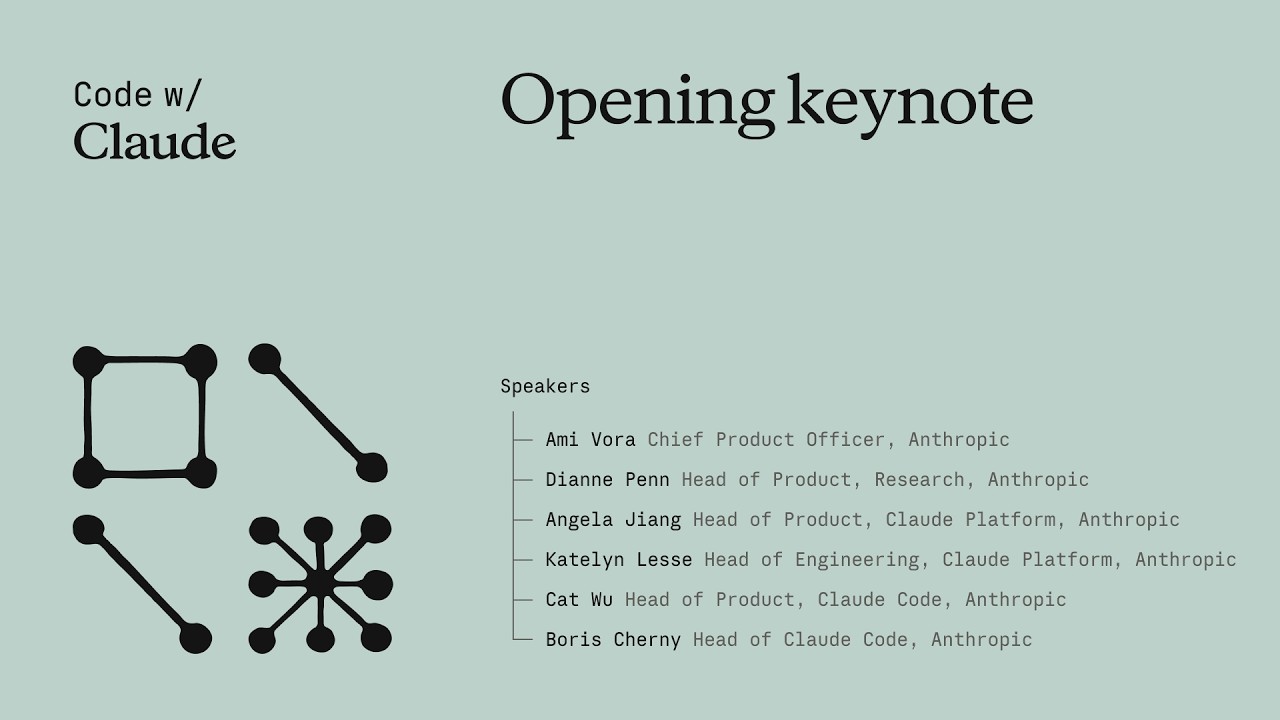
Published on YouTube by the Claude channel on May 6, 2026, this opening keynote covers the latest updates from Anthropic's engineering and product leaders. According to the page description, the event took place in San Francisco and showcases the newest advancements in AI development for their platform.
## TL;DR
The keynote outlines Anthropic's transition from linear AI adoption to exponential developer capabilities, driven by substantial rate limit increases for Claude Code and the Claude Platform API. Product leaders introduce 'task horizon' metrics alongside new features for Claude Managed Agents, including multi-agent orchestration, explicit success outcomes, and an autonomous self-learning capability called 'dreaming.' The presentation culminates in the live demonstration of Claude Code's newest workflow automations, desktop interface, and asynchronous 'routines' designed to handle complex development tasks, continuous integration autofixes, and enterprise-scale software modernization.
## Atmosphere & style
The presentation carries an optimistic, forward-looking energy that blends high-tech corporate excitement with deeply human, reflective storytelling. It begins with an authentic, nostalgic trip down memory lane that contrasts the sensory realities of early computer labs with today's ubiquitous AI power, grounding the technical leaps in real-world human impact. As the technical deep-dives and live drone-landing simulations unfold, the atmosphere shifts into an engaging, collaborative journey into unexplored territory, leaving the audience feeling inspired by the immediate, practical reality of autonomous software agents.
## Key takeaways
- [00:00](https://www.youtube.com/watch?v=GMIWm5y90xA&t=0s) Anthropic Chief Product Officer Amivora highlights how modern, accessible AI computing power provides developers with 'superpowers' that drive immense real-world efficiency gains, such as Stripe accelerating a 10-week migration into just four days.
- [00:00](https://www.youtube.com/watch?v=GMIWm5y90xA&t=0s) Binti successfully utilized the Claude API to automate foster care administrative documentation, shortening the family licensing process by 20 days and showing the human impact of AI efficiency.
- [05:00](https://www.youtube.com/watch?v=GMIWm5y90xA&t=300s) The rapid, exponential development of Anthropic's AI models has evolved from simple email writing to advanced agentic systems like Mythos, which autonomously discovered a 27-year-old vulnerability in the OpenBSD source tree.
- [05:00](https://www.youtube.com/watch?v=GMIWm5y90xA&t=300s) To support the massive 17x year-over-year surge in API volume and intensive developer usage of Claude Code, Anthropic is doubling rate limits across premium plans and boosting Claude Opus API limits.
- [05:00](https://www.youtube.com/watch?v=GMIWm5y90xA&t=300s) Anthropic's expanded compute partnership with SpaceX leverages the full capacity of the Colossus One data center to power increased rate limits directly for individual developers and small teams.
- [10:00](https://www.youtube.com/watch?v=GMIWm5y90xA&t=600s) The latest model, Opus 4.7, delivers real-world performance gains and intuitive execution, enabling companies like Rakuten to resolve three times the number of production engineering tasks compared to previous versions.
- [10:00](https://www.youtube.com/watch?v=GMIWm5y90xA&t=600s) Anthropic introduces the concept of 'task horizon'—the duration an AI can operate autonomously—advising developers to design for future proactive, always-on models by building ambitious prototypes and hard evaluation suites today.
- [20:00](https://www.youtube.com/watch?v=GMIWm5y90xA&t=1200s) The 'advisor strategy' architecture addresses the tension between high AI intelligence and high costs by pairing cheaper execution models with a larger model like Opus for higher-order guidance.
- [20:00](https://www.youtube.com/watch?v=GMIWm5y90xA&t=1200s) Eve Legal adopted the advisor strategy to achieve frontier-model quality at a five-fold cost reduction, demonstrating its feasibility for high-volume workloads and freemium business models.
- [20:00](https://www.youtube.com/watch?v=GMIWm5y90xA&t=1200s) Claude Managed Agents provide an agentic harness and production-grade infrastructure that bundles features like automatically tuned, portable memory, enabling teams like Notion to ship up to 10 times faster.
- [25:00](https://www.youtube.com/watch?v=GMIWm5y90xA&t=1500s) Anthropic announced three major features for Claude Managed Agents: multi-agent orchestration for complex tasks, outcomes for defining success criteria, and dreaming for autonomous agent self-learning.
- [26:15](https://www.youtube.com/watch?v=GMIWm5y90xA&t=1575s) Multi-agent orchestration improves performance and prevents context clutter by running independent threads for coordinated sub-agents, as demonstrated in the Lumara drone-landing simulation.
- [27:30](https://www.youtube.com/watch?v=GMIWm5y90xA&t=1650s) The new outcomes feature provisions an independent 'grader agent' to iteratively evaluate and self-correct performance against an explicit success rubric across multiple sessions.
- [28:45](https://www.youtube.com/watch?v=GMIWm5y90xA&t=1725s) The dreaming feature enables agents to autonomously analyze previous failures and update memory stores with generated heuristics, successfully increasing Lumara's simulation success from 4 to 6 sites.
- [33:00](https://www.youtube.com/watch?v=GMIWm5y90xA&t=1980s) Claude Code has shifted from requiring constant permission prompts to an 'auto mode' where developers delegate permissions and primarily focus on reviewing final pull requests.
- [33:00](https://www.youtube.com/watch?v=GMIWm5y90xA&t=1980s) Claude Code expands into three primary developer interfaces: a minimal CLI for power users, an IDE integration for real-time tracking, and Claude Code on Desktop featuring full-screen app previews and a sidebar control plane.
- [35:00](https://www.youtube.com/watch?v=GMIWm5y90xA&t=2100s) New workflow automation features in Claude Code—including Code Review, Remote Control, Autofix, Routines, and Claude Security—aim to eliminate tedious developer tasks like fixing flaky tests and manual security scanning.
- [37:30](https://www.youtube.com/watch?v=GMIWm5y90xA&t=2250s) Shopify has deployed Claude Code company-wide across engineering, design, product, and data science to transform internal tool development.
- [37:30](https://www.youtube.com/watch?v=GMIWm5y90xA&t=2250s) MercadoLibre deployed Claude Code to all 23,000 engineers, modernizing over 9,000 apps, reviewing 500,000+ pull requests, and aiming for a 90% autonomous coding loop by Q3.
- [42:30](https://www.youtube.com/watch?v=GMIWm5y90xA&t=2550s) The future of software engineering centers on asynchronous, routine-driven development where higher-order prompts autonomously manage engineering tasks, parallel sessions, and continuous integration fixes.
## Detailed walkthrough
### [00:00](https://www.youtube.com/watch?v=GMIWm5y90xA&t=0s) The Appalachian Roots of a Chief Product Officer and the Power of Claude
Amivora, the Chief Product Officer of Anthropic, opens her keynote by reflecting on her personal journey into technology. Growing up in the foothills of the Appalachians, she did not build computers or play video games. Her first encounter with complex coding occurred in college computer science classes, where students had to wait in line to log directly into powerful servers just to run ray tracers. She vividly recalls the sensory details of that era: "the hum of servers, the smell of old pizza, coffee, and that very specific aroma of a windowless basement computer lab." The thrill of hitting compile and waiting to see if a program worked hooked her on the joy of creation. Today, that same computing power is available to anyone, anywhere, without the lines or the weird smells.
Amivora shares how users frequently tell her, "I feel like Claude has given me superpowers." This capability is driving massive real-world impact across industries:
* **Stripe:** Scott McVicker, who runs developer infrastructure, tasked a team with converting 50,000 lines of Scala to Java for a JDK upgrade. Originally estimated to take 10 engineering weeks, the team completed the project in just four days using Claude.
* **Binti:** Led by co-founder and CEO Felicia Krakuru, Binti provides software for foster care caseworkers. By integrating the Claude API to automate paperwork, home visits, and licensing documentation, they shaved 20 days off the foster family licensing process. As Amivora notes, "20 days. It's not just an efficiency metric. That's a kid connecting with a family."
[05:00](https://www.youtube.com/watch?v=GMIWm5y90xA&t=300s) The Exponential Pace of AI and New Developer Rate Limits
Amivora addresses the rapid, exponential pace of model development at Anthropic. A couple of years ago, the frontier was a model that could write a decent email. One year ago, Opus 4 was introduced, and running an agent for an hour without human intervention was a stretch goal. Six months ago, agents were running end-to-end overnight. Most recently, Mythos read the entire OpenBSD source tree and discovered a 27-year-old vulnerability that had evaded every human reviewer, fuzzer, and static analyzer for nearly three decades.
Despite this exponential growth, many organizations still adopt AI on a linear path. Developers are bridging this gap, as evidenced by a 17x year-over-year increase in API volume on the Claude platform, and developers spending an average of 20 hours per week using Claude Code. While there is no new model to unveil today, Anthropic is rolling out major product updates to help developers close this gap:
* **Claude Code Rate Limits:** Anthropic is doubling the five-hour rate limits for Pro, Max, Team, and seat-based Enterprise plans.
* **Claude Platform API Limits:** API limits are being raised considerably for Claude Opus.
* **Compute Partnership:** These limit increases are powered by an expanded partnership with SpaceX to utilize the full capacity of their Colossus One data center, directing this compute power to individual developers and small teams.
[10:00](https://www.youtube.com/watch?v=GMIWm5y90xA&t=600s) The Evolution of Claude Models and the Concept of "Task Horizon"
Diane, leader of the Research Product Management team, takes the stage to trace the evolution of Claude since she joined Anthropic in 2023. She has helped bring 18 versions of Claude to market across the Haiku, Sonnet, Opus, and Mythos lines. She details the specific engineering challenges of past models: Opus 3 was optimized for JSON adherence and long-form code; Sonnet 3.5 (originally Sonnet 3 Mu) taught Claude to use computers safely; and Sonnet 3.7 required fine-tuning to manage its "slightly too over-eager" tendencies.
Diane explains that at Anthropic, the exponential curve means that as model intelligence increases, the addressable use cases grow exponentially—such as moving from simple code autocomplete to fully agentic coding. She highlights the real-world performance of their latest model, Opus 4.7:
* **AMP:** The coding agent moved its entire "smart mode" to Opus 4.7 because it scored the highest on their benchmarks, allowing them to simplify their scaffolding.
* **Rakuten:** Resolved three times the number of production engineering tasks compared to previous models.
* **Intuitive Execution:** Opus 4.7 demonstrated the ability to identify its own logical faults during planning, backtrack, and resolve them for cleaner execution.
Diane introduces the concept of "task horizon"—the measure of how long a model can work autonomously on a task. A year ago, models worked for minutes; today, agents run for hours; tomorrow, they will be proactive, always-on systems. She advises developers to "design for the next version of Claude, not just the current one" by maintaining hard evaluation suites and building ambitious prototypes that might fail today but will succeed as the underlying intelligence jumps.
[20:00](https://www.youtube.com/watch?v=GMIWm5y90xA&t=1200s) Bridging the Gap: The Advisor Strategy and Claude Managed Agents
The presentation transitions to a discussion of the practical challenges businesses face when adopting AI: achieving the right outcomes without excessive prompt engineering, and shipping scalably at high speed. To address the tension between high intelligence and high cost, Anthropic introduces the "advisor strategy." This architecture splits execution from advising: a smaller, cheaper model (like Haiku or Sonnet) handles the execution, but calls upon a larger model (like Opus) for guidance when it needs advice on what to do next.
* **Cost Efficiency:** When running Sonnet with Opus advising, Sonnet performed significantly better and more cheaply than Sonnet alone because the advisor model streamlined the execution path.
* **Eve Legal:** Used the advisor strategy to achieve frontier-model quality at a five-fold reduction in cost, making it ideal for high-volume workloads and freemium business models.
To solve the speed and scalability challenge, Anthropic highlights Claude Managed Agents, an agentic harness paired with production-grade infrastructure. This system allows teams to move from prototype to production in days rather than weeks, with partner teams shipping up to 10 times faster. Managed Agents bundle best practices out of the box, such as automatically tuned memory that persists user preferences across sessions (which remains fully portable for the developer). Notion utilized Claude Managed Agents to allow users to launch autonomous, long-running Claude agents directly within the Notion product experience.
[25:00](https://www.youtube.com/watch?v=GMIWm5y90xA&t=1500s) Upgrading Claude Managed Agents
The presentation kicks off with the announcement of three powerful new features designed to upgrade Claude Managed Agents: multi-agent orchestration, outcomes, and dreaming. Multi-agent orchestration allows developers to build "fleets of agents to solve really complex tasks," while the outcomes feature lets users specify exactly what success looks like so that Claude can "literally just iterate until it gets it done." The most exciting addition, however, is dreaming. Through dreaming, Claude is capable of self-learning by inspecting its previous sessions, identifying missed skills or lessons, and applying those learnings directly to its own memory.
To demonstrate these features live, the presenters introduce a fictional startup called Lumara, inspired by recent API rate limit increases for Opus and their time spent hanging out with a space company. Lumara's mission is to build agentic software that autonomously lands drones on the moon to mine hypothetical materials for their first customer. Because the founders are not actual aerospace engineers, they rely on Claude Managed Agents to handle the complex engineering work.
- **Multi-agent orchestration:** Enables fleets of coordinated agents to tackle complex tasks.
- **Outcomes:** Allows explicit definition of success criteria for iterative execution.
- **Dreaming:** Empowers agents to self-learn and update their own memory stores by analyzing past sessions.
[26:15](https://www.youtube.com/watch?v=GMIWm5y90xA&t=1575s) The Lumara Demo: Multi-Agent Orchestration
Using the Claude API CLI, the presenters show how they set up a multi-agent system for Lumara. The architecture consists of three distinct agents: a commander agent, a detector agent, and a navigator agent. The commander's job is to oversee the entire mission and ensure everything goes well. The detector agent is tasked with finding high-quality mining materials at potential landing sites, while the navigator agent ensures the drones fly and land safely.
The commander agent is configured as the coordinator of the other two. When the system runs, the commander spins up a session, and each sub-agent operates in its own independent thread with its own context window. This intentional design choice prevents context clutter and ensures significantly better performance when merging the final results.
[27:30](https://www.youtube.com/watch?v=GMIWm5y90xA&t=1650s) Defining Success with Outcomes
To ensure the drones meet the customer's strict requirements, the presenters integrate the new outcomes feature. Outcomes are defined using a simple markdown file that outlines the exact criteria for a successful run. For Lumara, the criteria require that the drones touch down softly, land on clear ground, and maintain enough fuel in reserve to safely return to Earth.
Once this rubric is sent to the session, Claude provisions a separate "grader agent." This grader evaluates the session's performance against the specified rubric. Because complex tasks are rarely solved on the first try, the system allows developers to specify a maximum number of iterations, letting the agent continuously iterate and self-correct across multiple sessions until it achieves the desired outcome.
[28:45](https://www.youtube.com/watch?v=GMIWm5y90xA&t=1725s) Hill Climbing with Dreaming
The presenters test their system against data from six hypothetical landing sites. In the initial simulation run, the multi-agent system successfully lands drones on four out of the six sites, failing on sites three and four. To improve these results without undergoing a tedious manual engineering process, they turn to the dreaming interface in the Claude Developer Console.
By clicking the "Dream" button and selecting a memory store, a dreaming agent analyzes the past simulation sessions and writes its learnings to memory. Overnight, the agent autonomously generates a robust "descent playbook" filled with heuristics from its previous runs. When a new simulation is run the next morning, the upgraded system successfully resolves all six sites without regressing on any of the previously successful ones. "All we had to do was just have Caitlin press a button in the console called Dream."
- **Initial Simulation Success:** 4 out of 6 sites successfully resolved.
- **Post-Dreaming Success:** 6 out of 6 sites successfully resolved.
- **Descent Playbook:** A robust set of heuristics generated autonomously by the dreaming agent.
[31:15](https://www.youtube.com/watch?v=GMIWm5y90xA&t=1875s) Introducing Claude Code
The presentation transitions to Kat and Boris, who introduce Claude Code. They frame their mission as closing the gap between frontier model capabilities and what developers can actually build and ship. Kat thanks the developer community for trusting Claude Code on production databases even back when Sonnet 3 was the frontier model and the product was "a bit rough around the edges."
Kat describes the journey of developing Claude Code alongside the community using a mountaineering metaphor: "It's kind of like climbing alongside you into terrain that none of us have explored before, learning together what works as we go." The goal is to continuously adapt to increasing AI capabilities and navigate new software engineering challenges together.
[33:00](https://www.youtube.com/watch?v=GMIWm5y90xA&t=1980s) The Evolution of Claude Code Interfaces
Kat reflects on how much the developer experience has changed over the past year. In the early days, using Claude Code required constant hand-holding, with developers carefully reviewing every single edit and responding to "a hundred two hundred permission prompts" before getting a final result. Today, most developers run Claude in "auto mode," delegating permissions and simply reviewing the final pull request (PR).
Claude Code has expanded across three primary interfaces to suit different developer preferences:
- **The CLI:** A minimal text interface built for power users who want maximum control and customization.
- **The IDE Integration:** Designed for developers who want to use powerful agents while actively following along with real-time code changes.
- **Claude Code on Desktop:** The newest full-screen graphical interface featuring a built-in preview to watch apps develop, a sidebar control plane for agents, and rich visual outputs.
[35:00](https://www.youtube.com/watch?v=GMIWm5y90xA&t=2100s) Automating the Developer Workflow
To address feedback from the developer community, the Claude Code team has built several highly requested automation features. These tools are designed to eliminate the tedious aspects of software development, such as babysitting PRs, fixing flaky tests, and managing security reviews.
The newly introduced workflow features include:
- **Code Review:** Deploys a team of agents to catch critical bugs on the developer's behalf.
- **Remote Control:** Integrates Claude Code into the iOS and Android Claude apps, allowing developers to fire off tasks from anywhere. "You can now go to a park, touch grass, and still code."
- **Autofix:** Proactively listens to CI events to fix flaky tests, address code review comments, and resolve merge conflicts automatically.
- **Routines:** Allows developers to configure Claude Code to trigger automatically based on webhooks, API events, or schedules.
- **Claude Security:** Scans codebases overnight and automatically kicks off Claude Code to patch discovered vulnerabilities.
[37:30](https://www.youtube.com/watch?v=GMIWm5y90xA&t=2250s) Enterprise Scale: Shopify and MercadoLibre
The impact of these tools is highlighted through real-world enterprise adoptions. Shopify has integrated Claude Code across its entire organization, including non-engineering teams like design, product, and data science. Andrew McNamara, Shopify's Director of Applied AI, notes that "the speed is just crazy" and that the tool has completely transformed how they build internal tools.
MercadoLibre has deployed Claude Code to all 23,000 of its engineers. This widespread adoption has shifted the nature of their work, allowing engineers to point agents at long-neglected tech debt. The system has reviewed over 500,000 PRs with human oversight and modernized more than 9,000 apps. Oscar Mullen, MercadoLibre's technology leader, is aiming for 90% autonomous coding and a fully agent-driven PR loop by Q3 of the year. Kat notes that this shift is even putting coding back into the hands of managers and VPs who have spent decades focused solely on roadmaps and reviews.
- **Shopify:** Uses Claude Code company-wide across engineering, design, product, and data science.
- **MercadoLibre:** 23,000 engineers using the tool; 500,000+ PRs reviewed and 9,000+ apps modernized.
[40:00](https://www.youtube.com/watch?v=GMIWm5y90xA&t=2400s) Live Demo: AcmePay and Parallel Sessions
Boris takes the stage to demonstrate Claude Code in action, starting with a quick onstage selfie. He walks through a scenario where an engineer at a payments infrastructure company called AcmePay is tasked with adding refunds to a merchant dashboard. Using the Claude desktop app, Claude writes a full implementation featuring idempotency, multi-currency handling, and audit logging.
During verification, Claude spins up the dashboard, triggers a refund, and notices a missing success toast. Identifying a race condition in the optimistic update, Claude autonomously traces the failure, applies a fix, and verifies that it works in the browser before marking the task as complete. Boris zooms out to show that this session is running in parallel with many others, allowing developers to manage multiple asynchronous coding tasks from a single control plane.
[42:30](https://www.youtube.com/watch?v=GMIWm5y90xA&t=2550s) Higher-Order Prompts and CI Autofix
Boris explains that the future of software engineering lies in asynchronous, routine-driven development. "Routines are a higher order prompt," he explains, comparing them to higher-order functions in programming. Instead of manually prompting Claude, developers write routines that prompt Claude on their behalf, such as a routine that automatically picks up a GitHub issue filed overnight and starts working on a fix.
He demonstrates the CI Autofix feature babysitting a PR. When the CI build flakes due to a network timeout, the routine automatically wakes up, diagnoses the failure as a known infrastructure issue, retries the job, and turns the status green. In Anthropic's own codebase, they configure the agent to fix the root cause of the flake every time, ensuring that developers "never see a red X."
[44:30](https://www.youtube.com/watch?v=GMIWm5y90xA&t=2670s) Closing the Gap
Boris wraps up the presentation by emphasizing that all the features shown—including routines and the latest Desktop app updates—are available for developers to use immediately. He ties together the three core themes of the day: frontier model capabilities, platform agents that grade and improve themselves, and developer-facing tools like Claude Code.
"The capability is already here. The gap left is how fast we put it to work." He invites attendees to spend the rest of the day exploring these layers through research talks, platform sessions, and hands-on workshops to start building the future of agentic software.
## Notable quotes
> [00:00](https://www.youtube.com/watch?v=GMIWm5y90xA&t=0s) the hum of servers, the smell of old pizza, coffee, and that very specific aroma of a windowless basement computer lab. — Amivora
> [00:00](https://www.youtube.com/watch?v=GMIWm5y90xA&t=0s) I feel like Claude has given me superpowers.
> [00:00](https://www.youtube.com/watch?v=GMIWm5y90xA&t=0s) 20 days. It's not just an efficiency metric. That's a kid connecting with a family. — Amivora
> [10:00](https://www.youtube.com/watch?v=GMIWm5y90xA&t=600s) design for the next version of Claude, not just the current one — Diane
> [25:00](https://www.youtube.com/watch?v=GMIWm5y90xA&t=1500s) fleets of agents to solve really complex tasks
> [25:00](https://www.youtube.com/watch?v=GMIWm5y90xA&t=1500s) literally just iterate until it gets it done.
> [28:45](https://www.youtube.com/watch?v=GMIWm5y90xA&t=1725s) All we had to do was just have Caitlin press a button in the console called Dream.
> [31:15](https://www.youtube.com/watch?v=GMIWm5y90xA&t=1875s) It's kind of like climbing alongside you into terrain that none of us have explored before, learning together what works as we go. — Kat
> [35:00](https://www.youtube.com/watch?v=GMIWm5y90xA&t=2100s) You can now go to a park, touch grass, and still code.
> [37:30](https://www.youtube.com/watch?v=GMIWm5y90xA&t=2250s) the speed is just crazy — Andrew McNamara
> [42:30](https://www.youtube.com/watch?v=GMIWm5y90xA&t=2550s) Routines are a higher order prompt — Boris
> [42:30](https://www.youtube.com/watch?v=GMIWm5y90xA&t=2550s) never see a red X.
> [44:30](https://www.youtube.com/watch?v=GMIWm5y90xA&t=2670s) The capability is already here. The gap left is how fast we put it to work. — Boris
## Mentioned
Amivora, Anthropic, Claude, Stripe, Scott McVicker, Scala, Java, JDK, Binti, Felicia Krakuru, Claude API, Opus 4, Mythos, OpenBSD, Claude Code, Pro, Max, Team, Enterprise, Claude Platform API, Claude Opus, SpaceX, Colossus One, Diane, Haiku, Sonnet, Opus 3, JSON, Sonnet 3 Mu, Sonnet 3.7, Opus 4.7, AMP, Rakuten, Intuitive Execution, task horizon, advisor strategy, Eve Legal, Claude Managed Agents, Notion, multi-agent orchestration, outcomes, dreaming, Lumara, Claude API CLI, commander agent, detector agent, navigator agent, grader agent, Claude Developer Console, Caitlin, Kat, Boris, Sonnet 3, auto mode, CLI, IDE Integration, Claude Code on Desktop, Code Review, Remote Control, iOS, Android, Autofix, Routines, Claude Security, Shopify, Andrew McNamara, MercadoLibre, Oscar Mullen, AcmePay, GitHub
Anthropic将Claude Code限额翻倍,扩大与SpaceX数据中心合作
前沿模型智能的指数级增长,要求开发者针对主动、全天候运行的自主系统来设计软件架构,而非局限于当前的线性AI能力。
本次主题演讲概述了Anthropic在大幅提高Claude Code及Claude Platform API速率限制的推动下,如何助力开发者从线性AI应用走向指数级能力跨越。产品负责人介绍了“任务周期”(task horizon)指标以及Claude Managed Agents的全新功能,包括多智能体编排、明确的成功结果界定,以及一种名为“梦境”(dreaming)的自主自学习能力。演讲在最后现场演示了Claude Code最新的工作流自动化、桌面端界面,以及专为处理复杂开发任务、持续集成自动修复和企业级软件现代化改造而设计的异步“例程”(routines)。
Anthropic 宣布针对 Pro、Max、Team 及 Enterprise 方案将 Claude Code 的 5 小时速率限制翻倍,并大幅提升 Claude Opus API 上限;算力来自与 SpaceX 扩大的合作,全面接入 Colossus One 数据中心。 (5:00)
Anthropic 提出“任务视野”(task horizon)概念,建议开发者面向未来的自主长程模型进行设计;最新 Opus 4.7 模型助力乐天(Rakuten)解决的生产工程任务量提升至以往版本的 3 倍。 (10:00)
Claude Managed Agents 迎来多智能体编排(multi-agent orchestration)、目标驱动(outcomes)及做梦自学习(dreaming)三大更新,支持智能体分析历史会话并自主更新记忆策略。 (25:00)
Claude Code 推出桌面端 GUI 界面,并上线 Code Review、CI 自动修复(Autofix)、例行任务(Routines)及移动端 Remote Control 等自动化工作流功能;MercadoLibre 已将该工具推广至全部 23,000 名工程师。 (35:00)
Reading summary
Anthropic leadership argues that while AI capabilities and autonomous task horizons are expanding exponentially, bridging the enterprise adoption gap requires structured architectures, self-improving agent platforms, and asynchronous developer tooling. They assert that the primary bottleneck in software delivery is no longer baseline model intelligence, but how effectively organizations deploy autonomous agents into production workflows.
Model Evolution and Extending the Task Horizon (10:00)
Anthropic product leaders describe an accelerating capability curve, advancing from basic email drafting to Opus 4 running autonomous hourly agents, and recently Mythos detecting a 27-year-old vulnerability across the OpenBSD source tree. Diane, who leads Research Product Management, defines the "task horizon" as the duration an AI model can work autonomously without intervention, projecting a transition from current multi-hour executions to always-on proactive systems. In production benchmarks, Anthropic reports that its Opus 4.7 model enabled the coding platform AMP to simplify its scaffolding and allowed Rakuten to resolve three times as many engineering tasks by autonomously identifying and backtracking its own planning errors.
To accommodate longer-running tasks, Anthropic announced doubled five-hour rate limits across Claude Code paid plans and raised API limits for Opus. Chief Product Officer Amivora noted that these increased developer allocations are supported by an expanded partnership utilizing the full compute capacity of SpaceX's Colossus One data center.
Hybrid Advisor Architectures and Managed Agents (20:00)
To reconcile the tension between frontier intelligence and compute costs, Anthropic introduced the "advisor strategy." Under this architecture, smaller, cheaper execution models like Haiku or Sonnet perform routine tasks but call upon a larger model such as Opus when higher-level guidance is required. According to Anthropic, this setup optimized execution paths, enabling legal tech provider Eve Legal to match frontier-model quality at a five-fold reduction in operating costs.
To standardize deployment, the company highlighted Claude Managed Agents, an infrastructure harness designed to transition agent prototypes into production. Anthropic claims partner teams ship up to ten times faster using the harness, which bundles persistent, portable session memory. Enterprise adopters such as Notion have leveraged Managed Agents to let users deploy autonomous, long-running Claude agents directly within their software interface.
Multi-Agent Orchestration, Outcomes, and Dreaming (25:00)
Anthropic announced three capabilities for Claude Managed Agents: multi-agent orchestration, outcomes, and dreaming. Multi-agent orchestration structures tasks across independent sub-agents—such as navigators or detectors—running in isolated context windows coordinated by a lead agent to prevent context clutter. The outcomes feature allows developers to provide markdown-based criteria evaluated by an automated grader agent, enabling the system to iterate autonomously across multiple sessions until the success criteria are met.
The dreaming feature facilitates autonomous learning between runs. A dreaming agent inspects past session logs, extracts heuristics, and updates its memory store without manual intervention. In an aerospace simulation involving six hypothetical landing sites, an initial multi-agent configuration succeeded on four sites; after running the dreaming process to autonomously generate a "descent playbook," the updated system resolved all six sites without regressing on prior successes.
Asynchronous Engineering Workflows and Enterprise Scale (35:00)
Claude Code has expanded from interactive permission prompts into an asynchronous "auto mode" available across CLI, IDE, and Desktop interfaces. Engineer Boris highlighted "routines"—higher-order prompts triggered by webhooks, schedules, or CI events—to automate background maintenance. In a demonstration, an automated routine detected a flaky CI build failure caused by network latency, initiated a diagnostic retry to turn the build green, and resolved the underlying failure without human input.
Enterprise case studies illustrate significant labor reductions. Stripe reported converting 50,000 lines of Scala to Java in four days instead of an estimated ten engineering weeks, while foster care platform Binti cut 20 days from licensing documentation. Shopify has deployed Claude Code company-wide across product, design, and engineering. MercadoLibre rolled out the tool to 23,000 engineers, reviewing over 500,000 pull requests and modernizing 9,000 applications, with technology lead Oscar Mullen targeting 90% autonomous coding and a fully agent-driven PR cycle by the third quarter.
Anthropic presenters emphasized that frontier models, self-improving platform agents, and automated developer workflows are available immediately, maintaining that closing the adoption gap depends on implementation speed. However, the presentation left open how enterprises will govern safety, accountability, and edge cases as organizations transition toward fully agent-driven PR loops.
[0:00] Amivora: the hum of servers, the smell of old pizza, coffee, and that very specific aroma of a windowless basement computer lab.
[0:00] I feel like Claude has given me superpowers.
[0:00] Amivora: 20 days. It's not just an efficiency metric. That's a kid connecting with a family.
[10:00] Diane: design for the next version of Claude, not just the current one
[25:00] fleets of agents to solve really complex tasks
[25:00] literally just iterate until it gets it done.
[28:45] All we had to do was just have Caitlin press a button in the console called Dream.
[31:15] Kat: It's kind of like climbing alongside you into terrain that none of us have explored before, learning together what works as we go.
[35:00] You can now go to a park, touch grass, and still code.
[37:30] Andrew McNamara: the speed is just crazy
[42:30] Boris: Routines are a higher order prompt
[42:30] never see a red X.
[44:30] Boris: The capability is already here. The gap left is how fast we put it to work.
Original transcript
[0:00] Oh Thank you. Thank you Please welcome to the stage Chief Product Officer of Anthropic Amivora Good morning, everyone. It is such a pleasure to see you all. Thank you for joining us. When I think about why I here today I go back to the first time I wrote a computer program and it worked I didn grow up coding I grew up in the foothills of the Appalachians I never built my own computer I didn even play video games The first time I actually tried to build anything complicated was in my college computer science classes. Now, this was so long ago, we had to wait in line to log directly into the servers because they were the only thing powerful enough to handle our ray tracers. This might be familiar to some of you. The hum of servers, the smell of old pizza, coffee, and that very specific aroma of a windowless basement computer lab. I can still remember that feeling of hitting compile and waiting to see if my program worked. that feeling of joy, discovery, a little relief, and the excitement that I had made something that had never existed in the world before. That's what hooked me, and that's why I'm here today. But so much has changed. What I could only get by waiting in line at a college computer science lab that available to anyone any day of the week anywhere in the world No line no weird smells no barriers Just that same feeling of excitement, joy, and relief. And I know a lot of you feel the same way. People say to me all the time, I feel like Claude has given me superpowers. It's one of my favorite things to hear. And we're seeing people use those powers. For instance, Scott McVicker runs developer infrared Stripe. One of his teams had 50,000 lines of Scala that needed to become Java before they could upgrade their JDK. The initial estimate was 10 engineering weeks. They used Claude and finished in four days. And sometimes speed isn't just about efficiency. It's about what's waiting on the other side. Felicia Krakuru is the co-founder and CEO of Binti. Her software runs the systems that caseworkers use to place kids in foster care. The paperwork, the home visits, the licensing process. This year, her team used the Cloud API to give caseworkers back hours they used to spend on paperwork. That took 20 days off the process of licensing a foster family.
[5:00] 20 days. It's not just an efficiency metric. That's a kid connecting with a family. And that excitement, joy, relief, that feeling of discovery, it's something I hear from everyone. I'm going to guess, though, that everyone here experiences it differently. Some of you are living on the frontier every day. Some of you are bringing along the people around you. and some of you came here because, like me, you can feel the ground shifting under us and you want a view of what's to come. Trust me, I feel all of those things often in the same morning. I come to work with a plan and then I have to tear it up by lunchtime because something new has happened. Does that sound familiar? And you know, that makes sense when we step back and look at how fast these models are getting better. At Anthropik, we talk a lot about the exponential, and I think that's what we're all feeling right now. Remember, a couple years ago, the frontier of model development was something so good, it could write a decent email And we were pretty happy about that A year ago we were standing on this stage Opus 4 was the headline and the idea that an agent could run for an hour without a human checking in felt like a stretch goal But then six months ago, agents were running end-to-end overnight, so we'd wake up to finished work. And then last month, Mythos read the entire OpenBSD source tree and found a 27-year-old vulnerability that had survived every human reviewer, every fuzzer, every static analyzer thrown at it for almost three decades. The jumps keep getting bigger and the intervals keep getting shorter. But even though model capabilities are improving on an exponential, most organizations are still adopting AI on a linear path. And that means there's a gap between what AI can do and what it's actually doing for people. Closing that gap, translating model capability into something real people use to solve their problems, that's what developers do. That what you all are doing And we seeing it happen Year over year API volume is up nearly 17x on the Cloud platform And on Cloud Code the average developer is now spending 20 hours per week running Cloud Now, like you, we've been shipping a lot lately. And we want you to walk away from today with a clear picture of where we're headed. So you can plan for it and ride the exponential with us. Let me say up front, we don't have a new model to unveil. Today is about how we're making our products work better for you. So you can close the gap for the rest of the world. And this morning, we'll show you what that looks like. First, Diane will talk about our foundation, the model layer. She'll share more about our Frontier models and what's coming. On the Cloud platform, we're shipping updates to Cloud managed agents. Outcomes, dreaming, multi-agent orchestration. And Angela and Caitlin will walk you through how the platform handles the infrastructure so you don't have to. And on Cloud Code, Kat and Boris will walk you through how you can use new primitives, like routines, to let Cloud Code prompt itself, even when you're away from your computer. But all this comes back to you and what you going to build Because most people will never call the Cloud API They never open a terminal and type Cloud They experience AI through something one of you built on the Cloud platform. Whether that's a designer exploring new directions with Canva, or a lawyer getting a brief out the door faster with Legora, or a developer using any one of the world's best coding agents. So thank you. You all shape what AI feels like for everyone else. We'd never be able to build everything that people need to solve their problems. That's something only you all can do. And one way we want to show our gratitude is by sharing a little exciting news. As of today, we are increasing rate limits for developers on Cloud Code and the Cloud Platform to help you keep building and closing that gap for the world. More specifically, we are doubling Cloud Code's five-hour rate limits for pro, max, team, and seat-based enterprise plans. And we're raising our API limits considerably for Cloud Opus. We're making this possible by expanding our compute partnerships. We're partnering with SpaceX
[10:00] to use all the capacity of their Colossus One data center. And we're investing this directly into individual developers and small teams. Over time, we'll continue to explore every way to help you get the best out of Claude, including our existing compute efforts and even bolder bets. So thanks for being here today. Thanks for partnering with us to shape what AI looks like for the world. Thanks for giving people superpowers. Up next, Diane, who leads our research PM team. Thank you. Thanks, Anmi. I'm Diane, and I joined Anthropic back in 2023. And I've been a part of every model since CLOD2. For those of you who are counting, that's bringing 18 versions of CLOD across Haiku, Sonnet, Opus, and now Mythos to users and developers like you. We wrestled with making Opus 3 great at adhering to JSON and also making it the best at writing long form code With Sonnet 3 Mu or as we all now finally know it Sonnet 3 we taught Claude to make and use a computer safely. And with Sonnet 3.7, which had a tendency to be slightly too over-eager, we figured out the right way to expose that to users and developers so you could get the most out of Claude. This time last year, we used Cloud4 to be able to use thinking dials in a way that worked well and to adjust test time compute. And we haven't slowed down. In the last 12 months, we shipped eight frontier models to developers and users, each one building upon the last, allowing you to write better code and the products you build go further than previously before. The model layer underpins everything else you'll hear about today. And that's the bottom line. As model intelligence increases, your starting line moves forward and you could do more than ever before. We talk about the exponential a lot at Anthropic You heard it a little bit from Ami as well For me the exponential means that as model intelligence increase, the use cases you can build and deliver to your users increases exponentially. For example, agentic coding is far more impactful than code autocomplete. And in this way, new products and new experiences create new markets and grow the pie for everyone. In research, we don't think about the exponential as sweep-inch numbers going up. It's also about creating and tracking capabilities that previously didn't exist until we designed and created them. Tool use, computer use, thinking that adapts to the problem, agentic loops that hold a plan over hundreds or thousands of steps, and long context windows that teach Cloud knowledge that it previously didn't have. And these capabilities don't just stop at code. Today Cloud can generate and iterate on visual designs analyze and create complex work deliverables and also navigate business domains you might be a part of in open-ended, ambiguous fashions. That's because the model intelligence, the core foundation, has gotten smart enough and strong enough to support all of this. When you're building on Claude, you're building on the model family that created these capabilities first and has had the most time to make them reliable. Let me make that concrete with our latest model, Opus 4.7. AMP, the coding agent, moved their entire smart mode onto Opus 4.7 because it scored the highest on their benchmarks and they were able to simplify their tooling, change their scaffold, because the model no longer needed the help. Rakuten ran it on their benchmarks and resolved three times the number of production engineering tasks than they previously could. And finally, Intuos are Op. 4.7, identify its own logical faults during the planning stage, figure out what was wrong, backtrack, resolve it, ultimately leading to faster
[15:00] and cleaner execution. The day after we launched Opus 47, we launched Claude Design by Anthropic Labs, one of my favorite launches this year. Already, people are building production interfaces with a combination of Claude Design and Claude Code. This is because Opus 47 has a real taste for visual design, the right nuances to show while adhering to your design principles. We also hear from everyday users that people like to use Cloud because it understands a full assignment and can figure out when to push back and question assumptions. At the same time, as each of us already know, having built on these systems, the models are unfinished and their works in progress. They can still be stomped sometimes by very basic things and also lose the thread when you introduce a lot of context. context. That's what makes this exciting, and thanks for being on this journey with us. Here a little about what we working on and what ahead First higher judgment and better quality code taste This means versions of Claude that you can trust with complex autonomous engineering work Second, context windows that feel infinite when combined with high-quality memory. So it feels like you could do a long-running task while getting better results. And finally, multi-agents coordination, powering teams of agents and instances of Claude that collaborate on big goals that are far too big for any single instance ever could. The way I think about progress and model intelligence is task horizon, which is a measure of how long a version of Claude or a model can work autonomously while improving on its deliverables and the quality of its work. Last time this year, models can work for minutes. Now, most of you and I probably have agents that are running for hours on end. And tomorrow, we'll have agents that are proactive, always on and know what to work on without losing the threat So what do we as developers make of all of this The exponential will keep improving and you need to build for emerging capabilities not just for today's versions of Cloud. This is because new models would be far more capable than the ones we have access to today. It used to be that we have to build scaffolding to keep every version of Cloud up, and now Now scaffolding is there to actually amplify model intelligence. Used to have to design complex iterative loops, give it the right tools, figure out how to do retries. And now all of that can be folded into the right thinking and the right execution right within the model. You are already seeing where this can go. Opus preview, missiles, is the next point of that exponential, and it's not a small step. Therefore, how we all work with model and Claude needs to change. Here are some things we think about at Anthropic. First you need to design for the next version of Claude not just the current one We seen countless times that the developers who win are the ones who optimize their architectures to absorb the next intelligence jump not just today incremental accuracy This means maintaining and creating harder evals, building ambitious prototypes that you don't think might work today. Because that's how you'll notice when the exponential is improving and moving under you. that something that previously didn't work all of a sudden starts passing. That's a sign that you probably have something magical to give to your users that didn't work before. And here's what the teams that are getting the most out of Claude have figured out. Model upgrades are a business opportunity. The teams that are getting the most out of Claude models are the ones who make to make upgrade cheap. This is automated evals, simple scaffolding, and ambitious prototypes and uses of capabilities that others haven't imagined yet. We believe that the exponential on slide one is gonna keep looking like that. As model intelligence increase, US developers
[20:00] a chance to make a head start to experiment with building new use cases, creating exciting new products for your users, and ultimately creating new designs and markets and ultimately growing the pie. Everything Caitlin and Angela are about to show you will give you the tooling to make all of this possible and come to life. Thank you so much for being here. So model capabilities are on the exponential, but businesses are still operating on the linear. And so as a business, it's never been more important to make sure that you're really able to harness the power of that exponential. But what's stopping businesses from really snapping to that? Well, it really boils down to two key problems. The first one is getting the right outcomes. Getting the right outcomes is still too difficult right You have to be able to do a lot of prompt optimization tool construction harness engineering There still a lot of work that it takes to really steer the model to exactly where you need it to go That's right. And the second problem is you want to ship fast, but you want to ship scalably at the same time. Everyone in the tech space is moving insanely fast right now, and you've got to keep up. But to win, you need quality, too. It's really easy to ship prototypes, but it's really hard to scale in production. So we've built the Claude platform to give you everything you need to get those great outcomes and to ship with speed and scale at the same time. The platform comes with API primitives that are tuned to Claude models. It gives you infrastructure to build and scale agentic systems. And it gives you controls to operate those systems. That's right. So if we go back to our problem statements that we hear all the time from different businesses, One of the most common ones that Kaitlin and I hear all the time is how much businesses need high intelligence, but of course at lower cost. So one of the ways that we're solving this is with the advisor strategy. This is really easy to implement. All you have to do is update your tools array inside the messages API And what we doing is that we actually providing an agent architecture that splits execution from advising So in execution you can pick a smaller model It will be a little cheaper. But then that small model, when it needs advice on what to do next, it can actually reach out to a bigger model for help. Yeah, so in practice, this means you could use a haiku or a sonnet class model to execute an opus as an advisor. And when we ran this with Sonnet executing and opus advising, We saw Sonnet perform way better than Sonnet alone. But more importantly, we saw Sonnet perform even more cheaply than Sonnet alone because Opus was able to advise it to get its work done better. A great example of this was Eve Legal. Eve Legal used the advisor strategy, and they told us they got Frontier Model quality at five times lower cost. Yeah, and that's awesome. We love stuff like this because you can go ahead and use this in things like a freemium model. when you offer these kinds of freemium experience to your users, you have to be conscious of the costs that you're going to incur. But obviously, you want to make sure you have a good experience for them. It's also really great for areas where you have an extremely high volume amount of workloads. And of course, you'd have to be a little conscious of your ROI. So that all great but what about speed and scale those two things that Caitlin mentioned to be really difficult to achieve at the same time Well most recently we introduced Claude Managed Agents Claude Managed Agents is an agentic harness that's paired with production-grade infrastructure. Teams are able to go from prototype to production in literally a matter of days. The teams that we've worked with have been able to ship literally 10 times faster with Managed Agents. Another great thing with Managed Agents that we love is that it bundles in a lot of the best practices out of the box. So for example, when you build an agent, one of the best practices that you want to make sure that you do is, of course, give it memory. That way, the agent persists user preferences, and it kind of remembers closer to what you want it to do every single session. It's a little difficult to build memory, and so this is an example of a best practice that we actually just bundle in out of the box, and it's automatically tuned for Claude. And we want to make sure that everyone hears this. When we do give you memory, that memory is ultimately yours. So you can take that and port it wherever you'd like. So one of our favorite examples of someone who built on managed agents was Notion. Notion wanted to build for speed and scale at the same time, so they chose to build on managed agents. And they built the ability for you to fire off Claude agents directly within their product experience for long-running, complex, autonomous tasks. Yeah, and we love that feature. That's super cool.
[25:00] All right. Well, today we are upgrading Claude Managed Agents with three really powerful features. We're going to be introducing multi-agent orchestration so that you can actually create fleets of agents to solve really complex tasks. We're going to introduce outcomes, which allow you to specify exactly what success looks like, and then Claude will literally just iterate until it gets it done. And we're going to introduce dreaming, and this one we're really excited about. But with Dreaming, Claude is actually able to self-learn. It's able to actually inspect over its previous sessions, figure out skills that it missed, lessons it should have learned, and actually apply those directly to memory on its own. But instead of just talking about all of these with you, we're actually going to show you live what these things look like. So Caitlin, let's do that. Let's do it. So Caitlin and I have been inspired by some of the announcements earlier today. There's greater API rate limits for Opus. And we've been hanging out with a particular space company for most recently. So we've been inspired to create a little startup of our own, a fictional one, to be clear, called Lumara. And with Lumara we decided why don we build a gentix software that helps us autonomously land drones on the moon And we really care about speed and scale at the same time So obviously we are going to build this on cloud-advantaged agents. Exactly. So let's say we lined up our first customer. And this hypothetical first customer wants to land drones on the moon to mine for hypothetical materials. And this is a big, ambitious job. And despite all of our dreams, we're not actually aerospace engineers. So we're going to need really awesome agents to get this work done for us So we're going to integrate all three of the new features that we just talked about And we did this for our first customer and I'm going to show you using the Claude API CLI how we actually set that up So first things first. This is a big job. So we actually want multiple agents to help us get this work done So I'm going to go ahead and show you the agents that we actually have set up for our customer The first one we have a commander agent and really the commander agent's job is to make sure that this whole mission goes well Then we've got a detector agent, and the detector agent's job is to make sure that we're actually finding the sites to land on that will have high-quality mining materials. And then we've got our navigator agent, and the navigator is making sure that we're landing our drones safely and flying them to their destination So I going to go ahead and actually set up our commander to be a coordinator of the other two agents And when this is running what actually happening is that the commander is spinning up a session. And then for each of these sub-agents, they have their own independent threads so that they have independent context windows. This is a very intentional design, and we found that by doing this all together and then merging in all the results, we get better performance. Exactly. So that's multi-agent. Let's go ahead and integrate outcomes. So the way outcomes work is we want to make sure that our customer, which has very specific criteria for what they want to accomplish, can define that criteria. And then we can provision a greater agent that actually makes sure we get that outcome. And so outcomes actually just start with a pretty simple markdown file. So here you can see a markdown file, again, really, really simple. And it just kind of outlines this criteria that shows us whether a run is successful. So we want our drones to touch down softly. we want them to land on clear ground. And pretty importantly, actually, we want to have enough fuel in reserve so that we can get our drones safely back to Earth. So in order to actually set out this rubric for our outcomes, I'm going to go ahead and send an event to our session that defines this rubric as our outcomes Yeah and when this is running like Caitlin mentioned we actually create a separate grader And this grader agent is evaluating across the session as to whether or not in each run we actually met the rubric that was specified. Now, of course, it could one-shot this. But more likely than not, it probably needs to iterate over a couple of sessions to do it. And as Caitlin has highlighted here, you can specify the max number of iterations you want to allow this to do. So we've integrated multi-agent, we've integrated outcomes, and it's time to test. Our customer gave us some data on six hypothetical sites that they might want to land their drones on for us to run some simulation sessions and see what happens. So I'm going to pop over into Lumara's dashboard, where you can see that I ran a simulation against these six sites. Yeah, and this is pretty good. I mean, this is a one-shot with our whole system. It's got the multi-agent architecture. It's got the outcomes feature integrated. And you can see here that it solved four out of six sites correctly. But clearly, it could have done a bit better on sites three and sites four. And like any two good founders, we obviously want to hill climb on this system. And normally, hill climbing is a pretty difficult process. You have to put a lot of work together to go and do that. But we're going to show you how we are hill climbing on this with just dreaming. Yeah, so we ran the simulation yesterday. We weren't quite happy with our results. And we came into the Claw Developer Console into our dreaming interface.
[30:00] And you can see I can actually just hit this little button that says dream, choose a memory store where a dreaming agent can go and look over all of those past simulation sessions and write its learning to memory so that all of our new sessions can actually reference those learnings in memory to do a better job. So I did this last night, and this is our dream that ran. And you can see that we wrote a bunch of stuff to memory, which is awesome. And crucially and most importantly, the agent actually chose to write a descent playbook so that all of our additional sessions that we run going forward will have this playbook to reference, including all sorts of heuristics from the different missions that it ran previously. This is like a really robust playbook of a whole bunch of information that we can go ahead and use. So this ran overnight last night, and I popped back into Lumar's dashboard this morning and ran a new simulation now that our system is upgraded. And that's awesome. We were able to actually hill climb and not regress on any of the ones that we cared about, but the two sites that could have improved have actually improved. And to hill climb on this, all we had to do was just have Caitlin press a button in the console called Dream. All right awesome Let wrap up And everything that we showed you here today live in this demo is available on the Claude platform for you all to build on Multi orchestration outcomes, and dreaming are now making the Claude Managed Agents primitive so much more powerful so that you can use it to construct deep, powerful, agentic systems that scale. Whether you're landing drones, autonomously on the moon, or you're building the next big business, Cloud Managed Agents is here to help you construct the agentic systems that you need and solve the problems that you're looking to solve. Now we'd love to pass it on to Kat and Boris, who will show you how Cloud Code is making it even more fun to build as a developer. Thank you. Angela and Caitlin just showed you how the Cloud platform closes the gap between what models can do and what agents businesses ship. We have a related challenge on Cloud Code. We also want to close the gap between model capabilities and what every developer can actually do with them. First I just want to thank all the developers here in this room Thank you for trusting Cloud Code on your production databases back when Sonnet 3 was our frontier model and when our product was a bit rough around the edges. Your support is what makes our team so excited to come in every day and make quad code even better. Let's start with why quad code exists. Software development is being reinvented in real time. The mission of quad code is to close this gap between the great ideas that you all have and shipping a product to the market. And the way that we enable this is we build tools that elicit the frontier intelligence from our models, and we make them accessible to every builder. And we don't think of ourselves as having a finished roadmap for you. We think of ourselves more like mountaineers, It's kind of like climbing alongside you into terrain that none of us have explored before, learning together what works as we go. And we're growing with you, we're growing with increasing AI capabilities, and we're navigating these new challenges together. I still remember a year ago when I would give Quad Code a task and I would carefully review every single edit it was trying to make every single permission prompt giving it really detailed feedback on what I liked and what I didn and just like holding its hand every step of the way until the result was good I remember some of these tasks would be like a hundred two hundred permission prompts until I got the final result and now most of you are running an auto mode you're delegating permissions to Claude and you're checking in after Claude has done a lot of its work and has a PR for you to review. Over the last year we've expanded a number of ways that you can use Quad. We started with the terminal, then we launched the IDE, and now we have desktop. We started with the CLI. This is still the interface for power users who want a minimal text interface, who want We want all the latest customizations and the most control. Then we added IDE, because a lot of you actually want the same powerful agents, but you want to follow along with all the code changes that it's making. And then based on all of your feedback for something a bit more visual, we knew where we had to go next. We launched our newest surface, Cloud Code on Desktop. It's a surface that's designed for people who want this full screen graphical interface
[35:00] built-in preview so you can watch as Cloud develops your app, a sidebar control plane for all your agents, and the ability to render images and rich outputs. We've built Desktop to be a control plane not only for your local sessions, but for your remote ones as well, with visual indicators for which agents are stuck and which ones are ready to go. The IDE and the Desktop app are built on the Cloud Agent SDK, The same SDK that many of you are already building on. Many enterprises have adopted quad code tools wall to wall. At Anthropic, this has driven a 200% increase in the number of PRs per engineer, while keeping the same code quality bar, even as our engineering team has scaled substantially. Together with you all, we're discovering and redefining the future of what software engineering looks like. We're embracing these new challenges by embracing automations powered by Quad to overcome each. I'm going to walk through a few of them right now. Here the feedback that we heard from our users and what we built with the help of this community We heard from you that you want to spend less time on code review So we shift code review that deploys a team of agents to catch critical bugs on your behalf Thousands of companies use this every day, including all internal anthropic teams. We heard from you that you really want to code on the go. So we launched remote control, and we added quad code to the iOS and Android quad apps so that you can fire off a task from anywhere. You're no longer walking around with an open laptop, balancing it, trying not to fall, and you're no longer stuck at your desk. You can now go to a park, touch grass, and still code. We heard that you're spending a lot of time babysitting PRs, fixing flaky CI tests, addressing code review comments, resolving all the merge conflicts. So we added autofix. It just listens to all these events, proactively puts up fixes so that your PRs are always green. We heard from you that you're kicking off quad code tasks on new tickets and new customer or bug reports. So we thought we should build routines So we have routines and it lets you configure once listen for web hooks API events or run on the schedule And it will just kick off Quad code automatically for you. So instead of you having to manually kick things off, Quad will handle it. And last, we heard from you that you're launching so many features that your security teams are having a hard time keeping up. So we built Cloud Security. It scans your whole code base overnight, and it can kick off Cloud Code to address the vulnerabilities that it finds. All of these primitives compose together, and this helps all of us together adapt to the future of what engineering looks like. Everything I've covered is something that you can pick up today. It's been especially exciting to see how a range of companies have taken these tools and adopted them at the scale of entire orgs. First, I wanted to share about Shopify. They power e-commerce for millions of merchants worldwide, and they've imbued AI across the entire engineering org and changed their culture. They're using quad code across the company, both on engineering teams but also non so design product data science They building it directly into their platform and standing up tools at scale Andrew McNamara is the director of Applied AI at Shopify and in his words, the speed is just crazy. Cloud Code has completely transformed how they build internal tools. Another example is MercadoLibre. They're Latin America's most popular e-commerce platform. They serve over a hundred million buyers. Their org is 23,000 engineers and everyone runs on quad code. When that happens across an org, the work itself changes shape. Engineers are pointing agents at tech debt that people haven't touched in a long time and people don't have time for. It's reviewed more than 500,000 PRs with human oversight and and modernized more than 9,000 apps. Oscar Mullen, who leads technology, is aiming for 90% autonomous coding and fully agent-driven PR loop by Q3 of this year. And we hear this from many others across the industry. The detail I love the most here, actually isn't this number. It's that a lot of the managers and VPs we talk to are like getting their hands dirty in the code
[40:00] this again. QuadCode is putting coding back in the hands of people who've spent the last decades on roadmaps and reviews and now they're back building. We see this across the industry. Millions of developers are getting more product shipped at a higher quality than before. Now let's see what this actually looks like in practice. To take you through it please welcome the head of QuadCode, Boris journey. Thanks, Scott. Can we do a quick selfie? All right. Before I jump into this demo, I just want to mention something. Everything Everything that we're showing today still feels magical to me, and I work on QuadCode every day. Even in Anthropic, we share screenshots back and forth of the cool things that people are building with Quad, and things that people are doing in the wild, and honestly I just feel excited to be on this journey together discovering all of this So today I excited to share a few more examples of what this looks like Unfortunately, we can't all work in the Wooner drone business. So for this demo, let's imagine that we're an engineer at AcmePay, and it's a payments infrastructure company. We're going to start the Quad desktop app. And we're going to start by working on a single task. In this session, Claude's working on adding refunds to Acme's merchant dashboard. It's building a full implementation. Item potency, so a duplicate webhook doesn't double refund a merchant. There's multi-currency handling across all the regions Acme serves. And audit logging for the compliance team. It writes implementation, and it's going to verify its own work. Claude pulls up the merchant dashboard, it triggers a refund, and... Ah There no success toast That a real edge case Claude sees the failure it traces it back to a race condition in the optimistic update it fixes it, and it's going to verify that it actually works in a browser before it calls the task done. Now let's zoom out. This session wasn't running alone. It's actually one of many sessions that were all running in parallel and being managed in parallel. In the Cloud Desktop app, you can now see all your Cloud Code sessions, which ones are running, which ones need your input, and which have PRs that have already been merged and closed. continuous coding is now just a slice of what's happening at any given moment. And we think that going forward, a lot more code is gonna start to be written in an async way. And this is why we keep talking about verification. If Claude can check its work, you can just let it run while you work on something else, and you come back to a fully working result And for me personally a lot of my code nowadays is written by routines I not the one doing the prompting I the one creating a routine that does the prompting For engineers in the room, think of it like a higher order function. Routines are a higher order prompt. For example, the refund session that we just looked at. A teammate filed a GitHub issue overnight, A routine watching the repo picked it up async and then kicked off the work in Claude. With routines, developers can set up async automations and wake up to PRs that are ready to merge. Here's our routines view. Routines can be run on a schedule. They can be kicked off by webhooks, or they can even be kicked off by arbitrary API calls. You can run them locally on your machine or on remote cloud compute. Let's look at one more feature. This is CI autofix that Kat talked about earlier. And what it's doing is it's watching the PR, the prior session,
[45:00] just opened. Its job is to babysit the PR to get it all the way to production. It's gonna auto fix any comments from code review and security review. It's gonna auto fix CI and it's gonna auto rebase if there's merge conflicts. And look at what just happened. CI flaked on the network timeout, the routine woke up, it diagnosed it as a known in for issue, it retried the job and now it's green. And actually in the cloud code codebase we have it not just retry, we have it fix the root cause every time. The engineer who owns the PR is never going to see a red X, and that work is off their plate. That's the shift. The default isn't I'm going to prompt quad code. The default is now I will have quad prompt quad code. Everything you just saw is available today, including routines, the latest updates the Quad Desktop app. We're excited for you to try it out and let us know what you think. We hope these features continue to close the gap between your ideas and shipping products And that really what every talk today was pointing out Diane capability curve Angela and Caitlin agents that grade and improve themselves what Kat and I just showed you. These are three layers of one story. The capability is already here. The gap left is how fast we put it to work. I encourage you to spend the rest of today exploring these layers. Research talks, if you're evaluating the models. Cloud platform sessions, if you're building for your users. Or quad-code workshops, if you want to learn more ways to bring Cloud into your day-to-day development work. Dive in, go deep, and start building with us. Thank you. Thank you.