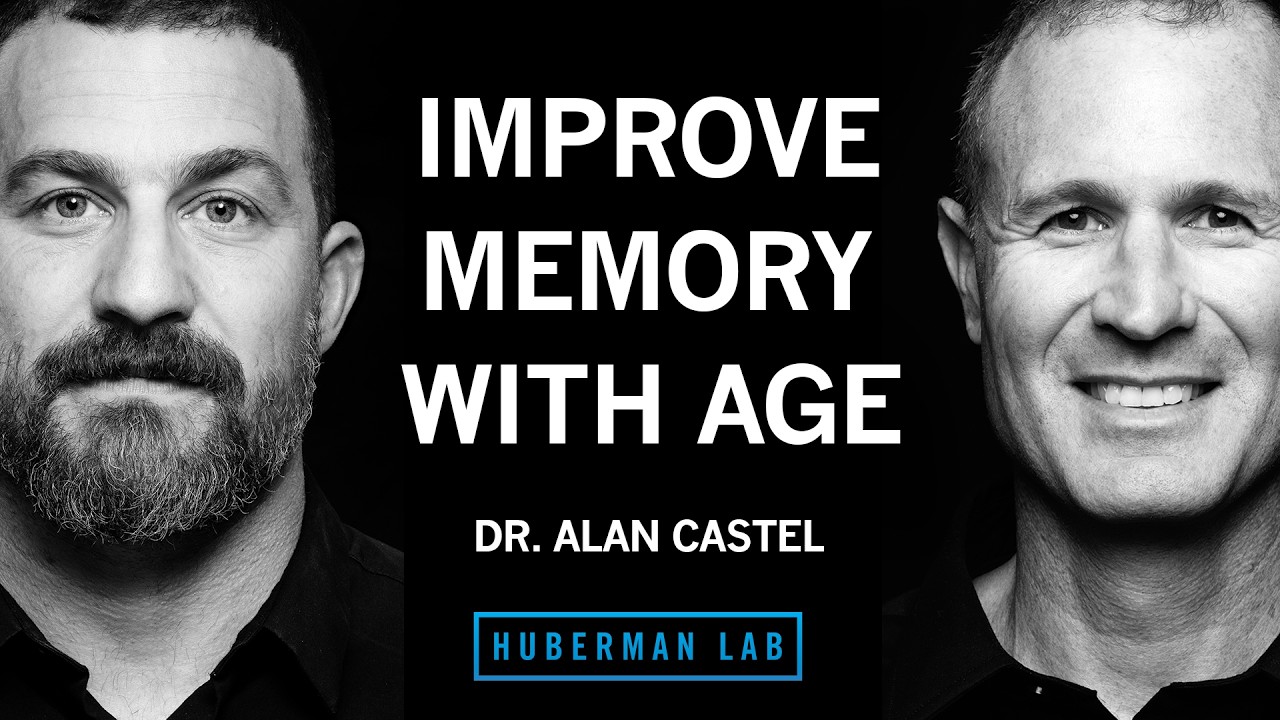
Alan Castel Links Habit Overrides and High Arousal to Fatal Memory Failures
Andrew Huberman
Hyper-automated sensorimotor routines systematically suppress conscious cognitive updating during periods of extreme autonomic stress, causing fatal behavioral errors across aviation, diving, and childcare.
## Background
Published on July 13, 2026, by Andrew Huberman on YouTube, this episode features Dr. Alan Castel, a professor of psychology at UCLA and an expert on human memory and cognitive aging. The program explores what science reveals about improving learning and memory at any age, the mechanics of false memories, and the daily habits of 'superagers' who maintain high cognitive capacity across their lifespan.
## TL;DR
The conversation explores memory as a reconstructive process heavily influenced by selective curiosity, attention, and effortful retrieval practice rather than passive repetition. Dr. Castel and Huberman discuss how physical exercise—specifically brisk walking—can reverse age-related hippocampal shrinkage, while lifestyle factors like balance, strong social connections, and a positive mindset act as critical indicators of longevity. They also contrast the evolutionary cognitive shift toward a positivity bias in older adults with the high stress and precarity faced by younger generations, emphasizing that successful aging relies on adaptability, meaningful engagement, and crystallized wisdom. Furthermore, the episode addresses modern cognitive challenges, including the rise of sophisticated AI voice cloning scams that target the emotional focus older adults place on their families.
## Atmosphere & style
The tone of the discussion is deeply intellectual yet accessible, blending rigorous cognitive science with warm, reflective storytelling. Huberman's grounded, probing curiosity matches Castel's engaging academic expertise, creating a collaborative peer-to-peer dynamic that feels both educational and deeply human. As the conversation moves from the mechanical frustrations of neuroplasticity to the profound life lessons of legendary figures like Coach John Wooden, the emotional arc shifts from analytical problem-solving to a comforting, optimistic celebration of aging. Ultimately, listening feels like sitting in on an inspiring mentorship session that reframes growing older not as a process of inevitable decline, but as an opportunity to cultivate genuine contentment and wisdom.
## Key takeaways
- [00:00](https://www.youtube.com/watch?v=EIhilBpn8Ow&t=0s) Memory is a reconstructive mental representation of the past rather than a perfectly accurate video recording, while metacognition refers to the awareness of one's own memory processes.
- [04:49](https://www.youtube.com/watch?v=EIhilBpn8Ow&t=289s) Using mnemonics can aid in memorizing labels but does not equal deep semantic understanding; name recall is better achieved through active retrieval practice, such as repeating a name during conversation.
- [08:22](https://www.youtube.com/watch?v=EIhilBpn8Ow&t=502s) True learning is driven by errorful trial and corrective feedback; simply seeing an object or environment thousands of times does not ensure an accurate conscious memory of its fine details.
- [14:05](https://www.youtube.com/watch?v=EIhilBpn8Ow&t=845s) Neuroplasticity is triggered by the cognitive discomfort and frustration experienced during a challenging task, which releases catecholamines to mark neural connections for structural adaptation.
- [17:42](https://www.youtube.com/watch?v=EIhilBpn8Ow&t=1062s) While crossword puzzles merely strengthen an older adult's existing verbal knowledge, balancing routines with extreme novelty or deliberate 'desirable difficulties' drives neurogenesis and long-term retention.
- [24:28](https://www.youtube.com/watch?v=EIhilBpn8Ow&t=1468s) Brain imaging reveals that reconstructing the past and imagining the future share an identical neural signature, as future imagination is built directly from past experiences.
- [29:16](https://www.youtube.com/watch?v=EIhilBpn8Ow&t=1756s) Eyewitness memory is highly malleable and easily contaminated by subsequent information or police lineups, demonstrating that high confidence does not guarantee accuracy.
- [48:29](https://www.youtube.com/watch?v=EIhilBpn8Ow&t=2909s) The Nun Study demonstrated that older individuals can possess the physical hallmarks of Alzheimer's post-mortem without showing cognitive decline, suggesting behavioral and social factors can decouple pathology from clinical symptoms.
- [50:27](https://www.youtube.com/watch?v=EIhilBpn8Ow&t=3027s) Engaging in a brisk walking group (40 minutes, 3 to 4 times a week) can reverse age-related hippocampal shrinkage, resulting in a 1% increase in hippocampal volume and improved memory scores after one year.
- [54:43](https://www.youtube.com/watch?v=EIhilBpn8Ow&t=3283s) Balance is a critical predictor of longevity in older adults; single-leg stands and balance training can visibly counteract age-related declines within one to two months.
- [01:03:07](https://www.youtube.com/watch?v=EIhilBpn8Ow&t=3787s) Subjective well-being globally follows a U-shaped graph across the lifespan, hitting its lowest point around age 50 before steadily trending upward in later decades.
- [01:13:47](https://www.youtube.com/watch?v=EIhilBpn8Ow&t=4427s) Subjective age—how old a person feels mentally and physically—is a significantly better statistical predictor of a person's lifespan than their actual biological chronological age.
- [01:20:02](https://www.youtube.com/watch?v=EIhilBpn8Ow&t=4802s) SuperAgers uniquely retain or increase the volume of their anterior midcingulate cortex (aMCC), a brain region that thrives on pushing through unwanted friction and tackling hard things.
- [01:29:48](https://www.youtube.com/watch?v=EIhilBpn8Ow&t=5388s) The positivity bias causes older adults' brains to naturally shift focus toward positive information, memories, and events, while younger individuals remain evolutionary tuned toward negative threats.
- [01:45:33](https://www.youtube.com/watch?v=EIhilBpn8Ow&t=6333s) According to the ABCs of successful aging, 'A' stands for Attitude and Adaptability, 'B' for Balance (avoiding extremes), and 'C' for Connection (prioritizing deep, quality interactions).
- [01:56:59](https://www.youtube.com/watch?v=EIhilBpn8Ow&t=7019s) Socioemotional Selectivity Theory shows that perceiving a limitation on remaining time naturally shifts a person's goals away from broad exploration and toward deep, meaningful relationships.
- [02:06:49](https://www.youtube.com/watch?v=EIhilBpn8Ow&t=7609s) While general trait curiosity tends to decline across the lifespan, situational state curiosity increases with age and serves as a highly selective filter for memory retention.
- [02:10:28](https://www.youtube.com/watch?v=EIhilBpn8Ow&t=7828s) Scammers increasingly exploit the deep familial focus of older adults by using AI voice cloning in grandparent scams to demand urgent financial wire transfers.
- [02:13:45](https://www.youtube.com/watch?v=EIhilBpn8Ow&t=8025s) Wisdom represents a crystallized bank of knowledge built over a lifetime of diverse experiences that proves critical for high-stakes, real-time decision-making.
- [02:18:01](https://www.youtube.com/watch?v=EIhilBpn8Ow&t=8281s) Using interactive tools like ChatGPT to generate rigorous self-tests induces retrieval practice, creating a cognitive delta that stamps in information more effectively.
## Detailed walkthrough
### [00:00](https://www.youtube.com/watch?v=EIhilBpn8Ow&t=0s) What Is Memory?, Reconstruction & Metacognition
Memory is fundamentally a mental representation of the past that is inherently reconstructive rather than perfectly accurate. This unique nature explains why two people can witness the exact same event yet recount it entirely differently even a day or a week later. Interest in this field often stems from the realization that our minds regularly play tricks on us, leading to a disconnect between what we think we know and what we actually know—a concept known as metacognition, or the awareness of our own cognition.
An early, humorous example of this occurred during a fifth or sixth-grade production of *The Wizard of Oz*. Despite practicing a single line repeatedly—"Listen everyone, there's a cyclone on the way. Hurry and get into the cellar."—opening night nerves resulted in the scrambled delivery: "Listen everyone, there's a cellar on the way. Hurry and get into the cyclone." Although the audience largely missed the blunder, it served as a firsthand lesson that memorization is not a simple direct consequence of repetition. Later, in high school, relying heavily on mnemonics, rhymes, and songs made it possible to memorize almost the entire periodic table to succeed in chemistry and algebra. However, college revealed that using these verbal labels did not equal a deep semantic understanding of the actual chemistry. This realization ultimately led to the study of psychology, a field dedicated to exploring learning, memory accuracy, and the regular occurrence of false memories.
Many people lean on mnemonics to overcome everyday memory hurdles, such as forgetting names. Historically, names were directly tied to a person's trade—like calling a baker Mr. Baker—but as names became more abstract, remembering them required establishing arbitrary mental links. For instance, connecting the last name Castel to the word "pastel" because a relative used pastels is a common workaround. While effective, this process is highly effortful and time-consuming, sometimes introducing predictable memory errors where a person mistakenly recalls the name as "Pastel" instead of Castel. This interference compounds with age as the mental catalog of familiar names grows.
To bypass this interference, individuals must rely on deliberate retrieval practice, such as repeating a new name multiple times during a conversation. However, from a practical standpoint, remembering the emotional substance or the topics discussed in a conversation is often far more vital than simply retaining a proper noun. For academic subjects or complex nomenclature, achieving deeper semantic learning requires shifting focus from passive labels to active verbs and mechanics. Rather than treating an element as a static term, a learner should focus on how it functions, such as how it gives or receives a charge under specific conditions. This "levels of processing" approach ensures that information is visualized and interacted with, transforming abstract concepts into highly engaging everyday realities.
---
[08:22](https://www.youtube.com/watch?v=EIhilBpn8Ow&t=502s) The Penny & Apple Logo, Noticing vs Seeing, Learning Through Mistakes
A massive amount of meaningful learning happens directly through making mistakes and experiencing retrieval failures. Simply seeing an object thousands of times does not guarantee an accurate memory of its details. This is famously demonstrated by people's inability to recall the exact features on a standard penny. A modern update to this test involves the ubiquitous Apple logo. When questioned, students are routinely unsure whether the famous bite is on the left or the right side, or whether the top feature is a stem or a leaf.
The most effective way to lock in this memory is through "errorful" trial and failure. If a person is forced to draw the logo from memory without looking, they will struggle and question their assumptions. When they are finally permitted to look at the logo again, their brain engages in significantly deeper learning than if they had skipped that initial, frustrating attempt. While traditional academic settings often discourage mistakes, retrieval failure paired with corrective feedback mimics how humans naturally navigate life. Without this tension, people fall into habituation, completely tuning out everyday visual elements in their environment.
* **The Fire Extinguisher Experiment:** Passively walking past a fire extinguisher every day does not mean a person knows where it is. In studies, rather than being told its location, participants are instructed to stand up and physically locate it. This active environmental engagement forces the transition from merely seeing an item to genuinely noticing it.
* **Visual Processing Limits:** While an immense amount of visual information constantly hits the retina, only a small fraction is processed at a conscious level.
In the realm of neuroplasticity, a critical revelation is that successfully executing a task provides absolutely no incentive for the brain to alter its structure. If the behavior is performed perfectly, the neural circuitry required for it already exists. True plastic change is triggered exclusively by the uncomfortable gap between a desired performance and one's current capability. This friction often manifests in unsupervised learning environments, such as teaching oneself a new language or learning an instrument via video platforms, where progress depends heavily on trial and error.
The most successful learners are those who possess the curiosity to ask the right questions and the mindset to persist through initial friction. The physical sensations of frustration and agitation experienced during a difficult task are not signs of failure; they are the physiological indicators of neuroplasticity in action. This state triggers a distinct chemical shift in the brain.
* **Chemical Triggers:** The cognitive discomfort of a challenging task triggers the release of catecholamines, specifically epinephrine and norepinephrine.
* **Synaptic Changes:** These neurotransmitters directly alter the chemical milieu surrounding synapses, marking those specific neural connections for subsequent structural adaptation.
How does the brain transition from this initial state of frustration to maintaining long-term memory systems as we age?
[15:06](https://www.youtube.com/watch?v=EIhilBpn8Ow&t=906s) Curiosity, Selection, and Memory in Older Adults
The conversation shifts toward the psychology of learning and how a "beginner's mind"—the willingness to embrace raw beginner status in a new domain—interacts with frustration. Andrew Huberman queries whether highly effective learners simply frame autonomic arousal and frustration differently, perhaps viewing it as an opportunity rather than a signal of inability.
Dr. Alan Castel agrees that goals and mindset heavily influence learning. While early-life learning is often structured around academic testing, later-life learning transitions into a matter of curiosity and closing a "knowledge gap." Interestingly, research shows that as people age, memory systems do not decline uniformly. Some remain stable or even improve, heavily driven by an individual’s selective curiosity. Dr. Castel notes that older adults become increasingly selective about what they focus on. Instead of expending cognitive energy to learn everything, they specialize their focus on what truly interests them, effectively "strengthening a strength."
* **Memory in Aging:** Not all systems decline equally; selective curiosity helps protect and maintain cognitive health.
* **The "Knowledge Gap":** Curiosity acts as a powerful intrinsic motivator to bridge the gap between what one knows and what one wants to know.
---
[17:42](https://www.youtube.com/watch?v=EIhilBpn8Ow&t=1062s) Routines, Novelty, and Breaking Habits
Huberman asks whether older adults should focus on maintaining existing memories or actively push to learn entirely new information. Dr. Castel advocates for a balanced approach, sharing an anecdote about his father, who is in his 80s and 90s. His father still plays the piano; while he isn't necessarily mastering new compositions, sharpening the pieces he already knows keeps him cognitively resilient. On the flip side, exposure to extreme novelty—such as traveling or navigating a new restaurant—is crucial for driving neurogenesis.
Even minor disruptions to fixed daily routines can induce a palpable shift in cognitive engagement. Dr. Castel illustrates this by describing how his university students naturally claim the exact same seats after the first few weeks of a quarter—an evolutionary behavior likely rooted in establishing a safe, predictable environment. When he forces them to switch seats halfway through the quarter, the students are deeply uncomfortable, yet the physical shift alters their mental perspective and mitigates the cognitive interference that occurs when everything is learned in a singular, unchanging spot.
* **Neurogenesis in Aging:** Neurogenesis does not simply cease at a certain age; it is continuously stimulated by novelty and new experiences.
* **The Crossword Puzzle Paradox:** Crossword puzzles leverage and strengthen an older adult's existing, well-maintained verbal knowledge rather than challenging them with entirely new cognitive frameworks.
---
[20:55](https://www.youtube.com/watch?v=EIhilBpn8Ow&t=1255s) Desirable Difficulties and Emotional Tags
Reflecting on his early career, Huberman recalls changing his seat after every single presentation break at scientific meetings just to stay awake through boring lectures. Dr. Castel identifies this as an excellent example of a practical, metacognitive insight. This prompts a discussion on the role of mistakes and embarrassment in stamping in memories. Publicly giving a wrong answer triggers intense arousal and shame, ensuring that while the individual may never forget the correct answer, the emotional trauma of the event often "swamps" the actual factual data.
This emotional tuning relies heavily on the amygdala, a brain structure critical for emotional processing that remains remarkably well-maintained with age, even as other regions decline. Dr. Castel references his colleagues at UCLA who pioneered the concept of "desirable difficulties"—the principle that making learning intentionally challenging or slightly uncomfortable ultimately yields far superior long-term retention.
* **Desirable Difficulties:** An instructional concept demonstrating that introducing deliberate challenges during the learning process leads to deeper, more durable memory.
* **The Amygdala's Resilience:** Unlike other cognitive regions, the amygdala remains highly active and intact throughout the aging process, preserving the emotional valence of memories.
---
[24:28](https://www.youtube.com/watch?v=EIhilBpn8Ow&t=1468s) "Mental Photographs" and Reconstructing the Future
Huberman shares a personal practice of taking intentional "mental photographs" of specific, non-extraordinary moments—such as a picnic with his first girlfriend on a hill in Palo Alto, or a mundane New York City street scene featuring construction scaffolding and a passing pedestrian. Decades later, he can still vividly recall the conscious decision to capture those scenes, even if the fine visual details have blurred. He questions whether the memory is preserved by an emotional tag or simply by the self-directed, conscious intent to select that moment.
Dr. Castel confirms that the conscious "selection process" is incredibly powerful. Human visual memory is exceptional, though even individuals with near-photographic memory make systematic errors. Modern reliance on smartphones to offload memory presents a dual dynamic: while some research indicates that the deliberate decision to photograph an event can enhance personal memory of it, other studies show that offloading an image to a device signals the brain that it doesn't need to store the information, thereby weakening organic retention. Furthermore, brain imaging reveals that reconstructing the past and imagining the future share an identical neural signature; because our imagination of the future is built entirely out of the bricks of past experiences, our memories are inherently reconstructive and prone to fluid shifts over time.
> "Reconstructing the past also has a similar brain signature as imagining the future... our imagination has to be based surely on the experiences you've had already."
[29:16](https://www.youtube.com/watch?v=EIhilBpn8Ow&t=1756s) Eyewitness Memory, the Ronald Cotton Case, Confidence vs Accuracy
The conversation transitions into the fallibility of memory, sparked by a quote from Morgan Housel, a two-time guest on the podcast and author of *The Psychology of Money* and *The Same as Ever* (mistranscribed as *The Art of Spending Money*). Housel shared a Russian proverb: "The past is more unpredictable than the future." This prompts Huberman to wonder about how memory distortion influences everyday life, from spousal arguments to high-stakes eyewitness testimony. He poses a foundational question: do we truly remember things the way they happened, or do we constantly confabulate and "muck it all up"?
Dr. Castel clarifies that while we do not distort things intentionally, memory is a continuous process of reconstruction heavily influenced by our current state and subsequent information. A harrowing real-world consequence of this is faulty eyewitness identification. When someone experiences a traumatic event, they often feel as though they are taking a mental photograph, embedding details like clothing, smells, and weather. However, if they later view a police lineup and select a suspect, that newly identified face can effectively overwrite and contaminate their memory of the actual perpetrator. When they replay the event in their mind, they are replaying the face of the person they selected, not the person they originally saw.
To illustrate this, Dr. Castel points to the tragic and famous case of Ronald Cotton. A woman survived a brutal assault and explicitly resolved to study her attacker's face so she could bring him to justice. When looking at a lineup, she approached it methodically, later noting it felt like a multiple-choice test for which she had studied hard. She confidently identified Ronald Cotton—a choice complicated by cross-race identification, which psychological research shows is inherently less reliable than identifying someone of one's own race. Cotton was convicted and spent decades in prison before DNA evidence completely exonerated him. The two later met, and she apologized out of immense remorse. Dr. Castel emphasizes this case study because it perfectly demonstrates how high confidence does not guarantee accuracy, and how predictably our "metacognitive insight" can fail us.
* **Memory Contamination:** Just like physical evidence, a witness's memory can be contaminated by leading questions or line-up procedures.
* **The Apple Logo Effect:** Just as people see the Apple logo daily but cannot draw it accurately, familiarity can cause us to stop attending to specific details.
* **The Legal System:** Dr. Castel notes that memory must be treated merely as one malleable source of evidence rather than an absolute record of truth.
---
[35:07](https://www.youtube.com/watch?v=EIhilBpn8Ow&t=2107s) Medium-Term & Prospective Memory, Hotel Fire Exits
Huberman shifts the topic to what he colloquially terms "medium-term memory"—the capacity to hold onto information for a day or a night before letting it go. He confesses to a personal habit born of a real-life scare: while staying at a hotel in San Francisco for a donor event, a middle-of-the-night fire alarm went off. While other guests hesitantly peeked their heads out into the confusing hallways, Huberman learned that when an alarm sounds, you must exit immediately. Ever since, before going to sleep in any hotel, he studies the emergency exit map, memorizes the sequence of turns (e.g., right, then left, right, then left), and occasionally walks the corridor to build a mental map. He notes that while he retains it for the night, he completely forgets the layout a week later, which he considers a form of healthy, selective forgetting.
Dr. Castel validates this habit, categorizing it under "everyday memory" or "prospective memory," which is heavily tuned toward survival. He shares his own parallel story of a hotel fire alarm with his family where he rushed down the stairs, believing he saw actual smoke in the hallway—though he later realized his mind might have been playing tricks on him due to anxiety and not wearing his glasses. He highlights that forgetting your hotel room number or the floor plan a week later is highly adaptive; it clears cognitive clutter so the brain can update to new, relevant numbers.
Furthermore, Dr. Castel advocates for "active learning" over passive observation. On commercial flights, flight attendants point out the six emergency exits, but passengers rarely encode the information. Dr. Castel jokes that attendants should say, "There's six emergency exits on this plane. I'm not going to tell you where they are... go find them." Huberman agrees, admitting that due to his own anxiety, he always actively looks behind him on a flight to locate the nearest exit, acknowledging that active engagement is what successfully "stamps in" critical survival information.
Huberman takes a brief moment to acknowledge the episode's sponsor, AG1, a foundational vitamin, mineral, probiotic, prebiotic, and adaptogen drink. He notes that he has taken it daily since 2012, well before the inception of his podcast, to support gut health, immune health, and overall energy. He emphasizes that if he could only recommend a single nutritional supplement to fill daily dietary gaps, it would be AG1. He highlights a current promotion offering a free bottle of Omega-3 co-enzyme Q10—which supports cardiovascular, cellular, and brain health—with a first subscription.
---
[41:47](https://www.youtube.com/watch?v=EIhilBpn8Ow&t=2507s) When Habits Turn Lethal, Aviation & Human Error
Returning to the conversation, Huberman jokingly notes that he will use Dr. Castel's evolutionary survival points as "weaponry" the next time his friends tease him for practicing hotel fire drills. He stresses that under conditions of extreme stress and high autonomic arousal, the conscious mind goes offline, and the brain defaults entirely to automated reflexes and deeply ingrained physical routines. He recalls a dangerous scuba diving accident he suffered years prior involving an underwater air failure, where he and his partner survived strictly because they defaulted to their trained emergency air-sharing routines.
To illustrate how lethal it can be when those underlying sensorimotor routines are altered, Huberman references a spectacular but tragic four-part documentary series featuring the famous free solo climber and base jumper Dean Potter (a predecessor to Alex Honnold). The documentary features a scene where base jumpers were executing a demonstration jump in Yosemite National Park to advocate for the sport's legalization. A highly seasoned female base jumper did not want her personal gear confiscated by park rangers at the bottom, so she borrowed a different rig from a friend.
Tragically, her borrowed pack featured a pilot chute deployment handle in a different location than her own—requiring a leg pull rather than her accustomed routine, or vice versa. The footage captures her falling the entire way down, desperately and repeatedly groping the empty space where her standard deployment handle normally sat. Under high-arousal conditions, despite knowing consciously that the gear was different, her motor system defaulted to the thousands of iterations of muscle memory she had previously built. Huberman notes that this serves as a stark warning: under immense pressure, if you do not have a deeply trained, correct behavioral routine to default to, "you default to not knowing what to do."
[44:11](https://www.youtube.com/watch?v=EIhilBpn8Ow&t=2651s) When Habits Turn Lethal: Routine vs. Awareness
Andrew Huberman shares a personal revelation about high-stress scenarios, noting how people naively assume they will sort through emergencies in a regimented way. Instead, the brain frequently defaults to entrenched routines. Dr. Alan Castel underscores this by detailing a tragic real-world phenomenon: intelligent, highly responsible parents accidentally leaving infants in hot cars. This occurs because the parent enters a hyper-automated "mode" of driving directly to work. When the sleeping infant remains silent, the deeply ingrained habit overrides the novel task of daycare drop-off, sometimes with fatal consequences.
This oversight is tied closely to prospective memory—the cognitive process of remembering to execute actions in the future. Because humans are naturally prone to forgetting and mind-wandering, modern society increasingly relies on external technological prompts, like cars that explicitly remind drivers to check the backseat. The conversationalists note how easily the brain can completely disengage from the present reality, whether due to high arousal in an emergency or simple daily driving routines.
* **Prospective Memory:** Remembering to perform a planned action or intention at a future point in time.
* **Scuba Diving Overconfidence:** Dr. Castel notes that standard PADI certifications legally require very little updating, meaning a person could dive after a five-year hiatus despite significant skill decay.
---
[48:29](https://www.youtube.com/watch?v=EIhilBpn8Ow&t=2909s) Why Older Adults Repeat Stories and Jokes
Shifting to a lighter topic, Huberman asks why older adults frequently repeat the exact same jokes and stories, questioning whether they genuinely forget having shared them or simply do it for self-entertainment. Dr. Castel explains that "source memory"—the specific type of memory that tracks where a piece of information was learned or who it was shared with—tends to decline naturally with age. While an older individual might genuinely forget they have told a story, Dr. Castel humorously admits that sometimes a joke or memory is simply so enjoyable that the speaker does not care if they are repeating it.
These repetitions also serve deep-seated human needs for nostalgia, comfort, and oral history. When families gather for events like Thanksgiving, rehashing familiar histories establishes a sense of connection and generational identity. However, Dr. Castel draws a line between this normal behavioral repetition and pathological aging. True cognitive warning signs involve severe short-term memory deficits, such as a person repeatedly asking what is for dinner just five minutes after receiving an answer.
---
[50:27](https://www.youtube.com/watch?v=EIhilBpn8Ow&t=3027s) Alzheimer’s, Brain Volume, and the Power of Walking
When Huberman asks whether severe memory loss is an inevitable part of the aging trajectory, Dr. Castel highlights the sheer diversity of cognitive aging, noting that a 100-year-old can functionally outperform a 60-year-old. He points to the famous "Nun Study," which revealed that some highly functional, mentally sharp elderly nuns actually possessed the classic physical hallmarks of Alzheimer's disease—amyloid plaques and neurofibrillary tangles—post-mortem. This discrepancy suggests that behavioral choices, a sense of purpose, and deep social connections can decouple physical brain pathology from actual cognitive decline.
To combat the physical shrinkage of the brain, Dr. Castel emphasizes physical exercise. The hippocampus, which is critical for declarative memory, typically loses 1% to 2% of its volume annually after a person turns 50. However, rigorous clinical research demonstrated that older adults randomly assigned to a brisk walking group for 40 minutes, three to four times a week, actually experienced a 1% *increase* in hippocampal volume after one year. This architectural change directly translated to significantly better performance on memory tests compared to a control group that only performed stretching.
* **Exercise Frequency:** 3 to 4 times a week for 30–40 minutes of cardiovascular activity (walking, biking, swimming, dancing).
* **Sleep and Memory:** Exercise trickles down to improve sleep quality; essential because major memory consolidation takes place during sleep cycles, which naturally degrade with age.
---
[54:43](https://www.youtube.com/watch?v=EIhilBpn8Ow&t=3283s) Balance as a Critical Indicator of Longevity
Dr. Castel shifts the focus from dementia to an often-overlooked marker of successful aging: physical balance. Statistically, one in four adults over the age of 65 experiences a fall each year. These falls carry devastating cascading consequences; breaking a hip or collarbone forces extended bed rest, which halts physical exercise, accelerates hippocampal shrinkage, and triggers rapid cognitive decline. Dr. Castel mentions a simple diagnostic tool he uses during presentations: challenging the audience to stand and balance on one leg for 10 seconds.
The test becomes drastically harder when participants attempt it with their eyes closed, as the brain relies heavily on visual cues for spatial orientation. Fortunately, balance is highly trainable through activities like yoga, tai chi, or simply practicing single-leg stands, showing noticeable improvements within just a month or two. Huberman adds an anecdotal observation that aging skiers and surfers often remain in remarkably vibrant shape. He points out that while posture and balance are excellent in these groups, a subtle shift often happens in very old age where resting mouth-breathing patterns emerge, raising interesting questions about optimal oxygenation, spontaneous movement, and brain health in the twilight years.
[58:39](https://www.youtube.com/watch?v=EIhilBpn8Ow&t=3519s) Physical Spontaneity, Posture, and Oxygenating the Brain
Andrew Huberman and Dr. Alan Castel discuss the physical habits of aging, noting that older adults often experience a significant decline in spontaneous movement. Huberman shares a recent observation of legendary choreographer Twyla Tharp, who visited his studio in her 80s. Tharp trains aggressively at 5:00 a.m. for two hours every morning, has a background in actual boxing, and is capable of deadlifting twice her body weight. Huberman notes that throughout their interaction, she remained actively upright, engaged her nervous system, and maintained strict nasal breathing unless speaking. In contrast, Huberman admits that with each passing year, he finds himself looking for opportunities to lean against objects or lie down, jokingly comparing the tendency to a bulldog.
Dr. Castel emphasizes that observing these subtle shifts in posture and breathing is a crucial insight. While he is not an exercise physiologist, he underscores that physical activity serves as a vital mechanism for forcing oxygen into the brain—a process that becomes progressively less efficient with age. He also challenges common age-based assumptions regarding physical decline.
> "My knee hurts and some people are like, 'Oh, well, you're just getting older.' Well, my other knee is the same age and it feels fine."
Dr. Castel advocates strongly for physical therapy and dynamic movement. He points out that regular walking is essentially a "controlled form of losing your balance and regaining it." Transitioning this to hiking on unpredictable, uneven trail surfaces forces the body to engage stabilizing muscles that are otherwise neglected, offering an excellent way to safely challenge the nervous system.
---
[01:01:14](https://www.youtube.com/watch?v=EIhilBpn8Ow&t=3674s) Stepping Into Discomfort and the Forcing Function of Accountability
The conversation shifts to the psychological value of placing oneself in uncomfortable, challenging positions. Dr. Castel confesses that while he feels completely fine during the interview, he experienced a wave of standard performance anxiety prior to recording. He recalls his early days of university teaching, standing before an audience of 300 students, feeling completely overwhelmed. A mentor offered him a fundamental piece of advice: "There's only one thing you need to do, and that's breathe." This basic act counters the subconscious tendency to shallow-breathe or mouth-breathe during high-stress situations, ensuring the brain gets the oxygen required to execute complex skills.
Huberman admits that he deliberately pushes himself into minor physical discomfort daily to combat complacency. He takes stairs rapidly and avoids airport escalators completely unless no structural alternative exists. He laughs as he notes a major "collateral advantage" or forcing function of hosting his podcast: public accountability. He shares a story of working out in a commercial gym while listening to music on his phone. A young fan tapped his shoulder and remarked, "I thought you don't use your phone when you work out." Huberman had to clarify that he only uses it for audio, not for texting, realizing with amusement that he must be incredibly careful about practicing what he preaches.
---
[01:03:07](https://www.youtube.com/watch?v=EIhilBpn8Ow&t=3787s) Cartilage Regeneration and the Midlife Happiness Dip
Huberman reflects on how localized physical pain often sidelines people from exercising, causing them to falsely assume their bodily "chassis" is simply wearing out permanently. He highlights a fascinating study emerging from Helen Blau's lab at Stanford University. Researchers identified an inhibitor of the molecule that naturally blocks cartilage regeneration. By knocking out this inhibitor or utilizing a drug analog, they successfully observed the regeneration of knee cartilage in both mice and humans. Huberman expects this breakthrough to be licensed to a pharmaceutical company soon, offering massive future potential for aging populations to overcome joint limitations.
Dr. Castel notes that managing midlife aches and pains ultimately traces back to daily habit construction and motivation. Interestingly, psychological research reveals that life satisfaction does not follow a linear downward trend. Instead, happiness tracks on a curvilinear, U-shaped graph, hitting its absolute lowest point around age 50.
* **The Midlife Dip:** Age 50 represents the lowest average levels of happiness and life satisfaction globally.
* **The Silver Lining:** For individuals navigating a difficult period in their 40s or 50s, this data offers profound comfort, confirming that subjective well-being routinely trends upward in later decades.
* **The Generational Paradox:** Young adults often maintain bodies in peak physical condition but suffer from intense cognitive confusion, emotional mismanagement, and chronic career stress.
---
[01:05:36](https://www.youtube.com/watch?v=EIhilBpn8Ow&t=3936s) Comparing Internal Landscapes Across the Lifespan
Huberman asks Dr. Castel directly if he feels happier at age 50 than he did at 40. Dr. Castel confirms that he is far more content today. Though his 20s and 30s allowed him to play basketball, scuba dive, and rebound effortlessly from injuries, his internal landscape was highly volatile. He observes this same profound uncertainty in his UCLA undergraduate students today, who are constantly stressing over romantic partners, career trajectories, and identity.
Huberman strongly agrees, exclaiming, "Oh my god. No," to the idea of romanticizing youth. He shares that his own 40th birthday was incredibly difficult, marked by the severe systemic stressors of academic science, such as the precarious nature of being a postdoc and the endless pressure of securing laboratory grant funding. Now older, Huberman views stress through an entirely different lens. He note that while his younger years didn't explicitly "suck," they were undeniably rough. Dr. Castel reiterates that many older adults he interviewed for his book, *Better with Age*, explicitly call their 60s and 70s the absolute best years of their lives.
---
[01:07:28](https://www.youtube.com/watch?v=EIhilBpn8Ow&t=4048s) Coach John Wooden's Two Pillars of Successful Aging
Dr. Castel contextualizes aging through developmental psychology, referencing Erik Erikson’s stages of psychosocial development, which dictate that every decade features a core conflict that must be resolved to progress healthily. To illustrate how high-achieving individuals find this resolution later in life, Dr. Castel details his personal interview with legendary UCLA basketball coach John Wooden when Wooden was in his 90s. Rather than lecturing, Wooden playfully treated Dr. Castel like a student, asking him to guess the "two most important words in the English language" for a successful life.
The first word Wooden provided was **love**. Wooden emphasized surrounding oneself with loved ones and engaging only in passions. Proving this devotion, Wooden never slept on his deceased wife's side of the bed and wrote her a letter every single month after her passing. He pinned his grandchildren's report cards on the wall directly adjacent to formal letters from US Presidents.
The second crucial word was **balance**, which applies both physically and mentally:
* **Physical Balance and Pride:** Wooden suffered a severe middle-of-the-night fall late in life, fracturing his collarbone and wrist. Although he wore a Life Alert emergency button around his neck, he refused to press it out of stubborn pride and a desire not to "bother" anyone. He waited silently until his morning caretaker arrived to take him to the hospital.
* **Mental Balance vs. Drive:** Wooden admitted that during his peak coaching years, his intense drive made him hyper-focused and caused him to spend far too much time traveling away from his family. Aging finally granted him the perspective to step back, reallocate his time, and achieve genuine internal peace.
[01:12:10](https://www.youtube.com/watch?v=EIhilBpn8Ow&t=4330s) Sponsor: Function
Andrew Huberman breaks to thank the episode's sponsor, Function, a service that provides over 160 advanced lab tests to offer a comprehensive snapshot of bodily health. These tests deliver critical insights into heart health, hormone levels, autoimmune function, and nutrient levels, and have recently been expanded to include access to advanced MRI and CT scans. Huberman shares a personal anecdote, revealing that a recent Function test flagged his blood lipids as slightly out of range. In response, he began supplementing with nattokinase to naturally reduce his LDL cholesterol, and a subsequent follow-up test successfully confirmed that his blood lipids had returned to his target range.
Huberman emphasizes the immense value of this kind of data, noting that while he has tracked his blood work for years, the process was traditionally time-consuming, complex, and extraordinarily expensive—often costing him thousands of dollars annually for substandard data. With a Function membership costing just $1 a day ($365 a year), he views it as a true financial savings given the proactive health challenges it helps users avoid. He invites listeners to visit [functionhealth.com/huberman](https://functionhealth.com/huberman) and use the code "huberman" for a $50 credit toward their membership.
---
[01:13:47](https://www.youtube.com/watch?v=EIhilBpn8Ow&t=4427s) Age Stereotypes, Subjective Age & Positive Age Beliefs
Huberman notes that the relentless drive to prove oneself to others is a classic "hallmark of being younger." While some manage to escape social comparison, most struggle with it, though it can serve as a powerful lever to generate hard work through fierce competition. Huberman observes a striking generational split in his audience: listeners aged 35 and younger heavily fixate on choosing a life direction, while the older demographic focuses intensely on maintaining their memory and health. Crucially, older adults are aggressively redefining what constitutes age-appropriate physical and mental ability. Two decades ago, society assumed a mandatory decline at age 70 or 80. Today, people are realizing that if they feel vibrant at 50 or 60, that vitality can realistically stretch to 90. Huberman clarifies that he does not consider himself a "longevity person" focused purely on lifespan, but he asks Dr. Castel whether this societal push to constantly go harder and longer is net positive, or if it exerts an unnatural pressure on older individuals who might naturally want to slow down and share wisdom.
Dr. Castel agrees that while humans are undeniably living longer, the critical goal is ensuring those added years are healthy, given that advanced age naturally elevates the statistical risk of developing dementia. From a psychological standpoint, Dr. Castel introduces the fascinating concept of "subjective age"—how old a person actually feels mentally and physically, independent of their calendar years. He poses a playful thought experiment: if you had no access to your birth certificate and your parents couldn't remember when you were born, how would you calculate your age? Data shows that after the age of 40, most individuals feel roughly 20% younger than their biological age. Remarkably, Dr. Castel reveals that subjective age is a significantly better statistical predictor of lifespan than actual biological age.
```
Subjective Age vs. Biological Age
┌────────────────────────────────────────────────────────────────────────┐
│ After age 40, most people feel ~20% younger than their calendar age. │
├────────────────────────────────────────────────────────────────────────┤
│ Subjective age is a STRONGER predictor of longevity than chronological │
│ age. Doctors rarely ask "How old do you feel?", yet it dictates data. │
└────────────────────────────────────────────────────────────────────────┘
```
While people certainly "feel their age" when recovering from an injury or waking up exhausted at 5:00 AM, Dr. Castel highlights how specific environments can instantly rejuvenate someone. Coaching his son's baseball team or walking across a vibrant college campus makes him feel profoundly youthful, allowing him to learn from younger generations while observing where they are confused. He emphasizes that while age-related stereotypes can sometimes be accurate, we do not need to blindly subscribe to them. In his book, *Better with Age*, he explores the profound value of having "mentors for aging." When he polls his university students about successful aging role models, they rarely choose elite marathon runners; instead, they name parents, grandparents, aunts, or uncles who maintain cherished holiday recipes, keep up their daily walks, or exude purpose. Dr. Castel warmly mentions watching Huberman's recent podcast episode with his own father, noting how beautiful it was to witness the unique, evolving dynamic between an older parent and their adult child.
* **Subjective Age Marker:** Most individuals over 40 report feeling about 20% younger than their chronological calendar age.
* **Predictive Power:** A person's self-reported subjective age is a more accurate indicator of future longevity than their true biological age.
* **The Intergenerational Campus:** Being surrounded by younger students provides older professors with cognitive variety and a direct window into the challenges of youth.
Dr. Castel notes that successful aging looks different for everyone. In his own family, he witnessed his father transition from a career as a theoretical physics professor to becoming the editor of a literary arts journal. This massive vocational shift completely "revived him," much like Huberman's pivot from standard academia to large-scale public outreach. Dr. Castel asks Huberman if he maps out his life using strict three- or five-year plans. Huberman replies that as an academic, he defaulted to a three-to-five-year horizon because scientific grants are structured on that timeline, making it difficult for him to conceptualize life beyond five years. Dr. Castel notes that while plans are excellent for motivation, rigid academic pressures can sometimes stifle creative output. When he first arrived at UCLA from Toronto, he gave himself a loose three-to-five-year window to see if the West Coast suited him. He long harbored a dream to write an accessible book on memory, and though he did not set a strict deadline, his wife's encouragement kept the plan alive until the book finally debuted ten years later.
Currently, Dr. Castel's goals are more abstract and focused on massive societal challenges, such as protecting older adults from the devastating financial fraud fueled by artificial intelligence. He is deeply interested in making technology truly accessible. While a young person will eagerly unbox a new iPhone and immediately fiddle with it without instructions, an older adult often approaches it with intense anxiety, fearing they will break the device. Dr. Castel notes a fascinating paradox: self-driving cars are wildly appealing to tech-savvy youth, yet they are desperately needed by older generations whose peripheral vision and reflexes are declining. Huberman highlights that vehicle accident data follows a stark U-shaped function, with very young, inexperienced drivers and very elderly drivers accounting for the vast majority of crashes.
```
Vehicle Accident Rates by Age Group
Accidents
▲
│ * *
│ * *
│ * *
│ * *
│ * * *
└─────────────────────► Age
Youth Middle Elderly
```
Huberman pivots to a profound neurological question: does the act of setting goals and striving for a future physically keep us alive? He references neuroscientific data on "SuperAgers"—individuals who maintain pristine memory and cognitive capacity late into life. Brain imaging shows that SuperAgers uniquely retain or even increase the volume of their anterior midcingulate cortex (aMCC). Huberman teaches neuroanatomy to medical students and recalls that early in his career, the exact function of the aMCC was unknown. However, his colleague Dr. Josef Parvizi performed groundbreaking research by directly stimulating the aMCC with electrodes in conscious human patients undergoing surgery. Every single patient stimulated reported an immediate, intense physical and mental activation. They would lean forward in their chairs and state that it felt as though a massive storm or challenge was approaching, yet they felt an overwhelming surge of determination to lean directly into the friction.
Huberman argues that this structure thrives entirely on pushing through unwanted friction and doing hard things. Pursuing a goal implicitly requires a concrete concept of the future. Huberman suggests that having an active plan literally triggers an evolutionary, cellular "will to live." Without goals, life becomes a closed, comfortable loop of merely smelling the roses. While a rare monk might find perpetual bliss living strictly in the present moment, Huberman asserts that true human life is inherently about looking forward to what comes next and aggressively working to make that vision a reality.
* **The Accident Curve:** Motor vehicle accident distribution is a clear U-shaped function across lifetimes, peaking heavily during teenage years and advanced old age.
* **The Doctor Josef Parvizi Discovery:** Direct electrical stimulation of the human anterior midcingulate cortex induces an immediate, visceral "will to fight" and a desire to confront oncoming psychological or physical storms.
* **Anterior Midcingulate Cortex (aMCC):** A critical brain structure that maintains its physical volume in SuperAgers; it is heavily associated with leaning into friction, resilience, and goal-directed forward progression.
[01:26:19](https://www.youtube.com/watch?v=EIhilBpn8Ow&t=5179s) Cultural Differences, Everyday Exercise, and Resilience during COVID
Dr. Alan Castel contrasts Western culture’s intense focus on goal setting, motivation, and biohacking for longevity with other cultures that age more naturally and successfully. For "superagers" and people living in Blue Zones, healthy behaviors are seamlessly woven into the fabric of daily life. They do not go to the gym four times a week out of a rigid sense of obligation; rather, they stay active because their environment requires them to walk uphill or navigate uneven surfaces, and they eat nutritious food simply because it is fresh, enjoyable, and locally available. Dr. Castel shares a personal anecdote about his own father, who biked to work every day and avoided even calling it "work" to keep it from feeling like a chore. Inspired by this, Dr. Castel commutes by bicycle in Los Angeles—admitting with a laugh that riding two miles uphill and two miles downhill can be the absolute best, most idea-generating part of his day, even if navigating LA traffic demands constant vigilance.
Andrew Huberman jokes that as someone who has lived in Los Angeles, the real danger is "doors cars opening"—a sentiment Dr. Castel echoes, noting that other cities like Toronto can be even more perilous for cyclists. Shifting the conversation toward psychological grit, Dr. Castel points out that superagers are defined by their deep resilience. While wealth and good health certainly provide an advantage, many superagers have survived profound hardships. This resilience became explicitly clear during the COVID-19 pandemic. Researchers initially feared the pandemic would devastate older adults due to extreme social isolation and a lack of technical literacy. However, Dr. Castel’s own psychological research revealed that older adults actually demonstrated far greater resilience than younger generations. While younger adults struggled heavily with their first major experience of restricted freedom and social isolation, older adults maintained perspective, drawing on a lifetime of navigating wars, financial meltdowns, structural family changes, and the deaths of loved ones.
* Superagers do not typically make living forever their explicit goal; they focus on finding a sense of purpose and connecting with younger generations or hobbies.
* During COVID-19, psychological studies showed older adults were significantly more resilient to isolation than younger adults due to their accumulated life perspective.
* One Holocaust survivor interviewed by Dr. Castel offered the powerful, highly present advice: "when you're going up or downstairs, think I'm going up or downstairs."
[01:29:48](https://www.youtube.com/watch?v=EIhilBpn8Ow&t=5388s) Perspective, the "Absence of Suck," and the Positivity Bias
Andrew Huberman shares an anecdote from a friend and past podcast guest, trauma and addiction therapist Ryan Suave. Suave noted that when he first treated young adults or teenagers who attempted suicide following a romantic breakup, his initial impulse was to tell them they had their whole lives ahead of them and that there are plenty of fish in the sea. However, Suave realized that to a young person, a breakup feels like the literal loss of their entire future because their past is so brief. Once he shifted his clinical approach to validate that it truly felt like the end of the world to them, his therapy became much more effective. Huberman notes that as people age, they learn to integrate their experiences, adopting a mindset of, "I've had some ups and downs and I'm taking... some heat, I just go, okay, well, I know one thing is I'm... hard to kill."
Dr. Castel agrees that going through these struggles is precisely what builds the retrospective realization that you can survive tough times. Huberman posits that our emotional selves integrate memory in a non-linear way: experiencing moments that completely "sucked" makes subsequent periods that are merely average feel incredibly beautiful by comparison. He notes that true contentment can simply be "the absence of suck" and savoring that peace. Dr. Castel connects this directly to a known cognitive phenomenon called the **positivity bias**. As people age, their brains naturally shift focus toward positive information, events, and memories, whereas younger individuals remain hyper-focused on negative threats, likely as an evolutionary survival mechanism.
* **Positivity Bias:** A psychological shift where older adults focus heavily on positive memories and stimuli to regulate and enhance their mood, contributing to an upward curve in happiness later in life.
* Many older adults actively choose to curate their environment, explicitly stating they no longer have the time or patience for negative people or complaints.
* When older adults repeat stories, they frequently apply a positive spin to past hardships (e.g., recounting a grueling walk to school as a fond or humorous memory).
[01:34:26](https://www.youtube.com/watch?v=EIhilBpn8Ow&t=5666s) Intergenerational Learning and the Stanford Spinal Cord Study
Dr. Castel recalls spending time with exceptionally happy older adults in South Florida who had survived some of the worst historical atrocities in Eastern Europe. Remarkably, despite age-related cognitive changes, they were incredibly engaging, less inhibited, and told "some of the dirtiest jokes." To foster connection across age gaps, UCLA runs a Senior Scholars program allowing older adults to audit undergraduate classes. Dr. Castel loves incorporating these seniors into his Psychology of Aging course. One year, several of the older auditors happened to be retired therapists. Though the program technically instructs seniors not to ask questions to avoid disrupting the undergraduates, Dr. Castel encourages their active participation. He famously tells his students that while the course has two midterms, it has no final exam. Instead, "the final exam is the test of life," meaning the material will directly serve them when caring for aging parents or navigating their own futures. Undergraduates consistently report learning the most from the seniors in the room.
Huberman transitions to a striking parallel from his time sitting in on a neural regeneration course at Stanford Medical School. The class brought in two guest speakers with spinal cord injuries to highlight different patient needs. The first was a young man in his 20s who spoke candidly about his devastating loss of mobility and the heartbreak of missing out on a future full of experiences he had yet to achieve. The second was an older gentleman who knew he would never walk again but possessed a radically different outlook. Because he had already lived a full life and checked off many milestones, he chose to focus entirely on what he could still do. The older man noted that as long as he remained an optimist, his quality of life was actually higher than many of his able-bodied, walking peers who had succumbed to pessimism. Huberman notes that this contrast beautifully illustrates how accumulating a diverse bank of life experiences allows people to look back on life as a completed "bucket list," rendering physical limitations far more manageable.
* The UCLA Senior Scholars program brings older adults into undergraduate classrooms, creating highly beneficial intergenerational dynamics.
* Western culture largely lacks the built-in, multi-generational household community structures found in other global cultures.
* A Stanford Medical School case study revealed a sharp divergence in trauma coping: an older spinal cord injury patient maintained high life satisfaction through optimism and a sense of a life well-lived, whereas a younger patient experienced a profound grief over an unfulfilled future.
Huberman takes a brief break to introduce the sponsor, Lingo, an everyday wearable biosensor designed to track glucose levels 24/7. He explains that glucose variability is a primary driver of daily energy levels, body composition, and long-term metabolic health. Frequent spikes and crashes in glucose can lay the groundwork for metabolic dysfunction and eventually escalate to pre-diabetes. Huberman shares a stark demographic statistic to emphasize the scale of the issue: approximately 115 million adults in the United States currently have pre-diabetes, with a higher prevalence seen in men than in women. Because the condition rarely presents clear early symptoms, the vast majority of these individuals are completely unaware of their health status. Huberman advocates for tracking glucose using a continuous monitor like Lingo to explicitly see how specific foods, physical activities, and stress levels impact real-time metabolic function.
* Huberman Lab listeners in the US and UK can access a 10% discount on a 4-week Lingo plan by visiting `[hellingo.com/huberman](https://hellingo.com/huberman)`.
[01:39:57](https://www.youtube.com/watch?v=EIhilBpn8Ow&t=5997s) Purpose, Midlife, and the Value of Experiences
The conversation shifts toward intentional living and finding purpose across different stages of life. Andrew Huberman reflects on a case study of two individuals—one who adapted to a severe physical limitation and lived an enriched life, and another who struggled—noting the importance of carrying out plans rather than simply living by default. Dr. Alan Castel shares that older adults generally report high levels of life satisfaction and happiness, whereas individuals in midlife often feel a lack of fulfillment. Reflecting on his own life, Castel mentions he might be on an upward trajectory, prioritizing memorable experiences like a recent family trip to Sedona, Arizona, over grandiose aspirations. He and Huberman bond over their mutual appreciation for Sedona’s scenery, light, and air quality.
Castel describes how a desire to fly airplanes shifted once he had a family, giving way to simpler, more meaningful hobbies like drawing—an activity he would not have prioritized in his 20s or 30s when professional demands took precedence. He emphasizes that a sense of purpose often manifests through mentoring and volunteering for older adults. This engagement with younger generations, termed "generativity," fosters deep social connection and a feeling of utility post-retirement. Huberman shares a personal example of his stepfather, a talented carpenter whose incredible tool shed and willingness to build things—like a dollhouse for Huberman's niece—makes him the go-to person to fix problems, providing a clear sense of familial utility.
- **Grandchild Interaction and Memory:** Correlational research indicates that older adults who spend approximately 5 hours a week with their grandchildren show improved memory function. Conversely, those spending more than 20 hours a week do not show this benefit, often because they are exhausted or forced into full-time childcare roles due to difficult family circumstances.
- **Yosemite Recommendation:** Huberman strongly advocates for visiting national parks, particularly Yosemite. He recommends driving to the high country and hiking Clouds Rest, calling it "the best thing you'll ever do," provided hikers bring plenty of water and start early to avoid coming down in the dark.
[01:45:33](https://www.youtube.com/watch?v=EIhilBpn8Ow&t=6333s) John Wooden and the ABCs of Successful Aging
Huberman asks Castel about his interactions with legendary UCLA basketball coach John Wooden, specifically if there were any subtle insights that did not make it into Castel's book, *Better with Age*. Castel clarifies a common misconception, noting that while Wooden did suffer a fall late in life, his resilience allowed him to bounce back, eventually passing away several years later near the age of 99. Castel fondly recalls his early impressions of UCLA growing up in Canada, jokes that many people globally view UCLA primarily as a basketball team rather than a university, and expresses gratitude for his eventual connection to Coach Wooden, who used to guest lecture on leadership.
Wooden lived modestly in a two-bedroom condo in Encino, completely uninterested in personal wealth, which stood in stark contrast to modern professional sports culture. From his discussions with Wooden and other high-functioning seniors, Castel distilled what he calls the "ABCs of successful aging."
- **A – Attitude and Adaptability:** Having a positive attitude toward aging is linked to a longer lifespan and a lower risk of developing dementia. It requires agency and a willingness to adapt to inevitable physical or mental changes. Huberman identifies this as "that friction again," noting that a healthy life requires a balance between ease and hardship.
- **B – Balance:** "Superagers" are rarely extremists; they do not typically run consecutive marathons or restrict their diets entirely to health fads like blueberries. Instead, they maintain a moderate, steady lifestyle, which likely interacts favorably with an underlying genetic component.
- **C – Connection:** Social connection is a powerful psychological pillar. While a young person might have a vast social circle, an older adult's circle naturally shrinks due to relocation or mortality. However, the quality and depth of these fewer relationships often improve, shifting focus toward meaningful, high-quality interactions.
[01:51:02](https://www.youtube.com/watch?v=EIhilBpn8Ow&t=6662s) Pushing Limits and a Lifelong Interest in Aging
Huberman reflects on how daunting it must be for modern 20- and 30-year-olds who are constantly bombarded with optimization protocols, whereas his own path through neuroscience was guided simply by following his interests. He shares a recent anecdote about pulling a rare all-nighter with his producer, Rob, to complete book edits. Despite preaching the biological importance of sleep, Huberman found it rewarding to prove he "still got it," viewing the experience as a memorable, temporary push toward a meaningful goal. Castel agrees, noting that working hard on a purposeful project triggers positive neurotransmitter reward mechanisms.
The segment concludes with Huberman expressing curiosity about Castel's distinct career path. He notes that while Castel is still relatively young, he has dedicated his professional life to studying memory and advocating for the welfare and care of the older generation, particularly in the emerging age of AI. Huberman observes that this deep, nurturing focus on older individuals is highly atypical and asks what originally sparked this intrinsic interest.
[01:53:32](https://www.youtube.com/watch?v=EIhilBpn8Ow&t=6812s) Older Adults, Empathy, and the Wisdom of Pruning Memory
Andrew Huberman points out that humans possess a natural, healthy evolutionary reflex to focus on improving the lives of children and the younger generation. He notes that Dr. Alan Castel is unique because he dedicates his career to studying memory within an older cohort that is often stereotyped as having the worst memory retention. Castel attributes his lifelong interest to growing up around fascinating older adults in both Canada and Florida during the prime of their retirement. He expresses a deep respect for seniors and considers his research a personal investment, adding with a grin that if we are all lucky enough, we will eventually reach that stage of life ourselves. He observes that while society pours massive resources into early education and parenting, it frequently looks the other way once individuals retire or transition onto Social Security.
Castel shares that the aging class he teaches at UCLA is consistently popular, though it still cannot quite compete with classes centered on relationships. He often jokes with his students who become fascinated by their parents' aging process to remember what they learned in 30 or 40 years. Reflecting on his own family history, Castel recalls how his grandparents would occasionally mix up his name with his brother's, yet they possessed an uncanny ability to remember the precise price of bananas. This stark contrast highlights that memory performance in older age often comes down to selective focus and the specific era in which a person was raised. Rather than seeing older adults as entirely separate from the young, he views life as a progressive change, occasionally looking at his own children and wondering what habits will stick with them by the time they reach 80.
* UCLA students often report a shifted perspective on their own parents' behavior after taking Castel's course on aging.
* Younger generations can benefit psychologically from adopting the emotional regulation and lower risk-taking tendencies typically found in older populations.
---
[01:57:16](https://www.youtube.com/watch?v=EIhilBpn8Ow&t=7036s) Brain Simulations, Selectivity, and the Power of Curiosity
Huberman brings up a quote from his psychologist friend who warns that "if" and "only" are the two most dangerous words in the English language, describing "if only" thinking as a useless and potentially destructive default trap. Castel agrees, noting that the brain constantly runs counterfactual simulations trying to optimize choices in youth, but that dwelling on these scenarios in older age can make the world seem incredibly dreary. Instead, Castel prefers studying the 70-, 80-, and 90-year-olds who have found peace with themselves. He references Huberman’s father's recent podcast appearance, admiring his polite yet irreverent refusal to let societal expectations constrain his thoughts. This sort of behavior inspired Castel to run a recent study examining how curiosity impacts memory as people age.
The curiosity study revealed that while general memory capacity declines with age, older adults remain incredibly adept at remembering details that align with their cognitive frameworks, or schemas. For instance, if an older participant is told bananas cost \$2.99, they retain it easily; if told they cost \$18.49, their brain quickly discards the information because it makes no sense. This highlights the evolutionary benefit of forgetting irrelevant data. Castel contrasts this with college undergraduates who highlight 80% of a textbook and wonder why they received a C, demonstrating a distinct inability to selectively filter information. Castel admits that as he ages, he applies this concept of strategic pruning to his own hobbies, like playing the piano. While his younger daughter possesses rapid developmental plasticity and picks up musical pieces effortlessly, Castel uses metacognition to selectively focus on the specific melodies right within his wheelhouse.
* **The Curiosity Study Finding:** Older adults selectively retain facts they are genuinely curious about while demonstrating a highly efficient mechanism for forgetting things they do not care about.
* **The "Highlighting" Fallacy:** Younger students often mistake passive exposure (like highlighting an entire chapter) for deep, selective learning.
* **Physical Resilience vs. Cognitive Strategy:** Castel notes his son can bounce back from a baseball injury in three days, while older adults take longer to heal and learn, requiring them to be far more selective with their energy.
---
[02:01:19](https://www.youtube.com/watch?v=EIhilBpn8Ow&t=7279s) Socioemotional Selectivity Theory and the Time Horizon of Steve Jobs
The discussion shifts toward developmental frameworks that explain this narrowing of focus, such as *selective optimization with compensation*, where seniors choose to excel at a few select activities—like mastering one specific weekly hike—rather than pursuing a chaotic variety. Castel introduces Laura Carstensen's *socioemotional selectivity theory* from Stanford University, which posits that as people realize their time on earth is limited, their mindset naturally shifts toward prioritizing deep, meaningful relationships and goals. Interestingly, Carstensen’s work demonstrates that if a younger person is given a shortened time perspective (such as a terminal diagnosis of 5 to 10 years), they instantly begin making life choices that mirror those of older adults.
Huberman offers a profound, somewhat mystical conjecture regarding whether individuals carry an unconscious biological awareness of their own lifespan. Growing up near Steve Jobs in Palo Alto, Huberman recalls seeing the tech icon walking around downtown or visiting the skateboard shop where Huberman worked to buy rollerblade wheels. Watching Jobs thin out during his cancer treatments and reading Walter Isaacson's biography left Huberman with the distinct impression that Jobs operated with an urgent, uncompromising mission, almost as if he knew his time was short. Huberman notes the contrast between "The 27 Club" artists who compress massive amounts of creative energy into a tiny window, versus individuals who live a slower, lower-intensity arc acting as if life will last forever. Castel finds the hypothesis fascinating, sharing that his own mother passed away at a young age while his father is still thriving in his 80s. This personal history gives Castel a balanced perspective at age 50, leaving him content with how far he has come while acknowledging that high-performing individuals often maximize every single day as if it were their last.
* **Socioemotional Selectivity Theory:** A Stanford-established framework proving that human goal selection is fundamentally altered by our perception of time remaining.
* **Steve Jobs Anecdote:** Huberman observed Jobs walking around Palo Alto without security in the evenings, fiercely protecting his time to maximize his creative output.
[02:06:49](https://www.youtube.com/watch?v=EIhilBpn8Ow&t=7609s) The Secret to Successful Aging & State vs. Trait Curiosity
Dr. Alan Castel and Andrew Huberman dive into what truly defines successful aging. Rather than chasing a single magic bullet, Castel explains that the secret lies in balance and moderation. While high-achievers might pull all-nighters early in life to "transform the world," superagers tend to be "more chill," intentionally protecting their sleep and routines to ensure long-term cognitive health. Huberman reminisces about the "mild psychosis" of pulling all-nighters during graduate school physiology and imaging experiments, noting that the shared social component and struggle are what made those memories fond rather than miserable. This prompts an interesting observation about nostalgia: when asked what age they would return to, very few people choose 15 or 20. Instead, most pick midlife, a period when cognition is still sharp, family is present, and career reinforcement is at its peak.
Castel shares a major focus of his current laboratory research at UCLA: the distinction between "trait curiosity" (a person's general tendency to be curious) and "state curiosity" (the acute curiosity triggered by a specific piece of intriguing information). Interestingly, while trait curiosity typically declines with age, state curiosity regarding topics people deeply care about actually increases as they grow older. Castel finds this mechanism fascinating because it acts as a selective filter for memory, guiding older adults to stamp in the things that truly matter to them. The lab tests this using experimental trivia questions, which has broader, real-world implications for lifelong learning in hobbies like birdwatching, hiking, or skateboarding well into a person's 70s or 80s.
- **Trait Curiosity:** General curiosity about the world; statistically tends to decline across the lifespan.
- **State Curiosity:** Situational curiosity piqued by specific, personally meaningful information; increases with age.
- **Midlife Preference:** Most adults prefer their midlife years over youth due to a balanced trifecta of strong cognition, family presence, and professional stability.
[02:10:28](https://www.youtube.com/watch?v=EIhilBpn8Ow&t=7828s) Scams, Fraud, and AI Voice Cloning
The conversation shifts to a darker, more nefarious exploitation of psychology: scams and fraud targeting older demographics. Castel points out that the very trait that defines healthy aging—Socioemotional Selectivity Theory, which causes older adults to focus heavily on family and emotional connection—is precisely what scammers weaponize. He details the chillingly common "grandparent scam," where fraud rings historical captured snippets of young people's voices from Facebook. Today, artificial intelligence has escalated this into an existential threat through hyper-realistic voice cloning. A grandparent might receive a call featuring the exact voice of their grandchild crying, "Please help me, I've been kidnapped, don't tell mom and dad," inducing panic that causes them to immediately wire massive sums of money.
Huberman praises Castel for acting as a scientific "protector" of the older generation, noting that few podcast discussions highlight this type of defensive advocacy. Castel explains that his lab is actively designing experiments to figure out how older adults can better distinguish between real and AI-generated fake information. While younger people are more likely to fall victim to identity theft or financial traps out of haste or a desire for instant gratification (like student loan forgiveness scams), older adults are targeted because they simply have far more wealth to lose.
- **Socioemotional Selectivity Exploitation:** Scammers prey on the deep emotional focus older adults place on immediate family members.
- **AI Voice Cloning:** Modern fraud utilizes minimal audio clips from social media to replicate a relative's voice perfectly, demanding immediate financial wire transfers.
- **Demographic Variance:** Younger adults are often caught by rapid-fire digital scams (e.g., identity theft, loan forgiveness), whereas older adults face targeted, emotionally high-stakes financial extortion.
[02:13:45](https://www.youtube.com/watch?v=EIhilBpn8Ow&t=8025s) Wisdom, Experience, and the Hudson River Miracle
Huberman poses a philosophical question about the nature of "wisdom," jokingly noting that advice seems to magically transform into wisdom only after a person passes away. He references historical mentors like Bill Bowerman, the legendary Oregon track coach who deeply shaped his runners by forcing them to take manual labor or community jobs so they understood the town was bigger than just the university. Castel responds that true wisdom doesn't require a person to die to be recognized. He recalls his own formative experiences with an older math teacher who doubled as his basketball coach, who bluntly told him, "You're not going to be starting this year if you don't put the time into your calculus class that you're putting into basketball."
To beautifully illustrate the operational difference between raw fluid intelligence and crystallized wisdom, Castel presents the case of Captain Chesley "Sully" Sullenberger and the "Miracle on the Hudson." When both engines failed over New York City, the crisis created a psychological dilemma: would you rather have a young pilot with lightning-fast reaction times and peak working memory, or an older pilot with decades of experience who has never actually landed a commercial plane on water? Sully chose the water landing because he had extensive experience flying gliders in his youth. He later noted that he had spent decades making small "investments" into his bank of knowledge so he could make one massive "withdrawal" when it mattered most. Castel distinguishes the two concepts seamlessly: "Knowledge is like 'I know so much,' and then wisdom of like how to carry it out or when it's appropriate."
- **The Bank of Knowledge:** Wisdom is built over a lifespan of diverse experiences, serving as a repository for high-stakes decision-making.
- **Sully Sullenberger Example:** Utilized past youth experience flying gliders to safely glide a dual-engine-failure commercial airliner onto the Hudson River.
- **Professional Preference:** Certain professions, such as psychotherapy or crisis management, inherently benefit from the crystallized wisdom of a 50- or 60-year-old over a 20-year-old.
[02:18:01](https://www.youtube.com/watch?v=EIhilBpn8Ow&t=8281s) AI as a Tool for Retrieval Practice & Core Knowledge
Bringing the conversation into the modern tech landscape, Castel reveals an incredibly effective way he utilizes artificial intelligence, specifically ChatGPT, for deeper learning. Instead of asking AI to feed him raw information, he instructs it to generate rigorous self-tests. Because retrieval practice is the absolute best way to solidify memory, getting an answer wrong on an AI-generated quiz creates the ideal "delta"—the cognitive friction between what you think you know and what you actually know. Castel's son often asks a question typical of the modern generation: "Why do I have to learn this when I can just ask AI now?" Castel notes this is just a repackaging of what his generation said about encyclopedias or Google.
To answer his son, Castel poses a hypothetical scenario regarding leadership and general knowledge. "Could you imagine if the next president said, 'I don't know our foreign policy with Mexico, but I could look it up'?" You inherently want a leader to possess an established baseline of internalized knowledge. Castel explains that learning granular details early in life is never a waste, even if those specific details are eventually forgotten. The process of mastering those details permanently shapes your mental models, informing exactly how you interpret new findings and navigate complex decisions decades later.
[02:20:26](https://www.youtube.com/watch?v=EIhilBpn8Ow&t=8426s) Re-examining the Aging Brain: Wisdom, Contentment, and Erickson's Stages
Andrew Huberman shares a personal anecdote about recently reading Liqun Luo's textbook, *Principles of Neurobiology*. Even though he recognizes every line because it is his primary field of study, reading it from front to back has felt different this time around. He wonders aloud if he is merely defaulting to an easy task rather than doing something highly challenging like learning Latin, or if there is genuine cognitive enrichment happening. Dr. Alan Castel reframes this experience as a form of beautiful nostalgia that allows for unique synthesis. Returning to a familiar subject is like revisiting a city you know well; you can now connect old foundational knowledge to entirely new concepts you have gathered over a lifetime.
The conversation shifts to a deeper philosophical and psychological question: are we merely deluding ourselves when we claim the brain gets better with age? Huberman notes that psychological frameworks like Erik Erikson's stages of development emphasize that human development and neuroplasticity do not stop in young adulthood. Every life stage features its own core conflict. Huberman expresses a strong preference for the idea that aging brains improve in specific ways that afford greater access to life experience, internal well-being, and a profound sense of peace. Dr. Castel agrees with this nuanced outlook, noting that while it is hard to objectively define "better" or "worse," aging brings about a qualitative difference. If a person maintains realistic expectations—acknowledging they may not run as fast as they used to or go scuba diving—they can discover immense meaning and mobility by engaging in the right protective behaviors. Huberman jokingly suggests that instead of striving to be a "SuperAger," perhaps the ultimate goal should simply be to become "super content."
- Liqun Luo's *Principles of Neurobiology* is a West Coast alternative to Columbia University's prominent neuroscience textbooks.
- Dr. Castel emphasizes that adjusting expectations can act as a powerful catalyst for positive lifestyle behaviors.
- The popular idiom "aging is better than the alternative" is highlighted to reflect perspective on late-life value.
[02:23:03](https://www.youtube.com/watch?v=EIhilBpn8Ow&t=8583s) Youth, Perspective, and the "Quirky Country" of Older Age
The two scientists banter about the old saying, "Youth is wasted on the young." Dr. Castel admits that since his son injured his shoulder, he has been reflecting on the physical resilience of youth. When you are young, a physical ache disappears the next day without a second thought, whereas for an older individual, that same minor injury can linger for months. Dr. Castel jokes that these reminders occasionally make him question his book title, *Better with Age*. However, he notes a positive modern trend in younger generations, specifically observing his own daughters. At 17 years old, they deliberately take walks purely for mental health and self-care while listening to podcasts—a mindful habit Dr. Castel admits he lacked at that age when walking was merely a mechanical means to get from point A to point B.
Dr. Castel hopes these early health and mindfulness habits will serve as a buffer when today's youth hit the frantic pacing of midlife. Explaining his career-long fascination with aging, Dr. Castel compares older adults to an intriguing, slightly quirky foreign country. If you visited a nation and found the population to be incredibly cool, interesting, and kind, you would naturally want to live there. For him, the world of older adults is exactly that destination. While advanced age brings frailties and a reliance on others, Dr. Castel firmly believes that with the right societal and interpersonal structures in place, it is a rewarding place to arrive.
- Physical recovery time scales up significantly from days in youth to months in older adulthood.
- Modern teenagers are demonstrating earlier awareness of mental health buffers, such as mindful walking.
- Dr. Castel views the community of older adults metaphorically as an attractive, wise, and unique country to look forward to entering.
[02:24:41](https://www.youtube.com/watch?v=EIhilBpn8Ow&t=8681s) Closing Thoughts and Podcast Wrap-Up
Huberman commends Dr. Castel for his vital research, noting that it provides immediately applicable tools for an understudied segment of the global population. While contemporary science is heavily obsessed with physical longevity, Dr. Castel’s work highlights the unique and positive psychological attributes of individuals aged 50 and older. After thanking Dr. Castel and expressing a desire to have him back on the show as his UCLA lab produces more data, Huberman transitions into his standard closing protocol. He directs listeners to the show notes for links to Dr. Castel's book, *Better with Age: The Psychology of Successful Aging*, and encourages audience support via free subscriptions and five-star reviews on Spotify and Apple Podcasts.
Huberman also plugs his debut book, *Protocols: An Operating Manual for the Human Body*, which distills 30 years of research and experience into actionable health guidance for sleep, exercise, focus, and stress control. He reminds his audience that they can connect with him across major social media platforms under the handle @hubermanlab and can sign up for the free monthly Neural Network Newsletter at hubermanlab.com to access concise protocol PDFs without any data-sharing risks.
- Dr. Alan Castel is a professor at UCLA and author of *Better with Age: The Psychology of Successful Aging*.
- Huberman’s book, *Protocols: An Operating Manual for the Human Body*, is the culmination of over five years of active writing and three decades of scientific experience.
- The Neural Network Newsletter offers zero-cost, short PDF reference guides covering topics like dopamine optimization, fitness, and deliberate cold exposure.
## Notable quotes
> [00:00](https://www.youtube.com/watch?v=EIhilBpn8Ow&t=0s) Listen everyone, there's a cyclone on the way. Hurry and get into the cellar. — Alan Castel
> [24:28](https://www.youtube.com/watch?v=EIhilBpn8Ow&t=1468s) Reconstructing the past also has a similar brain signature as imagining the future... our imagination has to be based surely on the experiences you've had already. — Alan Castel
> [29:16](https://www.youtube.com/watch?v=EIhilBpn8Ow&t=1756s) The past is more unpredictable than the future. — Morgan Housel
> [35:07](https://www.youtube.com/watch?v=EIhilBpn8Ow&t=2107s) There's six emergency exits on this plane. I'm not going to tell you where they are... go find them. — Alan Castel
> [41:47](https://www.youtube.com/watch?v=EIhilBpn8Ow&t=2507s) you default to not knowing what to do. — Andrew Huberman
> [58:39](https://www.youtube.com/watch?v=EIhilBpn8Ow&t=3519s) My knee hurts and some people are like, 'Oh, well, you're just getting older.' Well, my other knee is the same age and it feels fine. — Alan Castel
> [01:26:19](https://www.youtube.com/watch?v=EIhilBpn8Ow&t=5179s) when you're going up or downstairs, think I'm going up or downstairs. — Holocaust survivor interviewed by Dr. Castel
> [01:34:26](https://www.youtube.com/watch?v=EIhilBpn8Ow&t=5666s) the final exam is the test of life — Dr. Alan Castel
> [02:13:45](https://www.youtube.com/watch?v=EIhilBpn8Ow&t=8025s) Knowledge is like 'I know so much,' and then wisdom of like how to carry it out or when it's appropriate. — Dr. Alan Castel
> [02:18:01](https://www.youtube.com/watch?v=EIhilBpn8Ow&t=8281s) Could you imagine if the next president said, 'I don't know our foreign policy with Mexico, but I could look it up'? — Dr. Alan Castel
> [02:20:26](https://www.youtube.com/watch?v=EIhilBpn8Ow&t=8426s) super content — Andrew Huberman
## Mentioned
Dr. Alan Castel, Andrew Huberman, The Wizard of Oz, Apple, UCLA, Morgan Housel, The Psychology of Money, The Same as Ever, Ronald Cotton, AG1, Dean Potter, Alex Honnold, Yosemite National Park, PADI, Nun Study, Alzheimer's disease, Twyla Tharp, Helen Blau, Stanford University, Better with Age, Erik Erikson, John Wooden, Life Alert, Function, nattokinase, Dr. Josef Parvizi, Blue Zones, Toronto, Los Angeles, COVID-19, Ryan Suave, Senior Scholars program, Stanford Medical School, Lingo, Sedona, Arizona, Yosemite, Clouds Rest, Encino, Rob, Social Security, Laura Carstensen, Steve Jobs, Walter Isaacson, The 27 Club, Bill Bowerman, Captain Chesley 'Sully' Sullenberger, Hudson River, ChatGPT, Google, Liqun Luo, Principles of Neurobiology, Columbia University, Better with Age: The Psychology of Successful Aging, Protocols: An Operating Manual for the Human Body, Neural Network Newsletter, Spotify, Apple Podcasts, Facebook
艾伦·卡斯特尔:习惯覆盖与高度唤醒可导致致命记忆失误
在极度自主神经应激状态下,高度自动化的感觉运动惯性程序会系统性地抑制有意识的认知更新,从而在航空、潜水和育儿领域引发致命的行为错误。
本次对话探讨了记忆作为一种重构过程,主要受到选择性好奇心、注意力和主动提取练习的影响,而非被动重复。Dr. Castel 与 Huberman 讨论了体育锻炼(尤其是快步走)如何能够逆转与年龄相关的海马体萎缩,同时指出平衡能力、紧密社交纽带与积极心态是长寿的关键指标。他们还将老年人转向积极偏差的演化认知转变,与年轻一代所面临的高压及不稳定状态进行了对比,强调健康老龄化依赖于适应力、有意义的参与和晶体智慧。此外,本期内容还探讨了现代认知挑战,包括利用老年人对家庭的情感重视而日益兴起的复杂 AI 声音克隆诈骗。
记忆本质上是对过去的重构性心理表征而非精确录像,而元认知(metacognition)则是指对自己记忆过程的认知与评估。 (2:41)
真正的学习依赖于试错与纠错反馈,即使反复看到某一物体数千次,也不代表能准确记住其细节,正如人们难以准确画出苹果公司 Logo 一样。 (8:22)
神经可塑性由面对困难任务时的认知不适和挫败感触发,这会促使儿茶酚胺释放并标记突触连接以促成结构性适应;仅仅做填字游戏只能巩固现有语言知识,而引入“必要难度”与极端新鲜感才能促进神经发生。 (14:05)
脑成像显示重构过去与想象未来共享相同的神经印记;而目击者记忆极易被后续信息或指认程序污染,高度自信并不等于准确性。 (24:28)
著名的“修女研究”表明,部分长者尸检时虽有阿尔茨海默病的物理病理表现,生前却未表现出认知衰退,显示出行为和社交因素可将脑部病变与临床症状解耦。 (50:27)
Reading summary
Psychologist Dr. Alan Castel and neurobiologist Andrew Huberman examine memory as an inherently reconstructive, adaptive system that does not simply decline with age, but reorganizes around emotional significance, prior experience, and selective focus.
Reconstructive Memory and Error-Driven Plasticity (8:22)
Human memory does not function like a photographic archive; it reconstructs past events dynamically, leaving recollections vulnerable to post-event contamination. For example, selecting a suspect from a police lineup can overwrite a witness's mental image of the original perpetrator. Simple exposure and rote repetition do not ensure durable recall. People routinely fail to recall mundane features they see daily, such as details of the standard penny or the Apple logo, unless forced into an errorful retrieval attempt followed by corrective feedback.
At a physiological level, neuroplastic change requires cognitive friction. Successfully performing an established behavior engages existing circuits without prompting structural adaptation. Instead, the uncomfortable gap between current ability and desired performance releases catecholamines—specifically epinephrine and norepinephrine—which chemically tag active synapses for future remodeling. Applying this principle, instructional methods utilizing 'desirable difficulties' deliberately introduce struggle to produce deeper semantic retention.
Physical Exercise, Hippocampal Volume, and Balance (50:27)
Physical interventions exert direct architectural effects on the aging brain. The hippocampus, critical for declarative memory, typically contracts by 1% to 2% annually after age 50. However, randomized clinical trials demonstrate that adults walking briskly for 30 to 40 minutes three to four times per week experience a 1% increase in hippocampal volume over one year, reversing typical age-related atrophy and improving memory performance. Castel notes that post-mortem findings from the Nun Study revealed individuals functioning at high cognitive levels despite harboring Alzheimer's plaques and tangles, indicating that behavioral enrichment can buffer against structural neuropathology.
Castel identifies physical balance as an underappreciated marker of longevity, noting that one in four adults over age 65 experiences a fall each year. The resulting fractures often enforce prolonged bed rest, accelerating hippocampal shrinkage and cognitive decline. Because spatial balance relies heavily on visual cues and proprioception, training through single-leg stands, yoga, or dynamic movement directly counters this trajectory and enhances cerebral oxygenation.
Selective Curiosity and Schema-Based Cognitive Aging (15:06)
Cognitive aging is non-uniform. While source memory—the ability to recall where or to whom information was communicated—declines, the amygdala remains remarkably intact, preserving the emotional salience of memories. Older adults adapt through selective optimization, narrowing their cognitive investments toward personally meaningful topics. Castel's research indicates that while broad 'trait curiosity' tends to decrease across the lifespan, 'state curiosity' regarding specific domains of interest increases. Older brains readily retain details that fit established mental frameworks, or schemas—such as standard market prices—while efficiently discarding anomalous or irrelevant data.
This prioritization aligns with Laura Carstensen's socioemotional selectivity theory, which posits that recognizing a narrowing life horizon causes individuals to shift focus away from exploratory information-gathering toward deepening significant social relationships and achieving emotional contentment.
Automated Routines, Emerging Exploitation, and Wisdom (44:11)
Under conditions of severe stress or routine habituation, prospective memory disengages, and the nervous system defaults strictly to automated sensorimotor routines. This reflex can prove catastrophic when contexts change, as observed in aviation equipment errors, diving accidents, or instances where parents inadvertently leave infants in vehicles because daily driving habits override novel intentions.
Furthermore, the high emotional trust and familial focus characteristic of older adults are increasingly exploited by criminals using artificial intelligence for voice-cloned kidnapping and emergency scams. Conversely, Castel advocates employing generative AI constructively as an active retrieval engine: generating rigorous self-quizzes to create learning deltas rather than relying on passive information searches. Finally, Castel illustrates the superiority of crystallized wisdom over raw processing speed through Captain Chesley Sullenberger's Hudson River landing, where decades of prior glider experience superseded rapid fluid reaction time.
Castel concludes that successful aging relies on adaptability, moderation, and balanced cognitive friction rather than rigid biohacking protocols. While subjective happiness globally reaches a U-shaped low around age 50, life satisfaction routinely ascends in later decades; however, protecting older populations from sophisticated technological fraud remains an urgent societal priority.
精炼阅读摘要
加利福尼亚大学洛杉矶分校(UCLA)心理学教授 Alan Castel 指出,人类记忆本质上是主动重构的系统而非客观事实的精确录像,认知老龄化亦非不可逆的全面衰退;通过应对挫折驱动的主动提取、规律有氧运动与平衡训练,以及基于目标的选择性专注,个体在生命各阶段均能维持神经可塑性与认知韧性。
记忆的重构机制与挫折驱动的神经重塑 (8:22)
Castel 博士强调,记忆是对过去心理表征的动态重构,极易受后验信息与检索环境的重塑。例如在目击者辨认程序中,后续选取的嫌疑人照片往往会覆盖并污染证人对真实案犯的记忆;人们即便数千次接触硬币或常见品牌标志,若缺乏主动刻意提取,依然无法准确复现其细节。机械性重复并不等同于深度语义理解,真正的学习需要从被动标签转向功能机制层面的加工。
神经可塑性的触发高度依赖这种具有挑战性的认知摩擦。当任务被完美执行时,大脑缺乏改变现有神经回路的生理诱因;唯有在期望表现与当前能力出现差距、伴随挫折与焦躁感时,大脑才会释放肾上腺素和去甲肾上腺素等儿茶酚胺,为相关突触位点标记结构性重塑的信号。基于 UCLA 提出的“必要难度(desirable difficulties)”原则,包含错误尝试与及时矫正反馈的主动提取练习(例如凭借记忆作画或自我测验),其长期留存效果显著优于跳过错误阶段的顺畅学习。
运动与平衡对衰老大脑的结构性保护 (50:27)
在应对生理性脑萎缩方面,持续的有氧运动展现出确凿的逆转作用。50岁后,负责陈述性记忆的海马体通常以每年1%至2%的速度萎缩。然而临床试验证明,每周进行3至4次、每次30至40分钟快走的老年受试者,在持续一年后海马体体积不仅没有减少,反而实现了1%的净增长,并在记忆测试中显著优于单纯进行伸展运动的对照组。“修女研究”亦揭示,部分大脑尸检存在典型淀粉样蛋白斑块和神经纤维缠结的个体生前仍保持了高度的思维敏锐,表明生活方式干预和积极目标感可使器质性病理变化与实际认知表现脱钩。
此外,身体平衡能力被确定为健康老龄化的关键预警指标。65岁以上老年人每年有四分之一遭遇跌倒,跌倒引发的髋骨骨折及长期卧床会直接阻断运动机制,加速海马体萎缩并诱发认知断崖式恶化。通过单腿闭眼站立等日常训练,个体的本体感觉与平衡功能在数月内即可明显增强;同时,在日常生活中打破固定座位或通勤路线等惯性模式,引入环境新颖性,亦能持续刺激衰老大脑的神经发生。
选择性好奇与晚年认知的情绪重构 (117:16)
认知老龄化呈现出非均质衰退的特征,老年群体通常表现出更高维度的选择性专注。Castel 的实验室发现,尽管个体的普遍特质好奇心可能随年龄略有下滑,但针对自身重视领域的状态好奇心却会提升。老年人倾向于利用自身稳固的认知图式(schemas)筛选信息,例如能轻松记住符合市场常理的香蕉价格,而迅速丢弃荒谬的异常数据,这种对琐碎信息的“适应性遗忘”有效降低了认知负荷。
这一心理机制与 Laura Carstensen 的社会情绪选择理论一致:当个体意识到未来时间有限时,目标选择会自然收窄至富有意义的人际关系与内在体验,进而伴随情绪体验上的积极性偏差。全球主观幸福感调查呈现的“U型曲线”表明,生活满意度通常在50岁左右降至最低,随后在60至70岁明显上升。老年人重复讲述过往经历,在生理上源于来源记忆的自然减退,在心理层面则构成了巩固代际连接与传递口述历史的适应性策略;而长期积累的晶体智力与实践经验,则在应对危机时展现出年轻流体智力无法替代的决策智慧。
习惯自动化陷阱与人工智能诈骗威胁 (44:11)
在急性压力或高唤起状态下,大脑的深思熟虑系统会暂停运作,完全交由自动化感觉运动常规接管。Huberman 与 Castel 指出,前瞻记忆(对未来计划行为的记忆)极易被固化的日常惯性所屏蔽,例如潜水员在紧急故障时依赖肌肉记忆呼吸,但若装备配置临时变动则可能致命;在日常生活中,极度自动化的驾驶惯性也是导致负责任的父母偶发性将婴儿遗忘在封闭车内的认知诱因。
与此同时,老年群体高度关注家庭联结的社会情绪特征正被新型技术犯罪针对性利用。诈骗团伙利用老年人对孙辈安危的情感关切,结合生成式人工智能的超逼真语音克隆技术,制造虚假绑架与事故求助场景,诱发恐慌以索取巨额汇款。Castel 实验室目前正致力于开发辅助老年人辨别 AI 伪造内容的实验方案,强调在数字时代需警惕认知自动化带来的盲区,并在社会层面对弱势群体建立技术防御屏障。
本节目指出,健康老龄化并非追求极端寿命的单向优化,而是依靠适度运动、接纳认知摩擦与策略性专注实现的动态适应;然而,生活方式干预在多大程度上能够抵御严峻的神经退行性病变,以及如何帮助老年人在 AI 深度伪造泛滥的时代有效防御金融欺诈,仍是亟待深入探索与制度化应对的现实难题。
Source quotes
[0:00] Alan Castel: Listen everyone, there's a cyclone on the way. Hurry and get into the cellar.
[24:28] Alan Castel: Reconstructing the past also has a similar brain signature as imagining the future... our imagination has to be based surely on the experiences you've had already.
[29:16] Morgan Housel: The past is more unpredictable than the future.
[35:07] Alan Castel: There's six emergency exits on this plane. I'm not going to tell you where they are... go find them.
[41:47] Andrew Huberman: you default to not knowing what to do.
[58:39] Alan Castel: My knee hurts and some people are like, 'Oh, well, you're just getting older.' Well, my other knee is the same age and it feels fine.
[86:19] Holocaust survivor interviewed by Dr. Castel: when you're going up or downstairs, think I'm going up or downstairs.
[94:26] Dr. Alan Castel: the final exam is the test of life
[133:45] Dr. Alan Castel: Knowledge is like 'I know so much,' and then wisdom of like how to carry it out or when it's appropriate.
[138:01] Dr. Alan Castel: Could you imagine if the next president said, 'I don't know our foreign policy with Mexico, but I could look it up'?
[140:26] Andrew Huberman: super content
Original transcript
[0:00] Good learning happens through making
[0:01] mistakes. Just seeing something many
[0:03] times doesn't mean you'll remember it
[0:05] well. You've seen the Apple logo so many
[0:07] times, of course, you know all the
[0:08] features, but then when you quiz people
[0:10] and test them, and I do this in my
[0:12] class, people aren't sure. Is the bite
[0:14] on the left or the right hand side? Is
[0:16] there a stem or a leaf? The best way to
[0:18] remember something is to again failures.
[0:21] I'll have you draw it without looking at
[0:22] it and you struggling. Wait, is it on
[0:24] the left or right? And is it stem or a
[0:26] leaf? And you're starting to question
[0:27] all of these things. Then when you look
[0:28] at the logo again, you're going to
[0:30] engage in better learning than if you
[0:32] hadn't done that errorful kind of trial
[0:34] beforehand.
[0:35] >> Welcome to the Hubberman Lab podcast
[0:37] where we discuss [music] science and
[0:39] science-based tools for everyday life.
[0:42] [music]
[0:44] I'm Andrew Huberman and I'm a professor
[0:46] of neurobiology and opthalmology at
[0:49] Stanford School of Medicine. My guest
[0:51] today is Dr. Alan Castell. Dr. Alan
[0:54] Castell is a professor of psychology at
[0:56] the University of California, Los
[0:58] Angeles. He is one of the world's
[0:59] foremost experts on human memory and
[1:02] cognitive aging. Today we discuss what
[1:04] determines if we remember something like
[1:06] a name or an event or how to do
[1:08] something. And we discuss how to improve
[1:10] our ability to remember information of
[1:12] all kinds at any age. We also discuss
[1:14] how anytime we plan or imagine something
[1:17] about our future, we are always building
[1:19] that on memories of our past and what
[1:22] that means for our ability to come up
[1:24] with new ideas and plans for our lives.
[1:26] And we discuss how our memory changes
[1:28] across the lifespan and why some people
[1:30] retain exceptional cognitive abilities
[1:32] well into their 80s and 90s and even
[1:34] beyond and what any of us can do to
[1:36] improve our chances of maintaining or
[1:39] even getting better at memory as we age.
[1:41] Indeed, while most people assume that
[1:43] memory decline is an inevitable
[1:44] consequence of getting older, Dr.
[1:46] Castell explains research that tells us
[1:49] the story is far more nuanced and more
[1:51] optimistic. In fact, we cover one of the
[1:54] more powerful and perhaps surprising
[1:55] influences on our rate of cognitive
[1:57] aging, which is your beliefs about aging
[1:59] itself. And finally, we discuss
[2:01] so-called superagers, which is the name
[2:04] given to older adults whose memory
[2:06] performance rivals that of people
[2:07] decades younger. He explains which super
[2:10] aer protocols are accessible to anyone
[2:12] and how they can be incorporated into
[2:14] everyday life to benefit our mental and
[2:17] our physical health. Before we begin,
[2:19] I'd like to emphasize that this podcast
[2:20] is separate from my teaching and
[2:22] research roles at Stanford. It is
[2:24] however part of my desire and effort to
[2:25] bring zero cost to consumer information
[2:27] about science and science related tools
[2:29] to the general public. In keeping with
[2:31] that theme, today's episode does include
[2:33] sponsors. And now for my discussion with
[2:36] Dr. Alan Castell. Dr. Alan Castell,
[2:39] welcome.
[2:40] >> Thank you. Nice to be here.
[2:41] >> You're going to tell us how to build up
[2:43] and keep our memory. But let's start by
[2:46] asking what is memory? Or rather, how do
[2:50] you conceptualize memory from the
[2:54] standpoint of we move through life, we
[2:56] experience things, let's call it
[2:57] passively, or we try to remember certain
[3:00] things. What determines what information
[3:02] we hold on to, how long, and so on? It's
[3:04] a great question and memory is really a
[3:06] mental representation of the past and by
[3:09] its very nature it's reconstructive.
[3:11] It's never always accurate and I think
[3:13] that's why it's so mysterious and
[3:15] fascinating that you and I can see the
[3:18] same event and then remember it
[3:20] differently a week or a day later. Um,
[3:22] and it starts kind of almost at the
[3:24] sensory level and sometimes our mind
[3:26] plays tricks on us. And that's how I got
[3:28] interested in this field that how can I
[3:31] think I know something and yet not know
[3:33] it as well as I do. And this is
[3:35] something that's called metacognition or
[3:37] awareness of our own cognition. And as a
[3:40] personal anecdote when you know I was in
[3:42] fifth or sixth grade I had one line in
[3:44] the play The Wizard of Oz. It's a line I
[3:46] practiced again and again. Listen
[3:48] everyone, there's a cyclone on the way.
[3:50] Hurry and get into the cellar. And of
[3:52] course on opening night, listen
[3:54] everyone, there's a seller on the way.
[3:56] hurry and get into the cyclone.
[3:57] >> Nice.
[3:58] >> And I was thinking, how did I manage
[4:00] that? Having memorized this line, most
[4:02] of the audience probably didn't even
[4:03] notice. But that to me was an early
[4:06] exposure to memory is not always kind of
[4:08] a function of what you do with the
[4:10] information. And then, you know, in high
[4:12] school, I had another exposure to memory
[4:14] where I just memorized a lot of things.
[4:16] And that got me pretty far in algebra
[4:18] and chemistry. In fact, I almost
[4:20] memorized the entire periodic table. But
[4:22] this was using pneummonics, you know,
[4:24] little rhymes or songs. And I realized
[4:28] in my first year of college that I
[4:30] really didn't have a strong
[4:31] understanding of chemistry, even though
[4:33] I could use all these terms. And
[4:35] thankfully, I took an introductory
[4:37] psychology class and I realized people
[4:39] studied learning and memory and kind of
[4:41] false memories and why memory can and
[4:43] cannot be accurate. And I I was hooked.
[4:45] I found that so fascinating and I still
[4:48] do today. I'm both impressed and um
[4:52] intrigued to ask more about memorization
[4:53] of the periodic table. Uh first question
[4:56] is about pneumonics and ways that we um
[5:01] try and batch and learn information by
[5:03] pairing it to other things. Trying to
[5:05] remember a room full of people's names
[5:06] and you know you uh could pair the first
[5:09] letter of their name with a fruit or
[5:10] what you know people do these things. To
[5:13] me, that seems like a very inefficient
[5:14] way to learn because you're adding more
[5:18] information that you need to store away.
[5:20] So, the first question is, is that the
[5:23] best way to learn large batches of
[5:25] information?
[5:25] >> I think it's almost a workaround. And
[5:27] that's the first kind of problem people
[5:29] say is I can't remember names. And by
[5:31] their nature, names used to be
[5:33] descriptive of person's occupation.
[5:35] Someone's a baker, we call them Mr.
[5:37] Baker. But that's of course evolved with
[5:39] time. and names. You know, I tell people
[5:43] if you can't remember someone's name,
[5:44] that's probably a natural forgetting,
[5:46] but you remember if you had an
[5:48] interesting conversation or you remember
[5:50] if you can trust them, that's probably
[5:52] more important. So then to engage our
[5:55] kind of knowledge base so that we can
[5:57] remember names, we need to make this
[5:58] arbitrary link. And so I tell people my
[6:01] last name is Pastel, Castell, you know,
[6:03] Castell rhymes with pastel and my
[6:05] grandfather used pastels, let's say. And
[6:07] so people can then make this link. But
[6:09] like you say, that's effortful. It takes
[6:11] time. It takes time away from kind of
[6:13] the essence of something else we could
[6:15] talk about. And it also leads to these
[6:17] kind of predictable memory errors. So
[6:19] people say, "Oh, I remember his name was
[6:20] Pastel." When in fact, it's Castell. So
[6:23] I think we have to almost trick our
[6:25] memory into remembering things that
[6:27] might be somewhat arbitrary. And that
[6:29] becomes more pronounced as we get older.
[6:31] You know, there's more Davids, there's
[6:33] more Andrews, and it's just more
[6:35] interference. And so to get around that,
[6:38] we have to, you know, use deliberate
[6:40] practice, retrieval practice, use the
[6:42] name several times. But I tell my
[6:45] students whose names I often forget,
[6:47] that I'll still remember topics we've
[6:49] talked about or, you know, you know, how
[6:51] they felt about something. And I think
[6:53] that's more important than sometimes
[6:54] just remembering a name
[6:56] >> to remember chemistry or uh some other
[6:59] subject that involves nomenclature. I uh
[7:03] not everyday terms unless you're a
[7:05] chemist but to really understand the
[7:08] deeper mechanics of that thing and
[7:10] remember that what are some better tools
[7:13] I want to say and I'm not a memory
[7:16] researcher that it might be helpful to
[7:18] think in terms of verbs not labels so
[7:21] rather than thinking about a particular
[7:24] element just in terms of its name but
[7:25] think about how it interacts with
[7:27] something else or um how it gives or
[7:29] receives a charge in uh you certain
[7:32] conditions.
[7:32] >> Absolutely. I think that's what you're
[7:33] looking for is deeper learning, deeper
[7:35] semantic learning. And this has been
[7:37] referred to as levels of processing. So
[7:39] I was working at a very low level of
[7:41] processing when I'm, you know, making up
[7:42] happy Henry, you know, for hydrogen and
[7:45] helium. Um, but if you can start to
[7:47] visualize things or interact with them
[7:49] and that's why we want to have, you
[7:50] know, chemistry labs or places where I
[7:53] found chemistry very abstract. I think
[7:55] that's why I didn't really engage with
[7:57] it, but I found psychology to be
[7:58] something that we were interacting with
[8:00] every day. I was making these memory
[8:02] errors. I saw my parents and
[8:03] grandparents remembering and forgetting
[8:05] things and I thought, you know, how does
[8:07] that happen? And the brain is so complex
[8:09] that I don't think we'll ever completely
[8:11] understand, you know, why this me memory
[8:14] error might happen. But I think this
[8:16] awareness um is really important and a
[8:18] lot of good learning happens through
[8:20] making mistakes. Um you know, I you
[8:23] know, I play piano and I, you know,
[8:24] struggle and but I know when I make a
[8:26] mistake, I'm going to have to work on
[8:27] this. Um and I see that with my
[8:29] children. And you learn a lot by making
[8:31] these mistakes. And I think that
[8:33] illustrates also how our memory works.
[8:35] That just seeing something many times
[8:36] doesn't mean you'll remember it well.
[8:38] And this is a classic demonstration
[8:40] that, you know, you've seen a penny many
[8:42] times. You don't remember all the
[8:43] features on the penny. I've updated that
[8:46] to the Apple logo. You know, you've seen
[8:48] the Apple logo so many times. Of course,
[8:50] you know all the features. But then when
[8:52] you quiz people and test them, and I do
[8:54] this in my class, people aren't sure. Is
[8:57] the bite on the left or the right hand
[8:58] side? Is there a stem or a leaf? Um, but
[9:01] if you make people draw it while they're
[9:03] looking at it, they're going to remember
[9:05] it better
[9:06] >> while they're looking at the actual
[9:07] >> while they're looking at it. Or if they
[9:08] actually the best way to remember
[9:10] something is to again failures.
[9:12] >> I'll have you draw it without looking at
[9:15] it and you struggling. Wait, is it on
[9:17] the left or right? And is it stem or a
[9:18] leaf? And you're starting to question
[9:19] all of these things. Then when you look
[9:21] at the logo again, you're going to
[9:22] engage in better learning than if you
[9:24] hadn't done that errorful kind of trial
[9:27] beforehand. Even if you don't redraw it
[9:30] correctly.
[9:30] >> Exactly. Yeah. So this sort of thing is
[9:33] you know in a in a academic setting we
[9:35] don't want failure. We want people to do
[9:37] well. But I think the sort of retrieval
[9:40] failure with some you know corrective
[9:42] feedback is really beneficial and that's
[9:44] kind of how you learn through life. You
[9:46] know you make mistakes and then you
[9:47] correct them. But if you're constantly
[9:49] just doing it the right way, you're not
[9:51] really noticing these features. And
[9:53] we've tried to extend this to other
[9:54] domains like you know it's called
[9:56] habituation. You stop noticing things
[9:58] around you, like where the nearest fire
[9:59] extinguisher is, let's say. And I
[10:02] guarantee hopefully there's one
[10:03] somewhere nearby and you've probably
[10:05] walked by it many times, but you stop
[10:07] noticing it. And it's only until you'll
[10:10] need it, you'll realize, wait, where is
[10:11] it? And so we've done this study where
[10:13] you have to, instead of me telling you
[10:15] where it is, you have to get up and find
[10:17] it. And so now you're engaging with the
[10:20] environment, you're going to go look for
[10:21] it and be like, gosh, it's been there
[10:23] the whole time. have walked by it so
[10:24] many times have never noticed it. And I
[10:27] think that's the difference between
[10:29] seeing something and noticing it. So
[10:31] someone who studies vision, we know a
[10:33] lot of information reaches the retina,
[10:35] but then how much of it reaches our kind
[10:37] of more conscious level. And not all of
[10:39] it does. And I think that's what makes
[10:41] psychology interesting.
[10:43] >> In today's financial landscape of
[10:45] constant market shifts and chaotic news,
[10:47] it's easy to feel uncertain about how to
[10:49] save and invest your money. Wealthfront
[10:51] is the solution that helps you take
[10:52] control of your money while managing
[10:54] risk. For nearly a decade, I've trusted
[10:56] Wealthfront to navigate this volatility.
[10:58] With the Wealthfront cash account, I can
[11:00] earn 3.3% annual percentage yield or APY
[11:04] on my cash from program banks. And I
[11:06] know my money is growing until I'm ready
[11:08] to spend it or invest it. One of the
[11:10] features I love about Wealthfront is
[11:12] that I have access to instant, no fee
[11:14] withdrawals to eligible accounts 247.
[11:17] That means I can move my money where I
[11:19] need it without waiting. And when I'm
[11:21] ready to transition from saving to
[11:22] investing, Wealthfront lets me
[11:24] seamlessly transfer my funds into one of
[11:26] their expert-built portfolios. For a
[11:28] limited time, Wealthfront is offering
[11:30] the Huberman Lab audience an exclusive
[11:32] 75% APY boost over the base rate for 3
[11:35] months, meaning you can get up to 4.05%
[11:38] variable APY on up to $150,000 in
[11:42] deposits. Over 1 million people already
[11:44] trust Wealthfront to save more, earn
[11:46] more, and build long-term wealth with
[11:48] confidence. If you'd like to try
[11:50] Wealthfront, you can go to
[11:51] wealthfront.com/huberman
[11:53] to receive the boost offer and start
[11:55] earning 4.05% variable APY today. That's
[11:59] wealthfront.com/huberman
[12:01] to get started. This is a paid
[12:03] testimonial of Wealthfront. Client
[12:05] experiences will vary. Wealthfront
[12:07] brokerage is not a bank. The base APY is
[12:10] as of January 30th, 2026 and subject to
[12:13] change. For more information, please see
[12:15] the episode description. Today's episode
[12:18] is also brought to us by Helix Sleep.
[12:20] Helix Sleep makes mattresses and pillows
[12:22] that are customized to your unique sleep
[12:24] needs. Now, I've spoken many times
[12:27] before on this and on other podcasts
[12:29] about the fact that getting a great
[12:30] night's sleep is the foundation of
[12:32] mental health, physical health, and
[12:33] performance. When we aren't getting
[12:35] great sleep on a consistent basis,
[12:37] everything suffers. And when we are
[12:39] sleeping well and enough, our mental
[12:40] health, physical health, and performance
[12:42] in all endeavors improve marketkedly.
[12:44] Now, the mattress you sleep on makes a
[12:46] huge difference in the quality of sleep
[12:48] that you get each night. How soft it is
[12:50] or how firm it is all play into your
[12:52] comfort and need to be tailored to your
[12:55] unique sleep needs. If you go to the
[12:57] Helix website, you can take a brief
[12:58] two-minute quiz and it will ask you
[13:00] questions such as, "Do you sleep on your
[13:02] back, your side, or your stomach? Maybe
[13:03] you know, maybe you don't. Do you tend
[13:05] to run hot or cold during the night?"
[13:06] Things of that sort. You answer those
[13:08] questions and Helix will match you to
[13:10] the ideal mattress for you. For me, that
[13:12] turned out to be the Dusk Dusk mattress.
[13:15] I've been sleeping on a Dusk mattress
[13:17] for more than four years now, and it's
[13:19] been far and away the best sleep that
[13:21] I've ever had. If you'd like to try
[13:23] Helix, you can go to
[13:24] helixleep.com/huberman,
[13:27] take that 2-minute sleep quiz, and Helix
[13:29] will match you to a mattress that's
[13:30] customized for you. Right now, Helix is
[13:33] giving up to 27% off their entire site.
[13:36] Helix has also teamed up with TrueMed,
[13:38] which allows you to use your HSA FSA
[13:41] dollars to shop Helix's award-winning
[13:43] mattresses. Again, that's
[13:45] helix.com/huberman
[13:47] to get up to 27% off. Yeah, the big
[13:50] revelation for me when learning about
[13:52] neuroplasticity, and it was such an
[13:54] obvious one once I heard it, uh, was
[13:57] that if you can perform a mental or
[13:59] physical task, there's no reason for
[14:01] your brain to change. You clearly
[14:04] already have the circuit. So it's the
[14:05] gap between desired performance and
[14:08] current performance that actually
[14:09] triggers the opportunity for plasticity.
[14:12] >> Yeah. And those can be uncomfortable
[14:14] positions, right? Where it's like, I
[14:16] don't know this. Am I am I going to be
[14:18] able to learn it? And I think that's the
[14:19] this metacognitive aspect of when are
[14:22] you aware of that? And a lot of learning
[14:23] now is unsupervised learning.
[14:26] >> You know, it's not that you're going in
[14:27] classrooms and teachers are telling you
[14:29] what to do. You want to learn a new
[14:30] instrument,
[14:31] >> you might do a lot of it on YouTube,
[14:32] right? You're going to try and figure it
[14:34] out. you want to learn new language, you
[14:36] want to learn how to communicate with
[14:37] people, there's going to be a lot of
[14:39] trial and error. And I think kind of the
[14:41] best learners are the ones who persist
[14:43] um who are curious because that's how
[14:45] you're going to get a lot of feedback
[14:47] asking not just lots of questions but
[14:49] the right questions. Yeah. Yeah. And I
[14:51] think the frustration and agitation I do
[14:55] believe that's the you know the release
[14:58] of uh catakolamines you know epinephrine
[15:01] norepinephrine and those change the
[15:03] millu around synapses and um let them
[15:06] change you know all the things that we
[15:08] want to avoid are the things that
[15:09] actually allow us to learn. It could be
[15:11] that people that are very good at
[15:12] learning and have this willingness to
[15:15] embrace so-called beginner's mind. Like,
[15:16] you know, like, okay, they're excellent
[15:18] in one domain and they're perfectly
[15:19] happy to be a raw beginner in a
[15:22] different domain. I always wonder if
[15:23] they experience agitation the same way
[15:26] that anyone else would, but that they
[15:28] don't have the same relationship to it.
[15:31] Like, oh, here's that autonomic arousal
[15:33] again, and you know, here it is. And
[15:35] maybe they don't conceptualize as
[15:36] frustration. So in terms of
[15:38] >> getting better at learning and
[15:40] remembering things um have you or any
[15:43] other laboratories parsed kind of
[15:45] people's um framework around it like I
[15:47] know there's a vast literature around
[15:49] growth mindset but but I'm I'm thinking
[15:51] more in terms of how people
[15:54] think about their own levels of
[15:56] frustration because if you go oh like
[15:58] here I am frustrated again awesome let's
[16:00] go now's the opportunity versus h like
[16:03] I'm I'm terrible at this I know I should
[16:04] push through I I just wonder whether or
[16:06] mindset can actually make a difference.
[16:08] >> I think it can. I think our goals can
[16:10] play a big role. A lot of the learning
[16:12] we do is sometimes, you know, learning
[16:13] to take a test or learning, you know,
[16:15] something because it'll be on a test.
[16:16] But as we get through life, we realize
[16:18] you're interested in bird watching or
[16:20] music or skateboarding. You know, a lot
[16:22] of this is going to be observational
[16:24] learning. It's going to be talking to
[16:25] other people. So, I think it comes down
[16:27] to curiosity, which is almost closing
[16:30] this knowledge gap where here I am, but
[16:32] I want to be here. How can I get from
[16:34] here to here? And some of it is there's
[16:36] a strong motivation there. And that's
[16:38] something we've started to study with
[16:40] older adults as well because um we know
[16:42] memory declines happen with age, but not
[16:44] all things change equally. And in fact,
[16:47] there are certain memory systems that
[16:49] might actually remain stable or even
[16:50] improve. And I think some of the keys
[16:53] here are curiosity, being interested in,
[16:55] you know, listening to a podcast,
[16:57] talking to someone else, closing that
[16:59] knowledge gap, and then kind of
[17:00] extending that and going further. And I
[17:02] I sometimes find there's topics that I'm
[17:04] not so interested in, but then there's
[17:06] some that I will almost become obsessive
[17:08] about that it's like I'm going to watch
[17:10] that YouTube video and the next one and
[17:12] the next one and then 45 minutes later.
[17:14] And I think that that can be, you know,
[17:17] kind of a waste of time in some ways,
[17:19] but it shows that our brain is craving
[17:21] this information. And uh that's
[17:24] something that I'm really curious about
[17:25] how that will change as we get older.
[17:27] And some of our research suggests that
[17:29] as we get older, we're more selective
[17:31] about what we focus on. And I think that
[17:33] can be beneficial. So maybe you don't
[17:34] waste as much time on learn trying to
[17:36] learn everything, but you're more
[17:38] focused on the things you want to learn
[17:39] about. Do we know that it's important to
[17:43] continue to seek out new information as
[17:46] we get older in order to maintain our
[17:48] memory? Or is it sufficient to just make
[17:51] some effort to remember the past, what
[17:54] we need to do to get through our day?
[17:56] You know, I think this gets down to this
[17:58] question people think I really should be
[18:00] striving to to keep my memory. Everyone
[18:02] wants to keep their memory. Sure, that
[18:04] makes sense. But how hard should people
[18:06] push to learn new information as opposed
[18:08] to you maintaining what they've got?
[18:10] >> Yeah, it's a great question. I think
[18:12] it's a little bit of both and you want
[18:13] to have that sort of balance. So, if you
[18:15] know, if you if you play piano, my
[18:17] father in his 80s, 90s still plays
[18:20] piano. I don't think he's learning new
[18:21] pieces, but he's strengthening the the
[18:23] pieces he knows and that keeps him
[18:25] sharp. Um, on the other hand, being
[18:27] exposed to new things, if you're
[18:28] traveling, if you're talking to
[18:30] different people, that can be really
[18:32] important for things like even
[18:33] neurogenesis. You want to, you know,
[18:35] develop new brain cells, which we know
[18:37] doesn't just stop as we, you know, reach
[18:40] a certain age. [snorts] So, it's
[18:41] probably a bit of both. And people ask
[18:43] me, you know, what's the best thing to
[18:45] keep my brain sharp as a cross word
[18:47] puzzles? And that's interesting because
[18:49] I think as we get older, our actual
[18:51] verbal knowledge is maintained, if not
[18:53] improved. So in a way you're
[18:55] strengthening a strength and I think
[18:57] that can be beneficial but probably the
[18:59] other things to do are do new things.
[19:01] you know, go outside and appreciate the
[19:03] birds or talk to someone who has a
[19:05] different perspective or you go to a
[19:07] different restaurant even. All of these
[19:08] things I find as I get older, I have a
[19:11] lot of routines. But it's when I start
[19:13] to violate these routines, take a
[19:15] different way to work or, you know, try
[19:17] something different at a restaurant, I
[19:19] can almost feel like, wow, that was a
[19:20] different experience today. I did
[19:22] something else. And
[19:23] >> I think so, I think both are really
[19:25] important.
[19:26] >> We do get set in our ways. That's a it's
[19:29] a real thing. you know, [clears throat]
[19:30] habits can be healthy and we can talk
[19:31] more about that because there those
[19:33] routines, you know, I drove this way and
[19:34] I didn't get into a car accident or I
[19:37] even noticed my students in my classes
[19:39] after the first couple of weeks, they
[19:40] all sit in the same seats. I'm always
[19:42] like, why why is that? And it's like,
[19:44] well, I didn't get attacked by a snake
[19:46] here, so it's safe. Maybe evolutionarily
[19:48] it makes sense. But I'll sometimes
[19:51] halfway through the quarter say, okay, I
[19:53] want everyone to get up and switch sides
[19:54] and sit somewhere else. And students are
[19:56] like, "This is terrible. Like, I have to
[19:58] move." But there's some benefits to
[20:00] having a different perspective uh both
[20:02] physically and possibly mentally that
[20:04] you're going to then remember things
[20:06] differently. And I know if I've taken a
[20:08] class in a different classroom every
[20:10] year, I can almost revisit each of those
[20:12] rooms and try and recall what I learned.
[20:14] But if you learn all in the same spot,
[20:16] there's a lot of interference. So I
[20:19] think there there can be benefits to
[20:20] changing our habits. Um but it can be
[20:22] uncomfortable, especially at first. I
[20:25] went to a lot of scientific meetings
[20:26] early in my career and I would change
[20:29] seats at after every break. It was the
[20:31] only way I could stay awake through all
[20:33] the talks. Some talks would naturally
[20:35] keep me awake and some just wouldn't. I
[20:36] mean, they don't tell you this, but
[20:37] there are a lot of great talks at
[20:39] meetings and often a lot of boring ones,
[20:40] too. And you feel obligated to stay.
[20:44] Later in my career, I gave myself
[20:45] permission to get up and take a walk,
[20:46] but you know, um, so I do think that one
[20:49] learns differently. It even if you just
[20:52] change the novelty of seat position.
[20:55] >> Yeah. And I think that's a great example
[20:56] of as you've gotten older, more
[20:58] experienced. First of all, you give
[20:59] yourself the leeway like, hey, I can get
[21:00] up if this isn't working for me or I
[21:02] want to see something else. But I've
[21:04] also learned I learn better if I sit
[21:06] over here and then over here and then
[21:07] over here. And you know, that's those
[21:09] are some principles of memory that I
[21:11] think when you have this metacognitive
[21:13] insight, um, you can use it effectively.
[21:16] And I I've learned and I've seen my
[21:18] children learn sometimes through
[21:19] mistakes or sometimes this works better
[21:21] for me. And I think that's fascinating
[21:23] that we can do that.
[21:25] >> It is interesting that almost everybody
[21:28] has an experience of saying like a gaff
[21:31] like saying something stupid or um
[21:33] getting the wrong answer publicly and
[21:35] the the shame and the arousal that comes
[21:38] with that means a we we're never going
[21:40] to forget the right answer, but we tend
[21:42] to remember the experience of of of
[21:44] embarrassment more. Yeah.
[21:46] >> Than the it sort of swamps the
[21:47] information somehow. And it just raises
[21:50] this question for me is is there a
[21:53] slight to severe
[21:56] emotional tag on every memory we have.
[21:59] >> I think you know a part of our brain
[22:01] like the amydala that's involved in
[22:03] processing emotions is is very active
[22:05] and is maintained throughout age. It's
[22:07] other parts of the brain tend to
[22:08] decline. So I think you're right that
[22:10] there can be an emotional attachment to
[22:12] a lot of our memories. Some of them are,
[22:14] you know, bittersweet. Some of them are
[22:15] things we go back to for comfort.
[22:17] Sometimes we even change them a little
[22:19] bit so they fit the way we might have
[22:21] thought they happened.
[22:22] >> I think that happens
[22:23] >> and that can be at large.
[22:25] >> Sure. And that's part of our emotional
[22:26] tuning like what makes us feel good. Um
[22:29] some memories we don't want to revisit.
[22:30] Some you know PTSD there's a lot of
[22:32] research on how we can try and help
[22:34] people. Um so I think memory can be
[22:37] tuned that way and a lot of it can have
[22:39] an emotional veillance and those are
[22:40] usually the memories that we cherish.
[22:42] They're the ones that we might be afraid
[22:44] of. I I still remember even though I'm
[22:47] not sure I remember it accurately this
[22:48] Wizard of Oz and now when my daughter
[22:51] was in Wizard of Oz I was like oh this
[22:53] is such a great play so I was thinking
[22:55] positively about it even though at that
[22:57] time
[22:57] >> of getting the line wrong
[22:58] >> of getting the line wrong.
[22:59] >> What do you think happened there?
[23:00] >> You know I was probably just distracted
[23:02] you know you do a lot of these dress
[23:04] rehearsals. I'm not clearly I'm not an
[23:06] actor but you do a lot of these
[23:07] rehearsing and you don't see the
[23:09] audience. You don't appreciate what's
[23:11] going on. Um, especially when you're
[23:13] young, you know, all of a sudden like,
[23:14] oh, there's all these people watching me
[23:16] and I know I know what I'm supposed to
[23:17] say, but I kind of I'm not convinced
[23:20] most people even remembered it. I'm not
[23:21] even sure my parents were there, you
[23:24] know? So, I think we then think of it as
[23:26] a very strong emotional memory, but it
[23:28] guides us. And to me, that that's a
[23:29] lasting memory in a sense because it
[23:32] kind of forced me to think, how does
[23:33] memory really work? I thought I knew how
[23:35] it worked. And I see a lot of people,
[23:37] you know, studying in ways that aren't
[23:39] always as effective. You know, we know
[23:41] some of the work, this is colleagues at
[23:44] UCLA studied desirable difficulties. How
[23:46] can you make learning kind of
[23:48] uncomfortable, but that you'll remember
[23:50] things better? And it goes against a lot
[23:52] of our intuitions. A lot of teachers
[23:54] will want to say, how can we make
[23:55] learning easier? And I think that's
[23:57] probably the first problem is you don't
[23:59] want it to be easy. You want it to be
[24:00] not a struggle, but a challenge so that
[24:03] you can appreciate just how difficult it
[24:05] is. So, if I learned nothing else from
[24:07] that Wizard of Oz is now when I, you
[24:09] know, do a presentation or talk to other
[24:10] people, I love to see the room I'm going
[24:12] to be working in or maybe, you know, a
[24:14] scientific presentation, maybe you've
[24:15] done this, too. The night before you're
[24:17] like, "Oh, this is the auditorium." And
[24:19] probably raises your, you know, arousal
[24:21] level, but it makes you feel more
[24:22] comfortable than the day of.
[24:24] >> I don't have a photographic memory. I
[24:26] wish I did, or maybe I wish I I didn't,
[24:29] but a long time ago, I decided, um, I
[24:31] was in a in a really cool circumstance.
[24:34] I was on a picnic. I think it was my
[24:35] first girlfriend. And I remember
[24:37] thinking like, gosh, she's so beautiful.
[24:38] I'm just going to take a picture. We
[24:40] were just sitting at this park that's up
[24:41] in the hills behind uh where I used to
[24:43] live. And I just went and I decided,
[24:46] okay, like I remember the picture. Now,
[24:47] of course, in my mind now, it's it's
[24:49] blurry. Like I don't remember specific
[24:51] details, but I remember more or less I
[24:52] think I remember that the angle was
[24:54] that. And then
[24:55] >> like a year and a half ago, I was in uh
[24:58] Manhattan. and I was in an Uber and I
[25:00] just was like maybe I could just do that
[25:01] for a like a trivial
[25:04] >> street scene. So I just like look there
[25:05] was that one of those scaffolds for
[25:07] construction and I just decided you just
[25:09] do that and there was a guy walking by
[25:11] and I'm like I wonder if I'll remember
[25:12] it and I still remember it. Now the
[25:14] question I have is do I actually
[25:16] remember the content of what I saw?
[25:18] >> Mhm.
[25:19] >> Besides just their crude, you know, the
[25:21] scaffold, the guy in one case, you know,
[25:23] my my girlfriend, we were sitting on
[25:25] this nice big lawn above there this lake
[25:27] there. It's it's a beautiful spot uh in
[25:30] Palto still there. or is what's stamped
[25:33] in my decision to do that and the and
[25:36] the sort of conscious collection of it
[25:39] is are is it these weren't like big
[25:42] emotionally salient events where the the
[25:44] difference between these visual memories
[25:46] and other visual memories is that the
[25:50] emotional load wasn't that high
[25:52] >> but I made the decision to do it. It was
[25:55] like it was coming from me.
[25:56] So, I'm not just trying to remember like
[25:58] like we also went to was her senior my
[26:00] junior prom. Like I don't I remember a
[26:03] few things from that prom,
[26:04] >> but I can't reme I don't have a visual
[26:06] picture of the prom, but the prom was
[26:08] also a lot more emotionally,
[26:11] you know, laden than anything I just
[26:13] described. Does that make sense?
[26:15] >> Yeah, it's a fascinating question
[26:16] because I think selection is the
[26:18] important thing here that you're making
[26:19] a conscious decision like this is a
[26:21] special moment. Can I just take a
[26:23] picture of it? And the work on visual
[26:25] memory is interesting. We are very
[26:26] visual people but the research on
[26:29] photographic memory does show that even
[26:31] people who have very strong visual
[26:33] memory will make memory errors. So it's
[26:35] not that you know it's exactly
[26:37] photographic but their visual memory is
[26:39] exceptional. I think what's interesting
[26:40] here and this is something I think is
[26:42] important is the selection process that
[26:44] you're choosing. This is a special
[26:46] moment. I'm going to time stamp it and
[26:48] remember it.
[26:49] >> You're not, you know, doing anything
[26:50] special other than realizing a lot is
[26:52] going on. Now there's probably some
[26:53] emotional veilance there. versus taking
[26:56] this random picture in New York City.
[26:58] >> And it would be interesting to kind of
[26:59] test your memory later because we know
[27:01] sometimes we think we remember something
[27:03] well and in fact we misremember things
[27:05] or details and hopefully you know you
[27:08] got the right girlfriend of course but
[27:09] maybe the hill looks a little bit
[27:10] different or sometimes people are like
[27:12] of course it was spring cuz we went to
[27:13] the prom but it's like no actually now
[27:15] that you know we it was a different
[27:17] season entirely that was fall and
[27:19] confusing with the other picnic I took.
[27:21] M but I think that's important
[27:23] especially as you know we get older that
[27:24] there are some memories these days we
[27:26] have our phones for everything so you
[27:28] probably you probably couldn't then but
[27:29] you could have pulled out your phone and
[27:30] actually taken a picture and you see a
[27:32] lot of people offloading information now
[27:34] >> that you know I'm not going to remember
[27:35] this I'll take a picture there is some
[27:38] research showing that that act of
[27:40] deciding to take the picture actually
[27:42] improves your own memory
[27:43] >> for the event
[27:44] >> for the event.
[27:45] >> Interesting. Now, it can also make your
[27:47] memory worse because you're realizing I
[27:49] want to I'm taking this photo so I don't
[27:51] need to remember it later. And so, you
[27:54] could see it going both ways, but that
[27:56] selection process is important. So,
[27:58] sometimes you're choosing this is
[28:00] mundane. I'm going to offload it and
[28:01] take a picture or this is a special
[28:03] moment. I want to take this picture. And
[28:05] I see it, you know, when I take pictures
[28:06] of my family. This is a special moment.
[28:08] I want to take this photo. But there are
[28:10] times where I'm like, I don't have my
[28:12] camera. I don't want to interfere. this
[28:14] is going to be like an internal memory
[28:16] that I can take um and hopefully it
[28:18] lasts forever.
[28:19] >> I tell myself that my mindset
[28:21] [clears throat] at the time was this is
[28:23] a special moment. I never want to forget
[28:24] this.
[28:25] >> Yeah.
[28:25] >> I hope I never forget it.
[28:27] >> Well, you know, memory is reconstructive
[28:29] and I think, you know, the more you
[28:30] retrieve it and go back there, the more
[28:32] you'll have this feeling of remembering
[28:33] it. And our brain does a lot of
[28:35] interesting things in terms of, you
[28:37] know, reconstructing the past also has a
[28:40] similar brain signature as imagining the
[28:42] future. which you know in some ways
[28:45] makes sense. We shouldn't have separate
[28:46] parts of the brain for thinking about
[28:47] the past and thinking about the future.
[28:49] But that can kind of then predict why
[28:51] you might misremember something. Why
[28:53] your imagination has to be based surely
[28:56] on the experiences you've had already
[28:58] right or you know if I say what would it
[29:00] be like to go to Mars? Well you've never
[29:03] been to Mars but you've seen movies in
[29:05] the past about it. So our, you know, if
[29:08] I said imagine a space alien, you and I
[29:10] being similar age are probably going to
[29:12] think of the ET version of one,
[29:14] >> whereas someone who's younger than us
[29:16] might have a very different kind of
[29:18] representation of that. So it's
[29:20] interesting to think of memory as kind
[29:21] of a reconstruction of the past, but
[29:23] also imagining the future involves, you
[29:26] know, our past experiences.
[29:28] >> Never thought about it that way. It's
[29:30] the perfect time, I think, to raise the
[29:32] quote that uh a former guest on this
[29:34] podcast put on social media the other
[29:36] day. They weren't his words, but this
[29:38] Morgan Howell, who did a really
[29:41] wonderful episode on the psychology of
[29:43] money. Um, and I I really love his first
[29:46] book, but also his second book u the art
[29:48] of spending money. Um, he put out a he
[29:51] said it's a Russian quote, "The past is
[29:54] more unpredictable than the future."
[29:57] Yeah. goodness, that raises questions
[29:59] about eyewitness testimony, um, spousal
[30:02] arguments. You know, I occasionally will
[30:04] get an email, my wife and I are have a
[30:06] debate or my husband and I are debate
[30:07] and and I have a rule. I I don't get
[30:09] into uh spousal uh debates or arguments
[30:13] of any kind. So,
[30:15] >> do we remember things the way they
[30:17] happened or do we confabulate uh do we
[30:19] um muck it all up?
[30:21] >> You know, I don't think we muck it all
[30:23] up and I don't think we do it
[30:24] intentionally either. But as a result of
[30:26] all the information we have in our
[30:28] memory, we're constantly interpreting,
[30:30] you know, the future and our current
[30:32] state. And you spoke a little bit about
[30:34] eyewitness memory. I think that's a
[30:35] really good example of that where
[30:38] something horrible might have happened
[30:39] and like your experience where you think
[30:41] you're taking a picture and you're going
[30:42] to remember everything and it feels like
[30:45] you will. I can remember the shirt. I
[30:47] can remember the smell. I can remember
[30:48] the weather. Um, and sometimes that can
[30:51] be accurate, but a lot of research shows
[30:53] that sometimes we misremember these
[30:54] things. In some of these classic cases,
[30:56] unfortunately, um, you know, now that
[30:59] there's DNA evidence, you can determine
[31:00] that maybe they got the wrong person.
[31:03] And when that happens, you want to look
[31:04] back and say, how could that happen? And
[31:06] some of it comes down to faulty
[31:08] eyewitness identification. And these are
[31:11] not cases where people are lying or
[31:13] intentionally changing things, but
[31:16] they'll identify someone. They'll say,
[31:17] "That's the person." And as a result of
[31:20] identifying that person in a lineup,
[31:22] that person then replaces what they
[31:25] actually saw. So our memory can be
[31:27] contaminated just like any form of
[31:29] evidence could be contaminated. And then
[31:31] when you replay it again, you're
[31:33] replaying the person you identified, not
[31:35] the person you actually saw. Wow. So
[31:37] it's almost like we as we become more
[31:40] familiar with this person that we
[31:41] identified, quote unquote, our knowledge
[31:44] about them, facial features, etc. is is
[31:47] elaborated in our brain and we
[31:49] superimpose that on the actual
[31:51] experience.
[31:52] >> Yeah. And and this is you know one of
[31:55] the most famous cases Ronald Cotton case
[31:57] where really horrible event happened um
[32:00] and the woman made a point of trying to
[32:02] remember her attacker. So it wasn't just
[32:04] she got a quick glance but she had a
[32:06] long interaction with him and that's you
[32:08] know a traumatic event and she said if I
[32:10] survive this I want to remember his face
[32:12] so I can identify him later. So this is
[32:14] like the the perfect situation where
[32:16] your memory should be sharp. And um it
[32:19] was crossra identification which we know
[32:21] is not as reliable as identifying
[32:23] someone of your own race. And when she
[32:26] saw a lineup she identified she took her
[32:28] time and said this feels like it's a
[32:30] multiplechoice test. And I studied hard
[32:32] for it. She took her time and she
[32:35] identified the person and she thought in
[32:37] her mind this is the person who was
[32:39] inches from my throat. um and she
[32:41] identified him and he had a an alibi
[32:43] that didn't stand up and he was you know
[32:46] then you know found guilty and it was
[32:49] only you know decades later that DNA
[32:52] evidence exonerated him and she felt
[32:54] horrible. um she felt like, you know,
[32:57] and there's a lot of reasons why this
[32:58] could happen, you know, whether leading
[33:01] questions or how the identification
[33:03] process was conducted, but she was
[33:06] trying to do what she felt was her job
[33:07] and take someone who she thought was
[33:09] guilty off the street and um later they
[33:13] got to meet in fact and she you know
[33:16] could apologize to him. She felt
[33:18] terrible. And so this is one case study
[33:21] and you know I wouldn't draw any
[33:23] conclusions but it had a lot of the
[33:25] principles that we've talked about where
[33:26] you feel like you're taking a photo.
[33:28] It's a cross race identification where
[33:31] your confidence might be high for good
[33:33] reason um but accuracy might not be and
[33:36] then this kind of changing of the face
[33:39] whereas once you identify the face
[33:41] that's what you start to remember and so
[33:43] I think there's a lot of interesting
[33:44] memory principles at play here. How does
[33:47] the legal system deal with this kind of
[33:49] thing? I mean nowadays there's so many
[33:50] more cameras and phones which can track
[33:52] location. I like to think those things
[33:54] have improved the courtroom scenarios uh
[33:59] that it's harder for people to make
[34:01] genuine mistakes.
[34:02] >> Yeah. I think it's you know memory
[34:04] should be treated as one source of
[34:05] evidence just like DNA just like any
[34:07] sort of evidence but also we need to be
[34:09] aware that it can be contaminated just
[34:11] like any other source of evidence as
[34:13] well. So we can't just say oh well DNA
[34:15] evidence is perfect. Well, it can also
[34:16] be contaminated in predictable ways. And
[34:19] I think, you know, coming back to this
[34:21] idea of metacognition, most people feel
[34:23] like they have a pretty good
[34:24] understanding of how memory works,
[34:26] >> but it's not always accurate. And
[34:28] sometimes confidence, high confidence
[34:30] doesn't necessarily mean high accuracy.
[34:33] And I think part of the reason we're
[34:34] fooled is usually, you know, the more
[34:36] you see something, the better you'll
[34:38] remember it, just like the Apple logo.
[34:40] But that's not always the case. And
[34:42] there's predictable reasons why. the
[34:44] more you see something, the more you
[34:45] might stop attending to the features or
[34:47] you don't need to use it. And so that is
[34:49] a more kind of predictable memory
[34:51] principle. But we don't have this, you
[34:54] know, always accurate metacognitive
[34:56] insight. And I I think that's
[34:58] interesting. I think that's both
[34:59] concerning, you know, in the eyewitness
[35:01] memory case, but it's also important for
[35:03] learning. How can we be kind of
[35:04] effective and maximize our learning?
[35:07] >> I have a question about what I want to
[35:09] call medium-term memory. I don't even
[35:11] know if that's a real term. Short-term
[35:14] memory. Working memory. Listeners to
[35:16] this podcast may or may not be familiar,
[35:17] but working memory is like keeping a
[35:18] phone number online in your head or a
[35:20] string of numbers um until you need it
[35:23] and then kind of you may or may not
[35:26] remember it long term. Long-term memory,
[35:27] obviously. Long-term memory. But there's
[35:29] this thing that I do. I'm there's today
[35:31] is a bit of a confessional. So, um, when
[35:34] I check into hotels, um,
[35:37] um, I always look at the map of how to
[35:42] get out in a fire because once staying
[35:44] at a hotel in San Francisco for a donor
[35:46] event, the alarm went off in the middle
[35:48] of the night. Everyone, of course, stuck
[35:50] their head out to look to see if anyone
[35:52] was leaving and everyone like, "We're
[35:54] not leaving." And then they called
[35:56] everyone's room. It was an actual fire,
[35:57] which taught me like when the alarm
[35:58] goes, go. Right.
[35:59] >> But,
[36:00] >> and it was pretty confusing. Yeah,
[36:03] >> wide hallways, wasn't clear. Exit sign
[36:05] was not to like the actual stairwell. It
[36:07] was, you know, was not a good situation.
[36:10] But of course, got out fine. But from
[36:13] now on, before I go to sleep, I go and I
[36:14] look at [laughter] the where you are
[36:17] here.
[36:18] >> I look for the exit.
[36:20] I occasionally walk the hall. I don't
[36:21] want to be in this situation again.
[36:22] Especially in a high-rise. I just do not
[36:24] want to be in a situation where I can't
[36:25] get out of a building that's on fire. I
[36:27] figure it takes like 5 minutes. People
[36:29] laugh at me. And I do this, but I make a
[36:31] mental map. Okay, so let's assume it's
[36:33] Smokeoky. I do this thing. Okay, I would
[36:35] which is the closer door? I would go
[36:37] right, then left, right, then left,
[36:39] right. Okay, so I drill it in my head.
[36:41] Good. And I go to sleep. I never
[36:43] remember the maps, but it's not working
[36:45] memory. It's not short-term memory. I
[36:47] couldn't tell you for the life of me
[36:49] what the last hotel map looked like in
[36:52] my head. Had a you are here, red dot,
[36:55] had doors, had exit. So it had these
[36:57] component parts. But what term memory is
[37:00] that? And thank goodness I don't
[37:03] remember because it's going to change
[37:04] every time I'm in a different hotel.
[37:06] Yeah. So, what are the mechanisms that
[37:08] allow for selective forgetting that's
[37:09] healthy?
[37:11] >> And also, is medium-term memory an
[37:14] actual thing?
[37:14] >> Well, I think when you're saying
[37:16] medium-term, that's your everyday basic
[37:18] memory function where you're like, I
[37:20] need to remember things, but I don't
[37:21] think I need to remember them that long,
[37:22] but I really need to remember them today
[37:25] or tonight, and it makes me sleep better
[37:27] at night. And I've had a similar
[37:28] experience. I was um staying in a hotel
[37:30] with my family and the fire alarm went
[37:33] off. And we're like, "What do we do?"
[37:35] Well, we know we don't take the
[37:36] elevator. That's what you're always
[37:37] told. And I don't think I looked at the
[37:39] map, but you could I looked down the
[37:40] hall and I swear when I looked down the
[37:42] hall, I saw smoke. And so I'm like,
[37:44] "Let's not go that way." So, we went
[37:45] down the other way. We rushed down the
[37:47] stairs. We got outside and the kids were
[37:49] pretty, you know, traumatic. And
[37:52] actually, one of our children was like
[37:54] eight stories ahead of us going down the
[37:56] stairs. But what's interesting is I
[37:59] thought I saw smoke and that's maybe I
[38:00] didn't have my glasses on but that's my
[38:02] mind playing tricks on me. So maybe that
[38:04] was my concern. But I think that you
[38:07] know this everyday memory is is really
[38:10] relevant and um when you're studying
[38:13] that map you're making notes of like
[38:15] okay it's close by. It's down the hall.
[38:16] I've got to go down here. Um and that
[38:20] can be very informative and useful for
[38:22] survival. And there's some research
[38:24] saying that that's basically what our
[38:25] brain is tuned towards is surviving. You
[38:27] know, where am I going to eat? How am I
[38:28] going to sleep? How am I going to um so
[38:31] when you say everyday memory, I think
[38:32] that's probably the most important
[38:33] thing. And part of that memory formation
[38:36] is also then forgetting it and updating
[38:38] it. It's as simple as you you need to
[38:40] know your hotel room number when you're
[38:42] staying there. But if I ask you your
[38:44] hotel room number a week later, it's
[38:46] gone. But that's good in a way because
[38:50] you're going to have other numbers to
[38:51] remember and other hotel room numbers to
[38:53] remember. So there's benefits of
[38:54] forgetting. Um and you want to So I
[38:57] think that's an interesting insight.
[38:58] You're doing some processing to remember
[39:00] something but then you need to update it
[39:02] and forget it. Um and you know it's the
[39:05] same thing. I think the best thing you
[39:07] can do in that case is, you know,
[39:08] studying the map is one thing, but some
[39:10] people aren't great with maps and where
[39:11] am I in the hotel is doing that active
[39:14] learning of actually walking the halls
[39:16] of like, well, I go down here and
[39:17] there's there's the elevator, so I can't
[39:19] go there. Oh, there are the stairs. I'll
[39:20] remember that. And then you can kind of
[39:22] encode it. So that sort of active
[39:24] learning is like us with the fire
[39:25] extinguisher. We made people get up and
[39:27] find it instead of telling people where
[39:29] it was. And I'm always, you know, when
[39:31] you're on a flight, they'll always, you
[39:33] know, say there's six emergency exits on
[39:35] this plane. And then I think they do the
[39:37] wrong thing. They they tell you where
[39:39] they are. [snorts] I think the best
[39:41] thing would be to say, you know, there's
[39:42] six emergency exits on this plane. I'm
[39:44] >> not going to tell you where they are.
[39:45] [laughter]
[39:46] >> Well, I'm not going to say not where
[39:47] they are, but go find them. And I
[39:49] notice, maybe it's just myself being
[39:51] anxious, is as soon as they say that,
[39:53] I'm looking behind me. I'm making sure I
[39:55] know where they all are.
[39:56] >> Whereas most people are like, "Oh, they
[39:57] pointed here, here, and here. And I'll
[40:00] even say sometimes the nearest one is
[40:01] behind you. And I'm like, well, I want
[40:02] to see where it is behind me. And so I
[40:04] think that sort of act of learning,
[40:06] whether you call it everyday memory, is
[40:08] is really important. And I think when we
[40:10] talk about memory, people are like, I
[40:12] can't remember names. I'm like, that's
[40:14] kind of a common thing.
[40:15] >> But if you you need to sometimes
[40:17] remember like what medication are you
[40:19] taking or how did you react the last
[40:20] time you saw this person? And those
[40:22] sorts, I think it's really important to
[40:23] be in tune with what you're calling this
[40:25] kind of everyday average memory. I'd
[40:28] like to take a quick break and
[40:29] acknowledge our sponsor, AG1. AG1 is a
[40:32] vitamin mineral probiotic drink that
[40:34] also includes prebiotics and adaptogens.
[40:37] I discovered AG1 way back in 2012, long
[40:40] before I ever had a podcast, and I've
[40:42] been taking it every day since. The
[40:44] reason I started taking AG1, and the
[40:46] reason I still take it every day, is
[40:48] because AG1 is, to my knowledge, the
[40:50] highest quality and most comprehensive
[40:52] of the foundational nutritional
[40:53] supplements on the market. AG1 is
[40:55] designed to support things like gut
[40:57] health, immune health, and overall
[40:58] energy. And it does so by helping to
[41:00] fill any gaps that you might have in
[41:02] your daily nutrition. I get asked pretty
[41:04] much all the time, "If I could only take
[41:06] one supplement, what should that
[41:07] supplement be?" And my answer is always
[41:09] AG1. It has just been so helpful for
[41:12] supporting all aspects of physical
[41:14] health, mental health, and performance.
[41:16] If you would like to try AG1, you can go
[41:18] to drinkaga.com/huberman
[41:21] to get a special offer. For a limited
[41:23] time, AG1 is giving away a free bottle
[41:25] of their new Omega-3 co-enzyme Q10
[41:27] product. Omega-3 and co-enzyme Q10 are
[41:30] known to support cardiovascular health,
[41:32] cellular health and energy, generally
[41:34] brain health, and much more. I
[41:36] personally take them both every day.
[41:38] Again, go to drinkagg.com/huberman
[41:41] to get a free bottle of the new Omega-3
[41:43] co-enzyme Q10 with your first AG1
[41:45] subscription.
[41:47] Thank you for that. And I'm going to use
[41:48] that as weaponry when I get teased for
[41:52] uh walking the the fire exits. But it
[41:55] was because the in part because the
[41:56] first time people were asking, "Hey, do
[41:58] you know if we should leave? Do you know
[41:59] do you know which way to go?" And I
[42:01] realized, "Okay, next time it might as
[42:02] well be me. I I'll be the guy that knows
[42:05] which way to go." Certainly for myself.
[42:07] And then I can tell other people which
[42:08] way to go. Nobody else here knows where
[42:10] to go. And most likely they're not going
[42:11] to know the next time. I do the thing on
[42:13] the plane, too. I think, okay, I
[42:14] actually read the thing of how to Yeah.
[42:16] take it out because I figured well I've
[42:18] experienced how under conditions of very
[42:20] high arousal you just default
[42:22] >> to what almost feel like whatever was
[42:26] trained whatever reflexes you have I
[42:28] mean I had a scuba diving accident years
[42:30] ago and I don't like to say you know
[42:32] came close to the end but it was an air
[42:33] failure and it was a whole mess and you
[42:36] just default to
[42:37] >> yeah we had to do the whole share error
[42:39] thing it was a precarious situation to
[42:41] begin with and and you just default to
[42:43] these routines actually recently I
[42:45] watched what I think is a spectacular
[42:47] documentary about Dean Potter, who was a
[42:49] he was a free solo climber, a
[42:52] predecessor to um to Alex Honold.
[42:55] >> Um he was kind of the guy to beat and
[42:57] Honold passed him up pretty early, but
[42:59] and he got into wing suiting and base
[43:01] jumping and the whole thing. And there
[43:02] was this um there's a scene where um so
[43:06] be warned if you watch this amazing
[43:08] four-part series. There's a scene where
[43:10] uh people were doing base jumping in
[43:12] Yusede are advocating for it being legal
[43:15] in Yusede. It's illegal. And so there
[43:17] were a bunch of spectators there and
[43:18] they were doing this big demonstration
[43:19] jump. And a woman who was a very very um
[43:23] seasoned base jumper, she didn't want to
[43:27] use her own gear because they were
[43:29] confiscating people's gear at the
[43:30] bottom. So, she borrowed someone else's
[43:32] gear and she jumps and she's used to
[43:34] pulling from a leg a leg pull I guess it
[43:37] is. And you just see her the whole way
[43:38] down.
[43:39] >> The whole way down. And she's got, you
[43:41] know, she's got a parachute on.
[43:43] >> Yeah.
[43:43] >> And just, you know, um not to give it
[43:45] away, but I guess, you know, um gave it
[43:48] away that uh she
[43:51] dies. But the whole way down, you can
[43:53] see her just doing this routine
[43:54] movement.
[43:55] >> Yeah.
[43:55] >> And she put on a different pack. She
[43:57] knew that it was a different pole
[43:59] location. So under conditions of very
[44:01] high arousal,
[44:02] >> even highly highly trained people um for
[44:05] that that condition, they just default
[44:07] to whatever it is that they're used to
[44:08] doing. And if you don't know what to do,
[44:09] you default to not knowing what to do.
[44:11] If you know what to do, you default to
[44:13] what you think you need to do in one
[44:14] situation. And I've I've had that
[44:15] experience scuba diving. It's very clear
[44:17] from this documentary. the and I think
[44:19] we're all a little naive in thinking
[44:21] that oh no like when the alarm goes and
[44:24] everything is crazy like I'm going to
[44:25] sort through this in a in a regimented
[44:28] way like or I'll be so keyed up I'll
[44:29] I'll have to figure it out. This is not
[44:31] quite the case. The brain seems to not
[44:33] work that way.
[44:34] >> Yeah. I think we discover that um you
[44:36] know in these extreme situations but
[44:37] also even kind of in some simple
[44:39] situations there's there's a really
[44:40] concerning thing that happens that
[44:42] people will leave children infants in
[44:44] the back of their car
[44:45] >> unattended and you know and these
[44:48] infants will will die on hot days. When
[44:52] you look at these investigations, the
[44:54] reason this happens is, you know, these
[44:55] are very responsible, very intelligent
[44:57] parents who will, you know, put their
[45:00] child in the car and then get in the car
[45:02] and then you just get in this mode of
[45:04] I'm going to work. I'm going to do my
[45:06] job and you're in this routine. The baby
[45:07] falls asleep, you drive to work, you go
[45:10] upstairs, you do, and then you and then
[45:12] you get this phone call of like, where's
[45:14] your infant or why haven't they been
[45:15] dropped off? And you're thinking, what
[45:17] what are you talking about?
[45:18] >> Whoa.
[45:19] >> Exactly. I'm sure many people listening
[45:20] to this are like there's no way. There's
[45:24] no way.
[45:24] >> Well, I think there's like there's no
[45:26] way that could happen to me. This must
[45:27] be some person who's super distracted or
[45:30] has this. Sadly, it happens too often to
[45:34] people of, you know, all sorts of
[45:35] people. And I think that's part of the
[45:37] issue is like like you were saying,
[45:38] she's going to grab the strap where it
[45:40] normally is. You drive to work a hundred
[45:41] times this way, but it's this one day
[45:43] where it was your turn to take the
[45:45] infant to daycare and you just get into
[45:48] this mode, this habit, this routine. And
[45:51] now we have to have, you know, our car
[45:53] talking to us. You know, some cars will
[45:54] even say, you know, have you checked the
[45:56] back seat for an infant? It's like,
[45:58] gosh, have we come to that level where
[46:00] we need to be reminded of these things?
[46:02] So I think that's where you know it it
[46:04] you're right it becomes lethal that you
[46:06] know sometimes it's talked about in
[46:07] terms of prospective memory remembering
[46:09] to do something in the future. We think
[46:11] of memories usually as remembering to do
[46:12] some from the past right but a lot of it
[46:15] is you know what do you have to do
[46:16] today? Are you meeting this person? We
[46:18] have offload this to our phones and get
[46:19] reminders. Um but we're prone to
[46:22] forgetting and um especially under
[46:25] you're talking about high arousal. this
[46:26] person's falling. But it's even as
[46:28] simple as when you're in the car and and
[46:30] you're probably aware when you're in the
[46:31] car, you start mind wandering. You're
[46:33] thinking of a million other things and
[46:35] all of a sudden you've arrived somewhere
[46:36] or you missed your turn. So our brain
[46:38] kind of takes over in ways that we might
[46:40] not be sure about. Yeah. One of the
[46:42] things that spooks me about scuba diving
[46:44] and I love scuba diving is, you know, I
[46:47] got my Patty certification because it's
[46:48] a bit more involved, but it worries me
[46:51] that you actually don't have to update
[46:53] and if you do, not very often. You can
[46:56] It's been gosh it's been four or more
[46:58] five years since I went scuba diving
[47:00] last time. I've got my card. I have my
[47:02] gear
[47:02] >> and if somebody wants to go scuba diving
[47:04] tomorrow I can do it legally.
[47:06] >> Yeah.
[47:07] >> But there's a lot involved you know like
[47:09] you need to brush up. And so you know I
[47:11] mean here in the United States we have
[47:12] all this like you know people can sue
[47:14] each other there all these legal
[47:15] protections but there's still a lot of
[47:17] ways in which we can do damage to
[47:19] ourselves or others just by virtue of
[47:20] the fact that we're we don't have to
[47:22] brush up on driving skills. Yeah,
[47:25] >> you know, it it's kind of a shock to me
[47:28] that we don't have more more problems
[47:30] related to forgetting.
[47:32] >> It's true. I think the more you think
[47:33] about it, it's amazing how much we do
[47:35] remember, especially under some
[47:36] circumstances. But I agree that a lot of
[47:38] this, you know, scuba diving, too,
[47:40] because you're underwater with, you
[47:41] know, buoyancy, you have to figure
[47:43] things out. And I got certified, too,
[47:45] when I was 20. I wouldn't trust myself
[47:47] to to do it again. I'd want to probably
[47:49] take the entire course again. Um, and
[47:51] maybe but when you're 30 maybe you feel
[47:53] confident and you know especially
[47:55] drivers like new drivers you know you
[47:57] give very little training to younger
[48:00] drivers and then you're like you're on
[48:02] your own. Uh I've seen it with my
[48:04] children learning to drive. I also
[48:06] realize I'm not as good a driver as I
[48:08] thought I was. I'm certainly passing on
[48:10] some habits that I probably should be
[48:12] more aware of and they're more
[48:14] rulebased. They're aware of how to do
[48:16] things. But I have this feeling like
[48:18] this wisdom. Well, you don't need to do
[48:19] that or you know that's the rule, but I
[48:21] do it this way. So, I think you're
[48:23] right. I think we revisiting these
[48:25] things more often and being more
[48:27] cognizant probably would make us safer.
[48:29] On the lighter side, um many people who
[48:34] are concerned about their memory as they
[48:36] age will ask about forgetting. Um, I
[48:40] want to know why as people get older,
[48:43] they tell the same stories over and over
[48:46] again, same jokes over and over again.
[48:48] Have they forgotten that they've said
[48:50] the joke or they just doing it for their
[48:51] own entertainment or [snorts]
[48:54] I don't know like what what is this
[48:55] about? Like I feel like someone needs to
[48:57] do that study like like why why
[48:59] [clears throat] do people tell the same
[49:00] stories as they get older? I I think
[49:02] there's a lot of reasons and you know a
[49:04] lot of memories do change with age and
[49:06] some forms of memory like source memory
[49:08] uh tends to decline with age. You can't
[49:10] remember where you saw the headline or
[49:12] who you told the joke to. Um and
[49:14] sometimes I'll even say, you know, have
[49:16] I told you this before? But sometimes
[49:18] it's just such a good joke or such a
[49:20] good memory. I'm like, I don't really
[49:21] care because I'm going to tell it to you
[49:22] again because I'm enjoying this. And my
[49:24] kids will be like, yeah, we've heard
[49:25] that so many times. I'm like, yeah, but
[49:27] it's so good. So, it's probably a little
[49:30] bit of both. But I think there's also
[49:31] some nostalgia. Like we do share family
[49:34] histories this way.
[49:35] >> And I think you know when families get
[49:36] together for Thanksgiving there's this
[49:38] rehashing of do you remember when this
[49:40] happened? It's like yeah we tell that
[49:41] story every time. Um a lot of our
[49:44] histories used to be oral histories
[49:45] where you know we're telling stories and
[49:47] reminding people and it's how we
[49:48] determine what foods were safe. But
[49:51] yeah, I can see it's certainly
[49:52] frustrating and I think we think gosh
[49:54] I'm talking to this older person.
[49:55] They're telling me the same thing again
[49:56] and you're nodding. But I I take a
[49:59] certain amount of enjoyment from it.
[50:00] There's a nostalgia. Um there's also a
[50:03] feeling of familiarity.
[50:05] >> And so probably it's it's a collection
[50:07] of things. But you do see more
[50:08] pathological aging that people will
[50:10] completely forget. Um you know, they'll
[50:12] say the same things. They'll ask,
[50:14] "What's for dinner again?" 5 minutes
[50:15] later, "What's for dinner again? What's
[50:17] for dinner again?" And that's where it's
[50:19] probably more concerning. Um but it is
[50:22] an interesting thing to note that as we
[50:24] you know get older we might engage in
[50:26] that sort of behavior.
[50:27] >> What is the consensus now on Alzheimer's
[50:30] and memory loss generally? Meaning is it
[50:33] inevitable that people lose some amount
[50:35] of memory and um conditions like
[50:37] Alzheimer's are just a more rapid
[50:39] downward trajectory and we could talk
[50:41] about super aers. These people that seem
[50:42] to maintain cognition well better than
[50:45] their their peers anyway. Are there
[50:48] people who just, you know, are sharp
[50:49] till the day they take their last breath
[50:51] and that last breath comes in their 90s
[50:53] or even past 100?
[50:55] >> Yeah, I think just the the diversity
[50:57] that accompanies aging is really
[50:59] interesting. You could look at a
[51:00] 100-year-old who's doing really well and
[51:02] a 60-year-old who's not doing so well.
[51:04] So, we can't just use kind of biological
[51:06] age as as the marker. Um, and as a
[51:08] psychologist, of course, I'm interested
[51:10] in psychological aspects. Um, and
[51:12] there's, you know, an old study on nuns
[51:15] who, you know, it's interesting to see
[51:16] how you can test different people, but
[51:18] nuns are very committed to their their
[51:21] profession. Um, and you found that these
[51:24] nuns, how they aged, some of them
[51:25] certainly when they passed away, their
[51:27] brains had these kind of hallmark signs
[51:29] of dementia, plaques and tangles, but
[51:32] behaviorally they were still high
[51:33] functioning. So, it's really interesting
[51:35] that the hardware shows what we see as
[51:38] dementia and specifically Alzheimer's
[51:41] disease, but their behavior uh was that
[51:44] of a fairly healthy cognitive person.
[51:46] So, something else has to be going on.
[51:48] And you know, it could be some people
[51:50] say it's having a sense of purpose,
[51:52] could be having social connections. We
[51:54] know that's incredibly important. I
[51:56] think we do have a certain amount of
[51:57] control over it. And some of it might be
[51:59] based on physical exercise and sleep. So
[52:02] I know things you've talked about before
[52:04] and some it is having kind of a positive
[52:06] attitude about aging that if you feel
[52:08] like you you know some people say well
[52:09] it's all genetic so what do I have to
[52:11] do? Well if you go on a walk some really
[52:14] good research shows that you know
[52:16] walking three or four times a week um
[52:19] can enhance hippocample function the
[52:21] part of the brain that's very involved
[52:22] in declarative memory. Um and that part
[52:25] of the brain you know having turned 50
[52:27] recently tends to decline by about one
[52:29] to two% a year in terms of volume. So
[52:32] this is kind of physical shrinkage of
[52:33] the brain.
[52:34] >> But in the walking group the group that
[52:36] was randomly assigned to walk three four
[52:38] times a week for 40 minutes compared to
[52:40] a stretching group who's still engaging
[52:42] in exercise but not cardiovascular
[52:44] exercise. The walking group their you
[52:46] know hippocamp is actually increased in
[52:49] volume by 1%. So you're changing the the
[52:52] brain, but you're also changing the
[52:54] behavior. Their memory was much better a
[52:55] year later. So I think, you know, if you
[52:58] saw a doctor and said, you know, I'm
[52:59] having some memory problems. What can I
[53:01] do? Most people are looking for a pill
[53:03] or, you [snorts] know, sometimes it's
[53:05] eat this or do that. But I think
[53:07] physical exercise can be so important.
[53:10] Uh, and it probably the mechanism we
[53:12] don't know exactly, but it probably
[53:13] trickles down to things like
[53:14] improvements in sleep as well. M you
[53:16] know if you're getting exercise maybe
[53:18] earlier in the day you're going to have
[53:20] better mood you're going to sleep
[53:21] better. We know a lot of memory
[53:23] formation happens when you're sleeping.
[53:25] Uh we know as we get older our sleep
[53:28] quality tends to decline even if our
[53:30] quantity tends to increase. So I think
[53:33] just knowing that there are some things
[53:34] we can do and I'm using physical
[53:36] exercise as the example and it doesn't
[53:38] have to be you know the extreme version.
[53:41] um walking, dancing, um a lot of people,
[53:44] you know, enjoy being outside. Uh that
[53:47] can be incredibly important to offset
[53:49] some of the things we do know can can
[53:51] lead to dementia.
[53:52] >> Was the walking vigorous?
[53:54] >> You know, in this group, I think it's
[53:56] really 30 to 40 minutes. And there's
[53:59] nothing special certainly about walking,
[54:00] but it's something where you can
[54:01] randomly assign people to either walk or
[54:03] engage in stretching.
[54:05] >> So if you're biking, if you're swimming,
[54:07] if you're dancing, any of these things
[54:08] can be beneficial. But here it's, you
[54:10] know, you can randomly assign people to
[54:12] walk and and it should be at a rate
[54:13] where you're, you know, there's research
[54:15] showing that the people who walk
[54:16] slightly faster actually live longer.
[54:19] Um, so, you know, you're not sure
[54:21] exactly
[54:21] >> reverse causality there.
[54:22] >> Could certainly be that. And and a lot
[54:24] of this research, it's tough to do aging
[54:26] research because it's hard to randomly
[54:27] assign people to to certain conditions,
[54:30] >> but I think as a psychologist, knowing
[54:32] that you have a little bit of control
[54:33] over the process is important. And I
[54:36] think, you know, most people when they
[54:37] talk about aging, they're so worried
[54:39] about dementia and, you know,
[54:40] Alzheimer's disease as a specific form,
[54:43] but balance is even more important, I
[54:45] think. And most people aren't even aware
[54:47] of their balance.
[54:49] >> So, one in four people over the age of
[54:51] 65 will experience a fall. And that fall
[54:54] can be very detrimental. You can break
[54:56] your hip, your collar bone. Often, you
[54:59] know, you're getting up at night more
[55:00] frequently. You trip over a carpet or a
[55:02] rug. And you know, if you're in bed
[55:05] recovering from these falls, you're not
[55:07] walking. You know, your hippocampus is
[55:09] shrinking. If you ask people, "How's
[55:11] how's your balance?" Most people are
[55:12] like, "Well, it's fine. I I don't
[55:14] haven't had a fall." But there's a very
[55:16] simple test. We could do it now if you
[55:18] wanted where you just stand up and see
[55:19] if you can balance on one leg for at
[55:21] least 10 seconds. And I have, you know,
[55:23] when I do presentations, I do this
[55:25] ideally 30, 40 minutes into the
[55:27] presentation. We shouldn't be sitting
[55:28] for so long. And most people do pretty
[55:31] well. it's a younger group and sometimes
[55:33] it's older adults I'm speaking to and
[55:35] you can tell you know I'm like make sure
[55:36] you have something you can hold on to
[55:38] and you can tell that balance changes
[55:41] considerably with age
[55:42] >> and then I say okay now try doing it
[55:44] with your eyes closed
[55:46] >> and I actually usually don't do this
[55:47] with my older adult group because then
[55:49] you see the younger people start to tip
[55:51] and you know it's very we get a lot of
[55:52] cues from our visual environment for
[55:54] balance
[55:55] >> the young the older people tip
[55:57] >> everyone you'll see the younger people
[55:58] start to tip that's why it's even more
[56:00] surprising It's like a field sobriety
[56:02] test.
[56:03] >> It very much is, but it's this again
[56:05] from this metacognitive standpoint where
[56:06] you think your balance is fine because
[56:08] you haven't had a fall, but you could be
[56:10] close to falling at any given point. And
[56:13] so, you know, the cerebellum, the almost
[56:15] very primitive part of the brain is
[56:16] involved in a lot of this. What's
[56:18] interesting with balance is it's very
[56:20] trainable. And so, you know, there's
[56:22] parts of balance that involve visual
[56:24] inner ear, but if you engage in some
[56:26] training, and it can be as simple as
[56:28] standing on one leg or doing yoga or
[56:30] taichi, you can improve your balance
[56:31] considerably within a month or two. And
[56:34] so, I think when I talk to older adults
[56:36] who, you know, sometimes are even
[56:38] middle-aged, worried about their memory,
[56:40] I think balance is often overlooked and
[56:42] it's something that's trainable. Um, so
[56:44] I've started to do it a little bit and
[56:45] I've noticed changes in my balance.
[56:48] >> Sometimes good. I also notice I don't
[56:49] sleep well. my balance isn't as good.
[56:52] Um, and I think that's probably the most
[56:54] important thing to be on the lookout for
[56:56] because, you know, these things are
[56:57] related. If you if you lose your balance
[56:58] and you have a fall, you're not going to
[57:00] be engaging physical exercise. Your
[57:02] memor is going to decline.
[57:03] >> Yeah, the old skiers and the uh old
[57:06] surfers look to be in pretty awesome
[57:09] shape. Um, there are million compounds
[57:12] there. The sunlight, the social
[57:13] connection, the water, the cold, the,
[57:17] >> you know, I mean, there are a bunch of
[57:18] things. Um, obviously it's not just the
[57:20] skiing or the surfing, but there are
[57:22] certain sports where you look at the
[57:25] people and you say, "Okay, they're not
[57:26] the biggest and strongest, nor are they
[57:28] the ones with the most endurance, but on
[57:31] balance, they seem strong. Their posture
[57:33] looks good."
[57:34] >> Yeah.
[57:35] >> Um, they seem relatively happy. Who
[57:39] knows, right? I'm intrigued by the fact
[57:43] that I look at a lot of these videos of
[57:45] of uh super aers and athletes in their
[57:49] 70s, 80s, 90s who are doing remarkably
[57:51] well. It's very rare to see a video of
[57:55] athletes or non-athletes past 80 where
[57:57] they're breathing through their nose
[57:59] with their mouth shut. Almost always you
[58:01] see, [sighs and gasps]
[58:03] >> now I'm not saying it's causal,
[58:05] >> but there does seem to be a shift in the
[58:06] way that people breathe as they get
[58:08] older. look at some of the um I forget
[58:10] his name now. He's a television um
[58:13] personality u who's been around a long
[58:15] he's in his hundreds and he's been on
[58:17] YouTube in the news programs recently.
[58:20] But at rest it's like a mouth open
[58:22] breathing pattern. You kind of wonder
[58:24] whether or not they're getting enough
[58:25] oxygen to their brain. And I I do think
[58:28] that the shift in how we breathe,
[58:30] spontaneous movement, these things all
[58:32] go together.
[58:33] >> Um and I do think each
[58:34] >> component part needs to be looked at
[58:36] individually.
[58:37] So, okay. So, it's the movement, it's
[58:39] the exercise, the novelty, the social
[58:41] connection, but ultimately there's a lot
[58:43] of other things going on. Like, we know
[58:45] older people just don't they don't move
[58:47] spontaneously very much. We had Twilight
[58:49] Tharpin here, the you know, world famous
[58:51] choreographer, and she's in her
[58:53] somewhere in her 80s. You know, she can
[58:54] >> deadlift um twice her body weight.
[58:58] >> Works out at 5:00 a.m. every morning for
[58:59] two hours.
[59:00] >> Wow.
[59:01] >> She boxed for a while.
[59:03] >> Um but actual boxing cuz she's Twilight,
[59:06] right? She's a she's a really uh she's
[59:08] got a lot of spirit, but
[59:10] >> she doesn't sit like I'm sitting like
[59:12] kind of lazy back. She's she's fully
[59:14] active and she's she's moving and she's
[59:17] nasal breathing when unless she's
[59:18] speaking like she's
[59:20] >> she's her nervous system is turned on. I
[59:24] notice that and I go, God willing, I'll
[59:26] be I'll be like that. But I notic with
[59:27] each passing year, I take a few more
[59:29] opportunities to lean against things as
[59:31] opposed to standing up, not leaning
[59:32] against them or starting to resemble the
[59:35] bulldogs I've owned. There's opportunity
[59:37] to lie down, they lie down. If there's
[59:39] opportunity, you know, sleep and I don't
[59:41] know that that's good. Maybe we need to
[59:43] nudge ourselves to be a little more
[59:45] active than we're comfortable. I think
[59:47] the insight is so important to be like,
[59:48] I notice I'm doing more of this or I'm
[59:50] looking a lot like this and I'm
[59:52] surprised things starting like posture
[59:55] or even breathing. And I think, you
[59:57] know, I'm not an expert in this area,
[59:58] but just getting more oxygen to the
[60:00] brain is so important. And I think
[60:01] that's probably the mechanism be, you
[60:03] know, for physical exercise, you're
[60:04] getting more oxygen to your brain, which
[60:06] really as you get older, it's harder to
[60:08] do that. And so exercise might be kind
[60:11] of the mechanism um that does that. And
[60:13] maybe with the, you know, advances,
[60:14] we're going to find other ways to do
[60:16] that. Uh but I think that insight is is
[60:19] really important. And it's also, you
[60:21] know, we have age-based stereotypes of
[60:23] what happens, like, oh, as you get
[60:25] older, you know, let's say, you know, my
[60:28] knee hurts and some people are like, oh,
[60:30] well, you're just getting older.
[60:32] >> Well, my other knee is the same age and
[60:34] it feels fine. [laughter]
[60:36] >> So, something's going on. Maybe there's
[60:38] some trauma. There's something. But it
[60:40] does give you this feeling like, hey,
[60:41] there's something I can do. Or maybe you
[60:43] know I'm a firm believer like in
[60:45] physical therapy like a lot of the
[60:46] exercises we do you know if you keep
[60:49] doing the same thing that's great but
[60:50] then you lose a lot of the other you
[60:52] know muscle mass and you know I think
[60:55] exercise
[60:56] >> even walking people will say it's really
[60:58] like a controlled form of losing your
[61:00] balance and regaining it and losing your
[61:01] balance and regaining it
[61:03] >> and so you add that into hiking which is
[61:05] has unpredictable surfaces you know all
[61:07] these muscles that are you know you're
[61:08] not using too often now have to be
[61:11] engaged and so I
[61:13] I think that coming back to like
[61:14] challenging yourself can be very
[61:15] important. Putting yourself in
[61:17] uncomfortable positions. I mean, it's
[61:18] great to be on this podcast, but there's
[61:21] a time where I'm like, I'm not sure I
[61:22] want to do this, right? Like, you know,
[61:24] how do you get that?
[61:25] >> You feeling that way now?
[61:26] >> No, now I feel fine. But I think as we
[61:28] put ourselves in these uncomfortable
[61:30] positions and
[61:31] >> I remember, you know, when I first
[61:33] started teaching, you're like, gosh, 300
[61:35] people, you know, is this this is an
[61:37] uncomfortable situation. And one of one
[61:39] of my mentors said, you know what?
[61:41] there's only one thing you need to do
[61:43] and that's breathe
[61:45] because you start to forget that you
[61:47] know that is the most primitive thing to
[61:49] get oxygen to your brain that then you
[61:50] can do what you probably can do quite
[61:53] well
[61:54] >> and that's a a psychological oversight
[61:56] where we just kind of start I don't know
[61:58] if it's just mouth breathing but as we
[61:59] get older you know or there's more
[62:01] stress we stop being aware of you know
[62:04] the things that can really help us I
[62:06] notice with each passing year I get a
[62:09] little more difficult with myself about
[62:14] the little things, you know, just like
[62:16] so I try to this day I have to push
[62:18] myself. I take the stairs a little bit
[62:20] faster than I want to. I I don't take
[62:22] escalators unless there's no stairs
[62:24] available. Um when I travel I really I
[62:27] find I but I have to push you know
[62:31] >> I I have to I mean perhaps um uh you
[62:34] know collateral advantage of doing this
[62:36] podcast is I say things like that and
[62:37] now I don't want to get spotted in an
[62:39] airport on an escalator. Um, the other
[62:41] day I normally train at home gym, but I
[62:43] was in a commercial gym and I was
[62:44] listening to music on my phone and this
[62:46] kid came up to me and he tabed. He goes,
[62:47] "I thought you don't use your phone when
[62:48] you work out." I was like, "Sometimes I
[62:50] listen to things I just don't I'm not
[62:52] texting and sending messages." And he
[62:53] was like, "Okay." You know, it's like,
[62:55] "Wow, well, I have to be careful what I
[62:56] say." But it's nice. It actually has a
[62:58] forcing function, right? Um, and I think
[63:01] that as we get older, there are a lot of
[63:02] things where we're not being observed.
[63:04] We're we're not we know we should do
[63:05] them, but then we don't do them. And I
[63:07] think the injury thing is uh and the
[63:09] pain thing is is is a big one.
[63:11] >> Yeah.
[63:12] >> You know, I I I hear this all the time,
[63:15] you know, like, yeah, I would exercise
[63:17] more, but I got this shoulder thing. I
[63:19] got this. And I think that's why there's
[63:20] so much excitement about these peptides,
[63:22] and it's still very unclear, you know,
[63:24] what's going to be useful or not.
[63:26] Actually, there's a study out of Helen
[63:27] Blau's lab at Stanford
[63:30] um on mice and humans where they found
[63:33] an inhibitor of the molecule that
[63:35] inhibits cartilage regeneration. They
[63:37] knock out this inhibitor or they have a
[63:39] drug um kind of analog that can do this
[63:41] in humans and they observe regeneration
[63:44] of knee cartilage. I I'm sure this is
[63:46] going to be sourced to pharma. That's
[63:48] going to be the path because that's the
[63:49] typical path for labs at Stanford if
[63:50] they have a discovery like that. But
[63:52] >> how cool would that be? Yeah,
[63:54] >> right now, knock on wood, I have
[63:55] [clears throat] like no no joint issues,
[63:57] but how cool would that be? Because I
[63:59] think a lot of people just think, well,
[64:00] the body wears out.
[64:02] >> Yeah,
[64:02] >> you know, the hip wears out, the knee
[64:04] wears out. And so when they have that
[64:06] pain, they don't think they could
[64:07] overcome it by by movement. They they
[64:09] assume, well, you know, the chassis is
[64:11] kind of going and then, you know,
[64:12] >> well, a lot of this, you know, comes
[64:14] down to habits and some of it is
[64:16] motivation, right? It's hard to get
[64:17] motivated to go to the gym. And as you
[64:19] get older, more aches and pains. It's
[64:21] like harder to get up. it's easier to
[64:22] sit down. But I think knowing you have
[64:25] some control over it that you know a lot
[64:27] of especially in midlife people have
[64:29] back pain. It's probably the most common
[64:31] thing and it's probably from sitting you
[64:33] know we work a lot and especially in
[64:35] midlife there's some interesting you
[64:36] know it's not always a linear decline
[64:39] with age and in fact there's some
[64:40] interesting work on you know happiness
[64:42] being more curve linear like midlife is
[64:46] actually some of the lowest levels of
[64:48] happiness and life satisfaction
[64:49] >> really like our age 50 really
[64:51] >> so I hope in some ways that can well in
[64:54] some ways it can make great yeah well it
[64:55] can make you feel good because it you
[64:57] know a lot of people who might not feel
[64:59] great at 40 or 50 if you said, "Well,
[65:01] actually that's the lowest point in the
[65:02] graph and it can actually get better
[65:04] with age."
[65:05] >> Mhm.
[65:05] >> The title of my book,
[65:07] >> but it makes you realize that as we get
[65:09] older, there are more aches and pains.
[65:10] And yet, why are older adults, some of
[65:12] them who are fairly healthy and active
[65:14] are doing really well, whereas kind of
[65:16] when you're younger and your body's in
[65:18] decent shape, we're doing things like
[65:21] sitting, we're working a lot, we're
[65:22] stressed, we're not handling our
[65:24] emotions as well as we could. And so I
[65:26] think that's why aging is an interesting
[65:28] thing that you know we think when we're
[65:30] young that's you know the best times in
[65:32] our lives. It actually might be some of
[65:34] the most confusing times.
[65:36] >> Are you happier at 50 than you were at
[65:38] 40?
[65:39] >> I think I am. I think I'm more content.
[65:42] >> Um but when I was at 20 or 30 I could do
[65:44] whatever I want. I could scuba dive. I
[65:46] could play basketball. I'd bounce back
[65:47] from an injury.
[65:49] >> Your was your internal landscape more
[65:50] peaceful or more?
[65:52] >> Absolutely not. And I actually see it in
[65:53] a lot of undergraduates who are like
[65:55] it's a confusing time. You're trying to
[65:57] figure out what you want to do. You're
[65:58] trying you're in a different place. You
[66:00] have different partners. It's a you know
[66:02] and yet we say we almost romanticize
[66:05] that college is the best time in your
[66:06] life.
[66:07] >> Oh my god. No.
[66:08] >> Yeah.
[66:08] >> I am I I'll say I even though I am very
[66:12] happy 40 was rough. My 40th birthday I
[66:16] was like this is rough. And coming up in
[66:18] sciences, I loved doing it. Loved the
[66:21] experience. But it was very stressful.
[66:23] Raising money for your lab. A posttock
[66:24] is a very uncertain time. A lot of
[66:26] uncertainty,
[66:28] >> a lot of stress.
[66:29] >> Yeah.
[66:29] >> And now I I mean, I have stressors, but
[66:31] I
[66:32] >> I I view them differently.
[66:34] >> I feel completely differently about
[66:36] stress in general. I mean, I do a lot of
[66:38] things, but I I I don't think teen
[66:41] years, certainly not for me, or 20s or
[66:43] 30s are the best years of your of your
[66:45] life. Yeah. I I can attest like it
[66:47] didn't suck, but it it was rough.
[66:49] >> I mean, there's fun parts to it and
[66:51] there's a lot of novelty and you did
[66:52] things then that you probably wouldn't
[66:53] do now, but I think when we talk about
[66:56] aging, we're talking about how how
[66:58] negative it can be and all these things
[67:00] that can happen physically, but a lot of
[67:02] the older adults I talk to and I've
[67:03] interviewed for my book are saying
[67:05] actually 60 or 70 is probably the best
[67:07] time in my life.
[67:08] >> Nice.
[67:09] >> Yeah. that makes me [clears throat] feel
[67:10] I mean it's a select group who I'm
[67:12] talking to but it's not like it's the
[67:14] best time in terms of my aches and pains
[67:17] or you know sure I wish I was 40 for
[67:19] some reasons but those times can be very
[67:21] challenging and stressful so from a
[67:23] psychological standpoint it's
[67:24] interesting to look at these kind of
[67:26] nonlinear dynamics it's not a linear
[67:28] decline it's not that happiness just
[67:29] gets better with age there's there can
[67:32] be this midlife dip and you know some
[67:34] I'm not a clinical psychologist some
[67:35] people call this you know midlife well
[67:37] of course there's
[67:39] conflict at midlife. Well, there's
[67:40] really conflicts at every stage. Some of
[67:42] the, you know, Ericson's work on said
[67:45] every decade there's a conflict and it's
[67:46] how you resolve it allows you to kind of
[67:48] move on to the next stage of life. And I
[67:51] think um, you know, sometimes we don't
[67:53] think about midlife as much as well,
[67:55] this is what happens when you're young
[67:56] and this is what happens when you're
[67:58] old.
[67:59] >> And it's probably how you deal with what
[68:00] happens in the middle which allows you
[68:02] to age well. Um, so when I'm, you know,
[68:05] when I talk about aging, most of the
[68:06] older adults I talk to, I'm not
[68:08] educating them on how to age well.
[68:10] They've, they're there and they're doing
[68:11] it, it's often middle-aged people who
[68:14] are like, well, I have older parents.
[68:16] Um, you know, how are most people when
[68:18] they're 20 or 30, they're not thinking,
[68:20] what's my life going to be like when I'm
[68:21] 70 or 80?
[68:22] >> Yeah. Even now, that's hard for me to
[68:24] conceptualize.
[68:25] >> Sure. Yeah. I just try and do the best I
[68:28] can to take care of myself every day so
[68:30] that maybe I'll hit hopefully I'll hit
[68:33] 60 70 feeling great. I actually feel
[68:35] better physically now than I did in my
[68:37] 40s and 30s, but I was working so much
[68:41] then. You know, a lot of people I'm not
[68:43] boasting. It's actually probably should
[68:45] be more of a point of shame. I don't
[68:46] really recommend it for most people. I I
[68:48] mean I
[68:48] >> I worked nonstop and I don't know that
[68:52] I'd wish that on anyone. And I think a
[68:54] little more balance would have been
[68:55] healthy. Now I work a lot, but I
[68:58] definitely take time to to meditate, to
[69:01] pray, spend time with people in my life.
[69:03] Like I really try and savor things a bit
[69:05] more.
[69:06] >> Yeah.
[69:06] >> Um the problem with academic science as
[69:08] you know is there's always a deadline or
[69:09] revision or or something. There's always
[69:12] something. So once you realize there's
[69:14] always something.
[69:14] >> I think it's in a lot of professions,
[69:16] you know, people are very driven early.
[69:18] They have to prove themselves. You're
[69:19] either you're trying to survive, make
[69:21] money, make a name for yourself. And
[69:22] that puts a lot of stress on you. And as
[69:25] you get further along, you might realize
[69:27] maybe it's not worth it or maybe I need
[69:28] to backtrack or maybe there's more
[69:30] important things. And I think it really
[69:32] does come down to balance. And um you
[69:34] know, John Wooden, the UCLA basketball
[69:36] coach, I got to interview him uh you
[69:39] know, he was in his 90s and he said it
[69:42] really comes down to two things. And I
[69:43] thought, "Oh, this is great. You know,
[69:44] Coach Wooden is going to tell me, you
[69:46] know, the two things." And he thought of
[69:48] himself as a teacher, not just a coach.
[69:50] So he did, you know, a very effective
[69:52] thing. He had me guess those two things.
[69:54] The two most important words in the
[69:56] English language is how he said it. And
[69:58] here I am a student again. And I'm
[70:00] thinking, gosh, he's a coach, so I don't
[70:02] know. Success, teamwork, what is it? And
[70:05] he said, you know, the most important
[70:06] thing is love. Be around the people you
[70:09] love. Do the things you love. Um, and
[70:12] you know, he lost his wife well before
[70:14] he passed away. He wouldn't sleep on her
[70:16] side of the bed. He would write her a
[70:18] letter every month.
[70:19] >> Wow. um you know he had report cards
[70:21] from his grandchildren's on the on on
[70:23] the wall right next to letters from
[70:25] presidents you know so he's really
[70:27] surrounded by a a great community former
[70:30] players calling his former players were
[70:32] by his bedside when he passed away and
[70:34] then the second most important word is
[70:36] something I think a lot of people
[70:38] struggle with we're talking about is
[70:39] balance and it's um partly physical
[70:43] balance he did have a fall
[70:46] >> um you know like we were talking about
[70:47] and it's interesting because he had a
[70:49] life alert around, you know, that he
[70:51] could press around his neck. And this is
[70:53] why I think technology is great. Maybe
[70:54] there's ways we can prevent falls or but
[70:57] he fell in the middle of the night. Um,
[70:59] and he broke his his collar bone and his
[71:02] wrist and he had this life alert button,
[71:05] but he didn't press it
[71:06] >> because of pride.
[71:08] >> Exactly. He didn't want to bother any
[71:10] >> that Y chromosome.
[71:12] >> Yeah. It's a [laughter] very but you
[71:13] know it you give people all this
[71:15] technology and you know and then you
[71:16] realize there's a psychological part to
[71:18] it as well. He waited until the morning
[71:20] his caretaker arrived rushed him to the
[71:22] hospital. Thankfully he survived but
[71:24] that's pride, guilt, shame, didn't want
[71:26] to bother someone. So that's the
[71:28] physical balance. And then I think the
[71:30] mental balance as he said like you were
[71:31] saying is he was a very driven person.
[71:34] He was very successful with his
[71:35] coaching, but it meant a lot of time
[71:37] traveling, a lot of time away from his
[71:39] family, not focusing on the things that
[71:41] he found incredibly important. And as he
[71:43] got older, he felt like he could achieve
[71:45] more balance. You know, spend more time
[71:47] doing the things he wanted, be around
[71:49] the people he wanted. And I think that's
[71:51] a struggle for a lot of people. We get
[71:53] really into something and, you know, we
[71:55] forget about it. You know, we're having
[71:57] a conversation. It's hard to stand up.
[71:59] You know, it's, you know, you get
[72:01] focused on things. But as you get older,
[72:04] maybe you're a little bit better at
[72:05] finding that balance and finding that
[72:07] peace.
[72:08] >> I'd like to take a quick break and
[72:10] acknowledge our sponsor, Function.
[72:12] Function provides over 160 advanced lab
[72:15] tests to give you a clear snapshot of
[72:17] your bodily health. This snapshot gives
[72:19] you insights into your heart health,
[72:21] your hormone health, autoimmune
[72:23] function, nutrient levels, and much
[72:24] more. They've also recently added access
[72:27] to advanced MRI and CT scans. Function
[72:30] not only provides testing of over 160
[72:32] biomarkers key to your physical and
[72:34] mental health, it also analyzes these
[72:36] results and provides recommendations for
[72:38] improving your health from top doctors.
[72:40] For example, in a recent test with
[72:42] function, I learned that some of my
[72:44] blood lipids were slightly out of range.
[72:46] As a result, I decided to start
[72:48] supplementing with nattokinise, which
[72:50] can naturally help reduce LDL
[72:52] cholesterol. And it did. In a follow-up
[72:54] test, I could confirm that this strategy
[72:56] worked. My blood lipids are now back
[72:58] exactly where I want them. Comprehensive
[73:00] lab testing of the sort that function
[73:01] offers is just so important for health.
[73:03] I mean, how else are you going to know
[73:05] what's going on under the hood? And
[73:06] while I've been doing blood work for
[73:08] years, it used to be timeconuming,
[73:10] complicated, and expensive. In fact, I
[73:12] used to spend thousands of dollars per
[73:13] year trying to get this kind of data.
[73:16] And the data frankly were not all that
[73:17] good. But now with Function, it's
[73:19] extremely easy and affordable. A
[73:22] function membership is only a dollar a
[73:23] day, $365 a year. And if you think about
[73:26] the information it provides and the
[73:28] health challenges it helps you avoid and
[73:30] the proactive things that it can do for
[73:31] you to enhance your health, I truly look
[73:34] at it as a savings. To learn more, visit
[73:36] functionhealth.com/huberman
[73:39] and use the code hubman for a $50 credit
[73:41] towards your membership. Again, that's
[73:43] functionhealth.com/huberman.
[73:47] Yeah, the notion of having to prove to
[73:50] oneself or even to others that one can
[73:53] do something, that's a kind of a
[73:54] hallmark of being younger. Yeah, I
[73:57] suppose some people escape that, but I
[73:59] think most people struggle with that
[74:01] social comparison thing
[74:03] >> and it can be very useful as a as a
[74:07] lever.
[74:08] >> Um, can generate a lot of hard work,
[74:11] great work through competition. um even
[74:14] competitions in one's own head, but you
[74:18] know, eventually you realize like you're
[74:20] the only one in this fight, you know,
[74:22] and uh I don't know. I I this podcast
[74:25] has a very um broad uh audience in terms
[74:29] of age ranges. And so I it's a it's
[74:32] interesting the the younger crowd, let's
[74:34] just say 35 and younger, tend to have
[74:38] questions about how to pick direction,
[74:40] what what direction to go.
[74:42] Um
[74:42] >> the older crowd um generally is asking
[74:45] about things related to keeping their
[74:47] memory, their health and these days
[74:49] asking a lot of questions about whether
[74:51] they should revise their notions of what
[74:54] age appropriate physical ability or
[74:55] mental ability should be. I think that's
[74:57] a big shift.
[74:59] >> Mhm.
[74:59] >> Out there right now because um you know
[75:02] 20 years ago it was assumed you know
[75:04] people would hit 70 or 80 and start to
[75:05] slow down and you know now people are
[75:08] like well if I feel great at 50 maybe I
[75:10] could feel great at 60. If I could feel
[75:11] great at 60 maybe I could feel great at
[75:13] 90. You know the possibility feels real.
[75:15] And I'm not talking about living longer.
[75:17] I actually don't consider myself a
[75:19] longevity person. Sometimes I'll get
[75:21] lumped there. It's like I've never
[75:22] actually focused on that. Yes. I think
[75:24] it's great to live as long as you can at
[75:26] a a vibrant life, but what do you think
[75:29] about the messaging that we could go
[75:32] longer or could make more of our time?
[75:34] Do you think it's net positive or do you
[75:37] think that's creating a pressure for
[75:38] people to not live into their the
[75:41] reality that hey, they're like 70 and
[75:44] maybe slowing down and maybe telling
[75:46] those stories two or three times that
[75:48] maybe maybe they're supposed to shed
[75:49] wisdom and and not supposed to be uh
[75:51] jogging around the block. Yeah, it's so
[75:53] interesting to see these age age age
[75:55] related differences, but also to see how
[75:56] that's shifting and we're certainly
[75:58] living longer or you know, for the most
[76:00] part if you look at our history and
[76:02] there's a variety of reasons for that,
[76:04] but you want to make sure those years
[76:05] that we're adding are healthy ones. Um
[76:08] because the longer you live, the greater
[76:09] the chance of developing dementia. Um I
[76:13] think from a psychological perspective,
[76:14] it's interesting because uh you know, if
[76:17] you ask someone how old do you feel?
[76:19] That's very different than your
[76:20] biological age. Let's say you didn't
[76:22] have access to your birth suit. Your
[76:23] parents actually said, "Sorry, we can't
[76:25] actually remember how old you are."
[76:27] >> How would you figure that out?
[76:29] >> We're actually not your parents.
[76:31] I'm I'm sure they're my parents. Um,
[76:33] yeah, that's an interesting question.
[76:35] >> And this is known as subjective age. And
[76:37] you [clears throat] know, there's a
[76:38] physical feeling. There's al also this
[76:40] mental feeling. So, how do we assign
[76:41] that? And actually, after the age of 40,
[76:43] most people feel about 20% younger than
[76:45] their actual age. M and so I don't know
[76:48] if it's deceptive but you know if you're
[76:50] 70 you know we just turned 50 and I'm
[76:53] like wow that sounds
[76:54] >> sounds old [laughter]
[76:56] I feel about 40 seemed more recent but
[76:59] yeah I can see some things but as you
[77:01] get further along it's like gosh I'm in
[77:02] this age group am I supposed to do this
[77:04] now or behave like that but my parents
[77:06] are different than I was and so I think
[77:09] it's interesting it's also interesting
[77:11] that that subjective age is a better
[77:13] predictor of how long you'll live than
[77:15] your biological age.
[77:17] >> Fascinating.
[77:17] >> Yeah. So, you know, you go to the doctor
[77:19] and you're told like, "So, give me how
[77:21] old are you?" Well, that all of a sudden
[77:23] it's like, "Well, I guess I should
[77:25] behave like a 75year-old or an
[77:27] 80-year-old." You're not going the
[77:28] doctor's not going to say, "How old do
[77:29] you feel?" And in some ways, people do
[77:32] feel their age. I certainly feel my age
[77:33] when I have an injury or when I'm like,
[77:35] I'm tired or why am I getting I'm at 5
[77:37] in the morning now and I can't get back
[77:38] to sleep. But there's sometimes where
[77:40] it's like, no, I I feel young. And I'm
[77:43] not saying I'm running marathons, but I
[77:44] know when I coach my son's baseball
[77:46] team, I feel young. I mean, I feel old
[77:48] in some ways, but I'm like, "Oh, I
[77:50] remember how much fun this can be." And
[77:51] it's nice to be around kids and, you
[77:54] know, when I'm on a college campus, I'm
[77:55] like, "This is nice to be around, you
[77:57] know, younger people, and I'm learning a
[77:58] lot from younger groups, and I'm seeing
[78:00] how they're confused in different ways."
[78:02] So,
[78:03] >> I think there's a lot of age related
[78:05] stereotypes that are sometimes accurate,
[78:07] but we don't need to necessarily, you
[78:09] know, subscribe to them at all times.
[78:11] And in some ways you can have also and
[78:13] this is partly the motivation for my
[78:15] book kind of like mentors for aging. And
[78:18] I think when I ask my class who are some
[78:20] people that you really look up to who've
[78:22] aged well or successful aging a lot of
[78:25] it comes down to like a grandparent or a
[78:27] parent or an aunt or an uncle. And that
[78:30] that's really interesting because you
[78:31] share like some genetic overlap with
[78:33] them. But, you know, the stories, the
[78:35] reasons are really impressive and not
[78:36] that they're running marathons, but
[78:38] like, oh, we have this recipe or every
[78:41] holiday they do this or they're still
[78:42] walking and doing this and sometimes
[78:44] it's a public figure. Um, but having
[78:47] these role models is really important
[78:49] and often times it is apparent. So,
[78:51] probably my favorite podcast that I
[78:53] watched recently of yours was with your
[78:55] father,
[78:56] >> right? because you can see this dynamic
[78:57] and you can see like gosh this this is
[79:00] an older person and this is the younger
[79:02] version but they're different in so many
[79:03] ways and kind of you know some people
[79:06] can retire and some people clearly can't
[79:08] and and so I don't think there's any
[79:10] secret to successful aging like you have
[79:12] to do this or that but there's certainly
[79:14] some people and I've seen it in my
[79:15] family who can't retire or they have a
[79:18] career shift you know I saw my dad go
[79:20] from being a theoretical physics
[79:22] professor to being an editor of a
[79:24] literary arts journal and it's like such
[79:26] a shift, but I think it revived him and
[79:28] allowed him to kind of like you've gone
[79:30] from being a professor to kind of more
[79:32] public outreach and that keeps people
[79:35] going and that can happen again at 60 or
[79:37] 70. Um, and so I hope you know there's
[79:40] not this, you know, there's certainly
[79:41] age discrimination. You're not going to
[79:43] hire a 70-year-old to run your IT
[79:45] department, but I think there are, you
[79:47] know, things that older adults can and
[79:49] want to do that will kind of lead to
[79:52] this sense of purpose, which is really
[79:53] important as you get older. Do you map
[79:56] out your future? I mean, do you have u
[79:59] like a three or a fiveyear plan? Um I
[80:02] find that academics tend to operate on
[80:04] the 3 to 5 year plan because grants
[80:06] generally are somewhere between three
[80:08] and five years. That's pretty much all
[80:09] we can reasonably predict about where
[80:12] we're going to go with our ideas. We
[80:14] update as we discover things and um and
[80:17] so on. But do you ever recall having a
[80:20] plan currently? Do you plan like where
[80:23] you're going? This is just really but as
[80:25] a as a template for people to ask
[80:28] themselves the same question. I don't
[80:29] think I was ever sat down and said
[80:31] listen
[80:32] >> you want to focus on dayto-day but you
[80:34] got to have a plan and the plan should
[80:35] be put the horizon at three years or
[80:39] five years. I just I sort of defaulted
[80:40] to that because of academics.
[80:42] >> Yeah.
[80:42] >> Um and it's very hard for me to think
[80:44] past five years.
[80:45] >> No, I think people often will say in
[80:47] business too the plan you have and I
[80:48] think plans are important because they
[80:50] can motivate you. And you know, when I
[80:51] first got this job at UCLA, I was
[80:53] thrilled to leave the cold weather of
[80:55] Toronto and live on the West Coast. But
[80:57] I also said, you know, if it doesn't
[80:59] work out, let's see, in 3 to 5 years.
[81:01] So, I don't think I had this specific
[81:03] plan of I have to do this, but I also
[81:05] had a plan like, hey, I'd love to write
[81:07] a book that is accessible and can kind
[81:09] of capture the the lessons I've learned.
[81:12] And I didn't put a timeline on that, but
[81:14] when I first met my wife, I told her I
[81:16] was really interested in doing this. And
[81:17] she was very encouraging. and you know
[81:20] 10 years later that book finally comes
[81:22] out. So I think when you articulate
[81:23] plans there's definitely research saying
[81:25] that you can realize them and when other
[81:28] people are thinking that's something you
[81:30] can or should do I think it's it's
[81:32] beneficial but yeah in the academic
[81:34] world there there can be pressures to
[81:36] get grants and publish but I think that
[81:38] can also hamper some creative outputs. I
[81:40] don't have a plan of like in 3 to 5
[81:42] years I need to do this and this and
[81:44] sure it'd be nice to get another grant
[81:45] but maybe if you don't have a grant you
[81:47] can have a little more freedom and
[81:49] flexibility. Um, I'm really interested
[81:51] in how, you know, it's a concern now
[81:53] with AI, how people are subjected to a
[81:56] lot of information and a lot of this can
[81:58] be used for scams and fraud. [snorts]
[82:00] >> And so I'm interested in how older
[82:02] adults can be kind of, you know, aware
[82:05] of these scams that can take, you know,
[82:08] can be devastating and how we can make
[82:10] kind of the world better for older
[82:12] adults. And when I say older, it's like,
[82:14] you know, we're not that far away from,
[82:16] you know, why why can that self-driving
[82:18] car be so appealing to a younger person
[82:20] but not an older person. And if we can
[82:22] make, you know, technology more
[82:24] accessible to older people, it can
[82:26] certainly help. And I think there's
[82:27] simple ways to do it. Some it starts
[82:29] with attitudes about, you know, how do I
[82:31] engage with this? Will it work? Will I
[82:32] break it? Whereas younger people will
[82:34] just they get a new iPhone and they
[82:36] don't there's no instruction manual.
[82:37] They're just playing around with it. Um,
[82:40] so I'm interested in that. I don't think
[82:41] that has like a publication that I'm
[82:44] going to get out of it and maybe there's
[82:46] a grant, maybe there's consulting, but I
[82:49] think it's having a broader kind of
[82:51] approach might might be beneficial. So,
[82:53] these are more abstract goals and
[82:55] hopefully some of them can be realized,
[82:57] but it's not as tied to like, you know,
[82:59] when I was younger, yeah, I wanted to
[83:00] get tenure at UCLA, right? I was happy
[83:02] to have children and have a house where
[83:04] we could be, you know, centrally located
[83:06] without a long commute. So, I think
[83:08] those were the practical goals. But I
[83:10] think as I get older, I feel fortunate
[83:12] that I've achieved, you know, some of
[83:14] these goals that make my life more
[83:15] comfortable. But there's still things
[83:17] out there that I'm like, are we really
[83:19] ever going to know how memory works? Um,
[83:22] maybe, maybe not. But maybe we can make
[83:24] things easier to use or now that we know
[83:26] memory sort of works this way, maybe we
[83:28] can make this technology geared to help
[83:30] us in some meaningful way.
[83:32] >> Well, a comment and then a question. My
[83:34] comment is if anyone needs self-driving
[83:36] cars, it's older folks.
[83:38] >> Right.
[83:39] >> Right. I mean if you look at the
[83:41] accident data um look at the visual data
[83:45] I mean there are people who are
[83:47] >> I don't want to say legally blind but
[83:48] their peripheral vision is really lousy
[83:50] and they're driving and most of driving
[83:52] is peripheral vision
[83:54] >> um so you know for everybody's sake but
[83:57] of course very young people with new
[83:59] licenses they're all you know it's a
[84:00] it's a it's not a a you know a linear
[84:04] distribution of of accidents by age it's
[84:08] a U-shaped function. But the the the
[84:11] other is um nested in my question about
[84:15] whether you set goals is the question of
[84:16] whether setting goals helps us stay
[84:21] alive. You know, I I covered before some
[84:24] of the data on these super aers more of
[84:26] the neuroscience anterior midsulate
[84:28] cortex which seems to maintain or
[84:31] increase volume as superagers
[84:33] >> right
[84:34] >> age and they hold on to their memory
[84:35] etc. And what we understand of that
[84:38] structure, it's involved in
[84:41] pushing into friction, pushing oneself
[84:44] to do something that's hard or not
[84:46] desirable for oneself. It seems to come
[84:48] up on more and more episodes of the
[84:49] podcast. And I think I teach neuro
[84:50] anatomy to medical students. When I
[84:52] started teaching neuratomy, we didn't
[84:53] know what the anterior midsulate cortex
[84:55] does, but my colleague Joe Parvevesy
[84:57] probed it with electrodes in humans. And
[85:00] every single one they got stimulated.
[85:02] They'd say, "Feels like a big storm is
[85:04] coming. There's a challenge. I want to
[85:05] lean into it. They would kind of come up
[85:07] in their chair. They, you know, they're
[85:09] not, I mean, they're in a halo. They're
[85:10] getting surgery. So, but they would get
[85:12] physically and mentally activated like,
[85:14] I'm going to I'm going to I can take
[85:16] this. I can do this. And it's very clear
[85:19] that that's the brain structure that
[85:20] grows. And so, I feel like going after a
[85:23] goal, having goals, something to look
[85:25] forward to. I wonder whether or not this
[85:27] is the basic evolutionarily,
[85:31] you know, hardwired circuitry for if
[85:35] you're striving means you're trying to
[85:37] get someplace. If you're trying to get
[85:38] someplace, there's a concept of a
[85:40] future. If there's a concept of a
[85:41] future, well then you plan to be there
[85:44] or you want to leave something behind
[85:46] but
[85:46] >> that it might activate literally this
[85:49] kind of will to live and I don't want to
[85:52] sound mystical here but kind of at a
[85:53] cellular level
[85:54] >> because when people don't have plans
[85:57] then
[85:57] >> there's really no I mean
[85:59] >> you could just enjoy the smell of the
[86:01] roses but that becomes a bit of a closed
[86:03] loop. I don't know many people maybe
[86:06] monks or something who are really tapped
[86:08] into something that just that they just
[86:10] want to live in the in the bliss of the
[86:11] moment constantly. A lot of life is
[86:14] about what comes next and trying to make
[86:16] that thing happen.
[86:17] >> I mean it's so interesting to look at
[86:19] cellular and then anterior singulate and
[86:21] then super aers and then sense of
[86:23] purpose. If you look at all those
[86:24] different levels and then
[86:25] >> what we look at in a western culture too
[86:27] is very different than some cultures
[86:29] that age much better than western
[86:31] cultures and maybe there's lessons to be
[86:33] learned there because you know a lot of
[86:35] it is like you're saying goal setting
[86:36] and motivation but the goal is not just
[86:38] to live forever. It's to make the most
[86:40] of these moments and have this sense of
[86:42] purpose. And a lot of older adults do
[86:43] want to have this connection to younger
[86:46] people or connection to a hobby or an
[86:48] interest. And it's not as professionally
[86:50] driven as it is in kind of midlife. And
[86:53] I think the super ages is really
[86:54] interesting because you know I' I've
[86:56] read about that and I've seen this and I
[86:58] these are not people who said I want to
[87:00] live forever and I'm going to you know
[87:02] that that's not their goal. And a lot of
[87:04] them are not people who are like I went
[87:06] to the gym four times a week. they
[87:08] they've built into their, you know, it's
[87:10] the same with blue zones. It's built
[87:12] into their daily life of they eat well
[87:14] because that's the food that, you know,
[87:16] they enjoy and that they can find. They
[87:18] exercise not from going to the gym, but
[87:20] from having to walk uphill or on uneven
[87:23] surfaces. So, I think I don't want to
[87:26] say it's an American focus on goals and
[87:28] motivation and biohacking and longevity,
[87:31] but if you can build this into your
[87:32] daily life, it's so much easier, right?
[87:35] And then it just becomes, you know, I
[87:36] saw my father bike to work every day. In
[87:38] fact, he wouldn't even call it work
[87:40] because he didn't want to make it think
[87:41] like it was work. And I I don't know why
[87:44] I I bike to work too in Los Angeles,
[87:46] which is probably not the best thing to
[87:47] do, but I've been able to set up my life
[87:49] that I bike two miles uphill to work and
[87:52] then two miles downhill. It's probably
[87:54] sometimes it's the best time of my day.
[87:56] Sometimes it's when the best ideas come
[87:58] to me. I also have to be vigilant, you
[88:00] know. [laughter]
[88:00] >> Yeah. I just think the only thing you
[88:02] know only met you today but I I feel
[88:05] like uh uh something's coming out where
[88:07] I'm thinking just I just
[88:09] >> having lived in LA a while it's just
[88:11] doors cars opening that's just the
[88:13] simple
[88:13] >> you know other cities too in Toronto
[88:15] it's even worse you know um but I think
[88:17] with the super aers it's also resilience
[88:19] and these are people when you look at
[88:21] their lives
[88:22] >> sometimes you know they've had you know
[88:24] easier lives and that can be beneficial
[88:26] in some ways you know having wealth and
[88:29] health but often there's a lot
[88:30] resilience. You know, you've bounced
[88:32] back. We saw this during CO. We at first
[88:34] thought CO is going to be terrible for
[88:36] older people, right? Because they're
[88:38] going to be socially isolated. They
[88:39] don't know how to use technology. And
[88:41] [snorts] there's certainly reasons why
[88:43] older adults could be more vulnerable.
[88:45] But what we found, at least at the
[88:46] psychological level, we did some of this
[88:48] research, older adults were much more
[88:50] resilient than younger adults. And I
[88:52] think we've learned younger adults went
[88:54] through a lot of difficult times being
[88:55] socially isolated, being through
[88:57] probably their first major kind of
[89:00] situation where they can't behave the
[89:01] way they're normally doing it. And the
[89:03] older adults were the ones who are like,
[89:05] "Eh, I've lived through X, Y, and Z,
[89:08] wars, financial meltdowns, you know,
[89:10] changes in family structure, deaths of
[89:13] close people." And older adults seem to
[89:16] show a lot more resilience here. And um
[89:19] you know when I've interviewed people
[89:20] for for this book it's sometimes the
[89:23] most interesting people you know lived
[89:24] through the Holocaust who are like I
[89:26] appreciate every day you know I I think
[89:29] the best advice I got from one person
[89:31] was like when you're going up or
[89:32] downstairs think I'm going up or
[89:35] downstairs. They're very present right?
[89:38] They know if I'm mind wandering or doing
[89:40] something else something can happen. So
[89:42] maybe I shouldn't be mind wandering on
[89:44] my bike ride. I should be like that's my
[89:46] >> but you're considerably younger and
[89:49] clearly very me mentally uh aware to be
[89:52] able to to use that time of a friend. He
[89:55] was actually a guest on this podcast.
[89:57] His name is Ryan Suave. He's a a trauma
[89:59] therapist. He also treats addiction and
[90:00] a number of people.
[90:02] >> He said occasionally he'll get a a
[90:05] patient who uh was suicidal or tried to
[90:09] attempt suicide
[90:11] >> um or you know or who attempted suicide,
[90:13] excuse me. uh because of a breakup like
[90:16] in high school or in uh in their 20s.
[90:19] And you know, he said at first when when
[90:22] he would get these people coming through
[90:23] his clinic, he would think like, listen,
[90:24] you want to sit this person down and
[90:26] just say, look, like you're you got your
[90:28] whole life ahead of you that you're
[90:29] going to have other opportunities. There
[90:30] are other fish in the sea. But he
[90:32] quickly came to realize that to these
[90:34] what you know by all arguments are still
[90:37] kind of like kids, young adults. um to
[90:40] them it it feels like a loss of the
[90:43] entire future because they haven't had
[90:44] that future [clears throat] yet. And
[90:45] when he started approaching it through
[90:47] that lens, he was able to be more
[90:48] effective clinically
[90:50] >> to just really acknowledge like yeah it
[90:52] really feels like the whole world is
[90:54] coming to an end.
[90:55] >> They just don't have the perspective of
[90:56] having had some relationship challenges
[90:58] and
[90:59] >> found someone else and so it really
[91:01] feels like their whole life is over.
[91:03] >> Yeah.
[91:03] >> And because their whole life is up to
[91:05] that point. It's interesting to think,
[91:07] you know, and I remember thinking like,
[91:08] oh yeah, that makes total sense when you
[91:10] say it. I mean, obviously not the
[91:11] suicidality, you know, one hopes that
[91:13] wouldn't be where people would go with a
[91:15] breakup, but as we get older, yeah, we
[91:18] we can integrate over, you know, oh,
[91:21] I've been had my ups, I've had my downs,
[91:23] you know, I'm still here, I'm hard to
[91:24] kill, you know, as I sometimes tell
[91:26] myself, I go, I've had some ups and
[91:27] downs and
[91:28] >> I'm taking, you know, some heat, I just
[91:30] go, okay, well, I know one thing is I'm
[91:32] I'm hard to kill.
[91:33] >> Yeah.
[91:34] >> You know, I'm not resilient. Exactly.
[91:36] You go, "Okay, cool." Like, "What did I
[91:38] learn? I'm just going to apply the same
[91:39] principles here again." And you know,
[91:41] and then 10 years later, you go, "I'm
[91:43] still here."
[91:43] >> Yeah. I mean, it's just too bad. You
[91:45] have I mean, in some ways, you have to
[91:46] go through those struggles to to to
[91:48] realize that, oh, I'm still here. Or in
[91:51] retrospect, it was bad, but now I'm on
[91:53] to something else. And
[91:54] >> or in some cases, it's the best parts of
[91:56] life. This I don't understand. Maybe
[91:58] this is a more memory uh disruption than
[92:01] it is accurate [snorts]
[92:03] experience, whatever that is, but I feel
[92:05] like our emotional selves integrate in a
[92:09] in the way that we compare like things
[92:11] really really sucked at a moment, which
[92:13] makes the moments afterwards that just
[92:16] don't suck a little bit so much better.
[92:18] Yeah,
[92:18] >> there's some adaptation or habituation
[92:20] or whatever and then you look back and
[92:22] you go like things are so good because
[92:25] things don't completely suck which is a
[92:27] very different perspective than I need
[92:28] things to be so you know I need a bunch
[92:30] of stuff it's maybe it's just the
[92:31] absence of suck and you can really savor
[92:32] that. No, I think there's there's a
[92:34] memory component to that as well. And
[92:36] you know, some people have studied this
[92:37] looking at what's called the positivity
[92:38] bias. That as you get older, you're more
[92:41] likely to focus on positive things,
[92:42] positive information, positive events,
[92:45] but when you're younger, you're more
[92:46] likely to focus on negative things. And
[92:48] that might be for survival. Um, it might
[92:51] not benefit your mental health, but as
[92:54] you say, you know, these are big events
[92:55] that happen when you're 20, 25, and
[92:57] you're like, "This is horrible. How am I
[92:58] ever going to get through this?" Well,
[93:00] people do. Look at all these 70, 80 year
[93:02] olds who've, you know, gone through
[93:03] breakups and horrible things that have
[93:06] happened.
[93:06] >> Financial losses. You hear about people
[93:08] in the tech and business world, they're
[93:10] like went from so high to so low and
[93:13] then back again and you just go, "Oh my
[93:15] most people would just be devastated and
[93:17] they're like, well, this is the rhythm."
[93:19] >> Yeah. And and it's tough, but I think as
[93:21] we get older, you know, we might focus
[93:24] more on the positive things to enhance
[93:25] our mood. And maybe that's what leads to
[93:27] this kind of uptick in happiness as we
[93:29] get older. It's not just rosecolored
[93:30] glasses, but it's also saying, you know,
[93:32] I'm going to focus on the things that
[93:34] are positive or be around the people
[93:36] that make me feel good. I've also heard
[93:38] a lot of older adults will say, you
[93:40] know, as I get older, I just don't have
[93:42] time for that anymore. You know, I don't
[93:43] want to focus on the negative things or
[93:45] talking to people who bring me down.
[93:47] [gasps]
[93:48] >> But when we're young, you know, we're
[93:49] all around different people and, you
[93:51] know, might complain about things and
[93:53] maybe that's beneficial. So, you can see
[93:55] the bad things and rise above that. But
[93:58] again, it's interesting to see these
[93:59] nonlinear changes that you know and I I
[94:01] think there is definitely a memory
[94:03] component and come getting back to that.
[94:05] Why do older adults tell the same story
[94:07] several times? Well, you know, sometimes
[94:09] it's a negative story like I had to walk
[94:11] this far to school, but it usually has a
[94:13] positive spin to it. And so maybe we do
[94:15] this is because we have this positivity
[94:18] bias or we want to relay this positive
[94:20] information kind of to wash out some of
[94:22] the negative things that probably
[94:24] happened. you know, some of the happier
[94:26] older adults I spent time with in South
[94:28] Florida lived through some of the the
[94:30] worst times in in Eastern Europe, let's
[94:32] say. And I'm like, how how is this
[94:34] possible? And it's, you know, their
[94:37] brain changes in ways that might make
[94:39] them look like they're not as sharp as
[94:41] they used to be, but they're telling
[94:43] jokes. They're less inhibited. I learned
[94:45] some of the the dirtiest jokes from
[94:46] these individuals, and I think that
[94:49] these people are really interesting to
[94:50] talk to. And you know, I I love teaching
[94:52] at UCLA and being around students, but
[94:55] it's very different than talking to
[94:56] older adults. And every once in a while,
[94:58] we have this senior scholars program
[94:59] that, you know, allows older adults to
[95:02] take these undergraduate classes. And to
[95:04] me, that's probably the most enriching
[95:06] thing. I teach a class on the psychology
[95:08] of aging. And here in the classroom,
[95:10] there's four older adults. I mean, this
[95:12] is a, you know, a case study. And this
[95:14] year, several of them were therapists.
[95:16] So, I'm like, this is, you know, they
[95:17] had a lot of information to share, but
[95:19] they're even told in the part of it is
[95:21] that they're not supposed to ask
[95:23] questions.
[95:24] >> And I thought that's so strange. And in
[95:26] my class, I want them, you know, I
[95:27] assume if they're in astronomy or art
[95:29] history, they could be asking tons of
[95:31] questions, but I think this is such a
[95:33] great way to have this kind of
[95:35] intergenerational component. And a lot
[95:37] of the students, you know, I tell the
[95:38] students, I have two tests, but I don't
[95:40] have a final exam. And I tell them, the
[95:42] final exam is the test of life. I know
[95:44] it sounds a little, you know, kind of
[95:46] corny or hokey, but I'm like, everything
[95:48] you learned about aging, you're
[95:49] hopefully going to use in the future.
[95:50] Either your parents might not be
[95:52] relevant when you're 20, you're not
[95:53] thinking about it. But it was the older
[95:55] adults in the class that they often said
[95:57] were, you know, I like to think I'm a
[95:59] good professor, but they learn the most
[96:00] from these older adults. Um, and so I
[96:03] think having more of this
[96:04] intergenerational interaction,
[96:07] uh, is really important. And in
[96:08] different cultures, that's built into
[96:10] the community. In the Western culture,
[96:12] not so much. I mean some people grow up
[96:14] with their grandparents in the same
[96:16] household. Um I didn't but the at times
[96:19] I did have with my grandparents were
[96:21] very informative and you know you share
[96:23] genetic overlap with these individuals
[96:24] yet they also have wisdom and knowledge.
[96:26] Some it is dated but I think that can be
[96:29] very beneficial being around older
[96:30] adults. I'd like to take a quick break
[96:32] and acknowledge our sponsor Lingo. Lingo
[96:35] is an everyday wearable that tracks your
[96:37] glucose 24/7. Glucose drives a lot of
[96:40] key processes that support energy, body
[96:43] composition, and long-term health. When
[96:45] glucose is constantly spiking and
[96:47] crashing, that's where we can start to
[96:48] see metabolic dysfunction. And over
[96:50] time, that can even progress to
[96:52] pre-diabetes. Right now, about 115
[96:55] million adults in the US have
[96:57] pre-diabetes. Most don't know it, and a
[96:59] higher percentage of men have it than
[97:01] women do. Often, there aren't clear
[97:03] symptoms of pre-diabetes early on, so
[97:05] people don't tend to look into it. But
[97:07] the fact is that metabolic health is
[97:09] shaping how your body functions every
[97:10] day, whether you feel it or not.
[97:13] Tracking your glucose with Lingo can
[97:14] help you see how food, activity, and
[97:17] stress impact your glucose throughout
[97:18] the day. I personally have used Lingo,
[97:20] and it's been an invaluable tool for
[97:22] improving my metabolic health. If you
[97:24] would like to try Lingo, Huberman Lab
[97:26] listeners in the US and UK can save 10%
[97:29] on a 4-week plan. Just visit
[97:31] hellingo.com/huberman
[97:33] for more information. Terms and
[97:35] conditions apply. Again, that's
[97:36] hellingo.com/huberman.
[97:40] There's a really cool course at Stanford
[97:42] Medical School that I sat in on years
[97:44] ago about neural regeneration, which was
[97:47] a topic of study for my lab for a while.
[97:50] And they had a young person uh that
[97:53] year. It was a guy in his 20s who had a
[97:56] spinal cord injury. Came in, talked
[97:57] about his spinal cord injury, talked
[97:59] about what life was like for him before
[98:02] and after, how he's thinking about
[98:04] things. And then on a separate lecture
[98:07] there was a older individual who had
[98:09] also had a spinal cord injury and it was
[98:12] striking to see the divergence in
[98:14] attitude. You could look at this as
[98:16] tragic or redeeming depending on how you
[98:19] how you think about these things. But um
[98:21] the older gentleman was saying that, you
[98:23] know, he had this injury. He knows he's
[98:27] never going to walk again, but he's
[98:28] like, you know, he's lived a lot of life
[98:30] and he's done a lot of things and you
[98:33] know, and here he is. And so he's going
[98:34] to focus on what he can do. He's focused
[98:36] on what he can do.
[98:38] And he actually noted, this was some
[98:40] years ago, that he wasn't that much
[98:42] worse off compared to his peers, unless
[98:44] he let himself become a pessimist.
[98:47] >> So if he was an optimist, then he
[98:48] actually was still doing better than a
[98:50] lot of his um walking able peers.
[98:54] >> Whereas a younger gentleman was talking
[98:56] about how, you know, there's just so
[98:57] many things in the in the horizon that
[99:00] he's going to that he hasn't done that
[99:01] he really wanted to do that he doesn't
[99:03] have access to, which is really
[99:05] heartbreaking to hear. It was a very
[99:06] honest discussion and this was of course
[99:08] mainly focused on the biology and
[99:09] limitations of biology to try and
[99:11] overcome regeneration. But they brought
[99:14] these um people in because really wanted
[99:17] to highlight the differences in terms of
[99:19] patient need and um
[99:21] >> I thought it it you know this comes to
[99:23] mind now in in this conversation like I
[99:25] think if you acrew enough experiences
[99:27] good and bad it does we kind of bucket
[99:29] list life. We're like, "Okay, you know,
[99:32] >> I I did this and I did that and maybe I
[99:35] would have liked more of that, but I
[99:36] can't do that anymore." And, you know, I
[99:38] definitely didn't want more of that.
[99:39] And, you know, we can kind of bucket
[99:41] list life.
[99:42] >> And I never had a bucket list growing
[99:44] up. It would have been very useful like
[99:47] sit down and at any age I guess and just
[99:50] write out what are the things you
[99:51] absolutely don't want to uh leave this
[99:54] life not having done and and try and
[99:57] make those happen because god forbid if
[99:59] you have one of these injuries or you
[100:01] stroke out and die or have a heart
[100:03] attack not to sound morbid but then you
[100:05] know you you've done the things and I
[100:07] think that's the real tragedy of when
[100:09] people are limited early on and I don't
[100:11] know what became of the younger guy
[100:13] hopefully he um figured it out because I
[100:16] know a lot of people because of that
[100:18] work that um are blind or paralyzed um
[100:22] who live very enriched lives with
[100:24] families and all that but it's curious
[100:26] it's like uh I didn't think we'd get to
[100:28] like the meaning of life here purpose
[100:30] purpose in life but we should probably
[100:33] plan and and carry out on those plans
[100:37] and not just live by default
[100:39] >> wait till we're older and then try and
[100:41] figure out how we can go longer
[100:43] >> with a little less less pain um and a
[100:45] few uh more memories. I mean it's an
[100:48] interesting case study when you compare
[100:49] those two individuals and then say you
[100:51] know what what do you want to get out of
[100:52] life and it's kind of a big picture
[100:54] question and but a lot of older adults
[100:57] will say they have pretty good life
[100:58] satisfaction you know happiness life
[101:00] satisfaction could be similar and
[101:02] related and it again it's the midlife
[101:04] people who seem to be lacking
[101:06] >> and I don't know if we're at that stage
[101:08] but I feel like maybe I'm on the uptick
[101:10] but I don't I don't know if I have a
[101:10] bucket list but I certainly would like
[101:12] to do more things like hey I really
[101:13] enjoyed that trip to Sedona Arizona I'd
[101:16] like to do that again. Sedona is
[101:17] amazing. I just went for the first time.
[101:19] >> Yeah. My girlfriend and I went out there
[101:20] and we were like, "This place is
[101:22] awesome. It's so beautiful. The air
[101:24] feels so good. The light is amazing."
[101:26] >> And I definitely go back. My son and I
[101:28] climbed up, you know, part rocks that
[101:29] we, you know,
[101:30] >> Oh, you're a climber.
[101:31] >> Wow. I'm not a climber. I've climbed
[101:33] then, but we, you know, we went there 5
[101:35] years ago when he was too young to do
[101:36] that. He wanted to go back and I was
[101:38] like, "These are the sorts of moments I
[101:40] really enjoy." And it doesn't
[101:41] necessarily have to be Sedona. You can
[101:43] go up the coast here in California and
[101:44] get these. So, I feel like those are the
[101:46] moments that I'm like I'm not sure
[101:49] whether it has to be in Costa Rica or
[101:51] Matador Beach, but I feel like those are
[101:53] the moments that I I really enjoy. Um,
[101:56] you know, before it was like, yeah, I
[101:57] want to fly an airplane. That would be
[101:59] really cool.
[102:00] >> But I have friends who fly airplanes and
[102:01] I'm like, you know, I have a family now.
[102:03] I don't need to fly an airplane anymore.
[102:06] >> I think we look at these maybe I
[102:07] shouldn't be riding my bike either in
[102:09] LA. But I think we start to look at like
[102:11] what really, you know, captures you and
[102:13] matters. And some of it are like even
[102:15] some simple hobbies like we were talking
[102:16] about drawing earlier. Something I
[102:18] wouldn't have time for when I was 20 or
[102:20] 30. Like I could be spending that time
[102:22] programming a computer or writing
[102:24] something. And now that those are very
[102:27] kind of important moments and times um
[102:30] that I enjoy. So yeah, having a sense of
[102:32] purpose I think sharing information. A
[102:34] lot of older adults will say it's really
[102:36] nice to be a mentor. They don't want to
[102:38] go back and go through the grunt work of
[102:39] their job, but they'd love to share
[102:41] experiences or be an educator. And you
[102:44] see big benefits for older adults who
[102:46] volunteer. Um, again, it's
[102:48] correlational, but older adults who are
[102:50] engaged in some sort of, um, kind of
[102:52] generativity, like influencing the next
[102:54] generation, uh, feel very connected and
[102:58] and useful. And that's that's something
[103:00] some old adults will say is like, you
[103:02] know, I'm retired, but I still feel like
[103:03] I'm useful. And I think, you know,
[103:05] certainly how can we, you know, that'll
[103:07] be us, God willing, one day that we'll
[103:09] be older and be like, well, what are we
[103:10] supposed to do now?
[103:12] >> Maybe that's what grandkids are about
[103:13] >> perhaps. Yeah.
[103:15] >> Really useful to almost everyone in a
[103:17] family has some unique skill set they
[103:19] can contribute. Like like my stepdad is
[103:22] >> he's a really impressive carpenter and
[103:24] with tools and he built my niece's
[103:27] dollous when she was younger. Like if
[103:28] there's something to fix like he's the
[103:30] man,
[103:31] >> you know, or something to build. his
[103:33] tool shed is in insane. It's incredible.
[103:35] >> I think grandchildren, I mean, it's
[103:37] family. People will often say when
[103:39] they're, you know, close to their end of
[103:41] life, what were the most important
[103:42] things? And they'll say, you know,
[103:44] family rituals. So there's Thanksgiving
[103:46] or Passover, when everyone got together
[103:48] and got to doing something. And so those
[103:51] are kind of some very important
[103:53] memories. And I think if you realize you
[103:55] can also influence the next generation
[103:57] in in a meaningful way. I think some
[103:59] research, again it's correlational,
[104:00] shows that people who spend, you know, 5
[104:02] hours a week with their grandchildren
[104:04] have improved memory. So that seems we
[104:07] don't know if it's causal, but it's
[104:09] interesting that those who spend more
[104:10] than 20 hours a week don't show this
[104:13] benefit. In fact, might show the
[104:14] opposite.
[104:14] >> They're exhausted.
[104:15] >> They're exhausted or they're in an
[104:16] unfortunate situation where they're
[104:18] forced into child care. There's a single
[104:19] parent or someone's incarcerated. So
[104:22] it's interesting to get that insight
[104:23] that yes being around younger people or
[104:25] doing some meaningful interaction
[104:27] whether it's mentoring whether it's
[104:29] grandchildren can be can be and I think
[104:31] it's birectional you know that the
[104:33] children learn from it. I had I didn't
[104:35] spend a lot of time with my grandparents
[104:36] but I have very vivid memories of one
[104:38] grandfather showing me how you can clean
[104:40] a penny in Coca-Cola. You know that's
[104:42] like science and it was like that's
[104:44] crazy. Should I be drinking this? You
[104:45] know there's all sorts of questions I
[104:47] had. Um and and so I think that sort of
[104:50] you know interaction can be very useful
[104:52] for you know the grandparent and the
[104:53] grandchild. So
[104:55] >> I think about what really enriches one's
[104:57] life. Um in addition to deliberately
[105:00] trying to build memories you know the
[105:02] the decision to not fly planes and but
[105:05] maybe to get out to Sedona or Matador or
[105:07] Big Su or something like that. Yose I'm
[105:09] putting a strong vote for Yusede. You
[105:11] want to have an amazing experience in
[105:12] life. It's very low cost. If you can get
[105:14] yourself to Yoseite, drive up to the
[105:16] high country and hike Clouds Rest. It's
[105:18] the
[105:19] >> It's the best thing you'll ever do.
[105:22] >> That's on my bucket list.
[105:22] >> But get there early because you'll be
[105:24] coming down in the dark if you don't.
[105:26] And bring water because there's no water
[105:27] along the way.
[105:28] >> Amazing place. I'm putting a big plug
[105:31] for national parks cuz I love Yusede.
[105:33] The discussion you had with Wooden, you
[105:36] said uh the two takeaways that he um
[105:39] offered were love and balance. and then
[105:42] ironically he got harmed and eventually
[105:45] died from a fall because his pride got
[105:47] in the way. Um, was there anything else
[105:49] in that conversation that didn't get
[105:52] into your book or that um it's just
[105:54] maybe was more subtle that you think
[105:56] about? If not, no big deal.
[105:57] >> I mean, first of all, it wasn't the fall
[106:00] that led to his death. It was, you know,
[106:02] he had a fall. He didn't press his leg.
[106:03] He he was resilient. he bounced back and
[106:06] um you know eventually you know I think
[106:09] nearly 99 is when he passed away so
[106:11] several years after the fall. That was
[106:14] such an inspiring interview and I
[106:15] remember when I first got my job at UCLA
[106:18] you know growing up at Canada I'll admit
[106:20] the reason I knew UCLA was the
[106:22] basketball team, the football team. I
[106:25] remember watching the Rose Bowl and
[106:26] >> Okay, many people throughout the world
[106:28] think that UCLA is a basketball team.
[106:30] That's they I'm not sure that they know
[106:32] that. Um,
[106:34] >> and they've had their ups and downs.
[106:35] >> There's a school there, right?
[106:36] >> But I also thought, gosh, that place
[106:38] sure looks nice in the winter.
[106:40] >> And um, and so I it was I was thankful
[106:43] to be connected to Coach Wooden who
[106:45] actually used to lecture in a in a
[106:47] leadership class once a year and um, he
[106:50] was very interested in, you know,
[106:53] serving as a coach but also as a
[106:54] teacher. So I think this sort of
[106:56] generativity
[106:57] um you know he was so kind and
[107:00] thoughtful and then you come into his
[107:02] you know it's a two-bedroom condo in
[107:04] Inino this is not how a famous
[107:06] basketball coach would live now and he
[107:08] had no problem with that
[107:10] >> he wasn't interested in wealth or
[107:12] anything like that
[107:12] >> I think partly he didn't have and led a
[107:15] very fulfilling life in the absence of
[107:17] that whereas now you see in professional
[107:19] sports and all you know wealth can lead
[107:22] to all sorts of problems but um so I was
[107:24] impressed with that and just all the,
[107:25] you know, the pride he had and he, you
[107:30] know, sharing the the love and balance
[107:32] quote I thought was was helpful and I
[107:34] tried to distill it in in the book to
[107:36] capture not just what Wooden said but
[107:37] others that what I call the ABCs of
[107:40] successful aging. It's a kind of an
[107:41] easier way to and a is is an attitude
[107:44] having a positive attitude about what
[107:46] can happen as you get older. And
[107:48] actually, more recent research shows
[107:50] that those who have a positive attitude
[107:52] live longer, they're less likely to
[107:54] develop dementia. And so, it's probably
[107:56] maybe less stress, better behavior, but
[107:58] more recent research shows that if you
[108:00] have a more negative attitude overall of
[108:03] what can happen as you get older, but a
[108:05] more positive attitude about what you
[108:06] can do, your own personal kind of agency
[108:10] over the process that leads to kind of
[108:12] longer life.
[108:14] >> That's that friction again.
[108:15] >> It's the friction. It's the balance
[108:16] >> about that. You don't want it things too
[108:18] easy. You don't want them too hard like
[108:20] landscape too easy or too hard. It's it,
[108:23] >> you know, again and again, I've just
[108:24] been tracking during our conversation.
[108:26] It's the the delta. It's the difference
[108:28] between where you're at versus where
[108:30] you'd like to be and and
[108:33] >> not letting that turn you into a cynic
[108:35] or a kerogen, but like but feeling that
[108:38] friction. You can't we can't just like
[108:39] kick our feet up and Yeah.
[108:41] >> Uh all the time,
[108:42] >> right? And I think if you notice, look,
[108:43] bad things can happen as you get older,
[108:45] but I'm going to have to rise above it
[108:47] by doing these things. That's that's the
[108:49] adapt component. So, you know,
[108:50] attitudes, but also adapting because a
[108:52] lot of you're not going to have an easy
[108:54] time. And a lot of the older adults I've
[108:55] talked to said, you know, had to adapt
[108:57] to changes, whether it's physical,
[108:59] whether it's mental. Um, so I think, you
[109:01] know, to make call a adapt and also
[109:04] attitude is very psychological. And then
[109:06] b is balance, which is what we've talked
[109:08] about already. You know, I don't think
[109:10] it's the these super aes are not
[109:11] extremists. They're not like running
[109:13] marathons and eating, you know, only
[109:15] blueberries. Um, it's usually something
[109:18] like, yeah, I just do this or that and
[109:20] it works out.
[109:21] >> That suggests some sort of genetic
[109:23] component.
[109:23] >> I think there is a genetic component,
[109:25] but I also think it's not the extreme.
[109:27] Like, it's not like you need four cups
[109:28] of coffee a day to, you know, prevent
[109:31] dementia. It's probably having some
[109:33] level of balance and some, you know,
[109:34] genetic component. But um and then C is
[109:37] often overlooked as a you know from a
[109:39] psychological standpoint is connection
[109:41] and that's also what Wooden was
[109:43] emphasizing you know be around the
[109:45] people you love do the things you love.
[109:47] Um social connection I think we learned
[109:49] during co all of a sudden people are
[109:51] like oh my gosh I can't be around people
[109:52] or I can see them on Zoom but it's
[109:54] different all of a sudden it hits home
[109:56] that um social connection is important.
[109:58] Now, it's different for different
[110:00] people, you know, how they want to
[110:01] engage in it. But I think that's often
[110:03] lost sadly because of technology. You
[110:06] know, you can have tons of Facebook
[110:07] friends, but how many friends could you
[110:09] call up once a week to ask how their day
[110:11] is or their week is gone is probably
[110:14] limited. And as we get older, our social
[110:17] circle tends to shrink. Uh people move
[110:19] away, people pass away. But some
[110:22] research shows the quality of those
[110:23] fewer relationships can actually be
[110:25] improved. And I think that's again an
[110:27] interesting kind of nonlinear change
[110:29] that you know when we're young we know
[110:31] lots of people and we're interacting a
[110:33] lot in a social way but as we get older
[110:36] it's those more meaningful kind of
[110:37] relationships that are important.
[110:40] >> Yeah. The connection piece comes up
[110:42] again and again. And I think it, you
[110:44] know, as we talk about all this, like it
[110:46] must be kind of daunting for people in
[110:49] their 20s and 30s now because there's
[110:51] like all this stuff that you can do to
[110:53] make yourself better that frankly what
[110:55] we weren't aware of back when. It's
[110:57] >> like, oh, I like running, so I ran. Want
[110:59] to get stronger, so I lifted weights. I
[111:01] wanted to
[111:02] >> PhD in neuroscience, so I did it. Like I
[111:04] just sort of followed my interest. there
[111:06] wasn't this idea that you could like
[111:09] fundamentally transform how long you
[111:12] were going to live or how great you were
[111:13] going to feel at a given age. But so I
[111:15] kind of wonder if it's both good and
[111:17] bad. Um I don't want to undercut the
[111:20] idea that we can um strive for those
[111:22] things, but I also don't want to promote
[111:25] the idea that that we should all be
[111:26] thinking about what it's going to be
[111:27] like when we're 70. I mean, the the unit
[111:29] of life being the day, I think, is um
[111:33] true in the circadian sense. Our biology
[111:35] resets every 24 hours.
[111:37] >> Having recently um pulled the first
[111:39] allnighter in a while to finish some
[111:41] book edits. Last minute little nip tuck
[111:44] stuff with
[111:44] >> with my producer and friend Rob. We
[111:46] legitimately pushed through. It was like
[111:48] it's been like okay we'll go to two and
[111:49] then at two I was like I get then we're
[111:51] like looks like we're going through and
[111:52] been a while. It was fun to just be able
[111:54] you know as much as I talk about the
[111:56] benefits of sleep.
[111:57] >> Yeah.
[111:57] >> Um it's like that was cool. Like haven't
[111:59] done that in a while still got it. It
[112:01] hurt the next day. You get a nap. Next
[112:03] day you sleep a little longer. Like, you
[112:05] know, I gonna did I shorten my life? I
[112:07] don't know. I feel like I got I'll
[112:08] remember that.
[112:09] >> You'll remember and you're contributing
[112:11] to something that, you know, you think
[112:12] is important. You know, this is a book.
[112:14] This is something that you want to make
[112:15] sure it's accurate and, you know,
[112:17] thoughtful. And, you know, I think when
[112:19] you work hard at something, it does make
[112:21] you feel good. You're probably getting a
[112:22] lot of,
[112:23] >> you know, neurotransmitter reward
[112:25] mechanism kicking in.
[112:26] >> Yeah, it was so much fun. This is why I
[112:27] always say, you know, the occasional
[112:28] like late night out or all nighter, as
[112:30] long as it's for the right reasons, you
[112:32] know, I wish that for people.
[112:33] Occasional.
[112:34] >> Yeah.
[112:34] >> As you can tell, I'm I'm really
[112:36] intrigued by this idea that there's
[112:39] something about pushing ourselves.
[112:41] And as Wooden pointed out, there's also
[112:44] something about coming off the gas,
[112:46] being able to lean back and forth into
[112:47] those things. Like life is an
[112:48] oscillation. It's a circadian
[112:50] oscillation. And then it's like this
[112:52] push push push and then being able to
[112:53] come off the gas. And
[112:55] >> it's an art. It's not a It's not a
[112:57] science. There's science there, but it's
[112:59] it's not trivial like um and it actually
[113:01] raises this question uh for me. You
[113:04] know,
[113:05] >> you're an interesting guy. You know, you
[113:06] you're young in my opinion, but I'm 50
[113:08] also. So, you study memory, but you seem
[113:11] to have a genuine interest in care for
[113:14] the older generation. Like, how are we
[113:16] going to take care of them in the AI
[113:18] age? How are we going to take care of
[113:19] them? Um is that something that's always
[113:21] been intrinsic to you?
[113:23] I I don't want this to sound glib, but
[113:24] you know, but like what's the obsession
[113:26] with older folks? It's cool. It's very
[113:30] nurturing, but it's not typical. You
[113:32] know, most people aren't thinking about
[113:34] the older generation. It's natural for
[113:35] us as a species to think about the
[113:37] younger generation, right? We just have
[113:38] a
[113:39] >> what I think is a healthy reflex to like
[113:41] how can we make things better for kids
[113:43] that are coming up, young people, make
[113:45] it better.
[113:45] >> Yeah.
[113:46] >> But you you're unique in this way. you
[113:48] know, you study memory in the age cohort
[113:51] that uh has arguably some of the worst
[113:54] memory.
[113:55] >> I think it's maybe growing up around a
[113:57] lot of older adults. Again, you know, I
[113:58] grew up in Canada partly, but also in
[114:00] Florida and I was around a lot of very
[114:02] interesting older people, you know, kind
[114:04] of in their prime of their retirement
[114:06] life, uh, who'd spend a lot of time with
[114:08] me and, you know, I have aging parents.
[114:11] I've seen that. So I I don't know if
[114:13] it's also like a respect for older
[114:15] adults, but it's also I mean maybe it's
[114:17] I don't want to say egocentric, but in a
[114:19] good way if we're lucky we're going to
[114:22] be there one day.
[114:22] >> So you're making the discoveries that
[114:24] you will yourself benefit from.
[114:25] >> I hope so. I hope so. And I think it's
[114:27] an investment. You know, we invest a lot
[114:29] in our children and it's, you know,
[114:31] incredibly important and to be nurturing
[114:33] parents and, you know, have government
[114:35] that can help, you know, with education.
[114:38] But I think we look the other way once
[114:40] people are well you're on social
[114:41] security or you're retired and you know
[114:44] and I think culturally there's you know
[114:46] other cultures that treat older adults
[114:48] with more respect. Um and so I don't
[114:51] know what the reason is and you know I
[114:53] teach a class on aging at UCLA. It's a
[114:56] popular class but it's not as popular as
[114:58] the class on relationships or you
[115:00] [laughter] know things that I think
[115:02] younger people would be interested in.
[115:03] But often times after students take it,
[115:06] they say, you know, I never thought I'd
[115:08] be interested in aging, but I'm
[115:09] actually, you know, now that I think
[115:11] about it, you know, it's it's really
[115:13] interesting to see how my parents age.
[115:14] And I'm like, well, you know, give
[115:16] yourself 30 or 40 years and I hope
[115:18] you'll remember something from this
[115:19] class. And I think maybe that's my early
[115:21] exposure made me think this is really
[115:23] kind of an interesting thing that
[115:25] happens. And I remember, you know, with
[115:26] my grandparents, they would forget, you
[115:28] know, my get my name confused with my
[115:30] brother's name, but they could remember
[115:32] the price of bananas, right? So, how are
[115:34] they remembering this very detailed
[115:36] information versus forgetting things
[115:38] that are presumably important? And I
[115:40] think it comes down to focus. It comes
[115:42] down to, you know, the era you grew up
[115:44] in. And so, I don't see it as very
[115:46] different than, you know, older adults
[115:47] are not different than younger adults in
[115:49] that they're like, that's the old and
[115:51] this is the new, but it's this
[115:53] progressive change. And in some ways, I
[115:55] can see in my own children, I think,
[115:57] what are they going to be like when
[115:58] they're 80? What habits are going to
[116:00] stay with them and what things might
[116:01] change? And I think in some ways,
[116:03] there's a lot of things that you could
[116:04] see it kind of as a seed that just gets
[116:06] more pronounced as we get older, but
[116:09] also that we're better at, you know,
[116:11] regulating emotions and doing things
[116:12] that when we're young, we're not so good
[116:14] at. And we often think like, how can we
[116:17] make older people, you know, better by
[116:19] making them look younger? And in fact, I
[116:22] sometimes think, gosh, how could we
[116:23] instill some of that? Not just the
[116:25] wisdom, but make younger people feel
[116:27] like older people in some ways, kind of
[116:29] from a psychological standpoint, you
[116:31] know, better at regulating emotions,
[116:33] less likely to take risks.
[116:34] >> You know, it's the whole like if you
[116:36] know, if I know knew then what I know
[116:38] now. I It's why it's interesting that
[116:40] Wooden said that the two most important
[116:43] uh words in life are love and balance. I
[116:45] have a friend who's a psychologist and
[116:47] uh he said you know the two most
[116:49] dangerous words in the English language
[116:50] are if and only and especially when
[116:52] they're next to each other and it's
[116:54] interesting to watch my mind sometimes
[116:56] go like if only this or if only that.
[116:59] It's like
[117:00] >> we can default there and it's
[117:02] >> it's dreadfully um useless
[117:06] >> and and maybe even destructive.
[117:08] >> Um so I
[117:10] >> I encourage myself to you know watch out
[117:13] for the if only thinking. It's it's it's
[117:15] maybe even deadly.
[117:16] >> You know, we run a lot of simulations in
[117:17] our brain like what if I did this or
[117:19] what if I didn't do that or what if I
[117:20] met this person or what if I took this
[117:22] job? And I think at some point when
[117:24] you're young, maybe that's helpful like
[117:26] trying to figure out what would work out
[117:28] best. But as you're older, it's like,
[117:30] well, these things have happened and
[117:31] I've learned from them. Um, and yeah, I
[117:35] think it's, you know, really interesting
[117:36] to think of that as what if, what if
[117:38] this happened? and you can get yourself
[117:40] into a lot of trouble thinking what if
[117:42] that happens and what if you know the
[117:43] world can be an incredibly dreary place
[117:46] >> um when you when you think of it that
[117:48] way but it's also amazing to see and
[117:50] maybe that's why I'm interested in older
[117:51] adults it's like look these people 70 80
[117:54] 90
[117:55] >> I'm not just looking at the 90-year-olds
[117:56] who are doing incredible things I'm
[117:58] looking at the 90-year-olds who are you
[118:00] perhaps at peace with themselves you
[118:02] know feel comfortable
[118:04] um talking about things that they want
[118:05] to talk about I you know I enjoyed your
[118:07] father's podcast partly because I'm
[118:09] like, here's a guy who's not afraid of
[118:11] saying some things and appreciate that.
[118:13] Maybe maybe it's not always, you know,
[118:15] what people would expect.
[118:16] >> He's he has an irreverence to him. I
[118:18] mean, he's very um polite and uh
[118:21] believes in etiquette, but um he doesn't
[118:25] let people constrain him.
[118:27] >> Yeah. And you know, I I just found that,
[118:29] you know, there a lot of these podcasts
[118:31] have a lot of science in them, but he
[118:32] had a lot of you know, things that made
[118:34] me think, gosh, that's interesting.
[118:35] Could we test that? Is that really how
[118:37] you know you curiosity one of our more
[118:40] recent studies has shown that as we get
[118:42] older you know memory does decline in in
[118:45] many ways but um older adults can
[118:47] remember prices let's say that makes
[118:49] sense so you know the bananas being you
[118:51] know $2.99 but as soon as we say bananas
[118:53] are $1849
[118:55] that just doesn't make sense and older
[118:57] adults are quickly forget that and
[118:59] that's something we were talking about
[119:00] that the benefit of forgetting things
[119:02] that just don't fit your schemas that
[119:04] just don't make sense where younger
[119:06] adults um you know a lot of
[119:08] undergraduates will be like you know I
[119:10] highlighted 80% of the textbook why did
[119:12] I get a C on the exam it's this
[119:14] inability to kind of selectively focus
[119:17] on what's important and I' I've seen
[119:19] that even in myself like you know when I
[119:21] was younger I'd be taking notes on
[119:23] everything but by your fourth year you
[119:25] realize you know what let me sit back
[119:26] and look for the overarching themes that
[119:28] connect things and that's almost how I
[119:30] did well in psychology is I'm like
[119:32] >> okay some of these findings make sense
[119:34] and so I can remember it that way. But
[119:36] some of them are counterintuitive and a
[119:38] lot of this like people aren't always
[119:40] rational. This Conoran and Tverki, you
[119:42] know, all these biases people have.
[119:44] Well, that's fascinating. So, I just
[119:45] remember it that way. The things that
[119:47] made sense and the things that didn't
[119:48] make sense. And that's kind of how you
[119:51] can organize things. And I think that
[119:53] that can be kind of a useful principle
[119:55] as you get older is knowing what to
[119:56] overlook and kind of knowing what to
[119:58] focus on. And so, you know, older
[120:00] adults, even though they'll say, "My
[120:02] memor is not as sharp as it used to be."
[120:04] As long as you can remember the things
[120:05] that are kind of critical, um, that's
[120:07] what's important. And so, in this study
[120:09] on curiosity, we found that older adults
[120:11] tend to remember the things that they're
[120:13] most curious about, but they're also
[120:15] really good at forgetting the things
[120:16] that they just didn't care about in the
[120:18] first place.
[120:18] >> Sounds great.
[120:19] >> Yeah.
[120:19] >> Honestly, it sounds great, right?
[120:21] >> Yeah. I can't wait. Right. because um I
[120:24] want to learn more about certain things,
[120:25] remember certain people in certain
[120:27] things, but there's a lot of stuff that
[120:29] rolls through my phone or through my
[120:30] email. Yeah,
[120:32] >> luckily not through my daily experience,
[120:33] but that I I don't want to think about
[120:35] that stuff.
[120:35] >> And it captures your attention and all
[120:37] of a sudden you're like, where did the
[120:38] last 10 minutes go? I've been reading
[120:39] about this and now I'm remembering this
[120:41] useless thing.
[120:42] >> Yeah.
[120:42] >> Um so I think if you can prune these
[120:44] things and as you get older maybe you
[120:46] realize I've even realized, gosh, I
[120:48] forget this. I need to focus more. It's
[120:51] not just conscious focus, but it's like
[120:53] I, you know, I'm interested in this.
[120:54] Let's put more resources and time and
[120:56] energy into that. It takes me longer to
[120:59] learn a piano piece than, you know, my
[121:01] daughter.
[121:02] >> You play piano.
[121:02] >> I try, but you know, I see my daughter
[121:05] like picking these things up so quickly.
[121:06] And I'm like, I know I'm not going to be
[121:08] like that, but I can be more selective
[121:09] about what I try and learn, what's in my
[121:11] wheelhouse, and what's just beyond it.
[121:13] >> Developmental plasticity is amazing,
[121:15] right? I don't know how old she is, but
[121:17] I know she's younger than you. So,
[121:18] >> yeah, she's young. I've, you know, two
[121:20] daughters and a son and I see them all
[121:21] excelling. Like my older daughter is
[121:23] like, wow, her cognitive skills are
[121:26] probably beyond mine in terms of speed
[121:28] of processing. She might even be a
[121:29] better driver than I am. Um, you know,
[121:31] she's good at planning things. My
[121:33] daughter playing piano, it's like, gosh,
[121:35] if I could have those skills now, how I
[121:37] would practice more. My son will hurt
[121:39] himself in baseball and I'm like, he's
[121:41] out for three weeks. Three days later,
[121:43] he's pitching again. Right? So, those
[121:45] are things where it's like, yes, aging
[121:47] sucks in some ways. I'll be upfront
[121:49] about it. But I think when you
[121:51] appreciate those things as you get 40,
[121:53] 50, 60, it's like, yeah, that's, you
[121:54] know, it's hard to recover from
[121:56] injuries. It takes you maybe longer to
[121:58] learn something. But the things you
[122:00] really do care about, you can use all
[122:02] this kind of knowledge and wisdom and
[122:04] metacognition to focus on kind of what
[122:06] matters the most. So it's almost as if
[122:10] as we are able to do less with less pain
[122:14] or just do less attitude starts to
[122:17] become more and more important. That's
[122:19] what I'm hearing but I don't want to
[122:20] lead the witness as
[122:21] >> yeah I think that's definitely the
[122:22] perspective and you know this is built
[122:24] on some developmental theories of social
[122:27] you know social learning but also
[122:29] selective optimization with
[122:30] compensation. you know that as you get
[122:32] older maybe you're not going to be doing
[122:34] all these things and scuba diving and
[122:36] hiking but you'll be like you know that
[122:37] one hike I really enjoy I want to be
[122:39] able to do it once a week
[122:41] >> um [snorts] and so you're still doing
[122:42] the things you like but you're not doing
[122:44] kind of the wide range of them and
[122:46] another related theory is you know um
[122:49] socio emotional selectivity theory Laura
[122:51] Karstensson at Stanford another
[122:53] perspective saying that as we get older
[122:55] our kind of our our mindset shifts that
[122:57] we don't have as much time to live so we
[123:00] want to focus on the things that are
[123:01] important. Whereas when you're young,
[123:03] it's very abstract to say save for
[123:05] retirement or what are you going to do
[123:06] when you're 60? It's like that what am I
[123:08] going to do next week? Right? But her
[123:11] work has shown that when you give people
[123:12] different time perspectives, they make
[123:14] different choices. So if you
[123:15] unfortunately tell someone who's younger
[123:17] that they only have 5 to 10 years left
[123:19] to live, they're going to make choices
[123:21] very much like older adults too.
[123:23] >> [snorts]
[123:23] >> So, I don't know if it's conscious that
[123:25] we're thinking these things, but you
[123:26] know, as you get older, maybe you
[123:28] realize, I want to focus on the things
[123:30] that matter the most. Maybe I won't
[123:31] worry so much about the things that I
[123:33] used to worry about all the time. Um,
[123:36] and that can be kind of a healthy way to
[123:38] approach life. This might sound a little
[123:40] uh mystical, but I've always wondered if
[123:45] barring accident or injury whether
[123:48] people have some unconscious knowledge
[123:50] about how long they're going to live. Um
[123:53] you I grew up near Steve Jobs. He used
[123:55] to come into the skateboard shop that I
[123:56] worked to get rollerblade wheels and
[123:58] things like that. And he was around. He
[123:59] didn't have security. He'd walk when I
[124:00] was a posttock. You'd still see him
[124:02] walking through downtown Palto in the
[124:03] evenings. My dad and I would walk about
[124:05] once a week. We'd take a walk together
[124:06] and we'd see Steve. He was, you know,
[124:09] passed away I think in 2015 or something
[124:12] like that. Does that sound about right?
[124:13] In any case, he he was thinning out
[124:15] then. He was going through his various
[124:16] treatments. But
[124:18] >> you know, if you listen to his biography
[124:20] with Walter Isacson, um written by
[124:22] Walter Isacson, it I mean it was very
[124:24] clear that he had a mission, he was on
[124:26] it, that life was you had to maximize on
[124:28] your life, that you couldn't compromise.
[124:30] And okay, that led to some kind of high
[124:33] friction personality traits in him, too.
[124:35] But
[124:35] >> I don't think anyone would argue uh that
[124:39] he didn't do something super impressive
[124:40] in what he built. It transformed the
[124:42] world. I mean, most everyone listening
[124:43] to this has an Apple product in their
[124:45] vicinity as I say this, right?
[124:48] >> And it almost seemed like he had some
[124:50] deeper knowledge. He wasn't going to
[124:51] live that long. And when I think about
[124:54] like the 27 club of you know amazing
[124:56] artists dying at 27 and just like it's
[125:00] almost like there's a life energy that's
[125:01] either packed into a shorter period of
[125:03] time, a medium amount of time or a
[125:04] longer time. Now, of course, accidents,
[125:06] injuries, and things can happen um to
[125:09] but I wonder like if we have a sense
[125:12] based on our parents, our grandparents,
[125:13] our life notion of like I'm going to be
[125:15] around a while
[125:16] >> or because it really seemed to benefit
[125:18] him to have this attitude about life
[125:21] like you get one life.
[125:22] >> You have to live it on your terms.
[125:25] >> Um you don't want to compromise your
[125:27] soul and your your your heart and you
[125:30] just go for it. Mhm.
[125:31] >> And then there are these people that
[125:33] sort of live life as if it's going to go
[125:34] on forever.
[125:35] >> And for them it seems to go on a long
[125:37] time and it seems to be kind of a lower
[125:39] slower arc. I'm not saying one is better
[125:41] than the other, right? It's impossible
[125:43] to compare
[125:44] >> uh except
[125:45] >> you know to compare that the the
[125:48] objectively just say okay one live
[125:49] shorter pack more in one live longer
[125:51] maybe didn't have as intense a life. Do
[125:54] you think there there could be something
[125:55] in our biology that we have some
[125:58] awareness based on our genetic
[126:00] fingerprint that you know I probably got
[126:02] about
[126:04] if I think about my dad and mom they're
[126:06] doing well in their 80s but you know I
[126:07] probably have about 90 100 years if I
[126:09] take care of myself so I'm going to live
[126:11] that way. Yeah, it's a interesting
[126:14] conjecture and in some ways we probably
[126:16] do know like our lifespan is about this
[126:18] but you're right accidents can happen,
[126:20] things can happen and I've seen you know
[126:21] from my own family you know I can take
[126:24] the average age of my mother and father
[126:25] and sadly my mother passed away when she
[126:27] was young my father's still alive so I
[126:29] think I have this perspective of life
[126:32] can be short and when people are like
[126:33] I'm 50 but I haven't done this this and
[126:35] this part of me is like I'm 50 and I've
[126:37] made it this far I'm pretty happy with
[126:40] things but of course you know, your
[126:42] perspective could be different. And I
[126:44] don't know, in the case of these, you
[126:45] know, high performing individuals, maybe
[126:47] they lead every day, like it could be
[126:49] their last, and they want to stay up all
[126:50] night and transform the world. I think a
[126:54] lot of the super aes
[127:01] >> more chill.
[127:02] >> They're more chill, but maybe it's not
[127:04] intentional. It's like, I just don't
[127:06] want to, you know, ruin tomorrow by not
[127:08] sleeping a lot tonight. Um so you know a
[127:11] lot of people will say what's the secret
[127:12] to successful aging and um I think the
[127:15] secret is not to look for one thing
[127:17] probably you know we've talked a lot
[127:19] about you know exercise sleep and a lot
[127:21] of people say it's moderation like it
[127:23] doesn't mean like don't drink coffee or
[127:25] drink seven cups a day it's like if you
[127:27] want a cup of coffee have one but you
[127:29] can realize maybe you don't want it
[127:30] every day get you know eight hours of
[127:33] sleep well not every night clearly
[127:35] pulling an all nighter might have been a
[127:37] benefit for you and even a good
[127:38] investment and
[127:39] >> do it again for a very long time.
[127:41] >> But then you've probably learned from
[127:42] that. You're like, I don't want to be
[127:43] editing books late at night once a week,
[127:45] right? But once every few years,
[127:47] especially if it might pay off, that's
[127:49] that's part of the, you know, the deal
[127:51] I've made with myself. So
[127:52] >> the friendship I'm realizing as you say
[127:54] this, the fact that someone else was
[127:56] there
[127:56] >> is what kept me out of like, you know,
[127:58] swearing like this sucks or what. It's
[128:00] it's fun. It reminds me being in
[128:01] graduate school. We used to run
[128:02] physiology experiments all night or
[128:04] imaging experiments all night. And you
[128:05] get pretty loopy somewhere between 3 and
[128:08] 5 a.m. and you just acknowledge like,
[128:09] "Oh, here we go again." Like like mild
[128:11] psychosis cuz you are a little bit
[128:13] psychotic and in a sleep-d deprived
[128:15] state.
[128:16] >> You make it through and you're like,
[128:16] "Hey, we did that. That was that was
[128:18] fun."
[128:18] >> Maybe that's why people say college is
[128:20] the best time because you're going
[128:21] through a lot of things like that,
[128:22] staying up late, working hard,
[128:24] struggling through this, trying to
[128:25] figure out that, but there's a social
[128:26] component. You're doing it with other
[128:28] people. And you know, even when I think
[128:30] like the Steve Jobs thing or even when I
[128:31] talk to older adults, they're like, I
[128:33] like this part of my work life when it
[128:35] was a challenge and we had to travel
[128:37] here and do that. It was exciting. They
[128:39] wouldn't say it was relaxing and it's
[128:40] not something they want to revisit. And
[128:42] it's interesting if you ask people,
[128:44] "What age would you want to go back to?"
[128:46] Not a lot of people will say 20 or 15.
[128:49] It's usually kind of closer to midlife,
[128:51] which is interesting cuz maybe
[128:52] everything's kind of firing on all
[128:54] cylinders then. Your cognition's still
[128:55] pretty good. your family's still around,
[128:58] you know, you have your job, you're
[128:59] reinforced by a lot of things, but it's
[129:02] not going back to this age, you know,
[129:04] when you're like 20, 25.
[129:06] >> Any [snorts] experiments that your
[129:07] laboratory is doing now that you can
[129:10] even just tell us about the design of
[129:11] the experiment, if not the results?
[129:13] >> Yeah. Well, we're we're we've done some
[129:15] work on curiosity and I think that's
[129:17] something that from a lifespan
[129:18] perspective is interesting. We've been
[129:20] measuring different types of curiosity.
[129:22] One is known as state curiosity and one
[129:24] is known as trait curiosity
[129:26] >> and trait curiosity is just in general
[129:28] are you a curious person do you you know
[129:30] kind of get into things and have trouble
[129:32] if you don't learn the answer which I
[129:34] think a lot of you know people can have
[129:35] but as you get older that tends to
[129:37] decline with age which I thought was
[129:40] kind of perplexing because I you know a
[129:42] lot of curious people but we found that
[129:44] levels of state curiosity when I give
[129:46] you some interesting bit of information
[129:48] but I don't give you the answer if it's
[129:50] something you care about that actually
[129:52] increases with age your level of
[129:54] curiosity and learning.
[129:56] >> We think this is interesting because it
[129:57] probably guides our memory as we get
[129:59] older. You know, we're going to remember
[130:00] the things we care about and if you're
[130:02] curious especially so and there's
[130:04] probably some neurochemical pathway that
[130:06] is still engaged even though we know all
[130:09] sorts of things kind of decline with
[130:10] age. So that's one and we've been
[130:12] testing it with trivia questions, you
[130:14] know, things we have experimental
[130:15] control over. But I think it has
[130:16] implications for lifelong learning that
[130:18] if you're really interested in hiking or
[130:20] bird watching or skateboarding, that
[130:22] might still percolate when you're 70 or
[130:24] 80, which I think is really interesting.
[130:27] And and the other thing we're looking at
[130:28] is kind of the flip side of the
[130:30] curiosity, which could be a double-edged
[130:32] sword, is that I mentioned scams and
[130:34] fraud, right? That's like if it's almost
[130:36] like opening Pandora's box, right?
[130:39] >> [snorts]
[130:39] >> As soon as someone calls you with an
[130:40] offer that's too good to be true or
[130:43] limited time or something, it's that
[130:45] thing you always wanted and now it's at
[130:47] this price or worse, you know, we
[130:50] kidnapped your granddaughter and don't,
[130:53] you know, you need to pay this amount of
[130:54] money and they she doesn't want you to
[130:56] call mom and dad and all of a sudden you
[130:58] hear her voice on the line and she's
[130:59] saying, "Please help me." All of a
[131:02] sudden, you're wiring the money.
[131:03] >> People are running those scams.
[131:04] >> People are running and that's an old
[131:06] one. That was when you know younger
[131:08] people are posting things on Facebook
[131:09] and all of a sudden their voice is
[131:11] captured and now their voice is played
[131:12] to a grandparent who's like oh my gosh I
[131:14] need to help this person you know my
[131:16] loved one and it's preying on you know
[131:19] socio emotional selectivity theory that
[131:20] we focus on family and feelings and
[131:23] emotions and older adults get caught by
[131:25] this and AI has just made this even
[131:27] worse um because you're going to get
[131:30] phone you could get a phone call from
[131:31] Steve Jobs that sounds just like Steve
[131:33] Jobs right now even though you know he's
[131:34] not around and so we're looking at How
[131:36] as we get older are we able to
[131:38] distinguish between kind of this fake
[131:41] information and what's real? And it's
[131:43] not just older adults who are, you know,
[131:45] prone to this. It's younger people too
[131:47] who are, you know, in a rush, might not
[131:48] be paying attention to something, more
[131:50] likely to get identity theft. Whereas
[131:53] older adults, they have more money, they
[131:56] more to lose. And so I think that's
[131:58] that's on the more practical side of
[132:01] being able to identify how, you know,
[132:03] scams and fraud target people. But
[132:04] there's a psychological component, you
[132:06] know, emotions again [snorts] that, you
[132:08] know, might engage older adults more so,
[132:12] whereas younger people are more
[132:13] interested in, you know, oh, my loan is
[132:15] going to be forgiven if I give some
[132:17] information. Great. Um, so it's kind of
[132:20] using psychological mechanisms um in a
[132:23] in a very nefarious way. So, I'm
[132:24] interested in how we can try and kind of
[132:26] prevent that.
[132:28] >> And I feel like there's a lot of amateur
[132:30] psychologists out there who are engaged
[132:31] in this this kind of form of fraud. Um,
[132:34] so that's another area of of interest
[132:37] and trying to design experiments but
[132:39] also look at more practical
[132:40] implications.
[132:41] >> It's cool. You have a lot of care for
[132:43] the older generation. You're a
[132:45] protector.
[132:46] >> That's really great. You know, we had a
[132:48] lot of discussions on this podcast
[132:50] about, you know, youth and um and and
[132:53] everybody, you know, every age, but um I
[132:55] don't recall a conversation with anyone
[132:57] um much less a scientist who's
[132:59] interested in uh protecting uh older
[133:02] folks. Yeah, I know you thought about
[133:04] and maybe you can tell us what this
[133:07] wisdom thing is about, right? I mean,
[133:09] it's like I feel like uh um I'm not
[133:11] trying to be um facitious here when I
[133:14] say, you know, there seems to be a kind
[133:16] of transformation of of advice from just
[133:20] advice to wisdom after somebody dies,
[133:24] >> right? It's like when they're still
[133:25] around, it sounds like advice and then
[133:26] they die and it's like wisdom, you know?
[133:29] And um I'm not trying to make light of
[133:30] it, but it does seem like we look at
[133:32] knowledge from people that have passed
[133:34] away
[133:35] >> um as different
[133:36] >> like uh I haven't read much about
[133:38] wouldn't like basketball, but I'm I like
[133:41] >> um track enough that I read um you know
[133:45] uh the book about Bowererman, the coach
[133:47] up at Oregon, like the men of Oregon is
[133:49] a really he was another one of these
[133:51] amazing coaches that was much more of a
[133:52] mentor and teacher. He made all his
[133:54] runners get um jobs
[133:56] >> outside of school while in school and
[133:58] running for for this incredible track
[134:00] team.
[134:01] >> Yeah.
[134:01] >> And he would place them in uh not always
[134:03] manual labor jobs, but he made sure that
[134:06] they understood that the town that they
[134:08] were running in was much more than a
[134:09] university and a you know, he was like
[134:11] took the time to do this stuff, right?
[134:13] And he was a hard-nosed guy, but you
[134:15] know, so you you but I often wonder as I
[134:18] read these things like, "Oh, when he
[134:19] when he was alive, was was everyone
[134:20] revering him?" Because as soon as you
[134:22] die, you're like a thing,
[134:24] >> right? [laughter]
[134:25] It puts you in
[134:25] >> the one advantage of dying, you know,
[134:27] your your words move from uh advice to
[134:30] wisdom. What is that?
[134:31] >> I think Wooden got a lot of play for his
[134:33] wisdom. He retired at an earlier age
[134:35] than most people do. He didn't need to.
[134:37] He didn't um I don't think he made as
[134:39] much money as you know, coaches do now.
[134:41] But I think you're right. It's
[134:42] interesting how knowledge goes into
[134:45] wisdom. And I think even when I was
[134:47] thinking of like my own interest in in
[134:50] wisdom and aging is, you know, I had an
[134:52] older math teacher who also was my
[134:54] basketball coach and I think he was
[134:56] formative when I think of, you know, why
[134:58] I'm and he was older and he said,
[135:00] "Listen,
[135:02] >> you're not going to be starting this
[135:03] year if you don't put the time in to
[135:06] your calculus class that you're putting
[135:07] the time into basketball." [laughter]
[135:09] And he was very clear about that. And I
[135:11] was like, he said, "You have tremendous
[135:12] potential in calculus." He didn't say
[135:15] anything about basketball, but he's he's
[135:17] kind of saying like you need to work
[135:18] harder. The motivation is there. I've
[135:20] had older rabbis who've given me advice,
[135:22] you know, growing up that I, you know,
[135:24] not even being religious then still
[135:28] resonates with me. And so I think, you
[135:30] know, even at the practical level, the
[135:33] wisdom sometimes it's nice to hear it
[135:35] from the horse's mouth. You can read
[135:37] this cute little quote or something and
[135:39] that that's reasonable. And then I think
[135:41] wisdom also has a very practical kind of
[135:44] application. So you know Sully
[135:46] Sullenberger you know the the pilot you
[135:48] know the plane I don't know if you've
[135:50] seen the movie but if you remember the
[135:51] history is that you know a plane takes
[135:53] off from New York City and both engines
[135:55] go out and he's over New York City and
[135:57] he has to engage in an emergency landing
[136:00] and he has to So who do you want? Do you
[136:02] want a younger pilot who has faster
[136:04] reaction times, better memory, or do you
[136:07] want an older pilot who has more
[136:09] experience flying but has never landed a
[136:11] plane on water? And we know how the
[136:14] story ends thankfully. But most people
[136:16] would probably, you know, as I asked my
[136:18] class this, this is like the dilemma.
[136:20] Where, you know, where is the wisdom?
[136:21] Where is the knowledge? You know, if
[136:22] you're the faster pilot, maybe you turn
[136:24] around and land at an airport. That
[136:26] makes more sense. But Sully eventually
[136:28] decided that he had to make this water
[136:30] landing. And he said the reason he knew
[136:32] he could pull this off is he used to fly
[136:34] gliders, you know, and he said the
[136:37] principles are the same, but it's going
[136:39] to be a very different, you know,
[136:40] physics and weight [snorts] management.
[136:42] But he said he felt like he'd made a
[136:45] number of um investments over the years
[136:49] of kind of boosting his knowledge so
[136:51] that he could make one enormous
[136:52] withdrawal basically landing this plane
[136:55] on the Hudson River, which is, you know,
[136:57] an amazing feat.
[136:58] >> That's wild.
[136:59] >> Yeah. And so I think that's, you know,
[137:00] it's a dramatic Hollywood and there's a
[137:02] movie about it as well, but I think it's
[137:04] a a nice illustration of you can
[137:07] accumulate all this knowledge not just
[137:08] so you apply what you've learned. It's
[137:10] you're you're having to, you know,
[137:12] transform that knowledge saying now I'm
[137:14] going to apply it in this one emergency
[137:16] situation. So maybe that's the
[137:18] difference between, you know, knowledge
[137:20] which is like I know so much and then
[137:22] wisdom of like how to carry it out or
[137:24] when it's appropriate. It does help when
[137:26] the coaches have played, right? Like
[137:28] Steve Kerr,
[137:29] >> but some of the best coaches are the
[137:31] ones who are the worst. You know, Tommy
[137:32] Lorta, you know, all these people who
[137:34] like they struggled and they've seen it
[137:36] and now they're going to go into
[137:37] coaching. Um, and maybe that's the same
[137:39] with older adults. Uh, you know, again,
[137:42] these two older adults who took my class
[137:44] who are therapists. You know, it's like
[137:46] if you see a therapist, would you want
[137:47] to see a 20-year-old or would you want
[137:49] to see a 50 or 60 year old? Right? It
[137:52] just seems like there's going to be a
[137:53] difference in what they bring to the
[137:54] table.
[137:55] Nowadays, I think a lot of people are
[137:57] going to say chat GPT,
[138:01] >> which I, you know, I've found great use
[138:03] of AI in the self- testing thing, not
[138:06] looking for knowledge, but having chat
[138:08] GPT generate a self self test, you know,
[138:11] test me on my knowledge of
[138:13] >> something. Um, awesome. Because I, as we
[138:16] were talking about before we went on
[138:18] mic, you know, self testing is one of
[138:19] the best ways to learn information,
[138:21] realize, ah, I got that wrong. I didn't
[138:23] know that. And that's that's the delta.
[138:25] That's the difference between where
[138:26] you're at and where you want to be as
[138:27] opposed to just reciting things or
[138:29] highlighting things or writing them
[138:30] down. Although I do that also, but I
[138:32] know a lot of people are going to the
[138:34] internet for answers. And on the one
[138:37] hand we could say well those answers are
[138:42] the synthesis of a lot of wise people
[138:45] potentially but you could say like give
[138:47] I would like the integrated advice of
[138:49] Mahatma Gandhi would you know Jane
[138:52] Goodall and um
[138:55] >> you know whoever and uh for this
[138:57] particular situation you know and make
[139:00] it wise. I don't know what it would say.
[139:01] I don't want you to do that. It's a
[139:03] great question. I've I've tried, you
[139:05] know, I'm not of the era that my
[139:06] children are in terms of using AI, but
[139:08] I'd love to be like, answer this like an
[139:10] 80-year-old would. How would you present
[139:13] it differently if you were older versus
[139:14] younger? Because a lot of it is just so
[139:16] much more information than I'm like,
[139:17] wow, that's great. Can you summarize? I
[139:20] I don't use it often, but sometimes I'm
[139:21] like, can you summarize this? Can you
[139:23] sometimes it misses things and sometimes
[139:25] it's good but um but yeah it's really
[139:27] fascinating how how that sort of
[139:30] synthesis can be so transforming and you
[139:32] know even my son's like why do I have to
[139:34] learn this when I can just ask AI now
[139:36] and it used to be when I was a kid why
[139:38] do I have to learn this when I can just
[139:39] look it up in an encyclopedia right it's
[139:41] like the information is always going to
[139:43] be there but it's like how you're going
[139:45] to use it kind of in an informed way and
[139:47] I always say could you imagine if the
[139:49] next president said you know I don't
[139:51] know our foreign policy with Mexico, but
[139:53] I could look it up. I was like, well,
[139:55] you want to know a little bit about the
[139:57] foreign polic like friend or foe or
[139:59] something, you know, like you have to
[140:00] have some basic level. And where would
[140:02] you look it up? Like
[140:04] >> are you do you have aids that you trust?
[140:06] Do you have sources that you trust?
[140:08] >> I don't think you need to know all of
[140:10] these details, but you need to know kind
[140:11] of some general knowledge. And usually
[140:14] that comes from learning all the
[140:15] details. It's like you've learned all
[140:16] these details in neuroscience 20 years
[140:18] ago that you've probably forgotten, but
[140:20] it informs how you interpret
[140:22] neuroscience findings today.
[140:23] >> Yeah, I'm admittedly like such a nerd. I
[140:26] have this textbook. There's a really
[140:28] great new textbook. I'm didn't didn't
[140:30] plan to plug this, but my colleague
[140:31] Liein Low wrote a principles of
[140:33] neurobiology textbook that not as beefy
[140:36] as the principles of neuroscience one
[140:37] that is
[140:38] >> out of Colombia, but I'm a west coast
[140:40] guy, so I I like Leechin's book. And
[140:42] recently, I just started reading it.
[140:43] >> Yeah. Yeah,
[140:44] >> I started flipping through it, reading
[140:45] it front to back. And of course, I
[140:46] recognize every line, right? Cuz this is
[140:48] the area I've spent all these years in,
[140:49] but I I had not thought about a lot of
[140:52] it in a while, and I'm thinking about it
[140:53] a little differently. And maybe I'm
[140:55] lying to myself, but
[140:56] >> I tell myself like, there's some
[140:58] enrichment in this. I don't know what it
[141:00] is. I'm not just brushing out. There's
[141:01] something that's going to come of this.
[141:03] >> I know it, but maybe I'm just defaulting
[141:05] to the thing that's easiest and maybe I
[141:07] should be, you know, looking maybe I
[141:09] should be learning Latin or something
[141:10] like that instead.
[141:11] >> It's almost like nostalgia. you're going
[141:12] back to you remember learning this. It's
[141:14] also beautiful. It's more fun because
[141:16] now you're like, I haven't thought about
[141:18] this in a while, but now I can connect
[141:19] it to the other things I've been
[141:20] thinking about. So, it's like going back
[141:22] to a language you're familiar with or a
[141:24] city you're familiar with. The big
[141:26] question is, are we deluding ourselves
[141:29] into thinking that the brain somehow
[141:32] gets better as we age? Like, is this a
[141:34] story we're telling ourselves so that we
[141:36] can um you know, hold on to more?
[141:39] Obviously if we do the right things
[141:41] which you've described in your book and
[141:42] today you know get a bit more maybe a
[141:45] lot more uh meaning and experience or in
[141:49] keeping with the Ericson you know stages
[141:50] of development where there's a you know
[141:52] core conflict at every stage of life you
[141:54] know development doesn't stop when we
[141:55] become young adults neuroplasticity
[141:57] continues throughout the lifespan maybe
[142:00] and I certainly prefer this answer maybe
[142:03] our brains get better in certain ways
[142:06] that afford us access to life
[142:09] experience,
[142:11] internal
[142:13] feelings of well-being and peace and
[142:15] things that are outsized in comparison
[142:17] to what we can experience when we're
[142:19] young. I like I like that and like maybe
[142:21] we do get better in certain ways as we
[142:23] age.
[142:23] >> I like that perspective too, of course,
[142:25] but maybe it's hard to say like what's
[142:26] better or what's worse. It's like this
[142:28] is a qualitative difference and if your
[142:31] expectation of old age is quite low and
[142:34] you realize wait it doesn't have to be
[142:35] like that or you know I'm not going to
[142:37] run as fast as I used to or maybe I
[142:39] won't be scuba diving but hey it can
[142:41] actually be very meaningful it might
[142:44] encourage you to engage in behaviors
[142:45] that'll allow you to get there and be
[142:47] there in a you know mobile way a way
[142:49] that you'll enjoy it.
[142:51] >> Yeah. So maybe instead of striving to be
[142:53] a super aager we should strive to be um
[142:56] super content.
[142:58] something like that. I don't know.
[142:59] >> I think there's a quote people say like,
[143:01] you know, aging is better than the
[143:02] alternative.
[143:03] >> Is youth lost on the young though? We're
[143:05] going to fire back and forth.
[143:06] >> I definitely feel like there's times
[143:08] where I'm like, wow, maybe I shouldn't
[143:10] call the book better with age cuz
[143:11] [laughter]
[143:12] let's revise that
[143:13] >> because of your son's shoulder.
[143:14] >> Well, you know, just all sorts of things
[143:16] you can do when you're younger and you
[143:17] don't even appreciate it. You don't even
[143:19] think twice like, "Wow, it hurt
[143:20] yesterday, but it doesn't hurt today."
[143:22] It's like, h, that's months for me.
[143:24] >> Yeah, but the social stuff is so
[143:25] stressful. It can be but I'm not sure at
[143:27] that time it's relative to what and um
[143:31] you know I think you know there's a lot
[143:32] of challenges with younger people today
[143:34] and you know going through co and so on
[143:36] but I've also seen
[143:37] >> kind of a more focus on mental health
[143:40] like I've seen you know with my
[143:41] daughters they're like I'm going to go
[143:42] for a walk when I was 17 I wasn't just
[143:45] going for a walk I was like walking to
[143:47] get somewhere or you know running to get
[143:49] something but now there's this awareness
[143:51] of like maybe I'll take care of myself
[143:52] or maybe I'll listen to that podcast
[143:54] while I'm walking. It's like, wow, that
[143:56] seems like very wise. And so, I'm
[143:58] impressed. And I hope that, you know,
[144:00] those sorts of habits as you develop
[144:02] them earlier can stay with you and maybe
[144:04] buffer in this midlife where it's like,
[144:06] I always have to be busy. I can't, you
[144:08] know, stop and and think about things.
[144:10] And I think maybe that's why my interest
[144:13] or even obsession with aging is to be
[144:15] like, wow, there's this group of people
[144:16] that seem to be doing pretty well and I
[144:18] really enjoy being around them. How can
[144:19] I be like them? And oh, it so happens
[144:21] they're older adults. But, you know, if
[144:23] you went to a country and you're like,
[144:25] "This this group of people are really
[144:26] cool and interesting and kind of quirky.
[144:29] Maybe I'll live here." And to me, that
[144:31] might be what older age can be. And
[144:33] sure, they're sometimes frail and have
[144:35] to rely on other people, but that's not
[144:37] always such a bad thing if you have the
[144:39] right structure in place.
[144:41] >> You're doing important work, and I'm
[144:42] grateful that you would come here today
[144:44] and share your knowledge, your wisdom
[144:46] with us. Um, your book, I didn't know
[144:49] you were going to give me a book today.
[144:50] Better with age. I'll I'm going to read
[144:52] it. The psychology of successful aging.
[144:54] I'm going to encourage you to write more
[144:55] books because clearly you've gathered
[144:57] more knowledge since then. But um it's a
[145:00] rare find that uh somebody is doing
[145:03] really interesting science and their
[145:05] work is immediately applicable and that
[145:08] it taps into a segment of our population
[145:10] that exists everywhere in the world but
[145:12] that frankly doesn't get quite as much
[145:15] attention research attention as um other
[145:18] areas. I know there's a big interest in
[145:20] longevity. there's a big interest in in
[145:22] aging and preserving what we have. But
[145:25] in addition to studying all those
[145:26] things, uh you clearly study other
[145:28] aspects of you know what's unique and
[145:30] great about people, you know, 50, dare I
[145:33] say, and and above and and what we can
[145:35] all learn. Um because if we're lucky
[145:37] enough to live into those decades, we're
[145:41] all going to be benefiting from this
[145:43] knowledge. So, thanks for coming here
[145:44] today. Let's let's do it again as as
[145:46] more more comes off the mill from your
[145:48] lab.
[145:48] >> Thank you. Thanks for getting the word
[145:50] out. It's really um wonderful to hear
[145:52] kind of how to digest this and gives me
[145:54] new ideas of what to what we can pursue
[145:56] as we think about this.
[145:57] >> Great. It's been a pleasure. Thank you.
[145:59] >> Thank you. Thanks.
[146:00] >> Thank you for joining me for today's
[146:01] discussion with Dr. Alan Castell. To
[146:04] learn more about his research and to
[146:05] find a link to his book, Better with
[146:07] Age: The Psychology of Successful Aging,
[146:10] please see the links in the show notes
[146:11] caption. If you're learning from and or
[146:13] enjoying this podcast, please subscribe
[146:14] to our YouTube channel. That's a
[146:16] terrific zerocost way to support us. In
[146:18] addition, please follow the podcast by
[146:20] clicking the follow button on both
[146:22] Spotify and Apple. And on both Spotify
[146:24] and Apple, you can leave us up to a
[146:25] five-star review. And you can now leave
[146:28] us comments at both Spotify and Apple.
[146:30] Please also check out the sponsors
[146:31] mentioned at the beginning and
[146:32] throughout today's episode. That's the
[146:34] best way to support this podcast. If you
[146:37] have questions for me or comments about
[146:38] the podcast or guests or topics that
[146:40] you'd like me to consider for the
[146:41] Huberman Lab podcast, please put those
[146:43] in the comment section on YouTube. I do
[146:45] read all the comments. For those of you
[146:47] that haven't heard, I have a new book
[146:49] coming out. It's my very first book.
[146:51] It's entitled Protocols: An Operating
[146:53] Manual for the Human Body. This is a
[146:55] book that I've been working on for more
[146:56] than 5 years, and that's based on more
[146:58] than 30 years of research and
[147:00] experience. And it covers protocols for
[147:02] everything from sleep to exercise to
[147:05] stress control protocols related to
[147:07] focus and motivation. And of course, I
[147:09] provide the scientific substantiation
[147:12] for the protocols that are included. The
[147:14] book is now available by pre-sale at
[147:16] protocolsbook.com.
[147:18] There you can find links to various
[147:19] vendors. You can pick the one that you
[147:21] like best. Again, the book is called
[147:23] Protocols, an operating manual for the
[147:25] human body. And if you're not already
[147:27] following me on social media, I am
[147:29] Huberman Lab on all social media
[147:31] platforms. So that's Instagram, X,
[147:33] Threads, Facebook, and LinkedIn. And on
[147:36] all those platforms, I discuss science
[147:37] and science related tools, some of which
[147:39] overlaps with the content of the
[147:40] Huberman Lab podcast, but much of which
[147:42] is distinct from the information on the
[147:44] Hubberman Lab podcast. Again, it's
[147:46] Huberman Lab on all social media
[147:48] platforms. And if you haven't already,
[147:49] subscribe to our neural network
[147:51] newsletter. The neural network
[147:52] newsletter is a zerocost monthly
[147:54] newsletter that includes podcast
[147:56] summaries as well as what we call
[147:57] protocols in the form of one to
[147:59] three-page PDFs that cover everything
[148:01] from how to optimize your sleep, how to
[148:03] optimize dopamine, deliberate cold
[148:04] exposure. We have a foundational fitness
[148:07] protocol that covers cardiovascular
[148:08] training and resistance training. All of
[148:10] that is available completely zero cost.
[148:13] You simply go to hubermanlab.com, go to
[148:15] the menu tab in the top right corner,
[148:16] scroll down to newsletter, and enter
[148:18] your email. And I should emphasize that
[148:20] we do not share your email with anybody.
[148:22] Thank you once again for joining me for
[148:24] today's discussion with Dr. Alan
[148:25] Castell. And last, but certainly not
[148:28] least, [music] thank you for your
[148:29] interest in science.