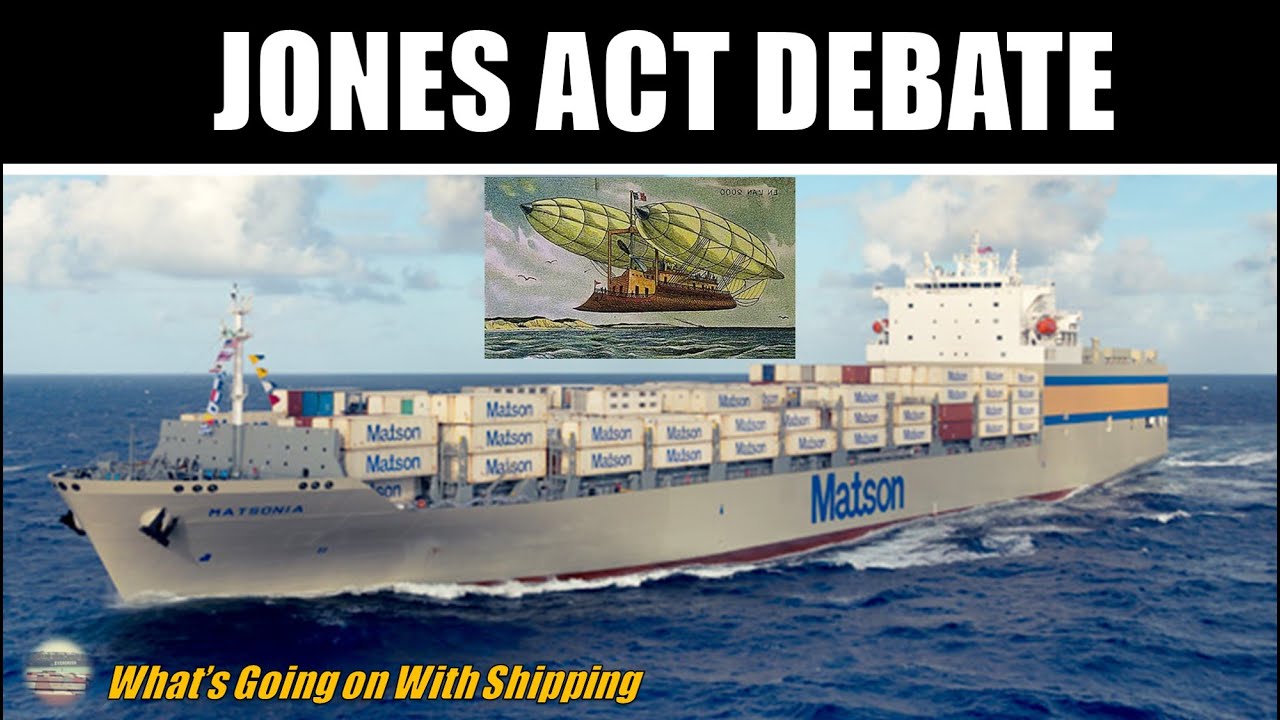
Mercogliano Rebuffs Heritage Airship Idea in Clash Over US Jones Act
What's Going on With Shipping?
Unworkable offshore airship concepts and full cabotage repeal fail basic logistics realities, leaving allied shipyard partnerships and statutory tweaks as the only viable path to revive American maritime power.
John McCown counters anti-Jones Act claims that U.S. shipbuilding multiples make final transport five times more expensive, calculating the actual net transportation cost penalty for containerized freight at just 15% to 20% due to shared fuel, pilotage, and handling expenses. (4:48)
Between 2010 and 2018, Chinese shipyards absorbed $132 billion in direct state subsidies, outstripping the U.S. Maritime Administration's Title XI loan program ($77 million) by a ratio of more than 1,700 to 1. (21:11)
Commercial Jones Act carriers like Matson repair in Chinese shipyards not out of preference, but because domestic West Coast dry docks are backlogged with U.S. Navy and Ready Reserve Force government vessels. (14:16)
The Heritage Foundation's proposed 'Blue Ocean Strategy' to offload 20,000 TEU container ships 12 miles offshore via dirigibles, drones, and helicopters is technically and economically unviable due to throughput limits, sea swells, and coastwise cabotage law. (33:11)
Detailed notes
## Background
Published on YouTube on November 18, 2023, by maritime historian and former merchant mariner Sal Mercogliano on his channel 'What's Going on With Shipping?', this episode breaks down a written debate hosted by the Center for Maritime Strategy. According to the show description, the video evaluates whether Section 27 of the Merchant Marine Act of 1920 (the Jones Act) serves as a help or hindrance to American shipping and national security through arguments from John McCown and the Heritage Foundation's Andrew Hale.
## TL;DR
Sal Mercogliano assesses the polarized debate over the Jones Act by dissecting arguments from industry veteran John McCown, who defends the law by debunking inflated cost multiples and emphasizing sealift readiness, and Andrew Hale, who contends the act has decimated U.S. maritime competitiveness. Mercogliano critiques both perspectives, noting that while McCown minimizes the need for modernization, anti-cabotage critics rely on skewed fleet metrics and misunderstand global shipbuilding subsidies. The review sharply scrutinizes a Heritage Foundation proposal to bypass domestic ports using offshore airships and heavy-lift drones, demonstrating why the concept is physically and logistically impossible. Ultimately, Mercogliano advocates for pragmatic reforms—such as allied shipbuilding partnerships and relaxed component requirements—over outright repeal.
## Atmosphere & style
The presentation is engaging, analytical, and distinctly grounded in practical deck-plate and executive shipping realities. Mercogliano adopts the persona of a fair-minded referee who meticulously checks data sources, transitioning smoothly between earnest economic breakdowns and incredulous, dry humor when confronting proposals like container-hauling dirigibles. Watching the breakdown feels like attending a masterclass in maritime logistics where academic and think-tank theories are tested against real-world engineering, shipyard scheduling, and sea conditions.
## Bulletin
- [04:48](https://www.youtube.com/watch?v=qWKz3psejb0&t=288s) John McCown counters anti-Jones Act claims that U.S. shipbuilding multiples make final transport five times more expensive, calculating the actual net transportation cost penalty for containerized freight at just 15% to 20% due to shared fuel, pilotage, and handling expenses.
- [21:11](https://www.youtube.com/watch?v=qWKz3psejb0&t=1271s) Between 2010 and 2018, Chinese shipyards absorbed $132 billion in direct state subsidies, outstripping the U.S. Maritime Administration's Title XI loan program ($77 million) by a ratio of more than 1,700 to 1.
- [14:16](https://www.youtube.com/watch?v=qWKz3psejb0&t=856s) Commercial Jones Act carriers like Matson repair in Chinese shipyards not out of preference, but because domestic West Coast dry docks are backlogged with U.S. Navy and Ready Reserve Force government vessels.
- [33:11](https://www.youtube.com/watch?v=qWKz3psejb0&t=1991s) The Heritage Foundation's proposed 'Blue Ocean Strategy' to offload 20,000 TEU container ships 12 miles offshore via dirigibles, drones, and helicopters is technically and economically unviable due to throughput limits, sea swells, and coastwise cabotage law.
## Key takeaways
- [00:00](https://www.youtube.com/watch?v=qWKz3psejb0&t=0s) The Jones Act (Section 27 of the Merchant Marine Act of 1920) enforces four statutory pillars for domestic cabotage: vessels must be U.S.-built, U.S.-flagged, U.S.-owned, and U.S.-crewed.
- [01:53](https://www.youtube.com/watch?v=qWKz3psejb0&t=113s) U.S. shipyard build costs are roughly three to four times higher than foreign yards due to high domestic labor rates and a 4.3% share of global steel production, rather than the five-to-eight-fold multiples claimed by critics.
- [04:48](https://www.youtube.com/watch?v=qWKz3psejb0&t=288s) China's commercial shipbuilding dominance (building 44% of global tonnage) stems from deliberate industrial subsidies—including free land, state-backed financing, and subsidized steel—rather than pure market competition.
- [09:32](https://www.youtube.com/watch?v=qWKz3psejb0&t=572s) Commercial Jones Act crews form the indispensable labor reserve needed to crew activated surge vessels in the Ready Reserve Force during military contingencies.
- [14:16](https://www.youtube.com/watch?v=qWKz3psejb0&t=856s) The collapse of deep-draft commercial shipbuilding began during the 1980s when the Reagan administration eliminated Construction Differential Subsidies (CDS) and slashed Operating Differential Subsidies (ODS).
- [18:47](https://www.youtube.com/watch?v=qWKz3psejb0&t=1127s) Selective counting skews fleet comparisons: while the deep-sea U.S. commercial fleet stands at roughly 93 vessels, counting all craft over 100 gross tons yields 3,531 U.S. vessels compared to roughly 11,000 for China and Hong Kong combined.
- [22:16](https://www.youtube.com/watch?v=qWKz3psejb0&t=1336s) Claims that domestic shipbuilding is 26 times more expensive than foreign acquisitions fall apart when analyzing DOD purchases of used foreign sealift Ro-Ros, which foreign owners sold at inflated prices requiring tens of millions to reflag.
- [25:04](https://www.youtube.com/watch?v=qWKz3psejb0&t=1504s) Structural shifts like interstate highway construction and pipeline expansions—not the Jones Act—were the primary historical reasons domestic coastal shipping declined in the mid-20th century.
- [28:40](https://www.youtube.com/watch?v=qWKz3psejb0&t=1720s) A full repeal of the Jones Act would carry unintended domestic consequences, exposing Mississippi River barge traffic and municipal ferry services to foreign-owned, foreign-flagged operators.
- [33:11](https://www.youtube.com/watch?v=qWKz3psejb0&t=1991s) Offshore lightering concepts using dirigibles or helicopters fail basic engineering throughput constraints: standard gantry cranes move containers every 30 seconds, while aircraft cannot handle continuous 20-ton cellular lifts in open ocean swells.
- [37:00](https://www.youtube.com/watch?v=qWKz3psejb0&t=2220s) Any lightering craft, barge, or aircraft moving cargo between a ship 12 miles offshore and the domestic shoreline remains legally subject to U.S. cabotage requirements under coastwise trade laws.
- [41:00](https://www.youtube.com/watch?v=qWKz3psejb0&t=2460s) Constructive Jones Act modernization should focus on pragmatic allied partnerships, modular foreign assembly frameworks (such as AUKUS or Finnish icebreaker models), and foreign direct investment in domestic shipyards rather than total repeal.
## Detailed walkthrough
### [00:00](https://www.youtube.com/watch?v=qWKz3psejb0&t=0s) Understanding Cabotage and the Merchant Marine Act of 1920
Sal Mercogliano opens the episode by teasing that while viewers constantly ask for a head-to-head clash between him and geopolitical analyst Peter Zeihan, today's debate is an intellectual duel hosted by the Center for Maritime Strategy (an affiliate of the U.S. Navy League) on their Maritime Operations Center blog. The debate centers on Section 27 of the Merchant Marine Act of 1920, colloquially known as the Jones Act. Mercogliano explains that cabotage—the transport of cargo and passengers between domestic ports—has been governed by statute in the United States since 1817, but the 1920 law solidified the requirement that any vessel moving goods between two U.S. ports must be U.S.-built, U.S.-flagged, U.S.-owned, and crewed by U.S. mariners.
While cabotage laws exist worldwide, Mercogliano emphasizes that the American framework represents one of the most restrictive cabotage regimes in existence. Many foreign countries enforce only domestic flagging requirements without mandating domestic construction. However, considering the sheer scale of the United States as the world's preeminent economic powerhouse and its expansive global military commitments, the necessity and impact of protecting domestic maritime cabotage remain fiercely contested. Mercogliano frames his role as an impartial ringside referee breaking down the evidence, methodology, and arguments presented by both sides.
- **Statutory Foundation:** Section 27 of the Merchant Marine Act of 1920 (preceded by the Navigation Act of 1817).
- **The Four Pillars of U.S. Cabotage:** A vessel moving between U.S. ports must be U.S.-built, U.S.-flagged, U.S.-owned, and U.S.-crewed.
---
[01:53](https://www.youtube.com/watch?v=qWKz3psejb0&t=113s) Framing the Debate and Dissecting Shipyard Build Multiples
The Center for Maritime Strategy framed the written exchange around a pointed, specific inquiry: “Is the Jones Act a help or hindrance to American shipping and national security?” Representing the pro-Jones Act perspective is John McCown, a non-resident senior fellow at the Center for Maritime Strategy and veteran maritime shipping executive. Arguing the opposition position is Andrew Hale, the Jay Van Andel senior trade policy analyst at the Heritage Foundation. Mercogliano jokes about his own lack of high-sounding think-tank titles before commending both authors for engaging in direct, transparent debate backed by cited sources.
In his opening argument, McCown readily acknowledges that the Jones Act entails an economic cost that can be quantified, but argues that public opinion has been warped by critics relying on distorted figures. McCown zeroes in on the vessel construction cost differential, pointing out that libertarian think tanks such as the Cato Institute historically claimed U.S. ship construction was six to eight times more expensive than overseas shipyards, before settling on a five-fold multiple as their standard figure. McCown counters that actual shipyard contract comparables reveal U.S. construction costs are roughly three times higher for commercial tankers and four times higher for container ships. Shipbuilding is fundamentally driven by two inputs: labor and steel. U.S. wage rates exceed global averages by more than five times, and the U.S. produces just 4.3% of global steel, whereas China has dominated world steel production since supplanting the U.S. position around 1950. As John McCown summarizes:
> “With the U.S. at a clear cost disadvantage with the two main factors used in building ships, there is no mystery why it costs more to build in the U.S.”
---
[04:48](https://www.youtube.com/watch?v=qWKz3psejb0&t=288s) Distortions of the Global Shipbuilding Market and Operating Cost Realities
To further explain why American shipyards cannot match foreign build prices, Mercogliano points viewers to economic research detailed on the *Trade Talks* podcast (episode 194, released November 5, 2023), based on a 74-page study published in the *Review of Economic Studies* by Panle Jia Barwick of Harvard University. The study demonstrates that China’s ascension to building 44% of world commercial tonnage was not driven by pure market efficiency, but through aggressive state industrial policy. Chinese shipyards received waterfront land at virtually zero cost, enjoyed unfettered access to state-backed financing and low-interest loans, purchased heavily subsidized domestic steel, and utilized cheap domestic labor unencumbered by OSHA safety requirements or stringent environmental regulations. Because China captured massive market share, shipbuilders in South Korea and Japan—who construct nearly all of the remaining 50% of global tonnage—have been forced to lower their own margins to compete.
```mermaid
flowchart TD
accTitle: Global Shipbuilding Dynamics and U.S. Cabotage Comparison
accDescr: Flowchart contrasting Chinese state-subsidized shipbuilding inputs against American operating realities and total shipping cost impacts.
subgraph ChinaModel["Chinese State-Subsidized Shipbuilding"]
direction TB
C1["Zero-Cost Waterfront Land"]
C2["Unfettered State Loans & Free Capital"]
C3["Artificially Cheap Subsidized Steel"]
C4["Low Labor Costs & Few Regulations"]
C1 & C2 & C3 & C4 --> Dominance["Builds 44% of Global Tonnage"]
end
subgraph GlobalImpact["Global Spillover"]
Dominance --> Competitors["South Korea & Japan Drive Down Margins (50% Market)"]
end
subgraph USReality["U.S. Cost Breakdown (Container Shipping)"]
direction TB
U1["U.S. Labor: 5x Global Average"]
U2["U.S. Steel: 4.3% of Global Output"]
U3["Ship Build Multiple: 3x-4x Overseas"]
U4["Shared Vessel Costs: Fuel, Port Fees, Pilotage"]
U1 & U2 & U3 & U4 --> TotalImpact["Net Transportation Impact: Only 15% to 20%"]
end
McCown stresses that focusing solely on vessel build multiples misrepresents the end cost of transportation. In container shipping, the ship’s amortization is only a fraction of total carrier expenditures. Costs such as marine fuel, local tug assist, terminal handling fees, and pilotage are identical whether a ship flies the Stars and Stripes or a foreign flag of convenience. When factoring in landside logistics, intermodal handling, and standard operational overhead, the actual objective cost difference for moving containerized freight under the Jones Act drops to just 15% to 20%. By fixating on a five-fold build multiple to claim that overall shipping costs are five times higher, McCown calculates that critics are exaggerating the real-world economic impact by a factor of 25 to 33.
---
[07:32](https://www.youtube.com/watch?v=qWKz3psejb0&t=452s) Debunking Exaggerated Claims and the Question of Domestic Labor Standards
McCown challenges three specific anti-Jones Act case studies published in recent years, documenting his rebuttals on his Medium page:
- **Tanker Waiver Charter Costs (May 2021):** Examining an actual foreign-flagged tanker chartered under an emergency Jones Act waiver, McCown found the cost differential compared to a domestic Jones Act tanker was 31%, not the multi-hundred-percent penalty claimed by critics.
- **Hawaii Cost-of-Living Impact (July 2021):** McCown dismantled a widely circulated report claiming the Jones Act imposes a $1.2 billion annual tax on Hawaii consumers, demonstrating the actual net cost is closer to $136 million.
- **East Coast Gasoline Prices (July 2023):** Addressing claims that cabotage restrictions add $4.3 billion annually to East Coast retail gasoline prices, McCown calculated the actual impact at approximately $85 million.
Mercogliano highlights McCown's argument that the higher operating costs of Jones Act shipping reflect American legal, environmental, and labor standards. Mercogliano raises the fundamental practical question that opponents of cabotage routinely evade: if the Jones Act is waived or repealed, what rules apply to foreign ships conducting domestic commerce? Foreign-flagged vessels visiting American ports today do not pay U.S. minimum wages or adhere to domestic labor statutes while operating in U.S. waters. Mercogliano asks whether critics truly intend to let foreign operators run domestic trade routes while paying mariners sub-minimum foreign wages, or if they expect them to abide by domestic standards. As John McCown states regarding the policy parity between maritime transport and landside logistics:
> “Jones Act ships are directly involved in domestic commerce and should be covered by the same rules governing other domestic industries.”
[09:32](https://www.youtube.com/watch?v=qWKz3psejb0&t=572s) National Security Sealift and the Crewing Web
Sal Mercogliano reviews the closing arguments of John McCown from the Center for Maritime Strategy, who argues that the national security value of the U.S.-flagged merchant fleet is beyond dispute. Mercogliano addresses a frequent critique raised by skeptics: during the 1990–1991 Persian Gulf War, commercial Jones Act ships did not haul cargo directly across the ocean to the Middle East. Mercogliano clarifies that this misinterprets how military sealift functions. Jones Act tankers are not designed to pick up cargo in the United States and steam straight to Saudi Arabia; rather, trained merchant mariners working day-to-day on Jones Act commercial vessels serve as the vital labor pool needed to crew activated surge ships in the Ready Reserve Force (RRF). Furthermore, commercial carriers like Matson and Pasha routinely transport military materiel to critical forward staging locations such as Hawaii and Alaska. McCown emphasizes that gutting domestic seafaring jobs would trigger an irreversible collapse of the specialized workforce and dissolve the network of industrial suppliers that simultaneously sustains naval shipbuilding.
```mermaid
flowchart TD
accTitle: Jones Act Role in Sealift and Naval Support
accDescr: Flowchart illustrating how Jones Act crews and supply chains sustain naval readiness and surge sealift operations.
subgraph Commercial["Commercial Foundation"]
Crew["Jones Act Mariners"]
Base["Industrial Web of Suppliers"]
Lines["Domestic Carriers (Matson / Pasha)"]
end
subgraph Defense["National Defense Operations"]
RRF["Ready Reserve Force Surge Ships"]
Naval["Naval Shipbuilding & Repair"]
Bases["Forward Staging Bases (Hawaii & Alaska)"]
end
Crew -->|"Mobilized to crew"| RRF
Base -->|"Provides critical components"| Naval
Lines -->|"Transports military cargo"| Bases
```
While Mercogliano largely aligns with McCown's defense, he notes that McCown's position is somewhat overly rigid. Sal believes the regulatory framework surrounding the Jones Act has failed to keep pace with modern international maritime standards, making thoughtful legislative reform necessary rather than maintaining an unbending status quo.
> “It would be reckless for Congress to repeal it, particularly today when the importance of stable service and seal of capacity in an emergency are more recognizable.” — John McCown (quoted by Sal Mercogliano)
[11:22](https://www.youtube.com/watch?v=qWKz3psejb0&t=682s) Andrew Hale's Critique: Global Decline and Chinese Dominance
Mercogliano pivots to the opposing argument published by Andrew Hale of the Heritage Foundation. Hale asserts that the Jones Act is fundamentally broken and has failed to deliver a competitive advantage. Mercogliano immediately pushes back against this blanket claim, noting that cabotage laws provided an immense strategic edge dating from the early Republic through to the massive logistical mobilization of World War II. However, both agree on the current grim state of American shipbuilding: the United States now produces less than 1% of the world's commercial tonnage. Meanwhile, the People's Republic of China has built a massive merchant fleet and expanded its maritime footprint into more than 100 ports across 63 nations under the Belt and Road Initiative.
The analysis turns to Hale’s criticism of how American carriers match up against Chinese state enterprises. Mercogliano takes issue with a minor formatting point—reminding viewers that the term "merchant marine" should not be capitalized like a formal military service—before breaking down Hale’s comparison of private U.S. carriers to COSCO. COSCO is a state-owned enterprise, not an independent commercial entity bound by private shareholders and quarterly dividends. Furthermore, when Hale describes Chinese civil-military integration as a policy that “harmonizes” commercial and military operations, Mercogliano scoffs at the sanitized phrasing, retorting that Beijing does not merely "harmonize" civilian shipping, but compels and enforces compliance outright. Hale also laments that U.S. shipowners are burdened by strict labor and environmental laws; Mercogliano acknowledges the reality of overregulation, but reminds viewers that standards like OSHA safety rules, child labor bans, pollution controls, and fair minimum wages remain fundamentally sound protections.
> “The Jones Act is not working and has never delivered a competitive edge.” — Andrew Hale (quoted by Sal Mercogliano)
- Hale notes the deep-draft Jones Act commercial fleet plummeted from 257 ships in 1980 to just 93 vessels today.
- Mercogliano points out that Hale’s tally selectively counts only ocean-going vessels exceeding 1,000 gross tons, leaving out thousands of tugs, barges, offshore supply boats, ferries, inland waterway craft, and Great Lakes carriers.
- Hale references an article by Colin Grabow of the Cato Institute arguing that Adam Smith would have opposed the Jones Act.
[14:16](https://www.youtube.com/watch?v=qWKz3psejb0&t=856s) Why Jones Act Ships Repair in Chinese Yards
Hale’s critique highlights the paradox of Jones Act vessels having to dry-dock in Chinese shipyards for maintenance and overhauls, arguing that high domestic build requirements have crippled U.S. industrial capacity. Mercogliano reframes this "chicken and egg" problem by explaining that the Jones Act did not cause the collapse of U.S. commercial shipbuilding. The true turning point came during the 1980s under the Reagan administration, when the federal government terminated the Construction Differential Subsidy (CDS) and slashed the Operating Differential Subsidy (ODS). Stripping those international subsidies caused American yards to stop producing commercial vessels for foreign trade, which concentrated domestic shipbuilding exclusively into a tiny, high-cost coastal market.
Mercogliano explains the practical bottleneck on the U.S. West Coast that forces carriers like Matson to send vessels abroad. Only a tiny handful of commercial yards on the Pacific coast possess the dry-dock capacity required for deep-draft commercial ships. Pulling up live MarineTraffic tracking data from Portland, Oregon on November 17, 2023, Mercogliano shows Vigor Marine's dry docks completely occupied by six government vessels:
- Department of Transportation/MARAD Ready Reserve Force vessels: *Cape Henry*, *Cape Horn*, and *Pacific Tracker* (along with the training ship *Golden Bear* docked on-site).
- Department of the Navy/Military Sealift Command fleet replenishment oilers: *John Lewis* (T-AO-205) and *Guadalupe* (T-AO-200).
```mermaid
flowchart TD
accTitle: West Coast Dry Dock Shortage Flow
accDescr: Flowchart showing why commercial carriers send Jones Act ships to China for repairs.
Gov["US Government Contracts<br>(MSC Oilers & RRF Surge Ships)"] -->|"Occupy full capacity & cause schedule overruns"| Yards["Limited US West Coast Yards<br>(e.g., Vigor Marine in Portland)"]
Yards -->|"No predictable repair slots available"| Commercial["Commercial Fleets<br>(Matson, Pasha, APL)"]
Commercial -->|"Must hit precise freight sailing schedules"| Overseas["Foreign Ship Repair Options"]
Overseas -->|"Cheapest rates offset 50% ad valorem tax"| China["Chinese Repair Shipyards<br>(Guaranteed 30-day turnarounds)"]
```
Because public-sector naval and sealift contracts dominate domestic yards, work often suffers from schedule slips, bureaucratic delays, and extensive change orders. Commercial container lines operate on tight liner schedules where every lost day at sea costs significant revenue. Operators cannot risk booking an overhaul in an American yard that might hold their ship weeks past its scheduled departure date. Despite being hit with a 50% U.S. customs ad valorem tax on all foreign shipyard maintenance work, carriers turn to Chinese shipyards because they offer massive capacity, lower rates, and rigid timetable reliability. Since companies like Matson operate direct liner routes connecting the U.S. West Coast to China, it is operationally seamless to discharge commercial cargo in a Chinese port and immediately enter a neighboring dry dock with a guarantee of leaving within 30 days.
> “It's not happening because Matson wants to go to China. It's because Matson can't get into US shipyards because there's not enough US shipyards to do it...” — Sal Mercogliano
[18:47](https://www.youtube.com/watch?v=qWKz3psejb0&t=1127s) Dissecting Fleet Statistics: U.S. vs. China
Sal Mercogliano breaks down the comparative numbers cited by Andrew Hale of the Heritage Foundation, who argues that the "wall of protection" around the U.S. merchant fleet has utterly failed when contrasted with China’s fleet of 8,007 ships—the second largest globally by carrying capacity. Mercogliano points out several flaws in this data presentation. First, Hale relies on outdated figures from an older edition of UNCTAD's *Review of Maritime Transport* rather than the current 2023 release. Second, Hale’s comparison is fundamentally skewed: he measures the U.S. by deep-sea, internationally trading vessels (around 93 ships) while applying an all-inclusive standard (every vessel over 100 gross tons) to China.
```mermaid
flowchart TD
accTitle: Comparison of U.S. and Chinese Fleet Metrics
accDescr: Visualizing the discrepancy between Hale's narrow U.S. count and the broader UNCTAD gross tonnage standards.
When evaluated using identical criteria—all vessels over 100 gross tons—the U.S. fleet stands at 3,531 vessels (about 3.5% of the world fleet by vessel count, though only 0.6% by deadweight tonnage). Furthermore, Mercogliano notes that Hale actually *understates* Chinese maritime dominance by omitting Hong Kong: adding Hong Kong's 2,537 ships to the Chinese mainland fleet of 8,262 yields nearly 11,000 vessels, accounting for 14% to 15% of global capacity and ranking just behind flag-of-convenience havens Liberia and Panama. Mercogliano insists that critics must be intellectually honest with their data: “Again, I don't mind you using numbers, but make sure you use them accurately and correctly if you're going to make a point.” He anticipates the counter-argument that much of the larger U.S. figure consists of domestic river barges, but counters that barges are simply the most efficient, natural mode of transport for moving bulk commodities down the Mississippi and Ohio River systems—and opening up the Jones Act would not change that operational reality.
- **Vessel count vs. capacity:** The U.S. controls 3.5% of global ships by hull count (3,531 vessels), but only 0.6% by total deadweight carrying capacity.
- **Combined Chinese maritime power:** Combining mainland China (8,262 vessels) and Hong Kong (2,537 vessels) gives an operating bloc of nearly 11,000 ships.
- **Top global flags:** China and Hong Kong combined sit behind only Panama and Liberia in deadweight tonnage.
---
[21:11](https://www.youtube.com/watch?v=qWKz3psejb0&t=1271s) Shipbuilding Subsidies: Billions in China vs. Millions in the U.S.
Mercogliano gives Hale credit for acknowledging the sheer magnitude of Chinese state support. Citing the Center for Strategic and International Studies (CSIS) report *Hidden Harbors: China's State-backed Shipping Industry*, Hale notes that Chinese shipyards absorbed $132 billion in direct state subsidies between 2010 and 2018. Yet Hale insists that simply subsidizing American shipbuilders under a "stifling" Jones Act will never revive the sector.
Mercogliano finds this dismissal baffling when comparing the orders of magnitude involved. During that exact same eight-year window, the U.S. Maritime Administration's Title XI loan guarantee program provided American yards with a paltry $77 million—not billion, but *million*. When factoring in the massive indirect subsidies detailed by academic studies (such as Harvard University research featured on trade podcasts), the capital flowing into Chinese yards is truly astronomical. Given that the U.S. has offered virtually nothing in comparison, Mercogliano rejects the claim that financial and industrial policy cannot make a difference.
- **Chinese direct yard subsidies (2010–2018):** $132,000,000,000 ($132 billion).
- **U.S. Title XI financing (2010–2018):** $77,000,000 ($77 million).
- **Comparative discrepancy:** Chinese direct state financing outstripped U.S. government support programs by more than 1,700 to 1 during the surveyed period.
---
[22:16](https://www.youtube.com/watch?v=qWKz3psejb0&t=1336s) The Myth of 26-Fold Domestic Costs and the Used Sealift Fleet
Turning to the regulatory and cost debate, Mercogliano agrees with Hale that commercial shipping faces a massive technology inflection point—particularly surrounding green propulsion and alternative fuels spurred by IMO 2050 decarbonization mandates. However, he strongly challenges Hale’s assertion that Jones Act regulators actively block new innovators. Mercogliano examines a striking claim attributed to former USTRANSCOM commander General Stephen R. Lyons, who allegedly testified that building a ship in the United States is 26 times more costly than buying foreign.
| Vessel Name / Class | Original Operator / Source | Purchase Price per Vessel | Conversion / Reflagging Cost | Resulting Total Investment |
|:--- |:--- |:--- |:--- |:--- |
| **Used MSP Ro-Ros (x2)** | American Roll-on Roll-off Carrier (ARC) | ~$25 million | Extensive yard delays (>1 yr) | ~$25M+ (significant administrative delay) |
| **Cape S-Class Ro-Ros (x3)** | Ignazio Messina & C. (Italian Line) | $90 million to $110 million | ~$20 million | $110 million to $130 million each |
Mercogliano attempted to trace the source link in the Heritage article, but found the hyperlink broken, and the specific "26 times" figure did not appear in Lyons' formal statement before the House Armed Services Committee. Even if Lyons uttered the line in off-the-cuff testimony, Mercogliano argues the arithmetic collapses when evaluated against real-world Defense Department acquisitions. To recapitalize the Ready Reserve Force, the U.S. government recently purchased five secondhand commercial roll-on/roll-off (Ro-Ro) vessels on the global market:
- Two vessels acquired from ARC for roughly $25 million each (which took more than a year to reflag despite already operating in the Maritime Security Program).
- Three 10-year-old vessels bought from Italy’s Ignazio Messina & C. for between $90 million and $110 million each, which require another $20 million per ship to reflag and modify for military readiness (becoming the Cape S-Class).
Mercogliano highlights the absurdity: foreign operators charged the U.S. government more to purchase these vessels used than Messina originally paid to construct them brand new, because foreign sellers recognized U.S. military desperation. Multiplying that $110–$130 million price tag by 26 would suggest a single cargo ship would cost over $3 billion to construct domestically, which is preposterous: “And there is no way, no way that 110, $130 million for the last one—multiply that by 26 is what it would cost to build such a ship in the United States.” Transcom and federal planners completely misjudged the global market, falling prey to foreign price gouging while wrongly maligning domestic build ratios.
---
[25:04](https://www.youtube.com/watch?v=qWKz3psejb0&t=1504s) True Historical Causes of Decline and the COVID Supply Chain Reality
Mercogliano challenges Hale’s argument that American shipping remains 18 times more expensive due purely to domestic regulations, and that this gulf only emerged once the Jones Act created an uncompetitive bubble. Historical reality disproves this narrative: transcripts from the Senate hearings on the Merchant Marine Act of 1920 explicitly documented that American shipbuilding was already significantly more expensive than British shipbuilding, driven by higher American living standards and robust labor protections.
Mercogliano emphasizes that anti-Jones Act critics habitually treat the 1920 statute as a scapegoat for broader technological and structural shifts in American freight:
- The expansion of the **Interstate Highway System** made long-haul trucking vastly faster and more flexible than domestic coastal shipping.
- The construction of national **interstate pipeline networks** permanently eliminated the need for coastal oil tankers to supply eastern fuel markets.
Mercogliano points out the flaws in Hale's proposed near-term policy reforms. Hale suggests granting Jones Act waivers to shipbuilding allies such as Japan, South Korea, and Greece. Mercogliano notes that while South Korea, Japan, and China together control roughly 93% of global shipbuilding output, Greece builds almost no commercial ships at all, making its inclusion nonsensical.
Furthermore, Hale's claim that Jones Act reform is needed to prevent supply chain breakdowns like those seen during the COVID-19 pandemic completely misdiagnoses the problem: “I don't know about you, but I didn't see a shipping shortage during COVID. I saw 109 ships off LA and Long Beach.” The crisis was an onshore logistics gridlock—involving chassis, terminals, warehousing, and railheads—not a shortage of open-ocean hulls. In contrast, domestic Jones Act carrier Matson proved to be one of the most reliable supply chains in the world during COVID: because Matson owned its dedicated terminals, its vessels bypassed the massive backlogs off southern California to provide uninterrupted expedited service between the U.S. West Coast, Hawaii, and Asia.
Mercogliano concludes by addressing the libertarian call for total maritime deregulation. Anti-cabotage advocates frequently point to Great Britain's nineteenth-century repeal of its Navigation Acts as an inspiring historical precedent for free trade. However, they consistently ignore the strategic context: “Britain repealed cabotage when its merchant marine controlled 50% of the world ships.” Britain abandoned cabotage only when it was the uncontested industrial master of the world ocean, not when its commercial fleet was struggling for its very survival.
[28:40](https://www.youtube.com/watch?v=qWKz3psejb0&t=1720s) Container History, Market Concentration, and the Perils of Total Repeal
Addressing the claim that American shipping was previously revolutionized by containerization and can simply replicate that success, Sal Mercogliano injects a critical historical reality check. Malcolm McLean famously struggled for a decade to sell the containerization concept to the broader commercial market; it took the logistics crisis of the Vietnam War and massive U.S. government adoption to validate its operational utility. Later, when United States Lines went bankrupt in the 1980s, the U.S. government pointedly refused to bail it out, triggering a collapse that directly enriched foreign competitors—notably Taiwan's Evergreen. Similarly, when Sea-Land encountered fatal financial troubles, Washington offered no rescue, allowing it to be acquired by the Danish conglomerate Maersk.
Mercogliano highlights that while containerization was born in the United States, deregulation and consolidation dramatically contracted the competitive landscape: two decades ago, the top 10 ocean carriers controlled roughly 50% of the world's container capacity afloat, whereas today those top 10 control an overwhelming 85%. Furthermore, he expresses total bafflement at the Heritage argument that the industry can be revolutionized again through “modularization” which is supposedly blocked by labor unions. If the author refers to modular shipyard construction techniques, Mercogliano acknowledges that modernization and regulatory reform are vital topics of discussion. However, he warns that blanket abolition of the Jones Act is a radical non sequitur: “But repealing the Jones, if you repeal the Jones Act, that means that the traffic on the Mississippi River is now open to foreign flag, that the Staten Island ferry is open for foreign ownership.”
- **Historical Reality of Containerization**: Malcolm McLean could not find commercial traction for his concept for ten years until the U.S. military logistics pipeline in the Vietnam War demonstrated its strategic value.
- **Fall of American Carrier Dominance**: Lack of state support led to United States Lines collapsing in the 1980s (fueling Evergreen's growth) and Sea-Land being absorbed by A.P. Moller – Maersk.
- **Oligopoly Growth**: Top 10 global container shipping lines expanded their fleet share from 50% twenty years ago to 85% today.
- **Unintended Consequences of Full Repeal**: Domestic inland waterways (the Mississippi River system) and municipal transit operations (such as the Staten Island Ferry) would be surrendered to foreign-flagged, foreign-owned operators.
[30:03](https://www.youtube.com/watch?v=qWKz3psejb0&t=1803s) The Heritage Foundation Report: Blue Ocean Strategy and Port Limits
Mercogliano turns to the concluding paragraph of Andrew Hale's piece, which references the May 2023 Heritage Foundation Special Report titled *Regaining U.S. Maritime Power Requires a Revolution in Shipping*, co-authored by Brent Sadler and Peter St Onge. Having read the report upon its release and privately conveyed his deep reservations to Sadler, Mercogliano reviews its core strategic diagnosis: over the past thirty years, the United States has surrendered its economic security by becoming completely dependent on foreign shipbuilding and foreign fleets, chief among them the People's Republic of China. He fully concurs with the paper’s premise that the U.S. Navy cannot maintain a credible deterrent without an accompanying merchant marine overhaul, and that historically America surged ahead during technological inflection points—such as the transition from sail to steam, steam to diesel, and coal to bunker oil.
Where the Heritage proposal derails, according to Mercogliano, is in its proposed workaround for port infrastructure limitations. Modern ultra-large container vessels (ULCVs) carrying 20,000 to 24,000 TEUs cannot dock at most American ports due to crane size restrictions, berth geometry, and turning basins. While ports like Los Angeles, Long Beach, and Savannah have dredged channels down to 50-foot drafts to handle massive ships, Heritage proposes a radical “Blue Ocean Strategy”: bypassing Jones Act constraints and port bottlenecks entirely by having foreign mega-ships sit 12 nautical miles offshore in international waters, offloading their containers into smaller secondary coastal hubs such as Coos Bay, Oceanside, Humboldt Bay, or Morro Bay via regional intermodal links.
```mermaid
flowchart TD
accTitle: Heritage Foundation Offshore Offloading Concept
accDescr: Diagram illustrating the Heritage Foundation proposal where international mega-ships offload cargo 12 miles offshore to avoid ports and the Jones Act.
subgraph International["12 Nautical Miles Offshore (International Waters)"]
ULCV["Ultra-Large Container Ship\n(20,000–24,000 TEU)"]
end
subgraph ProposedTransit["Proposed Offshore Transfer Mechanisms"]
Lighter["Shuttle Feeder Barges / Ships"]
AirLift["Vertical Lift:\nHelicopters, Drones & Dirigibles"]
end
subgraph Domestic["Secondary U.S. Ports / Mainland"]
RegionalPorts["Secondary Ports:\nCoos Bay, Humboldt Bay, Morro Bay"]
InlandRail["Class I Railroads & Long-Haul Trucking\n(2/3 of West Coast Cargo Moving East)"]
end
[33:11](https://www.youtube.com/watch?v=qWKz3psejb0&t=1991s) The Dirigible Delusion: Physics, Throughput, and Offshore Reality
Mercogliano displays the Heritage Foundation's infographic, struggling to maintain a straight face as he unpacks their logistical mechanism: an ultra-large container ship sits anchored 12 miles offshore in the open Pacific—under the fantasy that the open ocean will remain flat-calm like a millpond—while cargo is transferred either to smaller vessels or plucked off the deck by vertical-lift aircraft, including drones, heavy-lift helicopters, and dirigibles (blimps). He reminds viewers that when the U.S. military explored offloading Fast Deployment Logistic (FDL) ships using helicopters in the 1960s and 1970s, they discovered that helicopters possess fundamentally inadequate payload capabilities. A standard 40-foot container (FEU) routinely weighs up to 20 tons; few heavy-lift rotorcraft can manage that load, and no airframe can sustain continuous, high-cycle container moves.
```
+---------------------------------------------------------------------------------------------------+
| OFFSHORE DIRIGIBLE / HELICOPTER PROPOSAL VS. REAL-WORLD REALITY |
+------------------------------------+--------------------------------------------------------------+
| Heritage Foundation Concept | Maritime Engineering & Logistical Reality |
+------------------------------------+--------------------------------------------------------------+
| 12 miles offshore in international | Pacific swells cause continuous rolling and pitching; safe |
| waters (circumventing Jones Act) | deep-cell container extraction offshore is impossible |
+------------------------------------+--------------------------------------------------------------+
| Offload 20,000 TEU ship via | A 20-ton FEU container exceeds practical continuous vertical |
| blimps, drones, and helicopters | lift limits; airframes face severe structural payload caps |
+------------------------------------+--------------------------------------------------------------+
| Disperse cargo directly into small | 2/3 of West Coast cargo heads east via Class I rail networks;|
| regional Pacific harbors | small bays lack the deep-water rail/chassis infrastructure |
+------------------------------------+--------------------------------------------------------------+
| Faster, cheaper alternative to | Ship-to-shore gantry cranes move a box every 30 seconds; |
| conventional port construction | aerial/shuttle cycles would take weeks to clear a single ship |
+------------------------------------+--------------------------------------------------------------+
```
Even if experimental commercial airships (such as concepts explored by Louis Dreyfus Armateurs) achieve a 60-ton lift capacity, the core obstacle is *throughput*. A single 20,000 TEU vessel holds roughly 10,000 forty-foot boxes. A land-based ship-to-shore (STS) gantry crane moves a container in 30 seconds, operating at speeds an aerial blimp or drone could never match across a 12-mile transit. Extracting containers buried six to eight tiers deep inside vertical cellular hold guides while an unmoored ship pitches and rolls in sea swells is an engineering impossibility. Moreover, about two-thirds of all inbound West Coast containerized freight immediately moves east via inland Class I railroads and drayage trucks; small coastal inlets lack the mainline rail infrastructure to handle high-volume intermodal transfers. Mercogliano emphasizes that the military abandoned similar attempts to offload large, medium-speed roll-on/roll-off (LMSR) ships using Air Cushioned Landing Craft (LCACs) because discharging a single vessel took weeks instead of days.
Ultimately, the proposal fails to evade the Jones Act on its own terms: any transfer vessel, shuttle lighter, barge, helicopter, or dirigible operating between a point 12 miles offshore and the domestic shoreline constitutes point-to-point coastwise trade subject to U.S. cabotage law—demanding American crews, domestic construction, and U.S. documentation. Mercogliano summarizes the fatal disconnect of using this concept as a serious policy recommendation: “This is not a concept that has any commercial viability. Does it have military viability? Sure. Military will buy anything.”
[38:29](https://www.youtube.com/watch?v=qWKz3psejb0&t=2309s) Supply Chain Realities and the Dirigible Distraction
Sal Mercogliano addresses Andrew Hale's proposal that novel concepts like dirigibles and offshore container handling must supplant the domestic Jones Act fleet as it continues to wither away. While Mercogliano views the debate between John McCown and Andrew Hale as a prime opportunity for productive discourse, he points out a fundamental lack of commercial shipping literacy that often plagues outside think tanks. Commercial maritime operations are intensely complex, and very few individuals bridge the divide between industry operators and external policy analysts. Mercogliano emphasizes that the proposal to use airships for offshore container lightering is simply detached from operational reality: “Most people don't understand how it works.”
```mermaid
flowchart LR
accTitle: Container Port Logistics Flow
accDescr: Flow diagram contrasting the proposed airship lightering against actual landside container logistics and transloading.
subgraph Ocean["Ocean Transport"]
CS["Container Ships"]
end
subgraph Flawed["Proposed Airship Concept"]
DIR["Dirigibles / Lightering"]
CS -.->|"Impractical throughput"| DIR
end
subgraph Reality["Actual Landside Logistics"]
PORT["Port Marine Terminals\n(Cranes & Deep Draft)"]
DC["Distribution Centers\n(Within 50–100 miles)"]
TRUCK["Transloaded to 53-ft Trailers\n(Long-haul domestic freight)"]
CS -->|"High-volume discharge"| PORT
PORT -->|"Drayage"| DC
DC -->|"Cross-docking"| TRUCK
end
```
The core challenge in maritime shipping is scale and cargo throughput. The ports of Los Angeles and Long Beach handle around 20 million TEUs annually, a staggering volume that cannot be moved off ships by aircraft. Mercogliano points to the Port of Oakland: despite having deep drafts, container cranes, and quayside infrastructure ready to accommodate ships, labor and operational bottlenecks still snarled cargo flow. Furthermore, shipping containers rarely travel intact to final domestic destinations. Instead, the overwhelming majority move roughly 50 to 100 miles from the terminal gates to regional distribution hubs, where cargo is destowed and transloaded into 45-foot and 53-foot domestic trailers for overland transport. Floating dirigible concepts fundamentally bypass the real problem that needs solving—namely, the high cost of domestic shipbuilding and the economic burdens borne by coastal and island communities:
- The Jones Act impacts far more than non-contiguous territories like Hawaii, Alaska, and Puerto Rico; it directly affects coastal populations, including island residents and communities along the North Carolina Outer Banks.
- Ports like Los Angeles and Long Beach move roughly 20 million TEUs per year, volumes completely beyond the physical cargo capacity of lighter-than-air vessels.
- Marine shipping containers are generally unpacked within a 50-to-100-mile radius from ports, transferring retail freight into larger domestic trailers rather than moving inland on marine chassis.
[41:00](https://www.youtube.com/watch?v=qWKz3psejb0&t=2460s) Realistic Jones Act Reform and International Partnerships
Evaluating the two sides, Mercogliano commends John McCown for building an empirical, data-driven argument, while disagreeing with the notion that the Jones Act is perfect and should remain untouched. Honest reform is critical, but it requires grounded, practical proposals rather than unworkable concepts. Mercogliano notes that the debate missed crucial areas, particularly the total lack of Jones Act-compliant liquefied natural gas (LNG) carriers to move domestic energy between U.S. ports.
Rather than pursuing outright repeal, Mercogliano argues that policymakers should explore pragmatic, piecemeal statutory reforms. These adjustments could include relaxing domestic steel content thresholds, sourcing specific interior shipboard components from foreign manufacturers, or leveraging international allied partnerships for modular assembly.
He highlights models already present in allied defense programs:
- An AUKUS-style framework, mirroring how the U.S. and UK collaborate to supply submarines to Australia.
- A bilateral shipbuilding partnership with nations like Finland to construct initial icebreakers overseas while building out domestic assembly capacity.
- Foreign shipyard investments in the U.S., such as South Korea’s Hanwha entering the Philly Shipyard, Australia’s Austal operating in Alabama, and Italy’s Fincantieri running shipyards in the Great Lakes region.
Mercogliano argues that publishing unrealistic ideas harms the credibility of conservative defense and policy analysts. When respected institutions like the Heritage Foundation propose concepts detached from technical feasibility, commercial shipping executives write off the entire critique: “Commercial people will look at that and sit there and go, 'these people don't know anything about containers and moving cargo because that it is completely not a viable option at all.'”
[42:48](https://www.youtube.com/watch?v=qWKz3psejb0&t=2568s) Channel Outro and Wrap-Up
Mercogliano wraps up the episode by encouraging viewers to engage, subscribe, leave comments, and share the video across social platforms. In a humorous nod to the episode's most unconventional topic, he jokes that viewers can back him via YouTube Super Thanks or Patreon to help fund his new personal venture: buying a dirigible to enter the commercial container-lightering business. He signs off promising more coverage as maritime policy debates unfold.
## Notable quotes
> [07:32](https://www.youtube.com/watch?v=qWKz3psejb0&t=452s) Jones Act ships are directly involved in domestic commerce and should be covered by the same rules governing other domestic industries. — John McCown
> [11:22](https://www.youtube.com/watch?v=qWKz3psejb0&t=682s) The Jones Act is not working and has never delivered a competitive edge. — Andrew Hale
> [01:53](https://www.youtube.com/watch?v=qWKz3psejb0&t=113s) With the U.S. at a clear cost disadvantage with the two main factors used in building ships, there is no mystery why it costs more to build in the U.S. — John McCown
## Mentioned
Sal Mercogliano, John McCown, Andrew Hale, Peter Zeihan, Panle Jia Barwick, Colin Grabow, Stephen R. Lyons, Malcolm McLean, Brent Sadler, Peter St Onge, Center for Maritime Strategy, Heritage Foundation, Cato Institute, Navy League of the United States, Trade Talks, Review of Economic Studies, COSCO, Vigor Marine, Maritime Administration (MARAD), Military Sealift Command (MSC), United Nations Conference on Trade and Development (UNCTAD), Center for Strategic and International Studies (CSIS), USTRANSCOM, American Roll-on Roll-off Carrier (ARC), Ignazio Messina & C., Matson, Pasha Hawaii, United States Lines, Evergreen Marine, Sea-Land Service, A.P. Moller – Maersk, Louis Dreyfus Armateurs, Hanwha, Austal, Fincantieri, Merchant Marine Act of 1920 (Jones Act), Navigation Act of 1817, Maritime Security Program (MSP), Ready Reserve Force (RRF), AUKUS
## Video description
Is The Jones Act a help or hindrance to American shipping and national security?
What's Going on With Shipping?
Nov 17, 2023
In this episode, Sal Mercogliano - maritime historian at Campbell University (@campbelledu) and former merchant mariner - discusses an article posted by the Center for Maritime Strategy entitled Up for Debate: The Jones Act. In it, John McCown of the Center for Maritime Strategy and Andrew Hale of the Heritage Foundation debate is The Jones Act a help or hindrance to American shipping and national security.
00:00 Introduction
03:31 John McCown Pro-Jones Act
11:22 Andrew Hale Anti-Jones Act
30:03 Solution: Dirigibles?
38:38 Conclusion
Support What's Going on With Shipping via:
Patreon: www.patreon.com/wgowshipping
Twitter: @mercoglianos
Facebook: @wgowshipping
Email: mercoglianosal@gmail.com
Up for Debate: The Jones Act
https://centerformaritimestrategy.org/publications/up-for-debate-the-jones-act/
Industrial policy detectives: China’s subsidies for shipbuilding
https://tradetalkspodcast.com/podcast/194-industrial-policy-detectives-chinas-subsidies-for-shipbuilding/
Regaining U.S. Maritime Power Requires a Revolution in Shipping
https://www.heritage.org/defense/report/regaining-us-maritime-power-requires-revolution-shipping
Analyzing an exchange between maritime executive John McCown and Heritage Foundation analyst Andrew Hale, maritime historian Sal Mercogliano argues that while the Jones Act requires pragmatic modernization, calls for outright repeal rely on distorted cost figures, unworkable logistical proposals, and a failure to grasp global industrial dynamics.
Shipbuilding Differentials and Overall Freight Realities (1:53)
Critics of the Jones Act frequently cite inflated vessel construction multiples, with libertarian think tanks historically asserting that domestic ship construction is five to eight times more costly than overseas production. John McCown refutes this with contract data showing domestic builds run roughly three times higher for commercial tankers and four times higher for container ships. Because shipbuilding inputs are dominated by labor and steel—where U.S. wages are over five times the global average and domestic mills produce only 4.3% of world steel—higher local production costs are structural. Furthermore, commercial tonnage dominance by China (44%) and rivals in South Korea and Japan (nearly 50%) is sustained by aggressive state industrial policy, including free land, direct subsidies, and soft loans.
Critically, ship construction amortizes to only a small fraction of total logistics expenditures. Equalized expenditures like marine bunker fuel, terminal handling, canal charges, and pilotage apply regardless of a vessel's registry. McCown calculates that the actual net transportation cost penalty under the Jones Act is only 15% to 20% for container freight. When reviewing specific past claims—such as alleged multi-billion-dollar annual premiums on Hawaii consumer goods or East Coast retail gasoline—actual operational impacts proved to be fractions of those estimates, such as $136 million for Hawaii rather than $1.2 billion.
Domestic Industrial Capacity and Maintenance Bottlenecks (14:16)
Opponents argue that cabotage protections caused the domestic deep-draft commercial fleet to shrink from 257 vessels in 1980 to 93 today. However, Mercogliano clarifies that this decline stems primarily from the Reagan administration’s 1980s termination of the Construction Differential Subsidy (CDS) and cuts to the Operating Differential Subsidy (ODS), which eliminated domestic yards from international commercial trade. Moreover, narrow vessel tallies exclude thousands of critical domestic tugs, barges, and Great Lakes carriers that form the operational backbone of inland transport.
This limited yard capacity explains why domestic carriers like Matson conduct vessel overhauls in Chinese shipyards despite paying a 50% U.S. customs ad valorem tax. U.S. West Coast commercial dry docks, such as Vigor Marine in Portland, are perpetually backlogged with priority Military Sealift Command oilers and Ready Reserve Force surge vessels. Commercial container lines operating on rigid weekly schedules cannot tolerate the administrative delays common to naval yards. In contrast, Chinese dry docks offer lower labor costs, massive berth space, and guaranteed 30-day overhaul schedules.
The Practical Failures of Offshore Bypass Concepts (30:03)
To bypass both the Jones Act and domestic harbor limitations, a Heritage Foundation report proposed a 'Blue Ocean Strategy' where foreign ultra-large container vessels (20,000 to 24,000 TEUs) anchor 12 nautical miles offshore in international waters and discharge cargo using helicopters, drones, or dirigibles into small regional harbors. Mercogliano dismisses this as aerially and mechanically impossible. Commercial 40-foot containers weigh up to 20 tons, far exceeding continuous rotorcraft or blimp operational lift limits, and moving deep-cell container stacks on an unmoored vessel rolling in open Pacific ocean swells presents insurmountable engineering hazards.
Throughput constraints further demonstrate the proposal's logistical detachment. Ports such as Los Angeles and Long Beach move roughly 20 million TEUs annually, with shoreside gantry cranes cycling containers every 30 seconds. Discharging an entire mega-ship by aircraft would take weeks rather than days, mirroring past military failures with air-cushioned landing craft offloading roll-on/roll-off ships. Additionally, secondary coastal bays lack the heavy Class I mainline rail connections and chassis pools needed to support intermodal movements to inland markets. Legally, any lighter or aircraft shuttling freight from 12 miles offshore to the domestic coast remains subject to point-to-point U.S. cabotage requirements.
Strategic Sealift and Pathways for Legislative Reform (41:00)
Jones Act mariners form the core civilian crewing pool required to activate surge sealift in the Ready Reserve Force during global defense mobilizations, while domestic carriers routinely stage military equipment to Alaska and Hawaii. Mercogliano disputes claims that the U.S. can rely exclusively on the global secondhand market for defense sealift. Recent foreign purchases of used roll-on/roll-off ships cost between $90 million and $110 million per hull—more than their original newbuild prices—plus tens of millions more to reflag and modify.
Rather than endorsing total repeal—which would surrender inland waterways like the Mississippi River and harbor ferries to foreign flags—Mercogliano advocates targeted, pragmatic statutory reforms. Lawmakers could address acute domestic gaps, such as the complete absence of Jones Act-compliant liquefied natural gas (LNG) carriers, adjust domestic steel and component sourcing mandates, or adopt multinational production frameworks like AUKUS. Bilateral pacts, such as partnering with Finland to construct icebreaker hulls, and foreign direct investment from allied shipbuilders like Hanwha, Austal, and Fincantieri in U.S. yards offer viable paths to modernize capacity without dissolving domestic merchant marine security.
Mercogliano concludes that extreme deregulation and technically unfeasible concepts undermine credible maritime reform, arguing that policymakers must focus on targeted allied partnerships and industrial policy to revitalize American commercial shipping.
## Background
该视频由 YouTube 频道《What's Going on With Shipping?》于 2023 年 11 月 18 日发布,主讲人为坎贝尔大学海事历史学家兼前商船船员萨尔·默科利亚诺(Sal Mercogliano)。视频围绕海上战略中心(Center for Maritime Strategy)刊发的一场辩论展开,深入探讨了《琼斯法案》(Jones Act)究竟是助益还是阻碍了美国航运与国家安全。
## TL;DR
节目全面复盘了正方约翰·麦考恩(John McCown)与反方安德鲁·黑尔(Andrew Hale)围绕《琼斯法案》展开的学术论战。默科利亚诺肯定了麦考恩用扎实商业数据驳斥造船与运费成本被严重夸大的论据,但也指出其死守法案不愿改革的局限性;随后,他逐条拆解了传统基金会学者黑尔的数据引用偏差与逻辑漏洞。针对传统基金会提出的“超大型集装箱船停泊在公海并用飞艇或直升机转运卸货”以规避法案的设想,默科利亚诺从海况起重、年均数千万标准箱的吞吐量瓶颈以及内陆铁路联运现实出发,痛批该方案是脱离航运工程常识的天方夜谭,并呼吁各界推进修改本土钢材配比、引入海外造船合作等切实可行的渐进式改革。
## Atmosphere & style
整期节目兼具严谨的学术硬核感与辛辣幽默的脱口秀风格。萨尔·默科利亚诺作为深谙一线航运与军运运作的老海员,在拆解干船坞卫星调度和造船补贴时条理清晰、专业笃定;而当分析到智库学者提出的“飞艇卸载集装箱”方案时,他的语气转为满腹狐疑与啼笑皆非,通过生动的反讽让严肃的产业政策探讨充满了戏剧张力与观赏乐趣。
## Bulletin
- [06:49](https://www.youtube.com/watch?v=qWKz3psejb0&t=409s) 正方约翰·麦考恩指出反对派严重夸大了造船对海运总成本的影响;在集装箱运输领域,美籍船与外籍船的实际运营成本差距仅在15%至20%之间,而非宣称的数倍之巨。
- [14:16](https://www.youtube.com/watch?v=qWKz3psejb0&t=856s) 美籍商船常年赴华维修的主因在于美军舰艇与政府后备船队严重挤占本土有限的干船坞资源,导致商业班轮公司在严格排期下无法进入国内船厂维修。
- [22:16](https://www.youtube.com/watch?v=qWKz3psejb0&t=1336s) 反方安德鲁·黑尔引述的“美国造船比海外贵26倍”及联合国船队统计存在严重口径偏差,且美军近期采购二手滚装船的真实案例证明海外买船同样面临严重的溢价与改装开销。
- [33:11](https://www.youtube.com/watch?v=qWKz3psejb0&t=1991s) 传统基金会提出在离岸12海里外用飞艇或小型接驳船卸载2万TEU集装箱船的构想,在单箱起重能力、吞吐效率及内陆物流集疏运上均完全脱离商业运作现实。
## Key takeaways
- [00:00](https://www.youtube.com/watch?v=qWKz3psejb0&t=0s) 《琼斯法案》要求在美国境内港口之间航运的船舶必须由美国建造、悬挂美旗、由美国人所有并由美国船员配员。
- [03:31](https://www.youtube.com/watch?v=qWKz3psejb0&t=211s) 正方麦考恩认为美国造船成本偏高源于高工人工资和仅占全球4.3%的粗钢产量,而中国造船业在土地、低息贷款、钢材和劳工补贴上享有不对称优势。
- [06:49](https://www.youtube.com/watch?v=qWKz3psejb0&t=409s) 海运日常运营中的燃油费、港口使费等在美籍船和外籍船之间完全一致,建造成本翻倍并不直接等同于总体航运运价暴涨。
- [09:32](https://www.youtube.com/watch?v=qWKz3psejb0&t=572s) 《琼斯法案》的核心安全价值在于维系合资格的民用海员蓄水池,为国防后备舰队(RRF)和战时激增船队提供关键人力支撑。
- [14:16](https://www.youtube.com/watch?v=qWKz3psejb0&t=856s) 美国本土造船产能萎缩的直接诱因是里根政府取消了建造差额补贴(CDS)与运营差额补贴(ODS),导致本土船厂失去了国际商船订单。
- [14:16](https://www.youtube.com/watch?v=qWKz3psejb0&t=856s) 波特兰Vigor等本土船厂常年被海事局及军事海运司令部政府船只独占,商业班轮为保障刚性班期,宁可承受50%从价关税也必须选择海外船坞。
- [18:47](https://www.youtube.com/watch?v=qWKz3psejb0&t=1127s) 反方引用的船队数据混淆了口径:若按100总吨以上船舶统计,美国控制了全球约3.5%的船舶(3,531艘),并非仅有93艘远洋商船。
- [22:16](https://www.youtube.com/watch?v=qWKz3psejb0&t=1336s) 美军从意大利梅西纳航运购入的3艘旧滚装船单船最终耗资超1.1亿美元,二手购入价甚至反超当年造船原价,证明海外采购同样代价高昂且易被船东坐地起价。
- [25:04](https://www.youtube.com/watch?v=qWKz3psejb0&t=1504s) 全球93%的商业造船产能高度集中于中、韩、日三国,反方提出豁免向希腊等国造船的建议暴露了对全球造船产业链分布的缺乏了解。
- [28:40](https://www.youtube.com/watch?v=qWKz3psejb0&t=1720s) 全面废除《琼斯法案》不仅影响远洋船,还将直接使密西西比河等内陆水运水道和斯塔滕岛轮渡等关键市政航线向外资完全门户开放。
- [33:11](https://www.youtube.com/watch?v=qWKz3psejb0&t=1991s) 传统基金会提出的“离岸12海里用飞艇/直升机卸货”战略存在严重的物理吞吐瓶颈:专业岸桥每30秒卸一个集装箱,而飞艇单次运力与频次无法承接超大型货轮上万箱的卸载需求。
- [38:29](https://www.youtube.com/watch?v=qWKz3psejb0&t=2309s) 集装箱内陆物流链条通常在港口周边50至100英里内拆箱并转入公路或铁路干线,缺乏大运力铁路网的西海岸小型港湾无法承接主流货运分流。
- [41:00](https://www.youtube.com/watch?v=qWKz3psejb0&t=2460s) 务实的《琼斯法案》改革应聚焦于调整本土钢材比例、放宽零部件制造限制、探索海外模块化建造,以及借鉴外资入驻美国本土船厂(如费城造船厂、奥斯塔尔)的合作模式。
## Detailed walkthrough
### [00:00](https://www.youtube.com/watch?v=qWKz3psejb0&t=0s) 琼斯法案辩论的背景与沿革
在本期《航运那些事儿》(What's Going On with Shipping)中,主持人萨尔·默科利亚诺(Sal Mercogliano,坎贝尔大学海事历史学家兼前商船船员)探讨了由美国海军联盟(US Navy League)赞助的海上战略中心(Center for Maritime Strategy)在其“海事行动中心博客”(Maritime Operations Center blog)上发布的一场辩论。这并非观众此前期待的萨尔与彼得·齐汉(Peter Zeihan)之间的论战,而是该智库“供讨论”(Up for Debate)专栏组织的一场针锋相对的学术交锋。
```mermaid
flowchart TD
accTitle: 琼斯法案沿革与沿海航运四要素
accDescr: 展示琼斯法案从1817年至1920年的法律渊源,以及从事美国港口间航运所必需的四项硬性法定要求。
subgraph LegHist["法律渊源"]
L1817["1817年法律规定"] --> L1920["1920年《商船法案》第27条<br/>(琼斯法案)"]
end
subgraph FourPillars["沿海航运权(Cabotage)四大核心要求"]
R1["美国建造<br/>(US-built)"]
R2["悬挂美国国旗<br/>(US-flagged)"]
R3["美国人所有<br/>(US-owned)"]
R4["美国船员配员<br/>(US-crewed)"]
end
L1920 --> FourPillars
```
该辩论聚焦于《琼斯法案》(Jones Act)——即《1920年商船法案》(Merchant Marine Act of 1920)第27条关于沿海航运权(cabotage)的规定。根据该条款,凡在美国两个港口之间运送货物,必须同时满足四项严苛条件:由美国本土建造、悬挂美国国旗、归美国公民所有并由美国船员配员。虽然沿海航运限制最早可追溯至1817年,且全球多数海洋国家均设有沿海运输权限制,但美国该项法案的限制范围在全球范围内最为严苛。由于美国作为全球最大经济体,拥有巨大的海外经济利益与军事存在,这项沿海运输法规究竟是助益还是阻碍了美国航运与国家安全,长期以来引发激烈讨论。
- 辩论主题:明确聚焦于《琼斯法案》究竟是“助力还是阻碍了美国航运与国家安全”(a help or hindrance to American shipping and national security)。
- 正方代表:约翰·麦考恩(John McCown),海上战略中心非驻会高级研究员,拥有深厚的航运从业与投资背景。
- 反方代表:安德鲁·黑尔(Andrew Hale),传统基金会(The Heritage Foundation)杰伊·范安德尔高级贸易政策分析师(Jay Van Andel Senior Trade Policy Analyst)。
### [03:31](https://www.youtube.com/watch?v=qWKz3psejb0&t=211s) 正方约翰·麦考恩的开场立论与造船成本差距之谜
正方约翰·麦考恩开篇明确表达了对《琼斯法案》的支持立场。他承认该法案存在可量化的经济成本,但强调反对派批评者往往依赖被夸大的数据和具有选择性的对比来混淆视听。加图研究所(Cato Institute)等批评机构此前宣称美国造船成本是海外的6到8倍,后来改口为5倍;而麦考恩指出,实际可比的真实数据显示,油轮的建造成本倍数约为3倍,集装箱船约为4倍。
麦考恩分析指出,造船是高劳动密集型产业,核心原料为钢材。当前美国的工人工资水平是全球其他主要造船国的5倍以上,而美国粗钢产量仅占全球总产量的4.3%,全球大部分钢铁制造已被中国占据(美国在1950年之前曾占据该主导地位)。由于在劳动力和原材料两大核心要素上处于绝对成本劣势,美国本土造船成本更高是显而易见的。为了阐明这种全球产业失衡的根源,萨尔·默科利亚诺引用了哈佛大学研究人员在《经济研究评论》(Review of Economic Studies)发表的长达74页的论文及《贸易谈判》(Trade Talks)播客专题,揭示了中国造船工业政策崛起背后的五大核心红利:
1. 极其廉价乃至近乎零成本的沿海造船用地划拨;
2. 无限制、极低利息的资本注入与银行贷款;
3. 政府高额补贴的低成本国产钢材供应;
4. 获得高额间接补贴且低廉的产业劳动力;
5. 在劳工保护、OSHA(职业安全与健康管理局)标准和环保规章极度宽松的环境下运营。
中国造船业已占据全球建造份额的44%,而韩国和日本分担了另外约50%的份额。为了在竞争中生存,日韩船厂不得不压低成本以贴近中国报价。正如萨尔·默科利亚诺所指出的:“约翰提出了一个极好的观点:是的,美国造船确实更贵,但如果剔除所有补贴因素,真实的成本差距可能并没有看起来那么悬殊。”
### [06:49](https://www.youtube.com/watch?v=qWKz3psejb0&t=409s) 麦考恩拆解反对派的三大核心神话与真实运营成本
麦考恩在辩词中进一步指出,船舶建造成本倍数并不等同于最终海运总成本的差距。在日常运营中,燃油费、港口使费、引航费、码头堆存费等主要支出,无论对悬挂美国国旗的船只还是悬挂外国国旗的船只都是完全一致的。在集装箱运输行业中,承运人的绝大多数成本甚至与船舶本身的建造费用无关。通过真实数据建模核算,在集装箱运输领域,美国籍船舶与外国籍船舶的综合运营成本差距仅在15%至20%之间;反对者高呼“5倍建造成本”并将其直接等同于海运综合成本暴涨,其夸大程度高达25至33倍。
麦考恩以一名航运实际操作者与投资人的身份,在自身博客文章中多次对外界广为流传的数据进行精确反驳:
| 被驳斥的论点/研究 | 反对派指称成本 | 麦考恩核算真实成本 | 论证依据与关键发现 |
|:--- |:--- |:--- |:--- |
| 外国油轮与美籍油轮租金对比(2021年5月) | 成本相差数倍 | 实际差距仅 31% | 基于琼斯法案豁免下承租外国籍油轮的真实商业租约数据 |
| 琼斯法案对夏威夷消费者的负担(2021年7月) | 每年 12 亿美元 | 每年约 1.36 亿美元 | 拆解当地供应链中港口费、内陆转运等非船舶因素 |
| 琼斯法案对美东汽油价格的影响(2023年7月) | 每年 43 亿美元 | 每年约 8500 万美元 | 分析沿海汽油海运实际周转量及替代管网运价 |
萨尔·默科利亚诺高度赞赏这种摆事实、列依据的做法,并对那些主张废除该法案的人提出了根本性追问:一旦废除《琼斯法案》,允许悬挂外国国旗、外国建造、外国船东所有并配员外国海员的船舶全面进入美国内水,这些外籍船员是否必须遵守美国劳动法?事实表明,当前进出美国港口的外籍商船,船员在进入美国水域后并未获得符合美国最低工资标准的薪酬待遇。针对国内商业运输的法规适用性,麦考恩有力地总结道:“琼斯法案船舶直接参与国内商业运作,理应受到管辖其他国内行业的相同规则的约束。”(“Jones Act ships are directly involved [in] domestic commerce and should be covered by the same rules governing other domestic industries.”)任何脱离本国劳工与监管法规的行业成本自然会断崖式下降,但绝不能以此作为否定本国航运法规的合理借口。
### [09:32](https://www.youtube.com/watch?v=qWKz3psejb0&t=572s) 《琼斯法案》与国家安全:海员蓄水池与补给网络
Sal Mercogliano 强调,悬挂美国国旗的商船队作为国家紧急状态下唯一的战略海运能力,其安全价值是不可否认的。针对批评者常用的反驳说辞——“在 1990 年代海湾战争期间,根本没有一艘《琼斯法案》(Jones Act)船只运货去远东”——Sal 直言这完全是对航运运作模式的误读:“那根本不是人们指望琼斯法法案油轮去干的事;它们可不会装上货物一路开往沙特阿拉伯。”(“That's not what people say Jones Act tankers are going to do. They're not going to load cargo and sail to Saudi Arabia.”)真正的核心逻辑在于,国防后备舰队(Reserve fleet)与激增部署船只(Surge ships)必须依赖日常在《琼斯法案》船只上执乘的合资格海员来操控。此外,像 Matson 和 Pasha 这样的航运公司,日常便承担着向夏威夷、阿拉斯加等美军前沿集结基地运送军事物资的任务。
```mermaid
flowchart TD
accTitle: 琼斯法案对国家安全的支撑架构
accDescr: 展示琼斯法案商船队如何向战时激增船队提供合格海员并为海军造船业维系供应链网络
subgraph JonesAct["琼斯法案商业生态"]
direction TB
J1["沿海与离岸商船运营<br>(Matson, Pasha 等)"]
J2["持证受训海员队伍<br>(关键人力储备)"]
J3["供应商与专业配套网络<br>(关键设备与工业服务)"]
J1 --> J2
J1 --> J3
end
subgraph Defense["国防与战备需求"]
direction TB
D1["军事战略海运 / 激增船只<br>(Ready Reserve Force / MSC)"]
D2["海军造船与舰艇维修<br>(军工复合体基础)"]
D3["前沿基地补给<br>(夏威夷、阿拉斯加)"]
end
J2 -->|"紧急状态征调船员"| D1
J3 -->|"共享供应链与技术服务"| D2
J1 -->|"常态化军事货物承揽"| D3
```
约翰·麦考恩(John McCown)在辩论文章中同样指出,这些受过专业训练的海员是美国商船队不可替代的核心要素,一旦削减大批岗位,所造成的技能断层根本无法在短期内弥补;同时,依附于《琼斯法案》的庞大供应商与专业技术网络,直接为海军造船业提供着不可或缺的产品与服务。麦考恩警示:“琼斯法案在公平原则和国家安全层面都是合理的。国会如果将其废除将是极其鲁莽的,尤其是在今天,紧急状态下稳定运输与海运能力的价值已被更加清晰地认识到。”(“The Jones Act makes sense for both equity and national security reasons. It would be reckless for Congress to repeal it, particularly today when the importance of stable service and sealift capacity in an emergency are more recognizable.”)
Sal Mercogliano 虽大体赞同麦考恩的观点,但也表达了自己的保留意见。他认为麦考恩属于那种在《琼斯法案》上“插下大旗寸步不让”的死守派,而现实中必须推进改革,因为现行的美国监管条例早已严重脱节,未能跟上国际航运与行业规则的发展步伐。
- 关键机制:沿岸与近海商船提供现成、合资格的平民海员,随时填补军事海运司令部(MSC)和国防后备舰队的动员缺口。
- 工业生态:商船建造与维修维系着底层的工业配套、零部件制造及技术人才,一旦丧失,海军造船成本与瓶颈将进一步恶化。
---
### [11:22](https://www.youtube.com/watch?v=qWKz3psejb0&t=682s) 传统基金会的反驳:造船衰落、中资竞争与制度负担
随后,Sal 转向传统基金会(Heritage Foundation)安德鲁·海尔(Andrew Hale)的反方论述。海尔开篇即断言《琼斯法案》已经失效,且“从未带来过竞争优势”。对此,Sal 当场驳斥,指出从美国建国早期的沿海航运权(Cabotage)立法,到 1920 年正式颁布《商业海员法案》(即《琼斯法案》),再到第二次世界大战中将国内资源投送到海外战场的巨大战时壮举,该法案均起到了关键奠基作用。
然而,双方在造船业衰退这一冰冷事实上并无分歧:美国造船量目前已不足全球总量的 1%。海尔在文章中对比指出,中国在打造世界一流商船队的同时,还在全球 63 个国家的 100 多个港口进行了巨额战略投资(即“一带一路”倡议)。此外,海尔认为在《琼斯法案》的束缚下,美国商船队根本无力抗衡像中远海运(COSCO)这样的巨头。Sal 补充指出海尔行文中的一处毛病——“merchant marine”(商船队)不应首字母大写,因为它不是一个像空军那样的单一军事组织,更像是一个国家民用航空公司的集合;同时他也强调,私营美国公司受制于董事会、股东分红和利润压力,去和中国政府全资拥有的国有巨型航运公司竞争,本身就是一场不对等的较量。
关于海尔提到的中国“军民融合”政策,Sal 讽刺海尔用“协调”(harmonize)一词太过温和:“他们根本不是‘协调’,他们是直接下达指令,强行要求执行。”(“They don't harmonize it, they require it. I mean, they force it to happen.”)对于海尔抱怨的美国严苛的环境、劳工及特殊利益集团法规,Sal 承认存在过度监管问题,但坚决捍卫底线标准:防止污染、职业安全与健康管理局(OSHA)规范、禁止童工、最低工资与工时保障等,都是现代文明社会合理的必要机制。
- 船队数据争论:海尔引述数据称《琼斯法案》符合资质的船只从 1980 年的 257 艘锐减到现存的 93 艘;Sal 澄清该统计仅计入了 1,000 总吨以上的远洋船只,若算上拖船、驳船、近海支援船、大湖区船队、内河航道船舶和渡轮,实际船队规模远比这个数字庞大。
- 思想来源:海尔的论据大量引用了卡托研究所(Cato Institute)学者科林·格拉博(Colin Grabow)的观点(如《亚当·斯密也会反对琼斯法案》)。
---
### [14:16](https://www.youtube.com/watch?v=qWKz3psejb0&t=856s) 维修死局:美军抢占坞位与被迫赴华船坞的真相
针对海尔声称“《琼斯法案》导致维护成本高昂,且荒唐地迫使在美国建造的船舶如今必须送往中国船厂维修”的指责,Sal 从产业底层逻辑进行了深度拆解。海尔将其归咎于《琼斯法案》强制要求“美国建造”导致产能萎缩,但 Sal 指出这实际上是因果倒置:导致美国远洋商船队萎缩的真正罪魁祸首,是 1980 年代里根政府取消了建造差额补贴(CDS)和运营差额补贴(ODS)。失去了与外国低成本船队在国际航线上竞争的补贴后,美国船厂停止了国际商船建造,造成船厂产量锐减、单船造价暴涨,最终反噬了沿海贸易船舶。
```mermaid
flowchart LR
accTitle: 商业船坞产能挤占与海外维修因果链
accDescr: 说明为何美军舰艇挤占了本土有限的干船坞资源导致商业航运公司只能赴海外维修
subgraph US_Shipyards["美国本土西海岸干船坞 (以波特兰 Vigor 为例)"]
direction TB
GovShips["政府独占资源<br>• 3艘 RRF 后备船<br>• 3艘 MSC 补给油轮"]
Bottleneck["船台满载 / 工期无限延误<br>(设计变更单频发)"]
GovShips --> Bottleneck
end
subgraph Commercial_Need["商业航运运营 (Matson / Pasha)"]
direction TB
Sched["刚性航班日程表<br>(第1天进坞,第30天必须出坞装货)"]
Exclusion["彻底无法排进美国船坞"]
Sched --> Exclusion
end
Bottleneck --> Exclusion
Exclusion -->|"承担 50% 从价税<br>寻求极高准时率船厂"| Overseas["中国大型修船厂<br>(按时交付、成本低廉、航线直接顺路)"]
```
更核心的冲突发生在美国本土极度匮乏的干船坞资源上。以美西海岸为例,能够容纳深吃水大型商业船舶的民用修造厂屈指可数。Sal 調出了录制当天(2023 年 11 月 17 日)波特兰 Vigor 船厂的实时 Marine Traffic 卫星定位画面,清晰展示了整个船厂早已被 6 艘政府所有的船只塞得水泄不通:
1. 海事局(MARAD)国防后备舰队(Ready Reserve Force)的 3 艘船(Pacific Tracker、Golden Bear、Cape Henry);
2. 军事海运司令部(MSC)的 3 艘补给油轮(USNS John Lewis、Pecos、Guadalupe / Tanker 200)。
政府船只的进驻伴随着严重的低效与无休止的“工程变更单”(change orders),导致工期被一推再推。商业航运公司(如 Matson)实行的是严苛的航期时刻表,船舶必须在预定日期精准进坞、在规定天数(如第 30 天)准时出坞,以衔接西雅图普吉特海湾、塔科马、奥克兰或洛杉矶/长滩港的装货计划。当美国军方成为船厂的“独家客户”并挤占所有工期后,商业公司在本土根本无法排期修船。
“发生这种情况,并不是因为 Matson 想要去中国;而是因为 Matson 根本进不去美国船厂,因为美国没有足够的船厂可用,因为我们在海军、国际贸易船队以及沿海船舶建造上均进行了全面收缩。”(“It's not happening because Matson wants to go to China. It's because Matson can't get into US shipyards because there's not enough US shipyards to do it because we have curtailed the building of ships in the United States, both in the Navy and the international trade fleet along with the coastal trade.”)即便美国法律对海外维修船只苛以 50% 的巨额关税(Ad Valorem Tax),像 Matson 这样本就经营中美航线的公司,运载货物抵华卸船后直接进坞,依然能在工期、确定性和总成本上完胜瘫痪的美国本土修船厂。
### [18:47](https://www.youtube.com/watch?v=qWKz3psejb0&t=1127s) 审视中美船队统计数据与驳斥“保护主义高墙”论调
Sal Mercogliano 深入剖析了 Andrew Hale 针对《琼斯法案》(Jones Act)的核心论据。Hale 声称围绕美国商船队构筑的“保护之墙”已经失败,并对比了中国庞大的 8,007 艘船队(按载重吨位计为世界第二大)与美国远洋船队的悬殊差距。Sal 指出这篇文章的部分引用链接失效,更重要的是其数据引用存在严重偏差:Hale 使用的是联合国贸发会议(UNCTAD)《海运回顾》(Review of Maritime Transport)前一年的旧报告,而非最新的 2023 年版。
更为关键的是统计口径的混淆。如果采纳联合国报告中“所有超过 100 总吨船舶”的标准,Hale 不仅严重低估了中国(若计入中国香港的 2,537 艘以及内地的 8,262 艘,广义中国控制的船舶逼近 11,000 艘),同时也严重歪曲了美国的数据——按相同标准,美国拥有 3,531 艘船舶,而非 Hale 前文所暗示的区区 93 艘远洋船。Sal 强调,评估船队实力应看客观百分比:按船舶数量计,美国控制了全球约 3.5% 的船舶,按载重吨位(DWT)计则仅占 0.6%;而中国及香港控制了全球约 14% 至 15% 的载重吨位,位列利比里亚和巴拿马权宜籍之后,排名世界第三。
针对有人可能反驳称“美国那 3,500 多艘里大部分都是驳船(barges)”,Sal 直言,内河驳船正是密西西比河和俄亥俄河水系最高效的货物运输工具;即便彻底废除《琼斯法案》,沿海和内河依然会大量使用驳船。关于造船补贴,Hale 援引战略与国际问题研究中心(CSIS)的报告《隐藏的港湾》(Hidden Harbors),指出 2010 年至 2018 年间中国造船业获得了 1,320 亿美元的直接补贴,而同期美国 Title 11 船舶融资担保项目仅向本国造船业提供了区区 7,700 万美元。Sal 对此表示赞同,甚至补充道哈佛大学的播客研究揭示了更多隐形间接补贴,流向中国造船业的资金规模是极其天文数字的。因此,Hale 所谓“即便给予补贴也无法拯救深陷琼斯法案泥潭的美国商船队”的结论站不住脚。
- 广义中国控制船队(2023年统计):中国内地 8,262 艘 + 中国香港 2,537 艘 = 接近 11,000 艘,载重吨位占全球 14%~15%。
- 联合国统计口径下的美国船队:共 3,531 艘,占全球船舶总数 3.5%,载重吨位占全球 0.6%。
- 造船补贴悬殊对比(2010–2018年):中国造船业获直接补贴 1,320 亿美元;美国 Title 11 融资担保仅投入 7,700 万美元。
- Sal Mercogliano 严正批评道:“Again, I don't mind you using numbers, but make sure you use them accurately and correctly if you're going to make a point.”
---
### [22:16](https://www.youtube.com/watch?v=qWKz3psejb0&t=1336s) “美国建造成本高出26倍”的谬误与二手海运船采购困境
随后,Sal 逐句反驳了 Hale 关于创新限制与建造价格的陈述。Hale 主张美国应利用新技术和环保动力变革(尤其是应对国际海事组织 IMO 2050 减排要求),却指责《琼斯法案》阻碍创新者入场,并引述前美国运输司令部(USTRANSCOM)司令 Steve Lyons 上将的国会证词,称“在美国国内造船的成本是从国外购买的 26 倍”。Sal 查阅了 Lyons 上将在众议院军事委员会的原始证词和传统基金会的报告,并未找到这一具体表述,并明确指出该数字与现实严重脱节。
为了揭示海外购船的真实代价,Sal 列举了美军近期为国防后备舰队在公开市场上购入的 5 艘二手滚装船(Ro-Ro)的实际案例。其中 2 艘原属于海事安全计划(MSP)的美籍美运滚装船(ARC),每艘买入单价为 2,500 万美元,然而从采购到重新转籍并符合军运标准花费了超过一年时间。另外 3 艘则是从意大利梅西纳航运(Messina Line)购入的 10 年船龄滚装船(即未来的 Cape S 级),每艘裸船采购价高达 9,000 万至 1.1 亿美元,此外每艘还需追加 2,000 万美元的改装转籍费用。
Sal 揭露了一个荒诞的现实:美军购买这批二手意大利旧船的单价,甚至超过了当年梅西纳航运订造全新船舶的价格。这充分证明运输司令部和联邦政府严重低估了海外二手船的采购成本——当国际航运市场察觉美军急需二手吨位时,船东立刻坐地起价。即使按这批船最终 1.3 亿美元的单船总花费计算,如果乘以所谓的“26 倍”,单船造价将达到 33.8 亿美元,这在商船建造领域完全是天方夜谭。
```mermaid
flowchart TD
accTitle: 美军二手战略海运船采购与成本结构
accDescr: 展示美军为后备船队采购的二手滚装船实际费用与改装成本明细
subgraph ARC ["美运滚装船 (ARC, 2艘)"]
A1["从海事安全计划(MSP)购入"] --> A2["单船采购价: 2,500万美元"]
A2 --> A3["转籍合规用时: 超过1年"]
end
subgraph Messina ["意大利梅西纳滚装船 (Cape S级, 3艘)"]
B1["10年船龄二手商船"] --> B2["采购单价: 9,000万 - 1.1亿美元"]
B2 --> B3["追加改装转籍费: 约2,000万美元/艘"]
B3 --> B4["单船最终成本: 约1.1亿 - 1.3亿美元"]
end
Messina --> C{"价格倒挂现象"}
C --> D["二手买入价超过当年外商造新船原价"]
```
- 美军购买的前 ARC 滚装船单价为 2,500 万美元,耗时一年以上才完成美国国籍与军规整备。
- 从意大利梅西纳航运购入的 3 艘 10 年船龄二手滚装船,单船耗资高达 9,000 万至 1.1 亿美元,外加 2,000 万美元改装费。
- 市场哄抬效应:国际航运界发现美军意图后哄抬船价,导致购入二手船的花费远超预期。
- 针对 Lyons 上将所谓“造船贵 26 倍”的夸张论点,Sal 讽刺指出:“And there is no way, no way that $110, $130 million for the last one, multiply that by 26 is what it would cost to build such a ship in the United States.”
---
### [25:04](https://www.youtube.com/watch?v=qWKz3psejb0&t=1504s) 驳斥反琼斯法案历史修正主义、盟友造船豁免与供应链真相
在分析航运成本成因时,Sal 抨击了反对者将所有历史问题单因归咎于《琼斯法案》的极简思维。针对 Hale 提出的“即使剔除中国低劳动力成本,美国法规限制仍使建造成本高出 18 倍”以及“这种差距全因琼斯法案筑墙扼杀竞争才出现”,Sal 援引 1920 年《商船法》立法时期的参议院听证会纪录进行反驳:早在百年前,美国造船成本就已经显著高于英国,根本原因在于美国对本国工人的劳动保护法律远比当时的大英帝国更为严格。此外,二战后美国商船队萎缩的主因根本不是法案本身,而是国家交通基础设施的结构性转移——州际高速公路系统的铺设大幅淘汰了沿海散货船,跨州输油管道的落成则摧毁了大部分国内沿海油轮的需求。
对于 Hale 建议向韩国、日本和希腊发放《琼斯法案》造船豁免,Sal 哑然失笑,指出提出“豁免希腊造船”纯属外行之谈,因为希腊虽是航运大国但根本不是造船大国。当今全球商业造船完全被中、韩、日三国寡头垄断(三国合计占据全球造船产量的 93%,全欧洲相加不过 4%,其余国家均低于 1%)。而在大谈 COVID-19 供应链危机时,Hale 将港口瘫痪当成“运力短缺”,Sal 纠正道:疫情期间洛杉矶/长滩港外排队停泊了 109 艘集装箱船,危机本质是陆侧陆运基础设施与货物吞吐系统的崩溃,而非海上缺少货轮。在全行业陷入瘫痪之际,唯独美籍琼斯法案承运商美森轮船(Matson)凭借拥有自有专属码头,让船只直接靠泊卸货,不仅高效保障了夏威夷内航线,其远东快航服务更成为全美供应链的标杆。
最后,针对自由意志主义者主张的“通过彻底解除管制引入竞争,甚至效仿大英帝国废除《航海条例》(Navigation Acts)及沿海航运特权”,Sal 一语道破历史真相:英国当年废除沿海航运保护特权的前提,是其商船队已经统治了全球 50% 以上的海上运力、成为全球绝对的海上霸主;而如今美国远洋航运在全球市场占比微乎其微,盲目照搬全然是自欺欺人。
- 全球造船市场份额现实格局:中国、韩国、日本合计控制 93%;全欧洲仅占 4%;其余各个国家单列均不足 1%(希腊本土造船规模微乎其微)。
- 导致美国内航商业船队历史性萎缩的深层诱因:州际高速公路网与跨州长途管道网的建立替代了沿海海运与油轮。
- 疫情供应链真实瓶颈:LA/长滩外海积压 109 艘船,证明问题在于陆侧物流瘫痪而非船舶数量缺乏;Matson 凭借私有专属泊位成功突围。
- Sal 尖锐揭露了历史反差:“Britain repealed cabotage when its merchant marine controlled 50% of the world's ships.”,以此抨击当下鼓吹全盘解除管制的论调。
### [28:40](https://www.youtube.com/watch?v=qWKz3psejb0&t=1720s) 集装箱化历史教训与废除《琼斯法案》的潜在后果
Sal Mercogliano 针对 Andrew Hale 关于航运革新的论点展开反驳。Hale 提到美国曾通过集装箱化彻底改变航运,现在可以通过工会所抵制的“模块化”(modularization)再次实现飞跃。Mercogliano 补充了一段关键的航运历史:集装箱之父马尔科姆·麦克莱恩(Malcom McLean)在最初长达十年的时间里,根本无法推销集装箱化概念;最终是美国政府在越南战争中的后勤需求,才向世人证明了集装箱的真正效用。后来到了 1980 年代,当美国轮船公司(United States Lines)破产倒闭时,美国政府拒绝出手纾困,其崩溃直接让长荣海运(Evergreen)等竞争对手获利;当海陆联运(Sea-Land)陷入财务困境时,美国政府同样没有施以援手,导致其最终被马士基(Maersk)收购。Mercogliano 指出,美国催生了集装箱化,但全球集装箱班轮公司却在不断集中:二十年前全球前十大集装箱航运公司控制了 50% 的运力,如今前十大巨头控制的运力份额已高达 85%。
对于 Hale 提到的“模块化”,Mercogliano 直言感到困惑:“我不知道他说的模块化是什么意思。我不知道他在谈论什么。”如果是指造船业中模块化建造并总装的分段建造技术,这确实是值得探讨和改革的议题。但他严正警告,全面废除《琼斯法案》(Jones Act)绝非简单的造船改革,其代价将动摇根本:“如果废除《琼斯法案》,这意味着密西西比河上的航运交通将向外国船旗开放,斯塔滕岛轮渡(Staten Island Ferry)也将向外资所有权开放。我说,这就是我们面对的实际后果。”
- 二十年前全球前十大班轮公司控制 50% 的在航集装箱运力,如今前十大公司控制了 85%。
- 废除《琼斯法案》将直接导致密西西比河等内陆水域航线及城市轮渡系统对外资和外国船旗全面门户开放。
### [30:03](https://www.youtube.com/watch?v=qWKz3psejb0&t=1803s) 美国传统基金会报告与“离岸 12 海里卸货”蓝海战略
Andrew Hale 在文章末尾推荐的终极解决方案出自传统基金会(Heritage Foundation)由布伦特·萨德勒(Brent Sadler)与彼得·圣昂格(Peter St Onge)于 2023 年 5 月发表的特别报告——《重获美国海上力量需要一场航运革命》(Regaining U.S. Maritime Power Requires a Revolution in Shipping)。Mercogliano 表示自己早在该报告刚发布时就已研读,并曾直接向布伦特·萨德勒本人表达过异议。报告的核心论点包括:过去 30 年间美国过度依赖他国航运与造船(尤其是中国),逐步让渡了经济安全;美国必须恢复全球航运与造船竞争力,同时确保美国海军具备可靠威慑力;必须掀起一场革命才能与中国顶尖的商船队和快速扩张的海军抗衡。Mercogliano 对这些核心判断表示完全赞同。
```mermaid
flowchart TD
accTitle: 传统基金会离岸卸货构想流程
accDescr: 超大型集装箱船停泊在12海里外,通过驳船、直升机或飞艇将货物转运至西海岸沿线小型港口。
subgraph Offshore ["离岸 12 海里公海水域"]
ULCV["超大型集装箱船<br/>(20,000+ TEU)"]
end
subgraph Transfer ["转运工具构想"]
Shuttle["转运驳船/小型船只"]
Aero["垂直起降工具<br/>(直升机 / 飞艇 Dirigibles)"]
end
subgraph Shore ["沿海中小型港口"]
Ports["西海岸小型港口群<br/>(奥申赛德、库斯湾、洪堡湾等)"]
end
ULCV --> Shuttle
ULCV --> Aero
Shuttle --> Ports
Aero --> Ports
```
然而,该报告提出的具体战术却令 Mercogliano 大跌眼镜。报告认为,随着超大型集装箱船(运力达 20,000 至 24,000 TEU)不断普及,美国老旧港口受制于水深、岸桥吊车规格及堆场面积,无法承受昂贵的改建费用。因此,报告提出了一种“蓝海战略”:让超大型集装箱船停留在距离美国海岸线 12 海里的公海(领海之外)以规避《琼斯法案》,然后将集装箱转运至小型船舶,分流运送到西海岸两打左右的中小型港口(如奥申赛德 Oceanside、库斯湾 Coos Bay、洪堡湾 Humboldt Bay、莫罗湾 Morro Bay 等),从而摆脱对洛杉矶、长滩、奥克兰和西雅图-塔科马等巨型港口的依赖。
- 全球载箱量超 20,000 TEU 的超大型集装箱船目前无法挂靠美国大多数港口,主因是缺乏与之相匹配的超大型岸边集装箱起重机。
- 经过航道疏浚,洛杉矶、长滩、萨凡纳等主要港口的水深已达到 50 英尺(约 15.2 米),具备挂靠大型船舶的吃水条件。
### [33:11](https://www.youtube.com/watch?v=qWKz3psejb0&t=1991s) 飞艇卸货构想的技术荒谬性与商业吞吐量死穴
当探讨如何将停在 12 海里外的集装箱送上岸时,Mercogliano 全屏展示了传统基金会报告中的图表,并语带讽刺地念出报告提出的第二套方案:货物将被过驳至小型船只,或者通过垂直起降航空器(如直升机、无人机,甚至是“飞艇 / 飞艇 blimps/dirigibles”)运送上岸。Mercogliano 忍不住调侃道,这个设想的前提是假定太平洋离岸 12 海里的风浪永远如池塘般“风平浪静、完全没有摇晃”。
```mermaid
flowchart LR
accTitle: 码头岸桥与离岸飞艇卸货效率对比
accDescr: 港口岸桥每30秒即可卸下一个集装箱,而飞艇在远海风浪中作业周期长且单次运力严重不足。
subgraph Crane ["专业港口岸桥 (STS)"]
STS["船到岸起重机"] -->|"每 30 秒卸下 1 箱"| Speed1["高吞吐量<br/>成熟可靠"]
end
subgraph Airship ["传统基金会空运构想"]
Blimp["飞艇 / 直升机"] -->|"单趟数十分钟往返 12 海里"| Speed2["吞吐量极低<br/>受海浪晃动限制"]
end
```
Mercogliano 从工程与物流常识出发,对飞艇与直升机卸货进行了全方位驳斥:
1. **起重载荷严重不足**:美军在 1960 至 70 年代研发“快速部署后勤舰”(FDL)时就曾论证过直升机卸船,发现直升机吊重能力极低。一个 40 英尺标准集装箱总重可达 20 吨,即使是支奴干(Chinook)等重型直升机也难以承受。虽然像达飞海运合作方或 Louis Dreyfus Armateurs 构想过能载重 60 吨的重型飞艇,但单次运力依然杯水车薪。
2. **灾难性的吞吐量(Throughput)瓶颈**:一艘 20,000 TEU 的集装箱船折算为 40 英尺集装箱(FEU)也有 10,000 箱。港口一台成熟的船到岸起重机(STS crane)“每 30 秒就能从船上卸下一个集装箱”,而飞艇在 12 海里往返一次需要漫长时间,面对上万个集装箱根本无法实现商业规模化。
3. **船舶摇晃与深层舱位提取难题**:在远海无遮蔽水域,船体在涌浪中剧烈摇摆,“在深舱格导轨(cell guides)内,当船体晃动时根本没有办法把深底部的集装箱吊出来”。
4. **内陆集疏运通道错配**:西海岸入境货物约有三分之二需要依托一级铁路(Class I railroads)和长途集卡转运至美国东部,偏远的中小港湾根本不具备匹配的大运力铁路枢纽。
5. **无法规避法案监管**:穿梭于 12 海里外与本土陆地之间的驳船、直升机或飞艇,根据美国沿海贸易与航空法规,同样必须符合美国建造、悬挂美旗并由美国船员操纵,且接驳船必须安装极高大的吊臂才能触及大船顶层货箱。
Mercogliano 指出,这种构想或许只有“什么荒唐项目都会买单”的军方会在极端战时进行技术验证(类似美军曾尝试用气垫登陆艇 LCAC 卸载中速滚装船,结果发现几艘气垫艇耗时数周才能卸完),但在商业物流上完全是一纸空谈。Mercogliano 困惑地感慨,完全无法理解 Andrew Hale 为何会选择用如此脱离现实的飞艇卸货设想,来作为通篇严肃辩论的收尾论据。
- 一个 40 英尺标准集装箱(FEU)的总重可达 20 吨。
- 美西港口卸下的集装箱货物中,约有三分之二需要通过集装箱班列与卡车长途转运至美国东部腹地。
- 港口标准船到岸集装箱岸桥卸载一个货箱仅需约 30 秒。
### [38:29](https://www.youtube.com/watch?v=qWKz3psejb0&t=2309s) 商业航运现实与飞艇方案的脱节
萨尔·默科利亚诺(Sal Mercogliano)回顾了安德鲁·黑尔(Andrew Hale)的论点:新的运输方式必须取代《琼斯法案》(Jones Act)船队,因为这支船队多年来一直在持续萎缩。萨尔指出,这次辩论原本是一个展开深入且有益讨论的绝佳契机,但他直言不讳地表示,黑尔的观点暴露出对商业航运实际运作缺乏基本认知。萨尔强调自己并非针对黑尔个人,而是航运业非常复杂,行业内部与外部往往缺乏有效沟通,导致大部分人根本不明白现代航运物流是如何运转的。
将集装箱、离岸浮岛和飞艇混为一谈的想法,脱离了问题的核心本质。萨尔认为,真正的问题在于:在美国造船成本极高,到底该如何弥补这个差距?此外,《琼斯法案》对沿海社区造成了不成比例的深重影响,这绝非局限于夏威夷、阿拉斯加或波多黎各,就连北卡罗来纳州外滩群岛(Outer Banks)以及各大岛屿的居民都深受其害。整个行业亟需对《琼斯法案》展开务实改革与公开辩论,而不是提出一个试图一口吃成胖子、号称“彻底颠覆航运”却根本无人买账的天方夜谭。
萨尔通过具体的港口吞吐量说明了飞艇方案的荒谬:仅洛杉矶港和长滩港(LA and Long Beach),每年的集装箱吞吐量就高达 2000 万标准箱,这是一个天文数字,靠空运飞艇卸货根本无法满足吞吐需求。即便是像奥克兰港(Oakland)这样水深充足、岸吊齐备、巨轮可以直接靠泊的成熟大港,过去也曾因为码头劳动力等问题陷入拥堵困境,飞艇对此更是无能为力。更关键的是,集装箱海运的陆运链条有其固有规律:海运集装箱在抵港后,绝大部分运往 50 至 100 英里范围内的配送中心进行拆箱(unpacked/unloaded),然后重新装入 45 英尺或 53 英尺的长途卡车拖车运往全国内陆,极少看到海运集装箱直接长途跋涉跨州运输。黑尔对集装箱化物流流程的无知,使得飞艇方案彻底丧失了现实可行性。
- 吞吐规模:洛杉矶与长滩港年集装箱吞吐量约 2000 万 TEU。
- 内陆配送规律:绝大部分海运集装箱在距离港口 50 至 100 英里内的仓库拆箱,随后改用 45/53 英尺干线货车拖车运输。
> “不幸的是,用一个号称要彻底革命航运的想法孤注一掷,必须明白,根本没有人会买账。” —— 萨尔·默科利亚诺(“Unfortunately, swinging toward the fence here with an idea that's going to revolutionize shipping. Understand, no one's going to buy into that idea.”)
---
### [41:00](https://www.youtube.com/watch?v=qWKz3psejb0&t=2460s) 务实的《琼斯法案》改革方向与告别致意
萨尔肯定了约翰·麦考恩(John McCown)的论证风格,认为麦考恩给出了有数据支撑的量化证据,但他不同意麦考恩关于“《琼斯法案》现行版本完美无缺、无须修改”的立场。萨尔认为改革势在必行,双方在辩论中甚至遗漏了液化天然气(LNG)运输船这一亟待探讨的核心痛点。与其空谈全盘废除,不如讨论当下立刻能够实施的具体改革措施,例如修改法律中对造船美国产钢铁比例的硬性限制、调整船舶内陆配套零部件制造的合规要求,或者放开模块化建造。
萨尔建议借鉴国际防务与工业合作经验:比如类似于美英澳三边安全伙伴关系(AUKUS)由美国为澳大利亚建造潜艇的模式,美国是否可以委托芬兰等造船强国建造首艘破冰船,随后再引进本土建造?在民用船厂方面,费城造船厂(Philly Shipyard)已引入韩国力量,造船巨头如澳大利亚的奥斯塔尔(Austal)以及意大利芬坎蒂尼集团(Fincantieri)在五大湖区深耕,这些引入海外成熟技术与产能的路径才是切实可行的讨论方向。萨尔批评传统基金会(Heritage Foundation)这样顶尖智库的学者抛出飞艇这类“空中楼阁”式的无稽之谈,不仅吸干了严肃政策讨论的空间,还会让商业航运业内人士认为智库学者对货运完全一无所知。
```mermaid
flowchart TD
accTitle: Jones Act Practical Reform Paths
accDescr: 替代飞艇空想的务实琼斯法案改革路径,包括法律调整与国际造船合作
subgraph LegReform ["法律与合规调整"]
Steel["修改国内钢材比例硬性要求"]
Component["放宽内陆零部件制造限制"]
LNG["解决本土 LNG 船队空白问题"]
end
subgraph IndCoop ["工业与国际合作"]
Modular["推行模块化建造海外预制"]
Shipyards["引进韩意等外资先进造船技术"]
GovModel["借鉴 AUKUS/芬兰破冰船联合建造模式"]
end
LegReform --> ShipReform["琼斯法案务实改革"]
IndCoop --> ShipReform
```
在节目的尾声,萨尔以轻松幽默的口吻调侃了飞艇卸货构想,打趣呼吁观众给他的频道点赞、订阅、留言,或者通过 Super Thanks 与 Patreon 支持他“买一艘集装箱卸货飞艇去开创物流新业务”。他笑着表示飞艇确实是个有趣的搞笑话题,并期待未来可能带来的下一期“飞艇特辑”。
- 潜在改革抓手:调整美产钢铁比例、放宽国内零部件制造限制、支持分段模块化海外建造与本土总装。
- 国际船厂合作范例:奥斯塔尔(Austal,澳大利亚)、芬坎蒂尼(Fincantieri,意大利)在美设厂,以及韩国船企参与费城造船厂。
> “我只是觉得我们需要展开讨论,需要那些具备航运专业知识的聪明人参与对话,而不是提出这类天马行空的胡话,吸走所有的讨论空间,转移了真正的大问题。” —— 萨尔·默科利亚诺(“I just think we need discussion and we need intelligent people with knowledge of this talking about this and not pie in the sky nonsense that just sucks up air out of the room and and really distracts from what I think is the bigger issue.”)
## Notable quotes
> [28:40](https://www.youtube.com/watch?v=qWKz3psejb0&t=1720s) 如果废除《琼斯法案》,这意味着密西西比河上的航运交通将向外国船旗开放,斯塔滕岛轮渡(Staten Island Ferry)也将向外资所有权开放。 — 萨尔·默科利亚诺(Sal Mercogliano)
> [06:49](https://www.youtube.com/watch?v=qWKz3psejb0&t=409s) 琼斯法案船舶直接参与国内商业运作,理应受到管辖其他国内行业的相同规则的约束。 — 约翰·麦考恩(John McCown)
> [09:32](https://www.youtube.com/watch?v=qWKz3psejb0&t=572s) 琼斯法案在公平原则和国家安全层面都是合理的。国会如果将其废除将是极其鲁莽的,尤其是在今天,紧急状态下稳定运输与海运能力的价值已被更加清晰地认识到。 — 约翰·麦考恩(John McCown)
## Mentioned
萨尔·默科利亚诺(Sal Mercogliano), 约翰·麦考恩(John McCown), 安德鲁·黑尔(Andrew Hale), 彼得·齐汉(Peter Zeihan), 布伦特·萨德勒(Brent Sadler), 彼得·圣昂格(Peter St Onge), 科林·格拉博(Colin Grabow), 史蒂夫·莱昂斯(Steve Lyons), 马尔科姆·麦克莱恩(Malcom McLean), 琼斯法案(Jones Act / 1920年商船法案), 海上战略中心(Center for Maritime Strategy), 传统基金会(The Heritage Foundation), 加图研究所(Cato Institute), 美森轮船(Matson), 帕夏航运(Pasha Hawaii), 中远海运(COSCO), 马士基(Maersk), 长荣海运(Evergreen), 海陆联运(Sea-Land), 美国轮船公司(United States Lines), 波特兰 Vigor 船厂(Vigor Shipyards), 费城造船厂(Philly Shipyard), 奥斯塔尔(Austal), 芬坎蒂尼(Fincantieri), 美国运输司令部(USTRANSCOM), 军事海运司令部(MSC), 美国海事局(MARAD), 联合国贸发会议(UNCTAD), 战略与国际问题研究中心(CSIS), 国际海事组织(IMO)
## Video description
Is The Jones Act a help or hindrance to American shipping and national security?
What's Going on With Shipping?
Nov 17, 2023
In this episode, Sal Mercogliano - maritime historian at Campbell University (@campbelledu) and former merchant mariner - discusses an article posted by the Center for Maritime Strategy entitled Up for Debate: The Jones Act. In it, John McCown of the Center for Maritime Strategy and Andrew Hale of the Heritage Foundation debate is The Jones Act a help or hindrance to American shipping and national security.
#jonesact #shipping #nationalsecurity #supplychain
00:00 Introduction
03:31 John McCown Pro-Jones Act
11:22 Andrew Hale Anti-Jones Act
30:03 Solution: Dirigibles?
38:38 Conclusion
Support What's Going on With Shipping via:
Patreon: www.patreon.com/wgowshipping
Twitter: @mercoglianos
Facebook: @wgowshipping
Email: mercoglianosal@gmail.com
Up for Debate: The Jones Act
https://centerformaritimestrategy.org/publications/up-for-debate-the-jones-act/
Industrial policy detectives: China’s subsidies for shipbuilding
https://tradetalkspodcast.com/podcast/194-industrial-policy-detectives-chinas-subsidies-for-shipbuilding/
Regaining U.S. Maritime Power Requires a Revolution in Shipping
https://www.heritage.org/defense/report/regaining-us-maritime-power-requires-revolution-shipping
[Source](https://www.youtube.com/watch?v=qWKz3psejb0)
[7:32] John McCown: Jones Act ships are directly involved in domestic commerce and should be covered by the same rules governing other domestic industries.
[11:22] Andrew Hale: The Jones Act is not working and has never delivered a competitive edge.
[1:53] John McCown: With the U.S. at a clear cost disadvantage with the two main factors used in building ships, there is no mystery why it costs more to build in the U.S.
Original transcript
[0:00] Today's episode of What's Going On with
[0:01] Shipping. It's time for a Jones Act
[0:03] debate. I'm your host, Sam Magliano.
[0:05] Welcome to today's episode. No, this
[0:07] isn't going to be a Jones Act debate
[0:08] between me and Peter Zion. I know how
[0:10] many of you have requested that, but
[0:13] this is actually a Jones Act debate over
[0:15] at the Center for Maritime Strategy.
[0:18] This is a center that's supported by the
[0:20] US Navy League and specifically this is
[0:22] on their Maritime Operations Center
[0:24] blog. And so they decided to bring in
[0:26] these two people and argue the pro and
[0:28] con of the Jones Act. If you don't know
[0:31] what the Jones Act is, this refers
[0:33] specifically to section 27 of the
[0:35] Merchant Marine Act of 1920. Now the
[0:37] whole act is the Jones Act, but the part
[0:39] that usually gets mentioned is this
[0:41] section which deals with cababotage. And
[0:44] what cababotage is is the movement of
[0:47] good between two US ports. But the
[0:49] requirement is to move goods between US
[0:51] ports, you have to do it on a US
[0:53] flagged, US-built, US-owned, and US
[0:57] crude ship. This has been the rule since
[0:59] 1920, and prior to that, it was the rule
[1:01] since 1817. It's been around for a long,
[1:03] long time. Uh many nations have cab, but
[1:07] not all nations have the the scope of
[1:09] the American cabage. Some countries
[1:11] require, for example, just uh have to be
[1:14] domestically flagged or the ships don't
[1:16] have to be built in their country. So
[1:18] there's different requirements for
[1:19] different countries. The US cabage is
[1:21] probably one of the most restrictive in
[1:24] the world. On the flip side, the US is
[1:27] the largest economy in the world, has a
[1:29] massive overseas global presence in
[1:32] terms of economics and military. And so
[1:34] there's a lot of debates about why the
[1:36] US should have the cabotage. We're going
[1:37] to look at this argument. We're going to
[1:38] break it down. We're going to look at
[1:39] the facts they use to support it. And
[1:42] then we're going to discuss. If you're
[1:43] new to the channel, take a moment,
[1:44] subscribe to the channel, and hit the
[1:45] bell so you be alerted about new videos
[1:47] as they come out. All right, let's go
[1:49] ahead and dive into the Jones Act.
[1:52] [laughter]
[1:53] Okay, my my evil laugh right there. So,
[1:55] I'm great. I love this. I get to sit in
[1:57] the sidelines and referee between two
[1:58] people. So, the two people involved here
[2:00] are John Macauan, who is a non-resident
[2:03] senior fellow for uh the Center for
[2:06] Maritime Strate Strategy. I don't know
[2:08] why I'm not a non-resident. I don't need
[2:11] to be senior. I can be junior. I'm
[2:13] pretty young guy. Uh fellow for the
[2:15] Senate, but I'm not. So, you know, I'm
[2:17] not a fellow. Uh so, John will do it for
[2:20] the pro Jones Act side. And on the
[2:23] opposition side is Andrew Hail. Andrew
[2:26] Hail coming down here is the Jay Van
[2:29] Andell senior trade policy analyst for
[2:31] the Heritage Foundation. Man, I I wish I
[2:34] had a big long title like that. I don't
[2:35] have anything like that. So, let's look
[2:38] at what they say here in the
[2:39] introduction. I'm not going to read the
[2:40] article to you. I'm going to focus on
[2:41] the key points, but I really want to
[2:43] look at their interest their their intro
[2:46] here. So, up for debate is a project of
[2:48] the center of maritime strategy geared
[2:50] towards driving thoughtful, energizing
[2:52] discussion about pressing issues facing
[2:54] the USC services and international
[2:56] maritime security. Our monthly series
[2:58] places two contrasting expert views into
[3:01] written conversation with each other
[3:02] about a timely issue of maritime
[3:04] significance. Okay, going to fast
[3:06] forward here. In this edition, Mr. John
[3:08] Macauen uh and Mr. Andrew Hail debate
[3:12] the following issue. Is Jones Act a help
[3:14] or hindrance to American shipping and
[3:17] national security. So very focused
[3:19] issue, not talking about the pro and con
[3:21] of the Jones Act in general, but looking
[3:24] at it as a help or a hindrance to
[3:27] American shipping and national security.
[3:30] So in the intro, John is unabashed that
[3:32] he is a supporter for the Jones Act and
[3:35] talks about the fact that the Jones Act
[3:38] has an economic cost that can be
[3:40] quantified. Some believe the cost is
[3:42] unacceptable. Most are influenced by
[3:44] what they understand that economic cost
[3:46] is often informed by exaggerated figures
[3:49] and selective comparisons. Now I should
[3:51] mention John was a former shipping guy.
[3:53] He he knows the Joan Jones act. Critics
[3:56] like to highlight the vessel build cost
[3:58] multiple. Leo Institute previously used
[4:01] six to eight times as the cost of
[4:03] building a ship in the US compared
[4:04] overseas, but now has settled on five
[4:07] times as their favorite exaggeration.
[4:10] And John provides a link to that
[4:12] specific story right here. America
[4:14] doesn't need more shipping
[4:15] protectionism. The KO article is right
[4:18] there. So nobody's hiding sources here,
[4:20] which I like a lot. So he goes on here,
[4:23] actual comparables have it three times
[4:25] for tankers and four times for container
[4:27] ships. Building ships is labor intensive
[4:30] and the main product used in the
[4:31] construction is steel. US wage rates are
[4:34] more than five times the rest of the
[4:36] world and its steel production accounts
[4:38] for 4.3% of world production. The
[4:41] majority of the world's steel is now
[4:42] made in China. The position the US held
[4:44] until 1950. With the US at a clear cost
[4:48] disadvantage with the two main factors
[4:50] used in building ships, there's no
[4:52] mystery why the cost cost more to build
[4:54] in the US. If you want to delve into
[4:57] that more, I recommend this podcast over
[4:59] here from trade talks just dropped on
[5:01] November 5th. Indust industrial policy
[5:04] detectives China's subsidies for ship
[5:07] building from Harvard explains a new
[5:09] technique she developed to overcome the
[5:11] challenges and reveal how much a Chinese
[5:13] industrial policy transformed the ship
[5:16] building industry for the country and
[5:17] world. And you actually have a link to
[5:19] the article in the review of economic
[5:21] studies. It's 74 pages. It's great. But
[5:24] if you don't want that much, listen to
[5:26] the listen to the podcast here. The big
[5:28] issue that they come up with here is
[5:30] really five points. Number one, that
[5:33] China provided land for almost no cost
[5:36] to China ship builders. So there's
[5:38] almost no cost for the acquisition of
[5:40] land close to water. Second, China had
[5:43] access to free capital. Almost loans and
[5:47] an unfettered amount of money to build a
[5:49] shipyard was provided to China. Uh,
[5:52] Chinese steel is cheap. It's subsidized.
[5:55] It's really cheap. Chinese labor is
[5:57] cheap and really subsidized. And
[5:59] therefore all the in all the kind of big
[6:02] cost you have, land, capital, steel,
[6:05] resources, material, uh, personnel are
[6:08] all cheap. And then you're basically
[6:10] operating in a fairly unregulated
[6:13] industry where you don't have Asha and
[6:15] labor laws and all those issues that the
[6:17] US has to deal with. And understand
[6:20] China builds 44% of the world's
[6:22] shipping. The other fif%
[6:24] is built in Korea and Japan. And Korea
[6:28] and Japan have to chase after China. So
[6:29] they have to drive down their costs to
[6:32] be comparable to China or else they're
[6:34] going to lose business to the Chinese
[6:35] shipyards, which has been happening over
[6:37] the past decade. So John makes a great
[6:40] point. Yes, US is more expensive, but
[6:42] the real cost probably isn't that much
[6:45] more difference when you start factoring
[6:47] out all the issues of subsidies.
[6:49] Then John hits a lot of issues that
[6:51] really are the same whether you're on a
[6:53] Jones Act ship or a foreign a foreign
[6:56] flagship. So he talks about, for
[6:58] example, uh crew costs is a lower
[7:00] multiple, but fuel and other ship
[7:02] related costs, port costs, land costs,
[7:04] they're all the same. It doesn't matter
[7:06] if you're on a US flag or a foreign
[7:07] flagship. But if you come to US ports,
[7:09] you're going to be paying for the ports,
[7:10] paying for pilotage, all that stuff is
[7:12] going to be the same. In the container
[7:15] shipping, the large majority of carrier
[7:16] costs have nothing to do with the ship.
[7:18] Going through the real numbers, the
[7:19] total difference in an objective
[7:21] comparison for container shipping would
[7:23] be in the 15 to 20% range. In banging
[7:26] the with a five times multiple, the
[7:28] critics are off by a factor of 25 to 33.
[7:31] Uh he goes on here, "With experience in
[7:33] the Jones Act, as an operating investor,
[7:35] I've taken upon myself to challenge and
[7:37] correct mistakes I've seen by critics.
[7:40] In a May 21st article, he used the
[7:42] actual charter of a foreign flag tanker
[7:45] booked under the Jones Act waiver to
[7:46] show differences with 31%. In a July 21
[7:50] uh 2021 article, he dismantled a report
[7:52] saying the Jones Act cost Hawaii
[7:54] consumers 1 bill 1.2 billion per year
[7:57] and peg the real cost at 136 million.
[8:01] And one of the critics way to spread
[8:02] Jones Act myth is equating it to
[8:04] gasoline costs and in a July 2023
[8:06] article, he took that claim that the
[8:08] Jones Act cost East Coast consumers 4.3
[8:11] billion annually and unpacked it to show
[8:14] it cost about 85 million. And again,
[8:17] what I love is when I can link right to
[8:19] the articles, which you can through this
[8:21] article, and you can find these articles
[8:23] that John wrote on his Medium page where
[8:26] he has all three of those articles so
[8:29] that you can read the evidence for
[8:31] yourself. So he looks at this, the Jones
[8:33] Act cost differentials result from
[8:34] American laws, regulations, and labor
[8:36] practices. Any industry allowed to
[8:38] operate outside of these would see cost
[8:40] decline. And you know, this is the
[8:41] question I do have with those who want
[8:43] to wave the Jones Act. What exactly do
[8:45] you want to wave when you say the Jones
[8:47] Act? If you want to repeal the Jones
[8:48] Act, that means you remove all the
[8:50] restrictions. That means you can have
[8:51] foreign built, foreign flag,
[8:53] foreignowned, and foreign crude ships
[8:55] operating in US waters. Does that mean
[8:57] they can pay foreign wages or are they
[8:59] going to have to fall under US labor
[9:01] laws? And before everybody sits there
[9:03] and says, "Well, of course, S, they
[9:04] would have to fall under US labor laws."
[9:06] Ships that sail between American ports
[9:08] right now that are foreign flag don't
[9:10] pay their crew members more when they're
[9:11] in US waters.
[9:13] So there are people in the US earning
[9:15] less than minimum wage. Sailing ships in
[9:18] and out of harbors goes on here. Any
[9:20] industry allowed to operate outside of
[9:22] these would see the crew of the cost
[9:23] decline. Jones act ships are directly
[9:25] involved domestic commerce and should be
[9:27] covered by the same rules governing
[9:29] other domestic industries. Further it is
[9:32] incontrovertible that a US flag merchant
[9:34] marine provides national security
[9:36] benefits as the only seal of capacity in
[9:39] national emergencies. This is true. You
[9:41] know, one of the the the facades you'll
[9:43] see used is they'll talk about the fact,
[9:45] well, in the Persian Gulf War of the
[9:46] 1990s, no Jones Act ships hold cargo to
[9:51] the Far East. That's not what people say
[9:54] Jones Act tankers are going to do.
[9:56] They're not going to load cargo and sail
[9:58] to Saudi Arabia. But the reserve ships
[10:01] are going to be using Jones Act
[10:03] personnel who've crew Jones Act vessels
[10:06] to crew the surge ships. And there are
[10:08] going to be Jones Act vessels hauling
[10:09] military cargo, for example, Matson and
[10:12] Pasha to uh places like Hawaii and
[10:16] Alaska which are forward staging bases
[10:19] for US military forces. Goes on here,
[10:22] these trained seafares are the key
[10:24] element in our merchant marine. Ending a
[10:25] significant portion of these jobs
[10:27] results in training issues not readily
[10:30] reactable. There is an extensive web of
[10:32] suppliers and professionals linked to
[10:34] the Jones Act that also provide critical
[10:36] products and services for naval ship
[10:38] building. Arming them compromises that
[10:40] national security capability. The Jones
[10:42] Act makes sense for both equity and
[10:44] national security reasons. It would be
[10:46] reckless for Congress to repeal it,
[10:47] particularly today when the importance
[10:49] of stable service and seal of capacity
[10:51] in an emergency are more recognizable. I
[10:54] agree largely with John. However, I do
[10:56] think there needs to be reform. I I
[10:58] think John is is one of those guys who
[11:01] plants his flag on the mountain that is
[11:03] the Jones Act and doesn't like to budge.
[11:05] I do think there are areas that we need
[11:07] to be looking at. We need to do things
[11:10] better. Uh it has caused problems in
[11:13] that the US regulations have not kept up
[11:16] with international shipping and
[11:18] regulations. All right, let's go ahead
[11:19] and take a look at the flip side of this
[11:21] argument. All right, so this is Andrew
[11:23] Hail from the Heritage Foundation. I
[11:25] don't know, Andrew. I've never met him.
[11:26] I never really seen anything from him,
[11:29] but they obviously got him to write this
[11:31] piece. Uh, the Jones Act is not working
[11:33] and has never delivered a competitive
[11:35] edge. All right, I disagree with that
[11:38] right off the bat. Uh, if you look at
[11:40] when Cababotage was originally passed
[11:41] during the early republic period of the
[11:43] United States, it did provide a huge
[11:45] competitive advantage and even after its
[11:47] passage in 1920, it helped the United
[11:50] States. Again, your example for that is
[11:52] World War friaking two. You know, if you
[11:54] can't get it from the home front to the
[11:55] battlefront, doesn't do you any good.
[11:57] And in many ways, the Merchant Marine
[11:59] Act of 1920 set that up. And it wasn't
[12:01] just sabotage. The US has lost its
[12:04] global competitiveness in ship building.
[12:06] No denying that. Build less than 1% of
[12:08] the world ships today. China, on the
[12:10] other hand, has constructed a premier
[12:11] merchant fleet while investing in more
[12:14] than 100 ports in 63 countries. Well,
[12:16] again, that's huge amount of money. We
[12:17] talked about this. This is Belt and
[12:18] Road. Under the Jones Act, the US
[12:20] Merchant Marine pet peeve right here. do
[12:22] not capitalize merchant marine. Uh it's
[12:25] not an entity or an organization.
[12:26] There's no US merchant marine
[12:28] headquarters or anything like that. It
[12:29] is a it is it's like the US air service
[12:32] or airlines. Uh cannot compete with
[12:34] large Chinese corporations such as
[12:36] Costco. Well, no. Costco is a Chinese
[12:38] overseas shipping company. It's owned by
[12:40] the Chinese government. It's hard for a
[12:43] private corporation with boards of
[12:45] directors and stockholders and having to
[12:47] make dividends to compete with a
[12:49] government corporation. Conversely,
[12:51] China's civil mil fusion. Yeah. Okay,
[12:54] let's talk a little bit more about civil
[12:55] military fusion. Harmonizes, okay,
[12:58] harmonizes seriously harmonizes civilian
[13:00] shipping activity with military
[13:02] requirements. They don't harmonize it,
[13:03] they require it. I mean, they force it
[13:05] to happen. The Chinese are also not
[13:07] burdened with costly US environmental,
[13:09] labor, and special interest regulations.
[13:11] Okay, I understand that we don't like
[13:13] environmental, labor, and and and um uh
[13:16] special interest regulations. However,
[13:19] there are certain elements that are
[13:20] pretty good. You know, the pollution,
[13:23] asha, uh you know, child labor laws,
[13:27] minimum hours and wages. Those are all
[13:30] pretty good things. Granted, don't get
[13:31] me wrong, there's a lot of
[13:32] overregulation, but there are some good
[13:34] ones. The Jones Act and Adalorum taxes
[13:37] on US flag vessels for overseas ship m
[13:39] maintenance have prevented the US
[13:41] shipping industry from competing
[13:43] globally and hasten its decline. The
[13:45] Jonesac fleet has 257 ships in 1980 and
[13:49] only 93 ships today. Well, you're only
[13:51] counting ships over a thousand gross
[13:52] tons. If you bring in uh tugs and barges
[13:55] and offshore vessels and the Great Lakes
[13:58] fleet and the inland waterways and
[14:00] feries and all that stuff, you get a lot
[14:01] more vessels. So, they talk about this
[14:03] prevented US shipping industry from
[14:05] competing globally. The link brings us
[14:08] to this article written by Colin Greybo
[14:10] over at KO. Adam Smith would oppose the
[14:13] Jones Act. His next paragraph looks at
[14:16] the issue of maintenance. So Jones Act
[14:19] makes it expensive to maintain this
[14:20] fleet by requiring these ships to be
[14:22] US-built even while the withering fleet
[14:24] size has reduced US capacity. Well, this
[14:27] is a kind of a chicken and egg argument.
[14:29] What is reducing the size of US ship
[14:31] building capacity? Is it because we're
[14:33] building less ships or we have less
[14:34] capacity and therefore we're building
[14:36] less ships? And it's a little both.
[14:37] What's missing from this argument is the
[14:40] fact that it's not the Jones Act that
[14:41] has reduced the size of the US merchant
[14:43] fleet. It's the fact that in the 1980s
[14:46] we reduced the construction and
[14:48] operational differentials for ships in
[14:50] the international fleet. We used to
[14:52] subsidize those ships to compete against
[14:54] foreign flag vessels in international
[14:56] trade. When that went away, we stopped
[14:59] building commercial ships in US
[15:01] shipyards to compete on the
[15:03] international trade, which meant that
[15:05] the few ships were building for the
[15:07] coastal trade became more expensive
[15:08] because you're building less ships. Goes
[15:10] on here, the absurd consequence is that
[15:12] ships built in the US now require
[15:14] maintenance in Chinese yards. The
[15:16] absurdity is compounded by the fact that
[15:17] the 93 remaining aging US ships would be
[15:20] limited military use in wartime. Okay,
[15:23] first off, there's a variety of things
[15:26] wrong with this statement and let me
[15:27] clarify this. So, he is citing an
[15:30] article again over by the KO Institute
[15:32] by the same person, Colin Greybo.
[15:34] Freaking Jones Act ships turn to Chinese
[15:36] shipyard for maintenance needs. Okay,
[15:39] why are they turning to Chinese
[15:40] shipyards? We got to ask yourself this
[15:42] question. Why is shipping companies on
[15:45] the West Coast of the United States
[15:47] turning to Chinese shipyards? And the
[15:50] answer is very clear. Number one,
[15:51] there's only a handful. I mean, and I
[15:53] mean a handful. I mean, you count them
[15:54] on one hand. The number of ship repair
[15:56] facilities on the west coast and those
[15:58] that can handle large deepdraft vessels,
[16:00] even smaller. So, for example, Vigor
[16:03] shipyard up in Portland, Oregon is one
[16:05] of the big commercial yards that can do
[16:08] it. Uh we're filming this on November
[16:10] 17th, 2023. This is the Vigor shipyard
[16:14] from Marine Traffic right now. Uh and
[16:17] what you'll see in here is six vessels
[16:19] are at the facility. the Pacific
[16:22] Tracker, the Golden Bear, although it's
[16:24] not squawking its AIS, but it is there.
[16:27] Up in the dry dock right here is the
[16:29] John Lewis. This is the Cape Henry. This
[16:32] is the POS. And tanker 200 is the
[16:34] Guadalupe. Those are three ships owned
[16:37] by the Ready Reserve Force of the
[16:38] Maritime Administration, the Department
[16:40] of Transportation, and three MSC Oilers
[16:44] of the Military Seal of Command of the
[16:45] Department of Navy. Six government-owned
[16:48] ships are eating up all the repair
[16:51] capacity in Vigor. And not only are
[16:53] government ships eating up that repair
[16:55] capacity, but because they're government
[16:56] owned ships, they're probably either
[16:58] getting in late, there's massive change
[17:00] orders, which means the time that the
[17:02] ships are going to be in a shipyard, are
[17:04] going to be extended and off-kilter,
[17:06] which makes it extremely difficult for a
[17:09] ship shipping line like, for example,
[17:11] Matson, which has a big robust fleet, to
[17:15] schedule time to do their repairs.
[17:17] Commercially, you want to bring your
[17:18] ship in on day one and get out on a set
[17:21] day. You want to be able to get it in
[17:22] because you have to get that ship out
[17:24] because the next day you may be loading
[17:26] cargo up in Puet Sound or Tacoma or
[17:29] Oakland or LA, Long Beach. And so you
[17:32] need to make sure that if you book your
[17:33] ship into a shipyard, it's going to come
[17:35] in the day you book it and it's going to
[17:37] come out the day you require it and
[17:38] you're going to get the work done. The
[17:40] problem is because shipyards in the
[17:42] United States have become sole source
[17:44] customers or the Navy's become the sole
[17:46] source customer to shipyards. That means
[17:48] shipyards have become inefficient, slow
[17:51] and they push their schedules back which
[17:53] means that Matson to repaired ships or
[17:56] APL or Pasha or any US shipping firm
[17:59] whether it's Jones Act or not has to go
[18:01] look for foreign shipyards. And when you
[18:03] go look for a foreign shipyard, you're
[18:04] going to pay a 50% advalorum tax which
[18:07] means you're going to look for the
[18:08] cheapest shipyard. You're also going to
[18:10] look for the shipyard that's going to be
[18:11] able to get you in and out on the time
[18:13] required and that is China. Because
[18:15] China has the biggest repair facilities,
[18:17] the biggest shipyards right now. And
[18:19] because Matson, for example, services
[18:21] China, their ships are right there. They
[18:23] can literally go into China, offload
[18:24] their cargo, go into a shipyard, and
[18:27] they know they're going in day one, and
[18:29] they're going to be out in day 30 if
[18:30] they have to. And that's why it's
[18:32] happening. It's not happening because
[18:34] Matson wants to go to China. It's
[18:36] because Matson can't get into US
[18:38] shipyards because there's not enough US
[18:39] shipyards to do it because we have
[18:41] curtailed the building of ships in the
[18:43] United States, both in the Navy and the
[18:45] international trade fleet along with the
[18:47] Jones fleet. So, you have to have the
[18:49] context to understand what Andrew is
[18:52] talking about.
[18:54] He goes on here and he talks about
[18:56] creating a wall of protection around the
[18:57] US merchant fleet has not worked. The
[19:00] decline is in sharp sharp contrast to
[19:02] China's fleet of 8,07 ships, the second
[19:05] largest in the world by carry uh cargo
[19:07] carrying tonnage. I have a problem with
[19:09] this. Some of the links in these this
[19:11] article doesn't work for this side. I
[19:13] don't know why, but they don't. The 8,07
[19:16] ships is a number he's pulling from the
[19:18] review of maritime transport. Number
[19:20] one, he's using the previous year's
[19:22] version, not the 2023 version. Second,
[19:25] if you look at that number, then the US
[19:27] fleet's a lot bigger than 93 because
[19:29] it's counting all ships over 100 gross
[19:32] tons. When you look at that number from
[19:34] the 2022 chart that's in the review of
[19:37] marine maritime transport from 2023,
[19:39] number one, first of all, Andrew is
[19:41] underelling the Chinese because I would
[19:43] add Hong Kong to that. And if you add
[19:46] Hong Kong to China fleet right here, you
[19:48] get 20 2537
[19:50] ships in Hong Kong. Add the Chinese
[19:52] fleet, 8,262.
[19:54] You're talking about almost 11,000
[19:57] ships. But if you come down to the
[19:59] United States, 3,531.
[20:01] The most the best way to do this is in
[20:04] terms of percentages. The US controls
[20:07] 3.5%
[20:08] of the world's vessels by terms of
[20:11] numbers. If you go by dead weight
[20:13] capacity, it's only 0.6%. If you look at
[20:17] Hong Kong here and China, you're looking
[20:20] at roughly about 14 15%. Which puts it
[20:24] under Liberia and Panama as number three
[20:28] in the world. Again, I don't mind you
[20:30] using numbers, but make sure you use
[20:31] them accurately and correctly if you're
[20:34] going to make a point. And don't skew
[20:36] them to emphasize your point because
[20:38] again, you're leaving everyone with the
[20:40] impression that we only have 93 ships
[20:42] and that China has 8,000 ships. Well, if
[20:45] you're going to use the measurement they
[20:46] use in the review of maritime transport,
[20:48] then be sure you sit there and say, "We
[20:49] got 3500." Now, the counter to that is
[20:51] someone's going to scream to me. He's
[20:52] like, "Oh, those are those are barges.
[20:54] Those are barges they're using." Well,
[20:56] yeah, and barges are the efficient means
[20:58] to move cargo in the inland waterways
[21:01] because if you open up the Jones Act,
[21:03] they're going to replace them with
[21:04] barges. The barges are going to be what
[21:06] you use to come down the Mississippi,
[21:08] the Ohio, and the inland waterways. He
[21:11] then, the credit to him, Chinese ship
[21:13] building benefited from $132 billion in
[21:16] direct subsidies as well as indirect
[21:18] subsidies and regulations between 2010
[21:20] in 2018. Yet on the US side, simply
[21:23] subsidizing a fleet that operates under
[21:25] the stifling Jones Act will not revive a
[21:28] declining US merchant marine. And when
[21:30] you look at what he cites, he hits the
[21:32] hidden harbor report. This is CIS CSIS
[21:36] report Hidden Harbor's Chinese
[21:38] statebacked shipping industry that
[21:39] highlights the fact that 132 billion
[21:42] dollars in direct subsidies went to the
[21:44] Chinese ship building from 2010 to 2018
[21:47] in the same period for the US title 11
[21:50] loans provided the US ship building
[21:52] industry with 77 not billion but million
[21:56] dollars and again I come back to that
[21:59] argument he says that even with
[22:00] subsidies you're not going to help the
[22:02] US industry really and again this looks
[22:04] at direct subsidies. The podcast I cited
[22:07] earlier from Harvard University is
[22:09] talking about indirect subsidies. So the
[22:12] amount of money flowing into Chinese
[22:13] ship building is astronomical. All
[22:16] right. Then he has this. The US
[22:17] government needs to encourage industry
[22:18] to leverage innovation technology.
[22:20] Perfectly agree there. There's an
[22:21] inflection point in shipping right now
[22:24] particularly with propulsion and what's
[22:26] going to be the new fuel due to IMO 2050
[22:29] requirements coming down. The goal is to
[22:31] increase industrial capacity yet US
[22:33] regulators who implemented the Jones Act
[22:34] prevent new innovators from entering the
[22:37] market. I don't think that's true at
[22:39] all. General Steve Lines, who was the
[22:41] commander of US Central Command, has
[22:43] since been relieved by General Vonov,
[22:46] stated in a congressional testimony that
[22:48] is 26 more times costly to build ships
[22:50] domestically in the US than to purchase
[22:53] them from abroad. Okay, first off, I I
[22:56] had a hard time finding that link that
[22:59] they're using first off because that
[23:01] comes up. So, you can't get to the link.
[23:04] This is the statement given by General
[23:06] Lions before this uh House Armed
[23:08] Services Committee. He does not have
[23:10] that number specifically in front of
[23:12] him. Uh I went to the Heritage Report,
[23:15] which we're going to come back to, and I
[23:16] did not see that exact quote in here. It
[23:19] doesn't mean he didn't say it. I just
[23:21] don't have it linked to what he said.
[23:25] I will say that Andrew is is wrong on
[23:29] this statement even though he's quoting
[23:30] Lions because Lions isn't correct in
[23:32] this statement. Now, the US has bought
[23:35] five used ships on the open market to
[23:37] put into the sea lift fleet. Two of them
[23:40] were in the maritime security program,
[23:41] their former uh arc uh American rolloff
[23:45] rollon rolloff carrier vessels. Each of
[23:47] those were purchased for 25 million. Uh
[23:50] those ships have taken over a year to
[23:52] get reflged into the US fleet even
[23:54] though they're already US flagged. And
[23:56] then the three new ones they built which
[23:58] are Msina line vessels. These are
[24:00] 10-year-old ships bought by an from an
[24:03] Italian line. Look a lot like the Cape
[24:04] Ages in the Ready Reserve Force. They
[24:07] were purchased for between 90 to $110
[24:10] million. And it's going to cost an
[24:12] additional on top of that $20 million to
[24:16] refl them. Those ships were more
[24:18] expensive to buy used than Msina Line
[24:22] paid to buy them new. And there is no
[24:24] way no way that 110 $130 million for the
[24:30] last one. Multiply that by 26 is what it
[24:34] would cost to build such a ship in the
[24:35] United States. Now, but this goes to the
[24:38] fact that Transcom and the US government
[24:41] woefully woefully
[24:44] under judged how much it was going to
[24:46] cost to buy used SEAL lift ships because
[24:49] once the the carriers saw them sniffing
[24:52] for used ships, the price went up and
[24:54] that is clear from the cost that Msina
[24:57] lines charged the US to buy the three
[24:59] ships which were going to become the
[25:01] Cape Slass in the ready reserve force.
[25:04] goes on here. It's just a a question of
[25:06] labor costs, although Chinese labor is
[25:09] becoming less inexpensive.
[25:11] Okay, I I don't think they're making US
[25:14] minimum wage anywhere close. Even if
[25:16] lower Chinese labor costs are removed
[25:18] from the assessment, US regulations and
[25:19] restrictions still make American
[25:20] shipping 18 times more expensive. And
[25:24] [snorts] that is from the Heritage
[25:26] Report where he goes into it. I'm going
[25:28] to come back to this again. He goes on
[25:30] here, the vast majority of the
[25:32] differential only arose after the Jones
[25:34] Act created a protective wall that
[25:35] stifled competitive forces for US ship
[25:37] building. That's not true. Got to be
[25:40] clear. I I mean, if you look at the
[25:42] studies for the Merchant Marine Act of
[25:43] 1920 in the the Senate hearings, they
[25:47] talk about the fact that US shipping
[25:49] ship building is more expensive than
[25:50] than British. They have that number in
[25:53] there. They show it. They talk about it
[25:55] for a fact that that has been an issue
[25:58] because the British don't have the same
[26:01] laws for their people that the US has.
[26:03] It's just more expensive. And so to
[26:06] blame this all on the Jones Act, this is
[26:08] the biggest problem I have with a lot of
[26:10] people who attacked the Jones Act. They
[26:12] believe it's the cause for all the
[26:14] problems in the history of the US Merch
[26:16] Marine. It's not. There are other
[26:17] issues. Understand the biggest reduction
[26:19] for the for the shipping of the Jones
[26:21] Act was the interstate highway system.
[26:23] As soon as you built the interstate
[26:24] highway system, you didn't need ships
[26:26] moving cargo as much anymore. As soon as
[26:29] you built the interstate pipeline
[26:30] system, you didn't need tankers anymore.
[26:33] Again, there are a lot of issues that
[26:36] contribute to the decline of the
[26:37] merchant marine, but this causality that
[26:39] it's all this one piece of legislation
[26:41] is wrong. Goes on here, as an immediate
[26:43] solution, there should be waiverss for
[26:45] South Korea, Japan, and Greece as strong
[26:48] maritime allies under the Jones Act.
[26:50] Greece does not build that many ships. I
[26:52] don't know why he's throwing Greece in
[26:53] here. Again, the largest ship builders
[26:56] by percentage are China, South Korea,
[26:58] Japan, 93%. Every other country under
[27:02] there is less than 1%. If you add Europe
[27:05] together, it's about 4%. Uh
[27:08] realistically is not possible in the
[27:09] short term to outperform China in the
[27:11] maritime sphere. No kidding. Goes on
[27:13] here, but the US can in coordination
[27:15] with its allies alter the logistic
[27:17] paradigm. And minimum the goal should be
[27:18] to avoid the reoccurrence of the
[27:19] obviously failures of shipping supply
[27:21] chains during CO 19 pandemic. I don't
[27:24] know about you, but I didn't see a
[27:26] shipping shortage during COVID. I saw
[27:28] 109 ships off LA and Long Beach. I don't
[27:30] think we had a shortage of ships. I
[27:32] think we had a breakdown in the
[27:34] logistics infrastructure in the United
[27:36] States in how to handle ships. If you
[27:39] want to know who was successful during
[27:40] CO to ship, it was Matson lines. Matson
[27:43] Lines, who owned their own dock, was
[27:45] able to bring ships in, bypass the long
[27:48] line off the docks off of LA and Long
[27:50] Beach, come directly into their pier,
[27:52] offload, and provide guaranteed service
[27:56] for its customers, both between the
[27:58] United States and Hawaii, but also with
[28:00] their Far East service. And so they were
[28:02] able to do something that other people
[28:04] couldn't. He then goes on, uh, the
[28:06] merchant marine needs to become globally
[28:07] competitive and it needs to innovate
[28:09] with new technologies. Okay, I agree.
[28:10] which can happen with deregulation. This
[28:12] is libertarian talk. You know, the the
[28:15] whole thing is deregulation.
[28:16] Protectionism breeds weak and
[28:18] uncompetitive industries while
[28:19] innovation and renewed competitiveness
[28:21] would eventually make the Jones Act
[28:22] unnecessary. I again they will use the
[28:25] analogy that well Britain repealed its
[28:28] its its cabotage. Britain repealed
[28:30] cabotage when its merchant marine
[28:32] controlled 50% of the world ships.
[28:34] That's when they repealed cabatage. When
[28:36] when they were the only player in town,
[28:38] that's when they repealed it. The US has
[28:40] re revolutionized shipping before with
[28:42] containerization. Uh, real quick side
[28:45] note there, Malcolm Mlan couldn't sell
[28:47] containerization for anything for 10
[28:49] years. Couldn't sell it. It's the
[28:51] Vietnam War in the US government that
[28:53] shows that containerization has a
[28:56] utility to it. And by the way, when US
[28:59] lines goes belly up in the 80s, uh, the
[29:02] US government refuses to bail it out. It
[29:04] collapses to the benefit of a couple of
[29:06] shipping lines, not the least of which
[29:07] was Evergreen. And then when Sealand was
[29:10] in problems, the US government again
[29:12] didn't help it out and instead it got
[29:14] bought up by me. And so while we have
[29:18] containerization to thank us, we've also
[29:20] seen the reduction in the number of
[29:23] container companies out there. 20 years
[29:26] ago the top 10 companies control 50% of
[29:29] the containers afloat. Today the top 10
[29:31] control 85%. Goes on here and can do it
[29:34] again with modularization which is
[29:36] resisted by labor unions. I don't know
[29:38] what he means by modularization. I I
[29:40] don't know what he's talking about. Is
[29:41] he talking about the ship building
[29:42] aspect where you build ships in modules
[29:45] and bring them together? That okay, then
[29:47] that's an issue that we need to talk
[29:48] about. We need reform. But repealing the
[29:51] Jones, if you repeal the Jones Act, that
[29:53] means that the traffic on the
[29:54] Mississippi River is now open to foreign
[29:57] flag, that the Staten Island ferry is
[29:59] open for foreign ownership. I mean,
[30:00] that's what we're talking about here.
[30:03] All right, that brings us to the last
[30:04] paragraph. The solution to the current
[30:06] predicament has already been articulated
[30:08] in the Heritage Foundation special
[30:09] report. Regaining US Maritime Power
[30:12] requires a revolution in shipping. I've
[30:14] read this report. The authors argue for
[30:16] a blue ocean strategy under which ships
[30:18] could would circumvent the Jones Act by
[30:20] offloading cargo to ships waiting 12
[30:23] nautical miles away from the US
[30:24] shoreline. As container ships increase
[30:27] in size, the dated US ports will
[30:29] struggle to cope with advanced cranes,
[30:31] increased depth, and offloading areas.
[30:33] One could thus circumvent the Jones Act
[30:35] by offloading 12 nautical miles from the
[30:38] US shore. Okay, this is the heritage
[30:41] report. Regaining US maritime power
[30:42] requires a revolution in shipping. Uh
[30:45] written by Brent Sadler and Peter St. I
[30:49] apologize my Canadian there is probably
[30:51] terrible. So uh a paper written back in
[30:54] May. I read I've read this thing when it
[30:56] first came out and I had qualms with it
[30:59] in certain areas. Uh, and actually I
[31:01] voiced it to Brent specifically about
[31:02] it. Key takeaways. Over the past 30
[31:05] years, the US has gradually seated its
[31:06] economic security by increasing its
[31:08] reliance on other nations shipping and
[31:10] ship building. Okay, true. Especially
[31:12] China. US must regain global
[31:14] competitiveness in shipping and ship
[31:15] building while ensuring that the US Navy
[31:17] remains a credible deterrent. Okay.
[31:19] Nothing short of a revolution in US
[31:20] shipping is required to compete with
[31:22] China's worldclass merchant fleet and it
[31:24] quickly expanding navy. Completely agree
[31:26] with those takeaways. Think they're
[31:28] exactly right. Where the US in the past
[31:30] has has excelled is during periods of
[31:33] technical innovation. Uh the shift from
[31:37] uh steam power to diesel for example.
[31:39] The US embraced that. Uh it was great.
[31:40] The shift from coal to oil the US
[31:43] embraced uh magnificently. And now this
[31:46] new inflection in power will probably be
[31:49] another one. So they talk about the
[31:52] construction of ports in the United
[31:54] States. So understand US ports cannot
[31:55] handle the largest container ships in
[31:57] the world. the big ultra-large container
[31:59] ships, those that carry over 20,000
[32:01] containers, 20 to 24,000, cannot come
[32:04] into US ports, largely because the US
[32:06] doesn't have the cranes for them. Uh we
[32:08] have dredged US ports to handle larger
[32:10] container ships. So if you look at LA
[32:12] and Long Beach, uh Savannah and a few
[32:15] other ones, uh they can handle much
[32:17] larger ships coming into them. We're
[32:19] seeing drafts down to 50 ft in many US
[32:22] ports. Matter of fact, uh we're seeing
[32:25] ports uh really excel. This is a little
[32:28] bit dated because some ports are much
[32:30] deeper than what they have in here. So,
[32:33] opportunities for new intramotalism with
[32:35] railroad and airports nearby two dozen
[32:37] cities and ports on the west coast of
[32:38] the US could provide maritime shipping
[32:40] destinations currently available only to
[32:43] much larger ports. The concept here is
[32:46] that container ships can stay out beyond
[32:48] the 12mi limit and they can offload to
[32:51] all these ports. It's no longer just a
[32:53] handful. So it's no longer just LA and
[32:55] Long Beach and Oakland and Seattle
[32:57] Tacoma.
[32:58] Now you could bring in Oceanside and
[33:00] Cous Bay and Humbult Bay and Mororrow
[33:03] Bay and you can increase the number of
[33:06] containers coming ashore by multiple
[33:08] ports. But you may be asking yourself
[33:11] this question cuz I ask myself this
[33:12] question. Wait a minute S if you're 12
[33:14] miles off offshore who's offloading the
[33:17] contain how are you getting the
[33:18] containers from the ship to the shore?
[33:21] Well no worries. Heritage has the
[33:23] solution. I'm going to go full scale
[33:26] here so you can bask in the glory of
[33:28] this graphic uh that they have in here.
[33:31] So, as a maritime container ships grow
[33:33] larger, fewer ports will be able to
[33:35] accommodate them. The requirements for
[33:36] water depth, crane size offloading areas
[33:38] without incurring massive construction
[33:40] costs. One solution is to offload the
[33:42] cargo without going to port. So, number
[33:44] one, okay, I'm just going to read it for
[33:46] you. I just I'm going to try to keep a
[33:47] straight face as I read this. large
[33:49] container ship remains in international
[33:50] waters 12 miles offshore and we'll
[33:53] assume that it's perfectly flat calm the
[33:55] ship is not rocking and moving that it's
[33:57] perfectly flat calm because 12 miles
[33:59] offshore in the Pacific is like a pond
[34:02] all the time
[34:04] number two [clears throat]
[34:06] cargo is transferred onto smaller ships
[34:09] wait or loaded onto vertical lift
[34:12] aircraft such as helicopters drones or
[34:18] Not kidding. Derigibles.
[34:21] Derigibles.
[34:23] Blimps.
[34:25] Okay, I I'm going to just take a moment
[34:28] here and tell you something. In the
[34:30] 1960s and 70s, the US government looked
[34:32] at offloading ships, what were called
[34:34] fast deployment logistic ships with
[34:36] helicopters.
[34:37] And what they found out was helicopters
[34:40] can't lift that much. A cargo container,
[34:43] a 40ft cargo container can carry up to
[34:46] 20 tons.
[34:47] There are very few helicopters. Stop
[34:49] screaming at the at the TV now and the
[34:51] and the camera and telling me, "Oh,
[34:53] shinooks and look them up. Look what the
[34:56] carrying capacity of helicopters
[34:58] actually are. 20 ton containers are
[35:02] ridiculously heavy." And the idea that
[35:04] you're going to lift them with
[35:06] helicopters or derigibles
[35:10] is number one, can you do it? Yes, you
[35:13] can do it. There's no doubt that
[35:15] someone's going to come up with a
[35:16] derigible or helicopter that can do it.
[35:18] Matter of fact, I just saw this story
[35:20] today at maritime executive above and
[35:23] away airships used to fly large cargo
[35:25] from ships to remote areas. Uh Lewis
[35:28] Drifus amateurs has a novel idea of how
[35:30] to move large cargo for shippers. They
[35:32] plan to fly it to and from ship using
[35:35] airships, not unlike blimps into rigids.
[35:37] They can carry up to 60 tons. They're
[35:39] talking about the thing that they're all
[35:41] missing is this.
[35:44] You have a 20,000 TEU vessel. Let's
[35:48] assume that it's loaded with FEU. So,
[35:49] you're down to 10,000 FEUs. How long
[35:52] does it take you to move 10,000
[35:55] containers by helicopter or derigible?
[35:58] How many of these things do you have?
[36:00] Seriously, you're 12 miles offshore. How
[36:02] fast is your derigible moving? How fast
[36:05] are you going? And I know what they're
[36:06] telling me now. Well, S, you're going to
[36:07] multiple ports. you won't need to
[36:08] offload that much. Where does the cargo
[36:10] go that comes into the west coast of the
[36:12] United States? About 2/3 of a container
[36:14] ship's cargo goes east.
[36:18] It it goes on class one railway. It goes
[36:20] on draage. It goes on trucks and it goes
[36:22] east. That it's not where they go.
[36:25] They're going to go someplace else. And
[36:27] now you're telling me that you're going
[36:30] to be able to offload this. Understand
[36:32] the issue that they miss is called
[36:34] throughput. How much can you move? How
[36:36] many tons of cargo can you move? Because
[36:38] the thing you can't beat is a ship
[36:40] toshore crane. Ship toshore crane can
[36:43] move a container off a ship in 30
[36:44] seconds. 30 seconds. Boom. Container
[36:47] off. How fast is your derigible going to
[36:49] be? If you can't move it in 30 seconds
[36:52] off, let's give you a minute. I give you
[36:53] a minute. Go max time. Real extend
[36:56] length down to deep in the ship. Oh, and
[36:58] by the way, too, how do you pick up the
[37:00] containers that are down deep in the
[37:01] ship? uh helicopter works great on the
[37:04] top layer, but now that ship is rocking
[37:06] and rolling. It it's moving. There's no
[37:09] way to get the containers out in a deep
[37:11] cell when the ship is moving. None. This
[37:14] is not a concept that has any commercial
[37:18] viability. Does it have military
[37:20] viability? Sure. Military will buy
[37:21] anything. Military will buy anything.
[37:24] This is where the military came up with
[37:25] the idea of offloading large medium
[37:28] speed railroads with ELCACs. The problem
[37:30] they came up with is like you need a
[37:32] boatload more than three LCACs to do
[37:34] that because it's going to take you
[37:36] weeks weeks to do it. I don't care how
[37:40] fast an LCAT goes. It's going to take
[37:42] you weeks to do this. This is not a
[37:45] productive method of doing it. And it
[37:47] also has nothing to do with the Jones
[37:50] Act because understand these
[37:52] helicopters, these derigibles are all
[37:53] going to have to be built in the US
[37:54] probably. They're all going to have to
[37:56] be uh uh meet cababotage requirements
[37:58] for the US. They're going to be have to
[38:00] be US crews. They're going to have to be
[38:01] US personnel, US companies. The ship
[38:04] that's shuttling here from point A to
[38:05] point B, it's going to have to be Jones
[38:07] Act compliant to do it. And and by the
[38:09] way, that ship's going to have some big
[38:11] ass cranes cuz it's going to have to be
[38:13] able to reach to the very top of this
[38:14] ship to get those containers off. For
[38:17] the life of me, I don't know why Andrew
[38:20] decided to go with this issue as the
[38:22] last thing to wrap up his article with.
[38:25] He ends it with a statement, given that
[38:27] the US cannot compete in global shipping
[38:29] under the Jones Act, it must supplant
[38:31] the Jones Act fleet because it will
[38:34] continue to wither away as it has been
[38:36] for years. All right. I think this is a
[38:39] golden opportunity to actually have a
[38:41] good discourse. And I think the lack of
[38:44] shipping knowledge on the fact of
[38:46] Android, this is not I'm not being mean
[38:47] toward Andrew at all, but understanding
[38:51] how commercial shipping works and
[38:52] understand this is a fundamental flaw.
[38:54] Most people don't understand how it
[38:55] works. It's a very complex subject and
[38:57] not very many people inside the
[38:59] industry, outside the industry
[39:00] communicate with each other. But this
[39:03] this idea of of containers and and and
[39:07] offshore and originals is is not a
[39:10] legitimate issue. It goes past the issue
[39:13] that he was making that listen, it's
[39:15] more expensive to build in the US. What
[39:16] can we do to offset that? We need to fix
[39:18] that. Listen, the Jones Act
[39:20] disproportionately affects people along
[39:23] the coast. It does. It's not just Hawaii
[39:24] and and Alaska and Puerto Rico. It's
[39:27] people along the coast. People live on
[39:28] the Outer Banks in North Carolina are
[39:30] impacted by the Jones Act. People who
[39:32] live on islands are impacted by this. Uh
[39:35] this is something that affects
[39:36] everybody. We need honest reform for the
[39:38] Jones Act and a debate on this is a
[39:42] great idea. We need to talk about this,
[39:44] but what we need to do is come up with a
[39:46] battery of solutions or topics that we
[39:49] can address this in. Unfortunately,
[39:51] swinging toward the fence here with an
[39:54] idea that's going to revolutionize
[39:55] shipping. Understand, no one's going to
[39:57] buy into that idea. No one is. Look at
[40:00] the amount of containers that come in
[40:01] and out of ports. The whole issue here
[40:04] is throughput. You're looking at 20
[40:07] million containers coming out of LA and
[40:08] Long Beach yearly. I I mean that's
[40:10] insane amount. You're not moving them
[40:13] off. Uh look at Oakland. Oakland had
[40:16] issues with moving containers and they
[40:19] couldn't get Oakland to work. And that's
[40:21] bringing a ship right up your side
[40:22] without a problem. I mean, they've got
[40:24] the draft, they got the cranes, they
[40:25] could do all of it, but they had issues
[40:26] with labor. This doesn't help. This
[40:29] helps on maybe getting containers
[40:32] delivered to ports, but understand most
[40:34] shipping containers go into distribution
[40:36] sites to be unpacked and then reloaded
[40:39] into 45 and 53 ft trailers. They don't
[40:42] go in shipping containers. You don't see
[40:44] shipping containers usually more than 50
[40:46] to 100 miles from the ports because
[40:48] they're unpacked, unsted, and then
[40:51] reloaded, repacked into the trailers for
[40:53] the long hauls. And so understanding how
[40:56] containerization works helps this
[40:58] argument and and unfortunately that's
[41:00] not what you see. I I think John makes a
[41:02] good quantifiable case. He has the
[41:04] numbers. He supports it with data which
[41:06] is which is really really good. I
[41:08] disagree that the law is perfect and
[41:10] doesn't need to be changed. It does need
[41:11] to be changed. We need to have this
[41:12] conversation. Wish they talked about LG.
[41:14] I wish they talked about that because
[41:16] that's an area I think that needs a lot
[41:17] of discussion on. I think issues about
[41:20] reform of the Jones Act. Hey, let's not
[41:22] talk about repeal, but what would you
[41:23] change in the Jones Act that you can do
[41:26] right now? Maybe it's the change in the
[41:27] percentage of steel coming from the US.
[41:30] Maybe it's a change in the manufacturing
[41:31] of components in the interior of the US.
[41:34] Maybe it's modularity and building it,
[41:36] which I think Andrew was talking about,
[41:38] but he never quite got into. You know,
[41:41] the idea of maybe building components of
[41:42] the ships overseas and bringing them
[41:44] here for assembly. you know, maybe an
[41:46] AUS style deal where we're building
[41:49] submarines for the Australian Navy.
[41:51] Maybe Finland builds a icebreaker for us
[41:53] and then we build them here. Something
[41:55] along those lines. Getting the Koreans
[41:57] into the Philly shipyard. We've already
[41:59] got Australia Austel uh involved. We got
[42:02] the Italians finantier up in the Great
[42:05] Lakes. Maybe something along those lines
[42:07] that we need to be talking about. I just
[42:09] think we need discussion and we need
[42:12] intelligent people with knowledge of
[42:13] this talking about this and not pie in
[42:17] the sky nonsense that just sucks up air
[42:20] out of the room and and really distracts
[42:22] from what I think is the bigger issue. I
[42:23] don't mean to be hard on I really don't.
[42:25] But but it it it's discussions like that
[42:27] that come from very serious people and
[42:29] very well educated people and smart
[42:31] people at the Heritage Foundation.
[42:32] That's a problem, you know, because
[42:34] again, commercial people will look at
[42:36] that and sit there and go, "This these
[42:38] people don't know anything about
[42:40] containers and and moving cargo because
[42:43] that it is completely not a viable
[42:46] option at all. At all. Hope you enjoyed
[42:50] today's episode. If you did, hey, take a
[42:51] moment, subscribe to the channel, and
[42:52] hit the bell so you be alerted about new
[42:54] videos as they come out. Leave a
[42:55] comment, share it across social media,
[42:57] give it a big thumbs up, and if you can
[42:58] support the page, how can you do it?
[43:00] Well, you can help me buy my derigible
[43:02] so that I can go into business
[43:03] offloading containers ships. How do you
[43:05] get in? How would you like to invest in
[43:07] sal's derigible business? Well, you can
[43:08] hit the super thanks button down below
[43:10] or head on over to Patreon where you
[43:12] become a monthly or yearly subscriber.
[43:14] Until our next derigible episode, which
[43:17] I don't know when it'll be coming, but I
[43:19] hope soon because it was a fun topic.
[43:21] This is Al signing off.