Rotating Detonation Engines Promise 25% Efficiency Boost Over Rockets
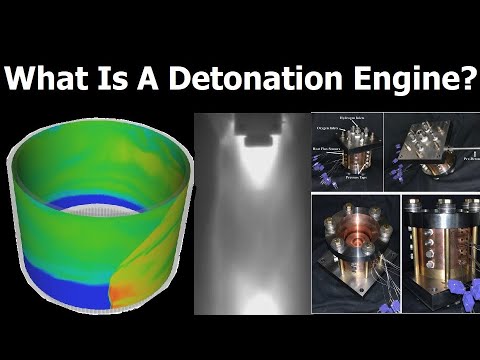
Scott Manley
Supersonic shockwaves in rotating detonation engines enable constant-volume combustion that theoretically yields 25% more work than conventional cycles, though fluid instability and material limits threaten real-world gains.
AI-assisted summary of What Is A Rotating Detonation Engine - And Why Are They Better Than Regular Engines — original source. Check the original for full context.
Source published:
Key ideas
- Rotating detonation engines (RDEs) are predicted to be up to 25% more efficient than standard rocket engines, dwarfing the roughly 10% gain typically achieved by shifting from open-cycle to complex closed-cycle systems. (0:04)
- Unlike conventional jet and rocket engines that rely on subsonic deflagration, detonation engines operate via supersonic shock waves that trigger near-instantaneous pressure and temperature spikes. (1:16)
- Thermodynamically, detonation approximates the constant-volume Humphrey cycle rather than the constant-pressure Brayton cycle, enclosing significantly more area on a pressure-volume diagram for greater work extraction. (6:12)
- By generating shock pressures exceeding 100 atmospheres, air-breathing RDEs could bypass heavy turbocompressor stages and support hypersonic flight up to Mach 5. (3:02)
Detailed notes
## Background Published on YouTube by Scott Manley on May 11, 2020, this video explores the emergence of detonation engine technology and claims of its superiority over conventional rocket and jet propulsion. According to the description, the video examines the core definitions of detonation engines, highlights the differences between pulsed and rotating architectures, and unpacks why thermodynamic principles predict these engines will outperform traditional designs.
## TL;DR Scott Manley examines rotating detonation engines (RDEs), which promise an efficiency gain of up to 25% over conventional rocket and jet engines by replacing subsonic deflagration with supersonic shock waves. After contrasting intermittent pulse detonation engines (PDEs) with the continuous annular shock waves of RDEs, he explains how detonation can achieve over 100 atmospheres of compression without heavy rotating compressor stages. Manley then details the underlying thermodynamics, using pressure-volume diagrams to contrast the constant-pressure Brayton cycle of traditional engines against the constant-volume Humphrey cycle of detonation engines. While the theoretical work output is substantially higher, he concludes that significant material and fluid-dynamic hurdles must be resolved before RDEs can realize their mathematical promise in production-ready hardware.
## Atmosphere & style The presentation carries Scott Manley's signature blend of approachable humor, technical rigor, and hands-on demonstrations, transitioning smoothly from a slow-motion kitchen experiment with burning alcohol to thermodynamic state diagrams. His delivery is optimistic yet analytically grounded, balancing genuine excitement over a potential 25% efficiency leap with pragmatic skepticism regarding extreme temperatures and wave stability challenges. Watching the video feels like an engaging, fast-paced masterclass in aerospace engineering that demystifies abstract propulsion physics through intuitive visual analogies and clear, practical context.
## Bulletin - [00:04](https://www.youtube.com/watch?v=rG_Eh0J_4_s&t=4s) Rotating detonation engines (RDEs) are predicted to be up to 25% more efficient than standard rocket engines, dwarfing the roughly 10% gain typically achieved by shifting from open-cycle to complex closed-cycle systems. - [01:16](https://www.youtube.com/watch?v=rG_Eh0J_4_s&t=76s) Unlike conventional jet and rocket engines that rely on subsonic deflagration, detonation engines operate via supersonic shock waves that trigger near-instantaneous pressure and temperature spikes. - [06:12](https://www.youtube.com/watch?v=rG_Eh0J_4_s&t=372s) Thermodynamically, detonation approximates the constant-volume Humphrey cycle rather than the constant-pressure Brayton cycle, enclosing significantly more area on a pressure-volume diagram for greater work extraction. - [03:02](https://www.youtube.com/watch?v=rG_Eh0J_4_s&t=182s) By generating shock pressures exceeding 100 atmospheres, air-breathing RDEs could bypass heavy turbocompressor stages and support hypersonic flight up to Mach 5.
## Key takeaways - [00:04](https://www.youtube.com/watch?v=rG_Eh0J_4_s&t=4s) A small-scale RDE prototype generating under 100 kg of thrust represents tangible experimental progress toward validating decades of theoretical propulsion research. - [00:04](https://www.youtube.com/watch?v=rG_Eh0J_4_s&t=4s) Detonation engine technology holds potential applications beyond rocketry and aviation, including marine turbine propulsion for the US Navy. - [01:16](https://www.youtube.com/watch?v=rG_Eh0J_4_s&t=76s) Combustion mode is defined by reaction front velocity relative to the local speed of sound: deflagration is subsonic, whereas detonation is supersonic. - [01:16](https://www.youtube.com/watch?v=rG_Eh0J_4_s&t=76s) In a detonation wave, unburned fuel cannot move out of the path of the supersonic front, causing near-instantaneous pressure and temperature rises with no time for thermal expansion during the burn. - [03:02](https://www.youtube.com/watch?v=rG_Eh0J_4_s&t=182s) Early pulse detonation engines (PDEs) demonstrated flight viability in 2008 using long tubes firing sequentially at 80 Hz, but intermittent purge-and-fill cycles limited steady thrust output. - [03:02](https://www.youtube.com/watch?v=rG_Eh0J_4_s&t=182s) Historical pulsejets like the V-1 flying bomb or hobbyist valveless tubes operate via subsonic deflagration rather than true supersonic detonation. - [03:02](https://www.youtube.com/watch?v=rG_Eh0J_4_s&t=182s) RDEs replace intermittent tube firing with continuous azimuthal propagation, guiding one or more detonation shock waves around an annular channel fed continuously with fresh propellant. - [03:02](https://www.youtube.com/watch?v=rG_Eh0J_4_s&t=182s) Air-breathing RDEs generate over 100 atmospheres of pressure across the shock front, potentially eliminating heavy mechanical turbocompressors in hypersonic vehicles up to Mach 5. - [03:02](https://www.youtube.com/watch?v=rG_Eh0J_4_s&t=182s) Maintaining stable operation in an RDE is complex because multiple circulating shock waves can overtake each other, extinguish, or let unburned propellant escape. - [06:12](https://www.youtube.com/watch?v=rG_Eh0J_4_s&t=372s) Standard jet and rocket engines operate on the Brayton cycle with constant-pressure (isobaric) heat addition. - [06:12](https://www.youtube.com/watch?v=rG_Eh0J_4_s&t=372s) Detonation engines execute the Humphrey cycle, where isochoric (constant-volume) combustion spikes pressure vertically on a P-V diagram to enclose greater net work output. - [09:48](https://www.youtube.com/watch?v=rG_Eh0J_4_s&t=588s) Much like real Stirling engines fail to meet ideal cycle efficiency due to continuous mechanical linkage motion, RDEs face real-world material and fluid dynamic losses that erode theoretical gains. - [09:48](https://www.youtube.com/watch?v=rG_Eh0J_4_s&t=588s) Extreme temperature and pressure spikes inside detonation chambers place severe demands on materials, requiring engineering solutions before laboratory gains translate into operational hardware.
## Detailed walkthrough ### [00:04](https://www.youtube.com/watch?v=rG_Eh0J_4_s&t=4s) The Promise of Rotating Detonation Engines
Scott Manley introduces recent news surrounding a small-scale technology demonstration of a rotating detonation engine (RDE). Although this specific prototype is compact and generates less than 100 kilograms of thrust, it serves as a tangible validation of a propulsion concept that researchers across the globe have theorized for decades. The intense interest stems from thermodynamic expectations: a rotating detonation engine is predicted to be up to 25% more efficient than standard rocket engines. Manley quips about the phrase “garden variety,” clarifying with a laugh that he naturally means the rocket garden at Kennedy Space Center, since he does not have any rockets planted in his own backyard.
Putting that performance jump into perspective, Manley highlights that rocket engineers go through enormous mechanical complexity just to squeeze out marginal gains: “When you consider that switching from a open cycle engine to a much more complicated closed cycle engine gets you a 10% improvement, a 25% improvement would be a massive.” Furthermore, the utility of detonation engines extends far beyond spaceflight and jet aircraft; organizations like the US Navy are actively investigating detonation technology to drive turbines aboard naval ships.
- Demonstration engine thrust: Under 100 kg - Projected efficiency improvement: Up to 25% over conventional rocket cycles - Open-cycle to closed-cycle comparison: Switching to closed-cycle typically yields only ~10% improvement - Alternate applications: Naval ship turbine power
---
[01:16](https://www.youtube.com/watch?v=rG_Eh0J_4_s&t=76s) Deflagration vs. Detonation
The critical distinction in these engines comes down to the scientific definition of combustion. In everyday language, people associate “detonation” loosely with explosions, but not all explosions are detonations. Scientifically, combustion is categorized by the speed of its reaction front relative to the speed of sound in the burning medium. A subsonic combustion front is termed a *deflagration*, whereas a supersonic, shock-based combustion front is a *detonation*. Conventional jet engines and rocket engines rely on deflagration, whereas detonation engines harness supersonic shock waves.
```mermaid flowchart TD accTitle: Combustion Modes Comparison accDescr: Diagram contrasting subsonic deflagration with supersonic detonation combustion processes.
subgraph Deflagration["Subsonic: Deflagration (Jet/Rocket Engines)"] D1["Subsonic Flame Front"] --> D2["Propellants Undergo Thermal Expansion"] D2 --> D3["Constant Pressure Combustion (Brayton)"] end
subgraph Detonation["Supersonic: Detonation (Detonation Engines)"] R1["Flame Accelerates Past Local Speed of Sound"] --> R2["Shock Wave Forms (Near-Instantaneous P & T Rise)"] R2 --> R3["Constant Volume Combustion (Humphrey)"] end ```
Manley illustrates this principle with a kitchen demonstration where he evaporated alcohol inside a transparent bottle and ignited it. Filmed in slow motion, the flame front can be seen propagating down into the vessel. Under the right air-fuel mixture and geometry, a combustion front can accelerate until it outpaces the local speed of sound. At that threshold, unburned gas cannot move out of the path of the oncoming reaction: “And at this point the unburned mixture doesn't get pushed out of the way of the incoming flame front and the flame front becomes a shock wave where the pressure and temperature rises near instantaneously.” Because the reaction occurs so rapidly that propellants have no time to undergo thermal expansion, detonation behaves as a constant-volume process, delivering an enormous pressure spike compared to the constant-pressure burn inside traditional engines.
---
[03:02](https://www.youtube.com/watch?v=rG_Eh0J_4_s&t=182s) Pulse Detonation Engines vs. Rotating Detonation Engines
To harness detonation for propulsion, engineers first developed the Pulse Detonation Engine (PDE), which saw an airborne flight test back in 2008. The test aircraft utilized long, straight tubes resembling drain pipes extending past the tail of the plane. The operational sequence required a cycle: injecting a purge of clean air, filling the tube with an air-fuel charge, and firing a spark plug at the base. The flame initially propagated as a deflagration before accelerating down the length of the pipe into a fully developed detonation. The test aircraft flew with four tubes firing at 20 pulses per second each, producing an overall acoustic frequency of roughly 80 Hz. Manley notes that non-detonation pulse engines also exist—such as the mechanical flap-valve engine on the WWII German V-1 flying bomb or the valveless U-shaped pulsejets built by YouTuber Colin Furze—but those rely on subsonic deflagration rather than supersonic detonations.
```mermaid flowchart LR accTitle: Pulse Detonation vs Rotating Detonation Engine Cycles accDescr: Comparison of intermittent purge-and-fire PDE tubes versus continuous annular detonation waves in an RDE.
subgraph PDE["Pulse Detonation Engine (Intermittent)"] P1["1. Air Purge"] --> P2["2. Fuel/Air Fill"] P2 --> P3["3. Spark Ignition"] P3 --> P4["4. DDT in Long Tube"] P4 --> P5["Exhaust & Repeat (80 Hz aggregate)"] end
subgraph RDE["Rotating Detonation Engine (Continuous)"] R1["Continuous Annular Propellant Injection"] --> R2["Detonation Wave Travels Azimuthally"] R2 --> R3["Continuous High-Pressure Exhaust"] R3 --> R2 end ```
While PDEs demonstrated the concept, the intermittent purge-and-pulse sequence prevents them from producing steady, uninterrupted thrust. The Rotating Detonation Engine overcomes this limitation: “So the rotating detonation engine takes this concept and tries to make the detonation a continuous process.” Instead of moving down an extended pipe, the detonation shock wave is guided continuously around a circular, annular channel. Fresh propellant enters ahead of the traveling wave, detonates upon contact, and vents out the open nozzle end, allowing the wave to circle indefinitely.
Physical implementation, however, has proven extraordinarily difficult despite extensive computational fluid dynamics (CFD) modeling. The annular chamber often supports multiple shock waves chasing each other around the circumference, all of which must sustain identical propagation speeds. If chamber conditions fluctuate, one wave can overtake another, the wave can blow itself out entirely, or unburned fuel can escape out the back and combust inefficiently or explosively. If mastered, an air-breathing RDE could eliminate massive mechanical turbocompressors—because a hundred-plus-atmosphere detonation shock easily dwarfs the few atmospheres of mechanical compression provided by standard rotating blades—enabling hypersonic propulsion up to approximately Mach 5.
- 2008 PDE flight test: 4 tubes operating at 20 Hz each (80 Hz combined) - PDE design constraint: Extreme tube length required for deflagration-to-detonation transition (DDT) - Key RDE advantage: Replaces intermittent cycles with continuous wave propagation in an annular channel - Compression capability: Shock-wave pressure reaches 100+ atmospheres without mechanical compressor stages - Hypersonic speed regime: Air-breathing RDEs are projected to operate efficiently up to roughly Mach 5
---
[06:12](https://www.youtube.com/watch?v=rG_Eh0J_4_s&t=372s) The Thermodynamics of Heat Engines and Cycles
To explain why propulsion scientists hold such high hopes for an unproven technology, Manley transitions into the classical thermodynamics of heat engines. At a fundamental level, any device that extracts heat from a high-temperature source, dumps residual heat into a cold sink, and diverts a fraction of that thermal flow into mechanical work is a heat engine. Whether an engine utilizes pistons, cylinders, or turbine blades—or is as vast as Earth's weather systems circulating atmospheric gases via solar heating—it adheres to these foundational thermodynamic rules.
“So you can describe the operation of every heat engine by tracking how its pressure, volume, temperature, and entropy change over time.” Manley uses an idealized Stirling engine cycle on a pressure-volume (P-V) diagram to illustrate how these thermodynamic states operate in closed cycles:
| State Change | Process Description | Mechanical / Thermal Effect | |:--- |:--- |:--- | | **1 $\rightarrow$ 2** | Hot, compressed gas expands | Pressure drops, volume increases, mechanical work is extracted | | **2 $\rightarrow$ 3** | Chamber contacts cold reservoir | Isochoric cooling: temperature drops, pressure drops at constant volume | | **3 $\rightarrow$ 4** | Cylinder contracts | Volume decreases, pressure rises back to baseline ambient | | **4 $\rightarrow$ 1** | Chamber contacts hot reservoir | Isochoric heating: gas warms, pressure rises back to initial state |
On these diagrams, the net mechanical work generated per cycle corresponds directly to the area enclosed by the cycle lines. Rockets and conventional jet engines operate via the Brayton cycle, where combustion occurs isobarically (at constant pressure, expanding in volume across states 3 to 4 as fresh air or propellants circulate through). In contrast, detonation engines execute the Humphrey cycle, where combustion occurs isochorically (at constant volume), fundamentally altering the shape of the curve and boosting theoretical thermal efficiency.
[09:48](https://www.youtube.com/watch?v=rG_Eh0J_4_s&t=588s) The Detonation Thermodynamic Cycle and Engineering Realities
Looking at the thermodynamic cycle on a pressure-volume diagram, the detonation process drives the curve upward vertically rather than horizontally, fundamentally reshaping the enclosed cycle. Because work output corresponds directly to the area enclosed within that thermodynamic loop, this geometry provides significantly more usable area. Scott Manley highlights the theoretical promise of this behavior, noting: “So therefore it's anticipated that a detonation cycle should get more power out of the same heat input.”
However, transitioning from pure theory to functional machinery introduces unavoidable practical compromises. Real-world systems suffer from efficiency losses and physical constraints that degrade performance away from the idealized thermodynamic cycle. For instance, the theoretical advantage of operating at substantially elevated pressures and temperatures can easily be restricted by the thermal and mechanical limitations of available materials. Manley draws an analogy to the Stirling engine, where the ideal cycle assumes pistons move instantly to a position, remain stationary, and then move back; in practice, mechanical linkages force the pistons to cycle continuously in a smooth sine-wave motion, preventing operational Stirling engines from ever matching their theoretical maximum efficiency.
Detonation engines currently face this exact bridge between mathematics and implementation. While researchers have achieved initial experimental milestones to prove they are more than mere concepts on paper, substantial engineering hurdles remain. The technology must still mature into robust, practical hardware capable of proving that the thermodynamic gains calculated on paper can survive the harsh realities of real-world combustion. As Scott Manley summarizes: “So right now detonation engines have taken a few small steps to being more than a theoretical device but beyond that they do need to be developed into real working devices and actually demonstrate they're able to achieve the levels of power and efficiency that the mathematics suggests.”
- **Thermodynamic advantage**: Constant-volume (detonative) heat addition plots vertically on the pressure-volume diagram, expanding the internal area of the cycle to extract greater work from an equivalent amount of heat. - **Material constraints**: The extreme peaks in temperature and pressure generated by detonation waves test the physical endurance of engine materials, often requiring operational derating below theoretical optimums. - **The Stirling engine analogy**: Real engines deviate from their theoretical cycles—just as sinusoidal piston movement degrades Stirling efficiency below textbook ideals, fluid dynamics and real combustion effects will erode ideal detonation engine curves. - **Current status**: Rotating detonation engines have moved beyond purely abstract concepts into early laboratory and flight demonstrators, but have yet to consistently demonstrate their full theoretical efficiency in production-ready hardware.
## Notable quotes > [09:48](https://www.youtube.com/watch?v=rG_Eh0J_4_s&t=588s) it's anticipated that a detonation cycle should get more power out of the same heat input. — Scott Manley
> [09:48](https://www.youtube.com/watch?v=rG_Eh0J_4_s&t=588s) detonation engines have taken a few small steps to being more than a theoretical device but beyond that they do need to be developed into real working devices and actually demonstrate they're able to achieve the levels of power and efficiency that the mathematics suggests. — Scott Manley
## Mentioned Scott Manley, Rotating Detonation Engine (RDE), Pulse Detonation Engine (PDE), US Navy, Kennedy Space Center, V-1 flying bomb, Colin Furze, Stirling engine, Brayton cycle, Humphrey cycle
## Video description There's been a few stories recently about detonation engines and how they're supposed to be superior to traditional jet or rocket engines. So, what is a detonation engine, what's the difference between a pulsed and rotating engine and why does thermodynamics predict these are better than traditional engine designs.
[Source](https://www.youtube.com/watch?v=rG_Eh0J_4_s)