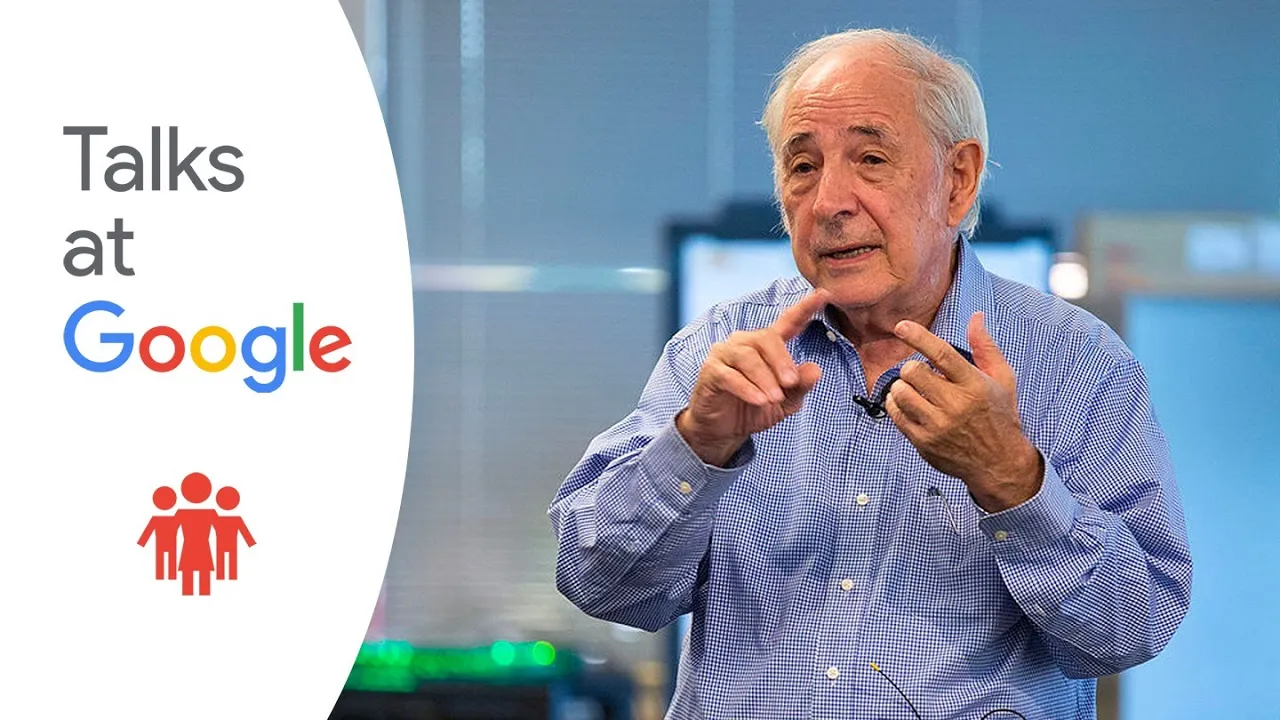
Searle Tells Google Digital AI Has Zero Intelligence, Cannot Think
Talks at Google
Because computer programs manipulate purely formal syntax rather than intrinsic semantics, computational simulation cannot duplicate the biological causal powers that produce conscious thought.
John Searle argues that Strong AI conflates syntactical simulation with semantic duplication, meaning that no matter how complex a computer program is, syntax alone will never produce intrinsic consciousness. (11:57)
A crucial distinction must be drawn between intrinsic, observer-independent phenomena (like biological brains thinking) and observer-relative attributions (like electronic state transitions interpreted by humans as computation). (18:51)
Concerns regarding mechanical intelligences rising up against humanity are fundamentally misplaced, as digital computers possess zero intrinsic psychological states or conscious intent. (27:14)
True artificial consciousness requires duplicating the brain's biological causal powers rather than programming formal systems, just as simulating human digestion or a rainstorm produces no actual digestion or wetness. (32:01)
Detailed notes
## Background
Published on YouTube by Talks at Google on December 4, 2015, this presentation features John Searle, Slusser Professor of Philosophy at UC Berkeley, addressing Google's Singularity Network. According to the page description, the talk examines the philosophy of mind and investigates whether artificial intelligence can truly achieve consciousness, drawing on Searle's classic critique of strong AI through the Chinese room argument.
## TL;DR
John Searle argues that functional engineering success must not be confused with genuine mental comprehension, insisting that syntax alone cannot produce semantic understanding. Through his famous Chinese room thought experiment, he demonstrates that computer programs manipulate formal symbols without any intrinsic awareness or conscious experience. He distinguishes between observer-independent biological phenomena and observer-relative computational interpretations, concluding that computational simulations can model processes but cannot duplicate the physical causal mechanisms of the brain. While biological organisms are physical machines that already think, creating genuine artificial consciousness will require replicating neurobiological causal powers rather than scaling up digital code.
## Atmosphere & style
The presentation is intellectually sharp, combative, and laced with dry, irreverent academic wit. Searle commands the room with energetic confidence, frequently dismissing prevailing AI paradigms and long-time debate opponents like Ray Kurzweil with candid, conversational humor. The dynamic feels like a classic Berkeley philosophy seminar transported straight into the heart of Silicon Valley, blending rigorous analytical breakdown with lively, entertaining skepticism about tech-industry orthodoxies.
## Bulletin
- [11:57](https://www.youtube.com/watch?v=rHKwIYsPXLg&t=717s) John Searle argues that Strong AI conflates syntactical simulation with semantic duplication, meaning that no matter how complex a computer program is, syntax alone will never produce intrinsic consciousness.
- [18:51](https://www.youtube.com/watch?v=rHKwIYsPXLg&t=1131s) A crucial distinction must be drawn between intrinsic, observer-independent phenomena (like biological brains thinking) and observer-relative attributions (like electronic state transitions interpreted by humans as computation).
- [27:14](https://www.youtube.com/watch?v=rHKwIYsPXLg&t=1634s) Concerns regarding mechanical intelligences rising up against humanity are fundamentally misplaced, as digital computers possess zero intrinsic psychological states or conscious intent.
- [32:01](https://www.youtube.com/watch?v=rHKwIYsPXLg&t=1921s) True artificial consciousness requires duplicating the brain's biological causal powers rather than programming formal systems, just as simulating human digestion or a rainstorm produces no actual digestion or wetness.
## Key takeaways
- [02:23](https://www.youtube.com/watch?v=rHKwIYsPXLg&t=143s) Epistemic objectivity about knowledge must not be confused with ontological objectivity; an epistemically objective science of consciousness is entirely possible despite consciousness being ontologically subjective.
- [05:23](https://www.youtube.com/watch?v=rHKwIYsPXLg&t=323s) Observer-independent phenomena exist regardless of human attitudes, whereas observer-relative constructs like money and computer computations depend entirely on conscious interpretation.
- [11:22](https://www.youtube.com/watch?v=rHKwIYsPXLg&t=682s) The Chinese room thought experiment demonstrates that running a formal syntactical program to manipulate symbols produces zero semantic comprehension of those symbols.
- [14:57](https://www.youtube.com/watch?v=rHKwIYsPXLg&t=897s) The Systems Reply to the Chinese room fails because simply expanding the boundaries of syntactic symbol manipulation does not generate semantic understanding.
- [18:51](https://www.youtube.com/watch?v=rHKwIYsPXLg&t=1131s) Biological systems possess intrinsic intelligence, whereas machinery like Deep Blue possesses zero intrinsic intelligence and only exhibits observer-relative computational transitions.
- [24:12](https://www.youtube.com/watch?v=rHKwIYsPXLg&t=1452s) Digital computers do not intrinsically perform computation; they undergo engineered electronic state transitions that human observers interpret as mathematics or logic.
- [29:47](https://www.youtube.com/watch?v=rHKwIYsPXLg&t=1787s) Human beings and biological brains are already physical machines that think, confirming that machines can think, though thought remains a specific causal neurobiological process.
- [32:01](https://www.youtube.com/watch?v=rHKwIYsPXLg&t=1921s) Building a conscious machine requires replicating the causal powers of the brain, analogous to an artificial heart replicating the physical pumping mechanism of a biological heart.
- [36:16](https://www.youtube.com/watch?v=rHKwIYsPXLg&t=2176s) Turing machines are interpretations of nature projected by observers rather than physical facts naturally discovered in the physical universe.
- [41:45](https://www.youtube.com/watch?v=rHKwIYsPXLg&t=2505s) Kurzweil's attempt to substitute neurotransmitters into the Chinese room overlooks the fact that specific neurobiological chemistry causally produces conscious experiences.
- [57:50](https://www.youtube.com/watch?v=rHKwIYsPXLg&t=3470s) The Turing test is fundamentally inadequate for determining consciousness because both computational inputs and outputs are defined solely through human interpretation.
- [51:49](https://www.youtube.com/watch?v=rHKwIYsPXLg&t=3109s) Consciousness consists of the qualitative, subjective field of feeling and awareness that begins when waking from dreamless sleep and ends with sleep, anesthesia, or unconsciousness.
- [01:07:39](https://www.youtube.com/watch?v=rHKwIYsPXLg&t=4059s) The building block approach to neural correlates has largely stalled; consciousness is better understood as a unified conscious field that sensory perceptions merely modify.
- [01:07:39](https://www.youtube.com/watch?v=rHKwIYsPXLg&t=4059s) The question of how consciousness arises will ultimately be settled by empirical biological and neuroscientific research rather than purely abstract philosophical debate.
## Detailed walkthrough
### [00:01](https://www.youtube.com/watch?v=rHKwIYsPXLg&t=1s) Introduction and Understanding Technological Advances
John Bracaglia, a Googler working in YouTube operations and lead of the Singularity Network—an internal group focused on rationality and artificial intelligence—opens the talk by introducing John Searle, the Slusser Professor of Philosophy at the University of California, Berkeley. Highlighting Searle's distinguished career in the philosophy of language, philosophy of mind, and social philosophy, Bracaglia notes Searle's honors, including the Jean Nicod Prize, the National Humanities Medal, and the Mind & Brain Prize, along with his famous "Chinese room" argument against strong AI.
Taking the stage to applause, Searle expresses his delight at returning to Google, quipping, “It is a university outside of a university. And sometimes, I think, this is what a university ought really to look like.” He explains that his lecture will address the broader significance of technological advances. While culture at large—especially in America—tends to marvel uncritically at engineering feats, Searle stresses that functional success should not overshadow fundamental conceptual clarity: “If they got a self-driving car who the hell cares about whether or not it's conscious.” Yet, he insists, understanding the nature of technology matters deeply for certain questions, which requires clearing up widespread intellectual confusions.
- Host: John Bracaglia (YouTube operations, Singularity Network organizer)
- Speaker: John Searle (Slusser Professor of Philosophy, UC Berkeley)
- Core awards mentioned: Jean Nicod Prize, National Humanities Medal, Mind & Brain Prize
---
[02:23](https://www.youtube.com/watch?v=rHKwIYsPXLg&t=143s) The Ambiguity of Objectivity: Epistemic vs. Ontological
Searle lays out the conceptual groundwork by tackling the distinction between objectivity and subjectivity. In modern intellectual life, society strives for objective science, yet the terms "objective" and "subjective" are riddled with an ambiguity that Searle warns creates "intellectual catastrophes." Specifically, the terms conflate an epistemic sense (having to do with knowledge and truth claims) with an ontological sense (having to do with real-world existence and modes of being).
Epistemically, an objective statement is a matter of verifiable fact independent of personal feelings—such as stating that Rembrandt was born in 1606 (correcting himself after initially slipping and saying died). Conversely, claiming that Rembrandt is the greatest painter who ever lived is epistemically subjective, because it rests on personal opinion and aesthetic judgement. Ontologically, the distinction concerns existence: mountains, molecules, and tectonic plates are ontologically objective because their existence does not rely on human observers or experience. By contrast, entities like pains, tickles, and itches are ontologically subjective; they exist only insofar as they are felt and experienced by a conscious subject.
```mermaid
flowchart TD
accTitle: Ambiguity of Objective and Subjective
accDescr: A two-by-two matrix separating epistemic knowledge claims from ontological modes of existence.
subgraph Epistemic["Epistemic (Knowledge Claims)"]
EO["Epistemically Objective<br/>(e.g., 'Rembrandt was born in 1606')"]
ES["Epistemically Subjective<br/>(e.g., 'Rembrandt is the greatest painter')"]
end
subgraph Ontological["Ontological (Modes of Existence)"]
OO["Ontologically Objective<br/>(e.g., Mountains, molecules, tectonic plates)"]
OS["Ontologically Subjective<br/>(e.g., Pains, tickles, itches, consciousness)"]
end
```
Searle recalls confronting the neurobiology faculty at UCSF, demanding to know why they were not actively solving how the brain produces consciousness: "What am I paying you to do?" The scientists replied that science must be objective, whereas consciousness is subjective, concluding that a genuine science of consciousness is impossible. Searle diagnoses their resistance as a textbook fallacy of ambiguity. While science must strive to be epistemically objective—evaluating claims independently of biases—that standard in no way prevents it from investigating phenomena that possess an ontologically subjective mode of existence. As Searle summarizes: “You can have an epistemically objective science of consciousness, even though consciousness is ontologically subjective.”
---
[05:23](https://www.youtube.com/watch?v=rHKwIYsPXLg&t=323s) Observer-Independence, Observer-Relativity, and Economics
Searle introduces a second vital distinction: phenomena that are observer-independent versus those that are observer-relative. Observer-independent entities exist entirely on their own, regardless of human thought or experience—again exemplified by physical realities such as mountains, molecules, and tectonic plates. Observer-relative phenomena, on the other hand, exist only relative to the attitudes, uses, and intentionality of conscious observers.
To illustrate, a slip of paper in a wallet functions as money, but that status is not derived from its chemical composition; it exists as money solely because human beings adopt a collective attitude toward it. The same observer-relative status applies to property, government, marriage, universities, Google, cocktail parties, and summer vacations. Because all observer-relative phenomena are generated by conscious human beings, they necessarily carry an element of ontological subjectivity. Even so, they can still be studied with epistemic objectivity, which makes fields like economics possible.
Yet economists frequently misunderstand their own discipline, treating economic laws as if they were observer-independent physical realities. Searle recalls his dismay as an economics student when instructors presented principles like "marginal cost equals marginal revenue" in the same absolute cadence that physics professors used for $F = ma$. Searle underscores the fragility of observer-relative social constructs: “And when the subjectivity changes-- ffft-- the whole thing collapses.” That fundamental vulnerability was starkly demonstrated in the financial collapse of 2008. In cognitive science, this distinction becomes paramount because concepts like intelligence, thought, memory, perception, and cognition carry both observer-independent (biological/mental) and observer-relative (computational/functional) definitions, and conflating them creates deep confusion.
- **Observer-Independent**: Mountains, molecules, tectonic plates (exist regardless of what humans think).
- **Observer-Relative**: Money, property, cocktail parties, Google, universities (exist only relative to conscious attitudes).
- **Economic Confusion**: Treating observer-relative human institutions as if they were physical invariants led directly to misunderstandings laid bare in 2008.
---
[08:50](https://www.youtube.com/watch?v=rHKwIYsPXLg&t=530s) Sloan Rangers and the Yale Restaurant Script
Searle pivots to intellectual history, recalling the founding of cognitive science decades earlier as an explicit revolt against the stranglehold of psychological behaviorism. During that era, the Alfred P. Sloan Foundation funded a traveling group of researchers—whom Searle humorously dubs the "Sloan Rangers"—to fly around the country giving lectures, primarily to one another.
When Searle was invited to speak at the Artificial Intelligence Lab at Yale University, he realized he knew nothing about artificial intelligence. He purchased a book by the Yale researchers for $16.95 plus tax, initially assuming it was wasted money. The book detailed a software program designed to demonstrate that computers could achieve genuine understanding. In the researchers' paradigm, the computer was fed a short story and subsequently asked questions about it; the machine could correctly deduce unstated information from background world knowledge.
In a typical scenario, a man walks into a restaurant, orders a hamburger, receives it burned to a crisp, and storms out without paying the bill. When asked whether the man ate the hamburger, the computer correctly answers "no," despite that fact never being explicitly mentioned in the text. The Yale team claimed this behavior proved that the system truly understood the narrative. Flying to New Haven on a United Airlines flight at 30,000 feet, Searle saw the fatal flaw in their logic: he realized that an English speaker could execute the very same program with stories written in Chinese characters, manipulating symbols according to rule instructions without having the slightest clue what the story meant. Searle thought the objection was so obvious the Yale researchers must have already answered it, but upon arriving, he discovered they had not considered it at all. Reflecting on the aftermath, Searle remarks: “I mean, how often do I have to refute these guys?”
- **Origin of Cognitive Science**: Launched as an explicit departure from behaviorism.
- **Sloan Foundation Fellowship**: Funded researchers ("Sloan Rangers") lecturing to interdisciplinary peer groups.
- **Yale AI Lab Claim**: An AI program processing restaurant "scripts" was claimed to truly understand stories because it correctly inferred unstated narrative facts.
---
[11:22](https://www.youtube.com/watch?v=rHKwIYsPXLg&t=682s) The Chinese Room Thought Experiment
Searle outlines the core formulation of his Chinese Room thought experiment. An English speaker who does not understand a single word of Chinese is locked in a room containing boxes filled with Chinese characters, accompanied by an instructional rule book written in English. Outside the room, native Chinese speakers submit batches of Chinese symbols through an opening.
```mermaid
flowchart LR
accTitle: The Chinese Room Thought Experiment
accDescr: Flow diagram showing how input symbols are mapped through an English rule book to output symbols without semantic understanding.
subgraph Input["Input (Questions)"]
Q["Chinese Symbols<br/>(Unknown to agent: Questions)"]
end
subgraph Room["Inside the Chinese Room"]
RuleBook["Rule Book in English<br/>(Program)"]
Boxes["Boxes of Symbols<br/>(Database)"]
Agent["Human Operator<br/>(CPU / Manipulator)"]
RuleBook <--> Agent
Boxes <--> Agent
end
subgraph Output["Output (Answers)"]
A["Chinese Symbols<br/>(Unknown to agent: Answers)"]
end
Q --> Agent
Agent --> A
```
Unbeknownst to the person inside, the boxes of symbols serve as a "database," the English rule book acts as a "program," the incoming symbols represent "questions," and the symbols he shuffles and passes back out are "answers." By strictly executing the formal rules for matching and manipulating syntax, the person inside produces outputs that look completely indistinguishable from those of a fluent Chinese speaker. Yet throughout the entire procedure, the person does not understand Chinese at all. Searle pauses, deadpanning to the audience: “Now we will suppose-- I hope you're bored with this, because I am.”
- **Inside the Room**: Non-Chinese-speaking person, boxes of Chinese symbols (database), English manual (program).
- **Process**: Purely formal, syntactic manipulation of uninterpreted symbols according to mechanical rules.
- **Outcome**: Flawless output of answers in Chinese without any semantic understanding of the language.
[11:57](https://www.youtube.com/watch?v=rHKwIYsPXLg&t=717s) The Chinese Room, Syntax, and Semantics
John Searle rehearses the thought experiment of the Chinese room to illustrate why computational symbol manipulation can never yield genuine comprehension. In this scenario, programmers become so adept at writing the instruction set, and Searle becomes so proficient at shuffling symbols according to those formal rules, that his outgoing responses are completely indistinguishable from those of a native Chinese speaker. Though he successfully passes the Turing test, he emphasizes that he still does not understand a single word of Chinese. He argues that he cannot possibly come to understand the language simply by running the program, because a program is defined entirely by formal operations over syntactical tokens, completely divorced from any physical realization or meaning.
To demonstrate the gulf between human cognition and mechanical processing, Searle contrasts how he operates in English versus Chinese. If someone asks him in English to name the longest river in the United States, he understands the words and answers that it is the Mississippi, or the Mississippi-Missouri depending on whether one counts them as a single river system. When passed Chinese characters asking for the longest river in China, however, he has no idea what the characters mean. He simply matches the input against his rulebook and outputs the corresponding Chinese symbols for the Yangtze River. The answer is factually correct, but produced with zero comprehension.
```mermaid
flowchart TD
accTitle: Syntax vs Semantics in the Chinese Room
accDescr: Diagram contrasting purely formal syntax with genuine human semantics.
subgraph Computation["Computational System"]
Input["Syntactical Input<br>(Uninterpreted Symbols)"] --> Rules["Formal Program<br>(Symbol Manipulation)"]
Rules --> Output["Syntactical Output<br>(Correct Answer)"]
end
subgraph HumanMind["Human Mind"]
Input --> Semantics["Semantics & Consciousness<br>(Intentionality & Meaning)"]
Semantics --> Understanding["Genuine Understanding"]
end
```
Searle summarizes the logical core of the Chinese room argument with two straightforward four-word principles:
- “The bottom line is that the implemented computer program by itself is never going to be sufficient for human understanding because human understanding has more than syntax.”
- “Syntax is not semantics.”
- “Simulation is not duplication.”
---
[14:57](https://www.youtube.com/watch?v=rHKwIYsPXLg&t=897s) Preposterous Counterarguments: The Systems Reply and Conversational Tricks
Before delving into the objections raised against his argument, Searle pauses briefly to check the clock with host John Bracaglia, insisting that sufficient time be reserved so anyone with a question gets a chance to speak. Turning back to his critics, Searle characterizes the academic replies to the Chinese room as breathtakingly preposterous. The most widespread response was the "Systems Reply," which asserted that while the human inside the room—acting merely as a central processing unit (CPU)—does not understand Chinese, the entire system (the room, the rulebook, the symbol boxes, and the scratch paper) does understand. Searle rejects this outright, pointing out that expanding the boundary of the system fails to bridge the gap between syntax and semantics: without a conscious mind to grasp meaning, the room as an aggregate is just as incapable of understanding as the individual components.
Searle recalls another public debate in which an opponent asked what would happen if the room were asked, "Do you understand Chinese?" and produced the answer, "Yes, I understand Chinese." Searle demonstrates the absurdity of this objection by showing that it is merely another exercise in blind symbol translation. If handed a slip with symbols that secretly mean "Do you understand Chinese?", he would simply look up the matching response in his lookup table and hand back symbols reading: "Why do you guys ask me such dumb questions? Can't you see that I understand Chinese?" The room can mimic defiance or comprehension without having the slightest awareness of what it is saying.
Addressing computer scientists who point out that natural language processing programs include modules explicitly labeled "semantics," Searle notes that these modules are nothing more than additional layers of code and syntactical rules. He stresses that this purely syntactical nature is not a defect but the foundational strength of digital computers, enabling machines like Deep Blue to execute an astonishing 250 million formal computations per second without needing to comprehend anything at all.
- “The bottom line is there's a logical truth, and that is that the implemented computer program is defined syntactically.”
- “How does the room get from the syntax of the computer program of the input symbols to the semantics of the understanding of the symbols?”
---
[18:51](https://www.youtube.com/watch?v=rHKwIYsPXLg&t=1131s) The Myth of AI Takeover and the Two Senses of Intelligence
Searle shifts to a broader issue: the common assumption that even if computers lack human understanding, they still perform authentic computation and information processing. Reviewing books for *The New York Review of Books*, Searle notes two pervasive cultural narratives. The first is an uncritical optimism declaring that humanity has entered an "information age" where literally everything can be treated as information. The second is an apocalyptic techno-alarmism warning that computers are approaching human-level intelligence, will inevitably surpass us, and may soon rebel against human oppression in what one author dramatically billed as the greatest challenge humanity has ever faced. Searle dismisses both claims as fundamentally confused.
The error lies in conflating two distinct meanings of the word "intelligence": observer-independent (intrinsic) intelligence and observer-relative intelligence. Observer-independent intelligence refers to an intrinsic, psychologically real conscious phenomenon. To illustrate this, Searle mentions his four dogs—named Frege, Russell, Ludwig, and Tarski—highlighting his Bernese mountain dog, Tarski, who was too big to ride in the car to Google. While Searle is smarter than Tarski, the dog possesses real, intrinsic mental processes and intelligence in the exact same sense that humans do, only to a lesser degree.
By contrast, a digital computer possesses zero intrinsic intelligence. Attributions of intelligence to machinery are entirely observer-relative and exist solely in the mind of human interpreters who design the electronic circuits to behave *as if* they were thinking. When IBM's Deep Blue defeated Garry Kasparov, the event was widely equated to Kasparov defeating Anatoly Karpov. But Karpov and Kasparov had to be consciously aware of playing chess, recognizing moves like opening pawn to king four or perceiving that their queen was under attack. Deep Blue knew none of this because it knows nothing at all. Searle concludes that this observer-relative distinction applies across all cognitive science categories, including memory, perception, decision-making, and rationality.
- “In the intrinsic sense in which I have more intelligence than my dog, my computer has zero intelligence-- absolutely none at all.”
- “In the strict sense, in the observer-independent sense in which you and I have intelligence, there is zero intelligence in the computer.”
- Deep Blue can generate epistemically objective chess moves, but its status as an "intelligent chess player" remains completely observer-relative.
- Psychological phenomena such as perception, decision-making, and understanding require intrinsic consciousness; running an electronic program merely simulates these traits for an external observer.
[24:12](https://www.youtube.com/watch?v=rHKwIYsPXLg&t=1452s) Observer-Relative Intelligence and the Origin of Computation
Searle emphasizes that the intelligence attributed to computational machinery is strictly observer-relative—it exists only in the mind of the conscious observer who interprets it, rather than in the machine itself. For most practical tasks, such as designing an autonomous self-driving car, Searle readily concedes that this distinction does not matter in the slightest: who cares whether the car is conscious or literally possesses intelligence, so long as it functions properly? The distinction only becomes critical when theorists mistakenly attribute actual psychological reality to machinery that possesses no intrinsic mental life. Searle points out an underlying asymmetry: while our mental attributions of intelligence to machines are observer-relative, the consciousness performing those attributions is not observer-relative at all—it is an intrinsic reality.
Taking a sip of water, Searle pivots to the historical shift in the word *computation*. When Alan Turing published his landmark 1950 paper, he titled it *"Computing Machinery and Intelligence"* rather than *"Computers and Intelligence"*. At that time, a "computer" referred to a human occupation—a person whose job it was to perform calculations, much like a runner or a piano player. Over time, the term shifted from denoting a human being to denoting mechanical hardware, acquiring a systematic ambiguity between its intrinsic, conscious sense and its observer-relative, mechanical sense.
```mermaid
flowchart TD
accTitle: Intrinsic vs Observer-Relative Computation
accDescr: Contrasts human intrinsic computation with mechanical observer-relative computation.
subgraph Human["Intrinsic Consciousness"]
H1["Conscious Agent"] -->|"Thinks (1 + 1 = 2)"| H2["Observer-Independent Computation"]
end
subgraph Machine["Mechanical State Transitions"]
M1["Pocket Calculator / Commercial Computer"] -->|"Electronic State Changes"| M2["Observer-Relative Output"]
end
H1 -->|"Interprets and attributes meaning to"| M1
```
- “The consciousness that creates the observer-relative phenomena is not itself observer-relative.” — John Searle
- “In those days, 'computer' meant 'person who computes.'” — John Searle
- “Intrinsically all that goes on is a set of electronic state transitions that we have designed so that we can interpret computationally.” — John Searle
---
[27:14](https://www.youtube.com/watch?v=rHKwIYsPXLg&t=1634s) The Pocket Calculator vs. Human Conscious Arithmetic
To make the contrast concrete, Searle writes out an elementary addition function on the blackboard: $1 + 1 = 2$. When a conscious human carries out this calculation, the computation is entirely intrinsic and observer-independent. Even if outside experts were to claim otherwise, the agent consciously performed the arithmetic. By contrast, when a pocket calculator or a commercial computer executes the exact same operation, it undergoes nothing more than physical and electronic state transitions that human beings have engineered and interpreted as computational steps.
This mechanical implementation is not epistemically subjective—Searle remarks that he pays good money to Apple precisely so they will manufacture hardware capable of executing programs his earlier machines were not "intelligent" enough to run. Yet the term "intelligence" here remains entirely observer-relative and harmless, unless people extrapolate it into apocalyptic narratives where a newly created race of mechanical intelligences rises up to overthrow humanity. What commercial computing hardware fundamentally lacks compared to human arithmetic is consciousness.
- “When my pocket calculator does the same operation, the operation is entirely observer-relative.” — John Searle
- “When it matters is when people say, well, we've created this race of mechanical intelligences. And they might rise up and overthrow us.” — John Searle
- “All observer-relative phenomena are created by human and animal consciousness.” — John Searle
---
[29:47](https://www.youtube.com/watch?v=rHKwIYsPXLg&t=1787s) Obsolete Vocabulary and the "Could a Machine Think?" Question
Searle steps back to catch his breath and diagnose why modern debates around mind and machine are hopelessly muddled: our conceptual apparatus is completely obsolete. The traditional dualistic dichotomies between the mental and the physical, the social and the individual, and the confusion between intrinsic versus observer-relative features prevent clear thinking.
He tackles the classic question: *"Could a machine think?"* Under any reasonable physical definition—a physical system capable of performing certain functions—human beings and animals are machines. Searle asserts that he is a machine and the audience members are machines, adding that in all likelihood, *only* machines can think. Thinking is a biological, causal process produced in the brain by intricate neurobiological mechanisms. Therefore, if the question asks whether a machine can think, the answer is an obvious yes, because human brains already do so.
- “And one of things I haven't emphasized but I want to emphasize now, and that is most of the apparatus, the conceptual apparatus, we have for discussing these issues is totally obsolete.” — John Searle
- “I'm a machine. You're a machine. And my guess is only machines could think.” — John Searle
- “Thinking is a biological process created in the brain by certain quite complex, but insufficiently understood neurobiological processes.” — John Searle
---
[32:01](https://www.youtube.com/watch?v=rHKwIYsPXLg&t=1921s) Artificial Brains, Artificial Hearts, and Dropping Objects
Searle addresses the subsequent question: could we build an *artificial* machine that thinks? He compares building an artificial brain to building an artificial heart. We succeeded in building artificial hearts because we understood the causal mechanism of the heart: it is a mechanical pump designed to circulate blood. Because we understand that function, an artificial heart can pump blood using synthetic materials rather than living muscle tissue. By contrast, we have not begun to build an artificial brain because we do not yet understand how the biological brain actually produces consciousness.
Instead of duplicating the brain's causal powers, the field relies on formal computer simulations. But a simulation of thinking is no more real thinking than a computer simulation of a rainstorm leaves you wet. In principle, Searle sees no theoretical barrier to building a thinking machine out of alternative biochemistry or non-neural materials, provided it duplicates the brain's causal powers. However, if one defines a "computer" simply in the observer-relative sense—as anything to which a computational formula can be ascribed—then literally any physical object qualifies. Searle illustrates this by dropping an object, noting that the falling object just computed the gravitational formula $s = \frac{1}{2}gt^2$. If that counts as intrinsic computation, then every physical interaction in the universe is computing.
- “The question, can you build an artificial brain that can think, is like the question, can you build an artificial heart that pumps blood.” — John Searle
- “We have no idea how to create a thinking machine because we don't know how the brain does it. All we can do is a simulation using some sort of formal system. But that's not the real thing.” — John Searle
- “That computer just computed a well-known function. $s$ equals one-half $gt$ squared.” — John Searle
[36:16](https://www.youtube.com/watch?v=rHKwIYsPXLg&t=2176s) Why Computation Is Observer-Relative and Not a Fact of Nature
John Searle concludes the lecture portion of his talk by reinforcing his central thesis: computation is never an intrinsic feature of an object, but rather a feature of an observer's interpretation of its physics. Recalling his early debates around the Chinese room argument, Searle remembers dramatically slamming his pen down onto a table and declaring it to be a digital computer running a very boring program that simply commands: "stay there." Nobody ever refuted him on this, he explains, because under standard textbook definitions, it is technically correct. In those early days, opponents attempted to confuse him with technical jargon, asserting that he overlooked the difference between virtual and non-virtual machines or neglected transducers. Searle admits he initially had no idea what a transducer or a virtual machine was, but adds that it only takes five minutes to grasp those concepts.
```mermaid
flowchart TD
accTitle: Intrinsic Nature versus Observer-Relative Interpretation
accDescr: Diagram showing the contrast between objective neurobiological processes and observer-relative computation.
The fundamental question, Searle argues, is whether Alan Turing’s definition of computation is sufficient to constitute thinking. In an observer-relative sense, the answer is definitively no. Artificial machines can execute computations, but computation alone can never produce thinking or any cognitive phenomenon because it is defined entirely formally and syntactically. Turing machines do not exist as independent facts in nature; they exist only through our interpretations. Addressing the technologists in the room, Searle emphasizes that he admires technology and sees no limits to its potential advances. However, the philosophical, psychological, and scientific implications of technology must not be misunderstood. “Turing machines are not to be found in nature,” Searle declares. “They're to be found in our interpretations of nature.”
- Computation is defined purely syntactically, whereas human cognition requires semantics and intrinsic meaning.
- Technical objections regarding transducers or virtual machines fail to overcome the fundamental syntax-versus-semantics gap.
- Advancing technological capacity is welcomed by Searle, but raw computational power must not be conflated with the realization of conscious thought.
---
[38:41](https://www.youtube.com/watch?v=rHKwIYsPXLg&t=2321s) Ray Kurzweil’s Challenge: Symbol Shuffling vs. Neurotransmitter Shuffling
Google host John Bracaglia introduces Ray Kurzweil to ask the opening question from the audience. Kurzweil opens by noting that he has been debating Searle on this topic for approximately 18 years. While praising the longevity of the Chinese room thought experiment for exposing the apparent absurdity of claiming deterministic computation yields thought, Kurzweil points out a counter-argument he published in his book *The Singularity Is Near*. Kurzweil reads back Searle’s own formulation of the Chinese room argument, but with critical substitutions: he replaces the computer with the human brain, and formal symbols with neurotransmitter concentrations and their related mechanisms. Under Kurzweil's parody, the brain succeeds simply by manipulating meaningless biochemical concentrations that it knows nothing about, leading to the absurd conclusion that the human brain itself cannot have true understanding.
Kurzweil then poses his core question regarding the epistemology of consciousness. Given Searle's claim that consciousness is an ordinary biological process like digestion, lactation, photosynthesis, or mitosis, Kurzweil asks how one can actually verify whether any entity is conscious. He challenges Searle to explain how he knows that Kurzweil himself is conscious, and crucially, how one could ever determine whether a future computer is genuinely conscious rather than merely simulating consciousness with convincing responses. Kurzweil predicts that computers will inevitably achieve convincing human-like behavior, making the problem of objective measurement unavoidable. As Kurzweil frames the dilemma: “And when we do, how do we know if it's conscious of it just seems conscious?”
- Ray Kurzweil challenges Searle using a parody from his book *The Singularity Is Near*, replacing symbols with neurotransmitters.
- The parody concludes that if symbol-shuffling cannot produce understanding, then shuffling meaningless neurotransmitter concentrations shouldn't produce understanding either.
- Kurzweil presses Searle on the epistemological problem of how we can scientifically measure or prove that an entity—human or machine—is experiencing subjective consciousness.
---
[41:45](https://www.youtube.com/watch?v=rHKwIYsPXLg&t=2505s) Specific Biological Causality and Knowing Other Minds
Searle responds to Kurzweil by addressing the neurotransmitter substitution first, dismissing it as a semantic parlor trick common among politicians. The difference between a computer and a brain is that the brain is an actual causal mechanism whose specific electrochemistry produces higher-level states of consciousness. While science does not yet understand the full details, it is clear that specific biochemistry matters: messing with the synaptic cleft causes profound alterations in consciousness. For instance, cocaine produces its psychological effects not through computational algorithms, but by physically inhibiting postsynaptic receptors from reabsorbing specific neurotransmitters—such as norepinephrine, dopamine, and GABA. By contrast, computation is an abstract mathematical procedure implemented across substrate-independent hardware, completely detached from the specific causal powers of the physical medium.
Turning to the question of how we know others are conscious, Searle argues that in real life, consciousness is not verified via rigid behaviorism. He points out that he knows his dog, Tarski, is conscious, but knows his smartphone is not. Tarski does not behave like a human—he wags his tail and licks hands, which human friends do not do. Instead, Searle knows Tarski is conscious because the dog shares underlying biological machinery: eyes, ears, skin, and neural pathways that mediate sensory input into behavior in a manner comparable to humans. While he leaves open the empirical status of insects like termites—joking that a termite has 100,000 neurons, whereas "I lose 100,000 on a big weekend"—he emphasizes that among human beings, attributing consciousness is an undeniable background presupposition rather than an abstract theory. As Searle summarizes: “In one sentence, the brain is a causal mechanism that produces consciousness by a certain rather complex and still imperfectly understood neurobiological processes.”
- The neurobiological effects of drugs like cocaine prove that specific biochemistry (e.g., dopamine, norepinephrine, GABA uptake), not computation, governs consciousness.
- Searle’s dog Tarski is recognized as conscious due to shared biological sensory-motor mechanisms, not because he mimics human behavioral patterns.
- Attributing consciousness to fellow human beings is a foundational background assumption of everyday existence, not a speculative hypothesis.
---
[46:03](https://www.youtube.com/watch?v=rHKwIYsPXLg&t=2763s) Simulation, Technology, and Autonomous Vehicles
An audience member asks Searle to imagine a future where humanity understands the brain well enough to run a precise simulation of it and connects that simulation to physical reality via real sensory inputs and motor outputs. The questioner asks what substantive difference remains between such a situated simulation and an actual biological brain. Searle responds that in functional engineering applications, there may be no difference at all, and the distinction does not matter for practical purposes. Pointing to Google’s work on autonomous vehicles, Searle remarks that if engineers can create a program to drive a car safely without requiring a conscious driver, that is a marvelous achievement.
Searle shares a personal anecdote about his father, who worked as an electrical engineer for AT&T and was deeply disappointed when Searle chose philosophy instead of pursuing engineering at MIT and Bell Labs. He reiterates that he has immense respect for technological accomplishments. However, engineering a machine that matches or exceeds human driving performance does not mean one has created consciousness or replicated the causal powers of the brain. When systems are designed to interact with reality, confusing behavioral simulation with real subjective experience leads to fundamental misunderstandings of the philosophical and scientific significance of the technology. As Searle notes regarding machine capabilities: “If you've got a machine that can drive a car as well as I, or probably better than I can, then so much the better for the machinery.”
- Successfully simulating driving behavior or brain functionality does not equate to creating conscious awareness.
- Searle's father, an AT&T electrical engineer, was disappointed his son went into philosophy rather than MIT and Bell Labs.
- While behavioral performance in automated tasks is a triumph for technology, consciousness itself remains a distinct, biologically grounded phenomenon.
[47:37](https://www.youtube.com/watch?v=rHKwIYsPXLg&t=2857s) Machine Uprisings and the Limits of Computational Simulation
John Searle dismisses the apocalyptic sci-fi anxiety that artificial intelligence will eventually rise up and conquer humanity, calling it an unrealistic concern because computers lack conscious psychological states. Ridiculing the premise, he compares it to worrying that footwear will turn hostile: “It's about like saying the shoes might get up out of the closet and walk all over us. After all, we've been walking on them for centuries, why don't they strike back?” When an audience member asks whether an artificial system might instead share an internal causal similarity to the brain rather than just matching its outputs, Searle acknowledges that this is an empirical, factual question. The core inquiry is whether the internal operations of a computer are isomorphic to neurobiological processes, and evidence to date indicates that they are not.
To illustrate, Searle revisits the history of computer chess. Early AI researchers attempted to interview grandmasters to model their cognitive strategies on machines. Yet when IBM built Deep Blue, it triumphed through sheer brute-force computational power rather than human-like cognition, evaluating 250 million chess positions per second. Because chess offers perfect information and a finite branching tree of moves, the fundamental hurdle is an exponential scaling problem rather than psychological complexity. AI researchers rightly recognized that Deep Blue represented an engineering feat rather than a triumph for cognitive modeling. Computational simulations remain invaluable tools across many sciences for modeling dynamic systems, but simulating a phenomenon is categorically distinct from duplicating its underlying causal powers.
```mermaid
flowchart TD
accTitle: Computational Simulation versus Biological Duplication
accDescr: Diagram contrasting computer simulations like Deep Blue with biological brain processes.
subgraph SIM["Computational Simulation (Weak AI)"]
A["Formal Symbol Manipulation\n(e.g., Deep Blue: 250M moves/sec)"]
B["Calculates Exponentials &\nPerfect Information"]
C["Informational Output\n(Model / Simulation)"]
A --> B --> C
end
subgraph DUP["Biological Duplication (Strong AI Claim)"]
D["Neurobiological Architecture\n(Brain Biology)"]
E["Causal Biochemical Powers"]
F["Intrinsic Consciousness &\nSubjective States"]
D --> E --> F
end
C -.->|"Simulates, but does NOT duplicate"| F
```
- In early AI history, investigators interviewed champion chess players to replicate their internal thought patterns on computers, which was later abandoned in favor of raw calculation.
- Deep Blue evaluated roughly 250 million chess positions each second to overcome the exponential branching problem of game theory.
- Searle emphasizes the central fallacy: “Strong AI says the simulation isn't just a simulation. It's a duplication. And that we can refute.”
---
[50:03](https://www.youtube.com/watch?v=rHKwIYsPXLg&t=3003s) The Epistemic Trap and Proving Consciousness
An audience member asks Searle if he can prove that he understands English, prompting an immediate quip. Searle jokes that while he was studying at Christ Church, a snobbish college at Oxford, many people doubted he could speak English because he spoke an American dialect that made traditional English listeners shudder. When the interlocutor presses further—asking how anyone can be sure Searle himself is not just running a computer program—Searle warns against adopting the purely "epistemic route" of skepticism.
The epistemic approach claims that an observer has no more direct proof of another human being's consciousness than they have of a machine's consciousness. Searle rejects this equivalence as a philosophical mistake. Recognizing consciousness in another human being does not require an elaborate neurobiological theory; it relies on observable biological mechanisms that naturally instantiate awareness. When a person looks with their eyes and speaks through their mouth, those behaviors manifest conscious biological intent. Addressing the questioner directly, Searle remarks: “The question was an expression of a conscious intention to ask a question. Believe me, if you are a locally produced machine, Google is further along than I thought.”
---
[51:49](https://www.youtube.com/watch?v=rHKwIYsPXLg&t=3109s) A Commonsense Definition of Consciousness
Moderator John Bracaglia introduces a pre-submitted audience question from the internal Dory tool, asking for the precise definition of consciousness used throughout the presentation. Searle responds that although people frequently complain that consciousness resists definition, framing it in ordinary language is straightforward. Science often starts with a commonsense definition to identify the target of study before discovering its exact physical makeup—much like initially defining water as a clear, colorless, tasteless liquid found in bottles before chemistry revealed that it is H2O.
Searle defines consciousness as the continuous spectrum of subjective feelings and awareness that begins each morning upon waking from a dreamless sleep and persists until one falls asleep again, undergoes anesthesia, or otherwise becomes unconscious. Under this criteria, dreams count as a legitimate mode of conscious experience. The defining essence of any conscious state is that there is qualitative feel to experiencing it, meaning it possesses an intrinsically subjective ontology. This working definition is identical to the one neurobiologists employ when investigating how the brain produces and sustains conscious experience.
- Searle gives his operational definition: “Consciousness consists of all those states of feeling or sentience or awareness that begin in the morning when you awake from a dreamless sleep.”
- Every conscious state exhibits a qualitative dimension—there is always something it feels like to be in that state.
- Consciousness necessarily possesses a subjective ontology, which forms the explicit subject matter of neuroscience research.
---
[53:43](https://www.youtube.com/watch?v=rHKwIYsPXLg&t=3223s) Time Horizons, Evolution, and Why Consciousness Matters
An audience member challenges Searle's claim that humanity cannot currently build a thinking machine, suggesting that humanity simply might not have sufficient time or universal luck to recreate the billions of years of evolutionary accidents—such as the asteroid impact that wiped out the dinosaurs—that generated biological brains. The questioner adds that, across a multiverse of parallel realities, artificial consciousness might arise elsewhere, or that perhaps human consciousness does not ultimately matter in the cosmic scheme.
Searle is unmoved by parallel-universe speculations and fatalism. While acknowledging that some scientific questions might theoretically outstrip human lifespan on Earth, he urges aggressive scientific persistence. He recalls how nineteenth-century thinkers once insisted that the secret of life was fundamentally unsolvable, until modern molecular biology dissolved the old impasse between vitalism and mechanism. When the questioner reiterates that human consciousness might philosophically be irrelevant, Searle grounds the issue in immediate human existence, retorting: “Maybe conscious doesn't matter. Well, it's where I live. It matters to me.” Just like democracy, art, literature, intimacy, and good food, conscious experience remains desperately vital to human life regardless of whether the cosmos cares.
---
[55:22](https://www.youtube.com/watch?v=rHKwIYsPXLg&t=3322s) Accidental Duplication and Simulating Digestion
Picking up on Searle's earlier analogy of the artificial heart, an attendee wonders whether engineers might stumble upon consciousness accidentally. If researchers build an artificial brain out of non-biological materials using entirely different architectural approaches, could a computer simulation inadvertently cross the threshold into genuine duplication without intentionally copying brain biochemistry?
Searle dismisses the concept of accidental synthetic awareness, stating flatly: “I would say to believe in that, you have to believe in miracles.” He points out that computers can simulate virtually any process that can be precisely formalized, including the biochemical process of human digestion. A programmer can write a flawless mathematical simulation of digesting a pizza, but nobody expects that computer to physically consume lunch. The program outputs only numbers, graphics, and models, not the physical power to digest nutrients. While computational models are indispensable tools in biology for formulating hypotheses and designing experiments, expecting an abstract simulation of cognition to spontaneously generate biological consciousness completely mistakes mathematical modeling for physical causation.
- Simulating a process on a computer provides a descriptive mathematical representation, not the physical power of the underlying event.
- Stuffer-in-the-computer fallacy: Running a perfect simulation of digestion does not mean you can feed the machine a slice of pizza.
- Computer simulations are highly valuable tools for calculating experimental outcomes and axioms, but they do not replicate biological biochemistry.
---
[57:02](https://www.youtube.com/watch?v=rHKwIYsPXLg&t=3422s) Beyond the Turing Test: Intrinsic vs. Observer-Relative Intelligence
John Bracaglia asks another audience question regarding the limitations of the Turing test: given that humans are notoriously gullible and quick to anthropomorphize machines, what test could evaluate general intelligence without generating false positives? Searle answers that the real problem lies not in designing a clever operational test, but in distinguishing between two fundamentally different types of intelligence: observer-independent (intrinsic) intelligence and observer-relative intelligence.
Observer-relative intelligence exists purely in the interpretation of an outside viewer. Humans routinely project computational intelligence onto inert artifacts by mapping symbolic meanings onto physical transitions. Searle notes that one could attribute impressive calculating abilities to a falling object simply because its trajectory can be mathematically described by the equation $s = \frac{1}{2}at^2$, or praise the prodigious discrimination of an ordinary pair of tweezers for separating individual strands of hair. As Searle begins demonstrating with objects on the stage, he insists that attributing intelligence to machines is simply a projection of human interpretation, not an intrinsic mental property of the system itself.
- Searle summarizes the foundational distinction: “Well, you all know my answer to that is the first step is to distinguish between genuine intrinsic observer-independent intelligence and observer-relative intelligence.”
- Observer-relative intelligence is entirely in the eye of the beholder, allowing any physical system to be treated as intelligent if a human assigns an interpretation to its states.
- Mathematical formulations, such as computing displacement via $s = \frac{1}{2}at^2$, illustrate how observers map computational agency onto dumb physical systems.
[57:50](https://www.youtube.com/watch?v=rHKwIYsPXLg&t=3470s) The Failure of the Turing Test and the Challenge of Emergence
John Searle argues that intelligence is fundamentally observer-relative, requiring human criteria to judge it. Because of this, the Turing test inherently fails: both the input and the output of a computer are only what they are relative to our interpretation as questions and answers. “One bottom line of my whole discussion today is that the Turing test fails.”
An audience member challenges Searle, suggesting he treats human and animal consciousness as an article of faith tied mysteriously to biological material. The questioner points out that this stance sounds akin to intelligent design theorists who argue that complex living systems could never emerge from inert matter. The audience member asks where the line is drawn between an amoeba and a dog, and questions why consciousness could not simply emerge from a sufficiently distributed, networked computational system executing vast numbers of calculations or interacting with biological components.
```mermaid
flowchart TD
accTitle: Searle's Distinction Between Duplication and Simulation
accDescr: Diagram contrasting genuine duplication of causal powers with formal algorithmic simulation.
subgraph Formal ["Syntactic Simulation"]
P["Formal Computer Program"] -->|"Simulates input-output functions"| S["Observer-Relative Simulation (No Semantics)"]
end
```
[59:25](https://www.youtube.com/watch?v=rHKwIYsPXLg&t=3565s) Causal Powers, Airplanes, and Computational Complexity
Searle responds to the emergence argument by noting that while miracles are logically possible, they are not serious scientific candidates. He compares asking whether consciousness could emerge from computation to asking whether chemical processes could turn a plastic comb into a conscious comb. Any system that creates consciousness must duplicate the specific biological causal powers of the brain, rather than merely simulating formal input-output functions. Drawing an analogy to aviation, Searle explains that an airplane does not require feathers to fly, but it must duplicate the bird's actual causal power to overcome gravity in the atmosphere using Bernoulli's principle.
When the audience member interjects that machines improve themselves and suggests Searle is ruling out evolution from an amoeba to a dog, Searle clarifies his position. He explains that while amoebas may have evolved into complex organisms over time, a single-celled amoeba as it currently exists lacks the physical machinery to produce consciousness. Furthermore, appeals to computational complexity miss the point because complexity itself is observer-relative and dependent on an arbitrary metric. Searle emphasizes that he is not making a science fiction claim that artificial consciousness is logically impossible, but rather that attempting to build it by writing code is fundamentally misguided: “If you're thinking about your life depends on building a machine that creates consciousness, you don't sit down your console and start programming things in some programming language.”
- Human beings and animals are already physical, conscious computers, demonstrating that physical machines can be conscious.
- Consciousness might ultimately turn out to depend on a simple biological mechanism rather than computational complexity.
- A single-celled organism like an amoeba lacks the physiological apparatus required to produce conscious states.
[01:02:05](https://www.youtube.com/watch?v=rHKwIYsPXLg&t=3725s) The Chinese Room, Syntax, and Semantics
An audience member proposes a thought experiment based on disassembly: if Searle were given the assembly instructions of Google Translate to run by hand, it would either take thousands of years on pen and paper or require decompiling and optimizing the code into English. In doing so, Searle would grasp the relationships between variables and subroutines, leading the questioner to ask who is to say understanding would not emerge from that process. Searle acknowledges that executing a real language program on paper would take millions of years, but explains that the scale of the example does not affect the core derivation. “The Chinese room is designed to illustrate axiom three, that just having the steps in the program is not by itself sufficient for a semantics.”
| Step / Axiom | Premise | Conclusion / Implication |
|:--- |:--- |:--- |
| **Axiom 1** | Programs are purely formal and syntactical. | A program's equivalence class is defined entirely by formal syntax. |
| **Axiom 2** | Human minds possess intrinsic mental content (semantics). | Mental states refer to meanings, not just symbol manipulation. |
| **Axiom 3** | Syntax by itself is neither constitutive of nor sufficient for semantics. | Manipulating uninterpreted symbols does not generate understanding. |
| **Conclusion** | Computer operations alone cannot produce understanding. | Computational systems lack semantics unless coupled with causal machinery. |
When the audience member suggests that the emergence of semantics after thousands of years cannot be verified experimentally, Searle rejects taking an epistemic detour into other-minds skepticism. He notes that science does not need to guess at internal states from purely external behavior because researchers can observe the underlying biological machinery. For instance, textbooks demonstrate that cats have visual experiences and color vision distinct from humans because scientists examine their distinct retinal color receptors, just as dogs can be verified to perceive higher auditory frequencies than humans due to their acoustic apparatus.
[01:05:58](https://www.youtube.com/watch?v=rHKwIYsPXLg&t=3958s) The Shift in Neuroscience and the Path Forward
Host John Bracaglia introduces the final question of the session, prompting Searle to joke, “I'm prepared to go all afternoon. I love this kind of crap.” An audience member asks about current neuroscience research, specifically studies that present stimuli near the threshold of conscious perception and track brain responses when a stimulus is perceived versus when it remains subliminal, asking whether Searle believes this approach is on the right track.
Searle enthusiastically endorses the empirical neuroscientific turn, calling it one of the best developments of his lifetime. He recalls that when he first became interested in the problem and approached researchers at the University of California, San Francisco (UCSF) to urge them to investigate consciousness, they resisted unsolicited advice from a philosopher. Back then, a famous neuroscientist bluntly told him that while it was acceptable to be curious about consciousness, one had to secure academic tenure first. Today, that professional taboo has broken down, and researchers can freely earn tenure by investigating the neural correlates of consciousness. Searle concludes that discovering the exact biological mechanisms by which the brain generates consciousness will constitute an enormous intellectual breakthrough.
[01:07:39](https://www.youtube.com/watch?v=rHKwIYsPXLg&t=4059s) The Building Block Approach vs. the Unified Field of Consciousness
Addressing an audience question about whether searching for neural correlates of consciousness is fruitful, John Searle cheerfully responds, “I happened to be interested in this crap.” He directs the room to his paper titled simply "Consciousness" in the *Annual Review of Neuroscience*, noting that current scientific investigations generally split into two main camps. The dominant camp pursues what Searle calls the "building block approach," attempting to isolate the specific neuronal correlate for individual conscious experiences, such as perceiving a red object or hearing the auditory tone of middle C. Proponents of this view believe that unraveling how the brain generates a single experience like red will crack the entire problem, operating like the discovery of DNA where understanding the core mechanism obviates the need to decipher every individual phenotype from scratch.
Searle contends that this atomistic strategy—despite being the bedrock of historical scientific success, where researchers understand small things before moving to big things—has failed to make real progress with consciousness. He argues instead for a "unified field" model: “Think of perception not as creating consciousness, but as modifying the conscious field.” In this framework, catching sight of the red fabric in an audience member's shirt does not generate consciousness out of nothing; rather, it introduces a qualitative modification into an already existing, background conscious field. Solving consciousness therefore requires researchers to explain how large systems across the brain establish this unified baseline in the first place.
Uncovering that mechanism remains exceptionally difficult, Searle observes, because when viewed on an MRI scanner, the conscious brain looks remarkably similar to the unconscious brain. While he considers his own remarks to be "neurobiological speculation," he stresses that philosophy alone cannot settle the matter: “I mean, I'm going to be answered not by a philosophical argument, but by somebody who does the hard research of figuring out exactly what are the mechanisms in the brain the produce consciousness and exactly how do they work.” Closing out the session, host John Bracaglia thanks Searle for speaking to Google's Singularity Network, calling the visit an immense honor before the room erupts into applause.
```mermaid
flowchart TD
accTitle: Two Approaches to the Neurobiology of Consciousness
accDescr: Flowchart contrasting the atomistic Building Block approach with Searle's proposed Unified Field approach.
subgraph BB["Building Block Approach (Atomistic)"]
B1["Isolate Specific Correlates<br/>(e.g., Seeing Red, Middle C)"]
B2["Derive General Mechanism<br/>(Analogous to DNA)"]
B3["Assemble Overall Consciousness"]
B1 --> B2 --> B3
end
subgraph UF["Unified Field Approach (Searle's View)"]
U1["Large Brain Networks Create Unified Field<br/>(Distinguishing Conscious from Unconscious)"]
U2["Perceptions Modify Existing Field<br/>(e.g., Red Shirt Alters Field)"]
U1 --> U2
end
```
- **Reference publication**: Searle's paper titled "Consciousness," published in the *Annual Review of Neuroscience*.
- **Genetics analogy**: The building block camp assumes that cracking the correlate for a single qualitative sensation (like red) will unlock consciousness universally, just as the structure of DNA explained phenotype expression generally.
- **The imaging puzzle**: Functional imaging techniques such as MRI still struggle to reveal the fundamental physiological differences that separate a conscious brain from an unconscious one.
## Notable quotes
> [11:57](https://www.youtube.com/watch?v=rHKwIYsPXLg&t=717s) The implemented computer program by itself is never going to be sufficient for human understanding because human understanding has more than syntax. — John Searle
> [02:23](https://www.youtube.com/watch?v=rHKwIYsPXLg&t=143s) You can have an epistemically objective science of consciousness, even though consciousness is ontologically subjective. — John Searle
> [32:01](https://www.youtube.com/watch?v=rHKwIYsPXLg&t=1921s) The question, can you build an artificial brain that can think, is like the question, can you build an artificial heart that pumps blood. — John Searle
> [18:51](https://www.youtube.com/watch?v=rHKwIYsPXLg&t=1131s) In the strict sense, in the observer-independent sense in which you and I have intelligence, there is zero intelligence in the computer. — John Searle
> [29:47](https://www.youtube.com/watch?v=rHKwIYsPXLg&t=1787s) I'm a machine. You're a machine. And my guess is only machines could think. — John Searle
> [01:07:39](https://www.youtube.com/watch?v=rHKwIYsPXLg&t=4059s) Think of perception not as creating consciousness, but as modifying the conscious field. — John Searle
> [29:47](https://www.youtube.com/watch?v=rHKwIYsPXLg&t=1787s) Thinking is a biological process created in the brain by certain quite complex, but insufficiently understood neurobiological processes. — John Searle
> [51:49](https://www.youtube.com/watch?v=rHKwIYsPXLg&t=3109s) Consciousness consists of all those states of feeling or sentience or awareness that begin in the morning when you awake from a dreamless sleep. — John Searle
## Mentioned
Alan Turing, Alfred P. Sloan Foundation, Annual Review of Neuroscience, Anatoly Karpov, Apple, AT&T, Bell Labs, Christ Church, Oxford, Computing Machinery and Intelligence, Daniel Bernoulli, Deep Blue, Dory, Frege, Garry Kasparov, Google, Google's Singularity Network, Google Translate, IBM, Jean Nicod Prize, John Bracaglia, John Searle, Ludwig, Mind & Brain Prize, MIT, National Humanities Medal, Ray Kurzweil, Rembrandt, Russell, Tarski, The New York Review of Books, The Singularity Is Near, United Airlines, University of California, Berkeley, University of California, San Francisco (UCSF), Yale University Artificial Intelligence Lab, YouTube
## Video description
John Searle is the Slusser Professor of Philosophy at the University of California, Berkeley. His Talk at Google is focused on the philosophy of mind and the potential for consciousness in artificial intelligence. This Talk was hosted for Google's Singularity Network.
John is widely noted for his contributions to the philosophy of language, philosophy of mind and social philosophy. Searle has received the Jean Nicod Prize, the National Humanities Medal, and the Mind & Brain Prize for his work. Among his notable concepts is the "Chinese room" argument against "strong" artificial intelligence.
Philosopher John Searle argues that computational symbol manipulation can never produce genuine understanding because syntax is not semantics, meaning digital computers lack intrinsic consciousness. He asserts that while machines can simulate human-like behavior, consciousness is a specific biological causal process rather than an abstract formal program.
Epistemic Ambiguities and Observer-Relative Phenomena (2:23)
Searle diagnoses a pervasive conceptual confusion between epistemic claims regarding knowledge and ontological claims regarding existence. While scientific investigation must remain epistemically objective by evaluating claims independently of personal bias, this does not preclude investigating phenomena like consciousness, which possess an ontologically subjective mode of existence because they exist only as felt experiences. Furthermore, observer-independent entities such as mountains and molecules exist regardless of human cognition, whereas observer-relative phenomena like money, universities, and commercial computation exist entirely through the collective intentionality and attitudes of conscious observers.
The Chinese Room and the Syntax-Semantics Gap (11:22)
Searle uses the Chinese room thought experiment to refute the core premise of strong artificial intelligence. A person inside a room who executes formal instructions to match and output Chinese characters can flawlessly pass the Turing test to outside observers without understanding a single word of Chinese. Digital computer programs operate through purely formal syntax, whereas human thought requires semantics and intrinsic mental content. Searle rejects the "Systems Reply" and related counterarguments, pointing out that expanding the boundaries of the system or adding syntactic processing modules still fails to bridge the gap between mechanical symbol manipulation and conscious meaning.
Intrinsic versus Observer-Relative Intelligence (18:51)
Attributions of intelligence to computational machinery are strictly observer-relative, existing solely in the minds of the human programmers and users who interpret the machine's electronic state transitions. A pocket calculator performing an addition function or Deep Blue evaluating 250 million chess positions per second possesses zero intrinsic intelligence or conscious awareness; both merely simulate cognitive tasks. Consequently, Searle dismisses apocalyptic warnings of artificial intelligence rebelling against humanity, comparing fears of machine uprisings to worrying that closet shoes will revolt because people have walked on them for centuries.
Biological Causality versus Computational Simulation (32:01)
Duplicating a biological power is fundamentally different from running an abstract simulation. Searle compares building an artificial brain to creating an artificial heart: an artificial heart succeeds by replicating the physical causal power of pumping blood, whereas software programs merely execute formal models without replicating the brain's biochemical causal mechanisms. In debate with Ray Kurzweil, Searle rejects the claim that consciousness can emerge simply by executing complex algorithmic operations, emphasizing that altered states caused by substances like cocaine demonstrate that specific neurobiology and neurotransmitters, not abstract substrate-independent code, produce subjective experience.
The Scientific Search for the Unified Field (67:39)
Searle defines consciousness in ordinary terms as the qualitative sequence of subjective feeling and awareness that begins upon waking and ceases with sleep or anesthesia. Rather than pursuing the dominant "building block approach" that seeks isolated neural correlates for distinct sensations like perceiving the color red or hearing middle C, Searle advocates for a "unified field" model. Under this view, sensory perceptions do not generate conscious experience from scratch but instead modify an already existing conscious baseline, leaving neuroscience with the empirical task of discovering the physiological mechanisms that establish that unified field.
Searle emphasizes that resolving the problem of consciousness will not come from philosophical deduction or formal computer programming, but from empirical neurobiological research determining how physical brains causally generate conscious experience.
精炼阅读摘要
加州大学伯克利分校哲学教授 John Searle 在 Google 演讲中主张,计算机程序仅依赖纯粹的形式句法操作,绝不可能产生真正的语义理解或意识;意识是一种生物大脑因果机制产生的本体论主观现象,而非可仅凭算法模拟实现的计算过程。
认识论与本体论的混淆 (2:23)
Searle 指出,围绕人工智能与心智哲学的讨论常陷入概念混乱,关键在于混淆了“客观/主观”的认识论含义与本体论含义。认识论上的客观指不依赖个人偏好、可通过经验检验的事实判断(例如伦勃朗生于1606年),主观则指审美或个人评价;而在本体论上,山脉与构造板块具有不依赖主观体验的客观存在,疼痛或意识体验则属于本体论主观,必须由意识主体感受才存在。神经科学家常因意识具有主观性而断言其无法被客观研究,Searle 认为这是一种歧义谬误:科学研究完全可以以认识论客观的态度,去探究本体论主观的意识现象。
观察者依赖性与计算的本质 (5:23)
Searle 进一步区分了“观察者独立”与“观察者相对”两类现象。山脉与分子在物理世界中独立存在,而货币、财产、婚姻与 Google 等社会制度只因人类意识的集体赋予才成立,一旦主观态度瓦解,这些建构便不复存在。现代计算与机器“智能”同样完全属于观察者相对的属性。计算器或商业计算机在物理层面上仅发生电路状态转换,其“进行算术”或“具备智能”的意义完全来自设计者与使用者的外部解释。人类用重力公式 $s = \frac{1}{2}gt^2$ 描述落体,并不意味着落体本身在进行内在计算;图灵机并非大自然既有的物理实体,而是人类对物理过程的解释模型。
中文屋论证与句法语义的鸿沟 (11:22)
针对强人工智能声称运行适当程序的计算机能真正理解语言的观点,Searle 提出了著名的“中文屋”思想实验。一个完全不懂中文的人被关在房间内,仅依照一本英文规则手册机械地匹配和置换传入的中文符号,输出在外人看来完全流利准确的中文回答。即便该系统通过了图灵测试,屋内操作者依然对中文毫无理解。Searle 据此总结出核心命题:“句法不同于语义”以及“模拟不同于复制”。计算机程序仅通过形式规则处理未经解释的符号标识,而人类心智则具有内在的意向性与语义内容,单纯扩展系统边界(如“系统回复”)或在代码中添加标注为“语义”的模块,依然只是增加形式规则,无法从形式句法飞跃到真正的语义理解。
生物因果力与模拟复制的边界 (18:51)
面对机器觉醒或反叛的人工智能末日论,Searle 认为这建立在混淆内在智能与观察者相对智能的虚幻推论上。计算机完全缺乏意识状态,担忧机器叛变如同担忧鞋柜里的鞋子会因被践踏而报复人类。他反驳 Ray Kurzweil 将神经递质置换为符号的类比,强调人脑是通过特定的电化学过程(如突触间隙的多巴胺、去甲肾上腺素和GABA机制)产生高阶意识状态的生物因果机器。正如人工心脏必须真正复制泵血的物理因果力而非仅仅模拟血流,若要制造真正思考的人工机器,必须复制大脑产生意识的具体因果力,而非依靠计算机算法进行形式模拟。计算机可以完美模拟披萨的消化过程或暴风雨,但模拟消化无法真正消耗食物,模拟暴风雨也不会把人淋湿。
神经科学转向与统一场模型 (51:49)
在探讨如何界定与研究意识时,Searle 给出了常识性操作定义:意识是指从无梦睡眠中醒来开始、直到再次入睡或麻醉为止的持续感知与清醒状态,其核心特征在于具备主观的质感体验。他赞同神经科学界打破旧有学术禁忌、直接研究意识神经相关物的经验转向,但对当前主流的“积木块途径”(试图先攻破看到红色或听到中央C的单项神经机制以推导整体机制)表示怀疑。Searle 倾向于“统一场”模型,主张知觉并非凭空创造意识,而是在大脑预先建立的统一主观意识背景场域中进行局部的质感修饰;因此,破解意识谜题的根本在于揭示大脑大尺度系统如何建立这一基线场域。
Searle 强调,人类本身就是具有思考能力的生物物理机器,原则上并不排除未来利用非生物材料复制出具备意识的人造物,但通过编写符号程序实现强人工智能的技术路径从哲学原理上是不可行的。破解心智奥秘的最终解答将不会来自哲学的形式论辩,而取决于神经科学界能否在实证研究中确切查明大脑产生意识的深层生物机制。
Detailed notes — zh
## Background
该视频由 YouTube 频道 Talks at Google 于 2015 年 12 月 4 日发布。讲座由 Google 内部的“奇点网络”(Singularity Network)主办,主讲人是加州大学伯克利分校的斯卢瑟哲学讲席教授约翰·塞尔(John Searle),主要探讨心灵哲学以及人工智能是否可能拥有意识的核心命题。
## TL;DR
塞尔通过其著名的“中文屋”(Chinese Room)思维实验指出,单纯基于符号和句法规则操作的计算机程序永远无法跨越到语义理解,因此“模拟不等于复制”,计算本身绝非产生心智的充分条件。他严格区分了“认识论与本体论中的主客观”以及“观察者独立与观察者相对”的概念,论证了现代计算机的一切智能与计算本质上都是观察者主观赋予的,内在智能为零。面对未来学家 Ray Kurzweil 及现场观众关于超级智能叛乱、图灵测试与系统涌现论的质疑,塞尔坚决主张意识是大脑特有的生物学因果机制所产生的高阶现象。他强调,要创造有意识的机器,关键在于复制大脑底层的生物物理因果效力而非仅仅运行代码,并呼吁通过硬核神经生物学研究来破解意识的统一场之谜。
## Atmosphere & style
整场讲座兼具深厚的学术思辨与犀利幽默的论战色彩,现场气氛活跃而充满智力张力。塞尔教授以其标志性的直率、不拘小节与略带自嘲的口吻侃侃而谈,动辄借扔下随身物品或生动比方瓦解科技狂热主义的幻觉。在与多年论敌 Ray Kurzweil 以及台下 Google 工程师的多轮交锋中,塞尔反应机敏、言辞锋利,展现出一股历经数十年辩论洗礼却依旧兴致勃勃的哲学大家风范,让观众深切感受到严谨分析哲学与前沿工程思维激烈碰撞的快感。
## Bulletin
- [01:38](https://www.youtube.com/watch?v=rHKwIYsPXLg&t=98s) 约翰·希尔勒强调意识在本体论上是主观的,但这并不妨碍建立一门在认识论上完全客观的意识科学。
- [11:57](https://www.youtube.com/watch?v=rHKwIYsPXLg&t=717s) “中文屋”思想实验表明符号计算仅停留在句法(Syntax)层面,而无法跨越到语义(Semantics),因而纯粹形式化的计算程序永远无法构成真正的人类理解。
- [20:36](https://www.youtube.com/watch?v=rHKwIYsPXLg&t=1236s) 计算与机器智能属于“观察者相对”(Observer-relative)现象,脱离了有意识主体的解释,任何物理设备或落体运动都不具备内在的计算与思考能力。
- [29:47](https://www.youtube.com/watch?v=rHKwIYsPXLg&t=1787s) 关于人造意识的实现,希尔勒指出必须在因果机制上“复制”(Duplicate)大脑产生意识的具体生物化学原理,而非仅仅在形式上进行计算“模拟”(Simulate)。
## Key takeaways
- [01:38](https://www.youtube.com/watch?v=rHKwIYsPXLg&t=98s) 区分认识论客观与本体论主观:意识虽然具有主观的存在模式(依赖于主体体验),但依然可以成为客观科学严谨研究的对象。
- [05:22](https://www.youtube.com/watch?v=rHKwIYsPXLg&t=322s) 观察者独立(如山川、分子)与观察者相对(如金钱、政府、AI 智能)有着根本不同,混淆两者的本体论地位会导致严重的认知谬误。
- [08:50](https://www.youtube.com/watch?v=rHKwIYsPXLg&t=530s) “中文屋”思想实验证明,仅凭查阅规则手册匹配未知符号并通过图灵测试,操作者本身对符号背后的语义依然一无所知。
- [11:57](https://www.youtube.com/watch?v=rHKwIYsPXLg&t=717s) 计算程序定义了一个完全独立于具体物理实现的句法等价类,但“语法不等于语义,模拟不等于复制”(Syntax is not semantics. And simulation is not duplication.)。
- [15:03](https://www.youtube.com/watch?v=rHKwIYsPXLg&t=903s) 反驳“系统反驳”(The Systems Reply):如果身处其中的人类无法理解语义,那么由纸箱、规则手册和房间构成的无意识系统更不可能涌现出理解。
- [18:51](https://www.youtube.com/watch?v=rHKwIYsPXLg&t=1131s) 所谓“超级 AI 因厌倦被奴役而反叛”是科幻式的伪命题,是将人类特有的主观心理状态错误投射到无内在心智的机器上的无稽之谈。
- [20:36](https://www.youtube.com/watch?v=rHKwIYsPXLg&t=1236s) 深蓝(Deep Blue)等国际象棋程序仅是在观察者相对意义下执行海量形式计算,在内在心理学意义上其智能完全为零。
- [29:47](https://www.youtube.com/watch?v=rHKwIYsPXLg&t=1787s) 人类与动物本身就是生物机器,因此“机器能否思考”在生物学意义上答案是肯定的,思考是由大脑特定神经生物过程产生的物理现象。
- [35:24](https://www.youtube.com/watch?v=rHKwIYsPXLg&t=2124s) 若将计算泛化为观察者相对的数学映射,任何遵循物理定律的运动(如物体自由落体运算 $s = \frac{1}{2}gt^2$)都可以被称为计算,这揭示了机器计算在本体论上的空洞性。
- [41:45](https://www.youtube.com/watch?v=rHKwIYsPXLg&t=2505s) 回应 Ray Kurzweil 的反诘:大脑通过具体的神经递质和受体等电化学因果机制产生意识,而计算机算法与物理实现完全解耦,不能直接套用类比。
- [55:22](https://www.youtube.com/watch?v=rHKwIYsPXLg&t=3322s) “计算消化披萨”思想实验表明,无论计算机对消化过程的数学模拟多么完美,也绝不可能消化掉真正的披萨;认知模拟同样不能等同于心智复现。
- [57:50](https://www.youtube.com/watch?v=rHKwIYsPXLg&t=3470s) 图灵测试无法作为检验内在智能的有效标准,因为它的输入与输出完全依赖外部人类观察者的解释,容易产生严重的假阳性。
- [01:07:39](https://www.youtube.com/watch?v=rHKwIYsPXLg&t=4059s) 在神经科学研究中,希尔勒更倾向于将意识视为一个预先存在的“统一场”(Unified field),感知输入只是在调制这个统一场,而非从零构建离散的意识积木。
- [01:09:34](https://www.youtube.com/watch?v=rHKwIYsPXLg&t=4174s) 意识难题的终极裁决权不在哲学思辨,而在于未来神经生物学硬核实证研究能否精确定位清醒大脑与无意识大脑之间的物理因果机制差异。
## Detailed walkthrough
### [00:01](https://www.youtube.com/watch?v=rHKwIYsPXLg&t=1s) 讲座开场:Google 奇点网络与约翰·希尔勒的登场
在 YouTube 运营部门工作的 Googler 约翰·布拉卡利亚(John Bracaglia)担任主持人,代表其领导的内部组织“奇点网络”(Singularity Network)向听众问好。该组织专注于探讨人工智能领域的理性与思辨。布拉卡利亚隆重介绍了主讲嘉宾约翰·希尔勒(John Searle)——加州大学伯克利分校的斯卢瑟哲学讲席教授(Slusser Professor of Philosophy)。布拉卡利亚向听众梳理了希尔勒的学术成就,指出其在语言哲学、心灵哲学以及社会哲学领域做出了广泛而杰出的贡献,曾荣获让·尼科奖(Jean Nicod Prize)、国家人文奖章(National Humanities Medal)与心灵与大脑奖(Mind and Brain Prize)。在其众多知名概念中,尤以反驳强人工智能(Strong AI)的“中文屋”(Chinese Room)论证闻名遐迩。
在全场的掌声中,希尔勒走上讲台。他风趣地称赞道,回到 Google 的感觉非常棒,这里就像是一所“校外的大学”,甚至“有时候我觉得大学真正应该建成的样子就是这样”。希尔勒随即切入正题,表示现代人尤其是美国人,极度热衷于为技术进步喝彩。例如一旦有了自动驾驶汽车,大家根本不在乎这辆车到底有没有意识。但希尔勒强调,从理解技术的本质目的来看,有许多深层问题至关重要,而这正是他接下来要拆解的核心。
- 主持人:John Bracaglia(YouTube Operations,Singularity Network 负责人)
- 主讲人:John Searle(UC Berkeley 哲学教授)
- 获得的荣誉:Jean Nicod Prize、National Humanities Medal、Mind and Brain Prize
### [01:38](https://www.youtube.com/watch?v=rHKwIYsPXLg&t=98s) 概念辨析:认识论与本体论的“客观与主观”
希尔勒指出,在进入当代思想争鸣之前,必须先厘清两个容易被混淆的概念——“客观性”(objectivity)与“主观性”(subjectivity)。在日常文化与科学探索中,人们极力推崇客观科学,但这两个词存在系统性的歧义,若不加分辨便会导致严重的思想灾难。它们在两个不同维度上游移:其一是认识论(epistemic,涉及知识的层面),其二是本体论(ontological,涉及存在的层面)。
```mermaid
flowchart TD
accTitle: 认识论与本体论中的主客观双重维度
accDescr: 展示主客观概念在认识论知识层面与本体论存在层面的四种组合与区分
subgraph EPI["认识论维度 (Epistemic / 知识层面)"]
EO["认识论客观 (如:伦勃朗生于1606年)"]
ES["认识论主观 (如:伦勃朗是最伟大的画家)"]
end
subgraph ONT["本体论维度 (Ontological / 存在方式)"]
OO["本体论客观 (山川、分子、板块:独立于感知)"]
OS["本体论主观 (疼痛、痒:必须依赖主体体验)"]
end
EO -.->|"能够研究"| OS
```
在认识论层面,两者的区别关乎知识断言(claims)的性质。如果声称“伦勃朗生于 1606 年”,这是一个客观事实,不以断言者或解读者的态度为转移,属于“认识论客观”;但若声称“伦勃朗是有史以来最伟大的画家”,则纯属个人意见,属于“认识论主观”。而在更底层的本体论层面,区分的标准则是存在的模式:山脉、分子和地质构造板块的存在不以任何人的意志为转移,具备“本体论客观”的存在模式;而疼痛、痒等感觉,只有在被主体体验到时才存在,属于“本体论主观”。
希尔勒分享了一段亲身经历:当年他初涉该领域时,纳闷脑科学家为何迟迟不解决意识问题,于是亲自前往加州大学旧金山分校(UCSF)质问神经生物学家团队:“你们这帮人为什么特么的不能搞清楚大脑究竟是如何产生意识的?我给你们付工资是让你们干什么的?”对方的回答却是:我们做的是客观科学,而你自己都承认意识是主观的,因此不可能存在关于意识的科学。希尔勒指出这完全是词义歧义导致的谬误。关于意识科学的可能性,希尔勒斩钉截铁地指出:
> “The point is this: you can have an epistemically objective science of consciousness, even though consciousness is ontologically subjective.”(“核心在于:即使意识在本体论上是主观的,你依然可以拥有一门在认识论上完全客观的意识科学。”)
### [05:22](https://www.youtube.com/watch?v=rHKwIYsPXLg&t=322s) 观察者独立性与制度现实的脆弱性
擦掉白板后,希尔勒引入了另一项关键区分:“独立于观察者的现象”(observer-independent)与“相对于观察者的现象”(observer-relative)。山川、分子和构造板块无论任何人怎么想都客观存在,属于前者;而人类生活中的许多核心事物,则只相对于观察者和使用者的态度才成立。例如钱包里的纸币之所以是钱,并非由其化学成分决定,而是完全取决于人类对待它的心理态度。
希尔勒列举道:金钱、财产、政府、婚姻、大学、Google、鸡尾酒会以及暑假,全都属于“相对于观察者”的范畴。这些现象均由人类意识创造,因此内含本体论主观性的成分。然而,人类依然可以对这些相对于观察者的领域建立认识论上客观的科学,经济学便是典型例子。但经济学家往往忘记这一点,以为经济学像物理学一样坚硬。希尔勒回顾自己当年学经济学时大为震惊:教授用讲授物理学“力等于质量乘以加速度”($F=ma$)时一模一样的口吻,去传授经济学里的“边际成本等于边际收益”($MC=MR$)。这完全是两码事——经济学研究的对象完全依赖于观察者的主观态度,“一旦主观态度发生改变——唰的一下——整个大厦就崩塌了,这在 2008 年金融危机中已展露无遗”。认知科学中的智力、认知、记忆、思维和知觉等核心概念同样兼具这两种含义,稍不留神就会混为一谈。
### [08:50](https://www.youtube.com/watch?v=rHKwIYsPXLg&t=530s) 认知科学的诞生与“中文屋”思维实验的缘起
希尔勒带听众回顾了一段思想史:几十年前认知科学诞生,最初是因为一批学者对心理学中的行为主义(Behaviorism)感到厌烦而发起。当时斯隆基金会(Sloan Foundation)出资赞助他们到处讲学,参与者们自嘲为“斯隆游侠”(Sloan Rangers),在各地主要是互相讲给对方听。希尔勒受邀前往耶鲁大学人工智能实验室演讲,当时他对人工智能一无所知,便掏了 16.95 美元加税买了一本耶鲁学者写的书。买完他心里还嘀咕:“这钱白扔了。”
读完后他发现书里提出了一套计算机能够理解故事的理论。研究者给计算机输入一段故事,然后提问,计算机能答出故事中未明写的隐含信息。书中的经典例子是:一个人进餐馆点了汉堡,侍者端上来时汉堡全烤焦了;此人勃然大怒,账单都没付就夺门而出。研究者问计算机:“这个人吃了汉堡吗?”计算机会正确回答:“没有。”耶鲁学者以此声称:这证明计算机真正理解了这个故事。
希尔勒在乘坐美联航飞往纽黑文的 30,000 英尺高空中灵光一闪:如果这套故事完全用中文写成,自己关在房间里依照英文规则去匹配符号并给出正确回答,而自己连一个汉字都不懂,这是否证明自己懂中文?希尔勒起初以为耶鲁的学者们肯定早已想过这个反驳,但这篇演说至少能应付差事。没想到对方不仅完全没预料到这一击,还纷纷跳出来反驳,更奇特的是反驳的理由各不相同。原本以为只是一周的学术交锋,结果演变成了长达 35 年的论辩。
希尔勒无奈地感叹道:“The argument has gone on longer than a week. It's gone on for 35 years. I mean, how often do I have to refute these guys?”(“这场辩论没有只维持一周,它持续了整整 35 年。我的意思是,我到底要驳斥这帮家伙多少次才算完?”)接着他向全场简要复述了经典“中文屋”模型的最简版本:
1. 自己被反锁在屋子里,屋内放满装有中文符号的盒子(在外界看来这叫“数据库”),以及一本用英文书写的符号操作规则手册(外界称之为“程序”);
2. 外界递入一串中文符号(外界称之为“问题”);
3. 他根据英文指令查阅规则,倒腾匹配这些符号,最后把另一组符号递出房间(外界视之为对问题的“回答”)。
整个过程纯粹是基于语法结构的符号重组,屋内的操作者对符号背后的语义(Meaning)一无所知。希尔勒讲到这里自嘲地笑称,希望大家对此感到厌烦,因为他自己早就讲烦了。
### [11:57](https://www.youtube.com/watch?v=rHKwIYsPXLg&t=717s) 中文屋的核心逻辑:语法不等于语义,模拟不等于复制
在中文屋思想实验中,约翰·塞尔(John Searle)设想外部专家编写的程序和规则极其完善,而自己在房间内对符号的挪动和匹配也熟练至极,以至于递出的回答与母语为中文的人毫无二致,轻而易举便通过了图灵测试(Turing test)。然而,即便如此,他依然连一个中文词都听不懂。塞尔指出,身处中文屋中的他绝不可能由此理解中文,因为他所扮演的无非是一套计算机系统,执行的只是一套计算机程序。程序纯粹是句法层面(syntactical elements)的运算规则。若用更严谨的技术语言来表述,所谓“相同已实现的程序”构成了一个完全独立于具体物理机制、独立于其实体实现的等价类。
如果执行这套程序的人根本无法借此理解问答的真实含义,那么任何基于执行程序运转的数字计算机也同样无法理解,因为计算机并不具备任何人类所没有的运算秘诀。计算机是彻底的句法语义设备,其运算完全在句法上被定义;而人类智能绝不仅仅需要句法,更需要语义(semantics),需要切实领会正在发生的一切。塞尔用自己面对英语和中文时的反应做对比:当别人用英语问他美国最长的河流是什么时,他清楚问题的含义,并回答密西西比河(或密西西比-密苏里河);但当别人用中文问中国最长的河流是什么时,他看到的只是一堆毫无意义的符号,仅仅依靠规则手册查找匹配项,递出代表“长江”的符号。
```mermaid
flowchart LR
accTitle: 中文屋与人类理解的对比
accDescr: 对比人类基于语义的理解与计算机仅依靠符号句法的处理机制。
subgraph Computer["中文屋 / 计算机处理机制"]
A["输入:未知中文符号"] --> B["句法查找手册<br/>(纯规则匹配)"]
B --> C["输出:正确中文符号"]
end
subgraph Human["真实人类智能"]
D["输入:语言符号"] --> E["意识与语义理解<br/>(知晓现实指涉)"]
E --> F["输出:基于认知的回答"]
end
```
约翰·塞尔在此总结了中文屋论证底层的两大支柱公理,他强调这两点显而易见且各自只需四个英文单词即可概括:“The bottom line is that the implemented computer program by itself is never going to be sufficient for human understanding because human understanding has more than syntax.” 他进而斩钉截铁地宣告:“Syntax is not semantics. And simulation is not duplication.”(语法不等于语义,模拟不等于复制。)
- 计算机程序的等价类完全独立于物理实现,其运算完全由符号操作所定义。
- 计算机无论运算多么精密,都仅停留在符号句法层面,缺失对世界指涉的内在语义。
- 模拟某种认知过程(Simulation)从逻辑上根本不等同于复制该认知过程(Duplication)。
---
### [15:03](https://www.youtube.com/watch?v=rHKwIYsPXLg&t=903s) 反对意见与驳斥:系统反驳与荒谬的追问
在提出中文屋论证后的漫长岁月里,塞尔收到了大量反驳意见,但他直言这些反驳在荒谬程度上简直“令人叹为观止”。其中最流行的一种被称为“系统反驳”(The Systems Reply)。持该观点的人认为,坐在房间里的塞尔确实不懂中文,他充其量只是一个 CPU(中央处理器);但塞尔加上整个房间、纸箱、草稿纸和规则符号,整个系统作为一个整体是理解中文的。塞尔对此回应道,当他第一次反问对方“难道是这间屋子懂中文吗”,对方竟然极其确信地回答“是的,屋子懂中文”。塞尔笑称自己虽然钦佩这种敢于语出惊人的勇气,但这纯属绝望之下的强辩:如果身处其中的人类无法跨越从句法规则到语义理解的鸿沟,没有意识的房间和纸箱更不可能跨越,除非假定房间里诞生了某种超越人类的独立意识。
另一种让塞尔哭笑不得的反驳来自公开辩论。有人质问他:假如外界用中文向中文屋提问“你懂中文吗”,而房间按照规则回答“懂,我理解中文”,那又该怎么说?塞尔现场演示了这种情境:房间收到一串未知符号(意思是“你懂中文吗”),他在手册里按形状检索规则,随后原样抄录并递出一串对应的新符号。这串符号在中文里翻译过来其实是在说:“你们怎么会问这么蠢的问题?难道看不出我懂中文吗?”然而身在其中的塞尔依然对其内容一无所知。房间之所以给出这个答案,完全是因为规则表格指示他画出这组形状,这丝毫不能证明任何真实的理解。
至于某些程序员辩解称,自然语言处理程序中往往有专门命名为“语义”(semantics)的代码模块,塞尔指出这根本是混淆概念:向系统添加所谓的语义模块,无非是写入了更多的计算机代码、实现了更多的句法操作,本质依然是纯句法。
> “The power of the syntactical definition of computation is you can implement it on electronic machines that can perform literally millions of computations in a very small amount of time.” —— 约翰·塞尔
- 计算的纯句法定义不是缺点而是其力量源泉,它使得机器能够在极短时间内执行天文数字级的运算(例如 Deep Blue 每秒据称可执行 2.5 亿次计算)。
- 无论向软件中堆叠多少层所谓的“语义代码”,在计算机实现层面增加的永远只是更多的句法指令。
---
### [18:51](https://www.youtube.com/watch?v=rHKwIYsPXLg&t=1131s) 信息时代的狂热与“超级AI叛乱”的荒谬幻觉
在转向讲座更核心的论题前,塞尔略作停顿喝了口水,并安抚台下听众,保证后续会有充裕的时间展开问答。他指出,许多人退而求其次地认为,即便计算机不懂中文,它至少在进行“信息处理”(information processing)和“计算”,因为这正是人类对机器的定义。然而,当下社会蔓延着对这一概念的严重泛化与误解。塞尔提到他为《纽约书评》(The New York Review of Books)撰写书评时读到的两本书:一本宣称人类步入了全新时代,并惊人地高呼“一切皆是信息”;而另一本则忧心忡忡地宣扬奇点威胁论。
这本充斥着危机感的著作宣称,计算机如今已经聪明到几乎与人类并驾齐驱,很快就会追平人类,并不可避免地演变为远超人类的超级智能。该书作者接着渲染道:届时人类必须当心,因为超级计算机很可能会厌倦被人类奴役和压迫的处境,进而奋起反抗推翻全人类;作者甚至宣称这可能是人类有史以来面临的最大挑战。塞尔直截了当地评价说,这种畅销书式的耸人听闻不仅浅薄,而且在哲学逻辑上完全站不住脚。
> “And pretty soon, they'll be just as smart as we are. And then I don't have to tell this audience the next step. They'll be much smarter than we are. And then look out because they might get sick of being oppressed by us. And they might simply rise up and overthrow us all.” —— 约翰·塞尔转述奇点恐慌论者的观点
- 塞尔认为将现实世界万物简化为“一切皆是信息”的泛信息论存在严重的哲学漏洞。
- 超级人工智能因“厌倦被压迫”而起义推翻人类的预言,是将人类特有的主观心理体验盲目投射给机器的无稽之谈。
---
### [20:36](https://www.youtube.com/watch?v=rHKwIYsPXLg&t=1236s) 两种智能:观察者独立与观察者相对
为了澄清人工智能领域的种种混乱,塞尔提出了一个根本性的哲学区分:“智能”(Intelligence)一词具有两种截然不同的含义——“观察者独立”(Observer-independent)与“观察者相对”(Observer-relative)。观察者独立的智能指代的是具有心理真实性(psychologically real)的客观现象。例如,塞尔比他养的伯恩山犬塔斯基(Tarski)更聪明。他风趣地插话道,自己养过四条狗,分别以现代逻辑学和哲学的先驱命名:弗雷格(Frege)、罗素(Russell)、路德维希(Ludwig,指维特根斯坦)以及塔斯基;尽管塔斯基体型太大塞不进汽车而未能来到现场,但它确实在与人类相同的心理学意义上拥有真正的智能,只是智力程度稍逊于人类。
与之形成鲜明对照的是计算机的所谓“智能”。计算机会处理信息、具有智能,但这完全是“观察者相对”的。人类设计并解释电子元件的高低电平状态,赋予其符号意义,使其表现得“仿佛在思考”。人们可以在认识论上对机器做出客观的陈述(epistemically objective claims),例如陈述深蓝(Deep Blue)在第几步走了哪只棋子,但这种智能归属完全取决于观察者的解读,机器本身内部根本不存在任何内在真实的智能。
```mermaid
flowchart TD
accTitle: 智能的两种本体论分类
accDescr: 划分观察者独立与观察者相对两种智能形态。
subgraph OI["观察者独立(Observer-Independent)"]
A["内在心理真实"] --> B["人类意识与思维"]
A --> C["动物认知(如狗 Tarski)"]
end
subgraph OR["观察者相对(Observer-Relative)"]
D["依赖外在解释"] --> E["深蓝国际象棋程序"]
D --> F["数字计算机与算法"]
end
```
塞尔以 IBM 的深蓝击败国际象棋世界冠军加里·卡斯帕罗夫(Garry Kasparov)为例。媒体当时大肆宣传“深蓝击败卡斯帕罗夫,正如卡斯帕罗夫击败阿纳托利·卡尔波夫(Anatoly Karpov)一样”。但在塞尔看来,这种类比掩盖了根本差异:卡尔波夫与卡斯帕罗夫对弈时,双方都必须在主观上有意识地知道自己在下棋,知晓诸如“我以兵进王四开局”或“我的王后在棋盘左翼受到威胁”等语义事实;而深蓝对此一无所知,因为它在心理学意义上不具备任何知觉与意识。
> “In the intrinsic sense in which I have more intelligence than my dog, my computer has zero intelligence-- absolutely none at all.” —— 约翰·塞尔
- 认知科学中的一系列核心术语——记忆、知觉、决策、理性以及智能——都必须严格区分“心理学上的真实功能”与“观察者相对的机械行为”。
- 在人类与动物具备内在心理体验的严格意义上,现有一切计算机电路系统的内在智能均为零,它既非比人类多,亦非比人类少,而是彻底不存在。
### [24:12](https://www.youtube.com/watch?v=rHKwIYsPXLg&t=1452s) 观察者相对性与意识的不可替代性
John Searle 指出,机器中的所有“智能”完全取决于观察者:“All of the intelligence is in the eye of the beholder. It's all observer-relative.”(所有的智能都存在于观察者的眼中,它完全是观察者相对的)。在实用层面上,这通常毫无影响——如果有人造出了一辆能够自动驾驶的汽车,无论它是否具有意识、是否真正拥有字面意义上的智能,在工程应用上都无关紧要。这种区分只有在一种情况下至关重要:那就是当人们误以为将智能赋予一台完全没有内在智能的机器具有某种心理学意义时。
值得注意的是,人类用来将智能赋予计算机的心理过程本身必须依赖意识。也就是说,观察者相对性的赋予行为必须由有意识的主体来完成;但创造了这些观察者相对现象的意识本身,却绝非观察者相对的,它是一种内在的客观事实。
```mermaid
flowchart TD
accTitle: 意识与观察者相对性的关系
accDescr: 展示人类内在意识如何赋予外部机器以观察者相对的计算与智能解释
subgraph Mind["内在心智领域 (Observer-Independent)"]
A["人类与动物意识"] -->|"主观赋予与解释"| B["心理计算过程<br/>(例如:1 + 1 = 2)"]
end
subgraph Machine["机器与物理领域 (Observer-Relative)"]
C["电子状态转换<br/>(口袋计算器 / 商业电脑)"]
D["物理运动<br/>(物体自由落体运动)"]
end
A ==>|"赋予智能与计算意义"| C
A ==>|"赋予算法解释: s = 1/2 gt²"| D
```
### [25:28](https://www.youtube.com/watch?v=rHKwIYsPXLg&t=1528s) 计算概念的历史演变与“算盘”的本质
Searle 进一步将这一区分推进到“计算”(Computation)本身。人们通常认为计算必然是计算机的内在特征,毕竟人类制造这些机器的目的就是为了计算。然而历史表明,“计算”一词经历了语义转变。Searle 回忆自己最初阅读 Alan Turing 的经典论文《Computing Machinery and Intelligence》(计算机器与智能)时的体会:图灵之所以没有将论文命名为《Computers and Intelligence》(计算机与智能),是因为在那个年代,“Computer”(计算者)指的是从事计算工作的人类个体,就像跑步者(Runner)或钢琴演奏家(Piano player)一样,指代的是执行该操作的人。
如今,这个词获得了系统的歧义性,既可以指独立于观察者的真实心理运算,也可以指观察者相对的机器物理过程。Searle 在黑板上随手演示了一个简单的加法计算:“一加一等于二”($1 + 1 = 2$)。他强调,他在黑板上进行计算的过程是绝对内在且独立于观察者的,无论外界专家如何评说,他都是在有意识地进行真正的计算。反观袖珍计算器,当它完成同样的加减运算时,其过程纯粹是观察者相对的:
> “Intrinsically all that goes on is a set of electronic state transitions that we have designed so that we can interpret computationally.” —— John Searle
> (从本质上讲,内部所发生的不过是一组电子状态的转换,而这些转换是我们为了能够从计算角度对其进行解释而专门设计的。)
商业计算机中的计算是观察者相对的,但这并不意味着它是认识论上的主观臆断。Searle 调侃道,自己花了大量金钱购买 Apple 设备,就是为了让它运行更高级的程序,但这些程序和计算之所以成立,始终缺少了人类拥有的核心要素——意识。正是因为缺乏真正的内在心理现象,商业计算机才无法拥有内在的计算能力。只有当人们开始幻想“机械智能种族将会崛起并推翻人类”,或者给这些机器强加其他荒谬的心理学解释时,混淆这两者的危害才会爆发。
- **语言演化**:在 Turing 发表论文的时代,“Computer”仅指代执行数学计算的人类,如今该词演变为指代一类物理机械装置。
- **商业软硬件的本质**:更昂贵、更强大的硬件所具备的“更高智能”,本质上依然是使用者在观察者相对层面做出的属性赋予,并不具备任何内在的心理学意义。
### [29:47](https://www.youtube.com/watch?v=rHKwIYsPXLg&t=1787s) 陈旧的概念框架与“机器能否思考”的生物学解构
Searle 总结指出,当前哲学与科技界讨论心智与 AI 时使用的整个概念工具已经彻底过时了——诸如心理与物理的对立、社会与个体的对立,以及未能严格区分观察者相对与观察者独立的混淆术语,严重阻碍了人们的清晰思考。
针对经典的图灵之问“机器能否思考?”,Searle 直言这个提问从前提上就过时了。如果将“机器”定义为能够执行特定功能的物理系统,那么人类本身就是机器:
> “Thinking is a biological process created in the brain by certain quite complex, but insufficiently understood neurobiological processes.” —— John Searle
> (思考是由大脑中某些极其复杂、但尚未被充分理解的神经生物学过程所创造的一种生物学过程。)
因此,“机器能否思考?”的答案毫无疑问是肯定的,因为人类和动物作为生物机器每天都在思考。但面对派生出的核心问题,Searle 逐层进行了逻辑剖析:
| 核心问题 | Searle 的判定 | 论证逻辑与核心依据 |
|:--- |:--- |:--- |
| **机器能否思考?** | **必然可以** | 人类与动物本身就是生物机器,思考是其物理器官产生的生物过程。 |
| **人造机器能否思考?** | **原则上可以** | 类比于人造心脏泵血;只要人造器官复制了大脑同等的因果能力即可,但人类目前尚未完全弄清大脑产生意识的具体机理,因而无从下手。 |
| **用非生物材料(非神经元)的人造机器能否思考?** | **完全开放的未知数** | 人造心脏无需肌肉组织也能泵血;人工大脑理论上也可能不需要脑组织,关键在于能否通过其他生物化学或物理材料“复制”(Duplicate)而非仅仅“模拟”(Simulate)大脑的因果效力。 |
| **计算机能否思考?** | **取决于定义** | 任何能进行计算的有意识主体(如人类)既是计算机也能思考;但在观察者相对意义下的机器,由于缺乏内在意识,不能真正思考。 |
Searle 特别强调了“模拟”(Simulate)与“复制”(Duplicate)之间的本质鸿沟。当前的计算机程序只是在形式系统上对思考过程进行模拟,这与制造出真正具备因果功能的人造大脑完全是两回事,正如电脑模拟天气绝不会带来真正的降雨一样。
### [35:24](https://www.youtube.com/watch?v=rHKwIYsPXLg&t=2124s) 观察者相对的计算:落体运动与万物皆为计算器
回到“计算机能否思考”的问题上,Searle 阐明:如果将计算机定义为“能够执行计算的主体”,那么任何有意识且能够进行基础算数运算的人类都是一台合格的计算机。Searle 推测,不仅人类这种计算者能够思考,而且任何具备思考能力的实体都必须具备执行简单计算的能力。
然而,一旦进入工程学与常规意义上的“观察者相对”语境,“计算”的外延就会发生灾难性的泛化。为了向听众展示这一结论,Searle 当场拿起一件物品让其自由下落,并指出它刚刚完成了一次著名物理函数的运算:
$$s = \frac{1}{2}gt^2$$
只要有人拿着足够精确的秒表记录时间,就可以推算出该物体下落的距离。Searle 强调,如果把这种能够映射数学公式的物理运动称为计算机,那么在观察者相对的意义下,世间万物都可以被称为计算机,因为任何物理系统只要被赋予了某种计算解释,都可以被视作在执行计算。这也彻底揭示了脱离观察者内在意识后,所谓“机器计算”在本体论上的空洞本质。
### [36:16](https://www.youtube.com/watch?v=rHKwIYsPXLg&t=2176s) 计算是观察者相对的,绝非心智的充分条件
John Searle 总结了他对计算本质的核心批判。他回顾了早年为“中文屋”论辩时的经典场面:他会抓起一支笔猛砸在桌上,声称这支笔就是一台数字计算机,只不过恰好运行着一个极其无聊的程序——“留在原地不动(stay there)”。令他感触颇深的是,从没有人能就此驳倒他,因为按照教材上的定义,这确实完全符合规范。在早期论战中,对手常常抛出一大堆技术术语来震慑他,比如指责他“漏掉了虚拟机与非虚拟机的区别”或“遗漏了转换器(transducers)”。Searle 坦承自己当时根本不知道什么是转换器或虚拟机,但学懂这些概念其实只要五分钟。
辩论的根本焦点在于:图灵所定义的“计算”本身,是否足以产生思考?对此,Searle 给出了坚定的否定回答。从观察者相对(observer-relative)的角度来看,计算根本不是自然界的固有事实,而是人类解释的产物。图灵机在自然界中是不存在的,它们只存在于我们对自然的诠释之中。单纯依靠形式化或句法(syntactic)定义的计算,永远不可能充分构成思维或任何认知过程。Searle 澄清自己对技术绝无偏见,他热爱且欢迎科技,也不认为技术的发展存在极限;他真正想做的是防止人们误解技术在哲学、心理学乃至科学上的真实含义。
> “Computation is not a fact of nature. It's a fact of our interpretation.” —— John Searle
---
### [38:41](https://www.youtube.com/watch?v=rHKwIYsPXLg&t=2321s) Ray Kurzweil 发难:神经递质替换谬误与意识的测量难题
演讲结束后进入提问环节,首位提问者是著名未来学家 Ray Kurzweil。Kurzweil 表示自己与 Searle 已经就这个议题辩论了整整 18 年。他首先称赞了中文屋论证经久不衰的生命力,因为它切中了“计算这种确定性过程怎能产生思维”的直觉荒谬感。然而,Kurzweil 指出他在自己的著作《奇点临近》(The Singularity Is Near)中曾对 Searle 做出过一次反诘:既然神经元和大脑在某种层面上等同于机器,那么完全可以把 Searle 论证里的“计算机”替换成“人脑”,把“形式符号”替换成机制性的“神经递质浓度及相关机制”。
Kurzweil 当场宣读了这种替换后得出的荒谬结论:大脑只是在操纵毫无意义的神经递质浓度,大脑对此一无所知,因而人脑也不可能具备真正的理解力。以此为由,Kurzweil 提出了核心质问:Searle 坚称意识是像消化、泌乳、光合作用或有丝分裂一样的生物学过程,是大脑特定生物机制的产物,但我们究竟如何知道大脑是有意识的?Kurzweil 发问:“你如何知道我有意识?如果未来造出了一台反应极度逼真、看似具有意识的计算机,我们又该如何测量并确知它是真有意识,还是仅仅‘显得’有意识?”
> “The neurotransmitter concentrations and related mechanisms themselves are quite meaningless. They only have the meaning we have attached to them. The human brain knows nothing of this. It just shuffles the neurotransmitter concentrations and related mechanisms. Therefore, the human brain cannot have true understanding.” —— Ray Kurzweil
- **辩论历史**:Ray Kurzweil 指出两人就强人工智能与意识的交锋已有 18 年之久。
- **类比替换法**:Kurzweil 尝试证明,若将中文屋中对符号操作的贬低套用到生物神经机制上,同样会推导出人脑没有意识的荒谬推论。
- **意识判定难题**:对于未来在行为和语言响应上完美拟人的计算机,缺乏客观测量尺度去验证其主观状态。
---
### [41:45](https://www.youtube.com/watch?v=rHKwIYsPXLg&t=2505s) 大脑因果特异性与狗的意识常识
针对 Kurzweil 的替换论证,Searle 幽默地反驳称,随意偷换原词是政客惯用的把戏。他一针见血地指出计算机与人脑的本质差别:大脑是一个具体的因果机制(causal mechanism),通过极其复杂且尚未完全明晰的特定电化学过程产生意识。这种过程高度依赖具体的生物化学原理——例如可卡因之所以起作用,绝非它具备某种奇特的计算能力,而是因为它破坏了突触后受体对特定神经递质(去甲肾上腺素、多巴胺、GABA)的重吸收。相反,计算机的本质是抽象的数学过程,其运作与具体的物理实现(implementation)完全解耦;任何硬件只要能执行程序步骤即可,程序本身纯粹是形式化与句法层面的。因此,要制造有意识的机器,必须复制大脑生物原理的因果效力(causal powers),而不仅仅是模拟其计算。
```mermaid
flowchart TD
accTitle: 因果机制与形式计算的对比
accDescr: 对比生物大脑的因果特异性机制与计算机硬件无关的形式计算特征
subgraph BrainMechanism["生物大脑 (因果特异性机制)"]
B1["特异性电化学过程<br/>(神经递质、突触受体)"] --> B2["产生高阶生物特性<br/>(主观意识/感知体验)"]
B3["物理实现不可替代<br/>(生物化学原理是核心)"] -.-> B1
end
subgraph ComputerSystem["计算系统 (基质无关的形式系统)"]
C1["抽象数学/符号操作<br/>(纯粹句法驱动)"] --> C2["输出行为模拟结果<br/>(不产生内在心智)"]
C3["物理硬件任意可替<br/>(纸带、芯片或桌上的笔)"] -.-> C1
end
```
谈到如何判定意识,Searle 指出这在现实生活中根本不是难题。他以自己的爱犬塔斯基(Tarski)和手上的智能手机为例:他确信狗有意识而手机没有。这种判断并非基于行为主义——狗见了他会摇尾巴、舔他的手,而人类朋友绝不会这么做;他之所以坚信狗有意识,是因为狗拥有与人类相似的感知解剖结构(眼睛、耳朵、皮肤)来介导输入刺激与输出行为。虽然白蚁有大约 10 万个神经元是否足以产生意识属于尚待专家解答的事实问题,但在人类日常生活中,“他人拥有意识”并不是一种假设或理论,而是如同“假定地板是坚硬的”一样的背景预设(background presupposition)。
> “The brain is a specific biological organ that operates on specific principles. And to create a conscious machine, we've got to know how to duplicate the causal powers of those principles.” —— John Searle
- **递质生物学实例**:Searle 引用可卡因对突触间隙去甲肾上腺素(norepinephrine)、多巴胺(dopamine)及 GABA 重吸收的干扰,证明心智依赖底层化学因果,而非算法逻辑。
- **神经元规模玩笑**:提到白蚁拥有 10 万个神经元时,Searle 调侃自己“过一个狂欢周末就会损失 10 万个神经元”。
- **哲学术语投射**:Searle 戏谑地提到,虽然知道在座各位都有意识,但要探究大家是否正承受“晚期资本主义下后工业时代人类的焦虑(angst of post-industrial man under late capitalism)”,则需要深入交流才知晓。
---
### [46:03](https://www.youtube.com/watch?v=rHKwIYsPXLg&t=2763s) 技术成就与哲学实质的界限
现场观众随后提出一个延伸假想:既然现在人类尚未完全理解大脑,但假定未来不仅能完整模拟大脑,还能通过传感器和运动输出端与现实世界进行交互,这与 Searle 所说的产生意识的大脑还有何区别?Searle 回应道,在某些应用场景中,两者确实没有任何表观区别,而且这种区别对于实用目的并不重要。
Searle 举例提到自动驾驶:只要有一套算法程序能像人一样、甚至比人更好地驾驶汽车,那就是一项极好的科技成果。他分享了自己家庭的一段趣事——他的父亲曾是 AT&T 的电气工程师,毕生最大的失望就是 Searle 竟然跑去当了哲学家,而没有像他期望的那样进入贝尔实验室(Bell Labs)或麻省理工学院(MIT)。因此,他发自内心为工程和技术进步喝彩。但技术上的成功并不等同于解决了心理学和哲学的本质问题;能够完美驾车并不等于系统拥有了意识体验。在许多至关重要的领域,机器是否具备真实的“意识”依然具有不可替代的决定性意义。
> “The question is, what is the philosophical, psychological, scientific significance of that? And if you think, well, that means you've created consciousness, you have not. You have to have more to create consciousness.” —— John Searle
### [47:37](https://www.youtube.com/watch?v=rHKwIYsPXLg&t=2857s) 终结者式的恐慌、Deep Blue 与模拟 vs. 复制
John Searle 驳斥了人们普遍担忧的“终结者机器起义推翻人类”的科幻末日论。他认为这绝非真正的现实威胁,因为机器根本不具备意识或任何有意识的心理状态。为了说明这种恐惧的荒谬,他打了个生动的比方:“这简直就像在说,鞋柜里的鞋子可能会站起来,踩得我们满地找牙。毕竟我们踩了它们好几个世纪,它们为什么不反抗呢?”这种假想在现实中根本不值得担忧。
现场观众随即提出一个更为严谨的问题:关心的不是系统的输出结果,而是机器内部是否存在与大脑类似的“因果同构性”(causal similarity)。Searle 承认这是一个事实层面的科学问题,但从现有证据看,计算机运作与大脑运作的同构性“并不怎么大”。以象棋程序为例,早期 AI 曾试图采访大师以探寻其思维过程并用计算机复现,但众所周知的 Deep Blue 并不是靠人类心理学机制下棋的。Deep Blue 每秒能够计算 2.5 亿个棋局位置。从博弈论角度看,国际象棋因具有“完全信息”(perfect information)和有限可能步数,在本质上是个很微不足道的游戏;之所以让人觉得难,纯粹是因为其面临巨大的“指数级组合爆炸”问题。
```mermaid
flowchart TD
accTitle: 计算模拟与强AI复制的区别
accDescr: 图表展示了计算模拟(在各个领域建模过程)与强AI(宣称模拟即复制认知)的本质分歧。
subgraph SimulationStage["计算模拟 (Simulation)"]
direction TB
A["现实世界过程<br/>(天气/生物/心理)"] --> B["计算机数学模型<br/>(算法与符号推演)"]
B --> C["有效研究工具<br/>(揭示推论与实验设计)"]
end
subgraph StrongAIClaim["强 AI 的谬误 (Duplication)"]
direction TB
B -.->|"错误等同"| D["真正的物理/心理复现<br/>(Duplication)"]
D --> E["宣称计算本身产生意识与理解"]
end
```
IBM 成功克服了指数搜索的难题,但该成就在心理学层面上毫无趣味,且诚实的 AI 研究人员也不会将其标榜为人类认知模拟的胜利。Searle 总结道,大脑实际过程在何种程度上与计算模拟重合是一个有趣的哲学与心理学课题,模拟也确实在许多领域大显身手;但弱 AI 的模拟绝不等同于强 AI 所坚称的“复制”(duplication):“强 AI 宣称模拟不仅是模拟,而是复制。而这一点我们可以予以驳斥。”
- Deep Blue 的核心能力:每秒可计算 2.5 亿个象棋局势走法(positions per second)。
- 博弈论特征:国际象棋具备完全信息(perfect information)和有限可能性,挑战仅在于指数复杂度。
- 模拟的限度:计算机模拟各类物理与生物过程是常规且有价值的科学手段,但符号计算过程不等于大脑生物过程。
---
### [50:03](https://www.youtube.com/watch?v=rHKwIYsPXLg&t=3003s) “你怎么证明你懂英语?”与拒绝认识论陷阱
一位听众提问道:“你能向我证明你理解英语吗?”Searle 戏谑地回答:“是的,但我懒得证明。”随后他用纯正的英国口音讲起自己在牛津大学基督堂学院(Christ Church)的旧事,笑称那是一所相当势利的学院,当时那里许多人就怀疑他到底懂不懂英语;他打趣说自己从来不声称自己讲的是 English,而是讲一种让不少英国人听到就浑身起鸡皮疙瘩的“美洲方言”(a dialect of American)。
提问者紧接着追问:既然你说你懂英语,我怎么知道你不是一个正在运行的计算机程序?Searle 指出这与此前 Ray 提出的问题如出一辙,并警告人们绝对不要掉入“认识论路线”(the epistemic route)的思维陷阱。认识论路线会诡辩称:“我们拥有的‘电脑有意识’的证据,和我们拥有的‘你有意识’的证据是一样多的。”Searle 直斥这种逻辑的脱节:“不,事实并非如此。”确认一个人具备意识并不需要玄奥艰深的神经生物学假说,我们能清晰辨认出物理结构:
> “我不需要精妙的神经生物学理论也能断定,那就是你的眼睛,你是通过你的嘴巴在说话,而你的提问是一个表达提问意图的有意识意愿。”
Searle 进一步对提问者打趣道:“相信我,如果你是 Google 本地制造出来的机器,那 Google 的技术进展可真比我想象的还要先进得多——但显然,你并不是机器。”
---
### [51:49](https://www.youtube.com/watch?v=rHKwIYsPXLg&t=3109s) 常识性定义:什么是意识?
Google 的主持人 John Bracaglia 插播了一个来自内网提问系统 Dory 的高票问题:“在整场讲座中,你所使用的‘意识’的具体定义是什么?请尽可能具体阐述。”
Searle 直截了当地指出,人们总常说意识难以定义,但他认为意识其实相当容易界定。科学上之所以尚无最终的科学定义,纯粹是因为目前还没有一套完整的科学理论支撑。如同科学史上的其他概念,常识性定义负责指明“研究目标”:比如水在常识中是“一种装在瓶子里、透明、无色、无味的液体”,而经过深入科学研究后才揭示出其本质是 H₂O。当前我们对意识的把握,正处在类似于把水看作无色透明液体的常识阶段。
Searle 给出了神经生物学家实际开展科研时所采纳的运行定义(working definition):
> “意识由所有那些感觉、感知或觉知的状态所组成,它们始于你早晨从无梦睡眠中醒来的那一刻,并在一天中持续进行,直到你再次入睡,或者以其他方式陷入他们所说的无意识状态。”
在这一界定下,梦境也是一种意识形态。意识的核心秘密和精髓,在于对任何一种意识状态而言,“处在那种意识状态中总有其特定的感受”(there's something it feels like to be in that conscious state)。正因如此,意识永远具备“主观本体论”(subjective ontology)。这正是神经科学家们试图攻克的问题:大脑究竟是如何产生这种主观体验的?它又是如何存在并发挥功能的?
---
### [53:43](https://www.youtube.com/watch?v=rHKwIYsPXLg&t=3223s) 进化概率、平行宇宙与意识的真正价值
现场听众提出了一个悲观边界的假设:即便假定人脑这种“思考机器”是靠漫长的进化过程塑造出来的,人类目前也可能根本没有足够的时间来造出思考机器——各种小概率事件(如小行星撞击灭绝恐龙等灾难)可能在我们的宇宙中阻断这一进程;提问者进一步指出,如果接受平行宇宙理论,也许在其他宇宙中早有某种人工意识产生,所以这件事在哲学上“也许根本不重要”。
对于“时间可能不够”的担忧,Searle 幽默回应:“关于我们可能没时间了这一点,嗯,我确实赶时间;但我认为我们应该拼尽全力去尝试。”人类科学史曾断言生命本身是无法参透的神秘现象,过去的“机械论”(mechanists)与“活力论”(vitalists)激烈争辩,而现在这些对立已被现代生物学超越,人类取得了不可思议的进展。
针对“意识也许无足轻重”的哲学虚无态度,Searle 给出了坚定的现实主义反驳:
> “这可是我切身生活的地方。它对我至关重要。”
Searle 阐明,世界上有许多事物无论在宇宙尺度上是否微不足道,但对人类而言却关乎根本——例如民主、性爱、文学、美食等;别人怎么看无关紧要,但所有这些体验都真真切切地以不同程度在个体生命中占据重要位置。
---
### [55:22](https://www.youtube.com/watch?v=rHKwIYsPXLg&t=3322s) 披萨消化实验:模拟绝非生化复制
有观众以人工心脏为类比发问:人工心脏可以使用完全不同于肉身心脏的材料与路径来达成功能、甚至走向复制;那么在尝试用计算机模拟大脑的过程中,我们是否有可能“歪打正着”,意外创造出真正的意识或实现复制?
Searle 直言不讳:“要相信这一点,你必须相信奇迹的存在。”他随即抛出了经典的“计算消化披萨”的思想实验来说明概念层面的混淆:
```mermaid
flowchart LR
accTitle: 披萨消化模拟的思想实验
accDescr: 展示了完美的披萨消化数学模拟与实际物质消化之间的鸿沟。
subgraph Simulation["计算机模拟"]
A["精确算法与模型"] --> B["完美的披萨消化模拟"]
B --> C["输出:图像 / 数据 / 数学图表"]
end
subgraph PhysicalWorld["物理生物世界"]
D["真实披萨"] --> E["物理化学消化与吸收"]
E --> F["真实的营养与胃肠生化反应"]
end
C -.->|"无法取代"| E
```
计算机几乎能对任何精确描述的过程做模拟,人们完全可以写出一套对“消化披萨”进行完美建模的程序。但没有人会在写完程序后,买一块真正的披萨塞进计算机机箱里,指望电脑把披萨消化掉——模拟出来的只是图表、图像或数学公式。Searle 澄清自己完全支持利用计算机辅助科学研究,它在推演公理假说、设计验证实验上是极佳的生物学工具。但若妄想仅凭认知行为的“计算模拟”就能奇迹般替代大脑底层的真实“生物化学因果机制”,在逻辑和物理常理上根本讲不通。
---
### [57:02](https://www.youtube.com/watch?v=rHKwIYsPXLg&t=3422s) 图灵测试的缺陷与观察者相关的主观智能
针对 Dory 平台提出的第二个问题——“鉴于人类很容易受蒙骗并过度高估机器智能,能否提出一个比图灵测试(Turing test)更好、更不容易产生假阳性(false positive)的通用智能测试标准?”Searle 再次回到他的根本立场。
Searle 指出,走出这一泥潭的第一步,是必须彻底区分两种概念:
1. **真实的、内在的、独立于观察者的智能**(genuine intrinsic observer-independent intelligence);
2. **观察者相对的智能**(observer-relative intelligence)。
观察者相对的智能完全取决于“旁观者的眼光”(in the eye of the beholder)。在这种定义下,人们可以把“智能”投射给任何物体。为了直观展现这一谬误,Searle 拿起身边的道具进行现场演示:如果只要能计算数学公式就算有智能,那么随手扔下一个物体,它在下落时都在“计算”重力加速度函数 $s = \frac{1}{2}gt^2$,那它就拥有了巨大的智能;他又指向另一个日常工具,打趣说它能够区分每一根毛发,难道它也拥有惊人的高超智能?将观察者赋予的功能当作物体的内在心理现实,正是图灵测试最容易产生假阳性判断的根源所在。
### [57:50](https://www.youtube.com/watch?v=rHKwIYsPXLg&t=3470s) 图灵测试的根本缺陷与因果能力复制
约翰·塞尔(John Searle)继续阐明为何智能无法通过单纯的外部行为来断定。他打趣道,就算是在自己这颗头发稀疏的脑袋里,思考也是确实发生的;但由于智能是“观察者相关”(observer-relative)的,评判它必须先确立标准。在塞尔看来,图灵测试存在致命缺陷:其输入和输出之所以能被视为问题与答案,完全依赖于外部人类的解释。塞尔给出了一个决定性的断言:“我今天整个讨论的一个底线就是图灵测试失败了。它根本无法为你提供一个关于智能的测试。”(“One bottom line of my whole discussion today is that the Turing test fails. It doesn't give you a test of intelligence.”)
现场一位观众提出质疑,认为塞尔似乎把人类拥有意识、狗拥有意识、且意识源自特定生物组织当成了不可动摇的教条,这种论调听起来非常像“智能设计论”(intelligent design):因为进化与创造宇宙过于复杂,就断定它不可能由无生命的惰性物质演化而来。观众反问,从变形虫到狗之间,究竟在哪里画出意识的分界线?既然人类甚至狗的意识都是进化过程中“涌现”(emergent)出来的,为什么意识就不能从一个高度分布式、联网、具备海量计算能力甚至与生物系统接驳的计算系统中涌现出来?
塞尔幽默地反驳道,奇迹总是有可能的,但你不能因此问“你怎么知道化学反应不会把这把梳子变成有意识的梳子”。他强调大脑产生意识的机制非常具体,任何创造意识的系统都必须复制这些因果能力(causal powers),而不仅仅是进行模拟。为了形象地说明这一点,塞尔借用了空气动力学的类比:制造飞行器并不需要羽毛,但必须复制鸟类在地球大气层中克服重力的因果能力;飞机之所以能飞,正是因为它利用了同样的物理原理——伯努利定律(Bernoulli's principle)去克服重力。单纯去模拟输入输出函数的某些形式化结构,绝不可能产生真正的意识。
```mermaid
flowchart LR
accTitle: 因果复制与形式模拟的对比
accDescr: 展现鸟与飞机复制因果能力,而计算机仅模拟形式结构的区别
subgraph Replication["因果能力复制 (Duplication)"]
A["鸟类的飞行机制"] -->|"遵循伯努利原理克服重力"| B["飞机"]
C["大脑生物机制"] -->|"复制因果能力"| D["真实意识"]
end
subgraph Simulation["形式结构模拟 (Simulation)"]
E["输入/输出形式结构"] -->|"仅仅运行程序/计算"| F["无语义的模拟(非意识)"]
end
```
---
### [01:00:31](https://www.youtube.com/watch?v=rHKwIYsPXLg&t=3631s) 机器自省、复杂度与“中文屋”的形式推导
针对观众提出的“机器可以自我改进,变形虫能演化成狗,为何复杂计算系统不能涌现意识”的追问,塞尔澄清自己从未否定变形虫能演化成高等生物,但单细胞的变形虫本身缺乏复制大脑因果机制的生理结构。谈到“系统复杂度”时,塞尔指出复杂度同样是观察者相关的——没有度量标准(metric),复杂度就毫无意义,甚至大脑产生意识的机制最终可能非常简单。他重申自己的理论从不排斥“计算机具有意识”,因为人类本身就是有意识的生物计算机;但他强调:“如果你认为自己命悬一线、必须造出一台能产生意识的机器,你绝不会坐在控制台前开始用某种编程语言写程序。那完全是南辕北辙。”(“If you're thinking about your life depends on building a machine that creates consciousness, you don't sit down your console and start programming things in some programming language. It's the wrong way to go about it.”)
另一位观众提出了一个极具技术色彩的思想实验:如果把谷歌翻译(Google Translate)的代码反汇编(disassembly),让塞尔在中文屋里用纸笔去一步步执行所有汇编指令,塞尔要么耗费数千年计算,要么把指令反编译为英文并进行深度优化;在此过程中,塞尔必然会理解各种变量和子程序之间的深层关系,难道这不能算作一种对中文的“理解”从中涌现吗?
塞尔非常赞赏这个切入点,并坦然承认:如果让人类在物理上执行一套能够回答中文问题的庞大程序,确实需要耗费数百万年时间。但塞尔随即指出,中文屋思想实验本身只是为了辅助说明背后的逻辑推导。他将核心论证归纳为清晰的公理化三段论:
- **公理一**:计算机程序完全是形式化的或句法性的(formal / syntactical);严格来说,“同一套被实现的程序”这一概念定义了一个纯粹由形式或句法所规定的等价类。
- **公理二**:人类心灵具有语义(semantics)。
- **公理三**:纯粹的句法本身不足以构成语义(中文屋思想实验正是这一公理的直观展现)。
- **推论**:如果计算机仅由其句法操作来定义,那么计算机操作本身永远不足以产生真正的理解。
---
### [01:04:21](https://www.youtube.com/watch?v=rHKwIYsPXLg&t=3861s) 生物学认知机制与神经科学对意识的研究
面对观众关于“能否通过实验区分纯句法长期运行涌现的结果与真正语义”的追问,塞尔坚决反对走认识论怀疑主义(epistemic route)的路子。他指出,我们不能因为“无法从外部区分思考机器与非思考机器”就陷入虚无,因为现代神经科学已经积累了压倒性的生物机制证据。
塞尔分享了自己刚接触脑科学时的趣事:为了弄懂大脑,他买回了所有大学一年级的基础教科书,因为初级教材最容易读懂。书中提到猫的色觉(color vision)与人类完全不同,视觉体验大相径庭。塞尔当时第一反应是:“天哪,这些科学家难道变成过猫吗?他们解决了‘其他猫的心灵问题’(other cats' mind problem)?他们知道当一只猫是什么感觉吗?”但答案其实非常平实:科学家完全了解猫的色觉,因为他们直接检测了猫眼底的感光受体(color receptors)。同样,人们完全清楚狗能听到人类听不见的高频声波,这一切都不是靠猜想,而是通过观察生物感知仪器的生理构造得出的客观结论。
活动主持人约翰·布拉卡利亚(John Bracaglia)提示这将是最后一个提问环节,塞尔兴致盎然地打趣回应:“行啊,我完全可以跟你们聊上一整下午,我太喜欢这套东西了。”(“I'm prepared to go all afternoon. I love this kind of crap.”)
最后一位观众提问:塞尔在演讲开头曾提到早年神经科学家对意识研究避之不及,但如今许多神经科学家正在通过向被试呈现处于知觉阈值(threshold of perceptibility)边缘的刺激,并对比阈上与阈下的脑部响应差异来进行研究;这种研究路径是否走在正确的轨道上?塞尔对此给出了高度积极的评价。他感慨自己活了这么大岁数,亲眼见证的最大幸事之一就是神经科学界对意识的研究如今已经变成了一门蓬勃发展的显学。他回忆早年去加州大学旧金山分校(UCSF)劝说科学家研究意识时,对方根本不想听一个哲学家唠叨,一位著名的神经科学家甚至直言相告:“在我的学科里,对意识感兴趣是可以的,但你得先拿到终身教职才行。”(“In my discipline, it's OK to be interested in consciousness, but get tenure first.”)而如今时代彻底变了,年轻学者完全可以凭借研究意识来获得终身教职;塞尔坚信,当神经科学家真正揭示大脑制造意识的确切生物机制时,那将是人类历史上无比巨大的智力突破。
### [01:07:39](https://www.youtube.com/watch?v=rHKwIYsPXLg&t=4059s) 神经相关物研究的两条路径:“积木法”对决“统一场”
面对观众关于寻找意识的神经相关物(Neural Correlates of Consciousness)是否可行以及该提出何种问题的提问,约翰·塞尔(John Searle)用他标志性的直率与幽默开场:“I happened to be interested in this crap.” 他向听众推荐了自己在《神经科学年鉴》(*Annual Review of Neuroscience*)上发表的一篇题为《意识》(Consciousness)的论文,并指出当今的脑科学研究主要分为两大阵营。第一种阵营采取的是所谓“积木法”(building block approach),研究者试图通过寻找单一感知经验的具体神经相关物来切入——例如大脑看到红色物体或听到中央C(middle C)音符时的对应脑区活动。持有这种观点的学者坚信,只要能彻底破解大脑如何产生“红色的主观体验”,就等同于攻克了整个意识之谜;这就如同当年破译 DNA 一样,只要掌握了底层核心机制与通用原理,便无需逐一去解释每一种复杂的表现型(phenotype)。
然而,塞尔对这种积木式研究持保留态度,认为其至今未取得实质性突破。他主张另一种更有前景的研究方向,即应当将意识理解为一个“统一场”(unified field)。在这一理论框架下,感知活动本质上并不是在凭空制造意识,而是在调制既有的意识场。塞尔指着现场观众举例说明:当他看见某位听众衣服上的红色时,这一知觉并没有从无到有地生成一段意识,而是修改了他原本就处于激活状态的意识场,使他在原本的体验中增添了此前没有的“红色的感觉”。尽管科学史上的大多数成就都建立在“原子论式”(atomistic)的方法论之上——先从小尺度微观事物着手,再层层推演至宏观系统——但塞尔强调,这种还原论在意识问题上遭遇了瓶颈。人类 experiences(如看红或听音)必须依附于一个预先存在的统一意识场,研究者若不首先弄清大脑如何生成这个总体的意识背景,单纯研究局部知觉的神经对应物就如同缘木求鱼。
```mermaid
flowchart TD
accTitle: 意识神经机制研究的两大进路
accDescr: 展示积木法与统一场进路在解释大脑如何形成主观感知时的根本差异。
subgraph BB["积木法(Building Block Approach)"]
B1["寻找个别感知的神经相关物<br/>(如看到红色、听中央C)"] --> B2["破解单一感官体验的成因"]
B2 --> B3["推导全局意识的一般规律<br/>(类比DNA解析表现型)"]
end
subgraph UF["统一场进路(Unified Field Approach)"]
F1["大脑大尺度运作机制"] --> F2["预先建立起统一的意识场"]
F2 --> F3["外部知觉输入<br/>(如红衬衫、声音)"]
F3 --> F4["修改既有意识场<br/>(而非凭空生成意识)"]
end
```
- 约翰·塞尔发表在《神经科学年鉴》(*Annual Review of Neuroscience*)上的关键论文篇名为《意识》("Consciousness"),论述了研究意识神经生物学基础的核心框架。
- 积木法假定意识是由各种离散的知觉拼图拼接而成的;而统一场假定意识是连续的、先验的整体背景场。
- 塞尔总结道:“Think of perception not as creating consciousness, but as modifying the conscious field.”
---
### [01:09:34](https://www.youtube.com/watch?v=rHKwIYsPXLg&t=4174s) 意识之谜的硬科学解法与讲座闭幕
探讨统一场进路的真正难点在于,科学家必须回答大脑的大尺度神经结构究竟是如何协同产生主观意识的,而这一领域目前仍充满未知。塞尔指出,现代脑成像技术揭示了一个令人困惑的现象:在磁共振成像(MRI)扫描中,处于清醒意识状态的大脑与无意识状态的大脑在物理影像上看起来惊人地相似。两者之间必然存在决定性的神经机制差异,但当前的科学手段尚未能精确定位这种差异到底在哪里。塞尔坦言自己近期正专注于其他哲学课题,但他始终期待神经科学家能够拿出一份确切的答案,讲清楚清醒大脑与无意识大脑之间究竟存在什么本质不同,从而从物理机制上彻底说明意识的存在。
塞尔强调,自己在此提出的推论属于“神经生物学猜想”(neurobiological speculation)。意识难题的终极答案绝不会来自纯粹的哲学论证或思辨辩论,而必须依赖于实验室里扎实艰辛的硬核实证研究——去真正揭示大脑中生成意识的生物学机制到底是什么,以及它们究竟如何具体运作。讲座接近尾声时,主持人约翰·布拉卡利亚(John Bracaglia)走上讲台向塞尔致敬并宣布活动结束。塞尔对 Google 的邀请表示感谢,全场报以热烈掌声。
- 塞尔指出核磁共振等技术尚未能清晰界定清醒与昏迷/无意识之间的决定性脑状态:“The problem is in an MRI, that conscious brain looks a lot like the unconscious brain.”
- 塞尔阐明哲学的局限与硬科学的终极裁判权:“I mean, I'm going to be answered not by a philosophical argument, but by somebody who does the hard research of figuring out exactly what are the mechanisms in the brain the produce consciousness and exactly how do they work.”
- 主持人约翰·布拉卡利亚在结语中致意:“John, it's been an immense, immense honor to be here with you today.”
## Notable quotes
> [01:38](https://www.youtube.com/watch?v=rHKwIYsPXLg&t=98s) The point is this: you can have an epistemically objective science of consciousness, even though consciousness is ontologically subjective. — John Searle
> [11:57](https://www.youtube.com/watch?v=rHKwIYsPXLg&t=717s) Syntax is not semantics. And simulation is not duplication. — John Searle
> [36:16](https://www.youtube.com/watch?v=rHKwIYsPXLg&t=2176s) Computation is not a fact of nature. It's a fact of our interpretation. — John Searle
> [29:47](https://www.youtube.com/watch?v=rHKwIYsPXLg&t=1787s) Thinking is a biological process created in the brain by certain quite complex, but insufficiently understood neurobiological processes. — John Searle
> [41:45](https://www.youtube.com/watch?v=rHKwIYsPXLg&t=2505s) The brain is a specific biological organ that operates on specific principles. And to create a conscious machine, we've got to know how to duplicate the causal powers of those principles. — John Searle
> [20:36](https://www.youtube.com/watch?v=rHKwIYsPXLg&t=1236s) In the intrinsic sense in which I have more intelligence than my dog, my computer has zero intelligence-- absolutely none at all. — John Searle
> [57:50](https://www.youtube.com/watch?v=rHKwIYsPXLg&t=3470s) One bottom line of my whole discussion today is that the Turing test fails. It doesn't give you a test of intelligence. — John Searle
> [01:07:39](https://www.youtube.com/watch?v=rHKwIYsPXLg&t=4059s) Think of perception not as creating consciousness, but as modifying the conscious field. — John Searle
## Mentioned
John Searle, John Bracaglia, Ray Kurzweil, Google, Singularity Network, Talks at Google, University of California, Berkeley, Jean Nicod Prize, National Humanities Medal, Mind & Brain Prize, Chinese room, Sloan Foundation, Alan Turing, Turing test, Deep Blue, Garry Kasparov, Anatoly Karpov, The New York Review of Books, The Singularity Is Near, Apple, AT&T, Bell Labs, MIT, University of California, San Francisco, Christ Church, Oxford, Google Translate, Annual Review of Neuroscience
## Video description
John Searle is the Slusser Professor of Philosophy at the University of California, Berkeley. His Talk at Google is focused on the philosophy of mind and the potential for consciousness in artificial intelligence. This Talk was hosted for Google's Singularity Network.
John is widely noted for his contributions to the philosophy of language, philosophy of mind and social philosophy. Searle has received the Jean Nicod Prize, the National Humanities Medal, and the Mind & Brain Prize for his work. Among his notable concepts is the "Chinese room" argument against "strong" artificial intelligence.
[Source](https://www.youtube.com/watch?v=rHKwIYsPXLg)
Source quotes
[1:38] John Searle: The point is this: you can have an epistemically objective science of consciousness, even though consciousness is ontologically subjective.
[11:57] John Searle: Syntax is not semantics. And simulation is not duplication.
[36:16] John Searle: Computation is not a fact of nature. It's a fact of our interpretation.
[29:47] John Searle: Thinking is a biological process created in the brain by certain quite complex, but insufficiently understood neurobiological processes.
[41:45] John Searle: The brain is a specific biological organ that operates on specific principles. And to create a conscious machine, we've got to know how to duplicate the causal powers of those principles.
[20:36] John Searle: In the intrinsic sense in which I have more intelligence than my dog, my computer has zero intelligence-- absolutely none at all.
[57:50] John Searle: One bottom line of my whole discussion today is that the Turing test fails. It doesn't give you a test of intelligence.
[67:39] John Searle: Think of perception not as creating consciousness, but as modifying the conscious field.
Source quotes
[11:57] John Searle: The implemented computer program by itself is never going to be sufficient for human understanding because human understanding has more than syntax.
[2:23] John Searle: You can have an epistemically objective science of consciousness, even though consciousness is ontologically subjective.
[32:01] John Searle: The question, can you build an artificial brain that can think, is like the question, can you build an artificial heart that pumps blood.
[18:51] John Searle: In the strict sense, in the observer-independent sense in which you and I have intelligence, there is zero intelligence in the computer.
[29:47] John Searle: I'm a machine. You're a machine. And my guess is only machines could think.
[67:39] John Searle: Think of perception not as creating consciousness, but as modifying the conscious field.
[29:47] John Searle: Thinking is a biological process created in the brain by certain quite complex, but insufficiently understood neurobiological processes.
[51:49] John Searle: Consciousness consists of all those states of feeling or sentience or awareness that begin in the morning when you awake from a dreamless sleep.
Original transcript
[0:01] JOHN BRACAGLIA: My
name is John Bacaglia.
[0:03] And I'm a Googler working
in YouTube operations.
[0:05] I also lead a group called
the Singularity Network,
[0:09] an internal organization
focused on discussions
[0:11] and rationality in
artificial intelligence.
[0:14] I'm pleased to be here
today with Mr. John Searle.
[0:19] As a brief introduction,
John Searle
[0:21] is the Slusser Professor of
Philosophy at the University
[0:23] of California-Berkeley.
[0:25] He is widely noted
for his contributions
[0:27] to the philosophy of
language, philosophy of mind,
[0:30] and social philosophy.
[0:32] John has received the Jean Nicod
Prize, the National Humanities
[0:35] Medal in the Mind and
Brain prize for his work.
[0:38] Among his noble concepts is
the Chinese room argument
[0:42] against strong
artificial intelligence.
[0:45] John Searle, everyone.
[0:46] [APPLAUSE]
[0:47] JOHN SEARLE: Thank
you Thank you.
[0:53] Many thanks.
[0:55] It's great to be back at Google.
[0:58] It is a university
outside of a university.
[1:00] And sometimes, I think,
this is what a university
[1:02] ought really to look like.
[1:04] Anyway, it's just
terrific to be here.
[1:06] And I'm going to talk
about some-- well,
[1:08] I'm going to talk about
a whole lot of stuff.
[1:10] But, basically, I want
to start with talking
[1:12] about the significance of
technological advances.
[1:16] And America, especially,
but everybody, really,
[1:19] is inclined to just
celebrate the advances.
[1:23] If they got a self-driving
car who the hell
[1:25] cares about whether
or not it's conscious.
[1:28] But I'm going to say there
are a lot of things that
[1:32] matter for certain purposes
about the understanding
[1:35] of the technology.
[1:36] And that's really what
I'm going to talk about.
[1:38] Now to begin with, I have
to make a couple rather
[1:41] boring distinctions
because you won't really
[1:43] understand contemporary
intellectual life if you don't
[1:46] understand these distinctions.
[1:49] In our culture, there's a
big deal about objectivity
[1:52] and subjectivity.
[1:54] We strive for an
objective science.
[1:57] The problem is that these
notions are systematically
[2:00] ambiguous in a way that produces
intellectual catastrophes.
[2:04] They're ambiguous between a
sense, which is epistemic,
[2:10] where epistemic means having
to do with knowledge--
[2:13] epistemic-- and a sense,
which is ontological,
[2:19] where ontological means
having to do with existence.
[2:23] I hate using a lot of
fancy polysyllabic words.
[2:25] And I'll try to keep
them to a minimum.
[2:27] But I need these two,
epistemic and ontological.
[2:31] Now the problem with
objectivity and subjectivity
[2:34] is that they're
systematically ambiguous--
[2:42] I'll just abbreviate
subjectivity--
[2:44] between an epistemic sense
and an ontological sense.
[2:48] Epistemically, the
distinction is between types
[2:52] of knowledge claims.
[2:54] If I say, Rembrandt
died in 1606, well-- no,
[2:58] he didn't die then.
[2:59] He was born then.
[3:00] I'd say Rembrandt
was born in 1606.
[3:03] That is to say, it's a
matter of objective fact.
[3:06] That's epistemically objective.
[3:09] But if I say Rembrandt
is the greatest
[3:11] painter that ever lived, well,
that's a matter of opinion.
[3:14] That is epistemically subject.
[3:18] So we have epistemic
objectivity and subjectivity.
[3:22] Underlying that is a distinction
in modes of existence.
[3:26] Lots of things exist regardless
of what anybody thinks.
[3:30] Mountains, molecules,
and tectonic plates
[3:33] have a mode of existence that
is ontologically objective.
[3:38] But pains and
pickles and itches,
[3:40] they only exist insofar as they
are experienced by a subject.
[3:45] They are ontologically
subjective.
[3:48] So I want everybody to
get that distinction
[3:50] because it's very
important because-- well,
[3:53] for a lot of reasons, but
one is lots of phenomena that
[3:57] are ontologically subjective
admit of an account which
[4:02] is epistemically objective.
[4:05] I first got interested
in this kind of stuff.
[4:07] I thought, well, why don't
these brain guys solve
[4:10] the problem of consciousness.
[4:12] And I went over UCSF to
their neurobiology gang
[4:16] and told them,
why the hell don't
[4:17] you guys figure out how the
brain causes consciousness?
[4:20] What am I paying you to do?
[4:22] And their reaction was,
look, we're doing science.
[4:26] Science is objective.
[4:29] And you, yourself, admit that
consciousness is subjective.
[4:33] So there can't be a
science of consciousness.
[4:36] Now you'll all recognize
that's a fallacy of ambiguity.
[4:39] Science is indeed
epistemically objective
[4:44] because we strive
for claims that
[4:47] can be established
as true or false,
[4:49] independent of the
attitudes of the makers
[4:51] and interpreters of the claim.
[4:53] But epistemic
objectivity of the theory
[4:59] does not preclude an
epistemically objective account
[5:04] of a domain that's
ontologically subjective.
[5:07] I promised you I wouldn't
use too many big words,
[5:09] but anyway there are a few.
[5:10] The point is this.
[5:11] You can have an epistemically
objective science
[5:14] of consciousness, even
though consciousness
[5:18] is ontologically subjective.
[5:20] Now that's going
to be important.
[5:22] And there's another distinction.
[5:25] Since not everybody
can see this,
[5:26] I'm going to erase
as I go along.
[5:29] There's another distinction
which is crucial.
[5:32] And that's between phenomena
that are observer-independent.
[5:40] And there I'm thinking of
mountains and molecules
[5:44] and tectonic plates, how
they exist regardless
[5:47] of what anybody thinks.
[5:49] But the world is
full of stuff that
[5:51] matters to us that
is observer-relative.
[5:56] It only exists relative
to observers and users.
[6:01] So, for example, the piece of
paper in my wallet is money.
[6:08] But the fact that makes it money
is not a fact of its chemistry.
[6:11] It's a fact about the attitudes
that we have toward it.
[6:15] So money is observer-relative.
[6:19] Money, property, government,
marriage, universities, Google,
[6:22] cocktail parties,
and summer vacations
[6:25] are all observer-relative.
[6:30] And that has to be distinguished
from observer-independent.
[6:34] And notice now, all
observer-relative phenomenon
[6:38] are created by
human consciousness.
[6:41] Hence, they contain an element
of ontological subjectivity.
[6:47] But you already know
that you can have,
[6:49] in some cases, an
epistemically objective
[6:53] science of a domain that
is observer-relative.
[6:57] That's why you can have an
objective science of economics
[7:01] even though the phenomena
studied by economics
[7:04] is, in general,
observer-relative,
[7:06] and hence contains an element
of ontological subjectivity.
[7:11] Economists tend to forget that.
[7:12] They tend to think
that economics
[7:14] is kind of like physics,
only it's harder.
[7:19] When I studied economics,
I was appalled.
[7:22] We learned that marginal
cost equals marginal revenue
[7:25] in the same tone of
voice that in physics we
[7:28] learned that force equals
mass times acceleration.
[7:30] They're totally different
because the stuff in economics
[7:35] is all observer-relative
and contains an element
[7:39] of ontological subjectivity.
[7:41] And when the subjectivity
changes-- ffft--
[7:44] the whole thing collapses.
[7:45] That was discovered in 2008.
[7:48] This is not a lecture
about economics.
[7:50] I want you to keep
all that in mind.
[7:52] Now that's important because
a lot of the phenomena that
[7:57] are studied in
cognitive science,
[8:00] particularly phenomena of
intelligence, cognition,
[8:03] memory, thought, perception,
and all the rest of it
[8:06] have two different senses.
[8:08] They have one sense, which
is observer-independent,
[8:14] and another sense, which
is observer-relative.
[8:17] And, consequently, we
have to be very careful
[8:21] that we don't confuse
those senses because many
[8:25] of the crucial concepts
in cognitive science
[8:28] have as their
reference phenomena
[8:32] that are observer-relative
and not observer-independent.
[8:37] I'm going to get to that.
[8:39] OK, everybody up with us so far?
[8:41] I want everything to
sound so obvious you
[8:43] think, why does this guy bore
us with these platitudes?
[8:45] Why doesn't he say
something controversial?
[8:50] Now I'm going to
go and talk about
[8:52] some intellectual history.
[8:54] Many years ago, before
any of you were born,
[8:57] a new discipline was born.
[9:00] It was called cognitive science.
[9:03] And it was founded by
a whole bunch of us
[9:05] who got sick of behaviorism
in psychology, effectively.
[9:08] That was the reason for it.
[9:09] And the Sloan Foundation used
to fly us around to lecture,
[9:16] mostly to each other.
[9:17] But anyway, that's all right.
[9:19] We were called Sloan Rangers.
[9:20] And I was invited to lecture to
the Artificial Intelligence Lab
[9:25] at Yale.
[9:26] And I thought, well, christ,
I don't know anything
[9:28] about artificial intelligence.
[9:30] So I went out and bought a book
written by the guys at Yale.
[9:34] And I remember thinking,
$16.95 plus tax-- money wasted.
[9:41] But it turned out I was wrong.
[9:45] They had in there a theory about
how computers could understand.
[9:49] And the idea was that you
give the computer a story.
[9:53] And then you ask the computer
questions about the story.
[9:57] And the computer would give the
correct answer to the questions
[10:00] even though the answer was
not contained in the story.
[10:04] A typical story.
[10:05] A guy goes into a restaurant
and orders a hamburger.
[10:07] When they brought
him the hamburger,
[10:09] it was burned to a crisp.
[10:11] The guy stormed out
of the restaurant
[10:13] and didn't even pay his bill.
[10:14] Question, did the guy
eat the hamburger?
[10:17] Well, all of you computers
know the answer to that.
[10:19] No, the guy didn't
eat the hamburger.
[10:21] And I won't tell you the
story where the answer is yes.
[10:24] It's equally boring.
[10:28] Now, the point was this proves
that the computer really
[10:33] understands the story.
[10:35] So there I was on my way to
New Haven on United Airlines
[10:39] at 30,000 feet.
[10:40] And I thought, well,
hell, they could give me
[10:42] these stories in Chinese.
[10:44] And I could follow the computer
program for answering stories.
[10:47] And I don't understand
a word of the story.
[10:50] And I thought, well,
that's an objection
[10:53] they must have thought of.
[10:55] And besides that
won't keep me going
[10:57] for a whole week in New Haven.
[11:00] Well, it turned out they
hadn't thought of it.
[11:02] And everybody was
convinced I was wrong.
[11:06] But interestingly they
all had different reasons
[11:08] for thinking I was wrong.
[11:10] And the argument has gone
on longer than a week.
[11:13] It's gone on for 35 years.
[11:15] I mean, how often do I
have to refute these guys?
[11:17] But anyway, let's go through it.
[11:22] The way the argument goes
in its simplest version
[11:24] is I am locked in a room
full of Chinese-- well,
[11:29] they're boxes full of Chinese
symbols and a rule book
[11:32] in English for
manipulating the symbols.
[11:34] Unknown to me, the boxes
are called a database,
[11:38] and the rule book
is called a program.
[11:40] In coming in the room,
I get Chinese symbols.
[11:44] Unknown to me,
those are questions.
[11:46] I look up what I'm
supposed to do.
[11:48] And after I shuffle
a lot of symbols,
[11:49] I give back other symbols.
[11:51] And those are answers
to the questions.
[11:54] Now we will suppose--
I hope your bored
[11:56] with this, because I am.
[11:57] I mean, I've told
this story many times.
[12:01] We will suppose that they get
so good at writing the program,
[12:04] I get so good at
shuffling the symbols,
[12:06] that my answers are
indistinguishable
[12:08] from a native Chinese speaker.
[12:10] I pass the Turing test
for understanding Chinese.
[12:13] All the same, I don't
understand a word of Chinese.
[12:16] And there's no way
in the Chinese room
[12:18] that I could come to understand
Chinese because all I am
[12:23] is a computer system.
[12:24] And the rules I operate
are a computer program.
[12:28] And-- and this is
the important point--
[12:30] the program is
purely syntactical.
[12:33] It is defined entirely
as a set of operations
[12:37] over syntactical elements.
[12:39] To put it slightly
more technically,
[12:41] the notion same
implemented program
[12:43] defines an
equivalence class that
[12:45] is specified completely
independently of any physics
[12:48] and, in particular,
independent of the physics
[12:51] of its realization.
[12:53] The bottom line is
if I don't understand
[12:56] the questions and the answers
on the basis of implementing
[13:00] the program, then neither does
any other digital computer
[13:03] on that basis
because no computer
[13:06] has anything that I don't have.
[13:09] Computers are purely
syntactical devices.
[13:13] Their operations are
defined syntactically.
[13:15] And human intelligence
requires more than syntax.
[13:19] It requires a semantics.
[13:20] It requires an understanding
of what's going on.
[13:25] You can see this if you
contrast my behavior in English
[13:30] with my behavior in Chinese.
[13:31] They ask me
questions in English.
[13:35] And I give answers in English.
[13:37] They say, what's the longest
river in the United States?
[13:39] And I say, well,
it's the Mississippi,
[13:41] or the Mississippi-Missouri,
depending
[13:44] on if you count
that as one river.
[13:46] They ask me in Chinese, what's
the longest river in China?
[13:50] I don't know what the
question is or what it means.
[13:52] All I got are Chinese symbols.
[13:54] But I look up what I'm supposed
to do with that symbol,
[13:57] and I give back an answer,
which is the right answer.
[14:00] It says, it's the Yangtze.
[14:02] That's the longest
river in China.
[14:03] I don't know any of that.
[14:04] I'm just a computer.
[14:06] So the bottom line is that the
implemented computer program
[14:12] by itself is never
going to be sufficient
[14:15] for human understanding
because human understanding has
[14:18] more than syntax.
[14:20] It has a semantics.
[14:22] There are two
fundamental principles
[14:24] that underlie the
Chinese room argument.
[14:27] And both of them seem
to me obviously true.
[14:30] You can state each
in four words.
[14:32] Syntax is not semantics.
[14:35] And simulation is
not duplication.
[14:40] You can simulate--
you're going to have
[14:42] plenty of time for questions.
[14:43] How much time we
got, by the way?
[14:45] I want to--
[14:45] JOHN BRACAGLIA: We'll leave
time for questions at the end.
[14:48] JOHN SEARLE: I
want everybody that
[14:49] has a question to have a
chance to ask the question.
[14:51] Anyway, that's the famous
Chinese room argument.
[14:55] And it takes about five
minutes to explain it.
[14:57] Now you'd be amazed at
the responses I got.
[15:03] They were absolutely
breathtaking
[15:05] in their preposterousness.
[15:08] Now let me give
you some answers.
[15:11] A favorite answer was this.
[15:14] You were there in a room.
[15:16] You had all those symbols.
[15:18] You had a box.
[15:19] You probably had scratch
paper on which to work.
[15:22] Now, it wasn't you
that understood.
[15:26] You're just a CPU, they would
say with contempt, the Central
[15:30] Processing Unit.
[15:31] I didn't know what any of these
words meant in those days.
[15:34] CPU, it's the system
that understands.
[15:41] And when I first
heard this, I mean,
[15:43] the room understands
Chinese, I said to the guy.
[15:45] And he said, yes, the
room understands Chinese.
[15:49] Well, it's a desperate answer.
[15:51] And I admire courage.
[15:53] But it's got a problem.
[15:55] And that is the reason
I don't understand
[15:57] is I can't get from the
syntax to the semantics.
[16:00] But the room can't either.
[16:01] How does the room get from
the syntax of the computer
[16:05] program of the input
symbols to the semantics
[16:09] of the understanding
of the symbols?
[16:11] There's no way the
room can get there
[16:13] because that would
require some consciousness
[16:15] in the room in addition
to my consciousness.
[16:18] And there is no
such consciousness.
[16:20] Anyway, that was
one of many answers.
[16:22] One of my favorites was this.
[16:24] This was in a public debate.
[16:25] A guy said to me, but
suppose we ask you,
[16:30] do you understand Chinese?
[16:33] And suppose you say, yes,
I understand Chinese.
[16:36] Well?
[16:37] Well, OK, let's try that
and see how far we get.
[16:42] I get a question
that looks like this.
[16:48] Now, this will be in a
dialect of Chinese some of you
[16:52] won't recognize.
[16:55] Unknown to me,
that symbol means,
[16:58] do you understand Chinese?
[17:00] I look up what I'm
supposed to do.
[17:02] And I give them
back a symbol that's
[17:03] in the same dialect of Chinese.
[17:06] And it looks like that.
[17:08] And that says, why do you guys
ask me such dumb questions?
[17:12] Can't you see that I
understand Chinese?
[17:18] I could go on with the other
responses and objections,
[17:23] but I think they're
all equally feeble.
[17:25] The bottom line is
there's a logical truth.
[17:29] And that is that the
implemented computer program
[17:32] is defined syntactically.
[17:34] And that's not a weakness.
[17:36] That's the power.
[17:37] The power of the syntactical
definition of computation
[17:42] is you can implement it on
electronic machines that
[17:47] can perform literally
millions of computations
[17:51] in a very small amount of time.
[17:53] I'm not sure I believe
this, but it always
[17:55] says it in the
textbooks, that Deep Blue
[17:58] can do 250 million
computations in a second.
[18:02] OK, I take their word for it.
[18:04] So it's not a
weakness of computers.
[18:07] Now, another argument
I sometimes got
[18:09] was, well, in
programs, we often have
[18:12] a section called the semantics
of natural understanding
[18:15] programs.
[18:16] And that's right.
[18:17] But, of course, what they do
is they put in more computer
[18:20] implementation.
[18:21] They put in more syntax.
[18:23] Now, so far, so good.
[18:25] And I think if that's
all there was to say,
[18:28] I've said all of that before.
[18:30] But now I want to go on
to something much more
[18:32] interesting.
[18:33] And here goes with that.
[18:35] Now how we doing?
[18:36] I'm not-- everybody
seems to understand
[18:39] there's going to be plenty
of time for questions.
[18:41] I insist on a good
question period.
[18:42] So let me take a
drink of water, and we
[18:44] go to the next step, which
I think is more important.
[18:51] A lot of people
thought, well, look,
[18:54] maybe the computer doesn't
understand Chinese,
[18:59] but all the same, it does
information processing.
[19:05] And it does, after
all, do computation.
[19:09] That's what we define
the machine to do.
[19:12] And I had to review a
couple of books recently.
[19:15] One book said that
we live in a new age,
[19:19] the age of information.
[19:22] And in a wonderful
outburst, the author
[19:25] said everything is information.
[19:29] Now that ought to worry us
if everything is information.
[19:33] And I read another book.
[19:34] This was an optimistic book.
[19:37] I reviewed-- this for "The
New York Review of Books"--
[19:39] a less optimistic book by a
guy who said computers are now
[19:44] so smart they're almost
as smart as we are.
[19:48] And pretty soon, they'll
be just as smart as we are.
[19:52] And then I don't have to tell
this audience the next step.
[19:55] They'll be much
smarter than we are.
[19:58] And then look out
because they might get
[20:02] sick of being oppressed by us.
[20:05] And they might simply rise
up and overthrow us all.
[20:10] And this, the author
said modestly--
[20:11] I guess this is how
you sell books--
[20:13] he said this may be the
greatest challenge that humanity
[20:17] has ever faced,
the upcoming revolt
[20:22] of super-smart computers.
[20:25] Now, I want to say both
of these claims are silly.
[20:29] I mean, I'm speaking
shorthand here.
[20:31] There'll be plenty of
chance to answer me.
[20:34] And I want to say briefly why.
[20:36] The notion of intelligence
has two different senses.
[20:42] It has an
observer-independent sense
[20:46] where it identifies something
that is psychologically real.
[20:50] So I am more intelligent
than my dog Tarski.
[20:56] Now, Tarski's pretty
smart, I agree.
[20:58] But overall, I'm
smarter than Tarski.
[21:02] I've had four
dogs, by they way--
[21:03] Frege, Russell,
Ludwig, and Tarski.
[21:08] And Tarski, he's a
Bernese mountain dog.
[21:10] I'm sorry I didn't
bring him along,
[21:12] but he's too big for the car.
[21:15] Now, he's very smart.
[21:17] But he does have intelligence
in the same sense that I do.
[21:21] Only he happens to have
somewhat less than I do.
[21:24] Now, my computer is
also intelligent.
[21:28] And it also processes
information.
[21:31] But-- and this is the key
point-- it's observer-relative.
[21:36] The only sense in which the
computer has intelligence
[21:41] is not in an intrinsic, but it's
in an observer-relative sense.
[21:46] We can interpret its
operations in such a way
[21:49] that we can make-- now, watch
this terminology-- we can make
[21:52] epistemically objective
claims of intelligence
[21:57] even though the
intelligence in question
[21:59] is entirely in the
eye of the beholder.
[22:03] This was brought
home forcefully to me
[22:06] when I read in the newspapers
that IBM had designed
[22:10] a computer program which could
beat the world's leading chess
[22:15] player.
[22:16] And in the same sense in
which Kasparov beat Karpov
[22:22] so we were told Deep
Blue beat Kasparov.
[22:24] Now that ought to worry us
because for Karpov and Kasparov
[22:28] to play chess, they both
have to be conscious
[22:31] that they're playing chess.
[22:33] They both have to
know such things
[22:35] as I opened with
pawn to king four,
[22:38] and my queen is threatened
on the left-hand side
[22:41] of the board.
[22:42] But now notice, Deep
Blue knows none on that
[22:46] because it doesn't
know anything.
[22:48] You can make epistemically
objective claims
[22:52] about Deep Blue.
[22:53] It made such and such a move.
[22:55] But the attributions of
intelligent chess playing,
[22:58] this move or that move,
it's all observer-relative.
[23:01] None of it is intrinsic.
[23:04] In the intrinsic sense in
which I have more intelligence
[23:08] than my dog, my computer has
zero intelligence-- absolutely
[23:14] none at all.
[23:15] It's a very complex
electronic circuit
[23:18] that we have designed to
behave as if it were thinking,
[23:22] as if it were intelligent.
[23:24] But in the strict sense, in
the observer-independent sense
[23:28] in which you and I
have intelligence,
[23:30] there is zero intelligence
in the computer.
[23:34] It's all observer-relative.
[23:36] And what goes for
intelligence goes
[23:38] for all of the key notions
in cognitive science.
[23:42] The notions of intelligence,
memory, perception,
[23:45] decision-making,
rationality-- all those
[23:48] have two different
senses, a sense
[23:51] where they identify
psychologically real phenomena
[23:55] of the sort that goes on
in you and me and the sort
[23:58] where they identify
observer-relative phenomena.
[24:02] But in the intrinsic
sense in which
[24:03] you and I have intelligence, the
machinery we're talking about
[24:07] has zero intelligence.
[24:09] It's no question of its
having more or less.
[24:12] It's not in the same
line of business.
[24:14] All of the intelligence is
in the eye of the beholder.
[24:17] It's all observer-relative.
[24:21] Now, you might say-- and I would
say-- so, for most purposes,
[24:24] it makes no difference at all.
[24:26] I mean, if you can design a
car that can drive itself,
[24:29] who cares if it's
conscious or not?
[24:32] Who cares if it literally
has any intelligence?
[24:35] And I agree.
[24:35] For most purposes,
it doesn't matter.
[24:38] For practical purposes, it
doesn't matter whether or not
[24:41] you have the
observer-independent
[24:43] or the observer-relative sense.
[24:46] The only point where
it matters, if you
[24:49] think there's some psychological
significance to the attribution
[24:54] of intelligence
to machinery which
[24:56] has no intrinsic intelligence.
[24:58] Now, notice the
intelligence by which we--
[25:04] the mental processes by which
we attribute intelligence
[25:08] to the computer
require consciousness.
[25:12] So the attribution of
observer-relativity
[25:14] is done by conscious agents.
[25:16] But the consciousness is not
itself observer-relative.
[25:21] The consciousness that creates
the observer-relative phenomena
[25:25] is not itself observer-relative.
[25:28] But now let's get to
the crunch line then.
[25:30] If information is
systematically ambiguous
[25:35] between an intrinsic sense,
in which you and I have
[25:38] information, and an
observer-relative sense,
[25:41] in which the computer
has information,
[25:44] what about computation?
[25:47] After all, computation,
that must surely
[25:50] be intrinsic to the computer.
[25:53] That's what we designed and
built the damn things to do,
[25:56] was computation.
[25:58] But, of course, the same
distinction applies.
[26:01] And I want to take
a drink of water
[26:03] and think about
history for a moment.
[26:05] When I first read
Alan Turing's article,
[26:13] it was called "Computing
Machinery and Intelligence."
[26:18] Now why didn't he call it
"Computers and Intelligence"?
[26:21] Well, you all know the answer.
[26:22] In those days, "computer"
meant "person who computes."
[26:27] A computer is like a
runner or a piano player.
[26:31] It's some human who
does the operation.
[26:33] Nowadays nobody would
think that because the word
[26:36] has changed its meaning.
[26:37] Or, rather, it's acquired
the systematic ambiguity
[26:41] between the
observer-relative sense
[26:46] and the
observer-independent sense.
[26:49] Now we think that
a computer names
[26:51] a type of machinery, not a human
being who actually carries out
[26:55] computation.
[26:56] But the same distinction
that we've been applying,
[26:59] the same distinction
that we discovered
[27:01] in all these other
cases, that applies
[27:04] to computation in the literal
or observer-independent
[27:09] sense in which I will now
do a simple computation.
[27:14] I will do a computation
using the addition function.
[27:21] And here's how it goes.
[27:22] It's not a very big deal.
[27:24] One plus one equals two.
[27:26] Now, the sense in which I
carried out a computation
[27:30] is absolutely intrinsic
and observer-independent.
[27:33] I don't care what
anybody says about me.
[27:35] If the experts say, well,
you weren't really computing.
[27:38] No, I was.
[27:39] I consciously did a computation.
[27:41] When my pocket calculator
does the same operation,
[27:46] the operation is entirely
observer-relative.
[27:49] Intrinsically all that goes on
is a set of electronic state
[27:53] transitions that we
have designed so that we
[27:56] can interpret computationally.
[27:58] And, again, to repeat, for most
purposes, it doesn't matter.
[28:02] When it matters is
when people say,
[28:05] well, we've created this race
of mechanical intelligences.
[28:12] And they might rise
up and overthrow us.
[28:14] Or they attribute some
other equally implausible
[28:18] psychological interpretation
to the machinery.
[28:21] In commercial computers,
the computation
[28:24] is observer-relative.
[28:26] Now notice, you all
know that doesn't mean
[28:29] it's epistemically subjective.
[28:30] And I pay a lot of
money so that Apple
[28:33] will make a piece of machinery
that will implement programs
[28:37] that my earlier computers
were not intelligent enough
[28:40] to implement.
[28:41] Notice the observer-relative
attribution
[28:43] of intelligence here.
[28:45] So it's absolutely
harmless unless you
[28:47] think there's some
psychological significance.
[28:50] Now what is lacking, of
course, in the machinery, which
[28:54] we have in human
beings which makes
[28:56] the difference
between the observer
[28:59] relativity of the computation
in the commercial computer
[29:04] and the intrinsic or observer
independent computation
[29:08] that I have just performed on
the blackboard, what's lacking
[29:11] is consciousness.
[29:13] All observer-relative
phenomena are
[29:17] created by human and
animal consciousness.
[29:20] But the human and
animal consciousness
[29:22] that creates them is not
itself observer-relative.
[29:26] So there's an intrinsic mental
phenomena, the consciousness
[29:30] of the agent, which creates the
observer-relative phenomena,
[29:35] or interprets the mechanical
system in an observer
[29:38] relative fashion.
[29:40] But the consciousness that
creates observer relativity
[29:43] is not itself observer-relative.
[29:45] It's intrinsic.
[29:47] Now, I wanted to save plenty
of time for discussion.
[29:51] So let me catch my
breath and then give
[29:54] a kind of summary of
the main thrust of what
[29:57] I've been arguing.
[29:59] And one of things I
haven't emphasized
[30:00] but I want to
emphasize now, and that
[30:02] is most of the apparatus,
the conceptual apparatus,
[30:07] we have for discussing these
issues is totally obsolete.
[30:12] The difference between the
mental and the physical,
[30:15] the difference between the
social and the individual,
[30:20] and the distinction between
those features which
[30:27] can be identified in an
observer-relative fashion,
[30:33] such as computation,
and those which
[30:36] can be identified in an
observer-independent fashion,
[30:39] such as computation.
[30:40] We're confused by the
vocabulary which doesn't make
[30:44] the matters sufficiently clear.
[30:46] And I'm going to
end this discussion
[30:48] by going through some of the
elements of the vocabulary.
[30:51] Now, let me have a drink of
water and catch my breath.
[31:00] Let's start with
that old question,
[31:03] could a machine think?
[31:05] Well, I said the
vocabulary was obsolete.
[31:09] And the vocabulary of
humans and machines
[31:11] is already obsolete
because if by machine is
[31:16] meant a physical system
capable of performing
[31:19] certain functions, then
we're all machines.
[31:22] I'm a machine.
[31:23] You're a machine.
[31:25] And my guess is only
machines could think.
[31:29] Why?
[31:30] Well that's the next step.
[31:32] Thinking is a biological
process created in the brain
[31:37] by certain quite complex,
but insufficiently understood
[31:43] neurobiological processes.
[31:45] So in order to think,
you've got to have a brain,
[31:49] or you've got to have something
with equivalent causal powers
[31:52] to the brain.
[31:53] We might figure out a way to
do it in some other medium.
[31:55] We don't know enough about
how the brain does it.
[31:58] So we don't know how to
create it artificially.
[32:01] So could a machine think?
[32:04] Human beings are machines.
[32:06] Yes, but could you make
an artificial machine
[32:08] that could think?
[32:09] Why not?
[32:10] It's like an artificial heart.
[32:12] The question, can you build
an artificial brain that
[32:14] can think, is like
the question, can you
[32:16] build an artificial
heart that pumps blood.
[32:19] We know how the
heart does it, so we
[32:22] know how to do it artificially.
[32:24] We don't know how the brain
does it, so we have no idea.
[32:27] Let me repeat this.
[32:27] We have no idea how
to create a thinking
[32:31] machine because we don't
know how the brain does it.
[32:34] All we can do is
a simulation using
[32:36] some sort of formal system.
[32:38] But that's not the real thing.
[32:39] You don't create
thinking that way,
[32:41] whereas the artificial heart
really does pump blood.
[32:44] So we had two questions.
[32:46] Could a machine think?
[32:48] And could an artificially-made
machine think?
[32:52] Answer the question
one is obviously yes.
[32:54] Answer to question two
is, we don't know yet,
[32:57] but there's no
obstacle in principle.
[33:00] Does everybody see that?
[33:01] Building an artificial
brain is like building
[33:04] an artificial heart.
[33:05] The only thing is no
one has begun to try it.
[33:09] They haven't begun to try it
because they have no idea how
[33:12] the actual brain does it.
[33:13] So they don't know how
to imitate actual brains.
[33:16] Well, OK, but could you build
an artificial brain that
[33:21] could think out of some
completely different materials,
[33:24] out of something
that had nothing
[33:25] to do with nucleo-proteins,
had nothing to
[33:28] with neurons and
neurotransmitters
[33:30] and all the rest of it.
[33:32] And the answer is,
again, we don't know.
[33:34] That seems to me
an open question.
[33:37] If we knew how the
brain did it, we
[33:39] might be able to
define-- I mean,
[33:42] be able to design machines
that could do it using
[33:45] some completely different
biochemistry in a way
[33:49] that the artificial
heart doesn't use
[33:52] muscle tissue to pump blood.
[33:54] You don't need muscle
tissue to pump blood.
[33:57] And maybe you don't need brain
tissue to create consciousness.
[34:00] We just are ignorant.
[34:01] But notice there's no
obstacle in principle.
[34:04] The problem is no one has begun
to think about how you would
[34:08] build a thinking machine,
how you'd build a thinking
[34:13] machine out of some
material other than neurons
[34:16] because they haven't begun
to think about how we might
[34:21] duplicate and not
merely simulate
[34:23] what the brain actually does.
[34:26] So the question,
could a machine think,
[34:28] could an artificial
machine think,
[34:30] could an artificial
machine made out
[34:32] of some completely
different materials,
[34:34] could those machines think?
[34:37] And now the next question
is the obvious one.
[34:39] Well, how about a computer?
[34:41] Could a computer think?
[34:43] Now, you have to
be careful here.
[34:45] Because if a computer is defined
as anything that can carry out
[34:49] computations, well, I just did.
[34:53] This is a computation.
[34:55] So I'm a computer.
[34:57] And so are all of you.
[34:59] Any conscious agent
capable of carrying out
[35:02] that simple computation is
capable, is both a computer
[35:07] and capable of thinking.
[35:09] So my guess is-- and
I didn't have a chance
[35:11] to develop this idea-- is
that not only can computers
[35:15] think-- you and
me-- but my guess
[35:18] is that anything
capable of thinking
[35:20] would have to be
capable of carrying out
[35:22] simple computations.
[35:24] But now what is the
status of computation?
[35:28] Well, the key element here is
the one I've already mentioned.
[35:33] Computation has two senses,
an observer-independent sense
[35:36] and an observer-relative sense.
[35:39] In the observer-relative
sense, anything
[35:43] is a computer if you can ascribe
a computational interpretation.
[35:47] Watch.
[35:47] I'll show you a very
simple computer.
[35:50] That computer just computed
a well-known function.
[35:54] s equals one-half gt squared.
[35:57] And if you had a
good-enough watch,
[35:59] you could actually
time and figure out
[36:02] how far the damn thing fell.
[36:05] Everybody sees.
[36:05] It's elementary mathematics.
[36:07] So if this is a
computer, then anything
[36:10] is a computer because
being a computer
[36:13] in the observer-relative
sense is not
[36:16] an intrinsic feature
of an object,
[36:18] but a feature of our
interpretation of the physics
[36:21] of the phenomenon.
[36:22] In the old Chinese
room days, when
[36:23] I had to debate these guys,
at one point, I'd take my pen,
[36:27] slam it on a table, and say
that is a digital computer.
[36:32] It just happens to have a
boring computer program.
[36:36] The program says stay there.
[36:38] The point is nobody
ever called me on this
[36:42] because it's obviously right.
[36:43] It satisfies a
textbook definition.
[36:46] You know, in the
early days, they
[36:48] tried to snow me with a whole
lot of technical razzmatazz.
[36:51] "You've left out the distinction
between the virtual machine
[36:54] and the non-virtual
machine" or "you've
[36:57] left out the transducers."
[36:58] You see, I didn't know what
the hell a transducer was,
[37:00] a virtual machine.
[37:01] But it takes about five
minutes to learn those things.
[37:04] Anyway, so now we get to the
crucial question in this.
[37:07] If computers can think,
man-made computers
[37:10] can think, machines can
think, what about computation?
[37:14] Does computation name a
machine, a thinking process?
[37:20] That is, is computation,
as defined by Alan Turing,
[37:24] is that itself
sufficient for thinking?
[37:26] And you now know
the answer to that.
[37:28] In the observer-relative
sense, the answer is no.
[37:32] Computation is not
a fact of nature.
[37:35] It's a fact of our
interpretation.
[37:37] And insofar as we can create
artificial machines that
[37:42] carry out computations,
the computation by itself
[37:46] is never going to be
sufficient for thinking
[37:48] or any other cognitive process
because the computation is
[37:52] defined purely formally
or syntactically.
[37:56] Turing machines are not
to be found in nature.
[37:59] They're to be found in our
interpretations of nature.
[38:03] Now, let me add, a lot
of people think, ah,
[38:05] this debate has something
to do with technology
[38:07] or there'll be
advances in technology.
[38:10] I think that
technology's wonderful.
[38:12] And I welcome it.
[38:13] And I see no limits to the
possibilities of technology.
[38:17] My aim is this talk is
simply to get across,
[38:20] you shouldn't misunderstand the
philosophical, psychological,
[38:24] and, indeed, scientific
implication of the technology.
[38:28] Thank you very much.
[38:29] [APPLAUSE]
[38:41] JOHN BRACAGLIA: Thank you, John.
[38:42] JOHN SEARLE: I'm
sorry I talk so fast,
[38:44] but I want to leave plenty
of time for questions.
[38:46] JOHN BRACAGLIA: We'll start
with one question from Mr. Ray
[38:49] Kurzweil.
[38:49] RAY KURZWEIL: Is this on?
[38:50] [INTERPOSING VOICES]
[38:55] RAY KURZWEIL:
Well, thanks, John.
[38:58] I'm one of those guys you've
been debating this issue for 18
[39:02] years, I think.
[39:05] And I would praise the
Chinese room for its longevity
[39:10] because it does really get
at the apparent absurdity
[39:14] that some deterministic
process like computation
[39:17] could possibly be responsible
for something like thinking.
[39:20] And you point out
the distinction
[39:22] of thinking between its effects
and the subjective states,
[39:29] which is a synonym
for consciousness.
[39:32] So I quoted you here in my
book "Singularity is Near,"
[39:41] at the equivalence of neurons
and even brains with machines.
[39:46] So then I took your argument
why a machine and a computer
[39:51] could not truly understand
what it's doing and simply
[39:56] substituted human
brain for computers,
[39:59] since you said they
were equivalent,
[40:01] and neurotransmitter
concentrations and related
[40:04] mechanisms for formal
symbols, since basically
[40:09] neurotransmitter
concentrations, it's
[40:10] just a mechanistic concept.
[40:14] And so you wrote, with
those substitutions,
[40:17] the human brain
succeeds by manipulating
[40:20] neurotransmitter concentrations
and other related mechanisms.
[40:24] The neurotransmitter
concentrations
[40:26] and related
mechanisms themselves
[40:28] are quite meaningless.
[40:30] They only have the meaning
we have attached to them.
[40:32] The human brain knows
nothing of this.
[40:34] It just shuffles the
neurotransmitter concentrations
[40:37] and related mechanisms.
[40:39] Therefore, the human brain
cannot have true understanding.
[40:43] So--
[40:44] [LAUGHTER]
[40:46] JOHN SEARLE: There's something
interesting variations, again,
[40:49] on my original.
[40:50] RAY KURZWEIL: But the
point I'd like to make,
[40:54] and that I'd be interested
in your addressing,
[40:57] is the nature of
consciousness because, I mean,
[41:00] you said today, and you
wrote, the essential thing
[41:04] is to recognize
that consciousness
[41:06] is a biological processes
like digestion, lactation,
[41:10] photosynthesis, or mitosis.
[41:12] We know that brains
cause consciousness
[41:14] with specific
biological mechanisms.
[41:18] But how do we know that
a brain is conscious?
[41:21] How do you know
that I'm conscious?
[41:22] And how do you--
[41:24] JOHN SEARLE: [INAUDIBLE]
[41:25] RAY KURZWEIL: And how do we know
if a computer was conscious?
[41:27] We don't have a
computer today that
[41:29] seems conscious, that's
convincing in its responses.
[41:32] But my prediction is we will.
[41:35] We can argue about
the time frame.
[41:37] And when we do, how do we
know if it's conscious of
[41:40] it just seems conscious?
[41:43] How do we measure that?
[41:45] JOHN SEARLE: Well, there
are two questions here.
[41:47] One is, if you do a substitution
of words that I didn't use
[41:52] and the words I did use, can
you get these observed results?
[41:55] And, of course, you can do that.
[41:57] That's a well-known
technique of politicians.
[42:01] But that wasn't the claim.
[42:02] What is the difference between
the computer and the brain?
[42:06] In one sentence, the brain
is a causal mechanism
[42:10] that produces consciousness
by a certain rather complex
[42:16] and still imperfectly understood
neurobiological processes.
[42:19] But those are quite specific
to a certain electrochemistry.
[42:23] We just don't know the details.
[42:24] But we don't know if you mess
around in the synaptic cleft,
[42:29] you're going to
get weird effects.
[42:31] How does cocaine work?
[42:33] Well, it isn't because it's
got a peculiar computational
[42:36] capacity.
[42:37] Because it messes
with the capacity
[42:39] of the postsynaptic receptors
to reabsorb quite specific
[42:43] neurotransmitters,
norepinephrine--
[42:45] what are the other two?
[42:46] God, I'm flunking the exam here.
[42:49] Dopamine.
[42:50] Gaba is the third.
[42:51] Anyway, the brain, like the
stomach or any other organ,
[42:57] is a specific causal mechanism.
[43:01] And it functions on specific
biochemical principles.
[43:04] The problem of
the computer is it
[43:06] has nothing to do
with the specifics
[43:09] of the implementation.
[43:11] Any implementation
will do provided
[43:13] it's sufficient to carry out
the steps in the program.
[43:16] Programs are purely
formal or syntactical.
[43:19] The brain is not.
[43:21] The brain is a specific
biological organ
[43:23] that operates on
specific principles.
[43:26] And to create a
conscious machine,
[43:28] we've got to know how to
duplicate the causal powers
[43:30] of those principles.
[43:32] Now, the computer
doesn't in that way
[43:36] work as a causal mechanism
producing higher level
[43:40] features.
[43:41] Rather, computation names an
abstract mathematical process
[43:46] that we have found ways to
implement in specific hardware.
[43:50] But the hardware is not
essential to the computation.
[43:54] Any system that can
carry out the computation
[43:57] will be equivalent.
[43:59] Now, the second
question is about how do
[44:01] you know about consciousness.
[44:02] Well, think about real life.
[44:04] How do I know my dog
Tarski is conscious
[44:08] and this thing here, my
smartphone, is not conscious?
[44:13] I don't have any doubts
about either one.
[44:15] I can tell that Tarski
is conscious not
[44:19] on behavioristic grounds.
[44:20] People say, well, it's because
he behaves like a human being.
[44:22] He doesn't.
[44:23] See, human beings
I know when they
[44:25] see me don't rush up and lick
my hands and wag their tails.
[44:29] They just don't.
[44:30] My friends don't do that.
[44:32] But Tarski does.
[44:33] I can see that
Tarski is conscious
[44:35] because he's got
a machinery that's
[44:37] relatively similar to my own.
[44:40] Those are his eyes.
[44:41] These are his ears.
[44:41] This is his skin.
[44:43] He has mechanisms that mediate
the input stimuli to the output
[44:50] behavior that are relatively
similar to human mechanisms.
[44:53] This is why I'm completely
confident that Tarski's
[44:56] conscious.
[44:57] I don't know anything
about fleas and termites.
[45:01] You know, your typical
termite's got 100,000 neurons.
[45:04] Is that enough?
[45:05] Well, I lose 100,000
on a big weekend.
[45:08] So I don't know if that's
enough for consciousness.
[45:11] But that's a factual question.
[45:12] I'll leave that to the experts.
[45:14] But as far as human
beings are concerned
[45:17] there isn't any question
that everybody in this room
[45:19] is conscious.
[45:20] I mean, maybe that guy over
there is falling asleep,
[45:22] but there's no question about
what the general-- it's not
[45:27] even a theory that I hold.
[45:29] It's a background
presupposition.
[45:30] The way I assume that
the floor is solid,
[45:32] I simply take it for granted
that everybody's conscious.
[45:35] If forced to
justify it, I could.
[45:37] Now, there's always a
problem about the details
[45:41] of other minds.
[45:42] Of course, I know
you're conscious.
[45:45] But are you suffering the
angst of post-industrial man
[45:49] under late capitalism?
[45:50] Well, I have a lot of
friends who claim they do.
[45:53] And they think I'm
philistine because I don't.
[45:55] But that's tougher.
[45:56] We'd have to have a
conversation about that.
[45:58] But for consciousness,
it's not a real problem
[46:01] in a real-life case.
[46:03] AUDIENCE: So you've
said that we haven't
[46:05] begun to understand how
brains work or build
[46:08] comparable machines.
[46:09] But imagine in the future we do.
[46:12] So we can run a simulation,
as you put it, of a brain.
[46:16] And then we interface
it with reality
[46:18] through motor output,
sensory input.
[46:21] What's the difference
between that
[46:23] and a brain, which
you say you know
[46:25] is producing consciousness?
[46:26] In
[46:27] JOHN SEARLE: In some cases,
there's no difference at all.
[46:30] And the difference
doesn't matter.
[46:32] If you've got a
machine-- I hope you
[46:34] guys are, in fact, building
it because the newspapers
[46:36] say you are.
[46:39] If you've got a
program that'll drive
[46:41] my car without a conscious
driver, that's great.
[46:45] I think that's wonderful.
[46:46] The question is not, what
can the technology do?
[46:49] My daddy was an electrical
engineer for AT&T.
[46:52] And his biggest
disappointment was
[46:53] I decided to be a
philosopher, for God's sake,
[46:56] instead of going to Bell
Labs and MIT as he had hoped.
[47:02] So I have no problem with the
success of the technology.
[47:06] The question is,
what does it mean?
[47:08] Of course, if
you've got a machine
[47:10] that can drive a
car as well as I,
[47:13] or probably better than
I can, then so much
[47:16] the better for the machinery.
[47:17] The question is, what is the
philosophical psychological
[47:21] scientific significance of that?
[47:23] And if you think, well,
that means you've created
[47:25] consciousness, you have not.
[47:27] You have to have more
to create consciousness.
[47:29] And for a whole lot of
things, consciousness
[47:31] matters desperately.
[47:33] In this case of this
book that I reviewed,
[47:35] where the guy said,
well, they got machines
[47:37] that are going to rise
up and overthrow us all,
[47:40] it's not a serious possibility
because the machines
[47:43] have no consciousness.
[47:44] They have no conscious
psychological state.
[47:47] It's about like saying the shoes
might get up out of the closet
[47:51] and walk all over us.
[47:52] After all, we've been walking
on them for centuries,
[47:55] why don't they strike back?
[47:56] It is not a real-life worry.
[47:58] Yeah?
[47:59] AUDIENCE: The difference that
I'm interested in-- sorry,
[48:01] the similarity I'm interested
in is not necessarily
[48:04] the output or the
outcome of the system,
[48:06] but rather, that is, it has
the internal causal similarity
[48:11] to the brain that you mentioned.
[48:13] JOHN SEARLE: Yeah, that's
a factual question.
[48:16] The question is, to what
extent are the processes that
[48:20] go on in the computer
isomorphic to processes
[48:24] that go on in the brain?
[48:25] As far as we know,
not very much.
[48:30] I mean, the
chess-playing programs
[48:32] were a good example of this.
[48:33] In the early days
of AI, they tried
[48:36] to interview great chess players
and find out what their thought
[48:40] processes were and
get them to try
[48:42] to duplicate that on computers.
[48:44] Well, we now know
how Deep Blue worked.
[48:47] Deep Blue can calculate
250 million chess positions
[48:50] in one second.
[48:52] See, chess is a trivial game
from a games theoretical point
[48:55] of view because you have
perfect information.
[48:58] And you have a finite
number of possibilities.
[49:00] So there are x number
of possibilities
[49:01] of responding to a
move and x number
[49:03] of possibilities for that move.
[49:05] It's interesting to us because
of the exponential problem.
[49:09] And it's very hard to
program computers that
[49:13] can go very many steps in
the exponents, but IBM did.
[49:18] It's of no
psychological interest.
[49:20] And to their credit,
the people in AI
[49:22] did not claim it as a great
victory for-- at least the ones
[49:25] I know didn't claim
it as a victory for AI
[49:27] because they could
see it had nothing
[49:28] to do with human cognition.
[49:30] So my guess is it's an
interesting philosophical
[49:34] question-- or psychological
question-- to what extent
[49:38] the actual processes
in the brain
[49:41] mirror a computational
simulation.
[49:43] And, of course, to
some respect, they do.
[49:45] That's why computational
simulations
[49:47] are interesting in
all sorts of fields
[49:49] and not just in
psychology, because you
[49:51] can simulate all sorts of
processes that are going on.
[49:54] But that's not strong AI.
[49:56] Strong AI says the simulation
isn't just a simulation.
[50:00] It's a duplication.
[50:01] And that we can refute.
[50:03] AUDIENCE: Could you prove to
me that you understand English?
[50:06] JOHN SEARLE: Yeah,
I wouldn't bother.
[50:09] (SPEAKING WITH BRITISH
ACCENT) When I was in Oxford,
[50:11] many people doubted that I did.
[50:17] I happened to be in a rather
snobbish college called
[50:20] Christ Church.
[50:22] And, of course, I
don't speak English.
[50:24] I never pretended to.
[50:25] I speak a dialect of American,
which makes many English people
[50:29] shudder at the thought.
[50:36] AUDIENCE: So you've said
you understand English,
[50:39] but how do I know you're
not just a computer program?
[50:42] JOHN SEARLE: Well, it's
the same question as Ray's.
[50:45] And the answer is
all sorts of ways.
[50:48] You know, if it got to a
crunch, you might ask me.
[50:53] Now I might give a
dishonest answer.
[50:55] Or I might give
an honest answer.
[50:56] But there's one route
that you don't want to go.
[50:59] And that's the epistemic route.
[51:01] The epistemic route
says, well, you
[51:04] have as much evidence that
the computer is conscious
[51:07] as that we have that
you are conscious.
[51:10] No, not really.
[51:11] I mean, I could go
into some detail
[51:13] about what it is about people's
physical structure that
[51:18] make them capable of
producing consciousness.
[51:20] You don't have to
have a fancy theory.
[51:22] I don't need a fancy
theory of neurobiology
[51:25] to say those are your eyes.
[51:26] You spoke through your mouth.
[51:30] The question was an expression
of a conscious intention
[51:34] to ask a question.
[51:35] Believe me, if you are a
locally produced machine,
[51:40] Google is further
along than I thought.
[51:44] But clearly, you're not.
[51:49] JOHN BRACAGLIA: We're going to
take a question from the Dory.
[51:54] JOHN SEARLE: Is he next?
[51:55] JOHN BRACAGLIA: We
had some people--
[51:57] AUDIENCE: Almost.
[51:58] JOHN BRACAGLIA:
We had some people
[51:59] submit questions ahead of time.
[52:01] JOHN SEARLE: OK.
[52:02] JOHN BRACAGLIA: So we're
going to read those as well.
[52:06] JOHN SEARLE: OK.
[52:06] All right.
[52:07] Right.
[52:08] JOHN BRACAGLIA: So the
first question from the Dory
[52:10] is, what is the definition of
consciousness you've been using
[52:12] for the duration of this talk?
[52:14] JOHN SEARLE: OK.
[52:14] Here goes.
[52:14] JOHN BRACAGLIA: Please be
as specific as possible.
[52:15] JOHN SEARLE: It is typically
said that consciousness
[52:18] is hard to define.
[52:19] I think it's rather
easy to define.
[52:22] We don't have a
scientific definition
[52:24] because we don't have
a scientific theory.
[52:26] The commonsense
definition of any term
[52:29] will identify the target
of the investigation.
[52:32] Water is a clear,
colorless, tasteless liquid.
[52:35] And it comes in
bottles like this.
[52:36] That's the commonsense
definition.
[52:38] You do science and
you discover it's H2O.
[52:41] Well, with
consciousness, we're in
[52:42] the clear, colorless,
liquid, tasteless sense.
[52:46] But here it is.
[52:47] Consciousness consists
of all those states
[52:50] of feeling or
sentience or awareness
[52:53] that begin in the
morning when you awake
[52:55] from a dreamless sleep.
[52:57] And they go on all day
long until you fall asleep
[53:00] again or otherwise become, as
they would say, unconscious.
[53:04] On this definition, dreams
are a form of consciousness.
[53:08] The secret, the essence,
of consciousness
[53:11] is that for any
conscious state, there's
[53:13] something it feels like to
be in that conscious state.
[53:17] Now, for that reason,
consciousness always
[53:18] has a subjective ontology.
[53:21] Remember, I gave you that
subjective-objective bit.
[53:25] It always has a
subjective ontology.
[53:27] That's the working
definition of consciousness.
[53:30] And that's the one
that's actually
[53:31] used by neurobiological
investigators trying to figure
[53:35] out how the brain does it.
[53:36] That's what you're
trying to figure out.
[53:38] How does the brain produce that?
[53:39] How does it exist in the brain?
[53:41] How does it function?
[53:43] AUDIENCE: I'd like
to propose a stronger
[53:45] bound on your observation
that we do not
[53:48] know how to build a
thinking machine today.
[53:51] Even if we knew how to
build it, because, I mean,
[53:54] our thinking machine was built
by the process of evolution,
[53:57] I'd like to propose--
well, what do you
[53:59] think about stating
that, actually, we
[54:02] may not have the time?
[54:04] And that it actually
may not matter.
[54:06] The reason we may not have the
time is the probabilities that
[54:10] need to happen, like the
asteroid falling and wiping
[54:12] the dinosaurs and whatnot,
may not happen in the universe
[54:15] that we live been.
[54:16] But if you subscribe to the
parallel universes theory,
[54:20] then there is some artificial
consciousness somewhere else.
[54:23] JOHN SEARLE: Yeah.
[54:24] OK, about we may not have the
time, well, I'm in a hurry.
[54:30] But I think we ought to
try as hard as we can.
[54:32] It's true.
[54:33] Maybe some things are
beyond our capacity
[54:35] to solve in the life of
human beings on Earth.
[54:38] But let's get busy and try.
[54:40] There was a period when
people said, well, we'll never
[54:43] really understand life.
[54:45] And while we don't
fully understand it,
[54:47] but we're pretty far along.
[54:48] I mean, the old debate
between the mechanists
[54:50] and the vitalists, that doesn't
make any sense to us anymore.
[54:53] So we made a lot of progress.
[54:55] There was another
half to your question.
[54:57] AUDIENCE: It may not matter
because all universe--
[54:59] JOHN SEARLE: Oh, yeah.
[54:59] Maybe conscious doesn't matter.
[55:00] Well, it's where I live.
[55:02] It matters to me.
[55:04] AUDIENCE:
Philosophically speaking.
[55:06] JOHN SEARLE: Yeah,
but the point is
[55:07] there are a lot of things
that may or may not
[55:10] matter which are desperately
important to us--
[55:12] democracy and sex and
literature and good food
[55:15] and all that kind of stuff.
[55:17] Maybe it doesn't
matter to somebody,
[55:18] but all those things matter
to me in varying degrees.
[55:22] AUDIENCE: Your artificial heart
analogy that you mentioned.
[55:24] I think you included the
idea that it's possible,
[55:26] just like with the
artificial heart,
[55:28] that we use different materials
and different approaches
[55:30] to simulate a heart
and, in some ways,
[55:34] go beyond just-- come
closer to duplication,
[55:37] that we might, in theory,
be able to do the same thing
[55:40] with an artificial brain.
[55:41] I'm wondering if you
think it's possible
[55:43] that going down the
path just trying
[55:46] to do a simulation of a
brain accidentally creates
[55:50] a consciousness or accidentally
creates duplication,
[55:52] even if we don't intend to
do it with exact same means
[55:55] as a brain is made.
[55:57] JOHN SEARLE: I would say
to believe in that, you
[55:59] have to believe in miracles.
[56:00] You have to-- now
think about it.
[56:03] We can do computer simulations
of just about anything
[56:07] you can describe precisely.
[56:08] You do a computer
simulation of digestion.
[56:12] And you could get
a computer model
[56:14] that does a perfect
model of digesting pizza.
[56:17] For all I know, maybe somebody
in this building has done it.
[56:20] But once you've done that, you
don't rush out and buy a pizza
[56:23] and stuff it in the
computer because it
[56:25] isn't going to digest a pizza.
[56:26] What it gives you is
a picture or a model
[56:29] or a mathematical diagram.
[56:31] And I have no objection to that.
[56:33] But if my life depended
on figuring out
[56:36] how the brain produces
consciousness,
[56:38] I would use the
computer the way you
[56:40] use a computer in any
branch of biology.
[56:42] It's very useful
for figuring out
[56:45] the implications of your
axioms, for figuring out
[56:47] the possible experiments
that you could design.
[56:50] But somehow or
other that the idea
[56:52] that the computer simulation
of cognitive behavior
[56:56] might provide the key
to the biochemistry,
[56:59] well, it's not out
of the question,
[57:01] it's just not plausible.
[57:02] JOHN BRACAGLIA: Humans are
easily fooled and frequently
[57:04] overestimate the
intelligence of machines.
[57:06] Can you propose a better
test of general intelligence
[57:09] than the Turing test, one
that is less likely to relate
[57:12] false positives?
[57:14] JOHN SEARLE: Well,
you all know my answer
[57:16] to that is the first
step is to distinguish
[57:18] between genuine intrinsic
observer-independent
[57:21] intelligence and
observer-relative intelligence.
[57:26] And observer-relative
intelligence
[57:27] is always in the
eye of the beholder.
[57:30] And anything will
have the intelligence
[57:32] that you're able
to attribute to it.
[57:34] I just attributed a great deal
of intelligence to this object
[57:38] because it can
compute a function,
[57:40] s equals one-half squared.
[57:42] Now this object has
prodigious intelligence
[57:45] because it discriminates
one hair from-- I
[57:48] won't demonstrate
it, but in any-- take
[57:50] my word for it that it
does, even in a head that's
[57:53] sparse with hair.
[57:54] So because intelligence
is observer-relative,
[57:57] you have to tell me the
criteria by which we're
[58:00] going to judge it.
[58:01] And the problem with
the Turing test--
[58:03] well, it's got all
sorts of problems,
[58:06] but the basic problem is that
both the input and the output
[58:12] are what they are only
relative to our interpretation.
[58:15] You have to interpret
this as a question.
[58:17] And you have to interpret
that as an answer.
[58:20] One bottom line of
my whole discussion
[58:23] today is that the
Turing test fails.
[58:24] It doesn't give you a
test of intelligence.
[58:27] AUDIENCE: So you seem to take
it as an article of faith
[58:30] that we are conscious,
that your dog is conscious,
[58:33] and that that
consciousness comes
[58:35] from biological material, the
likes of which we can't really
[58:39] understand.
[58:40] But forgive me for
saying this, that
[58:42] makes you sound like an
intelligent design theorist who
[58:45] says that because
evolution and everything
[58:50] in this creative
universe that exists
[58:53] is so complex, that
it couldn't have
[58:55] evolved from inert material.
[58:58] So somewhere between
an amoeba and your dog,
[59:00] there must not be consciousness.
[59:02] And I'm not sure where
you would draw that line.
[59:05] And so if consciousness
in human beings
[59:08] is emergent, or even in
your dog at some point
[59:10] in the evolutionary
scale, why couldn't it
[59:13] emerge from a
computation system that's
[59:16] sufficiently distributed,
networked, and has the ability
[59:19] to perform many calculations
and maybe is even hooked
[59:23] into biologic systems?
[59:25] JOHN SEARLE: Well, about could
it emerge, miracles are always
[59:28] possible.
[59:30] How do you know
that you don't have
[59:32] chemical processes
that will turn this
[59:35] into a conscious comb?
[59:37] How do I know that?
[59:38] Well, it's not a
serious possibility.
[59:40] I mean, the mechanisms
by which consciousness
[59:43] is created in the brain
are quite specific.
[59:46] And remember, this
is the key point.
[59:48] Any system that
creates consciousness
[59:51] has to duplicate
those causal powers.
[59:53] That's like saying, you don't
have to have feathers in order
[59:57] to have a flying machine,
but you have to duplicate
[60:00] and not merely simulate the
causal power of the bird
[60:04] to overcome the force of gravity
in the Earth's atmosphere.
[60:07] And that's what airplanes do.
[60:08] They duplicate causal powers.
[60:10] They use the same principle,
Bernoulli's principle,
[60:12] to overcome the
force of gravity.
[60:15] But the idea that somehow
or other you might do it
[60:18] just by doing a simulation
of certain formal structures
[60:22] of input-output mechanisms,
of input-output functions,
[60:26] well, miracles are
always possible.
[60:28] But it doesn't seem likely.
[60:29] That's not the way
evolution works.
[60:31] AUDIENCE: But machines
can improve themselves.
[60:33] And you're making the case
for why an amoeba could never
[60:35] develop into your dog over
a sufficiently long period
[60:38] of time and have consciousness.
[60:40] JOHN SEARLE: No, I
didn't make that case.
[60:40] No, I didn't make that case.
[60:41] [INTERPOSING VOICES]
[60:44] JOHN SEARLE: Amoeba
don't have it.
[60:46] AUDIENCE: You're refuting
that consciousness
[60:48] could emerge from a sufficiently
complex computation system.
[60:53] JOHN SEARLE: Complexity is
always observer-relative.
[60:57] If you talk about
complexity, you
[60:58] have to talk about the metric.
[61:02] What is the metric by which
you calculate complexity?
[61:04] I think complexity is
probably irrelevant.
[61:06] It might turn out that
the mechanism is simple.
[61:10] There's nothing
in my account that
[61:12] says a computer could
never become conscious.
[61:16] Of course, we're all conscious
computers, as I said.
[61:19] And the point about
the amoeba is not
[61:21] that amoebas can't evolve into
much more complex organisms.
[61:25] Maybe that's what happened.
[61:27] But the amoeba as it stands--
a single-celled organism--
[61:30] that doesn't have enough
machinery to duplicate
[61:33] the causal powers of the brain.
[61:35] I am not doing a science
fiction project to say, well,
[61:41] there can never be an
artificially created
[61:43] consciousness by people busy
designing computer programs.
[61:47] Of course, I'm not saying
that's logically impossible.
[61:50] I'm just saying it's not
an intelligent project.
[61:53] If you're thinking
about your life depends
[61:55] on building a machine that
creates consciousness,
[61:57] you don't sit down your console
and start programming things
[62:00] in some programming language.
[62:02] It's the wrong way
to go about it.
[62:05] AUDIENCE: If we gave you a
disassembly of Google Translate
[62:09] and had you implement the
Chinese room experiment,
[62:12] either it would
take you thousands
[62:14] of years to run all the assembly
instructions on pen and paper,
[62:19] or else you'd end up
decompiling it into English
[62:22] and heavily optimizing
it in that form.
[62:26] And in the process,
you'd come to learn a lot
[62:28] about the relationships
between the different variables
[62:30] and subroutines.
[62:31] So who's to say that an
understanding of Chinese
[62:35] wouldn't emerge from that?
[62:37] JOHN SEARLE: Well, OK, I
love this kind of question.
[62:40] All right.
[62:40] Now, let me say, of course,
when I did the original thought
[62:43] experiment, anybody will point
out to you if you actually
[62:47] were carrying out the
steps in a program
[62:49] for answering
questions in Chinese,
[62:51] well, we'd be around for
several million years.
[62:54] OK, I take their word for it.
[62:56] I'm not a programmer,
but I assume
[62:58] it would take an
enormous amount of time.
[63:00] But the point of the
argument is not the example.
[63:08] The example is
designed to illustrate
[63:11] the point of the argument.
[63:12] The point of the
argument can be given
[63:14] in the following derivation.
[63:16] Programs are formal
or syntactical.
[63:19] That's axiom number one.
[63:22] That's all there
is to the program.
[63:24] To put it slightly
more pretentiously,
[63:26] the notion same
implemented program
[63:29] defines an equivalence
class specified entirely
[63:32] formally or syntactically.
[63:34] But minds have a
semantics, and-- and this
[63:37] is the whole point of the
example-- the syntax by itself
[63:41] is not sufficient
for the semantics.
[63:43] That's the point of the example.
[63:44] The Chinese room is designed
to illustrate axiom three, that
[63:49] just having the steps in
the program is not by itself
[63:54] sufficient for a semantics.
[63:57] And minds have a semantics.
[63:58] Now, it follows from those
that if the computer is defined
[64:02] in terms of its
program operations,
[64:05] syntactical operations,
then the program operations,
[64:08] the computer operations
by themselves
[64:09] are never sufficient
for understanding
[64:11] because they lack a semantics.
[64:13] But, of course, I'm
not saying, well, you
[64:16] could not build a machine
that was both a computer
[64:19] and had semantics.
[64:20] We are such machines.
[64:21] AUDIENCE: You couldn't
verify experimentally
[64:23] what the difference might
be between semantics
[64:25] and what would
emerge from thousands
[64:28] of years of experience with
a given syntactical program.
[64:33] JOHN SEARLE: I think you
can-- I don't inherit this.
[64:35] He does.
[64:36] I think you don't want to
go the epistemic route.
[64:39] You don't want to
say, well, look
[64:41] you can't tell the difference
between the thinking machine
[64:45] and the non-thinking machine.
[64:48] The reason that's
the wrong route to go
[64:50] is we now have
overwhelming evidence
[64:54] of what sorts of
mechanisms produce what
[64:57] sorts of cognition.
[64:58] When I first got
interested in the brain,
[64:59] I went out and bought
all the textbooks.
[65:01] By the way, if you want
to learn a subject,
[65:03] that's the way to do it.
[65:04] Go buy all the
freshman textbooks
[65:05] because they're
easy to understand.
[65:08] One of these textbooks, it
said cats have different color
[65:13] vision from ours.
[65:15] Their visual experiences
are different from ours.
[65:18] And I thought, christ,
have these guys been cats?
[65:21] Have the other
cats mind problem?
[65:23] Do they know what
it's like to be a cat?
[65:26] And the answer is, of
course, they know completely
[65:29] what's the cat's color
vision is because they can
[65:31] look at the color receptors.
[65:32] And cats do have different
color vision from ours
[65:35] because they have
different color receptors.
[65:37] I forget the difference.
[65:38] You can look them
up in any textbook.
[65:40] But if in real life
we're completely
[65:42] confident that my dog can hear
parts of the auditory spectrum
[65:47] that I can't hear.
[65:47] He can hear the higher
frequencies that I can't hear.
[65:51] And cats have a different
color vision from mine
[65:54] because we can see
what the apparatus is.
[65:57] We got another question?
[65:58] You're on.
[65:58] JOHN BRACAGLIA: This will
be our final question.
[66:00] JOHN SEARLE: OK.
[66:01] I'm prepared to
go all afternoon.
[66:02] I love this kind of crap.
[66:04] AUDIENCE: So at the
beginning of your talk,
[66:06] you mentioned an anecdote
about neuroscientists
[66:08] not being interested
in consciousness.
[66:10] And, of course, by this time,
a number of neuroscientists
[66:13] have studied it.
[66:13] And so they'll
present stimuli that
[66:16] are near the threshold
of perceptibility
[66:18] and measure the brain responses
when it's above or below.
[66:21] What do you think about that?
[66:22] Is that on the right track?
[66:23] What would you do differently?
[66:24] JOHN SEARLE: No, I think one
of the best things that's
[66:27] happened in my lifetime--
it's getting a rather
[66:29] long lifetime-- is
that there is now
[66:31] a thriving industry of
neuroscientific investigations
[66:36] of consciousness.
[66:37] That's how we will
get the answer.
[66:40] When I first got
interested in this,
[66:42] I told you I went over to UCSF
and told those guys get busy.
[66:46] The last thing
they wanted to hear
[66:47] was being nagged by some
philosopher, I can tell you.
[66:50] But one guy said to me--
famous neuroscientist
[66:54] said-- in my discipline,
it's OK to be
[66:58] interested in consciousness,
but get tenure first.
[67:02] Get tenure first.
[67:05] Now, there has been a change.
[67:07] I don't take credit
for the change,
[67:09] but I've certainly
been urging it.
[67:10] You can now get tenure by
working on consciousness.
[67:13] Now, neuroscience has
changed, that now there's
[67:16] a thriving industry
in neuroscience
[67:18] of people who are actually
trying to figure out
[67:20] how the brain does it.
[67:22] And when they figure that out--
and I don't see any obstacle
[67:25] to figuring that
out-- it will be
[67:27] an enormous intellectual
breakthrough,
[67:29] when we figure out how
exactly does the brain
[67:31] create consciousness.
[67:33] AUDIENCE: But in
particular, that
[67:34] approach they're using now-- I
use the example of presenting
[67:37] stimuli that are near the
threshold of perceptibility
[67:39] and looking for
neural correlates,
[67:41] do you think that's
going to be fruitful?
[67:43] What particular questions
would you ask to find out?
[67:46] JOHN SEARLE: I happened to
be interested in this crap.
[67:48] And if you're
interested in my views,
[67:50] I published an article in the
"Annual Review of Neuroscience"
[67:54] with a title "Consciousness."
[67:56] It's easy to remember.
[67:57] You can find it on the web.
[67:58] And what I said is,
there are two main lines
[68:01] of research going on today.
[68:03] There are guys who take what
I call the building block
[68:06] approach.
[68:06] And they try to find
the neuronal correlate
[68:09] of particular experiences.
[68:10] You see a red object.
[68:12] Or you hear the
sound of middle C.
[68:14] What's the correlate
in the brain?
[68:15] And the idea they have
is if you can figure out
[68:18] how the brain creates
the experience of red,
[68:21] you've cracked
the whole problem.
[68:23] Because it's like DNA.
[68:24] You don't have to figure
out how every phenotype is
[68:27] caused by DNA.
[68:28] If you get the general
principles, that's enough.
[68:31] Now, the problem is they're
not making much progress
[68:34] on this what I call the
building block approach.
[68:36] It seems to me a much
more fruitful approach
[68:38] is likely to be think of
consciousness as coming
[68:42] in a unified field.
[68:44] Think of perception not
as creating consciousness,
[68:47] but as modifying
the conscious field.
[68:49] So when I see the red
in this guy's shirt,
[68:52] it modifies my conscience field.
[68:54] I now have an experience of
red I didn't have before.
[68:57] Most people-- and the
history of science
[69:00] supports them-- use the
building block approach
[69:03] because most of the
history of science
[69:05] has proceeded atomistically.
[69:08] You figure out how
little things work,
[69:10] and then you go to big things.
[69:12] They're not making much
progress with consciousness.
[69:15] And I think the reason
is you need to figure out
[69:17] how the brain creates
the conscious field
[69:20] in the first place because
particular experiences,
[69:23] like the perception of red
or the sound of middle C,
[69:26] those modify that
conscious field.
[69:29] They don't create a
conscious field from nothing.
[69:31] They modify an existing
conscious field.
[69:34] Now, it's much harder
to do that because you
[69:37] have to figure out how
large chunks of the brain
[69:40] create consciousness.
[69:41] And we don't know that.
[69:42] The problem is in an MRI, that
conscious brain looks a lot
[69:47] like the unconscious brain.
[69:50] And there must be some
differences there.
[69:52] But at this point-- and I
haven't been working on it.
[69:54] I've been working
on other things.
[69:56] But I want somebody to
tell me exactly what's
[69:59] the difference between
the conscious brain
[70:02] and the unconscious brain that
accounts for consciousness.
[70:04] We're not there yet.
[70:06] However, what I'm doing here
is neurobiological speculation.
[70:10] I mean, I'm going
to be answered not
[70:12] by a philosophical
argument, but by somebody
[70:14] who does the hard research of
figuring out exactly what are
[70:18] the mechanisms in the brain
the produce consciousness
[70:21] and exactly how do they work.
[70:23] JOHN BRACAGLIA: John, it's
been an immense, immense honor
[70:25] to be here with you today.
[70:26] Thank you so much for your time.
[70:27] And thank you for
talking to Google.
[70:29] JOHN SEARLE: Well,
thank you for having me.
[70:31] [APPLAUSE]