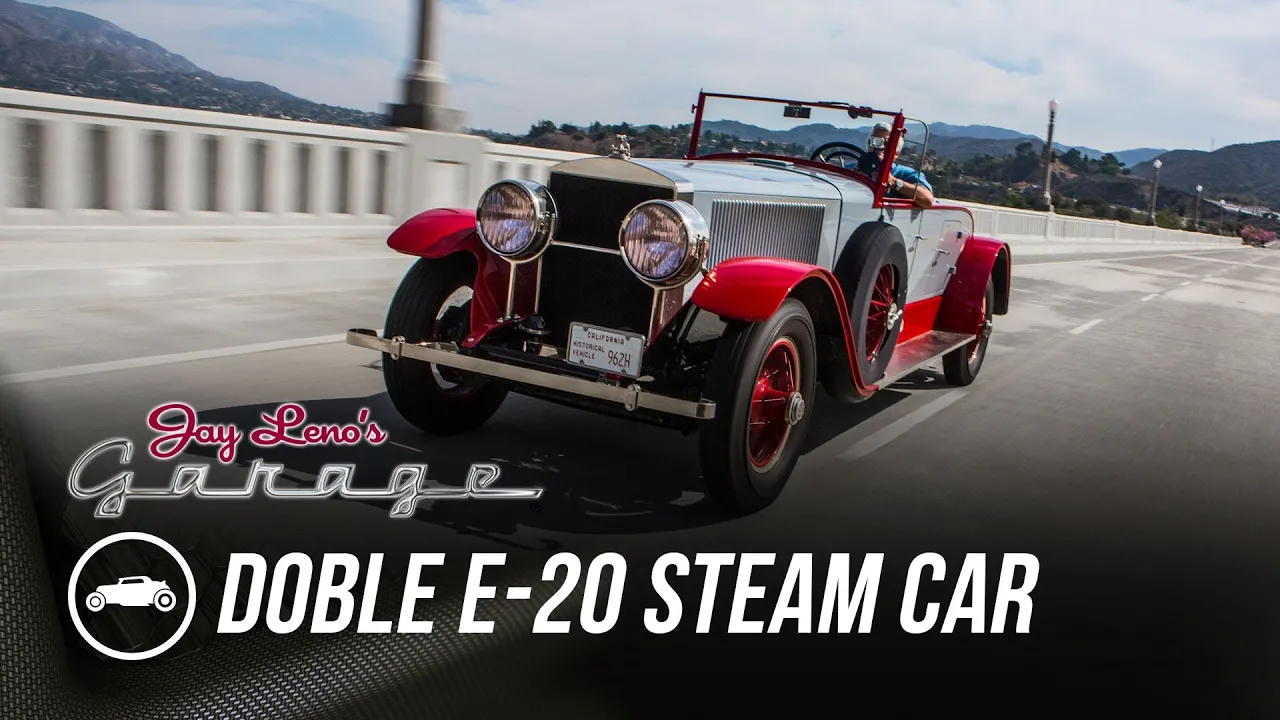
1925 Doble E-20 Steam Car - Jay Leno's Garage
Jay Leno's Garage
AI-assisted summary of 1925 Doble E-20 Steam Car - Jay Leno's Garage — original source. Check the original for full context.
Source published:
Key ideas
- The 1925 Doble Model E (chassis E-20), originally owned by Howard Hughes, achieved 132.5 mph in 1925 and produces 1,000 lb-ft of torque directly from a dead stop without a transmission. (0:00)
- Unlike traditional steam boilers, Doble's flash generator heats only one to two quarts of water at a time across 475 feet of tubing, reaching up to two million BTUs of heat and 750–1,000 psi of superheated steam. (6:58)
- Doble's closed-loop condenser system was advertised for up to 1,200 miles between water refills, though real-world operation yields closer to 200 miles under favorable conditions. (11:07)
- To keep the car roadworthy, Leno's team replaced the ineffective factory mechanical drum brakes with modern disc brakes and fabricated two full sets of custom pistons to resolve steam-expansion metallurgy issues. (20:00)
Detailed notes
## Background This video was published on YouTube by the official Jay Leno's Garage channel on April 14, 2014. According to the page description, Jay takes viewers for a ride in the 1925 Doble E-20 steam car—heralded as the greatest steam automobile ever built—which was originally owned by Howard Hughes and reached 132.5 mph in 1925.
## TL;DR Jay Leno showcases the extraordinarily advanced engineering of the 1925 Doble E-20 steam car, originally owned by aviation pioneer Howard Hughes. Using both a complete Murphy Roadster and an exposed rolling cutaway chassis, Leno details how Abner Doble eliminated the flaws of traditional steam cars with an automated monotube flash generator, quartz thermostat controls, and a double-acting four-cylinder compound engine producing 1,000 lb-ft of torque. After demonstrating the multi-step startup ritual and modern ceramic thermal coatings used in its restoration, Leno takes the 2.5-ton vehicle on public roads to showcase its seamless, whisper-quiet acceleration. The feature wraps up with a high-pressure boiler blow-down alongside his mechanic, George Swift, underscoring the garage's mission to preserve lost mechanical history.
## Atmosphere & style The presentation carries an infectious, scholarly reverence for forgotten ingenuity, driven by Leno's conversational enthusiasm and deep mechanical literacy. Rather than relying on hyperactive television tropes or manufactured drama, the pacing is patient and technical, combining hands-on garage masterclasses with an almost reverent road test. Watching it feels like getting a private tour from an obsessive curator who delights in the counterintuitive quirks of steam physics, conveying an eerie wonder as a massive 1920s vehicle sweeps through modern traffic in near-total silence.
## Bulletin - [00:00](https://www.youtube.com/watch?v=rUg_ukBwsyo&t=0s) The 1925 Doble Model E (chassis E-20), originally owned by Howard Hughes, achieved 132.5 mph in 1925 and produces 1,000 lb-ft of torque directly from a dead stop without a transmission. - [06:58](https://www.youtube.com/watch?v=rUg_ukBwsyo&t=418s) Unlike traditional steam boilers, Doble's flash generator heats only one to two quarts of water at a time across 475 feet of tubing, reaching up to two million BTUs of heat and 750–1,000 psi of superheated steam. - [11:07](https://www.youtube.com/watch?v=rUg_ukBwsyo&t=667s) Doble's closed-loop condenser system was advertised for up to 1,200 miles between water refills, though real-world operation yields closer to 200 miles under favorable conditions. - [20:00](https://www.youtube.com/watch?v=rUg_ukBwsyo&t=1200s) To keep the car roadworthy, Leno's team replaced the ineffective factory mechanical drum brakes with modern disc brakes and fabricated two full sets of custom pistons to resolve steam-expansion metallurgy issues.
## Key takeaways - [00:00](https://www.youtube.com/watch?v=rUg_ukBwsyo&t=0s) The Doble Model E solved the major drawback of earlier steam cars by enabling key-turn electric ignition without manual torch-lighting or long warm-up delays. - [00:00](https://www.youtube.com/watch?v=rUg_ukBwsyo&t=0s) The custom Murphy Roadster body features the prototype disappearing convertible top that later became an iconic design cue on Duesenbergs. - [00:00](https://www.youtube.com/watch?v=rUg_ukBwsyo&t=0s) Unlike internal combustion engines designed to shed heat, Doble steam propulsion relies on heat retention, running superheated steam at 750°F to 850°F. - [03:35](https://www.youtube.com/watch?v=rUg_ukBwsyo&t=215s) Costing between $20,000 and $25,000 in 1925, the Doble required dedicated professional chauffeur or mechanic maintenance to run properly. - [03:35](https://www.youtube.com/watch?v=rUg_ukBwsyo&t=215s) The emergence of the electric self-starter on gasoline engines, rather than inferior performance, effectively sealed the demise of steam automobiles. - [06:58](https://www.youtube.com/watch?v=rUg_ukBwsyo&t=418s) The double-acting four-cylinder compound engine delivers continuous power strokes in both directions, mimicking the power impulses of an internal combustion V16. - [11:07](https://www.youtube.com/watch?v=rUg_ukBwsyo&t=667s) A quartz-crystal thermostat automatically cuts burner fuel at 750°F because quartz does not expand with heat, whereas the surrounding metal rod does. - [11:07](https://www.youtube.com/watch?v=rUg_ukBwsyo&t=667s) Exhaust steam drives auxiliary turbine wheels that power the condenser cooling fans, recycling condensed steam back into liquid water. - [16:01](https://www.youtube.com/watch?v=rUg_ukBwsyo&t=961s) Engaging the handbrake opens cylinder drain cocks to discharge trapped condensation, preventing catastrophic hydraulic lock upon startup. - [16:01](https://www.youtube.com/watch?v=rUg_ukBwsyo&t=961s) The combustion chamber uses a Space Shuttle plasma ceramic coating capable of resisting temperatures up to 7,000°F to contain extreme burner heat. - [20:00](https://www.youtube.com/watch?v=rUg_ukBwsyo&t=1200s) Speed is controlled via a steering-wheel-mounted fine-pitch screw throttle wheel designed to safely meter 1,000 psi steam pressure without binding. - [20:00](https://www.youtube.com/watch?v=rUg_ukBwsyo&t=1200s) Unlike Stanley steam cars that lost pressure under sustained load, the Doble's forced-draft monotube generator maintains 800 to 1,000 psi continuously at highway speeds. - [24:01](https://www.youtube.com/watch?v=rUg_ukBwsyo&t=1441s) Jay Leno and mechanic George Swift transitioned the E-20 from a static museum piece into a reliable runner, accumulating roughly 3,000 road miles. - [25:25](https://www.youtube.com/watch?v=rUg_ukBwsyo&t=1525s) A regular high-pressure boiler blow-down procedure is necessary every few hundred miles to flush out hard-water scale and keep generator coils clean.
## Detailed walkthrough ### [00:00](https://www.youtube.com/watch?v=rUg_ukBwsyo&t=0s) The Pinnacle of Steam: Howard Hughes' 1925 Doble E-20
Jay Leno opens in the steam room of his garage, surrounded by steam-powered machinery and historical memorabilia, to present the 1925 Doble Model E (chassis E-20). While earlier steam cars required drivers to manually light a pilot burner with a match or torch and wait ten to fifteen minutes for the system to build pressure, the Doble was a breakthrough: an automobile where a driver could simply get in, turn the key, and drive away. This specific example was originally owned by Howard Hughes, an avid Doble enthusiast who favored the car because it was the only machine capable of matching his Duesenberg in sheer acceleration. In 1925, Hughes pushed this Doble to an astonishing 132.5 mph.
The car carries a custom Murphy Roadster body featuring the very first prototype of a disappearing convertible top, a design that folded flush beneath a rear deck panel and later became the hallmark style on Duesenbergs. Because it delivers 1,000 foot-pounds of torque directly from a dead stop, the car requires no transmission or multiple gears; it uses a direct-drive setup to turn the rear axle. Originally restored as a static museum piece by Arnold Schmidt for the Nethercutt Collection, Leno and his team had to substantially rebuild the mechanicals once they began putting serious road mileage on it, fabricating new pistons and piston rings. Operating the Doble demands a specialized steam cylinder oil to withstand its extreme operating conditions: while Stanley steam cars typically run around 400°F to 600°F, the Doble operates between 750°F and 850°F using superheated steam. At those elevated temperatures, water expands roughly 2,500 times, giving the car its immense power.
Restoring and tuning a Doble is notoriously difficult because standard internal combustion intuition runs completely backward. In a conventional gasoline engine, the goal is shedding heat to prevent overheating; in a Doble, preserving thermal energy is paramount. As Jay explains:
> “Anywhere heat is escaping, you want to seal that up and do what you have to do because the more heat it has, literally, the faster it goes.”
- **Torque:** 1,000 lb-ft produced from rest. - **Top Speed Record:** 132.5 mph set by Howard Hughes in 1925. - **Operating Temperature:** 750°F to 850°F superheated steam (expanding ~2,500 times). - **Chassis Weight & Wheelbase:** 2.5 tons on an approximate 142-inch wheelbase. - **Body Style:** Murphy Roadster with the prototype disappearing soft top and rumble seat.
---
[03:35](https://www.youtube.com/watch?v=rUg_ukBwsyo&t=215s) Under the Hood and the Reality of 1920s Steam Engineering
Lifting the hood panels reveals a labyrinth of copper and steel tubing, valves, and auxiliary systems that look utterly alien compared to an internal combustion layout. Jay jokes that pulling into a service station and asking an attendant to check the oil leaves them baffled because the actual four-cylinder engine sits at the rear axle rather than under the hood. Despite weighing two and a half tons, the car glides along in complete silence, burning fuel cleanly in a closed system that maintains an internal firebox reaching tens of thousands of degrees.
Operating a Doble involves dealing with mechanical phenomena virtually unknown to gasoline motorists, such as water hammer and high-pressure steam lubrication challenges. Since water possesses no lubricating properties, specialized steam oil must be continuously metered into the steam lines. Costing between $20,000 and $25,000 in 1925—at a time when a contemporary Model T Ford sold for around $260—the Doble was built strictly for the ultra-wealthy elite. The original owner's manual took this reality for granted, featuring a maintenance section explicitly listing chores for the owner's chauffeur or mechanic:
> “In the handbook, it says things for your man to do every day. See, if you had a car like this, you had to have a man who took care of the car.”
Starting the vehicle involved a checklist of thirteen distinct procedures. While running well it offers an effortless experience, keeping it running requires endless dedication. Jay reflects on the sheer volatility of ownership:
> “It's the kind of car when it's running great, it's unbelievable. It's the kind of car when it's running bad, it's unbelievable.”
Steam power had dominated rail and maritime transport throughout the nineteenth century, but the automotive market quickly outpaced it. The true death knell for steam was not raw performance, but the invention of the electric self-starter on gasoline engines, which freed drivers from dangerous hand cranks and made turning a key universal. The Doble represented the final, brilliant attempt to place steam on equal footing with internal combustion.
---
[06:58](https://www.youtube.com/watch?v=rUg_ukBwsyo&t=418s) Abner Doble's Obsession and the E-20 Chassis Architecture
Abner Doble was a quintessential engineering savant from a wealthy background who attended MIT before dropping out to pursue steam power. While a brilliant mechanical mind, he was a terrible businessman who constantly alienated investors. Rather than standardizing a production line, Doble treated every chassis as an evolving experiment, frequently altering engineering designs between sequential cars like E-18 and E-20. His obsessive perfectionism extended to minute hardware details. On the rear deck, the fuel filler assembly is fastened down by thirteen screws—a design choice born purely of competitive spite:
> “There's no reason you need 13 screws. The reason it has 13 screws is Rolls-Royce had 12. So Doble said, 'Hm, well, I'm going to make 13.'”
To clearly explain the Doble's mechanical design without the obscuring bodywork, Jay moves over to an original rolling display cutaway chassis. Rather than using a conventional boiler like a Stanley—which holds 15 to 20 gallons of boiling water in a pressure vessel like a tea kettle—Doble engineered a flash steam generator. The system heats no more than one to two quarts of water at any given instant across 475 linear feet of coiled, progressively sized steel tubing.
When the driver turns the ignition key, an electric Sirocco-style blower fan inside a draft booster unit spins rapidly, forcing air through a carburetor venturi. The suction draws gasoline from the float bowl and atomizes it downward over the tubing coil pack, igniting a burner that generates one million BTUs of heat in just 90 seconds (and up to two million BTUs at full operation). The forced downward draft produces 750 psi of superheated steam.
This high-pressure steam travels back to a rear-mounted, four-cylinder compound engine featuring two high-pressure and two low-pressure cylinders. Because the engine is double-acting, steam alternately pushes the pistons in both directions, making every stroke a power stroke. Jay points out that this constant delivery means the four-cylinder Doble generates power impulses equivalent to an internal combustion V16 engine, feeding torque straight into the rear differential without the need for a clutch or gearbox.
```mermaid flowchart TD accTitle: Doble E-20 Powertrain Flow accDescr: Diagram illustrating the operational flow from ignition to direct rear-wheel drive on the Doble E-20 chassis.
subgraph IgnitionAndAir ["Burner Assembly"] A["Ignition Key Turned"] --> B["Draft Booster / Sirocco Fan"] B --> C["Carburetor Venturi"] C --> D["Downward Forced-Draft Burner<br/>(1M–2M BTUs)"] end
subgraph SteamGeneration ["Steam Generator"] D --> E["475 ft Steel Tubing Coil Pack<br/>(1–2 Quarts Heated at a Time)"] E --> F["750 psi Superheated Steam<br/>(750°F–850°F)"] end
subgraph DriveUnit ["Rear Engine & Propulsion"] F --> G["4-Cylinder Double-Acting<br/>Compound Engine"] G --> H["Continuous Power Stroke<br/>(V16 Equivalent Delivery)"] H --> I["Direct Drive Rear Axle<br/>(No Transmission)"] end ```
- **Tubing Length:** 475 linear feet of continuous steel generator tubing. - **Water Capacity Under Heat:** Approximately 1 to 2 quarts heated at any single moment. - **Heat Output:** 1,000,000 BTUs reached in 90 seconds; up to 2,000,000 BTUs at peak operation. - **Operating Pressure:** 750 psi of superheated steam. - **Engine Type:** Double-acting four-cylinder compound engine (high-pressure and low-pressure stages). - **Hardware Quirk:** 13 fuel-filler mounting screws specifically chosen to exceed Rolls-Royce's 12.
[11:07](https://www.youtube.com/watch?v=rUg_ukBwsyo&t=667s) Engine Architecture and the Closed-Loop Steam Cycle
Jay demonstrates the mechanical layout of the Doble, pointing out that the engine is a direct-drive unit acting straight on the rear axle through the crankshaft without any transmission. High-pressure steam enters the compound engine's high-pressure cylinder first, and whatever steam remains expands into the low-pressure cylinder. Beyond driving the rear wheels, the engine powers an auxiliary shaft running water pumps and high-pressure oil pumps that inject lubricant directly into the steam at 200 pounds per square inch, which is essential because water itself possesses zero lubricity. Upon exiting the cylinders, the exhaust steam hits a draft booster that overrides the electric blower to force fuel into the burner harder and faster. The heart of the Doble's automated temperature control is a thermostat housing approximately six quartz crystals mounted against a metal rod. Because quartz does not expand or contract with temperature changes while the metal rod does, rising temperatures expand the metal, pushing the crystal forward into an electrical contact that instantly cuts the fire once steam reaches 750 degrees Fahrenheit. As the car travels down the road, this thermostat cycles the burner on and off three or four times every minute.
```mermaid flowchart TD accTitle: Doble E-20 Closed-Loop Steam Cycle accDescr: Diagram illustrating steam flow through cylinders, auxiliary turbines, and condenser back to the water tank. subgraph Propulsion["Engine & Drive"] HP["High-Pressure Piston"] --> LP["Low-Pressure Piston"] LP --> Axle["Direct Drive Axle & Crankshaft"] LP --> AuxShaft["Auxiliary Shaft (Pumps)"] end subgraph ExhaustCycle["Exhaust & Auxiliary Drive"] LP --> Booster["Draft Booster (Overrides Blower)"] Booster --> Turbines["Twin Turbine Wheels"] end subgraph Condensation["Condensing System"] Turbines --> Fans["Cooling Fans"] Turbines --> Condenser["Condenser (Front Core)"] Fans -.->|"Airflow"| Condenser Condenser --> Reservoir["Water Supply Tank"] end ```
Exhaust steam passing the draft booster is still not finished; it drives two auxiliary turbine wheels that spin the cooling fans behind the condenser. Jay recalls tracking down the original manufacturer in Worcester, Massachusetts, who had produced the turbine wheels in the 1920s. When modern representatives initially claimed they could not replicate them, Jay appealed to their pride: “You know, your grandfather made it in 1925. You mean to tell me this many years later, you can't make something your grand.” Embarrassed by the challenge, the company accepted the job and fabricated new turbine wheels at great expense. Steam leaving the turbines enters the front condenser—which functions like an automotive condenser rather than a conventional radiator—where airflow from the turbine-driven fans instantly condenses the vapor back into liquid water to be pumped through the cycle again.
Jay highlights the intricate auxiliary unit, describing it as the heart of the Doble car containing a 12-volt motor generator, four-piston water pumps, an air pump, and two vacuum pumps, all fired by a single spark plug that lasts indefinitely without failure. While Abner Doble claimed the condensing system allowed up to 1,200 miles on a single water tank, Jay clarifies that real-world range is closer to a couple hundred miles on a cool day, and noticeably less during hot summer driving when high ambient temperatures overwhelm the condenser, forcing excess steam to vent through a safety valve into the atmosphere.
- The oil pump injects cylinder lubricant into the steam line at 200 psi to protect the pistons. - The quartz crystal thermal regulator automatically cycles the burner to hold a steady 750°F operating temperature. - The condenser acts as a closed-loop distiller, turning 750°F–850°F steam back into usable liquid water. - Abner Doble advertised a 1,200-mile water range, but actual road range is roughly 200 miles under favorable conditions.
---
[16:01](https://www.youtube.com/watch?v=rUg_ukBwsyo&t=961s) Starting Procedure and Fire-Up
Operating the Doble involves an engineered ritual that often baffles modern automotive visitors. Jay jokes that explaining the systems to visiting engineers from General Motors or Mercedes-Benz makes him feel like a big shot despite having no engineering degree. Before firing the boiler, the driver must pull the handbrake lever. In a Doble, the handbrake linkage not only locks the mechanical brakes but simultaneously opens cylinder drain cocks to release any residual condensation accumulated overnight. Jay emphasizes that because water cannot compress, attempting to drive off with liquid trapped in the double-acting cylinders would instantly shatter the mechanical drive assembly.
Once drained, the driver turns on the electrical ignition and lifts an auxiliary manual water pump plunger to prime the mono-tube boiler coils up to roughly 500 psi. Pre-filling the coils with water is critical; firing the combustion chamber dry would immediately scorch and ruin the seamless tubing. Jay flips the switch for the automatic burner, pointing toward a sight glass down in the footwell where a circular vortex of fire ignites. The combustion chamber is treated with a modern plasma ceramic coating originally developed for the Space Shuttle. This coating withstands temperatures up to 6,000°F–7,000°F and insulates so effectively that someone can hold a piece of treated sheet metal directly in their bare palm while hitting the reverse side with a welding torch without feeling the heat.
As the burner warms the boiler, the driver balances steam pressure and temperature before departing. The burner automatically cuts fuel when boiler pressure peaks at 750 psi, requiring Jay to crack the throttle slightly to let off water and allow pressure and temperature to rise in tandem. Once temperature registers around 250°F on the gauge and steadily climbs toward operating range, Jay tops up the water reservoir—joking that he uses "Evian racing water" for high-speed runs—and prepares to drive.
- Engaging the handbrake automatically opens the cylinder drain cocks to eliminate condensation and avoid hydraulic lock. - Manual water pump plungers must build roughly 500 psi of water pressure across the boiler coils before the burner is lit. - The combustion chamber interior is lined with an aerospace-grade plasma thermal barrier coating resistant up to 7,000°F. - Burner fuel delivery automatically cuts off when resting pressure reaches 750 psi.
---
[20:00](https://www.youtube.com/watch?v=rUg_ukBwsyo&t=1200s) Driving Experience: The "Hand of God" and 1,000 lb-ft of Torque
Setting off down the road, the Doble operates in near-total silence, gliding into modern traffic without clutch pedals or gear shifts. Jay describes the vintage driving experience: “They used to call steam the hand of God because the torque just pushes you.” Unlike an internal combustion car from 1925 that required double-clutching and grinding unsynchronized gears, the Doble delivers smooth, uninterrupted direct drive. Speed is modulated not with a conventional foot accelerator, but through an inner throttle wheel mounted inside the steering wheel. This fine-pitch screw mechanism controls a metering valve; standard butterfly valves could never overcome or safely meter 1,000 psi of steam pressure without binding or blowing open.
Jay notes that modern disc brakes were added to this particular Doble for safety, recounting how the original mechanical drum brakes once had him sailing helplessly through red lights while apologizing to cross-traffic. Once warmed up, the Doble operates with 1,000 psi of boiler pressure and steam temperatures near 750°F. At these higher temperatures, the steam becomes superheated and dramatically more efficient, allowing the driver to close down the throttle wheel while sustaining higher speeds on less fuel.
Cruising at 60 mph requires barely cracking the throttle wheel. Jay compares the Doble’s sustained power delivery to the popular Stanley steam car. While a Stanley had an evaporative fire-tube boiler that dropped from 600 psi down to 200 psi under steady load—forcing the driver to pull over and wait for steam to recover—the Doble's forced-draft monotube design continuously generates steam faster than the engine consumes it, effortlessly maintaining 800 to 1,000 psi at 65 to 70 mph. Jay glides past a horse on the roadside without startling it, pointing out that despite being officially rated at just 150 horsepower, the engine generates an earth-moving 1,000 lb-ft of torque right off idle, making it one of the fastest and most sophisticated road vehicles of 1925.
- The steering-wheel throttle wheel uses a screw-action mechanism to throttle 1,000 psi steam without sticking. - Aftermarket disc brakes were installed to replace the ineffective factory mechanical drum brakes. - Monotube boiler design enables the Doble to sustain 800–1,000 psi continuously at 70 mph, unlike Stanley steam cars that lost pressure at speed. - The Doble E-20 powertrain delivers 150 horsepower and 1,000 lb-ft of immediate torque.
[24:01](https://www.youtube.com/watch?v=rUg_ukBwsyo&t=1441s) Piloting the Doble and Honoring Its Heritage
Behind the wheel on the open road, Jay reflects on the sheer thrill of operating the Doble E-20, explaining that the sensation differs entirely from any conventional automobile. As steam pressure builds back up, the driving dynamic feels more akin to navigation than standard motoring. Jay marvels at the vehicle's eerie silence under acceleration; as it sweeps past the camera car, there is virtually no engine noise whatsoever. Imagining the car in its prime during the mid-1920s, Jay remarks, “I bet Howard Hughes had a lot of fun in this car blowing off everything else on the road.” Hughes could casually outperform anything else traveling the highways in absolute quiet.
Getting the Doble to run reliably required extensive mechanical sortedness. While the Nethercutt collection had previously executed a beautiful restoration, the car had accumulated very few road miles. Jay and his team took on the challenge of turning it into a true driver, ultimately logging roughly 3,000 miles. dialed-in reliability required going through two complete sets of custom pistons to resolve intricate metallurgy puzzles, as different metals expand at drastically different thermal rates under intense steam heat. Jay takes deep pride in preserving this mechanical legacy, stating, “You know, I consider it such an honor to be the custodian of this car because we've been able to uh to uh fix it and get it running properly.”
- **Driving dynamics:** Piloted rather than merely driven, delivering effortless, near-silent acceleration past traffic. - **R&D and metallurgy:** Solved piston clearance and metal expansion issues by cycling through two iterations of pistons. - **Mileage accumulated:** Approximately 3,000 road miles logged by Jay's garage after sorting the mechanicals. - **Provenance:** Preserved across generations by caretakers including Howard Hughes and the Nethercutt Collection before arriving in Jay's stable.
---
[25:25](https://www.youtube.com/watch?v=rUg_ukBwsyo&t=1525s) The Boiler Blow-Down and George Swift's Handiwork
Back near the shop, Jay prepares for essential post-drive maintenance: blowing down the steam generator. Performed every couple of hundred miles—or roughly every second or third outing—the blow-down expels mineral scale and hard water deposits out of the tubing before they can clog the generator coils. Jay introduces his mechanic, George Swift, crediting him with mastering the complex system. Although Swift came entirely from an internal combustion background, he grasped Doble engineering quickly and rebuilt the engine into peak operating condition. Jay praises the achievement, declaring, “And this is probably I think one of the best running Dobles in the entire world.”
Swift initiates the procedure—what Jay affectionately dubs the "Doble dance"—opening the blow-down valve to unleash a furious blast of hot water, steam, and accumulated mineral scale onto the pavement. Once purged, the burner is switched off, leaving just enough residual steam pressure stored in the system to drive the car smoothly back into the garage without needing to fire up the boiler again.
- **Maintenance frequency:** Boiler blow-down is conducted every few hundred miles (or every 2–3 drives) to prevent hard-water scale accumulation. - **Mechanic:** George Swift transitioned from traditional internal combustion engines to completely rebuild and dial in the Doble power unit. - **Post-blow residual energy:** The car retains sufficient leftover pressure after shutoff to motor back into the garage under its own steam.
---
[26:38](https://www.youtube.com/watch?v=rUg_ukBwsyo&t=1598s) Preserving Lost Technology Over Drama
Jay concludes the drive by contrasting his garage’s philosophy with mainstream automotive television. Rather than relying on manufactured tension or theatrical arguments, he prefers using his platform to teach enthusiasts about forgotten mechanical wonders. Articulating his frustration with modern reality programming, Jay observes, “You know, I watch a lot of the car shows where the people yell and throw wrenches at each other and this kind of stuff and I don't quite get it.”
For Jay, the genuine reward lies in digging into historic engineering milestones, educating viewers on forgotten propulsion systems, and connecting with an audience that appreciates genuine automotive history. Thanking viewers for their comments and feedback, he signs off until next week's episode.
## Notable quotes > [20:00](https://www.youtube.com/watch?v=rUg_ukBwsyo&t=1200s) They used to call steam the hand of God because the torque just pushes you. — Jay Leno
> [00:00](https://www.youtube.com/watch?v=rUg_ukBwsyo&t=0s) Anywhere heat is escaping, you want to seal that up and do what you have to do because the more heat it has, literally, the faster it goes. — Jay Leno
## Mentioned Jay Leno, Howard Hughes, Abner Doble, George Swift, Arnold Schmidt, Doble Model E (E-20), Murphy Roadster, Duesenberg, Stanley steam car, Ford Model T, Rolls-Royce, Nethercutt Collection, Massachusetts Institute of Technology (MIT), General Motors, Mercedes-Benz, Space Shuttle
## Video description 1925 Doble E-20 Steam Car. Jay takes you for a ride in the greatest steam car ever built, once owned by Howard Hughes who took it up to 132.5 mph in 1925! » Subscribe: http://bit.ly/JLGSubscribe » Visit the Official Site: http://bit.ly/JLGOfficialSite
THE BEST OF JAY LENO'S GARAGE » Exclusive First Looks: http://bit.ly/JLGExclusives » Ultra Rare Supercars: http://bit.ly/JLGSupercars » Jay's Book Club: http://bit.ly/JLGBookClub
JAY LENO'S GARAGE ON SOCIAL Follow Jay: http://Twitter.com/LenosGarage Like Jay: http://Facebook.com/JayLenosGarage
ABOUT JAY LENO'S GARAGE A new video every Sunday! Visit Jay Leno's Garage, the Emmy-winning series where Jay Leno gives car reviews, motorcycle reviews, compares cars, and shares his passion and expertise on anything that rolls, explodes, and makes noise. Classic cars, restomods, super cars like the McLaren P1, sports cars like Porsche 918 Spyder and Camaro Z28, cafe racers, vintage cars, and much, much more. Subscribe for more: http://full.sc/JD4OF8
NBC ON SOCIAL: NBC YouTube: http://full.sc/MtLxIM NBC Facebook: http://facebook.com/NBC NBC Twitter: http://twitter.com/NBC NBC Google+: https://plus.google.com/+NBC/posts
1925 Doble E-20 Steam Car - Jay Leno's Garage http://youtu.be/rUg_ukBwsyo
Jay Leno's Garage http://www.youtube.com/user/jaylenosgarage
[Source](https://www.youtube.com/watch?v=rUg_ukBwsyo)