Li-Cycle Recovers 95% of Minerals From Intact EV Battery Packs
JerryRigEverything
Submerged hydrometallurgical recycling captures critical battery metals with 70% fewer emissions than primary mining, disproving claims that spent electric vehicle packs end up in landfills.
AI-assisted summary of What *Really* happens to used Electric Car Batteries? - (you might be surprised) — original source. Check the original for full context.
Source published:
Key ideas
- Li-Cycle's hydrometallurgical shredding process submerges entire, intact EV battery packs under a liquid bath to neutralize electric charge and prevent thermal runaway fires without requiring manual disassembly. (0:00)
- The mechanical separation line achieves a 95% material recovery rate, splitting batteries into plastics, structural metals, and active 'black mass' containing lithium, cobalt, and nickel. (4:15)
- Recycling battery minerals produces approximately 70% fewer carbon emissions than primary extraction from virgin open pits or brine fields. (4:15)
- Consumer electronics recycling is widely accessible, with 89% of the US population living within 10 miles of a Call2Recycle drop-off kiosk inside nationwide retail stores. (6:08)
Detailed notes
## Background Published on YouTube by JerryRigEverything on August 16, 2023, this video explores the reality of lithium-ion battery recycling. The video description highlights a behind-the-scenes tour of Li-Cycle's facility to show how electric car, cell phone, and power tool batteries are processed into raw materials, while directing viewers to Call2Recycle drop-off locations to divert their own electronics from landfills.
## TL;DR Host Zack Nelson tours Li-Cycle's Gilbert, Arizona recycling facility to debunk persistent myths that spent electric vehicle batteries inevitably end up in landfills. The facility safely processes fully assembled EV packs and everyday consumer electronics by shredding them submerged under a proprietary liquid chemical bath, eliminating fire hazards and neutralizing electrical charge. Mechanical separation and hydraulic filter pressing split the feedstock into three commodity streams: shredded plastics, mixed structural and precious metals, and a concentrated cathode/anode residue known as black mass. With a 95% material recovery rate that yields 70% fewer carbon emissions than primary mining, the recovered black mass is prepared for chemical refining into battery-grade lithium, cobalt, and nickel compounds.
## Atmosphere & style The presentation carries Zack Nelson's signature hands-on, practical curiosity, blending educational tech-demolition flair with industrial engineering marvels. Visually striking and tactile, the footage contrasts violent, high-torque shredding machinery against a serene, fire-suppressing chemical bath, creating an oddly satisfying look inside a modern recycling plant. The tone remains grounded, humorous, and reassuringly pragmatic, transforming an intimidating environmental dilemma into a solved technical reality through clear-eyed optimism and plain-spoken analysis.
## Bulletin - [00:00](https://www.youtube.com/watch?v=s2xrarUWVRQ&t=0s) Li-Cycle's hydrometallurgical shredding process submerges entire, intact EV battery packs under a liquid bath to neutralize electric charge and prevent thermal runaway fires without requiring manual disassembly. - [04:15](https://www.youtube.com/watch?v=s2xrarUWVRQ&t=255s) The mechanical separation line achieves a 95% material recovery rate, splitting batteries into plastics, structural metals, and active 'black mass' containing lithium, cobalt, and nickel. - [04:15](https://www.youtube.com/watch?v=s2xrarUWVRQ&t=255s) Recycling battery minerals produces approximately 70% fewer carbon emissions than primary extraction from virgin open pits or brine fields. - [06:08](https://www.youtube.com/watch?v=s2xrarUWVRQ&t=368s) Consumer electronics recycling is widely accessible, with 89% of the US population living within 10 miles of a Call2Recycle drop-off kiosk inside nationwide retail stores.
## Key takeaways - [00:00](https://www.youtube.com/watch?v=s2xrarUWVRQ&t=0s) Li-Cycle's facility in Gilbert, Arizona accepts batteries in virtually any condition, including swollen, crushed, recalled, or fire-damaged units. - [00:00](https://www.youtube.com/watch?v=s2xrarUWVRQ&t=0s) EV battery packs weighing thousands of pounds are shredded completely intact, protecting workers by eliminating the hazards of manual high-voltage disassembly. - [00:00](https://www.youtube.com/watch?v=s2xrarUWVRQ&t=0s) Submerging the industrial shredder under a proprietary liquid chemical bath neutralizes voltage, controls dust, and prevents thermal runaway fires. - [02:15](https://www.youtube.com/watch?v=s2xrarUWVRQ&t=135s) Mechanical separation extracts lightweight plastics that float to the top and dense metals that sink to the bottom of the submerged sorting tank. - [02:15](https://www.youtube.com/watch?v=s2xrarUWVRQ&t=135s) The recovered metal stream yields copper, aluminum, and steel, as well as trace precious metals such as gold, platinum, and palladium from circuit boards. - [02:15](https://www.youtube.com/watch?v=s2xrarUWVRQ&t=135s) A hydraulic filter press squeezes the slurry to extract dense 'black mass' while recirculating the process liquid in a closed-loop system with zero wastewater discharge. - [04:15](https://www.youtube.com/watch?v=s2xrarUWVRQ&t=255s) Black mass contains the highest concentrations of lithium, nickel, and cobalt, which can be recycled infinitely without losing elemental performance. - [04:15](https://www.youtube.com/watch?v=s2xrarUWVRQ&t=255s) Li-Cycle achieves an overall recovery rate of 95% from incoming battery materials, effectively serving as an above-ground mineral mine. - [04:15](https://www.youtube.com/watch?v=s2xrarUWVRQ&t=255s) Closed-loop battery recycling reduces carbon emissions by approximately 70% compared to traditional virgin ore mining. - [04:15](https://www.youtube.com/watch?v=s2xrarUWVRQ&t=255s) The Gilbert 'Spoke' can process 18,000 tons of battery material annually, sending black mass to the Rochester 'Hub' to produce battery-grade lithium carbonate, lithium sulfate, and cobalt sulfate. - [06:08](https://www.youtube.com/watch?v=s2xrarUWVRQ&t=368s) Through Call2Recycle partnerships, roughly 89% of Americans live within 10 miles of free battery collection bins located at major retailers like Home Depot and Lowe's. - [06:08](https://www.youtube.com/watch?v=s2xrarUWVRQ&t=368s) Because EV battery materials retain high economic value, the widespread myth that spent battery packs are simply dumped in landfills is economically and practically unfounded.
## Detailed walkthrough ### [00:00](https://www.youtube.com/watch?v=s2xrarUWVRQ&t=0s) Inside Li-Cycle: Submerged Shredding of EV Battery Packs
A persistent question surrounds the clean energy transition: what actually happens to lithium-ion batteries at the end of their lifespan? Whether they come from handheld cell phones, power tools, or multi-thousand-pound electric vehicles, skeptics frequently wonder if these batteries are simply dumped into landfills or genuinely recycled. To investigate the reality of large-scale battery recycling, Zack tours Li-Cycle's facility in Gilbert, Arizona, recognized as North America's leading recycler of lithium-ion batteries. While the facility can process small consumer electronics, it specializes in handling massive electric vehicle (EV) battery packs.
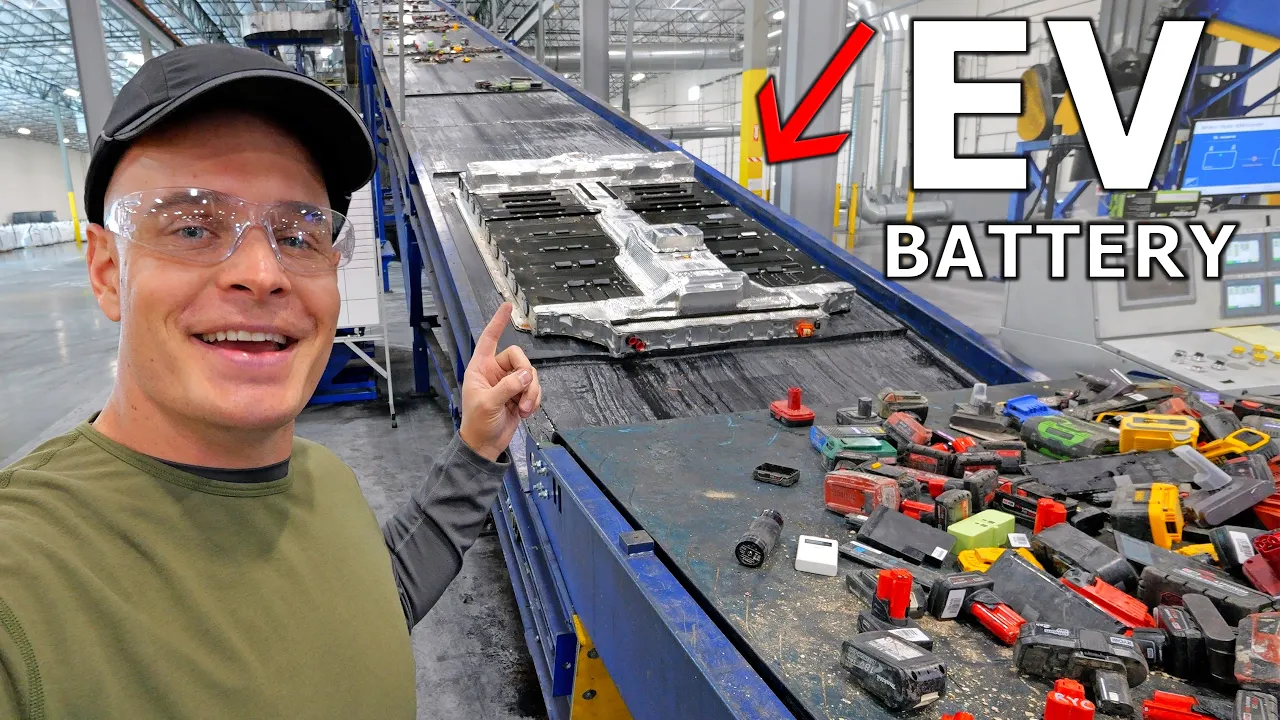
On the intake conveyor, a diverse mix of power sources is assembled, including phone batteries, laptop batteries, power tool packs, portable power banks, and even an old Nokia cell phone battery that Zack jokes is “a relic from times gone by.” Batteries can enter the facility in virtually any physical condition, whether intact, burned, damaged, or recalled. The centerpiece of the intake line is a full-sized EV battery pack weighing thousands of pounds. Rather than requiring human technicians to manually disassemble these dangerous, high-voltage battery enclosures, the entire intact pack is conveyed directly into a feed tower.
The feed tower and funnel are completely filled with a proprietary liquid solution featuring a massive industrial shredder submerged at the base. Submerging the entire tearing and shredding process under liquid eliminates the risk of thermal runaway fires and air emissions while immediately neutralizing the electrical charge. As Zack explains regarding worker protection, “Keeping the human operator safe is probably the most important part.”
- Li-Cycle accepts batteries in any state: undamaged, physically crushed, recalled, or fire-damaged. - EV battery packs are fed into the shredder fully assembled without manual disassembly, eliminating high-voltage electrocution and thermal hazards for workers. - The funnel and shredder operate completely submerged in a proprietary liquid chemical bath that prevents fires and controls dust.
[02:15](https://www.youtube.com/watch?v=s2xrarUWVRQ&t=135s) Separation: Plastics, Shredded Metals, and the Filter Press
Once the submerged shredder grinds the battery modules, the electrical charge is neutralized, leaving the materials completely inert with zero residual voltage. The resulting slurry moves across a series of mechanical sorting stages. Lightweight plastic components that once housed the battery cells float to the surface of the liquid and are vibrated upward into collection chutes, where they drop into large industrial bulk bags for downstream reprocessing.
Dense metallic fragments sink to the bottom of the submerged tank. An inclined conveyor pulls these sinking metal flakes out of the liquid bath and passes them over a vibrating sorter. This stream yields a clean mixture of shredded aluminum, copper, and structural steel, as well as trace precious metals recovered from internal printed circuit boards, including gold, platinum, and palladium. Stomping out the idea of wasting these elements, Zack asserts, “With how valuable and useful these internal materials are, no one should be throwing them in a landfill.”
The remaining liquid is heavily saturated with the dissolved and suspended active cathode and anode materials. This metal-rich slurry is pumped directly into a large blue hydraulic filter press. Under high pressure, the liquid is squeezed out and recycled back into the shredding system, while the press plates retain a damp, dense substance known as "black mass." When the hydraulic plates cycle open and shake, sheets of black mass fall down collection funnels. Zack observes that the industry views this substance as foundational: “The black mass has been valuable enough to be called 'the new gold.'”
```mermaid flowchart TD accTitle: Li-Cycle Battery Recycling Process accDescr: Flow diagram showing how whole batteries are shredded under liquid and separated into plastics, metals, and black mass.
subgraph Intake ["Intake & Neutralization"] A["Whole Batteries & EV Packs"] --> B["Submerged Industrial Shredder"] B --> C["Inert Slurry Bath"] end
subgraph Separation ["Physical Separation"] C -->|"Floats to top"| D["Plastic Separator"] C -->|"Sinks to bottom"| E["Metal Dewatering Conveyor"] C -->|"Suspended slurry"| F["Hydraulic Filter Press"] end
subgraph Products ["Recovered Commodities"] D --> G["Plastics Bag"] E --> H["Aluminum, Copper & Steel Shred"] F --> I["Black Mass (Li, Ni, Co)"] F -->|"Recycled Filtrate"| B end ```
- Shredding takes place in a closed-loop hydrometallurgical circuit where process liquid is continuously recirculated without wastewater discharge. - The process produces no traditional air pollution because materials are shredded cold under liquid rather than smelted or burned. - Circuit board traces deliver recoverable quantities of precious metals, including gold, platinum, and palladium alongside base structural metals.
[04:15](https://www.youtube.com/watch?v=s2xrarUWVRQ&t=255s) The Three Commodities and the Rochester Hub
At the end of the mechanical separation and filtration line, all incoming battery waste is reduced to three discrete commodity streams: clean shredded plastics, mixed copper and aluminum flakes, and drums of black mass. Black mass has the consistency of heavy black mud—or what Zack jokingly dubs “forbidden chocolate”—and holds the highest concentration of critical elements, specifically lithium, cobalt, and nickel. These base elemental metals do not degrade during their service life and can be recycled infinitely without loss of chemical performance.
Li-Cycle’s Gilbert "Spoke" facility achieves an overall material recovery rate of 95% from incoming batteries. Zack characterizes the operation as an eco-friendly alternative to raw mineral extraction: “Right here in Arizona is an above ground lithium mine that's processing batteries instead of earth.” Sourcing these battery metals through closed-loop recycling generates approximately 70% fewer carbon emissions compared to mining virgin ore from open pits or brine fields.
The Gilbert facility can process up to 18,000 tons of lithium-ion battery material annually. The black mass produced here is prepped for shipment to Li-Cycle’s centralized "Hub" refinery in Rochester, New York. Once fully operational, the hydrometallurgical Rochester Hub will chemically refine raw black mass back into high-purity, battery-grade chemical compounds, such as lithium carbonate, lithium sulfate, and cobalt sulfate, positioning it to become the single largest domestic source of recycled lithium carbonate in North America.
- Li-Cycle's recovery process captures 95% of the total battery materials across the three output bags. - Recycling battery minerals yields a 70% reduction in greenhouse gas emissions compared to traditional primary earth mining. - The Gilbert, Arizona "Spoke" has an operating processing capacity of 18,000 tons of battery feedstock per year. - The Rochester, New York "Hub" refines black mass into precursor chemicals: battery-grade lithium carbonate, lithium sulfate, and cobalt sulfate.
[06:08](https://www.youtube.com/watch?v=s2xrarUWVRQ&t=368s) Consumer Recycling via Call2Recycle and Debunking Landfill Myths
Addressing consumer confusion over the disposal of everyday electronics, Zack tackles the common dilemma of what viewers should do with junk drawers full of swollen, dead phone batteries and obsolete gadgets. Everyday consumers do not need direct industrial access to Li-Cycle to ensure their devices are diverted from municipal waste streams. Through programs like Call2Recycle, domestic infrastructure makes recycling accessible to the vast majority of households.
Approximately 89% of the United States population lives within 10 miles of an official Call2Recycle drop-off kiosk. These collection bins are routinely located inside prominent national retail chains such as The Home Depot, Lowe's, Staples, and OfficeMax. Collected electronics and loose batteries deposited into these drop boxes are consolidated and shipped to dedicated industrial recycling facilities like Li-Cycle to be converted directly into raw materials for next-generation consumer tech and electric vehicles.
Zack concludes by encouraging viewers to debunk the prevailing internet myth that electric vehicle batteries inevitably end up abandoned in scrap yards or buried in landfills. Pointing to the practical economics and advanced domestic facilities already operating, he notes that these critical battery materials are far too valuable to ever be discarded as trash.
- Approximately 89% of the US population resides within a 10-mile radius of a Call2Recycle collection point. - Standard drop-off locations include ubiquitous nationwide hardware and office retail stores: Home Depot, Lowe's, Staples, and OfficeMax. - Diverted consumer electronics feed the same closed-loop industrial recycling streams that supply raw battery-grade minerals for future EV production.
## Notable quotes > [04:15](https://www.youtube.com/watch?v=s2xrarUWVRQ&t=255s) Right here in Arizona is an above ground lithium mine that's processing batteries instead of earth. — Zack
## Mentioned Call2Recycle, JerryRigEverything, Li-Cycle, Lowe's, Nokia, OfficeMax, Staples, The Home Depot, Zack
## Video description How are Lithium Batteries Recycled? Today we find out. Whether its Electric Car batteries, cell phone batteries, or tool batteries the process is all the same. HUGE thanks to Li-Cycle for giving us a tour: https://www.li-cycle.com/ if you're looking to recycle your old cell phone or battery, you can find a drop off location here: https://www.call2recycle.org/locator/ and Call2Recycle will handle the rest. Lets get those old electronics and batteries turned into NEW technology!
Get my JerryRig Razor knife HERE: https://www.jerryrigknife.com/
Follow me for updates! Instagram: http://instagram.com/zacksjerryrig Facebook: http://on.fb.me/1U4bQqv Twitter: https://twitter.com/ZacksJerryRig
LARGE tool kit: http://amzn.to/2DURcr7 Travel Tool Kit: https://amzn.to/30LKXOY Mega Tool Kit: https://amzn.to/2OwequL Plastic Pry tools: http://amzn.to/1Tu57pI Metal phone opening tool: http://amzn.to/1WdOFv0 The camera I used to film this video: http://amzn.to/2p7GtkX (GH6 https://amzn.to/3LyfW8d) The Lens I used for this video: http://amzn.to/1QOXDw2 Wide angle lens: http://amzn.to/2qiYM4u And this Metabones adapter: http://amzn.to/2iZ67Ty This is the drone I use: https://amzn.to/3JEuTXs
TO SEND ME STUFF: See my P.O. Box on my 'About page': https://www.youtube.com/@JerryRigEverything/about
JerryRigEverything assumes no liability for property damage or injury incurred as a result of any of the information contained in this video. JerryRigEverything recommends safe practices when working with power tools, automotive lifts, lifting tools, jack stands, electrical equipment, blunt instruments, chemicals, lubricants, expensive electronics, or any other tools or equipment seen or implied in this video. Due to factors beyond the control of JerryRigEverything, no information contained in this video shall create any express or implied warranty or guarantee of any particular result. Any injury, damage or loss that may result from improper use of these tools, equipment, or the information contained in this video is the sole responsibility of the user and not JerryRigEverything. Only attempt your own repairs if you can accept personal responsibility for the results, whether they are good or bad.
[Source](https://www.youtube.com/watch?v=s2xrarUWVRQ)