Gelbart Cuts 1-Micron Parts on Home-Built Air-Bearing CNC Lathe
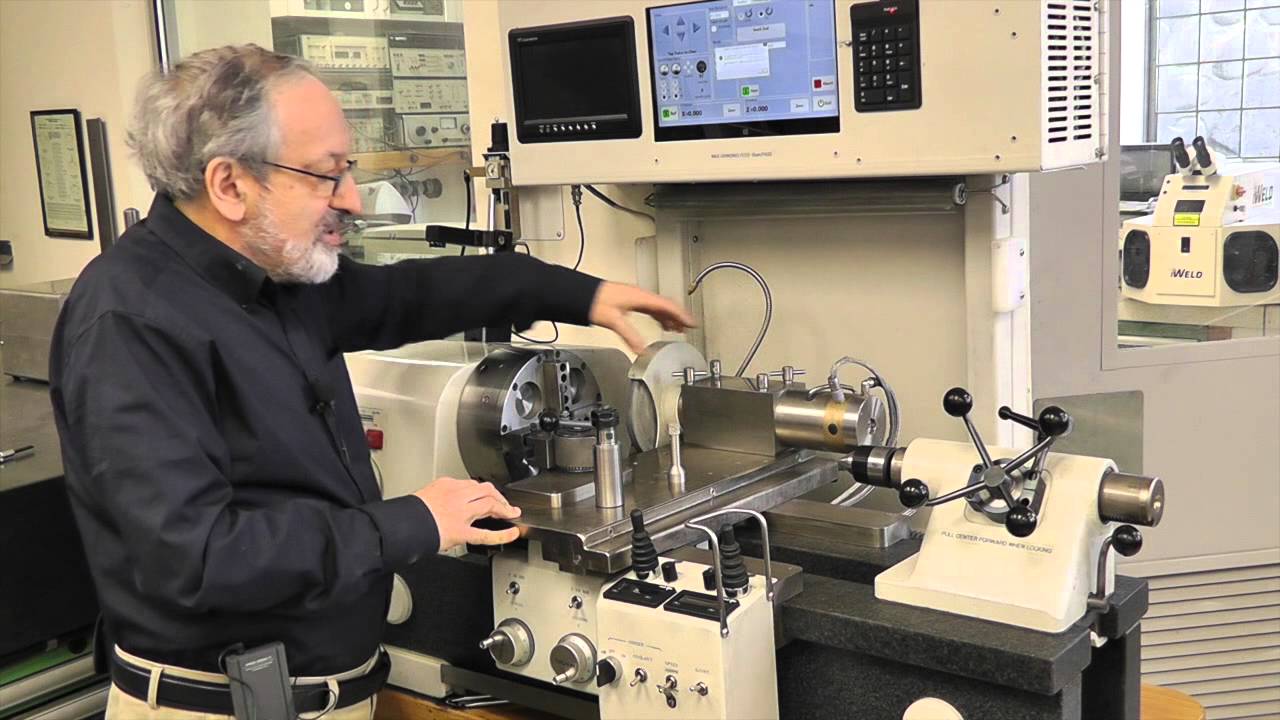
Dan Gelbart
Floating every axis on surplus air bearings over precompressed granite parallels produces airtight, frictionless fits directly off tooling without manual lapping.
AI-assisted summary of High precision air bearing CNC lathe and grinder — original source. Check the original for full context.
Source published:
Key ideas
- Dan Gelbart presents a home-built dual-purpose CNC lathe and cylindrical grinder capable of achieving 1-micron (0.00004") machining accuracy. (0:06)
- Every spindle and carriage floats on pressurized air bearings, using surplus semiconductor manufacturing spindles sourced for roughly $200 each. (3:48)
- The machine bed was built from commercial granite parallels bonded into T-sections with epoxy and placed under continuous compressive preloading via through-bolts. (6:20)
- Workholding utilizes a watertight chuck adapted from an extinct Skinner design, featuring radial adjustment screws that allow chuck runout to be dialed down to zero. (2:00)
Detailed notes
## Background Published on YouTube by Dan Gelbart on March 6, 2015, this video showcases his home-built, ultra-high-precision air-bearing CNC lathe and grinder. According to the description, the dual-purpose machine tool was engineered from scratch to achieve an operating accuracy of one micron (0.00004 inches).
## TL;DR Dan Gelbart presents a scratch-built CNC machine tool capable of both turning and cylindrical grinding to one-micron tolerances, demonstrated initially with a self-acting air-bearing piston assembly that requires zero lapping. The design eliminates friction and wear by utilizing surplus semiconductor air-bearing spindles, a watertight modified Skinner-style chuck, and a bed assembled from commercial granite parallels bonded under permanent bolt compression. Powered by custom CNC software developed alongside James Midgley and equipped with manual DRO overrides and an inspection microscope, the system supports versatile prototyping workflows. Gelbart wraps up by demonstrating live single-point threading under high optical magnification and smooth, low-splash precision grinding with dialed-in zero runout.
## Atmosphere & style The presentation carries the understated, authoritative tone of a master-class workshop tour, completely free of dramatic hype or filler. Gelbart speaks with methodical, practical enthusiasm, casually demystifying sub-micron engineering while sharing thrifty maker techniques like trepanning depleted grinding stones and repurposing surplus eBay spindles. Watching the video feels deeply satisfying and tactile, marked by mesmerizing demonstrations—from the frictionless coasting of an airtight piston to the sharp, microscopic curl of metal chips in the live camera feed.
## Bulletin - [00:06](https://www.youtube.com/watch?v=sFrVdoOhu1Q&t=6s) Dan Gelbart presents a home-built dual-purpose CNC lathe and cylindrical grinder capable of achieving 1-micron (0.00004") machining accuracy. - [03:48](https://www.youtube.com/watch?v=sFrVdoOhu1Q&t=228s) Every spindle and carriage floats on pressurized air bearings, using surplus semiconductor manufacturing spindles sourced for roughly $200 each. - [06:20](https://www.youtube.com/watch?v=sFrVdoOhu1Q&t=380s) The machine bed was built from commercial granite parallels bonded into T-sections with epoxy and placed under continuous compressive preloading via through-bolts. - [02:00](https://www.youtube.com/watch?v=sFrVdoOhu1Q&t=120s) Workholding utilizes a watertight chuck adapted from an extinct Skinner design, featuring radial adjustment screws that allow chuck runout to be dialed down to zero.
## Key takeaways - [00:06](https://www.youtube.com/watch?v=sFrVdoOhu1Q&t=6s) The machine achieves 1-micron (0.00004") geometric accuracy, enabling parts like matching pistons and cylinders to function as self-acting air bearings right off the tool without manual lapping. - [00:06](https://www.youtube.com/watch?v=sFrVdoOhu1Q&t=6s) A matched piston-and-cylinder demonstration shows zero-clearance, frictionless rotation and an airtight sliding fit with no oil film required. - [02:00](https://www.youtube.com/watch?v=sFrVdoOhu1Q&t=120s) Gelbart collaborated with James Midgley to program a custom CNC package tailored to the combined operations of an integrated turning lathe and precision grinder. - [02:00](https://www.youtube.com/watch?v=sFrVdoOhu1Q&t=120s) The custom chuck is based on a historical Skinner Chuck Company concept, fully sealing the radial slots against grinding swarf and coolant at all jaw positions. - [02:00](https://www.youtube.com/watch?v=sFrVdoOhu1Q&t=120s) Drilled pin holes in the chuck face allow modular pins to clamp workpieces from 0 mm to approximately 200 mm on both inner and outer diameters. - [03:48](https://www.youtube.com/watch?v=sFrVdoOhu1Q&t=228s) All linear axes, the workhead spindle, and the grinding head utilize air bearings to completely eliminate stick-slip, mechanical friction, and wear. - [03:48](https://www.youtube.com/watch?v=sFrVdoOhu1Q&t=228s) Surplus air-bearing spindles manufactured for semiconductor fabrication equipment can be acquired second-hand for around $200. - [03:48](https://www.youtube.com/watch?v=sFrVdoOhu1Q&t=228s) The tailstock features a 300 mm quill extension, enabling up to 600 mm of center distance within a very compact overall machine footprint. - [03:48](https://www.youtube.com/watch?v=sFrVdoOhu1Q&t=228s) Custom internal grinding wheels are waterjet-cut from worn-out standard grinding wheels and epoxy-bonded to shanks, opening up full commercial abrasive selections for internal grinding. - [06:20](https://www.youtube.com/watch?v=sFrVdoOhu1Q&t=380s) The bed was constructed by epoxying commercial granite parallels that were pre-lapped to 1-micron parallelism on all four faces. - [06:20](https://www.youtube.com/watch?v=sFrVdoOhu1Q&t=380s) Granite components were clamped upside down on a master surface plate during bonding and through-bolted under compression so the epoxy experiences only pure shear. - [06:20](https://www.youtube.com/watch?v=sFrVdoOhu1Q&t=380s) Integrated digital readouts (DRO) allow the machine to operate fully manually if computer issues arise. - [08:25](https://www.youtube.com/watch?v=sFrVdoOhu1Q&t=505s) An integrated overhead video microscope displays a real-time magnified view of the cutting edge and chip formation during operations such as single-point threading. - [08:25](https://www.youtube.com/watch?v=sFrVdoOhu1Q&t=505s) Radial adjustment screws on the spindle nose allow an operator to dial chuck runout to absolute zero when re-chucking parts against reference surfaces. - [08:25](https://www.youtube.com/watch?v=sFrVdoOhu1Q&t=505s) A precision-metered coolant delivery system prevents splashing during high-speed cylindrical grinding while maintaining thermal stability.
## Detailed walkthrough ### [00:06](https://www.youtube.com/watch?v=sFrVdoOhu1Q&t=6s) The 1-Micron Lathe and Grinder & the Air-Bearing Demonstration
Dan Gelbart introduces his home-built, ultra-high-precision machine tool designed to cut, turn, and grind parts to a tolerance of one micron (approximately 40 millionths of an inch, or 0.00004"). Anticipating the obvious question of why an individual craftsman would ever require one-micron precision, Gelbart notes that numerous demanding applications require this level of accuracy, and he presents a finished cylinder-and-piston assembly as proof. The piston is machined to such tight geometric tolerances that it acts as a completely loose, free-sliding fit inside the cylinder bore with zero noticeable play.
```mermaid flowchart TD accTitle: Granite Bed Assembly Process accDescr: Diagram illustrating the step-by-step construction of the lathe bed using bonded granite parallels.
subgraph Prep ["Component Preparation"] A["Granite Parallels<br/>(4 sides parallel to 1 µm)"] B["Granite Surface Plate<br/>(Flat Reference Base)"] end
subgraph Assembly ["Alignment & Bonding"] C["Invert Bars onto Surface Plate"] D["Set Spacing with Precision Spacers"] E["Epoxy Bond Bars into T-Sections"] end
subgraph Preload ["Preloading & Final Geometry"] F["Preload Joints in Compression<br/>with Through-Bolts"] G["Finished Co-Planar Bed<br/>(1 µm Guidance Gap)"] end
A --> C B --> C C --> D D --> E E --> F F --> G ```
The mechanical behavior of the assembly changes dramatically depending on whether airflow is permitted. When Gelbart seals the small air vent on top with his fingertip, the fit proves to be completely airtight, instantly supporting the piston without physical contact. When spun by hand, both the outer sleeve and the inner core rotate frictionlessly for an extended duration, acting as a true self-acting air bearing. Conventional production of such matching parts demands laborious, iterative lapping steps, whereas this scratch-built machine produces finished parts right off the tooling.
Addressing the practical utility and mechanics of self-acting aerodynamic surfaces, Dan Gelbart explains: “So in other words if you made a bearing like this this bearing will never need lubrication and never wear out because there is no contact between the inner part and the outer part you can verify that with an ohmmeter while they turn it's the same idea as air bearing in a hard drive or air bearings and other self-acting air bearings devices.”
- **Accuracy specification:** 1 micron (0.001 mm / 40 millionths of an inch / 0.00004"). - **Demonstration workpiece:** Matched cylinder and piston demonstrating an airtight sliding fit with no oil film. - **Electrical verification:** Contactlessness can be tested with an ohmmeter across spinning parts to prove continuous infinite resistance.
---
[02:00](https://www.youtube.com/watch?v=sFrVdoOhu1Q&t=120s) Custom CNC Control and the Watertight Skinner-Style Chuck
Gelbart designed and fabricated the machine mechanicals from scratch, but he collaborated with engineer James Midgley out of Vancouver, British Columbia, to create a dedicated CNC software package. Off-the-shelf CNC control software could not accommodate the dual-purpose architecture of an integrated turning lathe and precision grinder alongside its idiosyncratic hardware setups. As Gelbart emphasizes: “The reason I couldn't use a standard software package is this machine is both a lathe and grinder and has some other special features so I wanted to have a customized CNC package.”
The workholding setup centers on a specialized chuck adapted from an extinct American design by the Skinner Chuck Company. Standard lathe chucks have radial slots that ingest coolant, grinding swarf, and fine debris, but this Skinner-derived mechanism remains entirely watertight at all jaw openings. The jaws are driven internally via drive pins, and the jaw bodies themselves continuously seal the radial slots.
Because precision finishing involves relatively small cutting forces, Gelbart drilled pin holes directly into the chuck face. By inserting modular pins into these positions, an operator can securely clamp parts on either their inner diameter (ID) or outer diameter (OD) without swapping out the primary jaws. This hybrid jaw-and-pin arrangement enables the chuck to grip workpieces spanning from zero up to roughly 200 mm in diameter.
- **CNC software developer:** James Midgley (Vancouver, BC). - **Chuck design basis:** Skinner Chuck Company design, modified for complete environmental sealing. - **Sealing mechanism:** Drive pins engage the jaws from behind while the jaw profiles cover the guideway slots. - **Pin gripping capacity:** 0 mm to ~200 mm diameter for both internal and external holding.
---
[03:48](https://www.youtube.com/watch?v=sFrVdoOhu1Q&t=228s) Air-Bearing Ways, Long-Travel Tailstock, and Internal Grinding Wheels
Every moving carriage and spindle on the machine floats on pressurized air films, eliminating friction, stick-slip, and mechanical wear. The tailstock, saddle, cross slide, main workhead spindle, and high-speed grinding spindle are all mounted on air bearings. Rather than fabricating specialized spindles from raw stock, Gelbart sourced surplus air-bearing spindles originally built for semiconductor fabrication machinery, which are widely available second-hand on eBay for only a few hundred dollars.
The tailstock incorporates an exceptionally long quill travel that extends from fully retracted inside the casting out to approximately 300 mm. This arrangement gives the compact machine an effective center distance of nearly 600 mm when the center is retracted, accommodating unusually long workpieces or through-spindle bar stock. The cross slide travel is equally generous: driving the cross slide forward provides ample clearance for traditional lathe turning tools, while racking it backward clears the work zone to engage the grinding head.
For internal cylindrical grinding, the external wheel can be removed and replaced by either a precision collet adapter or dedicated direct-mount threaded grinding mandrels. Rather than purchasing costly proprietary internal mounted points, Gelbart fabricates bespoke wheels using a waterjet cutter: “All what you do is take a used up grinding stone and cut out any size of wheel you want with a water jet cutter then you just mount it with epoxy on the shaft so you and this way you have access to the full range of wheel materials which are available for external wheels.”
- **Spindle sourcing:** Surplus semiconductor manufacturing air-bearing spindles purchased on eBay for roughly $200 each. - **Tailstock quill travel:** ~300 mm extension range. - **Maximum center distance:** Nearly 600 mm on a compact machine footprint. - **Internal wheel fabrication:** Waterjet-trepanned disks cut from depleted standard bench/surface grinding stones and bonded to steel shanks with epoxy.
---
[06:20](https://www.youtube.com/watch?v=sFrVdoOhu1Q&t=380s) Fabricating a 1-Micron Granite Bed and Control Features
Achieving one-micron precision requires an exceptionally rigid, thermally stable, and straight machine bed. Gelbart built the bed assembly economically using precision granite parallels—readily available commercial granite bars that are lapped parallel on all four sides to within one micron over their entire length. He bonded two pairs of parallels together using epoxy to create two structural "T" sections, which were then bonded to form the central guide channel of the bed.
To ensure proper geometric alignment, the assembly was clamped upside down onto an inspection-grade granite surface plate with calibrated gauge spacers defining the central way gap. Once the epoxy cured, the opposing guide ways were flat, coplanar, and aligned to a single micron. Because epoxy adhesives perform well under pure shear but fail under tension or peeling, through-bolts clamp the granite structure under permanent mechanical preload. Gelbart explains the structural logic: “Because like all adhesives epoxy is very strong in pure shear mode but it's very weak in other modes so by holding the parts under compression the only stress the epoxy is subject to is shear which tries to cut them apart but all other stresses are taken up by the compression on the bolt.”
In addition to full CNC automation, the machine includes digital readout (DRO) scales and manual controls so it can function as a conventional manual lathe if computer problems arise. The carriage also features a dedicated pneumatic tailstock lock and an overhead inspection microscope aligned with a live video monitor to inspect tiny cutters and workpieces in real time.
- **Bed material:** Commercial granite parallels ground/lapped to 1 µm across all four faces. - **Epoxy joint protection:** Heavy structural bolts keep epoxy bond lines under continuous compressive preloading. - **Manual override:** Dedicated digital readouts (DRO) allow manual turning operations independent of the PC. - **Visual assistance:** Integrated optical microscope displaying live magnified imagery of the cutting zone on a video screen.
---
[08:25](https://www.youtube.com/watch?v=sFrVdoOhu1Q&t=505s) Live Demonstrations: Thread Cutting and Precision Cylindrical Grinding
Gelbart puts the machine through two machining demonstrations. The first operation showcases single-point external threading under CNC control. Through the integrated video microscope feed, the monitor displays a high-magnification view of the sharp cutting tool engaging the workpiece. When the cycle resumes, the camera clearly captures fine metal chips curling cleanly off the tip as the synchronized axes sweep across the part.
Before running the grinding operation, Gelbart highlights a critical detail on the spindle nose: a pair of radial adjustment screws built into the chuck body. Regarding their utility when re-chucking parts, Gelbart notes: “These two screws allow you to zero the run out of the chuck to zero and that's very useful when you have to take a job out do some operation and put the job back in you can re-adjust the run out to a reference surface to zero.”
The second demonstration illustrates multipass CNC grinding. Gelbart activates the cutting fluid system and spins up the high-speed grinding spindle. Because the coolant delivery is precisely metered to a small, targeted stream, there is virtually no coolant splashing inside the work envelope. The grinding wheel traverses into the programmed position, feeds in smoothly across several passes, and begins peeling off spark-free microscopic metal layers with complete stability.
- **Turning demo:** Single-point CNC threading monitored under the live video microscope. - **Runout calibration:** Dual opposing adjustment screws allow chuck runout to be dialed down to absolute zero against an indicator. - **Grinding demo:** Multipass outer-diameter grinding with low-splash, low-volume targeted coolant flow.
## Notable quotes > [06:20](https://www.youtube.com/watch?v=sFrVdoOhu1Q&t=380s) Like all adhesives epoxy is very strong in pure shear mode but it's very weak in other modes. — Dan Gelbart
## Mentioned Dan Gelbart, James Midgley, Skinner Chuck Company, eBay
## Video description Home built high precision air bearing CNC lathe and grinder having 1um (0.00004") accuracy.
[Source](https://www.youtube.com/watch?v=sFrVdoOhu1Q)