John Oliver Stunt Puts Fake Medical Product on Local TV for $1,750
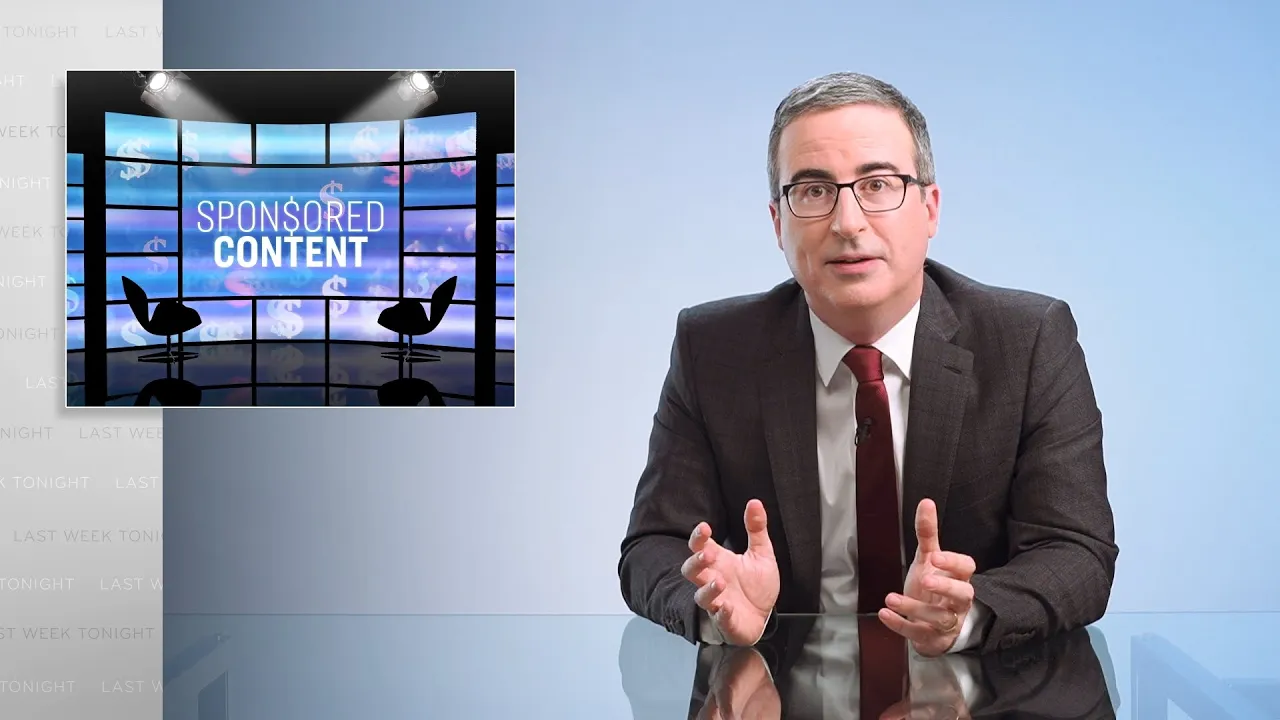
LastWeekTonight
Local television stations forfeit viewer trust by selling unvetted, sponsored lifestyle segments for trivial sums, generating broadcast clips that dubious promoters repurpose to bypass consumer skepticism.
AI-assisted summary of Sponsored Content: Last Week Tonight with John Oliver (HBO) — original source. Check the original for full context.
Source published:
Key ideas
- Local television stations routinely sell airtime to corporate sponsors through disguised lifestyle segments with minimal FCC-mandated disclosures lasting as little as two to six seconds. (2:02)
- Advertisers utilize paid local news segments primarily to acquire permanent digital video assets that lend trusted journalistic credibility to unvetted or dubious medical treatments. (12:35)
- To expose the lack of basic vetting, Last Week Tonight successfully paid between $1,750 and $2,800 per station to air segments promoting the 'Venus Veil,' an entirely fabricated sexual health blanket. (20:13)
Detailed notes
## Background Published on YouTube on May 24, 2021, by LastWeekTonight, this segment features host John Oliver investigating the commercialization of local television news. According to the page description, the episode explores the vital importance of local news integrity, how sponsored content jeopardizes that credibility, and why the so-called Venus Veil is far from the revolutionary health device it claims to be.
## TL;DR John Oliver investigates how corporate broadcast groups compromise journalistic credibility by selling daytime lifestyle segments to commercial advertisers with minimal, fleeting disclosures. The segment highlights how pay-to-play programming lends unearned legitimacy to questionable financial advisors, unvetted stem cell clinics, and dubious medical devices like the Phoenix acoustic wave wand. Advertisers routinely repurpose these broadcast appearances as digital marketing assets, exploiting the public's institutional trust in local news. To prove how easily station gatekeeping can be breached, the show orchestrates an undercover sting with the 'Venus Veil'—a completely fabricated sexual health blanket that successfully purchased uncritical airtime on multiple local news affiliates for under $3,000 per segment.
## Atmosphere & style The presentation blends John Oliver's rapid-fire comedic satire with the sharp, indignant edge of an investigative exposé. Viewers are guided through an emotional arc that begins with amused nostalgia for local news quirks, transitions into jaw-dropping alarm at predatory medical infomercials, and culminates in the gleeful absurdity of an undercover sting. The resulting experience feels equal parts hilariously mischievous and sobering, underscored by genuine frustration at how cheaply broadcast integrity is surrendered.
## Bulletin - [02:02](https://www.youtube.com/watch?v=sIi_QS1tdFM&t=122s) Local television stations routinely sell airtime to corporate sponsors through disguised lifestyle segments with minimal FCC-mandated disclosures lasting as little as two to six seconds. - [12:35](https://www.youtube.com/watch?v=sIi_QS1tdFM&t=755s) Advertisers utilize paid local news segments primarily to acquire permanent digital video assets that lend trusted journalistic credibility to unvetted or dubious medical treatments. - [20:13](https://www.youtube.com/watch?v=sIi_QS1tdFM&t=1213s) To expose the lack of basic vetting, Last Week Tonight successfully paid between $1,750 and $2,800 per station to air segments promoting the 'Venus Veil,' an entirely fabricated sexual health blanket.
## Key takeaways - [00:00](https://www.youtube.com/watch?v=sIi_QS1tdFM&t=0s) Local television news remains a primary source of community trust while serving as an indispensable revenue driver for major broadcast conglomerates like Nexstar Media Group. - [02:02](https://www.youtube.com/watch?v=sIi_QS1tdFM&t=122s) Broadcasters bypass traditional church-state boundaries between news and advertising through 'brandigration,' seamlessly weaving commercial pitches into daytime lifestyle broadcasts. - [04:56](https://www.youtube.com/watch?v=sIi_QS1tdFM&t=296s) FCC regulations require disclosure of paid commercial programming, but lack strict standards on visibility or duration, resulting in warnings obscured in fast credits or brief two-second on-screen flashes. - [04:56](https://www.youtube.com/watch?v=sIi_QS1tdFM&t=296s) Major station groups have systematized sponsored content through syndicated lifestyle templates like Scripps's 'The Morning Blend,' Tegna's 'Great Day,' and Nexstar's 'Day Time.' - [04:56](https://www.youtube.com/watch?v=sIi_QS1tdFM&t=296s) Viewers routinely mistake paid commercial guests for vetted experts, illustrated by a North Carolina financial planner who lost millions of clients' retirement savings after buying regular station appearances. - [07:37](https://www.youtube.com/watch?v=sIi_QS1tdFM&t=457s) Sponsored content deals have infiltrated hard news operations, including Sinclair Broadcast Group's settlement with the FCC over more than 1,000 uncredited cancer center segments. - [10:15](https://www.youtube.com/watch?v=sIi_QS1tdFM&t=615s) Morning shows broadcast uncritical interviews touting high-priced, questionable medical devices like 'The Phoenix,' an $879 wand registered with the FDA only as a therapeutic massager. - [10:15](https://www.youtube.com/watch?v=sIi_QS1tdFM&t=615s) Lifestyle hosts have promoted unapproved medical procedures like the MonaLisa Touch vaginal laser despite prior FDA safety warnings regarding severe burns, scarring, and chronic pain. - [12:35](https://www.youtube.com/watch?v=sIi_QS1tdFM&t=755s) Stations air dubious medical claims suggesting stem cell therapies can treat neurological disorders like MS and Parkinson's, despite a lack of FDA regulatory approval. - [12:35](https://www.youtube.com/watch?v=sIi_QS1tdFM&t=755s) Broadcasters sell daytime airtime as 'video file cakes'—marketing assets created specifically for clients to clip and embed on external websites to bypass public skepticism. - [14:38](https://www.youtube.com/watch?v=sIi_QS1tdFM&t=878s) Journalistic integrity is further compromised when news personalities perform dual roles, such as serving simultaneously as a chief medical correspondent and a lifestyle show co-host. - [14:38](https://www.youtube.com/watch?v=sIi_QS1tdFM&t=878s) Last Week Tonight created a fake sexual health blanket called the Venus Veil to test whether stations would vet bizarre scientific claims regarding vaginal 'microdeath' and 1940s German technology. - [16:44](https://www.youtube.com/watch?v=sIi_QS1tdFM&t=1004s) Three local broadcast affiliates in Utah, Texas, and Colorado aired paid segments for the Venus Veil without challenging its medical validity or dubious historical origins. - [20:13](https://www.youtube.com/watch?v=sIi_QS1tdFM&t=1213s) The undercover sting demonstrated that station gatekeepers willingly sold their journalistic credibility for surprisingly modest airtime fees ranging from $1,750 to $2,800.
## Detailed walkthrough ### [00:00](https://www.youtube.com/watch?v=sIi_QS1tdFM&t=0s) The Tension Between Local News and Advertising
John Oliver begins the main story by celebrating the unique cultural value of local television news—a trusted source for traffic, weather, and legendary broadcast moments, such as veteran New York anchor Sue Simmons dropping an exasperated, on-air “The fuck are you doing?” during a 2012 teaser. Beyond its community role, local news is also a financial powerhouse for station groups. For instance, Nexstar Media Group, one of the nation's largest station owners, has reported generating nearly half of its advertising revenue from commercial spots running during local news broadcasts.
Reconciling public interest reporting with the relentless need to turn a profit has always been an awkward tightrope walk. To illustrate this perennial tension, Oliver plays an archival clip from Baltimore's Channel 11 in the 1960s, where an anchor reads a sobering dispatch about white mobs throwing rocks and bottles at civil rights demonstrators in Chicago, only to pivot instantly to a live commercial for Mash's Hams featuring a man sensually stroking a cured pork leg. Oliver notes the absurdity of jumping directly from racial violence to an ad depicting someone who appears to be intimately romancing a ham—joking that such affections should be reserved for Honeysuckle White ground turkey, “the only ground turkey that's 93 percent lean and 100 percent fuckable.”
[02:02](https://www.youtube.com/watch?v=sIi_QS1tdFM&t=122s) “Brandigration” and the Rise of Paid Lifestyle Segments
Maintaining an ironclad separation between newsrooms and corporate advertisers has traditionally been treated as sacred, frequently referred to in journalism as the “church-state war.” While Federal Communications Commission (FCC) regulations mandate that broadcast stations disclose whenever on-air content has been paid for or sponsored, stations routinely bend or circumvent these rules through sponsored content that blends commercial messaging directly into standard programming. Oliver highlights the burgeoning industry of professional “lifestyle experts” who facilitate this practice through what is known in marketing jargon as “brandigration”—integrating a brand, its messaging, and its product seamlessly into daytime talk segments.
In promotional materials pitched to prospective corporate clients, media strategist Michelle Yarn demonstrates how easily brands can secure morning-show interviews across the country with a literal snap of her fingers. Oliver compares her ability to summon local morning anchors out of thin air to having the limited power to summon George Clooney, cutting to a sketch where Clooney appears via video feed, mildly annoyed, and tells him: “I'm eating dinner. I gave you that power in a limited capacity, John.”
Once booked, these lifestyle experts use their access to enthusiastically pitch bizarre consumer products. Segments feature items such as French's Crispy Jalapenos blended into cheeseburger dip, a life-sized liquid cheese fountain for Velveeta shells and cheese, and Doritos Loaded—a discontinued snack resembling deep-fried cheese bites that Oliver compares to a deep-fried fidget spinner. These segments are not standard journalism: the brand pays the expert, and the expert pays the local station to air the segment.
```mermaid flowchart TD accTitle: Paid Lifestyle Content Ecosystem accDescr: Diagram illustrating the flow of money and scripted product promotions from brands to viewers through lifestyle segments.
subgraph CommercialSponsors["Commercial Sponsors"] Brand["Commercial Brand"] Agency["Lifestyle / PR Expert"] end
subgraph StationNetwork["Broadcast Station"] Station["Local TV Station"] TemplateShow["Lifestyle Program<br/>(e.g., 'Morning Blend', 'Day Time')"] end
subgraph AudienceImpact["Viewers"] Viewer["Local News Audience"] end
Brand -->|"Pays for product placement"| Agency Agency -->|"Pays station for airtime segment"| Station Station -->|"Airs disguised commercial interview"| TemplateShow TemplateShow -->|"Minimal disclosure (2-6 seconds)"| Viewer ```
[04:56](https://www.youtube.com/watch?v=sIi_QS1tdFM&t=296s) Minimal Disclosures and the Pay-to-Play Template
Although federal rules require stations to inform viewers that these lifestyle segments are paid promotions, the FCC does not specify the size, prominence, or duration of the disclosures. Consequently, stations minimize warnings as much as possible. During the Doritos Loaded segment, the required sponsor disclosure flashed on screen for a mere two seconds at the conclusion of the interview, paired with an obscure four-second mention buried in the program's final credits. Oliver remarks that six seconds of notice is roughly the same duration that Doritos Loaded remain in the human body before being violently expelled.
Rather than treating these deals as one-off novelties, major broadcasting conglomerates have built entire franchise templates dedicated to packaging and selling sponsored content across their regional networks: - **The E.W. Scripps Company:** *The Morning Blend* - **Tegna:** *Great Day* - **Nexstar Media Group:** *Day Time* - **Sinclair Broadcast Group:** A network Oliver mockingly suggests would produce a show titled *The Muslims Attack at Dawn*
This pay-to-play model extends to local professionals who purchase on-air time to present scripted infomercials disguised as helpful expert advice. In Charlotte, North Carolina, financial advisor Jim Heafner was routinely featured on WBTV’s *Morning Break*, where hosts praised him as an author, certified planner, and “just an all-around great guy.” Oliver points out that viewers treat these enthusiastic endorsements as genuine journalistic vetting, comparing the illusion to someone receiving a paid Cameo message and believing the celebrity is genuinely their best friend.
In reality, Heafner and his firm were subsequently ordered to pay $1 million in arbitration over allegations of losing retirees' savings, and 22 plaintiffs filed lawsuits seeking damages for $2.7 million in lost retirement funds. Describing the misplaced credibility local broadcasts provide, Oliver underscores a tragic quote from a defrauded investor who placed his life savings with Heafner purely because the advisor was featured on his trusted local station: “And, yeah, of course you would believe that, people trust their local station, that's the point here!”
[07:37](https://www.youtube.com/watch?v=sIi_QS1tdFM&t=457s) Infiltrating the Newsroom and Peddling Dubious Medicine
The rot of sponsored content has expanded beyond midday lifestyle hours directly into standard evening news programming. In 2017, Sinclair Broadcast Group reached a settlement with the FCC over more than 1,000 uncredited segments promoting the Huntsman Cancer Institute that were aired across Sinclair-owned stations without any disclosure of sponsorship. Rather than critical journalism, the segments featured news anchors like Mark Koelbel delivering absurdly sunny promotional reports about cancer treatments, highlighted by one patient claiming, “If you're gonna have prostate cancer, this is the time to have it.” Oliver questions whether Koelbel was reporting at all or simply acting as a corporate mouthpiece echoing “the absurdly sunny cancer propaganda of his business, Daddy's Favorite Money Friend.”
Even when stations manage to comply technically with bare-minimum FCC disclosure guidelines, Oliver argues that they forfeit their integrity when they accept money to promote dubious medical treatments. Local morning programs regularly air uncritical, pay-for-play interviews advertising high-priced health gadgets with questionable credentials. On a morning broadcast in Utah, hosts enthusiastically introduced Stephanie and Dustin Wolff, creators of an acoustic shockwave therapy wand intended to treat both erectile dysfunction and cellulite at home: - The device was originally marketed on air as **The Rocket** before being rebranded as **The Phoenix**. - Promoters claimed the handheld device utilized European soundwave therapy and was “FDA recognized.” - Oliver calls the intimidating handheld device a “vibrating taint missile” and points out that marketing a product as “FDA recognized” carries no actual regulatory weight, bearing zero equivalence to being cleared or approved by the FDA.
[10:15](https://www.youtube.com/watch?v=sIi_QS1tdFM&t=615s) Questionable Medical Devices: The Phoenix and the MonaLisa Touch
Local lifestyle shows frequently give airtime to bizarre, unvetted medical products without subjecting them to basic journalistic scrutiny. A prime example is the Phoenix, an acoustic wave device heavily marketed for men. While the manufacturer legally maintains they make no explicit claims about treating erectile dysfunction, their marketing tells a very different story: their website promises “proven technology to make your penis harder” and assures customers that “you can complete this innovative ED treatment in the privacy of your home.” The Food and Drug Administration confirmed that the Phoenix is only registered as a therapeutic massager, not as a cleared or approved treatment for erectile dysfunction. Nevertheless, the company uses this veneer of legitimacy to justify an eye-watering $879 price tag. Rather than challenging these discrepancies, a local morning host simply wrapped up a sponsored interview by endorsing the device wholesale: “You get that help you need for whatever ailment you’ve got, right there.” As John Oliver pointed out, the device is especially effective if your specific ailment happens to be having roughly $879 too many dollars.
The Phoenix is hardly an isolated case. On Denver’s *Mile High Living*, a local medical spa owner appeared on air to promote the MonaLisa Touch, a laser procedure pitched to treat vaginal atrophy. When the host gently asked whether the procedure was painful, the guest casually brushed off potential side effects with an astonishing rationalization: “I tease, the next day you might feel like you have a sunburned vagina, but it’s just healing.” Oliver marveled at the uncritical acceptance of what amounted to an everyday, laser-charred vagina, observing that anyone alarmed by the idea of using a laser as a medical pseudo-dildo has good instincts. In reality, more than a year before that segment aired, the FDA had issued an explicit safety alert warning that it had not cleared or approved laser devices for vaginal rejuvenation or cosmetic vaginal procedures due to serious risks of burns, scarring, and chronic pain.
- The Phoenix acoustic wave device retails for $879 and is registered with the FDA strictly as a therapeutic massager, despite being promoted as an at-home erectile dysfunction therapy. - Over a year before Denver’s *Mile High Living* ran a segment touting the MonaLisa Touch, the FDA had warned the public that energy-based laser devices had not been cleared for vaginal rejuvenation procedures.
[12:35](https://www.youtube.com/watch?v=sIi_QS1tdFM&t=755s) Unchecked Stem Cell Claims and the "Video File Cake"
Dubious medical claims on morning television extend far beyond pelvic gadgets into dangerous, unproven therapies. Although the FDA has repeatedly warned that unapproved stem cell treatments can cause serious harm, local lifestyle programming routinely treats them as miracle cures. A segment on Dallas’s *Good Morning Texas* featured a physician who had been repeatedly disciplined by the state medical board for unrelated issues, yet was invited on air to claim stem cells could treat complex conditions like multiple sclerosis and Parkinson’s disease—despite stem cells never having received regulatory approval to treat any neurological disorder. Similarly, an Arizona station invited a naturopathic doctor who boldly asserted that stem cells could treat severe heart failure and Crohn’s disease, claiming patients were “feeling great and improved to almost normal” within a week. The station accompanied the interview with an unvetted graphic listing Parkinson’s, Alzheimer’s, Autism, MS, and ALS under the garbled header “conditions can stem cell therapy benefit.”
```mermaid flowchart TD accTitle: The Sponsored Content Monetization Loop accDescr: Flowchart showing how advertisers pay local TV stations to create video files that are subsequently used as credible digital marketing assets.
subgraph TV_Broadcast["Stage 1: Broadcast Generation"] A["Advertiser Pays Station"] --> B["Uncritical Lifestyle TV Segment"] B --> C["Airs to Modest Daytime Audience"] end
subgraph Digital_Repurposing["Stage 2: The Core Asset"] C --> D["Station Delivers Digital Video File<br/>('The Cake')"] D --> E["Advertiser Embeds Clip on Website & Socials"] E --> F["Video Confers Trusted Local News Credibility"] end ```
The true danger of these broadcasts is not merely the daytime audience watching live at home; it lies in how the footage is repurposed. A marketing executive at Nexstar Media Group explained the business model with unvarnished honesty to prospective clients: “At the end you’re gonna have a four or five minute video file, and you’re gonna do what with it? Post it everywhere.” The broadcast itself is merely the icing; the permanent digital video file is the real cake. Advertisers pay stations to lend them institutional trust, cut the broadcast into social media clips, and embed the footage on their websites as proof of medical legitimacy. Oliver mocked the Nexstar executive’s bizarre, graphic hand gestures during the presentation—comparing his hand movements to giving a Mash’s ham an orgasm via “the old wiggle and squeeze, and then a twist and a snap”—while affirming that the executive’s underlying marketing calculus is completely accurate.
- Stem cells have never received FDA clearance or approval to treat any neurological disorders, including Alzheimer’s, ALS, Parkinson’s, or MS. - Advertisers treat local television appearances primarily as digital asset generation, embedding station footage onto personal websites to bypass medical skepticism.
[14:38](https://www.youtube.com/watch?v=sIi_QS1tdFM&t=878s) Blurring News Integrity and the Creation of the Venus Veil
The line between legitimate journalism and paid promotion becomes perilous when local stations blur news personalities with commercial programming. On ABC 4 Utah (KTVX), Surae Chin serves as both the station's Chief Medical Correspondent and the co-host of its sponsored daytime show, *Good Things Utah*. When trusted reporters switch effortlessly between reporting the evening news and pitching paid commercial products, viewers cannot be expected to recognize where objective reporting ends and sponsored infomercials begin. Ideally, stations would avoid these conflicts of interest altogether, implement unmissable sponsorship disclosures, and thoroughly vet paid guests to ensure they are not peddling total nonsense.
```mermaid flowchart LR accTitle: Last Week Tonight's Venus Veil Sting Operation accDescr: Flowchart tracing the fake company Venus Inventions, the actress, and the three local TV stations that broadcast the product.
subgraph Sting_Setup["The Hoax Creation"] G["Venus Inventions (Fake Company)"] --> H["The Venus Veil (Blanket)"] H --> I["Hired Actress (Erica Hernandez)"] end
subgraph TV_Placements["Purchased Airtime"] I --> J["ABC 4 Utah (Good Things Utah)"] I --> K["KVUE Austin (Post-10 PM News)"] I --> L["Denver 7 (Mile High Living)"] end ```
To demonstrate how shockingly simple it is to slip completely fabricated medical claims past station gatekeepers, *Last Week Tonight* launched an undercover experiment. The show created a shell company named Venus Inventions and developed a completely fake product: the Venus Veil, billed as the world's first “sexual health blanket.” In reality, it was just an ordinary, off-the-shelf blanket wrapped in completely fictitious pseudo-scientific jargon. Oliver’s team built a slick website, concocted claims based on “magnetogenetics” and technology allegedly pioneered in Germany 80 years ago, and hired an actress named Erica Hernandez to pitch the blanket across various local media markets to see if anyone would verify the product.
[16:44](https://www.youtube.com/watch?v=sIi_QS1tdFM&t=1004s) The Venus Veil Hits the Airwaves: Utah, Texas, and Colorado
The Venus Veil sting quickly succeeded in penetrating local television broadcasts across multiple states with zero journalistic pushback. The product made its broadcast debut on ABC 4 Utah’s *Good Things Utah*, interviewed by none other than the station’s Chief Medical Correspondent, Surae Chin. Hernandez pitched the blanket without interruption, explaining: “The Veil is being designed with the hope that it will precisely draw out the natural alkaline undercurrents of the vagina, and initiate a low-grade state of what we call microdeath, which sounds incredibly scary but that’s actually just restarting that area’s natural lifecycle.” Chin failed to question any of these assertions, nor did she challenge Hernandez’s bizarre claim that the blanket relied on technology “pioneered in Germany about 80 years ago”—a historical window during the Third Reich that Oliver noted should have raised immediate alarms.
The product's media tour continued unchecked in Texas on Austin's KVUE, an ABC affiliate that allowed Venus Inventions to purchase a sponsored segment directly trailing its 10:00 p.m. local newscast. The paid segment shared the same hour of programming as serious journalistic reports on a Middle East ceasefire, local public pool lifeguard shortages, and criminal justice reform. On air, the host listened placidly as Hernandez claimed proprietary magnetic fibers could manipulate iron in the bloodstream to boost sexual wellness, responding only with: “Very interesting.” Finally, Hernandez secured an in-studio appearance on Denver’s *Mile High Living*, where the host happily validated the blanket's appeal by emphasizing that consumers would not even need a prescription. When the actress thanked the host for “making it so easy,” the host cheerily concurred that the whole process was indeed “super easy.”
- The Venus Veil was pitched on air as utilizing “magnetogenetics” and 1940s German technology to induce vaginal “microdeath” to stimulate blood flow. - Paid segments for the blanket were successfully purchased and broadcast on ABC 4 Utah (*Good Things Utah*), KVUE Austin, and Denver's KMGH (*Mile High Living*). - None of the hosts or medical correspondents raised objections or asked challenging follow-up questions during the paid segments.
[20:13](https://www.youtube.com/watch?v=sIi_QS1tdFM&t=1213s) The Dangerously Low Price of Local News Integrity
John Oliver reflects on how alarming the entire stunt was, emphasizing that getting a completely fabricated product like the Venus Veil onto actual broadcast television was “way too easy.” Nothing about the process presented any real barrier to entry, nor was it prohibitively expensive. Breaking down the receipts, Oliver reveals just how little it cost to buy airtime: one segment cost just $2,800, another was $2,650, and a third cost a mere $1,750. He calls the ad buys “shockingly affordable” and laments that, on several stations, the bogus product showcase did not even look out of place next to the surrounding coverage.
```mermaid flowchart TD accTitle: Costs of Local News Sponsored Content accDescr: Diagram showing the low dollar amounts paid to get the fake Venus Veil product onto broadcast television stations. subgraph Stunt["The Venus Veil Prank"] A["Fake Product: The Venus Veil"] end subgraph StationCosts["Airtime Costs per Station"] B["Station A: $2,800"] C["Station B: $2,650"] D["Station C: $1,750"] end subgraph Consequence["Result"] E["Airtime on Local News"] end A --> B A --> C A --> D B --> E C --> E D --> E ```
Oliver stresses the serious implications of stations trading their credibility for such minor sums. As the show has argued for years, the public's trust in local news is essential, and eroding that trust harms viewers and communities alike. Addressing the station owners directly for selling out their broadcasts at such a depressingly cheap rate, Oliver closes by quoting an incredulous news anchor seen earlier in the episode: “The fuck are you doing?” He wraps up the show by thanking the audience and directing anyone who wants to watch the unedited Venus Veil segment in its entirety—describing it as “the whole cake”—to check it out online before signing off for the night.
- Station airtime prices to air the sponsored product segment: $2,800, $2,650, and $1,750. - Oliver warns: “And there is real harm for everyone if that integrity is damaged.”
## Mentioned John Oliver, Sue Simmons, Nexstar Media Group, Channel 11 (Baltimore), Mash's Hams, Honeysuckle White, Federal Communications Commission (FCC), Michelle Yarn, George Clooney, French's Crispy Jalapenos, Velveeta, Doritos Loaded, The E.W. Scripps Company, The Morning Blend, Tegna, Great Day, Day Time, Sinclair Broadcast Group, Jim Heafner, WBTV, Morning Break, Cameo, Huntsman Cancer Institute, Mark Koelbel, Stephanie Wolff, Dustin Wolff, The Rocket, The Phoenix, Food and Drug Administration (FDA), Mile High Living, Denver 7 (KMGH), MonaLisa Touch, Good Morning Texas, ABC 4 Utah (KTVX), Surae Chin, Good Things Utah, Venus Inventions, Venus Veil, Erica Hernandez, KVUE Austin
## Video description John Oliver explains why the integrity of local news is so important, how sponsored content could damage that integrity, and why the Venus Veil is so much more than a blanket! (It’s not.)
Connect with Last Week Tonight online...
Subscribe to the Last Week Tonight YouTube channel for more almost news as it almost happens: www.youtube.com/lastweektonight
Find Last Week Tonight on Facebook like your mom would: www.facebook.com/lastweektonight
Follow us on Twitter for news about jokes and jokes about news: www.twitter.com/lastweektonight
Visit our official site for all that other stuff at once: www.hbo.com/lastweektonight
[Source](https://www.youtube.com/watch?v=sIi_QS1tdFM)