Ocado Runs 2,300 Warehouse Bots Under Single Centralized AI
Tom Scott
Because individual grid units lack autonomy and follow centrally computed paths, the automated facility functions as a single robot with thousands of physical actuators rather than a fleet of independent machines.
AI-assisted summary of How many robots does it take to run a grocery store? — original source. Check the original for full context.
Source published:
Key ideas
- Ocado's automated grocery warehouse operates across an area equivalent to seven football fields, routing over one million items daily using an aluminum storage grid up to 21 totes deep. (0:00)
- Roughly 2,300 grid bots travel at speeds up to 14 km/h with clearances as tight as five millimeters, using cable hoists to retrieve bins containing 58,000 distinct product varieties. (0:42)
- Predictive inventory placement allows incoming supplier stock to be shelved, picked, and loaded onto delivery vans in as little as five hours. (0:42)
- The grid bots lack independent navigational autonomy and function under a centralized 'Hive Mind' AI, prompting the philosophical argument that the entire grid functions as a single robot with thousands of physical actuators. (4:06)
Detailed notes
## Background Published by Tom Scott on YouTube on July 5, 2021, this video visits an automated Ocado grocery warehouse to explore whether its thousands of moving mechanical boxes count as individual robots or a single giant hive mind. The independent, unsponsored piece was edited by Michelle Martin and developed from a title suggested by Grant Hurst.
## TL;DR Inside Ocado's massive automated grocery warehouse in south-east London, around 2,300 bots glide along an aluminum grid spanning the area of seven football fields, retrieving stacked bins with millimetric precision to process over a million items daily. While independent robotic packing arms handle delicate grocery items using 3D vision systems, the grid bots possess virtually no local decision-making authority. Instead, a central artificial intelligence called the Hive Mind dictates all paths, speeds, and logistics across the floor. Drawing parallels to termite colonies and the human gut microbiome, Tom Scott concludes that rather than thousands of autonomous machines, the entire operation is best understood as a single, distributed super-robot equipped with thousands of physical limbs.
## Atmosphere & style The video carries Tom Scott's characteristic intellectual curiosity, balancing awe at staggering industrial engineering with an accessible philosophical thought experiment. Fast-paced footage of thousands of metal boxes zipping past one another within hair's-breadth tolerances creates a mesmerizing, hypnotic sense of scale and precision. The narration moves seamlessly from concrete logistical statistics to biological metaphors, leaving the viewer with a lingering, mind-bending shift in how they conceptualize agency, identity, and robotic autonomy.
## Bulletin - [00:00](https://www.youtube.com/watch?v=ssZ_8cqfBlE&t=0s) Ocado's automated grocery warehouse operates across an area equivalent to seven football fields, routing over one million items daily using an aluminum storage grid up to 21 totes deep. - [00:42](https://www.youtube.com/watch?v=ssZ_8cqfBlE&t=42s) Roughly 2,300 grid bots travel at speeds up to 14 km/h with clearances as tight as five millimeters, using cable hoists to retrieve bins containing 58,000 distinct product varieties. - [00:42](https://www.youtube.com/watch?v=ssZ_8cqfBlE&t=42s) Predictive inventory placement allows incoming supplier stock to be shelved, picked, and loaded onto delivery vans in as little as five hours. - [04:06](https://www.youtube.com/watch?v=ssZ_8cqfBlE&t=246s) The grid bots lack independent navigational autonomy and function under a centralized 'Hive Mind' AI, prompting the philosophical argument that the entire grid functions as a single robot with thousands of physical actuators.
## Key takeaways - [00:00](https://www.youtube.com/watch?v=ssZ_8cqfBlE&t=0s) The south-east London fulfillment warehouse replaces traditional human-oriented grocery aisles with an infrastructure engineered purely for automated machine throughput. - [00:00](https://www.youtube.com/watch?v=ssZ_8cqfBlE&t=0s) The facility spans seven football fields and processes over one million grocery items every day. - [00:00](https://www.youtube.com/watch?v=ssZ_8cqfBlE&t=0s) Grid bots operate with high precision, reaching speeds of 14 km/h while passing each other with margins as slim as five millimeters. - [00:42](https://www.youtube.com/watch?v=ssZ_8cqfBlE&t=42s) The Hive structure organizes 58,000 product lines into vertical columns of plastic totes stacked up to 21 bins deep. - [00:42](https://www.youtube.com/watch?v=ssZ_8cqfBlE&t=42s) Bots combine horizontal track movement with vertical cable hoists to extract specific totes, verifying their position via downward-facing optical sensors. - [00:42](https://www.youtube.com/watch?v=ssZ_8cqfBlE&t=42s) Predictive ordering algorithms reshuffle fast-moving products toward upper grid layers, enabling a five-hour turnaround from supplier delivery to customer dispatch. - [01:55](https://www.youtube.com/watch?v=ssZ_8cqfBlE&t=115s) Robotic packing arms use twin 3D cameras and computer vision to calculate grip angles and suction forces for irregularly shaped consumer items. - [01:55](https://www.youtube.com/watch?v=ssZ_8cqfBlE&t=115s) Automated packing arms independently enforce packing rules, such as preventing heavy canned goods from crushing delicate produce. - [02:49](https://www.youtube.com/watch?v=ssZ_8cqfBlE&t=169s) Unlike self-contained robotic arms, grid bots do not navigate autonomously; their routes, speeds, and destinations are orchestrated by a central 'Hive Mind' AI. - [02:49](https://www.youtube.com/watch?v=ssZ_8cqfBlE&t=169s) When bots report sensor discrepancies, the Hive Mind triggers an amber warning light and halts the unit so human perimeter operators can diagnose and command it wirelessly. - [04:06](https://www.youtube.com/watch?v=ssZ_8cqfBlE&t=246s) The warehouse architecture mirrors biological superorganisms like termite mounds or human microbiomes, where the boundary between individual units and a collective entity is ambiguous. - [04:06](https://www.youtube.com/watch?v=ssZ_8cqfBlE&t=246s) Because human intuition ties agency to physical scale and self-contained bodies, observers count thousands of bots when the grid is functionally one single robot with over 2,000 physical actuators.
## Detailed walkthrough ### [00:00](https://www.youtube.com/watch?v=ssZ_8cqfBlE&t=0s) The Scale of the Hive
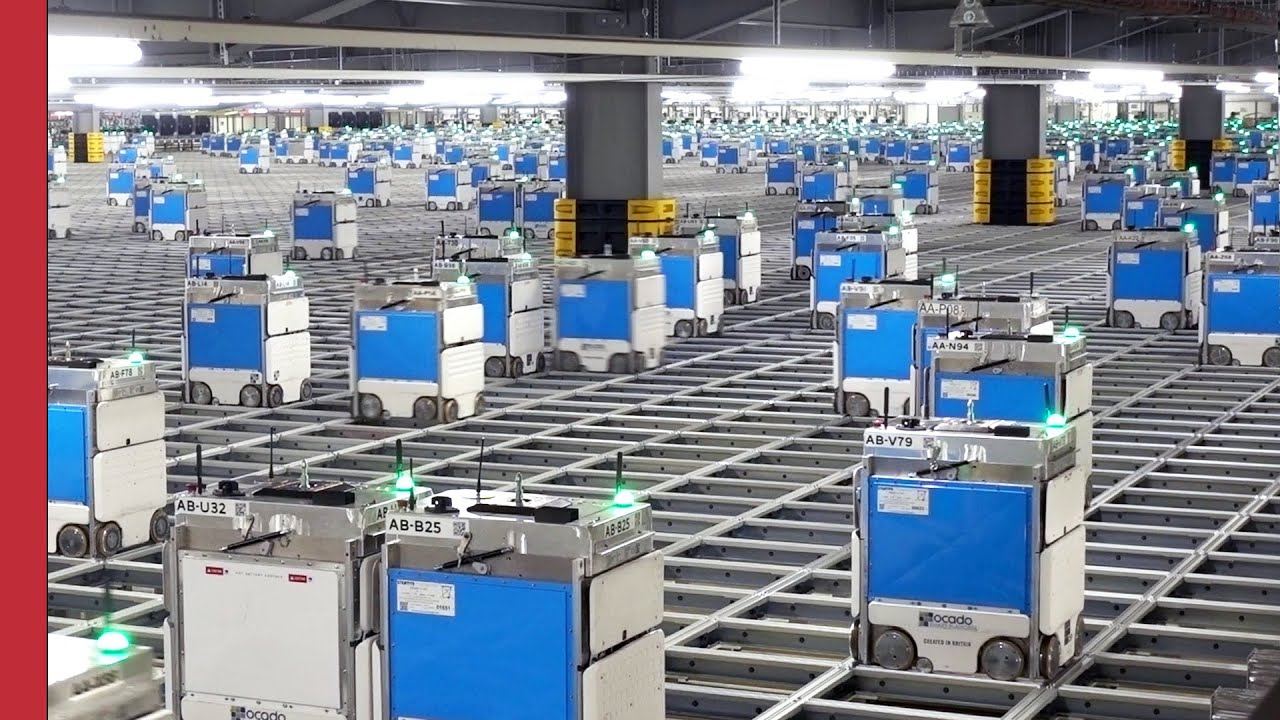
Inside an automated grocery packing warehouse in south-east London, customer orders are fulfilled without a single human walking up and down supermarket aisles. Instead of adapting machinery to spaces designed around human bodies, the entire facility—spanning an area equivalent to seven football fields—was custom-engineered from the ground up for maximum automated throughput. Across this massive expanse, thousands of mechanical rectangular units scurry along an elevated metal grid, moving over one million grocery items every single day.
```mermaid flowchart TD accTitle: Ocado Warehouse Automation Architecture accDescr: Flow diagram showing how customer orders move through the central Hive Mind, down through the grid bots and totes, into the automated packing arms, and out to delivery.
subgraph CentralControl["Central Intelligence"] HM["Hive Mind Central AI"] GO["Grid Operators (CCTV & Wireless Control)"] GO -.->|"intervenes on anomalies"| HM end
subgraph PhysicalGrid["The Hive Grid"] BOTS["~2,300 Grid Bots<br/>(14 km/h, 5 mm clearance)"] STACKS["Vertical Totes<br/>(Stacked up to 21 deep, 58,000 SKU types)"] HM -->|"movement profiles & waypoints"| BOTS BOTS -->|"cable hoist gripper"| STACKS end
subgraph PackingArea["Packing & Dispatch"] STATION["Pick Stations (Underneath Grid)"] ARMS["Robotic Packing Arms<br/>(3D Cameras & Vision)"] VAN["Delivery Vans<br/>(Out in ~5 hours)"] STACKS -->|"delivered by bots"| STATION STATION --> ARMS ARMS --> VAN end ```
The physical precision required to operate at this scale is striking. The boxes glide along tracks at speeds reaching roughly 14 kilometers per hour, missing each other by mere five-millimeter margins as they cross paths. Surveying the vast, mechanical grid stretching into the distance, Tom Scott notes that video cannot fully capture the sheer magnitude of the space, posing the central question of the operation: “So: how many robots are there in the Hive? Well, that depends on how you count them.”
- The facility covers the floor area of seven full-sized football fields. - Over 1,000,000 items are shuttled through the system daily. - Moving units travel at up to 14 km/h and operate with clearances as tight as 5 mm.
---
[00:42](https://www.youtube.com/watch?v=ssZ_8cqfBlE&t=42s) The Grid Architecture and Hoist Mechanics
The physical core of the warehouse is known as the Hive: an enormous, three-dimensional aluminum grid structure honeycombed with vertical storage columns. The products are stored inside standardized open plastic bins called totes, stacked directly on top of one another up to 21 bins deep. Operating across the top surface of this grid are approximately 2,300 bots tasked with sorting, retrieving, and shuffling inventory to fulfill incoming customer baskets.
``` [Bot] ── 14 km/h (X / Y Axis) ════════════════════════════════ <- Grid Surface Track | [ Tote 1 - Top ] | | [ Tote 2 ] | | [ Tote... ] | <- Cable Hoist (Z Axis) | [ Tote 21 - Deepest ] | lowers gripper assembly ──────────────────────────────── ```
Each bot maneuvers horizontally along the X and Y axes, but also operates along the vertical Z axis using an integrated cable hoist mechanism. When a specific item is required, a bot hoists down a mechanical gripper assembly into a grid column, latches onto the target tote, and lifts it into its internal bay. Navigation is handled locally by downward-facing optical sensors; every time a bot traverses a square, an underside laser registers the transition over the cell, constantly confirming its position grid square by grid square.
Managing 58,000 different product varieties requires aggressive predictive optimization. Using continuous streams of order data, the system forecasts purchasing trends and shifts fast-moving goods toward the upper layers and accessible perimeters of the grid. This logistical efficiency allows incoming stock unloaded from supplier lorries to be processed through the grid, packed into customer bags, and loaded onto delivery vans in as little as five hours.
- **Active fleet:** Approximately 2,300 bots operating concurrently. - **Storage capacity:** Stacks reach up to 21 totes deep within the grid columns. - **Product variety:** Around 58,000 distinct product types housed across the system. - **Turnaround speed:** New supplier inventory can arrive, be shelved, picked, and loaded into delivery vans in just five hours.
---
[01:55](https://www.youtube.com/watch?v=ssZ_8cqfBlE&t=115s) Automated Picking and Delicate Manipulation
Once the grid bots retrieve the appropriate totes, they transport them to stations situated directly beneath the aluminum framework. While human personnel still pack portions of the orders, a growing share of the handling is delegated to stationary robotic arms. Unlike moving rigid boxes on predefined tracks, handling groceries introduces serious mechanical hurdles because consumer packaging is engineered for human hands, resulting in unpredictable shapes, textures, and structural fragilities.
At each picking cell, twin overhead 3D cameras scan the interior of incoming storage boxes to build an image of the products inside. The arm's computer vision system identifies the item, confirms that it matches the live order requirements, calculates the optimal grasp angle and suction or grip force, and lifts the item into the customer's delivery bag. The algorithm must continuously weigh physical constraints—such as ensuring heavy canned goods are never placed on top of soft baked goods or produce. Items that are extremely heavy, awkwardly large, or unusually fragile remain off-limits to the automated arms, leaving a broad spectrum of intermediate everyday products for the machines to pack safely in real time.
---
[02:49](https://www.youtube.com/watch?v=ssZ_8cqfBlE&t=169s) The Hive Mind vs. Distributed Intelligence
The contrast between the packing arms and the grid boxes highlights a fundamental division in robotics architecture. A packing arm clearly fits the textbook definition of an individual robot: it has an isolated controller, analyzes visual sensor feeds independently, and makes autonomous real-time decisions about physical interactions. By contrast, the bots scurrying across the top of the grid operate on an entirely different paradigm governed by a central artificial intelligence dubbed the "Hive Mind."
The Hive Mind exercises absolute spatial awareness over the facility, tracking the location and vector of every tote and machine from the moment goods enter the building. While individual bots run onboard motion-profile software to handle motor acceleration, wheel braking, and precision stops, their destinations, routes, and timing are dictated entirely by the central AI. When an anomaly occurs—such as an onboard sensor reporting unexpected data back to the central server—the Hive Mind flags the discrepancy, illuminates an amber warning light on the unit's chassis, and brings it to an immediate controlled stop. Grid operators stationed along the warehouse perimeter monitor these events via an array of overhead CCTV cameras, diagnosing errors and broadcasting wireless commands directly to the bot to resolve track deadlocks remotely.
---
[04:06](https://www.youtube.com/watch?v=ssZ_8cqfBlE&t=246s) Superorganisms, Microbiomes, and the Nature of Identity
The centralized command structure of the warehouse blurs conventional distinctions between a collection of individual machines and a single unified organism. Tom points out that biology frequently struggles with this exact philosophical boundary: a termite mound can be viewed either as millions of separate insects or as a singular, distributed superorganism. Similarly, scientific discoveries over the past two decades have shown that human gut bacteria synthesize and metabolize neurotransmitters that directly influence human brain chemistry and mood, yet few people intuitively consider their digestive microbiome to be an intrinsic part of their personal identity.
Humans habitually assign agency, identity, and intelligence to entities that match human physical scale and speed. Consequently, watching thousands of distinct wheeled boxes zip across an aluminum frame naturally prompts observers to count several thousand distinct robotic entities. However, given that none of the boxes possess meaningful autonomy or independent goals—serving merely as remote physical actuators executing paths assigned by a single central computational engine—Tom argues that our intuitive count is mistaken: “I'd say there's a good argument that that is one robot... with 2,000 ways to interact with the world.”
## Mentioned Casual Historian, Grant Hurst, Michelle Martin, Ocado, P. Strandwitz, The Hive, Tom Scott
## Video description In Ocado's grocery warehouses, thousands of mechanical boxes move on the Hive. Are they all individual robots? Or is this one giant hive mind? • Thanks to Ocado: https://www.ocadogroup.com/solutions/online-grocery (this video is not sponsored, and they had no editorial control).
Reference: Strandwitz P. (2018). Neurotransmitter modulation by the gut microbiota. Brain research, 1693(Pt B), 128–133. https://doi.org/10.1016/j.brainres.2018.03.015 -- I should probably have put a "might" in there, but that's a thorough review of research and I think the claim just about holds up!
Edited by Michelle Martin https://www.youtube.com/@OnTheCrux
Filmed safely: https://www.tomscott.com/safe/
Thanks to Grant Hurst from Casual Historian for suggesting the title: https://www.youtube.com/user/grantghurst
🟥 MORE FROM TOM: https://www.tomscott.com/ (you can find contact details and social links there too) ❓ LATERAL, free weekly podcast: https://lateralcast.com/ https://youtube.com/lateralcast/ 👥 THE TECHNICAL DIFFICULTIES: https://youtube.com/techdif
[Source](https://www.youtube.com/watch?v=ssZ_8cqfBlE)