Rotating Black Holes Convert 42% of Mass to Outperform Nuclear Fusion
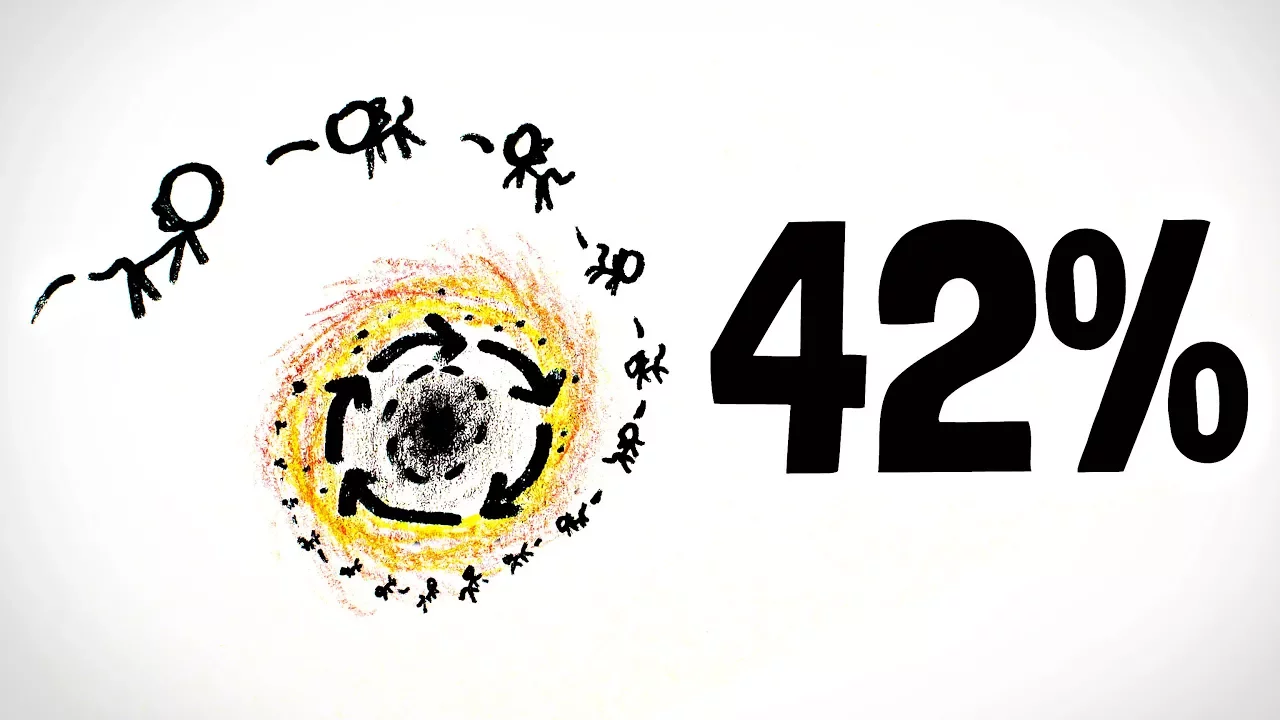
The Unreasonable Efficiency of Black Holes — minutephysics

minutephysics

Accretion disks around rapidly spinning black holes convert up to 42% of infalling mass into radiated energy because frame dragging stabilizes orbits down to the event horizon, far surpassing nuclear fusion.

AI-assisted summary of The Unreasonable Efficiency of Black Holes — original source. Check the original for full context.

Source published:

Key ideas

  • Antimatter offers 100% mass-to-energy conversion efficiency under E=mc², but natural scarcity makes it practically unusable as an energy source. (0:01)
  • Standard chemical reactions achieve only about 0.00000001% mass conversion, while nuclear fission and fusion reach 0.08% and 0.7% respectively. (0:01)
  • Accretion disks around non-rotating black holes convert approximately 6% of infalling mass into radiated energy before crossing the innermost stable circular orbit. (1:54)
  • Frame dragging in rapidly rotating Kerr black holes pulls the innermost stable orbit inward to the event horizon, boosting mass-to-energy conversion efficiency up to 42%. (4:26)

Detailed notes

## Background Published by Henry Reich on the YouTube channel minutephysics on December 31, 2017, this video explores the mass-energy conversion efficiency of various natural and physical processes based on Einstein's equation E=mc². According to the description, it examines why chemical and nuclear reactions yield comparatively little energy, while non-rotating and rotating black holes achieve astonishingly high efficiencies through their accretion disks.

## TL;DR While antimatter offers 100% mass-energy conversion, its lack of natural abundance makes it impractical as a power source, leaving chemical, nuclear, and gravitational processes as viable alternatives. Chemical reactions convert a negligible fraction of mass (around 0.00000001%), while nuclear fission and fusion reach only about 0.08% and 0.7% efficiency, respectively. In contrast, black holes unlock unprecedented gravitational efficiency as matter spiraling through accretion disks radiates heat before crossing the point of no return. A non-rotating Schwarzschild black hole converts roughly 6% of infalling mass to energy, whereas a maximally rotating Kerr black hole can achieve an extraordinary efficiency of up to 42% due to relativistic frame dragging pulling the innermost stable orbit inward.

## Atmosphere & style The presentation carries the fast-paced, playful, and accessible hallmarks of minutephysics, using hand-drawn animations to break down complex relativistic astrophysics. Reich grounds abstract concepts like mass defect and orbital mechanics in an absurdly humorous running unit of measurement: powering the entire nation of Norway with house cats. The tone balances lighthearted whimsy with scientific rigor, transforming intimidating physics equations into an intuitive and captivating exploration of the cosmos.

## Bulletin - [00:01](https://www.youtube.com/watch?v=t-O-Qdh7VvQ&t=1s) Antimatter offers 100% mass-to-energy conversion efficiency under E=mc², but natural scarcity makes it practically unusable as an energy source. - [00:01](https://www.youtube.com/watch?v=t-O-Qdh7VvQ&t=1s) Standard chemical reactions achieve only about 0.00000001% mass conversion, while nuclear fission and fusion reach 0.08% and 0.7% respectively. - [01:54](https://www.youtube.com/watch?v=t-O-Qdh7VvQ&t=114s) Accretion disks around non-rotating black holes convert approximately 6% of infalling mass into radiated energy before crossing the innermost stable circular orbit. - [04:26](https://www.youtube.com/watch?v=t-O-Qdh7VvQ&t=266s) Frame dragging in rapidly rotating Kerr black holes pulls the innermost stable orbit inward to the event horizon, boosting mass-to-energy conversion efficiency up to 42%.

## Key takeaways - [00:01](https://www.youtube.com/watch?v=t-O-Qdh7VvQ&t=1s) Albert Einstein's equation E=mc² dictates that mass is concentrated latent energy, where a 5 kg object contains enough theoretical energy to power Norway for a year. - [00:01](https://www.youtube.com/watch?v=t-O-Qdh7VvQ&t=1s) Antimatter annihilation converts 100% of rest mass into energy, but generating antimatter artificially requires vastly more energy than it releases. - [00:01](https://www.youtube.com/watch?v=t-O-Qdh7VvQ&t=1s) Chemical reactions convert an imperceptible 0.00000001% of mass into energy, leaving reaction products only fractions of a nanogram lighter. - [00:01](https://www.youtube.com/watch?v=t-O-Qdh7VvQ&t=1s) Nuclear fission converts roughly 0.08% of uranium-235 mass, while hydrogen fusion into helium converts about 0.7% of its starting mass. - [01:54](https://www.youtube.com/watch?v=t-O-Qdh7VvQ&t=114s) Energy generation near black holes occurs entirely outside the event horizon through gravitational infall and accretion mechanics. - [01:54](https://www.youtube.com/watch?v=t-O-Qdh7VvQ&t=114s) Infalling matter converts gravitational potential energy into kinetic energy, which collides, heats up, and radiates away as infrared light. - [01:54](https://www.youtube.com/watch?v=t-O-Qdh7VvQ&t=114s) Matter falling onto conventional celestial bodies like Earth yields only around one-billionth of its mass in energy due to weak surface gravity. - [01:54](https://www.youtube.com/watch?v=t-O-Qdh7VvQ&t=114s) An Earth-mass black hole would measure only two centimeters across, concentrating extreme gravity into an exceptionally small volume. - [01:54](https://www.youtube.com/watch?v=t-O-Qdh7VvQ&t=114s) In a non-rotating Schwarzschild black hole, the innermost stable circular orbit sits at three times the radius of the event horizon, yielding an accretion efficiency of roughly 6%. - [04:26](https://www.youtube.com/watch?v=t-O-Qdh7VvQ&t=266s) Rotating Kerr black holes drag spacetime along with their rotation, allowing orbiting accretion material to stabilize much closer to the center. - [04:26](https://www.youtube.com/watch?v=t-O-Qdh7VvQ&t=266s) A maximally spinning black hole shrinks its event horizon by half compared to a non-rotating counterpart and aligns the innermost stable orbit with the horizon itself. - [04:26](https://www.youtube.com/watch?v=t-O-Qdh7VvQ&t=266s) Accretion disks around maximally rotating black holes achieve mass-to-energy conversion efficiencies of up to 42%, vastly outperforming all nuclear reactions.

## Detailed walkthrough ### [00:01](https://www.youtube.com/watch?v=t-O-Qdh7VvQ&t=1s) The Limits of Mass-Energy Conversion: From Antimatter to Nuclear Power

According to Albert Einstein's famous equation $E=mc^2$, mass is fundamentally concentrated energy. In principle, any object possesses a staggering amount of latent energy; a standard five-kilogram house cat contains enough total energy to power the entire nation of Norway for a full year if it could be completely unlocked. In reality, extracting that stored energy is an extraordinarily difficult challenge. Antimatter is the theoretical gold standard of conversion efficiency: colliding a cat with an antimatter cat would result in total annihilation, converting 100% of both cats' mass into pure energy and powering Norway for two years. However, because our universe contains virtually no naturally occurring antimatter, creating antimatter requires expending vastly more energy than it yields, rendering it completely impractical as an energy source.

Excluding antimatter leaves three primary mechanisms for tapping into mass: chemical reactions, nuclear reactions, and gravitational interactions, such as matter falling toward massive bodies. Chemical reactions convert such an infinitesimal fraction of mass that people rarely even conceptualize them as mass-energy conversions. When a balloon filled with hydrogen and oxygen gases explodes into water vapor, the resulting products weigh only half a nanogram less than the starting gases. This equates to an efficiency rate of approximately $0.00000001\%$ ($10^{-8}\%$). At that rate, supplying Norway's annual power needs would require burning through ten billion cats.

Nuclear processes perform considerably better, yet remain modest on an absolute scale. Nuclear fission—splitting uranium-235 into krypton and barium—converts around $0.08\%$ of the uranium's rest mass into energy. Nuclear fusion, the process powering the Sun by fusing hydrogen into helium, manages an efficiency of roughly $0.7\%$. Even with fusion's comparative leap in output, powering Norway would still demand approximately 150 cats' worth of fuel. As Henry Reich summarizes: “Since we can't use antimatter, there are basically three options left to us: chemical reactions, nuclear reactions, and gravitational reactions - aka stuff getting pulled together by gravity, like matter falling into black holes.”

| Reaction Type | Process / Example | Conversion Efficiency | Cats Needed to Power Norway (1 Year) | |:--- |:--- |:--- |:--- | | **Antimatter Annihilation** | Cat meets anti-cat | $100\%$ | $0.5$ (or 1 cat + 1 anti-cat for 2 yrs) | | **Rapidly Rotating Black Hole** | Accretion disk at innermost circular orbit | Up to $42\%$ | $2.5$ | | **Non-Rotating Black Hole** | Accretion disk down to $3\times$ event horizon | $\sim 6\%$ | $17$ | | **Nuclear Fusion** | Hydrogen to helium (as in the Sun) | $\sim 0.7\%$ | $150$ | | **Nuclear Fission** | Uranium-235 splitting into Kr and Ba | $\sim 0.08\%$ | $\sim 1,300$ | | **Chemical Reaction** | Hydrogen + oxygen explosion | $\sim 0.00000001\%$ | $10,000,000,000$ | | **Earth Surface Impact** | Gravitational fall to Earth's surface | $\sim 0.0000001\%$ | Billions |

---

[01:54](https://www.youtube.com/watch?v=t-O-Qdh7VvQ&t=114s) Gravitational Infall and Non-Rotating Black Holes

Gravitational reactions achieve the highest natural mass-to-energy conversion efficiencies in the universe. While popular lore emphasizes that nothing can escape a black hole once past its event horizon, the energy generation happens entirely outside that boundary as matter falls toward it. When an object accelerates down a gravitational field, it converts gravitational potential energy into kinetic energy. If it collides with surrounding material, that kinetic energy transforms into thermal energy and radiates away as infrared light, shedding a fraction of the system's rest mass into space. For conventional bodies, this effect is negligible: falling to the surface of the Earth releases only about one-billionth of an object's mass as energy, performing no better than an ordinary chemical reaction.

Black holes are different because they pack vast mass into an absurdly compact volume. An Earth-mass black hole would measure just two centimeters across, giving infalling matter enormous distance to accelerate under an increasingly fierce gravitational field. By the time an object reaches the event horizon, its acquired kinetic energy is roughly equivalent to half of its rest-mass energy ($E=mc^2$). Yet simply plummeting straight past the event horizon traps all that energy forever. For energy to escape into the wider universe, infalling material must gradually spiral inward within an accretion disk. Inside the disk, matter repeatedly collides, heats up, radiates away energy, slows down, and drops to lower and lower orbits.

```mermaid flowchart TD accTitle: Black Hole Accretion Disk Energy Extraction accDescr: Matter spirals inward through an accretion disk, radiating heat until reaching the innermost stable circular orbit.

subgraph Disk["Accretion Disk Infall"] A["Infalling Matter"] --> B["Collisions & Viscous Friction"] B --> C["Radiates Thermal Energy Away"] C --> D["Loses Orbital Energy & Drops Lower"] D --> B end

subgraph Horizon["Orbital Limits"] D --> E["Innermost Stable Circular Orbit (ISCO)"] E -->|Plunges without radiating| F["Crosses Event Horizon"] end ```

For a standard, non-rotating (Schwarzschild) black hole, the innermost stable circular orbit sits at a distance three times farther out than the event horizon itself. Any matter forced inward past this threshold can no longer maintain a stable orbit and plunges directly into the abyss, taking any remaining energy with it. Between initial infall and that final cutoff point, the accretion disk efficiently radiates away approximately $6\%$ of the infalling matter's total mass as light and heat. While that might sound modest compared to pure annihilation, Henry Reich points out: “Which may sound weird, because, as you’ve probably heard, nothing can escape black holes – once inside.” At a $6\%$ yield, powering Norway for an entire year would take just 17 cats thrown into a non-rotating black hole.

- Falling onto a planet like Earth releases only around one-billionth ($10^{-9}$) of the infalling mass as energy. - An Earth-mass black hole has a diameter of roughly 2 centimeters. - In a non-rotating black hole, the innermost stable orbit is located at $3\times$ the radius of the event horizon. - Matter spiraling to that innermost stable orbit converts about $6\%$ of its rest mass into escaped radiation before plunging past the horizon.

---

[04:26](https://www.youtube.com/watch?v=t-O-Qdh7VvQ&t=266s) Rotating Kerr Black Holes and Accretion Efficiencies

Rotating (Kerr) black holes provide an even more extreme boost in conversion efficiency due to relativistic frame dragging. As a black hole spins, it drags the surrounding fabric of spacetime along with it in the direction of its rotation. For material orbiting in the same direction as this spin, frame dragging stabilizes circular orbits much closer to the center than would otherwise be possible. Depending on the spin velocity, the innermost stable circular orbit can move inward until it directly meets the event horizon. Furthermore, rapid rotation shrinks the physical radius of the event horizon to half the size of a non-rotating black hole of equivalent mass.

Because the matter can spiral down significantly deeper into the gravitational well before plunging, it has far more time and distance to collide, heat up, and radiate energy outward. In the case of a maximally spinning black hole, an accretion disk can convert up to $42\%$ of the infalling matter's rest mass into radiated energy. At this extraordinary rate, keeping Norway powered for an entire year would require feeding just two and a half cats into the accretion disk. As Henry Reich concludes: “So, if you really want to convert the mass of an object into energy, don’t bother with chemical reactions, or nuclear fission, or nuclear fusion: throw it into a rapidly rotating black hole.”

Calculating the efficiency of any reaction involves dividing the net energy released by the total rest-mass energy of the starting components. In radioactive alpha decay, for instance, a radium nucleus decaying into radon and helium releases approximately $6.6\text{ MeV}$ of energy, while a single nucleon (proton or neutron) has a rest-mass energy of roughly $940\text{ MeV}$. For viewers interested in running these calculations or mastering the orbital mechanics of black holes, the video directs them to interactive problem-solving courses on Brilliant.org.

- Rapidly spinning black holes drag surrounding spacetime in the direction of rotation, pulling the innermost stable circular orbit inward. - For a maximally rotating black hole, the innermost stable circular orbit coincides with the event horizon, which is itself half the radius of an equivalent non-rotating event horizon. - The maximum mass-to-energy conversion efficiency for a rapidly rotating black hole reaches approximately $42\%$. - Only $2.5$ cats spiraling into a rapidly rotating black hole would match Norway's annual electrical consumption. - Alpha decay of radium releases about $6.6\text{ MeV}$, contrasted against a nucleon rest mass of roughly $940\text{ MeV}$.

## Notable quotes > [04:26](https://www.youtube.com/watch?v=t-O-Qdh7VvQ&t=266s) So, if you really want to convert the mass of an object into energy, don’t bother with chemical reactions, or nuclear fission, or nuclear fusion: throw it into a rapidly rotating black hole. — Henry Reich

## Mentioned Albert Einstein, Henry Reich, MinutePhysics, Brilliant.org, Norway

## Video description Thanks to https://brilliant.org/minutephysics for sponsoring this video! Check out their black hole course at http://brilliant.org/minutephysicsblackhole

Support MinutePhysics on Patreon! http://www.patreon.com/minutephysics Link to Patreon Supporters: http://www.minutephysics.com/supporters/

This video is about how efficient various reactions are at converting mass to energy (as we know from the Einstein mass-energy equivalence of E=mc^2). Antimatter is very efficient but it is not naturally-occurring. Chemical reactions like fire or explosions are very inefficient. Nuclear fission and nuclear fusion are better, but not amazing on an absolute scale. Non-rotating black holes (Schwarzschild) and rotating (Kerr) are by far the most efficient, due to their accretion disks and very small radius of their innermost stable circular orbits.

REFERENCES: Periodic Videos Hydrogen Explosion in slow motion: https://www.youtube.com/watch?v=qOTgeeTB_kA

CIA World Factbook Norway Energy Consumption: https://web.archive.org/web/20120128032332/https://www.cia.gov/library/publications/the-world-factbook/rankorder/2042rank.html

Binding Energy: https://en.wikipedia.org/wiki/Binding_energy

Hydrogen molecular bonding: https://ocw.mit.edu/courses/chemistry/5-73-introductory-quantum-mechanics-i-fall-2005/lecture-notes/sec13.pdf

Gibbs free energy of water formation: https://en.wikipedia.org/wiki/Standard_Gibbs_free_energy_of_formation

Party Balloon Size Chart: https://broadwaypartyrental.com/wp-content/uploads/HELIUM-BALOON-CHART.pdf

Mass Excess https://en.wikipedia.org/wiki/Mass_excess

Table of Mass Excesses: http://www.nndc.bnl.gov/masses/mass.mas12

Deuterium-Tritium Hydrogen Fusion Energy Released: http://www.wolframalpha.com/input/?i=((deuterium+atomic+mass)%2B(tritium+atomic+mass)-(helium-4+atomic+mass)-(neutron+mass))%2F((deuterium+atomic+mass)%2B(tritium+atomic+mass))

Hydrogen to Helium Fusion chain efficiency: http://www.wolframalpha.com/input/?i=(4(proton+mass)-(helium+4+atomic+mass))%2F(4(proton+mass))

Uranium-235 fission efficiency: http://www.wolframalpha.com/input/?i=(neutron+mass%2B(uranium+235+atomic+mass)-(krypton+92+atomic+mass)-(barium+141+atomic+mass)-3(neutron+mass))%2F(neutron+mass%2B(uranium+235+atomic+mass))

Black Hole Accretion rates: http://www-astro.physics.ox.ac.uk/~garret/teaching/lecture7-2012.pdf

MinutePhysics is on twitter - @minutephysics And facebook - http://facebook.com/minutephysics And Google+ (does anyone use this any more?) - http://bit.ly/qzEwc6

Minute Physics provides an energetic and entertaining view of old and new problems in physics -- all in a minute!

Created by Henry Reich

[Source](https://www.youtube.com/watch?v=t-O-Qdh7VvQ)

中文简报

旋转黑洞质能转化率达42%,效率远超核聚变 快速自转黑洞周围的吸积盘可将多达42%的落入物质转化为辐射能,这是由于参考系拖拽效应使轨道稳定延伸至事件视界,其效率远超核聚变。 虽然反物质能实现100%的质能转化,但因其在自然界中极度匮乏,无法作为切合实际的动力来源,这使得化学、核能和引力过程成为可行的替代方案。化学反应转化的质量微乎其微(约0.00000001%),而核裂变和核聚变的效率分别仅达到约0.08%和0.7%。相比之下,随着物质在吸积盘中旋转并在跨越不可逆转的界限之前辐射出热量,黑洞释放出了前所未有的引力效率。不自转的史瓦西黑洞可将大约6%的落入质量转化为能量,而由于相对论参考系拖拽效应将最内层稳定轨道向内拉动,极限自转的克尔黑洞能够实现高达42%的惊人效率。 根据E=mc²,反物质拥有100%的质能转化效率,但自然的稀缺性使其在实际中无法用作能源。 (0:01) 常规化学反应仅能实现约0.00000001%的质量转化,而核裂变和核聚变的效率分别达到0.08%和0.7%。 (0:01) 不自转黑洞周围的吸积盘在跨越最内层稳定圆轨道之前,能将约6%的落入质量转化为辐射能。 (1:54) 快速自转的克尔黑洞中的参考系拖拽效应将最内层稳定轨道向内拉至事件视界,从而将质能转化效率提升至高达42%。 (4:26)

Reading summary

According to Henry Reich, gravitational infall into black hole accretion disks is the most efficient natural mass-to-energy conversion process in the universe, vastly surpassing both chemical and nuclear reactions. The Inefficiency of Chemical and Nuclear Reactions (0:01) Under Einstein's mass-energy equivalence ($E=mc^2$), even a modest mass contains immense latent energy, illustrated by a five-kilogram cat containing enough energy to power Norway for a year. However, extracting this energy remains fundamentally constrained by reaction mechanics. While antimatter annihilation theoretically achieves 100% conversion efficiency, the extreme energy cost of artificially producing antimatter renders it entirely impractical. Conventional chemical reactions convert only around 0.00000001% of mass into energy, meaning supplying Norway's power would require burning ten billion cats. Nuclear fission and fusion achieve higher yields of roughly 0.08% and 0.7% respectively, yet fusion would still require approximately 150 cats' worth of fuel. Accretion Dynamics in Non-Rotating Black Holes (1:54) Gravitational reactions tap into rest-mass energy as falling matter converts gravitational potential into kinetic and thermal energy. On low-density bodies like Earth, this process is negligible, converting only one-billionth of an infalling object's mass into radiation. Black holes, by contrast, compress massive amounts of matter into minuscule volumes—such as an Earth-mass black hole spanning just two centimeters—allowing matter to accelerate down an exceptionally steep gravitational well. Because nothing escapes beyond the event horizon, useful energy must be radiated beforehand. In an accretion disk, matter spirals inward, repeatedly colliding and releasing heat as infrared light before dropping to lower orbits. For a non-rotating Schwarzschild black hole, the innermost stable circular orbit sits at three times the radius of the event horizon. Matter reaching this threshold plunges directly inward without radiating further, setting the conversion efficiency of a non-rotating black hole at approximately 6%, which would reduce the fuel required to power Norway to 17 cats. Frame Dragging in Rotating Kerr Black Holes (4:26) Rotating Kerr black holes dramatically increase conversion efficiency through relativistic frame dragging, where the spin of the black hole drags the surrounding fabric of spacetime with it. This effect stabilizes co-rotating orbits much closer to the center, while rapid rotation simultaneously shrinks the physical radius of the event horizon to half that of an equivalent non-rotating black hole. In a maximally rotating black hole, the innermost stable circular orbit can move inward until it directly meets the event horizon. This allows infalling material to descend much deeper into the gravitational well, prolonging friction and radiation before the final plunge. Consequently, an accretion disk around a maximally spinning black hole can convert up to 42% of infalling mass into radiated energy, requiring just 2.5 cats to match Norway's annual electrical needs. Because naturally occurring antimatter is nonexistent, rapidly rotating black holes stand as the universe's ultimate natural power plants, offering an efficiency rate that dwarfs the limits of nuclear fusion.

精炼阅读摘要

Minutephysics 主持人 Henry Reich 指出,虽然根据爱因斯坦质能方程所有质量都蕴含巨大能量,但由于反物质在自然界极其稀缺,通过物质坠入黑洞吸积盘所产生的引力反应才是宇宙中效率最高的天然质能转化方式。 常规质能转换方式的效率瓶颈 (0:01) 根据质能方程 E=mc²,哪怕是一只 5 公斤重的家猫,其蕴含的全部静质量能量也足以供给挪威全年的电力需求。理论上,正反物质湮灭能实现 100% 的质能转化,但由于现实宇宙中几乎不存在天然反物质,人工制造反物质消耗的能量远大于产出,因而无法作为实际能源。抛开反物质,常规的化学反应与核反应在释放质量潜能方面表现相当有限。化学反应(如氢氧爆炸生成水蒸气)的质能损失极微,转换效率仅约 0.00000001%(10⁻⁸%),为满足挪威一年的电力需消耗 100 亿只猫的等量质量。 核反应虽然性能大幅提升,但绝对转化率依旧不高。利用铀-235 裂变为氪和钡的核裂变反应,只能将约 0.08% 的静质量转化为能量,供应挪威年耗电约需 1,300 只猫的燃料;即便是太阳内部将氢聚变为氦的核聚变反应,质能转化效率也仅约为 0.7%,仍需约 150 只猫的质量当量。这促使物理学界将目光转向引力相互作用。 引力下落与非旋转黑洞吸积盘 (1:54) 引力反应在自然界中具备最高的质能转化潜力。物体沿引力场加速下落时,引力势能转化为动能,碰撞产生的热能则会以辐射形式散逸并带走系统质量。普通天体的引力场由于体积庞大而效率极低,例如坠落至地球表面仅能释放约十亿分之一(10⁻⁹)的质量,效率与化学反应相当。然而,黑洞将巨大质量压缩在极小空间内(例如一个地球质量的黑洞直径仅约 2 厘米),赋予了物质极长的加速距离,物质在触及事件视界前所获得的动能可接近其静质量能量的一半。 如果物质垂直坠入事件视界,所有能量都会被永久封锁在黑洞内部。因此,能量释放依赖于吸积盘机制:落入物质在盘内盘旋,通过剧烈碰撞与粘滞摩擦升温,持续向外辐射红外线等光和热,从而不断损失轨道能量并向更低轨道滑落。对于非旋转(施瓦西)黑洞,其最内层稳定圆轨道(ISCO)位于事件视界半径的 3 倍处。一旦越过此界限,物质将不再维持稳定轨道并直接坠入视界。在滑落至该临界轨道之前,吸积盘可将流入物质约 6% 的静质量转化为向外辐射的能量。在此效率下,仅需 17 只猫的质量即可满足挪威一年的电力。 旋转黑洞的时空拖曳与极限效率 (4:26) 高速旋转(克尔)黑洞通过广义相对论预言的时空拖曳效应(frame dragging),将质能转化效率推向更高极限。快速自转的黑洞会拖拽周围的时空结构同向旋转,对于与自转同向旋转的盘内物质,时空拖曳效应使得原本不稳定的近距离轨道得以维持稳定,同时极端旋转黑洞的事件视界半径会缩小至同等质量非旋转黑洞的一半。 由于最内层稳定圆轨道大幅向内迁移,在极大旋转速率下甚至可逼近事件视界边缘,物质得以在更深的引力势阱中持续盘旋、摩擦并释放热量。这使得吸积盘的质能转换效率最高可攀升至约 42%。在此转换率下,仅需 2.5 只猫的质量投入吸积盘即可供应挪威全年的电力。Reich 总结称,若想真正高效地将物质质量转化为能量,快速旋转黑洞的吸积盘远胜核裂变、核聚变或化学反应。 黑洞吸积盘凭借高达 6% 至 42% 的质能转化效率,构成了宇宙中远超核聚变的极端能量发生装置。虽然人类目前无法直接利用黑洞作为能源设施,但这一力学机制解释了类星体等高能天体物理现象的巨大光度来源,揭示了引力与相对论效应在极端天体环境中释放能量的理论上限。

Detailed notes — zh

## Background 本视频由知名科普频道 minutephysics(创作者为 Henry Reich)于 2017 年 12 月 31 日发布在 YouTube 平台上。视频简介指出,本期内容围绕爱因斯坦质能等价公式 $E=mc^2$ 展开,详细探讨了反物质、化学反应、核裂变、核聚变以及黑洞等各类反应在将质量转化为能量时的转化效率,并着重解释了为什么非旋转与旋转黑洞的吸积盘具有超乎寻常的能量转换能力。 ## TL;DR 视频探讨了宇宙中不同物理机制将质量转化为能量的实际效率,并以“供电给挪威一年需要消耗多少只猫的质量”作为直观的衡量基准。尽管反物质湮灭拥有 100% 的终极效率,但因宇宙中缺乏天然反物质而无法实用;日常的化学反应转化效率低至可怜的十亿分之一,即便核裂变(约 0.08%)和恒星核聚变(约 0.7%)在绝对尺度上也远远称不上惊艳。黑洞则凭借其极度陡峭的引力深井成为了宇宙中最顶级的能量引擎:物质在进入事件视界前于吸积盘内剧烈摩擦并向外辐射能量,非自转黑洞的最内稳定圆轨道能释放约 6% 的质能,而自转克尔黑洞在参考系拖曳等极端时空几何效应下,其质能转化效率更是能够飙升至惊人的 42%。 ## Atmosphere & style 全片洋溢着 minutephysics 标志性的轻快节奏与风趣幽默,将抽象艰深的广义相对论概念转化为极其具象的奇思妙想。主讲人以生动随性的手绘风格搭配语速轻快的解说,把严肃的物理核算巧妙融入“用猫发电”的荒诞思维实验中,形成了绝妙的戏剧反差。整个叙事层层递进,从微不足道的化学反应逐步推向扭曲时空的极端黑洞物理,让观众在轻松会心的微笑中真切感受到宇宙引力法则所带来的震撼与智识上的愉悦。 ## Bulletin - [00:01](https://www.youtube.com/watch?v=t-O-Qdh7VvQ&t=1s) 化学反应的质能转化效率仅约 0.00000001%(10⁻¹⁰),而核裂变(约 0.08%)与核聚变(约 0.7%)在绝对物理尺度上依然极为有限。 - [01:31](https://www.youtube.com/watch?v=t-O-Qdh7VvQ&t=91s) 黑洞提取能量的关键并非视界内部,而是吸积盘中的物质摩擦与辐射散逸;非自转的史瓦西黑洞质能转化效率达 6%,超越太阳核聚变近十倍。 - [04:14](https://www.youtube.com/watch?v=t-O-Qdh7VvQ&t=254s) 极端自转的克尔黑洞通过参考系拖曳效应使最内稳定轨道内缩至视界边缘,能将高达 42% 的静质量转化为向外辐射的纯能量,仅次于反物质湮灭。 ## Key takeaways - [00:01](https://www.youtube.com/watch?v=t-O-Qdh7VvQ&t=1s) 依据爱因斯坦质能等价公式 E=mc²,哪怕仅 5 公斤的普通质量完全释放,理论上就足以供给挪威全境整整一年的全部电力。 - [00:01](https://www.youtube.com/watch?v=t-O-Qdh7VvQ&t=1s) 反物质湮灭能实现 100% 的质能转化效率,但宇宙中缺乏天然反物质且人造耗能巨大,无法作为实用的能量来源。 - [00:01](https://www.youtube.com/watch?v=t-O-Qdh7VvQ&t=1s) 排除反物质后,宇宙中实际提取质能的三种途径为化学反应、核反应以及引力作用。 - [00:01](https://www.youtube.com/watch?v=t-O-Qdh7VvQ&t=1s) 化学反应的质量亏损极其微小(如氢氧燃烧仅亏损半纳克),其 10⁻¹⁰ 的超低转化率使得日常燃烧甚至不被视为质能转化过程。 - [01:31](https://www.youtube.com/watch?v=t-O-Qdh7VvQ&t=91s) 核反应效率远超化学反应,但铀-235 裂变仅转化约 0.08% 的质量,氢聚变成氦也仅能释放 0.7% 的静质量能。 - [01:31](https://www.youtube.com/watch?v=t-O-Qdh7VvQ&t=91s) 物体沿引力势能下落到黑洞事件视界时,其积累的动能相当于转化为该物体约一半的 E=mc² 静质能。 - [01:31](https://www.youtube.com/watch?v=t-O-Qdh7VvQ&t=91s) 直接笔直掉入黑洞的能量会被永远困在事件视界内,只有吸积盘中物质互相碰撞摩擦并对外辐射,能量才能散逸至外部宇宙。 - [01:31](https://www.youtube.com/watch?v=t-O-Qdh7VvQ&t=91s) 非旋转的史瓦西黑洞其最内侧稳定圆轨道(ISCO)位于 3 倍事件视界半径处,物质旋轨至此时累计辐射出约 6% 的质量能量。 - [04:14](https://www.youtube.com/watch?v=t-O-Qdh7VvQ&t=254s) 快速自转的克尔黑洞通过强烈的参考系拖曳效应,使轨道物质能在更贴近黑洞的深层引力井中稳定运行,ISCO 甚至可与视界重合。 - [04:14](https://www.youtube.com/watch?v=t-O-Qdh7VvQ&t=254s) 极端自转黑洞能够榨取高达 42% 的物质静质量转化为辐射能,驱动挪威一年用电仅需消耗 2.5 只猫的质量当量。 - [04:14](https://www.youtube.com/watch?v=t-O-Qdh7VvQ&t=254s) 黑洞是宇宙中天然存在的最强质能转换引擎,其实际能源转换表现将核裂变与核聚变远远甩在身后。 ## Detailed walkthrough ### [00:01](https://www.youtube.com/watch?v=t-O-Qdh7VvQ&t=1s) 质能等价与能源提取的极限:从反物质到化学反应 爱因斯坦著名的质能等价公式 $E=mc^2$ 揭示了一个惊人的物理事实:任何拥有质量的物体,其内在蕴含的能量都是极度庞大的。以一只体重 5 公斤的普通猫咪为例,它所包含的质量如果能被完全榨取,理论上释放的能量足以供给整个挪威一整年的全部电力消耗。然而在现实宇宙中,如何高效地将质量转化为能量却是一个极其棘手的物理难题。反物质湮灭无疑是效率最高的形式——如果让一只猫与一只由反物质构成的“反物质猫”发生碰撞,双方百分之百的质量都将彻底转化为纯能量,足够让挪威平稳运转整整两年。然而,宇宙中几乎不存在天然的反物质,制造大量反物质所预先消耗的能量远远超过其产出,因此反物质根本无法作为实际的能源手段。 剔除反物质后,自然界中只剩下三种可行的质能提取机制:化学反应、核反应以及引力反应(即物质在引力拖曳下聚集,例如物质坠入黑洞的过程)。在这些机制中,人类最熟悉的化学反应,其质量转换效率低得令人发指,以至于人们在日常生活中根本不会将燃烧或爆炸联想为“质量转化成了能量”。“Chemical reactions, for example, are so bad at extracting energy from mass that we don’t even think about what they’re doing as converting mass to energy (even though it is).” 当你点燃一个充满氢气和氧气的气球时,会引发剧烈的爆轰,但如果精确测量反应前后的质量,生成的水仅比初始反应气体轻了区区半纳克。这意味着化学反应的质能转化效率仅有惨淡的 0.00000001%($10^{-10}$)。按照这个效率,如果要给挪威供电一年,你需要消耗整整一百亿只猫的质量。 - **反物质湮灭效率**:100%(5 kg 物质 + 5 kg 反物质可供挪威运转 2 年,但缺乏天然来源)。 - **化学反应效率(氢氧燃烧)**:约 0.00000001%(产物质量亏损仅约 0.5 纳克;驱动挪威一年需 100 亿只猫)。 - **三大实际质能提取途径**:化学反应、核反应、引力相互作用。 --- ### [01:31](https://www.youtube.com/watch?v=t-O-Qdh7VvQ&t=91s) 核能的局限与引力能的登场:黑洞吸积盘的物理机制 相比化学反应,核反应的效率有了质的飞跃,但若放在绝对物理尺度上考量,其转化率依然并不尽如人意。例如在核裂变中,将铀-235 裂变为氪和钡,仅能将其质量的大约 0.08% 转化为能量;而在太阳等恒星内部发生的核聚变反应中,四个氢核聚变成一个氦-4,也仅能将其初始质量的约 0.7% 释放为能量。即便按照核聚变 0.7% 的效率计算,为挪威提供一年的电力依然需要消耗大约 150 只猫的质量。正是在这个节点上,黑洞展现出了其作为宇宙顶级能源转换引擎的非凡地位。 许多人认为黑洞只能吞噬万物、无法输出能量,因为没有任何东西能够从事件视界内部逃逸。但黑洞提取能量的真正奥秘并不在于视界内部,而在于物质穿过事件视界这一“不归点”之前在下落过程中发生的物理变化。任何落入引力场的物体都会持续加速并累积动能,若撞击其他物质就会转化为热量,并通过红外辐射散逸到宇宙空间中,从而使整个系统的静质量减少。对于行星或恒星而言,这种由引力势能引起的质量释放微乎其微——比如一个物体坠落至地球表面,释放的能量仅相当于其自身质量的十亿分之一,效率惨淡得与化学反应无异。但黑洞与天体截然不同,它极度致密微小,一个具有地球质量的黑洞直径仅约 2 厘米,这为坠落物质提供了极为漫长且引力梯度急剧陡峭的下落距离。“Specifically, an object falling all the way to the event horizon of a black hole will have kinetic energy equivalent to converting roughly half of its E=mc^2 mass energy.” 然而,直接笔直坠入黑洞的物质无法为外部宇宙提供能量,其动能最终只会跟随物质一起困在视界之内。真正实现外溢质能转换的结构是黑洞的吸积盘:气体和碎片并不是直线冲进视界,而是以极高速度在黑洞外围螺旋轨道上下落。物质颗粒之间剧烈碰撞摩擦、升温并对外辐射电磁波,在辐射中失去能量与角动量,进而沉降到更低的轨道,如此往复循环直至最内层稳定轨道。对于一个不自转的史瓦西黑洞(Schwarzschild black hole),其最内侧稳定圆轨道(ISCO)位于事件视界半径的 3 倍距离处。物质从远方旋轨至此极限距离的过程中,大约会有 6% 的质量转化为辐射能散逸至宇宙深处;一旦越过这一临界轨道,任何残存的能量都会无可挽回地坠入深渊。即使只有 6% 的效率,也已经比太阳内部的核聚变高出近十倍,此时为挪威全境供电一年仅需向黑洞中投入 17 只猫的质量。 ```mermaid flowchart TD accTitle: 黑洞吸积盘质能提取机制 accDescr: 展示物质如何在引力势能下螺旋下落、摩擦生热、向外辐射,并在达到最内稳定圆轨道前将质量高效转化为辐射能的流动过程。 subgraph GravityWell["物质下落与摩擦过程"] A["外围下落物质"] -->|"在引力场中加速"| B["螺旋进入吸积盘"] B -->|"粒子碰撞与摩擦"| C["动能转化为热能"] C -->|"对外辐射电磁波"| D["系统损失能量与角动量"] D -->|"轨道下降"| B end subgraph Limits["非旋转黑洞能量边界"] D -->|"旋落至最内稳定圆轨道 (ISCO)"| E["累计释放约 6% 质量能量"] E -->|"越过 3 倍事件视界距离"| F["无法再向外部辐射并跌入视界"] end ``` --- ### [04:14](https://www.youtube.com/watch?v=t-O-Qdh7VvQ&t=254s) 旋转黑洞的极端效率与物理计算 尽管非旋转黑洞 6% 的质能转化效率已经把核反应远远甩在身后,但旋转黑洞(克尔黑洞,Kerr black hole)的表现更加令人难以置信,这源于旋转质量对时空结构的极端扭曲。快速自转的黑洞会产生强烈的“参考系拖曳”(frame dragging)效应,如同旋涡般将周围的时空连同其中的轨道物质强行拖向其自转的方向。这种拖曳效应允许同向顺行轨道的物质在不失稳跌落的前提下,运行在极其贴近黑洞的位置。随着自转速度加快,黑洞的最内侧稳定圆轨道会持续向内收缩;而在极端快速旋转的情况下,最内稳定轨道甚至能与事件视界完全重合。 不仅如此,快速旋转黑洞本身的事件视界半径也缩减到了同等质量非旋转黑洞的一半,这意味着物质可以沿轨道下落至更加恐怖的引力深井底部,将其引力势能近乎榨干。综合这些时空几何效应,坠入旋转黑洞吸积盘的物质,能够将其高达 42% 的静质量转化为向外辐射的纯能量。在这样夸张的能量转换机制下,为挪威提供全年电力只需要 2.5 只在吸积盘中旋轨坠落的猫。正如总结所言:“So, if you really want to convert the mass of an object into energy, don’t bother with chemical reactions, or nuclear fission, or nuclear fusion: throw it into a rapidly rotating black hole.” | 质能转换机制 | 反应或天体类型 | 质能转换效率(质量转化为能量的比例) | 维持挪威一年用电所需质量当量(猫 ≈ 5 kg) | |:--- |:--- |:--- |:--- | | **反物质湮灭** | 正反物质完全碰撞 | 100% | 0.5 只正物质猫(加 0.5 只反物质猫) | | **化学反应** | 氢气与氧气燃烧爆炸 | 0.00000001% ($10^{-10}$) | 100 亿只猫 | | **天体地表撞击** | 物体落至地球表面 | ~0.0000001% ($10^{-9}$) | 约 10 亿只猫 | | **核裂变** | 铀-235 裂变为氪与钡 | 约 0.08% | 约 1,300 只猫 | | **核聚变** | 氢核聚变为氦-4(太阳内部) | 约 0.7% | 约 150 只猫 | | **非旋转黑洞吸积** | 史瓦西黑洞最内稳定轨道 (ISCO) | 约 6% | 17 只猫 | | **极端旋转黑洞吸积** | 克尔黑洞最内稳定轨道 (ISCO) | 约 42% | 2.5 只猫 | 若要自主验算这些反应的转化效率,基础方法非常直接:只需将反应实际释放的能量除以所有参与反应体系的总静质能($mc^2$)。以经典的阿尔法放射性衰变为例,当镭衰变为氡和一个氦核时,释放的能量约为 6.6 MeV;而单个质子或中子的静质量能量大约是 940 MeV。通过核子总数与释放能量的比例,便能快速推导出其质能转化效率。最后,主讲人推荐了本期内容的赞助商 Brilliant.org,指出如果想真正透彻地掌握物理与数学,不能仅靠被动倾听,必须通过亲手推导计算和解决问题来实现,并引导观众通过其平台体验专属的黑洞互动微课程与物理测验题库。 ## Notable quotes > [04:14](https://www.youtube.com/watch?v=t-O-Qdh7VvQ&t=254s) So, if you really want to convert the mass of an object into energy, don’t bother with chemical reactions, or nuclear fission, or nuclear fusion: throw it into a rapidly rotating black hole. — Henry Reich > [01:31](https://www.youtube.com/watch?v=t-O-Qdh7VvQ&t=91s) Specifically, an object falling all the way to the event horizon of a black hole will have kinetic energy equivalent to converting roughly half of its E=mc^2 mass energy. — Henry Reich ## Mentioned 爱因斯坦 (Albert Einstein), Henry Reich, MinutePhysics, Brilliant.org, 挪威 (Norway), 史瓦西黑洞 (Schwarzschild black hole), 克尔黑洞 (Kerr black hole), 质能等价 (E=mc^2), 反物质 (Antimatter), 吸积盘 (Accretion disk), 最内侧稳定圆轨道 (ISCO), 参考系拖曳 (Frame dragging), 核裂变 (Nuclear fission), 核聚变 (Nuclear fusion) ## Video description Thanks to https://brilliant.org/minutephysics for sponsoring this video! Check out their black hole course at http://brilliant.org/minutephysicsblackhole Support MinutePhysics on Patreon! http://www.patreon.com/minutephysics Link to Patreon Supporters: http://www.minutephysics.com/supporters/ This video is about how efficient various reactions are at converting mass to energy (as we know from the Einstein mass-energy equivalence of E=mc^2). Antimatter is very efficient but it is not naturally-occurring. Chemical reactions like fire or explosions are very inefficient. Nuclear fission and nuclear fusion are better, but not amazing on an absolute scale. Non-rotating black holes (Schwarzschild) and rotating (Kerr) are by far the most efficient, due to their accretion disks and very small radius of their innermost stable circular orbits. REFERENCES: Periodic Videos Hydrogen Explosion in slow motion: https://www.youtube.com/watch?v=qOTgeeTB_kA CIA World Factbook Norway Energy Consumption: https://web.archive.org/web/20120128032332/https://www.cia.gov/library/publications/the-world-factbook/rankorder/2042rank.html Binding Energy: https://en.wikipedia.org/wiki/Binding_energy Hydrogen molecular bonding: https://ocw.mit.edu/courses/chemistry/5-73-introductory-quantum-mechanics-i-fall-2005/lecture-notes/sec13.pdf Gibbs free energy of water formation: https://en.wikipedia.org/wiki/Standard_Gibbs_free_energy_of_formation Party Balloon Size Chart: https://broadwaypartyrental.com/wp-content/uploads/HELIUM-BALOON-CHART.pdf Mass Excess https://en.wikipedia.org/wiki/Mass_excess Table of Mass Excesses: http://www.nndc.bnl.gov/masses/mass.mas12 Deuterium-Tritium Hydrogen Fusion Energy Released: http://www.wolframalpha.com/input/?i=((deuterium+atomic+mass)%2B(tritium+atomic+mass)-(helium-4+atomic+mass)-(neutron+mass))%2F((deuterium+atomic+mass)%2B(tritium+atomic+mass)) Hydrogen to Helium Fusion chain efficiency: http://www.wolframalpha.com/input/?i=(4(proton+mass)-(helium+4+atomic+mass))%2F(4(proton+mass)) Uranium-235 fission efficiency: http://www.wolframalpha.com/input/?i=(neutron+mass%2B(uranium+235+atomic+mass)-(krypton+92+atomic+mass)-(barium+141+atomic+mass)-3(neutron+mass))%2F(neutron+mass%2B(uranium+235+atomic+mass)) Black Hole Accretion rates: http://www-astro.physics.ox.ac.uk/~garret/teaching/lecture7-2012.pdf MinutePhysics is on twitter - @minutephysics And facebook - http://facebook.com/minutephysics And Google+ (does anyone use this any more?) - http://bit.ly/qzEwc6 Minute Physics provides an energetic and entertaining view of old and new problems in physics -- all in a minute! Created by Henry Reich [Source](https://www.youtube.com/watch?v=t-O-Qdh7VvQ)

Source quotes

[4:14] Henry Reich: So, if you really want to convert the mass of an object into energy, don’t bother with chemical reactions, or nuclear fission, or nuclear fusion: throw it into a rapidly rotating black hole. [1:31] Henry Reich: Specifically, an object falling all the way to the event horizon of a black hole will have kinetic energy equivalent to converting roughly half of its E=mc^2 mass energy.

Source quotes

[4:26] Henry Reich: So, if you really want to convert the mass of an object into energy, don’t bother with chemical reactions, or nuclear fission, or nuclear fusion: throw it into a rapidly rotating black hole.

Original transcript

[0:01] E=mc^2, the most famous equation in the world, describes the fact that anything with mass [0:06] possesses a huge amount of energy, in principle – like, a 5kg cat has enough energy in its [0:13] mass to power the entire country of Norway for a year – if only the energy could somehow [0:18] be fully extracted from the cat. [0:20] But it turns out that efficiently extracting energy from mass is a very hard thing to do. [0:25] Anti-matter is, of course, the most efficient way of extracting energy from mass since, [0:29] if you collide a cat with a cat made of anti-matter, 100% of the mass of the cat and anti-cat will [0:34] be converted into energy (powering Norway for 2 years). [0:38] But the universe has almost no naturally-occurring anti-matter, so it’s not a practical choice [0:42] for generating energy, since you’d first have to use a lot of energy to make a large [0:47] mass of antimatter. [0:48] Since we can't use antimatter, there are basically three options left to us: chemical reactions, [0:54] nuclear reactions, and gravitational reactions - aka stuff getting pulled together by gravity, [0:56] like matter falling into black holes. [0:59] Chemical reactions, for example, are so bad at extracting energy from mass that we don’t [1:03] even think about what they’re doing as converting mass to energy (even though it is). [1:08] As an illustration, reacting a balloon of hydrogen and oxygen gases creates a nice big [1:13] explosion, but the end-products of the reaction only weigh half a nanogram less than the initial [1:18] reactants , which amounts to a measly 0.00000001% efficiency of converting mass into energy. [1:27] At that rate, you’d need ten billion cats to power Norway for a year. [1:31] Nuclear reactions are a lot more efficient, but still pretty bad on an absolute scale: [1:37] splitting uranium-235 into krypton and barium converts only about 0.08% of the uranium’s [1:42] mass into energy, and fusing hydrogen into helium like in the sun converts about 0.7% [1:48] of the hydrogen’s mass into energy. [1:50] At that rate you’d need 150 cats to power Norway for a year. [1:54] This where black holes come in – they’re about as good as it gets in our universe for [1:58] extracting energy from mass. [2:01] Which may sound weird, because, as you’ve probably heard, nothing can escape black holes [2:05] – once inside. [2:07] But the efficiency of black holes comes from what stuff does while falling towards them, [2:11] before passing the no-turning-back point of the event horizon. [2:15] Anything that falls in a gravitational field speeds up, gaining kinetic energy, and if [2:19] it then crashes into something it can convert that kinetic energy into heat. [2:24] That heat can then radiate away as infrared radiation, slightly decreasing the mass of [2:28] the object. [2:30] For planets and stars, this conversion of mass into energy is pretty pathetic: an object [2:34] falling to the surface of the earth releases only about one billionth of its mass as energy. [2:39] That’s basically as bad as a chemical reaction! [2:47] But black holes have something special going for them: they are stupendouslysmall. [2:52] A black hole with the mass of the earth would be about 2 cm across, providing way farther [2:57] for an object to fall – and since gravity gets stronger and stronger the closer you [3:01] are to an object, objects falling into black holes get accelerated to ridiculous speeds. [3:06] Specifically, an object falling all the way to the event horizon of a black hole will [3:10] have kinetic energy equivalent to converting roughly half of its half of its E=mc2 mass [3:15] energy mass. [3:16] However, if the object continues to fall into the black hole, all of that energy will be [3:20] stuck inside the black hole. [3:22] The way to actually convert mass into energy that goes out into the universe is to have [3:26] the object slowly spiral into the black hole, crashing into other stuff, heating up, radiating [3:31] that energy away thereby losing mass and speed, slowing down more, spiraling to a yet lower [3:36] orbit, and so on, all the way down to the innermost possible orbit. [3:40] And this is exactly what accretion disks around black holes do! [3:44] So how good are they at converting mass to energy? [3:46] Well, for a non-rotating black hole, the innermost possible circular orbit is actually 3 times [3:51] farther out than the event horizon, and in order to spiral in to that point an object [3:55] has to convert around 6% of its mass into energy radiated away to the outside universe. [4:00] After that point if it loses any more energy it’ll plunge down into the black hole, after [4:04] which no more energy can be extracted. [4:06] But at this 6% rate, you’d only need to throw 17 cats into a black hole to power Norway [4:13] for a year. [4:14] Compared to the 0.00000001% efficiency of chemical reactions and the 0.7% efficiency [4:21] of nuclear reactions, 6% for a non-rotating black hole may seem pretty good. [4:26] But rotating black holes are even better, because of how they bend spacetime. [4:30] They literally “drag” things orbiting them in the direction of their rotation, which [4:35] means the innermost possible orbit can be much closer to the black hole (as long as [4:38] you’re rotating along with the black hole). [4:39] The details depend on how fast the black hole is rotating, but for a very quickly rotating [4:43] black hole the innermost possible orbit coincides with the event horizon! [4:49] And the event horizon itself is half as big as for a non-rotating black hole. [4:53] Combined together, this means that matter falling into rotating black holes can convert [4:57] as much as 42% of its mass into energy. [5:00] Or equivalently, you’d only need 2 and a half inspiralling cats to power Norway for [5:05] a year. [5:06] So, if you really want to convert the mass of an object into energy, don’t bother with [5:12] chemical reactions, or nuclear fission, or nuclear fusion: throw it into a rapidly rotating [5:17] black hole. [5:20] If you’re wondering how I calculated the efficiencies of converting mass to energy, [5:24] you can just divide the energy any reaction releases by the mass energy of the things [5:29] involved – for example, when radium radioactively decays into radon and helium it releases 6.6 [5:35] MeV of energy, and the mass energy of a single neutron or proton is about 940MeV, so I’ll [5:41] leave it to you to figure out how efficient alpha decay is at converting mass to energy! [5:45] Or you can learn more about nuclear fission and fusion by finishing this quiz on Brilliant.org, [5:50] which is this video’s sponsor and is full of interactive quizzes and mini courses on [5:54] physics and math. [5:55] If you really want to understand physics deeply, you have to work through calculations and [5:59] solve problems yourself, and Brilliant offers an interactive online way to do just that. [6:03] You can check out their course on black holes for free using the link in the description, [6:07] and if you decide to sign up for premium access to all of their courses, you can get 20% off [6:11] by going to Brilliant.org/minutephysics. [6:12] Again, that’s Brilliant.org/minutephysics which lets Brilliant know you came from here.