Valve operates with higher revenue and profitability per employee than Apple, Google, or Microsoft, sustained by roughly 50% year-over-year revenue growth since its 1996 founding as a privately held company. (0:03)
Community content creation vastly outperforms internal development, with Team Fortress 2 users outproducing Valve ten-to-one and top item creators earning up to $500,000 annually. (32:39)
Transitioning games to free-to-play economics typically expands audience size tenfold while tripling gross revenues, creating disproportionate gains due to near-zero marginal distribution costs. (30:10)
Valve is re-architecting Steam from a curated retail storefront with gatekeepers into an open network API where third-party creators, critics, and communities run custom commission-based storefronts. (43:31)
Gabe Newell argues traditional corporate structures are pre-internet legacy mechanisms driven by rent-seeking on friction, predicting physical manufacturing will converge with software licensing and local fabrication. (59:08)
Detailed notes
## Background
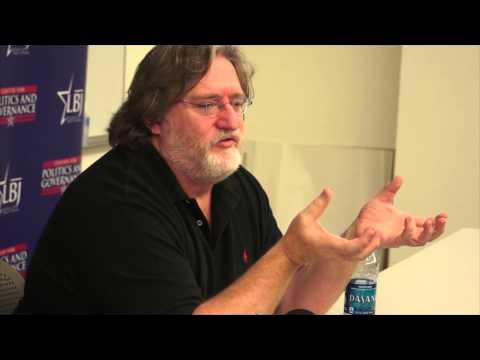
Published on YouTube by The LBJ School on January 31, 2013, this lecture features Valve Corporation founder Gabe Newell speaking at the University of Texas at Austin. As outlined in the video description, Newell discusses productivity, economics, political institutions, and the evolving future of corporations through his experiences as a video game developer and technology executive.
## TL;DR
Newell explores how Valve achieved extraordinary profitability and operational scale by systematically removing traditional corporate hierarchies, managerial friction, and retail intermediaries. Tracing Valve's evolution from the development of Half-Life to the emergence of Steam and virtual item economies in Team Fortress 2, he explains how near-zero marginal software costs and user-generated content outpace conventional studio production. He details Valve's flat organizational design—characterized by mobile desks, title-free autonomy, and ruthless talent filtering—alongside economic phenomenons like virtual inflation and liquidity crunches that led the studio to hire academic economists. Ultimately, Newell envisions Steam shifting into an open network API and argues that decentralized internet networks and digital micro-attribution models will render closed platforms and legacy pre-internet corporations obsolete.
## Atmosphere & style
The presentation feels like an intellectually rigorous yet remarkably relaxed academic masterclass, pairing dry entrepreneurial pragmatism with deep macroeconomic curiosity. Newell speaks in an unhurried, deadpan, and conversational cadence, seamlessly moving from corporate critique to absurd anecdotes, such as PayPal freezing accounts over suspected drug cartel activity because gamers were making fortunes selling virtual hats. The tone is devoid of typical Silicon Valley bravado, projecting instead the calm, analytical certainty of an engineer observing that traditional corporate structures are simply inefficient software systems ripe for replacement.
## Bulletin
- [00:03](https://www.youtube.com/watch?v=t8QEOBgLBQU&t=3s) Valve operates with higher revenue and profitability per employee than Apple, Google, or Microsoft, sustained by roughly 50% year-over-year revenue growth since its 1996 founding as a privately held company.
- [32:39](https://www.youtube.com/watch?v=t8QEOBgLBQU&t=1959s) Community content creation vastly outperforms internal development, with Team Fortress 2 users outproducing Valve ten-to-one and top item creators earning up to $500,000 annually.
- [30:10](https://www.youtube.com/watch?v=t8QEOBgLBQU&t=1810s) Transitioning games to free-to-play economics typically expands audience size tenfold while tripling gross revenues, creating disproportionate gains due to near-zero marginal distribution costs.
- [43:31](https://www.youtube.com/watch?v=t8QEOBgLBQU&t=2611s) Valve is re-architecting Steam from a curated retail storefront with gatekeepers into an open network API where third-party creators, critics, and communities run custom commission-based storefronts.
- [59:08](https://www.youtube.com/watch?v=t8QEOBgLBQU&t=3548s) Gabe Newell argues traditional corporate structures are pre-internet legacy mechanisms driven by rent-seeking on friction, predicting physical manufacturing will converge with software licensing and local fabrication.
## Key takeaways
- [11:04](https://www.youtube.com/watch?v=t8QEOBgLBQU&t=664s) Software development exhibits near-zero marginal costs, making it optimal to invest aggressively in top-tier talent rather than pursuing low-cost labor outsourcing.
- [15:34](https://www.youtube.com/watch?v=t8QEOBgLBQU&t=934s) Remaining private allows Valve to eliminate the distortive noise introduced by public market investors, corporate boards, and retail intermediaries.
- [17:00](https://www.youtube.com/watch?v=t8QEOBgLBQU&t=1020s) Valve maintains a flat organizational structure without job titles, dedicated QA departments, or traditional marketing teams, relying on multi-disciplinary generalists.
- [18:51](https://www.youtube.com/watch?v=t8QEOBgLBQU&t=1131s) Project management at Valve is treated as a temporary service role designed to assist peers rather than an executive career track.
- [21:56](https://www.youtube.com/watch?v=t8QEOBgLBQU&t=1316s) Physical workplace architecture reflects team mobility, utilizing modular desks on wheels with dual connection points to allow desk migrations in 15 minutes.
- [25:45](https://www.youtube.com/watch?v=t8QEOBgLBQU&t=1545s) Operating without formal hierarchies requires aggressive termination of underperforming or passive staff who cannot hide behind bureaucratic layers.
- [27:51](https://www.youtube.com/watch?v=t8QEOBgLBQU&t=1671s) Game design prioritizes player agency and immediate environmental feedback over realistic fidelity, as demonstrated by early Half-Life playtesting.
- [30:10](https://www.youtube.com/watch?v=t8QEOBgLBQU&t=1810s) Free-to-play business models scale total profitability by expanding player bases tenfold while tripling gross revenue.
- [34:16](https://www.youtube.com/watch?v=t8QEOBgLBQU&t=2056s) Customer economies consistently outproduce studio development capacity, leading Valve to hire professional economists to manage liquidity and inflation in virtual markets.
- [37:06](https://www.youtube.com/watch?v=t8QEOBgLBQU&t=2226s) Virtual cosmetic items command premium prices because they provide social signaling and status equivalent to luxury physical goods.
- [51:14](https://www.youtube.com/watch?v=t8QEOBgLBQU&t=3074s) In-game digital economies require non-provisional, durable property rights to prevent player perception of value from collapsing.
- [48:08](https://www.youtube.com/watch?v=t8QEOBgLBQU&t=2888s) Open creative networks require granular micro-attribution systems to automate royalty payments across complex, distributed user-created supply chains.
- [48:08](https://www.youtube.com/watch?v=t8QEOBgLBQU&t=2888s) Decentralized prediction markets consisting of engaged gamers outperform traditional Wall Street equity analysts at forecasting entertainment software sales.
- [56:10](https://www.youtube.com/watch?v=t8QEOBgLBQU&t=3370s) Plummeting communication costs drastically reduce information asymmetry, making corporate deception impossible against coordinated internet communities.
- [56:10](https://www.youtube.com/watch?v=t8QEOBgLBQU&t=3370s) Closed platform ecosystems function as rent-seeking mechanisms that artificially inflate competition chunk sizes and delay technological standardization.
- [59:08](https://www.youtube.com/watch?v=t8QEOBgLBQU&t=3548s) Advanced physical manufacturing and digital 3D rendering are computationally identical software problems, paving the way for manufacturing to transition into on-demand digital microtransactions.
## Detailed walkthrough
### [00:03](https://www.youtube.com/watch?v=t8QEOBgLBQU&t=3s) Introduction and Valve's Unconventional Scale
Sherri Greenberg, director of the Center for Politics and Governance at the LBJ School of Public Affairs, opens the session by welcoming the audience to the first brown bag event sponsored by the Benson Chair, alongside professors James Galbraith and Yanis Varoufakis and the student government group GPAC. She introduces Gabe Newell, founder of Valve Corporation, describing Valve as a powerhouse in the gaming industry and highlighting Steam's scale with over 55 million customers worldwide. She sets the agenda for the lecture: Newell's perspective on productivity, economics, political institutions, and corporate structures.
Newell begins by recounting Valve’s origins in 1996 as a privately held company—a deliberate choice resulting from core operating philosophies. Valve developed iconic single-player titles like *Half-Life* and multiplayer hits like *Team Fortress*, before building Steam, which currently hosts 2,500 applications across its 55-million-user base. Newell poses a central question: beyond financial success, why should anyone find Valve interesting? On raw commercial metrics alone, the company has sustained roughly 50% year-over-year revenue growth since its inception while maintaining higher revenue and profitability per employee than tech giants Apple, Google, or Microsoft. Furthermore, Valve ranks as roughly the fourth-largest bandwidth consumer on the planet, driving more internet traffic than entire nations. To make sense of why these operational realities matter, Newell frames his talk around his personal professional trajectory and the structural shifts he witnessed over several decades.
- **Founding year**: 1996 (privately held since inception)
- **Flagship titles cited**: *Half-Life* (single-player), *Team Fortress* (multiplayer)
- **Steam footprint**: 55 million global users, 2,500 active applications
- **Financial & network scale**: ~50% sustained annual growth; higher revenue/profit per head than Google, Apple, or Microsoft; 4th largest consumer of global bandwidth
---
[03:09](https://www.youtube.com/watch?v=t8QEOBgLBQU&t=189s) The Collapse of Retail Power: From Businessland to Negative Margins
Newell traces his intellectual journey back to his time at Microsoft from 1983 to 1996, where he transitioned from working on Macintosh software applications to core operating systems. He reflects on the radical realignment of the distribution value chain between the early 1980s and the modern era. In 1983, a company named Businessland ruled as the dominant PC vendor to small businesses. Businessland commanded extraordinary market leverage, demanding a 50% margin on gross sales—buying a system from a manufacturer like Osborne Computer Corporation for $1,000 and retailing it for $2,000.
By contrast, Newell notes that by 2012, brick-and-mortar retailers routinely sell Valve’s boxed games at a negative margin. Physical stores willingly take losses on inventory just to drive foot traffic into aisles, hoping shoppers will purchase high-margin ancillary items like blank CDs to offset the difference. This striking inversion raises an essential economic question: why did retail distribution forfeit so much control and pricing power over the product lifecycle, and is that shift unique to software or symptomatic of a wider systemic trend?
```mermaid
flowchart LR
accTitle: Retail Software Distribution Margin Shift
accDescr: Comparison of software retail distribution economics between 1983 and 2012.
subgraph Y1983["1983: High Retail Leverage"]
M83["Hardware Maker (e.g., Osborne)"] -->|"$1,000 wholesale"| R83["Retailer (Businessland)"]
R83 -->|"$2,000 retail (+50% margin)"| C83["Small Business End-User"]
end
[04:34](https://www.youtube.com/watch?v=t8QEOBgLBQU&t=274s) Blind Channels and the Shocking Discovery of *Doom*
Newell explains that in the early 1990s, even a high-performing corporation like Microsoft possessed virtually no real-world visibility into who was using its software or why. Internal operations relied on North American reseller warehouse reports that logged inventory pallets unpacked and shipped to local stores. These rudimentary lists captured only a fraction of total volume, offered zero insight into international sales, and completely missed corporate accounts and direct OEM channels. Inside Redmond, product managers squabbled over single-position movements on top-ten warehouse lists while remaining completely blind to the actual consumer base.
A crisis of conviction emerged when Microsoft's applications group faced resistance migrating character-mode DOS products over to Windows. Lotus was actively telling corporate customers that Microsoft’s Windows adoption figures were fabricated. To resolve the dispute, Microsoft undertook its first comprehensive field study, analyzing software usage across 10,000 physical machines in the field. The audit showed that users primarily ran pornography and video games—findings management immediately disregarded. However, it also confirmed that Windows had reached an active footprint of 30 million machines in the United States, proving users were not simply wiping Windows off their Dell or Compaq PCs to revert to DOS.
The biggest revelation of the audit was what topped the installed base. Windows was only the second most popular application on PCs. The number-one product in the world was *Doom*, developed by id Software—an independent 12-person team working out of Mesquite, Texas. Newell captures the organizational disbelief within Microsoft:
> “Somehow the largest software company in the world was being outdistributed by a 12-person company in Mesquite, Texas.”
Traditional management had no framework to explain how a tiny startup operating on internet shareware could surpass the footprint of the most strategic product line of the world's premier software firm. Yet inside Microsoft, executive thinking remained tethered to legacy distribution models. Newell points to Rob Glaser (who later founded RealNetworks), who insisted Microsoft could never take on Novell NetWare with LAN Manager without hiring a dedicated 500-person direct sales force to lobby intermediaries.
---
[09:12](https://www.youtube.com/watch?v=t8QEOBgLBQU&t=552s) Commoditizing Distribution vs. The Cost of Bureaucracy
Newell contrasts this structural blindness with two instructive market outliers from that era: Ventura Software and the IBM PCjr. Ventura Publisher, creators of desktop publishing software, were the first software executives Newell met who recognized that traditional retail distribution and product marketing were essentially commodities. Their operating philosophy was to concentrate entirely on building an exceptional product, entirely bypassing investment in marketing teams, and then putting the distribution rights up to competitive bidding to secure the highest royalty margin. While their eventual partnership with Xerox proved that sales and marketing were not completely commoditized—leading to eventual market underperformance—Ventura represented an early, deliberate effort to strip away non-essential overhead and focus exclusively on core product value.
On the other end of the efficiency spectrum was the IBM PCjr in the late 1980s. IBM’s massive administrative structure, corporate sales pipelines, and complex logistics had bloated its overhead to absurd levels:
> “The burden cost of shipping an empty box by IBM was over the retail price of the PCjr.”
IBM had built an organizational apparatus so burdened by overhead that it could not move an empty cardboard box through its warehousing and delivery pipeline without losing money against the PCjr’s retail sticker price. These contrasting models—a 12-person studio outdistributing an enterprise giant, a lean publisher treating physical distribution as an outsourced commodity, and an entrenched monopoly priced out of profitability by its own internal logistics—fundamentally reshaped Newell's perspective on corporate design, disintermediation, and the shifting economics of value creation.
[11:04](https://www.youtube.com/watch?v=t8QEOBgLBQU&t=664s) Rethinking Corporate Design: Exponential Cost Curves and Countering the Outsourcing Craze
Gabe Newell reflects on the landscape of corporate organization around 1996, when he and co-founder Mike Harrington were forming Valve. Across major industries—from insurance and airlines to Silicon Valley startups—structural changes were rendering entire legacy corporate functions obsolete. The cost of communicating with customers and delivering products was plummeting along an exponentially decreasing cost curve. While this dynamic alters any business, Newell notes it becomes glaringly obvious in sectors with near-zero marginal costs. In video games, virtually all expenditures occur before the first unit ships, meaning unit $N+1$ costs almost nothing to distribute. While the underlying economics apply just as much to heavy machinery like John Deere tractors, software made the low-friction reality immediate and testable.
At the time, mainstream corporate thinking was sprinting toward outsourcing, hunting for the cheapest English-speaking labor across the globe under the assumption that they could perform work adequately for far less pay. Newell and Harrington concluded that the corporate world had it completely backward. Rather than chasing rock-bottom labor costs, they decided Valve should aggressively pursue the most expensive, highly capable people available. In Newell’s view, high-end contributors were severely misvalued by conventional compensation metrics, which failed to account for enormous variance in actual output.
```mermaid
flowchart LR
accTitle: Marginal Cost Economics vs Corporate Talent Strategy
accDescr: Contrasting traditional corporate outsourcing with Valve's focus on high-productivity talent under low marginal distribution costs.
subgraph Market["Market Reality (1996)"]
A["Communication costs drop exponentially"]
B["Zero marginal cost for unit N+1"]
end
subgraph Traditional["Traditional Corporate Trend"]
C["Outsourcing to low-cost labor"]
end
subgraph ValveApproach["Valve's Counter-Strategy"]
D["Hire most productive/expensive talent"]
E["Eliminate operational layers"]
end
Market --> Traditional
Market --> ValveApproach
```
- In software, variance in output is stark: IBM in the 1980s measured a median employee’s productivity at roughly 1,000 debugged, shipped lines of code per year.
- By contrast, while developing *Half-Life*, Valve programmer Yahn Bernier was writing and shipping around 4,000 debugged lines of code per single day.
- Newell highlights that Bernier’s code was vastly more valuable to the business than someone building a legacy 3270 terminal emulator for OS/2.
- Newell disliked the generic word "talent," defining it strictly as “the ability to be productive.”
- “One of the sort of tenets that we used was that that was probably true across a much wider range of functions, right?” Newell explains, concluding that extreme productivity deltas exist far beyond coding.
- Rather than following the industry trend of hiring cheap digital artists in India or China, Valve sought out top-tier individuals—such as film artists in New Zealand making $200,000 a year—and aimed to bring them to Valve to produce $500,000 to $5,000,000 in value, splitting the difference on compensation.
---
[15:34](https://www.youtube.com/watch?v=t8QEOBgLBQU&t=934s) Staying Private and Eliminating Noise in the Feedback Loop
Having decided to center Valve on hyper-productive individuals, Newell and Harrington evaluated what corporate architecture would best support them. Their first major structural commitment was to remain private. Newell observed that going public introduces external third parties whose interests directly distort product work. In a public company, leadership becomes consumed by board meetings, series-stage venture capitalists panicking over share dilution, and distribution channel intermediaries demanding arbitrary product releases for shelf slots.
Remaining private strips that friction away, leaving an uncorrupted channel between the developer and the player. At Valve, anyone working on a product can identify a need, make the change, and push it directly to live users without waiting for bureaucratic sign-offs. If a developer introduces a bug or bad decision, they can roll out a correction within 15 minutes. Newell points out that the entire structural rationale is to remove distortion: “The whole point of being a privately held company is to eliminate another source of noise in the signal between the consumers and producers of a good.”
---
[17:00](https://www.youtube.com/watch?v=t8QEOBgLBQU&t=1020s) Flat Structure and Why Job Titles Hinder Innovation
Newell argues that traditional job titles and rigid hierarchies directly impede high-performing talent. In conventional environments, organizations calcify around existing job descriptions, forcing people to apply last generation’s solutions to the next generation's challenges. When workers are free from titles, they cross functional domains to solve problems at the lowest possible friction point.
Addressing an audience member who asks whether Valve started flat or transitioned after trying a hierarchy, Newell confirms the flat model was baked in from day one. He illustrates the necessity of title-free autonomy with a key breakthrough during the development of *Half-Life*:
> “The great example from *Half-Life 1* is that the guy who designed the skeletal animation system also had a Bachelor of Fine Arts and could also build environmental art. So if you go to a movie nowadays the idea that you would have a single person doing even a much more than a subset of any of those roles is mind-boggling. But there are a set of experiences that you get in *Half-Life 1* that are entirely a consequence of the person working on it being able to change the environment, change the code, or change the animations depending upon what was the most tractable way of solving the problem.”
- Static titles and departmental boundaries stop employees from framing problems in the most efficient, holistic way.
- Valve does not maintain a dedicated Quality Assurance (QA) department.
- Valve has no traditional marketing department; Newell notes they have a single individual who calls himself "Vice President of Marketing" purely to avoid confusing outside partners during industry discussions.
- Every employee at the company is fundamentally expected to communicate with and listen to customers directly.
---
[18:51](https://www.youtube.com/watch?v=t8QEOBgLBQU&t=1131s) Management as a Service Task Rather Than a Career Hierarchy
At Valve, management is viewed strictly as a temporary, specialized operational skill rather than a career path or status symbol. Because the studio values group enablement over bureaucratic gatekeeping, project management is fundamentally a service job centered on clearing roadblocks so colleagues can build. Newell notes that it is so exhausting and difficult to self-measure that employees rarely want to manage back-to-back projects:
> “Usually people refuse to do it twice in a row on back-to-back projects because it very much is, you know, a service job. It’s like, my job is to entirely define myself in terms of the productivity that I enable in other people. Next project I just want to not—you know, that’s a very stressful job and it’s hard to measure your own productivity, like all—everybody else says, ‘Hey, Jay, you did a great job, you should do it again,’ and Jay’s like, ‘Screw you guys.’”
Because veterans avoid repeat management stints, Newell jokes that they typically end up looking for an unsuspecting younger employee who still holds conventional notions about managerial authority, only for that person to quickly discover that managing means grinding relentlessly to facilitate everyone else's work.
---
[20:45](https://www.youtube.com/watch?v=t8QEOBgLBQU&t=1245s) Early Recruiting: Castle Storming and Non-Traditional Hires
When an audience member asks how Valve managed to recruit and retain world-class talent early on without conventional corporate incentives, Newell admits it required direct personal pitches. The process was not without its humbling moments; he jokes about hyping up potential recruits to take a leap, only to turn around and realize no one had followed: “We were like, ‘Let’s go! Let’s storm the castle!’ And then there’s like, ‘Where’d everybody go?’”
Once they secured a core nucleus of respected developers, momentum shifted toward word-of-mouth social networking, as engineers began recruiting peers from their own networks. Prominent industry figures like id Software's John Carmack and graphics guru Michael Abrash provided critical early help and credibility. Furthermore, Valve ignored conventional corporate hiring filters, eagerly taking bets on raw, self-taught ability over pristine resumes—including hiring an early programmer whose prior employment was managing a Waffle House.
[21:56](https://www.youtube.com/watch?v=t8QEOBgLBQU&t=1316s) Office Architecture and the Evolution of Valve’s Flat Structure
An audience member asks Gabe Newell whether Valve's flat organizational structure has evolved since the original *Half-Life* days, particularly as ballooning software development costs mean a single individual can accomplish relatively less on their own. Newell replies that Valve evolves constantly, and he illustrates this by sharing how his own preconceptions about office space were dismantled by the team.
```mermaid
flowchart TD
accTitle: Evolution of Valve's Office Organization
accDescr: Flowchart showing how Gabe Newell's initial office philosophy transitioned to an employee-driven flexible model.
subgraph Initial["Top-Down Philosophy"]
A["Tom DeMarco's Peopleware<br>(One person, one office)"] --> B["Private offices with doors & DND buttons"]
end
subgraph Emergence["Employee Pushback"]
B --> C["Offices sat empty; employees clustered in conference rooms"]
C --> D["Newell recognizes proximity enhances collaboration"]
end
subgraph Current["Adaptive Office Model"]
D --> E["Desks on wheels<br>(Only two floor contact points)"]
E --> F["Reconfigure spaces in 15 minutes"]
E --> G["Custom shared workspaces<br>(e.g., paired programming desks)"]
end
```
Deeply influenced by Tom DeMarco and Timothy Lister’s book *Peopleware*, Newell treated the principle of “one person, one office” as dogma. Having developed a fierce hatred for cubicles—which he characterizes as an outgrowth of a Data General corporate philosophy that assumed screwing employees meant management was doing something right—Newell mandated that every Valve developer have a private office, a closing door, a "do not disturb" button on their telephone, and total freedom over decor. In practice, however, developers bypassed this setup entirely: they tore doors down, crept into one another's offices, and abandoned their private rooms to cluster together in conference rooms. Recognizing that his rigid mandate was hurting productivity, Newell stepped back and let employees organize their own spaces:
> “That's when I realized, you know, they were making the right decision, right? They were deciding that the there were benefits to being in closer proximity to other people and that Gabe's rigid adherence to one person, one office was actually hurting their productivity.”
Today, office design is completely decentralized. Desks are mounted on wheels with only two contact points with the floor, allowing anyone to pack up their hardware and migrate to a new project group in roughly 15 minutes. Spaces range from small shared setups—such as the three-person office Newell occupies—to large shared work areas housing around 80 people, and employees independently decide whether it is worth their time to design specialized physical equipment, such as desks optimized for paired programming.
- **Quantitative Predictions:** Newell notes that a cornerstone of modern Valve culture is making explicit forward-looking predictions: “If you're not making quantitative predictions you're probably doing it wrong or you're probably not doing it as well as you can.” He emphasizes that anyone can spin an explanation after the fact, making upfront numbers essential to rigorous problem-solving.
[25:45](https://www.youtube.com/watch?v=t8QEOBgLBQU&t=1545s) The Challenges of Managing a Flat Company
Responding to a question from an attendee working at another flat company testing Valve's organizational model, Newell details the sharpest operational failure modes and friction points Valve faces without a traditional management hierarchy:
> “You have to be really aggressive about firing people.”
Because the flat model treats organizational processes as an engineering discipline—requiring people to make decisions, quantitatively measure outcomes, and rapidly iterate—it functions as a sink-or-swim environment where interns and standard entry-level hires often flounder. Furthermore, experienced industry veterans frequently struggle with the culture shock. Valve workers refer to this transition period as a form of “beaten wife syndrome,” seen most acutely in hires arriving from the feature film industry. In film pipelines, employees are conditioned to expect that exercising personal initiative will result in a superior punishing them. Consequently, it generally requires six to nine months for newcomers to unlearn that defensive mindset and internalize Valve’s expectation of personal autonomy and responsibility.
[27:51](https://www.youtube.com/watch?v=t8QEOBgLBQU&t=1671s) Game Design Heuristics: Single-Player Agency and Facial Feedback
Newell steps back to trace the evolution of Valve's design models, beginning with the challenges of developing single-player games like *Half-Life*. Early on, the team flirted with making games "more realistic," only to find that realism was a terrible design trope. Instead, they adopted the core heuristic of player agency: every meaningful player action or state change must yield an immediate, perceptible reaction from the environment.
When playtesting early builds of *Half-Life*, shooting a machine gun at a wall produced no visual reaction; the game world simply ignored the player. Once the team introduced bullet decals, playtesters spent up to an hour joyfully drawing pictures on surfaces with automatic gunfire, proving the heuristic's worth. For *Half-Life 2*, Valve poured massive engineering resources into accurately modeling ocular geometry and eye movement. Because human eyes are not perfect spheres, specular highlights and glints move distinctively across rotating surfaces. Because human brains possess specialized circuitry dedicated to tracking eye lines across a room, subtle rendering improvements made digital characters feel radically more lifelike:
> “It turns out that people suddenly say, ‘Oh, these characters are nicer. These characters are more like me. These characters are smarter.’ Right? So something as seemingly irrelevant to a game as making eyes work turns out to generate the sense that this game is more fun.”
[30:10](https://www.youtube.com/watch?v=t8QEOBgLBQU&t=1810s) The Multi-Player Shift and the Economics of Free-to-Play
The single-player design model—which Newell likens to directing a feature film where the lead actor is effectively deaf and autistic—collapses entirely in multiplayer games. In multiplayer environments, design rules produce unexpected and counterintuitive behavioral outcomes driven by network externalities. When Valve added the riot shield to *Counter-Strike*, player engagement rose; when they subsequently removed the riot shield, player counts rose again. These dynamics resemble spectator sports or operating systems far more than scripted movies.
```mermaid
flowchart LR
accTitle: Mechanics of Free-to-Play Game Economics
accDescr: Flowchart illustrating why giving a game away free multiplies player base, status goods, and profitability.
A["Product Given Away Free<br>(Zero purchase barrier)"] --> B["Audience Multiplies 10x"]
B --> C["Emergence of Social Goods<br>(Affinity, status, hierarchy)"]
C --> D["Gross Revenue Multiplies 3x"]
B --> E["Marginal Bandwidth Costs Remain Low"]
D & E --> F["Significant Expansion in Overall Profitability"]
```
This model evolved once more with the rise of free-to-play economics. While initially appearing suicidal to game developers accustomed to retail sales, free-to-play leverages network size to generate virtual goods tied to social hierarchy, affinity, and player status. Because the marginal cost of serving an additional player amounts to little more than bandwidth distribution bits, widening the audience funnel produces asymmetric financial returns:
> “Typically what we see with the free-to-play game which on the surface sounds like suicide is that your audience size goes up by a factor of 10 and your gross revenue goes up by a factor of three.”
Because incremental delivery costs remain low, the resulting profitability expands far beyond that threefold revenue gain, challenging traditional assumptions about media distribution and commercial software pricing.
[32:39](https://www.youtube.com/watch?v=t8QEOBgLBQU&t=1959s) The Property Rights Problem and the Rise of User-Generated Content
Games featuring player markets and auction houses reveal a fundamental flaw in how the industry handles player investment. Gabe Newell describes it as an appalling dynamic: an individual might pour twenty hours a week for four years into a game, accumulating assets and status, only to see the entirety of that accumulated value plunge to zero when they move on or the game sunsets. He draws a direct comparison to real-world real estate: it is as if someone bought a house, spent years making extensive structural improvements, and then, upon relocating, was forced to forfeit all equity and start entirely from scratch. Players clearly find value in these assets—their massive expenditure of time proves it—yet games have traditionally operated under a whimsical, dismissive view of players' property rights.
At the same time, Valve observed a seismic shift toward user-generated content (UGC) within *Team Fortress 2*. While the team at Valve considered themselves extraordinarily productive and talented at producing game content, the scale of player production quickly dwarfed internal capacity. Approximately ten times as much content was flowing from the user base as was being produced by Valve itself. Recognizing the futility of fighting this trend, Newell acknowledged that the player community had become their fiercest collaborator and competitor.
> “So, the only company we've ever met that kind of kicks our ass is our customers, right? We'll go up against Bungie or Blizzard or anybody, but we won't try to compete with our with our own user base because we already know that we're going to lose.” — Gabe Newell
```mermaid
flowchart TD
accTitle: Transition from Developer-Centric to User-Generated Economies
accDescr: Diagram illustrating the shift from developer content bottlenecks to user-generated production outstripping developers by 10 to 1.
subgraph LegacyModel ["Legacy Game Economy"]
Dev1["Developers produce 100% of content"] --> Store1["Developer sells items to players"]
Store1 --> Abandon["Player leaves game: Equity drops to zero"]
end
[34:16](https://www.youtube.com/watch?v=t8QEOBgLBQU&t=2056s) Breaking PayPal and the Emergence of Virtual Macroeconomics
Once Valve engineered the commerce systems allowing players to sell custom-made virtual items directly to one another via revenue-sharing arrangements, the economic repercussions arrived almost immediately. Top creators were soon pulling in as much as $500,000 in a single year purely from their virtual item royalties. The sudden surge of cash distributions caught payment processors off guard: during the first two weeks of the marketplace payout rollout, Valve actually broke PayPal's fraud-detection systems. PayPal panicked, assuming an unprecedented cash velocity into private accounts must be connected to illegal narcotics, forcing Valve to intervene directly and clarify that these everyday citizens were simply manufacturing digital hats. Furthermore, Valve learned that professional artists and developers at competing game studios were earning more money on the side as content creators inside *Team Fortress 2* than they were from their full-time day jobs.
As the virtual economy scaled, real-world macroeconomic phenomena surfaced spontaneously. The *Team Fortress 2* economy experienced cycles of inflation, deflation, and spontaneous currency creation as players minted their own informal mediums of exchange. International tax authorities swiftly took notice; South Korean regulators, for instance, mandated that game operators supply documentation equivalent to W-4 forms so players could report virtual income. This forced Valve to confront complex monetary and social policy questions: should drop rates be increased to compensate players for local income taxes, or altered based on purchasing power parity to provide a welfare buffer in developing markets? Compounding these governance puzzles, the barter system suffered from liquidity crunches at specific hours of the day, producing localized financial panics in the hat market and leading Valve to realize they needed professional economists on staff.
> “Nothing generates cash to our user base other than selling drugs like this. So we actually had to work something out with them and said, 'No, they're making hats, not drugs.'” — Gabe Newell
- Top community content creators were earning annual payouts reaching $500,000 from virtual item sales.
- PayPal's automated compliance systems halted payouts under the suspicion that the transactions represented illicit narcotics trafficking.
- In South Korea, regulations required creating virtual tax reporting structures akin to W-4 forms for in-game earnings.
- Liquidity dry-ups during off-peak hours triggered mini financial panics within the TF2 barter exchange.
[37:06](https://www.youtube.com/watch?v=t8QEOBgLBQU&t=2226s) Why Digital Hats Have Value: Status Goods and Asset Bubbles
An audience member asks how purely cosmetic items—virtual hats that offer negligible stat changes or none at all—command real-world prices ranging from $5 to upwards of $32. Newell counters that virtual cosmetics operate on the exact same psychological and social mechanics as physical luxury and status goods. People spend enormous premiums on real-world items like Porsche sports cars not strictly for mechanical utility, but for personal identity, signaling, and aesthetic satisfaction. When skeptics protest that digital goods are merely ephemeral software code rather than physical matter, Newell turns the critique back onto modern fiat money, which derives its value entirely from social consensus rather than inherent tangible substance.
For Valve, the fundamental challenge is defining and optimizing for real productivity rather than inflating an artificial bubble. Newell cautions that if a developer merely floods the ecosystem with unearned cosmetic drops, it destroys value through rapid hyperinflation. Valve's focus shifted toward establishing durable initial market structures and rules to prevent asset bubbles and market instability before they spiral out of control.
> “Money—I mean, if you look at people say, 'But these things aren't real,' and then you go, 'Well, what about money?' And they go, 'That's not fair.'” — Gabe Newell
[39:02](https://www.youtube.com/watch?v=t8QEOBgLBQU&t=2342s) The Central Economy Model and Monetizing Esports with Na'Vi's Dendi
Newell outlines a broader vision for virtual worlds: rather than treating every game as an isolated silo, games should function like "instance dungeons" connected to a singular, persistent central economy. In this architecture, identity, ownership, and authorship carry across game boundaries. Value generation takes many forms: hat designers create original assets, market arbitrageurs provide essential trading liquidity, and modders build complete custom environments and game modes. Plumber-level infrastructure must be built across the platform to ensure that whether an individual crafts a 3D model, records a custom character animation, or invents a taunt, that authorship is tracked and compensated.
High-level competitive skill represents another distinct category of community value creation. Historically, elite players struggled to monetize their talents beyond third-party advertising or streaming video sponsorships. In *Dota 2*, Valve introduced digital team banners for top esports organizations like the Ukrainian squad Natus Vincere (Na'Vi). When star players—such as Danil "Dendi" Ishutin—compete, spectators purchase virtual team banners to signal allegiance in-game and unlock special tournament item drops, with a direct percentage of sales channeled to the team. Newell points out that this direct patronage model can readily generate $100,000 annually for a marquee player, giving talent like Dendi the financial freedom to entertain millions with offbeat, high-skill strategies such as running Crystal Maiden as a carry equipped with multiple Battlefuries.
> “The things that you do in these games need to have persistence and they need to be exchangeable, and we need to look at more ways for users to generate content, to be productive in this audience, to accumulate assets that are exchangeable and retain their value.” — Gabe Newell
[43:31](https://www.youtube.com/watch?v=t8QEOBgLBQU&t=2611s) Shifting Steam from Curated Store to Open Platform
Applying these economic lessons directly to Valve's core software business requires rethinking Steam itself. Newell explains that Steam had historically functioned as a tightly curated digital storefront, staffed by dedicated internal personnel who acted as gatekeepers, reviewing inbound games, negotiating publishing deals, and selecting what products reached customers. Recognizing that internal gatekeeping forms a severe bottleneck against community productivity, Valve began shifting toward open platform systems designed to let market mechanisms and customer participation drive the catalog directly.
[44:00](https://www.youtube.com/watch?v=t8QEOBgLBQU&t=2640s) Dismantling the Distribution Bottleneck: Steam as a Network API
Gabe Newell outlines how Steam found itself unintentionally occupying the exact position Valve sought to avoid: acting as an artificial choke point between game makers and their audiences. Game developers would constantly plead for shelf space, only to be met with operational delays because the internal team was limited to releasing roughly three games a day while manually assembling store capsules and managing storefront assets. Newell explains that while a company might deliberately engineer an artificial bottleneck if its goal is to shift relative economic value toward distribution control through manufactured scarcity, that is fundamentally not Valve's objective.
To eliminate that friction, Valve began rethinking Steam not as a heavily curated gatekeeper, but as a generalized network application programming interface (API). At its technical core, Steam is simply an infrastructure of server racks and high-capacity network bandwidth designed to route bits efficiently between creators and consumers. While basic safeguards against malware and viruses remain necessary, Newell argues that Valve must step entirely out of the transactional middle. Rather than forcing developers to engage in high-friction personal lobbying, the distribution pipeline should operate programmatically. As Newell puts it: “So rather than us sitting between creators and consumers, we're going to get as far out of that connection as possible, right? So Steam stopped being this calling up Jason Holtman and yelling at him until he puts your game up on the Steam store and instead just becomes a network API.”
```mermaid
flowchart LR
accTitle: Evolution of Steam Distribution Model
accDescr: Diagram contrasting Valve's legacy curated distribution bottleneck with the open network API and user-generated storefront model.
subgraph Modern ["Open Network API Model"]
C2["Content Creators"] --> API["Steam Network API\n(Bandwidth & Servers)"]
API --> S1["Valve Store"]
API --> S2["Curator / Influencer Stores"]
API --> S3["User-Generated Stores"]
S1 --> U2["Consumers"]
S2 --> U2
S3 --> U2
end
```
[45:35](https://www.youtube.com/watch?v=t8QEOBgLBQU&t=2735s) User-Generated Stores and Community Editorial Curation
Newell draws a direct parallel between player-created cosmetics in *Team Fortress 2* and the future architecture of digital storefronts. In TF2, the studio discovered that eliminating the concept of privileged content allowed players to surprise everyone by crafting wildly popular items, such as ushankas—a traditional Russian fur cap Newell admits he had never even heard of until it surfaced in the game's economy. Applying this insight to e-commerce, Valve realized that the Steam storefront itself had become an inappropriately privileged piece of editorial content, when storefront curation ought to be treated as user-generated content.
Under this proposed model, any individual or competing enterprise can spin up a custom storefront connected directly to Steam's back-end infrastructure. Store owners would set their own cut via a market-driven mechanism, keeping prices competitive to avoid being priced out. An individual could curate a personal library for their friends and collect a small royalty whenever someone purchases a recommended title through their bespoke portal. Newell suggests that talented critics and writers—singling out Ben "Yahtzee" Croshaw as well as the comedic gaming site *Old Man Murray*—could turn their editorial voices into sustainable retail channels where consumers intentionally buy games through them to support their curation. As Newell summarizes the philosophy: “So you take two things which are tended you tend to think of as super valuable assets that have to be guarded really carefully—you know, deciding who gets to be on Steam and deciding how stores are presented to consumers—and this is how we rethink them, right? It's a generalized network service and a store rather than being some unique special thing that represents, you know, Valve having control of this; instead it turns into, 'Oh, lots of people are create really entertaining, will add a lot of value to that process and through mark—through the market mechanism it'll justify by—or the audience will reward or not reward people for building entertaining stores.'”
[48:08](https://www.youtube.com/watch?v=t8QEOBgLBQU&t=2888s) Micro-Attribution Frameworks and Economic Prediction Markets
Building an open economy requires solving deep structural challenges around provenance, ownership, and compensation. Newell explains that Valve must implement a comprehensive framework capable of tracking micro-contributions across complex creative supply chains: if one participant creates a raw texture, a second person incorporates it into a 3D model, a third designer places that model into a map level, and a fourth party sells that complete level to an end user, the underlying platform must automatically enforce each creator's licensing terms and distribute their respective revenue cuts.
Beyond production pipelines, Newell highlights his ongoing collaborative research with economist Yanis Varoufakis into decentralized prediction markets. Newell is convinced that prediction tools hold massive untapped value for both player entertainment and rapid information discovery. He predicts that user-driven wagering markets would radically outperform traditional commercial intelligence, claiming that twenty engaged gamers running an internal market could forecast sales figures for the next *Call of Duty: Black Ops* release far more accurately than established industry forecasting firms. Furthermore, Newell sees huge potential for macro-level economic experimentation: “So, there's an example of something that we're currently missing that would be hugely valuable to economists if one of the prediction markets is nominal GDP level targeting, my personal favorite. But it would also be entertaining if some of the prediction markets are how long until Lindsay Lohan goes into rehab again.”
- Provenance tracking ensures revenue is programmatically distributed across multi-tiered authoring pipelines (textures, models, levels).
- Prediction markets serve dual functions: high-signal analytical tools for firms and entertaining social speculation for players.
- Newell favors macroeconomic instruments, explicitly naming nominal GDP (NGDP) level targeting as his preferred prediction market subject.
[50:27](https://www.youtube.com/watch?v=t8QEOBgLBQU&t=3027s) Crowdsourcing Data Analysis to the Community
An audience member asks whether Valve, given its massive repository of Steam metrics, already possesses all the answers and merely needs to sort through the data. Newell responds that while the platform logs vast troves of telemetry, extracting meaningful insights from massive datasets is extraordinarily difficult. Valve’s fundamental strategy is not to hoard that data internally, but to build public-facing frameworks that allow the broader community to dig into it.
Newell points out that if the ecosystem can create enormous economic value simply by letting players design virtual hats, crowdsourcing data analytics directly to the player base could produce exponentially greater returns. Valve operates under the belief that internal staff should never attempt to solve problems that a coordinated internet community could address with superior scale and insight. Newell characterizes his operational mindset with a blunt operational maxim: “I do my job, but if I can figure out how to get Reddit to do my job, they'll do it a lot better, right?”
[51:14](https://www.youtube.com/watch?v=t8QEOBgLBQU&t=3074s) The Psychology of Virtual Security and the Assassination of Lord British
When asked by an audience member how Valve handles security and prevents malicious actors from exploiting open virtual systems, Newell draws a sharp philosophical distinction between true malicious breaches and unexpected emergent gameplay. He observes that game developers often make the grave error of labeling player cleverness or organic community spectacles as hacking. As an infamous example, he cites the 1997 assassination of Lord British (Richard Garriott's avatar) by a player during a public speech in *Ultima Online*. Rather than leaning into the narrative brilliance of a king being slain before his subjects, the developers panicked and rolled back the server instance, erasing what Newell considers the single most memorable and entertaining event in the game's history.
At the same time, Newell acknowledges that robust baseline security and secure property rights are absolute prerequisites for any functional society or economy. Citing discussions with Yanis Varoufakis regarding high-crime communities, Newell explains that when institutional security breaks down and property rights become provisional, perceived value collapses across the board. The exact same sociological principle governs digital economies: if participants cannot trust that their virtual assets and future claims are completely secure from bad actors, systemic instability will quickly degrade the health of the entire virtual meta-world. As Newell explains: “I mean, uh it's a general characteristic of social systems that um people have to have confidence that in the—in the future, right? And that's true whether it's your house and the stuff that you have inside of your house—you know, if property rights are provisional, then your value of property changes accordingly.”
- Developers should embrace unscripted, disruptive player behavior as narrative gold rather than treating it as a security breach requiring server rollbacks.
- Stable, non-provisional property rights are essential; without them, the subjective economic value of digital goods depreciates rapidly.
- Drawing from real-world sociological comparisons, a breakdown in core systemic security inevitably destabilizes the surrounding economy.
An audience member asks if Valve's broader drive to crowdsource labor was what originally motivated the commercial licensing of the Source Engine. Newell readily admits that public engine distribution was not particularly successful at democratizing productivity. Licensing a full industrial game engine proved far too demanding and complex for the vast majority of creators, imposing an intimidating barrier to entry rather than providing an accessible, incremental path for creative contributions.
Instead of demanding that participants master heavyweight game engineering up front, Newell argues that economic onboarding must mirror the incremental progression design of an MMORPG. Productive participation should unfold via a series of gentle, low-stakes introductory quests: a user starts by purchasing a single cosmetic hat, learns how to trade and sell it, earns an eleventh hat as a reward for completing ten successful transactions, experiments with simple color alterations, and gradually levels up their technical literacy over time. Newell articulates this operational vision of community progression: “But that's how we think of it is that growing people within this economy looks a lot like walking people through an an MMO experience.”
[54:36](https://www.youtube.com/watch?v=t8QEOBgLBQU&t=3276s) Money as an Informational Signaling Tool
Responding to an audience question about whether user-generated content creators are driven by intrinsic self-direction or extrinsic commodification, Gabe Newell explains that Valve does not attempt to separate those incentives. Creators participate both because they genuinely enjoy the work and because they receive substantial financial rewards. Beyond simply compensating creators, Newell emphasizes that money plays a critical structural role within an open network: it acts as a precise signaling mechanism. While social validation—such as friends thinking a creation is cool—remains present, currency introduces a clear, objective metric that allows individuals to evaluate the true utility of their efforts. When a creator realizes they made ten times as much money producing one item versus another, the signal becomes explicit, quantifiable, and comparable across different creative choices.
This dynamic naturally raises a fundamental economic question regarding the necessity of traditional firms: why do corporations exist at all if the price mechanism can efficiently organize production and allocate capital? Just as Newell begins exploring this institutional paradox, the session organizer interrupts the talk. Because a second crowd has gathered downstairs waiting to hear him, Newell has agreed to deliver an encore presentation, leaving him with roughly five minutes to compress the remainder of his lecture.
```mermaid
flowchart LR
accTitle: User Motivation and Market Feedback Loop
accDescr: Feedback loop showing how intrinsic creative desire and market signaling via currency guide creators toward high-value production.
subgraph Incentives["Creator Motivations"]
A["Intrinsic Drive<br/>(Creative enjoyment & peer status)"]
B["Extrinsic Reward<br/>(Substantial cash payouts)"]
end
subgraph Market["Signaling Mechanism"]
C["Market Output<br/>(User-generated content)"]
D["Comparative Currency Signal<br/>('Made 10x more doing this')"]
end
A --> C
B --> C
C --> D
D -->|"Explicit, comparable feedback"| A
D -->|"Capital allocation"| B
```
- “So the signaling becomes more explicit and comparable.” — Gabe Newell
- “Um, so why do companies—why do corporations exist in the first place? Right? I mean, if you're an economist, one of the challenges is to explain why do we need corporations at all, right? Why isn't the price mechanism sufficient to to allow good organization of production and allocation of capital?” — Gabe Newell
---
[56:10](https://www.youtube.com/watch?v=t8QEOBgLBQU&t=3370s) Cheap Information, Reddit, and the Problem with Closed Platforms
Accelerating his pace, Newell turns to the broader macroeconomic impact of the personal computer and the internet. Rather than just raw computation getting cheaper through Moore’s law, parallel variations of that law are making data access and global communication exponentially cheaper as well. From an institutional economics framework, this collapse in information costs drastically suppresses moral hazard, agency costs, and information asymmetry. Newell illustrates this with a modern cultural reality: attempting to deceive a networked community is practically impossible because collective verification power is so high.
This dynamic informs Newell’s persistent criticism of closed console platforms. While observers often assume his complaints stem from competitive platform rivalry, his core objection is structural: closed ecosystems artificially enlarge the "chunk size" of competition and dramatically raise market entry costs, locking out innovative producers from monetizing their ideas. Furthermore, closed ecosystems intentionally delay standardization. In Newell's view, many legacy corporate behaviors boil down to rent-seeking built on artificial friction. Standardized interfaces act as the primary defense against this rent-seeking by eliminating the proprietary bottlenecks that allow firms to extract value without producing utility.
- “The way the point that I make to people who are of your generation is you can't lie to Reddit.” — Gabe Newell
- “It's remarkable how many people try, but they don't understand that Reddit's ability to detect is insanely high.” — Gabe Newell
- “The thing that I dislike about closed platforms is they—I can go into this in ridiculous amounts—is that they increase sort of the chunk size of competition, which I think is a bad thing.” — Gabe Newell
- “Well, if you ask me and I look at most of the behaviors in corporations, it looks like rent-seeking behaviors on top of friction, which is a really dark way of thinking about the roles that people have in corporations.” — Gabe Newell
---
[59:08](https://www.youtube.com/watch?v=t8QEOBgLBQU&t=3548s) The Million-Dollar CNC Machine and the Post-Internet Corporation
Newell observes that modern internet networks organize distributed individuals far more effectively than traditional industrial giants like General Motors or Sears ever could. Legacy corporations frequently allow legacy physical assets to distort their internal decision-making, ultimately leading to their demise. To illustrate how physical production is converging with digital systems, Newell shares a personal anecdote about purchasing a million-dollar CNC machine as a hobby. Intending it as an escape from his day job, he quickly realized that modern machining issues—such as tool engagement angles—are computationally identical to 3D rendering problems. Carving an object from a block of aluminum follows the exact mathematical principles as rendering polygons in three-dimensional digital space.
To optimize the machine's efficiency, Newell found himself establishing standardized interfaces and network pipelines so jobs could flow through continuously, turning the physical machining workflow into something that looked uncannily like *Counter-Strike* game systems. He predicts that machine tool builders will shift away from selling physical hardware toward selling network capacity on demand. With the rise of 3D printing and digital fabrication, physical manufacturing is moving directly toward the microtransaction model of video games: companies will no longer ship uniform hardware products via one-size-fits-all broadcast models, but will instead sell software licenses and 3D models for local on-demand manufacturing. Newell concludes that future generations will view mass-produced, identical products as an incomprehensible historical relic, and that the organizational lessons forged in video games will soon govern all modern industries.
- “To us in this room it seems fairly obvious that the internet does a better job of organizing a bunch of individuals than General Motors or Sears does.” — Gabe Newell
- “The sort of bottom line is that corporations essentially look to me like pre-internet ways of organizing production and allocating capital...” — Gabe Newell
- “So I have a million-dollar CNC, right? It's a hobby that kind of got out of control, right?” — Gabe Newell
- “The reality is that all the problems related to machining are software problems.” — Gabe Newell
- “And the way that you keep this thing busy is you standardize a bunch of stuff and create a network interface so jobs can flow through this thing and you end up looking—you end up making this hobby of mine ends up looking a lot like *Counter-Strike* in terms of the sets of decisions that you would make to improve it.” — Gabe Newell
- “Our children are going to say that is the weirdest thing I've ever heard of. Like every one of my products are unique and different, and that transition means that the sets of lessons that we're learning today in the video game space are probably going to be true of a much wider range of industries tomorrow.” — Gabe Newell
## Notable quotes
> [15:34](https://www.youtube.com/watch?v=t8QEOBgLBQU&t=934s) The whole point of being a privately held company is to eliminate another source of noise in the signal between the consumers and producers of a good. — Gabe Newell
> [59:08](https://www.youtube.com/watch?v=t8QEOBgLBQU&t=3548s) The sort of bottom line is that corporations essentially look to me like pre-internet ways of organizing production and allocating capital... — Gabe Newell
> [56:10](https://www.youtube.com/watch?v=t8QEOBgLBQU&t=3370s) Well, if you ask me and I look at most of the behaviors in corporations, it looks like rent-seeking behaviors on top of friction, which is a really dark way of thinking about the roles that people have in corporations. — Gabe Newell
> [30:10](https://www.youtube.com/watch?v=t8QEOBgLBQU&t=1810s) Typically what we see with the free-to-play game which on the surface sounds like suicide is that your audience size goes up by a factor of 10 and your gross revenue goes up by a factor of three. — Gabe Newell
> [21:56](https://www.youtube.com/watch?v=t8QEOBgLBQU&t=1316s) If you're not making quantitative predictions you're probably doing it wrong or you're probably not doing it as well as you can. — Gabe Newell
## Mentioned
Apple, Ben 'Yahtzee' Croshaw, Blizzard, Bungie, Businessland, Call of Duty: Black Ops, Counter-Strike, Danil 'Dendi' Ishutin, Data General, Doom, Dota 2, Gabe Newell, General Motors, Google, Half-Life, Half-Life 2, IBM, IBM PCjr, id Software, James Galbraith, Jason Holtman, John Carmack, John Deere, LAN Manager, Lord British, Lotus, Michael Abrash, Microsoft, Mike Harrington, Natus Vincere, Novell NetWare, Old Man Murray, Osborne Computer Corporation, PayPal, Peopleware, RealNetworks, Reddit, Richard Garriott, Rob Glaser, Sears, Sherri Greenberg, Source Engine, Steam, Team Fortress, Team Fortress 2, Timothy Lister, Tom DeMarco, Ultima Online, Valve Corporation, Ventura Publisher, Ventura Software, Windows, Xerox, Yahn Bernier, Yanis Varoufakis
## Video description
Gabe Newell, founder of Valve Corp. On Productivity, Economics, Political Institutions & The Future of Corporations: Reflections of a Video Game Maker.
Special thanks to LBJ School Professor James Galbraith, LBJ School Visiting Scholar Yanis Varoufakis, the Center for Politics and Governance (CPG) and CPG Director Sherri Greenberg for making this event possible.
Additional Thanks to Brian Boyko for the Video Feed.
## Background
该视频由德克萨斯大学奥斯汀分校 LBJ 公共事务学院(The LBJ School)于 2013 年 1 月 31 日发布在 YouTube 平台上。视频记录了 Valve 联合创始人 Gabe Newell 受邀举办的主题讲座,页面简介说明其围绕生产力、经济学、政治制度以及企业未来的演进,从游戏开发者的视角展开深入反思与剖析。
## TL;DR
Gabe Newell 在演讲中系统阐述了 Valve 从游戏制作团队演化为前沿数字经济体的底层逻辑。他结合自身在微软经历的渠道变革与《毁灭战士》带来的震撼,深入剖析了边际成本递减、顶尖生产力人才争夺以及激进的无层级扁平化组织设计。随后,他以《半衰期》与《军团要塞 2》为例,揭示了玩家主体能动性、网络外部性、免费模式以及社区虚拟资产所有权所催生的宏观经济奇观。最后,Newell 展望了 Steam 从中心化人工商店向开放网络 API 的转型,并预言游戏业探索的微交易、用户生成内容与数据标准化机制必将重塑未来的实体制造业。
## Atmosphere & style
整场讲座沉稳、务实且充满极客式的智识幽默,Gabe Newell 毫无科技巨头高管的傲慢与照本宣科,而是以极其平实的工程师口吻解构复杂的商业与经济议题。演讲在高校学术殿堂的严谨氛围中展开,台下互动热烈,Gabe Newell 毫不避讳地调侃老东家微软的官僚冗余、自嘲管理失误,并不时抛出金句,让听众在会心一笑中真切感受到一种直击商业本质与未来范式的思维冲击力。
## Bulletin
- [00:03](https://www.youtube.com/watch?v=t8QEOBgLBQU&t=3s) Valve 长期保持私有制运作且不设传统管理层级与职位头衔,年复合增长率约 50%,人均利润超越微软、苹果和谷歌,成为当时全球第四大网络带宽消耗源。
- [11:04](https://www.youtube.com/watch?v=t8QEOBgLBQU&t=664s) 在软件边际分发成本趋近于零的趋势下,Valve 坚决抵制外包廉价劳动力的行业主流,转而以极高薪酬争夺极高生产力的核心人才,借由超额增量收益覆盖高昂人力成本。
- [32:39](https://www.youtube.com/watch?v=t8QEOBgLBQU&t=1959s) 《军团要塞 2》的社区玩家产出内容达到官方团队的 10 倍,顶尖创作者年分成达 50 万美元甚至搞崩 PayPal 风控,促使 Valve 引入专业经济学家研究游戏内的通胀、流动性危机与自发货币现象。
- [44:00](https://www.youtube.com/watch?v=t8QEOBgLBQU&t=2640s) Steam 正在告别中心化人工策展与上架审核瓶颈,计划转型为纯粹的网络 API 底层架构,允许任何个人或第三方机构自建商店并享有微版权与交易分成。
- [59:40](https://www.youtube.com/watch?v=t8QEOBgLBQU&t=3580s) 基于 3D 打印与数控加工的软件化趋势,实体制造业将向游戏微交易模式演进,未来商业模式将从售卖标准化硬件转向按需提供加工产能与数字模型切片。
## Key takeaways
- [03:08](https://www.youtube.com/watch?v=t8QEOBgLBQU&t=188s) 实体零售渠道的控制权在过去数十年发生根本逆转,从早年加价 50% 的分销霸权沦落到将游戏作为负毛利引流品(Loss Leader)销售。
- [04:34](https://www.youtube.com/watch?v=t8QEOBgLBQU&t=274s) 1990 年代初 12 人的 id Software 仅凭互联网共享模式分发《毁灭战士》,桌面安装量便超越了巨头微软旗下的王牌操作系统 Windows。
- [08:20](https://www.youtube.com/watch?v=t8QEOBgLBQU&t=500s) 臃肿的传统层级组织会导致沉没管理成本失控,正如 1987 年 IBM 寄送一个空包装箱的摊销成本竟超过了 PCjr 电脑的零售价。
- [13:24](https://www.youtube.com/watch?v=t8QEOBgLBQU&t=804s) 软件工程师之间的个体生产力差异悬殊,顶尖工程师单日交付的代码量可达到传统大厂中位数员工全年产出的数倍。
- [15:34](https://www.youtube.com/watch?v=t8QEOBgLBQU&t=934s) 拒绝上市并消除传统职位头衔,核心目的在于彻底消除生产者与消费者之间信息传递的组织噪音与外部利益干预。
- [18:51](https://www.youtube.com/watch?v=t8QEOBgLBQU&t=1131s) 在 Valve 内部管理被定义为一种纯粹为他人赋能的“服务型工作”而非职业晋升阶梯,绝大多数员工不愿连续主导两个项目。
- [21:56](https://www.youtube.com/watch?v=t8QEOBgLBQU&t=1316s) 办公空间的物理演进证明了自下而上的敏捷设计优于教条主义:全员滑轮办公桌可让团队在 15 分钟内快速完成跨项目重组。
- [25:45](https://www.youtube.com/watch?v=t8QEOBgLBQU&t=1545s) 极度扁平的架构对不合格人员的解雇极为果断残酷,传统文娱工业尤其是长片电影业转型而来的人才往往需要经历数月的文化适应期。
- [27:46](https://www.youtube.com/watch?v=t8QEOBgLBQU&t=1666s) 单人游戏设计的底层本质在于对玩家的主体能动性(agency)形成闭环反馈,而非盲目追求拟真视觉。
- [30:10](https://www.youtube.com/watch?v=t8QEOBgLBQU&t=1810s) 多人网络外部性重塑了商业模型:免费模式(F2P)通过兜售身份象征与社会层级,以极低的边际比特成本换取受众规模十倍级与利润爆发式增长。
- [37:08](https://www.youtube.com/watch?v=t8QEOBgLBQU&t=2228s) 游戏行业长期漠视玩家在虚拟物品中的沉淀资产,Valve 提出将底层所有权与作者权贯穿打通,将各款游戏构建为挂靠在中央经济体下的副本。
- [41:12](https://www.youtube.com/watch?v=t8QEOBgLBQU&t=2472s) 电竞选手的高超技巧是重要的生产力形态,通过《Dota 2》战队旗帜分成等系统可直接将粉丝关注转化为选手的可持续收入。
- [48:10](https://www.youtube.com/watch?v=t8QEOBgLBQU&t=2890s) 通过引入细粒度的微版权追踪系统,底层的贴图、3D 模型、关卡制作到终端分销的整个协作链条都能实现全自动收益分成。
- [48:10](https://www.youtube.com/watch?v=t8QEOBgLBQU&t=2890s) 基于玩家群体构建的去中心化预测市场,在销量预测等商业指标上的精准度有望彻底碾压传统发行商的专业调研机构。
- [51:14](https://www.youtube.com/watch?v=t8QEOBgLBQU&t=3074s) 游戏开发者常将玩家自发的涌现性创造误判为黑客攻击;虚拟经济平稳运转的前提在于底层技术防线的绝对安全与资产产权的持久稳定。
- [54:36](https://www.youtube.com/watch?v=t8QEOBgLBQU&t=3276s) 货币在用户生成内容生态中不仅是经济激励,更是一种将模糊的热爱转化为可量化、可对比市场需求的显性信号机制。
- [56:42](https://www.youtube.com/watch?v=t8QEOBgLBQU&t=3402s) 封闭的主机平台人为拉大了竞争颗粒度并阻碍技术标准化,其底层商业模式的本质是在交易摩擦上进行的特权寻租。
## Detailed walkthrough
### [00:03](https://www.youtube.com/watch?v=t8QEOBgLBQU&t=3s) 开场介绍与 Valve 的非凡指标
活动准时在中午 12:15 开始。德克萨斯大学奥斯汀分校 LBJ 公共事务学院政治与治理中心(Center for Politics and Governance)主任 Sherri Greenberg 进行了开场致辞。她代表 LBJ 学院、学生自治组织 GPAC 以及促成此次讲座的 James Galbraith 教授和 Yanis Varoufakis 访问学者,向与会师生表示欢迎。Greenberg 提到,主讲人 Gabe Newell 无需过多介绍——作为 Valve 的创始人,他带领 Valve 成为一家极具影响力的游戏巨头,其打造的 Steam 平台已成长为一个拥有全球 5500 万用户的庞大电子市场。她指出,Newell 当天将围绕生产力、经济学、政治制度以及企业的未来展开深入分享。
```mermaid
flowchart TD
accTitle: Valve公司核心指标概览
accDescr: 展示Valve在用户规模、产品矩阵、人均效益与网络流量四个维度的核心数据
subgraph ValveMetrics["Valve 关键业务指标 (2012-2013)"]
Steam["Steam 平台<br/>5500万活跃用户 / 2500+款应用"]
Games["代表游戏作品<br/>单人: Half-Life / 多人: Team Fortress"]
Financials["经营指标<br/>年均增长率约 50% / 人均利润超越科技巨头"]
Bandwidth["网络带宽消耗<br/>全球第4大互联网带宽消耗源"]
end
```
在热烈的掌声中,Gabe Newell 登台发言。他回顾道,Valve 成立于 1996 年,至今保持着私有化运作,而“这其实是我们做出的其他一系列决策所带来的结果”。Valve 既开发了《Half-Life》(半条命)等单人游戏,也推出了《Team Fortress》(军团要塞)等多人联机游戏,更建立了拥有 5500 万用户和 2500 多款应用的 Steam 平台。Newell 抛出了一个核心问题:除了他个人所谓的“迷人个性”之外,Valve 到底有什么值得关注的?如果从最粗略的指标来看,自创立以来公司每年保持约 50% 的增长速度,员工人均产值与利润率远超 Apple、Google 和微软等科技巨头,甚至产生比世界上大多数国家还要庞大的互联网流量,是当时全球第四大网络带宽消耗源。但他强调,这绝非仅仅关乎“又一家赚大钱的公司”,而是背后一系列反思与选择的结果。
- Valve 成立于 1996 年,自始至终保持私营公司属性。
- 业务横跨单人游戏(如《Half-Life》)、多人游戏(如《Team Fortress》)与数字发行平台 Steam。
- 截至演讲时,Steam 拥有 5500 万用户和超过 2500 款运行应用。
- Valve 年复合增长率长期维持在 50% 左右,人均收入与盈利能力显著高于微软、谷歌与苹果。
- 公司产生的互联网流量超过多数主权国家,位列全球第四大带宽消耗者。
---
### [03:08](https://www.youtube.com/watch?v=t8QEOBgLBQU&t=188s) 渠道控制权的丧失:从 Businessland 到负毛利零售
为了讲明 Valve 运行机制背后的逻辑,Newell 结合自己在 1983 年至 1996 年就职于微软的经历,剖析了价值链中渠道权利的剧烈转变。1983 年他加入微软,起初参与 Macintosh 应用程序开发,后转向操作系统团队。当时有一家名为 Businessland 的公司(如今在科技史上近乎变成冷知识冷门答案),曾是全球面向小型企业销售 PC 的最大渠道商。Businessland 掌控着绝对的话语权,抽成高达总销售额的 50%——例如像 Osborne 这样的计算机厂商以 1000 美元供货,Businessland 会直接加价到 2000 美元卖给顾客。
然而快进到 2012 年,实体零售端的格局彻底颠倒。Newell 指出,当时 Valve 的游戏在实体零售渠道销售时,零售商常常承受负毛利:他们以一定批发价进货,转手给消费者的价格却更低。零售商甘愿倒贴赔钱,仅仅是希望借此吸引客流进店,指望消费者顺便买些空白光盘等高毛利配件来弥补亏损。Newell 提出了一个深层追问:“为什么价值链中的这一环节会丧失对整个流程的控制权?这究竟是一个孤立的特例,还是某种更广泛趋势的典型表象?”
- 1983 年个人电脑渠道巨头 Businessland 面向小企业客户销售 PC 时,享有高达 50% 的毛利抽成(1000 美元机器加价至 2000 美元)。
- 到了 2012 年,传统实体零售商销售 Valve 实体游戏产品时常常以负毛利(低于进价)销售,仅将热门游戏作为招揽顾客进店的导流工具(Loss Leader)。
---
### [04:34](https://www.youtube.com/watch?v=t8QEOBgLBQU&t=274s) 微软的盲人摸象与《毁灭战士》(Doom)的震撼崛起
Newell 回忆起 1990 年代初期他在微软经历的认知盲区。在当时,微软作为一家运营极为规范的大企业,竟然对其产品在现实世界中的实际使用情况几乎一无所知。公司只能依赖中间分销商(Reseller)提供的出货清单:微软把软件打包成托盘发运给分销商,分销商拆包后再配送给无数小零售店,最后向微软汇报仓库出库数据。这种数据既不包含 OEM 预装渠道,也不包含企业大客户以及美国以外的广阔国际市场,但产品经理们整天只对着这些榜单上的一两位排名变动患得患失。
```mermaid
flowchart LR
accTitle: 传统微软分销与Doom颠覆式分销对比
accDescr: 对比微软依赖层层分销商且缺乏数据反馈的旧模式与id Software通过互联网共享直达用户的颠覆模式
subgraph MSFT["微软旧分销模式 (1990s初)"]
direction TB
M1["微软总部 (Pallet装盘)"] --> M2["分销商 (拆包分发)"]
M2 --> M3["各零售终端"]
M3 --> M4["终端用户 (使用数据完全缺失)"]
end
subgraph Doom["id Software 颠覆模式 (Doom)"]
direction TB
D1["德州12人小团队 (id Software)"] --> D2["互联网/共享软件 (Shareware) 直接分发"]
D2 --> D3["3000万+ 桌面覆盖 (超越Windows)"]
end
```
这种与现实脱节的状况导致了严重的内部战略摇摆。例如微软应用团队需要决定是否加速将全系应用从 DOS 字符界面迁移到 Windows,但竞争对手 Lotus 却向企业客户宣称 Windows 的销售数据全属伪造,根本没有实际用户采用。为此,微软破天荒地委托进行了一项覆盖 1 万台真实电脑的入户大规模调查。调查结果令人哭笑不得:人们买电脑主要为了看色情内容和玩电子游戏,这部分结论在内部被迅速边缘化;然而推算显示,Windows 实际装机量已达到 3000 万台,消除了管理层对用户买回戴尔或康柏电脑后立刻卸载 Windows 换回 DOS 的担忧。
更令 Newell 深感震撼的是调查里的装机量头把交椅:“但在当时真正触动我的是,Windows 只是第二名,你们大多数人大概知道第一名是什么——没错,是《毁灭战士》(Doom)。”这款由德克萨斯州梅斯基特(Mesquite)仅有 12 人的 id Software 制作的第一人称动作游戏,在缺乏传统渠道支持的情况下,装机量竟彻底击败了全球最大软件公司的王牌操作系统。
> “不知怎的,全球最大的软件公司,竟被德克萨斯州梅斯基特一个只有 12 个人的小团队在分发量上全面击败了。”
> — Gabe Newell
Newell 指出,当时传统的商业理论根本无法解释这种现象:在微软,一款字处理软件从行业第七爬到第六都需要倾注多年的分销渠道建设,而一个无名之辈却能突然横空出世,在终端渗透率上压倒微软的最重要产品。
- 1990 年代初期的微软几乎无法追踪软件在 OEM、企业大客户和海外市场的真实运行情况,仅依赖北美分销商仓库出库单指导运营。
- 为了求证 Windows 是否真实被采纳,微软展开了首次针对 10000 台电脑的真实用途入户调查,发现主流用途是色情和游戏,且推算出 Windows 在美真实装机量达 3000 万台。
- 调查中在全美电脑安装量位列第一的软件并非 Windows,而是 id Software 制作的游戏《毁灭战士》(Doom)。
---
### [08:20](https://www.youtube.com/watch?v=t8QEOBgLBQU&t=500s) 销售神话的破灭:Ventura 与 IBM PCjr 的反向启示
在《毁灭战士》用全新的价值连接方式重塑市场的同时,微软内部却在走向截然相反的扩张路线。后来创立 RealNetworks 的 Rob Glaser 当时力推建立一支 500 人的庞大销售团队,理由是“如果不招募这 500 人的销售团队,我们在局域网管理软件(LAN Manager)上就无法与 Novell NetWare 竞争”。Newell 嘲弄道,这支队伍甚至不直接面向终端客户,只是去向分销商推销,而这种远离价值创造的大型官僚销售机构直到多年后仍盘踞在微软体系内。
与此相对,Newell 列举了另外两个极具启发的对照案例:
1. **Ventura Software(开发 Ventura Publisher)**:这支团队是 Newell 最早遇到的宣称“零售渠道与市场营销已是大宗商品(Commodity)”的开发者。他们的策略是完全不投资渠道,专注把产品打磨到极致,然后向发行方公开竞价,挑选出让分成最高的发行商。尽管他们后来选择的施乐(Xerox)证明了当时的销售营销尚未完全被彻底商品化、导致其市场表现不及预期,但这开启了一种激进的新思维:“直接忽略所有多余的环节,它们只会拖垮我们;我们只需专注在自身擅长的事情上,其他环节的价值只会不断衰退。”
2. **IBM PCjr(发布于 1980 年代中)**:该产品的财务结构走入了另一个极端。到了 1987 年前后,IBM 运送一个空包装箱所摊销的企业沉没管理成本(burden cost),竟然已经超过了 PCjr 本身的整机零售价。换句话说,IBM 复杂的直销机构、庞大的组织层级和财务架构,注定了他们在这个消费级类别中“连寄送一个空箱子都不可能实现盈利”,从而在经济学意义上彻底丧失了将低成本硬件交付给顾客的商业可行性。这两个鲜明案例促使 Newell 深刻反思传统企业的组织形态与价值链控制力的未来走向。
- Rob Glaser 当年在微软主张建立 500 人的销售团队来向分销商推销 LAN Manager,Newell 视其为背离用户价值、徒增渠道冗余的负面典型。
- 桌面排版软件 Ventura Publisher 的开发团队率先采取“专注核心产品、将营销渠道视作通用大宗商品化(Commodity)进行竞标分发”的轻资产逻辑。
- 1987 年左右,IBM 内部组织成本极度臃肿,运送一个空盒子的全摊销成本(burden cost)竟然高于 IBM PCjr 的市场零售价,导致该产品在结构上完全不具备盈利可能。
### [11:04](https://www.youtube.com/watch?v=t8QEOBgLBQU&t=664s) 边际成本递减与对“外包浪潮”的反思
Gabe Newell 回顾道,当时整个商业环境中正在发生深刻的结构性转变,许多业务职能部门的相对价值正在重塑,传统大企业内部的整类职能实际上正在被淘汰。与客户沟通以及交付产品相关的所有环节,其成本都在沿着一条呈指数级下降的曲线上滑落。无论做的是虚拟的数字商品还是实体商品,这一规律都成立;只不过在边际生产成本本身就极低的领域(如电子游戏),这一趋势更为显而易见。在游戏行业,所有开发成本几乎都发生在卖出第一份拷贝之前,卖出“第 N+1 份”的边际成本极低。尽管这种低摩擦交付的逻辑对于制造约翰迪尔(John Deere)拖拉机同样适用,但在没有高额边际增量成本的数字领域,它更容易被测试和验证。
这引发了 Newell 和 Valve 联合创始人 Mike Harrington 在 1996 年创立公司时的核心思考:面对这种结构性变革,企业究竟应当如何设计?当时他们拜访了大量形形色色的企业,包括传统保险公司、航空公司以及硅谷的初创公司。他们观察到,当时整个产业界几乎都在朝着错误的方向狂奔——即狂热地追求“业务外包”(outsourcing)。外包的核心逻辑是寻找全球范围内讲英语且成本最低的劳动力,把工作交给他们,期望他们以极低的薪资把事情办好。
在 Newell 和 Harrington 看来,这种思路完全本末倒置。他们决定反其道而行之,将目标锁定在争夺全世界最昂贵、最具生产力的顶尖人才上。在 Newell 看来,这些人才是被传统市场严重低估的群体。虽然他直言自己讨厌“人才”(talent)这个词,更倾向于将其表述为“产生生产力的能力”(the ability to be productive),但 Valve 的创立正是建立在这一假设之上:必须找到最能创造价值的人。
“To us that seemed exactly the opposite of what you should be doing and what we decided was that we were going to buy the most expensive talent that was out there in the world that the opportunity was to that those were the people who were least correctly valued by talent which is a word I hate.”(Gabe Newell 解释为何 Valve 坚决抵制外包潮流,转而追求全球最贵的人才。)
```mermaid
flowchart LR
accTitle: Valve vs Industry Hiring Strategy
accDescr: 行业主流的外包压低成本策略与 Valve 争夺超高生产力人才的策略对比
subgraph Industry["1990年代行业主流"]
A["业务外包"] --> B["寻找廉价劳动力"]
B --> C["追求低边际人工成本"]
end
subgraph ValveApproach["Valve 的设计哲学"]
D["顶尖人才策略"] --> E["极高薪酬争夺极高生产力"]
E --> F["在低边际成本领域创造超额增量价值"]
end
```
### [13:24](https://www.youtube.com/watch?v=t8QEOBgLBQU&t=804s) 程序员生产力的天壤之别与跨领域价值
为了阐述顶尖人才与普通员工之间的巨大落差,Newell 拿软件开发领域的真实产出进行了对比。在 1980 年代的 IBM,衡量中位数员工生产力的标准指标大约是每年交付 1000 行经过排错的上线代码(debugged shipped lines of code)。而当 Valve 开发并交付初代《半条命》(Half-Life 1)时,其核心工程师 Yahn Bernier 每天就能交付 4000 行代码。
Newell 强调,即便抛开代码本身的实用性不谈——实际上 Yahn 编写的代码实用价值远远高于当时在 OS/2 系统上开发 3270 终端模拟器的程序员——仅仅从纯粹的代码行数产出上看,个体之间的生产力就存在着悬殊的天壤之别。Valve 的核心设计原则之一,就是坚信这种巨大的生产力差异不仅仅存在于程序员群体中,同样广泛存在于各类其他业务职能中。
基于这个核心前提,Valve 自建立第一天起就围绕着一个基本问题展开:如何吸引并留住全世界最具生产力的人?Newell 提到,几年前业界曾掀起一阵跑到印度和中国雇佣廉价内容制作者的热潮,而 Valve 采取了截然相反的做法。如果在当时新西兰的一部院线电影制作组里,有人年薪能拿 20 万美元,Valve 就会认为,如果这个人来到 Valve 能创造 500 万美元的价值,那公司就应当给他开出 50 万乃至数百万美元的薪酬,双方共享这些超额增量收益。
“So at IBM in the 1980s, typical productivity would be a thousand debug shipped lines of code per year, right? That was the metric that they used for sort of their median employee. Whereas when we were shipping HalfLife 1, one employee, Yahn Bernier was shipping 4,000 lines of code per day.”(Gabe Newell 用数据对比普通程序员与顶级工程师之间的极端生产力差距。)
### [15:34](https://www.youtube.com/watch?v=t8QEOBgLBQU&t=934s) 拒绝上市、消除职位头衔与扁平化运作
为了贯彻这套高生产力逻辑,Valve 做出了一系列激进的组织选择。首先,Valve 坚决不上市。在 Newell 看来,成为一家上市公司只会带来无穷无尽的麻烦,却无法为公司解决任何实际问题,反而让原本纯粹的决策过程受到第三方利益绑架。在 Valve,开发者的眼前只有最终用户:
- 开发者直接面对客户,做出改动后最慢只要 15 分钟就能直接部署给真实用户使用。
- 系统内部没有任何审批流程;如果做错了决定,同样只要 15 分钟就能把补丁打好修正完毕。
- 公司不需要召开董事会去应付那些在“C 轮融资”中纠结股份稀释和达标考核的风险投资人。
- 公司也不用受制于实体零售分销渠道关于“在特定档期填补特定货架槽位”的条条框框。保持私有制,本质上是为了彻底剔除生产者与消费者之间信息传递的“噪音”。
不仅如此,Valve 从一开始就摒弃了传统的“职位头衔”(job titles)。Newell 指出,对于 Valve 想要吸引的顶尖人才来说,头衔不仅无法提升生产力,反而是他们的敌人。行业技术日新月异,这一代产品的解决方案往往与上一代截然不同;僵化的头衔和职能划分会限制人的思维,阻碍他们创造出突破性的下一代产品。他以初代《半条命》的一名核心员工为例:该员工负责构建骨骼动画系统,但他同时拥有美术学士(BFA)学位,还能直接制作场景环境美术资产。在现代好莱坞电影工业中,一个人同时跨越这些工种是难以想象的,但在《半条命》中,许多关键体验正是得益于同一个人能根据解决问题的难易程度,自由在调整场景、修改代码或重调动画之间灵活切换。
现场有听众举手提问,Valve 这种极度扁平的架构究竟是创业之初就定下的,还是在走过传统企业模式的弯路后才探索出来的。Newell 明确回应,这从一开始就是 Valve 公司设计蓝图的一部分。
“The whole point of being a privately held company is to eliminate another source of noise in the signal between the consumers and producers of a good.”(Gabe Newell 阐述 Valve 坚持保持私有、绝不上市的核心逻辑。)
### [18:51](https://www.youtube.com/watch?v=t8QEOBgLBQU&t=1131s) 管理是服务而非晋升阶梯;人脉与早期招聘
这种非传统的组织架构孕育出了独特的协作文化。在 Valve,管理被视为一种特定技能(skill),而不是职业晋升路线(career path)。公司默认每个人都承担着个人贡献与团队协作的混合职责;当一个项目推进时,会出现大量涉及项目组织、维持运转的具体事务。然而在 Valve,极少有人愿意连续在两个项目里担任管理角色,因为管理本质上是一种纯粹的“服务型工作”:
- 管理者的核心价值完全取决于他为他人赋能、提升他人生产力的高低。
- 这种工作压力极大,且很难直接衡量个人自身产出,通常大家在项目结束后夸赞某个负责人干得漂亮、希望他再干一次时,对方的反应往往是“去你们的,老子不干了”。
- 于是团队通常只能去寻找那些对传统层级制管理怀有旧念头的年轻“倒霉蛋”,等他们接手后才发现,所谓管理不是发号施令的权力,而是为促成他人高产出而拼命付出的苦差事。
在 Valve 内部,甚至根本没有独立的质检(QA)部门和市场营销部门。虽然有一位同事在对外沟通时自称为“市场副总裁”,那纯粹是因为不顶着这个头衔去跟外部打交道会把对方搞糊涂,而公司内部坚信所有人的本职工作都包含了“直接与客户沟通”。
面对听众关于 Valve 初期究竟如何招募并留住这批顶尖人才的提问,Newell 回忆称,早期基本上靠创始团队亲自去四处兜售愿景。这个过程充满了波折,最初以为会加入的人在关键时刻纷纷退缩,“当时我们振臂高呼‘冲啊,去攻占城堡!’结果回头一看,‘人都跑哪儿去了?’”最终,他们通过说服少数关键人物,再由这些人通过熟人网络拉来更多优秀朋友。比如传奇程序员 John Carmack 和 Michael Abrash 都在 Valve 起步期提供了重要帮助。同时,Valve 展现出了传统企业不敢承担的用人魄力——公司最早期的核心程序员之一,在加入 Valve 之前的全职工作竟然是一家华夫饼屋(Waffle House)的店长。
“Management is a skill. It's not a career path. It's everybody is sort of we assume that everybody's a mix of individual and group contribution and there a set of tasks that look like you know that evolve over time related to project organization and just sort of keeping things going and usually people refuse to do it twice in a row on back-to-back projects because it very much is you know a service job.”(Gabe Newell 解释 Valve 对管理职能的反传统定位。)
### [21:56](https://www.youtube.com/watch?v=t8QEOBgLBQU&t=1316s) 从《人件》圣经到轮子上的办公桌:Valve 办公空间的自我演进
针对现场观众提问自初代《半衰期》(Half-Life)以来,随着软件开发成本飙升与单人产出占比变化,Valve 的扁平化组织结构是否发生了改变,Gabe Newell 直截了当地指出,公司的组织形态始终处于动态演进之中。为了说明这种演化方式,他分享了一个关于办公室环境的典型切片。Gabe 曾是 Tom DeMarco 所著《人件》(Peopleware)一书的狂热信徒,将其奉为圭臬,坚信“一人一间独立办公室”是保障工程师专注的唯一真理。同时,他极其痛恨传统的格子间(cubicles),认为这种布局源于 Data General 时代一种病态的管理哲学——“只要你把员工折腾得够呛,你大概就做对了什么”。于是 Valve 早期严格推行独立办公室,为每个人配备带有关门权和免打扰按钮的专属空间,允许随心所欲装饰。
然而,实际情况却迅速走向了意想不到的方向:员工们开始偷偷溜进彼此的办公室,甚至动手拆掉房门;到最后,尽管人人都拥有独立办公室,却根本没人坐在里面,大家全都自发聚集在会议室里协作,导致大量办公室空置,而会议室人满为患。Gabe Newell 由此意识到自己的偏执反而阻碍了生产力,正如他自己总结的那样:“They were deciding that the the the there were benefits to being in closer proximity to other people and that Gabe's rigid adherence to one person, one office was actually hurting uh their productivity.” 在一次次现实的敲打下,他终于承认员工做出了最适合他们自身的正确选择。
自此,Valve 彻底放权,让员工自主设计办公空间。如今 Valve 最大的单个共享办公区域容纳了大约 80 人,Gabe 本人也与另外两人合用一间办公室。为了极致的灵活性,全公司的办公桌全安装了滑轮,整张桌子与地面只有两个接触点,任何人都能在 15 分钟内打包好工作站,滑向新的项目组。员工甚至会自主投入时间去专门研发适配结对编程(paired programming)的共享办公桌。Gabe 自嘲道,Valve 的演化往往就是以“大家认定我出了个馊主意”为开端。此外,量化预测成为了公司文化不可动摇的支柱。Gabe 强调,不能做出前瞻性量化预测的工作方式是不严肃的,因为事后诸葛亮式的解释人人都会,唯有提前给出定量的数字预测,才能证明自己是用工程学的严肃态度在解决问题。
- 组织演进逻辑:政策并非自上而下规划,而是通过观察员工对旧规则的自发违反而被动修正。
- 办公桌模块化设计:每张桌子装有滑轮,仅有两个触地点,保证在 15 分钟内完成跨项目团队的物理迁移。
- 量化决策法则:“if you're not making quantitative predictions you're probably doing it wrong or you're probably not doing it as well as you can.”(如果你不做量化预测,你很可能就做错了,或者至少没有做到极致。)
```mermaid
flowchart TD
accTitle: Valve 办公空间设计演化逻辑
accDescr: 展示从早期自上而下的个人独立办公室,到员工自发拆门群聚,再到最终演变为带轮子的高机动性办公空间的演变流程。
subgraph Phase1["最初教条:一人一间"]
A["信奉《人件》原则<br/>极度排斥格子间"] --> B["每人分配独立办公室<br/>配备门与免打扰按钮"]
end
subgraph Phase2["现实冲突:自发协作"]
B --> C["员工拆除房门<br/>溜进他人办公室"]
C --> D["个人办公室空置<br/>全员扎堆会议室"]
end
subgraph Phase3["经验沉淀:彻底自主"]
D --> E["管理层认错:<br/>贴近协作价值大于物理隔绝"]
E --> F["空间设计全自主:<br/>滑轮办公桌、15分钟快速重组"]
end
```
### [25:45](https://www.youtube.com/watch?v=t8QEOBgLBQU&t=1545s) 扁平化架构的残酷现实:解雇、放养与“被虐待妻子综合征”
在互动环节,一位自称同样身处扁平化管理公司、正在实验 Valve 模式的绿衣观众请教这种体制下的陷阱与教训。Gabe Newell 毫无保留地指出了扁平体系残酷的一面:管理层必须在解雇不合格员工时表现得极其果断和激进(really aggressive about firing people)。扁平化并非温情脉脉的乌托邦,它本质上是一个硬核的工程问题——做决策、测量结果、根据反馈迅速迭代,不合适的人会迅速拖垮整个体系。
Gabe 坦承,Valve 在培养实习生和应届新员工方面做得并不好,扁平架构在人才培养上往往呈现出一种残酷的“自生自灭”(sink or swim)状态。此外,吸纳外部成熟人才同样伴随着剧烈的文化排斥。Valve 内部将其略带讽刺地称为“被虐待妻子综合征”(beaten wife syndrome),专指那些习惯了传统工业森严等级的新人所表现出的应激障碍。在这些行业中,最难适应的是来自长片故事片(feature film)电影工业的人才。电影行业的传统层级森严,员工被深度驯化并坚信:任何未经许可的主动作为,都会招致上级跳出来给予严厉的惩戒(somebody's going to leap out and smite them for doing that)。在新加入 Valve 的前六到九个月里,这些人往往陷入极度挣扎,需要耗费大半年时间才能真正理解并内化这家公司赋予个人的绝对自主权。
- 扁平化的代价:缺乏传统层级对弱者的庇护与系统化培训,对新人和实习生属于残酷的优胜劣汰筛选机制。
- 跨行业文化冲突:传统文娱工业(尤其是电影业)通过规训压制员工的主动性,转变观念通常需要 6 至 9 个月的漫长周期。
- 运作本质:公司运转如同工程系统,需要通过明确的度量标准对决策后果负责,而非依附于人际政治。
### [27:46](https://www.youtube.com/watch?v=t8QEOBgLBQU&t=1666s) 单人游戏设计的启示:玩家能动性与《半衰期》的眼球模型
随后,Gabe 将话题引回游戏制作的底层设计哲学,探讨决策模型是如何一次次建立又被打破的。在开发初代《半衰期》时,团队曾陷入过“让游戏更逼真”的拟真化陷阱,后来发现这是一个极其糟糕的设计陈词滥调。团队最终摸索出了一条设计公理:游戏的本质,在于对玩家的主体能动性(agency)做出响应。只要玩家做出了某种动作或改变了状态,虚拟世界就必须对其做出识别并予以反馈。
为了具象化解释这种抽象的概念,Gabe 举了开枪打墙的例子。最初版本的《半衰期》中,子弹打在墙上没有任何视觉变化,墙体在逻辑上彻底忽视了玩家的存在;随后开发团队加入了弹孔贴图(decal)机制,结果测试人员兴奋地花上整整一个小时用机枪在墙壁上涂鸦作画。这种强烈的互动欲望确立了 Valve 后续的设计启发法则。到了《半衰期 2》,团队投入了巨大技术力量攻关人类眼球运动模型。眼球并非标准的规则球体,其转动时的光斑高光位移与球体完全不同;人类大脑在进化中存在专门负责识别人类视线焦点的硬编码区域,即便隔着几排座位,观众也能敏锐分辨演讲者究竟在看谁。开发团队耗费苦功,让游戏角色能准确感知玩家在三维空间中的实际站位并与之四目相对。这项看似与游戏核心机制毫无关联的视觉细节,带来了惊人的心理反馈:测试玩家自发认为这些角色更友善、更聪明、更具人性。
- 核心交互哲学:游戏是对玩家主体能动性(agency)的闭环响应系统,忽略玩家输入的交互会导致沉浸感破碎。
- 弹孔贴图实验:微小的环境反馈即可极大激活玩家的主动探索欲,证明能动性反馈机制的有效性。
- 《半衰期 2》注视系统:利用人类神经对视线定位的生物学硬编码,通过精准的眼球非球体高光模拟与空间注视算法,大幅提高 NPC 的可信度与情感共鸣。
### [30:10](https://www.youtube.com/watch?v=t8QEOBgLBQU&t=1810s) 多人网络外部性与免费商业模式的逆直觉爆发
然而,当 Valve 从单人游戏跨入多人联机领域时,基于单人剧情建立的这套经验模型遭遇了全面瓦解。Gabe 比喻道,单人游戏在结构上很像一部由自闭症主角担纲的故事片,一切戏剧冲突皆可预编;但多人游戏则完全不同,它在行为机制上更像操作系统或者观赏性体育运动(spectator sport),其核心价值是由外部性(externalities)和玩家间的互动生态所塑造的。为此他列举了《反恐精英》(Counter-Strike)中著名的“防暴盾牌”悖论:当开发团队往游戏里加入防暴盾牌时,玩家在线人数上升了;而当他们把防暴盾牌彻底删掉时,玩家人数居然又上升了。这种依靠传统电影叙事或线性机制完全无法解释的现象,迫使 Valve 必须用系统生态学和经济学的视角重构认知。
随着时间推移,这种认知框架在遭遇免费游戏(Free-to-Play, F2P)模式时再次被推向极限。从表面逻辑看,“将产品免费赠送给所有人”在传统商业视角下简直等同于自杀行为。但深入到多人外部性系统后,其底层经济学完全不同:免费游戏贩卖的实质是与社会地位、群体认同与阶层层级(status, affinity, hierarchy)高度挂钩的虚拟商品。在网络化产品中,新增一名观众所带来的边际价值,远远高于吸纳该观众所需的边际成本——在数字分发网络中,多服务一个受众的增量成本几乎仅仅是分发数据比特的带宽费用。
- 机制断层:单人游戏的剧本化逻辑在网络外部性面前失效,多人游戏的价值逻辑更偏向操作系统平台和职业体育赛事。
- CS 盾牌悖论:功能的新增与移除均带来活跃度上升,印证了系统级外部性变动带来的再平衡活力。
- 免费模式(F2P)经济学模型:
- 核心消费驱动:身份象征(status)、归属认同(affinity)与权力层级(hierarchy)。
- 效益放大倍率:受众规模通常暴涨 10 倍(audience size goes up by a factor of 10),带动总营收激增 3 倍(gross revenue goes up by a factor of three)。
- 暴利结构:由于数字分发的边际比特成本极其低廉,利润率的提升幅度远远超越了 3 倍的营收增速。
### [32:39](https://www.youtube.com/watch?v=t8QEOBgLBQU&t=1959s) 虚拟财产所有权与玩家创造力爆发
Gabe Newell 深入探讨了传统游戏行业中长期存在的一个荒谬现象:在绝大多数设有市场或拍卖行的游戏中,玩家每周投入 20 个小时、连续玩上四年,但当他们决定离开时,这四年积累的一切价值瞬间归零。Newell 将其比喻为现实中买房的荒唐情境——“这就像是你买了一栋房子,花大笔钱对它进行了各种翻新和改造,结果当你搬到新家时,一切必须从零开始”,原本的投入得不到任何延续的价值。虽然这些虚拟资产和市场足以让玩家付出海量时间,证明它们具有极高的心理价值,但游戏行业对待玩家财产权利的态度却一直极为随性且不负责任。
与此同时,Valve 见证了用户生成内容(UGC)的惊人爆发。以《军团要塞 2》(Team Fortress 2,简称 TF2)为例,Newell 给出了一个极具震撼力的数据:TF2 社区玩家生产的内容总量,是 Valve 官方产出内容的整整 10 倍。尽管 Valve 团队自认为在游戏内容制作上极具生产力且水平顶尖,但即使在当时那个早期阶段,官方也已完全无法在内容产出速度和规模上与自己的用户群体抗衡。面对这股庞大的社区力量,Newell 坦言:
> “So, the only company we've ever met that kind of kicks our ass is our customers, right? We'll go up against Bungie or Blizzard or anybody, but we won't try to compete with our with our own user base because we already know that we're going to lose.”(我们遇到过唯一能把我们打得落花流水的公司,就是我们的客户。我们敢和 Bungie、暴雪或任何大厂正面对决,但绝不尝试和自己的用户群体竞争,因为我们早知道自己必输无疑。)
- 传统游戏忽视玩家产权:玩家持续投入数年时间积累的游戏资产,在更换游戏后往往直接归零。
- TF2 社区产出规模:社区用户生成内容量达到 Valve 官方团队的 10 倍。
- 竞争认知的转变:Valve 视玩家为内容创作上最强大的同盟与不可战胜的对手。
---
### [34:16](https://www.youtube.com/watch?v=t8QEOBgLBQU&t=2056s) “帽子经济”诞生、搞崩 PayPal 与宏观经济学难题
当 Valve 搭建好基础设施,允许玩家向其他玩家出售自创内容并进行收入分成后,极其惊人的事情发生了。顶尖的内容创作者在单一年份内拿到的分成收入高达约 500,000 美元。在该系统刚上线的前两周,巨大的现金流直接“搞崩了 PayPal 的风控系统”。PayPal 的风控人员完全惊呆了,甚至怀疑这背后涉及跨国毒品交易,因为在他们的认知里,除了贩毒没有任何正当途径能让普通个人账户以这种疯狂速度流入巨额资金。Valve 官方不得不亲自出面与 PayPal 沟通协调并哭笑不得地解释:“不,他们没在贩毒,他们只是在做帽子(虚拟饰品)。”
```mermaid
flowchart LR
accTitle: TF2 虚拟物品经济运转流程
accDescr: 玩家创作帽子道具经分成获取巨额利润,引发生态内部微观与宏观经济波动
subgraph Creation["创作与分销"]
C["创作者制作帽子"] --> M["游戏内市场交易"]
M --> R["收入分成(高达 50 万美元/年)"]
end
subgraph Disruption["金融与宏观现象"]
R --> P["冲击 PayPal 风控机制"]
M --> E["经济现象涌现:通胀/通缩/自发货币/微型流动性危机"]
end
```
这种商业生态甚至导致了奇异的行业倒错:其他知名游戏公司的部分正式员工,在业余时间给 TF2 制作虚拟内容赚取的收益,竟然远远超过了他们在原公司拿到的全职薪水。随着虚拟交易的爆炸式增长,整个虚拟系统演变出了极度复杂的宏观经济现象。通货膨胀、通货紧缩接踵而至,玩家开始自发创造交易媒介和虚拟代币。外部监管也随之而来,例如韩国政府开始要求向玩家出具类似 W-4 税表的文件,对游戏内的虚拟收益征税。这一系列问题让 Valve 陷入了深思:官方是否该通过提高掉落率来补贴被征税的玩家?面对不同国家不同的购买力平价(PPP),是否该动态调整掉落机制以实现某种形式的福利分配?此外,游戏内的物物交换(易货经济)在一天中的不同时段经常遭遇流动性枯竭,虚拟帽子市场甚至爆发了微型的“金融危机”。这一切让 Valve 意识到:必须聘请一位专业的全职经济学家了。
- 顶尖创作者收益:年收入分成突破 50 万美元。
- 支付渠道冲击:上线前两周引发 PayPal 风控瘫痪,甚至被误认为贩毒洗钱。
- 行业现象:外部游戏公司员工在 Valve 平台上当创作者赚得比正职薪水还多。
- 复杂经济学问题:涉及自发货币、流动性危机、韩国虚拟收入税收应对及购买力平价调整。
---
### [37:08](https://www.youtube.com/watch?v=t8QEOBgLBQU&t=2228s) 虚拟物品的价值来源与作为“主城经济”的游戏网络
现场有听众举手提问:为什么会有人愿意花 5 美元甚至 32 美元,去买一个对角色战斗属性毫无实质提升、仅仅是外观改变的虚拟“帽子”?Newell 回应道,虚拟饰品的价值构成与现实生活中的地位象征商品(Status Goods)没有任何不同。他反问道:“人们为什么会买保时捷?”很多人会质疑虚拟道具“不是真实的实体”,但 Newell 指出:“如果你看人们说‘但这些东西不是真的’,你反问‘那货币是真的吗?’,他们又会说‘这不公平’。”在本质上,价值是人类主观共识赋予的。
对于 Valve 而言,现在的核心挑战是“如何围绕生产力进行优化”(Optimize for productivity),以及如何避免虚拟世界中催生有害的资产泡沫。Newell 构想了一种全新的数字经济架构:未来将存在一个统一的核心中央经济体(Central Economy),而各大独立游戏就像是挂靠在这个中央经济体之下的一个个“副本”(Instance Dungeons)。玩家在某个游戏内部创造的产品与服务,能够跨越游戏边界,与外部其他玩家流通互换。
> “The way to think of it is that there's probably going to exist a central economy and that games are all sort of instance dungeons hanging off of that.”(理解它的方式是,未来很可能会存在一个核心的中央经济体,而所有游戏都像是挂靠在这个中央经济体之下的副本。)
在这种经济架构中,价值创造的方式多种多样:
- **设计与创作者**:制作三维模型、材质和动画的人,往往处于价值链顶端。
- **套利者(Arbitrageurs)**:发现交易差价并为虚拟帽子市场提供充足流动性的商人。
- **系统底层打通**:Valve 正在将“所有权(Ownership)”与“作者权(Authorship)”的概念彻底贯穿进整套底层管道中,确保资产能够持久留存并自由流通。
---
### [41:12](https://www.youtube.com/watch?v=t8QEOBgLBQU&t=2472s) 竞技选手的生产力变现与 Steam 商店模式的进化
Newell 进一步指出,生产力的定义绝不仅限于制作模型或动画,成为一名技术极佳的高水平职业玩家,同样是在为社区创造巨大的核心娱乐价值。关键问题在于:游戏开发者该如何为这种价值创造合理的变现渠道?
以《Dota 2》为例,Newell 提到了当时世界上最顶尖的乌克兰职业战队 Natus Vincere(Na'Vi)及其核心明星选手 Dendi。Dendi 以其极富魅力和观赏性的个人风格赢得了全球海量粉丝。Valve 为此在游戏中设计了战队旗帜(Banner)道具系统:玩家在客户端内购买支持战队的旗帜,在观赛或游戏过程中展示对 Na'Vi 的支持,比赛获胜时支持者还有机会获得掉落的稀有道具奖励。这笔旗帜销售收入的大部分会直接分成给战队和选手。
这种机制完全颠覆了电竞选手只能依赖 YouTube 广告分成或赞助商的被动变现模式,为选手和粉丝建立了一条直接且互利的经济纽带。Newell 预计,像 Dendi 这样的明星选手,每年单靠游戏内的旗帜分成就能轻松斩获 100,000 美元。这种机制能反哺选手,让他们投入更多精力去创造极具观赏性的名场面——比如在比赛中不按常理出牌,“拿水晶室女(冰女)打核心大后期,还出了五把狂战斧(Blade Furies)”,引发懂门道的 Dota 骨灰玩家狂欢。
Newell 总结道,虚拟世界必须确保玩家行为的**持久性(Persistence)**与**可交易性(Exchangeability)**,并在此基础上为社区创造更多积累资产的途径。正是在这种全新认知的驱动下,Valve 开始重新审视自家的核心产品——彼时的 Steam 本质上还是一个由 Valve 少数员工人工审查、把关上架的“精选商店(Curated Store)”,而这种传统的人工策展模式,即将迎来颠覆性的重构。
- 职业选手的价值变现:通过《Dota 2》战队旗帜分成,顶尖电竞选手年收入可直接增加 10 万美元。
- 经济设计核心原则:虚拟资产与成就有赖于“持久性”与“可交易性”。
- 平台进化铺垫:从由少数员工人工决策的精选商店,转向支持全员生产力的开放生态。
### [44:00](https://www.youtube.com/watch?v=t8QEOBgLBQU&t=2640s) 告别策展瓶颈:Steam 转型为网络 API 与人人可建的商店
Gabe Newell 谈到了 Steam 曾面临的现实瓶颈:开发者总会跑来恳求把他们的游戏放上架,而 Valve 内部团队则抱怨一天只能处理三款游戏,还得做胶囊宣传图等杂务。无论 Valve 主观愿望如何,他们客观上都成了阻隔内容与用户的瓶颈。Newell 指出,创造人为的分发瓶颈确实能将价值控制权集中在渠道方手中,打造出所谓的“货架稀缺性”,但这绝非 Valve 的初衷。Valve 的战略思考是放弃这种中心化策展的模式,将 Steam 彻底重构成一个纯粹的“网络 API”和底层发布机制。尽管仍需防范病毒与恶意软件,但从根本上说,任何人都应该能够通过 Steam 进行发布。Steam 的本质应当是一大堆服务器和庞大的网络带宽,只要有受众愿意消费上传的内容,就能产生集体公共利益。Valve 的目标是彻底退出内容创作者与消费者之间的中介环节。
在内容平权方面,Newell 举了《绝地要塞 2》(Team Fortress 2)的例子。在游戏中,玩家可以制作各种滑稽的物品,比如他自己在游戏里看到才第一次认识的俄式棉帽(Ushanka)。既然游戏内没有特权内容,那么 Steam 商店本身也不该是专属的特权领地。当前 Steam 商店本质上是一种编辑视角的集合,而未来的商店应当演变为“用户生成内容”(UGC)。这意味着任何个人或第三方公司都可以基于 Steam 后端搭建属于自己的商店:
```mermaid
flowchart TD
accTitle: Steam 从人工策展向网络 API 架构转型
accDescr: 展示了 Steam 如何从中心化瓶颈转变为去中心化网络分发架构以及用户生成商店模式。
subgraph Backend["Steam 基础设施层"]
API["Steam 开放网络 API<br/>(服务器 & 带宽)"]
Track["版权归属与收益分成结算"]
end
subgraph Stores["去中心化商店层 (UGC)"]
UserStore["普通玩家精选店<br/>(好友购买抽成)"]
EditorStore["知名主笔/媒体店<br/>(如 Yahtzee / Old Man Murray)"]
ThirdParty["第三方公司自建专属商城"]
end
subgraph Consumers["终端玩家消费群"]
Gamers["玩家与社区"]
end
API --> UserStore
API --> EditorStore
API --> ThirdParty
UserStore --> Consumers
EditorStore --> Consumers
ThirdParty --> Consumers
Consumers -.->|"交易资金与归属追踪"| Track
```
对于自建商店,市场机制会自然制约定价——如果某家商店抽成过高,就会被市场自动淘汰。如果普通玩家将自己拥有并常玩的游戏整理成一个轻量级商店,有朋友通过该链接购买,该玩家就应获得一定比例的收入分成。有些人可能会把“搭建商店”本身当成一种高度娱乐化的体验来精心运营。Newell 提到,像经典游戏评测网站 Old Man Murray 的团队,或是游戏评论人 Yahtzee(Zero Punctuation 作者),完全可以凭借独特的个人风格或编辑品味建立起极具吸引力的商店,用户也会乐意通过他们的渠道购买。曾经被行业奉为核心护城河的两大特权——“谁能上架”与“向消费者展示什么”,在 Valve 的构想中全都被拆解成了通用的网络服务。
> “So rather than us sitting between creators and consumers, we're going to get as far out of that connection as possible, right?” —— Gabe Newell
### [48:10](https://www.youtube.com/watch?v=t8QEOBgLBQU&t=2890s) 细粒度资产追踪与玩家预测市场
为了支撑这种去中心化的生产网络,底层必须建立极其严密的内容创作者归属权与所有权追踪体系。Newell 勾勒了这样一个生产链条:如果一个人制作了材质贴图,另一个人将贴图套进 3D 模型,第三个人把模型放进关卡地图,而第四个人把这个关卡打包卖给终端玩家,系统就必须依据创作者最初设定的授权条款,精准核算并分发各环节应当享有的收益分成。Valve 致力于投入大量精力构建这种能赋能个体生产力并提供相应回报的框架。Newell 评价道,哪怕是 Valve 当时非常原始的基础设施,也已经能让其他公司的员工在外部迸发出超越其本职机构的生产力。
在激发现有经济系统潜能的基础上,Newell 透露他正与经济学家 Yanis Varoufakis 合作,致力于降低“预测市场”(Prediction Markets)的创建与参与门槛。他们坚信预测市场无论在娱乐维度还是在信息收集维度都蕴藏着巨大价值。Newell 信心满满地断言,一旦预测市场上线三个月,其精准度将彻底碾压传统游戏发行商自家的商业市场预测。只要召集 20 位核心玩家组建预测市场,就能比市面上所有专业调研机构都更准确地预测出下一部《使命召唤:黑色行动 3》(Call of Duty: Black Ops 3)的实际销量。对经济学家而言,预测市场可以用来对“名义 GDP 水平目标”(Nominal GDP targeting,Newell 的个人最爱)进行研判;而对大众玩家来说,拿“林赛·罗韩(Lindsay Lohan)多久之后会再次进戒毒所”下注同样极具娱乐性。
现场观众随即提问:Steam 已经掌握了海量的平台交易与行为数据,难道不只需要把这些现成数据整理出来就可以了吗?Newell 回应道,数据分析本身是极其繁重复杂的工程,Valve 并不打算闭门造车,而是希望将这些数据尽可能全面地开放给社区。Newell 类比道,如果说在游戏里做一顶帽子是有价值的,那么分析 Steam 的海量数据将会创造大得多的价值。Valve 的核心哲学就是将一切事务系统化、框架化,交给广大用户去协作完成。
> “I do my job, but if I can figure out how to get Reddit to do my job, they'll do it a lot better, right?” —— Gabe Newell
- **生产链条的微版权分成**:从贴图作者、模型制作者、地图设计者到最终分销商,全程由底层系统精准追踪权益并自动结算。
- **预测市场的商业潜力**:20 名玩家组成的预测市场在预测大作销量(如《使命召唤》)上,精确度能超越专业市场分析机构。
- **数据众包逻辑**:Valve 倾向于提供原始数据与系统接口,驱动社区(如 Reddit 用户群)自发完成高难度的数据挖掘与分析。
### [51:14](https://www.youtube.com/watch?v=t8QEOBgLBQU&t=3074s) 安全、产权稳定性与游戏内涌现行为
有观众在提问环节表达了对开放生态安全性的担忧,质疑构建这些高度自由的虚拟世界是否会给黑客洞穿防线、肆意妄为留下可乘之机。Newell 区分了“黑客行为”与“玩家涌现行为”。他直言,游戏开发者最常犯的重大错误之一,就是将玩家自发的、极具娱乐性的创造性行为误判为黑客攻击或作弊。他拿网络游戏先驱《网络创世纪》(Ultima Online)中的著名公案举例:游戏创始人理查德·加里奥特(Richard Garriott)化身的“不列颠之王”(Lord British)在进行游戏首次全服公开演讲时,竟然被一名玩家当场刺杀。当时开发团队惊慌失措地选择了回档,但这在 Newell 看来愚蠢至极——那本是该游戏历史上诞生的最酷瞬间,开发团队理应顺其自然,让世界沿着“不列颠之王死后”的历史走向自然推演下去。
> “One of the biggest mistakes game developers make is to mistake hacking or to mistake a genuinely entertaining action by a player as hacking.” —— Gabe Newell
在承认必须宽容玩家行为的同时,Newell 也强调了底层系统安全与产权确认的绝对严肃性。在一个社会系统中,人们必须对未来抱有确信与安全感。无论现实中的房产与屋内财物,还是虚拟世界的资产,一旦产权变成不确定、随时可能被剥夺的暂定状态,资产的相对价值就会急剧贬损。Newell 提到他和 Varoufakis 曾讨论过高谋杀率社区的社会生态:当人身与财产安全毫无保障时,这种恐惧与匮乏会连锁传导至整个社会的每个角落。虚拟世界亦是如此,底层的技术安全防线如果出现漏洞,其造成的信心崩溃将波及整个元世界(Meta-world)。
### [53:11](https://www.youtube.com/watch?v=t8QEOBgLBQU&t=3191s) Source 引擎的教训与 MMO 式的经济等级递进
针对“Valve 将劳动力众包的渴望是否促成了当年 Source 引擎对外授权开放”的提问,Newell 坦率地给出了否定答案,并反思了 Source 引擎在激发广泛生产力方面的局限性。他坦言,对外发布 Source 引擎以期提高群体生产力并不是 Valve 最成功的尝试之一。Source 引擎的门槛过高、使用过于复杂,极大地限制了普通人参与协作和创造价值的方式,绝大多数用户根本无法通过渐进式的步骤摸索入门。
在 Newell 眼中,理想的参与方式应当像大型多人在线网游(MMO)升级打怪一样,为用户设计平滑的任务阶梯:
1. **入门任务**:在市场上先购买一顶帽子;
2. **进阶任务**:尝试卖掉这顶帽子;
3. **熟练阶段**:达成卖出 10 顶帽子的目标(当卖出第 10 顶时,系统奖励获得第 11 顶帽子);
4. **创作起步**:尝试给一顶帽子做一点简单的颜色调整,逐步涉足资产制作。
Newell 总结道,培育一个经济系统的参与者,其本质就如同通过 MMO 的任务线引导玩家体验升级一样,必须用阶梯式递进的方法带领大众逐步深入。
> “Growing people within this economy looks a lot like walking people through an an MMO experience.” —— Gabe Newell
### [54:36](https://www.youtube.com/watch?v=t8QEOBgLBQU&t=3276s) 玩家内容创作的内在动机与货币信号机制
观众提问探讨了 Valve 平台经济学中用户生成内容(UGC)的驱动力:究竟是因为自主导向的内在动机,还是因为面对商品化产品的外在金钱驱动,才让社区创作者展现出远超 Valve 内部团队的生产力?Gabe Newell 回应称,这两者是兼而有之的。创作者既因为热爱某件事而投入其中,同时也能收获巨额现金回报以及其他形式的社交奖励,Valve 从未试图将这两种激励割裂开来。
```mermaid
flowchart LR
accTitle: UGC 激励与货币信号机制
accDescr: 社区创作的热爱与金钱信号结合,帮助创作者评估行为价值
subgraph Drivers["双重激励"]
A["内在动机(兴趣/同侪认可)"]
B["外在动机(现金回报)"]
end
subgraph Market["市场验证"]
C["货币作为显性信号机制"]
D["价值量化与行动反馈"]
end
A --> C
B --> C
C --> D
```
在 Gabe Newell 看来,金钱最核心的作用是作为一种高度显性的“信号工具”(signaling tool)。人们为了获得朋友认可而创作很酷的东西,这种心理始终存在;但如果想要客观测定自己的劳动是否真正对外界具备价值,就必须依赖货币媒介。如 Gabe Newell 所言:“So the signaling becomes more explicit and comparable.”(因此这种信号变得更加明确且具备可比性),创作者能一眼看出做某件事赚的钱是另一件事的十倍,从而精确判断市场需求。紧接着,Newell 将视角引申至制度经济学领域:如果价格机制能够有效分配资本与组织生产,那么企业作为组织形式在当今时代为何还有存在的必要?
- 社区创作者并非单纯受金钱或纯粹兴趣单向驱动,而是“两者兼得”,Valve 的设计逻辑是让两者协同运作。
- 货币在此充当了无可替代的度量衡,让模糊的情感认同转化为可横向对比的价值信号。
- 主持人随后短暂打断,提醒现场观众由于楼下还有大量听众正在等候 Gabe Newell 的下一场演讲,本场分享将在五分钟内收尾。
---
### [56:42](https://www.youtube.com/watch?v=t8QEOBgLBQU&t=3402s) 摩尔定律延伸、Reddit 定律与封闭平台的寻租本质
Gabe Newell 阐述了 PC 和互联网之所以至关重要的根源:它们为创新与竞争搭建了开放的基础框架。不仅是算力,包括通信与数据获取成本在内,都在遵循类似摩尔定律的指数级轨迹急剧下降。从经济学角度来看,信息成本的崩塌对商业体系产生了颠覆性冲击——极低的信息获取门槛大幅缩减了道德风险(moral hazard)、代理成本(agency costs)以及信息不对称。
为了向在场的年轻听众生动阐明这一点,Gabe Newell 举了知名社区的例子:“The way the point that I make to people who are of your generation is you can't lie to Reddit.”(我对你们这一代人说明这一点的依据是:你根本无法对 Reddit 撒谎)。他指出虽然总有无数人试图欺骗社区,但 Reddit 识别谎言与虚假信息的能力高得惊人,这在经济学上正是信息不对称被彻底击碎的鲜活写照。
```mermaid
flowchart TD
accTitle: 开放网络与封闭平台的经济学对比
accDescr: 开放网络降低成本并打击寻租,而封闭平台增加颗粒度与准入门槛
subgraph OpenNet["开放网络与互联网环境"]
O1["计算/通信/数据成本指数级骤降"] --> O2["消除信息不对称与道德风险"]
O2 --> O3["标准化推进,消除寻租空间"]
end
subgraph ClosedPlatform["封闭平台(主机模式)"]
C1["增加竞争颗粒度 (Chunk Size)"] --> C3["推高市场准入门槛"]
C2["阻碍行业标准化进程"] --> C4["基于交易摩擦的寻租行为"]
end
```
谈及自己频繁批评主机(console)等封闭平台的原因,Newell 指出人们往往误以为主机之间存在竞争就代表健康,但实际上封闭生态极大地放大了“竞争的颗粒度”(chunk size),显著抬高了市场准入门槛,让许多拥有优秀创意的生产力无法被低成本地货币化。更严重的是,封闭平台人为阻碍了标准化。Newell 直言不讳地指出,如果剖析绝大多数传统企业的商业行为,其本质就是在交易摩擦之上建立的寻租模型(rent-seeking on top of friction),而推行标准化则是彻底剥夺这类寻租特权的利器。
- 通信与数据检索成本的指数级下降,正在以前所未有的速度消解传统商业组织的代理成本。
- 互联网在组织海量个体协同工作方面的效率,已经无可辩驳地超越了通用汽车(General Motors)或西尔斯百货(Sears)等传统巨头。
- 传统企业视若珍宝的所谓“资本资产”,往往在数字网络时代反过来扭曲了其管理决策,最终导致组织走向灭亡。
---
### [59:40](https://www.youtube.com/watch?v=t8QEOBgLBQU&t=3580s) 从百万数控机床到 3D 打印:实体制造业的微交易未来
Gabe Newell 分享了自己失控的业余爱好——他购置了一台价值百万美元的数控机床(CNC),原本想找一个与日常软件工作毫无关联的消遣,结果却沮丧且讽刺地发现,机械加工领域的一切难题本质上全是软件工程问题。在铝料上雕琢零件的啮合角度计算,与在三维空间中渲染画面的数学逻辑惊人一致。为了让昂贵设备满负荷运转,必须建立标准化流程和网络接口以接收任务流,最终这套硬件运维逻辑竟然与运营《反恐精英》(Counter-Strike)的后端系统如出一辙。
进一步观察机床制造行业,Newell 预测机床制造商未来将停止销售孤立的机械设备,转而向更广泛的用户按需售卖“加工产能”。这就好比互联网通过 TCP/IP 协议建立起通用互联标准一样,物理制造一旦接入标准接口,其吞吐效率将迎来质的飞跃。
结合新兴的 3D 打印技术,Newell 认为实体生产正彻底转向视频游戏式的微交易逻辑:
> “I think the pre-internet way of thinking of communicating to users as a sort of broadcast one-size-fits-all the way of thinking of products like right now everybody thinks that we're all going to get the same product. Our children are going to say that is the weirdest thing I've ever heard of.” —— Gabe Newell
他描绘了这样一个未来:企业甚至不需要生产或销售实体硬件,只需向用户出售可在本地运行的 3D 模型切片及配套控制软件。传统前互联网时代那种“自上而下广播式”推送单一无差别产品的模式将被历史淘汰;未来的下一代人会认为“所有人购买完全相同的标准化产品”是难以理喻的怪事。游戏行业今天所探索的即时按需生产、高度个性化以及全球微交易网络,在不久的将来必将席卷更为广阔的实体工业与商业世界。
## Notable quotes
> [15:34](https://www.youtube.com/watch?v=t8QEOBgLBQU&t=934s) The whole point of being a privately held company is to eliminate another source of noise in the signal between the consumers and producers of a good. — Gabe Newell
> [21:56](https://www.youtube.com/watch?v=t8QEOBgLBQU&t=1316s) if you're not making quantitative predictions you're probably doing it wrong or you're probably not doing it as well as you can. — Gabe Newell
> [37:08](https://www.youtube.com/watch?v=t8QEOBgLBQU&t=2228s) The way to think of it is that there's probably going to exist a central economy and that games are all sort of instance dungeons hanging off of that. — Gabe Newell
## Mentioned
Gabe Newell, Valve Corp., Steam, Half-Life, Team Fortress, Team Fortress 2, Businessland, Microsoft, Windows, DOS, id Software, Doom, Lotus, Rob Glaser, RealNetworks, Novell NetWare, LAN Manager, Ventura Software, Ventura Publisher, Xerox, IBM, IBM PCjr, Mike Harrington, Yahn Bernier, John Carmack, Michael Abrash, Tom DeMarco, Peopleware, Counter-Strike, PayPal, Bungie, Blizzard, Dota 2, Natus Vincere, Dendi, Yanis Varoufakis, James Galbraith, Sherri Greenberg, LBJ School, Call of Duty: Black Ops 3, Ultima Online, Richard Garriott, Source Engine, Reddit
## Video description
Gabe Newell, founder of Valve Corp. On Productivity, Economics, Political Institutions & The Future of Corporations: Reflections of a Video Game Maker.
Special thanks to LBJ School Professor James Galbraith, LBJ School Visiting Scholar Yanis Varoufakis, the Center for Politics and Governance (CPG) and CPG Director Sherri Greenberg for making this event possible.
Additional Thanks to Brian Boyko for the Video Feed.
[Source](https://www.youtube.com/watch?v=t8QEOBgLBQU)
Source quotes
[15:34] Gabe Newell: The whole point of being a privately held company is to eliminate another source of noise in the signal between the consumers and producers of a good.
[21:56] Gabe Newell: if you're not making quantitative predictions you're probably doing it wrong or you're probably not doing it as well as you can.
[37:08] Gabe Newell: The way to think of it is that there's probably going to exist a central economy and that games are all sort of instance dungeons hanging off of that.
Source quotes
[15:34] Gabe Newell: The whole point of being a privately held company is to eliminate another source of noise in the signal between the consumers and producers of a good.
[59:08] Gabe Newell: The sort of bottom line is that corporations essentially look to me like pre-internet ways of organizing production and allocating capital...
[56:10] Gabe Newell: Well, if you ask me and I look at most of the behaviors in corporations, it looks like rent-seeking behaviors on top of friction, which is a really dark way of thinking about the roles that people have in corporations.
[30:10] Gabe Newell: Typically what we see with the free-to-play game which on the surface sounds like suicide is that your audience size goes up by a factor of 10 and your gross revenue goes up by a factor of three.
[21:56] Gabe Newell: If you're not making quantitative predictions you're probably doing it wrong or you're probably not doing it as well as you can.
Original transcript
[0:03] Right, it is exactly
[0:05] 12:15 and so we are going to commence
[0:09] and
[0:10] um
[0:12] obviously our guest speaker does not
[0:15] need any introduction. I want to thank
[0:17] all of you for being here and being
[0:20] early. I am Sheri Greenberg, director of
[0:22] the center for politics and governance
[0:24] here at the LBJ School of Public
[0:25] Affairs. And on behalf of the center,
[0:27] the LBJ school and GPAC, which the LBJ
[0:31] school student government, and of
[0:32] course, professors Jamie Golth and
[0:35] Giannis Varu Fakis, I would like to
[0:37] thank you for attending this exciting
[0:39] talk with Gabe Newell. I would also like
[0:41] to thank the Benson chair and again,
[0:43] Professor Gre for sponsoring this lunch
[0:45] as the first in a series of Benson chair
[0:48] brown bags. We are obviously very
[0:51] honored to have Gabe Newell, founder of
[0:53] Valve Corporations, here with us today.
[0:56] I know that for most of you, Gabe Newle
[0:58] does not need any introduction. Valve is
[1:00] an immensely successful gaming company,
[1:02] and Steam has evolved into a major
[1:04] electronic market with 55 million
[1:07] customers around the globe. Today, Mr.
[1:10] Newell will discuss his views on
[1:11] productivity, economics, political
[1:14] institutions, and the future of
[1:16] corporations. Mr. Newell.
[1:24] [Applause]
[1:27] Um, so I'm Gabe
[1:29] and so Valve was founded in 1996. We're
[1:32] a privately held company and that's
[1:35] actually a consequence of other
[1:37] decisions that we made that I'll touch
[1:38] on later. We made single player games
[1:41] like HalfLife, multiplayer games like
[1:43] Team Fortress. Uh we built uh an
[1:46] internet services platform called Steam
[1:48] that as Cherry said has 55 million users
[1:52] and 2500
[1:54] uh different applications running on it.
[1:57] So the question would be other than my
[2:00] charming personality is Valve
[2:03] interesting right like why is Valve an
[2:05] interesting company? So if you use super
[2:08] gross metrics sounds like it could be
[2:10] interesting. We grow about 50% a year
[2:12] and have since we started the company.
[2:14] Um, and we tend to make people very
[2:17] productive and they add a lot of value.
[2:19] So if you look at Apple or Google or
[2:21] Microsoft, we have much higher revenue
[2:24] and profitability per employee uh than
[2:27] they do. And uh, you know, we generate
[2:30] more internet traffic than most
[2:33] countries, right?
[2:34] um uh we're I think we're the fourth
[2:37] largest bandwidth consumer in the world
[2:39] right now. So that says something is
[2:43] happening here. But is it interesting uh
[2:47] beyond just being another company that
[2:50] makes a bunch of money? Well, my path,
[2:53] which I'm going to use to sort of
[2:54] illustrate, I'm going to sort of walk
[2:55] you through what how I learned and what
[2:58] I learned that applies to Valve and
[3:00] hopefully use that to motivate your own
[3:02] understanding of the choices that we've
[3:03] made and what if any significance they
[3:06] have. Um, so I was at Microsoft from
[3:10] 1983 to 1996. I started off uh working
[3:13] on the Macintosh applications and then
[3:16] switched over to operating systems. Now,
[3:19] one of the things was that in 1983,
[3:22] there was a company called Businessland.
[3:24] Businessland is a sort of an answer to a
[3:26] trivia question
[3:28] nowadays. At the time, they were sort of
[3:30] the the biggest seller of PCs to small
[3:33] businesses in the world. And they would
[3:35] take 50% of the gross revenue of a sale.
[3:38] So, somebody like Osborne would sell
[3:41] them a machine for $1,000 and they'd
[3:45] mark it up to $2,000.
[3:47] If you flash forward to
[3:49] 2012, often times our games are sold at
[3:52] negative margins at retail. So, we'll
[3:54] sell in a product into retail and
[3:56] they'll actually sell it to consumers
[3:58] for even less. So, why they're hoping
[4:00] that maybe they'll generate some foot
[4:02] traffic uh that will help offset the
[4:04] negative margins they're taking on us
[4:06] by, you know, selling something that is
[4:08] likely to attract people's attention and
[4:10] then maybe you'll buy, you know, some
[4:12] some blank CDs or something. So, what's
[4:15] happened? Why has why is this part of
[4:17] the value chain uh lost uh so much
[4:22] control over the over over the whole
[4:25] process and is that generalizable? Is it
[4:27] is it just a unique instance or is it
[4:29] something that's symptomatic of of a
[4:32] broader set of
[4:34] trends? Well, in the early n my own
[4:38] experience in answering that question
[4:39] started sort of in the early 1990s. So,
[4:42] Microsoft had no idea what was happening
[4:44] in the real world with our products. Um,
[4:47] we'd have uh reseller lists. So, you'd
[4:50] sell your product to somebody else who
[4:52] would then take a pallet that we would
[4:54] physically put together. They break it
[4:56] down and then they uh sell the
[4:57] individual products out to to lots of
[5:01] lots of little stores. And those
[5:03] resellers uh represented only one small
[5:06] fraction of the total product being
[5:08] sold. They had nothing to do with
[5:10] anything other than the North American
[5:12] market. And so, but we would post uh
[5:15] these reseller lists where they would
[5:17] tell us what products were selling out
[5:19] of their warehouses. And that was pretty
[5:22] much the complete insight we had into
[5:24] how our products were performing uh in
[5:26] the real world. So, product managers
[5:29] would obsess over relative motions of of
[5:32] one or two uh spots on a on a top 10
[5:35] list. Uh but the idea that you would
[5:38] know what was happening through an OEM
[5:40] channel or happening with corporate
[5:42] accounts or happening anywhere outside
[5:45] of the United States was was more or
[5:47] less science fiction. This was you know
[5:49] a well-run company in the early
[5:51] 1990s. So at one point the applications
[5:54] group had to make a bunch of decisions
[5:56] like you know hey these crazy Windows
[5:58] guys they're saying that Windows is
[6:00] doing super well but you know Lotus is
[6:03] telling all their corporate accounts
[6:04] that that Windows is all is the sales
[6:07] numbers are all fake and uh that people
[6:10] are are not adopting uh Windows in any
[6:13] significant way. this was going to
[6:14] materially impact how quickly they tried
[6:16] to move all of their products over over
[6:19] to Windows rather than continuing to be
[6:21] character-based. So, Microsoft
[6:23] commissioned this really large study
[6:24] where rather than um
[6:27] uh uh looking at the sales side of it or
[6:31] the reseller side of it, they'd actually
[6:33] go out into the real world and see what
[6:35] what what people were actually doing. It
[6:38] was like the first time Microsoft had
[6:39] done it. uh is to, you know, look at,
[6:43] you know, 10,000 people's machines to
[6:45] figure out what they were actually using
[6:46] PCs for. Well, it turns out they were
[6:48] using them for porn and video games. And
[6:51] that part of the study was was
[6:54] immediately ignored. But the good news
[6:56] was that if you extrapolated those
[6:58] numbers was that Windows was actually
[7:00] being used on 30 million people's PCs uh
[7:04] in the United States. And this was cause
[7:07] for enormous celebration. Thank god
[7:08] they're actually using it rather than
[7:10] just getting it shoved onto their Dell
[7:13] or compact machine and immediately uh
[7:15] uninstalling it and and going back to
[7:17] character mode DOSs. But the thing that
[7:20] was really striking to me at the time
[7:22] was that Windows was the number two
[7:25] product and probably most of you know
[7:27] what the number one product
[7:29] was. Anybody
[7:32] early? Yeah, it was Doom.
[7:35] So this uh Doom is a one of the first
[7:39] first person action games shipped by a
[7:41] company called ID uh that's located uh
[7:44] in Mosquite. So
[7:47] somehow the largest software company in
[7:49] the world was being outdistributed by a
[7:51] 12person company in Mosquite, Texas. And
[7:54] there was no
[7:56] conception there's no model for why this
[7:58] made any sense. How could they possibly
[8:00] have done that? Right? I mean, it took
[8:02] years to to build up enough distrib
[8:05] distribution strength to go from number
[8:07] seven to number six in the word
[8:10] processing category, much less come out
[8:12] of nowhere with a product uh that would
[8:15] be on more desktops uh than the most
[8:18] important product that that Microsoft
[8:20] had. And at the same time that Doom was
[8:24] out there uh with a completely different
[8:27] approach to connecting users with value,
[8:30] people with inside of Microsoft were
[8:32] arguing, oh, we need a 500 p. You know,
[8:34] rub glazer who eventually started real
[8:36] networks was saying we can't be
[8:39] competitive with novel network until we
[8:41] hire a 500 person salesforce. And all
[8:44] they're going to do is sell
[8:46] uh land manager to the resellers. So
[8:49] they weren't even going to sell to
[8:50] customers. They're investing in an
[8:51] indirect channel and making this giant
[8:54] uh building this giant organization that
[8:57] continues to live on with within
[8:59] Microsoft all these years later who were
[9:02] not actually directly involved uh uh in
[9:06] making that sale. So here that was sort
[9:09] of the the the landscape uh at this
[9:11] point in
[9:12] time. And uh there were two other
[9:16] interesting data points. There's another
[9:18] company that was called
[9:20] um Ventura who made Ventura Publisher.
[9:23] Have any of you ever heard of that? It
[9:26] was the same kind of thing as Doom. And
[9:29] they were the first people that I ever
[9:30] met with who explicitly said, uh, retail
[9:34] distribution and marketing is a
[9:36] commodity and we're not even going to
[9:38] bother investing in it. Instead, we're
[9:40] going to build a great product and once
[9:42] we have a great product, we'll turn
[9:44] around and then uh find we'll put it out
[9:46] to bid. who wants to give us the highest
[9:48] percentage. They ended up going with
[9:50] Xerox and Xerox eventually proved that
[9:54] uh sales and marketing aren't quite as
[9:57] commodified as the Ventura guys had
[9:59] thought they were. So, they probably
[10:00] underperformed uh what they could, but
[10:03] they're the first people to say, "Let's
[10:05] just ignore all of this other stuff.
[10:07] It'll actually make us worse. uh we'll
[10:09] just focus on the thing that we do super
[10:11] well and this other thing is going to
[10:13] become in declining in value constantly.
[10:17] Uh at the flip side of it was the IBM PC
[10:19] Jr. The interesting thing about the PC
[10:21] Jr. at the time as I guess
[10:24] 1987 was that the burden cost of
[10:26] shipping an empty box by IBM was over
[10:30] the retail price of the PC Junior. In
[10:33] other words, they couldn't
[10:35] possibly be profitable ever selling
[10:38] products in that category. Their choices
[10:40] about the organization, their investment
[10:43] in direct corporate sales, uh the way
[10:45] that they had structured themselves
[10:48] financially made it impossible for them
[10:50] to even move an empty not well a nothing
[10:55] through their inventory process and into
[10:57] a customer's hands. So, both of these
[10:59] things make me start to think about
[11:00] what's going on. I'll sort of do a
[11:02] shortcut to the conclusion which was
[11:04] there were structural changes that were
[11:06] affecting the relative value of line of
[11:09] business functions and that whole
[11:11] categories within typical corporations
[11:14] were uh uh essentially being made
[11:19] obsolete.
[11:22] um that communications to your customers
[11:25] were on an exponentially uh decreasing
[11:29] cost curve and everything that was
[11:31] associated with talking to a customer or
[11:33] delivering a product to a customer. And
[11:35] this would be true whether you're doing
[11:37] virtual, you know, digital products or
[11:39] physical products, it would just be more
[11:41] obvious when you also had low marginal
[11:44] uh uh low incremental co low cost for
[11:47] incremental production, right? All the
[11:50] costs associated with building a video
[11:51] game tend to be associated before you
[11:54] sell your first copy. Selling the copy
[11:56] plus one is relatively cheap. So even
[11:59] though this thing would be true just as
[12:01] true for John Deere tractors as it was
[12:03] for video games, it would probably be
[12:05] more testable and provable in spaces
[12:07] where you could easily see that the that
[12:10] the low friction delivery of of of a
[12:13] good uh uh didn't involve significant
[12:17] incremental cost.
[12:19] So what did that mean in terms of how
[12:21] you were designing a company? This was a
[12:22] question I was trying to answer in 1996
[12:25] because we'd go out and we'd meet with
[12:26] all these companies. You know, you meet
[12:28] with insurance companies and and airline
[12:31] companies and startups in Silicon
[12:34] Valley and you had to come up with some
[12:37] way of thinking about what the design
[12:38] was and the thing that uh we became
[12:40] convinced of Mike Harrington who's the
[12:41] other founder and myself was that that
[12:44] everybody was going in the wrong
[12:45] direction. there's sort of a movement
[12:47] towards outsourcing and outsourcing is
[12:49] essentially where can we find the lowest
[12:51] cost English language uh speakers
[12:53] somewhere in the world and we'll give
[12:54] them a job and they'll do it uh just as
[12:57] well for a lot less money to us that
[13:00] seemed exactly the opposite of what you
[13:02] should be doing and what we decided was
[13:04] that we were going to buy the most
[13:06] expensive uh talent that was out there
[13:08] in the world that the opportunity was to
[13:13] that those were the people who were
[13:14] least correctly
[13:16] uh
[13:18] valued by talent which is a word I hate.
[13:21] I just mean the ability to be
[13:23] productive.
[13:24] Um now one of the things that sort of
[13:27] helps people in the software space think
[13:30] about this is that it's it's relatively
[13:33] easy to look at relative productivity of
[13:35] people within that space. So at IBM in
[13:38] the 1980s,
[13:39] uh, typical productivity would be a
[13:41] thousand debug shipped lines of code per
[13:44] year, right? That was the metric that
[13:46] they used for sort of their median
[13:49] employee. Whereas when we were shipping
[13:51] HalfLife 1, uh, one employee, uh, Yan
[13:55] Bri was shipping 4,000 lines of code,
[13:58] uh, per day. So there's pretty clearly,
[14:01] you know, it's easy to see that there's
[14:04] even if you're not arguing about whose
[14:05] lines of code are more useful, and
[14:07] arguably Yan's lines of code were way
[14:09] more useful than somebody developing a
[14:12] 3270 terminal emulator for OS2. Even if
[14:15] you're just looking at the raw
[14:17] production, it's easy to see that
[14:18] there's huge variation in productivity.
[14:20] One of the sort of tenants that we used
[14:22] was that that was probably true across a
[14:24] much wider range of functions, right? So
[14:27] we started from the assumption that even
[14:29] though it's easy to see that there's
[14:31] huge variation in productivity in
[14:33] software programmers there was probably
[14:35] that same variation in a lot of other
[14:38] roles. So when we designed Valve, we
[14:41] said okay that's what we're trying to do
[14:43] as you know everything goes back to this
[14:45] fundamental question of how do you
[14:46] attract and retain the most highly
[14:48] productive uh people in the world
[14:51] because if there if our thesis is
[14:53] correct we're that's where we're going
[14:54] to create our greatest incremental value
[14:58] right any you know we could hire a whole
[15:00] bunch of there was a big thing a couple
[15:02] years ago where everybody was trying to
[15:04] hire lowcost
[15:06] uh content producers in India and China.
[15:09] Uh, and we were trying to do the
[15:11] opposite. We were saying if somebody
[15:13] somewhere, you know, somebody working on
[15:16] um, uh, a feature film production in New
[15:19] Zealand is making $200,000 a year. If
[15:22] they come to Valve, they should be
[15:23] making $500,000 or $5 million, creating
[15:27] that much value. You know, we'll split
[15:29] the difference and and go from
[15:31] there. Um, so there are consequences of
[15:34] those choices. Nobody's asking questions
[15:37] which has has me a little bit worried.
[15:39] Um there consequences. One, Valve is not
[15:42] a publicly traded company. Being a
[15:45] publicly traded company adds a bunch of
[15:46] headaches and it didn't really solve any
[15:48] problems for us, right? It meant that
[15:52] control or control around decision-m now
[15:55] involved third parties. So for a
[15:57] developer or somebody building something
[15:59] at Valve, it's like there's the customer
[16:02] and they're the person that you're
[16:04] trying to make happy. And from the time
[16:07] that you make a change in a product,
[16:10] it's 15 minutes worst case before a
[16:13] customer is actually using that. There's
[16:16] no approval process. If you make a bad
[16:19] decision, it's 15 minutes until you've
[16:22] uh fixed that problem. You don't go to
[16:25] uh board meetings where the board argues
[16:27] about what the series um this third
[16:32] series of venture capitalists are
[16:34] worried about, you know, dilution and
[16:36] hitting certain targets, right? There's
[16:38] no notion of a distribution channel who
[16:41] says we're really looking for something
[16:43] that fits in this particular slot at
[16:45] this particular time. uh the whole point
[16:47] of being a a privately held company is
[16:49] to eliminate another source of noise uh
[16:54] in the signal between uh the consumers
[16:57] and and producers of a of a good. One of
[17:00] the other things is that the kinds of
[17:03] people that we thought fit this model uh
[17:06] don't need titles, right? that titles
[17:09] are actually the enemy of their enemy
[17:12] rather than being something that uh
[17:14] makes them more productive. Often times
[17:17] their solutions in one generation are
[17:18] different than their solutions in the
[17:20] previous generation and that an explicit
[17:22] organization captured in titles makes it
[17:25] less likely for them to have the
[17:26] insights and to build uh the next
[17:29] generation of whatever it is that's
[17:32] going to be exciting, right? Whether
[17:34] it's uh uh the great example uh from
[17:37] Halflife 1 is that the uh guy who
[17:40] designed the skeletal animation system
[17:42] also had a bachelor of fine arts and
[17:44] could also build environmental art. So
[17:46] if you go to a movie nowadays the idea
[17:49] that you would have a single person
[17:52] doing even a much more than a subset of
[17:56] any of those roles is mindboggling. But
[17:58] there are a set of uh experiences that
[18:01] you get in HalfLife 1 that are entirely
[18:03] a consequence of the person working on
[18:05] it being able to change the environment,
[18:08] change the code or change the animations
[18:10] depending upon what was the most
[18:12] tractable way of solving the problem. So
[18:15] titles and organizations keep people
[18:17] from sort of properly encapsulating the
[18:19] a problem at a point which allows them
[18:22] to be most productive. Does that make
[18:24] sense? Yes. Yeah. As far as I know,
[18:27] Valve is like the only organization that
[18:29] has a pretty flat organization structure
[18:31] that I've heard of. Was that something
[18:33] that you had at the outset of creation
[18:36] of Valve? Yes. To have or something like
[18:39] you along the line that was after having
[18:43] gone to a traditional organization.
[18:46] No, we always uh this was part of the
[18:48] design of the company from the
[18:50] beginning.
[18:51] Um uh one of the other things along
[18:54] those same lines is uh the thing that
[18:57] people sort of to us we've been working
[18:59] this way for a long time. So it doesn't
[19:01] seem nearly as peculiar as it does to
[19:03] people on the outside. Uh so another
[19:06] example that people tend to be a little
[19:07] bit surprised by is that management is a
[19:09] is a skill. It's not a career path. It's
[19:13] uh everybody is is sort of we assume
[19:15] that everybody's a mix of individual and
[19:17] group contribution and uh they're a set
[19:22] of tasks that look uh like you know that
[19:25] evolve over time related to project
[19:27] organization and just sort of keeping
[19:29] things going and usually people refuse
[19:32] to do it twice in a row on backto-back
[19:35] projects because it very much is you
[19:37] know a service job. It's like my job is
[19:39] to entirely define myself in terms of
[19:41] the productivity that I enable in other
[19:43] people. Next project I just want to not
[19:46] you know that's a very stressful job and
[19:48] it's hard to measure your own
[19:50] productivity like all everybody else
[19:51] says hey you know Jay you did a great
[19:53] job you should do it again and Jay's
[19:55] like screw you
[19:57] guys. Uh so usually we look for some
[20:01] younger sucker to give the job to who
[20:04] think that you know who have some old
[20:07] notions about management and you know
[20:09] it's authority within a hierarchy
[20:11] related to decision-m and then they find
[20:13] out that it's you know uh working really
[20:16] really hard to make other people uh be
[20:19] more be more productive. So, if that
[20:22] doesn't blow your mind, we have no QA
[20:24] department, right? We have no marketing
[20:27] department. We have one guy who who
[20:30] calls himself a vice president of
[20:31] marketing because because it confuses
[20:34] people if he doesn't tell them that when
[20:36] he's talking to them, but everybody at
[20:38] the company is is is we assume that
[20:41] their job is to talk to customers. Yeah.
[20:45] at the like outset of the company, how
[20:47] were you able to hire and retain the
[20:49] sort of talent you were looking for?
[20:52] Uh, so a lot of times it was just
[20:55] personally pitching people saying, you
[20:58] know, this is why we think this is an
[21:00] interesting opportunity. Uh, some of the
[21:02] people that we thought were going to
[21:03] join us at the beginning didn't. You
[21:05] know, we were like, let's go. Let's
[21:07] storm the castle. And then there's like,
[21:10] where'd everybody go?
[21:15] Uh so um once uh once you convinced
[21:22] people that you were doing something
[21:23] interesting then they would start to
[21:25] rope in their friends. So a lot of it is
[21:27] ends up being social networking at the
[21:29] at the end of the day. Uh John Carmarmac
[21:32] was pretty helpful um at at getting us
[21:35] going. Uh Michael Abrash was another
[21:37] guy. uh you know but we were also
[21:40] willing
[21:42] to we were willing to take what other
[21:46] companies would say were risks. So one
[21:47] of the first programmers at the company
[21:49] his previous job was
[21:52] um manager of a waffle house. Uh and he
[21:56] was one of the most creative and still
[21:58] is one of the most uh creative uh uh
[22:02] programmers in the industry. Uh in the
[22:04] back of the room. Yeah. Yeah. Uh has
[22:06] your black company structure changed
[22:08] since the days of path one because uh
[22:11] with the increase in cost of software
[22:12] development one person can do I guess
[22:15] less now than they did before. Has that
[22:17] changed the way your company work?
[22:20] Uh well our company evolves all the
[22:23] time.
[22:25] Um so I'll try to give you an example of
[22:29] how we evolve. Um I am a big believer in
[22:35] one person one office um DeMarco's uh
[22:39] people wear if anybody's read that you
[22:41] know I sort of treat that as a bible and
[22:43] so I was like I hated cubicles like with
[22:46] a passion and a vengeance it's like you
[22:49] know that grew out of this data general
[22:50] philosophy of screw if you're screwing
[22:52] your employees you're probably doing uh
[22:54] something right and so I'm I was like
[22:57] okay everybody always has their own
[22:59] office and
[23:02] um you know and you've got a do not
[23:04] disturb button on your phone and you
[23:05] have a door you can close and you can
[23:07] decorate your office however you want
[23:09] and people kept sneaking into other
[23:11] people's offices and then they started
[23:14] tearing doors down so people everybody
[23:15] had their own office but nobody was ever
[23:17] in it right so they were all
[23:19] congregating in our conference rooms and
[23:21] so we had all these empty offices and
[23:23] all these uh cluster uh uh clusters of
[23:27] people in conference rooms and you know
[23:30] That's when I realized, you know, they
[23:32] were making the right decision, right?
[23:34] They were deciding that the the the
[23:38] there were benefits to being in closer
[23:40] proximity to other people and that Gab's
[23:43] rigid adherence to one person, one
[23:45] office was actually hurting uh their
[23:48] productivity. So even, you know, hit
[23:50] after being hit on the head long enough,
[23:52] I realized that everybody else was
[23:54] making a decision uh that was correct
[23:58] for them. And so now we just say
[24:00] everybody designs their own office
[24:02] space. So our largest single room right
[24:05] now has about 80 people in it. Um I
[24:10] share an office with two other people.
[24:12] Um but each person you know has to
[24:15] that's one of the things that you think
[24:16] about. You think about how you
[24:17] communicate with other people. You think
[24:19] about uh what's an optimal opt optimal
[24:23] work environment for the the goals that
[24:25] you have. Uh desks are all on wheels. We
[24:29] only have two contact points with the
[24:30] floor. So you can pack up and join a
[24:33] different group of people in about uh 15
[24:35] minutes. Um
[24:38] uh some people are working on the design
[24:40] of if anybody's done paired programming.
[24:42] There are some people who are trying to
[24:43] build a desk that's more optimal for
[24:45] paired programming and giving you a
[24:47] shared thing and they have to make the
[24:49] decision whether it's more worth their
[24:50] time to to work on something like that
[24:53] than it is to do the work that they
[24:55] already are. So we just sort of said
[24:57] okay each person has to make their own
[24:58] decisions about what they work on, who
[25:01] they're working with, what are the tools
[25:03] they need, and what you know what what
[25:05] their offices ought to look like. But
[25:08] that's that's how we evolve usually by
[25:10] people deciding that I have a bad
[25:14] idea. Another thing that became very
[25:17] important sort of later on uh but is
[25:21] pretty much part of the design of valve
[25:22] now is if you're not making quantitative
[25:24] predictions you're probably doing it
[25:26] wrong or you're probably not doing it as
[25:28] well as you can. Uh and that's sort of
[25:32] become kind of critical to how we
[25:34] operate. You have to predict in advance.
[25:37] Everybody can explain anything after the
[25:39] fact and it has to be quantitative or
[25:41] you're not being serious about how
[25:43] you're approaching the problem. Yes, in
[25:45] the green shirt. Um, so I'm at a flat
[25:48] company. We're actually experimenting
[25:49] with the valve model. What are some gaps
[25:51] or problems that you've encountered with
[25:52] the kind of flat hierarchy? Some lessons
[25:55] that have been learned that could maybe
[25:57] help us. Uh, you have to be really
[25:59] aggressive about firing people. Um
[26:02] you're we haven't done a really good job
[26:05] uh with interns or new hires. It's kind
[26:08] of a sink or swim uh thing. Um
[26:17] uh you know people have to take it
[26:19] people have to take it seriously right
[26:21] it's an engineering problem right in the
[26:24] in the in the sense of you have to make
[26:26] decisions you have to measure outcomes
[26:29] you have to make changes as as a result
[26:31] of it so uh you
[26:34] know you know I I would have trouble
[26:37] working any other way now and I think
[26:39] most of the people at Valve would have
[26:41] trouble. Um there's a something we call
[26:44] the the we sort of somewhat unkindly
[26:48] call the beaten wife syndrome where
[26:51] people come in from other industries
[26:54] uh and really struggle. Uh the worst are
[26:57] people from the feature film industry
[26:59] where they've been sort of taught that
[27:00] anytime they show initiative that
[27:03] somebody's going to leap out and smite
[27:05] them for for doing that.
[27:08] Um and so that can usually takes about
[27:11] six to nine months for people to really
[27:12] sort of uh internalize the working model
[27:16] of the company. So those are the some
[27:18] some of the things we've encountered.
[27:20] Yeah. Uh do you think that uh that might
[27:23] be the reason more companies don't
[27:25] follow your uh flat business model? Uh
[27:29] it's sort of a personal responsibility
[27:32] type of thing.
[27:34] I'm going to come back to how I think
[27:36] things are changing and why they're
[27:38] going to change in a little bit and
[27:39] maybe if we come back to that question
[27:42] uh you may have a different way of of
[27:44] asking
[27:46] it. So to get onto that subject
[27:51] um these issues are going to collide in
[27:54] a in a couple of slides. So uh I'll
[27:57] start off with something. So how do we
[27:59] make a single player game? Right? a
[28:01] single player game uh was the challenge
[28:04] that we first had when we were building
[28:05] HalfLife, which was how do we make any
[28:07] decisions? People would say we should
[28:08] make games more realistic, and we sort
[28:10] of went down that rabbit hole. It turns
[28:11] out it's a horrible, horrible design
[28:13] trope uh to use. And so, we had to come
[28:16] up with this notion that games are um
[28:20] things which respond to agency on the
[28:22] part of the player. If the player
[28:24] performs an action or has a state, you
[28:27] need to uh recognize that and respond to
[28:30] it. Um that's a fairly abstract way of
[28:33] saying if I shoot at a wall, something
[28:35] should happen. So when we started with
[28:37] HalfLife, your gun would fire, but the
[28:39] wall wouldn't change. The wall was
[28:40] essentially ignoring you. So then we put
[28:42] a decal in and people testers would go
[28:45] and spend an hour just drawing things on
[28:47] the wall with their with their machine
[28:49] guns. And we said, "Okay, so this looks
[28:51] like a useful uh heristic for for making
[28:54] game game design decisions." In Halfife
[28:57] 2, a piece of technology that was really
[29:00] hard and but turned out to in our mind
[29:02] to be super valuable was modeling how
[29:04] people's eyes actually work when they're
[29:06] looking at you. So eyes are not spheres.
[29:09] So when your eye is rotating, you're
[29:12] going to see something that's like the
[29:15] the highlights, the glints on your eye
[29:17] are going to move differently than if
[29:19] you model them as spheres. And people
[29:21] turns out you have part of your brain
[29:23] that's hardwired to know where
[29:25] somebody's looking, right? Even though
[29:26] somebody's in the second row, they can
[29:28] tell that I'm looking at somebody in the
[29:30] third row. Uh, and so spending a bunch
[29:33] of time to make them aware of where the
[29:36] characters aware of where you were in
[29:38] space and that they're looking right
[29:42] correctly at that person. It turns out
[29:44] that people suddenly say, "Oh, these
[29:46] characters are nicer. These characters
[29:48] are more like me. These characters are
[29:50] smarter." Right? So something uh as
[29:53] seemingly irrelevant to a game as making
[29:58] eyes look work, right? turns out to uh
[30:01] generate the sense that this game is
[30:03] more fun, you know, and that's that's
[30:05] how a heristic leads you to interesting
[30:07] conclusions that
[30:10] do now. Of course, all this breaks down
[30:12] when you're trying to build a
[30:13] multiplayer game, right? Uh you know, a
[30:16] single player game is sort of like a
[30:18] feature film where your lead actor
[30:21] is kind of and autistic, but
[30:24] you can sort of think of it as as a
[30:26] feature film. In a multiplayer game,
[30:29] uh, you these rules that you come up
[30:32] with sort of don't work anymore. So, an
[30:34] example would be in Counterstrike, we
[30:36] put the riot shield in and our player
[30:38] numbers go up. We take the riot shield
[30:41] out and our player numbers go up. So,
[30:44] how do you how do you explain that,
[30:46] right? You need a different way of
[30:48] thinking about what you're doing. And
[30:50] you start to think after a while that
[30:52] multiplayer games are all about
[30:54] externalities. that kind of look more
[30:56] like operating systems. So or a or or a
[30:59] sport, right? So in terms of how they
[31:02] behave, they behave a lot more and value
[31:04] is created a lot more like a a spectator
[31:08] sport than than a feature
[31:10] film. So that, you know, that's pretty
[31:12] cool.
[31:15] Uh the problem was, you know, jump
[31:18] forward a couple more years that this
[31:20] great model that we had for thinking
[31:22] about single player games or multiplayer
[31:24] games seem to be breaking down
[31:26] again. So there are a couple of
[31:28] interesting examples of that. One is uh
[31:31] free-to-play games. So on the surface,
[31:33] free-to-play games sound like a horrible
[31:35] idea. I will give my product away for
[31:37] free.
[31:39] uh you know, most people just sort of
[31:41] stop right there and go, "Okay, that's
[31:43] that's horrible." But in a free-to-play
[31:45] game, what you're really doing is uh
[31:48] you're creating a lot of goods that are
[31:50] related to uh uh status and affinity and
[31:55] hierarchy, right? You're creating uh a
[31:58] whole bunch of goods there. and the
[31:59] marginal or the incremental value of an
[32:02] audience member is greater than the
[32:03] incremental cost of making that person
[32:06] an audience member. So typically what we
[32:09] see with the free-to-play game which on
[32:10] the surface sounds like suicide is that
[32:13] your audience size goes up by a factor
[32:15] of 10 and your gross revenue goes up by
[32:18] a factor of three. So since your the the
[32:22] incremental cost of another audience
[32:24] member is fairly small just the cost of
[32:27] distributing those bits to those
[32:28] customers your profitability tends to
[32:30] increase a lot more than a factor of
[32:32] three. Now okay that's that's sort of
[32:35] that's sort of puzzling and then we
[32:37] start to see this thing occurring in
[32:39] lots and lots of games where you have mo
[32:41] markets or auction houses. Uh so you
[32:45] have trade and goods between different
[32:47] uh customers and there's this sort of
[32:50] appalling thing that happens where
[32:51] somebody will play your game 20 hours a
[32:53] week for four years and then the value
[32:56] of that all goes to zero. Right? So it's
[32:58] it's like you bought a house uh and you
[33:01] made a bunch of improvements on the
[33:02] house and uh when you move to your new
[33:05] house you have to start over. You get no
[33:07] value from the investment that that that
[33:09] you've made. Clearly these markets and
[33:10] auction houses are valuable but or the
[33:14] assets that you've acred were valuable
[33:17] to you enough to justify this tremendous
[33:19] expenditure of your time. But games seem
[33:21] to have this really sort of whimsical
[33:23] notion of your of your property property
[33:26] rights. We're also seeing this huge
[33:28] uptick in userenerated content. So to be
[33:31] really concrete,
[33:34] uh
[33:36] um 10 times as much content comes from
[33:40] the user base for TF2 as comes from us.
[33:44] So we think that we're super productive
[33:46] and kind of badass at making TF2
[33:49] content. But even at this early stage,
[33:52] we cannot compete with our own customers
[33:55] in the production of content for this
[33:56] environment. So, the only company we've
[33:59] ever met that kind of kicks our ass is
[34:01] our customers, right? We'll go up
[34:03] against Bungie or Blizzard or anybody,
[34:07] but we won't try to compete with our
[34:09] with our own user base because we
[34:10] already know uh that we're going to
[34:12] lose. Once we start building the
[34:16] interfaces for users to
[34:18] start selling their content to each
[34:21] other, we start to see some surprising
[34:23] things. So, right now, I think the the
[34:26] the most anybody has earned in a single
[34:29] year is about
[34:31] $500,000. So, they're making content,
[34:33] selling it to other customers, and we
[34:35] have a revenue share uh with those
[34:38] people, and their takeaway is
[34:40] $500,000. The first two weeks that we
[34:43] did this, we actually broke PayPal
[34:45] because
[34:47] um they didn't have they I don't know
[34:51] what they're worried about. Maybe drug
[34:52] dealing. They're like, "Nothing
[34:53] generates cash to our user base other
[34:56] than selling drugs like this." So, so we
[35:00] actually had to work something out with
[35:01] them and said, "No, they're making hats,
[35:07] not but now that we had this notion of
[35:10] Oh, and another thing that was weird is
[35:13] we knew that people at other companies,
[35:15] other game companies had employees who
[35:18] were making more money being users in
[35:21] our framework than they were make being
[35:23] employees at their company. So we're
[35:27] like, okay, this is weird. And then it
[35:30] got more complex because we started to
[35:32] see things like inflation. We started to
[35:34] see deflation. We started to see uh
[35:37] users creating their own versions of
[35:40] currencies, medium mediums of exchange.
[35:43] Uh countries started to uh create
[35:46] regulatory structures. So in Korea, you
[35:49] actually have to create the equivalent
[35:51] of a W4 form for your players to account
[35:55] for the virtual income they get in
[35:58] playing your game. And so you're like,
[36:01] okay, wait, should we increase the drop
[36:03] rate for those customers to offset the
[36:07] tax, you know, the sale the implicit the
[36:09] sort of sales or income tax that the
[36:10] they're having? And what do we do about
[36:13] uh uh purchase price par, right? Should
[36:16] we adjust drop rates to like provide
[36:18] welfare to people who are playing in low
[36:21] income or or do we drop the value of
[36:23] their drops to reflect the fact that
[36:25] they can trade their hats for
[36:28] cheeseburgers for you know fewer I mean
[36:32] do we how do we decide how we are are uh
[36:35] creating productivity in this this
[36:37] environment we started to see trade the
[36:39] trade is exploding uh even though
[36:43] currently it's it's a It's a it's a
[36:45] barter economy. We started have problems
[36:48] in liquidity where at different times of
[36:50] day certain mediums of of
[36:52] of exchange sort of dried up and all of
[36:55] a sudden you had sort of weird little
[36:57] mini financial crises erupting in your
[37:01] TF2 hat
[37:06] exchange. So when we started to see
[37:08] these kinds of issues, we said, "Oh, we
[37:11] should probably start talking to an
[37:12] economist." Yes. How did where did like
[37:15] the value of like hats come? Because
[37:16] like I mean it literally is like hats
[37:18] are like small staff boosts and things
[37:20] like that. Like what makes somebody
[37:21] spend $5 which is $32 for a cosmetic
[37:24] change in like a game character?
[37:28] Uh I don't think that the value for that
[37:31] is any different than the value of lots
[37:35] of other kinds of uh status goods or or
[37:39] you know
[37:41] uh why you know why do people buy
[37:44] Porsches uh you know u so I don't think
[37:48] that that there's anything super
[37:50] different uh about how value gets
[37:52] created I mean money I mean if you look
[37:54] at people say but these things aren't
[37:55] real and then you go Well, what about
[37:57] money? And they go, that's not fair. You
[38:02] know, so
[38:05] uh it speaks to so one of the things
[38:08] that you're going to hear me say is that
[38:09] we're trying to optimize for
[38:10] productivity and that requires you to
[38:13] start thinking in terms of productivity
[38:14] in terms of what and so it is an issue
[38:17] that we're that we're that we're
[38:19] struggling with right now. uh how do you
[38:21] think about what is the value and how do
[38:23] you feel like you're not
[38:27] uh creating you know like asset bubbles
[38:30] are something that worry us uh and you
[38:34] know this is where you know hopefully an
[38:36] economist we also believe we're also
[38:38] particularly I'm worried that there are
[38:40] set of initial conditions that have
[38:42] different outcomes and that by putting
[38:45] in the right kinds of structures and
[38:47] disciplines early on we can avoid a lot
[38:49] of turbulence
[38:51] subsequently. Yes. So what
[38:55] about online?
[39:02] Yeah. So what we think is that you need
[39:04] some sort of market and that what our
[39:06] job is is to maximize the productivity
[39:08] of users in creating digital goods and
[39:10] services. That markets will determine
[39:13] what the the the marginal value ad of
[39:16] each of those activities are. But the
[39:18] kinds of ways in which people create
[39:20] value are are creativity and creating
[39:23] frameworks for that are going to vary.
[39:25] Now you can't just define productivity
[39:27] in terms of you give to a customer,
[39:30] right? Then you've sort of missed the
[39:31] whole opportunity for, you know, if
[39:33] you're just raining hats onto your
[39:35] customers, eventually uh you're probably
[39:38] going to suffer huge inflation and uh
[39:41] and so on.
[39:43] So, the way to think of it is that
[39:46] there's probably going to exist a
[39:47] central
[39:49] um I'll just use the term economy and
[39:52] that games are all sort of instance
[39:54] dungeons hanging off of that. And within
[39:57] a game, I'll be able to create goods and
[39:59] services which I exchange with other
[40:00] people and other games. Some of the
[40:03] things that I will do is, hey, I got
[40:05] this hat, right? And then somebody else
[40:09] will say,"I actually designed that hat."
[40:11] And the designer and creator of the hat
[40:13] is probably going to be a higher value
[40:16] person than the person who simply traded
[40:19] or acquired this asset in some other
[40:21] form. So you're going to have a bunch of
[40:22] different ways that people are going to
[40:24] be uh creating things. One group of
[40:26] people will simply be arbitrageing, you
[40:28] know, looking for trading opportunities
[40:29] and creating liquid markets in hats,
[40:33] right? But other people were saying,
[40:34] "Oh, I'm going to build a game, and my
[40:37] game contains animations and models uh
[40:41] and environments." And the steps that
[40:45] we're taking right now are to plum this
[40:47] notion of both ownership and authorship
[40:50] throughout the entire system. So, I'll
[40:52] be able to create something in one game
[40:54] and exchange it for value with somebody
[40:57] else. So, everybody, I think, can
[40:59] understand this notion of creating a
[41:00] model and exchanging that. That's a
[41:02] fairly easy way to think about uh
[41:05] productivity. Um but another you know
[41:08] taunts or animations are also ways in
[41:11] which you create value. But we actually
[41:12] think something like um being a really
[41:14] good player is a super valuable thing
[41:17] for the community. And the challenge
[41:19] isn't that you've created value. The
[41:21] challenge is coming up with a
[41:22] monetization method for those people. So
[41:24] in Dota 2 we say here's uh Na'vi.
[41:29] Na'Vi's one of the best teams in the
[41:32] world. They're from the Ukraine. Uh, and
[41:35] in particular, one of their players
[41:36] named Dendi is like one of the most
[41:39] charming people in in the world. How
[41:42] many people know who Dendi is? Okay.
[41:46] And so, uh, when Dendi is playing or
[41:48] when Na'vi is playing, you can purchase,
[41:51] um, a banner and depending upon the
[41:55] outcome, you may or may not be rewarded
[41:57] with an item for showing your support.
[42:00] And a percentage of the banner revenue
[42:02] goes to the team. Turns out to be a
[42:04] really good way for the team to monetize
[42:07] the entertainment uh, that they're
[42:10] creating for a bunch of people, right?
[42:12] So, we're looking for ways to say,
[42:14] "Dendi, you're awesome. you're
[42:15] entertaining and so on. And rather than
[42:18] trying to sell ads on your YouTube
[42:20] channel, here's a much more direct way
[42:22] for you to engage with your audience and
[42:25] for them to also benefit from waving
[42:28] your banner while they're, you know,
[42:30] logically waving your banner while
[42:32] they're playing, right? So, you know,
[42:35] pretty quickly we'd expect somebody like
[42:37] Dandy to be making, you know,
[42:39] $100,000 through banner sales for for
[42:42] his team a year. And that to us says,
[42:44] okay, we think this is valuable. We've
[42:46] done it. People are spending the money.
[42:49] Uh Dendi is now going to even spend more
[42:51] time doing entertaining things like
[42:54] playing Crystal Maiden as a carry with,
[42:58] you know, Five Blade Furies, which if
[43:01] you're Dota Dota nerd, that's like
[43:03] sounds ridiculously cool. Um, and if
[43:06] you're everybody else, it
[43:11] doesn't. So, the things that you do in
[43:13] these games need to have persistence and
[43:16] they need to be exchangeable.
[43:18] Um, and we need to look at more ways for
[43:21] users to generate content to be
[43:23] productive in this audience to to
[43:26] accumulate assets that are exchangeable
[43:28] and and retain their value.
[43:31] Um, so an example of that is, you know,
[43:35] I'm going to actually jump ahead in my
[43:37] own
[43:39] slides to talk sort of concretely about
[43:43] way that we ways that we instantiate
[43:44] this new understanding of what we're
[43:46] doing. So right now, Steam is
[43:49] essentially a curated store, right? It's
[43:53] a bunch of other things, but you can
[43:54] also think of it as a curated store. So,
[43:56] we have these really hardworking people
[43:58] that other companies call up and say,
[44:00] "Hey, would you put my game on Steam?"
[44:02] They're like, "Oh, you know, we're
[44:05] putting up, you know, three games a day
[44:07] right now and we have to create these
[44:09] capsules and blah blah blah." So,
[44:11] essentially, whether we want to or not,
[44:14] we're sort of becoming a bottleneck in
[44:16] terms of uh content being connected uh
[44:19] with users. Now there are reasons why
[44:22] you might want to create an artificial
[44:24] bottleneck between content creators and
[44:26] consumers. For example, if you want to
[44:28] shift where relative value is uh towards
[44:31] controlling distribution, it's great if
[44:33] you can create artificial shelf space uh
[44:36] scarcity, but that's not really what
[44:38] we're trying to do. So rather than
[44:40] having this curated store, we're going
[44:42] to say, okay, if we're thinking about
[44:44] this correctly, it really should be sort
[44:46] of a a network API. There should just be
[44:49] this publishing model and yes you have
[44:51] to worry about viruses and malware and
[44:53] stuff like that but essentially anybody
[44:54] should be able to you know make you know
[44:57] publish anything through steam right
[45:00] steam is just a whole bunch of servers
[45:01] and a whole bunch of network bandwidth
[45:03] and if people are interested in
[45:05] consuming the stuff that you're putting
[45:07] up there uh then uh a good uh you know a
[45:13] collective good is you know is going to
[45:15] be there. So rather than us sitting
[45:17] between creators and consumers, we're
[45:19] going to get as far out of that
[45:21] connection as possible, right? So Steam
[45:23] stopped being this calling up Jason
[45:26] Holman and and yelling at him until he
[45:27] puts your game up on the Steam store and
[45:29] instead just becomes a network API. So
[45:31] that's a consequence of our perception
[45:33] of the direction that the industry is
[45:35] going. So on top of that, we'd also say
[45:38] right now we have this. So in Team
[45:41] Fortress 2, we say, you know, anybody
[45:44] can make content. So people make goofy,
[45:46] you know, yushankas for for all the
[45:49] characters, you know, which I didn't
[45:51] even know that word until I saw it
[45:54] appear in in TF2. There's no notion of
[45:57] privileged content, right? Right now in
[45:59] Steam, the store is privileged content,
[46:01] right? It's like a store is like a
[46:03] collection of editorial perspectives on
[46:06] stuff and what it should be is
[46:09] userenerated content. That means other
[46:11] companies might create their own stores
[46:13] that are connected to the Steam backend,
[46:15] but anybody would be able to create a
[46:17] store. And right, there's some
[46:18] market-based mechanism for determining
[46:21] the price that a store gets to impose.
[46:23] So, anybody who tries to charge too much
[46:25] for the goods that are falling through
[46:27] that store will get priced out of the
[46:29] market. that if you have a collection of
[46:31] games that you own and you play and one
[46:34] of your friends decides to buy a game
[46:36] through your trivially created store,
[46:39] then you should get a percentage of that
[46:41] revenue. Right now, most people won't
[46:44] have interesting collections of games or
[46:46] interesting friends, I don't know, but
[46:48] some people will go to a lot of effort
[46:50] to create, you know, treat treating a
[46:53] store as another type of experience,
[46:55] right? And some people like you know the
[46:58] guys that I would have loved old man
[46:59] Murray would have done an awesome job um
[47:02] who uh you know Yatsi would probably be
[47:04] another person where either through
[47:06] affiliation or because of his editorial
[47:08] process I'd actually purchase a product
[47:11] through him rather than through some
[47:12] other way. So you take two things which
[47:14] are tended you tend to think of as super
[47:19] valuable assets that have to be guarded
[47:21] really carefully. you know deciding who
[47:24] gets to be on Steam and deciding how
[47:28] stores are presented to consumers and
[47:30] this is how we rethink them right it's a
[47:32] generalized network service and a store
[47:35] rather than being some unique special
[47:37] thing that represents you know Valve
[47:40] having control of this instead it turns
[47:42] into oh lots of people are create really
[47:44] entertaining will add a lot of value to
[47:46] that process and through mark through
[47:49] the market mechanism it'll justify by or
[47:53] the the audience will reward or not
[47:56] reward people for building entertaining
[47:58] stores. Does that make sense? Where we
[48:00] take these sort of high level concepts
[48:01] about how we're going to change and turn
[48:03] them very concretely into a set of
[48:06] product changes and system level
[48:08] changes. As I said before, one of the
[48:10] things we have to do is plum through
[48:11] this notion of authorship and ownership.
[48:13] If I build a texture and somebody builds
[48:15] it into a model and somebody takes that
[48:17] model and builds it into a level and
[48:19] then somebody else sells that level to a
[48:23] customer, uh whatever revenue share that
[48:26] I should get depending upon what are the
[48:29] terms that I've uh uh provided to other
[48:32] people to use it, all that has to be uh
[48:34] tracked and uh and accounted for. And it
[48:39] means that
[48:41] um we need to spend a bunch of time
[48:44] building these kinds of frameworks that
[48:46] help enable people to be productive uh
[48:49] and to uh be rewarded rewarded
[48:52] accordingly. Even with our primitive
[48:54] versions, we're helping people at other
[48:56] companies be more productive than their
[48:58] corporations are doing it. But we're
[49:00] constantly thinking about what are the
[49:02] ways and what are the most useful
[49:04] fundamental ways of enabling that
[49:06] productivity. One of the topics that
[49:08] Giannis and I are working on right now
[49:10] is making prediction markets something
[49:12] that are easy for people to author and
[49:15] easy for people to participate. We think
[49:17] that there's a huge amount of value in
[49:21] on both the entertainment side and on
[49:23] the information capture side to having
[49:25] prediction markets. And we also think
[49:27] that once everybody gets used to having
[49:29] prediction markets, they'll be very
[49:31] beneficial tools. I I am absolutely
[49:34] certain that within three months of
[49:37] prediction markets going up that the
[49:38] prediction markets will be uh vastly
[49:43] more reliable than a typical game
[49:46] publishers's own predictions and market
[49:48] forecasts for their own products. So, I
[49:51] bet you could take 20 gamers, build a
[49:53] prediction market, and nail uh the next
[49:56] Call of Duty, Black Ops 3 sales numbers,
[50:00] uh much more accurately than any of the
[50:03] market services that we use. So, there's
[50:05] an example of something that we're
[50:07] currently missing that would be hugely
[50:09] valuable to economists if one of the
[50:12] prediction markets is nominal GDP level
[50:15] targeting, my personal favorite. But it
[50:17] would also be entertaining if some of
[50:20] the prediction markets are how long
[50:22] until Lindsay Lohan goes into rehab
[50:25] again.
[50:27] From all the information you have for
[50:29] Steve, wouldn't you already have all the
[50:31] data just needs to be sorted?
[50:35] Uh we have uh we have lots and lots of
[50:40] data. Uh but analysis of data is hard.
[50:44] uh not in terms of we we want to take
[50:47] all that data and make it as widely
[50:49] available to people as possible, right?
[50:52] If building a hat is valuable, analyzing
[50:54] data from Steam is going to be a lot
[50:57] more valuable. So, anything that we do,
[51:00] we're trying to figure out how to
[51:01] systematize and create a framework for
[51:03] our audience to participate. Right? I do
[51:07] my job, but if I can figure out how to
[51:09] get Reddit to do my job, they'll do it a
[51:11] lot better, right?
[51:14] you've been waiting with a question.
[51:15] Yeah. Um I just wanted to see if you
[51:17] were going to touch on security. I mean,
[51:18] it sounds like with building these these
[51:20] worlds that it would almost be easy for
[51:23] a hacker to figure out how to use your
[51:25] world to do something that you really
[51:27] really really don't want them to do.
[51:30] Well, first of all, um
[51:34] uh there are multiple kinds of hacking.
[51:37] So, one of the biggest mistakes game
[51:39] developers is to mistake. One of the
[51:42] biggest mistakes game developers make is
[51:44] to mistake hacking or to mistake a
[51:46] genuinely entertaining action by a
[51:49] player as hacking. So the the example
[51:52] game developers tell each other is when
[51:55] Lord British was killed during his first
[51:57] speech in Ultima Online, they rolled the
[52:00] world back rather than recognizing that
[52:02] it was the coolest thing that had ever
[52:04] happened in Ultima Online. and they
[52:07] should have let that instance turn into
[52:09] whatever an instance turned into after
[52:11] they killed off Lord British. So um so
[52:15] you have to one you have to be really
[52:17] careful. Second is yeah you have to have
[52:18] really I mean uh it's a general
[52:21] characteristic of social systems that um
[52:25] people have to have confidence that in
[52:28] the in the future right and that's true
[52:30] whether it's your house and the stuff
[52:33] that you have inside of your house you
[52:34] know if property rights are provisional
[52:37] then your value of property changes
[52:40] accordingly if you know uh if you think
[52:43] you know Giannis and I were talking
[52:45] about communities where the homicide
[52:47] rates are incredibly high compared to
[52:49] say North America and you'll see the
[52:52] consequences of that lack of security
[52:54] throughout the entire thing. So yes,
[52:57] it's important. Yes, there are a whole
[52:58] bunch of technical problems to it and
[53:00] the degree to which you fail to provide
[53:02] adequate security. You know that those
[53:04] consequences will ripple throughout the
[53:07] entire world meta world.
[53:11] Yeah. is the um is the desire to kind of
[53:15] crowdsource a lot of the labor or as
[53:17] much of the labor as possible is that
[53:19] was that part of what led valve to
[53:21] release source like release source
[53:24] engine as a product available to uh I
[53:26] don't think uh I mean I would say that
[53:28] source is kind of a uh releasing source
[53:31] your goal is to enable productivity is
[53:33] not been one of our most successful
[53:35] efforts it's the it's just not
[53:39] a the it limits the ways in which people
[53:42] can participate and add value. It's
[53:45] hard, right? Uh it's too hard for most
[53:47] people to incrementally get into it. So
[53:50] the way we sort of think about being a
[53:52] member of this economy is to think of it
[53:54] much more like a an MMO. Like you need
[53:57] to walk people through step-wise like
[53:59] here are your quests like you know uh
[54:02] sell you know buy a hat, sell a hat,
[54:04] okay, sell 10 hats, okay, oh look, you
[54:07] got an 11th hat when you sold your 10th
[54:09] hat. Okay, now make a color change to a
[54:11] hat and then sort of walk people up in
[54:14] the same way that MMOs walk you up how
[54:18] uh the the experience and the ways that
[54:20] you participate. But that's how we think
[54:23] of it is that growing people within this
[54:26] economy looks a lot like walking people
[54:28] through an an MMO experience.
[54:32] uh in the back of the room. I'm curious
[54:34] about your take on motivation theory and
[54:36] how that plays into your economics here.
[54:39] Like are the users generating content
[54:41] are they so much more productive than
[54:43] your internal team because they're
[54:44] intrinsically motivated because they're
[54:46] self-directed or are they extrinsically
[54:48] motivated because it's a commoditized
[54:50] product that they're thinking
[54:55] uh they do it because they like to do
[54:57] it. They do it for both. uh they get a
[55:01] lot of cash and they get a lot of other
[55:03] rewards as well. Uh we're not trying to
[55:08] separate those
[55:10] rewards. So,
[55:13] um it's also the way we think of it is
[55:16] that money needs to flow as a signaling
[55:19] tool. Um that it's a much more uh if
[55:23] people want to do something because
[55:24] their friends think they're it's cool,
[55:26] that's still going to be there. But in
[55:28] order for people to really assess like
[55:30] what they're doing is valuable or not,
[55:32] you need to have the you need currency
[55:35] to so they go, "Oh, wow. I made 10 times
[55:38] as much money doing this as I did this."
[55:40] So the signaling becomes more explicit
[55:43] and
[55:45] comparable. Um, so why do companies why
[55:49] do corporations exist in the first
[55:51] place? Right? I mean, if you're an
[55:53] economist, one of the challenges is to
[55:55] explain why do we need corporations at
[55:58] all, right? Why isn't the price
[56:00] mechanism sufficient to to allow uh good
[56:05] organization of production and
[56:07] allocation of of capital? Let me hate to
[56:10] interrupt, but for those of you who have
[56:12] questions, I'm going to ask you to hold
[56:14] them. And um Mr. Rene has graciously
[56:19] agreed to do a repeat performance and we
[56:22] have a whole another crowd downstairs
[56:24] waiting for him. So if we could take
[56:27] about five more minutes and uh wrap this
[56:30] up because a whole lot of your
[56:32] colleagues are waiting to hear from him
[56:34] and he has agreed to speak with them
[56:36] next. So thank you.
[56:40] [Applause]
[56:42] Okay. So why the PC in internet
[56:45] important? They create frameworks for
[56:46] innovation and competition. And one of
[56:49] the most
[56:50] important consequences is that there are
[56:52] variet there sort of variations of
[56:54] Moore's law which are making not just
[56:56] computation but communication and access
[56:58] to data exponentially cheaper and those
[57:01] are those are continuing to accelerate.
[57:03] We all know that when things get
[57:05] computationally cheaper that's valuable
[57:08] but there are also consequences to
[57:10] communication and access to data getting
[57:11] cheaper. Um I had lots of anecdotes
[57:15] about that but I think people understand
[57:16] it. One of the things from a economic
[57:19] perspective that's important to realize
[57:21] is that cheap information
[57:24] uh reduces moral hazard uh agency cost
[57:27] and information asymmetry. The way the
[57:30] point that I make to people who are of
[57:33] your generation is you can't lie to
[57:34] Reddit. It's remarkable how many people
[57:36] try, but they don't understand
[57:39] uh that Reddit's ability to detect
[57:41] is insanely
[57:44] high. But that from an economist
[57:46] perspective translates to something
[57:48] that's really incredibly important about
[57:50] information asymmetry uh and moral
[57:54] hazard. Um you'll hear me people get
[57:58] confused when I sort of rag on consoles
[58:01] because oh well you have a competitive
[58:02] platform blah blah blah. The thing that
[58:04] I dislike about closed platforms is they
[58:07] uh I can go into this in ridiculous
[58:10] amounts is that they increase sort of
[58:12] the chunk size of competition which I
[58:14] think is a bad thing. Um they increase
[58:17] cost of market entry. So people who have
[58:19] good ideas it's actually a lot more
[58:21] expensive for their productivity to be
[58:25] monetized essentially in in closed
[58:27] platform spaces. They also delay
[58:29] standardization. So standardization is a
[58:31] mechanism by which
[58:35] um well if you ask me and I look at most
[58:39] of the behaviors in corporations it
[58:40] looks like rentseeking behaviors on top
[58:43] of friction which is a really dark way
[58:45] of thinking about the roles that people
[58:47] have in corporations. Uh standardization
[58:50] is a great way of uh eliminating the the
[58:54] ability to to rentseek. This is probably
[58:58] an entire presentation on itself.
[59:01] Um, but I would sort of say that
[59:06] uh to
[59:08] us in this room it seems fairly obvious
[59:11] that the internet does a better job of
[59:14] organizing a bunch of individuals than
[59:16] General Motors or Sears does.
[59:19] So
[59:20] um you know and that a lot of these
[59:22] companies things which were perceived as
[59:24] being capital assets end up disturbing
[59:29] their decision- making so that they
[59:31] actually end up dooming those companies.
[59:34] Um I don't know how to to do that in in
[59:37] five minutes. So uh the sort of bottom
[59:40] line is that corporations essentially
[59:42] look to me like pre- internet ways of of
[59:45] organizing uh uh production and and
[59:48] allocating capital and that when you see
[59:51] things like the the makers when you see
[59:53] the emergence of
[59:56] [Music]
[59:57] uh so I have a million-doll CNC, right?
[60:01] It's a hobby that kind of got out of
[60:02] control, right? and
[60:05] um it's a bunch and so I thought, "Oh,
[60:08] good. I'm going to have a hobby. It's
[60:10] going to have nothing to do with my day
[60:11] job." Well, the reality is that all the
[60:13] problems related to machining are
[60:15] software problems. They're problems of,
[60:17] you know, how do you have engagement
[60:18] angles that look a lot like rendering
[60:20] problems. It's like the difference
[60:21] between ren, you know, uh carving
[60:24] something out of aluminum and drawing
[60:26] something in threespace are
[60:29] astonishingly similar. And the way that
[60:31] you keep this thing busy is you
[60:33] standardize a bunch of stuff and create
[60:35] a network interface so jobs can flow
[60:36] through this thing and you end up
[60:38] looking you end up making this hobby of
[60:40] mine ends up looking a lot like
[60:43] Counterstrike in terms of the sets of
[60:45] decisions that you would make uh to
[60:47] improve it. And I think there's this
[60:48] temporary intermediate state where
[60:51] people who are machine tool builders
[60:53] actually stop selling their machine
[60:54] tools and end up selling machine
[60:57] capacity to a much wider audience. So
[60:59] machine tools are really cool and if
[61:01] you're adhering to a set of standards,
[61:03] right, if they're a set of interfaces,
[61:05] just like TCPIP provides a standard
[61:08] inter networking protocol, it turns out
[61:10] that you can actually get a lot more
[61:12] stuff through one of these devices. So,
[61:14] my hobby
[61:16] annoyingly looked a lot like my my my
[61:20] job and sort of, you know, let me use it
[61:22] in presentations like this, but um sort
[61:26] of took a little bit of the I'm going to
[61:27] do something completely different uh out
[61:30] of it. And I actually
[61:32] um think um that this notion about
[61:36] machining, which is sort of the most
[61:37] real world thing I could think of with
[61:40] 3D printing, now we've gone all the way
[61:42] to microtransactions. It's like, oh,
[61:44] it's even more like video games now,
[61:46] right? Where on demand you're building
[61:49] custom items for an audience on a
[61:51] worldwide basis, right? It's like there
[61:54] already are companies that don't even
[61:56] bother to sell you the hardware. They
[61:58] sell you the 3D models uh that you send
[62:02] to your 3D printer and then they, you
[62:04] know, the thing you actually get from
[62:06] them is the software that's running on
[62:07] top of that. I think you're going to see
[62:09] a lot more businesses that look like
[62:11] that. I think the pre- internet way of
[62:13] thinking of communicating to users as a
[62:15] sort of broadcast one-sizefits-all the
[62:18] way of thinking of products like right
[62:20] now everybody thinks that we're all
[62:21] going to get the same product. Our
[62:23] children are going to say that is the
[62:24] weirdest thing I've ever heard of. Like
[62:26] every one of my products are unique and
[62:28] different and that that transition means
[62:31] that the sets of lessons that we're
[62:32] learning today in the video game space
[62:35] are probably going to be true uh of a
[62:38] much wider range of industries tomorrow.
[62:41] Thank you.
[62:47] [Applause]