Game Developers Deploy Skinner Reward Loops to Mask Hollow Design
Extra Credits
Studios rely on operant conditioning as a cheap shortcut to induce behavioral compulsion, leaving players with post-play regret instead of genuine engagement through mastery, narrative, and flow.
AI-assisted summary of The Skinner Box - How Games Condition People to Play More - Extra Credits — original source. Check the original for full context.
Source published:
Key ideas
- B.F. Skinner demonstrated that operant conditioning can systematically shape voluntary human choices, proving that variable and interval reward schedules generate far higher persistence than rewarding every action. (0:11)
- Video games frequently deploy secondary reinforcers like points and virtual currencies because, unlike biological primary reinforcers, they do not encounter a natural satiation ceiling. (1:32)
- Compulsion loops create an illusion of engagement, functioning as a lazy design shortcut that induces post-play regret when players realize hours were spent on hollow repetition. (1:32)
- Rather than relying on Skinnerian conditioning, designers can build authentic engagement through six proven mechanics: mystery, mastery, mental challenge, narrative, novelty, and flow. (4:27)
Detailed notes
## Background Published on YouTube by Extra Credits on March 13, 2012 (originally airing in November 2010), this video explores how game design frequently leans on psychological reward loops. The description highlights that while engaging design is vital, developers too often rely on simple conditioning systems to artificially inflate playtime or drive in-game purchases rather than using deeper, more immersive mechanics.
## TL;DR The episode analyzes B.F. Skinner's discovery of operant conditioning, explaining how variable reward schedules and secondary reinforcers manipulate voluntary human choice in the same way they do pigeons in a Skinner box. The narrator argues that titles ranging from FarmVille and World of Warcraft to Solitaire and progression-bloated shooters exploit these loops as a lazy crutch, generating addictive compulsion rather than authentic enjoyment. Rather than tricking audiences into regretful time sinks, game developers are urged to embrace six genuine avenues of engagement: mystery, mastery, mental challenge, narrative, novelty, and psychological flow.
## Atmosphere & style The presentation carries an energetic, educational, and earnest tone, blending sharp academic history with passionate critique of modern game industry tropes. Driven by rapid-fire delivery and an analytical narrative style, the video builds from an informative breakdown of behavioral psychology into a principled, moral appeal to designers. It feels like an urgent classroom lecture that respects the artistic potential of video games while passionately condemning cheap psychological manipulation.
## Bulletin - [00:11](https://www.youtube.com/watch?v=tWtvrPTbQ_c&t=11s) B.F. Skinner demonstrated that operant conditioning can systematically shape voluntary human choices, proving that variable and interval reward schedules generate far higher persistence than rewarding every action. - [01:32](https://www.youtube.com/watch?v=tWtvrPTbQ_c&t=92s) Video games frequently deploy secondary reinforcers like points and virtual currencies because, unlike biological primary reinforcers, they do not encounter a natural satiation ceiling. - [01:32](https://www.youtube.com/watch?v=tWtvrPTbQ_c&t=92s) Compulsion loops create an illusion of engagement, functioning as a lazy design shortcut that induces post-play regret when players realize hours were spent on hollow repetition. - [04:27](https://www.youtube.com/watch?v=tWtvrPTbQ_c&t=267s) Rather than relying on Skinnerian conditioning, designers can build authentic engagement through six proven mechanics: mystery, mastery, mental challenge, narrative, novelty, and flow.
## Key takeaways - [00:11](https://www.youtube.com/watch?v=tWtvrPTbQ_c&t=11s) B.F. Skinner revolutionized psychology by proving science could condition volition and manipulate how organisms make voluntary choices. - [00:11](https://www.youtube.com/watch?v=tWtvrPTbQ_c&t=11s) Unpredictable variable-ratio or interval reward schedules produce far higher and more persistent rates of repetition than guaranteed rewards. - [01:32](https://www.youtube.com/watch?v=tWtvrPTbQ_c&t=92s) Secondary reinforcers such as money, score tallies, or social praise bypass physical satiation limits, sustaining compulsive behavior indefinitely. - [01:32](https://www.youtube.com/watch?v=tWtvrPTbQ_c&t=92s) Titles like FarmVille and World of Warcraft keep users playing through engineered reward schedules long after genuine fun has evaporated. - [01:32](https://www.youtube.com/watch?v=tWtvrPTbQ_c&t=92s) Behavioral conditioning is technically distinct from chemical addiction, but both result in repetitive, compulsive play patterns. - [01:32](https://www.youtube.com/watch?v=tWtvrPTbQ_c&t=92s) Relying on operant conditioning is a cheap design shortcut that fosters post-play regret once players reflect on their wasted time. - [03:14](https://www.youtube.com/watch?v=tWtvrPTbQ_c&t=194s) Reward schedules are ubiquitous across gaming, appearing in everything from Solitaire wins and Bejeweled score loops to FPS audio praises. - [03:14](https://www.youtube.com/watch?v=tWtvrPTbQ_c&t=194s) Developers frequently shoehorn RPG leveling mechanics into other genres to mask otherwise hollow and uninspired core gameplay. - [04:27](https://www.youtube.com/watch?v=tWtvrPTbQ_c&t=267s) Mystery leverages human curiosity and the compelling desire to find out what happens next. - [04:27](https://www.youtube.com/watch?v=tWtvrPTbQ_c&t=267s) Mastery provides genuine player satisfaction through the learning, refinement, and execution of complex skills. - [04:27](https://www.youtube.com/watch?v=tWtvrPTbQ_c&t=267s) Mental challenges fulfill players' natural desire for active thought through puzzles, tactical planning, and strategic reasoning. - [04:27](https://www.youtube.com/watch?v=tWtvrPTbQ_c&t=267s) Narrative anchors player investment through compelling story arcs or immersive fictional worlds. - [04:27](https://www.youtube.com/watch?v=tWtvrPTbQ_c&t=267s) Novelty satisfies the appetite for unique conceptual and visual experiences, distinguishing memorable games from generic genre tropes. - [04:27](https://www.youtube.com/watch?v=tWtvrPTbQ_c&t=267s) Flow lulls the player into a focused, rhythmic trance where the controller dissolves and actions outpace conscious thought. - [04:27](https://www.youtube.com/watch?v=tWtvrPTbQ_c&t=267s) Compulsion is not equivalent to meaningful engagement, and making an experience addictive does not make it a good game.
## Detailed walkthrough ### [00:11](https://www.youtube.com/watch?v=tWtvrPTbQ_c&t=11s) Burrhus Frederic Skinner and Operant Conditioning
In the early 1930s, psychologist Burrhus Frederic Skinner revolutionized the study of human and animal behavior. Prior to his work, psychology focused primarily on conditioning automatic reactions—such as training a subject to develop a phobia of pumpkins or to suddenly feel hungry at the sight of office supplies. Skinner, however, realized science could go a step further: “He theorized that you could condition volition—that you could change the way that people make choices.” This insight is crucial to modern media because an immense number of contemporary video games rely heavily on Skinner's findings, developing an unhealthy reliance on them.
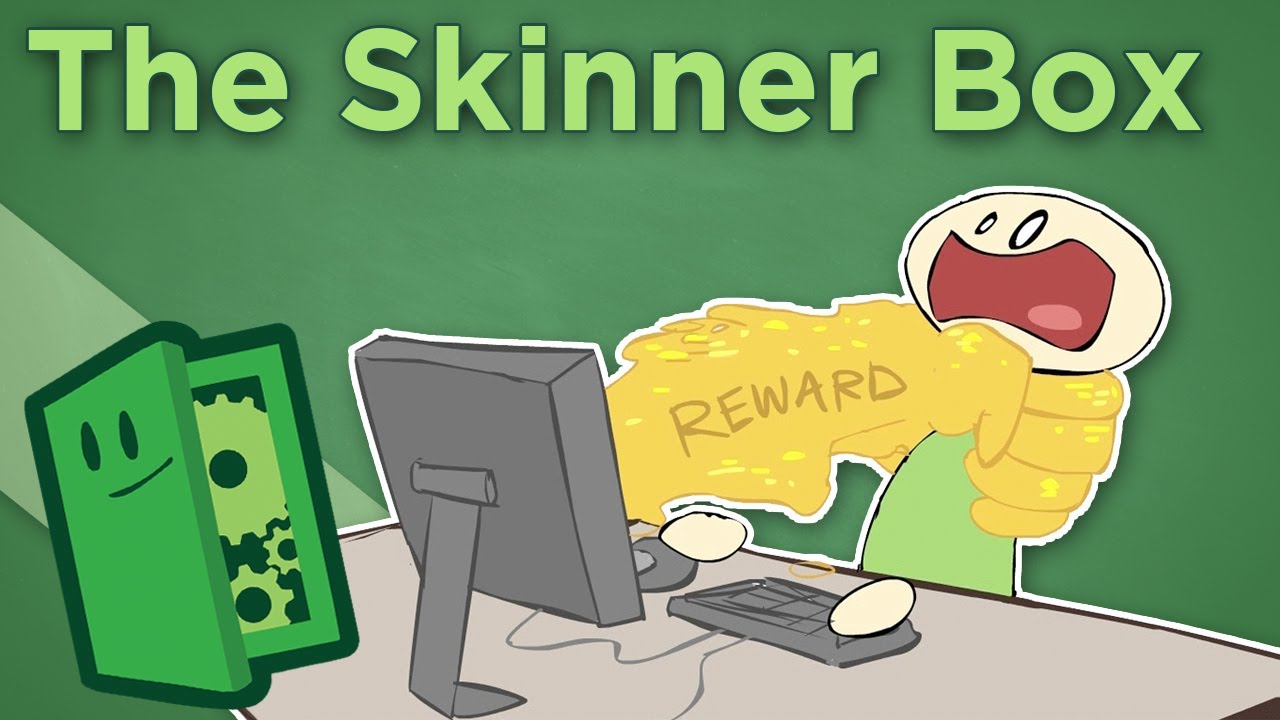
To test his hypothesis, Skinner constructed what is now known as the Skinner box: a simple container equipped with a button or lever into which he placed pigeons. Whenever a pigeon pecked the button, the apparatus dispensed food, while an attached recording device tracked the frequency of their pecks. The breakthrough lay in the nature of the action; pecking was not a passive physiological reflex, but an active decision. By successfully manipulating how often the birds chose to peck, Skinner demonstrated operant conditioning—the ability to systematically shape voluntary choice.
Skinner uncovered two startling principles through these experiments: - Operant conditioning works on human beings just as effectively as it does on animals. - Rewarding a subject every single time they perform an action is actually *not* the optimal way to keep them repeating it; offering rewards after an unpredictable number of repetitions (a variable ratio) or at specific time intervals (interval schedules) produces far higher and more persistent rates of repetition.
```mermaid flowchart TD accTitle: Operant Conditioning Reward Architecture accDescr: Diagram contrasting primary biological reinforcers which saturate versus secondary non-biological reinforcers which sustain engagement indefinitely.
subgraph Reinforcers["Types of Reinforcers"] PR["Primary Conditioners<br/>(Food, Water, Sex)"] SR["Secondary Reinforcers<br/>(Money, Points, Social Praise)"] end
subgraph Outcomes["Behavioral Outcomes"] SAT["Biological Satiation Point<br/>(Diminishing returns once full)"] LOOP["Indefinite Conditioning Loop<br/>(No satiation point / Compulsive repetition)"] end
PR -->|"Meets physical limits"| SAT SR -->|"Sustained by variable schedule"| LOOP ```
[01:32](https://www.youtube.com/watch?v=tWtvrPTbQ_c&t=92s) The Gambler's Paradox and the Illusion of Engagement
Skinner frequently illustrated operant conditioning by looking at gambling. Most gamblers fully understand that casino games are mathematically rigged against them, yet they persist in pulling the lever rather than undertaking an equally exhausting job that offers a steady paycheck and a higher guaranteed profit. When comparing spending eight hours at a slot machine to end up with $100 versus working eight hours pushing a button in a factory for the exact same $100 paycheck, people consistently judge the gambling experience as far more enjoyable.
This psychological quirk is reinforced by the distinction between reinforcer types. Primary conditioners—biological fundamentals like food, water, and sex—suffer from diminishing returns once an organism reaches physical satiation. Secondary reinforcers, which exist outside biology (such as money, virtual tokens, or social approbation), rarely encounter a natural satiation ceiling.
This mechanism directly explains why millions sink hours into titles like *FarmVille* or *World of Warcraft* long after the novelty has evaporated: - These games construct rigid reward schedules specifically engineered to compel players to perform actions that have turned completely tedious. - As an essential caveat, the narrator clarifies that behavioral conditioning is technically distinct from chemical addiction, though both result in repetitive play. - Designers use operant conditioning because it offers an easy shortcut: “The problem is that it's a lazy and cheap way to get someone to believe they're enjoying your product.” - This tactic creates post-play regret, leaving a player wondering weeks later why they dumped 80 hours of their life into a game that offered no genuine substance.
[03:14](https://www.youtube.com/watch?v=tWtvrPTbQ_c&t=194s) The Crutch of Reward Schedules and RPG Mechanics
The reliance on conditioning is endemic across the medium, extending far beyond poorly made role-playing games where loot drop rates and level-up ding sounds keep tired players awake chasing "just one more level." Almost any mechanic incorporating score tallies leans on this system, explaining why an elderly relative might sit playing *Bejeweled* for hours on end. Even *Solitaire*, historically the most played game worldwide, functions by offering the infrequent win as an intermittent reward. Action games rely on button-mashing reward loops over twelve-hour campaigns, and modern first-person shooters weaponize audio callouts, showering the player with voice lines praising how awesome they are.
This dynamic also drives the modern industry habit of shoehorning RPG leveling systems into every genre. While combining progression with mental and execution challenges works brilliantly in games like *Call of Duty* or *Dungeon Fighter*, too many developers use progression bars as an artistic shield. Bland, uninspired titles tack on reward systems merely to postpone the moment the audience notices the game beneath is hollow. Designers must be pushed to seek higher forms of engagement rather than settling for primitive Skinner box feedback.
```mermaid flowchart LR accTitle: Six Alternative Avenues of Player Engagement accDescr: Flowchart displaying the six non-conditioning design methods: Mystery, Mastery, Mental Challenge, Narrative, Novelty, and Flow.
subgraph Cognitive["Intellectual Hooks"] A["1. Mystery<br/>(Curiosity & Discovery)"] B["3. Mental Challenge<br/>(Logic & Problem-solving)"] end
subgraph Experiential["Aesthetic & Dynamic Hooks"] C["2. Mastery<br/>(Execution & Skill)"] D["4. Narrative<br/>(Story & World immersion)"] end
subgraph Sensory["Perceptual Hooks"] E["5. Novelty<br/>(Fresh aesthetics & Concepts)"] F["6. Flow<br/>(Rhythm & Trance-like focus)"] end ```
[04:27](https://www.youtube.com/watch?v=tWtvrPTbQ_c&t=267s) Six Authentic Methods for Fostering Engagement
Rather than relying on compulsion loops, games can achieve meaningful player engagement through six rich alternatives:
1. **Mystery:** Human curiosity possesses tremendous motivational force. Unraveling an enigma—sparking that moment where the player mutters, "What the hell is going on?" followed immediately by "I want to keep going to find out"—propels the audience naturally. 2. **Mastery:** Allowing the player to learn, refine, and execute a difficult skill creates deep satisfaction. This is prevalent in fighting games, rhythm games, and well-tuned action titles. 3. **Mental Challenge:** Daily life rarely satisfies the human appetite for active thought. Puzzles and complex tactical calculations—ranging from the logic brain-teasers of *Professor Layton* and *Myst* to the grand strategic maneuvers of *Civilization*—keep players hooked by flexing their brains. 4. **Narrative:** Storytelling provides a powerful anchor, whether through a compelling linear narrative or simply constructing an immersive fictional world that players actively want to inhabit. 5. **Novelty:** While hard to sustain indefinitely, humans crave unique experiences. This natural appetite for the new is why generic brown shooters feel stale and wear thin quickly, whereas uniquely realized worlds like *Planescape: Torment* endure. 6. **Flow:** Certain experiences—such as *Everyday Shooter*, *N₂O*, or an intense match of the original *Aliens versus Predator*—can lull a player into a zen-like trance. The player's eyes drop into a soft focus, breathing turns rhythmic, blinking slows, and the physical barrier of the controller dissolves until player and screen merge into pure instinct. Designers achieve this difficult state by establishing a play rhythm and accelerating the demanded reaction speed until the player is performing actions faster than conscious thought allows.
The best games do not rely on an isolated trick; they synthesize multiple organic techniques to engage their audience. The episode closes with a direct plea to current and aspiring game creators to abandon exploitative conditioning schedules: “Engagement and compulsion are different things. Just because you can make an experience compelling doesn't make it a good game.”
## Notable quotes > [04:27](https://www.youtube.com/watch?v=tWtvrPTbQ_c&t=267s) Engagement and compulsion are different things. Just because you can make an experience compelling doesn't make it a good game.
## Mentioned Burrhus Frederic Skinner, FarmVille, World of Warcraft, Bejeweled, Solitaire, Call of Duty, Dungeon Fighter, Professor Layton, Myst, Civilization, Planescape: Torment, Everyday Shooter, N₂O, Aliens versus Predator, Extra Credits
## Video description Engaging design is extremely important in games, but too often simple reward systems are used to keep players playing longer or spending more money on in-game purchases. There are far more interesting and immersive mechanics you can choose to put in your games. Subscribe for new episodes every Wednesday! http://bit.ly/SubToEC (---More below)
(Original air date: November 24, 2010) _______
Get your Extra Credits gear at the store! http://bit.ly/ExtraStore Play games with us on Extra Play! http://bit.ly/WatchEXP
Watch more episodes from this season of Extra Credits! http://bit.ly/2nrLiSZ
Contribute community subtitles to Extra Credits: http://www.youtube.com/timedtext_cs_panel?c=UCCODtTcd5M1JavPCOr_Uydg&tab=2
Talk to us on Twitter (@ExtraCreditz): http://bit.ly/ECTweet Follow us on Facebook: http://bit.ly/ECFBPage Get our list of recommended games on Steam: http://bit.ly/ECCurator _________
Would you like James to speak at your school or organization? For info, contact us at: contact@extra-credits.net _________
♪ Intro Music: "Penguin Cap" by CarboHydroM http://bit.ly/1eIHTDS
♪ Outro Music: "Consent (Make Me Dance)" by djpretzel http://ocremix.org/remix/OCR01186/
[Source](https://www.youtube.com/watch?v=tWtvrPTbQ_c)