Tesla Valve Explained With Fire
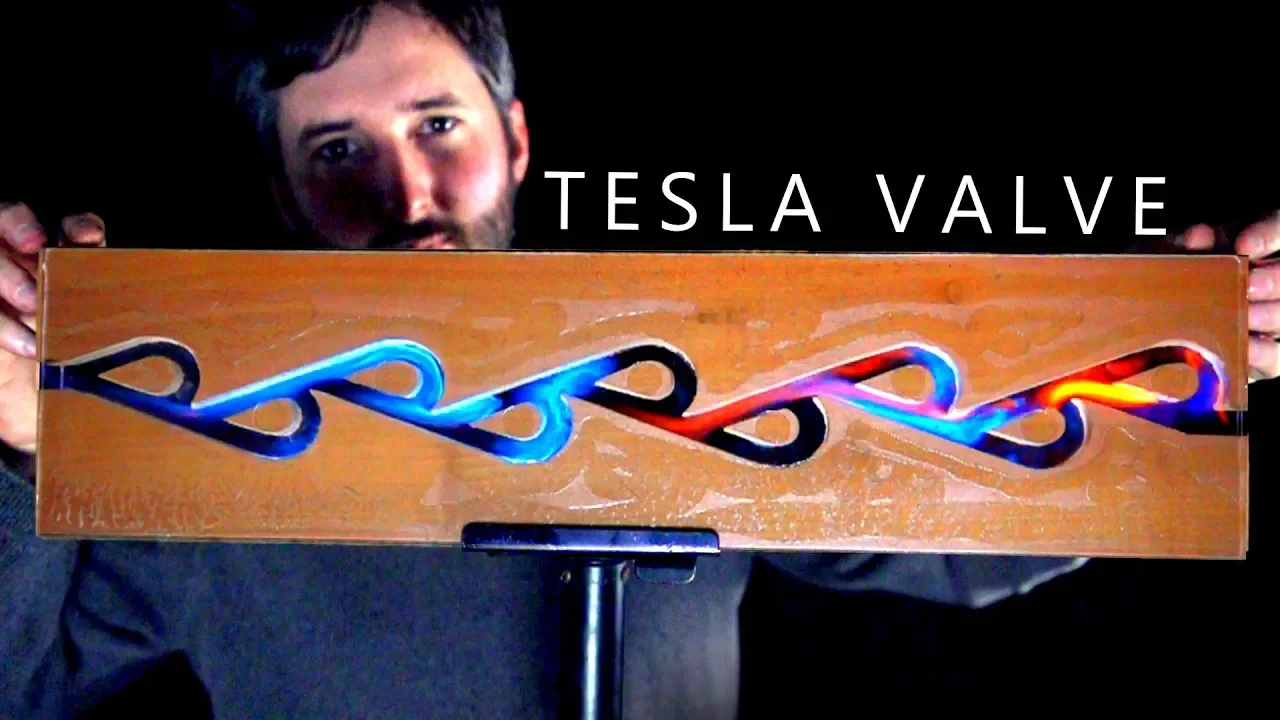
NightHawkInLight
AI-assisted summary of Tesla Valve Explained With Fire — original source. Check the original for full context.
Source published:
Detailed notes
## Background "Tesla Valve Explained With Fire" was published on YouTube by the channel NightHawkInLight on December 11, 2019. In the video's description, creator Ben explains that he demonstrates the inner workings of a Tesla valve by using the combustion of propane as a highly visible medium.
## TL;DR In this video, host Ben explores the fluid dynamics of a Tesla valve—a passive, one-way check valve with no moving parts—by using propane combustion as a visual tracer. By filming the reactions through a transparent, glass-paned valve with a high-speed camera, he demonstrates how the valve's static geometry restricts flow in one direction while facilitating it in the other. When ignited from the high-resistance end, the flame front stalls or self-extinguishes as backward-flowing jets from the loop fins actively choke the oncoming mixture. In contrast, igniting from the low-resistance end allows the expanding gases to build progressive pressure, rapidly accelerating the flame front and revealing the valve's potential as a reaction accelerator.
## Atmosphere & style The video has an analytical yet highly engaging and experimental tone, blending scientific curiosity with visually striking high-speed cinematography. Watching the flame fronts crawl, stall, or violently accelerate in slow motion creates a sense of wonder and discovery as complex fluid dynamics are made visible. Ben's calm, reflective narration and hands-on approach make the viewer feel like an active participant in a backyard laboratory breakthrough, especially during the dramatic split-screen comparison at the end.
## Detailed walkthrough ### [00:18](https://www.youtube.com/watch?v=tcV1EYSUQME&t=18s) Operating Principles of the Tesla Valve and Combustion Visualization Concept
Inspired by viewer comments on a previous video exploring propane bottle rocket testing, Ben sets out to investigate the mechanics of the Tesla valve. Originally conceived by Nikola Tesla, the device operates as a passive, one-way fluidic check valve. The valve contains zero moving parts and features completely static internal geometry, yet it produces asymmetric flow resistance. When fluid or gas enters from the forward direction, it sweeps smoothly through the central conduit, bypassing the side chambers without significant hindrance. Conversely, when forced into the opposite end, the oncoming medium is diverted into curved lateral loops or fins that route the flow backwards into the primary stream, actively interfering with and choking off oncoming fluid. As Ben explains: “If you input gas from one side of the valve, it has a very easy time making it all the way to the other side, but with no moving parts, if you input gas from the other side, the flow is much more restricted.”
Because visualizing gas dynamics directly within internal channels is notoriously difficult, Ben devised an experimental setup using combustion as a tracer medium. He constructed a transparent Tesla valve enclosed with glass viewing panes, allowing internal reactions to be filmed with a high-speed camera. By saturating the internal chamber with propane and igniting it alternately from each end, the propagating flame front serves as a high-contrast visual readout of velocity and directional resistance.
```mermaid flowchart LR accTitle: Tesla Valve Flow Comparison accDescr: Diagram illustrating forward low-resistance flow versus reverse high-resistance flow in a Tesla valve.
subgraph Forward["Forward Flow: Low Resistance"] direction LR InF["Inlet Flow"] --> MainF["Central Channel"] MainF --> OutF["Direct Exhaust"] end
subgraph Reverse["Reverse Flow: High Resistance"] direction LR InR["Inlet Flow"] --> SplitR["Diverter Fin"] SplitR --> LoopR["Curved Side Channel"] LoopR -->|"Collides with incoming flow"| MainR["Primary Stream Choke"] end ```
[02:05](https://www.youtube.com/watch?v=tcV1EYSUQME&t=125s) High-Speed Combustion in the Restricted Direction
Wearing safety glasses to protect against the possibility of the glass panes shattering if an ideal stoichiometric propane-air mixture detonates, Ben preps his ignition torch and rolls the high-speed camera. He initiates the first tests from the high-resistance end of the valve, pushing the combustion front against the geometry's intended blockage. In some runs, the fire struggles so intensely against the internal geometry that the flame fails to propagate entirely to the opposite exit.
Reviewing the high-speed footage in slow-motion reveals exactly how the static loop geometry disrupts the medium. As the primary flame front crawls forward, small tongues of fire peel into the reverse channels and whip backward into the path of the incoming burn, visibly accelerating against the overarching travel direction. Describing this counter-intuitive behavior, Ben notes: “On the high-speed, I was noticing as we're forcing the gas through the direction that it does not want to go in this valve, the tails of the fire coming back through these little channels are actually accelerating, it appears to be faster this direction than this direction, even though this is the direction of travel that the flame front is moving in.” This rapid retrograde jetting physically obstructs and quenches the oncoming mixture.
- The flame frequently stalls or self-extinguishes before reaching the far end when fired into the restricted side. - High-speed footage clearly shows backward flame jets emerging from the loop fins faster than the forward-propagating main flame front. - Each successive fin stage compounds this aerodynamic drag by repeatedly injecting counter-flowing jets into the central chamber.
[03:34](https://www.youtube.com/watch?v=tcV1EYSUQME&t=214s) Forward-Flow Acceleration and Future Supersonic Potential
When ignited from the opposite end—the low-resistance direction—the valve exhibits an entirely different acoustic and dynamic signature, producing a noticeably louder pop upon ignition. Rather than crawling or stalling, the flame front rapidly accelerates after crossing the first few channel segments. Because the experiment uses combustible propane rather than a steady passive stream of ambient gas, the combustion reaction causes dramatic thermal expansion right at the flame front itself. While this rapid expansion exerts force in both directions, the reverse geometry blocks backward expansion while the forward channel permits free movement. As a result, expanding gases build progressive pressure behind the flame front, driving it forward at an accelerating pace.
Ben reflects on this unexpected behavior: “This is a very interesting thing that I did not consider until I saw this high speed.” He realizes that beyond simple fluid rectification, the geometry effectively functions as an accelerator for reacting gases. Looking forward, he contemplates building an extended valve assembly to see just how fast a propagating reaction could travel, pondering whether an elongated channel could drive the combustion wave all the way to supersonic velocities. The video concludes with a split-screen slow-motion comparison, displaying both ignition directions side by side to highlight the dramatic disparity in flame propagation rates through identical static geometry.
- Combustion creates localized gas expansion that acts as a piston, transforming the valve into an acceleration tube. - Forward flow allows cumulative pressure buildup behind the flame, whereas backward expansion is continuously self-choked. - The acceleration effect suggests potential applications in rapid flame acceleration, pulse detonation, or supersonic combustion experiments.
## Video description In this video I demonstrate the workings of a Tesla Valve using the combustion of propane as a visible medium. If you enjoy these videos consider supporting my channel on Patreon: https://www.patreon.com/NightHawkProjects
A special thanks to my top patrons: Enzo Breda Lee & TheBackyardScientist!
Thanks for watching! -Ben
[Source](https://www.youtube.com/watch?v=tcV1EYSUQME)