Hexagons Beat Squares and Triangles on Space and Material Efficiency
CGP Grey
Hexagonal lattices dominate biological and industrial structures because their 120-degree joints enclose maximum volume with minimum perimeter, eliminating the material waste of rival shapes.
Bees construct hives with hexagons because wax production is metabolically costly, requiring roughly eight units of honey per unit of wax and demanding the most wall-efficient tiling shape. (0:00)
Hexagonal packing optimizes area-to-perimeter ratios across biology, organizing both bee ommatidia and human retinal photoreceptors into hexagonal lattices to maximize light capture. (2:21)
Hexagonal symmetry manifests across extreme scales in nature, from the molecular lattice of freezing water in snowflakes to Saturn's atmospheric Great Hexagon spanning six Earth diameters. (3:26)
Meeting at balanced 120-degree vertices, hexagonal networks distribute mechanical loads symmetrically—powering ultra-strong graphene, aerospace honeycomb panels, and distortion-free game boards. (5:28)
Detailed notes
## Background
Published by CGP Grey on YouTube on November 3, 2020, the video serves as a comedic yet mathematically grounded treatise on the superiority of the hexagon. The video description links to a behind-the-scenes companion video and promotional merchandise celebrating the phrase 'Hexagons are the Bestagons,' alongside credits to contributing mathematical advisors and crowdfunders.
## TL;DR
CGP Grey builds an exhaustive case for why the regular hexagon is the ultimate geometric polygon, coining the maxim 'hexagons are the bestagons.' Beginning with the honeycomb conjecture and the biological economics of bee wax, the video demonstrates how hexagons maximize internal area while minimizing wall perimeter without leaving gaps. The analysis expands across science and engineering, highlighting hexagonal patterns in retinal photoreceptors, snowflakes, Saturn's Great Hexagon, graphene lattices, aerospace honeycomb paneling, and tabletop game boards that eliminate diagonal spatial distortion.
## Atmosphere & style
The presentation is fast-paced, dryly humorous, and marked by a playfully dogmatic, quasi-cultish fervor for geometric perfection. CGP Grey blends clear mathematical pedagogy with exaggerated condescension toward inferior shapes like squares and pentagons, creating an infectious sense of revelation. The video builds to a conspiratorial, mock-reverent crescendo that treats geometric appreciation as an elite brotherhood before abruptly terminating with a sharp mechanical click.
## Bulletin
- [00:00](https://www.youtube.com/watch?v=thOifuHs6eY&t=0s) Bees construct hives with hexagons because wax production is metabolically costly, requiring roughly eight units of honey per unit of wax and demanding the most wall-efficient tiling shape.
- [02:21](https://www.youtube.com/watch?v=thOifuHs6eY&t=141s) Hexagonal packing optimizes area-to-perimeter ratios across biology, organizing both bee ommatidia and human retinal photoreceptors into hexagonal lattices to maximize light capture.
- [03:26](https://www.youtube.com/watch?v=thOifuHs6eY&t=206s) Hexagonal symmetry manifests across extreme scales in nature, from the molecular lattice of freezing water in snowflakes to Saturn's atmospheric Great Hexagon spanning six Earth diameters.
- [05:28](https://www.youtube.com/watch?v=thOifuHs6eY&t=328s) Meeting at balanced 120-degree vertices, hexagonal networks distribute mechanical loads symmetrically—powering ultra-strong graphene, aerospace honeycomb panels, and distortion-free game boards.
## Key takeaways
- [00:00](https://www.youtube.com/watch?v=thOifuHs6eY&t=0s) Wax is biologically expensive for bees, consuming approximately eight units of floral honey to produce a single unit of wax.
- [00:00](https://www.youtube.com/watch?v=thOifuHs6eY&t=0s) Out of all regular polygons, only equilateral triangles, squares, and regular hexagons can tile a two-dimensional plane without leaving gaps.
- [00:00](https://www.youtube.com/watch?v=thOifuHs6eY&t=0s) Unlike squares and triangles that tile through parallel grids or continuous self-division, hexagons tile without debasing self-division.
- [00:00](https://www.youtube.com/watch?v=thOifuHs6eY&t=0s) Irregular and complex tiling shapes, including Cairo pentagonal tiles and rhombuses, naturally aggregate into hexagonal macro-patterns.
- [02:21](https://www.youtube.com/watch?v=thOifuHs6eY&t=141s) While circles maximize area per perimeter in isolation, packing them together leaves wasted gaps and forces their centers into a hexagonal layout.
- [02:21](https://www.youtube.com/watch?v=thOifuHs6eY&t=141s) Among all shapes capable of tiling a plane, regular hexagons enclose the maximum area with the absolute minimum perimeter wall material.
- [02:21](https://www.youtube.com/watch?v=thOifuHs6eY&t=141s) Bee compound eye facets and human retinal photoreceptor cells both use hexagonal lattices to maximize incoming light capture while minimizing tissue used for cell walls.
- [03:26](https://www.youtube.com/watch?v=thOifuHs6eY&t=206s) Saturn's north pole features an atmospheric cloud formation shaped like a regular hexagon spanning roughly six Earth diameters across.
- [03:26](https://www.youtube.com/watch?v=thOifuHs6eY&t=206s) Standard snowflakes display six-fold radial symmetry because water molecules freeze into hexagonal crystal lattices known as Ice Ih.
- [05:28](https://www.youtube.com/watch?v=thOifuHs6eY&t=328s) Hexagonal lattices share three-way vertices oriented at 120-degree angles, distributing compressive and tensile stresses symmetrically across neighboring edges.
- [05:28](https://www.youtube.com/watch?v=thOifuHs6eY&t=328s) Graphene, composed of a single atom-thick sheet of carbon arranged in hexagonal rings, requires roughly 100 times more tensile force to rupture than structural steel.
- [05:28](https://www.youtube.com/watch?v=thOifuHs6eY&t=328s) Sandwiching an expanded hexagonal core between rigid outer sheets creates honeycomb paneling that provides high flexural strength and minimal weight for aerospace applications.
- [05:28](https://www.youtube.com/watch?v=thOifuHs6eY&t=328s) Square game boards distort movement along diagonals to approximately 1.414 spaces with four neighbors, whereas hexagonal game boards offer six equidistant, non-distorted directions of travel.
## Detailed walkthrough
### [00:00](https://www.youtube.com/watch?v=thOifuHs6eY&t=0s) The Honeycomb Conjecture: Bees and the Tiling Problem
The case for the hexagon begins with an undeniable axiom: “Hexagons are the bestagons.” Why? Because bees are the best, and they build exclusively with the hexagon. While one might initially assume bees favor hexagons simply because they are hexapods equipped with hexagonal compound eyes, the true motivation comes down to a demanding engineering dilemma. The humble bumblebee produces two substances: honey to eat and wax to contain that honey. Generating even a tiny amount of honey demands visits to thousands of flowers, and producing a single unit of wax consumes roughly eight units of honey. Wax is therefore brutally expensive in terms of floral labor, while honey is a drippy liquid requiring containment. To survive, a colony must construct a hive that encloses the maximum volume of honey while expending the absolute minimum amount of wax—a real-world manifestation of the mathematical honeycomb conjecture.
To determine which shape optimizes storage, one must look at tessellation, or covering an infinite surface with repeating polygons. More complicated polygons use excess perimeter by definition, meaning any honeycomb constructed from them would waste wax. When restricted to simple regular polygons, only three shapes can tile a plane tightly without leaving empty space: the equilateral triangle, the square, and the regular hexagon. Pentagons and septagons are essentially broken shapes that leave awkward gaps when forced together, and while octagons are passable, they still fail to tile on their own. Among the functional trio, squares tile by what amounts to uninspired cheating—stretching an infinite grid of parallel lines across an infinite plane, which CGP Grey dismisses as boring. Triangles rely on the exact same trick, continually dividing themselves into smaller self-divisions. The hexagon, by contrast, is the only regular polygon capable of tiling a plane without debasing self-division.
Even when other shapes try to tile, they inevitably succumb to hexagonal mimicry. Irregular shapes like rhombuses, triakis tilings, deltoidal trihexagonals, kisrhombille patterns, and floret pentagonals end up aggregating into hexagonal networks. Even Cairo pentagonal tiles bunch together into lumpy hexagons. CGP Grey proclaims: “The other shapes can't help it. They just want to be the bestagon.”
```mermaid
flowchart TD
accTitle: Tiling Capabilities of Regular Polygons
accDescr: Flowchart categorizing regular polygons by whether they tile a plane tightly and how they behave.
A["Regular Polygons"] --> B["Tiling Trio"]
A --> C["Gap-Leaving Shapes"]
subgraph TilingTrio["The Tiling Trio"]
B --> B1["Square<br/>(Parallel lines / Cheating)"]
B --> B2["Triangle<br/>(Divides into self)"]
B --> B3["Hexagon<br/>(Noble, Indivisible Bestagon)"]
end
subgraph NonTiling["Incomplete Tilers"]
C --> C1["Pentagon (Leaves gaps)"]
C --> C2["Septagon (Leaves gaps)"]
C --> C3["Octagon (Requires diamond fills)"]
end
```
- Wax production cost: 8 units of honey are consumed to manufacture 1 unit of wax.
- Only three regular polygons tile a flat plane seamlessly: triangles, squares, and hexagons.
- Various complex tilings—including Cairo pentagonal tiles and rhombuses—naturally cluster into hexagonal macro-structures.
---
[02:21](https://www.youtube.com/watch?v=thOifuHs6eY&t=141s) Min-Max Perfection: From Packing to Eyes
While a circle holds the mathematical crown for enclosing the most area within the absolute minimum perimeter, it only works in complete isolation. As soon as multiple circles are packed together, they leave glaring gaps of wasted space; filling those gaps with material only squanders more wax. Furthermore, when circles are packed as tightly as possible against one another, their centers naturally arrange into a six-pointed cluster—revealing yet another hidden hexagon. In communal storage, the hexagon remains undefeated, delivering the maximum interior volume for the least wall material.
```
+-------------------+------------------+---------------------+
| Polygon / Shape | Tiles Plane? | Wall Efficiency |
+-------------------+------------------+---------------------+
| Circle | No (Leaves gaps) | Best single; worst |
| | | when packed |
| Triangle | Yes | Low area-to-wall |
| Square | Yes | Moderate efficiency |
| Hexagon | Yes | Maximum area for |
| | | minimum perimeter |
+-------------------+------------------+---------------------+
```
This optimal min-max property explains why hexagonal architecture recurs across evolutionary biology, starting with the compound eyes of the bees themselves. Each facet in a bee's eye is an elongated tube channeling ambient light directly down to light-sensitive cells at the base. More light yields sharper vision, and hexagonal tubes capture the maximum quantity of light while wasting the minimum amount of tissue on dividing walls. Human vision operates under the exact same constraint: while human eyes appear spherical on the outside, the photoreceptor cells lining the retina at the back of the eye are organized into a hexagonal mosaic. CGP Grey stresses the universality of this design: “Your light-catching cells are at the back of your eye, in a hexagonal grid for the same reason as bees.”
- Packed circles naturally fall into a six-neighbor hexagonal configuration.
- Hexagons achieve the ultimate balance of interior area to wall perimeter for any tiling shape.
- Bee ommatidia and human retinal photoreceptor cells both arrange in hexagonal lattices to maximize light capture.
---
[03:26](https://www.youtube.com/watch?v=thOifuHs6eY&t=206s) Wonders of Scale: Saturn’s Great Hexagon and Snowflake Symmetry
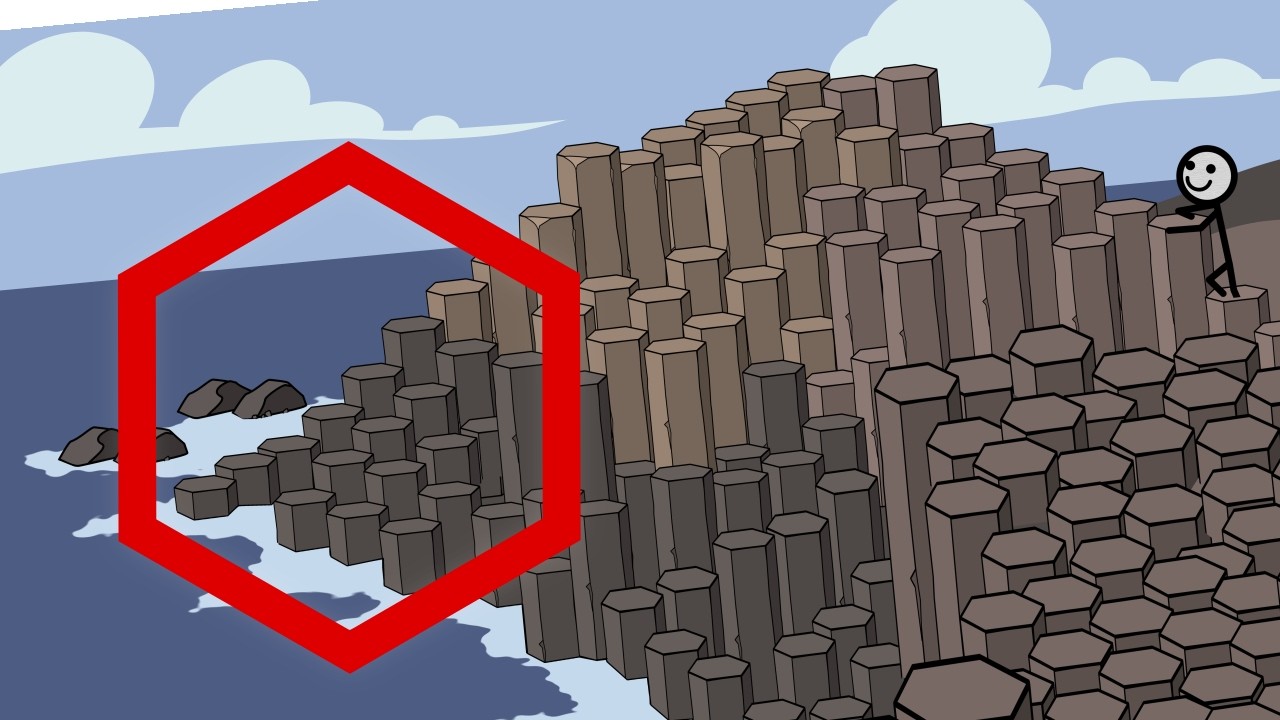
Hexagonal geometry dominates at astronomical and molecular extremes. At the north pole of the ringed gas giant Saturn sits an unexplained planetary feature: the Great Hexagon of Saturn. Spanning a width that could comfortably swallow six Earths side-by-side, this massive atmospheric structure is not a solid geological formation like Earth's basalt columns, because Saturn lacks a solid surface entirely. Instead, it consists of shapeless atmospheric clouds that somehow maintain crisp six-sided symmetry while rotating and changing colors. Joking about extraterrestrial contact, CGP Grey notes that if an advanced alien civilization wanted to leave an artifact where curious species would find it, placing a planetary beacon with Earth-sized hexagonal sides on the most eye-catching planet would be the logical choice: “Hexagon is the bestagon. From the largest down to the smallest.”
At the opposite end of the size spectrum, hexagonal symmetry governs the crystalline realm. Every standard snowflake displays six-fold radial symmetry because water molecules naturally assemble into hexagonal rings when freezing into ice lattices. As additional water molecules lock onto the structure, they expand the snowflake outward in a fractal pattern, preserving atomic geometry at a visible scale. Twelve-sided snowflakes occasionally appear, but only when two separate six-sided crystals collide and fuse during growth. This geometry extends to Ice $I_h$, the hexagonal crystal structure comprising virtually all natural ice on Earth (aside from the boring cubic Ice $I_c$ or the dangerous, fictional Ice-nine).
- Scale of Saturn's North Pole Hexagon: approximately six Earth diameters wide.
- Saturn's hexagon is an atmospheric cloud dynamic rather than a solid geological formation.
- Ice $I_h$ (hexagonal ice) accounts for almost all ice found on Earth; rare variations like Ice $I_c$ form cubes.
---
[05:28](https://www.youtube.com/watch?v=thOifuHs6eY&t=328s) Mechanical Superiority: Graphene, Structural Paneling, and Game Boards
The mechanical dominance of the hexagon stems from simple physics: when hexagons share edges, they meet at three-sided vertices oriented exactly 120 degrees apart. This layout provides the highest structural stability for the least mass. Pushing inward on one joint causes the remaining two to resist with equal force; pulling outward distributes the tensile load symmetrically. The entire lattice functions as an interconnected web where each vertex reinforces its neighbors. Basalt columns and soap bubbles naturally shed unstable curves to settle into hexagonal boundaries under pressure.
This geometry is vividly demonstrated in graphite. The "lead" inside a pencil is pure carbon, arranged in sheets of hexagonal rings. A single isolated layer forms graphene—the strongest atomic material known to science—requiring roughly 100 times more tensile force to rupture than structural steel. Because these hexagonal sheets bond tightly within each plane but slide easily across adjacent layers, a pencil can shed sheets to mark paper. When translated into macroscopic engineering, the geometry yields honeycomb paneling. Sandwiching an expanded hexagonal core between two thin sheets of aluminum or cardboard creates an exceptionally light, tear-resistant, and flexible composite essential for aviation and rocketry, where aircraft wings must flex without failing: “Give thanks to the hexagon for blessing our flight.”
Finally, the hexagon reigns supreme in game design. Square boards introduce severe mathematical distortion: moving orthogonally traverses a distance of exactly 1 space, whereas moving diagonally spans $\sqrt{2}$ spaces (approximately 1.414 spaces), corrupting spatial relationships. A square touches only four immediate neighbors. In contrast, every cell on a hexagonal board borders six direct neighbors at identical center-to-center distances: “Hexagons, however, have six which is more than four, which is better! And the distance from one space to the next is the same in every direction. One space. Just as it should be.”
- Graphene sheets require approximately 100 times more force to tear apart than steel.
- Three-way joints at 120-degree angles maximize load distribution and mechanical resistance.
- Honeycomb sandwich paneling provides high rigidity, flexural strength, and minimal weight in aerospace engineering.
- Square game grids warp movement along diagonals ($\sqrt{2}$ distance) and offer only 4 primary neighbors, whereas hexagonal grids provide 6 equidistant moves.
[09:02](https://www.youtube.com/watch?v=thOifuHs6eY&t=542s) Spreading the Enlightenment of the Order
In a conspiratorial, mock-reverent tone that caps off the discourse on geometric superiority, CGP Grey delivers a final parting charge to the viewer, treating the appreciation of the shape as membership in a secretive, enlightened society. Dismissing the audience to evangelize the geometric truth they have just received, CGP Grey commands: “Now, go. Share the enlightenment of the order with others.” The video then abruptly snaps off with the sound of a sharp mechanical click.
## Notable quotes
> [02:21](https://www.youtube.com/watch?v=thOifuHs6eY&t=141s) Your light-catching cells are at the back of your eye, in a hexagonal grid for the same reason as bees. — CGP Grey
## Mentioned
CGP Grey, David Rees, David Sheard, Earth, Ice Ic, Ice Ih, Ice-nine, London Maths, Professor Dave Explains, Saturn
## Video description
- Behind the Scenes: https://www.youtube.com/watch?v=4R3N1oeKbE4
- Hexagons are the Bestagons shirt: https://store.dftba.com/collections/all/products/hexagons-t-shirt
Special Thanks
Professor Dave Explains
London Maths
David Sheard
Crowdfunders
Steven Snow, John Buchan, Nevin Spoljaric, Donal Botkin, BN-12 , Ben Delo, Bobby , Chris Chapin, Richard Jenkins, Phil Gardner, Martin, Steven Grimm, سليمان العقل, David F Watson, Colin Millions, Ben Schwab, Saki Comandao, Jason Lewandowski, Marco Arment, Shantanu Raj, rictic , emptymachine , George Lin, Henry Ng, Thunda Plum, Awoo , David Tyler, Fuesu , iulus , Jordan Earls, Joshua Jamison, Nick Fish, Nick Gibson, Tyler Bryant, Oliver Steele, Andrew Bereza, Kermit Norlund, Kevin Costello, Rebecca Wortham, Derek Bonner, Derek Jackson, Mikko , Orbit_Junkie , Ron Bowes, Tómas Árni Jónasson, Bryan McLemore, Kyle Wayman, Alex Simonides, Felix Weis, Melvin Sowah, Christopher Mutchler, Giulio Bontadini, Paul Alom, Ryan Tripicchio, Scot Melville, Julien Dubois, Bear , chrysilis , David Palomares, Emil , Erik Parasiuk, Esteban Santana Santana, Freddi Hørlyck, John Rogers, Leon , Peter Lomax, Rhys Parry, ShiroiYami , Tristan Watts-Willis, Veronica Peshterianu, Dag Viggo Lokøen, John Lee, Maxime Zielony, Elizabeth Keathley, and Nicholas Welna
六边形在空间与材料效率上优于正方形和三角形
六边形点阵在生物与工业结构中占据主导地位,因为其120度角连接处能以最小周长包围最大体积,消除了竞品形状的材料浪费。
CGP Grey详尽阐述了正六边形为何是终极几何多边形,并提出了“六边形是最佳多边形”(hexagons are the bestagons)的格言。视频从蜂巢猜想和蜜蜂蜂蜡的生物经济性切入,展示了六边形如何在无缝密铺的同时以最小的墙体周长实现最大的内部面积。该分析进一步延伸至科学与工程领域,重点介绍了视网膜感光细胞、雪花、土星大六边形、石墨烯晶格、航空航天蜂窝夹层板以及消除对角线空间失真的桌面游戏棋盘中的六边形图案。
蜜蜂之所以用六边形筑巢,是因为生产蜂蜡在代谢上代价高昂,每产生一单位蜂蜡大约需要消耗八单位蜂蜜,从而需要墙体效率最高的密铺形状。 (0:00)
六边形密铺优化了整个生物界的面积周长比,将蜜蜂复眼的小眼和人类视网膜感光细胞都组织成六边形点阵,以最大限度地捕获光线。 (2:21)
六边形对称性在自然界的不同极端尺度上均有显现,从雪花中水结冰时的分子晶格,到跨度达六个地球直径的土星大气“大六边形”。 (3:26)
六边形网络相交于平衡的120度顶点,对称地分散机械载荷——这为超强石墨烯、航空航天蜂窝板以及无失真游戏棋盘提供了结构支持。 (5:28)
Detailed notes — zh
## Background
该视频由知名科普频道 CGP Grey 于 2020 年 11 月 3 日发布在 YouTube 平台上。视频简介提供了幕后制作花絮链接以及印有经典口号“Hexagons are the Bestagons”的周边 T 恤,并列出了协助审校的数学家与众筹支持者名单。
## TL;DR
视频从蜜蜂建造蜂巢的极高花蜜与蜂蜡成本切入,阐明正六边形在平面密铺中拥有“以最小边界围成最大面积”的极致几何效率。随后,CGP Grey 带领观众穿梭于宏观与微观领域,揭示六边形在人类与蜜蜂复眼构造、土星北极六边形风暴、冰晶微观构型、石墨烯分子结构以及航空蜂窝板材中的绝对统治力。最后,视频通过对比棋盘游戏中正方形网格的对角线失真与六边形网格的各向同性,得出正六边形是宇宙间最完美的几何形状(Bestagon)的终极结论。
## Atmosphere & style
全片洋溢着 CGP Grey 标志性的冷幽默与一本正经的荒诞传教感,语速干脆利落、逻辑层层递进。作者以极具煽动性的拟真“教主”口吻,将严谨的几何拓扑学与材料力学包装成一场对六边形的崇拜狂欢。整部作品视听节奏明快,兼具硬核科普的思辨性与令人捧腹的戏谑张力,让观众在不知不觉中被其强烈的几何秩序美学所俘获。
## Bulletin
- [00:00](https://www.youtube.com/watch?v=thOifuHs6eY&t=0s) 蜂巢猜想指出在能够完全密铺平面的正多边形中,仅有正三角形、正方形和正六边形三种;六边形能以最短的周长围出最大的面积,使蜜蜂在生产蜂蜡成本高昂的前提下容纳最多的蜂蜜。
- [04:31](https://www.youtube.com/watch?v=thOifuHs6eY&t=271s) 六边形具备极致的力学稳定性,其密铺网络由相隔120度的三向节点交汇而成,能够均等分散推力与拉力;单层六边形碳原子构成的石墨烯抗拉强度达到同等厚度钢材的约100倍。
- [02:48](https://www.youtube.com/watch?v=thOifuHs6eY&t=168s) 土星北极存在一个尺度足以容纳地球的六边形风暴,完全由气态云层维持稳定;微观尺度下,水分子在热力学驱动下自然结晶为六方晶系的冰Ih并形成六角雪花。
- [06:39](https://www.youtube.com/watch?v=thOifuHs6eY&t=399s) 在图版游戏与战棋设计中,六边形网格彻底解决了正方形棋盘对角线距离约为1.414格导致的距离失真问题,保证了六个邻接方向中心距离绝对恒定。
## Key takeaways
- [00:00](https://www.youtube.com/watch?v=thOifuHs6eY&t=0s) 工蜂制造蜂蜡的代价极高,每生产1个单位蜂蜡需消耗8个单位蜂蜜,因此蜂巢必须追求容积对周长消耗的极致几何效率。
- [00:00](https://www.youtube.com/watch?v=thOifuHs6eY&t=0s) 能够无缝紧密密铺平面的正多边形仅有正三角形、正方形与正六边形三种,而五边形、七边形等均会留下空隙。
- [00:00](https://www.youtube.com/watch?v=thOifuHs6eY&t=0s) 单体圆形虽然面积周长比最优,但在密集堆叠时必然产生空隙,且圆形的紧密堆积中心本身即呈六边形排布。
- [02:48](https://www.youtube.com/watch?v=thOifuHs6eY&t=168s) 蜜蜂复眼的每个微小透镜与人类视网膜后方的感光细胞均呈六边形排布,以最小的外壁阻隔换取最大的进光量。
- [02:48](https://www.youtube.com/watch?v=thOifuHs6eY&t=168s) 土星北极盘旋着巨大的六边形风暴,边长达地球级别,证明六边形秩序即使在无定形气态流体中也能自发维持稳定轮廓。
- [04:31](https://www.youtube.com/watch?v=thOifuHs6eY&t=271s) 水分子相互结合形成晶体时在热力学上偏好六边形构型,使绝大多数天然雪花和冰块(冰Ih)均呈现六角晶系对称。
- [04:31](https://www.youtube.com/watch?v=thOifuHs6eY&t=271s) 单层石墨烯由碳原子六边形网络构成,撕裂所需受力是同厚度钢材的100倍,展现了微观六边形网格的抗拉极限。
- [04:31](https://www.youtube.com/watch?v=thOifuHs6eY&t=271s) 六边形网络的节点均呈120度对称三向分布,无论面对受压还是拉扯都能通过相邻两个分支均等反向支撑,达成天然机械平衡。
- [06:39](https://www.youtube.com/watch?v=thOifuHs6eY&t=399s) 现代航空航天工业将铝材等压制为六边形蜂窝夹层板,以极轻的结构自重兼顾高抗撕裂性与必要的柔韧形变能力。
- [06:39](https://www.youtube.com/watch?v=thOifuHs6eY&t=399s) 正方形棋盘相邻格子仅有4个共边方向,其对角线移动距离为根号2(约1.414格),破坏了棋盘空间的各向同性与距离真实性。
- [06:39](https://www.youtube.com/watch?v=thOifuHs6eY&t=399s) 六边形网格具有6个完全等距且对称的共边邻接方向,消除了对角线距离不均,在战棋模拟中完美保留了时空连续性。
- [09:02](https://www.youtube.com/watch?v=thOifuHs6eY&t=542s) 自然界与工程学在力学、密铺与采光等多维度的选择,共同得出了“六边形是最佳形状(Hexagons are the bestagons)”的几何哲学结语。
## Detailed walkthrough
### [00:00](https://www.youtube.com/watch?v=thOifuHs6eY&t=0s) 蜜蜂的工程困境与密铺几何学
蜜蜂建造蜂巢选择六边形,绝不仅仅是因为它们是拥有六边形复眼的六足昆虫,而是出于极其严苛的工程效率考量。工蜂在生命中主要制造两样东西:蜂蜜与蜂蜡——前者用来食用,后者用来储存前者。蜜蜂采蜜需要飞访海量花朵,而要生产1个单位的蜂蜡,足足需要消耗8个单位的蜂蜜。由于蜂蜡在“花朵成本”上极为昂贵,蜂蜜本身又易于流淌,蜂巢必须做到用最少量的蜂蜡容纳最大量的蜂蜜。这就引出了著名的“蜂巢猜想”(Honeycomb Conjecture):到底哪种几何形状在密铺平面时效率最高?
```mermaid
flowchart TD
accTitle: 密铺多边形的选择与淘汰逻辑
accDescr: 比较不同几何形状在平面密铺中的表现,最终六边形胜出。
subgraph Regulars["正多边形密铺候选"]
Tri["正三角形<br/>(无限自割组合出六边形)"]
Sq["正方形<br/>(平行线简单平移,极度无趣)"]
Hex["正六边形<br/>(完美密铺,极值最优)"]
end
subgraph Excluded["被淘汰的形状"]
Pen["正五边形 / 七边形<br/>(留下空隙,无法紧密密铺)"]
Oct["正八边形<br/>(无法独立密铺)"]
Cir["圆形<br/>(单体周长最小,但堆叠留空隙)"]
end
Pen --> Excluded
Oct --> Excluded
Cir --> Excluded
Tri -->|"6个组合"| Hex
Sq -->|"作弊式分割"| Hex
Hex --> Win["最佳形状:六边形 (Bestagon)"]
```
密铺(Tiling)是指用多边形无缝覆盖一个平面。复杂的图案必然包含更多多余的线条,从而消耗更多蜂蜡。在能够紧密无缝密铺的正多边形中,实际上只有三种选择:三角形、正方形和正六边形。五边形和七边形密铺会留下缝隙,八边形也无法独立平铺。正方形只是借由无数条平行线在平面上机械延展,毫无几何美感可言;三角形看似稍有变化,但将6个三角形拼在一起,本质上依旧是在拼凑六边形。菱形、三角化六边形密铺(Triakis tiling)、三六边形镶嵌(Deltoidal trihexagonal)、开斯菱形(Kisrhombille)、花瓣五边形镶嵌(Floret pentagonal),乃至开罗五边形密铺(Cairo tiles),最终呈现的都是六边形或者扭曲的六边形形态。CGP Grey 总结道:“The hexagon, nobly indivisible, is the bestagon.”
- 蜜蜂生产 1 单位蜂蜡需要消耗 8 单位蜂蜜。
- 能够无缝紧密密铺平面的正多边形仅有 3 种:正三角形、正方形、正六边形。
- 圆形在单体状态下面积与周长比最优,但在平面堆叠时会留出巨大空隙;即便填补缝隙,也会耗费更多材料,且圆形的紧密堆积中心本身就呈六边形排布。
---
### [02:48](https://www.youtube.com/watch?v=thOifuHs6eY&t=168s) 极值之王:从复眼到土星北极的神秘巨阵
六边形具备“最小边界围成最大面积”的极致属性(Min-Max Stat),这使得它在生物演化和宇宙现象中屡屡现身。蜜蜂复眼中的每个微小六边形,都是一根通往底部感光细胞的长管:更大的进光量代表更敏锐的视觉,而六边形能以最少的外壁阻隔捕获最多的光线。人类的眼睛内部其实同样遵循这一规律——视网膜后方的感光细胞排列并非正方形,而是呈六边形网格分布,以达到“最大进光量、最小间隔壁”的采光极限。正如 CGP Grey 所言:“Your window to the world, is but through the hexagon.”
目光转向深空,在土星的北极上空,盘旋着整个太阳系中最壮丽的未解之谜——“土星六边形风暴”(The Great Hexagon of Saturn)。这个巨大风暴结构的边长甚至能够容纳下地球(直径能放下约六个地球)。土星是一颗气态巨行星,没有像地球玄武岩柱那样的固态地质构造,这意味着该风暴完全是由无定形的气体云层构成,却能不可思议地长期维持稳定的六边形轮廓并变换色彩。CGP Grey 调侃道,如果外星文明要在太阳系最引人注目的星球上留下一座信标巨石,这个拥有地球尺度边长的六边形风暴绝对是首选,毕竟没有高等智慧生命会愿意接触连“六边形是最佳多边形”这种宇宙普适真理都尚未参透的无知灵长类。
---
### [04:31](https://www.youtube.com/watch?v=thOifuHs6eY&t=271s) 微观完美:冰晶、石墨烯与力学稳定极限
将视角从宏观天体缩小至微观原子世界,六边形的几何统治力依旧无可动摇。每一朵自然落下的雪花都拥有六个分支,这是因为水分子相互结合形成晶体时,在热力学上最偏好牢固的六边形构型。随着分子进一步附着,冰晶在分形机制下向外延伸,将原子层面的六边形对称性投射到宏观可见的雪花上(即使偶见十二边形雪花,也是两朵雪花粘连所致)。地球上几乎所有的普通冰都是六角晶系的“冰 Ih”(Ice 1h),至于立方晶系的“冰 Ic”由于过于无趣而鲜被提及,而虚构小说中的“冰九”(Ice-9)更是千万碰不得的危险之物。
在碳元素的世界里,六边形展现出了极致的力学强度。铅笔芯并非由铅制成,而是由石墨(碳原子组成的六边形网络)构成。单层六边形碳原子薄片即为石墨烯(Graphene),它是宇宙中已知原子尺度强度最高的材料;撕裂单层石墨烯所需的力是撕裂同等厚度钢材的 100 倍。这种极致强度源于六边形拼接时自然形成的节点夹角:
```mermaid
flowchart TD
accTitle: 六边形力学稳定性受力分析
accDescr: 说明120度节点如何分散推力与拉力以实现最大力学稳定。
subgraph Joint["120度三向力学节点"]
A["受力节点"]
B["分支 1 (120°)"]
C["分支 2 (120°)"]
D["分支 3 (120°)"]
A --- B
A --- C
A --- D
end
subgraph Mechanics["力学响应机制"]
Pull["拉动任一分支"] -->|"其余两向提供"| PullResist["均等对称反向拉力"]
Push["推入任一节点"] -->|"其余两向提供"| PushResist["最稳定的抗压支撑"]
end
```
大自然极其偏爱力学稳定性,从地质玄武岩柱到相互挤压的肥皂泡,都会自发褪去球形而贴合为六边形。CGP Grey 强调了这一点:“Now look anew at a tiling of hexagons and you see it is composed of nothing but these max stable joints, each arranged perfectly to help the others be stronger and stabler.”
- 地球上绝大多数天然冰均为六方晶系结构“冰 Ih”(Ice 1h)。
- 石墨烯由单层六边形碳原子排列而成,其理论抗拉强度约为普通钢材的 100 倍。
- 六边形密铺网络中每一个节点均由相隔 120 度的三个分支交汇而成,用最少材料实现了抗拉、抗压均匀分散的极佳机械平衡。
---
### [06:39](https://www.youtube.com/watch?v=thOifuHs6eY&t=399s) 航天工程蜂窝板与棋盘游戏的终极裁决
六边形在宏观材料学中同样带来了工业革命。石墨内部的六边形平面之间结合较弱,因此可以在纸面上层层剥离留下字迹;但将六边形结构立体化后,材料便能在保持超强抗撕裂性能的同时兼具韧性。工业上通过将铝材或硬纸板冲压为六边形网格核心,再在上下复合面板,制成“蜂窝夹层板”(Honeycomb Paneling)。这种结构极其轻质、抗撕裂且具有适度柔韧性,成为现代航空与航天工业不可或缺的核心基材——火箭与飞机机翼必须在极限减重的同时承受巨大应力并保持适度弯曲,蜂窝板完美满足了这一矛盾的工程要求。
六边形最重要的世俗应用领域则在于战棋与图版游戏。几个世纪以来,棋盘设计长期在正方形格子与六边形格子之间争论不休,但正方形网格存在严重的内在几何缺陷:
| 棋盘类型 | 相邻单元数量 | 对角移动距离与问题 | 空间对称性 |
|:--- |:--- |:--- |:--- |
| **正方形网格 (Squares)** | 仅有 4 个真正的共边邻格 | 横纵移动为 1 格,但对角线移动距离为 $\sqrt{2} \approx 1.414$ 格,严重扭曲空间尺度 | 假性对称;对角线破坏了均匀移动规则,导致空间距离失真 |
| **六边形网格 (Hexagons)** | 拥有 6 个完整的共边邻格 | 无论朝向哪个相邻格子移动,中心距离严格恒定为 1 格 | 真正的各向同性,完美保留了时间和空间的连续统一 |
CGP Grey 犀利地指出,正方形棋盘虽然直观且易于画出,但完全是“未开化物种”的产物,对角线规则直接撕裂了时空的真实意义,正如他所评价的那样:“Square boards look even and tidy, but it's deceit.” 相比之下,六边形具备 6 个等距的邻接方向,彻底消除了对角线距离不均的痛点。他呼吁所有受制于正方形网格的游戏应当早日通过六边形化获得解脱,并坚信当人们领悟了六边形的几何优势后,眼中的整个宇宙都将呈现出六边形的至高完美秩序——“Hexagons are the bestagons”。
### [09:02](https://www.youtube.com/watch?v=thOifuHs6eY&t=542s) 传播六边形的启蒙之道
在整场关于几何秩序与形状优劣的论述落幕之际,CGP Grey 以一种近乎传教般的庄严与幽默口吻向观众下达了最后的使命。他敦促所有已经领悟几何真谛的追随者走出当下,将这份对秩序与完美的顿悟传播给更广阔的世界,随后伴随着一声干脆利落的点击声([click]),整部视频戛然而止。
正如 CGP Grey 在片尾郑重呼吁的那样:“Now, go. Share the enlightenment of the order with others.” 这一带有“六边形神教”传教色彩的有力收尾,既延续了全片贯穿始终的戏谑风格,也将这场针对几何图形的趣味科普推向了最高潮。
## Notable quotes
> [00:00](https://www.youtube.com/watch?v=thOifuHs6eY&t=0s) The hexagon, nobly indivisible, is the bestagon. — CGP Grey
> [06:39](https://www.youtube.com/watch?v=thOifuHs6eY&t=399s) Square boards look even and tidy, but it's deceit. — CGP Grey
## Mentioned
CGP Grey, 土星, 石墨烯, 石墨, 蜂巢猜想, 土星六边形风暴, 冰 Ih, 冰 Ic, 冰九, 蜂窝夹层板, Professor Dave Explains, David Sheard, David Rees
## Video description
- Behind the Scenes: https://www.youtube.com/watch?v=4R3N1oeKbE4
- Hexagons are the Bestagons shirt: https://store.dftba.com/collections/all/products/hexagons-t-shirt
## Special Thanks
Professor Dave Explains
London Maths
David Sheard
## Crowdfunders
Steven Snow, John Buchan, Nevin Spoljaric, Donal Botkin, BN-12 , Ben Delo, Bobby , Chris Chapin, Richard Jenkins, Phil Gardner, Martin, Steven Grimm, سليمان العقل, David F Watson, Colin Millions, Ben Schwab, Saki Comandao, Jason Lewandowski, Marco Arment, Shantanu Raj, rictic , emptymachine , George Lin, Henry Ng, Thunda Plum, Awoo , David Tyler, Fuesu , iulus , Jordan Earls, Joshua Jamison, Nick Fish, Nick Gibson, Tyler Bryant, Oliver Steele, Andrew Bereza, Kermit Norlund, Kevin Costello, Rebecca Wortham, Derek Bonner, Derek Jackson, Mikko , Orbit_Junkie , Ron Bowes, Tómas Árni Jónasson, Bryan McLemore, Kyle Wayman, Alex Simonides, Felix Weis, Melvin Sowah, Christopher Mutchler, Giulio Bontadini, Paul Alom, Ryan Tripicchio, Scot Melville, Julien Dubois, Bear , chrysilis , David Palomares, Emil , Erik Parasiuk, Esteban Santana Santana, Freddi Hørlyck, John Rogers, Leon , Peter Lomax, Rhys Parry, ShiroiYami , Tristan Watts-Willis, Veronica Peshterianu, Dag Viggo Lokøen, John Lee, Maxime Zielony, Elizabeth Keathley, and Nicholas Welna
## Music
David Rees: http://www.davidreesmusic.com
[Source](https://www.youtube.com/watch?v=thOifuHs6eY)
Source quotes
[0:00] CGP Grey: The hexagon, nobly indivisible, is the bestagon.
[6:39] CGP Grey: Square boards look even and tidy, but it's deceit.
Source quotes
[2:21] CGP Grey: Your light-catching cells are at the back of your eye, in a hexagonal grid for the same reason as bees.
Original transcript
[0:00] [playful instrumental synth music fades slowly]
You know...
[0:00] You know...
[0:00] Hexagons are the bestagons.
[0:03] Why?
[0:04] Because bees.
[0:05] Bees are the best
[0:06] and build only the bestagon, the hexagon.
[0:09] Now, I know what you’re thinking.
[0:10] Bees build hexagons because they're hexapods
[0:12] with hexagon eyes.
[0:14] How could they do otherwise?
[0:15] Excellent point.
[0:16] But the humble bumble has an engineering problem to solve.
[0:19] She makes two things: honey and wax.
[0:22] The former to eat,
[0:23] and the latter to contain the former.
[0:25] To make but a little honey,
[0:26] she must visit a lot of flowers.
[0:28] And to make one unit of wax,
[0:30] she needs eight units of honey.
[0:31] Wax is costly for bees in flower terms,
[0:33] and honey is drippy in food terms,
[0:35] so to make a hive that contains the maximum honey
[0:38] while using the minimum wax is royally vital.
[0:41] Thus, a honeycomb conjecture.
[0:43] Which shape works best?
[0:44] To answer, we need to talk tiles.
[0:46] Tiling is covering a surface with a pattern of polygons.
[0:49] There's lots of options
[0:50] because there's lots of polygons.
[0:52] Even the regulars go on and on-agon.
[0:54] Now for bees picking patterns,
[0:55] the more complicated ones
[0:57] obviously use more lines than necessary.
[0:59] That’s what complicated means.
[1:01] And thus a honeycomb of that tile
[1:02] would use more wax per honey.
[1:04] So sticking to the simple regulars,
[1:06] there are just three that tile tightly.
[1:08] Triangle, square, and hexagon.
[1:09] Pentagons are broken hexagons leaving gaps.
[1:12] Same with septagons.
[1:13] Octagons are alright,
[1:14] but they're no hexagon.
[1:15] Which leaves the tiling trio which tile differently.
[1:18] A square is a square of squares,
[1:20] which is a square of squares, and so on.
[1:22] Squares tile tidily by basically cheating.
[1:24] Covering an infinite plane with an
[1:26] infinite number of parallel lines.
[1:28] Like, wow, that's what a plane is.
[1:30] Boring!
[1:31] Triangles pull the same trick,
[1:33] dividing themselves down into infinite nothing.
[1:35] But not the hexagon!
[1:37] The only regular polygon
[1:38] to tile a plane without resorting to debasing self-division,
[1:42] unlike some squares I could mention.
[1:43] At least triangle is trying to be
[1:45] more geometrically interesting than square,
[1:47] teaming up a bit to…
[1:48] one, two, three, four, five, six.
[1:49] Wait, hexagon!
[1:50] The other shapes can't help it.
[1:52] They just want to be the bestagon.
[1:54] Even some of the irregulars,
[1:55] like rhombus, tile by hexagoning.
[1:57] Same with your triakis tilis,
[1:58] [with difficulty]
and deltoidal trihexagonals,
[2:01] [with continued difficulty]
and your, ah, kisrhombille,
[2:03] [with laughter]
and floret pentagonals.
[2:06] Look, they're all just hexagons.
[2:07] Even Cairo tiles
[2:09] (poor pentagons)
[2:10] tile up as best they can to form a lumpy hexagon.
[2:13] The rest just can't compete with the best.
[2:16] The hexagon,
[2:16] nobly indivisible,
[2:18] is the bestagon.
[2:19] Uhh, where were we?
[2:21] Oh right, honeycomb conjecture.
[2:22] Max honey. Min wax. Three options.
[2:24] Okay yes there's the circle.
[2:26] A shape defined by the least perimeter for the most area,
[2:29] but that only works when you need just one.
[2:31] Pack circles and this is the best they can do.
[2:33] Look at all that wasted space!
[2:35] And even if you pack the gaps,
[2:36] you still use more wax.
[2:37] And, again, the way these circles,
[2:39] arrange themselves …
[2:40] it's almost like…
[2:41] onetwothreefourfivesix
[2:42] hidden hexagon!
[2:42] Bees use the hexagon
[2:44] because no shape is better to create
[2:46] the maximum area for the minimum wall.
[2:48] And this min-max stat of hexagon
[2:50] is one of the many reason they show up everywhere.
[2:53] Including in the aforementioned bee's eyes.
[2:56] Each hexagon is a long tube that leads
[2:58] to the light-catching cells at the bottom.
[3:00] More light equals better vision and
[3:02] hexagons let the most light in
[3:04] using the least amount of wall.
[3:06] So why aren't your eyes hexagons?
[3:08] Au contraire mon ami,
[3:09] they are l'Hexagone.
[3:11] [intensely]
Not on the outside, but on the inside.
[3:14] Your light-catching cells are at the back of your eye,
[3:16] in a hexagonal grid for the same reason as bees.
[3:19] Max light, min wall.
[3:21] Your window to the world,
[3:23] is but through the hexagon.
[3:24] Does that not make it the bestagon?
[3:26] Okay, maybe hexagon as min-max-agon
[3:28] doesn't catch your fancy.
[3:29] Then how about a little mystery, oui?
[3:31] Let us travel to Saturn.
[3:33] Yes, the rings are attention-grabbing,
[3:35] but leave the equator,
[3:36] travel north and here lies the unexplained.
[3:39] The Great Hexagon of Saturn.
[3:41] Need something for scale?
[3:42] Well, here's the Earth.
[3:43] Oh, here's six the Earths.
[3:46] Saturn's hexagon is pretty big.
[3:48] What is it?
[3:49] Well, you might be thinking it's a geological formation.
[3:52] An enormous basalt column
[3:53] like the smaller versions you find on Earth.
[3:56] But no.
[3:56] Saturn is a gas giant.
[3:58] There is no surface or geology to speak of.
[4:00] So the great hexagon is composed of shapeless clouds
[4:04] somehow keeping shape and changing color.
[4:07] It's a magnificent solar system mystery.
[4:09] And, while I'm no space archeologist,
[4:11] if I was looking for an alien-gifted monolith,
[4:14] on the most “look at me” planet,
[4:16] under a hexagon beacon with earth-sized sides,
[4:19] [tongue click]
that's where I would start.
[4:21] After all, what aliens would want to make
[4:23] first contact with the nearby monkeys
[4:25] before they became enlightened
[4:27] to pursue the universal truth.
[4:29] Hexagon is the bestagon.
[4:31] From the largest down to the smallest.
[4:34] Say, for example, this tiny snowflake I happen to have,
[4:37] that has six sides, as all snowflakes do.
[4:40] Gee, what could cause that to be?
[4:41] Let's zoom down to the atomic realm and see.
[4:44] When water molecules join together to make a flake,
[4:46] the sturdy shape they prefer is the hexagon.
[4:49] As more molecules join,
[4:50] they extend the flake fractally up.
[4:52] The beauty of the snowflake on the monkey scale,
[4:54] is but an extension of the hexagonal perfection
[4:57] on the atomic scale.
[4:58] Okay, yes*.*
[4:59] You will sometimes find snowflakes with twelve sides,
[5:02] but this happens when two growing snowflakes
[5:03] get stuck together, so it still counts.
[5:05] And the hexagon isn't just for snow,
[5:07] but for all ice 1H,
[5:09] which means basically all ice on earth.
[5:11] Yeah, there's a little ice 1C
[5:12] which we don't talk about
[5:13] because it's made of cubes,
[5:14] and cubes are boring.
[5:16] And there's a bit of ice 9.
[5:17] No, don't touch that.
[5:18] But if there is ice in your drink,
[5:19] give thanks to the hexagon for keeping it cool.
[5:22] And it's not just water.
[5:23] Lots of atoms use hexagons because…
[5:25] (take a note)
[5:26] hexagons are the bestagons.
[5:28] Oh, using a pencil?
[5:29] Get ready to have your mind blown
[5:31] about the hexagon here too.
[5:33] The lead.
[5:34] Well, it isn't lead lead, it's carbon.
[5:36] And you know what carbon atoms think is the bestagon?
[5:38] [snap]
The hexagon.
[5:40] Pencil graphite is a whole bunch of hexagonal carbons,
[5:43] and when they happen to be in a straight sheet,
[5:45] that's graphene,
[5:46] which happens to be the strongest
[5:48] atomic material in the universe.
[5:50] Some of which is in that pencil.
[5:52] To tear a sheet of graphene apart,
[5:53] you would need a hundred times more force
[5:56] than to do so with steel.
[5:57] Hexagon is strong-a-gon.
[5:59] This is because when hexagons come together,
[6:01] they form three-sided joints 120 degrees apart.
[6:04] This, for the least material,
[6:06] is the most mechanically stable arrangement.
[6:08] Pull on one joint,
[6:09] and the other two equally pull back,
[6:11] push in, and the other two are the
[6:13] most able and stable to resist.
[6:15] Now look anew at a tiling of hexagons
[6:17] and you see it is composed of nothing
[6:18] but these max stable joints,
[6:20] each arranged perfectly to help the others
[6:22] be stronger and stabler.
[6:24] This is another reason hexagons show up everywhere.
[6:27] The universe blesses stability in her physics,
[6:30] from those basalt columns,
[6:32] to bubbles which,
[6:33] as soon as they can,
[6:34] ditch their spheres to become
[6:36] as close to hexagonal perfection as they can.
[6:38] That's so cool.
[6:39] Oh right, yes.
[6:40] So if your pencil lead contains
[6:42] some of the strongest material in the universe
[6:44] how can you write with it?
[6:45] Okay, okay.
[6:46] This is going to get even more exciting.
[6:49] While hexagons are super strong this way,
[6:51] they aren't super strong this way.
[6:53] On a small scale,
[6:54] that means your pencil can break off
[6:55] in layers to leave a mark.
[6:57] But on a big scale,
[6:58] hexagons can be flexible while keeping their strength,
[7:01] letting us construct some totally unreal materials.
[7:04] Print out a grid of hexagons in whatever,
[7:06] from aluminum to cardboard,
[7:07] make a little sandwich,
[7:08] and pow!
[7:09] You've got honeycomb paneling.
[7:11] A ridonkulously tear-resistant material
[7:13] that's also super light and flexible.
[7:15] It's used everywhere
[7:17] but particularly in aviation.
[7:19] Rockets need to be strong yet light.
[7:21] Same for aircraft.
[7:22] With wings that really can't tear
[7:24] but also need to bend.
[7:25] And only the magic of the honeycomb panel
[7:28] can do both as well.
[7:29] Give thanks to the hexagon for blessing our flight.
[7:32] And we still haven't yet discussed
[7:34] the most important application of the hexagon.
[7:36] Games!
[7:37] For centuries there has been great debate over boards,
[7:40] squares or hexagons?
[7:42] Spoiler... hexagons win.
[7:44] Square boards are the first thing
[7:45] an unenlightened species would think of.
[7:47] They look sensible and are easy to implement,
[7:50] but they are terrible,
[7:51] ineffective boards that cause spatial suffering.
[7:53] On a square board move horizontal
[7:55] or vertical one space
[7:56] and you've moved one space,
[7:58] but move diagonal
[7:59] and the distance is the square root of two spaces.
[8:02] Gross.
[8:03] Diagonals warp the distance pieces move.
[8:05] Square boards look even and tidy,
[8:07] but it's deceit.
[8:08] Their diagonals corrupting the meaning of space and time,
[8:12] and of course they must,
[8:13] because a square only has four true neighbors.
[8:16] Hexagons, however, have six
[8:18] which is more than four,
[8:19] which is better!
[8:20] And the distance from one space to the next
[8:22] is the same in every direction.
[8:24] One space.
[8:25] Just as it should be.
[8:26] If you're a game based on squares,
[8:28] I'm so sorry.
[8:29] But there is hope.
[8:30] With thought and effort,
[8:31] you can hexagon yourself into a better place.
[8:34] As we all should aspire to do,
[8:36] spreading order and hexagonal enlightenment
[8:39] for, hexagons are the bestagons.
[8:41] And now that you agree, with your eyes will see
[8:44] their six-sided perfection in all things.
[8:46] And you will say to yourself,
[8:48] as part of the order
[8:49] hexagons are the bestagons.
[8:56] Uhh, thanks for stopping by for communicator coffee.
[9:02] Now, go. Share the enlightenment of the order with others.
[9:05] [click]