Sawyer Fans Rescue RollerCoaster Tycoon as Atari Milks Brand
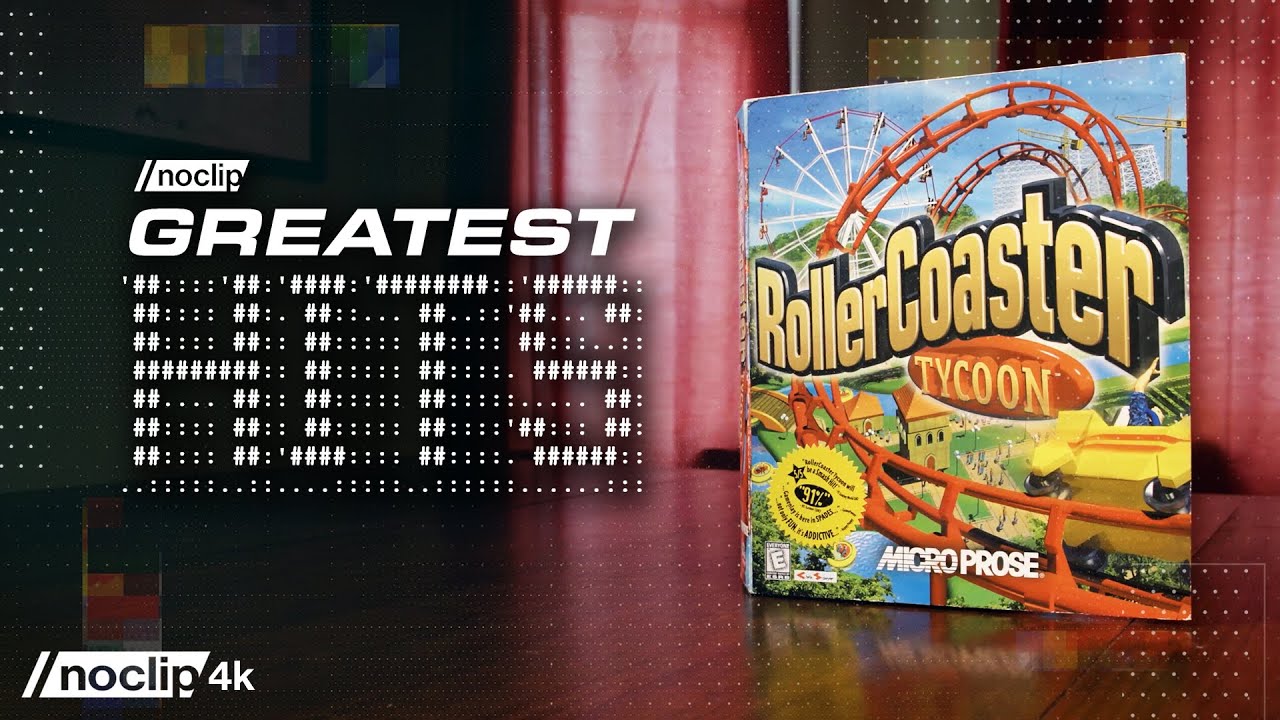
/noclip
Chris Sawyer's theme park simulation survives commercial exploitation and corporate disputes because open-source coders and indie developers preserved the mechanical depth of its original Assembly codebase.
AI-assisted summary of The Story of RollerCoaster Tycoon | Noclip Greatest Hits — original source. Check the original for full context.
Source published:
Key ideas
- Chris Sawyer coded the original RollerCoaster Tycoon nearly entirely in x86 Assembly, using integer-only math and pre-rendered 8-bit sprites to achieve remarkable performance across consumer hardware. (2:31)
- The franchise fractured significantly after RCT2, with rights owner Atari steering the brand through troubled releases and derivatives like RollerCoaster Tycoon World, while Frontier Developments forged a separate path with Planet Coaster. (19:58)
- Community-driven open-source projects such as OpenRCT2 have preserved and modernized the classic games, providing high-resolution support, modding tools, and cross-platform compatibility across modern operating systems. (11:08)
- Sawyer's primary simulation portfolio—Transport Tycoon, RollerCoaster Tycoon, and Locomotion—stands as a rare achievement where every single major title has inspired a full-scale open-source community reimplementation. (32:54)
Detailed notes
## Background Published by Noclip on YouTube on May 2, 2021, this documentary marks the debut of their crowdfunded series Greatest Hits. Chosen by Patreon backers, the video explores the original design, technical brilliance, and enduring legacy of RollerCoaster Tycoon by spotlighting the community members, reverse-engineers, and developers continuing to carry its torch.
## TL;DR Host Danny O'Dwyer traces the origins of RollerCoaster Tycoon, examining how Scottish developer Chris Sawyer hand-coded the beloved classic almost entirely in x86 Assembly alongside artist Simon Foster. After the franchise transitioned to 3D and endured a turbulent period under Atari's stewardship, the spirit of the series was kept alive by passionate fans, content creators like Marcel Vos, open-source preservationists behind OpenRCT2, and indie developers creating modern spiritual successors like Parkitect. Although Sawyer himself declined on-camera participation due to his quiet retirement, the documentary evolves into a heartfelt tribute to the creator's enduring technical legacy and the vibrant community that refuses to let the game fade.
## Atmosphere & style The piece carries an affectionate, warmly nostalgic, and investigative tone driven by Danny O'Dwyer's conversational journalistic delivery. It blends genuine technical awe—particularly regarding Sawyer's Assembly craftsmanship—with playful amusement over the bizarre mechanical quirks and corporate missteps in the franchise's later history. Rather than feeling defeated by the elusive nature of its legendary creator, the narrative builds a deeply appreciative, community-centered emotional arc, turning the retrospective into an uplifting celebration of the passionate hobbyists holding the torch.
## Bulletin - [02:31](https://www.youtube.com/watch?v=ts4BD8AqD9g&t=151s) Chris Sawyer coded the original RollerCoaster Tycoon nearly entirely in x86 Assembly, using integer-only math and pre-rendered 8-bit sprites to achieve remarkable performance across consumer hardware. - [19:58](https://www.youtube.com/watch?v=ts4BD8AqD9g&t=1198s) The franchise fractured significantly after RCT2, with rights owner Atari steering the brand through troubled releases and derivatives like RollerCoaster Tycoon World, while Frontier Developments forged a separate path with Planet Coaster. - [11:08](https://www.youtube.com/watch?v=ts4BD8AqD9g&t=668s) Community-driven open-source projects such as OpenRCT2 have preserved and modernized the classic games, providing high-resolution support, modding tools, and cross-platform compatibility across modern operating systems. - [32:54](https://www.youtube.com/watch?v=ts4BD8AqD9g&t=1974s) Sawyer's primary simulation portfolio—Transport Tycoon, RollerCoaster Tycoon, and Locomotion—stands as a rare achievement where every single major title has inspired a full-scale open-source community reimplementation.
## Key takeaways - [00:06](https://www.youtube.com/watch?v=ts4BD8AqD9g&t=6s) Despite a multitude of sequels and spin-offs, the enduring cultural affection for RollerCoaster Tycoon remains focused almost entirely on the first two entries created by Chris Sawyer. - [02:33](https://www.youtube.com/watch?v=ts4BD8AqD9g&t=153s) The series began under the working title White Knuckle after Sawyer became an avid roller coaster enthusiast following his work on Transport Tycoon. - [02:33](https://www.youtube.com/watch?v=ts4BD8AqD9g&t=153s) The original RollerCoaster Tycoon achieved massive commercial success, selling 6 million copies before the launch of its 2002 sequel. - [05:29](https://www.youtube.com/watch?v=ts4BD8AqD9g&t=329s) The game pairs an exceptionally low barrier to entry for newcomers with an extraordinarily deep skill ceiling driven by complex mechanical quirks and simulation systems. - [08:45](https://www.youtube.com/watch?v=ts4BD8AqD9g&t=525s) Simon Foster's pre-rendered 3D Studio Max art pipeline produced up to 6,600 unique frames per coaster car to account for multiple rotations, animations, and passenger load variations. - [11:08](https://www.youtube.com/watch?v=ts4BD8AqD9g&t=668s) Started in 2013 by Ted John, OpenRCT2 reverse-engineered Sawyer's Assembly codebase to resolve modern OS compatibility issues, add quality-of-life enhancements, and introduce multiplayer. - [13:27](https://www.youtube.com/watch?v=ts4BD8AqD9g&t=807s) OpenRCT2 balances classic game preservation with community modernization by offering modding APIs rather than embedding gameplay-altering cheats into the base experience. - [16:04](https://www.youtube.com/watch?v=ts4BD8AqD9g&t=964s) By avoiding floating-point math and relying on pre-rendered 2D sprites, Sawyer ensured the engine could simulate thousands of guests with individual pathfinding without bogging down consumer PCs. - [18:58](https://www.youtube.com/watch?v=ts4BD8AqD9g&t=1138s) RollerCoaster Tycoon 3 marked a major technical shift to full 3D developed by Frontier Developments, selling over 10 million copies despite polarizing visual purists. - [22:09](https://www.youtube.com/watch?v=ts4BD8AqD9g&t=1329s) Under Atari's stewardship, the IP suffered through contentious legal disputes, aggressive mobile monetization, and the critically panned disaster of RollerCoaster Tycoon World. - [23:40](https://www.youtube.com/watch?v=ts4BD8AqD9g&t=1420s) Frontier's Planet Coaster emerged as the true spiritual successor to RCT3's expansive 3D sandbox design, surpassing 2.5 million sales. - [25:40](https://www.youtube.com/watch?v=ts4BD8AqD9g&t=1540s) Indie sim Parkitect captured the isometric spirit of the early games by focusing on backend park operations and guest line-of-sight logistics. - [31:00](https://www.youtube.com/watch?v=ts4BD8AqD9g&t=1860s) Sawyer consciously stepped away after RollerCoaster Tycoon 2, expressing contentment that his personal vision was complete and declining to interfere with new iterations. - [32:54](https://www.youtube.com/watch?v=ts4BD8AqD9g&t=1974s) Sawyer's core simulation trilogy—Transport Tycoon, RollerCoaster Tycoon, and Locomotion—inspired OpenTTD, OpenRCT2, and OpenLoco, marking an unprecedented level of fan-led software preservation.
## Detailed walkthrough ### [00:06](https://www.youtube.com/watch?v=ts4BD8AqD9g&t=6s) The Enduring Mystery of RollerCoaster Tycoon
Noclip host Danny O'Dwyer introduces *Greatest Hits*, a series diving into the history and legacy of classic games chosen directly through backer votes on Patreon. When *RollerCoaster Tycoon* won the program's inaugural poll, Danny was genuinely surprised that an isometric theme park management game could command such passionate loyalty two decades after its heyday. The series produced a half-dozen sequels, numerous expansion packs, and multiple spiritual successors, yet the enduring affection almost universally centers on the first two titles—both of which were programmed virtually single-handedly by Scottish developer Chris Sawyer.
Sawyer has largely vanished from the modern public eye, having stepped away from the games industry after the release of the third entry. To understand why people still revere the franchise, Danny sets out to track down the figures holding the torch today: modern developers advancing the genre, active online communities, and content creators introducing new audiences to 20-year-old mechanics.
> “What is it about a theme park management series that resonated with so many people 20 years after its heyday?” — Danny O'Dwyer
---
[02:33](https://www.youtube.com/watch?v=ts4BD8AqD9g&t=153s) From Transport Tycoon to Theme Parks
The origin of *RollerCoaster Tycoon* traces back to the creative partnership between Chris Sawyer and visual artist Simon Foster. The pair previously created *Transport Tycoon*, an isometric simulation of 20th-century expansionism. Working remotely from one another, they collaborated by mailing physical floppy disks back and forth daily via the Royal Mail. Following the immense critical and commercial success of *Transport Tycoon*, Sawyer took an extended break to travel across Europe and North America, where he became an ardent roller coaster enthusiast.
That passion reshaped his next project. Originally conceived under the working title *White Knuckle*, the game was rebranded under the familiar "Tycoon" banner while retaining Sawyer's specific balance: deep logistical park management paired with intuitive, creative track construction. Players juggle path networks, concessions, restrooms, and staff alongside elaborate custom coasters designed to maximize thrill and park attendance.
```mermaid flowchart TD accTitle: RollerCoaster Tycoon Franchise Origins accDescr: Progression from Transport Tycoon through Chris Sawyer's travels to RCT1 and RCT2.
subgraph Origins["Early Collaboration"] TT["Transport Tycoon<br/>(Chris Sawyer & Simon Foster)"] Mail["Remote collaboration via<br/>Royal Mail floppy disks"] TT --- Mail end
subgraph Conception["Inspiration & Design"] Travel["Travels across Europe & North America<br/>(Riding roller coasters)"] WhiteKnuckle["White Knuckle prototype"] Origins --> Travel --> WhiteKnuckle end
subgraph Releases["Commercial Releases"] RCT1["RollerCoaster Tycoon (1999)<br/>• 6 million copies sold<br/>• Written in Assembly"] RCT2["RollerCoaster Tycoon 2 (2002)<br/>• Expanded scenery & custom rides<br/>• Frontier took over for RCT3 (3D)"] WhiteKnuckle --> RCT1 --> RCT2 end ```
The original game launched in 1999 featuring audio by veteran composer Allister Brimble, selling an astonishing 6 million units before its follow-up arrived. Released in late 2002, *RollerCoaster Tycoon 2* became widely regarded as the pinnacle of the series, expanding tools for scenery, rides, and community architecture just as the wider industry began abandoning 2D engines. Sawyer later served in a consultancy role for *RollerCoaster Tycoon 3*, while primary development duties transitioned to Frontier Developments.
- **Key Staff**: Chris Sawyer (designer/programmer), Simon Foster (graphics), Allister Brimble (music and sound). - **Working Title**: *White Knuckle*. - **Sales Milestone**: 6 million copies sold for the 1999 original before the sequel launched. - **Engine**: Programmed nearly entirely in x86 Assembly by Sawyer to ensure smooth performance.
---
[05:29](https://www.youtube.com/watch?v=ts4BD8AqD9g&t=329s) The Low Barrier and High Ceiling: Marcel Vos
Danny connects with Dutch YouTuber Marcel Vos, whose channel dissects the intricate mechanical quirks of the engine—exploring bizarre gameplay phenomena such as why exhausted guests take longer to drown than energized ones, or how maze pathfinding algorithms can trap visitors indefinitely. Vos recalls that during the early 2000s, *RollerCoaster Tycoon* was ubiquitous in the Netherlands, with kids frequently trading burned CD copies supplied by their parents.
Vos attributes the game's longevity to its remarkably low barrier to entry combined with an almost bottomless skill ceiling. A total newcomer can place down a pre-built merry-go-round or small coaster, immediately open the ride, and watch guests interact with the park without friction. Yet as players invest time, the mechanical depth prevents the game from ever feeling exhausted. Vos notes that his audience includes active players, lapsed fans curious about deep computational mechanics fifteen years later, and casual viewers who do not play at all.
Comparing the game to Peter Molyneux's classic *Amiga* title *Theme Park*, Danny points out that earlier park sims hit clear design thresholds where players ran out of meaningful things to do. Vos adds that modern full-3D spiritual successors like *Planet Coaster* require significant artistic skill and spatial effort just to make an environment look presentable, whereas *RollerCoaster Tycoon 2*'s isometric presentation and tile-based greenery allow anyone to construct an aesthetically pleasing layout simply by planting a few trees.
> “I think one of the main reasons why it's popular is that it has an incredibly low entry barrier.” — Marcel Vos
> “Because RollerCoaster Tycoon 2, you can put down a few trees and it just works.” — Marcel Vos
---
[08:45](https://www.youtube.com/watch?v=ts4BD8AqD9g&t=525s) Isometric Craftsmanship and Modern Resurgence
The enduring visual appeal of the early entries is exemplified by New Element, an online community that has spotlighted high-level visual design and hosted competitive park-building accolades for nearly two decades. The visuals that support this artistic longevity were created entirely by artist Simon Foster using 3D Studio Max.
Foster rendered thousands of individual 3D sprites and manually exported them onto rough grids for Sawyer to code into the game. To account for four distinct isometric viewing angles, rider animations, and varying passenger capacities, a single coaster car model could require up to 6,600 unique rendered frames. Because Sawyer hand-coded the engine in Assembly, these massive sprite sheets ran smoothly even when parks grew exceptionally large and congested.
``` +-------------------------------------------------------------+ | SIMON FOSTER'S ASSET PIPELINE (3D Studio Max to Assembly) | +-------------------------------------------------------------+ | 1. 3D Studio Max modeling and animation | | 2. Multi-angle renders (4 isometric rotations) | | 3. Variable passenger load frames | | 4. Manual export to 2D sprite grids | | * Coaster car complexity: up to 6,600 unique frames/car | +-------------------------------------------------------------+ ```
Although the Assembly codebase kept the original releases fast and stable, raw legacy binaries eventually became unplayable on modern operating systems and high-resolution monitors. Marcel Vos explains that contemporary content creation relies heavily on OpenRCT2, an open-source reverse-engineering project. OpenRCT2 introduces essential modern amenities such as windowed display modes, high-definition resolutions, game-speed toggles for testing long coasters, and extensive hotkey support, transforming an aging classic into a seamless modern experience.
> “I can't imagine making my videos without Open RollerCoaster Tycoon.” — Marcel Vos
[11:08](https://www.youtube.com/watch?v=ts4BD8AqD9g&t=668s) Tracking Down the Source and the Origins of OpenRCT2
With episodes crowdfunded through Patreon every two months, Noclip operates on a tight four-week production window to secure and film interviews before editing begins. While trying to reach Chris Sawyer through his management company and various industry backchannels, the team received no response. Faced with silence, host Danny O'Dwyer turned to the only person who understands the codebase just as intimately: Ted John, who started the open-source project OpenRCT2 in 2013.
Ted fell in love with theme park simulations around age seven when he received the first *RollerCoaster Tycoon*. Having played titles like *Theme Park*, he found Sawyer's creation immediately distinctive: “What interested me most about RollerCoaster Tycoon is it didn't feel dumbed down. It seemed quite sophisticated, and the graphics looked really good.” That visual appeal has endured because the sprites are pre-rendered. Ted followed the franchise closely, devouring screenshots and even reading the sequel's instruction manual before *RollerCoaster Tycoon 2* hit store shelves.
Around 2005, Ted encountered *OpenTTD*, an open-source recreation and enhancement of Sawyer’s earlier title *Transport Tycoon Deluxe*. Seeing *OpenTTD* offer seamless cross-platform support, modern multiplayer where players could cooperate within the same company infrastructure, and quality-of-life updates convinced him that *RollerCoaster Tycoon* deserved the exact same treatment. Starting in 2013, he set out to build OpenRCT2—a free program that modifies the original game's installer and data files to run on modern platforms, bringing the classic title to operating system families it never originally supported, including macOS and Linux.
[13:27](https://www.youtube.com/watch?v=ts4BD8AqD9g&t=807s) The Philosophy of Modernizing a Classic
Community demand quickly drove the expansion of OpenRCT2. Players clamored to build vastly larger parks with higher limits on ride types and scenery items, and frequently begged for smarter guest AI. Ted notes that even when players build meticulous pathway layouts equipped with directional signage and park maps, guests still manage to get lost and wander around complaining.
Balancing preservation against modernization requires constant discretion. Danny highlights that Ted essentially operates as "half game designer, half like game preservationist." Ted explains that the team resists features that undermine the original challenge:
> “Yeah, we're very cautious about adding too many new features. I've got a lot of, a lot of people like to request things that make it a bit easier or in other ways, things that we think of as a cheat, I suppose, where it tells you how much you should price the rides and various things like that. And we're not sure whether that should belong in the base game.”
To resolve this tension without alienating different segments of the community, the development team opted to make OpenRCT2 moddable, enabling players who want auto-pricing or gameplay aids to script their own add-ons.
Ted proved uniquely equipped for the technical hurdles of reverse-engineering; in his day job as a software engineer, he specializes in porting legacy COBOL programs to modern hardware. Nevertheless, he deflects solo credit, pointing out that over a hundred people have contributed to OpenRCT2's source code, handling everything from international localization and new art assets to QA testing and documentation.
[16:04](https://www.youtube.com/watch?v=ts4BD8AqD9g&t=964s) The Architecture of a Timeless Simulation
When Noclip asked supporters why *RollerCoaster Tycoon* continues to captivate players—and why surveys reveal a steady influx of young players who were not even born when the game was released—Ted compared the title's enduring appeal to physical building toys:
> “Well, I think a lot of people, they haven't played in a long time. They played it when they were younger and they see the game again. And they realize they can play it. But I think for a lot of other people, it's a toy. It's like Lego and the, you know, you can't get old of it. There's always different things, new things that you can think of building. It's not too complex. It's very uniform. You know, you're talking about isometric grid. Everything's tile or block-based, a bit like Lego and Minecraft.”
Ted also differentiates the core loop between the first two entries: the original game is driven by rigid campaign progression—completing scenarios, meeting financial and guest targets, and researching new rides to check off goals—whereas *RollerCoaster Tycoon 2* serves primarily as an expansive, creative sandbox.
Both games reflect Chris Sawyer’s deep fascination with amusement park engineering. The mechanics demand strict adherence to real-world physics: players cannot build reckless designs without making guests sick or driving lateral G-forces dangerously high, nor can they build an entire park out of terrifying coasters without alienating gentle ride-goers.
```mermaid flowchart TD accTitle: RollerCoaster Tycoon Performance Architecture accDescr: Technical design choices that allowed high performance on low-end hardware.
subgraph CoreEngine["Engine Architecture"] ASM["Coded in x86 Assembly"] SimpleMath["Integer-Only Math & Table Lookups"] end
subgraph SimulationTasks["Heavy Real-Time Simulation"] Guests["2,000+ Guests with Individual Pathfinding"] Rides["Multiple Coasters with Complex Physics"] end
subgraph VisualPipeline["Rendering Pipeline"] Gfx["8-Bit Palette-Based Pre-Rendered Sprites"] NoFloat["Zero Floating-Point Overhead"] end
CoreEngine --> SimulationTasks VisualPipeline --> CoreEngine ```
Sawyer's choice to write the game almost entirely in x86 Assembly—a practice already fading from PC development by the late 1990s—was not unheard of on consoles, but it gave the PC release an immense performance edge. The engine easily tracked thousands of simulated park guests running active pathfinding routines alongside animated rides and simple physics systems. By relying on pre-rendered 8-bit palette graphics, integer calculations, and extensive table lookups rather than floating-point math, Sawyer ensured the simulation ran smoothly on practically any consumer PC.
- **OpenRCT2 Contributor Base:** Over 100 individuals contributing code, documentation, art, and translations. - **Original Graphic Format:** 8-bit, palette-indexed pre-rendered 2D sprites. - **Key Simulation Constraints:** Strict lateral G-force calculations, nausea ratings, excitement thresholds, and guest intensity tolerances.
[18:58](https://www.youtube.com/watch?v=ts4BD8AqD9g&t=1138s) The 3D Shift and the Fragmented Post-Sawyer Era
After shipping *RollerCoaster Tycoon 2*, Sawyer stepped away to build *Locomotion* (2004), his spiritual successor to *Transport Tycoon*. Having amassed substantial wealth from the franchise's runaway sales, Sawyer retained ownership of the IP but transferred management and publishing control to Atari. Atari tapped Frontier Developments—who had previously proved their technical chops by porting the original game to the Xbox and developing both expansions for RCT2 (*Wacky Worlds* and *Time Twister*)—to develop a full sequel, with Sawyer serving in an advisory consulting capacity.
Released in 2004, *RollerCoaster Tycoon 3* represented a massive technical shift. It transitioned the franchise into full 3D, introducing a free-form rotating camera, real-time lighting with day/night cycles, and expanded guest behaviors. Despite selling over 10 million copies and earning positive reviews, it marked a nostalgic fracture point. For many purists, the charming simplicity and hand-crafted feel of Sawyer's pre-rendered isometric dioramas were lost in the move to early 3D polygons.
Behind the scenes, relationships collapsed: - **Corporate Feuds:** Following RCT3, the partnership between Atari and Frontier Developments soured into contentious, largely confidential legal battles regarding royalities, code rights, and IP usage. - **Franchise Stagnation:** Combined with Atari's worsening corporate financial troubles, the mainline series lay dormant for nearly a decade. - ***RollerCoaster Tycoon 3D* (2012):** A poorly received Nintendo 3DS exclusive that recycled RCT3-era visual assets in a fixed, pseudo-isometric perspective. - ***RollerCoaster Tycoon 4 Mobile* (2014):** A heavily monetized freemium mobile release that sparked outrage among long-time fans for aggressive microtransactions and timer mechanics. - ***RollerCoaster Tycoon 3 Mobile*:** An unexpected, straightforward mobile port of the 2004 PC game developed by Frontier that was mechanically solid, yet did little to satisfy fans hungry for a true classic successor. - ***RollerCoaster Tycoon Classic* (2016):** Sawyer returned to active development alongside an external team to produce a faithful remaster combining the scenarios, art style, and engines of the first two PC games for modern mobile devices.
[22:09](https://www.youtube.com/watch?v=ts4BD8AqD9g&t=1329s) The Downward Spiral of RollerCoaster Tycoon Under Atari
Following the well-received mobile release of *RollerCoaster Tycoon Classic*—which integrated mechanics Chris Sawyer had previously honed for an earlier mobile port of *Transport Tycoon*—the brand entered an exceptionally rough era under Atari's direction. The second title released that same year was *RollerCoaster Tycoon World*, a full 3D installment that had already spent years bouncing between different development studios and enduring a messy early access cycle. In a dramatic bit of counter-programming, Atari officially launched the game just a single day before Frontier Developments debuted their own ambitious coaster sim, *Planet Coaster*.
While *Planet Coaster* earned enthusiastic reviews from critics and players alike, *RollerCoaster Tycoon World* proved to be a disaster. Danny O'Dwyer describes it as “about as bad a nightmare fans of the series could have possibly imagined,” criticizing it as a buggy, unfinished, and deeply un-fun project that was universally panned by critics. Rather than learning from the failure, Atari spun the wreckage off into a deluge of derivative spin-offs and low-effort ports: *RollerCoaster Tycoon Touch* on mobile, a PlayStation VR on-rails shooter dubbed *RollerCoaster Tycoon Joyride*, and *RollerCoaster Tycoon Story*, a casual mobile match-three game.
```mermaid flowchart TD accTitle: RollerCoaster Tycoon Port Lineage accDescr: Diagram illustrating how RollerCoaster Tycoon World was ported across multiple formats down to the PC Epic Games Store release. subgraph S1["Mainline Flop"] RCTW["RollerCoaster Tycoon World (PC)"] end subgraph S2["Derivatives & Adaptations"] RCTT["RollerCoaster Tycoon Touch (Mobile)"] RCTA_SW["RollerCoaster Tycoon Adventures (Switch)"] RCTA_PC["RollerCoaster Tycoon Adventures (PC / Epic Games Store)"] end RCTW -->|"Mobile spin-off"| RCTT RCTT -->|"Equity crowdfunded console port"| RCTA_SW RCTA_SW -->|"Port of a port"| RCTA_PC ```
The cycle reached peak absurdity with *RollerCoaster Tycoon Adventures*. Originally an equity-crowdfunded Nintendo Switch adaptation of the mobile title *RollerCoaster Tycoon Touch*, it was later ported back to PC as an Epic Games Store exclusive. Danny quips that this effectively made it “a PC port of a Switch port of a mobile port of the worst *RollerCoaster Tycoon* game.” Observing the relentless milking of the name, Danny notes that “from the fans' perspective, it does seem that under Atari's stewardship, the RollerCoaster Tycoon franchise has become a bit of a cash cow.”
[23:40](https://www.youtube.com/watch?v=ts4BD8AqD9g&t=1420s) The Spiritual Successors and the Search for Chris Sawyer
Despite the degradation of the main license, the theme park simulation genre survived outside of Atari’s catalog. Two distinct projects stepped forward to carry the torch. The first was *Planet Coaster*, developed by Frontier Developments—the same studio that had previously partnered with Sawyer on *RollerCoaster Tycoon 3*. After experimenting with console park builders like *Thrillville* and *Screamride*, Frontier treated *Planet Coaster* as their triumphant return to the PC genre. Launched in 2016 to critical acclaim, supported with extensive DLC, and topping over 2.5 million sales, it established itself as the true spiritual successor to *RCT3*.
The Noclip team attempted to get Frontier developers or studio heads like David Braben on camera to discuss their lineage with Sawyer and the franchise. However, communications went silent midway through discussions. Danny acknowledges that Frontier’s reluctance makes sense: the official *RollerCoaster Tycoon* brand carries significant corporate and legal baggage, whereas Frontier had successfully built their own independent, passionate community with a fresh IP. Similarly, attempts to secure an on-camera interview with Chris Sawyer himself hit a wall. Having stepped away from day-to-day development decades earlier, Sawyer remains intensely private—especially in the shadow of historical legal disputes. His rare public remarks, such as a 2016 interview with Wesley Yin-Poole at *Eurogamer*, were handled strictly via email exchanges through his management, making him unavailable for Noclip’s typical conversational documentary style.
- *Planet Coaster* served as Frontier’s spiritual successor to *RollerCoaster Tycoon 3*. - Frontier had previously explored console-based park builders with *Thrillville* and *Screamride*. - *Planet Coaster* surpassed 2.5 million copies sold after its 2016 launch. - Sawyer's sparse modern communications have typically been filtered through management, including his 2016 *Eurogamer* Q&A.
[25:40](https://www.youtube.com/watch?v=ts4BD8AqD9g&t=1540s) Parkitect: Tackling the Backstage Logistics
While *Planet Coaster* carried forward the 3D spectacle of *RCT3*, traditional fans still craved a spiritual successor to Chris Sawyer’s original isometric games. That gap was filled by *Parkitect*, built by a lean independent team led by lead programmer Sebastian Mayer and art director/co-designer Garret Randell. Mayer grew up next to Germany’s Europa-Park—one of the largest amusement parks in the world—which instilled in him a deep fascination with both ride mechanics and backend park operations. Together with Randell, who accompanied Mayer on research trips to examine real roller coasters up close, they set out to build a management sim that honored *Theme Park* and *RollerCoaster Tycoon* while introducing real operational friction.
Unlike titles focused purely on sandbox ride design, *Parkitect* requires players to manage backstage logistics alongside guest entertainment. To maintain park functionality, players must construct staff break rooms, training facilities, and employee-only transport paths so workers can move park stock and haul trash without destroying the guest illusion. Guests are put off by the sight of functional infrastructure, making visual sightlines a primary gameplay mechanic. Danny points out how this bridges aesthetics and mechanics: “For instance, each visitor's line of sight is calculated, and so their experience at the park is positively or negatively impacted based on how much of the backstage park maintenance stuff they can see.” This technical trick forces players to use scenery, fences, and foliage not just as optional eye candy, but as functional acoustic and visual screening.
- Sebastian Mayer’s childhood close to Europa-Park inspired *Parkitect*’s focus on the unseen infrastructure of amusement facilities. - The game simulates explicit line-of-sight cones for every park guest to dynamically track exposure to staff buildings, deliveries, and garbage. - Decorative fences, walls, and foliage directly serve gameplay by hiding utilitarian corridors from visiting park-goers.
[27:56](https://www.youtube.com/watch?v=ts4BD8AqD9g&t=1676s) The Sim Renaissance and Nurturing a Community
Reflecting on their journey, Garret Randell notes that *Parkitect* caught the leading edge of a broader renaissance across simulation games, sharing the landscape with everything from detailed city planners to unique novelties like nomadic builders set on the backs of giant wandering beasts. When Danny asks about the contrast between *Parkitect* and *Planet Coaster*, the developers explain that the two titles cater to distinct creative desires: *Planet Coaster* functions as an expansive 3D creative suite for breathtaking realism and massive dioramas, while *Parkitect* targets the gritty logistical, budgeting, and spatial management layer of the classic isometric era. Sebastian Mayer emphasizes, “What we hear from players very often is that they enjoy both games for different reasons. And that's really cool that two games that are kind of similar can co-exist.”
Both developers credit active community stewardship for keeping their project grounded throughout its development cycle. Because years had passed without a solid indie theme park builder, expectations risked ballooning out of control. To build trust, Mayer published regular, painstakingly detailed devlogs breaking down the game's underlying math, rendering choices, and mechanical scope. Recognizing that a tiny indie team could never build every ride or prop requested by fans, they invested early in Unity modding pipelines to let players introduce custom rides, assets, and custom code. As Randell summarizes:
> “I think that's the number one most important thing in this entire genre, in any simulation game, if it has a creative element to it is just community.”
[31:00](https://www.youtube.com/watch?v=ts4BD8AqD9g&t=1860s) Sawyer’s Retirement and the Passing of the Torch
Danny concludes that "community" is the defining pillar that kept *RollerCoaster Tycoon* alive long after its original creator departed full-time development in 2004. The game's torch was preserved not by Atari’s sequels, but by the generation who grew up with it: the YouTube content creators exposing the game to brand-new audiences, the OpenRCT2 hobbyists and open-source coders modernizing the codebase for current hardware, and the indie creators who channeled Sawyer's ethos into fresh titles like *Parkitect*.
Sawyer’s representatives eventually confirmed to Noclip that Chris is completely retired from the industry and remains a deeply private person, though he continues to feel genuinely flattered by the modern reverence for his creations. In his earlier years, Sawyer pushed himself to the limit to produce his masterpieces, acknowledging that game creation has only grown more demanding since his departure. His stance on stepping back was outlined most clearly in his 2016 *Eurogamer* interview, in which he explained why he chose to let the series move on without his interference:
> “I think you have to understand that my personal vision for RollerCoaster Tycoon was fulfilled with the last version I created myself, RollerCoaster Tycoon 2, and I had no interest in working on someone else's vision for future versions of the game. Much better to let those who have inspiration fulfill their vision of the next iteration of the game and not to interfere. RollerCoaster Tycoon has moved on a long way since its early days as RCT1 and RCT2. And while I'm intrigued to see how the newer games evolve and expand, I'm not the right person to guide or restrict the design and development of games so different to my own.”
Danny observes that Sawyer's prolonged public silence, often lamented by longtime fans, is perhaps his greatest gift to the medium: rather than micromanaging or blocking new interpretations of theme park sims, he stepped aside completely, leaving room for new creators to experiment freely.
[32:54](https://www.youtube.com/watch?v=ts4BD8AqD9g&t=1974s) A Video for Chris Sawyer and the Enduring Community
Danny reflects on the original goal of producing the retrospective, admitting that at the outset, his deepest wish was to interview Chris Sawyer directly to discover what inspired the series and what its extraordinary impact meant to its creator. However, searching for those answers uncovered something even more compelling than a single designer's retrospective: the vibrant, passionate player base that kept the work alive. Danny explains that this project ultimately shifted from being a profile *about* Sawyer to a tribute *for* Sawyer—an open celebration of the enduring legacy he created and the global network of fans still obsessively designing theme parks and testing physics engines more than two decades later. As Danny summarizes the shift in perspective: “This video isn't about him. It's a video for him. A celebration of the legacy he left behind and a worldwide community of players who are still gleefully creating roller coasters 20 years later.”
Members of that creative network share what fuels their ongoing dedication. Sebastian points out how rare and uplifting it is that a title nearly two decades old retains such a fiercely loyal, collaborative ecosystem: “It's really cool how supportive the community for these types of games is. I mean, if you look at RollerCoaster Tycoon, game is like, 16 years old, 17 years old by this point. And it still has an active community.” Marcel Vos explains that his motivation comes from pulling back the curtain on complex game mechanics and connecting with other enthusiasts: “I like teaching people stuff or showing off cool stuff I made. And it's just so satisfying to see people, you know, leave nice comments and, you know, also just to watch those numbers go up. I'm a big numbers guy.”
The conversation turns to the sheer scale of Sawyer's technical imprint on gaming history. Ted emphasizes that Sawyer's output as an independent programmer remains unmatched in terms of long-term software preservation and grass-roots reverse engineering: “Transport Tycoon, RollerCoaster Tycoon, Chris Sawyer's Locomotion. And all three of them have now got open source projects replicating it. How many game studios, you know, could admit that?” Having achieved the near-impossible feat of creating three legendary simulation franchises that fans re-engineered from the ground up for modern operating systems, Sawyer's career stands as a singular achievement in video game history, prompting the closing joke: “Drop the mic and walk away, Chris Sawyer.”
```mermaid flowchart TD accTitle: Chris Sawyer's Trilogy and Open Source Legacy accDescr: Diagram illustrating the three core simulation games created by Chris Sawyer and their corresponding modern community-driven open source reimplementations.
subgraph SawyerGames["Chris Sawyer Original Releases"] TT["Transport Tycoon"] RCT["RollerCoaster Tycoon"] CSL["Chris Sawyer's Locomotion"] end
subgraph CommunityEngines["Community Open Source Projects"] OTTD["OpenTTD"] ORCT["OpenRCT2"] OLOCO["OpenLoco"] end
TT -->|"reverse-engineered as"| OTTD RCT -->|"reverse-engineered as"| ORCT CSL -->|"reverse-engineered as"| OLOCO ```
- **Chris Sawyer's Trilogy of Open-Source Heirs**: Across his career, Chris Sawyer effectively developed three core simulation masterworks—*Transport Tycoon*, *RollerCoaster Tycoon*, and *Chris Sawyer's Locomotion*. Every single one inspired an active, community-run open-source project dedicated to keeping the game modern, bug-free, and playable on current hardware (*OpenTTD*, *OpenRCT2*, and *OpenLoco*). - **A Rare Studio Feat**: Ted observes that almost no commercial video game studio in the industry can claim that every major title in their catalog inspired a full open-source community rebuild decades after release.
## Notable quotes > [11:08](https://www.youtube.com/watch?v=ts4BD8AqD9g&t=668s) What interested me most about RollerCoaster Tycoon is it didn't feel dumbed down. It seemed quite sophisticated, and the graphics looked really good. — Ted John
> [31:00](https://www.youtube.com/watch?v=ts4BD8AqD9g&t=1860s) Much better to let those who have inspiration fulfill their vision of the next iteration of the game and not to interfere. — Chris Sawyer
## Mentioned Danny O'Dwyer, Chris Sawyer, Simon Foster, Allister Brimble, Marcel Vos, Ted John, Sebastian Mayer, Garret Randell, David Braben, Wesley Yin-Poole, Jeremy Jayne, Frank Howley, Megan Carnes, Dan Silverstone, RollerCoaster Tycoon, RollerCoaster Tycoon 2, RollerCoaster Tycoon 3, RollerCoaster Tycoon World, RollerCoaster Tycoon Touch, RollerCoaster Tycoon Adventures, RollerCoaster Tycoon Classic, RollerCoaster Tycoon 4 Mobile, RollerCoaster Tycoon 3D, RollerCoaster Tycoon Joyride, RollerCoaster Tycoon Story, Transport Tycoon, Transport Tycoon Deluxe, Chris Sawyer's Locomotion, OpenRCT2, OpenTTD, OpenLoco, Parkitect, Planet Coaster, Theme Park, Thrillville, Screamride, White Knuckle, New Element, Europa-Park, Frontier Developments, Atari, Noclip, Eurogamer, 3D Studio Max, Royal Mail
## Video description SUBSCRIBE for More Free Game Docs ► http://bit.ly/noclipsubscribe Become a PATRON to unlock more videos ► https://www.patreon.com/noclip
In our brand new series Greatest Hits, we celebrate the legacy of RollerCoaster Tycoon by exploring its original design and talking to the people holding the torch today. RCT was chosen by a subset of our patrons - to pick the next game, consider joining them.
Noclip's work is 100% crowdfunded. Patreon: https://www.patreon.com/noclip Website: https://www.noclip.video Store: https://store.noclip.video Instagram: https://www.instagram.com/noclipvideo/ Twitter: https://twitter.com/noclipvideo Twitch: https://twitch.tv/noclip Podcast: https://noclippodcast.libsyn.com/ Podcast Channel: http://youtube.com/noclippodcast
Edited by Jeremy Jayne & Danny O'Dwyer Filmed & Colored by Jeremy Jayne Gameplay Capture by Frank Howley Captions by Megan Carnes
Motion Design by Dan Silverstone (Pica) Twitter: https://twitter.com/pica_creative IG: https://www.instagram.com/vivapica/ https://www.pica.me.uk
0:00 - Intro 2:31 - What is RollerCoaster Tycoon? 5:29 - Marcel Vos 11:48 - OpenRCT2 16:04 - Why Are People Still Playing? 20:01 - What Happened After RCT2? 25:40 - Parkitect 30:55 - The Legacy of RCT 34:14 - Credits
Tracks used; https://au.audionetwork.com/browse/m/track/illusory_145286 https://au.audionetwork.com/browse/m/track/tender-reflections-2_136411 https://au.audionetwork.com/browse/m/track/glowing-moon-2_1027035 https://au.audionetwork.com/browse/m/track/walk-in-the-park-2-60_145010 https://au.audionetwork.com/browse/m/track/smooth-light_1022022 https://au.audionetwork.com/browse/m/track/eon-expansion_1019549
[Source](https://www.youtube.com/watch?v=ts4BD8AqD9g)