Awnings: a simple cooling tech we apparently forgot about
Technology Connections
AI-assisted summary of Awnings: a simple cooling tech we apparently forgot about — original source. Check the original for full context.
Source published:
Key ideas
- Energy modeling on a standard Chicago home demonstrates that adding external window overhangs cuts annual cooling energy demand by 20% by blocking solar insolation before it strikes the glass. (7:56)
- While static low-SHGC window glass reduces summer cooling needs, it creates a severe winter heating penalty in colder climates by permanently blocking free passive solar heat gain. (7:56)
- Interior blinds and drapes fail to stop radiant heat gain because the energy has already breached the building envelope, absorbing into surfaces and driving interior temperatures up via the greenhouse effect. (13:31)
- Homeowners Associations (HOAs) represent the single largest administrative hurdle to modern awning adoption, prompting calls for legislative protections similar to solar panel access laws. (19:25)
Detailed notes
## Background This video was published on YouTube by the channel Technology Connections on July 15, 2024. In the video description, the host playfully questions where window awnings disappeared to and links to his social media profiles and Patreon page.
## TL;DR The video examines how window awnings transitioned from essential passive cooling features in early twentieth-century architecture to an obsolete design trend stigmatized by mid-century real estate markets and supplanted by residential air conditioning. Drawing on building energy simulations and solar geometry, the host demonstrates that exterior awnings can slash annual cooling loads by roughly 20% without incurring the winter heating penalties tied to static low-SHGC window glass. While noting trade-offs such as dimming natural daylight, insect nesting, and maintenance, the presentation contrasts awnings favorably against interior blinds and European roller shutters. Ultimately, the video calls for dedicated academic research into awning performance and legislative reforms to prevent suburban HOAs from banning exterior shading retrofits.
## Atmosphere & style The video carries an earnest, conversational, and subtly wry tone driven by Alec's signature blend of consumer advocacy, physics-based reasoning, and retro enthusiasm. It feels like an engaging living room lecture where genuine technical irritation at inefficient modern construction practices is balanced with dry humor and cozy historical nostalgia. The pacing moves smoothly from vintage catalog appreciation into rigorous thermal energy debates, wrapping up with self-deprecating outtakes that puncture any lingering academic pretension.
## Bulletin - [07:56](https://www.youtube.com/watch?v=uhbDfi7Ee7k&t=476s) Energy modeling on a standard Chicago home demonstrates that adding external window overhangs cuts annual cooling energy demand by 20% by blocking solar insolation before it strikes the glass. - [07:56](https://www.youtube.com/watch?v=uhbDfi7Ee7k&t=476s) While static low-SHGC window glass reduces summer cooling needs, it creates a severe winter heating penalty in colder climates by permanently blocking free passive solar heat gain. - [13:31](https://www.youtube.com/watch?v=uhbDfi7Ee7k&t=811s) Interior blinds and drapes fail to stop radiant heat gain because the energy has already breached the building envelope, absorbing into surfaces and driving interior temperatures up via the greenhouse effect. - [19:25](https://www.youtube.com/watch?v=uhbDfi7Ee7k&t=1165s) Homeowners Associations (HOAs) represent the single largest administrative hurdle to modern awning adoption, prompting calls for legislative protections similar to solar panel access laws.
## Key takeaways - [00:00](https://www.youtube.com/watch?v=uhbDfi7Ee7k&t=0s) Solar insolation triggers a greenhouse effect inside homes as radiant light passes through window glass and is re-emitted into living spaces as heat. - [02:34](https://www.youtube.com/watch?v=uhbDfi7Ee7k&t=154s) Historic architecture utilized deep porches, galleries, and exterior awnings to block direct solar radiation from touching window panes. - [06:17](https://www.youtube.com/watch?v=uhbDfi7Ee7k&t=377s) Residential air conditioning and mid-century aesthetic trends caused awnings to fall out of favor, stigmatizing them as indicators of homes lacking mechanical AC. - [07:56](https://www.youtube.com/watch?v=uhbDfi7Ee7k&t=476s) Adding window overhangs reduced annual cooling energy by 20% in an energy simulation of a Chicago single-family home. - [07:56](https://www.youtube.com/watch?v=uhbDfi7Ee7k&t=476s) Low-SHGC window glass penalizes northern homes in winter by permanently rejecting passive solar heat, whereas awnings exploit seasonal solar geometry to admit low winter sun. - [11:11](https://www.youtube.com/watch?v=uhbDfi7Ee7k&t=671s) Retrofitting high-SHGC windows with exterior awnings offers the same seasonal efficiency benefits as complex, custom-engineered architectural overhangs at a fraction of the cost. - [11:11](https://www.youtube.com/watch?v=uhbDfi7Ee7k&t=671s) In desert climates like Phoenix, five unshaded west-facing windows admit over a kilowatt of heat continuously on summer afternoons even with high-performance low-e glass. - [13:31](https://www.youtube.com/watch?v=uhbDfi7Ee7k&t=811s) Interior window coverings cannot match exterior shading because radiant energy has already crossed the building envelope and converted into heat inside the room. - [13:31](https://www.youtube.com/watch?v=uhbDfi7Ee7k&t=811s) Independent academic and building-code research quantifying the real-world efficiency of exterior window awnings remains surprisingly scarce. - [15:14](https://www.youtube.com/watch?v=uhbDfi7Ee7k&t=914s) Modern automated roller awnings can address historical maintenance downsides by retracting during high winds, overcast skies, or winter months. - [17:23](https://www.youtube.com/watch?v=uhbDfi7Ee7k&t=1043s) Unlike European roller shutters that trap hot air pockets against the glazing and block visibility, open awnings allow natural convective airflow while preserving ground-level outdoor views. - [17:23](https://www.youtube.com/watch?v=uhbDfi7Ee7k&t=1043s) Real-world thermal testing revealed a home gained twice as much indoor heat on clear sunny days compared to overcast days at identical ambient temperatures. - [19:25](https://www.youtube.com/watch?v=uhbDfi7Ee7k&t=1165s) Suburban HOA architectural rules frequently prevent homeowners from installing exterior awnings, highlighting the need for statutory protections.
## Detailed walkthrough ### [00:00](https://www.youtube.com/watch?v=uhbDfi7Ee7k&t=0s) The Forgotten Art of Window Awnings and Insolation
There are certain architectural details from the not-too-distant past that seem blindingly obvious in retrospect, yet have strangely fallen out of favor. Window awnings—once a staple of cute brick ranches and neighborhood homes everywhere—are chief among them. While they have largely vanished from contemporary building trends, there is a compelling case to be made for reviving them. They are not being pitched here as part of an affiliate deal or brand endorsement, but rather as a neglected piece of practical technology. As the host points out, our ancestors cracked the code on keeping buildings comfortable, but modern society somehow decided it was too cool for awnings, which is deeply ironic considering keeping things cool is their primary objective.
```mermaid flowchart TD accTitle: Solar Insolation Mechanism in Homes accDescr: Sunlight passes through window glass, is absorbed by indoor surfaces, and re-radiates as trapped heat.
subgraph SunEnergy["Solar Radiation"] S["Sunlight / Solar Irradiance"] end
subgraph Interior["Indoor Living Space"] W["Window Glass"] F["Flooring & Furniture"] H["Heat Energy (Longwave IR)"] end
S -->|"Passes directly through"| W W --> F F -->|"Absorbs light & re-radiates"| H H -->|"Greenhouse Effect"| Trap["Trapped Interior Heat (Insolation)"] ```
While people love windows for admitting natural daylight and providing views of the outdoors, they remain massive structural openings plugged with comparatively thin sheets of glass. Modern glass assemblies have dramatically improved thermal performance, but they still lag far behind the thick insulated walls that enclose them. The core issue is solar irradiance: when direct sunlight penetrates a transparent pane into an enclosed space, it triggers the greenhouse effect. Radiant light energy strikes interior flooring and furniture, which absorb the radiation and re-emit it into the living space as heat.
In the architecture and building science fields, this phenomenon of solar heat gain is known as *insolation* (distinct from thermal *insulation*). While modern low-emissivity glass coatings reflect a notable portion of this radiant energy, the sun is so overwhelmingly powerful that substantial heat still enters the building—a fact readily confirmed by any household cat seeking out a sunny floorboard. While welcome during freezing winter afternoons, this solar heating penalty is miserable during peak summer.
[02:34](https://www.youtube.com/watch?v=uhbDfi7Ee7k&t=154s) Ancestral Architecture and the Rise of the Awning in the 1920s
Historic builders recognized that the simplest way to defeat solar heat gain was to stop sunlight from ever touching the glass. If a structure is designed so its windows remain in full shade, the greenhouse effect cannot occur, keeping the living quarters noticeably cooler. This logic drove the construction of expansive covered porches across the American South and deep architectural galleries on historic French Quarter buildings in New Orleans. While deep porches and galleries doubled as rain shelters and comfortable outdoor living spaces, their primary thermal function was keeping the building envelope shaded even while the structure sat under direct midday sun.
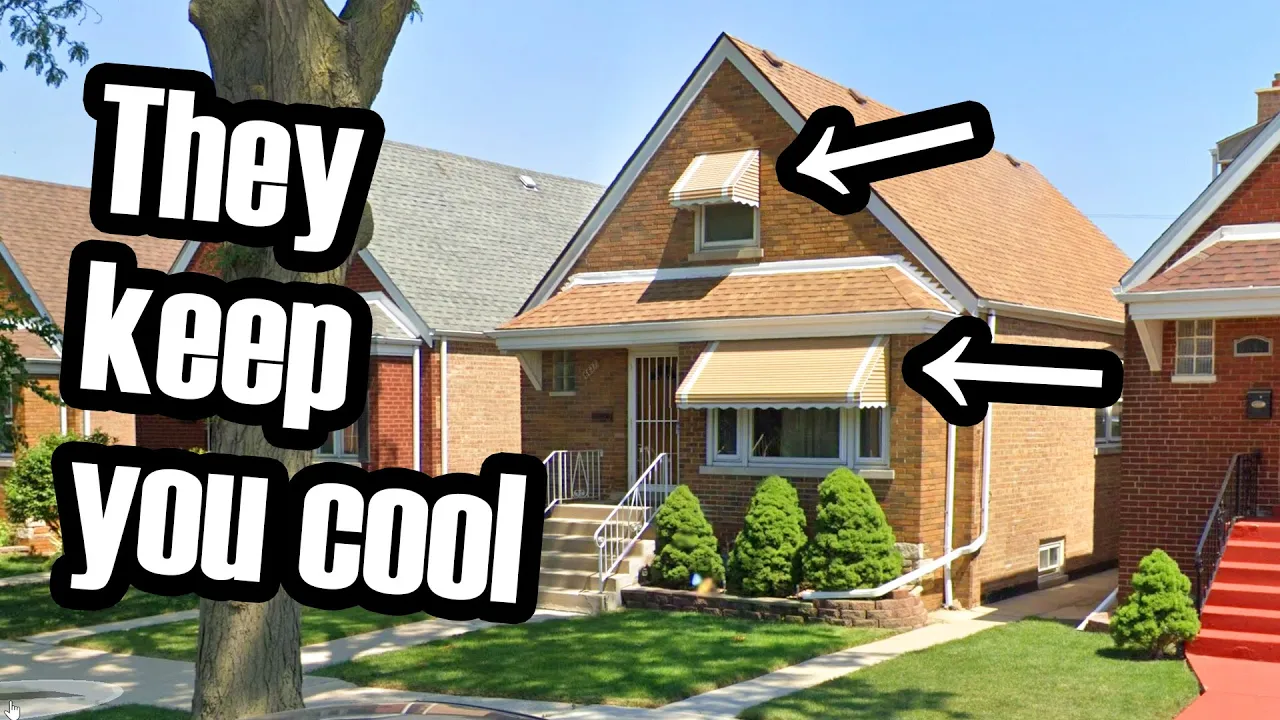
To achieve that same shade without building an expensive, material-heavy wraparound porch, manufacturers popularized fabric and metal window awnings. Awnings surged into mainstream residential fashion in the 1920s, celebrated in trade journals and home magazines alike. An article in the 1927 issue of *Building Age and National Builder* made an unabashed aesthetic and functional argument: “A Beautiful home which is devoid of awnings resembles a well dressed man without a necktie. The awnings give that finishing touch, just the last point to complete the proper taste.”
Beyond styling, period literature focused heavily on thermal comfort and interior preservation. The 1927 article noted that shading porch spaces dropped the indoor temperature of adjoining rooms, adding: “The fact that the awning excludes the sun from the window glass is quite an important asset in reducing the temperature of the room, and in preventing the fading of wall paper and carpet.” In 1925, writers Hal and Helen Davis declared in *Better Homes and Gardens*: “Awnings - they have such possibilities, such delightful possibilities, that foolish indeed is a house to go without them, if they can be afforded.” They were framed as major real estate selling points, with diverse catalog options ranging from regional configurations to flamboyant spear-mounted "Arabian Awnings." A quick digital stroll through older Chicago neighborhoods via Google Street View proves how widespread they were, with many vintage homes still retaining south- and west-facing awnings that cast deep shadows over the glass during scorching afternoons while allowing windows to stay open during summer downpours.
[06:17](https://www.youtube.com/watch?v=uhbDfi7Ee7k&t=377s) How Air Conditioning and Fashion Killed the Awning
The almost total disappearance of window awnings from modern public consciousness came down to two powerful forces: mechanical air conditioning and cyclical fashion trends. Before residential air conditioning, passive cooling techniques were vital for survival and basic comfort. Once motorized, energy-intensive compressors were tied to the electrical grid, interior climates could be brute-forced to whatever temperature the homeowner desired. So long as an air conditioner was sized with enough raw cooling capacity to overpower the continuous solar heat gain through the windows, exterior shading ceased to be strictly necessary.
Within a few decades, postwar home construction abandoned exterior awnings entirely under the assumption that mechanical HVAC equipment could simply pump the excess heat back outside. As new homes were built with bare, unshaded facades, existing homes with awnings suddenly appeared dated. In the design and real estate worlds, looking dated was treated as a fatal defect. By the 1960s, exterior window awnings had transformed from a symbol of refined taste into an architectural telltale that a house lacked modern central air conditioning. Realtors began advising sellers to tear them down, declaring that no modern buyer wanted a home with awnings because they were associated with old fuddy-duddies and lower-income households. Outside of niche infomercials for retractable patio covers, window awnings faded into obscurity.
- Mechanical cooling substituted electrical grid energy for passive architectural shading. - Postwar tract homes dropped awnings to cut construction costs and celebrate modern aesthetic minimalism. - Mid-century real estate agents actively stigmatized awnings as indicators of an un-air-conditioned, low-income home.
[07:56](https://www.youtube.com/watch?v=uhbDfi7Ee7k&t=476s) Modern Modeling: Energy Savings vs. Low-E Window Tradeoffs
Bringing window awnings back makes practical and financial sense. Apart from offering architectural character and customizable personal flair, they relieve strain on power grids during brutal heatwaves and directly cut electricity consumption. To quantify these savings, an energy model was run on a typical Chicago single-family home to calculate annual heating and cooling loads under varying architectural conditions. The results revealed an immediate, dramatic benefit: “Doing nothing to the house but adding window overhangs reduced the annual cooling energy needed by 20%.”
```mermaid flowchart LR accTitle: Tradeoffs of Low SHGC Windows vs Seasonal Shading accDescr: Low SHGC glass reduces summer cooling demand but penalizes winter heating demand, whereas overhangs block high summer sun while admitting low winter sun.
subgraph LowSHGC["Low SHGC Glass Only"] C1["Summer Cooling Demand: -20%"] H1["Winter Heating Demand: +Significant Penalty"] Net1["Net Efficiency: Mixed in cold climates"] end
subgraph Overhangs["External Overhangs / Awnings"] C2["Summer Cooling Demand: -20%"] H2["High summer sun blocked"] H3["Low winter sun enters freely"] Net2["Net Efficiency: Optimal year-round"] end ```
However, evaluating whole-home energy demand requires understanding the nuanced tradeoffs of window technology. Modern high-performance "Low-E" glass is rated using the Solar Heat Gain Coefficient (SHGC), which measures the fraction of solar radiation admitted through a window assembly. In hot Southern climates where heating demand is virtually nonexistent, installing windows with an extremely low SHGC—blocking over 75% of solar heat gain—is an unqualified win.
In Northern climates like Chicago, static low-SHGC glass introduces a severe seasonal penalty: - Over the course of a full calendar year, northern homes consume far more energy for heating than for cooling. - In the computer simulation, swapping south-facing windows to a low-SHGC glass reduced summer cooling demand by an amount comparable to installing exterior overhangs. - That same low-SHGC glass caused winter heating demand to spike dramatically by permanently blocking free passive solar heat gain when outdoor temperatures plunged. - Fixed glass coatings cannot adapt between July and January, whereas exterior overhangs naturally take advantage of solar geometry—blocking the high summer sun while allowing low-angle winter sunlight to pass beneath the shade and warm the interior for free.
[11:11](https://www.youtube.com/watch?v=uhbDfi7Ee7k&t=671s) The Elegance of Awnings vs. Complex Architecture
The beauty of window awnings lies in resolving a fundamental architectural trade-off: homeowners do not have to choose between summer shading and winter heating performance. Instead of sacrificing cold-weather passive solar gains by installing windows with low solar heat gain coefficients (SHGC), one can install high-SHGC windows to harvest free thermal energy during the winter, and simply rely on an awning to shade the glass when the summer sun sits higher in the sky. While high-end custom home design sometimes achieves this by engineering permanent structural overhangs over specific window elevations and using low-gain windows elsewhere, retrofitting an awning achieves the exact same functional outcome at a fraction of the cost and complexity.
```mermaid flowchart TD accTitle: Solar Heat Gain Window Trade-off accDescr: Comparison of high-gain windows with awnings across winter and summer seasons versus expensive architectural alternatives.
subgraph HighEnd["High-End Architectural Build"] A["High-SHGC south windows + low-SHGC elsewhere"] --> B["Permanent engineered roof overhangs"] B --> C["High design and construction cost"] end
subgraph AwningApproach["The Awning Retrofit Approach"] D["High-SHGC windows throughout"] --> E["Install exterior awnings"] E --> F["Cheap, adaptable, works anywhere"] end ```
In a voiceover insert, the presenter expresses concern that focusing primarily on mixed climates like the Midwest overlooks the severe demands of hotter regions. In an extreme climate like Phoenix, Arizona, even five average-sized (3-by-5-foot) west-facing windows equipped with top-tier low-e glass (SHGC of 0.2) will still admit well over a kilowatt of heat for hours every afternoon. As Alec puts it: “That’s not far off from running a space heater on high, and when it’s 100 degrees outside that’s not the smartest move.” Despite this reality, modern desert home developments frequently omit exterior window overhangs altogether, abandoning simple passive cooling strategies that were common knowledge even in temperate climates like Chicago.
- Five 3×5-foot west-facing windows with an SHGC of 0.2 transmit over 1 kW of thermal energy continuously on summer afternoons. - High-SHGC glass captures passive solar heating in winter; awnings block the steep summer sun without replacing the glass. - Modern suburban construction in Phoenix, Arizona, routinely neglects exterior window overhangs.
---
[13:31](https://www.youtube.com/watch?v=uhbDfi7Ee7k&t=811s) Modeling Skepticism and the Indoor Blind Fallacy
Reflecting on the simulation data used earlier, both Alec and the collaborator who helped run the building energy models harbored significant skepticism regarding certain outputs. Specifically, the model suggested that interior dark, closed drapes could reduce cooling power demand more effectively than a 2.5-foot exterior overhang, even when an overhang was already present. This defies basic physical principles: interior drapes cannot prevent sunlight from crossing the building envelope. Once sunlight penetrates the glass, its energy enters the room, and even highly reflective white roller shades absorb substantial energy and become intensely hot to the touch on summer afternoons. Exterior shading prevents the greenhouse effect from starting in the first place.
This disconnect highlights a broader industry problem: independent, robust research on the real-world efficiency of exterior awnings is remarkably sparse. The vast majority of published claims come directly from awning manufacturers rather than peer-reviewed academic or building-code studies. The underlying physics, however, are straightforward: eliminating direct solar beam radiation effectively converts any window—regardless of the façade it is located on—into the thermal equivalent of a shaded north-facing window (or south-facing in the Southern Hemisphere). As Alec notes: “Really, if there’s one call to action I want to make here it would be that there needs to be more study on the effectiveness of window awnings.”
- Interior blinds cannot stop radiant solar energy once it crosses through the glazing, leading to indoor heat absorption. - Shading external glass converts an exposed window into the thermal equivalent of a shaded, north-facing aperture. - Credible energy efficiency data for awnings remains surprisingly scarce outside of commercial marketing materials.
---
[15:14](https://www.youtube.com/watch?v=uhbDfi7Ee7k&t=914s) Trade-Offs: Light, Maintenance, Smart Tech, and Pests
Awnings do come with real-world drawbacks, the most immediate being reduced interior daylight. Because their explicit purpose is to eliminate direct sunlight, rooms become noticeably darker, which might disappoint occupants or sun-seeking pets. A speculative alternative could be a transparent awning made of ultra-low SHGC glass, which would preserve a clear view of the sky while cutting radiant transmission. Maintenance presents another historical pain point: early fabric awnings faded, accumulated dirt, and proved tedious to remove from frames, which drove the mid-century popularity of rigid aluminum models.
Modern material science and home automation offer solutions that bypass these old headaches:
```mermaid flowchart LR accTitle: Awning Technological Evolution accDescr: The progression from traditional fabric awnings to aluminum and modern automated smart systems.
subgraph Past["Historical Trade-offs"] A["Traditional Fabric<br>(faded, hard to wash)"] --> B["Rigid Aluminum<br>(durable, fixed position)"] end
subgraph Modern["Modern Automation"] C["Retractable Roller Awning"] --> D["Sensors + Wi-Fi Actuators"] D --> E["'Smart Awning'<br>(retracts for wind/clouds)"] end ```
Modern retractable fabrics paired with motorized rollers, Wi-Fi connectivity, and environmental sensors can automatically deploy during peak solar angles and retract during overcast weather, high winds, or winter days. The final drawback is biological: external shelters attract wildlife. While a nesting robin might be welcome, wasp nests frequently crop up in the framing underneath awnings. Though screened windows protect home interiors from stinging insects, physically clearing nests remains a chore. Nevertheless, Alec finds these minor issues easily manageable compared to the substantial thermal relief awnings provide.
- Fabric awnings historically suffered from UV degradation and difficult cleaning cycles, leading to the rise of aluminum awnings. - Automated motorized roller awnings can deploy on demand and retract during overcast skies or severe weather. - Pests such as wasps often construct nests under the protected eaves of fixed exterior awnings.
---
[17:23](https://www.youtube.com/watch?v=uhbDfi7Ee7k&t=1043s) Real-World Observations and Competing Exterior Shading
Alec's ongoing experiment of cooling his home exclusively overnight highlights the intense thermal power of solar radiation. On completely overcast summer days, his home's indoor temperature rises by only 5 to 6 °F throughout the entire day. On clear, sunny days with identical outdoor air temperatures, the indoor heat gain doubles to 10–12 °F. While radiant heating of the roof, attic, and exterior siding contributes to this increase, the thermal spike in west-facing rooms is nearly instantaneous as soon as the afternoon sun strikes the unprotected window glass.
```mermaid flowchart TD accTitle: Comparison of Exterior Window Shading Methods accDescr: Comparing awnings, European roller shutters, and exterior porch blinds on airflow and visibility.
A["Exterior Solar Shading Options"]
A --> B["Awnings"] B --> B1["Sun blocked before glass"] B --> B2["Free airflow dissipates heat"] B --> B3["Preserves ground-level outdoor view"]
A --> C["Rolladen / Roller Shutters"] C --> C1["Sun blocked before glass"] C --> C2["Traps warm air pocket against glass"] C --> C3["Completely eliminates outdoor view"]
A --> D["Exterior Porch Blinds"] D --> D1["Effective solar blockage"] D --> D2["Flexible fabric hanging"] D --> D3["Obstructs the outward sightline"] ```
While European exterior roller shutters (*Rolladen*) and exterior drop-down porch blinds effectively block direct radiation, both have clear operational downsides. Rolladen trap a dead-air pocket directly against the windowpane; as the metal slats bake in the sun, they re-radiate thermal energy into that confined gap, warming the glass while completely blocking the outdoor view. Exterior drop blinds also eliminate the sightline outside. An awning, by contrast, creates an open-air canopy that allows warm air to dissipate freely via natural convection while leaving sightlines to the outside completely clear. As Alec notes: “I’d rather have an awning, then that heat isn’t trapped and I can still look outside!”
- Overnight AC thermal flywheel experiments show daytime heat gain doubles (from 5–6 °F to 10–12 °F) on sunny vs. cloudy days at identical ambient temperatures. - European exterior roller shutters (*Rolladen*) trap a pocket of hot air directly against the glazing and completely obstruct daylight and views. - Awnings permit continuous convective airflow to prevent hot air stagnation while keeping outward ground views unobstructed.
---
[19:25](https://www.youtube.com/watch?v=uhbDfi7Ee7k&t=1165s) HOA Barriers and Final Call to Action
The biggest modern obstacle to widespread awning adoption in suburban housing is the Homeowners Association (HOA). In common-interest developments such as townhome communities, strict architectural control committees routinely forbid exterior modifications. Alec argues that if rigorous scientific research demonstrates that awnings can lower household cooling energy demands by meaningful margins—such as 20%—state or local legislation should curtail HOA authority to ban them outright. At an absolute minimum, HOAs should be mandated by law to provide a pre-approved palette of architectural awning styles and fabric colors.
With climate change intensifying summer heat domes, building codes and property standards must evolve beyond relying entirely on mechanical air conditioning and interior blinds. Historically, awnings were ubiquitous because they solved heat load problems passively. Alec concludes: “If window awnings were helpful before air conditioning, then surely they’re still helpful now.” Modern building science has spent decades optimizing glass coatings while forgetting basic geometric shading techniques that shield the glass altogether.
- HOAs stand as the primary legal and administrative barrier preventing homeowners from retrofitting exterior awnings. - Alec advocates for statutory protections restricting HOAs from banning energy-saving awnings, or at minimum requiring pre-approved styles. - Cooling energy codes frequently overlook window overhangs and awnings, despite their proven historical efficacy before the invention of residential AC.
---
[21:09](https://www.youtube.com/watch?v=uhbDfi7Ee7k&t=1269s) Outtakes and Bloopers
The video concludes with a sequence of lighthearted outtakes set against background jazz. Alec struggles through multiple takes of his presentation lines, stops abruptly when hearing strange ambient noises off-camera, and remarks humorously on his wardrobe: “I forgot how to tie a tie, I had to look it up! It’s been too long.” He rehearses and fumbles historical phrasing from vintage awning brochures regarding porch comfort, laughs through several verbal slip-ups and exasperated sighs, and brainstorms marketing pitches to make awnings culturally appealing again—riffing on baseball caps for houses before closing on a drawn-out, groan-worthy vocal pun: “*AWWWWW-nings.*”
- Alec humorously admits to having to look up how to tie a necktie for the video segment. - Features scrapped script reads and stumbles over vintage advertising copy describing awnings keeping porches "shaft and pleasant." - Alec brainstorms marketing slogans: "Awnings: like a baseball cap for your house!" followed by a drawn-out pun on the word *awning*.
## Notable quotes > [19:25](https://www.youtube.com/watch?v=uhbDfi7Ee7k&t=1165s) If window awnings were helpful before air conditioning, then surely they’re still helpful now. — Alec
## Mentioned Technology Connections, Alec, Building Age and National Builder, Hal and Helen Davis, Better Homes and Gardens, Google Street View, Patreon, Mastodon, Bluesky
## Video description Seriously - where'd they go? Links 'n' stuff:
Technology Connections on Mastodon: https://mas.to/@TechConnectify
Technology Connections on Bluesky: https://bsky.app/profile/techconnectify.bsky.social
Have you ever noticed that I've never done a brand deal? That's all thanks to people like you! Viewer support through Patreon keeps this channel independent and possible. If you'd like to join the amazing folks who fund my work, check out the link below. And thank you! https://www.patreon.com/technologyconnections
[Source](https://www.youtube.com/watch?v=uhbDfi7Ee7k)