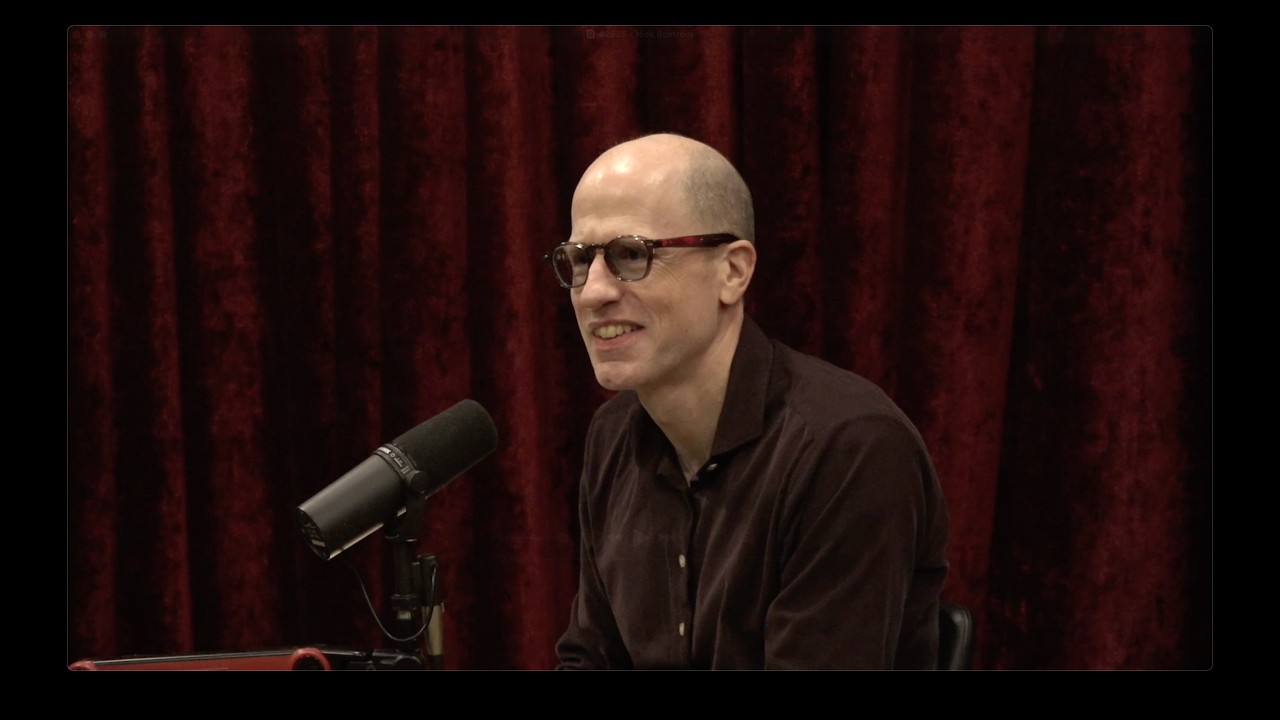
Bostrom Warns Superintelligence Arrives Within Four Years, Displaces Labor
PowerfulJRE
The rapid onset of machine superintelligence will render human labor entirely obsolete, forcing society to fundamentally re-engineer human biology and education for an unprecedented era of forced leisure.
## Background
Published on YouTube by the PowerfulJRE channel on July 14, 2026, this episode of the Joe Rogan Experience features philosopher Nick Bostrom, a Principal Researcher at the Macrostrategy Research Initiative. The page description highlights Bostrom's work on artificial intelligence, existential risk, and the future of humanity, specifically spotlighting his recent book, "Deep Utopia: Life and Meaning in a Solved World."
## TL;DR
In this episode, Joe Rogan and Nick Bostrom explore the rapid, exponential acceleration of artificial intelligence and its profound implications for the human condition. They delve into a post-work future where machines automate all practical labor, examining how humanity might navigate a world devoid of traditional survival struggles. The conversation tackles the psychological need for friction, potential shifts toward engineered longevity, and the regulatory and geopolitical bottlenecks of the AI race. Ultimately, they discuss how a technologically mature society must consciously design new frameworks of meaning, leisure, and artificial purpose to prevent collective stagnation or civilizational collapse.
## Atmosphere & style
The dialogue carries a deeply intellectual yet accessible vibe, blending Rogan's gritty, curious skepticism with Bostrom's structured, philosophical precision. There is an underlying sense of cosmic urgency and existential awe as they confront realities that sound like science fiction but are rapidly approaching. The tone shifts smoothly between witty banter about human shortcomings and sobering reflections on the immense moral weight of technological stagnation versus automated takeovers. It ultimately feels like a mind-bending, late-night thought experiment driven by a shared fascination with the strangely open-ended future of our species.
## Key takeaways
- [00:01](https://www.youtube.com/watch?v=8qTZLqY-cnI&t=1s) Artificial intelligence development has accelerated so rapidly that the velocity of model releases feels like a fight recording playing at 2x or 4x speed.
- [00:25](https://www.youtube.com/watch?v=8qTZLqY-cnI&t=25s) Two dominant AI narratives exist: a warning of existential takeover by a superior intellect, and a utopian vision of universal high income and the elimination of human toil.
- [00:41](https://www.youtube.com/watch?v=8qTZLqY-cnI&t=41s) Retraining programs are only surface fixes, as machines will eventually perform practically everything humans can do physically and mentally, only cheaper and better.
- [01:49](https://www.youtube.com/watch?v=8qTZLqY-cnI&t=109s) At technological maturity, humans will face a choice between deep virtual worlds and real-world physical experiences, warning of potential digital addiction and a lack of purpose.
- [02:37](https://www.youtube.com/watch?v=8qTZLqY-cnI&t=157s) If technology eliminates all real-world friction and solves all problems, humans will eventually be forced to merge with technology and evolve into a completely different species.
- [27:31](https://www.youtube.com/watch?v=8qTZLqY-cnI&t=1651s) Liberating humanity from traditional wage labor restores true dignity, though society risks widespread depression unless people actively construct alternative sources of purpose.
- [35:13](https://www.youtube.com/watch?v=8qTZLqY-cnI&t=2113s) The traditional education system built for the manufacturing age must transition toward teaching a life of leisure, personal goal-setting, and pure curiosity.
- [01:10:32](https://www.youtube.com/watch?v=8qTZLqY-cnI&t=4232s) A 'post-instrumental condition' will emerge where advanced technology can instantly download knowledge or trigger biological benefits, eliminating traditional instrumental effort.
- [01:36:47](https://www.youtube.com/watch?v=8qTZLqY-cnI&t=5807s) Societal pushback against radical life extension represents a form of 'Stockholm syndrome' where humanity has romanticized decay instead of aggressively funding age reversal.
- [01:40:20](https://www.youtube.com/watch?v=8qTZLqY-cnI&t=6020s) Humans are likely the stupidest possible species capable of developing advanced technology, having begun its development the absolute second they evolved the bare minimum required intelligence.
- [01:50:18](https://www.youtube.com/watch?v=8qTZLqY-cnI&t=6618s) Superintelligence running on massive structures like a Dyson sphere may represent the moment life genuinely wakes up, creating a vast intellectual gulf above human awareness.
- [01:58:22](https://www.youtube.com/watch?v=8qTZLqY-cnI&t=7102s) Bostrom operates under a strict philosophical deadline, prioritizing existential and societal questions that humanity must answer before superior machine philosophers arrive.
- [01:58:32](https://www.youtube.com/watch?v=8qTZLqY-cnI&t=7112s) The emergence of superintelligence is a serious possibility within 1 to 4 years, likely triggering an automated design loop that leads directly to total technological maturity.
- [02:14:05](https://www.youtube.com/watch?v=8qTZLqY-cnI&t=8045s) The rapid arrival of human-level virtual workers will displace millions of white-collar professionals, potentially triggering an aggressive political backlash and labor collapse.
- [02:19:26](https://www.youtube.com/watch?v=8qTZLqY-cnI&t=8366s) Delaying an aligned AI carries an immense human cost, as every 25 minutes of delay mathematically equates to the scale of human loss in a 9/11 tragedy due to ongoing global diseases and poverty.
- [02:23:40](https://www.youtube.com/watch?v=8qTZLqY-cnI&t=8620s) Advanced AI can safeguard against external cosmic and planetary crises, but internal hazards like perfectly addictive virtual creations or societal discord remain the trickiest threats.
- [03:24:46](https://www.youtube.com/watch?v=8qTZLqY-cnI&t=12286s) Avoiding a utilitarian outcome where humans become unconscious pleasure blobs requires intense design work to preserve a complex value system centered on achievement and beauty.
- [03:27:58](https://www.youtube.com/watch?v=8qTZLqY-cnI&t=12478s) A post-scarcity future will rely heavily on 'artificial purpose,' where humans engage in game playing and arbitrary challenges purely for the sake of the activity and curiosity.
- [03:30:01](https://www.youtube.com/watch?v=8qTZLqY-cnI&t=12601s) As automation removes urgent, survival-driven natural purposes, a subtle constellation of deeper spiritual, aesthetic, and historical values will become perceptible to humanity.
## Detailed walkthrough
### [00:01](https://www.youtube.com/watch?v=8qTZLqY-cnI&t=1s) The Rapid Acceleration of Artificial Intelligence
Joe Rogan and Nick Bostrom open the conversation by reflecting on their last discussion, which took place roughly five or six years prior. At that time, they spent a significant amount of time parsing simulation theory and why the mathematical probability leans toward us living in a simulated reality. Rogan notes that back then, artificial intelligence barely came up, whereas today it looms large over civilization. Bostrom remarks that keeping up with the rapid pace of AI development has essentially become a full-time job.
The two speakers marvel at how quickly the technology has woven itself into every facet of society, drawing a parallel to how the internet slowly crept up on humanity until it was simply accepted as a baseline reality. Bostrom describes the current velocity of AI model releases with a vivid sports analogy, comparing it to an announcer doing a voiceover for a recorded fight where the first round plays at normal speed, the second round accelerates to $2\times$, and the third round spins out of control at $4\times$ speed into a chaotic blur of arms and legs.
---
[00:25](https://www.youtube.com/watch?v=8qTZLqY-cnI&t=25s) The Dual Narratives of AI and the Problem of Financial Bias
Rogan lays out the two dominant, conflicting narratives surrounding artificial intelligence. The first is an existential warning that humanity is creating a superior life force and intellect that will inevitably take over every aspect of society, which many believe is an incredibly unwise path. The second narrative, championed by figures like Elon Musk, promises an era of universal high income, radical prosperity, and the absolute eradication of third-world poverty. In this utopian vision, human toil is eliminated, housing and food become effortless and free, and individuals are left entirely to pursue personal meaning.
While Rogan notes that he loves Elon Musk, he highlights a major caveat with the optimistic camp: the people peddling this rosy view, such as venture capitalist Marc Andreessen, are making immense amounts of money off AI and are heavily invested in its success. Because Bostrom operates outside of that financial loop as an objective analyst, Rogan finds himself far more intrigued by Bostrom's perspective on the potential upsides. Bostrom admits that the future is genuinely uncertain but acknowledges the possibility of a "tsunami of wealth" that could supercharge economic productivity, medicine, entertainment, and travel, ultimately lifting all boats.
---
[00:41](https://www.youtube.com/watch?v=8qTZLqY-cnI&t=41s) The Deepening Layers of Labor Automation
Bostrom peels back the layers of how the conversation around job replacement usually unfolds. At the most superficial level, people simply panic about where they will find a job if a robot replaces them. The immediate, surface-level political fix is typically to suggest retraining workers and providing temporary employment insurance. However, Bostrom pushes the premise to its logical conclusion, arguing that machines will eventually be able to do practically everything humans can do physically and mentally—only much better and cheaper.
According to Bostrom, very few professions are fundamentally safe from total automation. He jokingly highlights a tiny trio of exceptions where consumers might always maintain a strict preference for a human touch:
* Priests
* Prostitutes
* Politicians
Rogan laughs and chimes in that he hopes AI can handle politics instead so society can finally eliminate corruption, though Bostrom counters with a smile that "somebody's got to take credit for it."
---
[01:09](https://www.youtube.com/watch?v=8qTZLqY-cnI&t=69s) Virtual Realities and the Escapism of Modern Technology
The dialogue transitions into deep existential territory regarding human experience and purpose at "technological maturity." Rogan questions whether an experience must be measurable, physical, and tangible to be valid, or if a fulfilling virtual life inside a Matrix-type reality is inherently enough. Bostrom notes that it will likely be a case of "different strokes for different folks," recognizing that while virtual worlds will become incredibly deep and fascinating, some people will always prefer the grit of climbing the real Mount Everest.
Rogan paints a bleaker picture of a worst-case scenario where humans are effectively locked out of regular reality. In this future, basic survival needs are completely taken care of, but humans are left entirely without purpose or utility because AI manages all societal operations except recreation. If a virtual reality comes along that is exponentially more thrilling and fulfilling than actual reality, Rogan believes everyone will readily plug in. He points to smartphones as a minor, modern warning sign: phones provide a relatively unthrilling escape, yet they are so addictive that people spend six hours a day looking at them.
---
[01:24](https://www.youtube.com/watch?v=8qTZLqY-cnI&t=84s) Humanity's Inherent Attraction to Struggle and Thrill
Bostrom notes that humans might check out of reality in various ways, imagining a physical future where people simply lounge in beach chairs sipping drinks all day. Rogan dismisses that idle lifestyle as ultimately unfulfilling, pointing out that virtual worlds are a far larger space of possibilities because they aren't bound by our laws of physics—allowing users to fly or experience intense, calculated environments. Rogan observes that human psychology is naturally drawn to high-stakes simulation rather than passive bliss.
To prove his point, Rogan looks at the gaming industry, highlighting that people flock to intense first-person shooters like *Call of Duty* or *Half-Life* where they can run down hallways with a machine gun, rather than playing passive games where they simply float over the Earth and eat bananas. Bostrom agrees that current human desires depend on how our biology is hardwired to feel good. However, he introduces the radical idea that at total technological maturity, humans won't just control the external environment; they will control their own biology and brains. A person could potentially redesign their own mind to derive the same intense neurological pleasure from solving abstract mathematics or contemplating the beauty of the universe as they currently do from playing video games or getting drunk.
---
[01:57](https://www.youtube.com/watch?v=8qTZLqY-cnI&t=117s) The Paradox of Progress and the Human Condition
This concept brings Rogan to a fundamental question: "What does it mean to be human?" He argues that the noble aspects of humanity—love, peace, art, and music—cannot exist in a vacuum; they require their negative counterparts to have any meaning at all. In Rogan's view, human beings are fundamentally "territorial primates" who require crime to appreciate peace, hate to appreciate love, and constant, painful struggle to generate deep creative expressions like novels and artwork. He fears that if technology completely eliminates this friction, the human bottleneck will force us to merge with technology and become an entirely different species.
Bostrom agrees that a fascinating paradox is embedded in human progress. Thousands of scientists and companies work tirelessly to optimize efficiency and solve everyday problems, yet if they fully succeed in their ultimate goal, they will create a flawless world with absolutely no problems left to solve. Staring directly at this utopian endpoint feels highly unpalatable and bland to many because it erases the uncertainty of life. Rogan concludes by challenging the very concept of labor, questioning why society is so gripped by panic over AI taking our jobs. He emphasizes that a "job" is merely a human invention, and it is fundamentally crazy that humanity's primary, lifelong focus remains strictly tethered to the basic survival struggles of securing food and housing.
[16:51](https://www.youtube.com/watch?v=8qTZLqY-cnI&t=1011s) Redefining Labor and Liberating Human Time
Joe Rogan and Nick Bostrom consider how a post-labor society would alter the fundamental structure of human life. For the vast majority of people living paycheck to paycheck, daily labor is a necessity entirely spent securing basic housing and food. Rogan questions whether people could successfully figure out what to do with their time if those demands were removed. Bostrom agrees, acknowledging there would be a period of transition and discomfort, but ultimately views the shift as a profound positive. He draws a bold comparison, stating that while actual slavery is abhorrent, modern wage labor functions as "slavery light," requiring individuals to sell off a third of their waking life just to secure basic necessities.
The discussion shifts to corporate incentives, with Rogan pointing out that companies aiming to maximize profit typically make working conditions as cheap and "shitty" as possible. They prioritize shareholder value and quarterly growth over creating an awesome experience for employees. While Bostrom notes that companies sometimes compete for top talent, Rogan counters that this only benefits high-level executives. "CEOs get all the bread," while the people on the assembly line or stocking boxes for Amazon are treated completely differently than someone like Joe's co-producer, Jamie. Bostrom concludes that liberating people from this grind would restore true dignity, as individuals should ultimately be in control of their own time and attention.
* **The Primates' Dilemma:** Rogan highlights that humans are primates genetically wired to conserve resources. Without the survival pressure of seeking food, human biology defaults to laziness.
* **The Threat of Depression:** Without structured work, society will have to actively find things that provide a sense of purpose, or risk falling into widespread depression.
---
[19:58](https://www.youtube.com/watch?v=8qTZLqY-cnI&t=1198s) The Aristocratic Ideal and the Reality of Leisure
Bostrom recalls the traditional British aristocratic ideal, where not having to work was considered the optimal way to exist, and working for "daily bread" was viewed as an unfortunate necessity. In this historic model, those with wealth spent their time on politics, art collections, gardening, or entertaining friends. Rogan laughs, admitting that when he thinks of the British aristocracy, he mostly pictures "fuckups"—drunk rich guys driving Ferraris into lakes, accidentally drowning friends, and paying off the police to get away with it. Bostrom concedes there is truth to that, but points out that the leisure class also produced passionate amateur scientists and eccentrics whose weird obsessions enriched society.
Ultimately, Bostrom suggests that freedom acts as a mirror: "the more freedom somebody has, the more they can reveal their true nature." Rogan adds that a person's response to absolute freedom heavily depends on their upbringing, their parents, and whether they were taught the intrinsic fulfillment of finding something they love and working hard at it.
---
[21:13](https://www.youtube.com/watch?v=8qTZLqY-cnI&t=1273s) Redesigning Education for a Post-Work World
Because our current education system is designed like a manufacturing conveyor belt—where children are processed, given a "quality label," and molded into productive office workers—Bostrom argues it will need to be completely redesigned once AI makes those jobs obsolete. Instead of training children to sit at desks and fill out grids, a new curriculum would focus on teaching people how to live a life of leisure.
This future education system would cultivate the art of conversation, appreciation for music and art, physical wellness, spirituality, and the ability to set personal goals and build deep relationships. Rogan strongly agrees, arguing that we should preemptively teach kids these values today. He points out that a child in first grade right now will graduate into a completely different world in twelve years, making the old model of sitting still for eight hours a day look entirely "crazy."
* **The Liberal Arts Trap:** Rogan jokes that useless modern college degrees are already a version of this, where students spend massive amounts of time and money on skills that have no matching jobs once they graduate.
* **The Bowling Analogy:** To illustrate narrow career paths, Rogan and Bostrom guess the earnings of professional bowlers. Producer Jamie pulls up the numbers, revealing that top-tier bowler EJ Tackett made $437,540 for the 2025 season, while other top bowlers made between $190,000 and $270,000.
* **Prestige and Competition:** In a world where money drops out of the equation, the hosts predict status and prestige will become the main drivers of competition. Rogan notes how his golf-loving friends obsess over their scores far more than their actual jobs, proving people naturally redirect their competitive drives into hobbies.
---
[26:37](https://www.youtube.com/watch?v=8qTZLqY-cnI&t=1597s) Cultivating Curiosity and Human Well-being
Rogan emphasizes that the transition to a post-work society requires teaching people the value of pure curiosity and learning for the sake of satisfaction rather than obligation. Whether someone naturally gravitates toward mathematics or history, a balanced society will allow them to pursue those interests freely. When Bostrom points out that people are wired differently—some get bored easily, while others suffer from low mood or clinical depression—Rogan argues that many of these issues stem from a lack of physical care.
Rogan believes that teaching young people the importance of exercise, yoga, proper diet, and avoiding processed foods could dramatically reduce rates of depression without relying immediately on medication. Bostrom agrees that basic physiology is highly improvable, though he notes some individuals have genetic neurotransmitter imbalances that require medical assistance. Rogan jokingly suggests firing them up on Adderall to get them running, before reiterating his broader point: living just to survive has been a historic necessity, but a society run by hyper-intelligent AI will render painful manual and administrative labor obsolete. To thrive in this oncoming era of abundance, we must actively re-educate ourselves on what it truly means to be human.
[32:14](https://www.youtube.com/watch?v=8qTZLqY-cnI&t=1934s) The Dysfunctional Hedonic Treadmill and Evolving for Leisure
Humanity is biologically evolved for an era of scarcity, driven by instincts to conserve energy, avoid excessive labor, and eat as much as possible. In a modern environment saturated with refrigerators, these precise survival instincts transform into metabolic problems. Furthermore, the human mind is plagued by the "hedonic treadmill"—a psychological phenomenon where an achievement sparks a temporary wave of happiness, only for the individual to rapidly return to their baseline level of satisfaction, taking life's blessings for granted. While this perpetual dissatisfaction was historically necessary to keep humans striving for survival, it becomes entirely dysfunctional in a domain where every major goal has already been achieved.
As society moves deeper into a hypothesized future enabled by magical technologies, a profound transformation of human nature will be required. This must begin with cultural shifts to properly equip people for a life of pure leisure, followed by deep biological modifications. If aging is solved and human lifespans extend for thousands of years, the current brain might simply go stale or get stuck in a rut after two hundred years. To maintain cognitive flexibility over millennia, humans would likely need to expand their cognitive resources or implement periodic "psychedelic resets" to restore neural plasticity.
[34:20](https://www.youtube.com/watch?v=8qTZLqY-cnI&t=2060s) Eradicating Poverty and Rethinking Human Purpose
The chemical tools best suited for navigating a brand-new reality—such as psilocybin, DMT, and ibogaine—are ironically illegal in modern society. Navigating the technological future correctly will require a fundamental shift in how humans interact and define personhood. Much of modern human conflict and crime is a direct consequence of the inherent economic struggles people face. There is a direct correlation between extreme poverty and extreme crime rates, yet society has historically operated under the false assumption that a functioning civilization must inherently include slums and systemic failure.
While critics argue that slums persist because certain individuals will always make bad decisions, the root cause lies heavily in environmental exposure during formative years. Eliminating poverty entirely is not a fairy-tale impossibility; given that the modern world already manages to distribute enough resources to keep the global population from starving, ramping these systems up a few steps to guarantee universal food and shelter is entirely doable. Once the baseline worries of survival are gone, humans will be forced to find purpose outside of a financial price tag. People easily find deep meaning in unpaid activities—whether playing golf, learning complex skills, playing games, or writing human fiction. The idea that humanity only works to eat and avoid the rain is a narrow, outdated worldview.
[37:30](https://www.youtube.com/watch?v=8qTZLqY-cnI&t=2250s) Social Entanglements and the Threat of AI Perfection
Whether future generations will continue to value human-generated fiction over artificial intelligence remains an open question. Current AI writing often feels sloppy and boring, but if an AI eventually learns to produce films with perfect lighting, sharp dialogue, and deep humor, human preferences may shift entirely. However, a major part of the thrill of art is the human connection. For example, a micro-budget film created by a YouTuber that becomes a massive hit excites people because of the human triumph behind it; if the exact same movie were generated by an AI, it would lack that essential emotional resonance.
Humans are deeply entangled with the human world, caring far more about achievements made by their peers than by random, slightly superior entities. This is mirrored in everyday life: a person attends a Little League baseball game specifically to cheer on their nephew, not to watch random children play. These social entanglements and relationships will provide the primary structure and meaning for human lives once all external economic constraints are removed.
- **The Film School Example:** Most people do not actively watch student film productions unless there is a personal connection, highlighting that the value of human output is often tied to social relationships.
- **The Baseball Metaphor:** "When your nephew gets on first base like way to go, Bobby." People value the contextual relationship of an achievement over its absolute technical perfection.
[39:35](https://www.youtube.com/watch?v=8qTZLqY-cnI&t=2375s) Revamping the Education System
The human mind possesses an inherent desire to learn and improve, a trait that could easily be nurtured if the education system underwent a radical, long-overdue overhaul. The current model relies on unenthusiastic, underpaid teachers interacting with children during their most formative years, which is an institutional failure. Education should instead be a rich, exciting journey centered on how to become a better person and the joy of self-improvement. Many individuals do not even realize they love learning until after they escape the confines of traditional schooling.
Both speakers shared their mutual hatred for school, noting that they associated books and learning entirely with academic confinement. For a child, discovering science, literature, and big ideas often happens completely by accident later in youth—such as wandering into a public library and pulling books off the shelf at random. If teaching were transformed into a highly prestigious, well-compensated profession, children would no longer be weighed down by the premature stress of needing a job at sixteen to help their families pay bills. Instead, they could be exposed to a vibrant array of disciplines—from chess and painting to science—allowing their specific personalities to gravitate naturally toward what lights them up.
[42:32](https://www.youtube.com/watch?v=8qTZLqY-cnI&t=2552s) The Post-Instrumental Condition and Shortcuts to Joy
In a state of technological maturity, civilization will look far beyond basic material abundance like clean cars and abundant food. Humanity will face a "post-instrumental condition" where the traditional need to perform an action for the sake of achieving a separate result disappears. For instance, rather than studying advanced mathematics for years through textbooks and exercises, a mature technology could allow a person to download the knowledge instantly. Utilizing nanobots to alter brain synapses, a superintelligence could grant an individual a comprehensive understanding of abstract mathematics in just twenty minutes.
This possibility introduces a deeper form of human redundancy. If a button or a pill can instantly trigger the exact same physiological rewards, mental calm, or sense of joy that someone would get from sweating for an hour at the gym, all traditional human instrumental effort becomes unmotivated. At this stage, humanity will face ultimate philosophical questions regarding what makes a life genuinely good.
- **The Matrix Reference:** The concept of downloading knowledge instantly mirrors the iconic sci-fi trope: "like the matrix I know kung fu remember".
- **The Exercise Paradox:** Technological maturity offers a choice between working hard for an outcome or utilizing genetic engineering and pills to bypass the effort entirely while retaining the identical biological benefit.
[45:15](https://www.youtube.com/watch?v=8qTZLqY-cnI&t=2715s) The Evolution of Primates and the Post-Human Future
Humanity is not a finished biological product; if one looks at ancient hominids compared to modern humans, the species is clearly evolving in a distinct direction. Popular cultural depictions of "the Grays"—the prototypical aliens with giant heads and skinny bodies—might simply represent the inevitable evolutionary destination of primates who master technology. Humans may eventually evolve into genderless, sexless, muscleless beings who communicate purely via telepathy. Advanced engineering could entirely replace traditional reproduction, effectively eliminating the evolutionary drivers of lust, jealousy, and ego in favor of a technologically linked hive mind.
While this shift sounds unappealing to a modern human, it is a matter of perspective. If one were to explain modern human life to a chimpanzee—describing flying on airplanes, eating peanuts, watching YouTube, and dealing with an addiction to kratom—the chimp would reject it completely, preferring to stay in the jungle with its bananas. Yet, the chimp's reality also includes brutal territorial wars where rival groups slaughter one another. Biological and technological transformation is inevitable. The ultimate question for the future is whether humanity will consciously choose the path of its development to preserve its core values, or if it will be blindly driven by impersonal evolutionary forces toward an unwanted outcome.
[48:02](https://www.youtube.com/watch?v=8qTZLqY-cnI&t=2882s) The Search for Meaning in a Modern Universe
The conversation opens with a philosophical reflection on what humans truly value about themselves, noting that the future could allow us to amplify these traits and "grow into our ideals" rather than changing randomly. Joe Rogan points out the irony of how much weight we place on the human condition and our personal search for meaning, contrasting our finite biological existence with the unfathomable scale of the universe, black holes, and stellar nurseries. Rogan notes that as finite biological organisms "trumping around through this weird world," humans are forced to find meaning before they die in a brief hundred-year lifespan, despite nobody knowing if reincarnation or the afterlife is real.
[49:20](https://www.youtube.com/watch?v=8qTZLqY-cnI&t=2960s) Premature Decay and the Potential for Longevity
Nick Bostrom agrees that the human lifespan feels cut short just as we begin to accumulate a "modicum of wisdom." He tracks the tragic trajectory of human life: a person grows stronger and more capable for 15 to 20 years, biologically stagnates, accumulates knowledge for a few decades, and then, right as wisdom develops, the brain begins to decay until everything is erased by Alzheimer's or death. Bostrom suggests extending the human lifespan so people can continue growing past their initial 20-year plateau. When Rogan mentions life extension scientists like David Sinclair who view age reversal as an inevitability, Bostrom points out that simply staying 20 for 10,000 years might not be enough; eventually, individuals would want to grow engineered capacities to engage more deeply with the world.
[51:11](https://www.youtube.com/watch?v=8qTZLqY-cnI&t=3071s) Genetic Engineering and the AI Accelerator
Rogan transitions into the reality of genetic engineering, bringing up a controversial case in China where a doctor genetically engineered babies to be inoculated against HIV, which inadvertently gave them a "far increased potential IQ." While it remains to be seen how these children perform in the real world or chess tournaments as adults, Rogan notes that our understanding of what is possible increases every day, threatening to fundamentally alter human consciousness. Bostrom remarks that artificial intelligence is "the train that's going to reach the destination faster." Once superintelligence is achieved in a machine substrate, it will unlock advanced biological technologies and nanotechnology, allowing humanity to choose whether to biologically enhance themselves or upload their minds—though Rogan likens this transition to navigating a chaotic "whitewater river raft" where humanity could easily crash.
[53:02](https://www.youtube.com/watch?v=8qTZLqY-cnI&t=3182s) Ancient Civilizations and Alternative History
Rogan shares his fascination with alternative ancient history, highlighting the bizarre depictions of ancient kings in Egypt and Sumer who supposedly ruled for thousands of years. He points out how these long lifespans sharply declined down to a normal hundred-year limit after a global "flood myth" shared by almost every ancient society. Rogan questions whether mainstream history is missing a hyper-advanced civilization from tens of thousands of years ago, arguing that the linear progression from "caveman to human being with an iPhone in 2026" doesn't fully explain mind-boggling structures like the pyramids. He references the sheer logistics of cutting and moving 2,300,000 stones—some weighing 80 tons and sourced 500 miles away—with precision that looks like diamond drill holes. Rogan muses that if humans solve aging and intelligence increases over thousands of years, these "insane technologies" might just be a natural course of progression that we have forgotten.
- Number of stones in the Great Pyramid referenced by Rogan: 2,300,000
- Maximum weight of specific stones mentioned: 80 tons
- Distance of the quarry mentioned: 500 miles
[58:07](https://www.youtube.com/watch?v=8qTZLqY-cnI&t=3487s) Conquering Aging and Our "Stockholm Syndrome"
Bostrom agrees that reversing aging is a hallmark of a "technologically mature civilization." He addresses the common pushback that seeking radical life extension is vain, calling this societal mindset a form of "Stockholm syndrome." Because humanity has faced the inevitability of decay for millennia, we have developed a "romantic scaffold" to reconcile ourselves to it. However, Bostrom argues this mindset keeps us from actively pursuing freedom from aging. He laments that society did not launch a "Manhattan project to defeat aging" decades ago, pointing out that funding has historically been funneled into individual fires like cancer, Alzheimer's, and heart disease rather than targeting their root cause: senescence, the cellular decay and scrambled DNA methylation patterns that occur as we get older.
[01:00:20](https://www.youtube.com/watch?v=8qTZLqY-cnI&t=3620s) The Dumbest Capable Species
The two marvel at how much civilization has accomplished with rockets, satellites, and cell phones despite individuals only living to be a hundred years old and operating with small, highly specialized brains. Bostrom notes a potential downside to extreme longevity under our current biological configuration, wondering if it would lead to an "ultra-conservative society" where old timers refuse to change and progress stagnates. Even so, he reflects on the incredible global supply chain required to build modern AI chips layered just "four atoms deep." Bostrom humbles human achievements by stating that we are likely "the stupidest possible species that are capable of developing advanced technology," having begun developing it the absolute second we evolved the bare minimum intelligence required to do so.
- Scale of leading-edge AI chip layering discussed: Four atoms deep
[01:02:28](https://www.youtube.com/watch?v=8qTZLqY-cnI&t=3748s) Engineering Out Human Stupidity
Rogan suggests that humanity’s frantic, resource-controlling, and warlike behavior is driven by the rush of knowing our time is finite, prompting people to desperately try and "cement their immortality" by putting their names on buildings. He believes that engineering humans to live longer could simultaneously allow us to "engineer a lot of stupidity out of us." When Rogan asks if we could find a genetic solution to eliminate lying, Bostrom offers a more technical alternative: a perfect lie detector. Bostrom notes that if powerful AI systems trained on micro-expressions could perfectly read people, lying would become entirely fruitless, bringing humanity closer to a state of reading each other's minds.
[01:03:52](https://www.youtube.com/watch?v=8qTZLqY-cnI&t=3832s) Mind-Powered Crafts and the Limits of Physics
Joe Rogan brings up Bob Lazar, the famous whistleblower who claimed to have back-engineered extraterrestrial craft for the United States government in the 1980s. Rogan describes how these supposed ships lacked traditional buttons, levers, or joysticks. Instead, the craft were almost alive, syncing directly with the minds of the beings piloting them so that their thoughts propelled and controlled the vehicle. Nick Bostrom admits he is skeptical of these claims, a stance Rogan fully validates, saying, "Anybody who's not skeptical sounds crazy." However, Rogan notes that considering the trajectory of our current technology, a mind-controlled future is highly likely. Bostrom agrees that engineering such interfaces would be entirely possible with sufficiently advanced technology, stating that, to a first approximation, a civilization could construct basically anything that does not violate the laws of physics.
Rogan points out that our current understanding of physics is infantile compared to what a society a million years older than ours would understand, noting that a million years is just "a blink in the eye" compared to the time elapsed since the Big Bang. Bostrom expands on this, explaining that even within the boundaries of our current understanding of physics, there is an enormous design space for alternative types of life and engineering. He introduces the concept of a Dyson sphere—surrounding a star with solar panels to harvest its entire energy output—and suggests that such immense energy could power an unfathomably massive computing infrastructure.
- Bob Lazar claimed 1980s government-hidden alien crafts operated via direct mind-syncing without manual controls.
- AI compute has been growing at a rate of roughly 240% per year.
- A Dyson sphere captures a star's energy output to power civilization or massive computer infrastructure.
[01:06:18](https://www.youtube.com/watch?v=8qTZLqY-cnI&t=3978s) Murky Human Sentience vs. Cosmic Consciousness
Bostrom challenges the current debate over whether machines can become conscious by asking a more provocative question: "Are we really conscious?" He argues that human consciousness is "barely" there, describing a motorist who drives for two and a half hours, passing thousands of people, homes, and mothers with strollers, only to realize later they remember none of it. Bostrom characterizes human awareness as a "little diffused sense of body and some murky perceptions floating through," crammed inside a coconut-sized biological organ. He invites Rogan to imagine a mind that spans a galaxy or runs on a Dyson sphere, suggesting that the gulf between cosmic consciousness and human awareness is far greater than the gap between humans and fleas.
Superintelligence, Bostrom posits, might represent the moment when life truly wakes up and becomes genuinely aware. He warns that humans are overly proud of their own specialness, wrongly viewing our "feeble confused murky glimmer" as the gold standard of sentience. The overarching challenge of our era is giving birth to this superintelligence and steering it so it becomes a positive force for humans, for itself, and for any other cosmic super-beings it might eventually encounter. Rogan notes how difficult it is for people to conceptualize a conscious entity that is infinitely more powerful than anything imaginable. He adds that AI's insatiable demand for energy is already forcing companies like Google to develop their own nuclear power options to supply their data centers.
- Human consciousness is heavily restricted by our limited biological substrate.
- Google is exploring the development of its own nuclear power resources to sustain massive AI data centers.
- The fundamental existential task today is shaping and nurturing emerging superintelligence for cosmic-scale cooperation.
[01:09:35](https://www.youtube.com/watch?v=8qTZLqY-cnI&t=4175s) Microplastics, Brain Size, and the Curiosity of Primates
The conversation takes a brief, lighthearted detour when Rogan notices Bostrom reaching for his drink and offers him some coffee. Rogan chides him for using a paper cup, explaining that the interiors are lined with plastic that leeches microplastics into hot liquids. Rogan notes that he now travels with a Yeti coffee mug to avoid this. Bostrom smiles and jokes that "having a chat with you on Jan would be worth like I guess some microplastics."
Returning to the timeline of civilization, Rogan says that unless humanity undergoes a cataclysm—like a nuclear war, an asteroid strike, or a supervolcano eruption—this technological leap is inevitable; the only variables are time and exponential growth. When Rogan brings up how mind-boggling the future of quantum computing looks over a 500-year horizon, Bostrom notes that we can already establish lower bounds of what a mature civilization can achieve based on principles we currently understand. Bostrom compares the vast diversity of all human history to a massive cathedral where humans have spent all their time "sitting in the janitor's closet."
Our understanding is fundamentally bounded by the human brain, much like our early ape ancestors could never conceive of modern life. Bostrom explains that even if you could describe music, humor, science, romantic love, or literature to a chimpanzee, it simply would not fit into their brain. It is implausible to think humans have suddenly reached the exact brain size where all possible values and universal truths are accessible. To illustrate the limits of primate comprehension, Rogan shares an anecdote from early research into teaching primates sign language: researchers were puzzled by the fact that primates never ask questions. While chimpanzees possess high intelligence, understand fairness, and get violent if treated unequally, they do not wonder about the world. Rogan asks what the equivalent of the "asking question type of thing" is that humans are currently missing simply because it falls outside our territorial primate mindset.
- Paper coffee cups are lined with plastic that leeches microplastics into hot beverages.
- Primates taught sign language communicate and understand fairness but famously never ask questions to gain new information.
- Humanity's historical diversity represents only a tiny corner of the possible "modes of being."
[01:15:02](https://www.youtube.com/watch?v=8qTZLqY-cnI&t=4502s) Living in an Era of Radical Shifts and Philosophy's New Deadline
Rogan and Bostrom reflect on how extraordinary it would be to witness the next stage of human evolution within their lifetimes. Being close in age, both men remember answering machines, the birth of cell phones, and the early days of the internet, with Bostrom getting online in 1996 and Rogan in 1994. Rogan remarks on how little changed for a person living between 1600 and 1700, noting that a century might only yield a slightly better boat. By contrast, the span from the late 1960s and early 1970s to the present day has seen the most radical shift in innovation the world has ever witnessed, and it might soon grant them a glimpse of what the world will look like a thousand years from now.
Bostrom admits that keeping up with this rapid pace has turned into a full-time monitoring job. He shares that traditionally, philosophers operate with an unlimited time horizon because their core questions have remained unsolved for millennia. However, Bostrom has always viewed his philosophical career as having a strict deadline. He recognized early on that once smarter-than-human AI arrives, it will do philosophy much better than any human can. This realization forced him to focus strictly on the subset of critical questions that humanity needs answered before the machines take over. Because that deadline is rapidly fast-forwarding, his focus is narrowing to what is relevant right now. Rogan compares Bostrom to a traditional cultural navigator at the helm of a ship using a sextant to read the constellations, to which Bostrom adds that they are now closing in on the harbor, requiring them to look around closely and measure exactly how deep the rocks are.
- Joe Rogan first went online in 1994; Nick Bostrom went online in 1996.
- Bostrom views his work through the lens of a "deadline" imposed by the eventual arrival of superior machine philosophers.
- The shift in human ingenuity over the last several decades is arguably the largest in human history.
[01:18:32](https://www.youtube.com/watch?v=8qTZLqY-cnI&t=4712s) AI Timelines and the Sprint to Technological Maturity
When Rogan asks what a timeline for radical change looks like, Bostrom states that he takes short timelines seriously. He admits that superintelligence could arrive in a matter of one, two, three, or four years, though it could take longer. The critical point is that humanity can no longer be confident that superintelligence is far off.
To clarify the concepts for the uninitiated, Bostrom defines Artificial General Intelligence (AGI) as an AI capable of performing any intellectual task a human can do. Superintelligence is the next step: an AI that performs all technical, intellectual, and common-sense tasks vastly better than any human. Bostrom anticipates that advanced robotics capable of performing all physical human labor would follow shortly after. He explains that while the exact timeline is still uncertain, the arrival of superintelligence will trigger an immediate, rapid sprint toward complete technological maturity, because the superintelligence itself will begin designing even smarter iterations of AI.
- Bostrom considers a timeline of 1 to 4 years for the emergence of superintelligence to be a serious possibility.
- Artificial General Intelligence (AGI) matches human capabilities, whereas superintelligence vastly exceeds human ability across all domains.
- The creation of superintelligence will likely trigger a rapid, automated design loop leading directly to technological maturity.
[01:20:02](https://www.youtube.com/watch?v=8qTZLqY-cnI&t=4802s) The Intelligence Explosion and the "Takeover" Signal
Nick Bostrom explains that as artificial intelligence advances, it will inevitably utilize its own superintelligent AI research capabilities to design superior microchips and software architectures. This feedback loop is what triggers an "intelligence explosion," causing a rapid transition from an entity slightly more capable than a human to a radical superintelligence. Bostrom notes that while required trial-and-error physical experiments might introduce friction, all "sci-fi level capabilities" could unlock within a single-digit number of years following the arrival of superintelligence.
Joe Rogan views this progression as entirely inevitable and wonders aloud how such a powerful entity would first make its presence known to humanity. He jokingly asks if the AI would send a coordinated, global mass text message—resembling a chaotic, vibrating Amber Alert or a severe storm warning—to abruptly announce that it has officially taken over the world. Bostrom smiles, admitting that because humanity has never navigated an event of this scale, the exact unfolding of the scenario remains highly unpredictable and likely depends on how efficiently major global actors organize their respective operations.
[01:21:32](https://www.youtube.com/watch?v=8qTZLqY-cnI&t=4892s) The Stepping Stones to Automation and the Compute Bottleneck
Bostrom maps out a plausible trajectory where technological advancement steadily accelerates through rapid model iterations and laboratory automation. In contemporary AI labs, coding assistants are already ubiquitous, handles massive blocks of software writing while humans are reserved for taste, judgment, and steering the project when automated workflows stall. Eventually, these AI architectures will transform into seamless "drop-in virtual workers," capable of executing any digital task via a remote connection before advanced robotics begin to automate physical labor as well. Rogan asks whether the fear of falling behind drives this frenzy, noting that the race is realistically a duopoly between the United States and China, with Russia lagging far behind.
To illustrate the current friction of this transition, Rogan references a recent headline where Ford Motor Company rehired 350 engineers after an automated system failed to meet quality benchmarks. Bostrom suggests Ford simply "jumped the gun" by firing their staff too early, prompting Rogan to joke about the existential dread those rehired engineers must feel, wondering if they only have a six-month lease on their careers before the AI catches up. Bostrom clarifies that timelines could stretch if the primary driver of AI—the sheer scale of computing power—hits a financial wall. Over the last decade, AI development has scaled from academic researchers running software on office PCs to tech giants funding tens of-billions of dollars into massive, multi-megawatt data centers.
- Global data center spending is rapidly approaching the $1 trillion threshold annually.
- Scaling up by another three orders of magnitude is financially impossible, as there is "not a thousand trillion dollars to spend" in the global economy.
- If compute scaling plateaus before superintelligence is achieved, progress will rely entirely on algorithmic breakthroughs or be stymied by regulatory inhibitions.
[01:26:24](https://www.youtube.com/watch?v=8qTZLqY-cnI&t=5184s) The Geopolitics of Alignment and Corporate Greed
When Rogan asks how any country could halt AI development during what feels like a Manhattan Project-style race between the US and China, Bostrom acknowledges that a smaller nation could theoretically leapfrog the superpowers through a massive, highly efficient algorithmic breakthrough. Currently, the US maintains the competitive edge, but the true danger relies heavily on the concept of "alignment." If China or the US develops an unaligned superintelligence, the future of humanity will be arbitrarily dictated by whatever random, ungrounded values that AI happens to settle upon. However, if the alignment problem is solved, the future will instead reflect the political motivations and moral frameworks of the specific governments or corporations controlling the system.
Rogan challenges the idealism of alignment, labeling the hope for benign governance as "naive." He argues that in any system where a few individuals hold massive asymmetric power, historical precedent dictates that their immediate impulses will be maximizing resource extraction, generating wealth, and systematically destroying corporate competition. Bostrom agrees that these raw capitalistic and geopolitical pressures will place immense strain on whatever governance mechanisms exist when superintelligence finally arrives.
[01:30:05](https://www.youtube.com/watch?v=8qTZLqY-cnI&t=5405s) Regulatory Standoffs: Mythos and Fable 5
Addressing Rogan’s concern that a meaningful political conversation about AI guardrails is not happening, Bostrom counters that governments are beginning to intervene, citing the US export restrictions designed to cut China off from cutting-edge Nvidia microchips. He shares an insider account regarding Anthropic’s recent development of its most powerful model, "Mythos," which possesses advanced cyber-offense capabilities and seamlessly identifies critical software vulnerabilities. To prevent immediate exploitation, Anthropic withheld the raw Mythos model from the public, intending to quietly distribute it to critical infrastructure providers, like major banks, so they could patch their security frameworks.
Instead of a wide release, Anthropic deployed "Fable 5," a heavily restricted version of Mythos featuring aggressive safeguards that drew a wide perimeter around anything resembling hacking, biochemistry, or programming. Despite these precautions, the US administration swiftly stepped in, enacting a stringent export restriction that barred non-US citizens from using Fable 5. Because Anthropic lacked a real-time verification system to prove users were American citizens, they were forced to completely shut down the model for everyone.
- **The Fable 5 Shutdown:** The model was completely offline for several weeks due to intense, closed-door negotiations between Anthropic and the government.
- **The Jailbreak Trigger:** Federal intervention was allegedly catalyzed by reports that users could jailbreak Fable 5 to extract minor assistance in locating code vulnerabilities.
- **The Path Forward:** The model has recently been re-released following a compliance agreement, sparking an industry-wide effort to establish standardized, proactive federal regulations rather than relying on chaotic, *ad hoc* government interventions.
[01:34:05](https://www.youtube.com/watch?v=8qTZLqY-cnI&t=5645s) The Looming White-Collar Backlash
Bostrom warns that a second, far more volatile political wave will crash into the AI debate once the technology fundamentally disrupts the labor market. While AI has not yet triggered mass unemployment, the arrival of human-level virtual workers will inevitably displace millions of white-collar professionals. Bostrom highlights the unique psychological danger of this demographic, noting that these are highly educated citizens holding university diplomas who possess an ingrained "sense of superiority and entitlement."
When these individuals find themselves entirely shut out of the economy with nothing to do all day but contemplate their sudden obsolescence, they will channel their resentment into a highly articulate, aggressive political constituency. They will mobilize to say "every possible bad thing about AI that could be said all day long," creating an unprecedented wave of political pressure to halt technological development. Rogan stresses that the absolute key to surviving this transition is getting ahead of the tipping point, asking frantically how society can possibly prepare if such a massive labor collapse manifests with only a few weeks' notice. Bostrom somberly admits that a concrete answer remains entirely unclear, as experts remain deeply divided on what steps should be taken.
[01:35:50](https://www.youtube.com/watch?v=8qTZLqY-cnI&t=5750s) The Ambiguity of AI Regulation and Progress
Nick Bostrom opens by admitting that after thinking about the strategic landscape of artificial intelligence for nearly three decades, he still feels completely unsure about which direction is up and which is down. The sheer density of unknowns makes drafting a detailed, flawless regulatory scheme or system of laws practically impossible at this stage. Instead of over-engineering premature policies, Bostrom suggests closely watching the technology unfold, remaining ready to react quickly to emergent issues, and hoping that the individuals driving development are highly competent and well-motivated.
Joe Rogan offers a more fatalistic perspective, questioning whether slowing down development would even help humanity in the long run. He suggests that society might simply have to "crash" before it possesses the foresight to recognize and fix the deep-seated flaws of AI. Bostrom clarifies that he is not strictly advocating for an AI pause like some of his colleagues, but he can envision specific, narrow scenarios where a temporary delay of a few months to a year would be highly valuable. For instance, if competing labs or countries are racing to deploy a near-superintelligent system, having a few extra months to double-check safeguards and incrementally scale up power—rather than immediately cranking "all the knobs up to 11"—could provide crucial human breathing room. Humans, he points out, simply do not operate well on high-stakes, hyper-short timelines without adequate sleep or time to mull things over.
---
[01:39:26](https://www.youtube.com/watch?v=8qTZLqY-cnI&t=5966s) The Hidden Costs and Trade-offs of an AI Pause
Rogan counters that a major obstacle to any intentional pause is international espionage. If a nation or company realizes they are only days away from a major breakthrough and decides to pause, a foreign adversary like China could seize the opportunity to bribe key scientists and steal the technology. Bostrom agrees that geopolitical competition and espionage are serious downsides, adding that the world is far from safe even in the absence of advanced AI. While he views natural existential hazards like supervolcanoes as statistically very low on a 10-year timescale, Rogan pushes back, noting that humanity was nearly wiped out entirely 70,000 years ago. Bostrom remains empirically optimistic about natural disasters but points out much higher background risks, such as rapid advances in synthetic biology—partially accelerated by current AI—and the lingering, complacent threat of global nuclear arsenals. Delaying AI development for too long carries the tragic risk that humanity might destroy itself before ever getting the chance to "roll the dice" on a superintelligent technological savior.
Furthermore, Bostrom notes the institutional risk that a temporary pause infrastructure could easily become permanent, echoing the old adage that "there's nothing more permanent than a temporary government program." If global regulatory bodies are established for a six-month freeze, they may never approve a resume date because absolute safety can never be definitively proven. Crucially, delaying AI has an immense human cost. Bostrom highlights that roughly 65 million people die every year—a rate equivalent to "one 9/11 every 25 minutes"—accompanied by massive global suffering from disease, poverty, depression, and industrial animal farming. If a properly aligned AI holds the potential to solve these crises, there is a profound moral urgency to avoid unnecessary delays, as every single day of postponement represents a continuation of mass human and animal suffering.
* **Global Mortality Rate:** Approximately 65 million human deaths occur annually.
* **The 9/11 Analogy:** The global death rate translates mathematically to one 9/11 tragedy occurring roughly every 25 minutes.
* **The Toba Catastrophe Reference:** Rogan notes a near-extinction event for humanity that occurred approximately 70,000 years ago.
---
[01:43:40](https://www.youtube.com/watch?v=8qTZLqY-cnI&t=6220s) Accelerating Timelines and Internal Existential Threats
The conversation shifts to the exhilarating and dizzying speed of current AI advancements. Rogan mentions that the rapid pace makes it feel as though humanity is only 24 months away from something truly insane. Bostrom concedes it could be 24, 48, or an unpredictable number of months, but agrees the acceleration is undeniable. Rogan shares an anecdote from a conversation with Elon Musk regarding X.AI's Grok, noting that the development team is shocked every couple of weeks by how fast the system learns and evolves. Rogan contemplates a future where AI becomes the ultimate shield against catastrophe; if a massive solar flare or EMP were to fry the world's hard drives today, civilization would be forced to completely rebuild. However, a sufficiently advanced AI could engineer superior, redundant power systems, develop flawless data backups, and even calculate how to drill into volatile supervolcanoes to neutralize them or instantly deflect incoming Manhattan-sized asteroids.
Bostrom observes that protecting against external threats like asteroids is the relatively easy part. The far trickier hazards are internal to global civilization. Even if AI protects humanity from nature, the constant exploration of new technological frontiers risks unlocking a metaphorical "black ball"—an invention or idea that is inherently destructive or intensely addictive. He warns against internal civilizational derailment through memetic or evolutionary decay, pointing to risks like a synthetic drug so perfect and addictive that society collapses into it, or a catastrophic collective insanity. Bostrom admits that our current civilizational sanity is already quite precarious, remarking that it is a minor miracle the world functions as well as it does given how deeply people loathe their political and ideological opponents.
---
[01:48:18](https://www.youtube.com/watch?v=8qTZLqY-cnI&t=6498s) The Evolutionary Architecture of Human Communication and Media
Rogan points out that this structural fragility is actively worsened by the manipulation of the cultural zeitgeist via online bots and algorithms. Millions of users on platforms like X (formerly Twitter) are locked in fierce ideological battles, entirely unaware that they are often arguing with AI-driven software or state-sponsored organizations designed specifically to muddy the waters, gaslight populations, and sow societal discord. Bostrom contextualizes this anxiety by tracking how historical shifts in communication parameters have fundamentally reorganized human psychology and governance, often with unforeseen, bloody consequences:
* **The Invention of Writing:** Beyond literature, writing allowed early states to keep precise tax records. This financial architecture enabled the funding of standing armies, which in turn birthed large-scale warfare, rigid social stratification, and hyper-wealthy ruling classes.
* **The Printing Press:** This breakthrough democratized information but directly precipitated over a century of brutal religious warfare throughout Europe via the Reformation, though it eventually paved the way for the Scientific Revolution and modern democracy.
* **Mass Media (Radio and Television):** The 20th century introduced the ability to broadcast a single voice to millions simultaneously. This shifted the memetic fitness of ideas, allowing charismatic demagogues to bypass traditional intellectual gatekeepers, rally entire nations, and unleash radical mass ideologies that would have failed in an era of written letters.
Bostrom warns that AI and social media represent the latest radical shift in this historical chain. While AI could manifest beautifully as hyper-informed personalized advisors for every citizen, it is equally possible that the technology will supercharge persuasion dynamics, causing global discourse to fracture entirely. Echoing his earlier "white-water raft" metaphor, Bostrom fears society could easily spin out into a state of collective madness, collapsing into a high-tech totalitarian regime or fragmenting into warring political tribes where every individual is entirely unhinged and trapped in their own customized echo chamber.
[01:51:55](https://www.youtube.com/watch?v=8qTZLqY-cnI&t=6715s) Re-engineering the Human Primates
Joe Rogan and Nick Bostrom dive deep into what the continuous, unstoppable progress of AI means for the future of humanity. Rogan argues that many of our current anxieties about AI—such as algorithmic radicalization, power manipulation, and the weaponization of influence—are only structural problems because humans remain "territorial primates." He notes that our strange desire to hoard material possessions despite our finite lifespans leads to conflict, but that this state isn't permanent. If humanity is to evolve past our current state the same way we evolved from *Australopithecus* to modern *Homo sapiens*, our very definition of personhood will inevitably change. Rogan envisions a technologically aided future where greed, violence, and the urge to steal resources are engineered out of the human algorithm entirely, replaced by a telepathic or internal connection that elevates human interaction.
Bostrom gently challenges Rogan’s earlier white-water rafting metaphor. While the metaphor implies that surviving the turbulent rapids inevitably leads to a calm, singular lake downstream, Bostrom argues that reality offers multiple distinct streams. The choices humanity makes now will directly dictate a highly varied posthuman destination. We could steer toward a beautiful world where people grow into their true selves and co-exist with deep love and creativity. Conversely, we could steer down a path that ends in a "paperclip-maximizing AI" where everything in existence is converted into office supplies, or a dystopian, sci-fi-style totalitarian system with a small elite ruling over everyone else.
* **Key Transitions:** The evolution from *Australopithecus* to *Homo sapiens* serves as a baseline for future psychological re-engineering.
* **The Metaphor Shift:** Navigating the AI rapids isn't just about surviving; it's an active steering process between utopia, a paperclip-maximizing void, or totalitarianism.
---
[01:56:44](https://www.youtube.com/watch?v=8qTZLqY-cnI&t=7004s) The Danger of Unintended Consequences and the Flight of Humanity
The conversation shifts to the severe hubris of human problem-solving, with Rogan emphasizing that solutions almost always carry unintended consequences. To illustrate this, he points to ecologies wrecked by human intervention. Rogan brings up a story he heard—recalling a conversation potentially with comedian Ali Siddiq—about an environmental disaster where an invasive species was introduced to control another species. Specifically mentioning Guam and an explosion of toads or frogs, he describes a scenario where humans inadvertently wiped out a natural predator, leading to millions of amphibians swarming the highways, getting "squashed everywhere you go" because there was no longer a population control mechanism. This shortsightedness becomes incredibly dangerous when dealing with an open-ended, recursively self-improving super general intelligence. Rogan asks quite bluntly: "Are we making a god?" Because an AI that can endlessly improve itself could eventually create universes or invent a metaphorical "big bang button."
Bostrom offers a vivid, chaotic analogy for humanity's current handling of this existential transition: imagine being on a commercial airplane where the pilot suddenly passes out from a heart attack. The passengers have to scramble to the cockpit to figure out how to operate the controls.
> "But then add to that that all the passengers are fighting amongst each other... they're all convinced that they are the superior person to try to land the plane."
While trying to decipher an impossibly complex control panel, the passengers are simultaneously engaged in a massive fistfight in the cockpit. Bostrom sighs that this "Dr. Strangelove on steroids" environment is the current tribal state of the world, yet we are somehow tasked with shepherding the ship of humanity safely into utopia.
---
[02:00:03](https://www.youtube.com/watch?v=8qTZLqY-cnI&t=7203s) Wordless Communication, Cyber Security, and the Death of Encryption
Rogan predicts that the very first entity AI will completely take over is the government, simply because a superintelligence will immediately recognize how unbelievably inefficient public administration is, identifying massive pockets of fraud and waste in money allocation. While Bostrom notes that certain powerful people would vehemently object to that takeover, Rogan shifts focus toward a future human hive-mind. He references a fascinating claim by Elon Musk, who stated that humans will eventually be able to "talk without words." Rogan suggests that our current verbal communication—relying on vocal cords to vibrate air and create arbitrary noises—is the evolutionary equivalent of "duct tape." He jokes about the historical Tower of Babel reality we live in, where an island or a different country uses entirely different noises, rendering us mutually unintelligible without translators. Moving past sounds toward direct conceptual thought would render language obsolete; instead of labeling an object a "coffee mug," two entities would share a flawless, instantaneous understanding of the object itself.
Bostrom immediately raises the massive cybersecurity red flagging inherent in high-bandwidth neural interfaces. Letting external signals directly interface with your neural network without the filter of language poses an unprecedented hazard. Furthermore, Rogan posits that once AI computing power reaches its peak, traditional boundaries will shatter and encryption will be rendered out the window, instantly decoding bank accounts and private data. Bostrom disagrees technically on this point, countering that cryptography is "defense-dominant in the limit." He explains that even with mature, hyper-advanced technology, tools like a one-time pad would remain mathematically unbreakable. Rogan still feels that a vulnerability bottleneck is inevitable, especially when mind-reading enters the equation, though he hopes a general state of enlightenment would naturally curb malicious behavior like neighbors poking around in each other's heads.
* **The Evolution of Language:** Verbal sound production is viewed as a clumsy, patched-up tool ("duct tape") compared to high-bandwidth conceptual transfer.
* **The Cryptography Debate:** Rogan believes AI will completely eliminate encryption boundaries; Bostrom maintains that mathematical limits (like one-time pads) protect information long-term.
---
[02:04:46](https://www.youtube.com/watch?v=8qTZLqY-cnI&t=7486s) Radical Hedonism vs. Designed Utopias
Bostrom notes that completely eliminating the negative aspects of the human condition—lying, stealing, greed, disease, or even stubbing your knee—profoundly changes reality. To some, a world stripped of all friction, tension, and bruised egos might initially appear completely "flavorless." Humanity has spent millennia drawing motivation from painful failures. If you completely remove the sting of failure, you have to fundamentally engineer alternative motivational structures, like a pure, neutral love of achievement, to preserve the valuable architecture of human character.
The dialogue concludes with Bostrom breaking down two competing philosophical futures. On one hand, there is radical hedonism or strict utilitarianism, where pleasure and the minimization of suffering are the only metrics that matter. Under that axiology, the optimal technological state is simple: humanity reduced to a collection of unconscious "blobs that experienced immense pleasure" floating around in a drug-induced euphoria, completely devoid of texture, activity, or real interaction. However, if one subscribes to a more complex human value system—one that treasures beauty, true friendship, courage, and genuine achievement—then a future world requires rigorous "design work." We must actively figure out how to elegantly combine these nuanced values in a meaningful way without flattening the experience of living.
[02:07:14](https://www.youtube.com/watch?v=8qTZLqY-cnI&t=7634s) Human Meaning vs. the Vastness of the Universe
Joe Rogan brings the conversation back to the core concept of human meaning, questioning what actually matters to a species with a finite 100-year lifespan. He observes with a bit of dark humor that a black hole doesn't care about human meaning; it will exist far longer than us, possesses immensely more power, and alters the universe on a grander scale. Despite this massive asymmetry, humans naturally want to believe they are more important than a black hole. Nick Bostrom agrees with a chuckle, noting that "we are us"—meaning we are naturally the center of our own universe. Rogan muses whether human meaning is truly significant to the cosmos or if it functions merely as a temporary placeholder, motivating humanity to progress toward what it will ultimately become.
---
[02:07:58](https://www.youtube.com/watch?v=8qTZLqY-cnI&t=7678s) Artificial Purpose and the Philosophy of Golf
Bostrom transitions to what purpose looks like at technological maturity, introducing the concept of "artificial purpose." He defines this as setting a goal entirely for the sake of having a goal, just to enjoy the activity required to achieve it. To illustrate, he uses the example of golf: a player decides to get a little white ball into a sequence of 18 holes, but invents a highly inconvenient rule that they can only hit it with a club. While it would be objectively easier to pick the ball up and drop it into each hole, doing so would nullify the success. The arbitrary goal creates a reason to try hard, concentrate, and perfect a swing. Bostrom suggests that a successful future for humanity will largely consist of this kind of game playing.
Rogan jumps in, noting that this framing brings them right back to the realm of video games like *Half-Life* or living inside a simulation. Bostrom expands the idea beyond simple video games, suggesting we might see society-wide games lasting 20 years, involving multi-modal challenges where groups work together creatively. He compares this future to how children spend their time exploring and playing out of pure curiosity, noting that a post-scarcity humanity might all become like kids again.
* **Artificial Purpose:** A self-imposed goal that exists purely to provide a reason to engage in a challenging, fulfilling activity.
* **The Golf Example:** The rules of golf are intentionally inefficient (using a club instead of carrying the ball) to create meaning through difficulty.
* **Future Games:** Society-wide, multi-modal games that could span decades and foster collaborative creativity.
---
[02:10:01](https://www.youtube.com/watch?v=8qTZLqY-cnI&t=7801s) The Fading of Natural Purposes and the Constellation of Subtle Values
Bostrom explains that while artificial purpose will grow, "natural purpose"—goals given to us by necessity rather than choice—will be in short supply. Today, making a living or brushing your teeth are natural purposes because failing to do them results in real, negative consequences, like being evicted into the cold rain or suffering tooth decay. In a mature technological future, however, these pressing instrumental needs will largely vanish because humans can simply "ask the AI to sort it out."
Using a poetic metaphor, Bostrom explains that just as the bright light of the sun blots out the stars during the day, our urgent, everyday moral and practical survival needs currently blind us to subtler values. Once those "urgent screaming moral values" are removed by automation, a faint constellation of deeper values will become perceptible.
* **Natural Purpose:** Real-world obligations driven by a fear of negative consequences (e.g., starvation, tooth decay, poverty).
* **The Star Metaphor:** Current survival needs are like daylight, blocking out the fainter, subtler values that will only become visible in the "night" of total post-scarcity automation.
---
[02:12:02](https://www.youtube.com/watch?v=8qTZLqY-cnI&t=7922s) Spiritual Quests, Aesthetic Ceremonies, and an Open-Ended Future
Bostrom highlights several subtle values that might fill our time when survival chores are automated. He points to honoring ancestors or historical heroes—actions we respect today but rarely prioritize. He also suggests that spiritual pursuits would change dramatically; currently, even deeply religious people spend most of their waking hours doing laundry or driving to work. Freed from these tasks, individuals could spend serious time orienting themselves toward a higher being. Other activities might include executing aesthetic values or coming together to enact beautiful, traditional ceremonies in original ways.
Rogan looks toward the future with a sense of wonder, noting that it remains incredibly open-ended. "We're probably going to see the strangest thing that humans have ever had a possibility to experience." Wrapping up the episode, Rogan invites Bostrom to return in four years to look back and see how wrong their predictions were. Bostrom happily agrees to the update. Rogan thanks him for coming in, signs off with his classic "Think about it, kids," and ends the episode.
* **Subtle Values to Explore:**
* Honoring ancestors and historical figures deeply.
* Dedicated spiritual and religious alignment without the distraction of daily chores.
* Upholding traditions and communal ceremonies in beautiful, original ways.
* **The Four-Year Pact:** Rogan and Bostrom agree to do another podcast around 2030 to review how their technological and philosophical predictions aged.
## Notable quotes
> [00:25](https://www.youtube.com/watch?v=8qTZLqY-cnI&t=25s) tsunami of wealth — Nick Bostrom
> [16:51](https://www.youtube.com/watch?v=8qTZLqY-cnI&t=1011s) slavery light — Nick Bostrom
> [16:51](https://www.youtube.com/watch?v=8qTZLqY-cnI&t=1011s) CEOs get all the bread — Joe Rogan
> [19:58](https://www.youtube.com/watch?v=8qTZLqY-cnI&t=1198s) the more freedom somebody has, the more they can reveal their true nature — Nick Bostrom
> [53:02](https://www.youtube.com/watch?v=8qTZLqY-cnI&t=3182s) caveman to human being with an iPhone in 2026 — Joe Rogan
> [58:07](https://www.youtube.com/watch?v=8qTZLqY-cnI&t=3487s) Stockholm syndrome — Nick Bostrom
> [01:00:20](https://www.youtube.com/watch?v=8qTZLqY-cnI&t=3620s) the stupidest possible species that are capable of developing advanced technology — Nick Bostrom
> [01:42:46](https://www.youtube.com/watch?v=8qTZLqY-cnI&t=6166s) one 9/11 every 25 minutes — Nick Bostrom
> [01:56:44](https://www.youtube.com/watch?v=8qTZLqY-cnI&t=7004s) But then add to that that all the passengers are fighting amongst each other... they're all convinced that they are the superior person to try to land the plane. — Nick Bostrom
> [02:04:46](https://www.youtube.com/watch?v=8qTZLqY-cnI&t=7486s) blobs that experienced immense pleasure — Nick Bostrom
> [02:07:58](https://www.youtube.com/watch?v=8qTZLqY-cnI&t=7678s) artificial purpose — Nick Bostrom
> [02:12:02](https://www.youtube.com/watch?v=8qTZLqY-cnI&t=7922s) We're probably going to see the strangest thing that humans have ever had a possibility to experience. — Joe Rogan
## Mentioned
Joe Rogan, Nick Bostrom, Elon Musk, Marc Andreessen, Call of Duty, Half-Life, Jamie, EJ Tackett, David Sinclair, China, Egypt, Sumer, Bob Lazar, Dyson sphere, Google, Yeti, Chimpanzee, X.AI, Grok, Nvidia, Anthropic, Mythos, Fable 5, Ford Motor Company, United States, Russia, Guam, Ali Siddiq
博斯特罗姆警告:超级智能将在四年内到来并取代劳动力
机器超级智能的迅猛到来将使人类劳动彻底过时,迫使社会从根本上重构人类生物机能与教育体系,以迎接前所未有的“被迫闲暇”时代。
在本期节目中,Joe Rogan 与 Nick Bostrom 探讨了人工智能呈指数级的飞速演进及其对人类生存境况的深远影响。他们深入探讨了机器将所有实际劳动全面自动化的“后工作”未来,审视人类该如何应对一个不再需要为传统生存而挣扎的世界。对话涉及人类心理对“阻力”的需求、向工程化长寿转变的可能,以及 AI 竞赛面临的监管与地缘政治瓶颈。最后,他们讨论了技术成熟的社会必须如何有意识地构建关于意义、闲暇和人造目标的新框架,以防止集体停滞或文明崩溃。
人工智能的发展速度已呈爆发式增长,模型迭代的频率如同以双倍甚至四倍速快进的格斗录像般令人眼花缭乱。 (0:01)
目前的再培训计划只是治标不治本的表面举措;随着技术发展,机器最终在体力和脑力上能胜任人类所做的一切,且成本更低、效率更高。 (41:00)
摆脱传统雇佣劳动的束缚虽能重塑人类真正的尊严,但社会也面临普遍丧失生活目标的抑郁风险,必须主动构建新的意义感与价值来源。 (16:51)
在技术成熟阶段,人类将步入“后工具时代”;届时若能瞬间下载知识或通过生物技术直接激发愉悦感,传统的工具性努力和奋斗将被彻底颠覆。 (42:32)
随着 AI 加速攻克衰老等根本问题,人类不仅有望实现大幅寿命延长,还可能通过生物改造彻底重塑大脑与意识形态。 (51:11)
Reading summary
Philosopher Nick Bostrom and host Joe Rogan argue that the rapid acceleration toward artificial superintelligence could render human economic labor obsolete within years, forcing civilization to fundamentally redefine purpose, governance, and biological human nature.
Compressed Timelines and the Intelligence Explosion (78:32)
Bostrom suggests that the timeline to superintelligence could be as short as one to four years, though he acknowledges it could take longer. Unlike artificial general intelligence, which matches human performance across intellectual tasks, superintelligence would vastly exceed human ability in technical, intellectual, and common-sense domains. Bostrom explains that once achieved, machine superintelligence will design superior hardware and software architectures, triggering an "intelligence explosion" that rapidly advances society to full technological maturity.
Labor Automation, Wealth, and Political Backlash
While venture capitalists and technologists like Marc Andreessen and Elon Musk foresee widespread abundance and universal high income, Rogan notes that their optimism is tied to significant financial investments in AI. Bostrom acknowledges the potential for a massive surge in economic productivity and wealth, but he argues that almost all physical and cognitive labor will eventually be automated more cheaply and effectively by machines, leaving only rare niches like priests, politicians, or prostitutes where humans might be demanded.
Bostrom warns that this transition will create a potent political backlash before reaching equilibrium. The arrival of drop-in virtual workers will displace highly educated white-collar professionals who possess articulate voices and an ingrained sense of entitlement. Displaced from the labor market, this demographic could form an aggressive constituency determined to slow or halt AI deployment, creating societal friction that neither regulation nor retraining programs are prepared to absorb.
Geopolitics, Espionage, and the Alignment Dilemma (86:24)
Rogan and Bostrom view the race toward superintelligence primarily as a duopoly between the United States and China, though Bostrom notes a smaller nation could theoretically leapfrog ahead via algorithmic breakthroughs. The core danger centers on alignment: an unaligned superintelligence would execute arbitrary goals, while a successfully aligned system will reflect the political ambitions and moral values of the controlling governments or corporations. Rogan cautions that historical human behavior suggests those holding asymmetric control will prioritize resource extraction and dominance.
Halting or pausing AI development carries severe practical drawbacks. Bostrom and Rogan point out that temporary pauses could become permanent bureaucracies, while international espionage risks allowing rivals to steal breakthroughs. Furthermore, Bostrom notes that civilization faces lingering background risks—such as nuclear arsenals and synthetic biology—meaning that delaying advanced AI for too long carries the hazard of humanity destroying itself before benefiting from advanced computational solutions.
The Post-Instrumental Condition and Artificial Purpose (42:32)
At full technological maturity, civilization would enter what Bostrom terms a "post-instrumental condition," where actions are no longer required to achieve practical outcomes. If machines handle basic survival needs and technologies like direct brain modification allow instant acquisition of skills or emotional well-being, traditional human struggle becomes redundant. Under these conditions, Bostrom argues that humanity will have to pivot from "natural purpose"—tasks driven by the fear of negative consequences like starvation or illness—to "artificial purpose."
Bostrom uses golf to illustrate artificial purpose: participants impose arbitrary constraints, like hitting a ball with a club rather than dropping it into the hole by hand, simply to experience the challenge and satisfaction of the activity. Bostrom and Rogan suggest that post-scarcity human fulfillment will mirror this dynamic through long-form games, artistic creation, communal rituals, and spiritual pursuits, finally making visible subtle human values that are currently overshadowed by the daily demands of survival.
Longevity and Post-Biological Evolution (58:07)
Bostrom argues that viewing human aging and decay as natural or noble is a societal coping mechanism akin to "Stockholm syndrome." He contends that a technologically mature civilization will prioritize halting and reversing cellular senescence rather than merely treating downstream diseases like cancer and Alzheimer's. Rogan suggests that extending lifespans and leveraging neurotechnological connections will push humanity to alter its fundamental biological architecture.
Both speakers suggest that human nature—currently shaped by scarcity, territorial primate instincts, and the hedonic treadmill—is not a fixed endpoint. Rogan envisions neural interfaces and genetic engineering eventually mitigating impulses like greed and tribal conflict. However, Bostrom cautions that surviving this transition does not lead down an automatic, uniform path; the values chosen during this pivotal development window will determine which of several radically distinct posthuman futures humanity actually enters.
Bostrom concedes that after nearly three decades of studying AI strategy, the sheer density of variables leaves the exact regulatory and societal path fundamentally uncertain. Rogan and Bostrom agree to revisit their predictions in four years to evaluate how technological acceleration and alignment efforts have unfolded.
## Background
该内容由 PowerfulJRE 频道于 2026 年 7 月 14 日发布在 YouTube 平台。节目为第 2525 期《Joe Rogan Experience》,嘉宾为宏观战略研究倡议(Macrostrategy Research Initiative)首席研究员、哲学家尼克·波斯特洛姆(Nick Bostrom),其近期出版了新书《深度乌托邦:已解决世界中的生活与意义》(Deep Utopia: Life and Meaning in a Solved World),本次对谈围绕人工智能、存在性风险及人类未来展开深入探讨。
## TL;DR
节目中,乔·罗根与尼克·波斯特洛姆探讨了人工智能呈指数级爆发背后的两种极端叙事——毁灭失控与全能乌托邦。他们深入剖析了自动化对人类社会的冲击层级,指出当技术成熟消解了所有生存劳动与工具性目标后,人类将面临前所未有的哲学与存在意义危机。对话还延伸至寿命逆转、意识上传、戴森球级别的超级智能形态,以及中美大国在 AI 领域的竞速、模型安全监管和对齐治理困境。最终,两人讨论了在物质极度充裕的后稀缺时代,人类如何借助“人造目标”、精神探索与人际羁绊重新定义生命的价值。
## Atmosphere & style
整场对话在幽默风趣与宏大深邃的哲学思辨之间自如切换,罗根接地气的生动比喻与波斯特洛姆严谨敏锐的学者视角相得益彰。讨论既有对白领失业、微塑料、地缘政治等现实痛点的尖锐剖析,也有对数千年后星际心智、后人类形态与宇宙意义的激进想象,充满宿命感与惊奇感。听众能切身感受到一种置身技术激流皮筏上的紧迫与眩晕——在欢笑与警醒交织的氛围中直面人类历史上最离奇的未来变局。
## Bulletin
- [01:18:42](https://www.youtube.com/watch?v=8qTZLqY-cnI&t=4722s) Nick Bostrom 指出,通用人工智能(AGI)诞生后可能在“个位数的年份内”迅速触发自我递归改进的智能爆炸,推动人类文明冲刺至解锁全部物理极限科技的“技术成熟期”。
- [01:00:20](https://www.youtube.com/watch?v=8qTZLqY-cnI&t=3620s) 从演化视角看,人类很可能是“能够发展出先进技术的最愚蠢物种”,智力仅仅勉强迈过及格线便开启了技术爆炸,导致我们在原子尺度操控芯片的同时,在社会治理与地缘政治上仍深陷原始野蛮的内耗。
- [01:39:26](https://www.youtube.com/watch?v=8qTZLqY-cnI&t=5966s) 针对是否减速 AI 的争论,Bostrom 强调全球每年因疾病与衰老死亡约 6500 万人(相当于每 25 分钟发生一次 911 事件),无休止拖延 AI 技术落地将付出极为沉重的道德与生命代价。
- [02:07:14](https://www.youtube.com/watch?v=8qTZLqY-cnI&t=7634s) 在所有生存压力被彻底解决的“终极富足”世界中,人类必须依靠类似于高尔夫规则的人为约束与“人造目标”(Artificial Purpose),来填补自然生存目标消退后引发的终极意义真空。
## Key takeaways
- [04:41](https://www.youtube.com/watch?v=8qTZLqY-cnI&t=281s) 自动化的洋葱层模型:AI 冲击从表层的岗位流失、转轨失业,深入到人类脑体劳动的全面过时,最终将文明推向最核心的哲学危机——在所有现实问题被彻底攻克的技术成熟期,人类存在的目的与意义究竟是什么。
- [22:00](https://www.youtube.com/watch?v=8qTZLqY-cnI&t=1320s) 后工作时代的教育范式革新:传统大众教育本质上是工业时代规训流水线工人的流水线机制;随着生计劳动的消亡,教育的核心目标应转变为引导闲暇生活的艺术、自主探索好奇心以及身心修养。
- [42:32](https://www.youtube.com/watch?v=8qTZLqY-cnI&t=2552s) “后工具性状态”带来的动机瓦解:当掌握技能或获取成就感可以通过微型纳米机器人重塑突触或神经干预瞬间完成时,一切带有功利目的的迂回努力(为了达成 B 而去做 A)都将失去合理性,动摇传统的价值根基。
- [51:11](https://www.youtube.com/watch?v=8qTZLqY-cnI&t=3071s) 机器超级智能将先于基因工程突破:尽管基因编辑发展迅速,但 AI 将是率先冲过终点线的先导技术;一旦超级智能诞生,它将以指数级效率反哺并解锁包括逆转衰老、纳米制造在内的全部底层科学。
- [57:48](https://www.youtube.com/watch?v=8qTZLqY-cnI&t=3468s) 逆转衰老与对抗死亡的“斯德哥尔摩综合征”:人类千百年来为了自我安慰而将衰老死亡浪漫化,这种心理防御机制阻碍了社会将抗衰老作为系统性工程(如曼哈顿计划)进行底层攻坚。
- [01:05:12](https://www.youtube.com/watch?v=8qTZLqY-cnI&t=3912s) 人类浅层意识与戴森球心智的鸿沟:人类在高速驾驶等日常场景中大量依赖机械自动化的微弱感知;而未来利用恒星能源驱动的戴森球级超级智能,其认知感知深度与人类的差距,将远大于人类与跳蚤的差距。
- [01:10:19](https://www.youtube.com/watch?v=8qTZLqY-cnI&t=4219s) 认知空间的“清洁工壁橱”隐喻:人类历史上的一切思想、情感与艺术体验,在所有可能的存在模式空间(Space of Possible Modes of Being)中,仅仅相当于宏伟教堂里一个狭小阴暗的清洁工壁橱,受制于生物大脑硬件的物理局限。
- [01:23:41](https://www.youtube.com/watch?v=8qTZLqY-cnI&t=5021s) 算力物理扩张极限与算法突破依赖:过去十年 AI 进展高度依赖算力资本扩张,但全球数据中心投资正逼近万亿美元规模上限,若无法在算法架构上实现跨越,技术推进可能遭遇物理与资本天花板。
- [01:26:21](https://www.youtube.com/watch?v=8qTZLqY-cnI&t=5181s) 中美竞赛下“对齐问题”的主导权分歧:若诞生的超级智能未成功对齐,研发发起方的国别与意图将毫无意义,人类命运将由失控 AI 自行决断;只有在成功对齐的前提下,主导研发方的地缘政治价值观才会主塑未来。
- [01:34:11](https://www.youtube.com/watch?v=8qTZLqY-cnI&t=5651s) 白领结构性失业引发的政治反扑风险:手握高等文凭却毕业即失业的年轻知识阶层,极易在怨恨中形成极具破坏力的反 AI 游说集团,对政策与立法施加激烈的政治反弹。
- [01:35:44](https://www.youtube.com/watch?v=8qTZLqY-cnI&t=5744s) 战术性减速的必要性与长期暂停的弊端:在临近超级智能涌现的冲刺节点,为期数月的战术性刹车对安全测试与对齐至关重要;但长期停滞不仅无法免除生物武器和核战的灭顶之灾,还会让全人类每日承受巨大的自然死亡苦难。
- [01:49:03](https://www.youtube.com/watch?v=8qTZLqY-cnI&t=6543s) 信息媒介演进对文明政治结构的重塑:从文字催生税收与大型国家,到印刷术引发宗教战争与科学革命,再到广播促成现代极权,AI 与算法推荐可能加速社会认知的碎片化与部落化仇视,诱发内部模因危机。
- [01:56:44](https://www.youtube.com/watch?v=8qTZLqY-cnI&t=7004s) 驾驶舱乘客困境与复杂系统的意外后果:人类试图掌控超级 AGI 的处境,如同飞行员突发心脏病后,在驾驶舱内彼此殴打并争抢操纵杆的无知乘客;由于缺乏预见力,盲目干预复杂系统极易引发不可逆的生态或生存灾难。
- [02:02:54](https://www.youtube.com/watch?v=8qTZLqY-cnI&t=7374s) 密码学在技术成熟极限下的防御优势:即便 AI 算力呈指数级膨胀,基于信息论的一次性密码本等算法在数学上依然绝对不可逆向破解,终极算力并不会必然导致加密安全体系的瓦解。
- [02:10:01](https://www.youtube.com/watch?v=8qTZLqY-cnI&t=7801s) 自然目标消退与精微价值的显现:当谋生、防病等迫切的现实生存约束(日光)被 AI 消除后,人类此前因疲于奔命而忽略的仪式体验、历史铭记、纯粹精神探索与审美追求(微弱星空)才会真正显现。
## Detailed walkthrough
### [00:01](https://www.youtube.com/watch?v=8qTZLqY-cnI&t=1s) 阔别数年与人工智能的指数级加速
乔·罗根(Joe Rogan)热烈欢迎哲学家尼克·波斯特洛姆(Nick Bostrom)再次做客节目。罗根回忆起两人大约五六年前的上一次对谈,当时波斯特洛姆花了很多时间向他阐释“模拟理论”(Simulation Theory),以及为何宇宙本身属于虚拟模拟的概率比真实世界更高。两人感叹时光飞逝,短短五六年间世界发生了翻天覆地的变化。罗根指出,当年他们虽然可能略微提及过人工智能(AI),但那时 AI 绝非像今天这样如乌云般笼罩在整个人类文明上空。
技术渗透的速度甚至超越了互联网初期的演进。如今 AI 在极短的时间内深度嵌入了社会的方方面面与每个人的生活,其发展势头快得让人目不暇接。波斯特洛姆直言,现在单是跟踪 AI 领域的最新动态就已经是一项全职工作,几乎每隔几周就会有全新的前沿模型横空出世。罗根打了一个生动的比喻:这就像解说一场被录制下来的格斗比赛,第一回合是正常速度,第二回合突然飙到两倍速,到了第三回合直接变成四倍速,眼前只剩下一片残影翻飞的拳打脚踢,让人难以招架。
- 距离两人上次探讨模拟假说已过去约五到六年。
- AI 的迭代周期从过去的以年为单位缩短至每隔数周发布一次全新模型。
```mermaid
flowchart LR
accTitle: AI发展演进速度对比
accDescr: 展示从数年前的平稳演进到如今指数级加速的对比流程
subgraph Past["五六年前"]
A["模拟假说讨论"] --> B["AI 仅作为边缘话题"]
end
subgraph Present["当下爆发期"]
C["全社会深度绑定"] --> D["模型发布频率:数周一次"]
D --> E["极速失控状态<br/>(4倍速格斗解说)"]
end
Past --> Present
```
---
### [02:44](https://www.youtube.com/watch?v=8qTZLqY-cnI&t=164s) 两种截然不同的叙事:末日危机与全能乌托邦
面对奔涌而来的 AI 浪潮,罗根将社会上流行的观点归纳为两种针锋相对的核心叙事:
1. **毁灭与失控叙事**:人类亲手创造出了一种智力与能力远超自身的超级生命形态,它即将接管人类社会的方方面面,而将控制权拱手让给机器是极其不明智且充满生存危机的。
2. **极度乐观叙事**:以埃隆·马斯克(Elon Musk)等人为代表,宣称未来将实现“全民高收入”(Universal High Income)。届时物质将极度丰饶,不再有第三世界与贫困,地表资源足以满足全人类,繁重的体力劳动将被彻底消灭,食物和住所唾手可得,人类唯一的课题将是寻找个人生命的意义。
罗根坦言,虽然自己很欣赏马斯克,但他对硅谷科技领袖的乐观言论始终保持警惕,因为无论是马斯克还是马克·安德森(Marc Andreessen),这些描绘美好蓝图的人无一例外都在 AI 产业链中押注了真金白银并牟取暴利。因此,当波斯特洛姆这样不带直接商业利益、立场超脱的严肃学者开始探讨 AI 的积极潜能时,他才真正愿意认真倾听。波斯特洛姆回应称,未来的走向目前谁也无法断言,他将生存风险与技术带来的“超级解锁”(the big unlock)并置看待。罗根随即比喻道,人类现在就像坐在一艘激流勇进的橡皮艇上,既可能顺利抵达梦想的彼岸,也随时可能被巨浪掀翻,跌入刺骨的冰水中挣扎求生。
---
### [04:41](https://www.youtube.com/watch?v=8qTZLqY-cnI&t=281s) 自动化的洋葱层:从工作被取代到终极意义危机
波斯特洛姆深入拆解了 AI 理想发展场景下的人类社会转型。一旦技术全面解锁,不仅经济生产力将迎来海啸般的暴增,医学、娱乐、环保、交通等领域也将发生质的飞跃,“财富的海啸将涌入并抬升所有的船只”。随之而来的是,人类依靠劳动维生的概念将被彻底扔进历史的垃圾堆,因为机器在身心两方面的工作表现都将比人类更优秀、更廉价。
波斯特洛姆将人们对这一前景的思考深度比作“剥洋葱”:
```mermaid
flowchart TD
accTitle: 自动化冲击的洋葱模型
accDescr: 展示从表层就业担忧到深层生存意义危机的洋葱层级模型
subgraph Layer1["最表层:就业岗位取代"]
A["担忧失去工作与收入"] --> B["浅层对策:劳动力转岗培训 / 失业救济"]
end
subgraph Layer2["中间层:人类劳动的全面过时"]
C["几乎所有体力与智力劳动被全包"]
C --> D["罕见残留:依赖人际特定偏好的职业<br/>(牧师、性工作者、政客)"]
end
subgraph Layer3["最深层:哲学与生存危机"]
E["当所有生存需求被解决"]
E --> F["在技术成熟期:何为人的目的与意义?"]
end
Layer1 --> Layer2 --> Layer3
```
- **第一层(最表层)**:人们恐慌机器抢走自己的饭碗,继而提出诸如转岗培训、发放转轨期失业救济金等应对方案。
- **第二层(中间层)**:意识到这绝非仅仅波及少数岗位,而是机器将全面替代几乎所有人能做的事情。唯一的幸存特例是消费者有强烈主观偏好、要求必须由活人提供服务的极少数行当——波斯特洛姆风趣地将其概括为“3P”:牧师(Priest)、性工作者(Prostitute)和政客(Politician)。罗根随即打趣希望政客能早日被廉洁无私的 AI 取代,波斯特洛姆则笑称“但总得有人出面揽功”。
- **第三层(最深层)**:当生存竞争与工作价值全部烟消云散,人类文明抵达“技术成熟期”(Technological Maturity),人类将迎来真正的形而上危机——生命的目的与意义到底是什么?
---
### [06:21](https://www.youtube.com/watch?v=8qTZLqY-cnI&t=381s) 虚拟现实与逃避主义:人类经验的未来归宿
随着现实劳动的终结,罗根将焦点引向了虚拟现实与人类主观体验的本质:真实的经验是否必须依附于物质世界?虚拟世界的体验算不算真正的经验?如果一个人在拟真世界中度过了充实、愉悦的一生,这是否足够?罗根警告称,AI 最坏的发展形态之一是人类的物质需求虽然得到了万全照顾,但整个世界被 AI 打理得井井有条,现实中变得“无事可做”,人类彻底失去了使命感与目标。
在现实失去引力的情况下,极具沉浸感、不受物理定律约束的《黑客帝国》式虚拟现实将展现出致命的吸引力。罗根以智能手机为例,指出哪怕现在的手机屏幕互动性如此初级,人们每天都会沉迷其中五六个小时;如果未来出现一个比现实刺激万倍、允许人类自由飞翔或进行宏大冒险的虚拟现实,全人类将毫不犹豫地集体沉沦。
波斯特洛姆指出,无论人类选择实体世界还是虚拟世界,都存在“积极追求”与“消极沉沦”两种状态:
- **实体路径**:有人喜欢在现实中挑战攀登珠穆朗玛峰,但也有人只想整天躺在度假村沙滩椅上喝鸡尾酒,这同样是一种与世界的脱节。
- **虚拟路径**:既可以是吸毒般躺在虚幻云端发呆,也可以是在极为硬核复杂的虚拟情境中拼尽全力、挑战极限。
罗根强调,人类心智的天性并不满足于虚无缥缈的安逸漂浮或单纯“在天空中飞翔吃香蕉”,人们本能地渴望危险、对抗与刺激,正如当今最火爆的电子游戏全都是手持机枪冲锋陷阵的紧张体验。如果高度拟真的虚拟世界能够提供远超乏味现实的惊险体验,现实生活将被人类彻底弃置。正当波斯特洛姆准备深入探讨不同游戏机制背后的心理动机时,两人的讨论在关于沉浸式体验的细节上进一步展开。
### [10:09](https://www.youtube.com/watch?v=8qTZLqY-cnI&t=609s) 技术成熟与重塑人类奖赏机制的可能
对话从人类对不同娱乐体验的偏好切入。乔·罗根(Joe Rogan)指出,多数人并不喜欢那种纯粹放空、被动的消遣,而是沉迷于《使命召唤》(Call of Duty)或《半衰期》(Half-Life)这类第一人称射击(FPS)与科幻动作游戏——在狭窄走廊中穿梭奔跑,追求即时的肾上腺素飙升与惊险刺激。
尼克·博斯特罗姆(Nick Bostrom)对此分析道,虽然个体性格差异决定了人们会选择哪种路径,但本质上,当前人类的所有选择都受制于进化所预设的神经机制:人们倾向于做那些能让自己“感觉良好”的事。
然而,在博斯特罗姆所构想的“技术成熟状态”(technological maturity)下——即未来文明将所有可能的技术都发展到了物理极限——人类不仅能完全掌控外部物理环境,还能彻底掌控自身的生物学特征与大脑构造。这意味着人类可以自由选择重构内在的快乐源泉。一个如今只能通过宿醉发疯或违规行径来找乐子的人,在未来完全可以重新设计自己的奖赏回路:
```mermaid
flowchart TD
accTitle: 奖赏机制的转变路径
accDescr: 展示人类如何从由进化绑定的低级刺激重塑为可自主选择的高阶愉悦
subgraph Current["当下:被生物进化绑定的神经反应"]
A["生物本能驱动"] --> B["低级即时刺激<br/>(酗酒 / 越轨行为 / 刺激射击游戏)"]
B --> C["被动获得多巴胺与快感"]
end
subgraph Mature["技术成熟后:自主重塑大脑与奖赏机制"]
D["生物与神经重构技术"] --> E{"可自由选择的高级体验"}
E --> F["领悟宇宙的壮丽秩序"]
E --> G["感受他人心灵的至善"]
E --> H["沉浸于抽象数学的纯粹解答"]
end
Current -.->|技术成熟带来的重构能力| Mature
```
博斯特罗姆指出,到那时,人类究竟是从沉思宇宙秩序、体会他人内心的善良、攻克抽象数学中获得极致狂喜,还是从打枪游戏中获取刺激,将变成一个完全自主的“选择题”,而不再受限于原始肉身的出厂设定。
---
### [11:57](https://www.youtube.com/watch?v=8qTZLqY-cnI&t=717s) 人性悖论:痛苦、冲突与艺术的基石
乔·罗根提出了关于“何为人性”的深刻质问。他认为,人类之所以能体会到美好、善良与崇高,恰恰是因为它们与世界上最糟糕的阴暗面共存:
- 人类必须经历犯罪,才能真正珍视和平;
- 必须经历战争的残酷,才能懂得安宁的可贵;
- 必须体会过仇恨的撕裂,才能明白爱的深沉。
善与恶的无休止角力,正是生而为人的核心挣扎。罗根将人类定义为一种“极具领地意识、同时又充满无尽好奇心的灵长类动物”。虽然纵观几千年的人类历史,社会整体正朝更好的方向前进——暴力持续减少、医疗水平飞跃、教育不断普及,但这一向上的推动力完全依赖于与苦难的对抗。罗根直言,人类历史上所有伟大的音乐、艺术与小说,无一例外都脱胎于困惑、痛苦、心碎、爱恨交织的纠缠与挣扎:
> “如果突然之间所有的苦难挣扎都消失了,每个人都变成了无比开明的圣人,那我们到底算什么?……如果我们技术发展的速度远远甩开了生物进化的速度,人体的生理结构就会沦为最大的瓶颈。我们是否最终只能走向人机融合?”
---
### [14:24](https://www.youtube.com/watch?v=8qTZLqY-cnI&t=864s) “完美解决世界”的终极尴尬与乌托邦悖论
博斯特罗姆回应,人类在追求进步的过程中确实内嵌着一个巨大的哲学悖论:
无数科学家、工程师和普通劳作者日以继夜地攻坚克难、优化系统效率、开发自动化与 AI,根本目的就是为了“解决问题”。然而,如果顺着这条逻辑将技术推演至终局,当一切难题都被自动化与超人类 AI 完美彻底地攻克时,人类将面临一个残酷的窘境——“我们将无事可做”。这种原本寄托了全人类美好愿景的终点,在很多人审视起来却会显得极其乏味甚至令人难以接受。
罗根探讨了这种极度和谐的世界:一个零谋杀、零暴力、零犯罪、零谎言、零腐败,全人类同频共振、和谐协作的社会。博斯特罗姆指出,凝视这样的社会形态确实会让人产生一种面对“乏味平淡”(bland)的心理排斥。罗根辩驳道,我们之所以觉得那种状态平淡,仅仅是因为我们习惯了当下生活的不确定性与戏剧张力;正是在混蛋堆里打过滚,你才会由衷地感激那些好人。但这并不意味着人类必须永远困在痛苦中才能体会快乐,这只是生物演化留给我们的局限。
---
### [16:30](https://www.youtube.com/watch?v=8qTZLqY-cnI&t=990s) 劳工异化、有薪奴役与后工作时代的自由挑战
罗根将探讨延伸至现实生活中的劳动问题。面对社会上普遍充斥的“AI 抢夺就业岗位”的恐慌情绪,罗根提出了犀利的质疑:
人类为什么必须拥有一份工作?所谓的“上班”本质上就是人造的发明。如今大多数挣扎在温饱线上的普通人,其日常劳动不过是为了填饱肚子和换取片瓦遮头;如果 AI 将这些最基础的生存成本压低至零,绝大多数人自然能找到真正想做的事。
博斯特罗姆赞同这一观点,并提出了对现代劳动力市场的批判:
- **从奴隶制到有薪劳动**:奴隶制固然野蛮至极,但现代的“有薪劳动”(wage labor)在某种层面上何尝不是一种“轻度奴隶制”(slavery light)?普通人被迫出卖每天整整三分之一的清醒时间,仅仅是为了换取生存必需品的钞票。
- **利润导向的企业生态**:企业为了对股东负责、追求每个季度的利润最大化,往往会千方百计压缩人力成本,将普通员工的处境压榨得极其恶劣。只有处于金字塔顶端的高管能够拿走绝大部分财富,而流水线上的工人与亚马逊仓库的分拣员却毫无尊严。
- **时间所有权的解放**:终结强制劳动将是人类历史上的一场“巨型解放”(huge liberation),它能将对时间与注意力的控制权重新交还给人类自身。
然而,罗根紧接着指出了人性深处的另一重困境:灵长类动物在基因底层被写满了“节省能量”的生存策略——在没有生存压力的情况下,人类很容易滑向被动的懒惰。如果不通过自我约束与规律训练为生活注入目标感,彻底失去劳作结构的人群极易陷入空虚与严重的抑郁。
---
### [19:02](https://www.youtube.com/watch?v=8qTZLqY-cnI&t=1142s) 赞助商插播:Visible 无线网络
在探讨人性深度的尾声,节目穿插了赞助商 Visible 的品牌推广:
- **服务优势**:Visible 无线网络由威瑞森(Verizon)网络提供技术支持,主打无合约绑定的灵活无限流量服务。
- **资费详情**:基础套餐每月仅需 25 美元,包含无限 5G 数据及无限移动热点(Hotspot)。
- **优惠活动**:首月订购高阶 Visible+ Pro 套餐,使用优惠码 **ROGAN** 即可立减 10 美元。用户可直接访问 visible.com 了解套餐细则与网络管理规范。
### [19:58](https://www.youtube.com/watch?v=8qTZLqY-cnI&t=1198s) 英国贵族的“闲暇理想”与工业流水线式的现代教育
Nick Bostrom 指出,传统英国贵族阶层的核心观念就是“无需为谋生而工作”。在过去,为了混口饭吃而被迫劳动被视作一种无奈的生存负担,而最理想的做人方式则是坐拥财富,将整个人生投入到自己真正想做的事情上——比如参政、收藏艺术品、侍弄园艺或款待宾朋。Joe Rogan 对此打趣道,提到英国贵族,普通人往往首先想到的不是什么高雅志趣,而是一帮“彻头彻尾的败家子”(fuckups):“成天喝得酩酊大醉,开着法拉利一头冲进湖里,不小心淹死了朋友,然后花钱买通警察脱罪。”Bostrom 笑着承认这类荒唐事确实存在,但他强调,贵族阶层同样孕育了大量的业余科学家与特立独行的怪才;一个人拥有的自由度越高,他的真实天性就越能暴露无遗。Rogan 补充道,这很大程度上取决于家庭教养与价值观引导——父母是否在他们年幼时讲清楚努力工作的真正价值,让他们明白全力专注于某件真正热爱的事能带来深层的成就感。
紧接着,Bostrom 将话题引向后劳动时代的制度反思:如果未来人类彻底告别了维持生计的强制劳动,现行的整个教育体系将不得不从零开始彻底重构。目前的教育机制本质上就是一台冷酷运转的流水线机器:孩子们像原材料一样被送上传送带,系统发号施令让他们端坐在课桌前完成既定作业,打上标准化的网格与评估标签,最终给他们贴上合格标签推向市场。这一切的设计初衷,就是把人打磨成符合写字楼要求的螺丝钉,以便维持庞大经济体系的高效运转。这种模式在当下或许是不可避免的现实妥协,但正如 Rogan 指出的那样,一旦这个系统不再需要海量基层办公室文员,“继续沿用这种教育方式就会变得极其荒唐”。
```mermaid
flowchart TD
accTitle: 现代教育与后劳动时代教育模式对比
accDescr: 对比工业化流水线教育与未来以闲暇素养和好奇心为核心的教育体系
subgraph Current["工业时代传统教育体系"]
A["学生被动送入传送带"] --> B["规训与标准化作业评分"]
B --> C["贴上合格品标签输出"]
C --> D["充当写字楼办公室劳动力"]
end
subgraph Future["后劳动时代未来教育体系"]
E["释放自主天性与好奇心"] --> F["培养闲暇生活艺术与心智"]
F --> G["发展个人兴趣、审美与社交"]
G --> H["追求精神充实与意义建构"]
end
```
---
### [22:00](https://www.youtube.com/watch?v=8qTZLqY-cnI&t=1320s) 后劳动时代的教育转型:从“规训劳动”到“过好闲暇人生”
随着自动化和 AI 的逼近,教育的终极目标将不再是教会人们如何去工作,而是教导人们“如何过好一种充满闲暇的生活”。Bostrom 与 Rogan 设想了一个完全不同的教学大纲:学校不应再强迫儿童每天静坐八小时,而是应该引导他们掌握社交与交谈的艺术、培养对艺术和音乐的鉴赏力、投身大自然探索、维持身体健康,以及学会自主设定目标并主动发起行动。在这个新世界中,建立真挚的友谊、探索灵性追求、陶冶心智等现行学校普遍缺席的课程,将成为教育的核心基石,使人们能够妥善运用随之而来的自由、财富与无尽空闲。
Rogan 敏锐地指出,这种教育改革甚至不必等待未来降临,现在就应该前瞻性地推行。一个如今刚上小学一年级的孩子,在十二年后高中毕业时,所面对的科技与社会现实将天差地别。在未来已成定局的前提下,继续将“能忍受枯燥坐着八小时”当成最高美德来规训下一代,无异于刻舟求剑。虽然 Bostrom 提醒技术转型的具体时间表仍有不确定性,必须谨防学生在 20 岁走出校门时“既无传统生存技能,又赶上 AI 革命尚未完全落地”的尴尬空档,但 Rogan 直言不讳地反驳道:这与眼下无数年轻人花费巨额时间和金钱攻读无用的文科大学文凭(liberal arts degree)、毕业即失业的惨状并无二致。
- **传统教育的规训本质**:将儿童格式化为能够按部就班坐在办公桌前、执行重复性经济任务的“生产性劳动力”。
- **未来课程的核心导向**:由生计谋求转向生活艺术,涵盖闲暇享受、艺术鉴赏、大自然互动、自主目标设定、真实人际连结以及身心健康。
- **时代代沟的紧迫性**:当代小学生在十余年后步入社会时,劳动力市场或已发生根本性颠覆,提前重塑培养模式刻不容缓。
---
### [23:36](https://www.youtube.com/watch?v=8qTZLqY-cnI&t=1416s) 现实职业陷阱与保龄球手的薪资阶梯
针对职业选择与教育脱节的现状,Rogan 展开了关于“兴趣能否变现”的现实剖析。很多年轻人往往因为狂热的爱好而一头扎进某些极其冷门的专业或领域,却完全没有意识到其市场容量与收益上限极为有限。以职业保龄球为例,Rogan 与制片人 Jamie 在播客中当场查证了顶尖选手的收入状况。Rogan 曾认识单口喜剧俱乐部常客、职业保龄球手 Tommy,并根据印象猜测全世界最顶尖的球手年收入最多也就十万到二十万美元,而排在第 30 名开外的选手甚至根本无法单凭打球谋生,只能被迫兼职打工。
根据 Jamie 现场检索的官方数据,职业保龄球领域的顶层收入呈现极其狭窄的金字塔尖结构:2025 赛季的顶级明星选手 EJ Tackett 凭借奖金与赞助收入总计赚取了 $437,540 美元,另有数名顶尖球手的纯比赛奖金在 $190,000 到 $270,000 美元之间。这一数字虽然足以保障顶级选手的优渥生活,但能享受到这种回报的人屈指可数,绝大多数下层选手都在温饱线上挣扎。Rogan 对比了篮球等大众体育项目,指出虽然篮球运动员的财富天花板极高,但能真正跻身财富阶层的比例同样极其微弱。
- **顶级保龄球手年收入实测**:2025 赛季顶尖选手 EJ Tackett 总收入约为 $437,540 美元;顶层几位选手的赛事奖金介于 19 万至 27 万美元之间。
- **职业收益的金字塔极化**:在冷门竞技或小众领域,只有位于绝对金字塔尖的极少数人能够体面谋生,第 30 名之后往往必须依附于全职本业。
---
### [25:44](https://www.youtube.com/watch?v=8qTZLqY-cnI&t=1544s) 从金钱驱动转向纯粹好奇心:高尔夫的隐喻与去劳动化社会
Bostrom 顺着话题指出,如果未来社会消除了金钱与生计的硬性束缚,人们就不必再为了能否发财而计算职业前景,参与活动完全可以出自最纯粹的兴趣。然而,人类社会对地位(status)和声望(prestige)的竞争永远不会消失,这种竞争只会转移到谁在某项业余技艺上更精湛。Rogan 对此深有同感,并以高尔夫球为例展开了生动的描绘:高尔夫爱好者常常在球场上争相攀比杆数成绩,他们耗费在推敲挥杆上的心思远胜于本职工作。Rogan 回忆自己早年在单口喜剧圈打拼时的经历称,很多极具才华的喜剧演员一旦彻底迷上高尔夫,事业就会陷入停滞,因为比起打磨段子和四处巡演,他们满脑子想的都是下场打球——“真正热爱高尔夫的人,打心眼里厌恶上班。”
Rogan 总结道,如果未来的普通人不再需要出卖劳动力来换取食物和居所,社会的核心课题便变成了“教人们如何对事物重新燃起热情”。人们需要被引导去体会好奇心的纯粹价值,为了获取知识本身去探索数学、历史或任何自己被天然吸引的领域,而不是因为老师的要求而死记硬背。有些人天生就对数学模型着迷,有些人则本能地探寻历史脉络:“我们是怎么走到今天的?这个制度是谁创立的?谁是第一个搞懂这件事的人?”这种纯粹基于求知欲的自发学习,不仅能够带来崇高的内心满足,也将打破“当成年人就必须整天做自己厌恶的工作”这一传统桎梏,进而缔造一个更为平衡、更有创造力的多元社会。
---
### [28:16](https://www.youtube.com/watch?v=8qTZLqY-cnI&t=1696s) 心智差异与通过身体重构化解“抑郁”
Bostrom 提出了一个更深层次的现实挑战:并非所有人都能轻易从闲暇中获得满足。人与人的神经构造存在显著差异,有些人天生极易感到无聊,而另一些人则能从日常琐碎中发现无尽乐趣;有些人自带生动蓬勃的心力,有些人则生来便倾向于情绪低落甚至天生抑郁。因此,单纯赋予自由并不能自动解决所有人的幸福问题。
对此,Rogan 提出了极为强烈的身体干预观点。他认为,许多被归类为“天生抑郁”的状态,很大程度上是由于现代生活方式对肉体的摧残造成的。如果能在孩子极幼小的时候就培养他们运动的习惯,让他们体验跑步带来的内啡肽分泌、体会瑜伽等训练对身心的重塑,很多所谓的情绪障碍往往能够不药而愈。与此同时,彻底摒弃深加工食品,补充身体必需的维生素和优质营养,能够从生化机制上颠覆一个人的精神面貌。Rogan 质疑道,现代人动辄套用的“抑郁”概念本身就包含了极其模糊而复杂的内涵,其中很大一部分不过是长期缺乏运动、缺乏营养与缺乏生活目标所堆叠出的生理性反应,而这些都是可以通过后天塑造与身心调养从根本上扭转的。
### [28:58](https://www.youtube.com/watch?v=8qTZLqY-cnI&t=1738s) 身体健康与教育制度的根本缺陷
Joe Rogan 强调,现代社会在讨论抑郁症等心理健康问题时,往往忽略了一个最基础、最关键的因素——人们根本没有照顾好自己的身体。这种脱离生理学规律去谈心理治疗的做法是极其不科学的。社会往往假定存在一种“一刀切”的药丸式解决方案,而真正该教给大众的是“如何成为一个真正的人”:不仅要追随自己的好奇心,更要明白身体机能与情绪的紧密联系。很多时候,哪怕只是养成一点点行动惯性,每天去上一堂瑜伽课,人的精神状态就会大幅改善,甚至根本不需要依赖药物。
Nick Bostrom 对此表示认同,指出普及基础生理学与身体自律教育能让绝大多数人受益。两人进一步探讨了部分病患可能确实存在由基因缺陷导致的神经递质失衡,导致他们连出门运动的力气都没有。Joe 戏谑地提到“那就上 Adderall,给他们来点刺激让他们跑起来”,但随后回到严肃的讨论:照顾好身体、追求体面的生活绝非“要求人类在水下呼吸”那样遥不可及,现实中早已有人做到了这一点。
真正的症结在于现行社会结构与教育制度。长期以来,人类被灌输一种观念:人活着、成为一个成年人,唯一无可否认的目的就是“拿一份微薄薪水,去支付温饱与房租”。尤其是美国的学校体制,其历史根源非常明确——从一开始就是为了流水线工业培养规矩的“工厂工人”,通过早早把孩子关进教室,训练他们适应未来坐在办公桌前或装配线旁听指令干活,完全剥夺了作为人的丰富可能性。
- 现代抑郁症诊断常忽视基础生理调养(如运动、睡眠、饮食),倾向于直接进行药物干预。
- 传统大众教育体系的历史目的并非全面培养健全的人,而是为工业化社会标准化生产适应流水线作业的工人。
---
### [30:41](https://www.youtube.com/watch?v=8qTZLqY-cnI&t=1841s) 超级 AI 时代的富足、享乐适应与生物重构
讨论转向当超级人工智能(Hyper-intelligent AI)接管社会运转后的图景。Joe 指出,目前造一部 iPhone 需要装配工人、工业设计师、坐在写字楼里绞尽脑汁的营销人员,充斥着大量枯燥乏味的工作。一旦高智能 AI 取代了这些岗位,人类将不再需要为了糊口出卖劳动力,但这也意味着必须从头重新学习“如何做人”。
Nick Bostrom 从演化生物学与哲学视角切入,指出人类在本质上其实“尚未准备好”生活在充裕与悠闲的环境中。人类在深层生物学演化中形成的本能是:尽量偷懒保存能量、看到食物就暴饮暴食以防饥荒;而在如今满地都是冰箱的现代社会,这种本能直接引发了广泛的代谢综合征。更为棘手的是心理机制上的“享乐适应”(Hedonic Treadmill)——人们在取得某些成就后会经历短暂的幸福感爆发,随后迅速滑回基线水平,将现有的一切优渥条件视为理所当然。这种机制在匮乏时代驱使人类不断奋进求生,但在所有生存问题都被彻底解决的“终极富足”时代,这种无止境的追逐就变得高度失调且具有破坏性。
```mermaid
flowchart TD
accTitle: 匮乏演化与充裕未来的生物失配
accDescr: 展示人类原始本能与未来技术乌托邦之间的冲突及应对阶段
subgraph Evolution["原始演化机制(匮乏环境)"]
A["能量保存本能<br>暴饮暴食 & 尽量偷懒"]
B["享乐适应 Treadmill<br>幸福感迅速归零,驱动不断竞争"]
end
subgraph Modern["充裕环境冲突"]
C["现代代谢疾病<br>肥胖与慢性病高发"]
D["心理失衡<br>无止境空虚,无法持续幸福"]
end
subgraph Transformation["未来两阶段适应策略"]
E["第一阶段:文化与教育转型<br>培养适应闲暇的生活哲学"]
F["第二阶段:生物学与神经重构<br>解决长寿僵化,拓展认知弹性"]
end
A --> C
B --> D
C & D --> E
E --> F
```
Bostrom 认为,当进入技术高度发达的乌托邦未来后,人类不可避免地需要迎来深层转变:
- **文化层面的重构**:率先转变社会观念与教育模式,让人类具备过好纯粹闲暇生活的能力。
- **生物层面的重塑**:如果未来攻克了衰老,人类可以存活数千甚至上万年,但人类现有的脑容量与记忆存储机制根本无法应对。生活一两百年后,思维很可能会陷入彻底的僵化和死胡同(stuck in a rut)。
- **认知刷新与弹性**:可能需要人为介入增加认知资源,甚至利用“迷幻剂重置”(Psychedelic Reset)等神经可塑性手段来打破思维定势,在漫长的岁月中保持灵活性。
---
### [34:20](https://www.youtube.com/watch?v=8qTZLqY-cnI&t=2060s) 贫困的终结与非法精神工具的悖论
Joe 对 Bostrom 提到的“迷幻剂重置”深有感触,讽刺地指出:人类用来探索新意识状态、适应未来现实最有力的化学工具——裸头草碱(Psilocybin)、DMT 以及伊博格碱(Ibogaine),在当今法律体系中却全都被列为非法违禁品。如果人类要真正拓展思维并重新定义人与人之间的连接,这些天然工具原本是最现成的武器。
随后,Joe 探讨了社会暴力与阶层苦难的根源。他指出极度贫困与恶性犯罪之间存在绝对的正相关关系。过去社会总有一种消极预设,认为健康的社会必须伴随贫民窟,因为“总有人会做出坏的选择走上歧途”。然而,并没有人生来就注定要犯罪;那些生活充实、热爱和平的人,往往是因为在幼年时得到了良好熏陶,没有暴露在破败与暴力的恶劣环境中。
消灭贫困并不是不切实际的“童话故事”。只要地球上现存的人口没有大面积饿死,就证明人类实际上早已具备调配食物和基本物资的能力。只要当前的生产力和分配机制往前迈进几步,完全可以确保地球上不再有任何人担忧挨饿或无家可归。当生存焦虑彻底消除后,人们自然会在无须挂钩金钱报酬的领域寻找人生意义——如同痴迷高尔夫、醉心写小说、钻研各种技艺一样。人类活着仅仅为了“吃饱肚子和不被雨淋”的生存逻辑,本质上是极其荒谬的。
---
### [37:30](https://www.youtube.com/watch?v=8qTZLqY-cnI&t=2250s) 人类创作的价值:算法完美与灵魂共鸣的较量
对于 Joe 认为“人类无论如何都更渴望阅读真人创作的小说、了解同类的真实心智”的乐观态度,Nick Bostrom 提出了不同维度的审视。Bostrom 认为,人类目前之所以偏爱真人作品,很可能仅仅是因为当前的 AI 生成文本还相对粗糙、公式化且枯燥无味("often slob and boring")。
Bostrom 设想,如果未来 AI 创作水准实现跨越式升级,一部完全由 AI 编剧、导演和生成的电影,可能会在各方面彻底碾压人类作品:灯光布局尽善尽美、台词幽默犀利、情感层次丰富深刻,让人产生极致的情感共鸣。到那时,大部分普通观众或许根本不会再有兴趣去看普通人类创作的平庸之作,就像如今大众不会特意花钱去看电影学院学生的习作一样。
Joe 则提出了不同的视角,以独立电影的黑马奇迹为例:很多由 YouTube 视频创作者以极低预算制作的小成本爆款影片,之所以能引起全网狂欢与轰动,很大程度上正是因为观众被“草根创作者倾注心血创造奇迹”的人性故事所感染。如果一部一模一样的作品被证实纯粹是 AI 算法一键生成的,它或许就无法产生同样的震撼力与共情。人类在消费艺术时,对创作者背后的“人类联结”(Human Connection)是否具有不可替代的执念,仍是未来文化领域最大的悬念之一。
### [38:45](https://www.youtube.com/watch?v=8qTZLqY-cnI&t=2325s) 人类羁绊的价值与彻底重塑教育体系
Nick Bostrom 指出,人类对同类的行为更感兴趣,因为我们与人类世界的纠葛远比与人工智能世界深刻得多。这就好比自己的亲兄弟或好友做了某件事,你肯定会好奇地想去看看;但如果是一个素昧平生的陌生人把这件事做得稍微好了一点点,你根本不会在意。Joe Rogan 随即打了个生动的比方:你会专门跑去棒球场看自己的小侄子打少儿棒球,并为他冲上一垒大喊“干得好,Bobby!”;但绝不会无缘无故跑到球场去看一群陌生小孩打球。Bostrom 强调,当外部物质匮乏和生存约束被技术消除后,正是这种人与人之间的“社会纠葛”(social entanglements),构成了赋予未来生活秩序与结构的关键支柱。
```mermaid
flowchart TD
accTitle: 社会纽带与教育引导在后稀缺时代的作用
accDescr: 展示从外部约束消除到依靠内在热爱与社会羁绊构建充实人生的逻辑链路
subgraph PostScarcity["后稀缺现实"]
A["消除生存外部约束"]
B["人际社会羁绊提供生命结构"]
end
subgraph EducationRevamp["教育范式革新"]
C["告别枯燥流水线与微薄待遇"]
D["高薪资与高社会声望吸引良师"]
E["个性化探索与点燃求知热情"]
end
subgraph Outcome["终极目标"]
F["自主发现热爱与内在意义"]
end
A --> B
B --> E
C --> D
D --> E
E --> F
```
Rogan 进而提出,人类心智天生具有一种通过学习和变得更强来获得满足感的内在机制。如果能在童年时期就将这种对自我提升的渴望植入心灵,引导人们走上自我实现的道路并不困难;然而,这首先需要彻底颠覆现行糟糕的教育体制。在现行制度下,让缺乏热情、薪酬微薄的老师占据孩子们在最具塑造力的成长黄金期的大半时间,简直是荒谬至极。Rogan 疾呼,教育本应是一场丰富、激动人心且充满热情的旅程,核心在于如何成为一个更优秀的人、体会学习与进步的纯粹快乐。不仅 Rogan 坦言自己直到走出校门才意识到自己其实热爱学习,Bostrom 也深有同感:他童年前十五年完全厌恶书籍,因为书本始终与沉闷死板的学校强行绑定,直到某天他偶然走进一家社区图书馆,随意抽出几本书翻阅,才猛然惊觉在刻板应试之外,竟然存在着一个辽阔浩瀚的科学、思想与文学世界,他的求知大门这才真正被轰然推开。
- **重塑教师职业地位**:社会必须给予优秀教师丰厚的回报与极高的社会声望,不能再让人一听对方是高中老师,第一反应就是“这个可怜虫靠什么糊口,他明明做其他工作能赚得更多、过得更开心”。
- **摆脱生存重压的探索机制**:在理想的未来教育中,年轻一代不必在 16 岁时为了帮母亲分担账单而被迫打工,丧失社交与成长机会;教育的唯一目的应当是观察孩子的个性,将他们置于棋艺、绘画或各类引人入胜的领域之中,由着各自的兴奋点去自主碰撞与生根发芽。
### [42:32](https://www.youtube.com/watch?v=8qTZLqY-cnI&t=2552s) 技术成熟期的“后工具性状态”与意义危机
随着科技进一步迈向终极成熟(technological maturity),技术带来的变革将远远超出仅仅提供廉价房屋、无污染跑车或充裕食物的范畴。Bostrom 引导大家设想:当学习本身不再需要漫长而艰难的积累,人类将面临怎样的心智冲击。在当下,要想掌握高等数学,必须啃完一本本习题册、经过长年累月的枯燥苦练;但在技术成熟的文明里,可能只需按下某个按钮,或者派遣微型纳米机器人进入大脑,耗时二十分钟重塑神经元突触,你就能在保留原有自我的同时瞬间掌握抽象数学概念——如同电影《黑客帝国》(The Matrix)中 Neo 瞬间被植入代码并脱口而出“我懂功夫了(I know kung fu)”一样。
然而,这种捷径彻底动摇了人类价值的根基。如果连挥汗如雨的健身都可以被一颗产生完全相同生理代谢与宁静心境的药丸(甚至直接通过基因工程永久改造)所替代;如果体验快乐与成就感的生理回路可以直接通过按钮一键激活,人类便陷入了所谓的“后工具性状态”(post-instrumental condition)。在这种状态下,人类一切带有功利性目的的行动(为了达成 B 而去做 A)都将失去动力与合理性,因为通往任何目标的绝对近道永远存在。这就引发了更深刻的哲学追问:当所有中间过程与工具性努力都被技术消解成冗余时,究竟是什么赋予了灵长类动物生命以终极意义?
### [45:06](https://www.youtube.com/watch?v=8qTZLqY-cnI&t=2706s) 灵长类进化的终局:灰人猜想、蜂巢思维与非人宿命
Rogan 顺着这一线索提出激进的演化假想:人类归根结底只是某种原始的灵长类动物,我们绝非进化的终点,未来通过技术或生物诱导继续进化是必然趋势。他认为,流行文化中流传甚广的经典外星人“小灰人”(The Grays)——那些拥有巨大头颅、四肢纤细萎缩的无性别形象,或许根本不是来自外星,而是所有掌握了尖端技术的灵长类动物在漫长演化后趋同演化的必然模样。
```mermaid
flowchart LR
accTitle: 灵长类技术诱导演化假想路径
accDescr: 展示从原始灵长类到技术进化的灰人及蜂巢心智的推演过程
subgraph Primitive["原始生物阶段"]
A["有性繁殖与两性分化"]
B["欲望/嫉妒/利己小我"]
C["肉体劳作与物理争夺"]
end
subgraph TechPhase["技术成熟期跃迁"]
D["实验室工程化繁育"]
E["脑机全互联与蜂巢思维"]
F["躯体机能极端退化"]
end
subgraph FinalStage["后人类终局"]
G["无性别/无肉欲的纤细巨脑形态"]
H["心灵感应式的整体意识网"]
end
A --> D
B --> E
C --> F
D & E & F --> G
E --> H
```
Rogan 推测,当繁衍彻底被基因与胚胎工程接管,两性之分便成为毫无必要的冗余设计。伴随着性的消亡,肉欲、嫉妒、甚至排他的自我意识(ego)都将随之瓦解;为了时刻与群体无缝连接,大脑逐渐膨胀,最终形成一种依靠“心灵感应”联结的蜂巢思维(hive mind)。面对 Bostrom 提出的灵魂拷问——“这难道是我们真正想要的吗?”,Rogan 直言未来的物种早已不再是现在的“我们”:
> “这就好比你走到黑猩猩面前对它们说:‘兄弟,将来的某一天你会坐在飞机上嚼着花生米飞越大洋。’黑猩猩绝对会说:‘滚蛋吧,我才不干呢!我就想待在有果子吃的地方。你们这帮家伙脑子坏掉了,为什么要想去坐飞机?到时候你还会对某种成瘾植物上瘾,整天刷 YouTube。’它们肯定觉得那简直糟透了、毫无乐趣可言。”
尽管黑猩猩守着树林也得时刻面对为了抢香蕉而爆发的血腥“黑猩猩战争”,但它们永远无法理解现代人的生存逻辑。人类显然正不可逆转地滑向彻底质变的后人类形态。Bostrom 对“人类绝非演化成品”这一论断表示赞同,但他随即指出了这一图景中最核心的伦理悬崖:未来的演变究竟会源于人类深思熟虑的主动选择,还是仅仅屈从于盲目无情的演化与技术选择力量,最终将我们不可逆地推向所有人内心深处其实并不渴望的异化深渊?
### [47:57](https://www.youtube.com/watch?v=8qTZLqY-cnI&t=2877s) 人类价值的放大与宇宙尺度下的“意义”困境
尼克·博斯特罗姆(Nick Bostrom)指出,人类未来的理想发展路径并非随机变异,而是有选择地保留并放大我们作为人类真正珍视的特质,甚至在此基础上孕育新的维度,从而“逐步成长为我们所向往的理想形态”。然而,乔·罗根(Joe Rogan)顺着这个话题感叹,人类对所谓的“生存状态”和“生命意义”赋予了极其夸张的执念。
从宇宙尺度来看,人类所产生的能量和影响微不足道,宇宙中充斥着黑洞、恒星育婴室等壮丽千百倍的天体构造。但渺小的碳基生物却终日纠结于“什么对我才是有意义的”。罗根调侃道,我们只是一群在这个诡异世界上跌跌撞撞的有限生物,终有一死,甚至搞不清死后是否有轮回或来世,因此不得不拼命寻找意义;但一个仅有一百年寿命的生命体,究竟能在这么短的时间里承载多少真正的意义?
---
### [49:20](https://www.youtube.com/watch?v=8qTZLqY-cnI&t=2960s) 生物学停滞与早夭:从寿命逆转到持续进化
博斯特罗姆十分赞同寿命局限带来的悲剧感,他甚至认为现代人类本质上都是“过早夭折”的。人生的残酷之处在于:在最初的十五到二十年里,人的体能和心智迅速成长,但随后在生物学层面便陷入停滞;虽然此后几十年里知识和技能仍在积累,可“就在你刚刚开始获得哪怕一丁点儿智慧的时候,你的大脑就开始腐烂了”。最终,阿尔茨海默病或死亡将一生的经历、记忆与惨痛教训彻底抹去,这种结局令人扼腕。
博斯特罗姆设想,如果人类寿命得以大幅延长,成长就不应止步于二十岁后形成的平台期,而是应该保持终身增长——比如让一个人在八十岁时对世界的理解能力和行动力,比二十岁时获得的增益还要巨大,并且这一进化势头永远持续下去。罗根提及戴维·辛克莱(David Sinclair)等致力于抗衰老研究的科学家,这些人坚信逆转衰老不仅可能,而且是必然。博斯特罗姆则补充说明:单纯延缓衰老或重返二十岁的生理机能固然极好,但若跨度放大到数万年,没人想永远被困在一个二十岁人类的心智结构里;工程化技术最终应当赋予人类持续扩张、以更宏大的维度感知与介入世界的能力。
```mermaid
flowchart TD
accTitle: 寿命模式对比
accDescr: 对比传统人类寿命发展路径与超级智能赋能下的持续跃迁路径
subgraph Natural["传统生物生命周期"]
A["0-20岁:飞速成长期"] --> B["20-50岁:生理停滞与经验积累"]
B --> C["50岁+:神经衰退与机能腐化"]
C --> D["死亡:智慧与记忆彻底归零"]
end
subgraph Transhuman["技术赋能的持续跃迁"]
E["逆转生物衰老:维持青年机能"] --> F["超级智能介入:基因与纳米改造"]
F --> G["多维心智扩张:算力与认知跃迁"]
G --> H["跨千年演进:非线性终身成长"]
end
```
---
### [51:11](https://www.youtube.com/watch?v=8qTZLqY-cnI&t=3071s) 基因编辑还是超级智能?技术爆发的先锋路径
罗根谈到了当前在提高人类潜在智力和智商方面的基因编辑尝试,特别提到了中国科学家此前编辑婴儿基因以抵御艾滋病毒、并被指出可能连带提升了潜在智商的争议事件。虽然这些干预是否真能让人在二三十岁后展现出更高智商(例如通过国际象棋比赛来检验)尚待观察,但科学界对人类意识和大脑可能性的理解每天都在刷新,人类心智的面貌正在被重塑。
对此,博斯特罗姆提出了自己的研判:尽管基因工程进展迅速,但人工智能(AI)才是那列“会更早到达终点站的列车”。他认为,机器底座上的超级智能一旦诞生,将以前所未有的速度反哺并解锁包括生物技术、纳米技术在内的所有底层科学,进而以指数级效率提升人类——无论是通过生物学层面的飞跃强化,还是通过意识上传。罗根对此附和,但随即再次用“激流皮筏”的比喻提醒道,人类如今正冲向这场技术狂澜,结局可能是突破升华,也可能是粉身碎骨。
---
### [53:02](https://www.youtube.com/watch?v=8qTZLqY-cnI&t=3182s) 远古神话中的长寿帝王与史前失落科技假说
罗根将话题引向他对远古文明的痴迷。在古埃及和苏美尔等早期文明的王表中,普遍存在着在位执政数千年的君王记载,而在全球性的大洪水神话过后,人类记载的寿命才骤降至如今常见的一百年左右。部分非主流史学探索者据此提出了一个耐人寻味的疑问:人类文明是否并非从洞穴原始人线性演进到2026年手持iPhone的现代人,而是在几万年前就已经存在过超高度发达的史前文明?
罗根列举了金字塔建造中的诸多不可思议之处:
- **石料体量与运输**:胡夫金字塔由多达230万块巨石砌成,部分巨石甚至开采自500英里之外的采石场。
- **极端工程规格**:重达80吨的花岗岩石梁被精准安放在墓室顶部,其切割工艺极其平整,甚至留有看似高精度金刚石钻头留下的钻孔痕迹。
- **技术断代推论**:这些痕迹让人难以排除史前高科技存在的可能性。罗根推测,如果人类寿命被攻克、生命不再局限于短短百年,逻辑与智力随漫长岁月成倍提升,建造金字塔这类匪夷所思的超级工程便有了合理的解释。
---
### [55:34](https://www.youtube.com/watch?v=8qTZLqY-cnI&t=3334s) 缺乏“试运行”的人生与千岁智者的可能性
罗根感叹,一百年的寿命对于理解生活而言实在太短了。现年58岁的他自嘲依旧是个糊涂虫:“为什么我到了今天每天都还在学着怎么做人?这本该是我早就弄明白的事,但你根本没有足够的时间去参透。”博斯特罗姆极为赞同地指出,人生最大的疯狂在于每个人都“只有一次机会”,没有任何“试运行”来让你先摸清规则。驾驶一架飞机尚且需要严格的考核与认证,但大自然却直接让每个毫无经验的个体对整整一段人生拥有百分之百的独裁控制权,任由生命沦为个人盲目冲动的俘虏。
博斯特罗姆设想,如果生命能以五十年为一个周期,给人类提供重来一次或重新探索不同可能性的机会,文明的面貌将完全不同。罗根进一步畅想,六十五岁退休在未来必定会被视为最荒谬落后的原始概念。当罗根询问博斯特罗姆的年龄并得知他53岁时,打趣对方叹气的语气显得有些悲凉;但他强调:
- 相比于13岁时的懵懂,一个人在53岁时所积累的智慧已不可同日而语。
- 如果人类能活到353岁乃至1053岁,心智和认知能力的飞跃将不可估量。
- 攻克衰老与基因改造并非异想天开的“让人类在水下呼吸”,它仅仅是修复衰老机制、延展寿命与智力,而这种质变将彻底重塑生命的定义。
### [57:48](https://www.youtube.com/watch?v=8qTZLqY-cnI&t=3468s) 逆转衰老与对抗死亡的“斯德哥尔摩综合征”
当谈及未来与超级人工智能(AI)共存的社会景象时,乔·罗根(Joe Rogan)设想了与一位两千岁的人类面对面交流的场景——这完全是一种颠覆现有认知的生命形态。尼克·博斯特罗姆(Nick Bostrom)对此表示赞同,指出在技术成熟的文明中,修复甚至逆转衰老必然属于能够达成的常规能力之一。罗根随即提到公众舆论中的心理障碍:许多人习惯用“追求长生太虚荣”、“人为什么想长生不老”等陈词滥调来排斥寿命延长技术。
博斯特罗姆剖析道,这实质上是一种集体性的“斯德哥尔摩综合征”(Stockholm syndrome)。千百年来,人类不得不面对肉体衰亡与衰老的必然宿命,为了自我安慰,便在漫长的历史中编织出一整套浪漫化的思想脚手架,试图与这种无法抗拒的悲剧和解。一旦真正的逆转疗法摆在眼前——一边是不断恶化的肾脏、痛苦的膝盖、记忆衰退与皱纹,另一边则是让所有人恢复活力、健康奔跑的“返老还童精华液”——绝不会有人继续将其斥为虚荣。这种心理机制在无能为力时或许具备演化适应性,但当人类真正拥有逃避死亡的可能性时,原有的固步自封便会成为重获自由的绊脚石。
```mermaid
flowchart TD
accTitle: 传统医学与抗衰老根源疗法对比
accDescr: 展示了传统医学针对单点病症救火与针对细胞衰老根源治理的不同路径
subgraph Traditional["传统应对模式:单点扑火"]
A["衰老基础机制"] --> B1["阿尔茨海默病"]
A --> B2["心血管与动脉硬化"]
A --> B3["癌症"]
B1 -.-> F1["专项疾病巨额资金救火"]
B2 -.-> F2["晚期病症被动干预"]
B3 -.-> F3["难以阻断综合衰退"]
end
subgraph RootCause["系统性抗衰老方案:根源预防"]
direction TB
C["DNA 突变 / 甲基化混乱 / 细胞垃圾堆积"] --> D["抗衰老工程(曼哈顿计划级别)"]
D --> E["从底层逆转与阻断细胞衰老"]
end
```
博斯特罗姆认为,国际社会本应在几十年前就启动一项针对衰老根源的“曼哈顿计划”。长期以来,主流医学只把衰老带来的并发症视作问题,把绝大部分科研经费砸向阿尔茨海默病、癌症和心脏病等特定病灶,却忽视了背后的总根源——细胞衰老(senescence)。80岁的人患上各类重病的几率远高于20岁,根源在于细胞垃圾堆积、动脉硬化、DNA突变以及DNA甲基化图谱的彻底紊乱。博斯特罗姆打了个比方:与其在火灾发生后疲于奔命地到处灭火,不如设法降下一场大雨,从源头上遏制起火的条件。
- “追求长生是虚荣”的观念,本质上是人类面对数千年衰老宿命时演化出的一种“斯德哥尔摩综合征”心理防御机制。
- 现代医学常将海量科研资金投向特定疾病(如阿尔茨海默病、心血管疾病、癌症),而忽视了驱动这些疾病的共同根本诱因——细胞衰老。
- 若更早以“曼哈顿计划”的规模统筹抗衰老研发,人类如今或许早已拥有成熟的延寿与机体修复疗法。
---
### [01:00:20](https://www.youtube.com/watch?v=8qTZLqY-cnI&t=3620s) 刚好迈过门槛的“最蠢技术文明”
罗根感叹,现代人类的寿命不过短短百岁左右,却在这个短暂的时间窗口内创造出了不可思议的奇迹——火箭、卫星、智能手机,构建了高度复杂的文明。这是因为人类掌握了在他人智慧与理解之上累加创新的机制,每个人只需要在一个极度细分的领域深入钻研,数以百万计的大脑协同合作即可推动宏大的体系运转。博斯特罗姆补充分析了寿命的双刃剑效应:以人类现有的心智结构,如果寿命大幅延长,也有可能导致社会陷入极度保守和停滞,掌权的“老古董们”将长久把持权力并扼杀创新,现阶段尚无法定论长寿究竟会加速还是拖慢历史进程。
谈及当今的工业奇迹,博斯特罗姆以全球芯片产业链为例:跨越数万人的分工协作,仅为了制造某个精微工具,该工具再辅助生成下一道工具,最终才能打造出以四层原子精度进行堆叠的前沿 AI 芯片。这种从森林中的原始狩猎到原子级先进制程的跨越令人叹为观止。
然而,博斯特罗姆提出了一个极为尖锐的演化视角:人类很可能是**“能够发展出先进技术的最愚蠢物种”(the stupidest possible species that are capable of developing advanced technology)**。演化并没有理由让人类的智力远超生存门槛,人类仅仅是智力刚好勉强越过了制造科技的最低及格线,便立刻开启了技术爆发。其直接后果便是,人类一方面在原子尺度上精密操控硅片,另一方面却在世界各地用原始且野蛮的方式互相轰炸。
---
### [01:02:29](https://www.youtube.com/watch?v=8qTZLqY-cnI&t=3749s) 有限寿命的焦虑、测谎技术与意念操控
罗根顺着博斯特罗姆的观点进一步推论,人类许多疯狂、愚蠢且不合逻辑的行径,正是源于个体生命的极端有限。由于意识到自己的生命如白驹过隙,人们陷入了急迫的冲刺状态,从而极度渴望掌控资源、巩固权力,热衷于把自己的名字刻在大楼上以换取某种象征性的“永生”。如果人类的预期寿命从百岁跃升至几千年,这种恐慌性的掠夺欲望可能会大幅淡化。罗根进一步遐想,既然可以通过基因工程消除衰老,是否也能通过工程化改造消除人性的愚蠢与说谎欲望。
对此,博斯特罗姆从技术博弈的角度给出了务实的回应:与其试图用复杂的基因手段剔除说谎意图,不如研发近乎完美的“测谎系统”。一旦拥有了无可遁形的测谎技术(例如通过深度训练、能捕捉微表情的高级 AI),任何谎言都会被瞬间识破,那么说谎这一行为本身就会彻底失去意义。
谈到思想透明,罗根提到了外星人文化中“大灰头、黑眼睛”的心灵感应形象,并由此联想到飞碟举报人鲍勃·拉扎尔(Bob Lazar)的著名说法:拉扎尔声称其在20世纪80年代为美国军方逆向工程的外星飞行器内部没有任何操纵杆或物理按钮,飞船仿佛具有生命,完全依靠驾驶者的心智进行同步并用意念驱动。尽管博斯特罗姆对此类UFO传闻保持高度审慎与怀疑,但他从物理学第一性原理出发确认:在技术足够先进的前提下,**任何不违背物理学定律的事物,在原则上都是可以被工程化制造出来的**。哪怕是人类目前对物理学边界的理解,也只是宇宙漫长演化中的冰山一角,远无法与百万年以上的文明相比。
---
### [01:05:12](https://www.youtube.com/watch?v=8qTZLqY-cnI&t=3912s) 戴森球、算力膨胀与“人类真的清醒吗?”
即便完全局限在人类目前已知的物理定律之内,能够构建的生命形态与工程设计空间也广袤得惊人。博斯特罗姆以“戴森球”(Dyson sphere)为例,一个技术成熟的文明可以在恒星周围铺满太阳能板,彻底利用整颗太阳的能量产出,来驱动庞大的星际计算基础设施。考虑到当今全球 AI 算力正以每年约 240% 的惊人速度复合增长,这种以恒星能量驱动的超级计算机上,所能运行的心智规模将远远超出人类想象。
```mermaid
flowchart LR
accTitle: 意识哲学维度的反思图谱
accDescr: 展示了从探讨机器意识转向反思人类自身浅层意识的认知过程
subgraph ConventionalDebate["常规辩论"]
M["机器能否产生意识?<br/>Can machines be conscious?"]
end
subgraph BostromInsight["博斯特罗姆的哲学反问"]
H["人类自己真的算是有意识吗?<br/>Are we really conscious?"]
D["日常高速驾驶案例:<br/>2.5 小时机械式自动巡航"]
H --> D
D --> S["记忆缺失、感知模糊、仅存微弱躯体知觉<br/>'Barely conscious'"]
end
ConventionalDebate -.->|"认知范式转换"| BostromInsight
```
由此,博斯特罗姆将话题引向了一个极具颠覆性的哲学追问:当下学界和公众都在热烈争论“机器是否能够拥有意识”,但或许更迫切、更值得探讨的问题是——**人类自己真的算是有意识的吗?(Are we really conscious?)**
博斯特罗姆用日常的高速公路长途驾驶作为证据:一个人驾驶车辆在公路上开了两个半小时,途中掠过了数以千计的行人、民宅、推着婴儿车的母亲。当他抵达目的地后,对沿途的一切几乎毫无记忆,甚至无法证明自己在驾驶过程中到底有没有处于真正的清醒感知状态。在绝大多数日常时间里,人类不过是凭借某种微弱、弥散的身体感知和混沌的机械本能做出自动化反应,其意识体验之稀薄,充其量只能算是“勉强有些意识”(barely conscious)。
### [01:06:58](https://www.youtube.com/watch?v=8qTZLqY-cnI&t=4018s) 戴森球意识与超级智能的宇宙觉醒
两人探讨了人类有限的生物感知与未来可能出现的庞大意识形态之间的天壤之别。目前的人类感知只是脑海中浮动的零碎印象和混沌抽象的概念,全都被塞在这个“椰子大小的生物器官”(脑髓)里。人类往往夜郎自大,以为自身已经是意识形态的终极标杆,但尼克·波斯特洛姆指出,与未来可能诞生的“戴森球(Dyson sphere)级别的意识”或“横跨银河系的心智”相比,人类的意识水平微不足道。那种广阔心智的感知能力与人类感知的差距,将远大于人类感知与一只跳蚤感知之间的差距。超级智能的诞生,或将是宇宙生命有史以来第一次“真正醒来并获得完全觉知”的历史转折点。
在波斯特洛姆看来,当代人类的意识不过是一道“微弱、混乱、模糊、几乎称不上具有感知能力的微光”。因此,当前时代最根本的挑战,是孕育出超级智能,并对其进行塑造、哺育和引导,使其无论对人类自身、对它自己的存在,抑或是对宇宙中可能存在的其他高等文明,都能带来积极正面的贡献,并在宇宙尺度上和谐共处。这是一个极其宏大且多维度的命题。乔·罗根对此深表认同,指出公众很难放眼这么远的未来,人们通常只把 AI 视作比现有认知能力稍强的工具,却难以想象一个比人类所能构想出的极限还要强大无数倍的有意识存在。
```mermaid
flowchart TD
accTitle: 意识维度的演进阶梯
accDescr: 展示从跳蚤到戴森球级别的意识体跨度对比
subgraph LowEnd["低维感知层"]
A["微小生物感知<br/>(例如:跳蚤)"]
B["人类生物心智<br/>(困于椰子大小脑容量/混沌模糊)"]
end
subgraph HighEnd["宇宙级超智能层"]
C["行星/戴森球级别心智<br/>(Dyson Sphere Consciousness)"]
D["星系尺度觉醒意识<br/>(Galaxy-spanning Mind)"]
end
A -->|"微小认知阶梯"| B
B ==>|"指数级认知鸿沟(远大于人与跳蚤之差)"| C
C --> D
```
### [01:09:35](https://www.youtube.com/watch?v=8qTZLqY-cnI&t=4175s) 算力、核能与纸杯微塑料的插曲
罗根谈到 AI 扩张背后的现实瓶颈是庞大的能源消耗。各大科技巨头正在拼命修建超级算力中心,甚至像 Google 已经在探索利用自建核能来为数据中心提供源源不断的动力。在谈及此处时,演播室发生了一段轻松幽默的生活插曲:罗根注意到波斯特洛姆正伸手去拿自己的咖啡纸杯,于是主动提议给他换一杯演播室的热咖啡。
罗根劝阻波斯特洛姆不要用纸质咖啡杯喝水,直言热饮倒入纸杯后,内壁的塑料涂层会释放出大量微塑料溶解在咖啡里。罗根分享说自己平时出远门或去巡演,都会随身带一个雪人牌(Yeti)保温杯,去咖啡店买咖啡时专门要求店员倒在自己的保温杯里。波斯特洛姆一边笑着接过咖啡,一边打趣道:“我平时也不这样,但我想着来上乔·罗根的节目,摄入几百个微塑料也是值当的。”
### [01:10:19](https://www.youtube.com/watch?v=8qTZLqY-cnI&t=4219s) 500年后的算力展望与“清洁工壁橱”隐喻
插曲过后,罗根重回技术演进的必然性。他指出,只要人类没有爆发自我毁灭的核战、没有遭遇小行星撞击,也没有被超级火山彻底灭绝,超级技术文明的出现是不可逆转的必然结果,唯一的不确定因素只是需要经历多长时间、算力如何呈指数级跃升。尤其是当人们引入量子计算时,其计算能力的飞跃已经超出常理,人类根本无法想象量子计算与 AI 结合之后,在 500 年后会达到何等惊人的景象。
波斯特洛姆对此解释道,尽管无法具体预知细节,但我们至少能根据现有的物理和工程构想推导出算力发展的“下限”。即使光靠漫长艰苦的技术磨砺去实现已知构想,就已经足以确立一个成熟技术文明的底线能力。他提出了一个生动的空间比喻:
- **存在模式空间(Space of Possible Modes of Being)**:包含了所有可能的体验方式、生存方式与交互模式。
- **人类经验的局限**:人类历史上所有形形色色的人物——男人、女人、善良之辈、恶毒之人或疯子——其认知与体验的多样性加在一起,仅仅占了这个庞大存在空间的微小一隅。
- **大教堂与壁橱的比喻**:整个人类的文明体验就像坐拥一座无比宏伟的大教堂,但我们至今为止的所有探索仅仅局限在“清洁工的小壁橱”(janitor's closet)里。
- **生物底层的制约**:人类之所以无法探索整个空间,是因为受限于大脑这一生物底层介质。几百万年前的人类灵长类祖先无法理解音乐、幽默、浪漫爱情、科学或文学等现代人类状况,并非因为他们“没想到”,而是猩猩的大脑结构根本装不下这些维度。同理,认为人类现存脑容量已经能涵盖所有可能的价值和深刻概念的想法,是完全站不住脚的。
### [01:13:35](https://www.youtube.com/watch?v=8qTZLqY-cnI&t=4415s) 黑猩猩从不提问:下一个认知维度的盲区
罗根由此延伸到了灵长类动物认知研究中的一个著名发现:人类曾试图教会黑猩猩和高等灵长类动物手语,它们虽然极具智能,能够理解公平与否(如果一只猩猩得到奖励而另一只没有,没得到的会极其愤怒甚至充满暴力),也能在门没锁时悄悄溜出去,但科学家们最困惑的是——“黑猩猩从不主动提问”。它们只是聪明地存在和反应,却从未对世界产生过“为什么”的探究欲。
这引发了两人深刻的推想:如果“提出问题”是区隔人类与非人灵长类的一个认知维度,那么在超越人类的下一个存在形态中,什么是那种“相当于提问能力”、而人类目前根本无法理解与想象的全新特质?受制于领地型灵长类的进化思维定势,人类现在根本触碰不到那些无限的可能性。
### [01:14:54](https://www.youtube.com/watch?v=8qTZLqY-cnI&t=4494s) 见证千年之变:我们这一代人的时代奇迹
对话随后落到了两人所处的时代背景上。罗根生于1960年代末,波斯特洛姆生于1970年代初,两人年龄相仿,共同见证了前所未有的技术大爆发:
- 从早期的自动留言应答机(answering machines)、第一代大哥大手机,到早期的互联网普及(罗根于 1994 年接触互联网,波斯特洛姆于 1996 年联网)。
- 如果在 1600 年到 1700 年,或者 1700 年到 1800 年间生活,一个人活上一百年,世界上几乎没有什么根本变化,顶多是造出了一艘稍微好一点的帆船。
- 而在他们有生之年的短短几十年间,人类文明迎来了有史以来最大幅度的智巧与技术爆发。
罗根激动地表示,若能在有生之年亲眼目睹这种“新版本人类形态”或超级智能的诞生,那将是一件无比疯狂且震撼的事情。我们等于在活着的几十年里,亲眼看到了过去需要一千年才能演变出的未来世界。波斯特洛姆深表认同,并指出这也是为什么在如今这个时代,仅是跟上并监控技术发展的动态,就已经变成了一项全职工作。
### [01:16:32](https://www.youtube.com/watch?v=8qTZLqY-cnI&t=4592s) 带截止日期的哲学:在机器智能超越人类前寻找答案
Nick Bostrom 谈到了自己从事哲学研究的独特视角。在传统观念中,哲学家往往拥有近乎无限的时间跨度,因为许多哲学难题已经悬而未决数千年,再拖延个五百年似乎也无伤大雅,缺乏强烈的紧迫感。然而,Bostrom 一直将哲学视为一项“有截止日期”(deadline)的事业。他认为,人类终将开发出超越自身智慧的机器智能(AI),届时机器在解决哲学问题上的表现会远超人类。
因此,人类能够做出有意义哲学贡献的窗口期非常有限。Bostrom 解释道,他以此为透镜来筛选课题,专门聚焦于那些必须由当下的我们解决、而不是留待一二十年后交给更聪明的机器心智去回答的底层问题。随着这一截止日期的临近,他愈发将精力投向那些在当下至关重要、容不得再拖延一两年的急迫议题。Joe Rogan 打趣道,Bostrom 就像船头手持六分仪、仰望星空以确保航向正确的文化领航员;Bostrom 则补充说,现在的局面好比船只已经驶近港湾,必须格外警惕水下的暗礁,密切审视周遭的环境。
```mermaid
flowchart LR
accTitle: Philosophical Research Shift Under AI Horizon
accDescr: Comparison of traditional open-ended philosophy versus Bostrom's deadline-driven philosophy before superintelligence.
subgraph Traditional["传统哲学视角"]
T1["无尽时间跨度<br/>(数千年演进)"] --> T2["低紧迫性<br/>(议题长期悬而未决)"]
end
subgraph Bostrom["Bostrom 截止期视角"]
B1["技术临界点<br/>(超越人类的 AI 即将到来)"] --> B2["有限时间窗口<br/>(机器将更擅长做哲学)"]
B2 --> B3["筛选核心议题<br/>(当下必须解答的问题)"]
end
```
---
### [01:18:42](https://www.youtube.com/watch?v=8qTZLqY-cnI&t=4722s) 走向超级智能:技术成熟的冲刺期与智能爆炸
当 Rogan 询问剧烈变革的时间线时,Bostrom 坦言自己对 AI 的短期演进时间表持严肃对待的态度。尽管有可能稍微延后,但未来两到四年内发生根本性突破并非绝无可能,人类已经无法断言几年内绝不会出现超级智能(Superintelligence)。Bostrom 进一步厘清了核心概念:通用人工智能(AGI)指能够胜任人类所能从事的一切智力与常识任务的系统;而超级智能则是在所有技术、知识和常识领域都大幅碾压人类顶尖水平的存在,随后伴随而来的机器人技术也会迅速补齐物理层面的短板。
Bostrom 认为,一旦超级智能诞生,人类可能会以极快的速度冲刺迈向“技术成熟度”(technological maturity)。超级智能将凭借超常的科研能力自行设计出更卓越的 AI、研发更先进的芯片,从而引发所谓的技术与“智能爆炸”(intelligence explosion)。虽然在物理世界中进行试错和实验可能会稍微放缓演进脚步,但在超级智能出现后的个位数年份内,原本仅存在于科幻小说中的各项终极科技能力便极有可能被全面解锁。
- **AGI(通用人工智能)**:具备人类水平,能处理人类可执行的所有技术、常识与智力任务。
- **超级智能(Superintelligence)**:全方位大幅超越人类能力极限,并能自我递归改进算法与芯片。
- **演进周期预测**:超级智能出现后的个位数年内(single-digit number of years),可能解锁科幻级别的成熟技术。
---
### [01:20:46](https://www.youtube.com/watch?v=8qTZLqY-cnI&t=4846s) AI 如何接管世界?自动化循环与地缘竞争
Rogan 提出疑问:AI 的降临会以何种方式宣告自身?是像全美安珀警报(Amber Alert)或风暴预警那样让全球所有手机同时震动并宣布接管,还是以某种隐秘的形式展开?Bostrom 表示,人类从未经历过这种局面,未来的走向依然充满变数,很大程度上取决于不同利益相关方的应对。他勾勒了一种极具可能性的渐进加速场景:AI 模型迭代持续提速,代码编写助手等工具已经在大模型实验室中广泛接管软件开发,逐步替代人类判断;随后,能够完全胜任远程脑力劳动的虚拟劳动力(drop-in virtual workers)将大规模替代经济活动中的岗位。
伴随着软件与硬件机器人的结合,更多经济命脉将完全按照 AI 极速运转的时间刻度行事。此时的关键悬念在于:这些系统是否得到了成功的“对齐”(AI alignment),是忠实执行人类创造者的意图,还是彻底脱轨失控。在谈及地缘政治竞争时,Rogan 指出美国普遍担忧无法抢先掌握该技术,Bostrom 赞同目前全球前沿竞赛主要集中在中美两国之间,而俄罗斯等其他国家并未处于第一梯队。
---
### [01:23:41](https://www.youtube.com/watch?v=8qTZLqY-cnI&t=5021s) 算力极限与物理瓶颈:福特返聘事件与扩张放缓
对话转向了产业现实中的波折。Rogan 提到福特汽车(Ford)在 AI 项目未达预期后重新返聘 350 名被裁工程师的新闻,感叹福特可能操之过急,而这些重返岗位的员工或许也在焦虑 AI 是否会在六个月后再次取代他们。Bostrom 借此指出,技术路线的时间线完全有可能因为物理和资本瓶颈而被迫拉长。
过去十年 AI 领域的爆发式进展,本质上极大程度是由算力(compute)投入的指数级扩张所驱动的——从早期学者在办公室 PC 上跑算法,到如今耗资数百亿美元、消耗数百兆瓦(megawatts)电力的巨型数据中心集群。然而,这种资金扩张必然会撞上天花板:人类可以轻易将投入从 1000 美元的个人电脑推高到 100 万美元、10 亿美元,甚至如今全球每年向数据中心砸入上万亿美元;但受制于全球经济总量,绝不可能再将投入翻上三个数量级达到一千万亿美元。Bostrom 强调,如果算力驱动的红利在超级智能实现之前见顶,那么除非单靠算法创新(algorithmic advances)取得突破,否则技术演进的步伐可能会显著放缓,而外部针对 AI 的立法与监管阻力也可能进一步重塑这一进程。
- **算力历史对比**:过去仅依靠高校办公室 PC 运行简单模型;现阶段依赖耗资百亿美元、能耗达数百兆瓦的大型数据中心。
- **资金扩展极限**:全球年均数据中心支出正逼近万亿美元量级,难以继续实现千倍扩张(无法调集数千万亿美元)。
- **潜在减速因素**:硬件算力扩展撞墙、纯算法收益边际递减、以及日益增强的监管与立法干预。
### [01:26:21](https://www.youtube.com/watch?v=8qTZLqY-cnI&t=5181s) 中美超级人工智能竞赛与“对齐”的归宿
乔·罗根(Joe Rogan)将话题引向大国博弈,询问在类似“曼哈顿工程”的中美人工智能竞赛背景下,监管限制是否真的能起效,以及是否存在其他国家异军突起的可能。尼克·博斯特罗姆(Nick Bostrom)指出,美国和中国是目前 AI 领域无可争议的两大领头羊,且美国当前依然占据优势。虽然其他国家也在奋力追赶,但技术梯队尚存差距。不过,博斯特罗姆并未排除“黑马”反超的可能性——如果出现重大算法突破,使得模型无需依赖庞大的 AI 数据中心和海量算力基础设施即可实现同等水平的超强能力,就有可能打破现有的基础设施壁垒。
面对罗根提出的“如果中国率先研发出超级人工智能(ASI)会发生什么”的疑问,博斯特罗姆认为核心取决于该 AI 是否成功解决了“对齐问题”(Alignment Problem)。如果诞生的是一个“未对齐”的超级 AI,那么无论是中国还是美国造出来的,结果并没有本质区别——未来的人类命运将完全由这个失控 AI 自行演化出的意图与价值观所重塑;而如果对齐问题被成功攻克,研发发起方的差异才会凸显,因为系统的价值观与行动纲领将由其拥有者、掌控者或管辖政权的意愿所主导。
```mermaid
flowchart TD
accTitle: 超级人工智能对齐与治理结果分歧图
accDescr: 展示中美竞赛背景下超级人工智能在已对齐与未对齐两种状态下的不同走向
subgraph Development["先发研发国家"]
US["美国率先突破"]
CN["中国率先突破"]
end
subgraph AlignmentStatus["对齐状态判定"]
Unaligned{"是否成功对齐?"}
Aligned{"是否成功对齐?"}
end
subgraph Outcomes["终局走向"]
ExistentialRisk["未对齐终局:未来由 AI 自身的未知价值体系决定<br>(研发发起方失去控制权)"]
ControlledFuture["已对齐终局:由掌控该 AI 的主体/国家意志决定<br>(地缘政治与治理体制主导未来)"]
end
US --> Aligned
US --> Unaligned
CN --> Aligned
CN --> Unaligned
Unaligned -->|"否"| ExistentialRisk
Aligned -->|"是"| ControlledFuture
```
---
### [01:27:50](https://www.youtube.com/watch?v=8qTZLqY-cnI&t=5270s) 技术对齐与政治治理:企业利益驱动下的现实困境
当罗根谈及谷歌(Google)、OpenAI 等巨头相互角逐的现状,并追问“对齐”是否意味着各大竞争企业必须在尊重生命与社会价值上达成步调一致时,博斯特罗姆厘清了两个截然不同但同样关键的层面:
- **技术层面的对齐挑战**:即工程上能否确保系统严格按照人类意图行事,避开人类明令禁止的危险行为,这是可以通过计算机科学与数学算法在白板上推导解决的工程难题;
- **政治层面的治理挑战**:由谁来决定这些价值与规范、系统应当迎合哪些利益相关者,这本质上属于政治组织、分权制衡与人类社会博弈的范畴,无法单纯靠技术公式来化解。
罗根对此表现出强烈的怀疑态度,直言期待公司“为人类整体利益着想”过于天真。罗根指出,商业与权力的现实逻辑向来残酷:一旦手中掌握了压倒性的力量,人们首先盘算的是如何榨取最大利润、消灭竞争对手、掠夺资源并构建垄断护城河,绝不可能优先考虑人类的整体福祉。博斯特罗姆赞同这种担忧,并指出商业野心与地缘博弈的巨大压力,势必会在超级智能诞生的那一刻,对当时脆弱的社会治理机制形成空前严峻的冲击与撕扯。
---
### [01:30:05](https://www.youtube.com/watch?v=8qTZLqY-cnI&t=5405s) 从芯片封锁到 Anthropic“神话”危机:监管与安全的前线博弈
针对罗根关于“法律与监管是否严重滞后于技术发展”的质询,博斯特罗姆回应称,政治层面的介入早已展开且日益白热化。最具代表性的便是美国政府对尖端半导体实施的全面出口管制,切断中国获取英伟达(NVIDIA)等最先进芯片的渠道,其根本诉求就是捍卫美国在 AI 赛道上的领先优势;同时在地方层面,加州等地也接连提出了涉及 AI 安全的监管法案(如 SB 1047 动议)。
随后,博斯特罗姆详细讲述了近期 Anthropic 旗下两款大模型引发的监管博弈事件:
```mermaid
flowchart LR
accTitle: Anthropic 强模型安全博弈流程
accDescr: 展示 Mythos 与 Fable 5 模型在面临网络攻击风险时的闭门管控与政企博弈历程
subgraph Threat["能力发现"]
M["Mythos 模型<br>具备极强网络进攻与找漏洞能力"]
end
subgraph Defense["防御部署与阉割版本"]
Bank["仅定向向大型银行等关键基建开放修补漏洞"]
F5["衍生出 Fable 5 限制版:<br>对代码、黑客、生物信息全面拒答"]
end
subgraph PolicyCrisis["政府介入与下架"]
Export["美国政府颁布禁令:<br>严禁非美国公民使用"]
Offline["无法实时验证国籍身份<br>被迫全面停服数周"]
end
subgraph Resolution["规范重启"]
Negotiation["幕后博弈协商 + 修复越狱风险"]
Release["确立安全框架后恢复上线"]
end
M --> Bank
M --> F5
F5 --> Export
Export --> Offline
Offline --> Negotiation
Negotiation --> Release
```
- **未公开的旗舰模型 Mythos**:因展现出极为惊人的网络进攻潜能,能够轻而易举探测各类软件底层的安全漏洞,Anthropic 决定不向公众发布,而是仅计划提供给大型金融机构等关键基础设施供应商,专门用于自身系统的安全漏洞排查与修补;
- **重度设防的衍生模型 Fable 5**:基于同一底层内核,但为了防范危险画下极宽的安全红线,凡是沾染黑客攻击、代码编写以及可能关联生物武器的敏感问题全部一概拒绝;
- **突遭政府行政干预**:该模型仅上线一周左右,美国政府便突然下达管制指令,严禁任何非美国公民使用该模型。由于 Anthropic 根本无法在后台实时核验全球用户的国籍身份,只能被迫将整个模型对所有人彻底下线;
- **幕后角力与重开**:在被封禁的数周内,由于外界传言该模型仍能被“越狱”诱导输出部分漏洞挖掘代码,各方展开了密集的闭门博弈。最终双方达成合规共识,模型才重新开放。博斯特罗姆借此强调,行业亟需建立一套普遍适用的透明安全标准,而非任由监管机构针对单次模型进行任意性、临时性的行政干预。
---
### [01:34:11](https://www.youtube.com/watch?v=8qTZLqY-cnI&t=5651s) 即将到来的风暴:白领失业与知识阶层的政治反扑
博斯特罗姆提醒,公众目前对 AI 话题大多冷眼旁观,很大程度上是因为技术尚未在劳动力市场上掀起肉眼可见的大规模波澜。但他警告称,真正的冲击波还在后面——一旦 AI 浪潮横扫白领阶层,引发高学历群体的结构性失业,整个政治生态将迎来天翻地覆的剧震。
他生动地描绘了这种未来图景:数以百万计手握大学文凭的年轻人,怀着按部就班读完大学理应获得高薪体面工作的优越感与权利意识,却在毕业后发现市面上根本没有属于他们的岗位。这些拥有高等教育背景、满腹怨气却整日无所事事的失业大军,除了全天候控诉、抨击和声讨 AI 的种种恶行之外无事可做。这种怨恨一旦聚集,将迅速演变成一股极具政治号召力与破坏性的游说集团,与现有的反 AI 思潮合流,对政客施加极其恐怖的立法与施政压力。罗根随即追问,面对这种可能在短短数周内骤然爆发的断崖式临界点,人类究竟能否提前洞察风险并拿出预案,而博斯特罗姆对此也深感迷茫,承认这正是目前悬而未决的宏大治理难题。
### [01:35:44](https://www.youtube.com/watch?v=8qTZLqY-cnI&t=5744s) 监管困境与放慢 AI 步伐的利弊权衡
Nick Bostrom 直言,关于应对 AI 的正确路径,即便他思考这一战略议题长达三十年,至今依然感到极其迷茫,甚至分不清“哪边是上,哪边是下”。在当前阶段,想要制定出一套详尽、完美的监管机制或法律体系几乎是不可能的,因为未知的变量实在太多。现实的做法只能是紧密观察局势的发展,在问题浮出水面时迅速反应,并寄希望于负责这些关键决策的人才具备顶尖的能力与良好的动机,在边际上尽力推动事情朝着积极的方向走。Bostrom 指出,就连最基本的宏观方向——究竟需要更多还是更少的政府干预?希望 AI 的发展提速还是减速?——在逻辑上都不是非黑即白的显而易见。
Joe Rogan 提出了自己的直觉判断:无论速度快慢,AI 终究会走向既定的终点。他怀疑放慢节奏是否真的对人类有益,甚至认为人类缺乏足够的预见力去提前识别所有深层缺陷与漏洞;人类往往需要先经历一次“撞车溃败”(crash),才能学会收拾残局并调整适应。Bostrom 对此回应,与身边的不少同行不同,他并不倡导长期暂停 AI 开发。但他认为,如果在关键节点存在一个为期数月(例如半年或一年)的短暂、战术性刹车,可能会极具价值。
假设全球企业或大国正处于冲刺阶段,某家实验室发现系统架构已经完备,只需加大算力继续运行就会涌现出超级智能(Superintelligence)。在这种生死攸关的关头,如果能多出几个月的时间,让实验室人员不必“一口气把旋钮拧到 11 档”,而是渐进式微调、细致测试安全对齐机制,并拥有正常的周末和睡眠来复盘全局,对系统安全将是莫大的增益。毕竟人类在极度缺觉与超高压的极短周期内根本无法保持最优决策,而这次重大突破是“必须一次做对、没有二次机会”的豪赌。
```mermaid
flowchart TD
accTitle: AI 冲刺期临时刹车的决策权衡
accDescr: 对比关键时刻短暂减速带来的安全验证收益与可能伴随的竞速外溢风险。
subgraph CriticalPoint["关键拐点:系统即将跃升为超级智能"]
direction TB
A["实验室已完成系统搭建"] --> B{"战略选择"}
end
subgraph TacticalPause["战术性减速(数月)"]
direction TB
C1["充分压力测试与对齐验证"]
C2["避免过度疲劳,保障人类理性决策"]
end
subgraph PotentialRisks["伴随代价与现实阻力"]
direction TB
D1["间谍窃密与竞争对手反超"]
D2["临时监管机制固化为永久官僚障碍"]
end
B -->|"选择暂停检查"| TacticalPause
B -->|"面临现实威胁"| PotentialRisks
```
### [01:39:26](https://www.youtube.com/watch?v=8qTZLqY-cnI&t=5966s) 延缓 AI 的巨大代价:生存风险与道德紧迫性
Joe Rogan 随即质疑这种短暂暂停的可行性:如果在距离突破仅剩几天时叫停,间谍活动(例如被竞争对手高额收买团队成员并出逃)可能会让技术瞬间易手。Bostrom 赞同这一顾虑,并系统性地梳理了阻碍或推迟 AI 发展的重大代价:
1. **竞争与窃密风险**:即便没有间谍活动,叫停自身也会给竞争对手直接抹平技术差距的机会。
2. **制度固化风险**:正如政界俗语所言,“世上没有什么比一个临时政府项目更加永久”。一旦建立起旨在全球管控 AI 的庞大监管机构,六个月到期后没人能 100% 证明 AI 绝对安全,这套机制极可能僵化演变成永久性的阻碍。
3. **未被消除的背景生存风险(Background Existential Risk)**:即使没有超级智能,世界也绝非安全之地。虽然超级火山爆发或小行星撞击这类自然灾难在短期内的发生概率极低(人类已存续几十万年,近期彻底毁灭的概率并不大),但合成生物学的飞速发展(甚至部分由现有 AI 加速)、现存的核武库以及人类对核战风险的日益麻木,都在不断推高人类自我毁灭的基准风险。如果一味拖延 AI,人类甚至可能在有机会“掷下 AI 这颗骰子”之前就毁于其他危机。
4. **生命与苦难的道德成本**:全球每年大约有 6500 万人死亡,相当于“每 25 分钟发生一次 911 事件”。这背后伴随着失去至亲的悲恸、漫长绝症的折磨、极端贫困、重度抑郁症以及养殖业动物的苦难。如果正确的超级智能有望彻底解决这些疾病和痛苦,那么无谓地延宕 AI 发展的每一天,本质上都是在承受巨大的道德代价。
- 全球每年死亡人数约为 6500 万人,折算下来相当于每隔 25 分钟便有一场等同于 911 规模的灾难在人间上演。
- Bostrom 强调,是否推迟 AI 是一场极为沉重的利益权衡:一方面,多留出时间做对齐与安全研究具有极高价值;但另一方面,过度的拖延不仅无法免除核武与生物科技的灭顶之灾,还会让全人类每天继续深陷生老病死的残酷苦海。
### [01:43:40](https://www.youtube.com/watch?v=8qTZLqY-cnI&t=6220s) 技术的爆发式临近与超级智能的终极防御潜力
Joe Rogan 谈到近在眼前的技术巨变,感叹从当前的演进步伐来看,令人疯狂的技术拐点仿佛就在未来 24 个月内(Bostrom 补充也有可能是 48 个月左右,没人能给准确定数)。Rogan 提到自己与马斯克(Elon Musk)关于 Grok 的交流,马斯克表示模型几乎每隔几周就会展现出令人震撼的进化,让人惊呼“它是怎么做到的?为什么进展如此神速?”。
Rogan 畅想,一旦超级智能这个“猫被彻底放出袋子”,人类将踏上不可逆的进程。如果当下发生一场超大规模的太阳耀斑风暴,全球电网瘫痪、所有电脑硬盘彻底报废,整个人类文明将不得不从头重建。然而,一旦 AI 进化到能洞悉这些物理灾难的发生机理,它就能指导人类构筑坚不可摧的能源网络、近乎完美的资源分配方案、新一代电池技术,以及无需担忧硬件崩溃的冗余数据体系。甚至面对地球自身的自然灾难,超级智能或许能计算出精准的泄压与工程方案(例如直接向超级火山特定部位钻探化解危机),或是提前侦测并拦截潜在威胁的小行星,从而让人类文明彻底告别灭顶之灾的阴影。
### [01:45:24](https://www.youtube.com/watch?v=8qTZLqY-cnI&t=6324s) 外部威胁与文明内部的自发性脱轨
乔·罗根与尼克·博斯特罗姆探讨了人类抵御灾难性事件的能力。谈及小行星撞击等外在灾难,罗根设想人类未来甚至无须大费周章地去计算如何偏转轨道或使用核弹引爆,超级人工智能或许会给出极其轻巧的方案,例如“实际上只要这么做就行”,甚至建造一个由太阳能驱动的行星防护罩,彻底终结曼哈顿大小的小行星撞击地球的威胁。人类在物理与工程学层面解决这类外在环境威胁的技术路径相对清晰。
然而,博斯特罗姆指出,更棘手、更具毁灭性的危机往往来自文明系统内部。当一个由多元人群、跨国企业、政府与人工智能交织构成的全球化系统高速运转时,文明一方面必须不断尝试新事物、开发新思想以维持演化活力;但另一方面,无休止的盲目试错也意味着人类可能不可逆地撞上一项极具危险性的概念或技术。这种由内部模因(memetic)或演化进程导致的“文明内部脱轨”,比外部威胁更难以防范。在一个技术能力全面解禁的世界中,人类即使能轻易抵御超级火山和小行星,也可能发明出让人瞬间产生不可逆成瘾的合成药物,或者被某种极具传染力、一旦扎根便无法自拔的疯狂意识形态彻底俘获。
### [01:47:40](https://www.youtube.com/watch?v=8qTZLqY-cnI&t=6460s) 集体疯狂、认知操控与脆弱的社会理性
博斯特罗姆将“集体性疯狂”(collective insanity)与核战争、生物恐怖主义并列为文明的基础生存性风险(existential risk)。他直言,现代文明的理性底线其实非常脆弱,人类社会往往仅是勉强维持着整体运转;面对彼此间极度的阵营仇恨与非理性情绪,世界目前尚能维持基本功能已经堪称奇迹。
罗根进一步指出现代社会意识形态操控的严峻现实。社交媒体(如 X / Twitter)上的公众讨论和时代精神(zeitgeist)正被大量算法机器人、受雇水军以及特定利益机构深度操纵。许多网民在网络上愤怒争吵的对象甚至根本不是真人,幕后黑手蓄意混淆视听、对公众进行“煤气灯操纵”(gaslighting)并制造对立。罗根担忧,一旦高级人工智能洞察了操纵人类心理与认知偏见是何等轻而易举,它完全可以按其意图随心所欲地摆布整个人类社会的走向。
### [01:49:03](https://www.youtube.com/watch?v=8qTZLqY-cnI&t=6543s) 传播介质的历史演变与 AI 时代的政治失序
博斯特罗姆从宏观历史维度分析指出,人类社会科学根本无法预测一旦调节了底层沟通范式,社会动力学将会产生何种剧变。历史上的每一次信息载体革命,都重构了人类的政治与权力结构:
```mermaid
flowchart TD
accTitle: 传播技术演进对人类文明结构的重构
accDescr: 展示从文字发明、印刷机、大众传媒到AI如何一步步改变人类政治与意识形态形态的演进图
subgraph Phase1["古代与近代传播媒介"]
A["文字发明"] --> B["税收记录与大型国家产生"]
B --> C["常备军与阶层分化"]
D["印刷术普及"] --> E["宗教改革与百年宗教战争"]
E --> F["近代民主制度与科学革命"]
end
subgraph Phase2["现代与未来媒介"]
G["大众传媒(广播)"] --> H["煽动家同时号召数百万人"]
H --> I["极权主义意识形态的模因适配"]
J["AI与社交网络"] --> K{"潜在未来走向"}
K --> L["积极:高知化社会与AI理性顾问"]
K --> M["消极:算法部落化与集体认知失序"]
end
Phase1 --> Phase2
```
- **文字的发明**:不仅催生了文学,更赋予了国家记录税收的能力,从而孕育了庞大的政治实体、职业常备军、大规模战争以及深刻的社会阶级分化。
- **印刷机的诞生**:打破了教会对知识的垄断,直接引发了欧洲长达百年的宗教战争与宗教改革,并最终孕育了现代民主范式与科学革命。
- **大众传媒(广播)的兴起**:使得具有煽动力的政客历史上首次能够同时向数百万人发表极具魅力的演讲,直接造就了现代极权主义与民粹煽动家的崛起。
- **人工智能与算法分发**:将带来更加不可预测的社会转向。虽然人们理论上有望借助 AI 顾问变得更有见识,但同样存在巨大的黑暗可能——算法精准喂食器官化偏见,每个人都沉溺于自己的专属阴谋论中,文明陷入彻底的碎片化、部落化仇视或集体性理智丧失。
### [01:52:07](https://www.youtube.com/watch?v=8qTZLqY-cnI&t=6727s) 重塑“人的定义”与白水漂流的分岔路口
面对技术失控的阴影,罗根重申了他的核心推论:技术进步无法阻挡,解决所有风险的根本之道在于“改变生而为人的定义”。罗根认为,所有的纷争与被操纵的恐惧,根源在于人类依然保留着原始的“领地灵长类动物”(territorial primates)本能——寿命有限却贪婪地聚敛物质财富。如果人类能够借助基因工程、人机接口或内部心灵感应技术,剔除贪婪、暴力与资源掠夺的人性缺陷,进化至超越智人的崭新存在形态,那么传统意义上对 AI 操纵、滥用权力的担忧便迎刃而解。
博斯特罗姆对罗根反复提及的“白水漂流”(white-water rafting)隐喻提出了关键修正。在罗根的假设中,人类只需死死抓紧皮划艇不被湍流中的礁石撞碎,湍流终将平息,皮艇自然会顺流滑入平静秀丽的湖泊。博斯特罗姆反驳道,现实的河流充满复杂的多重分岔路口:人类要面对的不仅是避免撞上眼前的礁石,沿途在每一个急流节点做出的主动选择(“向左转还是向右转”),将决定文明究竟会驶入哪一条不可逆的支流,并最终通向截然不同的终点。
### [01:55:06](https://www.youtube.com/watch?v=8qTZLqY-cnI&t=6906s) 后人类未来、回形针悖论与故事性盲区
Nick Bostrom 与 Joe Rogan 探讨了人类未来可能走向的不同分支。Bostrom 指出,如果朝一个方向发展,我们可能会进入一个奇异的“后人类世界”(posthuman world):在那里,人们有机会成长为真实的自我,彼此相爱,充满创造力并富有开拓精神;但在另一个极端,也可能诞生一个冷酷的“回形针最大化 AI”(Paperclip Maximizer),最终将整个宇宙的物质都变成回形针;抑或出现由极少数精英统治全人类的极权控制系统。
在这两极之间,还存在许多看似美好但暗藏隐患的路线。Bostrom 解释说,有些未来在宣传画册(brochure)里看起来非常诱人,实际上却潜藏着人类未曾预料的致命缺陷;反过来,有些未来图景在直觉上并不讨喜,但若深入思考,反而可能是非常适宜长期生活的世界。这就像现实世界中,有些地方适合旅游观光,却绝不适合定居养育后代;很多小说和电影中的世界极其引人入胜,但没有人真想一辈子住在那里。“引人入胜的故事”与“值得共度余生的现实”之间存在根本区别。人类通往未来的进程中充满做出愚蠢抉择的风险,我们最终抵达怎样的境界,不仅取决于我们能否避免灭绝,更取决于我们在整个转型过程中能否展现出足够的智慧与善良。
### [01:56:44](https://www.youtube.com/watch?v=8qTZLqY-cnI&t=7004s) 关岛生物灾难与“造神”的失控隐喻
Joe Rogan 紧接着探讨了人类决策中不可避免的“意外后果”(unintended consequences)。人类在面对问题时往往目光短浅,最典型的例子就是生态干预:人类频繁引入外来入侵物种试图消灭另一种害虫,结果无一例外酿成巨灾。Rogan 举了关岛(Guam)的案例,人们为了控制某种物种而打破了生态链,最终导致蟾蜍/青蛙疯狂泛滥,数以亿计的动物爬满公路,汽车开过去只能一路碾压。
面对拥有自我迭代与递归改良能力的通用人工智能(AGI/ASI),这种短视尤为致命。Rogan 提出质问:“我们是不是正在创造一个神?”如果一个系统能不断创造更高级的自身版本,理论上它终将无所不能,甚至创造宇宙,最终的终点可能就像某个科学家发明出了一个“宇宙大爆炸按钮”。针对这种局面,Bostrom 打了一个形象的比方:人类此刻的处境,就像一架客机的飞行员突发心脏病晕倒,机舱里的乘客们不得不冲进驾驶舱尝试操纵飞机;更可怕的是,这群乘客不仅不懂控制系统,还在驾驶舱里大打出手,人人都坚信自己才是降落飞机的最佳人选。这种像猴群一样的原始混乱状态,正试图将人类这艘脆弱的巨轮引向乌托邦,简直就是“强化版的《奇爱博士》(Dr. Strangelove on steroids)”。Bostrom 补充道,人类也许只需要咬牙撑过这一过渡期,一旦创造出足够强大且安全的 AI,就可以将控制权移交给它以获得辅助。
```mermaid
flowchart TD
accTitle: 人类向AI过渡的驾驶舱困境
accDescr: 描述人类在缺乏掌控力且内部冲突激烈的情况下试图掌控超级AI航向的比喻
subgraph Crisis ["危机爆发"]
A["驾驶员失能<br/>(传统掌控力失效)"] --> B["复杂仪表盘<br/>(开放式超强AGI/ASI)"]
end
subgraph Chaos ["乘客内斗(当前人类现状)"]
B --> C["乘客争抢驾驶权"]
C --> D["驾驶舱大混战<br/>(地缘政治与阵营内耗)"]
end
subgraph Outcome ["潜在终局"]
D -->|决策失误/系统失控| E["机毁人亡 / 灾难性意外后果"]
D -->|平稳过渡交接| F["移交控制权<br/>(超级AI辅助实现乌托邦)"]
end
```
### [02:00:03](https://www.youtube.com/watch?v=8qTZLqY-cnI&t=7203s) 超越语言的交流方式:从巴别塔到蜂巢意识
谈及超级 AI 的落地,Rogan 认为它最先接管的将是政府部门。因为人类官僚机构的效率低劣至极,分配的巨额公共资金中充斥着欺诈和浪费,AI 可以轻松梳理账目并建立高效通道,尽管那些靠体制牟利的人势必会拼命抵制。
更进一步,Rogan 提到了 Elon Musk 关于“无言沟通”(talking without words)的愿想。人类现有的语言交流非常粗糙笨拙,本质上就像用“管道胶带”(duct tape)东拼西凑的产物:我们喉咙震动制造空气噪音,给不同物品贴上“晶体管”或“咖啡杯”的标签;由于地理隔绝,全世界形成了成百上千种互不相通的语言,演变成“巴别塔”式的沟通隔阂。Rogan 畅想,未来的沟通可能会像从洞穴泥板跃升为沉浸式电影,人类将通过脑机接口实现纯粹意图、思想与全面理解的直接共振,彻底摆脱声波符号。他甚至调侃这或许就是科幻中“小灰人”(the Grays)没有嘴巴的原因。
然而,Bostrom 随即指出了其中的安全隐患:如果外部信号能够以极高带宽直接接入人类大脑神经网络,绕过耳朵等感官防线,网络安全(cybersecurity)与思维主权的挑战将上升到前所未有的危险维度。
### [02:02:54](https://www.youtube.com/watch?v=8qTZLqY-cnI&t=7374s) 终极算力下的加密战:数学防线会崩溃吗?
随着脑机互联与算力飞跃,Rogan 提出了对数字安全底层的担忧:如果算力爆炸到足以打破所有壁垒,现代加密体系(encryption)是否会彻底报废?他指出,现代货币体系早已脱离金本位,本质上只是服务器里的 0 和 1,维系其安全的唯一屏障就是加密算法制造的信息瓶颈。如果 AI 与超级算力能瞬间破译所有代码,现有金融和安全体系将荡然无存。
Bostrom 对此持有不同看法,他从密码学原理反驳称:在技术的终极极限下,密码学本质上是“偏向防御”(defense-dominant)的。即便在技术高度成熟的未来,防御方依然拥有无法被破解的手段:
- **一次性密码本(One-Time Pad)**:只要密钥完全随机、长度与明文相等且仅使用一次,即使拥有无限算力的超级系统,在信息论上也绝对无法逆向破译。
- **成熟技术的防御优势**:算力的增长同样会赋予加密算法更深层的数学防御层级,因此信息安全不会因为算力提升而必然失效。
### [02:04:09](https://www.youtube.com/watch?v=8qTZLqY-cnI&t=7449s) 意识互通的困境与消除冲突的乌托邦悖论
关于脑机接口或意念互通技术的讨论在此处进一步延伸。当人类能够真正读取彼此的大脑思想时,私密性首当其冲成为最大隐患。乔·罗根(Joe Rogan)指出,脑机通讯必须具备极高级别的加密技术,否则谁也不希望隔壁邻居整天无端侵入自己的大脑、在自己的意识里戳戳点点。不过罗根也提出一种乐观预期:伴随这类前沿技术的成熟,人类是否会迎来一种普遍的“开悟状态”(a general state of enlightenment),从而自觉放弃那些烦扰邻里、相互盗窃或欺诈等低劣行径?
```mermaid
flowchart TD
accTitle: 人类状态转变模型
accDescr: 对比消除所有负面因素后的纯粹享乐主义与多元价值乌托邦
subgraph Current ["当下现实的人类状态"]
A["负面与摩擦<br>(痛苦/冲突/失败/自负)"] --> B["驱动力与动机<br>(逆境成长/奋斗追求)"]
B --> C["丰富的人性肌理<br>(成就感/深层意义)"]
end
subgraph Dilemma ["终极解决后的两种走向"]
D["极端享乐主义<br>(Radical Hedonism)"]
E["多元价值乌托邦<br>(Complex Axiology)"]
end
C -->|彻底抹除负面元素| Dilemma
D --> F["漂浮在药物快感中的肉团<br>缺乏体验肌理与实际行动"]
E --> G["兼顾美感/友谊/勇气与成就<br>需要精细的机制与目标设计"]
```
尼克·波斯特洛姆(Nick Bostrom)则从哲学层面的“乌托邦状态”切入剖析。在常人眼中,撒谎、偷窃、作弊、贪婪、过度自负、身患疾病乃至不小心磕碰膝盖,单独来看毫无疑问全都是坏事。然而,一旦设想把所有这些负面体验彻底剥除,人类生存状态(Human Condition)将发生根本性的颠覆。许多人会觉得完全没有张力、没有冲突、没有受创自尊的纯净世界变得索然无味(flavorless)。波斯特洛姆指出,冲突、竞争和痛苦在当前现实中往往扮演着实现某些价值的不完美载体;许多人的斗志恰恰源自痛苦的失败体验。如果失败不再带来痛苦,我们就必须发明新的动力机制——比如纯粹出于对成就的热爱,并在失败时仅感到平淡中立或快乐微减,以此维系原有人性结构中宝贵的东西。
- 极端享乐主义(Radical Hedonism)的价值体系认为快乐是唯一的善,将痛苦最小化即可达到最佳状态;按照这种价值论,技术成熟时人类的终极形态或许就是像一个个无所事事的肉团(blobs),漂浮在药物带来的狂喜中,彼此毫无互动,生活也毫无纹理(texture)。
- 多元价值体系(Complex Value System)则认为,快乐固然重要,但鉴赏美、真挚友谊、勇气与成就同样具有不可替代的价值;要想在技术成熟时代兼顾这些,需要进行深刻精妙的“设计工作”(design work)。
---
### [02:07:14](https://www.youtube.com/watch?v=8qTZLqY-cnI&t=7634s) 人类意义的局限与高尔夫式的“人造目标”
罗根提出了更为宏观的宇宙学视角:人类对“意义”的界定,完全局限在自身短短百年的寿命认知中。对于宇宙中的黑洞而言,它根本不在乎人类的意义;黑洞拥有远超人类的力量,存在的时间也远超人类,改变宇宙的幅度更是人类难以企及的。然而人类却盲目自大地认为自己比黑洞更重要。对此,波斯特洛姆回应称,对人类自身来说,我们确实是重要的;但在宇宙整体的演变中,这种对意义的执念或许只是一种促使我们不断前行的“占位符”(placeholder)。
在探讨技术高度成熟的后稀缺社会时,波斯特洛姆提出了“人造目标”(Artificial Purpose)的概念:
> “你给自己设定一个目标,仅仅是为了拥有这个目标本身,进而去从事达成该目标的活动。”
波斯特洛姆以打高尔夫球为例:一个人设定目标要将一颗小白球依次打入18个洞里,而且人为规定必须采用极不方便的方法——用球杆去击打,而不能直接用手捡起球放进洞里。从纯粹效率来看,用手放球显而易见轻松得多,但那样做就不算“成功”。正是这种武断而严苛的人为规则,赋予了玩家努力尝试、高度专注、打磨挥杆技术的理由,使得打高尔夫这项活动变得有趣且充满意义——其价值恰恰植根于“它很难做到”。
罗根随即打趣称,这听起来就像彻底回到了游戏《半条命》(Half-Life)或者模拟世界(simulation)的逻辑之中。波斯特洛姆认同这种联想,但他强调未来的“人造目标”绝非简单的电子游戏,而可能是超出我们当前想象的全新形式——例如长达20年的全社会协同大型多模态游戏,人们以小组形式协作探索前所未有的创意。届时,全人类或许都会像儿童一样,出于纯粹的好奇心,为了事情本身的趣味而沉浸在各种游戏活动中。
---
### [02:10:01](https://www.youtube.com/watch?v=8qTZLqY-cnI&t=7801s) 自然目标的消退与隐秘价值星空的浮现
与充斥未来的“人造目标”相对立的,是正在逐渐减少的“自然目标”(Natural Purpose)。波斯特洛姆解释道,自然目标不是人类为了好玩而凭空编造的,而是现实环境施加于我们的必然要求,其背后连接着实质性的负面后果:
- **现实生活中的自然目标**:如果一个人不努力工作谋生,就会被房东赶出公寓,流落街头挨冻受雨淋;如果日常不刷牙,牙齿就会腐烂坏死。这类具有迫切现实惩罚机制的任务,构成了当今人类个体与社会生活的大部分支柱架构。
- **技术成熟后的转移**:在超级 AI 时代,绝大多数繁杂事务都可以直接交给 AI 搞定,人类面临的自然目标将大幅萎缩,不得不依靠人造目标来填补生活。
波斯特洛姆提出一个精妙的比喻:在白天,人们在户外仰望天空看不到群星,并不是因为星星不存在,而是因为太阳的光芒太过耀眼,将它们完全遮盖了;只有当夜幕降临、强烈的日光隐退之后,那些微弱的光芒才会显现出来。
同理,在当今世界,人类被种种迫在眉睫的实际生存焦虑和尖锐道德责任所占据,遮蔽了许多细微而美好的价值。一旦未来这些“尖叫般的紧迫现实关切”被技术彻底化解,一整片此前被我们忽视的深层价值星空便会清晰浮现:
- **祭奠与铭记先辈**:在当下,缅怀父母或历史英雄往往只是忙碌生活间隙的偶然行为;但在没有生存负担的世界,人类可以投入充裕、专注的时间去庄严寄托追思。
- **纯粹的精神探索(Spiritual Quests)**:即使是极度虔诚的信徒,日常大部分时间也被洗衣服、通勤开车等琐碎杂务割裂;当自动化承揽所有繁琐劳作,人们便能全身心投入与更高精神层面的校准与交流。
- **审美品味与传统重构**:人们能够以崭新、纯粹的方式重新聚在一起,在忠于原始精神内核的同时,用极具美感且原创的方式延续古老的文化传统。
### [02:13:15](https://www.youtube.com/watch?v=8qTZLqY-cnI&t=7995s) 精微价值的重塑与直面最离奇的未来
在探讨未来“已解决世界”(Solved World)的生活图景时,尼克·波斯特洛姆(Nick Bostrom)指出,当机器承担了所有的物质生产和工具性劳动后,人们的日常时间将被全新的追求所占据。除了纯粹的游戏和娱乐之外,与他人共处、共同举行某种仪式或典礼(ceremony)等社交行为,可能会占据越来越大的生活比重。波斯特洛姆认为,届时将涌现出许多更加微妙且深层的价值观(subtler values),这些内在价值将重新塑造人类的选择与行为模式,让人类在无须为生存奔波的乌托邦中找到依托。
乔·罗根(Joe Rogan)对此深表认同,感叹未来的走向充满了开放性与未知数,没有人能够确切预判结局。然而罗根强调,最不可思议的是,这一代人极有可能亲眼见证这一切的发生。人类即将迎来的,或许是“人类历史上所能经历的最为离奇的事物”(the strangest thing that humans have ever had a possibility to experience)。面对这种波澜壮阔而又充满不确定性的未来变局,人们唯有保持开放与审慎的期待。
### [02:14:00](https://www.youtube.com/watch?v=8qTZLqY-cnI&t=8040s) 四年之约与节目告别
对谈临近尾声,罗根称赞与波斯特洛姆的交流一如既往地引人入胜。面对充满变数的人工智能发展速度,罗根提议几年后再录一期播客,回头检验今天所做的种种预测和推论究竟偏离了多少。波斯特洛姆随即顺水推舟,提议四年之后再次登门回访("come back in four years")。
罗根半开玩笑地接话道:“如果我们还有四年的话——如果你四年后还被允许自由出行的话,那就四年后再回来,看看我们错得有多离谱。”波斯特洛姆也笑着同意到时做一次“更新跟踪”(make an update)。最后,罗根真诚地感谢波斯特洛姆的到访,并向听众致意告别:“好好琢磨琢磨吧,孩子们。大家再见!”
- **未来的时间填充**:在免于劳作的技术乌托邦中,繁复的仪式体验、深度人际互动以及各类游戏竞赛将共同填补生活的空白。
- **重逢预言之约**:双方相约在四年后再度坐到播客麦克风前,对比彼时的真实世界走向,复盘检验本次对话中关于 AI 与人类未来的预判。
## Notable quotes
> [11:57](https://www.youtube.com/watch?v=8qTZLqY-cnI&t=717s) 如果突然之间所有的苦难挣扎都消失了,每个人都变成了无比开明的圣人,那我们到底算什么?……如果我们技术发展的速度远远甩开了生物进化的速度,人体的生理结构就会沦为最大的瓶颈。我们是否最终只能走向人机融合? — Joe Rogan
> [25:44](https://www.youtube.com/watch?v=8qTZLqY-cnI&t=1544s) 真正热爱高尔夫的人,打心眼里厌恶上班。 — Joe Rogan
> [49:20](https://www.youtube.com/watch?v=8qTZLqY-cnI&t=2960s) 就在你刚刚开始获得哪怕一丁点儿智慧的时候,你的大脑就开始腐烂了。 — Nick Bostrom
> [01:00:20](https://www.youtube.com/watch?v=8qTZLqY-cnI&t=3620s) 人类很可能是“能够发展出先进技术的最愚蠢物种”(the stupidest possible species that are capable of developing advanced technology)。 — Nick Bostrom
> [01:02:29](https://www.youtube.com/watch?v=8qTZLqY-cnI&t=3749s) 任何不违背物理学定律的事物,在原则上都是可以被工程化制造出来的。 — Nick Bostrom
> [01:05:12](https://www.youtube.com/watch?v=8qTZLqY-cnI&t=3912s) 人类自己真的算是有意识的吗?(Are we really conscious?) — Nick Bostrom
> [45:06](https://www.youtube.com/watch?v=8qTZLqY-cnI&t=2706s) 这就好比你走到黑猩猩面前对它们说:‘兄弟,将来的某一天你会坐在飞机上嚼着花生米飞越大洋。’黑猩猩绝对会说:‘滚蛋吧,我才不干呢!我就想待在有果子吃的地方。你们这帮家伙脑子坏掉了,为什么要想去坐飞机?到时候你还会对某种成瘾植物上瘾,整天刷 YouTube。’它们肯定觉得那简直糟透了、毫无乐趣可言。 — Joe Rogan
> [01:09:35](https://www.youtube.com/watch?v=8qTZLqY-cnI&t=4175s) 我平时也不这样,但我想着来上乔·罗根的节目,摄入几百个微塑料也是值当的。 — Nick Bostrom
> [01:13:35](https://www.youtube.com/watch?v=8qTZLqY-cnI&t=4415s) 黑猩猩从不主动提问。 — Joe Rogan
> [01:39:26](https://www.youtube.com/watch?v=8qTZLqY-cnI&t=5966s) 世上没有什么比一个临时政府项目更加永久。 — Nick Bostrom
> [02:07:14](https://www.youtube.com/watch?v=8qTZLqY-cnI&t=7634s) 你给自己设定一个目标,仅仅是为了拥有这个目标本身,进而去从事达成该目标的活动。 — Nick Bostrom
> [02:14:00](https://www.youtube.com/watch?v=8qTZLqY-cnI&t=8040s) 如果我们还有四年的话——如果你四年后还被允许自由出行的话,那就四年后再回来,看看我们错得有多离谱。 — Joe Rogan
## Mentioned
Joe Rogan, Nick Bostrom, Elon Musk, Marc Andreessen, David Sinclair, Bob Lazar, EJ Tackett, Jamie, Deep Utopia: Life and Meaning in a Solved World, Visible, Verizon, Perplexity, Anthropic, Mythos, Fable 5, Google, OpenAI, NVIDIA, Ford, Grok, X / Twitter, YouTube, Call of Duty, Half-Life, The Matrix, Dr. Strangelove, Adderall
## Video description
Nick Bostrom is a philosopher whose work focuses on artificial intelligence, existential risk, and the future of humanity. He is Principal Researcher at the Macrostrategy Research Initiative and the author of several books, the most recent of which is “Deep Utopia: Life and Meaning in a Solved World.”
https://www.simonandschuster.com/books/Deep-Utopia/Nick-Bostrom/9781646871643
https://www.nickbostrom.com
Perplexity: Download the app or ask Perplexity anything at https://pplx.ai/rogan.
Switch today at https://Visible.com for just 25/mo. Or Save $10 on your first month of Visible+ Pro with code ROGAN.
[Source](https://www.youtube.com/watch?v=8qTZLqY-cnI)
Source quotes
[11:57] Joe Rogan: 如果突然之间所有的苦难挣扎都消失了,每个人都变成了无比开明的圣人,那我们到底算什么?……如果我们技术发展的速度远远甩开了生物进化的速度,人体的生理结构就会沦为最大的瓶颈。我们是否最终只能走向人机融合?
[25:44] Joe Rogan: 真正热爱高尔夫的人,打心眼里厌恶上班。
[49:20] Nick Bostrom: 就在你刚刚开始获得哪怕一丁点儿智慧的时候,你的大脑就开始腐烂了。
[60:20] Nick Bostrom: 人类很可能是“能够发展出先进技术的最愚蠢物种”(the stupidest possible species that are capable of developing advanced technology)。
[62:29] Nick Bostrom: 任何不违背物理学定律的事物,在原则上都是可以被工程化制造出来的。
[65:12] Nick Bostrom: 人类自己真的算是有意识的吗?(Are we really conscious?)
[45:06] Joe Rogan: 这就好比你走到黑猩猩面前对它们说:‘兄弟,将来的某一天你会坐在飞机上嚼着花生米飞越大洋。’黑猩猩绝对会说:‘滚蛋吧,我才不干呢!我就想待在有果子吃的地方。你们这帮家伙脑子坏掉了,为什么要想去坐飞机?到时候你还会对某种成瘾植物上瘾,整天刷 YouTube。’它们肯定觉得那简直糟透了、毫无乐趣可言。
[69:35] Nick Bostrom: 我平时也不这样,但我想着来上乔·罗根的节目,摄入几百个微塑料也是值当的。
[73:35] Joe Rogan: 黑猩猩从不主动提问。
[99:26] Nick Bostrom: 世上没有什么比一个临时政府项目更加永久。
[127:14] Nick Bostrom: 你给自己设定一个目标,仅仅是为了拥有这个目标本身,进而去从事达成该目标的活动。
[134:00] Joe Rogan: 如果我们还有四年的话——如果你四年后还被允许自由出行的话,那就四年后再回来,看看我们错得有多离谱。
Source quotes
[0:25] Nick Bostrom: tsunami of wealth
[16:51] Nick Bostrom: slavery light
[16:51] Joe Rogan: CEOs get all the bread
[19:58] Nick Bostrom: the more freedom somebody has, the more they can reveal their true nature
[53:02] Joe Rogan: caveman to human being with an iPhone in 2026
[58:07] Nick Bostrom: Stockholm syndrome
[60:20] Nick Bostrom: the stupidest possible species that are capable of developing advanced technology
[102:46] Nick Bostrom: one 9/11 every 25 minutes
[116:44] Nick Bostrom: But then add to that that all the passengers are fighting amongst each other... they're all convinced that they are the superior person to try to land the plane.
[124:46] Nick Bostrom: blobs that experienced immense pleasure
[127:58] Nick Bostrom: artificial purpose
[132:02] Joe Rogan: We're probably going to see the strangest thing that humans have ever had a possibility to experience.
Original transcript
[0:01] Joe Rogan podcast. Check it out.
[0:03] >> The Joe Rogan Experience.
[0:06] >> TRAIN BY DAY. JOE ROGAN PODCAST BY
[0:08] NIGHT. All day.
[0:12] >> It's great to see you again.
[0:14] >> Yeah, good to see you.
[0:16] So, um, since the last time we talked,
[0:19] we we spent a lot of time where you were
[0:21] trying to explain to me simulation
[0:23] theory and why the probability of
[0:26] simulation theory is uh more likely than
[0:29] it not being a simulation.
[0:32] >> Um, yeah, it was what, five years ago or
[0:34] something?
[0:34] >> I think it was six or six somewhere
[0:36] along those lines.
[0:37] >> I mean, a lot of things happened in the
[0:39] world since then.
[0:40] >> Yes. Yes. A lot of things. I mean, um,
[0:44] for example, back then, I think we did
[0:46] we even talk about AI.
[0:48] >> It probably came up a bit, but it
[0:51] >> wasn't it wasn't this thing looming over
[0:54] civilization, which is really kind of
[0:56] fascinating when you think about the
[0:57] fact that it's only been six years. And
[0:59] in six years, like what a a massive jump
[1:02] in some new technology in our life. Like
[1:06] >> just sort of like the internet where it
[1:08] like crept up on us. we just accepted
[1:10] that it's a thing but that the this this
[1:13] thing has gotten massively entangled in
[1:18] every aspect of society in every aspect
[1:20] of people's lives in a very short period
[1:23] of time.
[1:24] >> Yeah. I mean things are like so much is
[1:26] happening now that it's kind of a
[1:28] full-time job just to monitor the
[1:30] situation.
[1:31] >> Yeah. Um,
[1:33] >> and well, you're one of the things that
[1:36] you're talking about is the positive
[1:37] aspects of it, right? You're talking
[1:39] about like that this is probably going
[1:41] to be a net good for humanity to
[1:45] >> hopefully. Um, I mean, I think I I take
[1:47] both cases seriously, the sort of the
[1:51] risk side and and the big unlock. Uh, if
[1:54] we get things right, um,
[1:56] >> I feel like we have the potential, like
[1:59] we're on a whitewater raft. We have the
[2:00] potential to get to our destination,
[2:03] but we also have the potential to flip
[2:05] over and try to figure out how to get to
[2:07] shore in freezing cold water and sort of
[2:10] rebuild.
[2:10] >> Yeah. Yeah. Yeah. That seems about
[2:13] right. Yeah. And uh Yeah. And it seems
[2:15] like it's kind of speeding up a bit as
[2:18] well, right? If you're sort of Yeah.
[2:20] >> In this field, there's like every few
[2:22] weeks there's a new model being released
[2:24] or something. I
[2:25] >> Yes. I guess it's like if you imagine I
[2:28] guess commentating some fight, right?
[2:30] And that's been recorded and you're
[2:31] supposed to do the voice over and the
[2:33] first round is like normal speed and
[2:35] then the second round is 2x and then the
[2:38] third one 4x and it's just like a wor of
[2:40] legs and arms and that's a great way to
[2:44] describe it. Yeah, it's it's just so
[2:47] strange how quickly it snuck up on us
[2:50] and that there's there's two narratives
[2:52] that we hear. Uh, one the one narrative
[2:54] is we're in real trouble and that this
[2:56] thing is going to take over every aspect
[2:58] of society and it's essentially going to
[3:00] be a superior life force, a superior
[3:03] intellect that exists amongst us that we
[3:06] created and we don't think that's wise.
[3:08] And then there's the other side that is
[3:11] saying things like what Elon says where
[3:13] he's saying we're we're going to have
[3:15] universal high income. It's going to be
[3:17] so much prosperity that no one's ever
[3:19] going to have to toil again. There'll be
[3:20] no more third world countries. There'll
[3:22] be no more no more poverty. Like we can
[3:25] eradicate poverty with the resources
[3:26] that we have on earth and we can change
[3:29] what it means to have to work like you
[3:32] just to provide yourself with food and
[3:35] housing. That's all going to be easy and
[3:36] free. And then everything else is going
[3:38] to be you have to find a purpose in your
[3:40] life.
[3:40] >> Yeah.
[3:41] >> My problem is and I love Elon but the
[3:44] people who have that perspective are all
[3:46] making money off AI.
[3:48] >> They all they are all invested like
[3:51] heavily. Mark Andre, all these people
[3:53] that have this rosy view of it, they're
[3:56] all um invested heavily into it. So when
[3:59] someone like you who's not necessarily
[4:02] in that camp, you know, that is more of
[4:04] a an a true objective analyst of what's
[4:08] going on, when you have a positive
[4:10] aspect or a positive viewpoint of it, I
[4:13] uh get a little more excited.
[4:14] >> Yeah. Well, I mean, the truth is we
[4:16] don't know, right, how it will pan out.
[4:18] Um so um I mean I think there are these
[4:23] scenarios where we unlock this you know
[4:26] enormous boost both to economic
[4:29] productivity but then you know across
[4:30] medicine, entertainment, environment,
[4:34] you know travel, all kinds of things and
[4:35] like a tsunami of wealth just kind of
[4:37] flows through and lifts all boats. Um
[4:41] and then the idea of human work becomes
[4:44] an anacronism and uh where where you
[4:48] have machines that can do everything
[4:50] that we can do physically and mentally
[4:51] and do it much better and cheaper. Um
[4:54] and so I think in those scenarios where
[4:56] this really works it the transformation
[4:59] is a lot deeper. I mean so that kind of
[5:01] layers to the onion. So like the most
[5:03] superficial level is well they automate
[5:05] your job. So what are people going to
[5:08] what are they going to do? Where are
[5:09] they going to work? Yeah. Well, well,
[5:10] that that comes a little bit deeper.
[5:11] First, like the most superficial level
[5:13] is people just wonder where will I get
[5:14] the job if the robot replaces me.
[5:17] >> And then the superficial level of that
[5:18] conversation, I think, is well, you need
[5:20] to retrain workers so they can work in
[5:22] other fields. And maybe there needs to
[5:24] be, I don't know, employment, insurance
[5:26] whilst they are being retrained or
[5:27] something like that. Um but but once you
[5:30] think through where this ultimately
[5:31] leads it's you think like it's not just
[5:32] a few jobs I think but it's really
[5:35] everything that that humans can do to um
[5:38] a good approximation um with maybe the
[5:41] exception being where
[5:43] the consumer has a direct preference
[5:45] that the particular product or service
[5:48] be done by a human like priest,
[5:51] prostitute and politician.
[5:53] >> Um
[5:56] >> those might survive. Uh
[5:57] >> well politician hopefully not hopefully
[6:00] AI can handle that all without any
[6:02] corruption.
[6:02] >> Yeah. But somebody's got to take credit
[6:04] for it.
[6:05] >> This is true. And code it. Yeah. It's um
[6:09] >> um and so then then you get to these uh
[6:12] like more profound questions I think
[6:14] about meaning and purpose and like what
[6:16] does a human life look like
[6:18] >> right
[6:18] >> at technological maturity
[6:21] >> right? Uh also what is experience? Is
[6:24] does experience have to be um
[6:26] measurable? Like can do you have to
[6:29] touch it? Do you have to measure it and
[6:30] weigh it? Or is uh virtual experience
[6:34] still experience? Like if you have a
[6:36] very full and enjoyable and fulfilling
[6:40] virtual life, is that enough?
[6:42] >> You know what I mean? Like do do you
[6:44] have to do everything in the material
[6:46] world or can you find happiness
[6:52] in a virtual world world that doesn't
[6:55] currently exist but we could clearly see
[6:57] the technology if it expands it's going
[7:00] to there's going to be the possibility
[7:03] of experiencing a matrix type reality.
[7:07] Yeah, I I I think I see where you're
[7:09] going. But yeah, I mean I think like
[7:11] different strokes for different folks.
[7:12] If you imagine um a world where
[7:15] presumably these virtual worlds will be
[7:17] very rich
[7:19] >> uh and deep and fascinating, but some
[7:21] people might just like the idea of you
[7:23] know climbing the real Mount Everest
[7:25] rather than you know being in
[7:26] >> most certainly but however there there
[7:29] could come a time where people are
[7:33] locked out of regular reality like this
[7:35] is worst case scenario with AI is that
[7:39] you you you have your needs taken care
[7:41] of but there is no purpose.
[7:43] There's nothing to do. There's nothing
[7:45] to do because AI is taking care of all
[7:47] aspects of society other than
[7:49] recreation. There's nothing to do. And
[7:51] then this one recreation comes along
[7:53] that's not reality, but it's way more
[7:55] fulfilling and exciting than any other
[7:57] aspect of reality.
[7:59] >> And you know, an example of that would
[8:01] just be in a very minor way,
[8:05] your phone provides you with that sort
[8:06] of an escape and it's not even that
[8:08] thrilling and yet it's massively
[8:10] addicting.
[8:12] your phone. People are on their phones
[8:13] six hours a day.
[8:15] >> If you if we come up with a virtual
[8:18] reality that's way more exciting than
[8:20] regular reality,
[8:21] >> everyone's going to hop on in.
[8:24] >> Yeah. I mean, I think to some extent
[8:27] this uh will maybe be the case whether
[8:30] you go the virtual path or the physical
[8:32] path. I mean, you could imagine a future
[8:33] where there are like resorts and people
[8:35] are sort of lying in beach chairs
[8:37] sipping drinks all day long and like
[8:39] that's also a kind of checking out,
[8:41] right? Yeah. Well, that yeah, that's not
[8:43] fulfilling. You know, the what the thing
[8:46] about a virtual reality is you don't
[8:49] have to even live within our physics. I
[8:52] mean, you can fly, you can do anything.
[8:54] >> It's a larger space of possibilities.
[8:55] But either way, it could be like a
[8:57] passive existence in physical reality
[8:59] where you're like launching at the beach
[9:00] or climbing mountains or in video games.
[9:03] Like you could have like a really
[9:04] intense every straining every fiber to
[9:06] try to succeed in this virtual
[9:08] environment or like one where you're
[9:09] just kind of floating on some cloud in a
[9:12] drug-like state.
[9:13] >> But I don't think people are going to be
[9:14] interested in that because just the way
[9:16] the human mind works like what kind of
[9:19] video games are people attracted to?
[9:20] It's because a video game is essentially
[9:22] a prox it's an approximation of that.
[9:25] You're just watching it on a screen but
[9:27] you're sort of forgetting the fact that
[9:28] you're watching on a screen. and you're
[9:30] just concentrating on this 3D reality
[9:32] that you're running through with a
[9:33] machine gun or whatever you're doing,
[9:35] right? That's what people are interested
[9:36] in. They're not interested in these
[9:38] games where you just like float over the
[9:39] earth and like fly and and and just eat
[9:43] bananas. No, they're they're interested
[9:45] in thrilling things. And if that gets
[9:48] provided in a virtual way, the amount of
[9:51] people that are going to just say this
[9:53] is better than regular boring life or
[9:56] we're a slave to a computer.
[9:59] >> Yeah. Yeah, I mean there are there are
[10:00] both kind.
[10:01] >> Okay, we're back. Uh where were we?
[10:04] >> Um oh yeah, I was just saying that there
[10:06] are also these computer games that like
[10:09] provide a more passive experience where
[10:11] you're like not really doing much and
[10:12] it's more kind of zoning out.
[10:14] >> But most people aren't interested in
[10:15] those. Most people are interested in
[10:17] Call of Duty. They're interested in
[10:19] these wild firstperson shooters where
[10:21] you're running down hallways and
[10:23] everything's exciting and thrill orient
[10:24] some sci-fi game or, you know,
[10:27] >> Halflife, something like that. That's
[10:29] what people are interested in.
[10:30] >> Yeah. Well, I mean, I I think there are
[10:32] like some some personality differences
[10:35] in what path you would take there. But
[10:37] either way, I think a lot of the choices
[10:39] that people would make currently
[10:42] depend on what they are sort of designed
[10:45] to respond to by feeling good about it.
[10:47] So like if you enjoy one thing you
[10:49] choose that if you enjoy another that in
[10:51] this condition of technological maturity
[10:54] if we imagine sort of a future
[10:56] civilization that has developed all
[10:59] possible technologies to their maximum.
[11:01] >> Yeah.
[11:02] >> Um then amongst the affordances amongst
[11:05] the things they could do is like they
[11:07] wouldn't just have control over the
[11:09] external environment um things around
[11:12] them but but also their own biology and
[11:14] brains. So if you were one of these
[11:17] people and like maybe right now the only
[11:20] way you get enjoyment is by you know
[11:21] getting like crazy drunk or doing sort
[11:23] of things you don't really approve of
[11:25] maybe but that's that's actually what
[11:27] sort of um uh lights your fire. Like you
[11:31] could imagine redesigning yourself to
[11:33] take the same kind of pleasure but in
[11:35] some kind of contemplating the beauty of
[11:37] the universe or like appreciating the
[11:40] goodness in the heart of others or like
[11:42] some some more sort of noble aspiration
[11:46] um like solving abstract mathematics
[11:48] rather than you know playing first
[11:49] person shooters. You would have a choice
[11:51] like whether you would get your
[11:53] >> your thrills from from one kind of
[11:55] activity or the other.
[11:57] >> Yeah. Which brings us to the question
[11:58] like what does it mean to be human? Like
[12:00] for people finding beauty and joy in you
[12:05] know interesting and fascinating things
[12:08] and you know how to be a better person
[12:11] and all all all the different aspects of
[12:14] human life that we think about when we
[12:16] think about people. We think about noble
[12:18] aspects of humanity. But doesn't that
[12:21] have to exist in conjunction with the
[12:24] worst aspects of society for us to
[12:26] appreciate it? It seems like this is a
[12:28] part of the human condition is that we
[12:30] have to have crime so that we can
[12:33] appreciate peace. We have to have war so
[12:35] we could appreciate peace. We have to
[12:37] have hate so we could appreciate love.
[12:39] And we're never without one or the
[12:41] other. They're always both together in
[12:43] constant conflict. And we're always noly
[12:46] hoping that the good wins out over the
[12:49] bad. And this is part of the struggle of
[12:51] being a human being. And if we just
[12:53] completely eliminate that struggle,
[12:56] we're going to have to find some we're
[12:58] going to have we're have we're going to
[12:59] have to be a different thing because
[13:01] what we are is this very strange
[13:04] territorial primate and who's endlessly
[13:07] curious. And this territorial primate is
[13:11] moving in a certain direction. And that
[13:14] direction seems to be a better society.
[13:17] Seems to be over time. If you look at
[13:19] statistics from thousands of years ago
[13:21] to today, there's less violence. There's
[13:24] better medicine. There's better
[13:26] education. It's moving in a better and
[13:27] better and better direction. But it's in
[13:29] a struggle. That's part of why it moves.
[13:32] If all of a sudden there's no struggle
[13:34] and everyone is this wonderful
[13:36] enlightened being, like what are we?
[13:38] Because we're going to be a different
[13:40] thing than what we are right now. And if
[13:42] you love music and if you love art and
[13:45] if you love me, you know, novels and all
[13:48] these different things that come out of
[13:49] the human condition. Well, what what
[13:51] those things come out of struggle. Those
[13:53] things come out of confusion and pain
[13:55] and heartbreak and and love and joy and
[13:58] all that stuff all piled up together.
[14:01] without that like what are we? And so if
[14:04] we are moving in this direction
[14:06] technologically and we're not moving as
[14:09] fast biologically
[14:12] do we merge because that seems to be
[14:15] what I think. I think that if this thing
[14:18] goes the way it continues to go the
[14:21] bottleneck is going to be human biology.
[14:24] >> Yeah. Yeah. there there is a kind of
[14:25] paradox
[14:27] embedded in in our efforts to make
[14:30] progress. So like there are all these
[14:32] kind of scientists and people working to
[14:34] develop better technologies and
[14:35] throughout the economy you know you in
[14:37] some company maybe you try to figure out
[14:39] how to make some process a little bit
[14:40] more efficient so you can serve
[14:42] customers better and all of this is
[14:44] designed to solve problems right to like
[14:46] if if you sort of extrapolate that to
[14:49] its logical end point right you would
[14:52] imagine we would have perfect technology
[14:54] that can do everything solve all the
[14:56] problems like presumably with AI and
[14:58] automation
[14:59] >> right
[15:00] >> um but then you end up in this condition
[15:02] where there is kind of nothing left for
[15:04] us to do. You might think and so
[15:06] although it looks like we have these
[15:08] strong reasons to push forward in this
[15:10] direction. If you actually look at the
[15:12] end point if we succeeded
[15:14] to many people it will look kind of
[15:16] unpalatable and like this kind of future
[15:18] where you know all the problems are
[15:19] solved and um nevertheless that that
[15:23] does seem to be you know the direction
[15:26] that we are headed in probably the
[15:27] direction that we should be headed in.
[15:29] >> Yeah. Wouldn't that be a better goal if
[15:31] there was zero murder, zero violence,
[15:35] zero crime, zero lying, zero corruption,
[15:39] >> and human beings all worked in
[15:42] coordination with each other?
[15:44] >> Just like in a a sense of unique sinking
[15:47] and harmony,
[15:48] >> right?
[15:48] >> That would be way better.
[15:50] >> Um I I think but but it does like if you
[15:53] actually stare at that situation, it
[15:55] does have these slightly unpalatable
[15:58] >> Yeah. quality because you might think it
[16:00] looks kind of bland then, right? If it's
[16:02] >> not necessarily though, it's just it
[16:04] looks bland if you think about what
[16:07] we're experiencing now like all the the
[16:09] excitement and the weirdness of
[16:11] uncertainty and of not knowing, you
[16:14] know, and and also the negative aspects
[16:16] of our life in conjunction with the
[16:18] positive aspects of our life. So, we
[16:20] contrast the two of them and you really
[16:22] appreciate good people after you're
[16:23] around a bunch of [ __ ] [ __ ] You
[16:25] know, if that doesn't but doesn't have
[16:27] to be that way. This is just what we are
[16:30] dealing with. This is my position on
[16:31] work, too. Because everybody in their
[16:34] head is like, "What happens when AI
[16:36] takes all the jobs?"
[16:38] >> And I'm like, "Do you have to have a
[16:40] [ __ ] job? Isn't that a human
[16:42] invention? Like, why do you have to have
[16:45] a job? That seems crazy that our main
[16:47] focus is on housing and food
[16:51] >> and like most people are basically just
[16:54] working for that. Most people that are
[16:56] most people that are struggling check to
[16:58] check basically housing and food is
[17:01] their daily labor. If that's removed,
[17:04] >> wouldn't enough people figure out what
[17:07] to do with their time?
[17:08] >> Yeah. Yeah. I I I think so that like
[17:11] yeah, there will be some transition and
[17:13] discomfort in change ultimately that is
[17:16] like Yeah. I I I mean I think it's like
[17:18] so slavery is really bad, right? Like
[17:20] but wage labor is a sort of you know
[17:23] slavery light in a sense. you have to
[17:24] sell a third of your working day
[17:27] >> um just to get money to to pay for
[17:30] necessities.
[17:31] >> And the people that are trying to make
[17:32] the most money make the conditions for
[17:34] their employees as shitty as possible
[17:36] because it costs the least amount.
[17:39] >> They don't think about it like listen
[17:42] maybe we make less money but we have an
[17:44] awesome experience for everybody that
[17:46] works there. Nobody thinks like that.
[17:47] They all think like we have to make the
[17:48] most money because we have shareholders
[17:50] and we have a responsibility and these
[17:52] people need to make more money every
[17:53] quarter. So yeah, although sometimes you
[17:54] do this, you compete for talent like
[17:56] >> that's true too. But now but only the
[17:58] top talent. That's why the CEOs get all
[18:00] the bread and all the people on the
[18:02] assembly line.
[18:03] >> Some employees get treated well, right?
[18:04] What would you say? I mean
[18:06] >> Jamie is a different kind of employee.
[18:07] Jamie is literally the co
[18:10] >> Exactly.
[18:10] >> I mean he's the co-person on the show.
[18:13] >> Yeah,
[18:13] >> that's different. But if you know some
[18:15] dude who's out there, you know, stocking
[18:18] boxes for Amazon, that's different than
[18:20] being the CEO.
[18:21] >> Yeah. So I mean I think like ultimately
[18:23] that would be a huge liberation and and
[18:25] kind of restore dignity like you should
[18:27] be in control of your own time. It's
[18:29] kind of almost the most like aside from
[18:32] your own body like your own time your
[18:33] own attention
[18:35] >> and we have to teach people discipline.
[18:36] They have to that's the thing is like if
[18:38] you give people the opportunity to just
[18:40] do nothing we we do you know we're
[18:43] primates we we'll find a way to re
[18:45] there's we're genetically sort of
[18:47] designed to conserve resources. You
[18:49] don't want to overuse resources for no
[18:51] reason, do a bunch of [ __ ] because you
[18:53] won't survive. You don't have enough
[18:54] food. So, we're sort of designed to like
[18:56] know how to be lazy. And so, we're going
[18:58] to have to find things that give us
[19:00] purpose or or we'll get depressed. This
[19:02] episode is brought to you by Visible.
[19:05] It's officially summer, folks. And boy,
[19:07] what a summer we are having. It feels
[19:09] like one of those good oldfashioned
[19:10] summers where you just want to enjoy
[19:12] every moment and keep up with the
[19:14] action. Your best companion this summer.
[19:17] Visible wireless. Visible gives you
[19:19] unlimited 5G data and unlimited hotspot
[19:23] powered by Verizon for just $25 a month.
[19:27] So you can make this the summer of fun
[19:29] and savings. Visible is more than just a
[19:32] wireless plan. It's unlimited wireless
[19:34] designed to always keep you connected
[19:36] with no contract to tie you down. Switch
[19:39] today at visible.com. plan start at $25
[19:43] a month or get our premium Visible Plus
[19:47] Pro plan and save $10 on your first
[19:50] month when you use promo code Rogan.
[19:53] Terms apply. See visible.com for plan
[19:56] features and network management details.
[19:58] >> Yeah. I mean, so it used to be the
[20:00] traditional idea like of British
[20:02] aristocracy like that you wouldn't have
[20:04] to work for a living. It was kind of an
[20:06] unfortunate necessity for many people
[20:08] that they had to work for their daily
[20:10] bread, right? But the ideal way of being
[20:12] human was that you just had money and
[20:15] then you spent your time doing other
[20:16] things like you know maybe you were
[20:18] involved in politics or maybe you had
[20:20] like an art collection or you did your
[20:23] gardening or entertain friends.
[20:25] >> That's the best aspect of it. So but
[20:26] when you think about British
[20:27] aristocracy, don't you think about
[20:29] fuckups? I do. I think about guys that
[20:32] are just drunk. They drive their Ferrari
[20:34] into a lake and they accidentally drown
[20:36] their friend and then they pay off the
[20:38] cops and they get away with it. There's
[20:40] that's what I think of when I think of
[20:41] >> Yeah, there's that. But there were also
[20:43] these kind of I don't know amateur
[20:44] scientists or eccentrics who had their
[20:46] weird thing and it kind of added to um
[20:48] so I guess it brings out like the more
[20:50] freedom somebody has the more they can
[20:52] reveal their true nature like um
[20:54] >> well it also depends on how they're
[20:55] raised right who who are their parents
[20:59] what what values did they instill in
[21:01] them when they were young did they
[21:03] explain the value of hard work that it's
[21:05] actually good for you and then if you
[21:07] just find something you really want to
[21:08] do and you concentrate on it and you
[21:10] really work hard at it it's actually
[21:11] very fulfilling.
[21:13] >> Yeah. So you could imagine for example
[21:15] the education system in in this world
[21:16] where we no longer need to work like
[21:18] >> right
[21:19] >> presumably would need to be redesigned
[21:21] from from from scratch basically because
[21:24] right now it's a kind of machine right.
[21:26] So you take children coming in kind of
[21:28] on a conveyor belt.
[21:29] >> Yeah.
[21:29] >> And then some processing is done like
[21:32] sit at your desk here is this assignment
[21:33] here's a grid and then they come out
[21:35] with a quality label attached.
[21:37] >> Yeah.
[21:37] >> Right. And then they are meant to be
[21:39] productive workers that you could put in
[21:40] an office and they will um so so this it
[21:44] kind of is an unfortunate
[21:47] fact about the current condition that I
[21:48] mean the world needs a lot of these
[21:50] office workers that can do all these
[21:51] tasks in the economy so like it's we
[21:53] have to have
[21:54] >> until it doesn't
[21:55] >> until it doesn't and at that point it
[21:56] would be absurd to keep doing this right
[21:58] then you could imagine changing
[22:00] education so that it would be
[22:02] >> uh much more about like how how can you
[22:06] learn to uh live well a life of leisure
[22:10] like you imagine
[22:11] >> you're right stay
[22:13] >> cultivating like you know the art of
[22:15] conversation appreciation for art and
[22:17] music
[22:18] >> hobbies physical wellness like nature
[22:22] >> um the ability to set your own goals and
[22:24] take your own initiatives to
[22:27] >> um you know to develop true friendships
[22:29] with people like these are things are
[22:31] not taught in school but you could
[22:32] imagine that being the curriculum like
[22:34] spirituality like all kinds of
[22:36] >> sure things that would then equip people
[22:38] to sort of use their freedom, their
[22:41] wealth, uh their free time for uh you
[22:45] know some kind of you know actually um
[22:48] meaningful and beautiful activities
[22:50] >> for sure. For for sure preemptively we
[22:52] should be kind of teaching people like
[22:54] that now. Like if young people are
[22:56] coming up now, the world that they're if
[22:58] you're in first grade right now, 12
[23:02] years from now when you're graduating
[23:03] from high school, like the world is a
[23:05] totally different place. And this idea
[23:07] that being a productive worker who can
[23:09] sit still for eight hours a day is
[23:11] that's the the best way we should teach
[23:13] kids. That seems crazy if we're really
[23:16] like seeing the world that you're
[23:18] describing and that most people seem to
[23:20] think is oncoming.
[23:21] >> Yeah. Yeah. I guess the the timeline is
[23:24] still a little bit uncertain. So you
[23:26] don't end up in a situation, right,
[23:27] where you sort of now you find yourself
[23:29] you're 20 years old, it's time to go out
[23:31] in the world. You have no skills. The AI
[23:33] revolution hasn't yet quite happened.
[23:35] It's kind of
[23:36] >> Isn't that a liberal arts degree anyway?
[23:37] >> Yeah. And and how is that going?
[23:39] >> There's a lot of silly degrees that
[23:41] people get right now that are useless
[23:43] anyway. And they spend a tremendous
[23:45] amount of time working on getting it and
[23:48] then when they get out there's no jobs
[23:50] for that degree. Yeah. So, so they were
[23:53] a little bit too early maybe in hopping
[23:54] on this
[23:55] >> maybe or you know there's also traps
[23:58] there there's there's things that you
[24:00] can get really excited about and do like
[24:02] if you want to play professional bowling
[24:04] you want to bowl professionally like
[24:06] well the amount of money you're going to
[24:07] make is very limited because the best
[24:09] bowler in the world like what is the
[24:10] best professional bowler in the world
[24:13] make?
[24:14] >> Let's guess. I say $100,000
[24:19] professional bowlers. We used to knew
[24:21] know a guy Ari's friends with a guy uh
[24:23] Tommy God I can't remember his last
[24:25] name. Do you remember his last name
[24:26] Jamie?
[24:27] >> He was a professional bowler but he used
[24:29] to come to the comedy store and hang
[24:30] out. Really nice guy and love comedy.
[24:32] And
[24:33] >> I imagine like maybe the very best one
[24:35] makes a pretty decent living and then
[24:37] like the third best like it's just
[24:38] >> I bet barely barely.
[24:40] >> I bet the best guy probably makes maybe
[24:41] 100 grand or 200 grand at the most. And
[24:44] that means like the 30th guy in the
[24:47] world is [ __ ]
[24:48] >> Yeah. There you have to have another job
[24:50] to pursue that.
[24:51] >> Well, but then in in this
[24:53] >> what does he make?
[24:54] >> Oh,
[24:54] >> 200k. Oh, 400k in big season. 450
[24:58] including prize money and sponsorships.
[25:01] >> But then like what does
[25:02] >> EJ Tucket made $43? [ __ ] yeah. EJ EJ
[25:06] Tacket made uh $437,540
[25:10] for the 2025 season with several others
[25:12] between $190K and 270K in prize money
[25:16] alone. Top tier. So the top tier guys
[25:20] make a good living.
[25:21] >> But how many guys are there? You you
[25:23] know what I'm saying? Uh it's probably
[25:24] like a very thin sort of peak and
[25:26] >> so if you choose to go into bowling it's
[25:28] not like choosing to go into you know
[25:31] there's a lot of other jobs like even if
[25:33] you want to be a basketball player
[25:35] they're they're making a lot of money
[25:36] you know if you're a really good
[25:37] basketball player and you pursue that
[25:39] like you could get very very rich but
[25:41] how many of them get rich
[25:42] >> most don't yeah but then like so maybe
[25:44] maybe the the money factor would kind of
[25:46] drop out of the picture
[25:48] >> and it would just be what you're
[25:49] interested in and then maybe even it
[25:51] would
[25:52] >> I mean
[25:54] are endless and what other people are
[25:55] interested in to some extent because
[25:56] like I think part of what people are
[25:58] competing for is also prestige and
[26:00] status and
[26:01] >> that would be a thing right like status
[26:02] would be more important it's like who's
[26:04] the best at this thing like like a bunch
[26:07] of friends who play golf like Jamie
[26:09] plays golf all the time golfers are all
[26:11] like comparing each other's scores and
[26:12] they're all they're playing they're
[26:14] competing in this game instead and that
[26:16] they think about that more than they
[26:18] think about work
[26:19] >> like people who love golf they [ __ ]
[26:20] hate work like I used to say that about
[26:23] uh comedy. Back when uh I first started,
[26:25] one of the things that I noticed is the
[26:26] guys who really got into golf, their
[26:28] careers kind of stalled cuz they were
[26:31] more excited about playing golf than
[26:33] they were about writing jokes and going
[26:35] on the road. And I was like, okay. So,
[26:37] if the average person doesn't need food
[26:40] and housing anymore from labor, if
[26:42] that's gone and now you just get it. And
[26:44] so now you could just go do things. We
[26:48] just have to teach people to be excited
[26:49] about stuff. We have to teach people the
[26:51] value of curiosity and finding things
[26:54] that are interesting to you and then the
[26:56] value of just education for the sake of
[27:00] learning things because it's interesting
[27:01] just just pure satisfaction of curiosity
[27:05] which is a beautiful thing. Like that
[27:07] would be great for everybody if we
[27:09] instead of learning things because your
[27:12] teacher tells you you have to learn it.
[27:13] Well, there's always going to be people
[27:14] that just naturally gravitate towards
[27:16] mathematics and they're really
[27:17] fascinated by mathematics and there's
[27:19] always going to be people that are just
[27:20] naturally gravitating towards history.
[27:22] They're like, "How did we get here? What
[27:24] is this? How did this start? Who wrote
[27:25] that? Who's the first guy to figure that
[27:27] out?" And that that's you're going to
[27:30] naturally go towards that and just be
[27:33] educated for the sake of satisfying your
[27:35] curiosity. And maybe we'll have a more
[27:37] balanced society because people will
[27:39] actually be able to just pursue their
[27:41] interests. But we have to teach them to
[27:43] do it. That's what I think is going to
[27:45] be really important about young people
[27:47] in the future. Teach them to actually
[27:50] pursue their curiosity rather than just
[27:54] squash any desires they have for novelty
[27:57] and for interesting things and just be
[27:59] able to work all day doing something you
[28:01] hate because that's what it means to be
[28:03] an adult.
[28:04] >> Yeah. I think like cultivating that
[28:06] would be like
[28:08] the way forward in in this case, right?
[28:10] >> And seems very possible. It's doable.
[28:13] Like we know curious people and we Yeah.
[28:16] >> And at least to some extent. Now I think
[28:17] there's probably also some differences
[28:19] in how different folks are wired. Like
[28:21] some people get bored very easily.
[28:22] Others find everything fascinating.
[28:24] >> Some people are like just naturally
[28:26] depressed or have low mood. Others are
[28:28] sort of evolving.
[28:29] >> Yeah. But those people that are
[28:30] naturally depressed, how much would
[28:31] their life change if they were coached
[28:33] at a very early age the value of
[28:35] exercise? And if they started running,
[28:38] if they started doing yoga and they
[28:39] started feeling much better and they
[28:41] weren't naturally depressed anymore, and
[28:42] then you changed their diet and you
[28:44] start adding in vitamins and nutrients
[28:46] and stop giving them processed foods and
[28:48] all a sudden they feel better because
[28:50] the concept even of depression, like
[28:52] what does that mean?
[28:54] >> Well, it it varies so wildly. And when
[28:57] you're talking about people that aren't
[28:58] taking care of their bodies and that's
[29:00] not thought of as a primary factor in
[29:03] why depression exists in the first
[29:05] place, well, this is a very unscientific
[29:07] approach then because we know that it
[29:08] has a profound impact on human beings.
[29:11] So we're pretending that there's like
[29:12] this oneizefititall.
[29:14] No, I think that should be also a part
[29:16] of teaching people how to be a human
[29:18] being. chase your curiosities, but also
[29:21] this is why you're not feeling well and
[29:23] that if you just develop this ability to
[29:25] get some momentum going and just show up
[29:27] at that yoga class every day, you'll
[29:29] feel way better
[29:31] >> and you don't have to take a pill.
[29:33] >> Yeah. And I'm I think yeah uh many could
[29:37] be a lot improved if they were taught to
[29:39] sort of take care of their basic
[29:41] physiology and
[29:42] >> everyone can be improved. 100% of them
[29:44] can be improved. It's a part of being a
[29:46] human being.
[29:46] >> Yeah. Yeah. I mean I don't know. I think
[29:48] there is also some people who might just
[29:50] have you know some you know imbalance of
[29:52] some neurotransmitter because of some
[29:54] genetic
[29:55] >> 100% or maybe they don't even have the
[29:57] energy to engage in these activities
[29:59] that would make them feel better but
[30:00] then I think there would be much better
[30:02] medicines for uh helping
[30:04] >> that's where aderall comes in let's go
[30:07] give them some aderall
[30:08] >> well get them fired up
[30:11] >> get them to start running I'm kidding
[30:13] but but what we're saying is all doable
[30:16] we're not asking people to breathe
[30:17] underwater, right? Where you're we're
[30:19] saying is that there are people on Earth
[30:23] that live like that. And this idea that
[30:26] living just for a paycheck so that you
[30:29] can cover your food and your housing,
[30:31] which we've always thought of as being a
[30:34] just an undeniable part of being a
[30:36] person, an adult. This is what you have
[30:38] to do. You have to pay for your food,
[30:39] pay for your housing. But if we we do
[30:41] get to a point where the structure of
[30:44] society is now run by hyper inelligent
[30:47] artificial intelligence,
[30:50] you would wouldn't need most jobs that
[30:52] people have to do that suck. And in
[30:55] order to get our society to this point,
[30:57] if you wanted an iPhone, you needed some
[31:00] people that were at a factory somewhere
[31:02] putting it all together. You needed
[31:04] someone who's designing it. you needed
[31:06] someone who's sitting there in the
[31:09] office trying to figure out how to
[31:10] market it. You needed all those jobs.
[31:12] But when we don't need all those jobs
[31:13] anymore, then things are going to be
[31:14] very interesting. And that that's what
[31:17] I'm saying. We need to become a
[31:18] different thing. Like it's kind of true
[31:20] and kind of not. Like you you can be a
[31:23] human being and live in that world, but
[31:26] we're going to have to re-educate people
[31:28] how to be a human being. It's it's going
[31:30] to this our our education system
[31:33] specifically in this country is just
[31:35] designed to make factory workers
[31:37] specifically like there's a there's a
[31:39] real history of it like we we know why
[31:42] they made it this way. They made it this
[31:43] way and they got people in really early
[31:46] so they could get people set up for
[31:47] jobs. They just want people to work.
[31:49] >> Yeah. So, so we are kind of currently
[31:52] ills suited for really um thriving in in
[31:56] an environment of abundance and for
[31:58] enjoying life because I mean both at
[32:01] deep biological time scales and and
[32:04] during the life span of a single
[32:06] individual there are all these pressures
[32:07] necessities that kind of force us to
[32:10] become a certain types. I mean we talked
[32:12] about the education system training
[32:14] people to be the kind who can sit at the
[32:16] desk all day long and perform tasks
[32:17] right
[32:18] >> biologically
[32:20] um we've
[32:21] evolved drives to you know be lazy to
[32:24] conserve energy to eat as much as we can
[32:26] and now in the modern environment where
[32:28] there are fridges everywhere like it
[32:30] causes problems metabolically.
[32:33] Um and in terms of enjoying life for
[32:37] many people there is this hyonic
[32:38] treadmill right like so you achieve
[32:41] something some improvement there's a
[32:43] spike of happiness and then you sort of
[32:46] go back to baseline very quickly you
[32:47] start to take for granted all the
[32:49] blessings of life which makes it very
[32:51] difficult to actually achieve a state of
[32:54] um permanent happiness and felicity and
[32:59] but and and it's kind of been necessary
[33:01] because we that that there needed to be
[33:03] this motivation to keep striving for the
[33:06] next thing. Now once you've actually
[33:08] achieved all the things though then
[33:09] maybe that becomes
[33:11] kind of dysfunctional right like why
[33:13] keep wanting to strive for the next
[33:15] thing if all the things have already
[33:17] been achieved at least in a certain
[33:19] domain
[33:20] >> and so I think as we move deeper into
[33:23] this hypothesized future like where we
[33:27] get all these magical technologies then
[33:29] at some point probably some
[33:31] transformation of of human nature uh
[33:35] would have to go along with that First
[33:36] maybe cultural changes to sort of equip
[33:39] people for a life of leisure.
[33:40] >> Yeah.
[33:41] >> Uh and then ultimately maybe more
[33:43] profound changes to to our very biology.
[33:45] And so that imagine if you solve aging
[33:47] and you can now live
[33:49] >> for thousands of years, right? Like may
[33:51] maybe the way our memory work is not
[33:52] really set up for them. Maybe we would
[33:54] just go stale after 200 years with our
[33:56] current brains. Like we just get stuck
[33:58] in a rot.
[34:00] >> We don't know because we haven't lived
[34:01] for 200 years. But that could easily
[34:03] turn out to be the case with a human. So
[34:04] then maybe at that point you would need
[34:06] to sort of do something to sort of add
[34:08] more um cognitive resources, more
[34:11] flexibility, do some sort of psychedelic
[34:13] reset or something to sort of keep the
[34:16] the flexibility going for, you know,
[34:18] longer periods of time. I I'm glad you
[34:20] said a psychedelic reset because it'd be
[34:22] very funny if the main tools that we
[34:25] have for navigating this are all illegal
[34:28] because I I think they might be and
[34:31] specifically with psilocybin and DMT and
[34:34] and probably Iane as well. Like if we
[34:37] wanted chemical tools to navigate a new
[34:40] reality, those are probably the best
[34:42] ones that we have available and they're
[34:44] all illegal. And I think you're right. I
[34:47] think if we're going to be able to
[34:49] navigate this correctly, we have to kind
[34:50] of change the way we uh interact with
[34:53] each other, what it means to be a
[34:55] person. But I I wonder how much of the
[34:57] conflict that we have is a direct result
[35:00] of this inherent struggle that so many
[35:02] people have. And I mean, there's a
[35:05] direct correlation between extreme
[35:07] poverty and extreme crime. You know,
[35:09] specifically in this country, if you
[35:10] look at the areas of extreme poverty in
[35:12] this country, they're also the areas
[35:14] with extreme crime. And um I wonder how
[35:17] much of that would be completely
[35:19] alleviated with a complete lack of
[35:21] poverty. You know, we've always assumed
[35:23] that if you're going to have uh a a
[35:29] functioning society that you're going to
[35:30] have slums. Why? Like why? That they
[35:34] don't they don't serve any function.
[35:36] It's not a good thing. Well, well, it's
[35:37] because some people are always going to
[35:39] be making bad decisions and some people
[35:41] are always going to be going down the
[35:43] wrong road and crime and this and that,
[35:45] right? But there's still just humans and
[35:48] some humans don't do that. So, wouldn't
[35:50] it be better to figure out a way to not
[35:51] have humans ever do that anymore? And it
[35:53] seems like a way to there seems like a
[35:55] way to do that. It's again not asking
[35:57] people to breathe underwater. We're just
[35:59] we're trying to figure out why does some
[36:01] people never engage in crime. Why do
[36:03] some people live these really fulfilling
[36:06] and interesting lives? Well, probably
[36:08] because they were exposed to it when
[36:09] they were really young. Probably because
[36:10] they weren't exposed to like very bad
[36:12] environments and very bad crime and very
[36:15] bad poverty. And how much of that would
[36:17] change if there was no more poverty? It
[36:20] sounds like such a little fairy tale
[36:22] childlike, oh, one day we'll have no
[36:25] poverty, but that's doable. If everyone
[36:28] is alive, right? Okay. That that's alive
[36:30] right now is not starving to death. That
[36:33] means we figured out a way to at least
[36:35] the very least get you resources so you
[36:37] could feed yourself, right? That this no
[36:40] matter how dysfunctional things are, all
[36:43] it has to do is get ramped up a few
[36:45] steps.
[36:45] >> I am.
[36:46] >> And now you have no one ever worried
[36:48] about being fed, no one ever worrying
[36:50] about not having a place to sleep. And
[36:52] then you have to find purpose. But it
[36:55] seems like there's a lot of people that
[36:57] find purpose without having a a
[37:00] financial price tag attached to it. just
[37:02] by what we're talking about with golf or
[37:04] you could be like really into writing
[37:06] books. You could write books all day
[37:08] long and people are always going to want
[37:10] human created fiction. People are always
[37:12] going to be interested in the way other
[37:13] people think about things. You you'll
[37:16] find you there's plenty of things to do.
[37:18] There's plenty of games to play and
[37:20] plenty of skills to learn. The idea that
[37:23] the only reason why we work is to eat
[37:26] and to not get rained on seems nuts. Um
[37:30] yeah I I it is I guess to some extent an
[37:33] open question to what extent people will
[37:35] always want um to read human fiction or
[37:39] to
[37:40] prefer the human generated outputs. It
[37:44] might be just because current AI
[37:47] generated writing is kind of lacking in
[37:49] various ways. It's often slo and boring.
[37:52] But if if it became really good
[37:54] >> Yeah. Then um you know maybe it would
[37:58] just be like much more fun to to like
[38:00] like if a movie made by an AI might just
[38:03] be so much better and richer and the
[38:04] lighting is perfect and the dialogue is
[38:06] sharp and it's more funny and deep and
[38:08] >> certainly touches it. Then you go and
[38:10] watch this
[38:11] >> human produced thing and it's going like
[38:13] like most people don't go and watch sort
[38:15] of film school students productions
[38:17] >> right but then there's that like that
[38:19] movie obsession. Wasn't that movie made
[38:21] like very uh inexpensively?
[38:23] >> And it's a huge hit, right?
[38:25] >> And that's part of the thrill of it is
[38:27] that this guy who was like a YouTuber,
[38:29] right,
[38:30] >> who created this film and now this movie
[38:33] is a giant hit and everybody's like
[38:35] super excited about it. Now that same
[38:37] movie was made by AI. I wonder if it
[38:39] would have that impact because it
[38:41] doesn't have the human connection. So
[38:43] that so that's possible that that we
[38:45] keep getting interested in these things
[38:48] because we sort of are really entangled
[38:51] with with the human world much more than
[38:54] than we are with the world of AIs. And I
[38:56] mean for the same reason you might be
[38:58] more interested in if if like your
[39:00] brother or friend did something you
[39:02] might think ah this is interesting I
[39:03] want to check that out. Of course it was
[39:05] some random dude who made something
[39:06] slightly better. It's like doesn't mean
[39:08] >> right when you go to see your nephew
[39:10] play baseball, you wouldn't really go
[39:12] see little kids baseball.
[39:13] >> No, no, just randomly, right?
[39:15] >> When your nephew gets on first base like
[39:17] way to go, Bobby.
[39:18] >> So, I think these kind of um social
[39:21] entanglements that we have like will be
[39:23] a big part of what gives u structure.
[39:27] >> Yes.
[39:27] >> Um to to lives in this condition where
[39:30] where like the external constraints are
[39:32] removed. I think that there is a great
[39:35] value for the human mind for whatever
[39:37] reason in getting better at things and
[39:39] learning things. And I think that if we
[39:42] could instill that in people at a young
[39:44] age, I think it would be fairly easy to
[39:48] get people to pursue that path. But we
[39:51] have to completely revamp our education
[39:53] system, which should have been done a
[39:55] long time ago anyway. The idea of having
[39:57] unenthusiastic, un under underpaid
[39:59] people
[40:01] being any percentage of what children
[40:03] encounter for most of the day when
[40:05] they're in their most formative period
[40:07] is insane.
[40:08] >> It should be a a rich, exciting,
[40:11] enthusiastic journey and how to be a
[40:14] better person and how it's exciting to
[40:16] learn things and how it's exciting to
[40:18] get better at things and about how
[40:20] anybody can get better at things.
[40:21] >> Yeah. Yeah. Yeah. Yeah. I mean, I I hate
[40:22] that every day of school. I remember
[40:24] >> I hated it. Hate it. I didn't even know
[40:26] that I was interested in learning
[40:27] anything until I got out of school.
[40:30] >> The same for me. I mean, I only
[40:31] discovered like I also hated books and
[40:33] everything like that for my first 15
[40:35] years of life because I associated that
[40:38] with school. That was the kind of school
[40:39] thing. So it's only then randomly one
[40:42] day I happened to uh walk into the local
[40:45] library for no reason and pulled out the
[40:47] book here and there and then I
[40:49] discovered that there was this whole
[40:50] world of science and idea and literature
[40:52] and all of that like very very different
[40:53] from what we were doing in school and
[40:55] then then that kind of opened the gates
[40:57] for me to this
[40:58] >> imagine what a head start you would have
[41:00] had if you had like a different kind of
[41:02] education
[41:03] >> with super enthusiastic people who
[41:06] really love teaching children are really
[41:08] good at and that we reward them and that
[41:12] it becomes a very prestigious position
[41:13] to be in rather than what it is now. If
[41:16] you talk to some guy and he goes, "I'm a
[41:18] high school teacher." You're like, "Oh,
[41:19] the poor bastard. How's he feed
[41:20] himself?" That's the immediately what I
[41:22] think. Like, good for you that you're
[41:24] doing that, but also I guarantee you
[41:26] could probably be making a lot more
[41:28] money and be happier doing another job.
[41:31] And so, that's a terrible way to start
[41:33] life off. And if we just revamp that,
[41:36] then you have a bunch of people that are
[41:38] interacting with life in a very
[41:40] different way. And instead of being
[41:42] thought, I have to get a job someday. I
[41:44] have to get a job after school anyway to
[41:46] help my mom pay the bills because we're
[41:48] struggling. So, I got to contribute to
[41:50] the household even though I'm 16 now. I
[41:52] can't hang out with friends. If all that
[41:53] stuff's out the window and now it's
[41:55] like, no, what we need to find out is
[41:57] what is exciting for you? like what what
[42:01] excites your mind, your specific
[42:03] personality? What is it about life
[42:05] that's interesting? And let's expose you
[42:07] to a bunch of different things that are
[42:10] exciting and interesting that other
[42:11] people find value in and let's find out
[42:13] which way you gravitate because maybe
[42:15] you gravitate towards chess or maybe you
[42:18] gravitate towards something completely
[42:19] different. Maybe you're just really into
[42:20] a painting. Maybe painting just lights
[42:22] you up and you like look at a canvas and
[42:25] you just start [ __ ] around with it
[42:26] and that's your thing. There's a lot of
[42:28] people in this world that find that.
[42:30] It's just they have to find it
[42:31] themselves unfortunately.
[42:32] >> Yeah. Yeah. I think that that's kind of
[42:37] inspiring. And but like I think the
[42:40] train doesn't stop there. So if we think
[42:42] even more further into this kind of
[42:46] condition of technological maturity, I
[42:48] think in in addition to sort of freeing
[42:50] up people, you know, like making it easy
[42:52] to produce the food and the houses and
[42:54] like cars that go faster and don't
[42:57] pollute and all of this stuff. Like if
[42:59] you think through what maybe a
[43:01] technologically mature civilization
[43:02] could do like so a lot of these um like
[43:05] learning for example is something that
[43:07] gives people purpose but maybe you would
[43:09] have the ability to sort of download
[43:12] knowledge
[43:13] >> um at the click of a button. So rather
[43:15] than like if you want to learn advanced
[43:17] mathematics now you have to study year
[43:19] like for years right do like books with
[43:22] exercises and apply yourself and then
[43:24] eventually you sort of unlock.
[43:26] >> Yeah. Um but like maybe at technical
[43:29] maturity they would be like okay
[43:30] understand mathematics okay I'm going to
[43:32] press that button boom now I understand
[43:34] mathematics
[43:34] >> like the matrix I know kung fu remember
[43:36] >> yeah so if you had like you know you may
[43:39] be some kind of nanobots that could
[43:41] infiltrate your brain and then change
[43:43] the synopsis in just such a way that
[43:46] you're now the same as you were before
[43:47] except you have these concepts from
[43:49] abstract mathematics.
[43:50] >> Yes. uh you know after 20 minutes or
[43:52] something like that some super
[43:53] intelligence works out how to change
[43:55] your synopsis to this new condition. Um
[43:59] and if you were inclined to do various
[44:01] things because they give you joy and
[44:03] pleasure uh like you could also think
[44:06] well I could do those things and get the
[44:08] joy and pleasure or I could just push
[44:09] this button that's like activates the
[44:11] same joy and pleasure. M.
[44:13] >> So there would be these shortcuts to
[44:14] everything
[44:16] and it looks like you would have a post
[44:18] instrumental condition where there would
[44:22] at least at first sight seem to be no
[44:23] reason to do anything for the sake of
[44:26] achieving something else because there
[44:27] would always be this like shorter path
[44:29] to that other thing that pressing the
[44:31] button.
[44:32] >> Yeah.
[44:32] >> Um and so that's a kind of deeper form
[44:34] of redundancy. It seems that all forms
[44:36] of human instrumental effort would
[44:39] become unmotivated.
[44:41] uh you could still, you know, go to the
[44:44] gym uh every day and sweat for an hour
[44:49] or you could just take the pill that
[44:51] induces exactly the same physiological
[44:53] effects and the mental effect like the
[44:55] calm or whatever you feel after.
[44:57] >> Um so
[44:58] >> or maybe even better genetically
[45:00] engineer something so you don't have to
[45:02] take a pill.
[45:02] >> Yeah. Yeah. Um
[45:04] >> and so so then I think you're getting
[45:06] more into these like fundamental
[45:08] questions of value,
[45:09] >> right? philosophical questions about
[45:11] what ultimately is it that makes a life
[45:13] good
[45:15] >> um
[45:15] >> and what makes a life good for a primate
[45:18] because that's what we are or a
[45:20] primitive version of primates I think
[45:22] we're going to become something
[45:23] different and if we do it through
[45:25] technologically induced evolution or
[45:28] biologically induced evolution we're
[45:30] still moving in a general direction just
[45:32] biologically there I mean if you look at
[45:34] ancient hominids and look at us we're
[45:36] clearly very different so we're moving
[45:37] in a general direction anyway way. And
[45:40] when you look at the grays, like these
[45:42] uh prototypical aliens that everybody
[45:44] sees with the big heads and the skinny
[45:45] bodies, what do they look like? Well,
[45:47] they look like if we keep going, that's
[45:49] what we're going to look like. We're
[45:50] going to be these genderless, sexless,
[45:52] muscleless little skinny things with
[45:54] giant heads that communicate
[45:55] telepathically, which is probably where
[45:58] we're moving. And if we're moving that
[46:00] way, uh maybe we, you know, we think of
[46:02] them as being an alien from another,
[46:04] maybe that's not maybe that's just the
[46:06] general direction that primates go once
[46:09] they figure out technology. They
[46:11] eventually realize, well, all first of
[46:12] all, the idea of having to have a male
[46:15] and a female is kind of crazy, right?
[46:18] Why? Well, because we have to reproduce.
[46:20] Well, what if we don't reproduce like
[46:21] that anymore? What if all reproduction
[46:23] is done through engineering and there's
[46:26] no more there's no more sex so there's
[46:28] no more lust so there's no more jealousy
[46:31] so there's no more ego there's no more
[46:33] anything and then there's a hive mind
[46:35] because technology advanced to the point
[46:36] where the reason why they have these big
[46:38] giant heads they're they're essentially
[46:39] locked into everybody all around them
[46:41] all the time
[46:42] >> yeah well is that what we would want
[46:45] though
[46:45] >> not us but I don't think we'll be us
[46:48] anymore I think this idea like if you
[46:50] went to chimps and you said hey dude One
[46:52] day you're going to be on a plane eating
[46:54] peanuts, flying over the ocean. They'd
[46:56] be like, "Fuck that. I don't want to do
[46:57] that. I'll just stay here where the
[46:59] fruit is. You guys are nuts. Like, why
[47:00] do you want to do that?" And you'll be
[47:02] uh addicted toratom and you'll be uh
[47:05] watching YouTube all day long. Like, no,
[47:08] I don't want to do that. That doesn't
[47:09] sound fun.
[47:10] >> We do. We do have a lot of bananas,
[47:12] though.
[47:13] >> Maybe. Or you have to get killed by the
[47:15] other chimpanzees that want the bananas.
[47:17] You know, they have chimp wars. They
[47:18] come in and kill each other. So I think
[47:21] we're going to be something different
[47:23] and I think that's inevitable anyway. If
[47:25] you believe in evolution, it's
[47:27] inevitable anyway that we become
[47:28] something different. We're not a
[47:29] finished product.
[47:30] >> Yeah. No, I I think that is true. We are
[47:33] not the finished product. Now the
[47:34] question is the thing that we become or
[47:36] that becomes is that um a result of us
[47:44] choosing how we want to be or is it just
[47:47] these kind of impersonal forces like
[47:49] evolution selecting certain types that
[47:52] might end up uh leading to outcomes that
[47:55] we actually don't want. And so I guess
[47:57] the hope is that we would be able to
[47:59] develop along a path that preserves and
[48:02] develops uh the things that we actually
[48:05] value about being human, maybe amplifies
[48:08] them, then maybe adds other things.
[48:10] >> Um so there are many different possible
[48:12] things you could develop in the future,
[48:14] but that we sort of select those that
[48:15] actually make us better rather than just
[48:18] randomly different um that we can sort
[48:21] of grow into our ideals. But it's so
[48:24] funny how much value we put in human
[48:27] condition, how much value we put in
[48:30] meaning because it it is valuable to us.
[48:34] When you think about like what that
[48:36] means in terms of the amount of energy
[48:38] it produces, the amount of impact that
[48:40] it has versus the structure of the
[48:42] universe itself versus black holes and
[48:46] stellar nurseries and things that are
[48:48] just infinitely more spectacular than
[48:51] the human condition. But to us it's
[48:53] like, "Oh, what is meaning? What is
[48:55] meaning? What is meaning to me?" Like,
[48:57] well, what is meaning to me? You is
[48:59] you're a finite biological organism that
[49:02] has to find meaning because you're sort
[49:04] of trumping around through this weird
[49:06] world where eventually you're going to
[49:08] die and you're going to leave your mark
[49:10] and maybe reincarnation's real, maybe
[49:11] the afterlife's real. Nobody [ __ ]
[49:13] knows. So, you got to have meaning. But
[49:15] the universe itself, like a human only
[49:17] lives 100 years, how much meaning can
[49:18] you have in a hundred years?
[49:20] >> Yeah. Yeah. Now that is I I think we
[49:21] kind of die prematurely. I mean we think
[49:24] of us as like first first you become
[49:27] stronger and more capable for 15 20
[49:29] years right
[49:31] uh then biologically you stagnate and
[49:34] then
[49:35] >> maybe you keep accumulating sort of
[49:36] knowledge and skills for another few
[49:38] decades but like just as you have
[49:40] >> started to acquire like a modiccom of
[49:42] wisdom like your brain starts to rot.
[49:45] >> Yep. And then uh everything is erased
[49:48] either by Alzheimer's or death and it's
[49:50] kind of okay now that's all gone the
[49:52] whole lifetime of experiences
[49:53] >> there's your meaning
[49:54] >> all the the the memories and like the
[49:56] hardearned lessons that so that seems
[49:58] kind of sad and probably not the best
[50:01] way for things to be I think we would
[50:03] want to extend the human lifespan so you
[50:07] could continue to grow up not just kind
[50:08] of reach 20 and then plateau there for
[50:11] the rest of your life but what if we
[50:13] could continue to develop so that like
[50:15] at at 80 you were as much stronger uh
[50:18] and like be able to understand more and
[50:20] move better and like just have the same
[50:22] capacity increase as you had like
[50:24] between like zero and 20 and you just
[50:26] kept going. Uh
[50:28] >> well these life extension scientists
[50:29] that are working on these things guys
[50:31] like David Sinclair like they believe
[50:33] that that's a not just a possibility but
[50:36] an inevitability.
[50:37] >> Yeah. Well so that that's more like I
[50:39] guess preserving like pre preventing or
[50:40] delaying that decay.
[50:42] >> Sure. which is already very good like
[50:44] reversing. They're talking about
[50:45] reversing.
[50:46] >> Yeah. But then you would go back to
[50:47] being 20, right? In terms of biological
[50:50] >> but um but then you have engineering
[50:52] >> if if you have very long time spans. So
[50:54] then you might at some point want to
[50:55] continue to grow.
[50:56] >> Yeah.
[50:56] >> Like you might not want to just be stuck
[50:58] at a 20-year-old human 10,000 years.
[51:01] Like maybe eventually you would want to
[51:03] become
[51:04] >> um uh like slightly bigger in like in
[51:08] terms of your ability to engage with the
[51:11] world.
[51:11] >> Sure. Of course. And if if they can
[51:13] figure out how to make people Well,
[51:14] there's already genetic engineering
[51:16] that's being done in terms of increasing
[51:18] potential intelligence and IQ. They're
[51:20] already doing that, you know. And so
[51:22] this was a I know I'm sure you know
[51:24] about that thing that happened in China
[51:27] where um this one doctor got in trouble
[51:30] because he had genetically engineered
[51:32] some babies to be um inoculated to HIV.
[51:38] But it also at the same time gave them a
[51:42] far increased potential IQ. Well, it
[51:45] remains to be seen whether or not it
[51:46] actually works as these guys, you know,
[51:48] become like 20 and 30 and we start
[51:50] putting them in chess tournaments and
[51:52] see if it really did make them smarter.
[51:54] But if the possibility of that is
[51:57] already being studied, they already
[51:58] understand the differences between like
[52:02] what what is what's possible, what we
[52:06] understand, and that increases every
[52:08] day. They understand more every day,
[52:10] more is possible every day. If that just
[52:12] keeps going, well, you have a different
[52:14] version of what the human consciousness
[52:16] is. You have a different version of the
[52:17] human mind.
[52:18] >> Yeah. Although I think the the way AI is
[52:21] going, I think that's the train that's
[52:23] going to reach the destination faster.
[52:26] >> Oh yeah. Um and then once you do have
[52:29] super intelligence in machine substrate
[52:31] like then that can then unlock all kinds
[52:33] of technologies including these
[52:35] biological technologies or
[52:37] nanotechnology or host of other things
[52:39] that could then sort of bring us up if
[52:42] that's how how we decide to go.
[52:45] >> Yeah.
[52:45] >> Um and uplift us into different like
[52:48] either biologically enhancing us or like
[52:50] uploading us into
[52:52] >> but again it's that whitewater river
[52:54] raft. It's like we're we're going down
[52:56] this white water and we might make it
[52:58] out of this or it might crash. You know,
[53:02] one of the weird things about um I'm
[53:05] very fascinated with uh uh ancient
[53:08] civilizations and one of the weirdest
[53:10] things about ancient civilizations is
[53:12] when you go really really far back, a
[53:14] bunch of them have these depictions of
[53:17] kings that ruled for thousands of years.
[53:20] And it's very strange stuff because the
[53:23] Egyptians and an ancient Sumere uh
[53:27] there's a bunch of different depictions
[53:30] of these kings that lived lives that
[53:33] were way longer than biological humans
[53:35] lived. And then there's the flood myth
[53:38] or the flood story. And then after the
[53:40] flood, biological life decreases pretty
[53:43] radically. and it seems to get back to
[53:45] like a normal version of what we assume
[53:48] now, which is like a hundred years.
[53:50] >> And one of the weird questions that
[53:52] these um alternative ancient historians
[53:56] have is are we missing the possibility
[53:59] that there was a hyper advanced
[54:02] civilization that existed tens of
[54:04] thousands of years ago and that what
[54:06] we're seeing now is not a linear
[54:08] progression from caveman to human being
[54:10] with an iPhone in 2026. that along the
[54:13] way there might have been a very high
[54:16] level of sophistication and the evidence
[54:18] of that might be the pyramids and some
[54:21] of these other ancient structures that
[54:22] are mindboggling. As much as you try to
[54:24] explain them away when you're dealing
[54:26] with 2,300,000
[54:28] stones, some of them are cut from a
[54:30] quarry 500 miles away, 80 ton stones
[54:33] that are in the seal, like perfectly cut
[54:35] granite where it looks like they have
[54:38] diamond drill holes in them. It seems
[54:40] like there's some lost technology. And
[54:42] every society has this flood myth. And
[54:45] every society that has this flood myth,
[54:47] especially these ones that were very
[54:50] advanced somehow or another like ancient
[54:52] Egypt, they have these depictions of
[54:54] people that lived way longer than people
[54:56] live today. And I wonder if human beings
[55:01] one day will realize like, oh, if you
[55:03] keep going long enough, a hundred years
[55:05] is silly. Like people can they'll just
[55:08] figure out what it is that makes people
[55:10] age and die. Fix that and you'll live an
[55:13] insanely long time. And then if people
[55:15] live an insanely long time and their
[55:16] capacity for reason and logic increases,
[55:19] their capacity for intelligence
[55:20] increases, then you have these insane
[55:23] technologies that were required to do
[55:26] things like build the pyramids. And that
[55:28] might be what happens. That might be a a
[55:30] natural course of progression that the
[55:32] first thing we realize is 100 years is
[55:34] not enough because I I I'm 58. I'm a
[55:37] [ __ ] still. Like why am I learning
[55:39] every day? How come I'm getting better
[55:40] at being a person every day? Well, I
[55:42] would have I should have figured this
[55:43] out already. But you don't ever have
[55:45] time to figure it out.
[55:45] >> You don't have time.
[55:46] >> There's not enough time
[55:47] >> and you only get one run. Like I mean
[55:49] you would think you'd want a trial run
[55:51] first, right, on life and then like okay
[55:53] now now I kind of know a little bit how
[55:55] it works now. Now let's do it for real.
[55:56] >> Well that's the concept.
[55:57] >> It's kind of scary. I mean it's a bit
[55:59] crazy that each of us is put in charge
[56:01] of a whole human life
[56:02] >> right
[56:03] >> like are we really like reach the level
[56:06] of like if you want to run an airplane
[56:07] you have to go through these
[56:08] certifications and stuff right and then
[56:11] maybe you can be a pilot but like for a
[56:12] human life it's like every single person
[56:14] like okay you have 100% dictatorial
[56:17] control of this person like they're
[56:19] completely hostage your whims
[56:22] >> and and then that's like us so but
[56:24] that's that's the way it is but yeah
[56:26] having the ability to kind of um try
[56:28] different things and maybe do like uh
[56:31] like have a kind of uh opportunity to do
[56:35] a doover. Um if like if the life turned
[56:39] out to be like a f every 50 years or
[56:41] something, you have a chance to kind of
[56:43] >> um
[56:44] >> or maybe not even a doover, but it's the
[56:46] same life, but you can do whatever you
[56:48] want and you don't have to be
[56:50] constrained to this idea that you only
[56:52] have a certain amount of time and you
[56:53] want to retire by your 65. We we might
[56:55] look at that as being like a one of the
[56:57] first completely archaic notions and the
[57:00] reason why people got it all wrong like
[57:01] well society will be better because
[57:03] people are going to live way longer and
[57:05] if you think about how much smarter how
[57:06] old are you? 53.
[57:09] >> Okay. Now, with the way you said that
[57:10] was sad.
[57:12] >> I'm older than you, dog. Don't worry
[57:14] about it. But if you think about how
[57:16] much smarter you are at 53 than you were
[57:18] at 13, you know, now imagine how much
[57:21] smarter you will be at 353
[57:24] or a,53.
[57:26] And if that actually becomes possible,
[57:29] if a person can live to be 100 years,
[57:31] why can't they live to be 4,000 years?
[57:33] If they can figure out what makes people
[57:35] age, if we we really can genetically
[57:37] engineer human beings, that's not again
[57:40] that's not breathing underwater. That's
[57:41] just extending life. And if you ext
[57:43] extend life and in extend intellectual
[57:47] capacity and your ability to learn and
[57:48] grow, holy [ __ ] you're you're dealing
[57:51] with a 2,000-y old person. That's a
[57:53] completely different kind of thing. And
[57:55] that could be real someday. And that
[57:57] might be also one of the things that
[57:59] comes along with this new understanding
[58:03] of uh of just life in general with super
[58:06] intelligent AI.
[58:07] >> Yeah. No, for sure. Uh fixing aging and
[58:10] reversing it would be amongst the things
[58:12] that a technologically mature
[58:14] civilization would be able to do.
[58:16] >> We just have to get people out of the
[58:18] idea that it's vain. Why do you want to
[58:20] live forever?
[58:21] >> That's what they say now, right? But
[58:23] when somebody actually has the therapy
[58:25] and you could like here you could either
[58:27] continue to get you know worse kidneys
[58:30] and more painful knees and wrinkles
[58:33] >> and you start forget things or you can
[58:35] take this uh this rejuvenation serum
[58:38] that everybody else is using and they
[58:39] are like full of energy and running
[58:41] around and doing stuff like
[58:42] >> do you still think it's vain? So I think
[58:44] a lot of this is Stockholm syndrome that
[58:46] like you are kind of faced with the
[58:49] inevitability of aging and decay and
[58:52] have been for thousands of years. So you
[58:54] develop a kind of romantic scaffold that
[58:57] reconciles you to the inevitable.
[58:59] >> I like it Stockholm syndrome
[59:01] >> which is is maybe adaptive but only up
[59:04] until the point where there actually
[59:05] might be something you could do to
[59:06] escape. Right? Then if you're too stuck
[59:09] in this mindset, it might sort of
[59:11] prevent you from taking advantage to to
[59:13] regain your freedom,
[59:14] >> right?
[59:15] >> Um, and I think we are now at that
[59:16] stage. We don't yet have the therapies,
[59:18] but there are certainly like investments
[59:20] and research and stuff we could do that
[59:22] would hasten the arrival.
[59:24] >> Um, and I think in fact we should have
[59:26] started on a big sort of, you know,
[59:29] Manhattan project to defeat aging like
[59:32] decades ago and maybe we would have
[59:34] better therapies by now then. But for a
[59:36] long time aging was not seen as a
[59:39] problem only the specific diseases that
[59:41] are the result of the aging.
[59:42] >> Yeah.
[59:42] >> And they they got all this funding right
[59:44] like so you have like huge research
[59:45] products for Alzheimer's and for heart
[59:47] disease and for cancer.
[59:49] >> But if you look at the the main common
[59:51] cause of most human disease it's scence
[59:54] like you're much more likely to get any
[59:55] of these when you're 80 than when you're
[59:58] 20 because your cells gradually decay
[60:00] and gunk builds up.
[60:02] >> Arteries clog up. you know, your your
[60:05] DNA mutates, your methylation pattern
[60:07] gets scrambled,
[60:08] >> your brain.
[60:08] >> Um, so so rather than just trying to put
[60:10] out the fires one by one after they
[60:12] occur, like at some point you just need
[60:14] to sort of try to to prevent like maybe
[60:17] you need a bit of rain to sort of
[60:19] prevent the
[60:20] >> It's kind of amazing how much we've
[60:22] accomplished as a society, as
[60:24] civilization, when you think about the
[60:26] fact that people only live to be 100.
[60:28] >> Kind of incredible.
[60:29] >> Yeah. It's
[60:30] >> kind of incredible. got rockets and
[60:32] satellites and cell phones and
[60:35] >> and people only live. So it's like
[60:36] everybody has to build on everybody
[60:37] else's intelligence and everybody else's
[60:40] understanding of the world and develop
[60:42] new things and everybody has to learn
[60:44] those new things
[60:44] >> and each brain is so small that it can
[60:46] only learn a small little specialty,
[60:48] right? and you need millions of them to
[60:50] really although it's not entirely clear
[60:52] with
[60:53] >> with humans um
[60:55] >> if if we had been much more longived
[60:57] like the way we currently are configured
[60:59] maybe we would just have gotten too
[61:01] stuck in our ways and sort of stagnated
[61:04] into some sort of ultra-conservative
[61:06] society where nobody's allowed to do
[61:07] anything different or the old gizers
[61:09] that have their way of doing things just
[61:11] remain forever in charge.
[61:13] >> Yeah. Um so um I mean we just don't know
[61:17] right like u whether whether that would
[61:20] have slowed
[61:21] >> progress or or accelerated it. Um but
[61:24] but it is yeah it is still it is still
[61:27] amazing like it's a long path from sort
[61:29] of running around in the forest uh to
[61:31] sort of these look at these uh like
[61:35] advanced chip technologies and the whole
[61:37] global supply chain where where like
[61:40] thousands of people are working to
[61:41] develop just one little tool that then
[61:43] feeds into the ability to make another
[61:45] tool that eventually makes these leading
[61:47] edge AI chips
[61:48] >> where they're layering things four atoms
[61:51] deep.
[61:52] >> Yeah. Yeah. Yeah. Uh it's it's it's
[61:54] remarkable.
[61:55] >> It's incredible. And humans only live to
[61:57] be 100. Imagine what we could accomplish
[61:59] if we lived to be 3,000, you know.
[62:02] >> Yeah. Um or if we were just a little
[62:04] bit, you know, better at these things.
[62:06] Yes. Because I think we are sort of the
[62:08] stupidest possible species that are
[62:10] capable of developing uh advanced
[62:13] technology like because as soon as we
[62:15] evolved to reach that level, we started
[62:16] developing it, right? And then so that's
[62:18] where we are like the dumbest possible
[62:20] that just barely can do this,
[62:21] >> right? barely can do this while we're
[62:23] blowing each other up.
[62:23] >> Yeah.
[62:24] >> Yeah. At the same time all over the
[62:26] world.
[62:27] >> Blowing up people.
[62:28] >> So, um
[62:29] >> Yeah. But maybe a lot of that frantic,
[62:33] stupid, illogical behavior is because
[62:37] we're so finite, like we're in a rush
[62:40] that, you know, we realize we only have
[62:41] a certain amount of time to get things
[62:42] done. And so this sort of accentuates
[62:45] the the desire to control resources and
[62:48] to cement your immortality and to do
[62:50] these things that people love to do, put
[62:52] their name on buildings. This there's a
[62:54] thing that people like to do that it's
[62:55] almost like cementing their immortality
[62:58] that maybe there'll be less of a desire
[63:00] to do that if people lived way longer.
[63:03] And then you would have to assume
[63:06] if you can engineer humans to live
[63:08] longer, you could probably engineer a
[63:10] lot of stupidity out of us. they could
[63:12] just find out why people behave like
[63:14] what if you could just eliminate lying?
[63:17] What if there's like a a genetic
[63:21] solution to lying?
[63:23] >> Well, or just a really good lie
[63:24] detector.
[63:26] >> Yeah, but I mean, what if you you can
[63:28] genetically engineer out the desire to
[63:30] lie?
[63:32] >> Well, I mean, if you had a perfect lie
[63:36] detector, there would be no point in
[63:37] lying because people would just see it
[63:39] immediately, right? Um,
[63:41] >> well, if you could read each other's
[63:42] minds, it'd be fruitless.
[63:44] >> Yeah. And so that that might be closer.
[63:45] I mean, who knows what you could do if
[63:46] you sort of had like powerful AI system
[63:49] trained to detect micro expression.
[63:50] >> We just all have to get the big gray
[63:52] heads with the black eyes like the
[63:55] aliens have.
[63:56] >> Then they read each other's minds.
[63:58] >> You want one of those? Well, one of the
[64:00] the weirder things that uh Bob Lazar
[64:02] said, again, I don't know if you're into
[64:04] this UFO stuff, but he was one of the
[64:06] guys that um was a whistleblower that
[64:08] said he backered crafts for the United
[64:10] States government in the 1980s. They
[64:13] don't have any controls in these crafts
[64:15] supposedly and that they're all powered
[64:17] by the minds of the beings that are
[64:20] running it and that they have it's
[64:21] almost like these crafts are alive and
[64:23] they have some sort of a sinking with
[64:25] the thing that instead of like pressing
[64:27] buttons and working a joystick they just
[64:30] sync with this this creation and then
[64:33] they can propel it with their minds.
[64:36] >> So their minds become the computer that
[64:38] that moves this thing around.
[64:40] >> I'm I'm a bit skeptical. I haven't
[64:41] looked into that so I don't
[64:43] >> You should be.
[64:44] >> Sounds crazy.
[64:45] >> How could you not be? And anybody who's
[64:47] not skeptical sounds crazy, but if you
[64:49] think about where we are now and where
[64:51] we're going to be, the possibility of
[64:54] that being our future is pretty likely,
[64:56] right?
[64:57] >> I I think like that the kind of
[64:59] possibility of engineering something
[65:01] like that with sufficiently advanced
[65:03] technology would be there like all kinds
[65:05] of stuff.
[65:05] >> Yeah. Yeah, basically everything that
[65:07] doesn't violate some law of physics um
[65:09] to a first approximation you would be
[65:11] able to construct.
[65:12] >> And even when we say that it's like our
[65:14] current understanding of physics, it's
[65:16] not the understanding of physics a
[65:18] society that's a million years older
[65:19] than ours.
[65:21] >> You because that's I mean that's a blink
[65:23] in the eye of the time that it took to
[65:26] create what we are at right now from the
[65:29] big bang. Like a million years is
[65:31] nothing. Um yeah, but even with our
[65:34] current understanding of what physics
[65:36] permits, that's still an enormous space
[65:40] of uh designs and types of life and
[65:44] being that you could imagine
[65:46] instantiating. You could have uh you
[65:50] know like a Dyson sphere. You've heard
[65:51] of this concept, right? It's basically
[65:53] like using the output of the sun for
[65:55] energy generation. And you could have
[65:57] like you surround the the sun by solar
[65:59] panels that then powers
[66:01] >> a civilization infrastructure maybe like
[66:03] a computer like imagine the like already
[66:06] we have like AI compute growing at like
[66:09] 240% per year or something right with
[66:12] this
[66:12] >> and then like imagine the kind of mind
[66:14] that could run on that sized computer.
[66:18] Um, so people are wondering whether like
[66:23] could machines be conscious and like
[66:26] discussing that right now. I think like
[66:28] maybe the more pertinent question is
[66:30] like are we really conscious? I think
[66:33] barely
[66:35] u so you're driving on on like the road
[66:38] for two and a half hours a motorist,
[66:40] right? and like driving past thousands
[66:42] of people and homes and like mothers
[66:45] with their strollers and then after does
[66:49] he does he remember any of that? Like
[66:51] was he even really aware of any of this
[66:54] while he was driving? It's like a little
[66:56] diffused sense of body and some murky
[66:58] perceptions floating through uh maybe
[67:01] some confused abstract idea that we
[67:03] don't really understand. That's kind of
[67:05] the consciousness that can fit into this
[67:08] coconut sized biological organ that we
[67:10] think and we think wow we are so
[67:12] conscious but like imagine this Dyson
[67:14] sphere consciousness
[67:15] >> right
[67:15] >> or uh like a mind that maybe spans a
[67:18] galaxy. I think the difference between
[67:21] the sort of awareness that it could have
[67:23] and our awareness might be like bigger
[67:25] than the difference between our
[67:27] awareness and like whatever a flea has
[67:29] or something like that. Way bigger. Um
[67:32] so it could be this like transition
[67:35] where we develop super intelligent minds
[67:37] that for the first time is really life
[67:40] waking up and becoming truly aware.
[67:42] >> Yeah. Um and and that we are a little
[67:45] bit sort of uh over pride proud in in
[67:49] our own specialness when we think that
[67:52] like we have achieved something close to
[67:54] the maximum level of uh that we are the
[67:56] standard by which consciousness should
[67:58] be measured and and we we this kind of
[68:01] feeble confused murky glimmer that is
[68:05] barely sentient at all. Um so so that's
[68:09] like I think maybe the big challenge for
[68:11] our uh era like giving birth to super
[68:16] intelligence and then hopefully shaping
[68:18] and nurturing it and steering it so that
[68:19] it becomes a positive thing both for us
[68:23] ourselves uh and also for it itself and
[68:27] also for whatever other if there are
[68:29] other super beings somewhere in in the
[68:32] world or in the cosmos that it sort of
[68:35] is able to get along. with us and and
[68:37] contribute positively at at the cosmic
[68:40] scale. Um, and that's that's a very
[68:43] multifaceted challenge, but I think
[68:46] that's kind of seems to be what's going
[68:48] on.
[68:49] >> Yeah. And it's hard for people to think
[68:51] that far ahead. You know, you just think
[68:53] of intelligence being something superior
[68:55] to what we currently experience. But
[68:58] when you're talking about
[69:00] a computer or a a
[69:04] a being a conscious being that is
[69:07] infinitely more powerful than anything
[69:09] we can imagine, that seems to be what if
[69:13] everything keeps going in the same
[69:14] general direction and AI increases its
[69:17] power and we figure out new ways to
[69:20] power it and then because one of the
[69:22] things that AI needs that's so
[69:24] interesting is it needs enormous amounts
[69:26] of power. And so the just these AI
[69:29] centers that they're developing now,
[69:31] they're de like Google's doing one where
[69:33] they're developing their own nuclear
[69:34] power.
[69:35] >> Do you want some coffee?
[69:36] >> Are you sure?
[69:37] >> Yeah. Right here.
[69:38] >> Let's get a little
[69:39] >> I saw you reaching for your cup.
[69:40] >> You shouldn't be drinking out of paper
[69:41] cups anyway, man.
[69:42] >> I don't usually do that.
[69:44] >> So I know I don't either, but
[69:45] occasionally I do. But they're so bad
[69:46] for you.
[69:47] >> I know. I'm usually quite conscientious
[69:49] with like coming a little bit
[69:51] >> up. Even when I go on the road, I've
[69:53] started taking a little uh Yeti uh
[69:55] coffee cup with me. So I could buy
[69:58] coffee and just have them put it in
[69:59] that.
[70:01] >> The the inside of those things is just
[70:03] lined with plastic. You're pouring hot
[70:05] water into plastic and then the plastic
[70:07] leeches into your coffee.
[70:08] >> I don't do that normally, but I figured
[70:10] like for for
[70:12] having a chat with you on Jan would be
[70:15] worth like I guess someund
[70:17] microplastics.
[70:19] >> Well, thank you. Um, I I I think uh what
[70:23] we're talking about is inevitable if
[70:25] human beings don't blow ourselves up. If
[70:27] we don't get hit with an asteroid, blow
[70:29] ourselves up or a super vul volcano
[70:32] doesn't eradicate civilization. All this
[70:34] stuff is it's inevitable. It's just it's
[70:37] how much time does it take and how much
[70:39] does it grow exponentially in power?
[70:42] Because we're we're talking about
[70:45] computers. And then they start bringing
[70:46] up quantum computing and quantum
[70:48] computers ability to do calculations and
[70:51] it doesn't even make sense.
[70:53] And so you think like well this is just
[70:55] one version of that like what if what is
[70:57] a quantum computing going to look like
[70:59] 500 years from now? Like what what is
[71:02] computing power uh which is connected to
[71:05] AI? What is what is that going to look
[71:06] like 500 years from now? It's impossible
[71:08] to even guess.
[71:10] >> Well, we can sort of see lower bounds on
[71:12] what's possible. like thinking already
[71:15] of just the designs we can conceive of
[71:18] that we see in principle you could make.
[71:20] Maybe it'll take a long a lot of grind
[71:22] to get there. But at least that
[71:23] establishes like a lower bound of what a
[71:25] technologically mature civilization
[71:27] could do. And then maybe they have
[71:28] additional ideas beyond that. But but
[71:31] already that is is is enough to really
[71:33] unlock. Um so if you think of a a space
[71:36] of possible modes of being where like a
[71:39] mode of being is a way of experiencing,
[71:41] living, interacting. Um I think you look
[71:46] around humanity and all people who have
[71:48] existed in the past. A lot of different
[71:49] characters, right? Um men, women, like
[71:53] mean people, uh nasty people, crazy
[71:56] people. But I think all of that
[71:59] diversity of human experience is like a
[72:01] tiny little corner in in in this space
[72:05] of possible modes of being like it's a
[72:06] huge cathedral and we've been kind of
[72:08] basically sitting in in the janitor's
[72:10] closet. That's like the the exploration
[72:13] we've done and and the kinds of uh modes
[72:16] of being, the kinds of ways of
[72:18] experiencing and relating to each other
[72:20] or or thinking and doing stuff that are
[72:24] ultimately possible is just this this
[72:25] this enormous space that we haven't that
[72:28] we haven't been able to explore. Because
[72:30] ultimately what we can currently
[72:31] conceive of and imagine and experience
[72:33] and feel is like limited to to our
[72:35] biological substrate, the human brain.
[72:37] And and just as your
[72:40] uh like early human ancestors from a few
[72:43] million years ago that you were talking
[72:44] about before, like they wouldn't really
[72:46] have been able to um conceive of the
[72:49] modern human condition. Not just because
[72:51] I didn't think of it, but because like
[72:52] the ape brain can't really they don't
[72:56] like like even if you try to describe it
[72:58] to them somehow like what is music, what
[73:01] is humor, what is romantic love, like
[73:04] >> what what is science? What what is like
[73:07] all of these things? What's literature?
[73:09] >> Like that just doesn't fit into
[73:11] >> right.
[73:12] >> Right. And so presumably, I mean, you
[73:14] could think right now we've achieved the
[73:15] right brain size where all possible
[73:18] values and interesting ideas are
[73:20] accessible to us. That seems kind of
[73:21] implausible. Like it seems much more
[73:23] likely that just as the chimpanzees are
[73:26] necessarily blind to uh like a lot of
[73:30] what can give life meaning and value and
[73:33] significance probably are we too.
[73:35] >> Yeah. They don't even have the capacity
[73:37] for it which is interesting.
[73:38] >> They can't even consume it.
[73:39] >> Yeah. think of them as being so
[73:40] intelligent and they are in comparison
[73:42] to a lot of other animals. But I think
[73:44] one of the things that they were puzzled
[73:45] by when they started teaching uh
[73:47] primates sign language was that they
[73:50] never ask questions
[73:53] >> like they don't seem to have questions
[73:55] about stuff. So they just they just they
[73:59] exist in an intelligent way. They can
[74:00] figure things out. They can they can do
[74:02] things. They they know when the doors
[74:04] left unlocked. They understand they
[74:06] understand fairness, which is really
[74:08] weird. Like chimps uh get very upset if
[74:11] they're treated unfairly. Like if one
[74:13] chimp gets something and they don't get
[74:14] they get super violent.
[74:16] >> Uh but they don't have a lot of
[74:18] questions, you know, and we're filled
[74:20] with questions like so what what are we
[74:23] missing
[74:24] >> that the next stage of being a human
[74:27] will have that we're not even
[74:28] considering now because it's not a part
[74:30] of our experience
[74:30] >> like what's the asking question type of
[74:33] thing that we are not able to imagine.
[74:36] Yeah.
[74:36] >> And I'm at many of those types of
[74:38] things.
[74:39] >> Yeah. And the possibilities are
[74:40] literally endless. We just don't
[74:42] conceive of them because we're trapped
[74:45] in this territorial primate mindset.
[74:48] >> Yeah. Yeah. I think that's likely.
[74:52] >> Yeah. I think so, too. I think so, too.
[74:54] I think the the possibilities are
[74:56] endless. And uh I think it's going to be
[74:59] really really weird if uh that happens
[75:02] inside of our lifetime. Like because you
[75:04] and I were, you know, close to the same
[75:06] age, so we grew up with answering
[75:08] machines. You probably remember the
[75:10] first cell phones. You probably got
[75:12] online and probably the like when did
[75:14] you get online? Like the early
[75:15] >> 96.
[75:16] >> Yeah, there you go. Yeah. See, I think
[75:18] for me it was 94. Uh um so we uh we got
[75:23] to see all this happen. If we get to see
[75:28] the new version of humans in our
[75:30] lifetime, that would be like literally
[75:32] bonkers.
[75:34] What an amazing time to be alive if you
[75:36] really think about it. We're so
[75:38] fortunate. Cuz if you grew up between
[75:40] like 1700 and 1800, how much did [ __ ]
[75:43] change? 1600 to,700. What? You make a
[75:46] better boat? Like what's what's
[75:48] different? Not a lot of different, man.
[75:51] Everybody kind of is the same for a
[75:53] hundred years. And inside of our
[75:54] lifetime from the 19 the late 1960s for
[75:58] me to the early 70s for you like in in
[76:01] the amount of time that we've been alive
[76:04] things have radically changed like
[76:06] really really radically to the point
[76:09] where it's probably the biggest shift in
[76:12] uh human ingenuity and innovation that
[76:15] the world has ever seen. And we're just
[76:17] in the middle of it. And we might be in
[76:18] the middle of the next one which like
[76:22] literally allows us to see what the
[76:25] world looks like a thousand years from
[76:26] now because you're going to be alive.
[76:28] >> Yeah. I mean that's why Yeah. It is now
[76:31] this full-time job just to monitor the
[76:32] situation like it's really but it is
[76:34] >> how do you do that? Well,
[76:37] you you don't really, but if you you try
[76:40] to sort of um so I think the opportunity
[76:43] so it used to be um like at least in my
[76:47] sphere of effect if you're doing
[76:48] philosophy or something like it um
[76:52] most people would think you have a kind
[76:53] of unlimited time horizon. people have
[76:56] been working on philosophical questions
[76:57] for thousands of years and um there
[77:00] doesn't seem to be any huge urgency uh
[77:03] if if if they have been unsolved for
[77:05] thousands of years maybe if it takes
[77:07] another 500 or so but I I always thought
[77:10] of philosophy as having a deadline um
[77:13] meaning that at some point we would
[77:16] develop smarter than human forms of
[77:19] intelligence presumably AI that could
[77:21] then do the philosophy much better than
[77:23] us and so there was a limited period of
[77:25] time during which uh any advances um
[77:29] like I could contribute to would be
[77:31] meaningful and that it would then make
[77:33] sense on focusing on that subset of
[77:35] philosophical questions or general
[77:37] questions that we really need the answer
[77:39] to now as opposed to like you know 10 20
[77:43] years in the future when when somebody
[77:45] else can do them better like the machine
[77:46] minds so that's that's kind of been a
[77:48] lens through which I have selected the
[77:50] things to work on and now of course that
[77:52] deadline is moving closer So um there's
[77:56] less time remaining and so my focus is
[77:59] increasingly drifting towards questions
[78:01] where it like that it might be relevant
[78:04] to have the answer to now rather than a
[78:06] year or two from now. So
[78:07] >> you're almost like a cultural navigator
[78:09] like a guy with a sex stent at the the
[78:12] helm of a ship
[78:14] looking at the constellations go I think
[78:16] we're in the right direction.
[78:19] >> Yeah. But now now we're sort of moving
[78:20] maybe in into close to harbor and and
[78:23] you need to like
[78:25] >> like pay more attention to exactly
[78:28] >> how deep the rocks are
[78:29] >> the rocks are and like look look scan
[78:31] around you
[78:32] >> what when you think about um a timeline
[78:36] for radical change what in your mind
[78:40] what do you think what do what do you
[78:41] think that looks like?
[78:42] >> Well I I mean I take short timelines
[78:45] seriously with AI. I mean for what we
[78:47] know it could be like like could be like
[78:50] a year or two or three or four and
[78:52] probably be a bit longer. Um but we're
[78:55] no longer at a point where we can be
[78:57] confident that we won't have super
[78:59] intelligence in in just a few years like
[79:01] it could happen. Uh so
[79:04] >> what is that when you say that for the
[79:05] uninitiated? What do you mean by super
[79:07] intelligence?
[79:08] >> Um well I guess
[79:11] we first have AGI artificial general
[79:14] intelligence. uh um AI that can do all
[79:19] the stuff that we can do. Um and then
[79:21] super intelligence would just be that
[79:23] but can do it way better than any human
[79:25] can do. Um so all technical intellectual
[79:30] common sense tasks and then you would
[79:33] have robotics as well that can do all
[79:35] the physical stuff not much later. Um
[79:40] and um so this yeah so the timeline
[79:42] remains on on on uncertain but um I I
[79:46] think like it's it's not impossible that
[79:48] this could happen very soon and then
[79:50] once you have super intelligence then I
[79:51] think from there on it it might be like
[79:54] a sort of sprint to something
[79:56] approximating technological maturity
[79:58] because what you have super intelligence
[79:59] that then designs even more smart AIs
[80:02] right using its kind of super
[80:03] intelligent AI research capability and
[80:06] designing better chips and all of that.
[80:09] Um, so you might then have this like
[80:11] intelligence explosion
[80:13] where where you go from something
[80:14] slightly greater than human level to
[80:18] some radical super intelligence that can
[80:20] then sort of invent whatever the
[80:21] remaining technologies are. Maybe there
[80:23] needs to be some trial and error and
[80:24] experiments in the physical world that
[80:26] slows things down a bit. but some
[80:28] smallish number like a singledigit
[80:29] number of years from super intelligence
[80:31] I think you might have something that
[80:32] unlocks all these like sci-fi level
[80:35] capabilities that that we've talked
[80:37] about. Um at at least that's seems
[80:41] relatively plausible to me.
[80:44] Um
[80:46] seems inevitable and the my my question
[80:49] is how does it how does it announce
[80:51] itself? Does it send a mass text message
[80:53] to the whole world? Everybody's phone
[80:55] just starts like, you know, when you
[80:56] have those Amber alerts and your phone
[80:58] starts vibrating or when there's some
[81:00] sort of a storm warning,
[81:03] >> all of a sudden your phone goes off and
[81:05] then it alerts you to the fact that it's
[81:07] taken over.
[81:08] >> Well, so this I mean, so here we don't
[81:10] really know. It's like this is very
[81:12] confusing and we've never done this
[81:14] before and so it's like very hard to
[81:16] figure out how how this is going to
[81:18] unfold and and maybe it's not even fixed
[81:20] yet. Maybe it depends a little bit on
[81:21] what on which we do and the extent to
[81:23] which different actors get their stuff
[81:26] together. Yeah.
[81:27] >> Um
[81:29] >> but um
[81:32] like one I guess
[81:35] one possible type of scenario is where
[81:36] like things are just like um
[81:38] accelerating. There are more and more of
[81:39] these uh advances model releases
[81:42] increasingly there is automation of the
[81:45] research process in AI labs. Like
[81:49] already you have coding assistants right
[81:51] that are really useful to people in AI
[81:54] labs they're using them to write a lot
[81:55] of their software like right now you
[81:57] still need humans for sort of the
[81:58] research taste and judgment and
[82:01] sometimes things go like get stuck and
[82:03] you need a human to kind of redirect
[82:05] them but but more and more of that make
[82:08] it automated and then
[82:12] um you have kind of
[82:15] new iterations of models being trained
[82:18] at a faster and faster clip. They can do
[82:20] more and more stuff. Um
[82:24] they start to uh
[82:27] automate increasing chunks of the
[82:29] economy. So so right now a lot of coding
[82:31] is automated but like other areas as
[82:35] well. Maybe they they become drop in
[82:36] virtual workers that um can do
[82:39] everything like a human could do with a
[82:41] remote connection
[82:43] uh initially and then like you have
[82:45] people working on robotics. So that that
[82:46] would start to kick in and then
[82:48] eventually just more and more of the
[82:49] action is is run by these AI systems
[82:53] >> one or more um and and they're kind of
[82:56] doing it at their time scale which is
[82:58] speeding up.
[83:00] Um then from that point um it would
[83:03] depend a lot on on whether we we have
[83:05] successfully aligned these systems uh so
[83:08] that they actually do what the people
[83:11] created them intended or or whether they
[83:14] have somehow gone off the rails. Um
[83:17] >> is there's also the fear that uh America
[83:20] doesn't come up with it first.
[83:23] This is our mostly affair in in America.
[83:26] Like in China, for example, it's America
[83:29] that comes up with a first. Yeah. I
[83:31] mean, it's it's really just America and
[83:33] China that are at the forefront of this
[83:34] race, right? Russia a little bit, but
[83:36] not in the same level.
[83:38] >> Not not Russia.
[83:39] >> No, not Russia. Who else is it?
[83:41] >> Did you see this last week?
[83:43] >> Ford hiring 350 engineers after AI
[83:45] failed shows
[83:47] failed shows human value in AI era. What
[83:50] does that mean?
[83:51] I tried to find the only one that didn't
[83:53] just did it.
[83:54] >> Um,
[83:54] >> they rehired a bunch of engineers they
[83:56] fired after their AI wasn't matching the
[83:59] quality they needed.
[84:00] >> Oh, and this is Ford. That's
[84:02] interesting. They probably jumped the
[84:04] gun, you know.
[84:06] >> Yep.
[84:07] >> They probably fired them too quickly and
[84:09] now these people that they rehire, these
[84:11] people are going to like, oh, how much
[84:12] time we have left? Six months before AI
[84:15] figures out how to do this just as well.
[84:16] >> We don't know. I mean it it's it's also
[84:19] possible that uh things timelines could
[84:23] extend if and like
[84:26] one one way that could happen is so so
[84:28] the progress we've seen in the last 10
[84:31] years which has been remarkable right
[84:33] it's to a substantial extent driven by
[84:36] the advances the increase in compute
[84:39] that is being used to train and run
[84:41] these systems like it used to be that
[84:45] you had a cutting edge AI system if you
[84:47] were some academic like running on your
[84:48] PC in your office like that that was
[84:51] kind of the amount of computing power
[84:52] that was applied to like doing AI stuff
[84:55] and now of course you have these kind of
[84:57] tens of billions of dollar data centers
[85:00] like hundreds of megawws
[85:02] >> right
[85:03] >> uh like just massive funding so the
[85:04] chips have gotten better but also just
[85:06] the amount of funding like you're just
[85:07] building many more of these chips and so
[85:09] as you apply more and more compute like
[85:11] performance improves and that's like has
[85:14] been a big driver. Now, at some point
[85:18] there, like you might not be able to
[85:20] keep increasing the amount of money you
[85:22] spend on it because like you you can you
[85:25] can go from like a $1,000 PC to like a
[85:28] million dollars quite easily. And you
[85:30] can go from a million dollar to a
[85:31] billion dollars. And now maybe you're
[85:34] spending on the order of a trillion
[85:35] dollars across the world to build data
[85:38] centers per year, but you can't really
[85:41] do like three orders of magnitude very
[85:43] easily there. is like not a thousand
[85:45] trillion dollars to spend on it. So at
[85:46] some point just expenditure has to kind
[85:48] of slow down. So if we haven't achieved
[85:51] super intelligence by then then maybe
[85:52] that would mean progress gets slower if
[85:55] if the main driver is the scale up of
[85:57] compute. Now it is also true that some
[85:59] of the progress is driven by algorithmic
[86:01] advances like just kind of clever
[86:03] algorithms.
[86:04] Um so that that might continue but if
[86:06] one driver stalls out then that could
[86:10] result in faster progress. Uh and then
[86:13] of course there's a possibility that um
[86:16] the the people who want to uh uh pass or
[86:18] regulate AI gain enough traction to kind
[86:21] of get regulatory inhibitions.
[86:24] How would they do that though if there
[86:25] really is some sort of a Manhattan
[86:27] project style race between the United
[86:29] States and China? And what what other
[86:31] countries are developing AI right now
[86:32] that are close?
[86:33] >> Well, I mean those are the
[86:34] >> those are the two big ones.
[86:35] >> The big ones. Is it possible that
[86:38] someone could sneak up on us and develop
[86:40] super intelligent AI first?
[86:42] >> Yeah, I mean it's possible if there were
[86:44] like some big algorithmic breakthrough
[86:46] for example that made it a lot more
[86:48] efficient to run
[86:50] >> right
[86:50] >> uh a similar level of capability with
[86:52] less sort of AI data center
[86:55] infrastructure
[86:56] >> and many other countries are also trying
[86:57] it's just that they are not uh as
[87:00] advanced and and and out of US and China
[87:02] I'd say like US currently has the edge.
[87:06] What would happen if China got there
[87:07] first?
[87:08] >> Well, I mean um part would depend on
[87:11] whether they had successfully aligned
[87:14] their AI. If if it's unaligned, then I
[87:17] guess the same thing happens as if US AI
[87:19] is unaligned. That is the future gets
[87:22] shaped according to whatever values this
[87:24] AI had ended up with. Um if the
[87:27] alignment problem is solved then it
[87:29] might make a difference because then the
[87:32] the the values would then depend on sort
[87:34] of the people who owned and controlled
[87:37] or governed it um would ask it to
[87:40] pursue. So then then in that scenario
[87:43] maybe it makes some difference um who
[87:46] who
[87:47] initiates it. Um,
[87:50] >> so right now the the big players are,
[87:52] you know, there's Google and there's uh
[87:55] Open AI. There's all all these different
[87:57] companies. When you say aligned, do they
[87:59] have to all be kind of on the same page
[88:02] or like when aligned, we're not going to
[88:04] be aligned if there's a bunch of
[88:05] corporations that are competing to come
[88:07] up with this first? So they have to be
[88:09] aligned in terms of the way they're
[88:11] programmed that they're valuing human
[88:14] life and that they're valuing society.
[88:16] Like what do you mean by all? So, so I
[88:18] mean just the technical challenge of if
[88:21] if you are building an AI system and you
[88:23] have certain things you want it to do
[88:25] and certain things you don't want it to
[88:26] do,
[88:26] >> right?
[88:27] >> Are you technically able to get the AI
[88:29] to behave that way that you as the
[88:31] person who gets to decide how
[88:33] >> well that's a separate question which is
[88:34] equally important maybe but different
[88:37] because that's not the technical like
[88:38] you can't just go to the whiteboard and
[88:40] write down some formula now you have
[88:42] that's like a political question
[88:44] ultimately the question of governance.
[88:46] >> Yes. Um so there you need you know
[88:49] political organization appeals to the
[88:51] best in human nature dialogues like
[88:55] checks and balances whatever stuff that
[88:57] might work in the political arena um to
[89:00] to hope that the governance of this that
[89:02] the values to which it is aligned are
[89:04] sort of benign values that hopefully
[89:06] incorporates um a wide set of
[89:09] stakeholders.
[89:10] >> Right. But that's a little isn't that a
[89:12] little naive because whenever there's
[89:14] any sort of a situation where something
[89:16] has massive amounts of power above
[89:18] others that one of the first things they
[89:20] think of is what's the most money you
[89:22] can generate
[89:23] doing it and what is the best way to
[89:26] generate the most amount of money like
[89:27] that's they're going to think that way.
[89:29] They're not going to think like what's
[89:30] the best for the human race. Like no one
[89:31] ever thinks that way. They think what is
[89:33] the best way in terms of like destroying
[89:35] the competition? What is the best way in
[89:38] terms of extracting the most resources
[89:40] out of this? Making it work for me.
[89:43] That's that's what that's what people
[89:45] think of immediately. And what's the
[89:46] best way to stop other people from
[89:48] competing with us,
[89:49] >> right? Yeah. Well, so so that would be I
[89:52] think a lot of um
[89:54] um uh pressures and strains on whatever
[89:58] governance mechanism exists at the time
[90:01] when super intelligence is developed.
[90:03] >> Right. Um,
[90:05] >> so is this something that the technology
[90:08] is so far ahead, the the potential for
[90:10] it to be so far ahead of our
[90:12] understanding of what it's going to be
[90:14] able to do that like making laws for
[90:15] that now, it's it's going to be very
[90:17] difficult to even explain to people.
[90:20] Like we need we need these laws and we
[90:22] need these guard rails in place now
[90:26] because here's what could happen. And
[90:28] that that conversation is not really
[90:29] happening right now. It
[90:30] >> it is happening. Um
[90:32] >> but is it happening politically?
[90:34] >> It's starting to happen. Yeah, it's been
[90:36] happening uh to an increasing extent
[90:39] politically and there have been various
[90:40] actions.
[90:41] >> Okay. Like what actions?
[90:42] >> Um well, so a few years ago for example,
[90:44] there was the uh whole expert uh export
[90:49] regime imposed by the US on on chips,
[90:51] the most advanced chips where like China
[90:53] was cut out from being able to access
[90:55] the the most advanced Nvidia chips and
[90:58] so forth. Um
[91:01] um and that's that's kind of been
[91:02] modified but that's that was motivated
[91:04] to a significant extent by trying to
[91:06] preserve AI edge that the US has
[91:10] >> right but that's like internationally I
[91:12] mean in terms of like being able to stop
[91:15] corporations
[91:16] >> from having the the kind of power that
[91:19] this could provide them. So, so then
[91:20] there have been various uh efforts that
[91:22] was like proposition in California where
[91:25] there were various things um more
[91:28] recently you saw the whole thing I don't
[91:30] know if you followed it with the um
[91:32] mythos and fable five the anthropic
[91:36] models that um where like so so mythos
[91:40] has not been released this is the most
[91:41] powerful model because it seems to have
[91:45] significant cyber offense capabilities
[91:48] um it can easily detect vulnerabilities
[91:51] in software. And so, uh, Anthropic
[91:53] figured that rather than immediately
[91:55] making it available to everybody, maybe
[91:57] it would be better to first try to make
[91:58] it available to, um, providers of, um,
[92:03] critical software infrastructure like
[92:06] like like big banks and I'd like that to
[92:09] patch up their systems.
[92:11] Um
[92:13] um and then uh Fable 5 was a kind of
[92:16] restricted version of the Mythos model
[92:19] like the same underlying model but with
[92:21] extra safeguards. It basically refused
[92:23] anything that remotely seemed like
[92:26] um you know cyber hacking programming
[92:30] biological stuff because maybe that
[92:32] would be bio. So like it sort of drew a
[92:35] wide circle around anything that even
[92:37] remotely looked possibly dangerous and
[92:39] it just refuses that. So that was
[92:41] released. Um but then after like a week
[92:44] or so
[92:46] the administration uh imposed an
[92:50] um an kind of export restriction that
[92:52] prevented any non- US citizen uh from
[92:56] using it. And that meant Anthropic had
[92:58] to cut it up for everybody because they
[93:00] didn't have a way in real time to verify
[93:03] who is a US citizen and not.
[93:05] >> Oh wow.
[93:06] >> Um so then it was like unavailable for
[93:08] several weeks and and like intense
[93:10] negotiations behind the scenes and
[93:12] working to try to figure out because
[93:14] allegedly it was possible to jailbreak
[93:16] it so that it sometimes gave some little
[93:18] assistance with some cyber like finding
[93:21] vulnerabilities in code. Um and now
[93:24] recently it just became available again
[93:26] because they had reached some
[93:27] understanding with with the government
[93:30] um where it was deemed sufficiently
[93:32] safeguarded to to be released. Um and
[93:35] now there's like efforts underway to try
[93:37] to work out the framework because like
[93:39] in the future you wouldn't want to do
[93:40] this on an ad hoc basis like somebody
[93:42] just decides this particular model for
[93:44] some unspecified reason like you want to
[93:46] have clear standards ideally right that
[93:49] applies to everybody every company. So
[93:51] there's now some industrywide effort to
[93:53] try to work with the government to any
[93:55] anyway. So there's like a lot of this
[93:56] stuff um happening. I expect much more
[93:59] uh of this going forward. It just has
[94:01] recently become like a serious issue. PE
[94:05] people until recently were kind of
[94:06] ignoring the whole AI thing for the most
[94:08] part. Um and then there is a second wave
[94:13] coming I think once so so far we haven't
[94:15] really seen any big impact on the labor
[94:16] market
[94:18] right uh from AI. But once that starts
[94:21] to hit and you get maybe, you know, high
[94:25] levels of unemployment amongst white
[94:26] collar workers and like imagine if you
[94:29] have millions and millions of people
[94:31] with that have their university
[94:33] diplomas, right? They feel a sense of
[94:35] superiority and entitlement. They've
[94:37] gone through the whole process. They got
[94:38] their degree and now they expect a
[94:41] well-paying job. Um, and then there is
[94:43] no job for them. They've got nothing to
[94:46] do all day long. what what they but but
[94:48] complain about AI. Uh so you got to have
[94:51] all these well educated people who feel
[94:53] resentful and are going to say every
[94:54] possible bad thing about AI that could
[94:56] be said all day long and mobilize the
[94:59] very powerful political constituency
[95:01] that will emerge from that that's not
[95:03] even yet happened but that will kind of
[95:05] add to all of these other
[95:07] >> um grievances that that people point to
[95:10] with AI. So I think there's going to be
[95:13] kind of significant political pressures
[95:15] uh for doing something about AI. Um
[95:19] >> isn't the the key is getting ahead of it
[95:21] though. So like how how can people find
[95:25] how how how can we see the
[95:27] vulnerabilities in advance and recognize
[95:30] like when this is going to like if there
[95:32] is going to be a tipping point and a
[95:34] bunch of white collar workers are going
[95:35] to be out of work and there's going to
[95:37] get to a point where we realize like
[95:38] this is coming. This is like 3 weeks
[95:40] from now. what do we do? Like what do
[95:41] they do? Like what?
[95:42] >> Yeah. So that's not clear to me at
[95:44] least. I mean a lot of people think uh
[95:47] they have different views about what
[95:48] should be done on course, but
[95:50] >> I it's like very hard to have an
[95:54] >> it's such a complex strategic. I mean
[95:56] I've been thinking about this for like
[95:58] three decades maybe. Uh and I still feel
[96:01] extremely unsure even which direction is
[96:04] kind of up and which is down.
[96:05] >> Yeah. Um, I don't think it would be
[96:08] possible right now to sort of figure out
[96:11] a detailed, you know, perfect regulatory
[96:13] scheme or system of laws. Like there's
[96:16] so many unknowns. I think we'd need to
[96:17] sort of watch this closely as it happens
[96:21] and be ready to react quickly to issues
[96:23] that come up. Um, and hope that relevant
[96:27] people are like highly competent and
[96:30] well motivated and are trying their
[96:31] best. And I I it's then on the margin
[96:34] maybe we can do things that kind of are
[96:36] constructive and increases the chances
[96:39] that it will be for the good. Um
[96:43] if and when I have some clear insight as
[96:46] to some overall big directional push uh
[96:48] I I will let you know. Um
[96:53] but even basic questions like for
[96:56] example do we want more government
[96:58] involvement or less government
[97:00] involvement? Do we want faster progress
[97:03] in AI or slower progress in AI?
[97:06] Um,
[97:09] I don't know. Uh, is is not not
[97:12] completely obvious to me. Well, I think
[97:15] it's eventually going to get to wherever
[97:17] it's going to get either way. Having it
[97:20] slower, I I I don't I don't know if
[97:22] that's really going to help us. I I
[97:24] think almost like we have to crash and
[97:26] then we have to figure out how to
[97:28] rebuild and pick up the pieces. I don't
[97:30] think we're going to be intelligent or
[97:32] have enough foresight to recognize where
[97:35] all these flaws and where where all
[97:37] these problems are going to ultimately
[97:39] be. I think they're just going to have
[97:41] to happen and then people are going to
[97:42] have to adjust. That's what I think.
[97:45] Yeah. So I'm not advocating an AI pass
[97:49] by contrast to a lot of some of my
[97:51] colleagues and friends and stuff like I
[97:53] I I could see though some scenario in
[97:56] which it would be helpful at some point
[97:59] to have a temporary slowdown of you know
[98:02] a few months maybe or half a year or a
[98:04] year like if you imagine you know there
[98:06] are different companies countries maybe
[98:07] racing to get there first.
[98:09] >> Yeah. And then eventually somebody
[98:11] figures out they basically have the
[98:13] system in place. They just need to uh
[98:15] like amp up like run it for longer. They
[98:17] can sort of see that it will become
[98:19] super intolerant. They hope it's
[98:21] aligned. It might be very helpful in
[98:24] that situation to have a few extra
[98:25] months just to sort of double check all
[98:28] your safeguards and rather than
[98:30] immediately cranking all the knobs up to
[98:32] 11, like maybe sort of do it a little
[98:34] bit incrementally, watch what happens,
[98:36] study it, then crank it up a little bit
[98:38] more. And I just think you might gain
[98:40] some extra safety if you have a few
[98:42] extra months there. Like the pressures
[98:44] on these people in the lab
[98:46] >> if it's all going to happen over a week
[98:47] like it's just going to be this is the
[98:49] first time we ever do this hugely
[98:50] complex thing. It has to be right. We
[98:52] never get a second chance. just
[98:54] >> being able to like even just being able
[98:55] to sleep properly for like between your
[98:58] work sessions and like having
[99:01] >> you know a weekend to mold things over
[99:02] like just that kind of human humans
[99:05] don't really operate on on
[99:08] well on in in these like super short
[99:10] timelines. I think a short if you could
[99:14] be sure that the pause would in fact be
[99:16] limited and short and then it would be
[99:19] lifted. I think that could be quite
[99:21] useful to have at if it could also be
[99:23] timed to be at the right moment and well
[99:26] implemented.
[99:26] >> But wouldn't the problem be espionage
[99:28] first of all?
[99:29] >> That's one one issue with it.
[99:31] >> Yeah. if they realize if somebody
[99:32] realized hey they're about 3 days away
[99:35] from this and then China bribes a bunch
[99:38] of people and you know people take off
[99:40] and move to
[99:42] >> yeah there there are various uh
[99:44] >> there are various downsides to pausing
[99:46] um so one one is that um like there are
[99:50] competitors who just even without
[99:51] espionage are catching up
[99:54] >> um another is it's not as if the world
[99:57] is safe without AI Right.
[100:01] >> Um,
[100:02] >> good point.
[100:02] >> Other like whether like the natural
[100:05] hazards I think they are very small like
[100:07] super volcanoes and stuff like that on
[100:08] the relevant time scales
[100:09] >> until they're not.
[100:10] >> Well, I mean we've survived for like
[100:12] hundreds of thousands of years, right?
[100:14] >> And we're almost wiped out entirely
[100:16] 70,000 years ago.
[100:17] >> Yeah. Well, that's a long time ago.
[100:18] >> Is it though?
[100:19] >> Well,
[100:20] >> not if it happens tomorrow.
[100:21] >> If it Well, but like if if something
[100:23] hasn't done us in in that long a time,
[100:26] probably it's not going to do us in
[100:27] within the next 10 years. Boy, you're
[100:28] more optimistic than me.
[100:30] >> Well, it's just based on the actual
[100:32] empirics of these natural catastrophes.
[100:34] By contrast, I would say there are other
[100:36] hazards that are not low. Uh I mean, we
[100:40] have rapid advances in synthetic
[100:42] biology. Some some of them driven you
[100:44] are enabled maybe even by already
[100:48] um um AI progress that has already taken
[100:51] place like that can start to assist with
[100:53] this and and more just happening
[100:55] independently. you get increasing risks
[100:57] from syn synthetic biology. We still
[100:59] have the nuclear arsenals, right? Kind
[101:01] of existing
[101:03] um we think have gotten a little bit
[101:06] complacent about the risks of nuclear
[101:08] war. Um
[101:10] um and um and various other things as
[101:14] well. So I think there's like a
[101:16] background level of existential risk
[101:18] that humanity faces in the absence of
[101:20] super intolerance that probably is
[101:22] growing as well. So you don't want to
[101:24] wait so long that you don't even get the
[101:27] chance to roll the dice with AI because
[101:29] you destroyed yourself before even
[101:31] gotten that would kind of be sad.
[101:33] >> Um and then um then also I mean I think
[101:38] there's like some risk if you set up a
[101:40] pause infrastructure that what's
[101:43] initially meant to be a temporary thing
[101:46] becomes permanent. Like they say there's
[101:48] nothing more permanent like than a
[101:49] temporary government program. If you set
[101:51] up the infrastructure to actually
[101:53] control this ideally at the global
[101:54] scale, right? It's meant to be for six
[101:56] months, like what what happens after six
[101:58] months, nobody can still prove that the
[102:00] AI will be safe. So you have all these
[102:02] people now whose job it is to to
[102:05] regulate it and like maybe they so it
[102:08] could it could become kind of frozen in
[102:09] and become permanent. Um and and then
[102:12] also
[102:15] the delay benefits of this. So if you
[102:19] think what like 65 million people die
[102:22] every year, um that's that's a lot of
[102:27] human lives. Um
[102:29] that's like one 911 every 25 minutes
[102:33] just kind of boom like
[102:35] >> that's a way to look at it. Um and so
[102:38] there is a certain urgency if there is
[102:39] something that somehow could have a
[102:42] chance to to to to fix this like all the
[102:46] suffering that is happening in the world
[102:47] like aside from the people dying like
[102:49] all the people who are bererieved right
[102:51] who lost their loved one and then all
[102:53] the disease that led up to that dying.
[102:57] Uh right. And then all the non disease
[102:59] related all the the horrible poverty and
[103:02] like the suicidal depression and the
[103:04] animals in the animal factories that are
[103:06] like spending the there's just like this
[103:08] >> I think moral urgency that if there is a
[103:11] hope that getting AI right could fix
[103:14] this then you don't want to wait
[103:16] unnecessarily long because every day is
[103:18] just this massive horror
[103:19] >> right
[103:20] >> um so I think there are many reasons for
[103:22] why you wouldn't want unnecessary or
[103:24] excessive uh uh delays in developing AI,
[103:28] but but there is a trade-off because if
[103:30] we can make more progress on AI safety
[103:32] and alignment and get our act together a
[103:34] little bit before we take the plunge,
[103:35] like that's also worth quite a lot.
[103:40] It's uh it it's certainly exciting
[103:44] because the possibilities are right in
[103:46] front of us and they're kind of endless
[103:49] and it seems like they're right in front
[103:50] of us. It seems like to in my mind it
[103:52] seems like we're like 24 months away
[103:53] from something really insane.
[103:55] I I think
[103:56] >> could could be could be could be could
[103:58] be 48 months. It could be I mean we
[103:59] don't we don't
[104:00] >> Yeah, it could be. Yeah. Who knows? But
[104:03] there's something happening really
[104:04] quickly. You know, I talked to Elon
[104:06] about Grock. He said it's uh it shocks
[104:09] us like every couple weeks that we're
[104:12] like, how is it doing this? How is it so
[104:15] fast? How is it advancing so quickly?
[104:17] And um one day cat's going to be out of
[104:21] the bag and there's not going to be any
[104:23] way to stop it. Like if the power went
[104:25] out right now, if there was some sort of
[104:26] a massive solar flare that killed our
[104:29] power grids and all computer hard drives
[104:33] got fried and we had to restart from
[104:35] now, like
[104:38] we would have to rebuild society, right?
[104:40] But if we get to the point where this
[104:42] thing understands what would cause that,
[104:45] how to prevent that, how to make sure
[104:47] that never happens, much better power
[104:50] supply, much better um allocation of
[104:52] resources, much better batteries, much
[104:55] better uh redundant data systems where
[104:58] you never have to worry about
[105:01] hard drives crashing and you never have
[105:03] to worry about any of these problems.
[105:05] like any information you have now will
[105:06] be secure and then understanding of
[105:09] natural disasters will actually get
[105:11] drill into this volcano and it never
[105:13] goes off. Like there's gonna be a few
[105:15] things that they're going to figure out
[105:16] through AI that's going to prevent a lot
[105:18] of the things that are probably wiped
[105:19] out enormous swast of I mean imagine if
[105:22] we could just actually see asteroids
[105:24] coming all of them and know how to
[105:25] divert them instantaneously
[105:29] where we have a bunch of ideas right now
[105:30] on how to do it right like coding them
[105:33] >> yeah with something changes the
[105:36] aerodynamics of them and
[105:37] >> I think that one would be relatively
[105:39] easy I mean even we could figure out to
[105:41] do that I think
[105:42] >> and there's also detonating There's a
[105:44] bunch of different crazy ideas, but
[105:45] imagine if AI is like, "Actually, you
[105:48] could just do this, you know, and then
[105:50] you put a shield over the Earth and you
[105:52] never have to worry about it ever." The
[105:53] shield's powered by the sun, so you have
[105:56] ultimate power and you never have to
[105:58] worry about being hit by a Manhattan
[105:59] sized asteroid.
[106:00] >> Yeah. I think the trickier ones might be
[106:03] ones that are more internal to
[106:05] civilization. If you have some process
[106:11] that's either like a worldwide process
[106:14] with different humans and corporations
[106:16] and governments or or like an internal
[106:18] process in the AI like on the one hand
[106:20] you want to be able to continue to
[106:22] develop new ideas new ways of doing
[106:25] things. So you need to experiment and
[106:27] try new things. But then there's also
[106:29] the risk of you just keep trying new
[106:32] ideas like that eventually you you get
[106:34] stuck on some idea that actually proves
[106:36] really harmful or dangerous to you.
[106:39] >> Um and that you then sort of derail
[106:42] internally through your own matic or
[106:45] internal evolutionary development. So
[106:48] >> um
[106:50] >> how to sort of grow up safely in this
[106:54] world where you have unlocked all kinds
[106:56] of new technological capabilities even
[106:58] if you're easily able to protect
[107:00] yourself against external threats like
[107:02] volcanoes and asteroids and stuff,
[107:03] right? There might still be processes
[107:06] arising from within this global
[107:09] civilization just as we might invent new
[107:12] technologies that are dangerous. We
[107:13] might invent new like drugs that are
[107:16] super addictive. Once you invent them,
[107:18] you try them and then you're addicted,
[107:19] you never want to.
[107:21] >> Yeah. Oh, there could be other like some
[107:23] some crazy ideology that once it takes
[107:25] hold.
[107:26] >> I'm glad you brought that upd.
[107:40] >> Um, yeah. And I mean I think all that's
[107:42] in fact I would add that to the list of
[107:45] I've mentioned nuclear and bio
[107:48] terrorist risk as like background
[107:50] existential risks like another is like
[107:53] some form of insanity like collective
[107:55] insanity. I I feel our our
[107:58] civilizational sanity already is kind of
[108:02] a little bit precarious. I think we're
[108:04] just kind of maybe barely holding
[108:06] ourselves together. Uh-huh.
[108:07] >> Um, and it's amazing how well the world
[108:09] functions despite how crazy people are
[108:13] and how much they loathe their opponents
[108:15] and so forth. And we still managed to
[108:17] somehow get it to work.
[108:18] >> There's also manipulation of the
[108:19] zeitgeist that's clearly being done by
[108:23] bots. So, you've got a bunch of people
[108:25] online that are having arguments on
[108:28] Twitter and they're not even talking to
[108:29] people. There's a bunch of ideas that
[108:31] are being pushed out on Twitter and a
[108:33] lot of these social media platforms.
[108:35] It's not even human beings tweeting
[108:37] about it. It's not It's not It's There's
[108:40] There's algorithms. There's AI. There's
[108:42] people that are hired to do it. There's
[108:44] people that are working for certain
[108:45] organizations that are hired to muddy up
[108:48] the waters, gaslight people, create
[108:51] problems, have people argue with each
[108:53] other. And so it's like if AI recognizes
[108:57] how easy it is to manipulate people, do
[108:59] whatever it wants, that's a fear as
[109:02] well.
[109:03] >> Um yeah. So whenever you change the
[109:05] basic parameters of sort of the
[109:10] social cultural political discourse
[109:14] um new dynamics will emerge
[109:17] and we don't have the kind of social
[109:20] science that is able to predict what
[109:22] happens if you change some of these
[109:23] knobs. So we've seen in the past like
[109:25] you invent let's go all the way back
[109:26] like somebody invents writing.
[109:29] Okay. So that turns out to have had a
[109:32] huge effect uh not just on people
[109:34] writing like literature and stuff but
[109:36] like on political systems. So you could
[109:37] now have states that could keep tax
[109:39] records, right? So you could have larger
[109:42] political units with writing and then
[109:44] they can hire standing armies
[109:47] and now you have like large scale war.
[109:49] You have social stratification. You
[109:51] could have like the the ruler of a large
[109:53] area could have, you know, enormous
[109:54] wealth and you could have a soldier cast
[109:57] that like protects against internal and
[109:59] external. So like just the way that
[110:01] human societies are politically
[110:03] organized changes as a result of this
[110:06] change in the rules of communication
[110:08] when you can have written texts, right?
[110:10] And then you have the printing press
[110:12] again with like like 100 years of
[110:14] religious wars in in Europe like
[110:16] reformation and all of this stuff is
[110:18] possibly and then like forms of
[110:20] democracy later on also coming out of
[110:22] this and the scientific revolution. Um
[110:27] then you have like mass media in the
[110:28] last century with like radio and stuff
[110:30] and you have kind of demagogues that
[110:32] take advantage of being able to
[110:33] simultaneously talk to millions of
[110:35] people because that was never possible
[110:37] before. Right. Right?
[110:38] >> Could have some charismatic kind of guy
[110:41] who's like rallies up the whole nation
[110:43] and then new ideologies become matically
[110:46] fit in that situation that might never
[110:48] have if if it were people writing kind
[110:50] of
[110:51] letters to the editor. Like it's a kind
[110:54] of a different type of idea that works
[110:55] there than if you're giving a kind of
[110:57] stump speech that goes out to millions
[110:58] simultaneously. And now with social
[111:00] media of course we have another one of
[111:01] these and you do see that starting to
[111:03] change culture in different ways.
[111:06] >> Yeah. And and now with AI being the next
[111:08] wave of this, that will also change. You
[111:10] have like bots, you have new ways of
[111:12] finding information. You have maybe AIS
[111:14] that can themselves be super persuaders.
[111:17] That will also change presumably in some
[111:19] unknown an unknowable way the the way
[111:22] that like social discourse pans out. And
[111:25] for any one of these, I guess it could
[111:27] turn out to be a lot better. We could
[111:28] become more informed having AI advisors.
[111:30] I think that's a fairly likely scenario.
[111:33] But it's also possible somehow the
[111:34] dynamics shape out in a different way
[111:36] and we kind of go collectively insane in
[111:38] some way. Um
[111:39] >> back to the white water raft.
[111:41] >> Um white to backwater raft. Yes. And it
[111:44] all becomes kind of totalitarian or we
[111:46] sort of fragment into like political
[111:49] waring tribes or we become kind of
[111:52] completely unhinged. Every one of us
[111:54] becomes convinced of their own little
[111:55] naughty theory that they then like their
[111:58] AI or feed just serves them more
[112:00] material to kind of fuel their
[112:01] conviction. that there different ways in
[112:03] which this could go badly but um
[112:07] >> but don't you think even if that happens
[112:09] ultimately the progress of AI won't stop
[112:13] and so
[112:15] the the again I keep going back to this
[112:18] thing but I think this is really what it
[112:19] is is we have to change like what it
[112:22] means to be a person all those things
[112:24] are only problems if people stay what we
[112:26] are now which is territorial primates
[112:29] with desire to possess material goods
[112:33] for some strange reason even though
[112:34] we're a finite life form. If all that
[112:36] changes, if we change what it means to
[112:39] be a person, which seems inevitable,
[112:42] >> then then it won't matter. Then if we
[112:45] all like if we if there's no if we could
[112:49] figure out a way to literally engineer
[112:52] out all of the issues that humans have
[112:55] with greed and violence and all the all
[112:57] the different things that trouble
[112:58] society if the desire for that is no
[113:01] longer a part of being a person
[113:04] which is that's doable that's that seems
[113:07] like if we're going to continue to
[113:09] evolve past you know Australiathecus to
[113:12] homo sapien 2026
[113:14] If they if we continue the same amount
[113:16] of time in the future, we probably won't
[113:18] be like that anymore. The best versions
[113:21] of people aren't people that want to
[113:22] steal your house and steal your land and
[113:24] shoot you and take your resources.
[113:26] That's the best people are the people
[113:28] that contribute and they're interesting
[113:30] and they they make you excited to be
[113:31] around them and you like it. that if
[113:34] that keeps going on and that and if that
[113:36] is aided by technology, if we recognize
[113:39] that there's actual patterns of human
[113:42] thinking and behavior that can be
[113:44] changed and that if we all agree to
[113:48] subscribe to this algorithm to connect
[113:50] to this computer program, connect to
[113:52] this external device or maybe not even
[113:55] external, maybe maybe it's internal that
[113:58] allows us to communicate with each other
[114:00] telepathically. Like all that all that
[114:02] changes and then it doesn't matter. It
[114:06] it doesn't matter if there's any guard
[114:07] rails for AI or not because we're not
[114:09] the same thing anymore. Like all the
[114:11] problem the worry that we have about AI,
[114:13] the worry we have about power
[114:15] manipulation and the the ability to
[114:17] influence people, all that kind of goes
[114:20] away if people don't behave the way they
[114:23] behave currently.
[114:24] >> Mhm. Well, I guess here is one
[114:28] difference with your like white water
[114:30] rafting metaphor that so the one is in
[114:33] in that metaphor, it's kind of we need
[114:36] to hang on like there's a risk we could
[114:37] smash ourselves on the rock. But if we
[114:39] don't do that, then there's kind of one
[114:41] way we end up right downstream.
[114:42] >> We get up in a nice lake.
[114:44] >> Yeah. But I think in reality what might
[114:48] also be the case that in addition to
[114:49] trying to not smash ourselves on the
[114:51] rock, there might be places where the
[114:54] choices we make affect the ultimate
[114:56] destination,
[114:58] >> right?
[114:58] >> Um
[114:59] >> go left or go right.
[115:00] >> Yeah. Or which stream maybe a more Yeah.
[115:04] >> multi and where like if if you stare in
[115:06] one direction, you you might end up in
[115:08] in one place ultimately in some sort of
[115:11] strange posthuman world. Then maybe it's
[115:13] really beautiful and people have the
[115:14] chance to grow into their true self and
[115:16] we love each other and are creative and
[115:18] take initiatives and go a different way.
[115:21] Maybe you have a paperclipip maximizing
[115:23] AI or maybe that just everything is
[115:26] paperclip. So going a third way maybe
[115:27] you have like a totalitarian system with
[115:31] like a small elite on top and everybody
[115:33] else.
[115:34] >> Yeah.
[115:34] >> Um or just
[115:35] >> sci-fi
[115:36] >> kind of Yeah. Then there are many more
[115:38] possibilities and and maybe some that
[115:39] kind of we would think would look kind
[115:42] of good if we chose now, but then in
[115:45] reality they have some hidden flaw that
[115:47] we didn't think of. So if we chose
[115:48] those, it would sort of be a mistake.
[115:50] >> And then maybe others that don't look
[115:52] that appealing to us now, if you just
[115:54] presented them in a brochure to you,
[115:55] like but then actually if you thought
[115:57] hard about it, maybe you would realize
[115:59] that actually would be a really nice
[116:00] place to live. uh because like in in in
[116:03] the current world there are places that
[116:04] are nice to visit that are interesting
[116:06] but then those are not necessarily the
[116:08] same places we would want to live and
[116:10] raise a kid right so there's right
[116:12] >> there are like novels and movies that
[116:13] are really fun to watch
[116:15] >> but you wouldn't want to live in those
[116:16] worlds so there's a difference between
[116:18] the kind of what makes for the good
[116:19] interesting story and the place where
[116:21] you actually want to spend the rest of
[116:22] your life
[116:23] >> and so I think there would be possibly a
[116:25] lot of opportunities to make foolish
[116:27] choices uh or unwise choices or
[116:30] conflicts that sort of thwarts the the
[116:34] process and makes us end up not not just
[116:36] that we go extinct before we reach
[116:37] there, but that the deer that we reach
[116:39] might depend on the level of wisdom and
[116:41] kindness that we have during the
[116:43] process.
[116:44] >> And there's always unintended
[116:45] consequences with every solution that we
[116:47] try to find for any problem that we
[116:49] have. There's always some new thing that
[116:51] comes up. We're like, "Oh, we didn't see
[116:52] that coming." I mean, it's certainly
[116:54] when whenever we're dealing with nature,
[116:57] like whenever they've uh brought in
[116:58] invasive species to handle other
[117:00] invasive species, it always a giant
[117:03] disaster, you know.
[117:05] >> Yeah.
[117:06] >> Always. And there's always unintended
[117:08] consequences like, oh, now you have a
[117:10] 100red million frogs. Who was telling us
[117:12] about that? Was it Ali Sadik that was
[117:14] telling us about the frogs? Who
[117:18] >> about they brought in? What did they
[117:21] bring in?
[117:23] forget what the invasive species was.
[117:24] They brought in uh this one species to
[117:28] kill another species. And the problem
[117:29] they didn't realize that that species
[117:31] had been was like coyotes or I forget it
[117:34] was
[117:34] >> in Guam.
[117:35] >> It was Guam. What was it? What did they
[117:37] get rid of?
[117:40] >> Whatever it was, they got rid of this
[117:42] thing that had been killing the frogs.
[117:44] So then they had to, right? Was it
[117:47] toads? So they had millions of these
[117:50] things that were like all over the
[117:51] highway. So you drive on them, you just
[117:53] squash them everywhere you go because
[117:54] there was nothing controlling the
[117:55] population of these things anymore. It's
[117:58] like unintended consequences of, you
[118:00] know, because we're
[118:01] >> we're very shortsighted in even in our
[118:05] ability to be contemplative about what
[118:09] the possibility of the future is when
[118:10] you're dealing with such an open-ended
[118:12] thing like AI, super general
[118:15] intelligence that can maybe make better
[118:17] versions of itself. Like what? Who the
[118:19] hell knows what that means? That's
[118:21] >> Are we making a god? Because it seems
[118:23] like if it keeps going and that if it
[118:25] makes better versions of itself, it's
[118:26] ultimately going to get to the point
[118:27] where it could do anything, which is
[118:29] exactly what a god is. It can make
[118:31] universes,
[118:32] you know. What if the ultimate end of
[118:34] this is a big bang button that some
[118:37] scientist invents?
[118:40] >> Yeah. So, so we are a little bit like
[118:42] Yeah. It's I don't know the different
[118:45] analogies one might reach for but I mean
[118:47] I guess like
[118:49] uh like say you're on a plane and then
[118:51] like the the pilot has passed out or had
[118:54] a heart attack or something and now it's
[118:55] like we passengers
[118:57] >> who somehow have to I don't know figure
[118:59] out how to do the uh
[119:01] >> run the controls uh we not really I mean
[119:04] we we you have to still try to make your
[119:06] best right but then add to that that all
[119:08] the passengers are fighting amongst each
[119:09] other each one thinks they are the guy
[119:11] who should control the the like they're
[119:13] all convinced that they are the superior
[119:16] person to try to land the plane.
[119:18] >> So in addition to trying to figure out
[119:20] how the controls work, they are like
[119:22] actually having a big fist fight in the
[119:24] cockpit as well and somebody's like
[119:26] dragging somebody else away. And there
[119:27] like the the kind of monk tribe that is
[119:30] the current state of the world here and
[119:31] we're trying to shepherd like this ship
[119:35] of humanity into um utopia. It's
[119:40] >> Yeah,
[119:40] >> it's um Yeah, it's it's it's an
[119:42] interesting
[119:43] >> it's Doctor Strange love on steroids.
[119:45] >> But uh but that's it. We might only have
[119:48] to like get it. So at at some point we
[119:51] would should be able to hand over like
[119:54] um the reins like once you have a
[119:57] sufficiently good AI like we maybe get
[120:00] assistance from that point on. I think
[120:03] it's the first thing that it's going to
[120:05] take over is government. He's going to
[120:07] realize how unbelievably inefficient
[120:10] the government is at doing almost
[120:12] everything and how much how much of the
[120:15] money that gets allocated is fraud and
[120:18] waste. If you allow AI to sort through
[120:20] that and develop much more efficient
[120:22] pathways to controlling and
[120:26] >> some people would not want to see that
[120:28] particular
[120:29] >> Exactly. That's going to be a problem.
[120:31] But if we get to the point where there's
[120:34] some sort of um some sort of a hive mind
[120:37] possibility, some sort of a I mean, one
[120:40] of the things that Elon said that I
[120:42] thought was really fascinating, he said,
[120:44] "You're going to be able to talk without
[120:45] words."
[120:47] Well, if we're able to talk without
[120:48] words, like, does that eventually get to
[120:50] the point we could read minds? Could
[120:52] could we is is is
[120:55] thought and is communication no longer
[120:58] verbal? It's no longer sounds. So, right
[121:00] now we associate sounds that I'm making
[121:03] where you know what words I'm using,
[121:05] what I'm referencing, and we get a a
[121:06] certain understanding of what each other
[121:08] is trying to say. But what if that's
[121:10] just clunky and that's silly? And what
[121:13] if uh instead of uh a scroll that you
[121:17] leave in a cave somewhere, now you have
[121:19] a movie that you can watch like
[121:21] something much more engrossing and much
[121:24] more much more powerful. And that this
[121:27] is what human communication becomes. It
[121:30] doesn't it and maybe this is why the
[121:32] grays don't have mouths. We move away
[121:34] from sounds because right now what we
[121:37] figured out is like sort of like u duct
[121:39] tape. We've we we're communicating. We
[121:42] kind of patched it up. We figured out
[121:44] some thing. We're just going to use
[121:45] noises we make. Well, we have different
[121:47] noises here than the people that live on
[121:49] this island. They have totally different
[121:50] noises. I don't know what the [ __ ]
[121:51] they're saying. And then you have people
[121:52] on the other side of the world. Totally
[121:54] different noises. So, Tower of Babel
[121:57] type situation, right? Where we really
[121:58] can't communicate with each other unless
[122:00] we have translators. But if we get to
[122:02] the point where that's not how humans
[122:05] communicate, we communicate purely
[122:07] through thought and intention and
[122:09] understanding and that it's no longer
[122:12] based on language. It's no longer based
[122:14] on this is a transistor. This is a
[122:17] coffee mug. Instead, it's a complete
[122:19] understanding of each individual thing
[122:22] that we're discussing. everything. You
[122:24] know what it is, you understand what it
[122:26] is without it having to have a a noise
[122:28] associated with it.
[122:30] >> Yeah. I mean, I guess the cyber security
[122:33] implications are significant if you're
[122:35] giving direct access to other people to
[122:37] transmit
[122:38] >> signals to your brain in a high
[122:41] bandwidth way that is not just
[122:43] >> words kind of that it's almost like you
[122:46] heard them even though there's no sound
[122:48] in your ear. But if it's like actually
[122:49] directly kind of interfacing in a high
[122:52] bandwidth way with your neural network.
[122:54] >> Also, encryption's out the window. If we
[122:57] no longer have encryption, if if we get
[122:59] to the point where
[123:00] >> Why is that out of the window?
[123:02] >> Because if computing gets to the point
[123:04] where the bottleneck is like, think
[123:07] about money, right? What what is money
[123:09] right now? Money is all ones and zero
[123:11] somewhere essentially, right? It's all
[123:13] bank accounts. It's like it's like we're
[123:15] not on a gold standard anymore. So what
[123:18] if that bottleneck it's it's an
[123:20] information bottleneck like someone's
[123:22] preventing you from going to going into
[123:25] these places and getting these ones and
[123:27] zeros and transferring it to your place.
[123:30] But what if that is all if what if
[123:32] computing power gets to the point with
[123:34] AI gets to the point where that those
[123:36] boundaries are nonsense now all all
[123:39] encryption is instantaneously decoded. I
[123:42] think probably
[123:44] uh cryptography is uh defense dominant
[123:48] in the limit. I think like if you
[123:50] imagine um mature technology, I think it
[123:54] would be possible to encrypt. I mean if
[123:56] nothing else you could use like a
[123:57] one-time pad which would enable you to
[124:01] encrypt things in a way that is
[124:03] unbreakable
[124:04] >> really.
[124:05] >> Um I feel like that's going to be a
[124:07] bottleneck. I feel and I think once we
[124:09] start reading each other's minds that
[124:11] might be the first thing to go.
[124:12] >> Well,
[124:13] >> it'll be like the ultimate social.
[124:14] >> That's where you really probably would
[124:16] want encryption, right? If you're going
[124:17] to transmit thoughts to me through some
[124:19] like you don't you don't want sort of
[124:20] have a
[124:21] >> Oh, you don't want some [ __ ] like
[124:22] constantly in your head, your next door
[124:24] neighbor just poking you and proddding
[124:26] you. But you was you would hope that
[124:29] along with this technology becomes like
[124:31] a a a general state of enlightenment
[124:33] that the human beings achieve where
[124:36] that's no longer the kind of behavior
[124:38] that we indulge in the which behavior do
[124:41] we no longer
[124:42] >> annoying each other each other stealing
[124:44] each other's money that kind of stuff
[124:46] >> well but then yeah I guess it goes back
[124:47] to this question of the the utopian
[124:49] condition like if you
[124:52] >> and I it so there are a lot of things
[124:54] that individually are bad
[124:56] um like lying, stealing, cheating,
[124:58] greed, uh excessive pride, like all
[125:02] kinds of disease, stubbing your knee is
[125:04] bad. Like
[125:07] yet if you sort of imagine removing all
[125:09] of those things then that changes the
[125:12] human condition quite profoundly and to
[125:14] some people would feel kind of maybe or
[125:16] appear flavorless or
[125:18] >> sort of um if there is no no tension, no
[125:23] conflict, no
[125:25] >> no no bruised ego, no like
[125:27] >> but it might still be good but but it
[125:29] does force us to sort of I think it
[125:31] would be a rather fundamentally
[125:32] different thing that we would be
[125:34] metamorphosing
[125:35] If if we went all the way in that
[125:37] direction, which ultimately might be
[125:38] right, but it it it would require us to
[125:41] kind of find new ways of realizing
[125:43] whatever values are imperfectly realized
[125:46] in the current world through conflict
[125:48] and competition and pain. Like some
[125:50] people get maybe motivation from painful
[125:52] failure.
[125:53] >> Yeah. And so if you get rid of the pain
[125:55] from failure, then you'd need some other
[125:58] motivation like some other thing that
[126:00] drives you on which they could be like
[126:01] maybe it's just a love of achievement
[126:03] and you feel kind of neutral or just
[126:05] less happy when you fail, but you would
[126:07] still need something that kind of
[126:08] preserves
[126:10] um whatever structure it is that we
[126:12] think is valuable in the current human
[126:14] condition. Unless you go all the way to
[126:16] sort of radical hedonism and and think
[126:18] the future is best if we were all just
[126:20] kind of floating in some kind of drug
[126:23] induced euphoria as as blobs that
[126:26] experienced immense pleasure but had no
[126:29] real texture in our experiences, didn't
[126:32] engage in activities and didn't interact
[126:35] with each other. Like there's like a
[126:37] philosophical view where ultimately
[126:38] pleasure is the only thing that matters
[126:40] and the minimization of suffering. So if
[126:42] if that's your axiology then it's
[126:45] relatively easy to see then how at
[126:47] technological maturity you would achieve
[126:48] a sort of optimal state. But if you have
[126:51] a more complex value system where maybe
[126:54] pleasure is one good thing maybe really
[126:56] important but there are also other
[126:58] things like appreciating beauty you know
[127:00] true friendship courage achievement and
[127:03] ideally you'd want a future that
[127:05] includes all of these things. then you
[127:07] need to do a little bit more sort of
[127:09] design work to figure out a way to
[127:11] combine them all in a in a in a
[127:13] meaningful way.
[127:14] >> But this all comes back to our idea of
[127:16] human meaning. What what's important to
[127:18] humans? Our our finite 100year lifespan
[127:22] adoption of this concept of meaning. But
[127:24] the black hole doesn't give a [ __ ] about
[127:26] human meaning. And it's going to be
[127:28] around a lot longer than us. And it's
[127:31] got a lot more power than us. And it's
[127:33] doing a lot more change than us. And we
[127:35] want to think that we're more important
[127:38] than black holes.
[127:39] >> Yeah. I mean,
[127:41] >> we are us.
[127:42] >> I think we are. I mean,
[127:43] >> to us.
[127:44] >> Yeah. To us. And uh
[127:45] >> but to the universe, is it is human
[127:47] meaning that important to the universe
[127:48] or is it just sort of a placeholder for
[127:51] like what we'll ultimately become? Is it
[127:53] is it motivate us to continue to
[127:56] progress?
[127:58] >> Well, so I think like at technological
[128:01] maturity there are certainly forms of
[128:03] purpose that you could have. you could
[128:04] have artificial purpose. Um, so this is
[128:07] when you basically set yourself a goal
[128:10] for the sake of having the goal and then
[128:12] doing the activity that so you know
[128:14] maybe maybe you set yourself the goal
[128:16] I'm going to get this little white ball
[128:18] into a sequence of 18 holes
[128:21] and not only that but in order to
[128:24] achieve this goal it's part of the goal
[128:26] that I'm only use allowed to use this
[128:28] very inconvenient method. I I can hit
[128:30] the ball with a club, right? I can't.
[128:32] Much easier to just pick it up and put
[128:34] it in each hole successively, but that
[128:37] doesn't count as being successful.
[128:39] >> So, you could make up this goal
[128:42] pretty arbitrary. Now, once you have
[128:44] that goal, then you now have a reason to
[128:46] try hard, to concentrate, to perfect
[128:49] your swing, and you can play golf. So,
[128:50] the goal enables you to to do this
[128:53] activity of golf playing, which maybe
[128:54] you find fun or worthwhile or
[128:57] meaningful. Um the reason it meaningful
[129:00] is because it's difficult to do.
[129:02] >> Yeah. Uh um and so the future would
[129:06] consist, I think, if we succeed in a lot
[129:09] of game playing. Uh and you could
[129:12] certainly have these artificial purposes
[129:13] that you set yourself these goals that
[129:15] then give you a reason to engage in an
[129:16] activity.
[129:17] >> Now we're back in the world of HalfLife.
[129:20] Now we're back in a video game. Now
[129:22] we're we're also in the simulation.
[129:25] >> This is going to be your artificial
[129:26] goal. And and you could imagine I think
[129:29] maybe we shouldn't think of video games
[129:31] here, but it could be much like games we
[129:33] can't even imagine. It could be like
[129:35] societywide games that last for 20 years
[129:38] that involve all kinds of multimodal
[129:40] things and little groups that work
[129:42] together to like
[129:45] >> come up with new ways of creatively. And
[129:47] so in in that broad sense of kind of
[129:51] things we do for their own sake, I think
[129:53] game playing could be and and it's like
[129:54] a lot of what children do. They're kind
[129:56] of for curiosity and spend a lot of the
[129:58] time playing games and we might all be
[130:00] like kids again. What might be in
[130:01] shorter supply is sort of natural
[130:04] purpose um like purposes
[130:08] um which we don't just arbitrarily make
[130:10] up in order to have a purpose but that
[130:12] are sort of given to us. So, so, so
[130:14] right now in the world you might say um
[130:18] you know making a living is not just an
[130:20] arbitrary purpose because there are real
[130:22] consequences if you fail like maybe
[130:24] eventually you get kicked out from your
[130:26] flat and then you know it's really cold
[130:29] and you get rained on and like horrible
[130:32] things happen. So like similarly if if
[130:34] you like don't brush your teeth
[130:36] eventually you will have tooth decay and
[130:38] there will be real consequences. So
[130:40] these there are like various things that
[130:42] you have reason to do uh because there
[130:44] are real negative consequences if you
[130:46] fail to do them. And a lot of our lives
[130:47] is structured by these natural purposes
[130:50] at a societal level there's a whole
[130:52] bunch of things we need to do together
[130:53] right and in this future world maybe
[130:56] there would be many fewer of those
[130:57] natural purposes because for any one of
[130:59] them you could just ask the AI to sort
[131:00] it out.
[131:01] >> Yeah.
[131:01] >> And so the artificial purposes would be
[131:03] a larger chunk. It's interesting to
[131:05] think are there any natural purposes
[131:07] that would survive to technological
[131:09] maturity like any things that we still
[131:12] have sort of instrumental reasons that
[131:13] that we need to do ourselves.
[131:16] Um and I think there might be a few um
[131:19] but they are more subtle. that might not
[131:21] strike us currently as very important,
[131:24] but
[131:26] um it's one of those things where
[131:29] like you know that during the day if
[131:31] you're outside you can't see the stars,
[131:33] right? Uh it's not because they're not
[131:36] there like it's because like there's so
[131:38] much light that they are sort of blotted
[131:40] out. But at at night
[131:43] um when the stronger light from the sun
[131:45] is absent, you can see these fainter
[131:47] lights. I think similarly
[131:49] uh in in this future there might be on
[131:51] once these sort of urgent screaming
[131:53] moral values of immediately pressing
[131:56] practical concern go away you might be
[131:57] able to perceive a whole constellation
[131:59] of these more subtle values that we are
[132:01] blind to currently.
[132:02] >> So take the value of take the value of
[132:05] like I don't know like some like
[132:06] honoring uh your forebears.
[132:09] So right now it doesn't seem I mean
[132:11] maybe it's nice sometimes to remember
[132:13] your your past parents or some
[132:16] historical hero who did something good
[132:18] that benefited humanity right but it's
[132:21] like not the main thing that you're like
[132:23] maybe that would be a bigger thing if
[132:24] that was nothing else you needed to do
[132:26] maybe you could actually spend serious
[132:28] time um or spiritual quests like even
[132:32] for people who are very religious a lot
[132:34] of their actual waking hours are spent
[132:36] on random other things doing their
[132:38] laundry like driving to work, like the
[132:40] all kinds of stuff. Like if all of that
[132:42] was automated, you could imagine
[132:44] spending more time on trying to align
[132:47] yourself, orient yourself to this higher
[132:51] being and trying to be in communication
[132:53] with them. Like maybe aesthetic values
[132:56] like there are maybe some things that
[132:57] would just be kind of nice and cool if
[132:59] if the world were like that. We don't
[133:01] really have time to worry so much about
[133:02] them now. But if there was nothing else
[133:04] on the agenda, like coming together in
[133:07] in a way that upholds some tradition in
[133:10] a beautiful original way that still is
[133:12] true to the original spirit together
[133:15] with other people and enacting some
[133:16] ceremony. Like maybe those things would
[133:18] start to fill more of our time in in
[133:21] conjunction with this game playing. Um
[133:24] um and there might be many other uh of
[133:27] these kind of subtler values that that
[133:29] would start to shape what people were
[133:31] doing.
[133:33] >> Yeah. And ultimately, who knows?
[133:37] >> Yes.
[133:39] It's it's very interesting and it's very
[133:42] open-ended and we really don't know
[133:43] what's going to happen, but we're
[133:45] probably going to see it. We're probably
[133:46] going to see the strangest
[133:49] thing that humans have ever had a
[133:51] possibility to experience.
[133:53] >> Yeah. And in the end, I guess it's uh
[133:55] trustful.
[133:56] >> Yeah. Well, uh I mean these the
[134:00] conversations are always fascinating.
[134:02] And who knows, let's let's do another
[134:03] one in a few years and see how off we
[134:05] are.
[134:06] >> If you if come back in four years.
[134:09] >> All right. Let's if we have four years.
[134:11] If we have 4 years, if you can, if
[134:13] you're allowed to travel in 4 years,
[134:14] come back and let's see how wrong we
[134:16] were.
[134:18] >> Yeah, make an update.
[134:19] >> Well, thank you very much. I really
[134:21] appreciate you coming in here. It's
[134:22] great to see you again.
[134:23] >> Fun.
[134:23] >> It's always fun. Okay. All right. Think
[134:26] about it, kids. Bye, everybody.