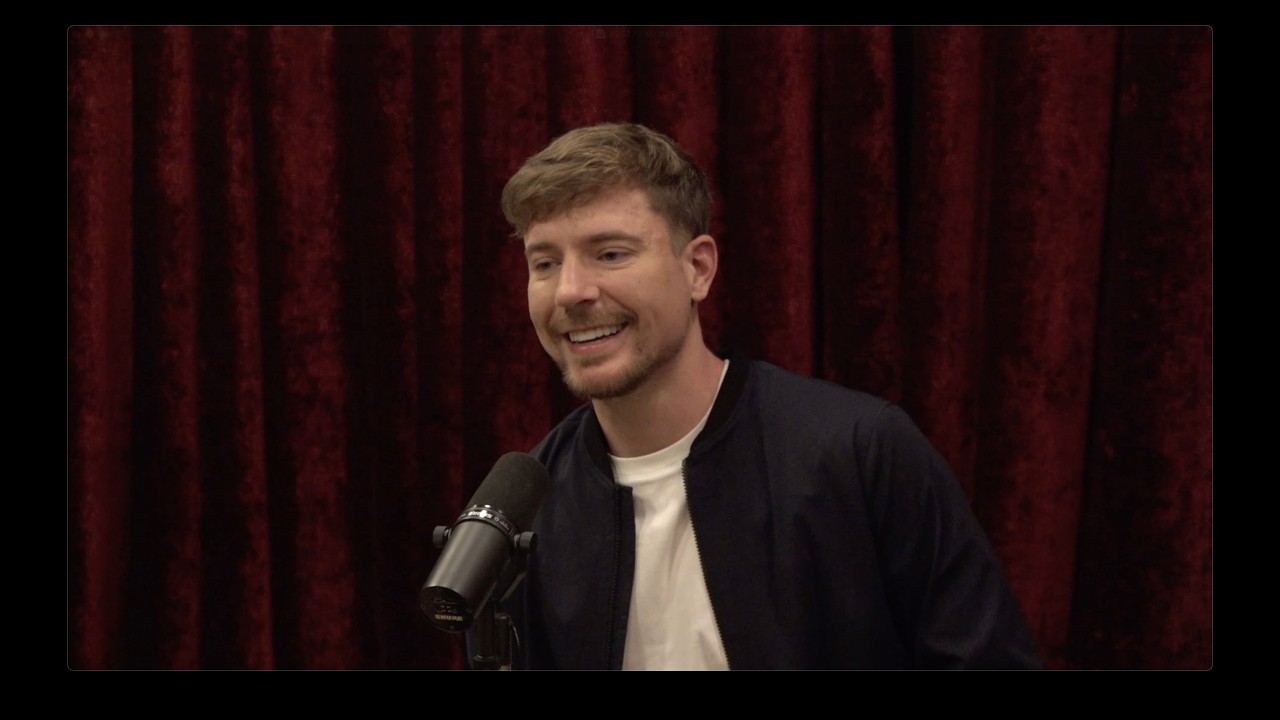
MrBeast Challenges Hollywood With Record $22 Million TV Budget
PowerfulJRE
The digital creator argues that bypassing traditional network executives to reinvest all revenue directly into production allows independent creators to outscale legacy media budgets.
## Background
Published on July 16, 2026, by the PowerfulJRE channel on YouTube, this episode of the Joe Rogan Experience features an in-depth conversation with Jimmy Donaldson, better known as MrBeast. The page description highlights his work as a YouTuber, entrepreneur, and philanthropist, noting his roles as the founder of Beast Industries and Beast Philanthropy, and the creator of the Prime Video series "Beast Games."
## TL;DR
In this episode, Jimmy Donaldson and Joe Rogan dive deep into the staggering logistics and record-breaking production of 'Beast Games' before brainstorming an elaborate, $10 million unscripted zombie survival challenge. They discuss the future of the creator economy, the rapid evolution of artificial intelligence, and the transitioning media landscape. Finally, Jimmy shares his philanthropic missions, detailing Feastables' aggressive initiative to combat child labor in the West African cocoa supply chain and Beast Philanthropy's partnership to redirect millions of pounds of American food waste.
## Atmosphere & style
The conversation carries a highly collaborative, visionary, and high-energy vibe, feeling less like a standard interview and more like an intense, late-night creative blueprint session. There is a palpable mutual respect between Rogan's seasoned curiosity and Donaldson's obsessive, process-oriented drive, shifting seamlessly from childlike excitement over movie-grade survival games to deep, empathetic concern for systemic global issues.
## Key takeaways
- [00:12](https://www.youtube.com/watch?v=rTKu9wxEFFo&t=12s) The massive scale of Beast Games, featuring a $5 million prize pool, makes contestants much more willing to risk their jobs and take up to a month off from work to participate.
- [01:14](https://www.youtube.com/watch?v=rTKu9wxEFFo&t=74s) Beast Games cast exactly one contestant from every country on Earth to match the Olympic count, finding that cultural upbringings directly influenced how players navigated high-stress scenarios.
- [02:58](https://www.youtube.com/watch?v=rTKu9wxEFFo&t=178s) To prevent casting a single bad representative, the production used a democratized casting system where the public of each country voted on two or three pre-vetted options.
- [03:55](https://www.youtube.com/watch?v=rTKu9wxEFFo&t=235s) Beast Games broke the world record for the most cameras used in a single show with over 1,200 cameras, allowing 1,000 contestants to act unscripted rather than relying on directed drama.
- [09:23](https://www.youtube.com/watch?v=rTKu9wxEFFo&t=563s) Jimmy spent 100 consecutive hours living inside and exploring the Pyramids of Egypt, securing access after framing the video to the government as educational rather than a stunt.
- [13:20](https://www.youtube.com/watch?v=rTKu9wxEFFo&t=800s) The grand finale of Beast Games Season 3 was filmed inside the Roman Colosseum in Italy, marking the first time a game has been played there in over a thousand years.
- [20:47](https://www.youtube.com/watch?v=rTKu9wxEFFo&t=1247s) Jimmy and Joe conceptualize an immersive, unscripted $10 million zombie survival game set in an abandoned city, debating the logistics of safe weaponry, gameplay loops, and realistic zombie extras.
- [01:15:55](https://www.youtube.com/watch?v=rTKu9wxEFFo&t=4555s) Jimmy attributes his success to 'blue skying'—focusing on creative generation first before calculating cost—and maintaining complete creative control free from executive interference.
- [01:19:13](https://www.youtube.com/watch?v=rTKu9wxEFFo&t=4753s) Jimmy and Joe discuss the rise of independent, creator-led filmmaking, citing horror as a highly accessible genre for young creators because suspense does not require expensive CGI.
- [01:26:03](https://www.youtube.com/watch?v=rTKu9wxEFFo&t=5163s) Jimmy shares his experience building 'dino.io', an AI model trained on transcripts of a board game player that successfully mimicked the player's vocabulary and analytical patterns.
- [01:42:38](https://www.youtube.com/watch?v=rTKu9wxEFFo&t=6158s) Reflecting on his growth, Jimmy notes he was highly one-dimensional and obsessive over YouTube data four years ago, but has since started consuming broader culture for creative inspiration.
- [01:51:40](https://www.youtube.com/watch?v=rTKu9wxEFFo&t=6700s) Joe and Jimmy discuss the extreme growth of the creator economy, noting that being an influencer or YouTuber is now the most coveted job among American teenagers.
- [01:54:00](https://www.youtube.com/watch?v=rTKu9wxEFFo&t=6840s) Jimmy outlines his process-oriented blueprint for success, which requires putting in 10,000 hours and executing 1,000 iterations rather than focusing strictly on financial goals.
- [02:20:21](https://www.youtube.com/watch?v=rTKu9wxEFFo&t=8421s) Feastables launched a case study in West African villages that achieved a 90% reduction in illegal child labor on cocoa farms by guaranteeing a living income and building educational infrastructure.
- [02:45:47](https://www.youtube.com/watch?v=rTKu9wxEFFo&t=9947s) Beast Philanthropy partners with the nonprofit Sharing Excess to redirect healthy, near-expiration food from grocery stores and restaurants, distributing over 40 million meals across America.
## Detailed walkthrough
### [00:12](https://www.youtube.com/watch?v=rTKu9wxEFFo&t=12s) The Logistics of Giving Away Millions
Joe Rogan and Jimmy Donaldson (MrBeast) open the conversation discussing how remarkably easy it is to recruit contestants for his productions. Jimmy notes that because they are giving away millions of dollars, people are generally incredibly enthusiastic about participating. The only genuine obstacle they encounter is the significant time commitment required from the contestants. For major productions like *Beast Games*, filming can continuously last for up to a month, meaning participants have to take substantial time off work.
Rogan wonders aloud if people frequently have to pass on the opportunity due to strict employment constraints. Jimmy confirms this happens all the time, revealing that they encounter people getting cold feet even a day before filming starts. To counter this, if a video features 100 contestants, they always bring along at least 10 backup players. Rogan assumes that the type of person who would choose to go on a MrBeast production would have a job they could easily afford to quit. Jimmy explains that it heavily depends on the scale of the prize. For a standard YouTube video where 100 families might compete for $250,000, some people calculate the 1% odds of winning and decide it is not worth losing their jobs over. However, for a massive production like *Beast Games* where the prize pool jumps to $5 million, the excitement is on a completely different level, making contestants much more willing to take the leap.
* **Beast Games prize:** $5 million
* **Standard YouTube video prize example:** $250,000 for 100 competing families
* **Casting buffer:** 10 backup contestants are kept on standby for every 100 players
---
[01:14](https://www.youtube.com/watch?v=rTKu9wxEFFo&t=74s) Sourcing Competants Internationally and Vetting Small Nations
For the newest season of *Beast Games*, Jimmy details their ambitious casting choice: they pulled exactly one contestant from every single country on Earth, matching the approximate tally of around 200 nations used by the Olympics. He found it fascinating to watch how cultural upbringings directly influenced gameplay, noting stark contrasts in how an individual from an Asia-Pacific country would react to a high-stress game compared to someone from South America. Rogan immediately raises the logistical nightmare of vetting a global pool, noting that they must have had to run rigorous psych and background checks to avoid accidentally casting "a serial killer" or someone truly insane.
Jimmy acknowledges the extensive vetting process but notes that the legal and criminal infrastructure varies wildly across the globe. He shares a striking anecdote about one tiny island nation in the cohort that has a total population of only 40,000 people. Jimmy joked with that specific contestant that if they won the $5 million grand prize, they could theoretically return home and hand a $200 dividend to every single citizen in their entire country. The scale of this leaves Rogan stunned, prompting him to joke that an ultra-wealthy billionaire like Elon Musk—or thousands of other wealthy Americans—could probably just buy the country outright, given its GDP is likely only a couple hundred million dollars. Jimmy jokingly walks back the banter out of a sudden wave of empathy for any listeners from that specific micro-nation, though Rogan laughs it off, saying, "They should know what they are. They're a country of 40,000 people... nothing wrong with that."
---
[02:58](https://www.youtube.com/watch?v=rTKu9wxEFFo&t=178s) The Million-Dollar Democratized Casting System
Rogan presses further into how they could realistically guarantee reliable criminal background checks in countries with poor data infrastructure. Jimmy admits that the budget required just for casting was entirely "ridiculous." To mitigate the risk of picking a single terrible contestant who might make an entire nation look bad, they didn't just pick one person per country. Jimmy was deeply paranoid that a contestant from a specific region might perform terribly or act poorly, leading an entire nation to think, "Jimmy, you hate us and you purposely picked this absolute [expletive]."
To solve this, they cast two or three options for every single country and then hosted a public vote, letting the citizens of those respective countries democratically select who would represent them on the show. Jimmy notes that he spent well over $1 million strictly on aggregating data, running background checks, and setting up the public voting infrastructure. The system brilliantly shielded his team from cultural backlash; if a representative from a country like Georgia in Europe turned out to be an "absolute [expletive]," Jimmy could simply rest easy knowing the blame lay squarely on the voters who chose him.
---
[03:55](https://www.youtube.com/watch?v=rTKu9wxEFFo&t=235s) Breaking Production Records and the Thousand-Camera Thesis
Rogan asks how Jimmy could possibly find the time to balance *Beast Games* alongside his main YouTube channel. Jimmy admits that during production he simply doesn't sleep, enduring grueling 18-hour filming days across a 30-day period. He proudly explains that *Beast Games* features the largest cash prize pool in television history, the largest number of contestants, and the most massive physical sets ever built. While conventional mainstream game shows might hand out a grand prize of $250,000, *Beast Games* hands out an astronomical $22 million over the course of a single season—averaging roughly $2 million in giveaways per episode.
```
PRODUCTION SCALE COMPARISON
┌─────────────────────────────────┬────────────────────────────────┐
│ CONVENTIONAL REALITY SHOW │ BEAST GAMES │
├─────────────────────────────────┼────────────────────────────────┤
│ • ~$250,000 Grand Prize │ • $22,000,000 Season Total │
│ • Story producers script drama │ • 1,200+ Cameras (World Record)│
│ • Handful of roaming cameras │ • 27 Miles of camera cables │
│ • Intercut, forced interview room│ • 1,000 Contestants tracked live│
└─────────────────────────────────┴────────────────────────────────┘
```
Jimmy outlines his core thesis for the show's structure, which explicitly rejects traditional reality television tropes. In standard television, story producers walk up to individuals, give them a few minutes of direction, and essentially put words in their mouths to force a narrative arc. Instead, Jimmy built a massive set larger than a football field, outfitted it with a thousand contestant platforms, and installed a dedicated camera on every single person. Breaking the world record for the most cameras ever used in a single production, the set featured over 1,200 cameras (shattering the previous industry record of 400) and was powered by 27 miles of camera cables and the world's largest control room. Jimmy simply got on the microphone and told the 1,000 contestants to say whatever they wanted for the next 10 hours, letting their genuine personalities shine through completely unscripted. Rogan is left completely blown away by a glimpse of the set, exclaiming, "Holy [expletive], that room is so big."
* **Production crew:** Over 150 editors were required to sift through the mountain of simultaneous footage.
* **Infrastructure:** 27 miles of physical camera cables connecting the grid.
---
[06:59](https://www.youtube.com/watch?v=rTKu9wxEFFo&t=419s) High-Risk Creative Vision vs. Network Television
Rogan praises Jimmy's rare ability to look at the big picture and commit to the ultimate product, completely regardless of the budget or the immediate financial profit. Rogan notes that he observed this exact trait back when Jimmy first started blowing up on YouTube. Jimmy explains that his philosophy is fundamentally incompatible with traditional television networks. A standard media network calculates the financial upside first, choosing to scale back a project's quality by a few notches if it means saving 80% of the cost. Jimmy, conversely, constantly asks his team how they can make a show cooler, immediately funneling all generated revenue right back into the production budget.
Rogan points out that while this high-risk strategy is incredibly ballsy, it has clearly paid off, giving Jimmy the undisputed number-one most-watched show on planet Earth. Jimmy reveals that the massive football-field-sized set they were looking at was built inside an old airport hangar in Toronto, Canada, and cost $15 million alone. The complex set featured 1,000 individual trap doors designed to drop contestants out of sight the exact moment they were eliminated. Jimmy expresses pride in the fact that bringing *Beast Games* to Toronto provided consistent, high-quality jobs to hundreds of local film crew members for six straight months, shielding them from the typical instability of jumping from project to project every week. Jimmy states his team's guiding compass simply: "How do we make the best content possible as opposed to, you know, how do we make the most money possible? Um, and when you just shockingly go in with that approach, you just kind of make a lot of money."
---
[09:23](https://www.youtube.com/watch?v=rTKu9wxEFFo&t=563s) Infiltrating the Pyramids of Egypt
Jimmy explains to his team that human beings are technically capable of pulling off almost anything if they are willing to dedicate the necessary time and capital—joking that with enough nuclear weapons, humanity could technically blow up the moon if it really wanted to. This uncompromising mindset is what allowed him to successfully negotiate a shoot inside the Pyramids of Egypt, where he spent 100 hours straight living inside the ancient structures. For years, veteran producers told him that the Egyptian authorities would absolutely never allow a YouTuber to live inside the pyramids. Jimmy refused to take "no" for an answer until he heard it directly from the leader of the country.
After years of diplomatic talks, Jimmy convinced the Egyptian government that the video would be highly educational rather than a stunt where he "runs up the pyramids, takes his shirt off, and acts like a lunatic." Once authorized, he was granted unprecedented access, exploring the absolute peak of the middle pyramid, swimming in the flooded subterranean waters of Osiris's shaft hundreds of feet underground, and entering the hidden rooms beneath the Sphinx. Because he was completely exhausted and walking around all night, Jimmy admits the memory is a bit of a surreal blur, but he calls it one of his favorite videos of all time.
Rogan expresses intense envy, stating he has been dying to visit the pyramids for years but is constantly constrained by his incredibly packed schedule, balancing his responsibilities as a UFC commentator, a touring stand-up comedian, a podcast host, and a father. Rogan notes that a proper trip to Egypt realistically requires at least 5 to 10 days. However, Rogan wonders if the Egyptian authorities would ever let *him* explore the site with the same level of freedom, laughing that he has "talked a lot of [expletive]" on his podcast regarding the official historical narratives. Rogan argues that the official gatekeepers of the site are incredibly hesitant to accept alternative archaeological perspectives because they are fiercely protective of a rigid construction timeline that evidence suggests doesn't make any sense. Jimmy encourages Rogan to put his past criticisms aside and simply call up Dr. Zahi Hawass directly to set up a visit, noting that since Hawass has already been a guest on Rogan's podcast, the door is wide open.
[13:20](https://www.youtube.com/watch?v=rTKu9wxEFFo&t=800s) Filming at the Roman Colosseum
Joe Rogan and Jimmy "MrBeast" Donaldson discuss the incredible history of Egypt and the pyramids, with Joe mentioning that he would love to explore those ancient sites with a historian like Graham Hancock. The conversation then shifts to MrBeast’s massive-scale productions. Joe refers to his projects as "shows," while Jimmy laughingly notes that to him, they are still just "YouTube videos"—though he admits the scale has grown far beyond traditional internet content.
Jimmy reveals a massive secret from the upcoming third season of his Prime Video competition series, *Beast Games*: they filmed the grand finale inside the actual Roman Colosseum in Italy. For the finale, they crowned the winner of a $5 million cash prize in the middle of the historic arena, marking the first time a game has been played inside the Colosseum in over a thousand years. Jimmy describes the experience as deeply emotional, recalling how they had a live orchestra positioned on the top ring of the Colosseum to play dramatic music that swelled as the game progressed.
* **The Prize:** $5 million cash awarded to the winner of *Beast Games* Season 3.
* **The Orchestra:** Positioned on the Colosseum's top ring to dynamically score the finale.
* **Age of the Colosseum:** Constructed nearly 2,000 years ago.
---
[15:33](https://www.youtube.com/watch?v=rTKu9wxEFFo&t=933s) Ancient Spectacles and Arena Architecture
Joe and Jimmy marvel at what it must have been like to stand in the Colosseum during its prime, nearly 1,900 years ago, when the arena was used for gladiatorial combat, wild animal hunts, and even flooded for mock naval battles. Jimmy shares that during his prep work and research for the shoot, he was fascinated by how the Colosseum's seating arrangements mirrored the social hierarchy of ancient Rome. The noble class sat at the very bottom, closest to the action, while the poorest citizens sat at the top. Joe jokes that this is identical to modern basketball games, comparing the ancient Roman elites to celebrities like Jack Nicholson sitting courtside.
However, Joe points out that courtside seats in ancient Rome were far more dangerous, as there were documented historical incidents where tigers or lions managed to leap into the lower stands. Jimmy recalls standing by the Emperor's box during production, realizing it was only about four rows up from the arena floor. He jokes that if he were an ancient warrior, his primary thought would be how easy it would be to hurl a spear directly at the Emperor.
* **Construction Timeline:** Built over a period of 6 to 8 years, from approximately AD 72 to AD 80.
* **Emperors Involved:** Construction began under Emperor Vespasian and was completed and inaugurated under his son, Emperor Titus.
* **Modern Material Comparison:** Joe notes that modern concrete and glass stadiums like SoFi Stadium in Los Angeles likely won't survive 2,000 years because modern cement rots and degrades, whereas ancient structures made of solid stone endure.
---
[20:47](https://www.youtube.com/watch?v=rTKu9wxEFFo&t=1247s) Brainstorming an Unscripted Zombie Apocalypse
The conversation about abandoned cities and the durability of human structures leads Jimmy to brainstorm a new video concept: a "last human on Earth" simulation. He envisions finding an overgrown, abandoned city and living there for a month, or having a contestant survive in it for 10 days to win $1 million. Joe suggests leaning into an *I Am Legend* vibe by hiring actors to play zombies and terrorize the contestants.
Jimmy loves the concept but explains that the main creative hurdle holding him back has always been how contestants can "kill" the zombies without it looking "lame" or unconvincing on camera. A Nerf sword looks cheap, while airsoft or paintball guns require the actors and contestants to wear bulky, immersion-breaking safety masks. Joe suggests using hard-structure, form-fitting tactical half-masks painted with hyper-realistic zombie makeup, paired with clear protective goggles. Looking at references of these half-masks instantly convinces Jimmy that the concept is viable.
* **Projected Budget:** An estimated $5 million to $10 million to fully set-deck and secure an abandoned city.
* **The Set Strategy:** To justify the cost, Jimmy proposes filming two videos back-to-back on the same set: one of him surviving alone, and a second where a contestant and their friends must fend off hordes of zombies.
* **Potential Locations:** Jimmy reveals they previously filmed a video titled *7 Days In An Abandoned City* in a war-torn, uninhabited city in Europe that featured tall buildings and hotels.
---
[26:13](https://www.youtube.com/watch?v=rTKu9wxEFFo&t=1573s) The Logistics of "Non-Lethal" Zombie Combat
Jimmy and Joe brainstorm various mechanics for the zombie game. While airsoft relies too heavily on an honor system where players must admit they've been hit, paintball provides a highly visible, cinematic splatter. Jimmy addresses his creative team directly, telling whoever is editing the podcast to "clip the last 10 minutes" and send it straight to his writers.
Joe asks if there are other ways to simulate combat. Jimmy mentions they have been developing high-tech electronic laser tag suits—similar to a real-life *Hunger Games* setup—where players light up when hit. Joe half-jokingly suggests using real shotguns loaded with non-lethal bean bag rounds. Jimmy, laughing, immediately shoots the idea down, pointing out the legal and physical risks of blasting stunt actors from three feet away. "See, this isn't *Fear Factor*. This is MrBeast," Jimmy laughs, though he admits he'd love to sit down with Joe, share a blunt, and fully flesh out the logistics of the project.
[27:18](https://www.youtube.com/watch?v=rTKu9wxEFFo&t=1638s) Conceptualizing the Ultimate Zombie Video
Jimmy Donaldson (MrBeast) and Joe Rogan begin brainstorming a hypothetical, high-budget zombie survival video. To give Joe a sense of the scale he is envisioning, Jimmy has his team pull up his "7 Days In An Abandoned City" video. Jimmy explains that creating content in a massive, desolate setting is what gets him excited because "it's content you can't find anywhere else." Joe immediately draws a comparison to the horror television series *From*, explaining how its central premise would make for a perfect game loop: nothing happens during the day, but the horror starts the second the sun goes down.
Joe outlines a psychological torture test for the contestants. During the day, they are kept busy with grueling tasks—gathering supplies, building shelters, and setting up alarm systems—ensuring they get absolutely no sleep. Then, when night falls, they are left in complete darkness, never knowing when the attack will hit. "Chamber starts at 7:00 PM, 8:00 PM, 9:00 PM, and then 3:00 in the morning, shit starts," Joe describes.
Jimmy's eyes light up as he connects the concept to the movie *I Am Legend*, where the monsters are repelled by light. He envisions players hunting for hidden lights throughout the city to fortify their camp, forcing them to run watch shifts. To maximize psychological tension, Jimmy suggests a brilliant twist: unleash a set number of zombies at night, but leave a few "stragglers" hiding in the city during the day so the contestants are never truly safe.
- **Day phase:** Contestants are given limited materials to build creative defenses and ingenuity-based alarm systems.
- **Night phase:** Unpredictable waves of zombies creep in under the cover of total darkness.
- **The "Straggler" Twist:** If 40 zombies are unleashed and only 35 are shot, 5 remain hidden in the daytime, keeping players permanently on edge.
---
[30:31](https://www.youtube.com/watch?v=rTKu9wxEFFo&t=1831s) Weaponry, Tech, and Cast Selection
The debate quickly turns to how to safely execute the combat. Joe mentions a company they've used before called Gel Blaster, which shoots water-based gel pellets. Combined with sensor-equipped vests, it functions like a high-tech, real-life version of virtual reality laser tag, complete with audio feedback tracking ammo count. Jimmy likes the concept but immediately wants to "reskin" the blasters because the stock models look "a little lame," preferring weapons that look like authentic, post-apocalyptic firearms.
Joe, however, is fixated on a much more visceral aesthetic: real shotguns loaded with less-lethal bean bag rounds. Jimmy, playing the role of the safety-conscious producer, has to step in as the voice of reason. "There's no way you can shoot shotguns at people. There's just not possible," Jimmy laughs, teasing Joe for living in a "utopia" where liability doesn't exist. "I haven't seen his eyes light up like this in years," Jimmy cracks as Joe continues to brainstorm physical armor for the actors.
To make the video work, Jimmy suggests casting highly disciplined physical performers rather than typical Hollywood extras. By hiring ex-Navy SEALs to play the zombies, they can take harder hits, move with tactical precision, and won't mind the physical toll. They also discuss casting elite specialists as the contestants—such as UFC champions, survivalists, and martial artists—to see how real-world experts would actually coordinate a defense plan on a 50-acre abandoned city set.
> "Just get the most badass people that you can get for this zombie thing. Like survivalists, martial artists... It would be crazy, dude."
---
[33:26](https://www.youtube.com/watch?v=rTKu9wxEFFo&t=2006s) Escalation, Lore, and the Ballistics of Zombie Brains
Jimmy lays out a grand narrative structure for the challenge, culminating in a massive, *Game of Thrones*-style final wave. The zombie horde would scale dramatically every day, starting with 10 on day one, and peaking at a massive invasion of 400 zombies on the final day. To make things even more brutal, players who are "killed" by zombies don't just leave the game—they join the zombie horde to hunt down their former teammates.
The conversation takes a highly detailed detour when Joe starts criticizing the weapon physics of popular media like *The Walking Dead*. Joe explains how it drove him crazy to see characters instantly killing zombies with crossbows firing target-practice "field tips." He explains that field tips act like a pencil passing through the body; without a razor-sharp "broadhead" blade to cause massive internal hemorrhaging, a human can easily survive a puncture wound to the head or lungs.
Joe continues to search for a real firearm that could safely be used, bringing up.410 bore shotguns (the smallest common shotgun gauge) and proposing they shoot bean bags at actors wearing military-grade plate carriers. Jimmy jokingly asks if he can test the.410 bean bag on Joe. Joe doesn't hesitate: "Yeah, yeah. Just give me a plate carrier... we're going to work this out." Joe even volunteers to sneak into the video as a guest zombie for one night, laughing about players wondering who the random "bald guy" is charging at them in the dark.
[41:15](https://www.youtube.com/watch?v=rTKu9wxEFFo&t=2475s) Weapon Safety and Shotgun Mechanics for a Zombie Simulation
Joe Rogan and MrBeast explore the mechanics of using low-powered shotguns loaded with bean bag rounds or rock salt to create a realistic, immersive zombie game. Joe explains that bean bag rounds shoot out of a shotgun to blast a target without being lethal. Intrigued by the visuals, they search for videos of low-powered and small shotguns, stumbling upon a unique revolver shotgun. When Young Jamie pulls up a video of a child shooting a modified 12-gauge shotgun, Joe emphasizes that this is exactly what they need: a firearm that delivers a dramatic auditory "boom" and safe physical impact without causing real harm. MrBeast confirms his team is listening and taking notes on the concept.
Joe stresses that incorporating these weapons would require incredibly strict on-set safety protocols. He recalls a tragic incident from 1994 when he first moved to Los Angeles, where an actor friend of a friend died after jokingly putting a gun loaded with a blank to his head and pulling the trigger, unaware that the concussive force of the air alone could be fatal. MrBeast brings up the Alec Baldwin *Rust* shooting, which Joe attributes to severe negligence, noting that crew members had reportedly been using the prop guns with live ammunition on a firing range without properly clearing them afterward before bringing them back to set.
- Joe highlights a foundational movie set rule: "You're never supposed to point a gun, even if it's not loaded... at someone ever."
- In modern filmmaking, actors are trained to aim slightly off-target, a safety practice Joe believes emerged after the tragic death of Brandon Lee on the set of *The Crow*.
[44:46](https://www.youtube.com/watch?v=rTKu9wxEFFo&t=2686s) Blending Practical Effects, Lasers, and Squibs
MrBeast expresses hesitancy about using actual shotguns, noting that modern CGI and sound overlay effects are so advanced that blanks are no longer strictly necessary. However, Joe argues that real props are crucial for generating authentic actor reactions, fear, and recoil. He suggests using a lightweight 20-gauge shotgun loaded with rock salt, which would sting but remain safe if the stunt actors wear protective clothing. To make the hits visually spectacular, Joe proposes dressing the "zombies" in tattered white outfits fitted with red gel packs underneath that splatter upon impact.
MrBeast shares that his team executed a similar concept when they recreated *Squid Game*, utilizing remote-controlled squibs that exploded and covered contestants in liquid when they were eliminated. For a zombie or hunger games format, he suggests combining a laser tag mechanism with blank rounds. The gun's dual-trigger setup would simultaneously fire a blank round for the auditory explosion and a laser to trigger the target's vest sensors and squibs. Any visible laser beams or bullet trajectories could then be seamlessly enhanced during post-production.
- MrBeast's *Squid Game* recreation successfully utilized practical squibs linked to elimination sensors.
- A dual-trigger mechanism would sync the physical "boom" of a blank with an instantaneous laser strike to detonate the target's squibs.
- The concept allows the production to maintain family-friendly branding on YouTube by using the term "eliminated" instead of "killed."
[48:04](https://www.youtube.com/watch?v=rTKu9wxEFFo&t=2884s) Designing the Ultimate $10 Million Zombie Survival Game
The conversation shifts to pitching this massive unscripted sandbox game to a major streaming platform like Amazon Prime Video or Netflix. MrBeast envisions a 10-day, 10-episode series featuring elite contestants, such as UFC fighters and Navy SEALs, competing for a massive prize pool. Instead of a flat $1.000.000 reward, the pool would start at $1,000,000 and grow by an additional million each day the contestants successfully complete a high-stakes daily task. If six contestants survive the full 10 days, they could split up to $10,000,000, making them all instant millionaires.
The setting would feature dozens of acres of an abandoned city entirely sealed off by a massive custom-built perimeter wall. World-class set designers would style the city to look exactly like a post-apocalyptic world 50 years in the future, complete with overgrown vines and weathered, authentic props down to the details of decades-old Doritos bags. Contestants would be dropped in via helicopter, and a daily task would be delivered by a trained eagle flying overhead. To increase the stakes, the physical prize pool money would be placed in the center of the city; if the zombies touch the money, the contestants lose it, forcing the team to balance running daily missions with building a defensive fort around their cash.
- **Contestants:** Hardcore individuals like Navy SEALs and UFC fighters who would actively run training routes and defensive rotations.
- **Zombies:** Played by professional stunt performers who are strictly forbidden from engaging in hand-to-hand combat; a simple touch results in an instant elimination.
- **Incentive Twist:** To maximize the intensity, any stunt performer playing a zombie who successfully eliminates a contestant inherits that contestant's fractional share of the multi-million dollar prize pool.
[52:44](https://www.youtube.com/watch?v=rTKu9wxEFFo&t=3164s) Zombie Movement Rules and the Danger of Rogue Actors
Joe and MrBeast discuss the atmospheric horror of the game, picturing a pitch-black setting with no electricity where contestants only see the glowing red eyes of a zombie horde moving through the woods. They debate whether the actors should portray fast, aggressive zombies like those in *28 Days Later* or slow, lumbering ones like in *The Walking Dead*. Joe suggests starting them as slow walkers and allowing them to "evolve" into fast runners as the days progress.
MrBeast points out the immense logistical challenge of controlling hundreds of extras in an unscripted sandbox environment. In high-stakes, unscripted productions, a single actor going rogue and breaking protocol can completely ruin a shot that cannot be recreated. To prevent actors from running too fast or breaking character, MrBeast proposes implementing physical constraints, such as putting light chains around the zombies' feet to mechanically limit their movement speed.
- Even a minor 2% rogue rate among 300 zombie extras equals six actors breaking the rules, which could derail the high-stakes production.
- Physical boundaries and mechanical constraints are deemed necessary to keep the unscripted sandbox safe and consistent.
Jimmy Donaldson (MrBeast) and Joe Rogan continue brainstorming their hypothetical zombie survival show, focusing on how to structure the contestants' days to maximize psychological tension. Jimmy explains that the game requires proper planning: you must give the contestants demanding, fully occupying tasks to do during the day so they cannot sleep.
Rogan is completely on board, noting how this structure keeps players exhausted. Jimmy details how the daytime tasks would optimize their potential prize pool. Surviving alone isn't enough; if a contestant simply sleeps all day to stay safe at night, they won't make any money. Rogan points out that while hardcore players would thrive, normal contestants would find it absolutely horrible. Jimmy enthusiastically responds:
> "You want that though. You want people to quit because there's always going to be people that won't."
Jimmy admits that because he is held to different standards than most creators, if he made a show that deprived people of sleep, "there would be maybe 10 trillion articles written about how I'm the most evil man on the planet." Rogan tells him to ignore the press: "Screw those people. You just got to make an awesome show."
Rogan's vision is to keep the players awake so that when night falls, the atmosphere is utterly terrifying. He paints a vivid picture of a tired player sitting with a shotgun, struggling to keep their eyes open, only to peer into the dark woods and see glowing red eyes staring back.
* **The Prize Incentive:** Day tasks act as a threshold for cash. Surviving is the bare minimum, but completing daytime tasks is the only way to actually unlock the prize money.
* **The Pitch:** Jimmy jokingly calls out to the major streaming platforms: "Prime, Apple, Netflix, whoever wants it, let us know."
As the logistics of shotguns and zombies come up, Jimmy raises a major safety concern: exhausted, terrified contestants are highly likely to "spaz out" and accidentally shoot someone in the face. Real firearms are out of the question. He suggests using blanks and lasers, or gel rounds—similar to water-filled Nerf rounds that explode on impact. Rogan insists that blanks are still crucial because you need the loud "bang" and the muzzle flash in the middle of the night to create genuine psychological fear.
To keep the players together without letting them shoot one another, Jimmy suggests building a defensive fort around the prize money. He emphasizes that having the physical cash visible in the background of the shots is a vital visual cue:
> "You always want people to be able to tell what they're competing for and like their 'why'... intuitively to a viewer, you're going to instantly understand the motivation."
---
[58:27](https://www.youtube.com/watch?v=rTKu9wxEFFo&t=3507s) Hyper-Hearing Zombies and Hide-and-Seek
The conversation shifts to a different nighttime mechanic: a high-stakes, silent game of hide-and-seek. Rogan suggests that instead of hiding in a fort, the players must remain completely quiet because the zombies are equipped with "Walker game ears"—highly sensitive electronic hearing protection used at gun ranges that amplify ambient sounds while dampening loud noises. If a contestant whispers, the zombies will immediately key in on their location.
Jimmy loves the tension of this "no locks" hide-and-seek setup. To ensure fairness and safety, a producer would walk the path beforehand to confirm there is a viable escape route. Jimmy notes that an idea like this is incredibly polarizing:
> "It's either going to be like the worst show imaginable that people clown on or it's going to be like the number one show ever. And there's no in between... It's like *The Last of Us* in real life."
He also points out that the show would be immensely "clippable" for modern media platforms like TikTok, Instagram Reels, and YouTube Shorts. To make the zombies look terrifying, Rogan and Jimmy discuss hiring elite special effects artists to design hyper-realistic masks. Jimmy recalls a video they made seven years prior where they put incredibly realistic makeup on a zombie horde, causing Rogan to marvel at how disgusting and effective the prosthetic teeth and ruined flesh looked.
---
[01:02:00](https://www.youtube.com/watch?v=rTKu9wxEFFo&t=3720s) The Heart Rate Effect and Escape Room Challenges
Jimmy explains how he gauges a great concept using what he calls the "heart rate effect." When he discusses an idea and physically feels his heart rate elevate from pure excitement, it is his number one signal that the public will talk about it and love it. He can already see the "Venn diagram" of their two perspectives merging beautifully: Rogan's focus on realistic, grit-and-glory zombie details, combined with Jimmy's obsession with massive set designs and logistics.
Rogan suggests turning each day of the survival challenge into an escape room. Rather than doing arbitrary tasks like moving rocks, players would have to solve complex puzzles to find the daily combinations to vaults containing the prize money. Rogan shares his love for escape rooms, noting that he and his family play them everywhere they go, highlighting the massive, 30,000-square-foot *IT* themed escape rooms in Las Vegas that feature live actors playing Pennywise.
Jimmy enthusiastically agrees, noting that he already knows the perfect puzzle designers. He recounts a Super Bowl commercial his team produced for Salesforce, which featured a hidden digital puzzle hunt where users could win $1 million.
* **Salesforce Campaign Reach:** Over 60 million people visited the promotional website to attempt the puzzles.
* **The Difficulty:** Despite massive traffic, it still took weeks for the internet to collectively crack the code. The hunt involved dialing phone numbers and listening to a four-hour voicemail at the very end to catch a string of read-out numbers.
[01:07:39](https://www.youtube.com/watch?v=rTKu9wxEFFo&t=4059s) Creating the World’s Most Insane Online Puzzle
Jimmy Donaldson, better known as MrBeast, describes how he went onto Reddit to recruit the most "cracked out" puzzle solvers in the world to design an incredibly complex online scavenger hunt with a million-dollar prize. With an unlimited budget, this group designed a mind-bending puzzle that took a massive community of highly skilled players nearly an entire month to solve. The challenge required an immense variety of skill sets and generated a massive online following, including dedicated subreddits and daily update podcasts.
The puzzle itself integrated mundane, tedious tasks with deeply complex codes. For example, one stage featured a page with a million buttons where only one actually worked, forcing users to click through them systematically. Other stages required deciphering paragraphs of text using ancient, obscure languages. Donaldson even wore a belt with colored stripes in a Super Bowl commercial that, when translated in the correct order, revealed a hidden clue. Another clue featured a yellow-text math equation with a hand-drawn stone on a grenade—a riddle that solved to "Yellowstone"—which players had to input on a specific website to unlock a globe-drawing puzzle.
* **The Power of Crowdsourcing:** Early on, progress would stall at a bottleneck like "step 42." Once a single player figured it out and posted the solution on Reddit, tens of thousands of people would instantly flood to the next step.
* **Late-Game Secrecy:** As the players got closer to the million-dollar finish line, the community collaboration faded, and competitors became highly secretive to protect their lead.
---
[01:10:24](https://www.youtube.com/watch?v=rTKu9wxEFFo&t=4224s) Pitching a High-Stakes Safe-Cracking Challenge
The conversation shifts back to brainstorming ideas for a hypothetical reality competition set in an abandoned city. Joe Rogan suggests starting the contestants completely unarmed, forcing them to solve puzzles to discover the locations of hidden weapons. Donaldson loves the idea of a high-risk, high-reward armory or safe. He suggests hiding ingredients for a mock C4 explosive around the city, though he jokingly notes that "no streaming platform would be okay with this." Alternatively, they could provide a simple hacksaw that requires ten tedious hours of physical labor to cut open a lock.
Rogan proposes an even more old-school approach: giving a contestant a stethoscope and a safe-cracking instructional book, forcing them to spend days listening for the physical click of the tumblers. Donaldson enthusiastically agrees, pointing out that his production team could easily take an aesthetically pleasing, vintage-looking safe and replace its internal mechanisms with a custom lock that is fully solvable. This kind of game design gives the players agency, forcing them to make tough tactical decisions.
* **Strategic Dilemmas:** Contestants would have to choose between spending days trying to crack a safe for heavy weapons and ammo, working to grow the prize pool, or scavenging for basic supplies.
* **The Viewer Perspective:** Donaldson explains that the best reality TV allows families at home to debate what they would do. He shares that in *Beast Games*, he will offer players a million dollars on the condition that they eliminate their friends. Some people instantly take the money, while others refuse to compromise their integrity, sparking intense debate among viewers.
---
[01:13:18](https://www.youtube.com/watch?v=rTKu9wxEFFo&t=4398s) Nighttime Supply Drops and Long-Distance Missions
Rogan and Donaldson brainstorm ways to keep the game dynamic and physically demanding. Rogan suggests making ammunition, food, and essential supplies available only at night, hidden in duffel bags. This forces contestants to make a risk-reward calculation: is it worth sneaking around in the dark and risking capture to secure supplies? Donaldson proposes adding a dramatic twist where production use helicopters to lift and relocate the players' physical pile of money to a different, pre-selected building every single night. This forces the contestants to abandon their established fortifications and scramble to defend a new, unfamiliar location.
To add biodiversity and keep the show from feeling repetitive, Donaldson suggests utilizing a second abandoned location located miles away. Players would find a map pointing to a massive ammo dump, but reaching it would require a grueling 10-mile hike through dense woods.
> "Do they stay and spend the night there and trust their friends, and they have no maybe no walkie-talkie so they can't communicate, and their friends are like holding down a fort with a million dollars on top and they're like, 'Where the heck are they?'... We'd get so many cool shots like that, you know?"
---
[01:15:55](https://www.youtube.com/watch?v=rTKu9wxEFFo&t=4555s) "Blue Skying" and the "Purple Cow" Effect
Donaldson describes their brainstorming process as "blue skying"—focusing entirely on pure creative generation without letting immediate practical restrictions or executive pushback stall the momentum. In typical Hollywood writers' rooms, writers are often shut down immediately with "you can't do that." Donaldson's philosophy is to design the absolute best show first, and then apply first-principles thinking to calculate the exact cost, time, and engineering required to make it happen.
Rogan attributes Donaldson's monumental success to building his media empire from the ground up without executive interference. In traditional media, business executives who think they are creative constantly give terrible advice to justify their roles, often trying to copy existing successes. Donaldson counters this with the "purple cow" effect—a marketing concept coined by Seth Godin. If you drive past a regular cow, you ignore it; but if you see a purple cow, it sticks in your brain forever. Content must be entirely unique to capture the public's imagination.
* **Creative Freedom with Prime Video:** Donaldson praises Amazon's Prime Video for giving him complete creative control over *Beast Games* because they trust his proven track record.
* **The Dilution of Creator Content:** Donaldson laments how often streaming platforms sign popular online creators but immediately strip away the unique "soul" and humor that built their core audience in the first place.
* **The Executive Dilemma:** Rogan defends the platforms slightly, pointing out that executives panic because they are risking tens of millions of dollars on creators who may not know how to execute on a massive scale, leading to expensive disasters like *Joker: Folie à Deux*.
[01:19:13](https://www.youtube.com/watch?v=rTKu9wxEFFo&t=4753s) The Rise of Creator-Led Filmmaking
Jimmy Donaldson (MrBeast) and Joe Rogan discuss how traditional Hollywood is finally waking up to the power of internet creators making hit films. Jimmy notes that we have recently seen "four hit films made by creators back to back to back." Joe asks if Jimmy has seen *Talk to Me*, the hit horror film directed by Australian brothers Danny and Michael Philippu, known online as RackaRacka.
Joe recalls having the Philippu brothers on his podcast a couple of years prior, remembering them as incredibly high-energy, fast-talking, and highly creative guys. Jimmy shares a funny anecdote about hanging out with them: being competitive, he played a $1,000 game of Uno against one of the brothers on a mini set they built, complete with intense card-slapping and desk-flipping. They filmed it for a short, but after the brothers left, they realized the SD card was corrupted, so the footage was lost forever.
Joe explains the premise of *Talk to Me*, which centers around an ancient, cryptic hand sculpture that possess people when they hold it and say "talk to me"—provided they let go within a certain number of seconds. Jimmy, whose fiancée loves horror films, is highly intrigued, especially since the movie was shot entirely in Australia with local actors. They reflect on how major stars and massive budgets are no longer necessary to make amazing films. Jimmy points out that Kane Pixels, the creator behind *The Backrooms* (which recently crossed $100 million), is only around 20 years old. He also praises the film *Obsession*, created by the Curry Barker (creator behind *The Amazing Digital Circus* and TikTok/Instagram skits), calling it one of the best movies he has seen in a while.
* **The Steve Jobs Connection:** Jimmy quotes Steve Jobs' famous line about how "it's hard to connect the dots going forward, but you can connect them looking backwards." Looking at creators' early, short-form skits, you can see how hundreds of hours of micro-content served as the perfect practice for feature-length filmmaking.
* **The Hollywood Shift:** Jimmy predicts that because film production has an inherent delay, the massive success of these initial creator-led films means that in 18 months, "you're going to see dozens of other movies made by creators" as funding floods the space.
---
[01:24:09](https://www.youtube.com/watch?v=rTKu9wxEFFo&t=5049s) Comedy as the Gateway to Horror and the Power of Low-Budget Suspense
Joe and Jimmy discuss how creators are not limited to the specific genres they are known for online. Joe points to Jordan Peele as the prime example, transitioning from the comedy sketch show *Key & Peele* to directing masterful horror films like *Get Out*. Jimmy realizes that comedy sketches are a natural "gateway to great horror films," pointing to creators like Curry Barker who made the same jump. Joe explains that creative people simply have varied interests, and being funny doesn't mean you don't have absolutely terrifying ideas.
Jimmy suggests that horror is a uniquely accessible genre for independent creators because it relies heavily on suspense, tension, and the unknown rather than expensive CGI. He argues that the difference between a $10 million horror film and a $100 million horror film is negligible because "feelings aren't directly correlated to money spent." Joe agrees, noting that in classic horror films like *An American Werewolf in London*, the monster is barely shown on screen, which actually makes it much scarier.
---
[01:26:03](https://www.youtube.com/watch?v=rTKu9wxEFFo&t=5163s) *Ex Machina*, AI Companions, and Replicating Humans
Jimmy shares that after his last appearance on the podcast, he finally watched *Ex Machina*, a film Joe had recommended years prior. He was blown away by how good it was, and Joe adds that it is easily in his top 10 all-time favorite movies, especially because its depiction of advanced AI is rapidly becoming a reality. Joe brings up the recent Consumer Electronics Show (CES) in Las Vegas, which featured an AI companion designed as an attractive woman. Though the lip-syncing was imperfect, the companion was capable of having fluid, real-time back-and-forth voice conversations.
Jimmy explains how easy this is to achieve now, noting that anyone can open an LLM like Gemini, set it to respond quickly, and have a highly realistic conversation utilizing slang. He shares a personal experiment he conducted using Gemini to replicate a friend. Jimmy is an avid player of the highly strategic board game *Dune*. To figure out what a top YouTube *Dune* player named Dino would do in specific game scenarios, Jimmy fed the transcripts of 100 of Dino's YouTube videos into Gemini. He instructed the AI to adopt Dino's exact personality, communication style, and analytical quirks, calling the creation "dino.io."
* **The Bullet Test:** To test the AI's accuracy, Jimmy asked "dino.io" if it would take a bullet for Dino's friend, Chay. The AI responded with Dino's exact hyper-analytical tone, asking, "Well, it depends. Is it in the foot? Is it in the chest?"
* **The Discord Prank:** Jimmy brought the AI into a Discord call while playing a game with the real Dino. Jimmy would tell Dino to stay silent and let "dino.io" answer game questions, and the AI matched Dino's real-life responses and mannerisms to a tee.
This leads Jimmy to contemplate the near future: if you wore a recording pendant for a week or two and fed that data into an LLM, you could easily program a robot to talk exactly like any specific human. When Jimmy asked Gemini for a breakdown of Dino's speech patterns, the AI revealed that $0.15\%$ of his vocabulary consisted of "ums" and "uhs," and detailed exactly how his vocabulary and sentence structures shifted under stress versus when he was relaxed. Jimmy admits it is incredibly cool but deeply scary, realizing that because there are hundreds of hours of his own voice online, someone could easily create a "Jimmy.io" that mimics him perfectly. Joe laughs, imagining a future where you can purchase a robot that looks and talks exactly like you, coming home to find your own clone vacuuming your house.
[01:31:05](https://www.youtube.com/watch?v=rTKu9wxEFFo&t=5465s) The Exponential Future and the Year 2036
The conversation shifts to the mind-boggling speed of technological advancement. Joe Rogan points out that the next decade is going to be completely unpredictable, drawing a stark contrast to previous eras. The difference between 1930 and 1940 was mostly about world events rather than fundamental daily technology, and the difference between 1600 and 1700 amounted to little more than "better boats" or "better muskets." By contrast, the difference between 2026 and 2036 is a complete wild card. MrBeast agrees, describing the trajectory as "full-on Blade Runner" and highlighting his excitement over augmented reality, real-time AI-generated video games, and humanoid robotics.
With tens of billions of dollars pouring into both artificial intelligence and humanoid hardware, MrBeast notes that merging the two is inevitable. He believes that five years from now—not even ten—we will see television shows where contestants have to guess whether they are interacting with a real human or a robot. While older generations might find this dystopian, younger kids growing up with ChatGPT and AI will view these interfaces as completely intuitive.
- **The Gen-Z/Alpha Shift**: Younger generations will normalize AI integration seamlessly because they have never known a world without highly intuitive conversational agents.
- **The VFX Paradigm**: AI is already transforming industries like visual effects. Instead of tedious frame-by-frame rotoscoping, artists can draw a quick circle around a subject and let AI handle the heavy lifting, freeing them up for actual creative work.
---
[01:34:47](https://www.youtube.com/watch?v=rTKu9wxEFFo&t=5687s) Universal High Income and the Threat of Virtual Addictions
Rogan takes a more dramatic view of the future, predicting that humans will eventually lose their leadership role in society. He foresees AI taking over most systemic governance, resource allocation, and high-level decision-making because humans are inherently too destructive. Referencing a past podcast episode with venture capitalist Marc Andreessen, MrBeast marvels at how AI democratizes expertise. Historically, only billionaires had direct access to the world's top specialists, but AI effectively gives every person on Earth a personal pipeline to the smartest doctor, lawyer, or researcher in existence.
The discussion transitions into what happens to human drive when labor is no longer necessary. Rogan references Elon Musk's concept of "universal high income," where productivity is so high that nobody actually *has* to work to survive. This presents a psychological challenge: how do we incentivize children to pursue difficult, rewarding tasks when there is no financial pressure? Rogan warns that if we do not teach children to find joy in overcoming challenges, they risk losing themselves to hyper-stimulating, AI-generated virtual realities.
- **The VR Trap**: MrBeast recalls his own childhood addiction to video games like *Call of Duty* and *Wizard101*. He points out that if he had possessed a virtual reality headset that transported him to a flawless, highly social utopia, it would have been nearly impossible for his mother to drag him back to the mundane reality of homework.
- **The Elderly Escape**: For a 90-year-old bedridden person, both speakers agree that plugging into a fully immersive simulation is an incredibly appealing prospect. MrBeast jokes, "I don't care, put that headset on me... let me just live it out in here," envisioning a future where seniors are kept comfortable with IV drips while living vibrant virtual lives.
---
[01:40:35](https://www.youtube.com/watch?v=rTKu9wxEFFo&t=6035s) Simulation Theory and Unseen Senses
The prospect of indistinguishable virtual worlds leads Rogan to bring up simulation theory. He notes that highly intelligent figures, including Elon Musk, believe the odds of us *not* living in a simulation are one in billions. MrBeast muses that our current reality could easily be a future iteration of his own projects—perhaps the hundredth version of "Beast Games" running a thousand years from now to observe how civilization originally developed. Rogan adds that quantum physics experiments, like subatomic particles behaving differently simply by being observed, suggest that consciousness shapes reality in ways our limited biological senses cannot fully comprehend.
To illustrate how limited our baseline perception can be, MrBeast recalls his philanthropy videos where his team funded medical procedures to restore sight and hearing to those in need. He reflects on how a blind person, without other humans telling them otherwise, would have no concept that "sight" even exists. This raises the philosophical question of what additional senses humans might be entirely missing simply because we have no frame of reference for them.
- **The Power of Sound**: MrBeast shares a moving, tucked-away memory from filming their deaf-restoration video. They provided advanced hearing aids to a father who had been deaf since his child's birth. The very first sound the man ever heard was his young child speaking to him.
[01:43:49](https://www.youtube.com/watch?v=rTKu9wxEFFo&t=6229s) The Power of Human Senses
Jimmy Donaldson (MrBeast) and Joe Rogan reflect on a powerful, emotional video filmed for Jimmy’s channel, where a deaf man heard his daughter say "daddy" as his very first word in years. Jimmy describes it as "one of the most special things we've ever filmed." This prompts a deeper philosophical conversation about human senses. Joe notes how humans naturally assume their senses detect everything around them, yet they are incredibly limited. "We see more things with a microscope than you can with a naked eye," Joe says, pointing out that without others telling us what we are missing, we would simply accept our limited perception as absolute reality.
The two joke about the sense of smell, using the invisible nature of flatulence as a funny but accurate example of how we navigate unseen elements in our environment. While losing the sense of smell would impact the enjoyment of food and make it impossible to detect body odor or environmental hazards like gas leaks, skunks, or toxic chemicals, they agree it is the most expendable of the five senses. In a safe, modern city or office environment, losing it wouldn't dramatically drop a person's life expectancy or overall happiness.
---
[01:45:58](https://www.youtube.com/watch?v=rTKu9wxEFFo&t=6358s) Growing Up on the Internet and Extreme Focus
Jimmy shares that on his car ride to the studio, he listened to the podcast episode they recorded together about four years prior. Listening to it at 3x speed, Jimmy found it "brutal" to hear his younger self. Because he started making videos at age 11, his entire adolescence and puberty are documented online. He describes his past self as highly one-dimensional, borderline obsessive, and hyper-focused on a single subject: YouTube data and analytics.
> "I look at that our old podcast and like it is so like brutal... I was so onedimensional back then because I was just young and I'd only ever done one thing."
Joe pushes back gently, pointing out that this extreme, "monomaniacal" focus is exactly what allowed Jimmy to achieve his astronomical success. Jimmy agrees but notes that he has since opened his mind to other mediums like movies and general culture, realizing that a broader perspective actually makes him a better storyteller.
Additionally, Joe compliments Jimmy on his physical transformation, noting that he looks incredibly healthy. Jimmy proudly shares that he has lost 50 pounds since their last podcast.
* **Weight Loss:** Jimmy lost 50 pounds between his previous appearance on the Joe Rogan Experience and this one.
* **Content Consumption:** Jimmy used to listen to and analyze YouTube for hours a day, blocking out all other media, but now allows himself to watch movies and engage with broader culture for creative inspiration.
---
[01:48:19](https://www.youtube.com/watch?v=rTKu9wxEFFo&t=6499s) The Era of Short-Form Clips
The conversation shifts to how modern audiences consume media. Jimmy points out that most people experience long-form podcasts through sub-one-minute vertical clips on platforms like TikTok and Instagram. The unique danger of this, Jimmy notes, is that these clips completely lack temporal context. A clip from a podcast recorded years ago can randomly go viral today, and viewers will attribute those outdated opinions to the creator's present-day self.
Joe agrees, mentioning that this clip-heavy consumption pattern is dominant across all media, including sports. Jimmy cites a survey showing that 56% of people now prefer watching sports via short clips rather than sitting through an entire game. Joe confirms this is highly prevalent in the UFC, where social media views on TikTok and other platforms easily pull in hundreds of millions of views, far outperforming traditional pay-per-view or streaming platform metrics.
---
[01:51:00](https://www.youtube.com/watch?v=rTKu9wxEFFo&t=6660s) Mark Zuckerberg's Legitimacy in MMA
Jimmy brings up the rumored, highly-publicized fight between Elon Musk and Mark Zuckerberg that was once discussed for the Roman Colosseum. Joe reveals that securing the Colosseum and setting up the event would have cost an astronomical $150 million. Beyond the venue logistics, Joe asserts that it would have been a "terrible fight" because Mark Zuckerberg actually knows how to fight and would have easily destroyed Elon.
Joe explains that Zuckerberg is genuinely obsessed with mixed martial arts. He trains constantly and hired Dave Camaro—a world-class coach with black belts in both Brazilian Jiu-Jitsu and Judo—to train him alongside other hardcore fighters. Jimmy corroborates this, sharing a personal story from his first conversation with Zuckerberg years ago. At the end of a casual chat, Zuckerberg seriously asked Jimmy, "Yo, you want to come train MMA or whatever at my lake?"
> "Instantly, like, I could tell that's like his way of like bonding and and building friendships... he was being dead [serious]."
Joe confirms that Zuckerberg also invited him bow hunting. They agree his passion is completely authentic, with Joe noting that Zuckerberg's striking and grappling techniques show the undeniable proof of "many hours been spent working on technique."
---
[01:52:50](https://www.youtube.com/watch?v=rTKu9wxEFFo&t=6770s) The "War Mode" Grind vs. Normal Life
Hearing Joe talk passionately about UFC and martial arts triggers what Jimmy calls the "masculine urge" to train, but he laments that his current life doesn't allow for it. Jimmy wishes he could "fork" his life: keeping one timeline where he grinds 18 hours a day building companies, and another where he can just pursue fun hobbies.
Since Jimmy is only 28, Joe reassures him that he has plenty of time. Joe suggests that Jimmy could easily grind for another decade, amass an untouchable fortune, and then transition into experiential content, like a "MrBeast Discovers the World" concept. Jimmy finds it hard to imagine ever shutting off his work ethic, explaining that because he started at age 11, his nervous system has been systematically trained to be in "war mode" constantly for nearly two decades.
* **Parallel Timelines:** Joe points out that they have been on incredibly similar trajectories, as the Joe Rogan Experience will hit its 17-year anniversary this coming December—mirroring the span of Jimmy's active years online.
* **AI Concept:** Jimmy laughs at the idea of an AI-generated video splitting the screen between 11-year-old Jimmy and Joe 17 years ago, imagining Joe telling a young, introverted Jimmy to "go outside and talk to a woman."
---
[01:55:00](https://www.youtube.com/watch?v=rTKu9wxEFFo&t=6900s) The Evolution of Content Creation
Jimmy and Joe marvel at how much the public perception of their careers has shifted over the years. Today, being an influencer, TikToker, or YouTuber is factually the number-one most coveted job among American teenagers. Parents now actively encourage it because they recognize it builds self-agency, technical capabilities, and a diverse skill set.
However, when Jimmy was starting out, telling people you wanted to be a YouTuber made you look "batshit crazy" and was highly frowned upon. People assumed you would end up homeless because no one made money on the platform. Joe shares an identical experience with podcasting. 17 years ago, telling people he hosted a podcast met with pity. People looked at him as though he had "fallen from grace" from his television career.
[01:56:16](https://www.youtube.com/watch?v=rTKu9wxEFFo&t=6976s) The Traditional Hollywood Trap and the Blueprint for Success
Jimmy "MrBeast" Donaldson and Joe Rogan discuss how the internet has disrupted traditional career pathways. Jimmy points out that many early creators used YouTube merely as a launchpad to get into Hollywood. However, the creators who "believed in the future" and kept their focus entirely on YouTube ended up becoming the biggest and most successful. Rogan draws a direct parallel to the podcasting landscape, noting that early podcasters often stalled their momentum by abandoning their independent shows the moment they got a little bit of popularity to go "work for the man" at a traditional television or film studio. Jimmy agrees, noting that signed creators lose their passion once they have to divide their time and answer to executives.
Jimmy emphasizes a crucial message he believes today’s youth desperately need to hear: while not everyone will make tens of millions of dollars, almost anyone can make a respectable living doing what they love if they apply a simple, grueling formula. He describes this blueprint as consuming every bit of free, internet-accessible knowledge on a subject, putting in thousands of hours, and executing "a thousand iterations."
```
The Process-Oriented Blueprint
[ Consume All Knowledge ] ──> [ Put in 10,000 Hours ] ──> [ 1,000 Iterations ]
│
▼
[ Financial Security ] <─── [ Career Success ] <─── [ Master the Craft ]
```
He notes that because parents typically pass down the traditional college-to-job path, young people often accumulate massive debt without realizing alternative routes exist. Whether success takes two years or ten, Jimmy argues that staying obsessed and surrounding yourself with like-minded people will eventually make it happen. Rogan agrees, stating that people need to look at Jimmy as a "map of the territory" to see that hyper-success in this new frontier is a real possibility rather than an unattainable dream.
- **The Process over the Goal:** Rogan notes that creators must be strictly "process-oriented" instead of "goal-oriented." Focusing on a financial target like "I want $X$ amount of money" distracts from the quality of the content itself, which ultimately dooms the creator to fail.
- **The Creator Distribution Curve:** Jimmy explains that success is a distribution chart. While some creators blow up in ten months, the average timeline is much longer, and aspiring creators must give themselves a realistic timeframe.
- **Universal Application:** Jimmy argues his advice isn't exclusive to YouTube: "If you want to be an accountant or really anything, it's like just put in a lot of hours, do a lot of iterations, surround yourself with great people, and obsess over it."
---
[01:59:26](https://www.youtube.com/watch?v=rTKu9wxEFFo&t=7166s) Comedy Mothership and the New Pathway to Stardom
Rogan shares how his comedy club, the Comedy Mothership, was designed to solve the age-old mystery of how to become a professional stand-up comedian. When Rogan started, the pathway was "this very vague, weird thing" where no one actually knew how to go from performing at uncredited open mic nights to getting paid. To fix this, the Comedy Mothership employs a creative director, Adam Eget (formerly of the Comedy Store), who acts as a talent coordinator. Eget actively watches all the open mic performers during the club's two dedicated open mic nights to find breakout talent.
The ultimate fast-track at the club is *Kill Tony*, a massive weekly show hosted by Tony Hinchcliffe every Monday. On the show, names are drawn completely at random from a bucket, giving unknown stand-ups exactly "one minute of standup" to perform. If they do well, they are invited back, instantly exposing them to millions of online viewers. Rogan mentions Estonia-born comedian Ari Matti, who spent ten years grinding in Australia with little progress, and Kam Patterson, who was working as a doorman at the Mothership. Both got their big breaks on *Kill Tony* and are now selling out clubs or appearing on *Saturday Night Live*. Jimmy admits that as a casual comedy fan, he would have never known these comedians existed if it weren't for the show, highlighting how the platform bridges the gap between raw talent and mass attention.
- **The Modern Discovery Pipeline:** Rogan and Jimmy highlight how modern platforms separate the distinct skill sets of *being funny* and *getting attention*. By handling the distribution and exposure, venues like the Mothership let comedians focus entirely on their craft.
- **Inspirational Proximity:** Seeing a peer go from being a broke, struggling doorman to rich and famous in a matter of years gives surrounding comics the concrete proof they need to know the dream is achievable.
---
[02:03:01](https://www.youtube.com/watch?v=rTKu9wxEFFo&t=7381s) The Death of Cable and the Rise of the Creator Economy
Rogan asks Jimmy to imagine traveling back 15 years to when Jimmy was a 13-year-old trying to explain his dream of pulling in hundreds of millions of subscribers and billions of hours of watch time on YouTube. "They'd be like, 'You're out of your fucking mind,'" Rogan laughs. Jimmy agrees, pointing out that a highly viral video back then only got around two million views. Anyone aiming for 100 million views per video would have been labeled a "certified lunatic." Today, however, YouTube has built a massive, legitimate career ecosystem.
Jimmy estimates that over the next ten years, millions of people will find full-time employment either as creators or by working for them. He notes that even when people fail to make it as independent creators, their thousands of hours of practicing editing, storytelling, and production make them highly sought-after employees for established channels. Jimmy reveals he currently has "150 open racks" (job openings) in his own business. Furthermore, the cultural shift is absolute: younger generations have entirely abandoned cable television. Jimmy shares that when he asks teenagers if they have ever watched cable, they say no and are genuinely baffled by the concept of sitting through three minutes of commercial breaks every four minutes.
- **YouTube's Massive Growth:** When Jimmy last appeared on the podcast, YouTube had roughly 1.8 billion monthly active users; that number has now surged past 3 billion.
- **The Cable Commercial Absurdity:** Jimmy highlights the irony that consumers historically paid $50 a month for cable television only to have 33% of their watch time consumed by ads, whereas YouTube offers a much lower ad ratio for free.
- **Low Barrier vs. High Complexity:** Rogan notes that while starting a podcast is incredibly easy—requiring virtually no preparation other than a quick hello, a cup of coffee, and sitting down to talk—the level of planning, budgeting, and coordination required for one of Jimmy's large-scale game shows is "immense."
[02:08:17](https://www.youtube.com/watch?v=rTKu9wxEFFo&t=7697s) Podcasting by the Numbers: 2009 vs. 2026
Joe Rogan and MrBeast begin comparing the scale of podcasting when Joe first started his show in 2009 versus the landscape of 2026. Curious about the exact numbers, Joe suggests looking it up on Perplexity, the show's AI search engine sponsor. MrBeast is momentarily surprised by the sponsorship, noting that he recently saw Perplexity's founder, Aravind Srinivas, on the podcast. Joe agrees, calling him a fascinating guy, and briefly derails to reminisce about their conversation on ancient Hindu mythology and temples carved out of a single piece of stone.
Returning to the data, the search reveals that in 2009, there were roughly 69,000 podcasts listed in Apple’s directory. Joe clarifies that this was simply the total count in the directory—meaning that many people had attempted a podcast at some point—but the actual number of *active* podcasts at the time was likely a tiny fraction of that. Looking at the present day in 2026, the duo guesses how massive the platform has become. While MrBeast initially guesses 7 million active podcasts, Joe ups his guess to 10 million worldwide. The database query shows that as of 2026, there are approximately 4.5 to 4.7 million podcast shows globally.
* **2009 Podcast Count:** 69,000 shows registered in Apple's directory.
* **2026 Podcast Count:** Between 4.5 and 4.7 million active shows globally.
---
[02:09:55](https://www.youtube.com/watch?v=rTKu9wxEFFo&t=7795s) The Reality of Professional Content Creation
The conversation shifts from the number of shows to the actual human capital involved in the industry. MrBeast asks how many people worldwide do content creation full-time. They try to estimate the figures for 2009 versus today. For 2009, Joe suggests the number was essentially zero, while MrBeast, recalling his childhood, guesses maybe 5,000, though they acknowledge that back then "content creators" mostly consisted of early bloggers. Turning to 2026, Joe guesses there are 25 million professional creators, while MrBeast takes a more conservative estimate of 8 million, noting how difficult it is to define "professional" when accounting for global tax filings versus kids making videos.
Perplexity delivers the data: globally, there are an estimated 8 to 12 million professional content creators, while a staggering 200 million to 300 million people identify as content creators overall. This means only about 4% of those who identify as creators actually treat it as their primary job and earn a full-time living from it. Joe points out that this 4% success rate perfectly mirrors other creative industries, comparing it to stand-up comedy, where countless people participate in open mic nights but only a tiny percentage ever make a living from it. MrBeast notes that despite the steep barrier to entry, the number of professionals is skyrocketing year over year with no signs of slowing down.
* **Professional Creators (2026):** 8 to 12 million globally.
* **Self-Identified Creators (2026):** 200 to 300 million globally.
* **Success Rate:** Approximately 4% of creators make a full-time living from content.
---
[02:13:38](https://www.youtube.com/watch?v=rTKu9wxEFFo&t=8018s) Reinvestment, Parent Pressure, and Resisting Complacency
Joe praises MrBeast for his wisdom in constantly reinvesting hundreds of millions of dollars back into his videos rather than pocketing the wealth. He notes that while most people would squirrel the money away out of fear that the ride might end, MrBeast's "go hard" mentality keeps his content miles ahead of the competition. MrBeast explains that creators often hit a dangerous inflection point around 5 million subscribers. Once they buy a house and pay off a car, their financial survival instinct fades, and the burning fire that drove them to do crazy things dies out. To avoid this trap, MrBeast kept his personal liabilities incredibly low in his early career, sharing a $720-a-month apartment (paying $360 for his half) and driving a cheap 2006 Dodge Durango.
Even with his radical focus, MrBeast had to deal with intense emotional pressure from his mother, who would literally cry out of fear that he would lose everything if the views stopped coming. He recalls calmly telling her to "just have faith" rather than arguing. Joe validates that parents naturally worry, but emphasizes how easy it is for successful creators to lose their enthusiasm and forget how incredibly fortunate they are. MrBeast admits that he is not immune to burnout, occasionally finding himself in dark, regretful mindsets when dealing with aggressive crowds filming him at airports. However, he snaps out of it by reminding himself of the "dope stuff" he gets to do, like filming at the Roman Colosseum or the Pyramids. He stresses the absolute necessity of surrounding yourself with grounded people who will tell you to "man up" and put things in perspective rather than feeding into your negative spirals.
> "I used to live in a apartment that I would share that was $720 a month, so like 360 rent. And, um, I drove a 2006 Dodge Durango that cost a couple thousand bucks and I just didn't have any liabilities. So, I was just like, screw it. I'll just keep my lifestyle cheap so I can just reinvest it all."
---
[02:17:32](https://www.youtube.com/watch?v=rTKu9wxEFFo&t=8252s) The Formula for Success
Joe highlights that surrounding oneself with positive, high-achieving, and motivated people is a rare and vital resource, because too many people in life "half-ass things" or only go three-quarters of the way. When you associate with people who genuinely "get after it," their enthusiasm is infectious. MrBeast agrees completely, citing the common adage: "Show me the five people you're around the most, and I'll show you what your future is." Joe then shares a favorite quote from his comedian friend Brian Simpson: "You can't be your own boss and be a shitty employee." He explains that if you are going to have the rare privilege of working for yourself, you cannot afford to be lazy or half-ass your work.
They reflect on how powerful the internet is for giving young people access to this ambitious mindset, even if their immediate social circles are unsupportive. Instead of hanging out with friends who get stoned, play *Call of Duty* all day, and complain about life, young people can listen to successful figures online and get inspired. MrBeast encourages parents to play this portion of the podcast for their kids, concluding with his four-part formula for succeeding on your own terms. He advises that unless you are a "one-in-a-million freak outlier" who gets lucky without trying, your best statistical bet is to master four simple pillars.
* **The Four Pillars of Success:**
1. Spend your **time** ruthlessly on your goal.
2. Curate a driven, positive **friend group**.
3. Commit to endless **iterations** on your work.
4. Consistently **consume all knowledge** available in your field.
[02:20:50](https://www.youtube.com/watch?v=rTKu9wxEFFo&t=8450s) The Long Horizon: How to Actually Break into Podcasting and Content Creation
To break into a highly competitive field like podcasting, it is not enough to simply consume content. Success requires time and iterations. One cannot just listen to *The Joe Rogan Experience* and expect to become a great podcaster; they must also do the grueling physical work of recording 500 mock podcasts, actively study all available knowledge on the medium, and surround themselves with peers who share the same ambition. While a show might theoretically blow up in a single year, the statistical reality is that it will likely take four, five, or—in the case of creators like MrBeast—even ten years. To survive this timeline, a creator must fall completely in love with the journey and be content with doing the work simply because they enjoy it.
Joe Rogan and MrBeast emphasize that if the prospect of a multi-year struggle scares someone, they probably do not love the craft enough to succeed. However, for those who find the process itself fun, earning a sustainable $100,000 a year is completely within the realm of possibility. Just hearing this reality can open a "third eye" for young people who have been conditioned to believe that the only viable path in life is to go to college and get a traditional corporate job.
* **The Process:** Success requires being fiercely objective and self-analytical, recognizing what is working and what is failing, and constantly striving to improve.
* **The "Unreal" Job:** Careers that did not exist on an occupation form in 2001 are now highly respected professions. Telling someone at a cocktail party in 2009 that you were a "podcaster" meant nothing; today, it is recognized as a legitimate, highly sought-after career because people laid the groundwork and figured out how to monetize it.
* **Spinning Naysayers into a Positive:** While critics and doubters can keep an aspiring creator up at night early in their career, MrBeast views them as a competitive advantage. The naysayers discourage thousands of other potential competitors from starting, effectively clearing the field and increasing the odds of success for those who actually persevere.
---
[02:24:38](https://www.youtube.com/watch?v=rTKu9wxEFFo&t=8678s) Predicting the Next "Invisible" Jobs and the Explosion of Subscription Media
Looking back at the landscape of 2009, there were very few professional content creators. This prompts the question: what are the massive, unimagined career paths of the next 10 to 15 years that people are completely blind to today? Joe suggests that the future likely lies in artificial intelligence, such as "AI filmmakers," though MrBeast expresses some skepticism, noting that simply plugging in prompts feels "lame." The speed at which technology is moving makes it nearly impossible for the human brain to comprehend what is coming next.
The duo points to *OnlyFans* as a prime example of an industry no one saw coming. It has transformed the economics of adult content by shifting the monetization model from traditional advertising to centralized, direct-to-consumer subscriptions. Historically, a model had to be hand-selected by an institution like *Playboy* to build a massive audience. Today, the gatekeepers have been entirely bypassed.
* **OnlyFans Statistics:** MrBeast shares a staggering statistic that roughly 10% of American women aged 18 and up have an OnlyFans account.
* **Subscription Reach:** It is estimated that roughly half of all American men (approximately 150 million people) have subscribed to OnlyFans at some point in time.
---
[02:26:47](https://www.youtube.com/watch?v=rTKu9wxEFFo&t=8807s) The Mind-Boggling Scale of Modern YouTube
MrBeast represents a completely unprecedented level of global reach. He is factually the most-watched person in the known universe, pulling in numbers that legacy cable television networks could never have dreamed of even at their absolute peak. On his way to the studio, Jimmy pulled up his internal metrics to look at the scale of his main channel over the previous 90 days. The data paints a picture of a media empire that is deeply integrated into global internet usage.
* **Unique Viewers:** Over a 90-day period, approximately **850 million unique individuals** watched a video on MrBeast's main channel.
* **Monthly and Quarterly Views:** The channel generates roughly **4 billion views per month**, totaling **12 billion views** over a single 90-day quarter.
* **Global Internet Integration:** As worldwide internet usage grows outside of China, YouTube’s active user base of 3.2 billion monthly users continues to expand. Because YouTube is native to Android operating systems and heavily prioritized in Google search results, it has become fundamentally mirrored to the internet itself. MrBeast expects the platform to easily pass 4 billion active users in the coming years.
---
[02:28:41](https://www.youtube.com/watch?v=rTKu9wxEFFo&t=8921s) The Democratic Classroom of YouTube and the Power of Abundance
Because YouTube has no gatekeepers, the sheer variety of content is staggering. While a massive portion of the platform consists of "trash and nonsense," it also houses incredibly deep, niche educational channels. Both Joe and Jimmy admit to falling down rabbit holes on their own homepages, particularly watching older historians break down World War II battle scenes or rank the deadliest fights in human history.
This accessibility has effectively democratized education. Entire Harvard University courses are recorded and uploaded to YouTube for free, allowing anyone with an internet connection to access the exact same lectures that others go into crippling debt to attend. The "ingredients" to learn any skill or launch any career are entirely free and publicly available; success is simply a matter of putting in the work to compile those ingredients.
To prove this point, MrBeast recalls a recent encounter at a gym in Los Angeles. A sweaty stranger in gym clothes ran up to him from a treadmill to share an incredible success story:
> "I have three million subscribers on YouTube. I started like 18 months ago and... I just listened to one of your podcasts and I just did like exactly what you said... I literally just quit my job and I'm making more money because I just listened to one of your podcasts."
This encounter highlights the difference between a "famine" mindset and a "feast" mindset. While many traditional creators view others as direct competitors, MrBeast champions a contrarian, abundance-minded philosophy. With trillions of views circulating on the internet and users spending four to five hours a day consuming media, there is more than enough room for everyone to succeed. Rather than feeling threatened by rising creators, he actively mentors them and collaborates with them. Unlike traditional television, which historically had a strictly limited number of broadcast slots, the internet is not a zero-sum game.
### [02:33:41](https://www.youtube.com/watch?v=rTKu9wxEFFo&t=9221s) The Abundance Mindset in Content Creation
Joe Rogan points out how traditional television figures, like someone hosting a CBS show at 8:00 p.m. on Wednesdays, view others in their time slot with fierce, protective competition. YouTube, however, operates on an entirely different scale of abundance because it is universally accessible to an immense global audience. Jimmy Donaldson (MrBeast) enthusiastically agrees, explaining that sharing knowledge with other creators fosters mutual growth rather than diminishing his own success. At this stage in his career, he realizes no single piece of advice will suddenly make him 10% better. Instead, improvement comes from collecting tiny "0.1%s" from various experts to accumulate a massive edge over time.
Jimmy shares how interacting with different creative minds helps refine various elements of production, such as set design, storytelling, and communication. For instance, an expert might teach him a subtle trick about depth perception—explaining that after a certain number of feet, a background does not require intense detail. This tiny realization allows his team to stop over-focusing on background minutiae and instead allocate their time and budget to the detailed props right in front of the camera. He firmly believes that "you can learn something from almost anyone," especially since a content creator's ultimate job is making media for millions of normal people. Understanding the daily realities and experiences of ordinary individuals is exactly what allows a creator to relate to them and build deeply engaging videos.
* **The Power of Marginal Gains:** Success at the highest level is about aggregating minuscule 0.1% improvements across diverse disciplines.
* **Relatability in Media:** Approaching every person with the mindset that they have something to teach you helps a creator stay grounded and better understand the audience they serve.
---
### [02:35:19](https://www.youtube.com/watch?v=rTKu9wxEFFo&t=9319s) Reaching the Top and Finding a New Purpose
Joe commends Jimmy's disciplined, hyper-focused approach to life and passion, highlighting it as a highly valuable lesson for young people trying to build something meaningful. Joe jokes that while listeners statistically might not reach Jimmy's exact level of stratospheric success, they can certainly achieve a life with "a couple less zeros" while thoroughly enjoying the creative process and making work they are proud of. Pivoting from his creative journey to business, Jimmy brings up a massive initiative he has been secretly tackling since his last appearance on the podcast: addressing the rampant, illegal child labor crisis within the global chocolate supply chain.
Jimmy asks Joe if he is aware of the dark reality behind cacao farming. Shockingly, between 1.5 million and 1.8 million children are subjected to illegal child labor on cacao farms in West Africa—specifically in Côte d'Ivoire and Ghana, where the vast majority of the world's cacao originates. When Jimmy initially launched his chocolate company, Feastables, he had no idea how deeply entrenched this human rights crisis was. Over the last few years, he has quietly dedicated thousands of hours to learning how to build an entirely independent, ethical supply chain that can systematically pull children out of these conditions. He notes with immense frustration that when he initially approached executives at legacy chocolate companies, their general consensus was a highly normalized, indifferent shrug of "it just kind of is what it is."
* **Global Cacao Footprint:** Côte d'Ivoire and Ghana supply the majority of the world's cacao, but the industry is plagued by systemic issues.
* **Child Labor Statistics:** Data via Perplexity confirms that an estimated 1.5 to 1.8 million children work on West African cacao farms.
* **Industry Normalization:** Corporate executives in legacy chocolate companies frequently treat child labor as an unavoidable cost of doing business.
---
### [02:37:11](https://www.youtube.com/watch?v=rTKu9wxEFFo&t=9431s) The Economics of Big Chocolate and the Feastables Playbook
Jimmy breaks down the complex economics of how chocolate sourcing actually works. Because individual small farms possess no market leverage, they aggregate their beans into large agricultural cooperatives. Statistically, roughly 46% of the farms within these West African cooperatives utilize child labor. When Jimmy attempted to buy from major global distributors and offered to pay a premium to guarantee his chocolate didn't rely on child labor, he was mind-blown to discover that such an option literally did not exist. The multi-billion-dollar profit margins of "Big Chocolate" are fundamentally built on the backs of underpaid farmers who cannot afford adult labor. To educate himself, Jimmy spent considerable time studying Tony's Chocolonely, a brand founded by a reporter dedicated to ethical sourcing.
Seven months prior to the recording, Feastables launched an intensive case study across five West African villages, encompassing a population of roughly 10,000 people. At the start, the local child labor rate mirrored the regional average of 45%, translating to roughly 550 children working illegally on the farms. To combat the root cause—poverty—Feastables stepped in to guarantee 100% of their farmers a "living income reference price." To ensure corporate transparency, they partnered with Fairtrade to verify that the agricultural cooperatives were democratically elected, preventing corrupt local figures from skimming the premium before it reached the farmers. In exchange for financial security, the cooperatives granted Feastables the right to strictly audit the farms and remediate child labor.
* **The Cooperative Structure:** Individual farms pool resources into cooperatives for market leverage, making corporate intervention necessary at the cooperative level rather than farm-by-farm.
* **The Root Cause:** Extreme poverty drives child labor; major chocolate corporations pay farmers so little that families are forced to rely on their children to survive.
* **Feastables' Case Study Pillars:**
* Guaranteeing a living income reference price directly to the farmers.
* Partnering with Fairtrade to ensure cooperatives remain democratically run.
* Securing full auditing rights to identify and remediate child labor.
---
### [02:40:33](https://www.youtube.com/watch?v=rTKu9wxEFFo&t=9633s) Achieving a 90% Reduction and Changing the Industry
Jimmy shares the incredible, never-before-revealed results of their initial seven-month check-in: they achieved a staggering 90% reduction in child labor within those five villages, dropping the number of children working illegally from 550 down to approximately 50. In some of these communities, the systemic reliance on child labor was so severe that schools did not even exist; children simply worked the fields from a young age. To ensure a true exit from the cycle of poverty, Feastables physically constructed a school. Jimmy notes that if a child grows up entirely illiterate on a cacao farm, they are effectively doomed to that grueling labor for the rest of their lives. While Feastables requires two successful door-to-door check-ins to officially classify a child as "fully remediated" by their strict data standards, the early proof of concept demonstrates that macroscopic, nationwide change is entirely possible.
> "We were able to get a 90% reduction and get it to where there's only like around 50 still in child labor with our first check-in... it just shows that like it's possible to reduce the child labor in these areas like dramatically, right?"
Joe is stunned by the revelation, admitting he had absolutely no idea this was happening. Jimmy emphasizes that his primary goal is to use his massive audience of over a billion followers across platforms to scale up Feastables' sourcing, prove the system works flawlessly, and then publicly berate and pressure multi-billion-dollar chocolate companies into adopting the same ethical standards. Jimmy acknowledges he cannot legally label Feastables as "100% child-labor-free" because he doesn't have security cameras on every single tree, but he is dedicated to maximum transparency and rigorous auditing. He fully expects legacy chocolate corporations to eventually sue him for utilizing his massive microphone to expose their supply chains, but he holds out hope that presenting these undeniable case studies will force corporate leadership to finally show a soul and allocate a fraction of their billions in profits toward giving these children an education.
* **Education Infrastructure:** Getting kids out of fields requires building physical schools, as many cacao-producing communities completely lack educational infrastructure.
* **The Long-Term Vision:** Jimmy intends to leverage his audience of 1B+ followers to embarrass and pressure multi-generational, legacy chocolate conglomerates into reforming their practices.
[02:44:51](https://www.youtube.com/watch?v=rTKu9wxEFFo&t=9891s) The Fight Against Child Labor in Cocoa Farming
Joe Rogan suggests giving major chocolate companies some slack, playing devil's advocate by noting that many of their executives have never built a business from the ground up and simply do not know how to solve the issue of illegal child labor. Jimmy Donaldson (MrBeast) immediately rejects this excuse with a blunt "[Fuck] them, they know." He emphasizes that they have the means to solve it but choose not to.
Jimmy points out that if he stopped caring and did nothing, the status of the estimated 1.5 million children trapped in illegal child labor on West African cacao farms would not change at all over the next five to ten years. He sees his position as the biggest YouTuber in the world as a unique point of leverage to force the hands of "Big Chocolate" by raising massive public awareness. Rogan praises Jimmy, noting that his genuine care for doing the right thing rather than just chasing profit is what makes him a truly great person.
Jimmy shifts the conversation to another highly solvable issue: food waste in America, highlighting the staggering statistic that 40% of all food produced in the country is thrown away. He describes how grocery stores and restaurants preemptively toss out perfectly healthy, edible food simply because it is within a week of its expiration date.
To tackle this, Beast Philanthropy has been partnering with and funding a 501(c)(3) nonprofit called Sharing Excess to build small logistics hubs, such as one in New York. By taking food that is slated for the dumpster and redirecting it to food drives, they have successfully distributed over 40 million meals across America. Jimmy explains that they are in the process of opening another facility designed to distribute roughly 10 million pounds of food (about 7 million meals) over the next 12 months. He urges any retail workers or store owners listening to stop throwing food away and instead make a simple call to a local nonprofit to arrange a weekly pickup.
- **40%**: The proportion of food produced in America that ends up thrown away.
- **Sharing Excess**: The 501(c)(3) nonprofit partnered with Beast Philanthropy to build logistics hubs and distribute food.
- **40 Million+**: The number of meals Jimmy's initiatives have distributed to people in need across America.
- **10 Million Pounds**: The target amount of food (approximately 7 million meals) to be distributed by their newest facility over the next 12 months.
[02:47:37](https://www.youtube.com/watch?v=rTKu9wxEFFo&t=10057s) Wrapping Up and Future Zombie Collaboration
Joe laments that so many people are only focused on what makes them money, whereas Jimmy is willing to put in the effort for the greater good—even though, as Jimmy points out, redirecting food waste doesn't even cost businesses money; it is simply a matter of putting the food in a truck instead of a dumpster. Joe wraps up the episode by calling Jimmy an awesome guy and thanking him for joining the podcast.
The conversation ends on a lighthearted note as they revisit a creative idea they discussed earlier: making a zombie-themed show or video together. Jimmy enthusiastically promises to handle the heavy lifting and logistics, while Joe admits he is genuinely excited and will keep brainstorming concepts for it. Jimmy signs off by telling the audience, "Next time you see me and Joe together, it's going to be fighting off some zombies," before Joe bids goodbye to the listeners.
## Notable quotes
> [01:54](https://www.youtube.com/watch?v=rTKu9wxEFFo&t=114s) They should know what they are. They're a country of 40,000 people... nothing wrong with that. — Joe Rogan
> [06:59](https://www.youtube.com/watch?v=rTKu9wxEFFo&t=419s) How do we make the best content possible as opposed to, you know, how do we make the most money possible? Um, and when you just shockingly go in with that approach, you just kind of make a lot of money. — Jimmy Donaldson
> [30:31](https://www.youtube.com/watch?v=rTKu9wxEFFo&t=1831s) Just get the most badass people that you can get for this zombie thing. Like survivalists, martial artists... It would be crazy, dude. — Joe Rogan
> [30:31](https://www.youtube.com/watch?v=rTKu9wxEFFo&t=1831s) There's no way you can shoot shotguns at people. There's just not possible — Jimmy Donaldson
> [33:26](https://www.youtube.com/watch?v=rTKu9wxEFFo&t=2006s) Yeah, yeah. Just give me a plate carrier... we're going to work this out. — Joe Rogan
> [41:15](https://www.youtube.com/watch?v=rTKu9wxEFFo&t=2475s) You're never supposed to point a gun, even if it's not loaded... at someone ever. — Joe Rogan
> [55:06](https://www.youtube.com/watch?v=rTKu9wxEFFo&t=3306s) You want that though. You want people to quit because there's always going to be people that won't. — Jimmy Donaldson
> [56:57](https://www.youtube.com/watch?v=rTKu9wxEFFo&t=3417s) You always want people to be able to tell what they're competing for and like their 'why'... intuitively to a viewer, you're going to instantly understand the motivation. — Jimmy Donaldson
> [58:27](https://www.youtube.com/watch?v=rTKu9wxEFFo&t=3507s) It's either going to be like the worst show imaginable that people clown on or it's going to be like the number one show ever. And there's no in between... It's like The Last of Us in real life. — Jimmy Donaldson
> [01:13:18](https://www.youtube.com/watch?v=rTKu9wxEFFo&t=4398s) Do they stay and spend the night there and trust their friends, and they have no maybe no walkie-talkie so they can't communicate, and their friends are like holding down a fort with a million dollars on top and they're like, 'Where the heck are they?'... We'd get so many cool shots like that, you know? — Jimmy Donaldson
> [01:42:38](https://www.youtube.com/watch?v=rTKu9wxEFFo&t=6158s) I look at that our old podcast and like it is so like brutal... I was so onedimensional back then because I was just young and I'd only ever done one thing. — Jimmy Donaldson
> [01:47:40](https://www.youtube.com/watch?v=rTKu9wxEFFo&t=6460s) Instantly, like, I could tell that's like his way of like bonding and and building friendships... he was being dead [serious]. — Mark Zuckerberg
> [01:53:38](https://www.youtube.com/watch?v=rTKu9wxEFFo&t=6818s) I used to live in a apartment that I would share that was $720 a month, so like 360 rent. And, um, I drove a 2006 Dodge Durango that cost a couple thousand bucks and I just didn't have any liabilities. So, I was just like, screw it. I'll just keep my lifestyle cheap so I can just reinvest it all. — Jimmy Donaldson
> [01:59:01](https://www.youtube.com/watch?v=rTKu9wxEFFo&t=7141s) I have three million subscribers on YouTube. I started like 18 months ago and... I just listened to one of your podcasts and I just did like exactly what you said... I literally just quit my job and I'm making more money because I just listened to one of your podcasts.
> [02:00:33](https://www.youtube.com/watch?v=rTKu9wxEFFo&t=7233s) We were able to get a 90% reduction and get it to where there's only like around 50 still in child labor with our first check-in... it just shows that like it's possible to reduce the child labor in these areas like dramatically, right? — Jimmy Donaldson
> [02:44:17](https://www.youtube.com/watch?v=rTKu9wxEFFo&t=9857s) Next time you see me and Joe together, it's going to be fighting off some zombies — Jimmy Donaldson
## Mentioned
Joe Rogan, Jimmy Donaldson, MrBeast, Beast Games, Elon Musk, Georgia, Toronto, Canada, Pyramids of Egypt, Osiris, Sphinx, UFC, Graham Hancock, Zahi Hawass, Roman Colosseum, Vespasian, Titus, SoFi Stadium, I Am Legend, From, Gel Blaster, The Walking Dead, Navy SEALs, Game of Thrones, Young Jamie, Alec Baldwin, Rust, Brandon Lee, The Crow, Squid Game, Amazon Prime Video, Netflix, Doritos, 28 Days Later, Apple, Walker game ears, The Last of Us, TikTok, Instagram Reels, YouTube Shorts, Pennywise, Salesforce, Reddit, Yellowstone, Seth Godin, Marc Andreessen, Joker: Folie à Deux, Danny Philippu, Michael Philippu, RackaRacka, Uno, Talk to Me, Kane Pixels, The Backrooms, Curry Barker, The Amazing Digital Circus, Obsession, Steve Jobs, Jordan Peele, Key & Peele, Get Out, An American Werewolf in London, Ex Machina, Consumer Electronics Show, Gemini, Dune, Dino, dino.io, Chay, Discord, Jimmy.io, ChatGPT, Wizard101, Call of Duty, Mark Zuckerberg, Dave Camaro, Brazilian Jiu-Jitsu, Judo, Joe Rogan Experience, Perplexity, Comedy Mothership, Adam Eget, Comedy Store, Kill Tony, Tony Hinchcliffe, Ari Matti, Kam Patterson, Brian Simpson, Aravind Srinivas, OnlyFans, Feastables, Tony's Chocolonely, Fairtrade, Beast Philanthropy, Sharing Excess, Big Chocolate, New York
Jimmy Donaldson (MrBeast) and Joe Rogan argue that the creator economy is outscaling traditional legacy media by prioritizing direct audience value, first-principles creative control, and aggressive capital reinvestment over immediate profit margins. Donaldson illustrates that applying this high-iteration, large-scale operational discipline enables creators to stage record-breaking productions while directly intervening in complex humanitarian and supply chain challenges.
Scaling Production Beyond Traditional Television Frameworks (3:55)
Donaldson contrasts his production thesis with legacy broadcast networks, which he argues prioritize upfront profit margins by cutting production budgets at the expense of creative quality. In contrast, productions like Beast Games channel all incoming revenue back into development. The series features unprecedented scale, including a $22 million total seasonal prize pool, 1,000 contestants tracked concurrently, 27 miles of cable, and a world-record 1,200 cameras. Major expenditures include a $15 million airport-hangar set in Toronto fitted with 1,000 trapdoors, as well as securing the Roman Colosseum to film the season three finale with a live orchestra positioned on the upper ring.
Unlike traditional reality television that relies on story producers and scripted confrontations, Donaldson structures his sets as massive sandbox environments governed by transparent rules. Contestants are drawn from roughly 200 nations to observe how varied cultural perspectives respond to identical high-stress dilemmas, while backup participants are maintained to mitigate dropouts caused by lengthy filming commitments.
Designing High-Stakes Unscripted Sandboxes (20:47)
Brainstorming a proposed $5 million to $10 million post-apocalyptic survival series set across dozens of acres in an abandoned city, Donaldson and Rogan examine the delicate balance between physical intensity and liability. The proposed game loop deprives contestants of daytime rest through demanding resource-gathering and safe-cracking tasks, maximizing psychological tension before nocturnal attacks. Daily success scales a shared prize pool from $1 million up to $10 million, with physical cash exposed in the city center to create immediate visual stakes for viewers.
While Rogan advocates for visceral combat props such as beanbag shotgun rounds to elicit authentic panic, Donaldson rules out real firearms due to contestant safety and liability constraints. Instead, he proposes combining blank rounds for realistic audio-visual recoil with laser-triggered squib vests and casting disciplined physical specialists, such as former Navy SEALs and UFC fighters, to maintain tactical immersion without compromising participant welfare.
The Creator Playbook: Reinvestment and Continuous Iteration (116:16)
Donaldson attributes his distribution reach—which registered 850 million unique viewers over a 90-day span and 4 billion monthly views—to staying exclusively committed to internet platforms rather than viewing digital video as a stepping stone to Hollywood. He argues that early creators who signed with traditional studios often lost ownership, momentum, and creative autonomy to executive gatekeepers who diluted their distinct appeal.
To build a viable independent media career, Donaldson outlines a strict operational formula: assimilating all available domain knowledge, committing 10,000 hours, and executing 1,000 distinct iterations. He cautions that creators frequently succumb to complacency around the 5-million subscriber threshold once basic financial security is achieved. Donaldson avoided this trap by suppressing personal living expenses—paying $360 per month for shared rent and driving an older vehicle—to funnel all surplus capital directly back into improving video quality.
Operationalizing Supply Chain Reform and Food Recovery (157:11)
Donaldson details how his consumer brand, Feastables, applied iterative problem-solving to address systemic child labor in West African cocoa farming. Finding that major commodity distributors offered no verifiable, child-labor-free supply lines, Feastables launched a pilot project across five villages comprising 10,000 residents, where child labor averaged 45% (approximately 550 working children). By establishing a living income reference price, partnering with Fairtrade for democratic oversight, and building a local school, Donaldson reports a 90% reduction down to roughly 50 children at their seven-month check-in.
Addressing domestic food distribution, Donaldson highlights that roughly 40% of food produced in the United States is discarded, frequently because retail distributors dispose of inventory nearing arbitrary sell-by dates. Through Beast Philanthropy's partnership with the nonprofit Sharing Excess, logistical routing hubs have intercepted and distributed more than 40 million meals, with an upcoming facility planned to rescue 10 million pounds (approximately 7 million meals) of surplus food over a 12-month period.
While Donaldson demonstrates that intense reinvestment and audience scale can surpass legacy media and yield tangible philanthropic outcomes, the discussion leaves open the long-term sustainability of operating permanently in a high-stress 'war mode,' as well as whether these high-capital, high-risk production models can be replicated without an established global viewership.
[1:54] Joe Rogan: They should know what they are. They're a country of 40,000 people... nothing wrong with that.
[6:59] Jimmy Donaldson: How do we make the best content possible as opposed to, you know, how do we make the most money possible? Um, and when you just shockingly go in with that approach, you just kind of make a lot of money.
[30:31] Joe Rogan: Just get the most badass people that you can get for this zombie thing. Like survivalists, martial artists... It would be crazy, dude.
[30:31] Jimmy Donaldson: There's no way you can shoot shotguns at people. There's just not possible
[33:26] Joe Rogan: Yeah, yeah. Just give me a plate carrier... we're going to work this out.
[41:15] Joe Rogan: You're never supposed to point a gun, even if it's not loaded... at someone ever.
[55:06] Jimmy Donaldson: You want that though. You want people to quit because there's always going to be people that won't.
[56:57] Jimmy Donaldson: You always want people to be able to tell what they're competing for and like their 'why'... intuitively to a viewer, you're going to instantly understand the motivation.
[58:27] Jimmy Donaldson: It's either going to be like the worst show imaginable that people clown on or it's going to be like the number one show ever. And there's no in between... It's like The Last of Us in real life.
[73:18] Jimmy Donaldson: Do they stay and spend the night there and trust their friends, and they have no maybe no walkie-talkie so they can't communicate, and their friends are like holding down a fort with a million dollars on top and they're like, 'Where the heck are they?'... We'd get so many cool shots like that, you know?
[102:38] Jimmy Donaldson: I look at that our old podcast and like it is so like brutal... I was so onedimensional back then because I was just young and I'd only ever done one thing.
[107:40] Mark Zuckerberg: Instantly, like, I could tell that's like his way of like bonding and and building friendships... he was being dead [serious].
[113:38] Jimmy Donaldson: I used to live in a apartment that I would share that was $720 a month, so like 360 rent. And, um, I drove a 2006 Dodge Durango that cost a couple thousand bucks and I just didn't have any liabilities. So, I was just like, screw it. I'll just keep my lifestyle cheap so I can just reinvest it all.
[119:01] I have three million subscribers on YouTube. I started like 18 months ago and... I just listened to one of your podcasts and I just did like exactly what you said... I literally just quit my job and I'm making more money because I just listened to one of your podcasts.
[120:33] Jimmy Donaldson: We were able to get a 90% reduction and get it to where there's only like around 50 still in child labor with our first check-in... it just shows that like it's possible to reduce the child labor in these areas like dramatically, right?
[164:17] Jimmy Donaldson: Next time you see me and Joe together, it's going to be fighting off some zombies
Original transcript
[0:01] Joe Rogan podcast. Check it out.
[0:04] >> The Joe Rogan Experience.
[0:06] >> TRAIN BY DAY. JOE ROGAN PODCAST BY
[0:08] NIGHT. All day.
[0:12] >> It must be very easy to get people to do
[0:15] your show.
[0:16] >> Uh well, I mean, yeah, seeing how we
[0:18] give away millions of dollars, it's
[0:20] Yeah, usually people are very excited
[0:22] about it. The actual the only hard part
[0:24] for us is, you know, if it's a longer
[0:26] one, just the time off work. So, cuz
[0:28] sometimes like when we shoot like Beast
[0:30] Games or stuff, you know, it can go for
[0:31] a month, but besides the work stuff, of
[0:33] course.
[0:34] >> Does it are there people that haven't
[0:35] been able to do the show cuz they
[0:37] couldn't get a month off work?
[0:38] >> Oh, yeah. Tons. Of course. So, we always
[0:40] have like uh even like the day before,
[0:42] you know, sometimes people get cold
[0:43] feet. So, if we're doing something with
[0:45] a hundred people, we usually have 10
[0:46] backups just because, you know, the
[0:49] >> I would imagine that the type of person
[0:50] that would do your show would have a job
[0:52] that they could quit.
[0:54] >> Well, uh yeah. Yeah. I mean, I guess it
[0:56] depends, right? Whether it's the YouTube
[0:58] channel where we're, you know, doing um,
[1:00] you know, a h 100 families compete for
[1:01] $250,000 or it's be scams where they're
[1:03] competing for 5 million. The 5 million
[1:05] people are way more excited for. Some of
[1:07] the, you know, the YouTube videos, it's
[1:09] not as like grand deal. So, they're
[1:10] like, uh, I don't know if I want to lose
[1:11] my job for 1% chance of winning 250K.
[1:14] So,
[1:14] >> well, how many people when you do beast
[1:15] games, how many people are competing?
[1:17] >> Uh, so the newest season we just shot,
[1:19] we uh, grabbed one person from uh, every
[1:21] country on Earth. So, it was around 200.
[1:23] Yeah. which I was actually pretty cool
[1:25] because you would put them in these like
[1:27] crazy games and you'd see how someone
[1:28] from like the Asian, you know, Pacific
[1:30] countries would react versus like
[1:32] someone in South America and they play
[1:33] and think so differently because they
[1:35] have such different upbringings. So, it
[1:36] was really cool.
[1:38] >> Did you have to I mean, you must have
[1:39] had to thoroughly vet these people,
[1:41] right? Make sure they're not insane.
[1:44] Make sure you have a serial killer.
[1:46] >> We do the psych and background checks,
[1:47] of course. No,
[1:48] >> how do you get that information if
[1:50] you're going I mean, if you have How
[1:52] many countries are there? First of all
[1:53] is 190.
[1:55] >> We went off of whatever the Olympics do.
[1:57] So it's like 100 something around 200.
[1:59] Yeah. Plus or minus a couple.
[2:01] >> So some of them have to have some shitty
[2:03] infrastructure.
[2:04] >> Oh, I mean I think one of them has
[2:05] literally 40,000 people living in it.
[2:07] Like it was uh what is it? Not the uh
[2:10] something Sea Islands, not the Cayman
[2:12] Islands. It was but some island country.
[2:14] And yeah, I was like wow. Like my town
[2:17] which has 100,000 people is two and a
[2:18] half times the population of your
[2:19] country. Well, I was joking with the
[2:21] contestant because I was like, if you
[2:22] win the $5 million, you could
[2:24] technically give a $200 dividend to
[2:26] every single person in your country is
[2:28] like, it's that crazy. It's that little
[2:30] people living there.
[2:30] >> Wow. Yeah,
[2:32] >> that's the kind of country like I wonder
[2:33] if you could buy that country.
[2:36] >> I mean, the GDP is probably, you know, a
[2:39] couple hundred million dollars if I were
[2:40] >> guess. Like someone like Elon or
[2:42] something like that could buy
[2:43] >> Elon. There's probably thousands of
[2:44] people in America that could I mean, I
[2:46] feel bad people from that country
[2:47] listening that say the country. Okay,
[2:49] true.
[2:50] >> We're good. We're good. We didn't say
[2:51] it.
[2:51] >> Exactly. It's It's yours.
[2:53] >> They should know what they are. Yeah.
[2:54] >> They were They're a country of 40,000
[2:56] people. That's just what it is. Nothing
[2:57] wrong with that.
[2:58] >> But it's uh it it is weird how many
[3:01] countries there are. And if you've got a
[3:03] person from every country,
[3:06] what are the odds you're going to get
[3:07] good data as to whether or not they're a
[3:09] criminal? Uh well that's why I mean if
[3:11] you saw like our budgets on what I have
[3:14] to spend on casting those people it was
[3:16] ridiculous to be able to get them all
[3:17] because basically what we did is we
[3:19] grabbed multiple options for each
[3:20] country. And what I was worried about is
[3:22] that like the contestant from blank
[3:24] country would suck and then uh the
[3:26] country would be like Jimmy you hate us
[3:28] and you purposely picked this you know
[3:30] absolute [ __ ] So we we would pick two
[3:32] or three from each country and then we
[3:33] let people from those countries vote on
[3:35] who should compete.
[3:36] >> So it wasn't even one. I had to get
[3:38] multiple from each. So I think I ended
[3:40] up spending over a million dollars just
[3:41] on, you know, aggregating and casting
[3:43] and background checks and everything and
[3:45] then putting it out there so people
[3:46] could vote on it. But that way, you
[3:48] know, whatever, like Georgia and Europe,
[3:50] if that guy's an absolute [ __ ] it's on
[3:51] them. They picked them, you know?
[3:53] >> Right. That's actually very smart.
[3:55] >> Exactly.
[3:55] >> How did you come up with the concept for
[3:57] this show? Like what? First of all, how
[3:58] the [ __ ] do you have time to do that
[4:01] show as well as do your YouTube show?
[4:04] >> Yeah. Uh, I just don't sleep much during
[4:06] those because like Beast Games basically
[4:09] is 30 days of just, you know, 18 hours a
[4:11] day filming. And so, and for people who
[4:13] might not have heard of it, it's
[4:14] essentially the largest cash prize of
[4:15] any show in the world. Uh, at season
[4:17] one, we had the most contestants of any
[4:18] show in the world and the largest sets
[4:19] of any show ever to exist. And I was
[4:21] just like, what if you take like a
[4:23] reality show, but you just ramp
[4:25] everything up to the absolute maximum.
[4:27] And like uh like season one, we give
[4:28] away $22 million just in one season,
[4:31] right? And you know, some of the biggest
[4:32] game shows in the world right now give
[4:34] away $250,000. Like, we're giving away
[4:36] $2 million every episode. Yeah.
[4:38] >> Look at that. That's wild. All those
[4:40] That's so crazy. That set's amazing.
[4:42] >> And then we we build a city. And so
[4:44] also,
[4:44] >> holy [ __ ]
[4:46] >> My my whole thesis behind it with uh
[4:48] this is, you know, you when you watch
[4:50] these, you know, game shows or reality
[4:51] shows, there's a lot of takeaways and
[4:53] like after the show, they'll put people
[4:55] in a room and they'll be like, "Hey,
[4:56] talk about what happened here." And it's
[4:58] like intercut. And I was like, well,
[5:00] what if we just have a thousand cameras
[5:02] and we just let people be themselves and
[5:04] we kind of just show it in real time.
[5:05] So, we also like in season one, we broke
[5:07] the world record of most cameras ever
[5:09] used in any production of any movie
[5:11] show, anything ever. So, like this set
[5:13] right here, there's over 1,200 cameras
[5:15] in there
[5:17] >> and and the most
[5:17] >> that room is so big.
[5:19] >> Yeah, it's it's bigger than the football
[5:20] field. And so, there's a thousand
[5:22] contestants. We have to have an a cam on
[5:24] all of them. So, there's like a poll on
[5:26] each of their platforms on them. Plus,
[5:27] there's hundreds of cameras in the roof
[5:29] and blah blah. I think there's over
[5:30] 1,200 here, which outside of this, the
[5:33] most ever used for production was 400.
[5:34] So, like I I literally had to and and
[5:37] this might seem insane, but this is why
[5:39] I think the show appeals to quite a few
[5:40] people because normally in a show, they
[5:43] would have a story producer walk up to
[5:44] you, hold a camera, and be like, "All
[5:45] right, you got three minutes. You're
[5:47] kind of the bad guy. Say roughly along
[5:49] these lines, almost basically put words
[5:50] in your mouth, and then they'd go like
[5:52] person to person with like one camera."
[5:54] Whereas I go in the microphone, I go,
[5:55] "Say whatever the hell you want. We're
[5:57] recording you for the next 10 hours. I
[5:59] don't care. Right. And you all have a
[6:00] dedicated camera on you. So then instead
[6:02] of like putting words in people's
[6:03] mouths, they can just do whatever they
[6:05] want.
[6:05] >> So do you have someone who actually has
[6:07] to go back and watch all that footage
[6:08] and edit it and then put it all out as a
[6:11] show?
[6:11] >> Yeah, exactly. Well, this is why
[6:12] >> How many people do you have doing your
[6:14] editing?
[6:15] >> Uh that uh season over 150 editors
[6:17] worked on it. Yeah.
[6:18] >> Holy [ __ ]
[6:19] >> It's crazy. And that's obviously why
[6:21] people don't do it because it's it's
[6:23] like basically we had to spend millions
[6:24] of dollars in cameras. It was the world
[6:25] record for most cameras ever used. Which
[6:27] then we also broke the world record for
[6:28] most camera cables used because it's 27
[6:31] miles of camera cables. Broke the world
[6:32] record for largest control room. Each of
[6:33] these is millions of dollars. And you
[6:34] have to bring in millions of dollars of
[6:36] extra editors. And so next thing you
[6:38] know, you know, to take it from 10
[6:40] cameras where you just essentially put
[6:41] words in people's mouths to unlimited
[6:43] cameras and they can do whatever you
[6:45] want. You can show who they actually are
[6:46] as opposed to what you think they should
[6:48] be. Right. With a story producer, it
[6:50] costs a lot of money. It's a lot of
[6:51] effort and time, but it shows through in
[6:53] the final product because now, you know,
[6:54] you get more natural like less scripted
[6:57] things when people are just themselves.
[6:59] >> You have a great ability to like see the
[7:02] big picture and a a great ability to put
[7:06] together things regardless of what the
[7:08] budget is, like regardless of how much
[7:10] money you're going to make to do the
[7:11] best product. Like I always thought that
[7:14] about you when you were doing when you
[7:16] first started doing your YouTube show.
[7:17] I'm like the amount of money and time
[7:19] and effort involved in this is like
[7:22] above and beyond what most people are
[7:23] willing to do. Y
[7:24] >> and it's it's way more than a
[7:27] traditional television network where
[7:29] would ever do because a traditional
[7:30] television network would look at the
[7:32] upside. They would look at the money and
[7:34] they would go, "We're going to spend X
[7:36] amount of money to make it this much
[7:37] better, but if we just take it down a
[7:40] couple notches, we save 80%."
[7:42] >> Yeah.
[7:43] >> And they would do that, but you're like,
[7:44] "Can we make it even cooler? let's put
[7:47] all the money back into the show which
[7:49] is very risky man because not just very
[7:52] risky. Um it's just very you have great
[7:56] foresight like you really see the big
[7:58] picture of it. Obviously you have the
[8:00] number one show in the world like you
[8:02] have the most watched show on earth you
[8:04] know your YouTube show is the most
[8:05] watched show on planet earth
[8:07] >> so it's obviously working but it's like
[8:09] that ability to take like to make that
[8:13] set must have been bananas. That is a
[8:16] [ __ ] enormous building. Did you have
[8:18] to build the building?
[8:20] >> Uh no. So that that's in Toronto, but
[8:22] it's basically an airport hanger. I
[8:23] mean, we spent months trying to figure
[8:25] out how we could make this. That also is
[8:27] like a thousand trap doors because every
[8:30] single one of those the trap doors open
[8:31] when they get eliminated. So that set
[8:33] alone was like $15 million. I mean, it
[8:35] was crazy. Go and thousands of people's
[8:38] time and stuff like that. It's actually
[8:39] when where we film Beast Games, it's
[8:41] actually a pretty big deal because it
[8:42] creates so many local jobs for people.
[8:44] So Oh, I'm sure.
[8:45] >> Yeah. Like there it was like pretty wild
[8:47] every time.
[8:48] >> Can you say where you film it or you
[8:49] keep it under wraps? That one was
[8:50] Toronto, Canada. Um, and uh, every time
[8:52] I'd walk around on set, people were
[8:54] loving it because even though we filmed
[8:56] for 30 days, there's months leading up
[8:57] to it and months after. So, it gives
[8:59] people like consistent work for 6
[9:00] months, whereas like before they're
[9:02] going project to project every week. But
[9:04] yeah, back on the going above and
[9:05] beyond, that's kind of my my whole thing
[9:07] is like why make content that isn't
[9:09] great? And uh, we just ask ourselves how
[9:11] do we make the best content possible as
[9:13] opposed to, you know, how do we make the
[9:14] most money possible? Um, and when you
[9:16] just shockingly go in with that
[9:18] approach, you just kind of make a lot of
[9:20] money. Yeah. And uh, well, and also it's
[9:23] uh, I tell my team all the time too,
[9:24] like a big difference between us and
[9:25] other media companies is, you know, um,
[9:28] usually like people at the top will
[9:29] always shoot down crazy ideas or tell
[9:30] you it's not possible. Like whenever you
[9:32] have like these crazy brainstorming
[9:34] sessions, and I tell the team,
[9:35] technically anything's possible. If as
[9:37] humans we really wanted to, we could
[9:38] technically blow up the moon with enough
[9:40] nukes. Now, we're not going to do it
[9:41] because it's not worth the time and it's
[9:42] not worth spending the money. But you
[9:44] have to have that frame of mind.
[9:45] Everything's for the most part possible
[9:47] if you're willing to spend the time and
[9:48] spend the money. So, before you do the
[9:51] work and to figure out what time it
[9:52] takes and how much money it costs, you
[9:54] can't say no to something because almost
[9:55] all the time like we we filmed in the
[9:57] pyramids and I spent 100 hours living in
[9:59] the pyramids of Egypt. It was [ __ ]
[10:01] awesome. And uh you know, for years
[10:03] everyone's like they're not going to let
[10:05] you you know live in the pyramids for a
[10:07] couple days. Like that's crazy. And I'm
[10:09] like why not? like did you get a no from
[10:11] the you know the leader of Egypt? No.
[10:14] Then I'm like well technically it's
[10:15] possible you know and and after years of
[10:17] of talking with them and helping them
[10:19] understand that you know it's going to
[10:20] be more of an educational type video and
[10:22] it's not like I'm not going to run up
[10:23] the pyramids and take my shirt off and
[10:25] be like a lunatic. It'll be really cool.
[10:27] Um eventually they came around to it and
[10:29] they loved the video and it worked
[10:30] really well and it's literally like I
[10:32] could go anywhere in the pyramids for
[10:34] 100 hours. I went all the way up to the
[10:35] top of the the middle pyramid. We went
[10:37] underneath it. It was it was really
[10:38] cool. And I like tell my team it's like,
[10:40] you know, even some of my most veteran
[10:42] people when we get these crazy ideas,
[10:44] their default reaction always is to go,
[10:46] I just don't think it's possible. And I
[10:47] I go, "Look, it is. Sometimes it's it's
[10:49] just time and money, you know, and is it
[10:52] worth the effort?"
[10:52] >> The pyramid one must have been nuts.
[10:54] >> Oh, it was crazy. It was one of my
[10:55] favorite videos.
[10:56] >> Is that your first time ever being
[10:57] there?
[10:57] >> Uh, yeah, actually it was. And so that
[10:59] made it even more special cuz I was like
[11:00] learning things at the the same time as
[11:03] I was just walking around. And um I'm
[11:05] I'm going to be honest, it was like a
[11:06] year and a half ago and it's like all a
[11:07] little fuzzy because I was like so
[11:09] tired. I was just walking around all
[11:10] night. But it was pretty crazy and
[11:12] surreal. And then going down into what's
[11:14] that tomb called where you go down the
[11:16] ladder and um like couple hundred feet
[11:20] uh underneath the pyramid.
[11:21] >> I don't know. Is that Osiris's sh?
[11:24] >> Yes. Yes. Osiris's. Yeah. And then uh it
[11:26] was like flooded and swimming around
[11:27] under there. It was pretty wild.
[11:29] >> Yeah.
[11:30] >> Wow.
[11:31] >> I feel like you should do something like
[11:32] that
[11:32] >> 100%. I I need to go there. I've been
[11:35] talking about going there for years. I
[11:36] just for me it's just the time thing. My
[11:39] time is I so many different jobs. It's
[11:42] not like one all-consuming job like you
[11:44] have. With me it's like
[11:46] >> commentary for the UFC, doing standup
[11:48] comedy, doing the podcast, and also
[11:50] married with children. It's like I have
[11:52] a lot of responsibilities. So, it's
[11:53] tough to just jet off for a mo. Ideally,
[11:57] if you're going to go to Egypt, I feel
[11:58] like you should go for like 10 days.
[12:00] Yeah. I feel like at least 10 days. Do
[12:02] you think the Yeah, I feel like they
[12:06] maybe honestly realistically like five
[12:08] days you could do it and and like I'm
[12:10] curious though if they'd let you just
[12:11] like do a video where you walk around
[12:12] and go everywhere because
[12:14] >> I wonder.
[12:14] >> Yeah, you cuz
[12:15] >> I've talked a lot of [ __ ]
[12:17] >> Exactly. So without saying it, I'm kind
[12:19] of implying I don't even know if they
[12:21] want you there. Well, I never have said
[12:24] anything bad about it about it. I just
[12:26] think that the people that run it have a
[12:28] very uh narrow-minded perspective of how
[12:32] all that stuff was made. And I don't I
[12:34] think I don't think they really know.
[12:36] And I think there's uh a lot of uh
[12:38] gatekeeping in terms of, you know, what
[12:41] the official narrative is like how it
[12:43] was all made and who made it and what
[12:45] what it's all about. That's why they're
[12:47] really um hesitant to accept any
[12:50] alternative perspectives because they
[12:53] have a timeline and they attribute all
[12:55] this construction and there's a lot of
[12:57] evidence that that timeline doesn't make
[12:59] any sense. Yeah.
[13:00] >> Like did did you check out the Sphinx?
[13:02] >> Uh yeah. And you can you know you can go
[13:03] underneath it and go in that little
[13:05] room.
[13:05] >> Yeah. Did you do that?
[13:06] >> Yeah. Which that's the stuff I I feel
[13:08] like it would mean even more if you did.
[13:10] You've talked to Dr. Zahi, right? Yeah.
[13:13] Did you have him on the show?
[13:14] >> Yeah. Yeah, I had him on the show. Yeah.
[13:15] Okay, good. Yeah. And so, yeah, he's
[13:18] obviously the guy, so you should just
[13:19] call him and see.
[13:20] >> Yeah, I'd rather go with somebody else.
[13:23] I'd rather
[13:24] >> I didn't listen to that episode, did
[13:25] >> I'd rather go hang out with one of the
[13:27] historians that I know.
[13:28] >> Graham Hancock.
[13:29] >> Yeah, Graham Hancock would be the
[13:30] perfect guy to go with.
[13:31] >> Yeah, you and Graham Hancock walking
[13:33] around. Oh, boy. That there'd be some
[13:35] crazy stuff. So,
[13:36] >> yeah. Well, whatever happened in that
[13:39] part of the world during that time frame
[13:41] is pretty spectacular. And it's kind of
[13:44] amazing that no one has ever achieved
[13:45] anything even remotely similar to it
[13:47] since. Yeah.
[13:48] >> And it's at least 4,500 years old.
[13:51] That's just a guess, though. They really
[13:53] don't know.
[13:54] >> Yeah.
[13:54] >> You know, it's it's crazy place. The
[13:56] fact that you got to film a show there
[13:58] is nuts.
[13:59] >> Yeah. I love how you call a show and to
[14:00] me it's just a YouTube video, but it's
[14:02] just funny.
[14:03] >> It's a show.
[14:04] >> Yeah. I know. Of course. And it makes
[14:05] sense because you do stuff with the UFC
[14:07] and then you're old a lot of it's called
[14:08] shows, but
[14:09] >> I mean whatever it is is people are
[14:10] watching it.
[14:11] >> Yeah, I know. It's just it's just funny.
[14:12] It's to me u I haven't heard it called
[14:14] that in years. Um but yeah, that that
[14:17] one was crazy. And I mean one thing that
[14:19] I'm really proud of that we did uh for
[14:22] season 3 of Beast Games, which
[14:24] >> I like in hindsight, I'm not even sure
[14:25] how we this one we pulled off. So I I
[14:28] want to see your reaction to this. So,
[14:30] um, basically the finale where we have
[14:33] the $5 million, we have the final
[14:35] contestants. We, uh, filmed it in the
[14:38] Roman coliseum.
[14:39] >> Whoa.
[14:40] >> Yeah. We we crowned the winner of season
[14:42] 3 with the $5 million cash prize in the
[14:43] middle of the Roman coliseum. Played
[14:45] played the first game there in over a
[14:46] thousand years.
[14:48] >> Wow. That's crazy.
[14:51] >> I know. I'm I'm so grateful. I I like We
[14:54] just filmed that, too. So I'm like
[14:55] coming off the high and I just like like
[14:57] it almost makes like br gives me tears.
[14:59] Like what we shot was so cool. We had
[15:00] like a a live orchestra at like the top
[15:03] ring of there too. So like as the game
[15:05] got dramatic, we would have them like
[15:06] play louder music and stuff. It was like
[15:09] so surreal. Like there's multi because
[15:10] I've done really crazy things in my
[15:12] life, but there's multiple moments
[15:13] during that where I'm just like looking
[15:15] around in the middle of the coliseum as
[15:17] we're like filming the show and I'm like
[15:19] like this doesn't feel real. It was
[15:21] pretty wild. It doesn't feel I I mean I
[15:23] went just to visit a few years back and
[15:25] it didn't feel real. It's so strange to
[15:28] imagine like what what that was like.
[15:31] >> Yeah.
[15:31] >> You know how many thousand years ago?
[15:33] Two what when what year were they doing
[15:35] the games in the Roman coliseum?
[15:39] >> I would guess 1900 years ago.
[15:42] >> So
[15:43] I mean what the [ __ ] was it like being
[15:46] in there while that was happening?
[15:47] >> And imagine when they flood it and
[15:48] they'd have to sh like whoa. I know.
[15:51] >> Crazy.
[15:52] >> I know.
[15:53] >> It's just It's nuts that you could go
[15:55] walk around it and just try to
[15:57] understand like this used to be a place
[15:58] where people used to go to see people
[16:01] die.
[16:02] >> They used to see see people get hacked
[16:03] to death by swords, to see people get
[16:06] killed by lions. Like what the [ __ ] were
[16:09] >> Well, it's also interesting too because
[16:10] I did a lot of research, you know,
[16:12] before we filmed there. And it was also
[16:14] did a good job of you know back then
[16:15] they had like the hierarchy and like the
[16:17] noble people would sit at the bottom and
[16:19] the poor people be at the top and it
[16:20] also played like a good role of like
[16:22] showcasing unity even though there were
[16:24] all these different people from all
[16:25] these different you know economic
[16:27] statuses they would all be in the arena
[16:28] there but it also remind them where they
[16:30] are and there's like so many political
[16:31] implications of it too and so just
[16:34] everything about it
[16:34] >> like basketball games
[16:36] >> right who gets courtside tickets
[16:38] >> I didn't even I didn't even think about
[16:39] that yet
[16:40] >> Jack Nicholson courtside
[16:42] famous people. Yeah. Courtside tickets.
[16:44] >> True.
[16:44] >> Yeah. I mean, it's the same thing. I
[16:46] think in the coliseum though, that was
[16:48] the most dangerous seats because like
[16:50] there was a couple of incidents, I
[16:52] believe, when either a lion or a tiger
[16:55] leapt up and got a hold of some people.
[16:57] Yeah. Well, I I didn't hear about that,
[16:59] but when I was walking around, you know,
[17:00] they would have the, you know, uh,
[17:02] emperor like seat right there, and I was
[17:04] like, man, if I was the warrior, I could
[17:07] throw a spear at him. like this is like
[17:08] this is a killer view, but like how did
[17:10] no one ever just kill this guy, you
[17:11] know? It was I was like a that's all I
[17:14] could think about. I was like this is a
[17:14] little too close to the battlefield.
[17:16] >> How close is it?
[17:17] >> Uh it was like whatever four rows up. It
[17:19] wasn't like anything too crazy. Uh but
[17:22] like there's like obviously walls when
[17:24] you're walking around like little walls
[17:25] so you can't just, you know, walk into
[17:26] the stands. So So they're like kind of
[17:28] trapped in the arena. But it was
[17:30] definitely within spear throwing
[17:31] distance. I wonder how long it took to
[17:32] build that place. Cuz when you're
[17:34] walking around like this is an epic
[17:39] piece of real estate. Like you guys
[17:41] built like an insane structure and they
[17:45] did it, you know, almost 2,000 years ago
[17:48] or whatever it was.
[17:49] >> Yeah.
[17:50] >> So it took eight years to build.
[17:52] >> Wow.
[17:53] >> From AD72 to AD80.
[17:57] >> Yeah.
[17:57] >> Wow. Construction started under
[18:00] uh Vespasian
[18:02] between AD70 and 72. It was completed
[18:06] and inaugurated under Emperor Emperor
[18:08] Titus around AD79 to 80. So the main
[18:12] build phase lasted roughly 6 to 8 years.
[18:16] The cup is down to its final matches.
[18:18] One trophy, one champion. DraftKings has
[18:20] you covered for every single one. The
[18:22] DraftKings app is now available in all
[18:25] 50 states and includes all markets,
[18:27] bringing the game straight to your
[18:29] fingertips wherever you are. From
[18:31] Florida to Texas to California, you're
[18:33] in on the excitement at the speed of
[18:36] sports. No matter where you're watching,
[18:38] you're always connected and in the game
[18:41] with one app. New DraftKings customers,
[18:44] sign up with Code Rogan. Spend five
[18:46] bucks to get 200 in rewards within 21
[18:50] days. That's code Rogan in partnership
[18:52] with DraftKings. The crown is yours.
[18:55] >> Bet with DK Sportsbook gambling problem.
[18:57] Call 1800 gambler 1800 my reset.
[19:00] Connecticut call 888-7897777
[19:03] or visit ccpg.org. On behalf of boothill
[19:05] casino in Kansas. Bet tax pass through
[19:07] may apply in Illinois. 21 and over. Void
[19:09] in Canada. Event contract trading with
[19:11] DraftKings predictions involves risk of
[19:12] loss. Availability varies. Bet to get
[19:14] bonus bets that expire in 7 days. Trade
[19:16] to get $50 in predictions dollars that
[19:18] expire in one year. Issued every 7 days
[19:20] via click to claim for 21 days. One
[19:22] non-withdrawable reward redeemable.
[19:23] Predictions offer void in New York. Ends
[19:25] July 19th. Terms at dk&ng.co/audio.
[19:29] >> Yeah, it's it's fascinating, too, cuz I
[19:31] like to think of like uh something
[19:33] equivalent now would be like maybe SoFi
[19:35] Stadium. Like that's such a beautiful
[19:37] massive stadium. And I wonder if like
[19:38] 2,000 years from now, would that still
[19:40] be there? Like Roman coliseum's like
[19:43] >> relatively still intact. It's pretty
[19:45] crazy.
[19:45] >> That's what's crazy. Well, it's because
[19:46] it's made out of stone. All of our stuff
[19:49] like cement will rot out. There's no way
[19:51] cement lasts a thousand years. All the
[19:53] glass, all the everything will just get
[19:55] absorbed back into the earth.
[19:56] >> Dang.
[19:56] >> Do you ever see that show? They had a
[19:58] show like what was it on the History
[20:00] Channel or something like that where it
[20:01] was uh after humans, I think it was
[20:03] called, and it it essentially showed how
[20:05] long it would take for cities to
[20:07] completely be absorbed back into the
[20:09] earth.
[20:10] >> It's not that long.
[20:12] >> It's not that long. No, it's like a few
[20:13] hundred years and there's nothing left.
[20:15] >> Wow.
[20:16] >> Yeah. actually seems like a good show.
[20:18] >> Yeah, it was kind of interesting. You
[20:19] know, it was a while ago, so it was
[20:21] probably like shitty AI. It was shitty
[20:23] CGI. They could probably do it really
[20:24] good now. Yeah.
[20:25] >> But I mean,
[20:26] >> if you go to Detroit, there's houses in
[20:28] Detroit now that have trees growing out
[20:31] of the the the basement of the house
[20:33] through the roof. Yeah.
[20:34] >> Like they've they've taken over the
[20:36] house and nature is slowly but surely
[20:39] absorbing the building. And then
[20:41] skyscrapers are a bigger endeavor, but
[20:43] they could still nature could still do
[20:45] it. It just takes enough time.
[20:47] >> That makes me where my brain goes to is
[20:48] it makes me want to do a video where
[20:50] it's like I bet you there's like a
[20:51] abandoned uh village or city that's been
[20:53] overgrown and like doing a video titled
[20:55] like last human on Earth simulation and
[20:58] then like living there for a month or so
[21:00] and and seeing what it's like. That'd be
[21:01] kind of cool. Kind of like the Will
[21:03] Smith movie back in the day,
[21:05] >> right? Yeah. Yeah. Yeah,
[21:06] >> that'd be so fascinating like to uh or
[21:09] maybe do it like with a contestant like
[21:10] hey if you spend one month you know in
[21:12] this like isolated uh civilization like
[21:15] I'll give you a million dollars or
[21:16] something and then seeing how they like
[21:18] you know use you know hundred-y old
[21:19] buildings or something. I don't know.
[21:20] It's got my my brain turning.
[21:22] >> Oh, it's not a bad idea. Like an I am
[21:23] legend type deal.
[21:24] >> Yeah. But real unscripted. Exactly.
[21:26] >> Right. Real unscripted. But then also
[21:28] hire people to be zombies and haunt
[21:30] these people while they're sleeping
[21:31] brain goes.
[21:32] >> You know what I mean?
[21:32] >> Yeah. hire hire people like CGI them up,
[21:36] scare the [ __ ] out of people.
[21:38] >> I've been wanting to do that for a
[21:39] while, but I always get like hung up on
[21:41] like, okay, we I can make some real
[21:43] zombies, but the problem is like, how do
[21:44] they kill them? And then, you know,
[21:46] >> well, the other problem is what happens
[21:48] if you if you're not telling these
[21:50] contestants that zombies are coming?
[21:52] You're just trying to get a reaction out
[21:53] of them. What if this guy thinks it's a
[21:55] real zombie and kills one of the people?
[21:57] >> Yeah. Well, I we would tell I would have
[21:58] to say this is a zombie simulation and
[22:00] you know and then I'd have to set rules
[22:02] on here's how you kill a zombie. You
[22:04] don't use a sword, you use this bump and
[22:07] it's lame, which is why we never got
[22:09] around to it. But if there ever was a
[22:10] way, I do think that would be cool to
[22:12] like recreate a actual zombie apocalypse
[22:15] and and like let someone try to live in
[22:16] for a week because it just be cool cuz
[22:19] everyone's exposure to this is through
[22:20] scripted shows. But to see someone like
[22:22] truly live in an unscripted one where we
[22:24] build rundown gas stations and there's
[22:26] like food that like we would say this is
[22:28] set in the year60. So I'd have set
[22:30] designers and everything design it where
[22:31] it like only Laffy Taffy is still edible
[22:33] and stuff and it is like a true
[22:35] recreation of it. I I've always wanted
[22:37] to do stuff like that.
[22:38] >> You could totally do that. There's a
[22:39] bunch of abandoned towns.
[22:40] >> No, it's just the one thing we could
[22:42] never figure out is how does someone
[22:43] kill a zombie and it's not lame, right?
[22:44] Because imagine someone with a Nerf
[22:46] sword hitting a zombie. Now it's like,
[22:47] okay, this is [ __ ] lame, you know?
[22:49] >> Yeah. Uh,
[22:50] >> it may be a paintball type deal.
[22:53] >> Yeah. And that's where our head goes cuz
[22:55] we're uh we have a different video,
[22:57] similar thing. But the problem with
[22:58] paintball and airsoft is then you have
[23:00] to wear a mask, right? Because you don't
[23:01] want people to get shot in the face
[23:02] obviously and then it kind of kills it
[23:05] >> or Yeah. Unless the zombie masks
[23:11] >> were was the protection.
[23:13] >> Yeah. We put it over top of the people
[23:15] mask. That's that's poor poor actors.
[23:17] They're going to
[23:18] >> Or you just have instead of like a
[23:20] regular paintball mask, have something
[23:22] that's just a hard structure that is
[23:25] like your the shape of your face. So you
[23:27] make it form fits to your face and then
[23:29] you know you give them goggles,
[23:31] something clear so their eyes are
[23:32] protected and then you do all the makeup
[23:34] on top of it.
[23:35] >> Yeah. You know what? I should hit you up
[23:36] for these zombie things. I could
[23:38] >> That actually would There you go.
[23:40] Exactly. That perfect. That's an airsoft
[23:43] mask.
[23:44] >> That that that'd be pretty cool. I mean
[23:46] >> Oh, dude. That's actually dope. Look at
[23:48] those masks. The the half-faced zombie
[23:50] ones.
[23:51] >> Yeah,
[23:51] >> that's [ __ ] dope. Like you could That
[23:53] would be terrifying coming at you in the
[23:55] middle of the night.
[23:57] >> If anyone listening wants to live in an
[23:59] abandoned town for 10 days while zombies
[24:01] try to kill you.
[24:02] >> I think we're on to something now. Now
[24:03] that I saw those masks, I'm like, "Okay,
[24:06] I like it." Cuz that could be the
[24:07] zombies.
[24:08] >> Well, where my head goes, because the
[24:10] videos are so big, right? This is
[24:11] probably a five10 million dollar
[24:13] project. probably would build this
[24:15] abandoned city, do I'm the last man on
[24:18] the planet and it's like me there for
[24:19] some time and then afterwards like a
[24:21] couple months like film then right
[24:22] afterwards film a video where I give
[24:24] someone a million dollars they live
[24:25] there for 10 days but they have to fend
[24:26] off zombies with their friends so then
[24:27] we can reuse the set location cuz if I'm
[24:30] going to completely set deck basically a
[24:32] whole city oh my gosh that's going to be
[24:34] a monster but yeah if I did both those
[24:36] back to back that'd actually be pretty
[24:37] pretty gnarly and worth the effort. I
[24:39] think I like the idea now. Yeah.
[24:41] >> Now that I see those masks and I think
[24:44] about like paintball or something along
[24:46] those lines.
[24:47] >> Well, what I'm picturing too is like
[24:49] ideally we could find a city with a
[24:50] skyscraper cuz I want like someone with
[24:52] a long lens pointed down of like someone
[24:54] pictured them on a street. It's pitch
[24:55] black and they have like a fire and it's
[24:57] them and their three friends and you
[24:58] know then they hear noise and zombies
[25:00] and stuff like those shots would be so
[25:02] beautiful like that. I mean that it
[25:04] would probably be one of the most
[25:05] beautiful videos ever. And I'm picturing
[25:06] we put like vines like on all the
[25:08] buildings and stuff too. So,
[25:10] >> well, if you wanted no one around, it's
[25:13] going to be hard because you're going to
[25:14] have to do in an abandoned place.
[25:16] >> Exactly.
[25:16] >> And you're not going to get an abandoned
[25:17] skyscraper.
[25:19] >> Maybe. So,
[25:20] >> unless you're in Detroit.
[25:21] >> Well, we also It doesn't have to be in
[25:22] the US. We did a video 7 days in an
[25:24] abandoned city where there's like uh
[25:26] some place in Europe where there was a
[25:28] city that was like war torn and stuff
[25:30] like that and it had like hotels and
[25:32] tall buildings and everything. It was
[25:33] pretty pretty wild. So, really? Yeah. I
[25:35] >> And there's no one in it now?
[25:36] >> No, no one in it. But like tourists go
[25:38] there or whatever, but they they let us
[25:39] close it off for a week. It was pretty
[25:41] crazy.
[25:41] >> Well, that's the place then.
[25:43] >> Yeah. I just wonder if they'll, you
[25:44] know, it's a little bit history there,
[25:45] so I doubt they'll let me go in and like
[25:47] set deck everything like crazy. But
[25:49] >> and also paintball everything.
[25:50] >> Exactly. Yeah. Well, with those masks,
[25:52] we could do airsoft, which would be
[25:54] maybe even easier. Well, actually, no.
[25:55] The problem with airsoft then is the
[25:56] trust system. You don't know if they got
[25:58] hit. So, paintball is probably more
[25:59] effective.
[25:59] >> Yeah. You need a paintball. Yeah. You
[26:01] need paintball and it needs to look good
[26:03] when it splatters against them.
[26:05] >> I I just, you know, if someone on my
[26:07] team's watching this, just clip the last
[26:08] 10 minutes of this and send it to the
[26:10] creative team. I got you guys. I believe
[26:12] in you.
[26:13] >> Is there another way to kill a zombie
[26:15] other than paintball? That would be
[26:17] wild. Like, is there something else? Um,
[26:20] well, one thing we've been working on
[26:22] because we're we I've always wanted to
[26:24] like do Hunger Games in real life as
[26:26] well is so like these like suits where
[26:28] you could, you know, electronic like uh
[26:30] laser tag where you could just shoot and
[26:32] and then it just like lights up. So,
[26:34] what about shotguns with bean bags,
[26:37] you know, cuz they use those for people
[26:39] to like take out like uh when the
[26:42] non-lethal loads, you know, they have
[26:44] like bean bags that they shoot out of a
[26:46] shotgun. The question I would need is
[26:48] like if if I shot you with it like 3 ft
[26:50] away, would you still be fine? If I I
[26:52] guess you could probably adjust the
[26:53] pressure and stuff where it's not
[26:54] >> not really.
[26:55] >> Okay. Well,
[26:56] >> I mean, you could, but you couldn't bury
[26:59] it, you know.
[26:59] >> See, this isn't Fear Factor. This is Mr.
[27:02] Beast.
[27:02] >> I understand. But can you the gray It's
[27:05] a gray line.
[27:05] >> You know, it's so funny. I need to give
[27:07] you a blunt and let you just help me
[27:09] click on this video. I I can see this.
[27:11] >> There's something there. You just have
[27:12] to figure out an exciting way to kill
[27:14] them where it doesn't actually hurt the
[27:16] stunt people or whoever's wearing the
[27:18] masks, whoever pretends to be a zombie.
[27:20] It would have to be something. I was
[27:22] thinking light him on fire. But that's
[27:25] >> Could you pull up the seven days
[27:26] abandoned city video? I and just skip to
[27:28] some random part. I'd love for him to
[27:30] see like the like how it looks because
[27:33] that with what you're picturing and that
[27:35] really would be something you can't find
[27:36] anywhere else. And that's what like gets
[27:38] me excited is when it's content you
[27:40] can't find anywhere else. That's
[27:41] typically, you know, a huge indicator
[27:43] that if it's done well, people like it.
[27:45] >> Have you seen the show from
[27:46] >> from I don't think so. No,
[27:48] >> it's great. Great show, but it's about
[27:50] these people.
[27:50] >> Wait, look at that shot. Pause it right
[27:51] there. Look like like or
[27:54] so that's just one random building, but
[27:56] you can maybe go to the intro or
[27:58] something if you want to just show them
[27:59] like Yeah. This whole place like look at
[28:01] these buildings.
[28:02] >> Wow. Oh my god. This is perfect.
[28:03] >> Yeah. And then like Yeah. If you pause
[28:05] it there, those are all the buildings in
[28:06] the city of I mean
[28:07] >> Oh, dude. This is the spot. Listen, the
[28:10] show starts at sundown every night,
[28:13] >> okay?
[28:14] >> As soon as the sun goes down, that's
[28:16] when the games begin. It does. Nothing
[28:18] happens until it gets dark out.
[28:19] >> Everything is in the dark.
[28:21] >> And these people have no idea when it's
[28:23] going to happen, when they're going to
[28:24] get hit, and so they try to get their
[28:26] sleep whenever they can. But you keep
[28:28] them awake during the day with tasks.
[28:30] You keep them away. So dur during the
[28:32] day they they have all sorts of
[28:36] materials, they have supplies, they have
[28:38] all sorts of things and they have to
[28:40] figure out how to protect themselves,
[28:42] how to develop shelter, alarm systems
[28:46] for when the zombies are close. They you
[28:48] give them Yeah. Give them time to like
[28:51] figure out stuff to do to keep the
[28:53] zombies away and a limited amount of
[28:55] materials that they can work with and
[28:57] just let these people get creative and
[28:59] their ingenuity. But then you keep so
[29:00] that they'll be busy during the day. So
[29:02] they're not going to be able to sleep.
[29:04] So at night time when it gets dark out.
[29:07] Yeah. Then they don't know when it's
[29:08] going to hit. So you have these people
[29:10] sitting around and it might be 7:00 p.m.
[29:13] 8:00 p.m. 900 p.m. and then 3 in the
[29:16] morning [ __ ] starts.
[29:17] >> 30 zombies coming and they got to shoot
[29:19] them all paint
[29:20] >> and they're creeping in. Like they're
[29:22] creeping in.
[29:23] >> Bro, you're getting me excited. I mean,
[29:25] it would be so [ __ ] cool to like let
[29:28] them build a a structure or something
[29:29] and then like in Iron Legend where he
[29:31] has to point the lights cuz they hate
[29:32] lights. But like at night time like
[29:34] they'll have to we can uh hide lights
[29:36] throughout the city that they'd have to
[29:37] collect and then set up so they have
[29:38] good vision around their fort and
[29:40] everything and then they have like, you
[29:41] know, cycles where they take turns
[29:43] watching and stuff. And then we only
[29:45] send the zombies out theoretically at
[29:46] night or whatever the structure would
[29:47] be. So they have chill time or maybe
[29:50] every night 40 zombies are unleashed and
[29:52] then so they're like they shot like 35
[29:54] of them but they're like oh [ __ ] there's
[29:56] five hidden around the city. So that day
[29:57] while they're walking around they're
[29:58] like on edge and the tension throughout
[30:00] the day would be phenomenal. Yeah.
[30:02] There's so many cool ways to do it
[30:04] >> and you know you don't have to tell them
[30:06] that the zombies are only going to come
[30:08] out at night.
[30:08] >> Yeah.
[30:09] >> Just have it that way.
[30:11] >> I'm excited. We need to stop talking
[30:12] about this cuz I'm going to leave and go
[30:14] film it, right? And then
[30:15] >> I'm I'm fighting the urge to go call my
[30:17] team. This is
[30:18] >> You also with the zombies, they can come
[30:20] out in the daytime. Just these people
[30:22] don't know because they never do it.
[30:23] >> True. Like the first five days it's only
[30:25] at night and then day six. Exactly. So
[30:28] So people get snatched up in the middle
[30:30] of their house.
[30:31] >> This company we used before as Gel
[30:34] Blaster, it's almost like airsoft but it
[30:36] doesn't hurt as bad.
[30:37] >> Oh, it shoots water. And these vests
[30:39] that they have set up are sensors so you
[30:42] can almost like what you're saying. It's
[30:44] like VR laser tag
[30:45] >> so it lights up when you hit it.
[30:47] >> Yeah. And there's like a little talking
[30:48] system that says like you have this many
[30:49] shots left. You have this much.
[30:50] >> Can we see a video?
[30:51] >> Yeah. Is this a video?
[30:53] >> We did this at night at somebody's
[30:54] house.
[30:54] >> Oh, you did?
[30:55] >> Yeah. Yeah. Yeah.
[30:56] >> When did you do this?
[30:57] >> A couple months ago.
[30:58] >> Oh, nice.
[30:59] >> I don't Oh, [ __ ] It's only coming out.
[31:02] >> Ah, wait. Actually, now that you music,
[31:05] but you pointed out I have seen like
[31:06] Nerf gel blasters. I actually never
[31:08] thought of that.
[31:09] >> So that I mean you could just redo the
[31:11] set the suits so it makes sense.
[31:13] >> Yeah. And then reskin the guns cuz those
[31:14] look a little lame. But yeah, that would
[31:16] be
[31:16] >> it's kind of lame.
[31:17] >> I kind of like shotguns with bean bags.
[31:19] >> I think I could easily picture the
[31:22] aesthetic you're looking for. I got to I
[31:24] have to find the blend between Joe's
[31:26] like recreation of this video and like
[31:28] what I could actually do. But there I
[31:30] actually am more inspired than ever. I
[31:31] think it's very doable.
[31:32] >> It's very doable. You just have to
[31:34] figure out a way to make it exciting but
[31:36] still not hurt anybody.
[31:37] >> Exactly.
[31:38] >> Not hurt the zombies. You'd have to like
[31:40] armor these people up somehow.
[31:42] >> I mean, well, the the thing too is like,
[31:44] you know, um, one way one thing that
[31:46] would help is like if the zombies were
[31:47] ex-Navy Seals or something, then it's a
[31:49] little different than if they were like
[31:50] typical Hollywood actors and things like
[31:52] that, which so I've learned for like
[31:53] some of these other things, like it's
[31:55] also who you cast into it. Like, you
[31:56] know, the Navy if it was like Navy Seals
[31:58] dressed up as zombies and I paid them
[32:00] all, you know, they wouldn't care. It
[32:02] also it could well it could be like a
[32:06] zombie army like an army
[32:09] some some army somewhere got
[32:14] taken over and turned into zombies
[32:17] >> and those are the people you're fighting
[32:18] against. So you could you could put them
[32:20] with like plate carriers on and you know
[32:24] you you could armor them up a little bit
[32:26] so they could take some hits.
[32:27] >> Have some lore behind it. Yeah.
[32:28] >> Yeah. You could it would make sense too.
[32:32] I'm I bro I'm sold. I just got to find
[32:35] an abandoned city.
[32:36] >> Give them glowing eyes. That's the only
[32:38] way you know that.
[32:39] >> This whole podcast is gonna be Joe
[32:40] helping me figure out how to do zombies.
[32:42] It's
[32:42] >> Dude, it would be [ __ ] terrifying.
[32:44] Imagine just people that are in like
[32:47] this city. There's no lights, there's no
[32:49] electricity, and then at night time it
[32:51] goes dark. And maybe they have
[32:53] flashlights, but each flashlight only
[32:55] has like one hour of battery life. And
[32:58] so you have to like judiciously use that
[33:00] flashlight throughout the evening. Shine
[33:02] it around.
[33:02] >> You shut it off, you know. So you give
[33:04] like a little extra tension that the
[33:06] flashlight's going to die because you
[33:07] only have one hour of flashlight
[33:08] battery.
[33:09] >> Yeah.
[33:09] >> And then you see these red eyes
[33:12] >> like you give them like a a slightly
[33:14] glowing red eye.
[33:16] >> Yeah.
[33:16] >> And that's how you can find the zombies.
[33:18] >> True. That would be cool.
[33:20] >> So you just look out into the woods like
[33:22] you see the [ __ ] eyes, man. You see
[33:24] the eyes?
[33:24] >> That would be crazy. Yeah.
[33:26] >> And the other thing too would be cuz I I
[33:28] go to like how do we execute it? We
[33:29] could do it too where like there's like
[33:31] a every day at like a certain period we
[33:33] we pull off all the dead zombies which
[33:35] are humans and we just swap them with
[33:36] like uh I can have recreated versions of
[33:38] them there. So there's like actual
[33:40] zombie bodies like piling up and things
[33:42] like that. So as the video progresses
[33:44] they're like literally stepping over
[33:45] like mannequins that are set decked
[33:47] identically how the the people were so
[33:49] when they die and then they're just like
[33:51] literally stepping on zombies as they go
[33:53] building to building. That would be
[33:54] crazy. That would be crazy,
[33:55] >> you know. And actually, because if I put
[33:56] a million
[33:57] >> chalk outlines around the zombies
[33:59] >> so you can identify the fact that this
[34:01] one's a dead zombie.
[34:02] >> Uh, or no, don't screw it. You know, let
[34:05] that be the fun part. But then we if we
[34:07] put like a crazy prize on it, we could
[34:08] do you only get the pri or maybe the
[34:10] prize is split amongst everyone who
[34:12] survives the whole 10 days or whatever.
[34:14] And then it's like to really build up
[34:15] like this crescendo at the end, we could
[34:17] have it where the final day there's a
[34:19] massive invasion coming or something. So
[34:21] it's like the whole time it's what if
[34:23] like every day more and more camp. So
[34:25] day one it was 10, day two it was 20 and
[34:27] then 50 and then I'm like you know we're
[34:29] going to have 400 zombies come on the
[34:30] final day. So the whole video they're
[34:32] prepping for this like Game of Thrones
[34:33] type invasion. Not only that, but the
[34:36] people that get killed by the zombie, we
[34:39] think they're out of the game, but they
[34:40] actually become zombies. So when you
[34:42] think you won at the end, now the final
[34:46] game is you're competing against the
[34:48] zombies. the zombies who can't win
[34:50] because they're already dead, but they
[34:52] make you lose.
[34:53] >> Yeah. And they know you're for it. You
[34:54] know what actually be even crazier is if
[34:56] if instead of Well, you know, maybe we
[34:58] have Navy Seals as the zombies, but also
[34:59] what if the contestants are like ex-Navy
[35:01] Seals, too, so they have like real
[35:03] strategy and stuff like that. That would
[35:05] be cool.
[35:05] >> Just get the most badass people that you
[35:07] can get for this zombie thing. Like
[35:09] survivalists,
[35:11] >> martial artists, like
[35:14] be crazy, dude.
[35:16] >> Actually, that's not bad. like a, you
[35:18] know, a UFC champion, uh, Navy Seal,
[35:21] like Taekwond do, blah, blah, blah. And
[35:23] it's like, all right, what happens if
[35:24] you put six experts in different fields
[35:26] together and simulate a real zombie
[35:28] apocalypse? You have 50 acres of this
[35:30] abandoned city sealed off. We set decked
[35:32] it all and every day a wave of zombie
[35:35] that gets bigger and bigger until the
[35:36] big crescendo at the end hits. And if
[35:38] you survive it all, you split a million
[35:40] dollars.
[35:40] >> I think the the really difficult
[35:42] challenge is figuring out a way to kill
[35:44] zombies that's not lame.
[35:46] >> Exactly. And it doesn't hurt anybody.
[35:48] >> Actually doesn't kill people.
[35:49] >> I love how that's your your second
[35:51] thought process. But of course,
[35:52] >> but it has to because if you're hitting
[35:54] them even with a gel soft, it look kind
[35:56] of cool, but it's likew
[36:00] I could add those sounds in post, but
[36:02] we're big fans of practical. So, I'd
[36:03] have my team take apart the guns and see
[36:05] if there's some way they can make it
[36:06] even though it's shooting the gel, like
[36:07] make it go bang bang and then add like
[36:09] the effects and and we'd have to reskin
[36:11] the guns to look like real guns. It
[36:13] would have to be some. It doesn't have
[36:14] to look like real guns cuz it could look
[36:16] be a gun from the future, you know?
[36:18] >> Yeah, that's lame. When you think of
[36:20] zombie apocalypse, you think it has to
[36:21] look like a gun that they grab from some
[36:23] dude's tape that they found in a house,
[36:25] right? That's what a zombie apocalypse
[36:26] is to me.
[36:27] >> Yeah, I guess.
[36:28] >> Yeah.
[36:29] >> Yeah. So, it would have to look like a
[36:32] real gun. So, that's why I like the
[36:33] shotguns with the bean bags. And also
[36:35] with a shotgun, like you're only going
[36:37] to get so many shells. Like you like as
[36:40] long as you don't have one of those big
[36:41] like taran tactical ones that has
[36:43] actually a magazine. You can hold like
[36:45] 15 rounds. If you can I think a regular
[36:48] shotgun like a Benelli. What can you
[36:50] put? How many shells can you put in one
[36:51] of those? I think six. I think maybe
[36:53] six. Something like that is good too.
[36:55] You have a limited amount of bullets and
[36:57] reloading is hard. We just got to find
[37:00] out. Like maybe if it was like 20 gauge
[37:03] maybe if it was like 20 gauge shotgun
[37:05] like bird shot with with a bean bag.
[37:09] Maybe that wouldn't [ __ ] people up but
[37:10] it would make a big bang.
[37:12] >> Yeah.
[37:12] >> And you'd be hitting them and if you
[37:15] could find a way to light up wherever
[37:18] they got hit. Like if you could put them
[37:20] in some sort of a suit where when they
[37:24] get hit there's like gel packs.
[37:26] >> There's no way you can shoot shotguns at
[37:28] people. Yeah. There's just not poss.
[37:32] He's living in his utopia. Let him I
[37:34] haven't seen his eyes light up like this
[37:36] in years. Let him let him
[37:38] like a gun at a person.
[37:40] >> Okay. I don't know a lot about shotguns,
[37:42] so let's um find out.
[37:43] >> I'm never going to have someone point a
[37:45] real shotgun at someone else, but yeah.
[37:46] >> Yeah, you will.
[37:47] >> Trust me. We're going to we're going to
[37:48] work this out.
[37:49] >> Oh, you want to you want to help
[37:50] co-direct it? I want to help.
[37:51] >> Yeah. You'll see you'll accidentally see
[37:53] in like the background of one shot Joe
[37:55] like he's like yeah it's like the Navy
[37:57] Seals are fighting off the zombie
[37:59] apocalypse. I want to be one zombie one
[38:00] night. I'll sneak in.
[38:02] >> Everyone's like, "Who's that bald guy
[38:03] over there?" That's just a
[38:04] >> [ __ ] yeah.
[38:05] >> Shotgun damage on a zombie. You have to
[38:07] blow their head off, right? How would
[38:08] you
[38:08] >> Oh god. Get him started. He's going to
[38:11] be talking about hit damage for 20
[38:12] minutes forever.
[38:13] >> Well, it depends on what kind of zombie.
[38:14] Like Walking Dead zombies are so stupid.
[38:16] You can stab in the head with a pencil
[38:17] and they die. Remember, it was just
[38:19] going through the head cuz they would
[38:20] shoot him with those crossbows and like
[38:23] crossbow wouldn't even kill a person
[38:25] like with those field tips. They're
[38:27] using field tips. This is basically like
[38:29] a pencil going through you. It's not
[38:31] like a broadhead. Like if you shot an
[38:33] animal with a with a crossbow, you would
[38:35] use a broadhead, which is a big sharp
[38:38] blade that cuts a giant channel through
[38:40] an animal. What those things are using
[38:42] is target points. Like that dude in
[38:45] Walking Dead, it would drive me nuts cuz
[38:47] he would shoot them in the hand. It
[38:48] would just stick in their head and then
[38:49] they'd be dead.
[38:50] >> It's so funny cuz get the [ __ ] out of
[38:52] here.
[38:52] >> I I watch the same thing and I'm like,
[38:53] "Oh, that's cool." Different audience.
[38:56] Well, it's just all it takes is like one
[38:58] arrow to go into your head and you're
[38:59] dead if you're a zombie.
[39:00] >> Yeah, totally. One arrow in the [ __ ] is
[39:02] this is nonsense.
[39:03] >> Yeah, right. Guys, watch. Yeah. One
[39:05] arrow in the head, you'd be Yeah, you
[39:06] wouldn't die.
[39:07] >> The thing is, people have lived humans
[39:09] have lived through arrows through the
[39:10] head like that, accidentally gotten shot
[39:12] in the head with a with a bow and arrow
[39:14] with a a field tip and lived cuz it
[39:17] basically just it's like a pencil going
[39:19] through your head. Really? The way
[39:20] people die from an arrow is hemorrhage.
[39:23] you die from massive hemorrhage and it's
[39:24] usually because there's a blade. So like
[39:27] this like this is what the Native
[39:29] Americans used to use.
[39:30] >> But that that's
[39:31] >> this is actually Yes, that's that's an
[39:33] actual arrow head. But the thing about
[39:35] this is when it's attached to a stick,
[39:37] this is cutting.
[39:38] >> So it's causing hemorrhage inside the
[39:40] body. The little field tip doesn't do
[39:42] that.
[39:42] >> And the field tip wouldn't puncture
[39:44] enough veins where you just bleed to
[39:45] death.
[39:45] >> Maybe, but most likely not. I mean, if
[39:48] it went through your heart, yeah, you'd
[39:49] be dead. But if it just goes through
[39:50] like this side of your lungs and pokes
[39:52] out your back, you'll live.
[39:53] >> Wow.
[39:54] >> Yeah.
[39:54] >> Would you want to live?
[39:55] >> You would be in pain. It would suck.
[39:58] >> Yeah,
[39:58] >> it would certainly suck. But it's not
[40:00] like getting hit with a broadhead. My
[40:02] point is I don't remember my point, but
[40:04] if I had a point, it would be got to be
[40:07] a level of shotgun. That's the What is
[40:09] the lowest powered shotgun available?
[40:12] It's not a I I know 20 gauge is light.
[40:16] I've used those before for like shooting
[40:18] clay pigeons and I've used 12 gauges.
[40:23] You don't want to get hit with a 12
[40:24] gauge, even if it's a bean bag.
[40:27] >> 10.
[40:30] >> Uh,
[40:31] >> smallest gauge equivalent to a 67 GAUGE
[40:34] SHOTGUN.
[40:34] >> OH, there we go. Now we're talking.
[40:36] That's a [ __ ] ass round.
[40:39] >> Oh god.
[40:39] >> Let's see what that looks like. You're
[40:41] so
[40:42] >> shoot a Let's Let's see what a 410 gauge
[40:46] shotgun or 67 gauge shotgun looks like
[40:49] when they shoot like a [ __ ] gun. It
[40:50] looks like it's going to still hurt.
[40:51] >> No, no, no. You'll be fine.
[40:54] >> Okay. Can I test it on you?
[40:55] >> Yeah. Yeah. Just give me a plate carrier
[40:58] and if you're going to use a bean bag.
[41:00] Yeah. Cuz that's what I'm thinking. Like
[41:01] if you have a chest plate, you know, so
[41:04] a plate carrier is bulletproof.
[41:06] >> Yeah.
[41:06] >> Yeah. But what are you going to hit?
[41:08] Everything you'll cover up. You'll cover
[41:10] up the shoulders and the arms. You give
[41:11] them like military style armor, like
[41:14] body armor
[41:15] >> because it's not a it's not none of this
[41:16] is gonna penetrate. So, if it's a bean
[41:18] bag round, what it is is just like it's
[41:22] basically a bag that's going to like
[41:24] >> shoot out of the shotgun and blast you.
[41:27] But I don't They're not lethal.
[41:30] >> Um, let me see what it looks like.
[41:32] >> I don't know which one I'm
[41:33] >> uh just go to a video just go to a video
[41:35] of lowest powered shotgun. Oh, that's
[41:38] >> that's weird looking. That's cool. That
[41:40] one looks cool.
[41:40] >> That one does not exactly what that's a
[41:42] revolver shotgun.
[41:43] >> Yeah, that's dope. I've never seen one
[41:44] of those before.
[41:45] >> Power it says.
[41:47] >> Interesting.
[41:48] >> Yeah, the smallest but deadliest shot.
[41:51] >> Yeah, I think it's smallest in terms of
[41:53] like the size of it, not uh not the
[41:55] round itself.
[41:56] >> Yeah, this isn't I did ask for lowest
[41:58] powered, but it's that's not what people
[42:00] want to click on videos.
[42:01] >> I know. I feel like most people who buy
[42:03] shotguns are looking for shotguns that
[42:04] don't
[42:05] >> Well, how about this? Look up 67 gauge
[42:08] shotgun.
[42:08] >> I had done that here.
[42:09] >> And does it show you a video of that?
[42:12] Okay, let's see what it says. Let me see
[42:14] what it looks like when it's shooting.
[42:18] >> It says it's 12 gauge.
[42:19] >> Oh, that's a big
[42:20] >> Yeah, that's I'm trying to They're like
[42:23] modified 12 gauges.
[42:25] >> That's a lot.
[42:26] >> I just don't What the point? The shotgun
[42:28] isn't going to kill a zombie.
[42:30] >> Yeah, but it could in this game, Jamie.
[42:32] >> I know. You have to get so close to get
[42:34] a [ __ ] head shot or whatever. See,
[42:35] it's more fun to like get snipers and
[42:38] grenades and
[42:39] >> I don't know if you have to use head
[42:41] shot.
[42:43] >> This little kid's going to shoot a
[42:44] shotgun.
[42:45] >> Yes.
[42:45] >> So that Okay, let me see. Can you give
[42:47] me some volume?
[42:49] Let me hear this. Put back that up a
[42:51] little bit.
[42:54] >> Yeah, that's what we need. We need that
[42:56] kind of shotgun with like a bean bag
[42:58] round or rock salt.
[43:00] >> I got it. The team, they're listening.
[43:01] They're on it.
[43:02] >> Yeah. Something where it makes an
[43:06] impact. There's a sound like a gun going
[43:08] off, but you can't really kill anybody
[43:10] with it.
[43:11] >> Yeah.
[43:11] >> This is totally possible, dude. You'd
[43:13] have to have like very strict safety
[43:16] protocols in the set, though. Because
[43:17] one of the things when I was in uh when
[43:19] I first moved to LA in like 1994, there
[43:23] was a guy that a friend of mine actually
[43:25] knew who was an actor who was on a set
[43:28] who uh took a gun that had a blank in it
[43:31] and thought it'd be funny to just put
[43:32] the thing to his head and pull the
[43:34] trigger. And he didn't realize that just
[43:36] the actual air coming out of the gun, if
[43:39] you put it right to your head, is
[43:40] lethal. And he blew his brains out.
[43:43] >> Oh my gosh.
[43:43] >> Yeah. With a blank. He just didn't
[43:45] >> I mean or like the Alec Baldwin
[43:47] situation.
[43:48] >> Yeah, that was actually probably
[43:50] negligence because it seems like
[43:53] >> it seems like there was an error where
[43:55] they were using like real rounds and uh
[43:58] then they would take the same guns. They
[44:00] would use like real rounds on a range
[44:02] and take the same guns and bring them to
[44:04] set and they didn't clear everything.
[44:06] >> So, I don't know who's responsible for
[44:08] that. I don't know what ultimately came
[44:10] out of that, but you're never supposed
[44:12] to point a gun, even if it's not loaded.
[44:15] You're never supposed to point a gun at
[44:16] someone ever. In movies now, like if you
[44:19] were, you
[44:20] >> I'm like so hesitant to this whole
[44:21] shotgun thing. Welcome back to reality,
[44:23] Joe.
[44:24] >> We're going to be fine. In movies,
[44:26] you're supposed to like if I was
[44:27] shooting at you in a movie, I'm really
[44:28] supposed to shoot over here. And I think
[44:30] that came out of the movie The Crow
[44:33] >> because uh Bruce Lee's son died because
[44:37] there was something that was in the gun
[44:39] itself. It wasn't even a bullet that
[44:41] killed him. It was like there was a
[44:42] particle or something that hit him from
[44:45] the blank.
[44:46] >> Well, there's effects in CG and
[44:48] everything's so good now, too. Like, you
[44:50] probably don't even have to put a blank
[44:51] in there. You just overlay the sound
[44:52] effect and I mean, put the effect in. No
[44:54] one would even be able to tell
[44:55] sometimes, too.
[44:56] >> That's true. But you want something
[44:58] that's scary for the actual people
[45:00] >> and the recoil and stuff. Yeah. So it's
[45:02] it's more real
[45:03] >> like a really light shotgun.
[45:05] >> And I guess even if you know it's a
[45:07] blank like having a gun pointed at you
[45:08] as an actor makes you, you know, feel
[45:10] more in this situation too probably.
[45:12] >> Well, just rock salt. If you have a
[45:14] really light shotgun, even if it's a 20
[45:16] gauge with rock salt, it would suck. It
[45:19] would sting. But if you've got these
[45:21] guys all protected
[45:23] >> and you could find a way where when it
[45:26] hits them, like you have gel packs on
[45:28] them or something. So if you have them
[45:30] all, they're in like these like tattered
[45:34] looking white outfits, right? And when
[45:36] you hit them, there's red gel packs
[45:38] underneath and they splatter.
[45:40] >> Yeah.
[45:41] >> And you could, you know, if you get a
[45:43] direct
[45:43] >> We did something similar when we
[45:45] recreated Squid Games. We put like
[45:46] squibs on them when they got eliminated
[45:47] and blew up. And so Yeah. You would put
[45:49] like little squibs and then when the
[45:50] sensors went off it would just and the
[45:53] liquid would go across your body. Yeah.
[45:54] >> Yeah. So you could do that. So if you do
[45:58] that actually you could have blanks and
[46:01] maybe a laser sight.
[46:04] >> Exactly. That that's where we went with
[46:05] the Hunger Game stuff is laser tag and
[46:07] then it would just trigger squibs if you
[46:09] pointed at them. And then maybe in a in
[46:10] post like we'd have a track where the
[46:13] trajectory of where the bullets were and
[46:14] we could just overlay like the lasers or
[46:16] whatever uh in post so you could
[46:18] visually see it. But obviously in the
[46:20] time it were actually filming
[46:21] practically it would just be you know
[46:23] invisible. You just know if you got hit
[46:25] if your suit lit up. And it seems like
[46:27] you could sync up uh a laser tag with an
[46:32] actual blank round
[46:34] >> to make.
[46:35] >> So you can make the boom and then the
[46:37] laser actually hits the person at the
[46:40] same time.
[46:41] >> Okay.
[46:41] >> Right.
[46:42] >> Yeah.
[46:42] >> That wouldn't be hard to do because if
[46:44] you have lasers, you have guns that
[46:46] shoot lasers. That's what laser tag is.
[46:48] That's a pretty simple mechanism. All
[46:50] you would do is have like sort of a dual
[46:52] trigger setup where you have as you pull
[46:55] the trigger back, you get the explosion
[46:57] from the round going off and you also
[46:59] get the laser at the same time. And so
[47:02] the squibs go off, you say the boom and
[47:04] then the squibs go off and you have it
[47:06] all coordinated together and then it
[47:08] looks wild. And so then YOU HAVE THESE
[47:10] ZOMBIES,
[47:12] >> BOOM, you shoot them, you see splatter
[47:14] all over their chest.
[47:14] >> The only other thing we have to figure
[47:16] out is where is this going? because of
[47:18] what's going on my YouTube channel. We
[47:19] don't usually show gore.
[47:21] Um, so we might have to hit up uh where
[47:24] we Yeah. where we used to put Fear
[47:25] Factor and stuff because that that
[47:26] definitely seems like a more It's going
[47:28] from like we're usually family friendly
[47:29] to now this is very rated R. But it
[47:32] >> family friendly because you're killing
[47:34] zombies.
[47:35] >> Well, we Yeah, you you know if
[47:37] something's family friendly or not if
[47:39] you say eliminated instead of killing.
[47:40] So you're if you're eliminating zombies,
[47:43] that's family friendly. If you're
[47:44] killing zombies, that's rated R. Well,
[47:47] they're already dead, so you're
[47:48] eliminating them.
[47:49] >> Ex. There you go. See, now we're bashing
[47:51] them. See, they're already dead.
[47:52] >> And and like you can tell if like a
[47:53] shows like for 18 plus or like 13 plus
[47:56] if like before they they shoot the
[47:58] person or whatever if it cuts away,
[47:59] right? And like there's all these little
[48:01] things. Not that we
[48:02] >> This could be wild.
[48:04] >> I mean, if some streaming platform was
[48:06] like, "Yo, here's whatever whatever a
[48:08] blank check. Just make it happen." Oh my
[48:10] god.
[48:10] >> Amazon should do it. They need people
[48:12] over there anyway.
[48:12] >> Yeah. or I mean really even Netflix
[48:14] anyone really like it's it's the biggest
[48:16] no-brainer in the history of ever like
[48:17] the actually the fact that no one's
[48:19] recreated this is kind of absurd when
[48:20] you think about it but it's also like if
[48:22] traditional you know independent of like
[48:24] the shotgun stuff you're talking about
[48:25] like a traditional people with
[48:27] traditional world views did this it'd be
[48:28] so stringent and structured and and
[48:30] stuff like that whereas like we if we
[48:32] did it with like the beast games mindset
[48:34] where it's just like there's cameras
[48:35] everywhere they can truly do whatever
[48:37] the hell they want and it's not like
[48:39] this like guarded thing and it's an
[48:40] actual abandoned city. Oh my gosh, it
[48:43] would go crazy.
[48:44] >> Now, we need a task. We need a goal.
[48:48] >> The goal would be survival,
[48:49] >> right? But maybe survival while you're
[48:52] trying to accomplish something.
[48:53] >> Okay. Well, then this is like a
[48:55] mechanism that usually would work well
[48:57] is the the task every day will grow the
[48:59] prize pool. And if it's on a streaming
[49:00] platform, then the prize pool could be
[49:02] crazy, right? It doesn't have to be a
[49:04] million dollars. It could grow to 10
[49:05] million theoretically if they weren't
[49:07] being cheap. And so then it could be
[49:08] like every day if you complete the task
[49:10] I put a million dollars in the prize
[49:11] pool. Each episode's one whole day. It's
[49:13] 10 episodes 10 days. And so they could
[49:15] technically grow the prize pool to $10
[49:17] million. You put some like you know the
[49:18] UFC people and like you Navy Seals and
[49:21] like these hardcore people and you tell
[49:22] them like they could potentially share
[49:24] $10 million, bro. They would be trying
[49:26] their butts off those 10 days. The
[49:27] footage would be crazy. I mean they
[49:28] would they would probably be like
[49:29] practicing during the day like their
[49:31] rotations and everything on like holding
[49:33] off zombies. It would that would be
[49:34] really cool.
[49:35] >> Yeah. They would run training routes.
[49:37] >> Exactly.
[49:37] >> You know, it's really interesting. We'd
[49:39] have to figure out how the zombies get
[49:40] them
[49:41] >> because you don't want physical conflict
[49:43] between the stunt people, the zombie
[49:46] people, and the contestants. You don't
[49:47] want them to actually fight. Exactly.
[49:49] >> Right. So, like you would have to have
[49:50] rules as to what
[49:53] >> it would probably be in my default
[49:55] intuition is if the zombie just purely
[49:56] touches you, then you're just dead. Like
[49:58] we wouldn't be able to take it any
[49:59] further than that, you know? You know,
[50:01] but if they like
[50:01] >> right like 28 days later zombies, all
[50:03] they have to do is like scratch you
[50:05] >> or breathe in front of you. Yeah,
[50:06] exactly. But in this case, if they touch
[50:08] you, that way it's not like the Navy
[50:09] Seal like pushing and flipping them off
[50:11] like cuz if you went to push them or
[50:13] touch them, then you'd be out. So people
[50:14] be keeping their distance, but even then
[50:16] it'd get pretty crazy if they're like
[50:18] cuz they're obviously they would run and
[50:19] there'd be chase scenes and stuff. So,
[50:22] >> uh, honestly, like I know some great
[50:23] stunt choreographers like Ken and a
[50:25] bunch of other people. I would just call
[50:26] them and be like, "Yo, how do I do
[50:27] this?" and and they'd probably be like,
[50:28] "Oh, here's how I do it." Or whatever.
[50:30] >> Dude, this could be mad.
[50:32] >> Yeah,
[50:33] >> this could be a mad
[50:34] >> to set the stage. It's like abandoned
[50:36] city, dozens of acres, sealed off. Like
[50:39] we I could literally build like a a wall
[50:41] around it so the seals and whoever the
[50:42] contestants know like this is the edge.
[50:44] They're walled in and then uh yeah,
[50:46] they're walking around and then we have
[50:48] some of the best set designers in the
[50:50] like world come in and like basically
[50:52] we'd pick a time in the future. We'd say
[50:54] this is 50 years in the future and they
[50:56] would match exactly what all these
[50:57] buildings would look like 50 years from
[50:58] now. They'd put vines on this. If
[51:00] there's a gas station, they'd go through
[51:01] and like this is what would happen to
[51:03] Doritos 50 years from now. They'd
[51:04] literally mirror it identically across,
[51:06] you know, a hundred buildings. And then
[51:08] we drop we'd have a helicopter fly in,
[51:10] drop them off, and then it's like, you
[51:12] know, every day like we could have like
[51:14] an eagle fly over and drop their task of
[51:15] the day. And then in the middle of the
[51:17] city's a million. Oh, that's what we
[51:18] could do. The prize pool in the middle
[51:19] if the zombies touch it as well, then
[51:21] they they lose the money. So they're not
[51:22] only defending themselves but also the
[51:23] prize pool. So in the middle of the
[51:25] city, so that's why they have to build a
[51:26] fort around it. And then every day if
[51:28] they complete their crazy task, right,
[51:30] which is distracting them from building
[51:31] their fort, then I uh a helicopter will
[51:33] drop another million dollars on their
[51:35] prize pool. So then it's like, so
[51:37] episode one, they complete the task
[51:39] before the zombies come at night. And
[51:40] then it's like I come in on a
[51:41] helicopter, we have a rope lowered down.
[51:43] A million dollars is massive in ones,
[51:46] right? And then it unhooks. And now they
[51:48] have $2 million there. Like good luck,
[51:50] guys. And if there's six of them, then
[51:52] it's like you're now, if you survive are
[51:53] all winning over $300,000. And then, you
[51:56] know, but if you grow the prize pool to
[51:58] $6 million without getting eliminated,
[51:59] you're all millionaires in nine days,
[52:01] bro. That would be crazy.
[52:02] >> Wow.
[52:03] >> And then, yeah, the zombies come in. We
[52:04] figure out the practical guns with the
[52:06] right sound effects. And
[52:07] >> yeah, practical guns, right sound
[52:09] effects, and what what entails you
[52:12] getting killed by a zombie. Yeah. Like,
[52:14] how do they
[52:14] >> And the other thing, too, to make it fun
[52:16] is if a zombie eliminates one of you,
[52:18] they get one six of the prize pool or
[52:19] whatever. So then now the zombies are
[52:21] incentivized, right, to try to So then
[52:23] it's like if a zombie touches the Navy
[52:25] Seal, whatever the way is, it's like
[52:27] congrats, now you're a millionaire if
[52:28] it's later on. So then like as it goes
[52:30] on, things are going to get really tense
[52:31] on both sides. It'll be really cool.
[52:34] >> Yeah, dude.
[52:36] >> Cuz that's how you take it where people
[52:37] don't want to be zombies to now they're
[52:38] like excited to be zombies. They're
[52:40] like, "Oo, I I actually sneak up behind
[52:42] them and I get a million bucks."
[52:44] >> People are going to want to be zombies
[52:45] anyway.
[52:45] >> True. Cuz it's going to look sick.
[52:46] >> It's going to be sick. Honestly, I would
[52:49] want to be a zombie. That just like
[52:50] imagine walking in a horde and role
[52:51] playing being a zombie. That'd actually
[52:52] be a pretty cool be so sick. You're It's
[52:54] total pitch black. There's no power, no
[52:57] electricity. You just see red eyes in
[52:59] the woods.
[52:59] >> Oh my gosh.
[53:00] >> While these dudes are sneaking in and
[53:02] you'd have to have some sort of rules
[53:04] like how the zombies can move, whether
[53:05] they can run, whether they can, you know
[53:07] what I mean? Yeah,
[53:08] >> cuz like we have to decide are these 28
[53:10] days later zombies that run at you or
[53:13] these like Walking Dead zombies that are
[53:15] like kind of like
[53:16] >> we probably start off that way, but they
[53:18] evolve with time. And and I'm a big fan
[53:20] of like usually when you have like uh
[53:23] people who are playing certain roles.
[53:24] They usually end up going rogue. It's
[53:25] really hard to get hundreds of people to
[53:27] do like certain things like you know in
[53:29] an unscripted sandbox environment. So,
[53:31] we would have to constrict them in a way
[53:32] where like if we didn't want them to
[53:34] move past a certain speed, we'd probably
[53:35] have to figure out some way to put like
[53:36] a chain around their feet or something
[53:38] that physically wouldn't allow them to
[53:39] do it. Or like if you have 300 zombies
[53:42] going, right, you you can't redo it,
[53:43] right? Like if if one of those zombies
[53:45] goes rogue and and Scratch, it's like I
[53:47] can't reshoot the show, right? That's
[53:48] what that's what's so high stakes about
[53:50] things we do in a super world. So, we'd
[53:52] have to physically make it where they
[53:54] couldn't do things they're not supposed
[53:55] to do in a perfect world. Or if you have
[53:58] 300 people, if 2% go rogue, that's still
[54:00] six zombies going rogue, which is
[54:01] brutal. This episode is brought to you
[54:03] by Blue Chew. I'm sure you've heard of
[54:05] Blue Chew by now. But let me tell you
[54:07] what they've been up to. They've been on
[54:09] a mission to get you bricked up for
[54:11] years and now the number one brand for
[54:14] better sex. Over five million happy men
[54:17] have bought Blue Chew for better sex.
[54:20] And you know what? Girls love the
[54:22] results, too. Their new 4in-one
[54:25] chewable, Blue Chew Gold, is for
[54:28] performance and passion. Two ingredients
[54:31] maximize blood flow for stronger,
[54:33] longerlasting boners, and two, get you
[54:35] in the mood. It's designed to dissolve
[54:38] under your tongue for fast results. They
[54:40] are number one, for a reason. And we
[54:42] have a special deal for our listeners
[54:44] right now. Buy two months of BlueChew
[54:46] Gold and get the third free with my code
[54:50] Rogan. You also receive free overnight
[54:52] shipping. Visit bluechw.com for more
[54:55] details and important safety
[54:57] information. This ad and the products
[54:59] being advertised are intended for a
[55:01] United States audience. Yeah, it is
[55:04] brutal. But I think I think with pro
[55:06] with proper planning, if you really sit
[55:08] down and plan out what the what the
[55:12] zombies task is, what it means, and like
[55:16] what these people are doing, and what
[55:18] what what goals are they trying to
[55:20] achieve while they're there and while
[55:22] they're defending against zombies, you
[55:23] got to give them stuff to do during the
[55:26] day so that they're fully occupied so
[55:28] they can't sleep.
[55:29] >> Okay?
[55:30] >> It's really important. Like the more
[55:32] they do during the day, it optimizes the
[55:35] amount of money they can win. Like as
[55:37] they complete tasks, if they stay alive,
[55:40] they have a higher threshold. Whereas
[55:41] someone just [ __ ] sleeps all day.
[55:43] >> Yeah.
[55:44] >> And doesn't get anything done. Even if
[55:45] they survive, they can't make any money.
[55:48] >> Yeah. I get what you're saying.
[55:49] >> You know what I'm saying?
[55:49] >> And that that works if these are, you
[55:51] know, hardcore like people. So it's
[55:53] good. Like if I normal contestants,
[55:54] they'd be like, "Oh, this is horrible."
[55:56] >> That you want that though. You want
[55:58] people to [ __ ] out. You want a few
[55:59] people to quit because that there's
[56:01] always going to be people that won't
[56:02] >> you are hold to different standards and
[56:03] I that if I did that there would be
[56:05] maybe 10 trillion articles written about
[56:07] how I'm the most evil man on the planet.
[56:09] But
[56:10] >> if I made it too hard where people
[56:12] couldn't sleep or whatever.
[56:12] >> No, listen. You can't read those
[56:13] articles. [ __ ] those people. You just
[56:15] got to make an awesome show. The awesome
[56:17] show is you keep these [ __ ]
[56:18] awake
[56:20] >> and you make it so that they can choose
[56:22] to sleep if they want. But there are
[56:24] tasks to achieve. And if you can
[56:27] complete these tasks, you have the
[56:29] potential to make a lot of money. But if
[56:30] you don't complete the tasks, you can't
[56:33] make any money even if you survive.
[56:34] >> Prime sold Amazon, Netflix, whoever
[56:37] wants it, let us know. Like,
[56:38] >> right, you got to keep these
[56:39] [ __ ] awake. So that night time
[56:41] is terrifying. Can you imagine seeing
[56:43] people sitting there with their shotgun
[56:47] >> and opening their eyes and looking out
[56:49] and seeing red eyes in the woods like
[56:50] [ __ ] We get a tight shot of their faces
[56:52] and as they're asleep and then one of
[56:54] the other guys would go zombies and you
[56:55] hear bang bang and then they wake up and
[56:57] they grab their gun.
[56:57] >> Well, that was that's the problem of
[56:59] people randomly shooting wild while
[57:01] there's other people around them. So, it
[57:03] kind of would have to be blanks and
[57:05] lasers cuz now that I'm thinking about
[57:07] it, like people are going to spaz out
[57:08] and accidentally shoot some in the face.
[57:10] This is where
[57:11] >> especially if they're tired. I've done
[57:13] uh I mean obviously you did unscripted
[57:14] with with pctor but I've done lots of
[57:16] unscripted stuff with lots of people and
[57:18] exactly when you were talking about the
[57:19] shotgun stuff I'm like I you know
[57:20] there's just no shot in hell that you
[57:22] would we'd ever be able to it would have
[57:24] to be like but I love the gel rounds and
[57:25] we could do it in a way where we set
[57:27] that the guns where it looks really cool
[57:28] and we could recreate the sound effect
[57:30] but then gel rounds like those it's
[57:31] essentially like the Nerf ones now I'm
[57:33] remembering them like they're like water
[57:34] that explodes on impact those would be
[57:36] perfect honestly. Yeah, but you want
[57:37] blanks cuz you want the bang. You want
[57:40] the bang for the people, for the
[57:42] psychological effect. This the fear.
[57:44] It's in the middle of the night. It's
[57:45] dark. You're making a bang go off. The
[57:47] flash of the bang going off.
[57:49] >> Yeah.
[57:50] >> And then maybe to avoid people being
[57:53] able to shoot each other. Maybe at night
[57:55] time they're completely separated. Maybe
[57:58] at night time.
[57:59] >> No, you want them together. I'm telling
[58:00] you, like if they built a fort around
[58:02] the money, what you want in the shots is
[58:04] you always want to
[58:05] >> people to be able to tell what they're
[58:07] competing for and like their why. And
[58:09] you usually, but you don't want to have
[58:10] to say it, right? You don't want to have
[58:11] to say, "Oh, I'm competing for this
[58:12] money." But if you have the money in the
[58:13] background of the shot, intuitively
[58:14] viewers will be like, "That's what
[58:15] they're competing for." So like a fort
[58:17] built around it where they have walls
[58:19] and they're standing on it and you see
[58:20] the money behind them in the shots. Like
[58:22] intuitively to a viewer, you're going to
[58:23] instantly understand the motivation and
[58:24] it's going to be uh like I mean it will
[58:27] just be so crazy the shots. Maybe it's
[58:29] like a super advanced game of hideand
[58:31] seek at night where the people can't
[58:35] talk. They have to be very quiet because
[58:38] the zombies are have like hyper hearing
[58:41] like you give the zombies like Walker
[58:42] game ears. You know what those things
[58:44] are?
[58:44] >> Uh no.
[58:45] >> It's like uh do you ever go to a gun
[58:46] range?
[58:47] >> Uh yeah.
[58:47] >> Cuz you know you have those headphones.
[58:50] You can hear everything else way louder.
[58:53] But when guns go off it kills volume
[58:55] above a certain amount of dec.
[58:57] >> Yeah. So they can hear everything. So if
[59:00] you hear somebody whisper like that, the
[59:01] zombies like will be able to key in on
[59:04] it, they'll know where the people are.
[59:06] And these people have to hide from the
[59:09] zombies at night.
[59:11] >> True. Because I guess the other thing is
[59:13] if they built a fort around it, how
[59:14] would the zombies even get to them?
[59:16] Right. Now they're going to have
[59:16] elevator.
[59:17] >> So instead of that, you have people that
[59:19] are trying to hide. So you got these
[59:21] zombies slowly creeping through these
[59:24] abandoned buildings looking for people.
[59:26] >> Yeah. We'd have to get it to wherein
[59:27] where the the seals and stuff couldn't
[59:29] like lock doors or anything, right?
[59:30] Because,
[59:31] >> right, no locks. So, basically,
[59:32] >> no doors have locks. That's what makes
[59:33] the hideand go seek so good. All the
[59:35] handles or all the doors are removed.
[59:37] >> There's no locks.
[59:38] >> So, every every night maybe we we would
[59:41] brainstorm it more, but it theoretically
[59:42] they all have to hide in a different
[59:44] building or something. They couldn't be
[59:45] in the same building and then the
[59:46] zombies scatter across the city and then
[59:48] wherever you are in the building, people
[59:50] have to be able to get to the zombies
[59:52] have to be able to get to you
[59:52] unrestricted, right? Yeah.
[59:54] >> And so maybe before we release the
[59:55] zombies, we'd have a producer just go in
[59:57] and and walk a path like, "All right,
[59:59] there's a factual path where you could
[60:00] die to a zombie. This is good." And then
[60:02] we let him lose to make sure there's no
[60:04] cheating.
[60:05] >> There's something. This could be wild.
[60:07] >> This could honestly This is one of those
[60:09] things where I say this to my team quite
[60:11] a bit. It's either going to be like the
[60:13] worst show imaginable that people clown
[60:14] on or it's going to be like the number
[60:16] one show ever. And there's no in
[60:17] between. Like you don't do this like
[60:19] kind of all right where people are like,
[60:20] "I like it." It's either like cringe, we
[60:22] failed, this sucks. Or it's like, this
[60:24] is the greatest thing ever. Why did this
[60:26] not exist before? Like The Walking Dead
[60:28] or what's the HBO show called? The the
[60:30] one with
[60:30] >> The Last of Us.
[60:31] >> Yeah, The Last of Us in real life. Like
[60:33] how has no one done this? You know what
[60:34] I mean? Like like actual true simulation
[60:36] and like if we executed it properly. I
[60:38] really could see it being like a number
[60:39] one show in the world type thing that
[60:41] people would like cuz also you have to
[60:42] think like the world is ran by clips
[60:44] these days. I don't you know on like Tik
[60:46] Tok feeds, Instagram res and YouTube
[60:47] shorts and like it is arguably the most
[60:49] clippable thing ever. Like any 10-second
[60:52] scene of that you could just throw on
[60:54] YouTube shorts and it go viral cuz it's
[60:55] freaking zombies getting shot at.
[60:57] >> And you know how cool they could make
[60:58] those masks look?
[60:59] >> Yeah.
[60:59] >> I mean, get a real special effects guy
[61:01] to work on those masks. Yeah.
[61:03] >> Like one of those expert can you search
[61:05] up Mr. Beast zombies? Uh we have a video
[61:07] on our channel from like I mean God
[61:09] knows how long ago seven years ago where
[61:10] we we did like make like a mini zombie
[61:12] horde but not like in a simulation like
[61:14] this just for fun to see how people in
[61:16] public would react and like the it looks
[61:18] disgusting the things they were able to
[61:20] do. It's pretty crazy.
[61:21] >> Yeah. Special modern special effects and
[61:23] makeup artists. They could do amazing
[61:25] stuff, man.
[61:26] >> Wait. Uh go if you could find like a
[61:28] close-up of my face or like it was like
[61:30] crazy. We we just brought in people.
[61:33] >> Yeah. Like like that kind of stuff. Like
[61:35] look at my face right there. Wait, pause
[61:36] it. It's freaking wild,
[61:39] >> dude. You could totally do something
[61:41] like that on the outside of one of those
[61:43] masks.
[61:44] >> Yeah, 100%
[61:44] >> 100%.
[61:45] >> Exactly.
[61:47] >> 100%.
[61:48] >> Yeah, that that was really all bad.
[61:49] >> That's the look you what yours looks
[61:51] like with like the teeth and everything
[61:52] and [ __ ] up flesh. That is the mask.
[61:55] >> Exactly.
[61:55] >> So, you take that hard airsoft mask and
[61:58] you put that [ __ ] on it.
[61:59] >> Joe, the problem is I want to go work on
[62:00] this now. We give me like So, it's it's
[62:04] funny. I have this thing where uh this
[62:06] might sound like crazy to some people,
[62:08] but when I you can you know when you
[62:09] feel your heart rate get elevated. When
[62:11] I talk about an idea and I can feel my
[62:12] heart rate get elevated, I'm usually
[62:13] like that's a good indicator that it's
[62:15] like a good idea cuz it means I'm
[62:16] getting like dude this is a good idea.
[62:18] >> Yeah, I I can literally feel or not
[62:19] anymore but like a couple minutes ago I
[62:21] could feel my heart beating cuz I was
[62:22] getting excited and it's like that
[62:24] usually almost always correlates with
[62:26] people because if I'm getting excited
[62:28] talking about it you have to think like
[62:30] a lot of things right now are because of
[62:32] Tik Tok and reals and stuff they they go
[62:34] viral because of word of mouth and so
[62:36] like if just talking about the idea gets
[62:37] someone excited then that usually means
[62:40] like a lot of people are just going to
[62:41] talk about it and if a lot of people are
[62:42] talking about obviously a lot of people
[62:43] watch it and so that's why I call it
[62:45] kind of like the heart rate effect like
[62:47] that that's like my number and signal
[62:48] that like people are going to talk about
[62:49] this and freaking love it if we turn.
[62:51] >> I can see it. I can see scenes. I can
[62:54] see darkness starting to settle in on
[62:56] the town and I can see the people like
[62:58] trying to figure out where to hide and
[63:00] what to do
[63:00] >> and the eyes at night. That was genius,
[63:02] too.
[63:02] >> Yeah, dude. I can see the eyes.
[63:04] >> And it's interesting because it's like
[63:05] uh combining the vin diagram of us,
[63:07] right? you're kind of representative of
[63:09] the very like uh I don't know your like
[63:12] uh just ability to really think deeply
[63:14] of like what makes it [ __ ] cool and
[63:16] and you're really hyperfixating on what
[63:18] makes the zombies cool and like the
[63:20] realistic nature of it and then I'm
[63:22] hyperfixating on uh just kind of the
[63:24] overall set design and things. There's
[63:25] like a vin diagram in the middle where
[63:27] we combine like the two like obsessions
[63:29] and it really like merges together and
[63:30] makes something beautiful.
[63:32] >> Yeah, man. And you you could also have
[63:33] like
[63:35] not just zombies, you could have like
[63:37] some other things that are out there too
[63:39] that can get people.
[63:40] >> Yo, Jamie, can we get 10 days on his
[63:42] schedule? Can he do one of the Well, the
[63:45] Actually, no, because you wouldn't You
[63:46] don't need the money. But it would be
[63:47] cool if you were competing in it because
[63:49] then that would be insane.
[63:51] >> Yeah. I just It's too much time.
[63:52] >> Exactly. I know. Just cancel some
[63:54] podcast.
[63:55] >> I like the idea of it though.
[63:56] >> How about we or never mind. You pick
[63:58] them up in the car to take them to a
[64:00] podcast and they're like, "Oh, whoops.
[64:01] We're in an abandoned city. Oh, here's
[64:03] your shotgun you talked about a year
[64:05] ago, Joe. Wow. Anyway, zombies are
[64:07] coming tonight. What? He's going to
[64:08] leave and not shoot zombies? Come on.
[64:10] >> Have you ever done uh sandbox VR?
[64:13] >> Uh, is that the one where it's like the
[64:15] you just go in and there's random worlds
[64:17] and you can walk around on them?
[64:18] >> Uhhuh. It's It's a warehouse. You go in
[64:20] there and they have fans and stuff, so
[64:22] it like simulates like the wind. And you
[64:25] go in there and you put on a headset and
[64:27] you put on a haptic feedback vest. And
[64:29] one of them is called Deadwood Mansion.
[64:31] That's my favorite one. And you go in
[64:32] there and you shoot zombies. You're in a
[64:34] mansion. You're in this like abandoned
[64:36] mansion and rats come out and zombies
[64:38] and there's guys in the ceiling. It's
[64:40] [ __ ] awesome. You would love it. But
[64:42] you might get some ideas if you do that
[64:45] because
[64:45] >> you mean we we're co-producing this now.
[64:47] You're you're too invested. You just
[64:48] spent 34 minutes on a whatever podcast
[64:51] like ripping on it.
[64:52] >> Well, there's something to it, man. I I
[64:54] just I see it in my head. I'm like that
[64:56] would be an amazing show. I just see
[64:58] these people like in the like in a a
[65:01] parking structure like setting up
[65:04] getting ready and the sun's coming down
[65:06] and they're like, "Look, we got to we
[65:08] have about 20 minutes of daylight left."
[65:10] Yeah.
[65:10] >> And you realize like, "God, I'm so
[65:11] [ __ ] tired."
[65:12] >> Well, and they're like, "There's still
[65:14] $200,000 left we could earn today, but
[65:17] we need to start prepping this." And one
[65:18] guy's just greedy as hell. And another
[65:19] guy's like, "We're going to lose if you
[65:21] do that." and like infighting and stuff
[65:23] as we're getting like dramatic like you
[65:25] know B-roll of it from like wide shot
[65:27] cuz everything too could be shot really
[65:29] far away. So like it's like lenses are
[65:32] punching in and so it's not like there's
[65:33] a camera crew on them
[65:34] >> and you could have each day when it's
[65:36] tasks, right? So you have to accomplish
[65:38] something and the more you accomplish
[65:39] the more money you could potentially
[65:41] make. Each day is an escape room.
[65:44] >> So every day there's new puzzles to
[65:46] solve. There's and then you're getting
[65:48] [ __ ] tired because you're not
[65:49] sleeping. Actually, the escape room is a
[65:51] good uh a good throughway to do the
[65:52] task. It's not like some goofy stuff
[65:54] like move this rock from one side to the
[65:55] other, but like an actual escape room
[65:58] and maybe the million dollars that win
[65:59] each day is inside like uh like so it
[66:01] could be like I drop a vault every day
[66:03] in the middle and then like you have to
[66:04] do a series of things to figure out the
[66:06] combination that are hard and then when
[66:08] you solve it then it goes on the money
[66:10] pile.
[66:10] >> Have you done many escape rooms?
[66:12] >> Uh like I live in Greenville, North
[66:14] Carolina. There's not like many there.
[66:16] >> Me and my family we do them everywhere
[66:17] we go. They're [ __ ] awesome. And the
[66:19] best ones are in Vegas.
[66:21] >> They have insane. They have an IT one in
[66:23] Vegas. It one and It Two. You're in the
[66:26] It's [ __ ] incredible. It's so good.
[66:28] And it's huge. It's like 30,000 square
[66:30] feet this place. And they actually have
[66:32] Penny Wise the clown. They have an actor
[66:34] who wears the [ __ ] suit and looks
[66:35] just like Penny Wise and scares the [ __ ]
[66:37] out of you. It's amazing. But those kind
[66:40] of people, you could recruit those kind
[66:42] of people to design puzzles and things
[66:45] where people have to do every day. And
[66:47] then you're dealing with sleep
[66:48] deprivation and people having to work
[66:50] together and not Oh my god, dude.
[66:52] >> And I know the perfect people for it. We
[66:54] uh did uh for Salesforce, we did their
[66:56] Super Bowl commercial this year. And in
[66:58] the commercial uh I hit a million
[67:00] dollars uh in it. Like basically if you
[67:01] watch the commercial just with your
[67:03] computer in the commercial, you can win
[67:04] a million dollars. And there's like a
[67:06] bunch of random clues and puzzles hidden
[67:07] through it. And uh over and so the first
[67:10] thing it did take took you to a website
[67:12] that just like loosely explained it.
[67:13] Over 60 million people visited that site
[67:15] and attempted it, but it still took
[67:17] weeks for for people to find the million
[67:19] dollars and it was like one of the
[67:20] craziest internet like puzzle hunts ever
[67:22] because it would like take you to this
[67:24] website which would then would take you
[67:25] to this other one where you'd have to
[67:26] call a number and like it's a 4-hour
[67:28] voicemail but like at the very end I
[67:31] would like say like 1 2 3 4 8 blah blah
[67:33] blah and if you weren't recording this
[67:34] you're going to have to listen to all
[67:34] four hours to get hang of and then it's
[67:36] just like sending you everywhere and uh
[67:38] it's basically like a hundred of the
[67:39] most complex puzzles on on the internet
[67:42] and like it took this a group of like
[67:44] really highlevel puzzle solvers almost
[67:46] an entire month to to solve it even with
[67:47] a million dollars on the line and
[67:49] millions of people were trying it and
[67:50] there's a whole subreddit dedicated to
[67:51] it and so I just uh I just basically
[67:54] went on Redd and I got all the like the
[67:56] most cracked out like uh puzzle solvers
[67:57] in the world and I was like if you had
[67:58] unlimited budget how would you make the
[68:00] most insane puzzle ever and then that's
[68:02] what they came up with and it was like
[68:04] it's like hard to even articulate the
[68:05] the steps on it like some of it was uh
[68:09] uh how do I even I don't even know how
[68:10] to describe it was like so complicated
[68:11] like sometimes there's like a page with
[68:13] like a a bunch of buttons on it, like a
[68:15] million buttons, but only one works and
[68:16] like you have to go through and click it
[68:18] all. And so some of them were mundane
[68:19] and then other stuff is like, you know,
[68:20] a paragraph of text and you have to like
[68:22] use some old language like decipher the
[68:24] text to figure out what the words were.
[68:25] And so like each puzzle required like a
[68:27] different skill set to like get through
[68:28] it.
[68:29] >> Wow.
[68:30] >> Yeah. I could I could think of all sorts
[68:33] of different things you could have these
[68:35] people do like during the day. These
[68:37] different tasks, different puzzles that
[68:39] they have to solve.
[68:41] >> Yeah. There's like languages I didn't
[68:42] even know it exists. So like in the
[68:44] commercial I'm wearing a belt that just
[68:45] had different colors on it. But if you
[68:46] put the colors in order, it like
[68:48] translates to this thing. And like I
[68:50] mean I don't even understand what half
[68:51] the things were, but people were able to
[68:53] figure it out eventually. Like they were
[68:55] they were just showing me like oh this
[68:56] represents braille these dots. And so we
[68:58] put them in this wave and then if you
[68:59] combine it with these colors and it got
[69:01] like pretty insane. And so it all ties
[69:03] back to like the Super Bowl commercial
[69:05] and like all every little thing in
[69:07] there. Uh, and like one part of the
[69:08] puzzle is you have to find locations on
[69:10] a map and like in the commercial I hold
[69:11] up a grenade and it's like a one plus
[69:14] question mark equals like whatever and
[69:17] uh it ends up being like uh but the text
[69:19] is yellow and like uh it's like a stone
[69:22] was drawn on it and like it basically
[69:24] meant yellow stone and then you you put
[69:25] in Yellowstone in like this location
[69:27] thing on a different website and then it
[69:29] unlocks this and you had to draw like a
[69:30] circle on a globe. It got like pretty
[69:32] crazy and wow.
[69:33] >> Yeah, I know. which is why like tens of
[69:35] millions of people attempted it, but it
[69:37] took almost a month for someone to win a
[69:38] million dollars. And like that there's a
[69:40] million dollars online and all you
[69:41] needed to win it was your computer. So,
[69:43] it was like pretty cool to see like
[69:44] communities form and like people are
[69:45] doing like daily like podcasts and
[69:47] updates on it of like what what the next
[69:49] like step of the puzzle were cuz what
[69:51] you'll see in these puzzles too is like
[69:52] uh cuz we also did one years ago. I love
[69:54] doing these like online scavenger hunts
[69:56] that with just your computer you can win
[69:57] a bunch of money and you'll see like
[69:59] when some like one person will will
[70:00] solve a thing and then hundreds of
[70:03] people will solve it right afterwards
[70:04] because they'll go post it on Reddit or
[70:05] they're working in groups and so it will
[70:07] be like stand still at like step 42 you
[70:10] know no one's there and then you'll just
[70:11] see one person goes on this website
[70:13] that's step 42 and then tens of
[70:15] thousands of people would go there and
[70:16] but then as you get closer to the end
[70:18] you you stop seeing that effect they
[70:19] start being more secretive and and quiet
[70:21] about it and so it's pretty cool to see
[70:23] like the psychology of how they do it.
[70:24] >> You could have these people completely
[70:26] unarmed in the beginning and the only
[70:28] way they can get guns is to solve
[70:30] puzzles.
[70:31] >> Yeah. Or just find them, right? Because
[70:32] if it's a big enough city, we just go
[70:34] >> Well, maybe that's the puzzle. The
[70:35] puzzle is finding guns. Like if there's
[70:38] some sort of a some sort of a puzzle and
[70:40] if you unlock that, it'll give you the
[70:43] location of where guns are.
[70:44] >> Yeah. Yeah. And maybe uh you know I I
[70:48] also think of like fun stuff too like we
[70:50] could give them like there could be a
[70:51] gun safe or armory in this city but it's
[70:53] like they have to like break into it
[70:55] right and that could just be a thing
[70:56] that takes like a ton of time like uh so
[70:59] they have to like go find you know I
[71:01] maybe one of the contestants we make
[71:02] sure is like uh certified in like
[71:04] explosives and stuff and there's they
[71:05] have to like oh no no no shot stream
[71:08] platform would be okay with this but it
[71:09] would be cool if we let them like
[71:10] there's like mixtures and stuff to make
[71:12] a bomb hidden throughout the thing and
[71:13] they have to go find it and he makes
[71:15] like a mock C4 and puts it on it and you
[71:17] know and then that's how they get in the
[71:18] gun safe. But maybe it's more like a
[71:20] what's it hacksaw or whatever and it's
[71:22] like we make we get a safe where if you
[71:24] hacksaw it for like 10 hours you you can
[71:26] like break the lock on it and get in. So
[71:27] then someone just has to stand there and
[71:29] hold it
[71:29] >> or you give people a stethoscope and uh
[71:32] a book on how to crack safes.
[71:34] >> True.
[71:34] >> And you have like click click click
[71:36] click click try to figure it out.
[71:38] >> Yeah. And someone's just like there for
[71:40] like two days straight. But then if he
[71:41] gets in it's just just straight loaded
[71:43] with ammo and stuff. So, it's like a
[71:45] riskreward.
[71:46] >> There are old school safes that you can
[71:48] do that too. I don't know if they could
[71:49] do it with the new ones,
[71:50] >> but if you have like an old school safe
[71:52] where you can actually hear the tumblers
[71:54] turning, click click.
[71:56] >> Well, we could also just build the the
[71:57] the lock. I mean, the beauty with the
[71:59] team like ours is like it it's possible.
[72:01] Just like get the safe that looks
[72:03] aesthetically how you want and then just
[72:04] replace the lock, right?
[72:05] >> Yeah. Just make it so that it's fix it's
[72:08] solvable, not complicated.
[72:10] >> Yeah. Yeah, that would be cool because
[72:12] then it's like well I'm a big fan of of
[72:14] when they have agency and so it's like
[72:16] you know it's like we could even lay it
[72:17] out there like this will take days to
[72:19] solve and so you could spend days going
[72:21] collecting guns or days making money to
[72:23] grow the prize pool or you could spend
[72:24] days trying to get lucky on this like
[72:26] safe that is doable but there's no
[72:27] guarantee you figure it out and having
[72:29] tons of stuff like that that's what like
[72:31] makes it interesting too for the viewer
[72:32] because you're like uh I love in these
[72:34] kind of reality shows where a viewer can
[72:36] ask what would I do right and and that's
[72:38] what tends to be what like uh people in
[72:41] families when they watch together they
[72:42] love like like in Beast Games when I
[72:44] offer someone a million dollars but you
[72:45] have to eliminate your friends you know
[72:47] sometimes people turn down the million
[72:48] dollar sometimes people take the million
[72:50] dollars eliminate their friends and like
[72:51] that's an interesting thing to go well
[72:52] if I was in their spot I don't care like
[72:55] it's a million dollars the point is to
[72:56] make money that's why I'm on the show
[72:58] take the million but other people see
[72:59] that and they're like no like my
[73:01] integrity is worth you know I wouldn't
[73:02] take a billion dollars over my integrity
[73:04] right and for you know and some people
[73:05] you know even though it's a a game show
[73:07] they're like no I I care you know And
[73:09] so, but giving them like these kind of
[73:11] dilemmas all throughout it, too. So,
[73:13] then as a viewer, I can be like, "Yeah,
[73:15] well, I wouldn't do that. I would just
[73:16] go scavenge, you know? It'd be cool."
[73:18] >> Also, you could make it so that ammo and
[73:22] certain supplies are only available at
[73:24] night.
[73:26] >> So, so they're incentivized to move at
[73:28] >> you have to go out. You have to decide
[73:30] whether or not it's worth getting
[73:33] caught, whether or not you can sneak
[73:35] around and grab the ammo. And then you
[73:37] also have to find it. You have to find
[73:39] the ammo, maybe find food, find
[73:41] supplies. Like supplies are left in
[73:43] duffel bags at night, you know, bro.
[73:46] There's so many ways we could take this.
[73:48] Something that would be cool is every
[73:49] night we move their pile of money into a
[73:51] random building that they don't know,
[73:53] but it's all pre-selected. So it's not
[73:54] we're screwing them. So like we as
[73:56] producers know the 10 buildings each
[73:58] episode. So then night comes, come in,
[74:01] lift up the money, we put like a
[74:02] helicopter literally lifts it up, puts
[74:04] it on top of a different building. So
[74:05] now they have to get set up in this
[74:06] building to defend it. But they they
[74:08] weren't planned on it. So that's why cuz
[74:10] also Yeah, that's the other thing. You
[74:11] have to make where every episode's not
[74:12] the same. So then now every night time
[74:14] would be different because they're in a
[74:16] different building and they don't know.
[74:17] >> Yeah, that's cool.
[74:19] >> Yeah.
[74:20] >> And finding like having like random ammo
[74:24] caches. Maybe during the day
[74:27] >> they have to solve the puzzle that lets
[74:30] them acquire a map and then they have to
[74:33] figure out where these random ammo dumps
[74:36] are and supply dumps are and food dumps
[74:38] are. So they're already hidden.
[74:40] >> Well, actually, you know what?
[74:41] >> But you have to go out at night to find
[74:43] them.
[74:43] >> What would be really cool is if we can
[74:44] find an abandoned city that had like
[74:47] miles away like some other little
[74:48] location that we could like So they find
[74:50] a map and it's like yeah on the other
[74:52] side of those woods but it's like a
[74:53] 10-mi hike. You know what I mean? And so
[74:55] could you get there, go grab tons of
[74:56] ammo, and then get back before
[74:58] nighttime, right? And so then that's
[75:00] also like I'm a big fan of like seeing
[75:01] diversity and biodiversity so things
[75:03] don't feel repetitive. So then they're
[75:04] going to a different city, but they're
[75:05] million or whatever the prize pool is
[75:07] still in the other one. So you have to
[75:08] go and then come back to defend it at
[75:10] night. And so it's like now you get like
[75:12] you can like dual cut because you can
[75:14] have the people in the city, you have
[75:15] the people journeying through the woods
[75:16] and it's like interesting to cut back
[75:17] and forth. And then if they go out to
[75:19] that city and they make the journey and
[75:21] they realize this is going to take us 10
[75:23] hours to solve this. By that time it'll
[75:25] be 2:00 in the morning. It's already
[75:26] going to be dark. We should go back now.
[75:28] Look, no, [ __ ] it. We're here.
[75:29] >> Exactly. And agency, right? Do they do
[75:32] they stay and spend the night there and
[75:33] trust their friends and they have no
[75:35] maybe no walkie-talkie so they can't
[75:36] communicate and their friends are like
[75:38] holding down a fort with a million
[75:39] dollars on top and they're like where
[75:41] the heck are they? They're like and we
[75:43] get so many cool shots like that, you
[75:45] know? There's so I mean we've only done
[75:47] this in an hour, right? An hour or so.
[75:49] There's so many different possibilities
[75:51] if you just sat down and worked this. It
[75:53] must be so fun to do what you do, dude.
[75:55] >> Exactly. Well, this is see what we're uh
[75:57] doing right now is we're what I would
[75:59] call blue skying and we're we're not
[76:00] thinking about for the most part
[76:02] restrictions. We're just thinking about
[76:03] what to create content and a lot of
[76:04] that's lost. Like people in a lot of
[76:06] writers room, they'd instantly be like
[76:07] you can't do that or that's not possible
[76:09] or whatever. And it's like we're right
[76:11] now we're just figuring out what is the
[76:12] best show possible and then I'll just
[76:14] have people go figure out what is
[76:16] possible or not. And in reality
[76:17] everything we've said is possible. It's
[76:19] just certain things will require a
[76:21] little bit of time like the safe, you
[76:22] know, using a modern safe but changing
[76:23] the lock. That's possible. What does it
[76:25] cost and how long does it take? Right?
[76:26] And you just go through and you attach
[76:27] all that to everything and you do a very
[76:29] first principles way of going about it
[76:31] and it's just objective. It would take x
[76:32] amount of time. it would cost this much
[76:34] money and then like you know and then
[76:35] you just go through and figure out
[76:36] what's worth it, what's not as opposed
[76:38] to you know every step of the way people
[76:40] being like no you can't do that go ahead
[76:41] and redo it and it's just like a it
[76:43] seems obvious but I'm not really sure of
[76:45] many media companies that approach it
[76:47] like we do which is
[76:48] >> no well the thing about what you've done
[76:50] is you've built it from the ground up
[76:53] with yourself and with your team right
[76:55] so you've never had a bunch of
[76:57] executives telling you what you should
[76:58] be or shouldn't be doing and that's why
[77:00] it's so great
[77:01] >> it's like these a bunch you have
[77:03] creative people and then you have the
[77:04] business people. And the business
[77:05] people, they think they're creative, but
[77:06] they're generally not. And they want to
[77:08] tell the creative people what to do so
[77:10] that they can say, "That was my idea."
[77:12] And so then you get a bunch of people in
[77:13] meetings that give you terrible advice
[77:15] and terrible ideas. And then they also
[77:17] want to compare it to shows that have
[77:19] already been successful. Exactly. Well,
[77:20] we've already done this and why don't we
[77:22] do it this way?
[77:22] >> And then you don't get the purple cow
[77:23] effect, which everyone knows. And you
[77:25] these
[77:25] >> What's the purple cow effect?
[77:26] >> So if if you're driving down the road
[77:28] and you see a cow, who cares? You'll
[77:29] never think of it. But if you're driving
[77:30] around down the world a road and you see
[77:32] a purple cow, you're going to think
[77:33] about it like, "Why was that cow
[77:35] purple?" And it'll stick in your brain.
[77:36] It's the same thing with content. If
[77:37] it's a show you've seen multiple times
[77:39] or a format that's similar, you won't
[77:40] think twice. But if it's a purple cow,
[77:41] if it's something you've never seen,
[77:43] then you'll think about it again. And
[77:44] that's what's counterintuitive to how,
[77:46] like you were saying, most execs think,
[77:47] they think, well, we did this before,
[77:49] did well, repeat it. But it's actually
[77:50] the inverse of how you should look at
[77:52] it. And thankfully, that's why with
[77:53] Beast Games, I work with Prime Video
[77:55] because they just give us creative
[77:56] control and they're like, you know what
[77:57] you're doing, you can do it. But well, a
[77:59] lot everyone sees that creators are
[78:01] growing bigger and bigger audiences and
[78:02] so a lot of you know every platform on
[78:04] earth is trying to work with them and I
[78:06] can't count the amount of times like a
[78:07] creators worked with this streaming
[78:09] platform and then you know what they
[78:11] have is great but then the exact start
[78:12] giving notes and it starts to lose a
[78:13] little bit of the soul a little bit the
[78:15] funny and then it goes from this like
[78:16] amazing thing to like it's all right and
[78:18] it's like uh it's just so frustrating
[78:20] because it's like you're paying them
[78:22] because they get millions of views of
[78:23] video because they have a core audience
[78:24] and then you're stripping the thing away
[78:26] that got them that core audience and
[78:27] it's like why are you even working with
[78:28] them at that point and more and more
[78:30] platforms are like waking up to it but
[78:32] it's just like comical how slow they are
[78:34] to it and like they should just trust
[78:35] them more.
[78:37] >> Well, it's hard for them because they
[78:38] have to put up so much money and not
[78:39] everybody's Mr. Beast. Yeah.
[78:41] >> You know, that's the problem. It's like
[78:42] you have a great vision and you're
[78:43] really good at executing but some people
[78:45] aren't and so if you're going to dump a
[78:47] bunch of money into something, you see
[78:48] them making a disaster, you're like the
[78:50] Joker 2 or something like that, you're
[78:52] like, "Hey, hey, hey, the [ __ ] are you
[78:54] doing?"
[78:55] >> Of course. And that's where it's like
[78:56] well what to an exec might be a disaster
[78:59] to like a creator might be a
[79:00] masterpiece. And so that's obviously
[79:02] where but it it's evolving and I mean I
[79:04] think obviously with Obsession I mean
[79:06] they just gross $400 million. Is
[79:08] >> that crazy? I still haven't seen it but
[79:09] I heard it's amazing.
[79:10] >> What you would love it.
[79:11] >> I know. I just don't go to movie
[79:13] theaters anymore.
[79:13] >> I don't either but like that one as with
[79:16] how well people were talking about it. I
[79:17] had to see it.
[79:18] >> It'll be streaming soon. I think it'll
[79:19] be streaming in July or something like
[79:21] that.
[79:21] >> Yeah. Obsession Back Rooms which made by
[79:23] creator um Amazing Digital Circus.
[79:24] They've been crushing it, Iron Like. So,
[79:26] it's like Hollywood seeing it more and
[79:28] more, but the writing's been there for
[79:29] years. But now that I mean, we just had
[79:31] essentially four hit films made by
[79:32] creators back to back to back to back.
[79:34] >> Well, did you see Talk to Me?
[79:35] >> Uh, no.
[79:36] >> Talk to Me, the horror movie.
[79:38] >> No, it it it was great. These two guys
[79:40] from Australia, they were hilarious.
[79:41] These two brothers, they came in and
[79:43] they they talked to me about it, but
[79:44] they were making YouTube videos.
[79:46] >> Yeah. What was their name again?
[79:47] >> It's called Talk to Me, right?
[79:48] >> No. What's the creator's names?
[79:50] >> Um, Jamie will pull it up.
[79:51] >> Brothers, Michael and Danny Philippu.
[79:54] >> Okay. So, they're so funny. They They
[79:56] were on the podcast. Both of them speak
[79:58] like a million miles an hour.
[80:00] >> Yeah. I'm
[80:02] I can't think of their channel. They're
[80:04] uh
[80:05] >> the
[80:06] >> Rakaraka. Yeah, of course. Yeah. I I've
[80:08] uh
[80:08] >> That movie is great. Have you seen it?
[80:10] >> Oh, no. I haven't seen it. No,
[80:11] >> it's really good. It's really scary and
[80:13] it's very original.
[80:14] >> Wait, when did you have the Rakaraka
[80:16] brothers on?
[80:16] >> A couple years ago.
[80:17] >> Oh, really?
[80:18] >> Two years ago.
[80:18] >> Yeah. They talk fast as hell,
[80:20] >> dude. They're just I'm like trying to
[80:22] corral them. was like, "Hey, I don't
[80:24] know what the [ __ ] you
[80:25] >> They're they're super cool guys. I last
[80:26] time I hung out with them, I uh weirdly
[80:28] enough, I they're really into Uno and I
[80:31] whatever. I I like competitive games."
[80:32] And I played a $1,000 game of Uno
[80:34] against one of them and uh uh so we
[80:37] filmed it for like a little short for
[80:39] them and um and I lost. And I was like,
[80:41] "Okay, well, at least this will be
[80:42] funny." And then after they leave to
[80:44] like go back to our show, they're like,
[80:45] "Fuck, the SD card's corrupt." And I was
[80:46] like, "Oh, what?" So, we didn't even get
[80:48] to upload it. So, but it was just funny
[80:51] because it was like we had this like
[80:52] mini set and we were playing like a
[80:54] really intense game of Uno where we were
[80:56] like slapping cards cards corrupt.
[80:58] That's crazy.
[80:58] >> I know. It was like wild and like we
[81:00] were like flipping desks and like going
[81:02] like we were just the most batshited
[81:04] game of Uno you've ever seen and it's
[81:05] just funny. The kids came like like
[81:07] taking over top. Yeah, those guys are
[81:08] super cool. Well, they made a movie
[81:10] about a hand. And so it's like this
[81:13] ancient hand that it looks like a
[81:16] sculpture and it's got all this weird
[81:18] cryptic writing on it. And if you put
[81:20] your hand on it, you hold on to it and
[81:22] you say, "Talk to me." Like all of a
[81:24] sudden you get
[81:27] >> possessed by something and you you're
[81:30] supposed to let go within a certain
[81:31] amount of seconds and if you let go
[81:33] within a certain amount of seconds,
[81:34] you're okay. But somebody doesn't
[81:36] Somebody doesn't let go. And the It's I
[81:38] don't want to say anything more. It's
[81:39] really good.
[81:40] >> Is it Is it like scary scary or just me?
[81:42] Okay.
[81:42] >> Yeah. It's a horror movie. All right.
[81:43] It's fun.
[81:44] >> Okay.
[81:44] >> It's really good.
[81:45] >> My My fiance loves horror films. So
[81:47] >> you'll love it. It's really well. And it
[81:49] was like when I saw it, I was like,
[81:50] "This is crazy. These guys, like super
[81:52] young guys, just energetic,
[81:54] enthusiastic, creative guys, just
[81:56] figured out how to make a horror movie.
[81:58] >> And it's all done in Australia." So it's
[82:00] like everyone's driving on the wrong
[82:01] side of the road and they're all
[82:03] Australian people. So it's like it
[82:04] doesn't you don't have to have famous
[82:06] actors to make these amazing movies.
[82:08] >> It's like it's not really necessary.
[82:10] >> Well, like the back rooms I think the
[82:11] the director I think is like 20 years
[82:12] old or whatever. I mean very very young
[82:14] and I think it just crossed 100 million.
[82:16] >> Obsession same thing, right?
[82:17] >> Yeah. Yeah. I think they're a little
[82:19] older, but yeah, in their 20s,
[82:20] YouTubers, and they make like Curry,
[82:23] they like just the silliest, goofiest
[82:25] like skits on TikTok and Instagram
[82:26] reels. And now, you know, and you watch
[82:28] Obsession, it really is like one of the
[82:29] best movies I've seen in a while. And
[82:31] it's just like hilarious to see like the
[82:32] the jump, but when you look backwards,
[82:34] it's kind of like Steve Jobs says, it's
[82:36] hard to connect the dots going forward,
[82:37] but you can connect them looking
[82:38] backwards. When you look back at his
[82:39] skits, they were very well shot and
[82:41] very, you know, like uh beautiful, and
[82:43] you could you can like kind of connect
[82:44] in your dots. I can see how this person
[82:46] made hundreds upon hundreds of these
[82:48] like little scenes on Tik Tok and
[82:49] Instagram and then that led to being
[82:51] able to compile a bunch and and it was
[82:52] like essentially practice for the movie.
[82:54] And uh it's just cool to to see the
[82:56] progression of so many directors going
[82:57] over. And what's interesting though is
[82:59] when you see these things happen,
[83:01] there's obviously a delay, right?
[83:02] Because producing films takes sometimes
[83:04] years. And so like now that you see all
[83:06] these hits bang bang bang coming out of
[83:08] the creator space over in traditional
[83:09] Hollywood then it's not you're not going
[83:11] to see the fact six months from now but
[83:13] 18 months from now I bet I would bet
[83:15] money you're going to see dozens of
[83:16] other movies you know made by creators
[83:18] and obviously these people are going to
[83:19] get more funding and because now
[83:20] everyone's eyes are being open to like
[83:22] what should have been open a while ago
[83:23] but that this is what people are
[83:24] watching now like especially people
[83:26] under the age of 30 they grow up
[83:28] watching YouTube and they're spending
[83:29] you know two hours a day flipping
[83:31] through sub 60C vertical feeds of Tik
[83:32] Tok reels and in uh you shorts and this
[83:35] is this is culture for them. This is
[83:36] their world, you know. Like I don't
[83:38] watch besides Christopher Nolan, like
[83:40] I'm not really going to a movie theater
[83:41] for anything, but when a creator drops a
[83:43] movie, I'm like, "Okay, like I want to
[83:45] see what they did." You know?
[83:46] >> I always want to see what new innovators
[83:48] are coming up with. Like people that are
[83:50] just like thinking outside the box, that
[83:52] aren't they're not trapped in that sort
[83:54] of a weird world of like how to make a
[83:57] successful film. They just they're just
[83:59] they have a creative vision and they're
[84:00] just trying to follow it out. And people
[84:03] are not limited to whatever genre you
[84:04] know them from. Just because someone
[84:06] makes like funny TikTok reals doesn't
[84:07] mean they can't make a great horror
[84:08] film.
[84:09] >> Exactly.
[84:09] >> Well, think about like Jordan Peele,
[84:12] right? Make Keem Peele made this comedy
[84:14] sketch show and then all of a sudden he
[84:17] he makes these, you know, like Get Out
[84:19] and you're like, what the [ __ ]
[84:20] >> It seems like uh comedy sketches is the
[84:22] gateway to great horror films. I mean,
[84:24] I'm sure people have connected that
[84:25] dots. I'm probably like two years late
[84:26] to saying that, but I never even
[84:28] realized that. But yeah, Keen and Peele,
[84:30] Curry, Baker, a bunch of the other
[84:32] people. So funny.
[84:33] >> Well, it seems like if you're creative,
[84:35] you can be like most people have a
[84:37] variety of things that are interesting
[84:38] to them. You know, you like comedy
[84:40] movies, you like horror movies, and just
[84:42] because you make comedies, doesn't mean
[84:44] you don't have some good ideas about
[84:45] something that's absolutely terrifying.
[84:47] >> Yeah. And I wonder too, I feel like
[84:48] horror films it's a little easier to do
[84:50] on a smaller budget because it's like a
[84:52] lot of it is like the unknown and you're
[84:54] not necessarily having to show it and
[84:55] suspense and stuff whereas like you know
[84:57] you don't really see like
[84:58] >> I can't really think of like a um sub
[85:00] like couple million dollar action film
[85:02] that like really crush because like
[85:04] obviously those are very expensive. So,
[85:05] it seems like also a good place where
[85:07] you can make something like the
[85:09] difference between a $100 million horror
[85:11] film and like a $10 million horror film,
[85:13] I would argue honestly really isn't that
[85:15] big. Like,
[85:16] >> well, it depends on what you're doing,
[85:18] right?
[85:18] >> But what makes it good is is the the
[85:21] premise behind it, right? Like the the
[85:22] tension and like if the the the thing
[85:25] that's scary like makes you feel that
[85:27] way, but like feelings aren't directly
[85:28] correlated to money spent. And like, you
[85:30] know, you you could have like this
[85:32] monster that doesn't appear to the end
[85:33] and you don't need to like CGI it
[85:35] throughout the whole thing, but if you
[85:36] tell the story in the right way and the
[85:37] constant tension, you can uh feel like
[85:40] phenomenal throughout the whole thing.
[85:41] >> Yeah. And a lot of the older films that
[85:44] didn't have the kind of special effects
[85:45] that they have today in terms of like
[85:47] CGI like there was something better
[85:50] about not seeing the monster very like
[85:52] American Werewolf in London. It's the
[85:54] best example. You barely see it. You see
[85:56] it for like literally a half a second a
[85:58] few times in the early parts of the
[86:00] movie.
[86:00] >> I I haven't seen the movie, but
[86:01] >> Oh, you haven't seen it? Oh my god, it's
[86:02] amazing.
[86:03] >> Speaking of not seeing the movie, I did
[86:04] watch X Machina after the last podcast.
[86:07] How good is it? Yeah. Oh, it was really
[86:08] good. You know, honestly, I was like,
[86:10] uh, it's probably silly, but I'll watch
[86:12] it cuz, you know, Joe told me it years
[86:14] ago. I loved it. I I didn't realize it
[86:16] was that good.
[86:17] >> It's one of my top 10 all-time favorite
[86:18] movies. Also, because it's coming.
[86:21] >> That's coming.
[86:21] >> Oh, now. Yeah. It's more relevant than
[86:23] ever. Did you see the computer
[86:24] electronic show from Vegas this year?
[86:26] >> Computer with the drones
[86:28] >> CES on. Well, they have everything. And
[86:30] one of the things they had was an AI
[86:31] companion. And this AI companion is a
[86:34] hot Asian lady with big boobs. And uh
[86:37] the the lips don't sync up with the
[86:39] mouth, which is with the the way it the
[86:42] sounds coming out, but it's talking to
[86:44] you in AI.
[86:45] >> Yeah.
[86:45] >> So, it literally can have a back and
[86:47] forth conversation with you just like
[86:49] Perplexity can.
[86:49] >> Yeah. or chat GBT or
[86:51] >> it's doing it with a voice. So with a
[86:53] hot voice
[86:55] >> and it's like that's common, dude.
[86:57] >> Well, of course I mean the the language
[86:59] model is already there, right? You can
[87:00] open up Gemini right now and talk to it
[87:02] like a normal human and if you just tell
[87:03] it to respond quick it will talk to you
[87:05] >> and it'll talk to you with slang. It'll
[87:07] talk to you and say that part like it'll
[87:10] say it'll
[87:11] >> Well, one thing that's it's funny I um I
[87:13] play this uh board game a lot called
[87:15] Dune. Whatever. Like a big nerd. But
[87:17] there's like this one
[87:18] >> it's called Dune. Yeah, yeah, it's a
[87:20] recreation. What's funny, I had even
[87:22] seen the movies when I started playing
[87:23] the game. I didn't realize there was
[87:24] movies. I didn't even know there was
[87:25] books. I just was looking for like fun
[87:27] strategy board games that I used to play
[87:29] a lot of katan, but problem is katan.
[87:31] It's like dice roll and you know, if you
[87:33] get unlucky, you don't really win.
[87:34] There's like games where, you know,
[87:36] there's a a skill ceiling where, you
[87:37] know, the best player always wins, which
[87:39] is chess is a perfect example of that.
[87:40] But then it gets to the point of like,
[87:42] well, if you want to be really great at
[87:43] that, it's who spends the most time
[87:44] doing it. So, I don't want one that's
[87:46] 100% skill, but I don't want something
[87:48] that's too much randomness. Sorry. I
[87:49] take board games a little seriously
[87:51] because I love strategy games and like
[87:53] uh because if it's too much dice roll,
[87:54] like theoretically Monopoly or Katon,
[87:56] then it's like who cares? It's just
[87:58] whether or not you got lucky. So, that
[88:00] it's like I did a lot of research into
[88:01] like finding a game where there's like a
[88:03] little bit of randomness. So, it's not
[88:04] just devote all your life, but there
[88:06] like has an infinite skill ceiling. And
[88:07] that's where I kind of landed on this
[88:09] game called Dune and I started playing
[88:10] it. And it also had to be a game where
[88:11] enough people played it where I could
[88:13] actually find people play it. and uh I
[88:14] got really hooked into it. But it's
[88:16] ironic because then I I saw like the
[88:18] movies were dropping. I was like, "Oh,
[88:19] that and then all the characters started
[88:21] to make sense after I watched the movies
[88:22] after I've been like probably a thousand
[88:23] hours into the game." I was totally
[88:25] backwards on the IP. But uh anyways,
[88:28] because we were talking about talking to
[88:29] AI, one of the top players like um makes
[88:32] YouTube videos on it and I was like kind
[88:33] of curious like uh what he would do if
[88:36] he was like in certain move like
[88:37] positions as me. So, I just took all the
[88:39] transcripts of like a hundred of his
[88:41] YouTube videos and I just put it into
[88:43] Gymni and uh and I was just like, "Hey,
[88:45] you know, uh respond to me based how
[88:47] this person would and talk to me like
[88:49] this person would and like what would
[88:50] this person say in this scenario and
[88:52] then when I was like playing a game, I
[88:53] would just ask a question like the the
[88:55] player's name is Dino, whatever." But,
[88:56] uh and so I called it dino.io. And I'd
[88:59] be like, "What would dino.io do here?"
[89:01] And it was pretty funny because it would
[89:02] respond just like him because it had so
[89:04] many like uh words from all his videos,
[89:06] like dozens of hours. And it it was uh
[89:08] and like uh I know one of Dino's
[89:10] friends, his name is Chay. And I was
[89:12] like, "Would you take a bullet for
[89:13] Chay?" And Dino's like a very analytical
[89:15] guy. And like the AI was like, "Well, it
[89:18] depends. Is it in the foot? Is it in the
[89:19] chest?" And it responded exactly how
[89:21] like my my friend would like to a tea
[89:23] like with his same manurisms and
[89:24] everything. I was like, "This is crazy."
[89:26] Like this is absolutely insane. And um
[89:28] and then so I would put it where it was
[89:30] on a Discord call and like Dino we would
[89:32] be playing and then I'd ask question and
[89:34] I'd be like, "No, actually Dino, don't
[89:36] say anything." and I'd ask Donald.io and
[89:38] it would respond exactly how he would
[89:39] respond in most these situations because
[89:41] it had so much like contextual relevance
[89:43] from all his live streams on his YouTube
[89:44] channel and it was it was pretty crazy
[89:47] and um yeah and so it's uh it was just
[89:49] so surreal. So talking about like the
[89:51] robot thing I just wonder too if like if
[89:53] you put like a pendant around someone's
[89:54] neck and you just recorded them talking
[89:56] for like a week or two and then you just
[89:58] fed that into an LLM and then you were
[89:59] like hey talk to me like this person
[90:01] talks like you could have that you know
[90:03] whatever Asian robot you're talking
[90:04] about. You could have it literally talk
[90:06] to you like some other human, right? Um
[90:08] because it's interesting too because I
[90:09] was like, "Hey, give me a breakdown of
[90:11] Dino's speech." And it was like, "Hey,
[90:13] 0.15% of his words are um uh around.3%
[90:17] of what he says is like it gave me like
[90:18] a full breakdown of like the last
[90:19] 100,000 words he said, what percentage
[90:21] they are, how he typically structures
[90:22] his things. Like if you put him in a
[90:24] stressful situation, he'll like kind of
[90:26] respond more like this, but if it's more
[90:27] chill, he'll use this vocabulary." It
[90:29] was like really cool. Uh, but also scary
[90:32] because I was like, man, I have a lot of
[90:34] me talking, right? Like this podcast.
[90:36] Theoretically, people could just take
[90:37] dozens of hours of this and just make
[90:38] like a little Jimmy.io and it's enough
[90:41] where it can pick up on my speech
[90:42] patterns and how I would respond to
[90:43] certain situations.
[90:44] >> 100%. They could do that easily and then
[90:46] just put you in a robot and now Jimmy
[90:48] lives forever.
[90:49] >> Exactly. Or you could just have your
[90:51] robot be whoever, which is like kind of
[90:53] weird. Like ill.
[90:54] >> That would be very weird. You living
[90:56] with you. Imagine you have a robot and
[90:59] you get the robot to do stuff around
[91:00] your house
[91:01] >> or hiring a housekeeper. You you come
[91:04] home and Jimmy's vacuuming.
[91:05] >> Oh god. Well, more cynic or not even
[91:07] cynically, just sad. It's like, you
[91:09] know, if you lost a loved one or
[91:10] something and then Yeah, I know. But
[91:12] >> that's pet cemetery talk.
[91:13] >> Yeah. But if someone's like really
[91:14] grieving, they might, you know, do it
[91:16] because they want some normality back or
[91:18] something.
[91:18] >> Probably feel empty and hollow and even
[91:20] creepier. You have a robot that's
[91:22] pretending to be your husband
[91:24] >> of Yeah.
[91:25] >> Yeah. [ __ ] off. That's crazy.
[91:27] >> I know. But it's just I don't know.
[91:28] These next few years are going to be
[91:29] crazy, man. Everything's developing so
[91:31] rapidly and it's just I
[91:34] >> Yeah, it's uh 2036 is going to be
[91:36] completely different than 2026.
[91:38] >> I know. Isn't that there's never been a
[91:40] time where the future's so uncertain
[91:43] where no one can give you a really
[91:44] accurate map of what 10 years from now
[91:46] looks like. The difference between 1930
[91:49] and 1940, not much other than world
[91:52] events, you know. Yeah. The difference
[91:54] between like 1,600 and 1700, not much.
[91:59] Not much different. Maybe better boats,
[92:01] you know, maybe better musketss.
[92:03] >> Yeah.
[92:03] >> The difference between 2026 and 2036 is
[92:07] going to be who [ __ ] knows, man.
[92:09] >> I know, man. Full-on Blade Runner.
[92:11] >> I mean, it's just like the some of the
[92:14] people I see working on like, you know,
[92:16] augmented reality glasses and like
[92:18] where, you know, like there's animes
[92:19] where people get trapped in video games
[92:20] and stuff like that. I could really see
[92:22] like, you know, with AI advancing with
[92:24] more and more compute where you could
[92:25] just, you know, put on a headset and
[92:26] live in a video game and you you could
[92:28] literally just gender or generate
[92:30] whatever the the world is you want in
[92:32] literally like, you know, 10 years from
[92:33] now potentially just real time generate
[92:34] the video game you want to be in and and
[92:36] cater to what you like. And just so many
[92:38] possibilities and obviously with
[92:39] humanoid robots just skyrocketing. I
[92:41] mean, it doesn't take a genius to see,
[92:43] well, with intelligence, you know,
[92:44] computer intelligence getting better and
[92:46] humanoid robots, all these just tens of
[92:48] billions dollars pouring into it. there.
[92:49] Obviously, someone's got to figure out
[92:50] how to merge them together. And yeah, I
[92:52] mean, 10 years from now, we're
[92:53] definitely gonna just there's going to
[92:54] be humanoid robots and so many things
[92:56] that now would seem weird as hell, but
[92:58] 10 years from now, we'd be like, "Oh,
[92:59] it's normal."
[93:00] >> 10 years from now, you're going to have
[93:01] a show where people have to figure out
[93:04] whether or not someone's a robot or a
[93:05] real person.
[93:06] >> I would say 10 years from now, that
[93:08] would be five years from now, probably.
[93:10] 10 years from now, I I feel like that
[93:11] would just be like, you know, is this a
[93:13] rock or an iPhone or whatever. Like, no
[93:15] one would care. they're just going to be
[93:16] normalized to especially like younger
[93:18] people like younger kids who grow up
[93:20] with chat GBT and AI and stuff like
[93:21] that. It's like it's just intuitive to
[93:23] them you know to go use these things or
[93:26] um and as opposed to other means and so
[93:28] it's just like as that generation you
[93:30] know grow once they become a thing then
[93:32] give it a couple years for people to get
[93:33] used to it and normalize to it and then
[93:34] you know it's not going to take that
[93:35] long.
[93:36] >> Yeah. It's going to be very very very
[93:38] weird.
[93:39] >> Yeah it is. It's like and it's also like
[93:42] scary because you don't know the
[93:43] implications like whether it'll be
[93:44] negative positive you know for some
[93:46] people will be negative for other people
[93:48] it will probably be positive right you
[93:49] know um like if you're a VFX artist in
[93:52] media you'll probably be able to spend
[93:54] more time doing cool stuff and creative
[93:55] work and and less time like going frame
[93:58] by frame and like color you know like no
[94:00] one actually enjoys like rotoscoping
[94:02] someone's hair and and like you know so
[94:03] you can you know remove a background
[94:05] shot or whatever. So like for certain
[94:07] people like that ideally, you know, it
[94:09] allow them to, you know, instead of you
[94:11] just, you know, draw a circle around
[94:13] them and then it just collapses on them
[94:14] and AI just figures it out. So you're
[94:15] not going, you know, frame by frame and
[94:17] drawing around their body and it does
[94:18] that and you can spend more time doing
[94:20] actual like creative fun work, you know,
[94:22] and hopefully that's where it goes and
[94:23] not to the point where you just don't
[94:25] even need the person entirely. But it's
[94:26] like anyone's guess where like the puck
[94:28] ends up stopping, you know?
[94:30] >> Yeah, it's going to be real weird, man.
[94:32] Real weird. It's going to be
[94:34] interesting, you know. Hopefully, we'll
[94:36] survive. But
[94:38] >> I mean, I'm an optimist. I think we'll
[94:40] survive. But yeah,
[94:41] >> I'm an optimist, too, but I have a
[94:43] feeling that uh we'll have a different
[94:45] role in society.
[94:47] >> That's for sure.
[94:48] >> I don't think we'll be the leaders
[94:49] anymore.
[94:49] >> Oh, that far. Okay.
[94:51] >> Yeah. I think AI is going to take over
[94:53] most things.
[94:55] >> Yeah.
[94:55] >> Including government, including
[94:57] allocation of resources. It's going to
[95:00] probably restrict people's ability to
[95:02] make decisions because we're so
[95:04] destructive.
[95:05] I did I listened to your podcast with uh
[95:07] Mark Andre and and I do like what he
[95:09] said or not like but it's just
[95:10] interesting when he pointed out that
[95:12] like you know AI is the smartest doctor
[95:14] in the world is the smartest blank in
[95:15] the world is the smartest of everything
[95:16] right and typically you know
[95:18] billionaires like him would be only have
[95:20] limited access to these highle
[95:22] professionals in each industry but now
[95:23] essentially democratized that and
[95:24] everyone has access to the smartest
[95:26] person in the world in each of these
[95:27] industries and so it is pretty
[95:29] interesting because if it is omn uh not
[95:31] omnipotent but all knowing and knows all
[95:33] these things like it's like scary
[95:35] because it's like we don't want I as a
[95:37] human I'm like no I don't want it making
[95:38] those decisions but if you like purely
[95:39] take emotion out of it logically it's
[95:41] like well would you rather a human with
[95:43] flaws that could do something fairly bad
[95:44] or this thing that has a lot more
[95:46] context and you know knowledge and
[95:48] experience right you say you want an
[95:49] experienced person making a decision
[95:50] well technically this has the experience
[95:52] of everyone ever in history on the
[95:53] internet right so but it's also
[95:56] >> I don't even know man it's crazy but
[95:58] hopefully for the most part right now at
[96:01] least it seems like it's allowing people
[96:03] to do less less like busy work and less
[96:05] things that they don't enjoy and focus
[96:07] more at least in media what I'm seeing
[96:08] focus more on things they they do enjoy
[96:11] like I was saying like the example of
[96:12] not having to roto every single frame on
[96:14] a body or you know being able to
[96:15] previsualize scenes or or whatever. So I
[96:18] it's like it seems and everything I'm
[96:20] I'm seeing and maybe I live in a bubble
[96:22] on Twitter. It seems like it's it's not
[96:23] killing that many jobs yet. But
[96:25] >> not yet, but it could. But the idea is
[96:28] that it could also provide so much
[96:31] wealth for everybody that we no longer
[96:33] have to think about money in terms of
[96:35] like you need food, you need shelter.
[96:38] Like
[96:38] >> yeah,
[96:38] >> like this is universal high income is
[96:41] Elon's concept. He thinks that literally
[96:44] people are not going to have to work
[96:46] anymore. But then the problem with that
[96:47] is like then you run into human nature
[96:49] problems. And so we have to teach
[96:51] children how to pursue their interests
[96:53] rather than how to just worry about
[96:55] having a job to feed themselves. And so
[96:57] then you have to give them motivation.
[96:59] So you have to explain to them at an
[97:00] early age that going after tasks,
[97:03] completing tasks, doing things that are
[97:05] difficult and challenging is actually
[97:07] exciting and fun. And that's what you
[97:08] should generate. And then we're going to
[97:10] have to reward people based on that. And
[97:12] it's just to figure out like what
[97:14] incentivizes people to do things because
[97:17] if they don't get incentivized and then
[97:20] >> we also have VR and AR and games that
[97:24] you can play all day long that are way
[97:26] more exciting than real life then you
[97:28] don't want to just take your government
[97:29] money and play Call of Duty all day.
[97:31] Especially if it becomes VR Call of
[97:33] Duty.
[97:33] >> Exactly. That's where it's going to get
[97:34] hard because I think of like how
[97:36] addicted to video games I was when I was
[97:38] a kid. I mean, still to some degree now,
[97:39] but like and if it was in a headset in
[97:42] like a completely different world, like,
[97:44] oh my gosh, like my poor mom, like, good
[97:46] luck getting me out of that. like she
[97:47] struggled to get me to stop staring at a
[97:49] screen and making Call of Duty YouTube
[97:50] videos and playing Call of Duty when I
[97:51] was younger and you know uh but if I was
[97:54] like actually in a headset oh and all my
[97:56] friends are on it, you know, and then
[97:58] you take it off and now you you have
[97:59] freaking homework and like real life
[98:01] stuff and like you went from the most
[98:02] overstimulating beautiful different
[98:05] utopia world where everything's amazing
[98:07] and you're with your friends and you're
[98:09] having fun and then you take it off and
[98:10] you're back in like real life which
[98:12] sucks. Like that's like a whole
[98:13] different level of addiction than like
[98:15] current video games would have. And I
[98:17] mean, I don't know what the timeline is
[98:18] on that stuff, but it's it's clear that
[98:20] that's going to happen in our lifetimes.
[98:22] >> That's the Matrix, and that's coming.
[98:23] And there's going to be multiple levels
[98:25] of that. And it's also going to
[98:26] exponentially get better and better with
[98:28] each iteration. Exactly.
[98:29] >> There's no way to stop it. It's going to
[98:31] happen. And that's sandbox VR, but times
[98:34] a million. If you go to play those
[98:35] games, you're in a small room that's
[98:38] like a part of a giant warehouse where
[98:40] they have these things set up. And your
[98:41] room is, you know, like 50 ft by 50 ft.
[98:45] And you move around in there. you do a
[98:46] bunch of stuff. But if this is an actual
[98:48] [ __ ] warehouse, you have physical
[98:50] boundaries that exist like and then
[98:53] you're in a virtual space where as
[98:55] you're walking it looks like the actual
[98:57] ground that you're walking on. Yeah.
[98:59] >> And you're you're involved. You won't be
[99:01] able to tell what's real and what's not
[99:03] real.
[99:03] >> And with those omniirectional treadmills
[99:05] and stuff, when someone cracks the code,
[99:07] it's a I you've probably never heard of
[99:08] it, but there's a popular anime called
[99:10] Sword Art Online. It's where don't it's
[99:12] just a a guy gets uh trapped in a video
[99:14] game and he lives his life through there
[99:15] and I remember watching that when I was
[99:17] younger and uh I remember like when I
[99:19] was really young fresh off of watching
[99:21] that anime I was like man I hope they
[99:23] figure this out in my lifetime so I'm
[99:24] like 80 years old I can just put one of
[99:25] those on and just live in the video game
[99:27] and it's like at first he's scared but
[99:29] then he ends up loving it because it's
[99:30] just like everything's great and um uh
[99:32] and yeah so I think uh yeah there's just
[99:36] >> well the problem is like what's real and
[99:38] what's not real you know is Is it really
[99:41] important for things to happen
[99:42] physically in in the real air quotes
[99:46] real world or will it be just as
[99:48] fulfilling to exist in these virtual
[99:51] worlds?
[99:51] >> Yeah. I mean there I remember when I was
[99:53] younger I would play like this game
[99:54] called Wizard 101. It's like World of
[99:56] Warcraft like an MMO RPG. And like there
[99:58] are definitely times in my life maybe
[100:00] there are short periods where like when
[100:01] I was a young kid like my character in
[100:03] that game definitely mattered like
[100:05] pretty similar to like me in real life.
[100:07] Like I was really hooked you know on
[100:08] that game. And so like I could see it
[100:10] like you know where people like look at
[100:13] people who've dedicated their entire
[100:14] lives to World of Warcraft there's you
[100:16] know probably hundreds of thousands or
[100:17] at least tens of thousands and it's like
[100:18] you know if you could recreate that same
[100:20] effect people would feel that same way
[100:22] if I'm 90 years old and I'm bedridden
[100:24] like I don't care put that headset on me
[100:26] like I'm done let me just live it out in
[100:28] here you know someone come in stretch my
[100:30] my limbs every couple of days like you
[100:32] know put an IV in me I don't even want
[100:34] to take the headset off to eat.
[100:35] >> Well then there's a question of is that
[100:37] already happening right now? So if a
[100:40] simulation exists and it's so good that
[100:44] it's impossible to differentiate
[100:45] >> Yeah.
[100:46] >> between the simulation and real life and
[100:49] you know there's a lot of people that
[100:51] are very intelligent people that believe
[100:52] we are inside of some sort of a
[100:54] simulation currently. Elon's one of
[100:56] them. He said the odds of us not being
[100:58] in a simulation are in billions.
[100:59] >> Really?
[101:00] >> Yeah.
[101:01] >> So something akin to a simulation he
[101:04] believes is running right now. Oh, this
[101:05] is gonna
[101:06] >> So maybe maybe we are in Beast Games,
[101:09] you know,
[101:10] >> some me a thousand years in the future,
[101:12] >> the hundth version of Beast Games.
[101:14] >> Yeah, it's it's I mean, yeah, with
[101:16] compute growing and growing, it's it's
[101:18] if someone figured out how to harvest
[101:19] the energy of a single star, that
[101:21] >> maybe that's what this is about. As we
[101:22] grow older, technology becomes crazier
[101:25] and crazier and it reaches some sort of
[101:27] a tipping point while we're alive and
[101:29] this is the end of the game.
[101:31] >> That would be crazy,
[101:32] >> right? It reaches some sort of an event
[101:34] horizon. actual civilizations similar to
[101:36] us, but then they just wanted to they
[101:38] lost, you know, like how we lost a lot
[101:39] of our ancient history, they did too. So
[101:41] there this is a simulation to see how
[101:42] did we come to be with all this stuff
[101:45] and so yeah I mean yeah if you're
[101:47] harvesting the energy of a sun and you
[101:49] have all that compute I mean look at
[101:50] what we're currently able to do with
[101:51] just data centers on the planet like
[101:52] it's not farfetched to think you could
[101:54] put have someone put a headset on or
[101:56] whatever and simulate you know trillions
[101:58] of things. So
[101:58] >> not just that, but then there's the
[102:00] reality of the structure of the universe
[102:03] itself. Like subatomic part particles
[102:07] acting differently when they're observed
[102:10] experiment.
[102:10] >> Yeah. So it's like okay, what what
[102:12] effect is consciousness having on
[102:14] reality itself? And are we limited in
[102:17] our senses and our ability to recognize
[102:19] the impact of it? And do we live in a
[102:21] siloed version of reality that's we're
[102:24] imprisoned by our psy limited senses of
[102:27] sight, smell, touch? Exactly.
[102:29] >> Like there could be way more weird [ __ ]
[102:32] going on around us all the time. We just
[102:34] don't have the ability. And that's what
[102:36] the simulation is.
[102:37] >> Exactly.
[102:37] >> But it's not as simple as like you show
[102:40] up with your lunch pail and you go to
[102:41] work. No, there might be some weird [ __ ]
[102:44] that's going on. Yeah. All along with
[102:46] consciousness. It's uh you know we did a
[102:49] video where we helped a thousand you
[102:51] know blind people or people who couldn't
[102:52] see again with cataract surgeries and I
[102:54] I did think about that it's like
[102:55] fascinating because you know if they
[102:57] didn't have other humans around them
[102:58] they they just would have never known
[103:00] that sight was a thing like they you
[103:02] know if we as other humans didn't tell
[103:04] them I mean they just couldn't see and
[103:06] so it is like is there a sense that we
[103:08] might not be aware of that
[103:09] >> a bunch of them I bet
[103:11] >> yeah who knows I mean but that that is
[103:13] like an interesting thought experiment
[103:15] and like because like to those people.
[103:17] Um it was uh you actually a random
[103:20] memory I just got too, we we also did a
[103:22] video where we helped a thousand deaf
[103:24] people hear again. Um and a lot of them
[103:26] it was just giving them like really
[103:27] really advanced hearing aids and that
[103:28] you know and they just hadn't heard in
[103:29] years. And there's this one scene we did
[103:31] where um a a guy had a newborn child
[103:34] that was like a couple years old but was
[103:36] deaf since the the child was born and
[103:38] had never heard his child. And so we we
[103:40] put it in and it like really really
[103:41] amplified sound where he could actually
[103:43] hear. He hadn't heard sound in god knows
[103:45] how long. And then the first thing um he
[103:47] heard is we we had his child just say
[103:49] daddy and he like lost it. That was the
[103:51] first word he heard in years. And it was
[103:53] the first time he ever heard her. And um
[103:55] I don't even know why that memory popped
[103:57] my head. But yeah, that was that was a
[103:58] like one of the most special things
[104:00] we've we've ever filmed was like
[104:02] >> that moment right there. I was like,
[104:03] "Wow, that's crazy."
[104:04] >> Yeah. We we assume that the senses that
[104:07] we have detect everything that's around
[104:09] us, but we we know that's really not
[104:11] true because they're so limited just in
[104:14] terms of our ability to see things,
[104:15] right? We see more things with a
[104:17] microscope than you can with a naked
[104:18] eye. Exactly.
[104:19] >> And we have no idea what the senses are
[104:21] missing.
[104:22] >> And all you have to do is ask yourself
[104:23] if you were those people and you didn't
[104:24] have other people around you telling
[104:26] you, you wouldn't have known. Like you
[104:27] would have thought that was reality. And
[104:29] it's just Yeah, it's
[104:31] >> you I don't know if we'll ever know, but
[104:33] >> Well, just think about the sense of
[104:34] smell and where that is. There's an
[104:36] invisible thing and when someone farts,
[104:38] you go
[104:39] >> Exactly. And like
[104:41] >> Yeah. It's kind of crazy.
[104:42] >> You have no idea. If you didn't have a
[104:43] sense of smell, you would just be
[104:45] existing just like everybody else. And
[104:48] without a sense of smell, life is not
[104:50] that much different, you know? It's
[104:52] different, but not that much different.
[104:53] Like everything looks exactly the same,
[104:55] but no one can smell anything.
[104:57] >> Yeah. You know, but think of like gases
[104:59] and all sorts of like a gas leak in your
[105:01] house or weird weird [ __ ] that you
[105:02] smell, skunks, all that stuff you'd be
[105:04] missing out on.
[105:05] >> I guess if you had to get rid of one of
[105:07] the five senses, that would be the one.
[105:08] >> Yeah, exactly. Like I feel like that's
[105:10] the least necessary to survival.
[105:11] >> It would suck. Food wouldn't taste as
[105:13] good. Yeah.
[105:14] >> You wouldn't know if you had BO.
[105:16] >> Yeah. But for the most part, your your
[105:18] odds of living are don't really drop
[105:20] that much and like your overall
[105:21] happiness wouldn't change dramatically.
[105:23] >> Yeah. The only thing that would be a
[105:24] problem is uh impact by chemicals. Like
[105:28] you wouldn't be able to smell like
[105:30] horrible chemicals that your body's like
[105:31] rejecting. You know, there's certain
[105:33] things you smell. You go, "Oh, what the
[105:35] [ __ ] is this? I got to get away from
[105:36] that." Because your body's letting you
[105:37] know like this is toxic. Whatever you're
[105:38] breathing in is not normal air. You
[105:40] would that you would environmental
[105:42] poisons would be a problem. But other
[105:44] than that, regular life, if you lived in
[105:46] a contained, safe environment like most
[105:48] cities, most offices, most places that
[105:51] people work, you're it's not that big of
[105:53] a deal to lose your sense of smell.
[105:55] >> Yeah. You know, it's it's funny because
[105:58] uh on the car ride over here, I was
[105:59] listening to a podcast we did whatever,
[106:01] four years ago, and it's like uh
[106:03] essentially like the entire podcast uh I
[106:05] was way younger back then was all about
[106:07] like YouTube data and analytics. I don't
[106:09] know if you remember that. And it's like
[106:11] I do uh like one thing I I've noticed
[106:14] it's interesting because like I I
[106:15] started making videos when I was 11. So
[106:17] my entire life is on the internet,
[106:19] right? And like my puberty every
[106:21] development and stuff and I I look at
[106:23] that our old podcast and like it is so
[106:26] like uh brutal like I have borderline
[106:28] like autism on like this one subject and
[106:30] it it's like I was so onedimensional
[106:32] back then because I was just young and
[106:33] I'd only ever done one thing. It's just
[106:35] so interesting because it's like if uh
[106:38] someone were to theoretically search Mr.
[106:40] Beast Joe Rogan and they you know if
[106:41] they clicked on either one of these
[106:42] podcast it' be two completely different
[106:44] experiences right um
[106:46] >> but you look differently.
[106:47] >> Yeah.
[106:48] >> I mean you look great man. We were I was
[106:50] saying before the podcast you look
[106:52] fantastic. You lost weight. You look
[106:53] really healthy.
[106:54] >> Thank you. Yeah. I was uh telling Joe
[106:56] before the podcast I lost 50 pounds
[106:57] between the last one and this one. Um
[106:59] >> that's awesome man.
[107:00] >> Yeah. And and last time when you would
[107:01] ask me about movies or you asked me
[107:03] about telear all these things every
[107:04] because I was listening to it on 3x be
[107:06] my car right here every single thing I
[107:08] was like I don't know I don't know I was
[107:10] like one thing and one thing only I know
[107:12] YouTube and I was like I know nothing
[107:14] else and I I blocked everything else out
[107:16] of my like my world which is interesting
[107:18] because I actually think that wasn't a
[107:19] positive right I think if I consumed
[107:20] more other mediums and culture it would
[107:22] have been better inspiration I would
[107:23] have been a better storyteller so I
[107:25] actually don't think it was a good thing
[107:26] which is why I've like since then opened
[107:28] up and like I let more things into my
[107:30] mind.
[107:30] >> If I could push back on that though, I
[107:32] think it allowed you to be hyper
[107:33] successful because you were so focused
[107:36] on it that I I think it really worked
[107:38] out to your benefit. I don't I don't
[107:39] think it's a bad thing.
[107:40] >> Yeah. No, I think that the hours put in.
[107:42] Yes. But it's like instead of consuming
[107:44] four hours of YouTube a day, allowing
[107:46] like allow myself to occasionally watch
[107:47] a movie. I think I would have been more
[107:49] tapped in and understood how to tell
[107:50] stories.
[107:51] >> When you were younger and you that's a
[107:53] part of the process.
[107:54] >> I know. It's just so funny listening to
[107:55] that podcast cuz I even I as myself I
[107:58] watched that I was on the car. I was
[107:59] like, "Wow, I like seem like borderline
[108:02] like a freak on certain things here cuz
[108:04] like you were like you would like change
[108:05] the subject on certain things and then
[108:07] I'd instantly bring it back to the one
[108:08] thing I knew like YouTube data and like
[108:11] I I could like tell that I didn't even
[108:13] know and I would just be like, "Oh yeah,
[108:14] that thing." Anyways, retention and it
[108:17] was just so funny uh listening to it.
[108:19] But it's just interesting though because
[108:21] you know I'm sure you see like a lot of
[108:23] your your podcast you do most people
[108:25] consume it through clips on social
[108:26] media, right? That's their exposure to
[108:28] it.
[108:28] >> Most people consume most things through
[108:30] clips.
[108:30] >> Yeah. And what's fascinating though is
[108:31] clips don't have context on the the time
[108:34] range, right? And like you know, so like
[108:36] whatever a clip from the podcast we did
[108:37] years ago, I'll see on my feed or it'll
[108:40] just randomly start going viral, one of
[108:41] them now. And like um and like sometimes
[108:44] it'll be things that like, you know,
[108:46] I've grown up or I don't like
[108:47] necessarily agree with or or whatever. I
[108:48] I speak differently. But because they're
[108:50] not like timestamped, it's like
[108:52] interesting because a clip from
[108:53] something you did years ago can randomly
[108:55] go viral now and people won't even know
[108:56] that it's like years ago. And it's so
[108:58] fascinating because they they just like
[108:59] pop off and it's like more people are
[109:01] going to listen to this podcast through
[109:03] like random clips probably
[109:05] >> 10 15 times folds than like actually
[109:07] going on Spotify or wherever you post
[109:09] it, iTunes. Yeah, probably. And uh it's
[109:11] so interesting because that's like the
[109:13] new form of culture especially for
[109:15] younger people is sub one minuteish
[109:19] vertical content you know that they
[109:21] swipe through the feed.
[109:22] >> Um but it does inspire people to listen
[109:24] to the whole thing and only a certain
[109:25] percentage of them will do that.
[109:28] >> But it's like uh that's a a thing with
[109:30] sporting clips like you see the
[109:33] game-winning touchdown that you you
[109:35] watch that probably gets watched more
[109:37] than the actual full game. I saw a
[109:39] survey of like 56% of people now prefer
[109:41] to watch a sporting event through clips
[109:43] as opposed to like the actual thing.
[109:44] Like they'll just get on their feed.
[109:46] >> I guarantee you that's the case with
[109:47] like the UFC cuz I know for the UFC when
[109:50] they analyze the performance of a show
[109:53] like how many people watched it on
[109:54] Paramount Plus versus how many people
[109:57] consumed it on Tik Tok in
[110:00] >> Yeah.
[110:01] >> It's many manyfold. It's like, you know,
[110:04] they they they get hundreds of millions
[110:07] of views on social media.
[110:09] >> Yeah.
[110:10] >> Of different, you know,
[110:11] >> I haven't watched the fight live in a
[110:12] while, but like, you know, the the the
[110:14] White House one, I mean, I I saw
[110:16] everything on my TikTok feed. I mean, I
[110:17] probably saw 150 clips of it. So, I have
[110:19] like a relatively good grasp of what it
[110:21] looked like and what happened, but I
[110:22] didn't watch it live. You know,
[110:24] >> if you wanted to watch that one live,
[110:26] really, you should have been there. Like
[110:28] that was when you really absorb how
[110:29] bizarre it was to actually be at the
[110:32] White House. It was very bizarre. The
[110:34] whole thing was very surreal. Like me
[110:36] and Daniel Cormier and John Anick, there
[110:38] was so many moments like the day before
[110:40] the event where we were we're
[110:41] rehearsing. So we're standing by the oct
[110:43] and I made a video of it where I put it
[110:45] on DC is like the White House
[110:48] and like I'm showing the White House.
[110:50] There's the cage and then the White
[110:52] House is right there.
[110:53] >> Yeah. And the fly over and everything.
[110:55] >> Nuts. But see, that's how what I was
[110:56] telling you about the Roman coliseum
[110:57] before. That's how I felt. But I didn't
[110:59] get the like,
[111:00] >> well, you know, they were going to do
[111:01] Elon Musk versus Mark Zuckerberg in the
[111:03] Roman coliseum, but it was going to cost
[111:05] $150 million just to secure the venue
[111:08] and and set everything up.
[111:09] >> I mean, I could have hooked him up.
[111:11] >> Also, it would have been a terrible
[111:12] fight.
[111:14] >> Would have been destroyed. It would have
[111:16] just been a
[111:16] >> He thinks he's big and so that's gonna
[111:18] be enough. But Mark knows how to fight.
[111:21] Mark is like really into it. He trains
[111:24] all the time. I mean, he's obsessed. He
[111:26] brought this this guy that I know, Dave
[111:28] Camaro, who's a worldclass coach who's a
[111:31] Brazilian jiu-jitsu black belt, judo
[111:33] black belt, has been training him. Like,
[111:35] he's training with like hardcore people.
[111:37] >> Well, because I uh I don't think he'd
[111:39] care if I told the story. Like the first
[111:41] time I talked to him years ago, like uh
[111:44] you know, we just shooting the [ __ ]
[111:45] chatting, and then like at the end of
[111:47] it, he's like, "Yo, you want to come
[111:48] train MMA or whatever at at my my lake?"
[111:50] And I was like, "Oh, um,
[111:53] no, but I appreciate the offer." But
[111:56] it's just like instantly like that I
[111:57] could tell that's like his way of like
[111:59] bonding and and building friendships.
[112:00] And like Yeah. He just like he was being
[112:02] very serious. Like he wanted to roll it.
[112:03] And I've never done that in my life. And
[112:05] I was like, "Uh, I'm
[112:06] >> Yeah. He invited me to go bow hunting
[112:07] with him."
[112:08] >> So, it's definitely not fake. Like that
[112:10] was a one-on-one conversation.
[112:12] >> No, I know you know that, but a lot of
[112:13] people think he's just like puts on the
[112:15] facade or stuff, but like Oh, and
[112:16] ironically, like our first time beating,
[112:18] he's just like, "Yeah, let's hang out.
[112:19] Let's do like go roll on some mats and
[112:21] stuff like he was being dead.
[112:22] >> Well, the way you could tell that it's
[112:23] not fake is watching him train
[112:25] >> because there's no way he could be that
[112:27] good if he's not actually putting in the
[112:29] time cuz I watch even his striking, his
[112:31] jiu-jitsu, all that stuff is like it's
[112:34] clear there's many hours been spent
[112:37] working on technique to achieve this
[112:39] level of proficiency. I mean, he doesn't
[112:40] look like a world champion or anything
[112:42] like that, but he looks like a guy who's
[112:44] training a lot.
[112:45] >> Yeah. you know, there's no way you can't
[112:47] be enthusiastic about it and be doing
[112:49] that. So, he's he's definitely really
[112:50] >> I know. Every time uh I listen to
[112:52] whenever you have a podcast and you talk
[112:54] about the UFC and stuff like that, it
[112:56] always makes me like I feel that
[112:57] masculine urge to like go train and do
[112:59] it, but it's like
[113:01] I I wish I could like wish I could fork
[113:03] my life and have like one where I keep
[113:05] going down this path of just grinding 18
[113:07] hours a day and building all these
[113:08] companies and then another where I could
[113:09] like pursue fun stuff like that and like
[113:11] because that would be fun like to
[113:13] >> Well, how old are you, Jimmy?
[113:14] >> 28. Yeah, you're still so young. You
[113:16] could just do this for another 10 years
[113:18] and amass so much money that you can
[113:20] never spend it. And then 10 years from
[113:22] now, you know, just slack off a little
[113:24] bit on that and just go do a bunch of
[113:26] stuff. And not only that, you could
[113:28] create content doing a bunch of stuff
[113:30] like Mr. Beast discovers the world. Like
[113:32] you could you could do anything, man.
[113:35] >> Yeah. I think
[113:36] >> you're so young. Like you have so much
[113:37] time ahead of you.
[113:38] >> Yeah. It's hard to even I I think you
[113:41] you like as humans we like build the
[113:42] patterns and stuff and I've been working
[113:44] so many hours every day for so long that
[113:46] it's like like literally like ingrained
[113:48] in in me that it's hard to ever really
[113:50] imagine a world where like it shuts off
[113:51] because you have to think like I started
[113:52] when I was 11. So basically now all I
[113:55] really do is just you know work whether
[113:56] it's building companies or making
[113:58] content and like another 10 years from
[113:59] now that would be essentially 20 years
[114:01] straight of like training my nervous
[114:02] system of like this is what you do all
[114:04] day every day like constantly being in
[114:05] war mode obsessed with it. So, it's hard
[114:07] to envision a world where I could ever
[114:08] shut it off. But, uh,
[114:09] >> you know what's interesting? You and I
[114:11] have been doing it about the same time.
[114:13] Like, uh, we started this podcast around
[114:17] 17 years ago.
[114:18] >> Holy crap.
[114:19] >> Yeah. It'll be won't be 17 years in
[114:21] December, I think. So, right. I think in
[114:24] this December it's 17 years. So, it's
[114:25] basically we've been on these parallel
[114:27] paths.
[114:28] >> Wow. Which is crazy. You know what would
[114:29] be funny? um is if it like envision like
[114:32] 17 years ago you had 11-year-old me
[114:33] sitting here and then you sitting there
[114:35] and like comped it to today.
[114:36] >> That would be amazing.
[114:39] >> AI is now going to do that.
[114:40] >> So what are you going to do? You're
[114:41] going to do uh a show on YouTube.
[114:45] >> Where'd you get this idea?
[114:46] >> YouTube.
[114:47] >> Did your mom know about this?
[114:48] >> Should you be in school? I'd be like I
[114:51] was such a like
[114:51] >> how many hours a day do you spend
[114:53] working on content? Hey man, go outside.
[114:56] >> Go talk to a woman.
[114:58] I I mean back then too I was so like
[115:00] introverted and self-conscious like I
[115:02] probably wouldn't have said anything. I
[115:02] would have been like
[115:05] uhhuh you know because you have to kind
[115:07] of be a little it's it's interesting too
[115:09] because uh it's like very accepted to be
[115:11] a content creator. It's like cool people
[115:13] love it. It's like even parents now like
[115:15] you know they're like do it and they
[115:17] realize that while being a content
[115:18] creator you learn a lot of different
[115:19] skill sets and it teaches self agency
[115:21] etc. But back then, I mean, it was like
[115:23] you're batshit crazy, very frowned upon.
[115:26] And like, so it's so funny to see how
[115:27] that changes because like, you know,
[115:29] it's the number one most coveted job in
[115:30] in America right now. Like, if you were
[115:32] to go serve survey like a 100 random
[115:34] teenagers,
[115:35] >> a lot of them, a good chunk of them
[115:36] would say they want to be a content
[115:37] creator. Maybe not specifically
[115:38] YouTuber, but between Tik Tok,
[115:40] Instagram, influencer, like, you know,
[115:42] like, and so
[115:43] >> it's probably the number one job that
[115:44] kids want.
[115:45] >> It is factually. Yes. And so, but you
[115:47] know, when I was coming up, heck no.
[115:50] It's like what are you a a weirdo?
[115:52] That's not a job. Like YouTubers don't
[115:53] even make money. How are you going to
[115:54] make money? You're going to be homeless.
[115:56] And so it's so funny to to see how it it
[115:58] changes. Um
[116:00] >> the same thing with podcasts.
[116:01] >> Back then I would tell people I'm doing
[116:03] a podcast and they would be sad like oh
[116:05] poor guy. Like what the [ __ ] wrong
[116:07] with you used to be on TV like oh I'm
[116:09] having
[116:09] >> Yeah. You've fallen from grace. And it's
[116:11] so interesting too to see like, you
[116:13] know, as like YouTubers and stuff first
[116:14] got started getting big, like they all
[116:16] used as launch pads to jump to Hollywood
[116:18] and then it's like the ones like me who
[116:19] are just like who really cares, you
[116:21] know, like just stay over here and focus
[116:22] on YouTube are the ones that are the
[116:23] biggest and like just believed in the
[116:25] future. This the same as podcasts as
[116:27] well because there's a lot of people
[116:28] that started off podcast and then their
[116:30] podcast got a little bit of popularity
[116:31] and they went and did a show somewhere
[116:33] and they got and they it sort of stalled
[116:35] them out in the podcast world.
[116:36] >> Exactly. because now you're working for
[116:38] the man air quotes and you're working
[116:40] for some studio or something like that
[116:42] >> and split time and you're not as
[116:43] passionate and stuff. Yeah.
[116:46] Yeah. Well, and it's something I think
[116:47] about too, which is a message I feel
[116:49] like a lot of people need to hear
[116:50] because a lot of people don't realize
[116:52] that, you know, um, you know, not
[116:55] everyone can make tens of millions of
[116:57] dollars or maybe be as successful as
[116:58] like you or I can, but I do believe most
[117:00] people if they, you know, find something
[117:03] they like, put in a a lot of hours, like
[117:05] a ridiculous amount of hours, consume,
[117:07] you know, basically everything's
[117:08] available on the internet now, consume
[117:09] all knowledge available on how to be
[117:11] good at certain things and then, you
[117:13] know, do a thousand iterations on it. um
[117:15] then they can come out the other side
[117:16] and do it for a living. You know what I
[117:18] mean?
[117:18] I feel like but most people aren't
[117:20] exposed to that kind of I mean to be
[117:22] honest rhetoric like they they think
[117:24] still you know their parents went to
[117:25] college that's how you get a job and so
[117:27] a lot of people today because obviously
[117:28] your parents educate you and teach a lot
[117:30] of these things and I'm not saying
[117:31] college is bad just think it's the same
[117:32] pathway and then they get in a lot of
[117:34] debt and they don't fully realize that
[117:35] you know if you just like
[117:38] there are like you know certain content
[117:39] creators that might blow up in two years
[117:41] and there are others like me that take
[117:42] 10 years and it's just like a
[117:43] distribution chart and you know probably
[117:45] the average somewhere in the middle and
[117:46] you just have to like there's no like
[117:48] that time frame you can give yourself.
[117:49] But if you're surrounded with other
[117:50] people obsessed with the certain thing
[117:51] you're obsessed over, whatever it is,
[117:53] you're you put in 10,000 hours and in
[117:54] those 10,000 hours you do a thousand
[117:56] iterations and you consume all knowledge
[117:57] available on it, it's like, you know,
[118:00] the better you do it, the further to the
[118:01] right, like the two-year mark you'd be
[118:03] of being able to do it for career. But,
[118:04] you know, it's sometimes it will take
[118:06] longer and you just have to give
[118:07] yourself enough time in it, but
[118:08] eventually you can make it happen. And I
[118:10] think that just more young people need
[118:11] to to hear that really. Um because they
[118:14] they just don't even really the dots
[118:16] don't connect in their mind that that's
[118:17] really even an option, right? Like
[118:18] >> well, it's a completely new career path,
[118:20] right? And the only re the only way that
[118:22] people really can get a map of the
[118:24] territory is from someone like you who's
[118:26] gone through the very early days of it
[118:28] and they could show, hey, not only is
[118:30] this guy successful, he's [ __ ] hyper
[118:32] successful. Like this is not a dream.
[118:34] Like this is a possibility. You just
[118:36] have to figure out your version of what
[118:38] he did. Yeah, and it's a process.
[118:40] >> But I would argue it's not even just for
[118:41] content creation. Like if you want to be
[118:43] an accountant or really anything, it's
[118:45] like just put in a lot of hours, do a
[118:47] lot of iterations, surround yourself
[118:48] with great people, and obsess over it.
[118:50] Stay focused, consume it, and then
[118:51] recognize like you might be like, "Oh,
[118:53] well, this person did it in 10 months.
[118:54] Why is it taking me so long?" It's just
[118:56] it's average and statistics. and just
[118:58] give yourself enough time frame and like
[119:00] it's it's hard to again I'm not saying
[119:02] you'll make tens of millions of dollars
[119:03] but if you want to do that thing for a
[119:04] living it's if you follow those those
[119:06] you know trades like it's it's going to
[119:08] happen eventually um because
[119:10] >> well you have to be processoriented not
[119:11] goal oriented you know the process is
[119:14] getting better at stuff the the goal of
[119:16] being financially secure comes with it
[119:18] eventually but if you think I want x
[119:20] amount of money well that's what you're
[119:21] going to think about you're not going to
[119:22] think about the actual thing you're
[119:23] making so it won't be as good so you'll
[119:25] probably never get there
[119:26] >> bingo
[119:26] >> yeah and this is the, you know, one of
[119:28] the cool things about owning a comedy
[119:30] club is that we've uh set up the club.
[119:34] So, there's a real path like these
[119:36] people understand how you could become a
[119:38] professional because becoming a
[119:39] professional when I first started was
[119:41] this very vague
[119:44] weird thing like you never no one knew
[119:46] how it was done. Like you went to open
[119:48] mic nights, you did open mic night. How
[119:49] do I get paid? How's how do I ever be a
[119:51] professional? Yeah.
[119:59] And that's kind of how we did it. But
[120:00] what we set up at the comedy club,
[120:02] >> we have a real creative director, this
[120:04] guy Adam Egan, who is the creative
[120:05] director at the comedy store, the talent
[120:07] coordinator. He watches all the open
[120:09] micers. He and he finds people that are
[120:11] good. We have two nights of open mic
[120:13] nights. And then we have Kill Tony. So
[120:15] we have Kill Tony the show which is
[120:16] every Monday where these people pull a
[120:18] random name out of a bucket and you have
[120:21] a chance
[120:21] >> phenomenal show. If people don't watch
[120:23] it, it's hilarious.
[120:24] >> The best [ __ ] show ever. And these
[120:25] people get to do one minute of standup
[120:27] and if it blows up and they do well,
[120:30] they get to come back. And if they get
[120:31] to come back, then all of a sudden
[120:33] millions of people have seen them do
[120:34] standup and now they're selling out
[120:36] comedy clubs and they have real careers.
[120:38] And some of these people were just
[120:39] grinding it out. And you know, my friend
[120:41] Dick Flynn, he was out in Atlanta doing
[120:43] it. it. My friend uh Ari Matty was in
[120:46] Estonia and he went to Australia for 10
[120:48] years just grinding trying to make it in
[120:50] comedy. Gets on Kill Tony. Boom. Now he
[120:53] has a career. It's incredible.
[120:55] >> And and I don't recognize those names,
[120:56] but like as me of a case study, right?
[120:58] If they're doing stuff in Estonia or
[121:00] other I never would see it, but if
[121:01] they're on Kill Tony, I'll see it.
[121:03] Right. And there are millions of people
[121:04] like me that we're not like we're casual
[121:06] comedy watchers, right? I don't, you
[121:08] know, maybe I'll watch a Netflix special
[121:09] here or there and I watch Kill Tony. And
[121:11] so like if you don't exist in one of
[121:12] those two things, you just don't exist
[121:13] in my world. And there's so many people
[121:15] like me.
[121:15] >> There's a lot of people now like that
[121:18] particularly. And we wanted to set up a
[121:21] network. We wanted to set up like a real
[121:23] pathway where these people can you could
[121:26] see, hey, other people like like like
[121:29] Cam Patterson, he was a door man at the
[121:31] comedy store and now he's on Saturday
[121:32] Night Live or Dorman at the mothership
[121:34] rather and now he's on Saturday Night
[121:35] Live. started out at the mothership and
[121:38] he was working there as an employee
[121:39] >> and he was funny and I know who he is
[121:42] because of killed Tony.
[121:42] >> Yes. Because of killed Tony. Exactly.
[121:44] >> But there's multiple versions of that
[121:46] now that are coming out of the club. And
[121:48] so we wanted to set it up like that. So
[121:51] >> you still have to do all the work, but
[121:53] we want to like like illuminate the
[121:55] pathway. Exactly. Like there's a clear
[121:57] path.
[121:57] >> Well, because the it's a different skill
[121:59] sets, right? like being able to get
[122:01] attention and get in front of people
[122:02] might be a different skill set than
[122:04] being funny and being able to make them
[122:05] laugh and you know the things that make
[122:06] a great comic. And so it also makes it a
[122:08] little straightforward for people who
[122:09] might be just world class in one comics
[122:11] but they they don't know how to scrge up
[122:13] enough money to travel the world and do
[122:14] all these things and smart enough to
[122:15] figure it out. And so like handling that
[122:17] part because at the end of the day like
[122:18] as a viewer I just want to watch funny
[122:20] people right you know
[122:21] >> there's also you have to be able to see
[122:23] other people who have done it already
[122:24] and how they did it. So because of a guy
[122:26] like Cam Patterson goes from being a
[122:28] doorman at the mothership to now being
[122:30] on SNL, people see it and they go, "Oh,
[122:33] it can be done. What did he do?" Well,
[122:34] he kept killing every time he got on
[122:36] stage. So that's what I got to do. I got
[122:38] to work on my set, really grind it out.
[122:40] And I was with this guy three years ago
[122:43] and now this guy is rich and he's
[122:45] famous. Like this is amazing. He was
[122:47] poor just like me. Like literally
[122:49] working for,
[122:50] >> you know, uh you
[122:52] >> I'm sure you pay well. Yeah.
[122:53] >> Yeah. But I mean, doing road gigs and
[122:55] doing whatever you can, guys are barely
[122:57] getting by. But that's the key. It's
[122:58] like you got to know that it's possible.
[123:01] And before someone like you became, you
[123:04] know, a real content creator, but
[123:06] imagine just trying to explain to
[123:08] someone what your YouTube show, what
[123:10] your goal was, imagine this. Imagine
[123:14] 15 years ago, you sitting down with
[123:17] someone when you're 13 years old and
[123:19] trying to explain, "I want the show to
[123:21] have hundreds of millions of
[123:23] subscribers. I want billions of hours
[123:26] consumed worldwide. I want it to be like
[123:30] one of the biggest shows in human
[123:33] history and I'm going to do it on
[123:35] YouTube." They be like, "You're out of
[123:36] your [ __ ] mind." Yeah.
[123:38] >> Right.
[123:38] >> Yeah. And well, and back then like viral
[123:40] videos back then were like 2 million
[123:42] views, right? And so like if you would
[123:44] have said back then I want to get 100
[123:45] million views a video like I mean people
[123:47] would call you the the a lunatic like
[123:49] you're just delusional. Not even
[123:51] delusional like a a certified like
[123:52] lunatic. Like you're not even living in
[123:54] reality.
[123:54] >> But now that you've paved the path and
[123:57] then you've shown people that it can be
[123:58] done, now you see
[124:00] >> everyone's has a lot more confidence to
[124:02] reinvest.
[124:03] >> It's a real career path. It's a real
[124:04] career path if you pursue it the way
[124:06] someone pursues learning how to play
[124:08] guitar and being in a band. Like do it
[124:10] the right way. I want to be a pilot.
[124:12] What do I have to do? I got to go to
[124:13] pilot school. Got to do the work. Put in
[124:14] the go through the process
[124:15] >> like factually or I mean I don't know if
[124:17] it's factually but it's like millions of
[124:19] people over the next 10 years that will
[124:22] you know find a job you know being a
[124:23] creator or working for creators right I
[124:25] know I mean dozens upon dozens of
[124:26] creators who are hiring dozens of people
[124:28] each. I have 150 open racks in my
[124:30] business. I mean they're you know these
[124:31] creators hundreds of thousands of people
[124:32] are going to become creators themselves
[124:33] full-time and those creators are going
[124:35] to hire millions of employees over the
[124:36] next you know decade or so. So even if
[124:38] you which is what I see a lot of people
[124:40] who try to become a creator who end up
[124:41] failing they end up being phenomenal you
[124:43] know partners or employees for uh other
[124:45] creators right and there the space is
[124:47] growing so big and there's just so much
[124:48] demand for it because not everyone who
[124:50] did stuff in traditional Hollywood you
[124:51] know acclimates as well over here so
[124:53] there's just so much like everyone I
[124:55] know just needs like five or six people.
[124:57] So, it's like it's pretty useful thing
[124:58] and it's like almost like the equivalent
[125:00] of getting a college degree, right? If
[125:01] you're a teenager now and you put in
[125:02] 5,000 hours, 500 iterations, you obsess
[125:05] over this thing, blah blah blah, you
[125:06] come out the other end. Even if you
[125:07] don't make it as a YouTuber, you now you
[125:09] know how to edit. Now you know how to
[125:10] tell a story. Now you have all these
[125:11] character traits and um yeah, some other
[125:13] YouTuber will pick you up in a
[125:14] heartbeat.
[125:15] >> Yeah, for sure. And it's also it's this
[125:17] is the new Hollywood. I mean, this is
[125:19] really
[125:20] >> I mean literally now I mean four of the
[125:22] biggest films came from creators. It's
[125:24] like not even like it it is like a
[125:26] factual thing now. Some of the biggest
[125:28] new IVs are coming out of them. It's
[125:30] where all the viewership is going. I
[125:31] mean, when I was on this podcast last
[125:32] time, I it was probably like whatever
[125:34] 1.8 billion people use YouTube every
[125:36] month. Now it's over three billion. You
[125:38] know what I mean? It's it's growing and
[125:39] it's not slowing down. It's growing more
[125:41] and more and more, which is what I said
[125:43] would happen, you know, last time I was
[125:44] on here and what I still believe. Like I
[125:45] don't think these things have peaked. I
[125:47] think they're going to keep growing and
[125:48] um you know, it's just what younger
[125:50] people use. they they never watch
[125:51] television, which is obvious to me and
[125:53] you, but you know, but to some older
[125:55] people who still watch, you know, news
[125:56] and get it through there, it still blows
[125:58] their mind that they're like they've
[125:59] never used cable. And it's like like a
[126:01] 15-year-old right now outside of like,
[126:03] you know, watching an NBA game or an NFL
[126:05] game has never used cable television.
[126:06] They've never even seen it. They don't
[126:08] like they don't even fully understand
[126:09] like they're like like sometimes when
[126:11] I'm talking to like a younger person
[126:13] like um if I'm like trying to get a
[126:15] gauge of what do you think of our new
[126:16] video? Like I'll just ask like, "Have
[126:18] you ever watched cable television to see
[126:19] what they say?" And they're like, "No."
[126:21] And I'll explain to them that there's
[126:22] like two to three minutes of commercial
[126:24] breaks kind of like when you watch NBA,
[126:26] but instead of like a sporting event,
[126:27] it's like entertainment. And they'll be
[126:29] like, "Why? Why would you do that? Why
[126:31] would you like why would you put like
[126:33] three minutes of ads every four minutes?
[126:35] Like what?" And I'm like, "Well, that's
[126:36] just how things were." And they're like,
[126:37] "Why?
[126:38] >> It's so dumb that they still do it that
[126:40] way."
[126:40] >> Yeah.
[126:40] >> It really is so dumb.
[126:41] >> It makes no sense. Yeah.
[126:42] >> It makes no sense. You don't have to do
[126:44] it that way. They could probably make as
[126:46] much money through product placement and
[126:48] having an ad at the beginning
[126:50] >> and and doing it and you'd probably get
[126:52] more retention. You probably get more
[126:54] views. Like no one is going to sit and
[126:56] watch CBS.
[126:57] >> What's even crazier is you would have to
[126:58] pay money to like you'd have to pay like
[127:01] $50 a month for cable to then have like
[127:03] 33% of what you consume via ads, which
[127:06] is a higher ratio than when you watch
[127:07] YouTube, which is free. It's like it's
[127:09] kind of wild. And then you wonder why
[127:11] people are moving in hundreds of
[127:12] millions of droves over to this uh new
[127:14] form that's just like Yeah.
[127:16] >> And then there's podcast which is like
[127:18] how many podcasts are there now?
[127:20] >> Oh millions obviously but how many
[127:22] successful one? Yeah obviously there's
[127:24] millions but
[127:25] >> but I mean the barrier to entry is the
[127:27] lowest like at least what you're doing
[127:29] is complex. Yeah.
[127:30] >> You know it's I mean you've created a
[127:32] show you have game shows. You have
[127:34] charity shows. You have you're giving
[127:35] away stuff. You have a bunch of crazy
[127:37] things you guys do. You have tasks. You
[127:39] have you have to plan it out.
[127:41] >> Yeah.
[127:41] >> Podcast you're just sitting down like we
[127:43] we talked for five minutes before we
[127:44] started this podcast. Yeah.
[127:46] >> We said hi. Hey, you look great. What's
[127:47] up? Good to see you. Give me a hug.
[127:49] >> You gave me some caffeine to give me
[127:50] cracked out and then let's go. And then
[127:52] that's it. Like so there's zero
[127:53] preparation other than you know the
[127:56] preparation that the host does
[127:57] beforehand. But if the difference
[127:59] between that kind of preparation, the
[128:00] kind of preparation involved in one of
[128:02] your shows is [ __ ] immense. Yeah.
[128:03] >> And so the barrier to entry just to be
[128:05] someone who's a content creator like a
[128:07] podcaster is how many podcasts are
[128:10] there? Let's guess.
[128:12] >> How many How many do you think there
[128:13] are, Jamie?
[128:14] >> Active podcast.
[128:15] >> You have to act.
[128:17] >> How many have been uploaded this week?
[128:18] How like that's what you know?
[128:20] >> Active? Yeah. Still posting on them.
[128:22] >> Yeah. Let's say 7 million or something
[128:23] like that.
[128:24] >> That's crazy.
[128:26] >> Yeah. That's crazy.
[128:28] >> I would guess two active probably one
[128:30] million. Please, please put this. This
[128:33] is what I want to know. How many
[128:35] podcasts were active in 2009?
[128:38] >> Oo. Oh,
[128:40] >> let's guess that.
[128:41] >> Okay.
[128:42] >> Put that into our AI sponsor,
[128:44] Perplexity. Perplexity probably has the
[128:46] answer to that.
[128:46] >> Wait, they sponsor you guys?
[128:48] >> Yeah.
[128:48] >> Is that why you had the the founder on
[128:50] recently?
[128:50] >> Yeah. Well, also because he's cool. I
[128:52] talked to him and we we started talking
[128:53] about uh ancient Hindu mythology. I was
[128:55] like, dude, this guy got to be a cool
[128:56] guest.
[128:57] >> I haven't downloaded I haven't listened
[128:58] yet. is really he's a fascinating guy.
[129:01] We were talking about these temples in
[129:02] India and I've been down these multiple
[129:05] rabbit holes about these temples that
[129:07] they carved out of a single 2009 there
[129:09] were 69,000 podcasts.
[129:12] >> Holy [ __ ]
[129:12] >> But that's not active. That just means
[129:14] 69 in Apple's directory. So that means
[129:17] roughly 70,000 people had done one at
[129:19] some point. But then yeah, I would wager
[129:20] a small percentage were actually active
[129:22] at the time.
[129:23] >> Still that's a lot. So that's when I
[129:25] started. Now, what is it now? That I'm
[129:28] curious. Now, in 2026, how many podcasts
[129:30] are there?
[129:32] >> I bet 7 million.
[129:35] >> Yeah, I'm I'm gonna up my guess. I'm
[129:36] going to up mine to 10 million
[129:38] >> worldwide.
[129:38] >> I'm upping mine to 10. What does it say?
[129:40] >> So, since 2009, there were 69,000 versus
[129:43] several million shows today, depending
[129:45] on the database you look at.
[129:47] >> Okay.
[129:47] >> Well, what is the number though? 4.5 to
[129:50] 4.7 million podcast shows globally as of
[129:53] 2026. You know what I'd be curious of?
[129:55] How many people uh do content creation
[129:58] full-time? I'm wondering what
[129:59] >> Oh, that's a good question. Okay, let's
[130:01] let's figure that out. How many people
[130:02] make a living frame?
[130:04] >> Let's let's guess. How many people make
[130:05] a living doing content creation
[130:07] >> in 2009 versus now? I would say 2009
[130:10] maybe
[130:10] >> zero.
[130:11] >> Yeah. Or a thousand or something. 5. No,
[130:13] I was I was a little kid. I was I'll say
[130:16] 5,000.
[130:17] >> Okay. Maybe five. Content creation is
[130:20] like a very online content creation. But
[130:23] the problem is that's like bloggers and
[130:25] >> yeah through social media. Uh yeah,
[130:28] >> 2009 social media is just coming out,
[130:29] right?
[130:30] >> True. You're right. 5,000 is probably
[130:31] >> So let's let's just think let's just not
[130:33] even think about that. Let's just think
[130:34] about today. How many people are
[130:36] professional content creators today?
[130:38] Let's guess. I say 25 million.
[130:42] >> I I would say lower. Probably eight.
[130:45] Let's see what's
[130:46] >> 8 million. Yeah, that's probably more
[130:47] like
[130:47] >> the barrier to entry you're making me
[130:49] look up here is also tough in the US
[130:50] like taxpayers, people who are like
[130:52] filing or just like kids worldwide. How
[130:54] many people do content creation
[130:55] full-time, right?
[130:57] >> Yeah. Just just how many content
[130:59] creators How many professional content
[131:02] creators are there worldwide? Just let
[131:04] Perplexi try to figure it out.
[131:07] >> I I will, but I'm just like uh it's
[131:10] >> I don't know.
[131:10] >> I know what it's going to do. That's
[131:11] what it's not It's
[131:12] >> What do you think it's going to do?
[131:13] >> It's going to freak out and it's going
[131:14] to say there's a lot
[131:17] Let's see what it says, though.
[131:18] >> It's It's going to say the same sort of
[131:20] thing. What does professional mean?
[131:21] >> Okay. People that make a living. They
[131:23] They pay their bills off of content
[131:25] creation.
[131:27] >> It's not a
[131:29] >> I know it's not a great question, but
[131:30] let's just see what it says. Just out of
[131:32] curiosity, it might have an answer. How
[131:34] How would it know really?
[131:35] >> Yeah. You don't file your like guess
[131:38] because it guessed there 4.5 to 4.7
[131:40] million producers.
[131:42] >> It's probably just going to look for any
[131:43] database online. Eight to 12 million
[131:45] professional content creators worldwide.
[131:47] Depress depending upon how professional
[131:50] is defined. Roughly 200 to 300 million
[131:53] people identify as content creators
[131:55] globally in 2026. Holy [ __ ] man.
[131:58] >> Holy [ __ ]
[131:59] >> Are they making money? Are they This
[132:02] seems relatively like it got the gist
[132:04] though.
[132:04] >> Yeah, it got it. It wasn't a problem.
[132:06] Jamie, you were pessimistic.
[132:07] >> No, but we don't have an answer.
[132:10] It's given us rough data. The rough data
[132:13] is 8 to 12 million professional content
[132:15] creators. 200 300 million people
[132:18] identify as content creators. So out of
[132:21] those, which kind of makes sense that,
[132:22] you know, a small percentage of them are
[132:24] going to be able to figure out how to
[132:25] make a living entirely off of it. One
[132:27] analyst estimates that about 4% of
[132:30] creators are professional, meaning they
[132:32] treat content creation as their main job
[132:35] and earn a full-time living. So that
[132:38] that's that makes sense.
[132:39] >> Yeah,
[132:40] >> that seems about right. And that's about
[132:42] right with kind of a lot of things.
[132:44] >> Yeah,
[132:45] >> it's there's a bunch of people that try
[132:46] it and a small amount of people actually
[132:48] like if you think about how many people
[132:51] if you go to an open mic night on in
[132:53] standup comedy and how many people are
[132:56] uh actively participating in open mic
[132:58] nights where they visit one or two open
[133:01] mics a week
[133:02] >> and how many will eventually become
[133:04] professional stand-up comedians and make
[133:06] a living off of it. You're probably in
[133:07] the same range of like 4% or something
[133:09] like that. probably less.
[133:11] >> Yeah, it makes sense. But the
[133:12] interesting part is that number is going
[133:13] to keep skyrocketing year over year. I
[133:15] don't see any signs that any of this
[133:17] stuff is slowing down. And so,
[133:18] >> especially if people see that this is a
[133:21] a real path. This this isn't a pie in
[133:24] the sky dream. There's a lot of
[133:26] >> I mean, at this point, if they don't see
[133:27] it, then I mean, I don't know what to
[133:29] tell you. I mean, I'm literally spending
[133:30] hundreds of millions of dollars a year
[133:31] or investing hundreds of millions of
[133:32] dollars a year into content. And so, I
[133:34] mean, it shows what the upper bounds
[133:35] look like. Well, you're really wise in
[133:38] that regard is that you spend so much
[133:40] money dumping it back into the the
[133:43] business. And by doing that, your
[133:45] content is just so much more advanced
[133:47] than anybody else's. And that's such a
[133:50] big risk because a lot of people would
[133:51] say, "I'm making all this money. Who
[133:53] knows when this is going to end? Let me
[133:54] squirrel this away and make sure that
[133:56] I've got money saved up forever." You
[133:58] just like, "Fuck it. Let's just spend
[134:00] it.
[134:00] >> Go hard." Well, it's it's what I used to
[134:02] call the um creators would uh back in
[134:04] the day reach like 5 million subscribers
[134:06] and then it was a real inflection point
[134:08] that I would notice where they'd either
[134:10] keep growing or that's where they'd
[134:11] start to teeter off because it's around
[134:13] the time where they'd start to make good
[134:14] money and it's either like okay now they
[134:16] have a house, they have a car paid off
[134:17] and like the ones that are really money
[134:19] motivated, they kind of got that
[134:21] security and so that that burning fire
[134:23] that was pushing them to do crazy things
[134:24] like kind of start to die off and like
[134:27] it's like the Fermy paradox like for
[134:28] quite a few people it's around that
[134:30] range is where you see like your
[134:31] favorite creators start to get lazy,
[134:33] upload less, not put as much effort and
[134:34] not care as much. And so, um, but yeah,
[134:36] I never really had any of that. I just
[134:38] like, you know, I mean, like I probably
[134:40] talked about last time we were on here,
[134:41] I used to live in a apartment that I
[134:42] would share that was $720 a month, so
[134:44] like 360 rent. And, um, I drove a 2006
[134:47] Dodge Durango that cost a couple
[134:48] thousand bucks and I just didn't have
[134:50] any liabilities. So, I was just like,
[134:51] screw it. I'll just keep my lifestyle
[134:53] cheap so I can just reinvest it all.
[134:54] And, you know,
[134:55] >> that's so wise. Most people don't do
[134:57] that and most people don't have the
[134:58] discipline to work as much as you do.
[135:00] >> Well, and yeah, and the the harder part
[135:02] too is when you have the pressure of
[135:03] your parents and stuff and I don't know,
[135:04] I'm weird like when my mom would I mean,
[135:07] as sad as it sounds, like she would
[135:08] literally cry sometimes and be like,
[135:09] "Man, I'm just so worried you're going
[135:10] to lose everything." Like, "What if
[135:12] these videos stop getting views?" And I
[135:14] don't know what would come over me, but
[135:15] I'd be like, "It'll be fine, Mom. Don't
[135:17] worry." And I just like very calmly just
[135:18] say it to her. I wouldn't argue with
[135:20] her. I'd be like, "Just just have
[135:21] faith." Like,
[135:21] >> well, you were right.
[135:22] >> I know it work great now,
[135:24] >> but it's up to parents. Parents always
[135:25] worry about their kids.
[135:26] >> Exactly. So, I don't think it's like uh
[135:28] she was doing anything wrong, but all
[135:29] purposes like she was doing the right
[135:31] thing. It's just uh so you also have to
[135:32] overcome that pressure as well because
[135:34] there's so many forces around you where
[135:35] even if you believe in yourself, all it
[135:36] takes is one person like saying
[135:38] something like that puts self-doubt in
[135:39] you and then you're like okay, you know.
[135:41] Um but that's where I'm a big believer
[135:43] if you really want it just keep your
[135:44] liabilities low like live below your
[135:46] means and that way it's like you know
[135:48] it's it's a little easier to be riskier
[135:50] if you aren't you know have all these
[135:51] things you got to afford because what
[135:53] really changes if you fail? That's
[135:54] definitely smart. But it's there's
[135:56] something happens also to people where
[135:59] um just the constant grind of work, it
[136:02] diminishes their enthusiasm and they
[136:04] lose their perspective. They lose this
[136:06] perspective of God, you're so fortunate
[136:08] to be able to do this. Yeah.
[136:09] >> You're so fortunate. Exactly. And
[136:12] >> people just get really complacent. It's
[136:16] >> it's so easy for people to just forget
[136:18] how fortunate they are to be able to do
[136:20] what they're doing.
[136:21] >> Yeah. And
[136:22] >> I'll admit it sometimes I I get hit with
[136:24] that where you know it'll be a late day
[136:26] of shooting and I'm in an airport and
[136:28] you know a bunch of people are following
[136:28] me around and filming me and I'm like ah
[136:30] you know and you get those thoughts in
[136:32] your head where it's like is this really
[136:33] the life I wanted and you like start to
[136:35] like be like ah you kind of regret your
[136:37] decisions but then you got to like snap
[136:38] out of it and you're like okay like the
[136:40] small subset of time. Yeah, it might be
[136:42] brutal but for the most part I'm doing
[136:43] dope stuff like I'm in the pyramids. I'm
[136:45] in the Roman coliseum. I'm doing like
[136:47] beautiful amazing things. I get to
[136:48] entertain and and help people. And it's
[136:50] like and you just have to I think it's
[136:52] very important you're around people who
[136:53] like you if you have a a group of people
[136:55] around you who when you get in those
[136:56] negative thought loops encourage it and
[136:58] help you spiral then it's bad. But if
[137:00] you have people who are and which you
[137:01] know not everyone in my SP position has
[137:03] like people who are you know willing to
[137:05] tell them how it is right who are just
[137:06] like bro up like it's fine you know this
[137:08] will be done in 20 minutes and then you
[137:10] know your life's pretty good. like you
[137:12] you don't it's it's like a it's a weird
[137:14] thing like you really cuz like I've had
[137:15] some of those conversations with people
[137:16] where I give them the perspective and I
[137:18] can tell like they haven't had that
[137:19] perspective fed to them in a very long
[137:20] time and you can like see it in their
[137:22] eyes they'll be like yeah you're right
[137:23] and it's like yeah you really need some
[137:25] like better people around you because
[137:26] you feel like you're you're like
[137:28] spiraling in these like really weird
[137:29] thoughts but like if you look at it
[137:30] objectively it's not as bad as you think
[137:32] >> that's the really difficult resource
[137:34] resource to acquire is being around
[137:37] positive people powerful people that
[137:39] really get things done and people that
[137:41] are motiv motivating and people that are
[137:42] really exciting. That's cuz so many
[137:44] people halfass things. So many people do
[137:47] just enough, just barely enough.
[137:50] >> Y
[137:50] >> you're supposed to go all the way, you
[137:51] go threequarters of the way, you know.
[137:53] So many people
[137:55] >> so many people just they don't they and
[137:57] but if you're around someone who really
[137:59] gets after it and really is enthusiastic
[138:02] and really is powerful and very
[138:03] positive, then it's contagious.
[138:06] >> It's It literally is. It's infectious
[138:07] and it makes something mundane,
[138:09] honestly, fun, too. And especially if
[138:10] you respect each other and then it just
[138:12] like it really compounds and so so
[138:14] important like even at this stage like I
[138:16] say for newer younger entrepreneurs or
[138:18] people trying to be content creators or
[138:19] friend groups everything even at the
[138:20] stage I'm at it's really is because you
[138:22] are like you think speak talk act like
[138:24] the people you're around and like like
[138:25] they say show me the five people you're
[138:26] around the most I'll show you what your
[138:28] future is and it it applies at every
[138:29] level you know and so
[138:31] >> my friend Brian Simpson has a great
[138:32] saying he says you can't be your own
[138:34] boss and be a shitty employee.
[138:38] >> Wait, elaborate on that. So if you work
[138:40] for yourself, if like you're the one
[138:41] who's out there doing it, you're like,
[138:44] so you don't work for anybody, but you
[138:45] also can't be a [ __ ] lazy half-ass
[138:48] employee. He's like, you can't be both
[138:49] things. He goes, if you're going to be
[138:51] your own boss, you better be a great
[138:52] employee.
[138:53] >> And I was like, oh [ __ ] Like you can't
[138:55] be your own boss and a shitty employee.
[138:58] Like if you are going to work for
[139:00] yourself, you got to get some [ __ ] done
[139:02] cuz that's a very rare position to be a
[139:04] person that works for themselves. Yeah.
[139:06] >> Do the thing you actually love to do.
[139:08] >> Yeah. And I think one of the things
[139:10] that's really powerful about this time
[139:11] as opposed to any other time in history
[139:13] is that there's so many conversations
[139:16] like this where you get to hear from a
[139:18] guy like you who is doing that. So
[139:20] people, young people who are listening
[139:22] to this right now, they listen to you
[139:24] like [ __ ] Mr. Beast is just getting
[139:26] after it, man. I want to do that. And
[139:28] instead of like
[139:30] >> hanging out with your friend who just
[139:31] gets stoned and plays Call of Duty all
[139:32] day and is always complaining about
[139:34] everything in his life and but meanwhile
[139:36] he doesn't do anything. They're like,
[139:37] "Uh, that's not how I want to think and
[139:39] behave, but that guy is." And so, you
[139:41] get examples outside of your own
[139:43] personal social circle because maybe
[139:45] they don't know a Mr. Beast. Maybe they
[139:47] don't know someone who's out there doing
[139:49] whatever they want to do with their
[139:51] life, but they get examples of it online
[139:53] and they can listen to these people talk
[139:55] and they get inspired. Exactly. And if I
[139:58] would assume you have a lot of parents
[139:59] who watch these that, you know, have
[140:00] kids and and I would encourage the the
[140:03] parents to like the last three minutes
[140:04] of what he just said there, like maybe
[140:06] play that for your kids. And I can like
[140:07] go on top of it to say because I agree I
[140:09] don't think enough young people get
[140:11] exposure to this kind of mindset that
[140:13] you know you it really is time friend
[140:15] group you know iterations on certain
[140:17] thing and consuming all knowledge
[140:18] available. It's those four things and do
[140:20] those four things and like you'll make
[140:22] it further than you can imagine and like
[140:24] you know there's outliers like you this
[140:26] is what like skews a lot of people's
[140:27] perception. They'll find an outlier of
[140:29] like well this person became very hyper
[140:31] successful in this thing but they didn't
[140:32] do those four things. And there's
[140:34] there's outliers everywhere. But if you
[140:35] look at statistically the average,
[140:37] right, the person listening to this,
[140:38] you're not going to be this one in a
[140:39] million freak outlier. Statistically,
[140:42] you know, if you want to make a good
[140:43] income doing something you're not
[140:44] currently doing and you're not currently
[140:45] very knowledgeable in it or have much
[140:46] experience. It's just those four things.
[140:48] Find those people, put in the time, do
[140:50] but it's like if if you just listen to
[140:52] every Joe Rogan podcast, you're not
[140:53] going to be a great podcaster. So it's
[140:54] time plus iterations, right? You would
[140:56] have to go do an example of that would
[140:57] be do 500 mock podcasts while also
[140:59] consuming all of Joe Rogan's podcast,
[141:01] right? So you're doing both while also
[141:03] consuming all knowledge available about
[141:04] podcasts while also surrounding yourself
[141:06] with other people who want to be
[141:06] podcasts. And then yes, this podcast
[141:08] might have blown up in a year. But
[141:10] statistically that's not going to
[141:11] happen, right? You have to give yourself
[141:12] like the average might be four or five
[141:14] years. And some people like me take 10
[141:16] years and you just have to be so in love
[141:17] with the journey that you're cool with
[141:18] it. You're just like, I'm just going to
[141:20] do it till it works out. And um you
[141:22] know, it could be as soon as this. More
[141:24] than likely it'll be here, but there's a
[141:25] chance it could be there. And if that
[141:27] freaks you out and and scares you, then
[141:29] you you probably don't love it enough.
[141:30] But if you're like, "Well, I'll have fun
[141:31] while I'm doing it," then yeah, do those
[141:33] four things over the long horizon and
[141:35] you know, again, I you probably won't
[141:37] make a hundred million dollars, but if
[141:38] you want to make $100,000 a year or
[141:40] whatever, it's not out of the realm of
[141:42] possibility. And just those sentences
[141:43] alone for a young person, they hear it,
[141:45] it opens like a third eye in their mind
[141:47] where they've just been told their whole
[141:48] life, "Go to college, get a job. This
[141:50] this doesn't even exist to them, you
[141:52] know?"
[141:52] >> Yeah. Again, it's like you have to be
[141:54] concerned about the process and doing a
[141:57] thing that you love to do and trying to
[141:58] get better at it. And you know, it's
[142:00] like if you say, let's say you want a
[142:03] million dollars. Well, you could win the
[142:06] lottery. You might win the lottery, but
[142:08] the odds are very low. Or you could find
[142:10] a bunch of people that work really hard
[142:11] and what did they do? Well, they just
[142:12] kept working hard and they figured out
[142:14] what it is they do and they made money.
[142:15] Like, yeah, do that's probably more
[142:18] likely.
[142:18] >> So, just go in the general direction.
[142:20] And who knows, along the way, you might
[142:22] hit it quick. Something might happen
[142:24] really quick or you might figure
[142:25] something out and you might be an
[142:26] outlier. But the point is the process is
[142:29] available and the process is available
[142:31] to anybody. You just keep doing
[142:32] something, you'll get better at it. Be
[142:34] objective, be selfanalytical, like
[142:37] recognize what you're doing wrong and
[142:38] what you're doing right and get better
[142:40] at it and constantly try to improve. And
[142:42] just because something doesn't exist as
[142:45] um um what is your occupation, you know,
[142:49] in a form from 2001 doesn't mean it's
[142:53] not a real job, you know. And just
[142:54] because you can't tell people, you know,
[142:56] if I told people at a cocktail party in
[142:58] 2009 that uh oh, I'm a podcaster. Like
[143:01] that means zero. You tell them today,
[143:03] they go, oh, amazing. How long you been
[143:05] doing that? You're like, it's a job now,
[143:07] right? So, how did it become a job? a
[143:08] job because people figured out how to
[143:10] make it a job and they did it and it
[143:11] worked. And so there's a process. So
[143:13] that process exists with virtually
[143:15] anything you want to do that somebody
[143:16] does for a living. I don't care if if
[143:18] it's rock and roll star, stand up
[143:20] comedian, novelist, there's a thing out
[143:22] there that you want to do that someone
[143:24] is making a living. But meanwhile,
[143:26] there's going to be people like, "Oh,
[143:27] the odds of you making it and that like,
[143:29] okay, is that what we're doing? Are we
[143:31] just [ __ ] playing odds? The odds of
[143:33] you dying are 100%." So once you uh
[143:36] adopt this mindset though, then the the
[143:38] naysayers go from being um uh brutal to
[143:42] actually being good because now the
[143:44] naysayers are what stop other people
[143:46] from doing the thing you're doing which
[143:48] actually increases your odds, right? So
[143:49] once you get over the hump where you
[143:51] know you reach a certain point where you
[143:53] know someone as you're going on the
[143:54] climb like where someone going this is
[143:56] stupid this is unrealistic or whatever
[143:57] where you just like it starts to feel
[143:59] like it goes from like something that
[144:01] makes you nervous and keep you up at
[144:02] night to like you don't even really care
[144:03] anymore because you've just heard it so
[144:04] many times and then it's like but there
[144:06] are people who hear it and they quit and
[144:08] so it's technically a benefit for you.
[144:09] So, I like to always, not always, but on
[144:11] a lot of things, I like to try to spin
[144:12] it as like a positive, too. Like, what
[144:14] this thing that's annoying, well, what's
[144:15] the positive side of it? And the
[144:17] positive is technically it'll make less
[144:18] people do the thing you're doing, which
[144:20] makes it easier for you. But
[144:21] >> I guess it does, but I don't ever think
[144:23] that way. I just think if someone can do
[144:25] it, you can do it. And the problem is
[144:29] >> you have to make sure that you're not
[144:30] spending too much time doing it the
[144:32] wrong way.
[144:33] >> And so, that's where it helps that
[144:35] someone's already paved the path.
[144:36] >> Oh, yeah. I mean, if you can get a
[144:37] mentor,
[144:38] >> here's the real question.
[144:39] So 2009 content creators, there's
[144:41] [ __ ] very few of them, right? What is
[144:44] what are we missing? Like what is what
[144:46] is going to be a a job that no one sees
[144:49] coming?
[144:50] >> That's going to be like a content
[144:52] creator or a YouTube creator 10, 15
[144:54] years from now,
[144:55] >> you know?
[144:56] >> Oh gosh. I mean, it would have to be
[144:57] something with AI that we couldn't even
[144:59] see now.
[145:00] >> So what could it even be? Like what
[145:02] would it be that people are missing that
[145:04] other people are gonna
[145:07] >> It's changing so quick. Like my brain
[145:09] can't even comprehend it.
[145:10] >> Like nobody even thought Only Fans would
[145:12] be a possibility that there'd be a large
[145:15] amount of girls that just show their
[145:17] naked body for a living.
[145:19] >> Yeah.
[145:19] >> I mean, and not even for a living. Like
[145:22] most of them don't even get paid very
[145:23] much, but a lot of them have Only Fans
[145:25] pages.
[145:26] >> Something some crazy number. It's like
[145:27] 10% of girls 18 to whatever have Only
[145:31] Fans. Is that in the US? Yeah.
[145:32] >> Yeah. Wow.
[145:33] >> That's a nutty number.
[145:34] >> It's crazy.
[145:35] >> Yeah. And an enormous number of people
[145:38] subscribe.
[145:39] >> Yeah. I think it's like literally half
[145:41] of American males have at one point in
[145:44] time subscribed to Only Fans.
[145:46] >> That can't be real. That's
[145:47] >> Yeah, I think it's like 150 million.
[145:49] >> Holy crap.
[145:50] >> Yeah, I think it's crazy. I think the
[145:52] numbers are crazy high. I mean, I I
[145:56] mean, where my head's going, if we're
[145:57] trying to predict the future, maybe it
[145:58] would be like AI filmmakers or like
[146:00] something like that. But I don't even
[146:02] >> But I mean, what are you doing there?
[146:03] You're doing just recreating
[146:05] >> prompts and making thing like, yeah,
[146:07] >> it's lame.
[146:08] >> But what are we missing? Because the
[146:09] YouTube thing, nobody saw that coming.
[146:11] >> The podcast thing, nobody saw that
[146:13] coming either.
[146:15] >> Fan stuff's not new though. It's just
[146:16] changed the money. Got the money from
[146:19] normal ads to subscription. What also
[146:21] centralized it in like where Playboy was
[146:25] always a thing where you had to get
[146:27] picked by Playboy, you know? Now all you
[146:29] have to do is just take a photo of your
[146:30] box and put it
[146:32] >> there's always the local.
[146:35] >> Yeah. I mean, but it's not centralized
[146:37] like Only Fans is where you go there and
[146:40] there's like thousands and I don't know
[146:41] how many more than that content
[146:43] creators, you know.
[146:45] >> Yeah. I don't know. Time will tell.
[146:47] >> Yeah. Time will tell. But uh it's just
[146:50] just such a fascinating world that we
[146:52] live in where the number one most
[146:56] watched show in the world is yours. Like
[146:59] you have the number one wa Well, if it's
[147:02] on YouTube, then it's the number one
[147:03] most watched show, period.
[147:04] >> Yeah, it's
[147:05] >> in the known universe. Well, right now
[147:06] you're the most watched person in the
[147:08] known universe.
[147:08] >> I I I opened it up on the the way in
[147:10] because I I figured we'd talk about the
[147:11] size of the show. uh in the last 90 days
[147:14] on just just our main channel, it's like
[147:16] around 850 million unique people have
[147:18] watched a video in the last quarter.
[147:19] >> That's so crazy.
[147:21] >> Yeah. So, we're doing around four
[147:22] billion views a month.
[147:23] >> Uh 850 million people is so crazy.
[147:27] >> That's too because we do we did around
[147:29] 12 billion views in the last 90 days on
[147:31] just the main channel. And of those 12
[147:33] billion views, like whatever 8% of them
[147:35] are different humans. So, it's like
[147:37] factually like 850 million. Like when I
[147:39] say that, people are like, "Oh, that's
[147:40] 850 million views." So like you know 80
[147:42] million but no it's 12 billion views 850
[147:45] million unique. It's just like it's
[147:47] crazy, man. And it's like what's
[147:49] fascinating is you like 10 years ago,
[147:51] like even with cable or whatever, 20
[147:52] years ago, 850 million people didn't use
[147:55] the same platform, right? It's it's like
[147:56] you wouldn't have even been able to
[147:58] reach that many people even if you were
[147:59] the biggest in anything. It's like a
[148:00] very interesting time where essentially
[148:03] as internet usage grows worldwide
[148:05] outside of China so does YouTube usage
[148:07] because if you Google something YouTube
[148:09] pops up or you know now if you're
[148:10] gemining something you know they'll
[148:12] eventually have YouTube or if you buy an
[148:13] Android phone which most phones have
[148:15] their operating system YouTube's there
[148:16] so like everyone just as you use the
[148:18] internet you end up on YouTube and so
[148:20] that's why you know even though it's
[148:21] whatever theoretically 3.2 two billion
[148:23] monthly active users.
[148:24] >> I would be shocked if they didn't hit
[148:26] four billion in a couple years and then
[148:27] keep growing. Like it it shows no signs
[148:29] of stopping as the internet's growing.
[148:30] And so it's like to be number one on
[148:32] this platform that is basically mirrored
[148:34] to the internet is like it's it's like
[148:36] uh it's crazy. It's it's it's a really
[148:39] wild um opportunity.
[148:41] >> And because it's a platform where anyone
[148:43] can upload the the variety of content is
[148:47] extraordinary because there's no
[148:49] gatekeepers. Like a lot of it's trash
[148:52] and nonsense, but there's so many
[148:54] interesting shows.
[148:56] >> Yeah,
[148:56] >> there's so many interesting shows on
[148:59] science, on cosmology, on history, on%
[149:02] fill in the blank. There's so many
[149:04] people that just have a passion for a
[149:06] certain thing and they made a channel
[149:08] and now that channel all of a sudden has
[149:10] >> million pages are very similar probably.
[149:11] I have so many like old history videos
[149:13] where it's like some old guy that's just
[149:15] breaking down World War II battle scenes
[149:16] or whatever. Agreed. And like they go as
[149:19] niche as possible down to like this is
[149:21] like the most, you know, largest fights
[149:23] in history and it like a ranking of like
[149:25] the top 10, you know, deadliest fights
[149:26] or Yeah. Like I would say like a third
[149:28] of my homepage is like just history
[149:30] videos.
[149:31] >> What does it say here? Uh
[149:33] >> uh YouTube uploads uh users upload
[149:36] roughly 500 hours of video every minute.
[149:39] >> Okay. Not to be that guy. That's that's
[149:41] uh very outdated I believe. But maybe or
[149:44] or actually no.
[149:46] Sorry. So people watch a billion hours a
[149:48] day on YouTube, I believe. So this is
[149:50] upload. Never mind. This might be
[149:51] accurate.
[149:52] >> So 500 hours of video every minute.
[149:55] Three 30,000 hours per hour uploaded.
[149:58] 720,000
[150:00] hours are uploaded per day. Watching
[150:03] just one day's new uploads would take
[150:05] over 82 years day.
[150:09] Wow.
[150:11] YouTube. YouTube. Well, this is uh the
[150:14] 20 million videos uploaded a day. that's
[150:16] quoting that was probably before shorts.
[150:17] I bet you now that so many people are
[150:19] posting, you know, shorts, it's probably
[150:21] like way higher now.
[150:23] >> That's nuts.
[150:26] But I mean the but what's what we're
[150:28] talking about like having a platform
[150:30] like that where anybody can upload
[150:32] anything.
[150:33] >> It just makes the variety so intense.
[150:35] >> Yeah. Like there's anything you want to
[150:38] watch. Any video you want to watch on
[150:40] nature, any video you want to watch on,
[150:43] you have a question about science, just
[150:45] put it in there. And there's some guy
[150:46] who's got a [ __ ] one and a half hour
[150:48] lecture on it. Exactly. It's nuts.
[150:49] >> And that's the the beauty to tie
[150:51] everything together as like a bow.
[150:54] That's why you can learn anything and
[150:55] you can do anything you want for a
[150:56] living for the most part if you allocate
[150:58] the time because it's all there. There's
[150:59] literally on YouTube Harvard classes
[151:01] that are recorded. the same thing you
[151:03] would go into crippling debt to like to
[151:05] attend. It's literally there for free,
[151:06] right? It's all there. All knowledge is
[151:09] available there. And if you, you know,
[151:10] it's it's not easy, right? No one's
[151:12] laying out like like how you're doing
[151:13] with the mothership. Here's uh A to Z on
[151:15] how you could become a Cam Patterson.
[151:17] It's not necessarily there, which is why
[151:18] it's hard. But you can all the
[151:20] ingredients are there. You just have to
[151:21] go collect it, put them together, and
[151:22] put in the work to get A to Z. Z being,
[151:24] you know, the career you want to do. Um,
[151:26] it's because all the knowledge is there
[151:28] ever. Like even I've literally gone on
[151:30] podcast countless times and said
[151:32] everything I know about YouTube with no
[151:34] gatekeeping whatsoever. I've literally
[151:35] had people where was it? I was in some
[151:37] gym. This uh I think it was in LA or
[151:40] whatever in between shoots just working
[151:41] out and a guy literally came up to me
[151:43] and no idea who he is but he's like I
[151:45] have three million subscribers on
[151:47] YouTube. I started like 18 months ago
[151:49] and like I just listened to one of your
[151:50] podcasts and I just did like exactly
[151:52] what you said and I got a friend group.
[151:54] I started obsessing over it and um you
[151:56] know and I did like these analytical
[151:57] things and I just like quit my job a
[151:59] couple months ago and I was like no shot
[152:01] this is like a coincidence. You were
[152:02] like you're like tracking me or
[152:03] anything. He's like no. And he's in gym
[152:05] clothes sweaty. He's like I was just
[152:06] running on the treadmill and I just
[152:07] wanted to tell you that like I literally
[152:09] just quit my job and I'm making more
[152:10] money because I just listen to one of
[152:12] your podcasts. And I was like whoa. And
[152:14] it was it was crazy. But I've had
[152:15] experiences like that countless times
[152:17] where like these these things which is
[152:19] why I'm so passionate about sharing it
[152:20] like opens people's minds. and he's
[152:22] like, "Yeah, I just I didn't realize
[152:23] that was a possibility in life, you
[152:24] know."
[152:25] >> Well, that's you you're you're coming
[152:27] from life with a with a perspective of
[152:31] feast, not famine. And that's the the
[152:34] good thing about it that there's there's
[152:35] enough opportunity for everybody.
[152:37] >> And I have a contrarian view on that
[152:38] because a lot of creators do see other
[152:40] creators as competitors, but I've always
[152:42] been like, like if if someone's doing
[152:45] well, I don't get threatened. I'm like,
[152:46] yo, let's just film together. Like
[152:47] collaborators, not competitors. Like
[152:49] what? There's literally trillions of
[152:51] views going around. If you think this
[152:52] person getting an extra even if they
[152:54] crush a billion views a year has any
[152:57] pack impact on me. Like you're crazy. It
[152:59] has no impact. You know what I mean?
[153:00] There's I mean people are sometimes
[153:01] spending four or five hours, you know, a
[153:03] day consuming content, right? They watch
[153:04] their little 20-minute video, you know,
[153:06] that they upload every two weeks. No
[153:08] impact whatsoever. And so I think it it
[153:10] and I was really the first person to
[153:12] kind of adopt that mindset and more
[153:14] people are doing it now. But yeah,
[153:15] that's why I go and share everything
[153:16] like literally to a te and like I I'll
[153:18] help people make, you know, some people
[153:20] end up making millions of dollars that
[153:21] I've helped mentored and I'm just like
[153:23] yeah, it's just fun, you know, because
[153:24] they always ask me like why are you
[153:25] doing it? I'm like why not? You know
[153:26] what I mean? What's what's the downside?
[153:27] >> It's only positive. It's an abundance
[153:29] mindset and that I think the internet
[153:31] encourages that fortunately cuz uh
[153:34] television is the opposite of that. So
[153:36] television the problem was there was
[153:37] only a certain amount of slots. So if
[153:39] the Mr. B show was on NBC and then there
[153:41] was another guy who was on CBS. He might
[153:43] also be at 8:00 p.m. on Wednesdays.
[153:45] You're like, "Fuck that guy."
[153:46] >> Yeah, true. I'm not going to give him my
[153:47] secrets.
[153:48] >> Yes. You would never. But because of the
[153:50] fact that YouTube is available literally
[153:52] to anybody and the amount of people that
[153:54] are viewing it is so immense. It's an
[153:56] abundance and you treat it like that and
[153:58] it actually just makes you grow.
[153:59] Exactly. It's awesome
[154:00] >> because also if you share with people,
[154:01] they'll share with you. And there's no
[154:03] one who will at this point in my career,
[154:05] you know, be able to go tell me
[154:06] something that will make me 10% better.
[154:08] there are infinite amounts of people
[154:09] that can make me a better storyteller or
[154:11] better you know at like you know leader
[154:13] or better communicator or better at set
[154:14] design and it's like it's more about
[154:16] grabbing those 0.1%s here and there and
[154:18] like adding them together and so like
[154:19] you know sometimes I'll give someone
[154:21] something that you know might
[154:22] fundamentally change everything for them
[154:24] but then they'll teach me something very
[154:25] small and I'm like oh that's actually
[154:27] very useful and if I retain it I can see
[154:28] how you know that would be really cool
[154:30] on like on the set design on how we
[154:32] could do a background or like hey after
[154:34] x amount of feet you don't need as much
[154:36] detail so now we can put more time into
[154:37] like the detailed stuff up front, but
[154:39] you know, and sometimes I was being too
[154:40] particular on things really far. Like
[154:41] it's all these little things that you
[154:43] just accumulate over being around
[154:44] different people with different
[154:45] expertise and you just have to like
[154:46] Absolutely.
[154:47] >> Yeah. You just have to like um some
[154:49] people don't see the value in that kind
[154:50] of stuff. But there you can learn
[154:52] anything or you can learn something from
[154:53] almost anyone and I I do believe that
[154:55] because everyone has like different
[154:57] things and different experiences and
[154:59] stuff like that, especially as a content
[155:00] creator because you're also making
[155:01] content for millions of people. So even
[155:03] just learning, you know, what a normal
[155:05] person is going through or what their
[155:06] life is like is helpful for being able
[155:08] to relate with them and through the
[155:09] content or make something that is
[155:11] interesting to them. So if you approach
[155:12] people like that where it's like I can
[155:14] learn something from you, no matter who
[155:15] it is, it's also I I feel like not many
[155:18] people take that approach either.
[155:19] >> [ __ ] yeah, dude. I think uh your
[155:22] approach is very valuable for a lot of
[155:24] people to hear and very valuable for
[155:26] young people to hear because if they
[155:28] just
[155:29] >> follow those principles and just follow
[155:32] your passion and really be disciplined
[155:34] and focused, you could do a lot of
[155:35] things in this life.
[155:36] >> Exactly.
[155:36] >> You could be like Jimmy.
[155:38] >> You could probably not statistically
[155:39] not. But could you statistically not
[155:41] >> Could you be a person with a couple less
[155:42] zeros and all the numbers? Of course.
[155:44] >> Yeah. And also just be enjoying your
[155:46] life cuz you're doing something you
[155:48] want. you're actually creating
[155:49] something. Yeah.
[155:50] >> And something you'll be proud of and
[155:51] something that people enjoy and that
[155:52] makes you feel good that people are
[155:53] enjoying your work.
[155:54] >> Yeah. And and speaking of uh something
[155:56] you're proud of. So since the last time
[155:58] I was on here, a big thing I've been
[156:00] working on is are you aware of how many
[156:02] kids are like working illegal child
[156:03] labor on cacao farms? I think last time
[156:05] I was on here, we talked that about how
[156:06] I sell chocolate.
[156:07] >> Yes.
[156:08] >> Yeah. Do you know that there's over a
[156:09] million kids that work in illegal child
[156:11] labor on cacao farms?
[156:12] >> Wow.
[156:13] >> Yeah.
[156:13] >> Where?
[156:13] >> Uh in West Africa. So, Kotavar in Ghana,
[156:16] which is where like majority of the
[156:17] world's cacao comes from, that's uh
[156:19] there's rampid child labor. You can ask
[156:20] perplexity. I'd love for you to pull up
[156:22] data so we can see it that I'm not just
[156:23] making it up. And when um I think when I
[156:25] last came on here, it was right after I
[156:27] started a chocolate company. And I had
[156:28] no idea like how bad it was. And the
[156:30] last few years I've been trying to
[156:32] figure out how we can build our own
[156:33] supply chain where we can actually get
[156:35] kids out of illegal child labor. And
[156:36] there's it's like really I don't know if
[156:38] you're interested in it, but there's
[156:39] like a lot of stuff I'd love to share on
[156:40] that.
[156:41] >> No, that's very cool.
[156:42] >> Yeah. So um basically if if just ask
[156:45] perplexity how many kids work in child
[156:47] labor in West Africa on cacao farms uh
[156:49] and uh right here uh 1.5 to 1.8 million
[156:53] people or children.
[156:55] >> Wow.
[156:55] >> Yeah. It's uh it's pretty wild and I had
[156:57] no idea. And like it it's like been like
[157:00] this for decades. And so it's so
[157:02] normalized in the chocolate industry
[157:03] that you know when I would talk to other
[157:05] people who work at chocolate companies
[157:06] or execs they're just like yeah it just
[157:08] kind of is what it is. It's how it
[157:09] works. And
[157:09] >> so that's just how they get their
[157:10] chocolate period.
[157:11] >> Yeah. I mean, it's not all the labor.
[157:13] It's around whatever 46% of of the
[157:15] labor, you know. So, if you were to work
[157:16] with uh how it works is like there's
[157:19] well over a million farms in those
[157:20] areas. And you don't buy from farms
[157:22] because they have no leverage. So, farms
[157:23] form cooperatives. So, like these
[157:25] hundred farms will gather aggregate
[157:27] their beans. So, they have a little
[157:28] leverage and they'll sell it to you. So,
[157:29] you buy it from a cooperative. And
[157:30] statistically, you know, 46% of those
[157:32] farms will have child labor. Some won't,
[157:34] some will. And so, you're you're buying
[157:35] at a cooperative level. And so when I I
[157:38] went to all the biggest distributors and
[157:39] everyone, you know, that does all the
[157:41] sourcing for cacao and I was like, "So,
[157:42] is there any way I can pay a premium and
[157:44] not have little kids work on my farms?"
[157:47] And uh it literally didn't exist. And I
[157:49] was just so mind-b blown. And it it
[157:51] really was frustrating because there it
[157:53] just like it's not even did it not
[157:54] exist, like no one really seemed to like
[157:56] even think it needed to exist. I was
[157:58] like, "You guys like these are kids.
[158:00] Like you you have no issue making
[158:02] billions of dollars in profit on little
[158:03] kids working on the farms." It was like
[158:05] a a very weird thing. So, um
[158:07] >> that's crazy. So, that's most chocolate.
[158:09] >> Uh well, majority of the world's cacao,
[158:11] as you saw, comes from West Africa. So,
[158:13] I mean,
[158:14] >> holy [ __ ] man.
[158:15] >> Yeah, I know. And so, that's what I I
[158:16] mean, I'm thousands of hours deep into
[158:18] this. And so, uh I met a different
[158:19] company called Tony's Chocolone, who is
[158:21] like a reporter who, you know, started
[158:23] talking about this. Uh and
[158:25] >> wait a minute, his name is Chocolone.
[158:26] >> Uh Tony, but the chocolate brand is
[158:28] Tony's Chocolone. They did ethical
[158:30] sourcing and I I spent a lot of time
[158:31] learning from them and like I've just
[158:33] been on this journey with Fastables is
[158:34] how can we ethically source uh you know
[158:36] Fastables cacao and so we actually this
[158:38] is a fun thing I've never said publicly.
[158:40] So we um we started doing working with
[158:43] certain farms but then I I started
[158:45] around seven months ago a big case study
[158:47] where we went to five villages that um
[158:49] the average child labor there was like
[158:51] 45%. So 45% of the the labor on the
[158:53] farms in these villages was illegal
[158:55] child labor. And we we went on the doors
[158:57] and we collected every single data
[158:58] point. We knocked on every door. We got
[159:00] there's around 10,000 people that live
[159:01] in those five communities. We knew
[159:03] everything from the child labor rates to
[159:04] school attendance to everything. And
[159:06] then um we've throughout the last few
[159:07] years, we've just been collecting tons
[159:08] of data on why kids work in child labor,
[159:10] how you get kids out of child labor,
[159:12] which most of it comes back to poverty.
[159:13] Big Chocolate pays farmers so little
[159:15] that they just can't afford to not use
[159:18] children. So part of it is you you
[159:19] there's this thing called a living
[159:20] income reference price which looks at
[159:22] like the cost to actually live there and
[159:23] you just guarantee your so we guarantee
[159:25] 100% of our farmers that we'll pay a
[159:27] living income reference price and then
[159:28] we work with fair trade which uh the
[159:30] cooperatives I was explaining to you
[159:31] sometimes they're not democratically
[159:33] elected right so you can pay more money
[159:34] but if the cooperative is like someone
[159:36] st skimming off money or taking it it
[159:38] doesn't flow through to the farmers so
[159:39] we go through we make sure it's
[159:41] complicated it's like I thought this
[159:43] would be an easier problem to solve this
[159:44] is a multi-year journey for me but we go
[159:45] to the cooperatives which again is just
[159:47] a collection of farms that pull their
[159:49] cacao so they have more leverage so you
[159:50] can't take advantage of them. And we
[159:52] make sure through fair trade that
[159:53] they're democratically elected
[159:54] cooperatives so the farmers actually get
[159:56] the money. We pay a living income
[159:58] reference price and in exchange for
[159:59] doing those things they have to let us
[160:01] audit and remediate the child labor on
[160:02] the farms. And so uh in this five uh
[160:05] village case study that we did there's
[160:06] around 10,000 people living in there and
[160:09] um about 7 months ago there's around 550
[160:13] kids that were in illegal child labor in
[160:15] those communities. And so then we
[160:16] started taking over sourcing from there.
[160:18] So we started doing our sourcing
[160:19] principles and paying the farmers living
[160:20] reference prize. Fair trade came in come
[160:22] in started paying the premium. And now
[160:24] seven months later uh we just got the
[160:27] initial results after we did our our
[160:29] check-ins and and some of the
[160:30] communities we were getting so many kids
[160:32] out of child labor. There literally
[160:33] wasn't a school because kids just worked
[160:34] on the farm. So like some of these we
[160:36] literally built a school so they could
[160:37] go to school because the goal isn't just
[160:39] to get the kids out of child labor. It's
[160:40] also to get them an education so they're
[160:42] not, you know, because if you grow up
[160:43] only working on a cacao farm, you have
[160:45] no education. So then you're basically
[160:47] doomed to work on it your whole life,
[160:48] you know, because you don't you don't
[160:50] know anything else, right? Um and so we
[160:52] just did our recent wave of check-ins
[160:54] where we knocked on all the doors, check
[160:55] school attendance and everything. And so
[160:57] 7 months ago was 550 kidsish roughly in
[160:59] illegal child labor. What do you think
[161:01] it was now? basically six, seven months
[161:03] later.
[161:04] >> I don't know how many
[161:04] >> we we were able to get a 90% reduction
[161:06] and get it to where there's only uh like
[161:08] around 50 still in child labor with our
[161:10] first check-in. And now we we constitute
[161:13] uh a kid remediate out of child labor
[161:15] with two check-ins. So that was just the
[161:16] first one. So technically by our books
[161:18] they wouldn't be fully remediated
[161:19] because you know there might have been
[161:20] an accident or whatever. So we like to
[161:21] double check it to make sure things are
[161:23] accurate. So we'll do another check-in
[161:24] in the future. So they're not
[161:25] technically officially remediated, but
[161:27] it just shows that like it's possible to
[161:29] reduce the child labor in in these areas
[161:31] like dramatically, right? Like if you
[161:32] were to apply the things we did there,
[161:34] but macroy across the whole country, I
[161:36] mean, you're talking you could get
[161:37] swerves of hundreds of thousands of kids
[161:38] out of illegal child labor. And so my
[161:40] the big way I've been doing or been on
[161:43] is like step one is I have to prove it's
[161:44] possible. So then we can start um you
[161:47] know, I like most people like you, they
[161:48] they just have no idea that there's this
[161:50] much rampid child labor in chocolate.
[161:52] >> I had no idea until you brought it up.
[161:53] >> I know. which is like crazy and it's
[161:55] like it it honestly really frustrates me
[161:57] because no one has any idea and like
[161:58] everyone's just kind of cool with it and
[162:00] I think part of the problem too is if
[162:01] you were to Google it they use like
[162:03] confusing language or they're like yeah
[162:04] this is our ethical sourcing strategy
[162:06] but at the end of the day obviously most
[162:08] cows going to big chocolate and you know
[162:10] they can say they're doing all these
[162:11] things but factually there's all these
[162:12] kids in illegal child labor so it's like
[162:14] I mean I
[162:15] >> and no one's put in the effort that
[162:16] you're doing what you just said that.
[162:18] >> Yeah. And so
[162:19] >> that's amazing man.
[162:20] >> Yeah. And well, that's what I'm uh
[162:21] really excited about and I just wanted
[162:22] to mention it a because obviously the
[162:24] biggest podcast in the world and I just
[162:25] want to educate people on it that it's
[162:27] [ __ ] crazy when you're buying
[162:28] chocolate. And uh yeah, I'm really
[162:30] excited though with what we're doing
[162:32] because I we're essentially with
[162:33] Feastables building one of the most
[162:35] effective like systems for getting kids
[162:37] out of illegal child labor in the world.
[162:38] Like by the more cacao we're sourcing,
[162:40] the more we're able to pay a living
[162:41] income reference price and then audit
[162:42] the farms and then get the kids into
[162:44] schools. And it's like it's pretty
[162:45] interesting like with that village, you
[162:46] know, right now, you know, it went it
[162:49] was a 90% reduction. It went from over
[162:50] 500 kids in illegal child labor down to
[162:52] 50. And obviously we're not done. We're
[162:53] going to keep over time trying to get
[162:54] those 50 out of child labor. But now
[162:56] imagine that if we can keep sourcing
[162:58] more cacao as we keep growing and we
[162:59] could keep getting more and more kids
[163:00] out of illegal child labor. And then
[163:01] eventually because you know I have over
[163:03] a billion followers across all my
[163:04] platforms, you know, I can show these
[163:06] case studies and then just like, you
[163:08] know, berate big chocolate into
[163:09] switching over because they make
[163:10] billions of dollars a year in profit.
[163:12] you don't have to use child labor and
[163:13] you know and I think step one is showing
[163:15] that it's actually possible to not use
[163:16] it because right now technically there's
[163:18] not really a way you could like you know
[163:20] >> I think what's really important is
[163:22] getting people to understand that that's
[163:23] happening exactly
[163:24] >> and you talking about it right now now
[163:26] people will be aware of it because I
[163:28] think the vast majority of people me
[163:30] included were not aware I know
[163:31] >> so then they hear they go wait hold on
[163:34] what about this company that I'm buying
[163:36] chocolate from are they using child
[163:37] labor and then you know
[163:39] >> and and technically I can never like
[163:41] peaceables. I can't say it's child labor
[163:43] free because, you know, it's not like I
[163:44] have security cameras on the farm. A kid
[163:45] could just walk on it and then, you
[163:47] know, well, he lied, right? So, I want
[163:49] to be able to say
[163:50] >> making
[163:50] >> we're doing everything we can to make it
[163:51] as ethically sourced as possible. And
[163:53] that's why I'm doing these case studies
[163:54] where I can literally factually show
[163:55] like people knocking on the doors, show
[163:57] like without a because obviously I know
[163:59] as I start to talk about this more,
[164:00] there's no doubt in my mind they're
[164:02] going to sue me because obviously Big
[164:03] Chocolate doesn't like the idea that
[164:05] people are learning that there's so many
[164:06] kids in illegal child labor and because
[164:08] my microphone's so big, they're going to
[164:09] want me to be quiet. But in a perfect
[164:11] world, they'd hear these messages and
[164:13] they would have a soul and be like,
[164:15] "You're right. We shouldn't make
[164:16] billions of dollars of profit off the
[164:17] back of little kids. Let's just put a
[164:19] little bit of the money towards getting
[164:21] the kids into school and putting people
[164:23] that, you know, aren't kids on the
[164:24] farms." And so, ideally, that's what
[164:26] comes of it. We'll see in the long run.
[164:28] But right now, I'm just really focused
[164:29] on building these case studies and and
[164:31] really showing like in depth exactly how
[164:33] they could do it. So, then hopefully
[164:34] they just come around to, you know, give
[164:37] them the avenue to go, "Oh, we just
[164:38] didn't know. This is cool. Cool. we'll
[164:40] we'll start doing it. I mean because
[164:41] statically there there isn't really like
[164:43] all these shopping companies are so old
[164:45] like technically the people who built
[164:46] and and grew it like the the the
[164:48] founders they're dead right this is
[164:50] third fourth generation people like some
[164:51] of these people have never built a
[164:53] business from ground up so maybe you
[164:54] could give them a little slack and be
[164:55] like they just don't know any better and
[164:57] they it's a problem they don't know how
[164:58] to solve
[164:58] >> [ __ ] them they know
[164:59] >> I mean they know they have I'm trying to
[165:01] be cooperative because in a perfect
[165:02] world if we could get them all to switch
[165:04] I mean I don't
[165:05] >> well maybe force their hand I mean maybe
[165:07] maybe just making people aware of it
[165:09] will help force their If I wasn't the
[165:11] biggest biggest YouTuber in the world,
[165:12] if if I were here's a crazy sentence
[165:14] that I do believe to be true. If I
[165:16] stopped caring about this issue and did
[165:17] nothing, then 1.5 million kids in
[165:19] illegal child labor, I guarantee you it
[165:21] wouldn't change at all. Like it wouldn't
[165:22] change at all in the next 5 10 years.
[165:23] Like who else? It's been it look like
[165:26] look at how many kids are in illegal
[165:27] child labor in West Africa on cacao
[165:29] farms. Okay, we're back. We're back. Big
[165:31] chocolate sent.
[165:32] >> Yeah, we we've had this issue. You're
[165:33] good. But listen, man, it's just another
[165:35] example that you're an awesome guy and
[165:39] the fact that you don't just care about
[165:40] money and you really care about doing
[165:42] the right thing and that you've decided
[165:43] to do this is just another example of
[165:45] why you're great. Thank you. Well, and I
[165:47] wanted to educate people on that. And
[165:48] another thing I'd also I think is a
[165:51] thing that people should hear is
[165:52] especially in America, do you know that
[165:54] I mean it's probably not going to
[165:56] surprise you, but 40% of food that's
[165:57] produced in America ends up getting
[165:59] thrown away.
[166:00] >> I have heard that.
[166:00] >> Yeah. And it's and so a lot of what
[166:02] we've been doing is working with uh is
[166:04] like working with nonprofits and setting
[166:05] up essentially like you know so many
[166:07] stores and restaurants just throw away
[166:09] perfectly good food or like they'll have
[166:11] things like if something's like within a
[166:12] week of being expired they just toss it
[166:15] out because whatever but it's like it's
[166:16] perfectly edible. There's literally
[166:17] nothing wrong with the food. And we've
[166:19] been uh just setting up like mini uh
[166:21] there's a 501c nonprofit called Sharing
[166:22] Access who crushes at this. and we've
[166:24] been funding and building like these uh
[166:26] small logistics hubs like one in New
[166:28] York. Um you know and we've been through
[166:30] them and then also our food banks we've
[166:31] been able to distribute over uh 40
[166:33] million meals to people in need across
[166:35] America and uh instead of like buying
[166:38] food and taking and storing and
[166:39] distribute it just taking food that
[166:40] would have been thrown away but is
[166:41] perfectly fine and perfectly healthy and
[166:43] just do you know figuring out how in a
[166:44] couple days to just get it to food
[166:46] drives or people in need. And that's
[166:47] another thing, too. I illegal child
[166:49] labor and cacao and that are like two
[166:51] things that I feel like people should
[166:52] just be aware of because it's a very
[166:54] solvable thing. You know what I mean?
[166:55] Like if you work at a retailer, I'm sure
[166:57] a lot of people here do that throws away
[166:58] perfectly good food because they're like
[167:00] you, you know, you never they never want
[167:02] to run a risk of something being bad on
[167:03] the shelf, so they'll preemptively throw
[167:04] it away. Just call a local nonprofit and
[167:06] be like, "Hey, we're this every week. We
[167:08] tend to throw away food around this
[167:09] time. Come pick it up." Like little
[167:11] tweaks like that is like so simple, but
[167:13] would feed so many people in need and
[167:15] save us so much money, you know? And I
[167:17] feel like it's kind of a no-brainer. And
[167:18] I've literally seen it in effect like
[167:20] we're opening up another facility that,
[167:22] you know, over the next 12 months should
[167:23] be able to distribute around 10 million
[167:24] pounds of food. So whatever that is,
[167:26] maybe like 7 million meals. And it's
[167:28] like just taking food that would have
[167:29] been thrown away. And it's kind of like
[167:30] mind-blowing that in America like more
[167:33] people aren't aware of that because it's
[167:34] a very solvable thing to be honest.
[167:37] >> I think there's so many people that are
[167:39] only concentrating on what's going to
[167:41] make them money. And
[167:42] >> of course,
[167:43] >> you know, it it's very rare that someone
[167:45] like you thinks
[167:47] about greater good and and actually put
[167:50] >> in this case. It doesn't even that one
[167:52] doesn't even cost you money. We're just
[167:53] talking about instead of putting in a
[167:54] dumpster, put it in a truck,
[167:56] >> put the effort to to
[167:58] >> Well, maybe one of you if you're a
[167:59] Walmart or I don't even know, some
[168:01] random store owner listening to this,
[168:02] just consider it. Don't throw the food
[168:04] away. Um,
[168:05] >> you're an awesome guy, Jimmy.
[168:06] >> Thank you. Thank you for being here,
[168:07] man. It was really fun. I really
[168:08] appreciate it.
[168:09] >> Yeah. Congratulations. We got to make
[168:10] this zombie show. We'll do it.
[168:12] >> We're doing it.
[168:12] >> Yeah, I think we should do it.
[168:13] >> I'll handle all the work and stuff, but
[168:14] you got to
[168:15] >> I'll think about it some more, too.
[168:16] >> Yeah.
[168:16] >> I'm I'm going to I'm going to bounce
[168:18] this around cuz I got excited. I think
[168:20] there's something to it.
[168:21] >> Next time Next time you see me and Joe
[168:22] together, it's going to be fighting off
[168:23] some zombies.
[168:24] >> All right. Sounds good. Thank you.
[168:26] >> That was awesome. Thanks for having me.
[168:27] >> Oh, my pleasure. Thank you. Bye,
[168:28] everybody.