Sequoia Capital Declares Shift to Computational Revolution as AGI Arrives via $10 Trillion AI Agent Market
Sequoia Capital
The venture firm outlines how long-horizon autonomous agents are compressing century-long development cycles into 100 days by transforming manual cognitive work into infinitely scalable tokenized services.
## Background
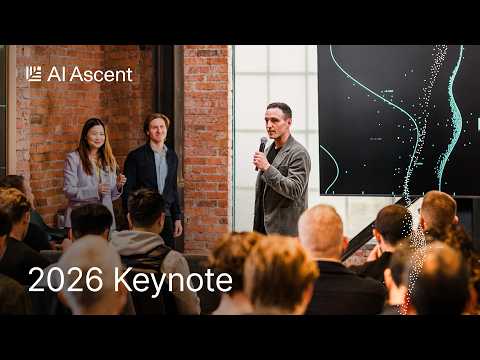
Published by Sequoia Capital on YouTube on April 30, 2026, this keynote video captures partners Pat Grady, Sonya Huang, and Konstantine Buhler presenting a case for the AI revolution. The description highlights how long-horizon agents are transforming cognitive work into a revolution of computation, turning what used to be 100-year development visions into achievable 100-day realities.
## TL;DR
The keynote outlines a structural transition from software to a massive $10 trillion AI services market driven by a fundamental shift toward a 'revolution of computation.' The speakers introduce the 'MAD' strategy (Moats, Affordance, Diffusion) for startups to survive rapidly changing model capabilities while tracking the evolution of autonomous AI agents from simple assistants to independent 'dark factories.' Drawing parallels to the Industrial Revolution, the presentation projects a future where machines handle 99.9% of cognition, shifting human focus toward raw creativity, strategy, and intrinsic human connection.
## Atmosphere & style
The presentation is deeply ambitious, visionary, and high-energy, pulsing with the rapid velocity of modern technological change. It feels like an exclusive, high-stakes briefing for builders that balances analytical venture capital frameworks with profound, philosophical historical analogies. The emotional arc transitions smoothly from grounded business strategies to a awe-inspiring look at an 'alien' future, ultimately grounding itself in a comforting, human-centric message about the enduring value of human relationships.
## Key takeaways
- [01:10](https://www.youtube.com/watch?v=LRo33rnv6rQ&t=70s) The current AI wave is part of an additive computing trajectory, built on decades of cumulative evolution across compute, bandwidth, data, and talent.
- [01:56](https://www.youtube.com/watch?v=LRo33rnv6rQ&t=116s) AI represents a fundamental shift from a "revolution of communication" (information distribution) to a "revolution of computation" (information processing).
- [01:56](https://www.youtube.com/watch?v=LRo33rnv6rQ&t=116s) AI unlocks the massive global services market, estimated at $10 trillion, making its total addressable market (TAM) significantly larger than the cloud software transition.
- [04:13](https://www.youtube.com/watch?v=LRo33rnv6rQ&t=253s) The practical and commercial arrival of AGI is defined by the emergence of long-horizon agents that can autonomously recover from failure and persist until a job is completed.
- [07:57](https://www.youtube.com/watch?v=LRo33rnv6rQ&t=477s) To establish durable moats against rapidly changing model capabilities, startups must focus on deep integration and customer-back relationships rather than just the technology layer.
- [09:33](https://www.youtube.com/watch?v=LRo33rnv6rQ&t=573s) Startups have a major opportunity to build "affordance"—paths of least resistance that make powerful technical capabilities dead-simple for business users.
- [11:51](https://www.youtube.com/watch?v=LRo33rnv6rQ&t=711s) AI agents have evolved from early, fragile experimental tools in 2022 into reliable, democratized systems capable of managing complex loops and workflows.
- [14:42](https://www.youtube.com/watch?v=LRo33rnv6rQ&t=882s) The value of SaaS tools is expected to explode as millions of software agents, rather than just humans, begin utilizing them.
- [17:08](https://www.youtube.com/watch?v=LRo33rnv6rQ&t=1028s) Agentic autonomy is shifting toward asynchronous operations and "dark factories" where software agents operate entirely autonomously without human review in production.
- [18:01](https://www.youtube.com/watch?v=LRo33rnv6rQ&t=1081s) The paradigm of hiring agents paid in tokens offers massive economic incentives over traditional human salaries due to infinite scalability and lower maintenance costs.
- [19:43](https://www.youtube.com/watch?v=LRo33rnv6rQ&t=1183s) Long-horizon agents are drastically compressing development timelines, condensing what previously took years of engineering work into days or weeks.
- [21:03](https://www.youtube.com/watch?v=LRo33rnv6rQ&t=1263s) The cognitive revolution is following the trajectory of the Industrial Revolution, moving toward a future where 99.9% of all cognition on Earth will be performed by machines.
- [24:45](https://www.youtube.com/watch?v=LRo33rnv6rQ&t=1485s) AI is commoditizing intelligence, transforming high-level expertise into an abundant resource that can be instantly invoked, used, and discarded like aluminum.
- [24:45](https://www.youtube.com/watch?v=LRo33rnv6rQ&t=1485s) Machine-driven cognition will yield "alien designs"—highly productive but entirely non-intuitive systems that challenge human preconceptions.
- [27:50](https://www.youtube.com/watch?v=LRo33rnv6rQ&t=1670s) The current era of AI is a temporary tinkering phase that will eventually lead to a formalized, fundamental science akin to thermodynamics.
- [27:50](https://www.youtube.com/watch?v=LRo33rnv6rQ&t=1670s) Just as photography pushed painting toward impressionism, the mastery of machine cognition will push human value toward authentic emotional connections and relationships.
## Detailed walkthrough
### [00:02](https://www.youtube.com/watch?v=LRo33rnv6rQ&t=2s) Welcome and Calibration
The session opens with a warm welcome to a packed room of busy community members. The speakers express deep gratitude to the attendees, framing the gathering as a vital service during "important times." The agenda is promised to be their best yet, featuring a collaborative synthesis of the many high-level conversations the hosts have engaged in over the past year.
The presentation is structured to flow from high-level calibration to present-day realities, and finally to future projections. Pat begins with the overall calibration, followed by Sonia, who will dive into the current landscape of AI, and Constantine, who will close by looking at what lies ahead.
[01:10](https://www.youtube.com/watch?v=LRo33rnv6rQ&t=70s) The Additive Waves of Technology
To calibrate the audience, Pat zooms out to the historical trajectory of modern computing, starting with the silicon-based transistors that originally gave Silicon Valley its name. These transistors evolved into networked systems, which eventually birthed the public internet, paved the way for cloud computing and social media, and ultimately shrunk down into the mobile devices we carry in our pockets today.
The core lesson of this historical retrospective is that technology waves are fundamentally additive. The industry required decades of cumulative evolution—building out compute, bandwidth, data, and talent—to make the current "indistinguishable from magic" AI moment possible.
[01:56](https://www.youtube.com/watch?v=LRo33rnv6rQ&t=116s) The Three Pillars of the AI Wave
Pat outlines three distinct characteristics that set the current AI wave apart from its predecessors. First, it is the largest wave yet because it is the first transition to encompass both software and services. During the first 15 years of the cloud transition, the total addressable market (TAM) for software grew from $350 billion to $650 billion, with cloud capturing about $400 billion of that. AI, however, unlocks the massive services market, which is estimated at a "conveniently round number" of $10 trillion. To put this scale in perspective, Pat notes that the US legal services market alone is a $400 billion vertical—matching the size of the entire historical cloud software market.
Second, this is the fastest wave yet, with the competitive "white space" filling up at an unprecedented rate. Tectonic shifts in cloud, mobile, and AI have rapidly propelled a new cohort of companies to over a billion dollars in revenue, with more on the horizon. Third, and most importantly, AI represents a fundamental shift from a "revolution of communication" (which is about how information is distributed, like the internet, cloud, and mobile) to a "revolution of computation" (which is about how information is processed).
- **Cloud TAM Growth:** Expanded from $350B to $650B over 15 years, with cloud accounting for $400B.
- **Services TAM:** Estimated up to $10T globally.
- **US Legal Services:** A single vertical in a single geography representing a $400B market.
[04:13](https://www.youtube.com/watch?v=LRo33rnv6rQ&t=253s) The Shifting Foundation and the Arrival of AGI
Because AI is a revolution of computation, the technological foundation is constantly shifting underfoot. Pat highlights three major inflection points over the last few years: the November 2022 "ChatGPT moment" which proved the power of pre-training; the emergence of the o1 model reasoning phase, which introduced a second scaling law around inference-time compute; and the recent release of Claude Code, which demonstrated the power of long-horizon agents.
The speakers boldly suggest that this third inflection point represents the arrival of AGI. While acknowledging they are venture capitalists and not technical researchers, they argue that from a practical, commercial standpoint, AGI has arrived: "if you can dispatch an agent to do a job and it can recover from failure and persist until that job is done... That feels pretty much like AGI." They contrast the "faster horses" of the past few years (which offered 10% to 40% productivity gains) with the "cars" of today—applications that offer 10x to 40x productivity leaps and fundamentally restructure organizations.
[06:24](https://www.youtube.com/watch?v=LRo33rnv6rQ&t=384s) The "So What?" and the MAD Strategy
Invoking the spirit of Sequoia's legendary founder, Don Valentine, Pat asks the ultimate question: "So what?" The answer is that a high-stakes commercial race has officially begun, with $10 trillion up for grabs. While AI labs approach this from a "tech-out" perspective, startups and builders are approaching it from a "customer-back" perspective.
For those building on top of foundation models, Pat offers a framework called "MAD," which stands for Moats, Affordance, and Diffusion. This strategy serves as a guide for startups trying to establish a durable foothold in an environment where the underlying model capabilities are changing daily.
[07:57](https://www.youtube.com/watch?v=LRo33rnv6rQ&t=477s) Moats: Customer-Back vs. Tech-Out
To explain the "M" in MAD, Pat references the classic merchandising cycle—the value chain required to take an idea to a happy customer. In a computation revolution, the temptation is to constantly look down at the rapidly changing technology layer. However, to build a true moat, builders must look up at the customer.
"Your customers are not changing nearly as fast as the capabilities are changing," Pat explains. While the specific software tools a startup builds today might become obsolete tomorrow, the depth of a company's relationship and integration with its customers remains highly durable. While having the best product is still incredibly important, wrapping your business deeply around the customer is the ultimate defense against rapid technological shifts.
[09:33](https://www.youtube.com/watch?v=LRo33rnv6rQ&t=573s) Affordance, Diffusion, and the Rain
The "A" in MAD stands for "affordance," a design term describing an object whose use is completely self-explanatory. Pat uses the analogy of a hammer: if you give a hammer to a two-year-old, they instantly know to start hitting things with it. In contrast, while a tool like Claude Code is incredibly powerful, opening a terminal is highly intimidating for the average Fortune 500 employee. Startups have a massive opportunity to build "paths of least resistance" that make these powerful capabilities dead-simple for business users to leverage.
The "D" stands for "diffusion." The diffusion gap—the delay between the creation of a capability and its actual adoption in the market—is widening because foundation models are advancing much faster than enterprise IT departments can adapt. Pat closes his segment with a classic racing analogy to inspire the crowd: "You cannot pass 15 cars in the sun, but you can pass 15 cars in the rain." The current torrent of new model capabilities means that while no existing lead is safe, absolutely anyone can win.
[11:51](https://www.youtube.com/watch?v=LRo33rnv6rQ&t=711s) The Rise of Agents: From 2022 to Today
Sonia takes the stage to discuss the defining theme of AI in 2026: agents. She takes the audience back to 2022, recalling early open-source projects like AutoGPT and BabyAGI. While these projects were overnight sensations on GitHub, they were ultimately "cute, kind of endearing, but completely useless" because the underlying models simply were not ready to handle loops and tools without failing.
Today, the landscape has completely shifted. Agents are actually working and have become highly democratized through tools like Claude Code for developers and OpenClaw for everyday users. Sonia notes that people are building agents for everything—from silly use cases like an agent that "will literally snitch on your neighbors for tax fraud," to entrepreneurial agents running generative media campaigns for construction businesses, to internal races within Sequoia to build agents that automate venture capital workflows.
[13:45](https://www.youtube.com/watch?v=LRo33rnv6rQ&t=825s) Defining the Functional Components of an Agent
Sonia defines an agent as "a system that perceives its environment, chooses actions, and progresses autonomously towards a goal." To illustrate this, she shares a video she generated herself using a video model, showcasing how far generative media has come.
Functionally, she breaks agency down into three core pillars:
1. **Reason and Plan:** The baseline intuition and ability to think on the fly.
2. **Take Actions:** The hands and feet of the agent, utilizing tools like terminals, search, writing, and compiling.
3. **Iterate Towards a Goal:** The persistence and feedback loops that allow an agent to work over long time horizons.
Ultimately, Sonia summarizes agency as "simply the ability to get done."
[14:42](https://www.youtube.com/watch?v=LRo33rnv6rQ&t=882s) Models, Tools, and Harnesses
Sonia breaks down the rapid progress of the three constituent components of agents: the models (the brain), the tools (the arms and legs), and the harness (the persistence). On the model side, the time a model can sustain progress on a complex task without going off the rails has jumped from tens of minutes a year ago to hours today.
For tools, agents are leveraging the terminal, Slack, iMessage, and computer-use APIs. Sonia challenges the popular narrative that "SaaS is dead," arguing instead that the value of SaaS tools will explode as millions of software agents begin utilizing them. Finally, the harness provides the feedback loops and reinforcement learning (RL) gyms that train agents in specific domains like mechanical engineering, design, and finance. She highlights early signs of self-improvement, pointing to research projects that can autonomously improve code to train a GPT-2 level model in just two hours.
[16:36](https://www.youtube.com/watch?v=LRo33rnv6rQ&t=996s) The Sliding Scale of Agenticness
Sonia explains that agents exist on a sliding scale of autonomy, using the evolution of software development as a prime example. The industry has moved rapidly from the simple, inline "tab autocomplete" assistants of 2023—which were helpful but not transformative—to the current era of "agentic development," where a human developer actively instructs and manages a team of agents. The paradigm is now pushing even further into background agents that operate entirely autonomously.
[17:08](https://www.youtube.com/watch?v=LRo33rnv6rQ&t=1028s) The Evolution of Agentic Autonomy and "Dark Factories"
The paradigm of AI agents is shifting rapidly toward asynchronous operations, where agents spawn sub-agents to handle complex workflows. This asynchronous model is poised to overtake the current paradigm in sheer volume because of the massive leverage it introduces to the system. Pushing the bleeding edge of this frontier are what can be described as "dark factories"—systems where human review is taken out of the loop completely. While removing human oversight entirely sounds radical, it is already happening in production environments, including within highly sensitive sectors like cybersecurity, made possible by robust engineering and strict guardrails.
This progression represents a climb up a "scale of agenticness." AI agents are evolving from simple, side-by-side helpers to interns that require management, to self-managing interns, and finally to trusted agents that can push directly to production without any human oversight. This evolution is not confined to coding; it is unfolding across all agentic applications.
- **The Agentic Scale**:
1. Little helpers (side-by-side assistance)
2. Interns needing management
3. Interns managing themselves
4. Trusted agents pushing to production without oversight
---
[18:01](https://www.youtube.com/watch?v=LRo33rnv6rQ&t=1081s) Services as the New Software and the Economics of Tokens
A fundamental takeaway for founders is that "services is the new software." This shift is actively manifesting across multiple industries. In medicine, users can hire an agent to inspect their genome, deliver personalized recommendations, prescribe medication, and recommend clinical trials. In law, agents will negotiate contracts, perform litigation, and settle disputes. In math and sciences, agents are solving complex problems and discovering new superconductors, while consumer-facing personal agents manage inboxes, calendars, finances, and file taxes.
Hiring agents is fundamentally easier and more scalable than hiring human employees. While humans are difficult to scale, keep happy, and require expensive salaries, agents are infinitely scalable with compute, low maintenance, and are paid in tokens. Generally, accomplishing a task with tokens costs significantly less than the equivalent human salary. Although humans remain smarter today, the "bitter lesson" of computation presses on, and agents will soon surpass human capabilities in many domains. The deployment of these agents across the application layer will be swift and unprecedented due to clear economic incentives and the inherent scalability of digital bits.
- **Human vs. Agent Dynamics**:
- Humans: Hard to scale, hard to keep happy, paid in salaries.
- Agents: Infinitely scalable with compute, low maintenance, paid in tokens.
- "The bitter lesson" ensures agents will soon be smarter at many tasks.
---
[19:43](https://www.youtube.com/watch?v=LRo33rnv6rQ&t=1183s) The Super-Exponential Rise of Agents and Compressed Timelines
As the number of agents balloons on a super-exponential trajectory, the world is about to reach a point where things get "genuinely strange." We will soon face scenarios where commerce happens directly between agents, allowing them to negotiate transaction terms and pay one another. We may also see swarms of agents policing networks to prevent cybersecurity catastrophes.
For founders, the reality of long-horizon agents is already compressing development timelines to an insane degree. For example, Nathan from Zed accomplished a three-year moonshot project over the holidays by himself using cloud code. Bret Taylor rebuilt Sierra over a single weekend, and the Notion team rewrote 8 million lines of code in just six weeks. While these individual compressed timelines are impressive, the real magic happens when you stack them on top of each other. Thanks to agents, "whatever you could imagine building over the next 100 years, we think is now possible in 100 days."
- **Examples of Compressed Timelines**:
- **Zed**: Nathan completed a 3-year moonshot project over the holidays alone.
- **Sierra**: Bret Taylor rebuilt the platform over a weekend.
- **Notion**: The team rewrote 8 million lines of code in 6 weeks.
---
[21:03](https://www.youtube.com/watch?v=LRo33rnv6rQ&t=1263s) The Cognitive Revolution: Parallels to the Industrial Revolution
To understand what comes next in the AI age, we can bifurcate work into two categories: physical work (force times distance, like a package on the Pony Express or a Falcon 9 satellite) and cognitive work (conscious thinking, like Pythagoras proving his theorem or DeepMind solving protein folding). While these are very different, the cognitive revolution is following a path remarkably similar to the Industrial Revolution, though it will move much faster and scale much larger.
Looking at physical work, for the vast majority of human history, virtually all labor was performed by human or animal muscle. Over the last few centuries, wind, water, steam, combustion, and electric motors took over. Today, it is estimated that "99 plus percent of all the physical work done on planet Earth for humans is done by machine." Cognition is on the exact same trajectory. For millennia, thinking was done almost entirely by humans. The introduction of electronic computation over the past century brought trillions of calculations to serve us. Now, the neural network represents the next massive wave. In the near future, 99.9% of all cognition on Earth will be performed by machines.
---
[24:45](https://www.youtube.com/watch?v=LRo33rnv6rQ&t=1485s) Four Stories of the Future: From Precious Aluminum to Alien Design
To illustrate what living in this cognitive future will feel like, we can look at four short stories. The first is the story of aluminum. In the mid-1800s, America capped the Washington Monument with 100 ounces of aluminum—then the most precious metal in the world, so rare it was displayed at Tiffany's in Manhattan. Decades later, an inventor created electrolysis to easily separate aluminum from dirt. Soon, aluminum went from a precious treasure to something used to wrap sandwiches and throw in the trash. In this analogy, "aluminum is intelligence" and "electrolysis is artificial intelligence." We are entering a world where PhD-level skills that took decades to master can be instantly invoked, used, and immediately discarded.
The second story is about "alien design." Because humans have done almost all the historical thinking, our world is designed to make sense to human brains. However, when machines take over cognition, designs become non-intuitive. In 2006, NASA used an evolutionary algorithm to design a space antenna. Instead of the traditional, symmetrical geometric pattern humans would design, the computer generated a bizarre, organic-looking shape. It was dramatically more productive, yet entirely counterintuitive to the human mind. As AI designs chips, cars, and buildings, we must remain open-minded to these alien, non-intuitive results.
---
[27:50](https://www.youtube.com/watch?v=LRo33rnv6rQ&t=1670s) Emerging Sciences and the Art of Unreason
The third story focuses on "emerging sciences." During the early Industrial Revolution, engineers like Newcomen and Watt built and perfected combustion engines through trial, error, and tinkering. It took over 120 years of tinkering before Sadi Carnot formalized these observations into a fundamental new science: thermodynamics. Currently, we are in the "tinkering phase" of AI, playing with billions of neurons and trillions of tokens. In the coming decades, a science as fundamental as thermodynamics will be introduced to help us master AI and perhaps even consciousness itself.
The fourth story explores the "art of unreason." For tens of thousands of years, human art progressed steadily toward realism—from cave paintings to Egyptian hieroglyphs, Greek pottery, and Renaissance masterpieces. Then, the daguerreotype and early photography emerged, instantly mastering the perfect replication of reality. People feared painting was dead. Instead, artists responded by shifting their focus from how the eye sees a moment to how the heart and soul see it, giving birth to impressionism, expressionism, cubism, and neo-expressionism.
As the Greek philosopher Protagoras wrote 2,500 years ago, "Man is the measure of all things." Nothing has value in a vacuum; aluminum, art, and intelligence only have value because of the human experience. AI will do the work, but "only the human connection can give you a reason to care." While work will change dramatically over the next decade, the human relationships formed today are what will endure and remain truly valuable.
## Notable quotes
> [04:13](https://www.youtube.com/watch?v=LRo33rnv6rQ&t=253s) if you can dispatch an agent to do a job and it can recover from failure and persist until that job is done... That feels pretty much like AGI.
> [07:57](https://www.youtube.com/watch?v=LRo33rnv6rQ&t=477s) Your customers are not changing nearly as fast as the capabilities are changing — Pat
> [09:33](https://www.youtube.com/watch?v=LRo33rnv6rQ&t=573s) You cannot pass 15 cars in the sun, but you can pass 15 cars in the rain. — Pat
> [11:51](https://www.youtube.com/watch?v=LRo33rnv6rQ&t=711s) cute, kind of endearing, but completely useless — Sonia
> [11:51](https://www.youtube.com/watch?v=LRo33rnv6rQ&t=711s) will literally snitch on your neighbors for tax fraud — Sonia
> [13:45](https://www.youtube.com/watch?v=LRo33rnv6rQ&t=825s) a system that perceives its environment, chooses actions, and progresses autonomously towards a goal. — Sonia
> [13:45](https://www.youtube.com/watch?v=LRo33rnv6rQ&t=825s) simply the ability to get done. — Sonia
> [18:01](https://www.youtube.com/watch?v=LRo33rnv6rQ&t=1081s) services is the new software.
> [19:43](https://www.youtube.com/watch?v=LRo33rnv6rQ&t=1183s) whatever you could imagine building over the next 100 years, we think is now possible in 100 days.
> [21:03](https://www.youtube.com/watch?v=LRo33rnv6rQ&t=1263s) 99 plus percent of all the physical work done on planet Earth for humans is done by machine.
> [24:45](https://www.youtube.com/watch?v=LRo33rnv6rQ&t=1485s) aluminum is intelligence
> [24:45](https://www.youtube.com/watch?v=LRo33rnv6rQ&t=1485s) electrolysis is artificial intelligence.
> [27:50](https://www.youtube.com/watch?v=LRo33rnv6rQ&t=1670s) Man is the measure of all things. — Protagoras
> [27:50](https://www.youtube.com/watch?v=LRo33rnv6rQ&t=1670s) only the human connection can give you a reason to care.
Sequoia Capital partners argue that the rise of long-horizon AI agents marks the functional arrival of artificial general intelligence, driving a transition from a software market into a ten-trillion-dollar services economy.
The Services Opportunity and Practical AGI (1:56)
Pat frames artificial intelligence as a fundamental shift from a revolution in communication to one in computation. Whereas the cloud software transition expanded its total addressable market from $350 billion to $650 billion over 15 years, AI unlocks the global services market, estimated at approximately $10 trillion. To illustrate the magnitude, the speakers note that the United States legal services vertical alone represents a $400 billion market, matching the entire historical size of cloud software.
The technological foundation has evolved across three key inflection points: the November 2022 ChatGPT launch demonstrating pre-training scale, the o1 reasoning phase establishing inference-time compute scaling, and recent long-horizon developer agents like Claude Code. While acknowledging they are venture investors rather than technical researchers, the speakers assert that systems capable of sustained autonomous execution, error recovery, and task completion fulfill the functional, commercial definition of AGI.
Navigating the Technology Torrent With MAD (6:24)
Because underlying model capabilities are shifting rapidly, Pat advises founders to approach development 'customer-back' rather than 'tech-out.' Under the MAD framework—Moats, Affordance, and Diffusion—durable enterprise moats come from deeply embedded customer workflows and relationships, which change far more slowly than model architectures.
The framework defines affordance as building intuitive paths of least resistance, noting that complex terminal interfaces intimidate typical corporate users despite their technical power. Meanwhile, the diffusion gap between frontier model capabilities and enterprise IT adoption is actively widening. Using a racing analogy, the speakers suggest that rapid technological turbulence allows late entrants to overtake incumbents who cannot adapt quickly.
Agent Architecture and Autonomous Dark Factories (11:51)
Sonia tracks the evolution of AI agents from early, unreliable 2022 experiments like AutoGPT and BabyAGI to modern systems anchored by three pillars: reasoning and planning, tool usage, and harness-driven reinforcement learning feedback loops. Model stability on complex tasks has expanded from tens of minutes to sustained hours. Rather than eliminating traditional software, the speakers argue that millions of deployed agents will drastically increase utilization of existing software-as-a-service platforms.
Autonomy is progressing along an operational spectrum: from early inline autocomplete tools, to human-managed agents, to self-managing agents, and ultimately to 'dark factories' where agents operate asynchronously and deploy directly to production without human review. The speakers contend that 'services is the new software,' pointing out that token-based agents are infinitely scalable and significantly cheaper than salaried employees across disciplines such as law, medicine, finance, and software maintenance.
Historical Parallels and Industrial-Scale Cognition (21:03)
Constantine draws a direct parallel between the Industrial Revolution and modern machine cognition. Historically, human and animal muscle accounted for almost all physical labor before mechanical engines scaled to perform more than 99% of physical work on Earth. The presentation forecasts a similar trajectory for knowledge work, projecting that machines will eventually handle 99.9% of all cognitive processing.
To contextualize this shift, the speakers present historical analogies: aluminum transitioning from a rare, precious metal to cheap household foil through electrolysis; evolutionary computing producing alien, organic NASA antenna designs that outperform human symmetrical designs; and early steam engine tinkering preceding formal thermodynamics by over a century. They suggest current AI development remains in an empirical tinkering stage ahead of a formal scientific framework.
The presentation concludes that while ubiquitous machine cognition will compress development cycles and automate cognitive labor at an unprecedented scale, intelligence itself possesses no intrinsic value without human utility; long-term commercial durability and cultural relevance will remain anchored in human experience and relationships.
[4:13] if you can dispatch an agent to do a job and it can recover from failure and persist until that job is done... That feels pretty much like AGI.
[7:57] Pat: Your customers are not changing nearly as fast as the capabilities are changing
[9:33] Pat: You cannot pass 15 cars in the sun, but you can pass 15 cars in the rain.
[11:51] Sonia: cute, kind of endearing, but completely useless
[11:51] Sonia: will literally snitch on your neighbors for tax fraud
[13:45] Sonia: a system that perceives its environment, chooses actions, and progresses autonomously towards a goal.
[13:45] Sonia: simply the ability to get done.
[18:01] services is the new software.
[19:43] whatever you could imagine building over the next 100 years, we think is now possible in 100 days.
[21:03] 99 plus percent of all the physical work done on planet Earth for humans is done by machine.
[24:45] aluminum is intelligence
[24:45] electrolysis is artificial intelligence.
[27:50] Protagoras: Man is the measure of all things.
[27:50] only the human connection can give you a reason to care.
Original transcript
[0:02] Good morning. How's everybody doing?
[0:04] >> [cheering]
[0:05] >> All right. All right, a little bit
[0:06] better. Hey, thank you all for being
[0:07] here. We really appreciate it. We do
[0:09] this as a service to the community
[0:12] because we are living through important
[0:14] times.
[0:15] And it's an honor for us to be able to
[0:17] serve as a bit of a gathering place for
[0:19] people to come together. And this is by
[0:21] far the best agenda we put together and
[0:23] by far the best set of attendees. And so
[0:25] we just want to start out by saying
[0:26] thank you. We know you are all crazy
[0:28] busy. Thank you for being here today.
[0:32] >> [applause]
[0:35] >> So, we do have a pretty exceptional
[0:37] agenda put together as per usual.
[0:40] Sonia
[0:41] in the impeccable outfit
[0:44] Constantine and [snorts] I are going to
[0:46] say a couple of words to start. You
[0:48] know, we have we have the privilege of
[0:49] being in the midst of a lot of
[0:51] conversations with a lot of interesting
[0:52] people. And so once a year we like to
[0:54] try to synthesize that a little bit and
[0:56] share back with you what it is we've
[0:57] been hearing. And so I'll say a few
[0:59] words of overall
[1:01] calibration and then Sonia will say a
[1:03] bit about what we see today and then
[1:05] Constantine will say a bit about what we
[1:08] think might be coming tomorrow.
[1:10] So, for calibration
[1:13] we're going to start by zooming out.
[1:15] Going back to the silicon [snorts] based
[1:17] transistors which gave this area its
[1:18] name.
[1:19] They got built into systems connected by
[1:21] networks that went public in the form of
[1:23] the internet, supported applications
[1:25] like social media and the cloud,
[1:27] eventually showed up on our pockets in
[1:28] mobile devices that today
[1:30] are capable of doing something
[1:32] indistinguishable from magic which is
[1:34] AI.
[1:36] The reason we like to show this slide
[1:38] and those of you who've been here in the
[1:39] past have seen this before
[1:41] is because it reminds us
[1:43] that all of these waves are additive.
[1:46] And we sort of needed all of these
[1:48] decades of evolution to have the
[1:49] compute, the bandwidth, the data, the
[1:52] talent to make the most of this moment.
[1:56] Now this AI wave is a little bit
[1:57] different in three ways. First
[2:01] it's the biggest wave yet.
[2:04] And that's generally true, but there is
[2:05] something more specifically true about
[2:07] this wave.
[2:08] Which is it is the first one that is
[2:10] both software and services.
[2:13] The top row shows the first 15 years of
[2:16] the cloud transition where the TAM for
[2:17] software
[2:19] went from about 350 billion to 650
[2:21] billion and cloud grew to be about 400
[2:24] billion of that.
[2:25] The bottom row is what is brand new.
[2:28] This is the services revenue
[2:31] that seems to also be available now.
[2:34] $10 trillion is a conveniently round
[2:36] number. We don't know if it's 10
[2:37] trillion or 5 trillion or 50 trillion.
[2:40] We do know that legal services in the US
[2:41] alone is a $400 market.
[2:44] That is one vertical
[2:45] and one geo.
[2:47] And it's the same as all of software.
[2:50] So this opportunity is immense.
[2:53] Point number two
[2:55] fastest wave yet.
[2:57] I think we can all feel this.
[3:00] What it means
[3:01] is that this white space, and I direct
[3:03] your attention to the AI side of this
[3:05] page this white space
[3:07] is getting filled pretty fast.
[3:10] These logos
[3:12] are the companies that got to a billion
[3:13] plus of revenue as a result of the cloud
[3:16] mobile and now AI tectonic shifts.
[3:19] And at current course and speed
[3:22] there are more coming soon.
[3:25] Point number three
[3:27] which is probably the most interesting
[3:28] one and I borrowed this
[3:30] from my partner Constantine
[3:33] is that there are two basic kinds of
[3:34] revolutions in technology.
[3:37] There are revolutions of communication
[3:40] which are about the way information is
[3:41] distributed.
[3:44] Most of the people in this room have
[3:46] only lived through revolutions in
[3:48] communication.
[3:50] The internet
[3:52] the cloud
[3:53] mobile
[3:55] those are all about information
[3:56] distribution. Those were revolutions in
[3:58] communication.
[4:00] AI is different.
[4:01] AI is this one.
[4:04] AI is a revolution in computation. It's
[4:05] about how information is processed.
[4:08] And that might sound like semantics, but
[4:10] these are fundamentally different shapes
[4:12] of waves.
[4:13] And maybe the most visceral way to feel
[4:15] this
[4:17] is to think about the fact that the
[4:18] floor keeps moving underfoot. The
[4:19] technology foundation
[4:21] on which everybody builds
[4:24] changes every day when new capabilities
[4:26] come out.
[4:28] And we've had three major inflection
[4:29] points
[4:30] over the last handful of years. First
[4:31] one
[4:32] chat GPT chat GPT moment, November 2022,
[4:36] the world saw the power of pre-training.
[4:39] Second one, couple years later
[4:41] 01 model reasoning.
[4:44] All of a sudden a second scaling law
[4:45] emerges around inference time compute.
[4:48] Third one
[4:50] just recently
[4:51] cloud code no plus 45 now 47.
[4:54] The world saw the power of long horizon
[4:56] agents.
[4:57] And while these look like three points
[4:59] on a continuum
[5:01] it's kind of a heartbreak between two
[5:02] and three. It's a little bit of a
[5:04] discontinuous change.
[5:06] And if we may may be so bold
[5:09] we would say
[5:11] that this is AGI.
[5:14] And look
[5:15] I'm an econ major
[5:16] we're venture capitalists
[5:18] not about to propose a technical
[5:19] definition for AGI. Okay, we study
[5:22] founders and markets and the collision
[5:24] thereof which is businesses.
[5:26] But we do study businesses. And so from
[5:29] a commercial standpoint, from a
[5:31] practical standpoint from a functional
[5:33] standpoint if you can dispatch an agent
[5:37] to do a job and it can recover from
[5:39] failure and persist until that job is
[5:41] done
[5:43] I don't know. That feels pretty much
[5:45] like AGI.
[5:47] Even if you don't think it's AGI, which
[5:49] is fine.
[5:50] By the way, Sonia will talk a lot more
[5:51] about this in her part.
[5:53] Even if you don't think it's AGI
[5:55] I think we can all see that the cars
[5:57] have arrived.
[5:58] Last few years we've had a lot of faster
[6:01] horses.
[6:02] Applications that made you 10 or 40%
[6:04] more productive, but didn't
[6:06] fundamentally change the way you work.
[6:09] Now we're starting to see cars.
[6:11] Applications that make you 10 or 40X
[6:13] more productive.
[6:14] And absolutely change the way that you
[6:16] work. Change the nature of your work.
[6:18] Change the nature of your organization.
[6:20] Cars have arrived.
[6:24] This is the founder of Sequoia, Don
[6:25] Valentine. He was famous
[6:27] for asking one question.
[6:30] So what?
[6:31] Why does all this stuff matter?
[6:33] >> [clears throat]
[6:34] >> Well, it matters cuz just in the last
[6:35] few months
[6:37] the race has begun.
[6:40] And it's a different kind of race
[6:42] than what we're used to.
[6:44] The way you drive a car is different
[6:45] than the way you ride a horse. The way
[6:46] you build a car is different than the
[6:47] way you take care of a horse.
[6:49] So it's a very different sort of race.
[6:51] And one of the reasons that we wanted to
[6:52] gather everybody here today is because
[6:54] nobody has all the answers.
[6:56] And the more time we can spend together,
[6:57] the more we can learn and hopefully
[6:59] figure out
[7:00] where all this stuff is headed.
[7:02] And it's important that we do so as soon
[7:04] as possible
[7:06] cuz there's a lot at stake.
[7:08] Just from a commercial perspective
[7:10] there's $10 trillion up for grabs. We
[7:12] got labs coming at it from a tech out
[7:14] approach. We got startups building on
[7:16] top coming at it from more of a customer
[7:17] back approach.
[7:19] We do have all of the labs represented
[7:21] in this room, but most of you are
[7:23] building on top. And so we'll take a
[7:24] minute and uh talk about that customer
[7:27] back approach.
[7:29] So our advice for those of you
[7:31] who are building on top of the labs
[7:33] is free advice and so it's worth every
[7:35] penny you paid for it. Our our advice
[7:38] would be to get mad.
[7:41] And we don't we don't actually need you
[7:42] to be angry. You can be angry if you
[7:43] want. If that's what drives you, that's
[7:44] cool. Go ahead and be angry. But this is
[7:46] just a convenient acronym
[7:48] for motes, affordance, and diffusion
[7:52] which are three characteristics or three
[7:53] pillars
[7:55] of a strategy for building on top of the
[7:57] models. First on motes
[7:59] just for fun. Anybody remember this
[8:00] slide from last year?
[8:03] One person and he's my partner. Okay,
[8:05] that's cool. Um
[8:07] we're we're not going to
[8:08] Okay, as a reminder this slide shows the
[8:10] merchandising cycle which is the links
[8:12] in the value chain required to take
[8:13] something from an idea to a happy
[8:15] customer. We're not actually going to go
[8:17] through the links in the chain.
[8:19] The point that I want to make here
[8:21] if you approach things from a tech out
[8:22] point of view, each link in the chain
[8:24] gets approached a little bit different.
[8:26] If you approach things from a customer
[8:27] back point of view, each link in the
[8:29] chain you approach a little bit
[8:31] different.
[8:32] Now here's the part that's
[8:33] counterintuitive.
[8:35] In a revolution of computation
[8:38] which is about information processing
[8:41] what you want to do
[8:43] is look down here
[8:45] because there's cool new stuff coming
[8:46] out all the time.
[8:48] What you should actually do for the sake
[8:50] of building motes
[8:52] is look up here
[8:54] because your customers are not changing
[8:56] nearly as fast
[8:58] as the capabilities are changing.
[9:01] The things that you built might be
[9:02] irrelevant tomorrow.
[9:05] The degree to which you wrap yourself
[9:06] around your customers is going to be a
[9:08] bit more durable.
[9:10] That's not to say the product and
[9:11] technology is not important. It is
[9:13] insanely important. And generally
[9:15] speaking best product wins.
[9:17] But in a world where product changes so
[9:20] fast because capabilities change so fast
[9:23] in thinking about motes, we would
[9:25] encourage you to go as customer back as
[9:27] possible and think about all the ways
[9:29] you can wrap yourself around those
[9:31] customers.
[9:33] Okay, the A in MAD stands for
[9:35] affordance.
[9:36] This is a term that we borrow from the
[9:37] design world.
[9:39] A hammer
[9:40] is an object that has affordance.
[9:42] I have a two-year-old son.
[9:44] If I give him a hammer
[9:46] he would know what to do with it. He
[9:47] would grab it and start hitting stuff.
[9:48] That's why we don't give him hammers.
[9:50] Okay? An object with affordance
[9:52] is one that doesn't need to be
[9:53] explained.
[9:55] People just know what to do with it.
[9:58] Claude code is insanely powerful.
[10:01] Go open up a terminal for the average
[10:03] Fortune 500 employee and see how far
[10:04] they get.
[10:06] While it is powerful,
[10:08] it does not offer that much affordance.
[10:11] That's not a knock in on Anthropic,
[10:13] but it is an opportunity for anybody who
[10:15] wants to build on top.
[10:17] And to create paths of least resistance
[10:20] for your specific customers and their
[10:22] specific problems so that it's just
[10:25] brain dead simple for them to figure out
[10:28] how to get to the outcome that they need
[10:29] for their business. That's the concept
[10:31] of affordance.
[10:33] And then finally, the D in MAD is
[10:36] diffusion.
[10:37] And the diffusion gap is the opportunity
[10:40] for companies building at the
[10:41] application layer. The rate at which
[10:44] capabilities are diffusing out into the
[10:45] market is far shy of the rate at which
[10:49] those capabilities are being created.
[10:51] And every day that the foundation models
[10:54] move faster than your average Fortune
[10:56] 500 enterprise, that gap gets bigger
[11:00] and that opportunity gets bigger.
[11:03] So, for motes,
[11:04] try to think customer back.
[11:06] For affordance, try to think about
[11:08] creating those paths of least resistance
[11:10] for your customers.
[11:12] And that diffusion gap, that represents
[11:14] your opportunity.
[11:16] Unless that slide from earlier with the
[11:17] white space starting to fill up was
[11:19] discouraging for anybody, may we remind
[11:21] you
[11:23] that no lead is safe.
[11:25] There's [clears throat] this expression
[11:25] in racing. You cannot pass 15 cars in
[11:29] the sun,
[11:30] but you can pass 15 cars in the rain.
[11:33] And right now there is a torrential
[11:35] downpour
[11:36] of new capabilities coming out of the
[11:38] foundation models.
[11:40] Which means that no lead is safe,
[11:42] but it also means
[11:44] that anybody can win.
[11:46] What a time to be alive.
[11:48] And with that, I'll hand it off to
[11:49] Sonya.
[11:51] >> [applause]
[11:56] [applause]
[11:56] >> Thank you, Pat. And can I just say it's
[11:58] so nice to see so many friendly faces in
[12:00] the audience. There is an exceptional
[12:02] group of people here today and I'm just
[12:04] really happy to be part of this
[12:06] ecosystem with all of you. And so, the
[12:07] purpose of my section is to talk about
[12:09] what's happening in AI right now, which
[12:11] for 2026 is agents.
[12:13] Okay, flashback to 2022. Show of hands,
[12:16] does anybody here remember AutoGPT or
[12:19] BabyAGI? Okay. Okay. So, these projects
[12:22] were overnight hits on GitHub and what
[12:24] they did was they took GPT-3, gave it
[12:26] some tools, wrapped in a loop, and let
[12:28] it run towards a goal.
[12:30] And it was promising until you watched
[12:32] those agents just fail over and over and
[12:35] over again.
[12:36] Kind of cute, kind of endearing, but
[12:38] completely useless.
[12:40] And I put this slide here to remind us
[12:41] that you know, we all knew agents were
[12:44] coming. Uh we could have seen it years
[12:46] ago,
[12:47] but back in 2022, the models just
[12:49] weren't ready yet.
[12:51] Fast forward to today,
[12:53] something around the turn of the year
[12:55] really changed. Suddenly we have agents
[12:58] everywhere around us and they seem to
[13:00] actually be working.
[13:02] Two agents in particular have been home
[13:04] runs. Claude code for the technical
[13:06] crowd and open claw and all of its
[13:08] lobster brethren, uh which democratized
[13:10] agents to anybody with a phone. And so,
[13:13] whether you are a hardcore engineer or a
[13:15] normie, the punchline is that anybody
[13:18] can create agents now.
[13:20] And so, what we're seeing is people are
[13:21] building agents for everything. There is
[13:23] silly stuff like an open claw agent that
[13:25] will literally snitch on your neighbors
[13:27] for tax fraud. Please don't do this. Or
[13:29] actually, maybe please do this. Uh
[13:31] there's entrepreneurial stuff. Agents
[13:33] running generative media campaigns to
[13:35] sell construction services.
[13:37] And then there's the professional layer.
[13:39] I can tell you there's a huge race
[13:40] internally at Sequoia for who can build
[13:42] the best agents to do our jobs better.
[13:45] So, what does it mean to be an agent?
[13:48] Here is one possible definition. An
[13:50] agent is a system that perceives its
[13:52] environment, chooses actions, and
[13:54] progresses autonomously towards a goal.
[13:57] By the way, guys, I made this in C dance
[13:58] by myself. I'm I'm very proud of it.
[14:00] >> [laughter]
[14:00] >> The video models have come a long way.
[14:04] Uh and more specifically, I view agents
[14:06] as having three functional components.
[14:09] First is the ability to reason and plan.
[14:12] Uh this is the baseline level of
[14:14] intuition and the ability ability to
[14:16] think on the fly.
[14:18] Second is the ability to take actions.
[14:21] This is tools, search, write, compile.
[14:25] And then finally, the ability to iterate
[14:27] towards a goal. This is the persistence
[14:29] that gives agents the ability to
[14:31] accomplish things over long time
[14:33] horizons.
[14:34] And so, agency combines these three
[14:36] things. It is simply the ability to get
[14:39] done.
[14:42] If we boil the agents down into their
[14:43] constituent components, the models, the
[14:45] tools, the harnesses, each component has
[14:48] progressed rapidly over the last year.
[14:51] First, the models are the brain. This is
[14:53] the most important thing that's
[14:53] happened. The meter chart measures uh
[14:56] how long a model can sustain progress on
[14:58] a complex task without going off the
[15:00] rails. And we've gone from the order of
[15:03] tens of minutes a year ago to the order
[15:05] of hours today.
[15:07] And so, this is this is the most
[15:08] important thing that's happened. The
[15:09] models are finally getting capable
[15:10] enough to sustain per- performance on
[15:13] long horizon tasks.
[15:17] Second, the tools are the arms and the
[15:19] legs.
[15:20] These give models access to things that
[15:23] make us productive on the computer. The
[15:24] terminal for file systems and dev tools,
[15:27] iMessage, Slack,
[15:29] uh web search, computer use, you name
[15:32] it.
[15:33] And the last two decades that we spent
[15:34] building tools for humans have ended up
[15:37] being uh able to port over to be
[15:39] incredibly useful for for agents as
[15:41] well. And there's a common refrain that
[15:43] SaaS is dead. I think to the contrary,
[15:45] the value of these tools is going to
[15:47] explode as the number of agents using
[15:49] them increases.
[15:53] Models and tools give agents capability.
[15:56] The harness is what gives them
[15:57] persistence, the ability to stay on
[15:59] task, adapt, and keep going. And that
[16:02] feedback loop is now really starting to
[16:04] crank.
[16:05] Especially now with reinforcement
[16:06] learning, we're giving these agents uh
[16:08] we're taking them to driving school,
[16:09] giving them uh
[16:11] you know, training them uh in RL gyms,
[16:14] and we're pushing performance in
[16:15] different settings from mechanical
[16:17] engineering to design to finance.
[16:22] We're also seeing the early glimmers of
[16:23] self-improvement or the machine building
[16:25] the machine.
[16:26] Uh for example, Andrej's other research
[16:28] project uh improves research
[16:30] autonomously towards a GPT-2 level model
[16:33] in just 2 hours.
[16:36] So, what does the world of agents
[16:37] everywhere look like?
[16:39] Agents exist on a sliding scale of
[16:42] agenticness. Um and so, let's take
[16:44] coding as an example.
[16:46] In 2023, we had tab auto complete, one
[16:49] AI assisting a human in line. This was
[16:52] incrementally useful, fundamentally not
[16:54] transformative.
[16:57] We now have agentic development, one
[16:59] human talking to an agent, instructing
[17:01] it what to do, maybe managing a team of
[17:03] agents.
[17:04] But this paradigm is getting pushed
[17:06] further. We're now seeing background
[17:08] agents, async agents, agents spawning
[17:10] sub agents. We think that async agents
[17:13] in this whole paradigm is likely to
[17:15] overtake the current paradigm in volume
[17:17] just because of the amount of leverage
[17:18] in the system.
[17:20] And then finally, pushing the bleeding
[17:22] edge of the frontier, what I call dark
[17:23] factories,
[17:25] um taking human review out of the system
[17:27] completely. This sounds crazy, but I've
[17:30] seen it happen in production including
[17:32] with cybersecurity companies. It is
[17:34] possible with good enough guardrails and
[17:37] good enough engineering.
[17:38] So, we're progressing up a scale of
[17:40] agenticness. Agents are going from
[17:42] little helpers that do a little amount
[17:44] by your side to interns that need to be
[17:47] managed to interns that manage
[17:49] themselves. And eventually to interns
[17:51] that can be trusted enough to to push to
[17:53] prod without oversight. And so, that's
[17:55] the evolution that's happening not just
[17:57] in coding, but across all of agents.
[18:01] Uh the most important takeaway uh for
[18:03] the founders in this room is that
[18:05] services is the new software. Pat's been
[18:07] saying this for as long as I've known
[18:08] him. Uh and our partner Julian, who's in
[18:10] the audience today as well, uh published
[18:12] a great article on this. And we've known
[18:13] this for a long time, but I think it's
[18:15] actually happening. So, in medicine,
[18:16] you're able to hire an agent that
[18:18] inspects your genome, gives you
[18:20] personalized recommendations, can
[18:21] prescribe you medication, uh recommend
[18:23] you clinical trials. And law, you'll be
[18:25] able to hire agents that can negotiate
[18:27] contracts on your behalf, even perform
[18:29] litigation and settle for you.
[18:31] In math and the sciences, we're seeing
[18:32] agents that can solve air those problems
[18:34] or discover new superconductors. Like
[18:36] how thrilling is that?
[18:38] Or in uh in the consumer world, personal
[18:40] agents that can manage your inbox for
[18:43] you, your calendar, your finances, uh
[18:45] file your taxes.
[18:48] And we expect there's going to be agents
[18:49] everywhere and that's in part because
[18:51] hiring agents is so much easier than
[18:53] hiring employees.
[18:55] Humans are hard to scale. Infinites are
[18:57] infinitely scalable with compute.
[18:59] Humans are hard to keep happy, except
[19:01] for me, I'm always happy. Uh agents are
[19:04] low maintenance.
[19:06] Uh humans are
[19:08] uh humans are expensive. You pay them
[19:09] salaries.
[19:10] Uh you pay agents tokens. Generally, it
[19:12] costs less to accomplish a task with
[19:14] tokens than the equivalent in salary.
[19:16] Today, humans are still generally
[19:18] smarter, but the bitter lesson presses
[19:19] on and soon agents will be smarter at
[19:21] many things. And so, the point of this
[19:23] slide is not that we humans are out of a
[19:25] job. Uh I think a uniquely human trait
[19:27] is adaptability. But we do expect the
[19:30] deployment of agents across the
[19:32] application layer to be swift and at an
[19:34] unprecedented rate and scale because the
[19:37] economics are so clear uh and because of
[19:39] the inherent scalability of bits.
[19:43] So, if you add all this up, the number
[19:44] of agents is ballooning on some sort of
[19:46] exponential, maybe super exponential.
[19:49] And I think we're about to hit the point
[19:50] where things get genuinely
[19:51] [clears throat] strange.
[19:52] Uh what happens when commerce happens
[19:54] between agents? Can they pay each other?
[19:57] What happens when agents can actually
[19:58] negotiate the terms of a transaction
[20:00] with each other?
[20:01] Are we going to have swarms of agents
[20:03] policing us, preventing things like
[20:04] cybersecurity Armageddon?
[20:06] All we know is the world is getting
[20:08] weird extremely quickly.
[20:11] And so I'll close by channeling my inner
[20:13] my inner Bene Gesserit.
[20:15] Uh long horizon agents are here. The
[20:17] curves that they're on is very clear.
[20:19] And for founders, I think everybody has
[20:21] examples of people that are
[20:23] accomplishing insanely hard timelines
[20:25] thanks to AI. So Nathan from Zed
[20:28] accomplished a three-year moonshot
[20:29] project over the holidays by himself
[20:31] with cloud code. Uh Bret Taylor rebuilt
[20:34] Sierra over a weekend. Um
[20:36] the Notion team rewrote 8 million lines
[20:39] of code in just 6 weeks. And so
[20:41] everybody has these examples of
[20:42] compressed timelines. But I think very
[20:44] few people outside of the AGI labs have
[20:47] seen what happens when you take these
[20:49] compressed timelines and you stack them
[20:51] on top of each other.
[20:52] And that's what's possible now. And so
[20:55] whatever you could imagine building over
[20:56] the next 100 years, we think is now
[20:58] possible in 100 days thanks to agents.
[21:01] I will pass it over to Konstantin.
[21:03] Thank you, Sonia.
[21:05] >> [applause]
[21:07] >> All right. Thank you so much, Sonia,
[21:09] Pat, for the brilliant overview,
[21:11] analysis. In this section, we're going
[21:13] to talk a little bit about what's next.
[21:17] Uh so the goal here is we all know we're
[21:19] in an AI age.
[21:21] What's it going to look like? What's it
[21:23] going to feel like? How's it
[21:24] characterized?
[21:26] Earlier in the presentation, Pat
[21:29] bifurcated technological revolutions
[21:32] between compute and communication. We're
[21:34] going to do another bifurcation here for
[21:35] types of work.
[21:37] There is physical work. This is a
[21:39] package on the Pony Express. This is a
[21:41] satellite on a Falcon 9.
[21:44] Work equals force times distance,
[21:45] physical movement. And then there's
[21:47] cognitive work. This is Pythagoras
[21:49] coming up with his theorem. This is
[21:51] DeepMind solving the pro- protein
[21:54] folding problem.
[21:55] Conscious thinking.
[21:58] These are very different types of work.
[22:01] But we believe that they're going to
[22:02] follow a very similar pattern in
[22:05] revolution.
[22:07] So let's talk about physical work
[22:08] because we've been through this
[22:09] revolution with the Industrial
[22:11] Revolution.
[22:13] For the vast majority of human history,
[22:17] all the work
[22:19] or virtually all the work for serving
[22:21] humans was done by some sort of muscle.
[22:26] People or animals. People moving
[22:28] something or an animal pulling the human
[22:31] along.
[22:33] This starts at 1700, but it goes back
[22:35] millennia.
[22:38] Then things started to change.
[22:40] Water and wind.
[22:42] Steam engines.
[22:44] And then things accelerated.
[22:47] Steam engines, combustion, electric
[22:49] motors.
[22:51] Today, 2026,
[22:53] you could estimate that 99 plus percent
[22:57] of all the physical work done on planet
[23:00] Earth for humans is done by machine.
[23:04] The plane that brought you here,
[23:06] the manufacturing of all the goods in
[23:07] this room,
[23:09] all the transportation that sets up for
[23:11] the pinnacle of the human experience
[23:13] you're having right now.
[23:15] Well, we think a similar pattern's going
[23:18] to happen in cognition.
[23:20] We're just a little earlier on.
[23:23] >> [snorts]
[23:23] >> So for most of human history, all the
[23:25] thinking on planet Earth for humans was
[23:28] done primarily by humans. Maybe a little
[23:30] bit for animals. The the sheepdog
[23:32] chasing the sheep.
[23:34] Right? And there was this sliver on top
[23:37] of mechanical work, the astrolabe or the
[23:40] clock.
[23:42] Now, over the past
[23:45] couple hundred years, there was not a
[23:46] lot of progress until
[23:49] electronic computation.
[23:52] And in the past 100 years, think about
[23:54] all the trillions of calculations that
[23:57] are happening at any given moment to
[24:00] serve you the human. All of that work,
[24:02] all of that cognitive work that's
[24:04] happening to serve us at any given
[24:06] moment. Trillions of calculations.
[24:09] We believe
[24:11] that the neural network
[24:14] is the next big wave.
[24:16] And that in the near future, 99.9%
[24:20] of cognition on planet Earth will be
[24:23] done by machines.
[24:27] Well,
[24:31] the parallel is pretty stark.
[24:33] And the good news is we've been through
[24:34] a revolution like this.
[24:37] The cognitive revolution is going to be
[24:38] a lot like the Industrial Revolution.
[24:40] Just much, much bigger and much faster.
[24:45] So what's it going to be like living in
[24:47] this future?
[24:48] I'd like to share some motivations for
[24:51] this future in the form of four [snorts]
[24:53] short stories.
[24:56] The first story.
[24:59] In the mid-1800s, America wanted to
[25:01] build a grand monument to our first
[25:04] president and our greatest war hero,
[25:06] George Washington.
[25:08] So we designed the tallest building in
[25:10] the world at the time, the Washington
[25:12] National Monument,
[25:14] and we wanted to cap it with the most
[25:17] precious metal in the world, 100 oz of
[25:20] the most precious metal in the world. So
[25:22] precious, in fact, that we put it on
[25:24] display at Tiffany's in Manhattan.
[25:27] That metal
[25:29] was aluminum.
[25:32] Within decades of the completion of the
[25:35] Washington National Monument,
[25:37] a young inventor came up with
[25:39] electrolysis,
[25:41] the process of separating aluminum from
[25:43] dirt.
[25:44] And within decades,
[25:46] aluminum
[25:48] was used to wrap our candies and our
[25:50] sandwiches,
[25:51] and then tossed into the trash.
[25:55] Aluminum
[25:57] is intelligence.
[25:59] Electrolysis
[26:01] is artificial intelligence.
[26:04] We're about to enter a world where some
[26:06] of the most precious skills
[26:09] that took decades to earn, PhD-level
[26:13] skills,
[26:15] are so instantly invoked
[26:18] that right after using them, you can
[26:20] crumple them up and throw them right in
[26:21] the trash.
[26:26] Story number two.
[26:28] We are entering a world of alien design.
[26:32] The world as we see it today is all
[26:34] about design for humans.
[26:36] You know, it's it's been optimized in a
[26:37] way that makes sense to our brains
[26:39] because we are doing almost all the
[26:41] cognition in the world.
[26:44] Well, when machines do the cognition,
[26:45] it's going to be a little different. In
[26:47] 2006, NASA was optimizing an antenna for
[26:51] a large space mission, satellite space
[26:53] mission.
[26:54] And traditionally, their antennas looked
[26:56] like this. It was a beautiful geometric,
[26:58] symmetrical pattern that optimized
[27:01] surface area for some power constraints.
[27:04] This time around, they said, "We're
[27:05] going to hand it over to computer and
[27:07] we're going to have an evolutionary
[27:08] algorithm." A lot like reinforcement
[27:10] learning.
[27:11] The result,
[27:13] this antenna right here.
[27:16] Dramatically more productive. Not
[27:19] intuitive to the human mind.
[27:21] In this AI era, when we hand over
[27:23] cognition to machines, we're going to
[27:26] get results that are not intuitive to
[27:27] us.
[27:29] When AI's designing chips, cars,
[27:32] buildings,
[27:33] they might look dramatically different.
[27:36] The world that we enter into, we have to
[27:38] be open-minded because the AI is not
[27:40] going to think like us.
[27:43] It's going to have alien design.
[27:46] The third motivation story is on
[27:50] emerging sciences. Not emerging science.
[27:53] We all know there's emerging science.
[27:55] I'm talking about emerging sciences.
[27:57] In the early Industrial Revolution, you
[28:00] had great engineers like Newcomen and
[28:03] Watt. And they perfected combustion
[28:06] engines.
[28:07] Basically, put a petrochemical into a
[28:09] piston, ignite it on fire, millions,
[28:12] billions of particles
[28:13] explode,
[28:15] move the piston, work.
[28:17] For almost 100 years, all of that was
[28:19] tinkering.
[28:21] It was an engineer saying, "Ah, that
[28:22] works a little bit better." Maybe
[28:24] something you could see see like a
[28:25] scaling law, but it was engineers
[28:28] playing
[28:29] with the product and seeing how they
[28:31] could improve it a little bit.
[28:34] Over 120 years after
[28:37] Sadi Carnot came around
[28:39] and formalized this in a new science,
[28:42] thermodynamics.
[28:44] He said, "Wait a second.
[28:46] There are millions or billions of
[28:47] particles. We can actually formalize
[28:49] what that all looks like."
[28:50] In this case,
[28:52] there are billions of neurons, trillions
[28:54] of tokens.
[28:55] Right now, we're in the tinkering phase
[28:57] of AI. Even if we think it's an
[28:58] understood science, it's not.
[29:00] In the future, we will have a science as
[29:03] fundamental as thermodynamics introduced
[29:06] in the next couple decades. Someone in
[29:07] this room might come up with that
[29:08] science.
[29:10] And that science will be taught in high
[29:12] schools. It will be that fundamental.
[29:15] And it will help us master AI. It will
[29:17] even help us master consciousness.
[29:21] Fourth story.
[29:24] The art of unreason.
[29:27] So for the vast majority of human
[29:29] history,
[29:30] tens of thousands of years, art has been
[29:32] a progression towards realism.
[29:36] This is a cave painting from about
[29:38] 25,000 years ago.
[29:41] Egyptian hieroglyphs.
[29:44] Greek
[29:45] pottery.
[29:47] Uh Renaissance paintings.
[29:50] uh
[29:51] a grand transformation toward realistic
[29:54] art. Just look at the difference
[29:56] over tens of thousands of years, the
[29:59] triumph of humanity.
[30:01] And then,
[30:03] engineering came along.
[30:06] The daguerreotype, early photography.
[30:10] And all of a sudden, what was spent
[30:11] decades of life to perfect the skill of
[30:15] getting every brushstroke perfect,
[30:17] done.
[30:19] So, how did the world react? They
[30:20] thought that painting was over.
[30:23] Oh, that's it. The machine can do it
[30:24] better than any human.
[30:26] Art is Art is ended.
[30:30] Well, what happened? How did humans
[30:32] respond?
[30:34] Humans responded
[30:35] by saying,
[30:37] "Was the purpose of this art to capture
[30:39] the moment in the way the eye sees it?
[30:43] Or was it to capture the moment in the
[30:45] way the heart and the soul sees it?"
[30:49] Impressionism, expressionism, [snorts]
[30:52] cubism,
[30:54] neo-expressionism.
[30:56] All these new forms of art are how
[30:58] humanity responded to this dramatic
[31:01] change in science.
[31:05] 2,500 years ago,
[31:08] Greek philosopher Protagoras
[31:11] wrote,
[31:12] "Man is the measure of all things."
[31:17] What he meant
[31:18] is that nothing
[31:20] in a vacuum
[31:22] has value to humans.
[31:25] Not aluminum,
[31:26] not art,
[31:28] not intelligence.
[31:30] >> [snorts]
[31:30] >> It only has value
[31:33] because of the experience.
[31:37] AI can do the work. AI will do the work.
[31:41] But,
[31:42] only the human connection
[31:44] can give you a reason
[31:46] to care.
[31:50] That's why we're all in this room today.
[31:52] A decade from now, work is going to be
[31:54] dramatically different. Things are going
[31:56] to change so much, but the one thing
[31:58] that will be constant
[32:00] is the relationships that you form today
[32:02] with the person right next to you will
[32:04] endure.
[32:06] That's what you're going to look back
[32:07] on. That's what's going to be valuable
[32:08] from today.
[32:09] So, I encourage you to form those
[32:11] relationships with the people next to
[32:13] you.
[32:14] Enjoy your time together at this AI
[32:16] Ascent,
[32:17] and really lean into what makes us most
[32:19] human.
[32:22] >> [applause]