Patent Trolls Cost US $500 Billion as Senate Kills Legal Curbs
LastWeekTonight
Predatory shell entities exploit vague software patents and asymmetric defense costs to extract settlements because trial lawyers lobby Congress to block reform.
AI-assisted summary of Patents: Last Week Tonight with John Oliver (HBO) — original source. Check the original for full context.
Source published:
Key ideas
- Patent troll litigation accounted for 3,000 of the 4,700 U.S. patent lawsuits filed in 2012, with studies estimating these non-practicing entities have cost investors over $500 billion since 1990. (0:04)
- Overly broad software patents granted by an overwhelmed USPTO enable trolls to threaten ordinary end-users and non-profits over everyday functions like photocopier scan-to-email features. (3:48)
- Because defending a patent case costs between $2 million and $5 million, trolls typically extract $100,000 nuisance settlements, resulting in roughly 90% of cases settling out of court. (5:53)
- Roughly a quarter of all U.S. patent cases are funneled into the plaintiff-friendly federal court in Marshall, Texas, prompting companies like Samsung to spend lavishly on local civic amenities like outdoor ice rinks to sway potential jurors. (5:53)
- Federal reform via the Innovation Act stalled in the Senate despite strong bipartisan House support, derailed largely by intense lobbying from trial lawyers who profit from patent litigation. (8:46)
Detailed notes
## Background Published on YouTube by the official Last Week Tonight with John Oliver channel on April 20, 2015, this segment examines how the United States patent system is exploited by bad actors. According to the page description, while patents are vital tools to protect inventors from theft, patent trolls abuse the legal landscape by stockpiling patents and forcing businesses to shell out massive sums under threat of litigation.
## TL;DR John Oliver investigates the predatory rise of 'patent trolls'—non-practicing shell companies that weaponize overly vague software patents to extort real creators, app developers, and ordinary businesses. Because defending a patent suit costs between $2 million and $5 million, targets routinely settle for around $100,000, while trolls exploit plaintiff-friendly jurisdictions like the federal court in Marshall, Texas. Despite the economic toll reaching hundreds of billions of dollars, bipartisan legislative solutions like the Innovation Act have been stalled by powerful trial lawyer lobbying. Oliver emphasizes that without comprehensive reform, the risk of extortion will continue to paralyze technological entrepreneurship.
## Atmosphere & style The segment carries John Oliver's signature brand of satirical outrage, balancing rigorous policy breakdown with rapid-fire, surreal humor and visual callbacks. Oliver shifts effortlessly from playful mockery of reality television pitches to visceral disgust over trolls extorting disability service organizations. Watching the piece feels like an accelerating roller-coaster of disbelief and righteous exasperation, capped off by a gloriously absurd musical performance that drives home the ridiculousness of the status quo.
## Bulletin - [00:04](https://www.youtube.com/watch?v=3bxcc3SM_KA&t=4s) Patent troll litigation accounted for 3,000 of the 4,700 U.S. patent lawsuits filed in 2012, with studies estimating these non-practicing entities have cost investors over $500 billion since 1990. - [03:48](https://www.youtube.com/watch?v=3bxcc3SM_KA&t=228s) Overly broad software patents granted by an overwhelmed USPTO enable trolls to threaten ordinary end-users and non-profits over everyday functions like photocopier scan-to-email features. - [05:53](https://www.youtube.com/watch?v=3bxcc3SM_KA&t=353s) Because defending a patent case costs between $2 million and $5 million, trolls typically extract $100,000 nuisance settlements, resulting in roughly 90% of cases settling out of court. - [05:53](https://www.youtube.com/watch?v=3bxcc3SM_KA&t=353s) Roughly a quarter of all U.S. patent cases are funneled into the plaintiff-friendly federal court in Marshall, Texas, prompting companies like Samsung to spend lavishly on local civic amenities like outdoor ice rinks to sway potential jurors. - [08:46](https://www.youtube.com/watch?v=3bxcc3SM_KA&t=526s) Federal reform via the Innovation Act stalled in the Senate despite strong bipartisan House support, derailed largely by intense lobbying from trial lawyers who profit from patent litigation.
## Key takeaways - [00:04](https://www.youtube.com/watch?v=3bxcc3SM_KA&t=4s) Patents were designed as exclusive commercial rights to protect inventors, serving as a critical foundation for startups and venture investment. - [00:04](https://www.youtube.com/watch?v=3bxcc3SM_KA&t=4s) The patent system is increasingly weaponized by patent trolls—non-practicing entities that manufacture no goods but amass patent portfolios strictly to threaten litigation. - [00:04](https://www.youtube.com/watch?v=3bxcc3SM_KA&t=4s) Patent troll lawsuits nearly tripled over two years, representing roughly 3,000 of the 4,700 patent cases filed across the U.S. in 2012. - [00:04](https://www.youtube.com/watch?v=3bxcc3SM_KA&t=4s) Patent troll litigation has inflicted an estimated $500 billion in investor wealth destruction since 1990. - [03:48](https://www.youtube.com/watch?v=3bxcc3SM_KA&t=228s) Rapid technological shifts have overwhelmed the USPTO, leading to the certification of broad, vague software claims that lack the specificity required of traditional mechanical inventions. - [03:48](https://www.youtube.com/watch?v=3bxcc3SM_KA&t=228s) Trolls frequently exploit vague software patents against everyday businesses and non-profits, such as demanding $1,000 per employee from a disability charity for using standard office scan-to-email tools. - [05:53](https://www.youtube.com/watch?v=3bxcc3SM_KA&t=353s) With full legal defense costs running between $2 million and $5 million, companies rationally opt to pay $100,000 settlement demands rather than risk bankruptcy in court. - [05:53](https://www.youtube.com/watch?v=3bxcc3SM_KA&t=353s) Approximately 90% of patent troll lawsuits are resolved via out-of-court settlements, insulating vague patents from judicial scrutiny. - [05:53](https://www.youtube.com/watch?v=3bxcc3SM_KA&t=353s) Predatory litigation is typically conducted through layers of opaque shell holding companies designed to hide the true owners behind the lawsuits. - [05:53](https://www.youtube.com/watch?v=3bxcc3SM_KA&t=353s) Nearly 25% of all U.S. patent lawsuits are filed in Marshall, Texas, due to the Eastern District of Texas court's reputation as uniquely hospitable to plaintiffs. - [05:53](https://www.youtube.com/watch?v=3bxcc3SM_KA&t=353s) Targeted technology corporations have spent millions cultivating goodwill in Marshall, Texas, including Samsung funding the construction of an outdoor ice-skating rink across from the federal courthouse. - [08:46](https://www.youtube.com/watch?v=3bxcc3SM_KA&t=526s) The bipartisan Innovation Act sought to curb troll activity by shifting defense fees to losing plaintiffs and requiring disclosure of shell company owners. - [08:46](https://www.youtube.com/watch?v=3bxcc3SM_KA&t=526s) Despite passing the House of Representatives by an overwhelming margin, the Innovation Act was blocked in the Senate due to aggressive lobbying by trial lawyer interest groups. - [08:46](https://www.youtube.com/watch?v=3bxcc3SM_KA&t=526s) Without legislative overhaul to close procedural and venue loopholes, patent litigation will continue to suppress innovation across the broader economy.
## Detailed walkthrough ### [00:04](https://www.youtube.com/watch?v=3bxcc3SM_KA&t=4s) The Role of Patents and the Rise of Patent Trolls
John Oliver introduces patents as "legally binding dibs," which grant inventors exclusive rights to their ideas once approved by the United States Patent and Trademark Office. Patents serve as the foundational bedrock of entrepreneurship and commercial investment. This reality is made painfully obvious on the television show *Shark Tank*, where investors relentlessly interrogate pitch contestants about their intellectual property, demanding to know whether they possess proprietary technology or patents before summarily declaring, "I'm out," if the founders lack legal protection. Oliver jokes that appearing on *Shark Tank* without a patent is like auditioning for *America's Next Top Model* without knowing how to "smize" or "booty tooch." The only pitch exempt from this scrutiny was an infamous entrepreneur who successfully pitched "I Want to Draw a Cat for You," dancing and singing about custom cat drawings—a business funded presumably because the founder holds a patent on whatever bizarre movement he was doing with his shoulders.
```mermaid flowchart LR accTitle: Patent Litigation Cycle accDescr: Diagram illustrating how patent trolls acquire vague software patents and leverage excessive defense costs to demand settlements. subgraph S1["Patent Acquisition"] A["USPTO issues broad, vague software patent"] --> B["Patent troll buys up patent portfolio"] end subgraph S2["Shakedown"] B --> C["Demand letter / Lawsuit filed in E.D. Texas"] C --> D{"Target assessment"} end subgraph S3["Resolution"] D -->|"Defense costs: $2M-$5M"| E["Settle for $100K (cheaper payout)"] D -->|"Fight case (rare)"| F["High financial risk in friendly venue"] end ```
Despite their importance, the patent system has become heavily corrupted by companies that produce nothing and weaponize legal claims. Oliver highlights the story of Austin Meyer, creator of the popular flight simulation app X-Plane, who was hit with a terrifying lawsuit from a company called Uniloc. The entity claimed it owned the patent on the concept of software checking a central server for authorization—a standard mechanism underlying every Android app. As Oliver observes, “This company Uniloc is essentially claiming it's entitled to a piece of every Android app,” meaning they could theoretically demand a cut from Tinder's business model, which he characterizes as a pile of STDs, sad orgasms, and broken self-esteem. Such predatory actors are known as "patent trolls": non-practicing entities that produce no tangible goods or services, but instead amass patents solely to shake down real creators through legal intimidation.
- In 2012, roughly 4,700 patent lawsuits were filed in the United States, with 3,000 of them initiated by patent trolls. - According to White House data, patent troll lawsuits nearly tripled over a two-year span. - Research estimates that patent troll litigation has cost investors approximately $500 billion ($0.5 trillion) since 1990. - Oliver illustrates that scale by noting Johnny Depp would have to star in *The Lone Ranger* over 100 times a year for 25 years to burn that amount of cash.
---
[03:48](https://www.youtube.com/watch?v=3bxcc3SM_KA&t=228s) Targeting Everyday Users and the Crisis of Vague Software Patents
Patent trolls do not merely target corporate titans like Apple and Samsung; they routinely prey on end users and modest local operations simply for utilizing ordinary off-the-shelf equipment. In Old Lyme, Connecticut, a non-profit company called SARAH Inc. (serving individuals with employment barriers and disabilities) was blindsided when a shell entity named Fulleen LLC threatened legal action. The troll demanded $1,000 per employee using the "scan-to-email" functionality on their office photocopier, insisting it owned the broad patent for that digital process. As Oliver furiously remarks, “When you are threatening to sue a company which helps people with disabilities find work for using their own photocopier, you're not just on the road to hell, you have your own parking spot right next to the devil.”
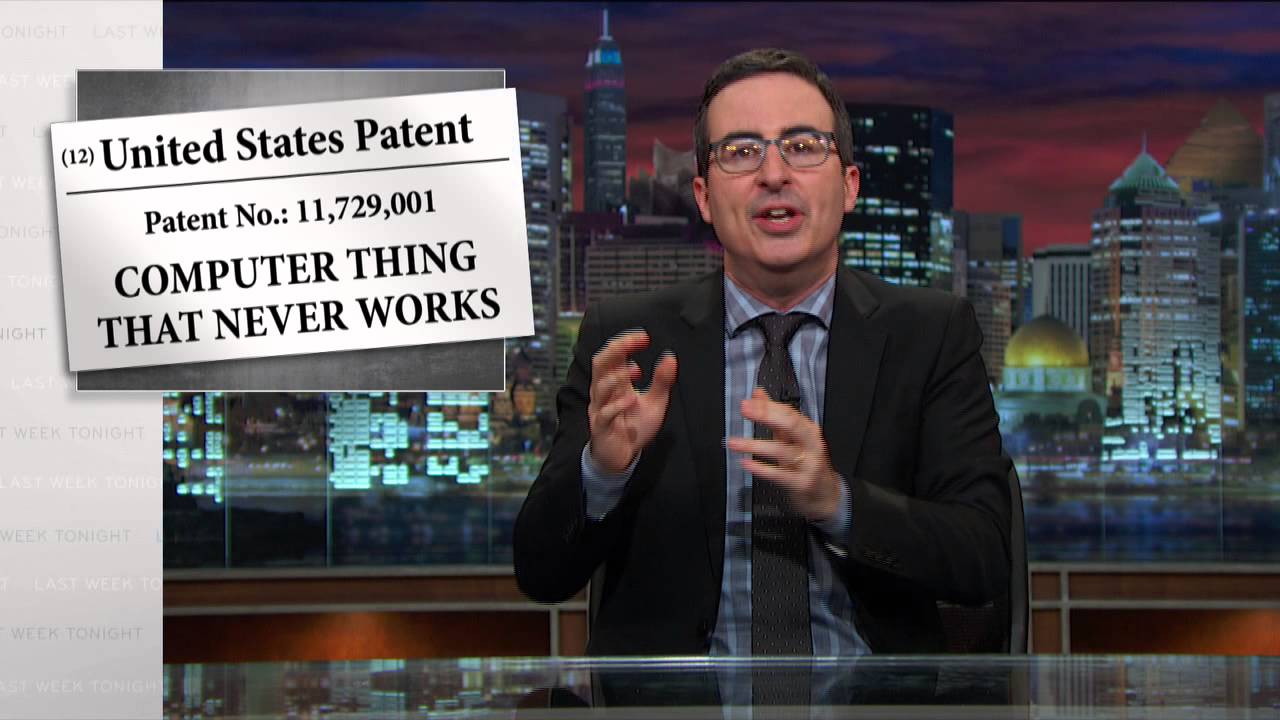
The root cause behind this surge in extortion lies in the Patent Office itself. By law, examiners are tasked with granting patents only for concepts that are "new, useful, and nonobvious." However, during periods of rapid technological disruption, the agency often becomes overwhelmed and certifies dubious claims, a phenomenon seen during the 19th-century railroad boom and recurring today with the software explosion. Unlike traditional mechanical inventions, which require precise technical blueprints, software patents are frequently granted with broad, abstract, and vague descriptions. This ambiguity enables patent trolls to weaponize decades-old filings and demand royalties on modern developments the original applicants never even envisioned. Oliver quips that if someone had patented "computer thing that never works" decades ago, they would currently be raking in fortunes off FaceTime.
---
[05:53](https://www.youtube.com/watch?v=3bxcc3SM_KA&t=353s) The Extortion Game, Obscure Shells, and Marshall, Texas
The business architecture of patent trolls is structured so that disputes almost never reach a courtroom trial; roughly 90% of cases settle out of court. Defending against a full-scale patent lawsuit typically costs between $2 million and $5 million in legal fees. Consequently, trolls deliberately ask for a fraction of that cost—typically around $100,000—knowing businesses will rationally opt to pay an extortion settlement rather than bankrupt themselves fighting. Oliver likens this settlement pricing to the way commercial airlines set their cabin temperatures: deliberately calibrated to make passengers utterly miserable, but not miserable enough to prompt revolt. Shielded behind nondescript names like IPNav, Empire IP, or MPHJ subsidiary Pragatus, these corporate fronts operate in complete anonymity, prompting Oliver to mock Pragatus as sounding like a tedious Greek hero who avoids slaying the Hydra because bruised farmers market produce is cheaper.
To guarantee favorable outcomes, patent trolls systematically exploit jurisdictional quirks by flocking to the Eastern District of Texas federal court in Marshall, Texas—a small town with a population of just 24,000. Nearly a quarter of all patent cases in the country are filed in this single venue because local judges and juries have established a reputation for being exceptionally plaintiff-friendly. The legal environment is so disproportionately skewed that targeted tech giants go to absurd lengths to charm the jury pool. Oliver notes that Samsung has poured close to $1 million into local Marshall community projects, including constructing an outdoor ice-skating rink directly across from the federal courthouse. “Samsung was so frightened of patent lawsuits they felt forced to build an outdoor ice rink in Texas,” Oliver says, pointing out that maintaining frozen ice in the Texas heat is as absurd as building a bowling alley in outer space.
---
[08:46](https://www.youtube.com/watch?v=3bxcc3SM_KA&t=526s) Legislative Paralysis and the Fight for Patent Reform
There has historically been bipartisan interest in Washington to rein in the predatory legal ecosystem. Oliver points to the Innovation Act, a legislative reform package introduced with widespread support. The bill was designed to make patent litigation riskier for trolls by empowering judges to force losing plaintiffs to cover the defendants' legal fees and mandating greater transparency regarding the real corporate owners behind shell holding companies. Although Oliver acknowledges the legislation was not a cure-all, he analogizes it to parents putting a padlock on a liquor cabinet: it will not stop everything, but it will make it considerably harder to ruin the entire neighborhood.
Despite passing the House of Representatives with an overwhelming majority, the Innovation Act stalled and died without ever receiving a floor vote in the Senate. When analysts and news commentators were asked what killed the measure, the answer was unambiguous: powerful lobbying efforts by special interest groups, spearheaded by trial lawyers who make their fortunes litigating these claims. Oliver rails against this conflict of interest, arguing that trusting trial lawyers to decide whether baseless patent lawsuits should exist is the equivalent of allowing raccoons to establish municipal guidelines for garbage cans.
Although a new iteration of the patent reform bill has been reintroduced in Congress, Oliver stresses that urgent statutory change is mandatory. Without federal intervention, the American economy risks being suffocated to the point where the only viable commercial venture left is one requiring zero intellectual property: dancing and charging people to sketch crude cartoon cats. Oliver closes out the segment by joining the "I Want to Draw a Cat for You" founder onstage, singing along to the jingle while warning that if the system is not reformed quickly, everyone will pay the price.
## Notable quotes > [03:48](https://www.youtube.com/watch?v=3bxcc3SM_KA&t=228s) When you are threatening to sue a company which helps people with disabilities find work for using their own photocopier, you're not just on the road to hell, you have your own parking spot right next to the devil. — John Oliver
## Mentioned John Oliver, United States Patent and Trademark Office, Shark Tank, America's Next Top Model, I Want to Draw a Cat for You, Austin Meyer, X-Plane, Uniloc, Tinder, Johnny Depp, The Lone Ranger, SARAH Inc., Fulleen LLC, Apple, Samsung, FaceTime, IPNav, Empire IP, MPHJ, Pragatus, Eastern District of Texas, Marshall, Texas, Innovation Act, House of Representatives, Senate
## Video description For inventors, patents are an essential protection against theft. But when patent trolls abuse the system by stockpiling patents and threatening lawsuits, businesses are forced to shell out tons of money.
Connect with Last Week Tonight online... Subscribe to the Last Week Tonight YouTube channel for more almost news as it almost happens: www.youtube.com/user/LastWeekTonight
Find Last Week Tonight on Facebook like your mom would: http://Facebook.com/LastWeekTonight
Follow us on Twitter for news about jokes and jokes about news: http://Twitter.com/LastWeekTonight
Visit our official site for all that other stuff at once: http://www.hbo.com/lastweektonight Connect with Last Week Tonight online... Subscribe to the Last Week Tonight YouTube channel for more almost news as it almost happens: www.youtube.com/user/LastWeekTonight
Find Last Week Tonight on Facebook like your mom would: http://Facebook.com/LastWeekTonight
Follow us on Twitter for news about jokes and jokes about news: http://Twitter.com/LastWeekTonight
Visit our official site for all that other stuff at once: http://www.hbo.com/lastweektonight
[Source](https://www.youtube.com/watch?v=3bxcc3SM_KA)