Chomsky Rebuffs Critics Over Defense of Holocaust Denier's Speech Rights
Chomsky's Philosophy
Freedom of speech exists only when extended to despised views, meaning the defense of a Holocaust denier's legal rights does not endorse his claims.
AI-assisted summary of Noam Chomsky - Freedom of Speech for Views You Don't Like — original source. Check the original for full context.
Source published:
Key ideas
- Noam Chomsky defends his controversial support for Robert Faurisson's civil liberties, arguing that true freedom of speech requires defending the right to express views one despises, including Holocaust denial. (4:46)
- Chomsky rejects accusations that he endorsed Faurisson's views, clarifying that he never wrote a preface for Faurisson's book but authored a separate essay on civil rights that the publisher placed as a foreword. (1:22)
- Faurisson faced prosecution in Lyon by nine organizations for incitement to racial hatred and historical falsification, prompting a defense petition signed by roughly 500 to 600 academics. (1:22)
- Chomsky maintains that even debating whether Nazi atrocities occurred constitutes losing one's humanity, but insists that the state must never have the authority to criminalize speech or mandate historical truth. (7:27)
Detailed notes
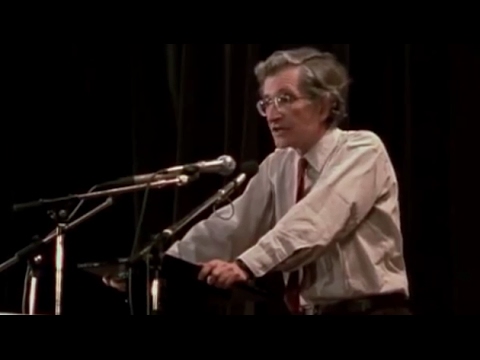
## Background Published on YouTube by the channel Chomsky's Philosophy on February 3, 2017, this video features archival discussion and debate centered on Noam Chomsky's perspective regarding the Robert Faurisson affair and free speech.
## TL;DR In this segment, Noam Chomsky addresses the intense backlash he faced after defending the civil liberties of French professor and Holocaust denier Robert Faurisson. Chomsky firmly refutes accusations that he authored a preface endorsing Faurisson's claims, clarifying that he contributed a separate essay defending basic freedom of expression. He argues that true commitment to free speech necessitates defending the right to voice views one despises, warning against state-mandated historical truth. Furthermore, Chomsky underscores his own moral stance, maintaining that Holocaust denial is an absurd falsehood and that debating whether Nazi atrocities occurred means abdicating one's humanity.
## Atmosphere & style The presentation carries the tense, confrontational intensity of a high-stakes intellectual trial, punctuated by rapid cross-examination and sharp retorts between Chomsky and his interlocutors. Interspersed archival footage—including candid clips of Faurisson outside a Lyon courthouse—lends the discussion an urgent, historical gravity. Chomsky remains characteristically methodical and uncompromising, cutting through emotive accusations with rigorous philosophical distinctions between defending an author's civil rights and endorsing their loathsome ideas.
## Bulletin - [04:46](https://www.youtube.com/watch?v=4-oV42OMQoE&t=286s) Noam Chomsky defends his controversial support for Robert Faurisson's civil liberties, arguing that true freedom of speech requires defending the right to express views one despises, including Holocaust denial. - [01:22](https://www.youtube.com/watch?v=4-oV42OMQoE&t=82s) Chomsky rejects accusations that he endorsed Faurisson's views, clarifying that he never wrote a preface for Faurisson's book but authored a separate essay on civil rights that the publisher placed as a foreword. - [01:22](https://www.youtube.com/watch?v=4-oV42OMQoE&t=82s) Faurisson faced prosecution in Lyon by nine organizations for incitement to racial hatred and historical falsification, prompting a defense petition signed by roughly 500 to 600 academics. - [07:27](https://www.youtube.com/watch?v=4-oV42OMQoE&t=447s) Chomsky maintains that even debating whether Nazi atrocities occurred constitutes losing one's humanity, but insists that the state must never have the authority to criminalize speech or mandate historical truth.
## Key takeaways - [00:00](https://www.youtube.com/watch?v=4-oV42OMQoE&t=0s) Intellectual smear campaigns rely on toxic labels like 'racist' or 'anti-Semite' that preemptively make rational rebuttal impossible. - [00:00](https://www.youtube.com/watch?v=4-oV42OMQoE&t=0s) Robert Faurisson was suspended from his university post and taken to court in Lyon over claims that Nazi death camps and gas chambers were fabrications. - [01:22](https://www.youtube.com/watch?v=4-oV42OMQoE&t=82s) Around 500 to 600 academics signed a civil rights petition on Faurisson's behalf, yet international backlash fixated disproportionately on Chomsky. - [01:22](https://www.youtube.com/watch?v=4-oV42OMQoE&t=82s) Chomsky disputes the claim that he wrote a book preface for Faurisson, emphasizing that he provided a separate philosophical statement on freedom of expression. - [04:46](https://www.youtube.com/watch?v=4-oV42OMQoE&t=286s) The publisher Pierre Guillaume inserted Chomsky's essay, 'Some Elementary Remarks on the Freedom of Expression,' at the front of Faurisson's volume. - [04:46](https://www.youtube.com/watch?v=4-oV42OMQoE&t=286s) Chomsky attempted to withdraw his essay before publication due to French commentators conflating the defense of speech rights with the endorsement of content, an attempt he later viewed as a mistake. - [04:46](https://www.youtube.com/watch?v=4-oV42OMQoE&t=286s) A genuine commitment to free speech necessitates defending ideas one loathes; totalitarians like Goebbels and Stalin also permitted speech they agreed with. - [04:46](https://www.youtube.com/watch?v=4-oV42OMQoE&t=286s) The state should never possess the authority to adjudicate historical truth or punish deviations from official history through criminal courts. - [07:27](https://www.youtube.com/watch?v=4-oV42OMQoE&t=447s) Just as erroneous scientific papers should be countered with refutation rather than jail time, false historical claims must not be met with state imprisonment. - [07:27](https://www.youtube.com/watch?v=4-oV42OMQoE&t=447s) Mainstream press in the United States and France gave no credibility to Faurisson's claims, demonstrating that allowing the speech did not validate the falsehoods. - [07:27](https://www.youtube.com/watch?v=4-oV42OMQoE&t=447s) Chomsky asserts that entering an arena of debate over whether the Holocaust occurred means losing one's humanity, distinguishing moral repulsion from legal suppression. - [07:27](https://www.youtube.com/watch?v=4-oV42OMQoE&t=447s) Faurisson himself dismissed the philosophical debate over civil liberties, stating he was solely focused on winning his legal case.
## Detailed walkthrough ### [00:00](https://www.youtube.com/watch?v=4-oV42OMQoE&t=0s) Smear Tactics and the Robert Faurisson Controversy
Noam Chomsky begins by addressing how public accusations function, observing that intellectuals are particularly adept at deploying falsehoods that leave their targets defenseless. When someone hurls an incendiary charge such as "anti-Semite," "racist," or "Nazi," rational rebuttal becomes impossible. As Chomsky reflects on the dynamic of public smear campaigns: “I mean the person who throws the mud always wins because there's no way of responding to such charges.” A critic on the panel counters by alleging that Chomsky categorizes everyone who disagrees with him as either a deliberate liar or a dupe, immediately pressing him on his involvement in the case of Robert Faurisson.
When the interlocutor attempts to summarize Faurisson's claims without getting bogged down in factual nuance, Chomsky interrupts, insisting that the specific details are essential to the truth of the matter. The interlocutor highlights Faurisson's core thesis: asserting that the mass murder of Jewish people during the Holocaust is a historic fabrication. A television interviewer introduces the broader context, pointing out that defending Faurisson—a French university professor suspended from his post for asserting there were no Nazi death camps in World War II—remains one of the most controversial and fiercely condemned acts of Chomsky’s public life.
- Chomsky maintains that intellectual mud-slinging relies on unanswerable personal labels rather than substantive critique. - The debate centers on Faurisson's denial of the Holocaust and whether defending a denier's legal rights equates to endorsing his thesis.
---
[01:22](https://www.youtube.com/watch?v=4-oV42OMQoE&t=82s) Faurisson's Convictions, the Petition, and the "Preface"
Standing outside the Palais de Justice in Lyon, sixty-year-old Robert Faurisson describes his numerous legal battles from the early 1980s, where he was prosecuted by nine organizations (predominantly Jewish associations) for incitement to racial hatred, racial defamation, and damage caused by the falsification of history. In the wake of Faurisson's suspension and legal troubles, a petition was circulated demanding the defense of his civil rights, signed by roughly 500 to 600 people, mostly academics. When asked why the international backlash fixated entirely on Chomsky rather than the other several hundred signatories, Faurisson attributes it to Chomsky’s outsized political prominence and influence.
```mermaid flowchart TD accTitle: The Faurisson Petition Controversy accDescr: Flowchart illustrating how Chomsky's defense of civil liberties was conflated with an endorsement of Faurisson's denialist views.
subgraph PetitionStage["Petition & Legal Charges"] A["Faurisson prosecuted in Lyon for racial defamation & historical falsification"] --> B["Petition signed by 500-600 academics defending his civil rights"] end
subgraph EssayStage["The Text & Publication"] B --> C["Chomsky writes 'Some Elementary Remarks on the Freedom of Expression'"] C --> D["Publisher inserts essay as a foreword/preface to Faurisson's book"] end
subgraph BacklashStage["Public Perception"] D --> E["Critics accuse Chomsky of endorsing Holocaust denial"] E --> F["Chomsky insists: Defending speech rights ≠ Endorsing speech content"] end ```
A heated confrontation unfolds on stage regarding Chomsky's exact words and deeds. A critic points out that the petition referred to Faurisson as a "respected professor of literature" who merely sought to make his "findings" public, and asserts that Chomsky later authored a preface for Faurisson's book calling him a "relatively apolitical sort of liberal." Faurisson himself appears in archival footage, denying that he is a Nazi, asserting: “A communist is a man, a Jew is a man, a Nazi is a man, I am a man.” When asked how he describes himself politically, Faurisson responds simply: "Nothing."
Chomsky forcefully rejects the claim that he wrote a preface for Faurisson's work: “That's not the preface that I wrote because I never wrote a preface, and you know that I never wrote a preface.” He explains that he provided a brief essay on civil liberties, and disputes that describing someone's political posture as liberal or referring to their research constitutes an endorsement of their conclusions.
---
[04:46](https://www.youtube.com/watch?v=4-oV42OMQoE&t=286s) Defending the Right to Speak vs. Defending the Views
Chomsky recounts the sequence of events that led to his statement being bound inside Faurisson’s volume. After signing the initial petition, Chomsky was asked by the organizer to draft an essay articulating the foundational principles of free speech—specifically emphasizing the separation between defending an individual's right to speak and validating the substance of what they say. Chomsky wrote a short piece entitled *Some Elementary Remarks on the Freedom of Expression* and granted permission to use it. The publisher, Pierre Guillaume, decided to print Chomsky’s text at the front of Faurisson's book as a cautionary foreword invoking freedom of thought and research.
When asked why he attempted to pull the essay at the eleventh hour, Chomsky explains that he wrote a letter asking to separate the texts because the French intellectual climate had become so distorted that commentators were incapable of distinguishing between defending rights and endorsing content. In retrospect, Chomsky views that attempted withdrawal as a mistake, stating he should have let the piece appear as written because the principle needed to be defended. Chomsky articulates the core philosophy of free speech with uncompromising clarity:
> “If you're in favor of freedom of speech, that means you're in favor of freedom of speech precisely for views you despise, otherwise you're not in favor of freedom of speech.”
Chomsky notes that totalitarian figures like Joseph Goebbels and Joseph Stalin were perfectly happy to permit speech they agreed with. What genuine commitment to civil liberties requires is defending speech that is loathed and offensive. He insists that outside of fascist regimes, the distinction between defending a person's right to express a view and defending the view itself has been universally understood since the eighteenth century.
- The state must never be granted the authority to determine historical truth or punish deviations from official history. - An individual who claims to support free expression only for agreeable ideas does not support freedom of speech at all.
---
[07:27](https://www.youtube.com/watch?v=4-oV42OMQoE&t=447s) Historical Reality, Scientific Debate, and Moral Boundaries
The dialogue turns to whether scientific objectivity and historical reality are undermined when someone defending an absurd or malicious falsehood receives public backing. Chomsky responds using a scientific parallel: if a researcher publishes a scientific paper containing errors or conclusions he disagrees with, the proper response is refutation, not state-enforced imprisonment. When someone is hauled into court on criminal charges for publishing their work, defending their basic civil liberties is an obligation regardless of how wrong their views may be.
Chomsky challenges his critics to identify any mainstream press coverage in the United States or France that treated Faurisson's denial of the gas chambers with credibility, asserting that virtually zero journalists took Faurisson's claims seriously. An interlocutor argues that Chomsky faced fierce criticism even from longtime supporters because his intervention was interpreted as part of a wider campaign against Israel. Chomsky counters by explaining that his personal moral stance on Holocaust denial is far stricter than that of his accusers:
> “You go back to my earliest articles and you will find that I say that even to enter into the arena of debate on the question of whether the Nazis carried out such atrocities is already to lose one's humanity.”
For Chomsky, engaging in a debate over whether the gas chambers existed is an abdication of basic decency, and refuting Faurisson’s claims presents no intellectual challenge whatsoever. The segment concludes with a candid remark from Faurisson himself, who dismisses the philosophical ideals of civil liberties: “I'm not interested in freedom of speech and all that, I have to win, and that's the question, and I shall win.”
## Notable quotes > [04:46](https://www.youtube.com/watch?v=4-oV42OMQoE&t=286s) If you're in favor of freedom of speech, that means you're in favor of freedom of speech precisely for views you despise, otherwise you're not in favor of freedom of speech. — Noam Chomsky
## Mentioned Noam Chomsky, Robert Faurisson, Pierre Guillaume, Joseph Goebbels, Joseph Stalin, Some Elementary Remarks on the Freedom of Expression, Palais de Justice (Lyon), Holocaust, Israel
## Video description Chomsky on the Faurisson affair and Free speech.
Source: https://www.youtube.com/watch?v=YHa6NflkW3Y
[Source](https://www.youtube.com/watch?v=4-oV42OMQoE)