Astrobiologists Rule Out Silicon Life Over Water Decay and Sand Waste
PBS Space Time
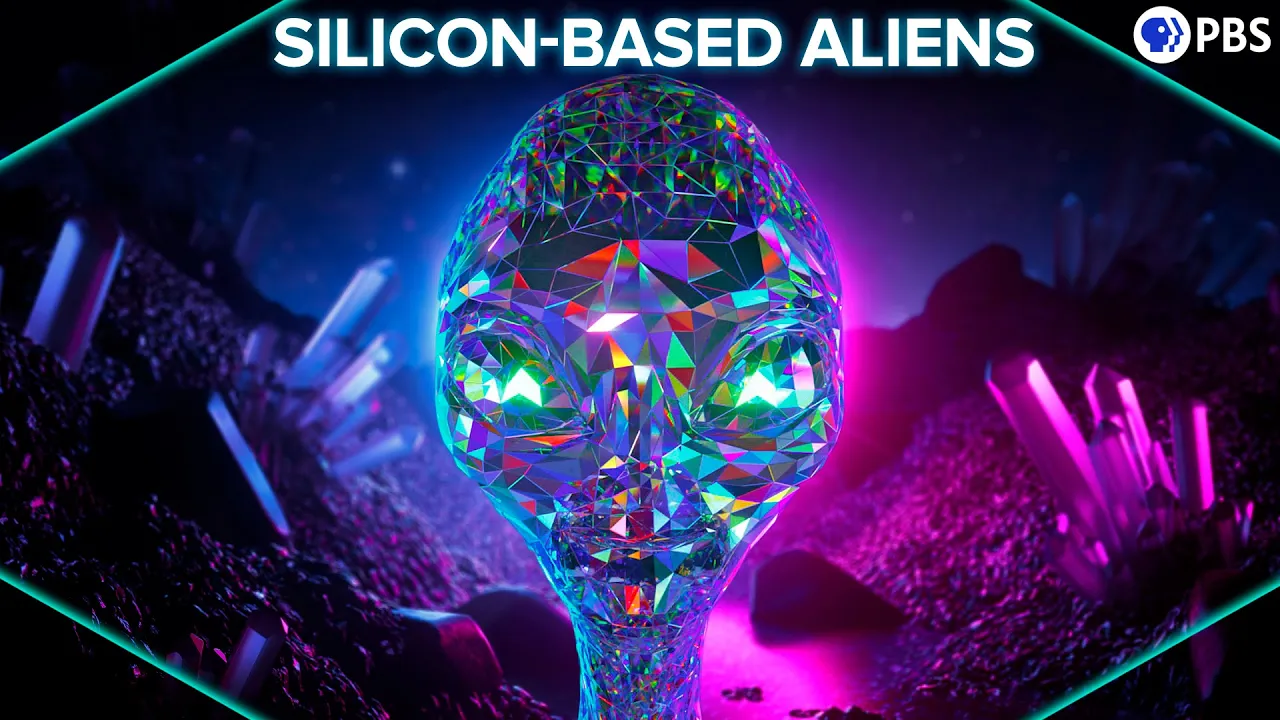
Silicon cannot displace carbon as the backbone of extraterrestrial biology because its molecules break down in water and oxidize into unmanageable solid sand rather than exhaled gas.
AI-assisted summary of What If Alien Life Were Silicon-Based? — original source. Check the original for full context.
Source published:
Key ideas
- Despite silicon making up over 28% of Earth's crust compared to carbon's 0.02%, terrestrial biology almost entirely ignores it due to the extreme instability of complex silicon molecules in water. (6:41)
- Silicon reacts with an overwhelming thermodynamic affinity for oxygen, trapping vast quantities in solid silicate rock and creating a severe metabolic challenge where respiration would generate solid silica sand instead of easily exhaled gas. (9:30)
- While carbon-in-water remains the most cosmologically viable biochemical basis, extreme low-temperature liquid hydrocarbons or sulfuric acid clouds could theoretically support alternative silicon-based life. (6:41)
- Earth organisms like diatoms demonstrate biological manipulation of silicon by building outer protective cell walls from hydrated silica, though their internal metabolic machinery remains entirely carbon-based. (12:11)
Detailed notes
## Background Published by PBS Space Time on YouTube on January 26, 2023, and hosted by Matt O'Dowd, this episode investigates whether extraterrestrial biology could be founded on silicon rather than carbon. According to the video description, although all known life is carbon-based, silicon shares key chemical properties and is far more abundant across terrestrial planets, prompting the question of whether silicon-based alien life could realistically exist.
## TL;DR Host Matt O'Dowd examines the physical chemistry behind hypothetical silicon-based biology, narrowing down the periodic table to just seven potential elements capable of building complex covalent molecular backbones. While silicon mirrors carbon's valence structure and is thousands of times more abundant in Earth's crust, it faces severe biochemical hurdles: it disintegrates in water, bonds irreversibly with oxygen into immobile silicates, and leaves solid silica (sand) rather than gaseous carbon dioxide as a respiratory byproduct. Although speculative environments like cryogenic hydrocarbon lakes or sulfuric acid clouds could theoretically host silicon polymers, carbon in liquid water remains overwhelmingly superior, making Carl Sagan's concept of 'carbon chauvinism' chemically sound. The episode concludes with a viewer mailbag exploring Tegmark's Mathematical Universe, Roger Penrose's Three Worlds ontology, Theia remnants within Earth's mantle, and anatomical corrections.
## Atmosphere & style The presentation blends rigorous, college-level physical chemistry with lively, self-aware science-fiction humor. Matt O'Dowd speaks with energetic intellectual clarity, illustrating dense thermodynamic and molecular bonding principles through evocative diagrams before pivoting smoothly to deadpan jokes about alien space slugs and coughing up sand. The viewer mailbag and correction segments foster an engaging, nerdy camaraderie, gracefully handling pedantic audience critiques with self-deprecating wit.
## Bulletin - [06:41](https://www.youtube.com/watch?v=469chceiiUQ&t=401s) Despite silicon making up over 28% of Earth's crust compared to carbon's 0.02%, terrestrial biology almost entirely ignores it due to the extreme instability of complex silicon molecules in water. - [09:30](https://www.youtube.com/watch?v=469chceiiUQ&t=570s) Silicon reacts with an overwhelming thermodynamic affinity for oxygen, trapping vast quantities in solid silicate rock and creating a severe metabolic challenge where respiration would generate solid silica sand instead of easily exhaled gas. - [06:41](https://www.youtube.com/watch?v=469chceiiUQ&t=401s) While carbon-in-water remains the most cosmologically viable biochemical basis, extreme low-temperature liquid hydrocarbons or sulfuric acid clouds could theoretically support alternative silicon-based life. - [12:11](https://www.youtube.com/watch?v=469chceiiUQ&t=731s) Earth organisms like diatoms demonstrate biological manipulation of silicon by building outer protective cell walls from hydrated silica, though their internal metabolic machinery remains entirely carbon-based.
## Key takeaways - [00:00](https://www.youtube.com/watch?v=469chceiiUQ&t=0s) Science fiction frequently proposes silicon-based life due to silicon's identical valence configuration to carbon and its high planetary abundance. - [01:59](https://www.youtube.com/watch?v=469chceiiUQ&t=119s) Biochemistry requires a dynamic thermodynamic middle ground balancing molecular stability with chemical reactivity, avoiding irreversible thermodynamic sinks. - [03:34](https://www.youtube.com/watch?v=469chceiiUQ&t=214s) Only covalent bonds provide the structural modularity needed for life, as ionic bonds dissociate too easily and metallic bonds form rigid crystalline lattices. - [03:34](https://www.youtube.com/watch?v=469chceiiUQ&t=214s) Elements in row 4 and below on the periodic table possess electron clouds too distant from their nuclei, making their covalent bonds too fragile for stable biochemical structures. - [03:34](https://www.youtube.com/watch?v=469chceiiUQ&t=214s) Eliminating unsuitable elemental groups leaves only seven viable candidates for life's scaffolding: hydrogen, carbon, nitrogen, oxygen, silicon, phosphorus, and sulfur. - [06:41](https://www.youtube.com/watch?v=469chceiiUQ&t=401s) Silicon is the only element capable of mimicking carbon's ability to assemble extended polymers, rings, and complex molecular backbones. - [06:41](https://www.youtube.com/watch?v=469chceiiUQ&t=401s) Water, the universe's most abundant and effective solvent, rapidly destabilizes and destroys complex silicon-based molecules. - [06:41](https://www.youtube.com/watch?v=469chceiiUQ&t=401s) Alternative solvents such as liquid hydrocarbons on Titan or sulfuric acid on Venus present trade-offs, including severely restricted solubility at cryogenic temperatures or extreme chemical corrosiveness. - [09:30](https://www.youtube.com/watch?v=469chceiiUQ&t=570s) Silicon's exceptionally strong thermodynamic affinity for oxygen traps the element permanently in unyielding silicate minerals, out of reach for biological synthesis. - [11:16](https://www.youtube.com/watch?v=469chceiiUQ&t=676s) Aerobic respiration using silicon would yield solid silicon dioxide (silica or sand), posing a catastrophic excretion problem equivalent to exhaling a kilogram of mineral solids daily. - [12:11](https://www.youtube.com/watch?v=469chceiiUQ&t=731s) Diatoms provide an empirical proof of concept on Earth that biology can synthesize and manipulate crystalline silica structures to protect carbon-based cellular machinery. - [13:49](https://www.youtube.com/watch?v=469chceiiUQ&t=829s) The overwhelming biochemical efficiency of carbon in water leads to scientific 'carbon chauvinism', suggesting first contact with extraterrestrial biology will almost certainly involve carbon. - [15:44](https://www.youtube.com/watch?v=469chceiiUQ&t=944s) Sir Roger Penrose's Three Worlds ontology presents physical reality, mathematical forms, and conscious thought in a mutually emergent, circular relationship rather than a hierarchy rooted strictly in mathematics. - [18:21](https://www.youtube.com/watch?v=469chceiiUQ&t=1101s) Large Low-Shear-Velocity Provinces at Earth's core-mantle boundary may represent unmixed, dense mantle remnants of the impactor protoplanet Theia. - [18:21](https://www.youtube.com/watch?v=469chceiiUQ&t=1101s) The Fermi Paradox is likely resolved not by a single insurmountable barrier, but by a chain of cumulative, moderately difficult evolutionary and planetary filters.
## Detailed walkthrough ### [00:00](https://www.youtube.com/watch?v=469chceiiUQ&t=0s) The Sci-Fi Dream of Silicon-Based Life
Every mechanism of living biology encountered so far is anchored entirely around carbon. Because astrobiology seeks to estimate the prevalence and diversity of life across the cosmos, science must confront a fundamental question: is carbon really the only viable foundation, or merely an Earthly accident? In popular science fiction, the leading candidate for alternative biology has long been silicon, appearing in everything from the lethal acid-blooded xenomorphs of the *Alien* franchise to the colossal asteroid-dwelling exogorth (space slug) in *Star Wars*.
Writers naturally gravitate toward silicon because it sits directly beneath carbon on the periodic table, possessing nearly identical valence configurations and valence chemistry. Furthermore, it is vastly more abundant on terrestrial planets than carbon. When astrobiologists refer to life as "carbon-based," they do not simply mean organisms consume or incorporate the element; rather, carbon forms the structural scaffolding for every functional macromolecule, including DNA, RNA, amino acids, proteins, and the complex cellular architecture assembled from them. The bond is so absolute that organic chemists routinely omit the letter "C" entirely from diagrams, marking molecular carbon backbones with simple zigzagging lines.
Matt O'Dowd highlights the total identity between the element and biology: “Biochemistry is by definition the chemistry of Carbon.” Whether life on other worlds could ever swap that foundational atom for silicon depends on the physical chemistry of molecular stability and energetic balance.
[01:59](https://www.youtube.com/watch?v=469chceiiUQ&t=119s) The Goldilocks Zone of Chemical Energy: Reactivity vs. Stability
Physical systems inevitably tumble down potential energy gradients toward the lowest achievable energy state. A stick of dynamite illustrates this thermodynamic push: nitroglycerin holds considerable chemical potential energy within delicate bonds. Because it takes minimal activation energy to rupture those tenuous connections, the molecule rapidly dissociates into smaller, low-energy products, releasing heat and gas in a runaway chain reaction. That reaction is strictly one-way because reassembling those fragmented molecules back into nitroglycerin requires far more energy than the ambient environment can supply.
Living systems cannot operate on unidirectional chemical reactions. If the molecular components of a cell descend into an unreactive thermodynamic sink, metabolic chemistry halts permanently, which is equivalent to death. Conversely, organisms cannot rely on molecules so fragile that they detonate or unravel under normal ambient conditions; molecular machines must survive long enough to replicate, store genetic code, and catalyze metabolic pathways.
Matt O'Dowd summarizes this essential metabolic prerequisite: “In other words, you want a balance of reactivity and stability.” Achieving that dynamic middle ground requires specific types of chemical bonds and elemental architectures.
[03:34](https://www.youtube.com/watch?v=469chceiiUQ&t=214s) Whittling Down the Periodic Table to Seven Elements
To find which chemical elements could hypothetically support an open-ended biochemical network, one must look at atomic bonding behaviors. Among the three primary bond types—ionic, metallic, and covalent—only covalent bonds supply the requisite structural nuance. Ionic bonds dissolve or dissociate far too easily, while metallic bonding yields rigid crystalline lattices that lack molecular variety. Covalent bonds, by contrast, permit neighboring atoms to share electrons to complete their outer valence shells, opening up limitless combinatorial arrangements. Carbon possesses four valence electrons and requires four more to achieve an octet; it can satisfy this by binding four individual hydrogen atoms to form methane, or by linking with other carbon and oxygen atoms to assemble ethane, ethanol, and infinitely branching chains.
Evaluating the periodic table reveals that most elements are incapable of this chemistry. Ionic and metallic formers are immediately eliminated, noble gases are ruled out due to inertness, and halogens fail because they rarely bind to multiple atoms simultaneously and tend to react with violent volatility. Heavy elements sitting in row 4 and below must also be discarded: their sprawling electron clouds are held so loosely by their distant nuclei that the resulting covalent bonds are catastrophically fragile. This atomic scaling explains why arsenic is lethal to terrestrial biology; cells mistake arsenic for phosphorus due to their identical valence count, but incorporating the heavier, row-4 atom creates brittle molecules that snap and fatally disrupt cellular machinery.
```mermaid flowchart TD accTitle: Periodic Table Elimination for Life Scaffolding accDescr: Elimination process discarding unviable elemental groups to leave only seven candidate building blocks. subgraph Discarded["Discarded Elements"] A["Metals & Ionic Formers<br/>(Rigid lattices / weak stability)"] B["Noble Gases & Halogens<br/>(Inert or explosive / mono-bonding)"] C["Row 4+ Elements<br/>(Large nuclei yield brittle bonds)"] end subgraph Viable["Seven Life Candidates"] D["Row 1 & 2 Elements:<br/>H, C, N, O"] E["Row 3 Elements:<br/>Si, P, S"] end Discarded -.->|"Screening Criteria"| Viable ```
After eliminating unsuitable rows and groups, only seven candidate elements remain: hydrogen, carbon, nitrogen, oxygen, silicon, phosphorus, and sulfur. Six of these make up the bedrock of Earth life, with carbon reigning supreme because it uniquely forms both 1D chains and 2D rings with itself. As Matt O'Dowd notes when evaluating chemical options: “Covalent bonds are really the only option.”
- **Valence mechanics**: Carbon shares 4 electrons to complete its valence shell of 8, forming the baseline methane molecule ($CH_4$). - **Combinatorial modularity**: Substituting hydrogens and joining carbon backbones produces ethane ($C_2H_6$), ethanol ($C_2H_5OH$), and extensive polymers. - **Arsenic toxicity mechanism**: Arsenic mimics phosphorus in cellular uptake, but its larger atomic radius causes structural collapse in synthesized biomolecules. - **Core chemical survivors**: Hydrogen, Carbon, Nitrogen, Oxygen, Silicon, Phosphorus, Sulfur.
[06:41](https://www.youtube.com/watch?v=469chceiiUQ&t=401s) The Silicon Paradox and the Solvent Dilemma
Silicon is the only element on the periodic table that matches carbon’s ability to create extended covalent polymers, rings, and complex molecular scaffolds. Chemists can synthesize synthetic silicon oils that replicate the texture and behavior of organic petroleum-based oils. Yet despite this biochemical mimicry, terrestrial biology almost completely ignores silicon, using it far less than trace metals like iron. This non-use is an extraordinary evolutionary paradox given the geological abundance: silicon makes up over 28% of the Earth's crust by mass within silicate minerals, whereas carbon makes up a mere 0.02%.
The primary barrier preventing silicon from becoming the foundation of Earth life is its behavior in water. Complex silicon molecules are highly unstable in aqueous environments, breaking down rapidly when exposed to $H_2O$. Life demands a fluid solvent to allow enzymes and substrates to circulate and interact. While water is chemically abundant, thermally stable, and broadly considered the ultimate solvent across the universe, its destructive interaction with silicon chemistry presents a devastating hurdle.
Matt O'Dowd underlines this critical incompatibility: “The instability of most silicon molecules in water is actually a huge blow to the viability of silicon-based life.”
Alternative liquid solvents could hypothetically host silicon organisms, though each introduces severe physical drawbacks: - **Liquid hydrocarbons**: Cryogenic lakes of methane and ethane (such as those found on Saturn's moon Titan) stabilize complex silicon polymers. However, extreme cold severely restricts solvent capacity, making it difficult to suspend the large, sophisticated macromolecules required for life. - **Sulfuric acid**: Common in the upper cloud decks of Venus, concentrated sulfuric acid supports diverse silicon interactions. Yet its extreme chemical corrosiveness may tear nascent proto-biological precursors apart before reproduction can establish itself. - **Atmospheric sci-fi parallels**: The acidic blood of the cinematic xenomorph mirrors a theoretical silicon-in-sulfuric-acid system, prompting O'Dowd to joke that humans should rethink Venusian floating cloud colonies before unleashing space horrors.
[09:30](https://www.youtube.com/watch?v=469chceiiUQ&t=570s) The Oxygen Trap and Energy Generation
A speculative workaround for aqueous silicon biology involves alternating silicon with carbon or oxygen atoms into hybrid scaffolding backbones. However, these hybrid polymers offer zero evolutionary or structural advantage over straightforward hydrocarbon chains. Furthermore, silicon suffers from an overwhelming chemical bias: it has an extreme thermodynamic affinity for oxygen.
Silicon binds far more readily and tightly to oxygen than it does to other silicon atoms or any other candidate element in the biological toolkit. When oxygen is present, silicon-based molecules fracture, reacting irreversibly to form remarkably stubborn silicon-oxygen bonds. Matt O'Dowd observes: “Silicon forms stronger bonds with oxygen than with any of the other ‘building blocks of life’, and certainly more so than with other silicon atoms.”
Because silicon reacts with oxygen along a steep, one-way path, the vast majority of Earth's crustal silicon is trapped in unyielding silicate rock, permanently out of reach of biological synthesis. In contrast, carbon forms atmospheric carbon dioxide ($CO_2$), a gas that easily dissolves in liquid and remains bio-available for primary producers to capture via photosynthesis.
The sole advantage of this intense bond strength lies in metabolic energetics. Terrestrial animals power their cells by converting high-energy $O_2$ bonds into lower-energy $CO_2$ waste via aerobic respiration, capturing the released energy through mitochondrial phosphorylation to produce ATP. Because the silicon-oxygen bond is even more stable, a hypothetical alien metabolizing silicon with oxygen could extract substantial energy from the reaction—provided it could overcome the profound physical challenge of managing the reaction's solid, rock-like waste products.
[11:16](https://www.youtube.com/watch?v=469chceiiUQ&t=676s) The Waste Product Dilemma: Exhaling Sand vs. CO2
```mermaid flowchart TD accTitle: Metabolic Byproduct Comparison: Carbon vs Silicon accDescr: Flowchart illustrating the cellular waste products of carbon-based versus silicon-based respiration.
subgraph CarbonRespiration["Carbon Respiration"] C1["Carbon + O2"] --> C2["CO2 (Gas)"] C2 --> C3["Exhaled effortlessly (~1 kg/day)"] end
subgraph SiliconRespiration["Silicon Respiration"] S1["Silicon + O2"] --> S2["SiO2 (Silica / Sand)"] S2 --> S3["Dense solid byproduct"] S3 --> S4["Requires coughing sand or excreting glass beads"] end ```
When considering alien respiration based on silicon, converting oxygen ($\text{O}_2$) into silicon dioxide ($\text{SiO}_2$) seems thermodynamically favorable at first glance. Silicon dioxide is even more stable than carbon dioxide ($\text{CO}_2$), which means the reaction can liberate a greater amount of energy. However, this creates a catastrophic biological waste problem. Carbon-based organisms produce $\text{CO}_2$, a gas that can be effortlessly expelled through respiration. By contrast, silicon dioxide is silica—solid sand. As Matt O'Dowd quips, invoking a familiar pop-culture sentiment: “It’s coarse and rough and gets everywhere, I hate it.” Solid silica accumulating inside cells or respiratory organs would be fatal.
The sheer volume of solid waste presents an enormous biomechanical hurdle. An average human exhales roughly one kilogram of carbon dioxide every day. A silicon-based counterpart would therefore need to physically eliminate a comparable mass of solid mineral waste:
> “A regular person exhales about a kilogram of Carbon Dioxide throughout the day, meaning Silicon aliens would need to cough out a good amount of sand. Or they poop glass beads or something - probably there’s a way around the issue.”
While hypothetical organisms might evolve mechanisms to excrete glass beads or expunge gritty minerals, doing so demands significant physical and metabolic overhead. In biological evolution, any minor thermodynamic or energetic disadvantage becomes decisive over evolutionary timescales.
[12:11](https://www.youtube.com/watch?v=469chceiiUQ&t=731s) The Chemistry of Silicon Life and the Reality of Living Crystals
Synthesizing the biochemistry: under very specific, highly specialized conditions, silicon possesses enough chemical diversity to sustain complex molecular structures. However, these environments are far less chemically versatile and accommodating than the mild conditions that nurture carbon-based life. If carbon is available on a world, prebiotic chemistry will almost inevitably favor it.
Science fiction writers have long portrayed silicon-based life as living rocks or animated mineral crystals simply because that is how silicon commonly manifests on Earth. Yet carbon-based animals do not resemble pencil graphite or walking diamonds. Nonetheless, Earth does host organisms that use silicon as a primary structural element: diatoms.
```mermaid flowchart LR accTitle: Diatom Structural Architecture accDescr: Diagram showing the hybrid structure of diatoms using silicon cell walls around carbon-based cellular machinery.
subgraph DiatomArchitecture["Diatom Architecture"] direction LR SW["Rigid Silica Wall (Hydrated SiO2 Crystal)"] CM["Internal Cellular Machinery (Carbon-based organelles)"] SW -->|Encapsulates| CM end
CM -->|"Photosynthesis"| O2["Produces ~50% of Earth's O2"] ```
Diatoms are single-celled photosynthetic organisms that construct rigid, crystalline outer cell walls out of hydrated silica. These intricate, glass-like shells protect the organic machinery inside. Floating in oceanic colonies, diatoms are critical to Earth's biosphere, generating roughly half of the oxygen we breathe. While their internal biochemistry remains strictly carbon-based, diatoms serve as an empirical proof of concept that biology can successfully manipulate and integrate solid silicon into functional structures.
[13:49](https://www.youtube.com/watch?v=469chceiiUQ&t=829s) Carbon Chauvinism and Exotic Habitats
Ultimately, silicon-based life appears to be overrepresented in science fiction relative to its real-world cosmological probability. The chemistry of carbon dissolved in liquid water is so overwhelmingly efficient, robust, and versatile that alternative schemes may struggle to compete. Matt O'Dowd points out:
> “In fact, carbon-in-water is such an astoundingly good option for biochemistry that there may be no other game in town. Even Carl Sagan called himself a carbon-chauvinist for this reason.”
Because of this chemical supremacy, humanity’s first contact with extraterrestrial biology will likely be with organisms that share our fundamental carbon backbone. Nevertheless, extreme planetary environments should not be ruled out. In cryogenic liquid hydrocarbon seas, such as those on Saturn's moon Titan, or amidst the concentrated sulfuric acid clouds of Venus, alternative solvent chemistries might permit exotic silicon-based biochemistry to arise.
[14:33](https://www.youtube.com/watch?v=469chceiiUQ&t=873s) Brilliant.org: Quantum Objects
Matt introduces the episode sponsor, Brilliant.org, a STEM learning platform featuring interactive, problem-solving lessons designed for learners at all experience levels. He highlights their course on **Quantum Objects**, which investigates microscopic phenomena where subatomic particles violate classical intuition and probability. The course guides students through building new equations of motion and algebraic measurement frameworks, exploring how quantum mechanics underpins modern technologies like lasers, transistors, and quantum computers.
[15:44](https://www.youtube.com/watch?v=469chceiiUQ&t=944s) Mailbag: Tegmark's Platonic Universe vs. Penrose's Three Worlds
O'Dowd transitions to viewer comments, first addressing the episode on Max Tegmark’s Mathematical Universe Hypothesis (MUH), which posits that fundamental physical reality is identical to an abstract mathematical structure.
- **Foundational Symmetries vs. Equations:** Viewer *onebronx* argued that the root of our universe is unlikely to be the complicated Standard Model Lagrangian or general relativity field equations, but rather simpler underlying principles such as the principle of stationary action and core symmetry groups. O'Dowd agrees, noting that if the MUH holds, our universe likely stems from very simple core rules from which complex mathematical relationships and physical laws emerge hierarchically. - **Sir Roger Penrose’s Three Worlds Ontology:** Viewer *S. Lee Odegard* asked why Sir Roger Penrose’s three-realm model of reality was excluded from the episode. O'Dowd explains that the concept was cut strictly due to time constraints, but outlines Penrose's triadic, mutually emergent ontology: 1. **The Physical Realm** emerges from the **Platonic Realm** (physical regularities depend on mathematical forms). 2. **The Mental Realm** emerges from the **Physical Realm** (physical brains generate conscious thought). 3. **The Platonic Realm** emerges from the **Mental Realm** (conscious minds conceive mathematical concepts extending far beyond immediate physical reality).
Unlike Tegmark, who elevates mathematics to the single ultimate foundation of reality, Penrose views these three domains in a circular, co-dependent relationship without granting ultimate primacy to mathematics. Viewers interested in the mathematical depth of this framework are directed to Penrose’s comprehensive book, *The Road to Reality*, which O'Dowd jokingly warns is as demanding as an intensive, full-semester university physics course.
[18:21](https://www.youtube.com/watch?v=469chceiiUQ&t=1101s) Mailbag: Theia Mantle Blobs and the Fermi Paradox
The discussion turns to the prior episode on high-resolution simulations of the Moon-forming collision between Earth and the protoplanet Theia.
```mermaid flowchart TD accTitle: Theia Remnants and Mantle Plumes accDescr: Diagram illustrating the proposed origin of LLSVPs from Theia impactor material.
T["Theia Impactor"] -->|"Giant Impact"| E["Early Earth"] E -->|"Dense, unmixed remnants sink"| LLSVP["LLSVPs (Core-Mantle Boundary)"] LLSVP -->|"Deep Mantle Plumes"| Basalt["Ocean Island Basalts"] Basalt -->|"Isotopic Analysis"| Prim["Primitive Isotope Signatures"] ```
- **Relics of Theia inside Earth:** Viewer *markcentral* asked whether remnants of Theia could still exist intact inside the Earth. O'Dowd confirms this is an active hypothesis: geophysicists have identified two massive, dense regions at the core-mantle boundary known as Large Low-Shear-Velocity Provinces (LLSVPs). Some researchers propose these structures are unmixed, dense chunks of Theia's mantle that sank during the collision. Basaltic lavas originating from plumes above these regions exhibit anomalous, "primitive" isotopic ratios, hinting at reservoirs unmixed by the giant impact. - **The Giant Moon as a Great Filter:** Viewer *Alice* inquired whether the requirement for a massive moon—which stabilizes planetary axial tilt and helps maintain a robust dynamo—could act as a hard filter resolving the Fermi Paradox. O'Dowd suggests the resolution is rarely a single bottleneck:
> “My personal intuition is that the extremely hard filter needed to explain the Fermi paradox is actually a chain of somewhat hard filters, and the large moon may be one of these.”
Additional filters likely include planetary architecture (protective gas giants in outer orbits paired with inner rocky planets) and the specific radiation profile and lifespan of the host star.
[20:07](https://www.youtube.com/watch?v=469chceiiUQ&t=1207s) Corrections: Animal Hands, Bat Anatomy, and Moons
O'Dowd concludes with lighthearted corrections from previous episodes:
- **Avian Hands vs. Bat Wings:** In a prior segment on supercritical fluids, O'Dowd joked that birds are animals with hands large enough to swim through gas. Viewer *Xovvo* delivered a detailed anatomical correction, explaining that bats have elongated, membranous hands supported by digits II through V, whereas bird wing surfaces consist of feathers mounted on a tiny, fused skeletal hand called a carpometacarpus with reduced digits. Taking the pedantic critique in stride, O'Dowd quipped that he learned “even casual jokes should be subject to rigorous research and fact-checking.” - **Titan vs. Triton:** In a verbal slip, O'Dowd had previously said Titan (Saturn’s moon) when referring to Triton (Neptune’s moon). He playfully deflects the blunder onto his Australian accent, claiming that Aussies simply omit 'r's after 't's—and concludes with the deadpan claim that Australian birds, unlike all others, actually do have giant hands.
## Notable quotes > [06:41](https://www.youtube.com/watch?v=469chceiiUQ&t=401s) The instability of most silicon molecules in water is actually a huge blow to the viability of silicon-based life. — Matt O'Dowd
> [13:49](https://www.youtube.com/watch?v=469chceiiUQ&t=829s) In fact, carbon-in-water is such an astoundingly good option for biochemistry that there may be no other game in town. Even Carl Sagan called himself a carbon-chauvinist for this reason. — Matt O'Dowd
> [09:30](https://www.youtube.com/watch?v=469chceiiUQ&t=570s) Silicon forms stronger bonds with oxygen than with any of the other ‘building blocks of life’, and certainly more so than with other silicon atoms. — Matt O'Dowd
> [18:21](https://www.youtube.com/watch?v=469chceiiUQ&t=1101s) My personal intuition is that the extremely hard filter needed to explain the Fermi paradox is actually a chain of somewhat hard filters, and the large moon may be one of these. — Matt O'Dowd
> [00:00](https://www.youtube.com/watch?v=469chceiiUQ&t=0s) Biochemistry is by definition the chemistry of Carbon. — Matt O'Dowd
## Mentioned PBS Space Time, Matt O'Dowd, Carl Sagan, Max Tegmark, Sir Roger Penrose, Alien, Star Wars, Brilliant.org, The Road to Reality
## Video description Thank you to Brilliant for Supporting PBS. To learn more go to https://brilliant.org/SpaceTime/
PBS Member Stations rely on viewers like you. To support your local station, go to:http://to.pbs.org/DonateSPACE
Sign Up on Patreon to get access to the Space Time Discord! https://www.patreon.com/pbsspacetime
Life as we know it is carbon-based, but does it have to be this way? There’s another element on the periodic table that shares some of the key properties of carbon but is far more abundant on most planets. I’m talking about silicon. So is there silicon-based life out there?
Check out the Space Time Merch Store https://www.pbsspacetime.com/shop
Sign up for the mailing list to get episode notifications and hear special announcements! https://mailchi.mp/1a6eb8f2717d/spacetime
Search the Entire Space Time Library Here: https://search.pbsspacetime.com/
Hosted by Matt O'Dowd Written by Fernando Franco Félix & Matt O'Dowd Post Production by Leonardo Scholzer, Yago Ballarini & Stephanie Faria Directed by Andrew Kornhaber Associate Producer: Bahar Gholipour Executive Producers: Eric Brown & Andrew Kornhaber Executive in Charge for PBS: Maribel Lopez Director of Programming for PBS: Gabrielle Ewing Assistant Director of Programming for PBS: John Campbell
Spacetime is produced by Kornhaber Brown for PBS Digital Studios. This program is produced by Kornhaber Brown, which is solely responsible for its content. © 2023 PBS. All rights reserved.
End Credits Music by J.R.S. Schattenberg: https://www.youtube.com/user/MultiDroideka
Space Time was made possible in part by Our Patreon Supporters
Big Bang Supporters Tim O’Rourke Steffen Bendel Bryce Fort Peter Barrett David Neumann Leo Koguan Sean Maddox Alexander Tamas Morgan Hough Juan Benet Vinnie Falco Fabrice Eap Mark Rosenthal
Quasar Supporters Glenn Sugden Alex Kern Ethan Cohen Stephen Wilcox Christina Oegren Mark Heising Hank S
Hypernova Supporters Ryan Moser David Giltinan Ivari Tölp Vyce Ailour Ken S Gregory Forfa Kirk Honour drollere Joe Moreira Bradley Voorhees Marc Armstrong Scott Gorlick Paul Stehr-Green Ben Delo Scott Gray Антон Кочков John R. Slavik Mathew David S. Cerutti Donal Botkin John Pollock Edmund Fokschaner chuck zegar Jordan Young John Hofmann Daniel Muzquiz
Gamma Ray Burst Supporters Joe Pavlovic Jswcp Ryan McGaughy Mark West Hypothasies Justin Lloyd Chuck Lukaszewski Edward Hodapp Kevin Tillery Cole Marc Forand D. Delair Walter Montalvo Andrea Galvagni Jerry Thomas Nikhil Sharma Alexander Gruber Jonathan Cordovano John Anderson Scott Hannum Paul Widden Bradley Ulis Craig Falls Kane Holbrook Ross Story teng guo Mason Dillon Harsh Khandhadia Thomas Tarler bsgbryan Susan Albee Frank Walker Matt Q MHL SHS Terje Vold James Trimmier Anatoliy Nagornyy comboy Andre Stechert Paul Wood Kent Durham jim bartosh Nubble Ramon Nogueira The Mad Mechanic Ellis Hall John H. Austin, Jr. Diana S Faraz Khan Almog Cohen Alex Edwards Ádám Kettinger MD3 Endre Pech Daniel Jennings Cameron Sampson Geoffrey Clarion Russ Creech Jeremy Reed David Johnston Web Browser Michael Barton Mr T Andrew Mann Isaac Suttell Oliver Flanagan Bleys Goodson Robert Walter Mirik Gogri Mark Delagasse Mark Daniel Cohen Nickolas Andrew Freeman Shane Calimlim Tybie Fitzhugh Robert Ilardi Eric Kiebler Craig Stonaha Graydon Goss Frederic Simon Tonyface John Robinson Jim Hudson A G David Barnholdt David Neal justahat John Funai Tristan Bradley Jenkins Daniel Stříbrný Luaan Cody Brumfield Thomas Dougherty King Zeckendorff Dan Warren Patrick Sutton John Griffith DFaulk Sam Long
What If Alien Life Were Silicon-Based?
[Source](https://www.youtube.com/watch?v=469chceiiUQ)