Canon 1988 Floppy Camera Requires Studio Deck to Extract Analog Stills
LGR
Obsolete still-video cameras surpass modern digital sensors not through image fidelity, but because magnetic media decay and mechanical glitches inject an organic unpredictability that digital capture cannot replicate.
AI-assisted summary of The 1988 VIDEO Floppy Disk Camera: Canon Xap Shot RC-250 — original source. Check the original for full context.
Source published:
Key ideas
- The Canon RC-250 XapShot launched in December 1988 for $800, bringing filmless 'still video' photography down from previously prohibitive multi-thousand-dollar price points. (0:04)
- The camera captures analog video frames onto 2-inch Video Floppy disks, holding up to 50 rewritable tracks instead of storing digital image files. (0:04)
- Severe aging issues affect 1980s still video units today, including dead proprietary lead-acid batteries and failing internal playback circuitry, requiring an industrial Sony MVR-5300 recorder to extract images. (5:43)
- Images captured on the RC-250 display distinct analog artifacts like scan lines, chroma drift, and tracking noise, creating a unique aesthetic prized in retro photography. (8:24)
Detailed notes
## Background Published by Clint on the YouTube channel LGR on August 31, 2018, this video examines the 1988 Canon XapShot RC-250. According to the page description, it explores this radical late-1980s still video camera that saves analog photos onto 2-inch floppy disks using NTSC recording technology rather than digital storage.
## TL;DR The video provides an in-depth retrospective on the Canon RC-250 XapShot, an $800 consumer camera from 1988 that recorded up to 50 rewritable analog video fields onto 2-inch Video Floppy disks. Clint documents the physical design, operational quirks, and significant hurdles of getting thirty-year-old hardware to work, ultimately utilizing an industrial Sony MVR-5300 studio deck to read the captured media. Reviewing the resulting images, he analyzes their tight focal length, scan-line artifacts, and color balance, celebrating how obsolete media formats deliver unpredictable, authentic analog character that modern digital sensors cannot replicate.
## Atmosphere & style The presentation carries LGR's trademark blend of cozy nostalgia, tech-archaeology curiosity, and dry humor. Viewers experience an engaging problem-solving journey that transitions from the tactile joy of unboxing vintage gear to the frustration of troubleshooting dead batteries and failing playback circuits. Rather than lamenting the technical flaws and corruptions of decaying magnetic media, the narrative builds toward a warm appreciation for the imperfect, vaporwave aesthetic unique to dead technology formats.
## Bulletin - [00:04](https://www.youtube.com/watch?v=4G_1uy_7B5w&t=4s) The Canon RC-250 XapShot launched in December 1988 for $800, bringing filmless 'still video' photography down from previously prohibitive multi-thousand-dollar price points. - [00:04](https://www.youtube.com/watch?v=4G_1uy_7B5w&t=4s) The camera captures analog video frames onto 2-inch Video Floppy disks, holding up to 50 rewritable tracks instead of storing digital image files. - [05:43](https://www.youtube.com/watch?v=4G_1uy_7B5w&t=343s) Severe aging issues affect 1980s still video units today, including dead proprietary lead-acid batteries and failing internal playback circuitry, requiring an industrial Sony MVR-5300 recorder to extract images. - [08:24](https://www.youtube.com/watch?v=4G_1uy_7B5w&t=504s) Images captured on the RC-250 display distinct analog artifacts like scan lines, chroma drift, and tracking noise, creating a unique aesthetic prized in retro photography.
## Key takeaways - [00:04](https://www.youtube.com/watch?v=4G_1uy_7B5w&t=4s) Released in December 1988 for $800, the Canon RC-250 XapShot was branded as the Ion in Europe and the Q-Pic in Japan. - [00:04](https://www.youtube.com/watch?v=4G_1uy_7B5w&t=4s) The XapShot belongs to the 'Still Video Camera' category, capturing single frozen frames of analog video onto magnetic media rather than taking digital photos. - [00:04](https://www.youtube.com/watch?v=4G_1uy_7B5w&t=4s) Images are stored on 2-inch Video Floppy disks containing 50 concentric magnetic tracks, allowing instant rewrites and in-camera track erasing. - [00:04](https://www.youtube.com/watch?v=4G_1uy_7B5w&t=4s) At $800, the XapShot dramatically lowered the consumer cost compared to Canon's 1986 professional RC-701 camera, which cost $2,600. - [02:42](https://www.youtube.com/watch?v=4G_1uy_7B5w&t=162s) The camera features an 11mm f/2.8 fixed-focus lens, which behaves like a 60mm standard lens on a 35mm film camera due to the small CCD sensor. - [02:42](https://www.youtube.com/watch?v=4G_1uy_7B5w&t=162s) Powering the camera in modern times requires tethering to an AC adapter and portable power pack because original 200 mAh lead-acid batteries permanently degrade. - [05:43](https://www.youtube.com/watch?v=4G_1uy_7B5w&t=343s) Hardware failures are widespread in vintage still video cameras; multiple consumer units failed to play back or capture images due to broken drives and fried circuitry. - [05:43](https://www.youtube.com/watch?v=4G_1uy_7B5w&t=343s) A professional $4,000 rackmount Sony MVR-5300 Hi-VF Still Video Recorder was required to reliably read and play back the 2-inch Video Floppies. - [08:24](https://www.youtube.com/watch?v=4G_1uy_7B5w&t=504s) Original still video systems were primarily intended for direct TV viewing like an electronic slide projector, as digitizing or printing required prohibitively expensive gear. - [08:24](https://www.youtube.com/watch?v=4G_1uy_7B5w&t=504s) Captured images produce horizontal scan lines, chroma drift, and tracking noise, which worsen over time from magnetic tape decay and track overwriting. - [10:47](https://www.youtube.com/watch?v=4G_1uy_7B5w&t=647s) The camera's exposure system tends toward underexposure, but provides surprisingly good dynamic range, color rendition, and UV filtering. - [11:35](https://www.youtube.com/watch?v=4G_1uy_7B5w&t=695s) The appeal of retro photography lies not in high-definition fidelity, but in the organic unpredictability and flaws of obsolete recording media.
## Detailed walkthrough ### [00:04](https://www.youtube.com/watch?v=4G_1uy_7B5w&t=4s) The Canon RC-250 XapShot and the Still Video Era
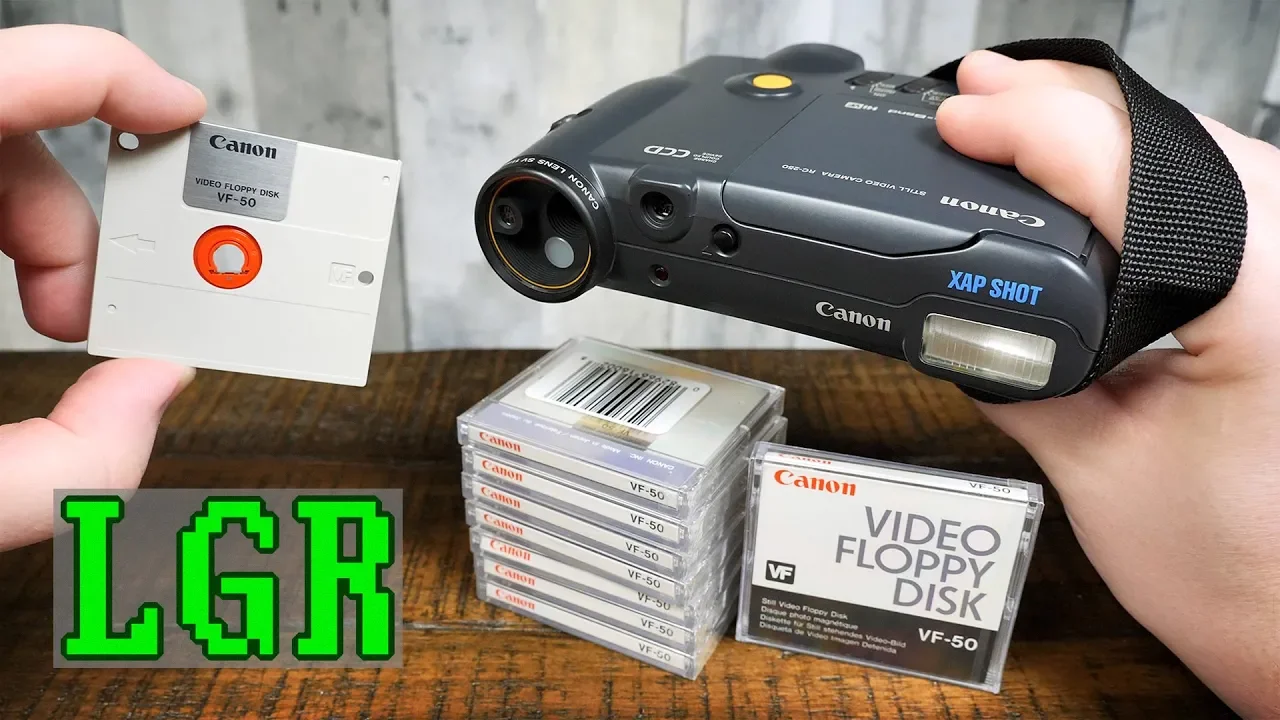
The Canon RC-250 XapShot debuted in December 1988 with an original retail price of $800 in the United States. Canon released the same underlying hardware internationally under different names, launching it as the RC-251 Ion in Europe and the RC-250 Q-Pic in Japan. The device belongs to a distinct late-1980s category known as a "Still Video Camera." Rather than functioning as a digital camera, the RC-250 captures an incoming video feed through a CCD sensor and freezes a single frame of analog video, storing it directly onto a magnetic medium designed for photographic viewing.
```mermaid flowchart TD accTitle: Still Video Camera Workflow accDescr: Diagram illustrating how the Canon RC-250 captures analog video frames and writes them onto 2-inch Video Floppy disks.
subgraph Capture ["Optical Capture"] A["Lens & CCD Sensor"] -->|"Captures single video frame"| B["Analog Video Signal (NTSC/PAL)"] end
subgraph Storage ["Magnetic Medium"] B -->|"Frequency modulation recording"| C["2-inch Video Floppy (VF / Hi-VF)"] C -->|"Stores up to 50 field tracks"| D["Track Erase & Rewrite on Demand"] end
subgraph Output ["Playback Systems"] D -->|"Composite / RF out"| E["Home Television"] D -->|"Professional player (e.g., MVR-5300)"| F["Video Printers / Digitizers"] end ```
The storage medium is the 2-inch Video Floppy (VF) disk, initially engineered by Sony under the name "Mavipak" for early Mavica cameras. Throughout the mid-1980s and into the early 1990s, several manufacturers adopted the standard as an electronic stop-gap bridging the gap between traditional silver-halide chemical film and modern digital sensors. The disks hold 50 concentric magnetic tracks, each recording a single field of analog NTSC or PAL video. Cameras supporting the High Band Video Floppy (Hi-VF) standard, such as the RC-250, can write up to 50 individual still images per disk. Unlike photographic film, which required wet lab processing and could never be altered once exposed, every track on a Video Floppy can be captured, inspected, wiped, and rewritten in-camera on the fly.
The RC-250 achieved significant contemporary acclaim because it lowered the prohibitive cost barrier previously associated with filmless photography. In 1986, Canon had introduced the professional-tier RC-701 video floppy camera, but its astronomical $2,600 price tag kept it out of reach for general consumers. Arriving exactly a century after the release of the landmark 1888 Kodak Box Camera, the sub-$1,000 price point led *Popular Mechanics* to speculate on its historical legacy, writing that “in a century or so, it might share the Kodak's status as the first of its kind to make an esoteric technology available to millions.” Period technology publications were equally fixated on its unusual rectangular industrial form, with *PC Magazine* memorably summarizing its dimensions as being “about the size of a well-packed sandwich.”
- **Release Date:** December 1988 - **Launch Price:** $800 USD (compared to $2,600 for the 1986 Canon RC-701) - **International Branding:** RC-250 XapShot (US), RC-251 Ion (Europe), RC-250 Q-Pic (Japan) - **Media Format:** 2-inch Video Floppy (VF / Hi-VF), originally Sony Mavipak - **Capacity:** 50 analog video tracks per disk (one still frame per track)
---
[02:42](https://www.youtube.com/watch?v=4G_1uy_7B5w&t=162s) Unboxing, Physical Hardware, and Ergonomics
An intact original 1988 box contains two distinct internal compartments. The first box houses the camera cradled in a molded styrofoam tray alongside an original fabric drawstring carrying pouch, both of which commonly suffer from age-related material deterioration. The second box contains product literature, promotional paperwork, and an illustrated user manual documenting all operational functions and peripheral accessories. Additional packaging trays store the bundled charging unit/wall adapter, various audio/video hookup cables, and a compact lead storage battery that invariably fails to hold a charge after three decades of chemical breakdown.
The camera's exterior features rounded rectangular contours and an all-plastic housing dominated by a mechanical disk drive door that opens with a distinct, spring-loaded tactile snap. On the front panel sits the built-in flash, the mechanical disk eject release, an optical viewfinder window, an LED self-timer indicator, and a clustered three-part circular optical array. This circular cluster houses the exposure metering sensor on the left, a dedicated white balance sensor at the bottom, and the primary camera lens at the top.
The lens itself is an 11mm fixed-focus design with a maximum aperture of f/2.8. Because of the tiny dimensions of the internal CCD sensor, an 11mm focal length yields a relatively tight, narrow field of view equivalent to a 60mm standard lens on a conventional 35mm film camera. The standard fixed shooting range stretches from 1 meter to infinity, though a physical macro switch located on the top deck shifts the focal plane to allow close-ups down to 30 centimeters (roughly one foot).
The top control deck contains an array of inputs: - A two-stage shutter release button - A slider for flash modes (automatic, fill-in, or off) - A master mode slider (power off, record, playback, and erase) - Forward and reverse directional track stepper buttons - A shooting mode selector switch (single frame versus continuous burst mode) - A dedicated +1.5 EV exposure compensation toggle - A segmented monochrome status LCD displaying frame counts and operational status
The rear face provides a wrist strap anchor point, a dioptric adjustment ring encircling the viewfinder eyepiece to compensate for imperfect user vision, a multi-pin video output port for direct composite/RF television connections, and a battery compartment designed for a proprietary 200 milliamp-hour lead-acid rechargeable battery. Because these batteries are universally dead today, using the camera in the field requires tethering it directly to the AC wall adapter and hauling a separate portable battery pack. Furthermore, the unit lacks any built-in lens cover or clip-on cap, making it frustratingly easy to smudge the front glass element when handling the body.
---
[05:43](https://www.youtube.com/watch?v=4G_1uy_7B5w&t=343s) Operation and the Rabbit Hole of Broken Hardware
Operating the XapShot is mechanically straightforward. Shifting the top slide switch into record mode activates the internal disk drive, which spins up while a mechanical stepper motor clicks through the tracks until it reaches the first unrecorded space. Once queued, pressing the shutter button fires the electronic exposure with an audible whir and click as the video frame is recorded onto the magnetic substrate. In continuous drive mode, the mechanism cycles rapidly, capturing sequential frames in quick succession while updating the track counter on the top LCD.
Discarding unwanted shots does not require replacing the disk. Moving the master switch to the erase setting allows the user to browse back and forth across recorded tracks using the forward and reverse stepper buttons. Holding down the mode button while depressing the shutter triggers an immediate wipe of that specific track, re-flagging it as open for subsequent recording.
Actually viewing the captured images today, however, presents an engineering roadblock due to ubiquitous hardware failures. A prior attempt with a 1988 Sony MVC-C1 still video camera ended in failure when its internal drive refused to read disks despite extensive repair attempts. A supposedly unused, boxed Canon RC-250 showed fully operational mechanics and successfully exposed disks, but its internal playback circuit failed completely, preventing any video output to a monitor. A second RC-250 purchased with claims of working order arrived in even worse condition: it refused to take photographs entirely, and its playback output produced nothing but scrambled static.
Frustrated by decaying consumer hardware, the solution was tracking down an industrial-grade studio device: the Sony MVR-5300 Hi-VF Still Video Recorder. Released in 1994 with an original price tag exceeding $4,000, this rackmount unit was never intended for retail consumers. It was distributed through commercial, scientific, and medical imaging channels to store output from professional scopes and video systems. Equipped with an automated motorized slot-loading mechanism and glowing orange LED status readouts, the MVR-5300 reads the exact same 2-inch Video Floppy disks, providing a stable, reliable mechanism to play back the tracks recorded by the handheld Canon.
---
[08:24](https://www.youtube.com/watch?v=4G_1uy_7B5w&t=504s) Playback, Analog Artifacts, and Image Character
When loaded into the MVR-5300 recorder, the recorded disks can be navigated frame by frame using manual skip controls, or cycled continuously via an adjustable interval wheel that functions like an automated slideshow. This reflects the original marketing pitch for consumer still video cameras in the late 1980s, which were promoted essentially as electronic alternatives to 35mm slide carousels. To get physical prints or digital files during that era, users had to invest heavily in expensive dedicated thermal video printers or specialized computer video digitizer capture cards. For everyday buyers, the standard experience was simply running a composite video cable directly into the living room television.
The resulting images exhibit a distinct, paused analog broadcast appearance. Because each photograph is effectively a single frozen video field, playback includes visible horizontal scan lines, edge jitter, chroma drift, and high-frequency noise. These artifacts are exacerbated by physical media degradation over thirty years of shelf storage. When inspecting older disks containing photographs taken by previous owners in the late 1980s, the decaying magnetic tracks yield heavy analog distortion, shifting chromatic lines, and severe noise, giving the images an uncanny, vaporwave aesthetic.
Rewritable video floppies also inherit the physical limitations of magnetic tape formats like VHS. Successive recording, erasing, and overwriting on a single track causes magnetic signal loss and introduces generation loss, corrupting subsequent shots. Even when testing pristine, new-old-stock disks, subtle tracking noise and horizontal banding remain part of the output.
Despite technical limitations, the XapShot's photographic results possess a unique visual charm. It renders an aesthetic balance between vintage analog film and low-resolution early digital sensors:
> “And with its high band specification, it was supposed to be able to capture 500 vertical lines of video resolution, but in practice it ended up being fewer than 400 from what I’ve read.”
In actual use, the camera produces clearer details than its video-field pedigree suggests. Color saturation is vivid without becoming unnaturally blown out, and the fixed-focus optical assembly combined with the front exposure sensor handles mixed, challenging ambient light environments with surprising consistency.
[10:47](https://www.youtube.com/watch?v=4G_1uy_7B5w&t=647s) Image Quality, Focal Length Quirks, and Retro Flaws
Evaluating the Canon XapShot RC-250’s exposure performance reveals that the camera tends to skew toward underexposure rather than overexposing shots, even when its built-in compensation mode is actively enabled. Despite this bias, the vintage hardware puts up an admirable fight across several technical fronts, including color reproduction, UV filtering, and overall dynamic range. Placing an RC-250 still directly alongside a modern smartphone capture of the identical outdoor scene illustrates these qualities; while the analog recording medium and low resolution obviously prevent it from competing in sheer clarity, the underlying image rendition holds its own remarkably well.
A particularly striking quirk of the RC-250 is just how tightly cropped its framing feels in practice. When comparing an uncropped smartphone photo to the Canon's capture, the 11mm lens effectively forces the photographer to stand roughly ten or so feet farther back from the subject than expected. For Clint, who frequently shoots with a 50mm prime lens on modern gear, this pronounced focal crop is not an issue at all. More importantly, he has developed a deep fondness for the distinctly imperfect output produced by this specific physical unit, which has a hardware glitch that prevents it from ever writing a completely clean, uncorrupted image file.
- **Exposure Handling:** Skews consistently toward underexposure rather than blowing out highlights, even when exposure compensation is engaged. - **Color & Optics:** Demonstrates surprisingly solid dynamic range, UV filtering, and color accuracy despite the constraints of analog NTSC capture. - **Focal Framing:** The fixed 11mm lens creates a tight, zoomed-in perspective that requires stepping back about 10 feet further than modern wide phone cameras. - **Unit Artifacts:** Clint notes that his specific camera is slightly damaged internally, meaning every single photograph captured contains some degree of analog glitching or visual corruption.
---
[11:35](https://www.youtube.com/watch?v=4G_1uy_7B5w&t=695s) The Philosophy of Retro Photography and Wrap-Up
Rather than viewing the visual flaws and corrupted lines as a fatal drawback, Clint embraces them as the primary appeal of vintage imaging. In his view, reaching for obsolete photography equipment is never about capturing razor-sharp, ultra-high-definition fidelity, which is a task already handled effortlessly by contemporary smartphones and digital SLRs. Instead, the joy of shooting vintage gear stems directly from utilizing dead media formats and finicky mechanisms that introduce organic uncertainty into the final frame.
As Clint explains: “When it comes to retro photography, I don’t often reach for a camera that’s going to provide crispy, hi-res reproductions of reality.” He elaborates on his creative philosophy: “But if I’m gonna go retro, I often go for something that uses obsolete media or something a little bit fallible that produces unpredictable results.” In that respect, the Canon RC-250 XapShot and its proprietary 2-inch Video Floppy disks hit the sweet spot of nostalgic unpredictability, delivering an authentic analog snapshot aesthetic that modern digital sensors cannot replicate. Clint concludes the video by inviting viewers to explore his other retro camera showcases and weekly features covering odd vintage technology before signing off with his classic closing thanks.
## Notable quotes > [11:35](https://www.youtube.com/watch?v=4G_1uy_7B5w&t=695s) When it comes to retro photography, I don’t often reach for a camera that’s going to provide crispy, hi-res reproductions of reality. — Clint
## Mentioned Canon RC-250 XapShot, Canon RC-251 Ion, Canon RC-250 Q-Pic, Canon RC-701, Sony Mavica, Sony MVC-C1, Sony MVR-5300 Hi-VF Still Video Recorder, Kodak Box Camera, Popular Mechanics, PC Magazine, Sony, Canon, Clint, LGR
## Video description The Canon XapShot is one radical late 80s still video camera. It takes photos and saves them to a floppy disk, but it's not a digital camera. It does so using analog NTSC recording tech!
● Check out the photos taken with this camera here: https://imgur.com/a/igrlPoi
● LGR links: https://twitter.com/lazygamereviews https://www.facebook.com/LazyGameReviews https://www.patreon.com/LazyGameReviews
● Music credits go to: http://www.epidemicsound.com
#LGR #Cameras #Retro
[Source](https://www.youtube.com/watch?v=4G_1uy_7B5w)