Astronomers Warn Earth Lacks Tools to Deflect City-Killing Asteroids
These are the asteroids to worry about — Veritasium

Veritasium

Because active deflection technologies fail and urban evacuations cause gridlock, launching space-based surveys to detect incoming threats decades in advance is humanity's sole viable defense.

AI-assisted summary of These are the asteroids to worry about — original source. Check the original for full context.

Source published:

Key ideas

  • Humanity has detected only five of more than 1,200 post-1988 asteroid impacts larger than one meter prior to atmospheric entry, none with more than 24 hours of advance warning. (0:08)
  • While nearly 98% of extinction-level near-Earth asteroids 1 km or larger are mapped, the vast majority of 100-meter 'city killers' remain completely undiscovered and could strike without warning. (13:44)
  • Current deflection concepts like nuclear detonations, rocket tugboats, and laser ablation are physically impractical or incapable of diverting kilometer-scale asteroids with current technology. (14:40)
  • Chaotic n-body gravitational perturbations from planets impose a hard mathematical predictive horizon of roughly 100 years for asteroid orbital trajectories. (6:03)

Detailed notes

## Background This video was published on YouTube by Derek Muller on the Veritasium channel on November 30, 2020. Grounded in Stephen Hawking's assertion that an asteroid impact poses the greatest threat to life on Earth, the video explores why tracking near-Earth objects is difficult, assesses real collision risks, and examines potential mitigation strategies with expert insights from planetary scientist Prof. Dave Jewitt.

## TL;DR While astronomers have tracked over 90% of civilization-ending, multi-kilometer asteroids and determined none will strike within the next century, humanity remains alarmingly blind to smaller 'city-killer' space rocks measuring roughly 100 meters across. Events like the 2013 Chelyabinsk meteor highlight that incoming objects approaching from the sun's glare or of lower albedo frequently evade ground-based detection until impact. Popular deflection concepts—such as nuclear detonation, laser ablation, or rocket tugs—face severe physical and logistical barriers, and mass urban evacuations risk catastrophic gridlock. Ultimately, the only practical defense currently available is deploying dedicated infrared space telescopes to detect hazardous objects decades in advance.

## Atmosphere & style The presentation blends Veritasium's signature inquisitive science journalism with a chilling, darkly humorous undercurrent of existential dread. Derek Muller's energetic exposition is balanced by the deadpan, blunt candor of UCLA professor Dave Jewitt, who casually dismantles Hollywood deflection tropes with nervous laughter and grim realism. Visually striking diagrams, historical impact scars, and ominous planetary animations create an experience that feels simultaneously intellectually exhilarating and quietly terrifying.

## Bulletin - [00:08](https://www.youtube.com/watch?v=4Wrc4fHSCpw&t=8s) Humanity has detected only five of more than 1,200 post-1988 asteroid impacts larger than one meter prior to atmospheric entry, none with more than 24 hours of advance warning. - [13:44](https://www.youtube.com/watch?v=4Wrc4fHSCpw&t=824s) While nearly 98% of extinction-level near-Earth asteroids 1 km or larger are mapped, the vast majority of 100-meter 'city killers' remain completely undiscovered and could strike without warning. - [14:40](https://www.youtube.com/watch?v=4Wrc4fHSCpw&t=880s) Current deflection concepts like nuclear detonations, rocket tugboats, and laser ablation are physically impractical or incapable of diverting kilometer-scale asteroids with current technology. - [06:03](https://www.youtube.com/watch?v=4Wrc4fHSCpw&t=363s) Chaotic n-body gravitational perturbations from planets impose a hard mathematical predictive horizon of roughly 100 years for asteroid orbital trajectories.

## Key takeaways - [00:08](https://www.youtube.com/watch?v=4Wrc4fHSCpw&t=8s) The 2013 Chelyabinsk meteor went entirely undetected before entry despite astronomers tracking asteroid Duende on the exact same day. - [02:35](https://www.youtube.com/watch?v=4Wrc4fHSCpw&t=155s) Asteroids are divided into loose rubble piles held by weak self-gravity and solid metallic fragments from the shattered cores of differentiated planetesimals. - [02:35](https://www.youtube.com/watch?v=4Wrc4fHSCpw&t=155s) Asteroid detection is hindered by low surface albedo (roughly 15%) and the opposition effect, which concentrates over 85% of detections in the narrow night-sky swath opposite the sun. - [02:35](https://www.youtube.com/watch?v=4Wrc4fHSCpw&t=155s) Ground-based telescopes suffer a complete blind spot for any incoming impactor approaching Earth from the daytime direction of the sun. - [06:03](https://www.youtube.com/watch?v=4Wrc4fHSCpw&t=363s) Gravitational perturbations from planets make accurate long-term orbital tracking impossible beyond a 100-year predictive horizon. - [07:33](https://www.youtube.com/watch?v=4Wrc4fHSCpw&t=453s) Hypervelocity impacts obliterate incoming meteors upon contact, converting kinetic energy into a superheated gas explosion comparable to a massive nuclear detonation. - [10:06](https://www.youtube.com/watch?v=4Wrc4fHSCpw&t=606s) The dinosaur-killing impact generated an atmospheric infrared heat pulse from falling sub-orbital ejecta, incinerating terrestrial surface life worldwide. - [12:06](https://www.youtube.com/watch?v=4Wrc4fHSCpw&t=726s) The statistical risk of humanity experiencing a 10 km extinction-level impact in our lifetime is effectively zero because astronomers have mapped all threats at that scale. - [13:44](https://www.youtube.com/watch?v=4Wrc4fHSCpw&t=824s) The asteroid population scales inversely with size, leaving thousands of intermediate 100-meter bodies capable of destroying entire cities uncataloged. - [14:40](https://www.youtube.com/watch?v=4Wrc4fHSCpw&t=880s) Nuclear blasts on incoming asteroids risk shattering them into rubble piles that re-coalesce under self-gravity along the original trajectory. - [14:40](https://www.youtube.com/watch?v=4Wrc4fHSCpw&t=880s) Mechanical deflection methods, including rocket engines, laser ablation, and reflective foil wraps, require power or continuous operation far beyond current engineering capabilities. - [16:43](https://www.youtube.com/watch?v=4Wrc4fHSCpw&t=1003s) Civilian mass evacuation during an asteroid alert is unviable due to guaranteed highway gridlock trapping populations within the impact zone. - [16:43](https://www.youtube.com/watch?v=4Wrc4fHSCpw&t=1003s) Investing in dedicated infrared space survey telescopes to discover threats decades in advance is humanity's only currently viable planetary defense strategy.

## Detailed walkthrough ### [00:08](https://www.youtube.com/watch?v=4Wrc4fHSCpw&t=8s) The Chelyabinsk Incident and the Detection Problem

On February 15, 2013, an asteroid weighing more than the Eiffel Tower entered the atmosphere over Chelyabinsk, Russia, and exploded roughly 30 kilometers above the ground. The explosion shone brighter than the sun, but because it detonated so high in the atmosphere, silence lingered for a full 90 seconds before the arrival of the shockwave. Unaware of the danger, residents crowded around their windows to record the smoke trail etched across the sky. When the shockwave finally slammed into the city, it shattered glass across thousands of buildings, injuring 1,500 people who were looking directly outside.

What made the event particularly embarrassing for the scientific community was that astronomers had already predicted an asteroid flyby for that exact day. Just 16 hours after Chelyabinsk, an asteroid of similar size named Duende (367943 Duende) safely passed within 27,000 kilometers of Earth—closer than satellites in geosynchronous orbit. While scientists tracked Duende with precision, they completely missed the incoming Chelyabinsk bolide.

This oversight is far from an isolated incident. Humanity remains surprisingly poor at spotting incoming impactors before they strike. Since 1988, more than 1,200 asteroids larger than one meter have struck Earth, yet astronomers managed to detect only five of them prior to atmospheric entry, and never gave more than a single day of advance warning.

- The Chelyabinsk meteor detonated 30 km above the ground. - The blast broke windows across thousands of structures, injuring 1,500 people primarily with flying glass. - Asteroid Duende approached Earth within 27,000 kilometers, well inside the geosynchronous satellite ring. - Out of >1,200 post-1988 impacts of objects >1 m, only five were discovered beforehand, all with under 24 hours of notice.

[02:35](https://www.youtube.com/watch?v=4Wrc4fHSCpw&t=155s) What Asteroids Are and Why They Are Hard to See

Asteroids are primordial debris left over from the formation of our solar system 4.5 billion years ago. During this epoch, dust and rock coalesced into molten protoplanets. Within these molten bodies, high-density metallic elements like iron, nickel, and iridium sank inward to form dense cores, leaving lighter silicate minerals floating on top to create outer mantles. While some protoplanets matured into modern planets, countless others collided violently, shattering into fragments that continued to orbit the sun and collide repeatedly over billions of years.

```mermaid flowchart TD accTitle: Protoplanet differentiation and asteroid formation accDescr: Dust and rock clump into molten protoplanets, separate into iron cores and silicate mantles, then collide into rubble piles and metallic meteorites.

subgraph Accretion ["Accretion (4.5 Ga)"] A["Rocks & dust clump"] --> B["Molten protoplanets"] end

subgraph Differentiation ["Core differentiation"] B --> C["Heavy metals sink (Fe, Ni, Ir)"] B --> D["Silicate rock floats to mantle"] end

subgraph Fragmentation ["Collisions & debris"] C & D --> E["Violent collisions & fragmentation"] E --> F["Metallic asteroids (core fragments)"] E --> G["Rubble piles (loose gravel conglomerates)"] end ```

These collisions created two distinct types of remnants: "rubble piles," which are loose conglomerates of gravel-sized rocky material bound by weak self-gravity, and solid metallic rocks formed from the shattered cores of differentiated planetesimals. Holding an iron meteorite fragment, Prof. Dave Jewitt highlights its antiquity: “And essentially it's the piece of a core of a small planetary body, like basically a small planet, that formed four and a half billion years ago, differentiated, so the core material fell out, and then this thing was smashed apart by a collision with another asteroid. That's the oldest thing you'll ever see.”

While the vast majority of cataloged asteroids reside in stable orbits within the main asteroid belt between Mars and Jupiter, some have been nudged into orbits closer to Earth, becoming Near-Earth Objects (NEOs). In his final book, Stephen Hawking identified an asteroid strike as the single greatest existential threat to life on Earth. Despite this danger, discovering them with ground-based telescopes is an immense challenge. As Prof. Jewitt explains, the basic search technique involves taking multiple sequential frames across the sky: “So what you do is you take a sequence of pictures, one, two, three, one, two, three, four, and you look for essentially a moving dot. And it's moving because it's orbiting around the sun. Whereas the stuff far away, the stars and galaxies, are not.”

Several factors compound this observational challenge: - **Small sizes**: Asteroids range from single-digit meters to kilometers wide, making them tiny dots lost in the massive expanse of space (Chelyabinsk was only ~20 meters wide, roughly the size of two school buses). - **Low albedo**: Asteroid surfaces are dark and rough, reflecting only about 15% of the light that hits them. - **The Opposition Effect**: Asteroids are bright enough to detect primarily when positioned directly opposite the sun relative to Earth (in full solar phase). Over 85% of detected NEOs have been located within the narrow 45-degree swath of the night sky facing directly away from the sun. - **Sunward blind spot**: Any asteroid barreling toward Earth from the daytime direction of the sun cannot be observed by ground telescopes—the exact blind spot from which Chelyabinsk emerged.

[06:03](https://www.youtube.com/watch?v=4Wrc4fHSCpw&t=363s) Orbital Uncertainty and Dynamical Chaos

Astronomers have discovered and cataloged roughly one million asteroids to date, but around 24,000 are classified as Near-Earth Objects that require vigilant tracking. Even when a telescope flags an asteroid, projecting its future track remains difficult. A few days of tracking data yields only a tiny arc of motion, making long-range projections speculative. Obtaining reliable predictions requires orbital tracking data accumulated over years or decades.

Yet even with optimal data, there is a hard mathematical wall preventing infinitely far predictions: gravitational perturbations. Asteroids do not follow pure two-body Keplerian trajectories around the sun; every planet in the solar system exerts a gravitational pull that continually tugs on them. This chaotic n-body gravitational interaction introduces dynamical chaos, setting a hard predictive horizon. As Prof. Jewitt points out: “So the maximum time you can predict with any accuracy at all where a body will be is about 100 years.” Beyond that century mark, orbital trajectories become functionally unpredictable.

[07:33](https://www.youtube.com/watch?v=4Wrc4fHSCpw&t=453s) Barringer Crater and the Nature of Hypervelocity Impacts

To understand the energy released by an impactor, one need only look at Barringer Crater in Arizona. Up until the 1950s, geologists believed the massive depression had been carved by volcanic action. However, a mining engineer named Daniel Barringer had become convinced in 1903 that the crater was the scar of a giant iron meteorite. Driven by the hope of uncovering a buried metallic mass that he estimated to be worth more than a billion 1903 dollars, Barringer staked a mining claim and spent the next 27 years drilling down into the desert floor.

Barringer and his crew drilled through the center and, upon finding nothing, drilled sideways beneath the crater rim based on the theory that the impactor struck at an angle. They drilled down past 400 meters, finding nothing but pulverized rock. What Barringer failed to understand was the physics of hypervelocity impacts. An impactor does not behave like a bullet stopping inside a wall; it hits at roughly 30 kilometers per second. At that speed, the kinetic energy is so immense that it obliterates and vaporizes the incoming body on contact, creating a super-heated, high-pressure bubble of gas that blasts the crater open.

- The 50-meter metallic impactor was almost entirely vaporized during the collision 50,000 years ago. - The impact unleashed roughly 10 megatons of TNT-equivalent energy. - That yield is over 600 times more powerful than the atomic bomb dropped on Hiroshima. - In energetic terms, the physical event that most closely mirrors a meteorite strike is an enormous nuclear detonation.

[10:06](https://www.youtube.com/watch?v=4Wrc4fHSCpw&t=606s) The Dinosaurs and the Scaled Threat of Mass Extinction

Impact hazards scale non-linearly with asteroid size. Prof. Jewitt, showing off a full-sized replica of a *Tyrannosaurus rex* skull, points out that the non-avian dinosaurs were annihilated 65 million years ago by an asteroid approximately 10 kilometers wide. Once an impactor exceeds a threshold size—estimated at roughly a couple of kilometers across—the resulting environmental destruction becomes globally catastrophic.

The initial impact throws enormous plumes of vaporized and melted crust into sub-orbital trajectories. This ejecta arcs through space, encircles the globe, and re-enters the atmosphere on every continent—even on the hemisphere opposite the impact crater. As billions of re-entering rock particles fall back to Earth, they heat the upper atmosphere, causing the entire sky to glow incandescently: “So you can imagine the sky turning from, you know, a nice blue day like today, into essentially a red, hot glow, like being inside a toaster oven.”

This radiant infrared heat pulse turned the atmosphere into an overhead broiler, cooking terrestrial animals alive on the ground. The only creatures that survived were those insulated from the thermal pulse, such as animals burrowed underground in tunnels or submerged underwater. When asked about the likelihood of humanity facing another 10-kilometer extinction-level impactor, Prof. Jewitt contextualizes the odds across human timescales: “In your lifetime, assuming you live to be 100 years old, you have a 10 kilometer impacter like the KT extinction event every hundred million years or something like that. So the probability of getting it in one year is one in a hundred million.”

[12:06](https://www.youtube.com/watch?v=4Wrc4fHSCpw&t=726s) The Shift from Global Extinction to Regional Devastation

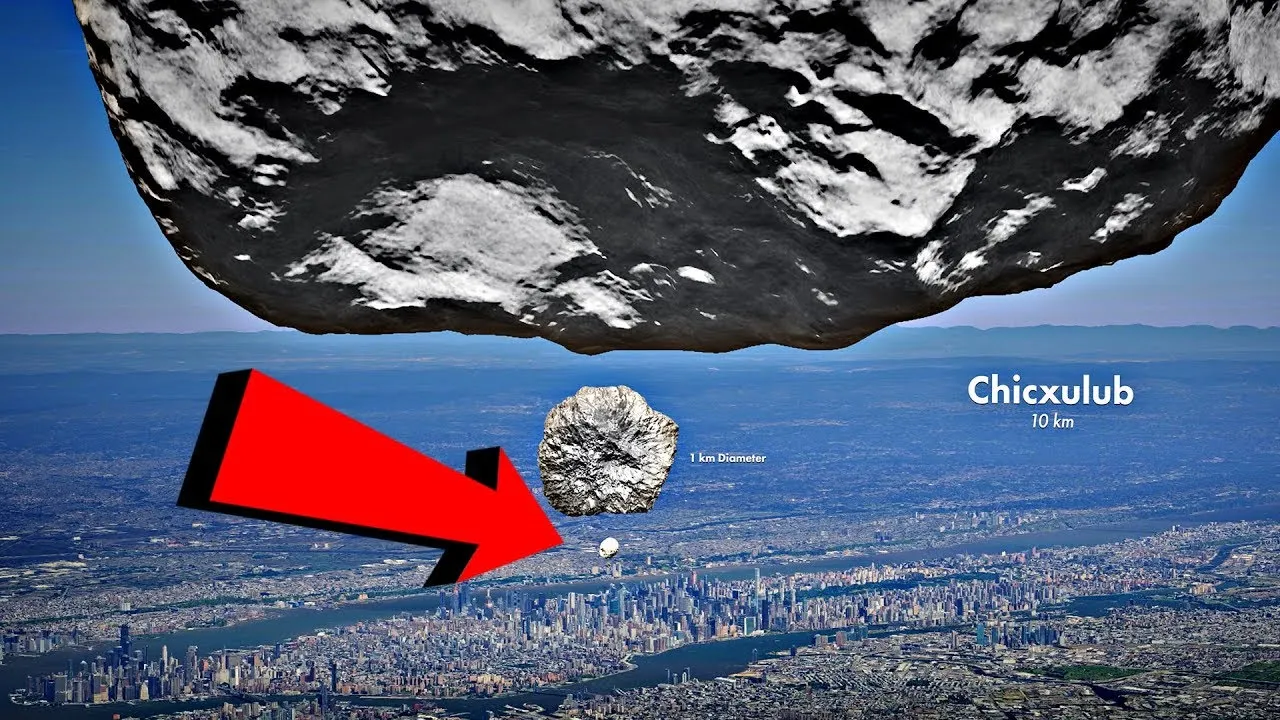
While a ten-kilometer asteroid impact sounds apocalyptic, planetary astronomers have effectively eliminated the threat of a dinosaur-style extinction event occurring in our lifetime. Because astronomers have mapped the skies and verified that no ten-kilometer space rocks have paths intersecting Earth’s orbit over the next century, the statistical lifetime risk of dying in an extinction-level impact has plunged from one in a million down to zero. The immediate existential relief, however, gives way to a much harsher mathematical reality: the population of asteroids grows exponentially as their size decreases. For every single ten-kilometer monster lurking in the solar system, there are roughly one thousand one-kilometer asteroids, and these smaller bodies remain fully capable of inflicting staggering devastation.

Speaking on the destructive potential of these intermediate impactors, Prof. Dave Jewitt from UCLA explains that a rock measuring between one and two kilometers across would unleash massive localized destruction rather than ending all terrestrial life. “So you would obliterate those countries with the impact of a one or two kilometer size body,” Jewitt notes, referencing the potential wiping out of nations the size of France or Germany. When asked whether humanity has successfully cataloged all of these mid-sized threats, Jewitt estimates that astronomers have identified around ninety-something percent—perhaps ninety-eight percent—of those one- to two-kilometer objects. Their orbits are sufficiently well calculated to guarantee reasonable safety for roughly the next ten years. Yet that safety margin evaporates rapidly when looking just below that threshold, at eight-hundred-meter asteroids whose potential impacts would remain thoroughly savage.

- Statistically, the baseline risk of dying from a 10 km impact was 1 in 1,000,000, but known orbital tracking reduces this figure to zero for the next 100 years. - Asteroid frequency scales inversely with size: for each 10 km asteroid, there are roughly 1,000 asteroids around 1 km across. - Scientists have identified approximately 90% to 98% of near-Earth asteroids measuring 1 to 2 km in diameter.

[13:44](https://www.youtube.com/watch?v=4Wrc4fHSCpw&t=824s) The Blind Spot: Hundred-Meter City Killers

The most urgent danger facing humanity is not the planet-cracking behemoths, but the vast population of asteroids measuring a few hundred meters across. These objects occupy a perilous middle ground: they are small and faint enough to have evaded comprehensive astronomical surveys, yet large enough that an atmospheric entry or ground strike would wipe out a major metropolitan area. Because so many hundred-meter bodies remain completely undiscovered, a devastating strike could occur with little to no advance warning.

When discussing the physical aftermath of such an event, Prof. Dave Jewitt makes it clear that a strike would not merely crack pavement, but level human infrastructure across an entire territory. “It would knock down the buildings in the city,” Jewitt explains, detailing how the kinetic energy would ignite city-wide infernos while blasting molten and shattered rock back into the sky, creating a lethal hail of high-speed ejecta capable of destroying everything within a hundred-kilometer radius. When asked if such an impact could realistically happen tomorrow without warning, Jewitt offers a nervous chuckle and confirms, “Well it could, yeah.”

- Projectiles measuring around 100 meters can flatten buildings across an entire city and ignite firestorms. - Ground impacts launch high-velocity ejecta upward, which rains back down to obliterate a disaster zone roughly 100 kilometers across. - Unlike kilometer-class asteroids, the majority of hundred-meter near-Earth objects remain undiscovered.

[14:40](https://www.youtube.com/watch?v=4Wrc4fHSCpw&t=880s) Deflection Myths: Why Bombs, Rockets, and Lasers Fail

Popular culture routinely depicts humanity saving the planet by launching a nuclear warhead or mounting engines to steer incoming space rocks out of harm's way, but the underlying physics tell a far bleaker story. Reflecting on a high-level scientific committee he served on a decade prior to assess mitigation technologies, Prof. Dave Jewitt bluntly punctures any sense of technological preparedness: “No. There's nothing we can do.” Detonating a nuclear bomb on or inside an asteroid risks shattering it into a loose swarm of debris that expands slightly before gravitational self-attraction pulls the fragments right back together into a coalesced rubble pile—assuming the object was not already a porous pile of rubble from ancient collisions.

```mermaid flowchart TD accTitle: Proposed Asteroid Deflection Concepts and Their Critical Failure Modes accDescr: A diagram contrasting four theoretical asteroid deflection strategies against their physical limitations.

subgraph Impulsive["Explosive / High Energy"] Nuke["Nuclear Warhead"] -->|"Gravity re-coalesces fragments"| Rubble["Reforms as Rubble Pile"] Laser["Surface Laser Ablation"] -->|"Insufficient Earth-based power"| LaserFail["Impossible to Beam or Transport"] end

subgraph Slow["Gentle / Radiative Propulsion"] Engine["Attached Rocket Engine"] -->|"Rotating body, weak thrust"| EngineFail["Requires Centuries of Clamping"] Foil["Aluminum Foil Wrap (Yarkovsky)"] -->|"Massive material payload"| FoilFail["Unfeasible to Launch and Wrap"] end ```

Alternative mechanical and thermal deflection strategies fare no better under rigorous engineering analysis:

- **Rocket Tugboats:** Attaching thrusters to gently nudge an asteroid off course fails because existing chemical and ion propulsion systems generate far too little thrust. Anchoring a rocket to an irregularly tumbling, rotating body and running it continuously for centuries is currently impossible. - **Laser Ablation:** Vaporizing an asteroid's crust to generate venting rocket-like plumes requires power levels far beyond any existing or planned Earth-based lasers, while transporting high-powered laser stations across deep space introduces overwhelming mass and logistical barriers. - **Aluminum Foil Wrapping:** Enveloping an asteroid in reflective foil to alter its solar heating and harness the Yarkovsky effect is theoretically elegant, but humanity has no mechanism to manufacture, launch, or manipulate thousands of square kilometers of foil around a spinning space boulder.

As Jewitt summarizes, “So the truth is, to be honest, we do not have a way now to deflect a kilometer size asteroid, at all.” When asked about dealing with a ten-kilometer extinction-class rock, Jewitt laughs and remarks that such a scenario would be “absolutely a thousand times more hopeless.”

[16:43](https://www.youtube.com/watch?v=4Wrc4fHSCpw&t=1003s) The Evacuation Trap and the Need for Space Surveys

Faced with the failure of active deflection concepts, scientists turned to the simplest civil defense plan imaginable: tracking the impact point and evacuating the targeted city. Yet historical analyses of mass evacuations during catastrophic weather events, such as hurricanes with a full week of warning, reveal that mass flight is an illusion. “And evacuation just doesn't work either,” Jewitt states, explaining that modern urban infrastructure cannot support a simultaneous exodus. Cities are fed by a limited number of arterial highways; the moment millions of panicked motorists converge on them, a single vehicle breakdown triggers systemic gridlock, trapping populations in the direct blast path.

```mermaid flowchart LR accTitle: The City Evacuation Bottleneck accDescr: Flow diagram showing how panicked vehicular mass evacuation causes freeway gridlock and traps populations in the target zone.

A["Asteroid Warning Received"] --> B["Millions Converge on Highways"] B --> C["Single Vehicle Breakdown"] C --> D["Catastrophic Freeway Gridlock"] D --> E["Population Trapped in Impact Zone"] ```

Because emergency evacuation fails and active deflection is not yet viable, Jewitt argues that the only pragmatic path forward is early detection through dedicated survey telescopes:

- Ground surveys and dedicated space telescopes—most notably infrared space observatories—must be funded and launched to hunt down dark, stealthy near-Earth objects. - Finding dangerous projectiles decades before an orbital intersection buys humanity the decades of lead time necessary to focus collective resources and engineer a bespoke deflection mission. - “What I think all reasonable people would conclude is, let's do the thing that we can do first,” Jewitt concludes.

[18:20](https://www.youtube.com/watch?v=4Wrc4fHSCpw&t=1100s) Global Doom Scenarios and a KiwiCo Calendar

While asteroid strikes command immense attention, they represent only one of many civilization-ending risks. Derek Muller reassures viewers with tongue-in-cheek humor that an asteroid strike is far from the only existential crisis facing humanity, pointing to a comprehensive “map of doom” produced by Dominic Walliman at the Domain of Science channel, which illustrates competing global catastrophes to determine which apocalyptic scenario is most likely to cause humanity's downfall.

The video transitions into a family-oriented conclusion as Derek invites his eldest son to deliver the sponsor introduction for KiwiCo. Highlighting the challenge of buying holiday gifts that keep children engaged rather than abandoned after opening, Derek explains how hands-on STEM project crates foster a mindset where learning feels like play:

- KiwiCo offers eight subscription lines scaled for learners of all developmental stages, ranging from newborns to older children. - All building materials, instructions, and components arrive self-contained in each monthly delivery, removing the need for extra shopping trips. - Derek showcases a functional wooden perpetual calendar he assembled from a crate, jokingly presenting it as a physical countdown mechanism to track every passing day that humanity survives without an asteroid impact. - Viewers are provided a promotional link (`kiwico.com/veritasium50`) granting a 50% discount on their first month of any subscription line.

## Notable quotes > [14:40](https://www.youtube.com/watch?v=4Wrc4fHSCpw&t=880s) So the truth is, to be honest, we do not have a way now to deflect a kilometer size asteroid, at all. — Prof. Dave Jewitt

## Mentioned Stephen Hawking, Prof. Dave Jewitt, Prof. Mark Boslough, Scott Manley, Ryan Wyatt, Prof. Amy Mainzer, Alexandr Ivanov, Daniel Barringer, Dominic Walliman, Derek Muller, Chelyabinsk meteor, 367943 Duende, Barringer Crater, DART Mission, UCLA, Sandia National Labs, Morrison Planetarium, Domain of Science, KiwiCo, Universe Sandbox

## Video description Stephen Hawking thought an asteroid impact posed the greatest threat to life on Earth. Thanks to Kiwico for sponsoring this video. For 50% off your first month of any crate, go to https://kiwico.com/veritasium50 For other potential world ending catastrophes, check out Domain of Science: https://ve42.co/DoS

In 2025, we launched the Elements of Truth game on Kickstarter and were thrilled by the response. We’re now in the final stages of production, with Kickstarter rewards shipping soon. If you missed the campaign, you can now pre-order the retail edition through our new website here - https://ve42.co/asteroids

Special thanks to: Prof. Dave Jewitt from UCLA Earth, Planetary, and Space Sciences Prof. Mark Boslough from Sandia National Labs Scott Manley: https://www.youtube.com/user/szyzyg Ryan Wyatt at Morrison Planetarium Prof. Amy Mainzer Alexandr Ivanov for the opening shot of Chelyabinsk Meteor

Maps of Asteroid Impacts —https://ve42.co/Map

Time passing animation from Universe Sandbox - http://universesandbox.com/

Opposition Effect — https://ve42.co/Belskaya2000 Belskaya, I. N., & Shevchenko, V. G. (2000). Opposition effect of asteroids. Icarus, 147(1), 94-105.

Potentially Hazardous Asteroids — https://ve42.co/Perna2013 Perna, D., Barucci, M. A., & Fulchignoni, M. (2013). The near-Earth objects and their potential threat to our planet. The Astronomy and Astrophysics Review, 21(1), 65.

Survey of Potentially Hazardous Asteroids — https://ve42.co/NEOSurvey

Population Vulnerability — https://ve42.co/Rumpf2017 Rumpf, C. M., Lewis, H. G., & Atkinson, P. M. (2017). Population vulnerability models for asteroid impact risk assessment. Meteoritics & Planetary Science, 52(6), 1082-1102.

Size distribution of NEOs — https://ve42.co/Trilling17 Trilling, D. E., Valdes, F., Allen, L., James, D., Fuentes, C., Herrera, D., ... & Rajagopal, J. (2017). The size distribution of near-earth objects larger than 10 m. The Astronomical Journal, 154(4), 170.

2020 NEOWISE Data Release — https://ve42.co/NEOWISE

National Research Council Report— https://ve42.co/Defending Board, S. S., & National Research Council. (2010). Defending planet earth: Near-Earth-Object surveys and hazard mitigation strategies. National Academies Press.

Tug Boat — https://ve42.co/Schweickart03 Schweickart, R. L., Lu, E. T., Hut, P., & Chapman, C. R. (2003). The asteroid tugboat. Scientific American, 289(5), 54-61.

Gravity Tractor 1 — https://ve42.co/Lu05 Lu, E. T., & Love, S. G. (2005). Gravitational tractor for towing asteroids. Nature, 438(7065), 177-178.

Laser Ablation — https://ve42.co/Thiry14 Thiry, N., & Vasile, M. (2014). Recent advances in laser ablation modelling for asteroid deflection methods. SPIE Optical Engineering+ Applications, 922608-922608.

Yarakovsky Effect — https://ve42.co/Yara

DART Mission — https://ve42.co/DART

Nuclear 1 — https://ve42.co/Ahrens92 Ahrens, T. J., & Harris, A. W. (1992). Deflection and fragmentation of near-Earth asteroids. Nature, 360(6403), 429-433.

Nuclear 2 — https://ve42.co/Bradley10 Bradley, P. A., Plesko, C. S., Clement, R. R., Conlon, L. M., Weaver, R. P., Guzik, J. A., ... & Huebner, W. F. (2010, January). Challenges of deflecting an asteroid or comet nucleus with a nuclear burst. In AIP Conference Proceedings (Vol. 1208, No. 1, pp. 430-437). American Institute of Physics.

Researched and Written by Petr Lebedev, Jonny Hyman and Derek Muller 3D animations, VFX, SFX, Audio Mixing by Jonny Hyman 2D animation by Ivy Tello Intro animation by Nicolas Pratt With Filming by Raquel Nuno

Music from https://epidemicsound.com "Stellar Dance" "Orbit" "That Notebook" "What We Discovered" "Out of Poppies" "Handwriting" Images and video supplied by Getty Images

[Source](https://www.youtube.com/watch?v=4Wrc4fHSCpw)

中文简报

天文学家警告:地球尚缺乏偏转“毁灭城市级”小行星的手段 鉴于主动偏转技术尚不可行且城市疏散会导致交通瘫痪,发射天基巡天望远镜提前数十年发现来袭威胁是人类唯一可行的防御手段。 尽管天文学家已追踪了超过90%足以毁灭文明的数公里级小行星,并确认未来一个世纪内不会发生撞击,但人类对直径约100米、具有“毁灭城市”威力的较小太空岩石仍然极度缺乏监测能力。2013年车里雅宾斯克流星等事件表明,从太阳强光方向接近或反照率较低的来袭天体,往往在撞击前都能避开地面探测。核爆、激光烧蚀或火箭拖船等流行偏转设想面临严峻的物理和后勤障碍,而大规模城市疏散则可能引发灾难性的交通瘫痪。归根结底,目前唯一切实行之有效的防御手段是部署专用的红外太空望远镜,以便提前数十年发现危险天体。 在1988年之后发生的1200多次直径大于一米的小行星撞击中,人类仅在进入大气层前探测到了其中的五颗,且预警时间均未超过24小时。 (0:08) 尽管近98%直径达1公里或更大的灭绝级近地小行星已被测绘,但绝大多数100米级的“城市杀手”仍完全未被发现,并可能在毫无预警的情况下撞击地球。 (13:44) 以目前的技术水平,核爆、火箭拖船和激光烧蚀等现有的偏转设想在物理上并不可行,或者无法偏转公里级的小行星。 (14:40) 来自行星的混沌N体引力摄动对小行星轨道轨迹构成了约100年的严格数学预测极限。 (6:03)

Reading summary

While planetary astronomers have identified nearly all extinction-level asteroids capable of ending human civilization, Earth remains unprepared for the far more numerous mid-sized asteroids that can level entire metropolitan regions without advance warning. The Blind Spot Behind Unannounced Earth Strikes (0:08) Humanity has a poor track record of detecting incoming space rocks before they enter the atmosphere. Since 1988, over 1,200 asteroids larger than one meter have struck Earth, but astronomers spotted only five beforehand, none with more than 24 hours of advance notice. In 2013, the 20-meter Chelyabinsk meteor detonated 30 kilometers above Russia, injuring 1,500 people with shattered glass, despite astronomers having tracked the harmless flyby of asteroid Duende that same day. Ground-based optical surveys struggle to track near-Earth objects (NEOs) because asteroids are small, have low albedos reflecting roughly 15% of light, and are mostly detected within a 45-degree swath opposite the sun. Rocks barreling toward Earth from the sunward daytime direction remain completely invisible to ground telescopes until atmospheric entry. Furthermore, orbital tracking is fundamentally limited: while a few days of data provide speculative arcs, even optimal observations become functionally unpredictable beyond a century due to chaotic n-body gravitational perturbations from the planets. Scaled Impact Hazards and the Mid-Sized Threat (7:33) Impact destruction scales non-linearly with asteroid size, releasing kinetic energy equivalent to nuclear detonations upon hypervelocity impact at roughly 30 kilometers per second. Barringer Crater's 50-meter iron projectile vaporized completely while releasing 10 megatons of energy, whereas the 10-kilometer Chicxulub asteroid 65 million years ago superheated the global atmosphere with re-entering crustal ejecta, roasting surface life. Because astronomers have mapped large NEOs and confirmed that no 10-kilometer bodies threaten Earth within the next 100 years, the near-term risk of a dinosaur-level mass extinction is functionally zero. However, asteroid populations scale inversely with size: for every 10-kilometer asteroid, approximately 1,000 one-kilometer bodies exist. UCLA professor Dave Jewitt notes that while astronomers have cataloged between 90% and 98% of 1-to-2-kilometer bodies—which could obliterate nations the size of France or Germany—the most urgent threat lies in uncataloged objects measuring a few hundred meters across. These city-killers are small enough to evade current surveys but carry sufficient energy to level urban centers and shower a 100-kilometer radius with lethal ejecta, with zero warning. Why Deflection and Evacuation Concepts Fail (14:40) Popular concepts for diverting hazardous asteroids collapse under real-world engineering and physical constraints, according to Jewitt. Detonating nuclear explosives risks merely shattering an incoming body, allowing its mutual gravitational attraction to re-coalesce the fragments into a rubble pile on the same trajectory. Attaching rocket engines requires continuously anchoring thrust to an irregularly tumbling body for centuries, while laser ablation demands impractically massive energy sources. Wrapping asteroids in reflective foil to leverage the Yarkovsky effect requires launching and deploying thousands of square kilometers of material around a tumbling rock. Civil defense through mass evacuation is equally ineffective for targeted metropolitan areas. Experience from weather crises demonstrates that evacuating millions along limited highway networks results in catastrophic vehicular gridlock from single breakdowns, stranding populations inside the blast radius. Jewitt concludes that humanity's only workable defense is prioritizing dedicated survey infrastructure—particularly space-based infrared observatories—to detect threatening bodies decades in advance, granting the lead time required to engineer functional deflection interventions. Because active deflection and evacuation are currently non-viable, researchers emphasize that space-based early detection is the only actionable safeguard against destructive mid-sized asteroids, buying decades of lead time to address incoming threats before they reach an irreversible trajectory.

精炼阅读摘要

根据天文学家戴夫·朱维特(Dave Jewitt)等专家的分析,人类目前已基本排除了未来一个世纪内发生十公里级小行星灭绝性撞击的可能,但真正紧迫的威胁来自于数量庞大且难以察觉的百米级“城市杀手”。面对现有偏转技术的物理局限与城市疏散的现实瘫痪,建设天基红外望远镜以争取数十年的预警前置时间,是现阶段唯一可行的防御途径。 监测盲区与轨道预测的百年物理极限 (0:08) 2013年俄罗斯车里雅宾斯克(Chelyabinsk)事件暴露了人类预警系统的严重漏洞:一颗重逾埃菲尔铁塔、直径约20米的小行星在地面上方30公里处爆炸,其释放的强光超过太阳,在爆炸90秒后抵达地面的冲击波震碎了数千座建筑的玻璃,致使1500名在窗前围观的居民受伤。令人尴尬的是,天文学家在当天精准预测了类似尺寸的小行星“杜恩德”(Duende)在距离地球2.7万公里处掠过,却对车里雅宾斯克流星体毫无察觉。自1988年以来,超过1200颗直径大于一米的小行星撞击地球,天文学家仅提前观测到其中五颗,且预警时间均不足24小时。 加州大学洛杉矶分校的戴夫·朱维特教授指出,这些太阳系在45亿年前形成的原始遗迹极难被地面望远镜发现。小行星体积小且反照率极低(仅反射约15%的光线),超过85%的近地天体(NEO)都是在背对太阳的45度狭窄夜空区域被发现的,而从朝阳方向袭来的天体则完全处于地面观测盲区。尽管人类已编目约100万颗小行星并持续追踪约2.4万颗近地天体,但多体引力扰动引发的动力学混沌构成了不可逾越的数学壁垒。朱维特强调,即使拥有几十年的观测数据,人类最高精度的轨道预测极限也仅在100年左右,跨过百年门槛后其轨迹在数学上便无法确定。 超高速撞击物理与百米级杀手的现实威胁 (7:33) 对亚利桑那州巴林杰陨石坑(Barringer Crater)的研究揭示了超高速撞击的物理本质。采矿工程师丹尼尔·巴林杰曾坚信坑底埋藏着价值逾十亿美元的完整铁陨石,耗费27年钻探至400米深处却只找到粉碎岩石。事实上,天体以约每秒30公里的超高速撞击时,巨大的动能会使撞击体在接触瞬间彻底气化,产生超高温高压气体巨泡并炸开撞击坑。直径50米的金属天体释放的能量约为1000万吨TNT当量(广岛原子弹的600倍以上),其物理机制与巨型核爆高度类似。类似地,6500万年前造成恐龙灭绝的十公里级撞击抛射出大量地壳熔融物,碎片重新进入全球大气层产生剧烈红外辐射脉冲,将地表烘烤成“烤箱”,仅有地下或水生动物幸免。 目前天文学家已确定未来百年内不会发生十公里级灭绝级撞击,但小行星数量随尺寸减小呈指数级增长:每存在一颗十公里级天体,就对应约1000颗一公里级天体。人类已发现90%至98%的一至两公里级近地天体(足以摧毁法国或德国大小的国家),并能确保未来十年的相对安全。然而,最大的威胁来自数量数以万计的数百米级天体。这类天体绝大多数尚未被编目,但若击中地表,其动能足以夷平整个城市的建筑物、引发全城大火,并将高速抛射物抛洒至方圆100公里区域造成彻底毁灭。朱维特证实,此类毁灭性撞击在毫无预警的情况下“完全有可能在明天发生”。 拦截偏转的技术神话与群体疏散的现实死局 (14:40) 科幻作品中依靠核弹炸毁或安装火箭推离小行星的设想,在现实工程与物理定律面前难以成立。曾参与高级别科学评估委员会的朱维特直言,人类目前根本没有能力偏转一公里级的小行星,面对十公里级天体更是“绝望一千倍”。若试图使用核弹炸毁小行星,爆炸不仅极难彻底摧毁多孔松散的“碎石堆”(rubble pile)天体,其引力甚至会使散开的碎片重新聚拢;常规化学或离子推进器的推力微乎其微,人类既无法将火箭稳固锚定在不规则自转翻滚的岩石上,更无法维持其连续运行数百年;至于利用激光烧蚀表面蒸发岩石,或是发射数千平方公里铝箔包裹小行星以借助亚尔科夫斯基(Yarkovsky)效应改变轨道的构想,在能源供应、有效载荷发射与太空操控技术上均完全不可行。 与此同时,退守至民防层面的城市疏散方案同样被证明是不可行的幻觉。朱维特分析指出,参考飓风等自然灾害在拥有一整周提前预警时的疏散历史,现代城市的公路交通网络根本无法承载短时间内数百万人规模的恐慌性外逃。主要干道通行能力极其有限,只要有一辆车辆故障抛锚就会引发连锁反应,造成全路网的彻底瘫痪,从而将整座城市的居民活活困在撞击的核心杀伤区内。 发展天基红外巡天作为战略性破局点 (16:43) 在主动偏转手段尚未成型、末端避险疏散必定瘫痪的前提下,天文学界认为人类唯一务实的破局路径是建立完善的早期发现系统。朱维特呼吁,当前必须优先资助并部署地面巡天系统以及专用的天基红外空间望远镜。由于暗弱小行星在可见光波段反射率极低且受太阳眩光遮蔽,唯有借助红外波段探测其自身的热辐射,才能有效突破地基盲区,在暗黑深空中捕捉潜伏的近地天体。 早期探测的核心战略价值在于“购买时间”。若能在天体与地球轨道交叉的几十年前就将其锁定,人类便能拥有长达数十年甚至上百年的预警前置窗口,从而集中全球科技与工业资源,针对具体目标的质量、自转与成分特征,专门研制定制化的动能撞击或引力牵引等拦截方案。正如朱维特所总结,所有理性的人应当得出的结论是:在空谈未经检验的拦截武器之前,人类必须先做好力所能及的第一步,即彻底看清天空中的潜在威胁。 小行星撞击虽是极少数人类具备理论防御可能性的全球灾难,但现实中对百米级“城市杀手”的观测网络依然存在巨大盲区,且拦截技术尚停留在理论验证阶段。如何在有限的资源下加快部署天基红外巡天望远镜以争取数十年的反应窗口,是摆在国际社会面前最紧迫的未决挑战。

Detailed notes — zh

## Background 该视频由科普频道 Veritasium(主持人 Derek Muller)于 2020 年 11 月 30 日在 YouTube 平台发布。视频简介引用了史蒂芬·霍金的观点,指出小行星撞击是地球生命面临的最大潜在威胁,并提供了有关近地天体巡天、动力学混沌及防御方案的多篇学术文献与合作学者致谢。 ## TL;DR 视频从 2013 年俄罗斯车里雅宾斯克流星空爆事件切入,揭示了人类在近地小行星早期预警领域的严重盲区。加州大学洛杉矶分校的戴夫·朱伊特(Dave Jewitt)教授指出,尽管 10 公里级的灭绝级天体在未来百年内已被排除撞击可能,但数量庞大且难以侦测的百米级“城市杀手”依然构成现实危机。在逐一推翻核武拦截、火箭推移、激光烧蚀等主流主动防御方案以及城市撤离设想后,影片指出人类目前在物理上根本无力偏转大中型小行星,现阶段唯一切实可行的对策是全力建造地面与天基巡天望远镜,尽早发现潜在的威胁天体。 ## Atmosphere & style 全片充斥着一种清醒、严谨且略带荒诞幽默的末日现实感。Derek Muller 充满求知欲的追问与戴夫·朱伊特教授直白、冰冷而又带着无奈苦笑的回答形成了鲜明对比,彻底粉碎了科幻电影式“最后一分钟拯救世界”的幻想。随着物理定律将人类构想的各类防御方案逐一击破,观众在感受宇宙尺度毁灭力量带来的压迫感之余,也深刻体会到人类科技在浩瀚深空面前的渺小与脆弱。 ## Bulletin - [00:08](https://www.youtube.com/watch?v=4Wrc4fHSCpw&t=8s) 1988年至今撞击地球的1200多颗米级以上小行星中,人类提前成功监测到的仅有5颗,且预警时间均不足24小时。 - [12:06](https://www.youtube.com/watch?v=4Wrc4fHSCpw&t=726s) 天文学界已确认未来100年内没有任何一颗10公里级的灭绝级小行星会撞击地球,但数百米级的“城市杀手”小行星大部分仍未被人类发现。 - [13:44](https://www.youtube.com/watch?v=4Wrc4fHSCpw&t=824s) 专家委员会评估表明,人类目前完全没有技术能力偏转哪怕1公里级的小行星,核爆、激光烧蚀与发动机推移等方案均受物理规律限制而不可行。 - [07:31](https://www.youtube.com/watch?v=4Wrc4fHSCpw&t=451s) 超高速小行星撞击遵循爆炸汽化物理机制,动能会瞬间转化为超高温高压气体完全汽化弹体,而非机械式嵌入地下。 ## Key takeaways - [00:08](https://www.youtube.com/watch?v=4Wrc4fHSCpw&t=8s) 车里雅宾斯克事件暴露出严重的近地预警盲区:当天天文学家成功测算了掠过的杜恩德小行星,却对造成约1500人受伤的真正撞击体毫无察觉。 - [02:35](https://www.youtube.com/watch?v=4Wrc4fHSCpw&t=155s) 小行星反照率极低且存在“冲日效应”,超过85%的已知近地小行星在太阳正对面被发现,导致从太阳方向朝地球飞来的天体极难被光学望远镜捕获。 - [06:19](https://www.youtube.com/watch?v=4Wrc4fHSCpw&t=379s) 太阳系多体引力扰动引发的动力学混沌效应,使得人类目前以任何精度预测小行星未来轨迹的极限时间仅在100年左右。 - [07:31](https://www.youtube.com/watch?v=4Wrc4fHSCpw&t=451s) 巴林杰陨石坑的采矿勘探失败证明,超高速宇宙撞击会将天体动能瞬间转化为极端热能并彻底汽化弹体,释放相当于广岛原子弹600倍以上的能量。 - [10:06](https://www.youtube.com/watch?v=4Wrc4fHSCpw&t=606s) 6600万年前10公里级小行星撞击通过亚轨道抛射物全球再入产生“烤箱效应”,将大气层加热为红炽辐射穹顶,导致地表恐龙等物种被活活烘烤致死。 - [12:06](https://www.youtube.com/watch?v=4Wrc4fHSCpw&t=726s) 小行星数量随尺寸减小呈指数级增长:每1颗10公里级天体背后对应约1000颗1公里级小行星,后者足以彻底抹除法国或德国规模的国家。 - [13:44](https://www.youtube.com/watch?v=4Wrc4fHSCpw&t=824s) 百米级小行星具备彻底毁灭整座现代化都市及其方圆100公里区域的威力,是当前人类面临的最大现实防御隐患。 - [13:44](https://www.youtube.com/watch?v=4Wrc4fHSCpw&t=824s) 核弹爆破碎片会在微引力下重新凝聚,激光功率与推进器推力在现有工程尺度下严重不足,导致主动偏转方案在现阶段无法实施。 - [16:43](https://www.youtube.com/watch?v=4Wrc4fHSCpw&t=1003s) 基于历史交通拥堵与公路运力瓶颈的案例研究显示,撞击前的大规模城市疏散同样无法奏效,哪怕单辆车抛锚就会引发道路瘫痪。 - [16:43](https://www.youtube.com/watch?v=4Wrc4fHSCpw&t=1003s) 科学界目前唯一切实可行的防御途径是优先推进巡天与空间望远镜建设,先尽可能找齐潜在危险目标,再针对性研制拦截方案。 ## Detailed walkthrough ### [00:08](https://www.youtube.com/watch?v=4Wrc4fHSCpw&t=8s) 车里雅宾斯克事件与人类的小行星预警盲区 2013年2月15日,俄罗斯车里雅宾斯克上空,一颗质量超过埃菲尔铁塔的小行星以极高速度撞入地球大气层,并在距地面30公里处发生剧烈爆炸。爆炸产生的光芒甚至比太阳还要刺眼。由于爆炸发生在极高空,地面在整整90秒内听不到任何声音。这长达一分半钟的致命寂静极大地加重了人员伤亡——人们看到天空里那道壮观的白色烟尘痕迹,纷纷趴在窗前好奇张望、拍照赞叹,以为一切已经结束。然而,随后席卷而来的超音速冲击波瞬间震碎了数千栋建筑的玻璃。加利福尼亚大学洛杉矶分校(UCLA)的戴夫·朱伊特(Dave Jewitt)教授指出:“成千上万的人脸上和眼睛里扎满了玻璃,因为他们当时都贴着窗户在往外看。”这起灾难最终造成数千栋建筑受损,约1500人受伤。 令科学界感到尴尬的是,就在同一天,天文学家曾成功预测过另一颗小行星的近距离掠地:直径尺寸相仿的“杜恩德”(Duende,编号 367943)在车里雅宾斯克流星爆发仅仅16小时后,从距离地球表面仅27,000公里处擦肩而过,这一距离甚至低于地球同步轨道卫星的高度。天文学家精准算出了杜恩德的轨迹,却对真正砸向车里雅宾斯克的小行星毫无察觉。 这种被“偷袭”的状况绝非孤例。自1988年以来,已有1200多颗直径大于1米的小行星撞击地球,其中人类在撞击前成功监测到的只有区区5颗,且预警时间从未超过24小时。这表明尽管地球表面布满了大型天文望远镜,太空中也部署了观测平台,人类在提前侦测危险小行星方面依然存在巨大盲区。 - **车里雅宾斯克小行星核心参数**:直径约20米(相当于两辆校车的长度),质量超过埃菲尔铁塔,在地面上方30公里处空爆。 - **冲击波破坏**:滞后强光约90秒到达地面,损毁数千座建筑,造成约1500人受伤。 - **近地防御实况**:1988年至今进入地球大气的1200多颗米级以上天体中,撞击前被捕获的仅有5颗,预警时间均不足1天。 --- ### [02:35](https://www.youtube.com/watch?v=4Wrc4fHSCpw&t=155s) 小行星的起源与观测困境 小行星是太阳系诞生时遗留下来的建筑废料。45亿年前,原始星云中的岩石和尘埃聚集碰撞,熔化形成早期原行星(protoplanets)。在重力分异作用下,铁、镍、铱等较重的金属元素沉入核心,轻质的硅酸盐矿物则浮在地表。部分原行星逐渐汇聚长大成为今天的行星,但更多原行星在轨道混乱期发生剧烈碰撞解体。这些碎片在环绕太阳公转的过程中不断再次碰撞、碎裂,最终演化成两类特征迥异的小行星:一类是由砾石碎块在微弱引力下松散聚集在一起的“碎石堆”(rubble piles);另一类则是古代原行星金属核心被撞碎后形成的致密金属小行星。朱伊特教授展示了一块铁陨石标本,并感慨道:“这本质上是一个小型行星天体核心的碎片……那是你能见到的最古老的东西。” ```mermaid flowchart TD accTitle: 小行星形成机制与分类演化 accDescr: 展示45亿年前星子聚合并分异,经历剧烈破碎后形成碎石堆和金属小行星的过程。 subgraph Origin["原始星云与分异"] A["尘埃与岩石聚集"] --> B["熔融状态原行星"] B --> C["分异:重金属下沉核心 / 硅酸盐浮于表层"] end subgraph Evolution["碰撞演化"] C --> D["天体轨道相交与剧烈撞击"] D --> E["外层破碎:硅酸盐碎石堆 (Rubble Piles)"] D --> F["核部剥离:高密度铁镍金属核心碎片"] end ``` 绝大多数小行星稳定运行在火星和木星之间的小行星主带,但部分受引力摄动轨道发生偏移,进入地球轨道附近,成为近地天体(NEO)。斯蒂芬·霍金在其生前遗作中曾直言,小行星撞击是地球生命面临的最大潜在生存威胁。然而,由于以下物理特性的制约,监测近地小行星极其困难: 1. **体积微小且背景浩瀚**:小行星直径从数米到数公里不等,在深空中极难被直接识别。 2. **极低反照率**:小行星表面粗糙暗沉,平均仅反射约15%的照射阳光。 3. **“冲日效应”(Opposition Effect)带来的盲区**:由于小行星主要依靠反射太阳光被望远镜捕捉,人类发现的近地小行星中有超过85%位于太阳正对面的45度天区内。这意味着任何从太阳方向朝地球飞来的小行星,在地面光学望远镜中都会被阳光彻底淹没——车里雅宾斯克陨石正是从太阳方向袭来,从而完美避开了所有望远镜的视线。 目前人类已编目确认的小行星已超过100万颗,其中近地天体约有24,000颗。 --- ### [06:19](https://www.youtube.com/watch?v=4Wrc4fHSCpw&t=379s) 动力学混沌与百年预测极限 即使人类成功观测并发现了一颗小行星,要准确判断它未来是否会撞击地球同样面临巨大的数学与物理挑战。如果仅有几天时间的短期观测数据,天文学家只能获得极小的一段轨道弧长,将其外推到遥远的未来会产生极大的误差。要建立相对精确的轨道模型,往往需要跨越数年乃至数十年的持续追踪观测。 更为致命的是物理规律本身的理论约束——动力学混沌(dynamical chaos)。近地小行星在环绕太阳飞行的过程中,并非处于理想的双体系统中,太阳系各大行星的引力场都在对其施加持续而复杂的摄动拉扯。这种多体系统的微小引力扰动会随着时间成倍放大,导致小行星的长期运行轨迹在数学上变得无法确定。戴夫·朱伊特教授强调了这一预测天花板:“能够以任何精度预测天体未来位置的最长时间,大概就是100年左右。”因此,人类目前的科学能力无法对百年之后的撞击概率进行有效预测。 --- ### [07:31](https://www.youtube.com/watch?v=4Wrc4fHSCpw&t=451s) 巴林杰陨石坑的误判与高速撞击物理 亚利桑那州的巴林杰陨石坑(Barringer Crater)为人类提供了小行星撞击物理特性的典型地质实证。在20世纪50年代以前,学术界主流观点长期认为该坑是由火山爆发活动造成的。然而采矿工程师丹尼尔·巴林杰(Daniel Barringer)敏锐地指出,它是由一颗富含金属的铁陨石撞击形成的。受商业利益驱使,巴林杰在1903年买下了该地的采矿权,他认定地下埋藏着一块巨大且完整的金属陨石,其开采价值在当年高达10亿美元以上。 巴林杰耗费了整整27年时间在陨坑内进行钻探,深度超过400米,后期甚至在坑壁边缘向四周斜向打孔,然而除了一些零碎矿屑外一无所获。巴林杰未能意识到的是,超高速天体撞击所遵循的物理机制与普通机械碰撞存在本质差异。朱伊特教授解释说:“当以极高速度发生撞击时,那并不像你把一块石头扔进砖墙里然后嵌在墙上或者弹开,它是爆炸性的……动能大到足以让撞击物完全汽化,变成超高温、超高压的气体。” 约5万年前,这颗直径仅约50米的小行星以每秒约30公里的宇宙速度撞击亚利桑那沙漠。在那一瞬间,巨大的动能瞬间转化为极端热能与内能,整颗小行星在剧烈爆炸中直接蒸发汽化,释放出相当于1000万吨TNT炸药的能量——这相当于广岛原子弹威力的600倍以上。剧烈的热膨胀气体向外猛烈炸开,掀开地表形成巨大的撞击坑,原本作为弹体的50米金属星体在爆炸中粉身碎骨、化为乌有,巴林杰苦苦找寻的“地下铁矿”在撞击完成的瞬间就已经不复存在。 --- ### [10:06](https://www.youtube.com/watch?v=4Wrc4fHSCpw&t=606s) 恐龙灭绝与全球性撞击的毁灭机制 ```mermaid flowchart TD accTitle: 公里级小行星全球性灭绝灾难链 accDescr: 展示10公里级小行星撞击导致全球天空红炽烘烤及生态灭绝的连锁物理过程。 subgraph Impact["撞击瞬间"] A["10公里级小行星撞击"] --> B["超大规模爆炸与汽化"] B --> C["巨量地表碎屑抛入亚轨道"] end subgraph GlobalFallout["全球再入沉降"] C --> D["碎屑沿亚轨道分布并重返大气层"] D --> E["全球天空遍布密集流星雨"] E --> F["大气层升温:红炽辐射热(烤箱效应)"] end subgraph Biosphere["生物圈后果"] F --> G["地表生物被直接活活烘烤致死"] G --> H["地底穴居物种与水生动物获得生存窗口"] end ``` 小行星直径一旦超过数公里的临界阈值,其释放的能量就会突破区域破坏范畴,引发毁灭性的全球气候与生态灾难。约6600万年前造成恐龙等绝大多数物种灭绝的白垩纪-古近纪(K-T)灭绝事件,正是一颗直径约10公里的小行星撞击造成的。 这类撞击的全球灭杀机制展现了极端的物理破坏性: 1. **亚轨道抛射物全球再入**:撞击产生的巨大能量将成千上万吨的熔融岩石和粉尘抛入太空,进入亚轨道弹道。 2. **“烤箱效应”(Toaster Oven Effect)**:这些碎屑随后在数小时至数天内重新落入全球各处的大气层,形成铺天盖地的全球流星暴。再入摩擦产生极其强烈的红外辐射,将原本湛蓝的天空变成暗红色、高热辐射的发热穹顶。朱伊特教授生动地描绘道:“你可以想象天空从像今天这样美丽的蔚蓝色,变成了基本上是炽热的红光,就像置身于烤面包机内部一样……这会把地面上的一切活活烤熟。” 3. **地表生物的大规模灭绝**:漫游在地表的大型恐龙在热辐射下无处遁形,被大范围活活烘烤致死;只有那些躲藏在地底洞穴中或深水环境下的早期小型哺乳动物与爬行动物才得以幸存,并在恐龙灭绝后填补了生态位空白。 针对地球再次遭受此类10公里级灭顶撞击的概率,朱伊特教授给出了统计尺度上的估算:平均每1亿年左右才会发生一次类似规模的撞击事件。因此在个人以100岁为基准的有生之年里,在任何单一自然年遭遇此类全球性毁灭撞击的概率仅约为一亿分之一。 ### [12:06](https://www.youtube.com/watch?v=4Wrc4fHSCpw&t=726s) 灭绝级风险的消除与中等尺寸小行星的隐患 人类死于 10 公里级小行星撞击的基准概率大约是百万分之一。但得益于过去天文学界的大量巡天观测,科学家们已经确定在未来 100 年内没有任何一颗 10 公里级的撞击天体其轨道会与地球相交。因此,在我们的有生之年,死于这种恐龙灭绝级别大灾难的实际概率已经被有效降为零。然而,好消息背后隐藏着一个指数级增长的残酷事实:体积越小的小行星,在太空中的数量就呈指数级增加。每存在一颗 10 公里级的小行星,就大约对应着 1000 颗直径在 1 公里左右的小行星,而这种体量的小天体依然具有极为恐怖的破坏能量。 加州大学洛杉矶分校(UCLA)的戴夫·朱伊特教授(Dave Jewitt)指出,直径 1 到 2 公里的小行星虽然不至于毁灭整个地球,但足以引发区域性的灭顶之灾:它能够彻底抹除相当于一个欧洲主要国家(如法国或德国)的整片陆地。天文学界目前估计已经编目并追踪了这批 1 至 2 公里级天体中约 90% 多(甚至达到 98%)的轨道,并在未来 10 年内能做出相当准确的位置预测。但真正让人担忧的是那些稍小一点的天体——比如 800 米级或者几百米级别的目标,其撞击力依然异常凶狠,而人类目前远未掌握它们的完整分布。 - 10 公里级天体:在未来 100 年内撞击地球的概率确认已被排除为零。 - 1 至 2 公里级天体:已知目标编目率达 90%~98%,足以抹除法国或德国规模的国家。 - 数量分布规律:每 1 颗 10 公里级小行星背后,对应约 1000 颗 1 公里级小行星。 --- ### [13:44](https://www.youtube.com/watch?v=4Wrc4fHSCpw&t=824s) 百米级“城市杀手”与无法防御的撞击现实 小行星撞击地球的最大现实威胁恰恰集中在几百米尺寸的区间。这种尺度的小天体足以彻底摧毁一座大型现代化都市,但又因为体积偏小、反照亮度低,人类至今仍遗漏了绝大多数百米级小行星。戴夫·朱伊特教授解释道,若百米级天体命中城市,冲击波会瞬间夷平所有建筑并引发波及全城的大火;如果砸入地面,高速溅射出的撞击喷发物(ejecta)将如暴雨般回落,将方圆 100 公里的区域彻底抹杀。当被问及“这种事明天是否就可能发生”时,朱伊特教授略带紧张地苦笑回答:“嗯,确实可能发生。” 当主持人 Derek Muller 追问“如果我们看到一颗大天体迎面而来,我们能做些什么”时,戴夫·朱伊特教授给出了冰冷而干脆的否定:“不,我们什么也做不了。”(“No. There's nothing we can do.”)朱伊特教授回忆了自己大约 10 年前参加的一个专门评估应对方案的委员会,在逐一核算后,所有主流的主动防御构想全被现实物理规律击溃: ```mermaid flowchart TD accTitle: 小行星主动防御方案可行性评估 accDescr: 展示核弹爆破、火箭推移、激光烧蚀与铝箔包裹等方案的技术瓶颈与缺陷 subgraph DefensePlans ["人类构想的主动防御方案与物理瓶颈"] A["核武器爆破"] --> A1["碎片初速慢,会在引力作用下重新凝聚为碎石堆 (Rubble Pile)"] B["火箭发动机推移"] --> B1["现有运载火箭推力不足,且难以锚定在自转天体表面持续工作数百年"] C["地基/天基激光烧蚀"] --> C1["地基激光功率远远不够;将超大功率激光器送入深空难度极高"] D["铝箔包裹改变辐射压"] --> D1["无法发射并展开足以包裹数公里天体体量的烹饪级铝箔"] end DefensePlans --> FinalConclusion["结论:人类目前完全没有能力偏转哪怕 1 公里级的小行星"] ``` “事实是,老实说,我们现在根本没有任何办法去偏转一颗一公里大小的小行星。”(“So the truth is, to be honest, we do not have a way now to deflect a kilometer size asteroid, at all.”)朱伊特教授甚至笑着坦言,如果要面对一颗 10 公里级的天体,那种绝望感还要再放大一千倍。 --- ### [16:43](https://www.youtube.com/watch?v=4Wrc4fHSCpw&t=1003s) 疏散撤离的幻灭与“先发现它”的唯一现实出路 在所有科幻般的偏转方案被理论计算推翻后,专家委员会退守到了最原始的应急方案:如果提前算出了撞击地点和爆炸波及的城市,能否组织全城大疏散?然而,在研究了人类历史上的城市紧急撤离案例(例如飓风来袭前拥有一周预警时间的防灾撤离)后,科学家们发现大规模疏散在现实中同样无法奏效。其症结非常直白:任何大城市对外连接的高速公路数量都极其有限,当数百万居民同时涌上公路逃难时,哪怕只有一辆汽车抛锚抛锚,整条交通干道便会瞬间陷入死锁,将所有人堵在灾难的靶心区域。 鉴于主动偏转和小行星来袭后的城市撤离都困难重重,朱伊特教授强调,眼下所有理性的人唯一该做且能做的事情,就是把资源集中在前端预警上: > “我认为所有理性的人都会得出的结论是,我们先做我们力所能及的事。所以让我们去搜寻它们,开展巡天观测,建造望远镜,把空间望远镜送入太空。这将是对理解小行星威胁做出的重大贡献。然后,当我们发现了一个看起来特别危险的具体目标时,我们再集中全力对付它,集中我们拥有的一切,并带着真正的动力开始严肃思考偏转它的方法。”—— 戴夫·朱伊特教授 --- ### [18:20](https://www.youtube.com/watch?v=4Wrc4fHSCpw&t=1100s) 其他全球浩劫与节目赞助 为了缓解观众对小行星撞击灭世的恐慌,Derek Muller 幽默地提醒大家,地球面临的全球性潜在灾难远不止这一种。他的好友 Dom(YouTube 频道 Domain of Science)专门制作了一份详尽的“末日地图”(Map of Doom),梳理了各种可能导致人类文明毁灭的极端场景,观众若想了解哪一种灾难最可能成为人类的终局,可以前往该频道观看。 视频尾声进入赞助商 KiwiCo 的介绍环节。Derek Muller 让自己的大儿子亲自念出了赞助串词。KiwiCo 为从新生儿到各年龄段的孩子提供 8 条不同的科学动手探索订阅线,把科学与工程制作变成充满趣味的游乐过程。Derek 展示了自己和儿子用套件拼装出的机械万年历模型,并开玩笑说这个日历正是为了“提醒大家每一天过去,小行星撞击的概率都会随之而变”。最后,视频为观众提供了首月订购半价优惠(kiwico.com/veritasium50)并感谢大家的收看。 ## Notable quotes > [13:44](https://www.youtube.com/watch?v=4Wrc4fHSCpw&t=824s) 事实是,老实说,我们现在根本没有任何办法去偏转一颗一公里大小的小行星。 — 戴夫·朱伊特 > [06:19](https://www.youtube.com/watch?v=4Wrc4fHSCpw&t=379s) 能够以任何精度预测天体未来位置的最长时间,大概就是100年左右。 — 戴夫·朱伊特 > [07:31](https://www.youtube.com/watch?v=4Wrc4fHSCpw&t=451s) 当以极高速度发生撞击时,那并不像你把一块石头扔进砖墙里然后嵌在墙上或者弹开,它是爆炸性的……动能大到足以让撞击物完全汽化,变成超高温、超高压的气体。 — 戴夫·朱伊特 ## Mentioned Veritasium, Derek Muller, 戴夫·朱伊特, 斯蒂芬·霍金, 丹尼尔·巴林杰, 车里雅宾斯克小行星, 杜恩德小行星, 巴林杰陨石坑, KiwiCo, Domain of Science, 加利福尼亚大学洛杉矶分校 ## Video description Stephen Hawking thought an asteroid impact posed the greatest threat to life on Earth. Thanks to Kiwico for sponsoring this video. For 50% off your first month of any crate, go to https://kiwico.com/veritasium50 For other potential world ending catastrophes, check out Domain of Science: https://ve42.co/DoS In 2025, we launched the Elements of Truth game on Kickstarter and were thrilled by the response. We’re now in the final stages of production, with Kickstarter rewards shipping soon. If you missed the campaign, you can now pre-order the retail edition through our new website here - https://ve42.co/asteroids Special thanks to: Prof. Dave Jewitt from UCLA Earth, Planetary, and Space Sciences Prof. Mark Boslough from Sandia National Labs Scott Manley: https://www.youtube.com/user/szyzyg Ryan Wyatt at Morrison Planetarium Prof. Amy Mainzer Alexandr Ivanov for the opening shot of Chelyabinsk Meteor Maps of Asteroid Impacts —https://ve42.co/Map Time passing animation from Universe Sandbox - http://universesandbox.com/ Opposition Effect — https://ve42.co/Belskaya2000 Belskaya, I. N., & Shevchenko, V. G. (2000). Opposition effect of asteroids. Icarus, 147(1), 94-105. Potentially Hazardous Asteroids — https://ve42.co/Perna2013 Perna, D., Barucci, M. A., & Fulchignoni, M. (2013). The near-Earth objects and their potential threat to our planet. The Astronomy and Astrophysics Review, 21(1), 65. Survey of Potentially Hazardous Asteroids — https://ve42.co/NEOSurvey Population Vulnerability — https://ve42.co/Rumpf2017 Rumpf, C. M., Lewis, H. G., & Atkinson, P. M. (2017). Population vulnerability models for asteroid impact risk assessment. Meteoritics & Planetary Science, 52(6), 1082-1102. Size distribution of NEOs — https://ve42.co/Trilling17 Trilling, D. E., Valdes, F., Allen, L., James, D., Fuentes, C., Herrera, D., ... & Rajagopal, J. (2017). The size distribution of near-earth objects larger than 10 m. The Astronomical Journal, 154(4), 170. 2020 NEOWISE Data Release — https://ve42.co/NEOWISE National Research Council Report— https://ve42.co/Defending Board, S. S., & National Research Council. (2010). Defending planet earth: Near-Earth-Object surveys and hazard mitigation strategies. National Academies Press. Tug Boat — https://ve42.co/Schweickart03 Schweickart, R. L., Lu, E. T., Hut, P., & Chapman, C. R. (2003). The asteroid tugboat. Scientific American, 289(5), 54-61. Gravity Tractor 1 — https://ve42.co/Lu05 Lu, E. T., & Love, S. G. (2005). Gravitational tractor for towing asteroids. Nature, 438(7065), 177-178. Laser Ablation — https://ve42.co/Thiry14 Thiry, N., & Vasile, M. (2014). Recent advances in laser ablation modelling for asteroid deflection methods. SPIE Optical Engineering+ Applications, 922608-922608. Yarakovsky Effect — https://ve42.co/Yara DART Mission — https://ve42.co/DART Nuclear 1 — https://ve42.co/Ahrens92 Ahrens, T. J., & Harris, A. W. (1992). Deflection and fragmentation of near-Earth asteroids. Nature, 360(6403), 429-433. Nuclear 2 — https://ve42.co/Bradley10 Bradley, P. A., Plesko, C. S., Clement, R. R., Conlon, L. M., Weaver, R. P., Guzik, J. A., ... & Huebner, W. F. (2010, January). Challenges of deflecting an asteroid or comet nucleus with a nuclear burst. In AIP Conference Proceedings (Vol. 1208, No. 1, pp. 430-437). American Institute of Physics. Researched and Written by Petr Lebedev, Jonny Hyman and Derek Muller 3D animations, VFX, SFX, Audio Mixing by Jonny Hyman 2D animation by Ivy Tello Intro animation by Nicolas Pratt With Filming by Raquel Nuno Music from https://epidemicsound.com "Stellar Dance" "Orbit" "That Notebook" "What We Discovered" "Out of Poppies" "Handwriting" Images and video supplied by Getty Images [Source](https://www.youtube.com/watch?v=4Wrc4fHSCpw)

Source quotes

[13:44] 戴夫·朱伊特: 事实是,老实说,我们现在根本没有任何办法去偏转一颗一公里大小的小行星。 [6:19] 戴夫·朱伊特: 能够以任何精度预测天体未来位置的最长时间,大概就是100年左右。 [7:31] 戴夫·朱伊特: 当以极高速度发生撞击时,那并不像你把一块石头扔进砖墙里然后嵌在墙上或者弹开,它是爆炸性的……动能大到足以让撞击物完全汽化,变成超高温、超高压的气体。

Source quotes

[14:40] Prof. Dave Jewitt: So the truth is, to be honest, we do not have a way now to deflect a kilometer size asteroid, at all.

Original transcript

[0:08] - This video was sponsored by KiwiCo. [0:10] More about them at the end of the show. [0:15] On February 15th, 2013, over Chelyabinsk Russia, [0:19] an asteroid heavier than the Eiffel tower [0:22] slammed into the atmosphere. [0:24] And then 30 kilometers above the ground, it exploded. [0:28] This violent event was brighter than the sun, [0:32] but so high up that it was silent, [0:35] for a full 90 seconds after the blast, [0:38] which only made the devastation worse. [0:41] - So you see all these videos, of people, [0:44] "Look, oh, what was that?" [0:45] They see the smoke trail in the sky, [0:47] "Oh, that's amazing!" [0:49] And then, you know, [0:50] just when you think nothing's gonna happen, [0:52] the shockwave hits and it blows out the windows, [0:54] thousand people got glass in their face and their eyes [0:57] because they're looking through the windows. [0:59] - The shockwave damaged thousands of buildings [1:03] and injured 1500 people. [1:08] What makes the Chelyabinsk incident kind of embarrassing [1:10] is that the very same day, [1:12] scientists had predicted that an asteroid would make [1:16] a close fly-by of earth. [1:18] And they were right. [1:19] 16 hours after Chelyabinsk, a similar sized asteroid, [1:23] known as Duende, [1:24] came within 27,000 kilometers of earth's surface. [1:28] That's closer than satellites in geosynchronous orbit. [1:32] But while they correctly predicted this close approach, [1:36] they completely missed the unrelated asteroid [1:39] that exploded over Russia. [1:41] And the truth is, this happens all the time. [1:44] We're really not that good at detecting asteroids [1:47] before they hit us. [1:49] Since 1988, over 1200 asteroids bigger than a meter [1:53] have collided with the earth, and of those, [1:56] we detected only five before they hit, [2:00] never with more than a day of warning. [2:03] With all our technology and all the telescopes [2:06] across the earth, not to mention the ones in space, [2:08] why do we struggle to detect dangerous asteroids [2:12] before they strike? [2:13] What are the chances that a big asteroid will hit, [2:16] wiping out most, if not all life on earth? [2:20] And if we saw one coming, what could we do about it? [2:25] (explosion) [2:35] Asteroids are the leftover debris [2:37] from when our solar system formed. [2:41] Four and a half billion years ago, [2:43] rocks and dust clumped together into molten protoplanets. [2:49] Inside, heavy elements, [2:51] metals like iron, nickel, and iridium, sank into the core, [2:56] leaving lighter silicate minerals on the surface. [2:59] Some of these protoplanets [3:01] grew into the planets we know today. [3:05] But many more collided with each other, [3:08] breaking into pieces. [3:16] These pieces continued orbiting the sun, [3:19] and smashing into each other and breaking into [3:22] even smaller fragments. [3:24] These became the asteroids, [3:27] which is why some of them are rocky, [3:29] loose conglomerates of gravel sized rocks [3:33] called rubble piles, [3:34] and others, from the cores of planetesimals, [3:38] are mostly metal. [3:41] - So this is, this is an iron meteorite. [3:44] And essentially it's the piece of a core [3:47] of a small planetary body, [3:49] like basically a small planet, [3:51] that formed four and a half billion years ago, [3:55] differentiated, so the core material fell out, [3:58] and then this thing was smashed apart by [4:01] a collision with another asteroid. [4:03] That's the oldest thing you'll ever see. [4:06] - Most of the asteroids have stable orbits [4:10] between Mars and Jupiter, in the main asteroid belt. [4:14] But some have made their way closer to earth. [4:18] And these are known as near earth objects. [4:21] They are of greatest interest to us [4:24] because of the threat they pose. [4:26] In his last book, [4:28] Stephen Hawking considered an asteroid impact [4:31] to be the greatest threat to life on earth. [4:34] But finding asteroids is difficult for several reasons. [4:39] Most are spotted by ground-based telescopes. [4:42] - [Prof. Jewitt] So what you do is you take [4:43] a sequence of pictures, [4:44] one, two, three, one, two, three, four, [4:46] and you look for essentially a moving dot. [4:49] And it's moving because it's orbiting around the sun. [4:52] Whereas the stuff far away, the stars and galaxies, are not. [4:56] - But you have to look carefully. [4:58] Asteroids are not very big. [5:00] They range from meters up to kilometers in size. [5:04] And in the vast expanse of space, [5:06] rocks like that just don't stand out. [5:09] And even the small ones can be damaging. [5:12] The Chelyabinsk meteor was only around [5:14] 20 meters in diameter, [5:16] roughly the width of two school buses. [5:19] Plus, asteroids are rough and dark. [5:22] They only reflect around 15% of the light that hits them. [5:26] So our best chance to see them [5:29] is when they're fully illuminated by the sun. [5:32] And that's why over 85% [5:34] of the near earth asteroids we've detected [5:36] were found in the 45 degrees of sky [5:39] directly opposite the sun. [5:41] This is called the opposition effect, [5:44] and it means there are likely more near earth [5:47] and potentially hazardous asteroids [5:49] that haven't been detected yet. [5:51] Any asteroid approaching from the direction of the sun [5:55] just can't be seen. [5:58] This is exactly what happened with Chelyabinsk. [6:03] So far, we have detected and cataloged a million asteroids, [6:08] the vast majority of which are in the main asteroid belt. [6:12] But 24,000 are near earth objects. [6:16] Ones that we need to keep a particularly close eye on. [6:19] Because even once you've detected an asteroid, [6:22] it's hard to tell if it will hit the earth. [6:25] - So if you just discover an object, [6:27] and you only have data from a few days, [6:29] then you can't really tell where it's gonna go, [6:31] because you're tryna take this little arc of motion [6:34] and predict it far into the future, so, [6:36] what you need is observations over years and years. [6:39] But even if you have perfect observations of an asteroid, [6:42] there's kind of a fundamental limit [6:45] to how far in the future you can predict. [6:47] And that's because of a couple of effects, [6:49] but one is that, you know, [6:51] they're not just orbiting the sun with no other influence. [6:54] All of the planets have gravity, [6:56] and all of the planets are pulling on [6:58] near earth asteroids and can change the orbit significantly. [7:02] So there is something called dynamical chaos, [7:05] which basically means, after a certain amount of time, [7:08] you don't know where the asteroid is gonna be. [7:10] And in practice, what that means is, [7:12] we can't do any work more than 100 years in the future. [7:17] So the maximum time you can predict with any accuracy at all [7:20] where a body will be is about 100 years. [7:23] - And this is pretty important, [7:26] because we know with certainty, [7:28] if one does hit, the results will be dramatic. [7:31] (gentle music) [7:33] This is Barringer crater in Arizona. [7:36] It's named after a mining engineer, Daniel Barringer, [7:40] who was the first to suggest [7:41] it was formed by a meteorite impact. [7:44] The prevailing view, even up until the 1950s, [7:47] was that it was created by volcanic activity. [7:50] But Barringer was convinced it was the site [7:53] of an iron meteorite impact. [7:56] So in 1903, he staked a mining claim, [7:59] and began drilling for the metallic meteorite, [8:02] which he believed to be worth more than [8:05] a billion 1903 dollars. [8:08] - Yeah. [8:09] So people are motivated by money, right? [8:10] So they thought, [8:11] "Hey, we can get some iron for free!" basically. [8:13] So they started to drill in the bottom of the crater [8:16] and found nothing. [8:17] And then they started to do other exploratory drills. [8:20] And this went on for years and decades. [8:23] They started to drill sideways. [8:24] Somebody said, you know, [8:25] maybe it came in from an angle, which it did. [8:27] And maybe the iron is not under the middle [8:30] but maybe it's over there under the wall. [8:32] So he was doing drilling, [8:33] if you go there, you can see the drills now. [8:35] He was drilling around the wall, he found nothing. [8:37] So what they didn't realize is, [8:39] when you have an impact at high speed, [8:42] it's not like you're throwing a stone into a brick wall, [8:46] you know, and it makes a hole and sticks in there. [8:48] Or just bounces off. [8:50] It's explosive. [8:51] It's like totally explosive. [8:52] So the kinetic energy of the projectile [8:54] comes in maybe 30 kilometers per second. [8:57] The kinetic energy of the projectile is big enough [9:00] to completely vaporize the projectile. [9:02] It turns it into a gas. [9:03] And that gas is super hot and super high pressure, [9:06] and it explodes and it blows out the crater. [9:09] So the projectile doesn't really exist after the impact. [9:11] I mean, little pieces can survive. [9:14] But this 50 meter body was basically obliterated. [9:18] So he was looking for something that did not exist. [9:22] - He spent 27 years mining the crater, [9:25] drilling down to a depth of over 400 meters. [9:29] But what he was searching for had vaporized on impact [9:32] 50,000 years earlier. [9:35] The 50 meter asteroid, [9:37] not that much bigger than Chelyabinsk, [9:39] released the energy equivalent of 10 megatons of TNT. [9:44] That's over 600 times the energy of the Hiroshima bomb. [9:49] So, the thing that most closely resembles [9:52] a meteorite impact is a very large nuclear explosion. [9:56] (explosion) [10:06] - This is the actual size of the T-Rex skull. [10:09] And I thought, this is such a cool thing, I gotta have it. [10:13] So, I bought the T-Rex. [10:16] The dinosaurs were wiped out by [10:17] a 10 kilometer size asteroid, [10:21] that hit about 65 million years ago. [10:23] So, above a critical size, [10:25] which is probably a couple of kilometers, [10:28] an impacter delivers so much energy [10:31] that it has a global effect. [10:33] (explosion) [10:39] So essentially, it launches a whole bunch of debris [10:41] into sub orbital trajectory. [10:44] So the ejector goes around the earth, [10:47] falls back into the earth, all over, [10:49] even on the other side of the planet [10:50] from where the impact occurred. [10:53] And what that means is the whole sky lights up [10:56] with wall-to-wall meteors. [11:00] So you can imagine the sky turning from, you know, [11:03] a nice blue day like today, [11:05] into essentially a red, hot glow, [11:08] like being inside a toaster oven. [11:12] So the first effect of this impact [11:14] apart from the initial blast [11:16] near where the actual impact occurred, [11:18] the first effect is the sky [11:19] turns into a great source of heat, [11:22] and it cooks everything on the ground. [11:23] So these guys were basically cooked. [11:26] - Cooked alive. [11:27] - Cooked alive, as they were walking around. [11:30] The only animals that had a chance [11:32] were the ones living in tunnels under the ground [11:35] or maybe in the water. [11:37] And they were able to come back and take over [11:40] without having to deal with the dinosaurs [11:43] as a major obstacle. [11:44] - What are our chances that earth gets hit [11:47] by another 10 kilometer or bigger asteroid? [11:51] - In your lifetime, assuming you live to be 100 years old, [11:55] you have a 10 kilometer impacter [11:57] like the KT extinction event [11:59] every hundred million years or something like that. [12:02] So the probability of getting it in one year [12:04] is one in a hundred million. [12:06] So you have one in a million chance [12:08] of dying from a 10 kilometer impact. [12:10] But, because we know that there are no [12:12] 10 kilometer impacters [12:15] with a path that intersects the earth [12:17] for the next hundred years, [12:19] your chance of dying from that is actually zero. [12:21] So work done already has reduced that down, you know, [12:25] from one in a million to nothing. [12:27] - So the good news is, [12:29] there won't be another dinosaur style extinction event [12:32] in our lifetimes. [12:33] But, there are exponentially more asteroids [12:36] of smaller sizes. [12:38] For every 10 kilometer asteroid, [12:40] there are roughly a thousand one kilometer asteroids, [12:44] and they're still capable of doing a lot of damage. [12:49] - One or two kilometers [12:51] is capable of causing local, but massive damage. [12:55] So that means, you know, [12:56] instead of wiping out the entire world, [12:59] you would wipe out the equivalent of [13:02] some European country, like France or Germany, [13:05] to mention two of my favorites. [13:07] So you would obliterate those countries [13:10] with the impact of a one or two kilometer size body. [13:13] - Do we know about all the [13:15] one to two kilometer bodies that could hit us? [13:17] - We think that we know 90-something percent. [13:20] Maybe 98% of those bodies have been identified, [13:24] and we have their orbits, [13:26] and we can make reasonable predictions [13:28] for the next 10 years of something about where there'll be. [13:32] And we seem to be okay at the moment, but you know, [13:36] what about the ones that are just [13:38] a little bit less than a kilometer? [13:39] What about the ones that are 800 meters? [13:41] That's still pretty, pretty savage if it hits. [13:44] - And this is possibly where [13:46] the greatest threat of asteroids remains. [13:49] A few hundred meters is large enough [13:51] to obliterate a large city. [13:53] But small enough that we haven't detected them all yet. [13:57] - We're missing a lot of hundred meter size projectiles. [14:00] And those guys are big enough to cause substantial damage [14:04] on the earth, depending on where they hit. [14:06] - So it could destroy a city. [14:07] - Yeah. It would knock down the buildings in the city. [14:10] It would cause city-wide fire. [14:12] And if it hit the ground, [14:14] it would throw up ejecta that would come back down, [14:18] rain on the ground, it would be high-speed ejecta, [14:20] that would obliterate a hundred kilometer zone around it. [14:24] - And this could happen tomorrow? [14:28] - Well it could, yeah. [14:30] (chuckling nervously) [14:32] - If we saw a big one coming, [14:35] what's our best bet for, I mean, [14:37] could we do anything about it? [14:38] What would we do about it? [14:39] - [Prof. Jewitt] No. [14:40] - Is there anything we can do to actively ... [14:41] - No. There's nothing we can do. [14:44] I was on a committee that looked at that, okay, [14:45] like 10 years ago, like, what could we do? [14:48] One option would be to try to bomb it. [14:50] It's a standard thing. [14:52] We don't know how that would work out. [14:54] Even when you got it there, [14:55] and even if you could explode it, [14:57] on the surface or in the surface, [14:59] it's not clear what you would do, [15:00] because typically what happens is you [15:02] blow up a body, and the fragments move out. [15:06] They expand out, but not very quickly. [15:08] And then gravity pulls them back together again. [15:10] So it would reform as a rubble pile. [15:13] If it was not already a rubble pile to begin with, [15:15] which it probably would be because of past impacts. [15:17] So blowing up a rubble pile [15:19] is something that we don't really know about. [15:22] Another idea is you could attach, [15:24] you could be all gentle, [15:24] and attach a rocket to the asteroid, [15:27] and just try to push it aside. [15:28] Just nudge it aside, instead of trying to blow it up, [15:30] let's just push it gently aside, [15:32] so that it deflects it and it doesn't hit the earth. [15:35] The trouble is, when you work out the numbers, [15:37] none of the rockets that we have can push it around enough. [15:40] You would have to keep the rockets attached to the surface, [15:42] which we don't know how to do. [15:43] Remember, it's a rotating body, [15:45] for centuries, to have a significant effect [15:48] on the motion of the asteroids. [15:49] So forget bombs, forget attaching rockets. [15:53] Ablating the surface, [15:54] basically you boil the surface with a laser. [15:56] We don't have any lasers powerful enough [15:58] and probably can't make lasers powerful enough [16:02] to do that from the earth. [16:03] We would have to take the lasers to the object, [16:05] which is even more difficult. [16:06] The idea that you could wrap an asteroid [16:08] in cooking foil, aluminum cooking foils, another nice one. [16:12] It may be a good one, the best one. [16:13] But it still doesn't really work [16:15] because we don't know how to do that. [16:17] We don't have a way to launch [16:18] enough cooking foil to wrap up an asteroid [16:21] and change its radiative properties [16:23] which would itself move the asteroid around. [16:26] So the truth is, to be honest, [16:28] we do not have a way now to deflect [16:31] a kilometer size asteroid, at all. [16:35] - That could destroy a country. [16:36] - [Prof. Jewitt] Yeah, we just don't have a way. [16:37] - And 10 kilometers? [16:39] - 10 kilometers is absolutely [16:41] a thousand times more hopeless. [16:42] (laughing) [16:43] So, when we discuss this, you know, [16:46] we had all these grand ideas. [16:47] "Oh, we could do this and this," and none of them worked. [16:49] We came down to the most basic idea, well, [16:52] maybe if we could figure out [16:53] where the asteroid is gonna hit, [16:54] like which city is it gonna explode over, [16:57] we can evacuate that city. [16:58] And then we looked at the history of city evacuations, [17:01] and we looked at cases, you know where, [17:04] for example, you have like a week's warning, [17:06] where some hurricane system is gonna come in [17:09] and flood a city. [17:10] And evacuation just doesn't work either. [17:14] And the reason is very, very simple. [17:16] Going into a city, there are not that many freeways. [17:19] If you have millions of people trying to get on a freeway, [17:22] the first time a car breaks down, you block that freeway. [17:25] So instantly, you have millions of people [17:28] trying to get out of the target zone, [17:30] and they won't be able to because all of the roads [17:32] will be instantly blocked. [17:35] So again, even that, even evacuation of a city, [17:38] is probably the most hopeful thing that we could try to do. [17:42] Even that's really, really difficult, [17:44] because of the large numbers of people involved. [17:47] What I think all reasonable people would conclude is, [17:50] let's do the thing that we can do first. [17:53] So let's look for them. [17:54] Let's do the surveys. [17:56] Let's build the telescopes. [17:57] Let's put this telescope in space. [17:59] That will be a major contribution [18:02] to understanding the threat from the asteroids. [18:04] And then when we find a particular object [18:08] that looks especially dangerous, then we can focus on it. [18:11] We can focus everything we have on it, [18:14] and we can begin to think seriously and with real motivation [18:17] about ways to deflect it. [18:20] - Now, if you're concerned about the world ending [18:23] in an asteroid impact, let me set your mind at ease. [18:26] There are many other potential global catastrophes [18:30] summarized in this map of doom made by my friend Dom, [18:34] over at Domain of Science. [18:36] So if you wanna see which of these horrible scenarios [18:38] is likeliest to be our downfall, [18:40] well go check out the video on his channel. [18:42] (sci-fi sound effects) [18:47] My oldest now knows how to do the sponsor message. [18:50] Do you wanna say it? [18:51] This episode ... [18:52] - [Kid] Is sponsored by KiwiCo. [18:55] (chuckling) [18:56] - Very good. [18:57] KiwiCo creates awesome projects and toys to get kids making. [19:02] They offer eight subscription lines for kids of all ages, [19:04] all the way down to newborns. [19:07] And with the holidays right around the corner, [19:09] KiwiCo is the perfect gift idea. [19:12] As a parent, I know that lots of gifts get unwrapped [19:15] and played with for a little while, [19:17] but then kids lose interest. [19:19] But a KiwiCo crate subscription will keep kids engaged, [19:22] learning, and making throughout the year. [19:24] Now I use their crates with my sons, [19:26] and they are a lot of fun while also being educational. [19:29] And I want my kids to see learning as a form of play. [19:32] And KiwiCo really helps me do that. [19:34] Plus all the supplies you need come right in the box, [19:37] so you never need to run out to the store. [19:39] Now here, I built a perpetual calendar. [19:42] A reminder that each passing day brings the chance [19:46] of an asteroid impact. [19:48] For viewers of this video, [19:49] KiwiCo is offering 50% off your first month of any crate. [19:52] Just go to kiwico.com/veritasium50, [19:55] and I'll put that link down in the description. [19:58] So I wanna thank KiwiCo for sponsoring Veritasium, [20:00] and I wanna thank you for watching.