Musk Taps Public Hunger for Future to Sell Armored Tech to Elites
Tom Nicholas
While Elon Musk’s grand rhetoric succeeds by satisfying a generational yearning to escape political and cultural stagnation, his transit loops and Mars ventures function in practice as privatized survival mechanisms designed exclusively for wealthy elites.
AI-assisted summary of The Fake Futurism of Elon Musk — original source. Check the original for full context.
Source published:
Key ideas
- Elon Musk's cultural resonance stems from answering a profound societal yearning to believe in the future again, cutting through decades of cultural and political exhaustion termed 'the slow cancellation of the future.' (17:53)
- Much like Henry Ford, Musk did not invent the core technology he is famous for, but radically transformed the cultural perception and status of electric vehicles from sluggish eco-appliances to sleek luxury symbols. (5:35)
- Musk's appeal is starkly generational: UK polling indicates 46 percent of millennials view him favorably, compared to just 22 percent of Gen X and 15 percent of baby boomers. (17:53)
- Despite utopian framing, projects like the Las Vegas Loop and Mars colonization function logistically as exclusionary, privatized bypasses and 'apocalypse technology' for wealthy elites rather than scalable public infrastructure. (21:31)
Detailed notes
## Background Published by cultural commentator Tom Nicholas on YouTube on August 9, 2020, this video essay analyzes the cultural resonance and ideological implications of Elon Musk's techno-futurism. Drawing on theorists like Mark Fisher and Franco "Bifo" Berardi, Nicholas examines how public enthusiasm for Musk's projects reflects a reaction to the neoliberal "slow cancellation of the future."
## TL;DR The video investigates why Elon Musk's ambitious rhetoric resonates so deeply, comparing his brand repositioning of electric vehicles to Henry Ford's industrialization of the automobile. Nicholas contrasts early 20th-century futurism with the subsequent cultural stagnation and loss of political alternatives under late-20th-century neoliberalism. While figures across politics and tech have tapped into a modern desire to believe in the future again, Nicholas scrutinizes Musk's actual engineering projects—such as the Las Vegas Loop and the Cybertruck. He argues that rather than providing egalitarian public infrastructure, Muskian futurism offers survivalist "apocalypse technology" and exclusive escape hatches designed primarily for wealthy elites.
## Atmosphere & style The presentation balances sharp academic cultural theory with biting, deadpan satire, opening with an absurd theatrical dispatch from an elite Martian colony. Nicholas maintains an articulate, measured, and conversational delivery that treats the audience's hunger for optimism with genuine empathy while systematically picking apart corporate hype. The video essay feels intellectually rigorous yet accessible, blending cinematic pop culture analysis and political critique into a compelling call to imagine an equitable collective tomorrow.
## Bulletin - [17:53](https://www.youtube.com/watch?v=5OtKEetGy2Y&t=1073s) Elon Musk's cultural resonance stems from answering a profound societal yearning to believe in the future again, cutting through decades of cultural and political exhaustion termed 'the slow cancellation of the future.' - [05:35](https://www.youtube.com/watch?v=5OtKEetGy2Y&t=335s) Much like Henry Ford, Musk did not invent the core technology he is famous for, but radically transformed the cultural perception and status of electric vehicles from sluggish eco-appliances to sleek luxury symbols. - [17:53](https://www.youtube.com/watch?v=5OtKEetGy2Y&t=1073s) Musk's appeal is starkly generational: UK polling indicates 46 percent of millennials view him favorably, compared to just 22 percent of Gen X and 15 percent of baby boomers. - [21:31](https://www.youtube.com/watch?v=5OtKEetGy2Y&t=1291s) Despite utopian framing, projects like the Las Vegas Loop and Mars colonization function logistically as exclusionary, privatized bypasses and 'apocalypse technology' for wealthy elites rather than scalable public infrastructure.
## Key takeaways - [01:49](https://www.youtube.com/watch?v=5OtKEetGy2Y&t=109s) Musk distinguishes himself from typical Silicon Valley startup founders whose disruptive rhetoric yields mundane consumer gadgets, instead proposing grand civilizational concepts like interplanetary colonization and underground transit loops. - [05:35](https://www.youtube.com/watch?v=5OtKEetGy2Y&t=335s) Paralleling Henry Ford's deployment of the assembly line to democratize existing automobile technology, Musk succeeded by reimagining battery-powered cars as high-performance, culturally desirable status symbols. - [08:53](https://www.youtube.com/watch?v=5OtKEetGy2Y&t=533s) The early 20th century was defined by a secular teleological faith in the future, celebrated in Marinetti's 1909 Futurist Manifesto and pursued across opposing political ideologies. - [12:23](https://www.youtube.com/watch?v=5OtKEetGy2Y&t=743s) The rise of neoliberalism under Thatcher and Reagan, followed by Francis Fukuyama's 'End of History,' inaugurated what Franco 'Bifo' Berardi termed 'the slow cancellation of the future.' - [12:23](https://www.youtube.com/watch?v=5OtKEetGy2Y&t=743s) Mark Fisher argued that political stagnation infected modern culture, stripping music of disruptive 'future shock' and replacing optimistic imagination with dystopian dread and climate paralysis. - [17:53](https://www.youtube.com/watch?v=5OtKEetGy2Y&t=1073s) Musk's techno-optimism shares cultural space with left-wing political figures like Bernie Sanders, Alexandria Ocasio-Cortez, and Jeremy Corbyn, who also gained youth followings by rejecting incremental status-quo management. - [17:53](https://www.youtube.com/watch?v=5OtKEetGy2Y&t=1073s) Generational polling highlights that millennials support Musk at more than double the rate of Gen Xers and triple that of baby boomers, reflecting a desire to escape post-2008 economic stagnation. - [21:31](https://www.youtube.com/watch?v=5OtKEetGy2Y&t=1291s) The Las Vegas Convention Center Loop demonstrates logistical inefficiency by relying on low-capacity cars carrying 5 to 12 passengers, contrasting sharply with municipal subways designed for over 1,000 riders. - [21:31](https://www.youtube.com/watch?v=5OtKEetGy2Y&t=1291s) Popular media erroneously projects post-scarcity, egalitarian ideals onto Musk—such as in Star Trek: Discovery—disguising private, exclusionary transit corridors as universal civic goods. - [24:24](https://www.youtube.com/watch?v=5OtKEetGy2Y&t=1464s) Rather than preventing ecological breakdown, projects like the Cybertruck and Mars colonies serve as survivalist escape hatches designed for a wealthy elite navigating climate catastrophe. - [24:24](https://www.youtube.com/watch?v=5OtKEetGy2Y&t=1464s) Musk explicitly confirmed this survivalist framing on Jay Leno's Garage, stating his objective to be a 'leader in apocalypse technology.' - [25:27](https://www.youtube.com/watch?v=5OtKEetGy2Y&t=1527s) Nicholas concludes that critiquing Muskian futurism should not mean accepting a stagnant present, but rather articulating bold, democratic futures shared by all of humanity.
## Detailed walkthrough ### [00:00](https://www.youtube.com/watch?v=5OtKEetGy2Y&t=0s) Dispatch from SpaceX Mars Colony One: Codename "3d3!"
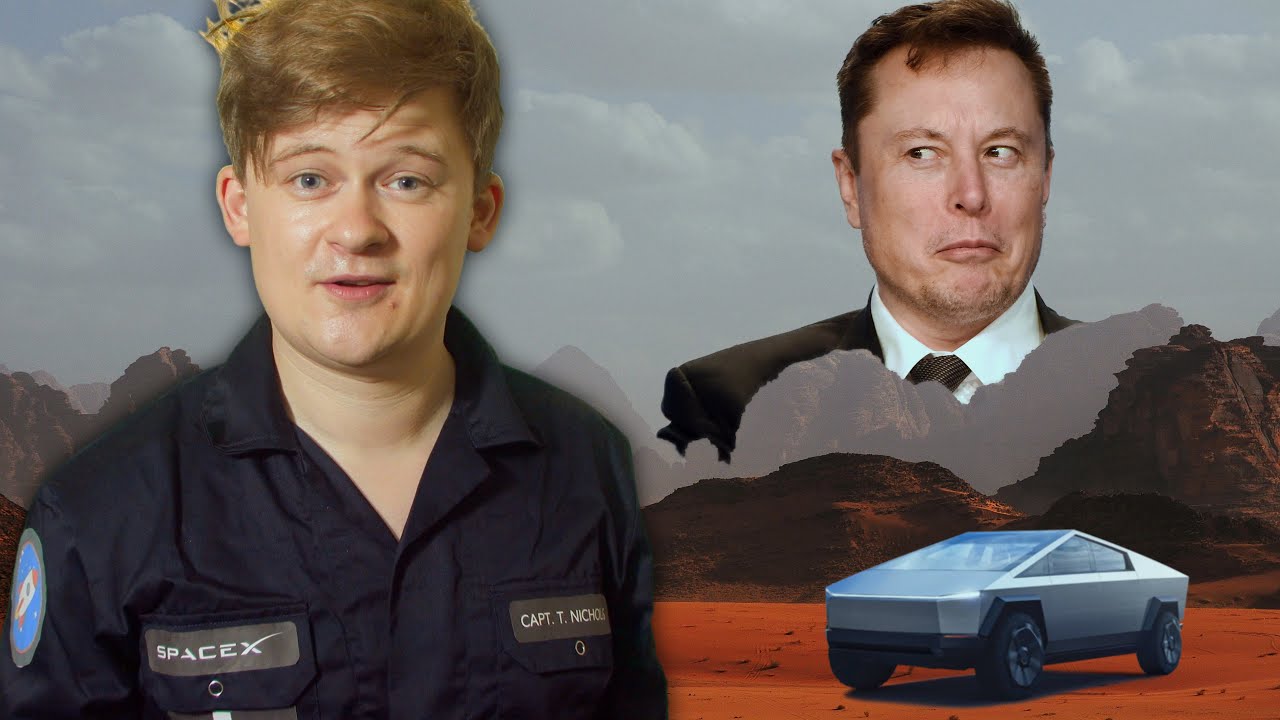
The video opens with a satirical sketch in which Tom Nicholas portrays "Captain Tom Nicholas," broadcasting live from SpaceX Mars Colony One, Codename: Eden—specifically stylized with "3"s instead of "e"s and an exclamation mark replacing the "n" (`3d3!`). It has been exactly 365 Earth-days since the spacecraft Dragon V touched down at the Eden Interplanetary Spaceport. According to the captain's deadpan report, life on the red planet is proceeding smoothly: automated water mines continue extracting ample moisture from the martian regolith, livestock and crops flourish inside climate-controlled agricultural biomes, and the initial wave of arrivals who landed as refugees are steadily transitioning into formal citizens.
Nicholas leans heavily into grandiose utopian marketing rhetoric, observing that whatever material creature comforts the colonists surrendered back on Earth are vastly outweighed by their newfound capacity to dream. In place of rising sea levels, ecological breakdown, and terrestrial despair, Mars offers a blank canvas for human aspiration and renewal. Yet the inspirational monologue builds directly toward an ironic punchline about the class reality underpinning this corporate frontier. As Tom Nicholas warmly invites everyone watching back home to participate in building humanity’s collective destiny, he reveals the steep admission barrier: “For the low, low price of just two million dollars.”
- **Colony Codename**: Eden (styled as `3d3!`, utilizing leetspeak "3"s for vowels and an exclamation mark for the terminal consonant). - **Milestone Date**: Exactly 365 Earth-days since the touchdown of the spacecraft Dragon V at Eden Interplanetary Spaceport. - **Colony Infrastructure**: Sub-surface water mines harvesting soil moisture alongside enclosed agricultural biomes sustaining crops and livestock. - **Ticket Price**: An upfront cost of two million dollars to secure passage and citizenship.
---
[01:49](https://www.youtube.com/watch?v=5OtKEetGy2Y&t=109s) The Polarizing Persona of Elon Musk and the Allure of Ambition
Online, Elon Musk serves as a relentless lightning rod for cultural debate. To his dedicated fanbase, he represents a modern incarnation of Tony Stark—an audacious industrial visionary possessing the swagger and technical drive required to pull technologies straight out of science fiction and manifest them in the physical world. Conversely, his detractors view him as a charlatan and a figure of mockery: a wealthy promoter who takes credit for the labor of his engineers while continually peddling inferior, half-baked solutions to problems that existing public infrastructure has already solved. Tom Nicholas notes that while commentators like Abigail Thorn (Philosophy Tube) have effectively dissected how Musk crafts a rebellious, counter-cultural persona while acting as an archetypical capitalist boss, this video aims to explore why his public pitch continues to hold such powerful resonance.
```mermaid flowchart TD accTitle: Silicon Valley Incrementalism vs Muskian Futurism accDescr: A comparison contrasting typical tech startup disruption with Elon Musk's grand proposals.
subgraph SV["Standard Tech Disruption"] direction TB A["Grand Disruptive Rhetoric"] --> B["Mundane Consumer Gadgets"] B --> C["e.g., Internet-Connected Microwaves"] end
subgraph MF["Muskian Futurism"] direction TB D["Audacious Speculative Scale"] --> E["Planetary & Civilizational Ambition"] E --> F["Subterranean Boring, Neural Links & Mars Colonies"] end ```
Musk distinguishes himself from his Silicon Valley contemporaries through his unapologetic, full-throated belief in the future. Typical modern tech entrepreneurs constantly invoke buzzwords like "disruption," claiming their newly launched ventures will fundamentally revolutionize the human experience, only to unveil trivial consumer commodities such as an internet-connected microwave. Musk, by contrast, tenders proposals that are visibly ambitious in scope. Critics may point out that boring an underground highway loop beneath a city does far less to ease traffic congestion and reduce carbon emissions than simply running extra municipal buses or subway cars each hour, yet the sheer scale of the concept captures the collective imagination. Nicholas introduces the concept of "Muskian Futurism" to examine the societal hunger his visions satisfy:
> “Whatever questions we might raise about Elon Musk's specific proposals for the future (and I will raise a few towards the end of this video), they're at least genuinely pretty bold.”
- **The Fan Archetype**: Celebrated as an eccentric industrial innovator and real-world Tony Stark bridging sci-fi into reality. - **The Detractor Stance**: Criticized for expropriating engineering labor and inventing overly complex private workarounds for solved civic problems. - **The Modern Disruption Paradox**: The sharp disconnect between high-minded Silicon Valley rhetoric and mundane market goods (e.g., smart home kitchen appliances). - **Central Premise**: To understand Musk’s cultural dominance, one must trace the historical evolution of how societies have conceptualized the idea of the future itself.
---
[05:35](https://www.youtube.com/watch?v=5OtKEetGy2Y&t=335s) Tesla, Henry Ford, and the Popularization of the Motorcar
While many of Musk’s speculative projects remain stalled at the concept phase, Nicholas highlights one tangible achievement that deserves genuine credit: the mainstream popularization of the electric vehicle (EV). Prior to Tesla's market dominance, battery-powered automobiles carried a distinct stigma. They were widely viewed as sluggish, visually unattractive, and profoundly uncool—the exact antithesis of the high-octane, combustion-engine machines glamorized in the *Fast & Furious* cinematic franchise or popular racing video games like *Gran Turismo*, *Forza*, and *Grand Theft Auto*. Tesla radically inverted that brand identity, making electric drivetrains synonymous with speed, sleek luxury, and cultural status.
Citing a 2019 academic paper on consumer adoption by Zoe Long et al., Nicholas emphasizes that Tesla succeeded primarily by transforming the cultural meaning of an existing mechanical concept:
> “Several participants explained that Tesla changed their perceptions that electric cars are slow, ugly, have limited range, and not fun to drive. Several participants noted that Tesla is 'cool' and that owning one communicates a symbolic message to others.”
This achievement places Musk in direct lineage with Henry Ford. Neither man invented the vehicle they became famous for; automobiles had already been manufactured and sold commercially for more than a decade before the Ford Motor Company was founded in 1903. Early cars were hand-crafted, temperamental, mechanically fragile playthings reserved strictly for the ultra-wealthy. With the introduction of the Model T in 1908, Ford turned the automobile into the default transportation mode of the burgeoning middle class.
Ford achieved this transition through organizational breakthroughs rather than pure engine mechanics, establishing standardized machine parts and the moving assembly line—a system later dubbed the "Fordist model of production." By deconstructing complex craftsmanship into discrete, repetitive tasks executed by specialized workers, Ford dramatically accelerated assembly times and reduced unit costs. In an identical fashion, Musk has relentlessly sought to maximize automated robotics in Tesla factories to lower production expenses and scale output. However, Nicholas argues that the most revealing parallel between Ford and Musk lies in the broader cultural spirit of the eras in which they operated.
| Dimension | Henry Ford & The Model T (1908) | Elon Musk & Tesla (2008–Present) | |:--- |:--- |:--- | | **Technological Precedent** | Automobiles existed commercially for over a decade. | Electric battery vehicles existed for decades prior. | | **Historical Preconception** | Fragile, costly, luxury playthings for the wealthy elite. | Sluggish, unattractive, uninspired eco-appliances. | | **Core Innovation** | The assembly line, standardized parts, and task specialization. | High-performance drivetrains, sleek design, and aggressive automation. | | **Cultural Shift** | Made the car the reliable transit standard of the middle class. | Made sustainable driving a prestigious, high-status cultural signifier. |
---
[08:53](https://www.youtube.com/watch?v=5OtKEetGy2Y&t=533s) Marinetti, Futurism, and the Century That Trusted in the Future
Two years after Ford rolled out the Model T in Detroit, Italian poet Filippo Tommaso Marinetti published *The Foundation and Manifesto of Futurism* on the front page of the French daily *Le Figaro* in 1909. Marinetti's tract attacked traditionalism, decrying society's "futile veneration for the past" while worshipping mechanical velocity, synthetic light, industrial machinery, creative destruction, and the uncharted potential of tomorrow. In doing so, Marinetti crystallized the emerging *Zeitgeist* of the early 20th century. Nicholas points out that human history has not always looked forward with eager expectation; traditional Christianity, for example, long interpreted the passage of chronological time as a tragic downward descent—a steady spiritual decline leading humanity away from the pristine grace of the Garden of Eden.
The dawn of the 20th century violently shattered that theological conservatism. Across culture, economics, and statecraft, societies developed an intense fascination with what lay ahead. Industrialists like Ford optimized factories to churn out cheaper, higher-quality commodities; avant-garde artistic movements released endless waves of manifestos demanding the destruction of classical rules; and ideological mass movements—including Communism, Fascism, and free-market liberal capitalism—each drafted blueprints to remake human existence from the ground up.
Nicholas draws upon Italian theorist Franco "Bifo" Berardi’s 2011 work *After the Future* to explain how the entire era operated under an unprecedented secular teleology:
> “He writes that 'the 20th century is pervaded by a religious belief in the future'.”
Even after European Fascism and Soviet Stalinism demonstrated the catastrophic horrors of mechanistic dogma, this faith in the future persisted throughout the post-war decades. It fueled the geopolitical Space Race, which envisioned humanity as an interplanetary species destined to colonize the cosmos, and prompted British Prime Minister Harold Wilson to proclaim that the nation would be forged anew in the "white heat" of a scientific revolution. This historical backdrop raises the central question of the essay: if bold, sweeping appeals to the future were the foundational currency of the entire 20th century, why does Elon Musk’s brand of techno-optimism feel like such an anomaly in our contemporary world?
- **The Futurist Manifesto (1909)**: Penned by Filippo Tommaso Marinetti and printed on the front page of *Le Figaro*, casting aside historical memory in favor of speed, technology, and violent forward momentum. - **The Christian Temporal Model**: Viewed time not as progress, but as a continuing metaphysical regression away from divine innocence and Edenic harmony. - **The Ideological Landscape**: Early 20th-century movements (capitalist industrialism, state socialism, and fascism) were all predicated on radical, structural visions of an engineered tomorrow. - **Post-War Technocracy**: Kept the futuristic flame alive via the Cold War Space Race and social-democratic modernization projects, such as Harold Wilson's 1963 "white heat" of technological revolution.
[12:23](https://www.youtube.com/watch?v=5OtKEetGy2Y&t=743s) The Slow Cancellation of the Future
Musk's readiness to dream up a world visibly different from our own stands out sharply against the broader backdrop of contemporary culture. To understand why his futurism feels so singular today, it is necessary to examine what Franco "Bifo" Berardi termed "the slow cancellation of the future." Beginning in the late 1970s and early 1980s, the unshakeable 20th-century belief in the future as a realm of boundless possibilities began to steadily decay, worn down by economic crises and cultural exhaustion.
This shift was felt most acutely in politics. Following her 1979 election as British Prime Minister, Margaret Thatcher popularized the slogan "There Is No Alternative." Together with Ronald Reagan in the United States, she pushed the idea that their neoliberal vision was not merely one political ideology among many, but the only rational way to organize society. This consensus solidified in 1989 with the fall of the Berlin Wall and the subsequent collapse of the Soviet Union, removing the primary existing geopolitical counterweight to global capitalism. Francis Fukuyama captured the spirit of this era when he famously declared "The End of History," pointing to:
> “the total exhaustion of viable systematic alternatives to Western liberalism”
as evidence of:
> “the end point of mankind's ideological evolution and the universalisation of Western liberal democracy as the final form of human government.”
With the end of history came the effective end of the future. Mainstream politics degenerated into mere technocratic administration: parties abandoned radical transformative projects and competed simply to appear as the least offensive, most capable managers of the existing order.
```mermaid flowchart TD accTitle: The Slow Cancellation of the Future accDescr: Timeline tracing the decline of future-oriented thinking from the late 1970s through the 2010s.
subgraph NeoliberalConsensus["Late 1970s–1980s: Neoliberal Turn"] direction TB A["Economic crises & social exhaustion"] --> B["Thatcher: 'There Is No Alternative'"] B --> C["Reagan & Thatcher install neoliberalism as singular logic"] end
subgraph EndOfHistory["1989–1990s: Post-Soviet Consensus"] direction TB D["Fall of Berlin Wall & USSR collapse"] --> E["Loss of real alternative to capitalism"] E --> F["Fukuyama: 'The End of History' & triumph of liberal democracy"] end
subgraph CulturalStagnation["2000s–2010s: Managerial Politics & Cultural Dread"] direction TB G["Managerial politics: Administrating the present status quo"] H["Cultural stagnation: Fisher's lost 'future shock' in music"] I["Dystopian media (Black Mirror, The Hunger Games)"] J["Climate emergency and planetary dread"] G ~~~ H ~~~ I ~~~ J end
NeoliberalConsensus --> EndOfHistory EndOfHistory --> CulturalStagnation ```
- In his 2014 book *Ghosts of My Life*, cultural theorist Mark Fisher traced how this political stagnation infected creative arts, noting that popular music lost the disruptive "future shock" that had marked the 1960s, 70s, and 80s. - Popular media in the late 2000s and 2010s shifted toward an active distrust of the future: anthology series like *Black Mirror* treated technological innovation as an inherently corrupting force. - Young adult fiction was swept by grim dystopias like *The Hunger Games* and *Divergent*, asking children to imagine futures where survival required brutal conflict among themselves. - Looming awareness of the climate crisis and systemic political inaction deepened this sense of paralysis: dreaming of tomorrow felt hollow when the planet itself appeared to have a terminal diagnosis.
[17:53](https://www.youtube.com/watch?v=5OtKEetGy2Y&t=1073s) Back to the Future
Despite the predictions of Berardi and Fisher that this generational despair would persist indefinitely, the future has recently staged a notable comeback. Fisher argued that the notion of youth automatically driving cultural reinvention had become outdated, assuming younger cohorts would absorb the ambient pessimism. Yet polling demonstrates that younger demographics are precisely those most receptive to forward-looking visions: a YouGov survey in the UK found that 46 percent of millennials held a positive opinion of Elon Musk, compared to just 22 percent of Gen Xers and only 15 percent of baby boomers.
Musk's appeal among millennials is not an isolated quirk, but part of a wider cultural appetite to break out of the post-1980s stupor. In politics, figures such as Bernie Sanders, Alexandria Ocasio-Cortez and "The Squad" in the United States, alongside Jeremy Corbyn in the UK, have attracted fervent youth followings by rejecting incremental status-quo adjustments and daring to project transformative social visions. Similar energy has surfaced through mass movements like Black Lives Matter, while the political right has presented its own reactionary visions through Donald Trump and post-Brexit British conservatism. In this landscape, Musk functions less as an eccentric outlier and more as a vessel for a generation eager to escape stagnation:
> “I think, in many regards, his appeal lies less in his specific proposals than in the more fundamental fact that he answers a contemporary desire to believe in the future again.”
- Generational support for Musk sharply inverts his own age bracket (49 at the time): millennials back him at more than double the rate of Gen X (22%) and triple that of baby boomers (15%). - The 2008 global financial crisis decisively shattered the neoliberal myth that the economic order was stable and self-regulating, opening space for renewed structural critique. - The shared ground between Muskian futurism and left-wing political revivals lies in their core premise: an insistence that the future can be fundamentally different from, and superior to, the present.
[21:31](https://www.youtube.com/watch?v=5OtKEetGy2Y&t=1291s) Muskian Futurism for Whom?
While Musk harnesses genuine utopian impulses, the material reality of his initiatives tells a very different story. A case in point arrived with the public rendering Musk shared of the Central Hall Station for the Las Vegas Convention Center "Loop." Mike Brown reported in *Inverse* that the underground tunnel was planned to transport 4,400 attendees per hour in one of two directions over a distance of nearly a mile. Critics immediately highlighted the profound geometric and logistical deficiencies of the design: individual passenger cars hold only five people, and even proposed higher-capacity pods hold around twelve, whereas standard metro trains easily transport well over 1,000 riders at a time.
This apparent inefficiency is frequently excused or misunderstood because the public assumes Musk shares a collective, egalitarian ideal. Popular culture reinforces this: a 2018 episode of *Star Trek: Discovery* casually grouped Musk with historical innovators. In *Four Futures*, Peter Frase analyzed the world of *Star Trek* as a post-scarcity communist society where hierarchy has been dissolved according to Karl Marx's maxim:
> “from each according to their ability, to each according to their need”
While Musk once cheekily labeled himself a socialist, his technological systems bear no resemblance to egalitarian public infrastructure. The extreme capacity limits of projects like the Loop are not technical oversights, but intentional design parameters:
> “This is not a mass public transportation system, this is a proposal for a series of gilded corridors which enable elites such as Musk to get to their destinations quicker”
- The Las Vegas Convention Center Loop design promises a throughput of 4,400 passengers per hour across roughly one mile. - Standard cars in the Loop convey just 5 passengers at a time, while proposed minivan-style pods seat 12—infinitesimal compared to standard municipal subways carrying 1,000+ passengers per train. - Public observers consistently err by viewing Musk's underground road tunnels and Martian colonization plans as universal goods, rather than infrastructure engineered exclusively for wealthy private elites.
[24:24](https://www.youtube.com/watch?v=5OtKEetGy2Y&t=1464s) Apocalypse Technology and the Cybertruck
The narrative shifts to the exclusionary nature of these futuristic visions. Rather than offering a democratic, utopian future for the masses, projects like Mars colonization serve as an escape hatch for a wealthy elite looking to avoid the catastrophic fallout of the climate crisis on Earth. This exclusionary, survivalist undercurrent is most visible in the design and marketing of the Tesla Cybertruck. While electric vehicles are traditionally framed as tools to mitigate environmental collapse, the Cybertruck—a supposedly bulletproof, solar-powered pickup—is built for a very different scenario. It is not designed to prevent the end of the world, but rather to navigate it.
During an appearance on *Jay Leno's Garage*, Musk explicitly embraced this dystopian framing. When discussing the vehicle's rugged, armored design, Musk stated, “we want to be a leader in apocalypse technology.” This admission reveals the true target demographic for Muskian futurism: an elite class equipped to traverse an ecologically devastated landscape while defending themselves against the inevitable hostility of those left behind.
```mermaid flowchart TD accTitle: The Shift in Muskian Technology accDescr: A flowchart showing the transition of Musk's projects from climate crisis prevention to elite survival.
A["Standard Electric Vehicles"] -->|"Goal"| B["Stave off climate crisis"] C["Muskian Futurism Projects"] -->|"Real Goal"| D["Escape / Survive the crisis"]
subgraph Escape ["Elite Survival Mechanisms"] E["Mars Colonies"] -->|"Purpose"| F["Escape Earth's climate devastation"] G["Tesla Cybertruck"] -->|"Purpose"| H["Traverse a hostile, ruined world"] end
D --> Escape ```
- **Mars Colonies:** Framed not as a grand leap for humanity, but as an escape pod for the wealthy to flee climate change. - **The Cybertruck:** A solar-powered, bulletproof electric pickup truck designed for post-apocalyptic survival. - **Apocalypse Technology:** Musk's self-proclaimed goal to lead in armored, survivalist consumer tech.
[25:27](https://www.youtube.com/watch?v=5OtKEetGy2Y&t=1527s) Who is the Future For?
In concluding his analysis, Nicholas acknowledges the powerful appeal of Muskian futurism. In an era marked by a "slow cancellation of the future," Musk's grand promises satisfy a deep, collective yearning to believe in progress and human ingenuity once again. However, the critical question we must ask of these projects is not whether they are technologically or logistically viable, but rather whom they are designed to serve.
Critiquing these corporate visions should not force us into a false binary where we must choose between a flawed future and a stagnant present. Nicholas argues that a genuinely better, democratic future is entirely possible if we can reclaim the narrative. As Nicholas puts it, “The challenge lies in trying to articulate one that is as bold as that offered by Elon Musk but is one in which we can all share.”
[26:19](https://www.youtube.com/watch?v=5OtKEetGy2Y&t=1579s) Outro and Acknowledgments
Nicholas wraps up the video essay by thanking his audience for tuning in to the broadcast. He encourages viewers who found the essay valuable or thought-provoking to share it with friends or anyone else who might appreciate the analysis.
He expresses deep gratitude to his top-tier Patreon supporters, whose financial contributions are essential for funding the research and production time required for these deep-dive videos. He invites others to join the community to gain early access to videos and scripts.
- **Top-Tier Patreon Supporters Named:** Michael V. Brown, J. Fraser Cartwright, Richard, Kaya Lau, LaLomi, David Brothers, and Chris Brown. - **Patreon Benefits:** Early access to videos, behind-the-scenes scripts, and direct support for independent video essays. - **Patreon URL:** patreon.com/tomnicholas
## Notable quotes > [08:53](https://www.youtube.com/watch?v=5OtKEetGy2Y&t=533s) the 20th century is pervaded by a religious belief in the future — Franco "Bifo" Berardi
## Mentioned Tom Nicholas, Elon Musk, SpaceX, Tesla, Neuralink, The Boring Company, Hyperloop, Tesla Cybertruck, Abigail Thorn, Philosophy Tube, Henry Ford, Ford Motor Company, Model T, Zoe Long, Filippo Tommaso Marinetti, The Foundation and Manifesto of Futurism, Franco "Bifo" Berardi, After the Future, Harold Wilson, Margaret Thatcher, Ronald Reagan, Francis Fukuyama, Mark Fisher, Ghosts of My Life, Black Mirror, The Hunger Games, Divergent, YouGov, Bernie Sanders, Alexandria Ocasio-Cortez, The Squad, Jeremy Corbyn, Black Lives Matter, Donald Trump, Mike Brown, Inverse, Star Trek: Discovery, Peter Frase, Four Futures, Karl Marx, Jay Leno's Garage
## Video description Watch this video ad-free on Nebula: https://nebula.tv/videos/tom-nicholas-the-fake-futurism-of-elon-musk
A video about Elon Musk and the future.
Timestamps:
0:00 SpaceX Mars 01:49 Introduction 05:35 Tesla, Ford and A Tale of Two Cars 08:53 Futurism 13:00 The Slow Cancellation of the Future 17:53 Back to the Future 21:31 Muskian Futurism for Whom?
There's perhaps already a distinct "Elon Musk Video Essay" genre here on YouTube. Hopefully, though, this takes a different approach to those which are already out there.
Rather than focussing on I take a look at why Elon Musk has become such a revered figure in recent years and why so many people have embraced Elon Musk's Loop, Tesla, Hyperloop, Spacex, Mars Mission, Neuralink and other projects.
Drawing partly on the work of Mark Fisher and Franco "Bifo" Birardi, I consider how human perceptions of the future (at least in the advanced capitalist nations) have changed over time. In particular, I'm interested in how Elon Musk's rise might be read as a response to what Birardi and Fisher refer to as the "Slow Cancellation of the Future" during the ascendency of neoliberalism (or neoliberal capitalism) in the 1970s, 80s, 90s and 2000s.
I also argue that Elon Musk might have more than a little in common with figures in the political sphere such as Bernie Sanders, Alexandria Ocasio Cortez (AOC) and "The Squad", Jeremy Corbyn etc. who have also recently sought to break from the status quo and invited us to imagine bold new futures.
Support the channel on Patreon at http://patreon.com/tomnicholas
If you've enjoyed this video and would like to see more including my What The Theory? series in which I provide some snappy introductions to key theories in the humanities as well as video essays and more then do consider subscribing.
Thanks for watching!
Twitter: http://twitter.com/tom_nicholas Instagram: http://instagram.com/tomnicholaswtf Patreon: http://patreon.com/tomnicholas Website: http://www.tomnicholas.com/
#ElonMusk #SpaceX #Neuralink
[Source](https://www.youtube.com/watch?v=5OtKEetGy2Y)