Svoboda Takes Ukraine Defense Ministry as Paramilitaries Patrol Kyiv
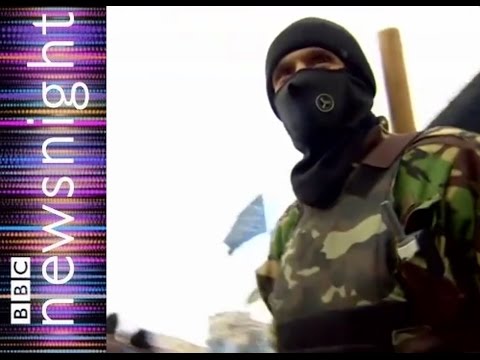
BBC Politics
Leading the violent street battles that toppled Viktor Yanukovych converted fringe nationalist factions into legitimate power brokers, delivering armed militias control of the capital and Svoboda key cabinet seats.
AI-assisted summary of Neo-Nazi threat in new Ukraine: NEWSNIGHT — original source. Check the original for full context.
Source published:
Key ideas
- Far-right paramilitary groups, notably Right Sector and C14, have maintained an armed street presence in Kyiv following the collapse of Viktor Yanukovych's government. (0:02)
- The nationalist Svoboda party secured four cabinet positions in Ukraine's interim government, including the Ministry of Defense, despite ongoing controversies regarding neo-Nazi symbolism among its members. (4:44)
- With regular police largely absent from Kyiv's streets, ad-hoc nationalist self-defense groups have assumed public order duties, leveraging their frontline role during the revolution to claim political legitimacy. (3:16)
- Rising geopolitical tensions in Crimea and southern Ukraine are expected to further bolster the political standing and street influence of Ukrainian ultra-nationalist organizations. (4:44)
Detailed notes
## Background Published on YouTube by BBC Politics on February 28, 2014, this report features BBC Newsnight correspondent Gabriel Gatehouse. According to the page description, the investigation examines the links between Ukraine's newly established interim government and far-right neo-Nazi factions.
## TL;DR Following the ouster of President Viktor Yanukovych, far-right paramilitary organizations like Right Sector and C14 established a heavy armed street presence across Kyiv, filling the void left by absent police forces. While everyday citizens drove the broader revolution, radical ultra-nationalists gained widespread visibility and perceived legitimacy by spearheading physical street clashes with state security. Through an on-the-ground interview with C14 leader Yevhen Karas inside a seized building, the report reveals explicit ethnic grievances directed against Russians, Jews, and Poles. Furthermore, it traces the institutional ascent of the far right, examining the Svoboda party's acquisition of four interim cabinet posts, including the Ministry of Defense.
## Atmosphere & style The broadcast opens with a somber, uneasy mood, juxtaposing floral memorials and the strains of Beethoven on Independence Square with the unsettling presence of masked street patrols displaying World War II SS emblems. Gatehouse's investigative approach is deliberate and probing, conducting clandestine, late-night interviews inside occupied government spaces to press ideologues directly on their extremist associations. Watching the footage evokes a palpable sense of post-revolutionary volatility, where the fresh optimism of civic protest is shadowed by armed radical squads staking claim to political legitimacy.
## Bulletin - [00:02](https://www.youtube.com/watch?v=5SBo0akeDMY&t=2s) Far-right paramilitary groups, notably Right Sector and C14, have maintained an armed street presence in Kyiv following the collapse of Viktor Yanukovych's government. - [04:44](https://www.youtube.com/watch?v=5SBo0akeDMY&t=284s) The nationalist Svoboda party secured four cabinet positions in Ukraine's interim government, including the Ministry of Defense, despite ongoing controversies regarding neo-Nazi symbolism among its members. - [03:16](https://www.youtube.com/watch?v=5SBo0akeDMY&t=196s) With regular police largely absent from Kyiv's streets, ad-hoc nationalist self-defense groups have assumed public order duties, leveraging their frontline role during the revolution to claim political legitimacy. - [04:44](https://www.youtube.com/watch?v=5SBo0akeDMY&t=284s) Rising geopolitical tensions in Crimea and southern Ukraine are expected to further bolster the political standing and street influence of Ukrainian ultra-nationalist organizations.
## Key takeaways - [00:02](https://www.youtube.com/watch?v=5SBo0akeDMY&t=2s) While everyday citizens composed the vast majority of the revolution, far-right organizations were the most organized and aggressive factions during violent confrontations with police. - [00:02](https://www.youtube.com/watch?v=5SBo0akeDMY&t=2s) Paramilitary groups patrolling Kyiv's Independence Square openly displayed extremist emblems, including the Wolfsangel armband historically associated with World War II SS divisions. - [00:02](https://www.youtube.com/watch?v=5SBo0akeDMY&t=2s) Right Sector established an active, armed presence across the capital, armed with baseball bats and firearms while maintaining a base at their former headquarters. - [03:16](https://www.youtube.com/watch?v=5SBo0akeDMY&t=196s) The disappearance of standard police forces from Kyiv created a power vacuum filled by self-defense vigilante units. - [03:16](https://www.youtube.com/watch?v=5SBo0akeDMY&t=196s) The extremist group C14 established its operating headquarters inside the seized former office of the Communist Party. - [03:16](https://www.youtube.com/watch?v=5SBo0akeDMY&t=196s) C14 leader Yevhen Karas framed his organization's mission as severing historical and imperial connections to both Russia and the Soviet Union. - [03:16](https://www.youtube.com/watch?v=5SBo0akeDMY&t=196s) Karas rejected the 'Nazi' label, defining his Ukrainian nationalism through grievances over non-Ukrainian ethnic groups—specifically naming Russians, Jews, and Poles—holding economic and political power. - [04:44](https://www.youtube.com/watch?v=5SBo0akeDMY&t=284s) C14 claims a membership of around 200 fighters and maintains close organizational ties to the parliamentary nationalist party Svoboda. - [04:44](https://www.youtube.com/watch?v=5SBo0akeDMY&t=284s) Svoboda achieved major executive influence in the post-uprising interim government by taking control of four ministries, including Defense. - [04:44](https://www.youtube.com/watch?v=5SBo0akeDMY&t=284s) Svoboda's transition into mainstream governance is shadowed by controversy, including parliamentarians photographed using the neo-Nazi numerical code '88'. - [04:44](https://www.youtube.com/watch?v=5SBo0akeDMY&t=284s) Svoboda representatives deny fascist ideology, arguing they oppose both Nazism and communism as twin totalitarian systems that historically devastated Ukraine. - [04:44](https://www.youtube.com/watch?v=5SBo0akeDMY&t=284s) Participation in violent clashes transformed once-marginalized radical factions into actors perceived as central to the revolution, granting them significant popular legitimacy to influence governance.
## Detailed walkthrough ### [00:02](https://www.youtube.com/watch?v=5SBo0akeDMY&t=2s) Far-Right Symbols and Paramilitary Groups on Independence Square
In the wake of the revolution, the defiant speeches across Kyiv's Independence Square have given way to the somber strains of Beethoven, signaling that the uprising is entering a new phase. Yet amid the floral tributes and children's memorials left in the square, darker and more sinister elements have surfaced. Paramilitary squads of armed men patrol the square carrying dubious iconography; one visible symbol is the yellow armband bearing the Wolfsangel, a German heraldic emblem utilized by several SS divisions during World War II. Far-right graffiti has simultaneously begun appearing across the city's walls.
While the movement that toppled the administration of Viktor Yanukovych was overwhelmingly composed of everyday Ukrainians—students, medical doctors, factory workers, and families who simply refused to yield to the state—the most organized and effective participants in the streets were a small cadre of far-right organizations. Whenever street battles with the police erupted, it was frequently these ultra-nationalist factions who proved to be the loudest and most aggressive.
Foremost among these factions is Right Sector (Pravy Sektor). Columns of roughly a dozen Right Sector fighters can be seen marching through Kyiv, mostly outfitted with baseball bats and, in some instances, firearms. Outside the charred remains of their former headquarters, members gather to pose for photographs, projecting a hardened street presence as they maintain an armed footprint in the heart of the capital.
[03:16](https://www.youtube.com/watch?v=5SBo0akeDMY&t=196s) Inside C14: Extremist Ideology and Ethnic Grievance
Across Kyiv, regular police units have virtually vanished from public view, leaving day-to-day law and order in the hands of ad-hoc "self-defense" groups. While not all of these volunteer vigilantes harbor extreme ideologies, those who do often avoid cameras and media scrutiny. Following a late-night phone call, an invitation is extended to meet the leadership of another far-right group, C14, at their newly claimed base of operations: the seized former headquarters of the Communist Party.
Speaking from inside the captured building, C14 leader Yevhen Karas frames the movement's objectives around breaking away from past imperial dominion: “It's our general mission to totally ruin uh chains that connect our country with the imperial power from the past.” When asked whether that past imperial force is Russia, Karas clarifies: “Yes, we can Russia, not only Russia, Soviet Union.”
When asked point-blank whether he is a Nazi, Karas rejects the label, stating: “Uh no, I don't think I'm a Nazi. I'm a Ukrainian nationalist.” When pressed on what that distinction means in practice, he outlines an ethnically based economic grievance: > “The main confrontation is uh about that some ethnic groups uh have u control many business structures, some economics, some political forces and uh... Russians and Jews and Poles maybe every some non-Ukrainians group control huge percent of some economic or politional power and of course in this situation Ukrainian people have some uh tension between it and it cause a conflict.”
[04:44](https://www.youtube.com/watch?v=5SBo0akeDMY&t=284s) Institutional Legitimacy and Political Power in the New Government
Yevhen Karas claims that C14 commands roughly 200 men. The group maintains direct ties to Svoboda (Freedom), an established nationalist political party that has secured significant executive power in the post-revolution interim government, controlling four cabinet ministries, including the Ministry of Defense. Svoboda's mainstream integration exists alongside persistent extremist controversies; two of its Members of Parliament were recently photographed displaying "88," a well-documented neo-Nazi numerical code for the eighth letter of the alphabet, representing "Heil Hitler."
```mermaid flowchart TD accTitle: Far-Right Factions and Post-Revolution Power Structure accDescr: Diagram illustrating the link between street-level far-right paramilitaries, political parties, and state authority in Ukraine.
subgraph StreetLevel ["Street-Level Militias"] RS["Right Sector (Pravy Sektor)<br/>Paramilitary street patrols"] C14["C14 (approx. 200 fighters)<br/>Occupying Communist Party HQ"] end
subgraph PoliticalParty ["Parliamentary Politics"] SV["Svoboda Party (Freedom)<br/>Far-right party linked to C14"] end
subgraph StatePower ["New Interim Government"] MIN["4 Cabinet Ministries<br/>Including Ministry of Defense"] end
C14 -->|"Affiliated with"| SV SV -->|"Holds executive power"| MIN ```
Svoboda representatives vigorously deny harboring Nazi sympathies. Emphasizing their rejection of totalitarianism, a party spokesman counters: > “We as in in no way espouse Nazi Nazism. In fact, we fight against Nazism. For us, Nazism and communism are two sides of the same coin. Those are both totalitarian ideologies which destroyed Ukrainian nation in the 20th century and fought against Ukrainians and killed millions of Ukrainians.”
As the revolutionary fervor begins to ebb and daily life resumes, Ukrainian politics remains in heavy flux, with rival factions jockeying for position. Left-wing activists have seized certain municipal and government spaces, but right-wing forces retain the dominant momentum. Because the radicals spearheaded the physical resistance against Yanukovych, they view the triumph as their own. As one analyst explains, the violence shifted their standing: > “Uh when the fighting started, they started to attract more and more young people and and then not only young people but all kinds of of persons where they were marginal, regarded as marginal previously. Now they are seen as being at the core of rep of the protest and therefore at the core of those who now have a popular legitimacy to make decisions.”
With escalating tensions in Crimea and deep-seated anti-Russian sentiments, developments in the east and south will likely further empower Ukrainian ultra-nationalists. Though their precise headcounts remain uncertain, the political and street influence of Ukraine's far right is unmistakably expanding.
## Notable quotes > [04:44](https://www.youtube.com/watch?v=5SBo0akeDMY&t=284s) For us, Nazism and communism are two sides of the same coin. Those are both totalitarian ideologies which destroyed Ukrainian nation in the 20th century and fought against Ukrainians and killed millions of Ukrainians. — Svoboda spokesman
## Mentioned BBC Newsnight, Gabriel Gatehouse, Viktor Yanukovych, Right Sector (Pravy Sektor), C14, Yevhen Karas, Svoboda, Independence Square (Kyiv), Ministry of Defense (Ukraine), Communist Party, Crimea, Ludwig van Beethoven
## Video description BBC Newsnight's Gabriel Gatehouse investigates the links between the new Ukrainian government and Neo-nazis
[Source](https://www.youtube.com/watch?v=5SBo0akeDMY)