Why is there no equation for the perimeter of an ellipse‽
Why is there no equation for the perimeter of an ellipse‽ — Stand-up Maths

Stand-up Maths

AI-assisted summary of Why is there no equation for the perimeter of an ellipse‽ — original source. Check the original for full context.

Source published:

Key ideas

  • Unlike its area formula (πab), an ellipse possesses no closed-form elementary equation for its perimeter, requiring reliance on approximations or infinite series. (0:00)
  • Srinivasa Ramanujan developed two famous perimeter approximations; his second formula, incorporating the auxiliary parameter h, is roughly 1,000 times more accurate than standard algebraic approaches. (10:00)
  • Using brute-force computer optimization, Matt Parker derived a custom formula that outperforms Ramanujan's first approximation at axis ratios above 2.4, as well as a simplified 'lazy' root-free formula bounded under 6.1% error. (8:00)
  • Matt Parker points out that the familiar circular circumference formula (2πr) is conceptually an illusion of simplicity, as the infinite series inherent to curve rectification is merely hidden inside the definition of π. (13:30)

Detailed notes

## Background This video was published on YouTube by Matt Parker on his channel Stand-up Maths on September 5, 2020. The page description explains that the video explores why there is no simple elementary equation for the perimeter of an ellipse, introduces Parker's own approximation equations, and invites viewers to submit improved approximations to his puzzle channel while featuring a charity auction and links to his podcast.

## TL;DR Matt Parker investigates the surprising mathematical fact that while the area of an ellipse has a neat closed formula, its perimeter cannot be expressed with standard elementary equations and requires infinite series or approximations. He evaluates classic historical estimates, including Kepler's geometric mean and Srinivasa Ramanujan's remarkably accurate formulas, before using computational brute force to craft his own competing equation. Parker then develops an intentionally simple, root-free 'lazy' approximation that stays remarkably accurate across wide aspect ratios, ultimately revealing that even the familiar perimeter formula for a circle merely hides an infinite series behind the constant π.

## Atmosphere & style The presentation is energetic, comedic, and charmingly self-deprecating, blending genuine mathematical enthusiasm with playful silliness. Parker balances rigorous graphical error analyses against lighthearted admissions of laptop-assisted brute force and petty computational rivalry with Ramanujan. The pacing feels informal yet intellectually engaging, punctuated by musical community parodies and the cozy, lively vibe of a passionate science communicator having fun with numbers.

## Bulletin - [00:00](https://www.youtube.com/watch?v=5nW3nJhBHL0&t=0s) Unlike its area formula (πab), an ellipse possesses no closed-form elementary equation for its perimeter, requiring reliance on approximations or infinite series. - [10:00](https://www.youtube.com/watch?v=5nW3nJhBHL0&t=600s) Srinivasa Ramanujan developed two famous perimeter approximations; his second formula, incorporating the auxiliary parameter h, is roughly 1,000 times more accurate than standard algebraic approaches. - [08:00](https://www.youtube.com/watch?v=5nW3nJhBHL0&t=480s) Using brute-force computer optimization, Matt Parker derived a custom formula that outperforms Ramanujan's first approximation at axis ratios above 2.4, as well as a simplified 'lazy' root-free formula bounded under 6.1% error. - [13:30](https://www.youtube.com/watch?v=5nW3nJhBHL0&t=810s) Matt Parker points out that the familiar circular circumference formula (2πr) is conceptually an illusion of simplicity, as the infinite series inherent to curve rectification is merely hidden inside the definition of π.

## Key takeaways - [00:00](https://www.youtube.com/watch?v=5nW3nJhBHL0&t=0s) An ellipse generalizes a circle with semi-major axis a and semi-minor axis b, but lacks a clean closed-form elementary formula for its perimeter despite having a simple area formula (πab). - [00:40](https://www.youtube.com/watch?v=5nW3nJhBHL0&t=40s) The geometric properties of an ellipse depend on auxiliary terms like the parameter h = ((a - b)/(a + b))^2 and the eccentricity e = sqrt(a^2 - b^2)/a. - [04:00](https://www.youtube.com/watch?v=5nW3nJhBHL0&t=240s) Johannes Kepler originally had to rely on approximations rather than exact formulas to compute the orbital paths and distances of planets. - [05:00](https://www.youtube.com/watch?v=5nW3nJhBHL0&t=300s) The naive arithmetic mean approximation P ≈ π(a + b) stays under 10% error up to an axis ratio of roughly 4.8, while the geometric mean performs significantly worse. - [06:00](https://www.youtube.com/watch?v=5nW3nJhBHL0&t=360s) The root mean square approximation P ≈ 2π*sqrt((a^2 + b^2)/2), often incorrectly assumed to be exact, achieves under 7.8% error at an aspect ratio of 5 and stays under 10% past a ratio of 10. - [07:00](https://www.youtube.com/watch?v=5nW3nJhBHL0&t=420s) Ramanujan's first perimeter approximation vastly outperforms basic means, keeping percentage error below 0.015% across aspect ratios from 1 to 5. - [08:00](https://www.youtube.com/watch?v=5nW3nJhBHL0&t=480s) Using a laptop to run brute-force numerical searches, Matt Parker derived an oscillatory approximation formula that surpasses Ramanujan's first formula for aspect ratios exceeding 2.4. - [10:00](https://www.youtube.com/watch?v=5nW3nJhBHL0&t=600s) Ramanujan's second approximation, which relies on parameter h, proves approximately 1,000 times more accurate than both Ramanujan's first formula and Parker's optimized formula. - [11:10](https://www.youtube.com/watch?v=5nW3nJhBHL0&t=670s) Matt Parker's root-free 'lazy approximation' P ≈ π(1.2a + 0.75b) avoids roots entirely and never exceeds 6.1% error across any aspect ratio. - [13:30](https://www.youtube.com/watch?v=5nW3nJhBHL0&t=810s) True perimeter calculation requires evaluating an infinite series in powers of h, such as P = π(a + b)[1 + (1/4)h + (1/64)h^2 + ...]. - [14:15](https://www.youtube.com/watch?v=5nW3nJhBHL0&t=855s) The apparent neatness of the circle circumference formula 2πr merely sweeps an infinite series under the definition of π, meaning circles are fundamentally as messy as ellipses. - [17:00](https://www.youtube.com/watch?v=5nW3nJhBHL0&t=1020s) Community contributions in prime hunting yielded two massive new primes where tan(p) > p, containing 1,017 digits and 35,085 digits respectively.

## Detailed walkthrough ### [00:00](https://www.youtube.com/watch?v=5nW3nJhBHL0&t=0s) Definitions and the Missing Formula

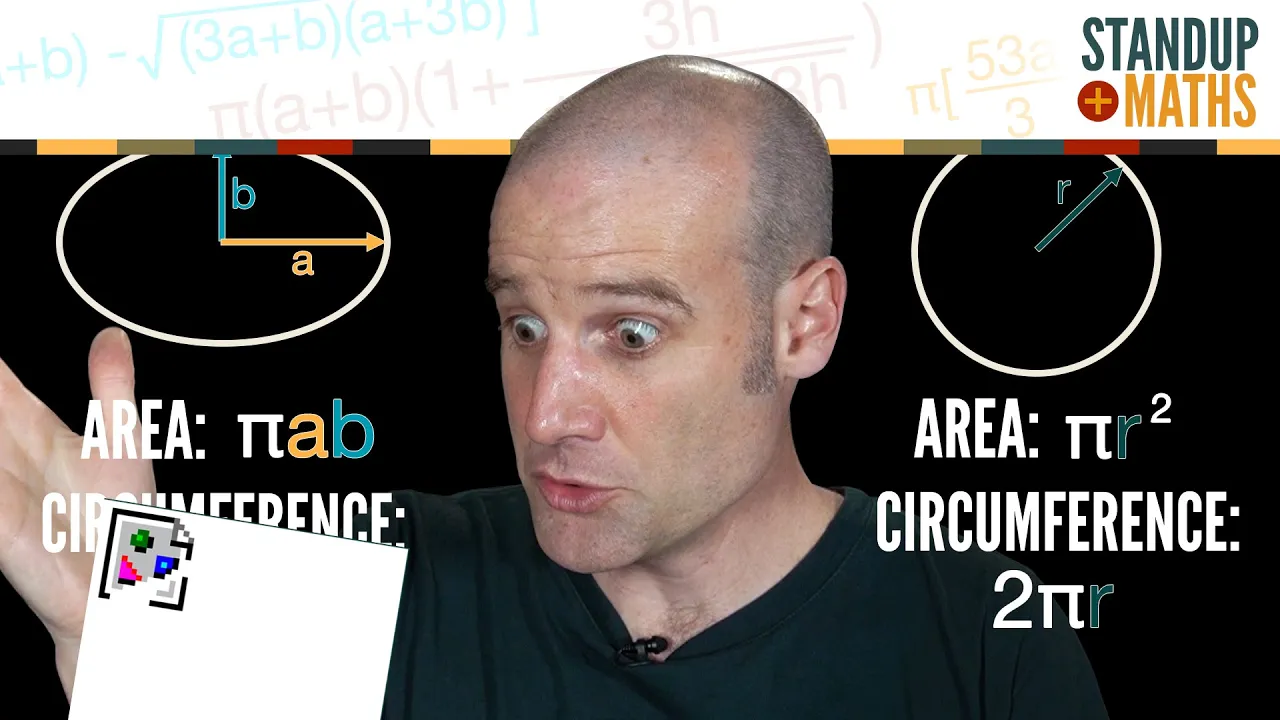
Matt Parker introduces the ellipse as a generalized circle: while a standard circle relies on a single radius $r$, an ellipse features both a semi-major axis $a$ and a semi-minor axis $b$. The area generalizes cleanly from $\pi r^2$ ($r \times r$) to $\pi a b$. However, while the perimeter (circumference) of a circle is simply $2\pi r$, there is no neat, closed-form elementary equation for the perimeter of an ellipse. Matt reacts with utter shock: “There's no neat equation for the perimeter of an ellipse. It's insane!”

Before diving into the problem, Matt outlines the key parameters and geometry associated with ellipses: - **Major and Minor Axes ($a$ and $b$):** The longest and shortest semi-diameters of the ellipse. Throughout his analysis, Matt treats $b = 1$ to express everything as an axis ratio $a/b$, noting that any resulting perimeter can simply be scaled by multiplying by the actual value of $b$. - **Auxiliary Parameter $h$:** Defined algebraically as $h = \frac{(a - b)^2}{(a + b)^2}$. While admitting he doesn't know its direct physical meaning, Matt points out that it proves extraordinarily handy in subsequent elliptical calculations. - **Eccentricity ($e$):** Defined algebraically as $e = \frac{\sqrt{a^2 - b^2}}{a}$. This serves as a geometric metric of deviation from circularity; an eccentricity of $0$ corresponds to a circle, while values approaching $1$ represent increasingly extreme, flattened ellipses. - **Focal Points and String Construction:** Unlike a circle (which has a single center point), an ellipse has two focal points. An ellipse is defined as the locus of all points where the sum of the distances to both foci is constant. This allows anyone to construct an ellipse by tethering a fixed length of string between two pins at the focal points and tracing around them with a pencil. Furthermore, if $c$ represents the distance from the center to either focal point, the eccentricity is simply $e = c / a$.

Matt mentions that Jane Street is the principal sponsor of the Stand-up Maths channel, highlighting open applications for paid internships across New York, Hong Kong, and London, before returning to the mystery of the missing perimeter formula. The spark came from an email sent by a viewer named David, who expressed pure bewilderment that no well-defined formula exists. When Matt rushed over to tell his wife, Lucie Green, her immediate reaction was: “'But what about orbits?'” As it turns out, Johannes Kepler himself had to rely on approximations to calculate the orbital paths and travel distances of planets.

```mermaid flowchart TD accTitle: Parameters of an Ellipse accDescr: Diagram showing how semi-axes a and b define the perimeter problem, auxiliary parameters, and physical focal properties. subgraph Axes["Primary Dimensions"] A["Semi-major axis (a)"] B["Semi-minor axis (b)"] end

subgraph Derived["Derived Parameters"] H["h = (a - b)² / (a + b)²"] E["Eccentricity: e = √(a² - b²) / a"] C["Center-to-focus distance (c): e = c / a"] end

subgraph Perimeter["Perimeter Problem"] NoEq["No elementary exact formula"] Approx["Approximations required (e.g. Kepler)"] end

A --> H B --> H A --> E B --> E E --> C A --> NoEq B --> NoEq NoEq --> Approx ```

---

[05:00](https://www.youtube.com/watch?v=5nW3nJhBHL0&t=300s) Classic Approximations and Ramanujan’s Formula

Matt begins testing classic approximations across a standard aspect ratio range running from $a/b = 1$ (a perfect circle) up to $a/b = 5$ (an ellipse five times as long as it is wide). The baseline approaches yield mixed results: - **Arithmetic Mean Approximation:** Averaging the two axes gives an effective radius $r_{\text{avg}} = \frac{a + b}{2}$, leading to $P \approx 2\pi\left(\frac{a + b}{2}\right) = \pi(a + b)$. This naive formula performs reasonably well initially, staying under a $10\%$ percentage error until the ratio reaches approximately $4.8$. - **Geometric Mean Approximation:** Using the geometric mean $\sqrt{ab}$ as the radius (a method believed to have been used by Kepler) performs substantially worse, with the error curve rocketing past $15\%$ at an axis ratio of just $2.63$. - **Root Mean Square (RMS) Approximation:** Taking the square root of the average of the squares, $\sqrt{\frac{a^2 + b^2}{2}}$—a formula often mistakenly claimed online to be the exact perimeter—fares far better than the arithmetic mean. At an aspect ratio of $5$, its error is only $7.8\%$, and it stays under $10\%$ error until the ratio surpasses $10$.

After a brief musical interlude (“A total ellipse of the chart”), Matt introduces an approximation discovered by Srinivasa Ramanujan: $$P \approx \pi \left[ 3(a + b) - \sqrt{(3a + b)(a + 3b)} \right]$$ Plotting Ramanujan’s formula requires shifting the error plot's vertical axis down by a factor of 1,000—now measuring tiny fractions of a percent ($0.005\%$, $0.01\%$, and $0.015\%$). Matt praises this incredible accuracy, noting that “Ramanujan, as always, has come up with the good.”

| Approximation Formula | Type / Description | Error Behavior ($a/b$ from 1 to 5) | |:--- |:--- |:--- | | $P \approx \pi(a + b)$ | Arithmetic Mean | Stays under $10\%$ error until $a/b \approx 4.8$ | | $P \approx 2\pi\sqrt{ab}$ | Geometric Mean (Kepler) | Degrades quickly; exceeds $15\%$ error at $a/b = 2.63$ | | $P \approx 2\pi\sqrt{\frac{a^2 + b^2}{2}}$ | Quadratic Mean / RMS | Only $7.8\%$ error at ratio $5$; stays under $10\%$ past ratio $10$ | | $P \approx \pi [3(a+b) - \sqrt{(3a+b)(a+3b)}]$ | Ramanujan's First Approximation | Extremely low error; stays under $0.015\%$ across the range |

---

[08:00](https://www.youtube.com/watch?v=5nW3nJhBHL0&t=480s) Matt's Computational Formula

Matt points out that while he lacks Ramanujan’s generational genius, he possesses modern computational firepower: “Here's the thing, for all of Ramanujan's incredible once-in-a-generation genius and just mathematical insight, I've got something that they didn't have. I've got a laptop.”

Using brute-force optimization code to search for an equivalent or superior approximation, Matt arrived at his own custom formula: $$P \approx \pi \left[ \frac{53a}{3} + \frac{717b}{35} - \sqrt{269a^2 + 667ab + 371b^2} \right]$$

When plotted against Ramanujan’s formula, Matt’s curve shows distinct characteristics: - At lower aspect ratios close to a circle ($a/b$ near $1$), Ramanujan’s approximation is distinctly superior. - Instead of curving steadily upwards, Matt's error graph oscillates, bouncing along the axis. Because the plot tracks absolute percentage error, these bounces represent zero-crossings where the formula alternates between slightly overestimating and slightly underestimating the true perimeter. - At an aspect ratio of approximately $2.4$, the curves cross: “the tide starts to turn at a value of 2.4. And after that, my formula does better.” - Matt designed the formula deliberately so that its oscillations keep the absolute error lower over a broader span, outperforming Ramanujan when averaged over the entire range of ratios from $1$ to $5$.

[10:00](https://www.youtube.com/watch?v=5nW3nJhBHL0&t=600s) Ramanujan’s Second Approximation and Matt’s Lazy Formula

Matt Parker compares his own formula to Srinivasa Ramanujan's first approximation, noting that on average his formula performs roughly twice as well in absolute error terms. However, he acknowledges that Ramanujan's formula has aesthetic and practical advantages: Ramanujan's is symmetric (the semi-major axis $a$ and semi-minor axis $b$ can be swapped interchangeably), whereas Matt's requires $a$ to strictly be the larger value. Matt's pride is quickly tempered by Ramanujan’s second approximation: $$\text{Perimeter} \approx \pi (a + b) \left( 1 + \frac{3h}{10 + \sqrt{4 - 3h}} \right) \quad \text{where } h = \frac{(a - b)^2}{(a + b)^2}$$ When plotted on the error graph, Ramanujan’s second approximation appears as an almost flat line along the bottom of the chart. It is roughly 1,000 times more accurate than both Ramanujan's first formula and Matt's formula, prompting Matt to concede: “So once again, well played Ramanujan, well played. There's nothing I can say, a total ellipse of the chart.” Anticipating that viewers will label his slightly flawed formula the "Parker Ellipse Approximation," he decides to lean into the concept and design an intentionally "lazy" approximation that avoids square roots entirely.

```mermaid flowchart TD accTitle: Comparison of Ellipse Perimeter Approximations accDescr: Flowchart contrasting Ramanujan's high-precision second formula with Parker's low-computation lazy formula. subgraph Ramanujan["Ramanujan's Approach"] R2["Second Approximation<br/>Uses h parameter & square root"] R2Perf["~1,000x more accurate<br/>Virtually flat line on chart"] end subgraph Parker["Parker's Lazy Approach"] PLazy["Formula: π(1.2a + 0.75b)"] PPerf["No roots needed<br/>Never exceeds 6.1% error"] end R2 --> R2Perf PLazy --> PPerf ```

His lazy approximation formula is: $$\text{Perimeter} \approx \pi (1.2a + 0.75b) = \pi \left(\frac{6}{5}a + \frac{3}{4}b\right)$$ Plotted against the other simple methods, it initially underestimates the perimeter, crosses zero, and then becomes an overestimation. When the aspect ratio axis is expanded from 1 to 20, the formula demonstrates impressive stability: - It starts with an error of $2.5\%$ for a circle ($a = b$). - It dips, crosses zero, and climbs back to $2.5\%$ error. - It stays under $2.5\%$ error until the ratio reaches $a/b = 14.4$. - It does not hit a $5\%$ error until an aspect ratio greater than $75$, with Matt asking, “and who's having an ellipse which is 75 times as wide as it is high. That's just ridiculous.” - Across all aspect ratios, the lazy formula never yields an error worse than $6.1\%$. - Matt notes that picking messier non-round decimal coefficients instead of $1.2$ and $0.75$ could optimize accuracy even further without adding computational complexity.

---

[13:30](https://www.youtube.com/watch?v=5nW3nJhBHL0&t=810s) Infinite Series and the Reality of $\pi$

To compute the "true" perimeter of an ellipse, one cannot rely on standard closed-form algebraic expressions; an infinite series is required. Matt shares his favorite series expansion, which relies on the factor $\pi(a+b)$ and powers of $h$: $$\text{Perimeter} = \pi (a + b) \left[ 1 + \frac{1}{4}h + \frac{1}{64}h^2 + \frac{1}{256}h^3 + \dots \right]$$ For quick checks, evaluating up to the $h^6$ term provided sufficient precision, while extending to the $h^{10}$ term offered thorough precision for his benchmark calculations.

```mermaid flowchart LR accTitle: Circle Perimeter vs Ellipse Perimeter Representation accDescr: Diagram illustrating how circular perimeter disguises infinite series complexity inside pi. subgraph Circle["Circle Perimeter: 2πr"] C1["Looks neat and tidy"] --> C2["Infinite series hidden under π"] end subgraph Ellipse["General Ellipse Perimeter"] E1["Requires infinite series in h"] --> E2["Each aspect ratio has its own constant"] end ```

Matt points out that this lack of a neat formula is not unique to stretched ellipses: the perimeter of a circle ($2\pi r$) is equally disorderly under the hood. The circle’s perimeter formula only appears tidy because humanity has swept the infinite series under the rug: “The thing is, normally we just sweep all of these terms up and then we hide them underneath the pi symbol, hoping no one will notice. But they're still in there. Just because it looks neat and tidy See? Check it out. Look, see? All those terms, they're still hidden in there. We just get fooled by how cute and adorable pi looks.” Every ellipse aspect ratio could theoretically have its own unique circle-constant equivalent to $\pi$. While $\pi$ retains a special universal status for ellipse *area* ($\text{Area} = \pi a b$), when it comes to perimeter, all ellipses—including circles—are fundamentally ill-behaved.

---

[15:40](https://www.youtube.com/watch?v=5nW3nJhBHL0&t=940s) Announcements, Primes, and the Charity Auction

Matt transitions to channel updates and community business ("AOB"): - **Jane Street Internships:** Jane Street is accepting internship applications across multiple disciplines for current or recent students. Typical runs are 10 to 12 weeks between May and September 2021 (with scheduling flexibility) across their London, New York, and Hong Kong offices. Matt notes he has visited all three offices and routinely presents to the London interns, staying afterward for pizza and drinks. - **A Podcast of Unnecessary Detail:** Matt announces the launch of a new podcast alongside his *Festival of the Spoken Nerd* collaborators Helen Arney and Steve Mould, based on their live show. Three episodes are live, with three more scheduled to drop. - **Prime Number Update:** Following an earlier video regarding prime numbers where $\tan(p) > p$, viewers discovered two massive new examples: several people found a prime with 1,017 digits, and another contributor found one with 35,085 digits. - **Matt Parker's Maths Puzzles:** Matt issues a community challenge on his puzzle channel: can viewers derive an approximation formula that beats his? A video reviewing the best submissions will be published shortly after a one-week submission window. - **Charity Auction on eBay:** The original cardboard ellipse drawn during the video with a drilled pen, two push pins, and a loop of thread is being auctioned on eBay to benefit WaterAid. Matt promises to sign the board and write both of his new approximation equations on its face (excluding only the backing pin-up board).

---

[19:50](https://www.youtube.com/watch?v=5nW3nJhBHL0&t=1190s) "A Total Ellipse of the Chart" Outro

The video concludes with a musical parody sequence of Bonnie Tyler’s "Total Eclipse of the Heart," titled *"A Total Ellipse of the Chart,"* sung by a chorus of contributors (including Helen Arney, Steve Hardwick, Victoria Saigle, Andrew McLaren, Fractal, Macey, and Sören Kowalick). Mid-song, Helen Arney interjects with spoken comedic "subliminal messaging" urging viewers to listen to *A Podcast of Unnecessary Detail* with herself, Matt Parker, and Steve Mould across podcast platforms and YouTube, before the vocal harmonies swell back in with repeated choruses of “A total ellipse of the chart.”

## Notable quotes > [00:00](https://www.youtube.com/watch?v=5nW3nJhBHL0&t=0s) There's no neat equation for the perimeter of an ellipse. It's insane! — Matt Parker

## Mentioned Matt Parker, Jane Street, Lucie Green, Johannes Kepler, David, Srinivasa Ramanujan, Helen Arney, Steve Mould, Steve Hardwick, Victoria Saigle, Andrew McLaren, Fractal, Macey, Sören Kowalick, Bonnie Tyler, Festival of the Spoken Nerd, A Podcast of Unnecessary Detail, WaterAid, eBay

## Video description Jane Street are still offering amazing internships: https://jane-st.co/SUM-internships

A Podcast of Unnecessary Detail is out now: https://festivalofthespokennerd.com/podcast/ Come for the Unnecessary Detail, stay for the A Podcast Of.

These are my approximation equations: perimeter ≈ π[53a/3 + 717b/35 - √(269a^2 + 667ab + 371b^2)] perimeter ≈ π(6a/5 + 3b/4)

If you can do better, submit it to Matt Parker's Maths Puzzles. https://www.youtube.com/watch?v=qJSHdJX6gB0 https://www.think-maths.co.uk/ellipsepuzzle

This was my pervious video featuring ellipsoids: https://youtu.be/l51LcwHOW7s

You can buy the ellipse from this video on eBay. I've written on my two new equations and signed it. All money goes to charity (the fantastic Water Aid). https://www.ebay.co.uk/itm/363096345270

Bonus content and a deleted scene are available on my Patreon. https://www.patreon.com/posts/41274351

Huge thanks to all who sent in a recording of them singing "A total ellipse of the chart." Sorry I could not include everyone. These are the people in the video:

Helen Arney Steve Hardwick Victoria Saigle Andrew McLaren Fractal Macey Sören Kowalick

It all started because of a request I put out on twitter. https://twitter.com/standupmaths/status/1301252952930299904

CORRECTIONS: - So far the only times (I've noticed that) I say "eclipse" instead of "ellipse" are 5:01 and 05:26 which was just after talking about my wife who is a solar physicist. So I think we split the blame 50/50. - It seems everyone but me recognised the Root Mean Square. I think I only associate that with current for some reason! Thanks all. - Let me know if you spot any other mistakes!

Thanks to my Patreons who meant I could spend about a week trying to find approximations for the length of ellipses. "Are you still working on that?" Lucie would - rightfully - ask over the weekend. "I'm going the extra mile for my patreon people!" I would reply. Here is a random subset of those fine folks:

Benjamin Richter Louie Ruck Matthew Holland Morgan Butt Rathe Hollingum Jeremy Buchanan Sjoerd Wennekes Barry Pitcairn James Dexter Adrian Cowan

https://www.patreon.com/standupmaths

As always: thanks to Jane Street who support my channel. They're amazing. https://www.janestreet.com/

Filming and editing by Matt Parker Additional camera work by Lucie Green VFX by Industrial Matt and Parker Music by Howard Carter Design by Simon Wright and Adam Robinson

MATT PARKER: Stand-up Mathematician Website: http://standupmaths.com/ US book: https://www.penguinrandomhouse.com/books/610964/humble-pi-by-matt-parker/ UK book: https://mathsgear.co.uk/collections/books/products/humble-pi-signed-paperback

[Source](https://www.youtube.com/watch?v=5nW3nJhBHL0)

中文简报

为什么没有计算椭圆周长的公式‽ 马特·帕克探讨了一个令人惊讶的数学事实:尽管椭圆面积有一个规整的闭式公式,但其周长却无法用标准的初等方程表示,必须依赖无穷级数或近似值。他评估了历史上的经典估算方法,包括开普勒的几何平均法以及斯里尼瓦瑟·拉马努金极其精确的公式,随后利用计算机暴力优化构建了属于他自己的竞争性方程。接着,帕克开发了一个特意设计的无根号“懒人”简化近似公式,该公式在宽长宽比范围内仍能保持惊人的准确度;他最终指出,即便是人们所熟知的圆周长公式,也不过是将无穷级数隐藏在了常数 π 之中。 与椭圆面积公式(πab)不同,椭圆周长没有初等闭式方程,必须依赖近似值或无穷级数。 (0:00) 斯里尼瓦瑟·拉马努金提出了两个著名的周长近似公式;其中引入辅助参数 h 的第二个公式,其精度比标准代数方法高出约 1,000 倍。 (10:00) 通过计算机暴力优化,马特·帕克推导出一个自定义公式,该公式在轴比超过 2.4 时优于拉马努金的第一近似公式;此外他还推导出一个简化的无根号“懒人”公式,其误差控制在 6.1% 以内。 (8:00) 马特·帕克指出,人们熟知的圆周长公式(2πr)在概念上只是一种看似简单的假象,因为曲线求长所固有的无穷级数仅仅是隐藏在了 π 的定义之中。 (13:30)

Reading summary

While the area of an ellipse generalizes cleanly to $\pi a b$, its perimeter cannot be expressed through an elementary closed-form equation, requiring mathematicians from Johannes Kepler to Srinivasa Ramanujan to rely on approximations and infinite series. Stand-up Maths presenter Matt Parker demonstrates that the apparent simplicity of a circle's perimeter is merely an illusion created by concealing an infinite series behind the constant $\pi$. The Missing Closed Form and Classic Baselines (0:00) An ellipse is defined by its semi-major axis $a$ and semi-minor axis $b$, with its deviation from circularity quantified by eccentricity $e = \frac{\sqrt{a^2-b^2}}{a}$ or the auxiliary parameter $h = \frac{(a-b)^2}{(a+b)^2}$. Unlike its area, which scales neatly as $\pi a b$, an ellipse has no tidy, closed-form elementary formula for perimeter. This absence historically compelled Johannes Kepler to rely on approximations to calculate planetary travel distances and orbits. Baseline geometric approximations across aspect ratios ($a/b$) from 1 to 5 show sharp divergences in accuracy. The arithmetic mean formula, $P \approx \pi(a+b)$, stays below a 10% error margin until an aspect ratio of approximately 4.8. In contrast, the geometric mean formula attributed to Kepler, $P \approx 2\pi\sqrt{ab}$, quickly deteriorates, surpassing 15% error at a ratio of just 2.63. A root mean square approach, $P \approx 2\pi\sqrt{\frac{a^2+b^2}{2}}$, performs significantly better, holding at 7.8% error at an aspect ratio of 5 and staying below 10% past a ratio of 10. Ramanujan’s Insights Versus Computational Optimization (5:00) Srinivasa Ramanujan devised two approximations that reduced perimeter errors by orders of magnitude. His first formula, $P \approx \pi [3(a+b) - \sqrt{(3a+b)(a+3b)}]$, maintains an error beneath 0.015% across aspect ratios up to 5. Using brute-force computational optimization on a laptop, Parker generated an alternative formula: $P \approx \pi [\frac{53a}{3} + \frac{717b}{35} - \sqrt{269a^2 + 667ab + 371b^2}]$. By oscillating between minor overestimates and underestimates, Parker's formula outperforms Ramanujan's first formula on average beyond an aspect ratio of 2.4, though it sacrifices symmetry by requiring $a$ to be the larger axis. This marginal gain was overshadowed by Ramanujan’s second approximation, $P \approx \pi (a + b) (1 + \frac{3h}{10 + \sqrt{4 - 3h}})$. Incorporating the parameter $h$, Ramanujan's second formula proved roughly 1,000 times more accurate than both his first formula and Parker’s computational variant, showing virtually zero deviation on standard error plots. A Root-Free Lazy Approximation (10:00) To counter the computational weight of nested roots, Parker designed an intentionally simple linear formula: $P \approx \pi(1.2a + 0.75b) = \pi(\frac{6}{5}a + \frac{3}{4}b)$. Despite eliminating square roots entirely, the formula provides surprising stability across wide aspect ratios. The linear formula begins with a 2.5% error for a perfect circle ($a=b$), dips across zero, and remains under a 2.5% error threshold until the aspect ratio reaches 14.4. It stays below a 5% error margin up to an aspect ratio exceeding 75 to 1, and it never surpasses an error of 6.1% across any aspect ratio, providing a robust back-of-the-envelope calculation. Infinite Series and the Illusion of $\pi$ (13:30) Calculating the true perimeter of an ellipse requires an infinite series, such as $P = \pi (a + b) [1 + \frac{1}{4}h + \frac{1}{64}h^2 + \frac{1}{256}h^3 + \dots]$. Parker notes that evaluating terms up to $h^6$ provides sufficient precision for standard checks, while evaluating to $h^{10}$ yields high-precision benchmarks. Parker argues that the neatness of a circle's circumference ($2\pi r$) is mathematically deceptive. The infinite series required for curved perimeters still exists within circular geometry, but standard notation hides the messy terms beneath the symbol $\pi$. While $\pi$ functions as a universal multiplier for the area of all ellipses, each distinct elliptical aspect ratio essentially requires its own unique perimeter constant, revealing that curved perimeters are fundamentally disorderly. While elementary algebra cannot provide an exact perimeter for an ellipse, approximations range from rapid root-free estimates to Ramanujan's sub-percent formulas. Exact solutions ultimately require infinite series, demonstrating that the apparent tidiness of circular circumference merely conceals the same underlying geometric complexity inside the constant $\pi$.

精炼阅读摘要

数学科普创作者 Matt Parker 指出,尽管椭圆面积可直接推广为 πab,但其周长不存在简洁的初等闭式解;无论是开普勒的历史计算还是现代数学,都必须依赖级数展开或近似公式来估算椭圆周长。 椭圆几何特征与缺失的周长公式 (0:00) 椭圆通常被视为圆的推广形态。圆的半径为 r,周长和面积分别对应 2πr 与 πr²;椭圆拥有半长轴 a 与半短轴 b,其面积公式可直接平滑拓展为 πab。然而在周长计算上,初等代数公式完全失效。为了量化椭圆的几何特征,研究通常引入辅助参数 h = (a - b)² / (a + b)²,以及偏心率 e = √(a² - b²) / a。在几何作图层面,椭圆由到两焦点距离之和恒定的点集构成,焦点到中心距离 c 与半长轴之比即为偏心率(e = c / a)。由于缺乏闭式解,即便天文学家开普勒在计算行星轨道周长与运行路径时,也只能依赖估算方式。 经典均值估算与拉马努金公式的精度飞跃 (5:00) 在轴比 a/b 从 1(圆)到 5 的区间内,常见的初等近似方法表现参差不齐。基于算术平均的公式 P ≈ π(a + b) 在轴比达到约 4.8 前误差保持在 10% 以内;相传被开普勒使用的几何平均公式 P ≈ 2π√(ab) 表现较差,轴比仅为 2.63 时误差便超过 15%;均方根(RMS)公式 P ≈ 2π√((a² + b²)/2) 表现较优,在轴比为 5 时误差为 7.8%,直到轴比超过 10 时误差才突破 10%。相比之下,印度数学家斯里尼瓦瑟·拉马努金(Srinivasa Ramanujan)提出的第一近似公式 P ≈ π[3(a + b) - √((3a + b)(a + 3b))] 展现出极高精度,在相同测试区间内误差始终低于 0.015%,比经典均值算法精确数个数量级。 算力暴力优化与第二近似的极致表现 (8:00) Parker 利用计算机暴力搜索优化得出自身近似公式 P ≈ π[53a/3 + 717b/35 - √(269a² + 667ab + 371b²)]。该公式曲线在误差图上发生振荡并反复穿越零点,在 a/b 达到约 2.4 后平均绝对误差优于拉马努金第一公式,但缺点是破坏了 a 与 b 的代数对称性。然而,拉马努金的第二近似公式 P ≈ π(a + b)[1 + 3h / (10 + √(4 - 3h))] 展现出碾压级优势,其精度比其第一公式及 Parker 算力公式高出约 1,000 倍,在误差图上几乎贴近于零。针对计算复杂度,Parker 提出了无须开平方根的“懒人近似公式” P ≈ π(1.2a + 0.75b);该公式在正圆处误差为 2.5%,直到轴比达 14.4 仍低于 2.5%,在轴比超过 75 之前误差不超 5%,且在全区间的极端误差始终未超过 6.1%。 无穷级数本质与被圆周率隐藏的数学真相 (13:30) 要获取椭圆周长的真实精确值,必须依赖无穷级数展开。Parker 介绍了他常用的展开形式:周长等于 π(a + b)[1 + (1/4)h + (1/64)h² + (1/256)h³ + …],日常快速校验计算至 h⁶ 项即可,而精确基准测试则需算至 h¹⁰ 项。Parker 强调,圆的周长公式 2πr 看起来工整优雅,本质上只是人类用单个常数 π 掩盖了底层的无穷级数展开。在周长问题上,每个不同长宽比的椭圆理论上都可以拥有专属的类似 π 的常数;圆只是椭圆的一个特例,其周长计算在本质上同样复杂,只是这种繁复被隐藏在了简洁的符号背后。 椭圆不存在初等闭式周长公式并非几何缺陷,而是曲线积分特性的体现;即便圆周长看似简单,也仅是将级数的复杂性打包进了常数 π 之中。

Detailed notes — zh

## Background 该内容由数学传播者 Matt Parker 通过其 YouTube 频道“Stand-up Maths”于 2020 年 9 月 5 日发布。视频内容探讨了椭圆周长缺乏精确初等方程的数学谜题,并在说明栏中提供了他个人推导的近似公式、相关挑战赛链接、慈善拍卖信息以及该视频的制作演职员名单。 ## TL;DR 视频深入剖析了为何简单的椭圆周长公式在数学上并不存在,并介绍了从开普勒近似法、拉马努金公式到 Matt 利用计算机暴力拟合出的多种估算方式。Matt 解释了圆的周长公式 $2\pi r$ 其实是一种简化手段,本质上与复杂椭圆一样依赖于无穷级数。观众通过对比不同公式在处理扁平椭圆时的误差表现,从而理解了数学近似背后的权衡艺术。 ## Atmosphere & style 视频基调轻松幽默且充满智力探索的乐趣,Matt Parker 依然保持着他那标志性的英式幽默与自嘲风格,将枯燥的数学推导转化为一场充满惊喜的科普游戏。片中不仅有他与妻子 Lucie 调侃的夫妻互动,还有各种数学谐音梗(如“A Total Ellipse of the Chart”),使得枯燥的计算过程变得极具感染力。整体观看感受如同参加了一场数学界的脱口秀,既严谨地科普了复杂理论,又在结尾处通过跨界合唱和慈善活动营造出一种温馨且充满活力的社区氛围。 ## Bulletin - [00:00](https://www.youtube.com/watch?v=5nW3nJhBHL0&t=0s) 与面积公式可以直接推广为 πab 不同,椭圆周长不存在任何封闭整洁的初等代数公式,必须依赖无穷级数或近似算法。 - [07:22](https://www.youtube.com/watch?v=5nW3nJhBHL0&t=442s) 拉马努金提出的两个近似公式展现了惊人精度,其第二近似公式的精度比第一公式以及现代电脑暴力拟合出的常规公式还要高出近一千倍。 - [10:00](https://www.youtube.com/watch?v=5nW3nJhBHL0&t=600s) Matt Parker 提出了一个无须开方的极简线性近似公式 π(1.2a + 0.75b),在长短轴比例达到 75 之前误差均能控制在 5% 以内,全范围最大误差不超过 6.1%。 - [13:40](https://www.youtube.com/watch?v=5nW3nJhBHL0&t=820s) 圆周长公式 2πr 的整洁表面上是一种“骗局”,本质上只是将无穷级数的所有复杂项隐藏在了超越数常数 π 之中。 ## Key takeaways - [00:00](https://www.youtube.com/watch?v=5nW3nJhBHL0&t=0s) 椭圆可以看作是圆的自然推广,拥有半长轴 a 和半短轴 b 两个不同方向的“半径”,其面积公式 πab 推广顺畅,但周长计算却无法直接推广。 - [00:00](https://www.youtube.com/watch?v=5nW3nJhBHL0&t=0s) 研究椭圆的核心衍生参数包括两轴平方差比平方和的辅助参数 h = ((a - b)/(a + b))^2,以及衡量扁平程度的离心率 e = sqrt(a^2 - b^2) / a。 - [00:00](https://www.youtube.com/watch?v=5nW3nJhBHL0&t=0s) 椭圆在几何上严格定义为平面上到两固定焦点距离之和为常数的点的轨迹,用绳子和图钉即可准确画出。 - [05:00](https://www.youtube.com/watch?v=5nW3nJhBHL0&t=300s) 开普勒在计算行星轨道周长时受困于没有闭式公式,不得不依赖近似公式进行轨道距离估算。 - [05:00](https://www.youtube.com/watch?v=5nW3nJhBHL0&t=300s) 算术平均值公式 π(a + b) 表现尚可,直到轴比达 4.8 之前误差都不超 10%;而几何平均值公式 2π*sqrt(ab) 误差随比例增大而迅速飙升。 - [05:00](https://www.youtube.com/watch?v=5nW3nJhBHL0&t=300s) 均方根公式 2π*sqrt((a^2 + b^2)/2) 并非网络误传的精确解,而是一种精度较好但终究有限的粗算近似。 - [07:22](https://www.youtube.com/watch?v=5nW3nJhBHL0&t=442s) 拉马努金的第一近似公式 π[3(a+b) - sqrt((3a+b)(a+3b))] 将误差直接缩小到了万分之几的量级,兼具高度优美的对称性。 - [07:22](https://www.youtube.com/watch?v=5nW3nJhBHL0&t=442s) 借助电脑暴力拟合出的非对称公式在轴比大于 2.4 之后的平均表现上略优于拉马努金第一公式,但在数学形式上牺牲了对称美感。 - [10:00](https://www.youtube.com/watch?v=5nW3nJhBHL0&t=600s) 拉马努金引入参数 h 的第二近似公式精度再次跃升,比第一公式高出整整三个数量级(约一千倍)。 - [10:00](https://www.youtube.com/watch?v=5nW3nJhBHL0&t=600s) 极简线性近似公式 π(1.2a + 0.75b) 完全摒弃开方运算,在半轴比 1 到 20 的绝大多数实际场景中均展现出极强的实用性。 - [13:40](https://www.youtube.com/watch?v=5nW3nJhBHL0&t=820s) 椭圆周长的理论精确值本质上依赖无穷级数展开式,实际计算中通常展开至 h^6 或 h^10 即可获得极高精度。 - [13:40](https://www.youtube.com/watch?v=5nW3nJhBHL0&t=820s) 圆的周长公式 2πr 实际上只是把无穷多项的级数打包藏在了 π 这个符号之下,在级数收敛的本质上并不比椭圆更守规矩。 ## Detailed walkthrough ### [00:00](https://www.youtube.com/watch?v=5nW3nJhBHL0&t=0s) 椭圆周长之谜与基础参数定义 在制作了一期关于椭球体(ellipsoid)的视频后,Matt Parker 决定进一步探讨其基础平面图形——椭圆(ellipse)。圆只有一个半径 $r$,而椭圆则具有长轴(半长轴)$a$ 与短轴(半短轴)$b$,如同拥有两个不同方向的半径,是圆的一种更普适的推广。这种推广在面积计算上非常平滑:圆的面积是 $\pi r^2$(即 $\pi \cdot r \cdot r$),而椭圆的面积正是自然推广后的 $\pi a b$。然而,当试图计算周长(即绕边缘一周的长度)时,反常的事情发生了——圆的周长是简洁优美的 $2\pi r$,但椭圆的周长却没有任何简单干净的初等代数公式。对此,Matt Parker 惊呼:“真实情况是,椭圆的周长根本没有简洁的方程,这简直不可思议!” 为了深入剖析这个问题,Matt Parker 首先梳理了椭圆几何中的几个核心关键参数与术语: - **半长轴 $a$ 与半短轴 $b$**:椭圆的长半轴和短半轴,后续讨论中统一约定 $a \ge b$。为了简化计算,Matt 通常将短半轴固定为 $b = 1$,仅用长短轴之比 $a/b$ 来表征椭圆的狭长程度;若要得到实际尺寸下的周长,只需将算出的周长乘以实际的 $b$ 即可等比例放大。 - **参数 $h$**:定义为两轴之差除以两轴之和的平方,即 $h = \frac{(a - b)^2}{(a + b)^2}$。虽然它没有直观的物理意义,但在各种涉及椭圆的复杂数学计算和高级级数近似中极其好用。 - **离心率 $e$(Eccentricity)**:定义为 $e = \frac{\sqrt{a^2 - b^2}}{a}$。与 $h$ 相比,离心率具有非常直观的物理与几何含义,用来衡量椭圆偏离正圆的程度:当 $e = 0$ 时图形就是一个完美的正圆;随着 $e$ 逼近 $1$,图形会变成极度扁平狭长的极端椭圆。 - **焦点(Foci)与轨迹定义**:除正圆仅有一个中心点外,椭圆拥有两个焦点。椭圆在几何上可严格定义为“平面上到两固定焦点距离之和为恒定常数的所有点的轨迹”。这一性质常用于实际绘制椭圆——将一根定长细绳的两端固定在两个焦点上,用铅笔拉紧绳子移动一周,即可画出一个标准椭圆。若设中心到焦点的距离为 $c$,则离心率也满足 $e = c / a$;对于圆而言,两焦点重合于圆心,此时 $c = 0$,离心率自然为 $0$。 ```mermaid flowchart TD accTitle: 椭圆基础参数关系 accDescr: 展现半长轴a与半短轴b如何推导出关键参数h、离心率e以及焦距c subgraph Axes["核心几何轴长"] A["长半轴 a"] B["短半轴 b"] end subgraph Derived["衍生几何特征"] H["辅助参数 h = ((a - b)/(a + b))^2"] E["离心率 e = sqrt(a^2 - b^2) / a"] C["中心到焦点距离 c = sqrt(a^2 - b^2)"] end A --> H B --> H A --> E B --> E A --> C B --> C C -->|"e = c / a"| E ``` ### [05:00](https://www.youtube.com/watch?v=5nW3nJhBHL0&t=300s) 开普勒的近似、均值法与经典粗略公式 Matt Parker 透露,启发他做这期内容的起因是观众 David 发来的一封邮件。David 在信中表示,自己震惊地发现椭圆周长竟然没有定义良好的精确初等公式。Matt 看到后同样难以置信,他急匆匆跑去问自己的妻子 Lucie(太阳物理学家):“你知不知道椭圆周长居然没有一个定义良好的方程?”对此,Lucie 犀利地反问道:“那行星轨道怎么办?”这正如 David 在邮件中所补充的:约翰内斯·开普勒(Johannes Kepler)在当年计算行星椭圆轨道运动的总距离时,就必须借助各种近似公式。若想用形式整洁的闭式方程来求椭圆周长,唯一的出路就是使用近似值。 为了直观对比各种近似公式的优劣,Matt 建立了一个评估坐标系:横轴为长短轴比例(设 $b = 1$),从正圆的比例 $1$ 一直延伸到长轴是短轴 $5$ 倍的极端椭圆(比例 $5$),这涵盖了日常遇到的大多数椭圆;纵轴则展示百分比误差(Percentage Error): 1. **算术平均值(Arithmetic Mean)近似**:直接取两轴的算术平均值作为等效半径,周长估算为 $2\pi \cdot \frac{a+b}{2} = \pi(a+b)$。这个最天真的近似表现出人意料地尚可,直到比例达到约 $4.8$ 之前,其误差都没有超过 $10\%$。 2. **几何平均值(Geometric Mean)近似**:开普勒曾使用过的一种方法,周长估算为 $2\pi\sqrt{ab}$。然而其表现极为糟糕,误差随着轴比增大而急剧飙升,在比例仅为 $2.63$ 时误差就已经突破了 $15\%$。 3. **均方根(Root Mean Square, RMS)近似**:网上很多人误传为“精确公式”的一种估算方法,其实质是两轴平方均值的平方根,即 $2\pi\sqrt{\frac{a^2 + b^2}{2}}$。这种公式的精度显著提高,当轴比达到 $5$ 时,其相对误差仅有 $7.8\%$ 左右,直到比例超过 $10$ 之后误差才会达到 $10\%$。在只需要粗算精度的场合,这是一个相当实用的选择。 ### [07:22](https://www.youtube.com/watch?v=5nW3nJhBHL0&t=442s) 拉马努金的惊艳公式与 Matt 的暴力计算 在探寻更高精度的公式时,Matt Parker 引入了传奇数学家斯里尼瓦瑟·拉马努金(Srinivasa Ramanujan)提出的著名近似公式: $$\text{周长} \approx \pi \left[ 3(a+b) - \sqrt{(3a+b)(a+3b)} \right]$$ 将拉马努金公式绘制在图表上时,误差曲线发生了数量级的骤降。此时纵坐标轴的尺度不再是 $5\%$、$10\%$ 和 $15\%$,而是直接缩小到了 $0.005\%$、$0.01\%$ 和 $0.015\%$——拉马努金的精度整整比前面的初等几何平均算法提升了上千倍。 然而,Matt Parker 调侃道,尽管拉马努金拥有百年难遇的数学直觉与天才,但现代人拥有拉马努金所不具备的武器——笔记本电脑。Matt 坦言:“即便我掌握的数学知识少得只够用来惹祸,我也能把大量的运算工作外包给这台机器。” Matt 编写了一个程序进行暴力搜索与参数拟合,最终拼凑出了一个属于他自己的周长近似公式: $$\text{周长} \approx \pi \left[ \frac{53a}{3} + \frac{717b}{35} - \sqrt{269a^2 + 667ab + 371b^2} \right]$$ 在将自己的公式与拉马努金公式进行对比时,Matt 发现两者呈现出截然不同的误差特性: - **低轴比阶段(接近正圆)**:拉马努金的公式精度极其惊人,在轴比很小时表现大幅领先于 Matt 的公式。 - **高轴比阶段(较扁平椭圆)**:拉马努金的误差随着比例增大呈单调向上飞窜的趋势,而 Matt 的公式由于在拟合时采用了特殊的策略,其绝对百分比误差在坐标图上反复“上下跳跃”,在真实值上下正负波动。 - **交叉点(轴比约 2.4 处)**:在轴比达到 $2.4$ 之后,局势彻底逆转。Matt 的公式精度开始反超拉马努金;若在 $1$ 到 $5$ 的整个测试区间内对综合误差进行平均统计,Matt 借助电脑拟合出的这套经验公式在更广的区间内展现出了极强的稳定性。 ### [10:00](https://www.youtube.com/watch?v=5nW3nJhBHL0&t=600s) 拉马努金的第二近似公式与“帕克椭圆近似” Matt Parker 首先将自己的公式与拉马努金(Ramanujan)的第一近似公式进行对比。他指出,自己的公式在平均表现上大约是拉马努金第一公式的两倍好。虽然部分正负误差在技术上会相互抵消,但即便只看绝对误差,其精度也是前者的两倍。Matt 坦承自己算出来时非常自豪,但也承认自己的公式不如拉马努金的美观:拉马努金的公式具有对称性,半长轴 $a$ 与半短轴 $b$ 可以任意调换位置,而 Matt 的公式则不对称,必须确保将较大的数值作为 $a$ 输入。 然而,拉马努金并没有止步于一个公式。拉马努金还提出了第二近似公式,同样使用了变量 $h$(即 $h = (a-b)^2 / (a+b)^2$)。当 Matt 将拉马努金的第二近似公式绘制在图表上时,其曲线紧贴底轴,精度高得惊人——大约比拉马努金的第一公式以及 Matt 自己的公式还要精准一千倍。面对这种近乎完美的表现,Matt 感叹道:“So once again, well played Ramanujan, well played. There's nothing I can say, a total ellipse of the chart.”(恶搞歌曲《Total Eclipse of the Heart》的谐音梗)。Matt 预见到观众肯定会借机调侃他发现了一个“不错但有缺陷”的公式,并开始将其戏称为“帕克椭圆近似”(Parker Ellipse Approximation)。 既然如此,Matt 决定干脆彻底拥抱这种“不够完美但很实用”的思路,去寻找一种更加“偷懒”(lazy)的椭圆周长近似公式,以此替代仅取算术平均或几何平均的方法。他最终给出了一个极其简单的线性近似公式:将半长轴 $a$ 乘以 1.2,半短轴 $b$ 乘以 0.75,相加后再乘以 $\pi$,即: $$\text{Perimeter} \approx \pi (1.2a + 0.75b) = \pi \left(\frac{6}{5}a + \frac{3}{4}b\right)$$ - **偷懒公式的误差表现**:公式在初始阶段会低估均值,随后反弹变为高估,使得误差百分比从负数跳到正数。 - **宽长比适用范围**:当半轴比从 1 扩展到 20 时,该公式初始误差为 2.5%,随后反弹回到 2.5%,直到轴比达到 14.4 之前都不会再次触及 2.5% 的误差线;而在轴比达到 75 之前,误差都不会超过 5%。 - **最大误差上限**:在完全不需要计算平方根或进行任何繁琐运算的前提下,该偷懒公式的最大误差从未超过 6.1%。 - **进一步微调空间**:Matt 选择 1.2 和 0.75 只是因为这两个数字看起来整洁;若采用更精细但略微复杂的系数,计算精度还可以进一步提升。 ```mermaid flowchart TD accTitle: 椭圆周长计算方法分级 accDescr: 展示从简单粗略到完全精确的不同椭圆周长计算方式 subgraph 粗略与懒人算法 L1["算术/几何均值法<br>(误差较大)"] L2["帕克懒人公式<br>π(1.2a + 0.75b)<br>(最大误差 ≤ 6.1%)"] end subgraph 复杂代数近似算法 A1["帕克复杂近似公式<br>(优于拉马努金第一公式)"] A2["拉马努金第一公式<br>(形式优美且对称)"] A3["拉马努金第二公式<br>(极高精度,利用变量 h)"] end subgraph 理论精确算法 E1["无穷级数展开式<br>(含 π、a、b 及 h 的幂次项)"] E2["包含无穷项的理论绝对值"] end L2 -.->|"追求更高精度"| A1 A1 -.->|"追求极致精度"| A3 A3 -.->|"追求理论精确"| E1 E1 -->|"计算至无穷项"| E2 ``` --- ### [13:40](https://www.youtube.com/watch?v=5nW3nJhBHL0&t=820s) 椭圆精确周长与 $\pi$ 的“骗局” 如果现实中确实需要精确求得椭圆的周长,该怎么办?Matt 解释说,视频中所有用来衡量近似公式好坏的“真实值”,实际上都是通过无穷级数算出来的。在诸多级数中,Matt 最喜欢的一个公式在最外层提取了 $\pi$ 以及 $a$ 和 $b$,内部则展开为变量 $h$ 的多项式级数。 为了取得足够精确的结果,只需要计算足够多的级数项即可。Matt 在做快速计算时通常算到 $h^6$ 项;而在做全面彻底的检验时,计算到 $h^{10}$ 项就已经绰绰有余。但从纯数学角度来看,要想知道绝对精确的椭圆周长,必须计算无穷多项。 Matt 随后指出,圆形的周长公式 $C = 2\pi r$ 表面上看整洁优雅,但这其实是一种“欺骗”。圆周长公式之所以好看,完全是因为里面包含了一个 $\pi$。而要想得到 $\pi$ 的精确值,本质上也必须借助包含无穷多项的无穷级数。Matt 形象地比喻道:“The thing is, normally we just sweep all of these terms up and then we hide them underneath the pi symbol, hoping no one will notice.” 人们只是被 $\pi$ 可爱小巧的外表给蒙蔽了。因此,从本质上讲,圆的周长公式和任何其他椭圆一样“表现恶劣”(badly behaved)。对于任意给定长短轴比例的椭圆,理论上都可以为该特定比例定义一个专属的“圆常数”来替代级数展开。尽管 $\pi$ 在计算任意椭圆的面积时依然保持着独一无二的优越地位,但在周长计算这件事情上,包括圆在内的所有椭圆都同样不守规矩。 --- ### [15:47](https://www.youtube.com/watch?v=5nW3nJhBHL0&t=947s) 赞助商 Jane Street 实习机会与最新动态 在探讨完数学核心内容后,Matt 进入了杂项事务(AOB)环节。他首先感谢了频道的赞助商 Jane Street。Jane Street 的实习申请已经开放,面向所有在校学生或刚毕业不久的学生。该实习项目传统上在 5 月至 9 月之间进行,为期 10 到 12 周(针对 2021 年度),但时间安排非常灵活。实习涵盖多个专业领域,不论未来是否打算留在 Jane Street 工作,这都是积累经验的绝佳机会。 - **实习地点**:申请者可自由选择伦敦、纽约或香港的办公室。 - **与 Matt 见面的机会**:Matt 透露自己亲自去过这三个地方的办公室与员工交流,并且过去两年每年都会去 Jane Street 伦敦办公室为实习生做演讲,并在演讲后留下来一起吃披萨、喝饮料。Matt 打趣称这或许是该实习项目“最大的亮点”。 紧接着,Matt 介绍了自己与 Festival of the Spoken Nerd 的老搭档 Steve Mould 和 Helen Arney 共同推出的全新播客节目——《A Podcast of Unnecessary Detail》(毫无必要细节的播客)。该节目改编自他们同名的线下科普秀,前三期节目刚上线一两天,后续还将更新三期,在各大主流播客平台和 YouTube 均可收听。 随后 Matt 更新了一则往期视频的数学进展:关于“寻找一个素数使得其正切值($\tan$)大于该素数自身”的问题,在视频发布后,观众们又找到了两个符合条件的新素数。有人找到了一个超过 1,000 位数的解(多位观众同时提交了一个 1,017 位的素数),更有观众算出了一个长达 35,085 位的超级素数,Matt 表示未来可能会就此制作一期追踪视频。 --- ### [18:27](https://www.youtube.com/watch?v=5nW3nJhBHL0&t=1107s) 椭圆谜题挑战、慈善拍卖与“Total Ellipse of the Chart” Matt 宣布,本周的“Matt Parker 数学谜题”(Matt Parker's Maths Puzzles)正是围绕椭圆展开,公开悬赏的问题就是:你能否找到一个比视频中更好的椭圆周长近似公式?观众可以通过指定页面提交自己的公式。Matt 承诺将在大约一周后的谜题解答视频中,详细拆解并分析大家发来的各种创新近似公式。 此外,Matt 将自己在视频开头用细绳在图钉板上画出来的那个椭圆放到了 eBay 上进行慈善拍卖,所有收益将全额捐赠给慈善机构 WaterAid: - **拍卖拍品**:包括手绘椭圆板、Matt 亲笔写在上面的两个全新“帕克椭圆方程”、他的亲笔签名、他在中间钻了一个孔的特制笔、用于画图的那截线绳以及两枚图钉(但不包含底部的图钉大背板)。 视频结尾伴随着多位观众和朋友合唱的恶搞神曲《A Total Ellipse of the Chart》(改编自 Bonnie Tyler 的《Total Eclipse of the Heart》)。在欢快的歌声与合成背景音中,Helen Arney 还插入了一段滑稽的“潜意识洗脑广播”,反复念叨:“Listen to our podcast. A podcast of unnecessary detail. It's got me and Matt Parker and Steve Mould... and also, a lot of unnecessary detail.” 视频在众人此起彼伏、饱含激情的“Total ellipse of the chart”合唱声中落下帷幕。 ## Notable quotes > [00:00](https://www.youtube.com/watch?v=5nW3nJhBHL0&t=0s) 椭圆的周长根本没有简洁的方程,这简直不可思议! — Matt Parker ## Mentioned Matt Parker, Lucie, David, Johannes Kepler, Srinivasa Ramanujan, Jane Street, Steve Mould, Helen Arney, Victoria Saigle, Andrew McLaren, Fractal, Macey, Sören Kowalick, Steve Hardwick, A Podcast of Unnecessary Detail, Festival of the Spoken Nerd, WaterAid, eBay, Total Eclipse of the Heart ## Video description Jane Street are still offering amazing internships: https://jane-st.co/SUM-internships A Podcast of Unnecessary Detail is out now: https://festivalofthespokennerd.com/podcast/ Come for the Unnecessary Detail, stay for the A Podcast Of. These are my approximation equations: perimeter ≈ π[53a/3 + 717b/35 - √(269a^2 + 667ab + 371b^2)] perimeter ≈ π(6a/5 + 3b/4) If you can do better, submit it to Matt Parker's Maths Puzzles. https://www.youtube.com/watch?v=qJSHdJX6gB0 https://www.think-maths.co.uk/ellipsepuzzle This was my pervious video featuring ellipsoids: https://youtu.be/l51LcwHOW7s You can buy the ellipse from this video on eBay. I've written on my two new equations and signed it. All money goes to charity (the fantastic Water Aid). https://www.ebay.co.uk/itm/363096345270 Bonus content and a deleted scene are available on my Patreon. https://www.patreon.com/posts/41274351 Huge thanks to all who sent in a recording of them singing "A total ellipse of the chart." Sorry I could not include everyone. These are the people in the video: Helen Arney Steve Hardwick Victoria Saigle Andrew McLaren Fractal Macey Sören Kowalick It all started because of a request I put out on twitter. https://twitter.com/standupmaths/status/1301252952930299904 CORRECTIONS: - So far the only times (I've noticed that) I say "eclipse" instead of "ellipse" are 5:01 and 05:26 which was just after talking about my wife who is a solar physicist. So I think we split the blame 50/50. - It seems everyone but me recognised the Root Mean Square. I think I only associate that with current for some reason! Thanks all. - Let me know if you spot any other mistakes! Thanks to my Patreons who meant I could spend about a week trying to find approximations for the length of ellipses. "Are you still working on that?" Lucie would - rightfully - ask over the weekend. "I'm going the extra mile for my patreon people!" I would reply. Here is a random subset of those fine folks: Benjamin Richter Louie Ruck Matthew Holland Morgan Butt Rathe Hollingum Jeremy Buchanan Sjoerd Wennekes Barry Pitcairn James Dexter Adrian Cowan https://www.patreon.com/standupmaths As always: thanks to Jane Street who support my channel. They're amazing. https://www.janestreet.com/ Filming and editing by Matt Parker Additional camera work by Lucie Green VFX by Industrial Matt and Parker Music by Howard Carter Design by Simon Wright and Adam Robinson MATT PARKER: Stand-up Mathematician Website: http://standupmaths.com/ US book: https://www.penguinrandomhouse.com/books/610964/humble-pi-by-matt-parker/ UK book: https://mathsgear.co.uk/collections/books/products/humble-pi-signed-paperback [Source](https://www.youtube.com/watch?v=5nW3nJhBHL0)

Source quotes

[0:00] Matt Parker: 椭圆的周长根本没有简洁的方程,这简直不可思议!

Source quotes

[0:00] Matt Parker: There's no neat equation for the perimeter of an ellipse. It's insane!

Original transcript

[0:00] - Recently I made a video which featured ellipsoids, big fan. I thought however it might be nice to take a closer look at the shape that is the ellipse, because a circle has just got one radius whereas an ellipse has a major axis A and a minor axis B. It's like it's got two different values for its radius. It's a more generalized version of a circle and my goodness! Is it lovely? So the area of a circle is pi r squared, that's r times r, whereas the area of an ellipse is pi a times b. It's the same thing but generalized. And the perimeter, the distance around a circle, that's 2 pi r. And the equation for the perimeter of an ellipse is... What the? It's true! There's no neat equation for the perimeter of an ellipse. It's insane! And we're going to have a look at that, but first I want to define some elliptical terms and I want to thank Jane Street, who are not only the principal sponsor of my entire Stand Up Mass channel, so all these videos you watch, you've got them to thank, but applications are now open for paid internships in any of these areas at Jane Street in New York, Hong Kong and London. I'll I'm going to do like an any other business thing with more about Jane Street and I've got an update on tens of primes which are bigger than the prime and a few announcements. That's all at the end. Now, however, we have ellipses to deal with. We've already met A and B, the major and minor, the big and the small axes of an ellipse, but there are other values based on those. So you've got H. I don't really know what the physical interpretation of H would be, but whatever the case, it's super handy in other calculations involving ellipses. So when you see an H, it's just the square of the difference between A and B of the sum of a and b. There you go. And we've got the eccentricity of an ellipse. And oh, okay, it's similar, but now it's the difference between the squares, square rooted, divided by a, why not? And that's got more of a physical interpretation, that's kind of a measure of how far from a circle the ellipse is. So if the eccentricity is equal to zero, it's a circle, and if it goes all the way up to one, that's like a super extreme ellipse and everything in between. Up next, all ellipses have two focal points other than a circle, which only has one. And actually you can define an ellipse in terms of those two focal points. It's just the locus of all the points which if you add the distance to both focal points, you get a set value. Which means you can draw an ellipse by getting a piece of string or thread to represent that fixed length, you attach it to the two focal points and then you draw all the points. which the two distances add to the original string and there you are, you get an ellipse. This also links back to the eccentricity of an ellipse because if you take the distance C from the center to the focal points, you divide that by A, you get the eccentricity. And for the case of a circle, both focal points are right at the middle, C is zero, eccentricity is zero, the whole thing ties together. Oh and the focal points have some physical representation, light, mirrors, blah blah blah. use ellipses, I try to always use A as the major longer axis and actually I always work it out in terms of its ratio compared to B. So actually I set B to 1 and then work out how long A would be. And yes, B could have other values, but if you do it as the ratio, whatever length you get for the perimeter, you can just multiply it by B to scale it up. So unless I specify otherwise, whenever I talk about a value or a size or a type of ellipse, I'm just referring to the ratio between the major and minor. axes. That's it for definitions. Let's get into it. I sent an email from someone named David about a week or two ago. In it they said that they were astounded to discover that there is no well-defined equation for the perimeter of an ellipse. I was astounded as well. I went racing across, found my wife, Lucy, I said, did you know there's no well-defined equation for the perimeter of an ellipse? And she said, "But what about orbits?" Great response. And in David's email they had mentioned that Kepler, when working out the orbits of the planets, had to use an approximation for the total distance that something in orbit would travel and I was like this is crazy how I never come across this before but sure enough if you want to calculate the [5:00] perimeter of an eclipse using a neat well-defined equation you have to use an approximation. So to look at how some of those approximations work I'm going to use a scale where we have 1 at the one end, which is the case for a circle. It's where the ratio between a and b is exactly one, and I'm going to go all the way up to five, an ellipse which is five times as long as it is I figure that's our normal kind of eclipse range. The first naive approximation is just to take the arithmetic mean of A and B. So you average the major and minor axis and take that as the radius. We can now compare how accurate that is compared to the true perimeter of an ellipse by looking at the percentage error. And I'm going to put 5, 10 and 15 percent on my plot. And if we put that on, you can see It's pretty good. It doesn't get worse than 10% until you get to 4.8%. And that's not bad. By the way, this is going to get very busy. I apologise if I stand behind bits of the plot. We'll see what happens. Our next step up is to take the geometric mean and I believe this is one of the ones that Kepler used. However, it is substantially worse. The error just goes racing off. You go past 15% after a ratio of only 2.63. That's not great. If you want to do better than line where people say it's the exact value of the perimeter. which is absolutely not true, is a kind of, I don't know, what is it? It's the average of the squares of A and B, but then you square root it. So I don't know, whatever you want to call that average, it is way better. So by the time we get to five, it's still only 7.8%. inaccurate and it won't hit 10% until after 10. So if you need a rough approximation, that's a pretty good option. A total ellipse of the chime! When I went looking for better approximations, I came across this one. It's got A and B, some 3s and of course a pie and this one was discovered by none other than Ramanujan. Of course, the incredible mathematical genius that was Ramanujan, went looking for an approximation for the perimeter of an ellipse and somehow found something as beautiful as this. And it is pretty good. So let's see how it looks on our plot. And that is substantially better. I should also point out that we are no longer looking at 5, 10 and 15 percent error. This is 0.005, 0.01 and 0.015 percent error. error. So this is like a thousand times better than what we had before. Ramanujan, as always, has come up with the good. Here's the thing, for all of Ramanujan's incredible once-in-a-generation genius and just mathematical insight, I've got something that they didn't have. I've got a laptop. it was having it in the past. So even though I only know just enough mathematics to be dangerous, I can outsource a lot of it to this machine. So I went through and wrote a program to try and find an equivalent or maybe better, approximation. And I came up with this one. So this is 53 times a divided by 3 plus 717 b divided by 35 subtract All that stuff under the square root. This is my ellipse length approximation. Let's see how mine fares in comparison and okay it's it's different. You can see lower down Not as good. Ramanujan's does a lot better. Mine has a different shape to it though. So instead of just kind of racing off, it bounces along and that was strategic. I wanted to get something which could stay lower. for longer and that bouncing up and down is actually because I'm taking the absolute value of the percentage error. In reality it goes above and below, it goes negative and positive but I just care how far away it is, not in which direction. the tide starts to turn at a value of 2.4. And after that, my formula does better. Ignore what happens. a lot further that way. not relevant and it actually does so much better that if you average across the entire range from one to five. [10:00] my formula on average is roughly twice as good as Ramanujan's. And that's before you factor in that some of the errors would average out, because technically some are negative, but even in absolute terms, twice as good. I have to admit, I was pretty proud when I worked that out. I will accept it does not look as pretty. as Ramanujan's and mine's not symmetric. You have to put in A as the bigger value, whereas Ramanujan's they can go in either way. So as always, i gave it a go pros and cons very proud if you think you can do better Wait to the end of the video. You'll have your chance. Not to be preemptively outdone, Ravanujan came up with more than one approximation. They had a spare this one. So it's using H and otherwise it's pretty standard. And it's not bad. If we add in Ramanujan's second approximation for the perimeter of an ellipse, it looks like this. That's it. It's that line at the bottom. It's incredibly accurate. It's about another thousand times better than Ramanujan's first one. or indeed mine. So once again, well played Ramanujan, well played. There's nothing I can say, a total ellipse of the chart. I know what's coming by the way, I've once again discovered something which is good but lacking. So of course people are going to start calling it the Parker Ellipse Approximation. I'm braced, it's Fine. But then I figured if I'm going to have an equation, which is good, but not great, why not embrace that? So I thought I would try to find another lazy approximation to rival where you just take the average, or one of the ones that we saw before. And I came across This. This is my lazy ellipse length approximation. You multiply a by 1.2, you multiply b by 0.75, add them together, multiply it by pi. Simple. and yet not bad. Here are the best two lazy approximations from before I've taken out the geometric mean one because it's terrible and we can now add in mine and Check that out, it's pretty good. So you've got the bouncing action from before, that's because it actually starts by underestimating the mean and then it comes up to a positive overestimation. So the percentage goes from negative to positive and actually going to five you can't really see the full story so I'm going to rescale now and plot everything from one to 20 Now you can see how great my lazy approximation is. It starts with an error of 2.5% then bounces goes back up to 2.5% and doesn't hit 2.5% again until you get to 14.4 and it doesn't get as bad as 5% until after 75, and who's having an ellipse which is 75 times as wide as it is high. That's just ridiculous. My lazy formula, with no need for square roots or anything too computationally intensive, never gives you a worse percentage than 6.1. And you could improve on it slightly. I picked the coefficients for ones that look neat. 1.2 and 0.75. If you had messier coefficients, which wouldn't be that much harder computationally, you could get an even better lazy approximation formula. And of course, if you think you can find a better lazy approximation formula, I want to hear about it. Details at the end of the video. a dodo a dodo... Finally, what if you do need to know the perimeter of an ellipse Exactly. During this video I keep talking about comparing the approximations to the actual value. How did I get those actual values? Well, if you want to know it precisely, you have to use an infinite series. There are several available. This one is my favourite. You've got pi and a and b out the front and our friend h makes an appearance to Again, and if you want a sufficiently precise value for the length, you just have to use enough terms. I used h to the sixth power as my max term a lot of the time for quick calculations, and then to do it thoroughly I found that if I went out to the tenth power of h, that was more than enough. So whatever level of precision, accuracy you need, just use sufficient terms. But technically, if you want to know the length exactly, you would need to use infinitely many terms in this sequence. Actually, it's a lot like pi in that room. [15:00] In it, this equation for the perimeter of a circle isn't neat and tidy at all. It's got a pi in it. And we can't get an exact value for pi without using an infinite series with infinitely many terms. The thing is, normally we just sweep all of these terms up and then we hide them underneath the pi symbol, hoping no one will notice. But they're still in there. Just because it looks neat and tidy See? Check it out. Look, see? All those terms, they're still hidden in there. We just get fooled by how cute and adorable pi looks. So the equation for the perimeter of a circle is as badly behaved as any other ellipse. In fact, for all the other ellipses, for any given ratio, we could work out their own equivalent value of pi. They'll have their own circle constant for that specific ratio. Yes, I accept that pi is still quite special because you use it for the area for any ellipse, but the point is when it comes to the perimeter, all ellipses are poorly behaved. including a circle. Now it's time for any other AOB business. Thanks again to Jane Street, applications for internships are open in any of these areas. It's open to anyone who either is a student or recently was a student. Traditionally, it's a 10 to 12 week run between May and September. This will be in 2021. But if those dates don't work for you, They're flexible. and I highly recommend these internships if you want experience in any of these areas, particularly if you think you might want to actually work at Jane Street, although of course you can do an internship and work somewhere else, then this is just a fantastic opportunity. You can also do it in the London, the New York or the Hong Kong office. Take your pick. And I guess the biggest feature is probably that I might get to meet you. I've actually been to all three of those offices to have a chat with and meet the staff. And for the last two years, I've been to the London Jane Street office specifically to give a talk to the interns and then hang around afterwards for pizza and beverages. So if you do an internship at GeneStreet, I might get to meet you. What a feature! More details at this website or in the description below. Please do pass them on to someone else if you think that the internship might be great for them. Okay, in other news, I've got a new podcast that has just come out this week with my Festival of the Spoken nerd colleagues, Steve Mould and Helen Arney. It's called A Podcast of Unnecessary Detail, is exactly what it says. It's based on our live show of a very similar name. The first three episodes came out a day or two ago, and there's three more episodes to follow. So please do check it out. If you're enjoying this video and you're still watching now, I guarantee the tan of a prime which is bigger than that prime. Since the video went out two more have been found. Someone found one with over a thousand digits, in fact several people sent in the same prime with 1017 digits, good work, and someone has found one more after that with 35,085 digits. So I'll probably do a follow-on video about that at some point. I've said a few times in the video if you or otherwise then you can send it in to me and that's going to be through Matt Parker's maths puzzles. The puzzle this week is all about ellipses and the open question is can you find a better approximation? So I will link to that below. That will have the full details of how you can send that in to me and that's where the rest of that conversation is going to happen. So just over a week from now I will provide the solution video to the ellipse puzzle and in that video I will give a breakdown of the other approximate formula that people have sent in. So check it out there and very And finally I'm going to put the ellipse that I drew with a piece of string on eBay with all proceeds going to charity. They all go to WaterAid. And I will write on both of the new Parker Ellipse. equations, I will sign it, you also get the pen that I drilled a hole in, the bit of thread, and the two pins. You don't get the pin-up board, but you get everything else, all proceeds going to charity. Please do check it out on eBay. And that's it, thank you so much for A total, a total, a total, total ellipse of the chart. [20:00] Totally lips of the chart. Time for some subliminal messaging. Listen to our podcast. A podcast of unnecessary detail. It's got me and Matt Parker and Steve Mould. And also, a lot of unnecessary detail. You can find it in all the usual places you find your podcast. You know, just search for the words. Unnecessary detail. I think you're getting the idea of this now. It's in everywhere you find your podcast. And also on YouTube. Amen. He likes Bonnie Tyler. Thank you. There's nothing I can say. A total ellipse of the chart. A total ellipse of the chart. A total ellipse of the chart. A total ellipse of the chart. A total ellipse of the chart. There's nothing I can do, total ellipse of the chart.