Reagan Defends Japan Chip Tariffs, Warns Congress on Protectionism
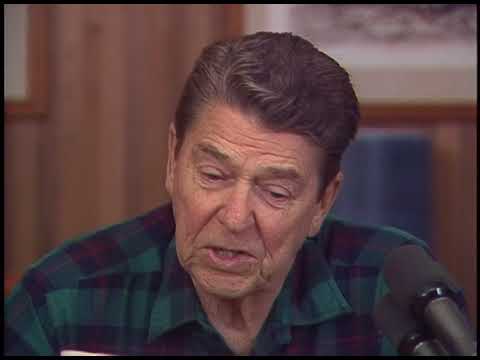
Reagan Library
Broad statutory trade barriers will trigger foreign retaliation and economic collapse reminiscent of the 1930s Smoot-Hawley tariffs, making presidential discretion essential to preserve open markets.
AI-assisted summary of President Reagan's Radio Address on Free and Fair Trade on April 25, 1987 — original source. Check the original for full context.
Source published:
Key ideas
- President Reagan instituted targeted import duties on Japanese electronic semiconductors due to Japan's failure to enforce a bilateral trade agreement, framing it as an exceptional response to unfair trade practices rather than an escalating conflict. (0:06)
- Reagan cited the 1930s Smoot-Hawley Tariff Act as a cautionary tale, warning that protective tariffs induce domestic complacency, provoke retaliatory trade wars, raise consumer prices, and deepen economic distress. (1:53)
- The administration pushed back against protectionist legislation in Congress, emphasizing that over 5 million American jobs directly depend on exports and that executive flexibility is vital for upcoming summits with Japan and the Venice Economic Summit. (3:48)
Detailed notes
## Background Published on YouTube by the Reagan Library on October 10, 2017, this recording features President Ronald Reagan's radio address to the nation broadcast from Camp David, Maryland on April 25, 1987. Drawing from the archival records of the White House Television Office, the description details Reagan's perspective on international trade policy, bilateral agreements, and American economic interests.
## TL;DR In his weekly radio address, President Reagan addresses recently imposed targeted duties on Japanese electronic semiconductors, explaining that they serve as a specific corrective measure for an unfulfilled bilateral accord rather than the start of a trade war. Reagan reflects on the Great Depression and the disastrous Smoot-Hawley Tariff to caution against the seductive trap of protectionism, which breeds domestic complacency, spurs foreign retaliation, and destroys jobs. Looking forward to bilateral discussions with Japanese Prime Minister Yasuhiro Nakasone and the upcoming Venice Economic Summit, he urges citizens to resist short-sighted Congressional protectionist bills that would restrict presidential negotiating flexibility and endanger millions of trade-dependent American livelihoods.
## Atmosphere & style The address possesses a calm, fireside gravity, balancing statesmanlike diplomacy with an intimate, conversational delivery typical of Reagan's weekend radio talks. Blending historical reminiscence of the 1930s with principled economic reasoning, Reagan speaks with measured conviction and pedagogical warmth. The tone moves seamlessly from sober diplomatic assessment to a watchful, firm warning against the perils of economic nationalism, leaving listeners with a reassuring sense of executive resolve and global stewardship.
## Bulletin - [00:06](https://www.youtube.com/watch?v=5t5QK03KXPc&t=6s) President Reagan instituted targeted import duties on Japanese electronic semiconductors due to Japan's failure to enforce a bilateral trade agreement, framing it as an exceptional response to unfair trade practices rather than an escalating conflict. - [01:53](https://www.youtube.com/watch?v=5t5QK03KXPc&t=113s) Reagan cited the 1930s Smoot-Hawley Tariff Act as a cautionary tale, warning that protective tariffs induce domestic complacency, provoke retaliatory trade wars, raise consumer prices, and deepen economic distress. - [03:48](https://www.youtube.com/watch?v=5t5QK03KXPc&t=228s) The administration pushed back against protectionist legislation in Congress, emphasizing that over 5 million American jobs directly depend on exports and that executive flexibility is vital for upcoming summits with Japan and the Venice Economic Summit.
## Key takeaways - [00:06](https://www.youtube.com/watch?v=5t5QK03KXPc&t=6s) President Reagan emphasized that overall relations with Japan remain strong despite urgent bilateral trade disagreements. - [00:06](https://www.youtube.com/watch?v=5t5QK03KXPc&t=6s) New import duties on Japanese goods were specifically triggered by Japan's non-compliance with an agreement on electronic semiconductors. - [00:06](https://www.youtube.com/watch?v=5t5QK03KXPc&t=6s) The administration asserted that a commitment to free trade inherently demands a commitment to fair trade and enforceable agreements. - [00:06](https://www.youtube.com/watch?v=5t5QK03KXPc&t=6s) The semiconductor duties were intended as a surgical measure to be lifted as soon as verifiable compliance is achieved, rather than the start of a trade war. - [01:53](https://www.youtube.com/watch?v=5t5QK03KXPc&t=113s) Reagan warned that initial short-term relief from protectionist tariffs gives way to complacency, reduced technological upgrades, and declining domestic innovation. - [01:53](https://www.youtube.com/watch?v=5t5QK03KXPc&t=113s) Protectionist measures invite foreign retaliation and trade barriers, driving up consumer costs and shuttering domestic factories. - [01:53](https://www.youtube.com/watch?v=5t5QK03KXPc&t=113s) The catastrophic economic fallout of the 1930s Smoot-Hawley Tariff was invoked as direct evidence of how protectionism damages national prosperity. - [03:48](https://www.youtube.com/watch?v=5t5QK03KXPc&t=228s) Congressional attempts to enact blanket protectionist bills were criticized as short-sighted pandering to special interest groups. - [03:48](https://www.youtube.com/watch?v=5t5QK03KXPc&t=228s) Millions of American livelihoods—including over 5 million jobs tied directly to exports—rely on reciprocal and open international commerce. - [03:48](https://www.youtube.com/watch?v=5t5QK03KXPc&t=228s) Reagan argued that presidential negotiating flexibility must not be curtailed by statutory trade mandates ahead of talks with Prime Minister Nakasone and the Venice Economic Summit.
## Detailed walkthrough ### [00:06](https://www.youtube.com/watch?v=5t5QK03KXPc&t=6s) Semiconductor Tariffs and the Upcoming Meeting with Prime Minister Nakasone
President Ronald Reagan opens his radio address by previewing an upcoming White House visit from Japanese Prime Minister Yasuhiro Nakasone. While affirming that overall relations with Japan remain excellent, Reagan notes that trade disputes have become an unavoidable, urgent priority. The previous week, the administration levied new duties on select Japanese imports following Japan's failure to enforce a bilateral agreement governing electronic semiconductors. Reagan emphasizes that levying duties and trade barriers is something he is normally loath to do because trade restrictions harm American workers and consumers over the long run. However, the semiconductor situation presented a clear exception where evidence demonstrated unfair trade practices violating an explicit bilateral accord.
Reagan explains that these targeted duties are intended strictly to resolve a discrete commercial breach rather than initiate an escalating conflict. His forthcoming talks with Prime Minister Nakasone will reiterate a desire to resolve trade grievances cooperatively and lift the punitive restrictions as soon as verifiable compliance allows. Reflecting on recent discussions in Canada, Reagan observes an emerging international consensus that true national prosperity depends upon open, equitable competition rather than self-defeating isolation. As Reagan summarizes his core standard for international commerce: “We expect our trading partners to live up to their agreements as I've often said our commitment to free trade is also a commitment to fair trade.”
- **Targeted Sector:** Electronic semiconductors, subject to new import duties due to non-enforcement of bilateral trade agreements. - **Diplomatic Objectives:** Cooperate with Japan to resolve the breach, avoid a broader trade war, and remove duties once compliance is verified. - **International Alignment:** Builds on free trade discussions recently delivered to Canadian leaders.
---
[01:53](https://www.youtube.com/watch?v=5t5QK03KXPc&t=113s) The Lessons of Smoot-Hawley and the Vicious Cycle of Protectionism
Reflecting on economic history, Reagan invokes the Great Depression to warn against the seductive appeal of protectionist policies. While enacting tariffs on foreign imports often appears patriotic and promises immediate relief for domestic companies and workers, Reagan argues that such benefits are short-lived and illusory. Over time, protected domestic manufacturers grow dependent on federal shields, abandoning innovation, technological upgrades, and sound management practices necessary to remain viable on the global stage.
The consequences compound when foreign trading partners retaliate by raising their own barriers, plunging nations into destructive trade wars. Tariffs artificially inflate consumer prices to prop up uncompetitive industries, leading to collapsed consumer demand, shuttered factories, and widespread unemployment. Pointing directly to the catastrophic results of the 1930s Smoot-Hawley Tariff, Reagan expresses his deep personal resolve to prevent similar policies from returning. As Reagan reflects on the enduring lessons of that era: “The memory of all this occurring back in the thirties made me determined when I came to Washington to spare the American people the protectionist legislation that destroys prosperity.”
```mermaid flowchart TD accTitle: The Cycle of Protectionism accDescr: A flow diagram showing how initial import tariffs lead to complacency, retaliation, market collapse, and job losses.
subgraph Phase1["Initial Policy"] A["Tariffs Imposed on Imports"] --> B["Temporary Relief"] end
subgraph Phase2["Domestic Decline"] B --> C["Complacency & Stalled Innovation"] C --> D["Dependence on Subsidies & Tariffs"] end
subgraph Phase3["International Escalation"] D --> E["Foreign Retaliation & Trade Wars"] E --> F["Artificially High Prices"] end
subgraph Phase4["Economic Collapse"] F --> G["Shrinking Consumer Demand"] G --> H["Factory Closures & Job Losses"] end ```
- **Historical Precedent:** The Smoot-Hawley Tariff Act, which economists and historians widely credit with deepening the Great Depression and stifling recovery. - **Economic Mechanics:** Complacency replaces innovation, triggering foreign retaliation, higher consumer prices, reduced sales, and business closures.
---
[03:48](https://www.youtube.com/watch?v=5t5QK03KXPc&t=228s) Resisting Congressional Protectionism and Protecting American Jobs
Reagan turns his attention to Capitol Hill, warning that certain lawmakers are pursuing short-sighted protectionist legislation for quick political gain and the favor of special interest groups. He cautions that these proposals ignore how deeply integrated the United States is with the international economy, noting that millions of American livelihoods depend directly on reciprocal trade. The administration remains committed to defending domestic businesses through decisive, surgical action against unfair practices—such as the semiconductor measures—while preserving the overarching architecture of open markets.
Looking ahead to his bilateral summit with Prime Minister Nakasone and the upcoming Venice Economic Summit, Reagan insists that presidential flexibility must not be compromised by restrictive statutory mandates. He warns that Congressional efforts to curb executive trade authority represent a dangerous revival of protectionism that threatens domestic economic vitality. Urging citizens to remain vigilant and ready to push back, Reagan underscores what is at stake: “So with my meeting with Prime Minister Nakasone and the Venice economic summit coming up it's terribly important not to restrict the president's options in such trade dealings with foreign governments.”
- **Jobs at Stake:** Over 5 million American jobs directly depend on foreign exports, alongside additional millions tied to imports. - **Key Summits:** Upcoming bilateral White House meetings with Prime Minister Nakasone and multilateral discussions at the Venice Economic Summit. - **Legislative Threat:** Congressional bills seeking to curb presidential discretion and enforce statutory protectionist measures.
## Notable quotes > [00:06](https://www.youtube.com/watch?v=5t5QK03KXPc&t=6s) We expect our trading partners to live up to their agreements as I've often said our commitment to free trade is also a commitment to fair trade. — Ronald Reagan
## Mentioned Ronald Reagan, Yasuhiro Nakasone, White House, Japan, Canada, Smoot-Hawley Tariff Act, Venice Economic Summit, United States Congress
## Video description Full Title: President Reagan's Radio Address to the Nation on Free and Fair Trade from Camp David, Maryland on April 25, 1987
Creator(s): President (1981-1989 : Reagan). White House Television Office. 1/20/1981-1/20/1989 (Most Recent) Series: Video Recordings, 1/20/1981 - 1/20/1989 Collection: Records of the White House Television Office (WHTV) (Reagan Administration), 1/20/1981 - 1/20/1989
Transcript: https://www.reaganlibrary.gov/research/speeches/042587a
Production Date: 4/25/1987
Access Restriction(s):Unrestricted Use Restriction(s):Unrestricted
Contact(s): Ronald Reagan Library (LP-RR), 40 Presidential Drive, Simi Valley, CA 93065-0600 Phone: 800-410-8354, Fax: 805-577-4074, Email: reagan.library@nara.gov
National Archives Identifier:77443170
https://catalog.archives.gov/id/77443170
[Source](https://www.youtube.com/watch?v=5t5QK03KXPc)