Radiative Panel Drops Water Below Freezing Without Electricity
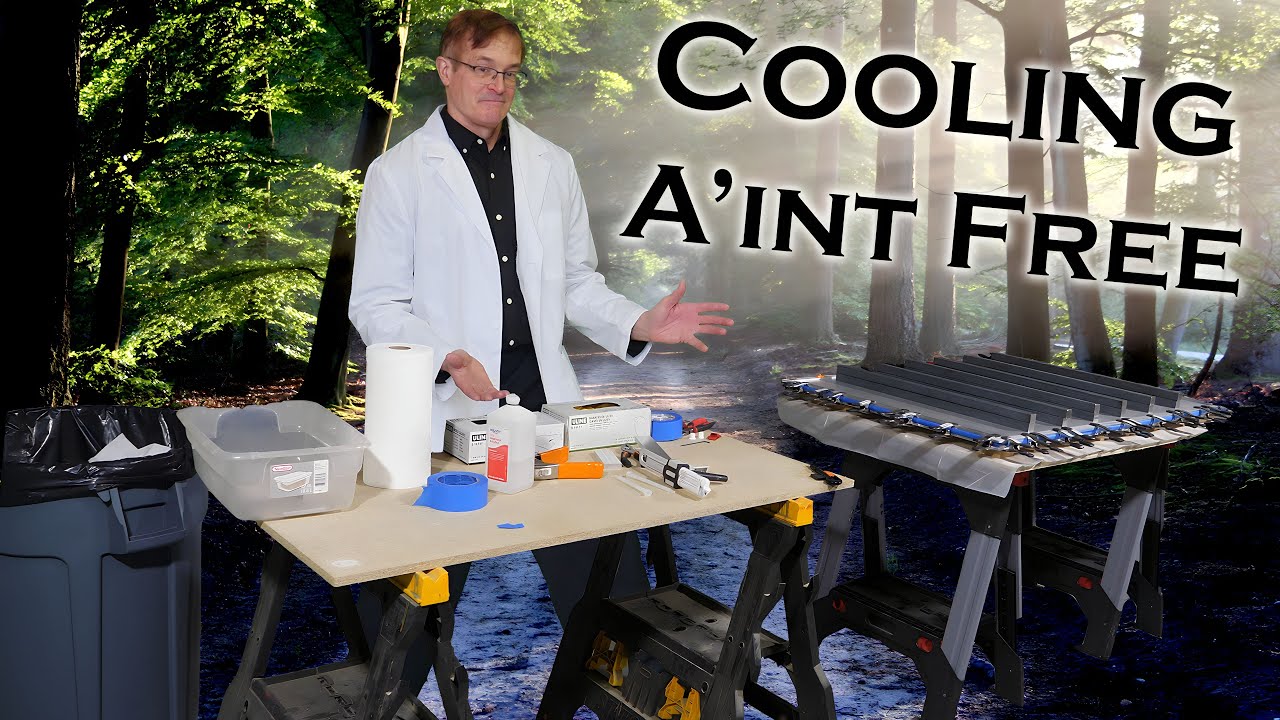
Air Conditioning isn't free... but we're close. — Tech Ingredients

Tech Ingredients

By radiating thermal energy directly into space through the atmospheric infrared window, passive surface coatings can chill circulating fluids below ambient air temperatures to slash compressor power demands.

AI-assisted summary of Air Conditioning isn't free... but we're close. — original source. Check the original for full context.

Source published:

Key ideas

  • Air conditioning accounts for roughly 10% of global electricity consumption, costing an estimated $300 billion annually in 2020 terms; a 1% gain in efficiency or cooling load reduction represents over $3 billion in yearly savings. (0:15)
  • Due to the atmospheric infrared transparency window, an unshaded ground-level black body experiences a net radiative deficit of approximately 150 W/m² directed into the sky, which can have an effective radiometric temperature as low as -50 °C. (2:41)
  • The team fabricated a 1 m² aluminum liquid heat exchanger clad in an engineered super-coating and insulated by rigid foam, aluminum tape, and an IR-transparent polyethylene convection shield, successfully chilling circulating fluid below freezing and below ambient outdoor temperatures without a compressor. (20:09)
  • Because radiant heat rejection scales with absolute temperature to the fourth power (T⁴), a 10% increase in panel absolute temperature yields roughly a 50% increase in radiative power, making the technology especially potent in extreme summer heat. (21:54)

Detailed notes

## Background Published on YouTube by Tech Ingredients on February 8, 2023, this video demonstrates how to construct a liquid cooling panel treated with a custom specialty paint that drops below ambient outdoor temperatures without electricity. The production documents the physical principles, workshop fabrication, and initial outdoor testing of a passive daytime radiative cooling system.

## TL;DR Addressing the massive energy footprint and economic cost of conventional air conditioning, the host outlines how Planck's law and the atmospheric infrared transmission window enable passive radiative cooling directly into space. To exploit this net radiative deficit, the team designs and builds a one-square-meter aluminum liquid-to-radiant heat exchanger panel insulated with rigid polyurethane foam, pure aluminum tape, and an infrared-transparent polyethylene convection shield. Circulating fluid from an insulated Dewar through the coated panel during a cloudless night successfully lowers the liquid reservoir below freezing and well below ambient air temperature. The video concludes by examining architectural integration options—such as boosting heat pump efficiency or tying into hydronic floor loops—and teasing the open-source DIY chemical recipe for daytime operation in an upcoming episode.

## Atmosphere & style The video carries a pragmatic, workshop-tinkerer vibe underpinned by rigorous thermodynamic physics and hands-on mechanical fabrication. The hosts balance dense academic concepts like Stefan–Boltzmann equations and black-body spectral curves with grounded, blue-collar problem solving—complete with sore hands from dispensing structural epoxy, running jokes about workshop clamps, and humorous asides about freezing like Jack Torrance. The transition from a brightly lit, dusty workshop to a cold suburban yard under the clear night sky provides a satisfying emotional payoff as digital thermometers tick downward into sub-ambient territory.

## Bulletin - [00:15](https://www.youtube.com/watch?v=5zW9_ztTiw8&t=15s) Air conditioning accounts for roughly 10% of global electricity consumption, costing an estimated $300 billion annually in 2020 terms; a 1% gain in efficiency or cooling load reduction represents over $3 billion in yearly savings. - [02:41](https://www.youtube.com/watch?v=5zW9_ztTiw8&t=161s) Due to the atmospheric infrared transparency window, an unshaded ground-level black body experiences a net radiative deficit of approximately 150 W/m² directed into the sky, which can have an effective radiometric temperature as low as -50 °C. - [20:09](https://www.youtube.com/watch?v=5zW9_ztTiw8&t=1209s) The team fabricated a 1 m² aluminum liquid heat exchanger clad in an engineered super-coating and insulated by rigid foam, aluminum tape, and an IR-transparent polyethylene convection shield, successfully chilling circulating fluid below freezing and below ambient outdoor temperatures without a compressor. - [21:54](https://www.youtube.com/watch?v=5zW9_ztTiw8&t=1314s) Because radiant heat rejection scales with absolute temperature to the fourth power (T⁴), a 10% increase in panel absolute temperature yields roughly a 50% increase in radiative power, making the technology especially potent in extreme summer heat.

## Key takeaways - [00:15](https://www.youtube.com/watch?v=5zW9_ztTiw8&t=15s) Worldwide air conditioning consumes roughly 10% of total electrical power generation, meaning even small marginal improvements deliver billions of dollars in economic value. - [01:12](https://www.youtube.com/watch?v=5zW9_ztTiw8&t=72s) Under Planck's and the Stefan–Boltzmann laws, objects at room temperature peak in thermal radiation near 10 µm and radiate roughly 500 W/m² into their surroundings. - [02:41](https://www.youtube.com/watch?v=5zW9_ztTiw8&t=161s) Clear atmospheric columns act as an infrared sink with effective radiometric temperatures reaching down to -50 °C, creating an average 150 W/m² net radiative deficit for ground-level emitters. - [03:28](https://www.youtube.com/watch?v=5zW9_ztTiw8&t=208s) Materials like skin, paint, and concrete feature high emissivity (75%–85%), whereas polished aluminum exhibits an emissivity of only about 6%, making it an exceptional infrared reflector. - [06:58](https://www.youtube.com/watch?v=5zW9_ztTiw8&t=418s) Polyethylene film is exceptionally transparent to long-wave infrared radiation, functioning as an ideal convection barrier that halts convective warming while allowing radiative cooling to deep space. - [06:12](https://www.youtube.com/watch?v=5zW9_ztTiw8&t=372s) Surrounding trees, fences, and structures radiate parasitic lateral infrared energy, requiring an angled reflective collar to restrict the panel's line of sight strictly upward toward the sky zenith. - [09:34](https://www.youtube.com/watch?v=5zW9_ztTiw8&t=574s) The heat exchanger panel uses internal closed-cell foam inserts to displace excess water volume, keeping weight down while channeling a thin, fast-moving fluid sheet across 1 m² of surface area. - [11:54](https://www.youtube.com/watch?v=5zW9_ztTiw8&t=714s) Rubber-toughened structural epoxy is utilized instead of welding to join the aluminum sheet skins and ribs, preventing thermal warping and accommodating differential thermal expansion. - [20:09](https://www.youtube.com/watch?v=5zW9_ztTiw8&t=1209s) Outdoor cloudless night testing proved the sub-ambient cooling concept, dropping circulating fluid temperatures from +0.9 °C down below freezing while ambient air stood at +0.5 °C. - [21:54](https://www.youtube.com/watch?v=5zW9_ztTiw8&t=1314s) Sub-ambient radiative cooling panels can integrate into building hydronics directly via radiant floor loops or serve as pre-coolers to drop refrigerant temperatures before the compressor in conventional HVAC systems. - [24:10](https://www.youtube.com/watch?v=5zW9_ztTiw8&t=1450s) Governed by the Stefan–Boltzmann T⁴ relationship, radiative cooling efficiency scales dramatically upward as ambient temperatures rise, providing the greatest cooling flux when thermal loads peak. - [24:56](https://www.youtube.com/watch?v=5zW9_ztTiw8&t=1496s) Because the custom coating provides extremely high solar reflectance alongside high thermal emissivity, the panels are engineered to achieve daytime sub-ambient cooling in direct sunlight.

## Detailed walkthrough ### [00:15](https://www.youtube.com/watch?v=5zW9_ztTiw8&t=15s) Global Cooling Costs and the Physics of Thermal Radiation

Air conditioning represents an immense share of worldwide power consumption, consuming roughly ten percent of all global electricity generation. In 2020 economic terms, powering these cooling systems cost an estimated $300 billion annually. Because the baseline energy demand is so staggering, even marginal gains yield massive economic returns: a mere one percent boost in equipment efficiency or a one percent reduction in thermal cooling loads would save over $3 billion each year—and substantially more at current energy prices. This economic reality has fueled intense research into passive daytime radiative cooling and architectural supercooling, using engineered surface coatings to reject heat into space without burning any electricity.

The fundamental physics enabling sub-ambient passive cooling rests on Planck's law of black-body radiation. Every physical body at a finite temperature continuously emits electromagnetic radiation across a characteristic, asymmetric spectrum whose peak wavelength corresponds to its absolute temperature. At roughly 5,700 Kelvin, the surface of the Sun peaks at approximately 550 nanometers in the yellow band of the visible spectrum. Under the Stefan–Boltzmann relationship, total radiant energy scales with the fourth power of absolute temperature ($T^4$), meaning each square meter of the solar photosphere blasts out an astonishing 67 megawatts of power.

As an object cools, its emission spectrum red-shifts into the infrared band. At typical ambient and human body temperatures, the radiation curve peaks near 10 micrometers (10,000 nanometers), while total radiant flux drops sharply to roughly 500 watts per square meter. A human body with an average surface area of 2.4 square meters continuously radiates roughly 1.2 kilowatts of thermal energy into the surrounding space. The reason humans do not rapidly freeze—as the host jokes, avoiding “looking like Jack at the end of *The Shining*”—is that surrounding indoor surfaces like walls, ceilings, floors, and nearby people sit at comparable temperatures and radiate heat back in near-perfect thermal equilibrium.

> “In 2020 dollars that represents 300 billion dollars per year, so even a one percent improvement in the efficiency of air conditioners or a one percent decrease in the load on air conditioning will save three billion dollars a year and it's probably substantially more nowadays.”

- Global AC power usage: ~10% of total worldwide electricity production. - Cost basis: $300 billion per year (2020 estimate). - Solar black-body temperature: ~5,700 K, peaking at ~550 nm with 67 MW/m² emittance. - Human/room-temperature black-body peak: ~10 µm (10,000 nm), radiating ~500 W/m². - Human surface area: ~2.4 m², radiating ~1.2 kW into the environment.

---

[02:41](https://www.youtube.com/watch?v=5zW9_ztTiw8&t=161s) Sky Temperature, Emissivity, and the Net Radiation Deficit

The critical exception to thermal equilibrium on Earth is the sky. Outer space represents an extreme heat sink, but the effective radiometric sky temperature is not the 2.7 Kelvin of the cosmic microwave background, nor is it simply the ambient air temperature at airliner cruising altitudes. Instead, it is an integrated thermodynamic value representing the entire vertical atmospheric column stretching from the ground to the edge of space, reaching effective temperatures as low as -50 °C. Depending on factors such as humidity, geographical altitude, seasonal climate, and day-versus-night conditions, downwelling atmospheric radiation averages approximately 350 watts per square meter. Consequently, an unshaded ground-level object radiating 500 W/m² experiences a net deficit of around 150 watts per square meter directed upward into the atmospheric infrared transparency window.

The rate at which a real-world object dumps heat depends on its surface emissivity—the ratio of energy radiated by a specific material relative to a theoretical black body at the same temperature. Typical natural and engineered materials—such as human skin, clothing fabric, building paints, concrete, wood, and standard plastics—exhibit high infrared emissivities between 75% and 85%. In contrast, polished metals act as strong infrared reflectors and possess poor emissivity; polished aluminum registers an emissivity of only around 6%.

To illustrate how this directional imbalance extracts heat, the host presents a thought experiment: standing inside a deep, open-topped box lined with polished aluminum. Because the aluminum walls possess 6% emissivity, they emit almost zero infrared radiation inward, while any thermal radiation emitted by the person's body simply reflects off the mirror-like metal walls and out toward the clear sky. Losing a net 150 watts per square meter across a 2.4-square-meter body yields an outgoing thermal draw of roughly 370 watts. Given that the basal metabolic rate of a resting human is only about 150 watts, losing 370 watts causes a noticeable, rapid chilling effect purely via radiative transfer.

> “The result is that any object down here on the ground will lose about 150 watts per square meter into the sky.”

- Effective radiometric sky temperature: can dip as low as -50 °C. - Downwelling atmospheric radiation average: ~350 W/m². - Net radiative deficit to clear sky: ~150 W/m² for an ambient black body. - Typical non-metal emissivity (skin, paint, wood, concrete): 75%–85%. - Polished aluminum emissivity: ~6% in the infrared. - Human net radiative loss in an open-top reflective enclosure: ~370 W versus a ~150 W basal metabolic generation.

---

[05:00](https://www.youtube.com/watch?v=5zW9_ztTiw8&t=300s) Building the Radiator Test Box and Atmospheric Shielding

To harness this radiative deficit into a functional, fluid-based cooling device, the team engineered a modular, well-insulated test chamber housing a specialized heat-exchange panel. The containment box is fabricated from rigid polyurethane foam board, which serves as a high-performance conduction insulator because of the microscopic, stagnant air pockets trapped within its closed cells. To eliminate stray radiative thermal gains, the interior faces of the foam structure are completely clad in genuine aluminum foil tape. Unlike synthetic tape printed with metallic inks, pure aluminum tape preserves the requisite 6% emissivity, reflecting ambient infrared away from the radiator plate.

The box features a modular wall perimeter and a rear insulating backer panel. Integrated into opposite corners of the assembly are inlet and outlet fluid ports, designed to pipe a working fluid through the heat exchanger in a closed circulation loop. Because the experimental test site is surrounded by tall trees and adjacent structures rather than sitting in an open plain or on a clear high-rise rooftop, ambient thermal radiation from those surrounding warm objects would strike the radiator and degrade the net cooling performance. To counteract this, an angled extension collar sits atop the lower box, acting as an infrared line-of-sight barrier that shields the test surface from nearby foliage and masonry while maintaining an unobstructed view of the open sky.

The remaining thermal engineering challenge is convective heat transfer. Once the radiator panel chills below the ambient air temperature, ambient breezes sweeping across the panel would transfer heat back into the surface, destroying the sub-ambient delta. While a deep box would theoretically allow cold, dense air to pool and stratify at the bottom, an excessively deep chamber would be unwieldy. The team solved this by constructing a transparent convection shield: an aluminum perimeter frame over which thin polyethylene film (common plastic wrap) is tightly stretched. While rigid glazings like glass, acrylic (Plexiglas), or polycarbonate absorb thermal infrared radiation and trap heat, thin polyethylene film is remarkably transparent to long-wave infrared wavelengths, allowing the panel to broadcast heat directly into the sky while maintaining a quiescent, insulating pocket of dead air over the plate.

> “Turns out this stuff—plastic wrap, polyethylene—is extremely transparent to the infrared, and so it can radiate out right through this but prevent airflow going across it, and it's lightweight and it's very convenient.”

```mermaid flowchart TD accTitle: Radiative Cooling Box Construction accDescr: Structural layers of the passive radiative cooler from the outer ambient environment down to the fluid loop.

subgraph Environment ["Environmental Isolation"] IR_Baffle["Aluminum-Clad Extension Baffle<br/>(Blocks IR from trees & buildings)"] PE_Window["Stretched Polyethylene Film Window<br/>(Stops convection, transparent to 8-13 µm IR)"] end

subgraph Enclosure ["Insulated Chassis"] FoamBox["Rigid Polyurethane Foam Walls<br/>(Stops conductive heat gain)"] Al_Tape["Pure Aluminum Tape Lining<br/>(6% Emissivity / High IR Reflectivity)"] end

subgraph Core ["Heat Exchanger Core"] Panel["1 m² Fluid Heat Exchanger<br/>(Custom radiative top coating)"] FluidLoop["Closed-Loop Liquid Flow<br/>(Inlet & Outlet diagonally opposed)"] end

IR_Baffle --> PE_Window PE_Window --> FoamBox FoamBox --- Al_Tape Al_Tape --> Panel Panel <--> FluidLoop ```

- Enclosure wall material: rigid closed-cell polyurethane foam lined with genuine aluminum tape (~6% IR emissivity). - Surroundings shielding: top-mounted angled extension collar blocking direct line of sight to trees and buildings. - Glazing material: ultra-thin polyethylene cling film (IR-transparent, blocks air currents and convective reheating). - Fluid routing: opposed corner ports enabling closed-loop continuous flow.

---

[08:34](https://www.youtube.com/watch?v=5zW9_ztTiw8&t=514s) Fabricating the Liquid Heat Exchanger Panel

The radiator plate itself is an oversized liquid-to-radiant heat exchanger. Small commercial liquid cooling blocks sold online for cooling computer CPUs, semiconductor lasers, and high-power LEDs feature machined internal channels that efficiently shed heat into a pumped fluid. However, commercial cold plates are far too small for atmospheric cooling experiments, which require a full one-square-meter footprint.

To fabricate the custom one-square-meter panel, an outer perimeter frame was constructed from aluminum U-channel, mitered at 45-degree angles on the corners and welded into a rigid rectangular chassis. Aluminum inlet and outlet tubes were pressed into holes drilled at diagonally opposing corners of the frame, and the penetrations were potted with high-strength toughened epoxy to ensure leak-free joints. The front and rear panel skins consist of one-millimeter-thick sheet aluminum bonded to either side of the U-channel frame.

A critical design issue was liquid volume and weight. With a 1.5-centimeter internal depth across a full square meter, filling the raw void with liquid would demand 15 liters of water, adding 15 kilograms (over 33 pounds) of thermal mass. To minimize weight while ensuring efficient heat transfer, the team bonded closed-cell foam blocks inside the internal cavity. The foam inserts displace the bulk of the interior volume while leaving a thin channel between the front aluminum sheet and the foam, preserving a sweeping film of water for thermal exchange. To prevent hydraulic pressure from bulging or pillowing the thin aluminum skins outward, internal structural stiffening ribs were spaced across the frame. Rather than attempting extensive edge welding and blind spot welds across every internal rib—which would cause significant thermal warping—the entire assembly was joined using high-performance Loctite toughened epoxy after the mating surfaces were thoroughly degreased, abraded with sandpaper, and cleaned again.

> “One of the problems with this kind of a system is that with a one and a half centimeter thick one square meter area, this thing would contain one full 15 liters of water—it would weigh a lot.”

- Panel dimensions: 1 m × 1 m (1 m² total active cooling surface), 1.5 cm frame thickness. - Fluid volume displacement: internal closed-cell foam blocks reduce liquid capacity well below the raw 15-liter limit. - Internal mechanics: interior stiffening ribs bridge the 1 mm sheet aluminum faces to eliminate pressure ballooning. - Assembly method: Loctite toughened structural epoxy bonding following mechanical abrasion and chemical cleaning.

[11:54](https://www.youtube.com/watch?v=5zW9_ztTiw8&t=714s) Assembling the Liquid Heat Exchanger Panel

The assembly begins with dispensing the adhesive system. Rather than mixing bulk resin in an open container, the project uses dual-barrel syringes fitted with static mixing nozzles, providing a clean, precise, and easily controlled bead. The chosen adhesive is a toughened epoxy incorporating rubber powder within the matrix, making the cured polymer significantly more resilient, compliant, and crack-resistant than brittle, unmodified epoxy resin. This flexibility is vital when joining materials with mismatched coefficients of thermal expansion, such as glass to metal or aluminum sheets experiencing temperature gradients, since the joint must absorb substantial differential expansion and contraction without shearing.

```mermaid flowchart LR accTitle: Heat Exchanger Assembly Workflow accDescr: Step-by-step workflow showing epoxy dispensing, frame alignment, weighted rib clamping, and cure time. subgraph Prep["Adhesive Application"] A["Dispense Toughened Epoxy<br/>(Syringe with Rubber Powder)"] --> B["Smooth Bead along Ribs"] end subgraph Assembly["Panel Mating"] B --> C["Align Outer Frame<br/>(~1 Inch Offset to Margin)"] C --> D["Place Top Aluminum Sheet"] end subgraph Clamping["Clamping & Cure"] D --> E["Iron Rods on Ribs +<br/>Perimeter C-Clamps & Tape"] E --> F["90-Min Epoxy<br/>Cures 48 Hours"] end ```

The team dons nitrile gloves and begins the arduous process of applying continuous beads along the internal rib pattern. Dispensing hundreds of inches of heavy-viscosity epoxy proves physically taxing on the hands, prompting the team members to swap roles: one squeezes the gun while the other helps align the outer perimeter frame roughly an inch away before setting it down dead-even with the bottom margins. As they apply the beads across the grid, the speaker assures his partner that variations in bead profile are harmless because the self-leveling epoxy naturally smooths out over time, though it must never be applied too thinly.

- Toughened epoxy formulation: resin modified with dispersed rubber particles for enhanced peel strength and cyclic fatigue resistance. - Perimeter alignment: frame lowered within an inch to maintain square registration across large aluminum sheet dimensions.

---

[16:16](https://www.youtube.com/watch?v=5zW9_ztTiw8&t=976s) Clamping, Leak Prevention, and Surface Preparation

Gluing the one-square-meter panel takes about an hour of continuous work. Once mated, the assembly receives an extensive clamping rig, invoking the old workshop proverb: “you can never be too rich, too thin, or have too many clamps.” Heavy iron rods are laid directly across the rib lines to distribute downward force evenly along the internal fluid channels, guaranteeing intimate metal-to-metal bonding between the internal ribs and outer skins. Painter's tape runs along the entire perimeter perimeter joint to catch and retain extruded epoxy squeeze-out, preventing sticky drips from coating the floor and clamp pads.

Because aluminum is non-porous and will not soak up epoxy like bare timber or open-cell fiberglass, a thin film suffices for bonding flat surfaces. However, the external seams are coated generously because, as the host warns, “any kind of a leak it would be a disaster so we really wanted to make sure we had a good epoxy seal.” With the 90-minute working-time epoxy fully seated under compression, the entire panel is left undisturbed for two full days to achieve maximum cross-linking. After curing, the internal cavity will be water-tested under static pressure before receiving its specialty optical radiative coating.

- Clamping hardware: long iron ballast bars across ribs paired with perimeter screw clamps. - Squeeze-out control: masking perimeter dam prevents shop and tool fouling. - Cure window: 48 hours for 90-minute open-time structural epoxy.

---

[18:39](https://www.youtube.com/watch?v=5zW9_ztTiw8&t=1119s) The Principle of the Super Coating and Outdoor Test Setup

The heart of the passive cooling panel lies in its specialty surface finish. Bare aluminum or conventional wall finishes cannot cool down effectively on their own because raw polished metals exhibit extremely low thermal emissivity in the long-wave infrared spectrum, reflecting external thermal radiation rather than shedding heat. The host emphasizes that “this is not white paint it's a special super coating and we're going to show you not only how it works and why it works but actually how you can make it yourself it isn't that complicated.”

```mermaid flowchart TD accTitle: Radiative Chiller Fluid Loop accDescr: Closed fluid circuit running from an insulated Dewar flask through a submersible pump into the radiative panel and back. subgraph Insulation["Insulated Reservoir"] R["Dewar Flask<br/>(Water + Propylene Glycol)"] P["Submersible DC Pump"] T["Thermocouple Probe"] R --- P R --- T end subgraph Exterior["Radiative Panel"] HX["1 m² Aluminum Heat Exchanger<br/>+ Emissive Super Coating"] B["Anti-Radiation Baffle Collar"] HX --- B end P -->|"Discharge Hose"| HX HX -->|"Return Hose"| R Sky["Clear Sky / Deep Space<br/>(Infrared Heat Sink)"] HX -.->|"8–13 µm Radiative Window"| Sky ```

To measure its performance, two flexible rubber hoses are connected to barbed ports at opposite diagonal corners of the internal baffle maze to guarantee uniform fluid sweep without stagnant corners. The return line drains back into a silver vacuum Dewar flask that blocks thermal conduction and convection from the ambient surroundings. A small 12-volt submersible pump sits submerged inside the Dewar, circulating water laced with a touch of propylene glycol to eliminate the danger of freezing inside the internal waterways during sub-zero chill tests. A calibrated thermocouple probe measures internal fluid temperature inside the Dewar, wired to an external digital readout running alongside the DC benchtop power supply.

- Coating function: high solar reflectance combined with selective emissivity across the 8–13 µm atmospheric transmission window. - Antifreeze additive: propylene glycol mixed into circulating loop to prevent phase-change rupture in sub-freezing runs. - Reservoir isolation: double-walled vacuum Dewar eliminates parasite ambient conductive heat gain.

---

[20:09](https://www.youtube.com/watch?v=5zW9_ztTiw8&t=1209s) Night-Sky Testing and Sub-Ambient Cooling

Bundled in cold-weather jackets, the team deploys the one-square-meter chiller outside beneath a cloudless night sky. The panel housing features a tall vertical perimeter collar or shroud. Because the test occurs in a suburban yard rather than on an unencumbered high-rise rooftop or flat desert expanse, surrounding trees, fences, and outbuildings continually radiate parasitic infrared energy sideways onto the device; the collar restricts the panel’s solid-angle field of view strictly upward toward the zenith of deep space.

At the start of the circulation run, ambient air temperature reads +0.5 °C, while the recirculating liquid probe inside the Dewar reads +0.9 °C. Over the course of the test, the thermal emission of the coated surface dumping heat directly into space causes the fluid reservoir to drop steadily below freezing, well below the ambient air temperature, establishing a substantial negative temperature differential without any compressor or active mechanical refrigeration.

- Initial baseline conditions: outdoor air at +0.5 °C, fluid reservoir at +0.9 °C. - View-factor shielding: reflective collar blocks lateral infrared emission from terrestrial structures. - Operating mechanism: radiative transfer through the atmospheric infrared window to deep space acting as a 3 K heat sink.

---

[21:54](https://www.youtube.com/watch?v=5zW9_ztTiw8&t=1314s) System Integration, Scalability, and Daytime Operation

Reflecting on the successful drop below ambient, the host details practical engineering pathways to tie sub-ambient liquid cooling into real-world structures. In homes equipped with hydronic heating—where boilers circulate warm water through baseboards, radiators, or embedded underfloor PEX tubing—the chiller panel could simply tee into the central distribution manifold, turning radiant floors into passive summer cooling planes to eliminate or reduce conventional compressor loads.

For structures relying on split-system air conditioners or air-source heat pumps, the chiller serves as a pre-cooler. Standard condensing units cannot dump heat below ambient outdoor dry-bulb temperature. By running the condensed liquid line from the outdoor coil through a secondary liquid-to-liquid brazed plate heat exchanger fed by the radiative chiller, the refrigerant can be chilled below ambient before entering the expansion valve, “fooling your air conditioner system into thinking it's a little bit cooler outside boosting its efficiency and you still retain all the benefits of the heat pump or the air conditioner in dehumidifying.”

| Integration Strategy | Working Mechanism | System Advantage | |:--- |:--- |:--- | | **Hydronic Radiant Loops** | Panel fluid tees directly into hydronic floor or radiator loops | Passive hydronic cooling without running vapor-compression systems | | **Condenser Sub-Cooler** | Fluid loops through a liquid-to-liquid heat exchanger on outdoor refrigerant lines | Drops high-side refrigerant temperature below ambient air, lowering compressor lift |

The host notes that overcast skies degrade performance because cloud bases are significantly warmer than deep space. Conversely, cooling performance scales aggressively in high summer heat due to the Stefan-Boltzmann law ($P \propto T^4$). Because radiative power scales with absolute temperature to the fourth power, a modest 10% increase in panel absolute temperature increases radiant energy dissipation into the sky by roughly 50%.

Addressing skepticism about night-only operation, the host points out that standard solar PV arrays also operate only half the day despite billions invested annually. Crucially, the custom super paint possesses high enough solar reflectance to operate around the clock in direct summer midday sun. The host closes by promising the next installment will disclose the exact DIY formulation and raw materials to brew the paint, followed by full 24-hour sunlit validation tests.

- Governing physics: Stefan-Boltzmann radiation law; a 10% rise in absolute panel temperature yields an approximate 50% increase in total radiant heat rejection. - Primary atmospheric limitation: low-altitude cloud cover radiating down at higher equivalent blackbody temperatures. - 24-hour capability: ultra-high solar reflectance prevents solar irradiance from overpowering the net infrared radiative flux.

## Notable quotes > [00:15](https://www.youtube.com/watch?v=5zW9_ztTiw8&t=15s) even a one percent improvement in the efficiency of air conditioners or a one percent decrease in the load on air conditioning will save three billion dollars a year and it's probably substantially more nowadays. — Tech Ingredients

## Mentioned Tech Ingredients, YouTube, Patreon, The Shining, Loctite, Plexiglas

## Video description Today we show you how to construct a liquid panel with custom specialty paint that when placed outside, cools down to a lower temperature than the ambient temperature.

Find us on Patreon and our website: https://www.patreon.com/techingredients https://www.techingredients.com/

[Source](https://www.youtube.com/watch?v=5zW9_ztTiw8)

中文简报

无电辐射制冷板成功将水温降至冰点以下 通过大气红外窗口直接向太空辐射热能,无源表面涂层可将循环流体冷却至低于环境空气温度,从而大幅降低压缩机电耗。 针对传统空调巨大的能耗和经济成本,主持人概述了普朗克定律与大气红外透射窗口如何实现直接面向太空的无源辐射制冷。为利用这种净辐射损失,团队设计并制造了一块面积为一平方米的铝制液体-辐射换热板,该面板采用硬质聚氨酯泡沫、纯铝胶带以及透红外的聚乙烯对流屏蔽罩进行隔热。在无云的夜间,将隔热杜瓦瓶中的流体循环流经涂层面板,成功将蓄液池温度降至冰点以下,且远低于环境气温。视频最后探讨了建筑集成方案——例如提升热泵效率或接入水暖地面回路——并预告将在下一期节目中公开用于日间运行的开源自制化学配方。 空调耗电量约占全球用电量的10%,按2020年标准估算每年耗资3000亿美元;效率提升或冷却负荷降低1%,每年就意味着超过30亿美元的节省。 (0:15) 由于大气红外透明窗口的存在,无遮挡的地面黑体朝向天空会产生约150 W/m²的净辐射赤字,而天空的有效辐射温度可低至-50 °C。 (2:41) 团队制作了一个1平方米的铝制液体热交换器,外覆工程超级涂层,并使用硬质泡沫、铝胶带和透红外聚乙烯对流屏蔽罩进行隔热,在无压缩机的情况下成功将循环流体冷却至冰点以下且低于室外环境温度。 (20:09) 由于辐射散热与绝对温度的四次方(T⁴)成比例,面板绝对温度每增加10%,辐射功率大约提升50%,这使得该技术在极端夏季酷热中尤为有效。 (21:54)

Detailed notes — zh

## Background 本内容由 YouTube 频道 Tech Ingredients 于 2023 年 2 月 8 日发布。视频简介说明,本期节目展示了如何利用定制的特殊涂料制作一块液体水冷板,将其放置在室外时,其温度可以自行降低到比周围环境温度更低的水平。 ## TL;DR 视频探讨了建筑超冷(Architectural Supercooling)与被动辐射制冷的物理原理,指出物体可通过大气透明红外窗口将热量直接排入寒冷的深空。为了将这一效应付诸实用,团队设计并亲手制作了一块面积达 1 平方米的超薄铝制水冷热交换面板,采用增韧环氧树脂进行减重与胶粘密封。配合隔热测试箱、保鲜膜光学对流窗口与杜瓦瓶闭环循环系统,该装置在户外实测中成功将水温降至环境气温以下。主讲人最后阐述了其与现有水暖或空调热泵系统耦合降低能耗的巨大应用潜力,以及在酷暑高温下更为强劲的理论辐射制冷效率。 ## Atmosphere & style 视频洋溢着硬核工程、车间实操与严谨热力学物理讲解深度融合的迷人魅力。主讲人娓娓道来,既有信手拈来的公式推导与生动幽默的比喻,又有着戴着手套在工作台前反复挤胶、调平夹具的扎实匠人质感。整个过程条理清晰、抽丝剥茧,让观众在见证一块手工水冷板落成并成功实现“低于室温制冷”的瞬间,感受到将深空物理搬进现实工程的智性兴奋与纯粹震撼。 ## Bulletin - [00:01](https://www.youtube.com/watch?v=5zW9_ztTiw8&t=1s) 利用建筑超冷原理(被动辐射制冷),通过特定波段将热量排斥到极寒的深空,可让建筑物温度降至环境温度以下,全程无需消耗电力驱动压缩机。 - [03:31](https://www.youtube.com/watch?v=5zW9_ztTiw8&t=211s) 团队制作了 1 平方米的超薄铝制水冷热交换板,外壳采用纯铝胶带与聚乙烯(PE)保鲜膜以抑制环境红外干扰与空气对流损失。 - [21:54](https://www.youtube.com/watch?v=5zW9_ztTiw8&t=1314s) 实测显示闭环循环水温降至显著低于外界环境空气温度(初始环温 0.5 ℃),验证了该无源制冷方案在辅助传统 HVAC 和热泵过冷方面的应用潜力。 - [21:54](https://www.youtube.com/watch?v=5zW9_ztTiw8&t=1314s) 根据斯忒藩-玻尔兹曼定律(辐射功率与绝对温度四次方成正比),该系统在炎热夏季的辐射温差与散热效率反而比寒冷天气更高。 ## Key takeaways - [00:01](https://www.youtube.com/watch?v=5zW9_ztTiw8&t=1s) 全球约 10% 的电力用于驱动空调系统,年能耗成本达 3000 亿美元,效率哪怕提升 1% 就能节省数十亿美元。 - [00:01](https://www.youtube.com/watch?v=5zW9_ztTiw8&t=1s) 常温物体(约 300 K)辐射峰值位于 10 微米左右的中红外波段,对空平均辐射净损耗约为 150 W/m²。 - [00:01](https://www.youtube.com/watch?v=5zW9_ztTiw8&t=1s) 深空是一个巨大的冷源,穿透大气窗口后的综合有效辐射温度最低可达零下 50 ℃。 - [03:31](https://www.youtube.com/watch?v=5zW9_ztTiw8&t=211s) 常见材质红外发射率高达 75%~85%,而抛光纯铝的红外发射率仅为约 6%,能有效阻隔周围热辐射吸收。 - [03:31](https://www.youtube.com/watch?v=5zW9_ztTiw8&t=211s) 普通玻璃和亚克力会吸收红外线,而聚乙烯(PE)保鲜膜在中红外波段具有极高穿透率,同时可阻隔空气对流。 - [08:34](https://www.youtube.com/watch?v=5zW9_ztTiw8&t=514s) 1 平方米水冷板内部填充闭孔泡沫,既消除了不必要的积水死重(防止系统超重),又保留了极薄水膜以实现高效换热。 - [11:54](https://www.youtube.com/watch?v=5zW9_ztTiw8&t=714s) 水冷板采用混有橡胶粉的工业级增韧环氧树脂进行粘接加固,可有效吸收冷热膨胀应力并避免薄铝板焊接变形。 - [18:39](https://www.youtube.com/watch?v=5zW9_ztTiw8&t=1119s) 循环测试回路中加入少量丙二醇以防结冰,储液罐采用真空杜瓦瓶切断与外界的热传导。 - [18:39](https://www.youtube.com/watch?v=5zW9_ztTiw8&t=1119s) 测试箱上方安装高出的遮光围圈,用于物理屏蔽周围树木和建筑物带来的杂散红外辐射。 - [21:54](https://www.youtube.com/watch?v=5zW9_ztTiw8&t=1314s) 该低温冷源可接入建筑水暖管路用于夏季地面降温,或串联在空调冷凝器后为制冷剂进行二次过冷,大幅降低压缩机做功。 - [21:54](https://www.youtube.com/watch?v=5zW9_ztTiw8&t=1314s) 基于斯忒藩-玻尔兹曼定律,面板温度每升高 10%,向天空倾泻的辐射能量激增约 50%,系统在酷暑工况下潜力更大。 - [21:54](https://www.youtube.com/watch?v=5zW9_ztTiw8&t=1314s) 特种超级涂层具备极高可见光反射率并精准在大气红外窗口高效发射,具备在烈日正午全天候 24 小时被动制冷的能力。 ## Detailed walkthrough ### [00:01](https://www.youtube.com/watch?v=5zW9_ztTiw8&t=1s) 建筑超冷原理:将热量辐射至极寒的深空 全球约有 10% 的电力用于驱动空调系统。以 2020 年的美元价值计算,这一消耗每年高达 3000 亿美元。这意味着空调效率哪怕仅提升 1%,或者空调负荷降低 1%,每年就能节省 30 亿美元,而在通胀后的当下,这一数字显然更为庞大。正因如此,被动冷却技术(Passive Cooling)近年来备受瞩目——它利用特殊涂层或表面处理将热量直接排斥出去,全程无需消耗任何电力。这种技术正是“建筑超冷”(Architectural Supercooling)的核心原理,能让建筑物或物理结构的温度降至环境温度以下。 所有物理对象都会发光,持续对外释放电磁辐射。辐射的波长与温度成反比,并遵循一条非对称的普朗克光谱(Planck Spectrum)曲线,其峰值出现在所谓的“黑体温度”处。例如表面温度高达 5700 开尔文(Kelvin)的太阳,其黑体辐射峰值位于约 550 纳米的可见黄光波段。根据斯特藩-玻尔兹曼定律,物体辐射的能量与热力学温度的四次方成正比。 ```mermaid flowchart LR accTitle: Thermal Radiation Principle accDescr: Diagram illustrating thermal radiation shift from Sun to human body to cold sky. subgraph HighTemp["高温天体"] A["太阳 (5700 K)<br/>峰值: 550 nm<br/>辐射: 67 MW/m²"] end subgraph AmbientTemp["常温物体"] B["人体 / 室温 (300 K)<br/>峰值: 10 µm<br/>辐射: ~500 W/m²"] end subgraph HeatSink["自然冷源"] C["深空辐射沉<br/>综合辐射: ~350 W/m²<br/>最低等效: -50 °C"] end A -->|"红移至红外波段"| B B -->|"净流失 ~150 W/m²"| C ``` 随着物体表面降温,整个光谱会向红端移动并进入红外波段。当物体降至人体温度或室温时,辐射峰值会红移至 10 微米(即 10,000 纳米)左右。由于四次方关系的剧烈削弱,其单位面积释放的能量锐减至约 500 W/m²。主讲人计算了自己的身体表面积约为 2.4 平方米,这意味着他时刻在向外辐射大约 1.2 千瓦的能量。之所以人体没有像《闪灵》(The Shining)结尾处的杰克那样冻僵,是因为周围的地板、墙壁甚至摄影师都在以接近的温度向他反向辐射,彼此处于热平衡之中。 自然界中唯一的特例是天空。从地面穿过整根大气柱延伸至外太空的综合辐射温度非常低,最低可达零下 50 摄氏度(-50 °C)。尽管天空并非处于 2.7 开尔文的宇宙微波背景辐射(CMB),也没有民航客机巡航高度的冷空气那般直接,但考虑湿度、昼夜、冬夏及海拔等变量后,天空对地表辐射的平均能量通常接近 350 W/m²。地表常温物体(约 500 W/m²)向天空净辐射能量,差值约为 150 W/m²。 - 太阳每平方米辐射功率:高达 67 兆瓦(67 MW/m²) - 人体/常温物体辐射功率:约 500 瓦/平方米(500 W/m²) - 地面物体向天空净辐射散失:约 150 瓦/平方米(150 W/m²) --- ### [03:31](https://www.youtube.com/watch?v=5zW9_ztTiw8&t=211s) 发射率与被动制冷测试箱的设计原理 发射率(Emissivity)在概念上相当于反射率的反向指标,它衡量了真实表面相对于理想黑体辐射器的辐射比例(绝对完美的黑体在现实中并不存在)。常见的皮肤、布料、商用油漆、混凝土、木材和塑料等材质,其红外发射率普遍在 75% 到 85% 之间。而高反射率的抛光金属(如铝)在红外波段具有极佳的反射能力,因而发射率极低,抛光铝的发射率仅约 6%。 “如果把我放进一个仅朝向天空敞开的大铝盒里,即便我和铝盒温度相同,铝盒也不会辐射太多红外线,我辐射出的红外线撞上铝壁后会反射并直奔天空,我将失去约 370 瓦的人体热量。”主讲人解释道。人体在静坐看 YouTube 视频时的基础代谢率只有约 150 瓦,370 瓦的热量散失意味着散热速度是代谢产热的两倍以上,身体会明显感到冰冷。 为了将这一物理效应付诸实用并进行有效验证,团队制作了一套隔热测试箱。核心结构包括一个内置于绝热盒中的散热板(Radiator)。测试箱采用硬质聚氨酯泡沫(Rigid Polyurethane Foam)板材制成,它是一种极佳的接触性热绝缘体。箱体表面包裹着一层特制的纯铝胶带——这并非普通铝色胶带,而是具有实打实 6% 红外发射率的高纯度铝箔胶带。这种双重设计既能隔绝外界热传导,又能防止周围环境向特制涂层面板投射红外辐射。 ```mermaid flowchart TD accTitle: Modular Test Chamber Layers accDescr: Exploded architecture of the passive cooling test chamber from window to base. subgraph OpticWindow["光学与防对流层"] W1["聚乙烯保鲜膜 (PE)<br/>阻挡对流,红外高透"] W2["铝制活动框架"] end subgraph ShieldExt["外周屏蔽层"] E1["高箱体拓展罩<br/>遮挡树木与周围建筑红外辐射"] end subgraph CoreBox["核心测试腔体"] C1["硬质聚氨酯发泡侧壁"] C2["纯铝胶带贴覆 (发射率 ~6%)"] C3["冷却辐射板 (1 m² 铝制水冷板)"] C4["聚氨酯隔热底板"] end OpticWindow --> ShieldExt ShieldExt --> CoreBox ``` 由于测试现场并非空旷的荒野,周边存在大树和建筑,它们会持续向下发射红外线,影响测试精度。因此,团队为箱体增加了一圈延伸外壁(Extension),遮挡视线内的建筑物与树木。此外,当面板温度降至环境温度以下时,流动的风与空气对流会不断向其补充热量。为了抑制对流,测试箱可以通过做高利用冷空气沉降进行分层绝热(空气静止时是非常优秀的绝热体,聚氨酯发泡本质上也是靠滞留的微小气泡隔热),但过于笨重。因此,团队在箱顶安装了一扇由铝框绷紧塑料薄膜制成的特殊“窗口”。 - 玻璃、Plexiglas(亚克力)与聚碳酸酯(PC):会强烈吸收红外线,阻断热量奔向天空,无法用作辐射窗口。 - 聚乙烯薄膜(普通保鲜膜):对中红外波段极其透明,既能让红外辐射直接穿透射向深空,又能把箱内空气锁在静止状态,防止对流损耗。 --- ### [08:34](https://www.youtube.com/watch?v=5zW9_ztTiw8&t=514s) 1 平方米超薄铝制热交换水冷板制作实录 测试的核心在于水冷热交换面板(Heat Exchanger),其设计灵感来源于市面上常见的小型水冷块(Liquid Cooling Blocks)。那些零售水冷块通常用于 CPU、激光器或高功率 LED 散热,内部设有密集的微通道引导水流并传导热量,造价低廉且方便胶粘,但尺寸太小,而本次测试需要足足 1 平方米(1 m²)的超大散热面积。 团队决定使用铝材亲手打造这一结构。主讲人先选用铝制 U 型槽(Aluminum U-Channel),将四个转角切出 45 度斜角(Miter Cut)后焊接成一个方形外框。接着在对角线上分别钻孔,插入定制的铝制进水管与出水管,并使用增韧环氧树脂(Toughened Epoxy)灌注在管道外缘,实现结构加固与彻底的水密封。外框底部和顶部各覆盖一张 1 毫米厚度的铝单板,形成封闭的扁平水腔。 ```mermaid flowchart TD accTitle: Heat Exchanger Panel Assembly Process accDescr: Manufacturing steps of the custom 1 square meter aluminum heat exchanger. subgraph FramePrep["框架制作与密封"] F1["铝制 U 型槽 45° 切割并焊接边框"] F2["对角开孔并装配进出水铝管"] F3["增韧环氧树脂灌胶固化防漏"] end subgraph CoreStructure["腔体结构与减重"] C1["底面 1 mm 铝板铺底"] C2["粘接闭孔泡沫块 (减重并填充内部体积)"] C3["加入内部加强筋 (防止水压膨胀鼓包)"] C4["保留顶面间隙形成均匀导流层"] end subgraph AssemblyBond["粘结封装"] A1["接触面打磨并深度除脂清洁"] A2["涂布 Loctite 工业级增韧环氧树脂"] A3["贴合顶面 1 mm 铝板并加压固化"] end FramePrep --> CoreStructure CoreStructure --> AssemblyBond ``` 然而该设计面临一个严重的重量问题:1 平方米面积搭配 1.5 厘米的厚度,若全灌满水将包含 15 升水(重量达 15 公斤以上)。为了减轻重量,主讲人在水腔内不承担主要热交换的背侧贴合了大量闭孔泡沫(Closed Cell Foam),占去绝大部分死体积。由于泡沫的厚度稍小于槽铝内高,前面板与铝板之间依然能流淌一层连续平整的水膜,确保高效的热交换。 在结构加固方面,为了防止水流动时的压力变化导致上下铝皮像气球一样向外膨胀鼓包,水腔内部横向布置了数根铝制加强肋(Stiffening Ribs)。如果使用全铝焊接,整块面板必须在外周完整焊接两遍,内部隐藏的加强肋还需进行复杂的盲焊或点焊,极易造成薄铝板受热严重变形变形。鉴于这套系统处于非常低的水压负荷下工作,主讲人最终选择了胶粘工艺。工作台上,金属接触面经历严格的去油清洗、砂纸打磨打毛、二次彻底除脂,随后使用乐泰(Loctite)工业级增韧环氧树脂胶水进行定位组装粘接。 ### [11:54](https://www.youtube.com/watch?v=5zW9_ztTiw8&t=714s) 增韧环氧树脂的特性与面板粘接 在准备将散热面板各个部件组装到一起时,主讲人展示了预装在注射器中的环氧树脂。这种包装比自己在大桶里搅拌要整洁得多、更容易精确控制用量。更关键的是,所选用的这款粘接剂中混合了橡胶粉末,属于增韧环氧树脂(toughened epoxy),具有极佳的弹性和抗冲击韧性,不会像纯环氧树脂那样容易开裂脆断。这种材料在粘接热膨胀系数差异较大的异种材料(例如玻璃与金属)时尤其出色,能有效吸收和缓解温度变化引起的膨胀应力差。 ```mermaid flowchart LR accTitle: 面板压合封装流程 accDescr: 展示铝板与肋条涂胶、对齐、铁棒重压与外围夹具锁固的组装步骤。 subgraph S1["涂胶准备"] A["增韧环氧树脂<br>(含橡胶粉)"] --> B["均匀挤胶至<br>框架与肋条"] end subgraph S2["对齐贴合"] B --> C["对准边缘<br>(留1英寸精准贴合)"] C --> D["贴防溢胶胶带"] end subgraph S3["压紧固化"] D --> E["顶部铁棒重压<br>(紧压内部肋条)"] E --> F["外围夹具锁死<br>(静置数日充分硬化)"] end ``` 在实际施工过程中,两人戴上手套展开精细操作。一位负责涂胶,另一位则协助搬运铝板框架,小心对齐边缘,确保四周完全吻合、毫无偏差。主讲人指出,胶线挤得稍有起伏没有关系,因为环氧树脂会自行流平填合,但胶层绝不能太薄。整个组装和压平工序耗时约一个小时,最终两人使用了大量工具进行全面夹固。正如主讲人幽默调侃的那样:“俗话说得好,人永远不会嫌自己太有钱、太瘦,或者夹具太多。”(“the old adage you can never be too rich, too thin, or have too many clamps.”) - 铝板表面不会像木材或玻璃纤维那样渗透吸收环氧树脂,因此理论上面积覆盖所需的胶量不多,但在外边框四周必须极其慷慨地施胶,一旦漏水将是灾难性的破坏。 - 铝板面板上方压上了多根铁棒(iron rods),专门利用自重对内部肋条(ribs)进行垂直压缩,确保内部支撑骨架与两面铝皮紧密粘合。 - 外沿贴了一圈胶带,防止被挤压溢出的环氧树脂滴落弄脏大量夹具以及车间地面。 - 该环氧树脂的可操作时间为 90 分钟,组装后需要静置数天充分固化,之后再注水进行严格的试漏检测。 --- ### [18:39](https://www.youtube.com/watch?v=5zW9_ztTiw8&t=1119s) 辐射制冷测试平台与实验装置 面板粘接固化并通过测漏后,整个系统的核心——特种“超级涂层”(super coating)被涂敷上表面。主讲人强调,如果只将光秃秃的裸铝板直接暴露在天空下,它的热辐射发射率极低,根本无法高效散热,正是这层特制涂料决定了制冷效果。这不是普通的白色油漆,它具备特殊的光学与辐射特性,后续还将详细解析其配方与自制方法。 ```mermaid flowchart TD accTitle: 闭环循环测试系统架构 accDescr: 冷却液在杜瓦瓶储液罐、潜水泵与外部辐射制冷面板之间闭环流动。 subgraph S1["绝热储液单元"] A["真空杜瓦瓶<br>(绝热阻隔外界热量)"] B["储液罐冷却液<br>(水 + 丙二醇)"] C["热电偶测温探头"] D["潜水泵"] A --- B B --- C B --- D end subgraph S2["辐射制冷单元"] E["1平方米 铝制散热面板<br>(特种超级涂层)"] F["遮挡反射围圈<br>(遮挡周边树木建筑红外)"] E --- F end D -->|"管道输送出水"| E E -->|"回流管注入"| B ``` 为了严格验证辐射制冷的降温能力,团队搭建了一套闭环测量系统。一平方米的面板对角设有两个管口,通过橡胶软管与置于银色真空杜瓦瓶(vacuum Dewar)内的潜水泵相连。杜瓦瓶能几乎完全切断测试水体与外界环境的热传导,内置的热电偶温度计则用于实时监测循环液温。 - 循环液体由外接稳压电源驱动潜水泵进行连续循环。 - 水中添加了少量丙二醇(propylene glycol),防止测试过程中液温降至冰点以下引发管路和换热面板结冰胀裂。 - 测试箱上方安装了高出的遮光围圈(collar),用于阻挡周围树木、房屋和建筑物发射的杂散红外辐射,确保面板主要且纯粹地朝向冷天空进行红外辐射。 - 测试开始时,室外环境空气温度显示为 0.5 ℃,而循环液体的初始探头读数为 0.9 ℃。 --- ### [21:54](https://www.youtube.com/watch?v=5zW9_ztTiw8&t=1314s) 户外测试结果、建筑应用与物理潜能 在晴朗夜空下运行一段时间后,仪表显示循环流体的温度大幅下降,显著低于周边的环境空气温度。主讲人指出,这种“无须压缩机直接低于环境温度”的冷源在建筑暖通(HVAC)中有巨大的落地价值。 其一,对于装有水暖系统(hydronic heating)的建筑,原本用于冬季锅炉输送热水给散热器或地暖的管道,可以在夏季接入这套辐射冷水回路,利用地面或暖气片为全屋降温,从而大幅减少甚至完全替代常规空调。其二,对于普通分体式空调或热泵系统,冷凝器在室外排出热量后,制冷剂温度绝不可能低于外界气温;如果在冷凝器后串联一个液-液换热器,利用该辐射面板制备的低温冷水为制冷剂进行二次过冷,便能骗过空调系统,大幅降低压缩机做功并提升系统能效比,同时保留空调原有的除湿能力。 ```mermaid flowchart TD accTitle: 辐射制冷与传统空调热泵耦合机制 accDescr: 空调排热制冷剂流经液液换热器由辐射板冷水二次冷却,提升运行效率。 subgraph AC["传统空调/热泵回路"] A["压缩机排气"] --> B["室外风冷冷凝器<br>(初步排热,高于环温)"] B --> C["液-液换热器"] C --> D["室内膨胀阀与蒸发器<br>(更强过冷度,能效大幅提升)"] end subgraph Radiative["辐射制冷循环"] E["超级涂层辐射面板"] -->|"低温防冻水"| C C -->|"吸热回流"| E end ``` 主讲人坦承,这种系统的主要限制在于云层。云层底部的温度远高于无遮挡的外太空,会阻碍红外能量射向深空。针对低温测试的疑问,他从热力学角度作出了深入剖析: > “随着环境温度升高,这种系统的运行效率实际上会变得更高,因为夏季天空温度固然有所上升,但上升幅度远没有地面温度那么大。”(“this kind of a system actually becomes more efficient the hotter it becomes because the sky temperature increases in the summer but not nearly as much as the ground temperature does”) - 根据黑体辐射的斯忒藩-玻尔兹曼定律(Stefan-Boltzmann law),辐射功率与绝对温度的四次方成正比($T^4$)。 - 面板温度每提升 10%,其向天空倾泻排放的辐射热量就会激增 50%,因此在酷暑天气下的降温潜力反而更加可观。 - 针对夜间测试可能引发的“只能工作半天”的质疑,主讲人反驳道,光伏太阳能板同样每天只工作一半时间,人类每年依然在光伏领域投入数百亿美元。 - 得益于面板所涂布的特种涂层对可见光具有极高反射率并精准在“大气红外窗口”高效发射,这套系统具备全天候 24 小时工作的能力,即便在正午强光直射下也能持续制冷。下期视频将深入展示该超级涂层的详细制备过程与全日光暴晒下的实测表现。 ## Notable quotes > [03:31](https://www.youtube.com/watch?v=5zW9_ztTiw8&t=211s) 如果把我放进一个仅朝向天空敞开的大铝盒里,即便我和铝盒温度相同,铝盒也不会辐射太多红外线,我辐射出的红外线撞上铝壁后会反射并直奔天空,我将失去约 370 瓦的人体热量。 — 主讲人 ## Mentioned Tech Ingredients, Loctite, 《闪灵》 (The Shining), Plexiglas, YouTube, Patreon ## Video description Today we show you how to construct a liquid panel with custom specialty paint that when placed outside, cools down to a lower temperature than the ambient temperature. Find us on Patreon and our website: https://www.patreon.com/techingredients https://www.techingredients.com/ [Source](https://www.youtube.com/watch?v=5zW9_ztTiw8)

Source quotes

[3:31] 主讲人: 如果把我放进一个仅朝向天空敞开的大铝盒里,即便我和铝盒温度相同,铝盒也不会辐射太多红外线,我辐射出的红外线撞上铝壁后会反射并直奔天空,我将失去约 370 瓦的人体热量。

Source quotes

[0:15] Tech Ingredients: even a one percent improvement in the efficiency of air conditioners or a one percent decrease in the load on air conditioning will save three billion dollars a year and it's probably substantially more nowadays.

Original transcript

[0:01] foreign [0:07] [Applause] [0:08] [Music] [0:15] that ten percent of all the world's [0:18] Global electricity production is used to [0:21] drive air conditioning systems it's kind [0:24] of surprising [0:25] in two thousand twenty dollars that [0:28] represents 300 billion dollars per year [0:31] so even a one percent Improvement in the [0:33] efficiency of air conditioners or a one [0:35] percent decrease in the load on air [0:37] conditioning will save three billion [0:40] dollars a year and it's probably [0:42] substantially more nowadays [0:44] that's why a lot of recent attention has [0:46] been focused on passive cooling using [0:49] specialized Coatings or surface [0:51] treatments to reject heat without using [0:54] electricity it's the principle that [0:56] underlies architectural supercooling [0:58] allowing buildings and structures to [1:00] actually cool below ambient temperatures [1:04] the principle that makes this possible [1:06] is that all physical objects glow they [1:09] emit electromagnetic radiation [1:12] that radiation's wavelength is [1:14] proportional to the temperature and it [1:17] follows a rather asymmetric curve called [1:20] the blank Planck Spectrum the peak of [1:23] that curve occurs at What's called the [1:25] black body temperature [1:27] the Sun for example at 5700 Kelvin has a [1:31] black body temperature or Peak at around [1:33] 550 nanometers in the yellow part of the [1:36] visible spectrum [1:37] the amount of energy that it releases is [1:41] proportional to the fourth power of [1:43] temperature whoa [1:45] so one square meter surface of the Sun [1:48] radiates 67 megawatts [1:51] as surfaces core objects cool this [1:55] entire spectrum redshifts and moves into [1:58] the infrared when you get down to body [2:01] temperature or room temperature that [2:03] wavelength Peaks at around 10 microns or [2:06] 10 000 nanometers and because of the [2:10] fourth power of temperature the amount [2:12] of energy released plummets down to [2:14] about 500 watts per square meter [2:17] I have a body surface area of about 2.4 [2:19] square meters so I am continually [2:22] radiating into the environment about 1.2 [2:25] kilowatts [2:27] now the reason I don't end up looking [2:28] like Jack at the end of The Shining is [2:30] because I'm surrounded by other objects [2:32] the floors the walls the cameraman that [2:35] are all at a similar temperature and are [2:37] radiating back to me we're in [2:39] equilibrium with one exception [2:42] the sky the sky is very cold it's not a [2:46] 2.7 Kelvin the mic Cosmic microwave [2:49] background temperature and it's not even [2:50] as cold as the air that surrounds a [2:52] commercial airliner at altitude it's a [2:55] rather complex temperature that [2:57] represents the column of air all the way [2:59] from the ground all the way out into [3:01] space but it can be as low as 50 degrees [3:04] below zero Celsius [3:06] it'll vary a little bit day and night [3:08] summer and winter and with humidity and [3:11] altitude and you can plug these [3:13] variables into the equation and come up [3:15] with an average that usually runs close [3:17] to about 350 watts per square meter [3:21] the result is that any object down here [3:24] on the ground will lose about 150 watts [3:27] per square meter into the sky [3:31] now there's one last principle that we [3:33] have to explain before we get into the [3:34] demonstration it's called emissivity and [3:38] you can think of this as sort of the [3:40] inverse of reflectivity [3:42] it represents the percentage that any [3:45] real surface any real object will [3:48] radiate compared to a perfect black body [3:50] emitter which doesn't exist typical [3:53] objects like skin cloth commercial [3:56] paints concrete wood Plastics all have [3:59] emissivities that run around 75 to 85 [4:02] percent [4:04] certain materials that are very [4:05] reflective in the infrared like polished [4:08] metals like aluminum have very high [4:11] reflectivity and as a result lousy [4:13] emissivity a polished aluminum is around [4:15] six percent [4:17] so if we took me and placed me inside of [4:20] a large aluminum box that's just open to [4:23] the sky [4:24] even if the box and I are at the same [4:26] temperature the box is not going to [4:28] radiate very much infrared I will lose [4:31] infrared to the sky and any infrared [4:33] that I give off will be bouncing off the [4:35] surfaces of the box and go into the sky [4:37] and I will lose about 150 watts per [4:41] square meter so I will actually lose [4:44] about 370 Watts my body heat into the [4:48] sky and I'll feel that because the basic [4:50] basal metabolic rate of the human body [4:53] when you're not doing anything you're [4:54] just sitting watching a YouTube video is [4:57] about 150 watts that's more than double [4:59] that [5:00] so to demonstrate that to show that this [5:02] works and maybe how you might be able to [5:04] apply this to something useful we built [5:06] this [5:08] this structure consists of a radiator [5:11] that we place inside of an insulating [5:13] box the box is made from rigid [5:16] polyurethane foam it's an excellent [5:18] contact or thermal insulator [5:21] and then we covered it with aluminum [5:23] tape this tape here [5:27] that we use for this purpose [5:30] is not just colored [5:33] as aluminum [5:39] it's pure aluminum it has about six [5:41] percent emissivity in the infrared [5:44] the result [5:46] is that by surrounding this radiator [5:49] surface with this insulated box we're [5:52] able to isolate it from the environment [5:53] and also prevent infrared from being [5:55] radiated down onto this very specialized [5:58] surface to build up the box we put a [6:00] back panel behind this radiator that we [6:03] built and later we'll show you how we [6:05] made this structure that you that will [6:07] transfer heat between water and the air [6:10] and then we surrounded it [6:13] with a modular structure that lets us [6:16] build up the walls [6:17] around this box [6:20] to surround the radiator [6:28] like this [6:29] you'll also see that we have a little [6:32] input Port here [6:34] and an opposite port in the other Corner [6:36] that allow water to flow into the [6:38] radiator and flow out of the radiator in [6:40] a closed loop I'll show you how that [6:41] works in just a sec [6:43] now because we are not in Big Sky [6:46] country or on top of a building [6:49] the trees and the surrounding buildings [6:51] will be able to radiate some infrared [6:53] down on this test surface and decrease [6:56] the effectiveness of this test [6:58] so we built a little extension to this [7:00] box which which acts as an infrared [7:02] barrier to the surroundings and simply [7:05] sits on top like this [7:09] with this you really can't see the [7:11] buildings in the trees [7:13] the final part of this assembly is the [7:16] fact that because we're going to [7:18] actually try to cool this surface off [7:20] below ambient temperature wind and [7:23] airflow that moves past this will [7:25] mitigate that difference and so in order [7:28] to prevent that we could either build [7:30] this box very tall so that we get [7:32] stratification and we get air to sit at [7:35] the bottom the nice cold air and that [7:37] will provide good insulation because air [7:39] is a superb insulator when it doesn't [7:41] move it's what makes polyurethane foam a [7:44] good insulator it's not the plastic it's [7:46] the air bubbles [7:47] but that would be pretty bulky so then [7:49] the final step [7:51] was to build a window [7:54] this window consists of an aluminum [7:57] frame on which we stretched a plastic [8:00] film to act as a barrier [8:03] to air flow and allow the air to [8:05] stagnate inside of the structure the [8:07] plastic is kind of interesting if you [8:10] use glass Plexiglas polycarbonate it [8:13] will absorb the infrared it's not [8:15] transparent to allow the infrared to go [8:17] up into the sky turns out [8:20] this stuff [8:22] plastic wrap polyethylene is extremely [8:25] transparent to the infrared and so it [8:27] can radiate out right through this but [8:29] prevent airflow going across it and it's [8:31] lightweight and it's very convenient [8:34] I'm going to show you [8:36] how we put this [8:38] heat exchanger together because it was a [8:40] rather interesting project [8:43] and we filmed that a little while ago [8:47] so I think you might want to take a look [8:50] how did we build this [8:53] it's based on these neat little devices [8:56] that you can get on Amazon that include [9:00] an input and an output for flowing [9:02] liquid and then have flow channels [9:04] inside of them that allow them to [9:06] distribute or take the Heat and send it [9:07] into the fluid they're really nice [9:09] they're inexpensive you can adhese them [9:11] you can use an adhesive to bond them [9:13] onto CPUs lasers LEDs and because [9:16] they're so cheap you can just [9:18] permanently Bond them which makes them a [9:20] lot more robust and easy to work with [9:21] problem is they just don't get big [9:23] enough we needed a one meter [9:27] surface area one square meter of surface [9:29] area so using that same sort of design [9:32] we built this and let me show you how [9:34] it's put together [9:35] I took some aluminum u channel and miter [9:39] cut the corners and welded them to form [9:42] this rectangular structure here and then [9:45] board a couple of holes in opposite [9:48] Corners placed an aluminum fill tube and [9:51] exit tube and then once it was inserted [9:55] into the hole I then took some toughened [9:57] epoxy and floated around the outside of [10:00] the tube to make it nice and rigid and [10:01] provide a leak-free seal [10:04] this Frame then [10:06] is located on a piece of one millimeter [10:09] thick sheet aluminum that acts [10:12] to seal up the bottom surface and [10:14] there's a mating one millimeter thick [10:16] piece of aluminum sheet that fits on top [10:19] now one of the problems with this kind [10:22] of a system is that with a one and a [10:24] half centimeter thick one square meter [10:26] area this thing would contain one full [10:29] 15 liters of water it would weigh a lot [10:33] so on the surface that doesn't matter [10:35] we're not doing the heat exchange I [10:37] bonded some closed cell foam to fill up [10:40] the bulk of the volume inside of here to [10:43] keep the panel light when it's filled [10:44] with water but because these foam [10:47] inserts are not as thick as the spacing [10:50] here we still get a water layer between [10:53] the front surface and the aluminum so we [10:55] get good thermal exchange now we could [10:58] just weld this whole thing together [11:02] problem with that though is it's a lot [11:04] of welding you'd have to weld the entire [11:07] periphery twice and then we would have [11:11] to weld in [11:13] these stiffening ribs that I've placed [11:16] in between here [11:18] to provide reinforcements so that the [11:21] sheets don't balloon in and out with [11:23] pressure changes and those aren't [11:25] visible so we'd have to do some spot [11:26] welding [11:27] so for this very low load application we [11:31] decided rather to use epoxy bonding and [11:33] that's how we're going to put this [11:34] together [11:35] so after thoroughly cleaning off the [11:39] contact points then sanding them and [11:42] then cleaning them off again we've got [11:45] the whole thing mounted on a table and [11:46] I'm going to use some of this [11:48] toughened epoxy from Loctite it's good [11:52] stuff it's a lot more expensive per gram [11:54] than if you mixed up a bucket of this [11:56] yourself but in these syringes they're [12:00] very nice and neat and easy to work with [12:02] and this particular material is also [12:04] useful because it has some rubber powder [12:07] in the mix that makes this a toughened [12:10] epoxy so it's much more resilient and [12:12] flexible and will not crack as easily as [12:16] the pure epoxy resin it's also super for [12:18] bonding surfaces that have different [12:21] coefficients of thermal expansion like [12:23] glass to metal because it can take up [12:25] some of that differential expansion [12:28] so with that I'm going to start by [12:30] putting on some gloves and we're going [12:32] to get this thing going [12:34] [Music] [12:46] [Music] [12:55] [Music] [12:58] foreign [13:02] [Music] [13:12] [Music] [13:13] [Applause] [13:17] [Music] [13:26] actually I would have wanted to do [13:28] because I wouldn't need to do my hand's [13:31] killing me I wouldn't mind okay then you [13:34] see how I'm doing this [13:39] uh why don't you uh you can help me with [13:42] the uh frame we're gonna put that down [13:44] in just a sec yeah I just want to see [13:46] how you [13:49] okay [13:51] this if you hold that side there [13:57] okay we're gonna put this down and go [14:00] real close but like an inch away [14:03] then you want to frame that line up [14:05] exactly with yeah what's there [14:07] overlapping not anything yeah [14:13] should be just about right [14:18] how's this [14:19] let me see [14:21] it's perfect [14:22] whatever they say I mean it should be [14:25] fun yeah it's perfect okay [14:28] so if you want to put on some gloves [14:29] yeah start start uh yeah give me a [14:33] second time [14:34] [Music] [14:49] [Music] [14:55] and it doesn't matter if I'm quite like [14:57] a line no it doesn't it all ends up [15:00] smoothing up you'll even see that where [15:01] you began how smooth it got [15:05] right but you don't want it too thin [15:10] you're doing well I mean that's you're [15:12] doing it perfectly [15:14] [Music] [15:21] [Music] [15:36] [Music] [15:39] foreign [15:40] [Music] [16:16] all right took us about an hour and the [16:20] old adage you can never be too rich too [16:22] thin or have too many clamps these iron [16:26] rods on top are just compressing uh the [16:28] glue on the ribs to make sure that we [16:30] get good adhesion between the ribs and [16:33] the surface sheets and the tape that was [16:37] placed around the edge is simply to [16:39] retain any of the extruded epoxy so that [16:43] we didn't end up covering our clamps and [16:44] the floor with a bunch of epoxy that [16:46] drips out aluminum doesn't absorb epoxy [16:48] like wood or fiberglass and so you [16:51] really don't need very much in order to [16:53] coat a surface we wanted to be very [16:55] generous on the outside because any kind [16:57] of a leak [16:58] it would be a disaster so we really [17:00] wanted to make sure we had a good epoxy [17:03] seal so now we're going to leave this 90 [17:05] minute working time epoxy a couple of [17:08] days to really harden up then we're [17:10] going to fill this thing up with water [17:11] across our fingers that we don't get any [17:12] kind of leakage and then we'll move on [17:14] to the next stage which is to put the [17:16] super coating on it [17:19] [Music] [17:36] foreign [17:36] [Music] [18:05] foreign [18:08] [Music] [18:37] foreign [18:39] we're going to show you the heart of [18:42] what makes this work is the special [18:44] coding because if the aluminum itself [18:47] were just exposed to the sky just like [18:49] the walls it would not emit very [18:51] efficiently and the coating makes all [18:53] the difference this is not white paint [18:56] it's a special super coating and we're [18:59] going to show you not only how it works [19:01] and why it works but actually how you [19:04] can make it yourself it isn't that [19:06] complicated now to demonstrate that this [19:08] process actually does work what we did [19:11] is I hooked two rubber tubes up to the [19:14] heat exchanger on the two ports that are [19:16] located at opposite Corners one side [19:20] goes to a submersible pump that's [19:24] immersed inside of a vacuum door that [19:28] effectively blocks all thermal transfer [19:30] between the outside environment and the [19:33] inside which is going to be filled with [19:35] water which will circulate in a loop [19:37] between [19:39] and back to the reservoir inside of the [19:43] reservoir I have a thermocouple a [19:45] temperature gauge and this is going to [19:47] read the temperature over here and we're [19:49] going to watch the temperature change as [19:51] we put this out under the sky if this [19:54] works the temperature of the water will [19:56] actually drop down below the surrounding [19:59] air temperature so we're going to see if [20:00] that works this is the power supply [20:02] that's going to be operating this and [20:04] we're going to get this going outside so [20:06] we're going to put on a couple of [20:07] jackets and we're going to head out [20:09] all right we're set up outside to test [20:12] the large one square meter panel under [20:14] the clear sky and what I have over here [20:18] is a power supply that powers the pump [20:20] I'll show you that in just a sec we have [20:22] the temperature probe that's measuring [20:24] the temperature of the liquid that's [20:25] being constantly recirculated through [20:27] the heat exchanger and into that silver [20:30] door below that contains the reservoir [20:33] of the water the water has a small [20:35] amount of propylene glycol in it because [20:38] we are going down to such low [20:40] temperatures we don't want the water to [20:42] freeze in the heat exchanger you'll also [20:44] see that I have this upper collar on the [20:47] box here this is because we aren't on [20:51] top of a building or in Big Sky country [20:53] we have a lot of trees and buildings and [20:56] structures around here that can all [20:57] radiate infrared radiation down onto the [21:00] panel and we want to do the best we can [21:03] with this Chiller to make sure that it [21:05] only sees the sky can radiate its [21:07] infrared out but it doesn't get it [21:09] bombarded by infrared from the [21:11] surroundings now the temperature at the [21:15] bottom here is the outdoor temperature [21:17] which right now is at [21:19] if I can see it 0.5 degrees [21:23] Celsius and the temperature of the probe [21:26] in the circulating liquid is at 0.9 [21:29] degrees Celsius so we're just going to [21:31] let this go for a while and see where we [21:33] get [21:35] foreign [21:52] thank you [21:54] okay so as you can see there's a pretty [21:57] significant difference between the [21:59] outside air temperature here and the [22:01] fluid that's circulating through the [22:03] chiller and you might wonder how could [22:05] you apply this to cooling off a [22:08] structure or a building there's a couple [22:10] methods one if you have a hydronic [22:13] heating system in your home or your [22:15] building where you have a boiler that's [22:17] flowing warm water through radiators or [22:19] your floor you could tee in the fluid [22:22] from this in order to be able to cool [22:24] those structures [22:26] in the summer that would allow you to [22:28] maybe eliminate or minimize or [22:30] supplement your normal air conditioning [22:31] system another method might be if you [22:35] have a split cycle air conditioner or a [22:37] heat pump [22:38] where the compressor outside compresses [22:40] the refrigerant and then dumps the [22:42] majority of the hot refrigerant heat [22:45] into the radiator using the large fan [22:47] outside the structure you remember that [22:50] you can't get that fluid temperature [22:52] even as low as the outside air [22:55] temperature it can never equal the air [22:57] temperature [22:58] so what you could do is place that or a [23:01] flow that liquid that's come out of your [23:04] radiator after it's dumped the majority [23:06] of its heat and put it through a uh heat [23:10] exchanger a liquid to liquid heat [23:11] exchanger where you circulate some of [23:14] the fluid from the chiller around the [23:17] refrigerant after it's dumped most of [23:20] its heat [23:21] fooling your air conditioner system into [23:23] thinking it's a little bit cooler [23:24] outside boosting its efficiency and you [23:27] still retain all the benefits of the [23:29] heat pump or the air conditioner in [23:31] dehumidifying or [23:34] producing additional Cooling [23:36] uh during times when this system may not [23:39] be operating at full capacity [23:42] one of the limitations on this kind of a [23:44] system is clouds [23:46] base of a cloud is not as cold as the [23:49] clear sky when you can dump the infrared [23:51] radiation all the way up into space [23:54] the other thing you may be wondering is [23:56] obviously we're talking about very low [23:58] temperatures here we're below freezing [24:00] this kind of a system actually becomes [24:02] more efficient the hotter it becomes [24:05] because the sky temperature increases in [24:07] the summer but not nearly as much as the [24:09] ground temperature does and so with a [24:12] larger differential you're going to see [24:13] in even greater cooling potential [24:15] because remember temperature to the [24:17] fourth power if you increase the [24:19] temperature of this panel just 10 [24:21] percent you'll increase the amount of [24:23] heat it dumps into the Sky by 50 percent [24:26] the other thing you may notice is we're [24:28] doing this at night and you might think [24:30] okay this thing is only going to work [24:32] half the time [24:33] well solar panels also only work half [24:36] the time and we spend billions of [24:38] dollars a year on solar panels [24:40] interestingly though because of this [24:42] super coating that we have put on this [24:45] system we can operate this 24 hours a [24:49] day even in bright sunlight and that's [24:51] what we're going to show you in the next [24:53] video how we made this super paint that [24:56] makes this possible in addition we'll [24:58] then test this kind of a system in the [25:01] sunlight to show you that it can work 24 [25:03] hours a day [25:05] so I hope you found this interesting and [25:07] I hope if you found the kinds of stuff [25:10] that we're covering here uh interesting [25:12] enough you'd take a couple of seconds [25:14] and subscribe it really helps out the [25:17] channel and the bigger we get the more [25:19] we can afford to build and to bring you [25:21] in our videos [25:23] so I want to wish you a very good [25:24] evening [25:25] take care thanks a lot for watching and [25:27] I'll see you soon [25:39] foreign