Friedman Cites Pencil to Show Price System Coordinates Global Trade
Free To Choose Network
The impersonal operation of the price system coordinates the labor of thousands of strangers worldwide without central planning, fostering both productive efficiency and global peace.
AI-assisted summary of Milton Friedman - I, Pencil — original source. Check the original for full context.
Source published:
Key ideas
- Milton Friedman argues that no single individual in the world possesses the complete set of knowledge or skills required to manufacture an ordinary pencil from scratch. (0:04)
- A standard pencil relies on an intricate global supply chain spanning Washington timber, South American graphite mines, and Malayan rubber plantations. (0:04)
- The coordination of thousands of worldwide contributors occurs entirely through the price system without any central directing authority or commissar. (1:18)
- Beyond generating economic efficiency, free market trade serves a vital sociological role by fostering peaceful cooperation among strangers who may otherwise harbor mutual animosities. (1:18)
Detailed notes
## Background Published on YouTube by Free To Choose Network on July 31, 2012, this video presents economist Milton Friedman illustrating foundational free-market concepts through the creation of a pencil. The description highlights how market forces encourage strangers across the globe to cooperate without meeting, delivering mutual benefits through everyday products.
## TL;DR Holding up a standard lead pencil, Milton Friedman asserts that not a single individual on Earth knows how to make one from scratch. He breaks down its components—from Washington timber requiring saws and iron ore, to South American graphite and Malayan rubber—demonstrating the sprawling, specialized supply chains involved. Friedman points out that thousands of people across diverse cultures and beliefs collaborate without any centralized authority or commissar issuing orders. Instead, the impersonal operation of the price system coordinates their efforts, demonstrating how free markets not only achieve productive efficiency but also promote international harmony and peace.
## Atmosphere & style The presentation is intellectually captivating, measured, and pedagogical, carrying the warmth and clarity of a classic philosophical lecture. Friedman turns an ordinary, disposable desk item into an object of wonder, speaking with quiet conviction and lucid charm. Watching the clip feels revelatory, shifting seamlessly from an analytical breakdown of raw materials into an uplifting, broad-minded reflection on human interconnectedness.
## Bulletin - [00:04](https://www.youtube.com/watch?v=67tHtpac5ws&t=4s) Milton Friedman argues that no single individual in the world possesses the complete set of knowledge or skills required to manufacture an ordinary pencil from scratch. - [00:04](https://www.youtube.com/watch?v=67tHtpac5ws&t=4s) A standard pencil relies on an intricate global supply chain spanning Washington timber, South American graphite mines, and Malayan rubber plantations. - [01:18](https://www.youtube.com/watch?v=67tHtpac5ws&t=78s) The coordination of thousands of worldwide contributors occurs entirely through the price system without any central directing authority or commissar. - [01:18](https://www.youtube.com/watch?v=67tHtpac5ws&t=78s) Beyond generating economic efficiency, free market trade serves a vital sociological role by fostering peaceful cooperation among strangers who may otherwise harbor mutual animosities.
## Key takeaways - [00:04](https://www.youtube.com/watch?v=67tHtpac5ws&t=4s) The core principles underpinning Adam Smith's free market philosophy are fundamentally simple yet produce complex real-world results. - [00:04](https://www.youtube.com/watch?v=67tHtpac5ws&t=4s) Not a single individual on Earth holds the comprehensive expertise needed to produce a simple wooden pencil alone. - [00:04](https://www.youtube.com/watch?v=67tHtpac5ws&t=4s) Harvesting cedar wood in Washington requires tools like saws, which in turn depend on steel production and upstream iron ore mining. - [00:04](https://www.youtube.com/watch?v=67tHtpac5ws&t=4s) The pencil's writing core is composed of compressed graphite, typically mined in South America rather than being actual lead. - [00:04](https://www.youtube.com/watch?v=67tHtpac5ws&t=4s) The eraser uses rubber sourced from regions like Malaya, where trees were originally imported from South America with British government backing. - [00:04](https://www.youtube.com/watch?v=67tHtpac5ws&t=4s) Numerous components, including the brass ferrule, yellow exterior paint, labeling paint, and adhesive glue, originate from diverse and untraceable supply networks. - [01:18](https://www.youtube.com/watch?v=67tHtpac5ws&t=78s) The manufacturing of a pencil coordinates the labor of thousands of individuals across the globe who have never met and speak different languages. - [01:18](https://www.youtube.com/watch?v=67tHtpac5ws&t=78s) Global market participants can successfully cooperate despite differing religious beliefs or mutual social animosities. - [01:18](https://www.youtube.com/watch?v=67tHtpac5ws&t=78s) Purchasing an inexpensive pencil allows a consumer to trade a few minutes of their own labor for seconds of labor from thousands of participants. - [01:18](https://www.youtube.com/watch?v=67tHtpac5ws&t=78s) This worldwide coordination operates entirely without a central commissar or government bureau directing production. - [01:18](https://www.youtube.com/watch?v=67tHtpac5ws&t=78s) The impersonal operation of the price system serves as the primary mechanism aligning the interests of disparate workers worldwide. - [01:18](https://www.youtube.com/watch?v=67tHtpac5ws&t=78s) Free market exchange is essential not only for productive efficiency, but crucially for fostering peace and harmony across nations.
## Detailed walkthrough ### [00:04](https://www.youtube.com/watch?v=67tHtpac5ws&t=4s) The Anatomy of a Lead Pencil
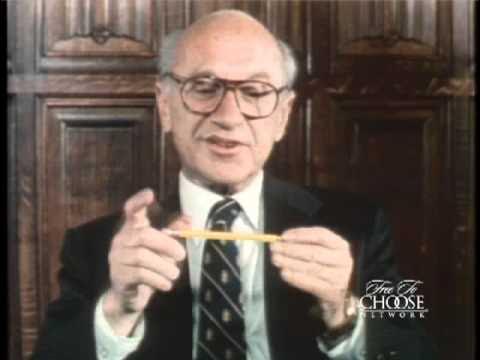
Milton Friedman reflects on the foundational teachings of Adam Smith, noting that the core principles underlying the free market are fundamentally simple. Holding up an ordinary lead pencil, Friedman makes a bold, counterintuitive assertion: “There is not a single person in the world who could make this pencil.” He dismantles the object into its raw elements to demonstrate the immense, invisible network required to produce something seemingly trivial. The exterior wood, he explains, likely began as a tree felled in the State of Washington, a task that required a saw, which in turn required steel, which itself demanded the mining of iron ore.
Friedman examines the other components of the pencil, noting that the black core commonly referred to as lead is actually compressed graphite, likely extracted from mines in South America. The red eraser mounted on the end is made of rubber, probably sourced from Malaya, where the rubber tree is not even indigenous; it had been imported from South America by entrepreneurs aided by the British government. As for the brass ferrule holding the eraser, the yellow exterior coat, the paint used for the black lettering, and the glue binding the wood casing together, Friedman admits he has no idea where they originated, emphasizing the sheer impossibility of any single individual mastering the vast array of specialized skills and logistical chains needed to fabricate them.
```mermaid flowchart TD accTitle: Components and Supply Chains of a Pencil accDescr: Diagram illustrating the diverse global inputs required to manufacture a simple pencil.
subgraph Casing ["Wood & Body"] A["Washington Timber"] --> B["Saws & Steel Tools"] B --> C["Iron Ore Mining"] end
subgraph Core ["Writing Core"] D["Compressed Graphite"] --> E["South American Mines"] end
subgraph Tip ["Eraser Assembly"] F["Rubber Eraser"] --> G["Malayan Plantations"] H["Brass Ferrule"] end
subgraph Finishing ["Assembly & Finish"] I["Yellow & Black Paint"] J["Adhesive Glue"] end
Casing --> K["The Finished Pencil"] Core --> K Tip --> K Finishing --> K ```
- **Wood casing**: Sourced from trees in Washington State, dependent on saws, steel production, and iron ore extraction. - **Pencil core**: Compressed graphite rather than lead, typically mined in South America. - **Eraser topper**: Natural rubber, likely grown in Malaya following transplanting from South America with British government backing. - **Hardware and finishing**: A brass ferrule, multi-colored paints for the body and labeling, and bonding glue from unknown origins.
---
[01:18](https://www.youtube.com/watch?v=67tHtpac5ws&t=78s) The Price System and Global Cooperation
The creation of a single pencil represents the coordinated efforts of literally thousands of individuals dispersed across the globe. These contributors speak entirely different languages, adhere to diverse religious faiths, and might harbor deep mutual animosities if they ever met face to face. Yet, when an ordinary consumer walks into a store and purchases a pencil for a trifling sum, they are engaged in a profound exchange: trading a few minutes of their own labor for a few seconds of the combined labor of thousands of unknown participants.
Friedman highlights the central wonder of this arrangement: this intricate global collaboration occurs without any centralized authority directing it. “There was no commissar sending out orders from some central office,” Friedman observes, attributing the achievement entirely to “the magic of the price system, the impersonal operation of prices that brought them together, and got them to cooperate to make this pencil so that you could have it for a trifling sum.” He concludes that the free market is far more than an engine for productive output; its highest merit lies in uniting humanity: “That is why the operation of the free market is so essential, not only to promote productive efficiency, but, even more, to foster harmony and peace among the peoples of the world.”
## Notable quotes > [00:04](https://www.youtube.com/watch?v=67tHtpac5ws&t=4s) There is not a single person in the world who could make this pencil. — Milton Friedman
## Mentioned Adam Smith, British government, Free To Choose Network, I, Pencil, Malaya, Milton Friedman, South America, State of Washington
## Video description Milton Friedman points out the remarkable degree of cooperation between people from many different countries, who’ve never even met, to make what appears to be a very simple product – a pencil. The free market encourages cooperation between strangers. And the end result is that we all benefit – in this case, by having pencils to use.
Check out our Facebook page here: https://www.facebook.com/FreeToChooseNetwork
Visit our media website to find other programs here: http://freetochoosemedia.org/index.php
Connect with us on Twitter here: https://twitter.com/FreeToChooseNet
Learn more about our company here: http://freetochoosenetwork.org/
Shop for related products here: http://www.freetochoose.net/
Stream from FreeToChoose.TV here: http://freetochoose.tv/
[Source](https://www.youtube.com/watch?v=67tHtpac5ws)