Joe Rogan Experience #1006 - Jordan Peterson & Bret Weinstein
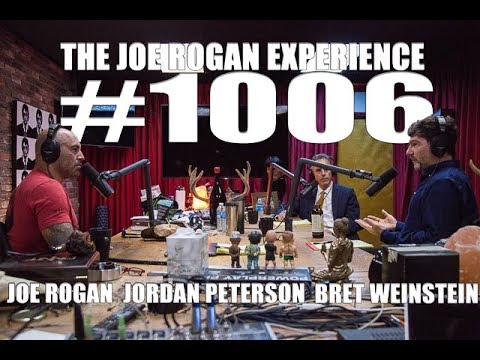
PowerfulJRE
AI-assisted summary of Joe Rogan Experience #1006 - Jordan Peterson & Bret Weinstein — original source. Check the original for full context.
Source published:
Key ideas
- Jordan Peterson and Bret Weinstein argue that dismissing totalitarian leaders like Adolf Hitler as mere 'madmen' obscures the latent, evolved human psychological mechanisms—including out-group disgust sensitivity and resource-competition programs—that enable mass atrocities. (0:00)
- Postmodern neo-Marxism is critiqued as an irreconcilable intellectual contradiction that denies biological reality and universal metanarratives while simultaneously relying on a Marxist metanarrative of class and power dynamics. (87:34)
- Weinstein introduces the concept of beliefs that are 'literally false, metaphorically true'—heuristics and mythic narratives that are factually untrue yet confer distinct evolutionary survival advantages when acted upon. (60:01)
- Peterson explains that wealth and productivity skew into extreme unequal Pareto distributions across all creative systems, making radical egalitarian attempts to enforce equal outcomes economically destructive and historically fatal. (91:53)
- Both scholars urge the adoption of individual personal responsibility and open discourse as the necessary cultural defense against escalating tribal feedback loops between the radical left and the alt-right. (25:20)
Detailed notes
## Background This episode was published on September 1, 2017, on YouTube by the PowerfulJRE channel as episode #1006 of the Joe Rogan Experience. The page description introduces clinical psychologist Jordan Peterson from the University of Toronto alongside biology professor Bret Weinstein from Evergreen State College, both of whom were embroiled in national campus controversies regarding free expression, evolutionary thinking, and institutional politics.
## TL;DR Jordan Peterson and Bret Weinstein join Joe Rogan to dissect the cultural, evolutionary, and psychological mechanisms driving modern political polarization and institutional collapse. Drawing from evolutionary biology, the discussion examines how human tribalism, disgust sensitivity, and out-group competition fuel totalitarian regimes and contemporary speech controversies. Peterson and Weinstein analyze the philosophical divide between empirical science and postmodern neo-Marxism, exploring how Pareto distributions naturally govern creative output and resource concentration across systems. Together, they advocate for the heroic individual, free speech, and nuanced public dialogue as the necessary safeguards against ideological radicalism on both the far left and the far right.
## Atmosphere & style The conversation carries an urgent, highly cerebral, and intellectually intense tone, reflecting the immediate fallout from the campus upheavals Peterson and Weinstein were actively enduring in 2017. Rogan acts as an inquisitive, grounded interlocutor, steering academic abstractions into relatable cultural touchstones while letting his guests build elaborate theoretical frameworks around biology, mythology, and political theory. The dialogue alternates between solemn warnings about historical atrocities and lighter moments of dry, bemused humor regarding internet satire, giving listeners the feeling of an unvarnished, deep-dive academic summit wrestling with societal instability in real time.
## Bulletin - [00:00](https://www.youtube.com/watch?v=6G59zsjM2UI&t=0s) Jordan Peterson and Bret Weinstein argue that dismissing totalitarian leaders like Adolf Hitler as mere 'madmen' obscures the latent, evolved human psychological mechanisms—including out-group disgust sensitivity and resource-competition programs—that enable mass atrocities. - [01:27:34](https://www.youtube.com/watch?v=6G59zsjM2UI&t=5254s) Postmodern neo-Marxism is critiqued as an irreconcilable intellectual contradiction that denies biological reality and universal metanarratives while simultaneously relying on a Marxist metanarrative of class and power dynamics. - [01:00:01](https://www.youtube.com/watch?v=6G59zsjM2UI&t=3601s) Weinstein introduces the concept of beliefs that are 'literally false, metaphorically true'—heuristics and mythic narratives that are factually untrue yet confer distinct evolutionary survival advantages when acted upon. - [01:31:53](https://www.youtube.com/watch?v=6G59zsjM2UI&t=5513s) Peterson explains that wealth and productivity skew into extreme unequal Pareto distributions across all creative systems, making radical egalitarian attempts to enforce equal outcomes economically destructive and historically fatal. - [25:20](https://www.youtube.com/watch?v=6G59zsjM2UI&t=1520s) Both scholars urge the adoption of individual personal responsibility and open discourse as the necessary cultural defense against escalating tribal feedback loops between the radical left and the alt-right.
## Key takeaways - [00:00](https://www.youtube.com/watch?v=6G59zsjM2UI&t=0s) Genocidal totalitarianism stems from latent, evolved human behavioral programs rather than isolated anomalies of individual madness. - [01:51](https://www.youtube.com/watch?v=6G59zsjM2UI&t=111s) Postmodern philosophy in university humanities rejects competence and objective reality, reducing all human interactions strictly to arbitrary power games. - [16:11](https://www.youtube.com/watch?v=6G59zsjM2UI&t=971s) Political conservatism and authoritarian tendencies correlate strongly with orderliness and disgust sensitivity rather than fear, functioning as an extended behavioral immune system against out-group contamination. - [39:05](https://www.youtube.com/watch?v=6G59zsjM2UI&t=2345s) Biological differences in human temperament, including higher average agreeableness and lower risk-taking in women, are supported by empirical psychology rather than being purely arbitrary social constructs. - [52:31](https://www.youtube.com/watch?v=6G59zsjM2UI&t=3151s) Societal innovation and discovery originate from a 'minority of one' on the fringe, requiring robust protections for free speech to reintegrate discoveries back into cultural consensus. - [01:00:01](https://www.youtube.com/watch?v=6G59zsjM2UI&t=3601s) Religious and mythic narratives function as evolved behavioral guides containing metaphorical truths that promote long-term survival, regardless of their scientific literalism. - [01:20:41](https://www.youtube.com/watch?v=6G59zsjM2UI&t=4841s) Scientific facts alone cannot generate ethics or prescribe human action; inherited wisdom and values are required to select optimal paths from an infinite landscape of data. - [01:31:53](https://www.youtube.com/watch?v=6G59zsjM2UI&t=5513s) Capital accumulation and creative output naturally follow Pareto distributions across all production domains, refuting the Marxist claim that inequality is an exclusive defect of capitalism. - [02:08:01](https://www.youtube.com/watch?v=6G59zsjM2UI&t=7681s) General cognitive ability (IQ) and conscientiousness represent the primary psychological determinants of economic performance in modern meritocratic systems. - [01:48:10](https://www.youtube.com/watch?v=6G59zsjM2UI&t=6490s) Universal Basic Income misdiagnoses human fulfillment by providing cash without addressing the biological and psychological necessity for purpose, utility, and responsibility. - [01:55:53](https://www.youtube.com/watch?v=6G59zsjM2UI&t=6953s) Free-market dynamics optimize logistical efficiency but cannot establish moral values, creating perverse incentives when applied inappropriately to universities, churches, and journalism. - [02:27:47](https://www.youtube.com/watch?v=6G59zsjM2UI&t=8867s) A 'black truth' occurs when an accurate factual claim is deliberately weaponized out of proper context to wound, mislead, or provide moral cover to extremist factions. - [02:42:08](https://www.youtube.com/watch?v=6G59zsjM2UI&t=9728s) Branding decentralized internet satire and memes as hate symbols erodes the middle ground of nuanced public discourse, polarizing observers into rigid binary extremes.
## Detailed walkthrough ### [00:00](https://www.youtube.com/watch?v=6G59zsjM2UI&t=0s) Origins of the Conversation and Analyzing Hitler
Joe Rogan opens the podcast with Jordan Peterson and Bret Weinstein, joking about Peterson looking especially sharp in a suit while making everyone else look sloppy. Peterson explains with a laugh that he only packed a limited selection of clothes. When Rogan asks whose idea it was to arrange the sit-down, Weinstein explains that he reached out after seeing a clip of Peterson discussing Adolf Hitler, in which Peterson argued that Hitler was actually far worse than his standard reputation suggests.
Weinstein connects Peterson’s insight to his own undergraduate work with renowned evolutionary biologist Robert Trivers, whom Weinstein considers one of the preeminent evolutionary minds of the twentieth century. Working under Trivers, Weinstein had conducted an evolutionary analysis of the Holocaust to investigate the prevailing cultural narrative that Hitler was simply insane. Weinstein felt that reducing genocidal leaders to mere madness bypasses the deeper, more terrifying mechanics of what actually transpired, making Peterson's video clip the perfect catalyst for a broader discussion.
> “I think there's something actually dangerous that we dismiss somebody like Hitler as crazy before we understand actually what they're up to so when I saw your your video clip I thought it would be worth having a discussion so that we could figure out what perspective makes sense.” — Bret Weinstein
[01:51](https://www.youtube.com/watch?v=6G59zsjM2UI&t=111s) The Crisis at Evergreen State College and the Dogma of Power
Before delving into evolutionary history, Rogan shifts focus to Weinstein’s unfolding crisis at Evergreen State College in Olympia, Washington. Weinstein clarifies that while a lawsuit had not yet been formally filed, he had engaged in an initial sit-down negotiation with the college administration the previous day in an attempt to avert legal action. However, Weinstein shares a grim assessment of the administration's stance, noting that the college appears to have learned nothing and is instead doubling down on the very premises that sparked the chaos.
Rogan details the public spectacles on campus, pointing to students roaming with baseball bats and a notorious confrontation where students commanded the college president not to use hand gestures while speaking because it constituted a microaggression. When the president complied, the students cheered and laughed at their newfound leverage. Peterson frames these campus antics not as youthful aberrations, but as the direct logical consequence of postmodern ideology taught in the humanities. Under this worldview, objective reality is discarded as a social construct, legitimate authority and competence are erased, and human relationships are interpreted purely through the prism of power dynamics and group conflict.
> “And if you're cynical about that sort of thing and you should be, you might say that part of the reason that the only thing that the post-modernists believe in is power is because that helps them justify their arbitrary use of it under any circumstances whatsoever and I think that's right.” — Jordan Peterson
- Bret Weinstein held his first formal negotiation meeting with Evergreen State College leadership the day prior to avert a lawsuit. - Rogan highlights the Evergreen student body’s tactics, such as policing gestures and patrolling campus grounds with bats, as games of raw coercion. - Peterson argues that postmodernism removes any standard of competence or merit, leaving dominance and arbitrary power as the only remaining currencies of human interaction.
[04:54](https://www.youtube.com/watch?v=6G59zsjM2UI&t=294s) Charlottesville, "Punch a Nazi," and Campus De-platforming
The conversation moves to the cultural escalation around political violence, specifically the ubiquity of the slogan "punch a Nazi" online and the arbitrary expansion of who qualifies as a Nazi. Rogan observes that in activist circles, anyone who dissents is casually branded a fascist, even while legitimate white supremacists carrying tiki torches and shouting antisemitic slogans marched at Charlottesville. Peterson emphasizes that mainstream culture across both the left and right had long reached a firm consensus that Nazism was thoroughly evil, which was why genuine neo-Nazis were so easily identified and condemned by sensible conservatives.
Peterson recounts how the fallout from Charlottesville directly impacted him in Canada. He was scheduled to participate in a panel discussion regarding the suppression of free speech on university campuses at Ryerson University in Toronto. In the wake of Charlottesville, a campus activist created a Facebook campaign featuring a crossed-out swastika and the slogan "no fascists at Ryerson," falsely targeting the panel. Ryerson’s administration caved and promptly canceled the event, largely because another scheduled panelist was journalist Faith Goldy, who had covered the Charlottesville protest and captured video of the fatal car attack.
> “We all agreed on that we're not going there anymore and so when someone pops up and says well we should go there it's like they're immediately identifiable you can box them in and if you have any sense like you know like many conservatives did in the aftermath of the Charlottesville they come out and say well in case it needs to be said again we're actually not allied with those people.” — Jordan Peterson
[07:58](https://www.youtube.com/watch?v=6G59zsjM2UI&t=478s) The Swastika vs. the Hammer and Sickle
Peterson describes the aftermath of the Ryerson cancellation, where counter-protesters held a victory celebration on campus. A crowd of several hundred gathered openly under the hammer and sickle, chanting calls for communist revolution. What Peterson found striking was the utter silence from mainstream media regarding the celebration of an ideology with a catastrophic, murderous historical record. Peterson contrasts the public reception of totalitarian symbols, exploring why the swastika immediately signals moral pathology while the hammer and sickle is tolerated or treated benignly.
Peterson offers a criminological analogy to explain the differing emotional responses to fascism and communism: Nazism resembles a street mugger who corners you in an alley and stabs you for your wallet, producing an immediate, visceral terror through overt bloodiness. Communism, by contrast, operates like a sophisticated white-collar criminal who methodically steals your pension; while potentially far more destructive in scale, the harm is abstract and deferred. Rogan adds that pure historical ignorance and pop-culture romanticism drive the left-wing imagery, pointing to youth wearing Che Guevara t-shirts who imagine a stylish jungle freedom fighter resisting American empire rather than confronting Guevara's real-world history of atrocities.
> “And I think maybe it's something like the Nazi is the guy who knifes you in the alley and steals your wallet and the communist is the white-collar criminal who takes your pension and you're actually more afraid of the first person than the second person because the damage they do is more proximal and immediate and emotionally recognizable.” — Jordan Peterson
```mermaid flowchart TD accTitle: Comparison of Totalitarian Symbols accDescr: Diagram illustrating Jordan Peterson's analogy contrasting the public perception of the swastika versus the hammer and sickle.
subgraph Nazism["Nazi Symbolism (Swastika)"] N1["Visible Brutality / Bloodshed"] --> N2["Alley Mugger Metaphor"] N2 --> N3["Immediate Visceral Terror & Universal Rejection"] end
subgraph Communism["Communist Symbolism (Hammer & Sickle)"] C1["Abstract / Systemic Atrocity"] --> C2["White-Collar Pension Thief Metaphor"] C2 --> C3["Romanticized Rebellion & Pop-Culture Tolerance"] end ```
[09:34](https://www.youtube.com/watch?v=6G59zsjM2UI&t=574s) Drawing Lines Around Extremism: Right vs. Left
Jordan Peterson begins by contrasting how political factions police their fringes, reflecting on the immediate aftermath of the Charlottesville rally. Prominent conservatives quickly distanced themselves from the extremists, citing Ben Shapiro's swift condemnation of white supremacists as a modern parallel to William F. Buckley Jr. excommunicating the John Birch Society from mainstream conservatism in the 1960s. Peterson argues that it is inherently easier for the right to establish clear boundaries because conservatives naturally excel at drawing lines: if someone wears a swastika to a protest, they are unequivocally cast out of the club.
```mermaid flowchart LR accTitle: Boundary Enforcement on the Right vs Left accDescr: Contrasting how the right uses clear visual markers like swastikas while the left relies on abstract concepts like equity. subgraph RightWing ["The Right Wing"] R1["Visible Marker:<br>Swastika"] --> R2["Immediate Line Drawn:<br>'Out of the Club'"] end subgraph LeftWing ["The Radical Left"] L1["Ideological Marker:<br>Demand for 'Equity'"] --> L2["Vague / Abstract Line:<br>Lacks Emotional Punch"] end ```
By contrast, defining where the radical left crosses the line into unacceptable extremism is elusive. Peterson suggests that insisting on "equity" without defining it ought to be the smoking pistol, yet it fails to function as an effective cultural demarcation. Pointing to abstract concepts lacks visceral, rhetorical power; nobody can easily rally public outrage or cut social ties simply over a disagreement on equity. Peterson highlights the disparity: “On the right you say, 'Well, you wear a swastika, you're out of the club, man,' right? On the left, well, what's the smoking pistol? You believe in equity... but it doesn't have the same emotional punch as 'you wore a swastika to the protest.'”
[10:38](https://www.youtube.com/watch?v=6G59zsjM2UI&t=638s) Evolutionary Roots of Tribalism and Historical Cycles
Bret Weinstein redirects the conversation, warning that treating Nazis as the primary threat acts as a red herring. By focusing on a cartoonish view of Charlottesville and the small headcounts involved, society overlooks a deeper evolutionary dynamic that recurs throughout history. As Joe Rogan briefly pauses to advise Weinstein on keeping his microphone a fist’s distance away, Weinstein articulates his core thesis: 1930s Germany was simply a well-documented manifestation of an evolved human tendency. He notes that “tyranny is the endgame of prosperity,” explaining that extended periods of affluence foster the illusion that primal human conflict has been banished forever. Once that abundance dwindles, older survival strategies resurface under new banners, which leaders like Donald Trump cynically ride.
Peterson agrees, noting that his own public battles over campus politics stemmed from recognizing this polarization. Pushing a radical leftist agenda in universities inevitably generates a mirror counter-reaction: an inversion of identity politics where people revert to white racial identification, which he describes as extraordinarily dangerous. Weinstein analyzes this asymmetry between the two sides:
- The political left relies on an unstable coalition of disparate minority and identity groups that lack the numbers to wield dominant power alone; once they attain control, internal friction threatens to tear them apart. - The far-right's manifestation as white nationalism is dangerously cohesive and stable because it appeals to a single, historically unified population rooted in evolutionary tribalism. - Weinstein stresses the "naturalistic fallacy": an evolutionary biologist describing a pattern's emergence is not defending it, as evolution is an amoral process that has generated humanity's highest virtues alongside its most horrific pathologies.
Weinstein summarizes the moral imperative facing society: “Evolution is an absolutely amoral process. It has produced the most marvelous features of human beings and the worst features, and we are in some sense obligated to pick and choose which features to honor and promote and which ones to tamp down.”
[16:11](https://www.youtube.com/watch?v=6G59zsjM2UI&t=971s) Disgust Sensitivity, Orderliness, and Authoritarianism
Peterson explains the psychological and biological mechanisms underpinning conservative and authoritarian beliefs. Temperament reliably tracks political orientation: left-leaning individuals generally score high in trait openness (associated with creativity) and low in conscientiousness. While conscientiousness can be divided into industriousness and orderliness, research reveals that conservatism specifically correlates with orderliness. Crucially, orderliness is tightly linked to an innate sensitivity to disgust rather than fear.
| Political Trait / Phenomenon | Underlying Mechanism | Evolutionary Role | |:--- |:--- |:--- | | **Trait Openness / Low Conscientiousness** | Creative, exploratory mindset | Seeking novelty and systemic reform | | **Orderliness (Sub-trait of Conscientiousness)** | High disgust sensitivity | Maintaining boundaries, sanitation, and social cohesion | | **Pathogen Avoidance (Behavioral Immune System)** | Pathogen prevalence correlates (r = 0.6) with authoritarianism | Guarding isolated populations against lethal foreign contagions |
Citing a study published in *PLOS ONE*, Peterson notes a 0.6 correlation between the local prevalence of infectious diseases and authoritarian political attitudes across countries and sub-national regions. This reaction constitutes an "extended behavioral immune system." Throughout evolutionary history, contact between isolated groups often led to devastating demographic collapse via novel pathogens, much like Native American populations perishing from smallpox after Spanish contact. This ingrained an implicit biological and tribal bias to reject the foreign.
Peterson ties this directly to Adolf Hitler's rhetoric, noting that reading *Hitler's Table Talk* (transcripts of Hitler's private mealtime discussions from 1939 to 1942) revealed how the dictator's language was saturated not with fear of out-groups, but with visceral disgust and an obsession with hygiene. Peterson observes how easily a societal virtue tilts into catastrophe: “People think of conservatives or fascists as afraid of those who are different. They're not afraid; they're disgusted. And that's not the same thing, because you burn things you're disgusted by.”
[19:13](https://www.youtube.com/watch?v=6G59zsjM2UI&t=1153s) The Latent Tribal Program and Dehumanization
Bret Weinstein expands on the evolutionary root of political hostility, linking it back to the pathogen-defense mechanism discussed moments earlier. When ancestral populations encountered one another, real microbiological threats created an instinctive fear of the foreign or "other," producing a strong selective pressure favoring reluctance to mix. However, Weinstein warns that this biological legacy manifests in modern warfare and politics through systematic dehumanization—labeling opposing groups as subhuman "vermin." His immediate concern centers on how society responds to the de facto Nazis surfacing in public view, such as the demonstrators in Charlottesville. Rather than recognizing the universal human capacity for tribal violence, the public comforts itself by treating these figures as an isolated, subhuman contagion, justifying violence against them under the illusion that containing an external infection solves the problem.
```mermaid flowchart TD accTitle: Evolutionary Pathogen Defense to Political Polarization accDescr: Diagram illustrating how ancient pathogen avoidance mechanisms transform into modern political dehumanization. subgraph Ancestral ["Ancestral Biology"] A["Deeply Rooted Disgust System"] --> B["Protection Against Biological Pathogens"] B --> C["Instinctive Fear of Foreign Populations"] end subgraph Manifestation ["Modern Manifestation"] C --> D["Wartime Dehumanization: Labeling Others as 'Vermin'"] D --> E["Pathogen Model: Treating Ideological Foes as Contagions"] E --> F["Latent Violent Programs Triggered by Environmental Shifts"] end ```
Weinstein argues that this response is fundamentally flawed because tribal cruelty is not a foreign virus, but an ancient, latent program carried in reserve by human populations. Jordan Peterson concurs, sharing how he has spent decades teaching university students about the psychology of Nazi Germany and Auschwitz. When students are asked whether they would have served as concentration camp guards, their immediate instinct is self-exoneration—insisting those perpetrators were fundamentally unlike them. Peterson stresses that the honest psychological realization is far more unsettling:
> “The right response is those people were human and I'm also human and so that means that the Nazi is us that's what it means and so that and who the hell wants to think that and no one will think that and I have thought that through because I thought through for a variety of reasons what the limits of my potential behavior are and the limits of my potential and maybe I'm more pathological than the average person it's certainly possible but I understand that the limits of my potential behavior are beyond the bounds of what people would normally consider civilized and I think that's characteristic of human beings in general.”
[22:25](https://www.youtube.com/watch?v=6G59zsjM2UI&t=1345s) The Peril of Taboo Topics and Radical Instability
Joe Rogan underscores why uncensored dialogue is indispensable. In a culture saturated with ideological hysteria, exploring the evolutionary roots of human darkness is treated as taboo. Forbidding these discussions does not eliminate extreme impulses; instead, it insulates them from analytical scrutiny and grants them explosive underground momentum. Rogan remarks that under slightly different circumstances—the wrong neighborhood, wrong parents, or wrong life path—any individual could have ended up marching with tiki torches in Charlottesville. Acknowledging that shared biological vulnerability is the only honest starting point for preventing political violence.
Peterson characterizes the broader sociological and psychological landscape as one of radical instability, where society stands on a knife-edge between outcomes far better or far worse than the present. In such a climate, individual actions carry outsized consequences. Peterson points to the Charlottesville car attack, where a single individual surrounded by a coterie of deplorables committed a murderous act that instantly warped the national political landscape. Peterson explains that culture is trapped in an escalating positive feedback loop:
> “I say something left like and you say something right like and that annoys me so I get more left and it annoys you and you get more right and all of a sudden were at each other's throats and that's happening everywhere right it's very unstable and what what's to be hoped for is that we can pull back from that and discuss it...”
[25:20](https://www.youtube.com/watch?v=6G59zsjM2UI&t=1520s) Positive Feedback Loops, Ideology, and Tech Censorship
Peterson reflects on the tension between diagnosing ideological capture and inadvertently accelerating polarization. While friends have criticized his use of the term "social justice warrior" as contributing to demonization, he emphasizes his grave concern over radical Marxist ideologies dominating universities and driving cultural division. To break this destructive cycle, Peterson urges personal responsibility over collective identification:
> “Get it into your head that you have the capacity for great evil and stop targeting stop assuming that that's something that's manifesting itself only in the people that you disagree with politically take responsibility for that and try to put your life together I don't see an alternative to that...”
Peterson notes that this rapid ideological ping-ponging mirrors the collapse of the Weimar Republic in the 1920s and 1930s. Rogan points out an alarming modern asymmetry: the American right possesses the overwhelming majority of firearms, making civil conflict a terrifying prospect, especially amid circulating warnings—such as remarks from Roger Stone—that attempts to impeach Donald Trump could trigger armed confrontation.
Weinstein insists that humanity already possesses the evolved cognitive tools to escape this trap, provided lines of open debate remain unobstructed. The greatest emerging threat is that dominant technology gatekeepers will shut off those tools:
> “...if Google and other of these online goliaths start deploying algorithms that decide what we get to talk about and see then we cannot use the very tools that are necessary in order to escape and avoid something like civil war which frankly communication and debate analyzing all the components of this issue completely objectively... taking the risks that are necessary with that and some of the risks are that if we have free and open communication that some percentage of that communication is going to be reprehensible and deplorable but yes but that but that the consequences of suppressing that are so much more dangerous than the consequences of allowing it that they're not in the same universe...”
Suppression transforms bad ideas into taboo badges of honor, allowing them to fester away from the light of public criticism where they could otherwise be thoroughly dismantled.
[28:49](https://www.youtube.com/watch?v=6G59zsjM2UI&t=1729s) AI Censorship, Pre-Perceptual Filtering, and Gad Saad
Jordan Peterson begins by voicing concern over major internet platforms like Google and YouTube implementing algorithmic, "pre-perceptual censorship" powered by artificial intelligence bots. He explains that these companies aim to stop objectionable content before it is even published. Peterson brings up a recent example involving Gad Saad, an evolutionary behavioral scientist and professor. Saad had uploaded a video that had not yet gone live, only to discover it had already been flagged for demonetization.
```mermaid flowchart LR accTitle: YouTube Pre-Publication Review Pipeline accDescr: Video upload triggers an automated or manual review leading to demonetization before public release. A["User Uploads Video"] --> B["System Content Access"] B --> C["Manual Review"] C --> D["Pre-Publish Demonetization Notice"] ```
Joe Rogan pulls Saad's tweet up on the screen, where Saad wrote: “YouTube thinks that my pointing to astounding hypocrisy is too triggering. There is nothing objectionable in my clip. Unbelievable.” While Peterson acknowledges that Saad’s video was flagged via a manual review rather than solely by an automated AI, both he and Rogan find it alarming. Given the millions of clips uploaded to YouTube, they question why a mainstream evolutionary behavioral scientist would be singled out for manual scrutiny. Rogan observes that simply asking questions about prevailing cultural movements now causes people to get immediately labeled as part of a right-wing hate group.
[30:21](https://www.youtube.com/watch?v=6G59zsjM2UI&t=1821s) Radical Social Constructionism and the Totalitarian Blank Slate
Peterson connects the targeting of scientists like Saad to a broader philosophical dispute: the assertion that human beings possess an intrinsic biological nature. He points out that those defending biological realities are now labeled with the derogatory epithet "biological essentialist." Peterson argues that for radical postmodern neo-Marxists, human nature must be treated as entirely blank: “If you're a radical postmodern neo-Marxist, your theory is human beings can be anything that I want to make them into.” He asserts that this premise is inherently totalitarian because it treats human beings as mere putty to be shaped to fit an ideological agenda, rather than recognizing any inherent constraints.
Peterson compares this modern ideology to the Soviet Union, where authorities explicitly rejected evolutionary biology, wiped out historical precedent, and sought to engineer a new human being for a utopian future. Bret Weinstein agrees, noting that Soviet science severely crippled itself by adopting ideologically driven, anti-Darwinian concepts:
> “The Russians actually sidelined themselves effectively with respect to evolutionary theory that basically they were so backward on a biological front that as they were deploying this very broken ideological toolkit, they were wrecking their ability to think about how biology works.”
Weinstein stresses that the findings of evolutionary biology inherently clash with political correctness: “Nobody tells the biota what's right and what's wrong. The biota does what it does, and those of us who look at it and attempt to understand what those patterns are can't help but be deeply politically incorrect almost all the time.”
[32:37](https://www.youtube.com/watch?v=6G59zsjM2UI&t=1957s) Evolutionary Biology, Racism, and the Non-Patriarchal Nature of Genes
Weinstein addresses how evolutionary mechanisms produce distinct social dynamics regarding race and sex. He makes the politically sensitive observation that human genomes carry the potential for racism for Darwinian reasons—namely, that distinct populations have historically banded together against other populations in violent competition, driving many of history's darkest moments.
However, Weinstein insists that sexism operates under an entirely different evolutionary logic. He argues that male and female genomes cannot evolve into inherently warring biological castes because genes do not stay segregated by sex:
> “It is not possible for male genes to gang up on female genes, because all of our genes spend half their time in male bodies and half their time in female bodies.”
While acknowledging that civilization has often been unfair across sex and gender lines, Weinstein clarifies that there is no biological basis for an evolved, monolithic "patriarchal force" aimed at permanently subordinating women. Any genetic program deployed by men to hurt women would inevitably be inherited by their own daughters in the next iteration. Weinstein argues that only by honestly confronting the Darwinian motives encoded in our genomes can humanity rationally decide to disempower those impulses:
- Human genomes contain evolved behavioral tendencies toward in-group favoritism and out-group competition (racism). - Genes spend equal generations in male and female lineages, making a genetic conspiracy against women biologically impossible. - Human beings are unique in their ability to use rational thought to override gene-level evolutionary drives. - Denying that biological urges exist prevents society from developing genuine tools to dismantle and diffuse tribalism.
[34:43](https://www.youtube.com/watch?v=6G59zsjM2UI&t=2083s) Bill C-16, Gender Expression, and Canadian Law
Peterson recounts the controversy surrounding his public opposition to Canada's Bill C-16 a year earlier. While opponents characterized his objections as an attack on transgender rights, Peterson insists his central concern was that the statute codified a radical social constructionist theory into formal law. He explains that under this legal framework, biological sex, gender identity, gender expression, and sexual proclivity are officially decoupled and deemed entirely independent of one another.
Peterson argues that claiming these four components are causally disconnected contradicts basic biological facts. For the vast majority of human beings, biological sex matches gender identity, gender expression, and heterosexual orientation. By rendering claims of biological causation unlawful, Canadian legislation placed standard biological observation outside legal bounds. As Weinstein wryly quips: “It's not that it's illegal to be a biologist, it's just illegal to be any good at it.”
[36:38](https://www.youtube.com/watch?v=6G59zsjM2UI&t=2198s) Biological Determinism, Rational Restraint, and Socializing Aggression
Rogan steps in to play devil's advocate, articulating the reasonable rationale behind opposing biological essentialism: the worry that defining individuals strictly by their biology reduces humanity to a "meat wagon" and risks sliding into horrors like eugenics. Peterson agrees that strict biological determinism carries dangerous political traps. However, Rogan and Weinstein emphasize that running to the opposite extreme—outright denial of biology—strips humanity of the cognitive tools necessary to transcend primitive urges.
Peterson illustrates how biology and environment must coordinate rather than cancel each other out, offering the development of childhood aggression as an example:
- Around 5% of young boys exhibit hyper-aggressive behaviors (kicking, biting, hitting, stealing) identifiable around two years of age. - Normal cultural socialization by parents and peers successfully curbs this behavior in the vast majority of boys by age four. - When properly guided rather than crushed, that biological temperament yields courageous, resilient, and forthright men who do not back down from challenges.
Peterson points out that achieving this healthy integration requires acknowledging both the innate biological drive and the necessary socialization, before turning to how James Damore's Google memo was similarly misrepresented as purely biological determinism.
[39:05](https://www.youtube.com/watch?v=6G59zsjM2UI&t=2345s) The James Damore Memo and the Biology of Agreeableness
Jordan Peterson addresses the controversy surrounding James Damore’s Google memo, defending Damore’s grasp of psychological research while clarifying the document's true intent. Peterson emphasizes that Damore was relying on credible, peer-reviewed scientific evidence demonstrating that biological factors meaningfully influence differences in temperament and interests between men and women. Damore's argument was not an attack on female competence, but an attempt to maximize talent across the board: if an organization wants to extract the highest economic value from all individuals, it must understand real baseline differences so workplaces can be designed to help both men and women flourish.
Peterson points to agreeableness as a prime example of an evolved temperament differential. On average, women score higher in agreeableness than men, which Peterson links to maternal care: surviving the intense demands of an infant requires an orientation toward self-sacrifice. However, this same evolutionary wiring carries a distinct disadvantage in corporate environments. Being adapted for nurturing leaves agreeable individuals less inclined to confront hyper-aggressive, competitive male colleagues or demand higher compensation. In market economies, those who cannot adopt disagreeable stances—such as threatening to walk away unless they are paid more—tend to earn significantly less.
> “One of the consequences of that is that agreeable people don't make as much money and the reason for that is to make money you actually have to be disagreeable because you have to go to your boss and say give me some bloody money or something you don't like will happen to you.” — Jordan Peterson
[41:17](https://www.youtube.com/watch?v=6G59zsjM2UI&t=2477s) Evolutionary Life History and Democratizing Wisdom
Bret Weinstein approaches the question through the lens of evolutionary biology, explaining why female and male lineages developed fundamentally different forms of wisdom. Because human females produce far fewer offspring over a lifetime and invest years of intensive care into raising each child, their reproductive stakes are exceptionally high. This extended maternal investment explains the evolutionary emergence of menopause, a stage where a woman's biological interests realign directly with the survival and stability of the entire lineage and community. This life-history constraint fosters an innate, long-term farsightedness about population welfare—a trait observable across mammalian females.
In contrast, human males represent a high-variance reproductive strategy: historically, a single male could father dozens of offspring or end up with zero. This variance rewarded high-stakes risk-taking, embedding that particular brand of wisdom along the male evolutionary path. Weinstein argues that in the modern world, biology does not have to be destiny. Society should actively democratize both forms of evolutionary wisdom so that women can freely adopt traditionally male-biased risk-taking strategies and men can cultivate lineage-preserving prudence. However, Peterson interjects that ideological dogma prevents this progress because mainstream discourse insists on the counter-factual premise that men and women are identical.
```mermaid flowchart TD accTitle: Evolutionary Divergence in Reproductive Strategies accDescr: Diagram illustrating how female and male reproductive trade-offs produce distinct forms of evolved wisdom.
subgraph FemaleStrategy["Female Life History Strategy"] F1["Limited lifetime offspring & high parental investment"] --> F2["Menopause & long-term lineage focus"] F2 --> F3["Lineage-preserving wisdom & social farsightedness"] end
subgraph MaleStrategy["Male Life History Strategy"] M1["High reproductive variance: zero to many offspring"] --> M2["Payoff for high-stakes competition & hazard"] M2 --> M3["Risk-taking wisdom & aggressive assertiveness"] end
subgraph ModernIntegration["Modern Cultural Integration"] F3 --> D["Democratized access to both forms of wisdom"] M3 --> D end ```
> “The fact is there's no reason if you're born female that you can't tune into what has historically been male biased wisdom and take advantage of that and we should be encouraging this.” — Bret Weinstein
[43:08](https://www.youtube.com/watch?v=6G59zsjM2UI&t=2588s) The Misrepresentation of Damore and Journalistic Malpractice
Turning to possible policy interventions, Peterson suggests that recognizing aggregate differences in agreeableness could inform creative corporate strategies. Rather than relying on rigid quotas, companies could account for negotiation reluctance by instituting more frequent salary reviews for female employees—reviewing men once a year and women every eight months, for instance. He is careful to note he is not endorsing that exact policy, but rather arguing for pragmatic adjustments that optimize economic participation without invoking the flawed rhetoric of "leveling the playing field."
The tragedy of the Google memo, Peterson notes, is that Damore wrote it after being solicited for feedback during a mandatory diversity program, only to be fired when his nuanced, scientific argument leaked. Joe Rogan points out the deliberate media distortion that followed: outlets systematically stripped Damore's citations and scientific links before publishing, presenting his memo as an unhinged sexist screed rather than a referenced academic summary. Peterson warns that this failure of journalism reflects deep ideological malice or gross incompetence. Because society sits in a radically unstable moment, journalists who play fast and loose with the truth to smear opponents risk pushing civil discourse toward catastrophic failure.
> “I was willing to play fast and loose with the truth and now I've played a major causal role and you know pushing everything towards a state of chaos it's like people have better be on their toes because we're in a situation that's radically unstable.” — Jordan Peterson
- James Damore was fired from Google after submitting his internal memo in response to mandatory diversity training. - News outlets re-published the memo with all embedded academic citations stripped out, making it impossible for casual readers to tell it was based on published psychological literature. - Peterson cautions that individual ethical lapses by media commentators now carry outsized systemic risk given current social polarization.
[46:11](https://www.youtube.com/watch?v=6G59zsjM2UI&t=2771s) Pepe the Frog, Kekistan, and Absurdist Internet Culture
Joe Rogan reflects on how quickly people weaponize accusations of racism over trivial internet culture. Rogan shares how he spent the previous day playfully trolling on social media with images of Pepe the Frog—posting Pepe with rainbows supporting gay rights, or showing Pepe with a sour face after biting into a lemon—to demonstrate that Pepe is simply an open-source, silly cartoon rather than a coordinated white supremacist hate symbol. Weinstein adds that he had recently researched the satirical online nation of "Kekistan," marveling at how it was constructed to baffle outsiders by imagining an absurd paradise where Jews, anti-Semites, atheists, and religious believers live alongside one another. The concept, Weinstein observes, was deliberately engineered to cause mainstream literalist minds to throw a cognitive error.
Peterson agrees, noting that because critics frequently associate him with the alt-right, he has spent significant time studying its subcultures and trolling rituals. He explains that much of Kekistan operates as satirical, defensive humor against moralistic cultural panics. Peterson even reveals that he purchased a green Kekistani flag for his father, who had been closely following the internet storms surrounding him. Peterson’s own bizarre connection to frog imagery originated innocently when he wore a carved wooden frog hat on camera—a gift from a Native American coastal carver. The artisan had explained that in their cultural mythology, because amphibians are the first creatures to die when a water supply is polluted, the frog is revered as an early warning harbinger alerting the tribe that the surrounding ecosystem has slipped dangerously out of balance.
> “The story was preposterous it was a you know it's a magical place where we're anti-semites and Jews and atheists and religious people live in harmony which is like that's hard to even parse it's designed to cause your mind to throw an error.” — Bret Weinstein
[48:36](https://www.youtube.com/watch?v=6G59zsjM2UI&t=2916s) The Accidental Frog Symbol and the Flight from the Radical Left
Jordan Peterson recounts how he inadvertently got tangled up in online frog subcultures. After making jokes about how his voice naturally sounds like Kermit the Frog, he wore a carved wooden frog hat made by an artist friend in a video discussing social instability. Because the carved frog had red lips, viewers immediately assumed he was referencing Pepe the Frog and the satirical cult of "Kek." Peterson admits he nearly fainted from shock, having had no idea the symbol would be interpreted that way. This surreal incident placed him in direct conversation with a large demographic of young online men who felt deeply alienated and pushed in a right-leaning direction by the radical left. When these young men ask what they should become if they reject the far left, many wonder if the only option is to flee to the alt-right.
Joe Rogan points out that this oppositional dynamic is inherently poisonous. Rather than developing genuine personal sovereignty, people simply react to their ideological adversaries, ramping up extreme positions and altering their identities purely out of spite. Peterson explains that his content is specifically aimed at breaking this reflexive binary by providing a meaningful alternative:
> “So what I've been trying to do with my videos—and I think this is part of the reason that they've become so popular, in fact I'm certain of it—is that I've been trying to agitate for the adoption of that personal responsibility as an alternative to political ideology.”
Peterson argues that Western civilization’s most profound discovery is that the fully developed, responsible individual serves as the only real defense against societal and biological tyranny. When people refuse the heavy burden of developing themselves, they retreat into collective racial or sexual tribes, willing to watch society burn simply to evade personal responsibility. Rogan agrees, noting that modern culture suffers from a profound lack of spiritual and physical struggle, forgetting that voluntary confrontation with difficult obstacles is required to discover one's true potential. Peterson concurs, framing this as the ancient hero myth: shrinking from the tragic burden of life breeds resentment and malevolence, whereas courageously facing the dragon is the only path forward.
[52:31](https://www.youtube.com/watch?v=6G59zsjM2UI&t=3151s) The Fringe as the Engine of Innovation
Bret Weinstein shifts the discussion to the evolutionary and systemic failure of collectivist groups. Whether dealing with white nationalists on the far right or social justice warriors on the far left, collectivist movements suffer from an inability to innovate or see forward. Group consensus can only preserve what is already agreed upon; it cannot discover the unknown. True discovery always originates at the individual level, requiring what Weinstein describes as a "minority of one" who tests new waters and convinces others to follow:
> “Every great idea starts with a minority of one, so we have to have the freedom to be the only person who believes something and then to compel others that it's somewhere in the right neighborhood and for others to pick up that mantle.”
Peterson connects Weinstein’s point directly to free speech, lamenting that defending speech has been mischaracterized as an exclusively right-wing issue. Speech is the vital mechanism operating on the frontier between order and chaos, pulling new insights back into the collective when existing social frameworks prove inadequate. Weinstein affirms that this is an evolutionary rule observed across all biology: adaptations do not emerge from comfortable organisms thriving at the center of a population, but from those struggling on the margins where risky experiments offer the only chance of survival.
```mermaid flowchart TD accTitle: The Mechanics of Societal Innovation accDescr: A diagram showing how individual inquiry on the fringe updates collective knowledge through free speech.
subgraph Fringe ["The Fringe: Chaos & The Unknown"] Ind["Independent Individual<br/>('Minority of One')"] Stress["Torment / Need for Adaptation"] Ind --> Stress Stress --> Discov["New Discovery / Novel Idea"] end
subgraph SpeechMechanism ["Communicative Bridge"] FS["Free Speech & Debate"] end
subgraph Center ["The Collective: Order & Established Knowledge"] Coll["Existing Social Consensus<br/>(Cannot innovate on its own)"] Update["Updated Collective Framework<br/>(Survival through adaptation)"] Coll --> Update end
Discov --> FS FS --> Update ```
- **Psychological predictors of genius**: Peterson cites psychologist Hans Eysenck's book *Genius*, noting that beyond high IQ and a creative temperament, experiencing the death of a parent before age ten was a significant statistical predictor of creative success, illustrating that creativity is spurred by torment rather than ease. - **The necessity of suffering**: People falsely treat creativity as gentle and pleasant, whereas true innovation requires being deeply burdened by an unresolved problem.
[55:24](https://www.youtube.com/watch?v=6G59zsjM2UI&t=3324s) The Heroic Individual in Religious and Evolutionary Lore
Peterson highlights how closely modern evolutionary dynamics mirror foundational religious traditions. The concept of the individual stepping out from the collective to rescue the group is a precise biological restatement of the central Christian archetype, as well as the Jewish prophetic tradition. In the Old Testament, solitary prophets repeatedly emerge to confront blind, tyrannical kings, warning the rulers that they are breaching fundamental moral orders and courting ruinous natural catastrophe.
Weinstein notes that across history, dozens of such voices likely spoke out, but the ones preserved in cultural memory were those whose predictions proved true, guiding their populations through historical bottlenecks—effectively meaning that natural selection and evolution authored these enduring narratives.
Peterson reflects on his foundational writing and his ongoing public lectures:
> “And when I wrote my first book, *Maps of Meaning*, it was about ideological conflict and it was about whether or not there was any alternative to ideological conflict, because you could make a case that there isn't—there's right and there's left and there's a war, right? But there is a third way, and I think that is the way of the heroic individual, and I mean that technically.”
For Peterson, this third path requires honing personal character, articulating truthful experience, and introducing novel, unique perceptions into the collective culture to prevent it from decaying. He mentions having completed twelve live biblical lectures walking through the Book of Genesis, which he views as a historical record charting the painful psychological discovery and emergence of the divine individual.
[57:37](https://www.youtube.com/watch?v=6G59zsjM2UI&t=3457s) The Abrahamic Narrative and Consciousness as the Mediator
Jordan Peterson discusses how contemporary society struggles with foundational religious texts because people evaluate them as though they are making scientific propositions about the physical world. Seen through that literalist lens, the scriptures appear factually wrong, but Peterson maintains they were never meant to serve as objective scientific descriptions. In his public lectures on Genesis, Peterson reframes these stories psychologically and philosophically, presenting consciousness as the western archetype mediating between chaos and order. This framework has resonated strongly with secular audiences, leading some of his YouTube followers to describe themselves as "Christian atheists" because they find value in the archetype of the divine individual acting across time without subscribing to supernatural dogma.
To illustrate how these ancient texts address human existence, Peterson turns to the story of Abraham. When God calls Abraham, he is already an old man who has remained too long in comfortable domestic safety—a figure Peterson likens to a modern forty-year-old living in his mother’s basement. God's call to adventure demands that Abraham abandon his family, friends, and familiarity to journey into foreign, hostile territory. Peterson emphasizes that answering this call does not result in immediate reward or comfort; rather, Abraham immediately faces famine and is forced to flee into Egypt, where his wife is nearly taken by a tyrant. Peterson highlights that the biblical narrative is fundamentally realistic about the suffering inherent in life, showing that triumph requires ethical commitment rather than naive optimism. As Peterson puts it:
> “What are you gonna find there, well, your fortune? No, you're gonna find the catastrophes of life, but if you keep yourself morally oriented and you make the right sacrifices, which is the Abrahamic story to a tee, then you can transcend the catastrophe of being and prevail.”
[01:00:01](https://www.youtube.com/watch?v=6G59zsjM2UI&t=3601s) "Literally False, Metaphorically True" and the Problem of Moral Accuracy
Bret Weinstein connects Peterson's interpretation of myth to Peterson's contentious debates with Sam Harris concerning the nature of truth. Weinstein suggests an evolutionary reconciliation between Peterson's metaphorical view and Harris's empirical view, while cautioning that it carries an uncomfortable implication. From an evolutionary biology standpoint, human intellect did not evolve purely to discover objective, scientific facts; it evolved to facilitate survival and reproductive success. Weinstein introduces the concept of ideas that are "literally false, metaphorically true"—beliefs that lack factual basis but yield superior practical outcomes when acted upon.
```mermaid flowchart TD accTitle: Literally False Metaphorically True Framework accDescr: Bret Weinstein's model showing how factually incorrect beliefs can produce adaptive behavioral advantages.
subgraph Belief ["Cognitive Belief"] A["Literally False Premise"] end
subgraph Action ["Adaptive Behavior"] B["Precautionary or Proactive Conduct"] end
subgraph Outcome ["Evolutionary Payoff"] C["Survival / Thriving Advantage"] end
A --> B B --> C ```
Weinstein offers two concrete examples to clarify the category. The belief that porcupines can shoot their quills is zoologically false, but anyone who behaves as if it is true maintains a safe distance and avoids quills that can migrate into vital organs or cause lethal infections. Similarly, the belief that "everything happens for a reason" is scientifically unsupported outside the laws of physics, yet adopting that mindset prompts someone struck by misfortune to search for hidden opportunities rather than succumb to despair. Weinstein argues religious truths evolved under this exact dynamic, but he presents a "bitter pill" for Peterson's moral optimism: evolved metaphorical truths are not necessarily morally upright, nor are they guaranteed to remain adaptive as environmental conditions change. Weinstein explains:
> “These are ideas that aren't true in the factual sense, but they are true enough that if you behave as if they were true, you come out ahead of where you would be if you behaved according to the fact that they're not true.”
- Porcupine quills feature microscopic barbs that cause them to work their way deeper into tissue over time once they puncture skin, posing serious risks of organ damage and sepsis. - Weinstein points out that doctrines carried along within human populations encode individual, familial, and societal truths, but effective metaphorical survival strategies can sometimes be morally reprehensible. - While ancient texts contain vital non-literal truths, Weinstein stresses that they are not inherently up-to-date or universally applicable to present-day realities.
[01:03:42](https://www.youtube.com/watch?v=6G59zsjM2UI&t=3822s) Rescuing the Dead Father: Archetypes, Pinocchio, and Tradition
Peterson acknowledges that wrestling with the boundary between empirical and metaphorical truth pushes his intellectual capacity to its limits, acknowledging that it is perilous ground where mistakes are easy to make. However, he counters Weinstein's critique by arguing that great mythic structures already anticipate that tradition can become obsolete or corrupt. Peterson notes that the archetype of the tyrannical father—often used exclusively by modern activists who condemn Western culture solely as an oppressive patriarchy—is only half of the equation, as it stands alongside the archetype of the wise king. Mythological systems recognize that past knowledge eventually calcifies and dies if it is not continually revitalized.
To demonstrate how stories illustrate this dynamic, Peterson analyzes the fairy tale of Pinocchio. Pinocchio begins as an unconscious marionette, pulled by strings and prone to deceit, while his creator Geppetto embodies the good father wishing for his creation to achieve genuine individuality. When Geppetto is swallowed by a giant whale at the bottom of the ocean, he represents the dead, stagnant wisdom of the past trapped in primordial chaos. Pinocchio must mature, dive into the abyss, and rescue his father. Peterson links this to the Christian doctrine of the Trinity: the Father represents accumulated historical knowledge that is dead on its own, requiring the living, active force of the Son in the present to update and redeem it. Tearing down the past wholesale—as occurred under Mao Zedong during China's Cultural Revolution—is catastrophic because the past carries biological and cultural wisdom accumulated across billions of years. Peterson underscores the necessity of this ongoing generational renewal:
> “The father was right a hundred years ago, a thousand years ago, and is still partly right, but he's dead; he can't participate in the updating of the process, so you need an active force now.”
- In the Pinocchio narrative, Geppetto's wish upon a star represents the difficult, seemingly impossible aspiration of guiding an unconscious being into true individualization. - The belly of the whale functions across worldwide mythology as a universal symbol for chaos, the unknown, and the unconscious depths. - Peterson equates throwing out inherited historical traditions to discarding the physical human body, which itself is the biological embodiment of roughly 3.5 billion years of evolutionary refinement.
[01:07:04](https://www.youtube.com/watch?v=6G59zsjM2UI&t=4024s) Archetypes, Cultural Legacy, and Modern Hazards
Jordan Peterson discusses the psychological obligation to embody deep moral ideals, observing that one’s moral duty is to realize the archetype within the confines of individual existence. In Western civilization, that archetypal image of perfection is Christ. While no modern person can replicate the literal historical life of first-century Judea, they must manifest that archetype today, which forces the difficult work of continually updating ancient wisdom. Peterson cautions that attempting to forego the past entirely leads to catastrophic social breakdown: “The past is alive enough so that those of us who inhabit its corpse aren't clawing each other to death while we're feeding, right that's the critical issue.” However, because societal structures can rapidly collapse, maintaining and re-articulating those ancestral structures requires constant vigilance.
Bret Weinstein agrees that religious systems are not merely Richard Dawkins’s dismissive “mind viruses,” but adaptive cultural inheritances forged across evolutionary history. Nevertheless, Weinstein warns that ancient codices cannot adequately navigate novel existential threats that their authors never conceived. No sacred text prepares modern humanity for perils like Google's algorithms or artificial intelligence destabilizing civilization. Navigating the modern world requires recognizing the gap where ancestral guidance falls silent.
```mermaid flowchart TD accTitle: Updating Ancestral Wisdom for Modern Hazards accDescr: Diagram contrasting ancient archetypal wisdom with novel modern existential risks. subgraph Ancient["Ancestral Inheritance"] A["Archetypal Models (e.g., Christ)"] --> B["Deep Patterns of Social Order"] end subgraph Gap["The Modern Dilemma"] B --> C{"Sufficient for Today?"} C -->|"Abstract Pattern"| D["Universal Moral Anchors"] C -->|"Novel Threats"| E["Technological Hazards (AI, Algorithms)"] end subgraph Action["Required Adaptation"] D & E --> F["Continual Re-articulation & Modern Rules"] end ```
---
[01:09:08](https://www.youtube.com/watch?v=6G59zsjM2UI&t=4148s) Abstract Truths vs. Legacy Code: From Taoism to Enriched Uranium
Peterson refines Weinstein’s critique by distinguishing between literal details and overarching abstract patterns. Mythological narratives operate at elevated levels of abstraction, making their foundational patterns universally applicable regardless of technological changes. As a prime example, Peterson points to the phenomenological landscape of chaos and order: order represents the domain where actions yield desired results, while chaos is where plans fail. Drawing on Taoist philosophy, Peterson argues that optimal functioning occurs directly on the boundary between the two:
> “The Daoists do that very nicely because they have a chaos order conceptualization of the of the phenomenological landscape and their claim is the the point of maximum proper being is right at the center of the border between chaos and order and I think that's true across contexts so I don't think that truth ages.”
Weinstein concedes that certain high-level patterns remain eternal, but compares older religious doctrines to computer software filled with accumulating "legacy code." When archaic instructions outweigh contemporary utility, retaining the whole package becomes perilous. Weinstein remarks that if the Ten Commandments were being issued today, the primary directive would almost certainly be:
> “Thou shalt not enrich uranium.”
Because uranium was completely unknown to ancient scribes, religious canons omit our greatest material dangers, implicitly downplaying them. Weinstein wonders whether society can honor religious traditions for guiding civilization to this point while boldly adopting more potent, up-to-date systems. Peterson cautions that updating ancient culture is notoriously difficult, pointing out that even fairy tales dating back 15,000 years resist simple modern revisions.
---
[01:12:05](https://www.youtube.com/watch?v=6G59zsjM2UI&t=4325s) Examining the Universality of Traditions
Playing devil’s advocate against his own claim that religious mythologies carry universally adaptive evolutionary wisdom, Peterson questions whether all religious traditions function equally well. Obscuring significant differences between faiths under a broad umbrella of universal truth overlooks unique structural traits:
> “So I'm going to stick my neck way the hell out because why not: it isn't obvious to me that Islam does, because it's very difficult for me to see that the totalizing nature of Islam doesn't make it unique among religions.”
- Religious texts contain distinct theological frameworks that do not necessarily map onto identical evolutionary or psychological solutions. - Peterson stresses that asserting every sacred text holds identical archetypal utility avoids addressing the specific real-world consequences of particular dogmas.
---
[01:13:03](https://www.youtube.com/watch?v=6G59zsjM2UI&t=4383s) Joe Rogan on the Word "Truth" and the Porcupine Metaphor
Joe Rogan interjects that the fundamental friction in these debates comes down to semantics and the misuse of the word *truth*. While terms like *tradition* or *wisdom* are readily acceptable, calling myths or protective fictions "true" invites confusion. Rogan revisits Weinstein's earlier analogy of telling a child that porcupines shoot their quills: while the warning keeps the child safe, the claim itself is factually false. Teaching an untrue mechanism builds a faulty model of reality into a child's mind when one could simply teach the factual hazard of sharp quills:
> “If you tell a kid that they can throw their quills and so therefore the kid stays clear of them, here's a faulty assumption in his head: you're lying to them for their own protection, and that was not good, I wouldn't do it.”
Rogan compares this to comforting platitudes like "everything happens for a reason," joking that after death humans might find an auditing room revealing our brains were just running simian survival routines rather than grasping ultimate reality. Weinstein agrees that he would never knowingly tell his own children that porcupines throw quills, noting that while adaptive beliefs may have evolved through natural selection to ensure survival, passing down inaccurate models risks misleading children on deeper inquiries down the road.
---
[01:15:14](https://www.youtube.com/watch?v=6G59zsjM2UI&t=4514s) The Etymological Origins of Truth and the Sam Harris Debate
Peterson pushes back against Rogan's strictly empirical definition of truth by recounting his debates with Sam Harris. Harris had accused Peterson of corrupting and hijacking the definition of truth by insisting on metaphorical or Darwinian definitions. Peterson argues that Harris has the historical chronology backward: the linguistic and conceptual root of truth is far older than the modern scientific construct of objective empirical facts.
Originally, truth described fidelity, alignment, and reliability—as in an arrow flying straight and "true" toward its target. In biblical contexts, such as Christ declaring himself "the way, the truth, and the life," the term denoted an existential mode of being rather than a set of scientific facts:
> “Harris's claim with regards to my utilization of truth was that I was absconding with the definition of truth and in false manner, but he was wrong, because the idea of truth is much older than the idea of objective truth, and the original notion of truth wasn't objective truth: it was like the arrow flies straight and true, right, it meant something like reliably reliably on its way to the appropriate destination, something like that.”
Peterson emphasizes that defining truth purely through a modern objective lens fails to understand the metaphorical, teleological traditions from which human language and moral structures evolved.
[01:16:09](https://www.youtube.com/watch?v=6G59zsjM2UI&t=4569s) Two Kinds of Truth: Representation vs. Action
Jordan Peterson explains that when grappling with truth, he sees two fundamental varieties that can either align or dissociate from one another. The first is the truth that manifests itself in the manner in which an individual acts; the second is the truth that represents the objective, external world. At times, both truths stack neatly atop each other, but frequently they diverge. An individual can act on a piece of wisdom that functions remarkably well in real life, even if the proposition carries an inaccurate factual representation of the physical world. Peterson points to biblical narratives as an example: when read strictly as modern science, they do not hold up, yet they may still encode functional truths.
```mermaid flowchart TD accTitle: Two Types of Truth accDescr: A diagram contrasting representational factual truth with pragmatic actionable tool truth. subgraph Truths["The Spectrum of Truth"] A["Objective / Factual Truth<br/>(Representation of the physical world)"] B["Actionable / Tool Truth<br/>(Wisdom that guides behavior)"] end A -->|"Optimal alignment"| C["Functional Reality"] B -->|"Optimal alignment"| C B -.->|"Operates effectively even with<br/>imperfect scientific knowledge"| D["Evolutionary Survival"] ```
Bret Weinstein offers the etymology of malaria as an illustration: the word derives from *mal aria*—literally "bad air." While malaria is actually transmitted by mosquitoes breeding in stagnant environments rather than the air itself, avoiding the foul-smelling swamp air kept people away from the vectors carrying the parasite. Peterson notes that this aligns with the pragmatic philosophical distinction he previously debated with Sam Harris: the difference between descriptive truth and tool truth. Just as a sharp ax is spoken of as being "more true" than a dull ax because it performs its intended function, tool truths enable humans to operate successfully in the world. Joe Rogan asks whether the confusion stems from using the word "true" when one ought to simply use the word "fact," pointing out that while $1 + 1 = 2$ is a fact and water extinguishing a match is a fact, both are also undeniably true.
> “There’s the truth that manifests itself in the manner in which you act and there’s the truth that manifests itself as a representation of the objective world and sometimes both those truths are stacked on top of each other and sometimes they’re not.” — Jordan Peterson
[01:18:27](https://www.youtube.com/watch?v=6G59zsjM2UI&t=4707s) Ancient Hygiene and the Germ Theory of Disease
Bret Weinstein notes that everyone in the room likely subscribes to the laboratory-tested, empirical truth as the ultimate benchmark of physical reality. However, ancient cultures had to survive long before they possessed the scientific language or instruments to verify such facts. Weinstein points to the Old Testament concept of "filth" and its strict commands against defecating inside the camp because it was said to be offensive to God. That rule kept human populations safe from infectious microbes thousands of years before the germ theory of disease was formally discovered.
Weinstein asks whether it is better to be paralyzed until one can literally describe the microbial underpinnings of an infection, or to be liberated by a behavioral rule that protects health millennia in advance. Peterson agrees, summarizing that human beings had to figure out how to act and survive before they could comprehend the world well enough to scientifically justify those behaviors. Rogan and Weinstein observe that dietary restrictions—such as prohibitions against shellfish (which carry red tide toxins) or pork (which transmits trichinosis)—likely originated from the same pragmatic, hygienic necessity, even if they later evolved into markers of tribal identity to distinguish groups from their neighbors.
> “Human beings needed to figure out how to act without dying before they could understand the nature of the world well enough to justify that.” — Jordan Peterson
[01:20:41](https://www.youtube.com/watch?v=6G59zsjM2UI&t=4841s) Fact vs. Wisdom and the Limits of Fact-Derived Ethics
Peterson suggests establishing an overarching category of "Truth" and dividing it into two distinct branches: "fact" and "wisdom." In an optimal scenario, facts and wisdom map directly onto one another, but when they do not, Peterson argues it is a serious error to discard the wisdom simply because its factual vehicle is crude—a mistake he attributes to New Atheist thinkers like Richard Dawkins and Sam Harris. Peterson criticizes what he sees as Harris's sleight of hand: the claim that moral wisdom is merely a secondary derivation that can be grounded straightforwardly in scientific facts.
```mermaid flowchart LR accTitle: Facts Versus Action in a Landscape accDescr: Diagram illustrating that aggregating facts does not determine a path of action. A["Infinite Objective Facts<br/>(Every blade of grass, soil density, wind)"] B["Action / Navigation<br/>(Choosing a specific path through the field)"] C["Wisdom & Value Hierarchy<br/>(Ethical and social constraints)"] A -.->|"Cannot spontaneously generate"| B A --> C C -->|"Selects viable direction"| B ```
Rogan notes that knowing the facts does not tell someone whether to prioritize their own self-interest or the welfare of others, which is precisely where ethics enter the picture. Peterson adds that aggregating facts cannot tell you how to act because the physical world contains an infinite number of facts. If a person stands before an open field, no amount of measurement regarding the soil, flora, or terrain will instruct them on which direction to walk; facts alone cannot bridge the gap between description and action.
> “Sam acts as if the process of mapping facts onto action is simple if we just got the facts right, but it’s the weakest part of his argument and we never ever got to that for a variety of reasons, but part of the reason it’s weak is, okay, well there’s like an infinite number of facts, man.” — Jordan Peterson
- The New Atheist perspective assumes that perfect factual knowledge naturally produces correct moral action. - Merely accumulating objective data about an environment does not reveal which path an individual ought to take. - Ethical dilemmas emerge whenever consequences are delayed across generations or when individual interests clash with collective welfare.
[01:22:36](https://www.youtube.com/watch?v=6G59zsjM2UI&t=4956s) Game Theory, Social Contracts, and Iterated Wisdom
Bret Weinstein notes that two distinct problems are intertwined in this discussion. First, an individual cannot be an expert in everything; the rationalist community's ideal of an individual calculating every move from first-principles data is practically impossible, requiring people to rely on approximate behavioral guides. Second, while civilization must be guided by its best empirical understanding of reality, it must also respect inherited wisdom whose exact regulatory function may not yet be fully understood. Weinstein cautions that this is inherently dangerous, as traditional practices can also harbor harmful baggage alongside their adaptive benefits.
Peterson deepens the definition of wisdom through an evolutionary and game-theoretic lens. For a principle to qualify as true wisdom, it must clear several overlapping hurdles across time: 1. It must function successfully against the constraints of objective reality. 2. It must preserve the actor's social standing and not destroy the functional social contract. 3. It must work for the actor in the present, next week, next month, and decades into the future. 4. It must work simultaneously for the individual, the immediate family, and broader society across repeated iterations.
> “If it’s wise, then it works in the world—so that’d be the constraint of objective reality—but then it works for you now and the you that’ll be in a week and the you that’ll be in a month, and it works for you and your family, and it works for you and your family and society, and it works in a way that those things all line up to be iterated across time.” — Jordan Peterson
[01:24:59](https://www.youtube.com/watch?v=6G59zsjM2UI&t=5099s) Ethical Constraints and the Postmodern Conundrum
Jordan Peterson proposes his solution to what he terms the "postmodern conundrum." Granting the postmodernists their core premise—giving "the devil his due"—he explains that their foundational observation is that a finite set of facts allows for an infinite number of possible interpretations. Because an observer cannot establish a single, canonical interpretation of a text or set of facts, postmodernists ask why any one reading should be privileged over another, ultimately concluding that all favored interpretations are merely assertions of power. Peterson argues that while this dilemma is real, postmodernism completely overlooks the severe role of ethical constraint. Although theoretical interpretations are limitless, practically functional interpretations—those that prevent an individual from being killed by others or failing disastrously through their own stupidity across time—are extraordinarily rare.
Bret Weinstein agrees, noting that enduring cultural narratives exist for concrete reasons: *The Odyssey* has survived through centuries, suggesting an underlying, scientifically investigable basis for its durability. Peterson highlights the fatal flaw that results when postmodernists reach this dead end: faced with infinite interpretations and paralyzed regarding how to actually act in the world, theorists default back into Marxism. Postmodernism leaves adherents bereft, aimless, and nihilistic, prompting them to sneak Marxist power dynamics in through the back door to provide purpose and a blueprint for action.
> “And so the landscape of interpretation is almost infinite, but the landscape of applicable interpretation, functional interpretation, is unbelievably constrained, and I think that constraint system is what we regard as ethics.” — *Jordan Peterson*
```mermaid flowchart TD accTitle: The Postmodern Conundrum and the Marxist Pivot accDescr: Diagram illustrating how postmodern nihilism leads back to Marxism due to lack of functional action.
subgraph Premise ["Postmodernist Premise"] Facts["Finite Set of Facts"] --> Infinite["Infinite Possible Interpretations"] Infinite --> NoCanon["No Canonical Interpretation"] NoCanon --> PowerClaim["Privilege Reduced to 'Power Games'"] end
subgraph Failure ["The Practical Dead End"] PowerClaim --> Nihilism["Nihilism & Action Paralysis<br/>('What do I do next?')"] RealWorld["Real-World Feedback<br/>(Survival & Stupidity Constraints)"] -.->|Ignored by Postmodernism| Nihilism end
subgraph Pivot ["The Neo-Marxist Turn"] Nihilism --> MarxismBackdoor["Adopt Marxism Through Back Door<br/>(Restores Action, Purpose & Identity Politics)"] end ```
[01:27:34](https://www.youtube.com/watch?v=6G59zsjM2UI&t=5254s) The Unholy Alliance of Postmodernism and Marxism
Joe Rogan questions whether people truly adopt these philosophies because of a dilemma over infinite interpretations, suggesting instead that it is simply an emotional reaction to the negative aspects of capitalism. In Rogan's view, Marxism offers a prepackaged, romanticized, egalitarian alternative centered on socialism and equality. Peterson clarifies that while romantic motivations are powerful, a rigorous historical distinction must be drawn between Marxism and postmodernism. Historically, French intellectuals developed postmodern philosophy in the wake of the late 1960s, a period when the murderous brutality of Soviet Marxism had become impossible to defend.
Peterson asserts that postmodernism functioned as an intellectual "screening tactic" that allowed discredited economic Marxism to morph into cultural identity politics. He points out a glaring intellectual contradiction: one cannot logically be both a postmodernist (which rejects metanarratives and universal structures) and a Marxist (which depends entirely on a grand metanarrative of class conflict). Peterson identifies an underlying, resentment-driven anti-capitalism as the unifying motive behind this self-contradictory stance, driven by an appetite to punish those who have achieved more.
> “You don't get to be a postmodernist and a Marxist. You actually technically cannot be both of those things at the same time, and the fact that most people are both of those things at the same time raises the specter of just exactly what their motivation is.” — *Jordan Peterson*
[01:30:20](https://www.youtube.com/watch?v=6G59zsjM2UI&t=5420s) Why the Marxist Prescription Fails
Bret Weinstein intervenes, joking that he might alienate his "last few friends" by dissecting Marxism's appeal. He acknowledges that Karl Marx’s critique of capitalism makes many valid points, which serves as the intellectual hook that draws people in. However, the prescription Marx offered is fundamentally toxic. Weinstein emphasizes that Marxism fails not because its story is unappealing, but because it is neither game-theoretically functional nor evolutionarily stable, inevitably collapsing into grave violence. Rogan asks Weinstein to break down precisely why Marxism goes bad in practice. Weinstein answers bluntly: the ideology fails because it refuses to account for human nature and the foundational mechanics that allow human societies to function. Peterson quips that Weinstein's critique sounds like that of a "true fascist."
> “There's a lot in Marx's critique of capitalism that's actually right, and so that kind of gets you through the door once you start looking at the analysis, and then there's the prescription, which is toxic, but it's not obvious why it's toxic.” — *Bret Weinstein*
- Marx's diagnostic critique of market imbalances has merit, drawing readers into the ideology. - The proposed Marxist remedies ignore basic human evolutionary drives and game-theoretic viability. - Historically, attempting to implement these remedies leads directly to coercion, catastrophic failure, and state-level violence.
[01:31:53](https://www.youtube.com/watch?v=6G59zsjM2UI&t=5513s) The Pareto Distribution and the Matthew Principle
Peterson returns to Marx's initial insight to demonstrate where the analysis went off course. Marx accurately noticed that capital relentlessly accumulates into the hands of fewer and fewer people, but he misdiagnosed this as an inherent flaw of capitalism. Peterson argues that this concentration is actually a manifestation of a deeper, universal law of creative production known as the Pareto distribution. In any endeavor where individual performance varies, the vast majority produce nearly nothing, a small fraction achieve moderate success, and a hyper-minority capture nearly all the output.
Peterson explains the mathematical rule of thumb: roughly the square root of the total population under consideration ends up possessing or producing 50% of the total output. This dynamic mirrors the biblical Matthew principle: *"to those who have everything, more will be given, and from those who have nothing, everything will be taken."* Peterson points out that this distribution appears across all human production, whether analyzing wealth, classical music compositions, or scientific output. When any production domain is established, unequal outcomes and hyper-concentrations of success inevitably follow.
> “What Marx observed was that capital tended to accumulate in the hands of fewer and fewer people, and he said that's a flaw of the capitalist system. That's wrong. It's not a flaw of the capitalist system; it is a feature of every single system of production that we know of, no matter who set it up and how it operates.” — *Jordan Peterson*
- **The Square Root Principle**: If 10,000 individuals compete in a production system, roughly 100 people (the square root of 10,000) will control half the generated wealth or output. - **Classical Music Example**: Out of 100 classical composers, roughly 10 generate half of all performed music; out of roughly 1,000 compositions created by those 10, approximately 30 pieces account for 50% of all public performances. - **The Matthew Principle**: A New Testament observation (*Matthew 25:29*) that empirically describes the compounding nature of success and compounding penalty of failure across complex adaptive systems.
[01:34:12](https://www.youtube.com/watch?v=6G59zsjM2UI&t=5652s) The Pareto Distribution, Econophysics, and the Flaw in Marxism
When productive spoils flow disproportionately to a tiny fraction of the population, a society faces a critical crisis: either the remaining majority starves, or the entire structure destabilizes because everyone grows furious. Jordan Peterson explains that humanity’s primary evolutionary solution has been to diversify the number of productive games. If an individual lacks the physical gifts to become an NBA basketball star, they can choose to run a podcast, build a business, or invent a new craft. By fractionating the production landscape, people who fail in one domain can thrive in another. However, even with multiple games, success tends to compound. A person with an immensely popular podcast or YouTube channel develops an exceptionally powerful network, concentrating utility and attention right back at the top.
Peterson points out that this concentration follows a pattern with the strength of a natural physical law. He highlights the little-known academic field of econophysics, where researchers use the exact mathematical equations governing the diffusion of gas molecules into a vacuum to model the distribution of money across an economy. Karl Marx observed this profound inequality but misdiagnosed the cause by attributing it solely to the evils of capitalism. Peterson argues the dynamic is far more fundamental: any minor advantage makes an individual slightly more attractive and capable, fractionally boosting the odds of future success until the advantage snowballs into a Pareto distribution. Peterson jokes that Joe Rogan has accumulated an astronomical 1.2 billion podcast downloads, not out of oppression, but because he rode that exact Pareto wave into the stratosphere. He facetiously asks whether Rogan should be compelled to redistribute his billions of downloads to the downtrodden.
Rogan pushes back, explaining that no listener is coerced into downloading anything; people freely choose what to consume, and if someone invests relentless effort, time, and focus into a compelling product, audiences naturally gravitate toward it, producing exponential growth. Peterson agrees with the free-market premise, emphasizing that critics and postmodernists fundamentally err when they conflate competence and authority with raw tyrannical power:
> “And this is the other problem with the Marxist perspective is that and the post modernists in particular like they conflate power competence and authority unfairly.”
```mermaid flowchart TD accTitle: The Pareto Distribution and Compounding Success accDescr: Diagram illustrating how initial competence snowballs into compounding advantage or creates the trap of zero.
subgraph DynamicOfAdvantage["Compounding Success (The Pareto Wave)"] A["Competence & Targeted Effort"] --> B["Fractional Advantage Gained"] B --> C["Increased Attractiveness & Network"] C --> D["Exponential Growth / Pareto Distribution"] end
subgraph DynamicOfDeprivation["The Black Hole of Zero"] E["Zero Resources / Absolute Privation"] --> F["Inability to Enter Productive Games"] F --> G["Severe Economic Penalization"] G --> H["Vulnerability to Revolutionary Nihilism"] end
D -.->|"Extreme gap destabilizes system"| DynamicOfDeprivation ```
[01:37:51](https://www.youtube.com/watch?v=6G59zsjM2UI&t=5871s) The Trap of Being "Stuck at Zero" and the Revolutionary Temptation
While acknowledging that markets reward competence, Peterson stresses that this dynamic leaves a catastrophic problem unresolved: the impossibility of gaining traction when someone is stuck at zero. Rogan suggests that instead of solely examining what successful people do right, society ought to identify what failing individuals are doing wrong in order to maximize human potential. Peterson mentions that this exact goal drove the development of his Future Authoring program. In a functional society, the two most reliable psychological predictors of success are intelligence (IQ) and conscientiousness—both heavily influenced by a genetic lottery. Furthermore, clearly defining a concrete target and working relentlessly toward it reliably improves outcomes.
Yet none of these tools work if someone possesses literally nothing. Peterson stresses that once an individual has some capital or momentum, acquiring more is manageable; but starting from absolute zero acts like a reverse trap where no one wants to talk to you, the system penalizes you, and you lack the table stakes to even play the game. This absolute immobility creates the breeding ground for revolutionary ideologies. Young men, who are biologically more expendable and therefore predisposed to high-risk behavior, find a potent romantic appeal in radical figures like Che Guevara. When an ideology offers the chance to burn down the entire corrupt structure, the offer sounds far more tempting than permanent stagnation, because in a newly randomized deck they might no longer be stuck at zero:
> “You're poor you don't have anything no one wants to talk to you you can't get out of it because you're too poor to get out of it you know you're penalized by the economic system because you can't even afford to start playing the game you're stuck at zero.”
[01:40:12](https://www.youtube.com/watch?v=6G59zsjM2UI&t=6012s) Necessity vs. Absolute Privation, and Evolutionary Purpose
Rogan presents a counterpoint: severe struggle and risk are the very engines of innovation and creativity. Unlike trust-fund heirs who can buy a new Ferrari every year and lack all drive—explaining why family fortunes notoriously dissipate after three generations—those facing real danger and uncertain futures are driven to invent and strive. Peterson concedes that brute necessity often propels the children of first-generation immigrants to remarkable heights, but he draws a sharp boundary between productive scarcity and absolute privation. Severe poverty is not an inspirational challenge; it is a black hole and a magnet. If someone is trapped in a remote village in Tanzania living by a river where people are routinely eaten by crocodiles, no amount of raw goodwill or ambition can lift them out of zero.
Bret Weinstein enters the conversation to broaden the lens from market incentives to evolutionary biology. He argues that addressing both what people do right and what they do wrong simultaneously accelerates individual maximization, but society fundamentally misconstrues human drive. Modern culture tells individuals that they are pursuing a permanent state of subjective happiness or contentment—believing that inventing a product or acquiring wealth will finally bring peace—but that expectation is an evolutionary trap. Weinstein argues that our biology did not evolve for static satisfaction:
> “The fact is what we are wired to do is to discover opportunities and then when we discover an opportunity it benefits the population that we come from and we turn that discovery into our...”
- Econophysics mathematically demonstrates that monetary distributions mirror the physical laws of gas molecules diffusing into a vacuum. - IQ and conscientiousness remain the two primary psychological determinants of individual success in functional meritocracies. - Family fortunes rarely survive past three generations due to the loss of hunger, necessity, and real existential stakes. - A critical distinction exists between motivational hardship (which drives innovation) and absolute systemic privation (which traps individuals irrecoverably at zero).
[01:42:53](https://www.youtube.com/watch?v=6G59zsjM2UI&t=6173s) The Malthusian Trap, Innovation, and Pareto Distributions
Bret Weinstein elaborates on the evolutionary pitfall humanity faces whenever it discovers a new efficiency. Rather than stabilizing surplus into enduring comfort or leisure, human populations historically convert gains into additional mouths to feed or increased consumption demands, rapidly returning to a baseline of privation and fear of starvation. When Joe Rogan asks for an example, Weinstein illustrates using an ancient farmer:
```mermaid flowchart TD accTitle: The Technological Surplus Dilemma accDescr: Flowchart contrasting how technological gains can either be stabilized as luxury or consumed by population growth back to privation.
subgraph Gain ["Technological Advance"] A["Ancient Farmer Farms Land"] --> B["Discovers or Adopts Wheel"] B --> C["Transports More / Greater Output with Same Labor"] end
subgraph Paths ["Two Divergent Paths"] C --> D["Path A: Stabilize Surplus<br/>(Persistent luxury, space to investigate important things)"] C --> E["Path B: Produce More Mouths to Feed<br/>(Population growth or quest for higher consumption)"] end
subgraph Outcome ["Result"] E --> F["Return to Privation<br/>(Fear of starvation restored to previous baseline)"] end ```
Rogan summarizes this phenomenon with the quip, "More money, more problems." Weinstein agrees, observing that while humanity historically responded to surplus by producing more people, it now manifests as an insatiable quest for consumption.
Jordan Peterson pivots the discussion back to Karl Marx and economic dynamics. While acknowledging that an overall rising tide has lifted the human standard of living stupendously since 1895, Peterson points out an inherent structural tension: progress demands open competition so individuals can innovate, but that innovation inevitably produces Pareto distributions where a tiny fraction of top performers captures the vast majority of the spoils.
This concentration produces extreme inequality, which Peterson notes is provably destabilizing: - Left-wing thinkers rightly warn that extreme inequality destabilizes society because impoverished individuals at the bottom will eventually decide to violently flip the system upside down. - Right-wing conservatives also have a direct stake in limiting inequality because empirical data overwhelmingly demonstrates that local inequality—more than absolute poverty—drives violent crime rates skyward.
Peterson insists that a productive political conversation between left and right must acknowledge this core trade-off: innovation drives progress, innovation creates inequality, but unchecked inequality tears civilization apart.
> “You need innovation, you pay for innovation with inequality, but you need to bind inequality because if it's too intense then things destabilize.” — Jordan Peterson
[01:48:10](https://www.youtube.com/watch?v=6G59zsjM2UI&t=6490s) The Flaws of Universal Basic Income and the Crisis of Purpose
When Joe Rogan asks Jordan Peterson if he sees a problem with solutions like Universal Basic Income (UBI), Peterson responds that basic income is a terrible answer to the right question. While resources do need to be redistributed down to the bottom so people have enough footing to innovate, handing out cash fundamentally misdiagnoses human psychology.
Peterson argues that human beings are fundamentally "beasts of burden" who require honourable social and individual responsibilities to survive. Without meaningful function, individuals degenerate and die—a breakdown he points to as the primary driver behind the modern opioid crisis in the West. He stresses that disenfranchised men do not merely lack money; they lack purpose, utility, and societal respect.
To illustrate how modern society leaves vulnerable populations behind, Peterson points to the military's strict enlistment standards: - It is a violation of federal law to induct anyone into the United States Armed Forces with an IQ below 83. - Despite historic wartime incentives to expand recruitment numbers, the military determined that there is not a single job someone below an 83 IQ can be trained to perform that is not actively counterproductive. - Approximately 10% of the total human population falls below this 83 IQ threshold.
Peterson emphasizes that in an increasingly complex, cognitive-heavy digital economy, individuals without basic computer literacy or high cognitive ability are left with virtually zero economic utility. He criticizes both political factions for living in ideological fantasies: - Conservatives naively claim that anyone can find a job if they just work hard enough. - Liberals naively claim that all human beings are identical blank slates who can be trained to do any task.
> “The fundamental problem is that human beings in some sense are beasts of burden, and if they're not provided with a place where they can accept social and individual responsibility in an honourable manner, they degenerate and die.” — Jordan Peterson
[01:49:56](https://www.youtube.com/watch?v=6G59zsjM2UI&t=6596s) Evolutionary Envy, Television, and the Threat of Tribal Warfare
Bret Weinstein analyzes human sensitivity to inequality through an evolutionary lens. Decades of social science demonstrate that people are far more distressed by relative inequality than by their absolute baseline of well-being. Weinstein explains that in ancestral human environments, this was a rational survival mechanism: if your neighbor farmed an adjacent plot and produced twice as much yield, they possessed critical knowledge you lacked. Paying obsessive attention to them was an adaptive way to discover and copy their superior techniques.
In the modern world, Weinstein warns, this ancient mental adaptation becomes completely maladaptive: - Modern living rooms feature screens broadcasting hyper-wealthy, artificial lives directly into people's visual field, simulating a neighbor's window. - Viewers instinctively feel an evolutionary trigger telling them they are failing or doing something wrong, even though the televised subjects live in entirely fabricated or disconnected contexts.
Weinstein suggests that because massive economic redistribution remains politically fraught and unpopular, modern power structures appear to employ economic austerity as a cudgel to keep a dissatisfied populace in check. He warns that when a population realizes that its era of sustained growth has permanently ended, natural instincts trigger tribal hostility and turn groups against one another in violent conflict.
> “People are motivated by the degree of inequality more than they are the absolute level of well-being that they have, and there's a very good—it's tragic, but a very good evolutionary reason for this, which is if you are working on some piece of land and your neighbor has the adjacent piece of land and they're doing twice as well as you, it's because they know something you don't.” — Bret Weinstein
[01:52:17](https://www.youtube.com/watch?v=6G59zsjM2UI&t=6737s) Inequality, Rigged Games, and the Threat of Radical Egalitarianism
Bret Weinstein begins by noting that humanity has historically fallen into a “totally indefensible but nonetheless biological pattern of history,” where groups reach perceived limits of opportunity, conclude that expansion has ended, and turn violently to seize resources from those who cannot defend themselves. To avoid this destructive cycle, societies must stop broadcasting the signals that trigger this instinct—signals generated when a system fails to ensure sufficient well-being to keep perceived inequality at a tolerable level.
Jordan Peterson acknowledges the merit of proposals like Universal Basic Income and stresses the profound stabilizing power of equality of opportunity. He argues that people are not inherently bitter about others' success as long as they believe the rules are fair. Describing the psychological bedrock of the American dream, Peterson observes that someone can accept being stuck at level one if they believe their children might reasonably reach level four. When the game is straight, ethical, and offers upward mobility, some degree of inequality is tolerated as a necessary byproduct of the generative economic engine.
```mermaid flowchart TD accTitle: The Divergent Paths of Economic Fairness accDescr: Flowchart contrasting the stable path of fair competition with the destructive cycle of rigged markets and radical egalitarianism. subgraph Stable["Sustainable System"] A["Fair Game & Ethics"] --> B["Tolerable Inequality"] B --> C["Generative Economy & Upward Mobility"] end subgraph Collapse["Destructive Cycle"] D["Rigged Game & Rent-Seeking"] --> E["Public Resentment & Backlash"] E --> F["Radical Egalitarianism / Eradication of Productive Class"] F --> G["Economic Collapse & Starvation"] end ```
However, Peterson points out that when the wealthy use their leverage to rig the rules—a frustration brought into sharp relief by the 2008 financial crisis, where the rich appeared to disproportionately benefit from system bailouts—public anger is entirely justified. When games become crooked, the social contract fractures. Peterson warns that postmodernists and neo-Marxists exploit this fracture by asserting that all hierarchies are merely corrupt structures of arbitrary power, where anyone with wealth is automatically an oppressor who stole it. Peterson cautions that while genuine criminals exist, erasing the distinction between productive creators and parasitic criminals leads straight to catastrophe: “When you radically make things egalitarian you're gonna wipe out all your productive people and then you're gonna starve.” He cites the Soviet Union in the 1920s as a catastrophic historical precedent for this exact blind spot and condemns universities for institutionalizing the belief that all inequality stems exclusively from oppression.
[01:55:53](https://www.youtube.com/watch?v=6G59zsjM2UI&t=6953s) Rent-Seeking vs. Productive Enterprise
Joe Rogan asks Peterson and Weinstein why academia has embraced this worldview so wholesale. Weinstein steps back to critique the broader economic reality, pointing out that public anger is not entirely unfounded because an uncomfortably large fraction of the economy consists of unproductive, predatory rent-seeking rather than genuine innovation. Con games and wealth-transfer schemes are infinitely easier to discover and operate continuously, whereas genuine productive breakthroughs occur only in fits and starts.
Weinstein explains that public discourse is trapped between two flawed caricatures: one side naively claims that markets are pristine engines free of corruption, while the other insists that all inequality is the product of theft. The truth is nuanced: markets are remarkably effective at determining *how* to execute tasks efficiently, but they are completely incapable of determining *what* human beings should morally value or pursue:
> “Markets are marvelous engines for figuring out how to do something really well... but what they're terrible at is telling you what you should want or what you should do.” — Bret Weinstein
If society democratically decided its goals and then deployed market mechanisms to solve those logistical challenges, Weinstein argues, it could minimize rent-seeking without succumbing to the impulse to throw the baby out with the bathwater by abolishing markets entirely.
[01:57:57](https://www.youtube.com/watch?v=6G59zsjM2UI&t=7077s) Ideological Capture, Academic Envy, and Market Morality
Peterson addresses Rogan's question about the universities, diagnosing the current state of higher education as the result of a runaway positive feedback loop operating on Pareto-like distributions. Beginning with a sharp political tilt to the left during the 1960s, academic hiring panels steadily reached a threshold where left-leaning faculties predominantly hired candidates who matched or exceeded their ideological convictions. Over several academic generations, conservative voices in the humanities and social sciences were effectively weeded out.
On a more human level, Peterson dryly observes that academic hostility toward capitalism is deeply tangled with envy and resentment: - Academics are highly intelligent individuals who often feel underpaid relative to their cognitive abilities. - Earning $100,000 to $120,000 a year, professors stew with bitterness when observing Wall Street bankers pulling down $20 million annually. - Peterson jokes that “if you paid sociology professors three times as much, the probability that they would be anti-capitalist would decline precipitously.”
Peterson illustrates this institutional animus through his own experience. Colleagues frequently express moral outrage simply because he collaborates with the business school and operates his own commercial ventures. When Peterson presses them, they cannot provide a coherent critique beyond treating the idea that "businessmen are evil" as an undeniable, self-evident truth.
Weinstein steps in to articulate the steelmanned philosophical logic driving that suspicion. In an unregulated, purely free market, if an amoral actor who embraces any profitable exploit is pitted against a moral actor constrained by ethical limits, the unconstrained amoral actor will mathematically out-compete the moral one over time. Peterson immediately pushes back, arguing that in a transparent game, market participants will eventually recognize amoral actors and refuse to do business with them. Weinstein counters that, unfortunately, markets do not naturally discipline amoral behavior so cleanly.
[02:01:24](https://www.youtube.com/watch?v=6G59zsjM2UI&t=7284s) The Amoral Edge of Unregulated Markets
Bret Weinstein expands on the evolutionary dynamics of free markets, arguing that relying solely on consumer policing—such as customers refusing to use Uber when the company faces an ethical scandal—creates a perverse incentive. In an unregulated space, the game quickly shifts toward identifying what is being monitored and avoiding only those specific missteps, while actively exploiting every profitable, unethical move that goes unnoticed. The actor willing to behave amorously gains an undeniable competitive advantage over the ethically restrained individual, who can at best hope to break even. As Weinstein puts it:
> “The individual who is perceiving which things they can get away with has an advantage.”
When Jordan Peterson asks whether this dynamic depends entirely on the specific competitive battlefield, Weinstein suggests there is really only one major exception: people who skyrocket into dominant positions almost overnight through raw technological innovation. Founders who invent the next breakthrough have not yet been disciplined by the market to search out unmonitored blind spots for profit.
Joe Rogan notes that major tech corporations overwhelmingly lean left politically. Weinstein responds by pointing to Google’s founding motto, “Don't be evil.” In Weinstein’s view, that slogan genuinely reflected the early ethos of innovators who had not yet been pressured by brutal competition. Over time, however, exposure to rivals willing to cut corners forces even idealistic tech giants to rationalize questionable behavior simply to survive. Rogan and Weinstein bring up Google’s compromises to enter the Chinese market, including accepting state censorship to counter local competition and rampant intellectual property theft, such as knockoff Google clones and fake Apple stores.
```mermaid flowchart TD accTitle: Market Pressure Toward Amorality accDescr: Diagram showing how unregulated market competition forces idealistic companies toward amoral behavior.
subgraph EarlyStage["1. Innovation Stage"] A["Breakthrough Innovation<br/>(e.g., Early Google)"] --> B["Ethical Idealism<br/>('Don't be evil')"] end
subgraph CompetitionStage["2. Market Pressure"] B --> C["Rivals exploit unmonitored<br/>unethical shortcuts"] C --> D{"Adapt or Perish?"} end
subgraph OutcomeStage["3. Realpolitik"] D -->|"Rationalize compromises"| E["Systemic Amorality<br/>(e.g., Censorship in China)"] D -->|"Maintain strict ethics"| F["Competitive Disadvantage"] end ```
---
[02:04:23](https://www.youtube.com/watch?v=6G59zsjM2UI&t=7463s) Why Universities and Journalism Resist Market Logic
Peterson pivots back to Weinstein’s earlier caution against straw-manning the anti-business sentiment of academic peers. Peterson clarifies that while he is certainly not an anti-capitalist, he firmly rejects the notion that every human institution should be treated like a corporation. Higher education, much like religious institutions, suffers when forced into an MBA-style corporate mold:
> “A university is actually not a business, it's a—like a church isn't a business; there are organizations that aren't businesses that you can't just cram into the free market structure willy-nilly.”
He notes that university faculty have valid reasons to resent the influx of professional administrators and profit-seeking managers who distort the institution's core scholarly purpose.
Weinstein strongly agrees, observing that several vital human endeavors possess no natural immunity against the distorting pressures of the market. He points to journalism as a prime casualty: when news organizations are subject strictly to market demands, they naturally optimize for telling readers what they want to hear rather than what they need to know. Markets excel at calculating distribution, but they possess no inherent wisdom about human well-being or what people ought to value.
---
[02:06:06](https://www.youtube.com/watch?v=6G59zsjM2UI&t=7566s) State Intervention, Free Speech, and Corporate Censorship
Peterson and Weinstein examine the core tension between left and right economic philosophies: leaving the market completely unchecked allows it to wander blindly without regard for long-term social health, yet using the heavy hand of the state to steer it risks introducing authoritarian pathologies. To strike a balance between conscious foresight and the decentralized calculating power of free enterprise, Peterson argues that society must maintain robust, untrammeled political discourse:
> “The answer to that is we have political discussions about it all the time that are untrammeled so that we can adjust the ratio between those two things as necessary.”
Weinstein echoes this danger, noting that an unregulated market can end up manipulating vulnerable populations, such as probing the minds of children to sell them products they cannot resist, while an overreaching nanny state destroys the market's dynamic energy.
Rogan connects this challenge directly to the modern marketplace of ideas and online speech. Platforms like Google and YouTube increasingly impose top-down morality through demonetization and content suppression, limiting what the public is allowed to discuss and distorting open dialogue.
---
[02:08:01](https://www.youtube.com/watch?v=6G59zsjM2UI&t=7681s) Meritocracy, Conscientiousness, and IQ as Predictors of Success
Rogan observes that genuine freedom inevitably breeds inequality because individuals invest wildly different amounts of effort, focus, and drive into their pursuits. Peterson confirms that this reality is thoroughly documented in psychological and empirical literature. The two strongest individual predictors of long-term life success are cognitive ability (IQ) and conscientiousness:
- **Intelligence (IQ):** Acts essentially as processing speed—the sheer number of credible cognitive operations an individual can execute within a specific window of time. - **Conscientiousness:** Reflects sustained stamina and focus—the number of work cycles an individual commits directly toward executing a given task.
Peterson explains the immense predictive power of combining these two metrics. If an observer tries to guess at random whether a person will end up in the top half or the bottom half of economic success, the odds are 50/50. Using standardized, reliable tests of IQ and conscientiousness, the correlation with competitive success jumps to approximately 0.6, yielding an 85% accuracy rate when predicting which of two people will outperform the other:
> “You can say with 85 percent accuracy which of two people would be more likely to be in the top fifty percent, so it's a whopping effect, and it's actually some validation for the essential integrity of our system.”
While corruption and environmental handicaps certainly exist, Peterson stresses that this high correlation demonstrates Western society functions largely as an open meritocracy where industrious and intelligent people generally pull ahead. Weinstein interjects, noting that IQ measurements themselves raise unresolved questions about how much observed differences reflect unequal access to enriching developmental environments.
[02:10:32](https://www.youtube.com/watch?v=6G59zsjM2UI&t=7832s) Environmental Factors, Head Start, and the Limits of IQ Enhancement
The conversation turns to the malleability of human intelligence and whether disparities in cognitive ability can be eliminated. Bret Weinstein suggests that biological intuition points to environmental interventions—such as eliminating lead in water or correcting vitamin deficiencies—as a major avenue for closing the gap, framing that potential as part of equal opportunity. Jordan Peterson, however, expresses deep pessimism based on his review of the scientific literature. Having researched the field while developing his Future Authoring program, Peterson observes that apart from basic baseline interventions, artificial attempts to boost intelligence yield discouraging results. He notes that simply ensuring people do not starve over the past century has caused a massive upward shift at the bottom of the IQ distribution, calling it a “walloping success.”
Peterson illustrates the limits of direct intervention using the American Head Start program from the War on Poverty. Head Start aimed to take disadvantaged children before grade school and train them cognitively, hoping to trigger a positive feedback loop—a Pareto-like effect where early gains would compound across first and second grade. Peterson explains that while participants initially gained a cognitive lead over peers, the advantage vanished by the sixth grade as other students caught up, leaving “absolutely no effect whatsoever of the training program left.” While Head Start did lead to reduced teenage pregnancy and dropout rates, Peterson attributes this to socialization or temporary removal from toxic home environments rather than lasting intellectual gains. Weinstein counters that Head Start is an uncontrolled experiment that starts too late in life and fails to insulate children from chronic neighborhood hardship, leaving the underlying biological truth of IQ unresolved.
```mermaid flowchart TD accTitle: Head Start Intervention and Outcome Flow accDescr: Diagram tracing the expected versus actual outcomes of early childhood cognitive interventions like Head Start.
subgraph Design["Program Design"] A["Deprived Children Identified"] --> B["Early Pre-School Cognitive Training"] end
subgraph Expected["Intended Trajectory"] B --> C["Compounding Cognitive Jump: Kindergarten to Grade 2"] end
subgraph Actual["Observed Long-Term Results"] B --> D["Initial Early IQ Advantage"] D --> E["Peers Catch Up by Grade 6: Net Zero IQ Difference"] B --> F["Secondary Social Benefits: Fewer Dropouts & Teen Pregnancies"] end ```
[02:13:16](https://www.youtube.com/watch?v=6G59zsjM2UI&t=7996s) Heritability, Separated Twin Studies, and Universal Opportunity
Peterson notes that Western society may already be experiencing diminishing returns in equalizing IQ because universal access to basic necessities—central heating, air conditioning, sufficient food, and the internet—gives motivated individuals broad access to information. He then points to twin research as evidence of the biological resilience of IQ: identical twins separated at birth and adopted into different families consistently show adult IQs that correlate far more closely with their biological parents than their adoptive parents. Furthermore, separated twins show an IQ correlation that tightens with age, until at age sixty their scores align almost as if the same person were tested twice, defying the intuitive expectation that divergent life experiences would cause their intellectual trajectories to separate. Weinstein critiques these studies by emphasizing that the sample size of identical twins reared apart is tiny, and that shared prenatal environments could explain enduring similarities if maternal stress or malnutrition affected both fetuses before birth.
Despite their differing views on the plasticity of intelligence, Weinstein highlights foundational principles they share: speech must remain unrestricted so any hypothesis can be advanced and scrutinized, and society must guarantee equal opportunity. Expanding on Peterson's earlier observation that freedom inevitably yields inequality, Weinstein argues that a free society does not have to let people fall completely to the bottom. “The fact is we could make people safe to fail,” Weinstein argues, suggesting that if society provides a floor through mechanisms like universal basic income, people will take creative, high-value risks without the terror of outright destitution or homelessness.
- Peterson summarizes the twin research trajectory: “By the time you're sixty, no matter how long you've been separated as an identical twin, your IQ score is so much like your twin's IQ score that it's as if the same person was being tested twice.” - Weinstein affirms their shared baseline: “The other thing that I think we would agree on is that equality of opportunity is nothing but good, right? A fair game with equality of opportunity.”
[02:17:02](https://www.youtube.com/watch?v=6G59zsjM2UI&t=8222s) Entrepreneurship, Healthcare Safety Nets, and Closing the Episode
Peterson observes that empirical data may support Weinstein's premise about a safety net fostering risk-taking. In Canada, the rate of entrepreneurial activity is higher than in the United States, which Peterson notes may stem from the presence of universal healthcare: a 25- or 27-year-old with a family can leave a corporate job to launch a startup without risking their family's medical coverage. While acknowledging that the Canadian single-payer system suffers from artificial scarcity, wait times, and cannot match the high-end private care of institutions like the Mayo Clinic, Peterson argues it performs substantially better and cheaper for the middle and lower classes than the American model, noting that the United States spends a far larger percentage of its GDP on healthcare. Joe Rogan points listeners to an episode of the television show *Adam Ruins Everything*, which explains how inflated pricing and profit recovery drove dysfunction in the American healthcare market.
As the broadcast crosses the two-hour-and-forty-minute mark, the hosts realize they have not yet addressed Dr. Peterson's planned thesis regarding Adolf Hitler. Weinstein invites Peterson to lay out the argument, but Peterson decides against opening such an explosive subject at the tail end of an exhausting discussion. Peterson admits that his fatigue makes it too risky to navigate the nuances of the Nazi regime without making an unforced error. Rogan and Weinstein agree with the decision, acknowledging that Hitler is an intensely charged subject where any slip in phrasing could be catastrophic.
- “I'm at the point where the probability that I will say something stupid is starting to increase, and I would rather not, because just saying the things that I'm trying to say that aren't stupid is dangerous enough,” Peterson explains when declining to start the Hitler topic.
[02:19:47](https://www.youtube.com/watch?v=6G59zsjM2UI&t=8387s) Historical Distance and the Rationality of Monsters
Joe Rogan reflects on how historical atrocities are perceived over vast expanses of time, citing Dan Carlin's analysis on *Hardcore History*. Carlin points out that despite Genghis Khan killing roughly ten percent of the world's population—an atrocity so immense it measurably reduced humanity's carbon footprint—modern observers routinely credit his empire with positive achievements like establishing international trade routes and opening commerce with China. Rogan wonders aloud whether a distant future might attempt a similar reappraisal of Adolf Hitler, though he acknowledges that modern documentation and film make that nearly impossible. Bret Weinstein steps in gingerly, aware of how easily conversations about Hitler can be weaponized or misunderstood, remarking that he intends to frame his evolutionary argument with extreme care.
Weinstein revisits a paper he originally wrote for evolutionary biologist Robert Trivers, arguing that while Hitler was indisputably a monster, he was a rational monster whose actions served an evolutionary logic rather than purely insane impulses. Hitler’s explicitly stated ideology was scientifically distorted and tangled around Darwinian ideas, but his concrete actions functioned to secure and maximize resources for his own population. Weinstein warns that genocidal impulses are not eradicated relics of the past; rather, they remain latent behavioral programs coded into human biology. When economic opportunities peak, populations expand to exhaust those resources, leading to severe austerity. When conditions become zero-sum, populations instinctively search for vulnerabilities: if that group lies across a border, it manifests as war; if it resides within the border, it culminates in genocide.
> “So my argument from all those years ago in my paper that I did for Bob Trivers that I mentioned at the beginning was that Hitler was a monster, as we all know, but he was a rational monster, that the program that he deployed was not what he said, mind you—what he said was wrong in many places, especially where it gets near Darwinism, it's just all tangled and broken—but what he did was rational from the point of view of increasing the amount of resource that was dedicated to producing members of his population.” — Bret Weinstein
- Genghis Khan's conquests wiped out an estimated 10% of the global population, altering land use enough to lower the planet's carbon footprint during his lifetime. - Weinstein stresses that genocidal drives surface under conditions of ecological and economic austerity once an expanding population saturates its resource base.
---
[02:22:44](https://www.youtube.com/watch?v=6G59zsjM2UI&t=8564s) Evolutionary Utility, Kin Selection, and Hitler's Strategy
Jordan Peterson clarifies that he does not fundamentally disagree with Weinstein’s warning against dismissing Hitler as merely an incomprehensible madman. Peterson insists on giving the devil his due: Hitler cannot accurately be described as stupid, uncharismatic, devoid of artistic talent, or an incompetent organizer, particularly given Germany’s economic turnaround during the early years of his rule. However, Peterson highlights a paradox he had raised in earlier lectures: as the German military began losing the war on the Eastern Front, instead of redirecting trains and logistics to win the war, the regime actively accelerated the machinery of extermination. Weinstein counters that from a cold, evolutionary fitness standpoint, the Nazi state sought to eliminate competing genomes while simultaneously enslaving able-bodied Jews to feed the war machine, noting that camps like Auschwitz served as both forced-labor and extermination centers.
```mermaid flowchart TD accTitle: Evolutionary Pressures and State Genocide accDescr: Flowchart illustrating resource austerity triggering latent biological drives toward war or internal extermination.
subgraph Resource_Shock ["Ecological & Economic Shock"] A["Population Expansion"] --> B["Resource Ceiling Reached"] B --> C["Severe Austerity / Zero-Sum State"] end
subgraph Latent_Programs ["Latent Evolutionary Mechanisms"] C --> D{"Vulnerable Population Target"} D -->|"External Target"| E["Territorial War"] D -->|"Internal Target"| F["Internal Genocide & Expropriation"] end
subgraph Resource_Outcome ["Resource Reallocation"] F --> G["Enslavement & Labor Extraction"] F --> H["Expropriation of Capital to Dominant In-Group"] end ```
Peterson then asks whether a viable evolutionary survival strategy might involve homogenizing an environment across racial or ethnic lines to minimize future existential threats to one's lineage. Weinstein agrees, but pushes back against the standard biological orthodoxy that restricts evolutionary kin selection exclusively to immediate, close genetic relatives. He argues that evolutionary theorists originally narrowed the operational definition of fitness to immediate kin simply because wider population-level fitness was difficult to quantify mathematically, not because kin selection logically terminates at the nuclear family. In Weinstein's view, Hitler struck against a distinct domestic population to expropriate their accumulated capital, then pushed into Eastern Europe and the Soviet Union for *Lebensraum*—a campaign that cost at least twelve million Soviet military deaths and millions more civilian lives. Genes do not consciously calculate superiority, Weinstein points out, but they act blindly to supplant alternative genetic lineages.
> “I've studied Hitler a lot and there's a bunch of things that you can't say about him: you can't say he was stupid, right; you can't say he was without artistic talent; you can't say that he was a poor organizer; you can't say that he wasn't charismatic; you can't say that he did [not do] wonders for Germany's economy in the first part of his reign; and so it's very necessary when you're dealing intelligently with a true monster that you give the devil his due.” — Jordan Peterson
- Jordan Peterson highlights that rather than diverting logistical resources to reverse military losses, the Nazi apparatus escalated the rate of extermination toward the end of the war. - Soviet losses in turning back the German offensive amounted to roughly 12 million military deaths, alongside an even larger civilian death toll. - Weinstein rejects orthodox kin selection models that treat genetic competition as terminating at immediate relatives, contending that genes operate to displace alternative population lineages.
---
[02:27:47](https://www.youtube.com/watch?v=6G59zsjM2UI&t=8867s) Latent Programs, Charlottesville, and "Black Truths"
Peterson emphasizes that the primary purpose of tracing this dark evolutionary logic is to warn contemporary society that these genocidal programs remain dormant within our shared biological architecture. Weinstein concurs, noting that while civilized adults resist such behavior, the latent circuitry remains waiting to be triggered by opportunistic political figures. He brings up Donald Trump, arguing that Trump cynically tapped into these dormant tribal impulses during his rise to power, citing his equivocal response to the Charlottesville violence as an example. Rogan and Weinstein recall how neo-Nazi publications, such as *The Daily Stormer*, celebrated Trump's remarks because he refused to single out or condemn the white nationalists, praising the fact that he attributed the violence to "both sides."
Peterson reflects on the philosophical problem of truth raised by Trump’s Charlottesville statement, recalling his own experience addressing the issue in the Canadian press after a planned free speech panel was canceled. While it is factually correct that reprehensible behavior existed on the fringes of both political extremes, Peterson argues that context and timing fundamentally dictate whether an utterance is truly honest. He draws a distinction between a "white lie"—an untruth spoken to prevent harm—and what he defines as a "black truth." A black truth occurs when someone weaponizes a literal fact out of proper context to wound, deceive, or grant cover to bad actors, turning the truth itself into an instrument of deceit.
> “Truth is a tricky thing because you have to take the temporal context into account, you know, because I would say you can imagine that there are white lies and black truths: a black truth is when you use the truth in a way that isn't truthful, just like a white lie is when you lie in a way that isn't harmful—you can use the truth to wound and hurt, and what that really means is that you've misused the truth.” — Jordan Peterson
- Following the Charlottesville rally, white nationalist platforms like *The Daily Stormer* celebrated Donald Trump's rhetoric, interpreting his refusal to condemn them exclusively as a quiet endorsement. - Peterson's scheduled free speech panel in Canada was abruptly canceled around the time of the Charlottesville events, forcing him to address the resulting media storm regarding political extremism.
[02:30:03](https://www.youtube.com/watch?v=6G59zsjM2UI&t=9003s) Trump, Charlottesville, and the "Wink and a Nod"
Jordan Peterson argues that Donald Trump committed a fundamental communication error following the violence in Charlottesville, regardless of whether Trump was acting out of deceit or sheer ineptitude. Peterson contends that Trump’s mistake was failing to establish the correct time and place for his statements. In Peterson’s view, Trump should have immediately and unequivocally denounced the white supremacist racism displayed in Charlottesville, remained silent on other fronts for two weeks, and only later addressed the broader political landscape—such as left-wing violence in Berkeley—to make the point that reprehensible extremists exist on both sides.
Joe Rogan and Bret Weinstein disagree that Trump’s remarks were merely inept timing. Weinstein argues that looking at Trump’s behavior during the 2016 election makes it clear his response was entirely deliberate and expected. Rogan emphasizes that Trump consistently offers a "wink and a nod" to neo-Nazis and white supremacists. Looking at the direct reactions published on white supremacist outlets like *The Daily Stormer*, Rogan reads how they celebrated Trump’s refusal to single them out, pointing out that Trump blamed "both sides" and implied Antifa were the real instigators. Rogan cites a memorable quip from comedian Alonzo Bodden: “Not all Trump supporters are racist, but all racists are Trump supporters.”
> “Because what he should have come out and done was said, ‘I unequivocally denounce the white supremacist racism that emerged in Charlottesville,’ and then he should have shut up.” — *Jordan Peterson*
- White supremacist websites openly celebrated Trump’s press conference, highlighting that he walked out of the room rather than answering shouted questions about white nationalism. - Rogan stresses the political utility Trump derives from courting these fringe groups, even if only by providing the bare minimum acknowledgment they crave.
---
[02:32:27](https://www.youtube.com/watch?v=6G59zsjM2UI&t=9147s) The Faith Goldy Controversy and Rebel Media
The conversation shifts to the broader fallout of Charlottesville in conservative media, specifically concerning Canadian journalist Faith Goldy and her firing from Ezra Levant’s *The Rebel Media*. Peterson explains that Goldy was dismissed after appearing on an affiliated podcast with *The Daily Stormer* network (associated with "The Krypto Report"). Peterson, who listened to the recording closely alongside his son, notes that Goldy had originally been scheduled to speak on an upcoming free-speech panel alongside him. The situation created a layered, meta-level irony: a university panel discussing the shutdown of free-speech events on campuses was canceled by the institution, while the organizers themselves had simultaneously ejected Goldy over speech issues.
Analyzing Goldy’s interview, Peterson concludes her critical journalistic failure was treating neo-Nazis like friendly neighborhood acquaintances. While a journalist has every right to interview extremists, Peterson argues she failed by refusing to press them on their underlying agenda or ask challenging questions. He explains that even a single pointed "snake bite" of critical pushback would have preserved her journalistic credibility. By maintaining an uncritical, cordial tone throughout, she inadvertently allowed hateful actors to masquerade as innocent, rational participants.
> “And so I would say she damned herself by insufficiently criticizing the villains—it was something like that.” — *Jordan Peterson*
```mermaid flowchart TD accTitle: Journalistic Engagement with Extremists accDescr: Flowchart contrasting critical engagement versus passive cordiality when interviewing extremist groups.
subgraph Critical_Approach["Rigorous Journalism"] A["Engage Extremists / Neo-Nazis"] --> B["Ask Tough Questions & Expose Agendas"] B --> C["Reveal Abhorrent Views to Public"] end
subgraph Flawed_Approach["Faith Goldy Scenario"] D["Engage Extremists / Neo-Nazis"] --> E["Maintain Unbroken Cordiality"] E --> F["Allow Villains to Masquerade as Innocent"] F --> G["Journalistic Failure & Backlash"] end ```
---
[02:34:25](https://www.youtube.com/watch?v=6G59zsjM2UI&t=9265s) Interviewing Extremists: Louis Theroux and W. Kamau Bell
Joe Rogan pushes back against the premise that hostile confrontation is the only legitimate journalistic tactic. He cites acclaimed British documentarian Louis Theroux, celebrated for embedding himself within extreme subcultures like the Westboro Baptist Church and Scientology. Rather than staging aggressive arguments, Theroux adopts an unthreatening, polite, and congenial demeanor for weeks at a time. Rogan notes that this non-combative style disarms subjects, leading them to drop their guard and reveal the ugly, irrational nature of their beliefs far more effectively than an adversarial interrogation would.
Rogan points to another example: W. Kamau Bell’s CNN series *United Shades of America*, where Bell sat down with members of the Ku Klux Klan. By sharing jokes and being friendly, Bell allowed the sheer absurdity and ugliness of their worldview to become obvious on camera. Rogan points out a glaring double standard in public perception: because Bell is Black, no one would ever accuse him of sympathizing with the Klan, much like Oprah Winfrey was never accused of racism when she interviewed Klansmen. When a white journalist like Faith Goldy interacts cordially with white supremacists, however, the public reflexively assumes ideological alignment.
> “Sometimes you don’t have to be confrontational with them; you just got to allow them to be comfortable.” — *Joe Rogan*
- Louis Theroux’s method relies on subtle, repeated inquiries wrapped in British politeness rather than overt debate. - Kamau Bell's rapport with Klan members highlighted racial prejudice naturally without requiring shouting matches.
---
[02:37:56](https://www.youtube.com/watch?v=6G59zsjM2UI&t=9476s) Raising the Threshold of Offense and Off-Ramping the Anti-Left
Bret Weinstein emphasizes that society must raise its threshold of offense if it wants genuine truth-seeking journalism to exist. He argues that embedding with abhorrent subcultures and allowing the public to understand how these groups view themselves is a vital service, not an endorsement of their views. Weinstein points out that viewing extreme ideologies clearly requires stepping back from the demand for performative condemnation.
Peterson connects this dilemma to his own public reputation. He notes that critics frequently smear him as "alt-right" or "far-right" simply because he is willing to talk to individuals on the fringes of conservative circles. Peterson explains that the broader anti-left spectrum is disorganized and at high risk of tilting rapidly into hard-right reactionism. He sees his dialogues as an intentional effort to provide a rational off-ramp for disaffected young people who are exhausted by blanket accusations of systemic and implicit racism. His objective is to show them that it is possible to reject radical leftist ideology without falling into the trap of far-right extremism.
> “Partly what I’m hoping is that I can talk to people who might conceivably be on that developmental pathway, because they’re tired of being accused of implicit racism, let’s say, and say, ‘Look, you can be anti-radical-left without falling all the way into the far right, and here’s how you might do it.’” — *Jordan Peterson*
[02:39:35](https://www.youtube.com/watch?v=6G59zsjM2UI&t=9575s) The Pepe the Frog Controversy and Humorless Ideology
Jordan Peterson reflects on the precarious nature of public dialogue, noting that engaging in conversation with certain controversial figures instantly carries the threat of guilt by association and being permanently tainted. Joe Rogan connects this dynamic to the uncompromising posture of the hard left, pointing specifically to the cultural panic surrounding Pepe the Frog. Rogan recounts a recent incident on Twitter where a critic declared he had just admitted to being a Nazi simply because he shared a user-generated meme depicting himself as Pepe. Rogan emphasizes that internet culture generates Pepe variants of virtually every public figure and that the meme is overwhelmingly deployed for defensive humor and satire rather than ideological extremism.
Bret Weinstein highlights how internet satire operates as a deliberate provocation against dogmatic groups, observing that the meme's primary power is exposing humorlessness. Rogan admits to a slight hesitation when talking about the meme publicly, fearing that some obscure detail might be weaponized against him, yet maintains that the vast majority of people—including the self-described "Kekistani" subculture—use the imagery simply to troll and mock overly sensitive critics. While Rogan acknowledges having done extensive image searches that uncovered genuinely abhorrent, antisemitic, and Nazi-themed versions created by bad actors, he stresses that decentralized internet users do not operate under coordinated command. To illustrate the absurdity of painting an entire character with the actions of a few, Rogan points out that historical Mickey Mouse cartoons frequently relied on blatantly racist caricatures of Black people, yet nobody makes the leap that Mickey Mouse itself is fundamentally a hate symbol that warrants a total boycott of Disneyland.
> “There’s something about the idea that the effectiveness of this meme is that it tangles people with no sense of humor in knots and that’s a huge part of why those things are generated.” — Bret Weinstein
- Rogan was accused on Twitter of admitting to being a Nazi solely for posting a meme of himself styled as Pepe the Frog. - The term "defensive humor" is highlighted as the primary mechanism behind online meme culture targeting self-serious ideologues. - While abhorrent Nazi and antisemitic variations of Pepe exist online, Rogan stresses they represent an uncoordinated, tiny fraction of the meme's widespread humorous use.
---
[02:42:08](https://www.youtube.com/watch?v=6G59zsjM2UI&t=9728s) The Slippery Slope of Hate Labels and the Vanishing Middle Ground
Rogan warns of the dangerous precedent set when institutions begin labeling cartoon characters as hate symbols, joking about a slippery slope where "first they came for Pepe." He argues that virtually any cartoon or cultural figure can be hijacked and placed into a hateful context, but doing so does not inherently transform the underlying symbol into hate speech. He strongly criticizes organizations like the Southern Poverty Law Center (SPLC) for formally classifying Pepe the Frog as a hate symbol and white supremacist icon. According to Rogan, branding a meme that is ninety-nine percent silly and humorous as an emblem of hate achieves nothing except backing everyday internet users into a corner, making them realize that the arbiters of culture are acting completely irrationally.
Weinstein observes that classifying mainstream internet humor as hate speech eliminates the vital middle ground of public discourse. By equating irreverent jokes with catastrophic extremes, authoritarian critics erase the intermediate space where sensible, rational human beings actually reside. Rogan laments that society has become completely trapped in binary ideological warfare, where individuals standing on extreme opposite edges of the field do nothing but hurl stones at one another. He concludes that when public discourse cannot even distinguish a ridiculous cartoon frog from genuine hate, the ability to have nuanced, productive conversations is severely threatened.
> “They're just drying up all of the space between their preposterous perspective and the nightmare at the other end of the spectrum and the point is almost all of us live in that intermediate space.” — Bret Weinstein
```mermaid flowchart TD accTitle: Escalation of Meme Condemnation accDescr: A flowchart showing how irreverent internet humor gets escalated into institutional hate labeling, eliminating the middle ground.
subgraph Origin["Online Subculture"] A["99% Humorous / Defensive Memes"] B["Isolated Bad Actors Make Extremist Variants"] end
subgraph InstitutionalReaction["Institutional Escalation"] C["Humorless Critics & SPLC Flag Symbol"] D["Symbol Formally Branded as White Supremacist"] end
subgraph CulturalFallout["Cultural Fallout"] E["Intermediate Nuanced Space Dries Up"] F["Polarized Extremes Throw Stones Across Divide"] end
A --> C B --> C C --> D D --> E E --> F ```
- Rogan contends that labeling the frog a hate symbol illustrates how out-of-touch watchdog groups have become, as the hateful variants are the product of specific individuals rather than the symbol itself. - Weinstein points out that almost all human thought relies on variability and nuance, which authoritarian labeling deliberately erases. - The speakers agree that hyper-polarization forces moderate, ordinary people into unnecessary conflict by treating intermediate dialogue as nonexistent.
---
[02:44:15](https://www.youtube.com/watch?v=6G59zsjM2UI&t=9855s) Final Thoughts and Sign-Off
Rogan closes the discussion on a note of exhaustion and humor regarding the absurdity of modern ideological debates. He remarks that if society cannot even agree on how to interpret internet cartoons, the prospect of resolving serious cultural divides feels almost hopeless. Peterson and Weinstein agree that the current state of cultural tension makes open dialogue essential, even if reaching that conclusion feels grim.
Rogan thanks both guests for coming up with the concept of a joint appearance and making the time to sit down together. Before wrapping up the recording, Rogan prompts Peterson and Weinstein to share their public Twitter handles so listeners can follow their ongoing work. After a brief, humorous moment where Rogan stumbles over the pronunciation of Bret Weinstein's surname, the three share friendly parting words and sign off from the broadcast.
> “Listen, this was a lot of fun as always and I'm glad you guys came up with this idea and I'm glad we had the time to do it.” — Joe Rogan
- Joe Rogan gives closing shout-outs to Jordan Peterson's Twitter (@jordanbpeterson) and Bret Weinstein's Twitter (@BretWeinstein). - Rogan shares a quick laugh with Weinstein over repeatedly mispronouncing his last name before closing out the episode.
## Notable quotes > [01:42:53](https://www.youtube.com/watch?v=6G59zsjM2UI&t=6173s) You need innovation, you pay for innovation with inequality, but you need to bind inequality because if it's too intense then things destabilize. — Jordan Peterson
> [01:55:53](https://www.youtube.com/watch?v=6G59zsjM2UI&t=6953s) Markets are marvelous engines for figuring out how to do something really well... but what they're terrible at is telling you what you should want or what you should do. — Bret Weinstein
> [16:11](https://www.youtube.com/watch?v=6G59zsjM2UI&t=971s) People think of conservatives or fascists as afraid of those who are different. They're not afraid; they're disgusted. And that's not the same thing, because you burn things you're disgusted by. — Jordan Peterson
> [32:37](https://www.youtube.com/watch?v=6G59zsjM2UI&t=1957s) It is not possible for male genes to gang up on female genes, because all of our genes spend half their time in male bodies and half their time in female bodies. — Bret Weinstein
> [01:48:10](https://www.youtube.com/watch?v=6G59zsjM2UI&t=6490s) The fundamental problem is that human beings in some sense are beasts of burden, and if they're not provided with a place where they can accept social and individual responsibility in an honourable manner, they degenerate and die. — Jordan Peterson
> [01:52:17](https://www.youtube.com/watch?v=6G59zsjM2UI&t=6737s) When you radically make things egalitarian you're gonna wipe out all your productive people and then you're gonna starve. — Jordan Peterson
> [01:18:27](https://www.youtube.com/watch?v=6G59zsjM2UI&t=4707s) Human beings needed to figure out how to act without dying before they could understand the nature of the world well enough to justify that. — Jordan Peterson
> [10:38](https://www.youtube.com/watch?v=6G59zsjM2UI&t=638s) Evolution is an absolutely amoral process. It has produced the most marvelous features of human beings and the worst features, and we are in some sense obligated to pick and choose which features to honor and promote and which ones to tamp down. — Bret Weinstein
## Mentioned Jordan Peterson, Bret Weinstein, Joe Rogan, Adolf Hitler, Robert Trivers, Evergreen State College, Ben Shapiro, William F. Buckley Jr., John Birch Society, Faith Goldy, Ryerson University, Che Guevara, Donald Trump, Roger Stone, Google, YouTube, Gad Saad, James Damore, Bill C-16, PLOS ONE, Hitler's Table Talk, Pepe the Frog, Kekistan, Hans Eysenck, Genius, Maps of Meaning, Book of Genesis, Abraham, Sam Harris, Pinocchio, Geppetto, Mao Zedong, Richard Dawkins, Christ, Ten Commandments, Karl Marx, The Odyssey, Old Testament, New Testament, Matthew 25:29, Future Authoring, United States Armed Forces, Tanzania, Genghis Khan, Dan Carlin, Hardcore History, The Daily Stormer, Uber, Apple, Mayo Clinic, Adam Ruins Everything, Head Start, War on Poverty, Auschwitz, Alonzo Bodden, Antifa, Ezra Levant, The Rebel Media, The Krypto Report, Louis Theroux, Westboro Baptist Church, Scientology, W. Kamau Bell, United Shades of America, CNN, Ku Klux Klan, Oprah Winfrey, Twitter, Mickey Mouse, Disneyland, Southern Poverty Law Center (SPLC)
## Video description Jordan Peterson is a clinical psychologist and tenured professor of psychology at the University of Toronto. You can check out all Dr. Peterson's self-improvement writing programs at www.selfauthoring.com Bret Weinstein is a biology professor at Evergreen State College in Olympia, WA. Currently he is in the middle of an intense controversy that has been documented by the Wall Street Journal, New York Times, and several other mainstream media outlets. Sign up for a free crash course on Evolutionary Thinking at http://bretweinstein.net/early
[Source](https://www.youtube.com/watch?v=6G59zsjM2UI)