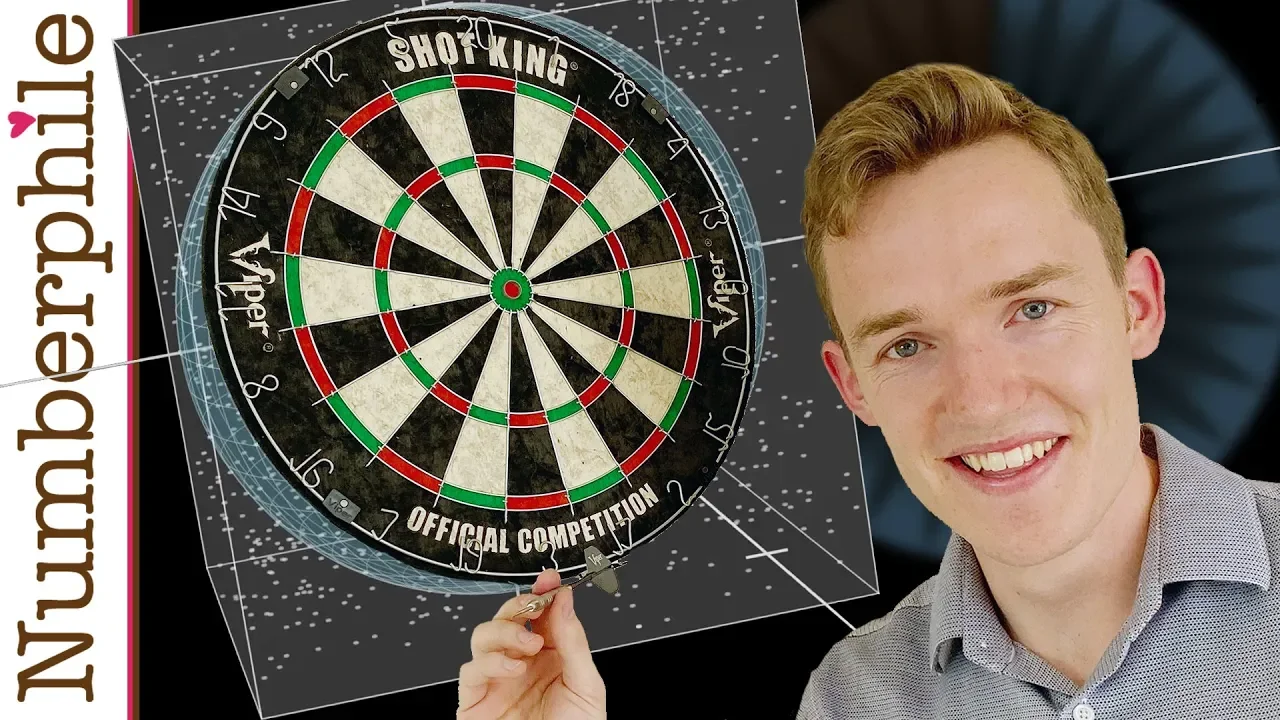
Grant Sanderson presents a geometric dart puzzle where the target starts as a unit circle and shrinks upon each hit by setting the new radius equal to the half-chord perpendicular to the hit point. (0:00)
For a player throwing uniformly at random on a fixed bounding square [-1, 1] × [-1, 1], surviving n rounds equates geometrically to a point landing inside a 2n-dimensional unit ball. (9:59)
Telescoping the expected value sum maps the probabilities directly onto the Taylor series expansion for e^x with x = π/4, yielding an expected total score of exactly e^(π/4) ≈ 2.1932. (20:59)
The puzzle was reverse-engineered by science fiction author Greg Egan, who noticed that the volume formula for even-dimensional unit balls, π^n / n!, mirrors the terms of an exponential Taylor series. (28:49)
Detailed notes
## Background
Published on YouTube by Numberphile on November 17, 2019, this video features Grant Sanderson from 3Blue1Brown joining host Brady Haran to explore a mathematical dart-throwing puzzle involving a shrinking bullseye. According to the show description, the problem was originally inspired by a tweet from mathematician and science fiction author Greg Egan, demonstrating how a simple target game connects to higher-dimensional geometry.
## TL;DR
Grant Sanderson presents a dartboard puzzle where each successful hit shrinks the circular bullseye along a perpendicular chord defined by the hit distance from the center. When modeled for a purely uniform random thrower on a bounding square, determining the survival probability across consecutive throws transforms into calculating whether coordinate tuples reside inside higher even-dimensional unit balls. Using a telescoping sum to calculate the expected score, the volumes of these hyperballs directly map to the terms of the Taylor series expansion for the exponential function. This yields a clean, closed-form expected score of e^(π/4) ≈ 2.1932, illustrating how higher-dimensional geometry serves as an intuitive encoding of multi-variable algebraic conditions.
## Atmosphere & style
The presentation is conversational, playful, and intellectually thrilling, propelled by the effortless banter between Grant's patient, lucid teaching style and Brady's genuine, relatable curiosity. Starting with crude paper cutouts and self-deprecating humor during physical dart throws, the video steadily shifts into rigorous visualization with animated clarity. The trajectory culminates in a satisfying 'aha' moment as messy, intimidated expectations evaporate into a famously elegant calculus identity.
## Bulletin
- [00:00](https://www.youtube.com/watch?v=6_yU9eJ0NxA&t=0s) Grant Sanderson presents a geometric dart puzzle where the target starts as a unit circle and shrinks upon each hit by setting the new radius equal to the half-chord perpendicular to the hit point.
- [09:59](https://www.youtube.com/watch?v=6_yU9eJ0NxA&t=599s) For a player throwing uniformly at random on a fixed bounding square [-1, 1] × [-1, 1], surviving n rounds equates geometrically to a point landing inside a 2n-dimensional unit ball.
- [20:59](https://www.youtube.com/watch?v=6_yU9eJ0NxA&t=1259s) Telescoping the expected value sum maps the probabilities directly onto the Taylor series expansion for e^x with x = π/4, yielding an expected total score of exactly e^(π/4) ≈ 2.1932.
- [28:49](https://www.youtube.com/watch?v=6_yU9eJ0NxA&t=1729s) The puzzle was reverse-engineered by science fiction author Greg Egan, who noticed that the volume formula for even-dimensional unit balls, π^n / n!, mirrors the terms of an exponential Taylor series.
## Key takeaways
- [00:00](https://www.youtube.com/watch?v=6_yU9eJ0NxA&t=0s) The shrinking dartboard game begins with a unit circular bullseye filling a board, resetting its center after each hit.
- [00:00](https://www.youtube.com/watch?v=6_yU9eJ0NxA&t=0s) The bullseye shrinkage algorithm uses the Pythagorean theorem: hitting at distance H shrinks the radius from R to √(R² - H²).
- [04:27](https://www.youtube.com/watch?v=6_yU9eJ0NxA&t=267s) The player is modeled as throwing uniformly at random across the fixed square [-1, 1] × [-1, 1] rather than using realistic Gaussian scatter.
- [07:54](https://www.youtube.com/watch?v=6_yU9eJ0NxA&t=474s) The probability of surviving the first throw is simply the ratio of the unit circle's area to the bounding square's area, π/4.
- [09:59](https://www.youtube.com/watch?v=6_yU9eJ0NxA&t=599s) Consecutive hits require the cumulative sum of squared coordinates to remain under 1, translating 2D dart rounds into higher-dimensional Euclidean geometry.
- [14:34](https://www.youtube.com/watch?v=6_yU9eJ0NxA&t=874s) Making two consecutive hits corresponds to choosing a 4-dimensional point (x0, y0, x1, y1) inside a 4D unit ball bounded by a hypercube of volume 16.
- [17:48](https://www.youtube.com/watch?v=6_yU9eJ0NxA&t=1068s) The volume of a 2n-dimensional unit ball is given by π^n / n!, yielding a probability of surviving n throws equal to (1/n!) * (π/4)^n.
- [20:59](https://www.youtube.com/watch?v=6_yU9eJ0NxA&t=1259s) Expressing expected score as a sum of tail probabilities collapses telescopingly into a direct sum of the survival probabilities.
- [23:45](https://www.youtube.com/watch?v=6_yU9eJ0NxA&t=1425s) The collapsed probability sum matches the Taylor series expansion for the exponential function e^x, evaluated at x = π/4.
- [23:45](https://www.youtube.com/watch?v=6_yU9eJ0NxA&t=1425s) The expected score for a purely random thrower evaluates to e^(π/4) ≈ 2.1932, requiring no casework across individual round scores.
- [26:18](https://www.youtube.com/watch?v=6_yU9eJ0NxA&t=1578s) Mathematicians utilize higher dimensions as algebraic coordinate encodings rather than claiming physical space contains extra geometric dimensions.
- [28:49](https://www.youtube.com/watch?v=6_yU9eJ0NxA&t=1729s) Greg Egan deliberately reverse-engineered the shrinking dartboard mechanics around the Taylor series representation of e^π.
- [28:49](https://www.youtube.com/watch?v=6_yU9eJ0NxA&t=1729s) The volume of a 100-dimensional unit ball drops to approximately 2.368 × 10^-40 because factorial growth in the denominator dramatically outpaces exponential growth in the numerator.
- [31:08](https://www.youtube.com/watch?v=6_yU9eJ0NxA&t=1868s) Switching between geometric hypervolumes and analytic sums of random variables demystifies why high-dimensional balls occupy an infinitesimal fraction of their bounding boxes.
## Detailed walkthrough
### [00:00](https://www.youtube.com/watch?v=6_yU9eJ0NxA&t=0s) The Shrinking Bullseye Game and Geometry Setup
Grant Sanderson introduces a dart-throwing puzzle to Brady Haran, teasing that it ultimately ties together higher-dimensional geometry and some of the most famous numbers in mathematics. Instead of a normal dartboard with a tiny red dot in the middle, this game begins with a giant bullseye filling the entire face of the board. Grant uses a drafting compass to cut out a full-sized circular piece of paper to physically represent this enlarged starting target, laughing at his rough craftsmanship: “Not the greatest circle I've ever drawn.”
```mermaid
flowchart TD
accTitle: Bullseye Shrinking Mechanism
accDescr: Process showing how dart hit distance H determines the new bullseye radius via a perpendicular chord.
A["Initial Circle (Radius R)"] --> B["Dart lands at distance H from center"]
B --> C["Draw perpendicular chord through hit point"]
C --> D["New diameter = Total chord length"]
D --> E["New radius r = Half-chord length = √(R² - H²)"]
E --> F["Draw new bullseye centered at original board center"]
```
The game is simple: hit the bullseye as many times as possible. However, every time a throw hits, the bullseye shrinks according to a strict geometric algorithm:
1. Draw a line segment from the board's original center to the hit point, denoting that distance as $H$.
2. Construct a chord through the circle that is perpendicular to this line segment at the hit point.
3. The total length of that chord becomes the diameter of the next bullseye (meaning half the chord's length becomes the new radius).
4. The center of the new, smaller bullseye remains pinned strictly to the original center of the dartboard.
Grant takes his first throw, hitting remarkably close to the center. Brady watches in disbelief, remarking on the shot, while Grant explains that an accurate hit acts as a reward: because the dart lands near the center, the perpendicular chord spans almost the entire diameter of the circle, trimming only a sliver off the paper. Grant jokingly compares this tiny reduction to “getting your hair cut, you know once every week or something like that.”
[02:05](https://www.youtube.com/watch?v=6_yU9eJ0NxA&t=125s) A Physical Demonstration: Punishing Bad Shots
To demonstrate the shrinking mechanism more clearly, Grant attempts to throw worse on purpose so the board shrinks noticeably. Ironically, his second throw lands close to the center again, prompting Brady to tease: “You can't even do a bad one when you try!” Grant responds with the quip: “Yeah, consistency is only a virtue if you're not a screw-up.”
Grant deliberately lands a dart much farther out toward the perimeter on his third attempt. Being far from the center punishes the player severely: the perpendicular chord near the edge is significantly shorter, drastically reducing the new radius. Grant cuts down the paper disc to match half the chord length, centers it back on the board, and tries for a fourth throw on the much smaller target. He misses the paper entirely. Brady calls out, “Oh dear, game over.”
When Brady asks if Grant's final score is three because he hit three bullseyes, Grant clarifies a special scoring rule:
- A player receives 1 point simply for showing up and playing the game.
- Each successful bullseye hit adds 1 additional point.
- Therefore, Grant's run of 3 hits yields a total score of 4.
- Equivalently, score can be viewed simply as the total number of darts thrown until the first miss. Grant notes: “You'll see why we like that at the end.”
[04:27](https://www.youtube.com/watch?v=6_yU9eJ0NxA&t=267s) The Mathematical Puzzle and the Uniform Random Thrower
Grant formalizes the puzzle by removing player skill. Instead of an expert aiming for the center, consider a purely random thrower. Grant models this by bounding the board within a square encompassing the initial unit circle ($R_0 = 1$). A realistic thrower might have a rotationally symmetric Gaussian scatter, but for ease of computer simulation and mathematical modeling, this player's throw coordinates $(x, y)$ are uniformly distributed independently across the square $[-1, 1] \times [-1, 1]$.
```mermaid
flowchart LR
accTitle: Fixed Dartboard vs Shrinking Bullseye
accDescr: The outer square boundaries remain fixed at [-1, 1] while only the inner circular bullseye contracts.
subgraph S["Fixed Outer Square: [-1, 1] × [-1, 1]"]
direction TB
C1["Initial Bullseye: Area = π"] --> C2["Bullseye shrinks after each hit"]
C2 --> C3["Center stays fixed at (0, 0)"]
end
```
Brady asks if the square shrinks alongside the circle after a successful shot. Grant clarifies that the square remains fixed: the outer board and the thrower's coordinate distribution remain identically distributed on every single throw, while only the circular bullseye in the middle shrinks. If the square shrank proportionally, the hit probability would stay identical on every throw, eliminating the core challenge of the problem.
The main puzzle question is: **What is the expected score for this random thrower?**
Grant breaks down the two ways to think about expected value:
- The empirical average score over a large number of simulated runs (e.g., 1,000 games).
- The formal sum of each possible score weighted by its probability:
$$\mathbb{E}[\text{Score}] = \sum_{k=1}^{\infty} k \cdot P(\text{Score} = k)$$
Addressing the chance of an infinite game where every dart lands on the bullseye forever, Grant explains that the probability of such an event is zero. Brady asks about hitting the exact infinitesimal center point of the bullseye. Grant confirms that while hitting an exact geometric point is physically possible, its continuous probability is strictly zero: “Yeah, so like one of those paradoxical facts about probability is you can have events that are possible, it's just probability 0.” He compares it to picking a rational number from a uniform random draw on the real number line: it is theoretically possible, yet has measure zero.
[07:54](https://www.youtube.com/watch?v=6_yU9eJ0NxA&t=474s) Probability of the First Hit and Setting Up the Variables
To tackle the overarching problem, Grant applies a standard mathematical problem-solving strategy: begin by answering the simplest non-trivial subproblem.
The easiest question is finding the probability of surviving past the first throw—meaning the score is strictly greater than 1:
- The initial bullseye has radius $R_0 = 1$, giving an area of $\pi R_0^2 = \pi$.
- The bounding square spans side length 2 (from $-1$ to $1$), giving an area of $2 \times 2 = 4$.
- Because dart landing coordinates are uniform across the square, the probability that the very first dart hits inside the circle is simply the ratio of their areas:
$$P(\text{Score} > 1) = \frac{\text{Area of circle}}{\text{Area of square}} = \frac{\pi}{4}$$
When Brady asks what happens if the dart lands exactly on the boundary circumference of the circle, Grant dismisses the edge case: “That's probability 0. Don't worry about it, it won't mess with the problem.”
Grant then turns to the much harder question: what is the probability of hitting at least two consecutive bullseyes? This second shot depends directly on where the first shot landed. To track this, Grant sets up a table tracking the bullseye radius and the distance of each hit:
- Initial radius: $R_0 = 1$.
- First hit location coordinates: $(x_0, y_0)$.
- By the Pythagorean theorem, the distance $H_0$ from the center to this first hit is:
$$H_0 = \sqrt{x_0^2 + y_0^2}$$
This distance $H_0$ will dictate the chord length, establishing the new radius $R_1$ for the subsequent throw.
[09:59](https://www.youtube.com/watch?v=6_yU9eJ0NxA&t=599s) The Pythagorean Rule and the Four-Dimensional Inequality
Grant Sanderson transitions from the initial shot to the geometry governing the next bullseye. Labeling the starting target radius as $r_0 = 1$ and the distance of the first shot from the center as $h_0$, he explains that calculating the subsequent radius $r_1$ is a matter of basic geometry. Under the problem's rules, the new boundary chord is defined to be perpendicular to the line from the center to the hit point, which immediately hints at right triangles: “So when you know that it's defined to be perpendicular, you know that you're probably going to use that fact in your solution to the puzzle.” By the Pythagorean theorem, the previous radius serves as the hypotenuse, meaning $1^2 = h_0^2 + r_1^2$. Rearranging this yields $r_1 = \sqrt{1^2 - h_0^2}$. Since reaching this stage requires the first dart to have landed inside the bullseye ($h_0 < 1$), the quantity inside the square root is strictly positive, avoiding any imaginary numbers.
```mermaid
flowchart LR
accTitle: Radius Shrinkage Geometry
accDescr: Right triangle showing how the initial radius, hit distance, and new radius relate via the Pythagorean theorem.
subgraph Triangle["Pythagorean Triangle"]
H["Leg: h0 (Hit distance)"]
R1["Leg: r1 (New radius)"]
Hyp["Hypotenuse: r0 = 1 (Old radius)"]
end
H -->|"h0² + r1² = 1²"| Hyp
R1 -->|"r1 = √(1 - h0²)"| Hyp
```
Next comes the second shot, specified by two fresh random coordinates $(x_1, y_1)$ whose distance from the origin is $h_1 = \sqrt{x_1^2 + y_1^2}$. For this second shot to land inside the shrunken target, the condition is $h_1 < r_1$, or equivalently $h_1^2 < r_1^2$. Substituting the definitions expands this requirement into:
$$x_1^2 + y_1^2 < 1^2 - h_0^2 = 1 - (x_0^2 + y_0^2)$$
Moving all coordinate variables to one side reveals a striking condition:
$$x_0^2 + y_0^2 + x_1^2 + y_1^2 < 1$$
Grant emphasizes how difficult this question sounds from a purely analytical standpoint: if you pick four random numbers uniformly between $-1$ and $1$, what is the chance that the sum of their squares is strictly less than 1? If one coordinate is as large as $0.9$, the shot could still succeed provided the other coordinates are small enough. In the single-shot case, answering whether $x_0^2 + y_0^2 < 1$ was resolved geometrically by recognizing the coordinates not as isolated numbers, but as a single point inside a two-dimensional unit circle. Following the exact same intuition, the four coordinates $(x_0, y_0, x_1, y_1)$ are best understood as a single point residing in four-dimensional Euclidean space.
[14:34](https://www.youtube.com/watch?v=6_yU9eJ0NxA&t=874s) Moving from Circles to Higher-Dimensional Balls
Grant asks Brady Haran what geometric concept is needed once the problem shifts from two squares to four squares. Brady admits he anticipated encountering a 3D sphere and cube first and feels they have leapfrogged a step: “Well, I was... how do you think we were gonna end up using a cube and a sphere, but I feel like we've jumped past—” Grant enthusiastically agrees: “We've jumped! We've jumped!” To illustrate the conceptual bridge, Grant notes that if the problem involved three coordinates with $x^2 + y^2 + z^2 < 1$, it would simply ask for the ratio between the volume of a 3D unit sphere ($\frac{4}{3}\pi r^3 = \frac{4}{3}\pi$) and the surrounding bounding cube of side length 2 ($2^3 = 8$), yielding $\frac{\pi}{6}$. Skipping odd dimensions is actually convenient for the pattern at hand, taking the dartboard problem straight from dimension 2 to dimension 4.
In four dimensions, mathematicians typically refer to the full interior as a ball rather than a sphere: “Because when they use the word sphere, they typically refer to the boundary, right? It's just the peel of the orange. It's not the contents of the orange. So what we really want is the ball.” The 4D bounding hypercube has side lengths of 2 across all four dimensions, giving a volume of $2^4 = 16$. The volume of a four-dimensional ball of radius $r$ is given by $\frac{\pi^2}{2}r^4$. With $r = 1$, the volume is simply $\frac{\pi^2}{2}$.
Because landing both shots guarantees a score of at least two, this ratio provides the tail probability for the game:
- Bounding 4D hypercube volume: $2^4 = 16$
- 4D unit ball volume: $\frac{\pi^2}{2}$
- Probability of score $\ge 2$:
$$\frac{\pi^2 / 2}{16} = \frac{\pi^2}{2 \cdot 2^4} = \frac{\pi^2}{32}$$
[17:48](https://www.youtube.com/watch?v=6_yU9eJ0NxA&t=1068s) The General $2n$-Dimensional Formula and the Water Break
Continuing this pattern to evaluate the probability of achieving a score of at least 3 requires six random coordinates—$(x_0, y_0, x_1, y_1, x_2, y_2)$—satisfying the condition that the sum of their squares remains under 1. When Brady confesses, “I don't know how to calculate the volume of a six-dimensional ball,” Grant reassures him that mathematicians have already established the formulas. The volume of a 6D ball of radius $r$ is $\frac{\pi^3}{6}r^6$. Comparing this to the 6D cube's volume of $2^6 = 64$ gives the probability of making the first three shots:
$$P(\text{Score} \ge 3) = \frac{\pi^3}{6 \cdot 2^6}$$
Grant reveals the general formula for any even dimension $2n$: “The volume of a $2n$ ball is equal to $\pi$ to the $n$, so half of the dimension, right? So in 2 dimensions you see a $\pi$, in 4 dimensions you see a $\pi^2$, and 6 you see $\pi^3$. So $\pi$ to half the number of dimensions, divided by $n$ factorial. Very clean, very beautiful.” Dividing this volume by the volume of the hypercube $(2^{2n})$ provides the probability of surviving $n$ rounds:
$$P(\text{Score} \ge n) = \frac{\pi^n / n!}{2^{2n}} = \frac{1}{n!} \left(\frac{\pi}{4}\right)^n$$
Grant hints that the appearance of $n!$ in the denominator is strongly reminiscent of a famous celebrity real number ($e$) that might already be springing to the minds of some viewers. Before demonstrating how these pieces assemble into the final answer, Grant pauses the recording to grab a cup of water while light hold music plays.
[19:52](https://www.youtube.com/watch?v=6_yU9eJ0NxA&t=1192s) Setting Up the Expected Score
Returning refreshed, Grant hypes up the conclusion: “Alright, are you ready for the grand finale?” Brady eagerly replies, “Please, that's what I'm here for!” Grant promises that although the setup looks intimidating, “it seems like it'll be chaotic, but it'll collapse in the most wonderful of ways.”
He writes out the classical definition of expected value:
$$E[\text{Score}] = 1 \cdot P(\text{Score} = 1) + 2 \cdot P(\text{Score} = 2) + 3 \cdot P(\text{Score} = 3) + \cdots$$
The geometric volumes do not give exact probabilities for individual scores directly; instead, they supply tail probabilities—the probability that the score is greater than or equal to a certain value. Grant explains that this discrepancy is straightforward to fix using telescoping differences. For example, the probability of scoring exactly 2 is simply the probability of getting a score of at least 2 minus the probability of getting a score greater than 2:
$$P(\text{Score} = 2) = P(\text{Score} \ge 2) - P(\text{Score} \ge 3)$$
Because achieving a higher score is a strict subset of achieving the lower score, subtracting the two cleanly isolates the exact score without needing complicated casework.
[20:59](https://www.youtube.com/watch?v=6_yU9eJ0NxA&t=1259s) Collapsing the Telescoping Series
Grant lays out the expanded expectation formula to demonstrate how the terms simplify. Writing out the expected score step by step, the calculation begins with:
Immediately, massive cancellations take place. The first term, $P(\text{score} > 0)$, stands alone. For $P(\text{score} > 1)$, one copy is subtracted in the first bracket, but two copies are added back in the second, netting $+1 \times P(\text{score} > 1)$. Similarly, two copies of $P(\text{score} > 2)$ are subtracted, but three are added in the subsequent bracket, netting $+1 \times P(\text{score} > 2)$. This telescoping pattern holds indefinitely: subtracting $n$ copies only to add $n+1$ copies leaves behind exactly one copy of every probability.
As Grant summarizes, “So every puzzle that we just had, every micro puzzle, we just add up all of their answers.” The probability of getting at least 0 is $1$, since the player is awarded a baseline point merely for participating. The probability of scoring greater than 1 is the area ratio $\frac{\pi}{4}$. For the higher-order terms, Grant reframes the powers of 2 into powers of 4: rather than writing $\frac{\pi^2}{2^4 \times 2}$, he groups it as $(\frac{\pi}{4})^2 \times \frac{1}{2!}$. The next term, formerly written with $\pi^3$ over $2^6$ times 6, becomes $(\frac{\pi}{4})^3 \times \frac{1}{3!}$. Recognizing the factorials emerging in the denominators makes the overall structure undeniable.
```mermaid
flowchart LR
accTitle: Telescoping Expectation Sum
accDescr: Diagram showing how the telescoping expectation formula collapses into a direct sum of probabilities.
subgraph Raw["Expanded Expectation"]
T1["1 × [P(>0) - P(>1)]"]
T2["2 × [P(>1) - P(>2)]"]
T3["3 × [P(>2) - P(>3)]"]
end
subgraph Collapsed["Net Sum"]
S0["P(score > 0) = 1"]
S1["P(score > 1) = (π/4)¹ / 1!"]
S2["P(score > 2) = (π/4)² / 2!"]
S3["P(score > 3) = (π/4)³ / 3!"]
end
T1 --> S0
T1 & T2 --> S1
T2 & T3 --> S2
T3 --> S3
```
---
[23:45](https://www.youtube.com/watch?v=6_yU9eJ0NxA&t=1425s) The Taylor Series and a Healthy Relationship with $e$
Anticipating that a viewer might think collecting factorials and grouping powers of $\pi$ makes the problem look needlessly complicated, Grant points out that anyone fresh from a calculus class will recognize the Taylor series for $e^x$:
Grant argues that viewing $e^x$ as this infinite polynomial is not merely an algebraic identity, but the conceptually correct way to understand the exponential function. It explains why the function is its own derivative, shines in probability contexts, and seamlessly generalizes to expressions like $e^{\pi i}$. Grant quips: “This is the healthy way to think of $e$ to the $x$. So if you looked at this and you weren't thinking of $e$ already, what it means is that there is a healthier relationship with $e$ waiting for you in the future.” Brady interjects that if they did not see it, they must currently have an unhealthy relationship, to which Grant wholeheartedly agrees.
Matching the terms of the collapsed dart series directly to the Taylor series, the variable $x$ is played by $\frac{\pi}{4}$. Therefore, the expected total score is precisely:
$$e^{\pi / 4} \approx 2.1932\dots$$
This result means an utterly unskilled player throwing darts uniformly at random across the bounding square will achieve an average score of roughly $2.1932$. Brady notes that Grant's earlier practice score of 4 was “not quite twice as good as someone who has absolutely no skill whatsoever,” to which Grant laughs, “I couldn't ask for a better recommendation.”
- Taylor series expansion: $\sum_{n=0}^{\infty} \frac{x^n}{n!} = e^x$
- Variable assignment: $x = \frac{\pi}{4}$
- Expected random score: $e^{\pi / 4} \approx 2.19328...$
- Grant's actual score: 4
---
[26:18](https://www.youtube.com/watch?v=6_yU9eJ0NxA&t=1578s) Higher Dimensions as Geometric Encodings
Grant reflects on the philosophical beauty of the problem: a simple game about two-dimensional dart throws naturally led them to compute the volume of a 6-dimensional ball. He stresses that mathematicians do not study higher dimensions because they believe physical space has six dimensions, as in string theory, but because geometry offers an intuitive spatial language to encode lists of numbers. When a channel supporter tried to solve an early teaser of this puzzle by brute force, the supporter ended up grinding through complicated integrals and marveled that $\pi^2$ kept appearing in the two-dart case—unwittingly rediscovering the formula for the volume of a 4-dimensional ball.
Grant explains that speaking of higher-dimensional manifolds or topology—like the Poincaré conjecture—is rarely about literal physical navigation: “They don't actually care about like a thing where you can move in four dimensions, it's about encoding quadruplets at points.” To illustrate how $e$ emerges naturally without the geometric factor of $\pi$, Grant presents a simpler companion puzzle: repeatedly pick random numbers uniformly between 0 and 1 until their running sum exceeds 1. Asking for the expected number of draws until exceeding 1 cleanly produces $e$, stripping away circular geometry while preserving the clean factorial structure.
---
[28:49](https://www.youtube.com/watch?v=6_yU9eJ0NxA&t=1729s) Greg Egan's Reverse-Engineered Puzzle and the Shrinking Hyperball
Grant credits science fiction author and mathematician Greg Egan with originating the dartboard problem on Twitter. Egan noticed the standard formula for the volume of an even-dimensional unit ball:
$$V_{2n} = \frac{\pi^n}{n!}$$
Recognizing that the sequence $\frac{\pi^n}{n!}$ mirrored the Taylor expansion terms for $e^{\pi}$, Egan deliberately reverse-engineered a probability game whose final answer would demand summing the volumes of increasingly higher-dimensional balls. Grant calls the construction “beautiful and clever,” marveling that one can find meaning in summing the 2D area of a circle, the 4D volume of a hyperball, and higher-dimensional hypervolumes together.
Because this infinite sum converges, the volumes of higher-dimensional unit balls must eventually plummet toward zero. Grant illustrates this dramatic drop by calculating the volume of a 100-dimensional ball of radius 1:
While $\pi^{50}$ continually multiplies by $\approx 3.14159$, the denominator $50!$ multiplies by integers scaling up to 50, causing the denominator to overwhelmingly dominate. Consequently, a 100-dimensional unit sphere inscribed inside a 100-dimensional cube of side length 2 occupies an infinitesimal fraction (roughly $10^{-40}$) of the cube's total volume—in stark contrast to 2D circles or 3D spheres, which fill most of their bounding boxes. Brady jokingly catches Grant out, asking if he is now imagining these spaces as real physical environments after just warning viewers not to. Grant clarifies: “When I say real, I mean, they're exactly as real as numbers are right? Like, the real number line you're not gonna find that in nature. You're not hiking through the woods and there's the real number line.” Higher-dimensional spaces, he concludes, are simply powerful, rigorous abstractions.
- 100-dimensional unit ball volume formula: $V_{100} = \frac{\pi^{50}}{50!}$
- Numerical value: $\approx 2.368 \times 10^{-40}$
- Geometric consequence: A unit hypersphere fills an vanishingly small portion of its circumscribed hypercube in high dimensions.
[31:08](https://www.youtube.com/watch?v=6_yU9eJ0NxA&t=1868s) Bridging Analytic and Geometric Intuition in Higher Dimensions
Reflecting on the nature of higher-dimensional geometry, Grant Sanderson cautions viewers against getting bogged down by literal physical interpretations of multi-dimensional space. People often wonder whether the universe physically possesses 100 dimensions, assuming that questions about higher dimensions are only meaningful if physical reality actually provides that extra room to move. While the rapid shrinkage of spheres in high dimensions feels wildly counterintuitive from a visual standpoint, translating the geometry into simple algebra makes the result feel completely obvious. As Grant Sanderson puts it: “What I would suggest people not hinge on is asking is the universe 100 dimensional and is the only way that it's meaningful to ask questions about 10 dimensions, if the universe has that wiggle room?”
Grant translates the problem into plain numbers: imagine choosing 100 numbers independently and uniformly at random between $-1$ and $1$, and then calculating the sum of their squares. Asking whether a dart lands inside an $n$-dimensional unit hypersphere simply means asking what the probability is that this sum of 100 squared numbers turns out to be strictly less than 1. Posed analytically, intuition kicks in immediately; with 100 separate squared values added together, the total is virtually guaranteed to exceed 1. Grant notes that moving fluidly between algebraic and geometric viewpoints demystifies the behavior: “So this is why it's helpful to have a back and forth between analytic thinking and geometric thinking.” Closing the video, Brady Haran directs viewers to Grant's channel, 3Blue1Brown, and points them toward Grant's full interview on the Numberphile podcast linked in the description.
```mermaid
flowchart LR
accTitle: Analytic vs Geometric View of Higher Dimensions
accDescr: Diagram comparing geometric hypercube dartboard to analytic sum of squares.
subgraph Geometric ["Geometric View"]
G1["100-D hypercube: [-1, 1]^100"] --> G2["100-D unit ball"]
G2 --> G3["Volume vanishes near zero"]
end
subgraph Analytic ["Analytic View"]
A1["Pick 100 values: x_i in [-1, 1]"] --> A2["Sum of squares: sum(x_i^2)"]
A2 --> A3["Sum easily exceeds 1"]
end
Geometric <-->|"Complementary Intuition"| Analytic
```
- **The analytic translation**: Choosing a point inside a 100-dimensional hypercube $[-1, 1]^{100}$ is mathematically identical to choosing 100 independent random numbers $x_1, x_2, \dots, x_{100} \in [-1, 1]$.
- **The condition for the ball**: The dart lands in the unit hypersphere if and only if $\sum_{i=1}^{100} x_i^2 < 1$, an event that is exceedingly improbable because summing 100 non-negative terms almost always dwarfs 1.
## Notable quotes
> [02:05](https://www.youtube.com/watch?v=6_yU9eJ0NxA&t=125s) Consistency is only a virtue if you're not a screw-up. — Grant Sanderson
> [04:27](https://www.youtube.com/watch?v=6_yU9eJ0NxA&t=267s) One of those paradoxical facts about probability is you can have events that are possible, it's just probability 0. — Grant Sanderson
## Mentioned
Grant Sanderson, Brady Haran, Greg Egan, 3Blue1Brown, Numberphile, Mathematical Sciences Research Institute (MSRI), Science Sandbox, Simons Foundation, Math For America, Twitter
## Video description
Grant Sanderson from 3Blue1Brown joins us to discuss an intriguing puzzle with a shrinking bullseye.
More links & stuff in full description below ↓↓↓
Grant Sanderson on the Numberphile podcast: https://youtu.be/A0RH93XvSyU
Greg Egan's tweet which started it all: https://twitter.com/gregegansf/status/1160461092973211648
Numberphile is supported by the Mathematical Sciences Research Institute (MSRI): http://bit.ly/MSRINumberphile
We are also supported by Science Sandbox, a Simons Foundation initiative dedicated to engaging everyone with the process of science. https://www.simonsfoundation.org/outreach/science-sandbox/
And support from Math For America - https://www.mathforamerica.org/
Grant Sanderson demonstrates how a shrinking bullseye dart game naturally encodes higher-dimensional Euclidean geometry, revealing that an unskilled, uniform random thrower achieves an expected score of exactly $e^{\pi/4}$.
The Shrinking Target and Pythagorean Reduction (0:00)
The game begins with a unit circular bullseye of radius $R_0 = 1$ centered on a dartboard, surrounded by a fixed outer square $[-1, 1] \times [-1, 1]$ of area 4. Whenever a dart lands at distance $H$ from the center, a chord is constructed perpendicular to the line segment connecting the center to the hit point. The full length of this chord defines the diameter of the next bullseye, keeping its center pinned to the board's origin. By the Pythagorean theorem, the previous radius serves as the hypotenuse, establishing the new radius as $r = \sqrt{R^2 - H^2}$. A shot close to the center removes only a thin margin, whereas a shot landing near the perimeter sharply contracts the target.
Mapping Sequential Throws to Even Dimensions (9:59)
To analyze the expected score, Sanderson models an untalented player whose coordinates $(x, y)$ are chosen uniformly and independently across the bounding square $[-1, 1] \times [-1, 1]$. Surviving the first throw simply requires landing inside the starting unit circle, which occurs with probability equal to the circle-to-square area ratio, $\pi / 4$. For the second throw to hit the shrunken target, its squared distance from the center must satisfy $x_1^2 + y_1^2 < 1 - (x_0^2 + y_0^2)$, rearranging into the single condition $x_0^2 + y_0^2 + x_1^2 + y_1^2 < 1$.
Rather than resolving four separate random variables analytically, Sanderson interprets $(x_0, y_0, x_1, y_1)$ as a single point inside a four-dimensional hypercube of volume $2^4 = 16$. The success condition describes the interior of a four-dimensional unit ball, which has volume $\pi^2 / 2$. This pattern extends to any arbitrary round $n$: surviving $n$ consecutive throws requires $2n$ random coordinates to lie within a $2n$-dimensional unit ball. Using the general volume formula $V_{2n} = \pi^n / n!$ and dividing by the hypercube volume $2^{2n}$, the probability of achieving a score of at least $n$ simplifies to $(1 / n!) (\pi / 4)^n$.
Telescoping Series and the Emergence of e (20:59)
The game's scoring awards 1 point for participating plus 1 point for each successful hit, meaning the score equals the total number of darts thrown until the first miss. The expected score is defined as the sum of all possible scores weighted by their exact probabilities: $\sum_{k=1}^{\infty} k \cdot P(\text{Score} = k)$. Because geometric ball volumes yield cumulative survival probabilities $P(\text{Score} \ge k)$ rather than isolated probabilities, Sanderson expands the expectation sum using telescoping differences, where $P(\text{Score} = k) = P(\text{Score} \ge k) - P(\text{Score} \ge k + 1)$.
When expanded, the terms collapse completely: each intermediate subtraction of $k$ copies is offset by the addition of $k+1$ copies in the adjacent bracket, leaving a simple sum of the survival probabilities. This yields $1 + (\pi / 4)^1 / 1! + (\pi / 4)^2 / 2! + (\pi / 4)^3 / 3! + \dots$. Sanderson connects this infinite series directly to the Taylor series expansion for the exponential function, $e^x = \sum_{n=0}^{\infty} x^n / n!$. Evaluating the polynomial at $x = \pi / 4$ produces an exact expected score of $e^{\pi / 4} \approx 2.1932$.
Geometry as an Encoding of Multi-Variable Data (28:49)
Sanderson attributes the puzzle to author and mathematician Greg Egan, who noticed that the volumes of even-dimensional unit balls, $V_{2n} = \pi^n / n!$, mirror the terms of $e^\pi$ and reverse-engineered a probabilistic game to sum them. Because the series converges, the volumes of unit hyperballs diminish rapidly in high dimensions. For example, a 100-dimensional unit ball has a volume of $\pi^{50} / 50! \approx 2.368 \times 10^{-40}$, filling an infinitesimal fraction of its surrounding $2^{100}$ bounding hypercube.
Sanderson emphasizes that higher-dimensional geometry serves as an intuitive spatial language for lists of numbers rather than a claim about physical spatial dimensions. While the disappearance of volume in high-dimensional spheres seems geometrically counterintuitive, it is algebraically obvious: choosing 100 independent numbers between $-1$ and $1$ and summing their squares almost guarantees a total exceeding 1, making it exceedingly rare for a point to remain inside the unit sphere.
The puzzle demonstrates how translating multi-variable algebraic constraints into higher-dimensional geometry can resolve seemingly complex conditional probabilities. Sanderson concludes that moving between geometric hypervolumes and analytic sums offers clear intuition for abstract spaces, showing that higher dimensions function as practical mathematical tools rather than physical realities.
[2:05] Grant Sanderson: Consistency is only a virtue if you're not a screw-up.
[4:27] Grant Sanderson: One of those paradoxical facts about probability is you can have events that are possible, it's just probability 0.
Original transcript
[0:00] Alright, Brady so I've got for you a puzzle. It's about darts.
[0:04] It involves some higher dimensional geometry and a couple of the most famous numbers in math
[0:10] So I'll describe the game. We want to hit as many bullseyes as we can.
[0:13] So right now the bullseye is this tiny red thing, but that's too small,
[0:16] we're going to start with a giant bullseye that fills up the entirety of the board.
[0:19] I have a proper compass
[0:20] so I'm gonna go ahead and cut out a piece, just a piece of paper to indicate our enlarged bullseye.
[0:28] [laughs]
- (Brady: That'll do)
[0:29] Not the greatest circle I've ever drawn. All you do is you try to hit the bullseye. Each time
[0:34] we hit it though, based on where our shot is the bullseye's gonna shrink.
[0:37] So it's gonna get harder and harder as we go.
- (Brady: You're not gonna hit the wall are you?)
[0:41] I'm not *that* bad!
[0:44] Oh, okay
- (Brady: Oh my goodness, hang on. That's amazing!)
- Thank you very much, that is amazing. And you're kind of rewarded for a good shot.
[0:51] So let me tell you what the rule is for how we shrink it. So step one,
[0:55] I'm gonna draw a line from the center to where I hit. And maybe for the future I'm just gonna call that distance H.
[1:02] So that's the distance of my hit and then what I'm gonna do is draw a chord of the circle
[1:07] that's perpendicular to this line. That's our chord.
[1:09] And our rule is
[1:11] that the length of this chord is the new diameter of the circle, which in this case because I had a good shot - right? The
[1:17] shot was nice and close to the center, I'm rewarded by the fact that it's not going to shrink that much.
[1:22] (Brady: Is the center of the new circle where your dart hit or where the original - ?)
- Great question. It's where the original centre was.
[1:29] All right
[1:30] so I'll draw a new circle where the original center was.
[1:32] Actually wish my shot was worse now because this is kind of too close to the edge, I mean you can kind of see it's,
[1:38] it's barely smaller.
- (Brady: Oh, yeah, so that's *just* trimming that circle down a bit)
[1:42] So I'm just gonna be giving it a little trim.
[1:44] This is like getting your hair cut,
[1:46] you know once every week or something like that. And presumably this means that the next shot is gonna be
[1:52] similarly difficult.
[1:54] This is actually fascinating because when I animate it then it's like oh boom the computer does it.
[1:58] And I'm not messing with the physical dartboard in any way. I think I'll stick to the animated style. For the sake of illustration
[2:05] I'm gonna try to make this a worse shot?
[2:10] Okay.
- (Brady: Oh my goodness!)
[2:13] So if I do the algorithm again,
[2:15] like this cord is a little bit shorter because we trimmed off the edges, right?
[2:18] And so it'll also be just a tiny bit smaller. So we kind of could run that again, but let me
[2:23] let me try to get a worse shot.
[2:25] (Brady: You can't even do a bad one when you try!)
[2:28] Yeah, consistency is only a virtue if you're not a screw-up.
[2:32] So this one's nice and far away from the centre, and I'm going to be punished more because it's far away.
[2:37] So we'll do the same game. We'll take this off. We're going to make some cuts.
[2:41] Distance is h1. And so it'll be a chord of the big circle,
[2:46] perpendicular to that line.
[2:50] The chord defines the new diameter, but it's kind of easier to think of it as half
[2:54] the cord as defining the new radius, certainly if you're drawing with a compass. So I'll set my new radius,
[3:00] but this time because I was closer to the edge of my you know, quote-unquote bullseye that cord ends up smaller.
[3:05] So I'm punished which means that the new bullseye is meaningfully smaller.
[3:10] Smaller bullseye, play the same game. I'm going to set it up so that the centre is at the
[3:16] centre of the board. Now I'm gonna actually try to hit closer to the centre
because I want more shots for a higher score.
[3:24] And I - I didn't hit close to the centre.
[3:26] (Brady: Ooh dear, you are going to get punished for that)
[3:28] So at this point, maybe you can already see how much that's gonna punish me,
[3:33] the idea that it's close to the edge means that the chord defining the new radius is going to be quite a bit smaller.
[3:43] Put it on the board...
- (Brady: Now we see how good you are)
- So far I've hit three, this is for a fourth.
[3:51] All right, I miss.
[3:53] (Brady: Oh dear, game over.)
[3:57] Game over.
- (Brady: So what's - so your score for that game is three, because you hit three?)
- I hit three
[4:02] I will say that would be the natural way to score it,
[4:05] based on what I want the answer to look like at the end here, you get one point just for playing.
[4:10] Okay? So you get one point just for playing and then one point for each bullseye that you hit.
[4:14] So in this case
[4:14] I got a score of four. You can say maybe you're - what we're counting is how many darts you throw in total?
[4:20] So I threw four darts and the fourth one happened to be a miss,
[4:23] whatever you want to do to artificially add one. You'll see why we like that at the end.
[4:27] All right, so I've defined the game, I haven't defined the puzzle yet.
[4:30] And so for the puzzle, let me just draw our board again, or at least draw a circle.
[4:35] All right, so we're gonna have a random darts player. So he throws at the board with some random distribution,
[4:39] we all do.
- (Brady: But there's no skill here, there's no - there is absolutely no waiting for the skill)
[4:44] (it could - it's as likely to be anything?) This will be a very bad - in fact, so he throws it in a weird way.
[4:49] We're gonna think of the square that encompasses the board, and this is a little unrealistic because any real dart player, their distribution is probably
[4:57] rotationally symmetric, right? I mean, why would it care about the diagonal directions?
[5:01] But basically he hits it at a random point anywhere within a square encompassing, whatever our first circle was.
[5:08] Okay, so maybe you imagine that the whole dartboard is a square and then there'll be shrinking within that. That's my X coordinates,
[5:14] Y, and maybe let's say that this happens to be
[5:18] radius of 1 for the original circle because why not. The
[5:21] x-coordinate for this person is always going to be something between negative 1 and 1. And
[5:26] it'll just be completely uniform within that. So this would be the simplest thing to model on a computer. To do it
[5:32] you just choose two different numbers, each one between negative 1 and 1, where every one of those is equally probable.
[5:38] So every point in this whole square is equally probable. And that square doesn't shrink
[5:42] it's only the circle that shrinks. And the question is what's the expected score? Okay, so we want to know the expected
[5:50] score
[5:52] for this thrower.
[5:54] (Brady: So Grant, after you throw your first dart and the circle shrinks the square doesn't shrink with it?)
[6:02] It does not shrink,
[6:02] no, so the the distribution for the thrower is the same. You might imagine the dart bored itself
[6:07] which is fixed is square, and the bullseye is shrinking. Okay?
[6:11] Because otherwise
[6:12] it's gonna be the same probability for each shot and some viewers might be able to guess what that probability is,
[6:17] and it wouldn't be as interesting a problem. Another way to think about the expected score,
[6:22] imagine this random player plays a thousand games, right? Just what's his average score for those thousand games?
[6:29] Another way to think about it, is you say it's going to be the probability that the score is equal to 1
[6:37] times 1, for that score, plus the probability -
[6:41] because remember the lowest score you can get is 1, because you get that 1 point just for playing -
[6:45] the probability that the score is equal to 2,
[6:48] times 2,
[6:49] plus the probability that the score is equal to 3 times 3, and so on.
[6:54] So what we need to figure out is all of these probabilities. In principle
[6:57] you could have a perfect game, right? If you hit in the center every single time and it never shrinks, you're hitting a perfect game.
[7:05] What we'll find is that, that's there's a probability of zero that you hit a
[7:10] bullseye infinitely many times,
[7:11] but it's also interesting how quickly does it shrink? Would a score of 10 be absurd or would that be maybe expected?
[7:17] (Brady: What is the probability of getting an exact bullseye? 'Cause an exact bull's eye is like)
[7:23] (presumably an infinitesimally small point?)
- It's probability 0
[7:27] Yeah, so like one of those paradoxical facts about probability is you can have events that are possible,
[7:32] it's just probability 0,right? It's possible to hit an exact bullseye,
[7:36] it's just probability 0. You know if you choose a random number from the number line
[7:40] it's possible that it's rational but its probability 0 and this - a lot of people kind of
[7:44] try to come to philosophical terms with like - how can it be possible but probability 0 the probability would have to be slightly bigger.
[7:50] But it's just one of those things of math.
[7:54] All right, so anytime you're solving a puzzle that's hard and this is hard,
[7:57] you see if you can ask an easier version of it or some easy sub problem within it,
[8:01] what's the easiest thing you can get a foothold in, right? And maybe in this case the easiest question to start
[8:07] that's not totally trivial is what's the probability of hitting the first shot?
[8:12] And this isn't that your score is exactly equal to one,
[8:14] if you hit a first shot your score is greater than or equal to one. Or no
[8:18] actually because you do get that point for free, this is the probability that your score is greater than one. Actually
[8:23] maybe you can tell me, right?
[8:24] What's the probability that on this first shot, with this random distribution within the square, it hits somewhere inside this whole circle?
[8:30] (Brady: I'm imagining we we need the area of the circle and the area of the square?)
- Yep, the area of the circle,
[8:36] this is pi r squared and that radius starts off as 1.
[8:40] So that ends up just being pi. And the area of the square is equal to, well
[8:45] the square side length is 2 times that radius right? So it's 2 by 2.
[8:49] So it's 4 which means the probability that you hit
[8:53] that first bullseye, that your score will be greater than 1 because you get that one point for you just for playing,
[8:58] is gonna be the area of that circle
[9:01] divided by the area of that square.
- (Brady: Grant, what happens if the dart lands on the line?)
- That's probability 0.
[9:07] Don't worry about it, it won't mess with the problem. So now a much, a much harder question is
[9:12] okay, you've hit that first shot,
[9:13] what's the probability that you hit at least 2? And this is where it starts to become
[9:17] interesting. Because this depends on where your first shot was.
[9:20] I'm gonna start writing a little bit of a chart,
[9:22] where I'm gonna keep track of the radius of each bullseye and I'm gonna keep track of just the hit length,
[9:28] at each point. And so the radius starts off as 1 and that first hit, it's, it's a it's a random point.
[9:35] Let's just give it a name for now
[9:38] Let's say it goes there. That's H_0. So it will be H_0 and
[9:44] by the Pythagorean theorem, if
[9:46] we want to describe what this is in terms of x and y, which will be helpful for later on to be thinking of it
[9:50] in terms of that,
[9:52] it's the square root of x squared, plus y squared if those are the coordinates of your first shot. And
[9:59] because we're going to have other shots I'm also going to give these guys a subscript. So now it's a geometry question to ask
[10:05] what's the new radius?
[10:07] Well, maybe we call this our zeroth radius, right?
[10:09] And I want to know what's the next radius after that initial shot?
[10:13] And if we remember our rule, we say you draw the chord and the chord was defined to be perpendicular to that.
[10:20] So when you know that it's defined to be perpendicular
[10:23] you know that you're probably going to use that fact in your solution to the puzzle.
[10:28] So the new radius is this length here, right? It's half of that chord.
[10:33] So what we might do, and I recognise I'll sort of be drawing over myself a bit here,
[10:39] because we have a right triangle here and that's what defined it we're gonna use the
[10:44] Pythagorean theorem. Because this was our old radius, radius one. That's the new hypotenuse so we know that
[10:51] the old hypotenuse, 1 squared, is equal to one of the legs which was H naught squared,
[10:59] plus the new radius squared plus
[11:02] r_1 squared. So what that means for what r1 is, is
[11:07] it's the square root of
[11:09] 1 squared minus h naught squared and
[11:12] remember
[11:12] the only way that you're even getting to this point is this h naught was less than 1, if you've got that first one in
[11:17] the bullseye. So this will be nice and well defined, no imaginary numbers or anything like that. Similarly now, we're gonna have a new shot
[11:24] it's determined by two new random coordinates, whatever the coordinates of your second shot
[11:29] happen to be or the coordinates of the next shot, maybe I should say. And this is an interesting question,
[11:34] what's the probability that you get that second one in? Because it depends on four different numbers, right?
[11:39] So I think it's helpful to just write out what the, what the actual requirement is.
[11:43] h1, the hit in that second shot, is less than r1. And I can go ahead and rewrite that by saying
[11:49] h1 squared is less than r1 squared and the reason is we have a whole bunch of squares going on,
[11:55] maybe that's going to be helpful for us. Right because I can expand out what h1 squared is, that's x1 squared plus
[12:02] y1 squared and that has to be less than, well what is r1 squared?
[12:07] That's 1 squared minus
[12:10] h naught squared. And then I can also expand out h naught
[12:14] so I'll be writing this as x1 squared plus
[12:17] y1 squared is less than 1 squared minus
[12:22] x-naught squared
[12:24] plus y naught squared.
[12:26] So all I'm doing is saying I want to explicitly write out what the requirement is for the four coordinates of my
[12:34] initial random shot. And now I have a bit of an interesting question,
[12:37] I might rearrange this so that all of my x's and y's are on one side and the 1 is just on the other.
[12:42] What I have is that xnaught squared
[12:44] plus y naught squared, you know bringing these two over to the other side,
[12:49] plus x1 squared plus y1 squared is
[12:53] less than 1. What's the probability that this happens
[12:57] when all these four numbers were chosen randomly within the range negative 1 to 1?
[13:02] So at this point that's kind of a hard question right? I tell you
[13:06] choose four random numbers. We're gonna add up their squares. What's the probability that they're less than 1? And you think to yourself
[13:12] oh, I don't know, you know if they were all less than 0.5 I guess that would happen?
[13:16] But if one of them was 0.9 that doesn't throw everything off because the others could be quite small. And to think about this
[13:22] let's just think about the very first situation where instead of doing it for h1 and r1;
[13:27] when we're over here doing it for what seems like a much simpler situation and it was,
[13:31] the probability that h naught is less than r naught which is just saying that x naught squared
[13:37] plus y naught squared is less than 1.
[13:40] We have a purely analytic statement, choose two numbers out of a hat based on this rule,
[13:44] what's the probability that the sum of their squares is less than 1? You answered it, geometrically. You immediately knew
[13:50] oh, we need to use pi. We're thinking of the area of the circle, right?
[13:54] And it's actually quite subtle what's happening there,
[13:56] you have a question about a pair of numbers and you're gaining
[13:59] intuition and using facts that we've discovered in math, like the area of a circle. By thinking of that not as two separate entities
[14:05] but as a single point in
[14:08] 2-dimensional space. That might sound obvious, the reason I'm hammering down on it is look at what we have over here. Four separate numbers,
[14:14] what you're asking for is a probabilistic property of these four numbers.
[14:19] It might be natural to think of them as being a single point x naught, y naught.
[14:28] x1y1 inside 4 dimensional space.
[14:34] And it's basically a space that has four real number coordinates. And so now Brady
[14:38] let me ask you, what's the analogous question? In the same way that asking what's the probability that the sum of two
[14:43] random numbers is less than one,
[14:46] begs the question of what the area of a circle is.
[14:49] When we ask what's the probability that the sum of four
[14:52] squares is less than 1. What do you want to know?
[14:55] (Brady: Well I was how do you think we were gonna end up using a)
[14:58] (cube and a sphere, but I feel like we've jumped past - )
[15:00] We've jumped! We've jumped! The whole idea that, hey if I choose three random numbers x squared, y squared, z squared,
[15:07] what's the probability that they're less than 1? If they're chosen by the same rule
[15:11] what you're going to be asking for is the volume of a sphere,
[15:14] because what it means for the sum of their squares to be less than 1 is that they sit inside a unit sphere.
[15:23] The volume of a sphere is
[15:25] 4 thirds
[15:27] pi r
[15:28] cubed. r is just going to equal 1. So that's 4/3 pi. That's the
[15:33] volume of a sphere. The volume of the cube which
[15:37] is 2 by 2 by 2, is going to be 2 cubed,
[15:41] which is 8.
[15:43] So if we were asking an analogous question where 3 dimensions happened to pop up you would just divide these two numbers. You would have
[15:49] 4/3 pi, divided by 8. Which would be pi sixths. You'll see it's actually quite helpful that we're gonna skip over odd numbered dimensions
[15:56] here. And so here we went straight from 2 to 4,
[15:59] the question that we want to ask right now is what's the volume of a 4 dimensional sphere? Or the 4-dimensional
[16:04] equivalent of volume. Instead of saying hyper volume or coming up with a new word, they just say volume.
[16:08] You could fancifully say measure, but we're just gonna say volume of a
[16:13] 4d sphere. And again
[16:15] if you wanted to be pedantic, the mathematician might actually say ball? Because when they use the word sphere
[16:20] they typically refer to the boundary right? It's just the peel of the orange. It's not the contents of the orange.
[16:25] So what we really want is the ball. The other thing that we need is the volume of a 4d cube.
[16:30] The cube is the easy one. Just like in the other cases the side lengths are all 2, 2, by 2, by 2,
[16:36] by 2.
[16:37] So that volume is 16. Volume of the sphere,
[16:40] there's a whole interesting discussion that we could have about the volumes of higher dimensional spheres,
[16:44] the surface areas, or the analogs of surface areas of higher dimensional spheres, and where they come from.
[16:48] I'm not going to give you that full story now, maybe at some other point.
[16:52] It happens to be the case that it is pi squared halves
[16:57] times r to the fourth. So it picks up an extra pi.
[17:01] Which is kind of interesting, when you go from 2 to 3, you don't pick up that pi
[17:04] but when you go from 3 to 4 you pick up that extra pi. And because our radius is 1, in this case
[17:09] that'll just be pi squared halves. And let's remember what this is.
[17:13] This isn't the probability of hitting exactly two shots, right? It's that you hit those first two shots,
[17:18] so it's the probability that your score is at least two. Maybe it also happens to be three or four,
[17:23] so we can write our answer here. The probability that our score is greater than or equal to two is equal to
[17:29] pi squared, and I'm going to actually write it as being over like this, 16 as 2 to the fourth, just to remember where it came from.
[17:38] So this was kind of the, the
[17:39] cube, or the hypercube. And then times 2.
[17:43] Where that was the denominator that we had from our volume of the 4d ball. And now we just keep doing this
[17:48] for all infinitely many different scores that we might have. Very similarly when we're asking about
[17:53] the probability that our score is at least 3 or that it's bigger than 3,
[17:59] what this comes down to is asking - we're going to have 6 different coordinates: x naught, y naught,
[18:06] x1, y1, x2, y2; and that the sum of their squares is less than 1.
[18:21] (Brady: I don't know how to calculate the volume of a six dimensional ball)
- No! Luckily
[18:27] mathematicians have figured it out for us. And again, it could be a whole interesting story,
[18:30] but if you go to Wikipedia, you could see a chart,
[18:32] there's quite a nice pattern that we're gonna - about to point out for, where that comes from.
[18:35] But the volume of a 6d ball happens to be pi cubed, over
[18:42] six times r
[18:44] to the 6. And then the volume of the 6d cube is of course 2 to the 6, and
[18:51] so the answer to the probability of hitting those first three shots, is going to be pi cubed
[18:58] divided by that 2 to the 6 and
[19:00] then what its denominator was, which was the 6. Because that r ends up being 1. And now I'll tell you the more general fact,
[19:06] which is pretty mind-blowing. Is that the volume of a 2n ball is equal to
[19:13] pi to the n, so half of the dimension, right? So in 2 dimensions you see a pi, in 4 dimensions
[19:18] you see a pi squared, and six you see pi cubed.
[19:21] So pi to half the number of dimensions, divided by n factorial. Very clean,
[19:26] very beautiful. Very reminiscent of another celebrity real number that a couple people might be familiar with now and that might be
[19:33] poking in their minds.
[19:34] But if it's not we'll get to it in just a moment. Given this as a fact that we'll just hand down from on high,
[19:41] let's figure out the expected score.
[19:43] (Brady: Please, that's what I'm here for!)
[19:44] Great. First let me get a cup of water.
[19:47] [Hold music]
[19:52] Alright, are you ready for the grand finale?
- (Brady: Yeah!)
- The finishing touch.
[19:56] It's, it seems like it'll be chaotic but it'll collapse in the most wonderful of ways. So the expected score. Expected score,
[20:03] now remember what this means, we're gonna have - it's going to be 1 times the probability that your score is 1,
[20:10] plus 2 times the probability that your score is 2,
[20:15] plus 3 times the probability that your score is 3, and so on.
[20:21] Now all of our expressions are greater than things.
[20:24] They're not saying exactly equal to, but that's completely fine. Because if I wanted to say for example
[20:29] what's the probability that your score is precisely equal to 2?
[20:34] So this will be your probability that your score is greater than 1 right?
[20:38] Minus the probability that the score is
[20:42] greater than 2. Because for it to equal 2 it's greater than 1, but it's not greater than 2 and this entirely
[20:48] encompasses the possibilities, right?
[20:50] If you're probably if you get a score of greater than 1, that
[20:53] encompasses all the possibilities of getting a score greater than 2, so it's okay to just subtract this off. We don't have to
[20:59] do anything more than that.
[21:00] So I'm gonna expand all of these out just a little bit before things collapse nicely. So this would be 1
[21:08] times
[21:09] the probability
[21:11] that the score is bigger than 0,
[21:14] minus probability that the score is bigger than 1,
[21:18] plus 2
[21:20] times
[21:21] probability that the score is bigger than 1
[21:25] minus the probability that the score is bigger than 2. And just one more for good measure,
[21:32] probability that the score that's bigger than 2
[21:35] minus the probability that the score is bigger than 3. So at this point we have a lot of cancellation that happens.
[21:42] So we've got this probability that
[21:43] your score is bigger than 0 that just stays on its own. For the probability that it's bigger than 1 we're subtracting one here
[21:49] but then we're adding two of them over here. So we've got
[21:53] probability that the score is greater than 1 and then similarly for score bigger than 2 we're subtracting 2 here
[22:01] but we're adding 3 back here. And so we're just going to be adding
[22:06] probability for the score is bigger than 2 And in general
[22:09] all we're doing is adding up all of the numbers that we just saw. All of those fun things involving pi. Because with the 3
[22:15] we're subtracting 3, but in the next one we'll be adding 4, and so on.
[22:19] So every puzzle that we just had, every micro puzzle, we just add up all of their answers.
[22:25] So the probability that your score is at least zero,
[22:28] that's 1, because definitely your score is bigger than zero because you get a point just for playing.
[22:33] Probability that it's bigger than 1, that's the one that you answered for me first.
[22:36] Which was saying that it's pi divided by 4. The next one,
[22:40] so I'm actually going to write this slightly differently because we always have some power of pi divided by some power of two.
[22:47] I'm going to write this as being
[22:49] PI fourths
[22:51] squared
[22:53] divided by 2. Is that all right? So that 4 squared came from - that's the same as 2 to the fourth
[22:59] and then the pi squared just went in there. And so I'm going to write it here as
[23:04] pi
[23:05] fourths
[23:06] squared
[23:08] times 1 over 2. And then the next one we had up here. And again, I'm gonna write it in terms of pi fourths.
[23:17] Rather than writing pi cubed over 2 to the sixth, which is the same as pi cubed over 4 cubed,
[23:22] I'm gonna write it as pi over 4 cubed. And
[23:26] 6 is really 3 factorial - like the reason that we see the 2 and then the 6, it's coming from this general pattern of
[23:33] hanging, of having a factorial. So over here we've got
[23:37] pi over 4
[23:39] cubed times 1 over 3 factorial, this is really two factorial. And maybe you see where this is going
[23:45] or maybe at this point you're saying you promised me this would look simple. It actually looks exceedingly complicated,
[23:49] you've got factorials, you're grouping the pis together for some reason.
[23:52] So there's some viewers right now, especially if they're maybe a little bit fresh off of a calculus class, or if they're particularly
[23:59] ingratiated to the number e, who will just see something screaming in their head right now.
[24:03] There's something known as the Taylor series for e to the x. Which is that it's 1 plus
[24:10] x and all right, it's x to the 1 over 1 factorial.
[24:14] x squared over 2 factorial,
[24:17] x cubed over 3 factorial and so on.
[24:23] Where you evaluate it as an infinite polynomial
[24:27] where each one of the terms is 1 over n factorial.
[24:30] It's not just that e to the x happens to equal this,
[24:33] I actually think the healthier way to view the exponential function and what e to the x is - this defines it, right?
[24:39] This is the thing that should pop into your head when you think of exponential growth and e to the x is this
[24:43] particular infinite series. This particular polynomial. This is where it will come up, especially in probability,
[24:48] it lends itself to an easier interpretation of why it is its own derivative, there's all sorts of nice things,
[24:54] it extends, it makes it easier to understand things like e to the (pi)(i); all of that. This is the healthy way to think
[24:59] of e to the x. So if you looked at this and you weren't thinking of e already, what it means is that
[25:05] there is a healthier relationship with e waiting for you in the future.
- (Brady: Or if you didn't see it you have an unhealthy relationship)
[25:11] You currently have an unhealthy relationship with e, that's absolutely true.
[25:14] If you didn't see it. Or you have no relationship with e. But if we compare this to the series,
[25:19] which I've unhelpfully drawn kind of far away, but you can match them up pretty easily,
[25:25] the thing that's playing the role of x right now is pi fourths.
[25:29] So all this is, is e to the pi fourths. Which, if we go and we plug it into a calculator,
[25:36] approximately equals two point one nine three
[25:41] two, on, on, on. Which is to say if you are a terrible random darts player,
[25:47] who unrealistically hits within a square with a uniform probability, which you wouldn't because it would be rotationally symmetric -
[25:53] but whatever you're hitting within a square. And you keep going like this
[25:56] then you play a thousand games, on average your score would be 2.1932. And remember my score was 4.
[26:06] (Brady: So you're you're not quite twice as good as someone who has absolutely no skill whatsoever?)
- I couldn't ask for a better recommendation
[26:14] Yeah, that's that's about right.
[26:18] So there's a couple things I like about this puzzle, right, the reason that I want to relay it. Hopefully what was the more
[26:24] unexpected or mind-blowing component is that we're even talking about higher dimensional geometry. You found yourself naturally asking, in the middle,
[26:31] what is the volume of a six dimensional ball?
[26:33] Right? And nowhere in that was asking, is the universe six dimensional? You know, like the string theory invokes 6 -
[26:39] no, no, no, like that's not why mathematicians necessarily care about higher dimensions.
[26:44] What was happening is you had six numbers and you were encoding a property of those six numbers with something that we like to describe
[26:51] geometrically. Rather than saying the sum of their squares is less than 1, you say it shows up inside a six dimensional ball.
[26:57] That also means it saved you some work,
[26:59] I put out this question to like some channel supporters as a early teaser of things, and one of them got back to me saying
[27:05] you know, I've been working on it and I, it's just like really hard. I've been like working through these integrals.
[27:09] What's very strange is even in the case with the second dart I'm getting pi squared for some reason.
[27:14] So he's working through all these integrals,
[27:17] under the hood what's happening is he's rediscovering the volume of a four dimensional ball, right?
[27:21] So it gives a more universal language for people to talk with on that. It came about from two-dimensional geometry.
[27:26] Nothing about the dartboard is four dimensional and I think this is just a common misconception that people
[27:31] listening to mathematicians describe things like manifolds in four dimensions or the Poincaré conjecture has been answered for everything except four dimensions.
[27:38] They don't actually care about like a thing where you can move in four dimensions,
[27:42] it's about encoding quadruplets at points. And the second one is that I think it helps build a healthier relationship with e.
[27:48] Because this this series is much more important than the number itself.
[27:51] I might, I might even just ask the puzzle and then we won't answer it, but it's a good thing to end on.
[27:56] (Brady: Yeah)
[27:56] So here we were
[27:58] choosing these random numbers between negative 1 and 1 and what were we asked - what we were asking is something about when you sum their
[28:04] squares.
[28:05] When is that less than 1? You can play a much simpler probability game where let's say I'm just gonna choose numbers
[28:13] from 0 to 1 with uniform probability. And I'm gonna keep going until the sum of the numbers that I've chosen
[28:20] ends up being bigger than 1. so for example, if the first number you choose is 0.3 and then the second one is
[28:27] 0.6, their sum is 0.9. And if the next one you choose is 0.5,
[28:30] that's the point when you go over. And so the question you can ask is
[28:34] what's the expected number of samples you need to take before it over blows one?
[28:38] e shows up in the answer,
[28:39] right? And the way it shows up is actually quite similar here and it's a way that's distilled because it doesn't involve circles
[28:45] so there's not the confusing factor of pi. You see much more pristinely the factorials.
[28:49] Very important is that I mention where this puzzle comes from. I saw this on Twitter, I think it was Greg Egan.
[28:54] He specifically designed a puzzle such that the answer would look like adding up the volumes
[29:01] of higher-dimensional balls, because
[29:03] we have this wonderful formula for the volume of higher dimensional balls, when the number of dimensions is even. And
[29:10] everyone who has a healthy relationship with e looks at this, a thing to the power n divided by n factorial,
[29:15] they scream in their mind the exponential function with e to the x,
[29:19] right? And it it sort of asks you to add them. Which is a weird thing to do, why would you do that?
[29:24] It's very strange. What does - how do you even interpret the sum of the area of a circle to the volume of a four-dimensional sphere?
[29:29] So he specifically designed a puzzle such that this would be the answer, which I think is beautiful and clever.
[29:35] Here's a very interesting thing. We're adding up all of these volumes, right, it converges. And what that means
[29:41] is that higher and higher out, the volume of a high dimensional sphere is quite small, right?
[29:47] In fact, we could compute it out. If I said hey, what's the volume of a 100 dimensional ball?
[29:53] Well, that would be pi to the 50th,
[29:57] divided by 50 factorial. Well, the thing is with, with 50 factorial the numbers you're multiplying in,
[30:02] it's 1 times 2 times 3 times 4 times 5 times 6 - you're, you're multiplying bigger and bigger numbers. Pi to the 50,
[30:07] you're always multiplying a pi, right?
[30:09] So the denominator starts winning out because by the end you've added an extra pi to the top, but an extra 50 to the bottom.
[30:14] So it shrinks back quite a lot. Around 2.368 times 10 to the negative
[30:19] 40. If you think about what that means, if you're in a hundred dimensions,
[30:23] right, and you look at a 100 dimensional cube
[30:26] and you say let's look at the sphere that's touching every single edge of that cube,
[30:30] what proportion of the square does that sphere occupy?
[30:34] It's, it's around 10 to the negative 40, right? Which - a lot of people I might quite counterintuitive,
[30:40] right, because if you think of a two-dimensional
[30:42] circle it fills up most of the square. Or a 3-dimensional sphere it fills up most of the cube.
[30:46] But if you think of what it's actually asking -
[30:49] (Brady: Hang on, are you doing what you just told people off for doing though, and imagining these as real spaces?)
[30:53] (Rather than - )
- Well they are!
[30:55] So - sorry. When I say real, I mean, they're exactly as real as numbers are right? Like, the real number line
[31:00] you're not gonna find that in nature. You're not hiking through the woods and there's the real number line.
[31:03] So in the same way like 100 dimensional space, it's a useful abstraction.
[31:08] What I, what I would suggest people not hinge on is asking is the universe 100 dimensional?
[31:14] And is the only way that it's meaningful to ask questions about 10 dimensions, if the universe has that wiggle room?
[31:20] But people find this quite counterintuitive how small in a sense small balls are up in higher dimensions.
[31:26] But if you interpret it much more literally by saying choose 100 numbers,
[31:29] okay, all of them chosen uniformly between negative 1 and 1, add up their squares,
[31:34] what's the probability that the sum of all those squares is less than 1? Like, oh,
[31:38] we got 100 of them - of course is gonna be bigger than 1, there's just so many numbers.
[31:42] Same thing that's going on. There's so many dimensions.
[31:44] So this is why it's helpful to have a back and forth between analytic thinking and geometric thinking.
[31:52] If you haven't already, make sure you check out Grant's incredible math channel: 3blue1brown.
[31:58] And if you'd like to hear more from Grant on the Numberphile podcast, check out the links on the screen and down in the video description