Bloomberg Ad-Spend Math Error Trips Up MSNBC Presenters
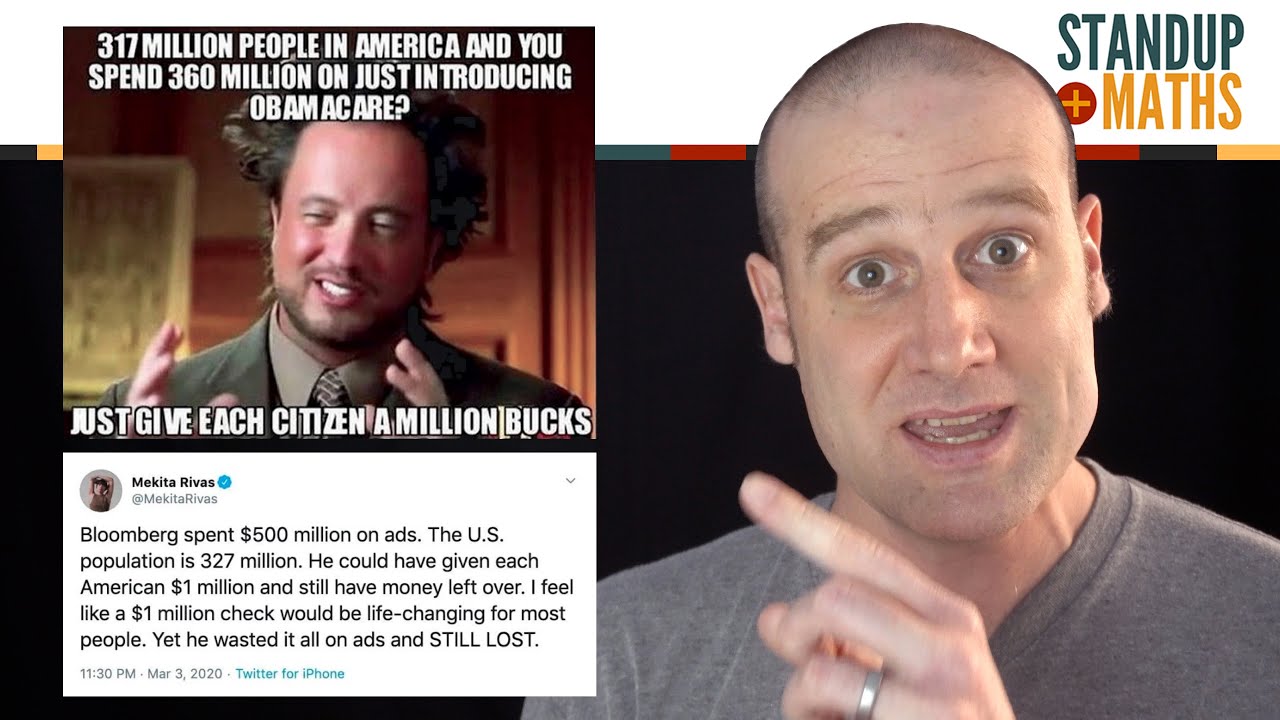
Why do people keep getting this wrong‽ — Stand-up Maths

Stand-up Maths

The viral mistake occurs because human intuition treats 'million' as a linguistic unit rather than a mathematical scale factor, a cognitive trap that high-pressure live television environments fail to catch.

AI-assisted summary of Why do people keep getting this wrong‽ — original source. Check the original for full context.

Source published:

Key ideas

  • A viral March 2020 tweet claimed Mike Bloomberg's $500 million ad spend could have funded a $1 million payout to each of the 327 million Americans, a blunder that was repeated earnestly on live MSNBC broadcast television. (0:00)
  • Dividing $500 million by 327 million people yields roughly $1.53 per citizen rather than $1 million, exposing a cognitive trap where large scale descriptors like 'million' are treated as linguistic units instead of mathematical scale factors. (0:00)
  • The error stems from an innate human tendency to strip units during arithmetic; while unit-stripping functions correctly in subtraction, division causes identical units in both the numerator and denominator to cancel out. (0:00)
  • Intense live control room environments make spontaneous mathematical fact-checking difficult, causing producers and on-air presenters to overlook basic arithmetic errors piped directly into graphics and earpieces. (5:00)

Detailed notes

## Background This video was published on YouTube by Matt Parker on his channel Stand-up Maths on March 24, 2020. In the video description, Parker shares links to his live shows, book editions of Humble Pi, Christian Lawson-Perfect's cash calculator, and sponsor and Patreon credits while issuing corrections regarding Mike Bloomberg's presidential campaign status.

## TL;DR Parker investigates a viral math error that originated in a tweet about Mike Bloomberg's $500 million presidential ad spend and was subsequently repeated as fact on MSNBC. Rather than funding a $1 million payout for each of the 327 million Americans, simple division shows the ad budget amounts to only about $1.53 per person. Parker explains that people repeatedly fall for this blunder because human intuition treats the word 'million' as an arbitrary unit that can be dropped and reapplied, which works in subtraction but fails completely in division when identical units cancel out. He also sympathizes with the live news anchors, demonstrating how the chaos and sensory overload of a live broadcast control room override natural critical thinking.

## Atmosphere & style The video carries Parker's signature blend of nerdy, stand-up comedy warmth, intellectual curiosity, and grounded self-deprecation. Rather than mocking those who made the televised on-air blunder, Parker shifts the mood from amused bewilderment into compassionate analysis, unpacking how human evolutionary 'factory settings' make counterintuitive arithmetic remarkably hard under stress. The final minutes take on a reflective, cozy, and personal tone from his home study as he candidly addresses early pandemic disruptions, tour postponements, and heartfelt gratitude toward his community.

## Bulletin - [00:00](https://www.youtube.com/watch?v=6egeUxIEQnM&t=0s) A viral March 2020 tweet claimed Mike Bloomberg's $500 million ad spend could have funded a $1 million payout to each of the 327 million Americans, a blunder that was repeated earnestly on live MSNBC broadcast television. - [00:00](https://www.youtube.com/watch?v=6egeUxIEQnM&t=0s) Dividing $500 million by 327 million people yields roughly $1.53 per citizen rather than $1 million, exposing a cognitive trap where large scale descriptors like 'million' are treated as linguistic units instead of mathematical scale factors. - [00:00](https://www.youtube.com/watch?v=6egeUxIEQnM&t=0s) The error stems from an innate human tendency to strip units during arithmetic; while unit-stripping functions correctly in subtraction, division causes identical units in both the numerator and denominator to cancel out. - [05:00](https://www.youtube.com/watch?v=6egeUxIEQnM&t=300s) Intense live control room environments make spontaneous mathematical fact-checking difficult, causing producers and on-air presenters to overlook basic arithmetic errors piped directly into graphics and earpieces.

## Key takeaways - [00:00](https://www.youtube.com/watch?v=6egeUxIEQnM&t=0s) A viral tweet inaccurately claimed Mike Bloomberg's $500 million campaign ad spend could provide every American with a $1 million check. - [00:00](https://www.youtube.com/watch?v=6egeUxIEQnM&t=0s) Dividing $500 million by the US population of 327 million results in approximately $1.53 per person. - [00:00](https://www.youtube.com/watch?v=6egeUxIEQnM&t=0s) A mathematically identical viral meme previously circulated regarding the $360 million rollout cost of the Affordable Care Act across 317 million citizens. - [00:00](https://www.youtube.com/watch?v=6egeUxIEQnM&t=0s) The recurring error stems from human intuition treating large numbers like 'million' as removable linguistic units rather than numeric scale factors. - [00:00](https://www.youtube.com/watch?v=6egeUxIEQnM&t=0s) While unit-stripping works in subtraction, division causes matching units in the numerator and denominator to cancel each other out entirely. - [05:00](https://www.youtube.com/watch?v=6egeUxIEQnM&t=300s) MSNBC broadcast the viral Bloomberg tweet on air, with both the host and guest validating the flawed arithmetic as true and disturbing. - [05:00](https://www.youtube.com/watch?v=6egeUxIEQnM&t=300s) Mathematical reasoning is not an innate human instinct and requires learned cognitive effort to override default intuitive assumptions. - [05:00](https://www.youtube.com/watch?v=6egeUxIEQnM&t=300s) Fast-paced newsroom control rooms rely on real-time feeds and directions, making live pushback against flawed on-screen math exceedingly rare. - [05:00](https://www.youtube.com/watch?v=6egeUxIEQnM&t=300s) Christian Lawson-Perfect developed an interactive 'cash calculator' tool to help users accurately visualize wealth distributions across large populations. - [10:00](https://www.youtube.com/watch?v=6egeUxIEQnM&t=600s) Matt Parker's 'Humble Pi' live tour dates in the UK were postponed from April 2020 to autumn due to COVID-19 pandemic venue restrictions. - [10:00](https://www.youtube.com/watch?v=6egeUxIEQnM&t=600s) Patreon support provided financial stability that allowed educational video production to continue after all in-person live speaking events were cancelled.

## Detailed walkthrough ### [00:00](https://www.youtube.com/watch?v=6egeUxIEQnM&t=0s) The Viral Math Error: Mike Bloomberg and the $1 Million Myth

Looking back at news from early March 2020, Matt Parker highlights a viral tweet posted on March 3rd that later made its way onto MSNBC News on March 6th. The tweet addressed Mike Bloomberg's heavy ad spending during his campaign for the Democratic presidential nomination. It claimed: "Bloomberg spent $500 million on ads. The US population is 327 million. He could have given each American one million dollars and still have money left over. I feel like a $1 million check would be life-changing for most people, yet he wasted it all on ads and STILL LOST."

Parker sets aside the political commentary, spelling, and aggressive capitalization to focus entirely on the two key numbers: $500 million and 327 million people. If you take any pocket calculator and divide 500 million by 327 million, the result is approximately 1.529. When the dollar unit is reapplied, that comes out to roughly $1.53 per person—drastically short of $1,000,000. Matt points out that this is not an isolated blunder: he had previously tracked an identical error in a meme complaining that spending $360 million to roll out the Affordable Care Act (Obamacare) across a population of 317 million Americans could have instead funded a $1 million payout for every citizen.

```mermaid flowchart TD accTitle: Division Calculation vs Mistaken Intuition accDescr: Diagram contrasting correct division with the mental unit-stripping error that leads people to think $500M divided by 327M people equals $1M each. subgraph Reality["Correct Calculation"] A["$500,000,000"] --> C["Divide $500M by 327M"] B["327,000,000 people"] --> C C --> D["~$1.53 per person"] end subgraph MentalTrap["The Mental Shortcut Trap"] E["Strip 'Millions' as a unit"] --> F["Compare 500 to 327"] F --> G["Notice 500 > 327"] G --> H["Reattach '$' and 'Million'"] H --> I["Incorrect conclusion: >$1 Million each"] end ```

Parker explains that he originally wanted to feature the Obamacare meme in his book *Humble Pi*, but because they could not secure the rights to the background "Aliens guy" image, only the text made it into the book. He introduces a hypothesis for why people repeatedly make this exact mistake: human intuition treats large words like "million" not as numeric scale factors, but as linguistic units. If a person starts with 80 million sheep and loses 50 million sheep, they naturally drop the "million sheep" unit, compute $80 - 50 = 30$, and attach the unit back on to arrive at 30 million sheep. While that unit-stripping shortcut works for subtraction, division causes the identical units in the numerator and denominator to cancel out entirely.

- Viral tweet premise: $500,000,000 spent on ads $\div$ 327,000,000 Americans. - Actual mathematical outcome: $\approx \$1.53$ per citizen. - Historical precedent: $360,000,000 ACA rollout $\div$ 317,000,000 Americans misconstrued as $1,000,000 per person. - The cognitive failure: “In our heads, we treat millions as a unit, a unit that we can take off and put back on again, but that doesn't always work.” — Matt Parker

[05:00](https://www.youtube.com/watch?v=6egeUxIEQnM&t=300s) The MSNBC On-Air Meltdown and Human Intuition

The theoretical nature of this mathematical misunderstanding was dramatically confirmed on live television. Parker presents the broadcast footage from MSNBC where the host and a guest discussed the tweet on screen. Reading the graphic aloud, the presenter remarked that the post made everything "clear," and added, "Don't tell us if you're ahead of us on the math." Up until that sentence, Parker assumed the broadcast was highlighting the tweet to mock its flawed arithmetic. Instead, the guest responded in complete earnestness: “He could have given each American $1 million and have had lunch money left over. It's an incredible way of putting it.” The host agreed, calling it "true" and "disturbing."

Parker argues that humans are fundamentally not built to do advanced arithmetic instinctively. We have to learn mathematics to override our factory settings, meaning anyone can fall into basic cognitive traps. Drawing on his own experience attending the live control room of a major US network news show, Parker explains the intense operational pressure involved. Producers juggle incoming news flashes, breaking developments, and real-time graphics, feeding directions straight into the earpieces of the on-air talent.

In such a chaotic environment, nobody along the production chain stopped to check the numbers on a calculator. Breaking protocol on live television to push back against a graphic being piped into your ear requires extraordinary mathematical confidence. Parker notes that while he might do it because challenging bad math is his brand, almost anyone placed in that exact situation would fail to catch the error. For viewers who want to explore sensible distributions of wealth across populations, he recommends an interactive "cash calculator" tool created by Christian Lawson-Perfect.

- Brain limitations: Mathematics is learned rather than innate; human intuition fails when scale overrides everyday units. - Control room reality: Presenters face constant auditory feeds, live prompts, and moving parts, making spontaneous fact-checking very difficult. - Universal fallibility: “I think if you've got a random human and put them in the same situation and I'm including us in this, it's more likely than not they'll make the same mistake.” — Matt Parker - Tool recommendation: Christian Lawson-Perfect's interactive calculator for distributing money across varying orders of magnitude.

[10:00](https://www.youtube.com/watch?v=6egeUxIEQnM&t=600s) Channel Admin, Postponed Tour Dates, and Patreon Thanks

Matt dedicates the final segment to "admin time" for the loyal 25% of viewers who watch videos through to the very end, jokingly dismissing the other 75% as "casuals." He addresses the disruption caused by the onset of the pandemic. His *Humble Pi* UK live tour, originally staged in 2019 and expanded with extra dates in April 2020 due to high demand, had to be postponed due to what he terms an "excess of virus." The tour dates are being rescheduled for September and October 2020. Ticket holders are advised to check directly with their venues for rebooking or refunds, as some venues were unable to reschedule and had to cancel outright.

Parker reminds viewers that both the US edition of *Humble Pi* and the newly released UK paperback edition are available in print, e-book, and audiobook formats for those isolating at home. Finally, he expresses deep gratitude to his Patreon supporters for sustaining his channel during a period when all of his in-person live performance work vanished overnight. He acknowledges the financial hardship many are facing, reassuring those who need to step back that it is completely understandable, while promising an upcoming behind-the-scenes video tour of his home study workspace for the patrons keeping his educational videos funded.

- *Humble Pi* tour: April 2020 dates postponed to September/October 2020 due to COVID-19 venue disruptions. - Book availability: US edition and UK paperback edition available, alongside e-book and audiobook versions. - Workspace update: Filming shifted entirely to a reconfigured home study for future video and podcast production. - Gratitude to viewers: “Thank you so much, the fact that I can continue doing this when all my live work is gone, I can still make videos and you watch them. Ah, it's great.” — Matt Parker

## Notable quotes > [00:00](https://www.youtube.com/watch?v=6egeUxIEQnM&t=0s) In our heads, we treat millions as a unit, a unit that we can take off and put back on again, but that doesn't always work. — Matt Parker

## Mentioned Matt Parker, Mike Bloomberg, MSNBC, Humble Pi, Affordable Care Act, Christian Lawson-Perfect, Jane Street, Howard Carter, Simon Wright

## Video description Download and watch Humble Pi: https://mathsgear.co.uk/products/humble-pi-show

Check out future live shows I'm doing here and here: https://festivalofthespokennerd.com/tickets/ https://standupmaths.com/shows/

Check out Christian Lawson-Perfect's cash calculator: https://make-it-rain-bloomberg.glitch.me/ https://twitter.com/christianp/status/1236338871564226561

US edition of Humble Pi http://bit.ly/humblepi

UK edition of Humble Pi https://www.penguin.co.uk/books/300/300640/humble-pi/9780141989143.html

Sorry, Think Maths have not made any teacher resources for this video, but check out their resources for all my other videos here: http://think-maths.co.uk/standupmaths-videos

CORRECTIONS - I said that Bloomberg was still running for the presidential nomination when at the time he had already dropped out. - Let me know if you spot any other mistakes! - Oh, some of my camera work was a bit of a mistake. I need more time to sort out manual settings.

Thanks again, as always, for Jane Street being my principal sponsor. https://www.janestreet.com/

Thanks to my Patreon supporters who help make these videos possible. Here is a random subset:

Paul LeVan Derek Chandler Everett Chouinard Morgan Butt Cubey Nikola Studer Malcolm Rowe Sjoerd Wennekes Andy B Alan Flett

Support my channel and I can make more maths videos: https://www.patreon.com/standupmaths

Filming and editing by Matt Parker Music by Howard Carter Design by Simon Wright

MATT PARKER: Stand-up Mathematician Website: http://standupmaths.com/ Maths book: http://wwwh.umble-pi.com Nerdy maths toys: http://mathsgear.co.uk/

[Source](https://www.youtube.com/watch?v=6egeUxIEQnM)

中文简报

彭博竞选广告支出算术错误误导MSNBC主持人 这一疯传的错误之所以发生,是因为人类直觉将“百万”视为语言单位而非数学比例因子,而高压力的电视直播环境未能察觉这一认知陷阱。 Parker调查了一条最初在推特上疯传的算术错误,该推文针对迈克·彭博(Mike Bloomberg)5亿美元的总统竞选广告支出,随后在MSNBC被当作事实重述。这笔广告预算并非能向全美3.27亿人每人发放100万美元,简单的除法表明人均仅约1.53美元。Parker解释称,人们反复陷入这一谬误,是因为人类直觉将“百万”一词视为可以随意略去和重新套用的任意单位;这种做法在减法中可行,但在分子分母相同单位会相互抵消的除法中则彻底失效。他也对直播新闻主播表示理解,指出直播控制室的混乱与感官过载压制了本应具备的批判性思维。 2020年3月一条疯传的推文声称,迈克·彭博5亿美元的广告支出本可以向全美3.27亿人每人发放100万美元,这一低级错误随后在MSNBC电视直播中被一本正经地重述。 (0:00) 将5亿美元除以3.27亿人,得出的人均金额约为1.53美元而非100万美元,这暴露了一个认知陷阱,即将“百万”等大数值描述词视作语言单位而非数学比例因子。 (0:00) 该错误源于人类在算术中脱去单位的本能倾向;虽然脱去单位在减法中有效,但在除法中分子和分母相同的单位会相互抵消。 (0:00) 高度紧张的直播控制室环境让自发的数学事实核查变得十分困难,导致导播和出镜主持人都忽略了直接输送至图表和耳机中的基础算术错误。 (5:00)

Detailed notes — zh

## Background 该视频由数学科普博主 Matt Parker(频道 Stand-up Maths)于 2020 年 3 月 24 日发布在 YouTube 上。视频围绕当时网络上疯传的一则错误推文及主流媒体的跟风报道展开,简介中附带了他的畅销书《Humble Pi》购买链接、互动计算器工具以及疫情期间线下巡演的调整通告。 ## TL;DR 视频深入剖析了 2020 年美国大选期间一条声称“布隆伯格的 5 亿美元竞选广告费足以给每位美国人发 100 万美元”的爆红荒谬推文,指出实际人均平摊仅约 1.53 美元。Matt 提出了“羊群假说”,解释人脑在处理直觉减法与量纲除法时的认知盲区——人们习惯于暂时剥离单位,却在除法完成后错误地把“百万”单位硬塞回结果中。视频还回顾了 MSNBC 新闻直播间全员附和该荒唐算术的集体“翻车”现场,并以同理心探讨了高压直播环境下人类突破演化“出厂设置”进行严谨数学思考的难度。 ## Atmosphere & style 整期节目洋溢着 Matt Parker 标志性的英式幽默与单口喜剧风格,节奏轻松明快却逻辑严谨。他在面对荒谬的低级算术错误时既展现出数学家的忍俊不禁,又没有沦为优越感十足的冷嘲热讽,而是通过生动的思想实验层层解构人脑认知的局限性。后半段结合当时突发疫情对巡演的影响,平添了一份亲切而诚恳的居家谈话质感,观感既烧脑又充满温暖的同理心。 ## Bulletin - [00:00](https://www.youtube.com/watch?v=6egeUxIEQnM&t=0s) 社交媒体流传推文称迈克·布隆伯格耗费的5亿美元竞选广告费足够分给全美3.27亿人每人100万美元,但实际人均计算仅约1.53美元,二者相差超65万倍。 - [03:30](https://www.youtube.com/watch?v=6egeUxIEQnM&t=210s) 人脑处理除法时易沿用减法逻辑将“百万”视作外挂单位,导致分子与分母本应抵消的数量级单位被错误保留,从而引发严重认知偏差。 - [05:00](https://www.youtube.com/watch?v=6egeUxIEQnM&t=300s) MSNBC直播节目在全美播放中全盘采信该错误推论,暴露出高压电视制作环境下缺乏数学验算机制与纠错自信的系统性漏洞。 - [10:00](https://www.youtube.com/watch?v=6egeUxIEQnM&t=600s) Matt Parker与同行制作了量纲交互计算器辅助公众理解财富分摊,同时因疫情影响全面调整其2020年春季线下巡演计划。 ## Key takeaways - [00:00](https://www.youtube.com/watch?v=6egeUxIEQnM&t=0s) 网络病毒式推文宣称布隆伯格的5亿美元广告费可让3.27亿美国人每人获得100万美元,引发舆论广泛讨论。 - [00:45](https://www.youtube.com/watch?v=6egeUxIEQnM&t=45s) 基本除法运算(500 ÷ 327)得出的实际平摊结果仅为约1.53美元,远不足以改变个人财务状况。 - [02:00](https://www.youtube.com/watch?v=6egeUxIEQnM&t=120s) 此类数学直觉错误具有重复性,奥巴马医改推行初期3.6亿美元支出也曾被网民误算为“每人发100万美元”。 - [03:30](https://www.youtube.com/watch?v=6egeUxIEQnM&t=210s) 人类大脑倾向于将“百万”与实体(如羊群或货币)打包为独立单位进行剥离,这种直觉在加减法中有效但在除法中失效。 - [04:20](https://www.youtube.com/watch?v=6egeUxIEQnM&t=260s) 在除法运算中单位本身必须参与量纲分析,分子与分母的“百万”相互抵消,不能简单原样贴回结果。 - [04:40](https://www.youtube.com/watch?v=6egeUxIEQnM&t=280s) 直觉引导容易让人混淆“500比327多出数百万”的差值概念与除法平均分配的倍率概念。 - [05:00](https://www.youtube.com/watch?v=6egeUxIEQnM&t=300s) MSNBC主播与嘉宾在2020年3月的直播中将该错误推文视作精妙洞见,反映出主流媒体缺乏基本数学核查。 - [06:45](https://www.youtube.com/watch?v=6egeUxIEQnM&t=405s) 数学是突破人类演化生理直觉的后天工具,正是这种超越“出厂设置”的特性导致直觉极度容易出错。 - [07:50](https://www.youtube.com/watch?v=6egeUxIEQnM&t=470s) 电视直播导播间的高压快节奏环境与层级流程,使得从制片到主播都难以主动暂停流程去质疑算术错误。 - [10:00](https://www.youtube.com/watch?v=6egeUxIEQnM&t=600s) 通过Christian Lawson-Perfect开发的互动计算器,公众可直观感受资金在不同数量级群体中的实际稀释效果。 - [11:10](https://www.youtube.com/watch?v=6egeUxIEQnM&t=670s) 受2020年新冠疫情冲击,原定于4月的《Humble Pi》英国巡演全面延期至秋季,线下演出转由线上平台支撑。 ## Detailed walkthrough ### [00:00](https://www.youtube.com/watch?v=6egeUxIEQnM&t=0s) 一条荒谬的推文与简单的除法算术 Matt Parker 深入分析了一条在发布当时仅过去两周多(2020年3月3日)却恍若隔世的热门推文。当时他正忙着重新安排和取消所有线下演出,未能第一时间探讨。这条推文聚焦于当时正在竞逐民主党总统候选人提名的亿万富翁迈克·布隆伯格(Mike Bloomberg)。推文中写道:“布隆伯格在广告上花了5亿美元。美国人口是3.27亿。他本可以给每个美国人发100万美元,手里还能剩下钱。我觉得一张100万美元的支票足以改变绝大多数人的生活,但他却把钱全浪费在广告上,而且还输了。” 抛开推文中的拼写和政治立场不谈,核心数据只有两组:5亿美元($500 million)的总花费与3.27亿(327 million)的美国人口。如果拿出手机上的任何计算工具进行除法计算(500 ÷ 327),得到的答案是 1.529。加上货币单位后,结果仅仅约为 1.53 美元。换言之,布隆伯格花掉的广告费平摊给每位美国公民,根本不是令人改变命运的“100万美元”,而是一块五毛三左右,连买杯咖啡都够呛。 这种啼笑皆非的错误并不是第一次发生。Matt Parker 提到自己长期痴迷于这类计算车祸,早在奥巴马医改(Affordable Care Act)推行初期,网上就曾流传过一张关于“远古外星人(Ancient Aliens)”模因的图片:当时美国政府花费了 3.6 亿美元推行和宣传系统,而美国人口约为 3.17 亿,网上同样有人高呼“这笔钱完全可以给每个公民发 100 万美元”。Matt 在编写他的畅销数学书《Humble Pi》(中文常译《谦卑的π》或《数学盲》)时就想收录这则模因,虽然最终因为图片版权问题只保留了文字,但他真正关心的从来不是模因图本身,而是人们为何总是一再落入同一个数学认知陷阱。 - 推文核心数据对比:5 亿美元支出 vs. 3.27 亿美国人口。 - 实际平摊金额:约 1.53 美元/人,而非推文所称的 1,000,000 美元/人。 - 历史相似案例:奥巴马医改系统花费 3.6 亿美元,美国人口 3.17 亿,同样被网民误算为“每人可得 100 万美元”。 --- ### [03:30](https://www.youtube.com/watch?v=6egeUxIEQnM&t=210s) 人脑对“单位”的直觉盲区:羊群假说 ```mermaid flowchart TD accTitle: 人脑直觉计算与正确除法的单位处理对比 accDescr: 图表对比了人脑在减法中把百万当作单位剥离的直觉机制,以及在除法中单位应相互抵消的实际数学逻辑。 subgraph IntuitiveSubtraction["直觉心理机制(类似减法)"] A["8000万只羊 - 5000万只羊"] --> B["剥离单位:'只羊' 与 '百万'"] B --> C["80 - 50 = 30"] C --> D["贴回单位:3000万只羊(有效)"] end subgraph DivisionError["推文中的除法错误"] E["$500M ÷ 327M 人"] --> F["直觉剥离单位:'$' 与 '百万'"] F --> G["500 ÷ 327 ≈ 1.53"] G --> H["错误贴回所有单位:$1.53 百万(大错特错)"] end subgraph CorrectMath["正确的量纲分析"] I["$500,000,000 ÷ 327,000,000 人"] --> J["'百万'相互抵消 (Million / Million = 1)"] J --> K["结果保留货币单位:约 $1.53 / 人"] end ``` Matt 提出了自己的理论:这一错误的根源在于人类大脑处理数学和单位的底层机制。他做了一个假设:如果你有 8000 万只羊,丢了 5000 万只羊,还剩多少?答案显然是 3000 万只(尽管这种放羊方式令人担忧)。在这个过程中,人的大脑会自动把“百万只羊”当成一个独立的计量单位剥离出去,只做简单的数字减法(80 - 50 = 30),最后再把“百万只羊”这个单位重新贴回去。 在减法运算中,这种偷懒的处理方式完全行得通。当人们面对“5亿美元”和“3.27亿人”时,直觉上又把“美元”和“百万”这两个单位同时拿掉了。他们直观地意识到 500 比 327 大,如果这是一个减法问题,差值确实是“数以百万计”的。然而,除法运算遵循完全不同的规则:当一个量除以另一个量时,单位本身也参与运算,“百万”与“百万”在分子分母间直接抵消了,最终留下的单位只有“美元/人”。人们在潜意识里完成了数值的比较,确认 500 比 327 大,随后却把所有被剥离的单位(美元、百万)一股脑全装了回去,从而得出“每人能拿一百多万美元”的荒谬结论。Matt 指出:“直觉上我们非常不擅长处理单位。”(“...intuitively we are not good at handling units.”) --- ### [05:00](https://www.youtube.com/watch?v=6egeUxIEQnM&t=300s) 电视直播车祸现场:MSNBC 演播室的集体失误 为了生动印证“人类对单位不敏感且普遍不擅长数学”,现实中发生了令人难以置信的一幕:2020年3月6日,美国主流新闻频道 MSNBC 的直播节目公开讨论了这条推文。节目嘉宾在屏幕上打出这则推文,主持人 Mara Gay 甚至煞有介事地念道:“当我在社交媒体上读到这条推特时,一切都豁然开朗了。布隆伯格花了5亿美元做广告,美国人口3.27亿……他本可以给每个美国人发100万美元,还能剩下买午饭的钱。”主持人 Brian Williams 更是赞叹这一算度切中要害,称这是个“令人难以置信的表述方式”,嘉宾也附和道“确实如此,这令人不安”。 Matt 在看到这个片段时坦言,在主播开口赞同之前,他一直以为新闻台是要把这条病毒式传播的推文拿出来作为反面教材调侃一番,根本没料到整个演播室从制片到主播竟然全盘买单。Matt 指出,人类的大脑本就不是为了进行严密数学运算而天生设计的,正如他在《Humble Pi》中阐述的核心观点:数学是一项后天习得的思维工具,它能帮助人类突破生理演化的“出厂设置”,但也正因如此,人们极度容易在直觉引导下犯错。 Matt 对电视从业人员表达了充分的理解与共情。他曾作为幕后嘉宾参观过极其类似的美国大型新闻直播导播间,亲眼目睹了控制中心内的混乱与高压:突发新闻接踵而至,图形制作争分夺秒,导播指令一刻不停地传进主持人的耳机耳麦中。在那种环境下,整条生产链路上的任何一个人——从发现推文的实习生、制作图表的编导,到面对镜头的当家主播——几乎都没有时间和余力停下来用计算器验算一遍。在高度紧张的直播镜头前,敢于打断流程质疑“等一下,大家的数学是不是算错了”,需要极其罕见的数学自信。Matt 坦言,即便是普通人被扔到那个高压演播室里,大概率也会犯下完全相同的错误。 > “数学让我们能够超越正常的直觉限制。这就是它如此神奇的原因。我们超越了出厂设置的局限。但这也意味着犯错是极其容易的。” —— Matt Parker 解释人类大脑为何天然容易在数学上栽跟头。 > 原文:“Mathematics lets us do things beyond our normal human intuition. That's why it's so amazing. We go beyond our factory setting limitations. But that means it's very, very easy to make mistakes.” --- ### [10:00](https://www.youtube.com/watch?v=6egeUxIEQnM&t=600s) 互动计算器与巡演疫情调整杂务 为了让观众亲身体验不同财富规模在各类人群中分摊的真实概念,Matt 推荐了他的好友 Christian Lawson-Perfect 制作的互动小工具——“让布隆伯格下钱雨(Make it rain Bloomberg)”现金计算器。在该网页中,用户可以输入任意一笔资金,计算器会自动换算出这笔钱若要以不同数量级(如1美元、10美元、100万美元等)分发,究竟能覆盖哪些实际的人口群体规模。 视频最后进入了 Matt 惯例的“行政事务时间”,专门留给坚持看到最后的观众(他戏称这部分人是“我的铁粉”,而弃剧的前75%则是“休闲看客”)。受2020年春季突发疫情影响,Matt 原定于 2020 年 4 月在英国进行的《Humble Pi》加演巡演被迫全部延期至秋季(9月至10月)。他提醒购票观众直接联系各演出场馆办理退票或改签手续,并透露部分因档期冲突取消的场次将尝试补充新场地。 此外,Matt 的著作《Humble Pi》美国版正持续发售,英国平装版也已同步上市,并有电子书和有声书可供居家隔离期间阅读。Matt 特别向在经济下行与演艺活动停摆期间依然在 Patreon 上支持他的赞助者表达了由衷感激。他表示,在所有线下巡演停摆的情况下,线上平台成了他最核心的工作支柱;他已将家中书房改造为录音与视频工作室,并承诺会在 Patreon 上发布书房工作室的幕后导览视频,回馈大家的支持。 - 推荐工具:Christian Lawson-Perfect 开发的财富平摊与数量级互动计算网页。 - 线下巡演变动:2020 年 4 月英国巡演全数因疫情延期至 2020 年 9 月与 10 月。 - 居家内容储备:《Humble Pi》实体书(英美版)、电子书及有声书全面在售。 ## Notable quotes > [05:00](https://www.youtube.com/watch?v=6egeUxIEQnM&t=300s) 数学让我们能够超越正常的直觉限制。这就是它如此神奇的原因。我们超越了出厂设置的局限。但这也意味着犯错是极其容易的。 — Matt Parker > [03:30](https://www.youtube.com/watch?v=6egeUxIEQnM&t=210s) 直觉上我们非常不擅长处理单位。 — Matt Parker ## Mentioned Matt Parker, Mike Bloomberg, Brian Williams, Mara Gay, Christian Lawson-Perfect, MSNBC, Humble Pi, Affordable Care Act, Ancient Aliens, Jane Street, Patreon ## Video description Download and watch Humble Pi: https://mathsgear.co.uk/products/humble-pi-show Check out future live shows I'm doing here and here: https://festivalofthespokennerd.com/tickets/ https://standupmaths.com/shows/ Check out Christian Lawson-Perfect's cash calculator: https://make-it-rain-bloomberg.glitch.me/ https://twitter.com/christianp/status/1236338871564226561 US edition of Humble Pi http://bit.ly/humblepi UK edition of Humble Pi https://www.penguin.co.uk/books/300/300640/humble-pi/9780141989143.html Sorry, Think Maths have not made any teacher resources for this video, but check out their resources for all my other videos here: http://think-maths.co.uk/standupmaths-videos CORRECTIONS - I said that Bloomberg was still running for the presidential nomination when at the time he had already dropped out. - Let me know if you spot any other mistakes! - Oh, some of my camera work was a bit of a mistake. I need more time to sort out manual settings. Thanks again, as always, for Jane Street being my principal sponsor. https://www.janestreet.com/ Thanks to my Patreon supporters who help make these videos possible. Here is a random subset: Paul LeVan Derek Chandler Everett Chouinard Morgan Butt Cubey Nikola Studer Malcolm Rowe Sjoerd Wennekes Andy B Alan Flett Support my channel and I can make more maths videos: https://www.patreon.com/standupmaths Filming and editing by Matt Parker Music by Howard Carter Design by Simon Wright MATT PARKER: Stand-up Mathematician Website: http://standupmaths.com/ Maths book: http://wwwh.umble-pi.com Nerdy maths toys: http://mathsgear.co.uk/ [Source](https://www.youtube.com/watch?v=6egeUxIEQnM)

Source quotes

[5:00] Matt Parker: 数学让我们能够超越正常的直觉限制。这就是它如此神奇的原因。我们超越了出厂设置的局限。但这也意味着犯错是极其容易的。 [3:30] Matt Parker: 直觉上我们非常不擅长处理单位。

Source quotes

[0:00] Matt Parker: In our heads, we treat millions as a unit, a unit that we can take off and put back on again, but that doesn't always work.

Original transcript

[0:00] I want to take a quick closer look at something that was in the news just over two weeks ago. So initially there was this tweet that was on the 3rd of March. Can you believe... That was less than three weeks ago. It feels like an absolute eternity. However, a lot's happened since then and I was going to talk about this at the time. However, I was a bit busy rescheduling and cancelling all of my live work. If you were going to come to my UK tour in April, it's all been rescheduled for after the summer. I'll talk about that more at the end of the video, links below. However, this came out on the 3rd of March and then a few days later, I believe the 6th of It was discussed on MSNBC News. We'll get to that in a moment. Let's have a closer look at the tweet first. And if we zoom in on this, right, there you go. There's really two key bits of information here. But the tweet as a whole said, "Bloomberg spent $500 million on ads." This was when Mike Bloomberg was still running for the Democratic presidential primaries. Man, those were innocent long ago times, weren't they? Okay, the US population is 327 million. close enough, I haven't got a problem with that. He could have given each American one million dollars and still have money left I feel like a $1 million check would be life-changing for most people, yet he wasted it all on ads and, all caps, still lost. Okay, so... Putting aside how some people spell check and capitalization on still lost, and whatever your politics may be, we can ignore all of that. The two key bits of information here are the 500 million US dollars and the population of 327 million. put those on there and you divide one by the other on any kind of calculation device like we all carry around these days and you get 1.529. Put the units back on. That's about $1.53. That is how much Mike Bloomberg could have sent everyone in the US. Not a million dollars. that's a lot less. So there you go, someone couldn't do division. End of story. Or is it? I've actually been obsessed with this kind of mistake for ages. But I originally looked into this version. So this is the 317 million people in America. The population has grown since then. And you spend $360 million on just introducing Obamacare. This is back when they were rolling out the Affordable Health Care Act and people had to sign up. And it was a very expensive process to set up the system and to promote it so everyone knows how to use it. Cost a lot of money. And once again, the same mistake. Just give each citizen a million bucks. Exactly the same mistake. How do people keep making the same error? And I actually looked into this. Pi which there's the US edition out now and the paperback version just came out in the UK. I wanted to put this meme in my book but we couldn't get rights to the background image so in the actual book you can see it's just the text which I decided is good enough. It wasn't Aliens guy I cared about it's why people were making the mistake. And here's my theory. I think it comes down to how humans do mathematics inside their heads. So quick hypothetical question: if you had 80 million sheep and then you lost 50 million sheep, how many sheep do you have left? That's right, you've got 30 million sheep and some very questionable sheep keeping practices that allows you to lose 50 million of them. But the point is not how many sheep, the point is how 50 million sheep, you know what? I can ignore the millions of sheep. We'll just consider that to be the unit. You then do 80 subtract 50, you get 30, and then you put back on the millions of sheep. In our heads, we treat millions as a unit, a unit that we can take off and put back on again, but that doesn't always work. For the case of 500 million and 327 million, we took the dollars units off and then didn't worry about it. We left them alone, we ignored them, we put them back on after we were finished. And that's what I think people are doing when they work this out in their heads. They get rid of the dollars as the unit, but they also get rid of the millions, just like we did with the sheep. And if you were doing a subtraction, that would work fine. This [5:00] would show you that one is bigger than the other and the difference between them is millions. However, that's not what we're actually working out. We want to divide one by the other and that actually means we also divide the units and the millions cancel out. The dollars survived quite nicely, it turns out. So I think people are doing, well they're doing a comparison. They're comparing one to the other and they realise that one is bigger than the other one. Sadly they're not doing the correct division. And when they realize one is bigger, they put all the units back onto it and go, hey, That's more than $1 million each. So I would say the reason people keep getting this wrong is because intuitively we are not good at handling units. And as if to perfectly prove my point that humans are terrible at units and not that great at maths, the universe gifted us this fantastic clip. So let's play along and have a quick look, shall we? Here we go. in every American a million dollars. I've got it. Let's put it up on the screen. When I read it, Tonight on social media, it kind of all became clear. Bloomberg spent $500 million on ads, U.S. population $327 million. Don't tell us if you're ahead of us on the math. I'm just going to stop it there for a second. Up until this point, I was pretty convinced they were about to point out that it was wrong. So everything to hear I'm thinking, "Oh okay, that tweet went viral, they're going to point out the mistake, have a bit of a laugh, and then they'll move on." He could have given each American $1 million and have had lunch money left over. It's an incredible way of putting it. It's an incredible way of putting it. It's true. It's disturbing. It does. It does suggest. It is indeed. disturbing. I actually think I'm uniquely qualified to comment on this. So for a start I wrote a whole book about math mistakes. I became, oh how did that get there? I became obsessed with how the human brain does mathematics, why we get it wrong and generally why humans are bad at maths. And that's the reality. We're all bad at mathematics. Our brains are not good at doing maths naturally. version of humble pie. The point is we learn mathematics. We're not born with it. We have to learn the maths to train our brain. Mathematics lets us do things beyond our normal human intuition. That's why it's so amazing. We go beyond our factory setting limitations. But that means it's very, very easy to make mistakes. The other reason I think I'm uniquely qualified here is I have actually been an unofficial backstage guest at one of these US network live news chat shows very very similar not this actual one but an incredibly similar one and I was I was there as a guest of a friend who was involved in the production so I can't go into any more details but I got to sit in the room and watch it get made live and by the room I mean like where the producers are like the editing suite if you will the control center and a lot is happening at once the new revelations are coming in graphics are coming in you wouldn't what they are doing on the fly and a lot of it is getting piped down to the presenters as it's happening. So I really feel for the presenters, they will have just had this possibly come through without realizing they had someone in their ear saying, oh, we've got this graphic, can you put it up on the screen? And I totally get it. It's amazing that no one in the chain took the time to double check the maths. And while I am upset that it all went wrong, I understand how it happened probably everyone in the chain from oh we should put this in the show to the presenters being told that they've got to talk about it didn't spend that long looking at it and you my goodness you'd have to have some pretty extreme mathematical confidence to get a thing in your ear saying this tweet represents how much money Bloomberg was using can you discuss it's incredible that there's more than a million dollars per person and for you to then go on live TV and hang on, let me get my calculator out. Or even just, excuse me, I think that might be wrong. I mean, I've done live TV as well. When you're doing live news TV, you've got voices coming through, like the feed in your ear, it is terrifying. And you're thinking about so many things at once. To stop and go, I think everyone else got the maths wrong. My goodness, I mean, I would struggle. I mean, I'll do it because that's me. It's on brand. But for a normal issue human being, I mean, I I think if you've got a random human and put them in the same situation [10:00] and I'm including us in this, it's more likely than not They'll make the same mistake. And if you do want to have some fun with how much money you could give to different populations of people, my good friend, Christian Lawson Perfect, has made an interactive guide to how much money you can give away. If you put in any amount of money, it will tell you which populations you can send different orders of magnitudes of money to. It is good fun. I will link to that below. You should check it out. Finally, it's admin time for the 25% of you who watch until the very end of the video. You're my people. Those other 75%. Honestly. casuals. Right, so first up, tour, my Humble Pie tour. This is the one I did around the UK in 2019, and then due to excess demand, we put extra dates into April 2020. Sadly, due to excess virus, we've had to postpone those. They're all currently being rebooked for September and October after the summer 2020. As I get details, I'll be putting them on my website. If you'd already bought can't directly help you, but if you contact the venue, they will either give you a refund or help you rebook if we were able to resedule into the same venue. We are going to try and add in a few extra dates because we're losing a venue or two that couldn't rebook. We just had to flat out cancel. So we're going to try and add a couple. I'll put a link down below. Everything, as I get it, I'll put it up on the show's page on my website. My book continues to be out, US edition. The UK paperback edition just came out. Of course, if you're isolating at home, there's also the book. Or you can order these and read them when you get them. The ebooks are available. And finally, I'm going to put a bonus thank you to all my Patreon supporters who are still sticking with me. I totally appreciate that some people are under the financial squeeze at the moment. If you were supporting me on Patreon but you can't afford to anymore, I totally get that. It's okay. But for those of you who do have a regular salary still coming in, thank you so much for your ongoing support. pretty much the only work I've got at the moment now all my live work is gone. I'm going to put a video up on Patreon to thank all the supporters showing you this workspace. So I'm now doing everything from my study at home and I've rearranged it and set it up to do podcasts and videos so I will do a video tour on Patreon and those of you who don't support me like I said and you do watch the videos right to the end. Thank you so much. the fact that I can continue doing this when all my live work is gone, I can still make videos and you watch them. Ah, it's great. Thank you so much.