Coders Force 3D onto Nintendo's 2D GBA as Hardware Bottlenecks Mount
minimme
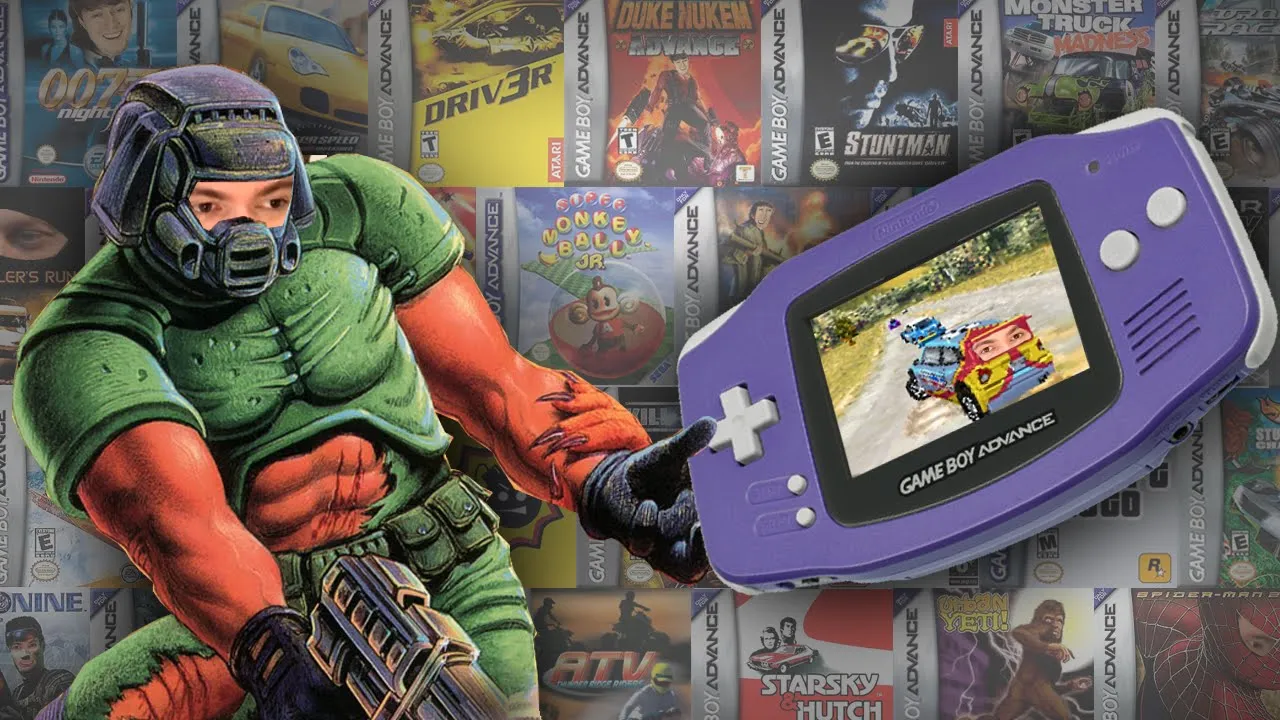
Game Boy Advance software performance proved that titles using 3D sparingly as an accent consistently played better than full polygonal showcases, which sacrificed framerates and mechanics to run on 2D silicon.
AI-assisted summary of The History of 3D Graphics on the Gameboy Advance | minimme — original source. Check the original for full context.
Source published:
Key ideas
- Despite Nintendo formally designing the Game Boy Advance as a dedicated 2D platform without 3D hardware, developers relied on raw 32-bit ARM7TDMI software rendering to produce raycasters, true polygonal engines, and voxel heightmaps. (0:02)
- The GBA first-person shooter market surged early with high-water marks like Torus Games' Doom II and Duke Nukem Advance, but genre output collapsed from six releases in 2002 to just one per year between 2003 and 2006. (13:26)
- Velez & Dubail's proprietary V3D engine set the system's peak graphical benchmarks, culminating in their 2005 port of Driver 3, which rendered full open-world 3D cities with on-foot and driving mechanics. (25:43)
- A negative correlation emerged across the library between visual ambition and mechanical quality: games that used 3D sparingly or as hybrid accents generally played far better than full-blown software-rendered showcases. (31:02)
Detailed notes
## Background Published on YouTube by minimme on February 20, 2020, this video retrospective examines the history and technical evolution of 3D graphics engines on the Game Boy Advance. Drawing from a custom tracking spreadsheet, the video surveys how developers pushed the handheld's 2D hardware beyond its intended limits with software-rendered polygonal, raycast, and voxel techniques.
## TL;DR Despite being built strictly as a 2D sprite machine, the Game Boy Advance became an unexpected battleground for software-rendered 3D technology as developers raced to bring console-style experiences to portable hardware. The retrospective charts this technical timeline from early launch hybrids like Tony Hawk's Pro Skater 2 and BSP corridor shooters like Doom, through peak technical breakthroughs like V-Rally 3 and Driver 3, to late-era voxel experiments and unreleased prototypes. Minimme reveals that while technical showcases often suffered from low framerates and compromised gameplay, the titles that used 3D selectively or achieved high performance left behind a fascinating legacy of low-level coding wizardry.
## Atmosphere & style The video features an analytical, nostalgic, and wryly humorous tone, balancing genuine admiration for low-level programming feats with candid critiques of sluggish, muddy shovelware. Minimme's laid-back and personal delivery makes dense rendering concepts feel accessible and engaging as he guides the viewer through historical spreadsheets, obscure engine demos, and retail gameplay clips. Watching it feels like a cozy, deep-dive retrospective that moves from early excitement and competitive technical ambition down to late-stage commercial exhaustion and affectionate preservationist curiosity.
## Bulletin - [00:02](https://www.youtube.com/watch?v=79fgH08z6xs&t=2s) Despite Nintendo formally designing the Game Boy Advance as a dedicated 2D platform without 3D hardware, developers relied on raw 32-bit ARM7TDMI software rendering to produce raycasters, true polygonal engines, and voxel heightmaps. - [13:26](https://www.youtube.com/watch?v=79fgH08z6xs&t=806s) The GBA first-person shooter market surged early with high-water marks like Torus Games' Doom II and Duke Nukem Advance, but genre output collapsed from six releases in 2002 to just one per year between 2003 and 2006. - [25:43](https://www.youtube.com/watch?v=79fgH08z6xs&t=1543s) Velez & Dubail's proprietary V3D engine set the system's peak graphical benchmarks, culminating in their 2005 port of Driver 3, which rendered full open-world 3D cities with on-foot and driving mechanics. - [31:02](https://www.youtube.com/watch?v=79fgH08z6xs&t=1862s) A negative correlation emerged across the library between visual ambition and mechanical quality: games that used 3D sparingly or as hybrid accents generally played far better than full-blown software-rendered showcases.
## Key takeaways - [01:30](https://www.youtube.com/watch?v=79fgH08z6xs&t=90s) Nintendo explicitly positioned the Game Boy Advance as a 2D-only handheld at reveal to temper unrealistic consumer expectations sparked by leaked tech demos and fake 3D mockups. - [02:53](https://www.youtube.com/watch?v=79fgH08z6xs&t=173s) Early titles relied on hybrid solutions, combining Mode 7 affine scaling or pre-rendered isometric backgrounds with real-time 3D polygon character models, as seen in Tony Hawk's Pro Skater 2. - [04:44](https://www.youtube.com/watch?v=79fgH08z6xs&t=284s) Developers adapted Binary Space Partitioning (BSP) raycasting algorithms to ship the first commercial corridor shooters on the hardware, establishing viability through Backtrack, Doom, and Ecks vs. Sever. - [06:26](https://www.youtube.com/watch?v=79fgH08z6xs&t=386s) The year 2002 saw an arms race of proprietary 3D tech demos from studios like Graphic State, AGB Games, and Raylight Studios attempting to pitch console ports such as Quake and Resident Evil 2. - [08:30](https://www.youtube.com/watch?v=79fgH08z6xs&t=510s) Rebellion introduced voxel heightmap rendering to the GBA with Tiger Woods PGA Tour Golf and Smuggler's Run before abandoning the console following the disastrous failure of Medal of Honor: Underground. - [11:17](https://www.youtube.com/watch?v=79fgH08z6xs&t=677s) Torus Games set the golden standard for handheld first-person shooters with Duke Nukem Advance and Doom II, combining complex multi-level geometry, destructible textures, and stable framerates. - [12:05](https://www.youtube.com/watch?v=79fgH08z6xs&t=725s) Velez & Dubail debuted their V3D engine in V-Rally 3, using dense geometry and clever visual workarounds—such as masking lower-screen affine polygon distortion behind dashboard overlays—to achieve unmatched graphical fidelity. - [13:26](https://www.youtube.com/watch?v=79fgH08z6xs&t=806s) 007: Nightfire broke away from flat BSP raycasters by employing a genuine polygonal 3D pipeline capable of sloped ramps, 3D furniture, dynamic lighting, and mounted turrets. - [14:55](https://www.youtube.com/watch?v=79fgH08z6xs&t=895s) Tantalus Media's Top Gear Rally delivered the largest fully modeled 3D cars and most realistic physics on the handheld, benefiting from rare first-party North American publishing support from Nintendo. - [19:18](https://www.youtube.com/watch?v=79fgH08z6xs&t=1158s) By 2004, the gaming press and consumers experienced severe 3D gimmick fatigue, as ambitious engines frequently resulted in compromised framerates and poor gameplay designed mainly for back-of-the-box screenshots. - [19:18](https://www.youtube.com/watch?v=79fgH08z6xs&t=1158s) Commercial market saturation left promising tech demos stranded without publisher backing, including Prograph Research's advanced DR Advance racing engine. - [21:42](https://www.youtube.com/watch?v=79fgH08z6xs&t=1302s) Late-generation urban action games diverged sharply: GTA Advance used 3D selectively to preserve complex 2D systems, whereas Payback rendered an entire interactive 3D world with real-time dynamic shadows and particle effects. - [25:43](https://www.youtube.com/watch?v=79fgH08z6xs&t=1543s) VD-Dev's Driver 3 represented the absolute zenith of 3D engineering on GBA by merging high-speed driving pipelines with full third-person open-world pedestrian mechanics. - [26:31](https://www.youtube.com/watch?v=79fgH08z6xs&t=1591s) The twilight years shifted almost exclusively toward licensed children's media, concluding the GBA's commercial 3D era in 2007 with Cars: Mater-National Championship. - [27:54](https://www.youtube.com/watch?v=79fgH08z6xs&t=1674s) Post-lifecycle community leaks uncovered lost technological breakthroughs, including a voxel-based prototype of Banjo-Pilot, a dual-layer Mode 7 pitch for Mario Kart XXL, and Cryo's unreleased Dune: Ornithopter Assault. - [31:02](https://www.youtube.com/watch?v=79fgH08z6xs&t=1862s) Engineers behind GBA 3D tech leveraged their low-level optimization skills into modern careers, evolving proprietary pipelines into contemporary console middleware and high-profile remaster projects.
## Detailed walkthrough ### [00:02](https://www.youtube.com/watch?v=79fgH08z6xs&t=2s) The 2D Handheld in a 3D World
The Game Boy Advance occupied a uniquely contradictory position in video game history. Arriving at the turn of the millennium, it was fundamentally architected from the ground up as a sprite-pushing 2D powerhouse at a time when the rest of the gaming industry had long since moved into full polygonal 3D. Despite the complete absence of dedicated 3D rendering hardware, the console's 32-bit ARM7TDMI processor proved just capable enough through raw programming wizardry to handle 3D, or at least convincing pseudo-3D graphics. Driven by the industry's obsession with 3D gaming, developers took up the challenge with reckless abandon. As minimme frames it: “It was never a question of whether they should, it was a question of whether they could.”
To trace this peculiar technical evolution, minimme built a comprehensive custom tracking spreadsheet cataloging release dates, Metascores, developers, and publishers across every notable 3D-oriented title on the system. Because no unified wiki or definitive historical archive exists for this specific subset of GBA software, the retrospective draws directly from this dataset to map out overarching industry trends, milestones, and development breakthroughs, while acknowledging the inherent statistical caveats of cataloging edge-case software.
[01:30](https://www.youtube.com/watch?v=79fgH08z6xs&t=90s) Pre-Launch Hype and the 2D Mandate
Before the public had even caught a glimpse of the retail hardware casing, IGN leaked an image of a barebones Game Boy Advance development kit in August 2000. Included alongside the early SDKs was a single-level playable tech demo of *Yoshi’s Story*. Originally a Nintendo 64 game, the demo showcased lush color reproduction, Mode 7-style ground scaling, smooth parallax scrolling, zooming, and a prominent pre-rendered 3D rotating island. While *Yoshi’s Story* was technically a 2D sidescroller, the fact that N64 assets were running on a portable device whipped pre-launch speculation into a frenzy. Popular perception had long pegged the upcoming handheld as essentially a portable Super Nintendo—a rumor seemingly validated by rumblings of a port of *Super Mario World 2: Yoshi's Island*—so seeing an N64 property running on early silicon signaled far greater ambition.
Nintendo swiftly moved to control expectations. Only days after the leak, the company formally unveiled the console's official pricing, release windows, and technical specifications in Japan. Company leadership went out of their way to firmly squash unrealistic 3D rumors, which had been exacerbated by fake mockups circulating online, such as an impossibly high-fidelity screenshot of a fully 3D purple Yoshi. Looking back at Nintendo's messaging, minimme observes: “Now it’s important to note again here that the GBA was not designed for 3D graphics - with Nintendo’s Executive Vice President at the time specifically pointing out on announcement that the GBA is a dedicated two-dimensional platform in what seems like an attempt to shut down the talk and rumours of it supporting 3D, of which there were many with stuff like this Purple Yoshi screenshot floating around online at the time which just looked far too good to be true - because it was probably fake.”
[02:53](https://www.youtube.com/watch?v=79fgH08z6xs&t=173s) Early 2001: Launch Hybrids and Subtle 3D
Nintendo outlined the Western launch details in early 2001, highlighting a slate of 15 launch games. Among the lineup, *F-Zero: Maximum Velocity* carried the torch for pseudo-3D by deploying high-speed Mode 7 background manipulation identical to the SNES original. While Mode 7 surface warping would become a staple of GBA racing titles, it relied on 2D affine transformation hardware registers rather than true polygon manipulation.
Far more technically revealing was Vicarious Visions’ launch title *Tony Hawk’s Pro Skater 2*. Instead of relying purely on pre-rendered sprite sheets, the developers rendered the skater as a fully articulated, real-time polygonal 3D model operating within pre-rendered isometric environments. The models blended cleanly against the static backdrops, delivering a remarkably faithful handheld interpretation of the console experience. Similar hybrid approaches appeared across the hardware’s lifespan, from the polygon character models in *Max Payne* to environmental elements and player assets scattered across various sports titles.
[04:44](https://www.youtube.com/watch?v=79fgH08z6xs&t=284s) The First 3D Shooters and the BSP Technique
Third-party development studios quickly realized that showing off 3D on a machine that lacked 3D hardware was the fastest way to turn publishers' heads. Without fixed-function polygon pipelines, programmers had to rely on software rendering and spatial efficiency algorithms—most notably Binary Space Partitioning (BSP), the foundational technique behind early 1990s PC shooters.
```mermaid flowchart TD accTitle: Binary Space Partitioning Flowchart accDescr: Diagram illustrating how BSP algorithms determine rendering visibility on GBA hardware.
subgraph SceneSetup["Spatial Partitioning"] A["Level Geometry"] --> B["Recursive Binary Tree Partitioning"] B --> C["Node Visibility Calculation"] end
subgraph Rasterization["Rendering Pipeline"] C --> D{"Inside Player Field of View?"} D -- "Yes" --> E["Draw Visible Wall Segments"] D -- "No" --> F["Cull Hidden Geometry"] end ```
JV Games brought the first notable BSP-style title to the system with a port of the 1998 PC shooter *Backtrack*. By drawing only the walls intersecting the player's viewing frustum, the engine minimized draw calls, though the final product suffered from sluggish framerates and a severely truncated draw distance.
Just weeks later, David A. Palmer Productions and Activision delivered a substantially superior demonstration of BSP technology with their port of *Doom*. Based on the Atari Jaguar conversion rather than the DOS original, the game featured complex geometric architecture, a seemingly limitless horizon, and smooth movement. Although running at a reduced internal resolution that essentially doubled pixel sizes on the handheld's display, it earned critical and commercial acclaim. As minimme recalls while evaluating his past rankings: “Critics and fans loved it and apparently I ranked it as the best GBA First Person Shooter around when I reviewed them all years ago, so it must be pretty good. I need a better memory.”
This initial wave crested with Crawfish Interactive’s *Ecks vs. Sever* in late 2001, demonstrating that fast-paced corridor shooters were genuinely viable on the hardware. Concurrently, Graphic State attempted to apply BSP tech to the racing genre with *Cruis’n Velocity*, though the experiment fell flat due to jarring visual artifacts and floaty vehicle handling.
- *Backtrack*: Port of the 1998 Windows shooter by JV Games; first notable BSP release on GBA, marred by low framerate and short draw distance. - *Doom*: Developed by David A. Palmer Productions; used Jaguar source code, delivered high framerates and complex levels despite half-resolution pixel doubling. - *Ecks vs. Sever*: Original handheld FPS by Crawfish Interactive; solidified BSP corridor engines as commercially viable on GBA. - *Cruis’n Velocity*: Graphic State’s attempt to adapt raycasting/BSP to open-track arcade racing; broadly panned for poor handling and awkward geometry.
[06:26](https://www.youtube.com/watch?v=79fgH08z6xs&t=386s) The 2002 Tech Demo Boom: Graphic State, AGB Games, and Raylight Studios
By 2002, the GBA development scene had transformed into an arms race of competing proprietary engines and speculative tech demos designed to solicit contract work. Graphic State bounced back from *Cruis’n Velocity* by releasing the polished, Doom-inspired corridor shooter *Dark Arena* in January 2002. Behind closed doors, they pushed the hardware further with an ambitious open-world demo that presaged *Grand Theft Auto III*: players could freely navigate city streets on foot in first-person, hop into vehicles, dodge wandering pedestrians against scrolling city backdrops, and even commandeer a fully operational helicopter. In March, Graphic State delivered *Star X*, an unabashed *Star Fox* clone rendering flat-shaded, untextured 3D polygons with impressive stability during frantic aerial battles.
Simultaneously, UK-based AGB Games made waves with their proprietary C2 Engine. Alongside tech demos for sports, racing, and city-driving environments, AGB produced a running proof-of-concept build of id Software's *Quake*. Leaping straight from flat *Doom* corridors to true textured 3D environments with complex angled architecture and animated wall surfaces shocked onlookers who had assumed the hardware was incapable of full six-degrees-of-freedom geometry.
The most celebrated engine architect of this era was Italy’s Raylight Studios, creators of the Blue Roses engine. Raylight captivated the games press with mockups replicating home console titles: - A real-time recreation of the introductory helipad and dock sequence from PlayStation's *Metal Gear Solid*, featuring fully textured architecture and scrolling animated water shaders. - Action scenes mimicking *Resident Evil*, displaying fully 3D character rigs animated using motion-capture data. - A fully playable demo of *Resident Evil 2*, developed independently in an unsuccessful bid to convince Capcom to greenlight an official handheld port.
[08:30](https://www.youtube.com/watch?v=79fgH08z6xs&t=510s) Porting Open Worlds and Rebellion’s Voxel Experiments
The commercial market expanded rapidly from just four 3D-adjacent titles in 2001 to fifteen in 2002. Sennari Interactive pulled off an improbable feat by translating Reflections Interactive's *Driver 2* to the handheld using a heavily customized BSP engine. Despite the hardware constraints, the game captured the core design of the home console version, featuring sprawling metropolitan street grids, real-time foot and vehicle transitions, active police pursuit AI, and rigid-body vehicle suspension physics.
Rebellion Developments embarked on an erratic, wildly divergent technical trajectory across 2002, pioneering voxel rendering on the platform. Based on the raycasting principles popularized by NovaLogic's *Comanche* and *Delta Force* on PC, the technique rendered terrain heightmaps using vertical screen-space columns. Rebellion’s release schedule swung across extremes: - *Tiger Woods PGA Tour Golf* (May 2002): Marked the first commercial appearance of voxel rendering on GBA, though it generated only static single-frame terrain backdrops for golfers to strike from. - *Smuggler’s Run* (September 2002): An ambitious real-time implementation of Rockstar's off-road game; it animated full voxel terrain at playable speeds by relying on relatively chunky voxel columns and aggressive horizon fogging. - *Medal of Honor: Underground* (Late 2002): A catastrophic misfire that abandoned voxels for a broken polygon-corridor engine.
Describing the sheer visual degradation of Rebellion's final effort, minimme holds nothing back: “Medal of Honor: Underground is considered to maybe be the worst GBA game ever made, it’s certainly the worst one I’ve personally played, and I think this footage of it just speaks for itself. It’s a slideshow of endless muddy pixels, making it near unplayable. Again, Rebellion had a weird year on the GBA, so weird in fact that I guess they just gave up on the console for good releasing no more games on it from this point forward.”
Closing out 2002, Crawfish released *Ballistic: Ecks vs. Sever*, an ambitious movie tie-in sequel. While visually solid, it buckled under feature creep, cramming in sniper scopes, vertical ladders, civilian non-combatants, base alarms, and split dual-character narrative campaigns. Meanwhile, Australian studio Torus Games was quietly stepping up to establish a far more refined standard for portable first-person action.
[11:17](https://www.youtube.com/watch?v=79fgH08z6xs&t=677s) Peak First-Person Shooters and the V-Rally 3 Breakthrough
The first-person shooter genre on the Game Boy Advance hit its high-water mark with Torus Games’ twin releases of *Duke Nukem Advance* and *Doom II*. These two titles raised the technical ceiling for handheld FPS titles to a tier that arguably no other studio would reach again. Torus built complex, multi-tiered level geometry featuring functional sliding doors, fluctuating floor elevations, and detailed wall textures that visually reacted to weapon damage. Despite rendering swarms of active enemy sprites simultaneously, both games maintained exceptionally smooth framerates. Beyond the raw engineering, their enduring legacy rests on their playability and charm: they are packed with character and genuinely fun to play rather than functioning as mere proof-of-concept demos. Alongside the original *Doom*, they established the undisputed gold standard for handheld shooters.
Outside of the shooting genre, Sega partnered with THQ to publish *Super Monkey Ball Jr.* The game adapted remarkably well to the handheld thanks to a minimalist visual aesthetic where the core physics and simple tilt mechanics fully justified using real-time 3D polygons—even if navigating precision stages with a digital directional pad felt, in minimme's humorous estimation, like it “should be a crime.”
The real watershed moment of 2002 arrived courtesy of the French coding duo Fernando Velez and Guillaume Dubail (Velez & Dubail). Having already established a reputation on the Game Boy Color for technically demanding racers, the team debuted their proprietary V3D engine mid-year with *V-Rally 3*. The title delivered an astonishing level of visual fidelity: geometrically dense terrain filled with banks, hills, roadside buildings, and angled surfaces, integrated seamlessly alongside cleanly scaled 2D billboard sprites for foliage. It utilized the GBA's screen real estate to the maximum, ran at a framerate smoother than almost anything before it, and incorporated well-above-average vehicle physics, multiple race modes with competing cars, and an immersive in-cockpit camera. Looking back, the creators considered this release a career defining achievement; as minimme remarks, “It’s a sight to behold, and the devs themselves have described it as one of the most important moments in their lives as developers.”
- *Duke Nukem Advance* and *Doom II* featured dynamic texture destruction, moving level architecture, and consistent framerates that outclassed competitor engines. - *V-Rally 3* established a graphical milestone on the handheld that only Velez & Dubail themselves would manage to surpass in subsequent years.
---
[13:26](https://www.youtube.com/watch?v=79fgH08z6xs&t=806s) Market Saturation and the Evolution of the Handheld Shooter
By 2003, the Game Boy Advance software ecosystem began to cool down. After an unprecedented flood of over 600 titles in under two years—averaging roughly one commercial release every single day following the Japanese debut—the pace dropped by roughly 100 releases compared to 2002. Extremely low software development overhead had created severe market oversaturation, pushing commercial releases increasingly toward licensed children's titles.
This shift heavily impacted first-person shooters. After climbing from three releases in 2001 to six in 2002, the genre collapsed to just a single FPS release per year from 2003 through 2006. The lone FPS representative for 2003 was a handheld demake of *007: Nightfire*, handled by JV Games (the studio behind 2001's *BackTrack*). Although plagued by a sluggish framerate, the underlying engine architecture was far more ambitious than a casual glance suggests. Rather than leaning on an old-school binary space partitioning (BSP) raycaster, *Nightfire* implemented a conventional polygonal 3D rendering pipeline. This allowed for angled architecture, dynamic ramps, physical polygonal furniture, mounted turrets, and real-time muzzle flashes that illuminated surrounding walls in dark environments.
```mermaid flowchart TD accTitle: Evolution of FPS Engine Techniques on the GBA accDescr: Diagram contrasting traditional BSP raycaster limits with Nightfire's true polygonal pipeline.
subgraph BSP["Early Raycaster Engines (e.g., BackTrack)"] A["Grid & BSP Partitions"] --> B["Right-Angled Walls"] B --> C["Flat Geometry & Billboards"] end
subgraph Poly["Nightfire 3D Pipeline (JV Games)"] D["True Polygonal Meshes"] --> E["Sloped Ramps & Angled Walls"] E --> F["Dynamic Gun Muzzle Lighting"] E --> G["Polygonal Objects & Turrets"] end ```
- GBA release trends saw overall software output tumble in 2003 as low-budget shovelware squeezed mid-tier projects. - FPS commercial releases shrank drastically: 3 in 2001, 6 in 2002, and down to 1 per year across 2003–2006. - While Torus's titles retained the crown for performance and fluidity, minimme stresses that “while I said Torus’s Doom 2 and Duke Nukem games are probably the most impressive on the system particularly thanks to their framerate, there’s definitely an argument to be made for Nightfire.”
---
[14:55](https://www.youtube.com/watch?v=79fgH08z6xs&t=895s) Racing Takes the 3D Crown: V3D Tricks, Voxels, and Top Gear Rally
As shooting titles dried up, racing simulations quickly became the primary showcase for handheld 3D graphics. *Sega Rally Championship* arrived with decent gameplay, though its visual presentation was hamstrung by an aggressively low rendering resolution that could not compete with *V-Rally 3*. *Drome Racers* took an alternate technical approach, using flat-shaded, pastel-colored polygons reminiscent of the Super Nintendo Super FX chip to bypass texture mapping memory bottlenecks and maintain high framerates.
Velez & Dubail struck again with a portable conversion of *Stuntman*, expanding their V3D engine to support animated track obstacles and complex set-pieces that transformed dynamically as the player raced. The V3D engine achieved its performance via a clever optical compromise: polygons noticeably distorted and warped near the bottom edge of the display due to an affine, non-perspective-correct rendering calculation. To hide this artifact, Velez & Dubail built the car dashboard in *V-Rally 3* directly over the distorted screen area, masking the engine's shortcuts while elevating cockpit immersion.
Meanwhile, Skyworks Technologies took over the voxel torch from Rebellion by releasing *Quad Desert Fury*. The title improved visual fidelity over *Smuggler's Run* with denser, smaller landscape voxels and a significantly greater draw distance, though the demanding renderer compromised the vehicle handling and physics engine.
```mermaid flowchart LR accTitle: V3D Engine Screen Warping Workaround accDescr: Flow diagram showing how V3D affine polygon distortion was masked by the dashboard HUD.
A["Software Poly Pipeline"] --> B["Non-Perspective Rendering"] B --> C["Lower Screen Poly Warping"] C --> D["Opaque Cockpit Overlay"] D --> E["Hidden Visual Artifacts & Enhanced Immersion"] ```
The standout racing achievement of 2003 was *Top Gear Rally*, developed by Melbourne-based Tantalus Media. Published by Kemco across PAL territories and Japan, it was picked up directly by Nintendo for its North American release—giving it monumental retail distribution advantages in an overcrowded market. Tantalus had iterated on their internal engine through previous quiet releases, but perfected it here. The game featured exceptionally large, fully 3D-modeled cars running alongside heavy, realistic vehicle physics. While its tracks lacked the sheer environmental complexity of Velez & Dubail's work, its car models were the largest on the system and its handling was unmatched.
- *Stuntman* incorporated moving, dynamic 3D track elements that adapted on the fly. - Non-perspective-correct texturing in the V3D engine caused noticeable warping along the lower viewport, which *V-Rally 3* cleverly concealed behind its 2D dashboard graphic. - *Top Gear Rally* stood out as the only Nintendo-published 3D title on minimme's master tracking list, providing crucial shelf exposure.
---
[17:27](https://www.youtube.com/watch?v=79fgH08z6xs&t=1047s) Studio Ambitions: Graphic State, Raylight, and Pocketeers
Several pioneering demo studios attempted to transition into full-scale commercial software in 2003, with varied results. Graphic State revisited the ambition of their earlier open-world technical demos to develop a *Crazy Taxi* clone titled *Crazy Taxi: Catch a Ride*. The title bit off more than the hardware could comfortably chew: while it squeezed expansive city maps, detailed architecture, and dozens of wandering 2D pedestrian sprites onto the screen, the renderer suffered from an uncomfortably low framerate and blurry resolution.
Raylight finally delivered commercial software utilizing their Blue Roses engine, launching two drastically different titles: 1. *Wing Commander: Prophecy*: An ambitious attempt to adapt the sprawling PC space combat simulator to handheld hardware. The engine handled full 3D space cruisers, dogfighting craft, beam weapons, and volumetric sprite explosions. Ship counts were carefully managed to minimize performance dips, making it a masterclass in handheld software scale. 2. *Ozzy & Drix*: A 3D sidescrolling platformer based on the animated series. While the game was mechanically dreadful to play, the visual presentation displayed uncommonly large, smoothly animated character models, clean background geometry, and vehicular action interludes.
Neither Blue Roses game managed to rival the jaw-dropping fidelity of Raylight's earlier private engine demos, causing them to lose ground to specialized European competitors. Meanwhile, AGB Games rebranded as Pocketeers and shipped *Need for Speed: Underground*. Although the visual clarity suffered from grainy rendering and cramped color palettes, the game handled smoothly. It established an EA partnership that yielded four increasingly sophisticated *Need for Speed* handheld follow-ups over the subsequent hardware lifecycle.
- *Crazy Taxi: Catch a Ride* pushed impressive open-world scope with roaming traffic, but suffered from poor framerates and sub-native visual clarity. - Raylight’s commercial debuts proved their tech could run on standard retail cartridges, but failed to match the hyper-detailed fidelity promised in their early trade-show demonstrations. - Pocketeers leveraged their initial *Underground* port into a multi-year franchise engagement, systematically refining their custom engine with every release.
---
[19:18](https://www.youtube.com/watch?v=79fgH08z6xs&t=1158s) Novelty Fatigue, Unreleased Tech, and the 2004 Horizon
By late 2003, public and critical fascination with Game Boy Advance 3D was evaporating. While unreleased concept footage like the canned third-person shooter *Radium* teased cinematic dynamic cameras and planar mirror reflection effects, the broader gaming press grew cynical. Review outlets increasingly dismissed 3D handheld engines as unplayable gimmicks designed primarily to trick consumers through still screenshots printed on the back of retail packaging. High-profile flops like *Quad Desert Fury*, *Ozzy & Drix*, *Cruis'n Velocity*, and *Medal of Honor: Underground* cemented the sentiment that polygon rendering often degraded gameplay.
```mermaid flowchart TD accTitle: The Decline of Handheld 3D Novelty accDescr: Cycle showing how visual ambition clashed with publisher economics and market fatigue.
A["Complex 3D Tech Demos"] --> B["Compromised Handheld Gameplay"] B --> C["Press Disdain & 'Gimmick' Backlash"] C --> D["Retail Software Sales Plummet"] D --> E["Publisher Hesitation for High-End Engines"] ```
This commercial hesitation left cutting-edge technology stranded in development labs. An Italian developer called Prograph Research engineered *DR Advance*, a smooth, high-framerate 3D racing pipeline that boasted advanced lighting and track design. Despite positive industry buzz, it never received a commercial release because publishers were unwilling to take financial risks on original IP. A developer from Prograph captured the grim market realities: > “Our idea was to generate interest in the engine and in case propose a formula-like without a license. Unfortunately, though the interest was high, the profit margin offered was too low, as the GBA market became saturated very quickly and third-party products usually sold very few copies.”
The industry was already looking toward the future. By 2004, Nintendo launched the dual-screen Nintendo DS, and Sony introduced the PlayStation Portable in Japan. The sheer technological chasm between these platforms was jarring; playing a software-rendered GBA racer alongside hardware-accelerated launch titles like *Ridge Racer* on the PSP underscored just how rapidly handheld technology was moving.
Even against next-generation hardware, 2004 delivered standouts on the aging 32-bit portable. *Hot Wheels: Stunt Track Challenge* doubled down on the clean, flat-shaded aesthetic to maintain velocity, while Velez & Dubail pivoted from circuit racers to character action with *Asterix & Obelix XXL*. Swapping cars for Roman legions, the duo produced an expansive platformer featuring sprawling geometry and animated 2D character sprites scaling smoothly without pixel breakdown. The sheer density of enemies on-screen pushed the console to visuals that flirted with the look of a home PlayStation console.
- Press sentiment soured toward 3D on the system as developers used rudimentary polygon engines merely to capture striking box-art screenshots. - Prograph Research’s *DR Advance* engine proved that high-performance tech demos could no longer secure profitable publisher backing in a flooded market. - *Asterix & Obelix XXL* demonstrated that the V3D engine could successfully drive complex character platformers, pushing scaling sprites and environmental density to the outer physical limits of the console.
[21:42](https://www.youtube.com/watch?v=79fgH08z6xs&t=1302s) Late-Era Technical Ambition: Kill.Switch, GTA, and Payback
By 2004, developers were wringing unprecedented tricks out of the Game Boy Advance hardware. Visual Impact, who had previously developed a pair of reasonably impressive *SSX* snowboarding titles for EA, took a dramatic leap forward by porting Namco's tactical shooter *Kill.Switch*. Delivering a full-blown third-person cover shooter on a handheld system was an outright novelty for the era. The game features a polygonally rendered 3D protagonist who animates with remarkable fluidity, maintaining a smooth frame rate despite numerous active background elements and gunfire. Minimme singles it out as the single most anachronistic-feeling title on the platform up to that point.
```mermaid flowchart TD accTitle: Evolution of Urban 3D Approaches on GBA accDescr: Diagram comparing the technical rendering strategies of GTA Advance, Payback, and Driver 3. subgraph GTA["GTA Advance (2004)"] G1["2D Sprites & Systems"] --> G2["Textured 3D Buildings & Lamps"] end subgraph PB["Payback (2004)"] P1["Full 3D Textured World"] --> P2["Dynamic Shadows & Physics"] end subgraph D3["Driver 3 (2005)"] D1["Full 3D Open Cities"] --> D2["On-Foot & High-Speed Driving"] end ```
That same year saw the release of *Grand Theft Auto Advance*, which took a hybrid approach by combining 2D top-down action with fully textured polygonal buildings and street lamps. While not the most aggressive showcase of pure 3D power, it stood out because the polygonal rendering had to share hardware overhead with sprawling, complex open-world gameplay systems. Minimme reflects on how this restrained design philosophy benefited the player experience: “This isn't the most impressive use, but with all it’s gameplay systems running at once it’s cool that it could also run so many fully textured 3D buildings on top of everything else.” In his view, “It’s also a good game, and honestly games that use 3D sparingly typically are more fun.”
Standing in direct contrast to GTA's hybrid restraint was *Payback*, an ambitious project that originally debuted on the Amiga in 2001 before being ported to Mac OS in 2003 and eventually reaching the GBA in late 2004. According to an unreferenced anecdote on Wikipedia, the port was completed well in advance, languishing until Destination Software finally stepped up to publish it. Where *Grand Theft Auto Advance* leaned on 2D sprites for its characters and traffic, *Payback* renders nearly everything in textured 3D polygons—from the city architecture down to individual pedestrians and vehicles. It incorporates detailed visual effects including car crash physics, tire skid marks, dynamic human and vehicle shadows, exhaust smoke, and exaggerated particle decals for bullets and blood. Minimme notes that while it ultimately falls short of GTA's charm and playability, “it’s certainly a lot more flashy and it has a lot more bells and whistles than any other game we’ve looked at or will look at.”
- *Kill.Switch* (2004) by Visual Impact introduced cover-based shooter mechanics and fluid character animation to the handheld. - *Grand Theft Auto Advance* combined dense 2D simulation logic with textured 3D architecture. - *Payback* pushed hardware boundaries with full 3D models for vehicles, humans, and environments, alongside real-time physics and shadow rendering.
---
[23:44](https://www.youtube.com/watch?v=79fgH08z6xs&t=1424s) Blue Roses Triumphs and Stumbles: Smashing Drive to Big Mutha Truckers
After earlier commercial releases like *Wing Commander Prophecy* and *Ozzy & Drix* failed to recreate the brilliance of Raylight Studios' initial tech demos, 2004 finally delivered a showcase that harnessed the Blue Roses engine effectively: *Smashing Drive*. An adaptation of the arcade taxi racer, the game sends players hurtling through dense, heavily scripted city courses loaded with destructible 3D obstacles and dynamic shortcuts. Everything reacts to vehicular collisions, creating a chaotic sense of momentum. Much like Reflections' *Stuntman*, the environments feel handcrafted and continuously evolve around the player. Minimme highlights its technical spectacle: “The sheer amount of detailed polygons streaming in and flying past at any given time is what makes this one so special - it’s straightforward but cool to see at this level.”
Heading into 2005, the handheld landscape shifted dramatically with the Western debut of the PlayStation Portable and the rising popularity of the Nintendo DS, prompting GBA development to taper off. Despite this decline, specialized developers continued experimenting with mature engines. Torus Games re-entered the first-person shooter ring after a three-year hiatus to release *Ice-Nine*, showcasing their refined proprietary engine. Meanwhile, David A. Palmer—the developer who coded the GBA port of *Doom* in 2001—returned to deliver a competent, if visually dated, spinoff entry in the *Tokyo Xtreme Racer* series. Raylight also turned out a rather sluggish, laggy port of *Street Racing Syndicate*, which offered little beyond oversized car models.
Raylight's final release for the system was *Big Mutha Truckers*, an entry that doubled as a simultaneous release on the Nintendo DS using the exact same Blue Roses engine. The GBA edition represents a rare 1:1 demake of its dual-screen sibling, retaining the same sprawling open-ended map structures while dialing down level-of-detail settings across the board. Its release struck Minimme as deeply surreal: “The fact that this is a 1:1 demake of a DS game that’s impressive in and of itself is a big part of the novelty here, and it’s just bizarre that this game even exists not only because the PS2 game it’s based on is so bizarre, but also because these DS and GBA ports came out three years after it.”
- *Smashing Drive* (2004) demonstrated the Blue Roses engine streaming dense, interactive 3D assets at high speeds. - Torus Games proved their technical longevity with *Ice-Nine*, while David A. Palmer engineered *Tokyo Xtreme Racer Advance*. - *Big Mutha Truckers* (2005) served as Raylight's swan song on the platform, sharing its underlying tech directly with the Nintendo DS version.
---
[25:43](https://www.youtube.com/watch?v=79fgH08z6xs&t=1543s) Peak Engineering: VD-Dev’s Driver 3
The pinnacle of pure 3D hardware manipulation on the Game Boy Advance arrived in 2005 courtesy of Fernando Velez and Guillaume Dubail (VD-Dev) with their port of *Driver 3* (Driv3r). Minimme unhesitatingly crowns the project: “What I believe is hands down the most technically impressive 3D game ever released on the GBA was Velez and Dubail’s port of Driver 3, and I’m not just saying that because I love Driver 3.” Though admitting it ranks as their least fun game to actually play due to cumbersome handling and mission structures, the technical feats operating beneath the hood remain unrivaled.
To pull off the handheld port, the French duo merged two distinct pipelines: the third-person on-foot exploration engine they had established in *Asterix & Obelix XXL* and the high-speed vehicle rendering systems from *V-Rally 3* and *Stuntman*. With these tools, they constructed two expansive open-world cities that mirrored the layout and scale of the home console releases. The GBA renders fully realized city blocks, multi-lane traffic, pedestrians, and dynamic transitions between car theft and on-foot shootouts in real time. The visual parity achieved between an underpowered 16.78 MHz handheld and 128-bit home consoles cemented the title as the undisputed engineering high-water mark of the platform's commercial lifecycle.
---
[26:31](https://www.youtube.com/watch?v=79fgH08z6xs&t=1591s) The System's Twilight: 2006 to Cars: Mater-National in 2007
By 2006, the Game Boy Advance had entered its twilight era, leaving behind a barren landscape where only six notable 3D games reached store shelves. Among these late releases, only two offered genuine entertainment value: The Pocketeers closed out their studio history with their final *Need for Speed* project, while Visual Impact bowed out with a conversion of *Tony Hawk's Downhill Jam*. The latter served as a polished farewell to the sharp, untextured, flat-shaded polygon aesthetic that had defined early 3D experimentation on the handheld.
Curiously, 2006 also witnessed a sudden, inexplicable surge in voxel-based releases. Skyworks, the studio responsible for *ATV Quad Power Racing* back in 2003, released three separate voxel titles in a single calendar year—effectively doubling the total number of voxel releases on the platform before the hardware died out completely. These included another quad-bike title, clearly engineered to squeeze the final drops of commercial utility out of an engine they had perfected years earlier.
The official commercial end for 3D graphics arrived in late 2007 with *Cars: Mater-National Championship*. Australian studio Tantalus dusted off the rendering engine they had built for *Top Gear Rally* four years prior, turning in a technically solid racing game with detailed car models. Minimme notes the poetic decline in subject matter over the handheld's six-year lifespan: “I’d say that the fact that we started with big gaming IPs like Doom and Duke Nukem and Resident Evil and ended up with Cars and some random monster truck and quad bike games speaks to where the GBA ended up as a whole. Oversaturated, and aimed at kids.”
- 2006 brought the final releases from The Pocketeers (*Need for Speed*) and Visual Impact (*Tony Hawk's Downhill Jam*). - Skyworks released three voxel-based outdoor racers in 2006, leveraging code originally developed years earlier. - Tantalus closed out the GBA's 3D history in 2007 with *Cars: Mater-National Championship*, resurrecting their *Top Gear Rally* engine.
---
[27:54](https://www.youtube.com/watch?v=79fgH08z6xs&t=1674s) Lost Gems and Leaked Tech Demos (2011–2019)
Long after the retail death of the handheld, internet leaks and preservation communities unearthed discarded prototypes that shed new light on the console's technical capabilities. In 2011, a build of Rare's *Banjo-Pilot* leaked online, revealing that the 2004 beta was built around a sophisticated voxel terrain engine. Although the final 2005 release was redesigned into a traditional 2D Mode 7-style flat plane racer because the voxel build suffered from severe frame drops, the leak demonstrated a breathtaking artistic direction that could have been the system's premier voxel title.
In 2012, preservationists discovered a 2001 tech demo developed by German studio Shin'en Multimedia, known for push-the-envelope titles like *Iridion 3D*, *The Touryst*, and *Fast RMX*. The racer prototype featured real-time polygon rendering and dynamic vehicle shading in its selection menus. That same year brought the discovery of a *Virtua Racing* prototype pitched to Sega by Dream On Studios. Evaluating its uncertain timeline, Minimme remarks: “If this was as early as 2001 then it’s really amazing, and even if it came out towards the end it’s still well above average.”
In 2015, two more lost projects surfaced. A YouTuber named Steven Seventyeight showcased *Mario Kart XXL*, an unreleased 2004 pitch prototype that featured two simultaneous scaling and rotating pseudo-Mode 7 background layers—a visual feat unmatched by any licensed retail GBA software. Soon after, footage emerged of *Dune: Ornithopter Assault*, an almost completely finished voxel flight shooter by Cryo Interactive that had been cancelled in 2002. Taking clear cues from NovaLogic's *Comanche*, the game restricted gameplay to a cockpit visor overlay to maximize processing headroom for its smooth, undulating desert landscapes.
The discoveries continued into 2019 when archival channel PtoPOnline uncovered prototypes from NDWare and C4 Digital. These consisted of a fully modeled *Harry Potter* Quidditch engine demo and a 3D tennis prototype. The Quidditch software booted with an intro splash screen for Climax Studios, suggesting the developers behind *Hot Wheels World Race* and *Serious Sam Advance* had circulated an uncredited, high-performance character-rendering framework to outside teams.
- *Banjo-Pilot* prototype (leaked 2011): A cancelled 2004 build that utilized full voxel landscapes instead of the flat Mode 7 tracks seen in the final game. - Shin'en Multimedia Prototype (leaked 2012): A 2001 polygon racing demo featuring real-time vehicle lighting. - *Virtua Racing Advance* (leaked 2012): Dream On Studios' polished tech demo pitched directly to Sega. - *Mario Kart XXL* (uncovered 2015): A 2004 demo running dual scaling and rotating background planes. - *Dune: Ornithopter Assault* (uncovered 2015): A near-complete 2002 voxel flight combat game styled after *Comanche*. - NDWare / C4 Digital demos (uncovered 2019): Quidditch and tennis prototypes running on an engine tied to Climax Studios.
---
[31:02](https://www.youtube.com/watch?v=79fgH08z6xs&t=1862s) Developer Legacies and the Reality of 3D on GBA
The independent studios that spent the early 2000s hacking 3D math into the GBA's simple 2D hardware used those lessons to navigate the broader video game industry for decades to come. Velez & Dubail rebranded as VD-Dev, maintaining an unbroken reputation for extracting impossible visuals out of handhelds with titles like *C.O.P. The Recruit* on the Nintendo DS and *IronFall: Invasion* on the Nintendo 3DS. Despite the tragic death of co-founder Fernando Velez in 2016, the studio reorganized and delivered the multi-platform futuristic racer *Rise: Race The Future* in 2018.
Raylight Studios also prospered by updating the Blue Roses engine through successive console generations, transforming it into modern middleware that powers releases across the Nintendo Switch, PlayStation 4, and Xbox One. Australian teams achieved major modern milestones as well: Torus Games transitioned into high-definition remaster projects like *Praetorians HD Remaster*, while Tantalus Media built an elite reputation for console porting, tackling *ZombiU*, *Cities: Skylines*, and Nintendo's high-profile *The Legend of Zelda: Twilight Princess HD* on Wii U.
Reviewing the era as a whole, Minimme observes that despite the dizzying ambition of early technology demos, the GBA never received an undisputed 3D masterpiece. Hardware limitations constantly forced teams to gut mechanics, truncate draw distances, or slash framerates just to get polygon pipelines running. Evaluating the systemic compromise, Minimme notes: “I mentioned this earlier but in some sense there is a direct correlation between how limited the use of 3D is, and how good the game is.” Handheld titles like *Grand Theft Auto Advance*, *Max Payne*, and *Tony Hawk's Pro Skater* succeeded precisely because they treated 3D graphics as an accent rather than the core architecture.
[32:19](https://www.youtube.com/watch?v=79fgH08z6xs&t=1939s) Reflecting on 3D on the Game Boy Advance
Looking back across the entire landscape of 3D gaming on the handheld, the titles that truly endure are the ones that manage to deliver genuine gameplay depth rather than relying purely on novelty, setting themselves apart "because they feel like more than just glorified tech demos." While the Game Boy Advance was never engineered to render fully realized polygonal spaces, the sheer ingenuity required to overcome its fixed hardware limitations leaves a lasting mark.
Even with the system's obvious visual trade-offs, low polygon counts, and strained frame rates, the historical effort to make three-dimensional worlds portable remains a captivating chapter in handheld programming. Minimme closes out the retrospective on a warm, appreciative note about the developers' technical wizardry: “Still though, this stuff will always be fascinating and impressive to me at least, and I hope you enjoyed joining me on this exploration of mine.”
## Notable quotes > [25:43](https://www.youtube.com/watch?v=79fgH08z6xs&t=1543s) What I believe is hands down the most technically impressive 3D game ever released on the GBA was Velez and Dubail’s port of Driver 3, and I’m not just saying that because I love Driver 3. — minimme
> [31:02](https://www.youtube.com/watch?v=79fgH08z6xs&t=1862s) in some sense there is a direct correlation between how limited the use of 3D is, and how good the game is. — minimme
## Mentioned minimme, Fernando Velez, Guillaume Dubail, David A. Palmer, Steven Seventyeight, Game Boy Advance, Game Boy Advance SP, Super Nintendo Entertainment System, Nintendo 64, Nintendo DS, PlayStation, PlayStation 2, PlayStation Portable, Game Boy Color, Nintendo Switch, PlayStation 4, Xbox One, Wii U, Amiga, Nintendo, IGN, Vicarious Visions, JV Games, David A. Palmer Productions, Activision, Crawfish Interactive, Graphic State, AGB Games, Pocketeers, Raylight Studios, Capcom, Sennari Interactive, Reflections Interactive, Rebellion Developments, NovaLogic, Torus Games, Sega, THQ, VD-Dev, Skyworks Technologies, Tantalus Media, Kemco, Electronic Arts, Prograph Research, Visual Impact, Namco, Destination Software, Rare, Shin'en Multimedia, Dream On Studios, Cryo Interactive, NDWare, C4 Digital, Climax Studios, PtoPOnline, V3D Engine, Blue Roses Engine, C2 Engine, Binary Space Partitioning, Mode 7, Yoshi's Story, Super Mario World 2: Yoshi's Island, F-Zero: Maximum Velocity, Tony Hawk's Pro Skater 2, Max Payne, Backtrack, Doom, Doom II, Ecks vs. Sever, Ballistic: Ecks vs. Sever, Cruis'n Velocity, Dark Arena, Star X, Quake, Metal Gear Solid, Resident Evil, Resident Evil 2, Driver 2, Driver 3, Tiger Woods PGA Tour Golf, Smuggler's Run, Medal of Honor: Underground, Duke Nukem Advance, Super Monkey Ball Jr., V-Rally 3, 007: Nightfire, Sega Rally Championship, Drome Racers, Stuntman, Quad Desert Fury, Top Gear Rally, Crazy Taxi: Catch a Ride, Wing Commander: Prophecy, Ozzy & Drix, Need for Speed: Underground, Radium, Hot Wheels: Stunt Track Challenge, Asterix & Obelix XXL, Kill.Switch, Grand Theft Auto Advance, Payback, Smashing Drive, Ice-Nine, Tokyo Xtreme Racer Advance, Street Racing Syndicate, Big Mutha Truckers, Tony Hawk's Downhill Jam, Cars: Mater-National Championship, Banjo-Pilot, Iridion 3D, The Touryst, Fast RMX, Virtua Racing Advance, Mario Kart XXL, Dune: Ornithopter Assault, C.O.P. The Recruit, IronFall: Invasion, Rise: Race The Future, Praetorians HD Remaster, Cities: Skylines, The Legend of Zelda: Twilight Princess HD
## Video description Join me as we relive the weird and wonderful timeline of 3D graphics engines on the GBA - be sure to rest your eyes when necessary!
More GBA videos: https://www.youtube.com/playlist?list=PL643B5filmfFl35g3r2l7_ucQKmv_7K6_
Support the channel on Patreon for some bonus content and early videos! https://www.patreon.com/minimme
Check out my Twitter: https://twitter.com/minimme Check out my 2nd channel: https://www.youtube.com/micromme Check out my cool web 1.0 website + discord server: http://www.minimme.com/
Sebastian Macke's Voxel explanation https://github.com/s-macke/VoxelSpace
Music: The Elevator Bossa Nova - www.bensound.com
Ocean - DeeTunez Free Beat 2014 - DeeTunez https://soundcloud.com/deetunez https://www.youtube.com/channel/UCdunOUTr3zpHYZxLz3LeUrg
Watching the Clouds - LAKEY INSPIRED Fly With Me - LAKEY INSPIRED Warm Nights - LAKEY INSPIRED Monroe - LAKEY INSPIRED https://soundcloud.com/lakeyinspired https://www.youtube.com/channel/UCOmy8wuTpC95lefU5d1dt2Q
Local Forecast - Elevator Kevin MacLeod (incompetech.com) Licensed under Creative Commons: By Attribution 3.0 License http://creativecommons.org/licenses/by/3.0/
Video Credits/Sources: "Monster Truck Madness ... (GBA)" https://www.youtube.com/watch?v=KrHcmknsY-k "Mario Kart: Super Circuit ... (GBA)" https://www.youtube.com/watch?v=USFwEmkk1tA "Tiger Woods PGA Tour Golf ... (GBA)" https://youtu.be/K6dglTKfRgM "Sega Rally Championship ... (GBA)" https://youtu.be/pKNTc_BJUBw Videos by YouTube channel 10min Gameplay https://www.youtube.com/channel/UCzjc5u-yPodS9U9E4tpNRUw
"007: Nightfire - Game Boy Advance" YouTube video by Gaming Exhibit https://youtu.be/va8TNG7eIJc https://www.youtube.com/channel/UCnpTNnBBzxLjwM6en8eKy3A
"Game Boy Advance Longplay [099] Star Wars: Flight of the Falcon" YouTube video by World-of-Longplays http://www.longplays.org Played by: Mad-Matt https://youtu.be/q6HMu0k-NVc https://www.youtube.com/channel/UCVi6ofFy7QyJJrZ9l0-fwbQ
"Grand Theft Auto on the Amiga!! Payback [Quick Play] | Nostalgia Nerd" YouTube video by Nostalgia Nerd https://www.youtube.com/watch?v=Xmd3HBKRod8 https://www.youtube.com/channel/UC7qPftDWPw9XuExpSgfkmJQ
"The Most Impressive GBA Game Ever!? - Port Patrol" YouTube video by Fraki https://youtu.be/rpctDKMoGIA https://www.youtube.com/channel/UCQ9-nBb_3BB0zik4t3XXoFw
"Prototype - Game Boy ADVANCE - E3 Trailer [16:9]" https://youtu.be/9ATtJZXQVt8
"Gameboy Advance 3D-Trip by Oxygene by Oxygene, 2001" https://www.youtube.com/watch?v=-cuv6_NlrIY
Graphic State's Open World Demo https://www.youtube.com/watch?v=UyGcVQIq2J8
AGB/Pocketeers C2 Engine Demos https://www.youtube.com/watch?v=6XNo1auSJhY https://www.youtube.com/watch?v=kxxX3mXSD8I https://www.youtube.com/watch?v=ue7zJejGu88 https://www.youtube.com/watch?v=wVdOFjJ99ic
Raylight Blue Roses engine demos https://youtu.be/M4HC3SOb-K4 https://www.youtube.com/watch?v=zTRYIOIMqU8 https://www.youtube.com/watch?v=EuMcCJkS5ZI https://youtu.be/UytJbUCLBqU
"Sniper Elite 4 - Launch Trailer" https://www.youtube.com/watch?v=lGBRAEvXZ94
French interview of Velez and Dubail for footage https://www.youtube.com/watch?v=rkJssrpWZ9M
GBA SP Unveil B-Roll by Giant Bomb https://youtu.be/TQbUuXaYZnQ
Radium trailer https://youtu.be/I4JcpKJZUxQ
GP Advance/DR Advance engine prototype https://youtu.be/QleV3OIUZmE
E3 2004 DS intro https://www.youtube.com/watch?v=TaA-lYUQom0
E3 2004 PSP intro https://youtu.be/cg-Zanga13Y
The Touryst Trailer https://youtu.be/lSQD5xJeXpk
Shin'En Prototype https://youtu.be/nok9bMha8JU
Virtua Racing Prototype https://youtu.be/KD5iGYMuAbQ
Mario Kart XXL https://youtu.be/zL8FdA3lshY
Quidditch/Tennis C4 demos https://youtu.be/BJhJUxcCUN8 https://youtu.be/PE8w7zdJtYU
Rise trailer https://youtu.be/-Ue9Cozkc7s
Praetorians HD trailer https://www.youtube.com/watch?v=s_GZOmcqJLc
Cities: Skylines trailer https://www.youtube.com/watch?v=A_zDorj9nZI
Twilight Princess Wii U trailer https://youtu.be/-CfW2hpHoNI
Other credits: VD-Dev quote from SSFF's video on them https://youtu.be/rfOR3XqrJc4
Sebastian Macke's Voxel explanation https://github.com/s-macke/VoxelSpace
IGN/Gamespot/Journo/News Articles: https://au.ign.com/articles/2000/08/22/game-boy-advance-development-kit-revealed https://au.ign.com/articles/2001/03/20/gba-ignpockets-game-boy-advance-faq https://web.archive.org/web/20001003153249/https://pocket.ign.com/news/23952.html https://www.gamespot.com/articles/nintendo-announces-north-american-gba-launch-details/1100-2693383/ https://au.ign.com/articles/2001/01/31/footage-of-new-3d-gba-engines
AGB Games archived website: http://web.archive.org/web/20020609204859/http://www.agbgames.com/news.htm
DR Advance quote Originally from this now defunct blog: https://massycalamai.blogspot.com/ Seen on: https://www.unseen64.net/2011/06/10/gp-advance-gba-cancelled/
Raylight website: http://www.raylightgames.com/
[Source](https://www.youtube.com/watch?v=79fgH08z6xs)