Wuppertal Rail Video Aligns 1902 and 2015 Runs to Chart Urban Shifts
Ett & Annat
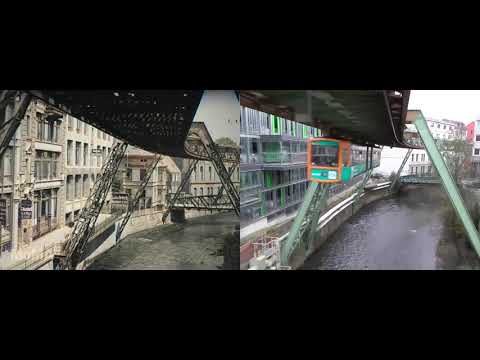
Matching the speed of modern transit footage to intact 1902 archival film exposes how building density and riverfront infrastructure evolved across 113 years along Germany's suspension route.
AI-assisted summary of Wuppertal Schwebebahn 1902 & 2015 side by side video — original source. Check the original for full context.
Source published:
Key ideas
- Ett & Annat created a side-by-side visual comparison of the Wuppertal Schwebebahn suspension railway spanning 113 years, pairing archival footage from 1902 with modern footage from 2015. (0:00)
- The editing methodology preserved the historical 1902 footage intact while selectively cutting and adjusting the frame rate of the 2015 footage to match perspectives. (0:00)
- The presentation relies entirely on visual comparison set to background music and ambient audio rather than a narrated voiceover. (0:00)
Detailed notes
## Background Published by creator Ett & Annat on YouTube on August 15, 2020, this video lines up archival footage of the Wuppertal Schwebebahn from 1902 alongside modern footage from 2015. The creator created the project for fun to offer an impression of how urban infrastructure and buildings evolved over a span of 113 years, matching scenes by adjusting the modern video's cuts and frame rates.
## TL;DR The video presents a synchronized, side-by-side comparative ride along Germany's Wuppertal Schwebebahn suspension railway, placing the 1902 historical run on the left and the 2015 perspective on the right. Viewers observe a century-long physical evolution of the city, highlighting enduring structures, modified riverbanks, and modernized transit infrastructure. Because the piece foregoes traditional narration or voiceover, the visual comparison unfolds naturally alongside musical accompaniment and ambient audio cues until its closing remarks.
## Atmosphere & style The presentation carries a reflective, hypnotic, and nostalgic quality as viewers witness 113 years of history passing in tandem. Unencumbered by spoken commentary, the viewing experience feels quiet, observant, and almost time-traveling, allowing the eyes to wander between black-and-white early 20th-century life and colorful contemporary reality. The rhythmic visual journey alongside ambient music fosters a quiet appreciation for the passage of time and structural continuity.
## Bulletin - [00:00](https://www.youtube.com/watch?v=7TqqdOcX4dc&t=0s) Ett & Annat created a side-by-side visual comparison of the Wuppertal Schwebebahn suspension railway spanning 113 years, pairing archival footage from 1902 with modern footage from 2015. - [00:00](https://www.youtube.com/watch?v=7TqqdOcX4dc&t=0s) The editing methodology preserved the historical 1902 footage intact while selectively cutting and adjusting the frame rate of the 2015 footage to match perspectives. - [00:00](https://www.youtube.com/watch?v=7TqqdOcX4dc&t=0s) The presentation relies entirely on visual comparison set to background music and ambient audio rather than a narrated voiceover.
## Key takeaways - [00:00](https://www.youtube.com/watch?v=7TqqdOcX4dc&t=0s) The video synchronizes archival footage from 1902 with modern footage recorded in 2015 side by side. - [00:00](https://www.youtube.com/watch?v=7TqqdOcX4dc&t=0s) The comparison spans an interval of 113 years to illustrate the urban and infrastructural evolution of Wuppertal. - [00:00](https://www.youtube.com/watch?v=7TqqdOcX4dc&t=0s) The 1902 archival recording is kept intact to maintain its authentic historical pacing. - [00:00](https://www.youtube.com/watch?v=7TqqdOcX4dc&t=0s) The 2015 contemporary recording was edited through cuts and frame-rate adjustments to achieve alignment with the historical route. - [00:00](https://www.youtube.com/watch?v=7TqqdOcX4dc&t=0s) Duplicated frames present in the 2015 source footage cause occasional jerkiness in the modern video feed. - [00:00](https://www.youtube.com/watch?v=7TqqdOcX4dc&t=0s) The project focuses on visual tracking of buildings, railway infrastructure, and environmental changes across more than a century. - [00:00](https://www.youtube.com/watch?v=7TqqdOcX4dc&t=0s) The presentation eschews spoken commentary or interviews in favor of musical accompaniment and ambient background sound. - [00:00](https://www.youtube.com/watch?v=7TqqdOcX4dc&t=0s) Automated speech recognition identifies only ambient acoustic artifacts, alert tones, and closing sign-offs rather than descriptive narration.
## Detailed walkthrough ### [00:00](https://www.youtube.com/watch?v=7TqqdOcX4dc&t=0s) Wuppertal Schwebebahn: 1902 vs. 2015 Side-by-Side Comparison
This video presents a synchronized, side-by-side historical comparison of the Wuppertal Schwebebahn (the suspension railway in Wuppertal, Germany), pairing archival footage captured in 1902 on the left with modern footage recorded in 2015 on the right. Rather than featuring a spoken voiceover or interview dialogue, the video is set to background music and ambient sound. The automated speech recognition transcribes primarily repetitive background acoustic artifacts, musical interludes marked as “*music*”, alert tones noted as “*BEEP*”, recurring expressions of “Thank you”, and closing remarks such as “The End”, “Bye”, and “I'm going to go.”
As detailed in the production notes by creator Ett & Annat, the project was created to illustrate the physical transformation of the city and its infrastructure across a span of 113 years. The archival 1902 footage was preserved in its original pacing, while the 2015 footage was aligned by cutting and adjusting framerates to match the historical perspectives as closely as possible, allowing viewers to observe the evolution of tracks, buildings, and urban surroundings over more than a century.
- **Temporal Span**: Compares historical archival footage from 1902 with contemporary footage from 2015, covering an interval of 113 years. - **Editing Technique**: The 1902 footage is kept intact, while the 2015 video is adjusted through frame-rate manipulation and selective cuts to maintain synchronization. - **Audio Profile**: Contains musical accompaniment rather than narration; automated transcript records repeated vocal filler, musical notations, and closing sign-offs.
## Mentioned Ett & Annat, Germany, Wuppertal, Wuppertal Schwebebahn
## Video description When I found these two videos: https://youtu.be/EQs5VxNPhzk filmed in 1902 https://youtu.be/DgfRq4kEFro recorded in 2015 I realized it might be possible to line them up side by side to get an impression of what have changed after 113 years.
The left video is left intact and I tried to line up the corresponding scenes in the right one by cutting and manipulating framerates. The duplicated frames in the right video are also present in the original and makes it a bit jerky.
I made this just for fun and did not aim for a 100% match but it is still possible to see how buildings etc. have changed over time.
[Source](https://www.youtube.com/watch?v=7TqqdOcX4dc)