Tommy Wood Links HIIT and Heavy Lifting to 20-Year Dementia Risk Reductions
Andrew Huberman
High-intensity exercise preserves brain structure and reduces long-term cognitive decline by triggering neuroplastic adaptations that offset age-related loss of white and gray matter.
## Background
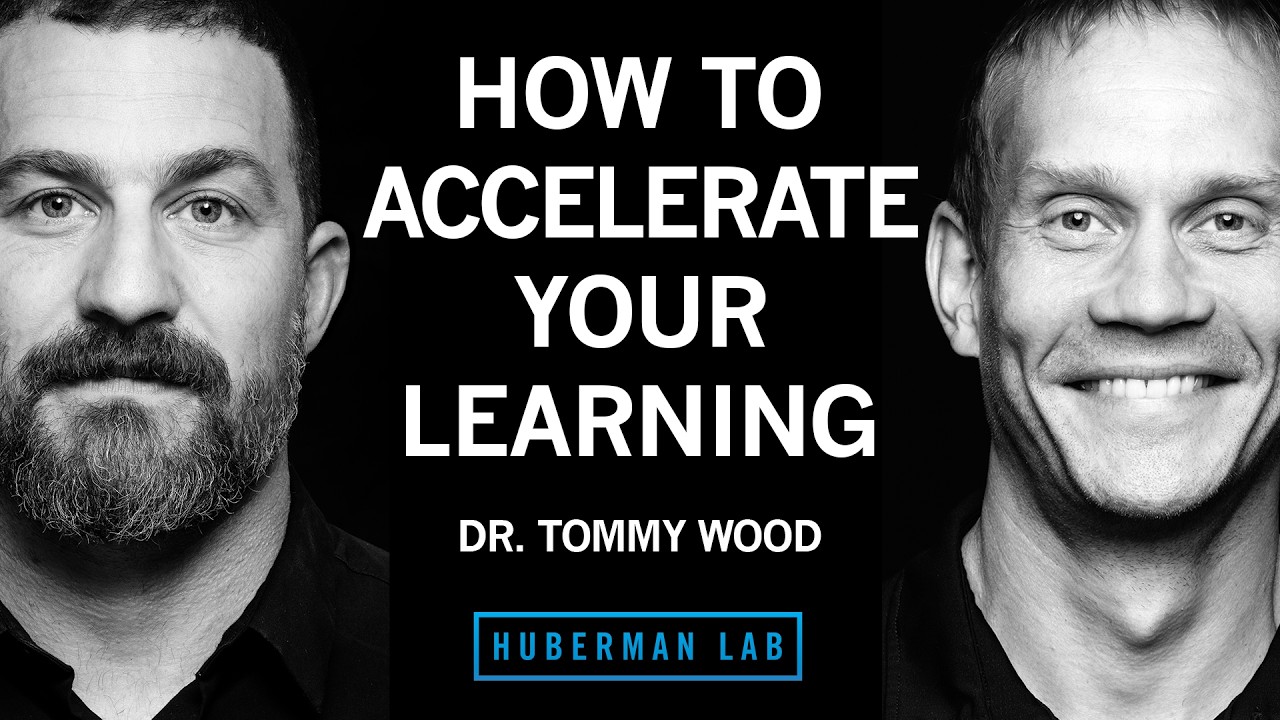
This episode was published on YouTube by Andrew Huberman on July 20, 2026. The video features neuroscience researcher Dr. Tommy Wood discussing science-based strategies to accelerate learning, enhance neuroplasticity, preserve cognitive function, and mitigate dementia and concussion risks.
## TL;DR
Dr. Tommy Wood explains how adult cognitive capacity and neuroplasticity are driven by novel motor-cognitive challenges, complex physical training, and dedicated processing speed work rather than passive brain games. He highlights how intense exercise protocols like high-intensity interval training (HIIT) and resistance training protect brain structure, while proper sleep, whole-food nutrition, and disease prevention hedge against stepwise cognitive decline. Additionally, Wood outlines targeted supplement and rehabilitation protocols for traumatic brain injury (TBI) and illustrates the mental benefits of confronting difficult, high-effort 'clutch' states.
## Atmosphere & style
The conversation is deeply intellectual, grounded, and intensely practical, striking a balanced dynamic between Huberman's structured, probing curiosity and Wood's clear, analytical expertise. The narrative arc moves seamlessly from complex neuroscientific concepts to actionable daily tools and personal physical feats, such as Wood's participation in strongman competitions. Listening to the interview feels like observing two passionate scientific minds demystifying human performance with engaging rigor, clarity, and authentic mutual respect.
## Key takeaways
- [04:05](https://www.youtube.com/watch?v=bPd9NnOzx78&t=245s) Neuroplasticity represents the brain's ongoing ability to adapt connections based on environmental input, whereas adult neurogenesis is extremely minimal and restricted to specific regions.
- [04:05](https://www.youtube.com/watch?v=bPd9NnOzx78&t=245s) The Developmental Theory of Aging suggests adults lose cognitive and motor functions primarily when they stop providing the necessary novel environmental inputs to sustain those neural networks.
- [11:11](https://www.youtube.com/watch?v=bPd9NnOzx78&t=671s) Familiar demanding habits preserve existing circuits, but novel cognitive and motor challenges like dance, sports, and language learning drive structural neuroplasticity and protect the frontoparietal network.
- [18:18](https://www.youtube.com/watch?v=bPd9NnOzx78&t=1098s) Visual processing speed training has been shown to significantly reduce long-term dementia risk, likely by enhancing cholinergic signaling in the forebrain.
- [21:56](https://www.youtube.com/watch?v=bPd9NnOzx78&t=1316s) Real-world complex motor-cognitive activities provide superior general cognitive transferability compared to digital brain games or crosswords.
- [30:24](https://www.youtube.com/watch?v=bPd9NnOzx78&t=1824s) Friction, mistakes, and embracing the discomfort of being bad at new tasks are neurobiological prerequisites to trigger true neuroplasticity.
- [36:50](https://www.youtube.com/watch?v=bPd9NnOzx78&t=2210s) Flow states reflect the expression of an already mastered skill, whereas learning is driven by high-effort, high-arousal 'clutch states' that engage the anterior midcingulate cortex.
- [50:55](https://www.youtube.com/watch?v=bPd9NnOzx78&t=3055s) High-level intense daily cognitive practice peaks at roughly two 60- to 90-minute sessions, with overall creative output dropping significantly after 4 hours.
- [55:50](https://www.youtube.com/watch?v=bPd9NnOzx78&t=3350s) Physical proximity to smartphones induces a constant cognitive load, while frequent external interruptions train the brain to self-distract during focused tasks.
- [01:03:03](https://www.youtube.com/watch?v=bPd9NnOzx78&t=3783s) Diet quality and energy balance follow a bell-shaped relationship with brain health; both extreme restriction and metabolic excess compromise long-term brain volume.
- [01:32:27](https://www.youtube.com/watch?v=bPd9NnOzx78&t=5547s) Stimulants improve subjective confidence and alertness but can decouple feeling from actual performance, increasing objective errors on complex tasks.
- [01:43:18](https://www.youtube.com/watch?v=bPd9NnOzx78&t=6198s) Norwegian 4x4 high-intensity interval training (HIIT) significantly improves hippocampal structure and volume preservation compared to moderate, Zone 2 treadmill exercise.
- [01:54:24](https://www.youtube.com/watch?v=bPd9NnOzx78&t=6864s) Aerobic exercise primarily builds brain gray matter via BDNF and lactate, whereas resistance training builds brain white matter, which is crucial for maintaining processing speed.
- [02:03:14](https://www.youtube.com/watch?v=bPd9NnOzx78&t=7394s) Up to 70% of dementia cases are preventable by addressing modifiable risk factors like hearing loss, physical inactivity, high LDL, and sleeping fewer than 6 hours per night.
- [02:09:47](https://www.youtube.com/watch?v=bPd9NnOzx78&t=7787s) Receiving the shingles vaccine (particularly Shingrix) is strongly associated with a reduced incidence of dementia through immune modulation and suppression of latent herpes viruses.
- [02:16:05](https://www.youtube.com/watch?v=bPd9NnOzx78&t=8165s) Age-related cognitive decline often happens in sudden, non-linear 'stepwise' drops immediately following major illnesses or hospitalizations due to inflammation and immobility.
- [02:18:28](https://www.youtube.com/watch?v=bPd9NnOzx78&t=8308s) Acute traumatic brain injury creates a critical cellular energy gap; forcing mental stimulation or allowing the brain to overheat triggers neuroinflammation and cell death.
- [02:22:50](https://www.youtube.com/watch?v=bPd9NnOzx78&t=8570s) Immediate post-concussion metabolic recovery strategies include high-dose creatine loading alongside bioavailable magnesium, omega-3s, choline, and ultra-high dose BCAAs.
- [02:28:08](https://www.youtube.com/watch?v=bPd9NnOzx78&t=8888s) Modern TBI rehabilitation protocols reject prolonged dark-room rest in favor of early, sub-symptom-threshold aerobic exercise, vestibular therapy, and oculomotor training.
## Detailed walkthrough
### [00:00](https://www.youtube.com/watch?v=bPd9NnOzx78&t=0s) High-Intensity Exercise and Hippocampal Preservation
A recent study randomized older adults into three experimental groups to evaluate cognitive outcomes: a low-intensity control group, a moderate-intensity group performing Zone 2 treadmill work three times per week, and a high-intensity interval training (HIIT) group utilizing the Norwegian 4x4 protocol. The Norwegian protocol required participants to complete four 4-minute intervals at 85% to 95% of their maximum heart rate, separated by 3-minute rest periods. This intervention was sustained three times a week for a rigorous 6-month period.
The results demonstrated that while the HIIT group improved their cardiorespiratory fitness to a similar degree as the Zone 2 group, they experienced significantly superior outcomes regarding brain structure. Specifically, MRI scans revealed enhanced hippocampal function and a profound maintenance of hippocampal volume. Remarkably, this structural and functional cognitive benefit was maintained for 5 years after the completion of the 6-month intervention, proving that short-term intense physical effort yields exceptionally durable neurological preservation.
[00:56](https://www.youtube.com/watch?v=bPd9NnOzx78&t=56s) Introduction of Dr. Tommy Wood
Host Andrew Huberman introduces Dr. Tommy Wood, a medical doctor and neuroscience researcher at the University of Washington in Seattle, who also serves as the Chief Science Officer of BetterBrain—a company offering free brain health coaching. Dr. Wood is an expert in neuroplasticity, human performance, and science-based protocols designed to optimize focus, learning capacity, and skill expression across all levels, from beginners to elite performers.
The conversation covers the precise brain states that optimize learning and how to intentionally induce them. They dive into structural mechanics: the ideal length of a learning session, daily session frequency, and how to train the brain to become more efficient at changing itself. This capacity means that the neural circuits responsible for focus are themselves plastic, enabling individuals to "literally get better at getting better."
* **Key Brain States:** Discussion of flow states alongside the lesser-known "clutch state," which is highly critical for accelerating performance and learning.
* **Granular Exercise Mapping:** How specific modalities—ranging from long, slow cardio to brief HIIT and resistance training—open distinct biological windows for different types of learning.
* **Book Spotlight:** Dr. Wood's book, *The Stimulated Mind: Futureproof Your Brain from Dementia and Stay Sharp at Any Age*, offers a deep dive into maintaining cognitive health across the lifespan.
[04:05](https://www.youtube.com/watch?v=bPd9NnOzx78&t=245s) Defining Neuroplasticity vs. Neurogenesis
Dr. Wood conceptualizes neuroplasticity fundamentally as the brain's capacity to respond to environmental inputs so that humans can better navigate and survive their surroundings. Every instance of learning, environmental interaction, or memory retention engages these foundational principles. This architectural shifting involves strengthening or creating new synapses, alongside the equally critical process of weakening and pruning existing connections to refine function.
A common point of confusion in both public and scientific spheres is the conflation of neurogenesis with neuroplasticity. For decades, scientific consensus followed the doctrine of Santiago Ramón y Cajal, who posited that the adult brain was entirely immutable and fixed after development. While it is true that the adult brain undergoes incredibly minimal neurogenesis—restricted to tiny numbers of new neurons in specific regions like the olfactory bulbs and the dentate gyrus of the hippocampus—this lack of cellular turnover does not imply structural stagnation.
> "Just because we have a fixed relatively fixed number of cells doesn't mean that we can't change the connections between those cells. And that's happening all the time. And that is, you know, the main principle of neuroplasticity."
* **Synaptic Pruning:** Essential for refining motor patterns and language acquisition. Brain cell proliferation largely finishes around 2 to 3 years of age; subsequent childhood development is primarily characterized by the strategic removal of unneeded connections.
* **The Developmental Theory of Aging:** Later in life, individuals often lose cognitive or motor functions because they stop providing the necessary environmental inputs to sustain those neural networks, causing the brain to continuously prune them away due to disuse.
[11:11](https://www.youtube.com/watch?v=bPd9NnOzx78&t=671s) Aging, Cognitive Maintenance, and Novelty
When analyzing the intersection of aging and neuroplasticity through epidemiological data and intervention trials, two distinct patterns emerge regarding how to keep the brain chronologically young. The traditional adage "use it or lose it" is strongly supported by observational data. Older adults who routinely maintain cognitively demanding lifestyle habits—such as attending lectures, volunteering, reading, and solving crosswords—exhibit significantly slower rates of cognitive decline and lower incidences of dementia. This reflects a preservation strategy, or holding onto existing neural circuitry.
Conversely, a robust and growing body of interventional literature highlights the unique power of structural novelty. When older adults are exposed to completely unfamiliar cognitive challenges, objective improvements in executive function are observed. These novel stimuli include learning a new language, practicing complex coordinative movements, studying musical theory, or learning an instrument. Large-scale randomized controlled trials, such as the U.S. POINTER trial and Australia's "Maintain Your Brain" online cognitive training study, confirm that introducing novel cognitive demands provides the necessary cellular stimulus to actively elevate and improve brain function rather than merely arrest decline.
Andrew Huberman shares that his debut book, *Protocols: An Operating Manual for the Human Body*, is officially available for pre-order ahead of its launch on September 15th. The text serves as a practical, actionable manual synthesizing decades of research and interviews with leading clinical experts. Designed to target psychological and physical pain points, it features explicit protocols for optimizing sleep, nutrition, exercise, stress management, neuroplasticity, and motivation.
The episode is brought to you in part by David, a brand making specialized protein bars. Their newest product, the Bronze Bar, contains 20 grams of protein, 150 calories, and 0 grams of sugar.
[15:45](https://www.youtube.com/watch?v=bPd9NnOzx78&t=945s) Sponsor: David Protein & The "Maintain Your Brain" Study
Andrew Huberman highlights David protein bars as an easy, low-calorie way to hit a daily protein target of one gram per pound of body weight, emphasizing their zero-sugar profile, 20 grams of protein, and 150-calorie count. Shifting the conversation back to cognitive research, Huberman asks about the specific details of large-scale cognitive health trials in older adults. Dr. Tommy Wood explains the Australian "Maintain Your Brain" study, which targeted middle-aged individuals in their 50s and 60s using personalized interventions across four domains: dietary changes, physical activity, cognitive behavioral therapy (CBT) for mental health support, and online brain training.
Dr. Wood notes that similar multidomain approaches have been replicated globally, such as the Pointer trial in the United States (focusing on adults in their 60s and 70s) and its predecessor, the Finnish FINGER trial. These programs combine diet, exercise, cardiovascular risk monitoring, and targeted cognitive exercises.
- The Pointer trial utilized **BrainHQ**, a digital training platform based on the neuroplasticity research of Dr. Michael Merzenich.
---
[18:18](https://www.youtube.com/watch?v=bPd9NnOzx78&t=1098s) Processing Speed, the ACTIVE Trial, and Dementia Risk
Dr. Wood highlights the historical significance of the landmark ACTIVE trial from the 1990s—the largest study on pure cognitive brain training in older adults (ages 60s–70s). The trial compared three training conditions (memorymnemonics/memory palaces, reasoning/pattern recognition, and visual processing speed) against a control group. Visual processing speed was trained by presenting information on a screen for rapidly shrinking durations (down to hundreds of milliseconds) and testing recall and spatial location.
> "Those who did processing speed training with booster sessions at one and three years had a significantly decreased risk of dementia 20 years later."
Dr. Wood explains that processing speed training enhances cholinergic signaling in the forebrain, a pathway particularly vulnerable to dementia. While basic reaction time slowly declines from one's 30s onward, complex processing speed—the ability to interpret and retain rapidly presented information—remains relatively stable until roughly age 60 before dropping off.
---
[21:56](https://www.youtube.com/watch?v=bPd9NnOzx78&t=1316s) Enhancing Neuroplasticity with Age: Motor & Cognitive Challenge
Huberman asks whether adults seeking to preserve or enhance cognitive function should push harder within their existing routines or venture outside their comfort zones. Dr. Wood clarifies that activities like crosswords or Sudoku operate more like passive, meditative focus exercises rather than true cognitive challenges. Building real cognitive capacity requires spending time in a state where one is simultaneously focused and cognitively challenged.
While digital brain games suffer from a narrow focus where improvements do not transfer to general daily life, real-world skills engage broad, interconnected neural networks. Engaging in complex physical activities—such as picking up a new ball sport—forces the brain to combine motor control, social interaction, and rapid visual/auditory processing in an unpredictable environment.
- **Transferability:** Complex, human-centric skills offer broad cognitive transfer, whereas digital brain training often yields highly specific improvements limited to the game itself.
---
[26:56](https://www.youtube.com/watch?v=bPd9NnOzx78&t=1616s) Learning New Skills: Dance, Sports, and Creative Arts
When asked for potent real-world plasticity inducers, Dr. Wood ranks learning a new dance at the top of the list. Meta-analyses in older adults show that structured styles like ballroom and line dancing yield some of the greatest cognitive benefits due to their combination of motor skill acquisition, social coordination, physical activity, and musical rhythm processing.
Beyond dance, Dr. Wood lists several other potent activities:
* **Dynamic Sports:** Ball sports, board sports, team sports, skateboarding, and martial arts (e.g., Brazilian Jiu-Jitsu) require real-time environment reactivity and processing speed.
* **Creative & Visual Arts:** Arts and language learning strengthen the frontoparietal network, which naturally declines with age and governs focus and attention.
* **Video Games:** While lacking large-muscle movement, complex video games push rapid problem-solving and visual search demands.
---
[30:24](https://www.youtube.com/watch?v=bPd9NnOzx78&t=1824s) Psychological Barriers to Learning in Adults
Dr. Wood references a paper he co-authored with colleague Dr. Josh Turknett proposing that cognitive decline with age is partly driven by a lack of novel, complex inputs. A primary reason adults stop pursuing new inputs is an aversion to being bad at things.
Huberman humorously relates to this psychological barrier, imagining stepping into a tango class with his wife expecting to look like Arnold Schwarzenegger and Jamie Lee Curtis in *True Lies*, only to face the uncomfortable reality of being a complete beginner. Dr. Wood agrees that while making mistakes feels uncomfortable, that exact friction is what triggers neuroplasticity and learning. Taking a group class where everyone can laugh at their shared mistakes turns a potential point of shame into an engaging social and cognitive win.
[31:39](https://www.youtube.com/watch?v=bPd9NnOzx78&t=1899s) Embracing Embarrassment and the Psychological Need for Challenge
Dr. Tommy Wood describes the internal resistance adults face when trying something completely foreign—such as learning a complex dance move like dipping a partner in tango. The fear of dropping someone, looking foolish, and feeling social shame often prevents adults from attempting novel tasks. However, leaning into that discomfort and risking failure is precisely what triggers neuroplasticity. Adult learning requires letting go of the self-imposed expectation that one must immediately be competent at everything.
Andrew Huberman shares that his Argentine grandparents danced the tango into their 80s, though they had learned it when they were young. He highlights how specific social dynamics can make certain skills harder for beginners. In traditional partner dances like salsa or tango, where one person leads, a novice leader faces unique pressure because the interaction depends entirely on their guidance. Huberman references author Tim Ferriss, who addressed this by hiring a specialized female dance coach to learn how to lead before competing in tango. Huberman also notes a former roommate—a UCSF neurology resident—who would return transformed from late-night tango sessions.
Dr. Wood explains that when a person engages with a meaningful, properly calibrated challenge and succeeds, it satisfies a fundamental psychological need. Overcoming a difficult task creates a positive "halo effect" that spills over into daily life, boosting confidence, stress tolerance, and enthusiasm for other challenges. Conversely, tasks that are excessively difficult and lead to repeated failure without progress can have the opposite effect and damage self-efficacy.
* **Key Insight:** For motor and cognitive challenges to drive positive psychological and neural adaptation, they must be difficult enough to cause errors, yet achievable through focused practice.
---
[36:50](https://www.youtube.com/watch?v=bPd9NnOzx78&t=2210s) Re-evaluating Flow: Flow States vs. Clutch States
The conversation shifts to defining "flow," a term originally coined by Mihaly Csikszentmihalyi. Huberman points out that popular culture often misinterprets flow as a magical state of effortless, flawless execution. Originally, however, flow was defined as being deeply engaged at the absolute boundary of one's current skill set.
Dr. Wood expresses frustration with the modern obsession with flow, clarifying two major misconceptions:
1. **Flow is NOT required for optimal performance:** In athletic and high-performance settings, top-tier execution often occurs in a **clutch state**. Unlike flow, a clutch state occurs at the optimal level of physiological arousal but feels like an intense, grueling, high-effort slog. Athletes routinely achieve peak outcomes through sheer focus, grit, and conscious effort while in a clutch state.
2. **Flow is NOT the state where optimal learning occurs:** Plasticity requires friction, frustration, and error-making. Because flow represents the fluid, maximal expression of an already established skill, stepping beyond that capability to learn something new inherently breaks the flow state.
```
┌────────────────────────────────────────────────────────────────────────────────────────┐
│ PERFORMANCE & LEARNING STATES │
├─────────────────┬──────────────────────────────────┬───────────────────────────────────┤
│ STATE │ FEELING / EXPERIENCE │ PRIMARY ROLE │
├─────────────────┼──────────────────────────────────┼───────────────────────────────────┤
│ Flow State │ Seamless, effortless execution │ Maximal expression of mastery │
├─────────────────┼──────────────────────────────────┼───────────────────────────────────┤
│ Clutch State │ High effort, intense friction │ Peak performance under stress │
├─────────────────┼──────────────────────────────────┼───────────────────────────────────┤
│ Learning State │ Error-making, high friction │ Driving neuroplasticity │
└─────────────────┴──────────────────────────────────┴───────────────────────────────────┘
```
Huberman connects the clutch state to the **anterior midcingulate cortex (aMCC)**—a brain region that enlarges in individuals who intentionally tackle hard tasks. Neurosurgeon Dr. Josef Parvizi at Stanford demonstrated that electrical stimulation of the aMCC invokes a feeling of an impending challenge combined with a firm resolve to press forward.
---
[43:35](https://www.youtube.com/watch?v=bPd9NnOzx78&t=2615s) Mastery, Virtuosity, and Ayrton Senna
Huberman introduces a skill framework shared by a friend from the Special Operations community: progress moves from *unskilled* to *skilled*, then to *mastery*, and finally to *virtuosity*. Virtuosity occurs when an individual who has already achieved mastery deliberately pushes themselves to the edge of the unknown, inviting unpredictability and unlocking an unprecedented tier of performance. Huberman notes seeing this phenomenon featured in the documentary *The Dark Wizard*, which details the life of free-solo climber and wingsuit flyer Dean Potter.
Dr. Wood notes that this definition of virtuosity closely overlaps with the peak, transcendental experiences often described in elite sports. He points to a famous account by legendary Formula 1 driver **Ayrton Senna** during qualifying at the Monaco Grand Prix. Senna described driving far beyond his conscious capacity, achieving lap times seconds faster than his competitors while feeling as though he were observing himself from outside the car.
[46:59](https://www.youtube.com/watch?v=bPd9NnOzx78&t=2819s) The Power of Foundational Practice
Dr. Wood and Huberman conclude that while elite performers may occasionally reach states of virtuosity or flow, their baseline success relies on embracing the friction of the clutch state and committing to repetitive, basic preparation.
Huberman recalls world-renowned choreographer **Twyla Tharp** describing her elite dancers' daily regimen. Even in her 80s, Tharp emphasizes that world-class dancers spend hours every single morning performing the most elementary physical drills and fundamentals. Only after completing these repetitive, basic exercises do they transition to rehearsing complex new choreography.
* **Key Takeaway:** Peak performance is built on endless, deliberate practice of fundamental skills, creating the structural foundation required to handle intense strain during high-stakes moments.
[47:32](https://www.youtube.com/watch?v=bPd9NnOzx78&t=2852s) Maintaining the Fundamentals and the "Rule of Thirds"
In skill development and training, people often mistakenly assume that performance should continuously feel fluid or effortless. Dr. Tommy Wood highlights the "rule of thirds" long recognized by athletes: across your training sessions over weeks or months, roughly one-third will feel amazing and effortless, one-third will be completely average, and one-third will simply feel like a grind where you just have to show up. He warns against over-glorifying "flow," noting that real neuroplasticity and cognitive capacity are driven by challenging, hard effort.
Regarding whether high performers must constantly practice basic fundamentals, Dr. Wood explains that it depends on the activity—often, complex practice naturally incorporates basic mechanics. He cites a study on expert and amateur pianists (younger groups in their 20s–30s vs. older groups in their 50s–60s) based at German music conservatories. The strongest predictor of finger dexterity and basic task-specific piano skills was not age, but cumulative practice volume. While an expert playing a complex piece gets the necessary fundamental repetitions organically, many still practice basic scales during warm-ups to maintain foundational skills and build an intentional routine before performing.
* **Rule of Thirds:** 1/3 of sessions feel great, 1/3 feel average, and 1/3 feel like a grind.
* **Pianist Study Breakdown:** Evaluated task-specific motor performance across age groups (20s–30s vs. 50s–60s) and skill levels (expert vs. amateur); total practice time, rather than age, dictated skill retention.
Andrew Huberman breaks for a sponsor message regarding AG1, a foundational nutritional supplement containing vitamins, minerals, probiotics, prebiotics, and adaptogens. He notes he has taken it daily since 2012 to support gut health, immune function, and overall energy.
[52:14](https://www.youtube.com/watch?v=bPd9NnOzx78&t=3134s) The Myth of 10,000 Hours and Optimal Work Chunks
Dr. Wood debunks the popularized "10,000-hour rule," clarifying that K. Anders Ericsson’s landmark study on elite violinists merely observed that 10,000 hours was the *average* cumulative practice accumulated by top 20-year-old players—not a magical threshold for mastery, as those individuals were still developing. Instead, the study's key actionable takeaway was how elite performers structure their day: they typically engage in two focused practice sessions per day lasting 60 to 90 minutes each.
For high-level cognitive work or skill acquisition, 60–90 minute blocks (or smaller 25–30 minute focused intervals like the Pomodoro Technique, with short breaks) represent the realistic limit of daily deep attention. Huberman concurs, recalling advice he received before writing his book that high-level creative output drops off significantly after about four hours of deep work per day. While individuals might push through 8–12 hour stretches under tight deadlines, it inevitably results in a post-deadline drop in output.
* **Violinist Practice Pattern:** Top-tier performers cap intense, focused practice at roughly two 60- to 90-minute sessions per day.
* **Cognitive Focus Structure:** High-demand cognitive work is best sustained in 20–30 minute chunks (e.g., Pomodoro method) or up to 4 total hours of deep work daily.
[55:50](https://www.youtube.com/watch?v=bPd9NnOzx78&t=3350s) Eliminating Distractions and the Role of Mind-Wandering
To execute deep work, Dr. Wood emphasizes removing modern distractions by closing email clients, messaging platforms (Slack, Teams, WhatsApp), and placing smartphones in a separate room. Citing Dr. Gloria Mark’s research in her book *Attention Span*, he notes that humans become so conditioned to frequent interruptions that when no external distraction occurs, they reflexively create one by reaching for their phones. Training oneself out of this habit requires intentional, distraction-free work blocks. When facing a creative sticking point, Dr. Wood prefers switching to another active project rather than forcing focus through extreme friction.
Huberman highlights research showing that even when a phone is turned off in a bag under a chair, its physical proximity inflicts an active cognitive cost because the brain subconsciously anticipates notifications. On the topic of focus, Dr. Wood adds that unstructured, non-input time—such as walking or taking a shower—allows the mind to wander, integrate facts, and forge novel creative connections.
* **Cognitive Load of Proximity:** Keeping a smartphone near your workspace—even turned off—reduces cognitive flexibility due to subtle anticipation of alerts.
* **Gloria Mark’s Insight:** Interruption patterns entrain the brain to seek out self-distraction when work becomes static.
[01:00:17](https://www.youtube.com/watch?v=bPd9NnOzx78&t=3617s) Dietary Patterns, Whole Foods, and Cognitive Health
When examining large-scale clinical trials aimed at preserving cognitive health and preventing dementia, Dr. Wood explains that interventions primarily focus on variations of the Mediterranean diet. Key examples include the MIND diet (*Mediterranean-DASH Intervention for Neurodegenerative Delay*—developed from the Rush University Memory and Aging Project) and dietary protocols used in the Smiles trial (the first randomized controlled trial using diet to treat clinical depression). These diets emphasize seafood, vegetables, berries, and whole grains while limiting saturated fats.
However, recent rigorous studies reveal that specific strict dietary components may be less critical than overall food quality:
* **MIND Diet Clinical Trial:** A randomized trial published in the *New England Journal of Medicine* comparing the MIND diet to standard caloric restriction found similar cognitive benefits across both groups.
* **UK Biobank Analysis:** Observational data showed that systematically removing individual components (such as olive oil, meat restriction, or specific vegetable groups) from a Mediterranean diet score did not alter the overall protective association against dementia risk.
* **Core Takeaway:** Cognitive protection stems from consuming nutrient-dense whole foods as an overall dietary context rather than obsessing over or isolating individual "superfoods."
[01:03:03](https://www.youtube.com/watch?v=bPd9NnOzx78&t=3783s) The Three Pillars of Diet and the Brain Volume Curve
When evaluating nutrition for cognitive longevity, the diet can be broken down into three fundamental areas: energy availability, individual nutrients, and overall dietary pattern. A recurring puzzle in nutritional science is why specific diets tailored for brain health—such as the MIND diet—sometimes fail to outperform basic caloric restriction in clinical trials. The answer largely lies in the baseline metabolic health of modern industrialized populations, who frequently exist in a state of chronic energy excess.
Global anthropological data highlights a clear bell-shaped relationship between lifetime energy availability and brain volume. On one end of the spectrum, extreme chronic caloric restriction starves the brain of the structural resources it requires for maintenance. This is observable in certain isolated indigenous groups, such as the Tsimané hunter-gatherers of Bolivia. In the middle sits intermediate transitional groups like the Moseten. On the opposite end of the spectrum, the chronic energy excess characteristic of highly industrialized populations in the United States and Europe produces a similarly diminished brain volume. This modern shrinkage is driven by metabolic disease, high blood pressure, and systemic inflammation. Ultimately, simply reducing excess energy intake to a balanced level provides a powerful baseline stimulus for cognitive improvement and brain tissue preservation.
* **Tsimané & Moseten Studies:** Highlight the delicate evolutionary balance between resource availability and brain reserve.
* **The Energy Balance Rule:** Brain volume suffers at both extremes—chronic starvation and chronic caloric excess.
[01:05:25](https://www.youtube.com/watch?v=bPd9NnOzx78&t=3925s) Essential Nutrients for Cognitive Health
Beyond
[01:18:19](https://www.youtube.com/watch?v=bPd9NnOzx78&t=4699s) The Shifting Landscape of Nutrition and Supplementation
The conversation shifts toward the future of personalized medicine, with both speakers envisioning a collaborative healthcare model. The ideal scenario involves individuals taking tailored supplements based on objective blood data rather than consuming a random "gazillion tablets and capsules." This approach allows people to retest their blood markers to ensure values come into range, all while tracking subjective experiences like sleep quality and general well-being.
The current societal dialogue surrounding supplements remains somewhat outdated, often flattening them into "expensive urine" or basic vitamin replacements. However, modern supplementation serves targeted functional purposes, such as enhancing slow-wave sleep or boosting cognitive focus.
A prominent question remains unanswered in the standard medical literature: if a standard dose of a nutrient like an omega-3 fatty acid keeps someone at the upper reference range, would a higher dose optimize them further? This territory is frequently dismissed as "biohacking," yet it reflects a fundamental human desire to feel better and extend lifespan safely. The past 40 years of nutritional science have focused overwhelmingly on defensive health—avoiding trans fats, fried foods, excess alcohol, and brain trauma. The frontier is transitioning into a proactive phase of discovering what can actively enhance human capability.
[01:20:54](https://www.youtube.com/watch?v=bPd9NnOzx78&t=4854s) Raising the Population Floor vs. Pushing the Peak
Dr. Tommy Wood structures the performance debate into two distinct categories: population-level health and peak individual performance. At the population level, the priority must be "raising the floor" by improving food quality and addressing equitable access to nutrition, ensuring individuals possess the baseline knowledge and resources to cook whole foods. From a biochemical perspective, nutrients serve as the ultimate leveler; the body simply requires these compounds to function, regardless of whether they originate from whole foods or supplements.
When pushing the upper boundaries of individual performance—such as elevating an omega-3 index from a healthy 7 or 8 up to a 12—clinical certainty drops. Dr. Wood notes that while advanced data collection and AI systems may eventually map these individual responses, current rigorous evidence primarily validates reaching a threshold of non-deficiency.
* **Population Health Goal:** Establish baseline nutrient sufficiency to eliminate cognitive and physical risks.
* **Individual Optimization Strategy:** Treat oneself as a personal experiment by holding lifestyle variables constant and tracking meaningful physiological outputs over time.
[01:23:10](https://www.youtube.com/watch?v=bPd9NnOzx78&t=4990s) The Peptide Era and Evaluating Supplement Efficacy
The landscape of self-directed health optimization shifted dramatically with the widespread adoption of GLP-1 receptor agonists like semaglutide and tirzepatide. The willingness of the general public to perform self-injections has dismantled historical needle phobias, opening the floodgates for the broader peptide market. Interestingly, the primary consumers driving this industry are not traditional "gym bros," but rather everyday adults and women seeking enhancements in longevity, fat loss, and physical appearance. People are increasingly seeking out emerging compounds like retatrutide before they are even officially released to the market.
Dr. Wood applies a conservative framework when evaluating any novel supplement or peptide, referencing a standard popularized by Jeffrey Bland: safety must be established first. If a compound demonstrates strong safety data, attempting to use it carries minimal risk even if it ultimately proves ineffective. Unfortunately, the vast majority of popular peptides lack high-quality human clinical trials confirming their efficacy for common lifestyle goals.
* **BPC-157:** Popularly used under the thesis of tissue and injury repair, though it lacks robust human evidence.
* **GHK-Cu (Copper Peptide):** Frequently utilized, particularly among women, for skin appearance and anti-aging.
* **Creatine:** The gold standard example of a highly effective supplement. It boasts extensive safety profiles, showing zero adverse effects even when administered in high doses to frail, older populations, making it an ideal compound for personal experimentation.
### [01:32:27](https://www.youtube.com/watch?v=bPd9NnOzx78&t=5547s) Stimulants, Subjective Feeling, and Performance
Dr. Wood clarifies that while there is "no plasticity pill," the state of arousal—characterized by alertness and focus—is a fundamental prerequisite for neuroplasticity. Substances like caffeine and other stimulants may show evidence of improving plasticity, but Dr. Wood argues these effects are indirect; they merely "set the stage for learning" by modulating physiological arousal. He emphasizes that tracking "how you feel" serves as a highly reliable integration of the brain’s various inputs and outputs, often proving to be a better predictor of an athlete's performance than objective metrics like Heart Rate Variability (HRV) or blood markers.
The conversation highlights a critical "dissociation" created by stimulants: they often make individuals *feel* as though they are performing better, even when objective cognitive data shows the opposite.
* **The "Feel-Good" Trap:** Studies on complex working memory tasks (like the $N$-back task) show that caffeine can lead people to react too quickly and make more errors, despite their subjective sense of improvement.
* **Medical Stimulants:** Similar data exists for ADHD medications (like methylphenidate) in neurotypical individuals, where users report feeling great while their objective performance does not necessarily increase.
* **The Cannabis Parallel:** Dr. Huberman compares this to the "cannabis effect," where individuals often experience a surge of creative confidence, only to realize the following day that their output was of poor quality.
### [01:37:18](https://www.youtube.com/watch?v=bPd9NnOzx78&t=5838s) Exercise as a Tool for Arousal
Because stimulants can decouple subjective feeling from actual performance, Dr. Wood promotes endogenous methods of increasing arousal—specifically exercise—as a more reliable tool. He notes that resistance training, aerobic work, or brief sprints effectively increase catecholamines (adrenaline, norepinephrine, and dopamine), which support cognitive function, learning, and memory retrieval. However, the intensity matters: "Truly exhaustive exercise" (such as a 2,000-meter rowing test) can leave the brain unable to function optimally for complex tasks immediately afterward.
Dr. Huberman confirms this from personal experience, noting that he often feels "dragged out" in the afternoon if he pushes sets to absolute failure during a morning workout. Both agree that leaving "something in the tank" regarding volume is essential if the goal is to perform high-level cognitive work shortly after training.
* **Practical Protocol:** Meta-analyses suggest that a 20-to-30-minute jog is the "sweet spot" for supporting immediate plasticity and learning without inducing excessive fatigue.
* **High-Intensity Alternatives:** For those short on time, short bouts of max-effort sprints (e.g., six seconds of work with long rest periods) can achieve similar arousal benefits without the total depletion of a long-duration, high-intensity session.
### [01:43:18](https://www.youtube.com/watch?v=bPd9NnOzx78&t=6198s) Long-Term Brain Health and HIIT
Shifting from immediate cognitive performance to long-term brain structure, Dr. Wood discusses the impact of different exercise intensities on the hippocampus. While earlier studies focused on moderate, steady-state exercise (brisk walking for 40 minutes, three times a week) and showed significant gains in hippocampal volume and BDNF levels, more recent research suggests that higher intensity may offer superior long-term structural benefits.
He details a study involving older adults randomized into low-intensity, moderate (Zone 2), and high-intensity interval training (HIIT) groups. The HIIT group followed the **Norwegian 4x4 protocol**: four minutes at 85% to 95% of maximum heart rate, followed by three minutes of rest, repeated four times.
* **Key Findings:** While all exercise groups improved fitness, the HIIT group showed significantly better hippocampal function and maintenance of structure on MRI scans.
* **Lasting Impact:** These benefits were maintained for five years following the six-month intervention.
* **The Role of Cortisol:** Countering the narrative that high-intensity exercise is "bad" due to cortisol release, Dr. Wood points out that in these studies, the individuals who worked harder and released *more* cortisol saw the greatest cognitive improvements. "This study directly shows that working really hard... actually improves hippocampal structure and function over time."
Ultimately, Dr. Wood suggests that while you might not want to do a 4x4 interval session immediately before a final exam, the process of high-intensity exercise is a potent stimulus that releases beneficial myokines and lactate, driving profound neuroprotective adaptations over the long term.
<ElicitationsGroup message="If you are interested in the specific physiological mechanisms of exercise and brain health:">
<Elicitation label="Learn how lactate impacts brain function" query="How does lactate produced during exercise affect brain health and neuroplasticity?"/>
<Elicitation label="Explore the role of myokines in cognitive health" query="What are myokines and how do they benefit the brain during exercise?"/>
<Elicitation label="Review the Norwegian 4x4 protocol details" query="How do I perform the Norwegian 4x4 interval training protocol safely?"/>
</ElicitationsGroup>
[01:46:59](https://www.youtube.com/watch?v=bPd9NnOzx78&t=6419s) High-Intensity Exercise and Neuroplasticity
High-intensity training drives essential physiological factors that cross into the brain, stimulating BDNF production to support neuroplasticity and consolidate recent cognitive gains. Doing high-intensity work like 4x4 intervals effectively boosts the structural and functional capacity of the brain, provided it is balanced thoughtfully within an overall training routine.
Andrew Huberman highlights the risks of unmonitored tap water contaminants, citing an Environmental Working Group study showing over 200 million Americans are exposed to PFAS ("forever chemicals") linked to hormone and gut microbiome disruption. He presents the Rorra countertop system as an effective solution that filters out endocrine disruptors and harmful disinfection byproducts while retaining essential minerals like magnesium and calcium.
* Over 200 million Americans are exposed to PFAS in tap water, and 122 million drink water with elevated cancer-causing chemicals.
* Rorra counter-top systems utilize medical-grade stainless steel with no plumbing installation required.
---
[01:48:31](https://www.youtube.com/watch?v=bPd9NnOzx78&t=6511s) Cortisol Benefits: Acute vs. Chronic Stress
The conversation turns to the widespread misunderstanding of cortisol in modern wellness culture. Huberman notes that routine resistance training or moderate cardio transiently triples or quadruples baseline cortisol levels, yet people routinely dread minor stressors while worrying about getting Cushing's syndrome or facial swelling ("moon face"). High morning cortisol is normal and healthy, helping regulate energy throughout the day and improving sleep at night.
Dr. Tommy Wood addresses the roots of this fear, placing some historical blame on Hans Selye’s classic General Adaptation Syndrome framework, which popularized the idea that chronic stress leads to total physiological exhaustion. While chronic stress raises allostatic load, fuels metabolic disease, and promotes insulin resistance, acute stress is the fundamental driver of adaptation. Intermittent stress diverts resources—such as shunting glucose to immune cells during an infection—to help the body adapt and build resilience against future physical or psychological challenges.
* Healthy individuals experience a 20- to 30-fold drop in cortisol levels from morning to night.
* Moderate exercise can triple or quadruple baseline cortisol levels temporarily without negative health consequences.
* "Cross-stressor adaptation" shows that regular physical training makes individuals more resilient against psychological stress.
* Dr. Selye explicitly warned against *hypo-stress* (a lack of stress), as without acute stressors, the body fails to adapt or build functional capacity.
---
[01:54:24](https://www.youtube.com/watch?v=bPd9NnOzx78&t=6864s) Resistance & Aerobic Exercise: Gray vs. White Matter
When examining resistance training protocols for cognitive health, short bouts of multi-joint machine exercises (such as leg presses, chest presses, lat pulldowns, and shoulder presses) performed at 80% effort yield rapid boosts in cognitive function through acute neural arousal pathways. Long-term studies on older adults reveal that performing 5 to 6 compound exercises for 3 sets of 8 to 12 repetitions 2–3 times weekly over 6 to 12 months generates substantial structural improvements in the brain's white matter and enhances executive function.
Dr. Wood delineates the complementary structural roles of aerobic and resistance exercise: aerobic training primarily target the brain's gray matter (including the hippocampus) via BDNF and lactate, whereas resistance training primarily protects and enhances white matter—which makes up roughly 60% of the human brain—partly through surges in IGF-1. Preserving white matter structure and minimizing white matter lesions caused by poor blood flow are among the strongest predictors of maintaining processing speed and preventing age-related cognitive decline.
* Human white matter comprises roughly 60% of the total brain volume, a proportion significantly higher than in other species.
* White matter structural integrity is a superior predictor of age-related cognitive trajectory compared to traditional neuropathological markers alone.
* Resistance training elevates IGF-1, a key growth factor required for white matter development from embryonic stages through old age.
* Aerobic exercise targets gray matter, memory, BDNF, and lactate; resistance exercise targets white matter, executive function, processing speed, and IGF-1.
* In academic neuroscience, running jokes held that almost any compound suppresses REM sleep, and almost any molecule applied to cultured neurons enhances long-term potentiation (LTP).
[02:01:33](https://www.youtube.com/watch?v=bPd9NnOzx78&t=7293s) Exercise as a Plasticity Trigger
Andrew Huberman thanks Dr. Tommy Wood and his colleagues for shifting his paradigm on exercise. He admits he used to view exercise from a purely reductionist standpoint—thinking it merely increased blood vessel growth and basic metabolic health to benefit the brain. Now, understanding how resistance training and cardiovascular protocols (like the 4x4 HIIT method) deploy a complex network of interacting molecules, he views exercise as "the real plasticity triggers." While he values single-molecule manipulations, he notes that in academic science, it often feels like "everything opens plasticity and everything disrupts REM sleep," making this clear framework deeply refreshing.
Huberman then transitions the conversation to neurodegenerative conditions like Alzheimer's and Parkinson's disease. He asks Wood about the current understanding of susceptibility factors, specifically genetic predispositions, and what actionable steps individuals can take beyond what has already been discussed to drastically reduce the risk of full-blown Alzheimer's or accelerated cognitive decline.
[02:03:14](https://www.youtube.com/watch?v=bPd9NnOzx78&t=7394s) Modifiable Risk Factors for Dementia
Dr. Wood frames dementia as an umbrella term for the end-stage of cognitive decline, where a person loses the ability to perform basic activities of daily living and can no longer care for themselves. He points out a systemic flaw in medicine: "we don't really do much until dementia is diagnosed," drawing a parallel to how type 2 diabetes is traditionally handled. Ideally, medical professionals should intervene much earlier in the trajectory.
Wood notes that Alzheimer’s disease is the most common form, accounting for 60% to 80% of dementia cases, followed closely by vascular dementia. He emphasizes that these two categories heavily overlap, as the vast majority of Alzheimer's patients exhibit clear blood vessel pathology in the brain. Other forms include dementia with Lewy bodies, frontotemporal dementia, and Parkinson's-related dementia.
Importantly, it is now widely accepted in the neuroscience community that roughly half of all dementia cases are preventable. While monogenic dominant mutations (such as those in the presenilin 1 and 2 genes or the amyloid precursor protein gene) represent a small slice of cases—comprising less than 5% and potentially as little as 1% of Alzheimer's disease—the vast majority is late-onset. This late-onset form is heavily influenced by lifestyle and environment. While the APOE gene and polygenic risk scores play a role, modifiable lifestyle choices dictate a massive portion of overall risk.
Dr. Wood references the landmark Lancet Commission on Dementia Prevention, Intervention, and Care, overseen by Professor Jill Livingston. The latest report identifies 14 modifiable risk factors that collectively account for about 45% of global dementia cases:
* Early life education (or lack thereof)
* High blood pressure
* Diabetes
* Hearing loss
* Vision loss
* Brain trauma
* High LDL cholesterol
* Low physical activity
* Social isolation
Huberman flags hearing and vision loss as particularly vital examples of how degrading sensory inputs starves the brain of critical stimuli. Wood agrees, pointing out that two highly debated lifestyle factors were left off the Lancet Commission's list due to stringent data-analysis criteria: sleep loss and nutrient status.
[02:07:28](https://www.youtube.com/watch?v=bPd9NnOzx78&t=7648s) The Sleep and Nutrition Debates
Huberman and Wood debate the omission of sleep from the official Lancet list. Huberman notes that while individual sleep needs vary—with some people thriving on 6.5 to 7 hours and others requiring 8 to 9—chronically sleep-deprived individuals and shift workers see rapid deterioration in other areas; their LDL cholesterol climbs, stress levels spike, and diabetes risk increases. Wood explains that when you isolate the epidemiological data, a distinct threshold emerges: "the cut off is really around 6 hours." Consistently sleeping fewer than 6 hours causes dementia risk to climb significantly. Huberman attributes this to missing out on the final two 90-minute sleep cycles of the night, which are highly enriched with REM sleep.
Furthermore, the Lancet Commission did not explicitly include critical nutrient statuses, such as Omega-3 fatty acid intake or B vitamin levels. Wood reveals that other independent epidemiological analyses suggest that accounting for sleep, targeted nutrition, and broader socioeconomic factors could push the total percentage of preventable dementias as high as 70%.
[02:09:47](https://www.youtube.com/watch?v=bPd9NnOzx78&t=7787s) The Shingles Vaccine and Dementia Risk
Huberman introduces a highly intriguing and controversial topic: recent data indicating that the shingles vaccine significantly lowers rates of dementia. Dr. Wood explains that this observation stems from three large "natural experiments" conducted in Wales (UK), Australia, and Canada. In these countries, the national healthcare systems introduced the shingles vaccine on specific dates, making large cohorts of the population suddenly eligible based on their birthdates. Individuals born just one day apart were split into eligible and ineligible groups. These populations showed virtually no baseline differences in healthcare-seeking behavior or other disease rates, yet the cohorts eligible for the shingles vaccine consistently displayed a lower risk of developing dementia.
The early trials utilized Zostavax, an older live-attenuated shingles vaccine. A subsequent comparative study in the United States looked at the transition to Shingrix, the newer recombinant vaccine, and discovered that Shingrix was associated with an even lower risk of dementia than Zostavax—though both performed significantly better than no vaccine at all.
Wood acknowledges a valid critique within academic literature: when looking at the Kaplan-Meier survival curves of these studies, the lines representing the vaccinated and unvaccinated cohorts diverge almost immediately—within a couple of months. Because dementia typically takes years or decades to manifest, critics argue this rapid divergence points to "residual confounding," meaning the vaccinated cohort may have simply been healthier or less prone to dementia from the start. However, Wood states there is a strong enough signal to warrant the randomized controlled trials currently being planned.
Mechanistically, several theories explain why a shingles vaccine might protect the brain:
* **Pain Reduction:** Shingles is an incredibly painful condition that can isolate elderly individuals for months, compounding the risk factors of social isolation and physical inactivity.
* **Immunomodulatory Effects:** The vaccine may globally modulate the immune system, yielding a slightly stronger protective signal in women than in men.
* **Viral Suppression:** The vaccine may actively suppress other latent viruses.
Huberman reminds the audience that herpes viruses (including the varicella-zoster virus that causes shingles) are neurotropic—they literally live inside neurons. For example, herpes simplex virus 1 harbors permanently in the trigeminal nerve, re-emerging as cold sores during times of stress. "These viruses are very smart," Huberman notes, because they survive by infecting their hosts without killing the host neurons outright. This biological reality provides a plausible mechanistic link between chronic viral presence in the nervous system and long-term dementia risk. Surprisingly, Wood points out that the data showing this protective effect occurred in surprisingly old cohorts—individuals getting vaccinated in their 70s and 80s within national healthcare registries.
[02:16:05](https://www.youtube.com/watch?v=bPd9NnOzx78&t=8165s) Avoid Illness to Preserve Long-Term Cognitive Function
Dr. Wood concludes his breakdown of vaccination research by clarifying the specific age demographics involved. While the US guidelines recommend getting the shingles vaccine in one's mid-50s to prevent the painful virus, the dramatic reduction in dementia risk observed in recent studies was primarily seen in older, higher-risk adults who received it later in life.
Expanding beyond vaccines, Dr. Wood emphasizes a fundamental yet often overlooked strategy for maintaining long-term brain health: actively minimizing periods of severe illness. Citing long-term longitudinal research like the Adult Changes in Thought (ACT) study at the University of Washington and the Rush Memory and Aging Project, he notes that cognitive decline with age does not follow a smooth, linear trajectory. Instead, individual tracking shows that cognitive capacity often drops in a "stepwise" fashion immediately following major medical events or severe infections—with the largest downward steps occurring after hospitalizations.
> "Cognitive function doesn't just decline sort of linearly or steadily with age... the biggest decreases sort of happen stepwise after periods of significant illness."
When a person becomes severely ill, they experience a convergence of negative factors: confinement to bed without environmental stimuli or cognitive inputs, complete physical inactivity, poor nutrient intake, and the direct biological damage caused by systemic infection and inflammation. By utilizing tools like vaccinations and lifestyle measures to prevent major illness, individuals avoid these prolonged periods of sensory and physical deprivation, thereby altering their long-term cognitive trajectory and preserving function over time.
* **Adult Changes in Thought (ACT) Study**: University of Washington study tracking cognitive function in individuals over time; identified severe illness and hospitalization as triggers for sudden, stepwise drops in cognitive capacity.
* **Rush Memory and Aging Project**: Longitudinal study demonstrating similar non-linear, illness-induced drops in brain function among older adults.
* **Mechanisms of Decline During Severe Illness**: Lack of environmental/sensory stimuli, physical immobility, inadequate nutrition, and infection-induced systemic inflammation.
---
[02:18:28](https://www.youtube.com/watch?v=bPd9NnOzx78&t=8308s) Immediate Protocols After a Concussion: Temperature and Metabolic Control
Shifting topics to traumatic brain injury (TBI) and moderate concussions, Andrew Huberman asks what immediate steps or supplements an individual should take right after getting their "bell rung"—such as a fall, a sports collision, or a minor accident—assuming serious medical emergencies like brain bleeds have already been ruled out by a doctor. Dr. Wood frames his approach around "positive asymmetry"—interventions that carry low risk but offer significant potential benefit.
The first critical, acute step is thermoregulation and temperature management. Drawing from his own PhD research on hypothermia following acute brain injury, Dr. Wood clarifies that while active body cooling (hypothermia) hasn't shown much success in clinical trials, preventing *hyperthermia* (getting overheated) is crucial. A head injury severely disrupts cellular energy, creating a gap between energy requirements and the damaged mitochondria's ability to produce energy. Excess heat or overstimulation increases this energy demand, triggering rapid neuronal cell death and neuroinflammation.
> "If you get too hot or you stimulate the brain, you're asking for more energy when... your neurons can't produce it, and that deficit in energy production is a trigger for cell death and neuroinflammation."
To minimize secondary injury, Dr. Wood highlights several immediate acute protocols:
* **Cooling down immediately**: Move indoors out of hot environments (such as an August football field) to prevent overheating; use fever-reducing medications like Tylenol if a fever develops.
* **Blood sugar control**: Avoid refined sugars and high-glycemic carbohydrates; spike in blood glucose following brain injury is strongly correlated with worse clinical outcomes.
* **Avoiding alcohol**: Completely abstain, as it severely disrupts sleep architecture essential for neurological repair.
* **Avoiding caffeine**: Avoid acute stimulant intake, which elevates metabolic demand in struggling neurons and disrupts rest.
---
[02:22:50](https://www.youtube.com/watch?v=bPd9NnOzx78&t=8570s) Supplement Strategies for TBI: High-Dose Creatine and Essential Nutrients
When evaluating nutritional supplements to aid concussion recovery, Dr. Wood points to high-dose creatine monohydrate as one of the best-supported interventions. In a pediatric trial spanning ages 1 to 18, researchers administered a high loading dose of 0.4 g/kg/day, which translates to roughly 28 grams per day for a 70 kg (155 lb) individual. This supplies much-needed energy substrate to energy-depleted brain tissue. Huberman reflects on his own experience with 1990s-style creatine loading protocols (20 grams per day split into four 5-gram doses with grape juice) that added significant muscle water weight and strength, asking if standard non-injured individuals need to load. Dr. Wood notes that while standard daily doses of 5–10 grams are sufficient for general mood, memory, and cognitive support, acute head injuries warrant short-term loading protocols (20–30 grams daily spread across the day) to rapidly saturate brain creatine levels.
Dr. Wood also details several other targeted, evidence-based nutrients to support the brain post-injury:
* **Magnesium**: Dose at 400 mg once or twice daily. Although early clinical trials surprisingly used magnesium oxide, Dr. Wood recommends highly bioavailable forms like magnesium glycinate.
* **Omega-3 Fatty Acids**: Studies in collegiate American football players show that daily supplementation mitigates the seasonal accumulation of circulating brain injury biomarkers, such as neurofilament light (NfL). High-risk individuals (athletes, tactical workers) should take omega-3s continuously as a preventive measure.
* **Choline / Citicoline (CDP-Choline)**: Dose at 1 to 2 grams daily to support acetylcholine synthesis and membrane repair.
* **Branched-Chain Amino Acids (BCAAs)**: While high doses of BCAAs typically disrupt normal sleep by competing with tryptophan for brain entry, clinical studies in veterans with TBI show that ultra-high doses—up to 60 grams per day (split into three 20-gram doses)—actually improved post-injury sleep quality.
* **Melatonin**: Beneficial for sleep management post-concussion.
* **Botanical Extracts**: Formulations like *Boswellia* (Indian frankincense extract, backed by three TBI clinical trials) and Enzogenol (pine bark extract) have shown positive effects, though Dr. Wood advises prioritizing basic nutritional compounds first.
---
[02:28:08](https://www.youtube.com/watch?v=bPd9NnOzx78&t=8888s) Psychedelics for Brain Trauma and Active Physical Rehabilitation
Huberman asks about emerging clinical trials investigating ibogaine and other psychedelics for long-term TBI recovery and post-traumatic stress disorder (PTSD). Dr. Wood acknowledges that the preliminary data is exceptionally compelling. Psychedelics administered in supervised, clinical macrodoses appear to trigger potent neuroplastic remodeling. However, he cautions that these protocols require strict medical monitoring—including real-time heart rate tracking—and are currently restricted or illegal in many jurisdictions.
Finally, Dr. Wood outlines a major paradigm shift in post-concussion physical therapy. The outdated advice of lying in a dark room until all symptoms disappear has been replaced by active rehabilitation. Current evidence shows that returning to controlled physical movement as soon as tolerated accelerates recovery.
> "Go lie in a dark room... that really changed over the last few years. You would expect... a rigorous return to play protocol that included low-level aerobic activity as soon as you're able to tolerate it."
Modern, evidence-based return-to-activity protocols involve:
1. **Low-level aerobic exercise**: Engaging in light cardio 2 to 3 times per week at an intensity kept just below the threshold that triggers or worsens symptoms.
2. **Sport/Skill-specific drills**: Progressing from general cardiovascular work to non-contact, skill-focused movements once baseline cardio is tolerated.
3. **Full practice integration**: Rejoining full training sessions before returning to actual competitive games or high-risk play.
4. **Targeted physical therapy**: Utilizing specialized physical and cognitive therapy if symptoms persist beyond one month post-injury.
[02:30:50](https://www.youtube.com/watch?v=bPd9NnOzx78&t=9050s) Comprehensive Rehabilitation Following Traumatic Brain Injury
After any type of traumatic brain injury (TBI), physical and specialized therapies play an increasingly central role in recovery. There is growing evidence supporting the use of virtual reality or augmented reality physical activities to mitigate cognitive symptoms. For individuals dealing with balance or dizziness issues, vestibular therapy is highly recommended. Furthermore, clinicians are placing greater emphasis on oculomotor training to address conditions like convergence insufficiency or other vision tracking issues. These eye-tracking deficits are incredibly common after a concussion, yet they are not picked up as often as they should be.
In professional sports and advanced clinical arenas, specialized eye tracking is frequently utilized post-injury. The ideal protocol requires establishing a baseline for the individual ahead of time, figuring out exactly what has changed following an injury, and then tracking and training those specific deficits over time. Andrew Huberman highlights that these recommendations will be extraordinarily helpful for athletes at all levels. For everyday individuals or parents whose kids might experience low-level head trauma—such as falling off the monkey bars—knowing these actionable steps provides critical guidance even without immediate access to elite team doctors and specialized technology.
---
[02:32:16](https://www.youtube.com/watch?v=bPd9NnOzx78&t=9136s) Dr. Tommy Wood's Strongman Pursuit and Event Formats
Shifting away from clinical science, Huberman brings up Dr. Tommy Wood's participation in an upcoming, completely drug-free strongman competition, jokingly clarifying that it is "not the Enhanced Games." Wood, who is 41 years old, 6'2", and typically weighs between 210 and 215 pounds, shares that he has completed six or seven competitions since picking up the sport during the COVID-19 pandemic. Because he is over 40, he competes in the masters category. Amusingly, in the sport of strongman, anyone weighing under 200 pounds is classified as a "lightweight," placing Wood in the lightweight masters category. Consequently, he has to perform a water cut to make weight before the competition, but because weigh-ins occur 24 to 24 hours in advance, he safely rehydrates and eats his way back up to his standard walking weight before lifting anything heavy.
While a typical local or regional strongman competition features five events, Wood has qualified for the Natural World's Strongest Man, which consists of seven grueling events. These competitions generally feature a dynamic mix of static maximum strength tests and moving events, such as deadlifts, overhead pressing, carrying medleys, stone lifting, farmers walks, or truck pulls.
* **Farmers Walk:** Carrying 120 kilograms (264 pounds) per hand for maximum distance within a 60- to 90-second time cap, where setting the implements down and picking them back up is permitted.
* **Yoke Walk:** Walking a distance of roughly 30 meters (approximately 90 feet) with a 700-pound yoke loaded across the back.
* **Circus Dumbbell:** If an athlete finishes the yoke walk before the time cap, they immediately transition to performing repetitions of a massive circus dumbbell, pressing it from shoulder to overhead. The first dumbbell is 110 pounds, and the next is 135 pounds.
* **Loading Medley:** Lifting and carrying heavy implements like sandbags and kegs ranging from 200 to 300 pounds over a raised platform.
* **Max Squat:** A standard back squat performed with a thick axle bar rather than a standard barbell. Competitors choose between two weights: 170 kilograms (nearly 375 pounds) or 200 kilograms (440 pounds), with reps on the heavier weight yielding a superior score. The event uses specific pads that the lifter must touch before standing back up.
* **Log Press:** An overhead press performed with a heavy log implement for repetitions, utilizing a tiered structure of 100 kilograms (220 pounds) and 120 kilograms (264 pounds).
* **Sled Medley:** A high-intensity finish requiring the competitor to push a sled, load it with a 275-pound sandbag, and then drag it across a course within a strict time cap.
---
[02:37:27](https://www.youtube.com/watch?v=bPd9NnOzx78&t=9447s) Closing Thoughts and Huberman Lab Resources
Huberman expresses deep admiration for Wood's ability to maintain an elite level of physical strength alongside his neuroscientific expertise, joking that Wood has "no excuse not to carry the groceries at home." He praises Wood for continuing to embrace intense athletic trials during adulthood, which beautifully mirrors the podcast's overarching themes of challenge and neuroplasticity. Huberman commends Wood as an exceptionally clear communicator and proposes bringing him back in the future to dive even deeper into stroke and brain injury recovery.
Concluding the episode, Huberman guides listeners through various zero-cost ways to support the show. He invites viewers to subscribe to the Huberman Lab YouTube channel and to follow the podcast on Spotify and Apple, where they can leave up to a five-star review and write comments. Huberman also highlights his upcoming debut book, *Protocols: An Operating Manual for the Human Body*, which is a culmination of 30 years of research and experience available for pre-sale at protocolsbook.com. Finally, he directs listeners to follow `@HubermanLab` across social media platforms and to sign up for the Neural Network Newsletter at hubermanlab.com to receive monthly protocol summaries and concise PDF guides completely free of charge.
## Notable quotes
> [04:05](https://www.youtube.com/watch?v=bPd9NnOzx78&t=245s) Just because we have a fixed relatively fixed number of cells doesn't mean that we can't change the connections between those cells. And that's happening all the time. And that is, you know, the main principle of neuroplasticity. — Dr. Tommy Wood
> [18:18](https://www.youtube.com/watch?v=bPd9NnOzx78&t=1098s) Those who did processing speed training with booster sessions at one and three years had a significantly decreased risk of dementia 20 years later. — Dr. Tommy Wood
> [01:43:18](https://www.youtube.com/watch?v=bPd9NnOzx78&t=6198s) This study directly shows that working really hard... actually improves hippocampal structure and function over time. — Dr. Tommy Wood
> [02:03:14](https://www.youtube.com/watch?v=bPd9NnOzx78&t=7394s) we don't really do much until dementia is diagnosed — Dr. Tommy Wood
> [02:07:28](https://www.youtube.com/watch?v=bPd9NnOzx78&t=7648s) the cut off is really around 6 hours. — Dr. Tommy Wood
> [02:09:47](https://www.youtube.com/watch?v=bPd9NnOzx78&t=7787s) These viruses are very smart — Andrew Huberman
> [02:16:05](https://www.youtube.com/watch?v=bPd9NnOzx78&t=8165s) Cognitive function doesn't just decline sort of linearly or steadily with age... the biggest decreases sort of happen stepwise after periods of significant illness. — Dr. Tommy Wood
> [02:18:28](https://www.youtube.com/watch?v=bPd9NnOzx78&t=8308s) If you get too hot or you stimulate the brain, you're asking for more energy when... your neurons can't produce it, and that deficit in energy production is a trigger for cell death and neuroinflammation. — Dr. Tommy Wood
> [02:28:08](https://www.youtube.com/watch?v=bPd9NnOzx78&t=8888s) Go lie in a dark room... that really changed over the last few years. You would expect... a rigorous return to play protocol that included low-level aerobic activity as soon as you're able to tolerate it. — Dr. Tommy Wood
> [02:32:16](https://www.youtube.com/watch?v=bPd9NnOzx78&t=9136s) not the Enhanced Games — Andrew Huberman
> [02:37:27](https://www.youtube.com/watch?v=bPd9NnOzx78&t=9447s) no excuse not to carry the groceries at home — Andrew Huberman
## Mentioned
Dr. Tommy Wood, Andrew Huberman, Santiago Ramón y Cajal, U.S. POINTER trial, Maintain Your Brain study, FINGER trial, ACTIVE trial, BrainHQ, Dr. Michael Merzenich, Tim Ferriss, Mihaly Csikszentmihalyi, Dr. Josef Parvizi, Ayrton Senna, Dean Potter, Twyla Tharp, K. Anders Ericsson, Dr. Gloria Mark, MIND Diet, Tsimané, Moseten, AG1, David Protein, Function, Rorra, BetterBrain, semaglutide, tirzepatide, retatrutide, BPC-157, GHK-Cu, Creatine, Jeffrey Bland, Hans Selye, Environmental Working Group, Lancet Commission on Dementia Prevention, Intervention, and Care, Jill Livingston, Zostavax, Shingrix, Adult Changes in Thought (ACT) Study, Rush Memory and Aging Project, University of Washington, Boswellia, Enzogenol, Enhanced Games, Natural World's Strongest Man, Protocols: An Operating Manual for the Human Body, Huberman Lab, YouTube, Spotify, Apple, Neural Network Newsletter
Tommy Wood:高强度间歇训练与大重量力量训练可降低20年失智症风险
高强度运动通过触发神经可塑性适应来抵消与年龄相关的白质和灰质流失,从而保护大脑结构并减少长期认知衰退。
Tommy Wood博士解释了成人的认知能力与神经可塑性是如何由新颖的运动认知挑战、复杂的身体训练以及专项处理速度训练所驱动,而非依赖被动的脑力游戏。他强调,高强度间歇训练(HIIT)和阻力训练等高强度运动方案能够保护大脑结构,而良好的睡眠、天然全食物营养以及疾病预防则有助于防范阶梯式认知衰退。此外,Wood还概述了针对创伤性脑损伤(TBI)的针对性补充剂与康复方案,并阐明了面对高难度、高负荷的“关键”(clutch)状态所带来的心智益处。
成年人的神经发生极其微弱且高度局限,大脑可塑性主要依赖于根据环境刺激调整神经突触连接;衰老相关的认知和运动衰退,往往源于缺乏维持神经网络所需的全新外部刺激。 (4:05)
熟悉的脑力活动只能维持既有神经回路,而舞蹈、球类运动及语言学习等兼具认知与运动协调的新鲜挑战,能显著推动结构性神经可塑性并保护额顶网络。 (21:56)
视觉处理速度训练被证实能显著降低长期的认知障碍症(痴呆症)患病风险,其生物学机制很可能与增强前脑的胆碱能信号传导密切相关。 (18:18)
心流状态通常代表对熟练技能的流畅表达,而真正触发神经可塑性、促进新技能学习的,是调动前中扣带皮层(aMCC)、伴随犯错与阻力的高唤醒“关键状态”(clutch state)。 (36:50)
高强度的日常深度认知训练存在生理极限,顶尖表现者通常将其划分为每天两次、每次60至90分钟的专注训练块,单日深度创造性产出在超过4小时后会大幅下滑。 (52:14)
Reading summary
Dr. Tommy Wood argues that preserving cognitive longevity and accelerating learning requires continuous exposure to physiological friction, complex environmental novelty, and targeted physical conditioning.
Neuroplasticity, Friction, and the Clutch State (4:05)
Adult neuroplasticity relies primarily on the structural strengthening, weakening, and pruning of synaptic connections rather than extensive neurogenesis, which remains restricted to small areas like the olfactory bulb and hippocampal dentate gyrus. Dr. Wood challenges the popular idealization of 'flow'—the fluid expression of existing capability—as the primary driver of skill acquisition. Because structural remodeling demands error-making and cognitive friction, active learning is closely tied to what Wood terms the 'clutch state,' characterized by high effort, conscious grit, and elevated physiological arousal.
Maintaining neuroplasticity with age requires venturing into genuine novelty rather than repeating familiar routines like crosswords or Sudoku. Complex, real-world tasks that integrate dynamic motor demands, social engagement, and auditory-visual processing—such as learning partner dance styles, team sports, or foreign languages—engage broad networks like the frontoparietal system and offer significantly greater functional transfer than isolated digital brain-training games.
Exercise Modalities and Structural Brain Preservation (114:24)
Different exercise regimens elicit complementary structural adaptations in the brain. Aerobic conditioning drives gray matter volume and hippocampal plasticity, largely mediated by blood lactate and brain-derived neurotrophic factor (BDNF). In older adults, a 6-month trial comparing moderate Zone 2 treadmill training against the Norwegian 4x4 high-intensity interval training (HIIT) protocol showed that while both improved cardiorespiratory fitness equally, the HIIT group achieved superior hippocampal volume preservation and functional outcomes that persisted for five years.
In contrast, progressive resistance training primarily supports the brain's white matter, which constitutes approximately 60% of total brain volume. Studies in older adults indicate that completing multi-joint compound exercises 2 to 3 times weekly preserves white matter integrity and reduces ischemic white matter lesions, serving as a primary defense against age-related processing speed decline. Wood also notes that acute spikes in cortisol from intense physical training drive beneficial cross-stressor adaptations, distinguishing intermittent physical stress from pathological chronic stress.
Nutritional Baselines and Cognitive Decline Prevention (123:14)
Wood outlines that up to half—and potentially up to 70% when accounting for sleep, nutrition, and socioeconomic variables—of dementia cases are preventable, with purely monogenic forms representing less than 5% of Alzheimer's diagnoses. Cognitive maintenance requires avoiding chronic energy excess, which drives modern brain volume reduction via metabolic dysfunction and vascular pathology. Clinical trial data indicates that broader adherence to nutrient-dense whole foods is more protective than isolating specific 'superfoods' or adhering to rigid variants like the MIND diet when calories are otherwise restricted.
Beyond dietary quality, epidemiological studies highlight key thresholds: sleeping fewer than 6 hours per night substantially elevates dementia risk. Furthermore, natural experiments in Wales, Australia, and Canada revealed that cohorts receiving shingles vaccinations experienced lower dementia incidence than unvaccinated peers. Because longitudinal data shows cognitive function often declines in a sudden, 'stepwise' pattern following severe infections and hospitalizations, avoiding acute systemic illness serves as an underappreciated strategy for protecting cognitive reserve.
Acute Concussion Management and Active Rehabilitation (138:28)
Following traumatic brain injury (TBI), mechanical disruption creates a cellular metabolic mismatch where damaged mitochondria fail to satisfy the brain's energy demands. Wood stresses that acute management must prevent hyperthermia, as elevated body temperatures accelerate secondary metabolic strain and cell death. High-dose creatine monohydrate supplementation (such as acute loading at 20–30 grams per day, or 0.4 g/kg/day as demonstrated in pediatric trials) helps replenish cerebral energy stores, supplemented by magnesium and omega-3 fatty acids.
Modern clinical protocols have abandoned the traditional directive to rest in dark isolation until symptom resolution. Instead, active rehabilitation accelerates recovery when introduced early. Protocols involve low-level aerobic exercise kept just below symptom-triggering thresholds, paired with targeted vestibular therapy and oculomotor training to correct common post-injury visual tracking and convergence deficits.
While the neurobiological foundations of cognitive maintenance—such as high-intensity training, nutrient sufficiency, and avoiding severe systemic illness—are well-supported by clinical trials, uncertainty remains around whether high-dose nutrient optimization beyond non-deficient baselines yields meaningful cognitive enhancements in healthy individuals.
精炼阅读摘要
医学博士兼神经科学家 Tommy Wood 指出,成年期大脑依然具有高度结构与突触可塑性,但其持续优化依赖于高认知难度挑战、适度生理唤醒以及对代谢和系统性损伤的主动防护。通过融合高新颖度技能训练、特异性运动模态、能量平衡控制及创伤后的代谢修复,个体能够在全生命周期内显著延缓认知衰退并增强学习能力。
神经可塑性:从新颖挑战到学习摩擦 (11:11)
成人大脑的神经发生极其有限,仅发生在嗅球与海马体齿状回等少数区域,但神经可塑性——即突触的强化、新生与修剪——贯穿终生。长期追踪与干预试验(如美国 POINTER 试验与澳大利亚“Maintain Your Brain”研究)表明,填字游戏等常规活动属于维持性练习,无法主动增强神经回路;只有学习新舞蹈、复杂球类、外语或乐器等结构性新颖输入,才能显著提升执行功能。历史性的 ACTIVE 试验证明,针对视觉处理速度的训练能增强前脑胆碱能信号传导,并在 20 年后依然表现出显著降低痴呆风险的效应。
针对大众对“心流状态”的推崇,Wood 博士澄清心流通常只是既有成熟技能的顺畅表达,并不构成最佳的学习状态。神经可塑性依赖于挫折感、失误与高认知负荷驱动的“关键状态”(clutch state)。成人停止学习往往源于抗拒表现不佳的心理壁垒,而接纳犯错带来的摩擦力,才是触发神经突触重构的核心生物学信号。
专注时段架构与工作负荷分配 (52:14)
在深度专注机制上,K. Anders Ericsson 的经典研究所提出的“一万小时定律”常被公众误解为能力突变门槛,其实际数据仅代表顶级提琴手的平均积累量。该研究更具操作性的洞见在于精英群体的时间分配:每日专注练习通常限制在两次、每次 60 至 90 分钟的区间内。无论是学术创作还是高难度技能学习,每日深度认知工作的有效上限约为 4 小时,强行延长工作时间往往会导致随后数日的产出严重滑坡。
外界干扰对注意力的破坏具有累积效应。研究显示,频繁打扰会训练大脑在缺乏外界刺激时反射性地主动分心;即便智能手机处于关机状态,只要放置在视线或物理触及范围内,潜意识对通知的微弱预期也会消耗认知灵活性。相反,散步或淋浴等非输入性的心智游荡时段,是大脑整合记忆碎片并催生创新连接的生理必要过程。
运动对脑灰白质与海马体的重塑 (0:00)
运动能够提高儿茶酚胺水平以提供学习所需的适度生理唤醒,且不同运动模态对脑结构具有针对性的重塑分工。临床随机对照试验显示,采用挪威 4x4 方案(以 85%–95% 最大心率运动 4 分钟、间歇 3 分钟,每周 3 次持续 6 个月)的高强度间歇训练(HIIT),在心肺适能改善上虽与 Zone 2 中等强度有氧运动相仿,但 MRI 显示其海马体体积与功能得到了显著保持,且该保护优势在干预停止 5 年后依然存在。高强度运动诱发的皮质醇短暂升高与 BDNF 释放,是驱动脑结构长期抗逆与神经适应的关键。
在解剖层面,有氧运动主要通过 BDNF 和乳酸途径促进灰质与海马体维护;而抗阻力量训练(如每周 2–3 次、包含 5–6 个复合动作的中高负荷抗阻)则主要通过 IGF-1 等通道保护占人脑体积约 60% 的白质。维持白质微观完整性并减少因供血不足造成的白质病变,是中老年群体维持信息处理速度和执行功能的最有力预测指标。
代谢平衡、睡眠与疾病防御对痴呆的影响 (123:14)
在人口健康层面,柳叶刀委员会等权威证据显示约 50%(若纳入睡眠与特定微量营养甚至可达 70%)的晚发型痴呆可以通过改善生活方式予以预防。在营养学上,地中海饮食与 MIND 饮食的核心优势在于未加工全食物模式,而非单一超级食物。终身能量摄入与大脑体积呈现钟形曲线:极端热量匮乏阻碍脑组织修复,而工业化社会的慢性能量过剩引发的高血压与代谢炎症,同样会导致显著的脑萎缩。
流行病学证据明确指出,长期夜间睡眠低于 6 小时会使痴呆风险大幅攀升,这与剥夺后半夜富含 REM 阶段的睡眠周期密切相关。此外,老年群体的认知衰退往往不是平滑线性的,常在大病或住院后呈阶梯状骤降。来自英国威尔士、澳大利亚和加拿大的自然实验表明,接种带状疱疹疫苗(包括早期 Zostavax 及新型重组 Shingrix)与痴呆发病率显著下降存在强关联,凸显出规避重症感染及抑制全身系统性炎症在认知防御中的决定性地位。
脑外伤的急性代谢管理与主动康复策略 (138:28)
发生脑震荡或闭合性创伤性脑损伤(TBI)后,损伤细胞的线粒体能量代谢受损,造成脑组织能量需求与 ATP 生产能力的严重失衡。在此阶段,急性干预的核心是防止体温过高(过热),因为环境过热或过早的大脑高负荷刺激会急剧扩大代谢缺口,加速神经元凋亡和神经炎症扩散。在营养支持方面,临床证据支持在伤后急性期采用高剂量一水肌酸冲击方案(例如每日 20 至 30 克分次摄入),以迅速提高脑内磷酸肌酸储备,并配合高生物利用度的甘氨酸镁和 Omega-3 脂肪酸稳定神经细胞膜。
在物理康复范式上,现代运动医学已彻底废弃以往在暗室卧床静止的传统观念,转而推行主动康复协议。当前指南强调,在伤后应尽快启动耐受限度以下的低强度有氧运动(将强度控制在诱发症状的阈值之下),并结合前庭平衡训练以及针对动眼追踪缺陷的视觉康复训练,从而有效加速脑神经功能的全面代偿与恢复。
Dr. Tommy Wood 的核心论证表明,终身认知储备的构建与脑结构维护并非依靠被动等待或单一灵丹妙药,而是建立在直面学习摩擦、对抗能量过剩、精细化匹配运动类型及敏捷应对全身感染与外伤的系统性干预之上。尽管高剂量营养冲击疗法和特定肽类补充剂在人体临床终点上仍存在证据局限与个体差异,但将认知负荷置于挑战边缘并保障底层脑代谢环境,构成了当前最具循证支持的大脑强化路径。
Source quotes
[4:05] Dr. Tommy Wood: Just because we have a fixed relatively fixed number of cells doesn't mean that we can't change the connections between those cells. And that's happening all the time. And that is, you know, the main principle of neuroplasticity.
[18:18] Dr. Tommy Wood: Those who did processing speed training with booster sessions at one and three years had a significantly decreased risk of dementia 20 years later.
[103:18] Dr. Tommy Wood: This study directly shows that working really hard... actually improves hippocampal structure and function over time.
[123:14] Dr. Tommy Wood: we don't really do much until dementia is diagnosed
[127:28] Dr. Tommy Wood: the cut off is really around 6 hours.
[129:47] Andrew Huberman: These viruses are very smart
[136:05] Dr. Tommy Wood: Cognitive function doesn't just decline sort of linearly or steadily with age... the biggest decreases sort of happen stepwise after periods of significant illness.
[138:28] Dr. Tommy Wood: If you get too hot or you stimulate the brain, you're asking for more energy when... your neurons can't produce it, and that deficit in energy production is a trigger for cell death and neuroinflammation.
[148:08] Dr. Tommy Wood: Go lie in a dark room... that really changed over the last few years. You would expect... a rigorous return to play protocol that included low-level aerobic activity as soon as you're able to tolerate it.
[152:16] Andrew Huberman: not the Enhanced Games
[157:27] Andrew Huberman: no excuse not to carry the groceries at home
Original transcript
[0:00] There's a much more recent study that
[0:02] took again older adults and randomized
[0:05] them across three different groups. One
[0:07] was like a low-intensity group. Another
[0:08] group basically did kind of zone 2 type
[0:11] work on a treadmill three times a week.
[0:12] And the third group did um a
[0:14] high-intensity interval training
[0:16] intervention which was the Norwegian 4x4
[0:18] protocol. So 4 minutes at 85 to 95% of
[0:21] maximum heart rate. They had a 3minut
[0:23] rest in their protocol. They did that
[0:25] four times over.
[0:26] >> That was three times a week.
[0:27] >> Three times a week for 6 months. That's
[0:28] that's pretty intense. But what they
[0:30] showed was that that highintensity
[0:32] interval training group, they improved
[0:34] their fitness just as well as the zone 2
[0:36] group, interestingly, but they had much
[0:38] better improvements in hypocample
[0:40] function and maintenance of hypocample
[0:41] structure and MRI scan. And they
[0:44] maintained that benefit for 5 years
[0:47] after the six-month intervention. So
[0:49] they worked really hard for 6 months,
[0:52] but that that benefit was maintained for
[0:54] for a really long period of time.
[0:56] Welcome to the Huberman Lab podcast
[0:57] where we discuss science and
[0:59] science-based [music] tools for everyday
[1:01] life.
[1:04] I'm Andrew Huberman and I'm a professor
[1:06] of neurobiology and opthalmology at
[1:09] Stanford School of Medicine. My guest
[1:11] today is Dr. Tommy Wood. Dr. Tommy Wood
[1:14] is a medical doctor and neuroscience
[1:16] researcher at the University of
[1:18] Washington in Seattle. He is also the
[1:20] chief science officer of BetterBrain, a
[1:23] company that provides free brain health
[1:24] coaching. Tommy is an expert in
[1:26] neuroplasticity and human performance
[1:28] and how science-based protocols can be
[1:30] used to improve your focus, ability to
[1:33] learn, and skill expression. His work
[1:35] applies to everyone from the novice to
[1:38] the elite expert, and for all kinds of
[1:40] skills, cognitive, language skills,
[1:42] athletic, and creative endeavors. Today,
[1:44] we discuss the brain states that favor
[1:46] learning and importantly, how to get
[1:48] yourself into those states. We also
[1:51] discuss how to get the most from a
[1:52] learning session. for instance, how long
[1:54] that session should last, how many
[1:56] sessions to do per day, and perhaps most
[1:58] importantly, how to tune your mind and
[2:00] body to get better at learning. That's
[2:02] something we don't often hear in the
[2:04] context of learning and neuroplasticity,
[2:06] that our brain circuits for focusing and
[2:08] learning are also capable of plasticity,
[2:11] meaning you can literally get better at
[2:13] getting better. Today, we discuss things
[2:14] like flow states and something called a
[2:17] clutch state, which is a seldom
[2:19] mentioned but critical brain state to
[2:21] accelerate learning and performance. In
[2:23] fact, a clutch state is the state that
[2:24] you want to seek to learn and perform at
[2:27] your best. We also discuss how different
[2:29] types of physical exercise from long
[2:31] slow cardio to brief high-intensity
[2:33] cardio and different forms of resistance
[2:35] training each open the window for
[2:37] distinct types of neuroplasticity and
[2:39] learning. So, this goes way beyond the
[2:40] general discussion about exercise
[2:42] improving your brain. We get really
[2:44] granular about exactly what types of
[2:46] things to do to improve your brain in
[2:48] specific ways. As a career
[2:50] neuroscientist who has worked on and
[2:51] taught neuroplasticity for decades now,
[2:54] it's rare that I encounter someone with
[2:56] as deep knowledge about the real science
[2:58] and application of learning and
[2:59] plasticity as Tommy has. He's also
[3:01] extremely unique because he has a ton of
[3:03] knowledge about new science-based
[3:05] protocols for plasticity. And he's also
[3:08] an athlete. We discuss that a little bit
[3:10] at the end as well. So today you will
[3:12] hear a lot of information that I am
[3:13] confident you have not heard on this
[3:15] podcast or anywhere else frankly about
[3:17] exercise, mental training, nutrition and
[3:20] supplementation and much more and how
[3:22] you can leverage each alone and in
[3:24] combination to learn new skills with
[3:26] accelerated speed, precision and
[3:28] durability over time. I should also
[3:30] mention that Tommy recently released a
[3:31] new book that he wrote entitled The
[3:33] Stimulated Mind: Futureproof Your Brain
[3:36] from Dementia and Stay Sharp at Any Age.
[3:38] It's an excellent book if you're
[3:39] interested in following up on today's
[3:41] discussion and learning more about how
[3:43] you can make your brain better at any
[3:45] age. Before we begin, I'd like to
[3:47] emphasize that this podcast is separate
[3:48] from my teaching and research roles at
[3:50] Stanford. It is however part of my
[3:52] desire and effort to bring zero cost to
[3:54] consumer information about science and
[3:56] science related tools to the general
[3:57] public. In keeping with that theme,
[3:59] today's episode does include sponsors.
[4:01] And now for my discussion with Dr. Tommy
[4:04] Wood. Dr. Tommy Wood, welcome.
[4:06] >> So amazing to be here. Thanks so much
[4:08] for having me.
[4:08] >> Man, this is my favorite topic in the
[4:10] entire world. What is more interesting
[4:12] than neuroplasticity, right? The brain
[4:14] is so interesting, but its most
[4:16] interesting feature in my opinion
[4:18] anyway, is that it can change itself.
[4:20] >> Essentially, that's its core most
[4:23] important function. If it can't do that,
[4:25] literally none of the other functions
[4:26] matter. You could you could argue and
[4:28] it's something that we have to be able
[4:31] to do right until the end of our end of
[4:34] our lives.
[4:35] You have an eclectic research tapestry,
[4:39] right? Today we're going to talk about
[4:41] neuroplasticity, what it is, what it
[4:43] isn't, how to access it for men, for
[4:45] women, different ages, and you also are
[4:49] a high performance coach. You're also a
[4:51] competing natural strongman.
[4:53] >> Uhhuh.
[4:54] >> Yeah. Yeah.
[4:54] >> Uh does that mean lifetime no gear?
[4:57] >> Lifetime. Well, it's tested. I Yeah.
[4:59] Lifetime no gear for me personally, but
[5:01] it's a drug tested version of the
[5:03] strongman sport. So yeah, if you uh if
[5:05] you compete in natural strongman, then
[5:07] you you get tested.
[5:08] >> Great. So we'll we'll talk about that.
[5:09] I'll resist the temptation to talk about
[5:11] your two boxer [snorts] pups because I'm
[5:13] a dog lover. That's a different episode.
[5:16] Neuroplasticity. I know what it means to
[5:18] me. How do you conceptualize it? How do
[5:20] you think people should think about it
[5:22] in terms of wanting to learn things and
[5:24] not forget things?
[5:26] I essentially just think of it as the
[5:29] brain
[5:31] responding to inputs in order for us to
[5:33] then be able to better navigate and
[5:36] survive our environment. And that's why
[5:38] I think it's such a fundamental part of
[5:40] what the brain does. And essentially
[5:44] every time you learn something, interact
[5:47] with something, remember something, the
[5:49] principles of neuroplasticity are
[5:51] engaged, right? you are making new
[5:52] sinapses or strengthening sinapses,
[5:55] weakening other synapses. A lot of
[5:56] people don't realize that particularly
[5:58] brain development, but then also the
[6:00] refining of functions in the brain
[6:02] through neuroplasticity includes the
[6:04] pruning or removal of signapses. Often
[6:06] we think about it's all about growth and
[6:09] new connections, but actually it also
[6:11] involves the refining or removal of of
[6:13] other connections that aren't needed.
[6:14] That's that's a massive part of of brain
[6:16] development in the first place. And this
[6:19] is a process that's essentially
[6:21] continuously on ongoing and you can
[6:25] think of it as it primary role is so
[6:28] that you can navigate survive the world
[6:30] around you and that's through learning
[6:32] skills through remembering people and
[6:34] things and facts. Um, and
[6:38] where I one of the one of the things
[6:41] that's most interesting to me about
[6:42] neuroplasticity
[6:44] and the way we think about our brains
[6:46] over time is that I think people have uh
[6:51] conflated
[6:53] neurogenesis and neuroplasticity. Mhm.
[6:55] [snorts]
[6:56] >> So when we're thinking about brain
[6:59] development, we're thinking about um
[7:01] then also brain function over with with
[7:04] with age and either cognitive decline or
[7:06] maintaining cognitive function. We
[7:09] thought that the adult brain was was
[7:10] fixed, right? Um or or then it was fixed
[7:14] and then it lost function. And this goes
[7:15] all the way back to Kahal who said the
[7:17] adult brain is immutable, right? He told
[7:19] us that you got into adulthood, it
[7:21] finished developing and then it was kind
[7:22] of done. He then at other times also
[7:25] said that changes in the connections
[7:27] between neurons could explain learning.
[7:29] And so there he's talking about
[7:30] neuroplasticity. But we we kind of got
[7:32] this idea that the brain was essentially
[7:34] fixed as an adult and then you know
[7:36] couldn't change anymore. But that can't
[7:37] be true because you still learn and
[7:40] remember things on a daily basis as as
[7:42] an adult. One of the things that I think
[7:44] we've gotten um confused about is the
[7:48] fact that the adult brain does not make
[7:50] new neurons in many places, right? maybe
[7:51] in the alactory bulbs in the dentus of
[7:53] the hippocampus, but tiny tiny number.
[7:54] >> Yeah. But like compared to the rest of
[7:56] the brain, they're not you're not really
[7:58] making new cells. And so because of
[8:00] that, we thought, well, we can't then
[8:01] grow and adapt or change our brains as
[8:04] adults. But just because we have a fixed
[8:07] relatively fixed number of cells doesn't
[8:09] mean that we can't change the
[8:10] connections between those cells. And
[8:12] that's happening all the time. And that
[8:13] is, you know, the main principle of
[8:14] neuroplasticity.
[8:16] >> Yeah, I like your definition. Um, in
[8:18] part [clears throat] because I agree
[8:19] with it. in part because it encapsulates
[8:22] a lot of uh things including u helping
[8:25] to clear up this misconception that you
[8:27] know we generate new neurons. I think
[8:29] >> the attractiveness of the new neuron
[8:31] idea is just uh it's so sticky.
[8:34] >> Um and so we would all love to believe
[8:36] that.
[8:36] >> Yeah.
[8:37] >> But maybe there's good reason why we
[8:38] don't add new neurons. Maybe maybe it's
[8:40] uh not adaptive, right? Adding new
[8:42] elements to a circuit is
[8:44] >> maybe not the best way to change a brain
[8:46] circuit. I think people also like the
[8:48] idea that, you know, every organ in our
[8:50] body turns over its cells. That we're
[8:52] not the same person literally that we
[8:54] were. The brain is same cells you were
[8:56] born with, minus a bunch of them that
[8:58] die off, as you pointed out. And thank
[8:59] you for mentioning pruning and the and
[9:02] the removal of connections as a
[9:04] fundamental uh aspect of plasticity in
[9:07] terms of um motor skill learning. Um
[9:10] let's say I decide I'm going to um
[9:14] practice billiards.
[9:15] >> Mhm. and I'm okay now. Hang in there.
[9:19] But let's say I want to get really good
[9:21] as I learn and get better and better.
[9:25] Can we reliably say that uh most of my
[9:28] improvement is the removal of
[9:30] inappropriate action and therefore
[9:34] synaptic connections.
[9:36] >> I don't know whether it's the majority.
[9:38] You might know whether it's the
[9:39] majority, but I think that there
[9:40] certainly you it requires both, right?
[9:43] the either the development or
[9:44] strengthening of new connections and
[9:47] then the removal of other connections
[9:48] that decrease accuracy say or that don't
[9:52] allow you to do the exact motion that
[9:54] you were intending to do. This, like I
[9:57] said, kind of goes all the way back to
[9:59] the development of motor skills, say in
[10:03] childhood, right? The brain has kind of
[10:06] finished developing new neurons sometime
[10:08] around 2 or 3 years old, right? Beyond
[10:12] that point, you're actually primarily
[10:14] removing connections in order to refine
[10:18] [snorts] uh functions based on the
[10:20] exposures that you have, be they
[10:22] language, motor, social skills, which is
[10:24] what the brain is essentially developing
[10:26] during that time period. So then that
[10:30] continues throughout our entire lives.
[10:33] And I think that uh something that
[10:34] happens later in life, one of the
[10:36] reasons why we may lose function is
[10:38] because we stop giving the brain inputs
[10:40] to maintain a given function. Therefore,
[10:43] that pruning continues, right? I don't
[10:45] need to learn know how to do this. So,
[10:46] I'm going to refine that away. That's
[10:49] kind of the developmental theory of
[10:50] aging or part of the developmental
[10:52] theory of aging. So in that you know
[10:55] when you're learning a skill as an adult
[10:57] or anytime a big part of refining that
[11:01] motor patterns that you're developing
[11:03] has to be the removal of connections
[11:05] that are or you know the down
[11:07] reggulation of connections that aren't
[11:08] allowing you to to do the skill that you
[11:10] want to do. If you were to tell people,
[11:14] look, you want to keep your brain as
[11:18] young as it can possibly be relative to
[11:20] your chronological age,
[11:21] >> you should what?
[11:23] >> Like it it so this is a general brain
[11:25] health question, but really I'm
[11:27] specifically asking about plasticity
[11:29] [clears throat]
[11:30] >> and let's make it multiple choice and
[11:31] then you can add things to it. Okay,
[11:33] >> you should exercise. So it can be
[11:34] multiple things and then we'll talk
[11:36] about which types of exercise. you
[11:38] should continue to do the things that
[11:40] you already know how to do.
[11:41] >> Yeah.
[11:42] >> And then third option um not mutually
[11:45] exclusive with the others of course is
[11:47] uh you should try to do new things that
[11:49] you can't already do.
[11:50] >> I I still toil with this when I look at
[11:52] the literature on neuroplasticity and
[11:54] aging,
[11:55] >> right? Like yes, use it or lose it is
[11:58] true,
[11:59] >> but we're also told that novelty and
[12:02] trying things that we're not good at is
[12:04] an essential component of building out
[12:06] brain circuits, continuing to make them
[12:08] function better as we get older. So, how
[12:10] do you how do you think about all of
[12:11] that? I'll partly answer your last
[12:15] question and then maybe give a framework
[12:17] for how I think about it. So when you
[12:20] look at a combination of epidemiological
[12:25] studies and intervention studies in
[12:27] older adults, everything about
[12:28] maintaining cognitive function later in
[12:30] life, you definitely see that those who
[12:33] continue to engage in hobbies and
[12:36] activities that are cognitively engaging
[12:38] or cognitively demanding and that can be
[12:41] lectures, that can be um volunteering,
[12:44] that can be you know reading crosswords,
[12:46] that kind of stuff. those individuals
[12:48] tend to either have slowed rates of
[12:50] decline or better maintenance of
[12:52] function over time and or lower rates of
[12:54] dementia. That's of course
[12:56] observational, right? But that's usually
[12:59] people continuing to engage in the
[13:01] things that you know they've already
[13:03] been doing, right?
[13:04] >> So they're holding on to what they've
[13:05] got.
[13:05] >> Holding on to what they've got by
[13:06] continuing to do that.
[13:07] >> Okay. Now, of course, it could partly be
[13:10] reverse causation because if you're
[13:12] maintaining function, then you will
[13:14] you're more likely to continue to do the
[13:16] things that that you enjoy doing, right?
[13:18] So, there's probably it probably goes in
[13:19] both both directions. However, there's
[13:22] an increasing body of literature that
[13:24] shows that by engaging older adults in
[13:27] novel cognitive activities, you see
[13:30] improvements in function. So that can be
[13:32] language learning. Uh that can be uh
[13:35] complex like coordinative movement or
[13:37] exercise. You see the same things with
[13:39] um like musical training like people
[13:41] learning a new musical instrument or
[13:43] learning um musical theory trying to
[13:45] identify different patterns in music.
[13:47] And you see in randomized control trials
[13:50] improvements particularly in executive
[13:51] function that seems to be most common
[13:53] across those different interventions.
[13:54] But you're seeing um improvements in
[13:57] cognitive function with novel cognitive
[13:59] stimuli. Uh there's a lot of uh recent
[14:02] trials that have also used types of
[14:04] brain training um things like the
[14:06] pointer trial that was here in the US
[14:08] maintain your brain which is a massive
[14:10] online study done in Australia recently
[14:13] and that's sort of broad cognitive
[14:16] training with like an online cognitive
[14:18] training platform. So again it's it's a
[14:20] new uh or novel um intervention or
[14:24] exposure that seems to provide a
[14:26] stimulus that improves function. So, I
[14:28] think both can be or do seem to be
[14:31] important.
[14:32] >> I'm excited to share with you that my
[14:34] book, Protocols, an operating manual for
[14:36] the human body, is now available for
[14:38] pre-order and will be coming out in less
[14:40] than two months. It's my first book, and
[14:43] it's a reflection of decades of
[14:44] research, hundreds of conversations with
[14:46] leading scientists and medical doctors,
[14:48] and my own exploration of health,
[14:50] fitness, and performance. Protocols is a
[14:52] straightforward to use manual for
[14:54] overcoming any number of different pain
[14:55] points you might have in terms of mental
[14:57] health, physical health, and
[14:59] performance. And if you're already doing
[15:00] well with mental health, physical
[15:02] health, and performance, it can make you
[15:03] that much better at any and all of those
[15:05] things. It's meant for anyone interested
[15:07] in achieving better health and vitality.
[15:10] It provides a deep dive into and clear
[15:12] explanation of tools to improve your
[15:13] sleep, nutrition, exercise, focus,
[15:16] stress management, neuroplasticity, and
[15:18] motivation, and much more. I'm truly
[15:21] thrilled to share protocols with all of
[15:22] you. The launch date is September 15th.
[15:25] You can learn more about it by going to
[15:27] protocolsbook.com.
[15:28] That's protocolsbook.com.
[15:31] I'd like to take a quick break to
[15:32] acknowledge one of our sponsors, David.
[15:35] David makes protein bars unlike any
[15:37] other. Their newest bar, the Bronze Bar,
[15:40] has 20 gram of protein, only 150
[15:42] calories, and zero gram of sugar. I have
[15:45] to say these are the best tasting
[15:46] protein bars I've ever had and I've
[15:49] tried a lot of protein bars over the
[15:51] years. These new David bars have a
[15:53] marshmallow base and they're covered in
[15:55] chocolate coating and they're absolutely
[15:57] incredible. I of course eat regular
[15:59] whole foods. I eat meat, chicken, fish,
[16:01] eggs, fruits, vegetables, etc. But I
[16:03] also make it a point to eat one or two
[16:05] David bars per day as a snack, which
[16:07] makes it easy to hit my protein goal of
[16:09] one gram of protein per pound of body
[16:11] weight. And that allows me to take in
[16:12] the protein I need without consuming
[16:14] excess calories. I love all the David
[16:16] Bronze Bar flavors, including cookie
[16:19] dough, caramel chocolate, double
[16:20] chocolate, peanut butter chocolate. They
[16:22] all actually taste like candy bars.
[16:24] Again, they're amazing, but again, they
[16:26] have no sugar and they have 20 grams of
[16:28] protein with just 150 calories. If you'd
[16:31] like to try David, you can go to
[16:32] davidproin.com/huberman.
[16:35] Right now, David is offering a deal
[16:36] where if you buy four cartons, you get
[16:38] the fifth carton for free. You can also
[16:40] find David on Amazon or in stores such
[16:42] as Target, Walmart, and Kroger. Again,
[16:44] to get the fifth carton for free, go to
[16:46] davidprotein.com/huberman.
[16:50] >> Can I ask what um for an example of
[16:53] maybe one or two of the things that were
[16:54] in that large-scale trial from
[16:56] Australia, like just at a at a very top
[16:58] contour level, um older adults, meaning
[17:00] 65 and older, um are doing what? The
[17:04] maintain your brain uh study was
[17:06] actually it was um sort of midlife kind
[17:09] of uh 50s and 50s and 60s mainly and
[17:13] they actually had interventions across
[17:14] four different domains based on risk
[17:16] factors within that given individual. So
[17:18] they had uh dietary a dietary
[17:20] intervention, they had physical
[17:22] activity, they had um cognitive
[17:24] behavioral therapy for those who had um
[17:28] you know some potentially some mental
[17:29] health um concerns and then they had uh
[17:33] online brain training. Uh there was
[17:35] something similar done in the pointer
[17:36] trial uh which was in older adults now
[17:39] 60s and 70s that was done here in the US
[17:42] that was a replication of an older trial
[17:43] called the finger trial that was done in
[17:45] Finland but what those guys did was
[17:47] something very similar. So it's uh diet,
[17:49] exercise, uh monitoring and and treating
[17:52] uh cardiovascular risk factors and then
[17:54] brain training. So what the brain
[17:57] training looks like um so the points
[17:59] trial is a good example. They did um
[18:01] they used a platform called Brain HQ
[18:04] >> which is an HQ
[18:05] >> Brain HQ um which was uh developed based
[18:08] on the work of Mike Mzinich um who's you
[18:10] know like one of the godfathers of
[18:12] learning and neuroplasticity right um
[18:15] and they
[18:18] do various tasks primarily focused on
[18:22] developing and maintaining processing
[18:23] speed. Um, some of that evidence goes
[18:26] all the way back to an older trial
[18:28] called active that was done in the US in
[18:31] the '90s. It was still the biggest ever
[18:33] trial of like pure cognitive brain
[18:36] training again in older adults. So 60s
[18:38] and 70s. They had three different um
[18:42] training groups. The uh and then a
[18:44] control group. Uh the training groups
[18:47] did memory training and kind of like you
[18:49] know pneumonics, memory palaces, that
[18:51] kind of stuff to help them remember.
[18:53] There was reasoning training which is
[18:54] kind of like looking looking for
[18:55] patterns in numbers and letters. And
[18:57] then there was processing speed training
[18:59] where in this example it's visual
[19:01] processing speed. So things flash up on
[19:03] a screen in increasingly small uh
[19:06] increments. So could be hundreds of
[19:08] milliseconds. And as you get better at
[19:11] doing it, that time gets shorter and you
[19:13] have to remember what you saw and where
[19:14] you saw it on a screen. They just
[19:17] published a secondary analysis of the
[19:18] active trial that showed that um those
[19:21] who did processing speed training with
[19:23] uh booster sessions at one and three
[19:25] years had a significantly decreased risk
[19:26] of dementia 20 years later. Um and
[19:28] they've done some other studies showing
[19:29] that that kind of training improves
[19:31] co-allergic signaling in the forebrain
[19:33] um which we know is susceptible to um
[19:36] the processes of dementia. So in
[19:39] particular, it's this training uh to be
[19:43] able to improve either visual or
[19:45] auditory processing speed, which is not
[19:47] something that you know, as you get
[19:49] older, you tend to not do activities
[19:51] that require you to process information
[19:53] quickly. Like driving is probably the
[19:55] the main one, but you can do it in
[19:58] sports and music and and other
[20:00] scenarios, but if you're not doing those
[20:01] things, processing speed tends to drop
[20:04] off sometime around 60 years old. When
[20:06] you say uh well I say processing, you
[20:09] say processing [laughter]
[20:10] uh processing speed. Um are you talking
[20:12] about reaction time, improving reaction
[20:14] time or pushing people to um stay at the
[20:17] edge of of reaction time? And when I say
[20:19] stay at the edge, I should clarify for
[20:20] people some task where if you go too
[20:23] fast, you make errors. If you go too
[20:25] slow, there's also a penalty
[20:26] >> in this scenario. And there are, you
[20:28] know, studies that look at these
[20:30] different functions over time. Probably
[20:33] the biggest one looked at uh data that
[20:35] came from the implicit association test
[20:37] people might have heard of where you get
[20:39] um show these pictures of different
[20:40] things and depending on how quickly you
[20:42] respond it tells you something about
[20:43] like your implicit um you like your
[20:45] implicit thought processes. Um they took
[20:48] some of the data from that. Um this is
[20:50] published in one of the nature journals
[20:52] a few years ago. And what they showed
[20:53] was that um you can separate out
[20:56] reaction time versus processing speed
[20:59] because reaction time is just is a is a
[21:01] very um just the basic of response to a
[21:03] visual stimulus whereas processing
[21:05] requires you is is based on how quickly
[21:09] you can process and remember the
[21:10] information that you're seeing. You
[21:12] actually think Yeah. So [snorts] what
[21:14] they showed in this study was that
[21:15] reaction time kind of slowly decreases
[21:17] on average in a population of it was
[21:19] about 1.2 million people slowly
[21:22] decreases in sort of like from about our
[21:25] 30s and then and then maybe decreases
[21:27] even more once we get past about 60.
[21:30] >> Processing speed on average tended to be
[21:32] more stable until about 60 years old and
[21:35] then tends to drop off. So in what
[21:36] you're doing in these um training
[21:39] modalities is you're being shown
[21:41] information
[21:43] for a very short period of time and then
[21:46] having to remember what it was you saw
[21:48] and where you saw it. Um so requires you
[21:50] to actually think and you know remember
[21:52] process the information rather than just
[21:54] like responding to a stimulus.
[21:56] >> So for people that want to jump to the
[21:59] okay what do I do? Um,
[22:01] can we conclude? Okay, if you like
[22:04] crossword puzzles, keep doing them, but
[22:06] do really hard ones for you. If you like
[22:09] lifting weights, continue to challenge
[22:12] yourself with those. If you like to run,
[22:14] you know, push harder. Or should it be
[22:17] we shift domains? You like to lift and
[22:19] run, great. Start swimming again,
[22:21] Andrew. I'm telling myself, I used to I,
[22:23] you know, I just noticed over time, it's
[22:26] it's such a cliche of aging, right? um
[22:28] that you one does tend to become more
[22:31] narrow quote unquote set in their ways.
[22:33] You like what you like, you don't want
[22:34] like what you don't. You get busier.
[22:36] Probably don't actually get busier, but
[22:38] you convince yourself, well, do I'm
[22:40] doing these things and I do plenty of
[22:41] them, so but I'm not doing these other
[22:44] things. Or for those of us, I think this
[22:47] is everybody. If they really ask
[22:49] themselves an answer honestly,
[22:51] >> you'd love to hold on to your motor
[22:52] function and cognitive function as long
[22:54] as you can,
[22:55] >> maybe even improve it. Should we push
[22:57] ourselves to do something that's really
[22:59] far outside the box or maybe sort of
[23:02] current skill adjacent? So, I think of
[23:04] those three categories. What What do the
[23:07] data say? If you want the greatest
[23:09] effect for the minimum amount of time,
[23:11] assuming you're still going to do all
[23:12] the stuff you normally do, you're going
[23:13] to add something else.
[23:14] >> Should it be something really different,
[23:16] slightly different, or just push harder
[23:18] in the thing you do?
[23:19] >> I think it's going to depend a little
[23:21] bit on what it what it is the things
[23:24] that you currently do, right? So like
[23:25] crosswords are a good a good example.
[23:27] Even if you're doing hard ones, if you
[23:30] look at the work of people like uh
[23:31] Gloria Mark, the things like crossword
[23:34] and sudoku, they're less of like a true
[23:37] cognitive challenge, right? It's it's
[23:39] almost has more of like a meditation
[23:41] meditative like effect, right? Which can
[23:43] be a good thing, right? So you're
[23:45] focused but not challenged really. uh
[23:48] whereas if we're trying to build
[23:51] capacity, you need to spend some time
[23:53] doing something where you are both
[23:55] focused and challenged um cognitively.
[23:58] So that can come from um learning new
[24:03] skills be they motor, language, social
[24:07] um and ideally as broad as possible
[24:10] because you're going to get better like
[24:15] overall stimulus as well as kind of like
[24:18] broader potential for for transfer into
[24:20] other areas of of daily life. In
[24:23] reality, the narrowness of the response
[24:25] or the breadth of the response is
[24:27] proportional to the narrowness or the
[24:28] breadth of the stimulus, right? So, you
[24:31] could get really good at one very
[24:34] specific thing or you could try and
[24:38] learn a new skill that requires a that
[24:41] involves a wide variety of tasks. So,
[24:43] I'll give like like an example is
[24:45] learning a new ball sport, right? that
[24:47] is going to require multiple assets of
[24:50] motor skills, social skills. Um, it's
[24:53] going to include both visual and
[24:55] auditory processing that's going to get
[24:58] faster and faster and harder and harder
[24:59] the better you get. So, something like
[25:01] that uh creates a much broader stimulus
[25:05] um than you know if you get very good at
[25:08] one very specific brain training task on
[25:11] like one computer program, right? This
[25:14] is one of the main arguments against
[25:16] online or you know digital brain
[25:18] training is that you get very good at
[25:21] doing that one specific thing but it
[25:22] doesn't transfer over to other areas of
[25:24] your life. Whereas some of these broader
[25:25] more complex ultimately more human
[25:29] skills probably give us much broader
[25:31] transfer as well as you know you know
[25:33] because of the the multiple pathways or
[25:36] networks that are being activated.
[25:38] >> If my interpretation of what you said is
[25:39] correct, pick something hard.
[25:41] >> Yeah. Ideally, pick something that's a
[25:44] bit outside or really outside your
[25:46] current skill set. Uh that involves
[25:50] motor and cognitive aspects like maybe
[25:53] um and that's kind of tricky to to find,
[25:55] right? I mean, with sport stuff, it
[25:57] feels motor and cognitive because you
[25:59] have to learn the rules of the game. You
[26:00] have to in some cases interact with
[26:02] others. with cognitive stuff. Um the
[26:05] motor skills involved in writing or
[26:09] turning a page, they're not that
[26:11] significant, right? Um even with a video
[26:13] game, I know [clears throat] video games
[26:15] can improve reaction time and visual
[26:16] search and things like that, but
[26:18] basically your thumbs get real real
[26:20] good. I actually went to a video game
[26:23] competition. They have teams. A kid that
[26:26] used to work for me, I was like, "What
[26:27] do you want for kind of end of year
[26:29] gift?" and he's like, I really want to
[26:30] go to this video game championship. And
[26:33] the kids actually who compete warm up
[26:34] their hands.
[26:36] >> The kids in the audience like have these
[26:38] styrofoam things so they clap so they
[26:40] don't make noise. So they and it was a
[26:42] whole thing.
[26:42] >> Yeah.
[26:43] >> So I don't want to take anything away
[26:44] from the the real sport. I I discovered
[26:47] that is playing video games, but
[26:50] >> mostly what was moving was thumbs and
[26:52] fingers, not a lot of large scale motor
[26:55] activity. Yeah. So, if you had to maybe
[26:57] [clears throat] throw out three or four
[26:59] things that are particularly potent
[27:01] plasticity inducers, what would those
[27:04] be?
[27:05] >> This definitely doesn't have to be super
[27:06] complicated. So, like the things that
[27:08] you mentioned earlier, so because you
[27:10] mentioned exercise and then skills,
[27:12] right? And so, you could do those things
[27:14] separately, right? I would maybe we'll
[27:16] get into why aerobic and strength
[27:18] training do different things to
[27:20] different parts of the brain, right? So,
[27:22] ideally, you do a little bit of both. if
[27:24] you don't feel super compelled to go and
[27:28] start a new sport, but you're getting
[27:29] these inputs from elsewhere. Um, and so
[27:32] you you would rather say learn a new
[27:34] language, right, which we have which we
[27:35] have some good evidence for, then that
[27:37] combination is great. But if you're
[27:39] thinking about some of the things that
[27:41] we have very good evidence for that kind
[27:43] of hit multiple um networks at the same
[27:48] time, dancing is probably number one.
[27:51] Lots
[27:51] >> learning a new dance.
[27:52] >> Learning a new dance. solo or with
[27:54] someone else? I'm sure we're half
[27:55] joking, but some people dance on their
[27:56] own. Some people dance with someone
[27:58] else.
[27:58] >> So, like dancing on your own in your
[28:00] living room, highly encouraged, right?
[28:02] It's a great form, physical activity.
[28:03] It's fun. You of course the um the best
[28:07] evidence is for ballroom and line
[28:09] dancing, which generally requires and so
[28:11] there are meta analyses of these
[28:13] interventions in older adults showing
[28:14] that ballroom and line dancing have the
[28:16] greatest effect on cognitive function.
[28:18] And so both of those require other
[28:20] people as well as learning you know
[28:22] various sets of of movements. So you
[28:25] have a you have skill learning you have
[28:26] social interaction and you have a
[28:27] physical activity component. There's
[28:29] probably also the musical component
[28:30] right you have to listen for the timing
[28:32] of the music and those kinds of things
[28:33] that that is its own skill set. So
[28:36] dancing has a a large body of evidence
[28:39] behind it. But then I think you know in
[28:41] the exercise realm you've got all the
[28:43] sort of ball sports, board sports, team
[28:45] sports. Um, I think skateboarding would
[28:47] be a great example. As long as you wear
[28:49] a helmet and don't hit your head uh too
[28:50] often. You know, most martial arts,
[28:52] again, as long as somebody's not
[28:53] punching you in the face too much.
[28:54] >> Something like Brazilian
[28:55] >> jiu-jitsu. Exactly. So, like you're um
[28:58] there's a physical component, there's a
[29:00] complex motor skill component. Usually,
[29:02] there's a social component, there's a
[29:04] there's a lot of uh responding, reacting
[29:06] to the environment or your opponent. Uh,
[29:08] right. So then talking about processing
[29:11] speed again but then beyond that there's
[29:13] some really interesting data on some
[29:15] other creative arts that do seem to have
[29:17] some effect on um you know network
[29:19] stability and function in the brain
[29:21] particularly the networks like the front
[29:22] of prioral network that we know is
[29:24] really important for like focus and
[29:25] attention and its function does tend to
[29:28] decrease with age. Um so uh things like
[29:32] like creative or or visual arts um some
[29:35] maybe some similar effects of learning a
[29:37] language um
[29:39] again um uh similar effects from
[29:41] learning to play video games. Yes of
[29:43] course there's no like big motor
[29:45] patterns involved but you're having to
[29:48] do um you know solve complex problems
[29:51] you know uh react quickly to to a
[29:53] changing environment that that kind of
[29:54] stuff. So that's, you know, eight or
[29:57] nine different things that that somebody
[29:59] could try. And like just one of those, I
[30:01] think, is going to be a new skill, a new
[30:03] stimulus, often happens in a social
[30:05] environment. Um, a number of different
[30:07] things happening at the same time.
[30:09] >> Any particular uh instruments?
[30:12] >> I don't think anybody's looked at
[30:14] instruments like the difference in
[30:16] different instruments. So I would say
[30:18] no. Pick pick one that you would that
[30:20] you feel motivated and interested to
[30:21] learn.
[30:22] >> Yeah. dancing by oneself has a lower
[30:24] shame quotient.
[30:25] >> Well, the shame quot I think might be
[30:27] might be important, right? the um you
[30:30] know there's the discomfort of making
[30:32] mistakes and we know how critical that
[30:34] is for learning and so like you're I
[30:36] think some of that can be important too
[30:38] but if you do it in a in a class
[30:40] everybody else is a beginner you're all
[30:42] doing it together maybe that adds a fun
[30:43] component because you can laugh at each
[30:45] other when you don't get it right you
[30:47] know so a few uh years ago I wrote a
[30:51] paper with my colleague Josh Tknet about
[30:53] this idea that um potentially one of the
[30:57] reasons why we lose lose cognitive
[30:58] function as we get older is because we
[31:00] stop giving our brain novel inputs or
[31:03] complex inputs that help maintain
[31:04] function, drive neuroplasticity. And I
[31:06] think one of the reasons that that
[31:08] happens is because adults hate being bad
[31:12] at things, right? You just like this
[31:14] thought like you you you just imagined
[31:15] it, right? I'm in a dance class and I'm
[31:18] going to suck at dancing, right? I
[31:21] imagine that I'm going to take my wife
[31:23] to to a tango class. It's something I've
[31:24] always wanted to do.
[31:26] When I go in the first time, I imagine
[31:28] I'm going to be like Arnold
[31:29] Schwarzenegger and Jam Lee Curtis in
[31:31] True Lies. Do you ever see that movie?
[31:34] But anyway, so right at the beginning,
[31:35] they're like they're spies and they're
[31:37] doing the tango at this, you know, like
[31:39] gangsters mansion or something. And it's
[31:41] like he leans her over, she grabs the
[31:42] rose from the table in her in her mouth.
[31:45] Like I'm going to try that. I'm going to
[31:47] drop my wife and she's going to hit her.
[31:48] She's going to be mad at me and lots of
[31:49] people are going to see and I'm going to
[31:51] feel stupid, right? And [snorts] so
[31:52] that's why we don't do those things. But
[31:55] it's so critical to driving those
[31:58] processes of learn of neuroplasticity
[31:59] that we make those mistakes that we have
[32:02] to kind of let go of some of that that
[32:04] we feel as adults like we we think that
[32:06] everybody expects us to be good at
[32:08] everything and the best at everything
[32:10] and you know we shouldn't fail we
[32:11] shouldn't make mistakes but as you have
[32:13] covered many times um it's so critical
[32:16] to to do that and so I think
[32:20] acknowledging that shame component
[32:22] exists and leaning into it is going to
[32:23] be a really important important part of
[32:25] trying to maintain this function over
[32:27] time.
[32:27] >> Couple of quick anecdotes and then some
[32:29] encouragement to do the tango class. Um
[32:31] I'll start with tango. My grandparents
[32:33] on my Argentine side did tango until
[32:35] they're into their 80s.
[32:37] >> So it can be done but they learned it
[32:38] rather young. Um
[32:40] >> and Tim Ferrris as I recall talked about
[32:43] this one of his books. Yeah, he learned
[32:46] tango. And um and that gets to the other
[32:48] point which is I want to talk about sex
[32:51] differences in uh results of experiments
[32:54] on in plasticity but when you dance the
[32:57] sorts of dances that we're talking about
[32:59] so salsa tango
[33:02] >> typically this is you know traditionally
[33:05] the male leads
[33:07] >> um years ago I had a girlfriend who was
[33:09] really into salsa so I went salsa
[33:11] dancing with her in the Bay Area one
[33:13] night and it's it's a tricky thing if
[33:15] you're not skil salsa dancer because
[33:17] basically you're taking your girlfriend
[33:18] to go dance with a bunch of other men,
[33:20] you know, and then you you until you
[33:22] learn. So the the it's it's there are
[33:25] conditions that make it harder, social
[33:28] conditions that make it harder for men
[33:29] to learn than women to learn particular
[33:31] types of dance, unless as Tim did, he
[33:34] got a dance coach, a female dance coach
[33:36] to teach him how to lead and then he
[33:38] learned how to lead and then he was able
[33:39] to dance tango competitively. I think I
[33:41] have that right, Tim. They'll correct me
[33:43] in the comments, but as as I recall,
[33:44] that's the story. So there's that. Um
[33:47] not that following is is trivial. It
[33:49] requires some skill. But there the if
[33:52] the person again traditionally the male
[33:55] can't lead the whole thing it it doesn't
[33:58] work
[33:59] >> right. So um I just made you more
[34:01] nervous about going to this class but
[34:03] you should do it because um I had a
[34:05] roommate when I was a posttock who was a
[34:07] neurology resident at UCSF and she would
[34:09] go do tango late at night and she would
[34:11] come back a different person. And so
[34:13] this is like the other piece here is you
[34:15] know it seems that when we are trying
[34:18] something truly new that involves
[34:20] interactions with other people and we go
[34:21] into that willingness to
[34:24] enter beginner's mind or whatever it is
[34:26] embrace the shame and as we start to get
[34:29] even just a little bit better at
[34:31] something. I mean it almost seems like
[34:33] there's this kind of halo around the
[34:35] rest of our life. We go to work the next
[34:37] day differently. We interact with people
[34:39] differently. like our nervous system is
[34:41] changed. What do you think that is? I
[34:44] mean, we can make up stories about
[34:45] chemicals and maybe we should because
[34:47] they're likely to be true. What do you
[34:49] think that is? That like general change
[34:50] in arousal like you're sleeping better,
[34:52] you're you're more excited for the other
[34:54] things in life when you're trying to
[34:56] learn tango and you get just a little
[34:58] bit better. What is that?
[35:00] >> I don't think I would make up anything
[35:01] about about chemicals. I think you could
[35:04] boil a lot of it down to we like to be
[35:07] good at stuff and we like to overcome
[35:10] things, right? There's just like this
[35:11] this like core need to be challenged and
[35:14] then to overcome those challenges. And I
[35:17] think there's a lot of downstream
[35:18] effects of of not doing that and they
[35:20] could be um you know related to mental
[35:22] health. It could also be related to
[35:23] physical health, right? because we think
[35:24] about physical and and um cognitive or
[35:27] or um you know stressor psychological
[35:30] related challenges and and the process
[35:32] of overcoming them because that's what
[35:33] really drives you know a lot of physical
[35:36] or or mental psychological growth and I
[35:39] think that's something that you know
[35:41] fundamentally is part of what we need on
[35:44] a daily basis and so you did this thing
[35:47] that you were bad at and you got better
[35:49] at it and you proved to yourself hey I'm
[35:51] capable I'm able to overcome challenges
[35:54] is I'm able to you know engage and and
[35:57] and do difficult things and I think the
[35:59] psychological benefits of that you just
[36:02] that process of engaging with a
[36:05] challenge overcoming it uh working hard
[36:07] to do that um I think that's just you
[36:10] know almost like a core psychological
[36:11] need that we have and then that
[36:13] transfers to all these other things oh
[36:14] yeah I can do these hard things I'm
[36:15] going to do that other thing I'm excited
[36:17] to try something else that's difficult
[36:19] I'm excited to challenge myself again
[36:20] and it needs to be something that feels
[36:23] feels uh meaningful, feels difficult
[36:26] enough that you have the ability to
[36:27] overcome with some dedicated practice or
[36:30] you know focus time working on it. If
[36:33] it's too hard, right, you can have the
[36:35] opposite effect, right? Like making
[36:36] something so difficult somebody can't do
[36:37] it and they just fail again and again
[36:39] and again and again, right? That that
[36:40] can obviously have the opposite effect.
[36:41] But something that you know you can get
[36:43] better at, you know, you can work on,
[36:45] you can see progress, right? I think all
[36:47] of that then has all these knock-on
[36:49] effects.
[36:50] >> Maybe we could talk about flow for a
[36:51] second. you know, one of the most
[36:53] bastardized terms in uh neuroscience
[36:56] performance psychology and the rest.
[36:58] When Cheeks Mahai talked about it
[37:00] initially, um when he really defined the
[37:03] term, it was about um being engaged in a
[37:06] process where you have a certain level
[37:08] of skill, but the thing you're trying to
[37:09] do is just beyond your skill level. So,
[37:11] really striving a bit and that kind of
[37:14] general sense of well-being that can
[37:16] come from that. Nowadays, I think people
[37:18] assume flow is when you are able to do
[37:21] something in the absence of kind of
[37:24] feeling of effort. It's like you just
[37:26] you you get the magic power kind of
[37:28] thing, which is not what flow was
[37:30] originally intended to to mean. I'd like
[37:33] to know how you think of this concept of
[37:34] flow and whether or not it's even a
[37:36] meaningful term. And I I you know I tip
[37:38] my hat to Stephen Cutotler and others
[37:40] who have written about it and and
[37:42] studied it and
[37:43] >> a great respect for Stephen and um what
[37:46] he's done uh with the concept and and uh
[37:50] and I think it's a meaningful concept
[37:52] but I don't think we really know how to
[37:56] define it. And I think this is important
[37:57] in the context of plasticity because I
[37:59] think what we see in Harry Potter movies
[38:02] and sci-fi and um you know fight club
[38:06] and everything else is that suddenly
[38:07] we're just going to be endowed with
[38:08] these powers just because we want them
[38:11] and need them and that is not how it
[38:13] works.
[38:13] >> Yeah.
[38:14] >> So is flow an expression of skill or is
[38:16] it the striving to attain a skill?
[38:18] >> I think of flow as the maximal
[38:21] expression of a complex learned skill.
[38:24] like you said, you're like right at the
[38:25] edge of your capabilities, but you're
[38:27] still managing to maintain um maintain
[38:29] function whatever whatever skill it is
[38:31] that you're you're performing at.
[38:33] The thing that really frustrates me is
[38:35] that
[38:37] because of that or you know some version
[38:40] of their definition of flow, people like
[38:41] well I've always got to search for flow
[38:43] like everything happens in flow and like
[38:45] we need to be in flow all the time which
[38:47] doesn't make any sense to me whatsoever.
[38:49] There's two different parts of this. So
[38:50] one is that people assume that for
[38:53] optimal performance you need to be in
[38:55] flow. That is not true. Um flow is one
[38:59] version of your of your of of being able
[39:02] to you know perform at the best of your
[39:03] abilities. If you think about this in
[39:05] terms of sports performance there might
[39:08] be broadly two states associated with
[39:12] top level performance. One is flow
[39:14] states the other is clutch states. And
[39:17] so a clutch state um you are still at
[39:20] the optimal level of arousal right if we
[39:22] think about the arousal curve and
[39:23] performance which we can come back to
[39:25] but so at the optimal level of arousal
[39:27] which is required for you know you to
[39:29] perform the skill that you're trying to
[39:30] perform but when you're in a clutch
[39:32] state it still feels like hard work
[39:35] right so like there are you you could
[39:37] talk to any athlete about a time that
[39:39] they um they performed well they won
[39:43] they you know they did at the best of
[39:44] their abilities but it was hard
[39:46] cognitive work it hard physical work. It
[39:47] was a slog, but they still managed to
[39:50] perform well. That's a that's a clutch
[39:51] state. And people can perform at the
[39:53] best of their abilities in clutch
[39:54] states. Um, and you know, even though
[39:57] they're not in flow, it's not all coming
[39:59] to them easily, right? It requires them
[40:00] to like really focus and work hard to
[40:03] get get the job done. And both of those
[40:05] are perfectly reasonable states in which
[40:07] to perform. And assuming that you have
[40:09] to be in flow to perform just isn't true
[40:11] if you look at like how you know
[40:13] athletes perform in the moment. The
[40:14] other side of it is that some people
[40:17] have intimated that flow is required for
[40:21] learning or like optimal learning
[40:23] happens in flow which doesn't make any
[40:24] sense. Right? If we if we talked about
[40:26] making mistakes and errors and friction
[40:29] required for learning that is not
[40:31] conducive to flow because it's uh it can
[40:34] be stressful, it could be frustrating
[40:36] and sort of the other side of that is if
[40:40] you know flow is expressing your skill.
[40:44] If you want to get better at that skill,
[40:46] you have to work even further beyond
[40:48] your current capacities which which will
[40:50] move you out of flow, right? because of
[40:52] like the friction, the mistakes and the
[40:53] errors that come from that. So I think
[40:55] yeah, flow is super interesting and I I
[40:58] wouldn't pretend to be an expert in
[40:59] flow, but there are all these other
[41:01] states where learning happens, where
[41:03] performance happens that aren't flow and
[41:05] that's fine, too, right? But sometimes
[41:07] it's hard and that's okay.
[41:09] >> I'm so glad you're here. I I've been
[41:11] looking for this conversation for well
[41:14] since I started the podcast because I
[41:16] completely agree about flow and the
[41:19] misunderstanding of the concept of of
[41:21] flow. I've never heard of a clutch
[41:24] state. Um is that a term that you coined
[41:27] or something?
[41:27] >> No, no, it's in the sports psychology
[41:29] literature. They'll talk about
[41:30] >> that's why I haven't seen it. Yeah, cuz
[41:31] I'm very familiar with the
[41:32] neuroplasticity literature, but I've
[41:34] I've never heard of it. Maybe I'm just
[41:35] not up to date on my reading. But um
[41:38] thank you for introducing clutch state
[41:40] which is when one is performing well but
[41:42] it's it is involving and this is a term
[41:45] I did make up sort of some limbic
[41:47] friction like you have to push yourself
[41:48] you're feeling constrained it's that
[41:50] you're at that edge where it's there's
[41:52] real challenge you're not you're
[41:53] definitely not in flow.
[41:54] >> Yeah. Uh, fantastic clutch state
[41:57] everyone. Um, learn it, know it, embrace
[42:00] it, um, live there for some period of
[42:03] time in your life across your lifespan.
[42:06] Uh, and you'll be better off. I I I mean
[42:08] that. Maybe we could drill into this a
[42:10] little bit more because you know several
[42:12] times on this podcast or more we've
[42:14] talked about the anterior midsulate
[42:15] cortex the structure that you know
[42:17] maintains size and super aers who take
[42:19] on hard things and
[42:21] you know this area of the brain that
[42:23] seems associated with tenacity which
[42:25] when stimulated people feel like an
[42:26] impending challenge there's actually
[42:29] neurosurgery experiments done by Joe
[42:30] Parvey at Stanford people feel like oh
[42:32] there's an impending challenge I'm going
[42:33] to lean into it this is sounds more like
[42:36] the clutch state than certainly and flow
[42:39] state. So maybe the thing we need to
[42:41] embrace is the clutch state. It's pretty
[42:43] catchy. It's not quite as catchy as
[42:45] flow, but but I I like it because um
[42:50] it has an element of like friction kind
[42:52] of written into it. You heard it first
[42:54] from Tommywood folks uh not me. A good
[42:57] friend who uh comes from the special
[42:59] operations community. Uh we talked about
[43:02] >> performance uh years ago and he said,
[43:05] "Well, there's unskilled, skilled,
[43:06] mastery, and virtuosity." M okay cool
[43:10] and he said virtuosity is when someone
[43:12] who has mastery pushes out to an edge of
[43:17] effort
[43:19] where they're sort of inviting in the
[43:20] unknown. They don't quite know what
[43:22] they're going to do next. They they have
[43:24] some semblance of an idea like they're
[43:25] not being um haphazard
[43:28] >> but there's an inviting in of the
[43:30] unknown and they find themselves at a
[43:32] new level.
[43:35] I've probably mentioned this documentary
[43:36] four times in the last four episodes,
[43:39] but when Andy Stumpf, former uh tier one
[43:44] SEAL operator, came on this podcast,
[43:45] former wings sutor,
[43:47] >> Red Bull High Performance team came on
[43:48] here, he suggested a podcast that I'm
[43:50] now suggest he suggested, excuse me, a
[43:52] documentary that I highly recommend,
[43:54] which is The Dark Wizard, which is about
[43:55] Dean Potter, who was a free climber, a
[43:58] free solo climber, turn wings, etc. And
[44:01] you see in that documentary how somebody
[44:04] who's pushing to their edge
[44:08] and a little bit beyond where the
[44:10] consequences the death consequence is
[44:12] able to access levels of skill that are
[44:15] like jaw-dropping I think even to him.
[44:17] >> Mhm.
[44:18] >> So does that make sense? Like is that
[44:21] sort of how you think about unskilled
[44:23] skilled mastery virtuosity? Do you think
[44:25] virtuosity is like where someone's like,
[44:27] "All right, I've mastered this thing.
[44:29] Now put me in a situation or I'll put
[44:31] myself in a situation where I don't know
[44:33] what's going to happen and maybe it'll
[44:36] all go wrong, but when it doesn't, new
[44:39] levels of performance emerge
[44:41] >> as it's described that way." Um, because
[44:45] you people might talk about virtuosos in
[44:47] a skill just because like they're so
[44:48] much better than everybody else, right?
[44:50] But like that that that
[44:53] definition requires a specific scenario
[44:57] and moment of performance, right?
[45:00] >> So then that sounds a lot like how I
[45:02] would think about flow,
[45:04] >> right? And so like when you when you
[45:05] look at some of the classic descriptions
[45:07] from individuals who've been in that
[45:09] kind of level. So like um there's
[45:11] there's one from so I I do a lot of work
[45:13] in Formula 1. So there's one from Aton
[45:14] Center where he's
[45:16] >> from who? I'm sorry. and Senna. Um,
[45:18] >> the driver.
[45:19] >> The driver.
[45:20] >> Sra.
[45:20] >> Yeah. Senna. Senna. Excuse me. Sra is
[45:23] David Senna. The great podcaster. He's
[45:25] the He's the virtuoso of of uh
[45:28] performance and business and finance
[45:30] podcasting.
[45:30] >> Don't let any of your uh F1 loving
[45:33] friends hear that part of the podcast.
[45:35] >> No, no, I like Sen. [laughter]
[45:38] Some people consider him to be the the
[45:40] the best Formula 1 driver of all time.
[45:42] He died tragically in a in a crash. Um
[45:46] but there's this um famous quote from
[45:49] him where he's driving in the Monaco
[45:52] Grand Prix and basically what he
[45:55] describes is that he's like going faster
[45:58] and faster and faster. He's like this is
[45:59] beyond my capabilities. Like he doesn't
[46:01] feel like he's actually connected to
[46:03] doing the thing. It's just kind of like
[46:04] happening. It's exact it's exact like
[46:06] he's going seconds faster around the lap
[46:07] than anybody else. And so like that's
[46:10] kind of what like he is so good, right?
[46:11] he achieved mastery and in that in that
[46:13] moment he's displaying virtuosity in
[46:15] that kind of um in that under that kind
[46:18] of definition and so like that that
[46:20] feels like there's a lot of overlap
[46:21] there.
[46:21] >> Yeah. Ever since seeing this uh Dark
[46:23] Wizard uh documentary which I've watched
[46:25] twice all the way through because it has
[46:27] a mental health component. It's a it's a
[46:29] brilliant and beautifully shot
[46:31] documentary recently released. I um I
[46:34] think about this virtuosity thing like
[46:36] constantly. Uh, but I I love this notion
[46:38] of the clutch state because it sounds to
[46:41] me that
[46:44] that's the state that we want to seek.
[46:46] And the assumption is that high
[46:48] performers are in this relaxed, mellow
[46:52] state, but I'm guessing they spend a
[46:53] significant amount of time there and
[46:55] drilling the really boring stuff to make
[46:57] sure they can get there. Yeah.
[46:58] >> Um, Twilight Tharp, who's in her 80s,
[47:01] uh, worldass choreographer,
[47:04] sat in the chair that I'm in and
[47:05] described the daily routine of her
[47:07] worldass dancers. They go through the
[47:10] most basic drills
[47:13] >> every single day, but every iteration
[47:16] for hours upon hours upon hours before
[47:18] they begin quote unquote practice,
[47:21] right? Before before they try and
[47:22] embrace the the new performance piece.
[47:26] >> Mh. but over and over and over often
[47:30] after multiple hours of morning exercise
[47:32] I think we we don't see all of that
[47:34] foundational work and that it needs to
[47:36] be maintained which raises a question do
[47:38] we always need to maintain uh practice
[47:41] the fundamentals
[47:42] >> before I answer your question I think
[47:44] there's there's another useful thing
[47:46] just kind of to remember that relates to
[47:48] all of this from you know in um you know
[47:51] athletes and sports particularly on the
[47:53] training side there's this general idea
[47:56] of thirds right? A third of your
[47:58] sessions,
[48:00] >> training, um, learning, whatever it is,
[48:03] are going to feel great. You're going to
[48:04] feel really good. You're just going to
[48:06] get stuff, you know, immediately. It's
[48:07] going to just come to you. Um, a third
[48:10] will just be average, right? And a third
[48:13] are just going to suck and you just have
[48:14] to show up and get it done.
[48:16] >> But this is all in the same day or this
[48:19] week across across the week, across
[48:20] months, across years, right? This stuff
[48:21] undulates. And the the the main reason
[48:24] why I say that is because
[48:28] related to this sort of glorification of
[48:30] flow is this idea that these things
[48:31] should just like always come easily to
[48:33] us. But that's completely antithetical
[48:35] to the idea that we have to work hard
[48:37] and challenge ourselves in order to
[48:39] build capacity drive neuroplasticity. So
[48:41] there's kind of this weird tension
[48:42] between what people are seeking versus
[48:44] what is actually just the part of the
[48:46] the grind of getting better and you know
[48:50] o over time and sometimes it is a grind
[48:52] and that's you know again that's okay
[48:54] doesn't mean you're doing it wrong you
[48:55] maybe it means you're doing it right
[48:57] when you then think about maintaining
[48:58] the fundamentals I think yes but
[49:01] probably it's going to depend on the
[49:03] scenario that that you're that you're
[49:06] thinking about um because sometimes the
[49:09] skill that you're performing, the
[49:12] fundamentals are kind of baked into that
[49:14] in in some way. So, it kind kind of
[49:16] depends on what the what the
[49:17] fundamentals really are. Maybe, you
[49:19] know, if it's um so I'm thinking about
[49:22] one specific study that was done in in
[49:25] pianists. Um so this is kind it was kind
[49:29] of related to the Ericson studies in uh
[49:31] in violinists, right? But this time they
[49:33] were looking at uh pianists. And so they
[49:35] had four they had four groups uh older
[49:38] and younger. So the younger was like 20s
[49:39] and 30s, older were 50s and 60s, expert
[49:42] and amateur pianists. And so the experts
[49:44] came from um German like music
[49:46] conservatories. Um and then they they
[49:49] looked at um sort of basic skills
[49:53] related to um you know moving the
[49:55] fingers and other things that that you
[49:57] you would do playing the piano. And um
[50:00] so they were like very task specific
[50:03] skills related to piano playing. And
[50:04] what they [snorts] found was that the
[50:06] most important predictor of how well
[50:10] somebody performed at those piano
[50:11] specific skills was not their age, it
[50:14] was how much they practice. So it's just
[50:16] that getting those reps in helps you
[50:19] maintain those sort of like basic
[50:20] functions. And maybe right when you're
[50:23] playing very complex piano pieces,
[50:25] you're encompassing all those
[50:27] fundamentals anyway, right? You don't
[50:28] need to you don't need to like do your
[50:31] you don't need to do your scales every
[50:33] day because some of that stuff is kind
[50:34] of built in. But you will also see
[50:36] people as they warm up say you maybe
[50:39] they will do scales and things cuz
[50:40] that's part of just like you know the
[50:42] the warm up maybe part maybe that's
[50:45] routine right this is me getting in the
[50:47] mo in in the mode of you know playing a
[50:49] complex piece but then maybe some of it
[50:51] is just kind of helping to maintain
[50:52] those fundamental skills. I'd like to
[50:55] take a quick break and acknowledge our
[50:56] sponsor, AG1. AG1 is a vitamin mineral
[51:00] probiotic drink that also includes
[51:02] prebiotics and adaptogens. I discovered
[51:05] AG1 way back in 2012, long before I ever
[51:08] had a podcast, and I've been taking it
[51:10] every day since. The reason I started
[51:12] taking AG1, and the reason I still take
[51:13] it every day, is because AG1 is, to my
[51:16] knowledge, the highest quality and most
[51:18] comprehensive of the foundational
[51:19] nutritional supplements on the market.
[51:21] AG1 is designed to support things like
[51:23] gut health, immune health, and overall
[51:25] energy. And it does so by helping to
[51:27] fill any gaps that you might have in
[51:29] your daily nutrition. I get asked pretty
[51:31] much all the time, "If I could only take
[51:33] one supplement, what should that
[51:34] supplement be?" And my answer is always
[51:36] AG1. It has just been so helpful for
[51:39] supporting all aspects of physical
[51:41] health, mental health, and performance.
[51:43] If you would like to try AG1, you can go
[51:45] to drinkag.com/huberman
[51:48] to get a special offer. For a limited
[51:50] time, AG1 is giving away a free bottle
[51:52] of their new Omega-3 co-enzyme Q10
[51:54] product. Omega-3 and co-enzyme Q10 are
[51:57] known to support cardiovascular health,
[51:59] cellular health, and energy, generally,
[52:01] brain health, and much more. I
[52:03] personally take them both every day.
[52:05] Again, go to drink AG1.com/huberman
[52:08] to get a free bottle of the new Omega-3
[52:10] co-enzyme Q10 with your first AG1
[52:12] subscription.
[52:14] >> So, now's your opportunity to kill the
[52:16] 10,000 hours. I mean, I know other
[52:18] people have attempted to, but what what
[52:19] does that really boil down to? Is it
[52:21] simply that about 8 hours a day of
[52:24] practice for a dedicated period of time
[52:26] is what leads to rapid plasticity and
[52:28] that's what was measured or is there
[52:31] really a a some sort of rule about time
[52:34] under uh seeking clutch state? The
[52:38] simple answer is what the study showed
[52:40] was that 10,000 hours was the average
[52:42] amount of time that an expert violinist
[52:44] had spent practicing by the time they
[52:46] reached 20 years old. That's what the
[52:48] study showed. They weren't even experts
[52:49] by that point. That was how much they'd
[52:51] practiced, you know, essentially in
[52:52] their youth. So that number of hours
[52:55] doesn't even translate over to true
[52:57] expertise in violinists in this one
[52:59] specific example. So I don't think
[53:02] there's some fixed number of hours uh
[53:05] required. It is interesting. Other parts
[53:08] of that study kind of looked at the the
[53:10] the practice routines of these expert
[53:13] violinists and what they found was that
[53:15] they tended to practice for about two
[53:18] sessions of 60 to 90 minutes a day. And
[53:22] I think that's a pretty good rule,
[53:26] right? If you're going to do something
[53:28] hard, you're pushing beyond your current
[53:29] skill level, focusing for 60 to 90
[53:33] minutes, maybe with, you know, a couple
[53:34] of breaks in there, um, a couple of
[53:37] times a day, that's probably about as
[53:39] much as most people can do. And I think
[53:41] that also relates to how we perform on a
[53:43] day-to-day basis in other areas of life,
[53:45] right? We kind of expect that we can go
[53:46] to work and we can work really hard for
[53:48] eight hours straight during the day, but
[53:49] like the brain doesn't really work like
[53:52] that. If we're doing hard um, cognitive
[53:54] work, right? you're being you're focused
[53:56] and highly challenged as you might be if
[54:00] you're a um you know a future virtuoso
[54:04] on the violin. You're trying to you know
[54:05] really practice and push yourself. You
[54:07] can only really do that for you know
[54:09] chunks of 20 to 30 minutes maybe a
[54:11] couple of times of the break right? So
[54:12] like that's why Pomodoro, even though
[54:14] there's no like good studies on the
[54:15] Pomodoro technique, like for those time
[54:16] periods, you know, 25 minutes with a
[54:19] 5-minute break a few times, they do kind
[54:21] of fit into that kind of rhythm that
[54:24] translates over to multiple areas where
[54:26] we might want to use our brains. Um, and
[54:28] just remember that hard cognitive work
[54:31] and that process of learning can only
[54:34] really happen in those kinds of size of
[54:35] of chunks if you want to do them
[54:37] sustainably.
[54:37] >> Yeah. Before I started writing my book,
[54:39] somebody uh who's published several uh
[54:42] very well-received books said, "You can
[54:44] only write for about four solid hours
[54:47] per day
[54:48] >> uh broken up into a couple of sessions."
[54:51] >> I was like, "Come on." I mean, like I'm
[54:53] I'm not trying to boast, but I used to
[54:55] go into the lab and sit down and work on
[54:57] a grant for six hours or something like
[54:59] that. And I started thinking like, was
[55:00] it really six hours? Go in there, see my
[55:03] students and postocs, sit down. Okay,
[55:04] then there's lunch. I need to walk my
[55:06] dog. Yeah. you know, and there were some
[55:08] late nights, but then the next morning
[55:10] I'm kind of dragging because I was in,
[55:11] you know, in my office really late and
[55:13] you you get real honest with yourself
[55:15] real quick and you go, "Oh, okay." In
[55:19] the periods of time where I definitely
[55:20] pushed to the 6 8 10 12 hours of just
[55:23] non-stop work as a deadline approached,
[55:26] there was a compensatory drop in output
[55:28] after after you clicked send. And so I I
[55:32] think
[55:32] >> you're right. They're right. It's
[55:33] somewhere between maybe I mean you're
[55:36] saying 60 to 90 minutes and they're
[55:37] saying 4 hours, but not a whole lot more
[55:40] than that for real focused in clutch
[55:43] state work.
[55:44] >> Yeah.
[55:44] >> So really digging in and no
[55:46] distractions, no phone, no checking your
[55:48] text messages, just you know.
[55:50] >> Yeah.
[55:50] >> Do you ever give yourself uh forced
[55:52] constraints to get real work done?
[55:55] >> Not to force it. I will say that um one
[55:58] of the best ways to like truly get
[56:02] deep focused work done is to eliminate
[56:05] distractions, right? That's one of the
[56:07] most important things that you can do.
[56:08] So close the email. I like put my phone
[56:10] in a different room or something because
[56:12] like nowadays your own, you know, close
[56:15] Slack, I have Slack, Teams, my lab and I
[56:19] uh we uh interact on, you know, we
[56:21] message back and forth on WhatsApp. Like
[56:22] there's email. I've got like five or six
[56:25] different ways that people can like
[56:27] constantly try and get my attention,
[56:28] right? So, like eliminating distractions
[56:30] is really important. And again, I return
[56:33] to Gloria Mark's work. She wrote an an
[56:34] excellent book called Attention Span if
[56:36] anybody's like really interested in
[56:37] this. Um, but you get used to a pattern
[56:40] of distraction such that when you're um
[56:44] not actually being distracted, you will
[56:46] distract yourself,
[56:47] >> right?
[56:48] >> Um, and but you can be trained out of
[56:50] that as well. But so you know that thing
[56:52] where you're trying to do work and you
[56:53] like reach for your phone for no reason.
[56:56] It's because your brain is kind of used
[56:57] to this pattern of you around about now
[57:00] I'm somebody will text me or send me an
[57:02] email and I'll and I'll reach my my
[57:04] phone. So you you go looking for it
[57:06] >> even if it hasn't happened. But again
[57:08] you can train yourself out of that if
[57:09] you if you have periods where you're not
[57:11] getting constantly distracted. So I will
[57:13] eliminate notifications. Um, but at
[57:15] least for me, what I found is that if I
[57:19] if I have a ton of friction in terms of
[57:22] trying to get something done, I will
[57:25] usually step away from it. Um, because
[57:28] there's something in there that just
[57:30] like needs to click or come back before
[57:31] I can like really engage in it. Or
[57:34] >> if you're at a sticking point.
[57:35] >> Yeah. Mhm.
[57:36] >> So if if I'm at a sticking point or it's
[57:37] like if something feels like it's just
[57:40] not coming in the moment, uh I will
[57:43] usually switch over to to to something
[57:45] else, which is also kind of a normal
[57:47] it's a it's it's one of a a possible set
[57:49] of patterns of work, which is that you
[57:51] have two or three projects you're
[57:52] working on on any given time. If one
[57:54] just like isn't quite working, then you
[57:56] can switch over to the other one and
[57:57] come back to it. [snorts] And then like
[57:59] the alternative is that when the
[58:01] deadline is so close and uh you know
[58:04] this often happens with a with a grant
[58:06] deadline or you know when I was writing
[58:07] my book and there's a you know a book
[58:09] deadline and you I've got to get this to
[58:11] my editor in um how however many days or
[58:14] hours
[58:15] I I tend to just not need to to
[58:19] eliminate those things because I'll I'll
[58:21] just I'll just focus in like I I I don't
[58:24] feel that kind of draw to be distracted
[58:27] by other things. But that usually only
[58:28] happens for relatively short periods of
[58:30] time, right? It's going to be a day or
[58:31] two or hours during a day rather than,
[58:33] you know, extended periods of time.
[58:34] >> Are you familiar with this recent study
[58:36] about phone on the table, phone in the
[58:38] bag? We would just remind people that if
[58:40] you're your phone has to be out of the
[58:41] room, even if it's in your bag beneath
[58:43] your chair turned off,
[58:44] >> you can still focus, but there's a a
[58:47] cost.
[58:48] >> Your cognitive flexibility, etc. really
[58:50] suffer. So that means that the brain is
[58:52] unconsciously expecting a call. You're
[58:55] sort of waiting for it. And and the way
[58:56] you describe this attentional break
[58:58] expectation thing um that we get
[59:01] entrained to interruptions is uh really
[59:04] interesting. Um maybe this is why
[59:07] meditation is such a useful tool for
[59:09] improving focus is that it's just a
[59:11] forced no breaks
[59:13] >> yeah thing. Although it's pretty easy to
[59:15] drift in meditation if you are not used
[59:17] to doing 20 minutes of meditation. You
[59:18] sit down to do that you set the timer
[59:20] like your brain can end up way off the
[59:23] trail. there could be some benefit to
[59:25] that as well, right? Because there's,
[59:28] you know, without kind of building that
[59:30] in and I and I don't routinely meditate,
[59:31] but um unless you have some parts of
[59:36] your day where actually you're not
[59:40] either putting in information,
[59:42] distracting yourself, thinking about a
[59:44] specific thing, right? You don't
[59:46] necessarily get that time to integrate.
[59:49] Um, you know, that's kind of, you know,
[59:50] the classic is you come up with your
[59:52] best ideas in the shower, right? because
[59:53] that's actually the time when you don't
[59:54] have your phone on you and you're not
[59:56] watching TV and you're not doing all
[59:57] these other things, you know, at the at
[60:00] the same time. So maybe yes, that's not
[60:03] what meditation is formally for, but it
[60:06] could potentially be beneficial if your
[60:08] if your mind's going to wander, you
[60:10] know, making new connections, um you
[60:12] know, coming up with new ideas, having
[60:13] that space and time to do it, you know,
[60:15] could potentially be beneficial, too.
[60:17] >> In these studies, these large scale uh
[60:19] trials, what was the diet intervention?
[60:22] Can we distill it down to some things
[60:24] that um everyone should do or ought to
[60:27] consider?
[60:28] >> Most interventions in the sort of um
[60:32] cognitive and psychological space are
[60:33] focused on some version of the
[60:35] Mediterranean diet. Um there's uh the
[60:39] mind diet um Mediterranean intervention
[60:42] to prevent neurogenerative delay. It
[60:44] came out of the Rush U memory and aging
[60:47] project and it's basically just a
[60:49] version of the um Mediterranean diet
[60:52] kind of focused on um dementia
[60:54] prevention and and the way they
[60:55] initially created it was they looked at
[60:58] foods that people ate more or less of
[61:00] and created a score and those who had a
[61:02] higher score tends to you know had a
[61:04] lower risk of later de dementia. It
[61:05] wasn't an intervention when it was when
[61:06] it was first um developed but that was
[61:09] kind of the version. And it it's kind of
[61:11] combination of the Mediterranean diet
[61:12] and the DASH diet which is um like a a
[61:15] anti-hypertension blood pressure
[61:17] treatment type diet. So it's uh you know
[61:20] seafood, vegetables, berries, whole
[61:23] grains, that kind of stuff.
[61:25] >> Not too much uh saturated fat or animal
[61:27] protein.
[61:28] >> And so this is very similar to the diet
[61:30] they used in the Smiles trial which was
[61:31] the first randomized control trial in
[61:33] depression that showed significant
[61:34] improvements in in mood symptoms. I
[61:37] think the the principles are useful, but
[61:39] there's not necessarily a huge amount of
[61:41] evidence to say that like this is the
[61:42] way that you you should or you have to
[61:45] eat uh to maintain cognitive health.
[61:47] There was actually um a big trial of the
[61:50] of the mind diet. It was published in
[61:52] the New England Journal of Medicine a
[61:54] couple of years ago and they compared uh
[61:56] the mind diet to standard caloric
[61:59] restriction. Um and actually they saw
[62:01] similar benefits in both in both groups.
[62:03] There have been big observational
[62:05] studies that have looked at how much
[62:07] their diet looks like a Mediterranean
[62:08] diet. And those whose diets look more
[62:10] like Mediterranean diets, yes, they have
[62:12] a lower risk of dementia. Of course,
[62:13] right, this is observational data,
[62:15] right? So, it's not you can't say it's
[62:17] causal. But what's interesting in some
[62:19] of these studies, so a big one that came
[62:20] out of the UK bio bank was that they um
[62:24] took out individual uh foods or food
[62:27] components of the Mediterranean diet to
[62:29] see if that changed the relationship
[62:30] between the Mediterranean diet and
[62:32] dementia risk. And there was no food or
[62:35] you know olive oil or food group or you
[62:37] eating more or less meat that changed
[62:40] the relationship between the
[62:41] Mediterranean diet and dementia risk. So
[62:42] what that tells me is it's much more
[62:44] about whole foods. they're nutrientdense
[62:48] rather than avoiding any you have to eat
[62:53] you have to consume lots of olive oil
[62:54] right or you have to restrict meat
[62:57] because if those things are eaten in the
[62:59] context of all this other stuff it's
[63:01] really that bigger context of diet
[63:03] quality and nutrient density that really
[63:04] matters so the the parts of diet that I
[63:10] think about are the you know there's
[63:13] three so there's energy there's
[63:15] nutrients and then there's overall
[63:16] dietary pattern. So, one of the
[63:19] confounding things about that trial I
[63:20] told you about the mind diet versus
[63:22] caloric restriction is you're like,
[63:24] well, the mind diet should win out,
[63:25] right? How does caloric restriction do
[63:27] just as well? And [snorts] in the kind
[63:30] of average population,
[63:32] we tend to have some issues with
[63:36] metabolic health and have been in a
[63:38] state of chronic energy excess for some
[63:40] period of time. There's been some very
[63:42] nice studies that have looked at brain
[63:44] aging and brain volume or brain reserve
[63:47] um across different populations. There
[63:49] was um there was uh one group that
[63:51] looked at different um tribes in
[63:54] Bolivia, the Bolivian Chiman who are
[63:56] hunter gatherer group, the Metan who are
[63:58] kind of an intermediate group between
[64:00] sort of the Chiman and like a standard
[64:02] kind of industrialized group and then
[64:04] industrialized humans in the US and
[64:06] Europe. And what they found is there's
[64:08] kind of this um bell-shaped curve
[64:10] between energy availability and brain
[64:12] volume. And in general, brain volume,
[64:14] right, the more the better, right, we
[64:16] think. And so if you're chronically
[64:18] calorically restricted, your brain is
[64:20] smaller um because you just don't have
[64:22] the resources to invest in, you know,
[64:25] the structure um and to maintain it. At
[64:28] the other end, you see the same thing.
[64:29] So if you're chronically in a chronic
[64:31] state of chloric excess, you also tend
[64:33] to have a smaller brain on average. And
[64:35] this is related to metabolic disease um
[64:38] you know and you know potentially and
[64:41] what comes with it um higher levels of
[64:43] inflammation high blood pressure things
[64:44] like that that we know can negatively
[64:46] impact the brain. So the most important
[64:48] thing and I think this is where some of
[64:50] the benefits of caloric restriction
[64:51] happened in that in that trial compared
[64:53] to the mind diet was that you know
[64:55] people's cognition improved just because
[64:57] they decreased their energy intake to a
[65:00] point that was you know more you know
[65:03] was essentially kind of what their brain
[65:05] kind of needed or you know kind of
[65:07] supported their overall physical health
[65:08] which then affects you know cognitive
[65:10] health and and brain volume and and
[65:12] brain function. So the first thing to do
[65:15] is to make sure that you're eating
[65:16] enough but not too much right and that's
[65:18] very simplistic but like energy is
[65:21] really critical energy availability not
[65:22] too low not too high then the next thing
[65:25] that you need is there is is nutrients
[65:28] we know there are several critical
[65:29] nutrients for uh related to cognitive
[65:31] function and risk of dementia. Um the
[65:33] ones that we have the best evidence for
[65:35] are vitamin D, iron, omega-3 fatty
[65:38] acids, uh the B vitamins uh involved and
[65:40] the B vitamins involved in methylation.
[65:42] So particularly B12 and folate also
[65:44] potentially B6 and riboflavin although
[65:47] that might depend a little bit more on
[65:48] on the individual. Then there are some
[65:50] other nutrients that you know have some
[65:52] pretty good evidence for them. So many
[65:53] of the antioxidant uh polyphenols things
[65:56] that you get from berries, coffee, tea,
[65:58] chocolate, the carotenoids that make
[66:00] things orange, yellow and red. Um
[66:03] lutein, zeazanthin, aazanthin if it
[66:05] comes from seafood that's that's what
[66:07] makes shrimp and salmon pink. Um and
[66:09] then you know some other aspects like
[66:11] dietary fiber seems to have you know
[66:13] some some benefits as well.
[66:14] >> Not magnesium.
[66:15] >> So magnesium is absolutely absolutely in
[66:17] there in there too. Um and in general I
[66:20] think um and the so magnesium uh zinc um
[66:25] then there's some of the structural
[66:27] lipid components things like choline and
[66:29] ethanolamine that you might get from um
[66:31] nuts and seeds or eggs. They have some
[66:34] slightly less you like less evidence.
[66:37] you really when you're looking at um
[66:40] brain changes over time and dementia
[66:41] risk, but they certainly do seem to be
[66:43] related to to cognitive function. So,
[66:45] there are some studies that show that
[66:46] those who have lower magnesium intakes
[66:48] tend on average to perform less well on
[66:51] some some cognitive function tests. So,
[66:54] all of those do seem to be important. I
[66:56] have two questions about nutrients and
[66:59] brain health in the short and
[67:00] [clears throat] long term. And they have
[67:01] to do with interactions between
[67:03] nutrients,
[67:04] >> which at least to my understanding are
[67:06] rarely explored. You know, you'll see
[67:08] studies of supplementing omega-3 or
[67:10] having people eat some fatty fish or or
[67:12] less and so on, but rarely in the
[67:14] presence or absence of some other
[67:17] vitamin that, you know, that can
[67:19] potentially impact the same pathways. So
[67:22] there's synergy. There's also, you know,
[67:24] necessity. So that could impact results.
[67:27] The other piece is on what time scale
[67:30] are these nutrients needed and on what
[67:32] time scale are they metabolized? So
[67:34] maybe to just kind of drill into the
[67:36] second question first. So you know I'm
[67:38] not out here as like the defender of
[67:40] supplements, but I've been taking
[67:42] supplements in various forms and eating
[67:44] whole foods and eating as generally
[67:46] healthily. You know, less so when I was
[67:49] younger, but still pretty healthy and
[67:50] more so as I get older. But here's where
[67:54] my brain goes. Wait, whole food is
[67:57] great, but let's say dark leafy greens
[68:01] have a bunch of things in them that are
[68:04] fundamentally important for brain and
[68:05] bodily health. Great. And they have
[68:07] fiber, etc.
[68:10] How many times a week am I eating dark
[68:11] leafy greens? Let's say I do Monday,
[68:13] Tuesday, Wednesday. I'm great. But then
[68:14] I'm traveling on, you know, Thursday,
[68:16] Friday. Should I be just supplementing
[68:18] Thursday, Friday? Am I good until the
[68:19] next week? I think one of the reasons
[68:22] why eating really well, I think everyone
[68:25] knows what that means, not enough
[68:27] calories, not too many, mostly whole
[68:28] foods, etc., enough vegetables, fruits,
[68:32] and high quality protein and quality
[68:35] fats.
[68:37] I think the reason why supplements still
[68:38] become enticing to me, maybe even
[68:42] necessary, is because you can take them
[68:43] every day very easily. So you can make
[68:46] sure that you're in range and maybe
[68:48] above range. So let's take one of these
[68:52] things. Okay, omega-3 fatty acids. I I
[68:56] believe that the data are pretty
[68:57] compelling. They can be helpful for
[68:59] health, maybe even brain health.
[69:01] Certainly, I believe that. But let's say
[69:04] the early part of my week is omega-3
[69:06] rich and the later part of my week is
[69:08] omega-3 poor.
[69:10] Am I good? Versus, you know, spreading
[69:13] it out across the week. it just becomes
[69:15] difficult to eat in a truly healthy way
[69:18] if uh if it's the case that it has to be
[69:21] consistent every 24 hours. So what do we
[69:23] know?
[69:24] >> So again, I think we're often tempted to
[69:27] over complicate this and try and think,
[69:31] oh, you know, I have to hit all these
[69:32] things at this interval and if I can't
[69:35] do that, then I have to supplement. And
[69:38] in reality, we probably have more buffer
[69:41] in the system than than we realize. So,
[69:44] um, omega-3 fats is a really good
[69:46] example. Your adapose tissue, your fat
[69:49] tissue is a depo. You know, it kind of
[69:53] stores excess omega-3s. I actually wrote
[69:55] a paper on this with a colleague of
[69:57] mine, Rory Heath, a few years ago. The
[69:59] longchain omega-3s that we have in our
[70:01] in our fat stores um may help to explain
[70:05] why supplementation does or doesn't work
[70:08] in some of these trials because
[70:09] >> some people just have more kind of
[70:11] hanging around. And if you eat more than
[70:13] you need on one day,
[70:16] um especially in a state of caloric
[70:18] excess, um that's going to be stored in
[70:20] your fat tissue. And then when uh you're
[70:22] sleeping or when you uh initiate uh
[70:25] lipolysis, the breakdown of fat. So
[70:26] particularly during periods like you're
[70:28] doing exercise, those then get released
[70:30] and they you know the the brain then has
[70:31] access to them. So there's some studies
[70:33] that um show that when you this relates
[70:37] to the form of the omega-3s as well. So
[70:39] many people will tell you that you have
[70:40] to take omega-3s in the phosphoipid form
[70:43] uh which is like a a special it's a
[70:45] special supplement. Um you can get it
[70:47] from krill. Um and the the form is where
[70:51] the the fat is attached to like a a
[70:53] phosphoipid head group just like it
[70:55] would be if it was sitting in in a cell
[70:56] membrane. And there's a specific pathway
[70:59] for those to get into the brain.
[71:01] >> It's only krill or it's fish oil also.
[71:03] >> Uh no. So fish tends to be the
[71:04] triglyceride form uh which is you know
[71:06] glycerol and then three fatty acids
[71:08] attached.
[71:10] >> When you compare a single dose of
[71:13] phosphoipid versus triglyceride form
[71:15] then more of the phosphoipid form gets
[71:17] into the brain. Some of this, you know,
[71:18] most of this comes from rodent studies,
[71:20] but what's interesting is that if you
[71:22] supplement over several days, it all
[71:24] kind of comes out in the wash because
[71:26] the triglyceride form um cycles through
[71:29] the adapose tissue as a depo and then it
[71:31] gets released and the brain can then use
[71:33] it. So, if you're going to take just one
[71:36] day of supplement and you want to get as
[71:38] much of that omega-3 in your brain, yes,
[71:39] you should take the we think we should
[71:41] you should take the phosphoipid form.
[71:42] But the form that comes in seafood,
[71:44] which is primarily the trig triglyceride
[71:46] form, is regulated through the body's
[71:49] fat stores. So, this is a really long
[71:51] way of me telling you if you eat some
[71:53] fish early in the week, you don't then
[71:55] have to supplement later in the week as
[71:56] long as you got kind of enough. And
[71:59] especially if you've consistently eaten
[72:00] seafood across your entire life because
[72:02] you probably have a bit of a depo. And
[72:04] so what you see in several
[72:08] trials where they've given omega-3s to
[72:12] decrease dementia risk or improve
[72:13] cognitive function. So many studies of
[72:16] like that have been done. There was
[72:17] actually a very recent one that just
[72:19] came out of of USC where they gave
[72:21] omega-3s for a long period of time. They
[72:23] measured omega-3 levels in the in the
[72:26] CSF, right, in the spinal fluid of these
[72:27] people to show that this the omega-3s
[72:29] were getting into the brain. they didn't
[72:30] see any changes in terms of cognitive
[72:32] function or um brain structure on an MRI
[72:35] scan. So, everybody's like, well,
[72:37] omega-3s don't work. But when you kind
[72:39] of squint at the data and and they
[72:41] didn't quite give me the data that I
[72:43] wanted, but when you look at it, those
[72:44] the people in the trial just didn't seem
[72:46] that omega-3 deficient in the first
[72:48] place. So, right, if this isn't
[72:50] something that you need more of to start
[72:52] with, giving a load more of it isn't
[72:54] going to make that much of a difference,
[72:56] right? And this is the case for all of
[72:59] these different supplements. So the best
[73:01] advice if you have access to it is to
[73:03] test your levels. Test your vitamin D
[73:05] levels. Test your hemoglobin and iron
[73:07] levels. Test your omega-3 levels. Test
[73:09] your homocyine levels which is as a
[73:11] marker of B vitamin status which we know
[73:12] is a a risk factor for cognitive decline
[73:15] dementia as well. So if um if you can
[73:19] test your levels and it shows that you
[73:21] need more and yes there are the the
[73:24] normal ranges that you have on a blood
[73:26] test are not necessarily the same as the
[73:28] risk ranges. So um homoyine is a good
[73:31] example. A normal range for homocyine
[73:33] which goes up if you need uh some of
[73:36] these methylation dependent B vitamins
[73:38] the normal range might go up to like 15
[73:40] or 16. But we know that risk is
[73:43] definitely elevated above 13 and is
[73:45] probably elevated above sort of 10 to
[73:47] 11. So what your target range really
[73:51] might be is is probably lower than what
[73:52] the normal range might be. But we have
[73:55] very good evidence that if you then
[73:58] supplement when somebody is above that
[74:00] range and you bring that down, you see
[74:02] significant improvements in in cognitive
[74:04] function or slowed cognitive decline.
[74:06] That is particularly the case for
[74:09] omega-3s and B vitamins that lower
[74:11] homocyine. And so this is the
[74:13] interactions that you were talking about
[74:14] earlier and this is the best one that we
[74:15] know of although I'm sure there are many
[74:17] more. Like I said, there are lots of
[74:19] trials that have given omega-3s or have
[74:22] given u B vitamins to lower homocyine
[74:25] and just haven't seen much of an effect.
[74:26] And everybody goes, "Oh, well, they
[74:27] don't work." But there are now at least
[74:30] three randomized control trials that
[74:31] have shown that omega-3 status and B
[74:33] vitamin status interact and they're
[74:35] dependent on one another. So, if you
[74:37] give uh B vitamins to somebody who has
[74:39] elevated homocyine, you bring down their
[74:41] homocyine, but they have poor omega-3
[74:43] levels, you don't see any benefit. And
[74:46] that's been shown in two trials. It was
[74:47] originally shown in the vittog trial
[74:49] that was run out of the University of
[74:50] Oxford. Um it was then uh replicated in
[74:53] the B proof uh trial. Then the other
[74:56] side has also been shown there was a in
[74:58] the omega AD trial they showed that
[75:00] supplements with omega-3s didn't result
[75:03] in any benefit if people had elevated
[75:04] homocyine. [snorts] So this that's just
[75:07] one example and you can imagine like you
[75:09] kind of said there are probably lots of
[75:10] these and if we're not you know going
[75:12] into a study actually looking like well
[75:15] what nutrients does this person need and
[75:18] then supplementing with them um you you
[75:21] you're not going to find any effect like
[75:22] you shouldn't be surprised when there's
[75:24] a when when the study doesn't show
[75:26] anything. potentially the one
[75:29] recent um example of kind of
[75:35] just giving a broadbased kind of set of
[75:38] nutrients with a multivitamin that
[75:40] seemed to work fairly well was the
[75:42] Cosmos study people may have heard of.
[75:44] It was thousands of people of older
[75:47] adults um and they were given either a
[75:48] multivitamin or a a flavonoid
[75:50] supplement.
[75:51] >> It's like a sententrum type vitamin.
[75:52] Yeah, it was it was Centrum silver,
[75:53] right? The most basic multivitamin, just
[75:56] 100% of the recommended daily allowance,
[75:58] not like no mult no like massive doses
[76:01] of anything.
[76:02] >> And in that study, those who got the mil
[76:04] got the multivitamin saw, you know,
[76:06] changes in cognitive function that
[76:08] suggested some like some some
[76:09] improvements. And but that was literally
[76:11] just covering the bases, right? No
[76:13] massive doses. The most basic
[76:15] multivitamin. So in the kind of general
[76:18] population, I think you could say that
[76:20] something like that is probably a
[76:21] reasonable strategy. But what they also
[76:23] showed was that um supplementing with
[76:25] this antioxidant cocoa flavonol was only
[76:28] beneficial in those who tended to have a
[76:30] poor quality diet to start with. Right?
[76:32] So they just weren't getting many of
[76:33] these kind of compounds from their diet.
[76:35] If you're drinking a lot of coffee,
[76:36] eating a lot of berries, seeing a lot of
[76:37] fruits and vegetables, you probably
[76:39] don't need it because you're already
[76:40] getting it.
[76:41] >> I'd like to take a quick break and
[76:43] acknowledge our sponsor, Function.
[76:45] Function provides over 160 advanced lab
[76:48] tests to give you a clear snapshot of
[76:50] your bodily health. This snapshot gives
[76:52] you insights into your heart health,
[76:54] your hormone health, autoimmune
[76:56] function, nutrient levels, and much
[76:57] more. They've also recently added access
[77:00] to advanced MRI and CT scans. Function
[77:03] not only provides testing of over 160
[77:05] biomarkers key to your physical and
[77:07] mental health, it also analyzes these
[77:09] results and provides recommendations for
[77:11] improving your health from top doctors.
[77:13] For example, in a recent test with
[77:15] function, I learned that some of my
[77:17] blood lipids were slightly out of range.
[77:19] As a result, I decided to start
[77:21] supplementing with nattokinise, which
[77:23] can naturally help reduce LDL
[77:24] cholesterol, and it did. In a follow-up
[77:27] test, I could confirm that this strategy
[77:29] worked. My blood lipids are now back
[77:30] exactly where I want them. Comprehensive
[77:32] lab testing of the sort that function
[77:34] offers is just so important for health.
[77:36] I mean, how else are you going to know
[77:38] what's going on under the hood? And
[77:39] while I've been doing blood work for
[77:40] years, it used to be timeconuming,
[77:42] complicated, and expensive. In fact, I
[77:45] used to spend thousands of dollars per
[77:46] year trying to get this kind of data.
[77:48] And the data, frankly, were not all that
[77:50] good. But now with Function, it's
[77:52] extremely easy and affordable. A
[77:54] Function membership is only a dollar a
[77:56] day, $365 a year. And if you think about
[77:59] the information it provides and the
[78:01] health challenges it helps you avoid and
[78:02] the proactive things that it can do for
[78:04] you to enhance your health, I truly look
[78:07] at it as a savings. To learn more, visit
[78:09] functionhealth.com/huberman
[78:12] and use the code hubberman for a $50
[78:14] credit towards your membership. Again,
[78:16] that's functionhealth.com/huberman.
[78:19] Thank you for that clarification. I I
[78:21] look forward to a day hopefully not long
[78:23] from now where people get their blood
[78:26] work done.
[78:28] They are told and they decide, it's a
[78:32] collaboration after all, which
[78:34] supplements to take.
[78:36] Ideally, those supplements are tailored
[78:38] to them. So, it's not gazillion tablets
[78:41] and capsules and then they can redo
[78:44] their blood work and see whether or not
[78:45] things come into range. And of course,
[78:46] that should be measured against
[78:48] subjective
[78:49] >> experience of well-being and sleep and
[78:52] all of that. That that's not hard to do
[78:54] in today's environment of technology and
[78:56] trackers and blood testing. It's just
[78:58] that uh we're a little bit in the um
[79:01] still in the '9s. uh even just the way
[79:04] that most people talk about supplements,
[79:06] certainly not you, but I think when
[79:07] people hear supplements, they go, "Oh,
[79:08] it's expensive urine." Okay, that's
[79:10] vitamin minerals. Maybe some of that is
[79:12] just getting urinated out, but then
[79:14] there's food replacement
[79:15] supplementation. And then there's
[79:16] supplements to get a specific desired
[79:19] effect like speed up the transition time
[79:21] to sleep, get more slowwave sleep, um
[79:23] more focus, etc. So it's unfortunate
[79:26] that we don't have good nomenclature
[79:28] like we do in science where where where
[79:30] words are very important so that people
[79:32] can communicate with accuracy.
[79:34] >> And I also wonder whether okay if you
[79:38] know one gram of of uh omega-3 uh EPA
[79:42] per day is good um but maybe three is
[79:46] better even though I'm at you know upper
[79:49] range upper reference range. And this is
[79:51] something that like nobody really wants
[79:54] to
[79:56] address because then it sounds like
[79:58] quoteunquote biohacking, but ultimately
[80:01] I think people want to feel good. They
[80:02] want to live longer. No one wants to do
[80:04] anything dangerous. I feel like we're
[80:05] really like in the in like prehistoric
[80:08] times with with how we think how most
[80:11] people think about nutrition and
[80:12] supplementation. I feel like the last 40
[80:14] years have been spent mostly focusing on
[80:16] what's bad for us. get trans fats, bad,
[80:17] fried foods, bad, eating too much, bad,
[80:20] right? Um, energy over energy toxicity,
[80:23] bad. Um, too much alcohol, bad. Zero is
[80:27] better than any, but you could probably
[80:28] drink a little bit and be fine. Okay, if
[80:29] you're going to take nicotine, don't
[80:31] smoke it or vapor dip it or like we sort
[80:33] of figured it out, right? Don't hit your
[80:35] head. If you do, don't hit it twice, you
[80:38] know? Like, like we've sort of been
[80:39] spending so much time on the don'ts that
[80:41] now I feel like we're in this exciting
[80:43] time of what can you do for one's
[80:45] health? And then there's this divide,
[80:48] right? Just eat whole foods, you'll be
[80:49] fine. And you've actually convinced me
[80:50] that we'll be fine. The question is,
[80:53] could I be that much better?
[80:54] >> This is really interesting to me because
[80:57] there's there's there's two different
[80:58] parts to it potentially, although, you
[81:01] know, they may end up being the same
[81:02] thing. So one is if we're thinking about
[81:05] if we're thinking broadly about
[81:08] improving brain health, cognition at the
[81:12] population level,
[81:14] what's really important is kind of
[81:16] raising the floor. Like what is going to
[81:18] work for everybody and get most of us
[81:21] most of the way there. So like that
[81:22] really is improving food quality. Um and
[81:27] then you know access to those foods as
[81:29] well, right? because that's diff you
[81:30] know that can be very inequitable like
[81:33] can people afford it do they know how to
[81:34] cook it can you know can they access it
[81:37] and then within that I think we also
[81:39] know we have very good evidence for cut
[81:42] offs that predict risk and if you can't
[81:44] get those um nutrients from food I think
[81:47] we should supplement I think I I like to
[81:50] call nutrients like the great leveler of
[81:52] like there's no point in arguing about
[81:54] different diets because your body
[81:56] requires these nutrients and like I
[81:57] don't care where you get them from as
[81:58] long as you get them, right? So, if you
[81:59] need to get them from supplements, I
[82:01] think that's fine. That that that should
[82:02] be fine. When you then get kind of to
[82:05] the next level, like how much further
[82:08] can we push function? My answer is I
[82:11] genuinely don't know. Like when you say
[82:12] like, you know, if I put so if I if I
[82:14] test my omega-3
[82:16] index, right, you said it was the kind
[82:18] of the higher level, maybe it's seven or
[82:20] eight or something like that. All right.
[82:21] If you push it to 12, is that better? I
[82:24] genuinely I genuinely don't know. like
[82:27] some of these more complex um AI
[82:29] systems, data collection, kind of seeing
[82:32] how you then respond individually as
[82:34] long as you can perform your own sort of
[82:35] like personal experiments, right? As
[82:38] much as you can hold one variable
[82:40] constant, have some meaningful output
[82:43] that you can kind of track over time,
[82:45] see whether it works or not. Can we then
[82:46] aggregate those data to kind of better
[82:48] understand this? I'm excited to see
[82:49] where that goes. I will say that the
[82:53] best evidence we have just says in
[82:55] reality don't be deficient. If you can
[82:57] reach that threshold of not being
[82:58] deficient or insufficient, maybe that's
[83:00] enough. I'm hopeful that that's the
[83:02] case, right? Because then more people
[83:04] will get to that point more more easily,
[83:07] but you know, there's there's a lot that
[83:08] we have to learn there.
[83:10] >> There was a time in the '9s and 2000s um
[83:14] where people would take stuff and do
[83:16] stuff. I'm not talking about anabolic
[83:18] steroids, although that was happening
[83:20] too. Um, and the whole idea was find
[83:24] things that work, perform really well in
[83:28] one's job or in one's sport, assuming
[83:30] you're not breaking any rules, right?
[83:33] But not tell anyone you were doing them.
[83:35] And then what changed, I think, were two
[83:37] things. One is there became a a market
[83:40] value for telling people what one does
[83:43] in order to make money. So people
[83:45] started doing that. And I do believe
[83:47] sharing is good, right? But also there's
[83:50] this problem that goes with that is that
[83:53] people who sit on the outside of kind of
[83:55] brain and and sports performance or just
[83:57] life just trying to maintain memory and
[83:59] do well in school and be be a busy
[84:02] person and still get sleep and all of
[84:03] that feel like, oh, you know, it's it
[84:06] we're being sold this one thing that's
[84:07] supposed to make all the difference.
[84:09] >> And I think the thing that really came
[84:10] to came in and changed all of it are the
[84:12] GLPs. I've never taken a JLP, but I'm
[84:15] just struck by like Americans are now
[84:17] willing to inject themselves. So now it
[84:18] opens up this whole thing about
[84:20] peptides, which you know the major
[84:22] consumers of peptides are not the bro
[84:24] science guys like the gym bros, it's
[84:26] women
[84:27] >> who look I have female family members,
[84:30] right? Um who have and they'll tell you
[84:33] me and and
[84:35] there's a long history of people doing
[84:37] and taking things and doing things for
[84:38] their cosmetic appearance and not
[84:40] necessarily sharing it with the world.
[84:42] So, these are the performance-enhancing
[84:45] uh um substances of of a whole different
[84:48] kind, right? And so, how is it that this
[84:51] peptide industry is so intriguing to so
[84:53] many people that Yeah. like jabbing
[84:55] yourself with something that is not FDA
[84:57] approved? Like people are doing it like
[84:58] crazy, even people who are kind of
[85:01] cautious about what they'll do and put
[85:03] into their body
[85:04] >> because of this bridge that the JLPs
[85:06] have made. It's so much easier now to
[85:07] just people aren't as needlehobic. So I
[85:10] think we're entering a time now where
[85:12] people are saying okay you know what the
[85:14] government uh the the the food pyramid
[85:17] the whatever the food quadrants like
[85:20] yeah that's just like if you don't want
[85:21] to die but I want to feel great and
[85:23] there's actually this potential that you
[85:25] and others are sort of offering like you
[85:27] can learn things into your older age you
[85:28] can be uh lean and have great posture
[85:31] into your 60s7s 80s 90s we see examples
[85:34] of this so I think that there's this
[85:35] pull we're getting kind of pulled
[85:37] forward towards this promise
[85:39] >> and I don't I think that promise is all
[85:41] about avoiding the the bad stuff. And
[85:43] people say, "Oh yeah, well my
[85:44] grandfather lived to be 102 and he was
[85:46] smoking every great like awesome." But a
[85:49] lot of people don't have those kinds of
[85:50] genetics in their family.
[85:52] >> They really and genetics play a big
[85:54] role. So I'm kind of editorializing
[85:55] here. I'd love your thoughts on how you
[85:57] sort of sit back and you look at the
[85:58] landscape of things. Um eat right,
[86:00] exercise, get good sleep, socialize is
[86:03] awesome,
[86:04] >> but that is just that is difficult
[86:07] >> for people that puts people into a
[86:08] clutch state. just trying to do that
[86:10] while managing family and profession and
[86:12] cost of life it you know cost of living
[86:15] that's a lot so I think people do want
[86:18] something that gives them more energy
[86:19] gives them better sleep you know picks
[86:21] up their mood you know and I don't think
[86:23] there's anything wrong with thinking
[86:25] about those things as long as it feeds
[86:26] back to to better behaviors
[86:28] >> particularly when I think about this
[86:30] kind of this new part of the of the
[86:33] supplement industry and like you said
[86:36] the the you know peptides are just the
[86:39] next they're the next iteration of the
[86:41] pills and potions and things
[86:43] >> to supplements more than drugs because
[86:45] look there's no putting the genie back
[86:47] in the bottle. I don't care what the FDA
[86:49] does and they can mark my words people
[86:51] are going to find their way to get their
[86:53] peptides cuz they love them.
[86:54] >> Mhm. [clears throat]
[86:55] >> And most people are not playing a drug
[86:57] tested sport.
[86:58] >> Yeah. And there may be adverse events
[87:01] out there, and this isn't a plug for
[87:02] peptides, per se, but where are all
[87:05] these adverse events that are not from
[87:07] botched injections or from really bad
[87:09] black market sources. Where are all the
[87:12] roid rages of peptides? Where are all
[87:14] the like I think you can see way more
[87:17] plastic surgery like like whoa, that
[87:20] looks bad kind of things in it like
[87:22] okay, melanitan's kind of an issue
[87:23] because people can really mess
[87:25] themselves up um there. But where are
[87:28] all the adverse events? Until people
[87:30] start dropping dead from BPC injections,
[87:32] people are going to get and they're
[87:33] going to take their BPC.
[87:35] >> I'll admit I'm more conservative when
[87:38] you're trying a new supplement or you
[87:41] peptide um I'm going to include peptides
[87:43] in into this, but of course you could it
[87:45] could be a pill or or whatever, right?
[87:46] Some peptides come as pills. I [snorts]
[87:48] would want some reasonably good evidence
[87:51] of efficacy that this is going to work
[87:53] in humans like me. Um,
[87:56] that's probably not a bar that most of
[87:59] these things are going to hit anytime
[88:00] soon.
[88:01] >> No, people don't care. I mean, people
[88:02] who who have no interest in walking into
[88:06] a gym are contacting me like crazy.
[88:09] These are adults who have kids they
[88:10] love, spouses they love. They are not
[88:14] medicine phobic like traditional
[88:16] medicine phobic. And they're like,
[88:17] "Should I be taking low dose? Should I
[88:19] be micro doing or reatite?" I'm like,
[88:21] "Edite's not even released yet." They're
[88:22] like, "Where can I get it?" like, are
[88:24] you kidding me? You know, but it's like
[88:26] it's incredible what's happened in the
[88:28] last few years.
[88:29] >> So, we think about what might what you
[88:32] might think about if if you're going to
[88:34] start to consider one of these.
[88:39] First of all, I would want to see
[88:40] evidence that that it works. The
[88:42] majority of peptides don't have good
[88:44] quality evidence in humans except the
[88:47] GLP ones, right? They're on the market
[88:48] >> and the growth hormone secrets, but for
[88:51] reasons other than people are taking
[88:52] them.
[88:52] >> Yeah. Yeah. psychopenia um you know
[88:55] other and and with with the most of
[88:58] those growth hormones secret dogs come
[89:00] with a risk of insulin resistance
[89:02] diabetes at high you particularly at
[89:04] higher doses
[89:05] >> yeah they're not the super popular ones
[89:06] I think the super popular ones are
[89:08] besides the GLPS and reat is a GLP and
[89:11] other things but are I would say micro
[89:13] doing of reat and trespatide one
[89:16] category for weight loss um fat loss I
[89:19] would say BPC57 people are taking it
[89:22] without even knowing what the desired
[89:23] effect is
[89:25] >> recovery is really broad I think it's
[89:28] >> injury repair that's the thesis no human
[89:30] evidence as far as no good human
[89:32] evidence and then there are these other
[89:34] kind of dot dot dot ones I would say um
[89:36] GHK copper for skin
[89:40] >> um appearance those are the three
[89:42] biggies
[89:44] >> um that seem and the last one in
[89:46] particular with women
[89:47] >> so I would want evidence that in humans
[89:50] it does what I want it to do most of
[89:52] those if not all of them except for the
[89:54] GOP ones don't don't have that evidence
[89:57] or for the thing or for the thing that
[89:58] you're you're you're trying to get right
[90:00] um but beyond that a question that that
[90:04] you have to ask and and I I like I like
[90:06] this reframing I heard it recently heard
[90:09] it recently from um Jeffrey Bland um
[90:11] which is that if you're going to
[90:12] consider injecting or taking something
[90:14] the first thing you should want to know
[90:16] is is this safe right if you have good
[90:19] safety data then trying it is low risk,
[90:22] right? Even if it doesn't work, right?
[90:25] At least, you know, it's not dangerous.
[90:27] And but we don't even have that for most
[90:29] of these.
[90:29] >> No, we just have the absence of
[90:31] documented adverse effects.
[90:32] >> Yeah. And
[90:33] >> in the time course that they've been
[90:35] used because we don't know about
[90:36] long-term use.
[90:37] >> And so, everybody has their own risk
[90:39] tolerance. Everybody's welcome to do
[90:41] whatever whatever they want, of course.
[90:44] But for me personally, first I would
[90:47] want documented evidence of safety and
[90:50] then you can say, well, I'm willing to
[90:53] try it because, you know, it may or may
[90:55] not do this thing. But you should also
[90:56] have a specific problem that you're
[90:57] trying to solve, right? Otherwise, why
[90:58] why would you bother taking it? But it's
[91:00] also the case for the vast majority of
[91:01] supplements that are out there and have
[91:02] been around for long periods of time is
[91:04] first of all, we don't have good
[91:05] evidence of long-term safety at whatever
[91:07] dose that you're taking. And then second
[91:09] of all, we don't know whether it works.
[91:11] For some we do like creatine, omega-3s,
[91:14] magnesium.
[91:15] >> Yeah. And creatine is actually the best.
[91:16] So like omega-3s, we know that they're,
[91:19] you know, critical nutrient, creatine, I
[91:21] think, is the best example because we
[91:22] know it's very safe, right? So even
[91:25] though this this idea of creatine
[91:27] responders and non-responders, um, you
[91:29] know, maybe it's going to be useful uh
[91:31] to improve or support cognition for some
[91:33] people, not others, may improve physical
[91:36] performance for some people, not others.
[91:37] At least we know that you can give high
[91:40] doses of creatine to frail old older
[91:42] individuals with essentially no side
[91:44] effects, right? We know it's very safe.
[91:46] So then you can try it and see if it
[91:48] benefits you. So creatine is a great
[91:49] example, but there aren't that many
[91:51] others that kind of fit into that
[91:52] category.
[91:54] >> Interesting times.
[91:55] >> Mhm. Again, I go back to I love the idea
[91:57] of blood testing, tailor tailoring
[92:00] supplementation to the needs of the
[92:01] individual, retesting so people can be
[92:03] really objective about whether their
[92:05] levels are moving in the right or wrong
[92:07] direction. Subjective experience. Um the
[92:09] sleep supplementation thing is kind of
[92:11] interesting because either pe people
[92:12] feel it improves their sleep or it
[92:14] doesn't. Even if it's a placebo effect,
[92:16] which in some cases it could be. Um with
[92:19] sleep tracking people can see are they
[92:21] getting more REM, are they getting more
[92:22] slowwave sleep? um such a such a
[92:24] fascinating um area. [clears throat] I
[92:27] mean, as you and I both know, there's no
[92:28] plasticity pill,
[92:30] >> but arousal,
[92:33] alertness, focus seems to be a
[92:36] prerequisite of plasticity,
[92:38] >> which is why things like caffeine and
[92:40] stimulants and elyroine and all these
[92:42] things that you can find some evidence
[92:44] for them improving plasticity, but it
[92:47] it's very likely to be indirect, right?
[92:49] It's not that they like make you learn.
[92:52] They set the stage for learning. It
[92:53] seems to always get back to arousal. So,
[92:55] this is what I I want to get back to
[92:57] exercise as as a tool for opening the
[92:59] window for plasticity.
[93:02] >> Could it be that it's simply a matter of
[93:05] moving your body to get enough
[93:08] adrenaline in your body, norepinephrine
[93:10] in the brain, and maybe some dopamine as
[93:12] well, so that the stage is set for
[93:13] plasticity? And it doesn't matter
[93:15] whether you jump rope, do jumping jacks,
[93:19] sprint, or do deadlifts. It's all about
[93:22] getting your brain into an altered
[93:24] admittedly indogenous chemical altered
[93:28] state of just more arousal and then boom
[93:30] you can go learn is it I mean could it
[93:32] just be that before we get into the
[93:34] exercise there's a an interesting part
[93:36] with the supplements that increase
[93:38] arousal right so the stimulants in
[93:40] particular and
[93:42] I am a big proponent of thinking about
[93:46] or um tracking how somebody feels right
[93:50] I think that how you feel is this kind
[93:52] of ultimate integration of all these
[93:54] inputs and outputs that the brain is
[93:56] kind of bring bringing together, right?
[93:58] And we know that how you feel, so how an
[94:00] athlete feels is a much better predictor
[94:02] of their performance than their HRV or
[94:04] any of their blood test.
[94:05] >> What are you asking them? Like you how
[94:07] good do you feel today on one to 10
[94:09] >> some some version
[94:10] >> I feel like I can conquer the world one
[94:12] I feel like
[94:12] >> exactly on you know and you you can boil
[94:15] it down or I mean you can um spread it
[94:18] out to many more questions. So there's
[94:19] there's a question there called the rest
[94:20] cue which is all about like how you
[94:23] recovered how recovered you feel, how
[94:24] motivated you feel to train or perform
[94:26] that kind of stuff. But essentially it
[94:28] boils down to how feel how good you
[94:29] feel. If you feel good, you're more
[94:32] likely to perform well. And that works
[94:33] better than the vast majority of data
[94:36] that you like biological physiological
[94:38] data you can collect. There are papers
[94:39] that come out on this every year that
[94:41] essentially show the same thing.
[94:42] >> That's kind of cool. Yeah,
[94:43] >> because mindset as my colleague Ali
[94:46] Crumb has focused on so much like
[94:48] mindset can be you can be honest with
[94:51] yourself and you can lie to yourself and
[94:54] tell yourself like okay you got a lousy
[94:56] sleep score but like I feel good.
[94:58] >> Yeah.
[94:59] >> Or I'm you know maybe sleep scores are
[95:01] like they mean something but today
[95:04] you know right I mean and it can work
[95:07] right I mean in terms of performance.
[95:09] Yeah. And so absolutely right then that
[95:12] gets into like the noibo effect of of
[95:14] how we think about either our sleep data
[95:16] or these other things, right? That that
[95:18] can negatively impact our performance.
[95:19] And we have good good studies um that
[95:21] that show that as well. So so I I think
[95:24] that like tracking how you feel is
[95:25] really important. [snorts] But when it
[95:27] comes to stimulants in particular, they
[95:30] they seem to dissociate how we feel
[95:33] versus how we perform. Right? So there
[95:35] there are studies that show that um uh
[95:38] giving people caffeine makes them
[95:41] [snorts] feel like they're performing
[95:43] better, but they're actually performing
[95:44] worse on certain cognitive tasks. So
[95:45] there's been studies done with like the
[95:46] the endback task. So like very complex
[95:49] uh you know working memory task
[95:50] particularly as you get like to like N3
[95:52] you're like trying to remember did I see
[95:54] this letter three letters ago, right? In
[95:57] those kinds of complex cognitive tasks,
[96:00] people who take caffeine feel like
[96:02] they're performing better but they're
[96:03] actually performing worse. they're
[96:04] making more errors or they're kind of um
[96:06] you know they're reacting too quickly,
[96:08] they're not really thinking about it.
[96:09] >> And [snorts] there are there's similar
[96:11] data from other stimulants too. So there
[96:13] was a paper that came out in science a
[96:14] couple of years ago with uh giving
[96:15] people um methylenadate some of the or
[96:18] some of the other like ADHD medications
[96:20] in people who don't have ADHD. These
[96:22] stimulant medications again show this
[96:24] dissociation between so they feel great.
[96:26] >> It's like the the inverse of the
[96:27] cannabis thing where people think
[96:28] they've got all these great ideas and
[96:30] then the next day even they are like oh
[96:32] my goodness this is dreadful. Yeah. And
[96:34] that's again been like formalized in
[96:36] studies where where you can do these
[96:38] tests where then other people
[96:39] objectively see how creative were you
[96:41] people taking cannabis felt like they
[96:43] were more creative but actually they
[96:45] weren't. And so the reason why um I say
[96:49] this is that when we're talking about
[96:50] supplements all these other things we're
[96:52] like well I feel much better therefore
[96:53] it must be must be doing something good.
[96:56] We know that with many of these
[96:58] supplements you can create this
[96:59] dissociation between how you how you
[97:01] feel and how you perform. whereas some
[97:03] of these endogenous things don't have
[97:05] that effect. So that's why that kind of
[97:08] like endogenous increase in arousal
[97:10] using things like exercise is a much
[97:11] more reliable way to improve performance
[97:15] because you don't kind of get this
[97:16] association between the two. So with
[97:19] exercise in particular, we we you know
[97:22] know very well that some period of
[97:24] exercise it can be resistance training,
[97:26] aerobic exercise, very brief sprints,
[97:29] increase arousal, improve cognitive
[97:31] function across multiple domains um
[97:33] improve learning um and retrieval,
[97:36] right? So so you're definitely
[97:37] augmenting some of these processes of
[97:39] neuroplasticity. Some of that's going to
[97:40] be related to the catakolamines and
[97:42] other things that get released as you
[97:44] know as you as arousal increases.
[97:46] >> [snorts]
[97:46] >> But we also know that different types of
[97:50] exercise have different effects on
[97:51] different parts of the brain. So yes, I
[97:53] think some of just like the general
[97:56] process of moving your body um and
[98:00] exerting effort definitely increases
[98:02] arousal. Um definitely improves
[98:04] cognitive function, improves learning as
[98:06] long as it's not truly exhaustive
[98:08] exercise. Like anybody who's done some
[98:12] terrible CrossFit wad or, you know, I
[98:13] used to be a rower. We used to do a 2K
[98:15] test on the rowing machine, right? You
[98:17] do a 2K test on a rowing machine, your
[98:18] brain does not work afterwards. It's
[98:20] like a six-minute flat out like V2 max
[98:24] kind of level of exertion.
[98:26] >> Yeah. Thanks. I'm going to interrupt
[98:27] briefly. Thank you for pointing that out
[98:28] because I think that people assume they
[98:30] have an infinite amount of energy and
[98:32] there's crossover and um I certainly
[98:36] have done, you know, extra sets to
[98:38] failure in a great morning workout and
[98:40] then the in the afternoon I'm dragging.
[98:43] If I hold back just a little bit in
[98:44] terms of volume,
[98:46] >> I find I get a real boost out of
[98:49] training. But I do low low volume high
[98:52] intensity, you know, usually two sets
[98:54] per exercise to, you know, two or three
[98:56] exercises per per muscle, like
[98:59] quadriceps being one muscle or something
[99:00] like that. If I do three,
[99:03] it's a small addition, right? The rest
[99:05] of the day I'm kind of dragging. So
[99:07] leaving something in the tank,
[99:08] >> yeah,
[99:09] >> does seem worthwhile. not during the
[99:10] sets, but leaving something in the tank
[99:12] in terms of volume really seems to help.
[99:15] >> Especially if you want your like to
[99:16] perform hard cognitive work directly
[99:18] afterwards. Sometimes if you're trying
[99:20] to really push
[99:22] >> sure
[99:22] >> performance or adaptation, right, is
[99:24] worth digging into that hole. But it
[99:26] really just depends on what you want to
[99:28] be able to do directly afterwards.
[99:29] >> I think student athletes, especially in
[99:31] D1 schools, they really um come to
[99:34] appreciate this. I've had a few of them
[99:36] in my courses over the years and um they
[99:38] really understand when they're pushing
[99:40] very very being pushed very hard in
[99:43] their sport and um they know that they
[99:47] have to sit in the front of the
[99:49] classroom, sit upright, do ex take extra
[99:52] measures to make sure they're not
[99:53] >> dozing off, attention drifting,
[99:55] especially in the age of phones and
[99:58] iPads and and things like that. It's
[99:59] very very difficult. Um, yeah, thank you
[100:02] for for mentioning that because they're
[100:03] just an extreme case of the rest of us.
[100:05] You know, we're told, we're all very
[100:06] busy like, "Oh, you need to exercise.
[100:08] It'll help your brain." And people like,
[100:09] "Well, I exercise and I'm exhausted."
[100:11] You know, that's not helping my brain.
[100:12] Let's get practical here.
[100:14] >> So, is there any way uh to
[100:18] it's got to be really subjective and uh
[100:20] depend dayto day. Is is there any way to
[100:22] kind of formalize that? like should you
[100:25] train let's say resistance training or
[100:28] running you know should you cap it at an
[100:30] hour should you pull back on the
[100:32] intensity if you have harder cognitive
[100:34] work to do in the afternoon we all want
[100:36] the maximum effect of exercise but we
[100:37] don't want it to undercut our efforts
[100:39] >> yeah I think that a lot of it's going to
[100:41] be based on what your current capacity
[100:43] is right as as with everything so if
[100:47] you're you you want to do some you got
[100:49] some you know learning to do you got an
[100:51] exam you want to do some hard cognitive
[100:53] work at, you know, whatever it is,
[100:54] writing a presentation, analyzing data,
[100:56] you uh reading you reading papers,
[100:58] writing your book, then doing some kind
[101:01] of workout that's that's probably below
[101:05] your kind of typical or below what what
[101:08] you would do when you're really sort of
[101:09] pushing pushing the envelope. We I think
[101:12] that when you look at meta analyses of
[101:15] exercise and then cognitive function
[101:17] immediately afterwards, the the protocol
[101:21] that has like the best evidence for it
[101:22] is like a 20 to 30 minute jog, right? So
[101:25] like that's the kind of um level of
[101:29] activity that that really seem to sort
[101:30] of like support all those general
[101:32] processes of plasticity and learning.
[101:34] >> What do you think is going on? Because
[101:35] it can't be that much arousal. I mean
[101:37] that the amount of catakolamines
[101:38] released from again catakolamines folks
[101:40] being the you know adrenaline,
[101:42] norepinephrine and uh dopamine um
[101:45] generally increased levels of arousal,
[101:47] alertness, uh propensity to move. You
[101:49] just that's that I feel better. People
[101:51] often think about the runner's high and
[101:53] endorphins. The endorphins come from
[101:55] pretty long intense duration effort.
[101:57] They're more of a you're floating kind
[101:59] of like uh you know I think the
[102:00] catakolamines are really the the
[102:02] cocktail of like all right I got a great
[102:04] workout in this morning showered got
[102:06] dressed I'm off to work let's go that's
[102:08] the so 20 or 30 minute jog I don't
[102:12] expect you'd get that much catakolamine
[102:14] release
[102:14] >> I mean you'll definitely get some right
[102:16] and like cortisol too right which
[102:18] obviously increases alertness and
[102:19] arousal and can can in the short term
[102:21] make you feel good
[102:22] >> it's a good thing
[102:23] >> um you you see similar effects of you
[102:25] know short resistance training workouts.
[102:27] Um, I think of it, it's it's probably a
[102:30] little bit of like an area under the
[102:31] curve thing because you see some similar
[102:34] effects of like you go out and you do
[102:36] >> sixsecond really hard sprints like max
[102:39] effort sprints. You do that a few times
[102:40] with a long break in between, right?
[102:42] That seems to have a similar effect, but
[102:44] you're only working for very short
[102:45] periods with very long rest periods.
[102:47] >> So, it's some it's something in that in
[102:50] that sphere. And I think it's that's
[102:52] probably just it. It's just enough to
[102:54] you just kind of boost catakonamines a
[102:57] little bit, a little bit of cortisol.
[102:59] That's enough to kind of move you up the
[103:01] arousal curve to the point where you're
[103:02] then able to focus and engage a little
[103:04] bit better. And I think yeah, you don't
[103:06] need a huge dump of that um in order to
[103:08] achieve that increase in arousal
[103:10] particularly as it pertains to like
[103:11] learning and then you know cognitive
[103:13] performance in like formal cognitive
[103:16] tests when which is where this is
[103:17] usually done. If you're then thinking
[103:19] about the type of exercise that changes
[103:22] cognitive function or brain structure
[103:24] long term,
[103:26] effort uh and intensity do seem to
[103:28] matter a lot more. But those studies
[103:31] have looked less of well how did that
[103:33] how do they feel directly afterwards?
[103:35] Right now you're thinking about what's
[103:36] the kind of stimulus that drives change
[103:39] over time and then intensity matters a
[103:42] lot as well. So um the the best example
[103:46] um is with aerobic exercise on the kind
[103:48] of uh zone 2 up to kind of zone four
[103:52] five sprint spectrum. So most people who
[103:56] listen to your show are probably
[103:58] familiar with a study where in older
[104:00] adults they had them do uh brisk walking
[104:03] three times a week 40 minutes. Um and
[104:06] when you kind of read the study and and
[104:08] the heart rate uh levels they were
[104:10] trying to attain, it was basically zone
[104:11] 2 work, 40 minutes brisk walking three
[104:13] times a week for a year. And they saw
[104:15] significant increases in the volume of
[104:17] the hippocampus uh increases in V2 max
[104:20] fitness, increases in circulating BDNF
[104:23] levels, though circulating BDNF doesn't
[104:26] actually get into the brain, but it's
[104:28] kind of telling you something about
[104:29] probably BDNF that's being produced in
[104:31] the brain. um and improvements in
[104:34] memory. With all of that, [sighs]
[104:38] however, there's a much more recent
[104:40] study that took again older adults and
[104:43] randomized them across three different
[104:45] groups. One was like a low inensity
[104:46] group. Another group basically did kind
[104:49] of zone 2 type work on a treadmill three
[104:50] times a week, very sim similar to that
[104:52] previous study that I mentioned. And the
[104:54] third group did um a highintensity
[104:56] interval training intervention, which is
[104:58] the Norwegian 4x4 protocol. So 4 minutes
[105:02] 85 to 95% of maximum heart rate. They
[105:04] had a threeminute rest in their
[105:06] protocol. They did that four times over.
[105:08] >> That's really hard. Anybody who's done
[105:11] the Norwegian 4x4, if I then say, well,
[105:13] hey, do that three times a week for 6
[105:15] months. Like that's
[105:16] >> that was three times a week.
[105:17] >> Three times a week for 6 months. That's
[105:19] that's pretty intense. But what they
[105:21] showed was that that high-intensity
[105:23] interval training group, they improved
[105:25] their fitness just as well as the zone 2
[105:27] group, interestingly, but they had much
[105:30] better improvements in hippocample
[105:32] function and maintenance of hypocample
[105:34] structure on an MRI scan. And they
[105:37] maintained that benefit for 5 years
[105:39] after the six-month intervention. So
[105:43] they worked really hard um for 6 months,
[105:46] but that that benefit was maintained for
[105:48] for a really long period of time. And in
[105:50] several analyses within that study, they
[105:52] basically show that the harder people
[105:54] worked um and the more cortisol they
[105:57] released, the better the benefit. And so
[106:00] this is important because nowadays
[106:01] there's or you know there's several
[106:03] people out there saying, "Oh, don't do
[106:04] high intensity exercise. It releases
[106:05] cortisol. That's stressful. Your body
[106:06] can't handle it." Right? This study
[106:08] directly shows that working really hard,
[106:10] releasing a lot of cortisol in
[106:12] high-intensity interval training
[106:13] actually improves hippocample structure
[106:15] and function um over over time. So yes,
[106:19] I imagine after they did their workouts,
[106:21] their brain wasn't maybe working at its
[106:23] best cuz that's a hard workout. But over
[106:25] time, this was this really strong
[106:27] stimulus that then resulted in
[106:29] significant improvements.
[106:31] >> Forgive me if you said it and I missed
[106:33] it. Uh what was the form of exercise?
[106:35] Was it rowing or biking or
[106:36] >> It was on a treadmill.
[106:37] >> Treadmill.
[106:38] >> Yeah.
[106:38] >> Uh really interesting. Um and you said
[106:41] it about 85% of max heart rate.
[106:43] >> Yeah. So that's that's a typical
[106:45] Norwegian 4x4 protocol, but I don't
[106:47] think that's the protocol you have to
[106:49] do. I think it's just this process of
[106:51] highintensity exercise that it releases
[106:55] a whole bunch of myioines and lactate in
[106:57] particular. We know that lactate very
[106:59] easily gets into the brain, generate,
[107:01] you know, stimulates BDNF production as
[107:03] as kind of part of that support of
[107:05] neuroplasticity or augmenting recent
[107:08] neuroplastic processes. I think there's
[107:10] something about that just that
[107:11] highintensity work that drives some of
[107:14] those factors that then support
[107:16] structure and function.
[107:17] >> It's an unfortunate reality, but tap
[107:19] water often contains contaminants that
[107:22] negatively impact our health. In fact, a
[107:24] 2020 study by the Environmental Working
[107:26] Group estimated that more than 200
[107:28] million Americans are exposed to PAS
[107:30] chemicals, also known as forever
[107:32] chemicals, through drinking of tap
[107:34] water. These forever chemicals are
[107:36] linked to serious health issues such as
[107:38] hormone disruption, gut microbiome
[107:40] disruption, fertility issues, and many
[107:42] other health problems. The Environmental
[107:44] Working Group has also shown that over
[107:46] 122 million Americans drink tap water
[107:49] with high levels of chemicals known to
[107:51] cause cancer. It's for all these reasons
[107:53] that I'm thrilled to have Aurora as a
[107:55] sponsor of this podcast. I've been using
[107:56] the Aurora countertop system for almost
[107:58] a year now. Roro's filtration technology
[108:01] removes harmful substances, including
[108:03] endocrine disruptors and disinfection
[108:05] byproducts while preserving beneficial
[108:06] minerals like magnesium and calcium. It
[108:09] requires no installation or plumbing.
[108:11] It's built from medical grade stainless
[108:12] steel, and its sleek design fits
[108:14] beautifully on your countertop. In fact,
[108:16] I consider it a welcome addition to my
[108:17] kitchen. It looks great and the water is
[108:19] delicious. If you'd like to try Rora,
[108:22] you can go to roora.com/huberman
[108:24] and get an exclusive discount. Again,
[108:26] that's Rora. R O R A.com/huberman.
[108:31] >> Yeah. Uh, two things. Super interesting,
[108:33] um, comparison between these studies.
[108:35] Um, and as somebody who incorporates one
[108:38] day a week of 4x4 type
[108:40] >> exercise and one day of longer, slower
[108:42] cardio, maybe I should try maybe doing a
[108:45] bit more of the high intensity.
[108:46] >> I think if you want it to be sustainable
[108:47] for long periods of time, like I would
[108:49] typically say one day of highintensity
[108:51] work is fine, right? Cuz you probably
[108:53] you want to be doing some resistance
[108:54] training. You
[108:55] >> I'm doing that three days a week. I do
[108:56] one long slow for me jog of about 60
[108:59] minutes
[109:00] >> uh 45 to 60 minutes and then one kind of
[109:03] in moderate kind of maybe more like zone
[109:05] 3 4.
[109:07] >> So thank you for putting in a a strong
[109:10] um word for cortisol not always being
[109:13] the bad guy.
[109:14] >> Um people are so afraid of cortisol. You
[109:16] want your morning cortisol high. It's
[109:18] going to make you sleep better at night.
[109:20] You'll have more energy during the day.
[109:21] It's a It was interesting to me to dive
[109:23] into the literature on cortisol and find
[109:24] that a moderate and int a moderate
[109:27] intensity
[109:29] resistance training session or cardio
[109:32] session probably a little bit easier
[109:34] than the uh 4x4 will triple one's
[109:38] baseline levels of cortisol and like or
[109:41] quadruple it. It's transient, but
[109:43] nobody's freaking out about these
[109:45] workouts, but they're afraid to get in a
[109:47] cold shower, which doesn't have nearly
[109:49] the same impact on cortisol or um it's
[109:52] kind of wild how afraid of cortisol
[109:54] people are. People think they're going
[109:55] to get Cushing syndrome. It's been I
[109:57] don't know what the SCOP on cortisol was
[109:59] all about, but you know, you're going to
[110:00] get moon phase, you won't be able to
[110:01] lose abdominal fat. I mean there is a a
[110:05] real condition which is you and I know
[110:07] it's a Cushing syndrome where cortisol
[110:09] is is pathologically elevated but come
[110:11] on folks like cortisol goes up cortisol
[110:14] goes down you that but 20 30fold from
[110:17] the morning until night in a healthy
[110:19] individual. So what do you think it is
[110:20] that that people get you know like
[110:22] afraid of cortisol afraid of uh some
[110:26] stress? I mean like your hippocampus
[110:29] obviously in this case their hippocampus
[110:30] got better. It's not dissolving into a
[110:33] puddle of its own tears. [laughter]
[110:35] What What is this? What did What did our
[110:38] predecessors do wrong?
[110:40] >> You know, let's blame it on the parents.
[110:42] What? Because [clears throat] we weren't
[110:43] doing science communication then. What
[110:44] What What in the world was the incentive
[110:46] for like demonizing molecules? It's so
[110:49] crazy. So even though his uh frameworks
[110:52] are still potentially very helpful, some
[110:54] of it we can blame on Hans and his like
[110:56] general adaptation response like the the
[110:58] the original idea that if you were
[111:01] chronically stressed it would lead to
[111:02] like true exhaustion of all your
[111:04] physiological systems, right? Because
[111:05] that was the final phase of his general
[111:07] adaptation response.
[111:08] >> People have conflated acute stresses
[111:11] versus chronic stresses. And yes, we
[111:12] know chronic stress be they
[111:14] psychological, physical, increase
[111:17] allatic load, increase metabolic
[111:19] disease, inflammation, blood sugar
[111:21] dysregulation, insulin resistance
[111:23] significantly associated with heart
[111:24] disease, dementia, all these kinds of
[111:26] things, right? So we so we know that
[111:28] these chronic stresses are can be really
[111:30] detrimental to our health. But we've
[111:33] kind of conflated that like any stress
[111:35] is bad because chronic stress is bad.
[111:37] But the way that I think about it or I
[111:39] try and talk about it is that actually
[111:41] the stress response and this is as kind
[111:44] of Sier originally described it is
[111:48] stress drives adaptation. He called it
[111:51] general adaptation syndrome or the
[111:53] general adaptation response because what
[111:55] stress is is your body acknowledging
[111:59] that you need to respond to some
[112:02] external stimulus, right? And so stress
[112:06] diverts resources so that you can then
[112:08] adapt to that stimulus. Be they
[112:10] physical, cognitive, neurological,
[112:12] right? A stressor diverts glucose to the
[112:15] immune system, right, in in an infection
[112:17] so that it functions better. You can
[112:18] eliminate the infection. And so yeah, if
[112:22] you took somebody and you like look you
[112:25] measure their cortile levels after a
[112:27] workout, it actually looks very similar
[112:28] to how it would look if you just broken
[112:30] your arm or if you were like really
[112:31] sick, right? This is the body adapting
[112:34] to a stimulus and like everything we've
[112:35] talked about here you know physical
[112:37] training driving neuroplasticity that
[112:40] requires adaptation and so some of that
[112:43] core stress response is involved in that
[112:46] the release of cacodium as you talked
[112:47] about in the brain right those are
[112:49] stress related molecules that are
[112:51] driving adaptation so that your body can
[112:54] deal with the stressor better in the
[112:55] future and we also know actually that
[112:57] there's some where there's some evidence
[112:59] for the uh cross stressor adaptation
[113:02] particularly with exercise, right? So,
[113:04] if you exercise regularly, you are
[113:05] better at dealing with other stresses
[113:07] like psychological stresses. You won't
[113:08] you're more robust to stresses. Your
[113:11] your mood or your cognitive function
[113:13] doesn't dip as much when you're when
[113:14] you're then psychologically stressed.
[113:16] So, stress is actually really important
[113:19] because it's the fundamental driver of
[113:21] adaptation. But because we've kind of,
[113:24] you know, we know that chronic stress is
[113:26] bad if if you never get a chance and
[113:27] that's because you never get a chance to
[113:28] adapt. You never get a chance to
[113:30] downregulate. you never get a chance to
[113:31] respond because it's just continuous.
[113:33] But right intermittent exposure to these
[113:36] stressors is really important. And Selia
[113:38] also talked about the idea of hypo
[113:40] stress, right? Not having enough stress
[113:41] because then you can't you don't adapt,
[113:43] you don't build function and response.
[113:45] So we just need to think about them very
[113:46] differently because that those acute
[113:48] stresses are incredibly important for
[113:50] driving adaptation.
[113:52] >> Way I think of it is pick your stressor.
[113:54] You can either be exercise or it can be
[113:56] psychological stress. If you take it in
[113:58] the form of exercise, you probably have
[114:00] less in the form of psychological
[114:01] stress. It's obvious not not completely
[114:03] true at a one for one, but I think uh as
[114:06] you pointed out, we and all organisms
[114:09] thrive on some degree of stress. I think
[114:11] if people are getting enough good sleep
[114:13] at night,
[114:14] >> yeah, sleep is the
[114:15] >> I don't want to say there's no limit to
[114:16] the amount of stress they can absorb,
[114:18] but when it starts to erode your sleep,
[114:20] that's perhaps when things need to be,
[114:22] you know, adjusted.
[114:24] >> Resistance training. Um, is there a
[114:27] particular protocol for resistance
[114:29] training that opens the opportunity for
[114:31] plasticity better than others that is
[114:34] supported in the literature?
[114:35] >> Again, two different windows say of of
[114:40] action. So, there's that that acute kind
[114:42] of arousal and this would be um, you
[114:46] know, you you go in the gym, you do a
[114:48] couple of sets, you're not maxing out.
[114:51] Um, you know, it's it's probably going
[114:53] to be your fairly typical couple of sets
[114:56] of uh 8 to 12 reps, kind of 80% of of
[115:01] max, something like that. You do
[115:02] >> compound movements. So, most studies use
[115:04] machines, right?
[115:06] >> Um, so maybe do a leg press and a chest
[115:08] press and a lat pull down, shoulder
[115:10] press, multi- joint movements, usually
[115:12] with machines.
[115:14] >> [snorts]
[115:14] >> And again, if that takes 20 to 30
[115:16] minutes, that kind of shows some similar
[115:18] effects to that like 20 to 30 minute jog
[115:20] that I talked about in terms of some
[115:21] some acute bumps in in in cognitive
[115:24] function probably through through
[115:25] arousal the mild activation of those
[115:27] arousal pathways
[115:30] actually quite similarly though I mean
[115:33] probably um slightly higher intensity
[115:36] will also be beneficial as long as
[115:37] you're able to uh recover over time like
[115:40] that that that recovery is is critical
[115:42] just like I was just saying in terms of
[115:43] any kind of adaptation. Um there are
[115:47] several studies of resistance training
[115:49] looking at cognitive function and uh
[115:52] brain structure over time. I say
[115:53] several, it's like three or four in
[115:55] older adults and they typically do two
[115:58] or three times a week, five to six
[116:00] exercises, three sets of 8 to 12 reps.
[116:03] Very very similar. Um, so those multi-
[116:06] joint machines in in the gym that
[116:08] anybody can do and they're in any gym.
[116:10] >> Presses, pull-ups, rowing, pull downs,
[116:13] leg press, leg press,
[116:14] >> hamstring curls. Exactly. Okay.
[116:16] >> Yeah.
[116:16] >> And what you tend to see is that if you
[116:21] do that for at least 6 months, so the
[116:23] studies go on for like 6 to 12 months,
[116:25] you see significant um
[116:29] changes in the structure of the white
[116:30] matter of the brain and with that
[116:33] improvements in executive function. You
[116:35] want to remind people what white matter
[116:36] is just for for the for the newbies.
[116:39] >> Very broadly, you have white matter and
[116:41] gray matter in your brain. In the human
[116:43] brain, white matter makes up
[116:44] approximately 60% um more than um most
[116:47] other species, any other species. And so
[116:49] like the wrinkly outer part of your
[116:51] brain, the cortex, that's gray matter.
[116:53] You also have more gray matter deep
[116:54] inside the brain. In between that is the
[116:56] white matter, which is where you have uh
[116:58] the myelin sheaths on your axons. That's
[117:00] what allows those uh nerves to conduct
[117:03] information really quickly. Whereas
[117:05] aerobic exercise on that kind of
[117:07] intensity spectrum we just talked about
[117:08] seems to particularly benefit the gray
[117:10] matter which includes the hippocampus.
[117:14] Resistance training seems to
[117:15] particularly benefit the white matter.
[117:17] Um and so you see improvements in a
[117:18] white matter structure which and and
[117:21] changes in white matter structure with
[117:22] age are one of the best predictors of
[117:24] cognitive decline with age.
[117:26] Interestingly, like outside of other
[117:28] things you see in terms of
[117:29] neuropathology, amaloid tow etc. That
[117:31] loss of white matter structure and
[117:32] function is you know closely tied to
[117:34] cognitive decline over time. So you see
[117:36] improvements in structure and function
[117:37] of the white matter and potentially
[117:40] improvements in something that we call Y
[117:42] matter lesions which tend to happen um
[117:44] around areas of poor blood flow uh
[117:47] within the Y matter of the brain. Um and
[117:50] with that improvements in executive
[117:51] function. So um uh aerobic exercise is
[117:54] gray matter and memory and resistance
[117:56] training is um white matter and more
[117:59] sort of executive type decision-m
[118:01] processing speed type functions. You
[118:03] know we talked about uh lactate and some
[118:05] of these other things that might
[118:06] increase uh um uh BDNF with the aerobic
[118:10] training in resistance training. The I I
[118:13] think the primary mediator of that or
[118:15] one of them is IGF-1 which is in
[118:18] particularly increased with resistance
[118:19] training. We know that IGF-1 is really
[118:21] critical to the development of white
[118:23] matter uh you know right you know in the
[118:25] womb and then as a baby and it seems to
[118:28] be also really important for for white
[118:31] matter structure then throughout um the
[118:32] lifespan. So resistance training is a
[118:34] really great way to then create these
[118:36] boosts of of IGF-1. So that's probably
[118:38] that's that's probably part of of of why
[118:39] we see that difference. But that that's
[118:41] why you need to do both though they may
[118:43] have similar kind of acute effects in
[118:45] terms of cognitive function. they seem
[118:46] to be having very different effects in
[118:48] terms of the structure and function of
[118:49] the brain long term.
[118:51] >> I so appreciate that you're basically
[118:53] telling us that different forms of
[118:55] exercise impact different critical
[118:57] aspects of brain structure and function.
[118:59] So, resistance training, white matter,
[119:01] cardio, gray matter, broadly speaking,
[119:03] and many different molecules, IGF-1,
[119:05] BDNF, lactate, and on and on. Just for
[119:09] uh
[119:10] >> uh what how do you say in in Britain?
[119:12] Well, it's not kicks, they use a
[119:13] different word, but for kicks and
[119:14] giggles, I'll just tell you there were
[119:16] sort of two running jokes in the field
[119:18] of neuroscience when I was coming up,
[119:20] which was if you desperately need a
[119:24] thesis, fortunately, this was not the
[119:26] position I found myself in. uh if you
[119:28] desperately need a thesis and like it's
[119:29] not going well,
[119:31] study the effect of pretty much any
[119:33] compound on REM sleep because it will
[119:35] reduce REM sleep. There are very few
[119:37] things that increase REM sleep. Very,
[119:39] very few except sleep deprivation and
[119:41] then REM rebound.
[119:43] >> Likewise, there was a review published
[119:44] by a guy named Jeff Lickman and Josh
[119:46] Sains who were in a different field. So,
[119:48] they did a kind of cocky thing, but they
[119:50] back then they were like like they're
[119:52] good guys. Um I know them both. Um but
[119:56] they published this review about
[119:57] long-term potentiation
[119:59] >> where they said they did a review of the
[120:01] literature and they said basically you
[120:02] can throw any molecule on a couple of
[120:04] neurons and do the protocol for
[120:06] long-term potentiation and you get an
[120:08] enhancement of long-term potentiation.
[120:09] Now that wasn't completely true. The
[120:11] reason I'm raising this is that there's
[120:12] this theme right like it's um there are
[120:15] certain processes like processes that
[120:17] are not that hard to disrupt like REM
[120:20] sleep. you just kind of tweak the system
[120:22] a little bit, you see a deficit, small
[120:24] or large deficit. And then things like
[120:25] long-term potentiation, which is thought
[120:27] to underly a lot of forms of learning
[120:28] and memory
[120:30] in a dish with some neurons or maybe
[120:32] even an animal, you can knock something
[120:34] out or overexpress something and whoop,
[120:36] you get more or less long-term
[120:38] potentiation. It's not that hard to tilt
[120:39] the scale on it. But in reality, the
[120:41] human body has tons of molecules that it
[120:44] deploys. And it now to me makes perfect
[120:47] sense why plasticity which of course is
[120:51] the the foundation of learning sort of
[120:53] one in the same uh in many ways is
[120:57] brought about by resistance training and
[121:00] by cardiovascular training because
[121:02] they're both motor.
[121:03] >> Yeah.
[121:03] >> Just like crossword puzzles certain
[121:05] plasticity effect
[121:07] >> maybe less than you know dance where
[121:10] there's a number of different things
[121:11] social inputs balance inputs and on and
[121:14] on. So whereas 2 3 years ago I would
[121:18] have said all right are we really
[121:20] talking about exercise opening
[121:22] plasticity that's always seemed like
[121:24] mice running on wheels and you get a few
[121:26] extra neurons you get a nature paper
[121:27] like I love that work don't get me wrong
[121:29] but it turns out to not be that
[121:30] meaningful
[121:31] >> in terms of new neuron production isn't
[121:33] that doesn't seem to be that meaningful
[121:35] for human uh memory and and offsetting
[121:38] cognitive decline. So, but now I have a
[121:40] completely different view of exercise
[121:42] based on your work, based on the studies
[121:44] that you're describing because it's
[121:45] like, yeah, these are the big guns in
[121:48] terms of deploying lots of molecules
[121:52] that
[121:53] >> without question are interacting with
[121:54] one another.
[121:55] >> So, I no longer think about exercise as
[121:58] like okay well like it's just increasing
[122:00] vessel growth, you're getting more
[122:01] metabolic health, so then the brain gets
[122:03] better. Um I now think about resistance
[122:05] training and cardio and their various
[122:07] forms as you point out 4x4 etc as like
[122:10] the real
[122:12] plasticity
[122:13] uh triggers.
[122:14] >> So that that was a long-winded way of
[122:17] saying thank you to you and your
[122:18] colleagues who've been doing this and
[122:20] thinking about things like clutch states
[122:22] and and molecules that shift plasticity
[122:24] because I love reductionist single
[122:27] molecule manipulations. I think they're
[122:29] very important in a certain context, but
[122:31] uh for a while it was like gosh,
[122:32] everything opens plasticity and
[122:34] everything disrupts REM sleep and like
[122:35] when are we going to get to this stuff?
[122:37] >> Anyway, Alzheimer's, Parkinson's, nobody
[122:40] wants these neurodeenerative conditions.
[122:44] What is the current thinking about
[122:47] the factors that make one susceptible to
[122:50] Alzheimer's? I'm beginning to think that
[122:53] it's not just one, but that there's a p
[122:56] genetic predisposition issue that maybe
[122:58] you could touch on. And what can we do
[123:02] besides the things that we're already
[123:04] talking about today um to
[123:08] best reduce the chance of um accelerated
[123:11] cognitive decline or full-blown
[123:13] Alzheimer's?
[123:14] >> First, we talk about dementia
[123:17] um which is essentially the end stage of
[123:20] cognitive decline. there's some
[123:21] trajectory of decline that happens from
[123:23] your peak to that point um where ideally
[123:26] we'd intervene much sooner but right now
[123:30] you know we don't really do much until
[123:31] dementia is diagnosed. It's but it's
[123:33] it's very similar like we don't do very
[123:34] much until diabetes is diagnosed. you
[123:37] know, ideally we can we can act much
[123:38] earlier in that trajectory and that's
[123:40] increasingly being accepted in the
[123:42] neuroscience and neurology communities
[123:44] that actually we could potentially
[123:46] change that trajectory or at least
[123:49] decrease risk. And so within dementia
[123:52] there are as an umbrella term which is
[123:54] essentially the loss of cognitive
[123:56] function such that you can't look after
[123:58] yourself on a day-to-day basis. You
[123:59] can't do the day you sort of the the
[124:01] basic activities of daily living.
[124:04] Alzheimer's disease is the most common.
[124:06] It makes up about 60 to 80% of cases of
[124:09] dementia. Um the next most common is
[124:12] vascular dementia. Although vascular
[124:14] dementia and Alzheimer's disease overlap
[124:16] a ton like the vast majority of people
[124:18] who have Alzheimer's disease also have
[124:19] some element of pathology or changes in
[124:22] the blood vessels in the brain which is
[124:23] what you get with vascular dementia. And
[124:25] then there's also dementia with Louis
[124:27] bodies um uh front to temporal dementia
[124:29] and then uh dementia related to
[124:31] Parkinson's potentially although that
[124:32] overlaps a lot with um Louisibody
[124:35] dementia and and dementia and
[124:36] Parkinson's may just be may actually
[124:38] mostly be Louis body dementia but
[124:41] [gasps] we've gotten to a point now
[124:44] where it's generally accepted that
[124:45] potentially half of cases of dementia
[124:48] are preventable and I think the majority
[124:50] of that falls into those first two
[124:52] buckets Alzheimer's and vascular
[124:53] dementia although
[124:55] metabolic disease and other risk factors
[124:57] for Alzheimer's disease also increase
[124:58] the risk of Parkinson's disease and and
[125:00] those other dementias as well. When you
[125:02] then think about Alzheimer's disease
[125:04] specifically, there's there's one small
[125:06] slice of Alzheimer's which is like
[125:08] monogenic dominant mutations that you
[125:10] have in either most of them happen
[125:13] either in the precinylan genes pin one
[125:15] and two or the amaloid precursor protein
[125:16] gene. They make up at this point less
[125:20] than 5% maybe as little as 1% of
[125:22] Alzheimer's disease. So, we're kind of
[125:23] we set those to the side a little bit.
[125:25] The vast majority of Alzheimer's disease
[125:27] is what we would call late onset
[125:29] Alzheimer's disease, although it's
[125:30] happening actually earlier and earlier
[125:32] in in some populations. Yes, there's a
[125:34] genetic component. Um, your APOE gene is
[125:37] your probably your most common uh risk
[125:40] gene. It's also associated there's also
[125:43] polygenic risk. So thousands of genes
[125:45] can give you a little bit more a little
[125:46] bit less risk of of of Alzheimer's
[125:48] disease, [gasps] but it's much more
[125:51] related to lifestyle and the environment
[125:53] than say that that kind of early onset
[125:56] monogenic Alzheimer's disease. And
[126:01] the the kind of the best accepted
[126:04] um review of all of this um is is run by
[126:08] the Lancet Comm Commission on Dementia
[126:10] Prevention uh overseen by professor Jill
[126:12] Livingston and their most the most
[126:14] recent version of this suggested there
[126:16] were 14 risk factors who between them
[126:19] accounted for about 45% of uh de
[126:22] dementia risk or dementia cases and that
[126:24] that are modifiable. So early life
[126:27] education, high blood pressure,
[126:28] diabetes, hearing loss, vision loss,
[126:31] brain trauma, um high uh high
[126:34] cholesterol, they recently recently
[126:36] added
[126:36] >> high LDL,
[126:37] >> high LDL cholesterol, low physical
[126:39] activity. So this is all related to the
[126:40] things we've already talked about,
[126:41] right? Maintaining good physical health,
[126:43] maintaining uh maintaining inputs,
[126:45] getting inputs in the first place,
[126:46] right? Education is is uh is critical.
[126:48] Um
[126:49] >> and hearing loss, as I recall, was an
[126:51] important one, right? in reference to to
[126:53] inputs like you don't want sensory input
[126:56] degraded.
[126:57] >> Absolutely. So hearing loss, vision
[126:58] loss, um social isolation. Um they
[127:01] didn't uh it was quite so two things
[127:04] they didn't include um that were fairly
[127:06] controversial and were sort of debated.
[127:08] Letters were written to the editor and
[127:09] all that kind of stuff as happens in in
[127:11] academia uh related to so they didn't
[127:13] include sleep loss or sleep deprivation
[127:15] as a risk factor for dementia even
[127:17] though the evidence particularly if
[127:18] you're
[127:18] >> didn't look at it or didn't include it.
[127:20] >> They didn't include it. So, like they
[127:22] talked about it, but they felt that the
[127:23] level of evidence wasn't high enough,
[127:24] though it was probably as high as some
[127:26] of the other things that they included.
[127:28] >> It's a tricky one. I I don't want to
[127:29] take us on too much of a tangent, but
[127:31] having looked at these data a lot, I do
[127:32] think that people need to get enough
[127:34] sleep, but some people, like myself, do
[127:35] fine on 6 and 1 half or 7 hours, and
[127:38] other people can do fine on only seven
[127:40] or eight or nine.
[127:42] >> Very few people are a-okay all the time
[127:44] on just four to five hours for prolonged
[127:46] periods of time. But what but when we
[127:48] say not a-ok okay what tends to happen
[127:50] with shift work or people that are
[127:51] chronically sleepd deprived is most of
[127:53] the other things you're talking about
[127:54] get worse LDL goes up stress levels goes
[127:57] up diabetes go so it's
[127:59] >> it's like uh I can understand why they
[128:02] might not have included it but it seems
[128:04] so foundational to me that it does seem
[128:06] kind of a shame
[128:07] >> part of it is related to how they
[128:08] analyze the data so we can we can we can
[128:11] get to that but I mean in reality when
[128:13] you look at the data on sleep loss and
[128:16] dementia risk The cut off is really
[128:17] around 6 hours. So if you're
[128:19] consistently sleeping fewer than 6
[128:20] hours, that's where risk starts to
[128:22] increase. So that that kind of sounds
[128:24] Yeah, that sounds about right. Cuz it's
[128:25] the I think it's the LA it's the lack of
[128:27] those last two cycles where that are REM
[128:30] enriched.
[128:31] >> Yeah.
[128:32] >> You know, cuz in the beginning of the
[128:32] night, you get your growth hormone
[128:33] surge, you get a lot of deep sleep,
[128:35] assuming you're, you know, doing things
[128:36] right during the day and and then it's
[128:39] those last, you know, 290 minuteish
[128:42] cycles that you glean most of your REM.
[128:45] >> Yeah. And if you're not getting those
[128:46] night in and night out and night in
[128:48] night out, like sooner or later, you're
[128:51] going to have issues.
[128:51] >> Yeah. So, so sleep was one. Then the
[128:53] other one was was nutrient status. So,
[128:55] they didn't talk about omega-3s, B
[128:56] vitamins, which we do actually have some
[128:58] some quite high quality interventional
[129:00] and observational kind of
[129:02] epidemiological data for. So, there was
[129:04] kind of some discussion as whether those
[129:05] things should have been included. Other
[129:07] analyses that looked at those suggested
[129:09] that they potentially contribute a
[129:10] significant of the amount of the
[129:12] population attributable risk of
[129:14] dementia. So all that to say that their
[129:18] their 45% estimate could be quite
[129:20] conservative if we consider some of the
[129:22] other things there there are some other
[129:24] studies that suggest that the maybe as
[129:27] many as or as much as 70% of dementias
[129:29] may be preventable but then you have to
[129:31] start including things related to
[129:33] socioeconomic status and deprivation and
[129:36] other societal factors that we know have
[129:38] a massive impact as well. So that's less
[129:40] modifiable like on the individual level,
[129:42] right? It really would require mod like
[129:44] changes at the societal level which is
[129:46] kind of harder to do.
[129:47] >> Could I ask you a question? It's going
[129:48] to be a very controversial one, but
[129:51] >> um
[129:52] >> there are people arguing
[129:55] there are very smart people I should say
[129:57] arguing that the shingles vaccine is
[130:00] lowering rates of dementia
[130:01] significantly. I haven't looked at those
[130:03] data closely yet. I plan to, but it
[130:06] certainly is intriguing given the data
[130:08] that herpes viruses of various sorts
[130:11] have been correlated with uh
[130:13] Alzheimer's. This comes off the back of
[130:16] three or four very large natural
[130:19] experiments that have been done in in
[130:21] various countries. And really how you
[130:24] interpret these data is going to depend
[130:25] a little bit on your kind of risk
[130:28] tolerance and like how you what you
[130:31] think should be done in terms of the le
[130:32] level of evidence required to to
[130:34] intervene. So, I'll describe the studies
[130:36] in a second, but some people are
[130:37] definitely saying, you know, if you want
[130:39] if you want to say that um the shingles
[130:42] vaccine decreases dementia risk, you
[130:43] have have to have a clinical trial
[130:44] that's adequately powered to show that.
[130:48] And there is a trial like that being
[130:50] planned currently.
[130:51] >> So, the the studies that have happened
[130:54] so far, uh there was one in the UK, in
[130:57] in Wales, uh one in Australia, uh and
[131:00] one in Canada. And in each of those
[131:04] countries, what happened was that on a
[131:07] single date, a huge trunch of people
[131:10] became eligible to get the shingles
[131:13] vaccine. Whereas if they were born one
[131:15] day earlier, they weren't eligible. So
[131:19] you get what you call like a natural
[131:20] experiment where from one day to the
[131:23] next, those people shouldn't be that
[131:25] different otherwise. and and they showed
[131:26] that, you know, rates of other diseases
[131:28] weren't that different. Rates of uptake
[131:30] of other, you know, health care and
[131:32] other vaccines weren't wasn't that
[131:33] different, but there different there was
[131:34] a big shift in the uptake of of the
[131:36] shingles vaccine. And so what they
[131:39] essentially consistently showed across
[131:40] all those different populations was that
[131:42] those who got the shingles vaccine um or
[131:44] were eligible to have the shingles
[131:45] vaccine, depending on whether they had
[131:46] access to the data on whether people got
[131:48] it or not, had a had decreased risk of
[131:51] dementia. And that was consistently seen
[131:53] across those three groups. All those
[131:56] three trials used an older version of
[131:58] the shingles vaccine called zostifax
[132:00] zostifax which was a live attenuated
[132:02] vaccine. There's now a newer version uh
[132:05] called Shingri which is a recombinant
[132:08] vaccine and there was a study done in
[132:10] the US that um compared people who
[132:13] switched from you know there was a
[132:15] similar switch from Zustvax to Shingri
[132:17] and and saw that Shingrix was associated
[132:19] with with a lower risk of dementia
[132:21] compared to Zustvax although both were
[132:23] associated with a lower risk than none.
[132:25] When you look at some of these trials
[132:29] um or studies because they're not
[132:30] trials, people have made the a very fair
[132:32] comment which is that when you look at
[132:34] the trajectory of dementia over time,
[132:36] you look at something called a Kaplan
[132:37] Meyer curve. So it's like a survival
[132:39] curve. So like um every time somebody
[132:41] gets a case of dementia like the line
[132:42] goes up and you look at the trajectory
[132:45] of the two lines those who got you know
[132:46] got the uh vaccine or not they diverge
[132:50] very early which kind of says that oh it
[132:53] only takes a couple of months to kind of
[132:55] see this difference in dementia risk
[132:56] which you which you wouldn't really
[132:57] expect based on like the natural course
[133:00] of dementia takes years to happen. So um
[133:03] this is very common in these kinds of
[133:05] studies. Um and it it's it's due to
[133:09] residual confounding. So there's like
[133:10] something inherently different about the
[133:12] populations that may be driving some of
[133:14] this different. Right? They they were
[133:15] going to get less dementia anyway. And
[133:17] so maybe the shingles vaccine isn't
[133:19] having that big of an effect. But I
[133:21] would say that having looked at all
[133:23] those trials and all those data, I'm
[133:25] fairly, you know, I'm convinced enough
[133:28] that um there's there's a signal there.
[133:31] there should be a randomized control
[133:33] trial. That's that's happening. But
[133:35] there's a number of reasons why this
[133:36] might be the case. One, uh it obviously
[133:40] we know reduces cases of shingles.
[133:42] Shingles can be very painful. It can,
[133:45] you know, can uh change how people
[133:47] interact with the world. You stay at
[133:49] home. You don't feel good. You're in a
[133:50] lot of pain for a long period of time.
[133:51] That can be that can go for you many
[133:54] months. It's rare for it to last many
[133:55] months, but it can can last a long time.
[133:58] Um then you know there's they've
[134:00] hypothesized
[134:02] in some of those papers that the
[134:05] magnitude of the reduction of dementia
[134:07] risk didn't map perfectly onto the
[134:09] reduction in uh in cases of shingles.
[134:12] Right? There had to be something else
[134:13] going on as well. They've suggested that
[134:15] it may be um due to like an imunom
[134:18] modulatory effect. It may be because
[134:20] you're also suppressing other viruses
[134:22] like herpes simplex virus that we know
[134:25] uh may also be associated with certain
[134:27] cases of dementia Alzheimer's. Um and
[134:31] the reason you one of the arguments for
[134:33] the imunom modulatory effect is because
[134:36] not in all the studies but in most of
[134:38] the studies there's a slightly bigger
[134:40] signal in women than there is in men. Um
[134:42] and it may be that that sort of um
[134:45] >> meaning it's more effective in
[134:46] >> more effective in women than it was in
[134:47] men. And we should mention that the
[134:50] shingles virus lives on neurons.
[134:52] >> Yes.
[134:53] >> Yeah. The herpes viruses tend to live on
[134:55] neurons that and they hang out on
[134:57] neurons which is why people who you know
[135:00] get herpes [clears throat] one
[135:00] infections will get a cold sore at a
[135:03] particular location that will come back
[135:04] because it's living on the trigeminal
[135:06] nerve. This just you know uh I think
[135:08] people don't often understand that
[135:10] viruses can you know harbor in in
[135:12] particular cell types.
[135:13] >> Yeah. And uh so the logical link between
[135:17] herpes viruses and and uh dementia risk
[135:20] is you know it's not
[135:22] >> I mean that that alone is not a causal
[135:24] relationship but it but it makes sense
[135:26] mechanistically.
[135:27] >> Yeah.
[135:28] >> And a fundamental feature of herpes
[135:30] viruses is they generally don't kill the
[135:32] neuron. They can
[135:33] >> but that's why they stay alive. These
[135:35] viruses are very smart.
[135:36] >> They know how to get infect their host
[135:38] but not kill their host which is what
[135:40] really smart viruses do.
[135:41] >> Yeah. So what age are people getting the
[135:43] shingles vaccine?
[135:44] >> The study is actually quite late. It's
[135:46] like people in their 807s and 80s.
[135:49] >> Oh wow.
[135:49] >> Yeah.
[135:50] >> Okay.
[135:50] >> So again, um it would be very fair to
[135:55] argue that getting it much earlier we
[135:57] don't have any evidence for because you
[135:59] know in reality in these particularly in
[136:01] these the studies um like the UK this is
[136:04] done in the national healthcare system.
[136:05] it was you know for the the highest risk
[136:08] older you know older adults and so
[136:10] getting it in your like 50s or you know
[136:12] mid-50s which is u sort of the
[136:14] guidelines in the US that yes to reduce
[136:18] shingles absolutely but it doesn't map
[136:19] onto the dementia risk um age that was
[136:22] seen in seen in these studies a final
[136:25] piece of this that I think is important
[136:27] and kind of goes beyond just the
[136:30] shingles vaccine is that
[136:33] if you want to maintain function over
[136:36] long periods of time, one of the best
[136:38] things you can do is minimize your
[136:40] chances of getting really sick. There
[136:42] have been sever several studies, one was
[136:44] the adult changes in thought study done
[136:45] at the univers University of Washington
[136:47] in Seattle primarily. Um this a similar
[136:49] thing was shown in the Rush memory and
[136:50] aging project. But basically, when you
[136:52] when you look at the same individual
[136:54] over time and you measure their
[136:56] cognitive function every few years,
[136:58] which these studies did,
[137:00] cognitive function doesn't just decline
[137:02] sort of linearly or steadily with age.
[137:05] It goes down, you know, a little bit on
[137:07] average, but the biggest decreases sort
[137:10] of happen stepwise after periods of
[137:12] significant illness. Um and so like in
[137:14] the adult changes in the thought study,
[137:16] those who'd been um you know sick in
[137:18] between, you know, had a major illness
[137:20] in between uh have be having their
[137:23] cognition retested, they had a step
[137:24] change down and those who were
[137:25] hospitalized that that step change down
[137:27] was even bigger. So
[137:30] you could talk about, you know, how
[137:32] people maybe could have changed things
[137:34] in order to recover some of that
[137:35] function afterwards. I think that would
[137:37] have been possible if you'd, you know,
[137:38] thought thought about how you might
[137:40] intervene. But a major I think it it's a
[137:44] it's a reason to say if I can do as much
[137:47] as I can to minimize the chance that I
[137:49] get really sick because what happens
[137:51] then is I'm I'm at home. I'm not
[137:53] receiving any stimuli any inputs. I'm
[137:55] not moving. I'm not eating well.
[137:57] Obviously there's the all the downsides
[137:59] of the infection itself. um then you
[138:03] know if I can avoid that as much as
[138:05] possible then over time that that that
[138:08] could lead to you know greater benefits
[138:11] right change change change the overall
[138:12] trajectory so I think that's one reason
[138:14] why some of these vaccinations could be
[138:17] beneficial is just you're minimizing the
[138:19] time you spend really sick as you're
[138:21] older which we've seen is results in
[138:24] these sort of like step changes down in
[138:25] cognitive function
[138:27] >> fascinating
[138:28] I realized that we could and probably
[138:32] should do an entire podcast about
[138:34] traumatic brain brain injury and
[138:35] concussion.
[138:36] >> But as a [clears throat] teaser for
[138:38] that, um,
[138:40] >> are there anything
[138:44] that people should do and or take in the
[138:47] immediate aftermath of a head hit? Now,
[138:49] I'm not talking about uh hopefully
[138:52] people are getting checked out for brain
[138:53] bleeds and things like that. So, I'm I'm
[138:55] talking about moderate concussion.
[138:56] Someone got their quote unquote bell
[138:58] rung. uh they slipped and fell. Uh they
[139:02] got clipped in soccer practice. Um their
[139:05] kids a little dizzy. Not of course
[139:07] somebody young or old is vomiting or you
[139:10] know not able to sleep or real issues. I
[139:12] mean everyone should probably be checked
[139:14] out in in the first case but I get asked
[139:16] this question all the time. Is there
[139:17] anything that people can take to kind of
[139:18] get over mild concussion or moderate
[139:21] concussion? The evidence base on this is
[139:24] a little shaky, but I think for most
[139:27] things
[139:29] it kind of fits into this idea of
[139:32] positive asymmetry, right? Low risk,
[139:34] high potential for benefit. And there
[139:35] have been lots of you there have been
[139:36] randomized control trials to kind of
[139:38] look at some of these things. So we a
[139:39] couple years ago we published a paper
[139:40] looking at different nutritional
[139:42] supplements after concussion that you
[139:45] know we have some reasonably good
[139:47] evidence for. So, um, yes, you should be
[139:50] seen by a doctor. You should get
[139:52] whatever scans and, you know, immediate
[139:54] medical care that you need. Absolutely.
[139:56] Right. That's we're assuming all of that
[139:57] is done or will be done.
[139:59] >> Yeah.
[140:00] >> Immediately, there are a couple of
[140:01] things that I think we know um from sort
[140:05] of um animal studies that translate
[140:08] fairly well onto onto humans, but also
[140:10] some you maybe some observational
[140:11] studies in humans. But, a couple of
[140:13] things are important. So one is temp
[140:15] temperature management temperature
[140:16] regulation. There have been this is what
[140:19] my PhD was actually in hypothermia after
[140:21] acute brain injury
[140:22] >> hyperothermia.
[140:23] >> Hypothermia. Yeah. So cooling down.
[140:26] >> Although I did do some studies where we
[140:27] you know heat it up and that makes
[140:29] things worse. So this kind of pertains
[140:31] to imagine brain doesn't like to get too
[140:33] hot.
[140:33] >> That's essentially what I'm about to
[140:35] say. So there have been lots of studies
[140:36] where they've done cooling hypothermia
[140:39] in people after traumatic brain injuries
[140:41] and concussions hasn't really shown much
[140:43] of an effect. What seems to be important
[140:46] is preventing hyperothermia.
[140:49] So um one of the effects of cooling
[140:52] somebody down is that they don't get
[140:53] hot. So that's probably something that's
[140:56] really important. So often concussions
[140:58] happen in a heat stressed environment.
[141:00] You're on a football pitch. It's August
[141:02] in Alabama. It's 40°, right? Get inside,
[141:06] get cool as quickly as you can because
[141:08] there are there are studies that and
[141:09] that doesn't mean you have to get an ice
[141:10] bath. Just don't be really hot. If you
[141:12] get a fever, which you might might do
[141:14] after a more significant injury, you
[141:16] know, Tylenol or something like that to
[141:18] help maintain thermmorreulation will be
[141:20] really important. The next is uh blood
[141:23] sugar regulation. So, we know that after
[141:26] a significant brain injury, you have
[141:27] increases in in blood sugar that's
[141:29] associated with worse outcomes. Some of
[141:31] it's like what's caused, what's
[141:32] consequence, is the injury driving the
[141:34] blood sugar, is the blood sugar driving
[141:35] the injury. I think an easy thing to
[141:37] just say is I would avoid any super
[141:40] sugary refined carbohydrates that might
[141:43] just sort of you know uh kind of pile on
[141:46] for one of a better word, right? What
[141:47] about alcohol?
[141:48] >> So alcohol um I would avoid as well
[141:51] mainly because it impairs sleep and we
[141:53] know that sleep is going to be critical
[141:54] to recovery. Some people would say
[141:56] something similar about caffeine acutely
[141:58] after injury because it's a it's a
[141:59] stimulant. Um, one thing that the reason
[142:02] why hyperothermia or getting too hot
[142:05] makes the injury worse is because it um,
[142:08] you know, simply speaking increases the
[142:11] gap between energy requirements and
[142:13] energy production. So like one of the
[142:15] hallmarks of these acute brain injuries
[142:17] is a deficit in energy production with
[142:19] you know mitochondrial failure or
[142:20] mitochondrial dysfunction. And so if you
[142:23] get too hot or you stimulate the brain,
[142:25] you're asking for more energy when the
[142:27] when the when your neurons can't produce
[142:29] it and that is a trigger that kind of
[142:32] deficit in energy production is a
[142:34] trigger for cell death and
[142:35] neuroinflammation and some of these
[142:36] other processes that then may happen. So
[142:38] avoid alcohol, avoid caffeine. Both of
[142:41] those potentially related to improving
[142:43] sleep. Then uh things that we have some
[142:46] you know reasonable evidence for um
[142:48] immediately after concussion are
[142:50] creatine.
[142:51] >> At what dosage? The best trial was
[142:52] actually done um in a p like pediatric
[142:56] group although very broad. It was like
[142:57] one year old to 18 years old. Um but
[143:00] they gave point4 gram per kilo per day.
[143:03] So
[143:04] >> wa.
[143:05] >> Yeah. So it's it's a pretty it's it's
[143:07] like double a traditional loading dose
[143:08] if you're a 100 kilo person. But like if
[143:10] you're 7 if you're 70 kilos um you know
[143:13] 155 lbs or something like that then
[143:16] that's 28 g of creatine. So like it's a
[143:19] lot but not
[143:20] >> trips to the bathroom could be expected
[143:22] but you just spread it out across the
[143:23] day right.
[143:24] >> Yes. So well one thing I'll say about
[143:26] that is um the most recent meta analyses
[143:29] show that you actually don't get is
[143:32] actually quite rare to get more GI side
[143:34] effects uh with creatine compared to
[143:36] placebo. Some of it is probably related
[143:38] to the quality of the supplement. So
[143:39] poor quality creatine supplements have
[143:41] more adulterance that may cause some of
[143:42] those GI side effects. Some of it is can
[143:45] be due to high um um you can saturate
[143:48] the creatine transporters. It doesn't
[143:50] get absorbed. Water gets drawn into the
[143:53] gut that can that can then write cause
[143:56] diarrhea or something. Um but some of
[143:59] the GI issues that people experience are
[144:01] probably due to poor quality products
[144:03] that they're taking. For the non uh head
[144:06] injured individual, is there any reason
[144:08] to go back to the old loading protocols
[144:10] of taking 20 grams per day, putting it
[144:13] in a little bit of grape juice or
[144:14] something else to spike blood sugar for
[144:16] this very reason that it could um
[144:18] augment the the passage of creatine into
[144:21] your cells as opposed to drawing water
[144:23] into the gut? In the '9s, we would take
[144:26] five grams of creatine four times a day
[144:29] in an ounce or two of pure grape juice.
[144:32] Yeah. Um, and you draw a lot of water
[144:35] into your muscle cells. You put on, you
[144:38] know, it varies, but for me, anywhere
[144:40] from 5 to 8 pounds of, it's water
[144:42] weight, but it's mostly in the muscles.
[144:44] It's not insignificant. Translates to
[144:46] big strength increases. I don't take
[144:48] nearly that much now. I just do the 10
[144:50] grams per day. But is there any reason
[144:51] to go back to those traditional loading?
[144:54] >> So, if you're just like long like
[144:56] long-term creatine supplementation, pro
[144:58] probably not. um in this kind of setting
[145:01] I think a a you know the the evidence is
[145:04] for a loading style protocol right so
[145:07] for most people it might be 20 to 30
[145:09] grams of of creatine spread spread
[145:11] across the day you know for if anybody's
[145:13] just like taking creatine
[145:15] for other reasons you know this is a
[145:18] standard dosing protocol I think is fine
[145:20] >> I thought you were going to tell me I
[145:21] could get it to work that way
[145:22] >> so so like the the some of the studies
[145:24] that use traditional like creatine
[145:26] monohydrate and look at creatine levels
[145:27] in the brain they did use is a loading
[145:29] protocol for for a week and then you see
[145:30] significant increases in brain creatine.
[145:33] But you creatine having other effects on
[145:35] the brain, you know, potentially
[145:36] improving mood, improving uh memory and
[145:38] in older adults. Um some of those
[145:42] benefits happen at just like a
[145:43] traditional creatine doses. So you don't
[145:44] need to take massive doses, you know,
[145:46] take load loading doses. You can
[145:47] actually see some benefits of like 5 to
[145:48] 10 grams. So that's a creatine. So
[145:51] magnesium, so 400 milligrams once or
[145:53] twice a day. There've been some trials
[145:55] that shown um
[145:55] >> what form
[145:56] >> those studies actually use magnesium
[145:57] oxide. surprisingly. Um, but I would
[146:01] probably use magnesium glycinate. Um,
[146:04] the it's very bioavailable. Um, athletes
[146:08] usually need a bit more glycine anyway,
[146:11] but any bioavailable form will will be
[146:13] fine than omega-3 fatty acids. Um the
[146:17] evidence is is is a little bit better
[146:19] for like um there are now several
[146:21] studies in like America in like
[146:22] collegiate American football players
[146:24] where they take a couple of grams of
[146:26] omega-3s every day and across a season
[146:29] you see um less accumulation of uh
[146:32] biomarkers of of injury like
[146:34] neuropilament light that are circulating
[146:35] in the blood. So that's something that I
[146:37] would just take long like
[146:38] longitudinally. you're somebody who's at
[146:41] risk of a concussion uh because of your
[146:43] sport or your job, I would just, you
[146:45] know, take a reasonable omega-3
[146:47] supplement just long term because we
[146:48] have some reasonable evidence for that.
[146:50] Then uh other things might become a
[146:53] little bit specific to uh the symptoms
[146:57] that you're experiencing. So if you have
[146:59] sleep issues, then uh there's studies
[147:00] that have used melatonin and that's
[147:02] that's shown improvements branch chain
[147:04] amino acids at high doses uh for sleep.
[147:07] And that's interesting because outside
[147:10] of TBI, high doses of branch chain amino
[147:12] acids may actually impair sleep because
[147:14] they compete for tryptophan uptake into
[147:16] the brain, decreasing potentially
[147:17] decreasing serotonin, melatonin uh
[147:19] production. But in TBI, there are two
[147:22] studies that suggest improvements in
[147:23] sleep with high doses of branch chain
[147:25] amino acids.
[147:26] >> If somebody's going to take branch chain
[147:28] amino acids, presumably they're going to
[147:30] look at how much leucine is there for a
[147:32] variety of reasons. Um, so do you recall
[147:34] how much leucine to get this effect post
[147:37] TBI?
[147:38] >> So I I don't think they at least I don't
[147:40] remember the leucine dose, but they were
[147:42] taking up to 60 g of branches.
[147:47] >> 6. Okay. Cuz a typical kind of
[147:51] suggested supplement bottle gym dose
[147:53] would be 3 to five grams. That's usually
[147:55] about six capsules. Yeah.
[147:57] >> So Okay. So like one study they did in
[148:00] uh veterans they had um I think it was
[148:03] three
[148:05] doses of 20 grams AC spread across the
[148:07] day.
[148:08] >> Are you curious about um these uh Ibeane
[148:12] studies that are looking at uh you know
[148:14] TBI and brain recovery? I mean Ibeane is
[148:16] a it's a a whole other thing because
[148:19] it's a the the most powerful
[148:21] long-lasting psychedelic at least that
[148:23] I'm aware of. But it seems like there's
[148:25] some interesting data coming out.
[148:27] Absolutely. Um and then you know in
[148:30] people with a history of brain trauma
[148:32] and PTSD and I think some of these other
[148:34] psychedelics are going to be um very
[148:37] interesting um there as well potentially
[148:39] due to their neuroplastic um effects
[148:43] that tend to particularly happen in like
[148:45] macro doses right in in [clears throat]
[148:47] um in the psychedelic doses. I think
[148:49] that there's a lot more to come there,
[148:51] but certainly the trials that have been
[148:52] done so far are quite compelling, but
[148:54] that's obviously in in a very controlled
[148:56] kind of clinical setting, heart rate
[148:58] monitor. Again, it's not legal in the
[149:00] United States, although things are
[149:01] shifting. But
[149:02] >> choline is another thing, particularly
[149:04] acetyloline. So um uh best evidence is
[149:07] for 1 to two grams a day um
[149:10] >> of choline
[149:10] >> of choline, you know, in the form of CDP
[149:13] choline or citicoline, which is the
[149:14] which is the same thing. Um those are
[149:17] the main ones. Then there's some other
[149:19] like Nisha supplements that do have some
[149:21] evidence. The one that's probably has
[149:22] the most evidence for it is Boswellia.
[149:24] >> Boswellia.
[149:25] >> Yeah. Uh which is a frank Indian
[149:26] frankincense. But there's an extract of
[149:28] Boswellia that's been tested in I think
[149:30] three different clinical trials after
[149:31] TBI showed some benefit. Enzogenol which
[149:34] I think is a pine extract. Slightly less
[149:36] evidence than Boswellia. I typically
[149:38] would recommend people stick to the
[149:40] first group of kind of nutritional type
[149:42] supplements. um but in very specific um
[149:45] use cases based on specific symptoms
[149:47] some of those other things might be
[149:48] beneficial. Then beyond that we know
[149:51] that phys return to physical activity as
[149:52] soon as possible is really important
[149:54] after
[149:54] >> without getting another head injury
[149:55] >> without getting another head injury. And
[149:57] you know so so this really changed over
[149:59] the last few years. You know maybe 5 10
[150:02] years ago people like you know rest is
[150:03] what you need to do. Go lie in a dark
[150:05] room. If you got a concussion in sports,
[150:08] you you would expect the team to have a
[150:12] rigorous return to play protocol that
[150:14] included lowle aerobic activity as soon
[150:17] as you're able to tolerate it u two or
[150:20] three times a week at a level just below
[150:22] what might make your symptoms worse. And
[150:25] then first you do sort of like
[150:27] non-specific aerobic exercise and then
[150:28] you start to bring back skill specific
[150:30] exercises, sports exercises, then go
[150:32] back into full training and then um go
[150:35] back into into playing kind of in that
[150:36] order and that should be quite
[150:38] systematized now. So I would expect
[150:40] sports teams to kind of have have that
[150:42] in place. So like the standard of care
[150:44] is generally phys physical therapy. if
[150:46] you have any ongoing cognitive or
[150:48] physical symptoms sort of a month plus
[150:50] after uh any kind of traumatic brain
[150:53] injury. Um there's some evidence that
[150:56] like virtual reality or augmented
[150:57] reality uh physical uh activity uh might
[151:01] improve cognitive symptoms uh vestibular
[151:04] therapy for balance and dizziness
[151:06] issues. And then increasingly uh you
[151:10] know there's um a focus on sort of
[151:13] ocular motor training for like
[151:15] convergence or other eye like um eye
[151:19] issues that are very common after
[151:20] concussions but aren't picked up as
[151:23] often as as people might like. But
[151:25] increasingly kind of eye tracking and
[151:28] these kinds of things are done
[151:29] particularly in professional sports or
[151:31] other arenas after brain injuries to
[151:34] kind of ideally you'd have a baseline
[151:35] you figure out what's changed and then
[151:36] you would track that over time and you
[151:37] can you can train that depending on the
[151:39] deficit.
[151:40] >> Those recommendations are going to be
[151:41] extremely helpful for people athletes at
[151:44] all levels. I mean, I think for people
[151:46] that don't have access to the, you know,
[151:48] all the latest and greatest, uh, you
[151:50] know, technology and coaches and, uh,
[151:52] nurses and doctors that, um, you know,
[151:55] there's a lot of head hits out there
[151:57] that aren't nec,
[151:58] >> you know, fortunately aren't um
[152:00] full-blown brain bleeds and brain
[152:02] damage, but the the low-level
[152:06] trauma to the brain is obviously a
[152:08] consideration, especially kids like just
[152:10] falling off the monkey bars. Like
[152:11] parents want to know what they can do.
[152:13] So, thank you very much for those
[152:15] recommendations.
[152:16] >> You're doing a strongman competition.
[152:17] >> Uh-huh.
[152:18] >> All natural. This is not the enhanced
[152:20] games. No.
[152:21] >> Um, just tell us what the format of that
[152:24] is. Well, first of all, how old are you?
[152:26] >> 41.
[152:26] >> Cool. Have you done one of these before?
[152:28] >> Yeah, six or seven competitions at this
[152:30] point. I started during CO. I've done
[152:32] like a competition or two every year
[152:33] since then.
[152:34] >> Mhm. You're a tall guy. You're like 6'2.
[152:36] You weigh
[152:37] >> like 210 215 usually.
[152:38] >> And is it So, it's height and weight
[152:40] class or just weight class? So, it's
[152:42] it's weight class. Um, I now so now that
[152:45] I'm older than 40, I compete uh in the
[152:47] mast's category. So, there's a
[152:49] >> this one of my favorite things about
[152:50] strongman is that if you weigh less than
[152:52] 200 lb, you're a lightweight. So, I'm uh
[152:54] I'm in the lightweight masters category.
[152:56] It means that I usually have to like do
[152:58] a a water cut to like for a weighin cuz
[153:02] I don't normally I'm not I'm normally
[153:03] above 200 lb. Um but yeah, they so they
[153:07] have they have weight they have weight
[153:09] classes and age classes. Can you eat
[153:10] your way and hydrate your way back up to
[153:13] after?
[153:13] >> Yeah. Like the usually you weigh in 20
[153:16] hours 24 hours before. I'm I'm
[153:19] definitely back to my usual weight by by
[153:21] the next day.
[153:22] >> Gotcha. Yeah. We don't want you trying
[153:23] to lift heavy things dehydrated. What
[153:26] are the big events? So, you're carrying
[153:27] stuff overhead. You're carrying stuff at
[153:29] your sides. You're What are you doing?
[153:31] >> A standard kind of local regional
[153:32] competition is five is five events. Um I
[153:34] qualified for the natural like world's
[153:36] strongest man uh which is going to be
[153:38] seven events. But there's usually um
[153:42] some kind of deadlift, some kind of
[153:44] overhead pressing event, uh some kind of
[153:47] um medley where you're like carrying
[153:49] something, lifting stones, farmers
[153:52] walks. So in um truck pull, something
[153:56] like that. So like more dynamic. So
[153:57] there's like usually like a static max
[153:59] strength thing, but then also like more
[154:00] dynamic.
[154:01] >> The teeth you do the teeth pull the
[154:04] >> Oh, no. No teeth. Uh no, no teeth
[154:06] pulling. Um the we didn't talk about
[154:09] oral health and cognitive function, but
[154:10] that's really important too. The events
[154:12] in the competition that I've got coming
[154:13] up, the the world's strongest, there's
[154:15] going to be a farmer's walk. So that's
[154:16] where you just like pick things up at
[154:17] the side and kind of
[154:18] >> So for a guy, let's say you you hydrate
[154:21] back to like 2 205 210 or something like
[154:23] that. What what what's a good distance
[154:26] and weight to carry?
[154:27] >> I know the weight in the competition.
[154:28] It's 120 kilos per hand. So that's 264
[154:31] pounds per hand. Um and as far as you
[154:34] can as far as you can carry it. Um I
[154:36] can't remember if
[154:37] >> that's a big human in in each hand.
[154:39] >> Yeah. Um so typically,
[154:43] you know, if you if you can get to where
[154:44] you've got like your body weight in each
[154:45] hand and you're able to pick it up and
[154:47] move with it, even if it's not very far,
[154:48] I think that's pretty good. Um but like,
[154:51] you know, some people might say half
[154:52] your body weight. In reality,
[154:54] >> if you pick something up heavy and move
[154:56] with it, that's great. Like, and then
[154:57] get better.
[154:58] >> We're not talking about recommendations.
[154:59] This is your time to shine, my friend.
[155:01] People can work their way up. I I I
[155:03] watch uh Tom Havlin's um uh Instagram.
[155:06] We'll put a link to it. Everyone should
[155:08] see that. His wife and his kid also work
[155:10] into the workouts. He's got a But man,
[155:12] he's strong. But yeah, carrying heavy
[155:14] weight. No, no, this is not your time to
[155:15] tell people how to tiptoe into it.
[155:16] That's a different podcast. So, you're
[155:18] carrying 220 lbs in each hand.
[155:21] >> 264 lbs per hand
[155:22] >> and walking how far?
[155:23] >> It's maximum distance
[155:26] um in I can't remember if it's 60 or 90
[155:29] seconds.
[155:30] >> You can set it down. You can set it. You
[155:32] can set it down. So, it's as far as you
[155:33] can get in that period of time. And
[155:34] it'll be similar with a with a yoke
[155:36] walk. So, there's a a yoke where you
[155:38] know sort of like put it on your back.
[155:39] It's 700 lb. How far can you how far can
[155:42] you walk in that period of time?
[155:43] >> Love this. So primitive. Love it. Pure
[155:45] hypothalamic event. Yeah.
[155:46] >> So, in that event in the in the yoke
[155:48] walk, if you get to the end, I think
[155:50] it's 30 I think it's 30 m 90ish feet. If
[155:53] you can carry that in that far in the
[155:55] time cap, then you do reps on a circus
[155:57] dumbbell. So like this this big massive
[155:59] dumbbell that you have to like shoulder
[156:00] to overhead. There's one at 110 lb and
[156:03] the next is at 135 lb. Then there's
[156:06] going to be a loading medley. So
[156:08] sandbags and kegs uh like over over a
[156:11] platform that's like I think 200 to 300
[156:15] lb implements. They kind of increase
[156:16] over time. Um there's a maximum squat
[156:19] and you have a choice of two different
[156:22] um weights. Um, and so like if you
[156:24] choose the bigger weight and you get
[156:26] reps on the bigger weight that you get a
[156:28] better score than somebody
[156:29] >> standard back squat.
[156:30] >> It's a standard back squat is with an
[156:32] axle bar. So like a thick bar.
[156:34] >> Um, and then in strongman when you have
[156:36] squatting you usually have pads that you
[156:38] squat down to. So there's a specific
[156:40] height you squat down to.
[156:42] >> Um, so like that could give you an
[156:43] advantage if you're shorter, right?
[156:45] Because you have to go less distance to
[156:46] get the weight on the pads. But like
[156:48] >> but there's no geeking it and calling
[156:50] less than a one rep. Yeah, people have
[156:52] done that. It doesn't look good.
[156:53] >> Yeah. No, no. Like it just has to hit
[156:54] the pads and come back up. And the
[156:56] weights are 170 kilos and 200 kilos. So
[156:59] that's
[157:00] >> what uh nearly 400 lb and 440 lb uh log
[157:03] press um for reps. And again, it's a
[157:07] similar style. And I I think it's 100
[157:09] kilos. So 220 lb and then 120. So 264.
[157:12] And then there's a sled like you uh I
[157:16] think you push a sled and then you load
[157:17] it with a 275 lb sandbag and then you
[157:21] drag it um in a in a time cap. I think
[157:25] that I think that's all the events.
[157:27] >> Awesome. Uh you'll let us know when it
[157:30] is.
[157:30] >> Yes. Uh it's at the end of August.
[157:32] >> Cool. Will it be online?
[157:34] >> Uh it won't be online, but I'm sure
[157:35] there'll be some stuff on Instagram.
[157:37] >> Cool. I I love that you do this. Uh
[157:39] clearly um you got a lot of brains in
[157:42] that. uh skull of yours and you you're
[157:43] also super strong. Love hearing it.
[157:45] That's that's great. And and uh you have
[157:48] no excuse not to carry the groceries at
[157:50] home, right? So you you lost that that
[157:52] ride. But there's no doubt you would.
[157:53] Anyway, that's awesome. I I I'm very
[157:55] impressed by the by people who continue
[157:59] to take on athletic challenges in their
[158:01] uh in their adult life as which is very
[158:04] appropriate to context today. So Dr.
[158:07] Tommy Wood, thanks for coming out today.
[158:09] I learned a ton from you and you know
[158:11] going into this I like I like to think I
[158:13] know a thing or two about plasticity
[158:14] having spent so much time in it and
[158:16] studying it over the years but I learned
[158:18] a lot from you today and I know everyone
[158:19] else did as well. You're an
[158:20] exceptionally clear communicator and um
[158:22] you're working on not just an important
[158:25] issue you're working on the issue uh
[158:28] this neuroplasticity thing and a whole
[158:30] lot more. So, let's definitely get you
[158:31] back to talk about recovery from brain
[158:33] injury and stroke and things of that
[158:34] sort because there's a lot of uh
[158:36] additional things I think we could dig
[158:37] into,
[158:38] >> but uh meanwhile, you've given us a lot
[158:40] of uh actionable tools and um
[158:43] >> yeah, I I love that uh you're doing the
[158:46] strongman competition and uh come back
[158:48] again. We appreciate you.
[158:50] >> I will. Thank you so much.
[158:51] >> Thank you. Thank you for joining me for
[158:52] today's discussion with Dr. Tommy Wood.
[158:54] To learn more about his work and his
[158:56] book, please see the links in the show
[158:58] notes caption. If you're learning from
[158:59] and or enjoying this podcast, please
[159:01] subscribe to our YouTube channel. That's
[159:03] a terrific zerocost way to support us.
[159:05] In addition, please follow the podcast
[159:07] by clicking the follow button on both
[159:09] Spotify and Apple. And on both Spotify
[159:11] and Apple, you can leave us up to a
[159:12] fivestar review. And you can now leave
[159:15] us comments at both Spotify and Apple.
[159:17] Please also check out the sponsors
[159:18] mentioned at the beginning and
[159:20] throughout today's episode. That's the
[159:21] best way to support this podcast. If you
[159:24] have questions for me or comments about
[159:25] the podcast or guests or topics that
[159:27] you'd like me to consider for the
[159:28] Hubberman Lab podcast, please put those
[159:30] in the comment section on YouTube. I do
[159:32] read all the comments. For those of you
[159:34] that haven't heard, I have a new book
[159:36] coming out. It's my very first book.
[159:38] It's entitled Protocols, an operating
[159:40] manual for the human body. This is a
[159:42] book that I've been working on for more
[159:43] than 5 years, and that's based on more
[159:45] than 30 years of research and
[159:47] experience. And it covers protocols for
[159:49] everything from sleep to exercise to
[159:52] stress control protocols related to
[159:54] focus and motivation. And of course, I
[159:56] provide the scientific substantiation
[159:59] for the protocols that are included. The
[160:01] book is now available by pre-sale at
[160:03] protocolsbook.com.
[160:05] There you can find links to various
[160:07] vendors. You can pick the one that you
[160:08] like best. Again, the book is called
[160:10] Protocols, an operating manual for the
[160:12] human body. And if you're not already
[160:14] following me on social media, I am
[160:16] Huberman Lab on all social media
[160:18] platforms. So that's Instagram, X,
[160:20] Threads, Facebook, and LinkedIn. And on
[160:23] all those platforms, I discuss science
[160:24] and science related tools, some of which
[160:26] overlaps with the content of the
[160:27] Huberman Lab podcast, but much of which
[160:29] is distinct from the information on the
[160:31] Hubberman Lab podcast. Again, it's
[160:33] Huberman Lab on all social media
[160:35] platforms. And if you haven't already
[160:36] subscribed to our neural network
[160:38] newsletter, the neural network
[160:39] newsletter is a zerocost monthly
[160:41] newsletter that includes podcast
[160:43] summaries as well as what we call
[160:44] protocols in the form of 1 to three-page
[160:46] PDFs that cover everything from how to
[160:49] optimize your sleep, how to optimize
[160:50] dopamine, deliberate cold exposure. We
[160:53] have a foundational fitness protocol
[160:54] that covers cardiovascular training and
[160:56] resistance training. All of that is
[160:58] available completely zero cost. You
[161:00] simply go to hubmanlab.com, go to the
[161:02] menu tab in the top right corner, scroll
[161:04] down to newsletter, and enter your
[161:05] email. And I should emphasize that we do
[161:07] not share your email with anybody. Thank
[161:09] you once again for joining me for
[161:11] today's discussion with Dr. Tommy Wood.
[161:13] And last, but certainly not least, thank
[161:15] you for your interest in science.