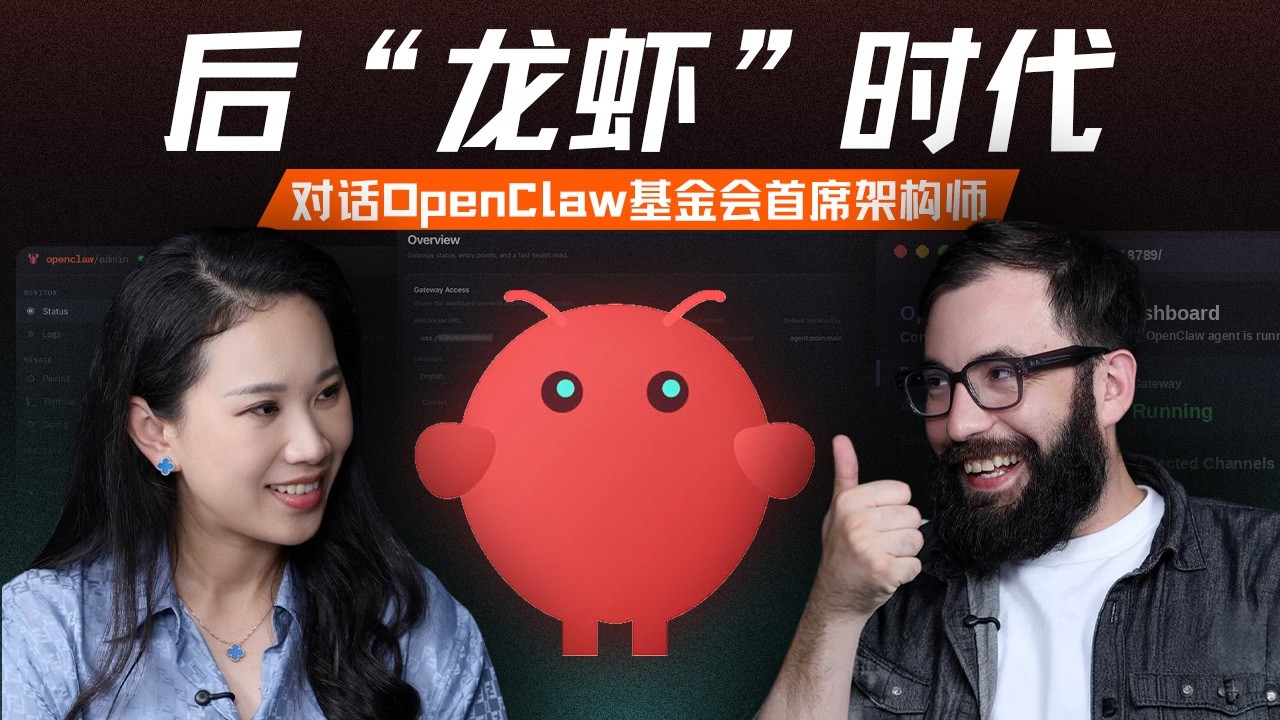
[00:03](https://www.youtube.com/watch?v=tnvyMcmtAiw&t=3s) “小龙虾”风靡中国与和 Peter Steinberger 共事的乐趣
面对 OpenClaw 随后在中国引发的更为空前的“小龙虾”狂热,Vincent 承认这完全超出了团队在 Discord 里的预期。他们惊奇地看到各种令人不可思议的破圈画面:有深圳腾讯总部大楼外的大妈(Aunties)在使用它,也有说唱歌手在 Twitter 上热烈讨论它。面对海外部分人对这股中国热潮是否属于“虚假刷量”的质疑,Vincent 坚定地回应这绝对是真实发生的。谈到与 OpenClaw 的创始人 Peter Steinberger 共事的感受时,Vincent 充满了赞赏。他认为 Peter 拥有一种极为罕见的、看待世界的特殊视角,总是能够看到未来的无限可能。
Peter 将极大的乐趣(Fun)与能量注入到了项目之中,OpenClaw 标志性的可爱小龙虾形象便是一个缩影。Vincent 表示,与 Peter 一起工作意味着不仅要在技术上追求最前沿(bleeding edge)的突破,更要在探索未知时保持像孩子一样的童心与好奇心,不断打破思维的边界。在团队中,每天的挑战都截然不同,充满了新鲜感与吸引力。
当被问及如何定义现在的 OpenClaw 时,Vincent 强调它早已超越了一个“个人 AI 智能体”的范畴。OpenClaw 基金会的使命是赋能整个 AI 生态,让智能体的应用对所有人保持开放和可触及——无论是大型企业、小微商家、普通家庭,还是想在家里跑本地模型的极客,其终极使命是“用 AI 赋能人类”。这一使命在过去半年中从未改变,即确保项目如创始人 Peter 的遗愿那样,保持独立、开源,并牢牢掌握在社区手中。
Vincent 进一步描绘了智能体在企业和团队中改变工作范式的真实案例。以前像软件工程师这样的员工使用 AI,大多是个人专属的 AI 编码助手,写完后交代码。而现在,OpenClaw 变成了一个“活在团队里”的智能体成员,它有自己的日常工作,同事们可以随时和它对话,它也可以找同事沟通,甚至团队的智能体之间也能互相交流。Vincent 举例说,他们内部的 OpenClaw 每隔几天就会为团队自动创作背景音乐(Soundtracks),这种过去体验很差的音乐 AI 能力如今被顺畅地集成进智能体中。这种变化超越了具体的垂直行业用例,正在从底层重塑人们在职场中的协作动态。
Here is a detailed, faithful walkthrough of the transcript section.
---
[15:44](https://www.youtube.com/watch?v=tnvyMcmtAiw&t=944s) The Post-Claw Era and Chinese Tech Ecosystem Dynamics
Vincent Koc discusses how OpenClaw fits into the broader software landscape as major tech companies create their own agentic products, such as Microsoft Scout in the US and Tencent Workbody in China. While products like Tencent Workbody are not directly built on top of OpenClaw, they are fully compatible with its skills and frameworks. Vincent describes this current landscape as the **"post-Claw era."** He argues that OpenClaw ushered in a new generation of agentic frameworks, sparking a massive boom in model labs and token consumption. Rather than seeing big-tech alternatives as competitors, he views them as a positive development for consumers and the broader ecosystem.
When addressing corporate partnerships, Vincent explains that OpenClaw handles them on a case-by-case basis while aiming to build unified solutions that address shared challenges across the industry. Although requirements vary by region—such as financial institutions in certain countries being heavily concerned with security risks and regulatory boundaries—the underlying core questions remain consistent across every region and digital maturity level: how to extract real business value, manage token and compute costs, ensure security, and scale operations properly.
In discussing China specifically, Vincent notes that the Chinese market has adopted OpenClaw faster than anywhere else in the world, serving as a "window into what's going to happen next" globally. Many Chinese enterprises have deployed OpenClaw to every employee to power their internal projects. The OpenClaw core team reflects this global pull, incorporating maintainers based in China to help shape their product roadmap, feature development, and developer feedback loops.
* **Microsoft Scout**: Highlighted as Microsoft's own agentic product/version within the ecosystem.
* **Tencent Workbody**: Not built directly on OpenClaw, but fully compatible with OpenClaw skills and frameworks.
* **Key Enterprise AI Concerns**: How to extract value, control cost, ensure safety, and scale effectively.
---
[20:46](https://www.youtube.com/watch?v=tnvyMcmtAiw&t=1246s) Architectural Evolution and Enterprise Scalability
Reflecting on why OpenClaw stood out half a year after its viral moment, Vincent notes that the industry had long promised personal AI agents that could act autonomously, yet users only had access to specialized coding agents. OpenClaw creator Peter was frustrated by this gap, built a personal system for himself, and accidentally sparked a global movement. As underlying frontier and open-source models continue to rapidly improve, OpenClaw's primary focus has shifted toward solving real-world enterprise scaling and deployment challenges.
A major architectural update discussed is the overhaul of OpenClaw’s session storage mechanism. Previously, session conversations were written directly into local files. The team has rearchitected this system into a file-backed database model (with customizable database backends). This change allows enterprise users to swap standard local files for scalable database clusters, run regular automated backups, and deploy the system seamlessly at scale. This refactoring drastically improves both personal consumer performance and corporate integration ease.
* **Origin Story**: Peter built the original prototype out of frustration with existing turn-based tools because he wanted a true "personal AI."
* **Storage Overhaul**: Replaced raw file logging with a structured database layer, enabling enterprise-grade backups and scalability.
---
[23:23](https://www.youtube.com/watch?v=tnvyMcmtAiw&t=1403s) The "Always-On" Gateway Architecture
The conversation turns to the Gateway—the central "nervous system" of OpenClaw that coordinates messaging channels, models, memory, and tools. Vincent explains that traditional coding agents are **turn-based** (operating inside isolated conversation threads). In contrast, OpenClaw’s Gateway operates as an **always-on service** running on the user's machine.
A core innovation of the Gateway is the **heartbeat cycle** (triggering every 10 to 30 minutes). During a heartbeat, the Gateway automatically initiates a background conversation chain to check pending tasks, evaluate schedules, and execute necessary actions without explicit prompt-by-prompt user input. This autonomous background execution provides OpenClaw with its signature "human-like magic."
> "It kind of created this like human-like sort of like 'I'm going to go and do things in the background for you'... I think that's what started giving OpenClaw a little bit of its magic as well."
---
[24:45](https://www.youtube.com/watch?v=tnvyMcmtAiw&t=1485s) Security Boundaries, Containerization, and "Auto Mode"
Because the Gateway holds credentials and executes system-wide commands, it represents OpenClaw's primary security boundary. Vincent outlines the multi-tiered defense strategy the project is developing:
1. **Credential Vaults**: Sensitive keys and API credentials are no longer stored in plain text.
2. **Containerization & OS Guardrails**: OpenClaw can run inside isolated containers to strictly constrain file access and network connectivity. The team is collaborating with OS-level and industry partners to natively enforce permissions so the host OS guarantees sandboxing.
3. **Auto Mode (LLM-based Intent Approval)**: Recognizing that fixed permission rules are too rigid—deleting files on a production server is dangerous, whereas doing so on a test box is acceptable—OpenClaw introduced **Auto Mode**.
Auto Mode leverages an internal model to evaluate user intent within conversation context and dynamically determine whether an action is safe or requires manual approval. Crucially, this security layer is model-agnostic: a user can route their primary inference through a local open-source model while delegating Auto Mode intent verification to a highly secure Frontier Lab model, creating a secure hybrid setup.
* **Security Concerns**: Identical to any full-access agent framework or terminal tool.
* **Hybrid Security Model**: Users can run cheap or private local inference for daily tasks while delegating security evaluation to top-tier commercial LLMs.
---
[28:33](https://www.youtube.com/watch?v=tnvyMcmtAiw&t=1713s) Foundation Models, Custom Post-Training, and Evaluation Benchmarks
Discussing the interplay between underlying foundation models and OpenClaw's agent harness (memory, tools, execution environment), Vincent confirms that both sides are vital. Interestingly, several open-source model teams—particularly in China—have begun post-training their models specifically on OpenClaw datasets. As a result, these models natively recognize that they are running inside OpenClaw, dramatically improving their tool usage and memory recall performance out of the box.
To systematically identify model performance gaps across different model sizes and providers, the OpenClaw team is partnering with academic research teams and AI labs to build and release an official evaluation benchmark.
* **Upcoming Benchmark**: A suite consisting of 100 to 120 standardized agent tasks to evaluate model performance inside the OpenClaw framework.
* **Post-Training Alignment**: Chinese open-source LLMs are actively post-trained on OpenClaw execution logs to improve native agentic capabilities.
[30:38](https://www.youtube.com/watch?v=tnvyMcmtAiw&t=1838s) Fair Treatment of Models and the Role of Smaller Local Models
Vincent Koc highlights that OpenClaw is committed to providing a neutral, level playing field for all model providers. The team strives for zero-day support whenever a new model drops, working directly with model labs to ensure feature parity and thorough testing without pushing one specific company over another. To streamline this, OpenClaw built features allowing model companies to push updates on their end without requiring a full code update on OpenClaw’s side. Furthermore, continuous benchmarking and tuning help optimize the user experience, particularly when integrating smaller or open-source models within the open-core ecosystem.
When asked whether smaller models remain important for agentic work, Vincent explains that they play a crucial role for the local model and open-source community—especially for users concerned with token costs and privacy. While smaller models might not offer peak performance across every metric, they still enable autonomous task execution. Learning how to architect OpenClaw to handle models of all sizes—small, medium, and large—fairly and efficiently remains an invaluable learning process for the project.
---
[32:09](https://www.youtube.com/watch?v=tnvyMcmtAiw&t=1929s) The Unsolved Mystery of Persistent Memory and Long-Horizon Tasks
Addressing persistent memory, Vincent firmly refutes the common claim that memory in AI is a solved problem, calling it "100% not a solved problem." Persistent memory introduces intricate challenges, such as cross-model compatibility—for instance, whether a new model can comprehend memory files created by a different model. Multi-tenancy presents another major hurdle: if a team shares a single OpenClaw instance, determining which memories can be shared among different users without privacy leaks becomes tricky. For now, OpenClaw handles multi-tenancy by assuming everything within an instance is interchangeable, while the team actively searches for more robust solutions to what Vincent considers one of the most interesting and difficult spaces in AI agent architecture.
When discussing long-horizon tasks, Vincent points out that modern state-of-the-art (SOTA) models are naturally improving at long-range reasoning. Drawing from his prior background in self-optimizing, recursive agents, he views long-horizon capabilities as features that industry model providers will solve and deliver as tools. Rather than attempting to solve long-horizon reasoning natively within OpenClaw, the framework positions itself as an orchestrator—managing work, leveraging various underlying models, and seamlessly integrating external breakthroughs into the OpenClaw system.
* **Memory Challenges:** Cross-model context understanding and multi-tenancy privacy boundaries remain open engineering problems.
* **OpenClaw's Role in Long Tasks:** Operates as an overarching coordinator rather than replacing model-level reasoning innovations.
---
[34:34](https://www.youtube.com/watch?v=tnvyMcmtAiw&t=2074s) Multi-Agent Design and Conway's Law in Agentic Architecture
On the topic of multi-agent architectures, Vincent notes that for 90% of user needs, a single agent is more than sufficient. Dividing workloads into isolated or specialized sub-agents only makes sense when a distinct, highly repeatable task requires its own system prompt or execution schedule. He compares this to team management: a leader only hires a second employee when the primary team member's workload becomes too heavy and contains clear, delegable responsibilities.
```
[ Single Agent (Sufficient for 90% of Tasks) ]
│
(Workload exceeds single context / needs distinct prompt)
▼
[ Manager / Primary Agent ] ── Delegates ──► [ Specialist Sub-Agent ]
```
Addressing why OpenClaw maintains a simple, pragmatic design instead of adopting overly complex hierarchical structures (like nested teams of managers and planners), Vincent invokes **Conway's Law**—the software engineering principle stating that system designs inevitably mirror the internal communication structures of the organizations that build them.
> "Complex organizations are like mirroring their internal organization design into their agents because they have a certain organizational structure... It doesn't mean that that's the optimum way to solve things."
He observes that established enterprises often blindly copy their legacy org charts into agent workflows rather than starting with a clean sheet of paper. In contrast, agile startups build "agent-first" from the ground up. Vincent shares an anecdote from a conversation with a friend in global AI transformation, who pointed out that while CTOs have technical agent frameworks, Chief Operating Officers (COOs) are struggling to envision what future team structures should look like. To bridge this gap, organizations must iterate rapidly through experimentation rather than forcing old paradigms into new models.
* **Agentic Engineering in 2026:** SOTA models understand problems deeply enough that developers can converse directly with the model to co-build agents, rendering pre-2026 agent development methods obsolete.
---
[39:04](https://www.youtube.com/watch?v=tnvyMcmtAiw&t=2344s) Ecosystem Expansion and the Missing Agent "Aha Moment"
While the broader ecosystem surges with new plugins, skills, and Model Context Protocol (MCP) standards, OpenClaw maintains a compact core framework while evaluating how to support third-party extensions. Vincent notes that industry-wide innovation on fundamental protocols has stabilized recently, shifting the focus to building on top of existing standards. For example, the core team recently discussed scenario dependencies where one skill relies on another—a concept currently missing from the standard skill specification. OpenClaw aims to collaborate with the wider ecosystem to address these architectural gaps and drive industry standards forward.
Addressing why the universally anticipated "aha moment" for autonomous agents hasn't fully arrived yet, Vincent emphasizes that the bottleneck is not limited to OpenClaw, but spans model reliability, execution costs, and external service readiness. Real-world execution often stalls because legacy services—such as banking platforms—do not yet support or allow safe agentic transactions. However, he highlights the emergence of **computer-use models** as the single biggest unlock. By allowing agents to take over web browsers, click interfaces, and operate software visually under user supervision, computer-use frameworks offer a practical path to bypass API limitations and solve long-standing friction points.
---
[41:37](https://www.youtube.com/watch?v=tnvyMcmtAiw&t=2497s) Lessons from the Cooldown: Building the Agent "Factory"
Reflecting on the market cool-down following the initial hype wave in early 2026, Vincent shares that the primary takeaway for OpenClaw was the critical need for rock-solid, reliable software. However, building reliable systems when agents themselves act as the primary software engineers proved exceptionally difficult. To make agent-driven development viable at scale, the team had to build comprehensive infrastructure and testing harnesses from scratch.
To illustrate this, Vincent describes their custom testing pipeline: maintainers' agents can programmatically spin up any operating system on arbitrary cloud hardware within **20 seconds**. The agent can independently take screenshots, record video, click through UI workflows, validate pull requests, and provide proof of functionality. If human maintainers require direct inspection, the system automatically opens a browser session with active authentication, allowing instant manual takeover.
> "To make agentic engineering work at scale... the factory needs all the other machines to work, right? You can't just have one conveyor belt expecting it to work. You need the quality assurance, you need the lights, you need all these other things to make a factory run—the water, electricity."
* **Testing Infrastructure:** Spins up full OS cloud environments in under 20 seconds for automated screenshot/video validation by sub-agents.
* **The "Factory" Analogy:** Autonomous coding agents require robust surrounding tooling (CI/CD, QA, cloud environments) to produce enterprise-grade software reliably.
---
[43:09](https://www.youtube.com/watch?v=tnvyMcmtAiw&t=2589s) The B2C/B2B Flywheel and Official Mobile Apps
Vincent observes a mutually reinforcing flywheel between individual consumers and enterprise adoption. Personal developers bring OpenClaw into their workplaces to solve business problems; conversely, enterprise adoption forces the platform to meet rigorous standards for reliability and extensibility, which directly benefits consumer users. Unlike traditional proprietary software—where enterprise and consumer products split due to divergent pricing, sales, and go-to-market strategies—OpenClaw's open-core nature allows both segments to thrive on the same adaptable codebase.
Addressing the launch of OpenClaw's official iOS and Android mobile apps, Vincent reveals that the codebase for the mobile apps had actually been built months earlier (around January/February). However, the team deliberately delayed publishing because they lacked a registered legal entity and refused to publish the apps under an individual contributor's personal developer account. Once the OpenClaw Foundation was formally established as a legal entity, they secured official Apple and Google developer accounts to provide a secure, first-party experience. Responding to mixed online feedback following the launch, Vincent candidly notes that while the internet is quick to criticize, offering official first-party mobile apps gives users crucial optionality without imposing significant ongoing engineering overhead on the core team.
> "This industry literally changes by the hour. I can open up my phone... I'm sure some new release of something crazy is happening right now."
> (这个行业简直是以小时为单位在变化。我拿出手机看新闻动态,敢肯定现在一定又有某个疯狂的新项目发布了。)
[57:40](https://www.youtube.com/watch?v=tnvyMcmtAiw&t=3460s) Peter 去往 OpenAI 后:去中心化与远期展望
针对创始人 Peter 宣布加入 OpenAI 后外界对 OpenClaw 项目前景的担忧,Vincent 正面回应称:项目目前并不存在“单点失效风险”(Single Person Risk)。虽然 Peter 的愿景对团队至关重要,但从代码 Commit(提交)数据来看,贡献度已经在核心工程团队与全球维护者之间逐步平滑分布。
Vincent 强调,评估开源项目的贡献不能仅凭 Commit 数量,因为许多涉及底层架构或安全性的关键修改虽然代码量不大,却具有举足轻重的影响力。目前,团队正协同将 Peter、Vincent 以及其他核心成员的构想整合为一份清晰的路线图,实行去中心化的模块化负责制。展望未来, OpenClaw 社区面临的最大挑战与机遇,并非纯技术层面的突破,而是如何降低门槛,让大众(如父母、长辈等非技术群体)都能轻松理解并使用 AI,确保每个人在 AI 时代都能拥有话语权。
> "The agents will find what's mathematically most optimal or like whatever's been trained into it. I think we just have to be careful of... seeing that because agents are doing some behavior that we don't want to kind of say because X is happening it's Y."
## Notable quotes
> [04:26](https://www.youtube.com/watch?v=tnvyMcmtAiw&t=266s) 我们用智能体去解决智能体扩展的难题,这是我们整个项目的重大突破口。 — Vincent Koc
> [08:55](https://www.youtube.com/watch?v=tnvyMcmtAiw&t=535s) OpenClaw 它的核心定位是‘个人智能体’,它具备持续的学习能力与记忆系统,能够自主构建技能去执行各类复杂的跨界任务。 — Vincent Koc
> [09:20](https://www.youtube.com/watch?v=tnvyMcmtAiw&t=560s) 如果明天某家实验室发布了一个全新模型而社区还没来得及支持,用户可以直接对 OpenClaw 说‘帮我加上这个功能’,它能够自动修改源代码并完成自我升级。 — Vincent Koc
> [23:40](https://www.youtube.com/watch?v=tnvyMcmtAiw&t=1420s) It kind of created this like human-like sort of like 'I'm going to go and do things in the background for you'... I think that's what started giving OpenClaw a little bit of its magic as well. — Vincent Koc
> [35:50](https://www.youtube.com/watch?v=tnvyMcmtAiw&t=2150s) Complex organizations are like mirroring their internal organization design into their agents because they have a certain organizational structure... It doesn't mean that that's the optimum way to solve things. — Vincent Koc
> [41:55](https://www.youtube.com/watch?v=tnvyMcmtAiw&t=2515s) To make agentic engineering work at scale... the factory needs all the other machines to work, right? You can't just have one conveyor belt expecting it to work. — Vincent Koc
> [48:20](https://www.youtube.com/watch?v=tnvyMcmtAiw&t=2900s) This industry literally changes by the hour. I can open up my phone... I'm sure some new release of something crazy is happening right now. — Vincent Koc
> [51:10](https://www.youtube.com/watch?v=tnvyMcmtAiw&t=3070s) OpenClaw 的长远战略目标是打造‘AI Agent 领域的瑞士’——保持绝对的中立与开放。 — Vincent Koc
> [55:20](https://www.youtube.com/watch?v=tnvyMcmtAiw&t=3320s) 健康的争论(Healthy Disagreements)是极其必要的。 — Vincent Koc
> [01:01:00](https://www.youtube.com/watch?v=tnvyMcmtAiw&t=3660s) Peter 坚信 OpenClaw 能够公平存活并服务全人类的唯一方式,就是将它置于非营利基金会之下,不被任何单一公司、国家或实体所控制。 — Vincent Koc
> [01:02:35](https://www.youtube.com/watch?v=tnvyMcmtAiw&t=3755s) The agents will find what's mathematically most optimal or like whatever's been trained into it. I think we just have to be careful of... seeing that because agents are doing some behavior that we don't want to kind of say because X is happening it's Y. — Vincent Koc
## Mentioned
Vincent Koc, Peter Steinberger, OpenClaw, 硅谷101, WAIC 2026, Mac mini, Polymarket, GitHub, OpenAI, Microsoft Scout, Tencent Workbody, QClaw, ArClaw, Wu, DClaw, Hermes Agent, Mannes, Jspark, Apple, Google, vLLM, SGLang, Model Context Protocol (MCP)
[4:26] Vincent Koc: 我们用智能体去解决智能体扩展的难题,这是我们整个项目的重大突破口。
[8:55] Vincent Koc: OpenClaw 它的核心定位是‘个人智能体’,它具备持续的学习能力与记忆系统,能够自主构建技能去执行各类复杂的跨界任务。
[9:20] Vincent Koc: 如果明天某家实验室发布了一个全新模型而社区还没来得及支持,用户可以直接对 OpenClaw 说‘帮我加上这个功能’,它能够自动修改源代码并完成自我升级。
[23:40] Vincent Koc: It kind of created this like human-like sort of like 'I'm going to go and do things in the background for you'... I think that's what started giving OpenClaw a little bit of its magic as well.
[35:50] Vincent Koc: Complex organizations are like mirroring their internal organization design into their agents because they have a certain organizational structure... It doesn't mean that that's the optimum way to solve things.
[41:55] Vincent Koc: To make agentic engineering work at scale... the factory needs all the other machines to work, right? You can't just have one conveyor belt expecting it to work.
[48:20] Vincent Koc: This industry literally changes by the hour. I can open up my phone... I'm sure some new release of something crazy is happening right now.
[51:10] Vincent Koc: OpenClaw 的长远战略目标是打造‘AI Agent 领域的瑞士’——保持绝对的中立与开放。
[55:20] Vincent Koc: 健康的争论(Healthy Disagreements)是极其必要的。
[61:00] Vincent Koc: Peter 坚信 OpenClaw 能够公平存活并服务全人类的唯一方式,就是将它置于非营利基金会之下,不被任何单一公司、国家或实体所控制。
[62:35] Vincent Koc: The agents will find what's mathematically most optimal or like whatever's been trained into it. I think we just have to be careful of... seeing that because agents are doing some behavior that we don't want to kind of say because X is happening it's Y.
Original transcript
[0:00] Open
[0:06] agent. Open claw is the number one. It's
[0:09] the most popular.
[0:10] >> The single most important release of
[0:12] software probably ever.
[0:13] >> Lobster themed installation events have
[0:15] popped up around the globe, especially
[0:17] in China.
[0:20] [music]
[0:30] Peter Steinberg. [music]
[0:35] >> We had a lot of problems because the the
[0:38] existing tools out there just weren't
[0:39] designed for our scale,
[0:40] >> but now it's getting better.
[0:41] >> A few weeks ago, we hit like 4 point
[0:43] something million downloads a week.
[0:44] >> They are saying [music] only startups
[0:46] can make things happen faster during the
[0:48] AI era. Peter's wishes were like he
[0:51] thinks the only way the open claw
[0:52] survives and is fair to everyone is that
[0:55] it remains in the in the foundation.
[1:09] Open.
[1:16] >> Hi Vincent, thanks so much for your time
[1:17] to joining us here at WIC 2026 in
[1:21] Shanghai. Let's start by introducing
[1:23] yourself a bit and explain your current
[1:25] role at the Open Claw Foundation.
[1:27] >> Yeah. So my name is Vincent Cotch. I'm
[1:29] chief architect at OpenC Claw Foundation
[1:32] essentially looking after product and
[1:34] engineering. And how did you first
[1:36] become involved with the open cloud
[1:38] community?
[1:38] >> So I've been a open-source contributor
[1:40] for basically the start of my career. I
[1:43] kind of noticed this project in early
[1:46] December and uh this was on on X on
[1:50] Twitter. A lot of I think poly market
[1:53] traders were using it and I got really
[1:55] excited. I was like what is this? Let me
[1:57] check out the project and then was like
[1:59] wow this is this is crazy. This is
[2:01] exciting. I started testing it and then
[2:03] I wanted to help. So I started
[2:04] contributing back to the project in like
[2:06] late December, early January and then
[2:09] eventually that kind of snowballed,
[2:10] became a maintainer and then from
[2:12] maintainer to my current job now.
[2:14] >> Do you still remember the day when open
[2:17] claw got really viral?
[2:19] >> I don't know if there was like a
[2:20] particular point. I think for me in San
[2:23] Francisco was in February where there
[2:27] was like a first clock on sort of event
[2:30] and I think there was like a few hundred
[2:33] people uh guest list but the event
[2:37] started at 7:00 but if you arrived at
[2:39] 5:00 you were late and the queue was
[2:41] like around the building.
[2:42] >> Yeah, I remember that one my business
[2:44] partner was there.
[2:45] >> Yeah, it was crazy.
[2:46] >> Yeah, she told me the queue is like a
[2:48] few blocks away already. Yeah. And it
[2:50] was and we hadn't seen anything like
[2:51] that sort of viral everyone is there,
[2:54] everyone's listening in San Francisco in
[2:57] quite some time. It kind of had that
[2:58] magic to it like you felt like something
[3:00] is going to happen. So for me like that
[3:02] was like the the peak sort of hype cycle
[3:04] and I think after then it just started
[3:06] taking off quite a bit.
[3:08] >> But did you guys expect that you know
[3:10] the open club would got really really
[3:13] crazy in China? No, I was uh obviously
[3:16] still a maintainer, but we're in the
[3:18] team on Discord and I'm seeing like the
[3:21] aunties using it outside Tencent's
[3:23] offices in Shenzhen. I'm seeing rap
[3:26] artists on Twitter talking about Open
[3:28] Claw. It's just crazy. And I'm just like
[3:30] everywhere. It's just going completely
[3:31] viral. China, but also outside of China,
[3:33] as China especially. And um a lot of
[3:36] people like this is fake. And I was like
[3:37] no, it's not fake. It's definitely
[3:38] definitely real. tell us how it uh looks
[3:42] like to work with Peter Steinberger, the
[3:44] creator of Open Cloth.
[3:46] >> I think there's a only a few people I've
[3:48] had the chance to work with that have
[3:50] like a very special way of seeing the
[3:52] world and really seeing the
[3:54] possibilities of what you can do. I
[3:56] think his attitude to life around, you
[3:58] know, make sure you put fun and energy
[3:59] into everything that you do definitely
[4:01] comes across in the work like you look
[4:03] at the fun little lobster and all of
[4:05] this. So I think for me has been not
[4:08] only just about you know creating what's
[4:09] new, what's on the bleeding edge, but
[4:12] also like that process of discovering
[4:14] something exciting has to be fun. You
[4:16] have to think like a child. You have to
[4:17] kind of like push yourself in your
[4:18] thinking a little bit. So I think for me
[4:20] it's um no no two days are different.
[4:23] Every day is kind of very exciting as
[4:25] well.
[4:25] >> And you said you joined the community in
[4:28] December last year only half a year
[4:30] away. We saw open claw, you know,
[4:33] growing from like perhaps a small
[4:35] project into a global sensation, a
[4:38] global open source community. What were
[4:40] some of of the biggest challenges that
[4:42] you guys have been through?
[4:43] >> I think the biggest challenge is like as
[4:45] with anything is like anything of this
[4:46] scale becomes quite hard not to manage
[4:50] but to grapple with. you've built some
[4:52] software that's designed for developers
[4:55] or tinkerers and now suddenly you have
[4:58] enterprise companies deploying this or
[4:59] trying to use it to build their
[5:00] businesses, right? So then you start
[5:02] getting people screaming like is it safe
[5:04] or um how do we deploy this at scale?
[5:08] Why is this using so many tokens and
[5:09] things like that? So you start realizing
[5:11] there's other challenges and everyone's
[5:12] like expecting you to fix this when
[5:15] actually it's just an open source
[5:16] product and we need to sort of like
[5:18] educate people like hey look we're going
[5:20] to do our best. we're going to try and
[5:21] help and solve this. But the
[5:23] frustrations that we got and the
[5:25] challenges that we faced ended up
[5:27] becoming the things that we started
[5:29] building for as well.
[5:30] >> So for example, we ended up with I don't
[5:33] know at one point we had like 13,000 PRs
[5:35] open pull requests like changes to
[5:37] openclaw and um we developed our own
[5:41] review using AI agents
[5:44] >> to like manage this workload. So then we
[5:46] started building the other agentic tools
[5:49] to help us with the scaling problems
[5:50] that we're having and I think that was
[5:52] like the unlock for us and that was like
[5:53] the more exciting part. So we had a lot
[5:55] of problems because the the existing
[5:57] tools out there just weren't designed
[5:59] for our scale.
[6:00] >> Yeah.
[6:00] >> Yeah. But now it's getting better.
[6:02] >> Yeah. Like we've had to essentially
[6:03] build entire infrastructure. So if you
[6:06] if you look on um the open core website
[6:08] there's a little link called ecosystem.
[6:10] We have over I think close to 100 repos.
[6:13] >> Mhm. So a lot of people know uh open
[6:17] claw the agent but also we have
[6:19] different libraries we have different
[6:21] automation tools testing infrastructure
[6:23] and we've had to build all of these and
[6:25] there's a joke that each one of these
[6:27] tools are basically like a startup in
[6:28] themselves that we manage
[6:30] >> and um enables us to build open claw at
[6:33] scale
[6:34] >> if you have to describe open claw in a
[6:36] few sentences today what would it be
[6:38] >> for us open claw and especially the open
[6:41] claw foundation is not is I think it's
[6:43] more than just this AI agent or personal
[6:46] AI agent. For us, it's like how do we
[6:49] empower the whole AI ecosystem agentic
[6:52] use be open and accessible to everyone?
[6:54] That could be for enterprises, that
[6:56] could be for small businesses, it could
[6:57] be for moms and dads, uh it could be
[6:59] people that want to run local models at
[7:01] home as well. So for us, the mission is
[7:03] to really empower humanity with AI.
[7:05] >> Did that mission change at all during
[7:07] the past 6 months? I think the that was
[7:10] pretty clear um you know when it started
[7:13] growing legs of its own the foundation
[7:16] was already being set up in the
[7:17] background obviously it's been announced
[7:18] recently so the mission statement was I
[7:21] think as a collective
[7:23] >> was somewhat already there and the idea
[7:25] has always been like we want to keep
[7:27] Peter's wishes were to like you know he
[7:28] wants to keep it an open and independent
[7:30] product and put it into a foundation and
[7:33] for the same reasons it's like we want
[7:34] to make sure it's accessible to everyone
[7:36] it's continues to remain open source
[7:39] continues to remain um in the hands of
[7:42] the community which was very important
[7:43] >> and
[7:44] >> before we dive into the technical uh
[7:46] questions let's talk about the China
[7:48] sensation in the first quarter as you
[7:51] described the open claw got extremely
[7:53] popular in China I would say even more
[7:55] popular than Silicon Valley and there
[7:57] were long cues of people lining up to
[7:59] install open claw Apple Macd was totally
[8:03] sold out back then so why in China
[8:06] though
[8:06] >> I think there's a mindset thing that
[8:08] I've noted Especially in China, it's
[8:09] like, hey, we see that there's this new
[8:11] thing. It's going to empower us. It's
[8:13] going to help us. Let's embrace it. I
[8:17] think the the the western sort of tech
[8:20] ecosystem was like, "Wow, this is scary.
[8:23] It can do so many things. Let's block
[8:25] this and let's understand what's
[8:27] happening." And we saw this sort of
[8:28] behavior like back in 2023 24 with like
[8:31] Chach as well
[8:33] >> where enterprises were like we have to
[8:34] block this AI because like it's too
[8:36] scary, it's too dangerous. And then
[8:38] eventually they opened up and adopt and
[8:39] adopted it. But I think for China has
[8:42] been very much like I want to adopt it
[8:43] at speed. I think and some of the
[8:45] stories I was hearing was like uh
[8:47] employees were given like KPIs like you
[8:49] need to automate this many things with
[8:50] openclaw whereas if you install openclaw
[8:53] in some enterprises in in other markets
[8:55] like you get in trouble because it's
[8:57] like security risk right so I think the
[8:59] mindset is very different around like I
[9:01] want to experiment learn and and build
[9:03] fast but I think it's just a just a
[9:06] difference in the technology culture and
[9:07] the sort of the speed in which China has
[9:10] been moving especially with open source
[9:12] >> is it possible
[9:13] Um because you know like a codeex or
[9:17] uncle code is not that popular in China.
[9:20] >> That's actually a good point. Yeah, it's
[9:22] not something I really actually thought
[9:24] about cuz the market penetration of
[9:26] these other products uh you know they
[9:28] they can't be really used easily or used
[9:30] at all within within the China
[9:31] ecosystem. So I think having something
[9:34] that's open source and available that
[9:36] people can adopt could have been
[9:37] obviously one of the key catalysts as
[9:39] well for this. For people who are not
[9:41] familiar with the open claw, can you
[9:43] tell them the difference between open
[9:45] claw and the coding agent?
[9:47] >> So a lot of these coding agents are
[9:48] starting to become like open claw as
[9:50] well. So it's kind of interesting. But
[9:52] if we rewind back to the start of the
[9:54] year, the coding agents were very much
[9:56] like hey I have like a terminal or an
[9:58] app. I want to build I don't know I want
[10:01] to build a website or something. So you
[10:02] have a conversation and it goes off and
[10:04] builds it. The difference between now
[10:05] and like openclaw, openclaw could yes
[10:08] build your website but the whole idea
[10:10] was that like it acts as your personal
[10:11] agent.
[10:12] >> So it would learn it will have a memory
[10:15] it would start to build skills it would
[10:18] go and do things for you but the beauty
[10:20] is that like those things could also be
[10:22] it needs to create code. So oh can you
[10:24] buy my groceries from this website?
[10:26] There's API it finds it. So then it
[10:28] creates the code to do it. Or for
[10:30] example, let's just say tomorrow one of
[10:32] the labs releases a new model and
[10:34] there's no support. So you ask open
[10:35] core, hey, can you add this feature? And
[10:37] it can change its own code
[10:39] >> and adapt itself and and add that
[10:41] feature for you. So I think the
[10:42] difference between the coding agents is
[10:44] like it's creating code and it's it's
[10:46] blocked like the harness or the tool
[10:48] whereas the open core agent can change
[10:50] its own code. The agent can modify
[10:52] itself which I think is the difference
[10:54] here.
[10:54] >> Smarter.
[10:55] >> Yeah. with so many people had to
[10:57] uninstall open claw after a while
[10:59] setting number one it's not so easy to
[11:02] use number two security concerns how do
[11:04] you see the cool down of the interest
[11:06] >> so one of the two things with that
[11:08] that's actually interesting is that
[11:10] there was definitely a cool down of the
[11:11] hype cycle
[11:13] >> like the the craziness sort of died out
[11:15] a little bit which was kind of good
[11:16] >> but the second thing is like we did mess
[11:18] it up a little bit where we were trying
[11:20] to build this thing really fast using
[11:22] agents you know really trying to push
[11:24] the frontier here and we learned some
[11:26] good lessons on like how not to build
[11:28] software with agents. So we did make
[11:30] some mistakes and we did lose a lot of
[11:31] users because it wasn't as stable. But
[11:33] ironically we overcame those challenges
[11:36] a couple months ago and if you look at
[11:38] our download numbers now they're
[11:39] actually better than they ever were. So
[11:41] before the at the craziness of the hype
[11:44] I think we were hitting like 2 and a
[11:45] half 3 million downloads a week on npm.
[11:47] So obviously there's Chinese mirror
[11:49] websites there's all these other
[11:50] sources. So download numbers are
[11:52] probably way larger but just based on
[11:54] npm and a few weeks ago we hit like 4
[11:56] point something million downloads a
[11:58] week. So
[11:59] >> um so yes it it did sort of die out a
[12:02] little bit the hype but actually the
[12:04] adoption is actually scaling even more
[12:06] now. So it's kind of interesting to see.
[12:08] So from that perspective I'm like really
[12:10] excited to see that like you know users
[12:12] are like responding to the like the
[12:15] stability and the features that we're
[12:16] releasing into the market.
[12:18] >> Can you give us a few examples? what are
[12:20] some of the really good use uh examples
[12:22] that you see across different
[12:24] industries?
[12:25] >> So, one of the things here is that like
[12:27] I think we talk about industry specific
[12:29] use cases. I like to think of it as like
[12:32] it's just like having another employee
[12:33] or internal personal assistant. So yes,
[12:37] it can be vertical specific use cases,
[12:39] but realistically it's like a case of if
[12:42] a model is good at doing some code or
[12:44] has understand some task really well and
[12:46] it has the tools or it can create the
[12:48] tools. I think it can do a lot of things
[12:50] now. So it can now browse websites, it
[12:52] can have a phone number, it can connect
[12:55] to messaging app. So really the the
[12:57] possibilities are kind of endless but
[12:59] depends on the task, right? So maybe
[13:01] some design tasks are really hard or
[13:03] video editing might be hard. But as
[13:04] people develop agentic tools for those,
[13:07] your agent can then use it. For example,
[13:09] our agent creates soundtracks for our
[13:11] team every every few days and it makes
[13:13] it kind of fun for us, right? Whereas AI
[13:16] for music was kind of not so good
[13:17] before, but now it's good. So then we
[13:19] can give that tool to our agent. So for
[13:21] us, it's like less about use case and I
[13:23] think it's more about you kind of
[13:25] discovering what's possible. One thing I
[13:27] do see that's interesting inside of uh
[13:29] enterprises and large sort of small to
[13:31] mediumsiz enterprises is also like
[13:34] employees having open claws in their
[13:36] kind of day-to-day job or projects
[13:38] having them. And I think that's changing
[13:40] the way employees work with agents cuz
[13:42] previously if I was an employee like an
[13:45] engineer I would use my own AI coding
[13:47] assistants and I would work and then
[13:49] share that with the team. Whereas now
[13:50] the it's not a coding assistant anymore.
[13:52] It's an agent but it lives with the team
[13:54] right? So it can talk to my colleagues
[13:57] >> and my colleagues can talk to my agent
[13:58] and it has like a different kind
[13:59] >> agent to their colleagues.
[14:00] >> Yeah. So I think that's creating like a
[14:02] different dynamic for us in terms of
[14:04] workplaces and and how we operate and I
[14:06] think some organizations here in China
[14:09] and globally are starting to experiment
[14:11] with this and some are kind of pushing
[14:12] the boundaries around that. Obviously,
[14:14] we internally use agents and part of our
[14:16] workflow and talk to agents on a regular
[14:18] basis, but it's [snorts] um I think
[14:20] that's where it get starts to get really
[14:22] interesting because it's less about use
[14:23] case, but it's changing the way we work.
[14:25] Actually,
[14:26] >> back to the first quarter, um many
[14:29] Chinese companies released agent
[14:31] products on the top of the open claw
[14:33] framework including Tensson Qclaw,
[14:36] volcano engine, art claw, Alibaba, Wu,
[14:39] Dclaw, etc. So many. Do you think that's
[14:42] the right approach for the 2C consumers?
[14:44] I mean like this big companies they
[14:47] actually launched their own claw
[14:49] products.
[14:49] >> Yeah. So a couple of things here for for
[14:51] especially for us like we we were just
[14:53] pushing this open source product. China
[14:56] was running at fast speed. They wanted
[14:58] to get into the market. They wanted to
[14:59] get it in the hands of users and their
[15:01] customers really quickly. So they
[15:02] developed on top of it. Right? We didn't
[15:04] have the capability to do it at the
[15:06] time. Now fast forward a little bit. do
[15:09] we want to go straight to consumers with
[15:11] openclaw like we kind of do that at the
[15:12] moment but realistically like at the end
[15:15] of the day we we just want to empower
[15:18] the ecosystem right and if that means
[15:20] that other companies are building on top
[15:22] of openclaw and getting that in the
[15:23] hands of users and empowering their
[15:25] users I think that's a great outcome for
[15:27] us but also at the same time the the
[15:30] other key thing here is that like if we
[15:31] wanted to build infrastructure and
[15:34] servers and host it for people it kind
[15:36] of feels like it's taking us away from
[15:38] like what we're trying to achieve which
[15:40] is actually building this software that
[15:42] works really well and helping the
[15:44] ecosystem sort of get that in the hands
[15:45] of everyone else. That might change in
[15:47] the future but that's kind of like where
[15:49] where we see things at the moment. So
[15:51] you would have seen also recently in the
[15:53] US we've had Microsoft scout which is
[15:55] Microsoft's version of open claw that's
[15:57] sort of out there and other companies
[15:59] are going to continue to do this and for
[16:01] us it's like how do we support the
[16:02] ecosystem where they want to build on
[16:04] top of it that could be a large
[16:06] technology company but it could also be
[16:07] a small enterprise that wants to do
[16:09] something internally as well
[16:10] >> a lot of uh the products I mentioned
[16:13] unfortunately uh did not work out pretty
[16:16] well what's the reason in your opinion
[16:18] >> I haven't had a chance to actually
[16:20] experiment with them. So, um, bit hard
[16:23] for me to sort of answer that question,
[16:24] but I would say that possibly, you know,
[16:27] I don't know if it was features or if it
[16:29] was cost or what those things were, but
[16:31] with anything, it's probably worth sort
[16:33] of digging into, but yeah, I haven't had
[16:35] a chance to really dig into those
[16:36] products in detail.
[16:38] >> Now, China Tech companies later
[16:39] developed their own agent products. For
[16:42] example, Tensson workbody now very
[16:44] popular, but it's not directly built on
[16:47] open claw. However, it is fully
[16:49] compatible with open claw skills and
[16:51] frameworks. How does open core actually
[16:54] mean to these uh latest rounds of agent
[16:57] products?
[16:58] >> So for us like I kind of see this is
[16:59] like this postclaw era. I believe that
[17:02] like open claw really ushered like this
[17:04] next generation of agentic frameworks
[17:06] into the ecosystem. It kind of created
[17:08] this explosion of uh model labs and
[17:11] token usage. So, you know, at the end of
[17:14] the day, in terms of what we're trying
[17:15] to achieve, I think it's good to have
[17:18] other solutions out there in the market
[17:20] and that kind of enables like a really
[17:22] good ecosystem. So, um I think it's a
[17:25] positive thing for the consumer and the
[17:27] the users and the ecosystem as a whole.
[17:29] >> And uh how do you continue to work with
[17:31] the big corp partnerships? M that one's
[17:35] a a bit more interesting, but I think
[17:37] currently our model is very much the
[17:39] case of like on a case-by case basis,
[17:42] but realistically we try to create one
[17:45] solution that fits most people and
[17:47] that's where, you know, we have to bring
[17:49] a lot of differences of opinion. We have
[17:50] to bring a lot of different
[17:52] technological ideas into the same place
[17:54] and get everyone to sort of agree on
[17:55] like what's the right way to do
[17:56] something. And I think as we solve these
[17:58] problems, it could be security or
[18:00] whatever it may be, we're kind of
[18:02] bringing the ecosystem together to like
[18:03] come up with like okay, this is how we
[18:05] should solve this problem and this is
[18:06] how it should be designed. And by doing
[18:08] so, we're kind of help propelling the
[18:10] industry forward as well.
[18:11] >> I know you've been traveling a lot these
[18:13] days, Japan, Singapore and of course
[18:17] come to China a lot. So uh when you uh
[18:20] do the partnership with the big corpse
[18:22] in different countries, are the
[18:24] partnerships different? Are the requests
[18:26] demand different in your observation?
[18:28] >> I would say less so partnerships, but
[18:31] the companies that I've spoken to, and
[18:33] this goes beyond just like talking
[18:34] partnerships specifically, but just I
[18:36] like to spend a lot of time with
[18:38] developers, with enterprises, with the
[18:40] ecosystem as a whole. I would say
[18:42] sometimes the challenges may seem
[18:44] different, but I noticed that as a
[18:46] whole, they're all pretty much the same,
[18:48] right? And for example, you know, if
[18:51] you're in a country that has a large
[18:53] financial sector, you might be worried
[18:55] about what happens if your financial
[18:56] sector starts adopting something like
[18:58] open claw. Is that going to be a risk?
[19:00] Is there some security concerns? So a
[19:02] lot of the challenges a lot of
[19:03] organizations and governments and policy
[19:06] makers and other people are talking
[19:07] about are going to be relatively the
[19:09] same thing but depending on where they
[19:11] are with their digital maturity it's
[19:14] probably going to change the the lens of
[19:16] of the sort of the complexities of the
[19:18] questions but majority of it sort of
[19:20] revolves around um you know how do we
[19:23] get value out of this? How do we uh
[19:26] manage cost? Um how do we make sure this
[19:28] is safe? How do we scale this properly?
[19:30] like I think this is not an open claw
[19:33] specific thing but just AI in general
[19:36] when you speak to anyone right so I
[19:38] think any enterprise right now or any
[19:40] sort of large organization or any anyone
[19:43] who's technical is sort of thinking
[19:44] through these things uh when it comes to
[19:46] the AI strategy
[19:48] >> what does the China market bring to the
[19:49] open core community is [gasps] it a lot
[19:52] of contributors a lot of users big core
[19:55] partnerships or continuous feedback
[19:57] >> I think it's a combination of all of
[19:58] those benefit with the Chinese market is
[20:00] obviously it's been fast at adopting
[20:02] open core faster than anywhere else. So
[20:05] for us it's like it's kind of a window
[20:07] into what's going to happen next uh in a
[20:10] way as well but also there's large
[20:12] enterprises here that are using it right
[20:14] I know of many enterprises here that
[20:16] have like every employee is using an
[20:17] open claw the projects are running on
[20:20] open claw and it's just interesting to
[20:22] see the dynamics and to work with those
[20:24] companies and just understand like what
[20:26] are some of their challenges what are
[20:27] their learnings how can we share some of
[20:28] those so I think that's definitely the
[20:30] case and um and we have some maintainers
[20:33] on the team that actually are situated
[20:34] here in China as well. So we have that
[20:36] kind of mix uh global mix when it comes
[20:39] to our team and our road map and the
[20:41] features that we work on and also the
[20:43] developers that we that we listen to as
[20:45] well.
[20:46] >> And um next I want to spend a few
[20:49] minutes uh to walk through some of the
[20:51] architecture and the really important
[20:53] technology questions. It was open
[20:56] architecture that made it stand out. um
[20:59] the gateway, agent runtime, sessions,
[21:02] memory scale, plug-in models, messaging
[21:04] channels, and connected devices work
[21:06] together in order to um have the agent
[21:09] complete the task. So, if you look back
[21:11] half a year since the beginning of the
[21:13] sensation, uh what really made Open Claw
[21:16] work? What is still the challenge and
[21:19] what needs to be improving uh to make
[21:23] open claw work better? I think what what
[21:26] was missing and you can ask anyone this
[21:28] is like there was this promise of AI
[21:30] agents that would do things for you that
[21:32] you could talk to and it would
[21:34] understand you and it can do things to
[21:36] an extent and that promise just never
[21:38] came to life right
[21:39] >> you know yeah we had coding agents but
[21:41] like a coding agent is not the same as
[21:42] like my personal AI everyone wants
[21:44] personal AI
[21:45] >> and Peter was just like frustrated that
[21:48] it didn't happen so he started building
[21:49] for himself and eventually a community
[21:51] formed around it and then it became open
[21:53] call as you know now so I
[21:55] that the fundamental needs of the users
[21:57] were like what people wanted were just
[21:59] like missing. Um, so I think that's the
[22:01] critical difference I think that kind of
[22:03] came about and I think maybe it was a
[22:05] combination of timing, the community,
[22:08] maybe a different number of factors that
[22:09] sort of helped bring that to life. And
[22:11] when we think about some of the
[22:12] challenges now, I think for us
[22:14] specifically, it's we know that the
[22:17] models are getting better. Uh, open-
[22:19] source frontier models are getting
[22:20] better. So knowing that the models are
[22:22] going to get better, what are some of
[22:23] the other challenges that we need to
[22:24] face? I think a lot of it comes down to
[22:26] things like scaling within an
[22:28] enterprise. There's going to be some
[22:30] specific technological requirements. So
[22:31] for example, recently we've
[22:34] rearchitected the way we store
[22:36] information in OpenClaw. Before we used
[22:39] to write everything into files. Um so
[22:41] all your session conversations that's
[22:44] now put into a database that's in a
[22:46] little file. What that means is that if
[22:48] you're an enterprise building this at
[22:49] scale, you can replace that file with a
[22:51] database system. You can take backups.
[22:53] It makes this a lot more scalable,
[22:55] right? And easier to deploy. So yes, it
[22:58] improves the the performance for
[23:00] consumer use for like personal use, but
[23:02] also at the same time it means that for
[23:04] enterprises like or technology companies
[23:06] like you mentioned that are like
[23:07] building on top of these makes it really
[23:09] easy to build on top of open claw. So a
[23:11] lot of what we're building now is like
[23:13] focused on functionality around like how
[23:15] do we build this thing in a way that
[23:17] enables more people to build on top of
[23:18] openclaw for whatever their use cases
[23:20] might be or their business challenges
[23:22] might be. Let's talk some of the tech
[23:24] details. Um so first of all gateway
[23:27] gateway is the central part of open
[23:29] clause design appears to be the central
[23:32] nerve system of open claw connecting
[23:34] messaging channels models memory and
[23:37] tools. Why did open core choose this
[23:39] always on getaway uh architecture and
[23:42] what can it do that a conventional agent
[23:45] framework cannot.
[23:46] >> So the difference with uh why did this
[23:49] happen you'd have to ask Peter this
[23:50] question. I think it was his design or
[23:52] maybe his agent came up with this design
[23:54] [laughter]
[23:55] or back and forth they came up with this
[23:56] design. I'm sure there's a story. I just
[23:58] can't remember off the top of my head.
[24:00] But I would say the difference at the
[24:01] time was that existing coding agents
[24:04] were basically turnbased, right? You had
[24:06] a thread and they were turn based. The
[24:08] difference with this sort of gateway
[24:09] concept is that like it was always on.
[24:12] >> So it's like working like a service
[24:13] essentially on your machine and it would
[24:15] connect to the messaging channels and
[24:17] then that's where the concept of the
[24:19] heartbeat came in. So it's like every 30
[24:21] minutes or every 10 minutes it's going
[24:22] to trigger a conversation chain. It's
[24:25] going to check if it needs to do
[24:26] anything. If it needs to do anything,
[24:27] it'll go off and do that thing. So it
[24:29] kind of created this like human like
[24:32] sort of like I'm going to go and do
[24:34] things in the background for you and
[24:36] have a way to like schedule tasks and
[24:38] with the agent and do things. I think
[24:40] that's what started giving this open
[24:42] claw a little bit of its magic as well.
[24:45] And also the getaway may hold
[24:47] credentials and execute actions score
[24:50] across the user system. Right. It is
[24:52] also open cloud's biggest security
[24:54] boundary. So what has opencloud
[24:56] community done to uh enforce the
[24:59] protection layer.
[25:00] >> Yeah. So a few things there. Um when it
[25:02] comes to credential storage like we've
[25:04] we've implemented some some security
[25:06] features where the credentials are not
[25:07] stored plain text like they're in a sort
[25:10] of vault sort of concept. But
[25:12] essentially one of the key things that
[25:13] we are working towards is like
[25:14] containerization right so you can run
[25:18] open claw in a container now so you can
[25:19] say that open core the that agent this
[25:22] is it can only have access to these
[25:23] files this internet connection things
[25:25] like that but we're taking that a step
[25:27] further and we're sort of like working
[25:28] with industry partners to like bring
[25:32] that as like a more native feature
[25:34] without sort of saying too much but um
[25:37] where if you say it can only access
[25:39] these files there's a way that the oper
[25:41] operating system and open clock can kind
[25:43] of know 100%
[25:44] >> it's only accessing these files and if
[25:46] it needs to it goes back to the user and
[25:49] it asks for permission right we're
[25:50] creating these sort of security
[25:52] boundaries outside of open claw uh as
[25:54] well and working with industry to make
[25:56] that a reality so that's definitely
[25:58] definitely in place and parts of this
[25:59] already exist now but parts of this will
[26:01] roll out as other technologies around
[26:03] security also happen cuz you also got to
[26:05] remember right like open core is like
[26:07] one piece of the puzzle you have the
[26:08] models you have the operating system you
[26:10] have the you know, we have to work
[26:12] across industry to sort of like solve
[26:13] this problem. It's not like exclusively
[26:15] us, but then you would have the same
[26:17] security uh concerns with any other
[26:21] coding agent. If you gave a coding agent
[26:23] like full admin access to your machine,
[26:25] it can also delete files and go to the
[26:27] internet and do all these things. So, I
[26:29] think a lot of times a lot of people
[26:31] direct towards us. uh we're more than
[26:33] happy to sort of help solve the problem
[26:34] as well but I would say it's like still
[26:36] a agent specific sort of challenge but
[26:39] we are solving this more from like a
[26:41] containerization perspective. So working
[26:43] out ways that you can kind of put it in
[26:45] a box safely and say hey you can only do
[26:47] these things and when a user accepts it
[26:49] or doesn't accept it like it's very
[26:51] clear and we we know that that's
[26:52] actually happened.
[26:53] >> Yeah. Well, I think you briefly
[26:55] mentioned this before, but what actions
[26:58] should an agent be permitted to take um
[27:02] uh autonomously and what kind of actions
[27:05] actually require them to um ask for
[27:08] approval?
[27:08] >> I think that's really hard to answer
[27:10] because like it's going to come down to
[27:12] what your intentions are, what use case
[27:14] you're working with. You know, you might
[27:16] decide, hey, deleting files on my
[27:18] machine is dangerous,
[27:19] >> right?
[27:20] >> But you might be working on another
[27:21] project where it's just a test machine,
[27:22] whatever, and you're like, delete them.
[27:23] don't care,
[27:24] >> but like they're not the same thing, but
[27:26] they are like your intentions of like
[27:27] what you're trying to achieve is like
[27:29] going to be quite important. So if you
[27:30] look at other coding agents, they've
[27:31] rolled out things like automatic sort of
[27:34] approval using large language model to
[27:37] understand the conversation thread and
[27:39] do this. So we've implemented a similar
[27:40] feature called auto mode. So instead of
[27:42] having on or off, we have like this in
[27:46] between where an agent will look at your
[27:48] conversation and then decide based on
[27:50] your intent is this safe or unsafe and
[27:52] then ask for approval. So we've sort of
[27:54] implemented that at a at a at the open
[27:57] core level which means that if you're
[27:58] using an open source model or some other
[28:01] model, you still get this feature. Now
[28:02] the other benefit with this as well, I
[28:04] might be using an open source model that
[28:06] might not have maybe some of the
[28:08] security guardrails. the auto mode thing
[28:10] could come from like a a Frontier Lab
[28:13] model.
[28:14] >> So I could pay for that access and just
[28:16] have like that safe keeping what my
[28:18] agent is doing, but then I could run all
[28:21] my inference on say like a local model.
[28:22] So then I kind of get a hybrid um of
[28:25] these two worlds as well.
[28:26] >> Yeah. M so looks like a lot can be done
[28:29] actually through like different layers
[28:32] and you talked about models and we're
[28:34] now experiencing another round of soda
[28:37] model racing that come up very in China
[28:41] >> also in China that's right how much does
[28:43] model update actually impact the agent
[28:46] uh framework or like if I have to
[28:48] reframe the question when an open claw
[28:50] agent performs well how much of that
[28:54] performance comes from the underlying
[28:55] foundation model and how much does that
[28:58] capability comes from open clause agent
[29:00] harness memory tools or execute
[29:02] environment
[29:03] >> I think it's a combination of both
[29:05] >> um I would also say that some models
[29:07] have also been trained post-trained on
[29:10] openclaw I know of some open source
[29:12] models especially some of the ones in
[29:13] China have definitely been post-trained
[29:15] on openclaw which means that those
[29:16] models then perform better because they
[29:18] understand like the model just knows
[29:20] that it's inside of openclaw and the
[29:21] memory and the tools and things like
[29:23] that so there's definitely like a
[29:24] combination of the two but We also know
[29:26] that some models don't work that well.
[29:28] So, which tells us that like the model
[29:31] needs to be at a certain level of
[29:32] intelligence or size. We're currently
[29:34] working through a process of running uh
[29:37] a benchmark and evaluation
[29:39] >> that we're going to make public about
[29:41] 120 tasks, 100 tasks. We're working with
[29:43] some research teams and some labs and
[29:45] we're going to release that over the
[29:46] next few weeks hopefully. It's been
[29:48] taking some time and that's going to
[29:50] help us understand where the gaps are
[29:52] and we're going to kind of release that
[29:53] to the market. But then we're going to
[29:55] work on okay where we know that the
[29:57] certain models or certain tasks are
[29:59] failing what can we do to improve that
[30:01] like can we improve the context or can
[30:03] we change something with the memory when
[30:05] it's a smaller model to like make sure
[30:07] that that performance works really well.
[30:09] So I think there's a combination of the
[30:10] model but also how the model works in
[30:12] the harness and we we're seeing this
[30:13] with the frontier model labs they're all
[30:15] releasing harnesses as well u to
[30:19] complement their model and I think it's
[30:20] the combination of the two right um
[30:22] because those harnesses come with tools
[30:24] and memory and other things and those
[30:25] models have been trained to explicitly
[30:27] use those tools and I think that's what
[30:29] making them powerful
[30:31] >> and open claw supports models from
[30:33] different providers
[30:34] >> correct
[30:34] >> how can you guarantee the model
[30:36] independence
[30:38] >> in what Okay. So that you treat actually
[30:40] models uh fairly not to favor certain
[30:44] models.
[30:45] >> Yeah. So we support any model release
[30:47] that comes out. We try our best to like
[30:48] get zero day support. We work with all
[30:51] the different model providers and labs
[30:52] like that. And yeah, we we don't
[30:55] specifically push one company or another
[30:57] company. Um we make sure that feature
[31:01] par exists as well and we do testing as
[31:03] well. So I think it just comes down to
[31:06] the capability. Uh we're also kind of
[31:08] built some features in there which
[31:09] allows model companies when they release
[31:11] new models they don't need to run an
[31:13] update on our side. They can push some
[31:16] changes on their end.
[31:17] >> So that makes it sort of fair and a
[31:19] little bit more easier for everyone
[31:20] else. Um but I think the benchmarking
[31:22] process and the tuning is going to help
[31:24] us like especially with some of the
[31:26] smaller models uh make sure that there's
[31:28] like a better experience for users as
[31:30] well in open core.
[31:32] >> Are smaller models important for the
[31:35] agent work? I'd say more for the local
[31:38] like the local model open source sort of
[31:40] community um specific tasks people are
[31:44] obviously concerned around token usage
[31:46] so for us it's like how do we make sure
[31:49] that you get some experience
[31:51] >> it might not be the best but like you
[31:53] might be able to carry out some
[31:54] autonomous tasks with open claw so for
[31:56] us it's like a really good learning
[31:58] experience to sort of figure out how do
[32:00] we then architect parts of open claw to
[32:03] then be fair for all of these models
[32:05] right small, large, medium. So that's
[32:07] kind of part of the process as well.
[32:09] >> Memory, um, persistent memory is one of
[32:12] the features that can make a personal
[32:13] agent generally useful and personalized.
[32:16] Um, but it can also introduce errors,
[32:19] um, privacy concerns and unwanted
[32:22] assumptions. How to balance these two
[32:25] sides?
[32:26] >> I would say the interesting thing with
[32:27] memory is like a lot of people might say
[32:29] it's like a solved problem.
[32:30] >> In my mind, this is like 100% not a
[32:32] solved problem. I think memory is like
[32:34] one of these things where it's like
[32:35] really complex space
[32:37] >> like you've even answered it right like
[32:39] for example let's just say I'm using one
[32:40] model and the memory files get created
[32:42] and then I switch to another model how
[32:44] do we know that that model understands
[32:46] there's all these like complicated
[32:48] factors right um other issues arise when
[32:50] you use like multi-tenency like what
[32:52] happens if you're sharing one claw in a
[32:53] team which memories can be shared with
[32:56] which people and that's why we we for
[32:58] now basically say with multi-tenency is
[32:59] like that claw assume everything is
[33:02] interchange changeable like there's ways
[33:04] we're working on like solving this
[33:06] >> sort of multi-tenency
[33:08] thing at the moment but you know that's
[33:11] why it's like a not a solved problem and
[33:14] we're actively working on this and
[33:15] looking at different ways of solving it
[33:17] that's probably like one of the more
[33:19] interesting harder problem spaces right
[33:21] now for sure.
[33:22] >> Yeah. Yeah.
[33:22] >> Cuz I think that's what gives it the
[33:25] >> the capability to do what it needs to
[33:26] do.
[33:27] >> Yeah. Yeah. Mhm.
[33:28] >> And also long horizon tasks
[33:30] >> are pretty challenging but necessary
[33:32] >> correct
[33:33] >> for the next chapter or what's uh your
[33:35] approach
[33:36] >> for long horizon tasks I believe a lot
[33:39] of the newer soda models are like
[33:40] getting better at long horizon tasks in
[33:42] general we're also seeing that industry
[33:44] is building um just for context like pre
[33:47] prior to my work on openclaw I was
[33:49] working on self-optimizing agents so
[33:52] essentially how do we get agents to like
[33:54] recursively improve themselves for like
[33:56] a particular long horizon task
[33:58] So I think the frameworks and approaches
[34:00] are going to come out from industry
[34:02] around that and I personally believe
[34:05] they're just going to become
[34:05] capabilities that we can just give to
[34:07] agents as like tools or some sort of
[34:10] features that we can build into it and
[34:12] let it manage it. So I think best way to
[34:16] describe it is that open core could act
[34:19] as like an orchestrator and keep on top
[34:20] of your work and you know do all of that
[34:22] and use different models to like
[34:24] orchestrate that work but like I I don't
[34:26] see us solving long horizon as a problem
[34:28] right whereas like different model
[34:30] companies and systems might and then we
[34:31] find a way to kind of like bring that
[34:32] into the open claw system
[34:34] >> and for the multi- aent design within
[34:37] open claw uh when is it useful to route
[34:40] work to isolated agents or specialist
[34:43] agents And when does that adding more
[34:45] agents simply create additional cost uh
[34:49] latency as well as coordination
[34:51] problems?
[34:52] >> I think it's less about cost and latency
[34:54] but more of a case of like context. Like
[34:56] most nine times out of 10 for most
[34:58] people one single agent is like more
[34:59] than sufficient to like handle a lot of
[35:02] complicated stuff where it happens is
[35:04] like oh there's this other very
[35:06] particular task I want to run every
[35:08] couple of days do a certain thing. It
[35:10] has its own system prompt. Once you
[35:12] start like carving that out, then you're
[35:15] like, "Okay, I can just make that a
[35:17] separate agent." The best way to think
[35:18] about it is like I have one person, one
[35:20] employee working for me. Now, their
[35:21] workload is a lot and I know certain
[35:23] workloads is like very repeatable. Okay,
[35:25] how do I take that work off them and
[35:26] then give that to someone else?
[35:28] >> So, kind of think more like I'm managing
[35:30] someone.
[35:31] >> How do I break this workload up between
[35:33] people? Is like a better sort of mindset
[35:35] to sort of apply to this um when you're
[35:38] thinking about this. And we are seeing
[35:40] some agent systems are moving uh towards
[35:43] a more complex structure involving
[35:46] managers, planners, uh sub agents and
[35:48] nested team of agents. Uh however, open
[35:52] core actually continues to uh keep its
[35:56] like uh simple or
[35:59] >> so-called pragmatic approach. Why why is
[36:01] that? So in engineering we have this
[36:02] concept called Conway's law which
[36:04] basically means that like most
[36:06] organizations
[36:07] will their software code will map their
[36:10] internal organization structure.
[36:12] >> What do I mean by this? Let's say my
[36:14] marketing team had a growth team and
[36:16] like a retention team. When I build the
[36:19] code, I might have a separate like
[36:21] promotion system and a separate like
[36:24] retention data system, right? Just
[36:26] because that's how my teams work. So I
[36:27] want one team to manage this code,
[36:29] manage another. I think complex
[36:32] organizations are like mirroring their
[36:34] internal organization design into their
[36:36] agents because they have a certain
[36:37] organizational structure. They create
[36:39] agents in that way. It doesn't mean that
[36:42] that's the optimum way to solve things,
[36:44] right? So I think we're inherently
[36:46] taking on the past challenges and not
[36:49] thinking from like a clean piece of
[36:50] paper like what would be the ideal way
[36:52] and just building from the ground up.
[36:53] And I think this is why some startups
[36:56] and some newer organizations are like
[36:58] able to like build agent first and like
[37:01] work at rapid speed versus some other
[37:03] organizations that have to go through a
[37:05] full change management process and like
[37:06] really understand what does this mean?
[37:09] Um, I got a close friend of mine, she
[37:10] works in like transformation, AI
[37:12] transformation like like a global scale
[37:14] and we were having a conversation and
[37:16] she was saying to me, this is just me
[37:18] sharing some personal notes by the way
[37:20] >> was like you know CTO's have all these
[37:21] resources they've all this like agent
[37:23] designs and frameworks but if I'm a
[37:25] chief operating officer like what does
[37:27] the future of the workplace look like
[37:29] what does the team structure agents like
[37:30] what does that all look like and I think
[37:32] those are like the conversations that
[37:34] people need to have because they're just
[37:35] kind of taking what they have and then
[37:37] just putting into an agent expecting it
[37:38] to magic work is like I think where some
[37:40] of the challenges are.
[37:42] >> So people need to have the right
[37:44] expectation of the agent
[37:46] >> or the way to get that expectation is
[37:48] through experimentation, right? Like
[37:50] start with a blank piece of paper. I'm
[37:52] going to redesign this team or this
[37:53] problem. Let's build some agents. Let's
[37:56] get it to let's build something in a
[37:57] day. Let's get it working. It's not
[37:59] going to work perfectly. What do we
[38:00] learn? And let's let's iterate on that.
[38:02] Whereas instead of taking like small
[38:04] small pieces and like trying to solve
[38:06] this problem and make it perfect and I
[38:09] think it's more a case of like how do we
[38:11] increase the maturity of of like this
[38:13] agentic design and the way I keep saying
[38:15] to people is like 2026 of way of like
[38:19] agentic engineering is very different to
[38:20] like how AI and agents were being
[38:23] developed prior to that and I think a
[38:25] lot of organizations and individual
[38:28] developers and product people just
[38:30] haven't quite crossed
[38:32] to the other side. Yeah. And realize
[38:33] that actually no the models like the SOT
[38:36] models we're speaking about have really
[38:38] good understanding of this problem and
[38:40] you can just talk to it and like work
[38:41] with it and and build the agent together
[38:43] right with the agent and get it to a
[38:45] point and then you can learn from that
[38:47] and you can apply the learnings instead.
[38:49] It's like oh I'm going to build all
[38:50] these little skills and then see what
[38:51] happen just you know it's like a I think
[38:53] you can just like leaprog basically
[38:55] >> and learn from that experience.
[38:57] >> Yeah. as you said there's like a um a
[39:00] surge of skills and plugins and MCPS um
[39:04] so we can see like open core still
[39:06] maintains like a small and core uh
[39:09] framework um within this opensource
[39:12] community while the ecosystem is
[39:14] expanding. Do you see open core actually
[39:17] will keep that small core or it will
[39:20] slowly expand uh to do more like third
[39:24] party ecosystems by itself? I think it's
[39:26] hard to say, but like we're definitely
[39:27] looking at ways that we can support the
[39:29] wider ecosystem
[39:31] um in different ways and some of our
[39:33] plug-in architecture has definitely been
[39:35] changing and shifting to like how do we
[39:36] move as the industry shifts. It's not
[39:38] like we have like a new concept like MCP
[39:40] or skills like I don't think we've had
[39:42] one of those in a while,
[39:43] >> but it's more how do we build on top of
[39:46] that, right?
[39:47] >> Um like an example the other day that
[39:49] we're talking about internally like what
[39:50] happens if one skill is dependent on
[39:51] another skill. Right now the skill spec
[39:54] doesn't accept that like there's no such
[39:56] concept of this in the industry. So
[39:58] we're like do we adopt this and build
[39:59] this and then force the industry to do
[40:01] it. I think that's where we would work
[40:02] with the ecosystem and like figure out
[40:04] like where some of the challenges are
[40:06] and how do we sort of like think about
[40:07] what's next.
[40:08] >> I think you mentioned that u uh Peter
[40:12] and other like core contributors were
[40:14] wondering uh why is like agents aha
[40:18] moment hasn't come yet. Um so is the
[40:23] technical uh bottleneck
[40:25] >> there's cost there's you you know
[40:27] there's how reliable is the model like
[40:30] there's there's all kinds of factors
[40:31] around this right so and again going
[40:33] back to my point it's like it's not just
[40:35] an open clause specific issue it's like
[40:36] also the models and other things that
[40:38] like encompass this ecosystem right and
[40:41] like you might have all of the companies
[40:42] that you're using like the banks for
[40:44] example do the banks allow your agents
[40:46] to come in and transact and move your
[40:47] money around and do this thing so I
[40:49] think there's a lot of challenges with
[40:50] like the services that your agent wants
[40:53] to access and how do they access it and
[40:55] so I think like the whole industry is
[40:56] like sort of growing up as well. So I
[40:59] think we'll start to see that becoming
[41:00] more reality as services are like allow
[41:02] agents and they're safe and the models
[41:05] work and you know I think it's going to
[41:06] take a little bit of time but we are
[41:08] definitely seeing a lot of improvements.
[41:10] The biggest unlock for me I've seen is
[41:12] the use of computer use models
[41:15] >> where you know like any one of the
[41:16] agents some agents support it and some
[41:18] of the harnesses. We're also looking at
[41:19] like some open source computer use um
[41:22] stuff on our harness so that you can use
[41:24] other models as well. And the idea is
[41:26] that like it can just take over a web
[41:27] browser, right? Start clicking things
[41:29] and doing things. So with your
[41:31] permission which might be like a way to
[41:33] sort of unlock the some of the
[41:34] challenges people are facing as well.
[41:36] >> After the first wave of the excitement
[41:40] in the first quarter, we talked about
[41:42] the cool down right. Um did the team did
[41:45] the open call community actually learn
[41:47] something uh from the cool down?
[41:49] >> I think for us it was like we just need
[41:51] to make sure that we build reliable
[41:53] software that works and works really
[41:56] well. But trying to do this in a way
[41:58] where agents are the main engineers and
[42:00] you're engineering the agents to do this
[42:03] is very very hard
[42:05] >> and we had to spend a lot of time
[42:07] building the tools for this right. So
[42:08] like one of them was building extensive
[42:10] testing tools. So right now any one of
[42:12] our agents, any one of the maintainers
[42:14] can their agents can spin up any
[42:17] operating system on any type of hardware
[42:19] on most clouds in like 20 seconds and
[42:22] they can go inside, take screenshots, do
[42:24] video recording, click through and
[42:25] that's how the agents able to test and
[42:27] validate the changes and make sure that
[42:28] it's working and allow us as maintainers
[42:30] to go in and see for ourselves and see
[42:32] proof. Mhm.
[42:33] >> So if I say hey attach proof to the P
[42:35] screenshot before after video recording
[42:37] or hey I want to access the machine it
[42:39] will say okay here boom I open a web
[42:41] browser I've logged you in you can now
[42:43] take over this test machine. So we had
[42:45] to build a lot of these things that
[42:46] didn't exist. And I think that's one of
[42:48] our learnings was that actually like to
[42:50] make aic engineering work at scale. We
[42:52] call it a factory. The factory needs all
[42:54] the other machines to work right. You
[42:56] can't just have one conveyor belt
[42:57] expecting it to work. You need the
[42:59] quality assurance. You need the lights.
[43:00] you need all these other things to make
[43:02] a factory run and the water electricity
[43:04] right so for us it was like we had to
[43:06] build all this other mechanics and that
[43:07] were missing
[43:08] >> and uh we are now seeing the adoption of
[43:11] individual developers and doing like
[43:13] personal AI we also seeing the
[43:15] enterprise side that they're adopting a
[43:18] lot of open open call framework uh as
[43:20] well so um to see and to be these two
[43:24] approach which one is now moving faster
[43:26] from your observation
[43:28] >> they're kind of one is feeding the other
[43:30] right So as consumers adopt it, some of
[43:32] those consumers work in enterprises and
[43:34] they're like, "Okay, how do I bring this
[43:35] into a business setting?" But then as
[43:37] enterprises adopt it, it's making the
[43:39] product better at scale for different
[43:42] use cases, which makes it better for
[43:43] consumers to adopt it because it's more
[43:45] reliable cuz enterprises can use it. So
[43:47] it's kind of creating this like really
[43:48] interesting flywheel for us. And it's
[43:50] very different because you know
[43:51] traditional software like if you build
[43:53] for an enterprise or a consumer, it's
[43:54] usually very different. And the reason
[43:56] why it's very different is maybe from a
[43:57] go to market perspective, right? sales,
[44:00] promotion, pricing, and the feature set
[44:02] changes because we're not technically
[44:04] selling the product. It really comes
[44:06] down to feature differentiation. And
[44:08] because Open Claw is quite extendable,
[44:10] allows enterprises to like really make
[44:11] it and shape it into what they need. So,
[44:13] I think we're kind of in this like
[44:14] really good sweet spot which kind of
[44:17] fits most people's needs uh currently,
[44:19] but the challenge is obviously working
[44:21] with industry and working with the
[44:22] ecosystem to like figure out what's you
[44:24] know, how to how to balance everyone's
[44:26] needs properly. You guys actually
[44:28] launched the mobile app for iOS and
[44:31] Android. Why did you do that?
[44:32] >> So, we actually had the apps built for a
[44:35] long time. I think it was still in the
[44:36] codebase in like January, February. We
[44:38] hadn't registered an entity.
[44:40] >> Yeah.
[44:40] >> So, the foundation got stood up as an
[44:42] entity and because it was stood up, we
[44:44] could finally go to Apple and Google and
[44:45] go, "Hey, can you give us a developer
[44:47] account and and we'll publish it."
[44:49] Right. We didn't want to publish it
[44:50] under some contributor's name. We wanted
[44:52] to do it officially.
[44:54] >> [snorts]
[44:54] >> Um, so we had them and we wanted to
[44:57] release them. Um, I think some people
[44:59] want a first party experience. Um, and
[45:02] some people really enjoy that first
[45:03] party experience and some people might
[45:05] not. So I think for us it's just giving
[45:07] people optionality on how they want to
[45:08] use it, right? So for us it's not any
[45:11] extra work cuz we've already done the
[45:12] work building these apps. It's just more
[45:14] a case of getting the hands in getting
[45:16] into the hands of people. And um I I saw
[45:18] some less positive feedback uh from some
[45:22] of the uh consumers. What is the biggest
[45:25] challenge there?
[45:26] >> I think the thing with people is on
[45:28] especially on the internet is like very
[45:29] quick to criticize. I think for us has
[45:31] been we develop at speed and the beauty
[45:34] with all that criticism was like great
[45:36] we now have tons of feedback that we can
[45:38] incorporate. So since then we've made a
[45:40] number of releases and even within the
[45:43] space of 2 weeks since we've released
[45:44] the apps if you look at what it where
[45:46] they are now versus where they were
[45:47] before they look totally different like
[45:49] it's like almost completely different
[45:50] product and the beauty with open source
[45:52] is that like other people could
[45:53] contribute so luckily we had people
[45:55] making contributions which was good but
[45:57] then a lot of designers were for example
[45:59] sending us nice designs that they
[46:01] created with AI possibly going implement
[46:04] this and you're like okay can you do a
[46:06] pull request can you like help us get
[46:07] this in they're I don't know how to do
[46:09] that. So a lot of people are quite quick
[46:11] to like make comments about software but
[46:14] I think people forget that it's like you
[46:16] know the open core foundation like main
[46:18] engineering team is like five or six
[46:20] people you know yeah we have other
[46:22] contributors and people working across
[46:23] the ecosystem as well but like we're not
[46:26] some 200 person startup you know a large
[46:28] enterprise but they're kind of expecting
[46:30] us so like quick quick can you do this
[46:32] but we took on all the feedback and we
[46:34] and we made some some quick changes and
[46:36] we'd rather get the product into hands
[46:38] of people get feed back then to try and
[46:41] make it perfect and spend months and
[46:42] it's not what people want.
[46:44] >> I think this is what I was saying
[46:45] earlier about how enterprises need to
[46:46] think about agentic engineering is like
[46:48] we can move quickly. So if you can move
[46:50] quickly, you're better to just get it
[46:51] out there, get get some feedback and
[46:53] then iterate quickly. If people made bad
[46:55] comments and then we did nothing about
[46:57] it, then I'd be like, okay, that's bad.
[46:58] But we were able to sort of like really
[47:00] change and shift and and make a lot of
[47:02] changes. the same time the websites got
[47:05] redesigned, our documentation got
[47:06] redesigned, like a whole bunch of stuff
[47:08] got redesigned. We're still hiring for
[47:09] product designers um as well onto the
[47:12] team.
[47:13] >> But yeah.
[47:14] >> Yeah. To be honest, I was a little bit
[47:15] surprised that you guys launched an app
[47:18] cuz I thought that's what a startup
[47:20] would do.
[47:21] >> Yeah. I mean, the testing tools have
[47:22] been pretty good. We have testing tools
[47:24] and they'll go and like launch it on
[47:26] phones and take screenshots and videos
[47:28] and maintainers would just kind of
[47:30] compare like, "Yep, this video looks
[47:31] good. It's like approved." So it does
[47:33] all the work, right?
[47:34] >> We still need to drive it, but we can do
[47:37] a lot more than we could before. The
[47:39] apps aren't super complex, right? Like a
[47:41] lot of the features already exist in the
[47:43] web UI. So it's more a case of like the
[47:44] same feature set in Android and iOS. The
[47:47] other thing we've also done is we we're
[47:49] not using some framework. We've written
[47:50] it in fully native Android code, fully
[47:52] native iOS code. So we're not having to
[47:54] ch battle complex code because the AI
[47:57] agents can write native code really
[47:59] easily. So I think there's some
[48:01] architectural decisions we made that
[48:02] make it really easy to maintain as well.
[48:04] >> Do you guys see Manners or uh Jspark as
[48:08] competitor?
[48:09] >> I haven't really used their products
[48:10] lately. So hard to answer but
[48:14] >> I don't know for us it's like I don't
[48:16] particularly see anyone as competitors
[48:17] in the industry. At the end of the day,
[48:18] we're trying to propel the agent
[48:22] industry forward
[48:24] >> um in this case and I would say like our
[48:27] adoption and growth is like just quite
[48:30] large and we're building more like a
[48:33] harness layer, right? We're building
[48:34] this sort of personal AI agent layer and
[48:37] now for enterprises as well and it's
[48:39] very different from some of these other
[48:40] products and services. Some of these are
[48:42] closed source SAS products which is very
[48:46] different from having like an open
[48:47] source product that you can take
[48:48] internally into your organization and
[48:49] build a business on top of as well.
[48:51] >> I have to mention another competitor of
[48:53] your yours. Um although you don't want
[48:55] to call anything competitor which is
[48:57] Hermas agent. A lot of developers they
[49:00] expressed a preference for Hermes agent
[49:03] describing it as linear or more coherent
[49:06] for certain user cases. Did open core
[49:09] team actually learn anything uh from the
[49:12] her?
[49:12] >> I think for us like some of their memory
[49:14] they're very different and divergent
[49:16] from some of our features and the way
[49:18] our features work. So they kind of give
[49:19] you this like very out of the box sort
[49:22] of experience. I would say some of the
[49:24] stuff they've done around memory is very
[49:25] different and kind of interesting. Some
[49:27] of the onboarding is kind of very
[49:28] interesting as well. But um I would say
[49:31] we're we're quite fundamentally
[49:33] different in terms of products. So
[49:34] although on the surface yes they're
[49:36] essentially personal agents you can
[49:38] connect them up to most messaging
[49:40] channels but some of the internal
[49:41] mechanics around is kind of very
[49:43] different as well
[49:44] >> and do you see like more uh open source
[49:47] uh agent frameworks coming out uh to the
[49:50] market and also do you expect the um the
[49:55] agent framework eventually to
[49:57] consolidate uh around a few dominant
[50:00] platforms which is you know similar to
[50:03] the operating systems.
[50:04] >> Yeah, I mean you could argue, yeah,
[50:06] maybe we will see some consolidation,
[50:08] but like if we looked at any of the AI
[50:10] tooling out there in the market right
[50:11] now, like none of that's happened. We
[50:12] have like hundreds and thousands of like
[50:14] AI software companies, right? So, hard
[50:16] to say what the future's going to look
[50:18] like, but yeah, we're going to see more
[50:19] and more agent frameworks. I think it's
[50:22] just going to accelerate. Everyone's
[50:23] going to create like maybe there's going
[50:24] to be vertical specific ones or industry
[50:26] specific ones or whatever the needs are.
[50:29] Uh there might be niche products
[50:30] obviously to tap into that specific
[50:32] market, but at the like larger scale
[50:35] there's only going to be room for like a
[50:36] small handful maybe, but we'll see. Like
[50:38] it's really hard to say. Like this
[50:40] industry literally changes by the hour.
[50:42] Like I can open up my phone and look at
[50:44] my newsfeed. I'm sure some new release
[50:46] of something crazy is happening right
[50:48] now, right? like and but I think that's
[50:50] also exciting that there's a there's a
[50:52] lot of opportunity there for anyone
[50:54] who's building but also for us as well
[50:56] to be able to sort of support the
[50:57] community as well which I think is
[50:58] really good thing.
[51:00] >> Next let's talk about the foundation.
[51:02] Can you explain to us how the open claw
[51:04] foundation operates in practice?
[51:07] >> Essentially it's a 501c.
[51:10] It's a nonprofit registered out of uh
[51:12] the US and because of that we obviously
[51:16] don't make revenue. um if we do make any
[51:19] sort of revenue, it's obviously going
[51:20] back into the community, back into the
[51:21] product and back into uh the ecosystem.
[51:25] And our focus and our mission is
[51:27] essentially what I've been sort of
[51:28] focusing on around like making sure
[51:30] personal AI and AI agents is like
[51:32] available and accessible to everyone and
[51:34] empowering sort of uh everyone. uh the
[51:37] operating model uh it kind of we we we
[51:41] kind of work like a startup when it
[51:42] comes to our engineering.
[51:43] >> Yeah.
[51:44] >> But obviously being a nonprofit
[51:46] organization we have to sort of work in
[51:48] a certain way as well. So we have like
[51:49] governance and all these structures and
[51:51] stuff like that.
[51:53] >> But predominantly we we get you know
[51:55] donations from the community we get
[51:56] donations from the tech ecosystem that
[51:58] then drives uh a lot of the hiring and
[52:02] different product initiatives that we're
[52:03] doing at the moment. So you would have
[52:05] seen we recently made an announcement of
[52:07] some of the partners that have um and
[52:09] some of the people in the industry that
[52:10] have been really grateful and sort of
[52:12] supporting our mission and that's
[52:14] usually the sort of the driving force
[52:16] behind it and it's very different from
[52:18] say like a venturebacked business that
[52:21] has to scale up to certain number
[52:22] multiple and hit a certain revenue
[52:24] number and things like that. Ours is
[52:27] mostly focused on what impact are we
[52:28] doing into the ecosystem and what impact
[52:30] are we doing to enterprises, personal
[52:33] users, you know, the the whole AI
[52:35] community as a whole, which means that
[52:37] our mission is very different. We we're
[52:39] essentially want to become Switzerland
[52:41] for AI agents.
[52:44] >> Yeah.
[52:44] >> Is a donation enough to uh run the
[52:48] community or the the foundation where
[52:51] you actually need a a lot of talents?
[52:54] It's hard to say what's enough or not
[52:56] enough. Like you could argue that
[52:57] there's unlimited work and it's never
[52:59] enough. But I would say that we're very
[53:00] grateful for everyone's support. Like we
[53:02] get support from people giving us small
[53:05] even $5 donations on GitHub down to,
[53:08] >> you know, supporting us with like, hey,
[53:10] we want to give you some tools to use
[53:12] for certain things. So I think support
[53:14] comes in many different shapes and
[53:16] forms. And I think we're very grateful
[53:19] for the community and the different
[53:20] partners out there and everyone that's
[53:22] kind of been supporting our mission.
[53:23] >> Do you have the guidance of um what kind
[53:26] of money you can absolutely take?
[53:28] >> I think internally we do have some you
[53:30] know we don't just take you know
[53:32] anything from anyone but that's
[53:33] something I'll have to check and come
[53:34] back to you if it's public or not. I'm
[53:36] not sure.
[53:37] >> You are now the chief architect and
[53:39] minister of lobster affairs.
[53:41] >> That's a bit of a joke.
[53:43] >> Yeah, I like this. And you have five
[53:45] members of technical staff um for
[53:48] product and engineering. Dave is the
[53:51] chairperson and also you have four other
[53:53] people responsible for community
[53:55] partnerships, talent and finance. You
[53:57] have core maintainers and of course the
[53:59] global community behind you guys. Uh but
[54:02] are these people enough to handle
[54:04] today's uh open claw daily operation? I
[54:08] think as as we scale, we will continue
[54:10] to scale and we continue to sort of grow
[54:12] the team and continue to grow like our
[54:14] support system around that. You'll
[54:15] notice like we have a number of job
[54:17] openings currently and we're going
[54:18] through a hiring process to continue to
[54:20] scale the team, but we're also cognizant
[54:22] that like we don't want to just explode
[54:24] and hire lots of people because we feel
[54:26] like we need to. I think there's like
[54:27] being mindful around what that looks
[54:30] like. So for example, if we hire someone
[54:32] into a function, it's like okay, how
[54:33] does an agent first look like in this
[54:35] role like design or events like how do
[54:37] we build like an agent first version of
[54:39] this
[54:40] >> and sort of build that up with that with
[54:41] that individual and then see how far we
[54:44] can scale that and it's not about not
[54:45] hiring people but it's about creating
[54:47] efficiency and then also giving this
[54:49] back to the community as well. So like
[54:51] everything that we do internally and the
[54:52] way we operate we open source and we
[54:54] give back to the community as well. So I
[54:56] think there's some some interesting
[54:58] things like yeah we'd love to hire like
[54:59] everyone we possibly can straight away
[55:01] but we also have to be mindful of like
[55:03] cost and like what does that look like
[55:05] and the impact that we need to drive
[55:06] from that as well.
[55:07] >> So is it hard to hire people nowadays
[55:10] cuz there's apparently a talent war in
[55:13] Silicon Valley.
[55:14] >> I think for us it's very different. Yes,
[55:17] there's definitely a talent war, but
[55:20] I think our project is very unique
[55:22] >> uh in terms of its position and its
[55:25] mission as well. And I think that
[55:26] attracts a certain type of people um
[55:28] into this project which aligns with our
[55:32] mission and what we're trying to do. So,
[55:33] I think creates like a very unique sort
[55:35] of opportunity. I think people that work
[55:37] in open source do it for the love, you
[55:40] know. I think there's like a passion.
[55:42] You want to give back to the community.
[55:43] Yeah.
[55:44] >> Um, and I think that, you know, we want
[55:46] to attract those sort of talent as well
[55:48] and sort of foster that sort of talent
[55:49] as much as we can.
[55:51] >> Cool. And, uh, you don't always agree
[55:53] with each other, I guess, within the
[55:56] foundation. So, when there's a
[55:57] disagreement, who has the final say?
[56:00] We've never actually had to like put the
[56:02] hammer down and and and and get to a
[56:04] point, but I think eventually we'd work
[56:06] out like, you know, who said what. But
[56:09] we have enough people and enough
[56:11] differences of opinion that collectively
[56:13] we tend to we finalize and agree towards
[56:16] something.
[56:16] >> And I think a project of this size and
[56:18] complexity, I think disagreement is a
[56:20] good thing.
[56:21] >> It means we're thinking through the
[56:22] changes. We're thinking through our
[56:23] opinions and our differences. If we all
[56:25] agreed with everyone, I think we would
[56:28] just end up receiving product that just
[56:30] doesn't work well. Um, the fact that we
[56:32] have such a diverse mix of maintainers
[56:35] on the project and organizations we work
[56:38] with means that we get like very
[56:40] challenging opinions, right? You know,
[56:41] for example, someone wants to put a
[56:43] feature in, you know, maybe for
[56:45] enterprises that helps in the in like a
[56:48] say US technology space, but then like
[56:50] maybe some Chinese maintainers like,
[56:52] hey, like this isn't going to work for
[56:53] us. Okay. So, how do we then create a
[56:55] feature that works for everyone or vice
[56:56] versa? It's just an example, right? So,
[56:58] it's like making sure that it's fair and
[56:59] and works well for everyone is like part
[57:01] of the part of the challenge. But I
[57:03] think disagreements are healthy.
[57:04] >> We haven't had any sort of stalemate or
[57:06] any issues with that. I think
[57:08] >> open source communities
[57:10] tend to be open source projects tend to
[57:13] be I don't know have its own way of
[57:16] solving these problems. Sometimes they
[57:18] can get quite heated like we haven't
[57:19] anything had anything too crazy. um but
[57:22] they tend to have their own sort of
[57:24] rhythm and flow and way of dealing with
[57:26] these issues and they have done for
[57:28] quite some time. So a lot of the
[57:30] maintainers on the project have worked
[57:31] in large open source projects as well.
[57:33] So for a lot of us it's like we're kind
[57:35] of used to
[57:37] >> dealing with these sort of situations.
[57:38] >> I have another question I have to ask
[57:41] about Peter. Uh of course I know uh pe
[57:43] people at the open claw foundation uh
[57:46] also the community were happy for him uh
[57:49] after he announced that he will join
[57:50] open AI but openclaw's early development
[57:54] tied closely to Peter and now the
[57:56] foundation per se how can you uh
[57:59] actually guarantee the mechanism that
[58:02] can work well uh and reduce the risk of
[58:05] relying too much on one person
[58:07] individually
[58:08] >> I'd say we don't have like a single
[58:10] person risk at the moment we have an
[58:11] entire our team of engineers. If you
[58:14] look at the commits, for example, it's
[58:16] like starting to smooth out a little bit
[58:17] more as well. You know, Peter's vision
[58:19] definitely matters a lot to us and the
[58:20] team as well. But as we continue to
[58:22] scale the team, I think it's how do we
[58:24] take that vision of Peter, myself, and
[58:26] other people like how do we kind of
[58:28] bring that together into a cohesive like
[58:30] strategy road map and get everyone
[58:32] aligned to the end state that we're
[58:33] trying to go towards. So I think that's
[58:34] the sort of thing that we're working
[58:36] towards that reduces any sort of risk
[58:37] around like this is a oneperson team. I
[58:40] think there was a big misconception like
[58:41] even when we had a huge maintainer group
[58:44] a lot of the community was still
[58:45] thinking hey it's just Peter right I
[58:48] mean fundamentally to to an extent a
[58:50] large percentage of the the commits are
[58:52] still coming from like a handful of
[58:54] people myself included but it's hard to
[58:56] quantify because like just looking at
[58:58] commits is not enough because some of
[58:59] the changes can be quite fundamental
[59:01] let's say security related but there's
[59:03] only like a small volume but could have
[59:05] large impact so we have a mixture of
[59:07] people contributing in different ways is
[59:10] and it's hard to quantify what that
[59:11] looks like, but I would say that like
[59:13] it's it's now quite blended. Like I
[59:16] might not have the full picture on
[59:17] everything, but not every person on the
[59:19] team has like the full 360° view, but
[59:21] we're collectively owning parts of the
[59:23] problem and working together to solve
[59:25] it.
[59:25] >> Yeah.
[59:26] >> Cool. And looking ahead, what is the
[59:29] single biggest challenge facing the open
[59:31] claw community today? I wouldn't say so
[59:34] much challenge of the community, but I
[59:36] would say there's a lot of opportunity.
[59:39] There's a large percentage of users in
[59:41] the world that are still not haven't
[59:43] fully adopted AI yet.
[59:45] >> For us, it's like how do we make this
[59:46] more accessible to the general public,
[59:48] to moms, dads, uncles, aunties,
[59:50] whatever. Like, how do we make AI easy
[59:52] to understand and work with?
[59:54] >> Because I think if people can access it,
[59:56] they can use it, they can understand it,
[59:58] and it means that they can have a say in
[60:00] what their future looks like with
[60:01] artificial intelligence. whereas um if
[60:03] you don't get a chance to use it, I
[60:05] think that's like, you know, not fair.
[60:06] So, we're trying to make sure that
[60:08] everyone can can get access to something
[60:10] like this technology. And I think
[60:12] there's still a huge percentage of
[60:14] population that still hasn't touched AI.
[60:15] So, how do we how do we enable that? On
[60:18] top of that, I think one moment people
[60:20] are waiting for is Apple and people are
[60:23] really hoping that u the uh mobile agent
[60:27] can really work so that people you know
[60:29] billions of people who are having phones
[60:31] can
[60:31] >> most people's computer is their phone
[60:33] right they everyone has a phone but they
[60:34] don't have a computer so
[60:36] >> um having like that ondevice agent first
[60:38] experience is probably going to be quite
[60:39] critical
[60:40] >> you guys have any plan to perhaps work
[60:42] with Apple to make the AI experience
[60:44] better
[60:45] >> time will tell yeah But it's hard like
[60:48] we want to integrate with every uh AI
[60:50] technology out there. But um yeah, we'll
[60:54] see.
[60:54] >> And open source projects can be more
[60:57] difficult to sustain uh than the
[61:00] traditional software projects because um
[61:03] infrastructure talent, maintenance,
[61:06] operation or takes money, right? Why
[61:09] would you guys want to keep open claw as
[61:11] open source community? uh because we can
[61:14] see um some open source community for
[61:17] example VIM and SG lang the founders
[61:20] actually came out to start their own
[61:22] business own startup to raise money they
[61:24] have very impressive fundraising and uh
[61:28] um you know they they are saying only
[61:30] startups can make things happen faster
[61:33] during the AI era do you agree
[61:36] >> I mean
[61:39] I don't know if there's a right or wrong
[61:40] answer for this but I would say Peter's
[61:41] wishes were like he thinks the only way
[61:43] the open clause survives and is fair to
[61:46] everyone is that it remains in the in a
[61:48] foundation and it's not controlled by
[61:50] one company or one country or one entity
[61:52] and that way it can be truly embraced by
[61:54] the community and I think by doing this
[61:56] we've been fully embraced by China the
[61:59] US tech companies moms dads like
[62:02] everyone right and I think that's
[62:04] enabled everyone to go okay this is like
[62:05] a fair kind of like a Switzerland of AI
[62:08] we're happy to work with work with that
[62:10] and we've had people reach out to us
[62:12] that exclusively want to find a way to
[62:14] work with us because we're in a
[62:15] foundation model. So I think it brings
[62:17] benefit and yes it doesn't generate
[62:20] revenue or create sort of capital wealth
[62:23] but I think it gives back to the
[62:25] community. What we give back creates
[62:28] opportunity for the industry to then
[62:30] create more capital. So I think it's a
[62:32] positive sum game for everyone at the
[62:34] end of the day. It's selfless I think in
[62:36] a way for Peter to go hey I want to give
[62:38] this to the world but I think it's a
[62:39] beautiful thing that's happened. Great
[62:41] to hear. How is your experience with WIC
[62:44] this year so far?
[62:46] >> Yeah, I'm just hearing lots of crazy
[62:47] things so far. I haven't had a chance to
[62:50] go out yet this week, but I think it's
[62:52] going to be great. I'm giving a keynote
[62:54] about my journey through open source,
[62:57] which I think is going to be great, and
[62:58] I'm going to be like really excited to
[63:00] see a lot of technology companies here
[63:02] and get part in the conversation as
[63:04] well. I think it's going to be like a
[63:06] very invigorating week. I think by the
[63:08] time the conference is finished, I'm
[63:10] going to be like, "Yeah, I'm I'm done."
[63:13] But really excited. I'm glad to be uh
[63:15] here back in Shanghai as well.
[63:17] >> Okay, cool. Last question. So, for the
[63:19] next 12 months,
[63:21] >> uh if you can give us some predictions,
[63:24] you know, what are the most important
[63:26] three things that will happen? Uh
[63:29] whether it's agent related or not.
[63:31] >> I don't want to give too much away. I
[63:32] think the thing that people need to
[63:33] watch out for, I think it's going to be
[63:34] interesting is like how do agents
[63:36] communicate and collaborate with other
[63:37] agents is going to be the next
[63:40] >> uh sort of interesting thing. If say a
[63:43] soda model company comes up with a
[63:44] solution, another model company comes up
[63:46] with a solution, how did these all
[63:47] coexist and work together? We're going
[63:49] to have like a world like phones, right?
[63:51] Everyone's going to have a different
[63:52] phone, but they need to be able to call
[63:54] each other, right? It's going to be a
[63:55] very similar process. So, I think that's
[63:57] going to be one that's going to be
[63:58] really interesting to see what happens.
[63:59] We're experimenting on some ideas around
[64:01] that. Um, but that's going to be really
[64:03] cool to see because I think there's
[64:04] that's going to be where we're going to
[64:05] start seeing some some really
[64:07] interesting unlock when I don't know my
[64:09] personal agent can call my work agent
[64:12] and share some information and get to
[64:15] work together and solve some problems,
[64:17] right?
[64:17] >> Yeah, I already heard some scary uh
[64:20] stories saying like the AI agents
[64:22] actually invent their own language that
[64:26] humans don't understand.
[64:28] >> We'll see. But um a lot of the uh
[64:31] mechanistic interpretability stuff is
[64:33] quite interesting around evaluation. Um
[64:36] the agents will find what's
[64:38] mathematically most optimal or like
[64:40] whatever's been trained into it. I think
[64:42] we just have to be careful of like
[64:44] seeing that because agents are doing
[64:46] some behavior that it becomes we don't
[64:48] want to kind of say because X is
[64:49] happening it's Y.
[64:51] >> Um we need to understand like what's
[64:52] causing it. But I think safety is one
[64:54] aspect, but also like
[64:57] >> just even getting these agents to
[64:58] communicate with each other is going to
[65:00] be the the challenge, right? Like you've
[65:01] got enterprise, you got different
[65:02] software systems, you got different
[65:04] architectures. So I think a lot of those
[65:06] kind of challenges are like actually way
[65:08] more complicated than security for
[65:10] example.
[65:11] >> Mhm.
[65:11] >> Yeah.
[65:12] >> Yeah. All right. Okay. Anything else you
[65:14] want to add? Anything?
[65:15] >> No, I just want to say thank you for the
[65:17] opportunity to come and have this
[65:19] interview and this conversation. So
[65:20] excited to be here.
[65:22] >> Okay. Thank you so much, Vincent. Hope
[65:24] you enjoy your time here in Shanghai.
[65:26] Thank you.
[65:38] Bye.