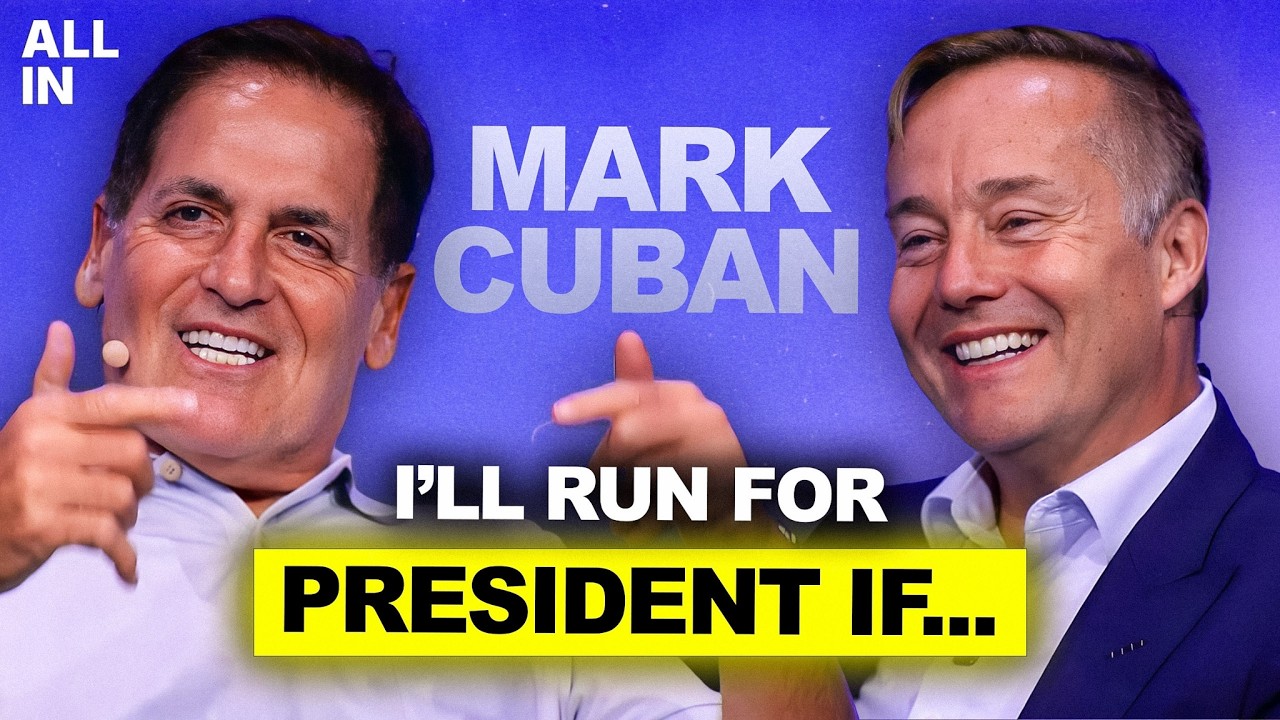
Mark Cuban Warns Venture Capital Funds Face AI Valuation Crash
All-In Podcast
Unlike the retail-driven dot-com bubble, the current AI market risks wiping out private capital funds that invested at peak valuations while enterprise adoption faces severe technical friction.
## Background
Published on YouTube by the All-In Podcast on July 21, 2026, this episode features guest Mark Cuban discussing whether current AI market trends mirror the dot-com bubble. According to the page description, the episode covers the limits of enterprise AI, transitioning to an AI-first workspace, self-directed healthcare, politics, and the New York Knicks.
## TL;DR
Mark Cuban and host Jason Calacanis dissect the current AI landscape, arguing that unlike the dot-com bubble's retail mania, today's AI bubble poses financial risks primarily to overleveraged private venture capital and private equity firms. They explore enterprise AI implementation hurdles, praising accessible platform tools like Lovable while examining the shift toward AI-first workplaces and world models. The discussion also touches on AI's impact on self-directed healthcare, socio-political algorithm dynamics, cost-of-living differences between states, and recent shifts in NBA team roster construction and sports franchise valuations.
## Atmosphere & style
The conversation is fast-paced, candid, and collegial, combining high-level venture finance insights with pragmatic technical realities. Cuban brings a sharp, direct energy—punctuated by colorful language and seasoned entrepreneurial anecdotes—while trading witty banter with Calacanis on everything from early internet stock hedges to NBA championship runs. The vibe feels like an intimate, unfiltered peak into an insider dialogue between veteran tech investors navigating industry shifts.
## Key takeaways
- [00:00](https://www.youtube.com/watch?v=OY2Sjbjd_VE&t=0s) Unlike the dot-com bubble, which was driven by public retail mania and zero-revenue IPOs, the current AI hype is concentrated in private capital, placing high risk on VC, PE, and hedge funds overcommitted at peak valuations.
- [02:00](https://www.youtube.com/watch?v=OY2Sjbjd_VE&t=120s) Late-stage AI firms and tech giants are taking on massive private credit debt and capital expenditures to construct data centers, creating potential energy and infrastructure oversupply risks similar to the early telecom era.
- [04:00](https://www.youtube.com/watch?v=OY2Sjbjd_VE&t=240s) Founders are encouraged to pursue smaller $50M–$100M IPOs rather than waiting for massive valuations, as public stock currency provides better flexibility for M&A and corporate growth.
- [06:20](https://www.youtube.com/watch?v=OY2Sjbjd_VE&t=380s) Early employees with life-changing concentrated equity positions in private AI unicorns are advised to utilize financial strategies like equity collars to protect against downside risk.
- [07:50](https://www.youtube.com/watch?v=OY2Sjbjd_VE&t=470s) Enterprise AI adoption faces significant operational hurdles and requires specialized engineering teams, demonstrating that full automation and AGI remain far from realization.
- [11:23](https://www.youtube.com/watch?v=OY2Sjbjd_VE&t=683s) Tools like Lovable are democratizing software creation, enabling non-technical users and international creators to build rapidly without deep engineering backgrounds.
- [14:50](https://www.youtube.com/watch?v=OY2Sjbjd_VE&t=890s) The fragility of AI agents and recurring issues like hallucinations create a major consulting and service opportunity for individuals who can troubleshoot and maintain enterprise workflows.
- [16:38](https://www.youtube.com/watch?v=OY2Sjbjd_VE&t=998s) A stark operational gap is opening between AI-fluent workers and non-users, with firms dramatically lowering internal software development costs by empowering staff to build custom tools in-house.
- [19:08](https://www.youtube.com/watch?v=OY2Sjbjd_VE&t=1148s) The next major boundary for AI is physical world models, which require spatial and sensor data beyond text and video to give models a foundational understanding of physical cause and effect.
- [21:26](https://www.youtube.com/watch?v=OY2Sjbjd_VE&t=1286s) Self-directed healthcare is expanding as individuals combine continuous wearable biometric monitoring and periodic blood panels with specialized AI models to manage personal health.
- [24:30](https://www.youtube.com/watch?v=OY2Sjbjd_VE&t=1470s) In contrast to social media algorithms that prioritize emotional engagement and outrage, LLMs operate primarily to deliver factual accuracy, serving as potential neutral truth-seeking tools.
- [32:40](https://www.youtube.com/watch?v=OY2Sjbjd_VE&t=1960s) Critiques of wealth tax proposals highlight that early models often fail to account for capital mobility and real-world behavioral changes among high-net-worth creators.
- [33:40](https://www.youtube.com/watch?v=OY2Sjbjd_VE&t=2020s) Pro-building regulatory environments, such as those in Texas, help alleviate housing cost pressures and founder stress compared to higher-friction regions like California and New York.
- [35:12](https://www.youtube.com/watch?v=OY2Sjbjd_VE&t=2112s) Strict salary cap rules, such as the NBA's second apron, are designed to enforce roster parity and make multi-year championship dynasties nearly impossible to sustain.
- [37:10](https://www.youtube.com/watch?v=OY2Sjbjd_VE&t=2230s) Modern sports team valuations are increasingly tied to media rights and streaming platform subscriber retention rather than traditional gate revenues or win-loss records.
## Detailed walkthrough
### [00:00](https://www.youtube.com/watch?v=OY2Sjbjd_VE&t=0s) Comparing the AI Market to the Dot-Com Bubble
Mark Cuban and Jason Calacanis kick off the discussion by drawing parallels between the current AI hype cycle and historical market bubbles. Cuban clarifies that the present environment is fundamentally different from the traditional dot-com bubble of the late 1990s. Back then, unprofitable companies with no revenue or internet traffic were going public and watching their stock prices surge 50% to 100% overnight, becoming mainstream retail talking points even among cab drivers. By contrast, the current AI market dynamics will not directly impact the general public or everyday citizens across the U.S.
Instead, Cuban warns that the current environment threatens to devastate a significant number of venture capital (VC), private equity (PE), and hedge funds that have gone "all in" at peak valuations. Portfolio managers face intense pressure to outperform competing funds, forcing them to chase late-stage rounds in high-profile AI firms like Anthropic and OpenAI, as well as capital-intensive giants like SpaceX.
```
Dot-Com Bubble vs. Current AI Market:
├── Dot-Com Bubble: Public retail mania, zero-revenue IPOs, widespread public impact.
└── Current AI Market: Private capital saturation, VC/PE risk exposure, massive CapEx debt.
```
Calacanis notes that after investing in venture capital for over ten years, it is wild to watch investors who deployed funds at the top of the market get wiped out. They recall a time when angel investors could enter promising deals at \$5 million to \$10 million valuations, whereas recent years saw unlaunched products demanding \$40 million to \$60 million pre-product valuations.
- Market leaders like Google and Meta are taking on hundreds of millions to billions in debt to fund AI capital expenditures.
- A systemic risk is compounding through private credit mechanisms (e.g., Altimeter Capital acquiring refunds/debt structures) while cash flows are fully committed to CapEx and bond obligations.
- Massive data center construction creates severe energy dependencies; Cuban jokes that if price-performance breakthroughs reduce power requirements, many data centers will end up being converted into pickleball courts.
- Cuban compares data center infrastructure trends to the early telecommunications era, where dark fiber was laid everywhere—eventually jumping from 1 Gbps to 10 Gbps and 100 Gbps—turning bandwidth scarcity into an oversupplied commodity sold for pennies on the dollar.
---
[04:00](https://www.youtube.com/watch?v=OY2Sjbjd_VE&t=240s) The Need for $100M IPOs, Equity Collars, and Regulatory Shifts
The conversation pivots to financial strategy, corporate exit environments, and risk management for founders and late-stage employees. Cuban argues that because this bubble is heavily driven by private capital, companies should prioritize smaller, \$50 million to \$100 million IPOs rather than waiting for mega-valuations like SpaceX or OpenAI. Having a publicly traded equity currency allows disruptive companies to aggressively roll up legacy businesses, acquire specialized data sets, or buy domain expertise. Raising debt or private equity for M&A during market shifts is extremely expensive compared to executing secondary offerings as a public entity.
> "I'm trying to tell my portfolio companies: Go public, motherfuckers. Go public! They just don't think that's the right thing to do." — **Mark Cuban**
Calacanis highlights how the regulatory environment under former FTC Chair Lina Khan frozen M&A activity for four years, forcing corporate development teams to stand down. Cuban points out that while big tech mega-mergers were blocked under predictive antitrust enforcement, smaller agile AI startups do not need to be massive corporations to disrupt legacy markets.
The speakers discuss financial protection strategies for early employees holding highly valued equity in private AI unicorns. Cuban recounts his famous trade hedging his Yahoo! stock after the Broadcast.com acquisition. Because formal equity collar products did not exist at the time, Cuban instructed Goldman Sachs to construct an index of overvalued internet stocks that he believed "sucked" so he could short the index until a formal collar could be established. Although he lost tens of millions on the short position itself, it protected his multi-billion-dollar fortune when the market crashed. He strongly advises employees at Anthropic, OpenAI, or SpaceX to protect their downside with collars once their equity reaches life-changing levels.
---
[07:50](https://www.youtube.com/watch?v=OY2Sjbjd_VE&t=470s) Enterprise AI Friction and Reality vs. Hype
Addressing the day-to-day capabilities of AI, Cuban argues that enterprise AI implementation is vastly more difficult and complex than the public realizes. While individual users can write prompts, bypass tests, or deploy basic single-step agents to boost personal productivity, rolling out AI at the corporate enterprise level is "terrifying" and fraught with operational roadblocks.
Despite alarmist predictions from industry leaders like Dario Amodei claiming AI would eliminate 50% of white-collar jobs within two years, overall employment continues to grow and demand for AI-literate talent remains unsatisfied. Cuban observes that enterprise CEOs generally have no idea how AI systems function under the hood, making it impossible for them to properly architect or integrate these tools without heavy technical intervention.
To demonstrate how far AI remains from true Autonomous General Intelligence (AGI), Cuban highlights the heavy reliance on human technical personnel. Big tech firms and AI frontier labs are aggressively hiring human teams to handle integration on the ground:
* **Microsoft:** Hiring 6,000 forward-deployed integration personnel to help enterprises implement AI systems.
* **Anthropic & OpenAI:** Building out massive forward-deployment teams to manually integrate models into corporate workflows.
* **Palantir:** Alex Karp actively criticizes competitor deployment strategies, which Cuban views as defensive posturing because competitors are adopting Palantir's legacy forward-deployed engineer model.
Cuban explains that current frontier models fail at simple, multi-step automated workflows without custom software engineering. For instance, asking ChatGPT or Claude to perform a routine weekly web search on a topic and automatically email a report fails outright or outputs unusable, raw JSON code and "slop" that requires continuous manual human debugging.
---
[11:23](https://www.youtube.com/watch?v=OY2Sjbjd_VE&t=683s) The Entrepreneurial Renaissance and Emerging AI Tools
Despite these enterprise implementation hurdles, Cuban emphasizes that AI represents the single most impactful technology wave in human history, opening up unprecedented opportunities for agile entrepreneurs. Platform tools like Lovable are democratizing software development, allowing non-technical founders worldwide to deploy functional applications rapidly.
During a discussion with Anton from Lovable, Cuban learned that users are generating over 770,000 application builds per week on the platform. The user demographics reveal a dramatic shift in software creation:
* **Global Footprint:** 70% of Lovable's user activity originates outside the United States, with rapid growth in markets like Brazil, India, and France.
* **Non-Developer Adoption:** 80% of users building software on the platform are non-engineers.
```
Lovable Platform Activity:
├── Weekly Builds: 770,000 applications created per week.
├── Geographic Distribution: 70% International (Brazil, India, France) | 30% United States.
└── User Base: 80% Non-Engineers | 20% Professional Software Engineers.
```
To test the capabilities of current AI application builders, Cuban describes a prompt experiment where he instructed an AI tool to design a hardware-software startup concept: a smart button recording 24 hours of continuous video, automatically transmitting data daily, complete with a provisional patent outline, licensing requirements, business plan, and a bill of materials (BOM) sourced from supplier databases.
> "In 12 minutes! Done. Done. And even if it's wrong, so what? Because every single motherfucking business plan ever written in the history of business plans is wrong!" — **Mark Cuban**
Cuban concludes that while AI models are prone to hallucination and agent drift—where underlying LLM updates cause existing autonomous agents to lose alignment or break over time—this creates a massive service opportunity. Individuals who understand basic systems thinking and computer fundamentals can build lucrative businesses by consulting for small and medium-sized enterprises, repairing broken AI workflows, and resolving technical integration failures.
[016:38] Transitioning to an AI-First Workspace
The conversation turns to the internal dynamics of adopting AI tools across venture capital and technology firms. A stark divide is opening up between employees who fully integrate AI into their daily routines and those who stick to traditional workflows. The gap in output between AI-literate team members and non-users is described as being as vast as the historical shift from using legal pads to mastering PC office suites.
This rapid adoption, however, leads to noticeable tool-hopping as employees hit functional ceilings with different platforms. Teams initially started building workflows on tools like OpenClaw, but moved away when the underlying agents proved too brittle and prone to hallucinations. Users then migrated to Claude Co-work, tried Perplexity Computer, and eventually leaned into platforms like Lovable to dynamically build internal software. By empowering staff to max out token spending—allowing several thousand dollars a month per employee—workers ended up building custom internal venture business intranets in a matter of days. In previous years, these applications would have cost $2 million to $3 million and taken a year with an outsourced development shop, or forced the firm to shoehorn its needs into rigid third-party SaaS products.
- **Tool Trajectory:** Users cycled from OpenClaw (too brittle/hallucinating) to Claude Co-work, Hermes Agent, Perplexity Computer, and Lovable.
- **Cost & Speed Shift:** Internal software that once took 12 months and $2M–$3M in outsourced development is now being built rapidly in-house by non-traditional developers.
- **Lovable's Growth:** Despite initial skepticism that its features would be absorbed by frontier LLMs, Lovable scaled rapidly from near-bankruptcy to hundreds of millions in revenue.
---
[019:08] The Frontiers of AI: World Models vs. Text and Pictures
Beyond text-based LLMs and image models, the future of artificial intelligence centers heavily on world models. Current models are limited because they operate predominantly on text and static visual data, lacking a genuine physical understanding of reality. To illustrate this limitation, the speakers point to a video of a two-year-old child in a high chair with a sippy cup: the toddler inherently understands physical cause and effect—that pushing the cup over the edge will cause a spill and make their mother run over—whereas current AI has zero baseline understanding of physical cause-and-effect dynamics. Similarly, a person navigating a blind corner would still rely on a trained guide dog over a phone running an AI model.
Building true physical world models requires going far beyond scraped internet text or standard YouTube videos. Companies are now gathering specialized spatial and sensor data—ranging from wearing haptic gloves in kitchens to deploying satellites equipped with spectrography. AI startups like Matter are launching satellites to capture continuous spectral video of the Earth, converting physical data into base algorithms that other world-building models can consume. Because real-world modeling, video rendering, and physical robotics demand orders of magnitude more tokens and computing power than text processing, these domains represent the primary reason data center power demand could continue to skyrocket.
- **Key Portfolio Companies Cited:** Synthesia (AI video generation), AMI (Yann LeCun’s world model initiative), and Matter.com (satellite spectrography for world models).
- **Physical Understanding Gap:** Current AI lacks the basic spatial and physical intuition of a toddler or a guide dog.
- **Compute Impact:** Video, world models, and robotics require a massive leap in token consumption compared to text-and-image LLMs.
---
[021:26] Self-Directed Healthcare and Biometric Data
The conversation pivots to personal health, fitness, and how AI is altering individual medical management. The speakers highlight the rise of self-directed healthcare, where users combine continuous biometric monitoring—such as Apple Watch, Whoop, and regular 3-to-6-month blood panels—with specialized medical AI engines like Open Evidence. Mark Cuban shares a personal anecdote about managing his own low iron levels: after experiencing adverse side effects from taking a prescribed supplement alongside another medication at the same time, he ran his full dietary and medication routine through Open Evidence. The model instantly identified the timing interaction and instructed him to separate the doses, resolving the issue without needing an immediate clinic visit.
While AI tools empower patients to track decades of personal baseline trends and catch early health warnings, the speakers agree that AI will not replace human doctors. Instead, it serves as an indispensable copilot. Because a human practitioner cannot memorize the overwhelming volume of medical research published daily, AI bridges the information gap, allowing doctors to focus on diagnostic empathy, physical examination, and clear patient communication.
- **Open Evidence:** Used as a domain-specific medical search tool to parse drug interactions and personal blood panel data.
- **Biometric Integration:** Combining wearables (Apple Watch, Whoop) with recurring blood panels allows individuals to establish multi-year longitudinal baselines.
- **Doctor's Role:** AI bridges the knowledge gap in rapidly changing medical research, while human physicians remain essential for physical exams, contextual judgment, and bedside empathy.
---
[024:30] Political Polarization, Social Algorithms, and AI as a Truth-Seeking Force
Moving into socio-political dynamics, the discussion touches on the growing divide between capitalism and local socialist movements across the United States. Local political shifts—such as Democratic Socialists of America (DSA) candidates winning local offices in New York or Michigan—are driven largely by political actors who excel at manipulating modern social media algorithms. The political landscape is dominated by figures whose whole adult lives have been shaped by algorithmic incentives. Because social media platforms operate on an engagement-driven currency, their algorithms reward outrage, continuous searching, and emotional "zone-flooding."
In contrast to social media's incentive to maximize engagement, large language models operate on a fundamentally different core mission: retrieving accurate, factual information to maintain user trust. As voters grow weary of algorithmic outrage, LLMs are increasingly serving as neutral "truth-seeking" arbiters. The speakers demonstrate this by mentioning how they use AI models (like Grok or Claude) to fact-check hyperbolic claims from political figures on both sides of the aisle by demanding objective source verification. Ultimately, access to neutral, fact-based AI models could help de-escalate political asymmetry and better educate the public on complex policy issues like legal immigration and economic talent retention.
- **Engagement vs. Accuracy:** Social media platforms optimize for user retention and emotional engagement; LLMs optimize for factual accuracy and trust.
- **Fact-Checking Practice:** Prompting models to "be objective, factual, check your work, and show sources" is becoming a common countermeasure against political misinformation on social feeds.
- **Immigration & Talent:** The speakers emphasize that retaining global entrepreneurial and technical talent remains critical for national competitiveness.
### [30:56](https://www.youtube.com/watch?v=OY2Sjbjd_VE&t=1856s) Political Leadership, Democratic vs. Republican Approaches, and State Cost-of-Living
The conversation opens with a lighthearted exchange about running for office if a certain president runs for a third term, which transitions into a broader discussion on the qualities needed in political leadership. They discuss how the ideal leaders might be "post-money"—executives who no longer need to work for a living and enter public service purely out of civic pride and love for the country. Evaluating the current state of American politics, the host and Mark Cuban critique both major parties: Democrats are criticized for framing every event as an existential threat to democracy without knowing how to build or execute, while Republicans are knocked for a perceived lack of empathy and connection to everyday people. Despite the current political friction, Cuban predicts a return to normalcy following the upcoming midterms and presidential election cycle.
Comparing life across New York, California, and Texas reveals stark economic trade-offs:
* **Per Capita Government Spending:** New York spends over twice as much per citizen ($12,000–$14,000+) compared to Texas ($6,000–$7,000), yet Texas maintains a higher perceived quality of life.
* **Federal Treasury Contributions:** Conversely, New York contributes significantly more to the federal treasury than Texas, despite Texas's business-friendly reputation and lower cost structure.
### [32:40](https://www.youtube.com/watch?v=OY2Sjbjd_VE&t=1960s) Wealth Taxes, Migration to Texas, and Regulatory Freedom
The discussion shifts to the migration of major founders and investors—including Elon Musk, David Sacks, Travis Kalanick, and the host—from Silicon Valley to Texas. Cuban, noting he was "there first," critiques wealth tax proposals advanced by politicians like Elizabeth Warren and Zohran Mamdani. Cuban recounts contacting the UC Berkeley economists who modeled Warren's original wealth tax proposal, discovering that their model only analyzed a single year of data and completely ignored behavioral changes or capital mobility (referencing France's failed two-year experiment with a wealth tax).
The conversation highlights the fundamental differences in operating environment between California and Texas:
* **Housing and Land Use:** In Texas, outside city boundaries, landowners face minimal friction; buying a ranch allows for immediate projects like installing a private solar farm. As a result of continuous building, Texas housing prices and rents have decreased three years in a row.
* **Founder Stress:** When founders move to cities like Austin, Houston, Dallas, or San Antonio, the financial pressure releases, enabling employees to actually afford homes.
* **Silicon Valley Culture vs. Texas:** While Silicon Valley remains ideal for first-time founders to "soak in" the ecosystem, second-time founders often prefer Texas, Nevada, or Florida. Cuban notes that Silicon Valley distorts priorities around fundraising milestones (Series A, B, C) and status, whereas Texas focuses purely on execution and company building.
---
### [35:12](https://www.youtube.com/watch?v=OY2Sjbjd_VE&t=2112s) NBA Playoff Debates, The Second Apron, and Sports Valuations
The host celebrates the New York Knicks winning their first NBA championship in 25 years after decades of waiting. Cuban and the host break down the path to the championship, including the Knicks' roster additions (Jaylen Brunson, OG Anunoby, and Karl-Anthony Towns), former coach Tom Thibodeau, and the San Antonio Spurs' playoff stumble with Victor Wembanyama (Wimby). Cuban compares Wembanyama's humble playoff experience to Dirk Nowitzki’s 2006 Finals loss, noting that getting humbled forces stars to return stronger.
The discussion turns to NBA roster building, parity, and the league's strict financial regulations:
* **The Second Apron:** The punitive rules surrounding the salary cap's "second apron" force teams to break up core groups rather than maintaining three max contracts. This forces franchises like Oklahoma City (OKC) to hoard draft picks to replace players graduating from rookie deals.
* **Parity and Back-to-Back Champions:** Cuban asserts there is "no chance" of seeing three-peats anymore, and even back-to-back championships have become exceedingly rare due to required roster turnover and injury risks.
* **Sports Franchise Valuations:** The host notes that NBA franchise values have detached from reality, making minority ownership nearly impossible even for high-net-worth individuals. Cuban explains that modern sports valuations are no longer driven by game attendance or win-loss records, but by subscription numbers for streaming services (such as Peacock and ESPN). Rather than traditional TV ratings, the true driver of franchise value is whether live sports can successfully drive persistent streaming subscriber retention and minimize subscriber churn.
## Notable quotes
> [04:00](https://www.youtube.com/watch?v=OY2Sjbjd_VE&t=240s) I'm trying to tell my portfolio companies: Go public, motherfuckers. Go public! They just don't think that's the right thing to do. — Mark Cuban
> [11:23](https://www.youtube.com/watch?v=OY2Sjbjd_VE&t=683s) In 12 minutes! Done. Done. And even if it's wrong, so what? Because every single motherfucking business plan ever written in the history of business plans is wrong! — Mark Cuban
## Mentioned
Mark Cuban, Jason Calacanis, Chamath Palihapitiya, David Sacks, David Friedberg, Lina Khan, Dario Amodei, Alex Karp, Yann LeCun, Elon Musk, Travis Kalanick, Elizabeth Warren, Zohran Mamdani, Jaylen Brunson, OG Anunoby, Karl-Anthony Towns, Tom Thibodeau, Victor Wembanyama, Dirk Nowitzki, All-In Podcast, Anthropic, OpenAI, SpaceX, Google, Meta, Altimeter Capital, FTC, Yahoo!, Broadcast.com, Goldman Sachs, Microsoft, Palantir, ChatGPT, Claude, Lovable, OpenClaw, Claude Co-work, Perplexity Computer, Hermes Agent, Synthesia, AMI, Matter.com, Apple Watch, Whoop, Open Evidence, Grok, AppLovin, Northwest Registered Agent, New York Knicks, San Antonio Spurs, Oklahoma City Thunder, Peacock, ESPN
马克·库班警告风投基金面临AI估值崩盘
与散户推动的互联网泡沫不同,当前的AI市场或将重创在估值顶峰入局的私募资本基金,而企业落地端正面临严重的技术阻力。
Mark Cuban与主持人Jason Calacanis深入剖析了当前的AI格局,认为与互联网泡沫时期的散户狂热不同,当下的AI泡沫主要给过度加杠杆的私有风险投资和私募股权机构带来了财务风险。他们探讨了企业AI落地的现实阻碍,在赞许Lovable等易用型平台工具的同时,审视了向AI优先型职场与世界模型的转变。此外,讨论还涉及了AI对自主医疗的影响、社会政治算法动态、各州生活成本差异,以及近期NBA球队阵容构建与体育特许经营权估值的变化。
与由散户狂热和零收入公司上市驱动的互联网泡沫不同,当前 AI 热潮的高风险主要集中在私募资本领域,重仓高估值晚期项目的 VC、PE 及对冲基金正面临巨大的资产清算风险。 (0:00)
Mark Cuban 建议创始人考虑进行 5,000 万至 1 亿美元规模的小型 IPO 以获取公开股权流动性便于并购扩张,并强烈建议持有高估值独角兽股权的早期员工使用领口期权(equity collar)等策略对冲下行风险。 (4:00)
企业级 AI 的落地难度远超公众预期,复杂的系统集成与模型幻觉证明通用人工智能(AGI)仍未实现,促使微软、OpenAI 和 Anthropic 等巨头大量招聘现场部署工程师协助客户交付。 (7:50)
以 Lovable 为代表的新型工具正在打破传统软件开发壁垒,企业通过赋能员工灵活调用 AI 构建内部系统,将原本需要数百万美元外包且耗时一年的软件项目压缩至数天完成。 (16:38)
Reading summary
Mark Cuban argues that the current artificial intelligence bubble threatens institutional capital and overleveraged private funds rather than retail investors, while enterprise deployment faces severe operational friction despite rapid bottom-up software creation.
Institutional Exposure and Bubble Dynamics (0:00)
Mark Cuban and Jason Calacanis contrast the ongoing AI market cycle with the late-1990s dot-com bubble. Unlike that earlier retail mania characterized by zero-revenue IPOs and public stock surges, current financial risk is concentrated in private equity, venture capital, and hedge funds purchasing late-stage stakes in companies like OpenAI, Anthropic, and SpaceX at high valuations. Calacanis observes that early-stage entry pricing has escalated from historic $5 million to $10 million angel valuations to unlaunched products demanding $40 million to $60 million. Simultaneously, tech giants like Google and Meta are issuing billions in debt to fund AI infrastructure, while Altimeter and private credit funds absorb structured debt obligations. Cuban compares current data center buildouts to early telecom dark fiber, warning that efficiency gains could turn physical computing capacity into an oversupplied commodity.
Enterprise Implementation Bottlenecks and World Models (7:50)
Cuban characterizes corporate AI integration as operationally daunting, rejecting predictions from industry figures such as Anthropic CEO Dario Amodei that AI will eliminate 50% of white-collar jobs within two years. Because frontier models routinely break on routine multi-step automated workflows—often outputting unusable JSON or low-quality code—leading AI providers rely heavily on human labor. Microsoft is hiring 6,000 forward-deployed integration personnel, while Anthropic and OpenAI are similarly building deployment teams that Cuban notes mirror Palantir's integration-heavy engineering model.
Technological limitations also persist because current frontier models rely almost entirely on text and static visual data. The speakers observe that models lack physical cause-and-effect intuition, contrasting current AI performance with a toddler understanding gravity or a pedestrian relying on a guide dog. Addressing this deficit requires specialized physical and sensor data, including haptic kitchen telemetry and continuous satellite spectrography from startups like Matter. Cuban and Calacanis emphasize that rendering world models and robotics requires orders of magnitude more token consumption and electrical power than standard text-and-image models.
Decentralized Software Creation and Decision Copilots (11:23)
Despite enterprise bottlenecks, Cuban notes an entrepreneurial wave driven by generative development platforms like Lovable, which processes over 770,000 application builds weekly. Platform metrics indicate that 80% of these users are non-engineers and 70% operate internationally in countries such as Brazil, India, and France. Inside tech firms, equipping employees with dedicated AI token budgets allowed non-traditional developers to build internal workflow software in days, replacing legacy internal tools that previously required $2 million to $3 million and a year of outsourced engineering.
Personal healthcare is experiencing a parallel transformation as users combine wearable biometrics from Apple Watch and Whoop with specialized medical search models like Open Evidence. Cuban cites using Open Evidence to identify a medication timing conflict that caused adverse reactions from his prescribed iron supplement. The speakers emphasize that domain-specific AI models will not replace physicians, but rather serve as diagnostic copilots that synthesize medical literature while human doctors handle physical examinations and bedside empathy.
Algorithmic Incentives, Regional Governance, and Sports Valuations
Addressing political communication, the speakers contrast social media platforms that reward emotional outrage with large language models designed to provide factual, source-verified responses to users seeking objective analysis. On domestic economic policy, Cuban critiques wealth tax proposals advanced by politicians like Elizabeth Warren, stating that supporting academic models evaluated only a single year of data while ignoring behavioral capital mobility. The speakers note that founders migrating from California to Texas benefit from lower regulatory friction and housing costs, contrasting Silicon Valley's fundraising-oriented prestige culture with Texas's focus on operational execution.
In sports business, Cuban explains that surging NBA franchise valuations have decoupled from traditional arena attendance and win-loss records. Instead, team values are sustained by streaming platforms like Peacock and ESPN relying on live sports to drive long-term subscriber retention and reduce churn. Concurrently, strict salary cap rules under the NBA's "second apron" penalize multi-star payrolls, forcing teams to cycle through rosters and draft assets, which Cuban asserts eliminates the viability of modern back-to-back dynasties.
Cuban concludes that while model drift, hallucinations, and enterprise integration hurdles will generate substantial consulting opportunities for technical problem-solvers, the private AI market faces significant contraction risks among overleveraged funds and debt-financed infrastructure.
## Background
该视频由知名科技与商业播客频道 All-In Podcast 于 2026 年 7 月 27 日发布在 YouTube 平台上。节目简介显示,本期访谈围绕投资家马克·库班(Mark Cuban)展开,重点探讨了当前 AI 市场的潜在泡沫与破灭风险、企业级 AI 面临的现实阻碍、向 AI-First 工作空间转型、医疗健康与生物识别数据、政治博弈与财富税争议,以及纽约尼克斯队与职业体育赛事的最新动向。
## TL;DR
在本次对话中,马克·库班对比了当下 AI 热潮与千禧年互联网泡沫的异同,指出当前估值泡沫主要局限在发债巨头与一级市场机构,并预言算力功耗比突破可能导致巨资建设的数据中心面临过剩危机。库班直言企业级 AI 的落地难度远超外界预期,“两年淘汰半数白领”的言论已被现实证伪,现阶段反而是懂技术的复合人才与创业者的巨大机遇。随后,对谈深入剖析了世界模型对海量算力的需求、AI 辅助的自我导向医疗变革、大语言模型作为客观工具对抗社交媒体极化算法的价值,并从商业与管理逻辑拆解了加州财富税的荒谬、NBA“第二土豪线”对王朝球队的瓦解,以及流媒体订阅拉新对职业体育估值的重塑。
## Atmosphere & style
整场对话节奏紧凑、畅快淋漓,两位资深科技投资人与体育从业者在思想碰撞中展现出极高的默契与敏锐的洞察力。库班的表达一如既往地犀利坦率、充满美式口语的直接与冷幽默,毫不避讳地用“混蛋们快去上市”或“变老真糟糕”等生动金句击碎行业虚火与技术狂热。从对 AI 基建硬着陆的冷峻警示,到谈及政治与经济现实时的务实沉着,再到聊至尼克斯队险胜与体育现场共鸣时的热血与动容,整个访谈在硬核商业推演与真挚的情感共振之间自如切换,听感兼具思想厚度与身临其境的带入感。
## Bulletin
- [00:00](https://www.youtube.com/watch?v=OY2Sjbjd_VE&t=0s) 马克·库班指出当前 AI 泡沫与互联网泡沫不同,风险未蔓延至散户,而是高度集中于激进加杠杆发债与重仓 Capex 的风险投资、私募机构及大型科技巨头。
- [01:46](https://www.youtube.com/watch?v=OY2Sjbjd_VE&t=106s) 库班预言 AI 能效比可能迎来非线性突破并压低算力门槛,巨头按完美预期盲目扩张的数据中心或重演千禧年“暗光纤”悲剧,沦为过剩资产被改造成匹克球场。
- [07:48](https://www.youtube.com/watch?v=OY2Sjbjd_VE&t=468s) 企业级 AI 落地难度远超预期,“两年内消灭 50% 白领”的预言彻底落空,反而催生了对 AI 熟练人才的招募荒以及针对“代理漂移”等工程落地问题的咨询需求。
- [24:30](https://www.youtube.com/watch?v=OY2Sjbjd_VE&t=1470s) 大语言模型商业核心是追求客观真相与降低信息不对称,有望成为打破传统社交媒体算法极化与政治信息茧房的关键工具。
- [38:11](https://www.youtube.com/watch?v=OY2Sjbjd_VE&t=2291s) NBA 新劳资协议中的“第二土豪线”通过严厉财政惩罚瓦解了三顶薪超级球队,彻底终结了三连冠王朝时代,推动联盟迈入高均衡竞争格局。
## Key takeaways
- [00:00](https://www.youtube.com/watch?v=OY2Sjbjd_VE&t=0s) 当下的 AI 热潮并非散户全民炒股的大众泡沫,而是风险高度集中在一级市场风投机构、私募信贷以及巨额发债扩张的科技巨头内部。
- [01:46](https://www.youtube.com/watch?v=OY2Sjbjd_VE&t=106s) 巨头对 AI 基础设施的资本支出(Capex)是按完美预期定价,一旦模型算法取得单瓦特能效跃升导致算力需求阈值剧降,巨额投资的数据中心面临严重过剩清算风险。
- [04:18](https://www.youtube.com/watch?v=OY2Sjbjd_VE&t=258s) 有潜力的初创公司应尽早以 5000 万至 1 亿美元规模 IPO,将具备高流动性的公开流通股票作为兼并传统业务与数据的低成本“收购货币”。
- [06:44](https://www.youtube.com/watch?v=OY2Sjbjd_VE&t=404s) 对账面资产剧增的明星独角兽核心员工,库班建议效仿自己当年用期权领子(Collar)锁定雅虎股票收益的经验,及时构建金融衍生品进行下行对冲保护。
- [07:48](https://www.youtube.com/watch?v=OY2Sjbjd_VE&t=468s) 企业级 AI 改造极其繁琐脆弱,大部分 CEO 缺乏技术工程认知,“50% 白领在两年内被淘汰”的预言破产,反而迎来了复合型落地人才的短缺。
- [09:20](https://www.youtube.com/watch?v=OY2Sjbjd_VE&t=560s) 大模型在复合自动化任务中频现残渣代码与崩溃,微软招揽 6,000 名工程师及 OpenAI 组建驻场团队表明行业正退回依赖重人力交付的驻场外包模式。
- [11:07](https://www.youtube.com/watch?v=OY2Sjbjd_VE&t=667s) 无代码与生成式工具大幅压缩创业门槛,创始人能用十余分钟完成专利规划与商业模型,推动创业从外包团队转向极低边际成本自建软件。
- [13:30](https://www.youtube.com/watch?v=OY2Sjbjd_VE&t=810s) 底层模型更新会引发“代理漂移”(Agent drift),使原有的工作流逻辑脱节,迫使企业投入更多工程与咨询人力来持续调优维护。
- [18:54](https://www.youtube.com/watch?v=OY2Sjbjd_VE&t=1134s) 当前 AI 仍停留在静态图文的世界,缺乏对物理因果常识的理解,迈向世界模型与具身智能将带来极其恐怖的视频数据与算力吞吐消耗。
- [21:26](https://www.youtube.com/watch?v=OY2Sjbjd_VE&t=1286s) 结合可穿戴设备、血液指标与医疗大模型的“自我导向医疗”正在普及,AI 扮演文献检索与辅助诊断工具,但无法替代现实中医生的物理观察与共情。
- [27:56](https://www.youtube.com/watch?v=OY2Sjbjd_VE&t=1676s) 传统社交媒体依赖刺激情绪与算法极化赚取用户留存,而以真实答案立足的大语言模型正在成为选民寻求客观政策真相与反击政治炒作的利器。
- [32:40](https://www.youtube.com/watch?v=OY2Sjbjd_VE&t=1960s) 针对未实现收益的财富税忽略了人类行为心理与资产流动性,这种静态税收模型促使创业者和成熟团队逃离加州、迁往建造阻力小且务实的得州。
- [38:11](https://www.youtube.com/watch?v=OY2Sjbjd_VE&t=2291s) NBA 新劳资协议中的“第二土豪线”极具惩罚性,任何球队都难以长期承受三名顶薪球员,未来不可避免地将走向依靠选秀储备的阵容拆分与动态平衡。
- [39:58](https://www.youtube.com/watch?v=OY2Sjbjd_VE&t=2398s) 体育特许权天价估值的底层驱动力已从传统门票与尼尔森收视率,全面转向各大流媒体巨头获取净增订阅用户的存量争夺战,但面临季后退订流失率(Churn)的长期考验。
## Detailed walkthrough
### [00:00](https://www.youtube.com/watch?v=OY2Sjbjd_VE&t=0s) AI 泡沫与互联网泡沫的本质差异
访谈一开场,主持人与马克·库班(Mark Cuban)便切入当下科技界最热议的话题——AI 市场是否正在酝酿一场巨大的泡沫。经历过多轮经济周期的两人感叹道:“我们以前见过这部电影。”然而,库班明确指出,眼前的 AI 热潮与当年的 Dot-com(互联网)泡沫有着截然不同的底层逻辑。在 1999 年至 2000 年前后的互联网泡沫时期,大批毫无实际营收、没有真实流量支撑的初创公司争相上市,散户盲目买入,股价动辄单日暴涨 50% 甚至 100%,连街头的出租车司机都在热烈讨论科技股。
如今的景象完全不同。AI 领域的资金狂欢主要被局限在一级市场与机构投资者之间。库班认为,这绝不是一个会让街头普通民众或大部分大众直接财富蒸发的全民泡沫;真正的重灾区是那些大举押注、不顾一切“全押”(All-in)的风险投资机构(VC)、私募股权基金(PE)以及部分二级市场基金。为了在同业业绩竞争中胜出、留住出资人(LP)的资金,基金经理们不得不疯狂抢夺 Anthropic、SpaceX 等头部项目的额度,一旦潮水退去或行情急转直下,这些机构将面临毁灭性的打击。
- 互联网泡沫时期:无营收、无流量的空壳公司高估值 IPO,散户全民炒股。
- 当前 AI 热潮:资金由私募机构、超大型科技企业与债务资本主导,风险高度集中在机构与风投圈内。
---
### [01:46](https://www.youtube.com/watch?v=OY2Sjbjd_VE&t=106s) 完美预期定价、疯狂借贷与未来的“匹克球场”
谈及投资估值的失控,主持人回顾了自己十多年的风投经历:过去天使轮投资一家初创公司的估值通常在 500 万至 1000 万美元,而如今许多团队产品连影子都还没有,张口就要 4000 万、5000 万甚至 6000 万美元的高昂估值,令人匪夷所思。库班进一步将视线转向科技巨头。像 Google、Meta 这样的行业领头羊,虽然拥有充沛的日常运营现金流,却正在将几乎所有自由现金流砸入资本支出(Capex),甚至发行债券、背负数十亿乃至数百亿美元的债务来建设 AI 基础设施,底层还交织着正在暴露风险的私人信贷(Private Credit)市场。
库班将这种现象称为“按完美预期定价”(Pricing for perfection)——资本市场假定投入的数千亿美元算力与数据中心支出未来不仅能换来海量收入,还能带来极高的净利润与利润率回报。然而,这种激进扩张埋下了巨大的隐患。库班大胆预言:随着模型与算法的突破,AI 的性能功耗比(Price-performance curve)很可能会出现非线性飞跃,大幅压低能耗与计算资源门槛。届时,耗费巨资修建的大量数据中心可能会因为电力与利用率需求不及预期而沦为“过剩资产”,最终被改造成匹克球场(Pickleball courts)。
这与千禧年前后的“光纤泡沫”如出一辙。当年全行业不计成本地在地下铺设光纤,市场坚信带宽需求会无限膨胀;但随着传输技术从 1Gb 跃升到 10Gb、100Gb,单条线路承载能力呈几何级爆发,原本预期的带宽短缺瞬间转变为严重的供过于求,大量闲置的“暗光纤”(Dark fiber)在破产重组中被以几分钱的极低清算价贱卖。
```mermaid
flowchart TD
accTitle: 基础设施投资泡沫演化逻辑
accDescr: 展示了算力与数据中心从过度扩张到技术突破后产能过剩的演化过程
subgraph Capital["资本驱动阶段"]
A["巨头与机构发债借贷"] --> B["超大规模资本支出 Capex"]
B --> C["疯狂圈地建设数据中心"]
end
subgraph Shift["技术与市场转向"]
C --> D["按完美预期定价<br/>要求百亿美元级利润反哺"]
E["能耗与算力能效突破<br/>单瓦特模型效率剧增"] -.-> F["算力需求阈值降低"]
end
subgraph Outcome["潜在过剩后果"]
D & F --> G["巨额电力与基建过剩"]
G --> H["数据中心沦为匹克球场<br/>重演暗光纤破产抛售"]
end
```
- 巨头模式:将全部现金流投入 Capex 并叠加大规模债券融资,缺乏容错空间。
- 历史对照:千禧年的暗光纤现象,技术效率的单点突破(1Gb 到 100Gb)使基础设施从极度紧缺迅速滑向一文不值。
---
### [04:18](https://www.youtube.com/watch?v=OY2Sjbjd_VE&t=258s) 敦促公司公开上市:股票是最好的“收购货币”
库班对当前初创公司普遍推迟上市的现状提出了尖锐的逆向思考。他认为,与其盲目等待数百亿美元规模的超级 IPO,有潜力的 AI 企业应该尽早完成 5000 万到 1 亿美元规模的上市。核心原因在于:如果 AI 确实能如行业所预言的那样彻底颠覆各行各业,那么颠覆者需要一种强大的“货币”(Currency)去低成本兼并那些跟不上时代的传统老牌公司、或者收购拥有垂直领域数据和专业知识的团队。
如果手头没有上市公司的公开流通股票作为支付对价,创业团队就必须在每次并购时重新去私募市场高成本融资,而在流动性收紧或市场动荡期,外部资本的代价往往极其昂贵。库班无奈地吐槽,自己一直在对旗下的被投企业大声疾呼:“去公开上市吧,混蛋们!去上市!”("Go public, motherfuckers. Go public."),但许多创始人依然受困于固有思维不敢迈出这一步。
主持人也补充提到,过去几年美国联邦贸易委员会(FTC)在莉娜·汗(Lina Khan)主导下的严厉反垄断监管,几乎像科幻电影《少数派报告》中的“先知”(Precogs)一样,试图在企业垄断苗头出现之前就扼杀一切潜在并购,导致企业发展部(Corp Dev)过去四年几乎全部奉命按兵不动。但在全球竞争加剧的背景下,规则正在发生变化。库班回顾自己早年创办 Broadcast.com 的经验,当时他们就是通过纯股票支付收购了大约五家公司,快速拼齐版图,最终迎来了更大的买家接盘。
- 核心主张:5000 万至 1 亿美元体量尽早 IPO,将流动性股票作为低成本的并购货币。
- 战术价值:在行业洗牌期,通过换股直接吞并掌握行业数据、垂直门槛高却无法跟上 AI 变革的传统业务企业。
---
### [06:44](https://www.youtube.com/watch?v=OY2Sjbjd_VE&t=404s) 传奇期权领子交易与对大厂员工的财富忠告
面对当今估值被推向天际的独角兽企业,主持人向库班提问:对于 Anthropic、OpenAI 或是 SpaceX 的核心员工来说,现在是否已经到了该考虑做资产保护的时候?库班给出了极其肯定的回答。他告诫这些依靠股权账面身家暴增的员工:“你到底需要多富有才够?”如果这笔财富已经足以彻底改变你和家人的生活轨迹,明智的做法就是寻找专业的金融工具做下行对冲保护。
库班分享了自己在互联网泡沫破裂前夕名震华尔街的传奇操盘细节。当年他通过将 Broadcast.com 出售给雅虎(Yahoo)获得了巨额股票,为了规避暴跌风险,他决定构建期权领子策略(Collar)锁定收益。然而,由于当时市场上根本没有现成的金融衍生品能直接满足他的需求,并且他还受到锁定期以及监管合规的严格限制,高盛(Goldman Sachs)专门为他量身定制了一个方案:高盛帮他挑选并设计了一个由他认为“烂透了”的互联网公司组成的专属股票指数,库班通过先期做空该指数来建立过渡性保护。
在这笔做空交易中,随着市场最后的癫狂冲顶,库班账面一度亏损了数千万美元;但正是这笔下行保护帮他撑到了限制期结束,并最终在公开市场上对雅虎股票完成了完整的期权领子锁定,成功保住了数以十亿美元计的真金白银,避开了随后狂泻 90% 以上的崩盘,成为金融史上最著名的空前对冲案例之一。
- 建议策略:对已实现巨大浮盈的核心员工,应通过领子期权(上限让渡部分暴利,下限锁定保底本金)锁死人生底盘。
- 历史实操:在无法直接抛售雅虎股票的情况下,通过做空定制的烂互联网股票指数完成过渡性对冲。
---
### [07:48](https://www.youtube.com/watch?v=OY2Sjbjd_VE&t=468s) 企业级 AI 的落地坚冰与白领失业预言的破产
当讨论转向未来 5 到 10 年 AI 在现实世界的技术穿透力时,库班一针见血地指出:“AI 落地实际业务的难度,远远超出了所有人的预期。”对于个人开发者或普通员工来说,AI 看起来近乎魔法——随手写几个 Prompt、搭一个简单的 Agent,在日常做项目或写作业时就能轻松把效率提升上百倍。然而,很多人天真地以为企业级系统的 AI 改造也会同样简单。
现实恰恰相反,在复杂的企业组织中部署 AI 极其困难,甚至令决策层感到恐慌。更具讽刺意味的是,包括 Anthropic 首席执行官达里奥·阿莫代伊(Dario Amodei)在内的大量 AI 领袖此前曾高调宣称,50% 的白领工作将在两年内被 AI 彻底取代。如今整整两年过去了,白领非但没有出现大规模断崖式失业,整体就业数据依然在增长,各行各业反而极度紧缺具备基本 AI 素养的复合型人才。
库班直言,大部分大企业的首席执行官(CEO)对底层 AI 技术到底在发生什么根本一无所知("CEOs have no clue what is going on. None whatsoever.")。想要向他们解释如何将模型工程化、如何在现实系统的脆弱性上增加鲁棒性与防护层,无异于对牛弹琴。库班指出,整个科技圈整天高谈阔论通用人工智能(AGI)和“接管世界”,但现实中如果连最基本、脏乱的企业现实数据与业务流都无法理顺,宏大的宏图就依然只是空中楼阁。
- 预期差距:个人场景下的效率百倍飞跃,无法直接平移为企业业务系统中的可靠落地方案。
- 预言打脸:宣称“两年内取代 50% 白领”的言论并未兑现,现实中迎来的反而是 AI 熟练人才的招募荒与企业高管的技术认知盲区。
### [09:20](https://www.youtube.com/watch?v=OY2Sjbjd_VE&t=560s) 驻场工程师潮与企业级 AI 的骨感现实
大模型公司争相组建驻场工程团队(Forward Deployed Engineers)的现象,在马克·库班(Mark Cuban)看来恰恰揭穿了当前 AI 落地难度被低估的真相。按照对生成式 AI 的理想设想,用户应当只需下达自然语言指令,模型便能自动执行并完成全套部署;然而现实中,微软一口气招揽了 6,000 名技术人员,Anthropic 与 OpenAI 也在纷纷派遣团队驻扎企业内部进行定制化落地。连 Palantir 的 CEO 亚历克斯·卡普(Alex Karp)都公开大惊小怪,质疑各大同行凭什么给企业提供类似定制服务,但这反而证明各家都在走 Palantir 依赖驻场工程师的老路。对于普通人来说,将 AI 当成超级搜索引擎,或是写个小脚本跑定时任务(cron job),只要具备基本的系统思维就能起效;然而一旦进入容错率极低的企业级关键任务,AI 便立刻暴露出深层短板。
库班进一步指出,大语言模型目前甚至无法处理看似简单的自动化复合任务。例如,若让 Claude 或 ChatGPT 追踪某位投资人的投资动态、生成分析报告并在每周固定时间发到邮箱,模型根本无法独立闭环。它通常只能反问用户是否要生成一个提醒代理,随后丢出一串混乱的 JSON 文件或未经调试的代码残渣(slop)。由于普通用户缺乏代码编写与调试能力,面对这些粗糙的代码只能束手无策,根本无法像技术人员那样不断迭代排错。
- 微软招聘了多达 6,000 名驻场工程人员来协助企业落地 AI。
- OpenAI、Anthropic 同样被迫采取向企业派遣技术团队的重人力交付模式。
- Palantir CEO Alex Karp 批评大模型厂商抢占企业服务 Alpha 收益,反映出行业重回工程外包本质。
```mermaid
flowchart TD
accTitle: 企业级 AI 理想与落差
accDescr: 对比生成式 AI 自然语言执行的理想状态与需要大量驻场工程师的现实落差。
subgraph Ideal["理想状态"]
A["用户下达自然语言指令"] --> B["AI 自动实现与部署"]
end
subgraph Reality["企业落地现实"]
C["复合型业务需求"] --> D["AI 产出粗糙代码与 JSON"]
D --> E["普通员工缺乏迭代排错能力"]
E --> F["不得不引入驻场工程师 (FDE)"]
end
```
---
### [11:07](https://www.youtube.com/watch?v=OY2Sjbjd_VE&t=667s) 白领岗位不会被消灭:AI 赋能创业与 12 分钟商业计划
针对市场上关于 AI 将淘汰 50% 白领岗位的普遍恐慌,库班直言这种言论极为荒谬。他认为 AI 连普通人最基本的事务性需求都尚未攻克,远谈不上大面积取代人类。然而,这种能力边界恰恰催生了前所未有的创业红利。库班以自己投资的无代码全栈开发平台 Lovable 为例,其创始人安东·奥西卡(Anton Osika)透露,平台用户目前每周利用该工具构建多达 770,000 个应用程序;惊人的是,其中仅有 30% 的业务来自美国本土,且使用者中只有 20% 是专业软件工程师,巴西、印度、法国等全球各地的创业者正在大规模利用此类工具打破技术壁垒。
为了测试生成式工具的极限,库班现场分享了自己的实验:他虚拟了一家开发“24小时不间断录像按钮硬件”的公司,要求 AI 构思商业模式、起草专利申请、制定商业计划书并梳理出物料清单(BOM)与对应供应商。整个流程仅耗时 12 分钟。回想过去创办硬件或软件公司,团队通常需要耗费整整 6 个月制作原型、再花 12 个月推动上线;如今最底层的商业筹划与信息检索被大幅压缩。至于计划书是否存在漏洞,库班调侃道:“商业史上写出来的每一份商业计划书,本来就全特么是错的。”商业计划不过是提供探索方向与思考框架,即使 AI 生成的模型存在偏差,创业者也完全可以在随后的迭代中快速修正。
- Lovable 用户每周创建的应用量突破 77 万个。
- Lovable 全球业务中仅 30% 位于美国,用户群体中专业工程师仅占 20%。
- 传统创业流程中需耗时 6 个月制作原型、12 个月正式发布,而 AI 仅用 12 分钟便完成了初版专利方案、物料清单与商业计划。
---
### [13:30](https://www.youtube.com/watch?v=OY2Sjbjd_VE&t=810s) AI 进阶的断层、代理漂移与咨询服务新机遇
库班提到,尽管 AI 在代码、法律、税务等垂直封闭的数据集内展现出类似“数学魔法”般的惊人准确度,但在普通人日常使用的进阶场景中,系统的成熟度甚至还比不上当年的 Excel 或 PowerPoint。更为讽刺的是,现在的模型在遇到工程报错时,缺乏基本的经验归纳机制;系统在多次尝试失败后只会冷冰冰地提示“任务失败”,而无法主动提示“有 97.6% 遭遇同类错误的用户是通过某方式解决的”。这导致普通职场人跨过初级交互后,迅速陷入技术断层,就像早期办公室总需要专门的技术骨干来调优复杂表格与幻灯片模板一样。
这种断层反而为懂技术原理的创业者提供了巨大的咨询与外包空间。任何人只要具备计算机软硬件背景,就能深入各级企业协助修补频频崩溃的 AI 流程。更重要的是,库班强调企业在部署自主代理(AI Agents)时面临严峻的“代理漂移”(Agent drift)风险。随着底层大语言模型版本的不断更新迭代,原本调优好的提示词和逻辑框架往往会与新底层产生脱节,导致系统在运行一段时间后逐渐失效。这种技术不稳定性意味着企业需要雇佣更多的人力去专门维护、监控并重构现有的 AI 工作流,而非单纯裁减人员。
- 局限数据集(代码、法律、税务)具备极高准确度,但在通用复杂业务逻辑上容错率低。
- 缺乏基于全局用户错误经验的自动化纠错推荐机制。
- “代理漂移”现象:底层基座模型更迭会导致原有 Agent 提示词与业务逻辑脱节崩溃,迫使企业投入更多人力进行持续维护。
---
### [16:38](https://www.youtube.com/watch?v=OY2Sjbjd_VE&t=998s) 打造 AI-First 机构与从 OpenClaw 到 Lovable 的工具演进
杰森·卡拉卡尼斯(Jason Calacanis)随后分享了自身风险投资机构推行“AI-First”战略的真实体验。他观察到,即便是在年轻员工内部,数字化工具的接纳度也呈现出极端的分水岭:积极拥抱 AI 的员工能迅速攻克数个核心业务瓶颈,而抗拒的员工则被远远甩开,两者之间的生产力鸿沟宛如当年“掌握 PC 办公套件的高手”与“依赖传统黄色便签本手写办公的人”一样悬殊。为此,卡拉卡尼斯对团队采取“Token 额度拉满”策略,允许每位员工每月消耗数千美元的 API 与工具费用,只要能换取实际效能的跃升。
在工具链的摸索过程中,团队经历了频繁的“工具跳跃”(tool hopping):从最初基于开源或实验性自动化工具(如 OpenClaw)进行搭建,却因代理频繁幻觉、系统过于脆弱而放弃;随后转向 Claude Co-work 等方案,虽相对稳定但能力上限有限;最终团队借助 Lovable 成功开发出了针对风险投资业务的定制化内网系统。在过去,任何投资机构绝不可能为了搭建内部网络花费 50 万美元并耗费整整一年周期,只能退而求其次地将就使用 Notion 或 Google Sheets。如今,两三名具备 AI 工具使用能力的员工在几天内完成的自研软件,相当于五年前需要花费两三百万美元外包给软件公司才能交付的成果。对于 Lovable 这家多次面临倒闭危机却实现营收数亿美元暴增的黑马,对谈双方均感叹生成式应用开发正彻底颠覆企业软件的构建逻辑。
- 机构内部提供每月人均数千美元的 Token 预算支持员工自由探索 AI 落地。
- 投资机构员工历经多次工具迭代(包括 OpenClaw、Claude Co-work、Perplexity Computer 及 Lovable)。
- 两三名掌握 AI 工具的非专业开发员工,替代了以往耗费 200 万至 300 万美元的外包研发团队。
- 颠覆了传统 SaaS 的适配逻辑:企业不再被迫削足适履去适应僵化的外部软件,而是以极低边际成本自建专属业务系统。
### [18:54](https://www.youtube.com/watch?v=OY2Sjbjd_VE&t=1134s) 从语言模型到世界模型:视频训练与算力黑洞
当前生成式 AI 领域正在发生激烈的兼并与演进,许多估值数亿美元的应用正被基础大模型逐步吸收。Mark Cuban 提到,自己在过去十余年里投资了包括 Lovable 以及很早就布局的 Synthesia.io 等表现亮眼的公司,但整个行业的发展主线正从单纯的 LLM 和 Transformer 架构延伸至“世界模型”(World Models)——例如 Yann LeCun 积极倡导的研究方向。Cuban 直言,当前所有的人工智能系统几乎全部构筑在静态的文本和图片基础之上,但十年之后,核心驱动力绝不会再是扁平的图文。
许多人热炒“AI 足够聪明、即将颠覆一切”,Cuban 却给出了极其具象且冷峻的反驳。他举例道:如果向 AI 展示一段两岁幼儿坐在高脚椅上拿着吸管杯(sippy cup)的视频,这个两岁孩子凭借常识就很清楚,只要把杯子推下边缘掉在地上,妈妈就会立刻跑过来,孩子随后会咯咯大笑;然而当下的 AI 面对这种物理世界与心理预期的因果链条,根本无从知晓接下来会发生什么。他又打了一个生动的比方:“如果你被蒙上双眼站在十字路口准备过马路,你宁愿信任一部装有最新 AI 的手机,还是信任一只导盲犬?”答案毫无疑问是导盲犬,这直观证明了 AI 离真正理解与应对现实世界还有极其遥远的距离。
即使 YouTube 等平台拥有浩瀚的视频库,仅靠被动视频仍不足以训练出成熟的物理世界常识,当前许多团队甚至雇佣马尼拉的标注员佩戴传感器手套录制烹饪等现实动作。Cuban 分享了他投资的一家名为 Matter.com 的前沿公司,该公司正在发射搭载高光谱成像仪的卫星,对地表的一切动态进行全光谱视频捕捉,并将其转化为底层世界模型,从而为其他 AI 系统提供物理规律算法。在讨论数据中心建设热潮与未来推理算力缺口时,Cuban 强调,构建世界模型、处理海量视频以及结合具身智能(Robotics)所消耗的 token 数量呈指数级爆发,“如果我对未来数据中心建设过剩的判断出现了偏差,那唯一的可能就是视频和世界模型带来的极端算力吞吐需求”。
```mermaid
flowchart TD
accTitle: LLM与世界模型的演进对比
accDescr: 展现从当前以文本图像为基础的语言模型向以物理因果和高维视频为基础的世界模型跨越的逻辑链条。
subgraph LLM["当前阶段:LLM / 静态多模态"]
A["图文数据集 (Text & Images)"] --> B["Transformer 架构"]
B --> C["缺乏物理常识 (无法预测吸管杯坠地反应)"]
end
subgraph WorldModels["演进方向:世界模型与具身智能"]
D["物理交互与空间动态 (手套动作/高光谱卫星)"] --> E["世界模型 (World Models)"]
E --> F["物理因果预测与真实机器人应用"]
end
C -.->|"视频与传感器数据驱动跨越"| D
E --> G["算力黑洞:Token消耗呈数量级激增"]
```
### [21:26](https://www.youtube.com/watch?v=OY2Sjbjd_VE&t=1286s) 自我导向医疗革命:Open Evidence、可穿戴设备与医生的未来
对话转向个人健康与 AI 的交汇点。主持人惊叹 Cuban 如今的状态比二十年前还要精瘦、有活力,Cuban 则打趣回应称自己吃得更健康,并调侃“晒黑的皮肤也有加分”。随着年龄增长,AI 正在彻底重塑个人健康管理模式。Cuban 谈到了自己投资的医疗 AI 公司 Open Evidence,并分享了一段亲身经历:他因体内铁指标偏低需要服用铁补充剂,同时还要服用另一种处方药物,但两者同服后身体持续出现不适。他将自己服用的全部药物、补剂清单以及每日饮食输入 Open Evidence,系统迅速指出了药物吸收冲突并给出具体方案:“每天凌晨三点起夜上厕所时服用这种药,早晨起床后再服用另一种。”这种极具可操作性的建议立竿见影地解决了难题,两人随即对中老年人频繁起夜自嘲笑道:“变老真是一件糟糕透顶的事(Getting old sucks)。”
Cuban 指出,这种结合了可穿戴设备与定期生理指标检测的“自我导向医疗”(Self-Directed Healthcare)正在催生巨大的早期红利。早在 Function Health 或 Superpower 等全套血液筛查平台风靡之前,Cuban 在八到十年前便坚持每三到六个月验一次血,在社交媒体上公开相关数据,甚至为此与传统医生争辩建立个人生理基线(benchmark)的重要性。如今,Apple Watch 记录的步数、心率、呼吸率和心电图(EKG),Whoop 最新整合的血液检测面板,再加上日常饮食追踪,使得数据与智能算法形成了完整闭环。
- **医疗决策中的信息不对称**:医学实践中存在大量基于经验的推测与试错,因为没有任何人类医生能够读完每天涌现的海量医学研究论文。
- **AI 赋能而非替代医生**:AI 扮演的是超级大脑与文献索引器的角色,能极大辅助诊疗;但面对面的共情力、交流技巧以及现场物理观察仍不可替代——“AI 无法直接看到你正在中枪流血”。
### [24:30](https://www.youtube.com/watch?v=OY2Sjbjd_VE&t=1470s) 算法政治学与 LLM 的信息平权力量
从健康延展到更广泛的社会经济议题,对话切入了美国的财富差距、资本主义与民主社会主义叙事的剧烈碰撞。主持人和 Cuban 均长期倡导通过推动大众进入公开资本市场(如 Brad Gerstner 和 Michael Dell 倡导的 Invest America 项目)来创造普惠财富。面对当下美国政治中激进社会主义思潮与传统资本主义之间前所未有的撕裂与极化,Cuban 给出了极为务实的切片分析。
Cuban 认为,像美国民主社会主义者(DSA)这类左翼势力的活跃主要局限在地方层面。以纽约州众议员 Zohran Mamdani 等年轻代表为例,在地方治理框架下,执政者必须面对必须平衡预算的刚性财政现实,因此其在全局层面掀不起真正颠覆性的风浪。这类政治人物真正厉害的核心优势在于对社交媒体算法的操纵能力。在美国的选举逻辑中,“谁能掌控算法,谁就能掌控选举结果”。Donald Trump 是这套玩法的宗师,而现年刚过三十岁的 Mamdani 整个人生轨迹完全浸润在社交网络与“特朗普时代”之中,深度研习了如何利用争议和情绪去驾驭信息分发规则。
在算法推荐逻辑下,不管是制造极端的荒谬言论(如特朗普声称“他们正在吃猫吃狗”),还是密集制造新闻点来“淹没舆论场”(flooding the zone),核心目的只有一个:争夺公众注意力并诱导搜索。只要用户被刺激并开始搜索,算法便会投其所好,全天候 24 小时向其推送该政治人物或其对立面的极端言论,从而进一步加剧信息茧房。然而,Cuban 对此并不悲观,他认为能够打破这种政治极化与信息垄断的真正力量恰恰是底层大语言模型(LLM)。相比社交媒体上基于情绪点击量排名的推荐流,LLM 具有极高的字面解析能力和客观中立逻辑,能够从海量原始资料中提炼无偏见的事实,极大地消除政治博弈中的“信息不对称”,最终成为拯救公共理性与真相认知的重要基石。
### [27:56](https://www.youtube.com/watch?v=OY2Sjbjd_VE&t=1676s) 大语言模型作为“真相寻求者”对抗算法极化
在讨论人工智能与社会认知时,Mark Cuban 与主持人探讨了大型语言模型(LLM)与传统社交媒体在根本动机上的巨大差异。社交媒体的核心“流通货币”是用户留存与注意力争夺,算法天生偏向制造对立与刺激;而像 Claude、ChatGPT 这类大语言模型的商业底线则是“追求真相”(Truth-seeking)与提供准确知识。一旦用户发现模型在信口胡编或迎合偏见,对其信任就会瞬间瓦解。随着公众对日益极化的政治感到迷茫与厌倦,越来越多选民正在放弃被算法喂养的短视频,转而向大模型提问——例如客观拆解各方政纲,或询问基于积分制(类似加拿大、新西兰)的理性移民政策。
对谈中还聊到了利用 AI 进行“政治打假”的趣事。如今面对政客们在社交网络上极端的言论(无论是左翼的 Alexandria Ocasio-Cortez 还是右翼的 JD Vance、Stephen Miller),最过瘾的反击方式就是直接召唤 AI 工具(如 Grok):“请客观、基于事实核查这些言论,附上数据并列出证据来源”,用冷静客观的事实迅速击碎政治话术。Mark Cuban 强调,全球范围内的人才流动至关重要,无论是经营一支 NBA 球队争夺顶级国际球星(如 Dirk Nowitzki),还是国家科技创新,都需要广纳贤才。如果政治言论和极端算法持续将优秀创业者逼离美国,后果将极其危险,而追求真实客观的 AI 正在成为帮助大众走出算法信息茧房的关键工具。
```mermaid
flowchart TD
accTitle: 社交媒体与大语言模型的驱动机制对比
accDescr: 对比社交媒体靠注意力与极端言论获利,而AI大模型靠追求真相与准确率赢得信任
subgraph SocialMedia["传统社交媒体模式"]
A1["商业核心:用户参与度与时长"] --> B1["算法偏好:情绪煽动与极化内容"]
B1 --> C1["结果:社会撕裂与信息茧房"]
end
subgraph LLM["大语言模型模式"]
A2["商业核心:答案准确性与权威度"] --> B2["交互机制:多维事实核查与理性推演"]
B2 --> C2["结果:破除偏见与寻求客观真相"]
end
```
- **底层驱动对比**:社交媒体靠“黏住眼球”变现,大语言模型靠“提供正确答案与知识”立足。
- **理性政策问答**:当向大模型询问移民或边境管控方案时,模型往往给出平衡边境安全与积分制(Point-based system)技术移民的理性方案。
- **人才竞争现实**:顶级人才具有全球流动性,优秀企业家已经开始向欧洲、印度等地区分散流动,美国需要靠理智的政策留住创造财富的核心大脑。
---
### [30:10](https://www.youtube.com/watch?v=OY2Sjbjd_VE&t=1810s) 美国政治僵局、总统竞选玩笑与得州对决纽约
针对美国现状的乐观程度,讨论从社会治理延伸到了两党政治生态的失衡。Mark Cuban 坦言美国当前面临的问题确实“相当疯狂”,但国家的纠错机制与宪法规定的总统任期限制依然是稳固的护栏。主持人半开玩笑地提出希望 Cuban 出来竞选美国总统,并自荐担任白宫新闻秘书,Cuban 则幽默回应:“如果现任决定打破规矩谋求第三任期,那我就去参选。”两人一致认为,现代国家真正需要的是那些已经实现财务自由、无须为生计妥协,纯粹出于爱国情怀与公民责任感走入公共服务的成熟管理者。
谈及两党的执政弊病,Cuban 给出了直率而尖锐的批评:民主党的问题在于“缺乏实际落地的执行力”,习惯于把每一次摩擦都无限放大推演为“世界末日与民主崩溃”;而共和党则在很多事务上表现得极端、脱离民众且缺乏同情心。不过,随着短期内的中期选举与大选交替推进,政治终究有望回归理性常态。此外,Cuban 结合自己先后居住在纽约、加州和得克萨斯的经历,点出了不同州在公共开支与生活质量上的巨大反差:
| 对比维度 | 纽约州 (New York) | 得克萨斯州 (Texas) |
|:--- |:--- |:--- |
| **人均财政支出** | 高达约 $12,000 - $14,000 /人 | 仅约 $6,000 - $7,000 /人(支出缩减近半) |
| **生活质量体验** | 生活与居住成本高昂,治理效率受限 | 居住环境宽敞,综合生活质量更佳 |
| **联邦财政净贡献** | 长期向联邦国库上缴更多税收顺差 | 联邦财政顺差贡献相对较低 |
- **治理短板总结**:民主党善于宏大叙事与贩卖恐慌却缺乏执行效率;共和党缺乏民生共情与政策温度。
- **周期性修复**:选民对常态与理性的渴望,将在选举周期的自我修正中推动政治温度降温。
---
### [32:40](https://www.youtube.com/watch?v=OY2Sjbjd_VE&t=1960s) 财富税的荒谬与硅谷迁徙潮:为什么创业者逃向得州
针对加州及部分进步派政客力推的“财富税”(Wealth Tax),Mark Cuban 直斥其为“极其愚蠢的政治作秀”。他回忆起当年 Elizabeth Warren 首次提出对未实现资本收益征税时,自己曾专门联络并查阅了加州大学伯克利分校(UC Berkeley)经济学家所做的支持模型。当问及该模型是否进行了跨年度测算或加入了针对富人行为变化的动态心理分析时,对方承认仅仅基于“单一年度的静态计算”。Cuban 指出,这种完全忽视资产流动性与人类行为反应的政策方案,在法国早已实施失败并匆匆叫停,本质上是不懂经济现实的哗众取宠。
加州日益苛刻的税收和令人窒息的官僚监管,正催生一场向得州的大迁徙。主持人感叹道,在加州连盖一间房子都阻力重重,而来到得州购买农场后询问当地能否铺设太阳能板,得到的回复是豪爽的:“这是你的农场,儿子,你想建什么都可以建。”这种对建设者友好的环境,使得奥斯汀等城市的住房供给迅速增加,房租与房价连续三年出现合理回落,极大地缓解了普通员工的置业压力。相比硅谷如今弥漫的浮躁融资攀比风气(“你拿到 A 轮还是 B 轮了?”),得州从 Michael Dell 那个时代起传承下来的务实创业文化,让第二批成熟的连续创业者能够真正放下杂音、专注业务本身。
- **财富税的根本漏洞**:假设资本与富人不会迁移的静态模型,完全忽略了跨州、跨国移动的现实反弹。
- **得州的建造成本优势**:相对宽松的土地与开发监管,让住房供给跟上需求,奥斯汀周边房租与房价实现连年回落。
- **创业心智模式对比**:硅谷适合初次创业者浸润连接,但伴随大量估值与融资层面的精力损耗;得州更适合务实型创始人组建专注盈利与业务规模的实体。
---
### [35:12](https://www.youtube.com/watch?v=OY2Sjbjd_VE&t=2112s) 尼克斯球迷圆梦时刻与 Jalen Brunson 的出走内幕
对话最后进入了轻松动情的体育环节。作为忠实拥趸,主持人倾诉了自己苦等 25 年只为纽约尼克斯(Knicks)重返争冠行列的煎熬。在复盘东部季后赛历程时,两人聊到了马刺与国王等对手的战术起伏,调侃了比赛第四节因为经验不足而痛失好局的戏剧性场面(如 Victor Wembanyama 传球失误、罚球不中,以及 De'Aaron Fox 的跑位偏差)。
核心焦点随即落到了 Jalen Brunson(JB)身上。作为达拉斯独行侠的前老板,Mark Cuban 坦诚揭秘了当年 Brunson 转投尼克斯的真实内幕。外界曾有诸多猜测,但 Cuban 表示这完全是 Brunson 的命运抉择:“我这里有他经纪人发来的短信,上面清清楚楚写着——他想要拥有属于自己的球队。”当时在独行侠拥有 Luka Dončić 的情况下,Brunson 必须另立门户才能成为真正的大当家。主持人回忆起当时曾邮件向 Cuban 打听这笔引援前景,Cuban 当时就毫不犹豫地保证“他绝对是真材实料(the real deal),而且人品无可挑剔”。当谈到自己在麦迪逊广场花园第五场比赛、坐在替补席后六排目睹球队胜利并忍不住泪流满面时,Cuban 深有共鸣地提到了当年陪伴 Dirk Nowitzki 夺冠的时刻,感叹体育竞技所能带给普通人最纯粹、无可替代的情感震撼。
- **Brunson 离队核心动因**:并非单纯薪资问题,而是为了寻求独挑大梁成为“球队绝对核心”的发展空间。
- **领袖品质赞誉**:Cuban 盛赞 Brunson 不仅技术过硬、球风坚韧,更具有罕见的优秀品格与谦逊人格。
- **体育的情感价值**:从独行侠依靠 Dirk Nowitzki 夺冠,到尼克斯时隔二十余年的复苏,体育运动在跨越政治与社会分歧上依然拥有最强大的凝聚力。
### [36:49](https://www.youtube.com/watch?v=OY2Sjbjd_VE&t=2209s) 体育现场的狂热氛围与 NBA 全球化扩张
马克·库班(Mark Cuban)谈及现场体育赛事的独特魅力时坦言,他曾去达拉斯看过四场足球世界杯比赛。尽管他直言自己其实“讨厌英式足球”("I hate soccer football. I hate it."),但现场的氛围、狂热与能量却无可替代,这种身临其境的震撼感与前往现场观看纽约尼克斯队(New York Knicks)或达拉斯独行侠队(Dallas Mavericks)的比赛毫无二致。当被问及 NBA 是否已经触及商业或影响力的顶峰时,库班给出了否定回答。他认为对于球迷而言联盟远未见顶,社交媒体正在以前所未有的速度推动这项运动在全球的渗透;例如他在巴黎街头漫步时,随处可见摆满维克托·文班亚马(Victor Wembanyama / Wemby)与鲁迪·戈贝尔(Rudy Gobert)球衣的专业篮球专卖店,证明其国际化势头依然强劲。
两名对话者深入探讨了文班亚马的发展轨迹。库班毫不怀疑文班亚马是名副其实的超级天才,但也指出他经历挫折、被外界“狠狠上了一课”("got humbled")反而是莫大的好事。库班将文班亚马如今的际遇与德克·诺维茨基(Dirk Nowitzki)在 2006 年总决赛惨痛失利后涅槃重生的经历作类比,坚信他经过沉淀与历练后,未来只会变得更高大、强壮和不可阻挡。文班亚马之所以从人人追捧的神童迅速转变为部分球迷眼中的“反派”,主要是因为对手是等待了五十余年渴望夺冠的纽约尼克斯,加上圣安东尼奥马刺队此前似乎对胜利势在必得。库班以自己的母校印第安纳大学(Indiana University)橄榄球队打比方:作为传统意义上的绝对底层弱旅,该队过去一个赛季击败全美前十强队的次数甚至超过了建队百余年历史的总和,而这种彻底的“下克上”与黑马剧本总会瞬间颠覆所有人的立场与心态。
- **现场赛事的情感溢价**:无论规则或个人喜好如何,顶级体育现场创造的沉浸感与情绪共鸣是数字媒介无法取代的核心资产。
- **球星的成长曲线**:年轻超级巨星遭遇挫折是巨星蜕变的必经之路,如同 2006 年的德克·诺维茨基在逆境后带领独行侠重回巅峰。
- **黑马叙事对联盟格局的冲击**:长年处于弱势地位的球队一旦打破垄断,会彻底重构球迷生态与舆论走向。
---
### [38:11](https://www.youtube.com/watch?v=OY2Sjbjd_VE&t=2291s) CBA 劳资协议与“第二土豪线”:王朝球队的瓦解与建队哲学巨变
话题随后转向劳资协议(CBA)以及库班曾深度参与推动的规则改革。对话双方指出,如今新劳资协议中极具惩罚性的“第二土豪线”(Second Apron)彻底改变了联盟格局,创造了前所未有的“竞争平衡”(Parity),但也让卫冕和建立王朝变得极为艰难。库班直言不讳地指出,现在的规则在实质上强制管理层必须拆分具备争冠实力的豪门阵容,因为任何球队都无法长期承受同时供养三名顶薪球员(Max Players)的严苛惩罚;一旦其中一人遭遇伤病或表现未达预期,整支球队就会立刻陷入万劫不复的深渊。
这种硬性的财政约束对总经理的运作水平和建队运气提出了极高要求。以俄克拉荷马城雷霆队(OKC Thunder)为例,他们之所以疯狂囤积未来选秀权资产,正是因为管理层清楚地知道当切特·霍姆格伦(Chet Holmgren)等核心球员的新秀红利合同到期后,他们迟早必须做出拆队取舍;而马刺队当前还能享受文班亚马的新秀合同红利。库班断言,在现行规则下,联盟未来绝不可能再出现“三连冠”(Three-peat)的神话,甚至连实现两连冠都微乎其微。随后两人还就季后赛的战局展开激烈互呛:库班认为若不是雷霆队的“杰伦·威廉姆斯(Jalen Williams / J-Dub)”受伤,雷霆完全有机会战胜马刺;而身为尼克斯铁粉的对方则回击称自己早就预测尼克斯能够顺利击败对手,库班则戏谑调侃尼克斯在首轮甚至“差点输给亚特兰大老鹰”,迫使对方辩解称球队当时只是在调整战术进攻体系,以帮助卡尔-安东尼·唐斯(Karl-Anthony Towns / KAT)彻底融入。
```mermaid
flowchart TD
accTitle: NBA第二土豪线对建队策略的制约机制
accDescr: 展示了硬工资帽与第二土豪线如何通过惩罚机制迫使球队拆散三顶薪阵容并依赖选秀资产与新秀合同。
subgraph ApronPressure["硬性财政约束:第二土豪线(Second Apron)"]
A["顶薪球员积聚<br/>(3名 Max 合约)"] --> B{"触发惩罚性限制"}
B -->|限制引援/冻结选秀签/超额奢侈税| C["容错率极低<br/>(单一伤病即可摧毁赛季)"]
end
subgraph StrategyShift["建队策略转向"]
C --> D["被迫拆散核心争冠阵容"]
D --> E["极度依赖新秀红利合约<br/>(如文班亚马、切特前期)"]
D --> F["大量囤积选秀资产储备<br/>(如雷霆队运作模式)"]
end
subgraph LeagueImpact["联盟整体格局"]
E --> G["打破王朝垄断<br/>三连冠(Three-peat)成为历史"]
F --> G
G --> H["联盟呈现高度竞争平衡(Parity)"]
end
```
---
### [39:58](https://www.youtube.com/watch?v=OY2Sjbjd_VE&t=2398s) 球队天价估值脱钩:从传统收视率转向流媒体订阅增量
在节目的尾声,对话转向职业体育特许权(Franchise)近年来令人咋舌的估值泡沫。对谈者调侃自己虽然财务状况良好,也一直梦想效仿库班买下一支 NBA 球队(例如尼克斯队)的部分股权,但如今球队市值上涨的幅度已经完全脱离了现实常理,普通富豪甚至必须联合埃隆·马斯克(Elon Musk)这个级别的超级富豪才可能买得起。库班对此给出了深刻的商业底层逻辑拆解:当前 NBA 球队价值暴涨的核心动能,既非球场门票收入,也非球场上的胜负战绩,而是流媒体服务(Streaming Services)的订阅驱动力。
库班深入对比了传统电视转播时代与当下的流媒体商业模式差异。在以往,外界往往盯紧尼尔森电视收视率(TV Ratings),并频繁唱衰 NBA 的收视表现不如其他传统体育联盟;然而在流媒体巨头竞争白热化的今天,传统评级体系早已失效。像 Peacock 或 ESPN 这样的平台在竞逐转播权时,真正看重的是一场尼克斯的焦点对决能为平台带来多少“净增付费订阅用户”(Subscribers)。对谈者也承认,自己为了收看比赛确实额外订阅了一到两个新的流媒体平台。库班随即点出了未来估值的最大隐患——流媒体用户的流失率(Churn):如果球迷在赛季结束后大面积退订,目前高企的球队估值体系将面临重估与震荡;但如果平台能够成功提高留存率,球队资产的估值狂欢就仍将持续下去。最后,对谈者在经典的片尾音乐中向马克·库班致谢,完成了这场横跨商业、AI 与体育经济的深度对话。
- **核心估值指标的代际迁移**:由传统门票收入、胜负战绩与电视收视率(Ratings),全面转向流媒体平台的获客拉新量(Subscribers)。
- **体育内容的护城河**:现场体育赛事已成为各大流媒体巨头(如 Peacock、ESPN 等)在存量竞争中争夺高黏性付费用户最强有力的抓手。
- **潜在估值风险**:流失率(Churn)是决定未来转播权溢价与特许权估值能否持续维系的关键变量。
## Notable quotes
> [04:18](https://www.youtube.com/watch?v=OY2Sjbjd_VE&t=258s) Go public, motherfuckers. Go public. — Mark Cuban
> [07:48](https://www.youtube.com/watch?v=OY2Sjbjd_VE&t=468s) CEOs have no clue what is going on. None whatsoever. — Mark Cuban
> [11:07](https://www.youtube.com/watch?v=OY2Sjbjd_VE&t=667s) 商业史上写出来的每一份商业计划书,本来就全特么是错的。 — Mark Cuban
> [18:54](https://www.youtube.com/watch?v=OY2Sjbjd_VE&t=1134s) 如果你被蒙上双眼站在十字路口准备过马路,你宁愿信任一部装有最新 AI 的手机,还是信任一只导盲犬? — Mark Cuban
> [21:26](https://www.youtube.com/watch?v=OY2Sjbjd_VE&t=1286s) 变老真是一件糟糕透顶的事(Getting old sucks) — Mark Cuban
> [30:10](https://www.youtube.com/watch?v=OY2Sjbjd_VE&t=1810s) 如果现任决定打破规矩谋求第三任期,那我就去参选。 — Mark Cuban
> [32:40](https://www.youtube.com/watch?v=OY2Sjbjd_VE&t=1960s) 这是你的农场,儿子,你想建什么都可以建。 — Mark Cuban
> [35:12](https://www.youtube.com/watch?v=OY2Sjbjd_VE&t=2112s) 我这里有他经纪人发来的短信,上面清清楚楚写着——他想要拥有属于自己的球队。 — Mark Cuban
> [36:49](https://www.youtube.com/watch?v=OY2Sjbjd_VE&t=2209s) I hate soccer football. I hate it. — Mark Cuban
## Mentioned
Mark Cuban, Jason Calacanis, Anthropic, SpaceX, Google, Meta, Broadcast.com, Yahoo, Goldman Sachs, Lina Khan, FTC, Dario Amodei, Microsoft, OpenAI, Palantir, Alex Karp, Lovable, Anton Osika, Claude, ChatGPT, OpenClaw, Claude Co-work, Perplexity Computer, Yann LeCun, Matter.com, Open Evidence, Function Health, Superpower, Apple Watch, Whoop, Zohran Mamdani, Donald Trump, Grok, Alexandria Ocasio-Cortez, JD Vance, Stephen Miller, Brad Gerstner, Michael Dell, Elizabeth Warren, Jalen Brunson, Luka Dončić, Dirk Nowitzki, Victor Wembanyama, Rudy Gobert, Chet Holmgren, Jalen Williams, Karl-Anthony Towns, New York Knicks, Dallas Mavericks, San Antonio Spurs, Oklahoma City Thunder, Atlanta Hawks, Peacock, ESPN
## Video description
(0:00) Bubble talk: comparing today's AI market to the dot-com bubble
(7:50) AI's real-world limits: why enterprise AI is harder than expected
(16:38) Transitioning to an AI-First Workspace
(21:26) Health & AI: self-directed healthcare and biometric data
(24:30) Politics, wealth tax, and AI as a truth-seeking force
(35:12) Knicks & Sports Talk
Thanks to our partners for making this possible!
AppLovin Ads — AppLovin's AI advertising platform reaches over a billion daily active users across mobile games. Full-screen video ads with a 35-second median watch time. Advertisers are profitably spending hundreds of thousands of dollars a day and advertiser access is still in closed beta. The window is open at https://applovin.com/ALLIN
Starting a business? Northwest Registered Agent gives you everything you need to build a complete Business Identity including free tools and built-in privacy. Get more at https://www.northwestregisteredagent.com/ALLINFREE
Follow Mark:
https://x.com/mcuban
Follow the besties:
https://x.com/chamath
https://x.com/Jason
https://x.com/DavidSacks
https://x.com/friedberg
Follow on X:
https://x.com/theallinpod
Follow on Instagram:
https://www.instagram.com/theallinpod
Follow on TikTok:
https://www.tiktok.com/@allin
Follow on LinkedIn:
https://www.linkedin.com/company/allinpod
Intro Music Credit:
https://rb.gy/tppkzl
https://x.com/yung_spielburg
Intro Video Credit:
https://x.com/TheZachEffect
#allin #tech #news
[Source](https://www.youtube.com/watch?v=OY2Sjbjd_VE)
Source quotes
[4:18] Mark Cuban: Go public, motherfuckers. Go public.
[7:48] Mark Cuban: CEOs have no clue what is going on. None whatsoever.
[11:07] Mark Cuban: 商业史上写出来的每一份商业计划书,本来就全特么是错的。
[18:54] Mark Cuban: 如果你被蒙上双眼站在十字路口准备过马路,你宁愿信任一部装有最新 AI 的手机,还是信任一只导盲犬?
[21:26] Mark Cuban: 变老真是一件糟糕透顶的事(Getting old sucks)
[30:10] Mark Cuban: 如果现任决定打破规矩谋求第三任期,那我就去参选。
[32:40] Mark Cuban: 这是你的农场,儿子,你想建什么都可以建。
[35:12] Mark Cuban: 我这里有他经纪人发来的短信,上面清清楚楚写着——他想要拥有属于自己的球队。
[36:49] Mark Cuban: I hate soccer football. I hate it.
Source quotes
[4:00] Mark Cuban: I'm trying to tell my portfolio companies: Go public, motherfuckers. Go public! They just don't think that's the right thing to do.
[11:23] Mark Cuban: In 12 minutes! Done. Done. And even if it's wrong, so what? Because every single motherfucking business plan ever written in the history of business plans is wrong!
Original transcript
[0:00] You and I live through a couple of
[0:01] bubbles. We've seen this movie before.
[0:03] >> Um and and this wave seems very
[0:07] different than do waves. So, let's talk
[0:09] about that. Are you concerned about a
[0:10] bubble? We're seeing bubbly like
[0:12] behavior. People
[0:13] >> It's not It's not the traditional dot
[0:15] bubble, right? Because back then there
[0:16] was companies going public getting crazy
[0:18] valuations and people are buying them
[0:20] and the stock would go up, you know, 50%
[0:23] 100% with companies that had no revenue,
[0:25] no traffic, no nothing. and you'd go get
[0:27] a cab back then and people would be
[0:29] talking about them. Yeah. And you don't
[0:30] you don't see that at all today. So,
[0:32] it's not a bubble that's going to impact
[0:34] most people in the room, right? Or most
[0:36] people um across the US, but it could
[0:40] just destroy a lot of VCs and a lot of
[0:42] funds and a lot of PE, right? Because
[0:45] they're going all in.
[0:47] >> I'm going all in. [music]
[0:50] App 111 started with an $8 domain and no
[0:53] VC funding and became one of the largest
[0:55] ad platforms in the world. Now that same
[0:57] engine powers AppL ads for e-commerce.
[1:00] Your ads run inside mobile games
[1:02] reaching over a billion people with full
[1:04] screen distraction-free attention. The
[1:06] platform finds buyers and optimizes for
[1:08] profit. You set the target, it does the
[1:11] rest. One cookware brand went from 4
[1:13] million to $16 million, turned
[1:15] profitable, and is on pace for 80
[1:17] million this year. Visit
[1:18] apploven.com/allin
[1:20] to launch your first campaign today.
[1:24] [music]
[1:25] >> It used to be that product managers for
[1:27] brokerages had to outperform the
[1:30] numbers, right, for, you know, the S&P
[1:32] or whatever. But now you got to
[1:34] outperform to keep the money coming in.
[1:36] You got to outperform the the fund next
[1:38] door. And they're all in anthropic and
[1:40] getting their outcomes and SpaceX and
[1:42] celebrating, but if hits the fan
[1:45] >> Yeah.
[1:47] It really is like I've only done venture
[1:50] for just over 10 years and it is wild to
[1:52] watch so many people who deployed at the
[1:55] wrong time just out of business. They
[1:57] just invested at the peak and entry
[1:59] price matters and you and I have been in
[2:02] a bunch of deals together and we used to
[2:03] get to investing companies at 5 million
[2:05] 10 million as angel investors and then
[2:07] all of a sudden the request was 40 50 60
[2:10] and the product's not launched and
[2:12] you're like how does this work?
[2:14] >> Yeah. And you know, and what's happening
[2:16] now is the market leaders, Google, etc.,
[2:18] Meta, they're borrowing hundreds of
[2:20] million, billions of dollars.
[2:22] >> Yeah, that's interesting.
[2:23] >> And there's already a private credit
[2:25] problem right now, right? So, you you
[2:27] you just layer on private credit like um
[2:30] Al Capital getting all the um refunds
[2:33] and then you you know, you have these
[2:34] huge companies that have cash flow, but
[2:36] there's, you know, they're they're
[2:37] spending all their cap cap um cash flow
[2:39] on capex and then they're borrowing on
[2:42] top of that. bonds, right? That's
[2:44] planning for perfection
[2:46] >> and that's going to be hard. And we're
[2:47] building these data centers and you
[2:50] know, if there's a price performance
[2:51] curve on AI that minimizes the power
[2:54] requirements, there's going to be a lot
[2:56] of data centers that are going to be
[2:57] turned into pickleball courts.
[2:59] >> Interesting. Because they just can't get
[3:01] the power turned on.
[3:02] >> No, just the power just everybody thinks
[3:04] that okay, there's going to be so much
[3:06] more utilization and there will be,
[3:08] right? It'll just scale like everybody
[3:10] expects, but there's going to be
[3:11] breakthroughs in technological
[3:12] breakthroughs as well. Just like we saw
[3:14] fiber back in the day, it was all about
[3:16] putting in fiber. Then it went from 1 GB
[3:18] fiber to 10 to 100 gigabyte and then
[3:20] there wasn't a fiber problem anymore.
[3:22] There wasn't a bandwidth problem
[3:23] anymore.
[3:23] >> Quite the opposite. We had dark fiber
[3:25] that people used. Yeah. Pennies on the
[3:28] dollar
[3:28] >> and just sitting there, right? And how
[3:30] is it not going to be the case that we
[3:32] don't get the same price performance
[3:33] improvements on the AI side and on the
[3:36] data center side?
[3:37] >> Yeah. And then with all the hate going
[3:39] against the data centers, I think that
[3:41] could be, you know, protecting them. And
[3:43] I mean, spending committing tens of
[3:46] billions of dollars for 10 20 years
[3:49] going out.
[3:50] >> Yeah.
[3:51] >> I mean, nobody can predict that. Well, I
[3:55] mean, you're you you used the word
[3:57] pricing to perfection, I think, earlier
[3:59] in the conversation, and that's really
[4:00] what's happening. I mean, you have to
[4:02] have a thesis that we're going to put a
[4:05] hundred, you know, open AI, uh, hundred
[4:07] billion dollars to work and that's going
[4:10] to come back not just in revenue, but it
[4:13] has to come back in earnings,
[4:14] >> margin dollars.
[4:15] >> Yeah. It has to be profitable.
[4:17] >> Yes. and you just don't know, you know,
[4:18] >> and I'll tell you the other in terms the
[4:20] correlary for um bubbles, right? In this
[4:24] particular bubble, because it's so
[4:25] driven by private capital, there should
[4:27] be a lot more companies going public,
[4:29] not at the SpaceX level for not open AI,
[4:32] not anthropic, but the hundred million
[4:35] dollar um IPO.
[4:37] >> Yeah.
[4:38] >> Because if AI does what AI knows, we all
[4:41] we we all know what it'll do in terms of
[4:43] disruption.
[4:44] >> Yeah. Then you want to have um some sort
[4:48] of um currency that allows you to buy
[4:51] all those companies like you guys were
[4:53] talking about buying different legal
[4:55] companies. Yeah. Right. Well, if you
[4:57] don't have that currency, the stock is
[4:59] currency, you're going to have to go out
[5:01] and raise money to do it. And if
[5:02] anything happens, and that money is not
[5:04] cheap, that money is really, really
[5:06] expensive. versus if you go out and you
[5:09] do a hundred million dollar IPO or a $50
[5:11] million IPO and you can do a secondary
[5:13] or whatever as many times as you need if
[5:15] you're performing. But the minute that
[5:17] company that you're competing with that
[5:19] is a legacy business can't keep up or
[5:21] there's some other um company that has
[5:23] domain expertise that you need or data
[5:25] that you need like you guys were talking
[5:26] about.
[5:27] >> Yeah.
[5:27] >> You want to be in a position to buy
[5:29] them.
[5:29] >> Yes, that is forward thinking. Yeah. No
[5:31] one is forward thinking like that at
[5:33] all. And I'm like trying to tell my um
[5:36] my portfolio companies, go public,
[5:38] motheruckers. Go public. They just don't
[5:40] think that's the right thing to do.
[5:42] >> Well, and M&A is, you know, not to make
[5:44] this political, but you know, when
[5:47] you're an entrepreneur, you have to play
[5:49] the game on the field. M&A was off the
[5:51] table. Lena Khan had a certain
[5:53] perspective, which was we have to be
[5:55] like precogs in Minority Report. We have
[5:59] to predict who's going to be a monopoly
[6:00] in the future and stop them. Now, it's
[6:02] like, okay, consideration with to
[6:04] compete with China and everything else
[6:05] that's going on globally.
[6:07] >> Four years of no acquisitions. I mean
[6:09] the people I talked to who are in
[6:11] corporate development were like we we've
[6:12] been told to stand down
[6:14] >> because it's not where we are but even
[6:17] so right it's you know with mergers and
[6:20] acquisitions at that scale fine but if
[6:22] AI does what we know it will do the
[6:25] companies that are disruptive don't have
[6:26] to be enormous companies.
[6:28] >> No.
[6:28] >> So you don't want to have to always
[6:30] raise cash to go out there. insight like
[6:33] the
[6:33] >> right because like back in the day back
[6:35] with broadcast.com we bought like five
[6:37] companies just for stock
[6:39] >> and then there was always a bigger fish
[6:41] to come along
[6:41] >> which we were happy to you know because
[6:43] yeah
[6:44] >> yeah the famous collar uh if you were a
[6:48] clawed employee if you're at anthropic
[6:50] you're at openi is it uh time to start
[6:53] thinking about the collar trying to
[6:54] thinking about yeah pairing the
[6:56] >> position you know I collared my stock
[6:57] because how rich do I need to be
[6:59] >> right
[6:59] >> you know and if you if you're able to
[7:02] change your life. If I work for any
[7:04] SpaceX, any of them, whatever, I'd be
[7:07] like, you know, somebody put together a
[7:09] collar for me. Yeah. You know, because I
[7:11] just need to be protected, save part for
[7:13] my upside, but just cover my downside.
[7:15] >> Yeah. Um when you did it, you had to
[7:18] >> like um actually orchestrate that,
[7:20] right? It didn't exist as a product.
[7:22] >> No, it didn't. So, I had to actually
[7:24] create an index of internet stocks. I
[7:26] had Goldman Sachs create an index of
[7:28] internet stocks that I thought sucked.
[7:30] And then I shorted that index because we
[7:32] and we had to follow all the laws and I
[7:34] just had to have that short in place
[7:36] until I was able to do a real collar in
[7:39] the market on my Yahoo stock. Yeah.
[7:41] >> And I lost tens of millions of dollars
[7:43] on that short. Yeah.
[7:44] >> But I made up for it.
[7:46] >> Yeah. I mean the one of the great trades
[7:48] of all time. Uh what do you think the
[7:52] the this wave of capabilities in AI? I'm
[7:57] sure you play with it because you've
[7:58] always been a tinkerer. So maybe what
[8:00] are you tinkering with and what do you
[8:02] think um is going to be the most world
[8:07] changing you know in the next 5 10 years
[8:09] for entrepreneurs for society where do
[8:12] you look at it and go hey let's work
[8:14] backwards yeah
[8:15] >> okay so AI is a lot harder to implement
[8:18] than anybody expected
[8:19] >> for sure
[8:20] >> right you know you can do an agent
[8:22] pretty straightforward right you can
[8:23] prompt away you know we cheated on tests
[8:26] we you know cheated at work you know did
[8:28] projects improved productivity 100x,
[8:30] right? All easy peasy. And we just
[8:33] assumed, you know, at the enterprise
[8:35] it'd be just as easy.
[8:36] >> It's hard.
[8:37] >> Yeah.
[8:37] >> And it's terrifying. And not terrifying
[8:40] for employees because Dario and
[8:41] everybody saying 50% of white collar
[8:43] people are going to lose their jobs.
[8:44] Here we are two years later, they said
[8:46] within [clears throat] two years and you
[8:48] know, employment still growing, people
[8:49] are hiring, we need more AI literate
[8:52] people, right? So CEOs have no clue what
[8:55] is going on. None whatsoever. And that's
[8:58] not going to change, right? And so, you
[9:01] know, trying to explain to them that
[9:05] you need to add a hardness to, you know,
[9:07] all the there's no chance, right? And if
[9:10] you think about it from an AI
[9:11] perspective,
[9:12] >> if AI, we're talking about, you know,
[9:14] AGI and we're talking about taking over
[9:17] the world. If you can't you if you need
[9:20] to have forward deployed engineers
[9:24] >> that tells you all you need to know
[9:26] about AI because by definition you
[9:28] should just be able to ask AI to do what
[9:30] I need you to do and ask and tell me how
[9:32] to implement it right yet here you have
[9:34] Microsoft hiring 6,000 people right you
[9:38] have anthropic open AI all saying
[9:40] they're going to deploy to these
[9:41] companies which tells you AI is hard and
[9:44] then you have um Alex Karp from
[9:46] Palunteer freaking out saying how can
[9:48] you give your alpha to these companies
[9:50] when in my opinion he's just saying
[9:53] they're doing what we're doing right
[9:55] we're we're all about forward deploy
[9:57] engineers at Palunteer and they're doing
[9:59] the same thing. Uh it it again it's a
[10:02] great insight because you can if you're
[10:05] using it as a search engine or you're
[10:06] making your little agent to you know go
[10:09] do your cron job. Okay fair enough. It's
[10:11] it's going to work. You need to be have
[10:12] a little bit of systems thinking but
[10:14] when you start putting into the
[10:15] enterprise and you know this is mission
[10:18] let's talk about the little bit of
[10:19] systems thinking because that's the
[10:20] second part and I'm not trying to on AI.
[10:22] I love it. I invest in it. It's going to
[10:24] be amazing. It's the most impactful
[10:25] technology that we've ever seen and may
[10:28] ever see. Right? But try going into
[10:30] cloud or or chat GPT and saying okay I
[10:33] just want you to do this search for
[10:34] Jason Calacanis investments and I want
[10:37] you to do report and I want you to email
[10:38] it to me every week.
[10:40] >> Yeah,
[10:40] >> it can't do it.
[10:41] >> Can't do it. And then it says, "Okay,
[10:43] would you like for me to do an an agent
[10:45] that gives you alerts and then you say,
[10:47] "Sure." And then you have to know how to
[10:48] program because it either gives you a
[10:50] JSON file or it gives you, you know,
[10:51] code and it comes out slop.
[10:53] >> Yeah. And then you have to correct,
[10:55] right? You have to reiterate,
[10:57] >> you know, if you want to say, you know,
[10:59] hey, let me load a picture in and you
[11:01] tell me if I'm hot or not or is this
[11:03] girl hot? What should I say to her? You
[11:05] know, or business versions. Great. Yeah.
[11:07] >> Right. But AI is not going to, you know,
[11:11] take away 50% of the jobs. There's just
[11:14] so much it can't do that regular people
[11:16] need it to do. Yeah. Right. Now, does
[11:18] that create opportunity? Enormous
[11:21] opportunity. Yes. Right. So, like I'm an
[11:23] investor in Loveable and we were here
[11:24] this morning talking and um
[11:27] >> Anthony was saying that Anton was saying
[11:29] that um they people are using Lovable to
[11:32] create 770,000
[11:35] applications a week.
[11:37] a week.
[11:38] >> Yeah.
[11:38] >> Right. And that only 30% of their
[11:41] business is in the US and only um 20% is
[11:46] engineers. And what's happening is
[11:49] entrepreneurs to answer your question
[11:50] about where it's going, right?
[11:52] >> If you're an entrepreneur, like he was
[11:54] saying before, there were there's no
[11:56] better time to be an entrepreneur.
[11:58] >> He's he nailed it, right? Because that's
[12:01] where AI is the most impactful. No
[12:03] matter where you are in the world, they
[12:05] have big utilization in Brazil, India,
[12:08] right? If you're in France, US,
[12:10] wherever, you know, like I gave I gave
[12:13] it um a prompt like I said because I
[12:15] wanted to see what it would take. I was
[12:17] like, "Okay, we're going to create an
[12:18] imaginary company that has a button that
[12:20] can record 24-hour video." And then I
[12:23] wanted to be able to send it to me every
[12:25] 24 hours, and I want you to create a
[12:27] patent and a business plan and tell me
[12:30] what um licensing or whatever I need.
[12:33] 12 minutes.
[12:34] >> Yeah.
[12:35] >> Wow.
[12:35] >> Like there just No, we've started tons
[12:37] of businesses.
[12:38] >> Yeah. Six months to get a prototype, 12
[12:40] months to launch it.
[12:41] >> Yes.
[12:42] >> And then you have to
[12:43] >> and then I ask for a bill of materials
[12:44] and the source companies like the basic
[12:47] stuff to be that the blocking and
[12:50] tackling stuff that every company has to
[12:53] do at, you know, when you're setting it
[12:55] up and early in its life cycle.
[12:58] Done.
[12:59] >> Done. And even if it's wrong, so what?
[13:02] Because the one thing you and I both
[13:04] know and and everybody in the room
[13:05] should know, every single motherucking
[13:07] business plan ever written in the
[13:08] history of business plans
[13:10] >> is wrong.
[13:11] >> Of course. Yeah. It's a it's a thought
[13:13] exercise that at least gives you some
[13:15] sort of direction you're going
[13:18] >> guideline and a template for you, right?
[13:20] But it's wrong.
[13:21] >> So what if the AI is wrong? if the model
[13:24] was wrong, you know, because it's you're
[13:26] going to learn and you're going to
[13:27] iterate, but it's still
[13:30] >> again all this talk about taking white
[13:32] collar jobs is ridiculous when it can't
[13:35] even do the basic,
[13:36] >> right? And you have to have like you
[13:38] said a programming mindset. Yeah. in
[13:40] order to be able to iterate and figure
[13:42] it out. And like even you would think if
[13:45] AI is advanced as we want to believe AI
[13:48] is right now all the errors that we get
[13:51] when we ask it to do a project it would
[13:53] learn from all those errors and even
[13:56] have hey I'm Claude you I see you have a
[13:59] problem with this right and it failed on
[14:01] these three attempts let me just tell
[14:03] you what 97.6% six% of the other people
[14:05] who ran into this did, right? And then
[14:07] it would fix it for you would tell you.
[14:08] It doesn't even do that. It just says
[14:10] failed, right? Or it says whatever.
[14:14] >> You know, again, AI is amazing.
[14:17] >> And particularly for programmers, it's
[14:19] game changing.
[14:20] >> And when you have a narrow data set like
[14:22] code or legal, tax, it's magic and it's
[14:25] just math, right? Basic data, right? But
[14:28] when you wanted to do when normal people
[14:32] anywhere in the world want to use it for
[14:35] normal stuff,
[14:37] >> great. You start a business, great. But
[14:40] if you want to start getting advanced,
[14:42] it's like figuring out PowerPoint used
[14:44] to be or Excel, right? You always have
[14:46] to have your Excel expert, you know, or
[14:48] your PowerPoint in your company.
[14:50] >> Yeah. Or whoever that you knew, right?
[14:52] or there would be companies built um I
[14:54] even invested in like a company that
[14:56] slides share that all they did was have
[14:58] PowerPoint templates that you could
[15:00] download and redo. AI is not even that
[15:03] advanced for, you know, once you get to
[15:04] the second level. And so that creates so
[15:08] much opportunity for anybody to walk
[15:12] into a small, medium size, even large
[15:14] business and say, "Hey, I understand AI.
[15:17] I have a basic computer background or
[15:19] better." And so all these fails that
[15:22] you're running into across your your
[15:24] your company, big or small, I can help
[15:27] you fix them
[15:28] >> because what AI can do once those issues
[15:31] are fixed,
[15:32] >> is phenomenal.
[15:33] >> Yeah.
[15:33] >> But even better, if you're thinking as
[15:35] an entrepreneur to start a business,
[15:37] those things will eventually break.
[15:39] Agents get bored, right? and they drift
[15:42] because as the underlying um large
[15:45] language model starts to change, the way
[15:49] it was originally programmed doesn't
[15:50] match what the the large language model
[15:52] turned into, right? You see what I'm
[15:54] saying? And so you and you even wrote
[15:56] something about this, right? Where it's
[15:58] taking more people to manage all this
[15:59] stuff.
[16:02] [music]
[16:05] >> Starting a business usually means
[16:07] juggling a bunch of different services
[16:09] just to look legit. Not anymore. With
[16:11] Northwest Registered Agent, you get a
[16:13] complete business identity all in one
[16:16] place. A business address, domain,
[16:18] website, phone number, and more with
[16:20] privacy protection built in from day
[16:22] one. Don't spend hundreds or thousands
[16:24] on services you can get from Northwest
[16:27] for free. Visit northwestregistered
[16:29] agent.com/allinfree
[16:32] and start using free resources to build
[16:35] your business today. I'm going all in.
[16:38] >> I'm trying to get the whole firm to be
[16:40] AI first. And even with young people,
[16:43] it's like one group embraces it and, you
[16:47] know, they they solve, you know, I don't
[16:49] know, let's call it five or six really
[16:51] pressing issues. The other group is, you
[16:54] know, not embracing it. And the the
[16:56] difference between those AI first
[16:58] employees and the non AI first
[17:00] employees, the gap is like, whoa. It's
[17:03] almost like when we got into the
[17:04] industry and somebody knew how to use
[17:05] the office suite in a PC and then
[17:07] somebody else was like on legal pads.
[17:09] It's like that much of a difference.
[17:11] It's so
[17:12] >> people who are AI literate.
[17:14] >> Yeah.
[17:14] >> What when did they run into a ceiling?
[17:16] >> Well, you know, it's what I'm seeing is
[17:19] a lot of tool hopping which I it's a
[17:21] good question because they started with
[17:23] openclaw. They started building it. It
[17:25] got brittle.
[17:25] >> Wait openclaw.
[17:27] >> Who's openclaw? Anybody using Hermes
[17:30] agent? Okay, there you go. Who's on
[17:32] Claude Co-work? And then, oh, whoa. And
[17:35] Perplexity Computer, anyone? Okay,
[17:38] interesting. Those are the four that
[17:39] people have been bouncing around on. And
[17:42] what I decided to do is I was just like,
[17:43] "Hey, token max it. You You can each
[17:45] spend a couple thousand dollars a month.
[17:46] I don't care about that. I just care
[17:48] about the gains." And they all wound up
[17:51] um going from Open Claw. All the agents
[17:55] started breaking. It's hallucinating.
[17:57] It's like too frustrating. They started
[17:58] using Claude Co-work. Okay, great. Um,
[18:02] but kind of limited. And then they
[18:04] started using lovable and they built
[18:06] intranets for the venture business
[18:10] that no venture business would spend a
[18:12] half million dollars and 12 months
[18:14] building an intranet. Like you' just be
[18:16] like, I'm going to put it in notion,
[18:17] Google Sheets, whatever.
[18:18] >> And then they just started building more
[18:20] and more software. I have two or three
[18:22] people who are building software that I
[18:24] would say five years ago we would have
[18:26] spent maybe two or three million dollars
[18:28] a year building this with that outsource
[18:30] company.
[18:30] >> You just would not have done it
[18:31] >> which means we wouldn't have done it
[18:32] >> right. You would just bought the SAS
[18:33] application that did it
[18:34] >> and then we would have tried to like
[18:36] shoehorn it into a SAS app and customize
[18:38] it. It wouldn't have worked. We would
[18:39] have given up.
[18:39] >> But how are you going to manage it now
[18:41] once they get there? Well, you know,
[18:43] again, to your company, Lovable, which
[18:45] man, congrats on that investment because
[18:46] that company was going to go out of
[18:48] business four times. And I told Anton,
[18:49] every time they say you're going out of
[18:51] business, you add 100 million in
[18:52] revenue. 600 million in revenue. And
[18:54] four times, 200 million, 300 million.
[18:57] Oh, yeah. It's going to be absorbed into
[18:58] the frontier model.
[18:59] >> The rest of the world, right? I mean,
[19:01] I've got lovable, I've got synthesia.io
[19:05] that was the first investor in
[19:06] >> nice
[19:07] >> 10 years ago, maybe that that are just
[19:09] that's just killing it, right? I've got
[19:11] AMI, which is Yakun's world model. Yeah,
[19:14] we haven't even talked about world
[19:15] models versus LLM and Transformers,
[19:17] right? Because everything we do is built
[19:20] on text and pictures.
[19:21] >> Yeah.
[19:22] >> Nothing's going to be text and pictures
[19:24] in 10 years, right? And but what's going
[19:27] to drive it? And like people say, well,
[19:29] AI is so smart. It's going to change
[19:31] everything. I'm like, "Okay, if you tell
[19:34] AI, if you show AI a video of a
[19:36] two-year-old on a high chair with a
[19:38] sippy cup, the a the two-year-old knows
[19:41] if you push the sippy cup over the edge,
[19:43] Yeah. mom's going to come running and
[19:44] the AI's the kid's going to start
[19:46] laughing."
[19:46] >> Yeah.
[19:47] >> AI's got no clue what's going to happen.
[19:49] >> Yeah.
[19:50] >> None. Right. Would you ra if you're at a
[19:52] corner blindfolded and you have to cross
[19:54] the street, would you rather have a
[19:57] video? Would you rather have your phone
[19:58] with AI or would you rather have a CNI
[20:01] dog?
[20:02] >> Yeah, dog.
[20:03] >> I'm taking the dog every time.
[20:04] >> Of course. Yeah, it's not ready,
[20:05] >> right? Yeah,
[20:06] >> it's not ready. So, just think about how
[20:08] far we have to go. Yeah.
[20:10] >> You know, and all this
[20:11] >> huge opportunity though. I mean, the
[20:12] world models are crazy because you have
[20:16] videos available on YouTube and just we
[20:18] we have the world there. So, it's not
[20:21] enough.
[20:21] >> It's not enough. they have to wear
[20:22] gloves and you're now they've got people
[20:24] in Manila like doing recipes.
[20:27] >> So I invested in the company matter.com
[20:30] and they're launching satellites just to
[20:33] take and they do specttography where
[20:35] they take um use the satellites to take
[20:38] videos of everything underneath them and
[20:39] use a spectrum. I don't even understand
[20:41] all the in order to be able to
[20:43] convert it into a world model that will
[20:46] provide algorithms that other world
[20:48] models can use. Yeah.
[20:50] >> Right.
[20:51] There's just no way that the the future
[20:53] of AI doesn't include video.
[20:56] >> Well, I mean, it's it's a a huge part of
[20:58] it. And as the inference
[21:02] and and the the back to the buildout of
[21:04] these data centers as we wonder what's
[21:07] going to happen, people wanting to use
[21:09] more tokens and then these world
[21:11] building and video, man, that takes a
[21:13] magnitude more tokens.
[21:14] >> Video like if I'm going to be wrong on
[21:15] the data centers, it's going to be
[21:16] because of video.
[21:17] >> Yeah. Right. and role models and
[21:19] robotics which is all related. Yeah.
[21:21] >> Yeah. I mean and robotics, you know,
[21:23] it's related but we still got a long way
[21:26] to go.
[21:26] >> Yeah. Uh health, you look great, by the
[21:29] way. I don't know what's going on. You
[21:30] got the red. What do you got? Reat tie.
[21:32] What's on the menu here? What's off the
[21:34] menu?
[21:34] >> Follow me on Instagram. M Cuban. I just
[21:37] I'm eating better. Not
[21:39] >> I mean, you look better now than 20
[21:40] years ago.
[21:40] >> Oh, I appreciate that. Thanks. Tan helps
[21:42] too, right?
[21:43] >> The tan. But I mean, you you look thin
[21:44] and fit and and listen, we're getting up
[21:46] there now. We're not kids anymore. Um,
[21:48] this is definitely going to help uh AI
[21:52] all the work being done.
[21:53] >> I mean, and I use it too like I invested
[21:54] in a company called Open Evidence.
[21:56] >> Yes.
[21:57] >> Yeah. Which is for medical, right? And
[22:00] um I used it and like I have two I have
[22:03] one supplement I have to take because my
[22:05] iron levels are low and I have to take
[22:06] this one medication. And I was taking
[22:08] them at the same time and couldn't
[22:09] understand why I was having problems. I
[22:12] run it through open evidence and I said,
[22:13] "Here's everything I'm taking. Here's
[22:14] everything I'm eating." And they're
[22:16] like, "No, you got to do this. You know,
[22:17] when you get up to pee at 3 in the
[22:18] morning, take this medication. When you
[22:20] get
[22:20] >> Getting old sucks."
[22:21] >> Yeah. Right. [laughter]
[22:22] >> I was I was right there with you last
[22:23] night. What's going on?
[22:25] >> What's going on? Right. Um and so, you
[22:28] know, but it's for health. It's going to
[22:32] make a huge difference, but it's not
[22:34] going to replace doctors.
[22:35] >> No. But I mean, it is pretty amazing. I
[22:38] don't Are you on Whoop or your Apple
[22:39] Watch?
[22:40] >> I watch. Yeah.
[22:40] >> Yeah. I mean, the Apple the the Whoop
[22:43] plus getting your blood test, just
[22:46] self-directed health care with AI, man,
[22:48] you're going to get some early wins and
[22:50] then when you do go talk to your doctor.
[22:51] >> No, you have it right there, right? My
[22:53] blood tested, you know,
[22:55] >> now is three to six months.
[22:57] >> Yeah.
[22:57] >> Right. And I've been doing it for 10
[22:58] years, so I know all my trends.
[23:00] >> Wow.
[23:00] >> So, you were doing it before function
[23:02] and superpower and all that.
[23:03] >> Yeah. Like I you could go look up Mark
[23:05] Cuban blood test on Twitter, right? X
[23:07] and I would get into it with doctors
[23:09] like 8 10 years ago and saying you're
[23:11] going to need this for your benchmarks
[23:13] and um but it's only going to get
[23:15] better.
[23:16] >> Yeah. And it's going to be really
[23:17] interesting. We had this big data moment
[23:20] and it was like okay yeah we're storing
[23:22] all this data but we didn't have any
[23:23] intelligence against it now. That's
[23:25] incredible when Apple is now putting
[23:27] that data. They're doing studies. I
[23:29] don't know if you've been invited to
[23:30] studies on your Apple Watch. I'm like
[23:32] well this is going to get very
[23:33] interesting. Whoop! Just added blood
[23:35] panels.
[23:36] >> So now your sleep data, your steps, your
[23:39] heart rate, your respiratory EKG
[23:42] >> plus your blood work.
[23:44] >> Then if you can get your diet into it as
[23:46] well.
[23:46] >> Yeah. That's what I watch has in eye
[23:48] health, right?
[23:49] >> Yeah.
[23:49] >> So yeah, you're just going to get
[23:50] smarter. Yeah. You know, and that'll
[23:52] make your doctors able to be smarter
[23:54] because 95% of medicine is guessing,
[23:56] >> you know, because you can't. There's no
[23:58] way a doctor can memorize all the new
[24:00] that happens every single day. You just
[24:03] can't. But a doctor using these tools
[24:06] having, you know, the empathy and the
[24:08] ability to communicate and the ability
[24:09] to see.
[24:10] >> Yeah.
[24:11] >> Right. Because again, there's you can't
[24:13] see.
[24:14] >> Yeah.
[24:14] >> You know, you could have doctor, you
[24:17] know, why am I bleeding? You got a blood
[24:20] looks like you got a gunshot wound,
[24:21] right?
[24:22] >> AI is not going to tell you that,
[24:24] Dwayne.
[24:25] Um
[24:27] when we look at the opportunity here,
[24:29] it's going to be a lot of change. A lot
[24:31] of talk about wealth disparity in the
[24:33] US. Uh Invest America, our friend Brad
[24:38] Gersonner, and our friend Michael Dell,
[24:40] another great Texan, and uh thanks for
[24:42] welcoming me. I'm enjoying my time in
[24:44] Texas.
[24:45] >> I mean, it's great. I love
[24:47] Texas, man.
[24:48] >> Texas is fun. It's kind of like the
[24:49] heat's kind of like this, though.
[24:50] >> Yeah, the heat.
[24:51] >> We have air conditioning.
[24:52] >> We do have air conditioning. you there
[24:54] there's a record number of air
[24:55] conditioners coming from China to Europe
[24:57] this summer.
[24:58] >> You know, I looked at what companies
[25:00] installed them and everything.
[25:01] >> Oh, you always got to trade. You always
[25:03] got to trade.
[25:04] >> I'm curious, but there's no real
[25:05] >> sold out. They're all being shipped here
[25:07] from China at the moment.
[25:09] >> Um,
[25:10] >> but really interestingly, you know,
[25:13] feels like
[25:15] entrepreneurship, which has been our
[25:17] shared passion for many decades. Hey,
[25:20] investing another shared one, giving
[25:22] people access to public markets, invest
[25:24] America. We have this dueling narrative,
[25:27] socialism in America, capitalism, and it
[25:31] feels like this is the in our lifetimes.
[25:33] You and I are close in age. This is the
[25:36] most fevered we've ever seen it. I mean,
[25:38] we have states,
[25:41] maybe not since the 60s or 70s. I I
[25:43] missed that. I was born 1970. You were
[25:45] born, I guess, 1943.
[25:47] >> 23.
[25:48] >> 23. I always joke he's my brother,
[25:51] >> you look good for 1923, but
[25:54] >> you know it's this is pretty polarized
[25:56] and and what's your take on the the
[25:57] socialist?
[25:58] >> There there's two things here. One, all
[26:00] the DSA stuff is local,
[26:02] >> right?
[26:02] >> It's really easy to be mandami and in
[26:05] New York when you have a budget, you get
[26:06] to control it and it's local, right? You
[26:08] got elected, you just do and you have to
[26:10] balance the budget and you'll see it in
[26:12] Michigan and wherever else.
[26:15] >> I don't think it's going to be
[26:16] gamechanging. But the more important
[26:18] thing is the people who are doing this
[26:20] are the people who are best at social
[26:21] media,
[26:22] >> right?
[26:23] >> You know, because the algorithms drive
[26:25] how people vote in the United States. I
[26:27] I can't speak for the rest of the world
[26:29] more than anything else. Whoever
[26:30] controls the algorithm controls, you
[26:32] know, the election in many cases. Trump
[26:35] knows how to use it. And what what do
[26:36] Mandami, you know, what what is unique
[26:39] about Mandami relative to Trump? He's
[26:41] what, 31, 32 years old?
[26:43] >> Yep.
[26:44] >> His whole adult life has been Trump.
[26:46] and social media.
[26:48] >> He studied it
[26:49] >> and the two together.
[26:50] >> Yeah.
[26:50] >> And the kid the guy in Michigan, same
[26:52] thing. So if if you're good at AI, I
[26:56] mean at um algorithm, you know, driving
[26:58] algorithms, whether it's flooding the
[27:00] zone or, you know, like Trump's saying,
[27:01] they're eating cats and dogs.
[27:03] >> Yeah. It's just attention.
[27:05] >> Yeah. And it's just, you know, defining
[27:07] the algorithms because whatever you
[27:10] search for, you get more of. And if they
[27:13] can get you to search for what they're
[27:15] saying and get show your interest, then
[27:17] you're going to just get mandami 24/7.
[27:19] Yeah. And you'll get the positive sides
[27:21] of mandami. Or if you happen to be on
[27:23] the other side of the aisle and you are,
[27:25] you know, looking at stuff that's
[27:27] counter than that, you'll get more of
[27:29] that. We don't like but one other piece
[27:32] I think is starting to change that and
[27:34] that's the large language models. M
[27:36] >> the thing that I think will save us as a
[27:40] world more than anything else in terms
[27:42] of um information availability and
[27:46] reducing the information asymmetry as it
[27:49] applies to politics are large language
[27:50] models because large language models
[27:53] have to be as literate or and literal
[27:56] and honest as they possibly can.
[27:58] >> Truth seeking.
[27:59] >> Yeah. Truth is a better way to put it.
[28:01] Yeah. So they they have to seek truth
[28:03] otherwise you'll lose trust in them and
[28:06] the last thing you know claude open AI
[28:08] needs is well you know they're lying
[28:10] their ass off about this for
[28:12] >> yeah their currency is getting you the
[28:13] correct answer and the correct knowledge
[28:15] social media's currency is keeping you
[28:17] engaged right it's two different
[28:19] missions
[28:19] >> totally different missions right and so
[28:21] you're not going to get rid of social
[28:23] media but I think people as they become
[28:26] more uncertain with their politics are
[28:29] going to go more and more and more to
[28:31] large language models and say, who
[28:33] should I vote for?
[28:34] >> And the large language model is going to
[28:35] come back and say, well, what do you
[28:36] think about this? What are your
[28:37] interests in this and da da da? And
[28:38] they'll give you honest answers.
[28:40] >> Yeah. And if you ask it, hey, what's a
[28:41] reasonable immigration policy? It'll
[28:43] give you a reasonable immigration
[28:45] policy, which is like,
[28:47] >> yeah, maybe shut the border and do a
[28:50] point-based system like Canada, New
[28:52] Zealand,
[28:52] >> whatever it may be, right? I've done the
[28:54] same thing and it's impressive.
[28:55] >> Very impressive. You know, my favorite
[28:57] troll now is like JD or, you know, AOC
[29:00] will, you know, they'll come out with
[29:02] whatever their craziness is on either
[29:04] side of the aisle. And then I'm like,
[29:05] ECRock, please vet these claims.
[29:08] [laughter]
[29:08] >> Be as objective and factual as possible.
[29:10] Check your work.
[29:11] >> Show your sources.
[29:12] >> And then it just replies to them. So,
[29:13] I've been just totally trolling Steven
[29:15] Miller. Um,
[29:16] >> oh my god.
[29:16] >> Who, you know, he's like
[29:18] >> anti-immigration. I'm very passionate
[29:20] about like legal immigration and
[29:21] recruiting great people because
[29:22] >> you need them. We need them.
[29:23] >> We need them.
[29:25] every cuz you're running a basketball
[29:27] team. Every time you get Dirk Nisky,
[29:30] somebody else doesn't have him on the
[29:31] team. You get Jaylen Brunson, he's not
[29:33] on the Mavericks anymore. Now he's on
[29:35] the Knicks. You know, like
[29:36] >> Well, that's why we come to these things
[29:37] in Europe, right? Yes. Because great
[29:39] talent, right? Smart people. Obviously,
[29:42] you guys are geniuses for being here,
[29:44] you know. Um but but at the same time,
[29:48] there's a different vibe in every
[29:50] European country and India and the whole
[29:52] rest of the world, right? And I think
[29:55] you're starting to see some
[29:56] entrepreneurs leave us
[29:58] >> Yep.
[29:58] >> to come here and that's scary and
[30:02] hopefully, you know, large language
[30:04] models seeking the truth will help
[30:06] educate people away from what the
[30:08] algorithms tell them.
[30:10] >> Yeah, I think it's like important. You
[30:12] optimistic now? Um, it's been pretty
[30:15] chaotic, but we're seeing such great
[30:18] progress. you're optimistic
[30:20] >> about
[30:21] >> let's start with America and then we'll
[30:24] go to humanity. Yeah.
[30:25] >> Yeah. No, I mean, you know, like every
[30:28] country, we have our issues. Um, ours
[30:31] just happen to be kind of insane. Um,
[30:34] >> it is pretty wild.
[30:35] >> Yeah. Um, [laughter]
[30:37] but the good news is, you know, we have
[30:39] term limits for our president.
[30:41] >> Yeah.
[30:41] >> And
[30:42] >> Yeah. And it seems like 12 three terms
[30:44] is going to be the one for president.
[30:47] I mean,
[30:49] >> you're going to run. I mean, I hope you
[30:51] do, man. I would love to be your press
[30:52] secretary. That would be a We'd have so
[30:54] much fun.
[30:55] >> We'd have fun.
[30:56] >> We would have fun. Well, if he decides
[30:57] to run for a third term, then I'll run.
[30:59] But he's
[30:59] >> Yeah. Okay, that's good. That's breaking
[31:01] news. I mean, I uh honestly like, um, if
[31:04] you think about what we need, I think,
[31:06] in leadership, executives who can, I
[31:11] think, you know, who are like post
[31:13] money, post needing to make a living.
[31:15] Um, that no I'm not gonna even go there.
[31:17] [laughter]
[31:18] >> Well, and then maybe who are doing it
[31:20] for love of country and maybe some
[31:22] amount of civic pride or
[31:24] >> No, I get what you're saying, right? And
[31:25] it's just like,
[31:26] >> you know, in the US,
[31:28] >> what the Democrats don't know how to
[31:31] actually do anything,
[31:32] >> right?
[31:32] >> You know, they know how to take whatever
[31:35] happens and extrapolate that to the end
[31:37] of the world and the end of democracy,
[31:39] right?
[31:39] >> Yeah.
[31:40] >> But and the Republicans on the other
[31:42] hand, you know, do crazy right?
[31:44] like they don't care about the people in
[31:45] the country. They don't you know there's
[31:47] no connection to people. There's no
[31:49] empathy and so you know we're but um in
[31:54] the short term but I think as we get
[31:56] past this next the midterms and the next
[31:58] presidential election
[31:59] >> I think we'll get back to normaly. I
[32:00] think we'll get I think people wanted
[32:02] and you know the thing that has been
[32:04] really eye opening for me having lived
[32:06] in New York, California, now Texas.
[32:09] You know, in Texas, we're spend half as
[32:12] much money per sometimes less. I think
[32:14] it's two and two 2.2 times as much is
[32:17] spent on each citizen in New York. Uh
[32:19] and uh we spend half as much, right?
[32:22] $67,000 per person. They spend like 14
[32:24] or something 12 to 14. And uh quality of
[32:27] life's better. But on the flip side, New
[32:30] York contributes more to the federal
[32:32] treasury, right, than Texas does. And
[32:35] you would think it should be the
[32:36] opposite, right? just because of the
[32:37] business and how things are run. So
[32:39] there are trade-offs.
[32:40] >> Yeah. But it's it's changing. Like what
[32:42] do you think about all of us moving to
[32:43] Austin and like Texas? You got
[32:45] >> smart obviously for obvious reason
[32:47] particularly you know like the wealth
[32:48] tax sheet is just dumb dumb crazy.
[32:51] >> They tried it here. Everybody work and
[32:54] they did it for about two years in
[32:55] France.
[32:56] >> Did they? Yeah. I don't know. But you
[32:58] know when Elizabeth Warren first
[32:59] proposed the wealth tax and so I found
[33:02] and she said well we have these models
[33:03] and everything. So I found the economist
[33:05] at UC Berkeley and I said, "Would you
[33:08] share your model with me or at least
[33:09] tell me about it?" He goes, I'm like,
[33:11] "Was it more than one year?" And he
[33:13] goes, "No, it was just one year." I'm
[33:14] like, "Did you do any behavioral
[33:16] analysis to see how people would respond
[33:17] to the changes?" Yeah.
[33:19] >> No. And so, you know, whether it's
[33:21] Mandami, Elizabeth Warren, whether it's
[33:23] California, it's it's showmanship more
[33:26] than reality.
[33:27] >> Yeah. And I think people are forgetting
[33:30] that people are mobile, you know, like
[33:32] uh
[33:33] >> US. [clears throat] Yeah,
[33:34] >> in the US it's pretty extraordinary. You
[33:36] got Travis Sachs, myself, Elon, just a
[33:39] bunch of folks have all of a sudden just
[33:41] shown up.
[33:42] >> I was there first.
[33:43] >> You were. I remember talking to you
[33:44] about it. And the thing that's amazing
[33:45] to me is, you know, in California, they
[33:48] won't let you build anything. And then
[33:49] we go to um I come to Texas, I buy a
[33:53] ranch, and I asked the guy like, "Hey,
[33:55] can I like put a solar farm in here?"
[33:58] He's like, "On your ranch?" I'm like,
[33:59] "Yeah, here." He's like, "Oh, son, it's
[34:01] your ranch. You can do that." It's like
[34:03] can I can I like build like
[34:04] >> trust me in the cities themselves. Try
[34:06] doing that in the city of Austin.
[34:07] >> I mean but just outside of it you build
[34:10] and housing prices have gone three years
[34:13] in a row housing prices and rents have
[34:14] gone down.
[34:15] >> When you build a company in Austin now
[34:18] and I'm sure it's like that in Dallas
[34:19] and Houston and San Antonio when I have
[34:22] founders move there the entire pressure
[34:25] is released. People can own a home. And
[34:26] I was like wow is that
[34:28] >> why do people still go to Silicon
[34:29] Valley? That like drives me p.
[34:32] >> I I think if you're a first- time
[34:33] founder, nothing better in terms of
[34:35] soaking in it. But when you're a second
[34:37] time founder,
[34:37] >> soaking in it, but what they don't tell
[34:39] you, the it is, right?
[34:40] >> Yeah, it's tough. I think second time
[34:42] founders have now realized if I build it
[34:44] in Texas or Nevada or Florida, I'm going
[34:47] to just all the talent's going to come
[34:49] >> in Silicon Valley just sets people's
[34:51] heads so wrong. Yeah. Right. So whether
[34:53] it's Travis, Mike, by the way, I've
[34:55] known Michael Dell since we were 22.
[34:57] Yeah. And I used to do business with him
[34:58] way back when. Um, but just the in Texas
[35:02] it's just like build your company and
[35:04] go.
[35:04] >> Yes.
[35:05] >> In the valley it's like so are you
[35:08] series A? Are you series B? Are you
[35:10] series C?
[35:11] >> A lot of distractions. Yeah. 25 years
[35:13] I've been waiting for my Knicks
[35:15] >> to win a championship
[35:17] >> and you played a significant role.
[35:20] >> No, the Spurs significant [laughter]
[35:22] role. [clears throat] They should have
[35:22] kicked your ass.
[35:23] >> And why didn't they why didn't they?
[35:25] >> I think it was coaching lack of
[35:27] experience. Yeah. You know, cuz you're
[35:29] up, put aside the 29, right? You're up
[35:32] in the fourth quarter of every game. WBY
[35:34] throws it into the back of some guy,
[35:35] misses two free throws. Dear Fox goes
[35:37] the wrong way.
[35:39] >> Lot of mistakes.
[35:40] >> Yeah. And you would be talking about
[35:41] firing Mike Brown. [laughter]
[35:42] >> I mean, it it was a we were concerned
[35:45] when he got hired and getting rid of
[35:47] Tibs. Oh my god.
[35:48] >> Tibs. But JB was the real deal, right?
[35:50] Was my Indiana boy OG, right? He you
[35:53] know, he saved you guys. So,
[35:54] >> yeah.
[35:55] >> Uh and you had Jaylen Brunson.
[35:57] >> Yep. Um
[35:59] he left and that was kind of destiny.
[36:02] His family wanted to come.
[36:03] >> That's what he wanted. I mean I could
[36:04] show you a text where his agent, you
[36:06] know, text me. He says he wants his own
[36:07] team.
[36:08] >> He wants his own team,
[36:09] >> right? Yeah. He was ready to go before.
[36:10] >> And I I texted or emailed you and I
[36:12] said, "What's the story of this is what
[36:14] we're going to base the franchise on."
[36:16] You said he's really good. He's the real
[36:18] deal.
[36:18] >> You know what I love? He's a great guy.
[36:19] That's the best part about JB. He's just
[36:21] really a good human. I I was there
[36:25] >> uh for the fifth game, six rows behind
[36:28] the bench.
[36:29] >> That's cool.
[36:29] >> And man, I I just cried. I just cried.
[36:33] It's been so many years. And you got
[36:35] your chip, too, with Dirk.
[36:37] >> Yep.
[36:38] >> It's so amazing how sports plays such a
[36:42] role in so many people's lives. Yeah.
[36:44] >> Especially now look at the World Cup.
[36:46] >> I mean, it's just like sports has just
[36:47] changed everything. And you know, like
[36:49] I've been to four World Cup games in
[36:52] Dallas and I hate soccer football.
[36:54] >> Right.
[36:55] >> I hate it. But just the whole scene, the
[36:57] vibe, the energy, you can't beat it.
[36:59] It's like going to a Knicks game, going
[37:00] to a Mavs game. Same thing.
[37:02] >> Yeah. And
[37:04] >> the NBA is it is it peaked? Did It
[37:07] sounds like
[37:08] >> It's hard to say. I mean, you know, for
[37:10] fans, no, cuz I mean, it just grows on
[37:12] social media, you know. I I went um I
[37:15] was walking in Paris and there was a
[37:16] basketball store, you know, and it had
[37:18] Wimby jerseys and Go Bear jerseys and
[37:20] everything and so I mean it's just
[37:22] growing globally.
[37:23] >> Yeah. It is Webby the real deal.
[37:26] >> Yeah. He's got he he got humbled though.
[37:28] >> Yeah.
[37:28] >> Which is good for him. It's like Durk in
[37:30] 2006 got humbled and came back better.
[37:33] We'll come back bigger, stronger,
[37:34] better.
[37:35] >> Yeah. It's amazing how he went from this
[37:37] like incredibly
[37:39] I don't know. There was a there was a
[37:40] magic about him to no he's a villain and
[37:43] he turned into a villain
[37:45] >> because it was New York and it was 50
[37:46] some years right and just the
[37:48] circumstances and you know San Antonio
[37:51] thought they had in the bag everybody
[37:53] it's like I went to Indiana University
[37:54] right and if anybody here follows
[37:56] college football in the states like we
[37:58] were the ultimate underdog we had not
[38:00] had you know we had not won 10 games we
[38:02] had we beat more top 10 teams last year
[38:05] than we did in 100 plus years of the
[38:07] program and so that that just changes is
[38:10] people's attitude.
[38:11] >> You've were very much involved in rule
[38:13] changes and we're going to get on AI
[38:15] next, but it's just great to talk to you
[38:17] about this since we're both such super
[38:19] fans of the NBA. Seems like the rule
[38:21] changes, the apron and um you know how
[38:26] punitive it is has created a lot more
[38:28] parody uh in the league and nobody knows
[38:32] who's going to win like
[38:33] >> well because you have to break up your
[38:35] team,
[38:35] >> right? Because at some point, OKC will
[38:38] have to break up their team. That's why
[38:39] they collect all their draft assets
[38:41] because you can't have three max
[38:43] players. No.
[38:44] >> And if one of them turns out to be hurt
[38:46] or not what you expected,
[38:48] >> then you're in deep, right? And so the
[38:50] second apron is just a complete game
[38:53] changer. And you have to be so much
[38:55] better at putting together a team than
[38:57] you were before. And you have to get
[38:59] lucky. Like the Spurs have went beyond a
[39:01] rookie contract, you know. Um the the
[39:04] OKC has got you know Hatchet on a rookie
[39:07] contract. He's not on a rookie contract
[39:08] any longer. So they have to be even more
[39:10] careful. And so it it really changes the
[39:13] strategy behind building a roster.
[39:15] >> So we we're going to see back to backs
[39:16] or any more
[39:17] >> no chance.
[39:18] >> No chance.
[39:19] >> No. I
[39:20] >> maybe back to backs, but not a what do
[39:22] they call when you have three the three
[39:23] Pete.
[39:23] >> Three feet. Yeah. No more feed. can be
[39:25] back to backs like you know um if Jaylen
[39:27] Jay Williams um Jayd Dub hadn't gotten
[39:30] hurt for OKC I think they would have
[39:31] beat um San Antonio and I think they
[39:33] would have beat the Nets
[39:34] >> I was worried about them versus the
[39:36] Knicks I knew we could beat the Spurs
[39:38] but I was concerned about
[39:39] >> I did not know you could beat I knew
[39:41] >> we beat them two out of three of the
[39:43] games of the year we spanked them I knew
[39:45] it would be like a I I said Knicks in
[39:47] six it was Nixon five
[39:48] >> you guys barely beat the Hawks and then
[39:50] >> Oh come on now we we we were tweaking
[39:53] the offense and we Just had to get Cat
[39:55] to buy in us points.
[39:56] >> Let's talk AI.
[39:57] >> Let's talk AI.
[39:58] >> Um,
[40:00] but it is so great to be a champion.
[40:02] God, it was
[40:03] >> Where's your ring? They didn't give you
[40:04] >> I They didn't yet. No, I'm going to get
[40:06] at the ring circle.
[40:08] [laughter]
[40:09] >> I, you know, I always was like, man, I
[40:11] got to follow Cubes and get, you know, a
[40:13] piece of
[40:14] >> You always told me you wanted to buy a
[40:15] team.
[40:15] >> I always wanted to get like a, you know,
[40:16] piece of the Knicks. And now it's like
[40:18] my net worth doing great. the value of
[40:21] the team disconnected from reality. I
[40:24] mean, my only chance is to call like
[40:26] Elon and be like,
[40:27] >> part about um the valuations is it's not
[40:30] driven by attendance. It's not driven by
[40:32] wins or losses. It's driven by
[40:34] subscriptions to streaming services. And
[40:37] it's going to be interesting to see
[40:39] because it used to be we looked at
[40:41] ratings, TV ratings, and people said the
[40:43] NBA was underperforming versus everybody
[40:45] else. Now, the Knicks play, obviously,
[40:47] there's some pinup um demand there, but
[40:50] what really matters is the number of
[40:52] subscribers Peacock gets, ESPN gets.
[40:54] It's the ratings sales, but it's more
[40:57] subscribers.
[40:58] >> I mean, I literally had to subscribe to
[41:00] like I think one or two more services.
[41:01] >> Well, that's the whole point, right? And
[41:03] did you keep them is the question.
[41:04] >> Yeah, I'll keep them. Sure. I mean,
[41:05] >> but there will there'll be churn. If
[41:07] there's churn, who knows what happens
[41:09] with valuations. If there's not,
[41:10] valuations keep on going.
[41:12] >> Wow. So crazy. All right, listen.
[41:15] There's your 45 minutes with Mark Cuban,
[41:17] the one and only.
[41:26] [music]
[41:34] >> I'm going all [music] in.