Dutch Junction Design Cuts Cyclist Blind Spots Without Widening Roads
BicycleDutch
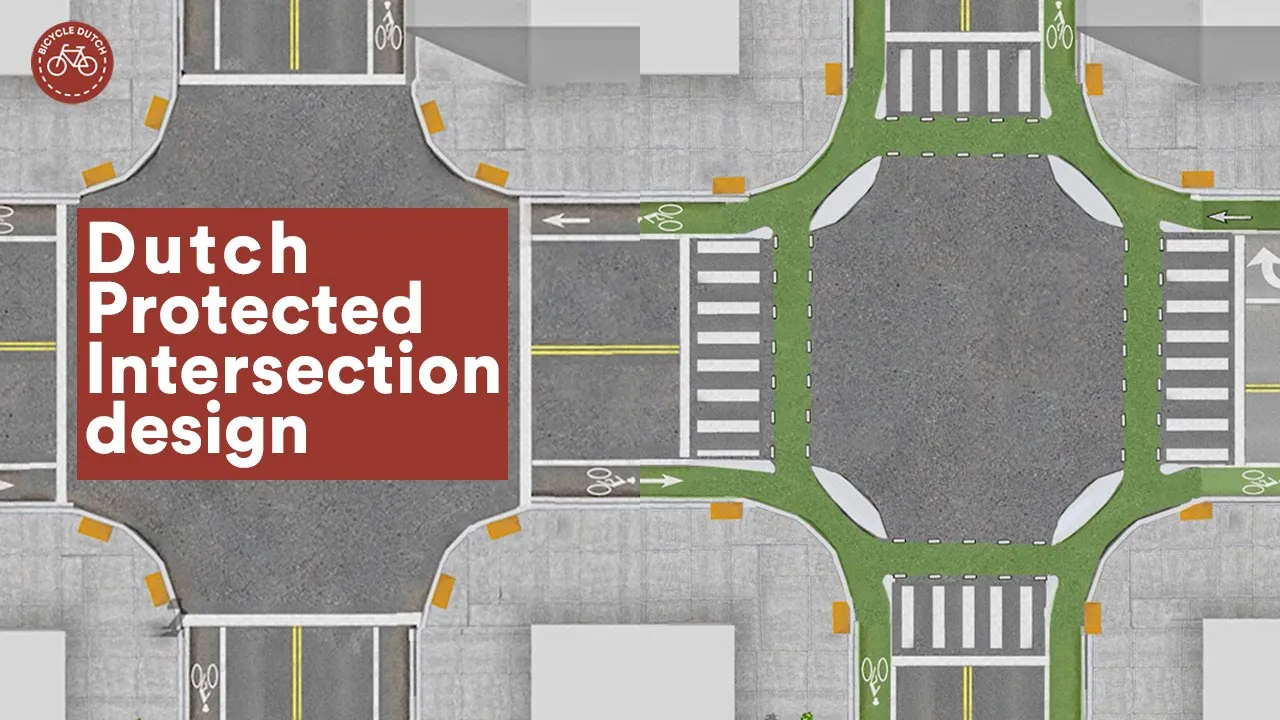
Reorganizing existing intersection curb space into corner islands eliminates hazardous vehicle blind spots without requiring wider streets.
AI-assisted summary of Intersection design, the Dutch - cycle friendly - way — original source. Check the original for full context.
Source published:
Key ideas
- Standard US intersection engineering forces cyclists and right-turning motor vehicles into a hazardous pre-intersection weave zone where drivers must check blind spots over their right shoulders. (0:01)
- Dutch protected intersections fit within standard intersection footprints without requiring wider streets, repurposing existing corner curb radii into protective islands. (0:34)
- Setting vehicle stop lines back aligns drivers' natural forward sightlines with bicycle crossings, enabling direct eye contact and eliminating blind-spot turning collisions. (0:34)
- Corner islands in all four quadrants naturally facilitate safe two-stage left turns for cyclists while accommodating dedicated zebra crossings for pedestrians. (0:34)
Detailed notes
## Background Published on YouTube by BicycleDutch on April 3, 2011, this video (Episode 120) addresses the misconception that Dutch cycle-friendly intersections require wider streets. The description explains that protected intersections can be implemented within standard street footprints without requiring any additional space.
## TL;DR The video contrasts conventional US intersection design with the Dutch protected junction layout. Standard American road designs force hazardous weaving zones and bad-angle blind spots by routing bike lanes between through-traffic and right-turn lanes. Dutch traffic engineers solve this by maintaining cycle separation to the far right and utilizing protective corner islands carved out of existing curb radii. Shifting the stop line back enhances pedestrian crossings, provides direct forward sightlines between drivers and cyclists, and facilitates safe two-stage left turns without expanding the road's footprint.
## Atmosphere & style The presentation carries a calm, pragmatic, and educational tone that methodically deconstructs standard engineering flaws using straightforward spatial logic. It feels like an authoritative, clear-headed urban planning lesson that demystifies road safety without sensationalism. The matter-of-fact delivery imparts a quiet confidence, making a complex traffic engineering dilemma appear completely manageable through thoughtful, practical geometry.
## Bulletin - [00:01](https://www.youtube.com/watch?v=FlApbxLz6pA&t=1s) Standard US intersection engineering forces cyclists and right-turning motor vehicles into a hazardous pre-intersection weave zone where drivers must check blind spots over their right shoulders. - [00:34](https://www.youtube.com/watch?v=FlApbxLz6pA&t=34s) Dutch protected intersections fit within standard intersection footprints without requiring wider streets, repurposing existing corner curb radii into protective islands. - [00:34](https://www.youtube.com/watch?v=FlApbxLz6pA&t=34s) Setting vehicle stop lines back aligns drivers' natural forward sightlines with bicycle crossings, enabling direct eye contact and eliminating blind-spot turning collisions. - [00:34](https://www.youtube.com/watch?v=FlApbxLz6pA&t=34s) Corner islands in all four quadrants naturally facilitate safe two-stage left turns for cyclists while accommodating dedicated zebra crossings for pedestrians.
## Key takeaways - [00:01](https://www.youtube.com/watch?v=FlApbxLz6pA&t=1s) Standard US urban design guides place bicycle lanes between general through-lanes and right-turn lanes. - [00:01](https://www.youtube.com/watch?v=FlApbxLz6pA&t=1s) Positioning bike lanes to the left of turn lanes creates a dangerous crossing angle and severe blind spots for motorists. - [00:01](https://www.youtube.com/watch?v=FlApbxLz6pA&t=1s) Dutch traffic engineering abandoned pre-intersection weaving zones decades ago in favor of keeping cyclists consistently separated to the far right. - [00:34](https://www.youtube.com/watch?v=FlApbxLz6pA&t=34s) The Dutch protected intersection requires no extra road width or land acquisition compared to traditional junction layouts. - [00:34](https://www.youtube.com/watch?v=FlApbxLz6pA&t=34s) Protective corner islands are carved out by mirroring the original turning radius of the street corner with an additional curb. - [00:34](https://www.youtube.com/watch?v=FlApbxLz6pA&t=34s) Colored asphalt and high-visibility crossing markings visually reinforce dedicated cyclist paths across the intersection. - [00:34](https://www.youtube.com/watch?v=FlApbxLz6pA&t=34s) Pushing the motorized vehicle stop line back creates dedicated space for pedestrian zebra crossings. - [00:34](https://www.youtube.com/watch?v=FlApbxLz6pA&t=34s) The set-back geometry ensures turning drivers face crossing cyclists directly through their front windshield rather than glancing over their shoulders. - [00:34](https://www.youtube.com/watch?v=FlApbxLz6pA&t=34s) Corner islands provide intuitive, sheltered waiting areas for cyclists executing two-stage left turns. - [00:34](https://www.youtube.com/watch?v=FlApbxLz6pA&t=34s) The protected intersection layout represents standard, everyday road engineering across the Netherlands rather than an experimental design.
## Detailed walkthrough ### [00:01](https://www.youtube.com/watch?v=FlApbxLz6pA&t=1s) The Flaws of Standard US Intersection Design
Standard road layouts in the United States, drawn straight from official urban design guides using standard lane widths, present a fundamental safety hazard when integrating cycle infrastructure alongside turning lanes. Under standard American recommendations, a bicycle lane is typically routed to the left of a dedicated right-turn lane, forcing cars and cyclists to weave across one another prior to entering the intersection.
The narrator identifies this weave zone as inherently dangerous because of the severe blind spots it creates for motorists. As the narrator explains: “The problem with this design is the extremely bad angle of crossing.” Drivers must physically crane their necks and glance over their right shoulder while moving forward to check if a cyclist is approaching in their blind spot. Because of these hazardous conflict zones, Dutch traffic engineers abandoned this style of road engineering decades ago. Instead of forcing cyclists to mix with general traffic or shift across active vehicle lanes before an intersection, Dutch planners position cyclists consistently to the far right of motorized vehicles and handle intersection crossings directly at the junction itself.
- Standard American intersection design places the cycle lane between general through-traffic and a right-turn lane, requiring drivers to look backward over their right shoulder across the bike lane. - In contrast, the Dutch design philosophy keeps bicycle traffic separated to the right side of motorized vehicles right up to the junction, eliminating weaving zones ahead of the intersection.
```mermaid flowchart LR accTitle: Standard US vs Dutch Intersection Conflict Points accDescr: Diagram contrasting the pre-intersection weave in US design with Dutch protected right-hand placement.
subgraph US["Standard US Intersection Design"] direction TB A1["Car approaching turn"] -->|"Weaves across bike lane"| C1["Conflict Zone (Bad Angle / Blind Spot)"] B1["Cyclist continuing straight"] --> C1 end
subgraph Dutch["Dutch Protected Approach"] direction TB A2["Car approaching turn"] -->|"Stays in vehicle lane"| D2["Right Turn onto Junction"] B2["Cyclist continuing straight"] -->|"Stays on far right"| E2["Protected Crossing at Junction"] end ```
---
[00:34](https://www.youtube.com/watch?v=FlApbxLz6pA&t=34s) Geometry and Safety Mechanics of the Dutch Protected Intersection
To make intersections safe without requiring wider streets or taking up additional land, the Dutch design simply reorganizes the existing space. An extra curb is constructed with the exact same turning radius as the original street corner, effectively creating a physical barrier to separate the cycle track from vehicle traffic. Because turning motor vehicles should already be steering clear of the bike lane, this modification carves out room for a protective corner traffic island. Opening up this curb allows bicyclists traveling straight to pass directly across the junction along a dedicated path. This protective geometry can be placed into all four corners of a standard four-way intersection without increasing the total footprint of the roadway.
Visual clarity is enhanced by applying colored asphalt to the cycle path and adding high-visibility crossing markings across the vehicle lane. Pedestrian safety is addressed by setting the vehicle stop line slightly further back from the intersection, creating ample space for a zebra crossing. This set-back stopping position and island geometry transform sightlines: turning vehicles wait where the driver can look forward to see cyclists waiting or crossing, rather than checking over their shoulders. Cyclists clear the intersection quickly, but even when a vehicle and bicycle meet, direct eye contact is straightforward since both individuals face forward. Additionally, the corner islands solve the classic challenge of two-stage left turns for cyclists. While skeptics might assume such an arrangement is merely theoretical, the narrator emphasizes: “It really needs no more space than a traditional junction.” The result is standard Dutch junction geometry that dramatically improves safety and makes cycling vastly more comfortable.
- **Geometric footprint:** The protective corner islands utilize the existing curb radius, requiring zero extra street width compared to conventional road layouts. - **Pedestrian and stop line adjustments:** Shifting the vehicular stop line back provides room for a dedicated zebra crossing and significantly improves visibility for foot traffic. - **Visibility and sightlines:** When turning right, drivers face the bicycle crossing directly through their windshield, enabling natural forward-facing eye contact with cyclists. - **Left-turn solution:** The four-corner protected island network provides cyclists with an intuitive, protected two-stage left turn across the intersection. - **Everyday implementation:** Far from being an experimental concept, this layout serves as the everyday, standard junction design across the Netherlands.
## Mentioned BicycleDutch, United States, Netherlands
## Video description [Ep. 120] The Dutch build cycle paths that continue on their intersections. They must have wider streets, right? Wrong! This video shows how these so-called "Protected Intersections" are built, no extra space is needed. More info: http://bicycledutch.wordpress.com/2011/04/07/state-of-the-art-bikeway-design-or-is-it/ And see part 2 of this video too: http://www.youtube.com/watch?v=5HDN9fUlqU8
A real-life example of this protected intersection design is shown in the following video: https://www.youtube.com/watch?v=TemAwgUrWJc
[Source](https://www.youtube.com/watch?v=FlApbxLz6pA)