YouTube Powers 4B Daily Views on 1M Lines of Python, Solomon Says
Next Day Video
Massive system scale depends on algorithmic partitioning and loose consistency guarantees rather than premature optimization, allowing rapid Python prototypes and relational databases to survive hypergrowth.
AI-assisted summary of Scalability at YouTube — original source. Check the original for full context.
Source published:
Key ideas
- YouTube's core infrastructure heavily relies on over a million lines of Python, scaling through a 9-order-of-magnitude increase in view traffic from initial prototypes to handling over 4 billion daily views. (9:33)
- To escape exorbitant commercial bandwidth costs, YouTube engineered its own custom CDN in two weeks using dense server racks, Lighttpd, and a Python 404 handler, delivering 60 Gbps on its first day. (35:06)
- YouTube scaled its MySQL database tier by developing Vitess in Go to optimize queries, pool connections, and route traffic via custom RPCs, dispelling the belief that relational databases cannot scale. (29:47)
- Replacing an early HTTP and pickle-based internal RPC layer with direct socket RPCs cut YouTube's global CPU usage by roughly 8%, while custom BSON serializers outperformed off-the-shelf alternatives by 10x to 15x. (26:47)
Detailed notes
## Background Published on YouTube by Next Day Video on March 11, 2012, this conference session features YouTube Developer Advocate Shannon -jj Behrens and foundational YouTube engineer Mike Solomon at PyCon. According to the video description, the talk offers a rare glimpse into the architectural heart of YouTube—one of the largest web platforms in the world—and explores how it scales its massive infrastructure using Python.
## TL;DR Following an opening by Shannon -jj Behrens on YouTube's operational footprint and API integrations, early engineer Mike Solomon outlines the architectural philosophies that allowed YouTube to scale its view traffic across nine orders of magnitude. Solomon advocates for starting simple with loose behavioral guarantees, using techniques like divide and conquer, approximate correctness, and cache jitter to maintain system stability. He reviews YouTube's core technology choices—including Apache, the custom Wise Guy FastCGI container, MySQL paired with Vitess, Spitfire templating, and an in-house CDN built in two weeks with Lighttpd—while urging engineers to prioritize clean data contracts and macro-level architecture over micro-optimizations.
## Atmosphere & style The talk opens with playful tech banter and developer-advocate humor before shifting into the dry, candid reflections of an engineer who built critical systems from the ground up. Mike Solomon presents with unpretentious authenticity, treating staggering web-scale challenges with casual pragmatism and deadpan wit. Watching the session feels like sitting in on an intimate post-mortem with a veteran hacker who openly shares past architectural blunders and war stories to demystify distributed systems.
## Bulletin - [09:33](https://www.youtube.com/watch?v=G-lGCC4KKok&t=573s) YouTube's core infrastructure heavily relies on over a million lines of Python, scaling through a 9-order-of-magnitude increase in view traffic from initial prototypes to handling over 4 billion daily views. - [35:06](https://www.youtube.com/watch?v=G-lGCC4KKok&t=2106s) To escape exorbitant commercial bandwidth costs, YouTube engineered its own custom CDN in two weeks using dense server racks, Lighttpd, and a Python 404 handler, delivering 60 Gbps on its first day. - [29:47](https://www.youtube.com/watch?v=G-lGCC4KKok&t=1787s) YouTube scaled its MySQL database tier by developing Vitess in Go to optimize queries, pool connections, and route traffic via custom RPCs, dispelling the belief that relational databases cannot scale. - [26:47](https://www.youtube.com/watch?v=G-lGCC4KKok&t=1607s) Replacing an early HTTP and pickle-based internal RPC layer with direct socket RPCs cut YouTube's global CPU usage by roughly 8%, while custom BSON serializers outperformed off-the-shelf alternatives by 10x to 15x.
## Key takeaways - [00:01](https://www.youtube.com/watch?v=G-lGCC4KKok&t=1s) YouTube serves more than 4 billion video views per day with over 60 hours of video uploaded every minute across 350 million enabled devices. - [09:33](https://www.youtube.com/watch?v=G-lGCC4KKok&t=573s) Foundational subsystems including transcoding, indexing, search, streaming, and CDN logic originated as simple Python prototypes that stayed in production long term. - [13:31](https://www.youtube.com/watch?v=G-lGCC4KKok&t=811s) The guiding architectural philosophy is to prioritize simplicity and loose guarantees early to avoid painting system designs into unworkable corners. - [14:50](https://www.youtube.com/watch?v=G-lGCC4KKok&t=890s) Approximate correctness allows distributed systems to avoid expensive global transactions when data inconsistencies are imperceptible to users. - [18:14](https://www.youtube.com/watch?v=G-lGCC4KKok&t=1094s) Injecting artificial randomness (jitter) into cache expiration windows prevents self-synchronization and devastating thundering-herd effects on backend services. - [18:14](https://www.youtube.com/watch?v=G-lGCC4KKok&t=1094s) Updating view counters via infrequent batching and pseudo-random increments avoids overwhelming transactional databases with single-increment writes. - [22:04](https://www.youtube.com/watch?v=G-lGCC4KKok&t=1324s) Failing to define explicit typed data contracts between architectural layers—such as passing generic dictionaries between serving and templating tiers—generates massive technical debt. - [24:26](https://www.youtube.com/watch?v=G-lGCC4KKok&t=1466s) Raw code execution speed does not equal system scalability; structural partitioning, boundary management, and clean algorithmic design provide far greater returns. - [24:26](https://www.youtube.com/watch?v=G-lGCC4KKok&t=1466s) Application runtimes in Python are frequently dominated by payload serialization, deserialization, and garbage collection rather than core business logic. - [26:47](https://www.youtube.com/watch?v=G-lGCC4KKok&t=1607s) Writing straightforward, easily searchable code without heavy metaprogramming or magic keeps execution fast and systems maintainable. - [26:47](https://www.youtube.com/watch?v=G-lGCC4KKok&t=1607s) YouTube operates on a synchronous FastCGI servlet container called Wise Guy behind standard Apache web servers rather than an asynchronous event loop. - [29:47](https://www.youtube.com/watch?v=G-lGCC4KKok&t=1787s) Linux provides critical low-level observability tools like strace and tcpdump that expose system resource usage regardless of application code quality. - [29:47](https://www.youtube.com/watch?v=G-lGCC4KKok&t=1787s) Apache ZooKeeper serves as YouTube's central distributed lock manager and configuration management system. - [33:14](https://www.youtube.com/watch?v=G-lGCC4KKok&t=1994s) YouTube organizes Python code primarily using namespaces and treating classes as lightweight C-style structs rather than deep object-oriented hierarchies. - [37:40](https://www.youtube.com/watch?v=G-lGCC4KKok&t=2260s) Live schema and infrastructure migrations are safely executed by incrementally canarying read traffic while validating writes through extensive pre-cutover simulations.
## Detailed walkthrough ### [00:01](https://www.youtube.com/watch?v=G-lGCC4KKok&t=1s) Introduction and YouTube Platform Scale
Shannon -jj Behrens opens the session at PyCon, jokingly introducing himself as a YouTube Developer Advocate, or a self-described “booth babe,” before playfully observing that the shtick isn't working because the audience has far too many men. He compares his opening remarks to the pre-roll advertisement viewers have to sit through before watching a Shakira video, explaining that just as Shakira needs to get paid, he is there to deliver the commercial upfront. His objective is to discuss how Python-based startups can leverage the YouTube platform to grow their businesses.
Behrens presents several high-level figures illustrating the operational footprint and growth of YouTube:
- YouTube serves more than 4 billion video views per day. - Every single minute, users upload over 60 hours of video content. He jokes that in the early days, the platform only took in around 39 hours per minute and could fit everything onto a single hard drive before needing to upgrade to RAID. - Across the globe, more than 350 million devices are YouTube-enabled. - Financially, YouTube's revenue more than doubled in 2010, establishing it as a profitable enterprise.
[01:16](https://www.youtube.com/watch?v=G-lGCC4KKok&t=76s) Four Strategies for Startups on YouTube
To help developers and founders take advantage of this reach, Behrens outlines four core strategic approaches startups can employ:
1. **Creating viral video content:** Producing engaging media that catches on virally to ride organic distribution waves. 2. **Engaging with the community:** Creating substantive content to cultivate and interact directly with an audience. 3. **Integrating with YouTube APIs:** Embedding YouTube functionalities directly into existing products. 4. **Innovating with new applications:** Building entirely novel applications powered by YouTube's backend and frontend APIs.
[01:56](https://www.youtube.com/watch?v=G-lGCC4KKok&t=116s) Viral Marketing and Community Engagement Examples
Illustrating the viral media route, Behrens plays an elaborate tech-rap music video featuring lyrics about the "blogosphere," the "Twitterverse," dominating the online scene, and dreaming of becoming the next Zuckerberg. After restarting the clip so the room can hear the audio clearly, he reveals that the production was actually an organic viral commercial for a VoIP provider. As Behrens points out, tech-minded people who enjoy and share the humorous video are precisely the demographic most likely to purchase a VoIP service, proving that a well-crafted viral campaign can substitute for expensive advertising budgets: “And so you know, you make this video, it goes viral, and then suddenly you don't have to pay for marketing cuz it's free.”
Switching to the second strategy—community engagement—Behrens showcases a video produced by a boutique skateboard company. Originally, the founders spent heavily on conventional social networking ads to reach skateboarders, with minimal return. They changed tactics completely: they began filming skateboarding videos, uploading them directly to YouTube, and actively answering questions in the comments whenever viewers asked about their boards. Behrens recounts speaking with the founders directly, noting: “And I talked to these guys and they're like, 'Yeah, we're not doing anything else. This worked better than, you know, spending money on anything else. This is all we're doing from now on.'” He highlights that unlike television, which remains a one-way broadcast, YouTube functions as a conversational medium where companies can directly converse with their customer base.
[06:48](https://www.youtube.com/watch?v=G-lGCC4KKok&t=408s) API Integration and Custom Innovation
Behrens covers the third strategy—product integration—by presenting YouTube Direct, an open-source App Engine application. News organizations and content publishers embed YouTube Direct into their websites to let users submit user-generated video directly to the publisher's platform, building deeper community involvement.
```mermaid flowchart TD accTitle: YouTube Integration and Innovation Paths accDescr: Diagram showing how products integrate via YouTube Direct or innovate using custom player and data APIs.
subgraph Integration["YouTube Direct (App Engine)"] A["User Video Submission"] --> B["Embedded Web Widget"] B --> C["News / Media Site Backend"] end
subgraph Innovation["Custom Client Application"] D["YouTube Data API"] --> E["App Interface (e.g. History of Jazz)"] F["Customized Player API"] --> E E --> G["Monetization (Paid App & iTunes Links)"] end ```
For the fourth strategy—innovating entirely new software—he showcases *The History of Jazz*, an interactive iPad application designed like a digital coffee-table book. The application uses YouTube's APIs to stream historical performances alongside educational narratives. The developers monetize through dual revenue streams: upfront app purchases and integrated iTunes links for the featured tracks.
[08:01](https://www.youtube.com/watch?v=G-lGCC4KKok&t=481s) YouTube APIs and Python Implementation
Behrens breaks down YouTube's developer surface into two distinct API tiers:
- **Google Data APIs (Backend):** Built around RESTful principles utilizing Atom and JSON formats. Behrens jokes that he attempted to convince the team to adopt CORBA instead, but was turned down. Client libraries are provided for Python as well as other platforms. The Data API allows applications to handle video uploads, searches, ratings, comments, and playlist management. By using OAuth 2.0 authentication, third-party apps can perform these actions directly on behalf of authenticated user accounts. - **Player APIs (Frontend):** Accessible via JavaScript and ActionScript, allowing developers to manipulate playback, tweak operational player parameters, or embed a completely chromeless version of the video player for bespoke user experiences.
Demonstrating the developer workflow, Behrens displays a Python snippet showing how simple it is to pull data from YouTube:
```python import gdata.youtube import gdata.youtube.service
yt_service = gdata.youtube.service.YouTubeService() query = gdata.youtube.service.YouTubeVideoQuery() query.vq = 'python' query.orderby = 'viewCount' feed = yt_service.YouTubeVideoQuery(query)
for entry in feed.entry: print(entry.media.title.text) print(entry.GetSwfUrl()) ```
He concludes by directing developers to the `@YouTubeDev` Twitter handle, his blog at `gx.blogspot.com`, and reminding the audience to consult the Terms of Service and monetization guidelines before introducing the featured speaker.
[09:33](https://www.youtube.com/watch?v=G-lGCC4KKok&t=573s) Mike Solomon on YouTube's Scale and Python Foundation
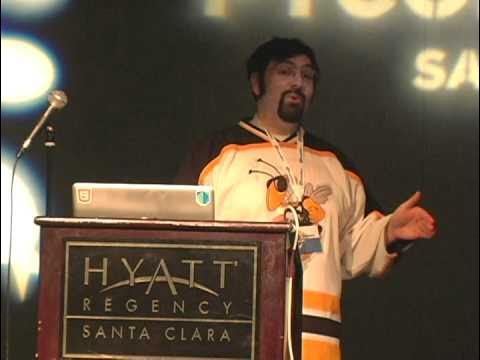
Behrens hands the presentation over to Mike Solomon, introducing him as the first employee at YouTube and the engineer who was originally responsible for ensuring every single video played when a user clicked the play button.
Solomon takes the stage, joking about running the slides from the back, and reflects on the challenge of compressing seven years of rapid architectural evolution into a single 30-minute conference presentation. He clarifies that while the talk targets scalability principles applicable across multiple programming languages, YouTube's core identity remains tied to Python.
Over his tenure, Solomon designed and built several foundational components of YouTube's infrastructure: - Core server architecture - Video indexing pipelines - Video transcoding services - Full-text search infrastructure - Internal Content Delivery Network (CDN) - Video delivery and streaming mechanisms - Image serving systems
He explains that nearly all of these subsystems began as rapid Python prototypes, and those prototypes proved resilient enough to remain in active production far longer than anticipated. Even as the company scaled, Python maintained its dominance across the codebase. Solomon reports: “And at last count there was like over a million lines of Python running running this thing, so lest anybody doubt, we actually really do use Python in a very, very big way.” Every user watching a video triggers execution across layers of Python services.
Solomon outlines the thesis for the remainder of his lecture: distinguishing between the often-confused concepts of *scalability* and *efficiency*, both of which become critical when a system expands beyond normal limits. To contextualize the engineering hurdles the team tackled, Solomon notes that during his time at YouTube, video view traffic multiplied by nine orders of magnitude.
[12:10](https://www.youtube.com/watch?v=G-lGCC4KKok&t=730s) The Core Ethos: Start Simple, Add Complexity Later
Scalability spans multiple axes—how code is written, executed, and maintained over time. When tasked with designing a new system or addressing a problem space, the foundational instinct should always be simplicity. Although real-world engineering is full of intricate problems, the initial version does not need to be complicated. Mike Solomon emphasizes that systems evolve gradually: many YouTube systems began as a single Python file before growing into sprawling ecosystems over many years. A truly scalable system operates smoothly in the background without getting in the engineer's way, rather than relying on buzzwords.
> “I mean the if I could if I could give you one word about scalable systems I think the word would be simple and every time I'm trying to build something new or look at at a way to solve a problem I'm looking for the most simple thing that will actually you know address the problem space and um you know thing there are lots of complicated problems but the first crack doesn't have to be that complicated the complexity will come over time naturally you can start you don't have to help it out at the beginning” — Mike Solomon
[13:31](https://www.youtube.com/watch?v=G-lGCC4KKok&t=811s) The “Tao of YouTube” and Preserving Flexibility
The guiding philosophy—the "Tao of YouTube"—centers on choosing the simplest solution possible with the loosest practical guarantees. Over-specifying a system or attempting to guarantee every behavior immediately paints an architecture into a corner, introducing artificial complexity and eliminating escape hatches when assumptions fail. In design reviews, engineers are encouraged to ask how a feature can iterate and how data will genuinely be used, because early assumptions rarely hold over time. Solomon jokes that YouTube originally started out as a video dating site; had the team rigidified the architecture around that initial premise, the platform would not have survived to become what it is today.
> “The reason that you want all these things is because you need flexibility to solve problems and the minute you overs specify something you paint yourself into a corner you're not going to be able to to make those guarantees and you you know the your problem becomes automatically complex when you're trying to guarantee everything and you you leave yourself no way out” — Mike Solomon
```mermaid flowchart TD accTitle: System Scalability Evolution Loop accDescr: Diagram illustrating how systems start with simple files and loose guarantees, iterate through dynamic changes, and scale out safely.
subgraph Design["Design Philosophy"] A["Single Python File / Minimal Design"] --> B["Loose Guarantees & Maximum Flexibility"] end
subgraph Growth["Evolutionary Scaling"] B --> C{"Work Partitioning"} C -->|"Divide & Conquer"| D["Stateless Web Tier"] C -->|"Sharding"| E["Database Shards"] end
subgraph Techniques["Operational Tricks"] D --> F["Dynamic Python Modifications"] E --> G["Approximate Correctness & Jitter"] end ```
[14:50](https://www.youtube.com/watch?v=G-lGCC4KKok&t=890s) Divide and Conquer, Dynamic Python, and Approximate Correctness
The cornerstone technique of scalability is divide and conquer: partitioning work and determining execution boundaries. In the web tier, this manifests as spraying requests across a pool of independent, largely identical web servers. In the storage layer, it underpins database sharding—subdividing datasets and minimizing communication between partitions. Because Python is entirely dynamic, even an imperfect early API can be rescued later: engineers can stub, modify, or decorate their way around edge cases using quick adjustments rather than rewriting foundational layers.
Another essential technique is approximate correctness. Solomon references a basic law of systems: the state of the system is simply whatever it is reported to be. If an inconsistency is invisible to a user, it functionally does not exist. For example, if a user posts a comment, another viewer across the world does not need to see it within 300 to 400 milliseconds; the author, however, expects to see their own comment immediately. Rather than forcing expensive worldwide transactions, the platform cheats locally for the author while allowing eventual consistency across the rest of the globe.
> “Approximate correctness is another one of my favorite techniques um this is sort of a you know one of the first rules of of systematics is the state of the system is that what it which is reported to be so if you can't tell that that your system is fundamentally skewing and and inconsistent as from the user perspective then it's not” — Mike Solomon
- Divide and conquer applies equally to horizontal stateless web tiers and relational database sharding strategies. - Python's dynamic runtime allows teams to modify, decorate, and stub out problematic API calls in production without heavy redesigns. - Tailoring consistency models to specific sub-features avoids global transactional overhead (e.g., loose eventual consistency for video comments versus strict persistence for paid movie rentals).
[18:14](https://www.youtube.com/watch?v=G-lGCC4KKok&t=1094s) System Entropy, Jitter, and the Value of Cheating
Distributed applications behave like chaotic weather systems where minor delays cause cascading issues. If identical cache expirations are configured across popular videos—for instance, caching a daily top video for an exact 24-hour window—every server will observe the expiration at the identical moment and stampede the backend in a self-inflicted thundering herd. YouTube combats this by introducing jitter: setting a target cache lifetime of 24 hours but randomly scattering the expiration between 18 and 30 hours. Unchecked distributed systems naturally tend to self-synchronize—such as when multiple threads block on a single slow disk—removing entropy from the system until an artificial injection of randomness (jitter) breaks the lockstep.
Solomon also highlights the engineering value of deliberate "cheating," echoing advice from his former boss:
> “My old boss told me that the fastest function call is the one that never happens and I have to I have to agree” — Mike Solomon
A concrete example is managing monotonically increasing counters, such as video views or profile view counters. Executing an ACID transaction on every single increment is prohibitively expensive. Instead, the application runs transactions infrequently, batching updates by a pseudo-random amount. As long as the count noticeably shifts from odd to even, users perceive the counter as dynamic and real without imposing crushing load on underlying transactional databases.
[21:07](https://www.youtube.com/watch?v=G-lGCC4KKok&t=1267s) Data-Centric Architecture and Scalable Components
Well-designed scalable components are identifiable by clean inputs, distinct outputs, and well-managed contracts. As YouTube expanded and engineering headcounts grew, defining tight data structures became far more critical than relying on written documentation. When a data object clearly specifies what enters and leaves a function, engineers can inspect the object directly to understand the system state before and after transformations. While Solomon admits the YouTube codebase had not always been flawless at enforcing rigorous data boundaries everywhere, establishing predictable data flows remains vital for debugging, setting operational expectations, and keeping large architectures comprehensible.
[22:04](https://www.youtube.com/watch?v=G-lGCC4KKok&t=1324s) Drawing Clean Boundaries: RPCs and Data Contracts
Mike Solomon reflects on how systems inevitably evolve toward Remote Procedure Calls (RPCs), particularly within a Python environment. Because Python is dynamically typed and inherently loose, the internal structure of an application depends entirely on programmer discipline. Establishing firm conventions early on is critical, but when conventions break down, introducing a hard RPC boundary acts as a firewall. Solomon illustrates this simple interface contract: “I will give you an integer and you should give me a Boolean back and that's it you know that that is that is a sum total of our conversation.” Clear component boundaries allow services to be swapped in and out over time. Initial versions might last only a month or six months before needing replacement, whether that means rewriting a Python component in C, altering it, or discarding it altogether.
As engineering teams scale, nobody can grasp the entirety of the codebase at once. Systems must be partitioned into well-defined subcomponents with clear domains—such as separating video transcoding from video search or database infrastructure. However, these distinct systems still need to share data, making explicit data specifications vital. Solomon confesses what he considers his own worst architectural mistake: defining the boundary between the serving layer and the templating layer as a generic dictionary.
```mermaid flowchart LR accTitle: Python Serving Layer to Template Layer Interface accDescr: Diagram illustrating how the serving layer passed a bloated dictionary to the template layer instead of a typed data object.
subgraph ProblematicDesign["Untyped Interface (The 'Greatest Sin')"] direction LR S["Serving Layer"] -->|"Dict with 100s of keys"| T["Template Layer"] end
subgraph PreferredDesign["Intended Typed Interface"] direction LR S2["Serving Layer"] -->|"WatchPage Object"| T2["Template Layer"] end ```
He explains that spending just ten minutes creating an explicit data object would have avoided years of technical debt: “The like the greatest sin I think I ever committed was the interface between the the serve layer and the template layer is a dictionary this is this is a phenomenally bad idea you you should not do this.” Instead of having a clean `WatchPage` object encapsulating video details, comments, and related videos, the application ended up passing around an untyped dictionary containing hundreds of arbitrary attributes.
- **Component Lifespans:** Early iterations often survive only one to six months; boundaries give engineers the flexibility to rewrite, tune, or discard components as performance needs dictate. - **Cognitive Load:** Well-defined boundaries prevent engineers from needing complete codebase knowledge to work on subsystems like search or transcoding. - **The Dictionary Antipattern:** Using raw dictionaries across major architectural tiers obscures data dependencies and makes maintainability significantly harder over time.
---
[24:26](https://www.youtube.com/watch?v=G-lGCC4KKok&t=1466s) Algorithmic Focus, Python Efficiency, and Profiling Pitfalls
Solomon reiterates that raw execution efficiency does not correlate with scalability, noting that cramming logic into a single monolithic C process might be mechanically efficient but fails entirely when human developer time is valued. The biggest operational gains come from architectural decisions at the macro level—determining whether a routine belongs inline, behind an RPC, or tucked into a subpackage for future migration. Furthermore, focusing on algorithmic complexity yields massive rewards. Python excels here because the barrier to implementing sound algorithms is remarkably low. Modules like `bisect` allow developers to take unsophisticated, accidentally sorted lists, perform fast operations, serialize them, and read them back in at orders-of-magnitude lower computational cost without reinventing basic data structures in C.
Efficiency in Python also requires careful profiling and measurement, which Solomon compares to reading tea leaves. Intuitive guesses about bottlenecks are frequently wrong due to hidden runtime overheads, such as garbage collection costs. A massive portion of YouTube’s application runtime is consumed simply serializing and deserializing data. Profiling these serializers requires realistic input; Solomon warns that testing a serializer with simple integers yields completely deceptive numbers if production actually passes 4KB Unicode blobs through the system.
- **Efficiency vs. Scalability:** Squeezing maximum speed out of a single process often hurts scalability; architectural partitioning and macro-level design must take priority over micro-optimizations. - **Algorithmic Wins in Python:** Tools like the built-in `bisect` module provide high-order performance improvements with negligible engineering overhead compared to custom C implementations. - **Garbage Collection and Serialization:** Application runtimes are frequently dominated by payload serialization and memory management rather than pure business logic. - **Benchmarking Real Payloads:** Synthetic benchmark data (such as bags of integers) fails to capture production behavior, where large Unicode payloads expose serializer inefficiencies.
---
[26:47](https://www.youtube.com/watch?v=G-lGCC4KKok&t=1607s) Keeping Code “Dumb”: Libraries, Custom Frameworks, and Apache
Achieving efficiency in Python is often about knowing what *not* to do. Solomon cautions that heavy metaprogramming and dynamic runtime tricks directly increase execution costs: “Dumb tends to turn out to be fast so this is something that we also we use a lot and it also it has other side effects too Dumber code is easier to grep for is easier to maintain.” Straightforward, readable code benefits engineers who rely on traditional terminal workflows using tools like Emacs and `grep`. Highly magical codebases obscure what is actually happening under the hood.
Solomon details the specific networking, serving, and templating components that power YouTube:
| Component / Layer | Technology Used | Architecture and Operational Role | |:--- |:--- |:--- | | **HTTP Client Library** | `cURL` (`pycURL`) | Chosen because most client-side HTTP libraries are poor; `cURL` is complex to integrate with, but provides outstanding baseline performance. | | **Internal RPC Protocol** | Direct socket RPC (custom) | Replaced an earlier HTTP/pickle-based transport; dropping HTTP enveloping and adopting direct sockets lowered YouTube's global CPU usage by roughly 8%. | | **Application Container** | **Wise Guy** | A FastCGI servlet container built with C and preforked process management. YouTube operates on a blocking, synchronous model rather than an asynchronous event loop. | | **Web Server** | **Apache HTTP Server** | Every incoming request to YouTube routes through Apache at some stage. Solomon highlights Apache as rock-solid, dispelling myths that high-scale sites must replace it. | | **Templating Engine** | **Spitfire** | Similar to Cheetah; compiles templates using an internal Abstract Syntax Tree (AST) to apply code transformations and runtime optimizations. |
Solomon stresses that engineers must evaluate their data formats carefully, explicitly warning against Python's default serialization: “Don't use pickle for things if it's going if it's I don't think I should have to tell you this but yeah don't use pickle we did it's not a good choice.”
---
[29:47](https://www.youtube.com/watch?v=G-lGCC4KKok&t=1787s) Core Infrastructure: Linux, MySQL, Vitess, and ZooKeeper
Solomon details YouTube's underlying infrastructure stack, highlighting Linux as the ideal operating system for distributed engineering. Having worked previously on BSD and Windows at Microsoft, he favors Linux for its observability “manholes.” Even when an application is poorly written, its underlying system resource consumption remains fully discoverable using standard utilities such as `strace` and `tcpdump`.
MySQL serves as YouTube’s primary operational database. Every video watched on the platform pulls substantial data from MySQL instances, functioning alternately as a traditional relational store or simply as a high-throughput blob store. Solomon dismisses broad claims that relational databases cannot operate at web scale: “Anybody who sort of blind you tell blindly tells you that MySQL doesn't scale or doesn't do something probably has not considered exactly how to solve the problem.”
To scale their database tier, YouTube developed **Vitess**, a Go-based front end and proxy for MySQL that Solomon works on directly. Vitess sits in front of the database clusters, dynamically rewriting and optimizing queries, performing connection pooling and proxying, and serving every incoming database request via custom RPCs. Finally, Solomon highlights **Apache ZooKeeper**, which he half-jokingly calls the lone piece of Java software that makes him think Java might be redeemable. YouTube uses ZooKeeper as a distributed lock manager and highly reliable filesystem-like store to manage system-wide configuration.
- **System Observability:** Linux provides low-level diagnostics (`strace`, `tcpdump`) that allow engineers to inspect exactly how running code interacts with the kernel and network. - **MySQL Utilization:** Used flexibly across YouTube as both a relational database and a blob storage engine depending on the workload and data model. - **Vitess:** Built in Go to handle query optimization, traffic routing, and connection scaling upstream of MySQL instances; powers YouTube's database traffic. - **Apache ZooKeeper:** Provides robust distributed coordination, locking, and configuration management across YouTube's infrastructure.
[32:04](https://www.youtube.com/watch?v=G-lGCC4KKok&t=1924s) Engineering Productivity and the Pet Peeve of Trivial Documentation
Mike Solomon shifts from database technologies to productivity, remarking that with complex tools, “you have to actually read the manual” rather than blindly tossing things in. When it comes to engineering productivity, Solomon admits the concepts are somewhat nebulous and that he believes far more in guiding philosophy than rigid doctrine. While teams preach simplicity, he acknowledges that defining it in the abstract is impossible: “All right, make it simple—what does that mean? I don’t know, but I’ll know it when I see it.” If an engineer’s first pull request arrives with thousands of lines spread across dozens of files, Solomon argues there was almost certainly a simpler path forward. His core rule for developers is to build a minimal prototype, get it functioning, and iterate from there.
Turning to developer ergonomics, Solomon vents about his personal pet peeve in codebases: redundant documentation comments that restate the obvious without adding context. When developers define an argument like `video_id` and follow it with a docstring reading `video_id: this is the video ID`, it wastes valuable vertical screen space without providing any information. On a small laptop screen, losing several lines of header space to tautological descriptions is deeply frustrating, and he urges developers to abandon the habit.
- Code reviews should prioritize minimal, simple implementations that can be iterated upon rather than massive, sprawling initial diffs. - Avoid low-value comments that merely mirror variable names, preserving vertical screen real estate for substantive code logic.
---
[33:14](https://www.youtube.com/watch?v=G-lGCC4KKok&t=1994s) Code Organization, Python Conventions, and the "Code Bonsai"
Explaining YouTube’s architectural conventions, Solomon notes that the engineering team rarely relies on heavy object-oriented programming. Instead, they organize code around namespaces and treat classes primarily like C structs to pass data around, keeping operations in module-level functions. Solomon recalls that in early Python versions (and at his previous company), module-level functions were significantly faster than method calls on objects. While Python 2.6 introduced improved caching that diminished that performance delta, the functional, namespace-driven style remained deeply ingrained in the YouTube codebase.
Wrapping up his prepared remarks, Solomon reflects on how he approaches software engineering advice. Rather than blindly copying specific technical implementations, he focuses on understanding the mindset behind them: “Whenever I talk to some really smart dude, I always feel like what motivated this guy to make these decisions—that’s more what helps me make good decisions than trying to actually repeat what he did.” He closes with his concept of the "Code Bonsai," an idealistic metaphor he pitched for code tree maintenance. While he envisioned a perfectly pruned, beautiful bonsai tree, he jokes that the reality of the YouTube code tree is far messier and wilder than any idyllic slide deck could capture.
```mermaid flowchart TD accTitle: YouTube Early Code Organization Pattern accDescr: Diagram illustrating how YouTube engineers structured code using data classes and module-level functions rather than deep object-oriented class hierarchies.
subgraph DataStructures["Data Layer"] DS["Data Container<br>(Class used as a C-style Struct)"] end
subgraph LogicLayer["Namespace & Logic"] F1["Module-Level Function A"] F2["Module-Level Function B"] end
DS -->|"passed into"| F1 DS -->|"passed into"| F2 ```
- Classes are predominantly used as lightweight data holders rather than polymorphic object-oriented hierarchies. - Historically, module-level function execution was notably faster in Python than bound method lookups. - The "Code Bonsai" represents an aspirational vision of codebases being intentionally manicured, even if real-world hypergrowth causes trees to sprawl.
---
[35:06](https://www.youtube.com/watch?v=G-lGCC4KKok&t=2106s) Building the In-House YouTube Video CDN in Two Weeks
Opening the floor to questions, an audience member asks about the architecture and technologies powering YouTube’s CDN. Solomon explains that YouTube initially outsourced video and image delivery to third-party commercial CDNs. However, paying bandwidth bills for third-party CDNs quickly proved to be "psychotically expensive," making an in-house build inevitable once traffic reached scale.
To replace the commercial vendors, YouTube relied on simple tools paired with experienced hardware engineering. A hardware engineer assembled high-density server racks connected to high-capacity network switches. For the software layer, they deployed Lighttpd (Lighty) and customized its 404 error handler with a lightweight Python script that resolved the backend location of any requested video file that missed the local cache. The solution was remarkably fast to ship: “That took two weeks, and on its first day served 60 gigabits.” Solomon emphasizes that massive throughput does not always demand complex infrastructure; basic, reliable building blocks can accomplish extraordinary feats.
```mermaid flowchart LR accTitle: YouTube Original In-House CDN Routing Flow accDescr: Flow diagram showing how Lighttpd served cached video requests or invoked a Python 404 handler to fetch missing videos.
User["Client Request"] --> Switch["Rack Network Switch"] Switch --> Lighty["Lighttpd Edge Server"] Lighty -->|"Cache Hit"| Serve["Stream Video to User"] Lighty -->|"404 Cache Miss"| PyHandler["Python 404 Handler"] PyHandler -->|"Resolve & Fetch"| Origin["Storage Backend / Cluster"] Origin --> Serve ```
- Third-party CDN hosting was abandoned because bandwidth costs scaled prohibitively fast. - The initial custom CDN was constructed in two weeks using dense rack hardware, robust switching, and Lighttpd. - Cache misses were managed by routing Lighttpd 404 errors to a custom Python lookup script. - The internal CDN handled 60 Gbps on its very first day of production traffic.
---
[36:20](https://www.youtube.com/watch?v=G-lGCC4KKok&t=2180s) Protocol Buffers, High-Speed BSON, and Vitess Serialization
An attendee from a company serving around 80 million users asks about serialization performance, noting that their team abandoned Python Protocol Buffers due to severe serialization overhead and wrote a custom C-based library called Palm. Solomon agrees that Protocol Buffers in Python have historically struggled with performance, remarking, “The question was loosely, 'We’re trying to use Protocol Buffers—are Protocol Buffers actually fast?' The answer is kind of no, but they’re going to get better.”
Solomon highlights that measuring serialization bottlenecks led YouTube down a similar optimization path. Rather than relying on standard Protocol Buffers or default BSON libraries, YouTube built a specialized, highly optimized BSON implementation tailored to their pipelines. Solomon reveals that their custom engine runs roughly 10 to 15 times faster than standard off-the-shelf BSON libraries. He adds that YouTube is contributing this work back to the community by open-sourcing the implementation as part of the Vitess project.
- Python Protocol Buffer libraries suffered from significant CPU overhead during serialization and deserialization. - YouTube authored an in-house BSON parser that outperformed available stock libraries by 10x to 15x. - The high-performance BSON serialization library was designated for open-source release within the Vitess project.
---
[37:40](https://www.youtube.com/watch?v=G-lGCC4KKok&t=2260s) Migrating Live Production Systems Under Heavy Load
The final question addresses the challenge of implementing new features or migrating data models on an actively running system that already receives massive production traffic. Solomon characterizes the dilemma as figuring out “how do you change the wheels while the car is running.”
Drawing from his extensive experience with large-scale data migrations, Solomon explains that while every application has unique constraints, YouTube relies on incremental traffic splitting and targeted simulations. When executing a major database or feature migration, engineers gradually route a small percentage of read traffic to the new data path to evaluate behavior under real-world conditions. Write traffic, however, carries much higher risk: engineers must run thorough simulations in advance, ensure confidence in data consistency, and execute the switchover. Solomon notes with a grin that while there is always an element of crossing your fingers, disciplined traffic routing and simulations have kept YouTube free of major migration catastrophes.
- Large-scale schema and architectural migrations are conducted using incremental percentage-based canary routing on read traffic. - Write migrations rely heavily on simulated workloads prior to cutover to prevent data corruption under load. - Incremental read-splitting minimizes blast radius and validates data path latency before systems commit entirely to new backends.
## Notable quotes > [33:14](https://www.youtube.com/watch?v=G-lGCC4KKok&t=1994s) Whenever I talk to some really smart dude, I always feel like what motivated this guy to make these decisions—that’s more what helps me make good decisions than trying to actually repeat what he did. — Mike Solomon
> [12:10](https://www.youtube.com/watch?v=G-lGCC4KKok&t=730s) if I could give you one word about scalable systems I think the word would be simple — Mike Solomon
## Mentioned Shannon -jj Behrens, Mike Solomon, YouTube, PyCon, Google Data APIs, YouTube Direct, App Engine, The History of Jazz, OAuth 2.0, Python, C, Go, cURL, pycURL, Wise Guy, Apache HTTP Server, Spitfire, Cheetah, Linux, MySQL, Vitess, Apache ZooKeeper, Lighttpd, Protocol Buffers, BSON, Palm
## Video description Shannon -jj Behrens, Mike Solomon This talk covers scalability at YouTube. It's given by one of the original engineers at YouTube, Mike Solomon. It's a rare glimpse into the heart of YouTube which is one of the largest websites in the world, and on
[Source](https://www.youtube.com/watch?v=G-lGCC4KKok)