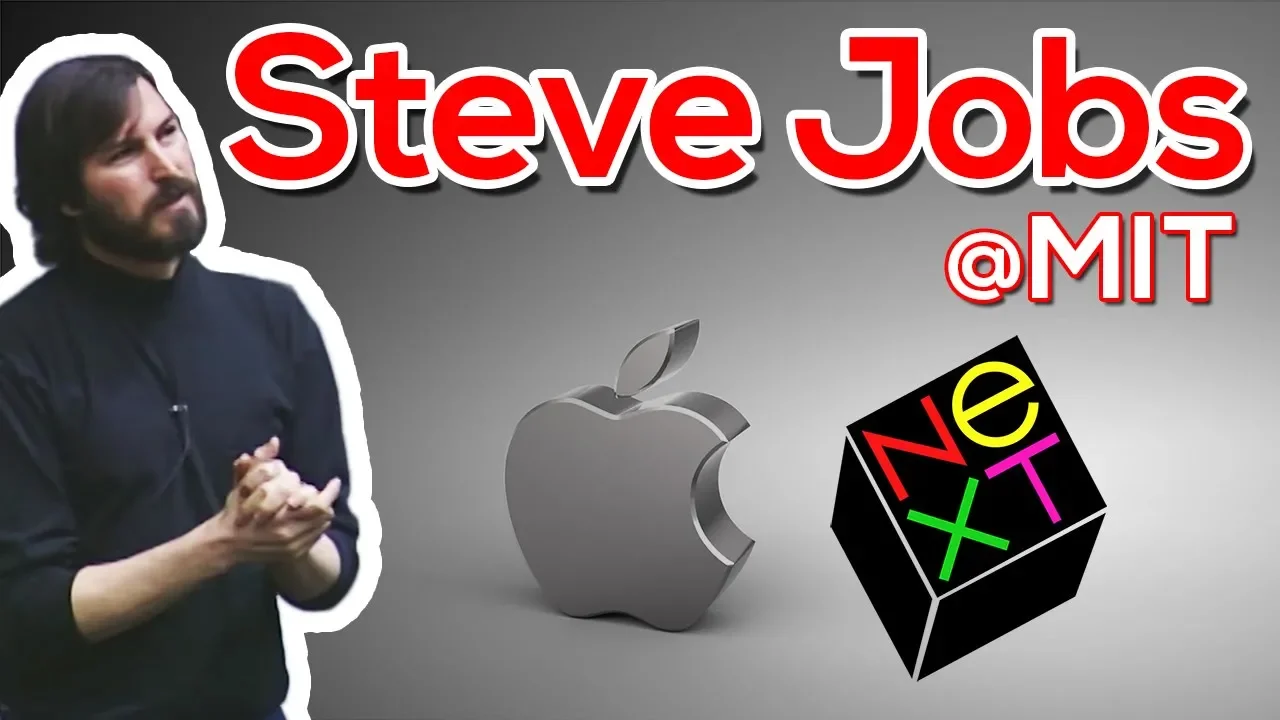
Jobs Uses NeXT Hardware to Fund Software Assault on Microsoft, Sun
MIT Video Productions
NeXT must remain a hardware maker because low-margin software cannot finance the high-touch direct sales force needed to establish object-oriented computing across corporate America.
Steve Jobs reveals that NeXT reached $127 million in revenues in 1991, driven by a strategic pivot from commercial shrink-wrapped software to custom mission-critical applications for enterprise clients. (0:00)
NeXT completed a port of NeXTSTEP to Intel 486-based PCs priced at $995, backed by Intel and Novell to counter Microsoft's operating system monopoly. (17:55)
Jobs frames object-oriented programming as a larger technical breakthrough than graphical user interfaces, reducing application development timelines from two years on Sun workstations to roughly 90 days on NeXTSTEP. (44:55)
NeXT's Fremont factory eliminated warehouses and automated board assembly through custom robotics treated as software I/O devices, producing surface-mount prototype boards on the production line with a lot size of one. (63:06)
Detailed notes
## Background
Published on YouTube by MIT Video Productions on December 19, 2017, this video documents Steve Jobs addressing students at the MIT Sloan School of Management in the spring of 1992 as part of the Sloan Distinguished Speaker Series. According to the page description, the session was arranged by a Sloan MBA student whose sister had recently married Jobs, providing a platform for Jobs to discuss his leadership at NeXT Computer Corporation, his reflections on co-creating and departing Apple, and the importance of gaining direct operational experience.
## TL;DR
Speaking to business students in 1992, Steve Jobs outlines NeXT Computer's strategic pivot toward high-value, custom enterprise applications powered by the object-oriented NeXTSTEP operating system. He justifies selling high-end hardware to fund the direct sales force necessary to evangelize advanced software paradigms, while evaluating upcoming industry threats like Microsoft Windows NT and Taligent. Reflecting on his painful departure from Apple, Jobs shares leadership lessons on building long-term talent, critiquing management consulting in favor of accumulating hands-on 'scar tissue.' He concludes with an in-depth explanation of NeXT's automated Fremont factory, demonstrating how treating manufacturing as a software problem with robotic I/O devices eliminates warehouses and accelerates time-to-market.
## Atmosphere & style
The lecture carries an intimate, conversational, and intellectually charged atmosphere, showcasing Jobs at an introspective yet fiercely ambitious inflection point in his career. Pacing naturally before a student audience, Jobs alternates between sharp, witty dismissals of management consultants and competitors and surprisingly candid, reflective admissions about his heartbreaking exit from Apple. The tone is direct, pragmatic, and visionary, giving viewers the feeling of sitting inside an unfiltered, masterclass dialogue on technological conviction, corporate responsibility, and product excellence.
## Bulletin
- [00:00](https://www.youtube.com/watch?v=Gk-9Fd2mEnI&t=0s) Steve Jobs reveals that NeXT reached $127 million in revenues in 1991, driven by a strategic pivot from commercial shrink-wrapped software to custom mission-critical applications for enterprise clients.
- [17:55](https://www.youtube.com/watch?v=Gk-9Fd2mEnI&t=1075s) NeXT completed a port of NeXTSTEP to Intel 486-based PCs priced at $995, backed by Intel and Novell to counter Microsoft's operating system monopoly.
- [44:55](https://www.youtube.com/watch?v=Gk-9Fd2mEnI&t=2695s) Jobs frames object-oriented programming as a larger technical breakthrough than graphical user interfaces, reducing application development timelines from two years on Sun workstations to roughly 90 days on NeXTSTEP.
- [01:03:06](https://www.youtube.com/watch?v=Gk-9Fd2mEnI&t=3786s) NeXT's Fremont factory eliminated warehouses and automated board assembly through custom robotics treated as software I/O devices, producing surface-mount prototype boards on the production line with a lot size of one.
## Key takeaways
- [03:02](https://www.youtube.com/watch?v=Gk-9Fd2mEnI&t=182s) High-performing companies distinguish themselves not by total IT spend, but by allocating budgets to custom operational productivity applications rather than standard management tools like word processing.
- [12:47](https://www.youtube.com/watch?v=Gk-9Fd2mEnI&t=767s) Hardware performance advantages last only six months in an 18-month churn cycle, whereas proprietary software environments create durable competitive moats lasting nearly a decade.
- [14:36](https://www.youtube.com/watch?v=Gk-9Fd2mEnI&t=876s) Management consulting provides broad but superficial experience, whereas real professional mastery requires accumulating 'scar tissue' by owning recommendations and taking responsibility through operational execution.
- [22:38](https://www.youtube.com/watch?v=Gk-9Fd2mEnI&t=1358s) NeXT remains in the hardware business because a pure software model with a $500 ASP cannot support the direct, consultative sales force required to educate enterprise buyers on a new software paradigm.
- [24:38](https://www.youtube.com/watch?v=Gk-9Fd2mEnI&t=1478s) Evaluating competitors, Jobs dismisses Sun's Solaris as repackaged legacy software and Microsoft NT as lacking a modern development environment, viewing Apple and IBM's Taligent alliance as NeXT's only genuine future threat.
- [27:10](https://www.youtube.com/watch?v=Gk-9Fd2mEnI&t=1630s) NeXTSTEP dramatically reduces development time because developers write only 20% of the code compared to other platforms by reusing modular object libraries.
- [33:10](https://www.youtube.com/watch?v=Gk-9Fd2mEnI&t=1990s) Jobs characterizes his departure from Apple as a lose-lose outcome that harmed himself, Apple, and end-user innovation, while critiquing Apple's pivot toward consumer electronics at the expense of high-end computing.
- [41:35](https://www.youtube.com/watch?v=Gk-9Fd2mEnI&t=2495s) Technology windows open roughly every decade when multiple research breakthroughs mature at once, requiring five years of intensive development followed by a five-year window of commercial exploitation.
- [46:13](https://www.youtube.com/watch?v=Gk-9Fd2mEnI&t=2773s) The economics of commercial shrink-wrapped software have become prohibitive for startups, driving the best software engineers away from monolithic applications toward writing reusable modular objects and development tools.
- [51:15](https://www.youtube.com/watch?v=Gk-9Fd2mEnI&t=3075s) Jobs evolved his management philosophy from impulsively fixing operational errors to taking a long-term view that coaches team members to build enduring capabilities over a decade.
- [52:48](https://www.youtube.com/watch?v=Gk-9Fd2mEnI&t=3168s) NeXT operates under an eight-member Policy Team that avoids artificial buy-in, requiring authentic consensus on roughly 25 pivotal company decisions each year.
- [55:59](https://www.youtube.com/watch?v=Gk-9Fd2mEnI&t=3359s) Enterprise workstation requirements—such as photographic color displays, fast local networking, and large screen real estate—directly conflict with the power and physical constraints of portable laptop design.
- [01:03:06](https://www.youtube.com/watch?v=Gk-9Fd2mEnI&t=3786s) NeXT treated automated manufacturing as an extension of software development, designing in-house robotics programmed via NeXTSTEP object libraries to reduce equipment costs and build circuit boards untouched by human hands.
- [01:05:17](https://www.youtube.com/watch?v=Gk-9Fd2mEnI&t=3917s) Close integration between R&D and the Fremont manufacturing facility eliminated engineering wire-wrap prototypes, allowing production lines to fabricate surface-mount prototypes directly from CAD data.
- [01:08:45](https://www.youtube.com/watch?v=Gk-9Fd2mEnI&t=4125s) NeXT balanced engineering and manufacturing culture by staffing the factory with PhD-level engineers and providing equal compensation, equipment, and office standards across both divisions.
## Detailed walkthrough
### [00:00](https://www.youtube.com/watch?v=Gk-9Fd2mEnI&t=0s) Introduction of Steve Jobs at MIT Sloan
An MIT Sloan host introduces Steve Jobs as the president and chief executive officer of NeXT Computer Corporation and one of the computer industry’s foremost entrepreneurs. Tracing his beginnings with co-founder Steve Wozniak building computers in a garage to the founding of Apple Computer, the host notes Jobs’s early conviction that personal computers could sit on every desk and be made simple to use. The speaker jokes that Jobs held the ideal credential for high-tech success by dropping out of Reed College. After his corporate divergence from Apple, Jobs founded NeXT in 1985 to build the revolutionary NeXT Cube, targeting the high-end workstation market against established rivals like Sun Microsystems.
The introduction highlights NeXT's momentum, noting 1991 revenues reached $127 million, backed by investor Ross Perot—prompting a lighthearted quip about Perot’s potential run for the White House—and mentions rumors of an initial public offering within 14 months. The host notes Jobs’s public service appointment to the President’s Export Council to advise on trade performance policies, as well as his personal connection to the audience: Jobs’s wife, Laurene, an MBA graduate from Stanford, is the sister of Sloan MBA ’92 student Brad Powell. Recalling that Jobs met Laurene while delivering a speech at Stanford just days before the 1989 Loma Prieta earthquake, the host quips, “Let’s hope that history doesn’t repeat itself,” before welcoming Jobs to the stage.
- NeXT 1991 revenue reached $127 million.
- Key financial backing provided by Ross Perot, with prospective IPO plans in roughly 14 months.
- Jobs was appointed to the President's Export Council the prior August to advise on trade competitiveness.
---
[03:02](https://www.youtube.com/watch?v=Gk-9Fd2mEnI&t=182s) IT Spending: Management vs. Operational Productivity
Taking the podium, Jobs explains that rather than giving a formal presentation, he wants to address what is on the students' minds and answer questions, taking 10 to 15 minutes upfront to explain why the world might need another computer company. Offering an unvarnished perspective, Jobs remarks, “We have a lot of scar tissue,” and suggests examining past mistakes. He cites *The Business Value of Computers*, a book by Paul Strassmann, then Chief Information Officer of the Pentagon. Jobs recalls a conversation where Strassmann observed that the central lesson of the Gulf War was that the best software will win the war.
```mermaid
flowchart TD
accTitle: IT Spending Focus vs Corporate Success
accDescr: Comparing how successful and unsuccessful firms allocate their IT budget between management and operational productivity.
subgraph TotalSpend["Information Technology Spending"]
A["All Companies Surveyed<br/>(~2% of Revenue)"]
end
subgraph Allocation["Budget Allocation Pattern"]
direction LR
B["Less Successful Companies"] -->|"Majority of budget"| C["Management Productivity<br/>(Off-the-shelf PCs, word processing, general apps)"]
D["Highly Successful Companies"] -->|"Majority of budget"| E["Operational Productivity<br/>(Custom mission-critical line-of-business apps)"]
end
TotalSpend --> Allocation
```
Strassmann surveyed companies ranging from struggling firms to industry leaders, asking how much they spent on information technology as a percentage of revenue. Counterintuitively, every tier spent almost the identical amount: roughly 2% of corporate revenues. The difference lay in how they deployed those dollars. Less successful companies spent the majority on management productivity, whereas highly successful enterprises allocated the bulk of their budgets to operational productivity applications. Jobs admits this finding was sobering:
> “Now, this was not very pleasant for me to read, because I spent the first 10 years of my life on management productivity, which was PCs.”
Jobs explains that personal computers and Macs fundamentally failed to alter operational productivity because generic retail software cannot run a hospital, execute Wall Street trading, or automate core vertical workflows for medium or large enterprises.
---
[06:12](https://www.youtube.com/watch?v=Gk-9Fd2mEnI&t=372s) The Evolution of Corporate Information Systems
Tracing the historical treatment of operational computing, Jobs explains that through the 1960s and 1970s, organizations relied exclusively on mainframes, dumb terminals, and armies of COBOL programmers to automate back-room accounting and record-keeping. The 1980s saw little fundamental shift beyond the introduction of minicomputers running identical terminal architectures. Only two to three years prior did front-office corporate divisions revolt against the bottleneck of central MIS departments. Needing operational tools immediately, business units initiated downsizing programs by establishing local area networks, running industry-standard relational database servers like Sybase and Oracle, and deploying Unix workstations from Sun Microsystems.
In competitive industries such as financial services, software had become inseparable from the product itself. In modern finance, Jobs argues, a financial instrument consists of an idea, a sales force, and a custom operational software application designed to interact with databases to execute complex transactions like mortgage swaps. Without the custom application, the product cannot exist. Because business units require these operational applications to deploy new offerings, corporate demand for internal application development has exploded into what Jobs identifies as the next major desktop computing revolution.
---
[08:38](https://www.youtube.com/watch?v=Gk-9Fd2mEnI&t=518s) NeXTSTEP, Rapid Application Development, and Accidental Advantages
Jobs explains that while Sun Microsystems pioneered the initial push into distributed operational workstations, NeXT is aggressively supplanting them. Using Sun workstations, corporate development teams typically take two full years to code a mission-critical application. By contrast, the object-oriented software architecture of NeXTSTEP cuts development time drastically, allowing programmers to deliver functional systems in roughly 90 days. Jobs emphasizes the resulting market leverage:
> “Now, if you're on Wall Street and you can create a new product in 90 days versus your competitor in two years, that's eight new products you can field for their every one.”
NeXTSTEP combines this five-to-ten-fold acceleration in software development speed with an intuitive graphical interface that ordinary corporate employees can navigate, while interoperating smoothly with shrink-wrapped productivity software.
Jobs concedes that NeXT did not understand this operational capability when launching the machine: “A lot of times you don't know what your competitive advantage is when you launch a new product.” Drawing a parallel to his tenure at Apple, Jobs asks the audience how many use Macintoshes and how many use NeXTs, noting NeXT aims to improve that ratio. When Apple designed the Macintosh, the team never anticipated desktop publishing. While they planned for bitmap displays and laser printers, they completely failed to foresee the emergence of page-layout tools like Aldus PageMaker. However, once Apple observed desktop publishing emerge nine to twelve months after launch, they swiftly pivoted their entire marketing and business strategy around it, turning it into the definitive Trojan horse that established the platform.
[11:08](https://www.youtube.com/watch?v=Gk-9Fd2mEnI&t=668s) The Pivot to In-House Mission-Critical Applications
Desktop publishing was the initial Trojan horse that got the Macintosh inside corporate America, allowing users to discover its broader capabilities. When NeXT created the NeXTSTEP object-oriented operating system, Steve Jobs and his team initially targeted traditional personal computer shrinkwrapped software developers such as Lotus, Adobe, and WordPerfect. Their premise was straightforward: NeXTSTEP would allow these independent software vendors (ISVs) to build commercial products five to ten times faster. Although that approach succeeded—yielding best-of-breed shrinkwrapped applications across nearly every category—an unexpected turning point arrived in early 1991.
Several major enterprises approached NeXT with a revelation about their own development bottlenecks: “The same software that allows Lotus to create their apps five to 10 times faster is letting us build our in-house mission-critical apps five to 10 times faster.” Jobs jokes that these clients bluntly told them, “This is a huge problem for every big company, and almost all medium-sized companies, and you have a solution in your hands, and you dummies don't even know it.” After spending about three months digesting that feedback, NeXT overhauled its entire sales and marketing strategy in the summer of 1991 to focus directly on custom enterprise applications. Growth exploded: NeXT grew roughly 4x in 1991 and projected 2x growth for 1992, securing meetings with high-profile clients across Washington, D.C., and New York that had once seemed out of reach.
[12:47](https://www.youtube.com/watch?v=Gk-9Fd2mEnI&t=767s) Sustainable Advantage in Software vs. Hardware
NeXT’s chief rival in the workstation landscape was Sun Microsystems. Jobs relishes the rivalry: “And our arch enemy Sun, they want to kill us. Which is good. They should try to do that as soon as possible, because the sooner they do it, the cheaper it will be for them.” However, he believes Sun has already missed the window to do so. In the computer industry, hardware operates on a rapid 18-month churn cycle. Even if a company manages to produce a machine one-and-a-half to two times better than competitors, that edge lasts only six months, making hardware an unreliable foundation for long-term differentiation.
Software, by contrast, creates durable moats that take nearly a decade for competitors to bridge. Jobs points out that it took Microsoft eight or nine years to catch up with the original Macintosh interface, and even then, parity remained debatable. Expecting a four- to five-year lead before any competitor produces a true alternative to NeXTSTEP, NeXT’s strategic imperative is to scale rapidly into a $1 billion to $2 billion company. Because NeXT cannot match Sun’s massive sales headcount or advertising budgets today, superior software is its only weapon to buy enough time to reach competitive scale.
```mermaid
flowchart TD
accTitle: Hardware vs. Software Competitive Advantages
accDescr: Diagram illustrating how short-lived hardware cycles compare to durable software moats.
subgraph Hardware["Hardware Cycle"]
H1["18-Month Innovation Churn"]
H2["1.5x to 2x Speed Advantage"]
H3["Advantage Disappears in ~6 Months"]
H1 --> H2 --> H3
end
subgraph Software["Software Cycle"]
S1["NeXTSTEP Object-Oriented OS"]
S2["4 to 5 Year Competitor Lag"]
S3["Run Fast to Reach $1B–$2B Scale"]
S1 --> S2 --> S3
end
```
[14:36](https://www.youtube.com/watch?v=Gk-9Fd2mEnI&t=876s) The Critique of Management Consulting and "Scar Tissue"
Jobs turns to the Sloan students to ask how many have experienced the enterprise bottleneck firsthand, polling the room on who worked on Wall Street or in manufacturing. When hands go up for consulting, he groans playfully: “Oh, that's bad... A mind is too important to waste. You should do something.”
When a student defends consulting by suggesting consultants can use NeXTSTEP to prototype and deliver working systems on reliably short timetables, Jobs responds with an extended philosophy of career growth and accountability:
> “I think that without owning something, over an extended period of time—like, a few years—where one has a chance to take responsibility for one's recommendations, where one has to see one's recommendations through all action stages and accumulate scar tissue for the mistakes and pick oneself up off the ground and dust oneself off, one learns a fraction of what one can.”
He elaborates that consulting provides an experience that is broad but paper-thin. Comparing it to an image of fruit—substituting a banana for a steak because he is a vegetarian—he explains that a consultant may accumulate two-dimensional snapshots of many industries without ever gaining three-dimensional depth: “You can say look, I've worked in bananas, I've worked in peaches, I've worked in grapes. But you never really taste it.” He also reminds the audience that consultants remain a variable expense, leaving them the first to be cut when economic hard times hit.
[17:55](https://www.youtube.com/watch?v=Gk-9Fd2mEnI&t=1075s) Should NeXT Just Become a Software Company?
A student asks why NeXT does not abandon hardware altogether and port NeXTSTEP directly to Sun workstations, given Sun’s far larger installed base. Jobs broadens the inquiry to the existential question: “Why don't we just become a software company, right?”
Responding to heavy client demand, NeXT had already completed a port of NeXTSTEP to Intel 486-based personal computers, scheduled to ship around September or October for $995 at retail, alongside discounted OEM licensing deals. Industry players like Intel and Novell rallied aggressively behind the 486 port because they feared Microsoft’s unchecked monopoly over personal computer system software and viewed NeXTSTEP as the only viable counterweight. Meanwhile, existing Sun customers begged NeXT to port to SPARC hardware so they would not have to discard hundreds of existing machines. Jobs notes that Sun resisted bitterly: “Now, Sun says they'd rather stick needles in their eyes than help us do this.” NeXT was actively weighing whether porting or withholding the software would hurt Sun more.
Despite porting to third-party chips, Jobs insists NeXT must remain in both the software and hardware businesses:
- **Expanding the Total Market**: Licensing NeXTSTEP across multiple architectures inevitably reduces NeXT's share of running hardware below 100%, but it vastly grows the overall pie, allowing absolute hardware unit sales to rise.
- **Hardware Division Mission**: NeXT's hardware group exists to build the premier, reference hardware for NeXTSTEP; Jobs states he would gladly settle for owning 20% to 25% of the total hardware market, as that still represents a viable $1 billion-plus enterprise.
- **Direct Demand Generation**: NeXT operates an internal field sales organization of roughly 130 professionals across the United States. These reps spend 90% of their pitch selling the value of NeXTSTEP and only 10% selling the box, which guarantees hardware sales because NeXT remains the primary vendor.
- **The Failure of Retail Channels**: Mainstream retail and dealer distribution networks have lost the skill to build demand for innovative systems; they merely fulfill pre-existing demand, leaving store clerks unable even to demonstrate revolutionary software.
[22:38](https://www.youtube.com/watch?v=Gk-9Fd2mEnI&t=1358s) Why NeXT Must Sell Hardware to Fund Software Innovation
Jobs explains that the traditional retail channel has ceased to be a venue for educating buyers on new, innovative concepts. Instead, retail has devolved purely into demand fulfillment, and even that function is being undercut by more direct, efficient distribution mechanisms like the telephone and Federal Express—a shift Jobs characterizes as an inevitable transition toward telebusiness. Because conventional channels cannot explain novel paradigms, the only viable way to introduce revolutionary technology is through a dedicated direct sales force that sits down with customers, studies their specific problems in their real-world environment, and demonstrates how the new system solves them.
```mermaid
flowchart TD
accTitle: System Software Sales Economics
accDescr: Comparison between pure software economics and NeXT's integrated hardware model.
subgraph PureSoftware["Pure Software Model (Fails)"]
A["Low ASP: ~$500"] --> B["Cannot fund direct sales force"]
B --> C["Relies on retail / telebusiness"]
C --> D["Cannot educate market on revolutions"]
end
subgraph NeXTModel["NeXT Integrated Model (Succeeds)"]
E["High ASP: ~$5,000 (Hardware + Software)"] --> F["Funds 130 direct field professionals"]
F --> G["Consultative sales on customer problems"]
G --> H["Successful market education & adoption"]
end
```
The economics of a pure software company make maintaining that kind of sales force impossible. If a company sells software packages at an average selling price (ASP) of $500, it cannot generate the margins required to support 130 direct sales professionals in the field. By bundling its environment with hardware, NeXT achieves an ASP of $5,000, which fully funds the high-touch educational effort needed to establish a breakthrough platform. Jobs argues that without those higher system-level ASPs, no new systems software company can survive.
- The conventional retail channel is condensing rapidly toward telephone orders and FedEx delivery.
- NeXT maintains roughly 130 direct sales professionals in the field.
- Low software ASPs of $500 cannot cover field education costs, whereas a $5,000 system ASP provides adequate funding.
> “So our strategy has been that we've got to be a hardware company in order to make our software business succeed.” — Steve Jobs
---
[24:38](https://www.youtube.com/watch?v=Gk-9Fd2mEnI&t=1478s) Evaluating the Competition: Solaris, Windows NT, and Taligent
When asked to identify NeXT’s competitors, Jobs narrows the field down to three contenders: Sun Microsystems’ Solaris, Microsoft’s Windows NT, and the Apple-IBM joint venture Taligent. Sun, he argues, previously offered meaningful software value because it had the premier Unix in the market, but the industry has moved far ahead while Sun’s software has stagnated. Solaris contains no object-oriented technology and merely repackages what Sun already offers.
Turning to Microsoft, Jobs characterizes Windows NT as their second attempt at a "Unix wannabe" following OS/2. While NT provides superior underlying operating system plumbing, Jobs points out that users and developers remain saddled with the existing Windows user interface and application framework, which he considers the worst development environment ever conceived. Because NT lacks an object-oriented foundation, Jobs expects custom mission-critical enterprise developers to reject it.
| Competitor | Platform / Architecture | Jobs's Assessment | Expected Threat Level |
|:--- |:--- |:--- |:--- |
| **Sun Microsystems** | Solaris (Unix) | Falling further behind; lacks any object-oriented technology; repackages existing code. | Minimal |
| **Microsoft** | Windows NT | "Better plumbing for Windows" and second attempt at a Unix-like OS, but keeps a horrendous dev environment. | Low for enterprise custom apps |
| **Taligent** | Apple/IBM Object OS | Legitimate object-oriented competitor planned for ~1995; will match where NeXT is today. | Serious long-term threat (mid-1990s) |
Jobs identifies Taligent as NeXT’s only genuine future competitor. Targeted to ship around 1995, Taligent will possess vast corporate resources, though Jobs expresses skepticism about whether they will actually ship on schedule. He jokes that if Taligent executes perfectly and works hard, by the mid-1990s they will achieve what NeXT has already built today. More importantly, the partnership between IBM and Apple validates NeXT's direction: by publicly endorsing object-oriented programming, they have endorsed NeXT’s architecture while leaving NeXT as the only shipping provider for the next three to four years.
> “Microsoft is doing NT, which is their sort of second attempt that a Unix wannabe.” — Steve Jobs
> “IBM and Apple saying, these guys are right on track, and come back in five years and we'll have it too.” — Steve Jobs
> “So if we can't compete with Taligent, it's probably because we've shot ourselves in the foot.” — Steve Jobs
---
[27:10](https://www.youtube.com/watch?v=Gk-9Fd2mEnI&t=1630s) NeXTSTEP and the Power of Writing Less Code
Addressing a question about whether NeXTSTEP is merely a specialized development niche rather than a mass-market operating system, Jobs clarifies the platform's core architecture. NeXT views NeXTSTEP not just as an operating system, but as an entire operating environment; the underlying Unix kernel constitutes only 10% of what NeXTSTEP actually is. Because applications built in NeXTSTEP rely on its comprehensive object framework, they cannot run natively on a Mac or on Windows without that runtime environment.
Jobs surveys the room to see how many attendees have technical backgrounds, and seeing a large show of hands, shares NeXT’s core programming metric. Programmers do not physically write lines of code any faster in NeXTSTEP than in other environments. However, because NeXT supplies six years of mature pre-built objects and allows companies to create and reuse their own internal object libraries, developers only need to write about 20% of the code that would be required to produce the same application on a Sun workstation or any other platform.
```mermaid
flowchart LR
accTitle: NeXTSTEP 80 Percent Code Reduction
accDescr: Illustration showing how 80 percent of an application is composed of pre-built objects, requiring only 20 percent custom code.
subgraph NeXTSTEPApp["NeXTSTEP Application (100%)"]
direction TB
subgraph Prebuilt["Pre-Built Objects (80%)"]
O1["NeXTSTEP Core Objects (6 Years R&D)"]
O2["Internal Enterprise Shared Objects"]
O3["Commercial 3rd-Party Objects"]
end
subgraph Custom["Custom Code (20%)"]
C1["Unique Business Logic"]
end
end
Prebuilt -.->|"eliminates 80% of maintenance & bugs"| C1
```
Jobs highlights an emerging commercial ecosystem where third-party developers—nearly ten companies already—are making a business out of selling reusable object libraries rather than full applications or systems software. To expand the reach of these custom applications, NeXT is porting NeXTSTEP to Intel 486 hardware. Drawing an analogy to the Macintosh's arrival in 1984, Jobs acknowledges that platform transitions create temporary fragmentation, but notes that competing platforms eventually absorb these breakthroughs while users who adopt the new environment benefit immediately from a far richer experience.
- Unix represents only 10% of the NeXTSTEP software environment.
- Developers write approximately 20% of the code needed on other systems to complete an application.
- NeXT ships with six years' worth of built-in, pre-tested object libraries.
- NeXTSTEP is being ported to Intel 486-based personal computers.
> “So the code that's the fastest to write, the code that's the easiest to maintain, and the code that never breaks, is the code you don't write.” — Steve Jobs
---
[30:37](https://www.youtube.com/watch?v=Gk-9Fd2mEnI&t=1837s) The Enterprise Opportunity and Consulting Ecosystem
An audience member asks how the corporate practice of outsourcing software development affects NeXT’s strategy, given that custom applications serve as the company's wedge into accounts. Jobs acknowledges that custom application development is NeXT’s "tip of our arrow" or "Trojan horse" for penetrating medium and large corporate clients, meaning NeXT’s overall growth is strictly paced by the size and skill of the developer community available to those firms.
Jobs points out that enterprise information systems (IS) departments have undergone a dramatic transformation over the prior four to five years. Companies across financial services, healthcare, and law enforcement have hired top-tier computer scientists onto their internal IS staffs. Where internal teams do not build software directly, an external network of value-added resellers (VARs) and independent consultancies fills the void; in New York alone, roughly ten third-party firms are actively developing NeXTSTEP systems for Wall Street firms. Furthermore, as the consumer PC shrink-wrapped software market consolidates into a handful of dominant players, surplus commercial developers are migrating into custom enterprise application development.
Jobs then turns the tables on the audience, polling the MIT Sloan students on their career plans:
> “So what are you guys all going to do when you get out of here? You going to go back to your companies? How many of you are going to go back? How many aren't going to go back? What are you going to do?” — Steve Jobs
When students call out inaudible responses and laughter breaks out, Jobs pitches the group directly, noting that NeXT is always looking to hire technically grounded people with the strong business training Sloan provides.
- Growth in enterprise accounts is tethered directly to the availability of developers.
- Wall Street accounts are supported by around 10 independent development firms in New York.
- The commercial PC software market has matured and consolidated, freeing developer talent for custom enterprise systems.
---
[33:10](https://www.youtube.com/watch?v=Gk-9Fd2mEnI&t=1990s) Regrets on Leaving Apple: "Everybody Lost"
An audience member prefaces a question delicately: "Well, I don't want to step on any toes here... But where do you think Apple would be had you not left it? And specifically, could it have come out with something as revolutionary in the tech industry?"
The question draws laughter from the audience. Jobs acknowledges that he has reflected deeply on his departure from Apple, and while he avoids reopening old disputes in detail, he offers a blunt, heartfelt assessment of the outcome. He explains that the rupture was a lose-lose situation for everyone involved: he lost the ability to continue the work he loved at the company where he had intended to spend his entire working life, Apple lost the visionary momentum that drove its early breakthroughs, and customers lost out on the innovations that could have resulted.
Despite the profound disappointment of his departure, Jobs puts the experience into realistic emotional perspective, stating that life moves forward and that professional heartbreak is far from the worst tragedy a person can endure.
> “I think everybody lost. I think I lost. And I wanted to spend my life there. I think Apple lost. I think customers lost. And having said all that, so what? You go on. It's not as bad as a lot of things. Not as bad as losing your arm.” — Steve Jobs
[33:57](https://www.youtube.com/watch?v=Gk-9Fd2mEnI&t=2037s) Apple’s Identity Crisis and the Consumer Pivot
Reflecting on his departure from Apple, Steve Jobs expresses genuine affection for his former company’s successes, noting, “I'm very happy every time Apple ships a Mac.” He praises the PowerBooks as decent hardware, but observes that Apple has spent recent years locked in an internal identity crisis. Historically, two competing factions vied for the soul of the company: one faction wanted Apple to be the next serious computer manufacturer, while the other wanted it to become the “Sony of computers.”
Jobs observes that the battle has effectively concluded: “And fortunately, the Sony guys have won.” Apple’s top talent has shifted toward portables and consumer electronics. The downside is that its traditional high-end line has been neglected: “the PowerBooks are pretty good, but the Quadras suck wind right now, the high end stuff.” Jobs warns of the immense unit-scale hurdle Apple now faces in consumer electronics:
```
[2 Million Units Sold] x [$500 Wholesale ASP ($795 Retail)]
=
$1 Billion in Revenue
+
$7 Billion Balance Needed from Other Lines
```
Even if Apple produces one or two smash-hit consumer gadgets selling millions of units, that revenue barely dents an $8 billion business. Jobs sees the broader PC and Windows market making a similar mistake: turning existing software into portables while abandoning power users. Macintosh System 7 failed to be the “second coming” and was merely an incremental update, while IBM’s OS/2 flopped entirely despite a hundred-million-dollar marketing push. Consequently, the top third of the desktop market feels stranded: “they're in the desert wanting something to drink,” leaving an open playing field for NeXT.
- Apple’s internal conflict pitted serious desktop computing against a consumer-device strategy modeled on Sony.
- A consumer product selling 2 million units at a $500 manufacturer ASP yields only $1 billion against Apple's need for roughly $8 billion in overall revenue.
- Neither Apple with System 7 nor Microsoft and IBM with OS/2 provided genuine leaps for sophisticated enterprise users.
---
[37:14](https://www.youtube.com/watch?v=Gk-9Fd2mEnI&t=2234s) Restructuring NeXT and Executive Recruiting
An audience member asks Jobs how NeXT’s management must evolve to scale from a $120 million company into a $1 billion enterprise. Jobs details sweeping executive hires and structural reorganizations made over the previous twelve months. He starts by introducing his Vice President of Marketing, Mike Slade, who is seated in the lecture hall:
> “And he's cheap, too.”
Slade spent seven or eight years at Microsoft—originally serving as the product manager for the initial release of Excel—and joined NeXT just as corporate clients began demanding mission-critical custom applications. Structurally, NeXT partitioned its operations roughly three months earlier by grouping hardware design engineering, manufacturing, global distribution, and hardware service into a unified Hardware Division led by co-founder Rich Page, with a software division forming alongside it.
```mermaid
flowchart TD
accTitle: NeXT Corporate Structure and Key Executives
accDescr: Organization chart showing Steve Jobs at the top overseeing key executives and newly divided hardware and software operations.
CEO["Steve Jobs<br/>President & CEO"]
subgraph Execs["Key Executive Recruits"]
MKT["Mike Slade<br/>VP of Marketing<br/>(ex-Microsoft)"]
CFO["Marcel Gani<br/>Chief Financial Officer<br/>(ex-Intel, Cypress)"]
COO["Peter van Cuylenburg<br/>Chief Operating Officer<br/>(ex-TI, Mercury, C&W)"]
end
subgraph Divs["Operating Divisions"]
HW["Hardware Division<br/>Rich Page (Co-Founder)<br/>Design, Mfg, Global Distro, Service"]
SW["Software Division<br/>NeXTSTEP Operating Environment"]
end
CEO --> Execs
CEO --> Divs
```
Jobs also recruited Chief Financial Officer Marcel Gani, a 12-year Intel veteran who managed European finance, internal auditing, and manufacturing planning before a stint at Cypress Semiconductor. Just one week before the MIT talk, Jobs appointed Peter van Cuylenburg as Chief Operating Officer. Van Cuylenburg had run Texas Instruments in Europe, turned the UK telecommunications provider Mercury Communications into a $2 billion firm, and helped manage its $6 billion parent, Cable & Wireless. Jobs admits that recruiting top-tier talent requires relentless patience, noting it took roughly 18 months to recruit Slade and van Cuylenburg: “And I've always found it best not to compromise, and just keep chipping away.”
- NeXT separated into dedicated Hardware and Software divisions to treat each as a standalone business.
- Mike Slade (ex-Microsoft) heads marketing; Rich Page oversees all hardware cradle-to-grave; Marcel Gani (ex-Intel) serves as CFO.
- Peter van Cuylenburg was hired as COO one week prior after an 18-month courtship by Jobs.
---
[41:35](https://www.youtube.com/watch?v=Gk-9Fd2mEnI&t=2495s) Technology Windows and Platform Lifecycles
Asked what technological advances he expects over the next five to ten years and how NeXTSTEP fits in, Jobs introduces his mental model of “technology windows.” Breakthroughs happen when disparate technologies developed in research environments—such as the MIT Media Lab—mature together, aligning like planets to make a major leap feasible.
Jobs explains that it generally takes five years of grueling effort to push open a technology window and deliver a commercial platform, followed by about five years of market exploitation. Pushing open these windows is notoriously costly and fraught with failure: the Apple III and the $100 million Lisa were painful stepping stones before the Macintosh succeeded, and NeXT suffered a similar setback with its original computer:
> “We came out with this cube. And we sold 10,000 of them. Why? Because we weren't quite there yet.”
Once established, however, core platforms endure for a decade or more because developing fundamentally new paradigms is extraordinarily hard:
| Platform | Window & Maturation Period | Practical Market Lifespan | Notes |
|:--- |:--- |:--- |:--- |
| **Apple II** | ~5-year gestation | **15 years** | Hardware evolved, but fundamental architecture endured. |
| **DOS** | Established early 1980s | **15+ years** (10 past, 5+ ahead) | Persists out of technical inertia despite clear limitations. |
| **Macintosh** | Lisa foundation (~5 years) | **12–13 years** (8 past, 4–5 ahead) | Emerged from a costly $100M course correction. |
| **NeXTSTEP** | 6 years to open (Cube to 1992) | **~5 years** exploitation window | Current products finally have the window fully open. |
Jobs declares that after six years of iteration, NeXT has finally forced the technology window wide open with an elegant implementation. The company now faces five years of aggressive commercial exploitation in the marketplace before it is time to sit down and invent the next big thing.
[044:55] Technology Windows and Object-Oriented Software
Steve Jobs reflects on the cadence of innovation in computing, noting that everything NeXT knows about emerging technological windows is already embedded in NeXTSTEP or being actively developed in their research laboratories. Technical breakthroughs rarely arrive independently; in his experience, they tend to appear together in clumps. Among the unreleased technologies currently being integrated are advanced video capabilities and new security architectures. Across the board, hardware products are becoming smaller, more portable, and dramatically faster, leading Jobs to observe that machines arriving over the next year or two will operate at speeds he finds hard to believe, even after years in the industry.
```mermaid
flowchart TD
accTitle: Technology Waves in Personal Computing
accDescr: Progression from early hardware through GUI to object-oriented frameworks.
subgraph EarlyEra["Early Wave"]
A["Command-Line & Silicon Advances"]
end
subgraph IntermediateEra["1980s Breakthrough"]
B["Graphical User Interfaces (GUI)"]
end
subgraph ModernEra["1990s Breakthrough"]
C["Object-Oriented Programming (NeXTSTEP)"]
end
EarlyEra --> IntermediateEra
IntermediateEra --> C
```
He identifies object-oriented technology as the most significant development in the computer landscape since the dawn of the graphical user interface a decade earlier. Emphasizing the magnitude of this shift, Jobs declares: “And I think object-oriented technology is the biggest technical breakthrough I have seen since the early '80s, with the graphical user interfaces. And I think it's bigger, actually.”
[046:13] The Economics of Building Applications vs. Writing Objects
An audience member asks where an independent software company should position itself to capture the most value: building polished operational end-user applications like Microsoft Word or Excel, or creating tools and reusable components for other developers. Jobs answers that established incumbents have effectively settled that dilemma for smaller developers. Entering the mainstream market for desktop shrink-wrapped applications on platforms like Macintosh or Windows requires $20 million to $30 million just to fund a team of several hundred engineers.
Even if a startup created an undeniably superior spreadsheet, breaking even would require roughly $50 million in marketing alone to rise above industry noise. Consequently, the most capable talent in the industry has stopped trying to compete head-on in traditional retail categories. Describing the changing dynamics of software development, Jobs remarks: “So what the brightest people I know of today are doing is they're writing objects. They're writing hunks of things that other developers are going to use to build apps.”
- Building a standard shrink-wrapped productivity tool requires $20 million to $30 million and hundreds of developers.
- Marketing an alternative spreadsheet on mainstream platforms costs around $50 million just to be heard above existing marketing noise.
- Strategic software innovation has pivoted toward building reusable modular objects rather than monolithic applications.
[048:02] Higher Education and the Commercialization of Research
When asked how NeXT approaches marketing to universities and whether a lack of independent consultants hurts adoption, Jobs traces his philosophy back to Apple. Although exclusively targeting higher education in NeXT’s early days was arguably a mistake, the educational sector remains vital. NeXT's strategy is straightforward: offer the steepest possible hardware discounts to colleges. Universities serve as an unmatched testing ground, providing critical feedback on product flaws, while training a generation of talented students whom NeXT and its enterprise customers can subsequently recruit.
NeXT hardware is deployed across roughly 350 campuses nationwide, standing as the number-one workstation brand in American higher education and the second best-selling computer overall at schools like MIT and Stanford, trailing only the Macintosh. At MIT, NeXT outsells IBM-compatible PCs through institutional channels. Addressing MIT’s Project Athena, Jobs points out that academic research initiatives naturally struggle with commercialization. Universities can invent brilliant concepts and test prototypes, but academic researchers are ill-equipped to handle full-scale commercial software engineering. A commercial industry quickly productizes those concepts, leaving academic experiments behind. For that reason, Jobs considers it healthy when projects like Athena conclude their lifecycles rather than trying to become commercial software houses. NeXT prioritizes equipping campus computing labs so that every student has public access to networked workstations.
[051:15] People Management: Lessons Learned from Apple
An audience member asks Jobs to name the single most valuable lesson he learned from his tenure at Apple that he now applies at NeXT. Jobs pauses before answering that the experience taught him to adopt a much longer-term perspective on colleagues and team dynamics. In his earlier career, seeing an operational error provoked an immediate impulse to step in and fix the mistake himself. Over time, he recognized that building an enduring organization requires mentoring people through their missteps rather than usurping their responsibilities.
```mermaid
flowchart LR
accTitle: Evolution of Management Approach
accDescr: Shift from immediate tactical intervention to long-term mentoring.
subgraph NewApproach["Long-Term Approach"]
B1["Error Identified"] --> B2["Coach Team Member"]
B2 --> B3["Develop Institutional Capability"]
end
```
Jobs explains how his management philosophy shifted toward patience and team capability: “In other words, when I see something not being done right, my first reaction isn't to go fix it. It's to say, we're building a team here. And we're going to do great stuff for the next decade, not just the next year, and so what do I need to do to help so that the person that's screwing up learns versus how do I fix the problem?”
[052:48] Organizational Conflict and the NeXT Policy Team
Asked how NeXT resolves internal disputes, Jobs rejects the standard management convention of demanding artificial "buy-in," where leaders overrule subordinates and insist that everyone pretend to support a compromised decision. Coercing an executive to carry out an initiative they believe is fundamentally wrong guarantees that resentment and friction will erupt later. Instead, NeXT brings the relevant stakeholders into a room and debates the issue until genuine consensus is achieved.
NeXT is directed by an eight-member executive group known as the Policy Team, which includes Jobs and Chief Operating Officer Mike Slade. The group focuses on distinguishing crucial strategic choices from minor tactical issues, estimating that an executive team only needs to make about 25 truly critical decisions per year. Jobs stresses that he pays senior executives high salaries specifically to tell the company what to do, not merely to take orders. He notes that he almost never pulls rank to unilaterally dictate an outcome, though on rare occasions when persistent misalignment makes consensus impossible, he has removed individuals from the team.
Explaining NeXT's decision-making philosophy, Jobs summarizes: “So we pay people a lot of money, and we expect them to tell us what to do. And so when that's your attitude, you shouldn't run off and do things if people don't all feel good about them.”
[55:59](https://www.youtube.com/watch?v=Gk-9Fd2mEnI&t=3359s) Portability vs. Raw Computing Power
An audience member asks about NeXT's positioning, pointing out a perceived shift toward a premium niche product and contrasting that with Apple's push into portability with the Macintosh PowerBook, wondering if portable computers and market-driven desktop workstations are mutually exclusive. Steve Jobs immediately pushes back on the premise that NeXT is an overpriced "premium product," clarifying that NeXT hardware actually costs roughly half of what Sun Microsystems charges. He credits this dramatic cost advantage to having both the most automated factory in the industry and an exceptional VLSI design group capable of engineering boards with far fewer components.
Jobs then asks the MIT Sloan audience how many students care about manufacturing, greeting their enthusiastic responses with visible excitement. Setting the stage, he points out that the entire personal computing market is undergoing a sharp bifurcation. Mainstream personal computers and Macs are rapidly moving toward the laptop form factor: “They're all going to be just like this, only lighter and smaller, before very long,” Jobs observes, gesturing at an audience member's PowerBook. While that transition frees users from the desktop without sacrificing much for basic tasks, Jobs explains that NeXT's core enterprise customers are demanding technical capabilities that are directly hostile to battery-powered portable designs.
Jobs details five critical areas where portability directly conflicts with high-end desktop workstation requirements:
- **Processor Speed vs. Battery Life:** High compute speed demands high wattage; delivering the performance NeXT customers require would deplete a portable battery in just three and a half minutes.
- **Mass Storage and Memory:** Large hard drives and massive RAM configurations carry size, weight, and power penalties impossible to sustain in a laptop.
- **Network Bandwidth:** While wireless radio LANs top out around 19.2 kilobits per second, enterprise workstation users demand high-speed local networking running at 100 megabits per second or faster, a performance level radio networks will not achieve for at least five years.
- **Display Size and Photographic Color:** NeXT's customer base has shifted to approximately 80% color systems, requiring true photographic-quality color. Flat-panel displays of that era cannot deliver true photographic color.
- **Screen Real Estate for Multitasking:** Running true multitasking operating environments means managing multiple concurrent applications, which requires large monitors rather than viewing complex workflows through small laptop screens.
Because running mission-critical custom applications demands absolute performance, Jobs emphasizes that NeXT deliberately chooses to optimize for raw desktop power over portable compromises.
[58:40](https://www.youtube.com/watch?v=Gk-9Fd2mEnI&t=3520s) Eliminating Warehouses and Embracing True Just-in-Time Manufacturing
Jobs polls the room on their manufacturing backgrounds, engaging students who have worked in pharmaceuticals, the automotive sector, and semiconductor companies such as Texas Instruments and Motorola. When an audience member asks if NeXT is outsourcing its manufacturing overseas, Jobs dismisses the idea outright: “No, it couldn't be further from the truth. We love manufacturing at NeXT.” He reflects on his time at Apple leading the development of the automated Macintosh factory in Fremont, California—a facility widely considered the industry benchmark until NeXT constructed its own plant.
Reflecting on Apple, Jobs admits to making major structural mistakes rooted in a misunderstanding of inventory. He realized too late that the two most expensive automated installations in the Mac facility—a multimillion-dollar automated storage and retrieval system with tote bins and a massive automated burn-in system—were nothing more than glorified, high-tech warehouses. Jobs explains that warehouses are actively harmful because storing inventory ties up capital that could be used productively and conceals defects. In an ideal setup, a defect is caught on the very first unit to enter the building, immediately closing the feedback loop with the vendor before millions of flawed parts are manufactured. At NeXT, they eliminated warehouses entirely: components arrive on the factory floor directly at their point of use via daily or even more frequent deliveries, and there is no outgoing finished-goods warehouse.
```mermaid
flowchart LR
accTitle: Just-in-Time Manufacturing Feedback Loop
accDescr: Diagram contrasting traditional inventory hoarding with NeXT's zero-warehouse immediate vendor feedback loop.
subgraph Traditional["Traditional Model with Warehouses"]
T1["Vendor Parts"] --> T2["Warehouse / Inventory"]
T2 --> T3["Delayed Production"]
T3 --> T4["Late Defect Discovery<br/>(Zillions made)"]
end
Jobs recounts a framework introduced to him by Steven Wheelwright, a former Stanford Business School professor who later moved to Harvard. Wheelwright categorized companies along a five-stage operational scale:
- **Stage 1:** Companies that view manufacturing as a necessary evil and wish they did not have to deal with it at all.
- **Stage 2 through Stage 4:** Incremental levels of competence and integration.
- **Stage 5:** Companies that treat manufacturing as a fundamental weapon for competitive advantage to accelerate time to market, lower unit costs, and drive higher build quality.
Jobs notes that historically one could place the American flag at Stage 1 and the Japanese flag at Stage 5, though American attitudes are finally beginning to change as talented business graduates enter the field and earn competitive salaries. Jobs humorously maps the exact same five-stage spectrum onto how computer manufacturers view software: Stage 1 companies like Compaq wish software had never been invented, IBM sits around Stage 2, Sun Microsystems is in the middle, while only three companies—Apple, Microsoft, and NeXT—occupy Stage 5, architecting their entire product strategies starting from the software and working backwards.
[01:03:06](https://www.youtube.com/watch?v=Gk-9Fd2mEnI&t=3786s) The Factory as a Software Problem with Robotic I/O
Applying their software-centric philosophy to manufacturing, NeXT conceptualized its automated assembly line as an operational software challenge: “And we said, this is really just a software problem with interesting I/O devices called robots.” To build it, NeXT persuaded software engineers from its R&D division to transfer into the factory operations team by offering bonuses, personal cajoling, and guarantees that they could return to pure software engineering if they hated the shop floor.
```mermaid
flowchart TD
accTitle: Evolution of Robotics at NeXT Factory
accDescr: Three evolutionary phases of robotics implementations in the NeXT factory.
subgraph Gen3["Generation 3: End-to-End Vertical Integration"]
G3H["NeXT In-House Mechanical Design"] --- G3S["Top-to-Bottom NeXT Software"]
G3Note["Low-cost, highly customized assembly"]
end
Gen1 --> Gen2 --> Gen3
```
NeXT evolved its manufacturing robotics through three distinct generations:
1. **Turnkey Commercial Systems:** NeXT specified requirements and purchased off-the-shelf automated arms, third-party controller electronics, and proprietary vendor software. While operational, these robots lacked software elegance and could not be tied into NeXT's proprietary quality information systems.
2. **Hybrid Systems with Object-Oriented Control:** NeXT outsourced custom mechanical hardware to external builders while writing all the control software internally on NeXT workstations. Using object-oriented programming, engineers wrote specialized "robot objects" and "quality objects," creating a unified control architecture that ran the entire factory.
3. **Fully In-House Designed Automation:** Inspired by Japanese manufacturers who build their own custom equipment, NeXT began specifying and assembling its own robotics from sourced components. Jobs notes that contrary to conventional assumptions about custom automation, designing their own machines turned out to be cheaper than buying commercial equivalents.
Through this end-to-end integration of mechanical design and object-oriented software control, NeXT built an advanced production line where core computer components are assembled, from start to finish, completely untouched by human hands.
### [01:05:17](https://www.youtube.com/watch?v=Gk-9Fd2mEnI&t=3917s) Manufacturing Strategy and Time-to-Market
Steve Jobs explains that NeXT views itself as a "low-cost producer" that maintains a competitive advantage by keeping its factory in Fremont, California—right under their noses. This proximity allows for rigorous quality control; in partnership with Canon in Japan, NeXT has reached a status where they ship products directly to stock, meeting the high-quality standards demanded by their partners. Jobs emphasizes that this level of integration is intentional, allowing them to exert control over the entire production cycle without the traditional disconnects found in many tech companies.
He outlines the core philosophy of their manufacturing process, which focuses on "time to market." In many companies, engineers design a product and "throw it over the wall" to the manufacturing team, who then have to fix design flaws or re-engineer processes to make the product viable. Jobs describes the NeXT approach as follows: "What you want to do is do this, and ship it right here while your competitors are still here." By integrating engineering and manufacturing, they eliminate the need to build traditional "wire wrap" or engineering prototypes. Instead, they use digital data from CAD systems, sent over local networks, to compute optimized robot paths and vision system programs, allowing them to produce a fully finished, surface-mount board directly on the factory floor with a lot size of one.
* **Key Advantage:** Manufacturing is involved from "day one," ensuring the technology used in prototypes is identical to that used in full production, avoiding the "waste of time" involved in shifting between different development technologies.
* **Relationship Management:** Jobs describes this as the "healthiest relationship between an engineering and manufacturing group I've ever seen in my life," built on shared databases and processes.
### [01:08:45](https://www.youtube.com/watch?v=Gk-9Fd2mEnI&t=4125s) Corporate Culture and Human Capital
When asked how they managed to bridge the gap between two traditionally siloed departments, Jobs reveals that the secret wasn't hiring a specific "type" of manufacturing personnel. Instead, they hired engineers and convinced them that manufacturing was a central, high-status discipline. They eliminated the "second-class citizen" status of manufacturing staff by paying them equally—or sometimes more—than those in R&D and providing them with identical office space, computers, and test equipment.
Jobs notes that for the first few years, the manufacturing team actually had more PhDs than the design engineering team, creating a high-caliber environment. He summarizes the philosophy behind this: "And it's not that hard. The key to it all, though, was we didn't go out and hire a bunch of manufacturing people. We went out and hired engineers." This strategic investment in talent, he argues, has been a significant competitive advantage for the company.
### [01:09:44](https://www.youtube.com/watch?v=Gk-9Fd2mEnI&t=4184s) Just-in-Time Logistics and Supplier Relations
Responding to a question about their "no-warehouse" policy and Just-in-Time (JIT) manufacturing, Jobs clarifies that their logistics success relies on pushing responsibility to their suppliers. When asked how they get materials so quickly, he quips: "See the key thing is, that's not our problem. That's our suppliers' problem." He explains that while NeXT isn't a giant like Goliath, they are a "very valuable David" to work with. They maintain a narrow supply base and provide these partners with high-value statistical quality information—often on a daily basis—using NeXT computers.
This data-driven collaboration encourages suppliers to "bend over backwards" to meet NeXT’s requirements. Jobs concludes this thought with a humorous observation about product quality: "And our philosophy is, our money doesn't break after we give it to them, so their parts shouldn't break after they give them to us."
### [01:11:44](https://www.youtube.com/watch?v=Gk-9Fd2mEnI&t=4304s) Reflecting on the Macintosh Market
In his final remarks, Jobs addresses the future of the Macintosh and the possibility of NeXT technology influencing portable computing. He predicts that while certain segments of the Mac market will continue to grow, others will stagnate. Jobs posits that there are tasks users will want to perform in the future that simply cannot be done on a Mac, or on the DOS/Windows platforms.
Comparing the evolution of the industry to the period when the Macintosh first arrived to challenge DOS, he suggests that a need for "some new technology" is inevitable. He concludes the session by noting it is time for him to "head off into the sunset" and return to California, thanking the students for their time.
## Notable quotes
> [27:10](https://www.youtube.com/watch?v=Gk-9Fd2mEnI&t=1630s) So the code that's the fastest to write, the code that's the easiest to maintain, and the code that never breaks, is the code you don't write. — Steve Jobs
> [44:55](https://www.youtube.com/watch?v=Gk-9Fd2mEnI&t=2695s) I think object-oriented technology is the biggest technical breakthrough I have seen since the early '80s, with the graphical user interfaces. And I think it's bigger, actually. — Steve Jobs
> [01:09:44](https://www.youtube.com/watch?v=Gk-9Fd2mEnI&t=4184s) And our philosophy is, our money doesn't break after we give it to them, so their parts shouldn't break after they give them to us. — Steve Jobs
> [46:13](https://www.youtube.com/watch?v=Gk-9Fd2mEnI&t=2773s) So what the brightest people I know of today are doing is they're writing objects. They're writing hunks of things that other developers are going to use to build apps. — Steve Jobs
> [52:48](https://www.youtube.com/watch?v=Gk-9Fd2mEnI&t=3168s) So we pay people a lot of money, and we expect them to tell us what to do. And so when that's your attitude, you shouldn't run off and do things if people don't all feel good about them. — Steve Jobs
## Mentioned
Steve Jobs, Steve Wozniak, Ross Perot, Laurene Jobs, Brad Powell, Paul Strassmann, Mike Slade, Rich Page, Marcel Gani, Peter van Cuylenburg, Steven Wheelwright, Apple Computer, NeXT Computer Corporation, Sun Microsystems, Sybase, Oracle, Lotus, Adobe, WordPerfect, Aldus, Microsoft, Intel, Novell, IBM, Compaq, Cypress Semiconductor, Texas Instruments, Mercury Communications, Cable & Wireless, Motorola, Canon, NeXT Cube, NeXTSTEP, Macintosh, Apple II, Apple III, Lisa, Aldus PageMaker, Solaris, Windows NT, OS/2, Taligent, PowerBook, Quadra, System 7, Excel, Microsoft Word, DOS, Windows, MIT Sloan School of Management, MIT Media Lab, Stanford University, Reed College, Harvard Business School, President's Export Council, Project Athena
## Video description
Please Subscribe! http://www.youtube.com/c/MITVideoProductions?sub_confirmation=1
Steve Jobs, one of the computer industry’s foremost entrepreneurs, gives a wide-ranging talk to a group of MIT Sloan School of Management students in the spring of 1992. Jobs shares his professional vision and personal anecdotes, from his role at the time as president and CEO of NeXT Computer Corporation, to the thrilling challenges of co-creating Apple Computer, and subsequent disappointments at his ousting. In conversational exchanges with audience members Jobs underscores the value of direct experience in the field, and “developing scar tissue.” The unexpected guest lecture within the Sloan Distinguished Speaker Series came about through the efforts of a Sloan MBA ’92 student whose sister had recently married Jobs.
(Special Thanks to Youtuber Paul Mangione for linking out these highlights!)
Highlights
5:13 Comparing management vs. operational productivity in software
9:25 Rapid development of application software using NeXT
10:30 Desktop publishing on the Macintosh
15:25 Problems with consultants
18:03 Should NeXT just become a software company
24:38 Who are NeXT's competitors, Sun Solaris, Microsoft NT, Taligent
27:41 NeXTSTEP operating environment, "the code that never breaks is the code that you don't
write...so write less code", benefits of object-oriented programming
30:59 NEXT's growth dependent on application developers
33:25 reflecting on separating from Apple and the struggles at Apple focusing on consumer electronics
37:27 Big achievements and management organization at NEXT
41:45 How technology windows open in the market, Apple II, DOS, Lisa, Macintosh, NeXT Cube,
"I think object-oriented technology is the biggest technical breakthrough I have seen since
the early 80's with graphical user interfaces and I think it's bigger actually."
46:40 Should you develop applications or objects and tools, "the brightest people are writing objects"
48:23 Developing products with higher education, Project Athena
51:22 What I Learned at Apple, taking a longer-term view on people
53:01 Management style and resolving conflict
56:18 Macintosh and PC and challenges with portability, processor speed, disk space, high speed
networking, true color displays, power
58:45 Manufacturing systems Macintosh vs. NeXT, removing warehouses with Just in Time processes,
factories as software with interesting I/O devices (robots)
1:06:11 Using manufacturing to improve time to market, product and process simultaneously
1:11:57 Growth of Apple and the Macintosh market
Steve Jobs argues that corporate computing's next major transition centers on operational productivity driven by custom software applications, positioning NeXT's object-oriented operating environment and tightly coupled automated manufacturing to capture high-end enterprise demand.
The Pivot to Operational Enterprise Computing (3:02)
Citing research by Pentagon CIO Paul Strassmann, Jobs observed that both high- and low-performing companies spend an identical proportion of revenue on information technology—roughly 2%—but diverge sharply in budget allocation. Less successful organizations predominantly fund management productivity tools like off-the-shelf PC spreadsheets and word processors, whereas market leaders direct capital toward custom operational applications that run core lines of business, such as Wall Street trading systems and hospital workflows.
While NeXT initially designed its NeXTSTEP environment to help commercial shrink-wrapped software vendors develop applications faster, large corporate accounts informed the company in early 1991 that the same object-oriented tools solved internal software bottlenecks. By shrinking application development cycles from two years on Sun Microsystems workstations down to roughly 90 days, NeXTSTEP offered significant time-to-market leverage. NeXT subsequently pivoted its entire commercial strategy toward custom enterprise software, driving 1991 revenue to $127 million.
System Pricing and the Direct Sales Model (22:38)
Addressing why NeXT remained an integrated hardware vendor rather than transitioning into a pure software company, Jobs noted that while hardware advantages last only about six months within an 18-month industry churn cycle, software architectures establish durable four-to-five-year defensive moats. However, pure software economics could not support the educational burden of introducing a new computing paradigm.
Because traditional retail channels had devolved into simple order fulfillment through catalog telephone sales and express delivery, third-party dealers could no longer explain revolutionary software paradigms to customers. A pure software company operating at an average selling price (ASP) of $500 could not generate the margins required to support an internal field sales force. Bundling software with hardware at a $5,000 system ASP enabled NeXT to maintain approximately 130 direct sales professionals to consult with enterprise clients on custom problems, while software ports to Intel 486 hardware served to expand the platform's overall market footprint.
Object Reuse and the Competitive Landscape (27:10)
Technically, Jobs framed the underlying Unix operating system as merely 10% of NeXTSTEP, with the primary value residing in six years of pre-built, reusable software objects. By assembling systems from pre-tested object libraries, developers write only about 20% of the custom code required on alternative platforms, dramatically compressing bug rates and maintenance overhead while enabling a nascent commercial ecosystem for third-party object vendors.
Assessing rival platforms, Jobs dismissed Sun's Solaris as a repackaging of legacy Unix lacking object-oriented capabilities, and viewed Microsoft's Windows NT as an improved operating system core burdened by an inferior application development environment. He identified Taligent—an Apple-IBM joint venture slated for the mid-1990s—as NeXT's sole genuine future competitor, arguing the project validated NeXT's architectural direction while leaving NeXT as the only shipping object-oriented platform for the immediate three to four years.
Automated Manufacturing and Zero-Inventory Logistics (58:40)
Rejecting offshore outsourcing, NeXT maintained its automated production line in Fremont, California, conceiving manufacturing as an operational software problem with robotic input-output devices. Over three iterations, NeXT transitioned from turnkey commercial robots to custom in-house automation driven directly by NeXTSTEP software objects. Direct integration with CAD databases allowed the factory to compute robot trajectories and produce surface-mount circuit boards with a lot size of one, bypassing conventional engineering wire-wrap prototypes.
NeXT eliminated intermediate warehouses and finished-goods storage entirely, implementing a just-in-time logistics model with frequent floor-level part deliveries. Jobs asserted that inventory warehouses immobilize capital and conceal manufacturing flaws. By routing parts directly to the assembly floor, quality defects were identified on the first unit rather than after thousands were produced. NeXT coupled this with daily statistical telemetry shared with a narrow group of suppliers, demanding zero-defect components to match the company's automated build standards.
Jobs concluded that personal computing is bifurcating into commodity portables on one end and high-throughput technical workstations on the other, asserting that enterprise demands for raw compute wattage, uncompressed color, local bandwidth, and complex multitasking will leave traditional desktop operating environments obsolete.
## Background
该视频由 YouTube 频道 MIT Video Productions 于 2017 年 12 月 19 日发布。页面描述显示,这是 1992 年春季史蒂夫·乔布斯在麻省理工学院斯隆管理学院“杰出演讲者系列”上的演讲;乔布斯在演讲中分享了他在 NeXT 计算机公司担任总裁兼 CEO 的职业愿景与个人轶事,回顾了联合创立苹果以及随后被迫离开的经历,并强调了从一线实战中积累“伤疤组织”的价值。
## TL;DR
史蒂夫·乔布斯在演讲中深刻反思了计算机产业的发展轨迹,指出企业真正需要的是提升“运营生产力”而非仅仅停留在“管理生产力”,而 NeXTSTEP 凭借颠覆性的面向对象架构,能将定制关键任务应用的开发效率提升 5 到 10 倍。他详述了 NeXT 为何坚持软硬件一体化与直销模式,深入剖析了 Sun、微软和 Taligent 等竞品的优劣势,并提出了技术窗口开启与关闭的生命周期假说。此外,乔布斯全面拆解了 NeXT 的组织人事调整、长远的人才管理哲学,以及将工厂视为软件工程、彻底剔除仓库的准时制(JIT)全自动化制造体系。
## Atmosphere & style
整场讲座气氛轻松自如、坦诚而充满思辨张力。乔布斯不拘泥于宣讲愿景,而是以标志性的犀利幽默与极其生动的隐喻——如将咨询顾问讽刺为“只看过照片却未尝过味道的二维香蕉”——同台下的商学院学子高频互动。在谈及被逐出苹果的创伤时,他流露出罕见的沉静与坦率,随后又迅速展现出破局者的昂扬自信,让现场观众深切感受到一位顶级企业家在饱经试错淬炼后所拥有的洞察力与管理魄力。
## Bulletin
- [03:02](https://www.youtube.com/watch?v=Gk-9Fd2mEnI&t=182s) 乔布斯指出平庸企业将约2%的IT预算花在通用办公等“管理生产力”,而卓越企业则重金投向定制业务软件等“运营生产力”,NeXTSTEP凭借面向对象技术将企业自研关键应用的开发效率提升5至10倍。
- [12:47](https://www.youtube.com/watch?v=Gk-9Fd2mEnI&t=767s) 硬件产品优势仅能维持约6个月,而底层系统软件具备长达数年的高护城河;NeXT坚持保留软硬一体模式,核心在于5000美元的高客单价才能支撑庞大的直销团队去开拓市场。
- [46:14](https://www.youtube.com/watch?v=Gk-9Fd2mEnI&t=2774s) 主流桌面通用应用开发已被巨头封锁,打破市场噪音需要至少5000万美元营销成本,行业内最聪明的开发者正在转向为他人提供底层组件和对象的开发路线。
- [58:45](https://www.youtube.com/watch?v=Gk-9Fd2mEnI&t=3525s) NeXT颠覆性地将硬件工厂视为软件问题,在加州弗里蒙特建立了无仓库的纯准时制(JIT)全自动工厂,通过CAD直连产线实现了“批量为一”的原型即量产制造。
## Key takeaways
- [03:02](https://www.youtube.com/watch?v=Gk-9Fd2mEnI&t=182s) 斯特拉斯曼的IT悖论表明,企业IT开销普遍稳定在营收的2%左右,决定成败的是资金投向了非核心的管理生产力,还是直接赋能业务变现的运营生产力。
- [06:12](https://www.youtube.com/watch?v=Gk-9Fd2mEnI&t=372s) 企业前台业务部门绕过冗长低效的MIS中心,利用标准数据库和定制应用直接推动业务落地,将成为桌面计算继图形界面之后的下一场大革命。
- [08:38](https://www.youtube.com/watch?v=Gk-9Fd2mEnI&t=518s) 正如桌面出版成为当年Macintosh敲开主流市场的“特洛伊木马”,帮助大企业以90天替代两年的周期自研关键业务应用,是NeXT破局的战略支点。
- [22:38](https://www.youtube.com/watch?v=Gk-9Fd2mEnI&t=1358s) 纯软件公司低廉的平均售价(ASP)无法覆盖教育革命性市场所需的直销团队成本,软硬一体的高客单价是支撑颠覆性系统软件普及的商业基石。
- [27:10](https://www.youtube.com/watch?v=Gk-9Fd2mEnI&t=1630s) 软件工程的核心法则在于“最快写完、最易维护、永远不报错的代码就是不需要写的代码”,NeXTSTEP通过丰富的预制对象让开发者省去80%的重复编码。
- [14:36](https://www.youtube.com/watch?v=Gk-9Fd2mEnI&t=876s) 咨询顾问虽然阅历丰富但认知扁平如“香蕉的照片”,缺乏长期对结果负责、经历挫败并在实战中积累“伤疤组织”的三维实践经验。
- [33:57](https://www.youtube.com/watch?v=Gk-9Fd2mEnI&t=2037s) 苹果转向消费电子和便携设备的策略难以填补庞大的营收缺口,且主流系统陷入渐进式改良,为专注于高端桌面算力的NeXT留出了市场真空。
- [41:35](https://www.youtube.com/watch?v=Gk-9Fd2mEnI&t=2495s) 重大技术窗口的开启通常需要经历长达5年的高昂试错与产品纠偏,面向对象技术是自图形界面以来最大、甚至更深远的技术突破。
- [48:03](https://www.youtube.com/watch?v=Gk-9Fd2mEnI&t=2883s) 学术研究机构如MIT的Project Athena长于前沿原型探索,但往往缺乏工业级商业化落地的基因,容易被计算机产业的快速演进所淘汰。
- [51:15](https://www.youtube.com/watch?v=Gk-9Fd2mEnI&t=3075s) 卓越领导者应当用更长远的眼光看待人才,管理者在员工犯错时的首要职责不是亲自冲上去救火,而是帮助其获得经验成长。
- [52:48](https://www.youtube.com/watch?v=Gk-9Fd2mEnI&t=3168s) 拒绝缺乏真诚共识的妥协式执行,领导团队应对核心重大决策进行彻底的会议辩论,直至全员心服口服。
- [55:59](https://www.youtube.com/watch?v=Gk-9Fd2mEnI&t=3359s) 高算力、大内存、高速网络与摄影级色彩显示在当时是便携性的天然死敌,NeXT坚决为企业关键任务的高性能计算进行深度优化。
- [58:40](https://www.youtube.com/watch?v=Gk-9Fd2mEnI&t=3520s) 高科技自动化仓库往往掩盖了库存积压并切断质量反馈,NeXT彻底摒弃原料与成品仓库,通过日频配送建立真正的准时制生产(JIT)。
- [01:01:14](https://www.youtube.com/watch?v=Gk-9Fd2mEnI&t=3674s) NeXT将制造部门视作连接机器人I/O设备的纯软件系统,使用自研面向对象平台控制工业机器人,颠覆了传统的设备集成模式。
- [01:05:45](https://www.youtube.com/watch?v=Gk-9Fd2mEnI&t=3945s) 工程CAD数据通过专线直连产线驱动机器人贴片,实现两块量产主板间无缝插入“批量为一”的原型板,消除了研发与制造之间的“隔墙抛物”。
- [01:08:45](https://www.youtube.com/watch?v=Gk-9Fd2mEnI&t=4125s) 制造团队拥有与研发等同甚至更高的薪酬待遇与技术地位,避免成为组织内的“二等公民”,以此将制造能力锻造成核心壁垒。
- [01:09:43](https://www.youtube.com/watch?v=Gk-9Fd2mEnI&t=4183s) 通过全自动产线沉淀的详尽质量统计数据每日反向赋能核心供应商,权责对等,倒逼供应链实现“免检入库”与零缺陷交付。
- [01:11:44](https://www.youtube.com/watch?v=Gk-9Fd2mEnI&t=4304s) 现有的Macintosh、DOS和Windows架构已触及性能与交互天花板,无法支撑未来更复杂的应用形态,行业迫切需要全新的底层技术底座。
## Detailed walkthrough
### [00:13](https://www.youtube.com/watch?v=Gk-9Fd2mEnI&t=13s) 介绍嘉宾史蒂夫·乔布斯与 NeXT 概况
MIT 斯隆管理学院“杰出演讲者系列”(Distinguished Speakers Series)主持人登台向现场师生致欢迎辞,并隆重引介 NeXT 计算机公司总裁兼首席执行官史蒂夫·乔布斯。主持人回顾了乔布斯作为计算机行业领军创业者的传奇履历:从与史蒂夫·沃兹尼亚克在车库中手工组装电脑起步,到创立苹果公司并向当时的行业巨头 IBM 发起强有力的挑战。乔布斯很早就展现出非凡的远见,坚信个人电脑应该普及到每一张办公桌上,并且必须做到足够简单易用。主持人还幽默地调侃道,从教育背景来看,乔布斯拥有在计算机行业大获成功的绝佳资质——因为他从里德学院(Reed College)退了学,引来全场哄堂大笑。
在与苹果公司日益膨胀的企业官僚文化产生分歧后,乔布斯于 1985 年离开苹果另立门户,创立了 NeXT 公司,致力于研发一款名为“Cube”的革命性计算机,进军高端工作站市场。尽管 NeXT 遭遇了来自 Sun Microsystems 等老牌劲旅的残酷竞争,但在 1991 年公司营收已突破 1.27 亿美元,业务规模显著扩张。在资金层面上,除了获得罗斯·佩罗(Ross Perot)的重金注资,甚至随着佩罗参选总统,NeXT 未来还可能在白宫拥有一位“友好的倾听者”。当时 NeXT 正筹备在未来 14 个月内进行首次公开募股(IPO)。在社会公职方面,乔布斯于前一年八月被任命为美国总统出口委员会成员,为影响贸易表现的政府政策提供咨询。
介绍接近尾声时,主持人揭秘了乔布斯此次做客斯隆学院的渊源:乔布斯的妻子劳伦·鲍威尔(Laurene Powell)曾是斯坦福大学 MBA 学生,而劳伦的弟弟布拉德·鲍威尔(Brad Powell)正是现场斯隆 92 届的同班同学。两人相识于乔布斯在斯坦福的一次类似演讲——那场演讲结束几天后就发生了旧金山湾区大地震,主持人打趣希望“历史不要在今天重演”。随后,全场在掌声中迎来乔布斯上台。
- 苹果创立路径:车库起家,以个人电脑挑战 IBM。
- NeXT 关键数据:1991 年营收达到 1.27 亿美元,计划在 14 个月内推动公司上市。
- 投资背景:获得知名投资人罗斯·佩罗支持。
- 家庭与校园渊源:乔布斯通过斯坦福大学演讲结识妻子劳伦,妻弟布拉德·鲍威尔当时正在 MIT 斯隆学院攻读 MBA。
---
### [03:02:00](https://www.youtube.com/watch?v=Gk-9Fd2mEnI&t=10920s) 斯特拉斯曼的 IT 悖论:管理生产力与运营生产力
乔布斯登台向大家问好,提议将这一个多小时的大部分时间留给互动问答,但开场先花 10 到 15 分钟阐述 NeXT 正在做的事情以及“为什么世界还需要另一家电脑公司”。他笑着表示,比起宣讲愿景,或许分享 NeXT 踩过的坑、犯过的错误对大家更有价值,因为他们已经“积累了大量的伤疤组织(scar tissue)”。
随后,乔布斯引出了一部深刻影响他认知的著作——由保罗·斯特拉斯曼(Paul Strassmann)撰写的《计算机的商业价值》(*The Business Value of Computers*)。斯特拉斯曼当时担任五角大楼的信息主管(CIO),乔布斯评价那是“地球上最有趣的职位之一”,因为五角大楼在海湾战争中得出的深刻教训就是“赢得战争的是最好的软件”。在书中,斯特拉斯曼调研了从惨淡经营到极其成功的各类企业,抛出了一个反直觉的发现:不论企业经营业绩如何,所有公司在信息技术(IT)上的开销占营业收入的比例完全一样,均稳定在 2% 左右。
真正拉开成功与失败差距的,在于企业究竟将这笔钱投向了哪里。斯特拉斯曼发现,表现平庸或不成功的企业,将其 IT 预算的大多数花在“管理生产力”(Management Productivity)上;而真正出类拔萃的企业,则将绝大多数资金砸向了“运营生产力”(Operational Productivity)。乔布斯坦言,读到这里时自己内心并不好受,因为在自己人生投身计算机行业的头十年里,他全力打造的 PC 和 Macintosh 本质上全部都在服务于管理生产力,根本没有触及运营生产力的核心。
“Now, this was not very pleasant for me to read, because I spent the first 10 years of my life on management productivity, which was PCs.” 乔布斯直白地反思道。他解释说,中大型企业无法直接去电脑店买一套现成软件来指导华尔街股票交易或管理一家医院,现成的办公套件无法自动化核心运营链路。
```mermaid
flowchart LR
accTitle: IT 投资分配与企业成功差异
accDescr: 对比平庸企业与成功企业在 IT 预算上的不同流向与对应产出
subgraph Budget["企业 IT 预算支出(营收占比 2%)"]
B["统一的 IT 预算"]
end
subgraph FailPath["表现平庸企业"]
M["管理生产力应用<br/>(PC / Mac / 通用办公套件)"]
R1["非核心收益<br/>(无法形成壁垒)"]
end
subgraph WinPath["卓越成功企业"]
O["运营生产力应用<br/>(定制业务软件 / 核心交易系统)"]
R2["核心竞争优势<br/>(直接赋能业务变现)"]
end
B -->|"不成功的企业投入重点"| M
M --> R1
B -->|"最成功的企业投入重点"| O
O --> R2
```
---
### [06:12:00](https://www.youtube.com/watch?v=Gk-9Fd2mEnI&t=22320s) 桌面计算的新革命:打破 MIS 垄断与定制业务系统
乔布斯梳理了企业历史上解决运营生产力的技术演进:在 60 年代,企业购买昂贵的大型机,配备终端设备和一群 COBOL 程序员编写后台应用;70 年代和 80 年代几乎如出一辙,不过是增加了小型机和终端,依然只有极少数大财团负担得起。直到八十年代末、九十年代初,这种僵局终于被打破。
破局的力量来自业务前线。各部门的“前台”(Front Office)开始意识到,它们对运营类应用的需求极为迫切,已经无法继续忍受管理信息系统(MIS)中心部门漫长而低效的响应。业务部门开始“自救”,绕过或携手 MIS 部门推动系统精简化(Downsizing):他们在业务前沿架设服务器,运行 Sybase 或 Oracle 等行业标准关系型数据库,搭建局域网,采购 Sun 等工作站,并投入约两年时间自主编写关键任务(mission-critical)定制应用。华尔街的股票与衍生品交易系统便是典型代表。
乔布斯以金融服务业为例指出,现代金融机构推出一款全新产品,其核心要素无外乎三样:一个点子、一支销售团队,以及一套能够狂敲数据库来实现业务落地的定制化软件系统(例如办理抵押贷款互换)。“Without the app, you don't have a product.” 乔布斯强调,没有这套定制应用,产品根本无法成立。因此,企业前端对快速构建运营类应用爆发出了海量需求。乔布斯断言,这将是桌面计算领域继图形界面之后的下一场大革命——通过重新设计业务流程,用定制化前端应用攻克运营生产力瓶颈。
---
### [08:38:00](https://www.youtube.com/watch?v=Gk-9Fd2mEnI&t=31080s) NeXTSTEP 的颠覆性优势与桌面出版的“特洛伊木马”启示
乔布斯谈到,企业自建运营应用目前看似冷门,就像 1985 年刚露头的“桌面出版”(Desktop Publishing)一样,当时人们都以为那不过是一个狭窄奇特、无关大局的垂直市场,但它最终成长为席卷行业的水平化通用需求。现阶段,NeXT 正在精准切入那些对定制应用具有刚性需求的企业,并向该领域的唯一先行者 Sun Microsystems 发起猛烈进攻。
NeXT 的核心杀手锏是其面向对象的软件环境 NeXTSTEP。过去在 Sun 工作站上耗时两年的应用研发,在 NeXTSTEP 上只需约 90 天即可搞定,将软件生产效率提升了 5 到 10 倍。更重要的是,基于 NeXT 构建的软件兼具极致的易用性,使得“肉体凡胎”(mere mortals)的普通业务人员也能轻松操作,并且定制程序能与开箱即用的办公生产力软件实现无缝互操作。乔布斯指出,对华尔街而言,如果一家机构能在 90 天内上线新金融衍生品,而对手需要整整两年,这就意味着在对方推出一款产品的时间里,前者已经迭代并投放了八款新产品,构筑起降维打击的绝对优势。
乔布斯坦承,在创立 NeXT 之初,他们完全没有料到这会是自己的核心杀手锏,正如当年做 Macintosh 时他们根本不曾预料到桌面出版的爆发一样。
“When we did the Macintosh, we never anticipated desktop publishing when we created the Mac.” 乔布斯回忆道。当年打造 Mac 时,苹果团队只规划了位图显示器(Bitmap Displays)和激光打印机,从未设想过 Aldus PageMaker 以及整个排版产业会全面下沉到个人桌面。然而,苹果团队的过人之处在于敏锐的商业嗅觉:在产品发布后的 9 到 12 个月内,他们察觉到了这股苗头,果断将整体市场营销和商业战略全盘转向桌面出版。这项业务比以往任何方案都好上四到五倍,最终成为了 Macintosh 攻占个人电脑市场的“特洛伊木马”。
- 竞品研发周期对比:Sun 工作站需要 2 年,NeXTSTEP 只需 90 天,开发速度提升 5 至 10 倍。
- 商业价值体现:在相同时间内,华尔街客户在 NeXT 平台上能实现 8 比 1 的产品投放速率优势。
- 历史战略镜鉴:Mac 并非生来就知道自己的杀手级场景,但苹果抓住了桌面出版这一“特洛伊木马”并全力下注,NeXT 如今也正在运营生产力领域复刻这种战略聚焦。
### [11:08](https://www.youtube.com/watch?v=Gk-9Fd2mEnI&t=668s) NeXTSTEP 的战略转折:从通用商业软件到企业关键任务开发
史蒂夫·乔布斯(Steve Jobs)回顾了 Macintosh 当年进入企业级市场的路径——正是桌面出版(Desktop Publishing)这一突破性应用,才让 Mac 敲开了美国大企业的大门,并在那里向企业用户展示出它能做到的其他所有出色功能。同样地,当 NeXT 开发出 NeXTSTEP 这套革命性的面向对象软件平台时,由于团队出身于“打包零售软件(shrinkwrapped apps)称王”的个人电脑时代,最初设定的目标客户也是 Lotus、Adobe、WordPerfect 这类商业应用开发商,宗旨是让他们开发商业软件的速度提升 5 到 10 倍。这一初衷确实实现了,NeXTSTEP 平台迅速吸引了各大品类中最顶尖的商业应用。
然而到了 1991 年初,一批极具规模的企业客户找上门来,点醒了 NeXT 团队。他们告诉乔布斯,你们根本不知道自己手里掌握着什么——既然能让 Lotus 把开发效率提升 5 到 10 倍,同样也能让大企业以 5 到 10 倍的速度构建内部自研的关键业务应用程序(in-house mission-critical apps)。客户直言,软件研发周期过长是困扰全美大中型企业的头号难题,甚至毫不客气地对他们说:“你们手里攥着现成的解决方案,你们这群笨蛋居然自己都不知道。”乔布斯承认,团队花了大概三个月才真正消化并听懂这个信息。
在 1991 年夏天,NeXT 果断调整了整体销售和市场策略,全方位聚焦于企业内部定制化应用开发。这一转向立即引发了爆发式增长:公司上一年度营收实现了约 4 倍的增长,当年预计还将翻倍。NeXT 的企业客户名单迅速壮大,团队刚结束在华盛顿特区和纽约与高规格客户的密集会晤,这些合作在一年之前甚至还只是奢望。
- **商业应用开发效率**:使 Lotus 等传统软件商的开发效率提高 5 至 10 倍。
- **业务重心转向**:1991 年夏全面转向“企业关键任务自研应用”市场。
- **业绩爆发**:战略转向后实现 400% 的年度业务增长,次年预期翻倍。
---
### [12:47](https://www.youtube.com/watch?v=Gk-9Fd2mEnI&t=767s) 硬件与软件的护城河:与 Sun 的时间赛跑
面对主要竞争对手 Sun Microsystems,乔布斯半开玩笑地表示,Sun 视 NeXT 为眼中钉并想除之而后快,这其实是一件好事:“他们应该尽早动手,因为动手越早对他们来说成本越低。”但乔布斯随即指出,局势已经发展到了 Sun 无法扼杀 NeXT 的阶段,而背后的核心壁垒正是“软件”。
乔布斯深刻剖析了硬件与软件在商业竞争中的本质差异。硬件行业每 18 个月就经历一轮更新换代,仅凭硬件几乎不可能建立起可持续的竞争优势。即便运气好,造出比对手强 1.5 倍或 2 倍的机器,这一优势通常也只能维持短短 6 个月。然而软件领域却完全不同,对手想要追赶极其艰难。以图形界面操作系统为例,微软花费了整整 8 到 9 年才勉强追赶上 Mac 的步伐,而且这种追赶是否真正完成依然存疑。
NeXT 评估,在未来 4 到 5 年内市场上根本不会出现真正能与 NeXTSTEP 抗衡的竞品。因此,NeXT 必须在这三到四年的窗口期内全力狂奔,将自己发展为一家规模达到 10 亿至 20 亿美元的公司。乔布斯坦承,NeXT 目前在销售人员规模和广告预算上都无法与 Sun 正面硬碰硬,唯有依靠卓越的产品力,并在竞品逼近前建立起足够的商业体量,才能在规模上同台竞技。
```mermaid
flowchart TD
accTitle: 硬件与软件竞争优势对比
accDescr: 对比硬件以18个月为周期的短暂技术优势与软件长达数年的高壁垒护城河。
subgraph Hardware["硬件竞争 (周期约18个月)"]
H1["研发出高出对手 1.5~2 倍的产品"] --> H2["技术优势仅维持 6 个月"]
H2 --> H3["难以形成可持续护城河"]
end
subgraph Software["软件竞争 (NeXTSTEP 平台)"]
S1["高壁垒面向对象系统架构"] --> S2["竞争对手需要 4~5 年追赶 (如微软追Mac耗时8-9年)"]
S2 --> S3["赢得窗口期:冲击 10~20 亿美元规模以建立体量优势"]
end
```
---
### [14:36](https://www.youtube.com/watch?v=Gk-9Fd2mEnI&t=876s) 犀利点评咨询业:“缺少伤疤组织的二维香蕉”
乔布斯向在场的 MIT Sloan 商学院学生发起互动,询问大家过去的职业背景。当发现台下有不少人来自咨询行业(Consulting)时,乔布斯当场调侃道:“噢,那太糟糕了,聪明的大脑不该被这样浪费,你们应该去做点实事。”
在被追问为什么对咨询持负面看法时,乔布斯给出了极为深刻的解释。他认为咨询本身并无恶意,但咨询师的工作模式存在本质缺陷:咨询师没有长期拥有(own)并负责过某项业务。他们提出建议后便抽身离开,不需要对结果承担长期责任,更不用全程跟进执行的各个环节。乔布斯尖锐地总结道:“我认为,如果不长期拥有某样东西——比如经历数年时间,让自己有机会对提出的建议全权负责,亲眼看着建议走完所有执行阶段,为犯下的错误积累‘伤疤组织’(scar tissue),摔倒在地上再爬起来拍掉灰尘——那么一个人学到的东西仅仅是他本可以学到的一小部分。”
乔布斯打了一个生动的比方:咨询师虽然涉猎广泛,但其认知极其扁平。这就像是一张香蕉的照片,“因为我是素食主义者,所以我不拿牛排打比方,但这就像是一张香蕉的照片。你可能会得到一张非常精准的照片,但它终究只有二维。没有实际下场去做的经验,你永远无法拥有三维的视角。你可以在墙上挂满照片向朋友炫耀,说‘看,我做过香蕉项目,我做过桃子项目,我还做过葡萄项目’,但你从未真正品尝过它们的味道。”此外,乔布斯还指出了咨询业的脆弱性:在企业遭遇不景气时,咨询顾问是最先被砍掉的可变成本(variable expense)。
---
### [17:55](https://www.youtube.com/watch?v=Gk-9Fd2mEnI&t=1075s) NeXT 为什么不干脆转为纯软件公司?
现场学生提出质疑:既然软件是决定 NeXT 生死的王牌,为什么不直接将 NeXTSTEP 移植到装机量更大的 Sun 平台上?NeXT 为何不彻底转型为一家纯软件公司?
乔布斯回应称,这触及了公司最核心的战略考量。由于大批企业客户强烈要求在其他硬件上运行 NeXTSTEP,NeXT 已经决定将系统移植到以 Intel 486 为代表的 PC 平台上。该版本将在当年 9 到 10 月正式出货,具备完全相同的应用生态、用户界面和开发环境,零售定价为 995 美元,并以更低的价格 OEM 授权给主流 PC 厂商。这项计划得到了 Intel、Novell 以及众多应用开发商的全力支持,核心原因在于全行业都对微软可能形成的操作系统垄断深感恐惧,并视 NeXTSTEP 为未来数年内唯一有能力在系统级软件上挑战微软的希望。
至于移植到竞争对手 Sun 的 SPARC 平台,乔布斯透露,许多已购入数百台 Sun 工作站的客户不愿将设备“扔进海湾”,纷纷恳求 NeXT 提供软件支持。然而 Sun 公司的态度极具敌意,甚至扬言“宁愿拿针扎自己的眼睛,也绝不配合 NeXT 的移植工作”。NeXT 正在权衡究竟哪种选择对 Sun 的打击更大,但鉴于公司以客户为导向,最终很可能会满足客户的需求。
尽管大举推进多平台战略,乔布斯明确表示 NeXT 不会放弃硬件业务:
> “我们做出的决定是将 NeXTSTEP 推向我们自己平台之外的更多设备,这显然意味着我们未来销售的硬件在所有运行 NeXTSTEP 的设备中所占的比例将低于 100%。然而,我们认为整体市场会因此扩大,我们硬件的绝对销量反而会增加。”
乔布斯进一步阐述了保留硬件业务的两大核心理由:
1. **打造行业极致标杆**:NeXT 硬件部门的目标是打造市场上性能与体验最好的 NeXTSTEP 专用硬件。即便未来 NeXT 自家硬件只占整体 NeXTSTEP 设备出货量的 20% 到 25%,这依然是一笔年营收超过 10 亿美元的庞大硬件业务。
2. **开辟市场与创造需求的能力**:现有的 IT 渠道(如电脑零售店)已经丧失了“创造需求(create demand)”的能力,只能做到“满足需求(fulfill demand)”。面对高度创新、革命性的新事物,店员往往连做演示都不会。NeXT 在全美拥有 130 名直销精英团队,他们将 90% 的精力投入在向客户演示和推销 NeXTSTEP 软件的革命性价值上,剩下的 10% 顺理成章地达成了硬件交易。只有软硬件一体的直销打法,才能真正破局并向主流市场推开全新的技术范式。
### [22:38](https://www.youtube.com/watch?v=Gk-9Fd2mEnI&t=1358s) 硬件销售是支撑颠覆性系统软件的唯一商业模式
乔布斯深入剖析了当时的计算机销售渠道危机。他指出,现有的零售渠道本质上只是在被动满足既有需求,而随着电话订购和联邦快递(Federal Express)等更高效物流模式的普及,传统零售渠道正在迅速缩减乃至被淘汰,最终将全面转向电话商务。面对这种渠道萎缩,一家试图向市场推介革命性创新产品的公司,唯一的出路就是建立直接销售团队(direct sales force),走到客户面前,在客户自身的业务场景中演示产品,探讨如何用新技术解决其实际痛点。
然而,直销团队的运营成本极其高昂。乔布斯用确凿的财务逻辑解释了 NeXT 为何不能只做纯软件公司:如果一家纯软件公司每套软件的平均售价(ASP)仅为 500 美元,其现金流根本无法支撑由 130 名专业销售人员构成的直销团队;反之,若捆绑硬件后整套系统均价达到 5,000 美元,直销模式在财务上就完全可行。因此,乔布斯断言,未来市场上不会再出现独立成功的纯系统软件公司,因为低廉的单价无法支撑教育市场所需的庞大开销。乔布斯总结道:“我们的策略是,我们必须成为一家硬件公司,才能让我们自己的软件业务取得成功。”(“So our strategy has been that we've got to be a hardware company in order to make our software business succeed.”)
- 传统零售渠道正在被更高效的履行渠道(电话与联邦快递)挤压,逐渐演化为纯电话商务。
- 500 美元客单价的纯软件公司无力承担 130 人的外勤直销团队,而 5,000 美元均价的软硬一体系统可以轻松支撑。
- 如果没有硬件带来的高单价支撑,开拓颠覆性系统软件市场的巨额市场教育成本将无法收回。
---
### [24:36](https://www.youtube.com/watch?v=Gk-9Fd2mEnI&t=1476s) 竞对全景:Sun Solaris、微软 NT 与合资公司 Taligent
在回答现场关于 NeXT 竞争对手的提问时,乔布斯将对手划分为三家:Sun Microsystems 的 Solaris、微软(Microsoft)以及由 IBM 与苹果合资创办的 Taligent。乔布斯逐一展开剖析,毫不留情地指出了各自的技术软肋。对于 Sun,他承认 Sun 过去因拥有市场上最出色的 Unix 而具备软件附加值,但如今市场已大幅演进,Sun 却停滞不前,Solaris 不仅没有面向对象技术,本质上只是旧技术的延续,其技术代差正越来越大。
谈及微软时,乔布斯评价正在开发的 Windows NT 是微软继 OS/2 之后“第二次尝试做一个 Unix 模仿者”。尽管 NT 的底层架构(乔布斯称之为“下水管道/plumbing”)会比过去更好,但用户头顶上依然顶着 Windows 的外壳,并捆绑着“有史以来发明的最糟糕的开发环境”(the worst development environment that's ever been invented)。对于 NeXT 专注的企业核心业务定制应用而言,微软这种非面向对象且极度笨拙的开发环境势必会被市场抛弃。
至于 Taligent,乔布斯认为这是 NeXT 真正意义上的对手,其计划在 1995 年左右发布产品。即便 Taligent 完美按期交付,其在 1995 年中期的技术水准也仅仅相当于 NeXT 今天的现状。乔布斯认为 Taligent 对 NeXT 形成了巨大的战略背书:“IBM 和苹果等于在向外界宣告:这群人(NeXT)的方向完全正确,请等我们五年,到时我们也会拿出同样的东西。”(“IBM and Apple saying, these guys are right on track, and come back in five years and we'll have it too.”)这种认可让 NeXT 确立了面向对象技术在市场上的正统地位,并在未来的三到四年内独占该技术的高地。
```mermaid
flowchart TD
accTitle: NeXT 竞争对手格局与优劣势对比
accDescr: 对比 Sun Solaris、微软 Windows NT 以及苹果 IBM 联手打造的 Taligent 在技术层面的优劣势
subgraph SUN["Sun Microsystems: Solaris"]
S1["拥有成熟 Unix 生态"] --> S2["缺乏面向对象特性,架构滞后停滞"]
end
subgraph MS["Microsoft: Windows NT"]
M1["操作系统底层水管改善"] --> M2["继承 Windows 极差的非面向对象开发环境"]
end
subgraph TAL["Apple + IBM: Taligent"]
T1["背书面向对象技术路线"] --> T2["预计 1995 年面世,仅能追平 NeXT 现有水平"]
end
SUN --> OUT["NeXTSTEP 领先 3-4 年窗口期"]
MS --> OUT
TAL --> OUT
```
- **Sun Solaris**:缺乏面向对象设计,无法跟上下一代软件环境的发展步伐。
- **Microsoft NT**:虽然提升了操作系统的底层水管性能,但由于上层开发环境依然糟糕且非面向对象,无法胜任关键任务的定制软件开发。
- **Taligent**:由苹果和 IBM 联手建立,虽拥有雄厚资源,但研发进度落后多年,反向印证了 NeXT 采用面向对象架构的先见之明。
---
### [27:10](https://www.youtube.com/watch?v=Gk-9Fd2mEnI&t=1630s) NeXTSTEP 的本质与核心法则:少写 80% 的代码
面对一位非开发人员提问 NeXTSTEP 究竟是专门面向开发者的垂直小众工具,还是可以像 MS-DOS 或 Windows 那样普及的通用操作系统,乔布斯首先厘清了概念定义。他指出 NeXTSTEP 是一个“操作环境”(operating environment),而不仅仅是一个操作系统;底层的 Unix 内核仅仅占到 NeXTSTEP 整体代码量的 10%。在 NeXTSTEP 上构建的应用程序必须依赖其内置的庞大对象库(Objects)运行,因此天然无法直接迁移至 Mac 或 Windows。
乔布斯向台下众多具备技术背景的 MIT 学子揭示了 NeXT 开发效率的奥秘:使用 NeXTSTEP 的程序员在敲代码的绝对速度上并不比使用其他系统的工程师快,但完成同一个业务软件所需编写的总代码行数,平均只有其他环境(如 Sun 的平台)的 20% 左右。乔布斯在这里给出了软件工程中著名的论断:“最快写完的代码、最容易维护的代码、以及永远不会出错的代码,就是你根本不需要去写的代码。”(“So the code that's the fastest to write, the code that's the easiest to maintain, and the code that never breaks, is the code you don't write.”)NeXT 随系统附带了经过六年打磨的现成对象库,企业开发人员还可以自行构建和复用专有对象,甚至外部已经涌现出近十家既不卖系统软件也不卖独立软件、专门向市场出售现成对象的第三方公司。
为了让基于这些丰富对象开发出来的软件能够无处不在地运行,NeXT 正在将 NeXTSTEP 移植到 Intel 486 硬件平台上。乔布斯坦言市场在过渡期会出现某种程度的割裂,但这就像当年 Macintosh 诞生时引发的分化一样,优秀的创新终将被行业逐步吸收,而 NeXTSTEP 即使在不进行任何应用开发的普通用户眼里,其交互体验也远远优于当时的 Mac 和 PC。
- NeXTSTEP 内部架构中 Unix 内核仅占 10%,其余 90% 为高度集成的面向对象运行与图形环境。
- 面向对象架构让开发者编写的代码量直接缩减至传统环境的 20%,省去了 80% 的编码工作。
- 软件生态中涌现出全新的商业实体——不销售最终应用软件,仅靠封装并出售功能对象组件为生的高级软件商。
- NeXTSTEP 正在向 Intel 486 硬件平台移植,以摆脱对专用硬件的依赖并拓展装机基数。
---
### [30:37](https://www.youtube.com/watch?v=Gk-9Fd2mEnI&t=1837s) 企业外包、人才转移与离开苹果的个人回响
有观众进一步提问:既然 NeXT 进入中大型政企客户的“特洛伊木马”(Trojan horse)是为其开发运营级定制应用的能力,那么当今许多企业将软件开发外包的趋势是否会影响这一战略?乔布斯回应称,尽管开发周期已被 NeXT 大幅缩减,但外部开发者资源的充裕程度确实决定着 NeXT 的扩张步伐。令他感到乐观的是,过去四至五年间,无论是医疗、金融服务还是执法部门,企业信息系统(IS)部门的人才密度都经历了爆发式增长,引进了大量真正通晓计算机科学的顶尖人才;在纽约华尔街,也有大约 10 家第三方独立公司在利用 NeXT 协助金融机构开发系统。
乔布斯还观察到,个人电脑(PC)行业的成熟与并购浪潮正导致传统独立软件开发商(ISV)的数量大幅收缩,80 年代因 PC 爆发而产生的过剩软件人才,目前正在分流至企业级定制开发和增值分销商(VAR)这一更具活力的领域。谈到这里,乔布斯话锋一转,打趣地询问 MIT 斯隆管理学院的学生们毕业后打算去哪、有多少人会回到原公司,并现场向技术背景与商业思维兼备的复合型学子抛出了橄榄枝。
在问答环节的尾声,一位观众谨慎提问:“如果你没有离开苹果,苹果今天会怎样?它还能在科技界推出同样革命性的产品吗?”乔布斯流露出了少见的深沉情绪。他坦言自己对这个问题深思过无数次,虽然不愿做无休止的假设,但他给出了极为直率而伤感的定论:“我认为所有人都输了。我觉得我输了,我本想在那儿度过余生;我认为苹果输了;我认为客户也输了。”(“I think everybody lost. I think I lost. And I wanted to spend my life there. I think Apple lost. I think customers lost.”)但乔布斯随即以豁达的语气轻描淡写地跨过了这段创伤:“话虽如此,那又怎样?生活还得继续。这总比失去一条胳膊好受得多。”
- 传统 PC 应用开发商进入垄断整合期,大量具备成熟经验的程序员正向企业内部定制软件与集成服务商流转。
- 乔布斯敏锐捕捉到大型企业 IS 部门地位的跃升,指出其不仅招募了懂计算机科学的精英,更成为企业定制创新的发源地。
- 面对被逐出苹果的历史公案,乔布斯定性其为三输结局(自己、苹果和广大客户),但强调企业家必须具备向前看的复原力。
### [33:57](https://www.youtube.com/watch?v=Gk-9Fd2mEnI&t=2037s) 苹果的路线之争与高端桌面市场的真空
史蒂夫·乔布斯(Steve Jobs)在谈及老东家时坦言,看到苹果每次交付麦金塔(Macintosh)电脑他依然由衷地感到高兴,他也相当认可 PowerBook 笔记本是款不错的产品。然而,苹果过去几年来始终在身份认同上陷入剧烈的内心挣扎。在苹果内部长期存在着两个对立阵营:“第一阵营想成为下一代严肃的计算机公司,第二阵营则想做计算机界的索尼。”乔布斯指出,这种路线撕裂此前一直在消耗苹果,但如今“索尼派”已经彻底胜出。这意味着苹果的战略重心全面转向便携设备与未来的消费电子产品,其高管层将顶尖研发人才抽离,导致高端桌面产品线受到严重冷落,用乔布斯的话说:“PowerBook 确实相当不错,但高端的 Quadra 系列现在简直是在喝西北风。”
这种全面转向消费电子领域的策略潜藏着巨大的商业模式风险。乔布斯现场拆解了消费电子产品的财务逻辑:在整个消费电子行业中,年销量能突破 100 万台的品类屈指可数。退一步假设苹果打造出了一两款爆品,单品年销量达到 200 万台,出厂均价(ASP)为 500 美元(终端零售价约 795 美元),这能带来 10 亿美元的收入,但苹果当时是一家规模达 80 亿美元的公司,剩下的 70 亿美元营收缺口仍须有着落。随着平均售价下滑,企业必须依靠极其庞大的出货规模来维系运转,这将在供应链和规模化上面临极为严苛的考验。
与苹果转向便携产品相呼应,Windows 和 PC 阵营也同样致力于将现有技术小型化、便携化,却无力满足占市场顶部三分之一的高端专业用户的算力诉求。软件层面的技术停滞进一步加剧了这种饥渴:Mac 的 System 7 系统原本被寄予厚望、视作“救世主降临”,最终却只是一次不痛不痒的渐进式改良;而 IBM 的 OS/2 曾宣称要将计算带入新纪元,结果沦为彻头彻尾的灾难,IBM 甚至不得不追加 1 亿美元的营销预算去强行挽回声誉。乔布斯形象地比喻道:“桌面市场上那三分之一希望部署更复杂应用的用户,此刻就像置身于沙漠之中渴望喝上一口水。”这为专注打造高端专业生产力工具的 NeXT 留出了巨大的战略机遇。
- 苹果消费电子财务测算模型:假设年销量 200 万台,出厂均价 500 美元(零售价约 795 美元),产生营收 10 亿美元,但无法填补苹果剩余 70 亿美元的大盘营收规模需求。
- 操作系统技术断层:System 7 未能带来革命性突破,OS/2 宣告失败并耗费 IBM 超过 1 亿美元进行后续公关推销。
- 乔布斯论市场真空:“桌面市场上那三分之一希望部署更复杂应用的用户,此刻就像置身于沙漠之中渴望喝上一口水,我认为为他们提供解决方案是一个巨大的机遇。”
---
### [37:14](https://www.youtube.com/watch?v=Gk-9Fd2mEnI&t=2234s) NeXT 的管理层重组与顶尖人才招募哲学
现场一位 Sloan 管理学院的学生向乔布斯提问:NeXT 计划如何调整其管理架构,以实现从 1.2 亿美元向 10 亿美元营收规模的跨越?乔布斯详细披露了过去一年中 NeXT 在组织与人事上实施的三大关键调整。首先,NeXT 挖来了原微软资深营销高管迈克·斯莱德(Mike Slade)出任市场营销副总裁。乔布斯指着坐在观众席中的斯莱德打趣,让他站起来亮相,并笑着调侃“而且他很便宜”。斯莱德曾在微软任职七八年,是 Excel 最初发布时的产品经理,后来执掌微软的重要营销业务;他的加入恰逢大型企业对“关键任务定制应用”需求激增的拐点,直接主导重塑了 NeXT 的市场定位与销售战略。
其次,在组织架构上,NeXT 在三个月前对业务链条进行了彻底整合,成立了硬件事业部,由联合创始人之一的里奇·佩奇(Rich Page)挂帅。该部门将硬件工程设计、生产制造、全球分销以及硬件售后服务全流程打通,实现了对硬件“从生到死(cradle to grave)”的端到端统筹负责。与此同时,软件事业部也在同步分拆组建中,确保两块截然不同的业务在同一个屋檐下各自拥有清晰的商业目标。财务方面,NeXT 引入了曾在英特尔工作 12 年、并担任过赛普拉斯半导体(Cypress Semiconductor)高管的马塞尔·加尼(Marcel Gani)担任首席财务官(CFO),加尼在欧洲财务、董事会内部审计及生产排程方面拥有极其扎实的基础。
在运营执行层面,乔布斯透露就在上周,NeXT 刚刚完成了首席运营官(COO)的任命,聘请了彼得·范·奎伦堡(Peter van Cuylenburg)。范·奎伦堡早年负责德州仪器(TI)的欧洲业务,随后出任英国水星通信(Mercury Communications)CEO,将这家“英国版 MCI”逆风翻盘做到 20 亿美元体量,进而升任其母公司大东电报局(Cable & Wireless,体量约 60 亿美元)的主管高管。乔布斯为了招募他整整苦追了一年半。谈及人才猎聘,乔布斯坦言自己从苹果时期就形成了这种偏执:真正顶尖的技术和管理领袖,往往需要花上一整年甚至更长时间才能从惠普或原公司挖动。乔布斯总结其人才理念道:“一旦你遇到了真正惊艳的人才,其他人就再也无法入你的眼;如果你妥协了,你心里很清楚自己是在退而求其次,而我一直觉得绝不能妥协,只能不断坚持去争取。”
```mermaid
flowchart TD
accTitle: NeXT 1992 Organization and Leadership Architecture
accDescr: NeXT 在 1992 年的高管团队配置及软硬件分权业务组织架构
CEO["史蒂夫·乔布斯 (President & CEO)"]
subgraph Operations ["核心执行层"]
COO["彼得·范·奎伦堡 (COO)<br/>前大东电报局/水星通信主管"]
CFO["马塞尔·加尼 (CFO)<br/>前英特尔 12 年/赛普拉斯"]
MKT["迈克·斯莱德 (VP 市场)<br/>前微软 Excel 资深产品与营销主管"]
end
subgraph BusinessDivisions ["两大端到端业务事业部"]
HW["硬件事业部 (负责人: 里奇·佩奇)<br/>整合设计、制造、全球分销与售后"]
SW["软件事业部 (组建中)<br/>独立核算并专注 NeXTSTEP 平台"]
end
CEO --> COO
CEO --> CFO
CEO --> MKT
COO --> HW
COO --> SW
```
- 核心管理团队任命:
- 迈克·斯莱德(Mike Slade):市场营销副总裁(前微软 Excel 首任产品经理,耗时 1.5 年招募)。
- 里奇·佩奇(Rich Page):NeXT 联合创始人,全面统管新整合的硬件事业部。
- 马塞尔·加尼(Marcel Gani):新任 CFO(历任英特尔欧洲财务主管、内部审计主管、制造排产规划主管,赛普拉斯半导体 1.5 年经验)。
- 彼得·范·奎伦堡(Peter van Cuylenburg):新任 COO(前德州仪器欧洲主管、水星通信 CEO、大东电报局核心高管,追逐 1.5 年后入职)。
- 乔布斯论顶级人才招聘:“一旦你遇到了真正惊艳的人才,其他人就再也无法入你的眼,你会一直把别人拿来和他比较;如果你妥协了,你心里很清楚自己是在退而求其次,而我一直觉得绝不能妥协,只能不断坚持去争取。”
---
### [41:35](https://www.youtube.com/watch?v=Gk-9Fd2mEnI&t=2495s) 技术窗口的开启与产品生命周期模型
当被问及未来 5 到 10 年的技术演进趋势以及 NeXTSTEP 如何卡位时,乔布斯提出了经典的“技术窗口开启与关闭”假说。他认为,重大技术飞跃绝非凭空产生,通常是来自不同领域的边缘技术在经过漫长演进后逐步汇聚,形成天体运行般精准的“行星连珠”时刻,使得某种颠覆性的跨越从不可能变为勉强可能。如果经常走访麻省理工学院媒体实验室(MIT Media Lab)或各大尖端研发中心,往往能提前嗅到这种前沿技术的萌芽。
按照乔布斯的商业经验,将一个刚刚开启的技术窗口转化为成熟的商业化产品,通常需要整整 5 年的高强度投入。由于窗口初启时技术和市场均不成熟,先驱者极易过早进入而遭受挫折,必须依靠巨额资金与产品试错来硬生生“把窗口向上推开”:
1. 苹果当年在探索图形用户界面(GUI)时耗资 1 亿美元研发了 Lisa 电脑,随后通过及时的方向修正才诞生了 Macintosh;
2. NeXT 同样经历了这一惨痛试错,第一代产品 NeXT Cube 仅仅售出 1 万台便遭遇商业滑铁卢,公司被迫紧急纠偏;
3. 一旦技术窗口被彻底推开并确立产品形态,市场便会进入长达约 5 年的红利开采期与大规模爆发期。
在论证基础平台的长期生命力时,乔布斯回顾了个人电脑历史上的三大基石:Apple II 架构在市场上足足统治了 15 年,硬件外壳虽有微调,内核机制却历久弥坚;DOS 系统已走过 10 年历程,且乔布斯无奈地调侃“谁也不会否认它轻轻松松还能再活上 5 年”;Macintosh 此时已诞生 8 年,注定还将拥有 4 到 5 年的生命期。这些平台之所以能长期主导产业,并非因为使用起来方便或成本低廉,而是因为底层系统工程的研发难度极其巨大。乔布斯自豪地宣称,历经长达 6 年的艰难研发与挫败修正,NeXT 终于把面向对象技术这扇技术窗口彻底推开了,NeXTSTEP 拥有极其优雅的架构实现,而 NeXT 接下来的任务就是在未来 5 年内全力在市场上开采和兑现这扇技术窗口带来的红利。
- 技术窗口生命周期阶段:
- 前期酝酿与技术汇聚(实验室阶段);
- 窗口开启与商业产品化攻坚(约 5 年,伴随高昂试错与产品纠偏);
- 市场红利全盛开采期(约 5 年达到巅峰);
- 成熟平台存续期(如 Apple II 存续 15 年,DOS 预期达 15 年,Macintosh 预期达 12-13 年)。
- NeXT Cube 商业教训:初代 Cube 工作站仅售出 10,000 台,属于窗口未完全打开时的激进尝试,促使团队重新修正战略软硬件路径。
- 乔布斯论技术窗口推进:“在我们的案例中,第一代产品失败了,我们推出了 Cube 却只卖出了 1 万台;为什么?因为当时时机未到,我们在过程中犯了错误,必须及时纠正方向——开创 Macintosh 是基于 Lisa 的纠偏,而开拓技术窗口是一件极其昂贵的事情。”
### [44:55](https://www.youtube.com/watch?v=Gk-9Fd2mEnI&t=2695s) 技术窗口与面向对象技术的技术革命
Steve Jobs 谈到,技术窗口通常不会孤立出现,根据他的经验,各种技术突破往往是“扎堆”涌现的。NeXTSTEP 当前已经融合了他们所掌握的所有处于开放或即将开放状态的技术窗口,实验室里也在持续研发后续能力,比如即将整合进去的视频技术和令人兴奋的安全机制。与此同时,硬件设备正变得更小巧、更便携,运算速度更是突飞猛进。Jobs 指出,未来一到两年内交付给用户的产品,其运行速度将达到连他自己都感到难以置信的水平。
在 Jobs 看来,当前面向对象技术的窗口已经彻底打开,它的技术意义甚至超越了以往的图形界面革命。Jobs 旗帜鲜明地下了断言:“And I think object-oriented technology is the biggest technical breakthrough I have seen since the early '80s, with the graphical user interfaces. And I think it's bigger, actually. It will prove to be bigger over time.” 他强调,虽然未来还有大量的市场开拓、用户教育和基于反馈不断迭代的工作要做,但核心的底层技术范式已经确立。
### [46:14](https://www.youtube.com/watch?v=Gk-9Fd2mEnI&t=2774s) 软件公司的抉择:做独立应用还是构建对象工具
现场一名学生提问:如果 NeXTSTEP 核心价值在于帮助构建运营类应用程序,那么对于一家软件公司而言,究竟是应该开发像 Word、Excel 这样的终端应用,还是开发供他人构建应用的对象与工具来捕获价值?Jobs 先是幽默地调侃道:“Well, Microsoft has made it easy.” 随后他重复了问题并展开深入剖析。
Jobs 解释说,现在的软件行业格局已经被 Microsoft、Lotus 和 WordPerfect 彻底改变。除非一家初创公司口袋里有两三千万美元在“烧得发烫”,能够雇佣数百人去开发一款能在 Mac 或 Windows 上销售的极其打磨精细的盒装软件,否则普通开发者根本没有选择的余地。他指出,即便你今天做出了世界上最好的电子表格软件,单是在主流平台上穿透市场噪音、做营销推广就需要花掉 5000 万美元才能达到盈亏平衡点。当提问者追问如果是全新一代、突破性的产品形态呢?Jobs 依然坚持,在主流平台上想要被人知晓,营销成本同样是天文数字。
Jobs 总结道,正因如此,行业生态正在发生根本性转移:“So what the brightest people I know of today are doing is they're writing objects. They're writing hunks of things that other developers are going to use to build apps. And they're going where everybody isn't.” 他坚信,去别人没去过的地方编写组件和对象,就是软件产业的下一个大趋势。
- 打造一款主流 Mac 或 Windows 桌面盒装应用:需要 2000 万至 3000 万美元研发预算及数百名工程师团队。
- 主流平台打破市场噪音达到收支平衡的营销成本:至少 5000 万美元。
- 顶尖技术人才的新出路:放弃硬拼终端通用应用,转向编写被其他开发者复用的底层对象与模块。
### [48:03](https://www.youtube.com/watch?v=Gk-9Fd2mEnI&t=2883s) 高等教育市场战略与 Project Athena 的教训
当被问及 NeXT 在高等教育机构的营销哲学时,Jobs 坦言 NeXT 最初只面向高等教育销售“可以说是一个错误”,但教育市场始终是他们的情结所在,当年在 Apple 也是如此。Jobs 认为高校市场的逻辑非常纯粹:尽可能给出最高折扣,将产品卖给高校。高等教育不仅能提供极佳的产品反馈以改进缺陷,更是为公司自身和商业客户培养、输送优秀毕业生的摇篮。
Jobs 分享了 NeXT 在学术界的战绩:NeXT 已经进入全美约 350 所大学校园,毫无悬念地成为全美销量第一的 UNIX 工作站;而在 MIT 和 Stanford 这样的顶尖学府,NeXT 是仅次于 Macintosh 的第二畅销电脑,在 MIT 的机构转售渠道中,NeXT 的销量甚至超过了所有 PC 的总和。
针对提问者提及的校园计算环境与支持问题,Jobs 深入剖析了 MIT 著名的分布式计算实验“Project Athena”(雅典娜计划)为何没有最终走向商业成功。Jobs 直言:“They didn't succeed, because they had a lot of good ideas as a research project, but the people necessary to commercialize those things and make them into real products aren't necessarily the same people that are going to pioneer the ideas at a university like MIT.” 类似的高校科研项目往往研发出极佳的雏形,但计算机产业演进太快,一旦学术研究者试图自己搞商业化,不仅做不出合格的商业软件,还会被工业界迅速借鉴并甩在身后。Jobs 认为 Project Athena 体面地收尾是件好事,而 NeXT 的策略则是重点拿下各大高校的公共计算机实验室,让买不起昂贵设备的学生也能使用,并直接无缝接入如今已经高度成熟的校园网络。
```mermaid
flowchart TD
accTitle: Project Athena Limitation vs NeXT Academic Strategy
accDescr: 对比高校学术项目商业化的天然缺陷与 NeXT 在高等教育市场的实际落地策略
subgraph ResearchProblem["学术科研商业化的困境(如 Project Athena)"]
A["顶尖学术创新与原型开发"] --> B["缺乏专业的商业化与工程落地团队"]
B --> C["产品化停滞,被工业界竞品超越"]
end
subgraph NeXTStrategy["NeXT 的高校战略"]
D["最大幅度硬件折扣"] --> E["占领高校公共实验室"]
E --> F["直接接入成熟校园网络"]
F --> G["获得严苛反馈 + 培养未来雇员/客户"]
end
```
### [51:15](https://www.youtube.com/watch?v=Gk-9Fd2mEnI&t=3075s) 在 Apple 学到的最深刻一课:用长远眼光看待人才
现场观众提问 Jobs:个人在 Apple 学到的、并且正在 NeXT 付诸实践的最重要的一件事是什么?Jobs 陷入了长达二十多秒的深思,随后平静地分享了自己的蜕变。他表示这或许不完全是在 Apple 时刻意学到的,而是离开 Apple 后基于当年的惨痛经历反思得来的:“And that is, I now take a longer-term view on people.”
Jobs 坦陈,过去当他看到事情没做对时,第一直觉就是亲自冲上去把事情修好。而现在的他会抑制这种冲动,告诉自己团队是在为未来十年的伟大事业打基础,而不是仅仅看眼前这一年。管理者此时的核心任务不是亲自救火,而是思考如何帮助那个搞砸了事情的员工从中吸取教训并获得成长。Jobs 坦白承认这种转变“有时是极其痛苦的”,他内心深处依然保留着想要亲手干预的本能,但他意识到对团队和人才保持长远眼光是他身上发生的最大改变,甚至自嘲这或许也是随着年龄增长而带来的“生理性变化”,引得全场哄堂大笑。
### [52:48](https://www.youtube.com/watch?v=Gk-9Fd2mEnI&t=3168s) 管理风格与冲突解决:拒绝虚假的执行共识
关于管理风格与团队内部冲突的处理方式,Jobs 明确表示自己从不相信所谓的“服从型买入(Buy-in)”哲学。他强烈反对那种“虽然你不同意,但为了团队团结,请妥协执行”的管理手腕。Jobs 分析道,如果你花大价钱雇佣一个人是希望他按专业判断去做正确的事,转头却强迫他去执行他认为错误的事情,这种矛盾迟早会爆发出来。
Jobs 坚持的处理方式是把核心责任人关进会议室,持续辩论沟通,直到达成真正的共识:“So I've always felt that the best way is to get everybody in a room, and talk it through until you agree.” 在 NeXT 内部,最高决策机制是一个被称为“政策团队(Policy Team)”的 8 人核心小组,成员包括 Jobs 本人、Mike 以及其他 6 名高管。该团队主要贯彻两项原则:
1. 严格区分真正关乎大局的核心决策与无需插手的琐事,全团队一年需要拍板的关键决策其实只有大约 25 项。
2. 遇到重大决策必须反复推敲直至全员心服口服。
Jobs 阐释了他的雇佣理念:“In other words, I don't view that we pay people to do things. That's easy, to find people to do things. What's harder is to find people to tell you what should be done, right? That's what we look for. So we pay people a lot of money, and we expect them to tell us what to do.” 他指出,既然花重金请人来告诉你该怎么做,那在大家都感到满意之前就绝不能盲目推进。
Jobs 回忆说,自己在管理中几乎从未动用过“我是 CEO,就必须听我的”这种霸道权力。但他也笑着补充,自己确实经历过一两次艰难的抉择,那就是面对长期方向不合的人:“I can recall a time when I've said, we don't see eye-to-eye, and you're off the team.”(全场大笑)。作为领导者,他的职责是明确告诉那些志不同道不合的人“你想走那条路,而团队要走这条路,这行不通”,并请其离开;但只要还在团队内,就必须通过深入沟通把分歧彻底解决。
### [55:59](https://www.youtube.com/watch?v=Gk-9Fd2mEnI&t=3359s) 便携性与高性能的分道扬镳
一位观众提出疑问,谈及 NeXT 当前似乎定位于高端优质产品(premium product)的细分市场,而像 Macintosh 正在大力进军便携设备(portability)领域,询问 Steve Jobs 便携性与满足此类市场需求是否相互排斥。Jobs 首先驳斥了“高端溢价”这一标签,指出 NeXT 硬件的实际成本只有 Sun Microsystems 同类设备的大约一半;实现这一成本优势的关键,正是 NeXT 拥有全行业自动化程度最高的工厂,以及顶尖的超大规模集成电路(VLSI)设计团队,能够用大幅精简的元器件数量实现同样甚至更强的功能。
Jobs 指出,整个计算机行业当前正处于清晰的分化(bifurcating)进程中。一方面,传统的 Mac 和 PC 正在全面走向类似现场观众手中 PowerBook 那样的便携形态,未来只会更轻、更小。便携化沿用现有技术,剥离桌面主机的束缚,牺牲的东西不多,但也未带来颠覆性的质变。然而,NeXT 针对的核心市场却发出了完全相左的需求信号——客户迫切需要的特性,在当下的技术条件下全部是“便携性的死敌”:
- **处理器速度与功耗**:“便携性的死敌就是速度,因为速度需要消耗功耗。”(“Speed is the enemy of portability, because speed takes power.”)如果用电池去驱动 NeXT 客户所要求的高算力,续航大概只有 3.5 分钟,根本毫无实用价值。
- **磁盘存储与内存**:企业关键应用要求极大的磁盘空间与内存容量,无论在体积还是功耗上都与便携设备天然冲突。
- **网络传输吞吐**:移动无线局域网(radio LAN)的速率撑死只有 19.2 kbps,未来五年内都无法达到 100 Mbps 及以上,而 NeXT 用户需要 100 Mbps 乃至更高的高速网络。
- **色彩与大尺寸显示**:NeXT 客户的出货配置中已有 80% 转向彩色,且需要真彩色(true color)来处理摄影级图像。当时市面上的平板彩色液晶显示屏完全无法呈现照片级色彩;更重要的是,在多任务并发处理场景下,用户每天面对屏幕数小时,需要巨大的视觉窗口,绝不可能忍受像戴着狭窄眼罩一样在小屏幕上工作。
NeXT 虽然也在开发更轻便的小型设备,但鱼和熊掌难以兼得。Jobs 强调,由于观察到企业在运行关键业务定制应用(mission-critical custom apps)方面存在巨大的算力缺口,NeXT 选择全力为高性能与高算力进行优化。
### [58:40](https://www.youtube.com/watch?v=Gk-9Fd2mEnI&t=3520s) 制造业演进:从 Mac 仓库教训到 NeXT 的零库存 JIT
Jobs 随即把话题转向制造工程,兴致勃勃地询问在场学生是否有制造背景,台下纷纷报出医药、汽车以及德州仪器(TI)、摩托罗拉等行业背景。针对外界流传 NeXT 打算将制造外包给海外代工的传闻,Jobs 明确澄清那完全违背事实,NeXT 对自主制造充满热情。Jobs 回忆起自己在苹果负责主持设计、建造并运营 Macintosh 高度自动化工厂的经历。尽管该工厂在当时堪称业界突破,但也犯下了严重的认知错误。
在建设工厂的过程中,团队逐步意识到“仓库和库存是极其糟糕的”。库存积压不仅会占用巨额流动资金、迫使企业向银行借贷,更致命的是它切断了与元器件供应商之间的质量反馈闭环。一旦零件出现缺陷,若深埋在仓库库存中,往往在厂商生产了成千上万件后才被发现;而理想的做法是当第一个不良品刚进大门时就被立刻捕获,并要求供应商立刻停线整改。Jobs 坦言,当年他在 Mac 工厂视察时突然醒悟:工厂里造价高达几千万美元的两个最大自动化系统——用于零件自动存取的穿梭料箱系统(totes)以及产线末端庞大的老化测试(burn-in)系统,本质上不过是两座极其昂贵的高科技自动化仓库而已。
吸取了这一沉痛教训后,NeXT 在建厂时确立了彻底摒弃一切仓库的原则,打造了真正的准时制生产(JIT, Just in Time)体系:
- **无原料仓与成品仓**:零部件送达后直接配送到生产车间的具体工位,完全不设原料仓库;货物每天配送,有时甚至一天多次补给。
- **全流程无遮挡**:车间完全透明开放,没有出货暂存库,实现从进料到成品的极致精益流转。
```mermaid
flowchart LR
accTitle: Apple Mac 自动化仓库模式与 NeXT 纯 JIT 模式对比
accDescr: 对比 Mac 工厂高自动化高库存模式与 NeXT 现场直达无仓库的纯准时制生产流转差异
subgraph Mac_System ["Mac 工厂模式:昂贵的高科技仓库"]
direction TB
M1["供应商零部件"] --> M2["自动存取系统 (小件仓库)"]
M2 --> M3["装配产线"]
M3 --> M4["大型老化测试系统 (在制品积压)"]
M4 --> M5["成品仓库存"]
end
subgraph NeXT_System ["NeXT 工厂模式:彻底剔除仓库 (True JIT)"]
direction TB
N1["供应商日频/多次送达"] -->|"直接送抵工位"| N2["工位即时装配"]
N2 -->|"实时质检闭环反馈"| N3["无缓冲连续流转"]
N3 --> N4["直接出货 (零成品仓)"]
end
```
### [01:01:14](https://www.youtube.com/watch?v=Gk-9Fd2mEnI&t=3674s) 制造竞争力的五个阶段与软件视角的工厂重塑
Jobs 引用了时任斯坦福商学院教授 Steven Wheelwright(后赴哈佛任教)在黑板上勾画的模型,该模型将企业对制造的理解划分为五个发展阶段:
1. **阶段一**:将制造视为“必要之恶”(necessary evil),巴不得不需要生产制造,但迫于无奈不得不做;
2. **阶段二至四**:逐步提升工艺规范与效率掌控;
3. **阶段五**:将制造上升为“核心竞争优势的来源”(opportunity for competitive advantage),凭借制造体系换取更快的上市周期(time to market)、更低的成本和更高的质量。
Jobs 风趣地评价道,过去人们往往把美国国旗贴在阶段一,而把日本国旗贴在阶段五;但随着新一代受过良好管理教育的优秀人才涌入工厂,美国企业正在重新重视并加大对制造领域的投入。随后,Jobs 巧妙地将这套五阶段模型迁移到各大计算机企业对待软件的态度上:
| 企业 | 软件认知所处阶段 | Jobs 的评价与动机 |
|:--- |:--- |:--- |
| **Compaq** | **阶段一** | 将软件视为必要之恶,“巴不得软件从来没被发明过”。 |
| **IBM** | **阶段二** | 仅将软件作为配合硬件销售的附庸,缺乏原生驱动力。 |
| **Sun** | **中间阶段(阶段三左右)** | 拥有一定系统软件研发实力,但兼顾硬件平台。 |
| **NeXT / Apple / Microsoft** | **阶段五** | 仅有的三家处于阶段五的企业。“我们做一切事情都是从软件出发,然后往回推导硬件。” |
基于这一软件核心哲学,NeXT 从创立之初就颠覆性地**将整座硬件工厂视为一个纯粹的软件问题**,在他们眼里,“工厂无非就是一个连着有趣 I/O 设备(机器人)的软件系统”(“This is really just a software problem with interesting I/O devices called robots.”)。
为了推行这一设想,NeXT 顶住阻力,通过发放奖金、百般劝说甚至承诺“干得不顺心包退回原部门”的条件,从研发核心团队中调动了一批顶尖软件工程师常驻工厂。工厂的机器人自动化经历了三代跨越式演进:
- **第一代机器人**:完全采购外部 Turnkey 整体打包方案(机械臂、硬件控制板及配套闭源软件全部由外部供应商提供)。这批设备虽然能跑,但软件架构呆板,无法自由定制,根本无法与工厂自研的质量追踪信息系统深度集成。
- **第二代系统**:NeXT 自行定义硬件规格并外包五金制造,但全面接管底层及上层软件控制。团队运用自家的 NeXTSTEP 平台,编写了大量的“机器人对象(robot objects)”和“质量管理对象(quality objects)”,让整座工厂高效运转在面向对象架构之上。
- **第三代突破**:受到 Jobs 参访日本制造体系(他曾访问日本三四十次,对日本厂商敢于自行工程化建造所需设备深受启发)的影响,NeXT 决定自己设计硬件并端到端自研全套控制软件。团队不再购买昂贵的工业标准成品整机,而是由 NeXT 规划规格、外协结构加工并自行总装机器人,不仅采购建造成本大幅降低,且灵活度极高。至此,NeXT 主机的核心部件制造完全实现了由先进工业机器人自主完成的全自动化生产,全程无需人工碰触。
正如 Steve Jobs 在总结这套高度集成的体系时所言:“我们做一切事情都是从软件出发,然后往回推导。”(“We start everything with the software and work back.”)这种以面向对象软件打通生产底层传感与执行器的设计,使 NeXT 的柔性制造与质量监控在当时达到了无出其右的自动化水平。
### [01:05:17](https://www.youtube.com/watch?v=Gk-9Fd2mEnI&t=3917s) 弗里蒙特工厂与佳能的“免检入库”伙伴关系
乔布斯强调,由于整条生产线完全不需要人手触碰,NeXT 坚信自己就是行业内“成本最低的制造商”(the low-cost producer)。他们把制造工厂设在加利福尼亚州的弗里蒙特(Fremont),就在眼皮底下运作,生产出的产品不仅供应本土,还直接出口到日本以及世界其他各地。
在日本市场,NeXT 与佳能(Canon)建立了合作伙伴关系。佳能拥有极其严苛、细致的质量审计流程,而 NeXT 目前已经达到了能够向佳能直接“免检入库”(ship to stock)的水平,佳能对他们的评价是极高品质的供应商。
- 工厂选址:加州弗里蒙特,距离工程团队仅约 15 分钟车程。
- 自动化优势:无人手接触主板制造,实现极致的低制造成本与高一致性。
- 国际品控认可:通过了佳能严苛的质量审计,获得“免检直接入库”资格。
---
### [01:05:45](https://www.youtube.com/watch?v=Gk-9Fd2mEnI&t=3945s) 研发与制造打通:消除“隔墙抛物”与“批量为一”的原型生产
现场听众提问研发团队是否真的可以直接通过自己的电脑调整产线。乔布斯笑着确认了这一点,但他打趣道:“我们可没给每个人这种权限,不过确实可以做到。”接着他详细阐述了制造如何成为核心竞争优势——缩短上市时间(time to market)。乔布斯指出,传统的产业模式是研发部门闭门造车,设计完成后“直接扔过墙给制造部门”(throw it over the wall);制造部门随后去收拾遗留的设计缺陷、重新设计制造流程,导致产品严重延期。NeXT 要做的是让制造与设计完全并行,在竞争对手还在调整产线时,自己就已经能将产品推向市场。
```mermaid
flowchart TD
accTitle: NeXT 工程与制造并行流程
accDescr: 展示从 CAD 系统生成数据直接驱动自动化工厂生成原型主板的端到端数据流。
subgraph ENG["工程研发端 (R&D)"]
A["CAD 设计系统"]
B["计算机器人贴片路径与视觉程序"]
C["比对 IS 系统中的物料清单 (BOM)"]
end
subgraph NET["网络传输"]
D["通过 T1 专线传输至工厂"]
end
subgraph FACTORY["弗里蒙特全自动工厂"]
E["下载数据至产线机器人"]
F["在两条量产板之间插入原型板<br>(批量为 1,全表面贴装)"]
end
A --> B
B --> C
C --> D
D --> E
E --> F
```
NeXT 研发团队在工程端直接从 CAD 系统提取数据,通过 T1 专线将数据秒级传至 15 分钟车程外的工厂。系统在内部计算机上自动计算出机器人的全优化运动路径、配置机器视觉系统程序,并与信息系统(IS)中的物料清单(BOM)进行交叉校验。随后数据直接下发到机器人,产线能够在两块量产 CPU 主板之间无缝插入制造一块“批量为一”(lot size of one)的原型板,并且直接采用完全相同的全自动化表面贴装技术(SMT)。
这种机制彻底改变了工程研发的习惯。乔布斯透露:“在过去整整两年里,我们在工程研发端再也没有制造过任何一块原型板——没有绕线板(wire wrap),没有任何实验室手工原型,所有东西全部直接由工厂制造。”这带来了双重巨大收益:第一,制造团队从项目的第一天(Day One)就完全介入;第二,工程原型与最终量产产品采用的是完全相同的制造工艺与技术,因此研发过程中积累的经验在量产时 100% 被继承,不会因为量产换工艺而白白丢弃。
- 消除壁垒:“在过去两年里,我们甚至没有在工程端做过任何一块绕线原型板,一切都在工厂里制造完成。”
- 统一数据库与工艺:工程与制造工作在同一套数据与流程规范之下,任何工艺变更都由双方共同评审。
---
### [01:08:45](https://www.youtube.com/watch?v=Gk-9Fd2mEnI&t=4125s) 制造团队工程师化:拒绝二等公民
乔布斯透露,打造这种健康关系的根本秘诀在于人才策略:NeXT 并没有招聘传统观念里的流水线管理人员,而是招募了顶级工程师来掌管制造。“我们走出去招聘的是工程师,并且让他们相信我们是认真的:他们的薪水和研发人员一模一样——事实上,起步阶段我们付给制造团队的薪水还要更高一点点。”
在 NeXT,制造团队绝对不是二等公民。他们拥有与研发人员完全一样的办公室规格、相同的测试仪器设备,桌上摆着同等级的计算机。人员也可以在研发与制造部门之间双向流动。乔布斯自豪地指出:“在最初的几年里,我们制造部门拥有的博士(PhD)数量甚至比设计工程部门还要多,直到设计团队后来从制造部挖走了几个人。”制造已成为 NeXT 真正的核心竞争优势之一。
> “我们去招聘工程师,并向他们证明我们绝非空谈:我们给他们开出与研发完全相同的薪水,制造团队绝不是二等公民。” —— 史蒂夫·乔布斯
---
### [01:09:43](https://www.youtube.com/watch?v=Gk-9Fd2mEnI&t=4183s) 真正的准时制(JIT)与供应商质量闭环
听众就 NeXT 号称“没有仓库、实现纯粹的准时制生产(True JIT)”提出疑问,追问原材料究竟是如何准时送达的,是用飞机还是卡车运送。乔布斯回答:“这根本不是我们的问题,而是供应商的问题。”NeXT 与供应商严格约定零部件送达工厂车间地面的具体时间节点:供应商如果管理到位,用卡车送达即可;如果控制不好,就必须自费空运;如果供应商能力不足以做到精准配送,就必须自己在 NeXT 工厂旁边租仓库备货。
由于 NeXT 当时规模尚小,无法像行业巨头那样对供应链强行发号施令,因此他们选择了精简的供应商策略,只与极少数核心供应商建立深度互信。NeXT 利用自动化系统采集极其详尽的零部件质量数据,并通过网络将这些统计质量报告反向推送到供应商的系统上,有些甚至是每日(daily)高频推送。像摩托罗拉(Motorola)这样的核心供应商,内部均配备了 NeXT 电脑来实时接收这些质检数据。
> “我们的原则是,我们的钱付给他们之后是不会坏的,所以他们的零件交给我们之后也绝不能出问题。” —— 史蒂夫·乔布斯
乔布斯幽默的比喻引发了现场热烈的笑声与掌声。他总结道,NeXT 虽然不是庞大的“歌利亚”(Goliath),但却是一个对供应商极具技术价值的“大卫”(David)。NeXT 对自己掌控的制造流程承担 100% 的责任,而供应商则必须承担起按时交付零缺陷(zero-defect)物料的责任。
- 精简供应商库:拒绝冗长庞杂的供应商名单,聚焦于与核心供应商的深度数字化协同。
- 质量数据反哺:每日将全自动产线检测出的零部件统计质量报告直连推送给摩托罗拉等核心供应商。
- 权责清晰对等:NeXT 保证货款支付信誉,供应商必须保证“零缺陷”和“准时交付”。
---
### [01:11:44](https://www.youtube.com/watch?v=Gk-9Fd2mEnI&t=4304s) 谈 Mac 与 PC 的局限:时代需要全新的技术底座
在最后的问答中,有观众询问乔布斯是否可能将 NeXT 的技术带到便携式 Mac 电脑上,以及他如何看待 Macintosh 的未来。乔布斯分析道,Macintosh 市场仍会继续增长,但具体取决于苹果接下来的行动;Mac 的某些细分市场会继续扩张,而另一些细分领域将不再具有增长空间。
乔布斯直言,Macintosh 确实是一台优秀的计算机,足以胜任某些特定工作。然而,展望未来几年人们想要在计算机上实现的全新任务,现有的技术架构已经无法承载:
> “要在几年后实现人们真正想做的事情,我认为 Mac 做不到,DOS 和 Windows 也同样做不到;因此市场必然需要全新的技术。” —— 史蒂夫·乔布斯
他用历史做对比:正如当年 Macintosh 刚诞生时,用户固然可以在 DOS 上做很多既有的事情,但对于很多划时代的全新体验,DOS 无论如何也做不到,或者需要耗费极其漫长的时间才能勉强达成。现在的 Macintosh 和 PC 体系同样碰到了这样的技术天花板,而这正是 NeXT 全新面向对象架构的历史机遇。
演讲在热烈的掌声中迎来尾声。乔布斯向在场的 MIT 师生道别,表示自己“必须迎着夕阳赶回加州了”,并对能与大家深度交流致谢。
## Notable quotes
> [27:10](https://www.youtube.com/watch?v=Gk-9Fd2mEnI&t=1630s) So the code that's the fastest to write, the code that's the easiest to maintain, and the code that never breaks, is the code you don't write. — 史蒂夫·乔布斯
> [44:55](https://www.youtube.com/watch?v=Gk-9Fd2mEnI&t=2695s) And I think object-oriented technology is the biggest technical breakthrough I have seen since the early '80s, with the graphical user interfaces. And I think it's bigger, actually. It will prove to be bigger over time. — 史蒂夫·乔布斯
> [55:59](https://www.youtube.com/watch?v=Gk-9Fd2mEnI&t=3359s) Speed is the enemy of portability, because speed takes power. — 史蒂夫·乔布斯
> [01:01:14](https://www.youtube.com/watch?v=Gk-9Fd2mEnI&t=3674s) This is really just a software problem with interesting I/O devices called robots. — 史蒂夫·乔布斯
> [22:38](https://www.youtube.com/watch?v=Gk-9Fd2mEnI&t=1358s) So our strategy has been that we've got to be a hardware company in order to make our software business succeed. — 史蒂夫·乔布斯
> [06:12](https://www.youtube.com/watch?v=Gk-9Fd2mEnI&t=372s) Without the app, you don't have a product. — 史蒂夫·乔布斯
> [01:09:43](https://www.youtube.com/watch?v=Gk-9Fd2mEnI&t=4183s) 我们的原则是,我们的钱付给他们之后是不会坏的,所以他们的零件交给我们之后也绝不能出问题。 — 史蒂夫·乔布斯
> [01:08:45](https://www.youtube.com/watch?v=Gk-9Fd2mEnI&t=4125s) 我们去招聘工程师,并向他们证明我们绝非空谈:我们给他们开出与研发完全相同的薪水,制造团队绝不是二等公民。 — 史蒂夫·乔布斯
## Mentioned
史蒂夫·乔布斯 (Steve Jobs), 史蒂夫·沃兹尼亚克 (Steve Wozniak), 保罗·斯特拉斯曼 (Paul Strassmann), 罗斯·佩罗 (Ross Perot), 劳伦·鲍威尔 (Laurene Powell), 布拉德·鲍威尔 (Brad Powell), 迈克·斯莱德 (Mike Slade), 里奇·佩奇 (Rich Page), 马塞尔·加尼 (Marcel Gani), 彼得·范·奎伦堡 (Peter van Cuylenburg), Steven Wheelwright, NeXT, NeXTSTEP, NeXT Cube, Apple, Macintosh, PowerBook, Quadra, Lisa, Apple II, System 7, Microsoft, Windows, Windows NT, MS-DOS, Excel, Word, IBM, OS/2, Taligent, Sun Microsystems, Solaris, SPARC, Lotus, Adobe, WordPerfect, Aldus PageMaker, Intel, Intel 486, Novell, Sybase, Oracle, Cypress Semiconductor, 德州仪器 (Texas Instruments), 水星通信 (Mercury Communications), 大东电报局 (Cable & Wireless), 佳能 (Canon), 摩托罗拉 (Motorola), Compaq, 麻省理工学院 (MIT), MIT Sloan, MIT Media Lab, Project Athena, 斯坦福大学 (Stanford University), 里德学院 (Reed College), 五角大楼, 《计算机的商业价值》(The Business Value of Computers)
## Video description
Please Subscribe! http://www.youtube.com/c/MITVideoProductions?sub_confirmation=1
Steve Jobs, one of the computer industry’s foremost entrepreneurs, gives a wide-ranging talk to a group of MIT Sloan School of Management students in the spring of 1992. Jobs shares his professional vision and personal anecdotes, from his role at the time as president and CEO of NeXT Computer Corporation, to the thrilling challenges of co-creating Apple Computer, and subsequent disappointments at his ousting. In conversational exchanges with audience members Jobs underscores the value of direct experience in the field, and “developing scar tissue.” The unexpected guest lecture within the Sloan Distinguished Speaker Series came about through the efforts of a Sloan MBA ’92 student whose sister had recently married Jobs.
(Special Thanks to Youtuber Paul Mangione for linking out these highlights!)
Highlights
5:13 Comparing management vs. operational productivity in software
9:25 Rapid development of application software using NeXT
10:30 Desktop publishing on the Macintosh
15:25 Problems with consultants
18:03 Should NeXT just become a software company
24:38 Who are NeXT's competitors, Sun Solaris, Microsoft NT, Taligent
27:41 NeXTSTEP operating environment, "the code that never breaks is the code that you don't
write...so write less code", benefits of object-oriented programming
30:59 NEXT's growth dependent on application developers
33:25 reflecting on separating from Apple and the struggles at Apple focusing on consumer electronics
37:27 Big achievements and management organization at NEXT
41:45 How technology windows open in the market, Apple II, DOS, Lisa, Macintosh, NeXT Cube,
"I think object-oriented technology is the biggest technical breakthrough I have seen since
the early 80's with graphical user interfaces and I think it's bigger actually."
46:40 Should you develop applications or objects and tools, "the brightest people are writing objects"
48:23 Developing products with higher education, Project Athena
51:22 What I Learned at Apple, taking a longer-term view on people
53:01 Management style and resolving conflict
56:18 Macintosh and PC and challenges with portability, processor speed, disk space, high speed
networking, true color displays, power
58:45 Manufacturing systems Macintosh vs. NeXT, removing warehouses with Just in Time processes,
factories as software with interesting I/O devices (robots)
1:06:11 Using manufacturing to improve time to market, product and process simultaneously
1:11:57 Growth of Apple and the Macintosh market
Please Subscribe for more great content!
http://www.youtube.com/c/MITVideoProductions?sub_confirmation=1
http://www.youtube.com/c/MITVideoProductions?sub_confirmation=1
[Source](https://www.youtube.com/watch?v=Gk-9Fd2mEnI)
Source quotes
[27:10] 史蒂夫·乔布斯: So the code that's the fastest to write, the code that's the easiest to maintain, and the code that never breaks, is the code you don't write.
[44:55] 史蒂夫·乔布斯: And I think object-oriented technology is the biggest technical breakthrough I have seen since the early '80s, with the graphical user interfaces. And I think it's bigger, actually. It will prove to be bigger over time.
[55:59] 史蒂夫·乔布斯: Speed is the enemy of portability, because speed takes power.
[61:14] 史蒂夫·乔布斯: This is really just a software problem with interesting I/O devices called robots.
[22:38] 史蒂夫·乔布斯: So our strategy has been that we've got to be a hardware company in order to make our software business succeed.
[6:12] 史蒂夫·乔布斯: Without the app, you don't have a product.
[69:43] 史蒂夫·乔布斯: 我们的原则是,我们的钱付给他们之后是不会坏的,所以他们的零件交给我们之后也绝不能出问题。
[68:45] 史蒂夫·乔布斯: 我们去招聘工程师,并向他们证明我们绝非空谈:我们给他们开出与研发完全相同的薪水,制造团队绝不是二等公民。
Source quotes
[27:10] Steve Jobs: So the code that's the fastest to write, the code that's the easiest to maintain, and the code that never breaks, is the code you don't write.
[44:55] Steve Jobs: I think object-oriented technology is the biggest technical breakthrough I have seen since the early '80s, with the graphical user interfaces. And I think it's bigger, actually.
[69:44] Steve Jobs: And our philosophy is, our money doesn't break after we give it to them, so their parts shouldn't break after they give them to us.
[46:13] Steve Jobs: So what the brightest people I know of today are doing is they're writing objects. They're writing hunks of things that other developers are going to use to build apps.
[52:48] Steve Jobs: So we pay people a lot of money, and we expect them to tell us what to do. And so when that's your attitude, you shouldn't run off and do things if people don't all feel good about them.
Original transcript
[0:00] [MUSIC PLAYING]
[0:13] Good afternoon,
ladies and gentlemen,
[0:15] and welcome to the
second [INAUDIBLE]
[0:18] presentation by the
Distinguished Speakers
[0:20] Series [INAUDIBLE].
[0:21] We are honored to have
with us today Steve Jobs,
[0:24] the president and
chief executive officer
[0:26] of NeXT Computer Corporation.
[0:29] Steve has consistently been
one of the computer industry's
[0:32] foremost entrepreneurs.
[0:33] Along with partner
Steve Wozniak,
[0:36] their entrance into
the industry was
[0:37] by the traditional
entrepreneurial route
[0:39] of building computers
in a garage.
[0:42] [INAUDIBLE] auspicious
start, however, [INAUDIBLE]
[0:44] the creation of Apple,
a formidable challenge
[0:47] to IBM in the personal
computer market.
[0:50] A true visionary,
Steve was known
[0:52] at an early age for
his belief that a PC
[0:54] could be put on every desk and
made simple enough for use.
[0:58] Educationally, he had
the right credentials
[1:00] to make it big in the
computer industry,
[1:02] because he dropped
out of Reed College.
[1:04] [LAUGHTER]
[1:06] [INAUDIBLE] and the
growing corporate culture
[1:10] diverged, both eventually
left Apple to establish
[1:13] their entrepreneurial roots.
[1:15] In 1985, Steve founded
another computer company,
[1:18] NeXT Corporation, to design a
revolutionary computer called
[1:22] the Cube.
[1:23] Targeting the high end
workstation market,
[1:25] NeXT has found the going
tough against [INAUDIBLE]
[1:28] competitors, such
as Sun Microsystems.
[1:31] However, with 1991 revenues
hitting $127 million,
[1:36] business has grown
substantially.
[1:39] With the backing
of Ross Perot, NeXT
[1:41] shouldn't be short of
funds in the future.
[1:43] Or in a more unlikely
scenario, a friendly year
[1:46] in the White House.
[1:50] The current plans
for NeXT computer
[1:51] involve a public offering,
possibly in the next 14 months.
[1:55] We hope to hear today just what
a good investment that should
[1:58] be.
[2:00] Steve has consistently been
recognized for his contribution
[2:03] to America's largest
high tech industry.
[2:06] Most recently, he was appointed
to the president's Export
[2:09] Council last August,
with the role
[2:11] to advise on government
policies and programs that
[2:14] affect trade performance.
[2:16] Outside of work, Steve is
married to Laurene, previously
[2:18] an MBA student at
Stanford University,
[2:21] and also a sister of one of
our classmates, Brad Powell.
[2:25] The couple met when Steve
gave a similar speech
[2:28] to this afternoon's at Stanford,
days before the Bay Area
[2:31] earthquake.
[2:32] Let's hope that history
doesn't repeat itself.
[2:35] [LAUGHTER]
[2:36] Ladies and gentlemen, we are
extremely grateful for Steve
[2:40] to giving up his time to
be with us this afternoon.
[2:43] Could you please
give a warm welcome
[2:45] to our distinguished
guest, Steve Jobs.
[2:47] [APPLAUSE]
[3:02] Thank you.
[3:05] Hi.
[3:06] I guess we get to spend an
hour or so together today.
[3:09] And most of the time,
I wanted to spend just
[3:11] talking about what
you want to talk
[3:13] and answering some questions.
[3:14] But I thought if you wanted,
I'd take about 10 minutes or 15
[3:17] minutes upfront and tell
you what we're doing at NeXT
[3:20] and why the world might need
another computer company.
[3:23] Is that something you guys
think about these things?
[3:27] OK.
[3:31] I thought I'd tell you
about some of our mistakes.
[3:33] Maybe that would be more useful.
[3:35] We have a lot of scar tissue.
[3:39] There is a really
interesting book
[3:41] that was written by a guy
named Paul Strassmann.
[3:45] And Paul has one of the more
interesting jobs in the planet.
[3:48] He's the Chief
Information Officer--
[3:50] CIO of a very large organization
called the Pentagon.
[3:54] And they really
understand software there.
[3:58] I had a conversation with him
not too long ago, and he said,
[4:00] the lesson from the Gulf War
was that the best software
[4:03] will win the war.
[4:05] And so they're trying
to do a lot of work
[4:07] in the software area.
[4:10] He wrote a book,
though, before he
[4:11] got this job called The
Business Value of Computers.
[4:14] It's rather thick, and it's
not good bedtime reading.
[4:16] But you can plow
through it, and there's
[4:18] some incredible stuff in it.
[4:20] And he asked two
questions in particular.
[4:24] One was, he surveyed
a bunch of companies
[4:28] from not very successful
all the way up
[4:30] through really successful.
[4:31] And there's somebody
taking notes here.
[4:33] [LAUGHTER]
[4:35] He asked how much they spent
on information technology
[4:40] as a percentage of revenues.
[4:41] And he got a very
counter-intuitive answer,
[4:43] right?
[4:43] You'd think that either the
really successful companies
[4:45] would either spend
more or less than
[4:47] the not-successful companies,
depending on your theory.
[4:50] But it was exactly the same.
[4:51] They all spent
about 2% of revenues
[4:54] on information technology.
[4:56] And he found this curious, and
so he asked another question.
[4:59] How did they spend their money?
[5:01] And he found out that the
really successful ones--
[5:05] actually, let's start with
the not-so-successful ones.
[5:08] As success increases
and dollars increase,
[5:12] he found out that the
not-so-successful ones spent
[5:15] the majority of their money
on management productivity,
[5:20] and the more
successful ones spent
[5:23] the majority of their money
on operational productivity
[5:27] applications.
[5:30] Now, this was not very
pleasant for me to read,
[5:32] because I spent the
first 10 years of my life
[5:34] on management productivity,
which was PCs.
[5:38] PCs and Macs never attacked
operational productivity.
[5:42] They just attacked
management productivity.
[5:44] Why is that?
[5:45] Because you can't go down
to your local computer store
[5:48] and buy an app that will
help you do stock trading,
[5:52] or will help you run a
hospital, or will help you
[5:57] in whatever operational
part of your business
[5:59] you want to automate.
[6:01] Unless you're a very,
very small business,
[6:03] then you can run some
accounting packages.
[6:04] But other than that, if you
were a medium-sized or large
[6:06] business, these
things never attacked
[6:08] operational productivity.
[6:12] So we zoom out and we
say, how have people
[6:16] attacked operational
productivity
[6:17] with information technology?
[6:19] Well, in the '60s, they
bought a mainframe,
[6:21] and they got some terminals and
a bunch of COBOL programmers,
[6:23] and they wrote a few apps.
[6:25] And most of them were
kind of back-room apps.
[6:28] And it sort of worked
for the very few
[6:30] that could afford to do this.
[6:32] In the '70s, they got a
mainframe and some terminals,
[6:35] and they did the same thing.
[6:36] And a few of them got a few
mini computers and terminals
[6:39] and tried to do it
a little cheaper.
[6:40] In the '80s, nothing changed.
[6:42] Mainframe and terminals,
minis and terminals.
[6:44] Until maybe about two
or three years ago.
[6:48] What happened two
or three years ago
[6:50] was that the front
office started
[6:53] to realize that they needed
operational apps so bad
[6:58] that they couldn't depend
on the MIS folks anymore.
[7:02] They started taking life
into their own hands
[7:05] and sometimes working with the
MIS folks to start downsizing
[7:09] and getting some
servers and running
[7:11] some industry-standard
databases like Sybase or Oracle
[7:14] in the servers, and making
a little local area network,
[7:17] and getting maybe
some Sun Workstations,
[7:19] and spending about
two years writing
[7:21] some mission-critical
operational applications.
[7:25] Like trading apps for Wall
Street, perfect example.
[7:29] And it kind of worked.
[7:30] And the reason that
they needed to do this
[7:33] was because more and more,
they were discovering
[7:36] that things like new
products required a custom
[7:40] operational application.
[7:42] An example, if you're
in financial services
[7:45] and you come up
with a new product,
[7:46] it's only three things.
[7:48] It's an idea, it's
a sales force,
[7:52] and it's a custom app
to bang on databases
[7:55] to make the product real,
to do the mortgage swaps
[7:58] or whatever it is
you want to do.
[8:00] Without the app, you
don't have a product.
[8:03] And so there has been an
increasing buildup of demand
[8:07] from the front parts
of corporations
[8:11] to create more and more and
more of these operational
[8:15] applications.
[8:16] And I think it's going
to get to the point
[8:18] where this becomes
fairly clear that this
[8:23] is the next big revolution
in desktop computing,
[8:27] is to attack the
operational productivity.
[8:32] And as we start to
re-engineer the way
[8:34] we do things, to automate a lot
of this in custom applications.
[8:38] Sounds a little strange
now, to most people.
[8:40] Sounds like desktop
publishing in 1985.
[8:42] Nobody knew what
it was, everybody
[8:44] thought it was kind of a strange
vertical thing over there.
[8:46] But my guess is it's
pretty horizontal.
[8:49] And we're attacking
vertical markets now
[8:53] that know they want this.
[8:56] And it's going extremely well.
[8:57] Sun is the only company that's
really had any success at this,
[9:01] and we're knocking
them out of the box.
[9:04] Because we came up
with the software
[9:06] called NeXTSTEP which
lets you build apps
[9:09] five to 10 times faster than
anything anyone's ever seen.
[9:12] And after you build them,
they're deployable and usable
[9:15] by mere mortals,
because it's really
[9:16] easy to use, this computer.
[9:18] And you can interoperate
your custom apps seamlessly
[9:21] with a bunch of off-the-shelf
productivity apps.
[9:23] So we go to these companies
that use Suns and take
[9:27] two years to write their
apps-- or are thinking
[9:29] about using Suns, and
they can write their apps
[9:31] in about 90 days on a NeXT.
[9:33] Now, if you're on
Wall Street and you
[9:35] can create a new product in
90 days versus your competitor
[9:39] in two years, that's
eight new products
[9:41] you can field for
their every one.
[9:43] And you can start to see the
competitive advantage that
[9:46] can be created this way.
[9:48] Now, we had no idea that
we were any good at this
[9:51] when we started NeXT.
[9:54] A lot of times you don't know
what your competitive advantage
[9:57] is when you launch
a new product.
[10:02] Let me give you
historical example.
[10:03] When we created-- how
many of you guys use Macs?
[10:05] Anybody?
[10:06] Good.
[10:08] [LAUGHTER]
[10:09] How many of you
have seen a NeXT?
[10:12] Oh, how many of you use a NeXT?
[10:15] Oh, that's not so bad.
[10:18] We'd like to change
that ratio a little bit.
[10:21] [LAUGHTER]
[10:21] We're on the right track.
[10:24] When we did the
Macintosh, we never
[10:28] anticipated desktop publishing
when we created the Mac.
[10:32] Sounds funny, because
that turned out
[10:34] to be the Mac's compelling
advantage, right?
[10:36] The thing that it did not one
and a half or two times better
[10:39] than everything else, but
four or five times better
[10:41] than anything else, where
you had to have one.
[10:44] We never anticipated it.
[10:46] We anticipated bitmap
displays and laser printers,
[10:48] but we never thought about
page maker, that whole industry
[10:50] really coming down
to the desktop.
[10:52] Maybe we weren't smart enough.
[10:54] But we were smart enough
to see it start to happen
[10:57] nine to 12 months later.
[11:00] And we changed our entire
marketing and business strategy
[11:04] to focus on desktop publishing,
and it became the Trojan horse
[11:08] that eventually got the
Mac into corporate America,
[11:10] where it could show its owners
all the other wonderful things
[11:13] it could do.
[11:14] Likewise, when we
created NeXTSTEP,
[11:18] this revolutionary
object-oriented software
[11:20] that we have, our
target customer
[11:23] coming from the PC world, where
shrinkwrapped apps were king,
[11:28] was Lotus and Adobe
and WordPerfect
[11:30] and all the shrinkwrapped
apps developers.
[11:32] And the purpose was to let them
create their apps five to 10
[11:34] times faster for these
shrinkwrapped apps.
[11:36] And it worked.
[11:37] We have a ton of
shrinkwrapped apps, now.
[11:38] Best of breed in
almost every category.
[11:41] But it wasn't
until early in '91,
[11:45] early last year, a
little over a year ago,
[11:47] that some really big
companies came to us and said,
[11:50] you don't understand
what you've got.
[11:52] The same software that allows
Lotus to create their apps five
[11:56] to 10 times faster
is letting us build
[11:59] our in-house mission-critical
apps five to 10 times faster.
[12:03] And this is the biggest
problem we've had.
[12:06] This is a huge problem for
every big company, and almost
[12:10] all medium-sized
companies, and you
[12:11] have a solution in your hands,
and you dummies don't even
[12:13] know it.
[12:15] And it took them about three
months before we finally
[12:17] heard it.
[12:19] And then last summer, we changed
our whole sales and marketing
[12:22] strategy around
to focus on that.
[12:24] And it's taken
off like a rocket.
[12:26] And we grew about 4x last year,
and probably grow about 2x
[12:30] this year.
[12:32] And our customer list
is now very, very strong
[12:36] and growing like crazy.
[12:37] We just got back from spending a
few days in DC and in New York.
[12:40] And we're talking to
customers we only dreamed
[12:44] of talking to a year ago.
[12:47] So that's what we do.
[12:48] And our arch enemy Sun,
they want to kill us.
[12:54] Which is good.
[12:55] They should try to do
that as soon as possible,
[12:57] because the sooner they
do it, the cheaper it
[12:59] will be for them.
[13:01] [LAUGHTER]
[13:04] I think it's gone past the
point where it's possible.
[13:07] And the greatest
thing is, hardware
[13:11] churns every 18 months.
[13:12] It's pretty impossible to
get a sustainable competitive
[13:16] advantage from hardware.
[13:19] If you're lucky, you can make
something one and a half or two
[13:22] times as good as your
competitor, which
[13:23] probably isn't enough to be
quite a competitive advantage.
[13:26] And it only lasts
for six months.
[13:29] But software seems to take
a lot longer for people
[13:32] to catch up with.
[13:34] I watched Microsoft
take eight or nine
[13:36] years to catch up with
the Mac, and it's arguable
[13:39] whether they've even caught up.
[13:41] It takes a long time.
[13:43] And we think that
the soonest we're
[13:45] going to have a true competitor
is probably four to five years.
[13:49] So we've got that amount
of time to grow ourselves
[13:52] a $1 to $2 billion
company so that we
[13:55] can compete with them on scale.
[13:56] See, today we can't
compete with them on scale.
[13:59] We never have as many
salespeople as they do,
[14:01] as Sun does.
[14:02] We don't have the ad
budgets that they do.
[14:04] So we've got to have
a better product.
[14:07] And I hope we always
have a better product,
[14:09] and I think we can.
[14:09] But I'd also like to be
able to at least give them
[14:11] a run for their money on scale.
[14:13] So we've got the next
three to four years
[14:15] to run really fast,
so that by the time
[14:18] they even get close to
having a competitive product,
[14:20] we're at a large enough
scale to where we
[14:22] can start to compete with them.
[14:25] And that's what we're doing
with our lives right now,
[14:27] spending a lot of
time with customers,
[14:29] spending a lot of time
making NeXTSTEP better,
[14:32] and that kind of thing.
[14:36] So that's the strategic
basis of what we do.
[14:38] Does that make any sense to you?
[14:44] Have you run across the concept
of sort of operational custom
[14:47] applications at all?
[14:49] I mean, most of you have come
from companies where you've
[14:51] had work experience, right?
[14:53] And you've all done that?
[14:54] So do you have this problem in
the companies you come from,
[14:57] of a lot of pressure to write
these operational custom
[15:00] applications and hardly anything
coming out of the spigot
[15:03] to satisfy this thirst?
[15:07] How many of you
from Wall Street?
[15:10] Good.
[15:11] [LAUGHTER]
[15:12] Good How many of you from
manufacturing companies?
[15:17] Excellent.
[15:18] Where are the rest of you from?
[15:19] [LAUGHTER]
[15:22] Consulting.
[15:24] How many from consulting?
[15:26] Oh, that's bad.
[15:27] [LAUGHTER]
[15:32] A mind is too
important to waste.
[15:35] [LAUGHTER]
[15:38] You should do something.
[15:44] Why is that bad?
[15:45] A consultant can come into a
company and use your system,
[15:47] and basically build
their applications
[15:50] in predictably short
amounts of time,
[15:52] and show them a working product.
[15:54] The only consultants I've seen
that I think are truly useful
[15:56] are the ones that help
us sell our computers.
[16:00] No seriously, I don't
think there's anything
[16:02] inherently evil in consulting.
[16:04] [LAUGHTER]
[16:08] I think that without
owning something,
[16:13] over an extended
period of time--
[16:15] like, a few years--
[16:17] where one has a chance
to take responsibility
[16:20] for one's
recommendations, where one
[16:23] has to see one's recommendations
through all action stages
[16:26] and accumulate scar
tissue for the mistakes
[16:29] and pick oneself up off the
ground and dust oneself off,
[16:33] one learns a fraction
of what one can.
[16:39] Coming in and making
recommendations
[16:40] and not owning the results,
not owning the implementation,
[16:46] I think is a fraction
of the value,
[16:52] and a fraction of
the opportunity
[16:54] to learn and get better.
[16:56] And so you do get a broad cut at
companies, but it's very thin.
[17:03] It's like a picture of a--
[17:06] I'm a vegetarian, so
I won't use steak.
[17:07] But it's like a
picture of a banana.
[17:11] [LAUGHTER]
[17:12] You might get a very
accurate picture,
[17:15] but it's only two dimensional.
[17:17] And without the experience
of actually doing it,
[17:21] you never get three dimensional.
[17:23] So you might have a lot
of pictures on your walls.
[17:25] You can show it off
to your friends.
[17:26] You can say look, I've
worked in bananas,
[17:28] I've worked in peaches,
I've worked in grapes.
[17:30] But you never really taste it.
[17:34] And that's what I think.
[17:37] [APPLAUSE]
[17:46] You're also a variable expense.
[17:48] And in hard times,
you find yourself.
[17:52] You find yourself
variable, right?
[17:55] If it's the software that's
going to make or break
[17:57] your company, how come you're
putting out on platform.
[18:00] Why don't you put it on Sun's?
[18:01] They have a much larger base.
[18:03] Right, very good question.
[18:04] I'm going to generalize
your question.
[18:06] Why don't we just become
a software company, right?
[18:11] That's a very good question.
[18:12] It's a subtle question.
[18:13] I'm going to try to go
through some several things,
[18:15] and I'm sorry if I jump around.
[18:19] We got a lot of
requests from customers
[18:22] last year that they would
love to see NeXTSTEP
[18:25] on other platforms,
and primarily,
[18:28] Intel-based platforms
like the 486.
[18:31] So we decided to do just that.
[18:34] And we have ported
NeXTSTEP to the 486,
[18:36] and we're finishing it now.
[18:38] And it will ship in the
September, October timeframe.
[18:41] And it's exactly the same stuff
we run in our own computer.
[18:45] Same app, same user
interface, same training,
[18:48] same development environment.
[18:50] And we're going to
sell it for $9.95,
[18:52] and we're OEMing it to a bunch
of companies whose names you'll
[18:55] recognize quite easily,
and OEMing it to them
[18:57] at a much cheaper price.
[19:00] And everybody's coming out
of the woodwork to help us.
[19:05] We're getting help from Novell.
[19:06] We're getting help from
all the developers.
[19:08] Intel's really helping us.
[19:10] And they really
want us to succeed.
[19:12] Why is that?
[19:15] Right.
[19:15] They all want to make sure that
there's a choice out there,
[19:19] and they're all really
scared about Microsoft.
[19:22] And they see NeXTSTEP
as the only thing
[19:24] on the horizon
that can challenge
[19:25] Microsoft in system software
for the next several years.
[19:29] So we're enjoying a lot of
help, and boy we need it,
[19:32] so that's good.
[19:34] Now, we've also had
a lot of requests
[19:36] from companies to port
NeXTSTEP to other platforms.
[19:39] And we're talking to some of
those companies right now.
[19:41] Now, we've got a lot of
requests from Sun customers
[19:44] the port NeXTSTEP to Sun.
[19:45] So a lot of them
are saying, look, we
[19:46] may not want to
buy them anymore,
[19:48] but we already bought
500, and we don't
[19:49] want to throw them in the bay.
[19:50] So can we put your
software in them?
[19:51] Because Sun's falling
behind in software.
[19:53] Now, Sun says they'd rather
stick needles in their eyes
[19:57] than help us do this.
[19:58] [LAUGHTER]
[19:59] That's a quote.
[20:02] And so we're evaluating
right now, which
[20:09] will be worse for Sun, if we
port it or if we don't port it?
[20:14] And since we're fairly
customer-driven,
[20:18] we'll probably end up doing
what the customers ask us to do,
[20:20] because we want to
make them happy.
[20:22] Now, this leads one
into the question,
[20:27] should we just be
a software company?
[20:29] And we think the answer is no.
[20:31] We think we should be a software
company and a hardware company.
[20:35] In making the decision
to put NeXTSTEP
[20:39] on more than our own
platforms, we clearly
[20:42] decided that we will
sell less than 100%
[20:44] of the NeXTSTEP hardware.
[20:46] However, we think that
the marketplace will grow,
[20:50] and we will sell more
absolute hardware.
[20:53] And secondly, the charter
of our hardware division
[20:55] is to make the best
NeXTSTEP hardware.
[20:58] Might not be the cheapest, might
not be this, might not be that.
[21:00] But we think all in all,
we can make the best stuff.
[21:03] And I would love
at nothing better
[21:06] than if someday we
only sold 20% or 25%
[21:08] of the NeXTSTEP hardware.
[21:09] But I still think that's a
billion-dollar-plus hardware
[21:12] business.
[21:14] And I'll get into one other
hardware-related reason
[21:16] in a minute.
[21:23] There are some things I
can't talk about here.
[21:30] In addition to that, if you look
at how we sell our computers
[21:37] right now, we have a
sales force in the US
[21:41] of about 130
professionals in the field
[21:43] out selling NeXT computers.
[21:46] They spend 90% of their time
selling NeXTSTEP software,
[21:52] and then 10% of their
time selling the hardware.
[21:56] In other words, if they
can get the customer
[21:58] to buy into NeXTSTEP,
then they're
[22:00] going to sell the hardware,
because right now we have
[22:03] the only hardware it runs on.
[22:05] So they are out there
selling NeXTSTEP right now.
[22:09] And this is what is
required to launch
[22:12] a new innovative product.
[22:14] The current
distribution channels
[22:17] for the computer industry
over the last several years
[22:20] have lost their ability
to create demand.
[22:24] They can fulfill demand,
but they can't create it.
[22:26] If a new product
comes out, you're
[22:28] lucky if you can find somebody
at the computer store that
[22:30] even knows how to demo it.
[22:33] So the more innovative
the product is,
[22:36] the more revolutionary
it is and not
[22:38] just an incremental improvement,
the more you're stuck.
[22:42] Because the existing channel
is only fulfilling demand.
[22:44] Matter of fact, it's
getting so bad, that it's
[22:46] getting wiped out, because there
are more efficient channels
[22:50] to fulfill demand, like the
telephone and Federal Express.
[22:54] So we're seeing the channel
become condensed on its way
[22:58] to I think just telebusiness.
[23:00] So how does one bring
innovation to the marketplace?
[23:04] We believe the only
way we know how
[23:06] to do it right now is with
the direct sales force,
[23:08] out there in front of
customers showing them
[23:10] the products in the environment
of their own problems,
[23:13] and discussing how
those problems can
[23:15] be mated with these solutions.
[23:17] A software-only
company could never
[23:20] afford to field a
direct sales force.
[23:23] With average selling prices
of $500 a software package,
[23:27] you could never afford 130
professionals in the field.
[23:32] With an average selling
price of $5,000, you can.
[23:37] And that's why I
don't think we're
[23:39] going to see any more systems
software companies succeed.
[23:45] I don't think it's possible
to fund the efforts to educate
[23:49] the market about a revolutionary
product with ASPs that low.
[23:54] And if it's not a
revolutionary product,
[23:57] I don't think the
company can succeed.
[23:59] So our strategy
has been that we've
[24:01] got to be a hardware company
in order to make our software
[24:06] business succeed.
[24:07] And we think we can do
really well at both of them.
[24:09] I know that's a long answer,
but it's a complex problem too.
[24:16] Yes?
[24:17] [INAUDIBLE]
[24:36] Sure.
[24:38] If you ask us who
our competitors are,
[24:41] we'll say really three things.
[24:43] One is Sun's Solaris software,
the other is Microsoft,
[24:47] and the third is Taligent.
[24:48] Let's take them in that order.
[24:50] Sun for a while had a
software value added,
[24:55] because they had the best
Unix in the marketplace.
[24:57] But the market's moved way
beyond that, and unfortunately,
[25:00] Sun hasn't.
[25:01] So their software's falling
further and further behind,
[25:03] and while we take
them very seriously,
[25:06] we don't think Solaris is
going to be much competition.
[25:08] It doesn't have an object
in it, and it's pretty much
[25:12] what they have today.
[25:15] Microsoft is doing NT, which
is their sort of second attempt
[25:18] that a Unix wannabe.
[25:20] And that's great,
and I think it will
[25:22] be better than the last
one, which was OS/2.
[25:24] But fundamentally, it's
just an operating system.
[25:26] It's better plumbing
for Windows.
[25:28] That's a good way
of thinking of it.
[25:30] Unfortunately, you're
still stuck with Windows
[25:33] in all of its glory, including
the worst development
[25:37] environment that's
ever been invented.
[25:39] And so we don't think
that this is really
[25:41] going to present a challenge to
what we're going after, which
[25:44] are these
mission-critical custom
[25:46] apps, because the development
environment is horrendous,
[25:48] it's not object-oriented, and
even with the better plumbing,
[25:51] we think it will be widely
rejected for what we do.
[25:57] In terms of Taligent,
Taligent represents
[26:00] the first true competitor
that we could have.
[26:03] They're going to ship
a product around 1995,
[26:07] if they execute to their plans.
[26:09] And I think if they do
execute to their plans
[26:12] and work really hard,
by about the mid '90s,
[26:14] they'll have roughly
what we have today.
[26:17] And that's not meant as a joke.
[26:19] It still means we
have to run very hard,
[26:21] because they will have a lot
of resources at their disposal.
[26:24] I think there's a lot of
questions as to whether they
[26:27] will ever ship a product.
[26:28] I think they're a few years away
from having something running,
[26:31] unquote.
[26:32] But we take them very seriously.
[26:34] Now, they've helped
us enormously,
[26:36] because they've blessed
object-oriented programming.
[26:39] And right now,
we're the only folks
[26:41] that have it, and will be for
the next three or four years.
[26:44] So if we can't
compete with Taligent,
[26:47] it's probably because we've
shot ourselves in the foot.
[26:50] You couldn't ask for
something better.
[26:52] IBM and Apple saying, these
guys are right on track,
[26:56] and come back in five years
and we'll have it too.
[27:00] It's great.
[27:01] And so the ball's in our court.
[27:07] Yes, in the back.
[27:10] You describe NeXTSTEP as an
environment and an operating
[27:13] system.
[27:14] And what I hear you talk
about is a great way
[27:16] to develop an application.
[27:17] I don't develop applications.
[27:18] I use other operating systems.
[27:20] Do you see a fracture of
the operating system market
[27:25] into a specialized niche
that you're describing,
[27:27] and then the general
market for those of us
[27:30] who don't develop apps?
[27:31] Or are you saying
that you can then
[27:33] bridge from an environment
that allows you to develop apps
[27:35] into an operating system that'll
be like Windows or MS DOS
[27:39] on a lot of machines?
[27:40] Well, let's get our
terminology straight.
[27:42] We look at NeXTSTEP as
an operating environment.
[27:46] Much more than an
operating system.
[27:48] Unix, which is our operating
system, is 10% of NeXTSTEP.
[27:53] So in these modern
operating environments,
[27:57] when you develop a
custom app in NeXTSTEP,
[28:00] it doesn't run on the
Mac or on Windows.
[28:02] It can't.
[28:04] You need all the objects
that come with NeXTSTEP
[28:06] to make it work.
[28:08] And let me go into a
little detail there.
[28:09] How many of you
are technical here?
[28:12] A lot, OK, great.
[28:14] Well, we've
discovered something.
[28:16] You don't write code
any faster in NeXTSTEP
[28:20] than you do in any other
operating and development
[28:22] environment that we know of.
[28:24] However, to do a particular app
on average, you write about 20%
[28:30] of the code that you do in any
other development environment
[28:34] we know of.
[28:35] About 20% of the code than
in Sun or in anything else.
[28:40] So the code that's
the fastest to write,
[28:44] the code that's the
easiest to maintain,
[28:46] and the code that never breaks,
is the code you don't write.
[28:49] So that's our strategy,
write a lot less code.
[28:53] And the way we do this is
we enable the developer
[28:58] to use a lot of objects
that others have written.
[29:01] We ship six years worth
of objects with NeXTSTEP.
[29:04] You can create your own
objects for your own company,
[29:07] and then reuse them
around your developers.
[29:09] And there's now independent
third party companies
[29:12] not selling system software,
not selling applications,
[29:15] but selling objects.
[29:16] There's not quite 10 of
them, and it's starting.
[29:20] And I think it's going
to be a very big thing.
[29:22] So in order to deliver
these apps that
[29:26] are created on the NeXTSTEP,
you have to have NeXTSTEP
[29:28] so they can run on
top and take advantage
[29:30] of this rich
community of objects.
[29:33] And that's why we're
porting NeXTSTEP to the 486.
[29:35] That's why you'll see NeXTSTEP
running on several hardware
[29:38] platforms.
[29:39] And will there be a
fracturing, if you will?
[29:45] Sure, to some extent.
[29:47] And I tend to look at
it as a transition.
[29:50] Was there a fracturing
when Mac came out?
[29:52] Yes.
[29:54] And there's been
more of a transition,
[29:56] as people either move to Mac
or in the case of Windows,
[30:00] adopt what's good about the Mac.
[30:04] Same thing's going
to happen here.
[30:05] We believe very strongly
that the benefits
[30:07] from these object-oriented
environments-- not only just
[30:10] rapid development, but a
much richer user environment.
[30:12] If you use a NeXT, it's a
lot nicer than a Mac or a PC,
[30:15] even if you never
developed an app.
[30:18] Other environments will absorb
some of those breakthroughs,
[30:23] and more and more people
will use NeXTSTEP.
[30:25] And things will tend to balance
themselves out over time.
[30:29] But there will be a transition.
[30:31] And our goal is to make
sure we're part of it.
[30:35] Yeah.
[30:37] You spoke earlier that
your competitive advantage,
[30:39] you felt lied in the fact that
these companies today were
[30:43] needing development on
the operational basis,
[30:47] as opposed to the management.
[30:50] Many companies, though--
or some, perhaps--
[30:52] outsource their development.
[30:53] How does this change
you business strategy?
[30:56] Good question.
[30:57] If our business strategy says
that we do a lot of things
[31:01] well, but the tip of our
arrow, or our Trojan horse,
[31:05] which is getting us into these
large and medium-sized accounts
[31:08] is our custom application
development ability,
[31:11] then our growth is going to
be paced among other things
[31:15] by the development community
available to these companies
[31:19] to develop these apps.
[31:22] Now, even though we have
shrunk the development time
[31:24] down to a fraction
of what it was, still
[31:27] without developers out there,
we're not going to win.
[31:31] Fortunately, most
companies have really
[31:37] increased the staffs of good
people in their IS departments
[31:41] dramatically in the
last several years--
[31:43] last four or five years.
[31:44] There's now really
bright people who
[31:46] know something about computer
science in IS departments.
[31:49] And most of the
industries we talk to,
[31:51] whether they're healthcare,
financial services, even
[31:54] law enforcement, places like
that have on-site developers
[31:57] in their IS teams.
[31:58] If not, they're starting
to become a lot of vars,
[32:01] and people out there
that we're using
[32:03] in LA or in New York where
I just was, we probably
[32:06] have about 10 independent third
party companies helping parts
[32:08] of Wall Street develop things.
[32:10] So I think that's not going
to be a stumbling block.
[32:14] My personal opinion
is the number
[32:16] of people in applications
development is shrinking.
[32:18] It exploded in
the '80s with PCs,
[32:21] but now that industry
is consolidating.
[32:23] It's consolidating down
to very few companies.
[32:26] And there's a lot
of excess people
[32:28] out there, that I think are
starting to get channeled
[32:31] into some of these other areas.
[32:35] So far, it hasn't
been a problem.
[32:36] But if you want to do that,
please call us and tell us,
[32:39] because we always need more.
[32:40] So what are you guys all going
to do when you get out of here?
[32:42] You going to go back
to your companies?
[32:45] How many of you are
going to go back?
[32:48] How many aren't
going to go back?
[32:50] What are you going to do?
[32:52] [INAUDIBLE]
[32:53] [LAUGHTER]
[32:57] Well yeah, I think
we always have
[32:59] jobs for really smart,
technical people.
[33:01] You know,
technically-based people.
[33:03] And you guys are getting a
great business education here.
[33:06] Yeah, we'd love to
talk to you about it.
[33:10] Yes, sir.
[33:10] Well, I don't want to
step on any toes here.
[33:13] Go ahead.
[33:13] But where do you Apple would
be had you not left it?
[33:15] And specifically, could it
have come out with something
[33:18] as revolutionary in
the tech industry?
[33:21] Well, these are deep questions.
[33:22] [LAUGHTER]
[33:27] I'll tell you, I've obviously
thought about this a lot.
[33:30] And I don't want to
get into it too much.
[33:32] But I will say that I
think everybody lost.
[33:38] I think I lost.
[33:39] And I wanted to
spend my life there.
[33:41] I think Apple lost.
[33:43] I think customers lost.
[33:46] And having said
all that, so what?
[33:50] You go on.
[33:51] It's not as bad as
a lot of things.
[33:53] Not as bad as losing your arm.
[33:57] So people go on,
and companies go on.
[34:01] And I think Apple--
[34:02] I'm very happy every
time Apple ships a Mac.
[34:04] It makes me very, very happy.
[34:06] I think the PowerBooks
are decent products.
[34:09] I like them.
[34:11] But Apple has been struggling
the last few years.
[34:13] They've been having
a real struggle
[34:14] with who they want to be.
[34:16] And this is nothing new.
[34:18] We always had that.
[34:19] That was part of what
kept Apple alive, I think.
[34:22] And there were two
camps within Apple.
[34:24] Camp one wanted to be the
next serious computer company,
[34:28] and camp two wanted to sort
of be the Sony of computers.
[34:33] And that struggling I think was
somewhat tearing Apple apart.
[34:37] And fortunately, the
Sony guys have won.
[34:41] They've kind of decided to
go be the Sony of computers.
[34:43] And so the PowerBooks
are pretty good,
[34:45] but the Quadras suck wind
right now, the high end stuff.
[34:48] And they're basically not
putting a lot of resources
[34:54] onto the power
users on desktops,
[34:57] and they've put most
of their best people
[34:59] now on the portables
and on consumer products
[35:02] that they're going to
be coming out with.
[35:03] And I think they'll
do very well at that.
[35:05] Now, there's a problem
in there, in that
[35:10] if you look at the
consumer products that
[35:12] sell over a million a year, you
can count them on a few hands.
[35:17] It turns out, there's not--
[35:18] I mean, consumer
electronics products,
[35:20] not like toothbrushes.
[35:21] But electronics products.
[35:22] And so let's assume they have
one of those or two of those.
[35:26] Let's say they have a product
that sells two million a year
[35:29] at a $500 ASP to them.
[35:31] So it sells to the consumer at
$795 or something like that.
[35:36] That's what, a billion
dollars, right?
[35:39] two million a year, $500 apiece.
[35:41] It's a billion dollars.
[35:42] They still have to get the
other $7 billion of revenue
[35:45] somewhere.
[35:47] So it's going to be an
interesting transition
[35:51] as the ASPs get lower.
[35:53] The volumes have to
get much, much higher,
[35:55] and you run into
some scale issues
[35:58] when you look out at the
consumer electronics industry.
[36:00] Not that it's not possible.
[36:02] And I think it's going to be
really interesting to watch.
[36:04] And we also see a lot of not
quite that clarity of movement,
[36:10] but some movement in
the Windows and PC world
[36:14] again towards taking
what they have now
[36:17] and making it portable.
[36:19] But not giving the top third
of the market more power.
[36:24] You know, System 7 on
the Mac was supposed
[36:26] to be the second coming.
[36:27] And it wasn't.
[36:28] It turned out to be an
incremental improvement.
[36:31] OS/2 was supposed to take
us into new dimensions,
[36:33] and it turned out to
be a complete failure.
[36:35] And they're going to
throw another $100 million
[36:37] after it just to make sure
you all know about it.
[36:39] [LAUGHTER]
[36:41] And so there is a
third of those desktops
[36:45] out there that the users and the
people that want to deploy more
[36:50] sophisticated apps are--
[36:52] they're in the desert
wanting something to drink.
[36:55] And I think there's a
tremendous opportunity
[36:57] to give them some solutions.
[36:59] Now, that doesn't
mean that Apple is not
[37:00] going to be successful.
[37:01] It just means they're going to
go off in another direction.
[37:06] Who knows what
would have happened
[37:08] had all this not happened.
[37:11] Yes, up in the corner?
[37:14] You've talked a lot
about making products.
[37:15] I wonder if you could talk
about the management at NeXT,
[37:18] and if you see changing
at all, as you hope, go
[37:22] from $120 million company
to a $1 billion company.
[37:25] Sure.
[37:29] Yeah, we're-- we've done
a lot in the last year.
[37:33] The most significant
things we did
[37:35] were, one, we hired
this guy right here.
[37:38] Mike Slade is our
VP of Marketing.
[37:41] He spent-- you can stand up.
[37:43] [INAUDIBLE]
[37:44] No.
[37:45] [LAUGHTER]
[37:53] And he's cheap, too.
[37:54] [LAUGHTER]
[37:57] And Mike spent seven or
eight years at Microsoft.
[38:00] And I originally met him, he was
the Product Manager for Excel
[38:03] when it first came
out, and ended up
[38:05] running big pieces of
marketing for Microsoft.
[38:07] So Mike runs all the
marketing at NeXT.
[38:09] And Mike came in to
NeXT just about the time
[38:12] when we were finally hearing
what these big companies were
[38:14] saying about mission
critical custom apps.
[38:16] And so we've worked
very closely together
[38:18] to redefine the marketing
strategy of the company.
[38:21] And Mike is done just
a superb job at that.
[38:24] The second big thing we did
was, about three months ago,
[38:29] a little over three
months ago, we
[38:31] consolidated our hardware design
engineering, our manufacturing,
[38:36] our worldwide distribution,
and hardware service
[38:39] all into one chunk called
the hardware division.
[38:42] So from cradle to grave, they
have hardware responsibility.
[38:45] And we're in the process of
forming the software division
[38:47] right now, so that we're all
still under the same roof,
[38:53] but we have clarity
about the fact
[38:55] that we've got to make
two businesses successful.
[39:00] The third thing
that we did was--
[39:02] and we have a
really great person
[39:03] running that, Rich Page, who
is one of the founders of NeXT.
[39:05] And he's doing a great
job running that.
[39:10] We hired a new CFO
recently, Marcel Gani.
[39:13] He's from Intel, spent
12 years at Intel doing
[39:17] some pretty interesting jobs.
[39:18] He ran all of
finance for Europe.
[39:20] He ran all of internal
audit for the Board.
[39:22] He ran all of manufacturing,
planning, and scheduling
[39:24] for a while, and
things like that.
[39:26] He's a pretty good guy, went to
Cyprus for a year and a half,
[39:30] and then came to NeXT.
[39:30] And he's great.
[39:32] And then recently,
as a matter of fact,
[39:34] about last week, I hired a
Chief Operating Officer, a guy
[39:39] named Peter van Cuylenburg.
[39:41] And Peter is someone
I first met when
[39:44] we were looking for an
Executive Vice President
[39:46] to the Sales and Marketing.
[39:48] And he turned me
down for the job.
[39:49] And we subsequently decided
not to hire that position.
[39:52] And I've been chasing him
for the last year and a half
[39:55] almost.
[39:55] He's really good.
[39:57] He spent a lot of time at
TI as [? run ?] Europe,
[40:02] and about three years ago, went
to a company called Mercury
[40:05] Communications in England--
they're the MCI of the UK--
[40:10] and turned that company
around to about $2 billion,
[40:13] and then was promoted
to run half of Cable &--
[40:16] or half of Mercury's parent
company, Cable & Wireless,
[40:19] and was running--
[40:20] they're about $6 billion.
[40:22] And he went there when he
thought that communications
[40:25] and computing were
going to, kind of,
[40:27] come together, but
never happened.
[40:29] And he figured out
that his real love
[40:31] is in the computer business.
[40:33] He's very, very
good, operationally,
[40:35] so that's just
happened last week.
[40:37] It seems like all the good
people I really want to hire,
[40:39] it seems take me a
year to hire them.
[40:40] Them And it's always been
that way, even at Apple.
[40:43] Some of the best technical
people, or whoever,
[40:45] it always seemed to take me,
like, a year to pry them out
[40:48] of HP, or wherever, and took
me over a year to hire--
[40:53] I think Mike has the award.
[40:54] You're about a year and a half.
[40:58] And they're all worth it.
[41:00] What happens is, I usually meet
somebody that is really good--
[41:03] I think is very, very good.
[41:04] And you can't get them.
[41:05] And then you go try
to find other people.
[41:07] And nobody measures up.
[41:09] You know, when you meet
somebody that good,
[41:10] just, you always compare
them to this one person.
[41:12] And you know you're going to
be settling for second best
[41:15] if you compromise.
[41:15] And I've always
found it best not
[41:18] to compromise, and just
keep chipping away.
[41:24] So I think we're
doing quite a bit.
[41:26] It feels like we're
running the company a lot
[41:28] better now than we ever have.
[41:30] We've definitely made
our share of mistakes.
[41:34] Yeah?
[41:35] What technological
advances do you
[41:37] see coming over the
next five to 10 years?
[41:40] and how is NeXTSTEP structured
to take advantage of those?
[41:46] I'll give you a global answer.
[41:47] Then we can descend
into some details.
[41:52] I believe that you can use
the concept of technology
[41:57] windows opening, and
then eventually closing.
[42:03] And what I mean by that
is, enough technology,
[42:08] usually from fairly
diverse places,
[42:10] comes together, and makes
something that's a quantum
[42:14] leap forward possible.
[42:16] And it doesn't come
out of nowhere.
[42:17] If you poke around the labs, and
you hang around the Media Lab
[42:21] here at MIT and other places,
you can, kind of, get a feel
[42:23] for some of those things.
[42:26] And usually, they're
not quite possible.
[42:28] But, all of a sudden, you
start to sense things coming
[42:30] together, and the
planets lining up,
[42:32] to where this is now
possible, or barely possible.
[42:35] And a window opens up.
[42:38] And it usually takes around--
[42:41] my experience anyway,
my life has been,
[42:43] it takes around five years to
create a commercial product
[42:49] that takes advantage of that
technical window opening up.
[42:54] Sometimes you start before
the window is quite open.
[42:56] And you can't get through it.
[42:57] And you push it up.
[42:58] And you push it up.
[42:59] Sometimes it just
takes a lot of work,
[43:01] took that long
with the Apple II,
[43:03] took that long with the Mac.
[43:05] You know, it took a Lisa
along the way, $100 million.
[43:09] It takes a while.
[43:10] It's a expensive to
push those windows open.
[43:13] And in our case, you know,
our first product failed.
[43:17] We came out with this cube.
[43:18] And we sold 10,000 of them.
[43:20] Why?
[43:21] Because we weren't
quite there yet.
[43:23] And we made some
mistakes along the way.
[43:25] And we had to course correct.
[43:26] You know, Macintosh was a
course correction off the Lisa.
[43:29] So with Apple II and III,
we did it in reverse.
[43:37] It takes around five years, or
some number of years like that,
[43:41] to realize that window opening.
[43:44] And then it seems to take
about another five years
[43:46] to really exploit it
in the marketplace.
[43:49] And let me give
you some examples.
[43:51] from my life.
[43:52] Apple II lasted 15
years, 15 years.
[43:58] The hardware churned.
[43:59] But basically, it was
the same for 15 years.
[44:01] DOS-- you know, DOS,
just passed 10 years.
[44:05] I don't think anyone
would disagree
[44:06] that it's going to easily
last another five, right--
[44:10] unfortunately.
[44:12] And Mac, you know, Mac is
eight years old, right?
[44:16] No question it's going to
last another four or five
[44:18] years, right?
[44:19] These things are hard.
[44:21] They don't last because
it's convenient,
[44:23] or even because it's economic.
[44:25] They last because
they're really--
[44:26] this is hard stuff to do.
[44:29] And so when we are
pushing that window open,
[44:35] I think with our current
generation of products,
[44:37] we finally got the window open.
[44:38] After six years, it's open.
[44:40] We've got an extremely
elegant implementation.
[44:43] And we've got five years
of work to do to exploit it
[44:46] in the marketplace.
[44:48] You know, we'll
peak in five years.
[44:49] Five years, we'll
all sit around,
[44:51] and say, OK, it's time to get
started on the next thing.
[44:53] It's time to get going
on the next thing-- maybe
[44:55] four years from now.
[44:57] But we've got a lot
of work ahead of us
[44:58] just to move this thing
out, and educate the market,
[45:01] and continue to refine it
based on market feedback.
[45:04] So everything I know about
technology windows that
[45:09] are open, or just about
open, is in NeXTSTEP,
[45:12] or we're working
on it in the labs.
[45:14] And these things generally
don't come along independently.
[45:17] They, kind of-- clumps
of them come together,
[45:18] has been my experience.
[45:20] So the things that aren't
in there right now that I
[45:24] can talk about, there's
some video stuff that's
[45:27] really interesting, that's
going to be integrated in.
[45:30] There some security stuff
that's really fascinating
[45:32] that's integrating in.
[45:33] But most of the core
technologies in there--
[45:37] products are getting
smaller and portable.
[45:39] Products are getting
much, much faster.
[45:40] But these things are well known.
[45:42] You know, the products
that we can put on--
[45:45] that we can give to you
in the next year or two
[45:48] are going to be
running at speeds
[45:50] that I find hard to believe.
[45:53] And I've been doing
this for a while.
[45:55] So I think the windows open.
[45:58] And I think
object-oriented technology
[46:00] is the biggest
technical breakthrough
[46:04] I have seen since
the early '80s,
[46:07] with the graphical
user interfaces.
[46:09] And I think it's
bigger, actually.
[46:11] It will prove to be
bigger over time.
[46:13] Yes?
[46:14] I have a question.
[46:15] If the value
[INAUDIBLE] and things
[46:18] like operational
applications, and NeXTSTEP
[46:21] is a tool to help
you build those,
[46:23] where do you draw the
line in capturing the most
[46:25] value between actually
developing applications,
[46:27] something like Word or
Excel, and becoming a tool
[46:30] builder to support those people
who may capture a little bit
[46:32] more of the value?
[46:34] Where do you want to
draw the line there?
[46:37] If you're a software company?
[46:38] If you're a software company.
[46:40] Well, Microsoft
has made it easy.
[46:42] Repeat the question.
[46:42] Yeah, oh, sorry,
the question is,
[46:44] if you're a software company,
should you develop apps,
[46:46] or should you develop
objects and tools?
[46:48] And see, the software
industry, with Microsoft,
[46:51] and Lotus, and WordPerfect
made it real easy.
[46:53] Unless you've got $20
million or $30 million
[46:55] burning a hole in your pocket
so you can go out and hire
[46:57] a few hundred people to develop
what it takes to develop one
[47:00] of these polished shrink-wrapped
apps on Mac or on Windows,
[47:05] then you don't have
much of a choice.
[47:07] There's not a real
opportunity there to--
[47:09] assuming you had the
best spreadsheet today,
[47:12] you could easily
spend $50 million
[47:14] marketing it before you'd
be breaking even selling it,
[47:18] because of just how expensive
it is to market a product today.
[47:22] But that's only for
existing spreadsheets.
[47:24] If you're trying to develop a
next-level generation of it,
[47:26] a different type of product.
[47:28] Well, assume that you have
a breakthrough spreadsheet.
[47:33] Again, on mainstream platforms,
it will take $50 million
[47:39] to just rise above the
noise level and market it.
[47:42] So what the brightest people
I know of today are doing
[47:46] is they're writing objects.
[47:48] They're writing hunks of
things that other developers
[47:51] are going to use to build apps.
[47:55] And they're going
where everybody isn't.
[47:58] And that's, I think, going
to be the next new thing.
[48:02] Yeah?
[48:03] You mentioned that a
possible problem for Macs
[48:04] is the lack of developers
and consultants out there
[48:07] who recommend it.
[48:08] Based on that view,
what's the NeXT view
[48:12] of how to market itself
to academic institutions?
[48:18] I think your
question is, what is
[48:20] our philosophy on marketing our
products to higher education?
[48:22] Mhm.
[48:25] Well, we started
off selling only
[48:26] to higher education, which
arguably, was a mistake.
[48:30] And But we've done
really well there.
[48:32] And our hearts are there.
[48:33] And we sold a lot of
Macintoshes there too,
[48:35] when we were at Apple.
[48:37] And I think it's a no-brainer.
[48:40] I think you take your products.
[48:41] You discount them as
heavily as you can.
[48:43] You sell them into
higher education.
[48:45] Higher education is
a wonderful place
[48:46] to give you great
feedback about how
[48:48] to make your products better,
and what's wrong with them.
[48:51] And it's a great place
to educate bright people
[48:55] that you can hire, and
that your customers can
[48:57] hire when they graduate,
so we do exactly that.
[49:00] We have-- I think were
sold on about 350 campuses
[49:03] in the United States.
[49:04] We are clearly the number
one selling workstation
[49:07] across the US.
[49:08] And we're the number two
selling computer of any type
[49:11] at campuses, like
here MIT or Stanford,
[49:14] right behind the Macintosh.
[49:15] We sell more computers
at MIT than PCs
[49:19] through the institutional
resale engines.
[49:24] So we do as much as we can.
[49:27] And I think it's been
pretty effective.
[49:29] What do you think?
[49:30] I mean, for example,
[INAUDIBLE] is going away.
[49:32] Like, the support
[INAUDIBLE] is going.
[49:34] Right.
[49:35] I mean, I'm talking about,
not just selling computers.
[49:37] I'm talking about
establishing a network
[49:38] of institutionalized
system [INAUDIBLE]..
[49:43] Well, what's happening is--
[49:45] see, the Project Athenas
didn't succeed for a reason.
[49:49] They didn't succeed, because
they had a lot of good ideas
[49:52] as a research project,
but the people
[49:55] necessary to
commercialize those things
[49:57] and make them into
real products aren't
[50:00] necessarily the
same people that are
[50:02] going to pioneer the ideas
at a university like MIT.
[50:06] And so those projects
never quite get baked.
[50:10] The recipes, kind of, developed.
[50:11] And you make a few samples.
[50:13] And it's pretty good,
but the computer industry
[50:15] is pretty advanced.
[50:16] And so other people
pick up those ideas,
[50:17] and make them into
real products.
[50:19] And they, kind of, leave the
research projects in the dust
[50:21] if the researchers
drop research and start
[50:24] trying to commercialize stuff.
[50:25] And I can point to 100 examples
of that in higher education.
[50:28] So it's probably good
that Project Athena has
[50:31] a beginning, a
middle, and an end,
[50:33] so that those people
don't get stuck
[50:35] trying to do commercial software
in an academic environment.
[50:38] It's, kind of, a mismatch.
[50:41] As far as we're concerned,
what we're doing is,
[50:44] there's a lot of
labs that are being
[50:45] put in in higher education.
[50:47] And we're winning almost
every one of those.
[50:49] And we really go
hard after the lab,
[50:50] so that people that can't
afford the computers
[50:52] have public access.
[50:54] And most universities now have
fairly elaborate campus-wide
[50:58] networks.
[50:58] It's no longer a new
cutting-edge thing.
[51:01] And we plug right into those.
[51:02] So I think it's--
[51:04] life's moved beyond where it
was a few years ago, where
[51:06] those kind of projects
were really important.
[51:09] And the knowledge to do that
exists fairly widespread.
[51:13] I think a few more and-- yeah?
[51:15] What's the most important
thing that you personally
[51:17] learned at Apple, that
you're doing at NeXT?
[51:20] Good question.
[51:42] I'm not sure I learned
this when I was at Apple,
[51:44] but I learned it based on
the data when I was at Apple.
[51:50] And that is, I now take a
longer-term view on people.
[52:00] In other words, when I see
something not being done right,
[52:04] my first reaction
isn't to go fix it.
[52:09] It's to say, we're
building a team here.
[52:13] And we're going to do great
stuff for the next decade, not
[52:16] just the next year,
and so what do
[52:19] I need to do to help so that
the person that's screwing up
[52:24] learns versus how do
I fix the problem?
[52:28] And that's painful sometimes.
[52:32] And I still have that first
instinct to go fix the problem.
[52:35] But that's taking
a longer-term view
[52:38] and people is probably the
biggest thing that's changed.
[52:40] And then and I don't know.
[52:42] That's maybe the part
that's biological, but--
[52:44] [LAUGHTER]
[52:47] Yes?
[52:48] To pull off on that
question, I wanted
[52:49] to ask you about your
management style,
[52:51] and specifically, how
do you resolve conflict
[52:53] in your organization?
[52:56] What's our management style?
[52:57] How do we resolve conflict?
[53:00] I've never believed
in the theory
[53:02] that, if we're on the
same management team,
[53:04] and a decision has to be
made, and I decide in a way
[53:08] that you don't like, and I say,
come on, buy into the decision.
[53:12] You know, buy into it.
[53:13] Like, we're all
in the same team,
[53:14] you don't agree,
but buy into it.
[53:16] Let's go make it happen.
[53:17] Because what happens is,
sooner or later, you're
[53:22] paying somebody to do
what they think is right,
[53:25] but then you're trying
to get them to do
[53:28] what they think isn't right.
[53:30] And sooner or later, it outs.
[53:31] And you end up
having that conflict.
[53:34] So I've always
felt that the best
[53:37] way is to get
everybody in a room,
[53:39] and talk it through
until you agree.
[53:43] Now, that's not
everybody in the company,
[53:46] but that's everybody
that's really
[53:49] involved in that decision,
that needs to execute it.
[53:53] And so that's how
we try to run NeXT.
[53:58] The way we run NeXT is,
we have a team at the top
[54:00] we call the Policy Team.
[54:01] There's eight people.
[54:04] Mike is on it.
[54:05] I'm on it.
[54:05] We have six other people on it.
[54:07] And the key-- we have
two things we try to do.
[54:10] One is, we try to differentiate
between the really
[54:13] important decisions and the
ones that we don't have to make.
[54:16] And the really
important ones, we
[54:19] work on it until we all agree,
because we're paying people
[54:23] to tell us what to do.
[54:25] In other words, I
don't view that we
[54:26] pay people to do things.
[54:28] That's easy, to find
people to do things.
[54:30] What's harder is to
find people to tell you
[54:32] what should be done, right?
[54:34] That's what we look for.
[54:35] So we pay people a lot
of money, and we expect
[54:37] them to tell us what to do.
[54:39] And so when that's
your attitude,
[54:42] you shouldn't run off and do
things if people don't all
[54:45] feel good about them.
[54:47] And the key to making that
work is to realize there's
[54:49] not that many things that any
one team really has to decide.
[54:53] And we might have 25
really important things
[54:57] we have to decide on
a year, not a lot.
[55:02] So that's how we try to run it.
[55:04] Sometimes it works.
[55:05] And sometimes we're
still working on it.
[55:09] I can't think of once--
[55:11] I can't-- maybe
there's once or twice,
[55:13] but I can't even recall a
time when I've said, dammit,
[55:16] I'm the CEO.
[55:17] And we're doing it
this way, you know?
[55:21] I can recall a time when I've
said, we don't see eye-to-eye,
[55:24] and you're off the team.
[55:25] [LAUGHTER]
[55:26] You know?
[55:31] I've had to say
that once or twice,
[55:32] over a prolonged period of
time, when a person has not
[55:37] wanted to go in the
same direction we've
[55:40] wanted to go in as a team.
[55:41] It's my job every once
in a while to say, hey,
[55:43] you want to go this way?
[55:44] We want to go this way.
[55:46] It's not working.
[55:49] But when people are on the
team, then we work it out.
[55:56] Yeah?
[55:57] You've, kind of,
chosen this direction,
[55:59] this niche towards
the premium product,
[56:02] versus you've
discussed Macintosh
[56:04] going into
portability, and a lot
[56:06] of these portability issues.
[56:07] Do you think portability
is exclusive?
[56:10] Can you do that and still do
some of the market-driven type
[56:13] stuff as well?
[56:15] I want to come back to
your premium product
[56:17] characterization, because
our products actually cost
[56:20] close to half of what Sun's do.
[56:22] And the reason they do is,
we have the most automated
[56:24] factory in the industry.
[56:26] And we have a great
VLSI design group,
[56:28] which designs stuff
in a lot less parts.
[56:29] Do you guys-- manufacturing,
do you care about that?
[56:31] Yeah.
[56:31] Yes.
[56:32] Yes.
[56:32] Yeah.
[56:33] We should talk about
that in a minute.
[56:37] The industry is
bifurcating right now.
[56:39] And what's happening is, is
that the Macs and the PCs as you
[56:42] know them today are all going
to be just like this-- hold up
[56:44] your PowerBook.
[56:45] They're all going to be
just like this, only lighter
[56:47] and smaller, before very long.
[56:50] And they're taking the
technology we have today,
[56:53] not particularly changing
it, and getting it
[56:56] off the desktop
in portable forms.
[56:58] And they're giving up
a few things for that,
[57:00] but nothing terribly profound.
[57:04] However, we're getting
all sorts of signals
[57:07] from certain parts
of the markets
[57:08] that they want things that
are the enemy of that, right?
[57:12] Well, what are they?
[57:13] Well, speed-- speed is
the enemy of portability,
[57:17] because speed
takes power, right?
[57:20] So the kind of speed
that our customers want,
[57:23] it would run for 3 and
1/2 minutes on batteries.
[57:25] And that's useless.
[57:28] The second thing
they want is, they
[57:29] want a lot more storage
on their disk drives,
[57:31] and a lot more memory, again,
the enemy of portability
[57:34] for power and size reasons.
[57:36] Another thing they want is
really high-speed networking,
[57:40] right?
[57:40] The radio LANs on
these things, at best,
[57:43] are going to go 19.2
kilobits per second.
[57:45] Our customers want 100
megabits per second and higher.
[57:48] You're not going to do
that with a radio LAN
[57:50] anytime in the next five years.
[57:52] Another thing our
customers want is our mix
[57:53] has shifted to, like, 80% color.
[57:55] And they want true
color to do photographs.
[57:57] There is no flat panel
color display today
[58:00] that will do
photographic-quality color.
[58:02] And they want big ones, because
once you have multitasking,
[58:05] and you run a bunch
things at once,
[58:06] you need a bigger window
into this electronic world.
[58:09] When you're using your computer
for two or three hours a day,
[58:11] you don't want to be looking
through blinders this big.
[58:14] You want something bigger.
[58:16] So these are all the
enemy of that today.
[58:20] And we're working on
smaller products, for sure,
[58:24] but it's really
tough to get both.
[58:26] And we're optimizing
for the power,
[58:30] because we see a
giant hole there
[58:32] for running these
mission-critical custom apps.
[58:35] And what people are
doing needs more power,
[58:38] so that's what we're
optimizing for.
[58:40] Let's talk about manufacturing.
[58:42] How many of you have a
manufacturing background?
[58:44] Oh, that's great.
[58:46] I love manufacturing.
[58:47] And what kinds of things?
[58:48] What kinds of companies?
[58:51] You have--
[58:52] Pharmaceuticals.
[58:53] Pharmaceuticals?
[58:54] Any auto people here?
[58:56] Yeah.
[58:57] Him.
[58:57] Auto?
[58:57] Electronics?
[58:59] Which
[58:59] TI.
[59:00] TI, uh-huh.
[59:00] Motorola.
[59:01] Motorola?
[59:02] Is it true you're sending
your manufacturing
[59:04] overseas, or just--
[59:05] I heard--
[59:06] Yeah, I heard that rumor, too.
[59:07] No, it couldn't be
further from the truth.
[59:10] We love manufacturing at NeXT.
[59:12] And when I was at Apple,
I had the good fortune
[59:16] to lead the effort to
build a Mac factory.
[59:18] And we designed, and built,
and operated that factory.
[59:21] And it was a real breakthrough.
[59:23] It was the best
factory in the industry
[59:24] until we built the at NeXT.
[59:26] And we made a lot of--
[59:27] [LAUGHTER]
[59:28] We made a lot of
mistakes, though.
[59:31] As an example, I remember
walking through it.
[59:33] You know, one of
the things you learn
[59:34] when you start building
factories is that warehouses
[59:37] are really bad, right?
[59:39] Warehouses are bad, because
you tend to put things in them.
[59:41] And inventory is really bad.
[59:43] Inventory is really bad,
because if it's defective,
[59:47] you don't find out
about it for a while.
[59:48] And you don't close the quality
feedback loop with the vendor,
[59:51] and correct the problem, until
they've made a zillion of them.
[59:53] What you want to do
is find the problem
[59:55] the first one that
comes in the door,
[59:56] and stop them from making more
until you fix the problem.
[59:59] So warehouses also cost money,
because you put all this stuff
[60:02] in them.
[60:02] And the stuff-- you have to
go borrow money from the bank,
[60:04] or use money that could be used
in a more productive purpose,
[60:07] so warehouses are bad.
[60:09] And you want to go to JIT.
[60:11] I'm sure you've studied this
all, and studied examples.
[60:14] I was walking through
the Mac factory one day,
[60:16] and the two biggest pieces
of automation we put in
[60:18] were a giant small-part
storage and retrieval system.
[60:22] It was the totes
that ran around.
[60:24] And the second one
was this giant burn
[60:26] in system at the end.
[60:28] And a few tens of millions of
dollars worth of equipment.
[60:32] And I realized, unfortunately
too late, that both of them
[60:36] are warehouses.
[60:38] They're just
high-tech warehouses.
[60:41] And so when we
looked at NeXT, we
[60:44] said no warehouses of any kind.
[60:48] We have a true JIT factory.
[60:51] Stuff comes in, and is delivered
right to the point of use
[60:53] on the factory floor.
[60:54] There is no warehouse.
[60:57] Deliveries are made daily,
sometimes more frequently
[61:00] than that.
[61:01] There is no outgoing warehouse.
[61:04] Everything is visible.
[61:06] And the reason that we were able
to do a lot of what we've done
[61:14] = because we looked at-- well,
I'll give you an example.
[61:17] When we were learning
about manufacturing at Mac,
[61:19] we hired a Stanford
Business School Professor
[61:21] at the time named Steven
Wheelwright, who Harvard
[61:23] has since stolen away, I think.
[61:26] And he did a neat thing.
[61:27] He drew on the board a little
chart, first time I met him.
[61:29] He said, you can
view all companies
[61:32] from a manufacturing
perspective this way.
[61:34] You can say there's
five stages--
[61:37] one, two, three, four, five.
[61:39] They all have these things.
[61:40] And stage one is companies
that view manufacturing
[61:44] as a necessary evil.
[61:46] They wish they didn't have to
do it, but damn it, they do.
[61:49] And all the way up
through stage five,
[61:52] which is companies
that view manufacturing
[61:54] as a competitive opportunity for
competitive advantage, right?
[61:58] We can get better
time to market,
[62:00] and get new products out faster.
[62:01] We get lower costs.
[62:02] We get higher quality.
[62:03] And in general, you
know, you can, sort of,
[62:05] put the American flag here,
and put the Japanese flag here.
[62:11] [LAUGHTER]
[62:12] [APPLAUSE]
[62:14] And that's changing, however.
[62:16] That's changing.
[62:17] And it's changing,
because people like you
[62:19] are going into manufacturing.
[62:20] Companies are starting
to realize that we
[62:22] were great at this one time.
[62:23] And then we took it for granted.
[62:26] And people are starting to
pay good salaries now, and get
[62:29] good people.
[62:31] And so we want to
be one of these.
[62:34] And we try very hard.
[62:36] By the way, just going back
to software for a minute,
[62:38] I often apply this scale
to computer companies,
[62:41] and how they look at software.
[62:43] See, I think most computer
companies are stage one.
[62:46] They wish software had
never been invented.
[62:49] I put Compaq in that category.
[62:51] And IBM is maybe stage
two, and things like that.
[62:53] And I think there's only--
[62:56] you know, Suns maybe, sort
of, in the middle, maybe here.
[62:58] I think there's only
three companies here,
[63:00] and that's us, Apple, and
Microsoft, in stage five.
[63:04] We start everything with
the software and work back.
[63:06] But anyway going back
to manufacturing,
[63:09] we started looking at the
factory as a software problem.
[63:15] And the first people
we hired in the factory
[63:17] were some software engineers.
[63:19] We convinced them to move
from R&D into software,
[63:21] which was not easy.
[63:22] We had to give them bonuses.
[63:23] We had to cajole them.
[63:24] We had to promise them
they could come back
[63:26] if they hated it.
[63:27] And they went over there.
[63:28] And we said, this is really
just a software problem
[63:31] with interesting I/O
devices called robots.
[63:33] That's all it is.
[63:34] And so we started building
the software first.
[63:37] And our first robots that
we got, we specced them out.
[63:42] And we bought them
completely turnkey,
[63:45] with the robot arms on them,
and all the electronics,
[63:47] and the software
to control them.
[63:51] And we specced it out,
but we didn't write it.
[63:54] And they didn't--
they worked OK.
[63:55] Some of them are still in
use, but they weren't great.
[63:58] And being software folks,
we weren't real happy.
[64:02] They weren't elegant.
[64:03] We couldn't do what we
wanted with the robots.
[64:05] We couldn't tie-in a quality
information system to them,
[64:07] and all this other
stuff we wanted.
[64:09] So the second generation,
we specced out the hardware,
[64:11] and had somebody build
the hardware for us,
[64:13] but we wrote all the software
on our own computers.
[64:16] We're object-oriented, so we
started writing robot objects,
[64:19] quality objects, you
know, all sorts of objects
[64:21] to control this factory.
[64:23] And we found in our
computer was great for it.
[64:26] And so our whole
factory now runs
[64:27] on this object-oriented
factory and quality system.
[64:32] The last generation of-- our
latest generation of robots,
[64:34] which we've deployed this year,
we actually built the hardware.
[64:38] I've been to Japan maybe--
oh, a lot of times-- maybe 30,
[64:41] 40 times.
[64:42] And I love to have
factories over there.
[64:44] They always amaze
me, because they
[64:45] built everything themselves.
[64:47] They weren't afraid of anything.
[64:49] They needed a robot.
[64:49] They tried to buy one.
[64:50] But if they couldn't,
they'd actually
[64:51] engineer it and build it.
[64:53] And you'd think this
was really expensive,
[64:54] but we found out
it's pretty cheap.
[64:57] It's actually cheaper
than buying them.
[64:59] And so we've actually
now designed our--
[65:01] and specced out our own robots.
[65:02] We don't mill the
metal or anything.
[65:03] We get that all made.
[65:04] We put them all together.
[65:05] And we do the software
top-to-bottom.
[65:07] And we have now some
extraordinarily advanced robots
[65:10] in the factory.
[65:11] And our computers are
built, start to finish,
[65:14] on the key components,
completely untouched
[65:17] by human hands.
[65:18] So we're pretty convinced
we're the low-cost producer.
[65:22] We do it in Fremont, California,
right under our nose.
[65:26] And we export them to Japan,
and all sorts of other places.
[65:30] And Canon is our
partner in Japan.
[65:32] And they do very, very
thorough quality audits.
[65:36] And we're now at the
point where we're directly
[65:38] shipped to stock with them.
[65:39] And they say we're a very
high-quality supplier.
[65:45] How do your lines tie
in with your research--
[65:47] your development team?
[65:48] Because I had heard
that they could actually
[65:49] change the line from their
own computers [INAUDIBLE]
[65:52] Yeah, they can.
[65:53] Well, we don't give everybody
permission to do that, but
[65:55] [LAUGHTER]
[65:55] --yes, they can.
[65:57] Here's how it works.
[65:58] One of the things we
do is we actually--
[66:00] when we want to build an
engineering prototype--
[66:02] see what happens in most--
[66:04] one of the key things
that manufacturing
[66:06] can contribute to competitive
advantage is time to market.
[66:09] Why is that?
[66:10] Because the way
most things work is
[66:12] you design your product here.
[66:16] And after you're done, you
throw it over the wall.
[66:19] And you design your
manufacturing process here,
[66:22] sorting out a bunch of things
that maybe weren't done right
[66:25] here, fixing them, changing
them, and then completing
[66:27] the process design.
[66:28] What you want to do is
do this, and ship it
[66:31] right here while your
competitors are still here.
[66:34] And that's what we've been
able to do in many cases.
[66:37] What we do is, we suck
data out of our CAD systems
[66:41] in engineering.
[66:42] We zing them around over
the local networks over a T1
[66:44] to [INAUDIBLE] factory
is about 15 minutes away.
[66:47] And in our own
computers, we compute
[66:51] all of the robot placement
programs' fully-optimized path.
[66:56] We compute all the
vision system programs.
[66:58] We check it against the bill
of materials in the IS system.
[67:02] And we download
it to the robots.
[67:03] And we're ready to build
a board, lot size of one,
[67:07] in-between two production
CPU boards on the line,
[67:10] full surface mount with all
of our automation technology.
[67:13] Now, the key is that
manufacturing did that so well
[67:19] for engineering, that we
haven't built a prototype
[67:22] in engineering for two years.
[67:25] We haven't built a wire wrap,
or any other kind of prototype
[67:28] in engineering for two years.
[67:29] Everything has been
built in the factory.
[67:32] Now, what does that mean?
[67:33] What that means
is, manufacturing
[67:36] gets involved from day one.
[67:39] Because the-- the
engineering guys
[67:40] call up manufacturing go, hey,
we want to build a prototype.
[67:43] We're going to need these
special parts in that thing.
[67:45] Take a look at this.
[67:46] Tell us what you think.
[67:47] We'd like to do it tomorrow.
[67:48] Let us know if that's
OK, blah, blah, blah.
[67:50] They get involved from day one.
[67:51] And what it also means is--
[67:53] so we get this parallelism.
[67:54] Secondly, a lot of times,
when you build prototypes,
[67:59] it's not quite the
same technology
[68:01] as you're going to
use in production.
[68:03] And so all the
accumulated knowledge
[68:05] you get from building
your prototypes,
[68:06] you throw away when
you change technology
[68:09] to go into production.
[68:10] And you start over in
that accumulation process.
[68:12] Because we don't
change technology,
[68:15] we don't throw anything away.
[68:19] We don't waste time.
[68:21] And it's led to one of the
healthiest relationships
[68:24] between an engineering and
manufacturing group I've ever
[68:26] seen in my life.
[68:27] They're all working
off the same databases.
[68:29] They're all working
on the same processes.
[68:32] They're all working in a
very disciplined process
[68:34] environment, to where, when
any processes are change,
[68:38] they all get together
and review the proposals,
[68:41] and all buy into it.
[68:42] And it's not that hard.
[68:45] The key to it all,
though, was we
[68:47] didn't go out and hire a
bunch manufacturing people.
[68:50] We went out and hired engineers.
[68:52] And we convinced them that we
were going to be different.
[68:55] We were going to pay
them exactly the same
[68:57] as-- as a matter of
fact, we paid them
[68:58] a little more at the beginning.
[69:00] But we pay him exactly the
same as R&D, no different.
[69:04] There's migration,
both directions,
[69:06] not just from manufacturing
into R&D, but both directions.
[69:10] And they're not
second-class citizens.
[69:13] They have the same offices.
[69:14] They have the same
test equipment.
[69:16] They have the same
computers on their desks.
[69:20] And it took us a
while to convince them
[69:21] that we were really serious.
[69:25] For about the first few
years, we had more PhDs
[69:27] in manufacturing than we
did design engineering,
[69:29] until design engineering
stole a few of them away.
[69:31] So it's really paid
off for us, and I
[69:34] think it's one of our
real opportunities
[69:36] for competitive advantage.
[69:39] Yeah, I think one or two
more, and we've got to run.
[69:42] And probably, you do too.
[69:43] Yes, up there, [INAUDIBLE]?
[69:44] So you have no
warehouses, is that true?
[69:46] You are doing true JIT?
[69:48] [INAUDIBLE]
[69:48] Yeah.
[69:50] How are you getting your
products or your raw materials?
[69:53] How are we getting
our raw materials?
[69:55] Yeah.
[69:55] You mean, like, what
truck line brings them in?
[69:58] Or what do you mean?
[69:59] [LAUGHTER]
[70:02] Is it air?
[70:03] Is it truck?
[70:03] I mean, how are you getting
everything in that quickly?
[70:06] See the key thing is,
that's not our problem.
[70:09] That's our suppliers' problem.
[70:11] So we agree with our supplier
when the stuff is going
[70:14] to arrive on our factory floor.
[70:16] And if they can-- if they're
together enough to ship it
[70:19] by truck, that's fine.
[70:22] If they have to ship it
by air, that's too bad.
[70:25] If they want to have a warehouse
next to ours, because they're
[70:28] not good enough, well,
then they have to do that.
[70:31] Now, we're not
giant, so we can't
[70:33] go command people to do things.
[70:34] But what's happened is, is we
have a fairly narrow supply
[70:38] base.
[70:38] We don't have three
billion suppliers.
[70:41] And they see tremendous
advantages in working with us.
[70:45] We're pushing our quality
information systems back
[70:47] to them.
[70:47] As an example, Motorola is
one of our key suppliers.
[70:50] Almost every key supplier
has NeXT computers.
[70:52] And we send them statistical
quality information,
[70:55] sometimes daily--
[70:58] daily-- off our automated
quality information systems
[71:01] on their parts.
[71:02] And those kinds of things are
extremely valuable to them.
[71:06] So while we're
not Goliath, we're
[71:09] a very valuable
David to work with.
[71:11] And so they really bend over
backwards to work with us.
[71:14] And we try to push the
problems where they belong.
[71:18] If it's our problems, we take
full responsibility for them.
[71:21] We own our process.
[71:23] But they-- it's their job to
get us a zero defect material
[71:28] on-time, per agreements.
[71:30] And our philosophy is, our money
doesn't break after we give it
[71:32] to them, so their
parts shouldn't break
[71:34] after they give them to us.
[71:35] [LAUGHTER]
[71:37] [APPLAUSE]
[71:44] Yeah?
[71:44] Do you see any possibility
of bringing NeXT over
[71:47] to [INAUDIBLE] portable Macs?
[71:50] And do you see the future
of Macs [INAUDIBLE]
[71:52] dying out, or what [INAUDIBLE]?
[71:55] You know, I think Macs are
going to continue to grow.
[71:57] It depends on what Apple does.
[71:59] I think certain segments
of the Mac market
[72:01] are going to continue to grow.
[72:03] I think certain segments
of the Mac market
[72:07] are not going to be
targeted for future growth.
[72:12] And I think Macs are good
computers to do certain things.
[72:17] But to do the things
that people I think
[72:19] are going to want to
do in a few years,
[72:21] I don't think you
can do them on a Mac.
[72:23] I don't think you can do
them on DOS and Windows.
[72:26] And so I think there's a
need for some new technology.
[72:30] Just like, you know, there a
lot of things that you can do
[72:33] on DOS when the Mac came out,
but there were some new things
[72:37] you just couldn't.
[72:37] And it would take a long time.
[72:39] And I think it's the
same way with the Mac.
[72:41] Hey, we have to head
off into the sunset
[72:43] back to California,
but thanks for a chance
[72:45] to be with you
all for some time.
[72:47] [APPLAUSE]