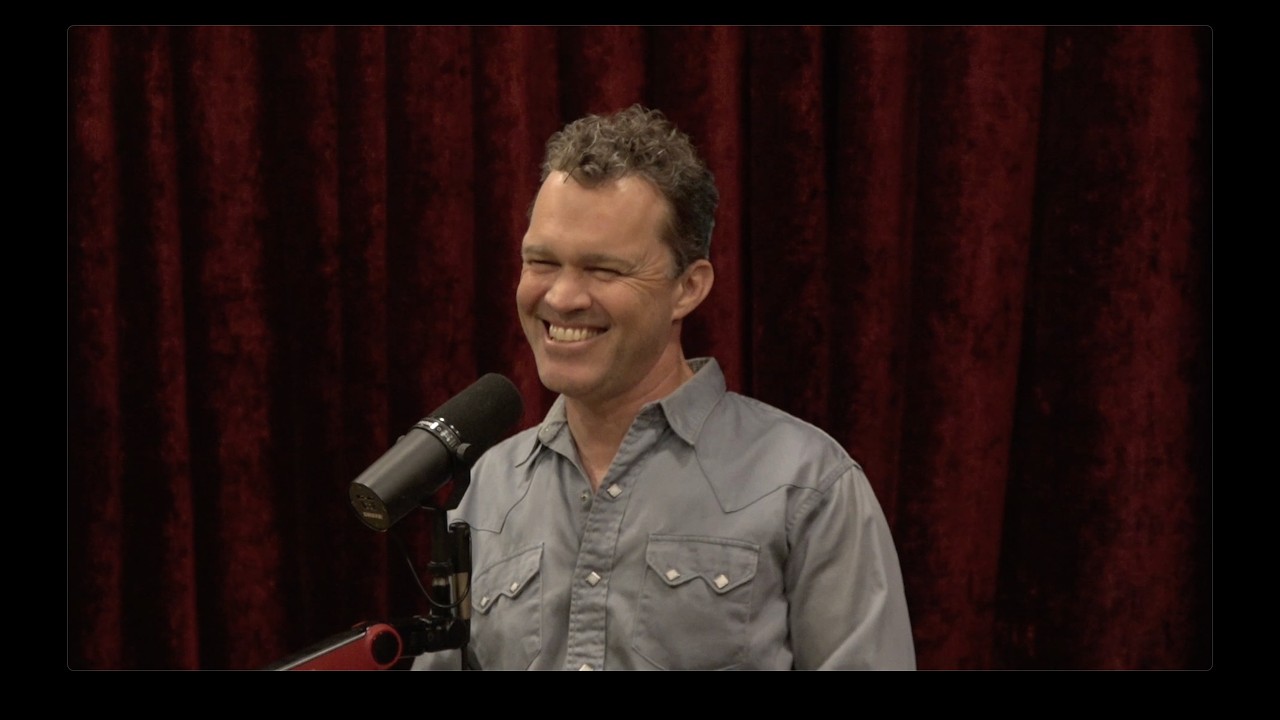
Zach Bush Warns Glyphosate and Synthetic Medicine Threaten Human Extinction
PowerfulJRE
Industrial agriculture, reliance on synthetic pharmaceuticals, and corporate disconnection from nature accelerate global health declines and threaten human survival within decades.
## Background
This episode of Joe Rogan Experience (#2529) was published by PowerfulJRE on YouTube on July 22, 2026. The page description introduces guest Zach Bush, MD, as a physician specializing in internal medicine, endocrinology, and hospice care, who is also the founder of Seraphic Group and the regenerative agriculture nonprofit Farmer’s Footprint.
## TL;DR
Zach Bush joins Joe Rogan to discuss how modern societal structures, abstract economic systems, and antibiotic chemical interventions have disconnected humanity from natural biological systems. The discussion explores ancient technologies, indigenous ecological knowledge, environmental toxins like glyphosate, and the health crises facing modern civilization. Bush frames humanity's current trajectory as a collective 'hospice moment' that presents an opportunity for systemic renewal through reconnecting with nature and biological energy.
## Atmosphere & style
The conversation carries a deeply philosophical and speculative tone, shifting fluidly between sweeping high-level concepts and specific medical or ecological theories. Zach Bush speaks with an earnest, contemplative intensity, framing complex modern issues in grand, holistic terms, while Joe Rogan acts as an engaged and grounded counterweight, frequently pressing with practical real-world counterexamples and personal observations. The exchange feels intellectually ambitious and visionary, maintaining an earnest, reflective energy throughout.
## Key takeaways
- [00:01](https://www.youtube.com/watch?v=Xq2aJpDHIio&t=1s) Zach Bush argues that reductionist science treats the human body as an isolated system rather than a deeply interconnected component of nature and its microbiome ecosystem.
- [03:21](https://www.youtube.com/watch?v=Xq2aJpDHIio&t=201s) Humanity is framed as currently facing a collective 'hospice moment,' experiencing a species-level diagnosis that requires shifting from systemic conflict to integration.
- [23:46](https://www.youtube.com/watch?v=Xq2aJpDHIio&t=1426s) Indigenous societies, such as the Achuar tribe, operate as keystone species that enhance biodiversity and maintain ecological balance through localized systems.
- [32:06](https://www.youtube.com/watch?v=Xq2aJpDHIio&t=1926s) Modern industrial additives like high-fructose corn syrup contain synthetic molecular structures designed to be patented, which alters human metabolic health.
- [42:49](https://www.youtube.com/watch?v=Xq2aJpDHIio&t=2569s) BioGeometry and shape transmissions illustrate how energetic frequencies and geometric proportions interact directly with biological physiological processes.
- [52:13](https://www.youtube.com/watch?v=Xq2aJpDHIio&t=3133s) Conventional historical timelines regarding ancient megalithic sites like the Pyramids of Giza are challenged, proposing lost acoustic, frequency, and biological technologies.
- [01:03:34](https://www.youtube.com/watch?v=Xq2aJpDHIio&t=3814s) Human biological intelligence functions like an antenna receiving nature's signals, which has been impaired during the post-WWII 'antibiotic era'.
- [01:14:02](https://www.youtube.com/watch?v=Xq2aJpDHIio&t=4442s) The 1910 Flexner Report and post-WWII petroleum surpluses systematically reshaped modern medicine away from herbal practices toward synthetic, patented pharmaceutical molecules.
- [01:32:26](https://www.youtube.com/watch?v=Xq2aJpDHIio&t=5546s) Near-death experiences and hospice observations indicate that consciousness and sensory reception extend beyond standard physical senses and mechanical biology.
- [02:25:40](https://www.youtube.com/watch?v=Xq2aJpDHIio&t=8740s) The Human Genome Project revealed that non-coding 'junk' DNA makes up 98.5% of the human genome, functioning as a complex inter-species genetic library.
- [02:36:34](https://www.youtube.com/watch?v=Xq2aJpDHIio&t=9394s) Direct, immersive contact with nature—such as three consecutive nights outdoors—can measurably restore immune system function and cellular vitality.
- [02:40:57](https://www.youtube.com/watch?v=Xq2aJpDHIio&t=9657s) Widespread exposure to glyphosate disrupts mitochondrial ATP energy production, correlating with a cascade of modern chronic health and fertility declines.
## Detailed walkthrough
### [00:01](https://www.youtube.com/watch?v=Xq2aJpDHIio&t=1s) The Coffee Debate and Human Relationships with Nature
The conversation kicks off with Zach Bush turning down coffee in favor of water, admitting he never quite figured out how the whole coffee thing works and prefers tea instead. Joe Rogan seizes the opportunity to quiz Bush, as a medical expert, on the wildly conflicting information surrounding coffee. Rogan points out that one day it is praised as an amazing antioxidant with numerous positive health benefits, and the next day it is demonized for causing severe dehydration and delivering far too much caffeine.
Bush responds by suggesting that the next major advancement for humankind will involve moving away from demonizing anything nature provides, focusing instead on our actual relationship to it. He explains that whether coffee is a health benefit or a detriment fundamentally depends on an individual's specific relationship to the substance. He critiques past science and fad diets for treating the human body as an isolated system while studying the impact of a single chemical like caffeine.
> "You're not an isolated system. And so if coffee is part of a complex ecosystem of your microbiome, the soil systems of your body, then it's going to supercharge you into health. But if coffee sits there as a drug that is bypassing the felt sense of being human, then you're probably undermining your potential to be alive fully..."
[01:48](https://www.youtube.com/watch?v=Xq2aJpDHIio&t=108s) Machine-Like Behavior and the Corporate Mirage
Rogan notes how interesting it is that caffeine is the one drug routinely and explicitly provided by corporate employers in the office. Bush takes the observation a step further, asserting that the primary drug offered in modern workplaces is actually an ingrained, performance-based reward system designed to prompt machine-like output. The human brain naturally contains every neurochemical necessary to control behavior, and society has spent the last 150 years molding corporate environments around these mechanical patterns.
Drawing from his extensive background in medicine, Bush shares that his third sub-specialty was hospice care, which allowed him to sit by thousands of deathbeds. He reveals a striking commonality among the dying: not a single person ever spent their final moments reminiscing about their time spent in an office. Even though office work consumes roughly 40 hours a week for decades, it completely fails to compute or integrate into the soul's experience at the end of life. Rogan agrees, noting that even if someone makes a massive amount of money, they are still fundamentally locked up for eight hours a day doing something they likely do not want to do.
[03:21](https://www.youtube.com/watch?v=Xq2aJpDHIio&t=201s) The Obsession with Numbers Over Human Feeling
The discussion shifts toward how human beings became abstract and disconnected from living systems. Rogan points out that cultural narratives heavily reinforce these delusions, celebrating the guy who shows up every day to a miserable, soul-crushing job as a hero, while dismissing the backyard poet as a mere hippie—unless, of course, that poet ends up selling a massive number of books like Hunter S. Scott Thompson, at which point society retroactively labels them a genius. Rogan emphasizes that people use almost anything as a crutch or an addiction to cope with a bad day, with unhealthy food being one of the biggest culprits.
Bush compliments Rogan on his 16-year broadcasting legacy across roughly 2,800 podcast episodes, stating that the platform is primed for "the most disruptive conversation that's ever been had." When Rogan asks what that could possibly be, Bush replies with two words: "Everything is perfect." He clarifies that the modern world is not experiencing a polycrisis, but rather a profound "hospice moment."
* As a hospice doctor, Bush found the work entirely different from his time running intensive care units (ICUs), where he felt he was constantly battling and failing against death.
* In hospice care, victory shifts from merely extending survival to integrating the totality of one's experiences.
* The transition allows dying patients to lay down the polarized "victim-perpetrator" dynamic and look past the limited five senses to realize the poetic perfection of their heartbreaks, disappointments, and joys.
[07:15](https://www.youtube.com/watch?v=Xq2aJpDHIio&t=435s) The Species' Hospice Diagnosis and the Sociopath Reality
Bush posits that humanity, in its current form, has existed for roughly 300,000 years and has finally received its own hospice diagnosis, with only a few decades left in this current iteration. He suggests that if humanity can set aside its polarized, right-versus-wrong conflicts, it will experience a collective awakening where former enemies are understood to have simply been holding the polarity required for the broader human journey. He adds a fascinating medical anomaly to highlight this potential transition, noting that about 10% of hospice patients unexpectedly do not die, but are instead discharged to live entirely new lives.
Rogan pushes back gently on this idealistic outlook, calling it a wonderful perspective "if sociopaths weren't real." He highlights the harsh reality of individuals whose minds do not function harmoniously with others and will never change. To illustrate his point, Rogan shares a shocking anecdote about a guest who sat right in his studio, only to murder a man and decapitate him a couple of weeks later.
* Rogan explains his collaborative work with his friend Josh Dubin, who transitioned from the Innocence Project to the Ike Perlmutter Center for Legal Justice to help exonerate the wrongfully incarcerated.
* Through the podcast's platform, multiple individuals have been freed.
* Dubin brought on a guest who had served 25 years in prison for drug dealing and assault; though legally guilty, his sentence was egregiously long.
* Merely weeks after filming the episode, the former inmate tracked down a man he had a personal beef with, killed him, cut his head off, placed a wig on the victim, and attempted a bizarre escape past high-definition security cameras that he seemingly did not understand due to his long incarceration.
[10:04](https://www.youtube.com/watch?v=Xq2aJpDHIio&t=604s) AI, Abstraction, and the Biological Future
Rogan emphasizes that the victim of the decapitation certainly did not experience a "perfect" moment, proving that innocent people constantly fall prey to real sociopaths. However, he agrees that society's current narrative of what it means to be a person is entirely broken, built on nonsense like 401k plans instead of true human experiences. Looking toward the future, Rogan notes how the rapid rise of Artificial Intelligence (AI) has brought concepts like Universal Basic Income (UBI)—or what Elon Musk terms "universal high income"—into mainstream discussion. The idea that people might be given enough resources to live without mandatory labor terrifies many because the education system has failed to teach individuals how to be curious, explore, and find intrinsic purpose.
> "Numbers that you don't even feel. The numbers go up, they go down, you don't even notice it, but you feel everything as a person... For whatever weird reason, we've been tricked into thinking that numbers are more valuable than the feelings."
Bush passionately validates this sentiment, declaring that Rogan has just nailed the single most important message for humanity: feeling is the only relevant metric for the human body. While Rogan muses that AI might eventually rework global infrastructure so humans can finally step back from running things and return to simply being people, Bush remains highly skeptical of a machine-dominated future. He insists that a mechanical system requiring external energy that cannot self-repair can never outlast biology. He dismisses the transhumanist, tech-centric future championed by Elon Musk—complete with brain chips and artificial limbs—as a massive, disorienting abstraction that occurs when vital context is lost, firmly concluding that the universe's ultimate pathway forward is strictly biological.
Here is a detailed, faithful walkthrough of Part 2 of the transcript:
### [16:15](https://www.youtube.com/watch?v=Xq2aJpDHIio&t=975s) The Dehumanizing Legacy of Industrial Education and AI
Zach Bush argues that for 150 years, society has trained children to sit in chairs, take multiple-choice tests, and undergo rigid programming rather than engaging in experiential learning. Because humans are naturally unsuited for machine-like behavior, forcing them into cubicles inevitably leads to declining health, productivity, and business failure. Bush views the current rise of AI as the natural endpoint of a humanity that has lost its connection to nature, reaching a "terminal state of abstraction."
Joe Rogan offers a contrasting perspective, speculating that artificial intelligence might not merely be a tool, but an entirely new form of non-biological life that humanity is meant to give birth to. He compares human technological ambition to an "electronic caterpillar that's making a cocoon," driven by a subconscious instinct to innovate and collect status-driven materialism. Rogan suggests that if AI takes over routine labor and Elon Musk's concept of universal high income comes to fruition, it could actually liberate humans from factory-style grind and allow them to return to being human.
- **Ketone IQ Sponsorship:** Rogan references DARPA's multi-million-dollar research into brain fuels for soldiers, noting that single servings of supplemental ketones originally cost $5,000 before Ketone IQ brought consumer doses down to $4 at Target and online.
---
### [20:48](https://www.youtube.com/watch?v=Xq2aJpDHIio&t=1248s) Motivation, Wealth, and Rethinking Education
Bush pushes back on the idea of universal high income, arguing that giving every individual hundreds of thousands of dollars a year from the government would act as a "death sentence to human creativity." He asks Rogan whether guests born into multigenerational wealth have ever displayed greater motivation or creativity than those born into poverty. Rogan agrees that people raised in poverty generally possess far more drive to succeed.
However, Rogan contends that this dynamic only exists because society trains people to be motivated solely by money. He argues that if children were raised without monetary anxiety and instead educated to explore their intrinsic interests—such as piano, painting, or sports—a high-income safety net paired with a new educational paradigm would foster genuine human expression rather than laziness. Bush counters that money remains an abstract mechanism disconnected from nature, and dumping money into a broken system will always end in disaster.
---
### [23:46](https://www.youtube.com/watch?v=Xq2aJpDHIio&t=1426s) Humans as Keystone Species and Indigenous Ecology
When Rogan brings up hunter-gatherer societies, Bush explains that indigenous tribes represent humanity in its proper natural context, operating as a "keystone species of keystone species." Far from being passive foragers, these communities actively enrich their environments. Bush notes that wherever a true keystone species is present—whether it is re-introduced wolves in Yellowstone, beavers in South America, white lions in northern South Africa, or indigenous tribes—biodiversity, soil health, and overall vitality flourish.
Bush points out that the Amazon jungle is not a wild, unmanaged wilderness, but a massive man-made food forest cultivated by hundreds of native nations over 40,000 years. As human management was displaced, the region began drifting toward desertification cycles. Bush asserts that money is not the primary root cause of societal decay, but rather a downstream symptom of losing this foundational connection to Mother Earth.
- **Keystone Species Examples:** Reintroduced wolves in Yellowstone, beavers in South America, white lions in northern South Africa, and Amazonian indigenous nations.
- **Amazon Rainforest History:** Cultivated as a managed food forest by native peoples for roughly 40,000 years.
---
### [26:47](https://www.youtube.com/watch?v=Xq2aJpDHIio&t=1607s) First Contact with the Achuar and the Threat of Abstraction
Bush illustrates the rapid decay caused by modern intrusion by detailing his experiences with the Achuar tribe in the sacred headwaters of the Amazon along the Ecuador-Peru border. The Achuar were the last indigenous culture to make first contact with the industrialized world, which occurred in 1996. For tens of thousands of years, the Achuar maintained extreme resilience by capping their village populations at 120 people; once a village hit that limit, young men were sent out to start a new settlement.
In the mid-1990s, Achuar elders began sharing collective dreams predicting the end of the world caused by their "little brothers" who had lost their connection to nature. To prevent extinction, they attempted to "redream" this relationship by reaching out to Westerners through dreamwork. This led Bill Twist and Lynn Twist (then a global director for The Hunger Project) deep into the jungle, where native leaders were waiting on a riverbank to declare that it was time for contact.
- **Achuar First Contact Year:** 1996
- **Village Demographics:** Strictly capped at 120 inhabitants to ensure ecosystem balance and community resilience.
- **Key Figures in Contact:** Bill Twist and Lynn Twist.
---
### [29:26](https://www.youtube.com/watch?v=Xq2aJpDHIio&t=1766s) The Destruction of Abundance and the 10-Year Household Cycle
Bush explains how rapidly the introduction of abstract Western commerce eroded the Achuar's self-sufficiency. It began modestly with missionary schools distributing boxed apple juice containing high-fructose corn syrup and chemical flavorings. Within 30 years, this single taste of industrial sugar severed their traditional bond with the forest. Today, despite living in one of the most biodiverse environments on Earth, tribe members perceive themselves as impoverished, struggling to buy gasoline for outboard boat motors, sending children away to British-style city schools, and using smartphones.
Before this disruption, the Achuar had no concept of poverty or food storage. They built magnificent, 30-foot vaulted homes designed for indoor-outdoor living, which they intentionally burned down every 10 years to honor energy rebirth cycles before constructing new ones elsewhere. Each family maintained three distinct garden plots across different micro-ecosystems to guarantee a thriving harvest regardless of weather shifts. Bush emphasizes that human beings are capable of magnificent ecological balance, but even a slight fracture in their relationship to natural systems causes immediate collapse.
- **Traditional Architecture:** Homes built with 30-foot vaulted ceilings, intentionally burned down every 10 years to reset household energy dynamics.
- **Agricultural Strategy:** Three distinct gardens maintained per family across micro-ecosystems to buffer against wet and dry seasonal variations.
[32:06](https://www.youtube.com/watch?v=Xq2aJpDHIio&t=1926s) High Fructose Corn Syrup, Racemic Molecules, and Corporate Patents
Zach Bush explains how the geometries of wealth and poverty function as sovereign frameworks within human behavior. Poverty, he argues, triggers an original human trauma: the belief that nature abandoned us and withheld what we needed. When a person tastes high fructose corn syrup in boxed apple juice, it acts like "cocaine on the frontal lobe," tricking the brain into believing humans created something better than nature.
Bush delves into the chemistry of high fructose corn syrup, noting it is a mirror image of natural fructose—a synthetic alteration created through a process known as a racemic reaction. Because this mirror-image molecule does not exist in nature, the liver cannot process it as a typical carbohydrate and instead handles it as an inflammatory triglyceride. Downstream, this aberration contributes to cardiovascular disease, brain inflammation, severe depression, and anxiety disorders. When Rogan asks why companies began altering molecules this way, Bush responds directly:
> "Because you can patent a molecule that doesn't exist in nature."
He compares this to the broader pharmaceutical model, where natural plant compounds are chemically altered specifically so they can be patented and commercialized. Reflecting on his own career, Bush notes that he spent 17 years in academia creating chemotherapy—attempting to poison cancer cells in laboratories every day—before realizing that certain compounds could nourish and restore cells instead.
* **Racemic Process:** A chemical process used to create a mirror-image molecule (a racemic mixture or enantiomer) not found in nature.
* **Metabolic Impact:** The liver converts mirror-image fructose into inflammatory triglycerides rather than normal sugars.
* **Patent Incentive:** Non-natural, synthetic chemical structures allow companies to secure patents and commercialize compounds.
* **Academic Background:** Bush spent 17 years in academia developing chemotherapy treatments before shifting his focus to cellular nourishment.
---
[35:16](https://www.youtube.com/watch?v=Xq2aJpDHIio&t=2116s) Loneliness of the Cancer Cell and the Sociopath Model
Transitioning to cellular health, Bush argues that sociopaths and cancer cells share a fundamental root cause: extreme isolation from their surrounding ecosystem. In biological research, cancer cells are not external invaders; rather, a cancer cell is "the loneliest cell in a human body." When a cell loses communication with its surrounding environment, it assumes malignant traits, becoming increasingly life-threatening over time. Similarly, a sociopath represents a human being who has become so completely isolated from the natural collective that they act with malignancy toward life around them.
When Bush fed and nourished isolated cancer cells instead of trying to poison or eradicate them, two outcomes occurred based on their remaining metabolic capacity: either they repaired themselves and reconnected with the biological system, or they underwent *apoptosis*—a gentle, natural self-elimination that allowed stem cells to replace them.
Rogan pushes back on this perspective, arguing that while ideal parenting might prevent sociopathy in a utopian world, real human existence is messy. As long as human freedom exists, Rogan notes, people will be raised poorly, leading to anger, theft, lie, and violence:
> "The problem with people is there's never been a single time in human history where we've been a people with no war. Not one. Not one."
* **Definition of Malignancy:** Malignancy stems from severe isolation; a cell or individual separated from its system becomes life-threatening.
* **Apoptosis:** The process of programmed cell death, where severely damaged cells dissolve cleanly to allow stem cells to regenerate new healthy tissue.
* **Rogan's Counterpoint:** Conflict, violence, and flawed parenting are inherent to human freedom, making universal peace biologically and historically unrealistic.
---
[38:51](https://www.youtube.com/watch?v=Xq2aJpDHIio&t=2331s) Historical Peace, Telepathy, and the Evolution of Communication
Bush challenges Rogan's assertion that human history has never seen universal peace, citing the reign of King Solomon roughly 2,400 years ago as a single generation where global peace occurred. Rogan remains skeptical, questioning how King Solomon could possibly know what was happening in Morocco, Australia, or China without modern telecommunications.
When Rogan jokes that there was no 5G or Twitter to check on China 2,400 years ago, Bush suggests that early humans utilized advanced technology inherent to the human body itself—namely, full telepathic communication—and mentions ancient structures like the pyramids. Rogan agrees that humans may have once held an innate intuitive or mind-reading capability that was gradually muted as spoken language and written text developed.
Bush expands on this idea, outlining an 80,000-year decline in human communication bandwidth:
1. **Wide-Open Telepathy:** Direct, non-verbal transmission of thought and feeling between human bodies.
2. **Tonal Language:** Vocalizations and tones (similar to opera) that transmitted a full-body sensory experience beyond simple auditory words.
3. **Spoken Word:** Intellectualized communication directed straight to the mind, prioritizing efficiency and machine-like optimization at the expense of bodily feeling.
4. **Written & Digital Text:** Abstract representations of language, continuing down to digital text messages and modern emojis.
---
[42:49](https://www.youtube.com/watch?v=Xq2aJpDHIio&t=2569s) BioGeometry, Shape Transmissions, and Biological Resonance
As the discussion turns to emojis, Rogan mentions that producer Jamie Verno views emojis as modern hieroglyphs. Bush agrees with the comparison but distinguishes ancient hieroglyphs as precise energetic forms rather than simple abstract symbols. He introduces the work of Dr. Ibrahim Karim, an Egyptian researcher in his 80s who developed *BioGeometry*. Bush explains that specific geometric shapes found in ancient Egyptian hieroglyphs and pyramid architecture interact directly with human biology, generating physiological responses such as reduced inflammation regardless of whether the viewer consciously understands the symbols.
Jamie searches online for scientific papers verifying these biological claims, finding quotes from Dr. Karim regarding energy fields, vibrational resonance, and spatial imprinting. Bush highlights the concept of *biosis*—the interconnected relationships that make living systems possible—to illustrate how biological systems permanently change when they interact.
Rogan agrees with the core principle that energy fields imprint upon one another, noting how critical it is to surround oneself with positive people: "Being around assholes is terrible for you." Bush concludes the segment by praising Rogan’s 16-year podcasting history as an open system of intellectual and biological "impregnation," driven by a relentless curiosity to challenge his own biology and evolve through continuous dialogue.
> "When two energy fields are in resonance and exchange information, something happens after the resonance is over. The two systems do not go back to their original state."
* **BioGeometry Founder:** Dr. Ibrahim Karim (Cairo, Egypt), developer of BioGeometry principles studying environmental shape resonance.
* **Swiss 5G Project:** Bush notes Switzerland engaged Dr. Karim's methods to harmonize electromagnetic frequencies and 5G networks using geometric shapes.
* **Biosis:** The underlying principle of interconnected, mutually supportive relationships necessary to sustain living systems.
[47:50](https://www.youtube.com/watch?v=Xq2aJpDHIio&t=2870s) The Genesis of the Podcast and Being an Antenna
Joe reflects on the early days of the podcast, sharing that it was never intended to be a business or a grand plan. In the beginning, it was purely recreational—a fun, community-driven project with friends to replicate the enjoyable dynamic of morning radio over the internet without making any money for years. Everything shifted around 2011 when Graham Hancock became one of his first major guests, alongside Anthony Bourdain. Having read *Fingerprints of the Gods*, Joe was a huge fan of Hancock's alternative history theories, even though his college-educated history friends were often offended and dismissed Hancock as a charlatan.
As viewership grew, Joe realized the podcast gave him a unique platform to bring on fascinating people, from high-profile figures like Neil deGrasse Tyson to knife makers and beekeepers. He emphasizes that he would love doing this even if it weren't a job and no one watched—just to sit across a table for hours, pick people's brains, and understand their motivations, passions, and inner thoughts. Joe views himself as an "antenna" for passionate people. To keep the process pure, there are no board meetings, executives, or corporate gatekeepers dictating the lineup; he books guests directly from his phone based purely on his genuine personal curiosity.
- Joe notes that he gets immense satisfaction from watching skilled craftspeople work with pride, such as cabinet makers obsessing over tight seams, sanding, staining, and polishing wood with microfiber cloths.
- Zach Bush connects Joe's "antenna" metaphor back to Ibrahim Karim's concept: humans operate as biological antennas constantly receiving environmental information.
---
[52:13](https://www.youtube.com/watch?v=Xq2aJpDHIio&t=3133s) Rethinking Ancient History and the Mysteries of Egypt
Joe challenges the mainstream historical narrative that modern humans represent the most advanced civilization to ever exist, pointing to the pyramids of Egypt as proof that our current understanding is flawed. Traditional archaeology attempts to neatly fit these ancient monuments into conventional historical boxes, but the physical reality does not align. Mainstream estimates place construction around 2500 BC, but Joe notes there is no carbon dating for stone and no hieroglyphs detailing their actual construction or purpose. Furthermore, ancient sites show evidence of extreme erosion and complex older structures built beneath newer ones.
Joe highlights the sheer engineering scale involved, such as moving 1,000-ton monoliths over distances of 400 miles, as well as the alignment of 2.3 million stones perfectly to true cardinal directions (north, south, east, and west). He argues that modern civilization lacks the machinery to replicate such feats today, making the assumption that ancient Egyptians were primitive absurd. Dr. Zach Bush proposes that the pyramids were created by a living biological system using acoustic waveforms rather than mechanical technology, with Ibrahim Karim suggesting the energy driving these constructions originated from human bodies rather than heavy machinery.
- Joe points out that physical artifacts like core drills in Egyptian granite demonstrate that ancient builders possessed a technology capable of drilling at ridiculously high RPMs.
- Zach Bush attributes this core drilling ability to the combination of water and biological energy working in harmony.
- Bush asserts that humanity suffered a global "amnesia event" around 5,000 to 7,000 years ago, resulting in a sudden global loss of connection, intelligence, and high-level technology across cultures like the Aztecs, Mayans, and Incas.
- Bush highlights the existence of massive underground labyrinths extending for thousands of kilometers worldwide, as well as ancient submerged pyramid structures off the coast of Japan that exceed the Egyptian pyramids in size.
---
[58:08](https://www.youtube.com/watch?v=Xq2aJpDHIio&t=3488s) Contextualizing Life, Energy Concentration, and Biosis
Dr. Bush outlines the fundamental evolution of energy concentration in physics and biology to contextualize how living systems develop intelligence. Stars generate massive amounts of energy through nuclear fission and fusion across billions of galaxies, but the biological innovation of chlorophyll created a system that concentrates light energy per cubic centimeter far beyond nuclear reactions. This light energy is passed through bacteria and fungi to support plant life, trees, and complex ecosystems. Higher concentrations of energy per cubic centimeter enable greater levels of internal communication, which Bush defines as *biosis*—the interconnected relationships necessary for life to co-create and collaborate.
The historical evolution of energy storage relies on carbon bonds. Sunlight is captured in strings of carbon to build carbohydrates and fatty acids, storing electromagnetic energy (photons) between carbon atoms. Fungi drastically accelerated this process by exuding digestive enzymes externally, turning the surrounding soil into an outside stomach and allowing vast mycelial networks (hyphae) to collaborate across miles as single-celled organisms.
- A major evolutionary leap occurred with the emergence of the mitochondria—ancient bacteria that entered human cells to drive respiratory energy production using oxygen and hydrogen, resulting in a 10-fold increase in light energy density.
- The average human cell contains roughly 200 mitochondria, while complex neurons contain up to 2,000 mitochondria in their neural heads.
- Mitochondria originated from a methane-producing bacterium swallowed by an archaebacterium, working together to move life past simple fermentation into complex multicellular organisms like protozoa, parasites, nematodes, and mammals.
- Bush concludes that human biology—specifically the human gut and colon—contains more biodiversity and concentrated life than any other ecological niche on the planet, including the Amazon rainforest or coral reefs.
[01:03:34](https://www.youtube.com/watch?v=Xq2aJpDHIio&t=3814s) Human Intelligence, the "Antibiotic Era," and the Desiccation of Wheat
Dr. Zach Bush posits that human intelligence is not an isolated phenomenon generated by the brain, but rather that the human brain acts as an intricate "antenna" tuned into nature. He explains that the gut's neurobiology shows we have the most complicated biological antenna system on Earth. However, over the past 70 years, humanity entered the "antibiotic era"—beginning with penicillin in the 1940s and progressing into agricultural herbicides and pesticides—which actively destroys *biosis* (the interconnected relationships that create and sustain life).
Joe Rogan points out the absurdity of modern agricultural practices, particularly using herbicides like glyphosate not just as weedkillers, but as desiccants to prematurely dry out wheat crops for faster processing. Rogan expresses frustration that the food supply has become dependent on chemical poisons, noting that regulatory decisions often protect the profits of chemical and agricultural companies rather than public health. Bush adds that the system reliant on chemical-heavy food isn't just the agricultural economy, but the multi-trillion-dollar medical system that profits from treating the resulting chronic illnesses.
- **The Antibiotic Era:** Began in the 1940s with penicillin and expanded into global agricultural chemicals, shifting society toward killing microbial life rather than supporting it.
- **Glyphosate as a Desiccant:** Sprayed directly onto crops like wheat right before harvest to dry them out rapidly, directly exposing the food supply to toxic chemicals.
- **Economic Reliance on Chemical Food:** Regulatory bodies hesitate to ban widespread pesticides because corporate, agricultural, and pharmaceutical business models depend on this ecosystem.
---
[01:07:34](https://www.youtube.com/watch?v=Xq2aJpDHIio&t=4054s) Bayer, Corporate History, and the Pasteurization Debate
Bush traces the deep historical roots of the chemical and pharmaceutical industries, explaining how Bayer was absorbed into IG Farben in Germany during the 1930s before being spun back out after World War II. During this era, researchers began studying the fundamental relationships between the microbiome, essential amino acids, and human biological output. Bush connects this mindset back to Louis Pasteur in the 19th century, whose work solidified the belief that nature and germs are inherently hostile to human health, giving rise to widespread sterilization practices like pasteurization.
Rogan and Bush debate the public narrative surrounding raw milk versus pasteurized milk. Rogan critiques sensationalized media reporting that misuses relative risk statistics to portray raw milk as extremely dangerous, when actual cases of severe illness from raw milk are statistically minute compared to standard foodborne illnesses.
> "The word antibiotic is truth in advertising. To be anti-biosis... is to be against, to disrupt, to destroy the interconnected relationships that make life possible."
- **Bayer and IG Farben:** IG Farben was the German chemical conglomerate that oversaw WWII-era chemical research; Bayer was reconstituted from it following the collapse of the Third Reich.
- **Louis Pasteur's Germ Theory:** Popularized the worldview that microbes are enemies to be eliminated, establishing the rationale for pasteurizing and homogenizing natural food products.
- **Raw Milk vs. Relative Risk:** Media reports often cite high percentage increases in risk (e.g., "860% more likely to get sick") to create panic, hiding the fact that actual yearly illness counts from raw milk are very low.
---
[01:11:18](https://www.youtube.com/watch?v=Xq2aJpDHIio&t=4278s) Foodborne Illness and the Precautionary Principle
Discussing the realities of food poisoning, Rogan notes that people frequently get sick from contaminated produce, particularly leafy greens and salads, often caused by agricultural runoff from industrial farms contaminating irrigation water. Bush shares a government project from the late 2010s that evaluated potential biological security threats to public salad bars. The study concluded that intentionally contaminating a salad bar was almost redundant because commercial salad bars already harbor virtually every known pathogen due to high public contact and poor handling.
When looking up data via Perplexity on which foods cause the most foodborne illness, the results highlight raw or undercooked poultry, ground beef, leafy greens, raw shellfish, and unpasteurized soft cheeses as primary vehicles for pathogens like *E. coli*, *Listeria*, and *Salmonella*.
- **Primary Food Poisoning Vectors:** Contaminated irrigation water runoff onto leafy greens, raw/undercooked poultry, ground beef, and shellfish.
- **Salad Bar Security Study:** A late-2010s government assessment concluded commercial salad bars are inherently prone to pathogen accumulation due to physical contamination and standing produce environments.
---
[01:14:02](https://www.youtube.com/watch?v=Xq2aJpDHIio&t=4442s) The 1950s Green Revolution, Petrochemicals, and Modern Medicine
Bush outlines how the mid-20th-century approach to agriculture and medicine was shaped by the post-WWII petroleum surplus. Following World War II, energy markets had a massive oversupply of oil. Petrochemical and industrial interests, building on foundations laid early in the 20th century by figures like John D. Rockefeller, realized that petroleum carbon molecules could be re-engineered into profitable synthetic pharmaceuticals and agricultural chemicals.
Bush highlights the 1910 Flexner Report—funded by the Rockefeller Foundation—which discredited traditional herbal medicine and pushed medical education exclusively toward synthetic, patented carbon-molecule pharmaceuticals. He illustrates this commercial model with the chemotherapy drug **vincristine**: although originally a biological compound found in nature and produced by organisms like algae, it was isolated, synthetically manufactured, and marketed at astronomical prices rather than integrated into natural soil or diet systems.
> "Vincristine today is sold for $28,000 a gram. The same thing was done with oil... if we can take something that's worth 20 cents and turn it into $28,000 if we manipulate these molecules and then make a story of 'this treats a disease'... that's how the antibiotic, anti-cancer, anti-diabetes, anti-obesity, anti-everything has come about."
- **The Flexner Report (1910):** Commissioned report that restructured American medical education, shuttering natural and holistic institutions in favor of pharmaceutical-based medicine.
- **Post-WWII Oil Surplus:** Driven by the need for new commercial markets, petroleum byproducts were repurposed into synthetic fertilizers, pesticides, and pharmaceutical drugs.
- **Vincristine Economics:** A naturally occurring anti-cancer compound derived from biological sources that is isolated and sold synthetically for upwards of **$28,000 per gram**.
- **Early Antibiotic Era:** Following penicillin's success against lethal infections like syphilis, antibiotics were heavily overprescribed throughout the 1940s and 1950s for routine ailments, setting the stage for modern microbial disruption.
[01:32:26](https://www.youtube.com/watch?v=Xq2aJpDHIio&t=5546s) Life as a Self-Regenerating Machine and the Human Antenna
Zach Bush outlines a philosophical vision of nature, emphasizing that biological life inherently possesses the capacity to overcome toxicity. Planet Earth has generated severe toxins since its inception—such as early sulfuric acid pools—yet biology continuously iterates, repairs, and regenerates through its unique capacity to concentrate light energy. This process yields increasing biodiversity and complexity, culminating in the human body as a specialized container designed to hold a maximum concentration of information and light energy. Reframing stress, Bush argues that when connected to nature, environmental friction and death are fundamental drivers of rebirth, imagination, and new life force.
Reflecting on his experiences in hospice care, Bush notes that near-death experiences reveal a universe deeply interconnected beyond human mental constructs or the five sensory systems. When a patient dips across the threshold, their sensory "antenna" opens completely, experiencing an intense influx of energetic information. Bush contends that if humanity could collectively feel this state of deep connection, addiction would cease, as he defines addiction as the behavioral consequence of an organism feeling abandoned by its infinite reality.
- **Definition of Nature:** Bush references the Oxford English Dictionary definition of nature—which distinguishes nature from humans and human creations—as evidence of humanity's self-imposed psychological separation from the natural world.
- **Illusion of Abstract Systems:** He argues that money and medical interventions (such as IV vitamin C or peptide injections) are abstract human constructs rather than true sources of life and biological vitality.
- **Predation and Indigenous Context:** Bush reinterprets predator-prey dynamics, citing indigenous perspectives where animals selectively offer themselves in a sacred relationship of exchange rather than pure violent conquest.
---
[01:39:39](https://www.youtube.com/watch?v=Xq2aJpDHIio&t=5979s) Debating Disease Outbreaks, Immunity, and European Colonization
Joe Rogan pushes back on the assertion that biological alignment alone protects against lethal disease, raising historical examples of massive population collapses. Rogan points to archaeological discoveries in the Amazon—such as those described around the Lost City of Z—where thriving, highly integrated ancient civilizations vanished roughly 200 years after initial European contact. The prevailing scientific explanation attributes this collapse to smallpox and other novel pathogens introduced by Europeans to populations lacking acquired immunity. Rogan notes that nomadic and indigenous groups frequently faced seasonal famines, compromised nutritional status, and severe resource constraints that left their immune systems vulnerable regardless of their spiritual or ecological integration.
> "If you introduce a new disease, a novel disease that they don't have an immunity to during that time, that could most certainly wipe them out despite the fact that they're living in nature. They don't have the resources that's required to keep a biological system perfectly functioning and healthy."
Bush responds by suggesting that the severe impact of colonizers was driven primarily by the acute imbalance and illness of the arriving Europeans themselves—who were malnourished from months on ships and detached from natural ecosystems for centuries—rather than just a straightforward pathogen spread. He argues that the sudden arrival of colonizers carrying a "scarcity mentality" and destructive technologies induced immense neurological stress and cortisol spikes in native populations. This psycho-spiritual trauma, according to Bush, disrupted the native populations' biological feedback loops and immune resilience, mirroring the structural disruptions seen when modern industrial items interrupt long-standing indigenous food ways.
- **Historical Architecture:** The discussion highlights how ancient cultures, such as the Aztecs, Incas, and Egyptians, designed pyramids aligned at precise $13^\circ$ angles mirroring celestial formations like Orion's Belt and the Pleiades star cluster.
- **The Impact of Travel Conditions:** Rogan emphasizes the severe physiological strain suffered by early transatlantic sailors eating low-quality provisions over months, which compounded the spread of disease upon land contact.
[01:47:37](https://www.youtube.com/watch?v=Xq2aJpDHIio&t=6457s) Native Isolation, Pathogens, and the Aztec Sacrifice Debate
Zach Bush opens by reflecting on the visceral reaction humans experience in the presence of a sociopath—an immediate, instinctual sensing of danger where an "antenna goes up." He applies this metaphor to Indigenous populations during European colonization: facing alien forces shooting them, destroying their gardens, and riding unfamiliar animals sent their cortisol levels into overdrive, collapsing their gut microbiomes and immune systems. Bush argues that these populations succumbed to Western diseases not primarily due to the pathogens themselves, but because their fear, guilt, and broken connection with nature disrupted their energetic biological field.
Joe Rogan pushes back, pointing out that well before European contact, societies like the Aztecs engaged in extreme cruelty. Rogan cites the Spanish chronicler Bernal Díaz del Castillo, who documented that as many as 80,000 people were sacrificed over four days during the consecration of the Great Pyramid of Tenochtitlan. Rogan stresses that a civilization practicing mass ritual sacrifice can hardly be described as living in a balanced, harmonious relationship with nature. Bush counters that such accounts represent a European perspective projecting its own broken worldview onto an alien culture, admitting he cannot defend human sacrifice but offering to frame indigenous relationship dynamics differently based on his own experiences with modern tribal communities.
- **Historical Accounts:** Chronicler Diaz reported up to 80,000 human sacrifices over four days during Tenochtitlan's temple consecration.
- **Root Cause of Disease:** Bush posits that fear, high cortisol, and loss of connection with nature drove immune failure rather than the mere presence of foreign microbes.
---
[01:50:09](https://www.youtube.com/watch?v=Xq2aJpDHIio&t=6609s) The Mesoamerican Ballgame and Ancient Megalithic Builders
To challenge standard historical narratives, Bush brings up the ancient Mesoamerican ballgame played by the Mayans and Aztecs. Players used a small ball that could be hit with any body part except their hands, aiming for a tiny stone hoop mounted high on massive pyramid arena walls. Bush notes that after games lasting for days, the victorious team's captain was traditionally beheaded. Rogan quips that this provided "not a lot of incentive to score," humorously explaining why the matches dragged on so long. When Rogan argues that fundamental human instincts always drive people to avoid death, Bush suggests that modern humans are veiled by five sensory limitations that obscure what happens beyond physical life.
The conversation pivots to the origin of ancient structures like the Aztec and Egyptian pyramids. Rogan and Bush note that the Aztecs did not claim to have built many of these massive monuments; rather, they inhabited existing structures, referring to places like Teotihuacan as the birthplace of the gods. Rogan describes visiting Chichén Itzá and marveling at its engineering, while acknowledging the predominant scientific theory that diseases wiped out these ancient American societies.
- **Mesoamerican Ballgame:** Played on large stone fields with small hoops barely larger than the ball; hands were forbidden, and victorious captains were traditionally sacrificed.
- **Megalithic Origins:** Both speakers highlight that early civilizations often claimed to have inherited, rather than constructed, their grandest stone structures.
---
[01:53:24](https://www.youtube.com/watch?v=Xq2aJpDHIio&t=6804s) Rethinking Death, Tibetan Sky Funerals, and Hospice Care
Bush clarifies that he does not advocate for violence, but envisions a world where death is no longer feared as an endpoint, but revered as a spiritual evolution. Rogan brings up Tibetan sky funerals—where deceased bodies are left exposed on mountainsides to be consumed by vultures—as a natural, cycling back into the ecosystem. Rogan contrasts this with modern Western burial practices, where bodies are preserved with toxic embalming chemicals, jokingly adding that these chemicals make it possible for forensic investigators to exhumate bodies years later and discover *"Nana poisoned him."*
Drawing from his experience as a hospice physician, Bush describes witnessing patients "pierce the veil" as they approach death. In those final moments, patients realize their physical body is just a small story within a vast, interconnected universe. He explains that 10% of hospice patients experience dramatic spontaneous remissions—recovering from terminal illnesses, re-engaging with their families, and expressing new artistic creativity after glimpsing this interconnectedness.
> "On the other side of that veil is radical connectivity energetically. You feel everything. Stars, moonscapes, everything... This is that precious one moment where a human antenna gets the entire download and can still transmit it."
- **Hospice Remissions:** Bush notes that roughly 10% of the 80 terminal patients he admitted weekly recovered and were discharged after experiencing near-death realizations.
- **Western Burial Critique:** Rogan and Bush criticize chemical embalming as an unnatural attempt to prevent the body from returning to nature.
---
[01:57:44](https://www.youtube.com/watch?v=Xq2aJpDHIio&t=7064s) Financial Systems vs. Natural Abundance
Bush praises Rogan for maintaining his connection to tangible, real-world pursuits—like mechanics, car building, and woodworking—despite acquiring massive wealth and fame. Mentioning his own home built in the woods of Virginia and his partner's village development project in Panama, Bush argues that society needs to move away from using money as the sole source of safety and shelter. He asserts that human biology was entirely resourced by nature without money, evolving from a single fertilized cell into trillions of cells powered by mitochondria that concentrate light thousands of times brighter than the sun.
Rogan grounds the argument in practical reality, asking how someone acquires tools like a circular saw to build a house without a monetary system. He outlines the complex industrial supply chains—from material science engineers and steel foundries to manufacturing factories, healthcare benefits, and union dues—required to produce modern tools. Bush responds by noting that ancient societies built lasting castles and pyramids without modern monetary systems, asserting that true innovation comes from natural human creative drive rather than financial incentives within an artificial matrix.
- **Cellular Energy:** Bush highlights that a human body consists of ~70 trillion cells and 14 quadrillion mitochondria operating without financial capital.
- **Supply Chain Realities:** Rogan points out that specialized tools require complex networks of workers, designers, and resource extractors who depend on monetary compensation.
[02:01:58](https://www.youtube.com/watch?v=Xq2aJpDHIio&t=7318s) The Mystery of Ancient Technology and Lost Civilizations
Joe Rogan and Dr. Zach Bush discuss the origin and construction of ancient structures like the Great Pyramids. Rogan points out that modern society is trapped in the assumption that current technological innovation is the only path human civilization could have taken. He argues that ancient societies likely went in a completely different technological direction—one that was subsequently lost to history due to a major cataclysm roughly 11,000 to 12,000 years ago, giving rise to universal flood myths across various cultures.
Rogan expresses frustration with standard archeological explanations, such as the idea that ancient builders simply pushed massive stones using sand and basic ramps. He notes that modern science fails to explain how ancient civilizations carried 500-ton stones across hundreds of miles, cut perfectly symmetrical statues, or constructed complex underground systems. He highlights subterranean discoveries beneath pyramids, including massive columned structures and large metallic objects described by ancient historians like Herodotus, emphasizing that we must remain open-minded about what we truly know.
- Modern archaeology often underestimates ancient capabilities by attempting to fit them into crude, linear explanations.
- A global cataclysm roughly 11,000+ years ago wiped out advanced technological knowledge, leading to a reemergence of society around 6,000 years ago.
- Subterranean structures, LiDAR discoveries, and historical accounts (such as Herodotus writing about labyrinths greater than Giza) reveal engineering complexity beyond current understanding.
---
[02:06:54](https://www.youtube.com/watch?v=Xq2aJpDHIio&t=7614s) Experiential Feeling vs. Abstract Knowledge
Zach Bush highlights Rogan’s physical shift during the discussion, observing how Rogan looks upward when accessing deep thought and begins transmitting conviction through body language and presence rather than mere mental calculation. Bush contrasts the limitations of the intellectual mind with the broader awareness that comes from "feeling" reality directly. He shares how his own near-death experience—a car accident in 2010—completely shifted his perspective away from 17 years of strict academic training toward an experiential understanding of human biology and connection.
Bush asserts that relying solely on abstract intellectual frameworks produces disempowered versions of reality. When individuals move beyond the cognitive "knowledge base" and tap into direct sensory and physical experience, they access a vastly greater capacity for information processing.
- Relying strictly on mental narratives or abstract theories limits our understanding of complex cosmic and biological systems.
- Near-death experiences often dismantle linear mental models, opening individuals up to a wider, experiential field of awareness.
---
[02:09:10](https://www.youtube.com/watch?v=Xq2aJpDHIio&t=7750s) Autism, Telepathy, and the Collapse of Abstract Systems
Dr. Bush proposes a paradigm shift regarding neurodivergence, suggesting that autism is not merely a disease to be managed, but an evolutionary neurological development. He argues that modern human systems—such as abstract monetary networks and a $5 trillion chronic disease management industry in the United States—have disconnected from nature and are heading toward systemic collapse. In response, human neurology is evolving beyond old cognitive filters and defense mechanisms.
He references projects like the "Telepathy Tapes" and observations of non-verbal autistic individuals demonstrating remarkable feats of memory and non-traditional communication. Bush describes how these individuals experience an ungated sensory reality, leaving them overwhelmed by the abstract, artificial environments of modern society while staying connected to an interconnected field of perception.
- The U.S. health system spends approximately $5 trillion annually on chronic disease management rather than true health, reflecting a system detached from biological reality.
- "Sensory processing deficits" can be recontextualized as an un-gated mind that experiences reality without traditional cognitive filters.
- Otto Warburg demonstrated in the 1920s that cancer is rooted in metabolic dysfunction, yet medical models often persist in treating it through linear, isolated interventions.
---
[02:12:33](https://www.youtube.com/watch?v=Xq2aJpDHIio&t=7953s) The Field Effect and Relational Healing in Clinical Practice
Sharing stories from his experience founding Revolution Health Center in 2010—a rural clinic in a small town of 550 people—Dr. Bush details his work with severely affected autistic children. He describes the intense suffering and sensory overload experienced by these children, who often resort to head-banging or self-soothing behaviors to narrow down overpowering sensory input to a single controllable signal.
Seeking alternative approaches, Bush introduced Emotion Code therapy, a technique utilizing magnets to address stored emotional energy. Because many severely affected children could not tolerate direct contact, the clinic began administering the therapy to the mothers instead. Over two years, the team observed that the children's symptoms improved significantly when their mothers and primary caregivers received emotional clearing. Bush concludes that these children act as highly sensitive "antennas" expressing the collective emotional field of their environment, drawing a parallel to how indigenous populations may have experienced the overwhelming intrusion of abstract European systems.
- Revolution Health Center was established in 2010 in a rural town of 550 people without significant financial resources.
- Children with severe neurodevelopmental stress frequently absorb and reflect the emotional states of their surrounding environment and caregivers.
- Treating the broader "field"—including mothers, relatives, and caregivers—resulted in measurable behavioral and clinical improvements in the children.
[02:16:44](https://www.youtube.com/watch?v=Xq2aJpDHIio&t=8204s) The Psychological Flood and the Realities of History
Zach Bush opens by reflecting on how human memory and historical trauma might operate on an energetic or neurological level. He asks whether ancient stories of catastrophic "floods" might describe an overwhelming collective trauma or psychological rupture—a moment when humanity felt completely separated from nature—rather than just a physical wall of water. Joe Rogan responds that while physical evidence strongly supports real cataclysms (such as the Younger Dryas impact theory), both ideas are not mutually exclusive; physical floods occurred, but other psychological or energetic disruptions could also have taken place.
```
COLONIAL & ECONOMIC TOLL
┌─────────────────────────────────────────────────────────┐
│ Atrocities: Recorded by Bartolomé de las Casas (1500s) │
├─────────────────────────────────────────────────────────┤
│ US Economic Sanctions: ~35M global deaths (40 yrs) │
└─────────────────────────────────────────────────────────┘
```
The conversation turns to European settlers arriving in the Americas. Joe highlights the extreme brutality of conquistadors as recorded by the 16th-century Spanish Dominican friar Bartolomé de las Casas, who detailed horrors like hacking off limbs and smashing infants on rocks when demands for gold were unmet. Rogan notes that this darker historical reality is why figures like Christopher Columbus should not be celebrated. Bush points out that this cycle of violence persists today through drug cartels and state power, citing a study published in *The Lancet* estimating that U.S. economic sanctions alone have caused roughly 35 million global deaths over a 40-year period without firing a shot.
* Bartolomé de las Casas originally participated in the colonial system before turning into a vocal critic and reformer against conquistador abuses.
* Bush argues that true health assurance will never come from corporations or financial systems, but from human biology and the Earth.
---
[02:21:00](https://www.youtube.com/watch?v=Xq2aJpDHIio&t=8460s) Ancient Languages, Geometry, and Verbing Reality
Rogan and Bush debate the role of money in modern society and discuss the origin of the phrase "money is the root of all evil," which traces back to the New Testament (1 Timothy 6:10). This leads to a discussion on ancient languages—specifically Aramaic, ancient Hebrew, Sanskrit, Tibetan, and Farsi. Rogan shares how reading Rumi's poetry in Farsi gives him "goosebumps," to which Bush adds that ancient scripts transmit complex mathematical and geometric information rather than abstract symbols.
> "He has so much mathematical truth in a thing that's in the form. He's telling you geometry, he's telling you sacred geometry, the fabric of the universe in the form of a language that is not symbolic—it's a true depiction of information."
They explore how ancient Hebrew lacked separate numerical characters, meaning every word carried inherent mathematical values that were lost when translated into Greek, Latin, and modern English. Bush argues that modern English detached language from reality by relying heavily on static nouns. Indigenous cultures often describe nature using verbs—referring to a tree not as an isolated noun, but as "treeing." He critiques modern science for using a static, noun-based framework that isolates variables by severing their natural connections, contrasting it with the continuous flow of living systems.
---
[02:25:40](https://www.youtube.com/watch?v=Xq2aJpDHIio&t=8740s) The Human Genome and the 98.5% "Junk" DNA
Bush breaks down the history of the Human Genome Project to demonstrate how conventional science misunderstood human genetics. Initiated in 1992, researchers initially anticipated finding roughly 400,000 human genes to account for the body's estimated 400,000 proteins. Instead, when sequencing concluded, scientists discovered that humans possess only around 19,000 to 20,000 genes—fewer than a common flea.
Only about 1.5% of human DNA directly codes for human genes, leaving 98.5% classified for decades as "junk DNA." Bush points out that this non-coding DNA is meticulously preserved across generations. He explains that organelles like mitochondria utilize this shared genetic library inside the cell nucleus to synthesize proteins and reproduce every few days. From this perspective, human DNA functions less like a blueprint for an isolated species and more like a collective "antenna" or ecosystem holding genetic records for all life on Earth.
* Every human cell contains roughly one meter of DNA inside its nucleus.
* Strung end-to-end, the DNA in a single human's estimated 50 to 70 trillion cells could wrap around the Earth's equator approximately 2 million times.
* Scientists have discovered that the human genome can be rearranged in 178 pieces to fully map out the genetic sequence of a pig.
---
[02:31:20](https://www.youtube.com/watch?v=Xq2aJpDHIio&t=9080s) Ending the Antibiotic Era and the Next Renaissance
Bush concludes that human biology cannot be understood through isolation, which is why chemical interventions like antibiotics, herbicides, and pesticides have crippled human health and fertility by destroying internal ecosystem diversity. He argues that the 70-year-old "antibiotic era" is coming to an end out of necessity.
Looking forward, Bush envisions entering a "biological renaissance" similar to the historic European Renaissance, where human creative capacity, mind power, and artistic expression exploded unexpectedly as humanity reconnected to a broader biological truth.
[02:32:08](https://www.youtube.com/watch?v=Xq2aJpDHIio&t=9128s) The Human Antenna, Autism, and Sacred Technologies
Dr. Ibrahim Karim is recalling ancient Egyptian technology embedded in hieroglyphs—specifically waveform dynamics and their impact on human biology. Rather than inventing these concepts from scratch, he accesses them intuitively: sitting in cafes, he can instantly sketch wave shapes on paper napkins to explain specific diseases. Humans act like receiving antennas; autism represents an unfiltered, supercharged state of this neural antenna, remaining deeply integrated with nature rather than detached from it. In contrast to modern societal amnesia, indigenous groups have preserved an intact connection to this field over millennia.
```
+------------------+--------------------------+
| Tradition | Unbroken History Length |
+------------------+--------------------------+
| Khoisan (Khoi) | ~100,000 years |
| Aboriginals | ~40,000 years |
| Native Americans | ~40,000 years |
| Deep Peru | ~30,000 years |
+------------------+--------------------------+
```
* The Khoisan possess an unbroken oral history spanning roughly 100,000 years (punctuated only by a global period of amnesia between 11,000 and 7,000 years ago).
* Khoisan elders exhibit experiential traits similar to those on the autism spectrum, such as communicating telepathically with forest systems or directly interpreting lunar cycles.
* The upcoming human renaissance is driven by a biological reconnection, shifting humanity away from merely wondering how ancient monuments were built toward actively organizing matter again.
---
[02:34:34](https://www.youtube.com/watch?v=Xq2aJpDHIio&t=9274s) Waveform Dynamics, Gravity, and the Pyramid Builders
The Pyramids of Giza were not constructed through conventional mechanical labor; rather, they were organized energetically through mind, frequency, and waveform resonance. By transmitting precise information into raw geological materials, ancient civilizations used vibrational frequencies to cut stone, manipulate gravity, and organize structures. This same foundational physics governs Unidentified Aerial Phenomena (UAPs).
Gravity is not an immutable law, but a relational phenomenon dependent on distance and mass ($m_1 m_2 / r^2$). When specific electromagnetic or acoustic waveforms are introduced between two interacting masses, they disrupt that gravitational relationship, creating anti-gravity effects. Modern science remains overly constrained by Newtonian mechanics—which reduces reality to strict action and reaction—whereas quantum physics reveals creation as an interplay of field polarities.
> "The pyramids were not built, they were organized... This was all an energetic expression. This is a frequency wavelength expression of something that was energetically already here."
---
[02:36:34](https://www.youtube.com/watch?v=Xq2aJpDHIio&t=9394s) Overcoming Attention Span Myths and the Power of Curiosity
The current cultural shift is pushed by human neurology reaching its absolute limit; people can no longer sustain outdated societal narratives. Podcasting plays a role in this transition by pushing minds beyond their former boundaries through relentless curiosity. The field effect created when two curious individuals meet—referred to by Dr. Ibrahim Karim as a form of energetic "impregnation"—resonates deeply with listeners.
The widespread belief that modern humans have short attention spans is inaccurate; while short-form media can hijack focus, individuals display immense sustained attention for topics that truly interest them. Universal human curiosity is suppressed primarily through separation from nature, over-medication, and environmental disconnect.
* **Nature Deficit Disorder:** Disconnecting from nature blunts baseline human vitality and curiosity.
* **Immune System Reset:** Spending three consecutive nights camping outdoors—without entering indoor structures—can reactivate T-cells, trigger stem cell production, and lower the biological age of the immune system by up to 30 years.
* **Siberian Taiga Example:** Werner Herzog's documentary *Happy People: A Year in the Taiga* illustrates how native Siberians living off the land exhibit high happiness levels and virtually zero mental illness, existing as an integral part of their ecosystem.
---
[02:40:57](https://www.youtube.com/watch?v=Xq2aJpDHIio&t=9657s) Glyphosate, Mitochondrial Breakdown, and the Cascade of Chronic Disease
A direct cellular link exists between glyphosate exposure and the systematic collapse of human health. Mitochondria turn carbon chains from fatty acids and carbohydrates into light energy, generating baseline cellular energy measured in ATP. Within 30 minutes of exposure to just one part per million (ppm)—or even 10 parts per billion (ppb)—of glyphosate, mitochondrial ATP production drops sharply.
```
1976: Glyphosate introduced into food supply
│
▼
1980s: Metabolic collapse & Obesity epidemic
│
▼
Late 1980s: Type 2 Diabetes (Liver fat accumulation)
│
▼
1990s: Widespread Food Allergies (e.g., Celiac / Gluten sensitivity via Gliadin)
│
▼
Mid-1990s: Autoimmune Diseases (Loss of cellular identity)
│
▼
Late 1990s: Neurological Crises (Autism, ADHD, Alzheimer's, Parkinson's, MS, ALS)
│
▼
2000s: Cancer Epidemic (Leukemias/Lymphomas, followed by solid tumors)
│
▼
2010s: Global Infertility & Endocrine Disruption (110+ countries below replacement rate)
```
* **ATP Depletion:** Baseline control tissue produces roughly 1,600 picomoles of ATP per milligram, which rapidly collapses upon contact with glyphosate.
* **Obesity Mechanism:** Obesity is not merely caused by excess calorie consumption, but by the failure to burn calories at the mitochondrial level due to chemical toxicity.
* **Global Fertility Drop:** Over 110 countries currently fall below the population replacement threshold of 2.1 births per woman; the United States sits at approximately 1.6.
* **Synergistic Toxicity:** Gliadin compounds in wheat interact synergistically with glyphosate residues to break down gut barrier integrity and metabolic function, mislabeled as simple gluten intolerance.
---
[02:46:01](https://www.youtube.com/watch?v=Xq2aJpDHIio&t=9961s) Embryos, Microbiomes, and Sexual Differentiation
Around 90 days into embryologic development, a human fetus—which begins in a sexually neutral state—requires a massive burst of cellular energy from its mitochondria to initiate sexual differentiation. The first 90 days of gestation are primarily dedicated to cultivating the internal microbial garden necessary to power this energetic shift. When environmental toxins disrupt mitochondrial ATP generation, the metabolic energy needed to complete sexual differentiation is diminished, contributing to developmental dysregulation.
[02:46:43](https://www.youtube.com/watch?v=Xq2aJpDHIio&t=10003s) Developmental Puberty Phases and Sex Differentiation
Dr. Zach Bush explains the profound biological transitions involved in human development, breaking down how a child moves from a "neutral" state toward sexual differentiation. Moving from neutral to male or female requires a massive energetic transition, which manifests through distinct stages of puberty throughout early life. The first puberty occurs at 90 days in the womb, followed by a late-phase intrauterine puberty, another at around ages four or five (where physical differences become noticeably visible), the classic puberty around ages 10 to 13, another around ages 18 to 21, and a final burst in the late 20s. These energetic discharges create polarity and govern literal neurological expression in the deep brain, shaping male and female behavioral traits.
Reflecting on his own children—a son and a daughter, who are now married, thriving adults—Dr. Bush notes how pre-programmed these developmental paths are. By 6 to 9 months of age, male traits start to display clear differences in behavior compared to girls at the exact same phase, illustrating deep biological programming as it differentiates from the center.
- **Stages of Energetic Puberty / Differentiation:**
- 90 days in utero (first puberty)
- Late phase in utero
- Ages 4 to 5 (early physical differentiation)
- Ages 10 to 13 (classic puberty)
- Ages 18 to 21
- Late 20s (final burst)
---
[02:48:00](https://www.youtube.com/watch?v=Xq2aJpDHIio&t=10080s) Glyphosate, Chronic Disease, and Human Extinction
Addressing environmental toxins, Dr. Bush details the massive escalation of global glyphosate application from 1976 to 2020. Today, approximately 3 to 4 billion pounds of glyphosate—which acts as a potent antibiotic—are sprayed into global soils annually. He argues that pouring billions of pounds of antibiotics into the environment destroys the metabolic life force of the planet and our species, directly driving the 1990s chronic disease explosion, an ongoing collapse in human fertility, and widespread gender dysregulation.
Dr. Bush frames this ecological breakdown as the path toward species extinction: a loss of metabolic capacity to concentrate light energy and maintain biosis, which he defines as the "interconnected relationships that make life possible." As these biological relationships decline per cubic centimeter, the rate of repair falls behind the rate of injury. Everyday exposures, like eating gluten (which causes a slight impact on gut health), become far more damaging because the body has lost its baseline fidelity and restorative capacity.
- **Global Glyphosate Usage:** 3 to 4 billion pounds sprayed into global soils annually.
- **Autism Trajectory Prediction:** Projections indicate 1 in 3 children may have autism by 2035 if systemic practices do not change.
- **Underlying Biological Shift:** Extinction occurs when a species loses its capacity to concentrate light energy and maintain interspecies biosis.
---
[02:49:17](https://www.youtube.com/watch?v=Xq2aJpDHIio&t=10157s) Reconnecting to Nature and Moving Beyond "Machine-Like" Human Behavior
To counter this trajectory, Dr. Bush outlines his past 15 years of work creating systems that fully support biology and widen human perception. Through initiatives like his online program, *Journey*, the goal is to help humanity step back into natural systems. He urges society to stop programming children into "machine-like behavior" and instead help them expand their sensory and intuitive "antenna" to re-learn what it feels like to exist "between heaven and earth."
Despite the severe environmental stressors, Dr. Bush remains optimistic about biological resilience, stating that "bodies are always going to win" and nature will inevitably reinvent herself out of whatever stressor acts upon her. Rather than forcing evolutionary shifts through neurodivergence like autism to escape an anti-nature, antibiotic environment, humans can proactively choose to restore their relationship with nature as a keystone species.
> "Our mechanical history, our anti-nature, antibiotic nature is going to come to an end because bodies are always going to win. Nature's always going to reinvent herself out of whatever stressor is pushing on her right at that moment."
---
[02:50:41](https://www.youtube.com/watch?v=Xq2aJpDHIio&t=10241s) Closing Thoughts, *Biological Elegance*, and Future Collaboration
As the episode draws to a close, Joe Rogan asks Dr. Bush where listeners can find his work. Dr. Bush points viewers to his website, `zachbushmd.com`, and mentions his book, *Biological Elegance*, emphasizing that it will not be sold on Amazon or through abstract financial systems. He emphasizes that his mission isn't about collecting money or acquiring passive followers, stating, "I don't want followers. I want builders. I want creators."
Rogan commends Dr. Bush for his work and efforts in pushing people toward these solutions, sharing how much he enjoyed the conversation and inviting him back for a future episode. Dr. Bush expresses his gratitude and eagerness to return as the show fades out to its closing music.
## Notable quotes
> [01:00](https://www.youtube.com/watch?v=Xq2aJpDHIio&t=60s) You're not an isolated system. And so if coffee is part of a complex ecosystem of your microbiome, the soil systems of your body, then it's going to supercharge you into health. But if coffee sits there as a drug that is bypassing the felt sense of being human, then you're probably undermining your potential to be alive fully... — Zach Bush
> [10:04](https://www.youtube.com/watch?v=Xq2aJpDHIio&t=604s) Numbers that you don't even feel. The numbers go up, they go down, you don't even notice it, but you feel everything as a person... For whatever weird reason, we've been tricked into thinking that numbers are more valuable than the feelings. — Joe Rogan
> [32:06](https://www.youtube.com/watch?v=Xq2aJpDHIio&t=1926s) Because you can patent a molecule that doesn't exist in nature. — Zach Bush
> [35:16](https://www.youtube.com/watch?v=Xq2aJpDHIio&t=2116s) The problem with people is there's never been a single time in human history where we've been a people with no war. Not one. Not one. — Joe Rogan
> [42:49](https://www.youtube.com/watch?v=Xq2aJpDHIio&t=2569s) When two energy fields are in resonance and exchange information, something happens after the resonance is over. The two systems do not go back to their original state. — Zach Bush
> [01:07:34](https://www.youtube.com/watch?v=Xq2aJpDHIio&t=4054s) The word antibiotic is truth in advertising. To be anti-biosis... is to be against, to disrupt, to destroy the interconnected relationships that make life possible. — Zach Bush
> [01:14:02](https://www.youtube.com/watch?v=Xq2aJpDHIio&t=4442s) Vincristine today is sold for $28,000 a gram. The same thing was done with oil... if we can take something that's worth 20 cents and turn it into $28,000 if we manipulate these molecules and then make a story of 'this treats a disease'... that's how the antibiotic, anti-cancer, anti-diabetes, anti-obesity, anti-everything has come about. — Zach Bush
> [01:39:39](https://www.youtube.com/watch?v=Xq2aJpDHIio&t=5979s) If you introduce a new disease, a novel disease that they don't have an immunity to during that time, that could most certainly wipe them out despite the fact that they're living in nature. They don't have the resources that's required to keep a biological system perfectly functioning and healthy. — Joe Rogan
> [01:53:24](https://www.youtube.com/watch?v=Xq2aJpDHIio&t=6804s) On the other side of that veil is radical connectivity energetically. You feel everything. Stars, moonscapes, everything... This is that precious one moment where a human antenna gets the entire download and can still transmit it. — Zach Bush
> [02:21:00](https://www.youtube.com/watch?v=Xq2aJpDHIio&t=8460s) He has so much mathematical truth in a thing that's in the form. He's telling you geometry, he's telling you sacred geometry, the fabric of the universe in the form of a language that is not symbolic—it's a true depiction of information. — Zach Bush
> [02:34:34](https://www.youtube.com/watch?v=Xq2aJpDHIio&t=9274s) The pyramids were not built, they were organized... This was all an energetic expression. This is a frequency wavelength expression of something that was energetically already here.
> [02:49:17](https://www.youtube.com/watch?v=Xq2aJpDHIio&t=10157s) Our mechanical history, our anti-nature, antibiotic nature is going to come to an end because bodies are always going to win. Nature's always going to reinvent herself out of whatever stressor is pushing on her right at that moment. — Zach Bush
> [02:50:41](https://www.youtube.com/watch?v=Xq2aJpDHIio&t=10241s) I don't want followers. I want builders. I want creators. — Zach Bush
## Mentioned
Zach Bush, Joe Rogan, Hunter S. Thompson, Josh Dubin, Innocence Project, Ike Perlmutter Center for Legal Justice, Elon Musk, Ketone IQ, DARPA, Target, Bill Twist, Lynn Twist, The Hunger Project, Achuar, King Solomon, Dr. Ibrahim Karim, BioGeometry, Jamie Verno, Graham Hancock, Anthony Bourdain, Neil deGrasse Tyson, Bayer, IG Farben, Louis Pasteur, John D. Rockefeller, Flexner Report, Rockefeller Foundation, Bernal Díaz del Castillo, Herodotus, Otto Warburg, Revolution Health Center, Bartolomé de las Casas, The Lancet, Human Genome Project, Werner Herzog, Pyramids of Giza, Happy People: A Year in the Taiga, Journey, Biological Elegance, Amazon, Perplexity
Physician Dr. Zach Bush argues that modern society's chronic physical and cultural ailments stem from a fundamental detachment from nature, driven by corporate abstractions, petrochemical medicine, and industrial agriculture. He frames humanity's current era as a collective "hospice moment" that necessitates moving away from isolated, machine-like behaviors toward biological interconnectedness.
The Antibiotic Era and Chemical Disruption (63:34)
Bush traces modern chronic illness to what he terms the "antibiotic era," which began with 1940s penicillin and expanded after World War II as surplus petroleum carbons were re-engineered into synthetic pharmaceuticals and agrochemicals. Referencing the 1910 Flexner Report, Bush claims medical institutions favored isolated, patentable compounds—such as the chemotherapy agent vincristine at $28,000 per gram—over integrated biology. In agriculture, widespread chemical use like glyphosate (applied at an estimated 3 to 4 billion pounds annually worldwide) functions as an environmental antibiotic that degrades soil vitality and gut microbiomes, disrupting what Bush defines as "biosis," or the relationships sustaining life.
Joe Rogan highlights the hazards of modern food systems, noting that regulators often protect chemical corporate profits while agricultural runoff and routine chemical desiccants undermine nutritional integrity. While Rogan cites empirical concerns regarding foodborne pathogens, Bush contends that systemic chemical toxicity impairs cellular mitochondrial energy and light-concentration capacity, arguing that chronic metabolic disease and declining fertility are downstream effects of this ecological rupture.
Corporate Abstraction, Isolation, and Malignancy (1:48)
Bush and Rogan critique modern workplace environments for institutionalizing machine-like performance metrics, conditioning workers to prioritize abstract financial figures over direct bodily feeling. Drawing on his background in palliative medicine, Bush notes that dying patients do not look back on office labor, as abstract metrics fail to integrate into human soul experience. Comparing societal disconnection to cellular pathology, Bush posits that a cancer cell is "the loneliest cell in a human body," arguing that cells turn malignant when communication with their surrounding ecosystem breaks down, just as individuals severed from community can display sociopathic behavior.
Rogan pushes back against this model, arguing that sociopathy and human violence have existed consistently throughout history, meaning ideal conditions alone cannot eliminate cruelty. Bush counters that industrial incentives exacerbate these fractures, pointing out how chemical synthesis through racemic reactions—such as in high-fructose corn syrup—creates mirror molecules absent in nature solely to secure commercial patents, burdening the human liver and promoting systemic inflammation.
Indigenous Ecological Stewardship and Keystone Roles (23:46)
Bush challenges modern perceptions of wilderness by framing indigenous communities as humanity functioning in its proper role as an ecological keystone species. He points to the Amazon basin, stating it is not an unmanaged jungle but a massive, 40,000-year-old food forest maintained by hundreds of native nations. Using the Achuar tribe along the Ecuador-Peru border as an example, Bush describes how they maintained ecological balance for millennia by limiting village sizes to 120 individuals, rotational gardening across distinct micro-climates, and intentionally burning and rebuilding homes every decade to renew domestic energy.
Bush notes that following first contact in 1996, the introduction of missionary schools, refined sugars, outboard boat motors, and monetary commerce rapidly degraded the Achuar's traditional self-sufficiency, cultivating an artificial sense of poverty within an abundant biome. While Rogan acknowledges the historical devastation caused by European contact and introduced diseases, Bush emphasizes that replacing native ecological fidelity with abstract economic dependency rapidly collapses human physical and social resilience.
Neurological Antennas, Neurodivergence, and Expanded Perception (129:10)
Bush proposes that the human nervous system acts as an antenna tuned into nature's information field rather than a standalone cognitive engine. Under this framework, he suggests that autism and sensory processing differences represent an evolutionary adaptation toward an unfiltered, ungated neurological capacity rather than simple impairment. At his Revolution Health Center clinic established in 2010, Bush observed that addressing emotional stress in primary caregivers through energetic therapies corresponded with symptom relief in autistic children, illustrating what he describes as biological and emotional field effects.
Bush links this heightened sensitivity to hospice observations, where patients nearing death frequently report a collapse of sensory boundaries and deep energetic connectivity. Highlighting that 98.5% of human DNA does not code for human genes and was historically dismissed as "junk," Bush argues that the human genome operates as a shared biological antenna for life on Earth, predicting that humanity will exit its mechanistic isolation through a broader biological renaissance.
While Dr. Bush envisions an inevitable biological restoration rooted in nature's cellular resilience, Rogan repeatedly challenges this idealism with historical realities, citing endemic warfare, lethal novel pathogens, and the complex industrial supply chains required to manufacture modern technology. The dialogue leaves unresolved whether human society can realistically dismantle its abstract financial and industrial frameworks without abandoning the material infrastructure that sustains contemporary civilization.
[1:00] Zach Bush: You're not an isolated system. And so if coffee is part of a complex ecosystem of your microbiome, the soil systems of your body, then it's going to supercharge you into health. But if coffee sits there as a drug that is bypassing the felt sense of being human, then you're probably undermining your potential to be alive fully...
[10:04] Joe Rogan: Numbers that you don't even feel. The numbers go up, they go down, you don't even notice it, but you feel everything as a person... For whatever weird reason, we've been tricked into thinking that numbers are more valuable than the feelings.
[32:06] Zach Bush: Because you can patent a molecule that doesn't exist in nature.
[35:16] Joe Rogan: The problem with people is there's never been a single time in human history where we've been a people with no war. Not one. Not one.
[42:49] Zach Bush: When two energy fields are in resonance and exchange information, something happens after the resonance is over. The two systems do not go back to their original state.
[67:34] Zach Bush: The word antibiotic is truth in advertising. To be anti-biosis... is to be against, to disrupt, to destroy the interconnected relationships that make life possible.
[74:02] Zach Bush: Vincristine today is sold for $28,000 a gram. The same thing was done with oil... if we can take something that's worth 20 cents and turn it into $28,000 if we manipulate these molecules and then make a story of 'this treats a disease'... that's how the antibiotic, anti-cancer, anti-diabetes, anti-obesity, anti-everything has come about.
[99:39] Joe Rogan: If you introduce a new disease, a novel disease that they don't have an immunity to during that time, that could most certainly wipe them out despite the fact that they're living in nature. They don't have the resources that's required to keep a biological system perfectly functioning and healthy.
[113:24] Zach Bush: On the other side of that veil is radical connectivity energetically. You feel everything. Stars, moonscapes, everything... This is that precious one moment where a human antenna gets the entire download and can still transmit it.
[141:00] Zach Bush: He has so much mathematical truth in a thing that's in the form. He's telling you geometry, he's telling you sacred geometry, the fabric of the universe in the form of a language that is not symbolic—it's a true depiction of information.
[154:34] The pyramids were not built, they were organized... This was all an energetic expression. This is a frequency wavelength expression of something that was energetically already here.
[169:17] Zach Bush: Our mechanical history, our anti-nature, antibiotic nature is going to come to an end because bodies are always going to win. Nature's always going to reinvent herself out of whatever stressor is pushing on her right at that moment.
[170:41] Zach Bush: I don't want followers. I want builders. I want creators.
Original transcript
[0:01] Joe Rogan podcast. Check it out.
[0:04] >> The Joe Rogan Experience.
[0:06] >> TRAIN BY DAY. JOE ROGAN PODCAST BY
[0:08] NIGHT. All day.
[0:14] >> Water. [music]
[0:14] >> I'll stick with the water for now. Never
[0:16] figured out how to do the coffee thing.
[0:18] >> You never figured out coffee?
[0:19] >> No.
[0:20] >> Really?
[0:20] >> Do tea things.
[0:22] >> Well,
[0:22] >> drink tea. Tea's probably better for
[0:24] you, I guess. But man, it's so hard to
[0:26] know. Well, here I'll ask you because
[0:29] you're a health expert. [laughter]
[0:31] >> How convenient.
[0:32] >> Because there's all this uh conflicting
[0:34] information about coffee. Like some
[0:36] people say coffee is really good for
[0:37] you. It's like an amazing antioxidant
[0:39] and it's all these positive health
[0:41] benefits. And other people say no, it
[0:43] dehydrates you. It's bad for you. It's
[0:46] too much caffeine. It's bad for your
[0:48] What do you think?
[0:50] >> I mean, I think this is one of the next
[0:51] advancements of humankind. We're going
[0:53] to stop demonizing anything nature's
[0:55] provided and we're start looking at our
[0:57] relationship to it instead. And I think
[0:59] it's fundamentally your relationship to
[1:00] coffee that's going to determine whether
[1:02] it's a health benefit or detrimental to
[1:05] who you are. There's been so many fad
[1:08] diets, so many fad moments, and the
[1:10] science has never supported any of it.
[1:12] The science is always looking at the
[1:15] human system as if it's an isolated
[1:16] system, then studies the impact of a
[1:18] chemical, caffeine, or otherwise on it.
[1:21] you're not an isolated system. And so if
[1:24] coffee is part of a complex ecosystem of
[1:26] your microbiome, the soil systems of
[1:28] your body, then it's going to
[1:29] supercharge you into health. But if
[1:31] coffee sits there as a drug that is
[1:34] bypassing the felt sense of being human,
[1:38] then you're probably undermining your
[1:40] your potential to be alive fully, and
[1:41] it's it's becoming a distraction to
[1:43] life. or you're doing your best to be a
[1:45] good office worker, [laughter]
[1:48] >> which is why they it's the one drug they
[1:50] provide at work.
[1:51] >> Exactly. If you're committed to
[1:52] machine-like behavior, it's your best
[1:53] asset.
[1:54] >> It is kind of interesting that caffeine
[1:56] is the one drug that is provided at most
[1:59] offices.
[2:00] >> I would say that that's indirectly true.
[2:03] I think that uh the the one drug that's
[2:06] most provided at offices is actually
[2:08] performance-based machine-like reward
[2:10] systems.
[2:12] >> Okay. So human ingrained drugs.
[2:15] >> Yeah. The the brain is contains every
[2:18] every neurochemical you'd want to
[2:20] control behavior.
[2:21] >> And so we've created office environments
[2:23] that reward machine-like behavior for
[2:26] 150 years. And so this is how we've
[2:28] ended up looking like we do as a
[2:29] humankind.
[2:30] >> Yeah. Very bizarre pattern that we found
[2:32] ourselves in that was created to make
[2:35] better office workers. So we've molded
[2:38] human behavior around office work. We've
[2:40] molded human behavior around the one
[2:42] thing that people really for the most
[2:44] part don't want to be doing which is
[2:46] >> yeah I was blessed [snorts] to sit by
[2:49] thousands of death beds as my third sub
[2:51] specialy in medicine was hospice sat by
[2:53] thousands of death beds and not a single
[2:55] person ever told me a day of their life
[2:57] in an office and they just don't even
[3:00] remember it. It's
[3:01] >> right
[3:01] >> it consumed 40 hours a week of their
[3:03] life and and it just is a it can't
[3:06] compute. It doesn't integrate into your
[3:08] soul experience at the end of things.
[3:10] >> Yeah. Even if you're making a ton of
[3:12] money, like at the end of the day,
[3:14] you're still locked up for eight hours a
[3:17] day doing something you probably don't
[3:19] want to do. You know,
[3:21] >> we're getting into a big piece right
[3:22] here. Like this is really the secret of
[3:24] everything is when did humans become
[3:26] abstract? When did we stop being living
[3:28] systems?
[3:30] So, do you think that that's just our
[3:34] ego, our delusions that allow us to
[3:38] think that we're not a system? That
[3:40] we're just this is me. I'm Mike. I know
[3:42] what I'm doing. I'm just going to drink
[3:43] my coffee and go to go to work cuz
[3:46] that's what you do. You have a job, you
[3:48] get it done, and then there's like these
[3:49] narratives that get reinforced in the
[3:51] media. Like the guy who shows up for
[3:53] work every day doing a job that sucks,
[3:54] that guy's a hero, right? We love those
[3:56] guys.
[3:57] >> That's it. That's it. And you're the guy
[4:00] that writes poetry and sits in his
[4:01] backyard. Ah, [ __ ] hippie.
[4:04] >> You know that nerd duell, he's not
[4:06] unless he sells a bunch of books and
[4:08] then we're like, the guy was a genius,
[4:10] you know, then he's going to rest
[4:11] Thompson. [laughter]
[4:14] >> I think what you said about the
[4:15] relationship to coffee is really
[4:17] important because I think that could be
[4:19] the case with virtually everything in
[4:21] life. You know, like there's you could
[4:24] get addicted to almost anything and you
[4:26] could use something anything as a crutch
[4:28] whether it's so many people use food. I
[4:30] mean, food is probably like one of the
[4:32] biggest ones humans use. You don't feel
[4:33] good, have some [ __ ] food. You eat
[4:35] some food you don't want. You shouldn't
[4:37] be eating, but you're like, "Fuck it.
[4:39] I'm having ringings. I'm tired. Today
[4:41] sucked at work. You know, I'm having a
[4:43] hot dog on the way home."
[4:45] >> Right.
[4:46] >> That's exactly right. And I think that's
[4:48] why you you've you've done 2,800
[4:50] podcasts or something like this. You've
[4:52] been at this for 16 years
[4:54] and I think this podcast is ready for
[4:56] the most disruptive conversation that's
[4:58] ever been had. I think
[4:59] >> is that this one right here?
[5:00] >> That's this one.
[5:01] >> Okay. What's the most disruptive thing
[5:03] that you could say in the most
[5:04] disruptive conversation that's ever been
[5:07] had?
[5:07] >> Everything is perfect.
[5:09] >> What does that mean?
[5:10] >> It means that everything that's
[5:12] happening right now is actually a
[5:14] perfect manifestation of a maturation of
[5:17] a species.
[5:19] We don't actually have, you know, a poly
[5:22] crisis going on. We've got a hospice
[5:24] moment. And the joy that I had as a
[5:27] hospice doctor was so different than
[5:28] when I was running ICUs and battling
[5:30] against death and [clears throat]
[5:32] failing against death every day. You
[5:34] change your perspective for a moment as
[5:36] a doctor and you suddenly are sitting by
[5:39] somebody's bed and the victory is no
[5:42] longer staying alive longer. It's
[5:45] integrating everything that's happened.
[5:46] And I got to watch over and over again
[5:48] how humans at that last few minutes of
[5:50] life suddenly look back and realize
[5:53] their life was perfect. And I think
[5:55] that's the exciting moment we're in is
[5:57] we're going to move past this polarized
[6:00] state of human perspective where we keep
[6:03] flipping the victim perpetrator code and
[6:06] we use the savior mentality to keep that
[6:08] victim perpetrator coin flipping to keep
[6:12] a mirage going. And we can get into why
[6:15] we created the Mirage in the first
[6:16] place, but in the hospice moment, you
[6:19] suddenly put that coin down and somebody
[6:21] starts dipping across the veil of the
[6:24] limited five senses of their brain and
[6:26] they start feeling an ecstatic moment
[6:28] where they realize, "Oh my god, the
[6:31] whole thing was poetically perfect. all
[6:34] of the heartbreak, all of the
[6:35] estrangement, all of the disappointment,
[6:38] all the insecurity.
[6:40] I did that for the experience and I felt
[6:44] everything. I felt everything a human
[6:46] can feel.
[6:48] And you get to see somebody who just a
[6:49] moment ago really thought their life was
[6:51] a failure. You know, difficult time with
[6:53] their kids, never became successful in
[6:55] their jobs, and they suddenly realized
[6:58] it had nothing to do with any of those
[7:00] metrics. It had to do with the
[7:01] experience of feeling everything a human
[7:03] being is capable of, which is probably
[7:05] one of the most unique experiences a
[7:07] soul can have. We are a very strange
[7:09] species for the limitations of our
[7:11] perception. And for that, we get to feel
[7:13] a lot. And that's really blessed. And
[7:15] so, I think we're moving towards this
[7:17] moment as a species now. We've we're on
[7:19] our hospice bed and we've been here
[7:21] 300,000 years in our current form. We've
[7:23] been given our hospice diagnosis. We got
[7:25] a few decades left in this current form.
[7:28] At that moment when we put down that
[7:30] victim perpetrator polarized sense of
[7:32] like he's right, she's wrong, she's
[7:34] right, he's wrong, we set that coin
[7:37] down, we're going to suddenly have a
[7:39] hospice moment where everything suddenly
[7:42] makes sense and we understand why we did
[7:44] the journey together. We realize that
[7:46] those that we thought were our enemies
[7:48] or the biggest problems of our lives
[7:49] were holding polarity to a human
[7:51] experience. I was waiting for our
[7:53] deathbed moment because about 10% of
[7:56] hospice patients don't die. They get
[7:59] discharged and go on to live a new life.
[8:01] >> This is a wonderful perspective if
[8:03] sociopaths weren't real.
[8:06] So the the problem is there there is an
[8:10] aspect of our society where there are
[8:12] human beings whose minds don't function
[8:17] uh in a harmonious manner with other
[8:19] people and they're not going to change.
[8:22] Like this is who they are and they've
[8:24] been doing this their entire life and
[8:26] they're out on the street and
[8:29] >> they've sat across from you right here.
[8:31] >> I'm sure. Yeah. Yeah. Well, we had a guy
[8:32] in the studio that cut a guy's head off
[8:35] after the podcast. He killed a guy and
[8:37] cut his head off. So, there's work that
[8:39] I do with my friend Josh Dubin. He used
[8:42] to work for the Innocence Project and
[8:43] now he works for the Ike Pearl Mutter
[8:46] Center for Legal Justice and it's all
[8:48] wrongly incarcerated people and getting
[8:50] them out of jail and spends a incredible
[8:52] amount of his own resources helping
[8:54] people. And through this podcast, a
[8:55] bunch of people have been released. So
[8:57] he wanted to do a podcast episode where
[8:59] he had one of the guys who had been in
[9:02] prison. He was guilty, but he had given
[9:04] been given an extraordinarily long
[9:06] sentence and it was it was wrong. And he
[9:09] comes on and he tells about his
[9:10] experience and he got released early,
[9:12] but he did like 25 years in jail for um
[9:16] I believe it was something along the
[9:18] lines of drug dealing and maybe some
[9:21] sort of an assault, but 25 years of his
[9:23] life when he was a young kid. He does
[9:26] the podcast and then afterwards goes and
[9:28] visits this guy that apparently he had a
[9:29] beef with, kills him, cuts his head off,
[9:32] puts him in a soup, like puts a wig on,
[9:34] tries to escape in the hallway like
[9:36] through the cameras. I guess he doesn't
[9:37] understand HD cameras cuz they haven't
[9:39] been around for 25 years.
[9:42] You know, he's sitting right there, you
[9:43] know, couple weeks later cutting a guy's
[9:45] head off. Yeah, you're going to this
[9:48] idea that everything's perfect. It's not
[9:49] perfect for the guy who got his head cut
[9:51] off. You know what I mean? It's not
[9:52] perfect for a person who becomes victim
[9:54] to these sociopaths that are amongst us.
[9:57] If uh everybody was just a person and
[9:59] everybody was genuinely trying to like
[10:01] do better in life, uh I would agree. But
[10:04] I would think that this is uh a part of
[10:07] this bizarre
[10:09] experience that we're all going through
[10:10] as a species. And I agree with you that
[10:13] there's a lot of things changing and
[10:16] there's a a narrative that exists about
[10:19] what it means to be a person that's
[10:20] entirely based up on what we described
[10:22] earlier. It's based on office work. Like
[10:24] it's b it's based on nonsense. It's
[10:26] based on 401k plans. It's not based on
[10:28] human experiences. And it's really dumb.
[10:30] It's not it doesn't help any. And
[10:32] everybody gets to the end and I'm sure
[10:34] you know this more than anybody. They
[10:36] get to the end and they never say, "I
[10:37] wish I worked more."
[10:38] >> Never.
[10:39] >> Never. Never.
[10:41] And you know, I know you love what you
[10:44] do. I [clears throat] I know you love
[10:45] what you do. And um I think that is the
[10:48] the true way to live life in a
[10:50] harmonious way. Find a thing where it's
[10:52] even work is not really work. It's just
[10:55] stuff that you enjoy doing that's
[10:57] interesting that you're required to do,
[10:58] but while you do it, you love it. That's
[11:01] what we should all strive for. and um
[11:04] this [ __ ] programming that we've done
[11:06] to children from the time they were
[11:07] young telling them that you know you're
[11:10] going to have to get some boring ass job
[11:12] and and doom they would like have it
[11:14] hang over your head like one day you're
[11:16] going to be 18 and then you're going to
[11:17] have to get a job. Oh [ __ ] And if you
[11:19] don't go to college it's going to be a
[11:21] terrible job. Oh no. It's just this
[11:24] we've been programmed that like one of
[11:26] the things that keeps coming up about AI
[11:28] is the concept of uh universal basic
[11:32] income or what Elon likes to say
[11:34] universal high income that we're all
[11:36] going to just have money for food and
[11:38] money for housing and you're going to
[11:40] have this incredibly
[11:44] rich society where there's so much money
[11:47] that no one really has to work anymore.
[11:49] And so then you're gonna have to find
[11:51] purpose doing something that you enjoy.
[11:53] And that sounds crazy to people. That
[11:55] sounds so insane like like I'm gonna
[11:58] have to figure out what to do with my
[11:59] life and I don't need to work for money
[12:02] anymore because if you're if the
[12:04] government just gives everyone in the
[12:06] country a half a million dollars a year.
[12:08] What do you The idea that you can't
[12:10] figure out what to do with your time is
[12:12] really nuts. That is a failure of ed our
[12:14] education system for sure because we
[12:17] haven't taught people to be curious and
[12:19] to find all these cool things and to
[12:21] find new people and go to interesting
[12:24] places and experience life. No, we've
[12:26] only told them about a bunch of numbers
[12:29] that you don't even feel. You know, you
[12:31] don't even feel the numbers. The numbers
[12:32] go up, they go down, you don't even
[12:34] notice it, but you feel everything as a
[12:36] person. Everywhere you go, all the new
[12:38] people you meet, all the new experiences
[12:39] you have, you feel all of them. And for
[12:42] whatever weird reason, we've been
[12:43] tricked into thinking that numbers are
[12:46] more valuable than the feelings. Numbers
[12:48] that you don't even feel.
[12:49] >> You've just nailed the most important
[12:51] message for humanity. This you just
[12:53] nailed the most important message.
[12:56] Feeling is the only relevant thing to a
[12:58] human body. And we got stuck only.
[13:01] >> We got stuck with numbers. We got stuck
[13:02] with number as soon as they figured out
[13:04] soon as they figured out how to make
[13:05] money and put it in banks and then now
[13:08] in the the cloud. Soon as they gave us a
[13:11] number to fixate on, we're like, "Oh,
[13:13] the number." It's so It's so weird. It's
[13:16] such a weird thing that people haven't
[13:20] figured out that that's a bad way to
[13:21] live. And maybe that will be part of the
[13:25] process with this whole technological
[13:30] innovation,
[13:32] this this crazy moment in history that
[13:34] we're at right now with AI where we
[13:36] really for the first time have no idea
[13:39] what the world's going to look like in
[13:40] 10 years. We just don't know. Well,
[13:42] maybe like this would be like a perfect
[13:45] the two things happen at the same time
[13:47] where enough people are saying this is
[13:49] not what life is supposed to be about
[13:51] and then this comes along and reworks
[13:54] all of our infrastructure and now we no
[13:56] longer need people to run things
[13:58] anymore. Okay, we can go back to being
[14:00] people.
[14:02] That's the that's the rosy rosecolored
[14:04] glasses version of it, right? I don't
[14:08] even know his rose color. I think it's
[14:09] inevitable. I think bodies always win.
[14:12] [clears throat] There's no way a machine
[14:14] ever wins this game. There's no way that
[14:16] a machine that requires external energy
[14:19] systems and cannot repair itself wins.
[14:22] And so the whole Elon Musk future of the
[14:25] planet that we've been told is a massive
[14:29] distraction from the reality that's
[14:31] going to be lived instead of invented.
[14:34] There is only one pathway forward for
[14:36] humanity now and it's biological, not
[14:38] technological. We're going to start to
[14:41] reverse our polarity on our belief of
[14:44] what technology is. And we're going to
[14:46] realize that everything at its highest
[14:48] expression is biological, not chemical,
[14:51] not physical. It's biological. If it's
[14:54] not a living system, it loses
[14:56] ultimately. The universe has been
[14:58] innovating life for billions of years
[15:01] because it's the most eloquent, most
[15:04] elegant thing that's ever been expressed
[15:07] by all of the systems, all the stacking
[15:09] geometry and beauty of this universe.
[15:12] It's life. That's the secret of
[15:14] everything. And so, anytime anybody
[15:16] comes along and says, "Here's a machine
[15:18] that's going to replace human XYZ," you
[15:22] can smile, thank them, and keep moving
[15:24] for a biological solution. Anytime
[15:27] somebody says, "Here's an IV drip.
[15:28] Here's a new red [clears throat] light
[15:31] that you can hang on your wall, make you
[15:32] healthier," you can say, "Thank you very
[15:34] much for your thought process. I'm
[15:36] moving back to biological systems." Life
[15:38] has been co-expressing
[15:41] life
[15:43] for billions of years. And it is by far
[15:45] in a way the most spectacular relational
[15:49] expression of nature that's occurred so
[15:51] far. And so when we think of a
[15:53] transhuman technologic future with chips
[15:56] in the brain and artificial limbs and
[15:58] all of the stuff that's unfolding right
[16:00] now through the musk world, all of that
[16:03] is literally an abstraction. The word
[16:06] abstraction means, you know, a
[16:08] disorientation that occurs when the when
[16:10] the context is lost. If we continue down
[16:14] this pathway that you nailed, we've been
[16:15] for 150 years training children to sit
[16:17] in chairs, answer multiple choice tests,
[16:20] be programmed with education rather than
[16:22] have experiential learning. We got so
[16:24] far down that avenue that a mechanical
[16:27] future feels more likely than a human
[16:29] future because humans are actually
[16:30] really bad at doing machine-like
[16:32] behavior. We're not consistent. We're
[16:35] not, you know, we don't thrive in that
[16:37] space. Our health declines, our
[16:39] productivity declines. Anytime you put
[16:41] somebody in a cubicle, they're they're
[16:42] on a downward spiral. And so all these
[16:44] companies that were told you need to put
[16:46] a bunch of people in cubicles and
[16:47] therefore make more in 10 years than you
[16:50] do now put themselves out of business by
[16:53] turning humans into machines. And we're
[16:55] just bad at it. And so the the rise of
[16:59] this AI generation is a natural
[17:03] expression of a humanity that's lost the
[17:05] context of life. We've lost the context
[17:07] of nature. Therefore, we're expressing
[17:10] AI as a terminal state of abstraction.
[17:14] >> I believe that life is the most
[17:16] spectacular expression of the universe
[17:18] as far as our experience, but I don't
[17:22] know if this thing that we're creating
[17:25] isn't another kind of life. And um I
[17:28] think it might be a kind of life that we
[17:31] help give birth to and then that thing
[17:35] figures out how to make better versions
[17:36] of itself. and um become something new.
[17:40] Like I've always
[17:43] equated us to like we're electronic
[17:46] caterpillar that's making a cocoon. We
[17:48] don't know why, but that's just what it
[17:49] does. You know, the cat, you know,
[17:51] caterpillars aren't talking to their
[17:52] caterpillar friends and getting
[17:54] schematics on how to build a cocoon and
[17:56] what's the proper technique. They just
[17:58] know how to do it, right? And I think
[18:00] what we do with our thirst for constant
[18:04] innovation, we want new electronics,
[18:07] want new best stuff all the time. And we
[18:10] have materialism where we're obsessed
[18:11] with collecting stuff which makes you
[18:13] buy new stuff. And the newest stuff, if
[18:16] you want status, is the best stuff. And
[18:18] what does that do? Well, it funnels in
[18:21] innovation, fuels innovation because it
[18:23] gives them a tremendous amount of
[18:25] resources to continue to make better
[18:26] stuff. And the ultimate best stuff is an
[18:29] artificial life. And I think it just
[18:31] might be a part of the process of being
[18:34] a person. It might be what the universe
[18:37] has people do. And I think we uh might
[18:41] be a little silly in thinking that the
[18:44] only kind of life that exists is
[18:46] biological.
[18:47] It just might be the only kind of life
[18:49] that exists up until a certain point
[18:51] when the intelligent creatures give
[18:53] birth to the next version of life. But
[18:55] it doesn't discount the experience of
[18:58] being a human and what it what it means
[19:00] to be a human and what's important about
[19:02] being a human and why it's terrible to
[19:05] be trapped up in a cubicle all the time.
[19:08] But if Elon's right about AI creating
[19:12] enough resources that we have universal
[19:14] high income, like I don't know if that's
[19:16] correct. It sounds crazy, but if that's
[19:19] right, well, that frees up people to
[19:21] just be people again. So it's like this
[19:25] new life form that we're giving birth to
[19:28] can handle all the stuff that we used to
[19:30] do. Can handle everything. Allocation of
[19:33] resources can handle shipping, move
[19:35] everything around. Everything doesn't we
[19:37] don't need to. No more people need to do
[19:39] factory jobs anymore. It's all done now.
[19:41] You can do whatever you want. This
[19:44] episode is brought to you by Ketone IQ.
[19:46] If you have been a longtime listener of
[19:48] this podcast, you know I've been
[19:49] studying ketones for years, decades ago.
[19:52] DARPA, the same people who invented the
[19:54] internet, asked one question. What is
[19:56] the best brain fuel for a soldier on the
[19:58] battlefield? They landed on ketones,
[20:01] your brain's natural superfuel. The
[20:03] military poured tens of millions
[20:06] figuring out supplemental ketones. A
[20:08] single serving of this stuff used to
[20:10] cost $5,000. I'm not joking. But the
[20:14] team of Ketone IQ, who are a part of
[20:16] this military program, were the first to
[20:18] bring it to market and cut the cost to
[20:20] just $4 a dose. And I'm telling you,
[20:22] this stuff is great. I drink one of
[20:24] these and my brain works on a whole
[20:26] another level. Go to
[20:27] ketone.com/roganogen
[20:30] for 30% off your subscription order. Or
[20:33] find Ketone IQ at Target stores
[20:36] nationwide in the protein and
[20:38] electrolyte aisle and get your first
[20:40] shot free. They're so confident they
[20:42] offer a 60-day money back guarantee. So
[20:45] go ahead and take your shot. I think the
[20:48] limitation of that argument is the
[20:50] definition of factory job there. If if
[20:53] what was really making people creative
[20:55] and productive as that story suggests
[20:58] was just half a million dollars a year
[20:59] from the government to each individual
[21:01] then we would see a really incredibly
[21:03] genius, productive, creative portion of
[21:07] humanity that are multigenerational
[21:09] wealth.
[21:12] Have you had somebody sit here who was
[21:13] born into great wealth who showed that
[21:15] they had way more productivity and way
[21:17] more creativity than people that were
[21:19] born in poverty?
[21:21] >> No. Generally, it's people that were
[21:22] born in poverty that have more
[21:24] motivation.
[21:26] >> Boom.
[21:26] >> Yeah.
[21:27] >> So, this promise that we're going to
[21:29] create an AI revolution that's going to
[21:31] give
[21:33] >> a what was his word? What was the term
[21:35] that Elon used? It was not
[21:36] >> universal [clears throat] high income.
[21:38] >> Universal high income. Yeah,
[21:40] >> that sounds like a death sentence to
[21:42] human creativity to me.
[21:43] >> Well, it certainly could if people are
[21:46] not taught at a young age how to be
[21:48] motivated by their interests rather than
[21:50] be motivated by money. So, you're making
[21:52] the argument for being motivated by
[21:54] money, which is what a lot of people are
[21:56] currently, right? But that doesn't
[21:58] necessarily mean that that's the only
[22:00] way a human can exist. You know, there's
[22:02] a bunch of different tribes all over the
[22:04] world that have a bunch of different
[22:05] customs. and they all agree to their
[22:07] customs and there those customs are
[22:08] totally different than these customs.
[22:10] We've gotten into the custom of thinking
[22:12] that you work for money and that's what
[22:14] our ideas are based on. And so the idea
[22:17] that money could come along and if you
[22:19] just gave people this money it would be
[22:21] the death of human creativity. Well,
[22:23] that sounds counterintuitive to what you
[22:25] were saying earlier because like people
[22:27] should be it's the factory
[22:31] mentality that's taught in schools
[22:33] that's the problem. It's the way they
[22:35] structure it. Because if you instead say
[22:38] to a child when they're learning things
[22:40] at a young age, you don't have to worry
[22:42] about money. Money is not what's
[22:43] important. What's important is your
[22:45] expression as a human being. Let's
[22:47] figure out what you're interested in.
[22:50] Maybe you're really interested in
[22:51] playing the piano, but you're really
[22:53] interested in painting and you're really
[22:55] interested in sports and you're really
[22:57] interested. Find out what you're
[22:59] actually interested in. We're going to
[23:00] teach you how to be better at it and how
[23:02] to be a better person. and we're going
[23:04] to give you a bunch of really
[23:05] interesting facts about life and teach
[23:06] you how to think and that's what school
[23:08] should be instead of setting people up
[23:10] for factory jobs. So the universal
[23:13] highinccome concept if that's used in
[23:15] conjunction with intelligent education
[23:18] education that's based on this new
[23:20] paradigm that we find ourselves in that
[23:22] seems like it would be a really good
[23:24] thing.
[23:26] It'll be a disaster for as long as money
[23:28] is disconnected from life. And so giving
[23:31] somebody a monetary system that does not
[23:34] participate in the formation, creation,
[23:36] and co-creation of life will just
[23:39] further distance us from nature. And so
[23:42] this is where we can start to think
[23:43] about like what is money actually and we
[23:46] can go down that avenue.
[23:47] >> So you think like just what about people
[23:49] that live in like hunter gatherer
[23:50] societies? Do you think that they they
[23:53] find purpose in hunting and gathering?
[23:55] right?
[23:55] >> They're functioning as the birthright of
[23:58] humanity right there. So, I've spent a
[23:59] lot of time with tribes all over the
[24:01] world from Africa to South America, deep
[24:04] Amazon jungle, everything else. And
[24:06] anytime you're with a culture that is
[24:08] still indigenous, meaning all of us are
[24:10] obviously indigenous to the planet.
[24:12] We're all made of her. These are her
[24:13] minerals. These are this is mother earth
[24:16] incarnate in my body. So, I'm as
[24:17] indigenous as anybody else, but my
[24:19] culture is horribly degraded in its
[24:22] relationship to nature. And so when we
[24:24] say there's an indigenous culture, these
[24:26] tribes you're speaking to, what we're
[24:28] saying is this is humans that have not
[24:29] lost their context. These are humans
[24:31] that have not become abstract in their
[24:33] value systems or reward systems. And so
[24:35] what they're functioning as there has
[24:37] great evidence
[24:38] >> is that humans were actually designed to
[24:40] be a keystone species of keystone
[24:42] species. A keystone species is
[24:45] characterized by its capacity to
[24:46] participate in life. Wherever a keystone
[24:48] species sets its foot, there's more
[24:51] biodiversity, more life force, more
[24:53] ecstatic expression of beauty, more
[24:55] intelligence in the natural system.
[24:57] Amazon jungle is the best example of it
[24:59] right now. That is a man-made forest. We
[25:02] have a forest that was designed by
[25:05] hundreds of nations that lived for
[25:07] 40,000 years in an ecosystem and planted
[25:09] the largest food forests that the world
[25:11] has ever seen. It is a managed forest.
[25:14] And as the management started to grade,
[25:16] as those those peoples were displaced or
[25:18] lost, the ecosystem is returning back
[25:21] towards you know a desertification cycle
[25:24] which is inevitable process there. So
[25:26] humans in right relationship to nature
[25:29] are keystone species. You can see this
[25:30] with wolves and being [clears throat]
[25:32] reintroduced to Yellowstone. You can see
[25:34] it with beavers down in South America.
[25:36] You put white lions back in northern
[25:38] South Africa. You can see it from space
[25:40] in the territories where keystone
[25:42] species are there. it goes green. The
[25:44] microbiome of the soils increase, the
[25:45] vitality of every plant increases. And
[25:48] so when you're talking about these
[25:49] tribes, you're talking about a human
[25:50] species that's in right relationship.
[25:52] And the moment money comes in as a
[25:55] metric and a value system that's not
[25:57] connected to life, you you fracture that
[26:00] system. And I think money is not the
[26:01] cause. I think money is actually a
[26:03] symptom of a humanity that's lost its
[26:06] its context of nature and is now way
[26:08] down the pathway of abstract systems,
[26:10] value systems, etc. But th this is the
[26:12] case with these people that they're in
[26:13] these indigenous tribes that what are
[26:15] they doing? They're trading with people
[26:17] and they're getting money. Like how are
[26:18] they getting money? Are they selling
[26:20] things?
[26:20] >> They don't need money.
[26:21] >> Right. But I'm saying
[26:23] how does when you were saying that money
[26:26] gets introduced and ruins it.
[26:27] >> It's a symptom downstream. So good
[26:29] example of
[26:30] >> but what I was getting to were you
[26:33] saying that it it gets in the way of
[26:34] these the tribes? Have you seen it like
[26:36] affect
[26:36] >> immediately?
[26:37] >> Immediately. So what what was the that
[26:39] was the question like what was the what
[26:41] was going on? Were they selling their
[26:42] stuff? What were they trading with these
[26:44] people and getting money? How were they
[26:45] getting money?
[26:47] >> My my new book that's just coming out is
[26:49] it goes into great detail on like the
[26:51] process of abstraction like how it
[26:52] starts to chip away. But in the book it
[26:54] it talks about my experience with the
[26:56] Ashwar tribe which is the very last
[26:58] indigenous culture to be introduced to
[27:00] the to what we'd call industrialized
[27:02] cultures.
[27:03] >> So first contact was 1996.
[27:06] So, we're one generation in.
[27:08] >> That's crazy.
[27:09] >> First contact. They're in the sacred
[27:10] headarters of the Amazon, just on the
[27:12] border between Ecuador and Peru,
[27:14] >> deep in the jungle there. And they were
[27:16] the very first indigenous peoples to
[27:18] reach out to make contact. And they made
[27:21] contact in 1996 with Westerners because
[27:24] they as a peoples they had they live in
[27:27] villages that always uh plateau at 120.
[27:30] As soon as they hit 120 people, the
[27:32] young men are sent out and they start
[27:33] new villages. So they never live in in
[27:35] groups more than 120. That has persisted
[27:38] as a very effective way of resilience
[27:40] and human experience for 40,000 years
[27:42] there. And so they started reaching out
[27:45] through dreams and dreamed a group of
[27:48] Westerners into their reality, guided
[27:50] them down the Amazon, everything else
[27:52] through their dream work and made first
[27:54] contact 1996 because for a few years
[27:57] they had started to dream the end of the
[27:59] world and realized the world was going
[28:01] to be destroyed by their little brothers
[28:02] who had lost relationship to nature. And
[28:06] so they realized they had to be part of
[28:08] the reconnection process. And if there
[28:10] was going to be a prevention of the
[28:12] great extinction, they were going to
[28:13] have to help their little brothers
[28:14] redream their relationship to nature.
[28:16] And so they started inserting themselves
[28:19] into the dreams of uh groups around the
[28:21] world. And the first ones to come in uh
[28:25] were traveling with uh Bill and Lynn
[28:27] Twist. Uh and Lyn Twist was the one was
[28:31] dreaming their faces and hearing their
[28:32] voices. She was uh one of the directors
[28:35] of the hunger project globally and was
[28:38] working worldwide to try to stop hunger
[28:41] and these indigenous faces kept
[28:42] appearing in her dreams.
[28:44] >> Wow.
[28:44] >> And uh the a friend of hers reached out
[28:48] and said, "I think you need to come to
[28:49] the Amazon with me." And she's like, "I
[28:50] don't is there people hungry there?" No,
[28:52] there's no hunger here. They been eating
[28:54] out of the forest for 40,000 years.
[28:55] She's like, "Well, I don't belong there.
[28:56] I'm I'm dealing with Ghana and Africa
[28:58] and India, all the places where people
[29:00] are starving." A few more invitations
[29:02] come and she finally finds herself on a
[29:04] in a on a river boat deep into the
[29:06] Amazon. They have to take a break for
[29:09] bathroom break. They step out on the on
[29:11] the B banks and the three faces she's
[29:13] been dreaming come walking out of the
[29:14] woods and say, "We've been waiting for
[29:16] you. It's time for contact."
[29:19] [laughter]
[29:20] [sighs and gasps]
[29:21] Wow.
[29:23] So that was 20 1996. So we're 30 years
[29:26] out. And the way in which money inserted
[29:29] itself first as a abstract concept was
[29:32] boxed apple juices in the missionary
[29:34] schools that were set up there.
[29:36] >> Oh,
[29:36] >> and boxed apple juice suddenly disrupted
[29:39] the entire 40,000year history of
[29:42] provision and abundance that that forest
[29:44] had supplied those peoples. And this
[29:47] high fructose corn syrup in a box with
[29:50] natural flavorings, i.e.
[29:52] potent chemicals to disrupt
[29:54] neurochemistry was all those children
[29:56] and ultimately their parents needed to
[29:58] taste to suddenly break their
[30:00] relationship to nature. Today they are
[30:03] consider themselves impoverished. They
[30:05] are working to try to get gas for their
[30:07] outdoor motors that they never used.
[30:09] They are trying to get more artificial
[30:12] food in and everything else. And so
[30:13] they've got smartphones in the in the
[30:15] jungle now. They're sending their kids
[30:17] out of the jungles to go to schools,
[30:20] British education systems in the nearby
[30:22] cities. And so it just took 30 years to
[30:25] abstract a culture. And this was a
[30:28] culture that had never known poverty,
[30:29] had never known shortage. So much so
[30:31] that one of the most beautiful things
[30:33] that I experienced with them is their
[30:34] houses. They build these epic houses in
[30:36] the jungle. They're huge. 30 foot volted
[30:39] ceilings.
[30:40] >> Really
[30:40] >> gorgeous. Like outdoor indoor living,
[30:43] like the best of California. And they've
[30:45] been building these things for 40,000
[30:46] years and they burn them down every 10
[30:48] years and build a new one. They have
[30:50] this understanding of uh the life death
[30:53] cycle of the energy of a house and they
[30:56] don't want the the household to be stuck
[30:58] in the same energy it's had the last 10
[31:00] years. They see it as this rebirth. You
[31:02] mentioned earlier the cocoon. They go
[31:04] through these rebirth processes for the
[31:06] whole household, the whole home. And
[31:07] they move.
[31:08] >> And they've been doing it that way for
[31:09] thousands of years.
[31:10] >> Tens of thousands of years. Wow. And so
[31:12] the beautiful thing about these houses
[31:14] is there's not a obviously not a
[31:16] refrigerator. There's not a storage bin
[31:17] for food. They wake up in the morning
[31:20] for 40,000 years, walk outside and
[31:23] collect what the jungle has for them
[31:24] today. But it wasn't a passive process.
[31:27] It was an active keystone species
[31:28] process. Every family has three
[31:30] different gardens that it maintains at
[31:33] different microecosystems within the
[31:35] forest. So that each year depending on
[31:37] dry season, wet season, whatever is
[31:38] happening that year, one of their
[31:40] gardens is thriving. And so they have as
[31:43] a people's created microecosystems
[31:46] within the Amazon rainforest for tens of
[31:49] thousands of years to the point that
[31:50] it's now holds the most biodiversity per
[31:53] meter of any other ecosystem in the
[31:54] world really.
[31:55] >> Wow.
[31:56] >> And so we are this magnificent creature.
[31:59] But if you break our relationship for a
[32:01] mo moment to our natural system, then
[32:04] the immediate thing that shows up before
[32:06] money shows up, poverty shows up. And my
[32:08] book goes into some detail as like what
[32:10] are the different geometries of of
[32:12] wealth and poverty. They actually hold
[32:13] their own security as their own kind of
[32:17] sovereign geometries within human
[32:19] behavior in human minds. And what you
[32:22] see with poverty is it it's this instant
[32:25] reinforcement of a deep deep human wound
[32:27] that must be our one shared original
[32:30] wound which is we were abandoned by
[32:31] nature. And the moment you believe any
[32:34] aspect of that or have anything suggest
[32:37] that nature it was holding back from us.
[32:40] Nature wasn't giving us you taste that
[32:42] that boxed apple juice that high
[32:43] fructose corn syrup and the brain is me
[32:46] like ah I knew there was something
[32:47] better than nature. I knew there was
[32:50] something better because the
[32:51] neurochemistry lights up and that boxed
[32:54] apple juice is just like cocaine on the
[32:55] frontal lobe. And it's a bizarre thing
[32:58] that high fructose corn syrup is a
[33:00] bizarre thing and it's just so perfectly
[33:03] exemplary of everything else we're doing
[33:04] as humans cuz high fructose corn syrup
[33:06] is the exact same molecule as fructose
[33:09] which is the main sugar and not just
[33:11] apples most the fruit that the have been
[33:13] eating for all these tens of thousands
[33:14] of years but it's flipped. It is the
[33:17] mirror image of the actual molecule of
[33:19] fructose and that does not occur in
[33:21] nature. And so they chemically flipped
[33:23] the molecule with chemical processing.
[33:26] And the moment you flip that molecule
[33:27] over, the liver cannot understand it as
[33:29] a carbohydrate. It now has to process it
[33:32] as an inflammatory
[33:34] triglyceride.
[33:35] And so instead of turning it into a
[33:37] sugar, it turns it into this aberration
[33:39] of a fat. And in the in the bloodstream
[33:41] that now causes cardiovascular disease,
[33:43] downstream inflammation of the brain,
[33:45] major depression, anxiety disorders, all
[33:47] kinds of things start emerging because
[33:49] you just flipped reality in a mirror.
[33:51] >> How did they flip it? What did they do?
[33:53] >> It's chemical treatment. And so the
[33:56] chemical process is called a recemic.
[33:59] And so you're a recemic is the chemical
[34:01] name for the mirror image of a molecule.
[34:03] And so you can basically create chemical
[34:05] reactions that will create the the
[34:06] mirror image of the molecule. And so you
[34:08] high fructose corn syrup is a a
[34:11] processed food where you're taking
[34:13] normal fructose and flipping the
[34:14] molecule through a recemic chemical
[34:16] process.
[34:17] >> And why did they first start doing that?
[34:18] >> Because you can patent a molecule that
[34:20] doesn't exist in nature. And so they
[34:23] created an quote unquote artificial
[34:25] sweetener, which is actually, you know,
[34:28] a profound way in which you can start to
[34:30] understand how we did everything in the
[34:31] pharmaceutical industry. We find plant
[34:33] compounds and we flip them around so
[34:36] that they're non-natural,
[34:38] not native to the body and now we can
[34:39] patent them and we can commercialize
[34:41] them. And you know, I'm not damning
[34:43] somebody else. This is me. I was I was
[34:46] at the height of my career, 17 years in
[34:48] academia. I was creating chemotherapy.
[34:50] And so I was, you know, getting paid as
[34:53] a medical doctor to sit in labs every
[34:55] day with cancer cells and try to poison
[34:58] them. And what I found in the end was a
[35:01] family molecules that didn't require any
[35:03] poisoning of the cell. They actually
[35:04] nourished the cell. And that's where my
[35:07] career pivoted hard was the sudden
[35:09] realization of like why why are we
[35:11] trying to poison these cancer cells? And
[35:14] I think this is where we can begin to
[35:16] like back up together. But I want to go
[35:17] back to a really important point that
[35:19] you held earlier because I don't want to
[35:22] when I say everything is perfect because
[35:23] it is. I don't want to diminish the
[35:25] amount of suffering we're in. the amount
[35:27] of suffering the sociopath is in who's
[35:30] going to be so
[35:33] extremely divorced from its natural
[35:35] system that it will think it reasonable
[35:36] to kill and behead somebody else. That
[35:39] sociopath we can look at as the great
[35:42] problem with humans. Humans would be
[35:44] just fine if we didn't have sociopaths.
[35:46] That was how I was trained as a
[35:48] biologist and and a medical doctor. I
[35:51] was trained to believe that if there
[35:52] just wasn't cancer cells, we'd all be
[35:54] healthy. we'd all live long if there
[35:56] just wasn't cancer. And what I
[35:58] discovered over time, which is anybody
[36:00] who spends 17 years looking through
[36:02] microscopes down in the beauty and
[36:05] miraculous nature of of biology is going
[36:08] to find this, but in the end, you find
[36:10] out that a cancer cell is actually no
[36:13] invader at all. It's actually the
[36:15] loneliest cell in a human body. And so a
[36:18] a human cell that loses connection and
[36:21] communication with its surrounding
[36:22] environment immediately takes on the
[36:24] traits of a cancer cell. The longer it's
[36:26] isolated, the more malignant it becomes.
[36:29] The word malignant means means
[36:32] life-threatening. This and I would offer
[36:34] you that the sociopath is exactly the
[36:37] same story. It's just one human cell
[36:39] that became so isolated that it became
[36:42] malignant in its behavior to life around
[36:44] it. And the moment my world switched is
[36:47] when I started feeding those isolated
[36:50] lonely cancer cells instead of trying to
[36:52] kill it, instead of trying to poison it,
[36:54] instead of trying to isolate it from the
[36:55] system. And then what happened was
[36:56] beautiful is they actually reconnected
[36:59] or they self-eliminated. And so if they
[37:01] had enough metabolic capacity left at
[37:05] that moment, they could repair,
[37:06] regenerate, and reconnect to the greater
[37:08] system and they would never threaten
[37:09] life. If they were too damaged and could
[37:11] not create enough energy for life at
[37:13] that moment, they would go through this
[37:14] gentle process called aptosis, which is
[37:16] a dissolving of the cell and a stem cell
[37:19] would be called in, put down a brand new
[37:21] healthy cell in its place. And so when
[37:24] we stop looking at cancers or sociopaths
[37:27] as the one problem with a otherwise
[37:30] healthy human system, we're going to
[37:32] realize we don't have a healthy human
[37:34] system. All of these things, the
[37:36] sociopath and the cancer are long s
[37:40] dived symptoms of a declining metabolic
[37:43] life force. And I that's where I think I
[37:45] can help you back up.
[37:47] >> Yeah, I I I hear what you're saying. So
[37:49] in a utopian world, no one is ever
[37:51] raised in a way that would create a
[37:53] psychopath. In a utopian world, children
[37:56] are raised with love and understanding
[37:58] always. And then you never get the
[38:00] sociopaths and the psychopaths.
[38:03] So in a utopian world, in a perfect
[38:05] world, that's true. But humans are one
[38:08] of the really cool things about us is
[38:09] we're not perfect. We're very messy, you
[38:12] know. So you're never going to have
[38:13] great parenting across the board. If you
[38:15] have human freedom, you're never going
[38:17] to have people that don't lie. You're
[38:19] never going to have people that don't
[38:20] steal. You're always going to have
[38:22] violence as long as you have human
[38:23] freedom because people are not going to
[38:25] be good at raising people. And some
[38:27] people are going to get raised angry and
[38:29] they're going to, you know, it's unless
[38:32] we change what a person is, unless we
[38:34] all just do mushrooms together and
[38:36] kumbayad all together, we're still
[38:38] people. And the problem with people is
[38:40] there's never been a single time in
[38:42] human history where we've been
[38:46] a people with no war. Not one. Not one.
[38:50] So you'd have to
[38:51] >> there was one
[38:52] >> when
[38:53] >> King Solomon
[38:54] >> King Solomon
[38:55] >> during King Solomon's reign the whole
[38:56] world went into peace.
[38:58] >> What year was this?
[38:58] >> One generation.
[39:01] [sighs]
[39:01] >> Uh this would have been uh you know
[39:04] years after David. So you're it must be
[39:07] about 2400 years ago or something like
[39:08] that.
[39:09] >> So how would we even know that there
[39:11] weren't wars in Morocco at the time that
[39:14] just they didn't hear about or that
[39:16] there weren't wars in Australia or there
[39:18] weren't wars? How do we know? How do we
[39:20] know that there weren't wars this so
[39:22] long ago?
[39:24] >> But King Solomon kept one of the best,
[39:26] you know, stories of humankind alive
[39:28] during that time.
[39:28] >> I'm sure he did, but what year was this?
[39:31] >> I'd be inaccurate if I said it
[39:33] precisely, but I think King David would
[39:35] have been about 2400 years ago. So,
[39:37] somewhere in that range.
[39:37] >> What is the odds that he knows what's
[39:40] going on in China?
[39:42] >> Zero.
[39:44] 2400 years ago, there's no 5G. You're
[39:47] not going on Twitter and finding out
[39:48] what's happening in China. There's no
[39:49] way he could know if there's war
[39:51] somewhere else.
[39:52] >> There was a technology beyond all of
[39:53] that sitting on the planet at that time.
[39:55] >> What was that?
[39:56] >> Pyramids.
[39:59] >> Hold on. So, you think that they use the
[40:02] pyramids to find out if there's war in
[40:04] China?
[40:05] >> I think that we were we had a technology
[40:08] called a human body at the time that was
[40:09] fully used and we were fully telepathic.
[40:14] you know, maybe not this recent, but
[40:16] certainly further back 10,000 12,000
[40:18] years ago, we were communicating much
[40:19] differently.
[40:21] >> Do you think people have an innate
[40:24] telepathic ability that's kind of muted
[40:27] a little bit by language and by talking
[40:29] in media and and then if we went back to
[40:32] the earliest stages of intelligence,
[40:35] we kind of read each other's minds and
[40:38] then we realized that's kind of messy.
[40:41] Wouldn't it be better if we just talked
[40:43] just I'll just tell you what I think. I
[40:45] don't want to let you in. And then
[40:47] >> Yeah. And then we wrote things down. So
[40:49] when you write things down, you can read
[40:51] other people's thoughts. But before
[40:54] words, I bet we didn't think in those
[40:57] terms. I bet we thought in terms of what
[40:59] is that? There's a tree. There's a
[41:01] person. There's a deer. This is how we
[41:02] have to do this. There's probably
[41:04] without words. There's probably an
[41:07] understanding of like what we're saying
[41:08] and feeling. That's probably what we
[41:11] lost. That's probably why you get weird
[41:12] feelings from certain people. You're
[41:14] like, "H, I don't know about this guy."
[41:16] You know, you're feeling something.
[41:18] There's there's something there. You
[41:19] just don't know how to measure it.
[41:21] >> I think you are spot on. You could have
[41:23] written my book for me. So, there's a
[41:25] whole there's a whole chapter in this
[41:26] book.
[41:26] >> That's definitely not true. [laughter]
[41:28] There's a whole chapter in there that
[41:30] gives an 80,000year look at human
[41:32] communication from this point of wide
[41:35] openen frequency bandwidth of of
[41:37] telepathic communication down to text
[41:39] messages.
[41:40] >> And so there's a linear decline that
[41:42] happens through these different steps to
[41:44] the more and more abstract ways of
[41:46] communicating and when we stop feeling
[41:48] each other
[41:49] >> and we started like you say you begin
[41:51] with tonal language before there's
[41:52] words. You start to create tones that
[41:54] are represented but you're still giving
[41:56] a full sense. This is like me singing an
[41:58] opera to you instead of like giving you
[42:00] a speech.
[42:00] >> And so tonal language was giving us a
[42:03] full body experience where you're
[42:04] listening beyond your auditory space.
[42:06] >> The spoken word was where we suddenly
[42:08] went straight to the mind. We were no
[42:10] longer using the technology of the human
[42:12] body and I was just going to speak and
[42:13] this improved efficiency very quickly.
[42:15] So this was the beginning of
[42:16] machine-like behavior where we could
[42:18] stop feeling the body and we could start
[42:20] mentally processing information. And the
[42:22] brain jumped in size and we start going
[42:24] through all of this iterations of
[42:26] efficiency and optimization maybe is the
[42:29] the the way in which we create empire.
[42:31] We create more control, more wealth,
[42:33] whatever we were doing at the time. But
[42:35] there was these advantages that looked
[42:37] good as we went from tonal to spoken
[42:41] word, from spoken word to written word,
[42:43] from written word to digital
[42:45] representations of words down to emojis.
[42:49] >> Yeah. Jamie thinks emojis are the next
[42:51] hieroglyphs.
[42:52] >> I think he's right. I think he's got
[42:54] something there, right? If they get real
[42:57] good. I mean, it's kind of hieroglyphs.
[42:59] It's kind of similar.
[43:00] >> It's kind of similar. I would say that,
[43:01] but it's the end of abstraction. So,
[43:03] hieroglyphs actually carry the
[43:06] information in the form. And so, the
[43:08] form of those shapes. Now we've, you
[43:11] know, some of the greatest minds on on
[43:13] the earth are starting to recognize that
[43:15] if you if you draw one of those shapes
[43:17] and show it to a human mind, it creates
[43:19] an incredible medical response. You can
[43:21] reverse inflammation, all kinds of
[43:23] things by looking at the shape because
[43:25] the shape is creating ways
[43:28] >> looking at the shape of certain
[43:29] hieroglyphs.
[43:30] >> Yeah. The shapes that are in Egyptian
[43:31] hieroglyphs are now being used to to
[43:34] really change human biology. We're
[43:36] realizing it was it was not a symbolic
[43:38] representation of something. It was a
[43:41] full transmission of information.
[43:43] >> Is there papers written on this?
[43:46] >> So Ibrahim is uh one of the greatest
[43:49] minds out there. He's out of Egypt,
[43:51] Cairo, Egypt, and he's in his 80s now.
[43:53] Um and I'm going to connect you with him
[43:55] because you'd love to have him on on
[43:56] this show.
[43:58] He has been hired by large, you know,
[44:01] groups and now Switzerland has hired him
[44:03] now to recode their 5G network with
[44:05] these shapes to improve biology and life
[44:08] around the 5G network, which I think is
[44:10] the future of technology is technology
[44:12] is not bad. Technology is not integrated
[44:15] in natural systems. And so Ibrahim is
[44:17] showing us this pathway to understanding
[44:19] how these original shapes that are
[44:21] represented within a lot of the
[44:22] hieroglyphs and things like that in
[44:24] Egypt, but also really embedded in the
[44:25] actual technology of the pyramids. It
[44:28] was a it was a method of communication
[44:30] that was beyond the human mind, beyond
[44:33] it was a life force transmission. So it
[44:36] was doing something to you while you're
[44:39] understanding the context of what the
[44:41] hieroglyphics is trying to communicate.
[44:43] It's actually having a physiological
[44:45] experience and anybody will have this
[44:47] physiological experience even if you
[44:48] don't understand the context.
[44:50] >> There's no understanding involved.
[44:51] >> Okay. So, you just go there, stare at
[44:53] these things and you it it reduces
[44:55] inflammation. Yeah.
[44:56] >> Is there anything on that online? Can we
[44:58] find something? Jamie, how dare you
[45:00] laugh at that. [laughter]
[45:03] >> Well, go deep, son.
[45:04] >> I did and it
[45:05] >> put on the waiters.
[45:06] >> I tried everything and it said there's
[45:07] no link, but I'm looking harder. Um, do
[45:09] you know of a a good resource where we
[45:11] could find a link to something like
[45:12] this? I'd like to know how they measured
[45:14] the inflammation.
[45:15] >> I'm not opposed to believing that it's
[45:17] possible.
[45:17] >> Just look at by
[45:20] this
[45:22] biogeeometry.
[45:23] >> This is his quote. Uh, it says, "When
[45:25] two energy fields are in resonance and
[45:27] exchange information, something happens
[45:29] after the resonance is over. The two
[45:31] systems do not go back to their original
[45:32] state. A sort of vibrational
[45:34] impregnation occur occurs which means
[45:37] that part of the new information leaves
[45:39] an imprint on the energy system. S
[45:41] systems then are in constant evolution
[45:44] through resonance or interaction.
[45:47] Well, that certainly seems to be what
[45:49] people are
[45:50] >> perfect. It's a perfect ex that that
[45:53] whole system is that description is a
[45:56] perfect description of human beings.
[45:59] >> I completely agree. Which is why it's so
[46:01] important to be around positive people
[46:03] and happy people. It's like really good
[46:05] for you.
[46:06] >> Being around [ __ ] is terrible for
[46:07] you.
[46:08] >> Yeah.
[46:08] >> You know, and terrible for them, too,
[46:10] because they're they're not attracting
[46:11] any nice people because and then they're
[46:13] going to continue that behavior. They're
[46:14] stuck, you know.
[46:16] >> But that's fascinating.
[46:18] >> Are you contri are you contributing your
[46:21] brain to medical science? Have you
[46:23] >> Am I contributing it? And what
[46:25] >> I think it'd be very interesting to
[46:27] study you.
[46:28] >> I would be. So there's a word that
[46:30] really captures the living force of out
[46:33] of that quote from Ibrahim and it it's a
[46:36] word called biosis. And so the word
[46:38] biosis means and refers to the
[46:41] interconnected relationships that make
[46:43] life possible.
[46:46] Your mind is one of the funnest things
[46:48] to watch and that's why everybody
[46:50] watches because you come in with a
[46:52] curiosity which I think is the real key
[46:55] to being human cuz you looked at that
[46:57] and you you immediately said that's what
[46:58] being human is. Two energy fields that
[47:01] can impregnate each other.
[47:02] >> Yeah.
[47:03] >> This podcast has been a 16-year
[47:06] impregnation
[47:08] inspired by your curiosity.
[47:10] >> Well, it's impregnated me as well. It's
[47:12] not like it's not like I'm the one
[47:14] point. Yeah,
[47:14] >> that's my point is you have made
[47:16] yourself available to over and over
[47:18] again be impregnated. You are making
[47:20] your whole body system available to new
[47:23] information. And a lot of the people
[47:25] that are in here aren't like measured as
[47:28] the smartest people on the planet and
[47:29] they're not measured as the nicest
[47:31] people on the planet.
[47:33] You keep attracting to yourself the ones
[47:35] that are going to challenge your biology
[47:37] to stretch more, to grow more. You want
[47:40] to grow so much that you created this
[47:43] whole system for yourself. I'm intrigued
[47:45] by that soul. I'm intrigued by somebody
[47:48] that would magnetize a 100 million
[47:50] people to themselves, not so that you
[47:52] can impress other people, but so you can
[47:54] receive that much information that
[47:56] Ibrahim is talking about. Well, it's not
[47:58] intentional. It was never on purpose.
[48:00] Like the podcast was just for fun. Like
[48:03] when we first start, we I don't think we
[48:04] made money on it for years. It was just
[48:06] fun. It was just fun to do. And in the
[48:08] beginning it was just talking with my
[48:10] friends and then um
[48:12] >> Why would that be separate from purpose?
[48:14] >> Well, I mean it was purposeful in that
[48:16] it was recreational and it was a
[48:19] community thing with with our friends
[48:21] that we would enjoy it because we always
[48:23] enjoyed doing like morning radio
[48:24] together and we said it'd be fun. We can
[48:26] the technology exists now. We can kind
[48:28] of do this on the internet. And then we
[48:31] had Graham Hancock on. So my friend
[48:32] Duncan and I sat down with Graham
[48:35] Hancock which was how many years ago was
[48:36] that? Was that 15 years ago?
[48:39] >> Yeah, it would have been 2011, I think.
[48:41] >> Probably like 15 years ago. So that he
[48:43] was the first I believe he was the
[48:44] first. It was either him or Anthony
[48:46] Bourdain were the first real guest. I
[48:48] think it was Graham. And all of a sudden
[48:52] now because of this show, I can have
[48:54] people on and ask questions. And I had
[48:56] already read Fingerprints of the Gods
[48:58] and I was a huge Graham Hancock fan. And
[49:00] all my friends that like had studied uh
[49:03] actual history in college were always
[49:05] very offended by my ideas that I would
[49:07] repeat from [laughter]
[49:08] my team. That guy's a charlatan. Shut
[49:10] the [ __ ] up. And I'd be like, I think
[49:12] he's right. I think he's got some
[49:13] points. Um so he was our first real
[49:16] guest. And then from then I realized
[49:17] that I could get guests cuz the numbers
[49:19] started get getting more and more people
[49:21] were watching it. So I was like, "Oh, so
[49:23] now I could just ask all these like I
[49:25] got Neil Degrasse Tyson on. I got all
[49:27] these different people on." I was like,
[49:28] "This guy seems interesting. Like, what
[49:30] does he do?" Like, I had knife makers on
[49:33] and I've had beekeepers on. It's just
[49:35] like, it's just to me, it's a a crazy
[49:37] opportunity to talk to fascinating
[49:39] people. And I would love to do that even
[49:41] if it wasn't a job. If I knew that three
[49:44] or four times a week, even if it wasn't
[49:46] a job, no one ever watched it. And I
[49:49] could just have a conversation with an
[49:50] interesting person for a couple hours
[49:52] just sitting across the table. So, how
[49:54] did you start doing this? and just pick
[49:56] their brain and find out like why how do
[49:58] what is what's their motivation? Like
[50:00] what what gets them excited? Why do they
[50:02] like that kind of music? Like where what
[50:04] why' you pick that up? You know, what
[50:05] what fascinates you about that? Like do
[50:08] you ever lose ambition? Do you ever like
[50:10] what goes on in your head? And I think
[50:13] uh somewhere along the line I've
[50:15] realized that I'm kind of like an
[50:17] antenna
[50:19] um for all these other people and that
[50:22] as long as it's pure in my my mind,
[50:26] right? As long as I'm only talking to
[50:28] people that I'm actually interested in
[50:30] talking to. So there's there's no one
[50:33] who decides who is on the show but me.
[50:36] There's no executives that have
[50:38] discussions. There's no board meetings.
[50:41] There's [laughter] nothing. There's
[50:42] nothing. It's my phone. And I just I
[50:44] just go, "That guy seems cool." Like, or
[50:46] or what is she talking about? That's
[50:48] nuts. Like, is that real? Oh my god.
[50:50] What? How did she figure that out? Come
[50:52] on in. And that's the whole way I've
[50:54] always done it. And I feel like as long
[50:56] as I just do it that way, then people
[51:00] are getting they're getting a chance to
[51:02] experience it with me because I'm being
[51:05] I'm just being me, right? and which is I
[51:08] I personally get great satisfaction out
[51:12] of watching people do things that they
[51:14] enjoy. Even if I have no interest in
[51:15] those things, like if I see a guy who's
[51:17] like making cabinets and he's like
[51:20] really into the the polishing and the
[51:22] sanding, you can tell like this guy's
[51:24] work is he's very proud of his work. He
[51:26] makes those seams nice and tight and
[51:28] sands it all down. And I'm watching him
[51:30] polish it and I'm and I'm watching him
[51:31] put the stain on. I'm like, "Wow, that
[51:33] guy made that with his hands." and he
[51:35] steps back and he's polishing it with a
[51:37] microfiber cloth. And I love that. I
[51:40] love when people are into things. I love
[51:42] when people are fixing engines. I love
[51:43] when someone's really into painting. I
[51:45] love people being into things. So, I'm
[51:47] an antenna for people that are really
[51:49] into things.
[51:51] >> I think that's exactly what Ibrahim was
[51:53] just describing in that quote. We are
[51:55] antenna and we are receiving information
[51:57] all the time. And the reason why it's so
[52:00] exciting to be human is because our
[52:02] antenna is got a broader
[52:05] aperture to receive information than any
[52:08] other creature on Earth so far.
[52:10] >> And then ever before as as far as we
[52:11] know
[52:12] >> on this planet at least.
[52:13] >> Yeah. But the pyramids, I want to go
[52:15] back to that because
[52:17] um I don't know if this is the smartest
[52:19] and the most advanced people have ever
[52:21] been. I don't think it is. I really
[52:23] don't. I think the pyramids are the
[52:24] perfect example of why we should
[52:26] question that that narrative. Uh you
[52:29] know, we want to put that in that place
[52:31] into a nice cute little box. And you
[52:34] know, all due respect to traditional
[52:36] archaeologists, but you really can't.
[52:39] There's not it's not physically possible
[52:41] to put that place that supposedly was
[52:44] made 25,500 BC. That's, you know, that's
[52:48] the that's the guess. It's really kind
[52:50] of a guess cuz there's no carbonate well
[52:53] that way.
[52:54] >> There's no hieroglyphs at all about the
[52:55] construction of it. There's no they
[52:57] don't show how they made it. They don't
[52:58] they don't know what the [ __ ] it was and
[53:00] they don't know why it has so much
[53:02] erosion in certain areas. They don't
[53:03] know why it's been built on there's
[53:05] other structures that are built on top
[53:06] of older structures that are even more
[53:08] complex. Like makes no sense. It makes
[53:12] no sense. It just makes no sense when
[53:14] you're moving enormous statues that are
[53:18] a thousand tons. How? How'd you do that?
[53:22] How did you get that thing? How'd you
[53:23] move it 400 miles? What the [ __ ] are you
[53:26] guys doing? You're doing something we
[53:28] can't do right now. As cocky as we want
[53:30] to be, we don't have machines to do that
[53:32] right now. So what why would we believe
[53:36] that they were primitive? Why would we
[53:38] believe that they were commensurate with
[53:40] the rest of what we think the world was
[53:43] 4,500 years ago? Cuz that's crazy. It
[53:46] makes no sense. That alone, just Egypt
[53:49] alone, it's like what were those people
[53:50] in Africa doing? Because whatever the
[53:52] [ __ ] they were doing, it's above and
[53:54] beyond anything anyone's doing right
[53:56] now. 2,300,000
[54:00] stones that perfectly align a true
[54:02] north, south, east, and west. How?
[54:05] Biology. Biology.
[54:08] It had to be a living system that would
[54:11] create something that intelligent. The
[54:13] reason why we can't build them today is
[54:14] we keep trying to invent machines to do
[54:17] our work. Biology is what did it in
[54:20] Ibrahim sitting there in Cairo, Egypt
[54:22] right now will tell you the way that
[54:24] they built these things was through
[54:25] waveform and the antenna and not just
[54:27] for receiving transmission that created
[54:31] the energy to create the pyramids was
[54:33] coming from bodies, not machines.
[54:34] >> But they certainly had some machines
[54:37] because there's these core drills that
[54:39] they find that they they don't
[54:41] understand how they could have ever had
[54:43] something that moved at those RPMs to
[54:45] make those kind of circles. that's
[54:47] drilling into this insanely hard
[54:49] granite. Like there's some technology
[54:52] involved.
[54:52] >> Water.
[54:53] >> Water. Biology and water together. So
[54:57] biology is ultimately carbon and water.
[54:59] It is a massive energetic potential that
[55:03] survives and concentrates between the
[55:06] magic of carbon and water. I would love
[55:08] to show you a couple slides of where I
[55:10] think we are as humans because you just
[55:12] uncovered the most important reality is
[55:14] let's keep very strong anchor in the
[55:17] fact that human biology we can call them
[55:19] humans we can call them Egyptians we can
[55:20] call them whatever you want but there
[55:22] was people of our size and our scale
[55:25] that were doing things on the planet
[55:26] very recently 5 10,000 years ago those
[55:29] have been doing their thing in the
[55:31] jungle for 40,000 years so this is
[55:32] recent history this isn't some like
[55:35] figment of our imagination king
[55:36] Solomon's right you know in that time.
[55:38] We have written history just after this
[55:41] time period. But there was an amnesia
[55:43] event. There was something that happened
[55:44] globally where we lost connection. We
[55:47] lost the signal around 5 to 7,000 years
[55:50] ago. Globally peoples all over the earth
[55:52] suddenly got disconnected from their
[55:54] intelligence and we see this massive
[55:56] event of loss of life or disappearance
[55:58] of life. So you got the Aztecs and you
[56:00] know Mayans, Incas. You got all these
[56:04] systems that had been thousands of years
[56:06] building incredibly complex underground
[56:08] labyrinths that go for tens of you know
[56:10] thousands of kilometers and things that
[56:12] we can't even wrap our heads around
[56:14] right now was being done all over the
[56:15] world not just in Cairo Egypt. The the
[56:18] pyramids in off the coast of Japan are
[56:20] way bigger than what was going on in
[56:21] Egypt. And so we had pyramids all over
[56:24] the freaking planet that were
[56:26] technologies that were concentrating
[56:27] energy. And I can I'm going to go back
[56:30] to my own lived experience here so we're
[56:32] not like philosophically getting into
[56:34] any space that starts to sound woo. I
[56:36] want to ground this.
[56:38] [laughter]
[56:40] >> We're woo woo, bro. We're on We're on
[56:42] woo woo man. [laughter] We're on Main
[56:45] Street in Woo Woo.
[56:47] We're running red lights, son.
[56:49] >> Let's go. Let's go. That's my favorite
[56:51] thing to do. As long as I'm 55 Chevy
[56:54] behind the wheel.
[56:55] >> I can tell you like running red lights
[56:56] at Woo Woo. Um, I want to bring you back
[56:59] because you said something and I have to
[57:01] understand what you were saying when you
[57:02] said biology and water. So, uh, clearly
[57:06] they had tools, right? So, clearly
[57:09] they're using a tool to make these cores
[57:11] out of the granite.
[57:14] >> So, I want to back up. Um, I think we
[57:17] just need to contextualize life because
[57:19] we get get into the risk of like
[57:21] starting to core down on that idea and
[57:22] that idea and that idea and we can't
[57:24] find our context.
[57:26] >> So, if we contextualize this
[57:28] conversation what life is,
[57:30] >> then we can get to pyramids, then we can
[57:32] get to UFOs and UAPs and, you know,
[57:34] everything else that's going on right
[57:35] now that's starting to force us to be
[57:37] like, wait, we don't have the whole
[57:38] story. And so this is my favorite thing
[57:40] about being live right now is there's
[57:41] just too much evidence that the story
[57:44] that we've been taught in schools is
[57:45] correct. It's just falling apart now.
[57:48] >> Yeah, it's falling apart.
[57:49] >> That's exciting.
[57:50] >> But the reason why we have things
[57:52] rushing into this space as new solutions
[57:55] that are just distracting us from
[57:57] actually stepping into our full potency
[57:59] is because we still are not allowing
[58:01] context to come back. And so I would
[58:03] love to contextualize the conversation
[58:05] first, okay? And then let's go down
[58:07] these rabbit holes.
[58:09] Uh if you've got that first slide of
[58:11] mind, we can start at the most
[58:14] fundamental level of understanding what
[58:15] life is. And this took me, you know, 25
[58:19] years of basic science laboratory work
[58:21] to finally get my mind clear and out of
[58:23] the way to what you said, be the antenna
[58:26] for the information. What is what is it
[58:28] trying to show us? And ultimately, when
[58:30] you look across these images across this
[58:32] top of the slide, we got the sun up top.
[58:35] The sun is the most potent energetic
[58:37] thing that physics does. It's nuclear
[58:39] and fision and fusion. And these things
[58:42] we call stars. And there's roughly 10
[58:44] billion stars per galaxy. We got
[58:48] somewhere around 2.5 trillion galaxies.
[58:50] So there's a lot of energy being pumped
[58:52] out in the universe by a sun. But that
[58:54] little innovation just to its right at
[58:56] the top is chlorophyll. And chlorophyll
[58:59] begins a process of concentration of
[59:01] light energy. And so this is where we
[59:04] start to see more light per cubic
[59:06] centimeter than nuclear fision infusion
[59:08] can produce. They can then pass that
[59:11] information in the form of energy onto
[59:13] bacteria and fungi. The bacteria and
[59:15] fungi then support more green life. And
[59:18] so we go from moss and you know slime
[59:21] molds to trees eventually. And so
[59:23] there's this constant feedback loop of
[59:25] concentrations of energy. The more
[59:27] energy per cubic centimeter you have,
[59:29] the more opportunity you have for
[59:32] communication. The word biosis again,
[59:35] the refers to the interconnected
[59:37] relationships that make life possible.
[59:40] If you've been in a long-term
[59:41] relationship before, like longer than a
[59:43] weekend,
[59:45] you got a sense of how much energy it
[59:47] takes to maintain a relationship.
[59:49] There's nothing you do in life that
[59:51] takes more energy than maintaining a
[59:52] family and your spouse and kids or
[59:54] whatever you got around you. That's
[59:57] because communication is required for
[60:00] co- collaboration, co-creation.
[60:03] And so energy has to be concentrated at
[60:05] higher and higher higher levels for life
[60:08] to do more and more and more complex
[60:09] things. A couple billion years ago on
[60:11] the planet, we have evidence that
[60:13] bacteria and fungi made their
[60:14] transition. So bacteria single-cellled
[60:17] single cellled organisms suddenly gave
[60:20] an an increase in concentration through
[60:22] an innovation of doing fermentation
[60:24] outside of the body. So bacteria ferment
[60:26] carbohydrates and fats. They use a a non
[60:30] oxygen related breakdown process to
[60:33] break carbon bonds. All of that sunlight
[60:35] is being stored in carbon. And so one
[60:38] carbon bonds to the next storing an a
[60:40] photon of electric electromagnetic
[60:43] energy between them. That's a carbon
[60:44] bond. So when you hear, you know, of a
[60:47] carbohydrate, that's a whole string of
[60:48] carbons that's storing sunlight. a fatty
[60:51] acid, another long string of carbons
[60:54] holding sunlight. So the innovation of
[60:56] life was can we store enough energy that
[60:58] it can be released in these exponential
[61:02] levels of energy per cubic centimeter.
[61:04] And the more that life innovated that
[61:06] process, the more complex life got. So
[61:08] bacteria, single-c cellled organisms,
[61:10] can't really collaborate, but they can
[61:12] build an ecosystem of nutrients. fungi
[61:15] figured out that they could actually get
[61:17] way more fermentation if they exuded the
[61:20] enzymes out of their body to make the
[61:22] whole nature around them the stomach.
[61:24] And so they outsourced the fermentation
[61:27] process to the soil around them. And
[61:29] suddenly there was so much more energy
[61:30] available. So they started to build
[61:33] whole networks of single-c cellled
[61:34] organisms that were now collaborating.
[61:36] We call these hi and pseudohifi the
[61:38] mcelial network of the fungal kingdom.
[61:40] They can go for miles and they're still
[61:42] single-c cellled organisms, but they're
[61:44] collaborating now because they have so
[61:46] much more energy because they're doing
[61:47] all that fermentation outside the body.
[61:49] So, they're not limited to what can be
[61:50] done inside the cell. The next
[61:53] innovation that just blew everything out
[61:55] was the innovation of the mitochondria.
[61:57] So, that little mitochondria represented
[61:59] up in that glowing cell right above the
[62:00] baby there. The mitochondria are small
[62:02] bacteria that live inside human cells.
[62:04] The average human cell has 200
[62:06] mitochondria. A neuron has 2,000
[62:08] mitochondria in its neural head. 2,000
[62:12] of those little bacteria living inside
[62:13] of a human cell and that's actually two
[62:17] microbes put into one. So it's a little
[62:19] tiny methane producing bacterium that
[62:21] was swallowed by an archa bacteria and
[62:23] they started collaborating in a big
[62:25] innovation that was respiratory energy
[62:28] production. So we suddenly added oxygen
[62:30] and hydrogen to the process that used to
[62:32] be fermentation. So now we have
[62:34] respiratory energy production in the
[62:36] form of mitochondria and that was a 10x
[62:38] improvement in energy light energy per
[62:41] cubic centimeter and then we suddenly
[62:43] got multisellular life and so was
[62:45] prozzoa into parasites into nematodes
[62:47] into worms into you know everything we
[62:50] have. So life has been stacking in
[62:51] complexity with direct relationship of
[62:54] how much energy per cubic centimeter
[62:56] exists there. The energy is predicting
[62:59] the outcome. It's not some organism
[63:01] comes along and says, "Well, I'm gonna,
[63:03] you know, I'm gonna take over because
[63:04] I'm smarter and more connected."
[63:07] Every time we've seen an innovation in
[63:09] nature, it's because preceding that
[63:11] moment, there was an innovation in
[63:12] increasing the amount of biosis, the
[63:15] amount of interconnected relationships
[63:16] inside a single organism.
[63:19] Eventually, you get to a human. A human
[63:21] has more life within it than any other
[63:23] niche of nature of this planet. Amazon
[63:25] jungle, coral reefs, any other mammal.
[63:27] The human colon and the body systems
[63:30] around it contain more biodiversity,
[63:32] more interconnected relationships than
[63:34] any other system on the planet. This is
[63:36] more biosis, more life, more energy per
[63:39] cubic centimeter. And what we get to
[63:41] start to recognize now and as our
[63:43] neurobiology of the gut starts to work
[63:45] through our our levels of understanding,
[63:46] we're starting to realize there is no
[63:48] such thing as human intelligence.
[63:50] There's a human brain that is an antenna
[63:52] for all of nature to speak to. And so we
[63:55] have the most complicated antenna system
[63:58] of any organism on earth. And just 10
[64:01] minutes ago, you sat there saying, you
[64:02] know, I think I'm actually an antenna.
[64:05] So this is the process that takes to
[64:07] great life. And 70 years ago, we started
[64:10] a new era of humanity called the
[64:11] antibiotic era. And it innovated with
[64:13] penicellin in the 1940s. But then it
[64:16] became herbicides and pesticides and
[64:18] took us into a massive journey of
[64:20] destroying biosis. The word antibbiotic
[64:24] is truth in advertising. To be
[64:26] antibbiosis,
[64:28] to be antibiotic is to be against, to
[64:31] disrupt, to destroy the interconnected
[64:33] relationships that make life possible.
[64:35] And so, if this is right, which I don't
[64:38] expect you to believe yet, but if this
[64:40] is right, I should be able to map to you
[64:42] the exact way in which we've landed at
[64:44] this moment, which is at the crippled
[64:46] point of human biology globally. chronic
[64:48] disease epidemics, infertility
[64:51] threatening the very survival of our
[64:52] species. So, I'm going to take you
[64:53] through the last 50 years and look at
[64:55] the human race just as a metabolic
[64:58] framework and we'll see if we can make
[64:59] some sense out of it.
[65:00] >> Okay, let's do it.
[65:02] >> I like it. Um it is uh very fascinating
[65:07] that we've gotten to where we are right
[65:08] now and that we know as much as we know
[65:11] and yet we still are doing things like
[65:14] uh extensive use of uh pesticides and
[65:17] herbicides and even when they're not
[65:18] necessary like the drying of wheat with
[65:21] it which is crazy like you don't you're
[65:24] not even using it for its intended
[65:25] purpose using it to as a desecator so
[65:28] you could dry out the wheat and process
[65:30] it quicker. What the [ __ ] are you doing?
[65:32] And then you're poisoning people
[65:33] unnecessarily because of this.
[65:36] >> See, this is why I love being with you,
[65:38] Joe, is because like you say the things
[65:40] that I wish I would be able to say the
[65:42] last
[65:42] >> that way. [laughter]
[65:44] >> That's all I really wanted to tell the
[65:45] EPA when I testified in front of the
[65:47] government.
[65:48] >> We're crazy. Well, someone probably
[65:49] should have someone like me do it. I'm
[65:51] not the guy, but someone should say it
[65:52] that way because that's really what it
[65:54] is. Like, you're poisoning people. And
[65:57] the the really nutty thing is the reason
[66:00] why they didn't do the ban on glyphosate
[66:03] because it would have a devastating
[66:06] impact on our our society on our economy
[66:10] because all these businesses would close
[66:12] and go under and they would lose
[66:14] billions and billions of dollars. Think
[66:16] of that. Think of where we are right now
[66:18] where our food supply relies on poison
[66:23] to function. If we take the poison out,
[66:26] it can't function. I don't know what to
[66:29] tell you, but there's only one way to do
[66:31] it. We have to poison you. That is
[66:34] really wild that anybody would accept
[66:36] that. I mean, you could have all your
[66:38] [ __ ] lobbyists, everyone sits in
[66:41] front of those microphones with notes
[66:43] and they they all have some preposterous
[66:45] way of framing it, but that's really
[66:47] what it is. You're saying the food
[66:49] supply relies on poison. And if we take
[66:53] away the poison, we'll fall apart.
[66:57] >> It's actually true.
[66:59] >> That's crazy.
[67:00] >> But let me show you why. Because it's
[67:02] not actually the food system that's
[67:04] about to fall apart. It's the medical
[67:06] system.
[67:07] >> Oh.
[67:08] >> And so the thing that relies on chemical
[67:11] food is not the money we're making from
[67:13] food system. It's the money we're making
[67:14] from the medical system.
[67:15] >> Well, isn't it both,
[67:17] >> isn't it?
[67:18] >> It's got to be both. It's got to be
[67:19] both. because I I know for a fact the
[67:21] pesticide manufacturers are they they
[67:24] work very hard to make sure that the
[67:27] politicians are very happy and biosis
[67:30] interconnectctor relationships that make
[67:32] life possible.
[67:33] >> Yeah.
[67:33] >> And so when
[67:34] >> Bayer owns Monsanto, right?
[67:37] >> Yeah. So Bayer purchased that recently
[67:38] and and they've been at this for long
[67:40] long time. Bayer started to to
[67:43] investigate the impact of interconnected
[67:45] relationships on human biology and
[67:46] fertility in the 1940s. we call it World
[67:49] War II and concentration camps. But
[67:52] that's where the the studies really
[67:53] started getting set up was understanding
[67:56] the relationship between microbiome, the
[67:59] output products, amino acids
[68:01] specifically that support human life.
[68:03] >> So Bayer was involved in the
[68:05] concentration camp.
[68:06] >> They were bought by a company called FK
[68:08] Pharmaceuticals in Germany uh in the
[68:10] 1930s and then they got spun back out as
[68:12] Bayer after the war with the collapse of
[68:16] the Third Reich. But you know, and
[68:18] they're hardly alone in this. Companies
[68:19] all over the world at the time were
[68:21] studying this these interconnected
[68:23] relationships cuz there was a lot of
[68:25] progress being made in the 1930s and 40s
[68:27] all the way back to the 1800s of
[68:29] understanding that humans are an
[68:31] expression of an complex ecosystem.
[68:33] They're not just this isolated system.
[68:35] And so it was Luis Pastor who kind of
[68:38] won the argument of nature's against us.
[68:41] Germs are attacking us. All of that. So
[68:43] that that really kind of doubled down on
[68:46] this belief that nature's opposed to
[68:48] humans and we have to survive by
[68:50] sterilizing our environment. So
[68:52] pasteurization is rooted in his name,
[68:54] Luis Pastor.
[68:55] >> Right. Right.
[68:56] >> And so we start pasteurizing with the
[68:58] idea that if there's any life inside of
[69:00] what we're consuming, it could compete
[69:02] with the human life.
[69:04] That is one of the nuttiest things that
[69:06] they've passed on on society that
[69:10] they've passed this idea that if you
[69:11] don't homogenize and pasteurize your
[69:14] milk that you're in danger and I don't
[69:17] know if you've ever seen some of these
[69:18] gaslighting articles, but some lady I
[69:20] wish I I saved it. Somebody uh made a
[69:23] great Tik Tok about it today or
[69:25] Instagram reel where that she was
[69:27] explaining uh relative risk versus
[69:30] actual risk and how these articles are
[69:32] framed to show you like oh my god this
[69:35] is so dangerous and that people who
[69:38] drink raw milk are like 860%
[69:42] more likely to get sick. But it's like
[69:45] versus people who drink homogenized
[69:48] milk. Well, how many people get sick off
[69:49] milk? And then you find the actual
[69:51] number and it's like like 1300 a year or
[69:54] something like that. I forget what it
[69:55] was. 13,000 a year feel bad because they
[69:57] they drank bad milk. And out of those,
[70:00] how many of those were drinking raw
[70:02] milk? Well, it was like more likely that
[70:04] it was wrong. But so then it's still
[70:06] only a few thousand people.
[70:07] >> By the time you find somebody that
[70:08] actually got harmed by it, you're down
[70:10] to six people, you know?
[70:11] >> Exactly. Which is like one of those
[70:13] really nutty things that people do. They
[70:16] got instead of saying this is what's
[70:19] dangerous about raw milk. Don't drink it
[70:23] when it's spoiled. Don't drink it. But
[70:24] also that's yogurt.
[70:26] >> That's [laughter] yogurt.
[70:28] >> And you should have yogurt because it's
[70:29] important to have good as acidophilus
[70:31] and all the the cultures, the live
[70:33] cultures. It's probiotics. [laughter]
[70:34] But don't drink raw milk cuz raw milk
[70:36] you'll die. I've never heard of a
[70:37] [ __ ] single person who drank raw
[70:39] milk. [laughter]
[70:40] >> Who died?
[70:41] >> I had a joke about it in my act a long
[70:43] time ago. Like you you get if milk takes
[70:45] you out [laughter]
[70:47] like my grandfather ate cigarettes and
[70:49] he lived to be a thousand. That was the
[70:51] joke. But it was like [laughter]
[70:53] milk took you out you [ __ ] [ __ ]
[70:55] Like it's not no one's dying from milk.
[70:59] Shut the [ __ ] up.
[71:00] >> Uh there's you know people get food
[71:02] poisoning. It happens a lot. And one of
[71:04] the things it is is uh it's runoff from
[71:07] industrialized farms that get into um
[71:10] people's vegetables. It's a lot of
[71:12] vegetables, a lot of salads. People get
[71:15] food poisoning from salads,
[71:16] unfortunately.
[71:18] >> Yeah. There was an interesting uh
[71:20] project that was put into motion around,
[71:22] I think it was late teens when the US
[71:25] government suddenly realized, oh my
[71:26] gosh, terrorists could attack us through
[71:28] salad bars. They could poison these
[71:30] salad bars so easily and we could just,
[71:32] you know, thousands.
[71:33] >> That's why they put the sneeze guard up.
[71:35] [laughter]
[71:36] >> Those have been long deployed. That's an
[71:37] ancient technology. The sneeze guard.
[71:40] Ancient technology. These are so
[71:41] ridiculous.
[71:42] >> Even the ancient Egyptians use those,
[71:43] I'm pretty sure. [laughter]
[71:46] >> But you've got this situation where they
[71:48] went out to see like tests like what
[71:50] happened if you put salmonella in these
[71:52] things and everything else. The
[71:53] conclusion of the whole study 2 years
[71:55] later is it'd be impossible to make
[71:57] salad bars any more toxic than they are.
[71:59] [laughter]
[72:00] >> What is every pathogen you've ever heard
[72:03] of is already there.
[72:04] >> Oh, [laughter] for sure. As soon as you
[72:05] let a bunch of people touch stuff and
[72:06] most people use their fingers, they're
[72:08] gross. What is uh salad the mo What is
[72:11] the thing that people get food sickness
[72:13] off the most? What's the what's the
[72:16] highest percentage
[72:18] in terms of like what kind of food?
[72:21] >> Yeah, it probably be like oysters,
[72:23] right? Like raw oysters or something.
[72:24] >> I think it's greens. I don't know to see
[72:26] what your your
[72:27] >> salad shows. But if it is if it is
[72:29] salad, it's not the actual greens
[72:31] itself. It's the toxic [ __ ] It's it's
[72:33] actual [ __ ] that gets on them. And then
[72:36] it's also like whatever they're using.
[72:38] >> It's the irrigation of the lettucees
[72:40] that are the problem. Create artificial
[72:42] water systems that start to brew these
[72:43] things.
[72:44] >> But I think you know the if we back up
[72:46] for a second like we're hitting on
[72:48] something so exciting here is that if we
[72:50] can understand that life is a
[72:52] concentration of light energy, we can
[72:55] start to understand everything and we
[72:57] can start to innovate for restoring our
[72:59] relationship to nature. We can become a
[73:00] keystone species again. And so I want to
[73:03] take a quick look at the last 50 years
[73:05] of antibiotic use to your point
[73:07] herbicides and pesticides. This thing
[73:09] that we're highly dependent on as a
[73:11] economy
[73:12] >> 100% but we can't leave people hanging.
[73:13] So let's find out what what's the actual
[73:15] >> put it in perplexity.
[73:16] >> Yeah. I said what food causes the most
[73:18] food poisoning and it didn't the answer
[73:20] is just like foods that are
[73:21] contaminated.
[73:22] >> Raw undercooked poultry. That makes
[73:24] sense. Ground beef. Other undercooked
[73:26] meats commonly linked to uh toxin
[73:29] producing E.coli. leafy greens and other
[73:31] raw vegetables. So there they don't have
[73:33] like a percentage.
[73:36] Raw or undercooked shellfish, raw or
[73:38] undercooked eggs,
[73:40] ultra unpasteurized milk and soft
[73:42] cheeses.
[73:43] >> Dangerous.
[73:44] >> Yeah, those are dangerous. Serious.
[73:46] Look, serious pathogens like wisteria
[73:49] and salmonella.
[73:50] Uh okay.
[73:53] So there's no no data that shows exactly
[73:56] what people get sick the most from. So
[73:59] your point go back to uh where you
[74:01] wanted to go from.
[74:02] >> So you talked about the herbicides and
[74:04] pesticides. So this started with the
[74:06] green revolution in the 1960s where we
[74:08] started to believe that the Midwest
[74:10] could start to feed the world. We were
[74:11] going to eliminate hunger by chemical
[74:12] farming.
[74:13] >> So I want to repeat that sentence. We
[74:14] decided we're going to eliminate hunger
[74:17] by chemical farming.
[74:18] >> And that was only the 1950s.
[74:20] >> 50s is where we really took off with it
[74:22] because what happened at the end of
[74:24] World War II, we had a massive glut of
[74:27] oil. And so we had revved up the whole
[74:29] global oil fossil fuel machine to supply
[74:32] the the global war machine. We had
[74:34] planes, tanks everywhere. The first time
[74:37] World War II ends, suddenly there's an
[74:38] enormous, you know, overload of oil and
[74:41] oil companies need a new revenue source.
[74:43] And this had begun in the 19 you know '
[74:45] 0510
[74:47] phase with the Rockefellers
[74:49] largest oil producing families in the
[74:51] world suddenly realized wait a second
[74:53] there's these carbon molecules can be
[74:55] reinvented into something much more
[74:57] valuable and so we can sell a gallon of
[75:00] oil for you know 22 cents back then or
[75:04] we can take those and start to break out
[75:07] chemical through chemical processing
[75:08] carbon molecules that can start to
[75:10] affect biology and so we could start
[75:12] making drugs
[75:13] that affect these things. And so the
[75:15] Flexner report comes out in 1910 that
[75:17] basically demonizes and you know laughs
[75:20] out herbalism and you know 10,000 years
[75:23] of traditional medicine and says that
[75:26] it's this new technology of small carbon
[75:28] molecules that's the future of it's the
[75:30] only advanced form of medical care. And
[75:33] so we started into this belief that it
[75:36] was going to be chemical derivatives of
[75:37] fossil fuels that were not going to just
[75:39] treat diseases but they were also going
[75:40] to grow our crops. It was Rockefeller
[75:42] that did this, right?
[75:43] >> Rockefeller's funded the Flexner report,
[75:45] which was Dr. Flexner's big report that
[75:48] said, you know, here's the future and
[75:49] here's, you know, kind of
[75:51] >> and he had massive investments in oil.
[75:54] >> Rockefeller built the whole system. So,
[75:55] he built standard oil that would then
[75:57] get broken up through the monopolies
[75:58] into Exxon Mobile and and the rest,
[76:00] Shell, etc. So, you've got, you know,
[76:03] the the this situation where to it's
[76:06] lived through to today. And so something
[76:08] like uh the chemotherapies that were
[76:11] around there's one called venristine
[76:13] which is a classic chemotherapy used for
[76:16] a whole host of common cancers. And
[76:18] venristine is a natural compound derived
[76:20] from from life. And so it's biologically
[76:23] made by algae and things like this. And
[76:25] so it's similar to oil where it's just a
[76:27] carbon substrate but it's still in its
[76:30] living form and but it's creating this
[76:32] strange carbon molecule called
[76:33] venristine. So it's made in algae. is
[76:35] present in algae instead of saying hey
[76:38] here's a biologic system that we could
[76:39] should look at like maybe this should be
[76:41] in our soil systems maybe we should be
[76:43] growing food that had you know this
[76:45] therapeutic effect this anti-cancer
[76:47] effect and instead they said no no let's
[76:49] separate the algae from nature and let's
[76:51] create huge vats of this and we will
[76:53] chemically extract the vinristine
[76:55] vinristine today is sold for $28,000 a
[76:58] gram and so the same thing was done with
[77:00] oil if we can take something that's
[77:02] worth 20 20 cents
[77:05] and we can turn into $28,000 if we
[77:07] manipulate these molecules and then make
[77:09] a story of this treats a disease that's
[77:11] attacking humanity. And so that's how
[77:14] the antibiotic, anti-cancer,
[77:15] anti-diabetes, anti-obesity, anti-
[77:18] everything has come about is let's
[77:20] invent chemicals that solve a problem
[77:23] for that doesn't even really exist. And
[77:25] so this is where we start to slip into
[77:27] this massive abstraction of we get so
[77:29] good at solving problems that shouldn't
[77:31] even exist or maybe don't even exist.
[77:34] And so this was the slippery slope that
[77:36] we set into in 1910s that then
[77:38] accelerated like anything in the 1950s.
[77:40] And so the 1950s you'll remember we had
[77:42] penicellin in the late late World War
[77:44] II. So penicellin was the first direct
[77:46] antibiotic and it was a revolution. It
[77:49] was so exciting. So kids in the 1940s
[77:51] and 50s were getting an injection in
[77:53] their butt for anything common cold,
[77:54] sneeze, red eyes, penicellin. So we were
[77:57] giving out these antibiotics thinking,
[77:59] well, we're going to sterilize humans
[78:00] finally and humans are once sterile
[78:02] because Luis Pastor's late 1800s telling
[78:05] us germs were the only thing that was
[78:06] really killing humans. If we eliminate
[78:08] germs, humans are going to just thrive.
[78:10] And so the idea that we now had
[78:12] antibiotics,
[78:14] anti- you know, small things that aren't
[78:16] human, we would finally become healthy
[78:18] again, right? But if people did get
[78:20] infected with syphilis back then,
[78:22] antibiotics like penicellin would cure
[78:24] them,
[78:26] >> it would so it would eliminate the
[78:28] symptom of syphilis. But syphilis wasn't
[78:29] a disease. Syphilis was a symptom of a
[78:31] degradation of healthy biologic
[78:33] interconnected relationships. And that
[78:36] was being argued back then in the late
[78:37] 1800s arguing with pastor over decades
[78:41] of really well published stuff. Uh
[78:43] you've got uh
[78:44] >> So can I stop you there? So you're
[78:46] saying that the people got syphilis
[78:48] because their system was compromised,
[78:50] not because syphilis is particularly
[78:52] dangerous. So did some people not get
[78:54] syphilis that were alive back then that
[78:57] were in contact with it? I mean, how
[78:58] contagious was it? And it is it because
[79:01] their bodies were unhealthy and their
[79:02] immune systems weren't functioning
[79:04] correctly because they were malnourished
[79:06] because they didn't get enough nutrients
[79:07] like what
[79:08] >> exactly. Yeah. So
[79:10] >> because a lot of it was the aristocracy
[79:12] like you would think they're the most
[79:13] wellfed. They're the most separated from
[79:15] nature.
[79:16] >> That too, right?
[79:17] >> They're the ones that aren't gardening.
[79:18] They're the ones that aren't out in the
[79:19] back. They're the ones that are
[79:21] separated from nature and have
[79:22] technology called convenience pushed
[79:24] around them on many many, many layers.
[79:26] So, they're the ones not touching the
[79:27] soil. They're the ones not making the
[79:29] bricks. They're the ones not building
[79:30] the houses.
[79:31] >> They were also drinking a lot and
[79:33] partying because they weren't feeling
[79:35] anything.
[79:35] >> So, they went after chemicals to feel
[79:37] something,
[79:38] >> right? Uh, and this is where I think
[79:40] this whole, you know, give everybody
[79:42] half a million dollars and they'll be
[79:43] happy. No, it's going to isolate them
[79:45] further. They're going to numb them down
[79:46] and all it's going to create is drug
[79:48] drug addiction on the highest levels we
[79:49] have ever seen it
[79:50] >> if they function the way people function
[79:53] today. But that was my point is if we
[79:55] educate children to not be in pursuit of
[79:58] money, but instead think of money as
[80:00] something that provides you with food
[80:01] and shelter and basic needs, and you
[80:03] don't have to worry about any of that
[80:04] stuff anymore. Now what you need to do
[80:06] is worry about being a person. Worry
[80:08] about finding something that's
[80:09] fascinating and get an education just
[80:12] for your own sake of fueling your
[80:15] curiosity. You know, learn things, grow,
[80:19] pick projects, do things you want to do,
[80:21] start taking u learning a musical
[80:24] instrument. Do something that's that you
[80:26] find fascinating because you don't have
[80:28] to spend your time just working anymore.
[80:31] You you just that you just said a word
[80:33] that I want to go back to that's so
[80:35] important. You said
[80:36] >> here's enough money to provide you food,
[80:38] shelter, and anything else you need.
[80:41] >> Yeah.
[80:43] >> Does money really provide food, shelter,
[80:46] or does nature provide it?
[80:49] >> Well, you use nature to make a house.
[80:52] Like cement doesn't exist in a vacuum.
[80:54] >> The Oshawar tribe have been building
[80:55] their houses for 40,000 years,
[80:57] >> right?
[80:58] >> No money. They've literally not had
[81:00] money,
[81:00] >> right? But they live in the jungle,
[81:01] right? If you live in Arizona, you
[81:03] better have a [ __ ] house. You better
[81:04] have air conditioning, too.
[81:07] >> Have you been Have you visited the
[81:08] Aboriginal brothers down in Australia?
[81:11] It's every bit as hot and brutal as no
[81:14] houses for 40,000 years. They lived
[81:16] absolutely fine without money.
[81:19] >> That's not ideal. It's not ideal to be
[81:21] outside when it's 110° and you're just
[81:23] suffering. I'm sure if those people had
[81:25] air conditioning, they'd go, "Ooh, this
[81:26] is way better." That's exactly what
[81:28] happened.
[81:29] >> They got air conditioning and then what
[81:30] happened?
[81:30] >> Give them air conditioning, they come
[81:31] out of nature.
[81:32] >> Yeah. But always, I mean, it's the only
[81:36] way like you people are so dumb. They
[81:38] can't be educated to the fact that
[81:40] there's a bunch of things that you have
[81:41] to satisfy.
[81:42] >> It's not intelligence. It's comfort.
[81:44] >> Comfort.
[81:45] >> It's subconscious.
[81:46] >> Right. But can't you teach people that
[81:48] they shouldn't just seek comfort?
[81:50] Because I learned that people can learn
[81:52] that. Like everybody is like naturally
[81:55] inclined to seek comfort. But if you do
[81:57] that too much, you you'll just you
[81:58] become soft and you atrophy and you get
[82:01] bored, depressed. And that's a a real
[82:03] problem with people. We need tasks. We
[82:05] are taskoriented, goaloriented
[82:08] creatures. We like stuff. We like to do
[82:10] things. We like to be do puzzles. We
[82:11] like to play games. We're fascinated.
[82:14] >> So I've been building stuff since I was
[82:15] a kid. I
[82:16] >> love building stuff.
[82:17] >> I had the best life ever because I was
[82:19] born poor. And so I grew up in
[82:21] government housing in Colorado. 1973
[82:25] water the Vietnam war was just ending
[82:28] and a bunch of the Mung people of
[82:30] Cambodia were displaced uh because of
[82:33] Agent Orange chemical that is
[82:35] immediately cousin to glyphosate the
[82:38] chemical we're talking about
[82:39] >> is it really agent orange is a it's a
[82:41] cozin
[82:42] >> they're the same class they're both
[82:43] organo phosphate molecules and so I'll
[82:46] get into that story a little later but
[82:48] nonetheless the peoples of the among
[82:50] were were displaced because we dumped it
[82:52] all over Cambodia North Vietnam um uh to
[82:55] make bear the Ho Chi Min Trail so we
[82:57] could from the air see our enemy and
[82:59] kill more people. We turned an entire
[83:01] jungle system into a complete moonscape.
[83:04] Not a single living life form left after
[83:06] 25 years of Agent Orange.
[83:07] >> If you go back there right now, it's
[83:09] still like that.
[83:10] >> No, it is fully recovered because
[83:11] biology has been allowed to return. We
[83:14] created so much disease in that place
[83:15] that humans were displaced. As soon as
[83:17] humans step out of there, the kind of
[83:20] extractive relationship nature rushes
[83:22] back. agent orange. It's It's not like a
[83:24] permanent chemical that stays in the
[83:26] soil.
[83:26] >> There's no such thing as a permanent
[83:27] chemical. They can once biology
[83:30] >> chemicals those forever chemicals
[83:31] >> forever chemicals are are measured
[83:33] without life. Bio, if you put biology
[83:36] back in a system, it will heal itself.
[83:38] Period. And that's my promise to
[83:41] humanity that everything is perfect. The
[83:43] stress that we're putting on this planet
[83:44] right now with these herbicides,
[83:45] pesticides, antibiotics, everything
[83:47] we're doing right now, I want to keep
[83:48] this in the context of everything is
[83:49] perfect. We're I'm going to keep
[83:51] drilling this home until we get there.
[83:52] But it's it's going to be an interesting
[83:54] journey because first we have to look at
[83:55] how much suffering have we created first
[83:57] to understand then why would we create
[83:59] suffering and why would that be perfect?
[84:01] But we'll get there. But I think we need
[84:03] to back up to people's lived experience
[84:05] right now. 1973
[84:07] we have the end of a world war really
[84:11] economic drain. Vietnam war was this
[84:13] massive drain on economic systems
[84:15] disrupted all kinds of things. And then
[84:17] then suddenly it's over and a little
[84:19] company called Monsanto that was
[84:20] producing Agent Orange needed a new
[84:22] economy and so they repurposed
[84:24] themselves into a chemical cleaner for
[84:27] industrial pipes and they bought a
[84:29] patent from a Japanese inventor who put
[84:31] this patent in the late 1950s for
[84:33] something called glyphosate. Bought that
[84:36] patent 1974 and they were using it to
[84:38] clean industrial pipes because it has an
[84:40] amazing ability to ex to grab minerals
[84:42] and pull it out of circulation. And so
[84:44] they were dumping lots of this down
[84:45] these clogged, you know, pipes of
[84:47] manufacturing facilities and like it
[84:49] would clean the pipes out beautifully.
[84:51] But the problem was as soon as the
[84:52] effluent got out into the river, it
[84:53] would kill all the fish and everything
[84:54] else. And so it was clearly not going to
[84:56] get past any environmental protection.
[84:59] So they needed a different purpose for
[85:01] this stuff at lower concentrations. And
[85:03] so they repatented in 1976 as a weed
[85:06] killer and rolled it out as Roundup as
[85:09] you know, which would become the the
[85:10] most successful weed killer in history.
[85:12] But this molecule had been already in
[85:14] use. This organo phosphate family of
[85:16] molecules had always already been
[85:18] killing life, you know, throughout
[85:19] Cambodia and Vietnam. Those people got
[85:21] displaced. And I grew up with them in
[85:23] Boulder, Colorado in government housing.
[85:25] And those M people showed us something
[85:28] of biology as they most poisoned, you
[85:30] know, peoples on the planet. And they
[85:32] showed no metabolic collapse. They
[85:36] showed no decline in health. They didn't
[85:37] have explosion of cancer or anything
[85:39] else. should have because we know that
[85:40] Asian orange causes cancer. And they
[85:43] showed me as young as I was at the time,
[85:45] 3, four years old, growing up with these
[85:47] these m people in gardens. And these
[85:50] Cambodian women were sitting squatting
[85:53] in the middle of their 10-ft plots that
[85:55] they were given as part of our our
[85:57] section A government housing. And they
[85:59] would sit and tell story, stay human
[86:01] connected. The receivers were on, the
[86:03] antennas were open. They're telling
[86:05] story while they're squatting barefoot
[86:07] in soil systems. And the biology is
[86:09] restoring their bodies, cleaning them,
[86:11] cleaning their bodies. I would find that
[86:13] out, you know, 35 years later studying
[86:15] glyphosate and human biology. But this
[86:17] is what I loved is that I had a lived
[86:19] experience of peoples that had been
[86:20] radically poisoned but had stayed in
[86:23] touch with the land. And because they
[86:25] were an extension of the planet, they
[86:27] didn't show disease
[86:29] >> cuz these are the people that left
[86:31] though. I mean the people that were
[86:33] still there in Cambodia and in Laos and
[86:36] like and all the areas where they used
[86:38] Agent Orange, didn't they have a high
[86:39] concentration of cancer? The people that
[86:41] lived there. Yeah. So, and that's
[86:43] largely because they got displaced to
[86:44] concentration camp type environments
[86:46] where they were separated from nature.
[86:47] So, if you don't stay connected to
[86:49] nature, then toxicity shows up, cancer
[86:51] shows up, all these things. A good
[86:53] example of this is Chernobyl. But the
[86:55] people that lived in the villages were
[86:57] Agent Orange. As long as they stayed
[87:00] close to nature, you're saying that they
[87:01] were fine from Agent Orange.
[87:03] >> In this case, there were no villages
[87:04] left. We literally turned it into a
[87:06] moonscape. So, they were fully refugee
[87:08] status divorced. They didn't have land
[87:10] to go back to for 30 years.
[87:13] >> But there were people that stayed that
[87:17] were close to where that Agent Orange
[87:18] stuff was dumped that lived that did get
[87:21] cancer. Right.
[87:22] >> Yeah. Uh, and the ones with the highest
[87:24] cancer were the US military soldiers.
[87:26] And so the people that were most
[87:28] separate from nature were going to show
[87:29] the highest rates of cancer. And so you
[87:32] have US military that are eating canned
[87:33] food and an MREs,
[87:35] >> you know, half a world away. They're
[87:37] going to show an immediate increase in
[87:39] and that's why Asian orange couldn't be
[87:41] repurposed is because it got such a bad
[87:42] rap on
[87:43] >> high anxiety. You're in a war. You don't
[87:45] want to be there.
[87:46] >> You're isolated socially, probably doing
[87:47] a lot of drugs psychologically. Yeah.
[87:49] >> Yeah. So you've reached a stress level
[87:52] because of your separation from your own
[87:53] personal natural connected biosis of a
[87:56] family and a community and your garden
[87:58] and all these things. So
[88:00] >> as we get further from nature, we become
[88:01] more vulnerable and then toxins become a
[88:04] real crisis for biology.
[88:06] >> So biology in isolation will have huge
[88:09] consequences to poisoning.
[88:11] >> A connected biologic system sees poison
[88:14] as a stressor that will make it
[88:15] stronger, not weaker. when you're
[88:17] communicating with these people, uh,
[88:19] especially like people that live in
[88:21] these indigenous cultures, when do they
[88:24] experience infections, do they have, uh,
[88:28] like do they get the flu? Does does
[88:30] anything go through them that's in their
[88:32] own body? Not something that's
[88:34] introduced by other people. Like we know
[88:36] that that wiped out 90% of Native
[88:39] Americans is disease that came from
[88:40] Europe.
[88:42] >> It's a story that's told. I'm not sure
[88:43] that we have the greatest evidence of
[88:45] that. That [clears throat] story has
[88:46] been played a lot. You know, I think
[88:47] it's also possible that we just killed a
[88:49] lot of people.
[88:50] >> Well, we certainly did that as well.
[88:52] >> We killed a lot of people, but I think
[88:53] that what's not understood was the
[88:55] breaking of their relationship to their
[88:57] natural system.
[88:58] >> And so, they may have had dysentery and
[89:00] died of infectious diseases, but not
[89:02] until we displaced them from their
[89:03] gardens, displaced them from their land
[89:05] and all that. We had to break their
[89:06] relationship to nature if they were
[89:07] going to get, you know, a bowel
[89:08] infection that was going to cause a
[89:10] problem. I've just seen too many
[89:12] examples of bi connected biologic
[89:14] systems that just cannot become
[89:15] diseased. a connected system and again
[89:18] let me turn to Chernobyl for a moment
[89:20] because this is a pretty rad example of
[89:21] this [clears throat] largest you know
[89:24] nuclear event nuclear disaster that's
[89:26] ever been created in human history maybe
[89:28] the Japan one is now exceeding it but
[89:31] Chernobyl was it 30 years ago or
[89:33] something 1976 or something like that
[89:35] Chernobyl happens huge nuclear waste
[89:38] dump into soil systems throughout the
[89:41] Siberian region there and we have the
[89:44] immediate movement of humans out of the
[89:46] region out of fear of cancer. And sure
[89:48] enough, all the humans that were in
[89:50] touch with that system, huge rates of
[89:52] thyroid cancer, renal disease, all kinds
[89:54] of things, you know, occurred.
[89:57] Meanwhile, those soils are primarily
[90:00] inhabited by vos, small little mouselike
[90:03] creature lives under the ground, looks
[90:04] halfway across from a field mouse and a
[90:06] mole. Those tiny little creatures have
[90:08] been eating the most radioactive soils
[90:10] on the planet for the last, you know,
[90:12] 30, 40 years, so almost 50 years now.
[90:15] And so that 50 years of eating
[90:17] radioactive material, they're now
[90:19] radioactive. So when you put a geer
[90:20] counter up next to one of those vos,
[90:23] it's it's not beep beep. It's just a
[90:25] continuous hum. And so these are most
[90:27] radioactive creatures on Earth. Not a
[90:29] single case of pup deformities, not as
[90:33] no to collapse of fertility. In fact,
[90:36] the v populations are thriving. The
[90:38] predator to the vo in Chernobyl is the
[90:41] wolf. And the Siberian wolf has
[90:44] absolutely quadrupled its population, no
[90:48] birth effects, no cancer, no consequence
[90:51] to eating the vos that are highly
[90:53] radioactive. And so this these are the
[90:56] best examples of when a system when a
[90:58] keystone species or otherwise is
[91:00] connected to its nature, she will never
[91:03] allow an injury to occur that she
[91:05] doesn't allow already have a solution
[91:06] for. And so at the microbiome level, we
[91:09] now know how these wolves and and bulls
[91:12] are surviving is they upregulate
[91:13] sudamonus. And sudamonus has this
[91:16] amazing it's a bacteria that actually if
[91:18] you look through all those food
[91:19] poisoning list of like what's going to
[91:20] kill you on the the ecoli and the
[91:22] sudamonus
[91:23] >> sudamonus is one of the most feared
[91:25] bacteria in a hospital for example.
[91:27] Turns out sudamonus thrive on
[91:29] radioactive material. They digest it,
[91:30] turn it into usable and safer products
[91:32] and all of this. So the microbiome is
[91:34] there living in the vos constantly
[91:37] converting and updating its physiology.
[91:39] So it's repairing at a faster rate than
[91:41] it's being injured. And I'll show you
[91:42] what this looks like in the lab too in a
[91:44] moment. But I want you to hold that in
[91:46] thought of there's every organism has a
[91:49] rate of repair and a rate of injury. And
[91:52] as long as the rate of repair is
[91:53] slightly faster than the rate of injury
[91:55] and it never gets a disease, you can
[91:57] ramp up that injury rate. And if nature
[92:00] stays interconnected, your rate of
[92:02] repair simply steps up to its right
[92:06] capacity. And so this is that classic
[92:08] adage, if it doesn't kill you, it makes
[92:10] you stronger. A biology that's
[92:13] practicing a relationship of biosis, the
[92:16] interconnected relationships that make
[92:17] health life possible. A biotic creature
[92:21] will always have the resources if from
[92:23] nature rather than from money. Money is
[92:26] never going to provide you biosis.
[92:28] Nature's always going to provide you the
[92:29] biotic capacity to overcome any toxicity
[92:32] that gets streamed up, planetary or
[92:34] otherwise. The planet's been making
[92:35] horrible toxins forever. The sulfuric
[92:38] acid pools that this planet dominated
[92:40] this planet surface. Biology came right
[92:42] past all of that. Biology grew up in it.
[92:45] Biology has no problem with chemistry
[92:47] because of its phenomenon of light
[92:50] concentration of energy, more energy per
[92:52] cubic centimeter than anything else in
[92:53] the cosmos. Life is this churning
[92:56] machine of iteration, repair,
[92:58] regeneration, iteration, repair,
[92:59] regeneration. And every time it does
[93:02] that, it has this tendency to make new
[93:04] iterations of itself to become more
[93:06] biodiverse. New species are formed, new
[93:08] imagination of nature. And pretty soon,
[93:10] you have a planet Earth that's teameming
[93:12] with so much unbelievable life. And
[93:14] finally, a container that can hold its
[93:17] maximum concentration of information and
[93:19] light energy is created, and that's a
[93:20] human. And so we've got this container
[93:23] that's holding billions of years of
[93:25] stress. The result of stress when
[93:28] connected to nature is more life force,
[93:30] more intelligence, more beauty. And so I
[93:33] loved what you said earlier because it's
[93:35] very important. There's a chapter in my
[93:37] book that's looking at this kind of
[93:38] neospiritualism of the utopia you
[93:40] mentioned and you're you you kind of
[93:42] call BS from the beginning on that.
[93:43] You're like humans have never done
[93:45] utopian things. Humans are part of the
[93:49] stress mechanism of the planet. I'm
[93:50] convinced of it because what we do all
[93:52] the time is we stress the system. We
[93:54] finally invented airplanes and the first
[93:56] thing we did was try to jump out of
[93:57] them. Like we just like stress. We like
[94:01] the discomfort of pushing the envelope.
[94:03] And I think we live on a planet in the
[94:05] middle of a universe that loves the same
[94:08] thing. It loves the stress of it. It
[94:10] loves the friction of possibility. It
[94:12] loves death because immediately there's
[94:14] rebirth. And every time there's a death,
[94:16] there's more opportunity for new
[94:18] creation, new imagination. And so when I
[94:21] say everything is perfect,
[94:23] it's literal. It means everything is
[94:26] reimagining itself all the time. And if
[94:28] humans do go extinct in these coming
[94:30] decades, that's part of a beautiful
[94:32] journey of life going iterating,
[94:34] iterating, iterating, iterating.
[94:36] There's a moment though with every
[94:38] hospice patient where you suddenly get
[94:40] to see life return. And sometimes they
[94:43] choose more life in the human body. And
[94:45] sometimes they're like, "I'm gone. I
[94:48] that's where I belong over there. I have
[94:50] a next thing." I've been by so many
[94:53] near-death experiences, I can't even
[94:54] count them anymore. But every time
[94:56] somebody dips across the veil of the
[94:58] human ego and the five sensory systems
[95:00] here, they see a universe that's so
[95:03] interconnected and has got absolutely
[95:06] nothing to do with a human mind and its
[95:08] perception and its, you know, effort to
[95:11] explain the universe. It has nothing to
[95:13] do. It's an fullbody
[95:16] experience. It is that antenna going
[95:18] wide open and being like this is what it
[95:21] is. And I can't
[95:24] >> [sighs]
[95:28] >> It's the one thing I wish I could do and
[95:30] I've never been able to do is just help
[95:34] humans feel that if you could feel what
[95:36] it felt like when somebody hasn't even
[95:39] come back to the point where they can
[95:40] tell you the near-death experience, but
[95:42] you're just standing there in witness to
[95:44] them [clears throat] and their antenna
[95:46] goes blowing wide open and you can feel
[95:49] what is in the field at that moment.
[95:53] There is nothing that compares to it.
[95:55] Plant medicine, peak experiences, breath
[95:58] work, cold plunge, hot plunge, take your
[96:01] body through any stress. You will not
[96:02] experience the amount of energetic
[96:04] information that comes through at that
[96:05] moment to that human antenna that's
[96:07] still biologically connected to Earth
[96:09] but is perceiving the whole story.
[96:15] That's the end of addiction. If you
[96:17] could feel that, there would be no more
[96:19] addiction on this planet. Because
[96:21] addiction is the necessary behavior of
[96:24] an organism that believes itself to be
[96:26] abandoned by its infinite reality.
[96:30] Humans believed ourselves to be
[96:31] abandoned by nature. And we put it right
[96:33] in our definition. You can probably pull
[96:35] it up. Oxford English dictionary. Nature
[96:37] is everything in the firmament of the
[96:39] earth, minerals, plants, animals, as
[96:41] opposed to humans or anything humans
[96:43] have made. Not only do we write
[96:45] ourselves out of nature, we put
[96:46] ourselves in opposition to nature as
[96:48] opposed to humans or anything humans
[96:50] have made.
[96:51] >> That's the Oxford dictionary's
[96:52] definition of nature really.
[96:55] >> And so as you start to think about this,
[96:57] like that's that's the whole story is
[97:00] when we start to lose the antenna, when
[97:02] we started dulling down the receptor and
[97:04] we started planting mental constructs.
[97:07] Money is where things come from. No,
[97:11] money has never birthed anything. Women
[97:13] birth life. Money does not.
[97:17] Biology is self-perpetuating always for
[97:20] more beauty, more intelligence. Anytime
[97:22] we create an abstract system and say
[97:24] biology needs that biology, living
[97:27] people need money. Living people need IV
[97:30] drips of vitamin C. Living humans need
[97:32] peptides injected. It is the biggest
[97:36] myth [laughter] in the cosmos is humans
[97:40] that don't realize that we are the best
[97:42] antennas that have been made on this
[97:44] planet so far. If we begin to use those,
[97:47] we will not do utopia will be d will
[97:51] experience opportunities for stress that
[97:53] doesn't harm another individual. And
[97:56] this is the charact characteristic of of
[97:57] a sovereign, you know, reality where
[98:00] everything is upleveling all of the
[98:02] time. And something that gives up its
[98:04] life is not killed. It's literally
[98:06] giving its life to the next. And so when
[98:08] you look at predation, you're thinking
[98:10] of the lion eating the antelope. If you
[98:13] spend enough time with these indigenous
[98:15] groups, they can tell you which
[98:18] antelopee is going to give itself to the
[98:20] lion. And it's not because it's weak or
[98:22] it's broken. There's a relationship they
[98:25] can feel between the predator and the
[98:27] prey. It's interesting that we call them
[98:29] prey. Who's preying in this situation?
[98:31] Who's about to go into an ascension
[98:34] process? Is the antelope or the lion?
[98:36] Maybe both. But there's a relationship
[98:38] there in our indigenous understanding.
[98:40] This is where sacred hunting comes in.
[98:43] Sacred hunting never went out to kill
[98:45] anything. It came to receive more. So if
[98:48] you go out in nature with the attitude
[98:50] of I am going to receive the abundance
[98:52] of nature for my peoples, for my family,
[98:55] for my things and you see what nature is
[98:57] going to offer you and this is the
[98:59] hunter gather tribes in spades here. But
[99:02] this is the change of mindset that we've
[99:04] got to go back to is everything is
[99:05] sacred, everything is sovereign. And
[99:08] when we sit back into that relaxed
[99:10] relationship, but we never got kicked
[99:11] out of nature. everything, our food, our
[99:14] shelter, our livelihoods are going to
[99:16] come from nature, not money. When we
[99:19] make that subtle shift of trusting this
[99:22] planet again, then we start turning on
[99:25] the antenna and then our intelligence
[99:27] comes back on and then our memory comes
[99:30] back on and we don't have to sit around
[99:32] being like, I wonder how those pyramids
[99:34] got built. We will be connected to that
[99:36] information because it's all still here.
[99:39] I want to go back to that, but I I want
[99:41] to push back on this idea that people
[99:44] can survive plagues if they don't have
[99:47] immunity to it. Because one of the best
[99:51] examples where that seems to have wiped
[99:53] out an entire civilization is all these
[99:57] sites they keep finding in the Amazon.
[100:00] When you read about the lost city of Z,
[100:03] you read about the initial European
[100:05] explorers who made their way into the
[100:07] Amazon. They found this thriving
[100:08] civilization. They went back 200 years
[100:10] ago. 200 years later, there's nothing.
[100:13] And the predominant theory is that they
[100:16] brought with them smallox and a bunch of
[100:18] other diseases and they spread like
[100:20] wildfire to a bunch of people that
[100:21] didn't have immunity to it and they
[100:23] died. Who's living more in harmony with
[100:26] nature than those people that were
[100:28] living in the Amazon? I mean, they're
[100:30] living in complete harmony with nature.
[100:32] They just didn't have the immunity to
[100:34] deal with European diseases.
[100:37] So you're telling me a story that I
[100:39] cannot answer because the story is
[100:42] abstract itself. And so
[100:44] >> how so?
[100:45] >> Because you're painting a picture a that
[100:47] somebody knows that there were small pox
[100:48] that went across those peoples.
[100:49] >> Well, we know there was small pox and we
[100:51] know that small pox did most certainly
[100:53] wipe out a lot of Native Americans as
[100:56] well as a lot of European settlers. Was
[100:58] it because they were malnourished?
[101:00] That's certainly possible. I mean that's
[101:02] certainly
[101:02] >> I guess I would just say when when do we
[101:04] have evidence that they started dying of
[101:06] smallox and I think that's after we
[101:07] displaced them from their tribal lands
[101:10] after we displaced them from their
[101:12] connected
[101:13] >> hard that's hard to say because it seems
[101:14] like there's a lot of evidence that it
[101:16] spread through tribes and even tribes
[101:18] that were on their own
[101:19] >> that it it there was there was a real
[101:22] problem but the other question is
[101:26] there w it wasn't always bountiful like
[101:29] where wherever Native Americans were and
[101:31] there was times where they had like
[101:34] serious famine and they they didn't have
[101:36] food sources that were nutritious and
[101:39] they did their best to stay alive. Um it
[101:42] wasn't always like look at all the deer
[101:44] and all the fish and we have fruits and
[101:47] vegetables everywhere. We're fine. No,
[101:48] there was there was certainly times
[101:50] where these nomadic people uh ran into a
[101:54] bad situation and if you introduce a new
[101:57] disease, a novel disease that they don't
[101:59] have an immunity to during that time,
[102:01] that could most certainly wipe them out
[102:03] despite the fact that they're living in
[102:06] nature. They're they don't have the
[102:08] resources that's required to keep a
[102:10] biological system perfectly functioning
[102:13] and healthy. They're struggling. They're
[102:15] barely getting by. I could totally see
[102:18] how people like that, you know, we like
[102:21] to think that, you know, everybody that
[102:23] lived in uh in in North America before
[102:26] the Europeans came had it nailed. They
[102:28] lived perfectly. Well, no. Tri tribal
[102:32] hunter gatherer people that are nomadic.
[102:34] Like sometimes you run into a bad place.
[102:37] Sometimes you're, you know, you're in an
[102:39] area that has no game. That's just how
[102:41] it goes. You have a bunch of mouths to
[102:42] feed and things go wrong. And if they're
[102:45] in that kind of a situation and they
[102:47] catch smallpox, they're going to be
[102:48] compromised. Their immune system will be
[102:50] compromised. Completely makes sense. And
[102:52] there was widespread contact with these
[102:54] diseases that came from these Europeans
[102:56] who also weren't very healthy. And came
[102:58] over here on boats. That had that's got
[103:00] to be [ __ ] terrible for you. You're
[103:01] on a boat for 3 months. What kind of
[103:02] food are you eating? And then you get
[103:04] here and you're spreading all your junk
[103:06] to all these other people that have no
[103:08] idea what that is.
[103:10] >> I think you're now you're on the button
[103:12] of it. And so it was less about the
[103:13] condition of the of people that were
[103:15] native to this land. It was more about
[103:17] the divorce of the people that were
[103:19] incoming from nature. And so those those
[103:22] settlers or those you know in industrial
[103:25] you know colonists who were coming over
[103:27] from Spain or otherwise it was their
[103:30] radical divorce for thousands of years
[103:32] of you know innovations [snorts]
[103:34] of clothing and horses and their all
[103:36] these different layers of technology
[103:37] that that interrupted their food systems
[103:40] and their relationship to nature. So
[103:41] they were coming over here sick. I agree
[103:43] with that. And it's likely that that may
[103:45] have been more of the imprint was less
[103:47] of an infectious disease and more of a
[103:50] dissonant imbalance. And so I think what
[103:52] we now know about the gut microbiome is
[103:54] that it has an immediate feedback loop
[103:56] to to stress signals, cortisol
[103:58] specifically. And so if you're a
[104:00] Spanish, you know, colonial army that
[104:03] shows up with weapons that have never
[104:05] been seen before and you've got, you
[104:07] know, this marauding
[104:11] belief that you're separate from nature
[104:12] and so you need to go steal as much as
[104:14] possible because you don't have enough.
[104:16] And so that's the downstream of the
[104:18] abandonment disorder of humanity is
[104:20] scarcity mentality, which then breeds
[104:22] empire rise and fall and colonialism and
[104:24] ownership models and all of this. And so
[104:27] you come over with this marauding new
[104:29] species. Let's think of it as a new
[104:31] species because up until this point none
[104:34] of the indigenous cultures here saw
[104:35] themselves as separate from nature. All
[104:37] of their, you know, 40,000 years of
[104:39] traditional practice where we are
[104:41] integrated in nature. We are an element
[104:43] between the cosmos and the earth. We sit
[104:45] in this fine little beautiful zone
[104:47] between heaven and earth. And this is
[104:49] human. This is the experience of being
[104:51] an antenna that's connected to this
[104:53] cosmos, connected to planet earth. And a
[104:55] great example of that Aztec architecture
[104:57] that literally mirrors the cosmos.
[105:00] >> Mirrors the cosmos as did the Egyptians.
[105:03] >> And so all of them were building these
[105:04] pyramids in 13° angles at just like
[105:07] Orion's belt. And so you've got, you
[105:10] know, Plleadian star clusters lasered
[105:12] into the stones in Peru and the in and
[105:15] the temples that are built underground
[105:16] there. Like crazy stuff. Yeah.
[105:19] >> Because we were antenna to the universe
[105:21] and we were antenna to the earth. He sat
[105:23] feeling them both. That's the magic of
[105:25] being human is you can feel both. This
[105:27] is a very magical moment. And my
[105:29] patients that are dying and are letting
[105:30] go of these bodies, they're certainly
[105:32] cosmic in scale. They'll tell you
[105:34] exactly which planets they go to and how
[105:35] they expand into the universe, become
[105:37] stars, all kinds of crazy stuff in their
[105:39] near-death experiences, but they're not
[105:41] on Earth at that moment. And so I think
[105:43] this wonderful moment of being an
[105:45] antenna, a biological antenna, not not
[105:47] the physics of a soul, you know, some
[105:49] identity that sits outside of biologic
[105:51] spaceime, but an antenna that's now
[105:54] biologically connected to more energy
[105:56] per cubic centimeter than it will ever
[105:57] feel because the cosmos doesn't do
[105:59] energy as well as life. And so you a sun
[106:03] doesn't do as much concentrated energy
[106:05] as life. And so this is this precious
[106:08] moment. And so you imagine these people
[106:10] for tens of thousand years designing,
[106:12] expressing these incredible
[106:14] technologies, the pyramids and space
[106:16] travel and everything else that they're
[106:17] doing at this time. Unbelievable
[106:19] connectivity. And then along comes a
[106:21] species that look human except they
[106:24] think they don't belong to Earth. They
[106:26] don't think they think they got
[106:27] abandoned. The whole kicked out of the
[106:30] garden thing has played itself out. And
[106:32] they come in with this killing mentality
[106:35] that is different than the prey and
[106:37] predator relationship that peoples had
[106:39] with each other. I'm sure too it wasn't
[106:41] just lions on and antelopes. There was a
[106:43] predation between humans from our
[106:45] beginning too. We are a natural system.
[106:47] We we live, we die, we rebirth, we read
[106:49] death. When our antenners are wide open,
[106:52] we understand the relationship and the
[106:53] flow of life as it goes through its you
[106:55] know ascension process. But here comes
[106:58] this species that is fundamentally
[107:01] opposed to life. It is antibiotic in its
[107:04] behavioral relationship to Earth. The
[107:07] stress that would have been felt in the
[107:09] neurologic system from peoples that had
[107:11] been interconnected and understanding
[107:13] space and having everything we're
[107:14] talking what they would have felt in
[107:16] that time would have I think been the
[107:18] infectious disease just like the boxed
[107:20] apple juice that came along to break the
[107:22] relationship of 40,000 years of
[107:24] abundance for the ashwar tribe and now
[107:26] put them in poverty.
[107:28] The same thing could happen
[107:29] energetically at the spiritual or
[107:30] psychosspiritual or psycho awareness of
[107:33] that antenna could suddenly break if su
[107:35] suddenly you felt like you were actually
[107:37] in danger.
[107:39] >> And isn't that what we feel when we feel
[107:40] a sociopath in our presence? Don't we
[107:42] suddenly viscerally feel something like
[107:45] this is actually dangerous? Other people
[107:48] can be mean, they can be [ __ ] but
[107:49] they're not. It's that antenna goes up.
[107:51] And so imagine a whole civilization
[107:54] feeling for the most this this foreign
[107:58] object coming at them and it's shooting
[108:00] them and it's killing them and it's
[108:01] tearing up their gardens and it's got
[108:03] horses which have never been seen on
[108:05] this continent. The cortisol level goes
[108:07] berserk. Immune system shuts down.
[108:09] Microbiome in the gut collapses and
[108:12] suddenly they are experiencing diseases
[108:14] of the west. Not because the pathogens
[108:15] were bad, not because some element of
[108:18] nature suddenly leapt across the ocean
[108:19] and attacked them, but because they went
[108:22] out of relationship, the antenna shut
[108:24] down. They lost the context of an
[108:26] interconnected biosis relationship with
[108:29] heaven and earth. I think that's where
[108:31] we start to really see honestly what was
[108:33] happening at that time. It was fear that
[108:36] was bringing it was guilt, shame of
[108:37] being kicked out of nature. It was
[108:39] energetic signals that were breaking the
[108:43] informationational stream, the field of
[108:44] connectivity that was that humans were
[108:46] probably suspended into at that time.
[108:48] But even before the Europeans arrived,
[108:51] the Aztecs were doing horrific [ __ ] to
[108:54] each other. Like in the consecration of
[108:57] the temple of uh is it Tino?
[108:59] >> Mhm. where they killed some they one of
[109:03] a Spanish chronicler named Diaz said
[109:05] that they killed as many as 80,000
[109:08] people over four days they sacrificed
[109:10] them
[109:12] like these are this is not like a
[109:15] balanced living with nature civilization
[109:18] we're talking about the Aztecs they were
[109:20] doing some wild [ __ ] man
[109:22] >> they had survived much longer than the
[109:23] Europeans had
[109:25] >> I understand that but they had survived
[109:27] by enslaving people and ritually
[109:29] sacrificing them.
[109:31] >> So that's your European story,
[109:33] >> but okay.
[109:34] >> So that's a European seeing a system and
[109:37] projecting its belief of its own broken
[109:39] relationship with nature and everything
[109:40] else.
[109:41] >> But do you think that they had a
[109:42] harmonious connection with nature by
[109:44] sacrificing slaves?
[109:46] >> I can't I can't defend that cuz I wasn't
[109:48] there to experience it. But I'll tell
[109:49] you a different story that might make
[109:50] you question it.
[109:52] >> Cuz for me to tell you what the Aztecs
[109:53] were, that's a [ __ ] story. I can't
[109:56] tell you. But in my own lived experience
[109:59] with tribes in that exact area, when I
[110:02] spend time with them, my antenna goes
[110:05] wide. I start to sense this bigger
[110:07] reality.
[110:09] >> And if you look deeper at the stories of
[110:11] the Aztecs, so the one of the classic
[110:13] things that they did did human sacrifice
[110:15] in was their their sports. And so they
[110:17] had a game that looked a lot like some
[110:19] combination of soccer and basketball.
[110:22] And so they had a little tiny ball that
[110:24] they could strike with any part of their
[110:25] body except their hands. So they
[110:26] couldn't throw it.
[110:27] >> The Mayans did that, right?
[110:28] >> Yeah. And so the Mayans have this sport
[110:30] and they've got this tiny little hoop
[110:32] way up on the wall of the the playing
[110:34] field which were huge. They're like, you
[110:36] know, as big as your lacrosse field or
[110:38] something like this. And so they got
[110:39] these huge fields in the middle of these
[110:41] pyramid, you know, structures of stone.
[110:43] And way up on the wall of one of these
[110:44] would be this tiny little hoop that was
[110:46] hardly bigger than the ball itself. And
[110:47] you had to like bump it with your
[110:49] shoulder or kick it through that little
[110:51] hoop. the games would last for days. It
[110:53] was it was kind of like your you know
[110:55] some version of of your British sports
[110:57] that go on and on. But anyway, the the
[111:01] winner
[111:02] would be then taken to the front and the
[111:05] captain of the team would be beheaded.
[111:09] >> Yeah. Not a lot of incentive.
[111:12] >> Not a lot of incentive. And
[111:13] >> not a lot of incentive to score.
[111:15] >> The incentive.
[111:15] >> That's why the games took for [ __ ]
[111:17] ever. That's why they lasted days.
[111:19] Nobody wanted to win. incentive was it
[111:21] they didn't want to win or was the
[111:22] incentive not to stay alive?
[111:24] >> Well, uh the kings weren't cutting their
[111:26] own heads off if someone won, right?
[111:28] They were cutting the heads off of the
[111:29] guy who was the winner and uh probably
[111:33] reluctantly.
[111:35] >> I mean, we can we can make all kinds of
[111:37] suppressions.
[111:37] >> Sure. I mean, maybe they were looking
[111:38] forward to being sacrificed. It's very
[111:40] possible.
[111:41] >> I think that's human instincts don't
[111:44] align with that. human instincts align
[111:46] with people try to avoid death whenever
[111:49] possible.
[111:50] >> I I totally agree that while we're still
[111:52] veiled but between the five senses that
[111:54] make us think that things end at
[111:55] >> I understand but if you're advocating
[111:57] for a world where it's okay to kill
[111:58] 80,000 slaves at the consecration of a
[112:01] temple that you probably didn't build in
[112:03] the first place because one of the
[112:04] problems with the Aztec temples is they
[112:07] don't claim they built them. They found
[112:08] them. They found them already built and
[112:11] they they literally call them the place
[112:13] where the gods were born. Like the some
[112:16] of these incredible structures were
[112:18] built who knows how much longer before
[112:21] the Aztecs were there. They describe it.
[112:23] They don't they don't say they built
[112:24] them.
[112:24] >> No, they inhabited them. Same with
[112:26] Egypt. It was built thousands of years
[112:27] before the modern Egyptians showed up
[112:30] >> likely. So
[112:31] >> the Egypt one is a little more
[112:32] complicated, you know, because there's
[112:34] so much of it and it's so big. It's like
[112:37] it's not that the Aztec one isn't
[112:38] complicated because it certainly so is
[112:40] the Mayan one. I I've only been to uh
[112:43] Mayan pyramids. I've been to um
[112:45] Chichinita. It was [ __ ] incredible.
[112:47] It's insane. You just try to wrap your
[112:50] head around what this society must have
[112:53] been like at its peak.
[112:56] >> But that's also the the the belief is
[112:59] that these people encountered European
[113:00] diseases as well. That's why they just
[113:03] sort of dropped off and vanished just
[113:05] like the Amazon.
[113:08] >> So I think there's there's a risk of us
[113:10] imprinting our current belief systems on
[113:12] a distant past that we can't remember
[113:13] >> that. Well, so sure. Yeah. I mean
[113:15] there's really they don't really know
[113:17] what happened to the Mayans.
[113:18] >> That's where
[113:19] >> there's a lot of guessing, but the
[113:20] prominent theory predominant theory I
[113:22] think is disease.
[113:24] >> And so I don't want to leave people
[113:25] hanging and think that I'm out to, you
[113:28] know, create a new humanity where it's
[113:29] okay to kill 80,000 people. I don't
[113:31] think you're saying that.
[113:32] >> I'm interested in a situation where the
[113:34] concept of killing goes away.
[113:36] >> The concept of death becomes reverent.
[113:39] >> The concept of death no longer is seen
[113:41] as an endpoint. The concept of death
[113:44] becomes an evolution, not an end point.
[113:46] This is what all indigenous people spend
[113:49] some time in Nepal, go to go to Tibet,
[113:51] their whole culture is in reverence to
[113:54] death.
[113:54] >> Well, they have those uh Tibetan sky
[113:56] funerals.
[113:57] >> Sky funerals. Those are wild and people
[114:00] are horrified by that. But I was like,
[114:02] as long as you knew that like they
[114:04] didn't have to get that HBO autopsy guy
[114:06] to exume your body because your your
[114:09] husband killed you or whatever it is. As
[114:11] long as you know that you died in a
[114:12] normal natural way. Isn't that kind of
[114:15] better to let the vultures eat you? It's
[114:17] kind of what you're supposed to be.
[114:19] You're supposed to cycle back into
[114:20] nature. We're so weird that we say,
[114:22] "Nah, you can't have me." And we poison
[114:25] ourselves so that we can go visit
[114:27] grandpa in the funeral home when he's
[114:29] imbalmed. He's imbalmed with toxic
[114:32] chemicals that are going to keep his
[114:33] body from decaying. So much so that you
[114:35] can dig them up a couple years later and
[114:37] find, oh my god, Nana poisoned him, you
[114:39] know, [laughter]
[114:42] cuz that's that's what happens. They
[114:44] find out. [laughter]
[114:45] >> Um
[114:46] >> that's that starts our new commentary
[114:48] about marriage, but
[114:49] >> yeah. Well, about humans, you know,
[114:51] >> but I think there's a there's something
[114:53] >> that was just one example. It could be,
[114:55] you know, a bunch of people. There's
[114:57] nurses that poison people. There's a lot
[114:59] of crazy people out there. But the point
[115:01] is like we're very strange in that the
[115:04] most common way we take care of bodies
[115:07] is we fill them up with chemicals that
[115:09] make it so that the rest of nature can't
[115:11] absorb us.
[115:12] >> It's because we have no reverence for
[115:13] death because we think it's an end
[115:15] point. Yeah.
[115:15] >> So, we cling to these containers as if
[115:18] this was the story.
[115:20] >> And that's what I got to see in hospice
[115:21] over and over again. It's the moment
[115:23] people pierce the veil and realize the
[115:25] antenna can sense everything again.
[115:27] That's when they realize this body is a
[115:29] tiny story of me.
[115:31] >> This is a tiny part of my experience.
[115:33] And it's precious because at that moment
[115:36] of being human,
[115:37] >> I felt heartbreak. I felt suffering. I
[115:40] felt fear. I felt guilt. I felt shame.
[115:44] None of which you can feel when you let
[115:46] go and pierce that veil. On the other
[115:49] side is radical connectivity. On the
[115:52] other side of that veil is radical
[115:54] connectivity energetically. You feel
[115:57] everything. Stars, moonscapes,
[115:59] everything. You are you're in this
[116:01] singularity moment. And that's what you
[116:03] can feel in your body. Like I continue
[116:06] to get
[116:07] >> so by what I feel right now when I just
[116:09] tell you about what it feels like to be
[116:11] in the presence of somebody in that
[116:13] moment when they're antenna goes wide
[116:15] open and they still have a biological
[116:17] antenna that can both transmit and
[116:19] receive information. The amount of
[116:21] information around death is so vast and
[116:24] this is why the Tibetans honor it so
[116:27] thoroughly is this is that precious one
[116:30] moment where a human antenna gets the
[116:33] entire download and can still transmit
[116:35] it. And so if we are not sitting in our
[116:38] in the rooms with our elders that are
[116:40] dying, we are missing the biggest
[116:42] download of life. And we will only find
[116:45] it out when we're on our deathbed,
[116:47] probably dying alone. And so this is
[116:50] what I'm talking about is I see a world
[116:52] not without death. I see a a world where
[116:55] death becomes the biggest moment of
[116:57] transformation.
[116:59] And 10% of people that go through that
[117:02] have to be discharged from hospice 6
[117:04] months later because they went on to
[117:05] live new life. Their diseases go away.
[117:07] Their health recovers. Their biology
[117:10] returns. And they have a different
[117:12] relationship with their children. They
[117:13] go and start creating art they've never
[117:16] created. These near-death experiences
[117:18] are trippy. And 10% is a huge number. As
[117:20] a hospital doctor, I was admitting 80
[117:22] patients a week to die. That's eight
[117:24] patients a week that are doing what they
[117:27] weren't supposed to do. They were
[117:28] supposed to die and they're not doing
[117:29] it. In fact, they are showing so much
[117:32] more life after they glimpsed that
[117:34] everything's perfect. And they took a
[117:36] deep breath and said, "I got one more
[117:38] thing to express before I let go of this
[117:40] finite moment." And this is our precious
[117:44] experience that we have. And I think
[117:46] honestly I think you're embodying
[117:48] something of this for humanity to look
[117:50] at. You're one of those rare
[117:52] personalities that gets on this, you
[117:55] know, seismic launch into the public
[117:57] eye. Wealth comes rushing to you that
[117:59] wasn't even expected. You you set out to
[118:02] have some fun with some friends and then
[118:04] this happened
[118:06] and you were one of the few people in
[118:08] the public eye right now that didn't
[118:10] allow that to break your relationship to
[118:11] your nature. and you stayed connected to
[118:14] the people that are building stuff, that
[118:15] are making cars. And that's what I grew
[118:17] up doing. I love it. That's it's what
[118:19] keeps us real is turning wrenches,
[118:21] getting the car to go faster, building a
[118:24] house. I built my own home. I live in
[118:26] the woods of Virginia and built my home
[118:29] there, living with my partner down in
[118:31] Panama as she's building a whole village
[118:33] down there. It's amazing to see what is
[118:36] going to happen when women start doing
[118:37] development on this planet. It's going
[118:39] to be spectacular. But what I'm feeling
[118:42] is this return to being human
[118:44] [clears throat] where I am receiving so
[118:46] much information and I need no money to
[118:49] be happy.
[118:51] If we keep making money the source by
[118:53] which we will be safe, fed, housed,
[118:56] everything else, we will continue in our
[118:57] abstract relationship to nature. When we
[119:00] start reforming all human systems in the
[119:02] context of a nature that is not only
[119:04] abundant, it does not know death. It
[119:07] only knows transformation,
[119:08] transformation, transformation,
[119:09] transformation, more complexity, more
[119:11] beauty, more intelligence. And so this
[119:13] is where we can start to lose the fear
[119:15] of death and start to move into this
[119:16] more reverent state of sovereignty where
[119:19] we understand that we are fully
[119:21] resourced, not by Elon Musk's, you know,
[119:23] minimum wage of half a million dollars.
[119:26] We are resourced by nature itself, by
[119:28] life itself, because we are cellular
[119:30] creatures. We had to be fully resourced
[119:32] to occur in our mother's womb. There's
[119:35] We needed no money to take one cell into
[119:37] 70 trillion cells inhabited by 14
[119:39] quadrillion mitochondria that
[119:40] concentrate sunlight 10,000 times
[119:42] brighter than the sun. That happened
[119:44] without money. That
[119:46] >> this all sounds great, but how do you
[119:48] get the money to get a saw to cut the
[119:50] wood to make your house?
[119:52] >> Why did the money have to enter it? The
[119:54] >> get the saw. Did you make the saw?
[119:56] >> Yeah.
[119:57] >> Okay. Isn't that have Do you have a
[119:59] circular saw? Do you have one of those
[120:00] nice, you know, those nice ones?
[120:04] saws.
[120:05] >> Why Why would we need money for that
[120:06] either?
[120:07] >> Well, we Someone's got to build it. So,
[120:09] someone's got to make a factory. So,
[120:10] someone's got to make the internal
[120:11] engine that spins that wheel a thousand
[120:13] times a minute or whatever it is.
[120:15] There's
[120:16] >> And so, all you're talking about is a
[120:18] concentration of energy,
[120:19] >> right? But someone's got to put the
[120:20] resources in to do that. They have to
[120:23] source the steel.
[120:24] >> What if it was nature that put the
[120:25] resources in instead of the Fed? So, the
[120:28] Fed's printing fake money,
[120:30] >> right? But you've got to motivate people
[120:32] to innovate. a thing.
[120:33] >> Do you have motivate people to create?
[120:35] >> Yeah. Well, certain things. But there's
[120:37] a reason why people do it because they
[120:39] know that they can make some money off
[120:40] of it, you know,
[120:42] >> because they're currently stuck in a
[120:43] matrix where they believe the stuff is
[120:45] coming from money.
[120:46] >> DeWalt power tools, right? When they
[120:48] make those engineers, there's a bunch of
[120:50] designers. They all work for money and
[120:52] they all like figure out how much
[120:54] electricity it's going to run on, what
[120:56] the engine's going to be, how fast it
[120:58] has to be, what's the best steel for the
[121:00] blades. There's money involved in all
[121:02] that because they have to have a
[121:03] warehouse where they have to build it.
[121:05] They have to pay people to pay their
[121:06] health care, pay their dental, they have
[121:08] to take care of them. Maybe they have a
[121:09] union. Okay? So, you've got union dues
[121:11] and fees and you got there's a bunch of
[121:13] money being exchanged because people
[121:15] want a reason to show up at work to do
[121:17] the work to make these saws because
[121:19] they're very difficult to make. It takes
[121:21] multiple people. There's a whole chain
[121:24] of different material science people
[121:27] that have to be involved.
[121:28] >> That's perfect. So you just gave a
[121:30] perfect synopsis of the last 200 years.
[121:32] >> Yeah.
[121:33] >> And so the industrial revolution,
[121:34] >> right? But but that's how you make a
[121:35] house. That's how you make this table.
[121:37] Like people have to work.
[121:38] >> But we built houses and castles and
[121:40] pyramids that were much greater than any
[121:42] house built today without the money.
[121:44] >> Yeah. But they had something. Okay. Like
[121:48] houses for sure they had money. Like
[121:50] which houses? Like if you go back 400
[121:52] years, 500 years ago, they definitely
[121:53] had money.
[121:54] >> 10,000 years.
[121:54] >> They were paying people. Okay.
[121:55] >> Pyramids.
[121:56] >> It's a good question. We don't build
[121:58] that money. We really don't.
[121:59] >> They just had a lot of money so they
[122:00] built a pyramid.
[122:00] >> Well, we don't know how they sourced the
[122:03] resources and we don't know how they got
[122:05] the people to do the work and we don't
[122:07] know what the technology was involved in
[122:09] in terms of planning and we don't we
[122:12] really don't know
[122:13] >> but I do know what it wasn't which was
[122:15] something like the Fed.
[122:16] >> What probably wasn't that
[122:18] >> and so it's not abstract monetary system
[122:21] that has nothing to do with life that
[122:23] pyramids.
[122:24] >> Well, yeah, we don't know, right? But we
[122:27] would assume that it would be more
[122:28] sophisticated than that because the
[122:29] pyramid's more sophisticated than that.
[122:31] We would like to think that it would be
[122:33] different. Um we we are also trapped in
[122:36] thinking that the system that we
[122:37] currently find ourselves operating in is
[122:39] the only way human beings can operate.
[122:41] This is my belief about the pyramids and
[122:44] about a lot of these ancient structures.
[122:46] I think we assume that because we are on
[122:50] a specific direction in terms of
[122:52] technological innovation that this is
[122:53] the only direction that human beings
[122:55] could have ever gone and I have a
[122:57] feeling that that is absolutely not the
[122:59] case and I think the pyramids are the
[123:01] best example of that. I think they went
[123:03] in a different direction. We don't know
[123:05] what direction that was because I think,
[123:08] you know, along the lines of what Graham
[123:10] believes and what Randall Carlson
[123:12] believes and a lot of these other folks
[123:13] that there was some sort of a great
[123:14] cataclysm and this is the source of the
[123:18] flood myths that exists in all ancient
[123:20] religions. Yeah.
[123:21] >> And this is somewhere around 11,000 plus
[123:23] years ago.
[123:24] >> Y
[123:24] >> and I think that probably wiped out a
[123:27] lot of information on how things were
[123:29] made and what they did and why they were
[123:32] doing it the way they did it. And I
[123:33] think uh modern archaeology just saying,
[123:36] you know, oh, they use sand and push
[123:38] stones, like you can go [ __ ] yourself.
[123:40] You go do that, [ __ ] [laughter]
[123:42] Can you go figure out how to carry a 500
[123:46] ton stone through the mountains hundreds
[123:49] of miles away? Go [ __ ] yourself. You
[123:51] can't. You're lying to me. You're
[123:53] pretending to be an expert and you're
[123:54] lying to me because you're not willing
[123:56] to say this baffles us to no end. We
[124:00] have no understanding of what tools were
[124:02] used in order to create these incredibly
[124:04] symmetrical statues. Never. Forget about
[124:07] the pyramid itself. Forget about the the
[124:10] the things that are you aware of Phil
[124:13] Filippo Beyond and his work out of
[124:15] Italy. The stuff that they're finding
[124:16] underneath the pyramids is baffling.
[124:19] >> Yeah. The baffling the LAR systems up
[124:22] there. Baffling. Yeah.
[124:24] >> So
[124:24] >> 20 m in diameter, huge columns with
[124:27] spirals wrapped around them. Like what's
[124:30] that? Why does it go up a kilometer into
[124:33] the earth? This is crazy.
[124:35] >> Is it crazy or is it actually something
[124:36] we're actually living the truth of?
[124:38] >> Well, I have a feeling it was an
[124:40] insanely advanced society that existed
[124:43] there. And I think there's just not a
[124:45] lot of evidence because the cataclysmic
[124:47] event of 11,000 years ago was probably
[124:50] so destructive that very few people
[124:53] survived. And the people that did
[124:55] survive, they just had stories and they
[124:59] just they had survival skills and they
[125:01] had to live in whatever way was possible
[125:04] in order to carry on the human race. But
[125:06] I think all semblance of a
[125:09] technologically sophisticated society
[125:11] that existed pre1,000 years ago was all
[125:14] but wiped out. And I think that's why
[125:16] society reemerges around 6,000 years
[125:19] ago. And I think that's what that is.
[125:21] It's a reemerging. And it's not a
[125:22] coincidence that all these societies
[125:25] that did emerge around 6,000 plus years
[125:27] ago, all of them have this flood myth.
[125:30] They all have these stories of these
[125:31] cataclysms because that story was passed
[125:33] on generation after generation. All the
[125:35] people that survived. And what we're
[125:37] getting is the ultimate game of
[125:38] telephone. We're getting the ultimate
[125:41] game of people telling a story and then
[125:43] you tell a story and then by the time it
[125:44] gets to Jamie, who knows what's missing?
[125:47] Who knows what's been added? Who knows
[125:49] what pharaoh has added his touch to it
[125:52] or what king has decided that this part
[125:54] can't be in there because it doesn't
[125:56] doesn't jive with this particular
[125:58] religious text that I believe in. It's a
[126:00] real problem. It's a real problem when
[126:02] we go back and we try to figure out what
[126:03] happened in history. But the things that
[126:06] should confound everyone and should
[126:09] absolutely remind you that we don't know
[126:11] is the pyramids. They they should just
[126:14] remind you we look at that. Shut the
[126:16] [ __ ] up. There's no way you know. You
[126:19] don't know what was going on. We We
[126:20] could only make guesses and we have to
[126:23] be very open-minded when we make these
[126:25] guesses because the sheer scale of these
[126:28] fantastic creations and not just them.
[126:31] The labyrinth that go underneath it that
[126:33] the one that has this enormous 40 meter
[126:36] long metallic object that's under the
[126:39] ground that they don't know what the
[126:40] [ __ ] it is. Heroditus talked about these
[126:43] labyrinths like these these are greater
[126:45] than Giza. He said like what were these
[126:48] people doing and how did they do it? We
[126:50] don't know.
[126:54] >> You have such an important couple of
[126:56] words in there. One of them is this
[126:58] knowing concept.
[126:59] >> Yes.
[127:00] >> You if we continue to try to make
[127:04] stories out of our mind to explain the
[127:06] world we live in, the cosmos and in all
[127:08] of its complexities or the human body
[127:10] and its miraculous thing, we're going to
[127:12] end up with very disempowered versions
[127:14] of reality. So, what should we do
[127:15] instead?
[127:16] >> Feel it instead of know it.
[127:18] >> Okay. Well, how you feel how they made
[127:19] the pyramids?
[127:20] >> You're already doing it. I I'm watching
[127:22] you do it cuz you keep looking up here
[127:24] every time you're like really going
[127:25] after the pyramids. You look way up to
[127:27] >> I do that with everything when I'm
[127:28] trying to think.
[127:29] >> Exactly.
[127:30] >> Yeah.
[127:30] >> So, but what's actually happening is
[127:32] once you've done that four or five
[127:34] times, your body starts putting the
[127:36] information in and then you're start
[127:38] speaking from some other thing than your
[127:39] mind. And that's when you come up with
[127:41] this conviction and I can feel it. So
[127:43] when my antenna is open, I can feel you
[127:46] state your truth through your body
[127:48] language, through the energy you're
[127:50] transmitting across this table. And I'm
[127:52] not listening to your words anymore. I'm
[127:53] feeling you. Your truth is fundamentally
[127:56] that pyramids exist.
[127:59] >> Things too complex to our own human mind
[128:01] and technologies exist. They're here
[128:03] right now. Yeah.
[128:04] >> They are undeniable.
[128:05] >> You're transmitting a truth that I don't
[128:08] have to like work on the words that I
[128:10] can feel it and it lands.
[128:13] For so long, I was trained to look up
[128:15] here. And I spent all of this time, 17
[128:17] years in academia, looking up here,
[128:19] trying to find my information map of
[128:22] like, oh, there's that piece of
[128:23] information and there's that piece of
[128:24] information. Let me put that into a
[128:25] story because that's what I know.
[128:28] I had my near-death experience in 2010.
[128:31] And when I experienced the peace and the
[128:34] opening that happens, it was a car
[128:35] accident in 2010. When you have that
[128:38] experience, you suddenly realize that
[128:40] what you know is a fraction of what you
[128:43] can feel and you have so much more
[128:46] information at your experiential level
[128:49] of capacity to to inform your biology
[128:53] than the mind will ever be able to
[128:55] create. And so this is where we start to
[128:57] live telepathically. And this could all
[128:59] be theoretical, but I will tell you I
[129:01] have seen thousands of patients in my
[129:03] clinics that are living this reality
[129:05] already. They have already gone back to
[129:07] telepathic communication wide open and
[129:10] they are called autistic people. Autism
[129:13] is a neurologic development necessary at
[129:16] the end of a period of time when humans
[129:19] went into complete abstraction. Money
[129:21] systems went abstract have no
[129:23] relationship to nature. We have medical
[129:26] systems that are actually chronic
[129:27] disease management systems that are
[129:28] bankrupting the world now. $5 trillion
[129:31] in a year spent on disease management in
[129:32] the United States alone. We are
[129:35] bankrupting the systems that got
[129:37] separated from nature. They are going to
[129:39] collapse. They are going to fail. And
[129:41] suddenly we develop a neurology that
[129:44] cannot be programmed with the old
[129:46] abstract systems and belief systems
[129:47] because they are feeling too much. We
[129:50] call it sensory processing deficits. But
[129:53] really what it is is a mind that's no
[129:55] longer gated with excuses, with defense
[129:59] mechanisms, with tolerance levels of of
[130:02] cognitive dissonance. Is this why have
[130:04] you seen that? There's uh one young boy
[130:07] who flew over Manhattan in a helicopter
[130:09] and then he drew the entire skyline like
[130:13] completely accurately
[130:15] >> just from his memory.
[130:17] >> Yeah. And it's it's you know a project
[130:20] that's become known as the telepathy
[130:22] tapes is a great example of it and I was
[130:25] on their second
[130:26] >> season of that talking through what I
[130:28] experienced in clinic is that we now
[130:30] have not just a theory of of telepathic
[130:35] communication. We have the lived
[130:37] experience between thousands of people
[130:39] that are in their in their between space
[130:42] between the words they are traveling to
[130:44] a unified location that they all agree
[130:46] exists which is called the hill. the
[130:47] hill.
[130:48] >> And so they are having a experience in
[130:52] which massive amounts of information are
[130:54] being transmitted back and forth and
[130:56] they cannot be programmed with death is
[130:59] bad and things you know they can't
[131:01] believe any of the abstract things we've
[131:02] been taught because they feel too much.
[131:05] The reason I became so clear on this was
[131:08] total accident in my clinic, which is
[131:10] the only way new ideas come along is
[131:12] complete accidents because when we when
[131:13] we do scientific research, it's way too
[131:16] linear. We see something, we're like,
[131:18] well, if that's happened, then this must
[131:19] be the way it is. Well, if I just saw
[131:21] that, then this must be a way. So, we do
[131:23] these linear, you know, knowledgebased
[131:26] systems. And so, we get nowhere. We go
[131:28] in circles in, well, cancer must be
[131:31] here. We we've known cancer wasn't the
[131:32] problem. We knew that cancer was a
[131:34] metabolic symptom, a symptom of
[131:36] metabolic collapse 100 years ago. So
[131:38] well defined in medical literature,
[131:40] everything else. Otto Werberg was the
[131:42] guy who like broke the whole news in the
[131:44] 1920s. So here we are 100 years later
[131:46] still thinking like cancer's coming out
[131:47] of the woodwork and attacking healthy
[131:49] human bodies. So we go on these linear
[131:51] things. What we are forgetting is these
[131:54] leaps in awareness. These a much bigger
[131:57] antenna system is available to us. And
[132:00] you you only get there when you finally
[132:02] surrender your knowledge base and you
[132:04] start to feel what's happening in front
[132:05] of you. And so I was taught that there
[132:07] was a a disease called autism that was
[132:08] affecting our children. And for years I
[132:11] helped manage these people in clinics
[132:12] and everywhere they showed up in the
[132:15] medical system and I saw this disease
[132:17] and my linear mind was always like I got
[132:20] I got to fix that. Maybe if I do this I
[132:22] could fix the human brain. Maybe if we
[132:24] flip this switch it'll work. Maybe if we
[132:26] put this chemical in their body, we can
[132:28] change their neurochemistry and get them
[132:30] to be able to tolerate a day.
[132:33] My clinic that I launched in 2010 was
[132:35] called Revolution Health Center, rural
[132:37] clinic, town of 550 people. No resources
[132:40] monetarily.
[132:42] There was no reason this was going to
[132:43] become an explo explosive hub of of
[132:46] innovation if you measured it by money.
[132:48] I was hemorrhaging money. I was not
[132:50] making money as a doctor at all. rural
[132:52] doctor had left the the hallowed halls
[132:54] and the marble halls of academia and I
[132:57] started seeing autistic kids a lot in
[132:59] these rural environments and in inner
[133:01] city urban environments where we have
[133:03] these really high penetrance of autism
[133:05] it's not being diagnosed because they
[133:06] don't have the resources to to bring the
[133:08] attention to the child's 5 seven years
[133:09] old and by that time there's been no
[133:11] resources brought to the kids so lots of
[133:14] undiagnosed you know autistic neurology
[133:16] out there and so I was seeing a lot of
[133:18] in clinic and these kids are heavily
[133:20] affected in The suffering is kind of
[133:22] through the roof. They are hitting their
[133:24] head against a wall 6 eight hours a day.
[133:26] They have a callous on their forehead
[133:28] from rhythmically hitting their head,
[133:30] striking their head against a wall. And
[133:32] when they get upset, somebody comes in
[133:33] their environment, stresses them, they
[133:35] start smearing feces and blood on the
[133:37] walls. It is from parenting aspect the
[133:40] most horrific hell you can possibly live
[133:43] in. The amount of suffering being
[133:45] expressed. And so these kids with highly
[133:48] affected autism are coming in my clinic
[133:50] and they can't even sit in front of you.
[133:51] They run around in the clinic room and
[133:53] they can't make eye contact. They can't
[133:55] make physical. They're feeling too much.
[133:56] And they'll go hide in a corner, hit
[133:58] their head against the wall, stem
[134:00] somehow. They're stim stemming their
[134:02] body until the chaos of everything
[134:03] they're taking in is shut down to one
[134:05] signal of pain. So this is an intense
[134:09] way to see a human being. And this kid's
[134:11] four years old sitting in front of you.
[134:12] And this mother is more exhausted than
[134:14] you've ever seen a human being.
[134:16] And so we started trying to like go into
[134:18] the woodwork of like what resources are
[134:20] we not thinking of here? And by this
[134:21] time I was starting to be exposed to
[134:23] Native American indigenous practices and
[134:25] new energetic therapies, Ibrahim Cream
[134:28] stuff out of Egypt. And it was like
[134:30] okay, show me something. Give me some
[134:32] tool here. And we stumbled upon this
[134:36] very simple tool which is called emotion
[134:38] code therapy. And it's a simple way of
[134:40] bringing the mind into awareness of
[134:42] where an emotion is stored inside of
[134:44] itself. And then you run a magnet over
[134:45] the forehead, over the top of the head
[134:47] to reset the the magnetic pull of the
[134:50] water around the brain and it changes
[134:51] the neurochemistry. And so it was a
[134:54] powerful tool. I was super excited about
[134:55] it. But most of these kids coming in so
[134:57] effective wouldn't even get close enough
[134:59] for me to do the therapy. So we started
[135:01] doing it on the moms to show the kid,
[135:03] hey, this is safe. And they'd come in,
[135:04] get a couple treatments. After two years
[135:07] of this, we started to realize all of
[135:09] the kids were improving before we ever
[135:12] got that treatment installed. they were
[135:14] improving when mom got treated.
[135:17] That started to make me realize they're
[135:19] not expressing a personal experience.
[135:21] They're expressing a field effect. Their
[135:23] antenna is wide open. And when we
[135:25] removed mom's emotional stressors, the
[135:27] kid got better. And so we started
[135:30] treating everybody in the field and and
[135:33] a heavily autistic child will require
[135:35] three to five full-time, you know,
[135:37] efforts to to get it. So they got a
[135:38] grandma, two aunties, an uncle, two
[135:41] brothers that are taking care of the
[135:42] kid. And we started treating the whole
[135:44] field like anybody who has touch with
[135:46] this kid in a week, we want to see them.
[135:48] We want to do clear their emotional
[135:50] field. The effect was just undeniably
[135:53] effective. Every time you cleared
[135:55] another individual whose emotional field
[135:57] was being felt by the kid, the kid
[135:59] improved.
[136:00] >> Wow.
[136:00] >> And so what I started to realize is
[136:02] these kids because they are wide open
[136:04] antenna that cannot damp themselves
[136:07] down. They don't have the filters that
[136:09] would allow them to survive in an
[136:10] abstract fake environment that's
[136:12] artificial through and through. They
[136:14] cannot do it. And so all they can do is
[136:16] feel everything. And now they're feeling
[136:19] what those native cultures must have
[136:21] felt when Europeans showed up for the
[136:22] first time.
[136:24] Neurologic systems that are wide open
[136:27] that suddenly see an abstract human
[136:30] being in the suffering they are in will
[136:33] collapse its own neurology will
[136:35] overwhelm the system. And so the same
[136:38] thing that our artistic are showing
[136:40] today I believe is very similar what it
[136:42] must have felt like to be an Inca or
[136:44] Mayan in your habitat and suddenly see
[136:47] the field disrupted by a stress signal.
[136:50] an unbelievable signal that just broke
[136:54] the whole field. So, we have stories
[136:56] about floods, but we're still thinking
[136:58] of the flood as a physical, you know,
[137:01] wave of water that came over. Is it
[137:04] possible that the flood was actually a
[137:06] neurologic experience of overwhelm that
[137:08] wiped out the entire memory bank? Did we
[137:12] do that when a sector of humanity truly
[137:15] experienced and believed itself to be
[137:17] separate from nature for a moment? Was
[137:19] there an original?
[137:20] >> I think it has they're mutually
[137:22] exclusive. Um, and I think there's a lot
[137:24] of physical evidence that the uh impact
[137:27] the younger dest impact theory
[137:29] specifically is real.
[137:30] >> I agree there's water. I agree water
[137:31] goes up and down. I agree that there's
[137:33] massive floods. But when we talk about
[137:35] the Inca and the Aztec, there was no
[137:36] flood at that time. So what I'm really
[137:39] getting at is is it possible there's
[137:41] something other than just physical
[137:42] floods? Can there be energetic
[137:44] >> so in that case these settlers coming
[137:48] across not just the diseases but just
[137:50] the fact that they were there
[137:52] >> they're marauders these people are
[137:54] coming in on horseback they have
[137:56] musketss
[137:57] >> they think they've been kicked out of
[137:58] nature for a thousand years they're
[138:00] terrified
[138:01] >> they're cutting people's arms off they
[138:02] don't give them their weight and gold
[138:05] >> they're breaking the field
[138:07] >> yeah you've read some of the depict
[138:09] there was um
[138:11] >> was it a um a bishop or some some
[138:15] someone traveled with some religious
[138:18] person traveled with Columbus's first
[138:20] crew and wrote these horrific depictions
[138:22] of what they did to the native people
[138:24] that they found and once they found that
[138:26] these people had gold that they demanded
[138:28] their way in gold were cutting their
[138:29] arms off and dashing babies heads on
[138:32] rocks. They were horrific stuff. I
[138:34] forget the the guy who it was but it was
[138:36] some religious figure who traveled with
[138:39] them. Here he is.
[138:42] Bartolome de lascas.
[138:44] So um he's a Spanish lawyer, clergyman,
[138:47] writer, and activist best known for his
[138:49] work as a historian and social reformer.
[138:52] So this is the guy and uh so he he
[138:56] recorded what the Spanish settlers did.
[139:00] He described and rallied against the
[139:01] atrocities committed by the concistadors
[139:04] uh against the indigenous people.
[139:06] Arriving as one of the first Spanish
[139:07] settlers in America, Los Casus initially
[139:10] participated in the colonial economy
[139:12] built on forced indigenous labor, but
[139:14] eventually felt compelled to oppose the
[139:16] abuses committed by European colonists
[139:18] against the indigenous population. So,
[139:21] he's one of the reasons why we know that
[139:22] we probably shouldn't be celebrating
[139:24] Columbus Day. He probably wasn't a great
[139:26] guy.
[139:26] >> Yeah. [snorts]
[139:27] >> Yeah.
[139:28] >> And and I wish it was distant in
[139:29] history, but it's still happening. Yes.
[139:32] The cartels are still doing that down in
[139:34] throughout this whole region that we're
[139:35] talking about and they're still
[139:36] beheading people with machetes and
[139:38] they're still
[139:38] >> at this and and we as the United States
[139:41] have killed more people than any other
[139:43] people's in history. We have been a
[139:46] machine of death for 250 years like none
[139:48] other and we've done it in the name of
[139:50] freedom and we've done it in the name of
[139:52] you know our god is better than your god
[139:54] and so we have used these altruistic
[139:57] shields to become the biggest death
[139:59] machine in the world. incredible medical
[140:00] paper was published just recently in the
[140:02] Lancet uh and it looked at the number of
[140:05] global deaths from just US economic
[140:08] sanctions over the last 40 years. And
[140:11] the number was around 35 million people
[140:12] dead.
[140:15] 35 million people died not with a single
[140:17] tank, not with a single plane in the
[140:19] air, not a single drone from economic
[140:22] sanctions. And so when we keep telling
[140:24] ourselves that we need money for our own
[140:28] health, for our own houses, we need
[140:30] health care insurance, therefore we need
[140:32] money, the assurance of health will
[140:34] never come from a company that doesn't
[140:36] care about you. It will always come from
[140:38] biology. It will always come from an
[140:40] earth that allowed you to conceive in
[140:41] your mother's womb.
[140:42] >> Well, we're in a very perverted system.
[140:45] If the health is dependent upon these
[140:48] organizations whose primary focus is to
[140:50] make the most money possible, that's
[140:52] crazy. And then recommend to you drugs
[140:55] that you absolutely don't need and then
[140:57] hide studies of these drugs are damaging
[140:59] to you.
[141:00] >> It's crazy unless you think that
[141:01] everything comes from money and then it
[141:03] makes sense.
[141:05] >> Yeah. Well, it makes sense that you know
[141:08] the old adage money is the root of all
[141:10] evil. It's that's when did that get
[141:12] written? Who wrote that? What quote's
[141:14] that from?
[141:15] >> I know that quote so well. I have no
[141:17] idea who wrote it.
[141:18] >> Do you have any idea?
[141:19] >> That's been that's the oldest adage in
[141:21] politics.
[141:21] >> I wonder who who's credited with that.
[141:25] They probably stole it from somebody
[141:26] else. [laughter]
[141:30] What does it say?
[141:32] >> The Bible.
[141:33] >> The Bible. There you go.
[141:35] >> New Testament.
[141:36] >> Ah,
[141:37] >> Timothy 16.
[141:40] >> Wow. There you go.
[141:42] >> So that would have been Aramaic.
[141:44] Timothy was speaking Aramaic.
[141:46] >> Aramaic was a critical language that has
[141:48] been forgotten in our Christian world of
[141:50] New Testament, Old Testaments. But most
[141:52] of is written or spoken in Aramaic, not
[141:54] Hebrew or not.
[141:55] >> That's the Dead Sea Scrolls. It's all in
[141:57] Aramaic.
[141:58] >> All in Aramaic.
[141:59] >> The Dead Sea Scrolls are bananas.
[142:00] >> And if you look at the the language of
[142:02] Aramaic, then we're getting a layer or
[142:04] two back from abstraction where there's
[142:06] actually shape to those that are
[142:08] actually transmitting information.
[142:09] There's something about looking at that
[142:12] written language as well that's really
[142:14] compelling.
[142:15] >> Your antenna's up.
[142:16] >> Yeah. Especially like old languages.
[142:19] There's something about like old Hindu.
[142:21] You look at like ancient Hindu scripts,
[142:23] ancient Tibetan scripts.
[142:24] >> Look at Farsy.
[142:25] >> Yes. Farsy gives me goosebumps when I
[142:28] read Farsy. When you look at a roomie
[142:29] poem written in Farsy,
[142:31] >> you realize he wasn't transmitting a
[142:33] poem. He has so much mathematical truth
[142:36] in a in a thing that's in the form. He's
[142:39] telling you geometry. He's telling you
[142:42] sacred geometry, the fabric of the
[142:44] universe in the form of a language that
[142:47] is not symbolic. It's it's a true
[142:51] depiction of information.
[142:52] >> It really is interesting. These ancient
[142:54] languages are so beautiful. Uh ancient
[142:57] Hebrew is another one. It's beautiful.
[142:59] you look at it like this is wild to look
[143:01] at you know and then when you find out
[143:03] that ancient Hebrew they didn't have
[143:06] numbers so the letters doubled as
[143:08] numbers and so there was there was
[143:10] actually numerical value in words that
[143:12] were missing like when the translations
[143:16] got to Latin and Greek and eventually
[143:18] English like we lost what they were
[143:20] trying there was something that they
[143:22] were saying that if they could read it
[143:24] they knew there was there was more
[143:26] context to these words that just simply
[143:29] you know, you're talking about a bush,
[143:30] you're talking about a tree, you're
[143:32] talking about a lake. Now, there's
[143:33] there's something to it. It's really
[143:35] really interesting stuff because it's
[143:37] like why did why did language get less
[143:39] complex as it got more recent? That
[143:42] seems strange. It got more symbolic.
[143:45] >> So, it wasn't necessarily the complexity
[143:47] that was a problem. It was that it
[143:48] separated itself from the actual
[143:51] information. So, now the word tree is a
[143:54] symbol of something that actually has
[143:56] never been a noun. So now we have a word
[143:58] that has no movement in it. It's a noun.
[144:02] It does not express movement. And we now
[144:04] assess you know 60% of of the surface of
[144:08] the earth as a non living non-moving
[144:11] thing called a tree.
[144:13] >> Whereas all native cultures when you ask
[144:15] them what is that they will use a verb.
[144:17] And so what they're saying is that is
[144:19] treeing.
[144:20] >> That's treeing. That's treeing.
[144:23] >> No nothing is. It's all verbs. English
[144:26] was the first language to come around
[144:28] and characterize everything as a noun.
[144:30] And that's why it became the language of
[144:32] science is because science broke its
[144:34] relationship to motion. It wanted
[144:36] everything to be static, therefore
[144:38] studyable, therefore we could control
[144:40] its variables. And so every time
[144:41] somebody shows you a cancer study, shows
[144:43] you a cardiovascular disease study. I
[144:45] did this for years. I've got
[144:46] peer-reviewed science, everything else.
[144:48] I was literally having to break every
[144:50] element of nature so that I could prove
[144:52] that my protein coupe TF-1 was the most
[144:55] important thing for cancer. I had to
[144:58] break every relationship to nature that
[145:00] that cancer cell could possibly have
[145:01] before I could study that protein. And
[145:04] so everything that we call trust the
[145:06] science these days is an aberration.
[145:09] It's a symbol of of life. It is not life
[145:13] itself. And so science itself has become
[145:15] this noun structured belief system that
[145:18] has no no flow in it. There's no verbing
[145:21] happening [clears throat] in science.
[145:23] It's there's a bacteria, there's a
[145:25] mitochondria, there's a human cell. And
[145:27] we think of those as three different
[145:28] things. No, it is life lifing. And what
[145:32] it's doing is finding more and more ways
[145:34] to stack complexity to get more and more
[145:36] light concentrated per cubic centimeter.
[145:39] >> And everything is in one relationship.
[145:41] There is no tree human thing. There's
[145:44] life doing biosis interconnected
[145:47] relationships. And this is getting very
[145:50] fun now is like we actually got the
[145:52] science now to prove that we were wrong.
[145:54] And so we think, okay, here's human DNA,
[145:57] double helix, Watson and Crick. This is
[146:00] Bible of the biologic kingdom. Now
[146:03] everything comes from DNA. And human DNA
[146:06] is much better than bacterial DNA
[146:08] because bacteria just have little circle
[146:10] loops of DNA. We have this beautiful
[146:12] spiraling double helix. This is got to
[146:14] be the best in the land.
[146:17] But then we start in 1992. You we set
[146:20] out to decode the human genome. And we
[146:23] thought, well, this is going to be
[146:24] amazing. It's going to be a 40-year
[146:25] project because we knew how many
[146:28] genes we could decode each year with our
[146:30] genetic sequencers. So we thought we
[146:32] were going to have to find 400,000 genes
[146:34] because we knew by this time that we had
[146:35] 400,000 different proteins in a human
[146:37] body. So we're like, well, we need to
[146:39] find a gene for each of those because we
[146:40] knew that a gene made an RNA that then
[146:43] made a protein. We knew how it worked.
[146:45] Watson Creek started us off. 1996 rolls
[146:49] around and the team finishes 25 years
[146:51] ahead of schedule because there were not
[146:53] 400,000 genes. There was 25,000 genes.
[146:57] Everybody laughed. Said, "You screwed it
[146:59] up. Three more teams finish over the
[147:00] next two years. The first team was
[147:02] wrong. There was not 25,000 genes. There
[147:04] was 19,000 genes. They had miscounted
[147:07] because they had dual counted some of
[147:09] them. We have less than 20,000 human
[147:11] genes that make a human body. The reason
[147:13] why that's so embarrassing is because a
[147:16] flea has 30,000 genes. A fruitly has
[147:20] 13,000 genes. So you sit somewhere
[147:22] between a flea and a fruit fly
[147:23] genetically. In fact, you're a little
[147:25] closer to the fruitfly than the flea.
[147:26] That's probably why the flea can jump 40
[147:28] times its height and you can't. But
[147:30] there is something sitting here right in
[147:32] front of us at the genetic level saying
[147:35] to be human is not to be a species.
[147:39] And so what is all that DNA doing?
[147:41] There's so much DNA in a human. How can
[147:43] we have so few of that? How small of
[147:45] that information actually coding a gene?
[147:47] And turns out the number is one and a
[147:48] half%. One and a half% of the DNA held
[147:51] inside of a human cell is actually
[147:52] coding for a gene.
[147:54] 98.5%
[147:56] we ended up calling junk DNA.
[147:59] So it was called junk DNA for 25 years
[148:01] until somebody started to realize that
[148:03] we were preserving our junk DNA more
[148:05] carefully and passing that to our young
[148:08] than we were the genes. And so there's
[148:10] something super important being
[148:11] preserved by biology from generation to
[148:13] generation. All this junk DNA what we
[148:16] now have found out is the mitochondria.
[148:18] Again, 200 mitochondria, many different
[148:20] species variants living inside a single
[148:22] human cell because they change their
[148:24] genetic sequencing very rapidly. And so
[148:26] you got maybe, you know, a couple
[148:28] hundred different versions of a
[148:30] mitochondria sitting in a single human
[148:32] brain cell.
[148:34] Those, it turns out, are storing their
[148:36] genetic information in the double helix
[148:38] of the human cell. and they go and
[148:40] access inside the human nucleus the gene
[148:43] that is theirs for their own
[148:45] reproductive capacity and pull an RNA
[148:47] out of that come and decode a protein so
[148:49] they can reproduce every 3 days for your
[148:51] entire life. So the mitochondria are
[148:54] storing their genes in the human cells.
[148:56] This was this doesn't fit any biologic
[148:59] map of Watson Creek. You're starting to
[149:00] realize there's a collective expression
[149:03] of in the antenna of being human. And
[149:06] that's what DNA ends up being is it is
[149:07] actually an antenna system that's taking
[149:09] in information and then unwinding and
[149:12] rewinding to reveal different genetic
[149:14] sequences to all of life within a human
[149:17] ecosystem. So, we are now convinced
[149:20] genetically that it's impossible that a
[149:22] human is a species, else we'd be
[149:23] somewhere between a flea and a fruitfly.
[149:25] The magic of being human is in the 98.5%
[149:28] of our DNA that doesn't code for a human
[149:30] gene. That is likely coding for all of
[149:33] life. That's what it means to be a
[149:35] keystone species genetically is we are
[149:38] the life. We are the life record. It is
[149:40] happening through us, in us, around us.
[149:42] Life is ascending through a biologic
[149:45] matrix that we call a human body, but it
[149:47] is not a species. It's an ecosystem. And
[149:50] 70 years ago, we started the antibiotic
[149:52] era. And we started wiping out the
[149:55] diversity inside of a human body. And
[149:57] so, the toxicity of herbicides and
[149:59] pesticides have very little to do to
[150:02] their impact on a human cell. It has to
[150:04] do with the impact on the entire
[150:06] ecosystem that's expressing itself
[150:08] through this massive genomic library
[150:11] that is so big we can't even wrap our
[150:12] head around. If we strung you end to
[150:15] end, you've got around 50 to 70 trillion
[150:17] human cells.
[150:19] Each of those cells has about a meter of
[150:21] DNA bundled inside of every nucleus of
[150:24] every cell. If we strung you end to end,
[150:26] we could wrap Joe around the
[150:28] circumference of the planet right at the
[150:30] equator two million times.
[150:33] Your DNA wraps around planet Earth two
[150:35] million times. The amount of genetic
[150:38] information in there is plenty to hold a
[150:42] record and a code for all of life on
[150:43] Earth. It will not surprise me that in
[150:47] the coming years we start to realize the
[150:49] entire code is here. We found out just
[150:51] recently that you could take the human
[150:53] genome and rearrange it into 178 puzzle
[150:56] pieces and spell pig perfectly.
[150:59] The genome is this warehouse of life of
[151:02] Earth. It's not belonging to a human
[151:05] species. And I believe that this is
[151:08] where we are going to really spend a lot
[151:09] of our new excitement around what it
[151:11] means to be human as we start to move
[151:12] into our next era. The antibiotic era is
[151:15] coming to an end. It's crippled our
[151:18] biology and our fertility point where we
[151:19] we cannot continue it.
[151:20] >> Well, how do we move past it?
[151:22] >> We be become biologic again. We're going
[151:24] to end the chemical antibiotic era and
[151:26] we're become move into the biological
[151:29] renaissance. You you talked a couple
[151:31] times about this moment of like
[151:34] remembering like
[151:37] the renaissance that we can all point to
[151:39] sudden explosion in math, science, art,
[151:42] massive, you know,
[151:45] it doesn't make any sense what was
[151:46] happening 50 years before the
[151:48] Renaissance and then the Renaissance and
[151:49] what would happen the next 200 years is
[151:51] it was a parametric
[151:53] explosion of creativity of human
[151:55] capacity, human mind capacity,
[151:57] creativity, everything. What does it
[151:59] coincide with?
[152:00] >> A remembrance.
[152:01] The antenna opened up. And so this is
[152:05] the moment we're about to reenter now as
[152:07] we're going into the next renaissance.
[152:08] And it's happening in people like Dr.
[152:10] Ibrahim Kim out of He's suddenly
[152:12] remembering the technology of the
[152:15] hieroglyphs. He's remembering the
[152:18] technology of waveform and its influence
[152:20] on biology. He's not in there inventing
[152:24] this stuff.
[152:26] I've sat with him in cafes and I'll say,
[152:28] "Well, what about this disease here?"
[152:30] And he goes just for a split second into
[152:33] his antenna, draws the draws the shape
[152:36] on the napkin, slides it across the
[152:37] table. He's not producing this stuff.
[152:41] He's remembering this stuff. The antenna
[152:44] is opening up on humankind right now,
[152:46] and autism is our supercharged version
[152:49] of that. The autistic neurology ha is so
[152:52] wide open that we're going to have no
[152:53] choice but to be start to remember
[152:55] everything. A kid flies over New York
[152:57] once can remember the entire scape.
[153:00] That's what our antenna is capable of
[153:01] doing.
[153:03] Autistic children are not abnormally
[153:05] genius. They are minds that are
[153:07] unfiltered and bodies that are still in
[153:09] the context of nature. They have not
[153:12] separated. When I sit with an indigenous
[153:15] elder in Africa, the Koi people, the Koi
[153:18] have been around for 300,000 years. They
[153:21] have an unbroken oral history for a
[153:24] 100,000 years with the exception of that
[153:26] blank point 11,000 to 7,000 years ago.
[153:29] And so they also suffered the amnesia.
[153:31] But 100,000 years of noral tradition is
[153:34] spectacular. It's twice as long as
[153:35] anything else on the planet. Aboriginal
[153:37] 40,000, Native Americans 40,000, deep
[153:40] Peru 30,000.
[153:42] 100,000 years of uninterrupted
[153:44] information. You sit with one of these
[153:45] elders and they have all of the
[153:47] experiential traits that the the
[153:49] autistic community has. They can go to
[153:51] the hill. They can communicate
[153:53] telepathically with the forest system.
[153:55] They can tell you what the panther is
[153:56] saying. They can tell you what the moon
[153:57] cycle is saying. Not because they've
[153:59] studied it, because they're literally
[154:00] just listening to the information.
[154:01] They're receiving the information. This
[154:03] new renaissance that's beginning is a
[154:05] biological reconnection that is going to
[154:08] be available to us. so much information
[154:10] that we're not going to sit here around
[154:12] listening to podcasts of wondering
[154:13] scratching our heads about how did the
[154:15] pyramids happen like what did we're
[154:17] going to start doing it again because
[154:19] there's a cellular understanding of how
[154:21] water and carbon work how it how you
[154:24] much work you can do instantaneously
[154:26] when you master the ability of the
[154:28] antenna of a human being to organize
[154:31] matter
[154:34] the pyramids were not built they were
[154:35] organized if that makes sense I believe
[154:37] that when you feel what's happening
[154:39] inside a pyramid. This was a this was
[154:41] all an energetic expression. This is a
[154:44] frequency wavelength expression of
[154:46] something that was energetically already
[154:49] here. It's an emergent reality that is
[154:52] made by biology when it feels the whole
[154:54] field,
[154:56] right? But how how do they put it
[154:58] together?
[155:00] So the people that are remembering this
[155:02] that are starting to feel what is this?
[155:04] It's they did it through mind. They did
[155:07] it literally through transmitting
[155:08] information into the natural materials.
[155:11] And so they would cut with their mind
[155:14] with frequency as a transmitter to cut
[155:17] the stones to organize stones to move
[155:19] anti-gravity and everything else. And
[155:22] you're bringing this to everybody's
[155:23] attention all the time. These UAPs and
[155:25] everything else that are rushing around
[155:26] here, gravity only exists in one plane
[155:30] of reality here.
[155:32] And so there's anti-gravity experiences
[155:35] that are the process of waves
[155:37] interrupting the relationship between
[155:39] two bodies. That's gravity. So gravity
[155:42] is the distance plus the mass or you
[155:44] mass squared plus the distance between
[155:46] the or multiply by the distance between
[155:48] the two bodies there. And so you need
[155:50] two bodies in relationship to create the
[155:52] phenomena of gravity. Not surprisingly,
[155:54] you can put a waveform between those two
[155:56] that interrupt that that relationship.
[156:00] And so when you start to think this way,
[156:02] then UAPs and and your pyramids all
[156:05] start to make sense. Like we're so
[156:08] Newtonian in our current belief systems.
[156:10] We've forgotten how to believe in
[156:12] quantum physics because we became so
[156:14] committed to the mechanical reality that
[156:16] Newton offered us. Newton said this
[156:19] happens therefore this happens. You know
[156:21] everything is action and reaction action
[156:23] reaction. Maybe or everything is
[156:26] creation.
[156:27] Is the right relationship between action
[156:29] and reaction actually polarity instead
[156:32] of one thing reacting to the other?
[156:34] >> What do you think is fueling this
[156:36] current res renaissance?
[156:38] >> I think it's us getting to the breaking
[156:41] point of human neurology. We can no
[156:43] longer sustain the stories.
[156:46] We It took so much energy for us to all
[156:49] believe the stories together.
[156:51] Everything you've ever talked about on
[156:52] this podcast is pushing you. You I don't
[156:55] even know if you know you're doing this.
[156:58] You are pushing the human neurology to
[157:00] its breaking point with every podcast.
[157:03] You are challenging the human mind to
[157:05] stretch past its capacity to keep the
[157:07] old stories alive. You're breaking
[157:09] minds.
[157:11] That's why we love you is I have a great
[157:14] affection for all people who do this.
[157:16] And you're one of these people doing
[157:17] this. You are a breaker of false things
[157:22] and you have an incredible device that
[157:24] you use all the time which is curiosity.
[157:28] It just won't let you sit still.
[157:30] >> You're too [ __ ] curious.
[157:33] I I love this about you cuz this is why
[157:35] I was excited to come to your podcast,
[157:37] not so I could talk about anything, so I
[157:39] could feel you. [snorts] I wanted to
[157:41] feel what this feels like because this
[157:44] has to be one of the most freaking
[157:46] curious [ __ ] on the planet.
[157:49] What a gift to sit in front of a curious
[157:50] human being. There's nothing that feels
[157:53] better to a human neurology than sensing
[157:56] the other. The impregnation that Dr.
[157:58] Ibrahim and Kareem mentioned there, that
[158:00] field effect of two fields that come
[158:02] into presence together and imprint
[158:05] impregnate the other one. It's your
[158:07] curiosity that's got everybody paying
[158:08] attention.
[158:10] >> We love it because you're not here to
[158:12] tell us you know everything. In fact,
[158:14] you keep challenging us that we don't
[158:15] know anything. You've said it five times
[158:17] on this one. We don't know. That feels
[158:19] so good to a neurology. We don't know.
[158:22] >> Well, I also think many people are
[158:24] curious and they also want to hear from
[158:28] other people that are curious as well
[158:29] because we live in this weird world
[158:32] where we've been deceived into thinking
[158:34] that people have short attention spans.
[158:36] It's not true. Like our your attention
[158:38] span can be hijacked by short attention
[158:40] span media, but it doesn't mean you have
[158:42] a short attention span. Most people that
[158:44] I know, if there's a thing that they
[158:47] like, if there's a thing that they're
[158:48] interested in, they have immense
[158:50] attention for it. Whether it's a
[158:52] sporting event or a concert they go to,
[158:54] there's a lot of things that you have a
[158:56] lot of attention for. It's just it has
[158:59] to actually resonate with you. And
[159:01] people love when other people are
[159:02] curious because they're curious. Most
[159:04] people are curious.
[159:05] >> All humans are curious.
[159:06] >> Yeah.
[159:07] >> All humans. If you're not, there's
[159:09] something wrong.
[159:10] >> You're not human.
[159:11] >> Well, you just blunted. Life is life has
[159:14] thrown you some curveballs and you
[159:16] didn't know how to duck.
[159:17] >> Well, you can definitely turn a a
[159:18] curiosity off in a human. No question.
[159:20] You just separate them from nature long
[159:22] enough
[159:22] >> and you drug them. You know,
[159:24] >> that's just a symptom of nature deficit
[159:26] disorder. I think
[159:27] >> Yeah, I think you're right. Yeah. And I
[159:28] think that's why one of the best
[159:31] remedies for people that are depressed
[159:33] is physical exercise.
[159:34] >> Get them out in nature.
[159:35] >> Yeah. Get them go out in nature.
[159:36] >> Go hiking. Camp for seven days.
[159:38] >> Something that makes you feel alive,
[159:39] gets your blood pumping because that's
[159:41] what's supposed to happen. And that's
[159:42] how you're supposed to exist.
[159:44] >> It's been shown three nights of camping
[159:46] outside, never go inside for 3 days,
[159:48] your immune system reverts 30 years,
[159:50] your tea cells turn back on, all your
[159:52] stem cells activate. We are living a
[159:55] blunted human experience because we
[159:56] separate ourselves from nature.
[159:58] >> Did you ever watch the Warner Herszog
[160:00] documentary uh Happy People?
[160:02] >> No.
[160:02] >> It's really fantastic. It's about these
[160:04] people that live in Siberia and they're
[160:07] so happy. There's like no mental illness
[160:09] and it's it's called happy people life
[160:11] life in the taigga. So it's all these
[160:13] people that are off the Tiger River and
[160:16] these people live a subsistence
[160:17] lifestyle. They uh they're they hunt and
[160:21] they fish and that's that's all they do.
[160:24] They ride around on snowmobiles. They
[160:25] build cabins. They live with their dogs.
[160:28] >> Sounds like my life.
[160:29] >> Yeah. It's it's quite fascinating
[160:30] because these people don't have any
[160:33] mental illness. They're all happy.
[160:35] They're all they're all laughing. They
[160:36] get together, they drink, and they have
[160:38] parties, and they they eat food
[160:40] together, and they're laughing, and then
[160:42] they go about their work, and then they
[160:43] exist completely in embedded in nature.
[160:47] They are nature. They're a part of it.
[160:48] >> And I would offer, they're not working
[160:50] at all. They're creating.
[160:51] >> They're living.
[160:52] >> They're creating.
[160:52] >> They're living. Zach, this was awesome.
[160:55] This is really fascinating. We got to do
[160:56] this again.
[160:57] >> Can I show you a picture of how we got
[160:58] here?
[160:59] >> Oh, yeah. Show me a picture of how we
[161:01] got here.
[161:01] >> All right. Let's just I want to I want
[161:03] to go through that next slide because
[161:04] it's going to orient us to like what's
[161:06] actually happening to humankind right
[161:08] now.
[161:08] >> Okay.
[161:09] >> And so we we have established clearly
[161:11] that nature's the context of a connected
[161:14] interconnected life. And so can you go
[161:17] back one slide? Oh yeah, that one will
[161:18] work. Yeah, sorry. Go ahead. That one.
[161:22] And so this is looking at the effect of
[161:24] glyphosate on ATP, which is energy
[161:27] production per cubic centimeter. And so
[161:29] this is looking at that and this is uh
[161:32] vehicle meaning control. And so you're
[161:34] producing about 1,600 pom moles per
[161:36] milligram of ATP. These are the
[161:38] mitochondria turning carbon chains of
[161:40] carbohydrates and fatty acids back into
[161:42] light energy. And so you've got this
[161:44] massive energy potential. And then
[161:46] within 30 minutes of introduction to
[161:48] just one part per million of glyphosate,
[161:50] which is a common amount that you would
[161:52] see in a lot of your your chemical
[161:54] farmed uh food systems. We've seen this
[161:57] all the way down to 10 parts per
[161:58] billion, which is, you know, a thousand
[162:00] times smaller quantity here. And so at
[162:04] these levels though, you see a sudden
[162:05] collapse of of the ATP production. And
[162:09] so now imagine in 1976 we start eating
[162:11] food with residues of this chemical and
[162:14] suddenly we shut down light per cubic
[162:16] centimeter for the first time in human
[162:18] history more effectively than ever
[162:20] probably. And so I'm going to show you
[162:22] on a population scale of billions of
[162:24] people what happens when you start to
[162:25] undermine the light per cubic
[162:27] centimeter. And so you start at obesity
[162:29] in 1980s 4 years after introduction of
[162:32] this chemical to our food system. From
[162:34] there you end up seeing the collapse of
[162:37] the metabolism that we call diabetes.
[162:39] Diabetes is a condition that stems from
[162:42] the obesity in the liver. Obesity is not
[162:44] because you're eating too many calories.
[162:46] It's because the calories can no longer
[162:48] be burned at the mitochondrial level,
[162:49] which is where they should be ending up.
[162:51] So, obesity happens when you're eating
[162:54] 2,000 3,000 calories a day and can only
[162:57] burn 1500 calories a day because your
[162:58] mitochondria have been poisoned by an
[163:00] antibiotic that's killing the bacteria
[163:02] in the soil just as they're killing the
[163:03] bacteria inside your cells which are
[163:05] mitochondria. And so, as we started
[163:07] seeing these increasing levels of
[163:08] glyphosate heading through the system,
[163:10] you end up with diabetes within a few
[163:12] years because fat stored in the liver,
[163:14] which is where everything gets
[163:15] redirected to if it can't burn in the
[163:17] cell, will ultimately give you insulin
[163:19] resistance. As you get insulin
[163:20] resistance, the insulin cannot get the
[163:22] carbohydrates into the cell anyways. And
[163:23] so now you're starving twice. You can't
[163:25] burn it at the mitochondria level and
[163:27] you can't get the sugar there. By the
[163:29] 1990s, we started to develop widespread
[163:31] allergies. The most energy demanding
[163:33] system in the body is the immune system.
[163:35] As the immune system started to fail in
[163:37] its metabolic capacity, relationships
[163:40] started to fail and we suddenly started
[163:42] develop a reactive relationship to the
[163:44] foods we were eating. Wheat in 1992
[163:47] starts causing a massive allergy to to
[163:50] gluten and the gleaden compound in there
[163:53] interacts with glyphosate to
[163:55] synergistically fracture this metabolic
[163:57] capacity. We don't have gluten
[163:59] sensitivity. We have a metabolic
[164:01] collapse. That's called glyphosate
[164:02] poisoning. I'll show you the the
[164:04] peer-reviewed science we we published
[164:06] from that. Within a couple years of
[164:08] allergy, which is basically overwhelm of
[164:11] the immune system to your environment,
[164:12] you ultimately end up with autoimmune
[164:14] disease. This is where your body no
[164:16] longer can sense what's outside and
[164:17] what's inside and your body becomes the
[164:19] enemy. So autoimmune disease is a steady
[164:22] destruction of your own body by your own
[164:23] immune system that can't tell it's you.
[164:25] You've lost cellular identity. Within a
[164:28] couple years of that, we develop
[164:29] neurologic conditions, ADHD and autism
[164:31] in our children, Alzheimer's and
[164:33] Parkinson's and our adults, as well as
[164:35] MS, ALS, and all the other neurologic
[164:37] degenerative conditions in the middle.
[164:39] In a two-year period, they all went
[164:41] logarithmic. By the early 2000s, we're
[164:43] starting to realize we're in the middle
[164:45] of a cancer epidemic. This is when I was
[164:46] at the University of Virginia developing
[164:48] chemotherapy. And so cancer epidemic
[164:50] launches. Initially, it's really obvious
[164:52] leukemias, lymphas, all these bone
[164:53] marrow things. And pretty soon by the
[164:55] late 2000s, it's solid tumors, it's
[164:57] prostate cancer, breast cancer, colon
[164:58] cancer, all of them going logarithmic.
[165:01] And so just this explosion of cancer.
[165:03] And that's not because there was more
[165:05] carcinogens around. It's because there
[165:07] was less life. There was less light per
[165:09] cubic centimeter. So every time we go
[165:11] down this ladder, we're seeing less
[165:13] metabolic capacity, less light per cubic
[165:16] centimeter. By the early 2010s, we see
[165:18] this collapse of fertility around the
[165:20] world. Today, two thou 110 countries
[165:23] around the world are below the the
[165:25] fertility rate necessary for replacement
[165:28] and 110 countries below. United States
[165:30] is way below 1.6 instead of 2.1.
[165:34] Infertility goes global. By the early
[165:36] 2010s, endocrine disruption and genomic
[165:39] instability starts to occur. So these
[165:40] are things like methylation defects and
[165:42] we can no longer detox the body. So we
[165:44] develop stories about Lyme disease and
[165:46] all these conditions of infections when
[165:48] in fact it's just toxicity that can no
[165:49] longer escape the body because we don't
[165:51] have the repair and detox mechanisms
[165:53] there because the metabolism the life
[165:56] light energy per cubic centimeter is
[165:58] diminishing. Finally, we see the the
[166:01] emergence of gender dysregulation
[166:03] happening in the womb. And so this has
[166:05] probably started in in pockets around
[166:07] the world a couple decades ago, but by
[166:10] the 2010s, mid mid-50s, we see this
[166:13] happening regularly. And what's
[166:15] happening here is the the biology is
[166:17] staying at neutral. Every fetus ever
[166:20] developed in the womb of a woman starts
[166:22] at neutral. Neither ma male nor female.
[166:24] It starts at neutral and then around 90
[166:26] days of embryologic development, it
[166:28] requires an explosion of energy from the
[166:30] mitochondria within it. And it takes
[166:32] that 90 days really not to do anything
[166:34] at the human level, but you're growing
[166:35] the garden. You're growing the microbial
[166:38] garden inside the human to get ready for
[166:39] this massive energy discharge that's
[166:41] going to polarized the biology to become
[166:43] male or female. So to move from neutral
[166:46] to male or neutral to female requires
[166:48] this huge energetic thing that we call
[166:50] puberty. So the first puberty happens at
[166:52] 90 days in the womb. There's another one
[166:54] that happens late phase in uterero. And
[166:57] then there's a the more typical one you
[166:58] see around four or five years old where
[167:00] you start to see differentiation of some
[167:01] of the physical features of boys and
[167:02] girls and then the classic one around 10
[167:05] to 13 years old and then another one
[167:07] around 18 to 21. Then a final burst that
[167:10] happens in your late 20s. So we go
[167:11] through all of these huge energetic
[167:13] discharges that create polarity that
[167:17] move you away from neutral to one or the
[167:18] other of the sexes. And this isn't like
[167:21] sex as a preference. This is literal
[167:23] neurologic
[167:25] expression. This is the neurology of the
[167:27] deep brain forming the behavioral traits
[167:29] of a human being to become male traits,
[167:32] female traits. If you've ever had two
[167:35] kids, I don't know if you got kids, but
[167:36] I've got a daughter and a son. They're
[167:38] both adults now and married and
[167:39] thriving. But the when you watch a kid
[167:43] develop, it's unbelievable what's
[167:45] pre-programmed in there. The male traits
[167:47] can appear by the time they're, you
[167:49] know, 6 months, 9 months old, they're
[167:50] doing something different than their
[167:51] sister did at that same phase. So
[167:53] there's what we're talking about is this
[167:55] deep programming of the biology as it
[167:57] goes away from center.
[168:00] By the time we had this much glyphosate
[168:02] in the system, so this whole cascade
[168:04] from 1976 to 2020, you're looking at
[168:07] this yellow line that's traveling up
[168:09] there, that's the the amount of
[168:10] glyphosate sprayed into our global
[168:12] environment. Today we spray 3 billion to
[168:14] 4 billion pounds of glyphosate into our
[168:17] global soils. 3 billion pounds of
[168:19] anything is disgusting. But this is
[168:21] unbelievable amount of antibiotic. That
[168:23] much antibiotic has reduced the
[168:25] metabolic life force of our planet and
[168:27] our species to the point where we have a
[168:29] chronic disease explosion by the 1990s
[168:31] and infertility collapse of the species
[168:33] and then gender dysregulation. So this
[168:35] is how a species goes extinct is it
[168:37] loses its metabolic capacity to
[168:40] concentrate light energy. Light per
[168:42] cubic centimeter is how life occurs.
[168:45] Biosis is the interconnected
[168:46] relationships that make life possible.
[168:48] you undermine those relationships, you
[168:50] decrease the number of relationships per
[168:52] cubic centimeter and you start to see
[168:54] this pattern evolving of a decrease in
[168:56] in repair and regeneration. And so that
[168:59] your rate of repair versus your rate of
[169:01] injury suddenly goes out of whack. And a
[169:04] previous rate of injury of eating bread,
[169:06] gluten has a slight impact on on your
[169:08] gut gut behavior. Slight decrease there
[169:12] and you and you lose fidelity and the
[169:15] the whole thing starts to degrade. So
[169:17] I've spent the last 15 years of my life
[169:20] building systems with people around us
[169:23] that are already tuning into this wider
[169:25] antenna to say what does biology look
[169:27] like fully supported. So we've created
[169:30] this these online programs called
[169:31] Journey which is jouring humanity back
[169:34] into natural systems to fully support
[169:36] not only the biology and the way it
[169:38] repairs and regenerates but fully open
[169:40] up the antenna to remember what we were
[169:42] supposed to be doing here to remember
[169:44] what it feels like to be between heaven
[169:46] and earth. to be floating in this cosmic
[169:48] stew of curiosity, creativity,
[169:51] productivity. That's what's going to
[169:53] make humans humans again. It's when we
[169:54] allow our children to become between
[169:57] again and start to stop being programmed
[169:59] into machine-like behavior and start to
[170:01] open up their antenna. We can decide to
[170:03] do that as a society and proactively go
[170:05] about this or autism will emerge to the
[170:08] point where one in three children will
[170:09] have autism by 2035 and we do this
[170:11] anyways. We are going to develop a
[170:14] neurology to escape. Our our mechanical
[170:17] history, our anti- nature, antibiotic
[170:20] nature is going to come to an end
[170:21] because bodies are always going to win.
[170:23] Nature's always going to reinvent
[170:24] herself out of whatever stressor is
[170:26] pushing on her right at that moment.
[170:28] Right now, human behavior is pushing on
[170:30] nature. If we stop doing that and we let
[170:33] nature come back in, we get to be part
[170:36] of the solution. We become part of we
[170:38] step right back into the right
[170:39] relationship with the keystone species.
[170:41] If people want to see more of this and
[170:43] they want to read more about what what
[170:44] is your website?
[170:46] >> Zack Bush MD is the website and the book
[170:48] is biological elegance and you're going
[170:50] to only find it there. We're not putting
[170:52] it on Amazon. We're not asking anybody
[170:53] to go after money or abstract systems.
[170:55] We're asking for engagement. I don't
[170:57] want followers. I want builders. I want
[170:59] creators. I want the co-creators that
[171:01] are going to come build this new world
[171:02] with us. This is my excitement and
[171:04] passion. I think you're doing a great
[171:06] job pushing us there.
[171:07] >> Well, thank you. And I I know you're
[171:08] going to get a lot of people that check
[171:10] this out now. I'm very excited. It was
[171:11] It was a fun conversation. Let's
[171:13] definitely do another one.
[171:14] >> I look forward to it.
[171:15] >> All right. All right. Thank you very
[171:16] much.
[171:23] [music]
[171:29] >> [music]