Musk Rejects Lidar and HD Maps to Anchor Tesla Autonomy in Vision
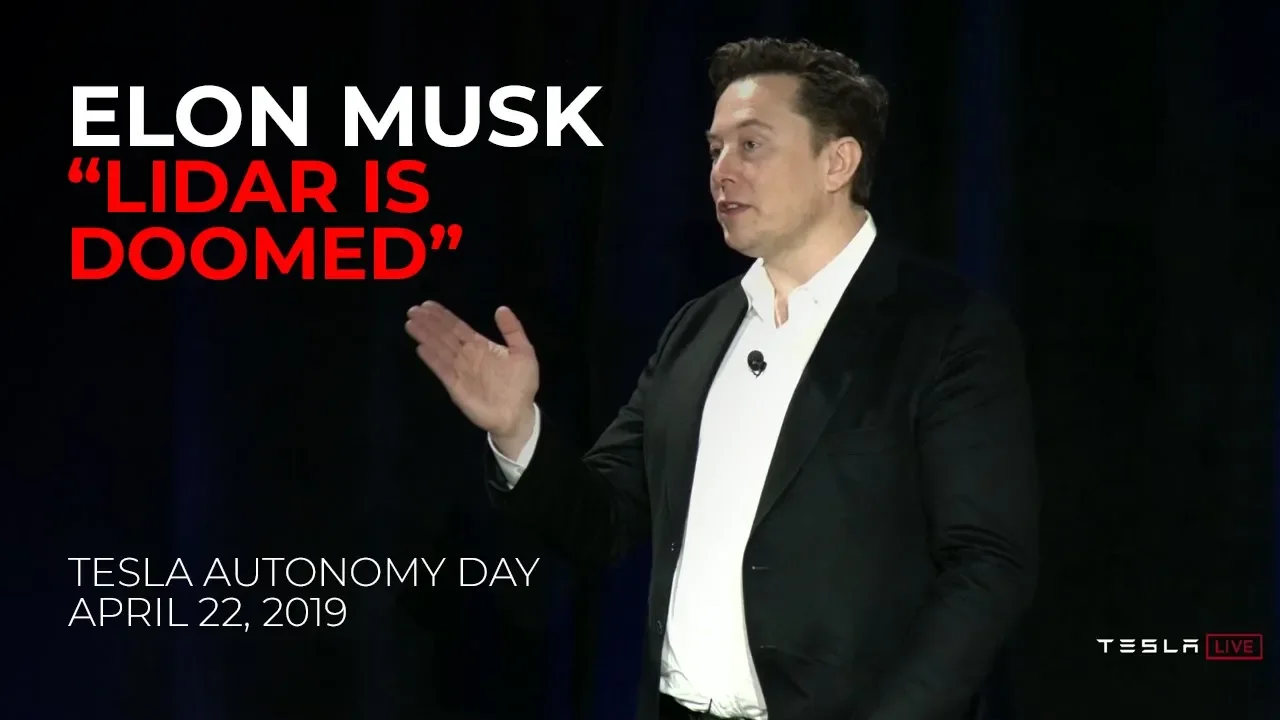
Elon Musk on Cameras vs LiDAR for Self Driving and Autonomous Cars — AutoPilot Review

AutoPilot Review

Autonomous vehicles relying on lidar and pre-rendered maps will fail because human road infrastructure requires camera-based visual reasoning to navigate dynamic real-world changes.

AI-assisted summary of Elon Musk on Cameras vs LiDAR for Self Driving and Autonomous Cars — original source. Check the original for full context.

Source published:

Key ideas

  • Elon Musk dismissed automotive LiDAR as an unnecessary 'fool's errand' and compared it to expensive biological appendices, arguing autonomous driving should rely on vision rather than active optical range-finding. (0:08)
  • Andrej Karpathy demonstrated that Tesla can achieve accurate 3D spatial depth estimation through computer vision via classical multi-view photogrammetry, radar-supervised neural networks, and self-supervised temporal consistency. (2:26)
  • Musk clarified his sensor philosophy by contrasting active visible-spectrum LiDAR with millimeter-wave radar, noting radar can penetrate atmospheric occlusions like fog, dust, and snow where optical lasers fail. (5:41)
  • Musk rejected pre-rendered high-definition (HD) mapping and precision lane coordinates as fundamentally brittle, confirming Tesla reversed its earlier experiments with the technology in favor of real-time vision. (9:03)

Detailed notes

## Background Published on YouTube by AutoPilot Review on April 27, 2019, this video captures presentations from Tesla's Autonomy Day for Investors held on April 22, 2019. According to the description, it outlines why Elon Musk and Tesla believe cameras rather than LiDAR are all that is required for Full Self-Driving, while detailing their rejection of HD maps and high-precision lane markings.

## TL;DR Elon Musk aggressively dismisses LiDAR as an expensive, redundant 'fool's errand' and rejects high-definition mapping as an overly brittle approach that fails when roads change. Andrej Karpathy demonstrates how depth perception can be achieved purely through biological vision principles and computer vision, presenting three methods: classical multi-view stereo, sensor-supervised neural networks calibrated with forward radar, and self-supervised depth estimation. Karpathy argues that rich visual semantic recognition is an unavoidable prerequisite for autonomy, while Musk explains the physics behind combining passive optical cameras with occlusion-penetrating millimeter-wave radar instead of redundant optical lasers.

## Atmosphere & style The presentation carries the dynamic energy of an investor day crossed with an engineering lecture, oscillating between Musk's blunt, irreverent soundbites and Karpathy's methodical, academic breakdowns. Musk's provocative delivery—dismissing competing technology as dead-weight appendices—creates an atmosphere of defiant conviction, while Karpathy brings a quiet, compelling clarity with top-down visual proofs and biological analogies. Watching it feels like witnessing an audacious technical bet delivered with total intellectual self-assurance.

## Bulletin - [00:08](https://www.youtube.com/watch?v=HM23sjhtk4Q&t=8s) Elon Musk dismissed automotive LiDAR as an unnecessary 'fool's errand' and compared it to expensive biological appendices, arguing autonomous driving should rely on vision rather than active optical range-finding. - [02:26](https://www.youtube.com/watch?v=HM23sjhtk4Q&t=146s) Andrej Karpathy demonstrated that Tesla can achieve accurate 3D spatial depth estimation through computer vision via classical multi-view photogrammetry, radar-supervised neural networks, and self-supervised temporal consistency. - [05:41](https://www.youtube.com/watch?v=HM23sjhtk4Q&t=341s) Musk clarified his sensor philosophy by contrasting active visible-spectrum LiDAR with millimeter-wave radar, noting radar can penetrate atmospheric occlusions like fog, dust, and snow where optical lasers fail. - [09:03](https://www.youtube.com/watch?v=HM23sjhtk4Q&t=543s) Musk rejected pre-rendered high-definition (HD) mapping and precision lane coordinates as fundamentally brittle, confirming Tesla reversed its earlier experiments with the technology in favor of real-time vision.

## Key takeaways - [00:08](https://www.youtube.com/watch?v=HM23sjhtk4Q&t=8s) Elon Musk asserts that LiDAR is an expensive, unnecessary crutch and that autonomous vehicle developers relying on it are doomed. - [00:08](https://www.youtube.com/watch?v=HM23sjhtk4Q&t=8s) Human biological vision serves as direct proof of concept that neural networks operating on visual inputs can perceive depth and safely navigate roads without emitting lasers. - [00:08](https://www.youtube.com/watch?v=HM23sjhtk4Q&t=8s) Biological depth perception relies on multiple complementary mechanisms, including binocular stereo disparity, structure from motion, and monocular geometric cues. - [02:26](https://www.youtube.com/watch?v=HM23sjhtk4Q&t=146s) Multi-view stereo photogrammetry allows vehicle cameras to triangulate dense 3D point clouds and roadway geometry directly from raw video over time. - [02:26](https://www.youtube.com/watch?v=HM23sjhtk4Q&t=146s) Tesla trains vision networks to predict 3D bounding cuboids by automatically supervising monocular camera feeds with distance measurements from forward-facing radar. - [02:26](https://www.youtube.com/watch?v=HM23sjhtk4Q&t=146s) Self-supervised convolutional neural networks can generate dense per-pixel depth predictions by enforcing mathematical temporal consistency across consecutive video frames. - [05:41](https://www.youtube.com/watch?v=HM23sjhtk4Q&t=341s) Semantic visual recognition is mandatory for Level 4 and Level 5 autonomy because LiDAR cannot read signs, interpret pedestrian body language, or differentiate harmless road debris from hazards. - [05:41](https://www.youtube.com/watch?v=HM23sjhtk4Q&t=341s) Roadway infrastructure was engineered exclusively for human biological vision, making visual perception the foundational problem autonomous systems must solve. - [05:41](https://www.youtube.com/watch?v=HM23sjhtk4Q&t=341s) Musk noted SpaceX developed its own LiDAR for spacecraft docking at the International Space Station, where the physics justify active laser range-finding unlike automotive environments. - [05:41](https://www.youtube.com/watch?v=HM23sjhtk4Q&t=341s) Active optical LiDAR operates in visible and near-visible spectra that remain vulnerable to atmospheric occlusion, whereas millimeter-wave radar effectively penetrates fog, snow, and dust. - [05:41](https://www.youtube.com/watch?v=HM23sjhtk4Q&t=341s) Tesla's standard hardware suite consists of eight surround cameras, one forward millimeter-wave radar, and 12 ultrasonic sensors. - [09:03](https://www.youtube.com/watch?v=HM23sjhtk4Q&t=543s) High-definition mapping creates an extremely brittle driving system that fails when confronted with unmapped construction, altered lane layouts, or road changes. - [09:03](https://www.youtube.com/watch?v=HM23sjhtk4Q&t=543s) Tesla briefly explored precision lane lines and HD mapping before completely abandoning the approach in favor of dynamic, real-time vision navigation.

## Detailed walkthrough ### [00:08](https://www.youtube.com/watch?v=HM23sjhtk4Q&t=8s) The Appendix Analogy and Biological Depth Perception

Elon Musk opens with an uncompromising assessment of automotive LiDAR, asserting that “LiDAR is a fool's errand and anyone relying on LiDAR is doomed.” He compares these costly sensors to unnecessary anatomical dead weight: “It’s like having a whole bunch of expensive appendices. Like, one appendix is bad, well now you have a whole bunch of them, it’s ridiculous, you’ll see.”

Andrej Karpathy takes over the presentation to explain how depth perception can be achieved exclusively through vision. While autonomous driving companies split their approaches between vision cameras gathering raw pixels and LiDAR producing point distance measurements, Karpathy points out an obvious biological precedent to the audience: almost everyone in the room drove to the venue using only biological neural networks and eyes without shooting lasers out of their faces, and they arrived safely.

```mermaid flowchart TD accTitle: Biological Mechanisms of Depth Perception accDescr: Three biological strategies humans and animals use to perceive depth without active laser sensors.

subgraph BiologicalVision["Biological Depth Cues"] Binocular["Binocular Stereo Vision<br>(Two forward eyes triangulate overlap)"] StructureMotion["Structure from Motion<br>(Head-bobbing animals with lateral eyes)"] MonocularCues["Monocular Visual Cues<br>(Vanishing lines, perspective & context)"] end

BiologicalVision --> Reconstruction["Triangulated 3D Understanding of the World"] ```

Human visual networks derive spatial measurements and full 3D scene understanding by leveraging several complementary mechanisms: - **Binocular vision**: Two forward-facing eyes provide independent measurements at each moment, allowing the brain to triangulate distances across overlapping visual fields. - **Structure from motion**: Animals with lateral eyes that lack overlapping fields bob their heads during movement, taking multiple temporal observations across space to triangulate depth. - **Monocular geometric cues**: Even with one eye shut and zero motion, humans retain a clear sense of distance through contextual cues such as vanishing lines and perspective illusions, demonstrating that artificial neural networks can learn to execute the exact same geometric reasoning.

---

[02:26](https://www.youtube.com/watch?v=HM23sjhtk4Q&t=146s) Three Computer Vision Approaches to Depth Estimation

Karpathy breaks down three distinct computer vision methodologies Tesla employs or studies to recover accurate 3D scene geometry directly from vehicle cameras without dedicated range-finding hardware.

```mermaid flowchart LR accTitle: Three Approaches to Vision Depth Perception accDescr: Progression from classical multi-view stereo to supervised radar annotation and self-supervised consistency.

subgraph Classical["1. Classical Photogrammetry"] MVS["Multi-View Stereo<br>(Triangulate 6s clip over 8 cameras)"] end

subgraph SensorAnnotated["2. Sensor-Supervised Neural Nets"] Radar["Forward Radar Distance"] -->|"Auto-label bounding boxes"| Cuboids["Predict 3D Vision Cuboids"] end

subgraph SelfSupervised["3. Self-Supervised Learning"] RawVideo["Raw Video Input"] -->|"Temporal Consistency Constraint"| DenseDepth["Per-pixel Depth Map"] end ```

The first approach uses classical multi-view stereo photogrammetry. Karpathy displays a six-second video clip captured by a Tesla driving through San Francisco. By tracking points across the vehicle's eight Autopilot cameras over time, dense 3D point clouds and roadway geometry are triangulated directly from raw pixels. Tesla uses a sparser, optimized variant of this reconstruction algorithm inside the car.

The second method harnesses neural networks supervised by on-vehicle sensor cross-annotation. Deep neural nets are exceptionally capable visual engines, but predicting monocular distance requires ground-truth training labels. Rather than using slow, inaccurate human annotators guessing vehicle ranges, Tesla feeds data from its forward-facing radar into the training pipeline: - Radar accurately tracks distances to dynamic objects ahead. - The radar range automatically generates ground-truth distance labels for the 2D bounding boxes detected by vision. - Once trained on vast quantities of fleet imagery, the vision neural network predicts 3D oriented cuboids straight from camera feeds. - Karpathy demonstrates top-down bird's-eye plots where camera-derived 3D bounding boxes match radar range returns with pinpoint precision, demonstrating that the network internalizes vehicle classes and scales to deduce accurate depth.

The third technique Karpathy covers is self-supervised depth learning, drawn from academic breakthroughs. Unlabeled, raw video frames are piped directly into a convolutional network tasked with predicting per-pixel depth for every frame. Because no ground-truth distance targets exist, the loss function enforces strict temporal consistency across consecutive video frames. Karpathy notes that the only way for the system to remain mathematically consistent over camera motion is to predict the actual scene geometry accurately, a result Tesla has successfully reproduced in-house.

---

[05:41](https://www.youtube.com/watch?v=HM23sjhtk4Q&t=341s) The Infrastructure of Driving and Musk on Sensor Physics

Karpathy emphasizes that rich visual recognition is not a luxury or a secondary enhancement, but an absolute operational prerequisite for Level 4 and Level 5 autonomy. LiDAR point clouds lack the semantic density required to make vital driving decisions: - Distinguishing between a harmless plastic bag blowing across the roadway and a dangerous discarded tire. - Reading bicyclist body language to predict whether an over-the-shoulder glance signals an impending lane merge or continued forward travel. - Reading construction zone instructional signs and regulatory speed notifications. - Determining whether a curbside pedestrian is distracted by a smartphone and about to step off the curb.

All roadway infrastructure—from painted lane lines to traffic signals—was designed exclusively for human biological vision. Karpathy argues that relying on LiDAR bypasses this foundational visual recognition challenge, serving as an artificial crutch that provides a false impression of autonomous progress.

```mermaid flowchart TD accTitle: Elon Musk Sensor Suite Architecture accDescr: Breakdown of Tesla sensor selection based on electromagnetic spectrum characteristics.

subgraph Sensors["Tesla Autopilot Sensor Selection"] Cameras["8 Surround Cameras<br>(Passive optical, 400-700 nm)"] Radar["1 Forward Radar<br>(Active millimeter-wave, 3.8 mm)"] Ultrasonics["12 Ultrasonic Sensors<br>(Near-field coverage)"] end

Cameras -->|"Semantic road cues & depth"| DriveSystem["Full Self-Driving Computer"] Radar -->|"Occlusion penetration: fog, dust, snow"| DriveSystem Ultrasonics -->|"Close-proximity maneuvering"| DriveSystem ```

Elon Musk rejoins the discussion to clarify his stance on LiDAR, pointing out that SpaceX engineered its own custom LiDAR system from scratch so the Dragon capsule could navigate and dock with the International Space Station: “I spearheaded that effort personally because in that scenario, LiDAR makes sense and in cars it's freaking stupid.”

Musk breaks down the physics of active photon emission: - Passive optical cameras already collect data across the human visible spectrum (400 to 700 nanometers). Adding active optical photons at visible or near-visible wavelengths is redundant and remains vulnerable to atmospheric occlusions like fog, dust, and heavy snow. - When employing active photon generation, autonomous vehicles should operate outside the visible spectrum at occlusion-penetrating millimeter wavelengths (around 3.8 millimeters), which is why Tesla mounts an active forward-facing radar. - Tesla's complete production suite consists of eight surround cameras, one forward millimeter-wave radar for high-speed travel, and 12 ultrasonic sensors for close-range detection, which Musk insists is the definitive hardware configuration for autonomy.

[09:03](https://www.youtube.com/watch?v=HM23sjhtk4Q&t=543s) The Brittleness of High-Definition Maps and Precision Lane Data

An audience member presses Elon Musk on an approach heavily favored by Tesla’s competitors in the autonomous driving sector: augmenting onboard vehicle perception and path planning with pre-rendered, high-definition (HD) maps of operating areas. The questioner asks whether HD mapping plays any role in Tesla’s autonomy architecture, whether Musk sees any value in it, and whether Tesla seeks external mapping-style datasets beyond what is passively harvested from its customer fleet.

Musk dismisses the strategy unequivocally, arguing that hardcoded geographic models create a fragile foundation for real-world driving. He explains that relying on high-precision coordinates prevents a self-driving system from adapting dynamically when road layouts, construction zones, or lane markings inevitably change. In Musk's view, autonomous driving must be fundamentally driven by real-time vision rather than static, pre-recorded data. Lane markings and external map references should at best serve as rough suggestions rather than absolute ground truth. Musk admits that Tesla had previously experimented with the approach before abandoning it entirely, stating: “We briefly barked up the tree of high precision lane lines and then realized that was a huge mistake and reversed it out.”

```mermaid flowchart TD accTitle: Comparison of HD Mapping versus Vision-First Autonomy accDescr: Flowchart contrasting the brittle HD mapping approach with Tesla's adaptive vision-first approach.

subgraph HDApproach["HD Map Approach (Competitors)"] HDMap["Pre-rendered HD Maps & GPS"] --> Lock["Car locks to static lane definitions"] Lock --> RoadChange["Road changes or construction occurs"] RoadChange --> Fail["System becomes brittle & fails to adapt"] end

subgraph VisionApproach["Vision-First Approach (Tesla)"] Sensors["Onboard Cameras / Vision System"] --> RealTime["Real-time environment perception"] RealTime --> Adapt["Dynamic adaptation to road changes"] MapRef["Map / Lane Lines"] -.->|"Guideline only"| RealTime end ```

- “The high precision GPS maps and lanes are a really bad idea.” — Elon Musk - “The system becomes extremely brittle.” — Elon Musk - According to Musk, locking a vehicle’s trajectory to GPS and precision lane lines without allowing dynamic vision override leaves the vehicle unable to adapt to real-world road changes. - Musk maintains that onboard vision must handle all primary driving tasks, treating lane lines strictly as flexible guidelines rather than rigid navigational anchors.

## Notable quotes > [00:08](https://www.youtube.com/watch?v=HM23sjhtk4Q&t=8s) LiDAR is a fool's errand and anyone relying on LiDAR is doomed. — Elon Musk

> [09:03](https://www.youtube.com/watch?v=HM23sjhtk4Q&t=543s) The high precision GPS maps and lanes are a really bad idea. — Elon Musk

## Mentioned Elon Musk, Andrej Karpathy, Tesla, SpaceX, Dragon, International Space Station, Autopilot, Full Self Driving

## Video description Tesla and Elon Musk outline why they believe cameras (vs lidar) are all that is needed for Full Self Driving during the Tesla Autonomy Day for Investors on April 22, 2019. Elon also touches on why they don't consider HD Maps and precision lane markings to be

Elon Musk says lidar "is a fool’s errand" and that anyone using lidar is "doomed." He goes on to say that they are "expensive sensors that are unnecessary. It’s like having a whole bunch of expensive appendices. Like, one appendix is bad, well now you have a whole bunch of them, it’s ridiculous, you’ll see."

There quite a bit of debate in the self-driving world whether lidar is truly required for Full Self-Driving capabilities on autonomous vehicles. Lidar provides very a very accurate, high precision depth map of the world around the car, but is currently still fairly expensive and also has challenges seeing through occlusions, like rain, snow and fog. Tesla's argument is that roads were built for human drivers with vision and that vision systems, such as cameras will do a better job traversing that environment than other sensors, reading all the vision queues meant for drivers, like road signs, etc. In addition, Tesla believes their vision system (plus radar) accurately handles depth sensing problems and that lidar is not needed for that function.

For more on Cameras vs Lidar for Self Driving Cars:

https://www.autopilotreview.com/lidar-vs-cameras-self-driving-cars

[Source](https://www.youtube.com/watch?v=HM23sjhtk4Q)

中文简报

马斯克弃用激光雷达与高精地图,确立特斯拉纯视觉自动驾驶路线 依赖激光雷达和预渲染地图的自动驾驶汽车注定会失败,因为人类道路基础设施需要基于摄像头的视觉推理来应对现实世界中的动态变化。 埃隆·马斯克严厉批评激光雷达昂贵、多余且是“徒劳之举”,并认为高精地图方案过于脆弱,一旦道路发生变化就会失效。安德烈·卡帕斯展示了如何纯粹依靠生物视觉原理和计算机视觉实现深度感知,提出了三种方法:传统的多视图立体视觉、利用前向毫米波雷达校准的传感器监督神经网络,以及自监督深度估计。卡帕斯认为,丰富的视觉语义识别是实现自动驾驶不可避免的前提,而马斯克则从物理学角度解释了将无源光学摄像头与穿透遮蔽物的毫米波雷达相结合,而非使用多余光学激光的原理。 埃隆·马斯克认为车规级激光雷达是毫无必要的“徒劳之举”,并将其比作昂贵的生物阑尾,主张自动驾驶应依赖视觉而非主动光学测距。 (0:08) 安德烈·卡帕斯展示了特斯拉如何通过计算机视觉实现精确的3D空间深度估计,具体涵盖传统多视图摄影测量、雷达监督神经网络以及自监督时间一致性三种途径。 (2:26) 马斯克通过对比主动可见光谱激光雷达与毫米波雷达阐明了他的传感器理念,指出毫米波雷达能够穿透大雾、灰尘和积雪等大气遮蔽物,而光学激光在这些场景下会失效。 (5:41) 马斯克认为预渲染高精(HD)地图和高精度车道坐标本质上过于脆弱,并证实特斯拉放弃了早先对该技术的尝试,转而采用实时视觉方案。 (9:03)

Detailed notes — zh

## Background 该视频由 YouTube 频道 AutoPilot Review 于 2019 年 4 月 27 日发布,内容节选自同年 4 月 22 日举办的特斯拉投资者自动驾驶日(Tesla Autonomy Day)。视频记录了埃隆·马斯克(Elon Musk)与时任特斯拉 AI 高级总监安德烈·卡帕西(Andrej Karpathy)向投资者阐述特斯拉为何选择以纯视觉摄像头作为全自动驾驶(FSD)的核心,并抨击激光雷达(LiDAR)与高精地图方案的技术逻辑。 ## TL;DR 马斯克直斥激光雷达是一场徒劳无功的骗局,将其比作昂贵且无用的阑尾,断言过度依赖它的企业终将走向失败。卡帕西随后从生物双眼视觉机制切入,展示了特斯拉通过多视角立体视觉、雷达跨模态标注以及自监督学习实现精准 3D 深度感知的技术路径,并指出高阶自动驾驶的核心在于理解复杂的语义长尾场景,而这正是激光雷达无法解决的硬伤。马斯克进一步从波长物理特性剖析激光雷达在乘用车上的多余性,同时坚决否定了高精地图路线,强调现实道路充满动态变化,过度依赖预设地图只会让系统变得极度脆弱,唯有赋予实时视觉感知最高裁决权才能实现真正的自动驾驶。 ## Atmosphere & style 整场演示充满了特斯拉标志性的激进与反叛色彩,现场氛围既有马斯克语出惊人、言辞辛辣的煽动性开场,又有卡帕西沉稳严谨、层层递进的技术拆解。马斯克以近乎嘲讽的决绝姿态全盘否定行业主流路线,语言直白且充满工程师式的傲气;卡帕西则以清晰的计算视觉原理解构生物智能,赋予纯视觉路线极强的理论说服力。观众在观看时能强烈感受到一种挑战行业传统范式的破局感,伴随着从尖锐批判到底层硬核工程论证的紧凑节奏,令人神经紧绷且极具冲击力。 ## Bulletin - [00:08](https://www.youtube.com/watch?v=HM23sjhtk4Q&t=8s) Elon Musk 严厉抨击自动驾驶领域的激光雷达(LiDAR)方案为“徒劳之举”(fool's errand),认为依赖激光雷达如同在车身堆砌昂贵无用的“阑尾”,注定走向失败。 - [02:22](https://www.youtube.com/watch?v=HM23sjhtk4Q&t=142s) Andrej Karpathy 阐述特斯拉纯视觉系统的深度感知能力,指出生物视觉仅凭双眼和神经网络即可测距,人工神经网络通过多视角立体几何、雷达跨模态标注及自监督学习同样能精准推断 3D 空间结构。 - [05:41](https://www.youtube.com/watch?v=HM23sjhtk4Q&t=341s) 特斯拉强调高精度视觉语义理解是高阶自动驾驶不可逾越的核心,激光雷达仅能输出稀疏点云而无法解析语义,绕开视觉认知实质上是带来虚假进展的“技术拐杖”。 - [09:03](https://www.youtube.com/watch?v=HM23sjhtk4Q&t=543s) Musk 坚决否定高精地图(HD Maps)与高精度车道线路线,认为依赖先验地图会导致系统在面对道路施工等动态变化时异常脆弱,真正的自动驾驶必须由车载实时视觉绝对主导。 ## Key takeaways - [00:08](https://www.youtube.com/watch?v=HM23sjhtk4Q&t=8s) Elon Musk 认为激光雷达对地面乘用车而言既昂贵又多余,将其比作多余的人体阑尾,断言依赖激光雷达的自动驾驶路线必将失败。 - [00:45](https://www.youtube.com/watch?v=HM23sjhtk4Q&t=45s) 人类完全依靠双眼与生物神经网络即可安全驾驶,证明纯视觉系统足以为大脑提供极其丰富的 3D 空间距离和结构感知。 - [01:15](https://www.youtube.com/watch?v=HM23sjhtk4Q&t=75s) 生物视觉依靠双目视差三角测距、动物摆头的运动恢复结构(SfM)以及单目透视几何线索获取深度,人工神经网络可完全复刻这些机制。 - [02:22](https://www.youtube.com/watch?v=HM23sjhtk4Q&t=142s) 特斯拉利用 8 个环视摄像头的多视角立体几何算法(Multi-view Stereo),仅凭几秒连续车载视频即可重建高精度 3D 稠密点云。 - [02:58](https://www.youtube.com/watch?v=HM23sjhtk4Q&t=178s) 特斯拉采用前向毫米波雷达的测距数据自动标注视觉目标框,通过跨模态学习让单目视觉神经网络学会结合几何尺寸直接推断深度。 - [04:10](https://www.youtube.com/watch?v=HM23sjhtk4Q&t=250s) 自监督学习允许神经网络在无标注视频序列中通过追求时间维度的物理几何一致性(Consistency over time),自主学会精准深度预测。 - [05:41](https://www.youtube.com/watch?v=HM23sjhtk4Q&t=341s) 现代道路基础设施全为人类视觉交互而设计,激光雷达的无语义稀疏点云无法应对长尾场景,视觉语义认知才是高阶自动驾驶的核心大山。 - [06:15](https://www.youtube.com/watch?v=HM23sjhtk4Q&t=375s) 纯视觉能够有效分辨道路障碍物属性(如轻质塑料袋与危险轮胎)并解析行人及骑行者的微动作与意图,而激光雷达对此无能为力。 - [06:55](https://www.youtube.com/watch?v=HM23sjhtk4Q&t=415s) 激光雷达绕过关键视觉识别问题只提供了虚假的技术进展表象,Karpathy 认为它终究是一根迟早要被抛弃的“拐杖”。 - [07:12](https://www.youtube.com/watch?v=HM23sjhtk4Q&t=432s) Musk 澄清激光雷达在漆黑且无语义需求的太空交会对接(如 SpaceX 龙飞船)中确实有用,但在复杂的地面乘用车上则是极其愚蠢的配置。 - [07:45](https://www.youtube.com/watch?v=HM23sjhtk4Q&t=465s) 从物理波谱来看,激光雷达与摄像头同处可见光波段;若需主动发射探测,毫米波雷达凭借 3.8 毫米波长能更有效地穿透大雾、暴雪和雨幕。 - [08:35](https://www.youtube.com/watch?v=HM23sjhtk4Q&t=515s) 特斯拉全车传感器架构(8 颗摄像头、1 个前向毫米波雷达、12 个超声波传感器)已通过内部反复推演验证,完全无需堆砌冗余传感器。 - [09:03](https://www.youtube.com/watch?v=HM23sjhtk4Q&t=543s) 高精度 GPS 地图和车道线会导致系统架构极度脆弱,一旦遇到道路施工、临时改道或标线变更,过度依赖先验地图的车辆将丧失应变能力。 - [09:35](https://www.youtube.com/watch?v=HM23sjhtk4Q&t=575s) 特斯拉早期曾尝试过高精度车道线路线,但意识到其技术死结后迅速彻底撤回,坚持以端到端实时视觉主导路径规划与决策。 ## Detailed walkthrough ### [00:08](https://www.youtube.com/watch?v=HM23sjhtk4Q&t=8s) 激光雷达是徒劳之举与生物视觉的深度感知原理 Elon Musk 首先对自动驾驶领域的激光雷达(LiDAR)路线给出了极其严厉的定性,称其为劳民伤财且毫无必要的冗余配置。Musk 直言:“LiDAR is a fool's errand and anyone relying on LiDAR is doomed.” 他将车载激光雷达比作人体内无用的阑尾,讽刺道拥有一个阑尾本来就很糟糕了,再硬塞一堆昂贵的阑尾简直荒谬至极。随后,时任特斯拉 AI 高级总监 Andrej Karpathy 接过话题,深入阐述纯视觉系统如何实现精准的深度感知。Karpathy 指出,行业内通常有两种传感器方案:一种是仅捕获像素的视觉摄像头,另一种是输出离散距离点云的激光雷达。 Karpathy 向台下的投资者抛出一个直观的常识:所有人今天开车前来参会,凭借的完全是生物神经网络和双眼视觉,眼睛绝没有发射任何激光束,却能够安全抵达。人类大脑通过视觉提取出对周围三维世界极其丰富的距离与结构感知,其背后的原理包括: - **双目视差测距**:人类双眼向前,每时每刻都能对前方世界获取两个独立的观测视角,大脑将两组信号缝合在一起,通过视差三角测量(Triangulation)推导出目标距离。 - **运动视差(Structure from Motion)**:许多动物的眼睛长在头部两侧,视野重叠极少,它们通过上下左右摆头(Bobbing),利用运动产生的多视点观测对环境进行三角测距。 - **单目深度线索(Monocular Cues)**:即使闭上一只眼睛且保持完全静止,单凭透视消失线、物体相对大小等强大线索,人脑依然能估算距离(例如视觉错觉中两条实际长度相同的蓝色线条,在大脑融合透视消失线后会产生显著的大小感知差异)。 人工神经网络完全能够模仿并实现这种基于纯视觉的多维度深度推断。 ```mermaid flowchart TD accTitle: 纯视觉深度感知与生物视觉机制 accDescr: 展示生物视觉获取深度信息的不同方式以及向人工神经网络的映射 subgraph Bio ["生物视觉感知机制"] A["双目立体视觉<br/>视差三角测量"] B["侧眼生物摆头<br/>运动恢复结构 (SfM)"] C["单眼静止状态<br/>透视线/单目几何线索"] end subgraph AI ["特斯拉纯视觉神经网络"] D["提取多视角像素特征"] E["学习几何与语义先验"] F["端到端高精度 3D 深度推断"] end Bio --> AI ``` --- ### [02:22](https://www.youtube.com/watch?v=HM23sjhtk4Q&t=142s) 纯视觉深度估算的三大技术路径 Karpathy 随后展示了特斯拉内部推导纯视觉深度的三种具体实现手段:一种经典计算机视觉方法,以及两种基于神经网络的前沿方案。首先是经典的多视角立体几何技术(Multi-view Stereo)。Karpathy 展示了一段特斯拉在旧金山街头行驶的 6 秒真实车载视频,Autopilot 系统启用了全部 8 个环视摄像头,仅依靠这 6 秒时长的多视角连续画面,算法通过特征匹配与稠密三角测量,便完整重建出了街道环境的高精度 3D 稠密点云与几何结构。这证明了视频数据中本身就蕴含着完整的 3D 空间结构,关键在于能否将其有效解算出来。 第二种路径是通过传感器自动标注来训练神经网络预测单目深度。神经网络本身是极度强大的视觉识别引擎,只要有充足的深度真值标签,网络就能准确学会单目预测。特斯拉并没有采用低效的人工标注去肉眼猜测车辆距离(例如判断某个框内的车是 25 米),而是利用车辆前置毫米波雷达返回的测距数据,自动关联并标注视觉神经网络生成的车辆检测边界框(Bounding Boxes)。通过这种传感器跨模态标注(Sensor Annotation)积累的大量训练集,视觉神经网络学会了结合车辆几何尺寸先验直接推断深度。在顶部鸟瞰投影(Bird's-eye view)对比中,纯视觉生成的 3D 包围框(Cuboids)与毫米波雷达探测到的圆形光标点完全严丝合缝。 第三种路径则是基于自监督学习(Self-Supervised Learning)。该方案完全不需要任何人工或传感器真值标签,只需将海量连续的裸视频输入神经网络: - 神经网络需要对视频序列的每一帧自主预测稠密像素深度。 - 损失函数的优化目标并非回归绝对坐标,而是要求深度预测在时间跨度上保持物理与几何的一致性(Consistency over time)。 - Karpathy 解释其核心逻辑:“And the only way to be consistent is to be right.” 唯有预测出真实正确的深度,多帧之间的几何投影才能自洽。特斯拉内部复现了这一方案,证实无监督纯视觉同样可以高质量学习深度。 --- ### [05:41](https://www.youtube.com/watch?v=HM23sjhtk4Q&t=341s) 语义认知的重要性与激光雷达的根本缺陷 Karpathy 将讨论上升到底层认知维度,强调高精度的视觉语义理解是高阶自动驾驶(L4/L5)不可逾越的绝对前提,而非可有可无的加分项。激光雷达仅仅能提供稀疏且缺乏语义的点云测量,其包含的信息密度极其匮乏,根本无法解决自动驾驶的核心长尾场景。整套现代道路交通基础设施——包括车道线、交通信号灯、施工警示牌、动态路标等——全部是建立在人类视觉交互的假定之上设计的,激光雷达点云对此完全无能为力。 Karpathy 举出了一系列必须依赖高维视觉理解的极端案例: - **道路异物判定**:路面上出现障碍物时,激光雷达只能反馈一团稀疏点云,但视觉系统能分辨那究竟是一个可以直接轧过的轻飘飘塑料袋,还是一块足以引发严重事故的实心废弃轮胎,而这两者导向截然相反的底盘控制策略。 - **动态意图理解**:骑自行车的人微微回头看,究竟是打算变道切入你的车道,还是仅仅在直行过程中保持观察? - **行人微动作**:路边行人是在低头专注看手机随时可能横穿车道,还是在安全等待通过? - **施工指引**:复杂道路施工区域的手写路标与导向指示,包含详尽的行为规则,唯有视觉感知能够解析。 基于这些硬核边界案例,Karpathy 做出总结:“And so in this sense, LiDAR is really a shortcut. It sidesteps the fundamental problems, the important problem of visual recognition that is necessary for autonomy. And so it gives a false sense of progress and is ultimately a crutch.” 依靠激光雷达绕过了真正的视觉认知大山,只带来了虚假的技术进展表象,终究只是一根迟早要被扔掉的拐杖。 --- ### [07:12](https://www.youtube.com/watch?v=HM23sjhtk4Q&t=432s) 主动光子发射的频段选择与特斯拉全车传感器架构 Elon Musk 重新接管话筒,对激光雷达做出了进一步的物理与工程剖析。Musk 澄清自己并非盲目痛恨这项技术,他透露 SpaceX 的龙飞船(Dragon)正是利用激光雷达在太空中进行交会对接,甚至当年是他亲自挂帅主导了 SpaceX 内部从零自研激光雷达的工程项目。Musk 强调:“Because in that scenario, LiDAR makes sense and in cars it's freaking stupid.” 太空对接环境背景漆黑、目标明确且无需语义理解,激光雷达高度适配;但在地面复杂复杂的乘用车领域,它既昂贵又完全多余。一旦纯视觉认知问题被攻克,车上的激光雷达硬件就会彻底变成废铁。 Musk 进一步从电磁波谱与物理穿透特性的角度切入: - **主动光子发射频段谬误**:激光雷达本质上是在可见光波段(约 400 至 700 纳米)进行主动光子发射。然而,车身被动光学摄像头已经完全覆盖了可见光波段;如果车辆一定要做主动发射,绝不应该选在同频段,而应该选择具备强大恶劣天气穿透能力的更长波长。 - **毫米波雷达的物理优势**:特斯拉搭载的前置毫米波雷达工作在 3.8 毫米波长级别,比可见光波长大了数千倍,能够轻易穿透大雾、扬尘、暴风雪和雨幕等视觉遮挡物。这种低成本的主动传感能为极端遮挡工况提供关键冗余。 - **传感器全套配置与定论**:全车硬件系统由 8 颗环视摄像头提供 360 度视觉输入、1 颗前向长距毫米波雷达(仅前向需要,因为前向是唯一极速行驶的方向),以及 12 个用于超近场距离探测的超声波传感器组成。 Musk 斩钉截铁地表示,特斯拉团队内部已经反复推演并确认过无数次这套传感器组合的完备性,得出的结论非常明确:绝对不需要再堆砌任何额外的冗余传感器。 ### [09:03](https://www.youtube.com/watch?v=HM23sjhtk4Q&t=543s) 高精地图的脆弱性与纯视觉路线 在问答环节中,现场提问者指出,过去几年自动驾驶领域的数家竞争对手一直在强调,他们通过在车辆底层平台上引入行驶区域的高精地图(HD Maps),来大幅增强车辆的感知与路径规划能力。提问者随即向特斯拉团队求证:高精地图在特斯拉的自动驾驶体系中是否占有一席之地?特斯拉是否认为它具有附加价值?又或者,特斯拉是否希望获取更多并非由车队端收集、而是偏向测绘制图风格的数据? 埃隆·马斯克(Elon Musk)对此给出了极为直接且坚决的否定回答,直言依赖先验高精地图不仅没有前途,反而会给自动驾驶带来巨大的安全隐患。马斯克断言:“高精度 GPS 地图和车道线是一个极其糟糕的主意。”(“The high-precision GPS maps and lanes are a really bad idea.”)他进一步阐述道,一旦系统对外部高精地图形成依赖,整体架构就会变得异常脆弱(brittle)。现实世界充满动态变化,道路施工、标线重绘或临时交通管制层出不穷;如果车辆过度依赖 GPS 坐标和预先录入的高精度车道线,且不允许视觉系统拥有最高裁决权,系统在面对路况突变时就会彻底丧失自适应与应变能力。 马斯克强调,真正的自动驾驶应当由视觉系统主导一切,高精地图或车道标线充其量只能作为辅助参考的指导线,而绝不能成为系统的核心依托。他坦言特斯拉在研发早期也走过弯路:“我们曾短暂地尝试过高精度车道线这条路线,但随后意识到那是一个巨大的错误,并迅速撤回了方案。”(“We briefly barked up the tree of high precision lane lines and then realized that was a huge mistake and reversed it out.”)最终,马斯克再次以一句干脆的“这根本行不通”为高精地图技术路线定性,重申了特斯拉坚守纯视觉端到端感知的底层逻辑。 ```mermaid flowchart TD accTitle: 高精地图方案与特斯拉视觉主导方案对比 accDescr: 对比依赖先验高精地图导致的系统脆弱性与基于实时车载视觉感知的自适应能力。 subgraph HDMapRoute ["高精地图路线 (竞争对手)"] A["预先测绘高精地图 / GPS"] --> B["车辆感知与规划"] B --> C{"现实路况发生变更\n(施工/临时改道)"} C -->|无法自适应| D["系统失效 / 极度脆弱"] end subgraph VisionRoute ["纯视觉主导路线 (特斯拉)"] E["车载摄像头实时输入"] --> F["神经网络环境重构"] F --> G["动态车道与障碍物识别"] G -->|视觉拥有最高优先级| H["自适应路径规划与安全行驶"] end ``` - **竞争对手的思路**:利用预先绘制的厘米级高精地图(HD Maps)增强车辆的感知与路径规划,将自动驾驶约束在已建图的特定地理围栏(Geo-fenced)区域内。 - **特斯拉的批评核心**:过度依赖高精地图会导致系统缺乏鲁棒性与泛化能力,现实道路的任何细微改动都会让车辆陷入无法决策的困境。 - **视觉系统的绝对主导权**:特斯拉认为视觉必须处理道路上的所有突发情况,车道线和导航信息只能作为基础参考,不能替代实时视觉感知。 - **研发历程的反思**:特斯拉曾短暂尝试过预设高精车道线的研发方向,但团队迅速发现该方案具有难以克服的技术死结,随即果断止步并彻底弃用。 ## Notable quotes > [00:08](https://www.youtube.com/watch?v=HM23sjhtk4Q&t=8s) LiDAR is a fool's errand and anyone relying on LiDAR is doomed. — Elon Musk > [05:41](https://www.youtube.com/watch?v=HM23sjhtk4Q&t=341s) And so in this sense, LiDAR is really a shortcut. It sidesteps the fundamental problems, the important problem of visual recognition that is necessary for autonomy. And so it gives a false sense of progress and is ultimately a crutch. — Andrej Karpathy > [09:03](https://www.youtube.com/watch?v=HM23sjhtk4Q&t=543s) The high-precision GPS maps and lanes are a really bad idea. — Elon Musk ## Mentioned Elon Musk, Andrej Karpathy, Tesla, SpaceX, Autopilot, Dragon ## Video description Tesla and Elon Musk outline why they believe cameras (vs lidar) are all that is needed for Full Self Driving during the Tesla Autonomy Day for Investors on April 22, 2019. Elon also touches on why they don't consider HD Maps and precision lane markings to be Elon Musk says lidar "is a fool’s errand" and that anyone using lidar is "doomed." He goes on to say that they are "expensive sensors that are unnecessary. It’s like having a whole bunch of expensive appendices. Like, one appendix is bad, well now you have a whole bunch of them, it’s ridiculous, you’ll see." There quite a bit of debate in the self-driving world whether lidar is truly required for Full Self-Driving capabilities on autonomous vehicles. Lidar provides very a very accurate, high precision depth map of the world around the car, but is currently still fairly expensive and also has challenges seeing through occlusions, like rain, snow and fog. Tesla's argument is that roads were built for human drivers with vision and that vision systems, such as cameras will do a better job traversing that environment than other sensors, reading all the vision queues meant for drivers, like road signs, etc. In addition, Tesla believes their vision system (plus radar) accurately handles depth sensing problems and that lidar is not needed for that function. For more on Cameras vs Lidar for Self Driving Cars: https://www.autopilotreview.com/lidar-vs-cameras-self-driving-cars [Source](https://www.youtube.com/watch?v=HM23sjhtk4Q)

Source quotes

[0:08] Elon Musk: LiDAR is a fool's errand and anyone relying on LiDAR is doomed. [5:41] Andrej Karpathy: And so in this sense, LiDAR is really a shortcut. It sidesteps the fundamental problems, the important problem of visual recognition that is necessary for autonomy. And so it gives a false sense of progress and is ultimately a crutch. [9:03] Elon Musk: The high-precision GPS maps and lanes are a really bad idea.

Source quotes

[0:08] Elon Musk: LiDAR is a fool's errand and anyone relying on LiDAR is doomed. [9:03] Elon Musk: The high precision GPS maps and lanes are a really bad idea.

Original transcript

[0:08] LAR is is a fool's errand and any and [0:11] anyone relying on LAR is doomed. [0:14] Expensive sensors [0:17] that are are unnecessary. It's like [0:19] having a whole bunch of expensive [0:22] appendic appendices [0:24] like one appendix is bad. Well, now I [0:26] want to put a whole bunch of them. [0:27] That's ridiculous. So in the next [0:29] section of my talk, I'm going to [0:30] especially talk about depth perception [0:32] using vision only. So you might be [0:34] familiar that there are uh at least two [0:36] sensors uh in a car. One is vision [0:39] cameras just getting pixels and the [0:40] other is LAR that a lot of uh a lot of [0:43] companies also use. And LAR gives you [0:45] these point measurements of distance [0:47] around you. Um, now one one thing I'd [0:50] like to point out first of all is you [0:52] all came here, you drove here, many of [0:54] you, and you used your your neural net [0:58] and vision. You were not shooting lasers [1:00] out of your eyes and you still ended up [1:02] here. [1:02] We might have things went well. [1:03] That's good for everyone. [1:05] So clearly the human neural net deres [1:08] distance and all the measurements and [1:09] the 3D understanding of the world just [1:11] from vision. It actually uses multiple [1:13] cues to do so. I'll just briefly go over [1:14] some of them just to give you a sense of [1:16] roughly what's going on in inside. Um, [1:18] as an example, we have two eyes pointed [1:20] out. So, you get two independent [1:21] measurements at every single time step [1:22] of the world ahead of you. And, uh, your [1:24] brain stitches this information together [1:26] to arrive at some depth estimation [1:27] because you can triangulate any points [1:29] uh, across those two viewpoints. A lot [1:32] of animals instead have eyes that are [1:34] positioned on the sides. So, they have [1:37] very little overlap in their visual [1:39] fields. So, they will typically use [1:40] structure for motion. And the idea is [1:42] that they bob their heads and because of [1:44] the movement they actually get multiple [1:45] observations of the world and you can [1:47] triangulate again depths and even with [1:49] one eye closed and completely motionless [1:52] you can still have some sense of depth [1:53] per reception. If you did this I don't [1:55] think you would notice me coming 2 [1:57] meters towards you or 100 meters back [1:59] and that's because there are a lot of [2:00] very strong moninocular cues that your [2:02] brain also takes into account. This is [2:03] an example of a pretty common visual [2:05] illusion where you have, you know, these [2:07] two blue bars are identical, but your [2:09] brain, the way it stitches up the scene [2:11] is it just expects one of them to be [2:12] larger than the other because of the [2:14] vanishing lines of this image. So your [2:16] brain does a lot of this automatically [2:18] and uh and neural nets, artificial [2:20] neural nets can as well. So let me give [2:22] you three examples of how you can arrive [2:24] at depth perception from vision alone. [2:26] Um a classical approach and two that [2:28] rely on neural networks. So, here's a [2:30] video going down. I think this is San [2:33] Francisco of a Tesla. So, this these are [2:35] our cameras, our sensing, and we're [2:37] looking at all I'm only showing the main [2:39] camera, but all the cameras are turned [2:40] on, the eight cameras of the autopilot. [2:42] And if you just have this six-second [2:43] clip, what you can do is you can stitch [2:45] up this environment in 3D using multiv- [2:48] view stereo techniques. So, this is the [2:49] 3D reconstruction of those six seconds [2:51] of that car driving through that path. [2:54] And you can see that this information is [2:55] purely is is very well recoverable uh [2:58] from just videos and roughly that's [3:01] through process of triangulation and as [3:03] I mentioned multi-use stereo and we've [3:05] applied similar techniques slightly more [3:07] sparse and approximate also in the car. [3:12] So it's remarkable all that information [3:13] is is really there in the sensor and [3:15] just a matter of extracting it. Um the [3:18] other project that I want to briefly [3:20] talk about is as I mentioned there's [3:21] nothing about neural network neural [3:23] networks are very powerful visual [3:24] recognition engines and if you want them [3:26] to predict depth then you need to for [3:29] example look for labels of depth and [3:30] then they can actually do that extremely [3:32] well. So there's nothing limiting [3:33] networks from predicting this monocular [3:35] depth except for labelled data. So one [3:37] example project that we've actually um [3:39] looked at internally is we use the [3:41] forward facing radar which is shown in [3:43] blue and that radar is looking out and [3:44] measuring depths of objects and we use [3:46] that radar to annotate the uh what [3:50] vision is seeing the bounding boxes that [3:52] come out of the neural networks. So [3:53] instead of human annotators telling you [3:55] okay this this car and this bounding box [3:56] is roughly 25 meters away you can [3:59] annotate that data much better using [4:00] sensors. So you use sensor annotation. [4:02] So as an example, radar is quite good at [4:04] that distance. You can annotate that and [4:06] then you can train a neural network on [4:07] it. And if you just have enough data of [4:08] it, this neural network is very good at [4:10] predicting those patterns. So here's an [4:12] example of predictions um of that. So in [4:15] circles I'm showing radar objects and in [4:18] uh and the cuboids that are coming out [4:20] of here are purely from vision. So the [4:23] cuboids here are just coming out of [4:24] vision and the depth of those cuboids is [4:27] learned via sensor annotation from the [4:29] radar. So if this is working very well [4:32] then you would see that the circles in [4:33] the top down view would agree with the [4:35] cuboids and they do and that's because [4:37] neural networks are very competent at [4:38] predicting depths. Uh they can learn the [4:40] different sizes of vehicles internally [4:42] and they know how big those vehicles are [4:44] and you can actually derive depth from [4:45] that quite accurately. [4:47] The last mechanism I will talk about [4:49] very briefly is slightly more fancy and [4:51] gets a bit more technical but it is a [4:52] mechanism that has recently um there's a [4:57] few papers basically over the last year [4:58] or two on this approach. which is called [5:00] self-s supervision. So what you do in a [5:01] lot of these papers is you only feed raw [5:04] videos into neural networks with no [5:06] labels whatsoever and you can still [5:08] learn you can still get neural networks [5:09] to learn depth and it's a bit a little [5:11] bit technical so I can't go into the [5:12] full details but the idea is that the [5:15] neural network predicts depth at every [5:16] single frame of that video and then [5:18] there are no explicit targets that the [5:19] neural network is supposed to regress to [5:21] with the labels but instead the [5:23] objective for the network is to be [5:24] consistent over time. So whatever depth [5:27] you predict should be consistent over [5:28] the duration of that video. And the only [5:30] way to be consistent is to be right. And [5:33] so the neural network automatically [5:34] predicts the correct depths for all the [5:35] pixels. And we've reproduced some of [5:37] these results internally. So this also [5:38] works quite well. [5:41] So in summary, people drive with vision [5:43] only. No lasers are involved. This seems [5:46] to work quite well. The point that I'd [5:47] like to make is that visual recognition [5:49] and very powerful visual recognition is [5:51] is absolutely necessary for autonomy. [5:53] It's not a nice to have. like we must [5:55] have neural networks that actually [5:57] really understand the environment around [5:58] you and uh and LAR points are much less [6:02] information rich environment. So vision [6:05] really understands the full details just [6:06] a few points around are are much um [6:09] there's much less information in those. [6:10] So as an example on the left here um is [6:13] that a plastic bag or is that a tire? A [6:16] liar might just give you a few points on [6:18] that but vision can tell you which one [6:20] of those two is true and that impacts [6:22] your control. Is that person who is [6:24] slightly looking backwards? Are they [6:25] trying to merge in into your lane on the [6:27] bike or are they just uh or are they [6:30] just going forward? In the construction [6:32] sites, what do those signs say? How [6:34] should I behave in this world? The [6:35] entire uh infrastructure that we have [6:37] built up for roads is all designed for [6:39] human visual consumption. So all the [6:41] signs, all the traffic lights, [6:43] everything is designed for vision. And [6:45] so that's where all that information is. [6:46] And so you need that ability. Is that [6:48] person distracted and on their phone? [6:50] Are they going to walk walk into your [6:52] lane? Those answers to all these [6:54] questions are only found in vision and [6:56] are necessary for level four, level five [6:58] autonomy. And so in this sense, LAR is [7:02] really a shortcut. It sidesteps the [7:04] fundamental problems, the the important [7:06] problem of visual recognition that is [7:07] necessary for autonomy. And so it gives [7:09] a false sense of progress and is [7:11] ultimately it's ultimately a crutch. [7:12] I should point out that I don't actually [7:14] super hate LAR as much as may sound. Um [7:17] but at SpaceX uh SpaceX Dragon uses LAR [7:22] to navigate to the space station and [7:24] dock. Not only that, we SpaceX developed [7:27] its own LAR from scratch to do that. And [7:30] I spearheaded that effort personally [7:32] because in that scenario, LAR makes [7:35] sense and in cars it's freaking stupid. [7:38] It's expensive and unnecessary. And as [7:40] Andre was saying, once you solve vision, [7:43] it's it's worthless. So you have [7:45] expensive hardware that's worthless on [7:47] the car. The we do have a forward radar [7:50] which which is low cost and is helpful [7:52] especially for occlusion situations. So [7:55] if there's like fog or dust or or you [7:58] know snow, the radar can see through [8:00] that. If you're going to use active [8:02] photon generation, don't use visible [8:04] wavelength because once you with with [8:07] passive optical, you've taken care of [8:08] all visible wavelength stuff. You want [8:11] if you want to use a wavelength that is [8:13] occlusion penetrating like radar. So so [8:16] LAR is just active photon generation in [8:18] the visual spectrum. [8:21] If you're going to do active photon [8:22] generation, do it outside visual [8:24] spectrum in the radar in the radar [8:26] spectrum. So like at 3.8 millimeters [8:29] versus 400 700 nmters, you're going to [8:31] be have much better occlusion [8:33] penetration. Um and that's why we have a [8:35] forward radar. Um, and then we also have [8:38] uh ultra 12 ultrasonics for for near [8:41] field information. Um, in addition to [8:44] the eight cameras and and the forward [8:46] radar, um, you only need the radar in [8:48] the forward direction because that's the [8:49] only direction you're going real fast. [8:52] So, it's I mean, we've gone over this [8:54] multiple times, like are we sure we have [8:56] the right sensor suite? Should we add [8:57] anything more? No. [9:01] I just wanted to follow up partially on [9:03] that uh because several of your [9:04] competitors in the space over the past [9:06] few years have made um you know have [9:08] have talked about how they are um [9:11] augmenting all of their perception and [9:13] path planning capabilities that are kind [9:15] of on the car platform with high [9:17] definitionition maps of the areas that [9:19] they are driving. Does that play a role [9:21] in your system? Do you see it adding any [9:23] value? Are there areas where you would [9:25] like to get more data that is not [9:27] collected from the fleet but is more [9:28] kind of mapping style data? [9:30] The high high precision GPS um maps um [9:34] and and lanes are a really bad idea. Um [9:38] the system becomes extremely brittle. So [9:41] any change like this this might any [9:44] change to the system makes it it can't [9:46] adapt. [9:47] So if if it if it it locks on to GPS and [9:50] high precision lane lines [9:53] um and and does not allow vision [9:56] override. In fact, vision should be the [9:57] thing that that does everything ex and [10:00] and then like lane lines are a [10:02] guideline, but but they're they're not [10:05] the main main thing. We we briefly boed [10:08] up the tree of high precision lane lines [10:10] um and then realized that was a huge [10:12] mistake and and reversed it out. [10:16] It's not good.