MinutePhysics Uses Causal Networks to Prove Statistical Causation
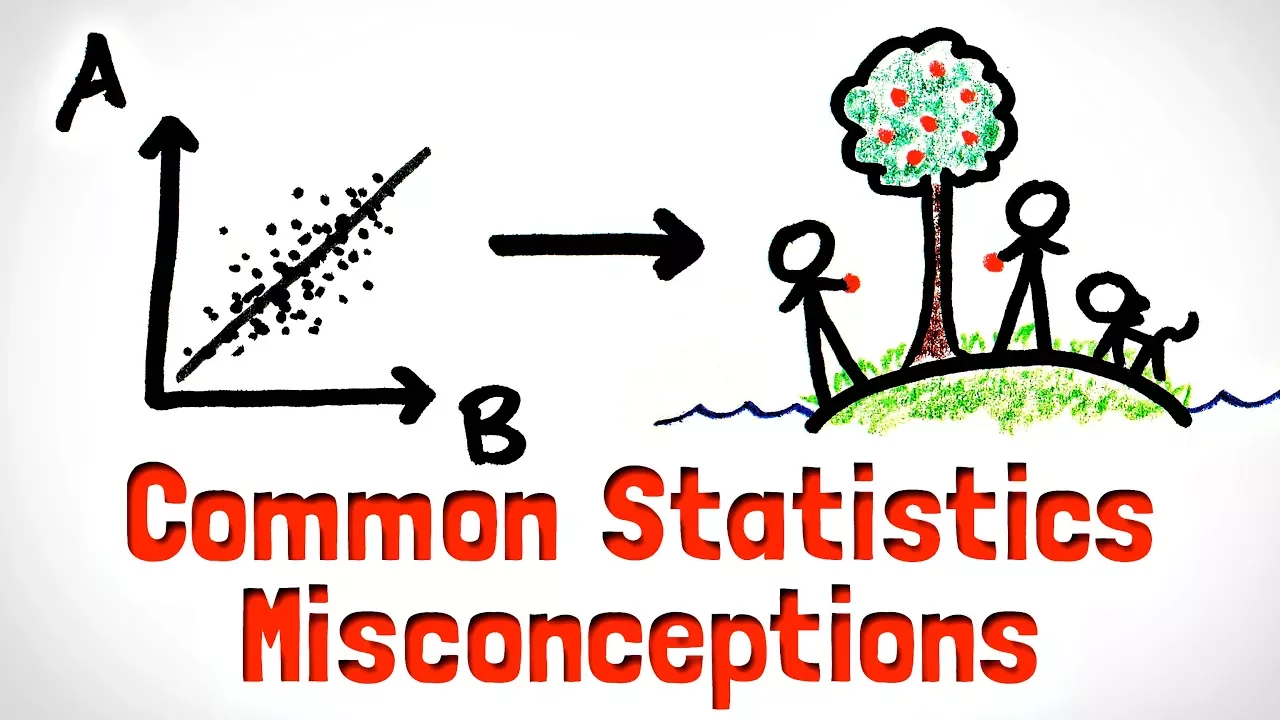
minutephysics
Evaluating multiple correlations across interconnected variables allows researchers to systematically eliminate incompatible cause-and-effect pathways and prove direct causality.
AI-assisted summary of Correlation CAN Imply Causation! | Statistics Misconceptions — original source. Check the original for full context.
Source published:
Key ideas
- The common statistical adage that correlation cannot imply causation is an overcorrection; analyzing networks of multiple correlations can systematically prove or eliminate causal pathways. (0:01)
- Using a three-variable system (height, cat ownership, and island habitat), researchers can prune 19 theoretically possible causal models down to just two valid configurations through conditional observations. (0:01)
- Classical causal models break down in quantum mechanics, where entanglement experiments produce statistical correlations that mathematically rule out every classical cause-and-effect explanation. (2:25)
Detailed notes
## Background Created by Henry Reich and published on the YouTube channel minutephysics on August 17, 2017, this video tackles the statistical misconception that correlation can never establish causality. According to the page description, it demonstrates how causal networks allow researchers to infer causation from correlation, while touching on Reichenbach's principle, common causes, and quantum entanglement.
## TL;DR While an isolated correlation between two variables cannot reveal the direction of cause and effect, the widespread belief that statistics can never prove causality is mistaken. By mapping multiple interconnected variables into causal networks and testing for conditional correlations—demonstrated through a thought experiment involving height, cat ownership, and island environments—researchers can systematically rule out dozens of competing models until only plausible causal chains remain. The primary exception to this classical framework occurs in quantum mechanics, where entanglement experiments produce statistical correlations that mathematically defy all classical causal models.
## Atmosphere & style The presentation is brisk, energetic, and intellectually playful, characteristic of MinutePhysics' visual, thought-experiment-driven educational approach. It creates an engaging eureka moment by turning a dogmatic statistical rule on its head through a whimsical island scenario, before pivoting into the weird, counterintuitive realities of quantum physics.
## Bulletin - [00:01](https://www.youtube.com/watch?v=HUti6vGctQM&t=1s) The common statistical adage that correlation cannot imply causation is an overcorrection; analyzing networks of multiple correlations can systematically prove or eliminate causal pathways. - [00:01](https://www.youtube.com/watch?v=HUti6vGctQM&t=1s) Using a three-variable system (height, cat ownership, and island habitat), researchers can prune 19 theoretically possible causal models down to just two valid configurations through conditional observations. - [02:25](https://www.youtube.com/watch?v=HUti6vGctQM&t=145s) Classical causal models break down in quantum mechanics, where entanglement experiments produce statistical correlations that mathematically rule out every classical cause-and-effect explanation.
## Key takeaways - [00:01](https://www.youtube.com/watch?v=HUti6vGctQM&t=1s) Assuming an isolated correlation between two variables proves direct causation is a fundamental statistical error. - [00:01](https://www.youtube.com/watch?v=HUti6vGctQM&t=1s) A raw correlation between height and cat ownership does not reveal whether height causes cat ownership, cats cause height, or a third factor causes both. - [00:01](https://www.youtube.com/watch?v=HUti6vGctQM&t=1s) The strict belief that statistics can never demonstrate causality is an incorrect overcorrection to the standard mantra. - [00:01](https://www.youtube.com/watch?v=HUti6vGctQM&t=1s) Causal networks allow researchers to evaluate the presence and absence of correlations across multiple interconnected variables to deduce causality. - [00:01](https://www.youtube.com/watch?v=HUti6vGctQM&t=1s) In a three-variable scenario without context, 19 distinct causal models can theoretically explain an observed correlation (or 20 if pure chance is included). - [00:01](https://www.youtube.com/watch?v=HUti6vGctQM&t=1s) Restricting mobility so that people remain on their birth island eliminates any causal model where height determines island habitat. - [00:01](https://www.youtube.com/watch?v=HUti6vGctQM&t=1s) Observing conditional independence—finding zero correlation between height and cat ownership within each island—eliminates any direct causal link between the two. - [00:01](https://www.youtube.com/watch?v=HUti6vGctQM&t=1s) Pruning hypotheses leaves only two viable models: a common cause model (island affects both) or a causal chain (cats affect the island, which affects height). - [02:25](https://www.youtube.com/watch?v=HUti6vGctQM&t=145s) Systematic evaluation of causal models demonstrates that statistical correlation can indeed imply causation. - [02:25](https://www.youtube.com/watch?v=HUti6vGctQM&t=145s) Quantum entanglement represents an exception to classical causal discovery, producing correlations incompatible with any classical causal network.
## Detailed walkthrough ### [00:01](https://www.youtube.com/watch?v=HUti6vGctQM&t=1s) Beyond the Mantra: How Causal Networks Infer Causality
A standard pitfall in statistical reasoning is assuming that an observed correlation proves a direct cause. For instance, if data shows that taller people are more likely to own cats, a superficial reading might conclude that being tall causes someone to get a cat. In reality, a raw correlation between height and feline ownership cannot reveal the direction of causation: it could just as well be that owning a cat somehow triggers human growth, or that an unseen third factor dictates both. A whimsical scenario illustrates the point: suppose people and cats are distributed across two distinct islands—one a lush, nutrient-rich paradise providing abundant food for humans to grow tall and care for pets, and the other a barren wasteland that stunts physical growth and suppresses pet ownership. In such cases, the correlation between height and cats is genuine, but neither directly causes the other.
```mermaid flowchart TD accTitle: Narrowing Causal Hypotheses accDescr: Flowchart illustrating how 19 potential causal models between height, cats, and islands are reduced to two valid causal paths.
subgraph Initial["Initial Hypotheses"] A["19 Possible Causal Models<br/>(20 if correlation is accidental)"] end
subgraph Filters["Elimination via Additional Correlations"] B["Observation 1: People stay on birth island<br/>(Height cannot cause Island)"] C["Observation 2: No correlation within each individual island<br/>(Height and Cats do not directly influence each other)"] end
subgraph Outcomes["Surviving Causal Models"] D["Option 1: Common Cause<br/>Island environment causes both Cat Ownership and Height"] E["Option 2: Causal Chain<br/>Cat Ownership causes Island conditions, which cause Height"] end
A --> B B --> C C --> D C --> E ```
However, aggressively repeating the rule that correlation does not mean causation creates an opposing error: the belief that statistics can never establish causality at all. As Henry Reich emphasizes, this overcorrection is mistaken: “But this oft-repeated mantra leads to another common misconception – the idea that you can’t infer any causality from statistics. You can!” While a single isolated correlation cannot untangle cause and effect on its own, causality can be systematically deduced by evaluating multiple correlations across interconnected variables using causal networks.
When analyzing the three variables—height, cat ownership, and island habitat—without any background context, there are 19 distinct possible causal configurations capable of explaining the correlation (or 20 if one allows that the correlation occurred by pure random chance). Introducing just two additional statistical observations drastically prunes these possibilities: - **Observation 1 (Mobility restriction):** People remain on the island where they were born, meaning adult height cannot determine which island a person inhabits; this eliminates every model where height influences island status. - **Observation 2 (Conditional independence):** Examining each island individually reveals no correlation whatsoever between an individual's height and whether they own a cat; this eliminates all configurations where height and cats exert a direct influence on one another.
Once those hypotheses are eliminated, exactly two plausible models survive: either the island environment is a common cause that independently influences both height and cat ownership, or cat ownership influences the state of the island, which in turn alters the height of subsequent generations (for example, if a massive population of cats cultivated the island into an abundant paradise). Using nothing more than correlations across a causal network, 19 theoretical relationships are narrowed down to two.
[02:25](https://www.youtube.com/watch?v=HUti6vGctQM&t=145s) The Quantum Exception and Causal Models
The island puzzle illustrates a broader mathematical reality: for any collection of variables, analyzing the presence or absence of correlations among them allows researchers to rule out incompatible cause-and-effect paths until only viable models remain. In this structural way, statistical correlation genuinely can imply causation. There is, however, a bizarre breakdown of this framework at the microscopic level: certain entanglement experiments in quantum mechanics yield statistical correlations that mathematically rule out *every single* possible classical cause-and-effect relationship. Reich captures the refined takeaway in an updated adage: “Correlation doesn’t necessarily imply causation, but it can if you use it to evaluate causal models. …Except in quantum mechanics.”
Following this statistical walkthrough, Reich highlights the sponsor Brilliant.org, a platform centered on active learning in STEM. He argues that passive consumption is insufficient for mastering analytical subjects, noting that “the only way to truly learn and understand much of math and physics is to actively work through the material yourself – videos only get you so far.” Brilliant structures guided puzzles, quizzes, and problems across skill levels, offering courses in subjects such as Probability, Classical Mechanics, Gravitational Physics, and the Physics of the Everyday. Reich concludes by pointing viewers to a companion footnote video exploring related edge cases that were omitted from the main explanation, including statistical feedback loops and correlations generated purely by coincidence.
## Notable quotes > [02:25](https://www.youtube.com/watch?v=HUti6vGctQM&t=145s) Correlation doesn’t necessarily imply causation, but it can if you use it to evaluate causal models. — Henry Reich
## Mentioned Henry Reich, MinutePhysics, Brilliant.org
## Video description Have fun improving your math & physics skills! Head to https://brilliant.org/minutephysics/
Footnote video: https://www.youtube.com/watch?v=iMbcMMe0D_Y
This video is about how causal models (which use causal networks) allow us to infer causation from correlation, proving the common refrain not entirely accurate: statistics CAN be used to prove causality! Including: Reichenbach's principle, common causes, feedback, entanglement, EPR paradox, and so on.
REFERENCES: Causal Discovery Algorithm in Quantum Mechanics Paper: https://arxiv.org/pdf/1208.4119.pdf Causal Models overview (Quantum and Classical): https://arxiv.org/pdf/1609.09487.pdf
Support MinutePhysics on Patreon! http://www.patreon.com/minutephysics Link to Patreon Supporters: http://www.minutephysics.com/supporters/
MinutePhysics is on twitter - @minutephysics And facebook - http://facebook.com/minutephysics And Google+ (does anyone use this any more?) - http://bit.ly/qzEwc6
Minute Physics provides an energetic and entertaining view of old and new problems in physics -- all in a minute!
Created by Henry Reich
[Source](https://www.youtube.com/watch?v=HUti6vGctQM)