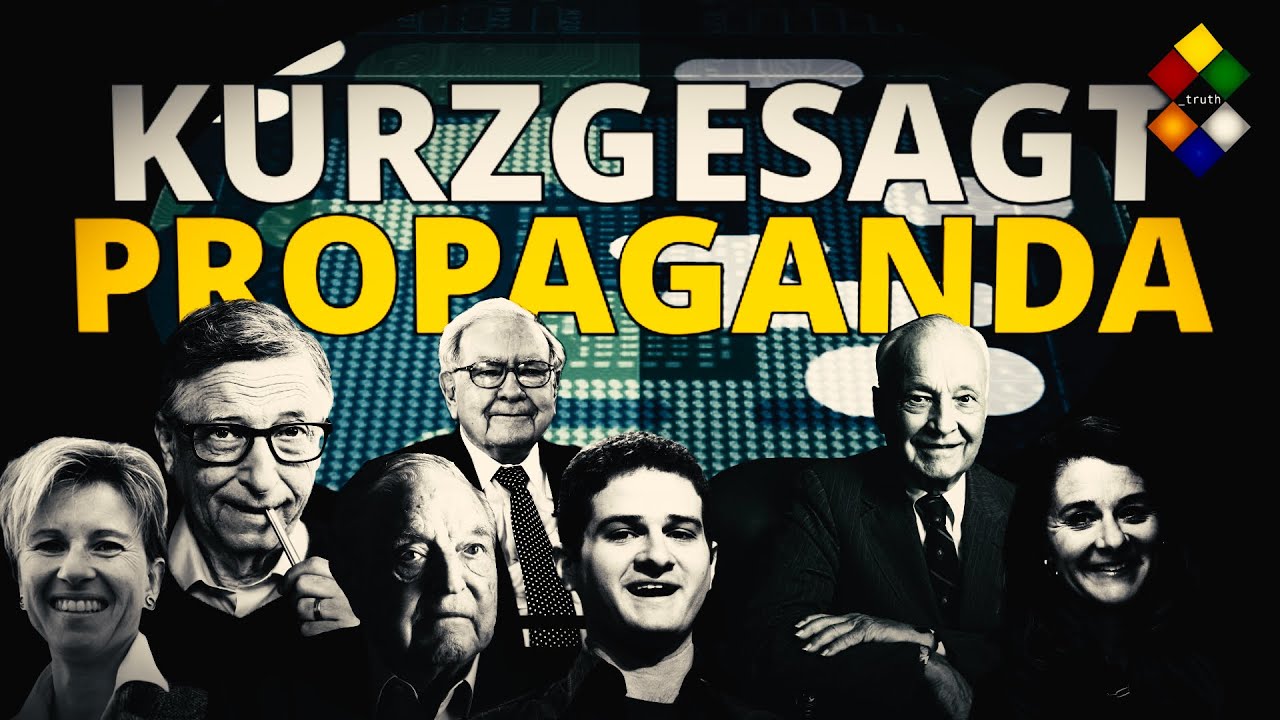
Kurzgesagt Takes $7M From Gates, Billionaires to Promote Tech Bets
The Hated One
Kurzgesagt relies on donor-funded think tanks to promote market-driven climate and health solutions that directly align with the commercial investments of its billionaire backers.
AI-assisted summary of How Kurzgesagt Cooks Propaganda For Billionaires — original source. Check the original for full context.
Source published:
Key ideas
- Kurzgesagt has accepted an estimated $7 million directly from billionaire funds and philanthropic foundations, roughly doubling its estimated $3.5 million in lifetime Patreon earnings from grassroots viewers. (2:05)
- The studio relies heavily on Our World in Data, which shares the same major funders—including the Gates Foundation and Open Philanthropy—creating a circular loop of pre-packaged research and media dissemination. (6:35)
- Kurzgesagt repeatedly highlights speculative climate technologies and market interventions, such as carbon capture, novel nuclear reactors, and alternative meats, in which Bill Gates and partner venture vehicles hold direct commercial stakes. (10:02)
- Despite having sufficient independent revenue from Patreon, merchandise, German public broadcasting, and client design work, Kurzgesagt continues taking controversial grants while relegating disclosures to video conclusions or description text. (21:37)
Detailed notes
## Background This investigative video essay was published by the channel The Hated One on YouTube on December 8, 2022. According to the page description and show notes, the piece investigates how the popular animation channel Kurzgesagt functions as a major propaganda tool for its billionaire sponsors, receiving an estimated $7 million from billionaire-backed funds—surpassing its lifetime earnings from grassroots Patreon supporters.
## TL;DR The video examines how Kurzgesagt's presentation of science, climate change, and global development aligns with the commercial and ideological interests of ultra-wealthy benefactors such as the Bill & Melinda Gates Foundation and Open Philanthropy. It reveals a closed feedback loop wherein billionaire capital funds both the research entities providing the channel's data—chiefly Our World in Data—and the animation studio itself, while obscuring conflicts of interest and burying sponsorship disclosures. The essay highlights how this pipeline promotes speculative, venture-backed tech solutions and curated progress metrics over systemic critique, contributing to an academic and media chilling effect that insulates powerful donors from scrutiny.
## Atmosphere & style The presentation carries the intense, urgent, and methodical tone of an adversarial investigative exposé, peeling back Kurzgesagt's friendly animated aesthetic to reveal deep structural compromise. The host speaks with focused indignation and sharp analytical precision, steadily layering grant records, academic counter-evidence, and financial disclosures to dismantle the myth of the scrappy, viewer-funded creator. Watching the video feels like an unsparing audit of modern digital media, transitioning from clinical deconstruction of specific video scripts to a stark, cautionary critique of institutional capture and the insidious power of billionaire philanthropy.
## Bulletin - [02:05](https://www.youtube.com/watch?v=HjHMoNGqQTI&t=125s) Kurzgesagt has accepted an estimated $7 million directly from billionaire funds and philanthropic foundations, roughly doubling its estimated $3.5 million in lifetime Patreon earnings from grassroots viewers. - [06:35](https://www.youtube.com/watch?v=HjHMoNGqQTI&t=395s) The studio relies heavily on Our World in Data, which shares the same major funders—including the Gates Foundation and Open Philanthropy—creating a circular loop of pre-packaged research and media dissemination. - [10:02](https://www.youtube.com/watch?v=HjHMoNGqQTI&t=602s) Kurzgesagt repeatedly highlights speculative climate technologies and market interventions, such as carbon capture, novel nuclear reactors, and alternative meats, in which Bill Gates and partner venture vehicles hold direct commercial stakes. - [21:37](https://www.youtube.com/watch?v=HjHMoNGqQTI&t=1297s) Despite having sufficient independent revenue from Patreon, merchandise, German public broadcasting, and client design work, Kurzgesagt continues taking controversial grants while relegating disclosures to video conclusions or description text.
## Key takeaways - [00:00](https://www.youtube.com/watch?v=HjHMoNGqQTI&t=0s) Kurzgesagt's video celebrating pharmaceutical companies for donating treatments for neglected tropical diseases was directly financed by the Gates Foundation, which holds large equity stakes in those same drug manufacturers. - [00:00](https://www.youtube.com/watch?v=HjHMoNGqQTI&t=0s) The 2012 London Declaration roadmap was spearheaded by the World Health Organization, not initiated spontaneously by Big Pharma firms that had ignored unprofitable tropical diseases for decades. - [02:05](https://www.youtube.com/watch?v=HjHMoNGqQTI&t=125s) Billionaire foundations quietly capture digital media and independent creators on YouTube to launder reputations and promote corporate-driven solutions under the guise of objective science. - [02:05](https://www.youtube.com/watch?v=HjHMoNGqQTI&t=125s) In 2015, the Gates Foundation gave Kurzgesagt a $570,000 grant, immediately surpassing the studio's monthly Patreon income and funding at least eight dedicated videos. - [02:05](https://www.youtube.com/watch?v=HjHMoNGqQTI&t=125s) Major funding sources for Kurzgesagt include Open Philanthropy (~$6M), the Gates Foundation, Open Society Foundations, Templeton World Charity Foundation, and Breakthrough Energy. - [06:35](https://www.youtube.com/watch?v=HjHMoNGqQTI&t=395s) Kurzgesagt heavily cites Our World in Data, an organization that has received over $4.8 million from the Gates Foundation alongside major Open Philanthropy backing. - [06:35](https://www.youtube.com/watch?v=HjHMoNGqQTI&t=395s) Our World in Data's historical poverty narrative relies on an artificially depressed $1.90/day baseline and speculative pre-1981 data that collapses if realistic metrics like $7.40/day are used. - [10:02](https://www.youtube.com/watch?v=HjHMoNGqQTI&t=602s) Kurzgesagt climate scripts downplay Global North emission culpability while prominently showcasing technologies matching Bill Gates's venture capital investments. - [10:02](https://www.youtube.com/watch?v=HjHMoNGqQTI&t=602s) Data for Kurzgesagt's carbon capture figures was derived from a Gates-funded publication citing a Gates-funded private facility, presenting an unrealistically low cost scenario. - [13:00](https://www.youtube.com/watch?v=HjHMoNGqQTI&t=780s) Editorial stances against organic farming and in favor of alternative meats cite Our World in Data, whose advisor Hannah Ritchie simultaneously served as a manager at an alternative protein firm. - [14:35](https://www.youtube.com/watch?v=HjHMoNGqQTI&t=875s) Kurzgesagt obscures its financial backers by burying disclosures in the final seconds of videos and describing Breakthrough Energy as a benign coalition rather than a private venture syndicate. - [16:33](https://www.youtube.com/watch?v=HjHMoNGqQTI&t=993s) Sponsors exert indirect editorial control through expert panels; consulted specialists in videos on vaccines, evolution, and effective altruism were predominantly funded by Gates, Templeton, or Open Philanthropy. - [16:33](https://www.youtube.com/watch?v=HjHMoNGqQTI&t=993s) The Gates Foundation used a $750 million funding package to pressure Oxford University into privatizing its COVID-19 vaccine with AstraZeneca rather than releasing it open-source. - [19:34](https://www.youtube.com/watch?v=HjHMoNGqQTI&t=1174s) Billionaire philanthropic spending generates the 'Bill Chill,' a widespread institutional self-censorship that deprives academic networks and media of independent critical voices. - [21:37](https://www.youtube.com/watch?v=HjHMoNGqQTI&t=1297s) Kurzgesagt admitted in 2017 that Patreon, merchandise, and ad revenue were already enough to sustain the studio, making billionaire financial entanglements an unnecessary editorial liability.
## Detailed walkthrough ### [00:00](https://www.youtube.com/watch?v=HjHMoNGqQTI&t=0s) Parasites, Neglected Tropical Diseases, and the Big Pharma "Hero" Narrative
In November 2016, Kurzgesagt published an animated video tackling some of the world's most gruesome parasites. The narrative followed a familiar, uplifting arc: horrific, neglected tropical diseases had ravaged impoverished populations for generations while world governments proved incapable of halting them—until Big Pharma magnanimously stepped up as humanity's savior. However, the actual history behind the initiative reveals a reality far less flattering to multinational pharmaceutical conglomerates. While these corporations did eventually agree to donate treatments to affected regions under public pressure, they did not do so out of spontaneous corporate goodwill. Rather, they acted only after decades of deliberately ignoring these illnesses because producing remedies for impoverished populations offered no meaningful profit margins.
Surprisingly, Bill Gates himself bears considerable responsibility for that long-standing neglect. By concentrating the immense philanthropic weight of the Bill & Melinda Gates Foundation on high-profile, marquee diseases like malaria, HIV, and tuberculosis, Gates's funding priorities inadvertently diverted critical resources and expert attention away from broader, structural healthcare dilemmas and common pathogens. Furthermore, the initiative celebrated in the video—the 2012 London Declaration on Neglected Tropical Diseases—was never conceived by pharmaceutical executives. The roadmap to eliminate or control ten neglected diseases by 2020 was spearheaded by the World Health Organization (WHO), which had to exert years of diplomacy and pressure to bring pharmaceutical corporations, NGOs, and sovereign governments to the bargaining table. For pharmaceutical giants that accrued nearly $9 trillion in collective profits over an 18-year period, donating surplus medicine carried zero operational risk and represented mere pocket change.
The most troubling dimension of the video, however, lies in who financed its production. The video was bankrolled directly by the Bill & Melinda Gates Foundation—an entity with immense equity holdings in the very pharmaceutical corporations lionized in the animation, while Bill and Melinda Gates personally held trustee roles in firms tied to the industry. Far from being an objective piece of popular science education, the project served as high-gloss corporate public relations. As the narrator underscores: “Kurzgesagt admitted they wouldn't have made this video if it wasn't paid for by Gates.”
- The WHO, not private pharmaceutical companies, authored the roadmap to eradicate neglected tropical diseases by 2020. - Pharmaceutical corporations generated nearly $9 trillion in profits over an 18-year window, making drug donations an insignificant financial burden. - The Bill & Melinda Gates Foundation, which sponsored the video, holds substantial stock portfolios across major pharmaceutical firms featured in the coverage.
---
[02:05](https://www.youtube.com/watch?v=HjHMoNGqQTI&t=125s) Billionaire Philanthropy, Media Capture, and the YouTube Frontier
This single video exposes the broader machinery through which ultra-wealthy individuals leverage media financing to launder their reputations, elevate private corporate interventions over public institutions, and bend policy narratives to their economic advantage. Ultra-wealthy oligarchs routinely funnel hundreds of millions of dollars into universities, legacy press rooms, and international governing bodies to manufacture favorable public consensus. When they seek deregulation or new market access, they underwrite journalism emphasizing technological modernization and GDP growth; when they seek political cover, they finance academic research that canonizes their preferred market-driven solutions as indisputable science. While public scrutiny has gradually eroded trust in traditional institutional media due to these financial entanglements, a critical blind spot remains: the quiet capture of digital creators and video essayists on YouTube.
```mermaid flowchart TD accTitle: Billionaire Funding and Content Pipeline accDescr: Diagram illustrating how billionaire donors fund both research organizations and Kurzgesagt to produce aligned media narratives.
subgraph Funders ["Billionaire Donors & Funds"] BMGF["Bill & Melinda Gates Foundation"] OP["Open Philanthropy (Dustin Moskovitz)"] OtherFunds["Templeton, Soros & Venture Funds"] end
subgraph Intermediary ["Data & Ideology Source"] OWID["Our World in Data (Max Roser)"] end
subgraph Production ["Media Output"] Kurz["Kurzgesagt - In a Nutshell"] end
BMGF -->|"$4.8M+ grants"| OWID OP -->|"Grants"| OWID BMGF -->|"$570K grant (8+ videos)"| Kurz OP -->|"~$6M in production grants"| Kurz OtherFunds -->|"Sponsored series"| Kurz OWID -->|"Pre-packaged charts & scripts"| Kurz ```
Kurzgesagt long cultivated a reputation as an unassuming, fiercely independent animation studio supported almost entirely by grassroots viewer donations through Patreon. Yet the financial reality tells a completely different story. Viewer disclosure of the Gates Foundation sponsorship was relegated to the final twenty seconds of the parasite video. Philipp Dettmer, the founder and owner of Kurzgesagt, acknowledged in a Medium post that the Gates Foundation acted as the channel's single largest backer, helping transform what was once a five-person Munich design firm into a global digital powerhouse. Grant records reveal that in November 2015, the Gates Foundation awarded Kurzgesagt a $570,000 contract spread over 49 months. At the time of the grant, Kurzgesagt was earning under $9,000 a month on Patreon, meaning the Gates contract—equating to roughly $11,000 a month or $71,250 for each of the eight Gates-backed videos identified—instantly surpassed their entire monthly grassroots patron revenue.
The Gates Foundation was far from the only billionaire benefactor patronizing the channel. Over subsequent years, Kurzgesagt accepted underwriting and production contracts from Dustin Moskovitz's Open Philanthropy, George Soros's Open Society Foundations, the Templeton World Charity Foundation, Gates's personal venture vehicle Breakthrough Energy, and effective altruism philosopher William MacAskill. Open Philanthropy alone awarded Kurzgesagt nearly $6 million in grants for video creation, translation, and short-form content. In total, Kurzgesagt has received an estimated $7 million directly from billionaire philanthropic funds. That figure easily eclipses the estimated $3.5 million the channel collected from its public supporters on Patreon across its entire operating history. Reflecting on this disparity between branding and commercial reality, the narrator emphasizes: “This made me realize that Kurzgesagt never was this small, independent, almost entirely viewer-funded channel.”
- In November 2015, the Gates Foundation awarded Kurzgesagt a 49-month grant worth $570,000. - Kurzgesagt produced at least eight distinct videos directly financed by the Gates Foundation. - Open Philanthropy awarded approximately $6 million in grants to Kurzgesagt for video production and localized translations. - Total billionaire funding to Kurzgesagt sits at roughly $7 million, approximately double their lifetime Patreon earnings of roughly $3.5 million. - Other sponsors include Open Society Foundations, Templeton World Charity Foundation, Gates Notes, Breakthrough Energy, and William MacAskill.
---
[06:35](https://www.youtube.com/watch?v=HjHMoNGqQTI&t=395s) The Circular Source Network: Our World in Data and Manipulated Metrics
The influence of billionaire patrons extends far beyond individual sponsored uploads; it permeates Kurzgesagt's core research process and editorial framing. The studio routinely assures viewers that its scripts are thoroughly fact-checked, scientifically objective, and insulated from external pressure. However, a review of Kurzgesagt's source repositories reveals an overwhelming reliance on a single primary collaborator: Our World in Data, an Oxford-affiliated research project founded by economist Max Roser. Kurzgesagt frequently cites Our World in Data dozens of times within a single source document, treating its figures as indisputable consensus.
Our World in Data is not an unattached academic collective; it is sustained by the exact same constellation of billionaire patrons that underwrites Kurzgesagt. The Gates Foundation has funneled at least $4.8 million into Our World in Data, alongside major funding from Open Philanthropy, the Templeton foundations, and William MacAskill. In fact, Kurzgesagt's initial partnership with Max Roser was directly initiated by their original Gates Foundation grant to produce a video on global overpopulation. The result is a closed loop: billionaire foundations fund the think tanks that assemble the metrics, then fund the animators who package those figures for tens of millions of viewers, who are told the conclusions represent pure science.
| Metric / Dimension | World Bank & *Our World in Data* Narrative | Academic & Empirical Counter-Evidence | |:--- |:--- |:--- | | **Poverty Line Standard** | Extreme poverty defined as living below **$1.90/day** | Economists and development scholars urge a baseline of at least **$7.40/day** | | **Historical Data Baseline** | Charts model poverty curves extending back to the early **1800s** | Robust, global empirical poverty data did not exist prior to **1981** | | **Global Poverty Trajectory** | Depicted as an unbroken, steep decline driven by capitalist growth | Stagnation or outright increase since 1981 if China is excluded or higher baselines are applied | | **Present Living Conditions** | Framing celebrates historical eradication of material deprivation | Over **half the global population** faces food insecurity/malnutrition; **40M+** live in modern slavery |
When scrutinized, the data underpinning these videos unravels. In its coverage of overpopulation and global development, Kurzgesagt presents historical graphs showing global extreme poverty collapsing from near-universal levels in the early 19th century down to single digits today, attributing this miraculous trend to free-market economic growth. Yet verified, standardized global poverty statistics were simply not collected prior to 1981; everything prior is retroactive economic speculation.
Furthermore, the World Bank’s extreme poverty threshold of $1.90 per day is an artificially depressed benchmark calculated as an average of the poverty lines of the world's absolute poorest nations. It routinely classifies billions of people who are desperately poor under their own domestic national standards as "lifted out of poverty." When scholars adjust that line to a realistic basic needs standard of $7.40 per day, or when the singular economic transformation of China is excluded, the celebrated historical drop in global poverty vanishes entirely, replaced by stagnation or an outright increase in the absolute number of people living in severe deprivation. Despite this, the narrative of inexorable, market-driven progress remains a cornerstone of the world view funded by Gates and amplified by Roser. Quoting Max Roser's defense of this framing directly, the narrator illustrates how these statistics are weaponized for public optimism: “As the economist Max Roser has said: ‘The world has done quite well on this. The newspapers could have run a headline: The lives of the poor will improve more in the next 15 years than at any other time in history. Number of people in poverty fell by 137,000 since yesterday comes out as a—what for many people will be a stunningly positive story.’”
[10:02](https://www.youtube.com/watch?v=HjHMoNGqQTI&t=602s) Downplaying Historical Emissions and Pushing Bill Gates's Tech Bets
The analysis of Kurzgesagt’s climate change content reveals a heavy reliance on Our World in Data, which the narrator argues conveniently downplays the historic responsibility of developed nations. While Our World in Data frames emissions in a way that softens Western culpability, an uncompromised study from *The Lancet*—which received no outside funding—paints a radically different picture: the United States is responsible for 40% of excess global emissions rather than the commonly cited 25%, while the European Union accounts for 29% instead of 22%. Furthermore, the G8 nations have emitted 85% of historical carbon dioxide, and the Global North as a whole is accountable for a staggering 92% of excess atmospheric carbon.
```mermaid flowchart TD accTitle: Narrative Pipeline of Billionaire Climate Investments accDescr: Diagram showing how billionaire investments flow through think tanks and Kurzgesagt videos to promote specific unproven climate technologies.
subgraph Funders ["Billionaire Capital"] BG["Bill Gates / Breakthrough Energy"] end
subgraph ThinkTanks ["Data & Research Layer"] OWID["Our World in Data\n(Max Roser / Hannah Ritchie)"] GatesTech["Funded Startups:\n• Low-carbon cement & steel\n• Direct air capture\n• Alternative meats\n• Advanced nuclear"] end
subgraph Media ["Public Messaging"] KZ["Kurzgesagt Videos"] Narrative["Narrative Focus:\n'Investment' & 'Innovation'\nOver systematic phaseouts"] end
BG -->|"Millions in Grants"| OWID BG -->|"Venture Capital"| GatesTech OWID -->|"Cited 27+ times / script consults"| KZ GatesTech -->|"Uncritical inclusion"| KZ KZ --> Narrative ```
Across several climate videos, Kurzgesagt introduces a seemingly random selection of technological breakthroughs: new-generation nuclear plants, novel batteries, low-carbon electronics, low-carbon steel, clean cement production, artificial meat, and direct air carbon capture. These technologies share two defining characteristics: none are currently scalable or commercially viable enough to meaningfully solve climate change, and Bill Gates has poured millions of dollars of personal venture capital into startups developing every single one of them. Kurzgesagt frequently repeats words like "investment" and "innovation" in an almost obnoxious rhythm, lowering standard evidentiary bars to promote tech fixes. For instance, its figures on carbon capture were lifted straight from a Gates-funded magazine that cited a Gates-funded private capture facility. That estimate represents the lowest possible scenario; real-world costs are at least double today, and even the most optimistic projections—which won't materialize before the next decade—remain twice as expensive as simply planting trees.
- According to *The Lancet*, the Global North is accountable for 92% of excess atmospheric carbon, and the G8 alone emitted 85% of historical $\text{CO}_2$. - Kurzgesagt's carbon capture cost figures relied on a Gates-funded magazine drawing data from a Gates-funded private facility. - Critics and scientists argue that hyping these speculative technologies diverts crucial public attention away from proven solutions, delaying the necessary phase-out of fossil fuels and modern high-emission industrial practices.
As the narrator emphasizes: > “Kurzgesagt doesn't tell you which technologies Bill Gates has invested in and how positive messaging about them is advancing his positions, but Kurzgesagt did take the effort to mention exactly those technologies that Bill Gates and his billionaire friends are most invested in.”
---
[13:00](https://www.youtube.com/watch?v=HjHMoNGqQTI&t=780s) Synergies Across Nuclear Energy, Organic Food, and Alternative Meats
A clear pattern emerges when comparing Kurzgesagt’s editorial focus with Bill Gates’s financial bets. In its video examining whether nuclear energy is needed to stop climate change, Kurzgesagt links directly to Our World in Data's nuclear energy coverage; its source list references Our World in Data 27 separate times, representing roughly one out of every three citations. While the video carries no formal Gates sponsorship, Gates is heavily invested in next-generation nuclear reactor companies.
A similar dynamic governs Kurzgesagt’s harsh critique of organic farming. Bill Gates has long championed high-tech, industrialized agriculture using chemical fertilizers, proprietary seeds, and pesticides as the singular answer to global hunger—an approach that has yet to eliminate food insecurity. Across four separate instances where Kurzgesagt delivers a definitive verdict condemning organic farming, Our World in Data is the sole authority cited. Gates also ranks among the earliest and largest investors in alternative meats, holding major equity stakes in vegan and meat-free protein manufacturers. Kurzgesagt released an entire series arguing that traditional meat is terrible for personal health and the planet. These videos were advised by Hannah Ritchie, a senior researcher at Our World in Data who simultaneously worked as a business manager for a meat-free mycoprotein company during the production of at least one video.
- Kurzgesagt’s nuclear video source document cited Our World in Data 27 times without disclosing Gates’s deep commercial investments in nuclear technology. - In all four instances where Kurzgesagt reached an editorial verdict against organic farming, Our World in Data was cited as the primary reference. - Video advisor Hannah Ritchie simultaneously served as a key figure at Our World in Data and as a business manager at an alternative protein firm.
The narrator highlights this failure of scientific transparency: > “Whatever your take on meat is, these are conflicts of interest that should normally be disclosed by any serious research, but Kurzgesagt makes no effort to help you connect the dots.”
---
[14:35](https://www.youtube.com/watch?v=HjHMoNGqQTI&t=875s) Obscured Sponsorship Disclaimers and Breakthrough Energy
Kurzgesagt exhibits a substandard approach to disclosing sponsorships when compared to standard journalistic and YouTube practices. An audience poll conducted by the creator indicated that the vast majority of viewers expect sponsorships to be disclosed either before a video begins or during the opening introduction. In contrast, Kurzgesagt buries disclosures in the final seconds, renders them in small onscreen text, or conceals them entirely within the description box.
| Platform / Actor | Disclosure Policy / Standard | Kurzgesagt Practice | |:--- |:--- |:--- | | **Viewer Expectation** *(Audience Poll)* | Clear disclosure before video playback begins or during the opening intro. | Buried in the final seconds of the video, restricted to fine on-screen text, or hidden in the description box. | | **YouTube Platform Standard** | Mandates un-removable, prominent warning labels for state-funded broadcasters (e.g., Funk / German PBS). | No automated platform tags exist for private venture funds or billionaire foundations, allowing sponsors to remain opaque. | | **Breakthrough Energy** | A multi-billion-dollar private venture capital syndicate designed to profit from clean-tech adoption. | Framed benignly as a nonprofit "coalition founded by Bill Gates" working toward Net Zero; video description links to Gates's book sale rather than the fund's portfolio. |
Kurzgesagt presents Breakthrough Energy as a benevolent philanthropic coalition founded by Bill Gates to advance clean technology and Net Zero emissions. In reality, Breakthrough Energy operates as a consortium of venture capital funds through which billionaires stand to earn substantial returns when the specific technologies they back secure market dominance. Furthermore, the link provided in the description directs viewers to buy Bill Gates’s book rather than to the venture fund’s portfolio site. The narrator argues that YouTube should apply the same disclosure framework it uses for state-affiliated media—such as the warning label applied to Kurzgesagt’s German channel, *Funk*, which operates under German public broadcasting—to private billionaire-funded channels.
The narrator points out the deceptive nature of these disclosures: > “Kurzgesagt also does a terrible job at explaining who their sponsors actually are.”
---
[16:33](https://www.youtube.com/watch?v=HjHMoNGqQTI&t=993s) Institutional Capture: Templeton, Open Philanthropy, and Oxford Vaccine Lobbying
Kurzgesagt insists that financial sponsors never exercise editorial control over its scripts, but the narrator argues this claim ignores how institutional networks operate. Sponsors systematically shape content because Kurzgesagt relies directly on experts and institutions funded by those very sponsors:
```mermaid flowchart LR accTitle: Sponsor-to-Expert Feedback Loop in Kurzgesagt Content accDescr: Flowchart demonstrating how primary grantmakers directly fund the academic institutes and experts Kurzgesagt consults for script production.
subgraph Donors ["Funding Sources"] OP["Open Philanthropy"] BMGF["Bill & Melinda Gates Foundation"] TWC["Templeton World Charity"] end
subgraph Intermediaries ["Funded Experts & Institutes"] FHI["Future of Humanity Institute\n(Received £15M+ from OP)"] WM["William MacAskill\n(Centre for Effective Altruism)"] GatesStaff["Gates Foundation Executives\n& Funded Researchers"] TempScholars["4 of 6 Consulted Scholars\n(Direct Templeton Grants)"] end
subgraph Videos ["Kurzgesagt Videos"] V1["'The Last Human' & Collapse Videos"] V2["Vaccine Side Effects Video"] V3["Human Evolution & Mind Videos"] end
OP --> FHI OP --> WM BMGF --> GatesStaff TWC --> TempScholars
FHI --> V1 WM --> V1 GatesStaff --> V2 TempScholars --> V3 ```
- In its video on vaccine side effects, Kurzgesagt listed six consulted experts: at least four worked for Gates-funded organizations, and one was an active executive inside the Bill & Melinda Gates Foundation. - In three videos financed by the Templeton World Charity Foundation, four out of six consulted scientists had received direct research funding from the Templeton foundation. - For its video on long-termism, *The Last Human* (sponsored by Open Philanthropy), two of the three consulted researchers came from Oxford's Future of Humanity Institute, which took more than £15 million from Open Philanthropy; the third consulted researcher from LMU Munich had also worked at Oxford during those grant periods. - Another video addressing civilizational collapse was produced in collaboration with Oxford philosopher William MacAskill, the intellectual leader of the Centre for Effective Altruism, which receives millions from Open Philanthropy. - Open Philanthropy has granted Kurzgesagt over €5 million directly to translate its archive and create content popularizing effective altruism and long-termist ideology.
The assertion that wealthy benefactors donate without seeking control is directly contradicted by recent history. The narrator points to the development of the Oxford–AstraZeneca COVID-19 vaccine: Oxford scientists had planned to donate the patent rights to the public domain so that developing countries could manufacture cheap generic doses without waiting for wealthy nations' charity. Bill Gates stepped in and used the leverage of a $750 million funding package to force the university to reverse course, sign an exclusive manufacturing partnership with AstraZeneca, and lock down the patent rights, prioritizing the commercial interests of multinational pharmaceutical companies over the urgent pleas of the World Health Organization.
The narrator lays bare the absurdity of claiming such money carries no influence: > “Do you think money doesn't buy influence, so billionaires do political lobbying and campaign financing for the lols and they don't get any laws influenced in their favor?”
[19:34](https://www.youtube.com/watch?v=HjHMoNGqQTI&t=1174s) The Bill Chill and Institutional Capture
The narrative transitions from the consequences of decades of private investment—culminating in what is described as global vaccine apartheid and millions of preventable deaths—to the broader corrupting influence of capital on scientific inquiry and journalism. Bill Gates has directed an estimated $300 million into various media companies, with Kurzgesagt among the recipients. This vast financial pipeline effectively insulates donors from journalistic scrutiny, leaving audiences to wonder when they last encountered a genuinely critical investigation into the Bill & Melinda Gates Foundation. Addressing Kurzgesagt's defense that they maintain editorial independence and decouple donor interests from video production, the host poses a pointed, satirical challenge: will viewers ever see a brightly animated Kurzgesagt duck representing Bill Gates meeting with convicted sex offender Jeffrey Epstein at his private residences?
```mermaid flowchart TD accTitle: The Mechanics of the Bill Chill accDescr: Diagram showing how billionaire philanthropic funding exerts control over media, research, and public policy through financial leverage.
subgraph Capital["Billionaire Philanthropy"] BF["Billionaire Capital\n(e.g., Gates Foundation)"] end
subgraph Influence["Direct Funding Channels"] direction TB Media["Media & Outreach\n($300M+ to Press & Studios)"] Research["Academic Research\n& Institutional Grants"] end
subgraph Impact["Systemic Outcomes"] direction TB Chill["'The Bill Chill'\n(Self-Censorship & Loss of Reviewers)"] Policy["Policy Capture & Veto Power\nOver Global Health & Governance"] end
BF --> Media BF --> Research Media --> Chill Research --> Chill Chill --> Policy ```
Quoting Carl Sagan to underscore the danger to open inquiry, the host warns:
> “If we are not able to ask skeptical questions to interrogate those who tell us that something is true to be skeptical of those in Authority it becomes less diverse more engine and more authoritative then we're up for grabs for the next charlatan political or religious who comes ambling along in the academic Community there is a phenomenon called the chilling effect it occurs when scientists self-censor or refuse to speak out against the funding source of their institutions out of fear of losing support or getting sacked”
Within public health and academic networks, this systemic self-censorship is openly referred to as the "Bill Chill." Because the Gates Foundation funds so many institutions across the globe, it has become extraordinarily difficult to find independent peer reviewers who do not have financial ties to the organization. Through this multibillion-dollar philanthropic footprint, Gates has amassed the leverage to unilaterally shape national and international health directives, giving private interests effective veto power over democratic policy agendas that conflict with their priorities.
- Gates has distributed over $300 million directly to media entities and educational outlets. - The pervasive reach of foundation grants has compromised the pool of independent academic reviewers. - Concentrated philanthropic capital enables private foundations to veto public policies that do not align with their organizational agenda.
---
[21:37](https://www.youtube.com/watch?v=HjHMoNGqQTI&t=1297s) Billionaire Hacking of Public Discourse and Kurzgesagt’s Business Model
The analysis turns toward the double standard applied to corporate lobbying versus philanthropic intervention. While outlets like Kurzgesagt routinely portray fossil fuel lobbyists as classic villains manipulating politicians and disinforming the public with deep pockets, they appear completely blind to the exact same dynamic when they are the beneficiaries of billionaire funding. By deploying immense wealth across research institutions, public relations campaigns, and media houses, ultra-wealthy donors brute-force their preferred market-based solutions into the mainstream while squeezing out competing systemic critiques.
> “Billionaires have hacked the system by which we measure the myriads of arguments in science and public disc Wars with the sheer wealth they brute Force their ideas into the mainstream by giving their interests more funding for research more coverage in the media and higher likelihood of becoming a public policy”
This financial compromise is particularly unnecessary for an animation giant of Kurzgesagt's scale. Back in a 2017 Medium post, Kurzgesagt openly acknowledged that their Patreon funding, merchandise sales, and ad revenue were sufficient to sustain the studio without commercial or institutional sponsors. In addition, the company operates a commercial design wing producing commissioned work for major corporate clients, receives direct funding from the German public broadcast system (funk/state media), and generates revenue from courses on platforms like Skillshare and Brilliant. Given this diverse set of revenue streams, the studio has the financial security to decline controversial philanthropic grants entirely. At the bare minimum, sponsorship disclosures should appear at the very start of a video rather than tucked away at the end or hidden in description boxes, giving viewers the context needed to evaluate the material before watching.
> “There is no such thing as a free gift”
- Kurzgesagt acknowledged as early as 2017 that viewer patronage and merchandising alone could fully fund their core operation. - Alternative revenue streams include their commercial design agency, German public broadcast subsidies, and sponsored educational courses. - The host advocates for strict boundaries analogous to universal bans on tobacco marketing, arguing that media outlets and educators must not accept financing from organizations they are tasked with covering critically.
---
[23:31](https://www.youtube.com/watch?v=HjHMoNGqQTI&t=1411s) Independent Creator Funding vs. Institutional Capture
Concluding the essay, the host highlights the deliberate absence of paid product placements, corporate integrations, or sponsored brand reads throughout the video. Emphasizing the distinction between corporate-backed productions and authentic grassroots support, the creator notes that the channel has never signed a single corporate sponsorship deal.
> “That's because this channel has never taken a single sponsorship deal none with my current ad Revenue I can honestly Proclaim that the headed one channel is indeed almost entirely viewer funded without my patreon supporters this video wouldn't happen”
Viewers looking to support rigorous, conflict-free investigative content are invited to subscribe to the creator's Patreon community, which offers access to exclusive podcasts and channel merchandise.
## Notable quotes > [10:02](https://www.youtube.com/watch?v=HjHMoNGqQTI&t=602s) Kurzgesagt doesn't tell you which technologies Bill Gates has invested in and how positive messaging about them is advancing his positions, but Kurzgesagt did take the effort to mention exactly those technologies that Bill Gates and his billionaire friends are most invested in. — The Hated One
## Mentioned Kurzgesagt – In a Nutshell, The Hated One, Bill Gates, Melinda Gates, Bill & Melinda Gates Foundation, World Health Organization, Dustin Moskovitz, Open Philanthropy, George Soros, Open Society Foundations, Templeton World Charity Foundation, Breakthrough Energy, William MacAskill, Max Roser, Our World in Data, Hannah Ritchie, Philipp Dettmer, The Lancet, Funk, AstraZeneca, Future of Humanity Institute, Carl Sagan, Jeffrey Epstein, Patreon, YouTube
## Video description UPDATE: Kurzgesagt's official response: https://reddit.com/r/kurzgesagt/comments/10jlyyk/kurzgesagt_statement_to_the_conflict_of_interest/ My response to Kurzgesagt: https://www.reddit.com/r/thehatedone/comments/10pb1q9/my_response_to_kurzgesagt/ Kurzgesagt is not just a popular science outreach channel. It's a major tool for propaganda of their billionaire sponsors. Support independent research and analysis by joining my Patreon page: https://www.patreon.com/thehatedone
Kurzgesagt received estimated $7 million from billionaire funds. This would be more money than Kurzgesagt received from their supporters on Patreon (estimated $3.5 million) in the entire history of the channel.
Sources [First half only; second part in the pinned comment] [0] https://web.archive.org/web/20221108134548/https://www.youtube.com/watch?v=qNWWrDBRBqk [1] https://www.reuters.com/article/us-diseases-neglected-pharma-idUSTRE80T0LO20120130 [2] https://en.wikipedia.org/wiki/London_Declaration_on_Neglected_Tropical_Diseases [3] https://www.gatesfoundation.org/Ideas/Media-Center/Press-Releases/2012/01/private-and-public-partners-unite-to-combat-10-neglected-tropical-diseases-by-2020 [4] https://www.businessinsider.com/r-fight-against-neglected-tropical-diseases-needs-big-pharma-push-who-2017-4 [5] https://www.latimes.com/nation/la-na-gates16dec16-story.html [6] https://academic.oup.com/bmb/article/93/1/179/307584? [7] https://www.thelancet.com/journals/lancet/article/PIIS0140673609608850/fulltext? [8] https://www.vox.com/2015/6/10/8760199/gates-foundation-criticism [9] https://jamanetwork.com/journals/jama/fullarticle/2762308 [10] https://www.thenation.com/article/society/bill-gates-foundation-philanthropy/ [11] https://www.latimes.com/archives/la-xpm-2007-jan-07-na-gatesx07-story.html [12] https://www.washingtonpost.com/education/2020/02/10/bill-melinda-gates-have-spent-billions-dollars-shape-education-policy-now-they-say-theyre-skeptical-billionaires-trying-do-just-that/ [13] https://apnews.com/a4042e82ffaa4a34b50ceac464761957 [14] https://news.gallup.com/poll/1597/confidence-institutions.aspx [15a] https://medium.com/@Kurzgesagt/kurzgesagt-sponsorships-on-youtube-3121a45b0fe9 [15b] https://web.archive.org/web/20221122151542/https://www.youtube.com/watch?v=0KQYNtPl7V4&lc=Ugw7oaypQ3qALcugYzh4AaABAg [16] https://www.gatesfoundation.org/about/committed-grants/2015/11/opp1139276 [17] https://www.openphilanthropy.org/grants/kurzgesagt-video-creation-and-translation/ [18a] https://www.openphilanthropy.org/grants/kurzgesagt-short-form-video-content/ [18b] https://web.archive.org/web/20220000000000*/https://www.patreon.com/Kurzgesagt [19] https://ourworldindata.org/funding [20] https://en.wikipedia.org/wiki/Our_World_In_Data#Funding_and_collaborations [21] https://web.archive.org/web/20221108134123/https://www.youtube.com/watch?v=QsBT5EQt348 [22] https://ourworldindata.org/extreme-poverty-in-brief [23] https://www.nytimes.com/2021/12/02/world/global-poverty-united-nations.html [24] https://theconversation.com/why-the-world-banks-optimism-about-global-poverty-misses-the-point-104963 [25] https://www.theguardian.com/global-development-professionals-network/2015/nov/01/global-poverty-is-worse-than-you-think-could-you-live-on-190-a-day [26] https://www.theguardian.com/commentisfree/2019/jan/29/bill-gates-davos-global-poverty-infographic-neoliberal [27] https://newint.org/features/2019/07/01/long-read-progress-and-its-discontents [28] https://www.theguardian.com/news/2019/feb/25/modern-slavery-trafficking-persons-one-in-200 [29] https://www.thelancet.com/journals/lanplh/article/PIIS2542-5196%2820%2930196-0/fulltext [30] https://oxfam.app.box.com/s/1rp115i9uiwmvsa11mwaa00vwc6ic437 [31] https://qz.com/1402301/bill-gatess-1-billion-energy-fund-is-expanding-its-portfolio-of-startups-fighting-climate-change [32] https://www.wired.com/2015/11/zuckerberg-gates-climate-change-breakthrough-energy-coalition/ [33] https://qz.com/859860/bill-gates-is-leading-a-new-1-billion-fund-focused-on-combatting-climate-change-through-innovation [34] https://news.stanford.edu/2019/10/25/study-casts-doubt-carbon-capture/ [35] https://www.wired.com/story/the-potential-pitfalls-of-sucking-carbon-from-the-atmosphere/ [36] https://www.technologyreview.com/2021/07/08/1027908/carbon-removal-hype-is-a-dangerous-distraction-climate-change/ [37] https://www.ipcc.ch/site/assets/uploads/sites/2/2019/06/SR15_Full_Report_High_Res.pdf [38] https://grist.org/technology/orca-the-largest-carbon-removal-facility-to-date-is-up-and-running/ [39] https://climeworks.com/roadmap/orca [40] https://www.ft.com/content/8a942e30-0428-4567-8a6c-dc704ba3460a
Follow me: https://twitter.com/The_HatedOne_ https://www.reddit.com/r/thehatedone/
The footage and images featured in the video were for critical analysis, commentary and parody, which are protected under the Fair Use laws of the United States Copyright act of 1976.
[Source](https://www.youtube.com/watch?v=HjHMoNGqQTI)