Colbert Confronts Bush Over Low Polls, Slams Press Subservience
CNN
Colbert argues that the Bush administration sustains its policies by rejecting empirical facts, aided by a compliant Washington press corps that abdicates its adversarial role.
AI-assisted summary of Watch Stephen Colbert at the 2006 White House Corresponde... — original source. Check the original for full context.
Source published:
Key ideas
- Stephen Colbert delivers a high-wire satirical roast at the 2006 White House Correspondents' Dinner, adopting his conservative pundit persona while seated beside President George W. Bush. (0:00)
- Addressing Bush's 32 percent approval rating, Colbert coins the memorable aphorism that 'reality has a well-known liberal bias' and compares the administration's trajectory to Rocky Balboa absorbing endless punishment. (3:45)
- Colbert skewers the assembled Washington press corps for abandoning its early post-9/11 passivity, demanding reporters return to simply transcribing administration announcements without adversarial scrutiny. (8:15)
- Rejecting claims that White House staff reshuffling was akin to rearranging deck chairs on the Titanic, Colbert concludes that the administration is instead rearranging deck chairs on the Hindenburg. (8:15)
Detailed notes
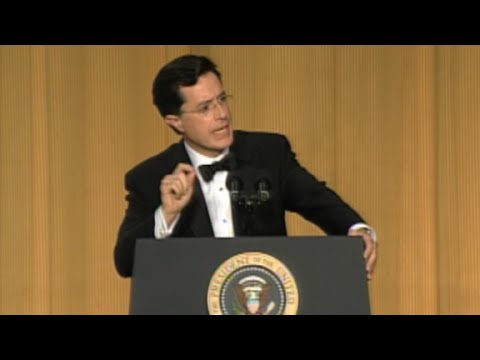
## Background Published by CNN on YouTube on April 29, 2016, this video looks back ten years to Stephen Colbert's performance at the 2006 White House Correspondents' Dinner. The video description highlights how Colbert pulled no punches while skewering President George W. Bush and the gathered press corps in his signature satirical style.
## TL;DR Performing in character as an ultraconservative pundit, Stephen Colbert addresses President George W. Bush and the White House press corps directly from the head table. He satirizes the administration's reliance on 'gut' instinct over empirical facts, reinterpreting Bush's 32 percent approval rating through a brutal Rocky Balboa analogy and celebrating the White House's penchant for staged photo opportunities. Colbert also attacks elitist knowledge and the First Lady's reading initiatives, arguing that unwavering political conviction matters more than changing reality. He concludes by excoriating the assembled journalists for breaking their early-2000s compliance and meddling in depressing classified operations, ultimately comparing the administration's trajectory to rearranging deck chairs on the Hindenburg.
## Atmosphere & style The address carries a tension-charged, subversive atmosphere characterized by deadpan comedic delivery and biting political satire. Speaking inches away from the very targets he is lampooning, Colbert maintains an unyielding, mock-fawning persona that generates palpable, nervous friction across the room. Watching the performance feels daring and audacious, as Colbert transforms an elite, decorous Washington ballroom into a crucible of uncomfortable laughs and piercing truth-telling.
## Bulletin - [00:00](https://www.youtube.com/watch?v=IJ-a2KeyCAY&t=0s) Stephen Colbert delivers a high-wire satirical roast at the 2006 White House Correspondents' Dinner, adopting his conservative pundit persona while seated beside President George W. Bush. - [03:45](https://www.youtube.com/watch?v=IJ-a2KeyCAY&t=225s) Addressing Bush's 32 percent approval rating, Colbert coins the memorable aphorism that 'reality has a well-known liberal bias' and compares the administration's trajectory to Rocky Balboa absorbing endless punishment. - [08:15](https://www.youtube.com/watch?v=IJ-a2KeyCAY&t=495s) Colbert skewers the assembled Washington press corps for abandoning its early post-9/11 passivity, demanding reporters return to simply transcribing administration announcements without adversarial scrutiny. - [08:15](https://www.youtube.com/watch?v=IJ-a2KeyCAY&t=495s) Rejecting claims that White House staff reshuffling was akin to rearranging deck chairs on the Titanic, Colbert concludes that the administration is instead rearranging deck chairs on the Hindenburg.
## Key takeaways - [00:00](https://www.youtube.com/watch?v=IJ-a2KeyCAY&t=0s) Colbert opens by adopting an uncritical conservative pundit persona, claiming an intellectual kinship with Bush based on instinct and gut feelings rather than books and facts. - [00:00](https://www.youtube.com/watch?v=IJ-a2KeyCAY&t=0s) Dinner guests are jokingly told to request cocktails by speaking clearly into their table numbers so NSA surveillance can dispatch them. - [00:00](https://www.youtube.com/watch?v=IJ-a2KeyCAY&t=0s) Colbert defines conservative anti-statism by arguing that if the government that governs least governs best, the United States successfully established a fabulous government in Iraq. - [03:45](https://www.youtube.com/watch?v=IJ-a2KeyCAY&t=225s) Bush's 32 percent approval rating is dissected as mathematically two-thirds empty, with Colbert urging the president to ignore reality because reality exhibits a liberal bias. - [03:45](https://www.youtube.com/watch?v=IJ-a2KeyCAY&t=225s) The Bush administration's perseverance is framed through the film Rocky, celebrating a battered fighter whose core inspiration is taking repeated blows to the face despite ultimately losing. - [03:45](https://www.youtube.com/watch?v=IJ-a2KeyCAY&t=225s) Iconic presidential public-relations moments—standing on aircraft carriers, ground-zero rubble, and flooded streets—are satirized as masterfully staged photo opportunities. - [06:30](https://www.youtube.com/watch?v=IJ-a2KeyCAY&t=390s) Colbert feigns hostility toward Laura Bush's national literacy initiative, rejecting books as elitist tools that prioritize historical facts over personal opinion. - [06:30](https://www.youtube.com/watch?v=IJ-a2KeyCAY&t=390s) The president's unwavering stubbornness is lauded as steadfast consistency: believing the exact same thing on Wednesday that he believed on Monday, regardless of what occurred on Tuesday. - [08:15](https://www.youtube.com/watch?v=IJ-a2KeyCAY&t=495s) Fox News is praised as the sole balanced media outlet for presenting both sides of every issue: the president's perspective and the vice president's perspective. - [08:15](https://www.youtube.com/watch?v=IJ-a2KeyCAY&t=495s) Colbert scolds the press for investigating warrantless surveillance and secret CIA black sites, claiming exposing classified operations merely achieves 'misery accomplished.' - [08:15](https://www.youtube.com/watch?v=IJ-a2KeyCAY&t=495s) Reporters are reminded of their post-9/11 compliance, when they avoided challenging administration claims regarding tax cuts, climate change, and Iraqi weapons of mass destruction. - [08:15](https://www.youtube.com/watch?v=IJ-a2KeyCAY&t=495s) Colbert outlines the proper role of the White House press corps: the president decides, the press secretary announces, and reporters transcribe and go home. - [08:15](https://www.youtube.com/watch?v=IJ-a2KeyCAY&t=495s) The performance concludes by swapping the Titanic metaphor for the Hindenburg, characterizing the administration not as a sinking ship but as an airborne catastrophe.
## Detailed walkthrough ### [00:00](https://www.youtube.com/watch?v=IJ-a2KeyCAY&t=0s) Speaking from the Gut and Core Principles
Stephen Colbert begins his address at the 2006 White House Correspondents' Dinner by expressing feigned, hyperbolic awe at being seated right next to his “hero,” President George W. Bush. Pretending he must be dreaming, Colbert asks the audience to pinch him, quickly noting that he is such a heavy sleeper that simple pinching will not do: he pleads for someone to shoot him in the face, glancing around to ask if Vice President Dick Cheney is absent and lamenting that the one man who could have helped is missing. He then advises dinner guests that if they need anything brought to their tables, they should simply speak slowly and clearly directly into their table numbers so that an agent from the National Security Agency can dispatch a cocktail. Turning to Bush, First Lady Laura Bush, and the assembled press corps, Colbert introduces his conservative pundit persona, insisting that he and the president share a unique intellectual kinship because neither of them belongs to the overly intellectual establishment. As Colbert puts it: “Guys like us, we're not some brainiacs on the nerd patrol, we're not members of the factinista, we go straight from the gut.”
Colbert explains that genuine truth does not reside in books or cerebral thought, arguing that the human gut has far more nerve endings than the brain. Anticipating that skeptics might claim that medical reference works disprove this claim, he asserts that looking things up in a book is the fundamental mistake; rather, people must consult their own guts, just as his own gut reassures him of how the nervous system functions. He notes that on *The Colbert Report*, he offers viewers truth unfiltered by rational argument, operating inside a “no-fact zone”—a phrase he jokingly warns Fox News that he has copyrighted.
Framing himself as a simple man guided by a simple mind and simple values, Colbert outlines the foundational tenets of his worldview. He declares that he believes America exists, spanning from the Atlantic to the Pacific with fifty states, and quips that he cannot wait to see how *The Washington Post* spins that statement the next morning. Moving across his platform, Colbert asserts that democracy is America's greatest export—at least until China invents a way to mass-produce it out of plastic for three cents a unit—and cordially welcomes Chinese Ambassador Zhou Wenzhong, thanking his country for making Happy Meals possible. He praises small government by declaring that the government that governs least governs best, observing that by this metric the United States has successfully established a fabulous government in Iraq. He touches on pulling oneself up by one's own bootstraps (recalling he once saw someone accomplish this feat in Cirque du Soleil), religious tolerance (welcoming Jews, Muslims, and Hindus along the “infinite paths” to accepting Jesus Christ as personal savior), and processed groceries, deadpanning that while he believes in yogurt, he refuses to believe “I Can't Believe It's Not Butter!”
- Colbert credits his entire political philosophy to instinct rather than intellectualism, insisting gut feeling trumps documented evidence. - Colbert parodies free-market outsourcing and foreign diplomacy by connecting the Chinese Ambassador directly to the manufacturing of Happy Meal toys. - Colbert redefines conservative anti-statism by pointing to post-invasion Iraq as the ultimate realization of a government that governs least.
---
[03:45](https://www.youtube.com/watch?v=IJ-a2KeyCAY&t=225s) Approval Ratings, the Rocky Analogy, and Staged Photo Ops
Addressing the political elephant in the room, Colbert turns directly to President Bush’s plummeting poll numbers, noting that recent surveys show the president sitting at a meager 32 percent approval rating. Colbert instructs Bush to disregard these figures completely, arguing that polls merely capture the views of people operating in reality, and delivers his iconic assessment: “We know that polls are just a collection of statistics that reflect what people are thinking in reality, and reality has a well-known liberal bias.” He cautions Bush against listening to those who frame the situation as a glass half-full or half-empty, pointing out that 32 percent mathematically means the glass is two-thirds empty, adding that while there is still liquid left, he would advise against drinking it because the bottom third is mostly backwash.
```mermaid flowchart TD accTitle: Rocky Analogy for Bush Administration accDescr: Diagram illustrating Colbert's framing of George W. Bush as Rocky Balboa against the world.
subgraph Ring["The Boxing Match"] A["Rocky Balboa: President Bush"] --- vs["Fights"] --- B["Apollo Creed: Everything Else in the World"] end
subgraph Corner["The Corner"] C["Corner Man Mick: Dick Cheney"] -->|"Cut me, Dick, cut me!"| A end
subgraph Outcome["The Reality Check"] A -->|"Gets up repeatedly"| D["Beaten & bloodied"] D -->|"Historical result"| E["Loses in the first movie"] end ```
Colbert rejects the notion that this represents a nadir for the Bush presidency, framing it instead as a temporary lull before an epic comeback. He analogizes the administration's trajectory to the plot of the film *Rocky*. In Colbert’s telling, Bush is Rocky Balboa, battered and bloodied in the tenth round, while Apollo Creed represents “everything else in the world.” Cheney steps into the role of corner man Mick, with Bush shouting, “Cut me, Dick, cut me!” Whenever Bush collapses to the canvas, the public urges him to stay down, but like Balboa, Bush stubbornly climbs back to his feet—even if, as Colbert abruptly remembers, Rocky actually ends up losing the fight at the end of the original movie. Shrugging off the loss, Colbert maintains that the inspirational core remains unchanged: it is the touching story of a man who endures being punched in the face over and over. Turning the statistics on their head, he challenges the audience to consider whether a 68 percent disapproval rating simply means that 68 percent of Americans approve of the job the president is *not* doing.
Colbert emphasizes his unwavering loyalty, noting that he stands by the president because the president stands for things—and, more importantly, stands *on* things, such as aircraft carriers, ground-zero rubble, and flooded city streets. These moments, Colbert argues, reassure the world that whatever catastrophe strikes the country, America will inevitably bounce back with the most powerfully staged photo opportunities in history. On energy independence, Colbert praises Bush’s visionary domestic agenda, suggesting that his endless hours spent clearing brush at his Crawford, Texas, ranch are actually an experimental initiative to develop alternative fuels, predicting that the nation will be driving mesquite-powered automobiles by 2008.
- Bush's 32 percent approval rating is dissected as mathematically two-thirds empty, with the remainder described as unpalatable backwash. - The administration's perseverance is likened to Rocky Balboa taking a relentless beating, culminating in an overlooked technical defeat. - Iconic presidential appearances on the USS *Abraham Lincoln* and in post-Katrina New Orleans are celebrated purely as masterclasses in public-relations staging.
---
[06:30](https://www.youtube.com/watch?v=IJ-a2KeyCAY&t=390s) Books, Steadfastness, and the War on Facts
Moving on to praise the First Family, Colbert acknowledges the president's deep love for Laura Bush, whom polls and public consensus widely view as her husband's better half. However, Colbert registers a personal complaint with the First Lady regarding her signature national reading initiative. He confesses an innate distrust of literature, dismissing books as elitist instruments packed with facts and devoid of heart. He mocks the authority of encyclopedic knowledge by asking who the *Encyclopædia Britannica* thinks it is to decree that the Panama Canal was completed in 1914, insisting that if he prefers to assert it was built in 1941, doing so is his constitutional right as an American citizen.
Colbert aligns his factual skepticism directly with the White House's philosophy, arguing that historical accuracy should be left open to interpretation rather than settled by recorded facts. What makes President Bush truly remarkable, Colbert claims, is his absolute and unwavering consistency regardless of external conditions. As Colbert observes about the president's resolute nature: “He believes the same thing Wednesday that he believed on Monday, no matter what happened Tuesday.” In Colbert's view, real-world events may fluctuate, but this administration’s convictions remain completely impervious to change.
- Colbert rejects the authority of historical dates and texts, arguing that personal opinion outweighs documented history. - The First Lady's literacy campaign is critiqued in-character as an unwanted intrusion of elitist facts over emotional intuition. - Bush's refusal to adjust his policies in response to shifting realities on the ground is satirized as an ironclad virtue of unmovable consistency.
---
[08:15](https://www.youtube.com/watch?v=IJ-a2KeyCAY&t=495s) Skewering the Press Corps: "Rearranging the Deck Chairs on the Hindenburg"
Having addressed the head table, Colbert turns his sights squarely on the assembled journalists, declaring himself appalled to be surrounded by the liberal media that is actively tearing the country apart. He carves out a single exception for Fox News, praising the network for faithfully presenting both sides of every single story: the president’s side and the vice president’s side. He excoriates the rest of the press corps for their investigative priorities, questioning why they insist on publishing front-page exposés about warrantless NSA wiretapping programs and secret CIA black sites in Eastern Europe. Those operations were classified for a crucial reason, Colbert insists: they are thoroughly depressing, and in exposing them, the journalists have merely achieved "misery accomplished."
```mermaid flowchart LR accTitle: Colbert's Media Protocol Rules accDescr: A three-step sequence mapping the passive role Colbert argues the Washington press corps should play.
subgraph Administration["The Administration"] A["The Decider:<br/>Makes decisions"] --> B["Press Secretary:<br/>Announces decisions"] end
subgraph Press["The Press Corps"] B --> C["The Reporters:<br/>Type decisions down"] C --> D["Spell-check & go home"] end ```
Colbert nostalgically recalls the preceding five years, reminiscing about the early post-9/11 era when the press corps exhibited far more cooperative restraint. On landmark issues such as tax cuts, faulty intelligence concerning Iraqi weapons of mass destruction, and the emerging consequences of climate change, the American people did not want to know the unsettling details, and the Washington press had the courtesy not to dig for them. To restore order, Colbert reviews the fundamental operating rules of presidential reporting: the president acts as "the decider" who makes the choices, the press secretary steps up to the podium to announce those choices, and the journalists simply type them into their word processors.
He urges the reporters to run their copy through spell-check, close their laptops, and go home to reconnect with their families, make love to their wives, and finally write the novels kicking around in their heads—specifically the fictional story about an intrepid Washington investigative reporter who possesses the integrity and courage to stand up to executive authority. He points out that the administration has no incentive to entertain their adversarial inquiries anyway, because the press remains perpetually unsatisfied. When the media demanded personnel changes, the White House obliged, only for commentators to dismiss the reshuffling as merely rearranging the deck chairs on the *Titanic*. Colbert rejects the metaphor, insisting that the administration is not sinking at all; rather, it is soaring, and if anything, officials are rearranging the deck chairs on the *Hindenburg*. With that final incendiary image, Colbert offers his parting gratitude to the White House Correspondents' Association, First Lady Laura Bush, and President Bush before exiting the dais.
- Fox News is commended for journalistic balance that strictly spans the narrow ideological gap between Bush and Cheney. - The Washington press corps is reminded of its earlier complicity in uncritically repeating administration claims regarding WMDs and tax cuts. - Colbert replaces the *Titanic* analogy with the *Hindenburg*, depicting the administration not as a ship sinking in water, but as an airborne disaster engulfed in flames.
## Notable quotes > [03:45](https://www.youtube.com/watch?v=IJ-a2KeyCAY&t=225s) We know that polls are just a collection of statistics that reflect what people are thinking in reality, and reality has a well-known liberal bias. — Stephen Colbert
## Mentioned Stephen Colbert, George W. Bush, White House Correspondents' Dinner, CNN, Dick Cheney, National Security Agency, Laura Bush, The Colbert Report, Fox News, The Washington Post, Zhou Wenzhong, Iraq, Cirque du Soleil, Jesus Christ, I Can't Believe It's Not Butter!, Rocky, Apollo Creed, USS Abraham Lincoln, Encyclopædia Britannica, Panama Canal, Central Intelligence Agency, Titanic, Hindenburg, White House Correspondents' Association
## Video description It's been 10 years since Stephen Colbert ripped into President George W. Bush and the media at the 2006 White House Correspondents' Dinner. Watch how, in Colbert style, he held no punches.
[Source](https://www.youtube.com/watch?v=IJ-a2KeyCAY)