Food Brands Flout Grice's Maxims to Mislead Shoppers, Scott Says
Tom Scott
Marketers exploit Grice's Cooperative Principle by highlighting obvious attributes on food labels, deliberately flouting conversational maxims to imply rival products carry defects without legally lying.
AI-assisted summary of The Hidden Rules of Conversation — original source. Check the original for full context.
Source published:
Key ideas
- Everyday human conversation relies on the Cooperative Principle and Grice's Maxims to convey vast unspoken context without requiring hyper-logical, unambiguous speech. (0:00)
- The four descriptive Gricean maxims—Quantity, Quality, Relation, and Manner—guide how listeners interpret statements and connect them to context. (0:47)
- Breaking a maxim can occur via violation (deception/lying) or flouting (openly breaking a rule to generate conversational implicature). (3:34)
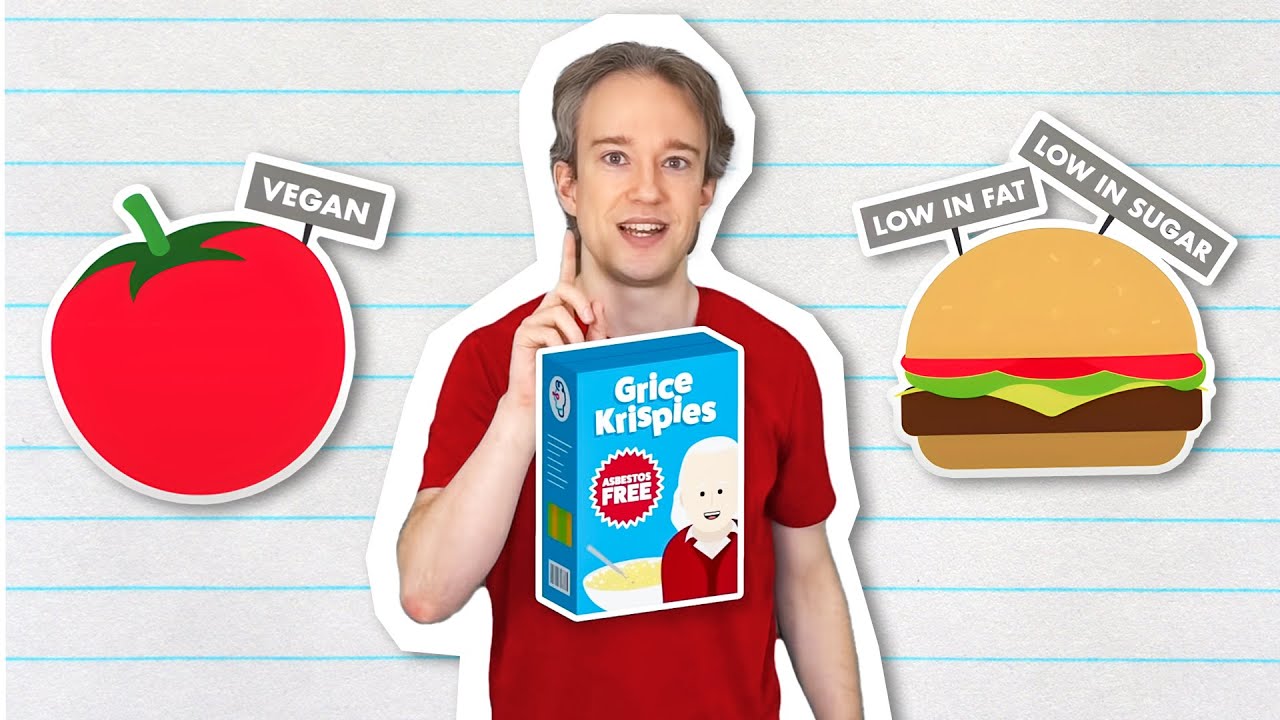
- Marketers frequently flout Gricean maxims with redundant claims like 'vegan tomatoes' or 'asbestos-free cereal' to falsely imply competing products lack those qualities. (4:26)
Detailed notes
## Background Published on YouTube by Tom Scott on May 4, 2020, this video introduces Paul Grice's conversational maxims, explaining the subtle guidelines people subconsciously follow to understand everyday language. Co-written with Molly Ruhl and linguist Gretchen McCulloch, the video examines the Cooperating Principle and why technically accurate packaging like 'asbestos-free cereal' or 'vegan tomatoes' feels inherently suspicious.
## TL;DR Tom Scott breaks down language philosopher Paul Grice's 1975 Cooperative Principle, which asserts that everyday conversation works because people operate under shared communicative assumptions. Rather than relying on hyper-literal speech, participants intuitively use four core maxims—Quantity, Quality, Relation, and Manner—to infer massive amounts of contextual meaning from brief exchanges. The video contrasts deceptive violations of these maxims with 'flouting,' where speakers openly break a guideline to trigger conversational implicature. This phenomenon explains both subtle real-world signals, like understated recommendation letters, and manipulative product marketing claims.
## Atmosphere & style The video carries a brisk, engaging, and intellectually curious tone characteristic of Tom Scott's educational pieces. Scott combines accessible thought experiments with dry, witty observations about academic philosophy and grocery packaging. The pacing is crisp and conversational, turning formal linguistic theory into a series of intuitive, humorous 'aha!' moments that make viewers reexamine the hidden mechanics of their own daily dialogue.
## Bulletin - [00:00](https://www.youtube.com/watch?v=IJEaMtNN_dM&t=0s) Everyday human conversation relies on the Cooperative Principle and Grice's Maxims to convey vast unspoken context without requiring hyper-logical, unambiguous speech. - [00:47](https://www.youtube.com/watch?v=IJEaMtNN_dM&t=47s) The four descriptive Gricean maxims—Quantity, Quality, Relation, and Manner—guide how listeners interpret statements and connect them to context. - [03:34](https://www.youtube.com/watch?v=IJEaMtNN_dM&t=214s) Breaking a maxim can occur via violation (deception/lying) or flouting (openly breaking a rule to generate conversational implicature). - [04:26](https://www.youtube.com/watch?v=IJEaMtNN_dM&t=266s) Marketers frequently flout Gricean maxims with redundant claims like 'vegan tomatoes' or 'asbestos-free cereal' to falsely imply competing products lack those qualities.
## Key takeaways - [00:00](https://www.youtube.com/watch?v=IJEaMtNN_dM&t=0s) Labels like 'vegan tomatoes' or 'asbestos-free cereal' feel suspicious because they present redundant information contrary to normal conversational expectations. - [00:22](https://www.youtube.com/watch?v=IJEaMtNN_dM&t=22s) Language philosopher Paul Grice formulated Grice's Maxims in his 1975 paper 'Logic and Conversation' to bridge literal logic and everyday communication. - [00:38](https://www.youtube.com/watch?v=IJEaMtNN_dM&t=38s) The Cooperative Principle assumes both conversational participants share a baseline presumption of mutual cooperation. - [00:53](https://www.youtube.com/watch?v=IJEaMtNN_dM&t=53s) The Maxim of Quantity requires providing as much information as needed to be understood, but no more. - [01:03](https://www.youtube.com/watch?v=IJEaMtNN_dM&t=63s) The Maxim of Quality dictates telling the truth. - [01:06](https://www.youtube.com/watch?v=IJEaMtNN_dM&t=66s) The Maxim of Relation instructs speakers to be relevant, prompting listeners to actively infer connections between statements. - [01:12](https://www.youtube.com/watch?v=IJEaMtNN_dM&t=72s) The Maxim of Manner requires clear, straightforward delivery, which Grice's own dense philosophical prose ironically struggled to meet. - [02:12](https://www.youtube.com/watch?v=IJEaMtNN_dM&t=132s) A brief exchange like 'I'm out of petrol' and 'There's a garage down the road' conveys an entire solution through implicature without explicit exposition. - [03:44](https://www.youtube.com/watch?v=IJEaMtNN_dM&t=224s) Violating a maxim involves dishonesty, deception, or outright lying to a conversational partner. - [03:49](https://www.youtube.com/watch?v=IJEaMtNN_dM&t=229s) Flouting a maxim occurs openly and conspicuously so the listener notices the omission and infers an unspoken meaning. - [03:57](https://www.youtube.com/watch?v=IJEaMtNN_dM&t=237s) An academic recommendation letter praising only handwriting or attendance deliberately flouts Quantity to signal a student's lack of competence. - [04:26](https://www.youtube.com/watch?v=IJEaMtNN_dM&t=266s) Product packaging exploits conversational implicature to manipulate consumer perception without technically uttering a legal falsehood.
## Detailed walkthrough ### [00:00](https://www.youtube.com/watch?v=IJEaMtNN_dM&t=0s) The Cooperative Principle and Grice's Maxims
Seeing a package of "vegan burgers" on a supermarket shelf makes complete sense, but spotting a label that proclaims "vegan tomatoes" immediately triggers suspicion. It mirrors the classic joke about "asbestos-free cereal": while technically accurate, advertising the fact feels unsettlingly out of place. Tom Scott explains that such labels feel off because they run counter to Grice's Maxims, a collection of communication guidelines first outlined by language philosopher Paul Grice in his 1975 paper *Logic and Conversation*. Grice sought to address the vast gulf between literal logical formalism and everyday natural speech, recognizing that people regularly communicate far more meaning than the bare dictionary definitions of their words.
To make this possible without requiring humanity to invent a hyper-logical, completely unambiguous language, conversations rely on what Grice dubbed the Cooperative Principle: the baseline presumption that both participants are cooperating with one another. People instinctively try to anchor whatever someone says into the surrounding context and whatever has already occurred. This dynamic is obvious when it breaks down, such as in video games when a non-player character recites identical canned dialogue regardless of whether the player just saved their village or burned their house to the ground. In real life, humans assume their conversational partners are adhering to four core guidelines, which are descriptive rather than prescriptive:
- **Maxim of Quantity:** Provide as much information as required to be understood, and no more. (Labeling tomatoes as "vegan" violates this, because tomatoes are already universally understood to be vegan.) - **Maxim of Quality:** Tell the truth. - **Maxim of Relation:** Be relevant. Listeners automatically assume what you say connects to what was just discussed and will search for that connection. - **Maxim of Manner:** Be clear in delivery.
Tom observes with some amusement that Grice's own philosophical prose was so dense and repeatedly restated that it barely adhered to his own Maxim of Manner. As Tom Scott points out regarding human communication: “Grice wrote that for that to be possible without having some hyper-logical unambiguous language, we must be operating under some shared assumptions, what he called the Cooperative Principle.”
[02:12](https://www.youtube.com/watch?v=IJEaMtNN_dM&t=132s) Context and Implication: The Stranded Driver
To demonstrate how the maxims function seamlessly in everyday life, Tom presents a two-line exchange: one person says, “I’m out of petrol,” and Tom replies, “There’s a garage down the road.” Analyzed purely through strict, literal logic, these are two completely disconnected factual assertions. Yet, because humans automatically apply the Cooperative Principle, an extensive web of unspoken meaning is instantly deduced without needing explicit exposition.
Every maxim performs heavy lifting to make the short exchange intelligible: - **Relation:** The listener deduces that the mentioned garage almost certainly sells petrol, because otherwise mentioning it would be pointless. - **Quantity:** Tom says just enough to convey the practical takeaway: push the vehicle there, buy fuel, and resolve the roadside emergency. - **Quality:** The stranded motorist can safely assume Tom is telling the truth rather than inventing a location or guessing. - **Manner:** Even an American unaccustomed to British vocabulary can infer from context that "garage" refers to a commercial petrol filling station rather than a private residential garage where an ordinary homeowner parks their car.
As Tom Scott notes when reviewing the interaction, “All that backstory about a stranded car was implied just by the words ‘I’m out of petrol’.”
```mermaid flowchart TD accTitle: Cooperative Principle Mechanics in Conversation accDescr: Flowchart showing how the statement "There's a garage down the road" is interpreted through the four Gricean Maxims.
A["Statement: 'I'm out of petrol'"] --> B["Response: 'There's a garage down the road'"]
subgraph G["Gricean Maxims at Work"] B --> C["Relation: Garage sells fuel"] B --> D["Quantity: Push car, buy fuel, resolve dilemma"] B --> E["Quality: Information is truthful and reliable"] B --> F["Manner: 'Garage' means a commercial gas station"] end
G --> H["Understood: Full solution without explicit exposition"] ```
[03:34](https://www.youtube.com/watch?v=IJEaMtNN_dM&t=214s) Conversational Implicature, Flouting, and Marketing Tricks
When speakers choose not to follow the maxims, they invite what Grice termed "Conversational Implicature"—deliberately implying meaning that remains unsaid. Tom explains that there are two distinct ways to break a maxim: violating it and flouting it. Violating a maxim involves dishonesty, deception, or outright lying. Flouting, by contrast, occurs when a speaker breaks a maxim openly and conspicuously, intending for the listener to notice the omission and interpret the hidden message beneath it.
To illustrate flouting, Tom cites Grice's classic example of an academic tasked with writing a letter of recommendation for a graduate school applicant in whom they have zero confidence. Tom quips that he suspects this was simply Grice grumbling about a real-life student. The professor writes: *"The student’s command of English is excellent, and his attendance at tutorials has been regular."* While factually positive, it blatantly flouts the Maxim of Quantity by withholding any assessment of the student's actual philosophical ability, effectively signaling to the admissions board that the candidate is unsuitable.
This same communicative trick frequently appears in modern product marketing. Labels boasting that food is "vegan," "asbestos-free," "low in fat," or "low in sugar" flout the maxims to manipulate customer perception. As Tom Scott summarizes, “They’re flouting Grice’s maxims to imply that the other brands aren’t, or to imply that those claims are good things to be.” While such advertising is not legally considered lying, it violates the spirit of the Cooperative Principle—unless, Tom jokes, there really is an evil, animal-byproduct tomato circulating on the market. In closing, Tom credits co-writers Molly Ruhl and Gretchen McCulloch, noting that Gretchen's linguistics podcast *Lingthusiasm* explores these language phenomena in greater depth.
## Mentioned Tom Scott, Paul Grice, Molly Ruhl, Gretchen McCulloch, Logic and Conversation, Lingthusiasm, Because Internet, Willow Marler, Graham Haerther
## Video description Gricean Maxims are a vital part of how we understand each other: a set of... well, maybe "rules" is a bit strong. They're guidelines that we follow without realising it. And it's the reason that "asbestos-free cereal" sounds suspicious.
Written with Molly Ruhl and Gretchen McCulloch. Gretchen's podcast Lingthusiasm is at http://lingthusiasm.com/
Gretchen's book BECAUSE INTERNET, all about the evolution of internet language, is available: 🇺🇸 US: https://amzn.to/30tLpjT 🇨🇦 CA: https://amzn.to/2JsTYWH 🇬🇧 UK: https://amzn.to/31K8eRD
(Those are affiliate links that give a commission to me or Gretchen, depending on country!)
Graphics by Willow Marler: https://wmad.co.uk Audio mix by Graham Haerther: https://haerther.net
REFERENCES: Munroe, R. (2009). "Free". https://xkcd.com/641/ Grice, H.P. (1975). "Logic and Conversation," Syntax and Semantics, vol.3 edited by P. Cole and J. Morgan, Academic Press. Reprinted as ch.2 of Grice 1989, 22–40.
🟥 MORE FROM TOM: https://www.tomscott.com/ (you can find contact details and social links there too) ❓ LATERAL, free weekly podcast: https://lateralcast.com/ https://youtube.com/lateralcast/ 👥 THE TECHNICAL DIFFICULTIES: https://youtube.com/techdif
[Source](https://www.youtube.com/watch?v=IJEaMtNN_dM)