US Civil Defense Agency Mandates Duck-and-Cover Drills for Schools
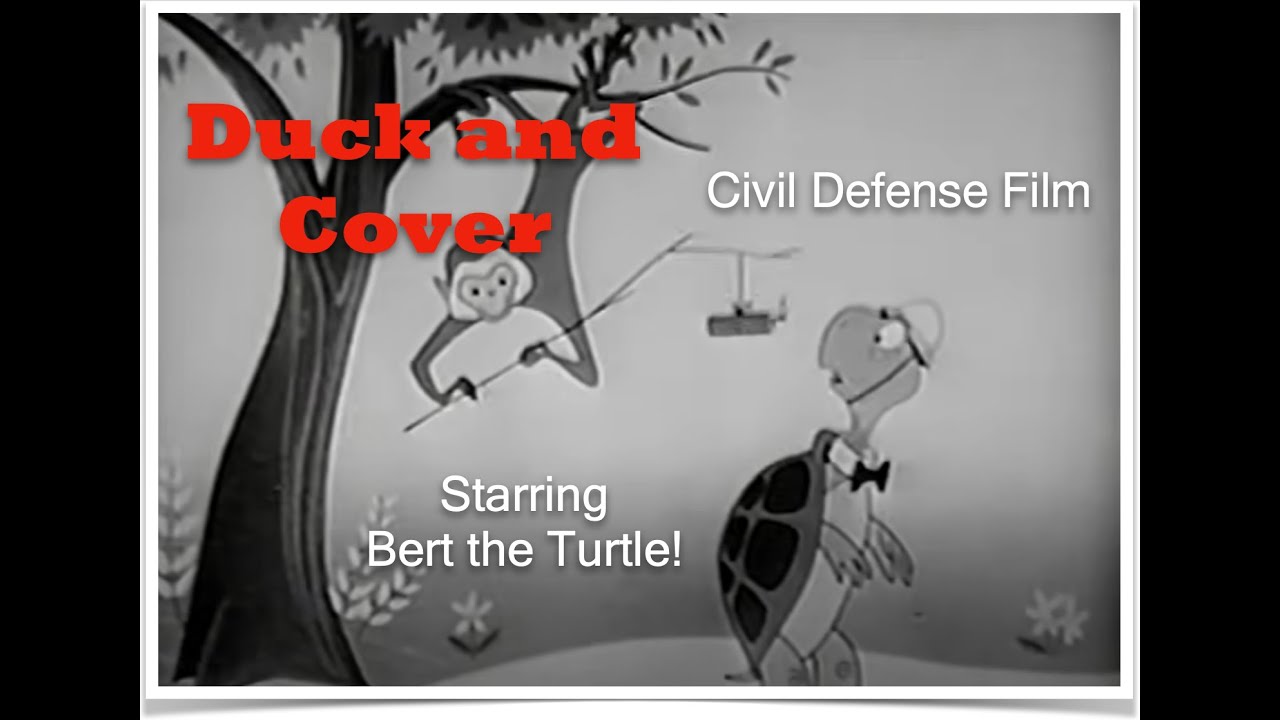
Duck And Cover (1951) Bert The Turtle — Nuclear Vault

Nuclear Vault

Immediate self-shielding behind walls, desks, or improvised coverings mitigates fatal thermal burns and blast debris during surprise atomic detonations.

AI-assisted summary of Duck And Cover (1951) Bert The Turtle — original source. Check the original for full context.

Source published:

Key ideas

  • Produced by Archer Productions in cooperation with the Federal Civil Defense Administration, the 1951 educational film 'Duck and Cover' frames atomic attack preparedness as an everyday public safety habit comparable to fire drills and traffic safety. (0:06)
  • Civil defense guidance differentiates between attacks with siren warnings—allowing organized evacuation to shelters marked with an 'S'—and sudden attacks without warning, where a blinding flash serves as the sole trigger to act. (2:07)
  • The film instructs children and families to improvise thermal flash barriers using blankets, newspapers, or jackets and stresses that individuals must stay covered until blast waves and debris hazards completely pass. (7:38)

Detailed notes

## Background Published on YouTube by the Nuclear Vault channel on July 12, 2009, this video presents the 1951 Cold War civil defense film *Duck and Cover*. Produced by Archer Productions in collaboration with the Federal Civil Defense Administration, the historical public awareness film was designed to instruct school-age children on how to protect themselves in the event of an atomic attack.

## TL;DR Using the animated mascot Bert the Turtle alongside live-action demonstrations by schoolchildren, the film teaches essential personal protection protocols against nuclear detonations. It frames the danger of atomic weapons in parallel with everyday hazards like fires and traffic accidents, explaining that attacks may occur either with advance warning sirens or unexpectedly with a blinding flash of light. Viewers are trained to instinctively drop to the ground, shield their faces and the backs of their necks, and take cover beneath sturdy furniture, curbs, walls, or improvised barriers like jackets and blankets. The presentation stresses constant vigilance and self-reliance, advising children to stay sheltered and motionless until adult emergency workers arrive or all debris hazards pass.

## Atmosphere & style The film strikes an eerie balance between mid-century cheery optimism and grim nuclear anxiety. An upbeat, catchy animated jingle featuring Bert the Turtle quickly yields to solemn, matter-of-fact narration that treats the horrors of atomic shockwaves and thermal flash burns as routine realities of modern life. Watching it feels like a surreal dispatch from early Cold War America, where jaunty cartoon pedagogy and crisp classroom drills attempt to package cataclysmic destruction into manageable, orderly schoolroom habits.

## Bulletin - [00:06](https://www.youtube.com/watch?v=IKqXu-5jw60&t=6s) Produced by Archer Productions in cooperation with the Federal Civil Defense Administration, the 1951 educational film 'Duck and Cover' frames atomic attack preparedness as an everyday public safety habit comparable to fire drills and traffic safety. - [02:07](https://www.youtube.com/watch?v=IKqXu-5jw60&t=127s) Civil defense guidance differentiates between attacks with siren warnings—allowing organized evacuation to shelters marked with an 'S'—and sudden attacks without warning, where a blinding flash serves as the sole trigger to act. - [07:38](https://www.youtube.com/watch?v=IKqXu-5jw60&t=458s) The film instructs children and families to improvise thermal flash barriers using blankets, newspapers, or jackets and stresses that individuals must stay covered until blast waves and debris hazards completely pass.

## Key takeaways - [00:06](https://www.youtube.com/watch?v=IKqXu-5jw60&t=6s) Bert the Turtle's instinct to pull into his shell introduces the fundamental civil defense maneuver of ducking and covering to shield vulnerable body parts. - [00:06](https://www.youtube.com/watch?v=IKqXu-5jw60&t=6s) The film contextualizes atomic bomb defense alongside routine civic hazards like fires and traffic accidents that society manages through rules and drills. - [02:07](https://www.youtube.com/watch?v=IKqXu-5jw60&t=127s) Detonations produce violent blast waves capable of shattering windows, flattening signage, and crushing structures, alongside blinding thermal radiation that burns exposed skin. - [02:07](https://www.youtube.com/watch?v=IKqXu-5jw60&t=127s) Attacks are categorized into two types: those preceded by warning sirens and surprise attacks with no audible warning. - [02:07](https://www.youtube.com/watch?v=IKqXu-5jw60&t=127s) When warning sirens sound, citizens are instructed to halt all outdoor activities and seek refuge in school basements, home shelters, or buildings bearing the official 'S' civil defense marker. - [02:07](https://www.youtube.com/watch?v=IKqXu-5jw60&t=127s) In a no-warning attack, the blinding flash itself is the immediate order to duck and cover without looking around or hesitating. - [05:07](https://www.youtube.com/watch?v=IKqXu-5jw60&t=307s) Students caught in school corridors must drop flat against interior walls away from glass and protect the back of their necks with their hands. - [05:07](https://www.youtube.com/watch?v=IKqXu-5jw60&t=307s) Classroom and cafeteria procedures require children to shelter under heavy desks or tables to avoid injuries from collapsing ceiling plaster and falling fixtures. - [05:07](https://www.youtube.com/watch?v=IKqXu-5jw60&t=307s) Children outdoors must leverage environmental barriers such as retaining walls, curbs, heavy doorways, or personal clothing to shield against thermal flash and debris. - [05:07](https://www.youtube.com/watch?v=IKqXu-5jw60&t=307s) Passengers on public transit or school buses must duck down below seat levels and away from windows to prevent lacerations from shattering glass. - [07:38](https://www.youtube.com/watch?v=IKqXu-5jw60&t=458s) Civil defense readiness extends beyond school hours into weekends and family vacations, requiring self-reliance when adults are not present. - [07:38](https://www.youtube.com/watch?v=IKqXu-5jw60&t=458s) Lightweight everyday materials such as picnic blankets and newspapers can serve as effective impromptu barriers to reduce flash burn severity on exposed skin. - [07:38](https://www.youtube.com/watch?v=IKqXu-5jw60&t=458s) The two non-negotiable rules of nuclear survival are to duck and cover immediately, and to remain motionless under shelter until all danger has passed.

## Detailed walkthrough ### [00:06](https://www.youtube.com/watch?v=IKqXu-5jw60&t=6s) Bert the Turtle and Everyday Dangers

The presentation opens with an animated musical introduction introducing Bert the Turtle, a lively cartoon character who stays safe by remaining constantly vigilant. As the jaunty theme song explains, whenever trouble approaches, Bert never gets injured because he instinctively pulls his head and limbs into his hard shell to duck and cover. The narrator steps in to remind the audience that Bert's defensive maneuver is an essential survival habit that every single viewer must adopt, noting that the production is an official civil defense film created by Archer Productions, Incorporated, in cooperation with the Federal Civil Defense Administration and in consultation with the Safety Commission of the National Education Association. When Bert is coaxed to emerge from his shell to greet the audience, he hesitates, underscoring his cautious nature and showing how retracting into a shell protects him from injury and can even save his life.

The narrator transitions from Bert to real schoolrooms where boys and girls practice civil defense drills, drawing an explicit parallel between the atomic bomb and other routine hazards that modern society has learned to manage. While an atomic weapon is extraordinarily dangerous and may be deployed by an enemy, it should be approached with the same preparedness applied to fires and traffic. Society prepares for the danger of fire by establishing professional fire departments and running regular school fire drills, and it prevents traffic accidents by requiring motorists and pedestrians to obey established safety regulations. Facing the new reality of the atomic era requires applying that exact same discipline of readiness.

The narrator outlines this collective responsibility clearly: > “Be sure and remember what Bert the Turtle just did, friends, because every one of us must remember to do the same thing; that’s what this film is all about: Duck and Cover.”

The narrator reinforces the need to adapt to modern threats: > “Now we must be ready for a new danger: the atomic bomb.”

- **Film sponsorship and production**: Federal Civil Defense Administration, National Education Association Safety Commission, and Archer Productions, Inc. - **Everyday hazard comparisons**: Fires (managed via fire departments and school fire drills) and automobiles (managed via pedestrian and traffic rules). - **Core defensive concept**: Emulating Bert the Turtle's instinct to pull inward to shield vulnerable body parts from physical harm.

---

[02:07](https://www.youtube.com/watch?v=IKqXu-5jw60&t=127s) The Flash and Two Kinds of Attack: Warning vs. No Warning

The narrator explains the physical reality of a nuclear detonation, describing an explosion marked by a blinding flash of light brighter than the sun itself. Unprepared individuals caught in the open risk severe injury from the immense blast wave, which can violently knock people to the ground, throw them against walls or trees, shatter glass windows throughout an entire city, flatten large signboards, and crush buildings. Beyond the kinetic impact, the flash produces intense thermal radiation capable of causing burns far more agonizing than the worst sunburn imaginable on exposed flesh. Because human beings lack natural protective shells, people must create their own by immediately ducking beneath sturdy furniture such as desks or tables and clasping their hands tightly over the back of the neck and face to shield skin and eyes.

In an elementary school classroom, a student named Betty asks her teacher how citizens will know when an atomic bomb is about to strike. The teacher explains that an attack will fall into one of two categories: an attack with warning, or an attack without warning. Most of the time, organized civil defense observers and military personnel in uniform expect to detect incoming enemy aircraft and sound alert sirens in advance, granting civilians precious minutes to reach designated safety zones. When warning sirens wail, children playing outdoors at school or at home must immediately cease their games and seek shelter—either inside specially prepared home refuges, school shelters, or public facilities displaying the official "S" civil defense shelter sign. However, the film stresses that an attack could also occur without any audible warning whatsoever, in which case the brilliant flash of light serves as the immediate and only signal to act.

```mermaid flowchart TD accTitle: Nuclear Attack Response Procedures accDescr: Visual decision pathway distinguishing actions for an attack with warning sirens versus an attack without warning. subgraph Detection["Attack Detection"] A["Threat Emerges"] --> B{"Warning Siren Sounds?"} end subgraph SirenAlert["Attack With Advance Warning"] B -->|"Yes"| C["Halt all outdoor activities immediately"] C --> D["Evacuate to designated shelter"] D --> E["Go to home shelter, school basement, or S-sign shelter"] end subgraph SuddenFlash["Attack Without Advance Warning"] B -->|"No (Sudden Flash)"| F["Blinding light brighter than the sun"] F --> G["Duck and Cover instantly"] G --> H["Shield face and back of neck tightly"] H --> I["Remain under shelter until danger subsides"] end ```

The narrator emphasizes the difference between warning scenarios: > “Betty is asking her teacher, ‘How can we tell when the atomic bomb may explode?’ and her teacher is explaining that there are two kinds of attack: with warning and without any warning.”

The narrator underscores the absolute urgency demanded when caught without sirens: > “When there is a flash, duck and cover, and do it fast.”

- **Detonation characteristics**: Thermal flash brighter than natural sunlight, thermal burns worse than sunburn, and violent blast waves capable of shattering windows, tossing people, and collapsing structures. - **Shelter markings**: Buildings marked with official "S" symbols designate approved civil defense shelter zones. - **Crucial rule for zero-warning events**: The flash itself constitutes the evacuation order; individuals must never pause or look around to see what happened.

---

[05:07](https://www.youtube.com/watch?v=IKqXu-5jw60&t=307s) Practicing Duck and Cover: School, Street, and Daily Life

Older students demonstrate how to execute defensive procedures in non-classroom environments. If caught out in a hallway or school corridor during a flash, a student must drop down and press tightly against an interior wall away from doors or windows, keeping the face and the back of the neck wrapped tightly to prevent airborne flying glass shards from causing severe lacerations. If a detonation occurs during lunch in the cafeteria, students must instantly drop beneath the nearest dining table so that falling ceiling plaster or overhead light fixtures cannot strike them. Because parents and teachers may not be present when a strike occurs, children must develop the self-reliance required to protect themselves anywhere at any time.

This principle of personal readiness is illustrated by Paul and Patty, two children walking along a neighborhood street on a pleasant spring morning. The moment an unexpected flash illuminates the street, Paul immediately drops to the ground and covers the back of his neck, while Patty pulls the coat she is carrying over her body to protect herself from thermal heat. The narrator notes that if the children had been standing near a building entrance, ducking into a heavy doorway would have provided excellent structural protection. Similarly, a young boy named Tony walking to a Cub Scout meeting instantly drops flat behind a low concrete retaining wall when the flash appears. Rather than panicking or jumping up to run, Tony remains completely motionless until the blast wave passes and an adult civil defense worker arrives to assist him. The same immediate response applies to transit: passengers riding in a school bus, commercial bus, or streetcar must duck down below the level of the seats and away from windows to avoid glass injury.

The narrator articulates the core philosophy of civil defense training for young people: > “Getting ready means we will all have to be able to take care of ourselves.”

The narrator praises Tony's disciplined behavior under simulated blast conditions: > “Notice how he keeps from moving or from getting up and running; he stays down until he is sure the danger is over.”

- **Corridor procedure**: Flatten body against an interior wall, curl up tightly, face away from glass, and clasp hands over the neck. - **Cafeteria procedure**: Slide directly under tables to guard against falling ceiling materials. - **Street maneuvers**: Use roadside curbs, retaining walls, heavy doorways, or personal clothing items like jackets to shield skin. - **Transit vehicles**: Drop down below the window line on school buses and streetcars to avoid shattered window glass.

---

[07:38](https://www.youtube.com/watch?v=IKqXu-5jw60&t=458s) Being Ready Anytime: Picnic, Home, and Class Discussion

Readiness is not restricted to school hours; civil defense requires vigilance every single day of the year, including weekends, family holidays, and summer vacation. The film depicts an ordinary family enjoying an outdoor picnic when an atomic flash occurs. Even during leisure activities, the family executes the drill flawlessly: the father covers himself and his children, and they make use of available materials—such as an ordinary picnic blanket or even an open sheet of newspaper—to form an impromptu barrier against the thermal flash. Even a light fabric layer significantly reduces the severity of flash burns on bare skin.

The narrator outlines the two fundamental rules of nuclear survival: first, duck and cover immediately, protecting every inch of exposed skin, particularly the back of the neck and face; second, remain covered in place without moving until official notification or conditions make it clear that the blast and falling debris hazard has completely passed. The film concludes by urging students to consult their classroom teachers as soon as the screening ends, instructing classes to actively discuss and plan the specific defensive covers available across their own neighborhoods, homes, and transit routes. The narrator delivers a final verbal drill, demanding that the children shout out the core directive of the entire program in unison.

The narrator highlights the critical post-blast protocol: > “The next important thing to do after that is to stay covered until the danger is over.”

The narrator reminds students of their ultimate responsibility when separated from parents: > “Older people will help us as they always do, but there might not be any grown-ups around when the bomb explodes; then you’re on your own.”

The film closes with the narrator's direct prompt to the audience: > “Now tell me right out loud: what are you supposed to do when you see the flash?”

- **Thermal protection improvisations**: Newspapers, jackets, picnic cloths, or any available material can shield bare skin from severe flash burns. - **Two non-negotiable rules**: 1. Duck and cover immediately upon seeing the flash or hearing the alarm. 2. Remain fully tucked under cover until all danger from blast shockwaves and falling debris has completely subsided. - **Post-viewing exercise**: Students are directed to immediately engage with their teachers to evaluate cover options in their specific schools and communities.

## Notable quotes > [07:38](https://www.youtube.com/watch?v=IKqXu-5jw60&t=458s) Older people will help us as they always do, but there might not be any grown-ups around when the bomb explodes; then you’re on your own. — Narrator

> [05:07](https://www.youtube.com/watch?v=IKqXu-5jw60&t=307s) Getting ready means we will all have to be able to take care of ourselves. — Narrator

> [00:06](https://www.youtube.com/watch?v=IKqXu-5jw60&t=6s) Now we must be ready for a new danger: the atomic bomb. — Narrator

## Mentioned Bert the Turtle, Archer Productions, Federal Civil Defense Administration, National Education Association, Raymond J. Mauer, Anthony Rizzo, Robert Middleton, United States Library of Congress, National Film Registry, Nuclear Vault, The Atlantic, Soviet Union, New York City, Astoria, New York

## Video description Duck and Cover staring Bert the Turtle is a 1951 Civil Defense Film

Written by Raymond J. Mauer and directed by Anthony Rizzo of Archer Productions and made with the help of schoolchildren from New York City and Astoria, New York, it was shown in schools as the cornerstone of the government's "duck and cover" public awareness campaign.

According to the United States Library of Congress (which declared the film "historically significant" and inducted it for preservation into the National Film Registry in 2004), it "was seen by millions of schoolchildren in the 1950s."

Duck and Cover lyrics: There was a turtle by the name of Bert and Bert the turtle was very alert; when danger threatened him he never got hurt he knew just what to do... He'd duck! And cover! Duck! And cover! (male) He did what we all must learn to do (male) You (female) And you (male) And you (deeper male) And you!' Duck, and cover!'

Duck and Cover (film) From Wikipedia, the free encyclopedia http://en.wikipedia.org/wiki/Duck_and_Cover_(film)

The Unexpected Return of 'Duck and Cover' - The Atlantic http://www.theatlantic.com/national/archive/2011/01/the-unexpected-return-of-duck-and-cover/68776/

Production History of Duck and Cover http://www.conelrad.com/duckandcover/cover.php?turtle=01

Duck and Cover is a civil defense social guidance film that is often popularly mischaracterized as propaganda.

Film production started in 1951 and it gained its first public screening in January 1952 during the era after the Soviet Union began nuclear testing in 1949 and the Korean War (1950–53) was in full swing.

Funded by the US Federal Civil Defense Administration, it was written by Raymond J. Mauer, directed by Anthony Rizzo of Archer Productions, narrated by actor Robert Middleton and made with the help of schoolchildren from New York City and Astoria, New York.

It was shown in schools as the cornerstone of the government's "duck and cover" public awareness campaign, being aired to generations of United States school children from the early 1950s until 1991, which marked the end of the Cold War.

The US government contracted with Archer to produce Duck and Cover.

[Source](https://www.youtube.com/watch?v=IKqXu-5jw60)

中文简报

美国民防部门要求学校开展“卧倒并掩护”演练 在遭遇突发原子弹爆炸时,立即躲在墙壁、课桌后或使用临时遮挡物进行自我防护,可减轻致命热辐射烧伤和爆炸碎片的伤害。 该影片通过动画吉祥物“海龟伯特”与学童的真人示范,讲授了防范核爆炸的基本个人防护规程。影片将原子武器的危险与火灾、交通事故等日常隐患并列,说明袭击可能伴随警报器提前预警发生,也可能在没有预警的情况下伴随耀眼强光突发。观众接受的训练是本能地倒地,护住面部和颈后,并躲避在坚固家具、路缘、墙壁下方或利用夹克、毯子等临时遮挡物寻求掩护。该宣传片强调保持时刻警惕和自力更生,建议儿童在成人应急救援人员赶到或所有碎片危险消除之前,始终保持掩蔽且不要移动。 这部由阿彻制片公司(Archer Productions)与联邦民防管理局合作制作的1951年教育影片《卧倒并掩护》(Duck and Cover),将原子弹袭击防范宣传为一种类似于消防演习和交通安全的日常公共安全习惯。 (0:06) 民防指南将袭击区分为伴有警报器预警的袭击(允许有组织地疏散至标有“S”的防空洞)和毫无预警的突发袭击,在后一种情况下,耀眼的闪光是采取行动的唯一信号。 (2:07) 影片指导儿童和家庭使用毯子、报纸或夹克临时制作热辐射遮挡屏障,并强调个人必须保持掩蔽,直至冲击波和碎片危险完全过去。 (7:38)

Reading summary

Produced by the Federal Civil Defense Administration and the National Education Association, Duck and Cover presents atomic preparedness as an ordinary civic discipline akin to fire safety, instructing children to rely on immediate, habitual self-protection in any environment. Normalizing Atomic Defense Through Everyday Safety Habits (0:06) The film analogizes the atomic bomb to familiar hazards that society already manages through structured rules and regular training. Just as cities maintain professional fire departments and conduct routine school fire drills, and communities prevent vehicular accidents by enforcing pedestrian and motorist traffic laws, civil defense authorities argue that the population must adopt disciplined readiness for atomic weapons. Embodying this message is the cartoon character Bert the Turtle, who avoids harm by instinctively retracting his head and limbs into his shell whenever danger threatens. Because human beings lack a natural biological shell, the presentation argues that individuals must cultivate an artificial one by dropping down, covering exposed skin, and curling up tightly. Emphasizing collective responsibility, the production—developed by Archer Productions in consultation with educational and civil defense officials—asserts that atomic defense is not a reason for paralyzing fear, but an everyday habit that every citizen must practice. Recognizing Warning Scenarios and Flash Hazards (2:07) The program outlines two distinct nuclear attack scenarios: attacks with warning and attacks without warning. Under an attack with advance warning, organized civil defense spotters and military personnel detect incoming enemy aircraft, triggering alert sirens. This signal gives civilians several minutes to halt outdoor activities and seek refuge in prepared home basements, school shelters, or public structures displaying the official "S" civil defense shelter designation. Conversely, an attack may occur without any audible warning, in which case a blinding flash of light brighter than the sun serves as the sole and immediate signal to act. The film explains that detonation produces severe thermal radiation capable of causing burns far worse than sunburn, accompanied by violent shockwaves that knock people down, crush buildings, and shatter window glass across an entire city. Because of these physical hazards, viewers are instructed never to pause or look toward the light, but to duck and cover instantly. Environmental Adaptation and Individual Self-Reliance (5:07) Civil defense readiness requires adapting defensive maneuvers to whatever space an individual occupies. Within schools, students in hallways are instructed to drop and flatten against interior walls away from glass doors, while those in cafeterias must dive beneath tables to guard against falling ceiling plaster and lighting fixtures. On public transit, including streetcars and school buses, passengers are directed to duck down below window level to avoid flying glass shards. This training stresses that children cannot rely solely on adult supervision, as strikes may occur when parents or teachers are absent. The film demonstrates street-level responses through several children: Paul drops to the ground while Patty wraps a carried coat around herself for thermal shielding; similarly, Tony, a young boy en route to a Cub Scout meeting, flattens behind a concrete retaining wall. Tony remains entirely motionless during the blast wave, waiting until an adult civil defense worker arrives rather than panicking or fleeing. Year-Round Vigilance and Thermal Shielding (7:38) Preparedness is framed as an obligation that extends beyond the school day into weekends, family holidays, and summer vacations. To illustrate, the film depicts an ordinary family on a picnic responding to an unexpected detonation. The father and children immediately drop and use an everyday picnic blanket or an open sheet of newspaper as a barrier. The narrator emphasizes that even a thin, improvised fabric layer provides critical protection by reducing the severity of flash burns on bare flesh. The guidance establishes two cardinal survival rules: first, duck and cover immediately, shielding the face and the back of the neck with hands or clothing; second, remain in place under cover until it is certain that all shockwaves and falling debris hazards have ceased. The broadcast concludes by calling on students to conduct classroom discussions with their teachers to map out viable shelter locations across their own specific neighborhoods, transit routes, and homes. The presentation concludes that while civil defense authorities and older adults will assist whenever possible, atomic survival ultimately depends on individual readiness to duck and cover without hesitation and remain sheltered until danger passes.

精炼阅读摘要

由美国联邦民防管理局与国家教育协会安全委员会联合指导制作的民防教育片《卧倒并掩护》(Duck and Cover)提出,公众应当像应对火灾与交通事故一样,将防核袭措施转化为日常安全规范,其核心原则是在侦测到核爆闪光或警报声的瞬间立即卧倒,并利用一切可用障碍遮蔽身体脆弱部位。 危险日常化与伯特防卫模型 (0:06) 影片开篇通过卡通角色“乌龟伯特”(Bert the Turtle)的防卫动作建立核心安全模型:当危险来临时,伯特本能地将头颈和四肢缩入坚硬的龟壳内以躲避伤害。旁白指出,该片由阿彻制作公司(Archer Productions, Inc.)联合美国联邦民防管理局(Federal Civil Defense Administration)及国家教育协会安全委员会(National Education Association Safety Commission)共同制作,旨在将伯特的避险本能普及为每位公民必须掌握的生存习惯。 解说随后将原子弹威胁直接类比于现代社会已妥善管理的日常隐患。社会通过组建专业消防队和开展学校定期火警演习来应对火灾,通过要求行人和驾驶员遵守交通法规来减少车祸伤亡。影片认为,面对核武器这一现代新型危险,公众应当且必须保持完全相同的防备纪律,通过将规范化的防护动作训练为条件反射,消除群体性恐慌并降低潜在伤亡。 预警袭击与突发闪光的判别响应 (2:07) 影片详细阐述了核爆的破坏特征,指出核爆会产生比正午太阳更为耀眼的强烈闪光、足以严重灼伤裸露皮肤的热辐射,以及能够掀翻行人、震碎全城玻璃和摧毁建筑的剧烈冲击波。由于人体缺乏天然护壳,人们必须通过就地卧倒并紧扣颈部和面部来构筑人造防线。 针对学生提出的袭击发生时机问题,影片明确将核袭击划分为“有预警”和“无预警”两类。在有预警情况下,民防观察哨与军方人员会提前探测到来袭飞机并拉响警报,平民可利用宝贵的数分钟时间停止户外活动,有序撤往标有官方“S”标志的公共防空设施、学校地下室或家庭避难所。然而,若遇无警报的突发袭击,瞬间出现的刺眼闪光即为最高避险指令,个人决不能停留张望,必须即刻就地掩蔽。 多场景就地掩护与独立自救法则 (5:07) 影片通过一系列实景模拟,示范了在教室之外各类常见场所的避险规范。若身处学校走廊,学生应立刻背对门窗紧贴走廊内墙卧倒卷曲,双手扣住后颈以防飞溅的玻璃碎片割伤;若在学校食堂用餐,应迅速钻入餐桌底部,防止震落的天花板灰皮和吊灯造成钝器击伤;若在校车或有轨电车上,乘客须迅速蹲伏在座位水平线下方,利用座椅靠背阻挡碎裂的车窗玻璃。 在社区街道环境中,影片通过儿童佩蒂(Patty)、保罗(Paul)和托尼(Tony)的示范强调独立自救意识。闪光突现时,孩子们迅速卧倒在路缘石边、厚重门廊内或低矮的混凝土挡土墙后,并利用随身携带的外套覆盖全身以阻隔热浪。旁白特别强调,突袭发生时成年人可能不在身旁,未成年人必须具备自主避险的定力,在冲击波结束前切忌慌乱奔跑。 两项生存铁律与全天候戒备要求 (7:38) 民防戒备并非局限于校园上课期间,而是要求覆盖全天候日常生活的每个场景。影片展示了一家人在户外野餐时突遇核闪光的处置方式:父亲迅速协助家人就地卧倒,并就地取材利用野餐毯或摊开的报纸遮盖躯体。解说强调,即便是一层轻薄的织物或纸张,也能在瞬间阻隔大量强光热能,显著减轻裸露皮肤的严重闪光灼伤。 影片据此归纳出核袭击生存的两大根本铁律:第一,无论何时何地,一旦看到闪光或听见警报,必须立刻卧倒并遮盖全身皮肤,尤其是后颈与面部;第二,在冲击波与高空坠物险情彻底平息、相关危险过去之前,必须始终保持掩蔽状态,切勿擅自起身。影片最后要求学生在观影结束后,立即在教师组织下讨论自己所在社区、居所与上下学路途中的具体可用掩体,确保防护策略在微观环境中得以落实。 《卧倒并掩护》将复杂的冷战核威慑转化为一套针对普通市民(尤其是儿童)的机械化动作规程,其论述重心完全置于抵御突发热辐射与物理飞溅物的直接物理防护上。该方案虽然为近距离核爆冲击波和初级光辐射提供了即时应对手册,但受限于时代与宣传目的,并未展开涉及核爆后的放射性沉降与长周期辐射污染等更为复杂的后续生存挑战。

Detailed notes — zh

## Background 该视频由 YouTube 频道 Nuclear Vault 于 2009 年 7 月 12 日发布,收录了 1951 年由美国联邦民防管理局资助、Archer Productions 制作的经典民防宣传片《卧倒并掩护》(Duck and Cover)。页面简介指出,影片由雷蒙德·J·莫尔(Raymond J. Mauer)编剧、安东尼·里佐(Anthony Rizzo)执导,并由罗伯特·米德尔顿(Robert Middleton)解说,曾在 1950 年代至冷战结束期间向全美数百万学童广泛放映,后于 2004 年被美国国会图书馆列入国家影片登记表。 ## TL;DR 本片以卡通乌龟伯特(Bert the Turtle)遇险时将头脚缩入硬壳的动作开篇,向少年儿童确立了应对核袭击的核心口诀“卧倒并掩护”(Duck and Cover)。解说员将原子弹的威力与火灾、交通事故等日常风险进行对比,系统讲解了刺眼强光、热辐射灼伤和致命冲击波等核爆破坏形式。影片详细区分了“有预警”与“突发无预警”两种袭击情境,并由多名学生实景示范了在走廊、食堂、街道、校车及户外野餐等不同环境下就地卧倒、护住面颈部与遮蔽皮肤的自救动作。全片着重强调在危难突降且无成人协助时,孩子们必须保持冷静、立即下意识自救并服从民防人员的指挥。 ## Atmosphere & style 全片充斥着鲜明而奇特的冷战时代印记,开篇欢快的卡通儿歌与后续沉重肃杀的核毁灭主题形成了巨大的超现实反差。解说员语气沉稳而严肃,既像耐心的长辈循循善诱,又在模拟空袭警报和突发闪光时迸发出近乎军事化命令的紧迫感。观看体验既带着一种古旧社会指导影片的质朴与程式化,又因孩子们平静地演练躲避核爆冲击波而隐隐透露出一丝令人不寒而栗的严酷与紧张。 ## Bulletin - [00:06](https://www.youtube.com/watch?v=IKqXu-5jw60&t=6s) 《卧倒并掩护》(Duck and Cover)是美国联邦民防管理局于1951年资助制作的标志性民防社会指导片,通过卡通角色乌龟伯特(Bert the Turtle)向以学童为主的公众普及核袭击应对常识。 - [02:30](https://www.youtube.com/watch?v=IKqXu-5jw60&t=150s) 影片区分了核袭击的两种形态:有预警时应迅速前往带“S”标志的地下掩体避难,而突发无预警袭击的第一信号是比太阳还要刺眼的核闪光,必须在数秒内就地卧倒自救。 - [01:21](https://www.youtube.com/watch?v=IKqXu-5jw60&t=81s) 核爆的主要即时威胁包括高强度光辐射灼伤以及击飞人体、震碎玻璃的破坏性冲击波,影片强调即便使用外套、野餐垫甚至报纸遮盖裸露皮肤,也能有效减缓热辐射伤害。 - [05:07](https://www.youtube.com/watch?v=IKqXu-5jw60&t=307s) 民防防护的核心纪律不仅在于迅速掩护头部与颈部,更要求在卧倒后保持绝对静止,直至冲击波过去并确认险情完全解除,或等待专业民防人员现场救援。 ## Key takeaways - [00:06](https://www.youtube.com/watch?v=IKqXu-5jw60&t=6s) 乌龟伯特(Bert the Turtle)通过将身体缩入龟壳的动画形象,直观地确立了全美核防护基础口诀——“卧倒并掩护”(Duck and Cover)。 - [00:06](https://www.youtube.com/watch?v=IKqXu-5jw60&t=6s) 该影片由联邦民防管理局联合全美教育协会制作,旨在将核威慑应对转化为像火灾演习和交通规则一样规范化的公众防御本能。 - [01:21](https://www.youtube.com/watch?v=IKqXu-5jw60&t=81s) 原子弹爆炸的核心物理杀伤征兆是极端刺眼的瞬时强光,其亮度远超太阳,裸露皮肤若无防护将遭受严重热辐射灼伤。 - [01:21](https://www.youtube.com/watch?v=IKqXu-5jw60&t=81s) 伴随闪光而来的巨大冲击波能够损毁房屋、掀翻设施并震碎全城玻璃,因此避险时必须主动背对并远离任何玻璃门窗。 - [02:30](https://www.youtube.com/watch?v=IKqXu-5jw60&t=150s) 防空体系将袭击分为有警报与无预警两种,听到警报时应立刻停止一切活动,按预案撤离至标有“S”记号的加固防空掩体或地下室。 - [02:30](https://www.youtube.com/watch?v=IKqXu-5jw60&t=150s) 在毫无警报的突发袭击中,闪光即为最高行动指令,留给个人的反应时间极短,严禁犹豫观望,必须瞬间卧倒。 - [05:07](https://www.youtube.com/watch?v=IKqXu-5jw60&t=307s) 室内遭遇险情时,应迅速钻入坚固课桌底或紧贴走廊承重内墙卧倒,双手紧扣后脑与颈部以防高空坠物和飞溅碎片。 - [05:07](https://www.youtube.com/watch?v=IKqXu-5jw60&t=307s) 街头遇险时可借助路边台阶、坚固门廊或实体砖墙作为依托,迅速利用身旁掩体阻挡迎面而来的冲击波与瓦砾。 - [07:20](https://www.youtube.com/watch?v=IKqXu-5jw60&t=440s) 随身携带的厚外套、毛毯乃至大张报纸,在开阔地带均可充当简易遮蔽物,能够有效阻隔直接作用于皮肤的核热脉冲。 - [07:20](https://www.youtube.com/watch?v=IKqXu-5jw60&t=440s) 乘坐公共汽车、校车或电车等交通工具时遭遇闪光,切忌慌乱站立,应迅速从座位滑下顺着过道趴伏,避开车窗碎玻璃飞溅。 - [05:07](https://www.youtube.com/watch?v=IKqXu-5jw60&t=307s) 完成卧倒掩护后的一大关键纪律是保持身体绝对静止,切勿在中途起身跑动围观,必须持续掩蔽至冲击波完全消散。 - [07:20](https://www.youtube.com/watch?v=IKqXu-5jw60&t=440s) 民防教育强调灾难降临时儿童身旁可能没有成年人照料,每位学童必须具备独立自立的自保能力并无条件服从专业民防人员指挥。 ## Detailed walkthrough ### [00:06](https://www.youtube.com/watch?v=IKqXu-5jw60&t=6s) 乌龟伯特的防身法则:“卧倒并掩护”(Duck and Cover) 影片以一段活泼生动的动画歌曲开场,向孩子们介绍了一只名叫伯特(Bert)的小乌龟。歌词唱道:“有一只名叫伯特的乌龟,乌龟伯特非常警惕;当危险威胁到他时,他从不受伤害,因为他清楚该怎么做……他会卧倒!并且掩护!”动画中,调皮的猴子点燃挂在绳子上的爆竹来捉弄伯特,伯特立刻把头、四肢和尾巴缩进坚硬的龟壳内,爆竹炸毁了周围的一切,但伯特安然无恙。画外音随之向观众强调:“大家一定要牢记乌龟伯特刚才的动作,因为我们每个人都必须学会做同样的事;这正是这部影片的主题:卧倒并掩护。” ```mermaid flowchart TD accTitle: 乌龟伯特的防御策略流程图 accDescr: 展示危险发生时伯特如何迅速将身体缩入壳中从而免受伤害的反应过程。 subgraph Danger["面临威胁"] D1["察觉外界危险(如爆竹爆炸)"] end subgraph Action["防御反应"] A1["立刻趴下卧倒 (Duck)"] A2["将头颈及四肢缩入壳内掩护 (Cover)"] end subgraph Result["防御结果"] R1["完好无损,保全生命"] end D1 --> A1 A1 --> A2 A2 --> R1 ``` 解说员随后指出,本片是由美国联邦民防管理局(Federal Civil Defense Administration)联合制作,并咨询了美国全国教育协会(National Education Association)安全委员会的意见,由 Archer Productions 负责摄制。解说员试着招呼伯特从龟壳里钻出来跟观众打招呼,但伯特十分谨慎,依然躲在壳里。解说员解释道:“你看,伯特是一个非常非常谨慎的家伙;遇到危险时,这就是他免受伤害的方法,有时这甚至能救他的命。”这正是学校孩子们正在操练“卧倒并掩护”动作的原因。 - 本片为官方民防宣传片,核心受众为全美在校学童及公众。 - 乌龟伯特(Bert the Turtle)以“缩壳”动作形象地向儿童传达自保核心概念。 - 该片确立了面对核爆危险时最基础的口诀:“Duck and Cover”(卧倒并掩护)。 --- ### [01:21](https://www.youtube.com/watch?v=IKqXu-5jw60&t=81s) 日常危险与新危险:认识原子弹的威力与闪光 解说员将原子弹的威胁与孩子们日常熟悉的危险进行了类比。火灾非常危险,若有人粗心大意,大火能烧毁整栋建筑,但社会早已做好应对准备:城市有优秀的消防部门灭火,学校里也经常组织消防演习(Fire Drills)。汽车同样具有危险性,有时会引发严重车祸,但社会通过交通规则来约束司机和行人。现在,大家必须面对一种全新的危险——原子弹。解说员严肃地告诉大家:“我们都清楚原子弹极度危险,既然它有可能被用来对付我们,我们就必须为此做好准备,就像我们平时防范身边的各种危险一样。” 如果原子弹爆炸,第一征兆将是一道强烈的闪光。解说员用极其生动的语言形容:“那是一道刺眼的闪光,比太阳还要明亮,比你见过的任何东西都要刺眼。”紧接着是极具破坏力的冲击波,它能将人狠狠击倒或撞向树木和墙壁,砸毁房屋,吹倒广告牌,震碎整座城镇的窗户玻璃。此外,闪光伴随的高温会造成严重的灼伤,甚至“比可怕的晒伤还要严重得多,尤其是在皮肤裸露在外的时候”。人类没有乌龟坚硬的外壳,因此必须学会自己的防护方式:首先迅速趴下卧倒,然后紧紧遮护住后颈和面部,钻到桌子底下或任何身旁的遮蔽物下方。 - 日常风险防御机制对照: - 火灾危险:消防队、学校消防演习。 - 交通危险:司机与行人的安全交规。 - 原子弹威胁:提前掌握“卧倒并掩护”技能。 - 原子弹爆炸的主要破坏形式: - 刺眼强光:光辐射亮度超过太阳,可导致无防护皮肤严重灼伤。 - 巨大冲击波:击飞人体、损毁建筑、掀翻广告牌、震飞玻璃碎片。 - 人类自我掩护要领:迅速趴下,紧密护住面部和最脆弱的后颈。 --- ### [02:30](https://www.youtube.com/watch?v=IKqXu-5jw60&t=150s) 有预警与无预警袭击应对机制 在贝蒂(Betty)所在的学校里,师生们正热烈讨论原子弹防空知识。贝蒂向老师提问,大家如何才能知道原子弹何时可能爆炸。老师向全班解释,敌人的袭击通常分为两种情况:“有预警袭击”(with warning)和“无预警袭击”(without any warning)。通常情况下,民防人员与军队官兵会竭尽全力通过雷达和哨戒网络监控敌情,争取在敌机将炸弹运送至本土之前拉响防空警报,给大众留出进入家中、学校或避难所的时间。 ```mermaid flowchart TD accTitle: 原子弹袭击应对决策路径 accDescr: 区分有警报袭击与无预警袭击两种情境下的应对方式与行动步骤。 Attack{"袭击发生情境"} Attack -->|有防空警报| Warned["听到警报声响"] Attack -->|突发无预警| Sudden["看到刺眼闪光"] subgraph AlarmRoute["有预警行动流程"] Warned --> StopAct["立即停止当前活动"] StopAct --> SeekShelter["寻找'S'标避难所/地下室/加固掩体"] end subgraph FlashRoute["无预警行动流程"] Sudden --> DuckFast["毫无迟疑立即卧倒"] DuckFast --> CoverFace["紧护后颈与面部,避开玻璃门窗"] end ``` 解说员模拟了空袭警报声,并向孩子们说明:如果在操场上玩耍时听到警报,必须立刻停下手中的一切活动,以最快速度前往最近的安全地点。在家附近玩耍时,听到警报要迅速跑回家中由父母布置的安全角落;如果在离家较远的地方,要就近寻找带有明显安全标志(S 标志)的公共防空避难所,或者寻求身旁大人的帮助。 解说员随即话锋一转,提出了最严峻的考验:“但有时候——这一点非常非常重要——炸弹可能会在毫无预警的情况下突然爆炸。”在没有任何警报声的情况下,公众得到的第一讯号就是强烈的“闪光”。解说员严厉告诫:“那时我们首先知道的便是这道闪光,这意味着无论你在哪里,都必须立刻卧倒并掩护!根本没有时间四处张望或犹豫不决,一定要像伯特那样,一旦看到闪光,立刻卧倒并掩护,动作必须快!” - 两种袭击类型: - 有警报袭击:依靠民防体系与防空警报争取疏散时间。 - 无警报袭击:首要信号为强光闪烁,留给人们的反应时间仅有数秒。 - 关键避险标识:留意带有“S”标识(Safe / Shelter 避难标志)的坚固建筑与掩体。 --- ### [05:07](https://www.youtube.com/watch?v=IKqXu-5jw60&t=307s) 校园与街头突发闪光时的自救范例 影片通过多组学生的真人演练,展示了室内外不同场景下的具体防护姿势。走廊上的高年级男生示范道:如果闪光突现而你不在教室内,应顺着墙根紧贴墙面卧倒,牢牢护住脸部和后颈,身体必须背对或尽量远离带有玻璃的门窗,以防被震碎飞溅的玻璃渣刺伤。如果正在食堂吃午餐,听到响动或看到闪光,应立刻钻入坚固的餐桌底下,防止天花板坠落物砸伤。 解说员提醒大家,面对核袭击,每个人必须学会自立自强,因为灾难降临时身旁可能根本没有大人指导。保罗(Paul)和帕蒂(Patty)走在美丽的春日街头,解说员突然大喊:“那是炸弹!卧倒并掩护!”两人毫不迟疑,瞬间顺着路边台阶卧倒。保罗双手紧扣后脑护住脖子,帕蒂则迅速将手头携带的厚外套蒙在身上,利用衣物遮蔽裸露皮肤以防热辐射灼伤。影片还展示了一名女孩在厚重门廊下的正确避险姿态,指出厚实的门道与坚固的门框同样是极佳的掩护点。 随后出场的是正准备去参加幼童军(Cub Scout)活动的托尼(Tony)。走在街边的托尼看到闪光,敏捷地扑倒在身旁的砖墙根下。解说员表扬道:“好样的,托尼!那道闪光意味着迅速行动!托尼明白身旁任何掩体都能起作用。”解说员特别提醒观众注意托尼的专业细节:“注意看他是怎样保持完全静止、不随意乱动、也绝不爬起来乱跑的;他一直趴在地上,直到确信危险完全解除。”片刻后,巡视现场的民防队员赶来协助托尼,解说员强调在危难时刻必须绝对服从民防队员的专业指挥。 - 室内避险细节: - 走廊:贴内墙趴卧,严防门窗碎玻璃,紧扣颈部。 - 食堂/教室:钻入桌底,手抓桌脚,防范天花板或悬挂物砸落。 - 门廊:依托坚固承重结构遮挡冲击波。 - 街头避险细节: - 保罗双手紧锁颈后,帕蒂使用随身携带的厚外套覆盖躯体阻隔热辐射。 - 托尼利用路边实体矮墙阻挡冲击波与飞溅瓦砾。 - 卧倒后关键纪律:“趴伏静止”,切忌中途起立围观或恐慌奔跑。 --- ### [07:20](https://www.youtube.com/watch?v=IKqXu-5jw60&t=440s) 各种生活场景的防护技巧与全民演练总结 解说员进一步将应用场景扩展到日常生活的方方面面,强调核袭击不会挑选时间。如果正在校车、公共汽车或有轨电车上遭遇闪光,切勿惊慌盲动,要立刻顺着过道或座位下方趴下,“动作要快,避开窗户,因为车窗玻璃会碎裂飞射割伤人体”。无论周日、节假日还是假期,公众都必须在任何时刻做好准备。 影片随后展示了一个在户外野餐的家庭。全家人看到闪光后迅速趴在野餐布周围,父亲拉起野餐布甚至报纸覆盖在孩子和自己身上。解说员点评道:“甚至连一块薄布都能起到保护作用,甚至一张报纸都能使你免受严重的灼伤;但最重要的一点依然是卧倒并掩护你自己,尤其是遮盖住衣物未能遮盖的皮肤部位。”无论是居住在繁华都市还是偏远乡村,所有人都必须建立这种下意识的防御本能。 ```mermaid flowchart LR accTitle: 全天候防核闪光核心原则 accDescr: 涵盖交通工具、户外野餐等任何时空条件下的卧倒、覆盖与持续防护三步法。 subgraph Step1["步骤一:闪光即卧倒"] S1["任何地点(校车/野餐/街道)"] --> S2["迅速离开门窗就地趴下"] end subgraph Step2["步骤二:全方位掩护"] S2 --> S3["遮盖裸露皮肤"] S3 --> S4["利用衣物/报纸/桌椅防护"] end subgraph Step3["步骤三:持续静止等待"] S4 --> S5["保持卧姿不动"] S5 --> S6["直到确认冲击波与危险彻底过去"] end ``` 解说员为全片的核心步骤作了系统性总结: 1. 第一件事:看到闪光立即“卧倒并掩护”。 2. 第二件要事:保持掩蔽姿态,趴在地上不要乱动,“直到危险彻底过去”。 解说员叮嘱孩子们,影片结束后应当向老师积极请教,并在课堂上共同探讨在不同场所遭遇原子弹袭击时的自保方案。解说员最后告诫:“大人们会像往常一样帮助我们,但原子弹爆炸时你身边可能一个大人也没有,那时候你只能依靠你自己。”在影片收尾之际,解说员大声向屏幕前所有孩子提问:“现在大声告诉我,当你看到闪光时,你应该怎么做?”画外音与音乐齐声高呼响亮有力的口号:“卧倒并掩护!(Duck and Cover!)” - 乘车避险要领:乘坐公交车、校车或电车时,迅速从座位滑下趴在过道,避免迎面朝向车窗碎玻璃。 - 简易遮蔽物防热灼伤:在开阔户外,可用随身外套、野餐毛毯或大张报纸阻隔强烈的核热辐射脉冲。 - 自我负责意识:防空袭不仅仅依赖家长和民防人员,每名学生都必须具备独立在废墟和突发险情下自救的能力。 ## Notable quotes > [07:20](https://www.youtube.com/watch?v=IKqXu-5jw60&t=440s) 大人们会像往常一样帮助我们,但原子弹爆炸时你身边可能一个大人也没有,那时候你只能依靠你自己。 — 解说员 > [01:21](https://www.youtube.com/watch?v=IKqXu-5jw60&t=81s) 我们都清楚原子弹极度危险,既然它有可能被用来对付我们,我们就必须为此做好准备,就像我们平时防范身边的各种危险一样。 — 解说员 > [07:20](https://www.youtube.com/watch?v=IKqXu-5jw60&t=440s) 甚至连一块薄布都能起到保护作用,甚至一张报纸都能使你免受严重的灼伤;但最重要的一点依然是卧倒并掩护你自己,尤其是遮盖住衣物未能遮盖的皮肤部位。 — 解说员 ## Mentioned 乌龟伯特, 美国联邦民防管理局, 美国全国教育协会, Archer Productions, Raymond J. Mauer, Anthony Rizzo, Robert Middleton, 贝蒂, 保罗, 帕蒂, 托尼, 幼童军, Duck and Cover ## Video description Duck and Cover staring Bert the Turtle is a 1951 Civil Defense Film Written by Raymond J. Mauer and directed by Anthony Rizzo of Archer Productions and made with the help of schoolchildren from New York City and Astoria, New York, it was shown in schools as the cornerstone of the government's "duck and cover" public awareness campaign. According to the United States Library of Congress (which declared the film "historically significant" and inducted it for preservation into the National Film Registry in 2004), it "was seen by millions of schoolchildren in the 1950s." Duck and Cover lyrics: There was a turtle by the name of Bert and Bert the turtle was very alert; when danger threatened him he never got hurt he knew just what to do... He'd duck! And cover! Duck! And cover! (male) He did what we all must learn to do (male) You (female) And you (male) And you (deeper male) And you!' Duck, and cover!' Duck and Cover (film) From Wikipedia, the free encyclopedia http://en.wikipedia.org/wiki/Duck_and_Cover_(film) The Unexpected Return of 'Duck and Cover' - The Atlantic http://www.theatlantic.com/national/archive/2011/01/the-unexpected-return-of-duck-and-cover/68776/ Production History of Duck and Cover http://www.conelrad.com/duckandcover/cover.php?turtle=01 Duck and Cover is a civil defense social guidance film that is often popularly mischaracterized as propaganda. Film production started in 1951 and it gained its first public screening in January 1952 during the era after the Soviet Union began nuclear testing in 1949 and the Korean War (1950–53) was in full swing. Funded by the US Federal Civil Defense Administration, it was written by Raymond J. Mauer, directed by Anthony Rizzo of Archer Productions, narrated by actor Robert Middleton and made with the help of schoolchildren from New York City and Astoria, New York. It was shown in schools as the cornerstone of the government's "duck and cover" public awareness campaign, being aired to generations of United States school children from the early 1950s until 1991, which marked the end of the Cold War. The US government contracted with Archer to produce Duck and Cover. [Source](https://www.youtube.com/watch?v=IKqXu-5jw60)

Source quotes

[7:20] 解说员: 大人们会像往常一样帮助我们,但原子弹爆炸时你身边可能一个大人也没有,那时候你只能依靠你自己。 [1:21] 解说员: 我们都清楚原子弹极度危险,既然它有可能被用来对付我们,我们就必须为此做好准备,就像我们平时防范身边的各种危险一样。 [7:20] 解说员: 甚至连一块薄布都能起到保护作用,甚至一张报纸都能使你免受严重的灼伤;但最重要的一点依然是卧倒并掩护你自己,尤其是遮盖住衣物未能遮盖的皮肤部位。

Source quotes

[7:38] Narrator: Older people will help us as they always do, but there might not be any grown-ups around when the bomb explodes; then you’re on your own. [5:07] Narrator: Getting ready means we will all have to be able to take care of ourselves. [0:06] Narrator: Now we must be ready for a new danger: the atomic bomb.

Original transcript

[0:06] D there a turtle by the name of and the [0:11] turtle was very alert when danger [0:14] threatened him he never got hurt he knew [0:17] just what to do he Duck and [0:22] Cover du and cover he did what we all [0:27] must learn to do you and you and you and [0:33] you and [0:36] cover be sure and remember what Bert the [0:39] turtle just did friends because every [0:41] one of us must remember to do the same [0:43] thing that's what this film is all about [0:46] Duck and Cover this is an official Civil [0:49] Defense film produced in cooperation [0:51] with the federal civil defense [0:53] Administration and in consultation with [0:55] the safety Commission of the National [0:57] Education Association produced by AR [1:00] Productions [1:01] Incorporated hey Bert come on out and [1:04] meet all these nice people please all [1:08] right we really can't blame you you see [1:10] Bert is a very very careful fellow when [1:13] there's danger this is the way he keeps [1:16] from being [1:16] hurt sometimes it even saves his life [1:21] that's why these children are practicing [1:23] to Duck and Cover just as you do in your [1:26] school we all know the atomic bomb is [1:29] very dangerous ous since it may be used [1:31] against us we must get ready for it just [1:34] as we are ready for many other dangers [1:36] that are around us all the time fire is [1:38] a danger it can burn whole buildings if [1:41] someone is careless but we are ready for [1:44] fires we have a fine fire department to [1:47] put out the fire and you have fire [1:49] drills in your school so you know what [1:51] to do automobiles can be dangerous too [1:55] they sometimes cause bad accidents but [1:57] we are ready we have safety rules that [2:00] car drivers and people who are walking [2:01] must obey now we must be ready for a new [2:05] danger the atomic [2:07] bomb first you have to know what happens [2:10] when an atomic bomb explodes you will [2:13] know when it comes we hope it never [2:15] comes but we must get ready it looks [2:17] something like this there is a bright [2:20] flash brighter than the sun brighter [2:21] than anything you've ever seen if you [2:24] were not ready and did not know what to [2:26] do it could hurt you in different ways [2:30] it could knock you down hard or throw [2:32] you against a tree or a wall it is such [2:35] a big explosion it can smash in [2:37] buildings and knock sign boards over and [2:39] break Windows all over town but if you [2:42] Duck and Cover like Bert you will be [2:45] much [2:46] safer you know how bad sunburn can feel [2:49] the atomic bomb flash could burn you [2:52] worse than a terrible sunburn especially [2:54] where you're not covered now you and I [2:57] don't have shells to crawl into like [2:59] Bert the turtle so we have to cover up [3:01] in our own way first you duck and then [3:05] you cover and very tightly you cover the [3:08] back of your neck and your face Duck and [3:11] Cover underneath a table or desk or [3:14] anything else close by in Betty's school [3:17] they are talking about the atomic bomb [3:19] too Betty is asking her teacher how can [3:22] we tell when the atomic bomb May explode [3:26] and her teacher is explaining that there [3:27] are two kinds of attack with warning and [3:30] without any warning we think that most [3:33] of the time we will be warned before the [3:35] bomb explodes so there will be time for [3:37] us to get into our homes schools or some [3:40] other safe place our civil defense [3:43] workers and our men in uniform will do [3:45] everything they can to warn us before [3:48] enemy planes can bring a bomb near us [3:51] you may be in your schoolyard playing [3:54] when the signal [3:57] comes that signal means to to stop [4:00] whatever you are doing and get to the [4:02] nearest safe place fast always remember [4:06] the flash of an atomic bomb can come at [4:08] any time no matter where you may be you [4:12] might be out playing at home when the [4:13] warning [4:16] comes then be sure to get into the house [4:19] fast where your parents have fixed a [4:21] safe place for you to go if you are not [4:24] close to home when you hear the warning [4:26] go to the nearest safe cover no where [4:30] you are to go or ask an older person to [4:32] help you you know the places marked with [4:35] the S sign there are safe places to go [4:38] when you hear the alarm if there is a [4:41] warning you will hear it before the bomb [4:43] explodes but sometimes and this is very [4:47] very important sometimes the bomb might [4:50] explode without any [4:53] warning then the first thing we would [4:55] know about it would be the Flash and [4:57] that means Duck and Cover fast wherever [4:59] you are there's no time to look around [5:01] or wait be like Bert when there is a [5:04] flash Duck and Cover and do it [5:07] fast here are some older boys showing [5:10] what to do if the flash comes when you [5:11] are not in the classroom this is what to [5:14] do if you should be in a corridor you [5:17] duck and cover tight against the wall [5:19] this way remember to keep your face in [5:22] the back of your neck covered tightly [5:25] try to fall away from Windows or doors [5:27] with glass in them then if the glass [5:30] breaks and flies through the air it [5:31] won't cut you you might be eating your [5:34] lunch when the flash comes Duck and [5:36] Cover under the table then if the [5:39] explosion makes anything in the room [5:41] fall down it can't fall on [5:43] you getting ready means we will all have [5:46] to be able to take care of ourselves the [5:49] bomb might explode when there are no [5:51] grown-ups near Paul and Patty know this [5:54] and they're always ready to take care of [5:56] themselves here they are on their way to [5:58] school on a beautiful spring day but no [6:01] matter where they go or what they do [6:03] they always try to remember what to do [6:06] if the atom bomb explodes right then [6:09] it's a bomb Duck and Cover Paul and [6:12] Patty know what to do Paul covered the [6:15] back of his head so that he wouldn't be [6:16] burned and Patty covered herself with [6:18] the coat she was carrying they knew how [6:21] to Duck and Cover they acted right away [6:24] when the flash came if they had been at [6:27] this doorway when the bomb flashed Paul [6:29] and Patty would have ducked and covered [6:31] this way like this girl heavy doorways [6:34] are a good place to Duck and Cover she [6:36] will be safer [6:38] too here's Tony going to his cub scout [6:41] meeting Tony knows the bomb can explode [6:43] any time of the year day or night he is [6:46] ready for it Duck and [6:48] Cover at a boy Tony that flash means Act [6:52] Fast Tony knows that it helps to get to [6:55] any kind of cover this wall was close by [6:58] so that's where he ducked and covered [7:00] Tony knew what to do notice how he keeps [7:03] from moving or from getting up and [7:04] running he stays down until he is sure [7:07] the danger is over the man helping Tony [7:11] is a civil defense worker his job is to [7:14] help protect us when there is danger of [7:16] the atomic bomb we must obey the civil [7:19] defense [7:20] worker we must know how to Duck and [7:23] Cover in the school bus or in any other [7:25] bus or street car Duck and Cover don't [7:29] wait duck away from the windows fast the [7:33] glass may break and fly through the air [7:35] and cut you Sundays holidays vacation [7:38] time we must be ready every day all the [7:42] time to do the right thing if the atomic [7:45] bomb explodes Duck and [7:48] Cover this family knows what to do just [7:51] as your own family should they know that [7:54] even a thin cloth helps protect them [7:56] even a newspaper can save you from a bad [7:58] burn but the most important thing of all [8:01] is to Duck and Cover yourself especially [8:03] where your clothes do not cover you no [8:06] matter where we live in the city or the [8:08] country we must be ready all the time [8:11] for the atomic bomb Duck and Cover [8:15] that's the first thing to do Duck and [8:17] Cover the next important thing to do [8:19] after that is to stay covered until the [8:22] danger is [8:24] over yes we must all get ready now so we [8:28] know how to save our elves if the atomic [8:30] bomb ever explodes near us if you do not [8:33] know just what to do ask your teacher [8:36] when this film is over discuss what you [8:38] could do in different places if a bomb [8:40] explodes older people will help us as [8:43] they always do but there might not be [8:45] any grown-ups around when the bomb [8:47] explodes then you're on your own [8:51] remember what to do friends now tell me [8:53] right out loud what are you supposed to [8:55] do when you see the Flash [9:01] Duck and [9:03] Cover Duck and Cover [9:09] [Music]