Young Slit Test Recreated in Sunlight Proves Light Behaves as Wave
Veritasium
Diffraction through dual apertures produces constructive and destructive interference fringes, demonstrating that light propagates as interacting waves rather than Newtonian corpuscles.
AI-assisted summary of The Original Double Slit Experiment — original source. Check the original for full context.
Source published:
Key ideas
- Centuries of physics debate pitted Isaac Newton's corpuscular particle model of light against Christiaan Huygens' wave theory until Thomas Young's double slit experiments in the early 1800s provided decisive evidence. (0:59)
- Archival notes from Young's 1803 Royal Society lecture detail how he split a narrow sunbeam using a card slip roughly one-thirtieth of an inch wide to produce alternating color fringes and shadow divisions. (1:39)
- A street recreation using natural sunlight and a cardboard box revealed multiple repeating circular spots rather than two distinct slit lines, baffling public onlookers expecting a simple geometric projection. (2:08)
- Constructive and destructive interference patterns, identical to ripple tank mechanics, confirmed light behaves as a wave, while differing wavelengths of solar light explained the rainbow coloration along outer fringes. (3:51)
Detailed notes
## Background Published on YouTube by the educational channel Veritasium on February 19, 2013, this video explores the fundamental nature of light by revisiting Thomas Young's historic double-slit experiment from the early 1800s. According to the description, Derek recreates the groundbreaking test using natural sunlight and a custom apparatus rather than modern lasers, demonstrating how diffraction and interference originally proved that light behaves as a wave.
## TL;DR Derek Muller opens by interviewing beachgoers on what light is, illustrating how a seemingly simple concept puzzled humanity for centuries amid rival theories from Isaac Newton and Christiaan Huygens. After reviewing Thomas Young's original 1803 lecture notes in the Royal Society archives, Derek constructs a sunlight viewing box with a microscopic double slit and asks the public to predict what will appear inside. Contrary to expectations of seeing two bright lines, viewers observe a row of separated dots with rainbow fringes, leading into an explanation of wave interference, dispersion, and how Young's historic experiment convinced physicists that light travels as waves.
## Atmosphere & style The presentation is bright, inquisitive, and accessible, pairing sunny on-the-street interactions with a reverent visit to historical archive vaults. Derek maintains an encouraging and educational rapport with spectators, guiding them from intuitive misconceptions to moments of genuine delight and discovery as they peer into the viewing box. The pacing smoothly bridges casual public banter, water-tank physics demonstrations, and classical history, giving the viewer the feeling of participating in a live, tangible revelation.
## Bulletin - [00:59](https://www.youtube.com/watch?v=Iuv6hY6zsd0&t=59s) Centuries of physics debate pitted Isaac Newton's corpuscular particle model of light against Christiaan Huygens' wave theory until Thomas Young's double slit experiments in the early 1800s provided decisive evidence. - [01:39](https://www.youtube.com/watch?v=Iuv6hY6zsd0&t=99s) Archival notes from Young's 1803 Royal Society lecture detail how he split a narrow sunbeam using a card slip roughly one-thirtieth of an inch wide to produce alternating color fringes and shadow divisions. - [02:08](https://www.youtube.com/watch?v=Iuv6hY6zsd0&t=128s) A street recreation using natural sunlight and a cardboard box revealed multiple repeating circular spots rather than two distinct slit lines, baffling public onlookers expecting a simple geometric projection. - [03:51](https://www.youtube.com/watch?v=Iuv6hY6zsd0&t=231s) Constructive and destructive interference patterns, identical to ripple tank mechanics, confirmed light behaves as a wave, while differing wavelengths of solar light explained the rainbow coloration along outer fringes.
## Key takeaways - [00:06](https://www.youtube.com/watch?v=Iuv6hY6zsd0&t=6s) Public perceptions of the fundamental nature of light often default to vague or mystical descriptions due to a lack of intuitive physical understanding. - [00:59](https://www.youtube.com/watch?v=Iuv6hY6zsd0&t=59s) Isaac Newton proposed in 'Opticks' that light consists of tiny moving particles called corpuscles. - [00:59](https://www.youtube.com/watch?v=Iuv6hY6zsd0&t=59s) Christiaan Huygens countered Newton's view by arguing that light propagates as a wave. - [01:39](https://www.youtube.com/watch?v=Iuv6hY6zsd0&t=99s) Thomas Young's 1803 Royal Society manuscript records the original experimental setup using a sunbeam split by a 1/30th-inch slip of card. - [02:08](https://www.youtube.com/watch?v=Iuv6hY6zsd0&t=128s) Replicating Young's test with direct sunlight requires careful alignment compared to modern laser setups. - [02:30](https://www.youtube.com/watch?v=Iuv6hY6zsd0&t=150s) Most observers intuitively predict that two narrow slits illuminated by sunlight will cast only two straight bright lines. - [03:05](https://www.youtube.com/watch?v=Iuv6hY6zsd0&t=185s) The sunlight apparatus actually projects a central bright white dot flanked by repeating, symmetrically spaced spots with prismatic fringes. - [03:51](https://www.youtube.com/watch?v=Iuv6hY6zsd0&t=231s) A classical particle model fails to explain the presence of multiple repeating spots beyond the two slit openings. - [04:15](https://www.youtube.com/watch?v=Iuv6hY6zsd0&t=255s) Water ripple demonstrations illustrate how overlapping wave fronts produce constructive interference when peaks meet peaks and destructive interference when peaks cancel troughs. - [04:58](https://www.youtube.com/watch?v=Iuv6hY6zsd0&t=298s) Constructive interference between the light waves from both slits produces the bright spots, while destructive interference creates the dark gaps. - [05:54](https://www.youtube.com/watch?v=Iuv6hY6zsd0&t=354s) Polychromatic sunlight separates into rainbow edges because different wavelengths, such as longer red waves versus shorter blue waves, constructively interfere at slightly different angles. - [06:58](https://www.youtube.com/watch?v=Iuv6hY6zsd0&t=418s) Young's experimental results overwhelmingly convinced the 19th-century scientific establishment that light is fundamentally wave-like.
## Detailed walkthrough ### [00:06](https://www.youtube.com/watch?v=Iuv6hY6zsd0&t=6s) Asking the Public: What Is Light?
Derek begins by taking to the streets and asking passersby a seemingly basic question: “What is light?” The question immediately stumps people, prompting hesitant, circular, or offbeat answers. One person asks whether light is an element, while another simply guesses that light is brightness. Others offer more subjective or mystical interpretations, claiming that everyone has an aura made of light that correlates to the chakras of the human body, spanning the spectrum from red to green. When pressed on the difference between blue and red light, one respondent plainly answers, “The color.” Another observes, “It goes in your eyes and then you see stuff.” Attempting to describe light to someone without vision, an interviewee remarks that it represents the fundamental distinction between experiencing total darkness and seeing objects placed directly in front of you.
[00:59](https://www.youtube.com/watch?v=Iuv6hY6zsd0&t=59s) The Historical Debate and Young's Original Manuscript
Derek notes that the question has vexed humanity for centuries, occupying the greatest minds in physics. In the late 1600s, Isaac Newton argued in his treatise *Opticks* that light was composed of a stream of tiny particles, which he termed corpuscles. Around the same time, Dutch physicist Christiaan Huygens proposed a competing theory: light behaves as a wave. This scientific disagreement persisted for over a century until English polymath Thomas Young carried out his double slit experiment.
```mermaid flowchart TD accTitle: Light Theory Historical Debate accDescr: Historical progression of theories explaining light from Newton and Huygens to Young's experiment.
subgraph Debate["Late 1600s Debate"] N["Isaac Newton: Corpuscle / Particle Theory"] H["Christiaan Huygens: Wave Theory"] end
subgraph Resolution["Early 1800s Resolution"] Y["Thomas Young: Double Slit Experiment (1801–1803)"] W["Diffraction & Interference Observed: Light Becomes Accepted as a Wave"] end
N --> Y H --> Y Y --> W ```
To ensure historical fidelity in recreating the test, Derek partnered with Brady Haran to gain access to the archives beneath the Royal Society in London. Inside the vault, Derek examines Young's original handwritten lecture notes from 1803, reading aloud Young's description of his setup:
> “I brought into the sunbeam a slip of card, about one-thirtieth of an inch in breadth, and observed its shadow, either on the wall or on other cards held at different distances. Besides the fringes of color on each side of the shadow, the shadow itself was divided by similar parallel fringes, of smaller dimensions.”
- Newton's particle model appeared in his treatise *Opticks*. - Huygens championed the wave interpretation concurrently in the late 17th century. - Young documented his optical observations using a thin slip of card one-thirtieth of an inch wide held in a sunbeam.
[02:08](https://www.youtube.com/watch?v=Iuv6hY6zsd0&t=128s) The Street Experiment with a Sunlight Box
Derek explains that while Young's experiment is conceptually simple enough to replicate at home, it is exceptionally delicate when using natural sunlight rather than modern lasers. To conduct the demonstration in public, he constructs a viewing apparatus out of a large cardboard box fitted with a peephole and an aperture holding a slide with two microscopic, side-by-side slits. Setting up outdoors in direct sunshine, he angles the box toward the sun so the rays strike the double slit squarely, and asks beachgoers what they predict they will see inside.
Most participants predict they will see two distinct bright lines, matching the physical slits: - “The obvious thing you think you're gonna see is you're gonna see two lines.” - Some anticipate a single merged beam, a widespread glow across the bottom, or an internal kaleidoscope of colors.
When onlookers peer into the viewing hole, their expectations are upended. Instead of two slit lines, they observe a horizontal row of distinct circular spots. A bright white spot sits directly at the center, flanked on both sides by repeating spots that display prismatic fringes. As viewers adjust their vision, they notice additional dots spreading symmetrically outward along the line, leaving them bewildered as to how two tiny slits could project multiple alternating points of light.
[03:51](https://www.youtube.com/watch?v=Iuv6hY6zsd0&t=231s) Explaining Interference: Particles vs. Water Ripples
Derek breaks down why this result contradicts a particle model of light. If sunlight were made of classic corpuscles travelling along straight paths, passing them through two parallel openings would merely cast two distinct bright spots on the floor of the box. The presence of multiple repeating spots indicates that light from the two slits is interacting before it strikes the back surface.
```mermaid flowchart LR accTitle: Double Slit Wave Interference accDescr: Light passing through two slits creates waves that overlap constructively into bright spots or destructively into darkness.
subgraph Slits["Two Slits (Light Sources)"] S1["Slit A Wavefront"] S2["Slit B Wavefront"] end
subgraph Interaction["Superposition"] CI["Peak meets Peak / Trough meets Trough"] DI["Peak meets Trough"] end
subgraph Pattern["Screen Display"] Bright["Constructive Interference: Bright Spots"] Dark["Destructive Interference: Dark Fringes"] end
S1 & S2 --> CI S1 & S2 --> DI CI --> Bright DI --> Dark ```
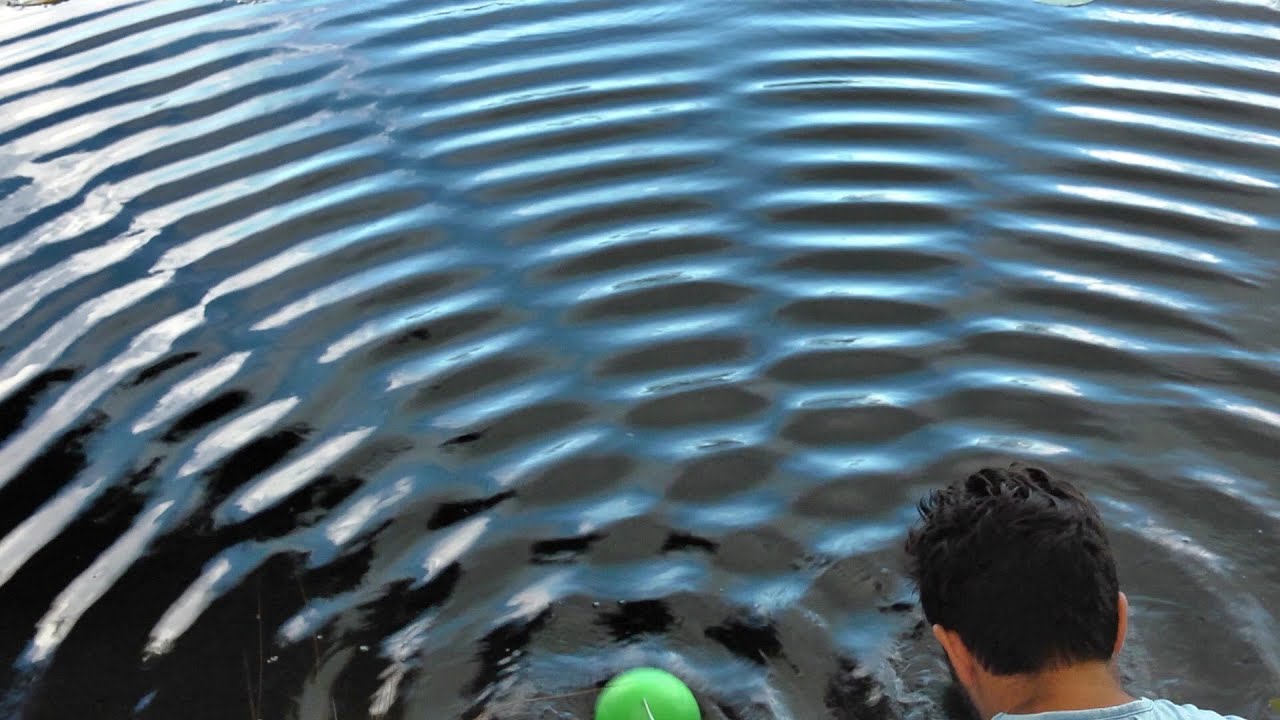
To illustrate how waves behave, Derek shifts to a pond demonstration using mechanical ripple generators: - A single vibrating point source creates concentric, circular wavefronts moving outward. - Adding a second point source creates an interference pattern where the overlapping rings intersect. - Where a crest aligns with a crest (or a trough with a trough), the waves reinforce one another through constructive interference, raising the amplitude. - Where a crest collides with an opposing trough, destructive interference occurs, canceling the motion entirely.
Derek explains to a spectator: “When the light from one slit met up peaks with peaks and troughs with troughs, they constructively interfered and produced a bright spot. But, if the trough from the wave from one slit met up with the peak of the wave from the other slit, they would destructively interfere, and you wouldn't see any light there.” The onlooker likens the effect to two water droplets falling into a swimming pool and creating overlapping ripples.
[05:54](https://www.youtube.com/watch?v=Iuv6hY6zsd0&t=354s) Wavelengths, Colors, and the Final Mystery
Derek addresses the rainbow coloration visible in the outer dots. Natural sunlight is polychromatic, meaning it comprises a spectrum of different wavelengths. Because red light has a longer wavelength than blue light, their constructive interference peaks fall at slightly different physical angles away from the central white spot. This chromatic dispersion generates distinct rainbow edges on the side fringes. A participant realizes that physical color differences—such as a red bin versus a green flowerpot—stem purely from varying wavelengths of light, concluding with a grin, “I have been enlightened, literally.”
Derek closes with a puzzle for the audience: the light on the box floor did not reproduce the elongated geometry of the narrow rectangular slits, but instead manifested as rounded, circular spots. He challenges viewers to explain this phenomenon in the comments, hinting that another video on his channel points toward the answer. Ultimately, the historical outcome was definitive: “So convincing were the results of Young's double slit experiment that the scientific community concluded that light must be a wave, there is no way it could be a particle.”
## Notable quotes > [05:54](https://www.youtube.com/watch?v=Iuv6hY6zsd0&t=354s) So convincing were the results of Young's double slit experiment that the scientific community concluded that light must be a wave, there is no way it could be a particle. — Derek Muller
## Mentioned Thomas Young, Isaac Newton, Christiaan Huygens, Brady Haran, Derek Muller, Opticks, Royal Society, University of Sydney
## Video description Light is so common that we rarely think about what it really is. But just over two hundred years ago, a groundbreaking experiment answered the question that had occupied physicists for centuries. Is light made up of waves or particles?
The experiment was conducted by Thomas Young and is known as Young's Double Slit Experiment. This famous experiment is actually a simplification of a series of experiments on light conducted by Young. In a completely darkened room, Young allowed a thin beam of sunlight to pass through an aperture on his window and onto two narrow, closely spaced openings (the double slit). This sunlight then cast a shadow onto the wall behind the apparatus. Young found that the light diffracted as it passed through the slits, and then interfered with itself, created a series of light and dark spots. Since the sunlight consists of all colours of the rainbow, these colours were also visible in the projected spots. Young concluded that light consist of waves and not particles since only waves were known to diffract and interfere in exactly the manner that light did in his experiment.
The way I have always seen this experiment performed is with a laser and a manufactured double slit but since the experiment was conducted in 1801 I have always thought that it should be possible to recreate the experiment using sunlight and household materials. That is basically what I did here. I will show the interference pattern I observed with my homemade double slit on 2Veritasium but I chose to use a manufactured double slit here to ensure that the pattern was impressive for observers at the beach.
Special thanks to Henry, Brady, and Rupert for their cameos, Glen for filming and Josh for helping create the apparatus. Thanks also to the Royal Society for allowing us to view the original manuscript of Young's lecture and the University of Sydney for lending the double slits.
Music by Kevin Mcleod (incompetech.com) Danse Macabre, Scissors
[Source](https://www.youtube.com/watch?v=Iuv6hY6zsd0)